

FEDERAL COURT OF AUSTRALIA
Australian Corporate Supplies Pty Limited v Arakella Pty Limited ATF GNS Trading Trust [2020] FCA 740
ORDERS
AUSTRALIAN CORPORATE SUPPLIES PTY LIMITED ACN 127 414 626 Plaintiff | ||
AND: | ARAKELLA PTY LIMITED ATF GNS TRADING TRUST ACN 003 907 319 Defendant | |
DATE OF ORDER: | 14 May 2020 |
THE COURT ORDERS THAT:
1. The originating process filed 18 February 2020 is dismissed on the basis that it was not a valid application pursuant to s 459G of the Corporations Act 2001 (Cth).
2. The plaintiff pay the defendant’s costs on an ordinary basis as agreed or assessed.
Note: Entry of orders is dealt with in Rule 39.32 of the Federal Court Rules 2011.
FARRELL J:
1 These are reasons for orders made on 14 May 2020.
2 On 18 February 2020, Australian Corporate Supplies Pty Ltd (ACS) filed an originating process naming Arakella Pty Ltd as trustee for GNS Trading Trust (Arakella) as respondent and an affidavit sworn on that day by Geoffrey Gavan Duffy (Mr Duffy) (First Duffy Affidavit). That day was the twenty-first day after a statutory demand for $256,251.49 dated 20 January 2020 was served on ACS by Arakella on 28 January 2020.
3 The originating process said:
A. DETAILS OF APPLICATION
This application is made under Section 459G of the Corporations Act 2001
On the facts stated in the supporting affidavit, the Applicant claims:
1. An order under section 459H of the Corporations Act 2001 that the Statutory Demand dated 20 January, 2020 served by the respondent on the applicant.
2. Costs
3. Such further order as the Court deems fit.
Date: 18 February, 2020
4 The originating process did not seek to have the statutory demand set aside under s 459J of the Corporations Act 2001 (Cth) on the basis of a defect in the demand.
5 The First Duffy Affidavit said the following:
l. I am the sole Director and Secretary of the applicant and as such have direct involvement in the day to day dealings of the applicant.
2. I am informed and verily believe that the respondent served a Creditor’s Statutory Demand dated 20 January, 2020 on the applicant on 28 January, 2020. a true copy of which is annexed hereto and marked with the [l]etter “A” (the “Statutory Demand”).
3. On 28 January, 2020 I received an email from the applicant’s company accountant, Mr John Watson confirming receipt of the Statutory Demand at the applicants registered address that day, a true copy of which is annexed hereto and marked with the letter “B”.
4. The applicant has been in dispute with the respondent in relation to outstanding invoices since October, 2019.
5. In about October, 2019, employees of the applicant first raised the disputed invoices with the respondent and a series of emails were exchanged between the parties regarding same, a true copy of which is annexed hereto and marked with the letter “C”.
6. This dispute is well known to Mr Paul Yardley, a senior executive employed by the respondent. In about December, 2019 I had a meeting with Mr Yardley when we discussed outstanding credits due to the applicant and the disputed invoices. We agreed on the outstanding credits due to the applicant in a total amount of $80,301.60. These credits are correctly shown in annexure A to the Statutory Demand. However, we did not resolve the disputed invoices and agreed to meet again to reconcile our respective account records. Since this time I have telephoned to speak to Mr Yardley on several occasions to try to arrange the proposed meeting, without success. I have sent and received text messages from Mr Yardley acknowledging my unreturned calls and advising he will telephone me shortly, which he has not done. Annexed hereto and marked with the letter “D”) are true copies of the text messages.
7. On 12 February, 2020 I forwarded a letter via email on behalf of the applicant to the respondent’s solicitor, O’Neill Partners, a true copy of which is annexed hereto and marked with the letter “E”. To the best of my knowledge and belief, each of the facts set out in the letter are true.
8. I am informed and verily believe that on 18 February, 2020 the applicant’s consultants forward via email copies of annexures C and D to this affidavit together with copies of the disputed invoices to O'Neill Partners, requesting that the Statutory Demand be withdrawn, a true copy of which is annexed hereto and marked with the letter “F”.
9. A genuine dispute continues to exist between the respondent and the applicant regarding the amount of debt claimed in the Statutory Demand.
6 A copy of the statutory demand was set out in annexure “A” to the First Duffy Affidavit.
7 The statutory demand stated that ACS owes Arakella the amount of $256,251.60, being the amount of the debt described in the Schedule. The Schedule to the statutory demand provided as follows:
SCHEDULE
Description of the debt | Amount of the debt |
Goods supplied by the Creditor to the Debtor Company. Invoices issued and credits allowed by the Creditor to the Debtor Company between 27 September 2019 and 17 January 2020. A copy of the Statement showing the Invoices issued by the Creditor is attached to this Statutory Demand and marked with the letter “A”. | $256,251.49 |
TOTAL | $256,251.49 |
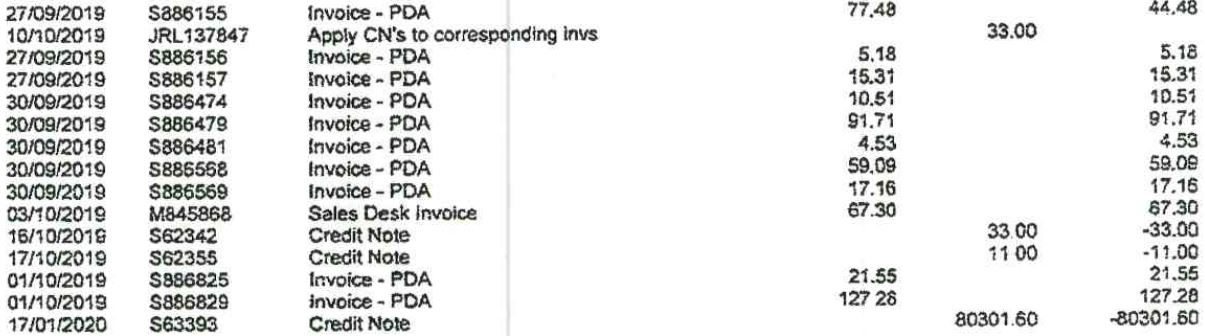
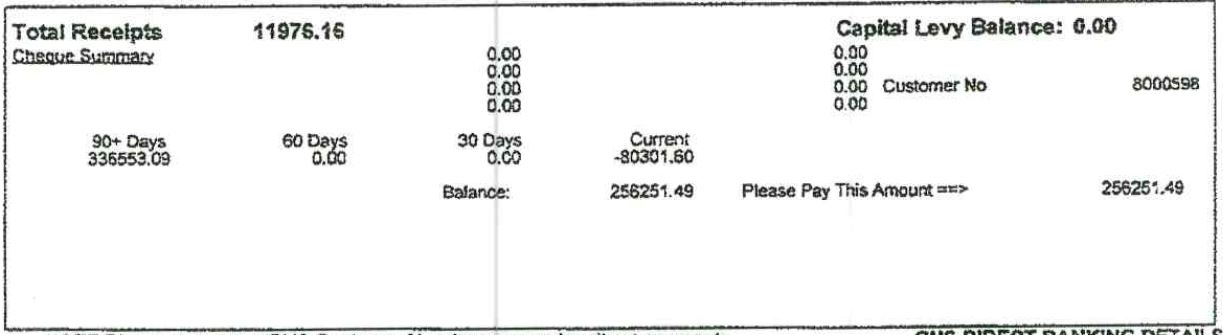
8 The Statement referred to in the Schedule as being attached and marked with the letter “A” was dated Friday, 17 January 2020. Without letterhead or footer, the Statement relevantly said:
9 The statutory demand was verified by an affidavit dated 20 January 2020 and sworn by Mervyn Mahony in which Mr Mahony said:
1. I am a National Credit Manager for the Creditor named in the Statutory Demand, which this affidavit accompanies, relating to the debt owed by Australian Corporate Supplies Pty Ltd Formerly Trading As Office Supplies Australia ACN 127 414 626.
2. I am the person who, on behalf of the Creditor, had the dealings with the Debtor Company that gave rise to the debt and I have inspected the business records of the Creditor in relation to the Debtor Company’s account with the Creditor.
3. The information in this affidavit has been obtained from the account records maintained by the Creditor in the ordinary course of its business.
4. The debt of $256,251.49 mentioned in the Statutory Demand is due and payable by the Debtor Company.
5. I believe that there is no genuine dispute about the existence or amount of the debt.
10 Appendix C to the First Duffy Affidavit contains a listing of 80 invoices and credit notes. Evidence filed by Mr Mahony for Arakella demonstrates that they had a face value of $5,530.76.
11 Annexure D to the First Duffy Affidavit contains text messages between Mr Yardley and Mr Duffy in which Mr Duffy asks Mr Yardley to give him a call and in which Mr Yardley gives various reasons why he was unavailable to take the call at that time. The Court notes that the reason why Mr Duffy was calling Mr Yardley is not identified in these messages.
12 Annexure E to the First Duffy Affidavit contains a letter from Mr Duffy to Arakella’s lawyers (O’Neill Partners) dated 12 February 2020 which says (as written):
Re: AUSTRALIAN CORPORATE SUPPLIES PTY LTD (ACS) ats ARAKELLA PTY LTD ATF GNS Trading trust (GNS)- Creditor's Statutory Demand dated 20 January, 2020.
I refer to the above matter in which you act for the creditor, GNS.
The above Statutory Demand was received on 28 January, 2020.
As your client is well aware, there was and remains a genuine dispute between the parties in relation to the the alleged debt referred to in the Statutory Demand.
This dispute is well known to Mr Paul Yardley, CEO of your clients business. I have had numerous discussions with Mr Yardley regarding the disputed invoices claimed by GNS together with outstanding credits due to ACS, which have not been resolved. In about December, 2019 I had a meeting with Mr Yardley when we discussed the disputed invoices and agreed to meet again to reconcile our respective account records. Since this time I have telephoned to speak to Mr Yardley on several occasions to try to arrange the proposed meeting, without success. I have sent and received text messages from Mr Yardley acknowledging my unreturned calls and advising he will telephone me shortly, which he has not done.
There remains a genuine dispute as to the amount claimed in the Statutory Demand, which was well known to GNS at the time that the above Creditor's Statutory Demand was issued.
Notwithstanding your clients knowledge of the dispute and Mr Yardley's failure to properly deal with ACS to resolve same, GNS have issued and served the above Creditor’s Statutory Demand supported by an Affidavit which states at paragraph 5 “I believe that there is no genuine dispute about the existence or amount of the debt.”· Clearly this is not correct.
I request the abovementioned Creditor's Statutory Demand be withdrawn immediately and you confirm same in writing to me by 5pm Thursday, 13 February 2020. Otherwise, I will instructed our lawyers to commence proceedings to set aside the Statutory Demand.
Subject to confirmation of the immediate withdrawal of the Statutory Demand, I would welcome the opportunity to meet with GNS to resolve the outstanding dispute.
13 Annexure F to the First Duffy Affidavit is an email from Matthew Savage of Savage Business Solutions dated 18 February 2020. It is addressed to a person with an email address at O’Neill Partners. It said:
Please see email trail below between our respective clients regarding the disputed invoices. The disputed invoices are also attached. We also attach copies of text messages between Mr Yardley and Mr Duffy regarding the dispute.
Clear1y the Statutory demand is not validly issued. We again request that you confirm that your client withdraws same immediately. We are currently preparing an application to have the Statutory demand set aside, which will be filed today in the absence of your confirmation of withdrawal.
The invoices referred to in the email were not annexed to Mr Duffy’s email.
14 A number of other affidavits were filed in these proceedings on behalf of both parties. ACS filed the following other ACS affidavits:
(1) Mr Duffy’s affidavit sworn on 3 March 2020 (Second Duffy Affidavit). That affidavit deposed to the service on Mr Duffy by Arakella of proceedings in the District Court of New South Wales claiming from him as guarantor the amount claimed in the statutory demand;
(2) Mr Duffy’s affidavit sworn on 23 March 2020 (Third Duffy Affidavit). In that affidavit Mr Duffy deposed to being unable to identify how the sum of $256,251.49 claimed was calculated having regard to the Schedule to the statutory demand, the Statement annexed to it and the affidavit of Mervyn Mahony which accompanied it. Mr Duffy says that ACS was not provided with a copy of the Statement until 17 January 2020. He says that the Statement does not show that ACS incurred liabilities to Arakella in the sum of $256,251.49 between 27 September 2019 and 17 January 2020 as alleged in the statutory demand. He says that, to the contrary, the Statement confirms that ACS was in credit with Arakella in the net amount of $79,881.50 for that period and a payment of $10,000 made by ACS on 15 January 2020 is not shown on the Statement. The affidavit then deals with evidence concerning the nature of an agreement said to have been entered into between ACS and Arakella in May 2019 (May 2019 agreement). Mr Duffy alleges that Arakella breached the May 2019 agreement by issuing invoices in categories not contemplated by the agreement, including but not limited to charges for freight, failure to price match and failure to pay for existing stock purchased from ACS. Mr Duffy also said that Arakella failed to deliver purchase orders directly to ACS customers, resulting in ACS incurring third party freight charges in the sum of $10,000 per month between May 2019 and January 2020. Mr Duffy also gives evidence responsive to evidence filed by Arakella;
(3) Mr Duffy’s affidavit sworn on 4 May 2020 (Fourth Duffy Affidavit) sets out evidence in reply to evidence given by Mr Mahony in his affidavits dated 3 March 2020 and 9 April 2020;
(4) An affidavit of Michael Ellis sworn on 4 May 2020. Mr Ellis is an accountant formerly employed by ACS. Mr Ellis gave evidence in relation to work undertaken by him in relation to the appropriateness of charges made by Arakella having regard to the May 2019 agreement. He also appeared, at [22] of his affidavit, to raise an off-setting claim of $45,000.
15 Arakella submitted that the First Duffy Affidavit is not a “supporting affidavit” as required by s 459G(3) and raised objections to some or all of the evidence in the other ACS affidavits on the basis of the principles relevant to applications under s 459G in Graywinter Properties Pty Ltd v Gas & Fuel Corp Superannuation Fund [1996] FCA 822; (1996) 70 FCR 452; 21 ACSR 581; 14 ACLC 1703 (Sundberg J) (Graywinter).
16 ACS accepted that the decision in Graywinter is authority for the propositions that:
(1) An affidavit filed within 21 days of the service of the statutory demand must provide support for the orders sought under s 459G. In accordance with terminology used by Arakella, this was referred to as the “Graywinter principle”; and
(2) ACS is not entitled to rely on a ground that is not raised in an affidavit filed within 21 days of the service of the statutory demand. In accordance with terminology used by Arakella relying on Infact Consulting Pty Ltd v Kyle House Pty Ltd [2007] NSWSC 56 (Infact Consulting) at [20] and [23] (White J), this is referred to as the “Graywinter Corollary”. ACS (correctly in the Court’s view) considered the “Graywinter corollary” to fall within what is commonly known as the “Graywinter principle”.
17 Arakella relied on the following discussion of the Graywinter principle in Aussie Hoist Property Pty Ltd v Mulqueen [2018] FCA 1493 (Aussie Hoist) at [47]-[48] (Griffiths J) as follows:
47 In Graywinter Properties Pty Ltd v Gas & Fuel Corporation Superannuation Fund [1996] FCA 822; 70 FCR 452 (Graywinter), Sundberg J summarised the following minimum requirements that had to be satisfied by the supporting affidavit required under s 459G(3)(a) of the Act:
(a) The affidavit must state material facts which show that there is a genuine dispute.
(b) The affidavit need not include, in admissible form, all the evidence that supports the contention of a genuine dispute.
(c) Neither a mere assertion that there is a genuine dispute nor a bare claim that the debt is disputed will suffice.
48 His Honour also held that if the supporting affidavit did not meet the minimum requirements, the Court did not have jurisdiction and this could not be overcome by filing a supplementary affidavit after the 21 day period had expired. Justice Sundberg held, however, that where the minimum requirements had been met, material relied upon in the supporting affidavit could be supplemented by affidavits filed after the 21 day period had expired (but they cannot raise a new ground - see [61] below).
The Court accepts that quote as a summary of the well-established Graywinter principle.
18 In Elevate NSW Pty Ltd v Canada Bay Private Hospital Pty Ltd [2019] FCA 1248; (2019) 138 ACSR 186 (Elevate), Griffiths J made three points about objections based on the decision in Graywinter at [47]-[51] which the Court accepts are relevant to this case:
47 First, Graywinter objections reflect the statutory limits on the Court’s jurisdiction to set aside an offsetting claim. In that vein, it is important to recognise that there is (Financial Solutions Australasia Pty Ltd v Predella Pty Ltd [2002] WASCA 51; 26 WAR 306 at [34]):
“no settled and universal principle, which must be satisfied by an affidavit before it can be accepted as ‘supporting the application’ within the meaning of s 459G(3)(a) and as satisfying the jurisdictional requirement being considered. The statutory yardstick remains that the affidavit should support the application. The precise nature of the application may well influence what this requires”
48 What must be determined to establish the jurisdictional threshold is that the affidavit supports the application, not whether the affidavit in and of itself is sufficient to establish the offsetting claim.
49 Secondly, evidence adduced in an application of this kind, even if some of it would be ordinarily objectionable on the basis of hearsay or opinion (and unable to be relied upon to prove the facts asserted), is admissible to establish facts relevant to whether there is a genuine dispute about indebtedness (Tokich Holdings Pty Ltd v Sheraton Constructions (NSW) Pty Ltd (in liq) [2004] NSWSC 527; 185 FLR 130 at [21]-[23] per White J; John Holland Construction and Engineering Pty Limited v Kilpatrick Green Pty Limited (1994) 14 ACSR 250 at 253). In the present circumstances, Ms McTavish’s evidence as CEO of the plaintiff, is admissible to establish the genuineness of the plaintiff’s belief that there was a plausible contention requiring investigation (Central City Pty Ltd v Montevento Holdings Pty Ltd [2011] WASCA 5; 29 ACLC 11-011 at [25]; Aussie Hoist at [52]).
50 Thirdly, as I said in Aussie Hoist in the passage above, the supporting affidavit “need not include, in admissible form, all the evidence that supports the contention of a genuine dispute”. An affidavit will satisfy the threshold requirements of jurisdiction in s 459G if it contains the material facts showing the existence of a genuine dispute (at [47]).
51 In this case, most of the relevant paragraphs in Ms McTavish’s second affidavit do not seek to establish any material facts that were not raised in the first affidavit. As the plaintiff submitted, the relevant paragraphs are better characterised as further elaboration of the matters already raised in the first affidavit. Thus, even if the material in the first affidavit is not able to prove the facts necessary to make out the contention of an offsetting claim, it is sufficient that the first affidavit states the material facts that the plaintiff relies on to show there is a genuine dispute (MNWA Pty Ltd v Deputy Commissioner of Taxation [2016] FCAFC 154; 250 FCR 381 at [93]-[97]).
19 ACS relied on Elevate at [48]. It also relied on Hansmar Investments Pty Ltd v Perpetual Trustee Co Ltd [2007] NSWSC 103; (2007) 61 ACSR 321 at [28] (White J) for the proposition that a matter will be sufficiently raised in an affidavit supporting an application to set aside a statutory demand if it is raised by necessary inference. The Court accepts that proposition.
20 The Court notes that Part 2 of Sch 12 to the Coronavirus Economic Response Package Omnibus Act 2020 (Cth) commenced on 25 March 2020. The parties did not draw the commencement of that Act to the Court’s attention. However, the Court is satisfied that the introduction of that Act had no effect on the issues which arose for determination, having regard to the fact that the statutory demand was served before 25 March 2020 (so that the “prescribed period” was 21 days after service of the statutory demand) and having regard to the terms of s 1669 of the Corporations Act.
21 Under Part 2 of Sch 12 to the Coronavirus Economic Response Package Omnibus Act:
(1) Sections 459F and 459G were amended to refer to a “statutory period” rather than a period of 21 days (items 22, 23, and 24);
(2) Section 9 of the Corporations Act defined the “statutory period” to be, in effect, 21 days or the “prescribed period” (item 21);
(3) New reg 5.4.01AA was introduced into the Corporations Regulations 2001 (Cth) (item 26). It provided as follows:
5.4.01AA Temporary increase to the statutory minimum and statutory period
(1) For the purposes of paragraph (a) of the definition of statutory minimum in section 9 of the Act, the amount prescribed is $20,000.
(2) For the purposes of paragraph (a) of the definition of statutory period in section 9 of the Act, the period prescribed is 6 months.
(3) This regulation is repealed at the end of the period of 6 months starting on the day this regulation commences.
(4) New Part 10.42 of the Corporations Act was introduced (item 25). It provides as follows:
Part 10.42 Transitional provisions relating to the Coronavirus Economic Response Package Omnibus Act 2020
1669 Application of amendments made by Schedule 12 to the Coronavirus Economic Response Package Omnibus Act 2020
The amendments made by Part 2 of Schedule 12 to the Coronavirus Economic Response Package Omnibus Act 2020 apply to statutory demands that are served on or after the commencement of that Schedule.
22 At the time of the hearing, ss 459C(1)(a), 459F, 459G, 459H(1) and 459J relevantly provided as follows:
459C Presumptions to be made in certain proceedings
(1) This section has effect for the purposes of:
(a) an application under section 234, 459P, 462 or 464; or
(b) an application for leave to make an application under section 459P.
(2) The Court must presume that the company is insolvent if, during or after the 3 months ending on the day when the application was made:
(a) the company failed (as defined by section 459F) to comply with a statutory demand; or
…
459F When company taken to fail to comply with statutory demand
(1) If, as at the end of the period for compliance with a statutory demand, the demand is still in effect and the company has not complied with it, the company is taken to fail to comply with the demand at the end of that period.
(2) The period for compliance with a statutory demand is:
(a) if the company applies in accordance with section 459G for an order setting aside the demand:
(i) if, on hearing the application under section 459G, or on an application by the company under this paragraph, the Court makes an order that extends the period for compliance with the demand—the period specified in the order, or in the last such order, as the case requires, as the period for such compliance; or
(ii) otherwise—the period beginning on the day when the demand is served and ending 7 days after the application under section 459G is finally determined or otherwise disposed of; or
(b) otherwise—the statutory period after the demand is served.
459G Company may apply
(1) A company may apply to the Court for an order setting aside a statutory demand served on the company.
(2) An application may only be made within the statutory period after the demand is so served.
(3) An application is made in accordance with this section only if, within that period:
(a) an affidavit supporting the application is filed with the Court; and
(b) a copy of the application, and a copy of the supporting affidavit, are served on the person who served the demand on the company.
459H Determination of application where there is a dispute or offsetting claim
(1) This section applies where, on an application under section 459G, the Court is satisfied of either or both of the following:
(a) that there is a genuine dispute between the company and the respondent about the existence or amount of a debt to which the demand relates;
(b) that the company has an offsetting claim.
…
459J Setting aside demand on other grounds
(1) On an application under section 459G, the Court may by order set aside the demand if it is satisfied that:
(a) because of a defect in the demand, substantial injustice will be caused unless the demand is set aside; or
(b) there is some other reason why the demand should be set aside.
(2) Except as provided in subsection (1), the Court must not set aside a statutory demand merely because of a defect.
23 The application was set down for hearing on 13 May 2020 on a short timetable on the basis that Arakella claimed that it is necessary to decide this application before 18 May 2020, otherwise Arakella would not have time to serve an application to wind up ACS relying on the presumption in s 459C(2)(a) if it is found that the application was not made under s 459G. If no application under s 459G was made, then the period for compliance with the statutory demand (compliance period) as prescribed by s 459F(2) ended on 18 February 2020. That period is either 21 days after the demand was served or, where an application has been made under s 459G, any period ordered by the Court or otherwise seven days after the application is determined. As the hearing progressed, it became clear that unless this narrow point was determined first, it may not be possible to complete the hearing in time, having regard to the availability of a witness who was required for cross-examination who required medical treatment, the availability of counsel and the Court’s other commitments in the period from 2.00 pm on 13 May and 18 May 2020. Accordingly, argument focused on that narrow point.
24 Arakella said that the end of the compliance period under s 459F(2)(a) fell on 18 May 2020 because of either or both of the following:
(1) The originating process filed on 18 February 2020 was not an application to set aside the statutory demand having regard to the failure to expressly state in it that ACS sought that order. The Court will refer to this ground as the “insufficiency of the originating process ground”.
(2) Because the First Duffy Affidavit was not, applying the Graywinter principle, a “supporting affidavit” within s 459G(3)(a). The Court will refer to this as the “Graywinter principle ground”.
25 In relation to the insufficiency of the originating process ground, Arakella submitted as follows in its written submissions:
2. The application is not an application to set aside the statutory demand at all. Thus, the Court’s jurisdiction is not engaged.
3. The content of the application omits any express reference to setting aside the statutory demand. That is the touchstone of an application permitted by s 459G of Corporations Act 2001 (Cth) (‘the Act’).
4. This is a technical argument, and does not depend upon prejudice to the defendant. The defendant does not suggest prejudice.
5. If the argument is correct, the event provided for in s 459F of the Act has already occurred. No extension of time has occurred by force of s 459F(2)(a) of the Act.
6. This cannot be cured by any amendment to the originating process.
7. If this argument is correct then the Plaintiff’s application fails without more.
26 In his oral submissions, counsel for Arakella emphasised that:
(1) The originating process did not make any express reference to setting aside the statutory demand; and
(2) The words in the chapeau to s 459F(2)(a) being “if the company applies in accordance with section 459G for an order setting aside the demand” require that the application expressly seek an order setting aside the statutory demand. Counsel submitted that s 459G is permissive, but s 459F(2) sets the “compliance period” and that is predicated on an application being made, which should not be a matter of inference.
27 The Court does not accept Arakella’s argument for the following reasons:
(1) Under the heading “details of application”, the originating process states that the application is made under s 459G which authorises only one form of application, that is, for an order setting aside a statutory demand.
(2) The statutory demand is expressly identified as having been dated 20 January 2020 and served by Arakella on ACS.
(3) Paragraph 1 of the originating process expressly claims an order under s 459H. Section 459H only applies where an application has been made under s 459G. It would undoubtedly have been better had paragraph 1 of the originating process ended with the words “be set aside” as was clearly intended. However, the originating process was filed by the director of ACS, who is not a lawyer.
(4) Having regard to the express references to ss 459G and 459H and the identification of the statutory demand, the Court was satisfied that the originating process is properly understood as an application to set aside that statutory demand.
28 In relation to the Graywinter principle ground, Arakella submitted that:
(1) The First Duffy Affidavit is not a “supporting affidavit” sufficient to meet the requirements of s 459G(3)(a). While Mr Duffy asserts that there is a dispute, he does not supply sufficient facts (as opposed to mere assertions) showing that there is a genuine dispute between the parties. There is nothing said in the First Duffy Affidavit which explains the nature of the dispute. The Graywinter principle therefore applies.
(2) Paragraph [4] of the First Duffy Affidavit is a mere assertion.
(3) Paragraph [5] gives evidence that “the disputed invoices” are those referred to in annexure C to the First Duffy Affidavit. That is a listing of invoices with a face value of $5,530.76. Crucially in this context, there is nothing in the body of the affidavit or its annexures which indicates the nature of the dispute concerning those invoices.
(4) As to Paragraph [6] of the First Duffy Affidavit:
(a) The statement that the dispute is well known to Mr Yardley supplies no sufficient facts concerning the nature of the claimed dispute.
(b) What is said to have been discussed at a meeting in December 2019 was “outstanding credits due to the applicant and the disputed invoices”. It is Mr Duffy’s evidence that “[w]e agreed on the outstanding credits due to the applicant in a total amount of $80,301.60. These credits are correctly shown in annexure A to the Statutory Demand”. That would indicate that those matters had been resolved. On a fair reading of the affidavit at [6], “the disputed invoices” which Mr Duffy says were not resolved at the meeting are those referred to at [5], being those invoices listed in annexure C. They are a relatively immaterial amount compared to the amount claimed in the statutory demand and the basis of disputing them is not disclosed.
(5) The letter set out at annexure E to O’Neill Partners does not take the matter any further. It substantially repeats what is said in the First Duffy Affidavit at [6].
29 Counsel for ACS submitted that the material in the First Duffy Affidavit, particularly at [6] but also the material at [4]-[7] and the annexures, put squarely in issue that the invoices referred to in the annexures do not comply with the contractual arrangements between the parties whatever they may be. Counsel says this is so even though the affidavit and annexures do not refer to an arrangement between ACS and Arakella; it arises by reasonable inference. There is evidence in the other ACS affidavits concerning the existence of an arrangement which ACS and Arakella entered into in May 2019 and alleged breaches of that agreement.
30 Counsel for ACS submitted that the First Duffy Affidavit sets out a sufficient basis to meet the requirements of a “supporting affidavit” in accordance with the Graywinter principle. That is because it sets out that there is a dispute, it puts forward invoices (listed in annexure C) in relation to which the dispute arises and, in the nature of ACS’ business, it is reasonably to be inferred that the dispute relates to the contractual terms under which the invoices were purportedly issued. Counsel for ACS submitted that, even if the Court were to find in favour of the objections raised by Arakella to evidence in the other ACS affidavits on the basis of the Graywinter corollary and that would affect the nature of the order the Court would make under s 459H, the Court has jurisdiction to hear the application and time is extended under s 459F. That is so, even though the First Duffy Affidavit does not say in what way Arakella had not complied with the terms of their arrangement.
31 At the conclusion of argument in relation to this issue, counsel for ACS submitted that if the Court found for ACS on the Graywinter principle ground, time continued to run for compliance with the statutory demand under s 459F and the convenience of the witness, counsel and the Court could be accommodated. However, if the Court found against ACS, counsel conceded that ACS must accept that the application failed. The proceeding was stood over until the afternoon of 13 May 2020.
32 The Court was not satisfied that the First Duffy Affidavit is a “supporting affidavit” as required by s 459G(3). That is because there is nothing in the First Duffy Affidavit which indicates the nature of the asserted dispute. The Court was not satisfied that the First Duffy Affidavit provides sufficient facts to raise the inference that the asserted dispute concerning “the disputed invoices” arose out of the contractual arrangements between the parties as opposed to on some other basis. The First Duffy Affidavit does not, therefore, set out the material facts which show that there is a genuine dispute. That is so even though the First Duffy Affidavit attaches evidence of correspondence in October 2019 between the parties which contains a list of disputed invoices to a value of approximately $5,500, states that after the meeting with Mr Yardley in December 2019 the disputed invoices remained to be resolved, and evidence of correspondence with Arakella’s lawyers (set out in annexures E and F).
33 In saying this, the Court notes the following from Graywinter at 459 (emphasis added):
In a s 459H(l)(a) case, the affidavit must in my view disclose facts showing there is a genuine dispute between the parties. A mere assertion that there is a genuine dispute is not enough. Nor is a bare claim that the debt is disputed sufficient. It follows from the fact that the affidavit need not go into evidence, which is the customary function of an affidavit, that it may read like a pleading.
An affidavit which exhibits an exchange of correspondence between the parties or between their solicitors from which it appears that a claim is made and rejected for reasons given can qualify as a supporting affidavit. And an affidavit verifying the pleadings in an action may qualify.
I am thus unable to accept the respondent's submission that the affidavit must contain sufficient material to make out a case under s 459H. In reply, that submission was somewhat retreated from. It was said that the affidavit must, as a minimum, contain a statement of the material facts on which the applicant intends to rely to show a genuine dispute - it might read more like a pleading than a story. That accords with what I consider to be the minimum requirement.
34 In this case, the First Duffy Affidavit deposes to correspondence between the parties and between their solicitors in which the disputed invoices were identified. However, the reason for ACS to dispute the invoices or for Arakella to reject ACS’ claim is nowhere identified in the First Duffy Affidavit. The assertion that Mr Yardley knew the nature of the dispute does not suffice.
35 When the parties were advised of the Court’s view and it enquired if there was any reason why the application should not be dismissed, counsel for ACS sought leave to amend its pleadings to include a claim under s 459J. The claimed defect in the statutory demand concerned the way the Schedule described the debt due (see [7] above). Counsel for ACS submitted that the defect is raised by the First Duffy Affidavit because it is apparent from the face of an annexure to the affidavit and therefore is not precluded by the Graywinter principle, albeit that the defect was not identified by Mr Duffy in the affidavit.
36 ACS submitted that the Statement in annexure A to the Schedule (see [8] above) shows invoices and credit notes for the period from September 2019 to January 2020. The total of the invoices described in the Statement is approximately $497. The total of the credit notes described in the Statement is $80,378.60. The basis for the amount claimed in the statutory demand appears to be the combination of amounts said to be “90+ days” at the bottom of the Statement and the amount due to ACS on the balance of the invoices and credits in the period from September 2019 to January 2020. ACS submitted that even if that is the way in which the amount claimed was calculated, it does not accord with the description of the debt in the statutory demand and no invoices for the period before September 2019 were attached to the statutory demand. ACS says that it is not possible to identify from the statutory demand and its supporting affidavit sworn by Mr Mahony how the sum claimed is calculated. Evidence filed by Arakella indicates that it relies on invoices prior to September 2019 to establish its debt.
37 ACS claimed that substantial injustice arises by reason of the defect because, on receipt of the statutory demand, ACS was not in a position to know exactly the source of the debt it was being asked to pay and in light of the fact that ACS is now precluded from relying on material that puts in issue the accuracy of the invoices issued before September 2019. An amendment that seeks to bring the originating process in line with matters raised in the supporting affidavit is one that is permitted outside the 21 day period.
38 Arakella opposed leave to amend the originating process. Counsel for Arakella submitted that it appears that a forensic decision was made not to make an overt application under s 459J and Arakella’s written submissions made it clear that it did not know whether such an application was being made even though things were said about the statutory demand and its supporting affidavit in ACS’ written submissions. The application to amend was not foreshadowed and before the Court adjourned to consider whether the Graywinter principle applied to the First Duffy Affidavit, its counsel said that if ACS was not successful, then its application would not succeed.
39 In response to the Court’s enquiry as to whether the application to amend the originating process should be understood as, in essence, an application to re-open argument in relation to the application of the Graywinter principle, counsel for ACS submitted that the substantial injustice to his client was the inability to put in issue the invoices that pre-date 27 September 2019. Counsel said that, while it might have been a better choice to run the case in the alternative, that was not done and that is why ACS seeks the Court’s indulgence. Counsel submitted that the issue of substantial injustice in this case can be answered by looking at the defect itself and ACS sought to put in issue a genuine dispute about “the invoices”. The issue is squarely raised in the Third Duffy Affidavit, albeit that that affidavit may not now be relied on.
40 Counsel for Arakella submitted that it can only be a forensic decision to run the case the way ACS did for the First Duffy Affidavit to deal with disputed invoices in the limited way it did. That is underlined by remarks made by counsel for ACS before the Court adjourned to consider the argument with respect to the application of the Graywinter principle. The timing issue which brought forward consideration of whether the First Duffy Affidavit is a “supporting affidavit” remains and if leave were granted, the case would not be free of cross-examination by reason of its re-configuration. Accordingly, Arakella would be exposed to the prejudice of not being able to rely on the statutory demand to found a winding up application if that issue was not resolved in the very limited time-frame available. Counsel for Arakella also submitted that ACS’ application to set aside the statutory demand (and the First Duffy Affidavit) makes no reference to substantial injustice being suffered as a result of any defect in the statutory demand. Reliance on s 459J falls within the Graywinter principle on the authority of Infact Consulting.
41 The Court found that it would be inappropriate to grant leave to amend the originating process to rely on s 459J on the bases that the process under Div 3 of Part 5.4 of the Corporations Act is intended to be a summary process, albeit not an unjust process, and there is nothing in the First Duffy Affidavit which asserts injustice arising out of any defect in the statutory demand. It was necessary for it to do so having regard to the Graywinter principle: see Crystal Point Pty Ltd v Deputy Commissioner of Taxation [2010] QSC 154 at [20] (Martin J) and Re Hopetoun Kambala Investments Pty Ltd [2011] NSWSC 1343 at [34] and [40] (Ward J).
42 The parties brought in proposed short minutes of order. Arakella sought declarations concerning its capacity to apply for winding up based on the presumption in s 459C(2)(a) and having regard to s 459F(2). Arakella had not previously applied for that relief and the Court considered that it was up to Arakella to form its own views as to the impact of the Court’s findings and the orders which it made on 14 May 2020 dismissing ACS’ originating process.
I certify that the preceding forty-two (42) numbered paragraphs are a true copy of the Reasons for Judgment herein of the Honourable Justice Farrell . |
Associate:


