FEDERAL COURT OF AUSTRALIA
Australian Competition and Consumer Commission v STA Travel Pty Ltd [2020] FCA 723
ORDERS
AUSTRALIAN COMPETITION AND CONSUMER COMMISSION Applicant | ||
AND: | STA TRAVEL PTY LTD (ACN 004 801 512) Respondent | |
DATE OF ORDER: |
1. STA Travel Pty Ltd (STA Travel) contravened ss 18(1), 29(1)(g) and 34 of the Australian Consumer Law being Schedule 2 of the Competition and Consumer Act 2010 (Cth) (ACL) by:
(a) publishing an advertisement on pages 8 and 12 of STA Travel ‘Destination’ brochures entitled Africa and the Middle East, Europe, Asia, Australia & New Zealand, North America and Latin America which were available in all STA Travel stores from 2 October 2017 to 1 January 2019 and which contained, under the heading “MULTIFLEX DATE CHANGE PASSES”, statements “Travelling should be about having the freedoms and flexibility to change your plans, which is why you can now make easy prepaid dates changes to your flights without ever paying airline or admin fees”, "With our exclusive MultiFLEX passes, you can now make easy prepaid date changes on the road, without ever paying airline or admin fees", "One change for $49, three changes for $99 and unlimited changes for $149";
(b) publishing an advertisement on page 7 of STA Travel brochures entitled "INDI Tailor Made Travel" which were available in all STA Travel stores and online between at least 21 March 2019 and 9 August 2019 and which contained, under the heading “CHANGING YOUR MIND”, a statement “No fees, no worries. With our exclusive MultiFLEX passes you can now make unlimited date changes to your flights on the road, without ever having to pay the airline or admin fees. One change for $49, three changes for $99 and unlimited changes for $149";
(c) attaching a poster to the back of STA Travel computer screens in stores, facing customers, between 1 June 2017 and 30 June 2017 which contained, under the heading “MULTI FLEX PASS”, a statement “Unlimited date changes for $149”;
(d) attaching a poster to the back of STA Travel computer screens in stores, facing customers, between 1 September 2017 and 30 September 2017 which contained, under the heading “MULTI FLEX PASS”, a statement “Unlimited date changes for $149”;
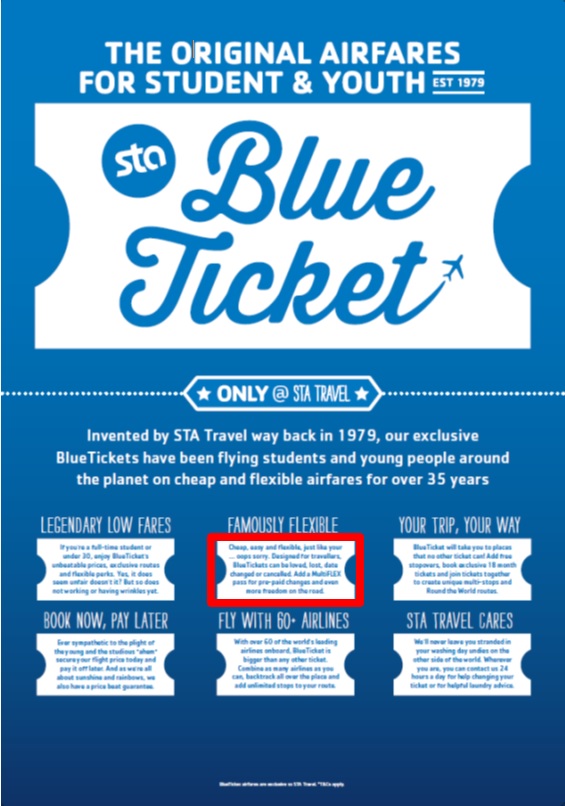
(e) displaying a poster in two STA Travel stores between 24 September 2015 and March 2019 which contained, under the heading “FAMOUSLY FLEXIBLE”, a statement “Add a MultiFLEX pass for pre-paid changes”;
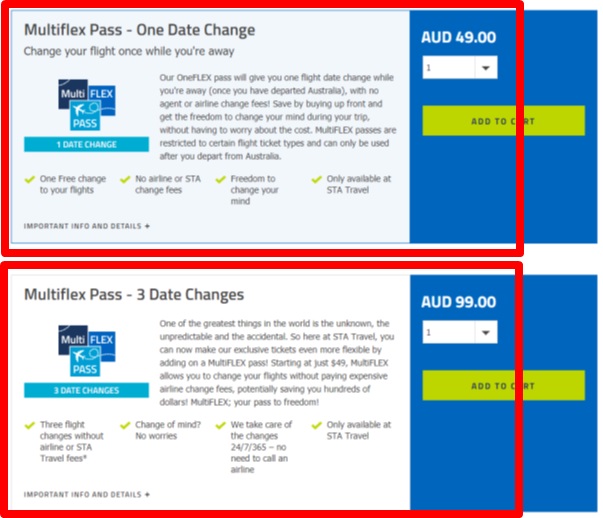
(f) publishing, on the booking page of the STA Travel website for the MultiFLEX pass between 29 July 2016 and the beginning of 2019, statements in respect of the one date change pass "Our OneFLEX pass will give you one flight date change while you’re away (once you have departed Australia), with no agent or airline change fees! Save by buying up front and get the freedom to change your mind during your trip, without having to worry about the cost", “One free change to your flights” and “No airline or STA change fees” and in respect of the three date change pass “Three flight changes without airline or STA Travel fees”;
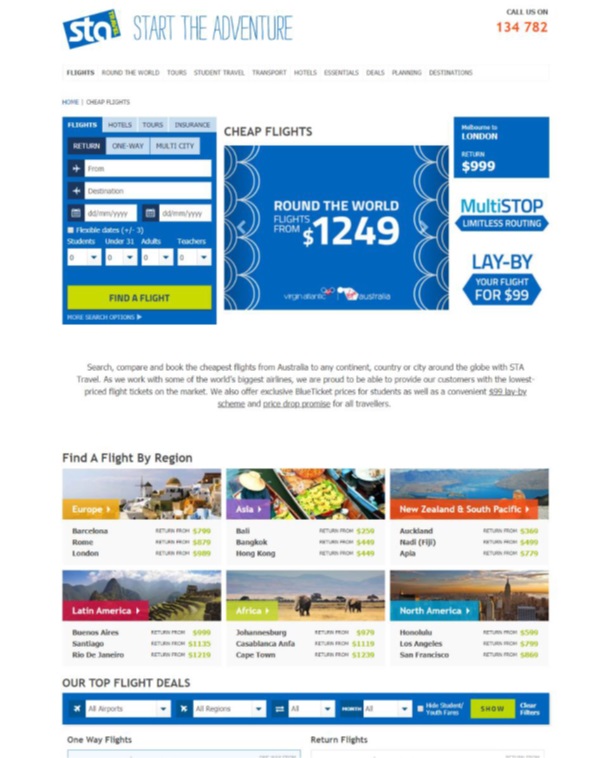
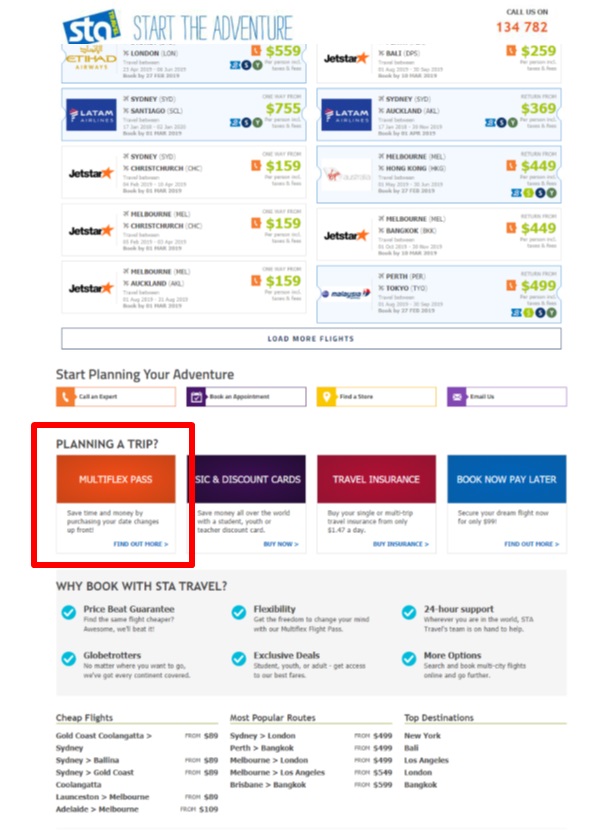
(g) publishing, at 276 separate webpages on the STA Travel website between 14 November 2014 and 12 July 2019, under the heading “MULTIFLEX PASS”, a statement “Save time and money by purchasing your date changes up front!”;
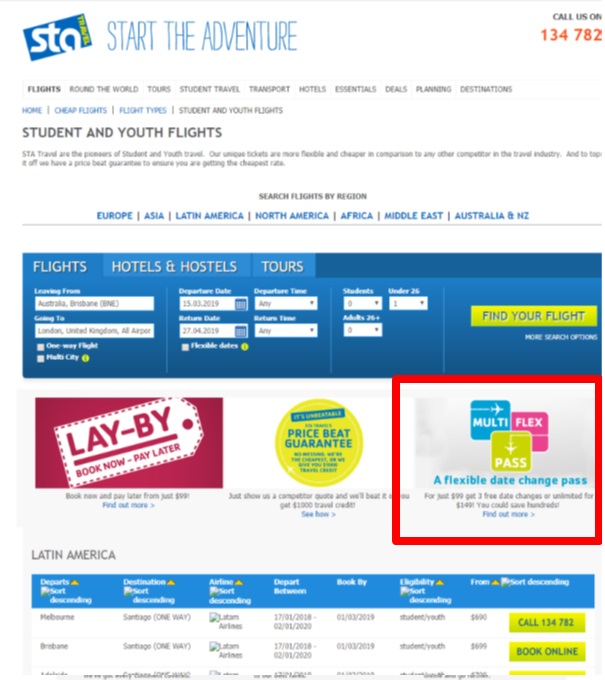
(h) publishing, on a webpage of the STA Travel website titled “Student and Youth Flights” between 19 March 2014 and 27 March 2019, under the heading “MULTIFLEX PASS”, a statement “For just $99 get 3 free date changes or unlimited for $149!”;
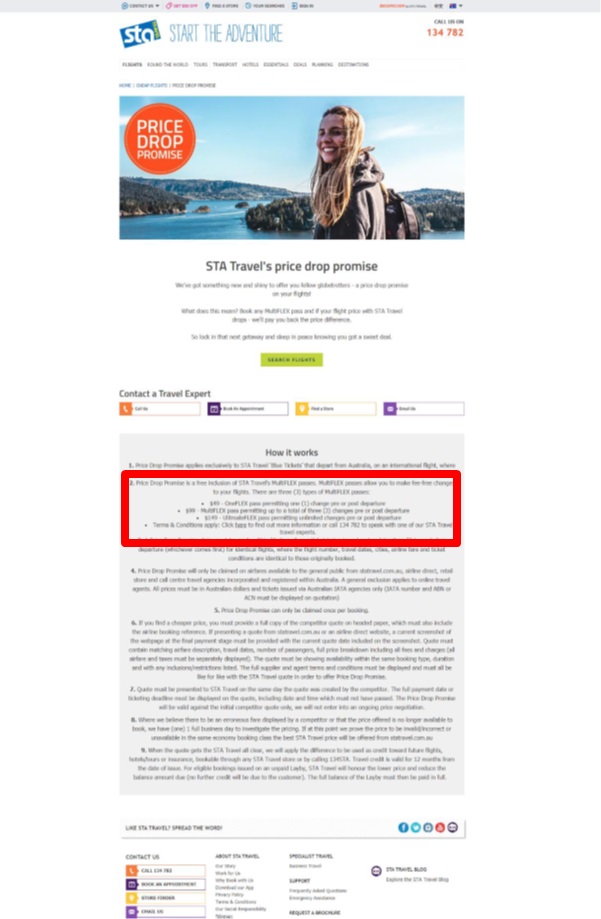
(i) publishing, on a webpage of the STA Travel website titled “STA Travel’s Price Drop Promise” between 6 December 2018 and 4 July 2019, under the heading “How it works”, a statement “MultiFLEX passes allow you to make fee-free changes to your flights. There are three (3) types of MultiFLEX passes: $49 – OneFLEX pass permitting one (1) change pre or post departure; $99 – MultiFLEX pass permitting up to a total of three (3) changes pre or post departure; $149 – UltimateFLEX pass permitting unlimited changes pre or post departure";
(j) publishing, on a webpage of the STA Travel website titled “Travel Essentials” between 18 January 2018 and 16 July 2019, under the heading “Get more flexibility with MultiFLEX”, a statement “Our MultiFLEX pass allows you to save time and money by purchasing your date changes up front allowing you the freedom to change your mind during your trip and save upwards of $100”,
each of which represented to consumers that a customer who purchased a "MultiFLEX" pass and who subsequently made a change to the date of a flight booking would not be charged anything to change the date of the flight booking when in fact STA Travel charged additional charges, including airfares, taxes, margins and various miscellaneous fees to customers using the “MultiFLEX” pass to make a change to the date of a flight booking.
THE COURT ORDERS THAT:
2. Pursuant to s 224 of the ACL, STA Travel pay to the Commonwealth of Australia a pecuniary penalty in the total amount of $14,000,000 in respect of the contraventions referred to in the declaration in paragraph 1 of these orders, of which:
(a) $9,000,000 is to be paid within 10 business days of the date of this Order; and
(b) $5,000,000 is to be paid in five instalments as follows:
(i) $1,000,000 within 1 year of the date of this Order;
(ii) $1,000,000 within 2 years of the date of this Order;
(iii) $1,000,000 within 3 years of the date of this Order;
(iv) $1,000,000 within 4 years of the date of this Order;
(v) $1,000,000 within 5 years of the date of this Order.
3. Pursuant to s 232 of the ACL, STA Travel is restrained for a period of 5 years from the date of this Order from making a representation in an advertisement, on its website or in other promotional material that a customer who purchases a “MultiFLEX” pass and who subsequently makes a change to the date of a flight booking would not be charged anything to change the date of the flight booking when that is not the case.
4. Pursuant to s 247 of the ACL, STA Travel cause to be published in each of its stores for a period of 30 days, at its own expense, within 14 days of each STA Travel store re-opening, a colour copy of a corrective notice in the form set out at Annexure A to these Orders regarding the contraventions of sections 18(1), 29(1)(g) and 34 of the ACL declared by the Court.
5. Pursuant to s 246 of the ACL, within 120 days of the date of this Order, STA Travel must establish at its own expense a Consumer Law Compliance Program which meets the requirements set out in Annexure B to this Order and maintain the compliance program for three years from the date on which it is established.
6. A copy of the reasons for judgment, with the seal of the Court affixed thereon, be retained on the Court file for the purposes of s 137H of the Competition and Consumer Act 2010 (Cth).
7. STA Travel make a contribution to the ACCC's costs in the amount of $200,000 to be paid within 30 days of the date of this Order.
Note: Entry of orders is dealt with in Rule 39.32 of the Federal Court Rules 2011.
ANNEXURE A
CORRECTIVE NOTICE
CORRECTIVE NOTICE ORDERED BY FEDERAL COURT OF AUSTRALIA |
Proposed poster to be displayed in STA Travel stores for a period of 30 days |

An investigation and action by the Australian Competition and Consumer Commission (ACCC) has revealed that STA Travel Pty Ltd (STA Travel) misled consumers in the advertising for its date change pass, known as the “MultiFLEX Pass” between March 2014 to August 2019, in breach of the Australian Consumer Law.
STA Travel’s online, in-store and print marketing represented that the MultiFLEX Pass allowed customers, for an upfront fee, to make date changes to their flights without paying any additional amount. Some advertisements, for example, said that purchasing a MultiFLEX Pass allowed customers to buy date changes ‘upfront’, or to get ‘free’ or ‘fee free’ date changes.
STA Travel admitted that these advertisements were misleading because when customers bought a MultiFLEX Pass and used it to change a flight, STA Travel charged many customers additional amounts, including margins or other fees on top of the difference in airfare charged by the airline and taxes. In some cases, STA Travel charged these amounts even though the airline had not charged STA Travel any additional airfare or tax at all.
STA Travel has taken the following action to fix the problem:
1. Audited all of its MultiFLEX advertisements
2. Removed all misleading MultiFLEX advertisements from publication
3. Updated staff training materials about MultiFLEX
4. Introduced new staff policies
On 23 April 2020, the Federal Court declared that STA Travel made false or misleading representations in advertising the MultiFLEX Pass. The Court approved the settlement reached between the ACCC and STA Travel, and ordered STA Travel to:
1. pay a penalty of $14 million
2. pay an amount towards ACCC’s costs
3. implement a comprehensive Australian Consumer Law compliance program
4. publish this notice.
We from STA Travel are sorry for any inconvenience caused.
This corrective notice has been published by STA Travel pursuant to an order of the Federal Court of Australia in an action commenced by the Australian Competition and Consumer Commission.
ANNEXURE B
CONSUMER LAW COMPLIANCE PROGRAM
STA Travel will establish a Consumer Law Compliance Program (Compliance Program) that complies with each of the following requirements:
Appointments
1 Within three months of the date of the Order, STA Travel will appoint a director or a senior manager with suitable qualifications or experience in corporate compliance as a compliance officer with responsibility for ensuring the Compliance Program is effectively designed, implemented and maintained (the Compliance Officer).
2 Within three months of the date of the Order, STA Travel will appoint a suitably qualified, internal or external, compliance professional with expertise in consumer law (the Compliance Advisor).
3 STA Travel will instruct the Compliance Advisor to conduct a consumer law risk assessment within three months of being appointed as the Compliance Advisor (Risk Assessment).
4 STA Travel will use its best endeavours to ensure that the Risk Assessment covers the following matters, to be recorded in a written report (Risk Assessment Report):
(a) identifies the areas where STA Travel is at risk of breaching sections of the Australian Consumer Law (ACL) which is Schedule 2 of the Competition and Consumer Act 2010 (Cth);
(b) assesses the likelihood of these risks occurring;
(c) identifies where there may be gaps in STA Travel’s existing procedures for managing these risks; and
(d) provides recommendations for any action to be taken by STA Travel having regard to the above assessment.
Compliance Policy
5 STA Travel will, within 30 days of the date of the Order, issue a policy statement outlining STA Travel’s commitment to compliance with the ACL (the Compliance Policy).
6 STA Travel will ensure that the Compliance Policy:
(a) contains a statement of commitment to compliance with the ACL;
(b) contains an outline of how commitment to ACL compliance will be realised within STA Travel;
(c) contains a requirement for all staff to report any Compliance Program related issues and ACL compliance concerns to the Compliance Officer;
(d) contains a guarantee that whistleblowers with consumer law compliance concerns will not be prosecuted or disadvantaged in any way and that their reports will be kept confidential and secure; and
(e) contains a clear statement that STA Travel will take action internally against any persons who are knowingly or recklessly concerned in a contravention of the ACL and will not indemnify them in the event of any court proceedings in respect of that contravention.
Complaints Handling System
7 STA Travel will ensure that the Compliance Program includes a consumer law complaints handling system (the Complaints Handling System).
8 STA Travel will use its best endeavours to ensure this system is consistent with AS/ISO 10002:2006 Customer satisfaction - Guidelines for complaints handling in organizations, tailored as required to STA Travel’s circumstances.
9 STA Travel will ensure that staff and customers are made aware of the Complaints Handling System.
Whistleblower Protection
10 STA Travel will ensure that the Compliance Program includes whistleblower protection mechanisms to protect those coming forward with consumer law complaints.
Staff Training
11 STA Travel will ensure that the Compliance Program provides for regular (at least once a year) training for all directors, officers, employees, representatives and agents of STA Travel, whose duties could result in them being concerned with conduct that may contravene sections 18, 29 or 34 of the ACL.
12 STA Travel must ensure that the training is conducted or designed by a suitably qualified compliance professional or legal practitioner with expertise in consumer law. Training may be conducted electronically via an eLearning module.
13 STA Travel will ensure that the Compliance Program includes a requirement that awareness of consumer law compliance issues forms part of the induction of all new directors, officers, employees, representatives and agents, whose duties could result in them being concerned with conduct that may contravene sections 18, 29 or 34 of the ACL.
Reports to Board/Senior Management
14 STA Travel will ensure that the Compliance Officer reports to the Board and/or senior management every six months on the continuing effectiveness of the Compliance Program.
Compliance Review
15 STA Travel will, at its own expense, cause an annual review of the Compliance Program (the Review) to be carried out in accordance with each of the following requirements:
(a) Scope of Review – the Review should be broad and rigorous enough to provide STA Travel and the ACCC with:
(i) a verification that STA Travel has in place a Compliance Program that complies with each of the requirements detailed in paragraphs 1 – 15 above; and
(ii) Compliance Reports detailed at paragraph 17 below.
(b) Independent Reviewer – STA Travel will ensure that each Review is carried out by a suitably qualified, independent compliance professional with expertise in consumer law (the Reviewer). The Reviewer will qualify as independent on the basis that he or she:
(i) did not design or implement the Compliance Program;
(ii) is not a present or past staff member or director of STA Travel; and
(iii) has no significant shareholding or other interests in STA Travel.
(c) Evidence – STA Travel will use its best endeavours to ensure that each Review is conducted on the basis that the Reviewer has access to all relevant sources of information in STA Travel’s possession or control, including without limitation:
(i) the ability to make enquiries of any officers, employees, representatives and agents of STA Travel;
(ii) documents relating to the Risk Assessment, including the Risk Assessment Report;
(iii) documents relating to STA Travel’s Compliance Program, including documents relevant to STA Travel’s Compliance Policy, Complaints Handling System, Staff Training and induction program; and
(iv) any reports made by the Compliance Officer to the Board or senior management regarding STA Travel’s Compliance Program.
(d) STA Travel will ensure that a Review is completed within one year of this Compliance Program coming into effect, and that a subsequent Review is completed within each year for three years.
Compliance Reports
16 STA Travel will use its best endeavours to ensure that within 30 days of the completion of a Review, the Reviewer includes the following findings of the Review in a report provided to STA Travel, (the Compliance Report):
(a) whether the Compliance Program of STA Travel includes all the elements detailed in paragraphs 1 – 16 above, and if not, what elements need to be included or further developed;
(b) whether the Compliance Program adequately covers the parties and areas identified in the Risk Assessment, and if not, what needs to be further addressed;
(c) whether the Staff Training and induction is effective and if not, what aspects need to be further developed;
(d) whether STA Travel’s Complaints Handling System is effective and if not, what aspects need to be further developed;
(e) whether STA Travel is able to provide confidentiality and security to consumer law whistleblowers, and whether staff are aware of the whistleblower protection mechanisms; and
(f) whether there are any material deficiencies in STA Travel’s Compliance Program, or whether there are or have been any instances of material non-compliance with the Compliance Program, (Material Failure), and if so, recommendations for rectifying the Material Failure/s.1
STA Travel response to Compliance Reports
17 STA Travel will ensure that the Compliance Officer, within 14 days of receiving the Compliance Report:
(a) provides the Compliance Report to the Board or relevant governing body;
(b) where a Material Failure has been identified by the Reviewer in the Compliance Report, provides a report to the Board or relevant governing body identifying how STA Travel can implement any recommendations made by the Reviewer in the Compliance Report to rectify the Material Failure.
18 STA Travel will implement promptly and with due diligence any recommendations made by the Reviewer in the Compliance Report to address a Material Failure.
Reporting Material Failures to the ACCC
19 Where a Material Failure has been identified by the Reviewer in the Compliance Report, STA Travel will:
(a) provide a copy of that Compliance Report to the ACCC within 21 days of the Board or relevant governing body receiving the Compliance Report; and
(b) inform the ACCC of any steps that have been taken to implement the recommendations made by the Reviewer in the Compliance Report; or
(c) otherwise outline the steps STA Travel proposes to take to implement the recommendations and will then inform the ACCC once those steps have been implemented.
Provision of Compliance Program documents to the ACCC
20 STA Travel will maintain a record of and store all documents relating to and constituting the Compliance Program for a period not less than five years – being the number of years compliance training is required and an additional two years following that period.
21 If requested by the ACCC during the period of three years, STA Travel will, at its own expense, cause to be produced and provided to the ACCC copies of all documents constituting the Compliance Program, including:
(a) the Compliance Policy;
(b) an outline of the Complaints Handling System;
(c) Staff Training materials and induction materials;
(d) any Compliance Report identifying a Material Failure that has been completed at the time of the request (as referred to in paragraph 20).
ACCC Recommendations
22 STA Travel will promptly consider any recommendations that the ACCC may make that the ACCC deems reasonably necessary to ensure that STA Travel maintains and continues to implement the Compliance Program in accordance with the requirements of this Compliance Program.
Compliance with Ticket Change Pricing Policy
23 STA Travel will ensure that its travel agents, officers, employees, representatives and agents comply with STA Travel’s Ticket Change Pricing Policy introduced by STA Travel in July 2019 as revised in January 2020 (Ticket Change Policy).
24 STA Travel will ensure that MultiFlex ticket changes are audited at least monthly to ensure compliance with the Ticket Change Policy.
25 Where an audit identifies that a ticket change has not complied with the Ticket Change Policy, resulting in a customer being charged a higher amount than the customer ought to have been charged, STA Travel will refund the customer the difference within 14 days.
26 For the calendar years 2020, 2021 and 2022, at the end of each calendar year, STA Travel will provide a report to the ACCC, outlining STA Travel’s compliance with the Ticket Change Policy, and its compliance with paragraphs 24 to 26 above.
27 STA Travel may amend the Ticket Change Policy from time to time with written consent from the ACCC.
Note: Entry of orders is dealt with in Rule 39.32 of the Federal Court Rules 2011.
O’BRYAN J:
Introduction
1 In this proceeding, the Australian Competition and Consumer Commission (ACCC) alleges that STA Travel Pty Ltd (STA Travel) engaged in conduct in contravention of the Australian Consumer Law, which is Schedule 2 to the Competition and Consumer Act 2010 (Cth) (CCA).
2 At all relevant times, STA Travel has supplied travel and tourism related services to consumers in Australia, emphasising discounts and flexibility and with a marketing focus towards students and young people. It currently has 50 stores in all States and Territories, except Tasmania and the Northern Territory.
3 By its concise statement dated 27 March 2019, the ACCC alleged that, between September 2011 and March 2019, STA Travel made representations about the benefits and characteristics of a product called a “MultiFLEX Pass”. The MultiFLEX Pass was promoted as an upfront purchase of future airline ticket date changes. The ACCC alleged that in advertising and promoting the MultiFLEX Pass, STA Travel represented that:
(a) customers who purchased the MultiFLEX Pass and subsequently made changes to the date of a flight booking would not be charged anything to change the date of their flight (the No Fees Representation); and, or in the alternative,
(b) customers who purchased the MultiFLEX Pass and subsequently made changes to the date of a flight booking would pay no more than the difference in the cost of the airfare charged by the airline, and any necessary taxes (the Fare / Tax Representation).
4 The ACCC alleged that the representations made by STA Travel in respect of the MultiFLEX Pass were false, misleading and deceptive, or likely to mislead or deceive, and liable to mislead the public, in contravention of ss 18(1), 29(1)(g) and 34 of the Australian Consumer Law.
5 The parties have agreed to resolve the proceeding on the following basis:
(a) STA Travel has admitted that the advertisements and promotional materials numbered 6, 7, 8, 9, 11, 14 16, 17, 18 and 22 depicted in the Schedule to these reasons conveyed the No Fees Representations and that in publishing that material it engaged in conduct that:
(i) was misleading or deceptive in breach of s 18 of the Australian Consumer Law;
(ii) falsely represented that the MultiFLEX Pass had particular uses or benefits in contravention of s 29(1)(g) of the Australian Consumer Law; and
(iii) was liable to mislead the public as to the nature and characteristics of the MultiFLEX Pass in contravention of s 34 of the Australian Consumer Law,
and that the No Fees Representation was made between 19 March 2014 and August 2019 (the Relevant Period); and
(b) the ACCC does not press its allegations against STA Travel in relation to the Fare / Tax Representation or in relation to other advertisements and promotional materials referred to in the concise statement.
6 The parties agreed on a form of orders which they seek to be made by the Court comprising:
(a) declarations of contravention of ss 18(1), 29(1)(g) and 34;
(b) a pecuniary penalty of $14 million in respect of the contraventions of ss 29(1)(g) and 34;
(c) an injunction restraining STA Travel from engaging in the contravening conduct in the future;
(d) costs of a fixed amount of $200,000;
(e) an order as to findings of fact; and
(f) the implementation by STA Travel of a compliance program.
7 In support of the proposed orders, the parties filed a statement of agreed facts and admissions (SOAF) for the purposes of section 191 of the Evidence Act 1995 (Cth), a notice to admit and response and a joint outline of submissions.
8 The principles relevant to the making of consent orders such as those proposed in these proceedings were conveniently summarised by Gordon J in Australian Competition and Consumer Commission v Coles Supermarkets [2014] FCA 1405 (ACCC v Coles) at [70]–[73] as follows:
[70] The applicable principles are well established. First, there is a well-recognised public interest in the settlement of cases under the Act: NW Frozen Foods Pty Ltd v Australian Competition & Consumer Commission (1996) 71 FCR 285 at 291. Second, the orders proposed by agreement of the parties must be not contrary to the public interest and at least consistent with it: Australian Competition & Consumer Commission v Real Estate Institute of Western Australia Inc (1999) 161 ALR 79 at [18].
[71] Third, when deciding whether to make orders that are consented to by the parties, the Court must be satisfied that it has the power to make the orders proposed and that the orders are appropriate: Real Estate Institute at [17] and [20] and Australian Competition & Consumer Commission v Virgin Mobile Australia Pty Ltd (No 2) [2002] FCA 1548 at [1]. Parties cannot by consent confer power to make orders that the Court otherwise lacks the power to make: Thomson Australian Holdings Pty Ltd v Trade Practices Commission (1981) 148 CLR 150 at 163.
[72] Fourth, once the Court is satisfied that orders are within power and appropriate, it should exercise a degree of restraint when scrutinising the proposed settlement terms, particularly where both parties are legally represented and able to understand and evaluate the desirability of the settlement: Australian Competition & Consumer Commission v Woolworths (South Australia) Pty Ltd (Trading as Mac’s Liquor) [2003] FCA 530 at [21]; Australian Competition & Consumer Commission v Target Australia Pty Ltd [2001] FCA 1326 at [24]; Real Estate Institute at [20]-[21]; Australian Competition & Consumer Commission v Econovite Pty Ltd [2003] FCA 964 at [11] and [22] and Australian Competition & Consumer Commission v The Construction, Forestry, Mining and Energy Union [2007] FCA 1370 at [4].
[73] Finally, in deciding whether agreed orders conform with legal principle, the Court is entitled to treat the consent of Coles as an admission of all facts necessary or appropriate to the granting of the relief sought against it: Thomson Australian Holdings at 164.
9 Subsequently, in Commonwealth v Director, Fair Work Building Industry Inspectorate (2015) 258 CLR 482 (Commonwealth v Director, FWBII), the majority of the High Court (French CJ, Kiefel, Bell, Nettle and Gordon JJ) observed (at [57]):
… in civil proceedings there is generally very considerable scope for the parties to agree on the facts and upon consequences. There is also very considerable scope for them to agree upon the appropriate remedy and for the court to be persuaded that it is an appropriate remedy. Accordingly, settlements of civil proceedings are commonplace and orders by consent for the payment of damages and other relief are unremarkable. So are court-approved compromises of proceedings on behalf of infants and persons otherwise lacking capacity, court-approved custody and property settlements, court-approved compromises in group proceedings and court-approved schemes of arrangement. More generally, it is entirely consistent with the nature of civil proceedings for a court to make orders by consent and to approve a compromise of proceedings on terms proposed by the parties, provided the court is persuaded that what is proposed is appropriate.
10 At a hearing conducted on 23 April 2020, I made orders largely in the form sought jointly by the parties. In my view, the orders proposed by the parties were appropriate, within the Court’s power and consistent with, and not contrary to, the public interest. These are my reasons for making those orders.
The conduct of STA Travel
11 As noted above, at all relevant times STA Travel has supplied travel and tourism related services to consumers in Australia. STA Travel is a subsidiary of the STA Travel Group, which is owned by DK Travel Holding Ltd. STA Travel’s approximate market share, based on the number of passengers departing Australia, is 1%.
12 The MultiFLEX Passes were introduced in or around September 2011. If a customer sought to change a flight without a MultiFLEX Pass, the customer would be required to pay an STA Travel change fee, which ranged over the period from $60 to $100 per change and, where applicable, the airline change fee, which in some cases was several hundred dollars per change. MultiFLEX Passes permitted the customer to change the date, route, destination, class or airline (subject to ticket or fare rules). The change could occur when the customer was part way through their journey.
13 Between September 2011 and at least August 2019, STA Travel sold a range of MultiFLEX Passes, namely:
(a) the “ONEFlex Pass”, costing $49 and allowing one flight date change;
(b) the “3 Change Pass” or “Multiflex Pass”, costing $99 and allowing three flight date changes; and
(c) the “Unlimited” or “Ultimate” Change Pass costing $149 and allowing unlimited flight date changes,
each of which is referred to herein as a MultiFLEX Pass.
14 Until approximately January 2019, the MultiFLEX Passes were only available on international flights booked with a “SATA” ticket. SATA tickets were supplied only by STA Travel. SATA tickets are negotiated tickets which STA Travel purchases from an airline and which typically do not have a set margin. The amount of margin (if any) charged to a customer by STA Travel is determined by the individual travel agent usually with reference to the price for such a flight then available in the market. When STA Travel supplies an SATA ticket, it assumes some of the airline’s usual administrative responsibilities associated with issuing, cancelling and changing the date of a flight booking.
15 Until 14 December 2011, STA Travel sold MultiFLEX Passes in store and via telephone only. From 15 December 2011 to August 2019, MultiFLEX Passes were sold by STA Travel through stores, via telephone and online from STA Travel's website. Between March 2013 and October 2019, approximately 85% of MultiFlex Passes were sold through an STA Travel store and a further 8.8% of MultiFlex Passes were sold to customers via telephone, email or an online chat service. Approximately 6.6% of MultiFlex Passes were sold through online sales.
16 During the period 2015 to 2019, STA Travel generated, on average, approximately $1.6 million per annum in revenue from the sale of the MultiFLEX Pass being, on average, approximately 4.5% of STA Travel’s annual total revenue. STA Travel had a conversion target of 40% for MultiFLEX Passes – meaning that it sought to sell MultiFLEX Passes on at least 40% of all sales of SATA flights.
17 Throughout the Relevant Period, it was STA Travel’s policy and practice to charge customers who had purchased a MultiFLEX Pass and who sought to make a flight change the following amounts:
(a) the difference in the cost of the airfare as charged by the airline (if any);
(b) a margin charged by STA Travel on the transaction, the amount of which varied and was determined in the discretion of the individual travel agent; and
(c) any applicable taxes,
but not “change fees” that might otherwise be charged by STA Travel or the airline.
18 STA Travel management, at the highest level, was aware that it was STA Travel’s policy and practice to impose those charges on customers who held a MultiFLEX Pass and who sought to make a flight change.
19 In sample periods chosen by the parties for the purposes of discovery, being two months of each calendar year between 2015 and 2019, STA Travel imposed charges on customers for making flight changes using a MultiFLEX Pass, contrary to the No Fees Representation, in approximately 65% of instances (3,831 instances in total). STA Travel did not charge customers anything to make a flight change using a MultiFLEX Pass, or provided customers with a refund, in approximately 35% of instances from the sample periods (2,071 instances).
20 The parties have agreed that the advertisements and promotional materials numbered 6, 7, 8, 9, 11, 14 16, 17, 18 and 22 which are depicted in the Schedule to these reasons incorrectly conveyed a representation that a customer who purchased a MultiFLEX Pass and subsequently made changes to the date of a flight booking would not be charged anything for the change. The representation was incorrect because STA Travel’s policy and practice was to impose various charges on customers making a flight date change.
21 The advertisements for the MultiFLEX Pass were approved by STA Travel’s Head of Product and Marketing, who was part of STA Travel’s senior leadership team, which is one level below the senior management team.
22 The following is a description of each of the advertisements and promotional materials:
(a) Advertisement 6 was published on pages 8 and 12 of STA Travel “Destination” brochures titled Africa and the Middle East, Europe, Asia, Australia & New Zealand, North America and Latin America. The brochures were available in all STA Travel stores from 2 October 2017 to 1 January 2019. The advertisement stated that date changes are “prepaid”; that the customer would not “ever pay airline or admin fees…”; and that the customer could receive one, three or unlimited changes for the relevant price of the MultiFLEX Pass ($49, $99 or $149). While the advertisement highlighted two kinds of fees waived by the MultiFLEX Pass, it did not suggest that those were the only charges waived and instead represented that there were no fees payable.
(b) Advertisement 7 was published on page 7 of an STA Travel brochure titled "INDI Tailor Made Travel" available in all STA Travel stores and online between at least 21 March 2019 and 9 August 2019 (being a date after the commencement of proceedings by the ACCC). The advertisement was in substantially the same terms as Advertisement 6, emphasising that customers with a MultiFLEX Pass can “make unlimited date changes” on the road. It stated that a customer can make the change of date if they have purchased the relevant MultiFLEX Pass. There was no qualification to that general representation.
(c) Advertisement 8 comprised a printed poster attached to the back of STA Travel computer screens in stores, facing customers, between 1 June 2017 and 30 June 2017. The poster emphasised that customers would get unlimited date changes in exchange for payment of $149.
(d) Advertisement 9 also comprised a printed poster attached to the back of STA Travel computer screens, facing customers, between 1 September 2017 and 30 September 2017. It was in a similar form to advertisement 8. It stated that customers would receive unlimited date changes for $149.
(e) Advertisement 11 was part of a poster displayed in two STA Travel stores between 24 September 2015 and March 2019. The posted represented to customers that they could add a MultiFLEX Pass for “pre-paid changes" and “even more freedom on the road”.
(f) Advertisement 14 is a page from STA Travel's website which permitted the customer to purchase the MultiFLEX Pass online. The webpage was published between 29 July 2016 and the beginning of 2019 and was displayed as a pop-up each time a person sought to purchase a SATA flight through the STA Travel website. The webpage stated that the customer was “buying up-front”, which conveyed that relevant changes were paid for in advance. In respect of the “One Date Change” Pass, the webpage stated that the holder was entitled to “One Free change to your flights”, conveying that consumers would not have to pay anything other than the cost of the MultiFLEX Pass to change their flight. The webpage also stated that the customer has the “freedom to change your mind during your trip, without having to worry about the cost,” which also conveyed to the customer that they would not have to worry about any costs after purchasing the MultiFLEX Pass. While customers could expand the "important info and details" section which provided further information about charges, there was no requirement that they do so in order to complete the purchase.
(g) Advertisement 16 is a copy of a page published on 276 separate webpages on the STA Travel website between 14 November 2014 and 12 July 2019 (being a date after the commencement of proceedings by the ACCC), with each page promoting cheap flights to different destinations. The banner stated that a customer could “Save time and money by purchasing your date changes up front!”, conveying that no further cost would be incurred to make date changes after a MultiFLEX Pass was purchased.
(h) Advertisement 17 is a page published on STA Travel’s website between 19 March 2014 and 27 March 2019 (being a date after the commencement of proceedings by the ACCC). It included a banner advertisement that prominently promoted the MultiFLEX Pass, telling customers that for $99 they “…get 3 free date changes” or “unlimited [changes] for $149”, conveying that the changes were paid for and there would be nothing further to pay if the customer required a date change.
(i) Advertisement 18 was an online advertisement published on the STA Travel website between 6 December 2018 and 4 July 2019 (being a date after the commencement of proceedings by the ACCC). It stated that a MultiFLEX Pass allowed a customer “…to make fee-free changes to your flights…”. There was no indication (either express or implied) that a customer would have to pay any additional amount beyond the cost of the MultiFLEX Pass for flight date changes.
(j) Advertisement 22 was an online advertisement published on the STA Travel website between at least 18 January 2018 and 16 July 2019 (being a date after the commencement of proceedings by the ACCC). It promoted the MultiFLEX Pass as a facility that allowed the customer to purchase their date changes “up front” – a statement which conveyed that any flight changes were already purchased and paid for by the customer by buying the MultiFLEX Pass.
Declarations
23 The orders proposed by the parties included declarations of contravention. The relevant principles relating to declaratory orders in the context of regulatory proceedings were summarised by Gordon J in ACCC v Coles as follows:
[74] The Court has a wide discretionary power to make declarations under s 21 of the Federal Court Act: Forster v Jododex Australia Pty Ltd (1972) 127 CLR 421 at 437-8; Ainsworth v Criminal Justice Commission (1992) 175 CLR 564 at 581-2 and Tobacco Institute of Australia Ltd v Australian Federation of Consumer Organisations Inc (No 2) (1993) 41 FCR 89 at 99.
[75] Where a declaration is sought with the consent of the parties, the Court’s discretion is not supplanted, but nor will the Court refuse to give effect to terms of settlement by refusing to make orders where they are within the Court’s jurisdiction and are otherwise unobjectionable: see, for example, Econovite at [11].
[76] However, before making declarations, three requirements should be satisfied:
(1) The question must be a real and not a hypothetical or theoretical one;
(2) The applicant must have a real interest in raising it; and
(3) There must be a proper contradictor.
24 I am satisfied that it is appropriate to make declaratory orders. However, I am not prepared to make declarations in the form originally sought by the parties, which annexed each of the infringing advertisements to a generic declaration. As stated by the High Court in Rural Press Ltd v Australian Competition and Consumer Commission (2003) 216 CLR 53 at [89] in a similar context, a declaration that a person has contravened a statutory prohibition should indicate the gist of the findings that identify the contravention. Declarations must be “informative as to the basis on which the Court declares that a contravention has occurred” and “should contain appropriate and adequate particulars of how and why the impugned conduct is a contravention of the Act”: Australian Competition and Consumer Commission v EnergyAustralia Pty Ltd [2015] FCA 274 per Gordon J (at [83]). The declaration should accurately reflect the contravening conduct in a concise way: Australian Competition and Consumer Commission v Danoz Direct Pty Ltd (2003) 60 IPR 296 per Dowsett J at [260].
25 I consider that the declarations that have been made identify the statements in the advertising and promotional materials that infringed the Australian Consumer Law and the basis for the findings of infringement in a concise way.
Pecuniary penalties
26 The orders proposed by the parties contemplate the imposition of a total pecuniary penalty of $14 million pursuant to s 224 of the Australian Consumer Law. In Commonwealth v Director, FWBII, the plurality of the High Court stated, in relation to civil penalties jointly proposed by the parties to the Court in settlement of a proceeding, that:
[48]…the court is not bound by the figure suggested by the parties. The court asks “whether their proposal can be accepted as fixing an appropriate amount” and for that purpose the court must satisfy itself that the submitted penalty is appropriate.
…
[58]… Subject to the court being sufficiently persuaded of the accuracy of the parties' agreement as to facts and consequences, and that the penalty which the parties propose is an appropriate remedy in the circumstances thus revealed, it is consistent with principle and, for the reasons identified in Allied Mills, highly desirable in practice for the court to accept the parties' proposal and therefore impose the proposed penalty.
27 Accordingly, it is necessary to consider whether the penalty proposed by the parties is appropriate having regard to the admitted contraventions of the Australian Consumer Law and other relevant agreed facts.
Relevant statutory provisions and legal principles
28 Relevantly, s 224(1)(a) of the Australian Consumer Law provides that, if a court is satisfied that a person has contravened a provision of Part 3-1 (which includes ss 29(1)(g) and 34), the court may order the person to pay to the Commonwealth such pecuniary penalty, in respect of each act or omission by the person to which this section applies, as the court determines to be appropriate.
29 Subsection 224(2) provides that, in determining the appropriate pecuniary penalty, the court must have regard to all relevant matters including:
(a) the nature and extent of the act or omission and of any loss or damage suffered as a result of the act or omission; and
(b) the circumstances in which the act or omission took place; and
(c) whether the person has previously been found by a court in proceedings under Chapter 4 or this Part to have engaged in any similar conduct.
30 Subsection 224(3) specifies the maximum penalty that may be imposed by the Court for each act or omission to which s 224(1) applies. A different maximum penalty applied during the Relevant Period in which the contraventions occurred:
(a) before 1 September 2018, the maximum penalty for each act or omission that contravened ss 29(1)(g) and 34 was an amount of $1.1 million; and
(b) from 1 September 2018, the maximum penalty for each act or omission that contravened ss 29(1)(g) and 34 was the greater of:
(i) $10 million;
(ii) if the court can determine the value of the benefit that the contravening corporation obtained directly or indirectly and that is reasonably attributable to the act or omission, three times the value of the benefit; and
(iii) if the court cannot determine the value of that benefit, 10% of the annual turnover of the contravening corporation.
31 Subsection 224(4) provides that, if conduct constitutes a contravention of two or more provisions referred to in s 224(1)(a), a person is not liable for more than one pecuniary penalty in respect of the same conduct.
32 A number of matters can be noted about the relevant statutory provisions.
33 First, the penalty to be imposed is a penalty that the Court considers appropriate, subject to the maximum specified by the statute.
34 Second, the Court may impose a penalty in respect of each act or omission that constitutes a contravention of the Australian Consumer Law, subject to the maximum penalty which is stated to apply to each act or omission. In the case of contraventions of Part 3-1 of the Australian Consumer Law involving a misleading statement in advertising or promotional material which is published or disseminated widely, including particularly over the internet, the number of acts constituting a contravention of the Australian Consumer Law may be very large and may not be able to be calculated. That is because a contravention occurs each time the misleading statement is communicated to a consumer, which occurs every time a consumer reads the infringing advertisement or promotional material whether in a retail store, in a brochure or on a webpage: Australian Competition and Consumer Commission v Hillside (Australia New Media) Pty Ltd trading as Bet365 (No 2) [2016] FCA 698 at [12]-[18]; Australian Competition and Consumer Commission v Reckitt Benckiser (Australia) Pty Ltd (2016) 340 ALR 25 (Reckitt Benckiser) at [3].
35 Third, in considering the sufficiency of a proposed civil penalty, regard must ordinarily be had to the maximum penalty for the reasons stated (in a criminal sentencing context) in Markarian v The Queen (2005) 228 CLR 357 at [31]: first, because the legislature has legislated for them; secondly, because they invite comparison between the worst possible case and the case before the court at the time; and thirdly, because in that regard they do provide, taken and balanced with all other relevant factors, a yardstick. However, as stated by the Full Federal Court in Reckitt Benckiser at [156], care must be taken to ensure that the maximum penalty is not applied mechanically, instead of it being treated as one of a number of relevant factors, albeit an important one. In that case, the Full Court observed (at [157]) that the theoretical maximum penalty on the facts of that case was in the trillions of dollars (some 5.9 million contraventions at $1.1 million per contravention) and that it followed that the assessment of the appropriate range for penalty in the circumstances of that case was best assessed by reference to other factors, as there was no meaningful overall maximum penalty given the very large number of contraventions over a long period of time.
36 In determining the appropriate penalty for a multiplicity of civil penalty contraventions, the Court may have regard to two common law principles that originate in criminal sentencing: the “course of conduct” principle and the “totality” principle: Australian Competition and Consumer Commission v Yazaki Corporation (2018) 262 FCR 243 (Yazaki Corporation) at [226]. Under the “course of conduct” principle, the Court considers whether the contravening acts or omissions arise out of the same course of conduct or the one transaction, to determine whether it is appropriate that a “concurrent” or single penalty should be imposed for the contraventions: Yazaki Corporation at [234]. The principle guards against the risk that the respondent is “doubly punished” in respect of multiple contravening acts or omissions that should be evaluated, for the purposes of assessing an appropriate penalty, as a lesser number of acts of wrongdoing: Construction, Forestry, Mining and Energy Union v Cahill (2010) 269 ALR 1 at [39], per Middleton and Gordon JJ. However, as noted by the Full Court in Yazaki Corporation (at [227]), it is not appropriate or permissible to treat multiple contravening acts or omissions as just one contravention for the purposes of determining the maximum limit dictated by the relevant legislation. Accordingly, the maximum penalty for the course of conduct is not restricted to the prescribed statutory maximum penalty for each contravening act or omission: Reckitt Benckiser at [29]; Yazaki Corporation at [229]-[235]. The “totality” principle operates as a “final check” to ensure that the penalties to be imposed on a wrongdoer, considered as a whole, are just and appropriate and that the total penalty for related offences does not exceed what is proper for the entire contravening conduct in question: Trade Practices Commission v TNT Australia Pty Ltd (1995) ATPR 41-375; Australian Competition and Consumer Commission v Australian Safeway Stores Pty Ltd (1997) 145 ALR 36 at 53 per Goldberg J; ACCC v Coles at [132].
37 Fourth, subsection 224(2) requires the Court to take into account four specific matters and all other relevant matters. The four specific matters are: (i) the nature and extent of the act or omission; (ii) any loss or damage suffered as a result of the act or omission; (iii) the circumstances in which the act or omission took place; and (iv) whether the person has previously been found by a court in proceedings under Chapter 4 or Part 5-2 of the Australian Consumer Law to have engaged in any similar conduct. In Trade Practices Commission v CSR Limited (1991) ATPR 41-076, in the context of a contravention of provisions of Part IV of the Act, French J listed a number of matters potentially relevant to the assessment of penalty under the equivalent s 76 of the Act. Those factors have been referred to on many occasions in the assessment of penalties under both s 76 of the Act and s 224 of the Australian Consumer Law and have become known as the ‘French factors’. They are:
(a) the size of the contravening company;
(b) the deliberateness of the contravention and the period over which it extended;
(c) whether the contravention arose out of the conduct of senior management or at a lower level;
(d) whether the company has a corporate culture conducive to compliance with the Act as evidenced by educational programs and disciplinary or other corrective measures in response to an acknowledged contravention;
(e) whether the company has shown a disposition to cooperate with the authorities responsible for the enforcement of the Act in relation to the contravention;
(f) whether the contravener has engaged in similar conduct in the past;
(g) the financial position of the contravener; and
(h) whether the contravening conduct was systematic, deliberate or covert (i.e. private).
38 The French factors are neither exhaustive of potentially relevant matters to be considered nor “a rigid catalogue or checklist of matters to be applied in each case”: Australian Building and Construction Commissioner v Construction, Forestry, Mining and Energy Union (2017) 254 FCR 68 at [101].
39 Fifth, the principal object of imposing a pecuniary penalty is deterrence; both the need to deter repetition of the contravening conduct by the contravener (specific deterrence) and to deter others who might be tempted to engage in similar contraventions (general deterrence): Australian Competition and Consumer Commission v TPG Internet Pty Ltd (2013) 250 CLR 640 at [65] per French CJ, Crennan, Bell and Keane JJ; Commonwealth v Director, FWBII at [55] per French CJ, Kiefel, Bell, Nettle and Gordon JJ and [110] per Keane J.
40 Sixth, in common with criminal sentencing, determining a civil penalty usually involves multi-factorial decision-making, identifying and balancing all the factors relevant to the contravention, and where the result is arrived at by a process of “instinctive synthesis” of the relevant factors: Reckitt Benckiser at [44].
Consideration of the proposed penalty
41 In my view, the following factors which were referred to by the parties in their joint submissions are relevant to the assessment of penalty in this case.
42 STA Travel is a significant business. It currently has 50 physical stores (down from 74 stores in September 2011) and has stores in all States and Territories except Tasmania and the Northern Territory. Between 2011 and 2016, STA Travel employed approximately 450 staff. STA Travel currently employs between approximately 320 and 340 staff. STA Travel’s operating revenue for the 2017, 2018 and 2019 financial years ranged between approximately $34.5 million and $42 million per annum. It has recorded a net loss for each of the 2017, 2018 and 2019 financial years, ranging between approximately $6 million and $10.5 million. While STA Travel holds only 1% of market share based on the number of passengers departing Australia, it is a significant company, with a particular presence in the youth travel market.
43 STA Travel’s policy throughout the Relevant Period was that it would charge customers seeking to use a MultiFLEX Pass the difference in airfare and taxes, with the airfare including a margin for STA Travel. This policy was inconsistent with the messages conveyed by the infringing advertisements and promotional materials.
44 The table below details the periods during which each of the infringing advertisements and promotional materials was published:
Advertisement | Date of first publication | Date Removed |
6 | 2 October 2017 | 1 January 2019 |
7 | 21 March 2019 | 9 August 2019 |
8 | 1 June 2017 | 30 June 2017 |
9 | 1 September 2017 | 30 September 2017 |
11 | 24 September 2015 | March 2019 |
14 | 29 July 2016 | Beginning of 2019 |
16 | 14 November 2014 | 12 July 2019 |
17 | 19 March 2014 | 27 March 2019 |
18 | 6 December 2018 | 4 July 2019 |
22 | 18 January 2018 | 16 July 2019 |
45 As can be seen from the above table, the relevant conduct commenced in March 2014 and continued until 9 August 2019, after the date on which the ACCC commenced this proceeding. Further, advertisements 7 and 18 were published for the first time after the ACCC had raised its concerns with STA Travel. STA Travel failed to act in a timely way to remove advertisements which it now concedes were misleading or deceptive.
46 In the present case, it is difficult to identify the number of contraventions. The admitted contraventions involved 10 different advertisements and promotional materials published via different media including brochures available, and posters published, in STA Travel retail stores and statements appearing on STA Travel’s website. Advertisement 14 appeared as a pop-up offering the MultiFLEX Pass every time a consumer took steps to purchase a SATA fare on the STA Travel website. In relation to the advertisements published in STA Travel stores, a customer’s exposure to the advertisements would likely have been at the time that they were speaking with an individual travel agent. Approximately 85% of MultiFlex Passes were sold in an STA Travel store. Approximately 6.6% of Multiflex Passes were sold online.
47 The advertising and promotional materials, and the representations conveyed by the materials, reached an indeterminate audience. While the precise number of contraventions of ss 29(1)(g) and 34 that occurred during the Relevant Period cannot be ascertained, it is likely to be very large. Together, the advertisements and promotional materials conveying the No Fees Representations ran for over six years and were likely to have been viewed by consumers thousands of times.
48 There are at least ten different courses of conduct, arising from the ten different advertisements, each of which contained different content when advertising the MultiFLEX Pass and were published over differing time periods. Eight of the ten advertisements were published at least in part in the period after 1 September 2018 when the maximum penalty for each contravening act or omission increased from $1.1 million to $10 million.
49 During the period 2015 to 2019, STA Travel generated, on average, approximately $1.6 million per annum in revenue from the sale of the MultiFLEX Pass being, on average, approximately 4.5% of STA Travel’s annual total revenue.
50 The loss or damage to consumers from the contravening conduct included the following charges that were often imposed on consumers when using their MultiFLEX Pass to change a flight: the difference in airfare (including a margin for STA Travel), any additional taxes and, in some cases, other miscellaneous fees charged by STA Travel. With respect to STA Travel’s margin component, it is relevant that:
(a) in 12% of all instances in the sample periods of discovery, an additional margin was charged by STA Travel even though the airline itself had not charged customers any amount for the change; and
(b) in 23% of all instances in the sample periods of discovery, the additional margin charged by STA Travel exceeded the amount of the additional airfare.
51 The advertisements were approved by STA Travel’s Head of Product and Marketing. The Head of Product and Marketing is a member of STA Travel’s senior leadership team, which sits under the management team. Despite high level approval, the advertisements were published without any apparent mechanisms for review, and without any Australian Consumer Law compliance checking.
52 STA Travel had no process in place to vet advertisements for Australian Consumer Law compliance, and did not audit the operation of the MultiFLEX Pass itself until 2016. When it did carry out a review, it identified internal non-compliances where travel agents were manipulating internal records to increase commission payments. It addressed this behaviour by amending its commission schemes and sending policy reminders to staff; however, it did not investigate the product as a whole.
53 While STA Travel had an Australian Consumer Law compliance program in place during the Relevant Period, it was not effective to prevent the contraventions. STA Travel has not identified a person with responsibility for Australian Consumer Law compliance during the Relevant Period, and the length of the contravening conduct tells against a compliance culture. Since 2019, STA Travel has taken steps to improve its corporate culture, including by employing a compliance officer and voluntarily introducing compliance training for senior staff.
54 STA Travel has been responsive to the ACCC’s concerns and these proceedings. During the ACCC’s investigation, it responded to multiple voluntary requests for information. In its initial concise response to the ACCC’s concise statement, STA Travel admitted contraventions in respect of five advertisements. STA Travel provided extensive discovery which required the assistance of a large number of STA Travel staff. STA Travel has agreed to the present settlement which obviated the need for a trial. Nevertheless, and as noted earlier, STA Travel continued to engage in some of the contravening conduct after the ACCC raised its concerns, after the issue of these proceedings and after it had admitted contraventions.
55 STA Travel has not previously been found by a Court to have engaged in any similar conduct.
56 The parties submitted that it is open to the Court to view the following amounts as appropriate penalties for the contravening conduct involving the publication of the following advertisements (listed in ascending order of seriousness):
(a) penalties of approximately $100,000 for the publication of each of advertisement 8 and 9 which were published on in-store posters for a relatively short period of time ($200,000 in aggregate);
(b) a penalty of approximately $500,000 for the publication of advertisement 6 which was published in travel brochures available in-store for about 15 months;
(c) a penalty of approximately $500,000 for the publication of advertisement 11 which was published on in-store posters in only two stores but for a relatively lengthy period of time between September 2015 and March 2019;
(d) a penalty of approximately $1 million for the publication of advertisement 14 which was published on STA Travel’s website for a period of two and a half years from July 2016 to the beginning of 2019 and appeared as a pop-up each time a person sought to purchase a SATA flight through the STA Travel website;
(e) a penalty of approximately $2.2 million for the publication of advertisement 7 which was a brochure available in all STA Travel stores and online between at least 21 March 2019 and 9 August 2019, a period that continued well after proceedings were commenced by the ACCC;
(f) a penalty of approximately $2.2 million for the publication of advertisement 17 which was a webpage that included a banner advertisement that prominently promoted the MultiFLEX Pass and was published for approximately five years between March 2014 and March 2019, after STA Travel was aware of the ACCC’s concerns;
(g) a penalty of approximately $2.2 million for the publication of advertisement 18 which was published on the STA Travel website between December 2018 and July 2019, after STA Travel was aware of the ACCC’s concerns and after the ACCC had commenced proceedings;
(h) a penalty of approximately $2.6 million for the publication of advertisement 16 which was published on 276 different webpages on the STA Travel website for a lengthy period between November 2014 and July 2019; and
(i) a penalty of approximately $2.6 million for the publication of advertisement 22 which was published on the STA Travel website between at least January 2018 and 16 July 2019, even after admissions had been made in this proceeding that it was misleading or deceptive.
57 Taking into account all of the factors referred to above, I consider that the total penalty proposed by the parties, and the penalty attributed to each course of contravening conduct engaged in by STA Travel comprising the publication of each infringing advertisement, is an appropriate penalty to be imposed. Having regard to the revenue generated by STA Travel from the sale of MultiFLEX Passes, the penalty would be expected to serve the purpose of specific deterrence. The penalty would also be expected to have a significant deterrent effect on misleading and deceptive conduct in the travel industry generally.
Injunctions
58 Section 232(1)(a) of the Australian Consumer Law empowers the Court to grant an injunction in such terms as it considers appropriate, if it is satisfied that a person has engaged, or is proposing to engage, in conduct which constitutes or would constitute a contravention of, relevantly, Chapters 2 and 3 of the Australian Consumer Law. Section 232(4) states that the Court may exercise its power to grant an injunction restraining a person from engaging in conduct:
(a) whether or not it appears the person intends to engage again (or continue to engage) in that conduct;
(b) whether or not the person has previously engaged in conduct of that kind;
(c) whether or not there is an imminent danger of substantial damage to any other person if the person engages in conduct of that kind.
59 The Court must ensure that an injunction is granted in clear and unambiguous terms, leaving no room for confusion: ICI Australia Operations Pty Ltd v Trade Practices Commission (1992) 38 FCR 248 at 259.
60 In the present case, I am satisfied that STA Travel has engaged in conduct which constitutes a contravention of ss 18(1), 29(1)(g) and 34 of the Australian Consumer Law, thereby enlivening the power of the Court to grant injunctive relief.
61 In my view, the original form of injunction proposed by the parties to the Court was not appropriate. The order sought to restrain STA Travel from charging amounts to customers when using a MultiFLEX Pass in circumstances where, after the date of the order, STA Travel represents in an advertisement that a customer who purchases a MultiFLEX Pass and who subsequently makes a change to the date of a flight booking will not be charged anything to change the date of the flight booking. The most significant difficulty with the original form of order was that it sought to restrain the amounts charged by STA Travel, when the contraventions concerned the making of misrepresentations and not the charges imposed on customers. The proposed order had an insufficient nexus between the contravening conduct and the conduct to be enjoined: ACCC v Z-Tek Computer Pty Ltd (1997) 78 FCR 197 at 203-204. The second difficulty was that the proposed order was unlimited as to time. Whether it is ever appropriate to impose injunctive relief in a context such as the present that is unlimited as to time, in my view it is not appropriate in a case such as the present where the respondent, STA Travel, has not previously been found to have contravened the Australian Consumer Law: cf Australian Competition and Consumer Commission v IPM Operation and Maintenance Loy Yang Pty Ltd (2006) 157 FCR 162 at [233] per Young J.
62 It is appropriate, however, to restrain STA Travel for a defined period, proposed by the parties as 5 years, from making a representation in an advertisement, on its website or in other promotional material that a customer who purchases a “MultiFLEX” pass and who subsequently makes a change to the date of a flight booking would not be charged anything to change the date of the flight booking when that is not the case. Such an injunction is stated in clear terms and is directed to the admitted contravening conduct (i.e. the No Fees Representation), in circumstances where STA Travel continues to offer the MultiFLEX Pass: cf. Australian Competition and Consumer Commission v Coles Supermarkets (No 2) [2014] ATPR 42-487 at [5] per Allsop CJ. An injunction in that form will serve the public interest deterring repetition of the infringing conduct: see Australian Competition and Consumer Commission v Online Dealz Pty Ltd [2016] ATPR 42-524 at [190].
Publication of notice of contravention
63 The parties jointly sought an order that STA Travel publish a notice regarding its contravening conduct. The Court has power under ss 246 and 247 of the Australian Consumer Law to make such an order. In my view, it is in the public interest for STA Travel to publish the proposed notice in that it will alert customers and potential customers of STA Travel (including customers seeking to purchase a MultiFLEX Pass in the future), as well as the public at large, about STA Travel’s contravening conduct.
Compliance program
64 The parties jointly proposed an order that STA Travel establish, at its own expense, a consumer law compliance program and maintain the compliance program for three years from the date on which it is established. As part of the compliance program, STA Travel has agreed to conduct audits to ensure compliance with a new Ticket Change Pricing Policy and to provide yearly audit reports to the ACCC. The Ticket Change Pricing Policy ensures that:
(a) STA Travel will only charge customers seeking to utilise a MultiFLEX Pass where a ticket change results in the customer being required to pay an additional airfare amount; and
(b) the margin charged by STA Travel in these cases will be referable to the amount of margin charged on the original airfare, or otherwise based on a set of consistent, objective and auditable criteria.
65 The Court has power to make an order directing a person to establish a compliance program under s 246(2)(b) of the Australian Consumer Law. I am satisfied that the order sought is appropriate, in circumstances where:
(a) STA Travel’s previous compliance program was ineffective to prevent the contravening conduct;
(b) the implementation of the compliance program is likely to improve STA Travel’s compliance with the Australian Consumer Law; and
(c) the compliance program sets out the steps to be taken with sufficient clarity so that it is able to be performed.
Costs
66 The parties have agreed to an order that STA Travel pay the sum of $200,000 in respect of the ACCC’s legal costs.
Conclusion
67 I have concluded that the consent orders proposed by the parties, with the alterations referred to in these reasons, are in the public interest because they protect the interests of the community, improve the compliance of STA Travel with the Australian Consumer Law, provide for general deterrence of the contravening conduct and bring about a final resolution of the proceedings, avoiding the costs to the parties and the public associated with a hearing of the proceeding.
I certify that the preceding sixty-seven (67) numbered paragraphs are a true copy of the Reasons for Judgment herein of the Honourable Justice O'Bryan. |
Associate:
SCHEDULE
ADVERTISEMENTS
Advertisement 6
Published on pages 8 and 12 of STA Travel ‘Destination’ brochures entitled Africa and the Middle East, Europe, Asia, Australia & New Zealand, North America and Latin America which were available in all STA Travel stores from 2 October 2017 to 1 January 2019.
Advertisement 7
Published on page 7 of an STA Travel brochure entitled "INDI Tailor Made Travel" available in all STA Travel stores and online between at least 21 March 2019 and 9 August 2019.
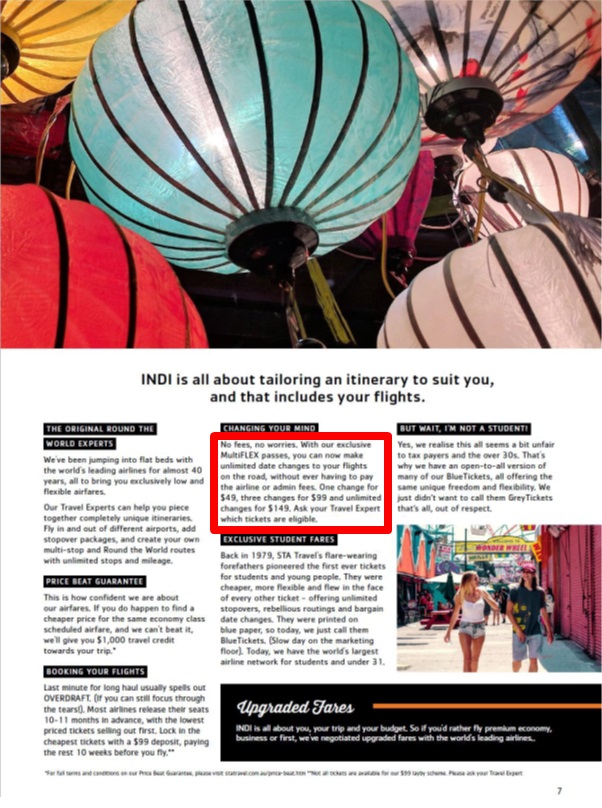
Advertisement 8
Printed poster attached to the back of STA Travel computer screens in stores, facing customers, between 1 June 2017 and 30 June 2017.
Advertisement 9
Printed poster attached to the back of STA Travel computer screens in stores, facing customers, between 1 September 2017 and 30 September 2017.
Advertisement 11
Displayed as a poster in two STA Travel stores between 24 September 2015 and March 2019.
Advertisement 14
Published at the URL: "https://book.statravel.com.au/staglobe/MultiflexPassesRetrieve.do?ln=en&div=au&pos=1ASTAGLOBE-AU" between 29 July 2016 and the beginning of 2019.
Advertisement 16
Published at 276 separate pages on the STA Travel website between 14 November 2014 and 12 July 2019, including the URL "https://www.statravel.com.au/cheap-flights.htm".
Advertisement 17
Published at the URL "https://www.statravel.com.au/student-and-youth-flights.htm" between 19 March 2014 and 27 March 2019.
Advertisement 18
Published at the URL "https://www.statravel.com.au/price-drop-promise.htm" between 6 December 2018 and 4 July 2019.
Advertisement 22
Published at the URL "https://www.statravel.com.au/essentials.htm" between 18 January 2018 and 16 July 2019.