

FEDERAL COURT OF AUSTRALIA
NL Investment Group Pty Ltd v Parc Vue Project Botanic Pty Ltd (Trustee) [2020] FCA 711
ORDERS
DATE OF ORDER: |
THE COURT ORDERS THAT:
1. The applicant’s interlocutory application dated 28 April 2020 (Interlocutory Application) is dismissed.
2. The applicant pay the respondents’ costs of and incidental to the Interlocutory Application.
3. Within 28 days, the applicant file and serve a further proposed amended statement of claim and, if necessary, a further proposed amended originating application.
Note: Entry of orders is dealt with in Rule 39.32 of the Federal Court Rules 2011.
ANDERSON J:
Introduction
1 This proceeding centres on an investment by the applicant in a property development. In broad terms, the applicant alleges that the seven respondents either made, or were in some manner involved in the making of, representations in relation to that investment that were, amongst other things, false, misleading or deceitful. On that basis, the applicant seeks declarations that each respondent contravened one or more of ss 1041E, 1041F and 1041H of the Corporations Act 2001 (Cth) (Act), and also seeks damages against each respondent. The respondents are yet to file defences to these allegations.
2 Since the proceeding was commenced in December 2019, the respondents have voiced discontent with the applicant’s pleadings. This decision addresses the applicant’s interlocutory application for leave to amend its originating application and statement of claim. Except for the seventh respondent, each of the respondents oppose that grant of leave. In addition to specific complaints addressed below, they broadly argue that the applicant’s statement of claim fails to plead its case with sufficient particularity to enable the respondent to respond.
3 My view is that leave to amend ought not be granted to the applicant because its proposed amended statement of claim is liable to be struck out. Today, on 26 May 2020, after hearing the parties, I dismissed the applicant’s application for leave to amend its originating application and statement of claim, and directed the applicant to file and serve a further proposed statement of claim within 28 days. These are my reasons for doing so.
Application for leave to amend
4 The applicant commenced this proceeding on 12 December 2019 by filing an originating application and a statement of claim. It was evident at the first case management hearing on 12 March 2020 that the respondents held concerns regarding the applicant’s statement of claim. As a result, I made orders requiring each respondent to write to the applicant about any perceived deficiencies in the statement of claim, and for the applicant to then inform the respondents whether it intended to amend its pleadings. It was also clear at a further case management hearing on 15 April 2020 that the disputes regarding the applicant’s pleadings would only be resolved with the intervention of the Court. I accordingly ordered that the applicant’s application for leave to file and serve an amended statement of claim be listed for hearing.
5 In accordance with those orders, the applicant filed an interlocutory application on 28 April 2020. The orders sought by that application are as follows:
1. The applicant has leave to file and rely upon:
a. the amended originating application dated 28 April 2020;
b. the amended statement of claim dated 28 April 2020.
2. An order pursuant to r 7.11 of the Federal Court Rules 2011 (Rules) that the seventh respondent to give discovery to the applicant of all documents in its control that may be used to identify to whom the $1,252,000 received from the applicant was paid by the seventh respondent by Thursday 11 June 2020.
3. Each of the respondents have leave to file a defence by 4pm on Tuesday 23 June 2020.
4. A direction that the applicant file a single combined reply to each respondent’s defence (if any) on Tuesday 5 July 2020.
5. That the parties be directed to conduct a compulsory mediation no later than Friday 21 July 2020 to be mediated by a Senior Counsel or Queen’s Counsel of no less than 5 years appointment agreed between the parties. The costs of the mediator are to be borne jointly by the parties and to be paid in advance to the barrister’s clerk of the mediator appointed.
6 The applicant relies upon written submissions dated 28 April 2020, and written submissions in reply dated 19 May 2020, in support of its interlocutory application.
7 None of the respondents have formally brought an application to strike out the applicant’s current pleadings. However, each of the respondents (except for the seventh respondent) oppose leave being granted to the applicant. For this purpose, the first respondent relies upon written submissions dated 15 April 2020 and 12 May 2020, the second, fifth and sixth respondents rely upon written submissions dated 12 May 2020, and the fourth respondent relies upon written submissions dated 12 May 2020. The third respondent did not file any written submissions, but orally adopted the submissions of the fourth respondent. The seventh respondent (to which a receiver and manager was appointed in August 2018), neither consents to, nor opposes, the applicant’s application for leave. However, for simplicity, I will refer to the “respondents” below as a unified bloc of opposition.
8 I heard the applicant’s interlocutory application today, on 26 May 2020. The applicant was represented by Mr Redenbach of counsel, the first respondent by Mr Lorbeer of counsel, the second, fifth and sixth respondents by Ms Foley of counsel, the third respondent by Ms Fernandez (a solicitor), the fourth respondent by Ms Case of counsel, and the seventh respondent by Mr Johnson (a solicitor). After hearing the parties’ submissions, I adjourned the hearing to 4 pm, when I pronounced my orders.
Proposed amended pleadings
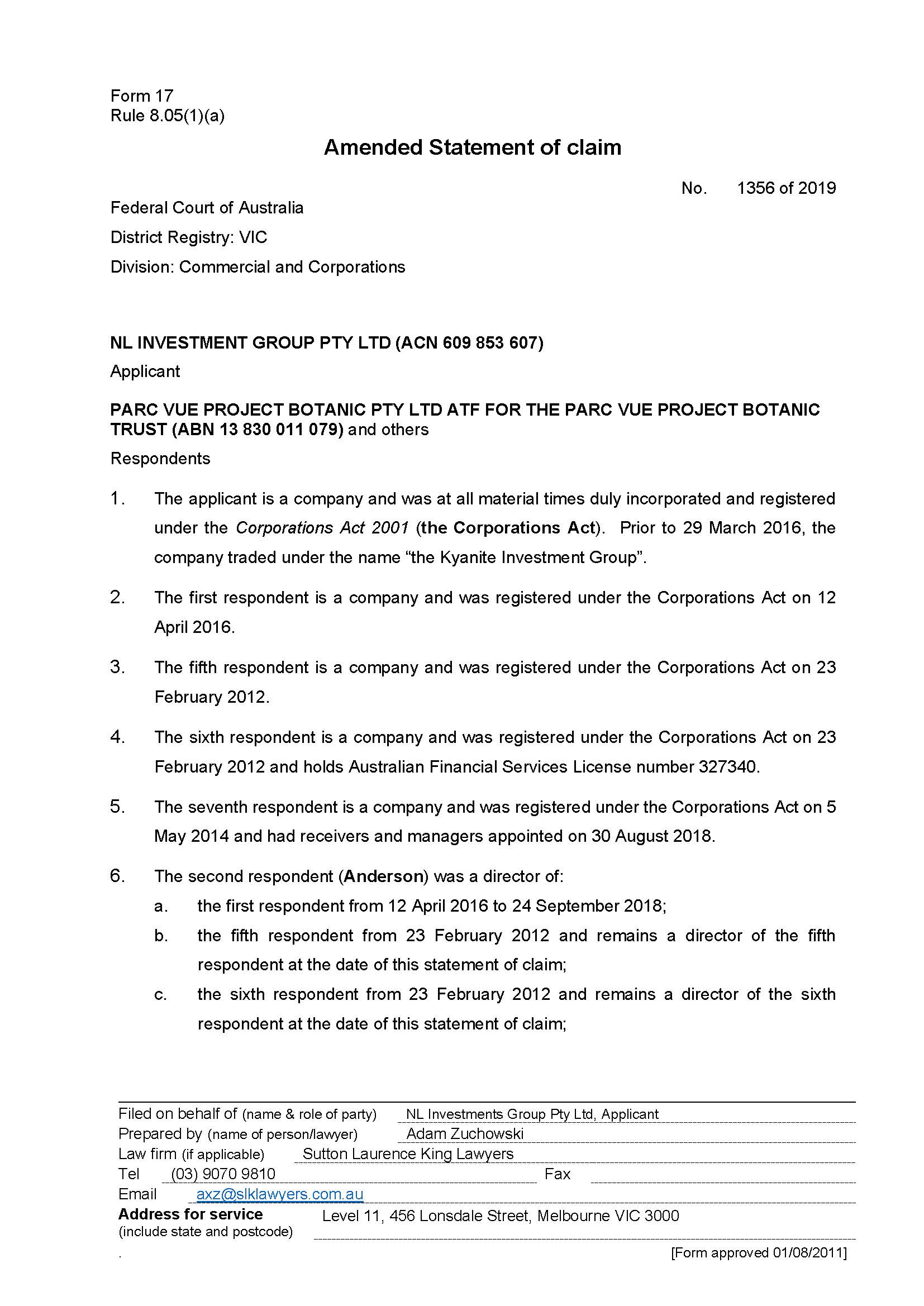
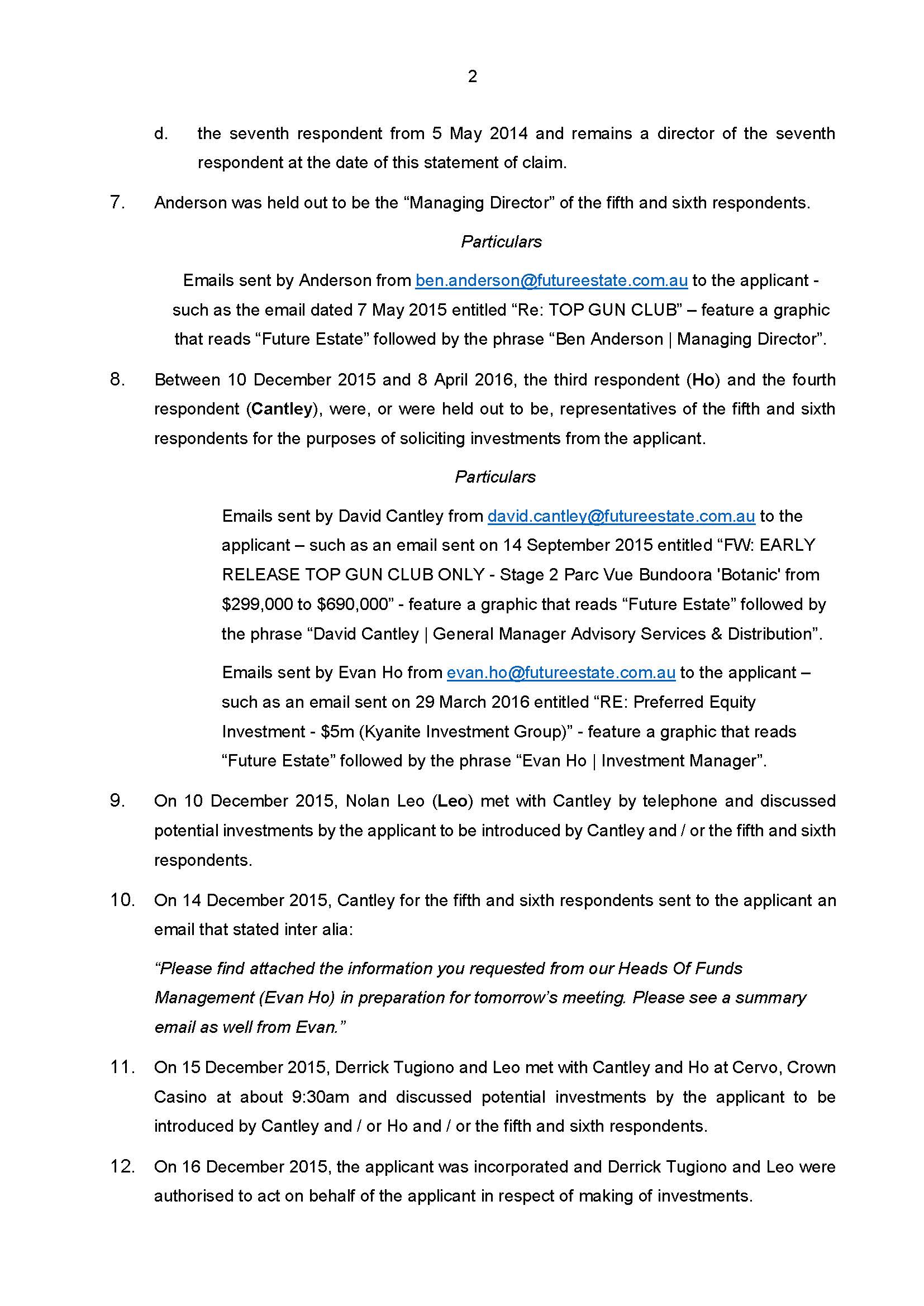
9 The applicant provided a copy of its proposed amended statement of claim (Proposed Statement of Claim) to the Court on 28 April 2020. For reference, the body of the Proposed Statement of Claim is extracted in the annexure to these reasons.
10 Particular aspects of the Proposed Statement of Claim are discussed below. However, by way of a very broad introduction, the applicant’s primary claim is that each of the seven respondents contravened ss 1041E, 1041F and/or 1041H of the Act, and that the applicant is accordingly entitled to, amongst other remedies, an order for damages under s 1041I of the Act against each respondent.
11 For reference, these provisions of the Act relevantly provide as follows:
1041E False or misleading statements
(1) A person must not (whether in this jurisdiction or elsewhere) make a statement, or disseminate information, if:
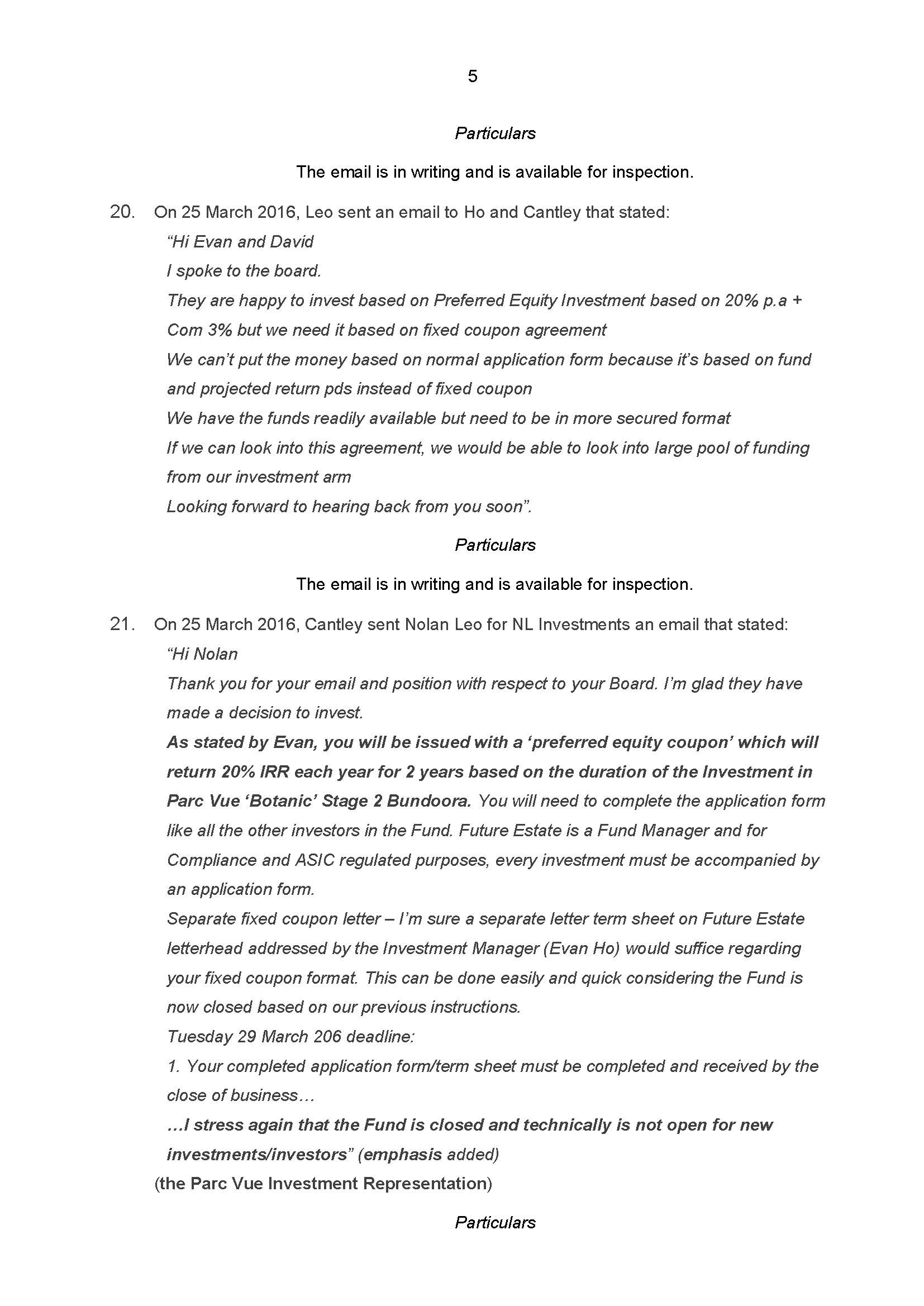
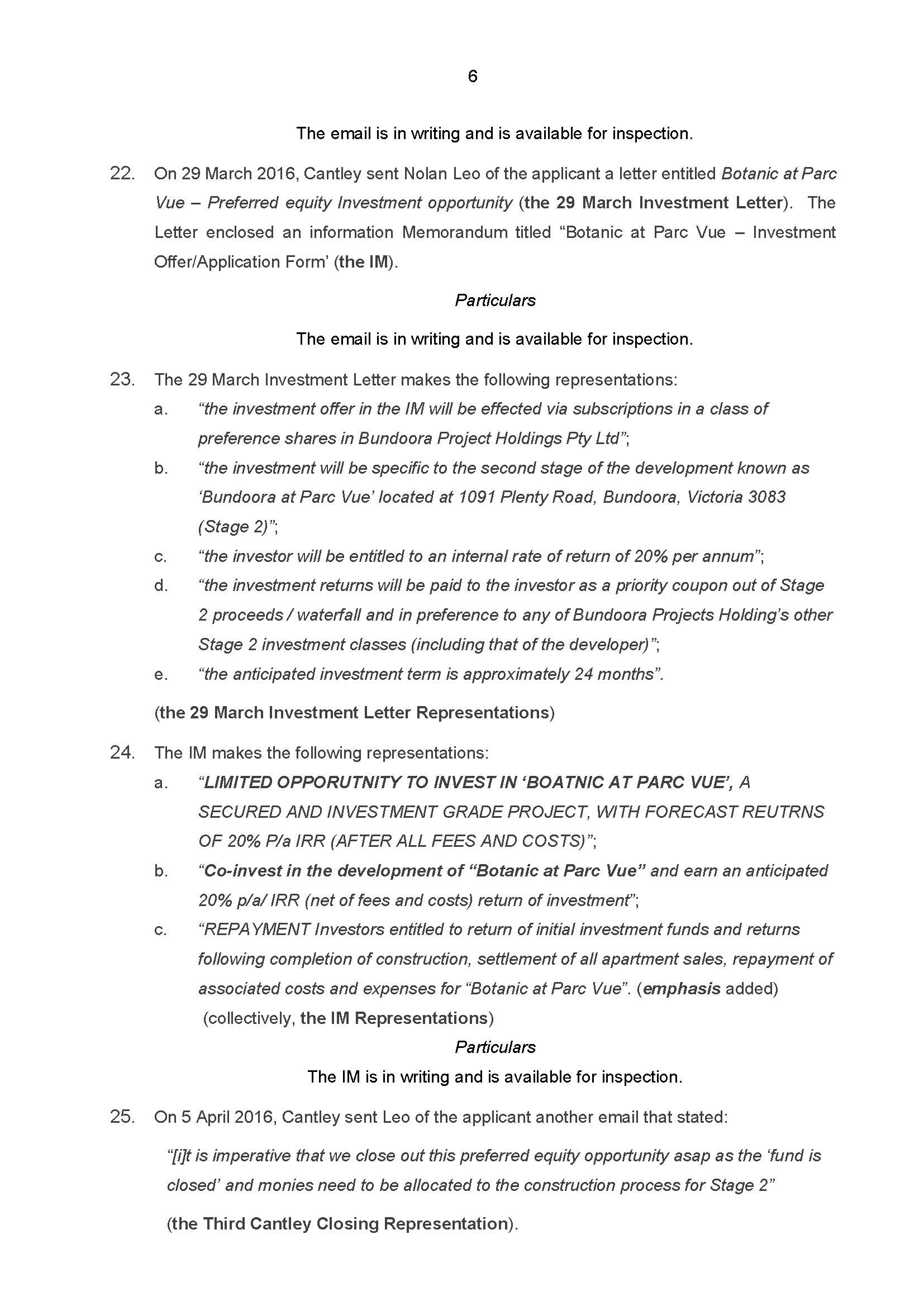
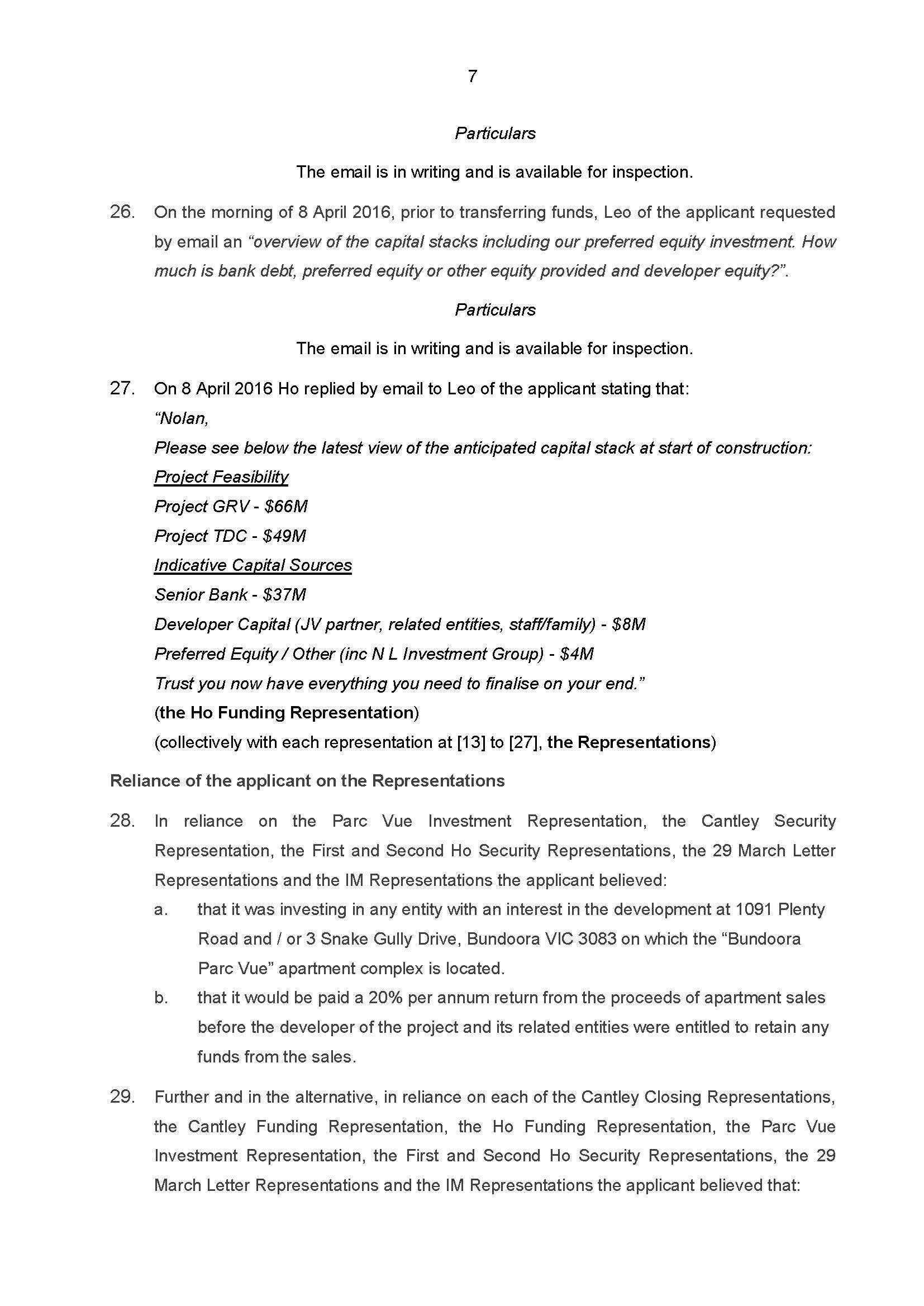
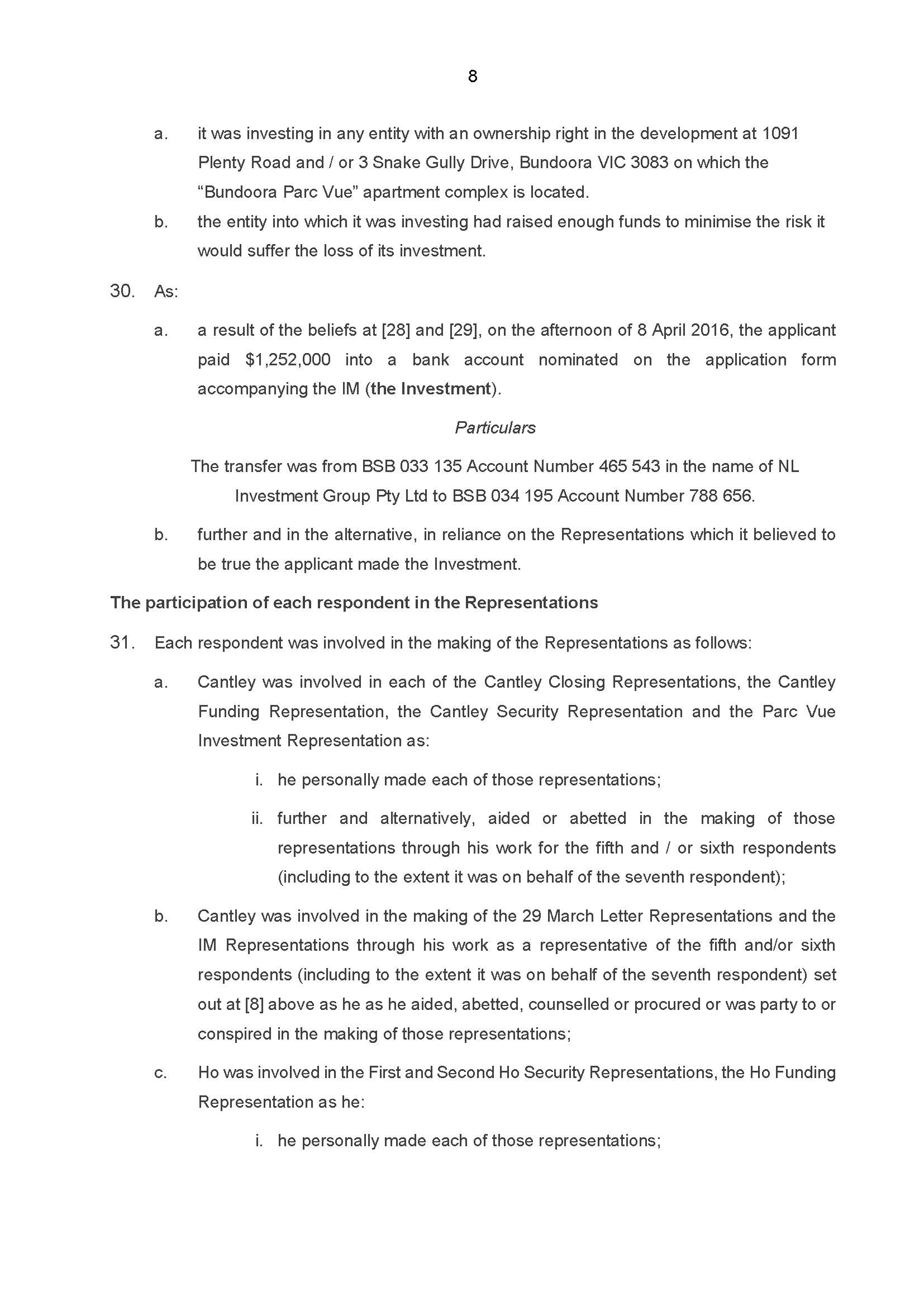
(a) the statement or information is false in a material particular or is materially misleading; and
(b) the statement or information is likely:
(i) to induce persons in this jurisdiction to apply for financial products; or
(ii) to induce persons in this jurisdiction to dispose of or acquire financial products; or
(iii) to have the effect of increasing, reducing, maintaining or stabilising the price for trading in financial products on a financial market operated in this jurisdiction; and
(c) when the person makes the statement, or disseminates the information:
(i) the person does not care whether the statement or information is true or false; or
(ii) the person knows, or ought reasonably to have known, that the statement or information is false in a material particular or is materially misleading.
…
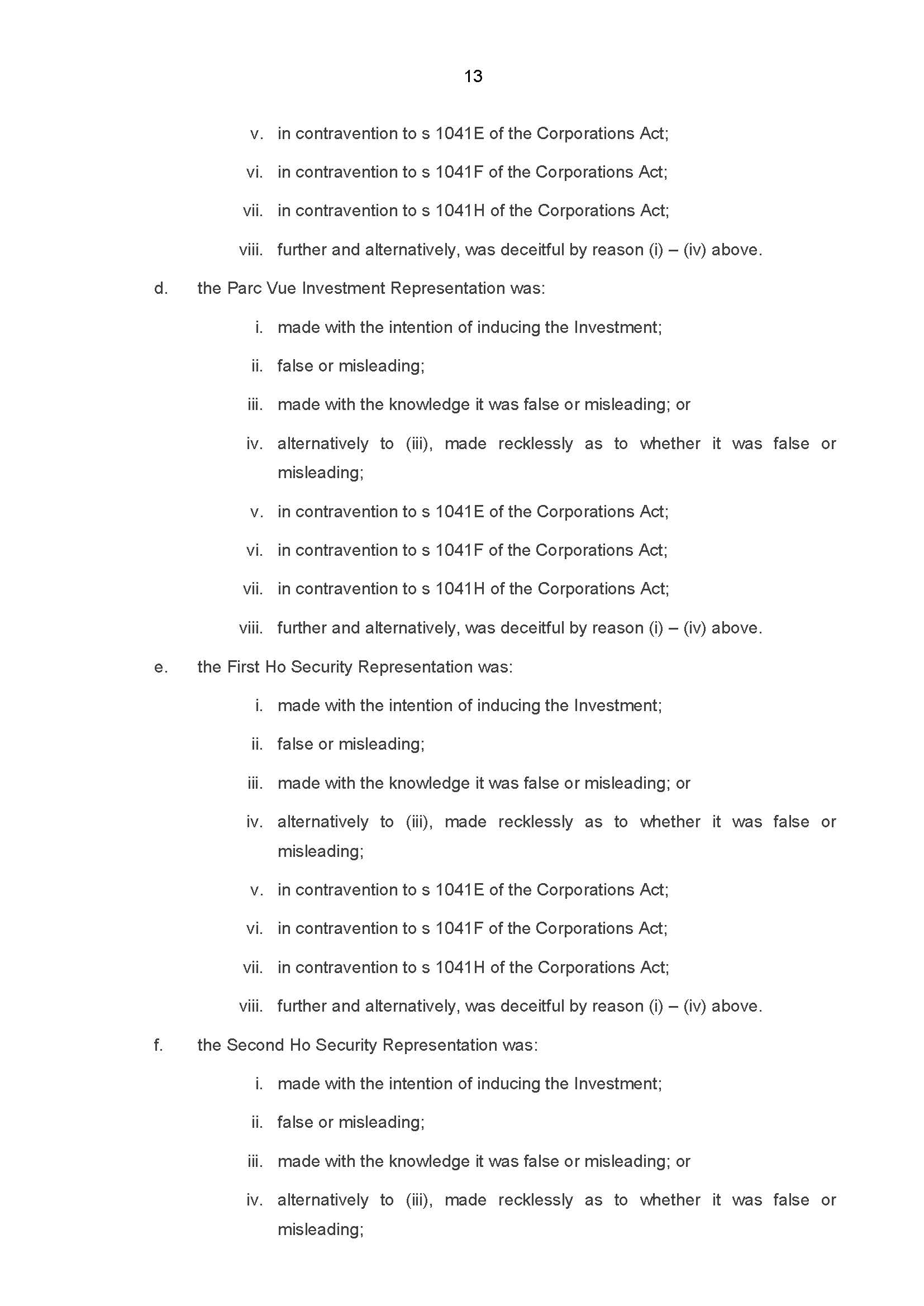
1041F Inducing persons to deal
(1) A person must not, in this jurisdiction, induce another person to deal in financial products:
(a) by making or publishing a statement, promise or forecast if the person knows, or is reckless as to whether, the statement is misleading, false or deceptive; or
(b) by a dishonest concealment of material facts; or
(c) by recording or storing information that the person knows to be false or misleading in a material particular or materially misleading if:
(i) the information is recorded or stored in, or by means of, a mechanical, electronic or other device; and
(ii) when the information was so recorded or stored, the person had reasonable grounds for expecting that it would be available to the other person, or a class of persons that includes the other person.
…
1041H Misleading or deceptive conduct (civil liability only)
(1) A person must not, in this jurisdiction, engage in conduct, in relation to a financial product or a financial service, that is misleading or deceptive or is likely to mislead or deceive.
…
1041I Civil action for loss or damage for contravention of sections 1041E to 1041H
(1) A person who suffers loss or damage by conduct of another person that was engaged in in contravention of section 1041E, 1041F, 1041G or 1041H may recover the amount of the loss or damage by action against that other person or against any person involved in the contravention, whether or not that other person or any person involved in the contravention has been convicted of an offence in respect of the contravention.
…
12 The alleged primary contravening conduct is 11 representations made by the third and fourth respondents to the applicant between 18 March 2016 and 8 April 2016 in relation to certain property investments. The applicant alleges that each of the respondents were in some form involved in the making of those representations. It is pleaded that, as a result of those representations, the applicant paid $1,252,000 to the seventh respondent in the belief that it was investing in a property development with a return of 20% per annum, which was secured over the proceeds of apartment sales and paid in priority to the developer. However, the applicant says that it only ever received unsecured preference shares in the seventh respondent, which bore a name similar to the property development. The applicant alleges that four days after making the investment, the first respondent was incorporated, and that upon a plan of subdivision being approved, the first respondent took title to the property development as the trustee of a trust estate without any obligations to the applicant or the seventh respondent. As alleged, the second respondent is a central player in these events, as the second respondent is pleaded to have been a director of the first respondent, fifth respondent, sixth respondent and seventh respondent during the relevant periods.
Principles on pleadings
13 The general requirements in relation to the content of pleadings are addressed in r 16.02 of the Federal Court Rules 2011 (Cth) (Rules). That rule relevantly provides as follows:
Content of pleadings—general
(1) A pleading must:
(a) be divided into consecutively numbered paragraphs, each, as far as practicable, dealing with a separate matter; and
(b) be as brief as the nature of the case permits; and
(c) identify the issues that the party wants the Court to resolve; and
(d) state the material facts on which a party relies that are necessary to give the opposing party fair notice of the case to be made against that party at trial, but not the evidence by which the material facts are to be proved; and
(e) state the provisions of any statute relied on; and
(f) state the specific relief sought or claimed.
(2) A pleading must not:
(a) contain any scandalous material; or
(b) contain any frivolous or vexatious material; or
(c) be evasive or ambiguous; or
(d) be likely to cause prejudice, embarrassment or delay in the proceeding; or
(e) fail to disclose a reasonable cause of action or defence or other case appropriate to the nature of the pleading; or
(f) otherwise be an abuse of the process of the Court.
…
14 The prohibitions listed in r 16.02(2) also form the bases upon which a party may apply to the Court for an order that all or part of a pleading be struck out: r 16.21 of the Rules.
15 The fundamental purpose of pleadings was described by White J in Sitzler Pty Ltd v GPT RE Limited as Responsible Entity of the General Property Trust [2018] FCA 1496 at [8] as being
… to provide a structural framework for the litigation. Pleadings achieve this purpose by performing two basic functions. First, by defining the issues between the parties, thereby providing the basis for the determination of questions as to discovery before trial and the admissibility of evidence at trial and of questions as to what the litigation has decided for the purpose of the rules as to res judicata and issue estoppel. Secondly, by providing fair notice to opponents of the case to be made against them at trial, thereby minimising the risk of injustice resulting from surprise:
See also Australian Broadcasting Corporation v Wing [2019] FCAFC 125; 371 ALR 55 at [147] per Besanko, Bromwich and Wheelahan JJ.
16 Most practically, pleadings are required to enable the respondent to know, with sufficient clarity, the case which it is required to meet: Dare v Pulham [1982] HCA 70; 148 CLR 658 at 664 per Murphy, Wilson, Brennan, Deane and Dawson JJ; Banque Commerciale S.A. En Liquidation v Akhil Holdings Ltd [1990] HCA 11; 169 CLR 279 (Banque Commerciale) at 286 per Mason CJ and Gaudron J; see also Thomson v STX Pan Ocean Co Ltd [2012] FCAFC 15 (Thomson) at [13] per Greenwood, McKerracher and Reeves JJ and Australian Building and Construction Commissioner v Hall [2018] FCAFC 83; 277 IR 75 at [49] per Tracey, Reeves and Bromwich JJ; Bauer Consumer Media Ltd v Evergreen Television Pty Ltd [2019] FCAFC 71; 367 ALR 393; 142 IPR 1 at [150] per Rangiah J. For this purpose, a pleading must allege a cause of action and material facts with sufficient particularity, and not simply make general allegations: Young Investments Group Pty Ltd v Mann [2012] FCAFC 107; 293 ALR 537 (Young Investments) at [7] per Emmett, Bennett and McKerracher JJ. Whether or not the pleading has done so depends on the context and circumstances of the case: ibid; Jenkings v Northern Territory of Australia (No 2) [2018] FCA 1706 (Jenkings) at [20] per White J.
17 Notwithstanding the above principles, it should be recalled that pleadings are the “servants, not the masters of the judicial process”: Thorpe v Commonwealth of Australia (No 3) [1997] HCA 21; 71 ALJR 767 at 775; 144 ALR 677 (Thorpe) at 687 per Kirby J. In other words, they are a means to an end, namely the attainment of justice between the parties: Banque Commerciale at 293 per Dawson J; Thorpe at ALJR 774–775; ALR 687; Thomson at [13]. Thus, modern courts avoid an unduly technical or restrictive approach to pleadings: Thomson at [13]; see also Barclay Mowlem Construction Limited v Dampier Port Authority [2006] WASC 281; 33 WAR 82 at [4]–[8] per Martin CJ and QC Resource Investments Pty Ltd (In Liq) v Naicker [2019] FCA 963 at [24] per Greenwood J.
18 There is no application to strike out the applicant’s pleadings currently before the Court. However, the strike out power under the Rules is relevant because the respondents contend that leave for the applicant to amend its pleadings ought to be refused because the Proposed Statement of Claim, if accepted, would be liable to strike out.
19 The power under r 16.21 of the Rules to strike out a pleading confers wide discretion on the Court. That said, great caution must be exercised before striking out a pleading: Favell v Queensland Newspapers Pty Ltd [2005] HCA 52; 79 ALJR 1716; 221 ALR 186 at [6] per Gleeson CJ, McHugh, Gummow and Heydon JJ; Channel Seven Adelaide Pty Ltd v Manock [2007] HCA 60; 232 CLR 245 at [33] per Gummow, Hayne and Heydon JJ; see also Construction, Forestry, Mining and Energy Union v BHP Coal Pty Ltd [2017] FCAFC 50 at [44] per Greenwood, Flick and Rangiah JJ. As expressed by Emmett, Bennett and McKerracher JJ in Young Investments at [6]:
Provided that a pleading fulfils its basic function of identifying the issues, disclosing an arguable cause of action and apprising the other party of the case that it has to meet at trial, the pleading should be allowed to stand and the proceeding should be allowed to go to trial.
See also Agar v Hyde [2000] HCA 41; 201 CLR 552 at 575-576 per Gaudron, McHugh, Gummow and Hayne JJ. In particular, the power to strike out a pleading because it discloses no reasonable cause of action should only be exercised in a plain and obvious case: see Polar Aviation Pty Ltd v Civil Aviation and Safety Authority [2012] FCAFC 97; 203 FCR 325 at [42]-[44] per Perram, Dodds-Streeton and Griffiths JJ.
20 If substantial parts of a pleading are struck out, the court may strike out the entire pleading on the basis that the residue would be confusing: Harvey v Dioceses of Sale Catholic Education Limited (St Joseph’s Primary School Wonthaggi) [2019] FCA 1714 at [12] per O’Callaghan J, citing Trade Practices Commission v Australian Iron & Steel Pty Ltd (1990) 22 FCR 305 at 323 per Lockhart J.
Consideration
21 The alleged defects with the applicant’s Proposed Statement of Claim are manifold. The three different sets of written submissions filed on behalf of the respondents raise various issues that overlap to some extent, but not perfectly. Instead of precisely tracing through, and reconciling, every complaint raised by the respondents, I will instead address below the key issues with the applicant’s pleadings.
First respondent’s responsibility for pre-incorporation events
22 The first issue is unique to the applicant’s claims against the first respondent. In short, the first respondent complains that the claims against it are bad as a matter of law because the representations alleged to found the allegedly contravening conduct occurred prior to the first respondent’s incorporation.
23 For this purpose, the relevant chronology (as alleged by the applicant) is as follows:
(a) 11 representations were made to the applicant between 18 March and 8 April 2016: Proposed Statement of Claim, paras 13–27;
(b) those representations caused the applicant, on 8 April 2016, to transfer funds to a bank account (Proposed Statement of Claim, para 30), which it seems was owned by the seventh respondent: Proposed Statement of Claim, sub-para 45(a);
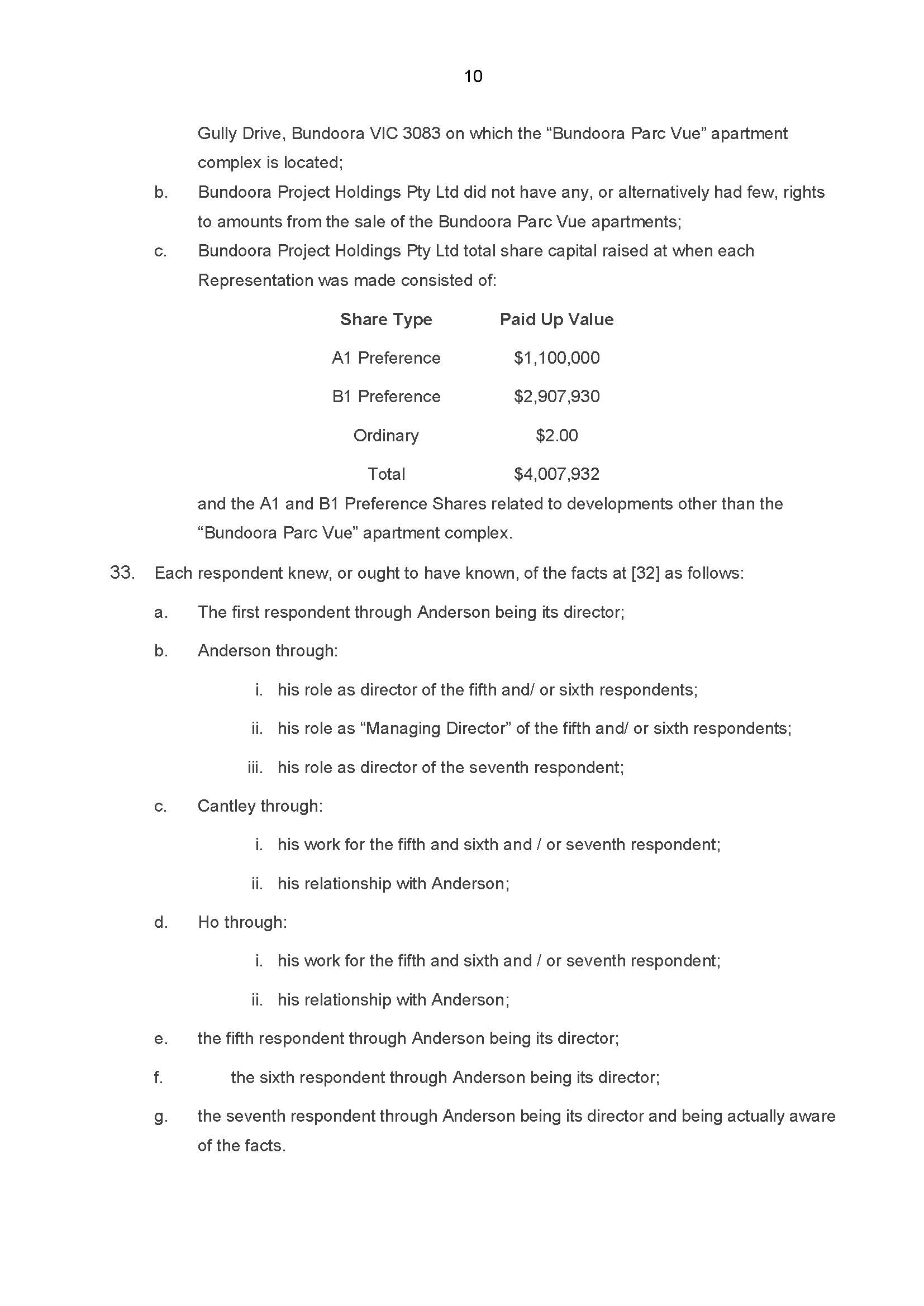
(c) at the time of the representations, the seventh respondent did not own land, or an interest in the land, or in the development: Proposed Statement of Claim at [32(a)];
(d) the first respondent was incorporated on 12 April 2016: Proposed Statement of Claim at [2];
(e) the second respondent was a director of the first respondent from 12 April 2016 to 24 September 2018: Proposed Statement of Claim at [6(a)]; and
(f) on 5 September 2016, the first respondent took title to the relevant land: Proposed Statement of Claim at [39(b)].
24 After the Proposed Statement of Claim characterises the representations as, amongst other things, contravening ss 1041E, 1041F and 1041H of the Act (para 38), the involvement of the first respondent in the contravening conduct is addressed as follows:
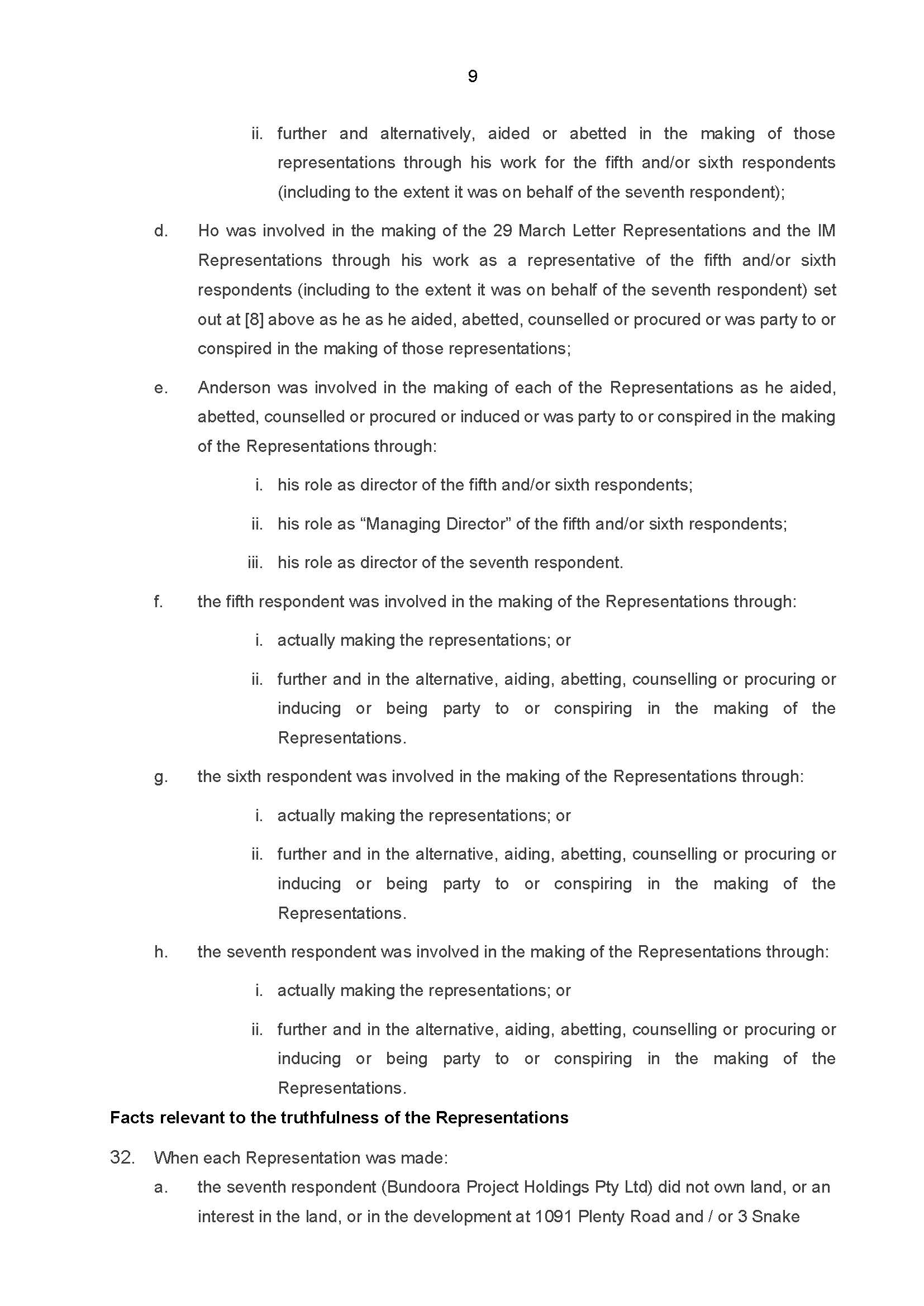
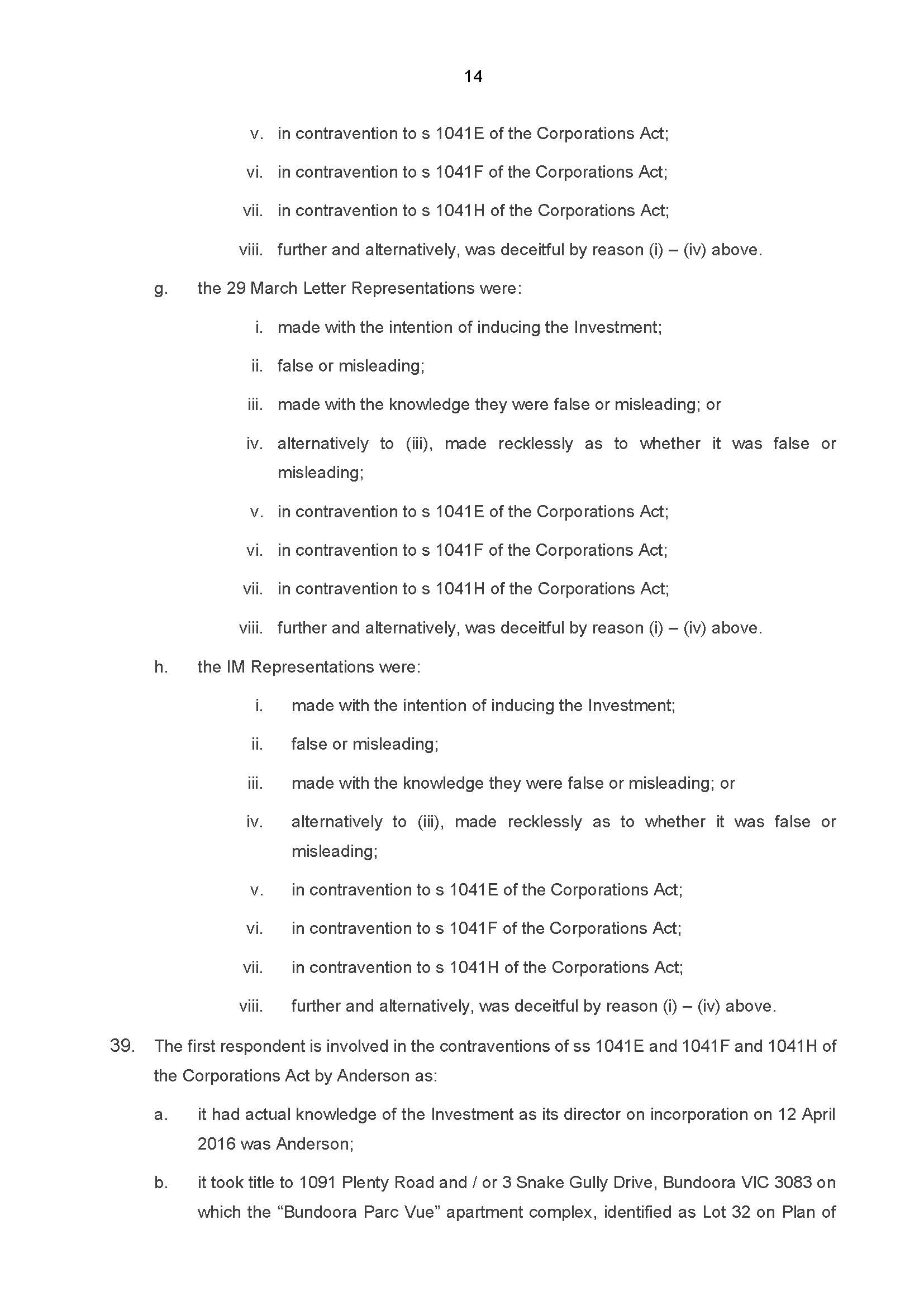
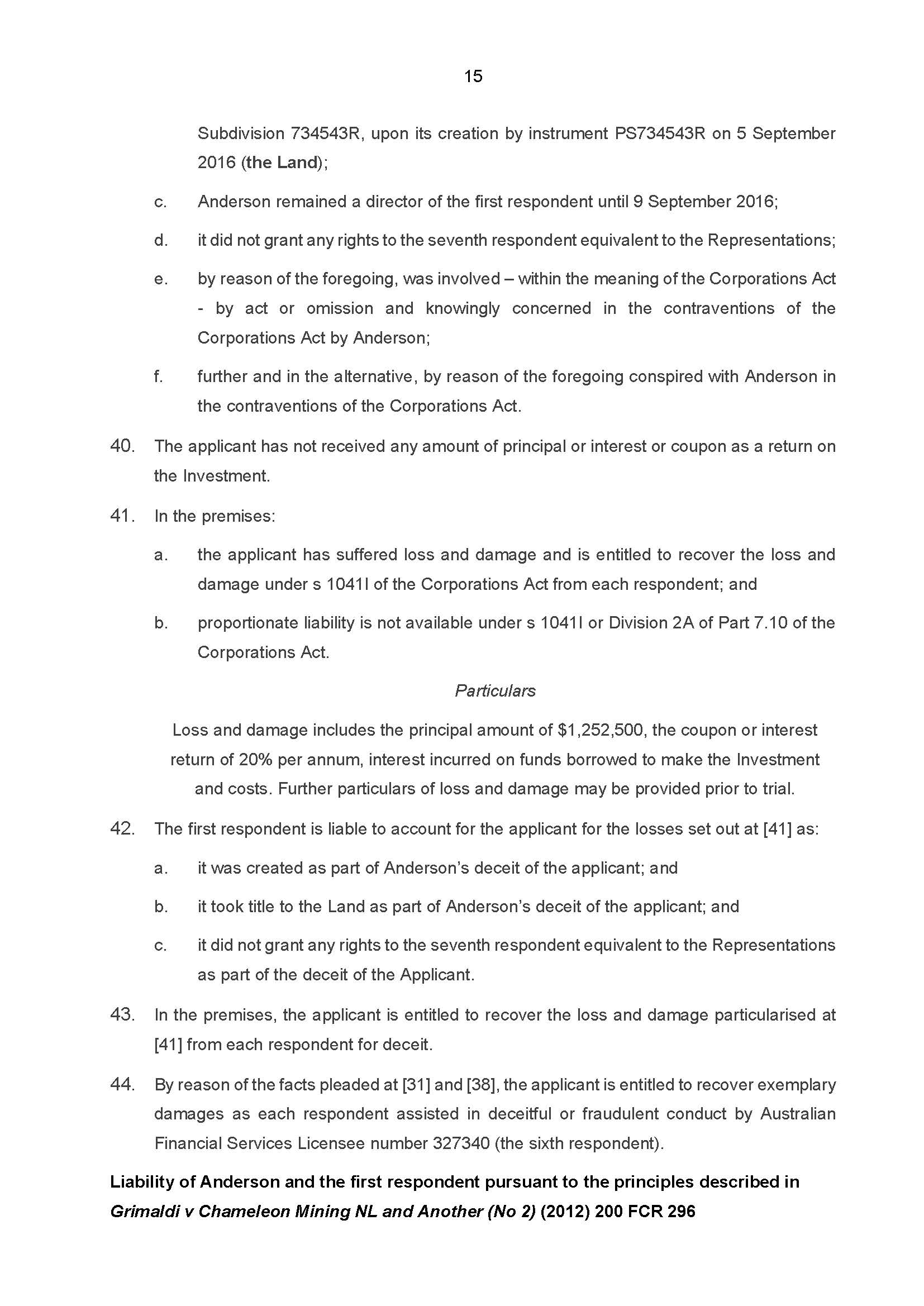
39. The first respondent is involved in the contraventions of ss 1041E and 1041F and 1041H of the Corporations Act by [the second respondent] as:
a. it had actual knowledge of the Investment as its director on incorporation on 12 April 2016 was [the second respondent];
b. it took title to 1091 Plenty Road and / or 3 Snake Gully Drive, Bundoora VIC 3083 on which the “Bundoora Parc Vue” apartment complex, identified as Lot 32 on Plan of Subdivision 734543R, upon its creation by instrument PS734543R on 5 September 2016 (the Land);
c. [the second respondent] remained a director of the first respondent until 9 September 2016;
d. it did not grant any rights to the seventh respondent equivalent to the Representations;
e. by reason of the foregoing, was involved - within the meaning of the Corporations Act - by act or omission and knowingly concerned in the contraventions of the Corporations Act by [the second respondent];
f. further and in the alternative, by reason of the foregoing conspired with [the second respondent] in the contraventions of the Corporations Act.
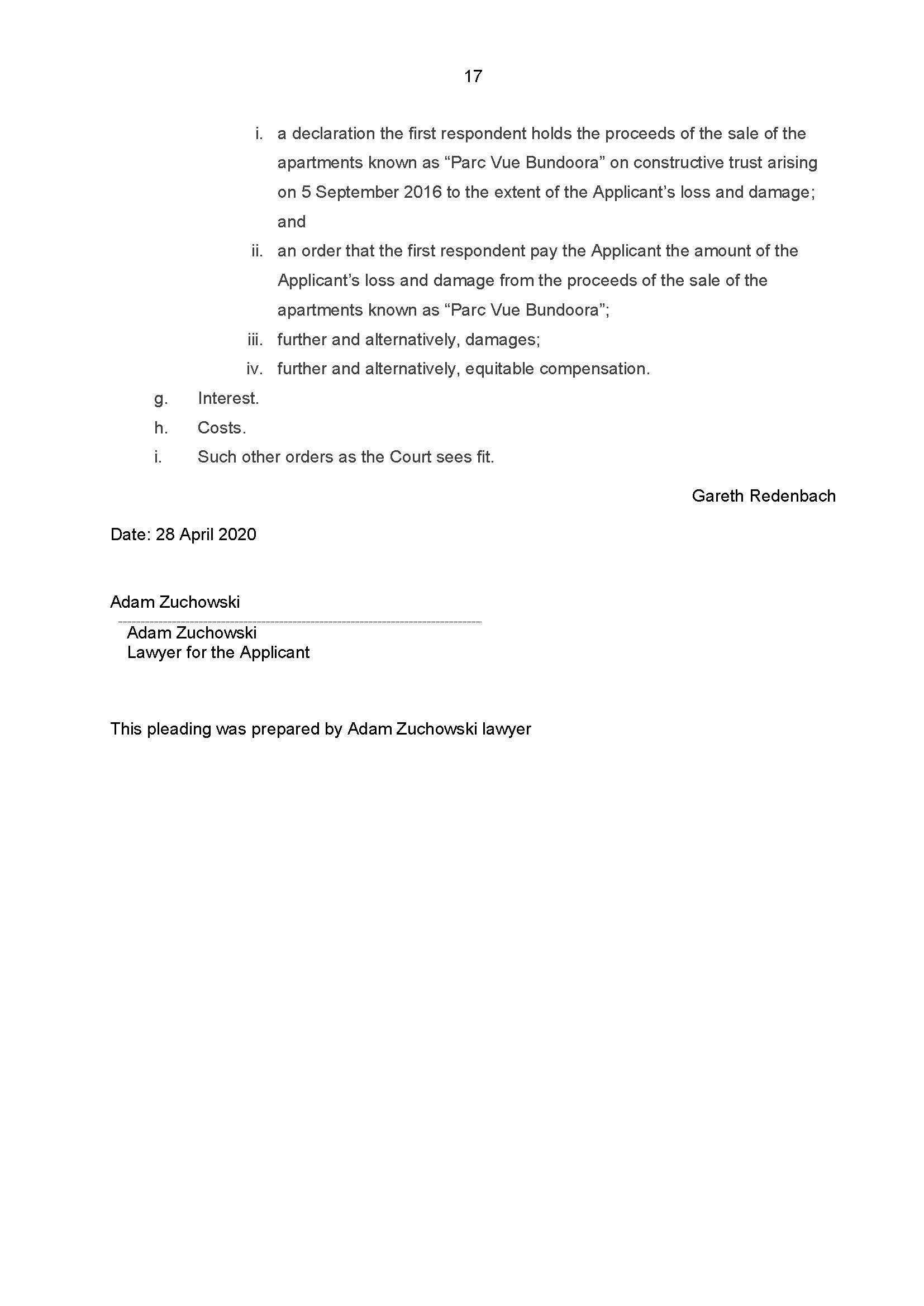
25 As a result, the Proposed Statement of Claim provides that the first respondent is liable to account for certain losses (paras 42 and 46), or otherwise holds proceeds from the sale of apartments on the relevant land on constructive trust (paras 47 and 48(f)).
26 The first respondent responds by rhetorically asking what it did within the five months between being incorporated and obtaining title to the land to implicate it in the wrongs alleged against the second respondent. The first respondent further asks what the connection is between any conduct of the first respondent (or event concerning the first respondent) and the applicant’s loss. In particular, the first respondent cites BJ McAdam Pty Ltd v Jax Tyres Pty Ltd (No 3) [2012] FCA 1438 at [18]–[24] per Perram J to the effect that it is impossible at common law for a company, upon incorporation, to ratify a contract entered into prior to incorporation. However, my sense is that the authorities regarding the corporate ratification of contracts may offer little assistance when it comes to characterising corporate involvement in conduct for statutory purposes. It is instead necessary to look to the statutory wording.
27 According to para 39 of the Proposed Statement of Claim, the vice in the first respondent’s conduct was being “involved in the contraventions of ss 1041E and 1041F and 1041H of the [Act] by [the second respondent]”. According to para 38 of the Proposed Statement of Claim, those contraventions pertained exclusively to the making of certain representations. No conduct subsequent to the making of those representations was said to amount to contravening conduct under the Act (although the subsequent events were relevant to, amongst other things, the applicant’s alleged reliance and incurring of loss or damage). Could the applicant be “involved” in the making of the representations, even though it was not incorporated at that time?
28 Where the applicant is seeking an order for damages pursuant to s 1041I of the Act, which relevantly applies in respect of a person “involved” in a primary contravention (see above at [11]), it is necessary to consider the sense in which the Act refers to such involvement. For this purpose, s 79 of the Act provides as follows:
79 Involvement in contraventions
A person is involved in a contravention if, and only if, the person:
(a) has aided, abetted, counselled or procured the contravention; or
(b) has induced, whether by threats or promises or otherwise, the contravention; or
(c) has been in any way, by act or omission, directly or indirectly, knowingly concerned in, or party to, the contravention; or
(d) has conspired with others to effect the contravention
29 A review of this statutory definition reveals that each form of identified conduct in relation to the primary contravention—aiding, abetting, counselling, procuring, inducing, being knowingly concerned in, being a party to, or conspiring to effect—could only have been performed prior to, or at the time of, the primary contravention: Australian Securities and Investments Commission v Australian Investors Forum Pty Ltd (No 2) [2005] NSWSC 267; 53 ACSR 305; 23 ACLC 929 (Australian Investors Forum (No 2)) at [113]–[118] per Palmer J; see also Yorke v Lucas [1985] HCA 65; 158 CLR 661 at 670 per Mason ACJ, Wilson, Deane and Dawson JJ. As Palmer J expressed in Australian Investors Forum (No 2) at [118], “[n]one of the paragraphs in s 79 permit of a construction which encompasses within “involvement” doing something after the contravention has already been committed and is complete, even if what is later done is to conceal, ratify or knowingly derive benefit from the contravention”.
30 It follows that the applicant, who was incorporated on 12 April 2016, could not have been “involved” (within the sense relevant to s 79 of the Act) in the making of the impugned representations, which occurred between 18 March and 8 April 2016. As such, this particular allegation against the first respondent, as currently pleaded, is bad at law.
31 I also add (without deciding) that, to the extent that the applicant intends to plead that the first respondent was a joint tortfeasor with the second respondent in connection with a deceitful making of representations (as further discussed below), that allegation may face similar obstacles: see Thompson v Australian Capital Television Pty Ltd [1996] HCA 38; 186 CLR 574 at 580 per Brennan CJ, Dawson and Toohey JJ, as cited in the first respondent’s written submissions.
32 The paragraphs containing the allegations in relation to the first respondent’s involvement in the representations are liable to be struck out. In isolation, this defect with the Proposed Statement of Claim may have been capable of severance from the balance of the allegations. However, there are broader issues with the applicant’s proposed pleadings.
Pleading of representations
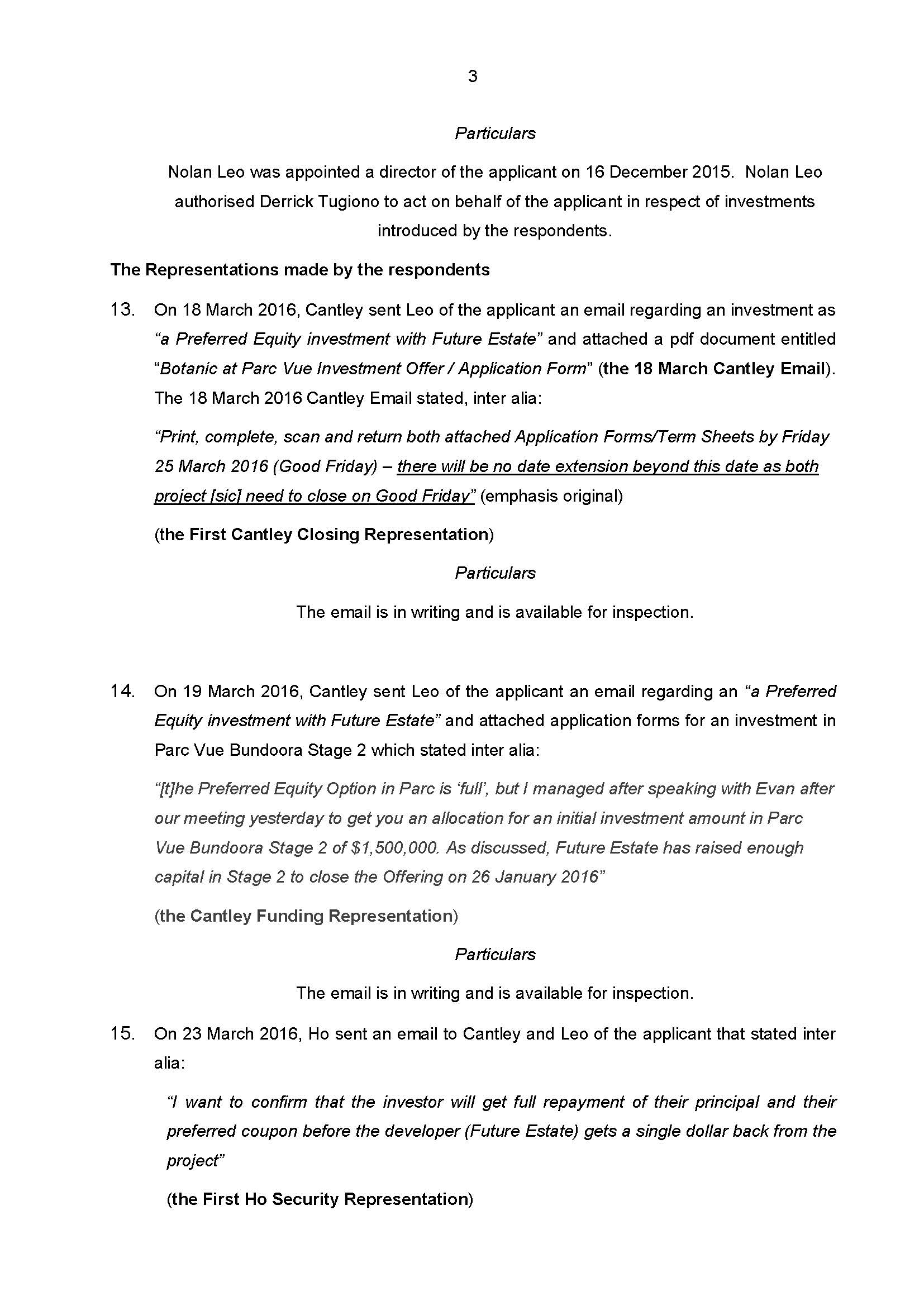
33 The 11 representations underpinning the applicant’s claims are pleaded at paras 13–27 of the Proposed Statement of Claim. As can be seen from those paragraphs, the drafter has pleaded those representations by reference to a chronology of relevant email and letter correspondence, where each paragraph of the Proposed Statement of Claim describes the date of the representation and the relevant representor and representee, and then extracts the relevant parts of the correspondence. By way of example, the first representation is pleaded as follows:
13. On 18 March 2016, Cantley sent Leo of the applicant an email regarding an investment as “a Preferred Equity investment with Future Estate” and attached a pdf document entitled “Botanic at Parc Vue Investment Offer / Application Form” (the 18 March Cantley Email). The 18 March 2016 Cantley Email stated, inter alia:
“Print, complete, scan and return both attached Application Forms/Term Sheets by Friday 25 March 2016 (Good Friday) “there will be no date extension beyond this date as both project [sic] need to close on Good Friday” (emphasis original)
(the First Cantley Closing Representation)
Particulars
The email is in writing and is available for inspection.
This same drafting format is repeated for each representation.
34 The Proposed Statement in Claim later turns to the pleaded characterisation and consequences of each representation. For example, in relation to the first representation extracted above, the Proposed Statement in Claim pleads as follows:
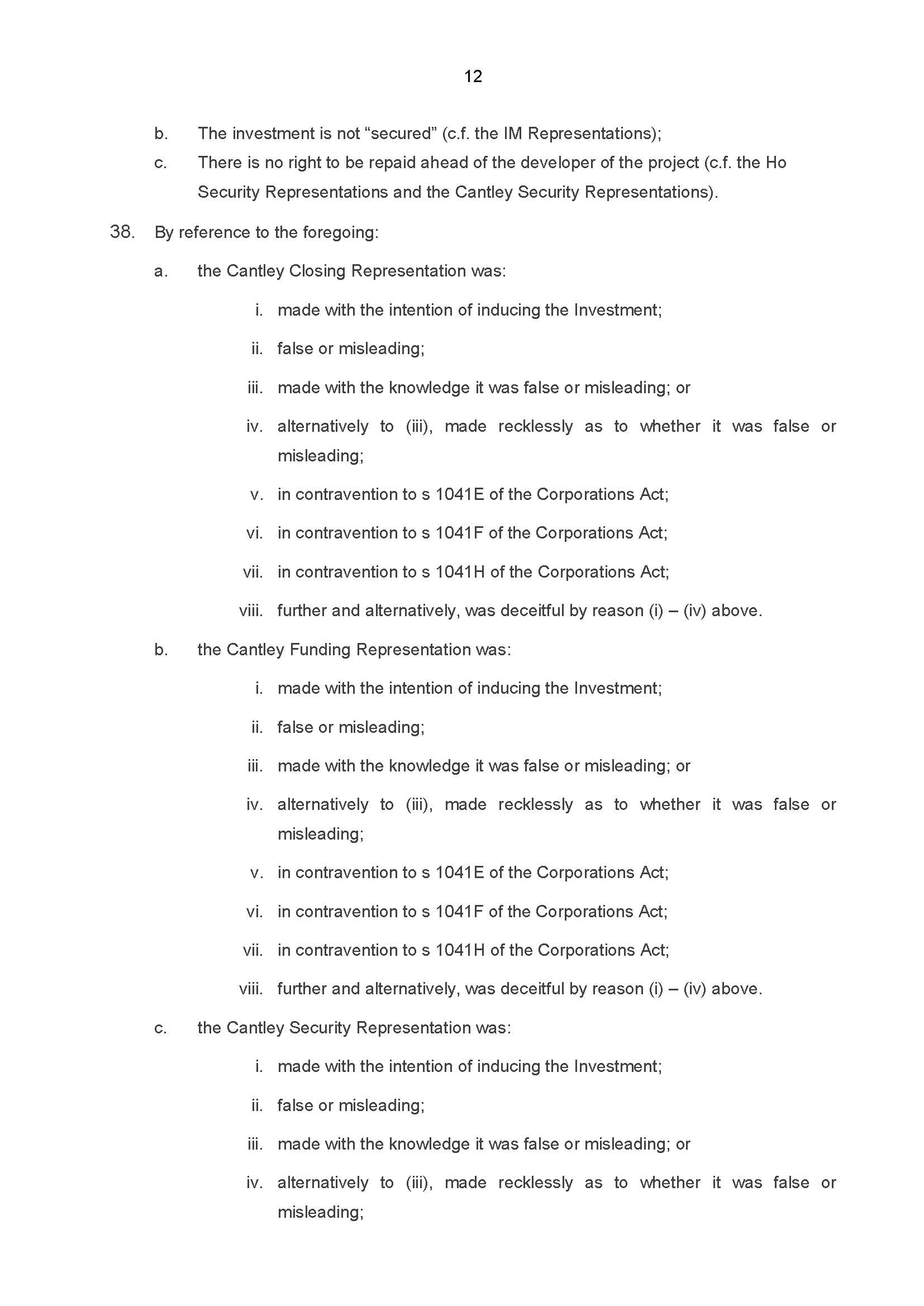
38. By reference to the foregoing:
a. the Cantley Closing Representation was:
i. made with the intention of inducing the Investment;
ii. false or misleading;
iii. made with the knowledge it was false or misleading; or
iv. alternatively to (iii), made recklessly as to whether it was false or misleading;
v. in contravention to s 1041E of the Corporations Act;
vi. in contravention to s 1041F of the Corporations Act;
vii. in contravention to s 1041H of the Corporations Act;
viii. further and alternatively, was deceitful by reason (i) – (iv) above.
…
(As a side note, para 38 only has eight sub-paragraphs, but I presume for current purposes that the defined terms used therein were intended to pick up all 11 representations. For instance, the phrase “Cantley Closing Representation” used in sub-para 38(a) is not defined in the Proposed Statement of Claim. It is presumably intended to refer to the combination of the “First Cantley Closing Representation”, the “Second Cantley Closing Representation” and the “Third Cantley Closing Representation” as defined in paras 13, 18 and 25 respectively.)
35 Focussing on the pleading of the representations in paras 13–27 of the Proposed Statement of Claim, the basic fault with this form of pleading is that it fails to apply the distinction drawn in r 16.02(1)(d) of the Rules between “material facts” and “evidence”. That rule provides that “a pleading must … state the material facts on which a party relies that are necessary to give the opposing party fair notice of the case to be made against that party at trial, but not the evidence by which the material facts are to be proved” (emphasis added). As Barker J expressed in Sedco Forex International Inc v Nexus Energy WA Proprietary Limited [2012] FCA 351 at [23], “[t]he primary obligation on a pleader is to lay out those material facts (not evidence) on which it relies and which it will prove by evidence at trial in order to satisfy the elements of a recognised cause of action which entitles it to a particular remedy”.
36 Relatedly, the Rules distinguish between the pleading of material facts and the provision of particulars: see div 16.14 (ss 16.41A–16.45) of the Rules, Hanson-Young v Leyonhjelm [2018] FCA 1688; 364 ALR 624 at [17] per White J and Jenkings at [18]. Lindgren J explained the different purposes of the pleading of material facts and particulars as follows in Australian Automotive Repairers’ Association (Political Action Committee) Inc v NRMA Insurance Ltd [2002] FCA 1568 at [15]:
The requirement that material facts be stated has two purposes: the natural justice purpose of adequately informing the other party of the nature of the case alleged against that party; and the purpose of providing a basis for determining whether that alleged case, so exposed, constitutes a cause of action cognisable at law. Particulars serve only the former purpose. … Particulars have a role to play where all the material facts have been pleaded but leave the other party inadequately informed of the case to be met; …
37 Paragraphs 13–27 of the Proposed Statement of Claim is, in short, too heavy with evidence and too ambiguous with material facts. This is not merely a problem of form. It raises substantive confusion in respect of the cases that the respondents are required to meet. The critical problem with the format of pleading in paras 13–27 is that it fails to identify with requisite precision the content of the representation relied upon to form the relevant material fact (being “the facts necessary for the purpose of formulating a complete cause of action pleaded”: McKellar v Container Terminal Management Services [1999] FCA 1101; 165 ALR 409 at [23] per Weinberg J). The respondents are instead required to sift through the various extracts of correspondence to identify the precise representations which are impugned by the applicant. The potential confusion is exacerbated by the fact that some of the extracted correspondence contains emphasis of parts of the correspondence using bold or underlined text. This raises doubts as to whether the emphasis is intended to confine the relevant representation to the emphasised text (rather than the extract as a whole).
38 None of this analysis should be taken as expressing an opinion as to the relevance or cogency of the correspondence extracted. That correspondence may indeed be precisely what the applicant has to rely on to prove its case (or at least an element of it). However, what the drafter of the Proposed Statement of Claim was required to do, in order to comply with the Rules, was to review the correspondence, and condense the content of that correspondence into the particular representations that are alleged to found the contravening conduct. Unfortunately, the drafter failed to do so, and the consequence is that the respondents are left uncertain as to the precise representations that are said to form the contravening conduct.
Involvement by the respondents
39 The next issue with the Proposed Statement of Claim is the manner in which para 31 pleads each respondent’s involvement in the making of the representations. (In this regard, refer to s 79 of the Act, as extracted above at [28], in relation to the forms of conduct that constitute “involvement” in a contravention.) The involvement of the respondents in the contravening conduct is important to the applicant because s 1041I of the Act, which is extracted above at [11], entitles a person who suffers loss or damage as a result of the relevant contravening conduct to recover the amount of that loss or damage, not just from the primary contravening party, but from “any person involved in the contravention”. The Proposed Statement of Claim seeks an order for damages under s 1041I against each respondent: para 48(b).
40 An allegation of “involvement” requires identification with some “reasonable precision” of what the respondent is alleged to have done to have been “involved”: Olson v Keefe (No 3) [2018] FCA 2001 at [33(2)] per Bromwich J. However, para 31 of the Proposed Statement of Claim is confusing because it does not clearly distinguish between those persons who committed the primary contraventions of the Act as opposed to those persons who were “involved in” those contraventions. For instance, at paras 31(a)(i), 31(c)(i), 31(f)(i), 31(g)(i) and 31(h)(i), it is alleged that the relevant respondent was “involved in” the making of a representation on the basis that the respondent actually made that representation. This mode of pleading ignores the distinction between primary contravention and secondary involvement drawn in ss 79 and 1041I of the Act.
41 I acknowledge that the applicant has pleaded alternatives in relation to the nature of the “involvement” by the third, fourth, fifth, sixth and seventh respondent (paras 31(a), 31(c), 31(f), 31(g) and 31(h)). The applicant is of course entitled to plead its case in alternatives. However, the lack of particularity regarding the interaction between each respondent and the representation means that this form of pleading increases the uncertainty as to the identification of who actually made the relevant representation. It is likely to cause the respondents embarrassment in responding, as they cannot be certain as to the nature and degree of their involvement.
Characterisation of representations
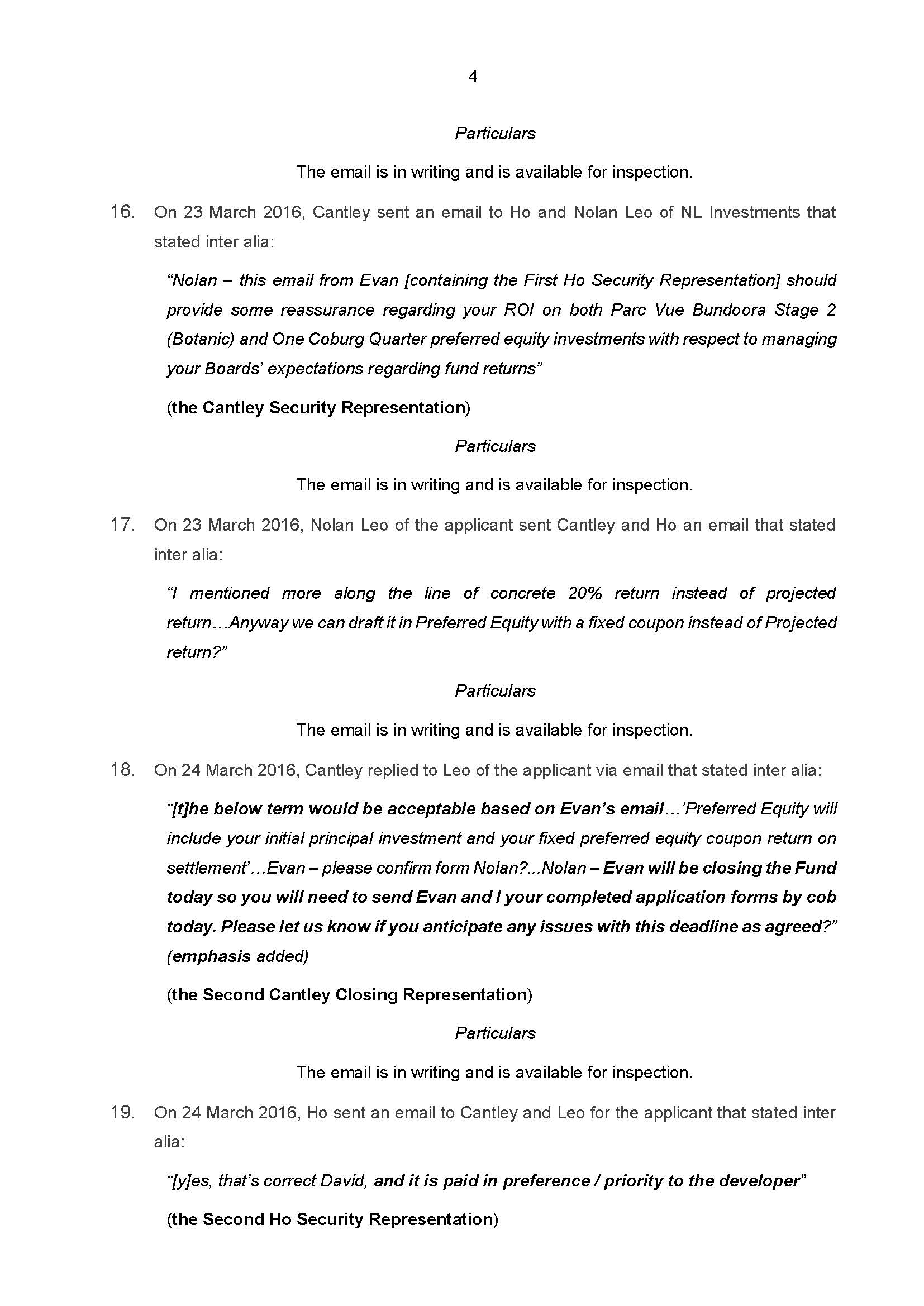
42 Paragraph 38 of the Proposed Statement of Claim, as referred to above, is the mechanism by which the applicant characterises the nature of the relevant representations. For each representation, the applicant pleads that the representation was:
i. made with the intention of inducing the Investment;
ii. false or misleading;
iii. made with the knowledge it was false or misleading; or
iv. alternatively to (iii), made recklessly as to whether it was false or misleading;
v. in contravention to s 1041E of the Corporations Act;
vi. in contravention to s 1041F of the Corporations Act;
vii. in contravention to s 1041H of the Corporations Act;
viii. further and alternatively, was deceitful by reason (i) – (iv) above.
43 The difficulty with this mode of pleading is that it impermissibly bundles the factual and legal “variables” in respect of each alleged contravention. Paragraph 38 does not distinguish between any particular respondents, and the inference is supposedly that each respondent, by either making or being involved in the representations, contravened the relevant provisions of the Act in equal manner. But each of ss 1041E, 1041F and 1041H of the Act are different offences. Although they may overlap, they have effect independently of each other: see s 1041J of the Act. As such, notwithstanding that each of these statutory provisions proscribe different forms of conduct, and require proof of different matters for the contravention to be established, the applicant alleges one common set of facts, and then alleges that each pleaded representation was made in contravention of ss 1041E, 1041F and 1401H without separately addressing the elements of each provision, and without separately pleading how those elements relate to each respondent. Accordingly, unlike the circumstances described by Boddice J in International Piping Products (East Coast) Pty Ltd v Berg [2016] QSC 271 at [34], the form of pleading in the present case does not ensure that “each defendant is informed of the facts relied upon in respect of the cause of action against that defendant”.
44 By pleading para 38 of the Proposed Statement of Claim in this form, the applicant may have been attempting to ensure that its pleading was as concise as possible. This is broadly commendable: see r 16.02(1)(b) of the Rules. However, brevity cannot come at the cost of a material lack of specificity and clarity in the matters alleged. Where an allegation of a statutory contravention is pleaded in a proceeding, it is necessary for a respondent to the proceeding to be able to identify which statutory provision has allegedly been contravened, whether that particular respondent is alleged to be the contravening party, and what events and conduct are alleged to constitute each element of that particular statutory contravention. This may be a complex process where the proceeding involves lengthy underlying facts, numerous respondents, and multiple statutory provisions allegedly contravened. But the justice of the case requires the applicant, in drafting its pleading, to disassemble its broad complaint into components, and to communicate to the respondents with sufficient particularity how those components interact, and how that interaction leads to the relief sought by the applicant being granted.
45 Although the overarching theme of the applicant’s complaint in this proceeding can readily be discerned, each individual respondent, after reading the Proposed Statement of Claim (and para 38 in particular) is left guessing as to the precise role it played in the impugned conduct, and how that conduct is of such a nature that it contravenes the particular provisions of the Act. Paragraph 38 is accordingly liable to be struck out because it is, objectively viewed, evasive and ambiguous and is otherwise likely to cause the respondents prejudice and embarrassment.
Claims of deceit
46 The applicant’s Proposed Statement of Claim seeks, in the alternative, damages for deceit against the second to seventh respondents: para 48(d). Paragraph 38 of the Proposed Statement of Claim characterises each representation as deceitful. This is said to be by reason of items (i)–(iv) of each sub-para of para 38, where the applicant pleads that each representation is, amongst other things, “false or misleading” (see above at [42]). However, there is no attempt by the Proposed Statement of Claim to separately plead the elements of the tort of deceit.
47 The pleading of damages for deceit cannot be maintained in its present form because the pleading proceeds on the basis that deceit can be made out where the representation is misleading. This is incorrect, as the tort of deceit is founded on the existence of a false representation. Gummow, Kirby and Crennan JJ outlined the elements of a tort of deceit as follows in Magill v Magill [2006] HCA 51; 226 CLR 551 at [114]:
The modern tort of deceit will be established where a plaintiff can show five elements: first, that the defendant made a false representation; secondly, that the defendant made the representation with the knowledge that it was false, or that the defendant was reckless or careless as to whether the representation was false or not; thirdly, that the defendant made the representation with the intention that it be relied upon by the plaintiff; fourthly, that the plaintiff acted in reliance on the false representation; and fifthly, that the plaintiff suffered damage which was caused by reliance on the false representation. Generally, the elements of the tort have been found to exist in cases which concern pecuniary loss flowing from a false inducement and the need to satisfy each element has always been strictly enforced, because fraud is such a serious allegation.
See also Raphael Ahn v Toppro Pty Ltd [2015] NSWSC 641 at [7]–[8] per Brereton J.
48 The allegation of deceit is serious. It is insufficient for the applicant to “tack on” its allegation of deceit to the other allegations referred to in each sub-para of para 38 of the Proposed Statement of Claim. And, for the same reasons as explained above, the applicant is not permitted to simply refer to the underlying impugned conduct and then characterise it as constituting a bundle of various wrongdoing. The pleading needs to identify the material facts that establish each element of the tort of deceit.
Claim of breach of fiduciary duty
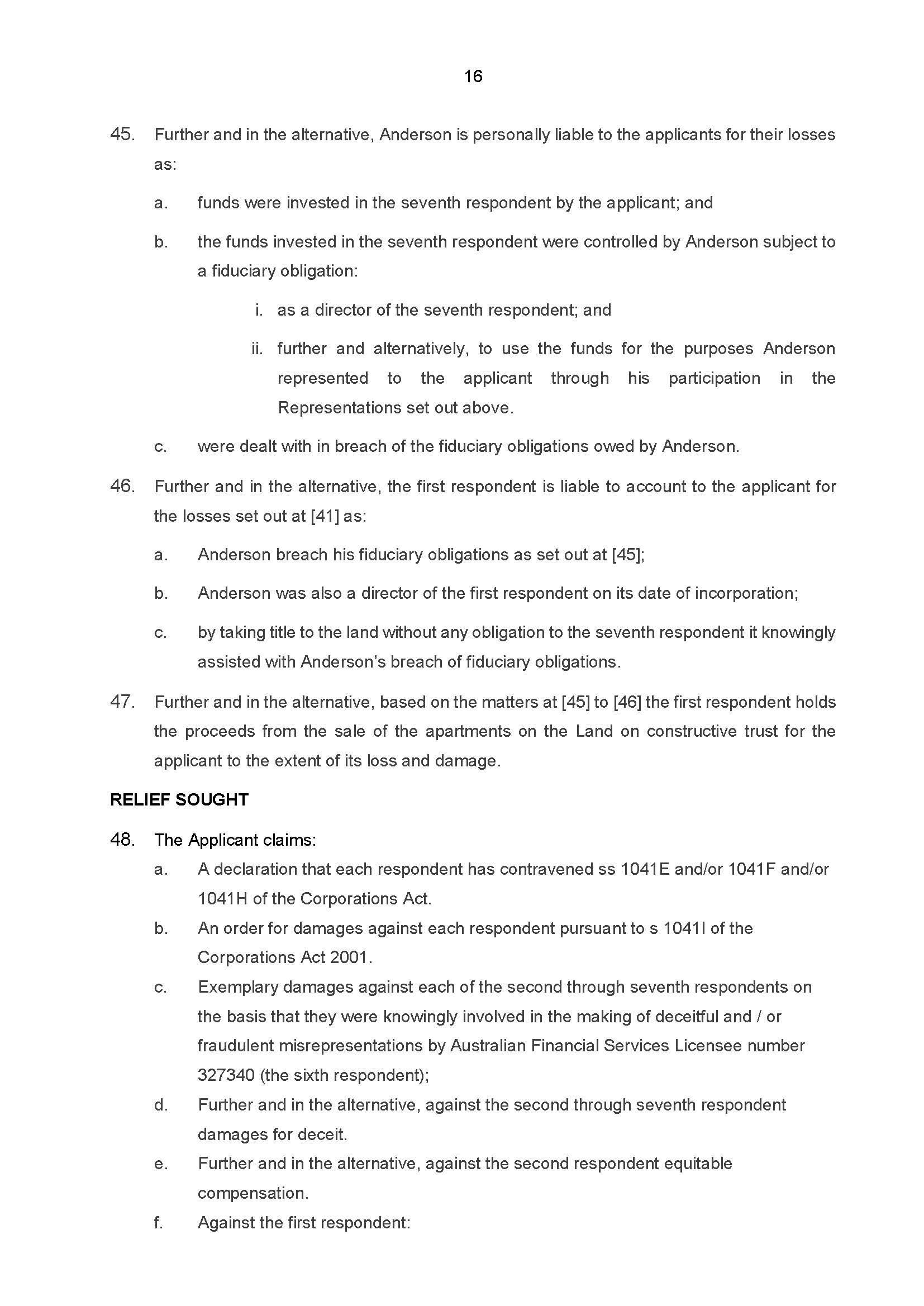
49 The applicant pleads as follows in para 45 of the Proposed Statement of Claim:
Liability of [the second respondent] and the first respondent pursuant to the principles described in Grimaldi v Chameleon Mining NL and Another (No 2) (2012) 200 FCR 296
45. Further and in the alternative, [the second respondent] is personally liable to the applicants for their losses as:
a. funds were invested in the seventh respondent by the applicant; and
b. the funds invested in the seventh respondent were controlled by [the second respondent] subject to a fiduciary obligation:
i. as a director of the seventh respondent; and
ii. further and alternatively, to use the funds for the purposes [the second respondent] represented to the applicant through his participation in the Representations set out above.
c. were dealt with in breach of the fiduciary obligations owed by [the second respondent].
50 Although the broad aim of this paragraph may be discernible, there are some problems with its lack of precision. To start, it is not clear to whom the second respondent owes the fiduciary obligations. Is the pleading intending to say that the second respondent, as a director of the seventh respondent, owes fiduciary obligations to the seventh respondent? Or, because the paragraph starts with a statement that the second respondent is liable to the applicant, is the pleading intending to say that the second respondent owes fiduciary obligations to the applicant? And, if the answer to the last question is in the affirmative, what, precisely, were the factual circumstances relied upon to give rise to the fiduciary relationship between the applicant and the second respondent? It would be convenient in this regard if the paragraph was to refer back to previously pleaded facts, either by cross-reference to a particular paragraph or by use of a defined term.
51 The heading to paras 45–47 of the Proposed Statement of Claim indicates that the liability of the first and second respondents addressed in those paragraphs is pursuant to the principles described in Grimaldi v Chameleon Mining Ltd (No 2) [2012] FCAFC 6; 200 FCR 296. However, for the purpose of assessing the clarity of the material facts alleged on the face of the Proposed Statement of Claim, the respondents are not expected to read between the lines by reference to particular case law. Greater precision is necessary in facts pleaded if the applicant is attempting to attribute particular characteristics to its allegation. In this regard, it appears from the applicant’s written submissions (see the emphasised passages in the extracted quote at para 12) that the applicant is seeking to allege liability on the part of the second respondent on the basis that he is the alter ego of the seventh respondent: see ibid at [243] per Finn, Stone and Perram JJ. However, that allegation is not clearly brought out in para 45 of the Proposed Statement of Claim.
52 The pleading further alleges (at para 45(c)) that the second respondent has “dealt with” (presumably referring to the funds invested) in breach of his fiduciary obligations. But there are no material facts pleaded which identify how these funds were applied in breach of those obligations. This is unsurprising given the applicant’s concession in its written submissions (at para 13) that it has “no visibility on how the funds were dissipated”. This is evidently the reason why the seventh respondent now seeks discovery of “all documents in [the seventh respondent’s] control that may be used to identify to whom the $1,252,000 received from the applicant was paid by the seventh respondent” (as discussed below). (I also note in this regard that the applicant had earlier in the proceeding sought for a subpoena to be issued to Westpac Banking Corporation, but I determined at the first case management hearing that I would not grant leave to the issue of the subpoenas until the pleading disputes were settled.) However, notwithstanding these efforts, the applicant does not appear to currently have a proper basis to make the specific allegation in para 45(c).
53 The “information asymmetry” between applicant and respondent prior to the commencement of legal proceedings can undoubtedly be a strategic impediment to the applicant. As such, some leniency is granted to the applicant in permitting evolution in the precision of its case over the course of a proceeding. Clearly, an applicant is not required to have absolute certainty in respect of its allegations in order to commence a proceeding. Indeed, it may be that, in some circumstances, discovery and the delivery of further particulars will support the refinement of the applicant’s case: see, for example, Sadie Ville Pty Ltd v Deloitte Touche Tohmatsu [2017] FCA 1202; 123 ACSR 223 (Sadie Ville (No 1)) at [66] per Moshinsky J. However, for an applicant to plead an allegation, there must be a factual and legal basis for that allegation: see r 16.01(c)(i) of the Rules. This only requires that “there is some evidence” and that “the gist of that evidence is properly pleaded and particularised”: Optiver Australia Pty Ltd v Tibra Trading Pty Ltd [2008] FCAFC 133; 169 FCR 435 at [33] per Heerey, Gyles and Middleton JJ. However, without expressly saying so, it appears the applicant does not currently have sufficient evidence to support its claim that the second respondent “dealt with” the funds invested.
54 Given the applicant’s present uncertainty as to the movement and use of the invested funds, the applicant would naturally have held the same uncertainty prior to commencing the proceeding. As such, the applicant could have availed itself of pre-proceeding mechanisms under the Rules to uncover what happened to the funds. However, it did not do so, and, as things stand, it appears that the applicant currently does not have a factual and legal basis for this allegation. If that is so, the proper response is for the applicant, at least at this stage, to abandon this aspect of its claim, and to reignite it should the applicant come to possess further supporting evidence. And, in my view, it is currently inapposite to permit a discovery application without the applicant clarifying its pleadings.
Discovery application
55 As noted above, the second order sought by the applicant in its interlocutory application on 28 April 2020 is as follows:
2. An order pursuant to r 7.11 of the Federal Court Rules 2011 (Rules) that the seventh respondent to give discovery to the applicant of all documents in its control that may be used to identify to whom the $1,252,000 received from the applicant was paid by the seventh respondent by Thursday 11 June 2020.
56 The reference in the second order to r 7.11 of the Rules (which is entitled “[c]ompromise or settlement of matter before proceeding”) is in error. According to the applicant’s written submissions, the applicant is seeking preliminary discovery against the seventh respondent, which would instead invoke an order under either rr 7.22 or 7.23. Counsel for the applicant confirmed at this morning’s hearing that the relevant rule invoked was r 7.22.
57 Regardless of whether r 7.22 of the Rules is appropriately invoked in respect of discovery from the seventh respondent (the seventh respondent does not meet the definition of a “prospective respondent” under r 7.21), my view is that, given the applicant is required to re-plead the entirety of its Proposed Statement of Claim (as I conclude below), it would be premature to make any order as to discovery in the nature sought by the applicant in its interlocutory application. I will accordingly dismiss the applicant’s discovery application. The applicant is entitled to make a further application for discovery at an appropriate future time.
Exemplary damages
58 The applicant finally seeks an order as toexemplary damages against each of the second to seventh respondents on the basis that they either “assisted in deceitful or fraudulent conduct” (para 44), or were “knowingly involved in the making of deceitful and / or fraudulent misrepresentations” (para 48(c)), by the sixth respondent. This is the first time the Proposed Statement of Claim referred to the underlying conduct as “fraudulent”. In any event, there is a broader difficulty with the applicant’s claim for exemplary damages that largely follows from the preceding discussion.
59 Exemplary damages are an exceptional remedy: Gray v Motor Accident Commission [1998] HCA 70; 196 CLR 1 at [20] per Gleeson CJ, McHugh, Gummow and Hayne JJ. As McColl JA explained in Fede v Gray by his tutor New South Wales Trustee and Guardian [2018] NSWCA 316; 98 NSWLR 1149 at [152] (with the agreement of Basten JA at [208] and Meagher JA at [211]), for there to be an award of exemplary damages,
[t]here must be something more than a mere finding of fault. Rather, exemplary damages are awarded “as a punishment to the guilty, to deter from any such proceeding for the future, and as a proof of the detestation of the jury to the action itself.” They are awarded where a defendant engages in conduct “variously identified as ‘wanton and malicious’, as ‘conscious wrongdoing in contumelious disregard of the plaintiff’s rights’, as ‘outrageous’, ‘atrocious’, ‘vindictive’, ‘arrogant’, ‘high handed’ or ‘insolent’.”
(Citations omitted.)
60 The facts underlying this proceeding, once ultimately proven, may or may not warrant a claim for such damages. At this stage, I cannot express a view either way. But it is clear that some aspects of the pleaded conduct of the relevant respondents could not give rise to such an order. Paragraph 44 of the Proposed Statement of Claim pleads that the applicant is entitled to recover exemplary damages as a result of the facts pleaded at paras 31 and 38. These paragraphs, which have been discussed above, allege ranging degrees of wrongdoing by the respondents (including by making, or being involved in, merely misleading representations). Depending on the factual circumstances, and the causes of action advanced, the making of a deliberately false representation by a defendant may, in exceptional circumstances, warrant an exemplary damages order against the defendant. However, it is very unlikely, if not impossible, for the making of a representation that is merely misleading to amount to conduct worthy of such punishment. As such, to the extent that the applicant wishes to maintain its claim to an entitlement to exemplary damages, its pleadings will need to be amended such as to clearly define the basis for that entitlement. This is so in respect of both the material facts and the cause of action said to give rise to the entitlement.
Conclusion
61 Although “the modern tendency is against taking a pedantic approach to pleadings, it is fundamental that a pleading must clearly indicate what allegations are made against each respondent”: Coshott v Mak [1998] FCA 147 at p 4 per Wilcox J. In the present case, I commenced my analysis of the Proposed Statement of Claim willing to forgive the applicant from having to perfectly plead its claims. However, upon reading the Proposed Statement of Claim (in particular those aspects discussed above), my view is that it does not plead its allegations with sufficient precision, and would accordingly be, as a whole, liable to be struck out under r 16.21(1) of the Federal Court Rules.
62 Unlike the circumstances considered by Moshinsky J in Sadie Ville (No 1) at [66], I do not view that the circumstances of the present case are such that the applicant’s Proposed Statement of Claim provides a satisfactory basis for the ongoing conduct of this proceeding, even at this preliminary stage. Given the extent of the deficiencies with the applicant’s pleadings, it is not open for discovery and further particulars to rescue the applicant from having to re-plead its case in a sufficiently precise manner.
63 It is clearly necessary for the applicant to clarify its allegations prior to the filing of any defences by the respondents or any attempts at mediating the dispute. To this end, I direct that, within 28 days of this decision, the applicant file and serve a further proposed amended statement of claim and, if necessary, a further proposed originating application. In doing so, the applicant should heed the analysis of the Proposed Statement of Claim set out in these reasons.
Original statement of claim
64 A number of deficiencies with the Proposed Statement of Claim described above apply equally to the applicant’s original statement of claim (dated and filed 12 December 2019). On this basis, I raised with counsel for the applicant this afternoon that I was minded to also strike out the applicant’s original statement of claim, and then provide the applicant a completely fresh opportunity to re-plead its case. Upon request from the applicant, I granted the parties the opportunity to read these reasons and then raise any submissions in relation to the applicant’s maintenance of its original statement of claim.
Costs
65 At the hearing this morning, counsel for the fourth respondent submitted that, should the Court refuse to grant the applicant leave to amend its pleading, an indemnity costs order should be made against the applicant due to, in the fourth respondent’s submission, the applicant’s persistence with its proposed amended pleadings in the face of the respondents’ previous correspondence to the applicant regarding the deficiencies with those pleadings. For similar reasons, counsel for the first respondent submitted this afternoon that the applicant ought to pay the respondents’ costs forthwith.
66 I order that the applicant pay the respondents’ costs of and incidental to the applicant’s interlocutory application, but not on an indemnity basis, nor to be payable forthwith. I accept that it was not optimal for the parties to require two case management hearings and an interlocutory hearing to address the deficiencies with the applicant’s pleadings, but I do not view the applicant’s conduct in the proceeding thus far to be so unreasonable such as to warrant the costs orders sought by the first respondent and fourth respondent respectively.
Orders
67 For the reasons expressed above, I make the following orders:
1. The applicant’s interlocutory application dated 28 April 2020 (Interlocutory Application) is dismissed.
2. The applicant pay the respondents’ costs of and incidental to the Interlocutory Application.
3. Within 28 days, the applicant file and serve a further proposed amended statement of claim and, if necessary, a further proposed amended originating application.
I certify that the preceding sixty-seven (67) numbered paragraph is a true copy of the Reasons for Judgment herein of the Honourable Justice Anderson. |
Associate:
APPLICANT’S PROPOSED AMENDED STATEMENT OF CLAIM DATED 28 APRIL 2020
VID 1356 of 2019 | |
DAVID CANTLEY | |
Fifth Respondent: | FUTURE ESTATE GROUP PTY LTD |
Sixth Respondent: | FUTURE FUNDS MANAGEMENT PTY LTD |
Seventh Respondent: | BUNDOORA PROJECTS HOLDINGS PTY LTD |


