FEDERAL COURT OF AUSTRALIA
Cantor v Audi Australia Pty Limited (No 5) [2020] FCA 637
Table of Corrections | |
25 May 2020 | In the first sentence of paragraph 232, the words “the interests of” have been inserted after the words “fair and reasonable having regard to” and before the words “the class members as a whole”. |
25 May 2020 | In the first sentence of paragraph 334, “s 23ZF” has been replaced with “s 33ZF”. |
25 May 2020 | At the end of paragraph 340, “(s 183)” has been replaced with “(s 173)”. |
ORDERS
Applicant | ||
AND: | AUDI AUSTRALIA PTY LIMITED (ACN 077 092 776) Respondent | |
JUDGE: | FOSTER J |
DATE OF ORDER: | 1 APRIL 2020 |
THE COURT ORDERS THAT:
1. Confidential Material means the information and evidence in:
(a) Paragraphs 5 to 27 of the confidential affidavit of Julian Klaus Schimmel affirmed on 10 December 2019 and filed in proceedings NSD1459 of 2015, NSD1472 of 2015 and NSD1473 of 2015 (together, the MB proceedings) and Annexure 2 to the Deed of Release and Settlement comprising Annexure JK-67 to the said affidavit;
(b) Annexure 2 to the Deed of Release and Settlement in Annexure JKS-68 to the confidential affidavit of Julian Klaus Schimmel affirmed on 20 March 2020 and filed in the MB proceedings;
(c) The Settlement Payment Methodology specified in Annexure JKS-69 to the confidential affidavit of Julian Klaus Schimmel affirmed on 20 March 2020 and filed in the MB proceedings;
(d) The expert report of Terence Michael Potter dated 20 March 2020 including all appendices and relied upon in the MB proceedings;
(e) Confidential exhibit AGR-1 to the affidavit of Alexandra Gay Rose sworn on 24 March 2020 and filed in the MB proceedings;
(f) Paragraphs 3.1(2) and (3), 6.1 to 6.25 and Annexure A to the expert report of Abe Tomas dated 20 March 2020 and relied upon in the MB proceedings and the letter of instruction from Maurice Blackburn Pty Ltd (Maurice Blackburn) to Mr Tomas; and
(g) The confidential affidavit of Gregory John Williams sworn on 25 March 2020.
2. Confidential Settlement Evidence means:
The confidential opinion of the applicant’s Counsel dated 20 March 2020.
3. VW WO Data means the following information from the National Exchange of Vehicle and Driver Information System (NEVDIS) contained in the spreadsheet entitled SR1727_data.xlsx:
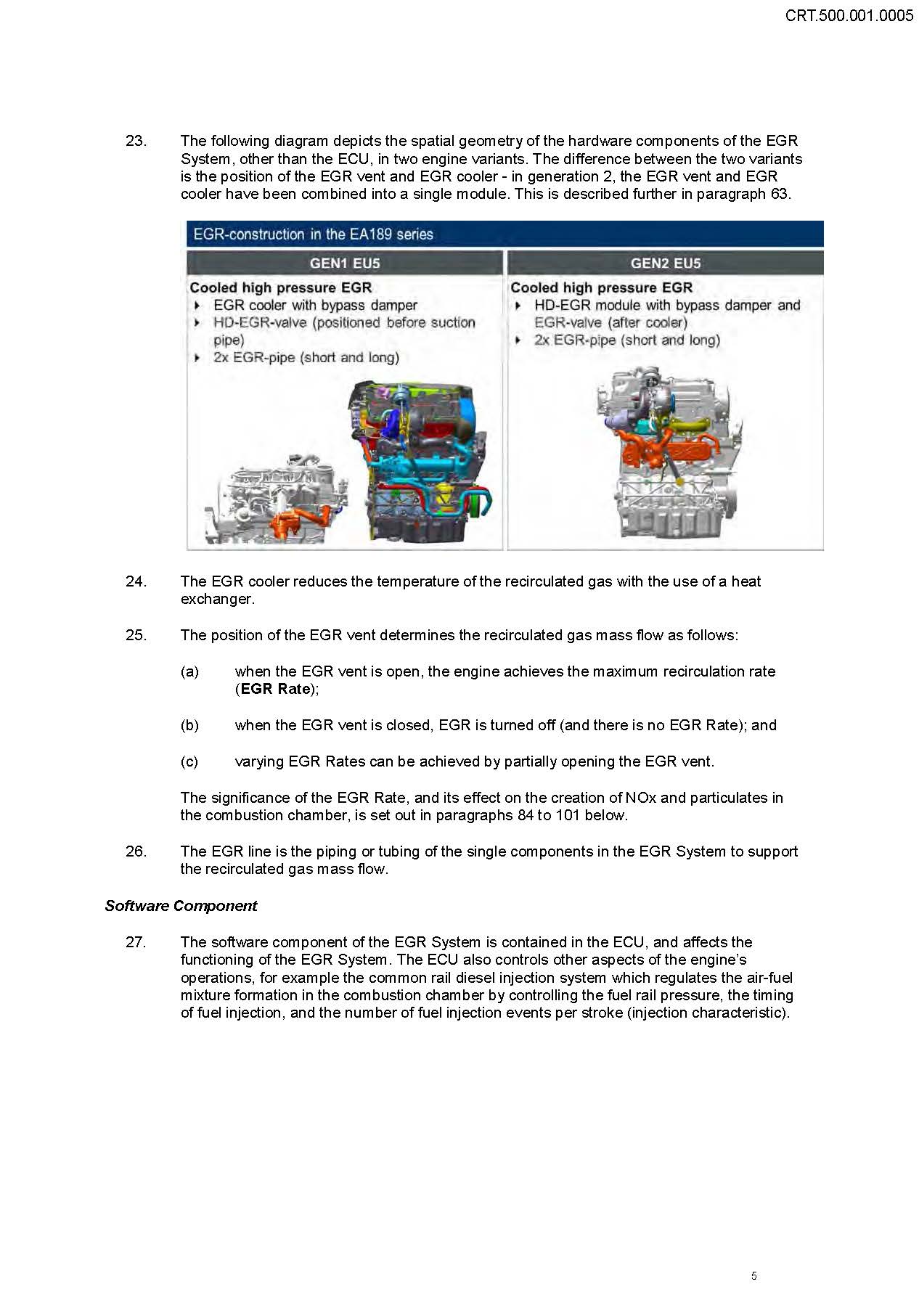
(a) Vehicle Information Number (VIN);
(b) Write-Off Status; and
(c) Write-Off Date.
4. Skoda WO Data means the following information from NEVDIS contained in the spreadsheet entitled SR1726_data.xlsx:
(a) Vehicle Information Number (VIN);
(b) Write-Off Status; and
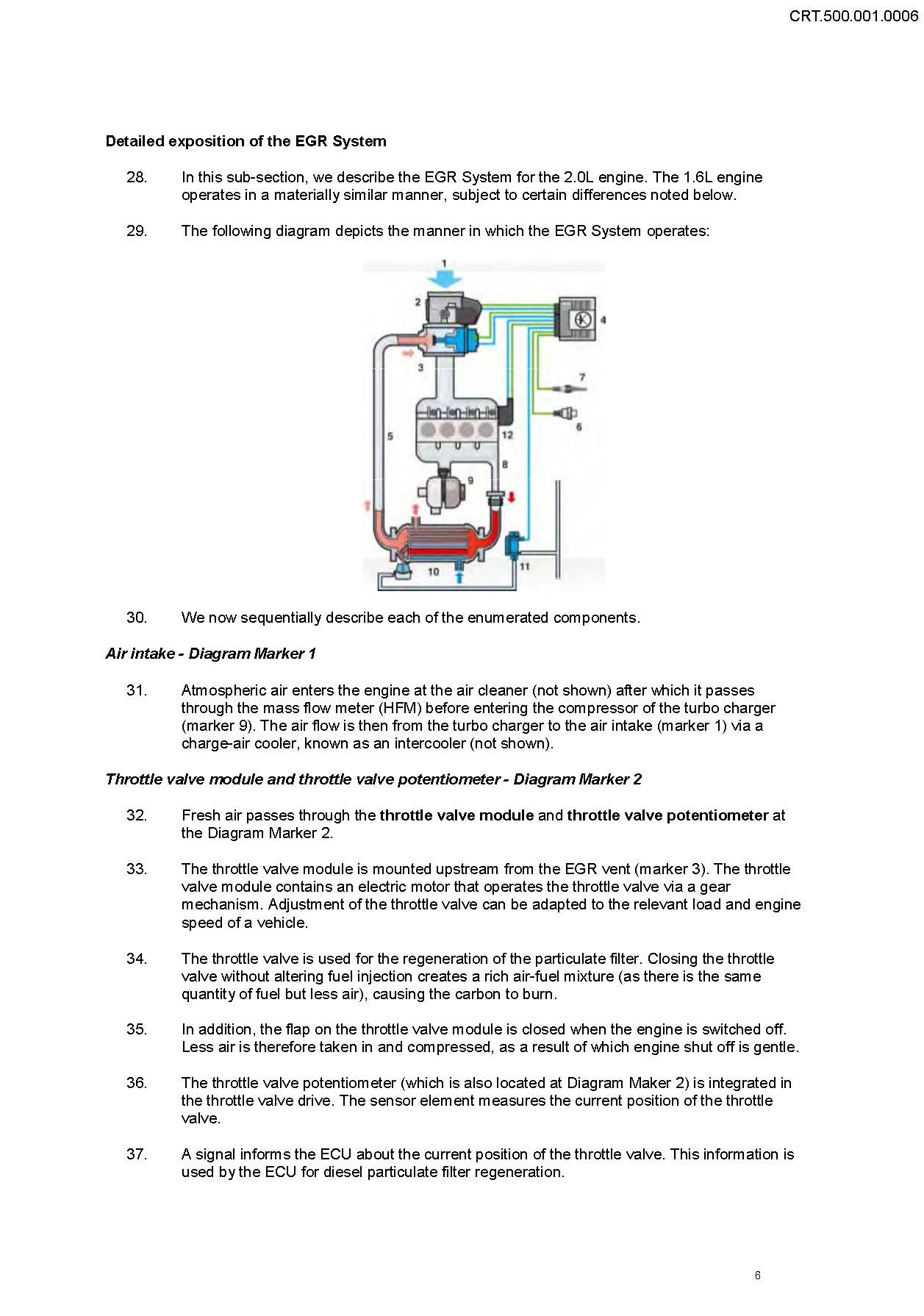
(c) Write-Off Date.
5. Audi WO Data means the following information from NEVDIS contained in the spreadsheet entitled SR1965.xlsx:
(a) Vehicle Information Number (VIN);
(b) Write-Off Status; and
(c) Write-Off Date.
6. Pursuant to s 33V of the Federal Court of Australia Act 1976 (Cth) (the Act), the settlement of this proceeding be approved upon the terms set out in:
(a) The Deed of Release and Settlement comprising Annexure JKS-68 to the confidential affidavit of Julian Klaus Schimmel affirmed on 20 March 2020 and filed in the MB proceedings (Settlement Deed);
(b) The Settlement Scheme (version 2) comprising Annexure JKS-71 to the affidavit of Julian Klaus Schimmel affirmed on 20 March 2020 and filed in the MB proceedings (Settlement Scheme); and
(c) The Settlement Payment Methodology comprising Annexure JKS-69 to the confidential affidavit of Julian Klaus Schimmel affirmed on 20 March 2020 and filed in the MB proceedings.
7. Pursuant to s 33ZF of the Act, the applicant be authorised, nunc pro tunc, to enter into and give effect to the Settlement Deed for and on behalf of all Group Members (being those persons who meet the definition of group members as set out in the Third Further Amended Statement of Claim filed herein on 18 September 2017 [which definition is set out in the Schedule to these Orders] and who did not opt out of this proceeding).
8. Pursuant to s 33ZB(a) of the Act, the persons affected and bound by the settlement are the parties to the Settlement Deed and Group Members.
9. Pursuant to s 33V(2) and s 33ZF of the Act:
(a) The payment to Richard Cantor of AUD20,000 be approved as a Lead Applicant Reimbursement Payment (as defined in clause 1.1 of the Settlement Deed) and be paid by the respondents in accordance with clause 5.2 of the Settlement Deed.
(b) The Bannister Law component of the Applicants’ Reasonable Costs (as defined in clause 1.1 of the Settlement Deed) be approved in the amount verified as reasonable in respect of the period up to and including 29 February 2020 in the report of Ian Ramsey-Stewart dated 20 March 2020 and filed in the MB proceedings and be paid in accordance with clause 5.1 of the Settlement Deed.
(c) The payment to the applicant in this proceeding and the applicant in proceeding NSD1308 of 2015 jointly of the amount of AUD752,844 being the total of the premiums payable under and for the Bannister Law Applicants’ ATE insurance described in clauses 1.1 and 5(b) of the Settlement Deed be approved.
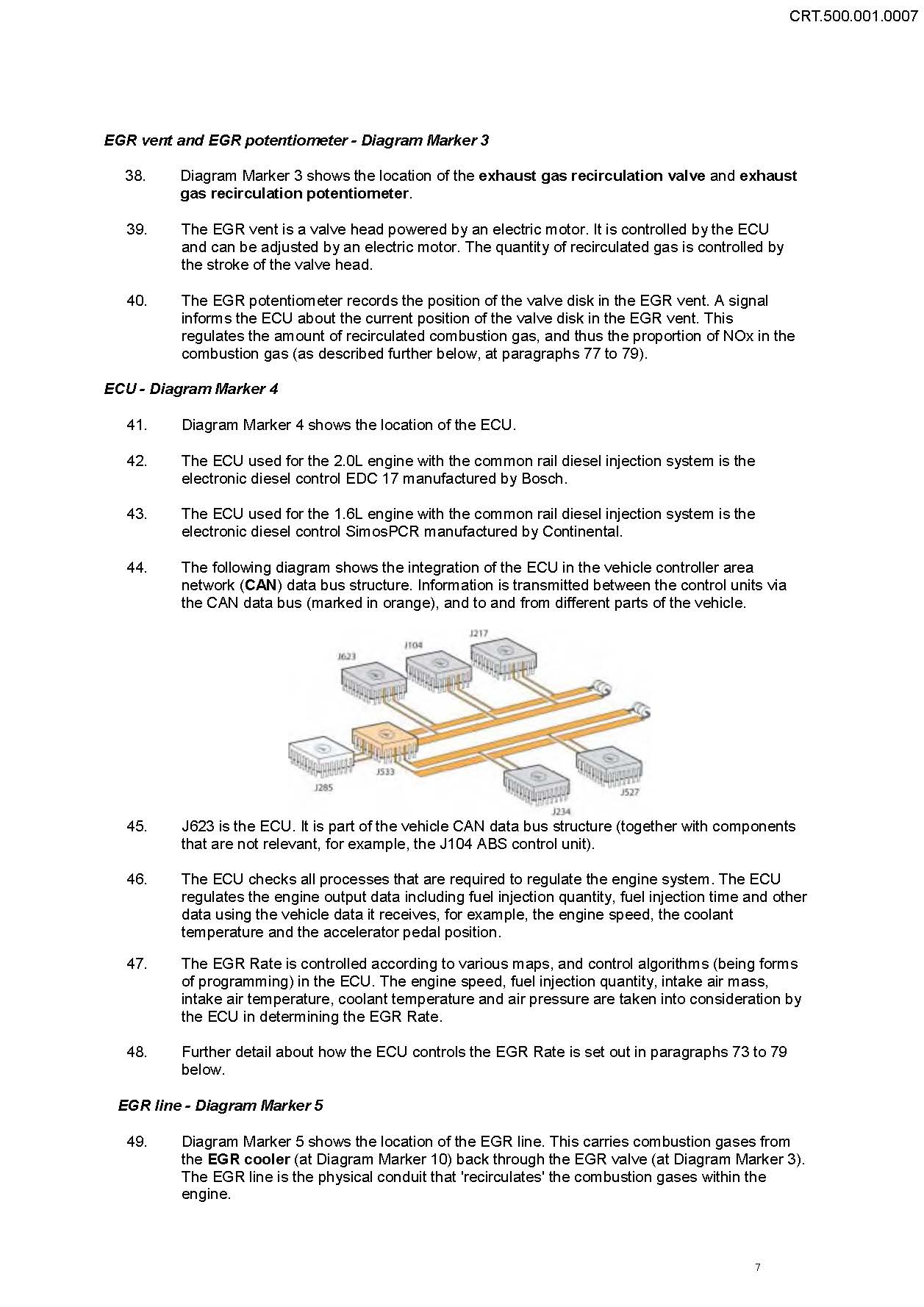
10. Pursuant to s 33ZF of the Act, Maurice Blackburn be appointed as the Administrator of the Settlement Scheme.
11. The proceeding be dismissed:
(a) With no order as to costs and with all previous costs orders vacated;
(b) Without prejudice to parties’ or the Administrator’s liberty to relist the matter for the purpose of seeking orders consequential to the Settlement Deed and/or the Settlement Scheme, and, to this end, pursuant to r 9.05 of the Federal Court Rules 2011 the Administrator be joined as a party to this proceeding for the limited purpose of exercising such liberty; and
(c) With the dismissal of the proceeding to take effect upon completion of the administration of the settlement.
12. Pursuant to s 37AF and s 37AG(1)(a) of the Act, until further order, on the ground that the order is necessary to prevent prejudice to the proper administration of justice, the Confidential Settlement Evidence:
(a) Be treated as confidential;
(b) To the extent that such material is held by the Court in paper form, be held with the Court file in envelopes marked “Not to be opened except by leave of the Court or a Judge” or destroyed;
(c) To the extent that such material is held by the Court in electronic form, be kept in a confidential section of the relevant Court file;
(d) Not be published, made available (whether electronically or otherwise) or disclosed to any person or entity except:
(i) The Court;
(ii) The applicant in this proceeding NSD1307 of 2015 and the applicant in proceeding NSD1308 of 2015 and their legal representatives; and
(iii) The legal representatives of the applicants in the MB proceedings,
such permitted disclosures to be on terms that none of those persons or entities disclose the Confidential Settlement Evidence or any part of it to any person or entity other than those listed in this Order.
13. Pursuant to s 33ZF of the Act:
(a) The claim registered by Mr Barry Holmes on 12 March 2020 be deemed to have been validly registered in accordance with clause 5.3 of the Settlement Scheme and Mr Holmes be permitted to participate in the Settlement Scheme; and
(b) Provided that a claim is registered by Mr Peter Shakes by 16 April 2020, his claim be deemed to have been validly registered in accordance with clause 5.3 of the Settlement Scheme and Mr Shakes be permitted to participate in the Settlement Scheme.
14. Pursuant to s 33ZF of the Act, and notwithstanding Order 13 made on 12 December 2019, persons who have, after 10 March 2020 but on or before 26 March 2020, registered claims in accordance with the Settlement Scheme shall be deemed to have validly registered their claims in accordance with clause 5 of the Settlement Scheme and shall be permitted to participate in the Settlement Scheme.
15. Pursuant to s 33ZF of the Act:
(a) On or before 1 April 2020, Volkswagen Group Australia Pty Limited produce copies of the VW WO Data and Skoda WO Data to Maurice Blackburn;
(b) On or before 1 April 2020, Audi Australia Pty Limited produce copies of the Audi WO Data to Maurice Blackburn;
(c) Maurice Blackburn be permitted to use the VW WO Data, Skoda WO Data and Audi WO Data (together, the NEVDIS WO Data) for the limited purpose of verifying whether or not a group member held an interest in an affected vehicle in accordance with the Settlement Scheme and whether, and if so, when that vehicle was written off;
(d) Maurice Blackburn keep and store the NEVDIS WO Data in a manner that preserves its confidentiality; and
(e) Maurice Blackburn not disclose the NEVDIS WO Data to any person other than the following who have provided an undertaking to keep the NEVDIS WO Data confidential and not use it in a manner that is inconsistent with these Orders:
(i) Officers and employees of Maurice Blackburn who are involved in or responsible for the conduct of this proceeding;
(ii) Officers and employees of any third parties engaged to provide technical or project support services in relation to the settlement of this proceeding;
(iii) Counsel retained and appointed to perform the role of “Review Assessor” pursuant to clause 8 of the Settlement Scheme; and
(iv) Experts engaged by Maurice Blackburn to assist in carrying out any functions under the Settlement Scheme.
16. The parties have liberty to apply in the event that further orders are required:
(a) Should it become apparent that, for the reasons set out in paragraph 20 of the non-confidential affidavit of Julian Klaus Schimmel affirmed on 20 March 2020 and filed in the MB proceedings, certain group members were not notified of the proposed settlement prior to 10 March 2020, for the purpose of seeking orders as may be appropriate to permit some or all of such persons to participate in the Settlement Scheme;
(b) Should it become apparent that amendments are needed to the Settlement Scheme for the reasons set out in paragraph 72 of the non-confidential affidavit of Julian Klaus Schimmel affirmed on 20 March 2020 and filed in the MB proceedings, for the purpose of seeking approval of such amendments; or
(c) Should any of the parties or Group Members consider that it is desirable to seek the assistance of the Court in relation to any matter concerning the Settlement Scheme.
17. As soon as practicable after completion of the settlement administration, the Administrator provide a report to the Court as to the completion of the Settlement Scheme.
18. The claims for relief made by the applicant in the Interlocutory Application filed by him on 4 November 2016 be dismissed.
19. The claims for relief made by the applicant in the Interlocutory Application filed by him on 10 December 2019 be dismissed.
20. Pursuant to r 1.32 of the Federal Court Rules 2011 and s 33ZF of the Act, Grosvenor Litigation Services Pty Ltd (Grosvenor) be joined to this proceeding as an additional respondent.
21. The claims for relief made by Grosvenor in the Interlocutory Application filed by it in this proceeding on 11 December 2019 otherwise be dismissed.
22. The claim by Grosvenor for a Funding Order made orally before the Court on 26 March 2020 be dismissed.
23. Grosvenor’s claims for non-publication or suppression orders in respect of particular evidence tendered before the Court on 26 March 2020 be reserved into Chambers to be dealt with on the papers.
AND THE COURT NOTES THAT:
24. In addition to information already provided and noting that the parties otherwise have sought non-publication orders in respect of the Confidential Material and the Confidential Settlement Evidence as set out proposed Orders 1, 12 and 13 of certain draft Orders submitted by Maurice Blackburn to the Court for its consideration at approximately 2.10 pm on 27 March 2020:
(a) Volkswagen AG will pay approximately AUD120 million as the total settlement amount to be made available to eligible group members.
(b) When the settlement has been finalised and all requisite payments thereunder have been made, the total of all amounts paid is unlikely to be significantly less than AUD120 million and may be more than AUD120 million.
(c) Individual settlement payments will be determined in accordance with the methodology developed by the applicant and approved by the Court.
(d) The precise amount of each individual payment must await the finalisation of the assessment of registrations by Maurice Blackburn as the Administrator (which is ongoing).
(e) The estimated average settlement payment for each participating vehicle is AUD2,800.
(f) Persons with an interest in different types of vehicles are eligible to receive different payment amounts, for example, as a result of the type and age of their vehicle. The range of per vehicle payments is approximately AUD1,589 to AUD6,554.
25. Exhibits AGR1 and AGR2 to the affidavit of Alexandra Gay Rose sworn on 24 March 2020 and filed in the MB proceedings, which are in the form of Excel files stored on a USB, are to be retained by the solicitors for the respondents until the date which is 12 months from the date upon which dismissal of this proceeding takes effect in accordance with Order 11 above.
26. The total amount of the Bannister Law applicants’ costs and disbursements verified by Mr Ramsey-Stewart pursuant to and for the purposes of clauses 1.1 and 5 of the Settlement Deed to be paid pursuant to Order 9(b) above and Order 9(b) made this day in proceeding NSD1308 of 2015 is AUD7,800,696.50 inclusive of GST.
27. The names of those Group Members who have opted out of this proceeding are specified in the Orders made by the Court on 6 May 2019.
THE SCHEDULE HEREINBEFORE REFERRED TO
Group Members are those persons (other than those persons who had retained Maurice Blackburn as their legal representative in proceeding NSD1472 of 2015 as at 1 August 2017, except for those Group Members who had also retained Bannister Law as their legal representative in this proceeding NSD1307 of 2015 as at 1 August 2017) who:
(a) At any time during the period between January 2008 and 28 October 2015 inclusive purchased or leased or otherwise acquired an interest in an Audi diesel motor vehicle fitted with 1.6L or 2.0L EA189 diesel engines, in particular the following models, and who still had a legal interest in that vehicle as at 18 September 2015:
Make | Model | Year |
Audi | A1 | 2011–2014 |
A3 (1.6) | 2011–2013 | |
A3 (2.0) | 2009–2013 | |
A4 | 2008–2015 | |
A5 | 2012–2016 | |
A6 | 2009–2014 | |
Q3 | 2012–2014 | |
Q5 | 2009–2016 | |
TT | 2009–2014 |
and
(b) Suffered loss or damage by or resulting from the conduct and contraventions by the respondent pleaded in the Third Further Amended Statement of Claim filed herein on 18 September 2017.
Note: Entry of orders is dealt with in Rule 39.32 of the Federal Court Rules 2011.
ORDERS
NSD 1308 of 2015 | |
BETWEEN: | JOSEFINA TOLENTINO Applicant |
AND: | VOLKSWAGEN GROUP AUSTRALIA PTY LIMITED (ACN 093 117 876) Respondent |
JUDGE: | foster j |
DATE OF ORDER: | 1 APRIL 2020 |
THE COURT ORDERS THAT:
1. Confidential Material means the information and evidence in:
(a) Paragraphs 5 to 27 of the confidential affidavit of Julian Klaus Schimmel affirmed on 10 December 2019 and filed in proceedings NSD1459 of 2015, NSD1472 of 2015 and NSD1473 of 2015 (together, the MB proceedings) and Annexure 2 to the Deed of Release and Settlement comprising Annexure JK-67 to the said affidavit;
(b) Annexure 2 to the Deed of Release and Settlement in Annexure JKS-68 to the confidential affidavit of Julian Klaus Schimmel affirmed on 20 March 2020 and filed in the MB proceedings;
(c) The Settlement Payment Methodology specified in Annexure JKS-69 to the confidential affidavit of Julian Klaus Schimmel affirmed on 20 March 2020 and filed in the MB proceedings;
(d) The expert report of Terence Michael Potter dated 20 March 2020 including all appendices relied upon in the MB proceedings;
(e) Confidential exhibit AGR-1 to the affidavit of Alexandra Gay Rose sworn on 24 March 2020 and filed in the MB proceedings;
(f) Paragraphs 3.1(2) and (3), 6.1 to 6.25 and Annexure A to the expert report of Abe Tomas dated 20 March 2020 and relied upon in the MB proceedings and the letter of instruction from Maurice Blackburn Pty Ltd (Maurice Blackburn) to Mr Tomas; and
(g) The confidential affidavit of Gregory John Williams sworn on 25 March 2020.
2. Confidential Settlement Evidence means:
The confidential opinion of the applicant’s Counsel dated 20 March 2020.
3. VW WO Data means the following information from the National Exchange of Vehicle and Driver Information System (NEVDIS) contained in the spreadsheet entitled SR1727_data.xlsx:
(a) Vehicle Information Number (VIN);
(b) Write-Off Status; and
(c) Write-Off Date.
4. Skoda WO Data means the following information from NEVDIS contained in the spreadsheet entitled SR1726_data.xlsx:
(a) Vehicle Information Number (VIN);
(b) Write-Off Status; and
(c) Write-Off Date.
5. Audi WO Data means the following information from NEVDIS contained in the spreadsheet entitled SR1965.xlsx:
(a) Vehicle Information Number (VIN);
(b) Write-Off Status; and
(c) Write-Off Date.
6. Pursuant to s 33V of the Federal Court of Australia Act 1976 (Cth) (the Act), the settlement of this proceeding be approved upon the terms set out in:
(a) The Deed of Release and Settlement comprising Annexure JKS-68to the confidential affidavit of Julian Klaus Schimmel affirmed on 20 March 2020 and filed in the MB proceedings (Settlement Deed);
(b) The Settlement Scheme (version 2) comprising Annexure JKS-71 to the affidavit of Julian Klaus Schimmel affirmed on 20 March 2020 and filed in the MB proceedings (Settlement Scheme); and
(c) The Settlement Payment Methodology comprising Annexure JKS-69 to the confidential affidavit of Julian Klaus Schimmel affirmed on 20 March 2020 and filed in the MB proceedings.
7. Pursuant to s 33ZF of the Act, the applicant be authorised, nunc pro tunc, to enter into and give effect to the Settlement Deed for and on behalf of all Group Members (being those persons who meet the definition of group members as set out in the Third Further Amended Statement of Claim filed herein on 18 September 2017 [which definition is set out in the Schedule to these Orders] and who did not opt out of this proceeding).
8. Pursuant to s 33ZB(a) of the Act, the persons affected and bound by the settlement are the parties to the Settlement Deed and Group Members.
9. Pursuant to s 33V(2) and s 33ZF of the Act:
(a) The payment to Josefina Tolentino of AUD20,000 be approved as a Lead Applicant Reimbursement Payment (as defined in clause 1.1 of the Settlement Deed) and be paid by the respondents in accordance with clause 5.2 of the Settlement Deed.
(b) The Bannister Law component of the Applicants’ Reasonable Costs (as defined in clause 1.1 of the Settlement Deed) be approved in the amount verified as reasonable in respect of the period up to and including 29 February 2020 in the report of Ian Ramsey-Stewart dated 20 March 2020 and filed in the MB proceedings and be paid in accordance with clause 5.1 of the Settlement Deed.
(c) The payment to the applicant in this proceeding and the applicant in proceeding NSD1307 of 2015 jointly of the amount of AUD752,844 being the total of the premiums payable under and for the Bannister Law Applicants’ ATE insurance described in clauses 1.1 and 5(b) of the Settlement Deed be approved.
10. Pursuant to s 33ZF of the Act, Maurice Blackburn be appointed as the Administrator of the Settlement Scheme.
11. The proceeding be dismissed:
(a) With no order as to costs and with all previous costs orders vacated;
(b) Without prejudice to parties’ or the Administrator’s liberty to relist the matter for the purpose of seeking orders consequential to the Settlement Deed and/or the Settlement Scheme, and, to this end, pursuant to r 9.05 of the Federal Court Rules 2011 the Administrator be joined as a party to this proceeding for the limited purpose of exercising such liberty; and
(c) With the dismissal of the proceeding to take effect upon completion of the administration of the settlement.
12. Pursuant to s 37AF and s 37AG(1)(a) of the Act, until further order, on the ground that the order is necessary to prevent prejudice to the proper administration of justice, the Confidential Settlement Evidence:
(a) Be treated as confidential;
(b) To the extent that such material is held by the Court in paper form, be held with the Court file in envelopes marked “Not to be opened except by leave of the Court or a Judge” or destroyed;
(c) To the extent that such material is held by the Court in electronic form, be kept in a confidential section of the relevant Court file;
(d) Not be published, made available (whether electronically or otherwise) or disclosed to any person or entity except:
(i) The Court;
(ii) The applicants in this proceeding NSD1308 of 2015 and the applicant in proceeding NSD1307 of 2015 and their legal representatives; and
(iii) The legal representatives of the applicants in the MB proceedings,
such permitted disclosures to be on terms that none of those persons or entities disclose the Confidential Settlement Evidence or any part of it to any person or entity other than those listed in this Order.
13. Pursuant to s 33ZF of the Act:
(a) The claim registered by Mr Barry Holmes on 12 March 2020 be deemed to have been validly registered in accordance with clause 5.3 of the Settlement Scheme and Mr Holmes be permitted to participate in the Settlement Scheme; and
(b) Provided that a claim is registered by Mr Peter Shakes by 16 April 2020, his claim be deemed to have been validly registered in accordance with clause 5.3 of the Settlement Scheme and Mr Shakes be permitted to participate in the Settlement Scheme.
14. Pursuant to s 33ZF of the Act, and notwithstanding Order 13 made on 12 December 2019, persons who have, after 10 March 2020 but on or before 26 March 2020, registered claims in accordance with the Settlement Scheme shall be deemed to have validly registered their claims in accordance with clause 5 of the Settlement Scheme and shall be permitted to participate in the Settlement Scheme.
15. Pursuant to s 33ZF of the Act:
(a) On or before 1 April 2020, Volkswagen Group Australia Pty Limited produce copies of the VW WO Data and Skoda WO Data to Maurice Blackburn;
(b) On or before 1 April 2020, Audi Australia Pty Limited produce copies of the Audi WO Data to Maurice Blackburn;
(c) Maurice Blackburn be permitted to use the VW WO Data, Skoda WO Data and Audi WO Data (together, the NEVDIS WO Data) for the limited purpose of verifying whether or not a group member held an interest in an affected vehicle in accordance with the Settlement Scheme and whether, and if so, when that vehicle was written off;
(d) Maurice Blackburn keep and store the NEVDIS WO Data in a manner that preserves its confidentiality; and
(e) Maurice Blackburn not disclose the NEVDIS WO Data to any person other than the following who have provided an undertaking to keep the NEVDIS WO Data confidential and not use it in a manner that is inconsistent with these Orders:
(i) Officers and employees of Maurice Blackburn who are involved in or responsible for the conduct of this proceeding;
(ii) Officers and employees of any third parties engaged to provide technical or project support services in relation to the settlement of this proceeding;
(iii) Counsel retained and appointed to perform the role of “Review Assessor” pursuant to clause 8 of the Settlement Scheme; and
(iv) Experts engaged by Maurice Blackburn to assist in carrying out any functions under the Settlement Scheme.
16. The parties have liberty to apply in the event that further orders are required:
(a) Should it become apparent that, for the reasons set out in paragraph 20 of the non-confidential affidavit of Julian Klaus Schimmel affirmed on 20 March 2020 and filed in the MB proceedings, certain group members were not notified of the proposed settlement prior to 10 March 2020, for the purpose of seeking orders as may be appropriate to permit some or all of such persons to participate in the Settlement Scheme;
(b) Should it become apparent that amendments are needed to the Settlement Scheme for the reasons set out in paragraph 72 of the non-confidential affidavit of Julian Klaus Schimmel affirmed on 20 March 2020 and filed in the MB proceedings, for the purpose of seeking approval of such amendments; or
(c) Should any of the parties or Group Members consider that it is desirable to seek the assistance of the Court in relation to any matter concerning the Settlement Scheme.
17. As soon as practicable after completion of the settlement administration, the Administrator provide a report to the Court as to the completion of the Settlement Scheme.
18. The claims for relief made by the applicant in the Interlocutory Application filed by her on 4 November 2016 be dismissed.
19. The claims for relief made by the applicant in the Interlocutory Application filed by her on 10 December 2019 be dismissed.
20. Pursuant to r 1.32 of the Federal Court Rules 2011 and s 33ZF of the Act, Grosvenor Litigation Services Pty Ltd (Grosvenor) be joined to this proceeding as an additional respondent.
21. The claims for relief made by Grosvenor in the Interlocutory Application filed by it in this proceeding on 11 December 2019 otherwise be dismissed.
22. The claim by Grosvenor for a Funding Order made orally before the Court on 26 March 2020 be dismissed.
23. Grosvenor’s claims for non-publication or suppression orders in respect of particular evidence tendered before the Court on 26 March 2020 be reserved into Chambers to be dealt with on the papers.
AND THE COURT NOTES THAT:
24. In addition to information already provided and noting that the parties otherwise have sought non-publication orders in respect of the Confidential Material and the Confidential Settlement Evidence as set out proposed Orders 1, 12 and 13 of certain draft Orders submitted by Maurice Blackburn to the Court for its consideration at approximately 2.10 pm on 27 March 2020:
(a) Volkswagen AG will pay approximately AUD120 million as the total settlement amount to be made available to eligible group members.
(b) When the settlement has been finalised and all requisite payments thereunder have been made, the total of all amounts paid is unlikely to be significantly less than AUD120 million and may be more than AUD120 million.
(c) Individual settlement payments will be determined in accordance with the methodology developed by the applicant and approved by the Court.
(d) The precise amount of each individual payment must await the finalisation of the assessment of registrations by Maurice Blackburn as the Administrator (which is ongoing).
(e) The estimated average settlement payment for each participating vehicle is AUD2,800.
(f) Persons with an interest in different types of vehicles are eligible to receive different payment amounts, for example, as a result of the type and age of their vehicle. The range of per vehicle payments is approximately AUD1,589 to AUD6,554.
25. Exhibits AGR1 and AGR2 to the affidavit of Alexandra Gay Rose sworn on 24 March 2020 and filed in the MB proceedings, which are in the form of Excel files stored on a USB, are to be retained by the solicitors for the respondents until the date which is 12 months from the date upon which dismissal of this proceeding takes effect in accordance with Order 11 above.
26. The total amount of the Bannister Law applicants’ costs and disbursements verified by Mr Ramsey-Stewart pursuant to and for the purposes of clauses 1.1 and 5 of the Settlement Deed to be paid pursuant to Order 9(b) above and Order 9(b) made this day in proceeding NSD1307 of 2015 is AUD7,800,696.50 inclusive of GST.
27. The names of those Group Members who have opted out of this proceeding are specified in the Orders made by the Court on 6 May 2019.
THE SCHEDULE HEREINBEFORE REFERRED TO
Group Members are those persons (other than those persons who had retained Maurice Blackburn as their legal representative in proceeding NSD1459 of 2015 or NSD1473 of 2015 as at 1 August 2017, except for those Group Members who had also retained Bannister Law as their legal representative in this proceeding NSD1308 of 2015 as at 1 August 2017) who:
(a) At any time during the period between January 2008 and 28 October 2015 inclusive purchased or leased or otherwise acquired an interest in a Volkswagen or Skoda motor vehicle fitted with 1.6L or 2.0L EA189 diesel engines, in particular the following models, and who still had a legal interest in that vehicle as at 18 September 2015:
Make | Model | Year |
Volkswagen Passenger Cars | Golf | 2009–2013 |
Polo | 2009–2014 | |
Jetta | 2010–2015 | |
Passat CC | 2008–2012 | |
Volkswagen CC | 2011–2015 | |
Passat | 2008–2015 | |
Eos | 2008–2014 | |
Tiguan | 2008–2015 | |
Skoda | Octavia | 2009–2013 |
Yeti | 2011–2015 | |
Superb | 2009–2015 | |
Volkswagen Commercial Vehicles | Caddy | 2010–2015 |
Amarok | 2011–2012 |
and
(b) Suffered loss or damage by or resulting from the conduct and contraventions by the respondent pleaded in the Third Further Amended Statement of Claim filed herein on 18 September 2017.
Note: Entry of orders is dealt with in Rule 39.32 of the Federal Court Rules 2011.
ORDERS
NSD 1459 of 2015 | ||
BETWEEN: | ALISTER DALTON First Applicant JOANNA DALTON Second Applicant | |
AND: | VOLKSWAGEN AG First Respondent VOLKSWAGEN GROUP AUSTRALIA PTY LIMITED (ACN 093 117 876) Second Respondent | |
JUDGE: | foster j |
DATE OF ORDER: | 1 april 2020 |
THE COURT ORDERS THAT:
1. Confidential Material means the information and evidence in:
(a) Paragraphs 5 to 27 of the confidential affidavit of Julian Klaus Schimmel affirmed on 10 December 2019 and Annexure 2 to the Deed of Release and Settlement comprising Annexure JK-67 to the said affidavit;
(b) Annexure 2 to the Deed of Release and Settlement in Annexure JKS-68 to the confidential affidavit of Julian Klaus Schimmel affirmed on 20 March 2020;
(c) The Settlement Payment Methodology specified in Annexure JKS-69 to the confidential affidavit of Julian Klaus Schimmel affirmed on 20 March 2020;
(d) The expert report of Terence Michael Potter dated 20 March 2020 including all appendices;
(e) Confidential exhibit AGR-1 to the affidavit of Alexandra Gay Rose sworn on 24 March 2020 and filed herein;
(f) Paragraphs 3.1(2) and (3), 6.1 to 6.25 and Annexure A to the expert report of Abe Tomas dated 20 March 2020 and the letter of instruction from Maurice Blackburn Pty Ltd (Maurice Blackburn) to Mr Tomas; and
(g) The confidential affidavit of Gregory John Williams sworn on 25 March 2020.
2. Confidential Settlement Evidence means:
(a) The confidential affidavit of Julian Klaus Schimmel affirmed on 20 March 2020.
(b) The confidential opinion of the applicants’ Counsel dated 24 March 2020.
3. VW WO Data means the following information from the National Exchange of Vehicle and Driver Information System (NEVDIS) contained in the spreadsheet entitled SR1727_data.xlsx:
(a) Vehicle Information Number (VIN);
(b) Write-Off Status; and
(c) Write-Off Date.
4. Skoda WO Data means the following information from NEVDIS contained in the spreadsheet entitled SR1726_data.xlsx:
(a) Vehicle Information Number (VIN);
(b) Write-Off Status; and
(c) Write-Off Date.
5. Audi WO Data means the following information from NEVDIS contained in the spreadsheet entitled SR1965.xlsx:
(a) Vehicle Information Number (VIN);
(b) Write-Off Status; and
(c) Write-Off Date.
6. Pursuant to s 33V of the Federal Court of Australia Act 1976 (Cth) (the Act), the settlement of this proceeding be approved upon the terms set out in:
(a) The Deed of Release and Settlement comprising Annexure JKS-68 to the confidential affidavit of Julian Klaus Schimmel affirmed on 20 March 2020 (Settlement Deed);
(b) The Settlement Scheme (version 2) comprising Annexure JKS-71 to the affidavit of Julian Klaus Schimmel affirmed on 20 March 2020 and filed herein (Settlement Scheme); and
(c) The Settlement Payment Methodology comprising Annexure JKS-69 to the confidential affidavit of Julian Klaus Schimmel affirmed on 20 March 2020.
7. Pursuant to s 33ZF of the Act, the applicants be authorised, nunc pro tunc, to enter into and give effect to the Settlement Deed for and on behalf of all Group Members (being those persons who meet the definition of group members as set out in the Second Further Amended Statement of Claim filed herein on 18 September 2017 [which definition is set out in the Schedule to these Orders] and who did not opt out of this proceeding).
8. Pursuant to s 33ZB(a) of the Act, the persons affected and bound by the settlement are the parties to the Settlement Deed and Group Members.
9. Pursuant to s 33V(2) and s 33ZF of the Act:
(a) The following payments be approved as Lead Applicant Reimbursement Payments (as defined in clause 1.1 of the Settlement Deed) and be paid by the respondents in accordance with clause 5.2 of the Settlement Deed:
(i) Alister Dalton – AUD20,000 and
(ii) Joanna Dalton – AUD10,000.
(b) The Maurice Blackburn component of the Applicants’ Reasonable Costs (as defined in clause 1.1 of the Settlement Deed) be approved in the amount verified as reasonable in respect of the period up to and including 29 February 2020 in the report of Ian Ramsey-Stewart dated 20 March 2020 and filed herein and be paid by the respondents in accordance with clause 5.1 of the Settlement Deed.
10. Pursuant to s 33ZF of the Act, Maurice Blackburn be appointed as the Administrator of the Settlement Scheme.
11. The proceeding be dismissed:
(a) With no order as to costs and with all previous costs orders vacated;
(b) Without prejudice to parties’ or the Administrator’s liberty to relist the matter for the purpose of seeking orders consequential to the Settlement Deed and/or the Settlement Scheme, and, to this end, pursuant to r 9.05 of the Federal Court Rules 2011 the Administrator be joined as a party to this proceeding for the limited purpose of exercising such liberty; and
(c) With the dismissal of the proceeding to take effect upon completion of the administration of the settlement.
12. Pursuant to s 37AF and s 37AG(1)(a) of the Act, until further order, on the ground that the order is necessary to prevent prejudice to the proper administration of justice, the Confidential Settlement Evidence:
(a) Be treated as confidential;
(b) To the extent that such material is held by the Court in paper form, be held with the Court file in envelopes marked “Not to be opened except by leave of the Court or a Judge” or destroyed;
(c) To the extent that such material is held by the Court in electronic form, be kept in a confidential section of the relevant Court file;
(d) Not be published, made available (whether electronically or otherwise) or disclosed to any person or entity except:
(i) The Court;
(ii) The applicants in this proceeding NSD1459 of 2015 and the applicants in proceedings NSD1472 of 2015 and NSD1473 of 2015 and their legal representatives; and
(iii) The legal representatives of the applicants in proceedings NSD1307 of 2015 and NSD1308 of 2015
such permitted disclosures to be on terms that none of those persons or entities disclose the Confidential Settlement Evidence or any part of it to any person or entity other than those listed in this Order.
13. Pursuant to s 37AF and s 37AG(1)(a) of the Act, on the ground that the order is necessary to prevent prejudice to the proper administration of justice, up to and including 31 December 2021, the Confidential Material:
(a) Be treated as confidential;
(b) To the extent that such material is held by the Court in paper form be held with the Court file in envelopes marked “Not to be opened except by leave of the Court or a Judge” or destroyed;
(c) To the extent that such material is held by the Court in electronic form, be kept in a confidential section of the relevant Court file;
(d) Not be published, made available (whether electronically or otherwise) or disclosed (by publication or otherwise) to any other person than:
(i) The Court;
(ii) The applicants in this proceeding NSD1459 of 2015 and the applicants in proceedings NSD1472 of 2015 and NSD1473 of 2015 and their legal representatives;
(iii) The applicants and the legal representatives of the applicants in proceedings NSD1307 of 2015 and NSD1308 of 2015;
(iv) The respondents in proceedings NSD1459 of 2015, NSD1472 of 2015, NSD1473 of 2015, NSD1307 of 2015 and NSD1308 of 2015 and their legal representatives;
(v) Grosvenor Litigation Services Pty Ltd and its legal representatives; and
(vi) Nicholas Owens SC and Robert Yezerski in their capacity as independent contradictors appointed by the Court pursuant to Order 10 made on 12 December 2019.
14. Pursuant to s 33ZF of the Act:
(a) The claim registered by Mr Barry Holmes on 12 March 2020 be deemed to have been validly registered in accordance with clause 5.3 of the Settlement Scheme and Mr Holmes be permitted to participate in the Settlement Scheme; and
(b) Provided that a claim is registered by Mr Peter Shakes by 16 April 2020, his claim be deemed to have been validly registered in accordance with clause 5.3 of the Settlement Scheme and Mr Shakes be permitted to participate in the Settlement Scheme.
15. Pursuant to s 33ZF of the Act, and notwithstanding Order 13 made on 12 December 2019, persons who have, after 10 March 2020 but on or before 26 March 2020, registered claims in accordance with the Settlement Scheme shall be deemed to have validly registered their claims in accordance with clause 5 of the Settlement Scheme and shall be permitted to participate in the Settlement Scheme.
16. Pursuant to s 33ZF of the Act:
(a) On or before 1 April 2020, Volkswagen Group Australia Pty Limited produce copies of the VW WO Data and Skoda WO Data to Maurice Blackburn;
(b) On or before 1 April 2020, Audi Australia Pty Limited produce copies of the Audi WO Data to Maurice Blackburn;
(c) Maurice Blackburn be permitted to use the VW WO Data, Skoda WO Data and Audi WO Data (together, the NEVDIS WO Data) for the limited purpose of verifying whether or not a group member held an interest in an affected vehicle in accordance with the Settlement Scheme and whether, and if so, when that vehicle was written off;
(d) Maurice Blackburn keep and store the NEVDIS WO Data in a manner that preserves its confidentiality; and
(e) Maurice Blackburn not disclose the NEVDIS WO Data to any person other than the following who have provided an undertaking to keep the NEVDIS WO Data confidential and not use it in a manner that is inconsistent with these Orders:
(i) Officers and employees of Maurice Blackburn who are involved in or responsible for the conduct of this proceeding;
(ii) Officers and employees of any third parties engaged to provide technical or project support services in relation to the settlement of this proceeding;
(iii) Counsel retained and appointed to perform the role of “Review Assessor” pursuant to clause 8 of the Settlement Scheme; and
(iv) Experts engaged by Maurice Blackburn to assist in carrying out any functions under the Settlement Scheme.
17. As soon as practicable after completion of the settlement administration, the Administrator provide a report to the Court as to the completion of the Settlement Scheme.
18. The claims for relief made by Richard Cantor, the applicant in proceeding NSD1307 of 2015, in the Interlocutory Application filed by him in this proceeding on 23 March 2020 be dismissed.
19. The claims for relief made by Josefina Tolentino, the applicant in proceeding NSD1308 of 2015, in the Interlocutory Application filed by her in this proceeding on 23 March 2020 be dismissed.
20. The parties have liberty to apply in the event that further orders are required:
(a) Should it become apparent that, for the reasons set out in paragraph 20 of the non-confidential affidavit of Julian Klaus Schimmel affirmed on 20 March 2020, certain group members were not notified of the proposed settlement prior to 10 March 2020, for the purpose of seeking such orders as may be appropriate to permit some or all of such persons to participate in the Settlement Scheme;
(b) Should it become apparent that amendments are needed to the Settlement Scheme for the reasons set out in paragraph 72 of the non-confidential affidavit of Julian Klaus Schimmel affirmed on 20 March 2020, for the purpose of seeking approval of such amendments; or
(c) Should any of the parties or Group Members consider that it is desirable to seek the assistance of the Court in relation to any matter concerning the Settlement Scheme.
AND THE COURT NOTES THAT:
21. In addition to information already provided and noting that the parties otherwise have sought non-publication orders in respect of the Confidential Material and the Confidential Settlement Evidence as set out proposed Orders 1, 12 and 13 of certain draft Orders submitted by Maurice Blackburn to the Court for its consideration at approximately 2.10 pm on 27 March 2020:
(a) Volkswagen AG will pay approximately AUD120 million as the total settlement amount to be made available to eligible group members.
(b) When the settlement has been finalised and all requisite payments thereunder have been made, the total of all amounts paid is unlikely to be significantly less than AUD120 million and may be more than AUD120 million.
(c) Individual settlement payments will be determined in accordance with the methodology developed by the applicants and approved by the Court.
(d) The precise amount of each individual payment must await the finalisation of the assessment of registrations by Maurice Blackburn as the Administrator (which is ongoing).
(e) The estimated average settlement payment for each participating vehicle is AUD2,800.
(f) Persons with an interest in different types of vehicles are eligible to receive different payment amounts, for example, as a result of the type and age of their vehicle. The range of per vehicle payments is approximately AUD1,589 to AUD6,554.
22. Exhibits AGR1 and AGR2 to the affidavit of Alexandra Gay Rose sworn on 24 March 2020 and filed herein, which are in the form of Excel files stored on a USB, are to be retained by the solicitors for the respondents until the date which is 12 months from the date upon which dismissal of this proceeding takes effect in accordance with Order 11 above.
23. The total amount of the Maurice Blackburn applicants’ costs and disbursements verified by Mr Ramsey-Stewart pursuant to and for the purposes of clauses 1.1 and 5 of the Settlement Deed to be paid pursuant to Order 9(b) above and Order 9(b) made this day in each of proceedings NSD 1472 of 2015 and NSD 1473 of 2015 is AUD43,296,810.22 inclusive of GST.
24. The names of those Group Members who have opted out of this proceeding are specified in the Orders made by the Court on 6 May 2019.
THE SCHEDULE HEREINBEFORE REFERRED TO
1. The Group Members are the applicants and all other persons who:
(a) Prior to 3 October 2015, acquired an interest in an affected VW diesel vehicle (as defined in paragraph 35 of the Second Further Amended Statement of Claim filed herein on 18 September 2017); and
(b) Still had an interest in that vehicle as at 3 October 2015,
but not including:
(c) The respondents, or any wholly or partly owned subsidiary of either of the respondents;
(d) Any Volkswagen authorised dealer;
(e) Any Judge of the Federal Court of Australia; or
(f) Any group member in proceeding NSD 1308 of 2015 (the VW-Skoda BL Proceeding) who has retained Bannister Law as its legal representative in the VW-Skoda BL Proceeding as at 1 August 2017, except for those group members who have also retained Maurice Blackburn as its legal representative in proceeding NSD 1459 of 2015 or proceeding NSD 1473 of 2015 as at 1 August 2017.
Note: Entry of orders is dealt with in Rule 39.32 of the Federal Court Rules 2011.
ORDERS
NSD 1472 of 2015 | ||
BETWEEN: | ROBYN TANYA RICHARDSON Applicant | |
AND: | AUDI AG First Respondent AUDI AUSTRALIA PTY LIMITED (ACN 077 092 776) Second Respondent VOLKSWAGEN AG Third Respondent | |
JUDGE: | foster j |
DATE OF ORDER: | 1 april 2020 |
THE COURT ORDERS THAT:
1. Confidential Material means the information and evidence in:
(a) Paragraphs 5 to 27 of the confidential affidavit of Julian Klaus Schimmel affirmed on 10 December 2019 and Annexure 2 to the Deed of Release and Settlement comprising Annexure JK-67 to the said affidavit;
(b) Annexure 2 to the Deed of Release and Settlement in Annexure JKS-68 to the confidential affidavit of Julian Klaus Schimmel affirmed on 20 March 2020;
(c) The Settlement Payment Methodology specified in Annexure JKS-69 to the confidential affidavit of Julian Klaus Schimmel affirmed on 20 March 2020;
(d) The expert report of Terence Michael Potter dated 20 March 2020 including all appendices;
(e) Confidential exhibit AGR-1 to the affidavit of Alexandra Gay Rose sworn on 24 March 2020 and filed herein;
(f) Paragraphs 3.1(2) and (3), 6.1 to 6.25 and Annexure A to the expert report of Abe Tomas dated 20 March 2020 and the letter of instruction from Maurice Blackburn Pty Ltd (Maurice Blackburn) to Mr Tomas; and
(g) The confidential affidavit of Gregory John Williams sworn on 25 March 2020.
2. Confidential Settlement Evidence means:
(a) The confidential affidavit of Julian Klaus Schimmel affirmed on 20 March 2020.
(b) The confidential opinion of the applicant’s Counsel dated 24 March 2020.
3. VW WO Data means the following information from the National Exchange of Vehicle and Driver Information System (NEVDIS) contained in the spreadsheet entitled SR1727_data.xlsx:
(a) Vehicle Information Number (VIN);
(b) Write-Off Status; and
(c) Write-Off Date.
4. Skoda WO Data means the following information from NEVDIS contained in the spreadsheet entitled SR1726_data.xlsx:
(a) Vehicle Information Number (VIN);
(b) Write-Off Status; and
(c) Write-Off Date.
5. Audi WO Data means the following information from NEVDIS contained in the spreadsheet entitled SR1965.xlsx:
(a) Vehicle Information Number (VIN);
(b) Write-Off Status; and
(c) Write-Off Date.
6. Pursuant to s 33V of the Federal Court of Australia Act 1976 (Cth) (the Act), the settlement of this proceeding be approved upon the terms set out in:
(a) The Deed of Release and Settlement comprising Annexure JKS-68 to the confidential affidavit of Julian Klaus Schimmel affirmed on 20 March 2020 (Settlement Deed);
(b) The Settlement Scheme (version 2) comprising Annexure JKS-71 to the affidavit of Julian Klaus Schimmel affirmed on 20 March 2020 and filed herein (Settlement Scheme); and
(c) The Settlement Payment Methodology comprising Annexure JKS-69 to the confidential affidavit of Julian Klaus Schimmel affirmed on 20 March 2020.
7. Pursuant to s 33ZF of the Act, the applicant be authorised, nunc pro tunc, to enter into and give effect to the Settlement Deed for and on behalf of all Group Members (being those persons who meet the definition of group members as set out in the Second Further Amended Statement of Claim filed herein on 18 September 2017 [which definition is set out in the Schedule to these Orders] and who did not opt out of this proceeding).
8. Pursuant to s 33ZB(a) of the Act, the persons affected and bound by the settlement are the parties to the Settlement Deed and Group Members.
9. Pursuant to s 33V(2) and s 33ZF of the Act:
(a) The following payments be approved as Lead Applicant Reimbursement Payments (as defined in clause 1.1 of the Settlement Deed) and be paid by the respondents in accordance with clause 5.2 of the Settlement Deed:
(i) Robyn Tanya Richardson – AUD20,000 and
(ii) William McIntyre – AUD20,000.
(b) The Maurice Blackburn component of the Applicants’ Reasonable Costs (as defined in clause 1.1 of the Settlement Deed) be approved in the amount verified as reasonable in respect of the period up to and including 29 February 2020 in the report of Ian Ramsey-Stewart dated 20 March 2020 and filed herein and be paid by the respondents in accordance with clause 5.1 of the Settlement Deed.
10. Pursuant to s 33ZF of the Act, Maurice Blackburn be appointed as the Administrator of the Settlement Scheme.
11. The proceeding be dismissed:
(a) With no order as to costs and with all previous costs orders vacated;
(b) Without prejudice to parties’ or the Administrator’s liberty to relist the matter for the purpose of seeking orders consequential to the Settlement Deed and/or the Settlement Scheme, and, to this end, pursuant to r 9.05 of the Federal Court Rules 2011 the Administrator be joined as a party to this proceeding for the limited purpose of exercising such liberty; and
(c) With the dismissal of the proceeding to take effect upon completion of the administration of the settlement.
12. Pursuant to s 37AF and s 37AG(1)(a) of the Act, until further order, on the ground that the order is necessary to prevent prejudice to the proper administration of justice, the Confidential Settlement Evidence:
(a) Be treated as confidential;
(b) To the extent that such material is held by the Court in paper form, be held with the Court file in envelopes marked “Not to be opened except by leave of the Court or a Judge” or destroyed;
(c) To the extent that such material is held by the Court in electronic form, be kept in a confidential section of the relevant Court file;
(d) Not be published, made available (whether electronically or otherwise) or disclosed to any person or entity except:
(i) The Court;
(ii) The applicant in this proceeding NSD1472 of 2015 and the applicants in proceedings NSD1459 of 2015 and NSD1473 of 2015 and their legal representatives; and
(iii) The legal representatives of the applicants in proceedings NSD1307 of 2015 and NSD1308 of 2015
such permitted disclosures to be on terms that none of those persons or entities disclose the Confidential Settlement Evidence or any part of it to any person or entity other than those listed in this Order.
13. Pursuant to s 37AF and s 37AG(1)(a) of the Act, on the ground that the order is necessary to prevent prejudice to the proper administration of justice, up to and including 31 December 2021, the Confidential Material:
(a) Be treated as confidential;
(b) To the extent that such material is held by the Court in paper form, be held with the Court file in envelopes marked “Not to be opened except by leave of the Court or a Judge” or destroyed;
(c) To the extent that such material is held by the Court in electronic form, be kept in a confidential section of the relevant Court file;
(d) Not be published, made available (whether electronically or otherwise) or disclosed to any other person than:
(i) The Court;
(ii) The applicant in this proceeding NSD1472 of 2015 and the applicants in proceedings NSD1459 of 2015 and NSD1473 of 2015 and their legal representatives;
(iii) The applicants and the legal representatives of the applicants in proceedings NSD1307 of 2015 and NSD1308 of 2015;
(iv) The respondents in proceedings NSD1459 of 2015, NSD1472 of 2015, NSD1473 of 2015, NSD1307 of 2015 and NSD1308 of 2015 and their legal representatives;
(v) Grosvenor Litigation Services Pty Ltd and its legal representatives; and
(vi) Nicholas Owens SC and Robert Yezerski in their capacity as independent contradictors appointed by the Court pursuant to Order 10 made on 12 December 2019.
14. Pursuant to s 33ZF of the Act:
(a) The claim registered by Mr Barry Holmes on 12 March 2020 be deemed to have been validly registered in accordance with clause 5.3 of the Settlement Scheme and Mr Holmes be permitted to participate in the Settlement Scheme; and
(b) Provided that a claim is registered by Mr Peter Shakes by 16 April 2020, his claim be deemed to have been validly registered in accordance with clause 5.3 of the Settlement Scheme and Mr Shakes be permitted to participate in the Settlement Scheme.
15. Pursuant to s 33ZF of the Act, and notwithstanding Order 13 made on 12 December 2019, persons who have, after 10 March 2020 but on or before 26 March 2020, registered claims in accordance with the Settlement Scheme shall be deemed to have validly registered their claims in accordance with clause 5 of the Settlement Scheme and shall be permitted to participate in the Settlement Scheme.
16. Pursuant to s 33ZF of the Act:
(a) On or before 1 April 2020, Volkswagen Group Australia Pty Limited produce copies of the VW WO Data and Skoda WO Data to Maurice Blackburn;
(b) On or before 1 April 2020, Audi Australia Pty Limited produce copies of the Audi WO Data to Maurice Blackburn;
(c) Maurice Blackburn be permitted to use the VW WO Data, Skoda WO Data and Audi WO Data (together, the NEVDIS WO Data) for the limited purpose of verifying whether or not a group member held an interest in an affected vehicle in accordance with the Settlement Scheme and whether, and if so, when that vehicle was written off;
(d) Maurice Blackburn keep and store the NEVDIS WO Data in a manner that preserves its confidentiality; and
(e) Maurice Blackburn not disclose the NEVDIS WO Data to any person other than the following who have provided an undertaking to keep the NEVDIS WO Data confidential and not use it in a manner that is inconsistent with these Orders:
(i) Officers and employees of Maurice Blackburn who are involved in or responsible for the conduct of this proceeding;
(ii) Officers and employees of any third parties engaged to provide technical or project support services in relation to the settlement of this proceeding;
(iii) Counsel retained and appointed to perform the role of “Review Assessor” pursuant to clause 8 of the Settlement Scheme; and
(iv) Experts engaged by Maurice Blackburn to assist in carrying out any functions under the Settlement Scheme.
17. As soon as practicable after completion of the settlement administration, the Administrator provide a report to the Court as to the completion of the Settlement Scheme.
18. The claims for relief made by Richard Cantor, the applicant in proceeding NSD1307 of 2015, in the Interlocutory Application filed by him in this proceeding on 23 March 2020 be dismissed.
19. The claims for relief made by Josefina Tolentino, the applicant in proceeding NSD1308 of 2015, in the Interlocutory Application filed by her in this proceeding on 23 March 2020 be dismissed.
20. The parties have liberty to apply in the event that further orders are required:
(a) Should it become apparent that, for the reasons set out in paragraph 20 of the non-confidential affidavit of Julian Klaus Schimmel affirmed on 20 March 2020, certain group members were not notified of the proposed settlement prior to 10 March 2020, for the purpose of seeking such orders as may be appropriate to permit some or all of such persons to participate in the Settlement Scheme;
(b) Should it become apparent that amendments are needed to the Settlement Scheme for the reasons set out in paragraph 72 of the non-confidential affidavit of Julian Klaus Schimmel affirmed on 20 March 2020, for the purpose of seeking approval of such amendments; or
(c) Should any of the parties or Group Members consider that it is desirable to seek the assistance of the Court in relation to any matter concerning the Settlement Scheme.
AND THE COURT NOTES THAT:
21. In addition to information already provided and noting that the parties otherwise have sought non-publication orders in respect of the Confidential Material and the Confidential Settlement Evidence as set out proposed Orders 1, 12 and 13 of certain draft Orders submitted by Maurice Blackburn to the Court for its consideration at approximately 2.10 pm on 27 March 2020:
(a) Volkswagen AG will pay approximately AUD120 million as the total settlement amount to be made available to eligible group members.
(b) When the settlement has been finalised and all requisite payments thereunder have been made, the total of all amounts paid is unlikely to be significantly less than AUD120 million and may be more than AUD120 million.
(c) Individual settlement payments will be determined in accordance with the methodology developed by the applicant and approved by the Court.
(d) The precise amount of each individual payment must await the finalisation of the assessment of registrations by Maurice Blackburn as the Administrator (which is ongoing).
(e) The estimated average settlement payment for each participating vehicle is AUD2,800.
(f) Persons with an interest in different types of vehicles are eligible to receive different payment amounts, for example, as a result of the type and age of their vehicle. The range of per vehicle payments is approximately AUD1,589 to AUD6,554.
22. Exhibits AGR1 and AGR2 to the affidavit of Alexandra Gay Rose sworn on 24 March 2020 and filed herein, which are in the form of Excel files stored on a USB, are to be retained by the solicitors for the respondents until the date which is 12 months from the date upon which dismissal of this proceeding takes effect in accordance with Order 11 above.
23. The total amount of the Maurice Blackburn applicants’ costs and disbursements verified by Mr Ramsey-Stewart pursuant to and for the purposes of clauses 1.1 and 5 of the Settlement Deed to be paid pursuant to Order 9(b) above and Order 9(b) made this day in each of proceedings NSD 1459 of 2015 and NSD 1473 of 2015 is AUD43,296,810.22 inclusive of GST.
24. The names of those Group Members who have opted out of this proceeding are specified in the Orders made by the Court on 6 May 2019.
THE SCHEDULE HEREINBEFORE REFERRED TO
1. The Group Members are the applicant and all other persons who:
(a) Prior to 3 October 2015, acquired an interest in an affected Audi diesel vehicle (as defined in paragraph 38 of the Second Further Amended Statement of Claim filed herein on 18 September 2017); and
(b) Still had an interest in that vehicle as at 3 October 2015,
but not including:
(c) The respondents, or any wholly or partly owned subsidiary of any of the respondents;
(d) Any Audi or Volkswagen authorised dealer;
(e) Any Judge of the Federal Court of Australia; or
(f) Any group member in proceeding NSD 1307 of 2015 (the Audi BL Proceeding) who has retained Bannister Law as its legal representative in the Audi BL Proceeding as at 1 August 2017, except for those group members who have also retained Maurice Blackburn as its legal representative in proceeding NSD 1472 of 2015 as at 1 August 2017.
Note: Entry of orders is dealt with in Rule 39.32 of the Federal Court Rules 2011.
ORDERS
NSD 1473 of 2015 | ||
BETWEEN: | STEVEN ROE Applicant | |
AND: | SKODA AUTO A.S. First Respondent VOLKSWAGEN GROUP AUSTRALIA PTY LIMITED (ACN 093 117 876) Second Respondent VOLKSWAGEN AG Third Respondent | |
JUDGE: | foster j |
DATE OF ORDER: | 1 april 2020 |
THE COURT ORDERS THAT:
1. Confidential Material means the information and evidence in:
(a) Paragraphs 5 to 27 of the confidential affidavit of Julian Klaus Schimmel affirmed on 10 December 2019 and Annexure 2 to the Deed of Release and Settlement comprising Annexure JK-67 to the said affidavit;
(b) Annexure 2 to the Deed of Release and Settlement in Annexure JKS-68 to the confidential affidavit of Julian Klaus Schimmel affirmed on 20 March 2020;
(c) The Settlement Payment Methodology specified in Annexure JKS-69 to the confidential affidavit of Julian Klaus Schimmel affirmed on 20 March 2020;
(d) The expert report of Terence Michael Potter dated 20 March 2020 including all appendices;
(e) Confidential exhibit AGR-1 to the affidavit of Alexandra Gay Rose sworn on 24 March 2020 and filed herein;
(f) Paragraphs 3.1(2) and (3), 6.1 to 6.25 and Annexure A to the expert report of Abe Tomas dated 20 March 2020 and the letter of instruction from Maurice Blackburn Pty Ltd (Maurice Blackburn) to Mr Tomas; and
(g) The confidential affidavit of Gregory John Williams sworn on 25 March 2020.
2. Confidential Settlement Evidence means:
(a) The confidential affidavit of Julian Klaus Schimmel affirmed on 20 March 2020.
(b) The confidential opinion of the applicant’s Counsel dated 24 March 2020.
3. VW WO Data means the following information from the National Exchange of Vehicle and Driver Information System (NEVDIS) contained in the spreadsheet entitled SR1727_data.xlsx:
(a) Vehicle Information Number (VIN);
(b) Write-Off Status; and
(c) Write-Off Date.
4. Skoda WO Data means the following information from NEVDIS contained in the spreadsheet entitled SR1726_data.xlsx:
(a) Vehicle Information Number (VIN);
(b) Write-Off Status; and
(c) Write-Off Date.
5. Audi WO Data means the following information from NEVDIS contained in the spreadsheet entitled SR1965.xlsx:
(a) Vehicle Information Number (VIN);
(b) Write-Off Status; and
(c) Write-Off Date.
6. Pursuant to s 33V of the Federal Court of Australia Act 1976 (Cth) (the Act), the settlement of this proceeding be approved upon the terms set out in:
(a) The Deed of Release and Settlement comprising Annexure JKS-68 to the confidential affidavit of Julian Klaus Schimmel affirmed on 20 March 2020 (Settlement Deed);
(b) The Settlement Scheme (version 2) comprising Annexure JKS-71 to the affidavit of Julian Klaus Schimmel affirmed on 20 March 2020 and filed herein (Settlement Scheme); and
(c) The Settlement Payment Methodology comprising Annexure JKS-69 to the confidential affidavit of Julian Klaus Schimmel affirmed on 20 March 2020.
7. Pursuant to s 33ZF of the Act, the applicant be authorised, nunc pro tunc, to enter into and give effect to the Settlement Deed for and on behalf of all Group Members (being those persons who meet the definition of group members as set out in the Second Further Amended Statement of Claim filed herein on 18 September 2017 [which definition is set out in the Schedule to these Orders] and who did not opt out of this proceeding).
8. Pursuant to s 33ZB(a) of the Act, the persons affected and bound by the settlement are the parties to the Settlement Deed and Group Members.
9. Pursuant to s 33V(2) and s 33ZF of the Act:
(a) The payment to Steven Roe of AUD20,000 be approved as a Lead Applicant Reimbursement Payment (as defined in clause 1.1 of the Settlement Deed) and be paid by the respondents in accordance with clause 5.2 of the Settlement Deed.
(b) The Maurice Blackburn component of the Applicants’ Reasonable Costs (as defined in clause 1.1 of the Settlement Deed) be approved in the amount verified as reasonable in respect of the period up to and including 29 February 2020 in the report of Ian Ramsey-Stewart dated 20 March 2020 and filed herein and be paid by the respondents in accordance with clause 5.1 of the Settlement Deed.
10. Pursuant to s 33ZF of the Act, Maurice Blackburn be appointed as the Administrator of the Settlement Scheme.
11. The proceeding be dismissed:
(a) With no order as to costs and with all previous costs orders vacated;
(b) Without prejudice to parties’ or the Administrator’s liberty to relist the matter for the purpose of seeking orders consequential to the Settlement Deed and/or the Settlement Scheme, and, to this end, pursuant to r 9.05 of the Federal Court Rules 2011 the Administrator be joined as a party to this proceeding for the limited purpose of exercising such liberty; and
(c) With the dismissal of the proceeding to take effect upon completion of the administration of the settlement.
12. Pursuant to s 37AF and s 37AG(1)(a) of the Act, until further order, on the ground that the order is necessary to prevent prejudice to the proper administration of justice, the Confidential Settlement Evidence:
(a) Be treated as confidential;
(b) To the extent that such material is held by the Court in paper form, be held with the Court file in envelopes marked “Not to be opened except by leave of the Court or a Judge” or destroyed;
(c) To the extent that such material is held by the Court in electronic form, be kept in a confidential section of the relevant Court file;
(d) Not be published, made available (whether electronically or otherwise) or disclosed to any person or entity except:
(i) The Court;
(ii) The applicant in this proceeding NSD1473 of 2015 and the applicants in proceedings NSD1459 of 2015 and NSD1472 of 2015 and their legal representatives; and
(iii) The legal representatives of the applicants in proceedings NSD1307 of 2015 and NSD1308 of 2015
such permitted disclosures to be on terms that none of those persons or entities disclose the Confidential Settlement Evidence or any part of it to any person or entity other than those listed in this Order.
13. Pursuant to s 37AF and s 37AG(1)(a) of the Act, on the ground that the order is necessary to prevent prejudice to the proper administration of justice, up to and including 31 December 2021, the Confidential Material:
(a) Be treated as confidential;
(b) To the extent that it is held by the Court in paper form, be held with the Court file in envelopes marked “Not to be opened except by leave of the Court or a Judge” or destroyed;
(c) To the extent that such material is held by the Court in electronic form, be kept in a confidential section of the relevant Court file;
(d) Not be published, made available (whether electronically or otherwise) or disclosed to any other person than:
(i) The Court;
(ii) The applicant in this proceeding NSD1473 of 2015 and the applicants in proceedings NSD1459 of 2015 and NSD1472 of 2015 and their legal representatives;
(iii) The applicants and the legal representatives of the applicants in proceedings NSD1307 of 2015 and NSD1308 of 2015;
(iv) The respondents in proceedings NSD1459 of 2015, NSD1472 of 2015, NSD1473 of 2015, NSD1307 of 2015 and NSD1308 of 2015 and their legal representatives;
(v) Grosvenor Litigation Services Pty Ltd and its legal representatives; and
(vi) Nicholas Owens SC and Robert Yezerski in their capacity as independent contradictors appointed by the Court pursuant to Order 10 made on 12 December 2019.
14. Pursuant to s 33ZF of the Act:
(a) The claim registered by Mr Barry Holmes on 12 March 2020 be deemed to have been validly registered in accordance with clause 5.3 of the Settlement Scheme and Mr Holmes be permitted to participate in the Settlement Scheme; and
(b) Provided that a claim is registered by Mr Peter Shakes by 16 April 2020, his claim be deemed to have been validly registered in accordance with clause 5.3 of the Settlement Scheme and Mr Shakes be permitted to participate in the Settlement Scheme.
15. Pursuant to s 33ZF of the Act, and notwithstanding Order 13 made on 12 December 2019, persons who have, after 10 March 2020 but on or before 26 March 2020, registered claims in accordance with the Settlement Scheme shall be deemed to have validly registered their claims in accordance with clause 5 of the Settlement Scheme and shall be permitted to participate in the Settlement Scheme.
16. Pursuant to s 33ZF of the Act:
(a) On or before 1 April 2020, Volkswagen Group Australia Pty Limited produce copies of the VW WO Data and Skoda WO Data to Maurice Blackburn;
(b) On or before 1 April 2020, Audi Australia Pty Limited produce copies of the Audi WO Data to Maurice Blackburn;
(c) Maurice Blackburn be permitted to use the VW WO Data, Skoda WO Data and Audi WO Data (together, the NEVDIS WO Data) for the limited purpose of verifying whether or not a group member held an interest in an affected vehicle in accordance with the Settlement Scheme and whether, and if so, when that vehicle was written off;
(d) Maurice Blackburn keep and store the NEVDIS WO Data in a manner that preserves its confidentiality; and
(e) Maurice Blackburn not disclose the NEVDIS WO Data to any person other than the following who have provided an undertaking to keep the NEVDIS WO Data confidential and not use it in a manner that is inconsistent with these Orders:
(i) Officers and employees of Maurice Blackburn who are involved in or responsible for the conduct of this proceeding;
(ii) Officers and employees of any third parties engaged to provide technical or project support services in relation to the settlement of this proceeding;
(iii) Counsel retained and appointed to perform the role of “Review Assessor” pursuant to clause 8 of the Settlement Scheme; and
(iv) Experts engaged by Maurice Blackburn to assist in carrying out any functions under the Settlement Scheme.
17. As soon as practicable after completion of the settlement administration, the Administrator provide a report to the Court as to the completion of the Settlement Scheme.
18. The claims for relief made by Richard Cantor, the applicant in proceeding NSD1307 of 2015, in the Interlocutory Application filed by him in this proceeding on 23 March 2020 be dismissed.
19. The claims for relief made by Josefina Tolentino, the applicant in proceeding NSD1308 of 2015, in the Interlocutory Application filed by her in this proceeding on 23 March 2020 be dismissed.
20. The parties have liberty to apply in the event that further orders are required:
(a) Should it become apparent that, for the reasons set out in paragraph 20 of the non-confidential affidavit of Julian Klaus Schimmel affirmed on 20 March 2020, certain group members were not notified of the proposed settlement prior to 10 March 2020, for the purpose of seeking such orders as may be appropriate to permit some or all of such persons to participate in the Settlement Scheme;
(b) Should it become apparent that amendments are needed to the Settlement Scheme for the reasons set out in paragraph 72 of the non-confidential affidavit of Julian Klaus Schimmel affirmed on 20 March 2020, for the purpose of seeking approval of such amendments; or
(c) Should any of the parties or Group Members consider that it is desirable to seek the assistance of the Court in relation to any matter concerning the Settlement Scheme.
AND THE COURT NOTES THAT:
21. In addition to information already provided and noting that the parties otherwise have sought non-publication orders in respect of the Confidential Material and the Confidential Settlement Evidence as set out proposed Orders 1, 12 and 13 of certain draft Orders submitted by Maurice Blackburn to the Court for its consideration at approximately 2.10 pm on 27 March 2020:
(a) Volkswagen AG will pay approximately AUD120 million as the total settlement amount to be made available to eligible group members.
(b) When the settlement has been finalised and all requisite payments thereunder have been made, the total of all amounts paid is unlikely to be significantly less than AUD120 million and may be more than AUD120 million.
(c) Individual settlement payments will be determined in accordance with the methodology developed by the applicant and approved by the Court.
(d) The precise amount of each individual payment must await the finalisation of the assessment of registrations by Maurice Blackburn as the Administrator (which is ongoing).
(e) The estimated average settlement payment for each participating vehicle is AUD2,800.
(f) Persons with an interest in different types of vehicles are eligible to receive different payment amounts, for example, as a result of the type and age of their vehicle. The range of per vehicle payments is approximately AUD1,589 to AUD6,554.
22. Exhibits AGR1 and AGR2 to the affidavit of Alexandra Gay Rose sworn on 24 March 2020 and filed herein, which are in the form of Excel files stored on a USB, are to be retained by the solicitors for the respondents until the date which is 12 months from the date upon which dismissal of this proceeding takes effect in accordance with Order 11 above.
23. The total amount of the Maurice Blackburn applicants’ costs and disbursements verified by Mr Ramsey-Stewart pursuant to and for the purposes of clauses 1.1 and 5 of the Settlement Deed to be paid pursuant to Order 9(b) above and Order 9(b) made this day in each of proceedings NSD 1459 of 2015 and NSD 1472 of 2015 is AUD43,296,810.22 inclusive of GST.
24. The names of those Group Members who have opted out of this proceeding are specified in the Orders made by the Court on 6 May 2019.
THE SCHEDULE HEREINBEFORE REFERRED TO
1. The Group Members are the applicant and all other persons who:
(a) Prior to 3 October 2015, acquired an interest in an affected Skoda diesel vehicle (as defined in paragraph 38 of the Second Further Amended Statement of Claim filed herein on 18 September 2017); and
(b) Still had an interest in that vehicle as at 3 October 2015,
but not including:
(c) The respondents, or any wholly or partly owned subsidiary of either of the respondents;
(d) Any Skoda or Volkswagen authorised dealer;
(e) Any Judge of the Federal Court of Australia; or
(f) Any group member in proceeding NSD 1308 of 2015 (the VW-Skoda BL Proceeding) who has retained Bannister Law as its legal representative in the VW-Skoda BL Proceeding as at 1 August 2017, except for those group members who have also retained Maurice Blackburn as its legal representative in proceeding NSD 1459 of 2015 or NSD 1473 of 2015 as at 1 August 2017.
Note: Entry of orders is dealt with in Rule 39.32 of the Federal Court Rules 2011.
TABLE OF CONTENTS
[1] | |
[28] | |
VWAG’s EA189 Diesel Engine and the Relevant Emissions Standards | [40] |
[70] | |
[73] | |
[76] | |
[90] | |
The US Defeat Device Software and the Australian Two Mode Software | [105] |
[107] | |
[107] | |
[107] | |
[119] | |
[137] | |
[143] | |
[172] | |
[172] | |
[183] | |
The Complexity and Likely Duration of the Litigation (Par 15.5(a)) | [186] |
[190] | |
[191] | |
The Risks of Establishing Liability and Loss or Damage and of Maintaining the Class Actions (including the Range of Reasonableness of the Settlement in Light of the Best Recovery and in Light of the Risks of Litigation (Pars 15.5(d), (e), (f), (h) and (i)) | [192] |
[239] | |
[240] | |
[249] | |
[250] | |
[257] | |
[261] | |
[265] | |
[278] | |
[280] | |
[280] | |
[294] | |
The Materials Relied Upon in Respect of the Funding Applications | [298] |
[308] | |
[310] | |
[310] | |
[325] | |
[422] | |
FOSTER J:
1 On 1 April 2020, I made orders under s 33V of the Federal Court of Australia Act 1976 (Cth) (the FCA Act) approving the settlement of the five class actions brought against Volkswagen Aktiengesellschaft (VWAG) and a number of its subsidiaries on behalf of Australian consumers who had purchased Volkswagen, Audi and Skoda diesel motor vehicles in the period 2008–2015 which had been fitted with a prohibited defeat device. This massive fraud on consumers around the world perpetrated by VWAG and its subsidiaries has become known as “dieselgate” or “the VW global emissions scandal” or “the VW global emissions issue”. In these Reasons for Judgment, I shall refer to that fraud as “the emissions scandal”. Approximately 10.7 million to 11.5 million motor vehicles worldwide were affected by the emissions scandal, including almost 100,000 vehicles sold in Australia. Under the settlement, in the events which have happened, VWAG and the other respondents in the class actions will be obliged to pay to the affected Australian consumers who claim their entitlement under the settlement a total sum of approximately $120 million and, in addition, to pay the applicants’ costs and expenses of the litigation which total approximately $51,980,351. The respondents have also agreed to pay the costs of administration of the Settlement Scheme.
2 At the same time as I made the settlement approval orders, I dismissed several applications brought in the interests of the litigation funder which had provided some financial assistance to the applicants in two of the five class actions referred to at [1] above. By those applications, the applicants in those two class actions and the litigation funder itself sought to increase substantially the total payment that the funder would receive as a consequence of the settlement. That increase in the funder’s return was to be funded by a deduction of a relatively small amount from the individual entitlements of most of the class members under the settlement. Some may have thought that authorising such a deduction was “fair” or “just”. I did not think so. There was also a question as to whether the Court has power to make at least one of the funding orders sought. I will discuss this issue later in these Reasons.
3 These Reasons for Judgment are my reasons for making the orders which I made on 1 April 2020.
4 The emissions scandal was initially publicly revealed on 3 September 2015 when, according to a statement made on 8 October 2015 by Michael Horn, the then President and CEO of Volkswagen Group of America Inc (VW America) to a US Congressional Committee, representatives of VWAG disclosed at a meeting with representatives of the California Air Resources Board (CARB) and the US Environmental Protection Agency (EPA) that emissions software in certain four cylinder diesel engines manufactured by VWAG and its affiliates in the years 2009–2015 contained a defeat device in the form of hidden software which could recognise whether a vehicle was being operated in a test laboratory or on the road. The deployment of this software resulted in the motor vehicles fitted with the affected diesel engines emitting significantly higher levels of nitrogen oxides (NOx) when driven on the road than when tested in the laboratory. NOx is harmful to humans and to the environment. This is a generally accepted fact among scientists who work in the relevant fields and among many governmental authorities around the world charged with regulating emissions from motor vehicles. In many countries, including in Europe, the US and Australia, the emission of NOx into the atmosphere from motor vehicles is closely controlled.
5 Throughout the period 2006–2015, the installation of such a defeat device in vehicles to be sold in the US was prohibited under US law. That has remained the position at all times after 2015. By early September 2015, VWAG had acknowledged that it had installed a defeat device in the affected vehicles in the US and that, by so doing, it had broken US law. It has never been prepared to admit that its two mode software was a defeat device within the meaning of that term in the relevant Australian emissions control instruments.
6 On or about 7 October 2015, after suspending sales of affected vehicles in Australia, Volkswagen Group Australia Pty Ltd (VW Australia) announced that it had made available online a tool so that customers of VWAG and VW Australia and Skoda Auto a.s. (Skoda) who had purchased affected Volkswagen-branded and Skoda-branded diesel vehicles in Australia could check if their vehicles had been fitted with the affected diesel engines as part of VWAG’s action plan to respond to “the global emissions issue”. I infer that the reference to the “global emissions issue” in that announcement was a reference to the capacity of the software in the affected diesel engines to cause those engines to emit lower levels of NOx when being tested in the laboratory than would have been emitted when the same vehicles were driven on the road. No mention was made in that announcement that Audi-branded diesel vehicles were also affected by the emissions scandal although it was perfectly plain by then that Audi vehicles were so affected. Later in October 2015, Audi Australia Pty Limited (Audi Australia) admitted that a number of Audi diesel models sold in Australia had also been fitted with the EA189 diesel engine in which the two mode software described at [4] above had been installed.
7 On 30 October 2015, Bannister Law, as solicitors on the record, commenced two class actions in this Court—Cantor v Audi Australia (NSD 1307 of 2015) (the Cantor proceeding) and Tolentino v VW Australia (NSD 1308 of 2015) (the Tolentino proceeding)—in which the applicant in each of those proceedings claimed relief in respect of the emissions scandal. The Cantor proceeding concerned Audi-branded vehicles. The Tolentino proceeding concerned Volkswagen and Skoda-branded vehicles. I shall refer to the Cantor and Tolentino proceedings together as the BL proceedings. Each of the BL proceedings was a partially funded open class proceeding.
8 On 20 November 2015, Maurice Blackburn Pty Limited (Maurice Blackburn), as solicitors on the record, commenced a class action in this Court—Dalton v VWAG and VW Australia (NSD 1459 of 2015) (the Dalton proceeding). The Dalton proceeding concerned Volkswagen-branded vehicles. On 22 November 2015, Maurice Blackburn commenced two further class actions in this Court—Richardson v Audi Aktiengesellschaft (Audi AG), Audi Australia and VWAG (NSD 1472 of 2015) (the Richardson proceeding) and Roe v Skoda, VW Australia and VWAG (NSD 1473 of 2015) (the Roe proceeding). The Richardson proceeding concerned Audi-branded vehicles and the Roe proceeding concerned Skoda-branded vehicles. Both Audi AG and Skoda are subsidiaries of VWAG. Skoda is a wholly owned subsidiary of VWAG. VWAG holds in excess of 99% of the issued capital of Audi AG. I shall refer to the Dalton, Richardson and Roe proceedings together as the MB proceedings. Each of the MB proceedings was an unfunded open class proceeding.
9 The claims made in the five class actions referred to at [7] and [8] above related to approximately 100,000 motor vehicles fitted with Volkswagen’s EA189 diesel engine or a variant thereof. The five class actions covered Volkswagen, Audi and Skoda-branded diesel vehicles sold in Australia in the period from January 2008 to October 2015.
10 Subsequently, in late 2016 and in early 2017, the Australian Competition and Consumer Commission (ACCC) commenced proceedings against VWAG and VW Australia (NSD 1462 of 2016) and against Audi AG, Audi Australia and VWAG (NSD 322 of 2017) in which it sought relief in respect of the emissions scandal. I shall refer to those two proceedings together as the regulatory proceedings. The regulatory proceedings also concerned VWAG’s EA189 diesel engine.
11 In late 2019, in proceeding NSD 1462 of 2016, VWAG made certain admissions as to its illegal conduct. On 20 December 2019, I imposed a pecuniary penalty of $125 million upon VWAG for its admitted illegal conduct (as to which, see Australian Competition and Consumer Commission v Volkswagen Aktiengesellschaft [2019] FCA 2166 (the penalty judgment)). I have reproduced parts of the penalty judgment in these Reasons. Notwithstanding that circumstance, I suggest that readers of these Reasons take the time to read the penalty judgment in its entirety as it contains a considerable amount of information relevant to the Court’s consideration of the issues addressed in these Reasons.
12 Until late 2019, the five class actions and the regulatory proceedings were case managed together.
13 In all five of the class actions, the applicants alleged that:
(a) The software in the EA189 diesel engines installed in the vehicles covered by those actions is a defeat device within the meaning of the Australian Design Rules applicable to those vehicles and within the meaning of the Australian Vehicle Emissions Standards; and
(b) The vehicles covered by those actions failed to comply with the requirements of the Australian Vehicle Emissions Standards, which prohibit the use of defeat devices to cause vehicles to operate an emission control system differently in the test environment from the way in which that system functions when operating in normal use on the road.
14 The applicants in all of the class actions alleged that the respondents in those actions engaged in misleading and deceptive conduct and made false and misleading representations in respect of the vehicles covered by those actions by representing that those vehicles complied with the applicable Australian Vehicle Emissions Standards when, in truth, they did not comply with those Standards. They also alleged that the vehicles were not of acceptable quality and did not comply with applicable safety standards.
15 The applicants in the MB proceedings made additional allegations to the effect that the European and Australian companies named as respondents in those actions engaged in unconscionable conduct, deceit and general law misrepresentation and also failed to comply with certain statutory warranties as well as an express warranty provided to their customers.
16 The applicants in the class actions sought, among other things, compensation on behalf of the owners of and interest holders in the vehicles covered by those actions for the financial losses which they contended had been caused by the respondents’ conduct.
17 The respondents in the class actions denied all of the above allegations on various grounds.
18 In February 2017, in an endeavour to hear and determine all of the above proceedings (except proceeding NSD 322 of 2017 which had not been commenced by then) expeditiously, efficiently and fairly, I ordered that eight important separate questions which arose in all of the first six proceedings be determined separately from and before all other questions in those proceedings. Those common questions were later amended and supplemented and proceeding NSD 322 of 2017 was included in this separate questions approach. Ultimately, twelve separate questions went to trial in all seven proceedings. These twelve separate questions are set out in orders made by me on 10 November 2017. A question of central importance was whether the diesel engines installed in the vehicles covered by all seven proceedings had been fitted with a defeat device within the meaning of the relevant Australian Design Rules and Emissions Standards.
19 In addition, soon after the class actions were commenced, I took steps to require the parties to agree upon the terms of a detailed Technical Document in which the workings of the EA189 diesel engine were to be explained. Particular emphasis was to be placed in that document upon the design and functionality of the software to which I have referred at [4] above.
20 In March and May 2018, I conducted and completed a hearing of the twelve separate questions to which I have referred at [18] above (Stage 1 Hearing). At the conclusion of the Stage 1 Hearing, I reserved my judgment in respect of those questions. In light of the settlement of the class actions and the finalisation of the regulatory proceedings, the parties to all seven proceedings no longer required that judgment to be delivered.
21 Shortly before the commencement of the Stage 1 Hearing, the parties finalised the Agreed Technical Document. That document became Exhibit A in the Stage 1 Hearing and was given the following electronic exhibit number (CRT.500.001.0001) at that hearing. I shall refer to that document in these Reasons as “the ATD”. A copy of the main text of the ATD without appendices is annexed to these Reasons for Judgment and marked as “Attachment A”.
22 Throughout 2018 and 2019 (up to mid-September 2019), the parties prepared for a further joint hearing of most of the issues remaining in all seven proceedings. That further hearing was called “the Stage 2 Hearing”. The Stage 2 Hearing was fixed to commence on Monday 23 September 2019 with an estimate of six weeks. Further dates in December 2019 were also allocated to the Stage 2 Hearing.
23 The issues to be determined at the Stage 2 Hearing were, for the most part, again common to all seven proceedings.
24 It was envisaged by the Court and by the parties that there would be one final set of hearings after the Stage 2 Hearing which would most likely require the remaining issues in the five class actions to be dealt with separately from the remaining issues in the regulatory proceedings. It may have also been necessary to hear some of the Stage 3 issues in the MB proceedings separately from and after the remaining issues raised in the BL proceedings.
25 On 6 September 2019, my Associate was informed by the parties to the five class actions that those proceedings had settled in principle. Subsequently, the parties to the class actions informed the Court that the respondents in the class actions had agreed to pay group members an aggregate amount in a range between $87 million and $127.1 million, depending upon the number of members who register their claims for the purposes of the settlement. The $87 million was to be the minimum payment and the $127.1 million was to be the maximum payment which the respondents would be liable to make to group members under the settlement. I was also informed that the payment of the class actions settlement amount was to be on a “without admissions” basis. I was also told that the respondents had agreed to pay the applicants’ costs.
26 On 16 September 2019, with the consent of all parties in all seven proceedings, I vacated the Stage 2 Hearing. As at that date, I had been informed that the ACCC and VWAG were still negotiating a settlement of the regulatory proceedings and that a settlement of those proceedings was likely to be reached in the near future.
27 Subsequently, on 23 September 2019, I was informed that the regulatory proceedings had also settled in principle. On the same day, I fixed 10.15 am on 3 October 2019 for the hearing of a joint application to be made by the parties to the regulatory proceedings for the making of declarations and the imposition of an appropriate pecuniary penalty in proceeding NSD 1462 of 2016. For reasons which I explained at [264] of the penalty judgment, on 27 September 2019, I vacated that date and re-fixed the hearing of that application at 10.15 am on 16 October 2019. That hearing proceeded on 16 October 2019. A further hearing took place on 13 November 2019. The penalty judgment was delivered on 20 December 2019. By the penalty judgment, I imposed a larger penalty upon VWAG than the penalty amount which had been agreed between it and the ACCC.
THE HEARING OF THE CLASS ACTIONS SETTLEMENT APPLICATION
28 On 11 December 2019, I heard a number of preliminary applications made by the applicants in all five of the class actions designed to progress the settlement approval process as quickly and as efficiently as possible. The next day (12 December 2019), I made orders in Chambers which dealt with all of those preliminary applications. By those orders, I:
(a) Approved the form and content of a settlement notice to be sent to group members;
(b) Approved the form and content of a settlement notice to be published in certain specified daily newspapers and on a number of websites;
(c) Provided for the filing and service of evidence and submissions in relation to certain funding applications foreshadowed by the litigation funder involved in the BL proceedings and by the applicants in those proceedings;
(d) Approved the closure of the classes in both the MB proceedings and the BL proceedings in order to give effect to the terms of the settlement and also approved a mechanism for the registration of claims by those group members who wished to participate in the settlement;
(e) Approved a mechanism by which those group members who wished to oppose the settlement were required to give notice of their objections and the grounds therefor to Maurice Blackburn;
(f) Authorised Maurice Blackburn to take certain steps under the Settlement Scheme prior to the Court’s approving the settlement;
(g) Made orders preserving the confidentiality of certain material contained in the affidavits filed in support of the preliminary applications; and
(h) Fixed 26 March 2020 as the date for the hearing of the class actions settlement approval application and the funding applications.
29 The preliminary applications were supported by two affidavits affirmed by Julian Klaus Schimmel. Both affidavits were affirmed on 10 December 2019. One affidavit (being the affidavit of 89 paragraphs) was an open affidavit. The other affidavit (comprising 29 paragraphs) was the subject of a confidentiality claim. Mr Schimmel is a Principal Lawyer with Maurice Blackburn and has the carriage of the MB proceedings on behalf of the applicants in those proceedings.
30 As at 11 December 2019, the funding applications foreshadowed by the applicants in the BL proceedings were supported by an affidavit of Diane Gail Chapman sworn on 10 December 2019. Ms Chapman is the lawyer having the day to day carriage of the BL proceedings on behalf of the applicants.
31 The settlement approval hearing took place on 26 March 2020. Because of restrictions on face-to-face appearances in Court imposed by the Chief Justice as part of the Court’s response to the potential spread of COVID-19, the settlement approval hearing and the hearing of the funding applications were conducted by videoconference using the Microsoft Teams conferencing platform. This was done with the consent of all of the parties and their legal representatives. I sat in a Courtroom in the Law Courts Building at Queens Square in Sydney and the practitioners and their clients participated in the hearing at 15 separate remote locations. In addition, three persons who had notified their intention to object to the settlement were included in the Microsoft Teams conferencing. Two of those persons (Messrs Loy and Tehan) made oral submissions in support of their objections. Notwithstanding that the above approach was adopted, the Courtroom itself remained open to the public at all times as is required by s 17(1) of the FCA Act. No communication was made or indication given by the Court to the effect that the Courtroom in which I sat would be closed to the public. Of course, notwithstanding that the Courtroom remained open to the public throughout the hearing, it was my intention at all times to ensure compliance in the Courtroom with all relevant public health orders, directions and guidelines and such compliance was achieved. The hearing proceeded in an orderly and fair fashion with few difficulties posed by the technology. With one or two exceptions, all of the material to be relied upon had been filed and served in advance of the hearing. The one or two additional items sought to be relied upon were quickly provided to me on the day with the assistance of my personal staff. There were no witnesses required to give evidence viva voce and there was no cross-examination of any of the deponents of affidavits read and relied upon. A full transcript of the hearing was made by the Court’s official transcript service, Auscript. An additional back-up recording was made using the Microsoft Teams technology. Although proceeding on the Microsoft Teams platform worked well enough for the purposes of the hearings held on 26 March 2020 in the present cases, the use of such a platform may well not be ideal or in the interests of justice when a more lengthy and complex hearing is required, especially where viva voce evidence is to be given by witnesses and where cross-examination may be required. Each case will have to be considered on its merits. However, there will be cases where proceeding other than in the Courtroom in the conventional way may work a serious injustice on one or more of the parties. The Court must remain mindful of this possibility and be ever vigilant to prevent it happening.
32 The settlement approval relief claimed by the MB applicants was specified in an Interlocutory Application filed by those applicants on 21 March 2020 and the settlement approval relief claimed by the BL applicants was specified in an Interlocutory Application filed by those applicants on 23 March 2020.
33 The material filed by the MB applicants and which was relied upon by all parties in support of the settlement approval application comprised:
(a) Mr Schimmel’s two affidavits affirmed on 10 December 2019 referred to at [29] above;
(b) An open affidavit comprising 88 paragraphs affirmed by Mr Schimmel on 20 March 2020;
(c) A confidential affidavit comprising 97 paragraphs affirmed by Mr Schimmel on 20 March 2020;
(d) An open affidavit affirmed by Mr Schimmel on 24 March 2020;
(e) The expert report of Ian Ramsey-Stewart dated 20 March 2020;
(f) The expert report of Abe Tomas dated 20 March 2020;
(g) The expert report of Terence Michael Potter dated 20 March 2020;
(h) The Settlement Payment Methodology which is confidential Exhibit JKS-69 to the confidential affidavit of Mr Schimmel affirmed on 20 March 2020;
(i) The Confidential Joint Opinion of Counsel briefed on behalf of the applicants in the MB proceedings dated 24 March 2020; and
(j) The MB applicants’ Outline of Submissions dated 23 March 2020.
34 Some of the above material was the subject of a claim for suppression or non-publication orders. I dealt with those claims in the orders which I made on 1 April 2020. In addition, in light of certain evidentiary rulings which I made in respect of the evidence of Richard Langley Stewart Hill, a witness called by the funder, paragraphs 16 and 17 of Mr Schimmel’s affidavit of 24 March 2020 were not read.
35 In support of the settlement approval application and in addition to the material described at [33] above, the BL applicants also relied upon the following additional materials filed on their behalf:
(a) An affidavit of Charles John Bannister sworn on 20 March 2020;
(b) The Confidential Joint Opinion of Counsel briefed on behalf of the applicants in the BL proceedings dated 20 March 2020;
(c) The BL applicants’ Outline of Submissions dated 20 March 2020 and filed on 23 March 2020;
(d) The BL applicants’ supplementary Outline of Submissions dated and filed on 23 March 2020; and
(e) The BL applicants’ supplementary Outline of Submissions dated and filed on 31 March 2020 concerning costs.
36 The respondents supported the settlement. In addition to the above material, the respondents also relied upon:
(a) An affidavit of Alexandra Gay Rose sworn on 24 March 2020;
(b) An open affidavit comprising 14 paragraphs sworn by Gregory John Williams on 24 March 2020;
(c) A confidential affidavit comprising 12 paragraphs sworn by Gregory John Williams on 25 March 2020; and
(d) The respondents’ Outline of Submissions dated and filed on 25 March 2020.
37 The proponents of the above affidavit material also tendered all of the exhibits to the affidavits which I have listed. All of these exhibits were admitted into evidence without objection.
38 I took into account all of the material referred to at [33]–[37] above before making the settlement approval orders.
39 The funding applications were also heard on 26 March 2020. I will address the hearing of the funding applications later in these Reasons.
VWAG’S EA189 DIESEL ENGINE AND THE RELEVANT EMISSIONS STANDARDS
40 A useful exposition of the design and operation of VWAG’s EA189 diesel engine is found in the text of the ATD (Attachment A to these Reasons) and in the US plea agreement which is referred to in detail at [73]–[106] below. As noted above, a version of this engine was installed in all of the vehicles sold in Australia which were affected by the emissions scandal. This engine is the only engine with which the Australian litigation is concerned.
41 The description of VWAG’s EA189 diesel engine which follows is taken from Attachment A. I have quoted from Attachment A from time to time, not for the sake of repetition but rather in order to ensure that important material from that Attachment is appropriately included in the text of these Reasons. That is not to say that the balance of Attachment A is not important. Attachment A should be carefully studied and considered by all those who read these Reasons as it contains a detailed (and agreed) exposition of the design and operation of VWAG’s EA189 diesel engine an understanding of which is a vital part of gaining an accurate and adequate appreciation of the Two Mode Software described in that document and in these Reasons and of the purpose for which that software was created and deployed in the engines installed in the affected vehicles.
42 A diesel engine is a combustion engine powered by the combustion of diesel fuel.
43 With the combustion of the fuel in the combustion chamber of the engine, gases are created. These combustion gases are appropriately described as combustion gases until there is a material change in their chemical composition such as the change produced by an after-treatment device. Combustion gases are primarily nitrogen, carbon dioxide, water and oxygen with small amounts of pollutants such as NOx, carbon monoxide, hydrocarbons and particulate matter (combustion gases).
44 NOx is the collective term for the sum of the chemical compounds, nitric oxide (NO) and nitrogen dioxide (NO2). NOx is created in the combustion chamber of the engine by the reaction of nitrogen with surplus oxygen at high pressure and high temperature.
45 Particulates (fine dust or soot) are also created during the combustion process.
46 Once created, combustion gases and particulates must exit the combustion chamber.
47 The engine control unit (ECU) in vehicles fitted with the EA189 diesel engine is a computer that controls the vehicle’s engine and exhaust function.
48 One system that can be adjusted by the ECU is the exhaust gas recirculation system (EGR system). Exhaust gas recirculation (EGR) involves recirculating combustion gases produced in an engine during the combustion process back into the combustion chamber.
49 VWAG has consistently used EGR systems in its turbo charged direct injection (TDI) diesel engines to prevent or impede the creation of NOx. The EGR system deployed in the engines installed in the affected vehicles is one variant of such EGR systems.
50 The EGR system in the Australian affected vehicles is the same as the EGR system in the corresponding European vehicles manufactured by VWAG.
51 There is an EGR cooler in the EGR system. That hardware component in the engine reduces the temperature of the recirculated gas with the use of a heat exchanger.
52 The software component of the EGR system is contained in the ECU and affects the functioning of the EGR system. The ECU also controls other aspects of the engine’s operations, for example, the common rail diesel injection system which regulates the air-fuel mixture formation in the combustion chamber by controlling the fuel rail pressure, the timing of fuel injection and the number of fuel injection events per stroke (injection characteristics).
53 NOx forms when a mixture of nitrogen and oxygen is subjected to high temperature. The lower combustion temperature caused by EGR cooling reduces the amount of NOx created during combustion. As a result of the temperature drop, a greater mass of combustion gas can be fed back into the combustion process. This allows the combustion temperatures and consequently the creation of NOx during the engine warm-up phase to be reduced further. This leads to the same volume of combustion gas but more mass.
54 The “EGR Rate” is used as a means of quantifying the extent to which the EGR system is used by the engine. However, it is not a value that is measured by the engine or in vehicle testing at any point in time. Rather, it is a theoretical target value that, in its most general terms, refers to the amount of recirculated gases in place of fresh air in the combustion chamber. A high EGR Rate indicates that there is more recirculated gas and less fresh air being used by the EGR system at any given point in time and a low EGR Rate indicates that there is less recirculated gas and more fresh air at any given point in time.
55 The EGR Rate is controlled according to various engine operating maps in the ECU.
56 The software of the EGR system is part of the ECU and consists of input values (mainly RRP/revolutions per minute, torque, intake air temperature, coolant temperature, boost pressure, atmospheric temperature and current air mass) and output values (the EGR vent position).
57 The EGR Rate, together with the fuel injection timing, charge air pressure and other engine variables, affects the amount of combustion gases and particulates created in the combustion chamber.
58 A higher EGR Rate reduces the temperature of the combustion zone. At lower temperatures, less NOx is created in the combustion chamber but more particulates are created.
59 On the other hand, a lower EGR Rate, or no EGR, results in a higher temperature in the combustion zone. At higher temperatures, more NOx is created in the combustion chamber but fewer particulates are created. This is illustrated in the following diagram:
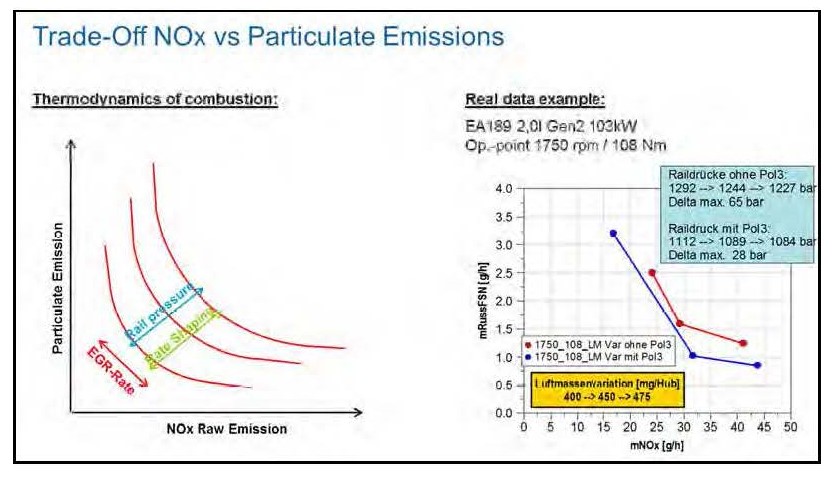
60 Within the ECU, key quantities for emissions are fuel quantity injected per stroke, RPM and target fresh air mass. Calibration data include maps of target fresh air mass, injection timing, injection characteristic, injection pressure and intake port flap actuation. There are corrections to target air mass for ambient pressure, engine temperature and the charge air temperature (T22).
61 The diesel particulate filter (DPF) regeneration cycle is determined by two different means:
(a) A soot model using variables including injection quantity and air mass. The soot model is calibrated using experimental data, primarily from Mode 2 operation; and
(b) Input from the DPF delta pressure sensor.
62 The two mode operation of the EGR system is addressed in detail at pars 91 to 108 of the ATD. The effect of those paragraphs may be summarised as follows:
(a) In summary, simplifying the description in that document:
(i) All of the affected vehicles contained an EGR system.
(ii) In all of the affected vehicles, the EGR system was controlled by the ECU.
(iii) All of the affected vehicles contained software in their ECU which caused the EGR system to operate in one of two modes (Two Mode Software):
(A) Mode 1 was optimised for NOx and other pollutant emissions (primarily by specifying a lower target air mass which would be expected to result in a higher EGR Rate than in Mode 2 and compliance with applicable emissions limits). I note here that the applicants alleged that, when operating in Mode 1, the emission control system would operate at the expense of vehicle performance, fuel economy, the durability of engine components, reliable regeneration of the particulate filter and/or the comfort (in respect of noise, vibration and harshness) and driveability of the vehicle.
(B) Mode 2 was the mode optimised for performance and comfort including fuel economy, reliable regeneration of the particulate filter and noise, vibration and harshness by reducing the effectiveness of the vehicle’s emission control system (primarily by specifying a higher target air mass which would be expected to result in a lower EGR Rate and thus higher NOx emissions than in Mode 1).
(iv) The Two Mode Software caused Mode 1 to operate for a few seconds immediately after the engine was started and thereafter only when the affected vehicles were being driven after start-up according to the New European Drive Cycle (NEDC) Type 1 Emissions Test, which is the primary legislated emissions test in Australia. At all other times, the Two Mode Software caused the affected vehicles to operate in Mode 2.
(b) If the affected vehicles were subjected to a NEDC Type 1 Emissions Test, while operating in Mode 2, thereby substantially replicating the mode that would be activated when the vehicles were driven on the road other than strictly in conformity with the operating conditions of the NEDC, they would have exceeded the NOx emissions limits prescribed by Australian Design Rule 79—Emission Control for Light Vehicles (ADR 79) to a very significant degree.
63 The presence of this Two Mode Software in the ECU of the relevant engines was consciously and deliberately concealed by VWAG from the relevant Australian regulatory authorities, from the public and from Australian consumers.
64 To the above summary at [62] and [63], the following may be added:
(a) Generally, the EGR Rate is higher in Mode 1 than in Mode 2 (see par 100 of the ATD);
(b) Because the EGR Rate influences the level of NOx and the level of particulates produced in the engine:
(i) When the EGR Rate is higher, as in Mode 1, less NOx is produced in the engine but more particulates are produced in the engine; and
(ii) Correlatively, when the EGR Rate is lower, as in Mode 2 (the mode engaged for normal driving conditions on the road), more NOx is produced in the engine and fewer particulates are produced in the engine;
(see par 101 of the ATD);
(c) The EGR system for Australian Affected Vehicles (as defined in the ATD) operates in Mode 1 when the vehicles are driven in a manner that accords with the prescribed emissions testing framework, including the NEDC Type 1 Emissions Test distance-time corridor, cold start, and ambient pressure requirements (see par 103 of the ATD);
(d) The NEDC Type 1 Emissions Test is a distance-time corridor. This means that it measures vehicles over a certain distance across a certain time. Vehicles that travel a specified distance over a certain time will fall within the distance-time corridor. In other words, they will be operating in the prescribed NEDC Type 1 Emissions Test “test conditions” (see par 104 of the ATD);
(e) The Australian Affected Vehicles start in Mode 1, and continue to operate in Mode 1 as long as they are driven in a manner which accords with the NEDC Type 1 Emissions Test (that is, as long as they stay within the NEDC distance-time corridor) (see par 105 of the ATD); and
(f) If the vehicles are driven in a manner that is not in accordance with the NEDC Type 1 Emissions Test (that is, they do not stay within the NEDC distance-time corridor), the mapping (programming) in the ECU directs the EGR system to operate in Mode 2 (see par 106 of the ATD).
65 The parties addressed the applicable emissions standards for NOx at pars 122 to 149 of the ATD.
66 At pars 129 and 130 of the ATD, the parties set out a summary of the maximum permitted levels of exhaust emissions for the affected vehicles when driven in Australia.
67 Throughout the period with which the class actions are concerned, the approval of vehicles imported into Australia by VWAG and its associated companies for sale and use in Australia generally occurred via “ECE Approval”. That is, for the purposes of the Australian market, the Australian authorities recognised the authorised use of such vehicles in Europe (see par 131 of the ATD).
68 At pars 132 to 134 of the ATD, the parties described the relevance of European test results to the Australian testing requirements in the following terms:
132. For each vehicle and engine gearbox variant there is a separate ECE approval with all relevant exhaust emission values.
133. Testing determines whether a vehicle meets the Standards. The vehicle runs with a defined speed curve while the exhaust emission values are measured. Compliance with the numerical emission limits is a necessary, but not sufficient, condition for type approval.
134. If a model fulfils the required specifications during its testing type, then every vehicle in the series is certified for the relevant emission standard.
69 At pars 135 to 149 of the ATD, the parties described in some detail the NEDC Type 1 Emissions Test environment and its relationship to the way in which motor vehicles will generally behave in ordinary driving conditions or conditions of normal use. Those paragraphs are in the following terms:
NEDC emissions testing, “ordinary driving conditions” and “normal use”
135. [Deleted]
136. The prescribed testing environment for ECE approval is the NEDC, described in paragraphs 103 to 107 above. The NEDC is a driving cycle, where vehicle speed is specified as a function of time (also known as a distance-time-corridor). It measures vehicle performance over a certain distance over a certain time. This is so regardless of whether or not the vehicles are in a laboratory, on a dynamometer, in ‘test conditions’, or on the road.
137. Individual vehicles of identical models do not exhibit uniform test results, including exhaust emissions test results, even when operating in the NEDC test.
138. The Standards prescribe requirements for how a vehicle must be operated during testing. By way of example, this includes:
(a) requirements for how the vehicle is placed on the chassis dynamometer;
(b) detailed descriptions and provisions for the test procedure for exhaust emissions on the dynamometer, for example, test cell temperature, humidity and atmospheric pressure, dilution and sampling system temperatures, exhaust dilution system and a large number of other ambient and test conditions;
(c) a requirement to drive in accordance with the NEDC. The NEDC is a vehicle based test that is performed in a purpose built vehicle emissions laboratory. The laboratory consists of a chassis dynamometer (also known as a “roller bench”). The vehicle is secured onto the dynamometer which provides a controlled load onto the driven wheels. The vehicle is then driven over a defined distance-time-corridor which is known as the NEDC. All exhaust emissions are collected and analysed to give a cycle result of grams per kilometre for a range of pollutants, including NOx. The driver must drive in accordance with a synthetic driving cycle with a running time of 19.66 minutes (where Part 1 is 4 x 195 seconds and Part 2 is 1 x 400 seconds).
(i) Part 1 of the NEDC involves 15 elementary urban cycles (idling, acceleration, steady speed and deceleration). They consist of four identical operating curves with a duration of 195 seconds, each of which must be driven four times in a row with a specified pause in between. For each operating curve there are then three separate operating curves with precisely specified time and speed: the first up to 15 km/h, the second up to 40 km/h, the third up to 50 km/h and, with decreasing speed, some seconds at 35 km/h. The distance covered is 4.052 kilometres, the maximum speed is 50 km/h and the total running time is 13 minutes.
(ii) Part 2 of the NEDC involves 13 extra-urban cycles (idling, acceleration, steady speed and deceleration). First, the driver accelerates to 70 km/h and continues at that speed for a specified number of seconds. Then the driver reduces the speed according to the driving line displayed on the monitor to 50 km/h and continues at that speed for a period again specified to the second. The driver then accelerates again to 70 km/h, remains at the line displayed on the monitor for 42 seconds, then further accelerates to 100 km/h and, after a short time, to 120 km/h, and then rapidly reduces speed to 0 km/h. The distance covered is 6.955 kilometres, the maximum speed is 120 km/h and the total running time is 6.66 minutes.
139. There are tolerances in the Standards that relate to how a vehicle must be operated during testing. For example, the Standards stipulate that:
A tolerance of plus or minus 2 km/hr shall be allowed between the indicated speed and the theoretical speed during acceleration, during steady speed, and during deceleration when the vehicle’s brakes are used…speed tolerances greater than those prescribed shall be accepted during phase changes provided that the tolerances are never exceeded for more than 0.5 s on any one occasion.
140. The Standards also contain tolerances relating to the test conditions (including factors such as ambient temperature and humidity) and test equipment (including factors such as measurement accuracy of laboratory equipment).
141. Conducting the NEDC in a laboratory has two principle [sic] advantages: repeatability and comparability of results. Laboratory conditions mean that various sources of variability, such as temperature and air pressure can be controlled. This means that the results of the NEDC are highly reproducible and, because the NEDC is consistent, the exhaust emissions values of one vehicle are directly comparable to the exhaust emissions values of every other vehicle under test conditions.
142. [Deleted]
143. On the road, if the same vehicle is driven in the same manner, over the same distance-time-corridor, and the conditions are the same as those under which it is tested in the laboratory, the exhaust emissions, including engine NOx emissions, will be similar. However, because you cannot control every variable affecting engine performance and emissions, the results of any two tests will never be identical.
144. Given the highly specific nature of the NEDC requirements, it is unlikely that a vehicle driven in normal use will be driven at the same speeds, for the same time and in the same conditions as the conditions specified by the Standards.
145. Relevant factors that may influence fuel consumption and exhaust emissions are:
(a) related to the driver: the driver’s fitness on the day, acceleration behaviour, switching point/gear-shifting speed and driving dynamics.
(b) related to traffic: amount of traffic/traffic jams, traffic light stops (quantity, duration), speed profile, and acceleration profile.
(c) related to external conditions: temperature, wind, rain and road conditions (wet, dry etc.); and
(d) related to the vehicle condition: correction of quantity of fuel injection according to software update (new training), DPF regeneration in a cycle, use of heating/air condition, and consumer comforts (fan, windscreen wipers etc.).
146. [Deleted]
147. [Deleted]
148. The difference between vehicle emissions under normal driving conditions and laboratory conditions is attributable to 4 main factors:
(a) the NEDC testing procedures were first developed in the 1970s and were designed to represent typical driving conditions of busy European cities at that time. The NEDC was last updated in 1990 to try to better represent more demanding, high speed driving modes. There is currently an initiative to further update the testing procedures. In 2007, a working group of the United Nations Economic Commission for Europe (UN/ECE) began to develop a worldwide harmonized test procedure for light vehicles that has become known as the “Worldwide Harmonized Light Vehicles Test Procedure” (the WLTP). The WLTP includes a new test cycle that is designed to be more representative of average modern-day driving behaviour and limits the tolerances in and related to the NEDC. It is expected that the WLTP will replace in the NEDC in 2017;
(b) there are tolerances in the current procedures regarding the assessment of vehicles before they are tested under the NEDC. Before a vehicle can be tested under the NEDC, and in order to simulate normal driving conditions, the level of resistance of the dynamometer must be set to simulate the level of resistance the vehicle would experience if driven on the road. This resistance setting, known as the “road load” is adjusted for each specific vehicle that is tested and can be determined using different methods;
(c) there are tolerances in the current procedures regarding the testing of vehicles under the NEDC. This may include things such as the reference mass of the vehicle, the choice of wheels and tyres, how the laboratory instruments are calibrated, the temperature of the test cell, use of higher gears and the driving technique of the individual driver; and
(d) factors relating to vehicle operation. This includes the use of on-board electrical equipment, such as air conditioning and entertainment systems as well as other external factors such as driving style, fuel quality, weather conditions and road surface.
149. For example, a diesel engine vehicle operating in the NEDC distance-time-corridor must be operated in an environment with a temperature between 20 and 30 degrees Celsius. If the same vehicle is operated in a 10 degrees centigrade environment, even if it otherwise remains within the parameters of the NEDC test, its exhaust emissions will be different
THE IDENTIFICATION PLATE SYSTEM IN AUSTRALIA
70 New motor vehicles can only be supplied in or imported into Australia if those vehicles comply with the vehicle standards made under s 7 of the Motor Vehicle Standards Act 1989 (Cth) (MVSA), which is legislation administered by the Department of Infrastructure and Regional Development (as that Department was called at all relevant times) (DIRD). Section 5 of the MVSA defines these vehicle standards as “national standards”. Where new vehicles of a particular type comply with the national standards, the Minister must, under s 10A of the MVSA, give written approval for identification plates to be placed on the relevant vehicles. In order for a motor vehicle to be lawfully imported into and supplied in Australia, it must be the subject of an approval to affix an identification plate pursuant to s 10A.
71 At all material times during the relevant period between 1 January 2008 and 3 October 2015, it was an offence to supply a new vehicle to the market that was either “nonstandard” (by which is meant that the vehicle did not comply with national standards) or which did not have an identification plate affixed to it (see s 14 of the MVSA). Section 18 of the MVSA similarly made it an offence to import a road vehicle into Australia that was either “nonstandard” or which did not have an identification plate affixed to it.
72 Vehicle Standard ADR 79 is and was at all material times a vehicle standard made under s 7 of the MVSA and was therefore a “national standard” as defined in s 5 of the MVSA. ADR 79 prescribed at all material times the maximum amount of NOx that vehicles could emit while undergoing a standardised testing procedure, namely the NEDC Type 1 Emissions Test.
73 The US plea agreement is a public document. It was tendered in evidence before me at the Stage 1 Hearing and at the penalty hearing. I referred to it extensively at [101]–[137] of the penalty judgment. I propose to substantially reproduce those paragraphs in these Reasons because they contain a clear exposition of the circumstances in which the Two Mode Software was conceived and eventually installed in diesel motor vehicles sold in the US. VWAG’s conduct in relation to the US market was the precursor to its behaviour in Australia.
74 The US plea agreement consists of a plea agreement made between the United States of America, as plaintiff, and VWAG, as defendant, on 11 January 2017 pursuant to Rule 11(c)(1)(C) of the US Federal Rules of Criminal Procedure. The agreement itself is 35 pages in length. There are three exhibits to that plea agreement. The plea agreement was filed in proceeding No 16-CR-20394 in the United States District Court, Eastern District of Michigan. Exhibit 1 to the plea agreement comprises certain certificates, Exhibit 2 is a Statement of Facts and Exhibit 3 contains provisions setting out the duties and authority of an Independent Compliance Monitor appointed under the plea agreement to monitor and audit VWAG’s compliance with the ongoing requirements of the plea agreement. Exhibit 2 (the Statement of Facts) is an agreed Statement of Facts and VWAG expressly accepted in that Statement of Facts that all of the information set out therein is true and accurate. I shall refer to that Statement of Facts as the USSOF.
75 The parties to the plea agreement are the United States of America, by and through its Department of Justice, Criminal Division, Fraud Section, and certain other US government offices, and VWAG. VWAG is described in the plea agreement as “the Defendant”. In the preamble in the plea agreement, VWAG is said to have entered into that agreement pursuant to authority granted by its Management Board, with the consent of its Supervisory Board. These two Boards are the organs of VWAG at the apex of its management structure.
The Terms of the US Plea Agreement
76 In this section, I shall describe and, where appropriate, extract the provisions of the plea agreement itself not including any of the exhibits to that agreement.
77 In the plea agreement, VWAG pleaded guilty to Counts One, Two and Three specified in the Third Superseding Information laid by the relevant US prosecutorial authorities.
78 Count One (the statutory conspiracy count) comprised two separate conspiracies: First, a conspiracy to defraud the US by obstructing the lawful function of the US federal government. Second, a conspiracy to violate the US wire fraud statute (18 U.S.C. §1343) and the US Clean Air Act (42 U.S.C. §7413(c)(2)(A)). An element of each of the conspiracy charges was either an agreement to defraud or an intention to defraud. Thus, in the plea agreement, VWAG admitted that it had the requisite criminal state of mind at the time that the conspiracy offences were committed.
79 Count Two (the statutory obstruction of justice count) (breach of 18 U.S.C. §1512(c)) concerned VWAG’s conduct in tampering with and destroying documents and records with an intention to impair the documents’ or records’ integrity or availability for use in an official proceeding. This count also involved conduct which was accepted by VWAG as having been knowingly undertaken. It also admitted that this conduct was corruptly undertaken.
80 Count Three involved the introduction of imported merchandise into the US by means of false statements in violation of 18 U.S.C. §542. VWAG admitted in the plea agreement that the statements which it made to the relevant authorities which were the subject of Count Three were statements which it knew were false at the time that they were made.
81 On p 3 of the plea agreement, VWAG agreed:
… to cooperate fully with the Offices in their investigation into the conduct described in this Agreement and other conduct related to the introduction into the United States of diesel vehicles with defeat devices as defined under U.S. law.
82 On p 7 of the plea agreement, the following appeared:
E. Factual Basis for Guilty Plea
The Defendant is pleading guilty because it is guilty of the charges contained in the Third Superseding Information. The Defendant admits, agrees, and stipulates that the factual allegations set forth in Exhibit 2 (the Statement of Facts) are true and correct, that it is responsible under the laws of the United States for the acts of its employees described in Exhibit 2, and that the facts set forth in Exhibit 2 accurately reflect the Defendant’s criminal conduct and provide a factual basis for the guilty plea. The Defendant agrees that it will neither contest the admissibility of, nor contradict, the Statement of Facts contained in Exhibit 2 in any proceeding.
83 In Section 3 (Sentence) of the plea agreement (at pp 10–15), the parties set out the agreed sentence which was intended to be the subject of a joint application for approval and imposition by the US District Court, Eastern District of Michigan. In Section A of Section 3, the parties set out the considerations which they agreed were relevant to determining the appropriate sentence. At par 3 of this Section (p 11 of the plea agreement), the following was said:
3. the Defendant has already agreed to compensate members of the class in In re Volkswagen “Clean Diesel” Marketing, Sales Practices, and Products Liability Litigation, No. 3:15-md-2672 (N.D. Cal.), which consists of victims of the underlying criminal conduct that is the subject of this Agreement, and to pay into a NOx remediation trust, in an aggregate amount of approximately $11 billion (based on net present value);
84 At pars 11 and 12 of Section 3 (p 13 of the plea agreement), the parties stated:
11. the Defendant has agreed to pay an additional $1,500,000,000 to the United States to resolve claims for civil penalties arising from the underlying conduct that is the subject of this Agreement;
12. accordingly, after considering (1) through (11) above, (a) the Defendant received an aggregate discount of approximately 20% off of the bottom of the otherwise applicable U.S. Sentencing Guidelines fine range, reflecting its cooperation in the investigation, and (b) after application of the foregoing discount, the Defendant in addition received a credit of $11 billion, representing the net present value of the Defendant’s settlements with consumers and payments to the NOx remediation trust in settlement of civil litigation.
85 On p 13 of the plea agreement, under a heading “B. Fine”, the parties recorded their agreement that VWAG should pay to the United States a criminal fine of USD2.8 billion.
86 In the succeeding sections of the plea agreement, the parties agreed that VWAG should be placed on probation and that it should pay into Court an additional mandatory special assessment of USD1,200. The parties then also agreed that restitution was not practicable and, in any event, not necessary in the present case, given the establishment of the NOx remediation trust referred to at par 3 of Section 3A of the plea agreement.
87 In the balance of the plea agreement, the parties addressed certain ongoing co-operation and reporting obligations on the part of VWAG and other miscellaneous matters which I need not describe in detail here.
88 In Section 8B (p 22 of the plea agreement), VWAG waived all rights to appeal its conviction and sentence if convicted and sentenced in accordance with the plea agreement.
89 In Section 14 (Public Statements by the Defendant) (p 31 of the plea agreement), cl A, VWAG:
... expressly [agreed] that it shall not, through present or future attorneys, officers, directors, employees, agents or any other person authorized to speak for [VWAG] make any public statement, in litigation or otherwise, contradicting the acceptance of responsibility by [VWAG] set forth above, contradicting the fact that [VWAG] has pled guilty to the charges set forth in the Third Superseding Information, or contradicting the facts described in Exhibit 2. Any such contradictory statement shall, subject to cure rights of [VWAG] described below, constitute a breach of this Agreement, and [VWAG] thereafter shall be subject to prosecution as set forth in Paragraph 9 of this Agreement. …
90 As I have already noted, the USSOF is Exhibit 2 to the plea agreement. It is a document of 30 pages in length.
91 On p 1 of Exhibit 2, the following is stated:
The following Statement of Facts is incorporated by reference as part of the Plea Agreement (the “Agreement”) between the United States Department of Justice (the “Department”) and Volkswagen AG (“VW AG”). VW AG hereby agrees and stipulates that the following information is true and accurate. VW AG admits, accepts, and acknowledges that under U.S. law it is responsible for the acts of its employees set forth in this Statement of Facts, which acts VW AG acknowledges were within the scope of the employees’ employment and, at least in part, for the benefit of VW AG. All references to legal terms and emissions standards, to the extent contained herein, should be understood to refer exclusively to applicable U.S. laws and regulations, and such legal terms contained in this Statement of Facts are not intended to apply to, or affect, VW AG’s rights or obligations under the laws or regulations of any jurisdiction outside the United States. This Statement of Facts does not contain all of the facts known to the Department or VW AG; the Department’s investigation into individuals is ongoing. The following facts took place during the time frame specified in the Third Superseding Information and establish beyond a reasonable doubt the charges set forth in the criminal Information attached to this Agreement:
92 At pp 2–4 of Exhibit 2, the parties described the relevant entities and individuals. In the paragraphs in which those entities and individuals are described, individuals identified as “Supervisor A”, “Supervisor B”, “Supervisor C”, “Supervisor D”, “Supervisor E” and “Supervisor F” were all senior employees of VWAG. Supervisor A was the supervisor in charge of Engine Development for all of VWAG in the period from about October 2012 to September 2015. Supervisors B, C and D were in charge of the VW Brand Engine Development Department in various periods commencing in about May 2005 and ending in 2017. Supervisor B had that role in the period from about May 2005 to about April 2007. Supervisor C had that role in the period from about May 2007 to about March 2011 and Supervisor D had that role in the period from about October 2013 to January 2017. In the period from about October 2011 to about July 2013, Supervisor A served as the supervisor in charge of the VW Brand Engine Development Department. From July 2013 to September 2013, Supervisor A was also the supervisor in charge of the group called “Development for VW Brand”, in which capacity he supervised approximately 10,000 VWAG employees. Each of the supervisors referred to was a senior employee below the level of the VWAG Management Board.
93 “VW Brand” was an operational or business unit within VWAG that developed vehicles to be sold under the “Volkswagen” brand name.
94 In the second section of the USSOF, the parties addressed the US NOx Emissions Standards which were in force from time to time in the period 2003–2018. This material appears at pp 5–8 of Exhibit 2.
95 At pars 14–22 of the USSOF (at pp 5–8 of Exhibit 2), the following is said:
14. The purpose of the Clean Air Act and its implementing regulations was to protect human health and the environment by, among other things, reducing emissions of pollutants from new motor vehicles, including nitrogen oxides (“NOx”).
15. The Clean Air Act required the U.S. Environmental Protection Agency (“EPA”) to promulgate emissions standards for new motor vehicles. The EPA established standards and test procedures for light-duty motor vehicles sold in the United States, including emission standards for NOx.
16. The Clean Air Act prohibited manufacturers of new motor vehicles from selling, offering for sale, introducing or delivering for introduction into U.S. commerce, or importing (or causing the foregoing with respect to) any new motor vehicle unless the vehicle complied with U.S. emissions standards, including NOx emissions standards, and was issued an EPA certificate of conformity.
17. To obtain a certificate of conformity, a manufacturer was required to submit an application to the EPA for each model year and for each test group of vehicles that it intended to sell in the United States. The application was required to be in writing, to be signed by an authorized representative of the manufacturer, and to include, among other things, the results of testing done pursuant to the published Federal Test Procedures that measure NOx emissions, and a description of the engine, emissions control system, and fuel system components, including a detailed description of each Auxiliary Emission Control Device (“AECD”) to be installed on the vehicle.
18. An AECD was defined under U.S. law as “any element of design which senses temperature, vehicle speed, engine RPM, transmission gear, manifold vacuum, or any other parameter for the purpose of activating, modulating, delaying, or deactivating the operation of any part of the emission control system.” The manufacturer was also required to include a justification for each AECD. If the EPA, in reviewing the application for a certificate of conformity, determined that the AECD “reduced the effectiveness of the emission control system under conditions which may reasonably be expected to be encountered in normal vehicle operation and use,” and that (1) it was not substantially included in the Federal Test Procedure, (2) the need for the AECD was not justified for protection of the vehicle against damage or accident, or (3) it went beyond the requirements of engine starting, the AECD was considered a “defeat device.” Whenever the term “defeat device” is used in this Statement of Facts, it refers to a defeat device as defined by U.S. law.
19. The EPA would not certify motor vehicles equipped with defeat devices. Manufacturers could not sell motor vehicles in the United States without a certificate of conformity from the EPA.
20. The California Air Resources Board (“CARB”) (together with the EPA, “U.S. regulators”) issued its own certificates, called executive orders, for the sale of motor vehicles in the State of California. To obtain such a certificate, the manufacturer was required to satisfy the standards set forth by the State of California, which were equal to or more stringent than those of the EPA.
21. As part of the application for a certification process, manufacturers often worked in parallel with the EPA and CARB. To obtain a certificate of conformity from the EPA, manufacturers were required to demonstrate that the light-duty vehicles were equipped with an on-board diagnostic (“OBD”) system capable of monitoring all emissions-related systems or components. Manufacturers could demonstrate compliance with California OBD standards in order to meet federal requirements. CARB reviewed applications from manufacturers, including VW, to determine whether their OBD systems were in compliance with California OBD standards, and CARB’s conclusion would be included in the application the manufacturer submitted to the EPA.
22. In 1998, the United States established new federal emissions standards that would be implemented in separate steps, or Tiers. Tier II emissions standards, including for NOx emissions, were significantly stricter than Tier I. For light-duty vehicles, the regulations required manufacturers to begin to phase in compliance with the new, stricter Tier II NOx emissions standards in 2004 and required manufacturers to fully comply with the stricter standards for model year 2007. These strict U.S. NOx emissions standards were applicable specifically to vehicles in the United States.
96 In the relevant period, VWAG sold or offered for sale in the US various models of motor vehicles containing 2.0L diesel engines. It also sold into the US vehicles containing 3.0L diesel engines. These engines were all variants of VWAG’s EA189 diesel engine.
97 VWAG’s US subsidiary, VW America, prepared and submitted to the EPA and to the CARB applications for a certificate of conformity and an executive order to obtain authorisation to sell each of the vehicles fitted with its 2.0L diesel engine which it intended to import into the US. Those applications were accompanied by the following signed statement by a VW representative:
The Volkswagen Group states that any element of design, system, or emission control device installed on or incorporated in the Volkswagen Group’s new motor vehicles or new motor vehicle engines for the purpose of complying with standards prescribed under section 202 of the Clean Air Act, will not, to the best of the Volkswagen Group’s information and belief, cause the emission into the ambient air of pollutants in the operation of its motor vehicles or motor vehicle engines which cause or contribute to an unreasonable risk to public health or welfare except as specifically permitted by the standards prescribed under section 202 of the Clean Air Act. The Volkswagen Group further states that any element of design, system, or emission control device installed or incorporated in the Volkswagen Group’s new motor vehicles or new motor vehicle engines, for the purpose of complying with standards prescribed under section 202 of the Clean Air Act, will not, to the best of the Volkswagen Group’s information and belief, cause or contribute to an unreasonable risk to public safety.
…
All vehicles have been tested in accordance with good engineering practice to ascertain that such test vehicles meet the requirement of this section for the useful life of the vehicle.
98 Based on the representations made by VWAG’s and VW America’s US employees, the EPA and the CARB issued Certificates for these vehicles allowing them to be sold in the US.
99 At pars 29 and 30 of the USSOF (at pp 10–11 of Exhibit 2), the parties agreed the following:
29. Upon importing the Subject Vehicles into the United States, VW disclosed to U.S. Customs and Border Protection (“CBP”) that the vehicles were covered by valid Certificates by affixing an emissions label to the vehicles’ engines. These labels stated that the vehicles conformed to EPA and CARB emissions regulations. VW affixed these labels to each of the Subject Vehicles that it imported into the United States.
30. VW represented to its U.S. customers, U.S. dealers, U.S. regulators and others in the United States that the Subject Vehicles met the new and stricter U.S. emissions standards identified in paragraph 22 above. Further, VW designed a specific marketing campaign to market these vehicles to U.S. customers as “clean diesel” vehicles.
100 On p 11 of Exhibit 2, the parties set out their agreement in relation to the criminal conduct committed by VWAG addressed in the USSOF. At pars 31–38 (pp 11–14) and 41–43 (pp 16–17), the parties agreed the following:
VW AG’s Criminal Conduct
31. From approximately May 2006 to approximately November 2015, VW AG, through Supervisors A-F and other VW employees, agreed to deceive U.S. regulators and U.S. customers about whether the Subject Vehicles and the Porsche Vehicles complied with U.S. emissions standards. During their involvement with design, marketing and/or sale of the Subject Vehicles and the Porsche Vehicles in the United States, Supervisors A-F and other VW employees: (a) knew that the Subject Vehicles and the Porsche Vehicles did not meet U.S. emissions standards; (b) knew that VW was using software to cheat the U.S. testing process by making it appear as if the Subject Vehicles and the Porsche Vehicles met U.S. emissions standards when, in fact, they did not; and (c) attempted to and did conceal these facts from U.S. regulators and U.S. customers.
The 2.0 Liter Defeat Device in the United States
32. In at least in or about 2006, VW AG employees working under the supervision of Supervisors B, C, and F were designing the new EA 189 2.0 liter diesel engine (later known as the Generation 1 or “Gen 1”) for use in the United States that would be the cornerstone of a new project to sell passenger diesel vehicles in the United States. Selling diesel vehicles in the U.S. market was an important strategic goal of VW AG. This project became known within VW as the “US’O7” project.
33. Supervisors B, C, and F, and others, however, realized that VW could not design a diesel engine that would both meet the stricter U.S. NOx emissions standards that would become effective in 2007 and attract sufficient customer demand in the U.S. market. Instead of bringing to market a diesel vehicle that could legitimately meet the new, more restrictive U.S. NOx emissions standards, VW AG employees acting at the direction of Supervisors B, C, and F and others, including Company A employees, designed, created, and implemented a software function to detect, evade and defeat U.S. emissions standards.
34. While employees acting at their direction designed and implemented the defeat device software, Supervisors B, C, and F, and others knew that U.S. regulators would measure VW’s diesel vehicles’ emissions through standard U.S. tests with specific, published drive cycles. VW AG employees acting at the direction of Supervisors B, C, and F, and others designed the VW defeat device to recognize whether the vehicle was undergoing standard U.S. emissions testing on a dynamometer (or “dyno”') or whether the vehicle was being driven on the road under normal driving conditions. The defeat device accomplished this by recognizing the standard drive cycles used by U.S. regulators. If the vehicle’s software detected that it was being tested, the vehicle performed in one mode, which satisfied U.S. NOx emissions standards. If the defeat device detected that the vehicle was not being tested, it operated in a different mode, in which the effectiveness or the vehicle’s emissions control systems was reduced substantially, causing the vehicle to emit substantially higher NOx, sometimes 35 times higher than U.S. standards.
35. In designing the defeat device, VW engineers borrowed the original concept of the dual-mode, emissions cycle-beating software from Audi. On or about May 17, 2006, a VW engineer, in describing the Audi software, sent an email to employees in the VW Brand Engine Development department that described aspects of the software and cautioned against using it in its current form because it was “pure” cycle-beating, i.e., as a mechanism to detect, evade and defeat U.S. emissions cycles or tests. The VW AG engineer wrote (in German), “within the clearance structure of the pre-fuel injection the acoustic function is nearly always activated within our current US’07-data set. This function is pure [cycle-beating] and can like this absolutely not be used for US’07.”
36. Throughout in or around 2006 Supervisor F authorized VW AG engineers to use the defeat device in the development of the US’07 project, despite concerns expressed by certain VW AG employees about the propriety of designing and activating the defeat device software. In or about the fall of 2006, lower level VW AG engineers, with the support of their supervisors, raised objections to the propriety of the defeat device, and elevated the issue to Supervisor B. During a meeting that occurred in or about November 2006, VW AG employees briefed Supervisor B on the purpose and design of the defeat device. During the meeting, Supervisor B decided that VW should continue with production of the US’07 project with the defeat device, and instructed those in attendance, in sum and substance, not to get caught.
37. Throughout 2007, various technical problems arose with the US’07 project that led to internal discussions and disagreements among members of the VW AG team that was primarily responsible for ensuring vehicles met U.S. emissions standards. Those disagreements over the direction of the project were expressly articulated during a contentious meeting on or about October 5, 2007, over which Supervisor C presided. As a result of the meeting, Supervisor C authorized Supervisor F and his team to proceed with the US’07 project despite knowing that only the use of the defeat device software would enable VW diesel vehicles to pass U.S. emissions tests.
38. Starting with the first model year 2009 of VW’s new engine for the 2.0 Liter Subject Vehicles through model year 2016, Supervisors A-D and F, and others, then caused the defeat device software to be installed in the 2.0 Liter Subject Vehicles marketed and sold in the United States.
…
Certification VW Diesel Vehicles in the United States
41. VW employees met with the EPA and CARB to seek the certifications required to sell the Subject Vehicles to U.S. customers. During these meetings, some of which Supervisor F attended personally, VW employees misrepresented, and caused to be misrepresented, to the EPA and CARB staff that the Subject Vehicles complied with U.S. NOx emissions standards, when they knew the vehicles did not. During these meetings, VW employees described, and caused to be described, VW’s diesel technology and emissions control systems to the EPA and CARB staff in detail but omitted the fact that the engine could not meet U.S. emissions standards without using the defeat device software.
42. Also as part of the certification process for each new model year, Supervisors A-F and others certified, and/or caused to be certified, to the EPA and CARB that the Subject Vehicles met U.S. emissions standards and complied with standards prescribed by the Clean Air Act. Supervisors A-F, and others, knew that if they had told the truth and disclosed the existence of the defeat device, VW would not have obtained the requisite Certificates for the Subject Vehicles and could not have sold any of them in the United States.
Importation of VW Diesel Vehicles in the United States
43. In order to import the Subject Vehicles into the United States, VW was required to disclose to CBP whether the vehicles were covered by valid certificates for the United States. VW did so by affixing a label to the vehicles’ engines, VW employees caused to be stated on the labels that the vehicles complied with applicable EPA and CARB emissions regulations and limitations, knowing that if they had disclosed that the Subject Vehicles did not meet U.S. emissions regulations and limitations, VW would not have been able to import the vehicles into the United States. Certain VW employees knew that the labels for the Porsche Vehicles stated that those vehicles complied with EPA and CARB emissions regulations and limitations, when in fact, the VW employees knew they did not.
101 At par 44 (at p 17 of Exhibit 2), the parties noted their agreement that Supervisors A and C and others marketed, and caused to be marketed, the vehicles referred to in Exhibit 2 to the US public as “clean diesel” and “environmentally friendly”, when they knew those vehicles had been intentionally designed to detect, evade and defeat US emissions standards.
102 VWAG subsequently developed a second generation 2.0L diesel engine which was launched in the US in or around 2011. That engine also contained software which was designed to detect, evade and defeat US emissions tests.
103 At pars 52–64 (at pp 21–25 of Exhibit 2), the parties to the USSOF set out their agreement as to the concealment of the defeat devices in the 2.0L diesel engines imported into the US. Those paragraphs are in the following terms:
The Concealment of the Defeat Devices in the United States – 2.0 Liter
52. In or around March 2014, certain VW employees learned of the results of a study undertaken by West Virginia University’s Center for Alternative Fuels, Engines and Emissions and commissioned by the International Council on Clean Transportation (the “ICCT study”). The ICCT study identified substantial discrepancies in the NOx emissions from certain 2.0 Liter Subject Vehicles when tested on the road compared to when these vehicles were undergoing EPA and CARB standard drive cycle tests on a dynamometer. The results of the study showed that two of the three vehicles tested on the road, both 2.0 Liter Subject Vehicles, emitted NOx at values of up to approximately 40 times the permissible limit applicable during testing in the United States.
53. Following the ICCT study, CARB, in coordination with the EPA, attempted to work with VW to determine the cause for the higher NOx emissions in the 2.0 Liter Subject Vehicles when being driven on the road as opposed to on the dynamometer undergoing standard emissions test cycles. To do this, CARB in coordination with the EPA, repeatedly asked VW questions that became increasingly more specific and detailed, as well as conducted additional testing themselves.
54. In response to learning about the results of the ICCT study, engineers in the VW Brand Engine Development department formed an ad hoc task force to formulate responses to questions that arose from the U.S. regulators. VW AG supervisors, including Supervisors A, D, and E, and others, determined not to disclose to U.S. regulators that the tested vehicle models operated with a defeat device. Instead, Supervisors A, D, and E, and others decided to pursue a strategy of concealing the defeat device in responding to questions from U.S. regulators, while appearing to cooperate.
55. Throughout 2014 and the first half of 2015, Supervisors A, D, and E, and others, continued to offer, and/or cause to be offered, software and hardware “fixes” and explanations to U.S. regulators for the 2.0 Liter Subject Vehicles’ higher NOx measurements on the road without revealing the underlying reason – the existence of software designed to detect, evade and defeat U.S. emissions tests.
56. On or about April 28, 2014, members of the VW task force presented the findings of the ICCT study to Supervisor E, whose supervisory responsibility included addressing safety and quality problems in vehicles in production. Included in the presentation was an explanation of the potential financial consequences VW could face if the defeat device was discovered by U.S. regulators, including but not limited to applicable fines per vehicle, which were substantial.
57. On or about May 21, 2014, a VW AG employee sent an email to his supervisor, Supervisor D, and others, describing an “early round meeting” with Supervisor A, at which emissions issues in North America for the Gen 2 2.0 Liter Subject Vehicles were discussed, and questions were raised about the risk of what could happen and the available options for VW. Supervisor D responded by email that he was in “direct touch” with the supervisor in charge of Quality Management at VW AG and instructed the VW AG employee to “please treat confidentially” the issue.
58. On or about October 1, 2014, VW AG employees presented to CARB regarding the ICCT study results and discrepancies identified in NOx emis-sions between dynamometer testing and road driving. In response to questions, the VW AG employees did not reveal that the existence of the defeat device was the explanation for the discrepancies in NOx emissions, and, in fact, gave CARB various false reasons for the discrepancies in NOx emissions including driving patterns and technical issues.
59. When U.S. regulators threatened not to certify VW model year 2016 vehicles for sale in the United States, VW AG supervisors requested a briefing on the situation in the United States. On or about July 27, 2015, VW AG employees presented to VW AG supervisors. Supervisors A and D were present, among others.
60. On or about August 5, 2015, in a meeting in Traverse City, Michigan, two VW employees met with a CARB official to discuss again the discrepancies in emissions of the 2.0 Liter Subject Vehicles. The VW employees did not reveal the existence of the defeat device.
61. On or about August 18, 2015, Supervisors A and D, and others, approved a script to be followed by VW AG employees during an upcoming meeting with CARB in California on or about August 19, 2015. The script provided for continued concealment of the defeat device from CARB in the 2.0 Liter Subject Vehicles, with the goal of obtaining approval to sell the Gen 3 model year 2016 2.0 Liter Subject Vehicles in the United States.
62. On or about August 19, 2015, in a meeting with CARB in El Monte, California, a VW employee explained, for the first time to U.S. regulators and in direct contravention of instructions from supervisors at VW AG, that certain of the 2.0 Liter Subject Vehicles used different emissions treatment depending on whether the vehicles were on the dynamometer or the road, thereby signaling that VW had evaded U.S. emissions tests.
63. On or about September 3, 2015, in a meeting in El Monte, California with CARB and EPA, Supervisor D, while creating the false impression that he had been unaware of the defeat device previously, admitted that VW had installed a defeat device in the 2.0 Liter Subject Vehicles.
64. On or about September 18, 2015, the EPA issued a public Notice of Violation to VW stating that the EPA had determined that VW had violated the Clean Air Act by manufacturing and installing defeat devices in the 2.0 Liter Subject Vehicles.
104 Subsequently, in about September 2015, in a further endeavour to conceal the true course of events in relation to the development of the defeat device deployed in the 2.0L diesel engines imported into the US, VWAG employees destroyed documents and files which related to US emissions issues which they believed would be the subject of a hold notice issued by VWAG’s US subsidiary in due course in order to preserve documents potentially relevant to any legal proceedings. These matters are addressed at pars 73 to 82 of Exhibit 2.
The US Defeat Device Software and the Australian Two Mode Software
105 In about 2006, a very senior supervisor employed by VWAG (probably Supervisor A referred to in the US plea agreement) authorised the Two Mode Software for use in vehicles fitted with the EA189 diesel engine which were later supplied in Australia, for the purpose of enabling the affected vehicles to pass the relevant Australian emissions tests even though, when driven on the road in normal use, those vehicles would not be able to satisfy the NOx emissions limits specified in ADR 79. Thereafter, under the ongoing supervision of that very senior employee and other supervisory personnel, VWAG employees calibrated and installed the Two Mode Software in the EA189 diesel engines installed in the affected vehicles which were later sold in Australia.
106 Despite the circumstance that, in some presently irrelevant respects, the diesel engines installed in motor vehicles sold in the US market differed from the EA189 diesel engines installed in the affected vehicles sold in Australia, the US defeat device software referred to in the US plea agreement performed substantially the same function as the Two Mode Software. In particular, a feature of the US defeat device software installed in the engines in the US vehicles and the Two Mode Software installed in the engines in the Australian affected vehicles was the ability to recognise, at any particular moment, the parameters of a relevant emissions test and then to cause the affected vehicles, including the EGR system of the vehicles, to operate in Mode 1.
THE MAIN ISSUES IN THE CLASS ACTIONS
A Brief Exposition of the Applicants’ Pleaded Cases
107 The Cantor proceeding concerned Audi diesel vehicles only. The only respondent to that proceeding was Audi Australia. The vehicles which were the subject of the Cantor proceeding are those specified in par 1 of the Third Further Amended Statement of Claim filed in that proceeding on 18 September 2017. The vehicles specified in that paragraph were:
Make | Model | Year |
Audi | A1 | 2011–2014 |
A3 (1.6) | 2011–2013 | |
A3 (2.0) | 2009–2013 | |
A4 | 2008–2015 | |
A5 | 2012–2016 | |
A6 | 2009–2014 | |
Q3 | 2012–2014 | |
Q5 | 2009–2016 | |
TT | 2009–2014 |
108 The Tolentino proceeding concerned certain Volkswagen-branded vehicles as well as three models of Skoda-branded vehicles. The only respondent to that proceeding was VW Australia. The vehicles which were the subject of the Tolentino proceeding are those specified in par 1 of the Third Further Amended Statement of Claim filed in that proceeding on 18 September 2017. The vehicles specified in that paragraph were:
Make | Model | Year |
Volkswagen Passenger Cars | Golf | 2009–2013 |
Polo | 2009–2014 | |
Jetta | 2010–2015 | |
Passat CC | 2008–2012 | |
Volkswagen CC | 2011–2015 | |
Passat | 2008–2015 | |
Eos | 2008–2014 | |
Tiguan | 2008–2015 | |
Skoda | Octavia | 2009–2013 |
Yeti | 2011–2015 | |
Superb | 2009–2015 | |
Volkswagen Commercial Vehicles | Caddy | 2010–2015 |
Amarok | 2011–2012 |
109 The allegations made by the applicant in the Cantor proceeding and the allegations made by the applicant in the Tolentino proceeding were substantially the same although there were minor differences between the two sets of allegations which simply reflected the fact that each proceeding was dealing with differently branded vehicles. In each proceeding, the applicant alleged that 54,745 Volkswagen-branded passenger cars, 17,256 Volkswagen-branded commercial vehicles, 16,085 Audi-branded vehicles and 5,148 Skoda-branded vehicles were affected by the emissions scandal. The total number of vehicles covered by the BL proceedings was, therefore, 93,234.
110 In each of the BL proceedings, the applicant made the following allegation:
During the relevant period, Affected Vehicles sold, imported, distributed, manufactured, and/or supplied by the respondent in Australia [Audi Australia and VW Australia] contained a “defeat device” within the meaning of applicable European, and Commonwealth emission, standards, and, in particular, UN/ECE Regulation Number 83 articles 2.16 & 5.1.2.1, in hidden emissions software that could recognise whether a vehicle was being operated in a test laboratory or on the road.
(Par 18 of the Third Further Amended Statement of Claim in the Cantor (Audi) proceeding and par 14 in the Third Further Amended Statement of Claim in the Tolentino (Volkswagen and Skoda) proceeding).
111 Having alleged that each of the affected vehicles contained a defeat device, the applicants in the BL proceedings then described in brief terms the way in which that defeat device influenced the operation of the affected vehicles. Each applicant then alleged that the affected vehicles described in each of the relevant Statements of Claim did not comply with the applicable Commonwealth emissions standards in that they emitted much higher levels of NOx than was permitted by those standards and, for that reason, could not lawfully be driven on the road in Australia. They also alleged that the deployment of a defeat device in motor vehicles in Australia was prohibited under ADR 79.
112 In the alternative, the applicant in each of the BL proceedings alleged that the Two Mode Software described in the relevant pleadings constituted a defeat device equivalent because that software defeated the purpose of the prohibition in ADR 79 on the use of defeat devices.
113 The applicants in the BL proceedings then alleged that Audi Australia and VW Australia concealed the fact that the affected vehicles contained a defeat device or, alternatively, a defeat device equivalent, from all relevant Australian regulatory authorities and from Australian consumers.
114 The applicant in each of the BL proceedings then alleged that, by importing, marketing, distributing, leasing, selling, financing, manufacturing, supplying or making available to be sold in Australia vehicles fitted with the Two Mode Software defeat device, the respondent in each case engaged in conduct in trade or commerce within the meaning of s 18 of the Australian Consumer Law (ACL) or, for those group members who acquired or leased an affected vehicle prior to 1 January 2011, engaged in conduct in trade or commerce within the meaning of s 52 of the Trade Practices Act 1974 (Cth) (TPA). It was then alleged in each case that the respondent in each case engaged in conduct that was misleading or deceptive or was likely to mislead or deceive in contravention of the relevant provisions of the ACL and the TPA.
115 In addition, each applicant alleged that, by failing to disclose that the affected vehicles had been fitted with a defeat device or a defeat device equivalent, the respondent in each case engaged in additional contraventions of s 18 of the ACL and s 52 of the TPA.
116 The applicant in each case also alleged that, by making express representations in advertising material and in sales brochures that the affected vehicles were “clean diesel” vehicles and that those vehicles met the relevant Commonwealth emissions standards for NOx, in circumstances where neither of the matters asserted was true, the respondent in each case also contravened s 18 of the ACL and, where applicable, s 52 of the TPA.
117 In addition, in each case, the applicant alleged that the respondent supplied vehicles that did not meet the statutory guarantee embodied in s 54(1) of the ACL, supplied vehicles that were not of a merchantable quality in breach of s 74D of the TPA in respect of vehicles acquired or leased prior to 1 January 2011 and supplied vehicles that did not comply with Australian safety standards in breach of s 106(1) of the ACL or s 65C(1) of the TPA, for those group members who acquired an affected vehicle prior to 1 January 2011.
118 The applicants in the BL proceedings claimed declarations, damages or compensation and, if feasible, a full refund of the purchase price upon the return of the affected vehicles. The applicants’ damages claim was for the diminution in value of the affected vehicles caused by the presence of the Two Mode Software in the engines of those vehicles.
119 The allegations made in each of the MB proceedings were substantially the same (as was the case in each of the BL proceedings).
120 In the MB proceedings, looked at together, the group members were defined as the applicant(s) and all other persons who:
(a) Prior to 3 October 2015, acquired an interest in an affected Volkswagen, Audi or Skoda diesel vehicle the particular models of which were specified in the Statement of Claim in each case. Those models were essentially the same models as were specified in the BL proceedings (as to which, see [107]–[109] above); and
(b) Still had an interest in that vehicle as at 3 October 2015
but not including:
(i) The respondents, or any wholly or partly owned subsidiary of any of them;
(ii) Any Volkswagen, Audi or Skoda authorised dealer;
(iii) Any judge of this Court; and
(iv) Any group member in the BL proceedings who had retained Bannister Law as its legal representative in either of the BL proceedings except those group members who had also retained Maurice Blackburn in any of the MB proceedings.
121 In the Richardson proceeding, the applicant carved out a subgroup, being those members of the main group who acquired an interest in an affected Audi diesel vehicle containing a Selective Catalytic Reduction (SCR) system. These vehicles were predominantly Audi Q5 SUVs.
122 The last iteration of the Statement of Claim in each of the MB proceedings was the Second Further Amended Statement of Claim filed in each case on 16 September 2017. The respondents in the Dalton proceeding were VWAG and VW Australia. The respondents in the Richardson proceeding were Audi AG, Audi Australia and VWAG and the respondents in the Roe proceeding were Skoda, VW Australia and VWAG.
123 After describing in some detail the chronology of the exposure of the emissions scandal, the way in which the NEDC Type 1 Emissions Test works and the regulatory framework in respect of the importation and sale in Australia of motor vehicles, each of the applicants in the MB proceedings alleged that, during the period from approximately 2006 to 2015, VWAG installed, or caused to be installed, in certain Volkswagen, Audi and Skoda-branded diesel vehicles a form of software in the vehicle’s management system designed to detect when the vehicle was undergoing an emissions test and to activate or maximise parts of the emission control system in the vehicle so as to reduce the output of NOx in a way that did not occur, or did not occur to the same extent, in normal use of the vehicle or in normal driving conditions and therefore had installed into those vehicles a defeat device within the meaning of that term in ADR 79 (par 27 of the current Statement of Claim in the Dalton proceeding, par 28 of the current Statement of Claim in the Richardson proceeding and par 28 of the current Statement of Claim in the Roe proceeding).
124 The applicants then alleged that the defeat device so described deactivated parts of the vehicle’s emission control system, or reduced the effectiveness of the emission control system, with the result that the vehicle’s performance was enhanced but the vehicle emitted substantially higher levels of NOx. The applicants alleged that the Two Mode Software was installed in Volkswagen-branded vehicles, Audi-branded vehicles and Skoda-branded vehicles in the relevant period.
125 The applicants then alleged that the presence of the defeat device in the engines of the affected vehicles was concealed from the relevant Australian regulatory authorities and from Australian consumers.
126 I note that, in their Defences, the respondents admitted that the Two Mode Software was installed in the engines of the affected vehicles but denied that the Two Mode Software was a defeat device.
127 The applicants also alleged that, without the defeat device, the affected vehicles could not have complied with the requirements of ADR 79 and could not have complied with State legislation governing the registration of motor vehicles.
128 The applicants also put a case based upon the notion that, if, for technical interpretative reasons, the Two Mode Software did not constitute a defeat device within the meaning of ADR 79, it was nonetheless a defeat device equivalent, the installation of which constituted a breach of ADR 79 in any event.
129 The applicants alleged that, by manufacturing, importing, supplying and distributing diesel motor vehicles fitted with the Two Mode Software, the respondents represented to all persons acquiring or dealing with the affected vehicles that those vehicles complied with the applicable legal requirements for road vehicles in Australia and that consumers relied upon those representations when they purchased affected vehicles. The applicants then alleged that those representations were false and misleading and that the affected vehicles could not lawfully be imported into Australia, could not lawfully be sold in Australia and could not lawfully be driven on the road in Australia.
130 The applicants also alleged that, by the conduct referred to at [129] above, the respondents represented to the Commonwealth of Australia that the affected diesel vehicles were compliant with ADR 79 in circumstances where those vehicles did not comply with ADR 79 and that the Commonwealth relied upon those representations in the various ways pleaded by the applicants.
131 They also alleged that, by engaging in the same conduct, the respondents represented to the Commonwealth that the affected diesel vehicles had not been modified to operate in a manner which was different from that used in normal driving conditions when undergoing testing for compliance with emissions standards which representations were also false and misleading and that the Commonwealth relied upon those representations.
132 The applicants also alleged that, by manufacturing the affected diesel vehicles for supply to and sale in Australia and by applying for and obtaining approval to affix compliance plates to those vehicles and further, or alternatively, by affixing or arranging for the affixing of compliance plates to those vehicles, the respondents created a reasonable expectation on the part of the Commonwealth and on the part of Australian consumers that the affected vehicles complied with ADR 79 in circumstances where that expectation was not met. The failure to meet that expectation constituted misleading and deceptive conduct by silence.
133 The applicants also alleged that, by engaging in the conduct to which I have referred, the respondents made false or misleading representations to the Commonwealth and to Australian consumers in trade or commerce in breach of s 29(1)(b) and s 29(1)(g) of the ACL and, as appropriate, in breach of s 53(a) and s 53(c) of the TPA.
134 The applicants also alleged that the respondents engaged in unconscionable conduct, that they failed to comply with a number of statutory warranties and guarantees, that they supplied goods which were not of merchantable quality, that they supplied goods which were not of acceptable quality, that they supplied goods which breached express warranties given at the time of supply, that they failed to comply with safety standards, that their conduct constituted the tort of deceit and that they were guilty of equitable misrepresentation.
135 In part, VWAG’s liability was said to be accessorial to the liability of VW Australia and the other subsidiaries.
136 The MB applicants claimed declaratory relief, damages, compensation, exemplary damages and, in the alternative, an account of profits. The MB applicants’ primary damages claim was for compensation for the diminution in value of the affected vehicles caused by the contravening conduct on the part of VWAG and its subsidiaries.
The Principal Defences Raised by the Respondents
137 The respondents denied that the Two Mode Software constituted a defeat device within the meaning of ADR 79. They also denied that that software constituted a defeat device equivalent as pleaded by the applicants in all of the cases. By March 2018, when the Stage 1 Hearing commenced, there were very few differences between the applicants and the respondents as to the operation of the Two Mode Software in the diesel engines installed in the affected vehicles. By that time, the main contest between the applicants and the respondents concerned the true interpretation of the relevant provisions of the MVSA and ADR 79. The resolution of the competing contentions, to some extent, was heavily influenced by the true interpretation of the international instruments upon which ADR 79 was based, in particular, UNECE Regulation 83.
138 The respondents also contended that, because in respect of all affected vehicles they had obtained appropriate and valid type approvals from the relevant authorities in Europe, the Australian regulatory authorities were bound to regard the vehicles imported into Australia and subsequently supplied here in respect of which such approvals were held, as fully compliant with the various regulatory requirements in place in Australia including as being fully compliant with ADR 79.
139 In respect of at least the deceit case and the unconscionable conduct case, the respondents argued that the conduct and knowledge of those officers and employees of the respondents who were responsible for conceiving the idea embodied in the Two Mode Software and for implementing the scheme to defeat the relevant emissions controls in Australia could not be attributed to the respondents (being corporations).
140 The respondents also contended that the misrepresentations alleged against them were not made in trade or commerce, that the applicants could not prove reliance on those representations and that the provisions of the ACL and the TPA did not apply to conduct outside Australia of foreign corporations.
141 The respondents also argued that, even if they had contravened the various provisions relied upon by the applicants, the applicants had suffered no loss as a result of any of those contraventions. They also contended that some of the claims by group members were statute barred.
142 In addition, the respondents contended that certain remedial measures of a technological nature which they had devised after the commencement of the Australian class actions, which they had offered to all purchasers of the Australian affected vehicles and which had been approved by the relevant regulatory authority in Germany and by DIRD in Australia, were effective to render the affected vehicles fully compliant with all relevant emissions requirements in Australia. It seemed to be common ground that those measures were effective in terms of reducing the level of NOx emissions from the affected vehicles to the level mandated by ADR 79. However, there was a vigorous contest between the applicants and the respondents as to whether the consequences of putting those measures in place were so deleterious to the performance and condition of the affected vehicles in the long term as not to constitute a satisfactory answer to the applicants’ claims.
THE IMPORTANT TERMS OF THE SETTLEMENT
143 The terms of the settlement are recorded in:
(a) The Deed of Release and Settlement comprising Annexure JKS-68 to the confidential affidavit of Julian Klaus Schimmel affirmed on 20 March 2020 and filed in the MB proceedings (Settlement Deed);
(b) The Settlement Scheme (Version 2) comprising Annexure JKS-71 to the open affidavit of Julian Klaus Schimmel affirmed on 20 March 2020 and filed in the MB proceedings (Settlement Scheme); and
(c) The Settlement Payment Methodology (SPM) comprising Annexure JKS-69 to the confidential affidavit of Mr Schimmel referred to at subpar (a) above.
144 On 1 April 2020, I made non-publication orders pursuant to s 37AF and s 37AG(1)(a) of the FCA Act (Order 13 in each of the MB proceedings) covering inter alia Annexure 2 to the Settlement Deed (Annexure 2) and the whole of the SPM. Those orders were expressed to remain in place until 31 December 2021.
145 The Settlement Deed (with the exception of Annexure 2) and the Settlement Scheme were not the subject of any non-publication or suppression order and are presently available to group members and to the public.
146 I now turn to describe the essential terms of the settlement, respecting, of course, the fact that the detail of some parts of the settlement are the subject of the non-publication orders to which I have referred at [144]–[145] above.
147 In return for:
(a) A broad release given by the applicants on their own behalf and on behalf of group members in favour of the respondents and their employees, officers and associates (as to which see the definition of Claim in cl 1.1 of the Settlement Deed and cl 2 of the Settlement Deed);
(b) An additional broad release being provided directly by each eligible (registered) claimant as a condition of receiving payment under the settlement (as to which, see cl 11.2 of the Settlement Scheme) and Annexure A to the Settlement Scheme;
(c) The acceptance by the applicants that the settlement reflected in the settlement documentation is without admissions on the part of the respondents (cl 3 of the Settlement Deed);
(d) The applicants’ agreement to broad and stringent confidentiality provisions in favour of the respondents (cl 12 of the Settlement Deed);
(e) An additional confidentiality promise being provided directly by each claimant as a condition of receiving payment under the settlement (as to which, see cl 11.2 of the Settlement Scheme and Annexure A to the Settlement Scheme); and
(f) The provision of certain warranties by the applicants and their lawyers (cl 14.1 and cl 14.3 of the Settlement Deed)
the respondents agreed to make a number of payments and to keep certain matters confidential. The respondents’ confidentiality obligations are not co-extensive with the confidentiality obligations undertaken by the applicants as part of the settlement.
148 First, under cl 7.1 of the Settlement Deed, the respondents agreed to pay the Aggregate Settlement Sum as defined in cl 1.1 of the Settlement Deed within 60 days of the later of:
(a) The Approval Date; and
(b) The date upon which the Administrator gives notice to the legal representatives of the respondents of the number of Registered Affected Vehicles determined in accordance with the Settlement Scheme.
149 Three definitions in cl 1.1 of the Settlement Deed are important to having a correct understanding of the respondents’ cl 7.1 obligations. Those definitions are:
Aggregate Settlement Sum means the total amount payable by the respondents having regard to the number of Registered Affected Vehicles, determined in accordance with Annexure 2 and cll 6, 7, 8 and 9.1 of the Settlement Scheme.
Registered Affected Vehicle means an Affected Vehicle in relation to which a Participating Group Member is determined by the Administrator as satisfying the Eligibility Criteria in the Settlement Scheme. For the avoidance of doubt, if more than one Participating Group Member has an interest in any particular Affected Vehicle, that vehicle will be counted as one Affected Vehicle.
Affected Vehicle means vehicles subject to the Class Action Proceedings …
Approval Date has the meaning given to it by cl 8.6 of the Settlement Deed. Relevantly, the Approval Date is that date which is at the expiration of the appeal period from the date upon which the Approval Orders were made—in this case, no Appeal or Application for Leave to Appeal having been filed, the Approval Date is that day which is at the expiration of the period of 28 days after 1 April 2020 viz 30 April 2020. I will proceed upon the basis that the Approval Date for the purposes of the Settlement Deed and the Settlement Scheme is 30 April 2020.
150 It is not necessary to delve further into the definitions of Class Action Proceedings, Participating Group Member or Eligibility Criteria.
151 The Registered Affected Vehicles are those Affected Vehicles which are ultimately accepted by the Administrator as eligible to share in the Aggregate Settlement Sum.
152 The Administrator, appointed by the Court to administer the Settlement Scheme, is Maurice Blackburn. Maurice Blackburn was so appointed on 1 April 2020.
153 Annexure 2 provides that the Aggregate Settlement Sum shall be no less than $87 million and no more than $127.11 million. The calculation of the precise quantum of the Aggregate Settlement Sum is dependent upon the number of Registered Affected Vehicles ultimately accepted by Maurice Blackburn as eligible to share in the settlement. The evidence before me at the approval hearing suggested that, at the end of the assessment process, there were likely to be approximately 42,500 Registered Affected Vehicles. If, in the end, there are 42,500 Registered Affected Vehicles, the Aggregate Settlement Sum will be $120.7 million. If the number of Registered Affected Vehicles is 45,000 or more, then the Aggregate Settlement Sum will be $127.11 million. $127.1 million is, of course, the maximum amount at which the Aggregate Settlement Sum can be quantified.
154 Once the quantum of the Aggregate Settlement Sum has been determined, the amount thereof must be paid by the respondents into a bank account established by Maurice Blackburn as Administrator for the purposes of the Settlement Scheme (cl 7.1(b) of the Settlement Deed).
155 Thereafter, a number of payments must be made out of that bank account as required by the Settlement Deed, the Settlement Scheme and the SPM.
156 The amount to be paid to each individual group member entitled to share in the settlement (defined in the Settlement Deed and Settlement Scheme as Participating Group Members) must be determined in accordance with the Settlement Scheme and the SPM. The original version of the Settlement Scheme is Annexure 3 to the Settlement Deed. The 20 March 2020 version of the Settlement Scheme (Version 2) is Annexure JKS-71 to Mr Schimmel’s open affidavit affirmed on 20 March 2020.
157 The precise basis upon which specific payments to individual group members are required to be calculated is the subject of non-publication orders. However, I am able to say that those individual payments reflect the assessed amount of the diminution in the value of affected vehicles caused by the fact that the Two Mode Software was installed in those vehicles, such assessed diminution in value being arrived at by taking into account motor vehicle sales data obtained from VWAG and its affiliates and reliable industry sources and assuming, for the purposes of the relativity between particular claims of individual group members, the validity of the applicants’ primary damages theory adjusted in order to take into account their next most favoured damages theory. That data takes into account the age, the brand, the model, the engine size, the body shape and the type of transmission of each affected vehicle. The calculations will also take into account the expert evidence of Mr Tomas and Mr Potter.
158 Upon the assumption that the Aggregate Settlement Sum, as finally calculated, will be approximately $120 million, then the estimated average settlement payment in respect of each participating vehicle is $2,800 and the range of per vehicle payments is expected to be approximately $1,589 to approximately $6,554. Newer, more expensive vehicles will sit near the top of that range and older less expensive vehicles will sit closer to the bottom of that range.
159 Payments to individual group members must thereafter be made out of the Administrator’s bank account in accordance with cl 7.3 of the Settlement Deed and cl 10 and cl 11 of the Settlement Scheme.
160 The contractually agreed payments payable to the funder of the BL proceedings, Grosvenor Litigation Services Pty Ltd (Grosvenor), must be deducted from the entitlements of those group members who contracted with Grosvenor to make those payments and then paid to Grosvenor at the same time as monies are remitted to those particular group members (see cl 7.3(c) of the Settlement Deed and cl 10.3 of the Settlement Scheme).
161 Second, in addition to agreeing to pay the Aggregate Settlement Sum, the respondents agreed to pay the Applicants’ Reasonable Costs and certain other payments in accordance with cll 5.1, 5.2 and 5.4 of the Settlement Deed. Those clauses provide:
5. Costs and other payments
5.1 Applicants’ costs
(a) The Respondents will pay the Applicants’ legal costs being professional fees and disbursements:
(i) on a solicitor and client basis, including GST;
(ii) calculated in accordance with the Applicants’ retainers with MB or BL, as applicable;
(iii) including any legal costs incurred in connection with the mediation and in obtaining the Preliminary Orders and Approval Orders, including orders for registration, class closure and distribution of the Settlement Notice as set out in the Settlement;
which are verified as reasonable by a costs expert and approved by the Court (Applicants’ Reasonable Costs).
(b) The Applicants will retain an independent costs expert (Costs Expert) who will prepare a report quantifying the Applicants’ Reasonable Costs in the BL Proceedings and MB Proceedings in accordance with clause (a) above, and opining on the reasonableness thereof (Costs Report).
(c) The identity of the Costs Expert must be notified to the Respondents prior to his or her appointment. If the Respondents do not agree that the Costs Expert is suitably independent and qualified, the parties will use their best endeavours to agree on an alternative person and failing agreement, the identity of the person is to be determined by the Court.
(d) In preparing the Costs Report and in order to give effect to clause 15.4 of the Federal Court of Australia’s Class Actions Practice Note (GPN-CA), the Costs Expert may request that the Respondents disclose the total legal costs incurred in Australia by the Respondents in their defence of the Class Action Proceedings and the ACCC Proceedings (Respondents’ Costs Information), and if such a request is made the Respondents will disclose the Respondents’ Costs Information to the Costs Expert subject to the following:
(i) the Respondents’ obligation to disclose the Respondents’ Costs Information is conditional upon the Costs Expert providing an undertaking not to disclose, publicly reveal or otherwise use the Respondents’ Costs Information except as permitted by this clause;
(ii) the Respondents’ Costs Information is to be disclosed to the Costs Expert solely in order for her or him to evaluate the reasonableness of the Applicants’ legal costs and may be relied upon by the Costs Expert in verifying the amount of the Applicants’ Reasonable Costs;
(i)[sic] the Respondents’ Costs Information is not to be disclosed by the Costs Expert to anyone, including the Applicants’ or their legal representatives;
(ii) the Respondents’ Costs Information is to be provided as an estimated range only, and not in itemised form;
(iii) without disclosing the amount of the Respondents’ Costs Information, the Costs Reports may refer to the fact that the Respondents’ Costs Information had been disclosed to and was taken into account by the Costs Expert in verifying the amount of the Applicants’ Reasonable Costs; and
(iv) the Applicants’ Solicitors are permitted to draw the terms of this clause to the attention of the Costs Expert.
(e) The Applicants will seek approval for the payment of their Costs by the Court at the same time as the Approval Application is heard.
(f) The Costs Report must be filed with the Court by the Applicants in support of the Approval Application and served on the Respondents.
(g) The Respondents will pay the Applicants’ Reasonable Costs within 60 days of their approval by the Court by paying them into the trust account of MB in the case of the MB Applicants and the trust account of BL in the case of the BL Applicants. Acknowledgment of receipt by MB and BL respectively shall be conclusive evidence of payment of these amounts.
(h) If any Applicant, Group Member or the Funder appeals the Court’s decision to approve the Applicants’ costs or any part of them, the Respondents’ obligation to pay the Applicants’ Reasonable Costs will be suspended until all appeal rights in relation to the Court’s approval are exhausted and thereafter the Respondents’ obligation will then resume in accordance with any order made on appeal.
5.2 Other payments
(a) The BL Applicants may, at the same time as the Approval Application is heard, seek an order that the Respondents pay the BL Insurance Premiums.
(b) The Respondents will pay the BL Applicants such amount in respect of the BL Insurance Premiums as is approved by the Court within 60 days of the Court so ordering by paying the amount approved by the Court into the trust account of BL. Acknowledgment of receipt by BL shall be conclusive evidence of payment of this amount.
(c) The Approval Application may seek an order that the Respondents pay the Lead Applicant Reimbursement Payments.
(d) The Respondents will pay any Lead Applicant Reimbursement Payment ordered by the Court within 60 days of the Court so ordering by paying the Lead Applicant Reimbursement Payment into the trust account of MB in the case of the MB Applicants and Joanna Dalton and the trust account of BL in the case of the BL Applicants. Acknowledgment of receipt by MB and BL respectively shall be conclusive evidence of payment of these amounts.
…
5.4 Applicants’ costs relating to this deed
For the avoidance of doubt and to the extent verified by the Costs Expert as reasonable, the Applicants’ costs of and in relation to this Deed will form part of the Applicants’ Reasonable Costs.
162 The quantum of the costs and disbursements incurred by the BL applicants which were verified as reasonable for the purposes of cl 5.1 of the Settlement Deed by an expert legal costs consultant, Mr Ian Ramsey-Stewart, who was retained jointly by the parties, was $7,800,696.50 inclusive of GST for the period up to and including 29 February 2020.
163 The quantum of the costs and disbursements incurred by the MB applicants which were verified as reasonable for the purposes of cl 5.1 of the Settlement Deed by the same expert legal costs consultant was $43,296,810.22 inclusive of GST for the period up to and including 29 February 2020.
164 I approved those amounts for legal costs and disbursements on 1 April 2020. The total of the two amounts was $51,097,506.72.
165 On 1 April 2020, I also approved the payment of the following Lead Applicant Reimbursement Payments (as defined in cl 1.1) for the purposes of cl 5.2(c) and (d) of the Settlement Deed viz:
$20,000 to Richard Cantor
$20,000 to Josefina Tolentino
$20,000 to Alister Dalton
$10,000 to Joanna Dalton
$20,000 to Robyn Tanya Richardson
$20,000 to William McIntyre
$20,000 to Seven Roe
166 The BL Insurance Premium referred to in cl 5.2(a) and (b) is defined in cl 1.1 of the Settlement Deed as:
… the Bannister Law Applicants’ ATE insurance premiums of $752,844 (or such lesser amount as may be approved by the Court).
167 On 1 April 2020, I also approved payment to the BL applicants of the BL Insurance Premium in the amount of $752,844 for the purposes of cl 5.2(a) and (b) of the Settlement Deed.
168 Third, the respondents also agreed to pay the reasonable costs of the administration of the Settlement Scheme (see cl 9.3 of the Settlement Deed and cl 14.1(b) of the Settlement Scheme).
169 The total of the verified amounts for legal costs and disbursements ($51,097,506.72), the Lead Applicant Reimbursement Payments ($130,000) and the BL Insurance Premium ($752,844) is $51,980,350.72.
170 Therefore, if the quantum of the Aggregate Settlement Sum as ultimately calculated is $120.7 million, the respondents are obliged to pay under the settlement the total amount of approximately $172.7 million plus the costs of administration of the Settlement Scheme and plus the applicants’ reasonable legal costs and disbursements incurred in the period from 1 March 2020 up to the date when the class actions are finalised.
171 The parties also agreed that the BL applicants and Grosvenor were free to make application to the Court for two forms of Funding Equalisation Order in the alternative and that any such application (if made) would not be opposed by the respondents or by the MB applicants. That reservation in favour of the BL applicants and Grosvenor was subject to specific terms and conditions to which I will refer in more detail later in these Reasons. One of the matters specifically provided for in the Settlement Deed was the appointment of an Independent Contradictor in respect of the funding applications foreshadowed in the Settlement Deed such Independent Contradictor to be briefed and remunerated by Grosvenor. Both the BL applicants and Grosvenor did, in fact, make applications for funding orders purportedly pursuant to these provisions. I refused to make any funding orders.
CONSIDERATION (SETTLEMENT APPROVAL)
172 Section 33V of the FCA Act is in the following terms:
33V Settlement and discontinuance—representative proceeding
(1) A representative proceeding may not be settled or discontinued without the approval of the Court.
(2) If the Court gives such an approval, it may make such orders as are just with respect to the distribution of any money paid under a settlement or paid into the Court.
173 The Court has promulgated a Practice Note (Class Actions Practice Note (GPN-CA)), the current version of which was issued on 20 December 2019, in which the Court sets out guiding principles for the conduct of class actions in this Court. As expressly stated in the Practice Note (at par 1.1(c)), the guidance in the Practice Note is not intended to be inflexibly applied. It must also be remembered that a Practice Note is a collection of guidance notes for the assistance of practitioners in navigating the practice and procedure of the Court. A Practice Note is not intended to be and can never be an authoritative statement of the law, particularly substantive law, in respect of any matter addressed in it. A Practice Note is not a judgment of the Court nor is it equivalent to a judgment of the Court nor is it a Rule of Court or equivalent to a Rule of Court. Nor can it be taken as a statement which reflects consensus views of all of the judges of the Court or even a majority of those judges. If guidance set out in a Practice Note is in conflict with the law as declared in judgments of this and other relevant Courts, especially the High Court, then the observations in the Practice Note must give way to such judgments.
174 Sections 14 and 15 of the Practice Note set out the procedure and the other requirements that will generally need to be met when the Court is considering an application for the approval of the settlement of a class action.
175 Paragraph 15.5 of the Practice Note is in the following terms:
15.5 The material filed in support of an application for Court approval of a settlement will usually be required to address at least the following factors:
(a) the complexity and likely duration of the litigation;
(b) the reaction of the class to the settlement;
(c) the stage of the proceedings;
(d) the risks of establishing liability;
(e) the risks of establishing loss or damage;
(f) the risks of maintaining a class action;
(g) the ability of the respondent to withstand a greater judgment;
(h) the range of reasonableness of the settlement in light of the best recovery;
(i) the range of reasonableness of the settlement in light of all the attendant risks of litigation; and
(j) the terms of any advice received from counsel and/or from any independent expert in relation to the issues which arise in the proceeding.
176 The principles which govern the Court’s consideration and determination of a class action settlement approval application are well-established and are now uncontroversial. As the authorities in this Court make clear, before making an order approving a class action settlement, the Court must be satisfied that the settlement is fair and reasonable having regard to the interests of the class members as a whole, including as between class members: Australian Securities and Investments Commission v Richards [2013] FCAFC 89 at [7]–[8]; Camilleri v The Trust Company (Nominees) Limited [2015] FCA 1468 (Camilleri) at [5]; Kelly v Willmott Forests Limited (In Liq) (No 4) (2016) 335 ALR 439 (Kelly) at 454–457 [62]–[77] esp at 454 [62]; Blairgowrie Trading Ltd v Allco Finance Group Ltd (Receivers and Managers Appointed (In Liq) (No 3) (2017) 343 ALR 476 (Blairgowrie No 3) at 499–500 [81]–[85]; Rushleigh Services Pty Ltd v Forge Group Limited (In Liq) (Receivers and Managers Appointed) [2019] FCA 2113 (Rushleigh) at [6]; Andrews v Australia and New Zealand Banking Group Limited [2019] FCA 2216 (Andrews) at [16]–[19]; McKenzie v Cash Converters International Ltd (No 3) [2019] FCA 10 (McKenzie) at [24]; and Clime Capital Limited v UGL Pty Limited [2020] FCA 66 at [27] (Clime Capital).
177 I have found Moshinsky J’s synthesis of the relevant principles in Camilleri at [5] to be particularly helpful. There, his Honour said:
The following principles can be distilled from the case law and applicable practice notes regarding applications brought under s 33V of the Act, or cognate provisions in other jurisdictions:
(a) the central question for the Court is whether the proposed settlement is fair and reasonable in the interests of the group members considered as a whole: Australian Competition and Consumer Commission v Chats House Investments Pty Limited (1996) 71 FCR 250 at 258; Williams v FAI Home Security Pty Ltd (No 4) (2000) 180 ALR 459 (Williams) at [19]; Wheelahan v City of Casey [2011] VSC 215 (Wheelahan) at [57]-[59]; and Matthews v Ausnet Electricity Services Pty Ltd [2014] VSC 663 (Matthews) at [34];
(b) there will rarely be one single or obvious way in which a settlement should be framed, either between the claimants and the defendants (inter partes aspects) or in relation to sharing the compensation among claimants (the inter se aspects) – reasonableness is a range, and the question is whether the proposed settlement falls within that range: Darwalla Milling Co Pty Ltd v F Hoffman-La Roche Ltd (No 2) (2006) 236 ALR 322 (Darwalla) at [50];
(c) it is not the task of the Court to ‘second-guess’ or go behind the tactical or other decisions made by the plaintiff’s legal representatives, but rather to satisfy itself that the decisions are within the reasonable range of decisions, having regard to: the circumstances which are ‘knowable’ to the plaintiffs and their representatives; and a reasonable assessment of risks, based on those circumstances: Darwalla at [50]; Pharm-a-Care Laboratories Pty Ltd v Commonwealth (No 6) [2011] FCA 277 at [22]; Modtech Engineering Pty Limited v GPT Management Holdings Limited [2013] FCA 626 (Modtech) at [12];
(d) the list of factors typically relevant to an assessment of the reasonableness of a proposed settlement, set out in Williams at [19], is a useful guide but is neither mandatory nor necessarily exhaustive – it is just a guide (see Haslam v Money for Living (Aust) Pty Ltd (Administrators Appointed) [2007] FCA 897 at [19]-[20]; Taylor v Telstra Corporation Ltd [2007] FCA 2008 at [65]; Wingecarribee Shire Council v Lehman Brothers Australia Ltd (in liq) (No 9) [2013] FCA 1350 at [47]; Mercieca v SPI Electricity Pty Ltd [2012] VSC 204 (Mercieca) at [32]), and additional consideration needs to be given to factors relevant to the fairness of the settlement inter se;
(e) in relation to the inter se fairness, a particular concern of the Court is to confirm that the interests of the lead plaintiff, or signed-up clients of a given firm of solicitors, are not being preferred over the interests of other group members: see, eg, Rod Investments (Vic) Pty Ltd v Abeyratne [2010] VSC 457 (Abeyratne) at [19]. The arrangement should be framed to achieve a broadly fair division of the proceeds, treating like group members alike, as cost-effectively as possible: see, eg, Mercieca at [37]-[39];
(f) an important consideration will be whether group members were given timely notice of the critical elements, so that they had an opportunity to take steps to protect their own position if they wished. Once appropriate notice is given, the absence of objections or other response action from group members is a highly relevant consideration in support of a settlement, and all its elements: see, eg, Abeyratne at [22]; and Mercieca at [38];
(g) where a group member does object to the settlement, an important further question is whether the objector is prepared to assume the role − and risks – of being lead plaintiff: cf Wong v Silkfield Pty Ltd [2000] FCA 1421 at [24]-[30];
(h) in relation to provisions for costs-sharing among the successful group members, again an important consideration is where the group members were alerted at an early stage to the potential costs-sharing consequences of subsequent participation in the action: cf Australian Securities and Investments Commission v Richards [2013] FCAFC 89 at [46]. It is not, thereafter, the role of the Court to go behind the costs agreements (see Wheelahan at [103]), but rather to satisfy itself that the agreements have been applied reasonably according to their terms;
(i) further, the level of detail which the Court will require in order to be satisfied that costs have been calculated in accordance with the applicable agreements will vary, depending on factors such as whether the group members are all clients, or include non-client claimants, and the proportion of the settlement funds to be applied to costs.
178 I also found Lee J’s summary of the relevant principles in McKenzie at [24] to be helpful. There his Honour said:
First, the Court assumes an onerous and protective role in relation to group members’ interests, in some ways similar to Court approval of settlements on behalf of persons with a legal disability; secondly, the Court must be astute to recognise that the interests of the parties before it and those of the group as a whole (or as between some members of the group and other members) may not wholly coincide; thirdly, and connected to the second point, the Court should be alive to the possibility that a settlement may reflect conflicts of interest or conflicts of duty and interest between participants in the common enterprise which has conducted the representative proceeding; fourthly, the Court should understand that at that point of settlement approval, the interests of the parties have merged in the settlement and both sides may not critique the settlement from the perspectives of the group members who may suffer a detriment or obtain lesser benefits through the settlement; fifthly, the Court must decide whether the proposed settlement is within the range of reasonable outcomes, not whether it is the best outcome which might have been won by better bargaining (in this way, the Court’s task is not to second-guess the applicant’s lawyers, and it should recognise that different applicants and different lawyers will have different appetites for risk): see generally, Lopez v Star World Enterprises Pty Ltd [1999] FCA 104; (1999) ATPR 41-678 at 42670 [15] (Finkelstein J); Williams v FAI Home Security Pty Ltd (No 4) [2000] FCA 1925; (2000) 180 ALR 459 at 465-466 [19] (Goldberg J); P Dawson Nominees Pty Ltd v Brookfield Multiplex Limited (No 4) [2010] FCA 1029 at [18] (Finkelstein J); Australian Securities and Investments Commission v Richards [2013] FCAFC 89 at [40] (Jacobson, Middleton and Gordon JJ); Caason Investments Pty Limited v Cao (No 2) [2018] FCA 527 at [12] (Murphy J).
179 It is appropriate to emphasise that the Court’s role is protective and that the Court is obliged to protect those group members who are not represented and whose interests may be prejudiced by their absence.
180 Reasonableness is a range: Blairgowrie No 3 at 500 [82]; and Kelly at 456 [74].
181 In the present case, the observations made by Beach J at 500 [83] in Blairgowrie No 3 are particularly pertinent. There, his Honour said:
Second, the Court’s role is not to second-guess the strategic decisions made by the applicant’s legal representatives, but rather to satisfy itself that the decisions are within the reasonable range of potential decisions, having regard to the circumstances which are known by and reasonably knowable to the applicant and its legal representatives, and that there has been a reasonable assessment of the relevant risks based on such circumstances.
182 In deciding to make the 1 April 2020 settlement approval orders, I applied the above principles. At the end of the hearing on 26 March 2020, I was satisfied that the settlement was fair and reasonable.
183 At Section 2, pars 8–10 of their Outline of Written Submissions filed on 23 March 2020, the MB applicants made the following submissions by way of summary as to why the Court should approve the settlement:
8 The court should be satisfied that the proposed settlement is fair and reasonable and in the interests of group members, in summary because:
a) of the matters addressed in the Confidential Opinion;
b) the settlement provides a substantial amount of money in settlement of the claims of group members, which is not further reduced by the applicants’ legal costs;
c) if the proceedings were ultimately successful, it would likely be years before any amounts were received by group members, having regard to the complexity of the proceedings, the respondents’ vigorous defence of the proceedings, the time it would take before any final hearing were to be heard and determined (which is even more difficult to predict with the recent COVID-19 pandemic), and the likelihood of appeal;
d) the settlement will avoid substantial additional legal costs on the part of all parties;
e) a very substantial number of group members have registered to participate in the settlement. The number of objections received is low. For the most part, the objections are based upon a (possibly understandable) misapprehension about the amount that group members will receive, or on the basis that group members are desirous of remedies (e.g. a buyback) not available in the proceedings; and
f) the settlement employs a rational methodology to allocate payments among group members that is based upon the applicants’ case theories as to how group members suffered loss and damage, and that may be (and is being) administered without undue cost or delay.
9 As to the last point, there are, obviously, different ways to divide up the sum of money made available through the settlement to group members. These range from the very simple (e.g. a division of the money equally amongst all group members) to the more complex (for example, seeking to take account of precise differences in the value of vehicles, or the different interests of group members (owner, lessee etc.), the different makes of vehicles, the time at which vehicles were purchased, the different purchase prices paid, etc.). In relation to the latter approach, the present case is particularly complicated in that regard not only because the range of variables is very large, but also because there are different potential conceptual bases on which a group member could be compensated, and potentially different times at which loss could fall to be assessed. There is a difficulty in making any such more complex allocation, in that it depends upon the collection of a substantial amount of data and the development of a methodology to take account of all the relevant differences. At some point, the cost of such an exercise will be out of proportion to the benefit that the exercise may achieve in determining a just and equitable allocation. A balance must be struck, which of necessity will involve some differences between group members being dealt with in a “broad brush” way.
10 The proposed settlement payment methodology strikes a balance in this respect. It relies upon reliable and informative data sources as to the value of each group member’s vehicle and a reasoned approach (based on expert evidence) as to the appropriate allocation for each relevant interest in an affected vehicle. It does not take account of all differences between group members, but it takes sufficient account of difference so as to result in a fair and equitable division.
184 After making a brief submission outlining the relevant principles, the MB applicants then addressed in their Outline a number of specific submissions to those matters in par 15.5 of the Class Actions Practice Note which they considered should be addressed by the Court in the present cases when deciding whether to approve the settlement. See pars 16–20 of the MB applicants’ Outline.
185 I shall adopt the same approach when explaining my reasons for approving the settlement.
The Complexity and Likely Duration of the Litigation (Par 15.5(a))
186 As the docket judge in all seven Volkswagen matters, as the judge who has case managed all seven matters at all times, as the judge who has heard all but one of the Interlocutory Applications made in the matters and as the judge who presided over the Stage 1 Hearing, I am well placed to assess the complexity and likely duration of the litigation—for present purposes, the five class actions. The litigation has been extremely complex and lengthy. Up to the end of 2019, when the Settlement Deed was signed, there had been 38 Case Management Hearings, most of which were, in themselves, relatively complex; 11 substantial Interlocutory Applications; and a vigorously contested hearing of 12 separate questions of 14 days’ duration. In addition, I have made over 100 sets of orders in each of the five class actions. As at September 2019, when the matters were settled in principle, the Stage 2 Hearing was about to commence. That hearing was fixed for a period of eight weeks in two separate blocks. The Stage 3 Hearings would thereafter also have required many weeks of hearing.
187 Mr Bannister estimated that the total costs expended by the parties to date would be close to, if not more than, $100 million. The total costs expended on the applicants’ side of the record was approximately $55 million. Although there was no evidence before me as to the quantum of the respondents’ expenditure on costs, I have no doubt that it was substantially more than $55 million. I think that Mr Bannister’s opinion as to the amount of the total costs spent to date in the litigation was probably overly conservative.
188 In addition to the above matters, there was a very real prospect of multiple appeals which, if filed, would have delayed the ultimate resolution of the matters and added substantially to the costs of achieving that resolution.
189 There was no doubt in my mind that a settlement of the matters upon reasonable terms was going to be a far more preferable outcome for all parties than would have been achieved by litigating the matters to the bitter end.
The Stage of the Proceedings (Par 15.5(c))
190 As at September 2019, the Stage 1 Hearing had been completed and the Stage 2 and Stage 3 Hearings were in prospect. The commencement of the Stage 2 Hearing was imminent. There was a long way to go. Avoiding all further hearings, including Case Management Hearings and Interlocutory Hearings, was going to be a veritable boon to all parties. By way of example, the final determination of the quantum of the loss suffered by individual members of the classes would have taken a considerable amount of time and would have consumed considerable resources, all of which were saved because the proceedings were settled.
The Ability of the Respondents to Withstand a Judgment for a Sum Greater than the Settlement Payments (Par 15.5(g))
191 As submitted by the MB applicants, there is no evidence to suggest that the respondents could not withstand a judgment in an amount which is greater than the amounts payable under the settlement.
The Risks of Establishing Liability and Loss or Damage and of Maintaining the Class Actions (including the Range of Reasonableness of the Settlement in Light of the Best Recovery and in Light of the Risks of Litigation (Pars 15.5(d), (e), (f), (h) and (i))
192 At the heart of all of the causes of action relied upon by all of the applicants was the allegation that the Two Mode Software constituted a defeat device within the meaning of ADR 79.
193 In all relevant versions of ADR 79, the use of a defeat device in a motor vehicle is prohibited. In cl 2.16 of Appendix A to all relevant versions of ADR 79, defeat device is defined as follows:
2.16 “Defeat device” means any element of design which senses temperature, vehicle speed, engine rotational speed, transmission gear, manifold vacuum or any other parameter for the purpose of activating, modulating, delaying or deactivating the operation of any part of the emission control system, that reduces the effectiveness of the emission control system under conditions which may reasonably be expected to be encountered in normal vehicle operation and use. Such an element of design may not be considered a defeat device if:
2.16.1. The need for the device is justified in terms of protecting the engine against damage or accident and for safe operation of the vehicle; or
2.16.2. The device does not function beyond the requirements of engine starting; or
2.16.3. Conditions are substantially included in the Type I or Type VI test procedures.
194 The definition of defeat device in ADR 79 reproduces the definition of defeat device found in UNECE Reg 83. In that instrument, the use of a defeat device in a motor vehicle is also prohibited.
195 The full title of UNECE Reg 83 is United Nations Economic Commission for Europe Regulation 83, Uniform Provisions Concerning the Approval of Vehicles with Regard to the Emission of Pollutants According to Engine Fuel Requirements, which is an international instrument given legal effect in Australia through ADR 79.
196 As I have already noted, in March and May 2018, I heard the twelve separate questions which had been ordered by me on 10 November 2017. This was the hearing known as “the Stage 1 Hearing”. A question of central importance at the Stage 1 Hearing was whether the Two Mode Software was a defeat device. At that hearing, the parties placed before the Court all of the evidence which they considered relevant to the determination of that question and also made detailed, comprehensive and lengthy submissions (both oral and written) directed to the question. By the end of May 2018, that question had been fully litigated before me. For these reasons, having considered the issue very carefully, I am in a position to express a conclusion on the point: In my opinion, the Two Mode Software was a defeat device within the meaning of ADR 79. Thus, the applicants would have succeeded on this crucial foundational issue.
197 This conclusion is consistent with the views of regulators in Europe, the UK, the US and Australia. It is also on all fours with the opinion of Waksman J, a judge of the High Court of Justice of England and Wales expressed by his Lordship in a recent judgment: Crossley and Ors v Volkswagen Aktiengesellschaft and Ors [2020] EWHC 783 (QB) (Crossley).
198 In Crossley, his Lordship considered the definition of defeat device contained in Art 3(10) of EU Council Regulation 715/2007 dated 20 June 2007 which relevantly provided:
... “defeat device” means any element of design which senses temperature, vehicle speed, engine speed (RPM), transmission gear, manifold vacuum or any other parameter for the purpose of activating, modulating, delaying, or deactivating the operation of any part of the emission control system, that reduces the effectiveness of the emission control system under conditions which may reasonably be expected to be encountered in normal vehicle operation and use.
199 The definition of defeat device reproduced at [198] above is virtually identical to the definition of defeat device in ADR 79.
200 Of course, a finding that the Two Mode Software was a defeat device is only one step along the way. In order to achieve meaningful success against the respondents, the applicants were required to establish much, much more. In my view, the applicants faced many serious risks in endeavouring to establish recoverable loss as a result of the respondents’ alleged breaches of the law. I do not mean to suggest by that remark that they would not have achieved some measure of success. I intend merely to sound a note of caution. I will now mention some of these risks and also discuss the reasonableness of the settlement when assessed against these risks.
201 Before addressing in a little more detail some of the risks confronting the applicants in the present cases, I will take a moment to recap some aspects of the settlement.
202 As noted at [158] above, if the Aggregate Settlement Sum, as finally calculated, turns out to be approximately $120 million, as expected, then the estimated average settlement payment in respect of each participating vehicle will be $2,800 and the range of per vehicle payments is expected to be approximately $1,589 to $6,554.
203 The per vehicle amounts referred to above are calculated pursuant to the SPM which, in effect, adjusts or weighs the payments between different classes of claimants, depending upon which vehicle they had and what type of interest they had in that vehicle. The methodology also has some internal weighting between different means of calculating loss. This approach reflects the circumstance that the applicants had intended to adduce evidence supporting a calculation of loss on more than one basis and also reflects the relative merits of those bases, as perceived by the applicants.
204 The applicants advanced two principal case theories in relation to loss. The first was based upon the proposition that loss and damage were suffered when the emissions scandal became public in about September 2015, causing a drop in the resale value of the affected vehicles. The other approach reflected an alternative theory that each group member suffered loss or damage at the time when she purchased her particular vehicle because, at that time, she paid more for that vehicle than it was then truly worth. In addition, as part of the applicants’ loss at acquisition theory, the applicants wished to argue that, by reason of the presence of the Two Mode Software in the engines of the affected vehicles, those vehicles were blighted with a serious defect which rendered them worthless or as good as worthless right from the start because the presence of that defect meant that the vehicles were not properly authorised to be driven on Australian roads. This contention was advanced as one of the bases upon which the applicants claimed a full refund of the purchase price of the affected vehicles.
205 The process of weighting was explained in detail in the evidence. It is the subject of a non-publication order so I shall not provide any more detailed explanation of that process. In any event, in my opinion, I do not need to explain that process in more detail for present purposes.
206 The allocation of payments to different interests in any particular vehicle where multiple interests exist is explained and supported by the expert report of Mr Tomas.
207 The approach to settlement which underpins the way in which the group members’ shares in the Aggregate Settlement Sum is to be determined and the quantum of that sum are both based upon a rational foundation which substantially reflects the applicants’ main case theories. The method by which particular group members’ entitlements are differentiated from other group members also appears to me to be fair and reasonable and constitutes a sensible way of determining those individual entitlements.
208 Given that the respondents have agreed to pay the applicants’ legal costs and certain other expenses in addition to the Aggregate Settlement Sum, the individual group members’ entitlements will not be reduced by the deduction of any amount to cover those costs and disbursements.
209 In broad terms, the applicants advanced misrepresentation cases based upon misrepresentations made to the Commonwealth, on the one hand, and to Australian consumers, on the other hand. In both cases, it would probably have been necessary to prove reliance upon the alleged misrepresentations. I say “probably necessary” because there is a respectable argument that, in the circumstances of the present case, individual express reliance is not a necessary element of any of the misrepresentation causes of action relied upon.
210 As far as the representations allegedly made to the Commonwealth were concerned, the applicants may well have had no difficulty establishing reliance on the part of the Commonwealth had it been necessary to do so. However, there were very real questions as to the identity of the maker of those misrepresentations which were alleged to have been made to the Commonwealth.
211 As far as the representations allegedly made to Australian consumers were concerned, the question of reliance may well have posed more significant obstacles to the applicants’ ultimate success.
212 The respondents also put in issue whether the asserted misrepresentations were, in fact, made in trade or commerce within the meaning of s 52 and s 53 of the TPA and s 18 and s 29 of the ACL. An associated issue raised by the respondents was whether the European respondents were, in fact, carrying on business in Australia at all.
213 The question of whether the corporate respondents would be liable for the conduct of their employees in the present cases was also put in issue by the respondents.
214 There were also particular sticking points for the applicants in relation to their claims based upon unconscionable conduct and for exemplary damages and their claim for an account of profits which was put as an alternative to their damages claim.
215 Notwithstanding the difficulties confronting the applicants in the misrepresentation cases upon which they relied, there was little doubt in my mind that, if the Court were ultimately satisfied that VWAG and its affiliates had made the representations relied upon and was also satisfied that the applicants had overcome the other difficulties to which I have referred, the applicants had a very strong case on the question of whether those representations were false.
216 From approximately May 2006 to approximately November 2015, VWAG intentionally deceived US regulators and US customers about whether 585,000 diesel motor vehicles sold in the US under the brands “Volkswagen”, “Audi” and “Porsche” complied with US emissions standards. Most of the vehicles in question were powered by a variant of VWAG’s EA189 diesel engine, although some were fitted with its newer EA288 diesel engine. This deception was achieved by the deployment in the relevant engines of software which was, in a functional sense, the same as the Two Mode Software subsequently installed in vehicles sold in Australia. VWAG has accepted that this US software constituted a defeat device within the meaning of that term in the relevant US legislation.
217 This new EA189 2.0L diesel engine was intended to be the cornerstone of a new project to sell diesel-powered passenger vehicles in the US. In 2006, and at all times thereafter, selling such vehicles in the US market was an important strategic goal of VWAG.
218 Senior management personnel at VWAG realised that VWAG could not design a diesel engine that would meet the stricter NOx emissions standards that would come into force in 2007 and, at the same time, attract sufficient customer demand in the US market. Vehicles which complied with the new standards would not perform as well as those which were able to run free of the constraints imposed by those standards. VWAG’s answer to the dilemma with which it was confronted in 2006 was to design, create and implement the defeat device software so that the diesel engines in which that software was installed could detect, evade and defeat US emissions standards. In this way, VWAG could produce motor vehicles that would appear to meet those standards when tested in the test environment according to the NEDC Type 1 Emissions Test maps but which could not meet those standards when driven on the road under normal conditions unless the particular road conditions replicated the test maps, a state of affairs which was unlikely to occur and which, if it did occur, would only be in place for a very short time. When driven on the road, the motor vehicles fitted with diesel engines in which the defeat device software was installed would emit substantially higher NOx than was permitted—sometimes 35 times higher than the US standards allowed.
219 This defeat device which was deployed in the US had originally been developed at Audi AG. It was described in one particular internal VWAG document as “pure cycle beating” meaning that the only purpose for having such software in the engine was to defeat the emissions standards.
220 At all times throughout the period from 2006 to August 2015, senior management of VWAG and Audi AG had gone to great lengths to conceal and keep secret from US regulators and customers alike the presence of the impugned software in the relevant diesel engines. That position would have continued indefinitely had a particular VWAG employee not broken ranks and revealed the truth to CARB officers in a meeting with such officers held on 19 August 2015. The disclosure which this employee made at that meeting was made in direct disobedience of ongoing instructions from senior management within VWAG that the existence of the impugned software must be kept secret at all times and at all costs. Earlier in 2015, US regulators had threatened not to certify VWAG’s new model vehicles because of discrepancies identified in NOx emissions produced by its current models.
221 Throughout the period from 2006 to 2015, VWAG misrepresented to US regulators that the relevant vehicles complied with US NOx emissions standards in circumstances where certain senior management of VWAG knew that those vehicles did not comply with those standards. As a result, VWAG procured the necessary certificates under US legislation permitting the importation and sale of those vehicles in circumstances where the same senior management knew that, if the truth had been told to US regulators and the existence of the defeat device had been disclosed, VWAG would not have obtained the requisite certificates and could not have imported or sold any of those vehicles in the US.
222 As a result of the disclosures made by the whistleblower employee to the CARB officers on 19 August 2015, the presence of the defeat device and the purpose and operation of that device began to come to light.
223 By no later than 2011, VWAG had begun to engage in substantially the same conduct in Australia as it had undertaken in the US. By no later than 2011, it was importing into and selling in Australia diesel-powered motor vehicles under the brand names “Volkswagen” and “Audi” which were fitted with a variant of the EA189 engine in which the Two Mode Software had been installed. When the deception in the US was revealed in August/September 2015, the true position in respect of Australian vehicles also began to be uncovered.
224 The conduct of VWAG which I have summarised at [215]–[223] above is corporate conduct of the worst possible kind. At its heart is a dishonest scheme deliberately concocted and put into effect which was designed to deceive DIRD. So much was expressly admitted by VWAG for the purposes of the proceedings brought against it by the ACCC and thus as the basis for the penalty which I imposed upon it in the penalty judgment. But the impact of this scheme extended much more widely than that. The conduct inevitably deceived consumers in Australia. Prospective purchasers of new motor vehicles in Australia proceed upon the basis that, if an identification plate (commonly called “compliance plate”) is affixed to a particular vehicle, that vehicle complies with all applicable Australian emissions standards. Furthermore, such prospective purchasers who are interested enough to visit the GVG website operated by DIRD will take particular note of the certifications provided in respect of particular vehicles on that website. In the present cases, VWAG not only deceived DIRD in order to procure the necessary identification plate in respect of each and every one of the affected vehicles but it also claimed and thus received the higher and more valuable endorsements of DIRD reflected in the certifications published in respect of many of the affected vehicles on the GVG website.
225 The consequence of VWAG’s conduct was that almost 100,000 diesel powered Volkswagen-branded, Audi-branded and Skoda-branded vehicles were let loose on Australian roads at the behest of VWAG and its affiliates for reasons of profit in circumstances where those vehicles would emit NOx in substantially higher quantities than was permitted under ADR 79. Those consumers who had purchased one of the affected vehicles would have done so in ignorance of the circumstance that the vehicle was non-compliant and had no doubt assumed that the vehicle was, in fact, compliant. Those who had visited the GVG website and noted the certifications which VWAG and its affiliates had received in respect of some of the affected vehicles were deceived a second time.
226 It must also be remembered that the conduct of VWAG and its affiliates posed a very serious risk to the health of Australian citizens including, in particular, as a result of excessive amounts of NOx being emitted into the atmosphere in this country.
227 It is neither necessary nor appropriate for me to discuss all of the risks to which I have referred at [209]–[214] above in any detail with a view to expressing even tentative opinions about the likely outcome in respect of the matters raised. It is sufficient for present purposes for me to record that, in my view, the above matters all constituted genuine risks which the applicants needed to confront and overcome if they were to continue the litigation to a successful conclusion.
228 Notwithstanding the above, the most significant risks which the applicants faced were posed by the need for the applicants to prove recoverable loss or damage as part of the causes of action relied upon. That is, they needed to prove that the loss for which they claimed compensation was caused by the respondents’ contravening conduct. Right from the start, and unsurprisingly, the respondents contended that the applicants had suffered no compensable loss in the circumstances of the present cases for a number of reasons. The respondents argued that:
(a) As matters have turned out, the presence of the Two Mode Software in the affected vehicles did not prevent group members from using their vehicles and exploiting the capacity of those vehicles to the fullest extent. Mr Cantor, for example, held his vehicle for four years or so before the emissions scandal was revealed and, during that period, drove it for 173,000 km. DIRD never issued a direction or order that all affected vehicles be taken off the road and, as I understand matters, there was never any suggestion that such a direction or order would be issued;
(b) The respondents agreed to fix the alleged defect constituted by the presence of the Two Mode Software in the engines of the affected vehicles free of charge, that “fix” having been approved by the relevant regulatory authority in Germany and by DIRD in Australia; and
(c) According to the respondents, the “fix” does not affect the fuel consumption, performance or driving experience of the affected vehicles. These assertions on the part of the respondents were hotly contested in the litigation.
229 In addition, the applicants’ damages evidence was, in some very important respects, problematic and was the subject of substantial criticism by the experts intended to be called by the respondents on the question of damages both as to the methodology employed and the quality and reliability of the underlying data.
230 Although the applicants claimed a full refund of the purchase price of the affected vehicles, it seemed to me that there was little prospect that that relief would be ordered by the Court after a contested hearing. The most likely measure of loss that might have attracted the Court, if it could be proven to a satisfactory level, was the diminution in value of the affected vehicles caused by the presence of the Two Mode Software. That diminution in value might be assessed as at the date of acquisition or as at September/October 2015 when the emissions scandal was uncovered.
231 The contest in the evidence as to the appropriate principles to be applied in the assessment of loss and damage in the present cases and the appropriate methodology for doing so was deep and substantial. Each side of the record intended to call several expert witnesses. The applicants were genuinely at risk of coming up short and failing to prove any loss. Furthermore, there was considerable force in the proposition that, ultimately, such loss as could be proven was no more than about 10% of the market value of the affected vehicles as at September/October 2015. If that were to be the result of this very serious and expensive forensic contest, then the settlement which has been agreed compares very favourably indeed with that postulated result.
232 In the end, I had no difficulty at all in accepting that the financial terms of the settlement were fair and reasonable having regard to the interests of the class members as a whole. In addition, given the care with which the comparative merits of individual claims have been considered and resolved in the methodology ultimately agreed upon, I was also firmly of the view that the settlement was reasonable as between individual group members. In saying that, I had firmly in mind the observations made by Middleton J in Andrews, at [45], where his Honour said:
I have referred above to how fairness is to be approached. Scientific exactitude is not to be expected of settlements of aggregate proceedings. This is of particular relevance to those terms of settlements providing for distribution of an amount which fairly represents the aggregate value of the claims. Courts have recognised that there is a balance to be struck between fine-tuning of settlement allocations, and the costs of undertaking an exercise which is designed to ensure that each group member receives such proportion of the settlement sum as reflects his or her own claim (and the likelihood of individual success in respect of it). In Camilleri v The Trust Company (Nominees) Ltd [2015] FCA 1468 at [43], Moshinsky J said that it was relevant to whether a settlement should be approved ‘whether the costs of a more perfect assessment procedure would erode the notional benefit of a more exact distribution’. Similar comments were made by Osborn JA in Matthews v AusNet Electricity Services Pty Ltd [2014] VSC 663 at [240].
233 I wish to say something about those group members who failed to register their claim to share in the settlement funds by the due date for completing such registration, 26 March 2020.
234 On 12 December 2019, I made orders providing for notification to group members of the fact that a settlement in principle had been reached and for a registration process requiring those group members who wished to share in the settlement funds to meet the requirements of that process. Notice of the settlement was required to be given by email or, in circumstances where email contact failed for one reason or another, by post. That notification had to be given by the applicants and also by the respondents. In addition, notice of the settlement was also required to be published in a number of national and local newspapers and to be displayed on the Court’s website as well as on a special purpose website operated by Maurice Blackburn. All of the communications about the settlement made pellucidly clear that, if any particular group member wished to participate in the settlement and obtain a financial benefit from the settlement, that group member had to register in accordance with the orders of the Court and to do so by 10 March 2020. The communications also made clear that those group members who failed to comply with those requirements would not be entitled to share in the settlement funds but would nonetheless be bound by the settlement. The original 10 March 2020 deadline for registration was extended by me to 26 March 2020 in the orders which I made on 1 April 2020.
235 When I made the settlement approval orders on 1 April 2020, I took the view that it was necessary to close the class for the purposes of consummating the settlement which had by then been agreed between the parties and that the most effective way of doing so was by adopting the registration process propounded by the parties. There were, as is common in these cases, a number of advantages in this approach.
236 Last week (on 4 May 2020), Moshinsky J delivered a judgment in Fisher (Trustee for the Tramik Super Fund Trust) v Vocus Group Limited (No 2) [2020] FCA 579 (Vocus). At [57]–[63], his Honour addressed the impact of the approval order which he made in that case on unregistered group members as follows:
Unregistered Group Members
I now turn to consider the treatment of unregistered Group Members under the proposed settlement. As noted above, it is proposed that unregistered Group Members (who did not opt out) will not receive any distribution, but will nevertheless be bound by the settlement. Although this proposed treatment was the subject of procedural orders made on 21 May 2019, it is appropriate, in my view, to consider afresh whether the proposed treatment of unregistered Group Members is fair and reasonable in the circumstances. This is consistent with the approach taken by Beach J in Newstart in relation to a comparable issue concerning unregistered Group Members: see Newstart at [65]-[71].
In my view, the proposed treatment of unregistered Group Members (who have not opted out) under the proposed settlement is fair and reasonable. First, I am satisfied that the registration process (as adopted in this case) was necessary for there to be a realistic prospect of resolving this dispute prior to trial. Without a registration process such as adopted in the present case, it would not have been possible to determine whether any settlement sum was sufficient from the perspective of the applicants and Group Members. Further, it would not have been possible for the respondent, Vocus, to achieve the necessary degree of certainty from any settlement. For example, looking at the matter from the perspective of the respondent, if any settlement was binding only on registered Group Members (rather than all Group Members), Vocus would face the potential of another proceeding or other proceedings being brought by unregistered Group Members. While it is true that this risk existed (and exists) in relation to Group Members who opted out, the risk is significantly less.
Secondly, Group Members were given clear notice of the registration process and the consequences of not registering and not opting out. As set out earlier in these reasons, the June 2019 Notice explained the registration process in some detail, and highlighted (included in bold at the beginning of the notice) the significance of not registering and not opting out. Group Members were provided within a reasonable period of time (some six weeks) in which to register. Further, insofar as certain Group Members sought to register in the period between the deadline and the date of the mediation (2 December 2019), those Group Members are to be treated as registered Group Members by virtue of the orders made on 7 February 2020. Also, insofar as 11 of the 12 objectors have sought to be included, on the basis that their failure to register was due to extenuating circumstances, they also are to be treated as registered Group Members.
Thirdly, the effect of failing to register and failing to opt out was reiterated in clear terms in the February 2020 Notice. The February 2020 Notice also made clear that Group Members could object to the proposed settlement, and provided details of how to do so. In these circumstances, it is significant that no unregistered Group Member has objected to the proposed settlement on the basis of the treatment of unregistered Group Members.
Two days before the hearing of the present approval application, the Court of Appeal of the Supreme Court of New South Wales delivered judgment in Haselhurst v Toyota Motor Corporation Australia Ltd [2020] NSWCA 66 (Haselhurst). In that case, a bench of five Judges (Bell P, Macfarlan, Leeming and Payne JJA, and Emmett AJA) held that a class closure order made by the primary judge was beyond the power in s 183 of the Civil Procedure Act 2005 (NSW). The leading judgment was given by Payne JA, with whom all other members of the Court agreed. Bell P provided some additional reasons, and all of the other members of the Court agreed with those additional reasons. The parties to the present proceeding presented submissions in relation to Haselhurst. Both parties submitted that the decision should not stand in the way of approval of the proposed settlement. In my view, the judgment of the Court of Appeal is distinguishable on the basis that it concerned a pre-trial class closure order and the question whether such an order could be made under s 183 of the Civil Procedure Act (which corresponds to s 33ZF of the Federal Court of Australia Act). In contrast, the present application seeks approval of a settlement pursuant to s 33V(1) of the Federal Court of Australia Act. The application is made at the conclusion of the proceeding, at which time different considerations arise. Further, the Court of Appeal in Haselhurst referred with apparent approval to the judgment of Beach J in Newstart, in which his Honour approved a settlement in which unregistered group members did not receive a distribution but were nevertheless bound by the settlement: see Haselhurst at [97] per Payne JA; see also at [7] per Bell P. I refer also to the judgment of Jagot J in Inabu Pty Ltd as trustee for the Alidas Superannuation Fund v CIMIC Group Ltd [2020] FCA 510 at [8], in which her Honour accepted a submission that it is clear from the reasoning in Haselhurst that the Court is able to make an order extinguishing a group member’s claim under ss 33V and 33ZB of the Federal Court of Australia Act at the time of approving a settlement.
I note for completeness that there are differences between the orders made in the present case on 21 May 2019 and the order under consideration in Haselhurst. In particular, paragraph 16 of the orders made on 21 May 2019 in the present case was expressed to be “subject to any further order of the Court” and sub-paragraph (b) included the words “will not, without the leave of the Court”. In any event, as discussed above, I have considered afresh whether it is fair and reasonable for unregistered Group Members not to receive a distribution but nevertheless to be bound by the settlement.
For these reasons, I consider the treatment of the unregistered Group Members under the proposed settlement to be fair and reasonable. I also consider it appropriate to make the proposed order under s 33ZB.
237 Although his Honour’s judgment was not available to me when I made the settlement approval orders, it does capture succinctly and felicitously the reasons why I was prepared to give final effect on 1 April 2020 to the class closure orders which I had made on 12 December 2019 and thereby to exclude unregistered group members who had not opted out from sharing in the settlement funds while at the same time rendering them bound by the terms of the settlement. The number of group members in the present cases is substantial and it is likely that less than half of that number will actually share in the settlement. However, no-one suggested to me a fairer or more efficient way of addressing the problem of bringing class actions such as the present to a close under a settlement than the solution to which I gave effect on 1 April 2020.
238 Before leaving this topic, I should also say that the present cases were notorious in Australia and around the world and, quite apart from the settlement notice which was communicated to potential group members in the fashion which I have described, it is highly likely that those persons who might have had a claim were well aware of the existence of the cases and the possibility that they might be settled at some point in time. The cases had received a lot of publicity throughout the period that they were active. There is a very good chance that those persons in the Australian community who might have fallen within the pertinent class definitions ensured that they were informed from time to time as to the state of play in the litigation. The fact that so many group members have not chosen to participate in the settlement is somewhat of a mystery to me but there are many possible reasons for this including, for example, that a substantial number have had their vehicles “fixed” under the rectification program offered by the respondents. It is not for me to speculate on the reasons why more than half the potential group members have not chosen to participate in the settlement.
The Terms of Counsel’s Advice (Par 15.5(j))
239 Counsel for the MB applicants and Counsel for the BL applicants provided Confidential Joint Opinions as to the issues which arose in the proceedings and as to the applicants’ prospects of success. Those Opinions are detailed, learned and to the point. Both Opinions are the subject of non-publication orders. Both Opinions met the high expectations of the Court as explained by Lee J in McKenzie at [26]–[27]. I took both Opinions into account in deciding to approve the settlement.
The Reaction of the Class to the Settlement (Par 15.5(b))
240 The orders which I made on 12 December 2019 provided that all group members be directly notified of the settlement and that notices explaining the settlement be published in specified newspapers and be displayed on the Court’s website and on a special website operated by Maurice Blackburn. Those orders were substantially complied with. The details of the steps taken in order to comply with those orders and evidence of various communications resulting from the taking of those steps are set out at pars 16–29 of Mr Schimmel’s open affidavit affirmed on 20 March 2020.
241 A total of 68 objections to the settlement were lodged by group members with Maurice Blackburn. In the orders which I made on 12 December 2019, I had required those group members who wished to object to the settlement to lodge a document with Maurice Blackburn in which they notified their objection and stated the grounds therefor. This had to be done by 10 March 2020. All of the objections were tendered in evidence at the settlement approval hearing as JKS-74 to Mr Schimmel’s open affidavit of 20 March 2020. I read them all.
242 Because of the prohibition on face-to-face appearances in this Court which was put in place on 17 March 2020, on 19 March 2020, I directed Maurice Blackburn to email the 68 objectors asking them to indicate whether they intended to appear at the settlement approval hearing and make oral submissions at that hearing. Two objectors (Mr Loy and Mr Tehan) informed Maurice Blackburn that they wished to appear at the settlement approval hearing. Arrangements were made for them to join the Microsoft Teams platform. Each of them made brief oral submissions in support of his objection. A third group member, Mr Hepburn, observed the hearing from about 2.30 pm onwards.
243 Twenty-five objectors opposed the settlement upon the basis that they considered the financial aspects of the settlement to be inadequate. At the time when they lodged their objections, the objectors knew very little of the detail of the settlement. In addition, unfortunately, they were misled, I think, by the public statements made on behalf of the parties to the effect that group members would each receive at least $1,400 compensation and that the respondents would contribute a global sum of $87 million to $127.1 million. The $1,400 figure was never likely to be correct and the most likely global payment to be made by the respondents was expected to be of the order of $120 million.
244 Some of the objectors pointed to publicly available information that suggested that VWAG and its affiliates had paid more to settle class actions in the US, Canada and Germany and argued that the global sum which the respondents had agreed to pay and the individual compensation payments were not sufficient recompense for the fraud perpetrated upon group members by VWAG and its affiliates.
245 Eleven objectors objected to the funding applications.
246 Others objected to the settlement because it was arrived at on a “without admissions” basis.
247 A convenient summary of the gravamen of the objections is set out at pars 30–49 of Mr Schimmel’s open affidavit of 20 March 2020.
248 Given the relatively small number of objections, the misapprehension which was at the heart of 25 of them and the fact that many of the other grounds were difficult to discern or trivial, I came to the conclusion that I should not decline to approve the settlement because of the objections.
249 These modest payments were agreed and I had no difficulty approving them.
250 The amounts for legal costs and disbursements which I approved on 1 April 2020 are very substantial. The amount approved in the case of Maurice Blackburn was $43,296,810.22 and the amount approved in the case of Bannister Law was $7,800,696.50. I wish to emphasise once more that the $51 million or so approved by the Court as the amount of the applicants’ legal costs and disbursements to be reimbursed to them by the respondents is an amount which must be paid by the respondents in addition to the Aggregate Settlement Sum which is expected to be approximately $120 million. According to the evidence tendered before me at the settlement approval hearing, negotiations between the principal protagonists had always proceeded upon the basis that the respondents would pay a lump sum by way of compensation plus a further sum on account of legal costs and disbursements. In addition, the evidence went further and supported the parties’ submission that the respondents would not have increased the return to the applicants by any amount that might have been shaved off the $51 million verified by Mr Ramsey-Stewart. I was, of course, rather sceptical about the thrust of that evidence and that submission. However, in the end, I accepted both.
251 The amounts for Maurice Blackburn’s legal costs and disbursements and for Bannister Law’s legal costs and disbursements referred to at [250] above were verified as reasonable by the legal costs expert jointly retained by the parties, Mr Ian Ramsey-Stewart. In arriving at his final assessment, Mr Ramsey-Stewart deducted $802,079.10 from the total amount claimed by Maurice Blackburn and deducted $549,031.46 from the professional costs claimed by Bannister Law. He also deducted $685,521.38 from disbursements incurred by Bannister Law.
252 In considering whether to approve payment of the legal costs and disbursements ultimately verified as reasonable by Mr Ramsey-Stewart, I was obliged to keep firmly in mind the fact that the respondents had agreed to pay the applicants’ legal costs upon the basis specified in cl 5.1(a) and cl 5.1(d) of the Settlement Deed. That is, the respondents agreed to pay those costs on a solicitor/client basis (including GST). They also agreed to pay those costs at rates calculated in accordance with the applicants’ retainers with Maurice Blackburn and Bannister Law, as applicable. The costs which the respondents agreed to pay also covered the items of work specified in cl 5.1(a)(iii).
253 In reality, the promise which the respondents made in respect of the payment of the applicants’ legal costs and disbursements was to pay such amount as was verified as reasonable by Mr Ramsey-Stewart upon the bases specified in cl 5.1(a) and cl 5.1(d). Mr Ramsey-Stewart was obliged to approach his task upon that basis and the respondents undertook to pay such amount as he verified as reasonable. Two of the tasks which Mr Ramsey-Stewart had to perform were to satisfy himself that the amount of work done by the lawyers was reasonable and that that work was reasonably carried out.
254 Although the Court was required to approve the figures arrived at by Mr Ramsey-Stewart, in truth, the Court had no capacity to second guess whether he had performed his function appropriately and in accordance with cl 5.1. As I saw matters, I had to be satisfied that Mr Ramsey-Stewart had performed the assessment of the lawyers’ costs and disbursements which cl 5.1(a) required of him.
255 During the settlement approval hearing, I had some reservations about the uplift which Mr Ramsey-Stewart had allowed in respect of the Bannister Law fees. However, upon more mature reflection, I realised that the uplift claimed had been a term of the retainer agreements entered into between Bannister Law and that firm’s clients and was therefore appropriately allowed having regard to the terms of cl 5.1(a)(ii).
256 In the end, in light of the above matters and taking into account the fact that the respondents did not make any submissions to the effect that I should not accept Mr Ramsey-Stewart’s figures, I approved the amounts which he had verified.
257 The basis upon which the payment of the BL Insurance Premiums (as defined in the Settlement Deed) in the amount of $752,844 would be paid was provided for in cl 5.2(a) and (b).
258 In his affidavit sworn on 20 March 2020, Mr Bannister provided some evidence in support of this claim. At par 10 of that affidavit, he said that adverse costs insurance had been obtained by the BL applicants from a commercial insurer, AM Trust, which is based in London. Cover in the amount of $2,172,219 was secured under that policy of insurance. It was expected that that amount would be sufficient to cover the BL applicants for any exposure to an adverse costs order.
259 The basis upon which the figure of $752,844 was arrived at as the appropriate premium seemed rather odd to me. The essence of that arrangement was that, in the event of a settlement, the amount of $590,844, being part of the $752,844 premium, would become payable. That additional amount would only become payable in the event of a settlement of the BL proceedings.
260 During the settlement approval hearing, I also had reservations about approving the payment of this amount. However, as was the case with the amounts for legal costs and disbursements, the respondents made no submission to the effect that I should not approve this payment. In the end, although the evidence in support of this claim from Mr Bannister was scant and, I have to say, not particularly persuasive, I nonetheless decided to approve payment of the claimed amount for the BL Insurance Premiums upon the basis that it had become payable under a genuine commercial transaction which had been reasonably entered into by the BL applicants.
261 In his confidential affidavits, Mr Schimmel gave a reasonably detailed exposition of the course of the mediation which led to the settlement. It is not appropriate that I refer to that evidence in detail here. However, I wish to note that it is clear from Mr Schimmel’s evidence that, at the commencement of negotiations, there was a significant difference between the perceptions of the applicants, on the one hand, and the perceptions of the respondents, on the other hand, as to the likely outcome of the litigation. The applicants were seeking a significant sum by way of damages or compensation and the respondents continued to maintain that the applicants had suffered no loss at all. The gulf between the warring parties had to be bridged and that exercise was not an easy one. Negotiations continued for some time. In the end, the settlement was the result of a hard fought iterative process which involved significant compromise on the part of both sides of the record.
262 The settlement provided for an agreed methodology not only for determining the quantum of the respondents’ global compensation payment but also for an equitable and rational distribution of that payment among group members.
263 I have no doubt that what was achieved was a very fair compromise.
264 The orders which I made on 1 April 2020 covered not only the approval of the settlement agreed amongst the parties and the protection of confidential and sensitive material pursuant to s 37AF of the FCA Act but also addressed a number of procedural or process matters concerning the effectuation of the settlement which do not require specific consideration in these Reasons for Judgment.
265 Non-publication orders were sought by the applicants and the respondents in respect of four categories of information. These categories were:
(a) Information which would disclose the average or individual per vehicle payment which will be made to individual group members under the settlement;
(b) Data obtained from third party sources pursuant to agreements entered into by one or more of the parties to keep that data confidential which data has been used in administering the Settlement Scheme and in the preparation of parts of the evidence to support the approval applications;
(c) Evidence concerning events which took place during the mediation which are subject to “without prejudice” privilege recounted in the confidential affidavit of Mr Schimmel affirmed on 20 March 2020; and
(d) The confidential Opinions of Counsel taken with the confidential affidavit of Mr Schimmel affirmed on 20 March 2020 which are directed to the reasons why the settlement is fair and reasonable in the interests of group members.
266 During the settlement approval hearing, I indicated to the parties that I might be disposed to accede to their application for non-publication orders in respect of the categories of information specified at [265] above if they agreed to make public certain additional information about the settlement which was designed, in part, to rectify the misleading impression that was probably created by the public statements made on behalf of the parties in late 2019 to the effect that the likely per vehicle payment under the settlement would be $1,400 and that the respondents would pay an amount between $87 million and $127.1 million as a global amount of compensation to be paid to group members.
267 In light of the observations which I made during the settlement approval hearing, the parties made a further public statement as to the likely payments that would be made to individual group members and also as to the likely global sum to be paid by the respondents under the settlement. These matters were noted in the orders which I made on 1 April 2020. As a result and having regard to the relevant principles, I decided to make the non-publication orders sought by the parties.
268 At [31]–[36] of Australian Competition and Consumer Commission v Cascade Coal Pty Ltd (No 4) [2018] FCA 1243, I explained the principles which govern the exercise of the Court’s power to make a non-publication order or suppression order under s 37AF. I said:
Section 37AE and s 37AF of the FCA Act are in the following terms:
37AE Safeguarding public interest in open justice
In deciding whether to make a suppression order or non‑publication order, the Court must take into account that a primary objective of the administration of justice is to safeguard the public interest in open justice.
37AF Power to make orders
(1) The Court may, by making a suppression order or non‑publication order on grounds permitted by this Part, prohibit or restrict the publication or other disclosure of:
(a) information tending to reveal the identity of or otherwise concerning any party to or witness in a proceeding before the Court or any person who is related to or otherwise associated with any party to or witness in a proceeding before the Court; or
(b) information that relates to a proceeding before the Court and is:
(i) information that comprises evidence or information about evidence; or
(ii) information obtained by the process of discovery; or
(iii) information produced under a subpoena; or
(iv) information lodged with or filed in the Court.
(2) The Court may make such orders as it thinks appropriate to give effect to an order under subsection (1).
In s 37AG, the legislature specified the grounds upon which a suppression order or non-publication order might be made. In s 37AG(1)(a)–(d), four such grounds are set out. In the present case, Moses Obeid relies upon the ground specified in s 37AG(1)(a). That subsection provides that a suppression order or non-publication order may be made if the order is necessary to prevent prejudice to the proper administration of justice.
Section 37AG(2) provides that a suppression order or non-publication order must specify the ground or grounds upon which the order is made.
In Australian Competition and Consumer Commission v Cascade Coal Pty Ltd (No 1) (2015) 331 ALR 68 at 73–74 [28]–[30], I said:
In Hogan v Australian Crime Commission (2010) 240 CLR 651; 267 ALR 12; [2010] HCA 21 at [30] , the High Court said, in respect of the use of the word “necessary” in s 50 of the FCA Act, the predecessor to Pt VAA that it is “a strong word”. The Court observed that the collocation of necessity to prevent prejudice to the administration of justice and the necessity to prevent prejudice to the security of the Commonwealth suggests that the Parliament is not dealing with trivialities. The Court went on to hold that:
“the administration of justice” spoken of in s 50 is that involved in the exercise by the Federal Court of the judicial power of the Commonwealth; this is a more specific discipline than broader notions of the public interest.
The Court continued at [31]–[33] as follows:
It is insufficient that the making or continuation of an order under s 50 appears to the Federal Court to be convenient, reasonable or sensible, or to serve some notion of the public interest, still less that, as the result of some “balancing exercise”, the order appears to have one or more of those characteristics (A statement by Fullerton J to like effect, with respect to the powers of the Supreme Court of New South Wales, was approved by Hodgson JA (Hislop and Latham JJ concurring) in Attorney-General (NSW) v Nationwide News Pty Ltd (2007) 73 NSWLR 635; [2007] NSWCCA 307 at [31]).
If it appears to the Federal Court, on the one hand, to be necessary to make a particular order forbidding or restricting the publication of particular evidence or the name of a party or witness, in order to prevent either species of prejudice identified in s 50, or, on the other hand, that that necessity no longer supports the continuation of such an order, then the power of the Federal Court under s 50 is enlivened. The appearance of the requisite necessity (or supervening cessation of it) having been demonstrated, the Court is to implement its conclusion by making or vacating the order. The expression in s 50 “may … make such order” is to be understood in this sense.
It may tend to distract attention from the particular terms of s 50 to describe the Federal Court as embarking upon the exercise of a “discretion” when entertaining an application under s 50 (Dwyer v Calco Timbers Pty Ltd (2008) 234 CLR 124; 244 ALR 257; [2008] HCA 13 at [40]). Once the Court has reached the requisite stage of satisfaction, it would be a misreading of s 50 to treat it as empowering the Court nevertheless to refuse to make the order, or to leave in operation the now impugned order. It would, for example, be an odd construction of s 50 which supported the refusal of an order under s 50 notwithstanding that it appeared to the Court to be necessary to make an order to prevent prejudice to the security of the Commonwealth.
The threshold which a suppression order applicant must satisfy is high. Mere embarrassment, inconvenience, annoyance or unreasonable or groundless fears will not suffice.
In Australian Competition and Consumer Commission v Valve Corporation (No 5) [2016] FCA 741, Edelman J, when sitting as a Judge of this Court and in determining an application pursuant to s 37AF of the FCA Act that certain answers to interrogatories be suppressed, said the following at [8]–[9]:
The onus of persuading the Court to make an order which restricts publication of evidence has been described as “a very heavy one” (see Computer Interchange Pty Ltd v Microsoft Corp [1999] FCA 198; (1999) 88 FCR 438, 442 [16] (Madgwick J)). The order must be necessary to prevent prejudice to the administration of justice, not merely that it is desirable to address a potential prejudice to the administration of justice. In Hogan v Australian Crime Commission (664 [30]) the joint judgment of the High Court emphasised that “‘necessary’ is a strong word”. Justice Perram has explained that “[m]ere embarrassment or annoyance will not suffice”: Australian Competition and Consumer Commission v Air New Zealand Ltd (No 12) [2013] FCA 533 [7].
Valve asserts that there is prejudice to the proper administration of justice due to its claimed confidentiality in relation to the information in each of the categories outlined above. It is important to draw a distinction between information which is not public and information which is truly confidential. The mere fact that information relevant to a proceeding is not in the public domain will rarely be a sufficient basis to suppress its publication. The interest in confidential information can be different if the disclosure of that information could “become a vehicle for advantaging or prejudicing trade rivals”: Australian Competition & Consumer Commission v Origin Energy Electricity Ltd [2015] FCA 278 [148] (Katzmann J); Australian Competition and Consumer Commission v Cement Australia Pty Ltd (No 2) [2010] FCA 1082 [23] (Greenwood J); see also Yara Australia Pty Ltd v Burrup Holdings Limited (No 2) [2010] FCA 1304 [25] (Barker J).
His Honour dismissed the application before him, primarily upon the ground that it had been made prematurely. In support of that conclusion, at [21]–[22], his Honour said:
Even apart from these doubts there is another fundamental obstacle for Valve. Any assessment of any prejudice to the administration of justice will require consideration of the interest in transparency and open justice. Section 37AE of the Federal Court of Australia Act provides that in deciding whether to make a suppression order or non-publication order, the Court must take into account that a primary objective of the administration of justice is to safeguard the public interest in open justice. Each of the matters over which Valve seeks confidentiality orders may be matters which are relevant to the assessment of remedies including pecuniary penalties.
Further, s 37AJ(2) of the Federal Court of Australia Act also requires that the order should operate for no longer than is reasonably necessary to achieve the purpose for which it is made. It might be open to doubt, for instance, whether it is necessary to maintain a suppression of the publication of Valve’s financial information, including in any reasons for decision which are given, even for the year 2015 beyond, say, 2017 or 2018. The extent and importance of each of these matters can only be properly assessed in light of the evidence and written submissions at the remedies hearing.
See also the observations of Anastassiou J in Clime Capital Limited v UGL Pty Limited (No 2) [2020] FCA 257 at [11]–[18].
269 I applied the principles to which I have referred at [268] above when making the non-publication orders which I made on 1 April 2020. Those orders broadly reflected the orders sought by the parties although, in relation to most of the confidential material, I decided to limit the operation of the orders to the period ending on 31 December 2021 rather than until further order or until some later date.
270 I now set out in brief terms the submissions made by the parties in support of the non-publication orders which they claimed. As will already be clear, for the most part, I accepted those submissions.
271 The parties submitted that, as to the first category of information referred to at [265] above, for the reasons explained in Mr Schimmel’s confidential affidavit of 20 March 2020 and in Mr Williams’ confidential affidavit of 25 March 2020, settlement was only able to be reached upon the basis that certain matters be kept confidential. Had such confidentiality not been agreed, it is unlikely that any settlement would have been reached. Encouraging settlement, where such settlement is in terms approved by this Court, is in the interests of the proper administration of justice.
272 Although one may be forgiven for being somewhat sceptical about the thrust of this evidence, I formed the view that I should accept it and also accept the submission that was made upon the basis of this evidence.
273 As to the second category of information referred to at [265] above, the parties submitted that commercial-in-confidence or commercially sensitive information may form a sufficient basis for the grant of a non-publication order. I formed the view that, in the present case, that basis justified the order sought. See the summary of the relevant principles given by Anastassiou J in Clime Capital at [15].
274 As to the third category of information referred to at [265] above, maintenance of “without prejudice” privilege, where such privilege has not been waived, is protected as a necessary incident of the privilege itself and is an accepted category of material in respect of which confidentiality should be maintained. See the observations of Anastassiou J in Clime Capital at [22].
275 As to the fourth category of information referred to at [265] above, the parties argued that it is essential that the confidential opinions of Counsel in relation to the merits of the proposed settlement be kept confidential. This is in the interests of the proper administration of justice because the Court depends upon candour from Counsel as to the merits of a case. If such opinions were not kept confidential, then Counsel would be guarded in what they might say knowing that, if settlement is not approved, the opposing side would gain a valuable insight into the potential and acknowledged weaknesses of the applicants’ case. Further, such opinions are privileged as between the applicants and their lawyers.
276 The respondents argued that information which might assist contra parties in other litigation in which the respondents are involved around the world ought to be protected from disclosure. They relied upon the observations of Lee J in Lifeplan Australia Friendly Society Limited v S&P Global Inc [2018] FCA 379 at [20].
277 In addition, the proposed confidentiality orders were intended to protect information described in Mr Williams’ open affidavit sworn on 24 March 2020 as “Wholesale Price Data”. That information contains details of the wholesale prices charged by the Australian respondents to dealers in their network. That information is not publicly available. The respondents submitted that it would cause harm to them and to their dealers in a number of different ways. In particular, it would provide a significant advantage to competitors of the group, particularly in relation to the pricing of their own vehicles.
278 For the reasons which I have set out above, I decided to make the settlement approval orders which I made on 1 April 2020 as well as the non-publication orders to which I have referred.
279 I now turn to deal with the funding applications made by the BL applicants and Grosvenor, the litigation funder of the BL proceedings.
The BL Applicants’ Funding Applications
280 At the commencement of the hearings on 26 March 2020, the following funding applications made by the BL applicants were before the Court:
(a) Interlocutory Application No 2 filed in the Cantor proceeding and in the Tolentino proceeding on 10 December 2019;
(b) The claim for relief made in par 8 of the Interlocutory Application filed in the Cantor proceeding and in the Tolentino proceeding on 23 March 2020; and
(c) Interlocutory Application filed by each of Mr Cantor and Ms Tolentino in each of the MB proceedings on 23 March 2020.
281 In the Interlocutory Application referred to in subpar (a) of [280] above, Mr Cantor and Ms Tolentino claimed the following relief:
Funding Application
1. An order, pursuant to section 33V(2) of the Federal Court of Australia Act 1976 (Cth) (the Act), that the Settlement Administrator, in accordance with clause 7.3(b) of the Settlement Deed and clause 10.2 of the Settlement Scheme, is to pay to Grosvenor Litigation Services Pty Ltd 10% of the Settlement Payment of each Participating Group Member, or such other amount or percentage as the Court considers fair and reasonable, other than:
(a) Participating Group Members in the MB Proceedings who had executed a retainer agreement with Maurice Blackburn Pty Ltd on or Before 3 September 2019; and
(b) Participating Group Members who opted out of the BL Proceedings.
Funding Equalisation Application
In the event that the Court makes an order pursuant paragraph 1 above (Funding Order), the Applicants seek orders that:
2. The Applicants have leave to intervene in the MB Proceedings for the purpose of making a funding equalisation application.
3. Pursuant to sections 33V(2) and 33ZF the Act, the Settlement Administrator, in accordance with clause 10.4 of the Settlement Scheme, is to:
(a) deduct from the settlement amount provisionally payable to Participating Group Members who are not subject to the Funding Order a percentage amount equivalent to the amount to be deducted pursuant the Funding Order; and
(b) add back such deducted amounts to the total pool of funds to be used to pay the claims of all Participating Group Members.
Alternative Funding Equalisation Application
In the event that the Court does not make orders pursuant to paragraphs 1 and 2 above, the Applicants seek orders pursuant to sections 33V(2) and 33ZF of the Act, that:
4. The Settlement Administrator is to:
(a) deduct from each Participating Group member in the Bannister Law proceedings who has not entered into a valid and enforceable litigation funding agreement with Grosvenor Litigation Services Pty Ltd a percentage amount equivalent to the percentage amounts payable to Grosvenor Litigation Services Pty Ltd by Participating Group Members in the BL Proceedings who have entered into valid and enforceable litigation funding agreements with Grosvenor Litigation Services Pty Ltd; and
(b) add back such deducted amounts to the total pool of funds to be used to pay the claims of all Participating Group Members in the Bannister Law proceedings.
282 The BL applicants informed me at the commencement of the hearings on 26 March 2020 that they did not press the claims for relief made by them in pars 2 and 3 of the 10 December 2019 Interlocutory Application (ie those which are specified under the heading “Funding Equalisation Application”). As a consequence of that decision, the BL applicants also did not press any of the claims for relief made by them in the 23 March 2020 Interlocutory Application filed by each of them in each of the MB proceedings (viz those referred to at [280(c)] above).
283 The claim for relief made in par 8 of the Interlocutory Application referred to in subpar (b) of [280] above was in the following terms:
[In the event that the Funding Application by the Funder is not approved by the Court]:
(a) Pursuant to section 33ZF of the Act or otherwise, a funding equalisation order (Alternative Funding Equalisation Order) whereby such percentage amount as the Funder is legally entitled to receive from group members in the Bannister law proceedings who have entered into valid and enforceable funding agreements with the Funder is:
(i) deducted from the amount of compensation otherwise payable to eligible participating group members in the Bannister Law proceedings who have not entered into a funding agreement with the funder and
(ii) added back to the pool of funds to be used to pay compensation to all eligible participating group members in the Bannister Law proceedings.
284 Before addressing the active funding claims which were pressed before me on 26 March 2020, I wish to say something about an earlier application made by the BL applicants in the BL proceedings for a common fund order (CFO). That application was made very soon after the Full Court delivered its decision in Money Max Int Pty Ltd v QBE Insurance Group Ltd (2016) 245 FCR 191 (Money Max). Money Max was handed down on 26 October 2016. In BMW Australia Ltd v Brewster (2019) 374 ALR 627 (Brewster), the High Court disapproved the reasoning of the Full Court in Money Max to the effect that s 33ZF of the FCA Act empowered this Court to make a CFO early in the life of a proceeding brought under Pt IVA of that Act and held that the Money Max decision was no longer good law. I shall return to Money Max and Brewster later in these Reasons.
285 By Interlocutory Application filed in each of the Cantor proceeding and the Tolentino proceeding on 4 November 2016 (the 2016 CFO Application), the BL applicants had sought an order which had all the features of a CFO as that type of order was explained by the Full Court in Money Max. The order sought involved the Court approving detailed funding arrangements among the BL applicants, Bannister Law itself and Grosvenor. For present purposes, I need only mention that, had the order been made in 2016 or 2017, the Court would have approved at a relatively early stage of the proceedings a payment to Grosvenor of a funding commission of 10% of the gross amount for which the Bannister Law proceedings might ultimately be settled (including any amount recovered on account of legal costs and disbursements). That commission would, in effect, be payable by all members of the group as defined in the BL proceedings (other than those who had retained Maurice Blackburn or opted out) including unfunded group members. Those group members who had expressly retained the services of Maurice Blackburn were excluded from the scope of the 2016 CFO Application.
286 The 2016 CFO Application was made returnable before the Court at a Case Management Hearing held on 14 December 2016. On that day, Counsel who appeared for the BL applicants requested that the 2016 CFO Application be stood over to the next Case Management Hearing because the form of the notice to group members which would have to be given if the application were pressed would be affected by the staging of the hearing of various issues in the proceedings which was then under consideration. As a result of the submissions made by Counsel for the BL applicants on that occasion, the 2016 CFO Application was adjourned to 9.30 am on 22 February 2017 before me for case management only.
287 At the Case Management Hearing held on 22 February 2017, Counsel then appearing for the BL applicants again requested that the 2016 CFO Application be postponed or deferred. On this occasion, no specific orders were made in respect of the 2016 CFO Application and it was thereafter stood out of the list.
288 The 2016 CFO Application was next mentioned at a Case Management Hearing held before me on 1 December 2017. On that occasion, Senior Counsel for the respondents suggested that the BL applicants now wished to press the 2016 CFO Application and wished to have it heard and determined before judgment in respect of the issues raised at the Stage 1 Hearing. Counsel for the BL applicants responded to that suggestion by denying that the BL applicants wished to proceed as indicated by Senior Counsel for the respondents. He informed me that the BL applicants wished to leave the 2016 CFO Application in abeyance as they had done since December 2016. He said that that application had been left in abeyance for good reasons.
289 At the hearing of certain applications before me on 6 June 2018 (colloquially known among the parties as “the overlap applications”), the 2016 CFO Application was mentioned. On that occasion, I remarked (at Transcript p 15 l 14–Transcript p 16 l 5):
I have let it sit there. I have not forced it on. Nobody who comes here for Bannister Law has ever asked me to deal with that. … They have just left it there and not prosecuted it.
290 That is where matters were left until the hearings which were held on 26 March 2020.
291 A suggestion was made during those hearings to the effect that the 2016 CFO Application was still alive notwithstanding that, in effect, it had been abandoned in 2017. Further, it was suggested by Counsel appearing for the BL applicants that the principal reason why the 2016 CFO Application had not been determined was that, as a matter of logic, it should have been deferred until after I had dealt with the respondents’ application filed on 27 June 2017 in which they offered solutions for the issues caused by the overlap between the BL proceedings and the MB proceedings which application included, as alternative relief, an application to stay or dismiss the BL proceedings entirely. As I have endeavoured to demonstrate, this last proposition did not capture accurately the reason why the 2016 CFO Application had not been formally dismissed. The truth was that that application had been abandoned, as I have said, and probably should have been formally dismissed in 2017.
292 In any event, at the hearings which took place on 26 March 2020, neither the BL applicants nor Grosvenor sought to press the claims for relief made in the 2016 CFO Application. For their part, the BL applicants accepted that those claims for relief were no longer pressed.
293 For the reasons which I have explained at [285]–[292] above, and for more abundant caution, on 1 April 2020 I made an order formally dismissing the 2016 CFO Application.
294 On 10 December 2019, Grosvenor filed an Interlocutory Application in each of the BL proceedings. By that Application, it sought an extension of time within which to file and serve any application which it might be advised to make for leave to intervene in the BL proceedings. In the alternative, it sought leave to intervene nunc pro tunc in the BL proceedings. In addition, it sought an order that it be joined as a respondent to each of the BL proceedings.
295 Grosvenor did not file any Interlocutory Application or otherwise formally make application for the particular funding order which it ultimately sought at the hearings on 26 March 2020. Instead, it circulated draft orders in which it specified the orders which it proposed to seek at the hearings on 26 March 2020. In those draft orders, Grosvenor sought orders for leave to intervene in the BL proceedings or, as an alternative, orders joining it as a respondent to those proceedings and for confidentiality in respect of parts of the evidence which it proposed to adduce on that occasion. The terms of the funding order which it sought were as follows:
Funding Order
4. Pursuant to section 33V(2) of the Act, the Settlement Administrator shall, prior to the distribution of the Settlement Payments to any Participating Group Members, deduct 10% of the Settlement Payment otherwise payable to those Participating Group Members who are not:
(a) Participating Group Members in the MB proceedings who had executed a retainer agreement with Maurice Blackburn Pty Ltd on or before 3 September 2019; or
(b) Participating Group Members who opted out of the BL proceedings but did not opt out of the MB proceedings;
(together “Excluded Group Members”) and pay the said deductions to Grosvenor.
296 It will be readily apparent that the Funding Order which Grosvenor sought (Grosvenor CFO) was in terms which were substantially the same as the funding order sought by the BL applicants in par 1 of the 10 December 2019 Interlocutory Application which they filed in the BL proceedings.
297 In the end, I was left with two funding applications, namely:
(a) The Grosvenor CFO Application by which Grosvenor claimed substantially the same relief as the BL applicants had claimed in the earlier CFO application made by those applicants in par 1 of their 10 December 2019 Interlocutory Application; and
(b) The funding equalisation order application made by the BL applicants in par 8 of the Interlocutory Application filed by them on 23 March 2020 in each of the BL proceedings which replicated the funding equalisation order application made by those applicants in par 4 of their 10 December 2019 Interlocutory Application. I shall refer to this extant application as “the BL applicants’ Alternative FEO Application”.
The Materials Relied Upon in Respect of the Funding Applications
298 In support of their funding order applications, the BL applicants relied upon the following materials:
(a) Mr Bannister’s affidavit of 20 March 2020 (including the exhibits thereto) esp pars 27–30 and 72–75;
(b) The BL applicants’ Outline of Written Submissions dated 20 March 2020 and filed on 23 March 2020 esp at pars 11–37; and
(c) The BL applicants’ Further Written Submissions dated 24 March 2020 and filed on 25 March 2020.
299 Grosvenor relied upon the following materials in support of its application for the Grosvenor CFO:
(a) Affidavit of Christopher John Pagent sworn on 29 November 2019;
(b) Second affidavit of Christopher John Pagent sworn on 25 March 2020;
(c) Affidavit of Richard Langley Stewart Hill sworn on 23 March 2020 (including the exhibits thereto);
(d) Second affidavit of Richard Langley Stewart Hill sworn on 25 March 2020;
(e) Affidavit of Richard Cantor sworn on 25 March 2020;
(f) Outline of Written Submissions on Intervention Application dated 10 December 2019;
(g) Outline of Written Submissions dated 21 March 2020 and filed on 23 March 2020;
(h) Additional Outline of Written Submissions dated 31 March 2020; and
(i) Draft Orders proposed by Grosvenor.
300 The independent contradictors filed and served two Written Submissions, namely:
(a) Independent Contradictors’ Written Submissions dated 24 March 2020 and filed on 25 March 2020; and
(b) Further Written Submissions made by the Independent Contradictors dated 27 March 2020.
301 Grosvenor sought to read and rely upon an affidavit apparently sworn by Mr Cantor on 25 March 2020. In that affidavit, Mr Cantor purported to confirm, by way of commentary, the contents of par 67 of Mr Hill’s affidavit sworn on 23 March 2020 and also asserted that the contents of par 16 of Mr Schimmel’s affidavit affirmed on 24 March 2020 were not accurate.
302 I rejected the entirety of Mr Cantor’s 25 March 2020 affidavit because the critical paragraphs were bad in form; because, to some extent, he impermissibly transgressed the parties’ “without prejudice” privilege; and because, in any event, the evidence was unduly prejudicial to the MB applicants (as to which see s 135 of the Evidence Act 1995 (Cth)).
303 I had earlier rejected par 67 of Mr Hill’s affidavit sworn on 23 March 2020 on various grounds including form, relevance and undue prejudice. Mr Hill’s evidence in that paragraph was expressed as a conclusion based upon observations which he claimed to have made during the course of the mediation. He did not specify those observations nor did he explain how he had reached the conclusion which he expressed in that paragraph by reference to those observations.
304 Grosvenor also sought to read Mr Hill’s second affidavit sworn on 25 March 2020 and filed on 26 March 2020. Grosvenor accepted that that affidavit should suffer the same fate as Mr Cantor’s affidavit. Accordingly, I rejected the entirety of that affidavit for the same reasons.
305 The second affidavit sworn by Mr Pagent was admitted (over objection) subject to relevance.
306 In light of the rulings which I made in respect of Mr Cantor’s affidavit of 25 March 2020, Mr Hill’s affidavit of 25 March 2020 and Mr Pagent’s affidavit of 25 March 2020, the MB applicants did not read or rely upon pars 16 and 17 of Mr Schimmel’s affidavit affirmed on 24 March 2020.
307 Neither the BL applicants nor Grosvenor read the affidavit of Ms Chapman sworn on 10 December 2019.
Consideration (Funding Applications)
308 As already noted, I declined to make the Grosvenor CFO as well as the cognate claim made by the BL applicants in par 1 of their 10 December 2019 Interlocutory Application. I also declined to make the Alternative FEO sought by the BL applicants.
309 Before discussing the specific circumstances of the present case, it is appropriate that I refer to a number of authorities which address the relevant principles.
The Relevant Principles
310 Money Max is a decision of the Full Court of this Court delivered on 26 October 2016. In Money Max, the Court held that s 33ZF of the FCA Act empowered the Court to make a CFO at an early stage of a Pt IVA proceeding and that, in the circumstances of that case, a proper exercise of the Court’s discretion required that such an order should be made. The Court also held that it would generally be appropriate for the Court to make an order effecting equality of treatment as between funded and unfunded group members. The precise form of order will depend upon the circumstances of each case and upon the position adopted by the parties.
311 Money Max was a shareholder class action brought pursuant to Pt IVA of the FCA Act. It was being funded by a litigation funder. The proceeding was brought on behalf of the applicant itself and on behalf of an open class comprising all persons who acquired an interest in QBE shares in the defined period and who claimed to have suffered loss as a result of QBE’s conduct. As at the date of hearing of the application for a CFO, the applicant and approximately 1,290 class members had each entered into a litigation funding agreement with the funder. The remaining class members had not.
312 Pursuant to each funding agreement, the applicant and the funded class members agreed that, in consideration of the funder agreeing to meet their legal costs, any adverse costs order and any security for costs, they would, from any settlement or judgment monies they received, reimburse the funder the legal costs paid and would also pay the funder a percentage commission of either 32.5% or 35% depending upon how many QBE shares they acquired in the defined period. The effect of these funding arrangements was that the funded class members were collectively bearing the cost of the action against QBE whereas the unfunded members of the group who did not opt out benefitted from those arrangements without contributing to the cost thereof.
313 At 194 [3], the Court explained the nature of the application with which it was dealing in the following terms:
Before the Court is an interlocutory application in which the applicant seeks orders pursuant to s 33ZF of the Act which would, in essence, have the effect of applying litigation funding terms to all class members (not just the funded class members). The principal orders sought would require the applicant and all class members to pay the Funder a pro rata share of the legal costs incurred and a funding commission at the (reduced) rate of 30% from the common fund of any settlement or judgment in their favour. We will refer to this as a “common fund order”. Such an order would oblige all class members, including those that have not entered into a Funding Agreement, to contribute equally to the legal costs and litigation funding costs of the proceeding by paying the Funder.
314 The application before the Court had been referred to a Full Court by the Chief Justice pursuant to his power to do so under s 20(1A) of the FCA Act.
315 At 195 [9]–[10], the Court set out in some detail the form of the orders which it was prepared to make.
316 The Court held that those orders were within power and, in the circumstances, were appropriate pursuant to s 33ZF and s 23 of the FCA Act.
317 The orders provided that all group members would pay to the funder by way of reimbursement the amounts which the funder will have paid at the conclusion of the proceedings to the lawyers who conducted the proceedings on account of legal costs and disbursements together with a percentage of the gross amount for which the proceedings might be settled or for which judgment is given including (inter alia) costs recovered pursuant to any costs order or pursuant to any agreement. The percentage of the commission that might be payable was left for future consideration.
318 At 194 [7] and at 209 [78], the Court made clear that the power to make the orders which it had indicated it was minded to make derived from s 23 and s 33ZF of the FCA Act and from no other source. In particular, no reliance was placed upon notions of unjust enrichment or general equitable principles or principles seen to be analogous to such principles. The source of the relevant power was considered to be found in the provisions of the FCA Act itself.
319 The Court considered that it would be best placed to judge the appropriate rate of commission to be paid to the funder at the time of settlement or judgment and also considered that, in the proper exercise of the power to finally fix the commission rate, the Court could ensure that commissions which were excessive or disproportionate to the risk taken by the funder would not be authorised by the Court. In that context, at 211 [88]–[89], the Court recounted some aspects of the relevant US experience in the following terms:
One of the important considerations in court approval of attorneys’ fees in class actions in the USA is the result actually achieved for class members: Federal Rules of Civil Procedure, rule 23(h), Committee Notes on Rules – 2003 Amendment. The Manual for Complex Litigation (4th ed, Federal Judicial Centre, 2004) states (p 193, §14.121) that “[g]enerally, the factor given the greatest emphasis is the size of the fund created, because ‘a common fund is itself the measure of success … [and] represents the benchmark from which a reasonable fee will be awarded.’” (Citations omitted.) The Private Securities Litigation Reform Act 1995 (US) expressly provides that a fee award should not exceed a reasonable percentage of the amount of any damages and prejudgment interest actually paid to the class: see 15 U.S.C. §§ 77z-1(a)(6) and 78u-4(a)(6). The United States Court of Appeals, Third Circuit has noted that although there is no automatic correlation and a variety of other factors are relevant, percentage fee awards generally decrease as the amount of the recovery increases: In Re Prudential Insurance Co of America Sales Practice Litigation 148 F (3d) 283 at 339 (3d Cir 1998). That is borne out by empirical research: Eisenberg T and Miller G, “Attorney fees in class action settlements: An empirical study” (2004) 1 (No 1) Journal of Empirical Legal Studies 27-78.
Our proposed orders may benefit funded class members if a very large settlement or judgment is obtained because, when approving the funding commission rate, the Court may decide it is appropriate to take the quantum into account.
320 When addressing the relative merits of a CFO versus a funding equalisation order (FEO) (at 217–221 [126]–[149]), the Full Court made the following observations (at 219 [140]–[142]):
Modtech was a funded open class proceeding and the class included funded and unfunded class members. After opt out had occurred, the trial heard and judgment reserved, the parties reached an “in principle” settlement. In the settlement approval application the applicant sought orders for a settlement distribution scheme that provided for the deduction of a funding commission from the settlement amounts of all class members and for that to be paid to the funder.
Importantly, it was not until they were given notice of the proposed settlement that unfunded class members were told of this proposal. At that point they could not opt out. Gordon J considered that the application was brought too late and with insufficient notice to class members. Her Honour said, correctly in our view, that those circumstances distinguished Modtech from Pathway and she refused to make a common fund order. Instead her Honour made a funding equalisation order so that unfunded class members did not receive a “windfall” (at [58]). Her Honour also observed that it is difficult to conceive of circumstances in which a common fund order would be appropriate (at [60]). We respectfully disagree. As her Honour said, it will depend on the circumstances.
Unlike Modtech, in the present case class members were given notice of the common fund application at an early stage, opt out has not yet occurred and the case has not been heard. If the proposed orders are made and any unfunded class members are unhappy with the obligation to pay a reasonable Court-approved funding commission it will be open to them to opt out and bring separate proceedings (either individually or in another class action). Further, unlike Modtech, if the proposed orders are made funded class members will be advantaged by any reduction in the rate of funding commission that they have to pay as later approved. These are critical differences from the scenario dealt with in Modtech.
321 The Court went on to consider the observations made by Wigney J in Blairgowrie Trading Ltd v Allco Finance Group Ltd (In Liq) (2015) 325 ALR 539 (Blairgowrie). The Full Court summarised Wigney J’s reasons at 220 [144] and endeavoured to distinguish Blairgowrie from Money Max in the succeeding paragraphs. I pause to note at this point that, in the subsequent High Court decision of Brewster, the plurality (Kiefel CJ, Bell and Keane JJ) who, together with Nettle and Gordon JJ, comprised the majority Justices, cited with apparent approval various passages from the judgment of Wigney J in Blairgowrie in which his Honour explained his reasons for not making the CFO which had been sought in that case.
322 At 226–231 [176]–[205], the Court discussed a number of policy reasons which the Court held supported the decision to which it had come. The Court stated explicitly that it had not made its decision on the basis of broader policy considerations but nonetheless considered it appropriate to make some brief observations on the broader contextual setting because “… a common fund approach to litigation funding charges and legal costs is consistent with the broad policy aims of Pt IVA” (at 226 [176]).
323 At 217 [126] ff, the Full Court considered some of the history in respect of FEOs made in this Court. At 217 [129], the Court said:
In our view, a funding equalisation order is just one method for achieving equality of treatment between class members, and whether that type of order, a common fund order or some other order directed to equality of treatment is appropriate will depend upon the circumstances of the case and the position taken by the parties.
324 The Court went on to consider those cases where judges had made a CFO and those cases where judges had refused to make a CFO and provided reasons for that decision. The Full Court noted that Jacobson J in Farey v National Australia Bank Ltd [2014] FCA 1242 and Pagone J in Pathway Investments Pty Ltd v National Australia Bank Ltd (No 3) [2012] VSC 625 had both made a CFO. Justice Pagone had not given reasons for making the order which he made but Jacobson J had. On the other side of the ledger, Wigney J in Blairgowrie had refused to make a CFO as had Gordon J in Modtech Engineering Pty Ltd v GPT Management Holdings Ltd [2013] FCA 626. Prior to the decision in Money Max, CFOs were not in vogue. In the period after Money Max was decided until late last year when Brewster was decided, a number of judges of this Court made CFOs.
325 On 4 December 2019, the High Court handed down its decision in Brewster.
326 Brewster involved an appeal from a decision of the Full Court of this Court (Westpac Banking Corporation v Lenthall (2019) 265 FCR 21 (Lenthall)) and also an appeal from a decision of the NSW Court of Appeal in BMW Australia Ltd v Brewster (2019) 366 ALR 171 (BMW v Brewster). The hearing of the Federal Court appeal in Lenthall and the Supreme Court appeal in BMW v Brewster took place concurrently with, of course, separate judgments being delivered. In the High Court, the two appeals were heard together.
327 The Justices who comprised the majority in the High Court in Brewster were those in the plurality (Kiefel CJ, Bell and Keane JJ), Nettle and Gordon JJ. Justices Gageler and Edelman dissented.
328 In the Westpac matter, the applicants, on behalf of themselves and numerous group members, commenced a representative proceeding under Pt IVA of the FCA Act against Westpac Banking Corporation and Westpac Life Insurance Services Ltd (together, Westpac). The applicants alleged that they relied upon advice from Westpac’s financial advisers to purchase insurance policies from Westpac Life. They argued that the financial advisers had breached their statutory and fiduciary obligations to them by failing to advise them of equivalent or more advantageous insurance policies offered by third-party insurers. The applicants in the Westpac class action signed a funding agreement with a litigation funder. Only a small number of group members had entered into a funding agreement with the funder before the applicants applied to this Court for a CFO. Westpac objected to the making of a CFO. Subject to an undertaking being given by the funder to be bound to certain specified funding terms, the primary judge made a CFO pursuant to s 33ZF of the FCA Act. The Full Court dismissed an appeal from that decision.
329 In the BMW matter, the applicant, on behalf of themselves and a large number of others, commenced a representative proceeding in the Supreme Court of NSW against BMW Australia Ltd (BMW) relating to the national recall of BMW vehicles fitted with defective airbags manufactured by Takata Corporation. In that proceeding, the applicant alleges that BMW contravened the TPA and the ACL. That proceeding is also funded by a litigation funder. The applicant in BMW v Brewster applied to the Supreme Court of NSW for a CFO. At the time he made that application, only a small number of group members had entered into a litigation funding agreement with the funder. Upon the funder providing an undertaking to maintain the litigation, the Supreme Court was asked to make the CFO. Upon application by BMW, the primary judge removed into the Court of Appeal as a separate question the question of whether the Court had power to make such orders. The Court of Appeal held that the Supreme Court did have the power to make such orders pursuant to s 183 of the Civil Procedure Act 2005 (NSW) (the CPA).
330 After a grant of special leave in both matters, Westpac appealed the Full Court’s decision in its matter and BMW appealed the Court of Appeal’s decision in its matter.
331 The judgment of the plurality commences at 630 in 374 ALR.
332 At 630 [1]–[4], the plurality outlined the issues in the proceedings and stated in summary form their conclusions and their reasons for arriving at those conclusions as follows:
The principal issue in these appeals is whether, in representative proceedings, 33ZF of the Federal Court of Australia Act 1976 (Cth) (the FCA) and s 183 of the Civil Procedure Act 2005 (NSW) (the CPA) empower the Federal Court of Australia and the Supreme Court of New South Wales respectively to make what is known as a “common fund order” (“CFO”). Such an order is characteristically made at an early stage in representative proceedings and provides for the quantum of a litigation funder’s remuneration to be fixed as a proportion of any moneys ultimately recovered in the proceedings, for all group members to bear a proportionate share of that liability, and for that liability to be discharged as a first priority from any moneys so recovered.
This issue was resolved in the affirmative against the appellants in these appeals by the courts below, in Matter No S154 of 2019 (“the Westpac appeal”) by the Full Court of the Federal Court of Australia, and in Matter No S152 of 2019 by the Court of Appeal of the Supreme Court of New South Wales (“the BMW appeal”). Because the principal issue was resolved in favour of the respondents, two further issues arose for determination by the courts below: the first being whether the sections infringe Ch III of the Constitution and the principle in Kable v Director of Public Prosecutions (NSW) [(1996) 189 CLR 51; 138 ALR 577] respectively, and the second being whether the sections are contrary to s 51(xxxi) of the Constitution.
Properly construed, neither s 33ZF of the FCA nor s 183 of the CPA empowers a court to make a CFO. Section 33ZF of the FCA and s 183 of the CPA each provide relevantly that in a representative proceeding, the court may make any order the court thinks appropriate or necessary to ensure that justice is done in the proceeding. While the power conferred by these sections is wide, it does not extend to the making of a CFO. These sections empower the making of orders as to how an action should proceed in order to do justice. They are not concerned with the radically different question as to whether an action can proceed at all. It is not appropriate or necessary to ensure that justice is done in a representative proceeding for a court to promote the prosecution of the proceeding in order to enable it to be heard and determined by that court. The making of an order at the outset of a representative proceeding, in order to assure a potential funder of the litigation of a sufficient level of return upon its investment to secure its support for the proceeding, is beyond the purpose of the legislation.
It follows that each appeal must be allowed. As a result, the further issues determined by the courts below and agitated again by the parties in this Court do not arise for determination.
333 The issue before the Court was resolved as one of statutory construction. The plurality did not need to consider the Constitutional points mentioned at the end of 630 [2].
334 At 631–632 [10]–[15], the plurality noted that the primary judge had made a CFO relying upon s 23 and s 33ZF of the FCA Act as the sources of power for the making of that order and went on to describe the essential terms of the CFO made by the primary judge. The essential features of the CFO were described in the following way (at 632 [11]–[14]):
The CFO stipulated, among other things, and subject to further order, that any judgment or settlement sum (“resolution sum”) will be pooled, and that group members will be required to pay from that pool [Westpac v Lenthall at [20]–[22]] the lesser of:
(a) three times the total expenditure on legal costs, disbursements, adverse costs orders and fees of the costs referee paid by JKL; or
(b) 25 per cent of the net resolution sum;
and an additional amount for each appeal.
The payments to JKL were prioritised as the first payments to be made from any resolution sum [Westpac v Lenthall at [21], [23]].
The CFO departed from the order sought by the first to fourth respondents only insofar as his Honour ordered that JKL’s commission be calculated by reference to the net rather than gross resolution sum [Lenthall v Westpac Banking at [53]]. This was said to incentivise JKL to contain legal costs and to reflect the extent of the risk assumed by the funder [Lenthall v Westpac Banking at [51]].
Although the CFO set a commission rate for JKL, it was subject to the distribution “not exceeding any such amounts as the Court determines to be fair and reasonable in all the circumstances” [Westpac v Lenthall at [23]]
335 In the BMW matter, Mr Brewster applied for a CFO in substantially the same terms as the CFO applied for in the Westpac matter (as to which, see 634 [27]).
336 On appeal, the Full Court of this Court dismissed the appeal in the Westpac matter and the Court of Appeal concluded that the Court had power to make the CFO claimed.
337 At 637 [43], the plurality set out the approach which must be adopted in determining the true construction of the two statutory provisions under consideration in Brewster viz s 33ZF of the FCA Act and s 183 of the CPA. At that paragraph, the plurality said:
The determination of the true construction of s 33ZF of the FCA and s 183 of the CPA requires consideration of the text of these provisions in their context and having regard to the mischief that Pt IVA of the FCA and Pt 10 of the CPA were intended to remedy [CIC Insurance Ltd v Bankstown Football Club Ltd (1997) 187 CLR 384 at 408; 141 ALR 618 at 634–5 (CIC Insurance); Project Blue Sky Inc v Australian Broadcasting Authority (1998) 194 CLR 355; 153 ALR 490 at [69]]. The scope of each of ss 33ZF and 183 is “not confined by matters not required by [their] terms or context; however, the terms must be construed and the context considered” [Wong v Silkfield Pty Ltd (1999) 199 CLR 255; 165 ALR 373; [1999] HCA 48 (Wong v Silkfield Pty Ltd) at [12]. And context must be regarded in its widest sense to include the state of the law prior to the enactment of these sections [CIC Insurance at CLR 408; ALR 634–5; Regional Express Holdings Ltd v Australian Federation of Air Pilots (2017) 262 CLR 456; 350 ALR 567; [2017] HCA 55 at [19]].
338 At 638 [46], the plurality said that the power conferred by s 33ZF of the FCA Act is broad, but that it is essentially supplementary. They said that the words of limitation in the section should not be ignored and, in support of that proposition, cited the observations made by Wilcox J in McMullin v ICI Australia Operations Pty Ltd (1998) 84 FCR 1 (McMullin) at 4.
339 At 638–639 [47]–[48], the plurality continued:
While it has rightly been acknowledged that the power conferred by each of ss 33ZF and 183 is broad, it is one thing for a court to make an order to ensure that the proceeding is brought fairly and effectively to a just outcome; it is another thing for a court to make an order in favour of a third party with a view to encouraging it to support the pursuit of the proceeding, especially where the merits of the claims in the proceeding are to be decided by that court. Whether an action can proceed at all is a radically different question from how it should proceed in order to achieve a just result.
In the resolution of this issue, textual and contextual considerations must be addressed together with considerations of purpose [SZTAL v Minister for Immigration and Border Protection (2017) 262 CLR 362; 347 ALR 405; [2017] HCA 34 at [35]–[39]]. These considerations all point to the conclusion that ss 33ZF and 183 do not empower the making of a CFO. That conclusion can be reached without reliance upon any implication to narrow the scope of their operation, whether by reference to the principle of legality or otherwise. Nor is it dependent upon acceptance of the appellants’ attempt to invoke the approach to construction for which Anthony Hordern stands as authority. Nor is it necessary to accept that the task of ensuring “that justice is done in the proceeding” is confined to the resolution of the substantive issues in dispute between the parties.
340 The proposition stated in the second sentence of 639 [48] in Brewster is not limited to any particular point in time. In that sentence, the plurality stated unequivocally that neither section empowered the Court to make a CFO at any time. Of course, in making the remarks which they did at 638–639 [47]–[48], the plurality did not have under consideration the question of whether the Court had power to make a CFO as part of an order approving a settlement pursuant to s 33V of the FCA Act or its equivalent in the CPA (s 173).
341 At 639–641 [49]–[59], the plurality considered textual considerations which bear upon the true construction of s 33ZF and s 183. At 639 [49]–[52], the Court noted that the orders contemplated by s 33ZF and s 183 are orders which are designed to ensure that justice is done in a class action after it is has been commenced and are not directed to ensuring that such an action is able to go forward in the first place. At 639 [49], the plurality quoted the observations made by Wigney J in Blairgowrie at 565 [135] where his Honour said:
“the only real rationale for making the order at this stage [being an early stage in the proceeding] is to ensure the commercial viability of the proceeding from the perspective of the litigation funder. That has nothing to do with ensuring that justice is done in the proceeding.
342 Furthermore, the plurality made clear that not only does the order need to be focussed upon ensuring that justice is done in the proceeding, as distinct from ensuring that the proceeding is able to go forward, but also that the justice that is done in the proceeding must be done as between the parties to the proceeding and not in the interests of a third party such as a litigation funder. As the plurality said at 639 [51], s 33ZF and s 183 assume that an issue has arisen in a pending proceeding between the parties to it and that the proceeding will be advanced towards a just and effective resolution by the making of the order sought.
343 At 639–640 [52]–[54], the plurality said:
Court approval of arrangements with a non-party in order to enable a proceeding to be pursued at all could only be said to be appropriate or necessary to ensure that justice is done between the parties to the proceeding if one were to assume that maintaining litigation, whatever its ultimate merit or lack thereof, is itself doing justice to the parties. That would be to make an assumption about process for its own sake rather than the outcome of the process. Such an assumption cannot be attributed to the legislature having regard to the text of ss 33ZF and 183.
The making of a CFO is not apt to ensure that justice is done in the proceeding by regulating how the matter is to proceed; to the contrary, an application for a CFO is centrally concerned to determine whether the proceeding is viable at all as a vehicle for the doing of justice between the parties to the proceeding. That is a question outside the concerns of ss 33ZF and 183. As Wigney J explained in Blairgowrie in a passage that warrants citation at length [At [112]–[114]]:
“The requirement in s 33ZF that the order be ‘appropriate or necessary’ would ordinarily require, as a first step, the identification of a particular issue or problem in the proceeding that needs to be addressed. There would ordinarily have to be some specific reason or justification for making an order under s 33ZF. An order is unlikely to be either appropriate or necessary unless it is directed at resolving some issue or problem that has arisen or would, but for the order, arise.
The particular issue or reason for making the order under s 33ZF must also be one that has arisen in, or relates to, ‘the proceeding’. The section is not concerned with theoretical issues, or difficulties that may exist beyond the metes and bounds of the particular proceeding. It is not directed, for example, at resolving theoretical or practical problems concerning litigation funding that might occur in representative proceedings generally. Nor is it concerned with issues or problems concerning the rights or interests of third parties, such as litigation funders. Justice ‘in the proceeding’ would not ordinarily involve any consideration of the commercial interests of a litigation funder unless they gave rise to some issue or problem that has, or is likely to have, some direct impact on the proceeding.
The criterion ‘justice is done’ also suggests that the particular issue or problem must somehow relate to the just hearing and determination of the claims, or the enforcement of the rights or subject matter in issue in the proceeding. That may involve a question of procedure, or it might involve a question involving the substantive rights and interests of the parties. A requirement that justice is done also suggests that the proposed order must be fair and equitable. That will ordinarily involve a consideration of the position of all parties.”
It can be seen that the reasons of Wigney J did not seek to confine the scope of s 33ZF to the final determination of the ultimate issues between the parties. Of course, interlocutory orders apt to move the proceeding towards a just conclusion between the parties are within the scope of the sections. But to emphasise, as the respondents do, the interlocutory nature of the CFOs of present concern by pointing to their provisional effect is to highlight that the CFO is directed to whether the litigation funder is given sufficient financial incentive to enable the proceeding to proceed at all. An order directed to that concern is not brought within the scope of s 33ZF by the expedient of structuring it as a provisional or interlocutory order.
344 At 641 [56]–[59], the plurality addressed the Money Max decision. There, their Honours said:
As Wigney J accepted in Blairgowrie [At [98], citing Shin Kobe Maru at CLR 421; ALR 10 and Wong v Silkfield Pty Ltd at [11]], the broad power conferred by s 33ZF is not to be read down by making implications or imposing limitations which are not found in the express words of the provision.
In Money Max [At [144]–[145]], the Full Court of the Federal Court treated the decision of Wigney J in Blairgowrie as distinguishable on the facts of the case. In addition, the Full Court in Money Max addressed the concern by Wigney J as to the “difficulty of setting a funding commission rate at a stage when the reasonableness of that rate could not be known” and suggested that that difficulty might be met by providing in the CFO that the funding commission rate will be as approved by the court, with approval to occur at a time when the “[c]ourt is armed with better information, including information as to the quantum or likely quantum of settlement” [At [146]–[147]].
The Full Court in Money Max did not come to grips with the observations made by Wigney J as to the textual limitations upon the power conferred by s 33ZF. Neither the reasons in Money Max, nor the arguments of the respondents in this Court, provide a satisfactory answer to them.
The difficulty attending the making of a CFO at the outset of the proceeding goes beyond the practical difficulty identified in Money Max [At [146]]. Contrary to the view of the Full Court in that case, the problems that attend the fixing of the rate of the funder’s remuneration at the beginning of the proceeding are not concerned solely with the factual and prudential aspects of the exercise of the discretion conferred by s 33ZF; they also involve the conceptual difficulty of an absence of criteria to guide the exercise of discretion by the court. In addition, there is the incongruity of reading such a power into s 33ZF or s 183 when other provisions of Pt IVA and Pt 10 make specific provision apt to accommodate that task but which operate at the conclusion of the proceeding. This incongruity is discussed in the course of considering the context in which these provisions appear.
345 In Brewster, the majority Justices decided that the decision of the Full Court in Money Max was incorrect and that, contrary to that decision, s 33ZF of the FCA Act did not authorise the making of a CFO at all let alone at an early stage of a class action under Pt IVA of the FCA Act.
346 At 641 [60], the plurality commenced their consideration of such contextual matters as they believed were relevant to the true construction of s 33ZF and s 183. At 641 [60], the plurality noted that each section is a supplementary source of power.
347 At 641 [61], the plurality said that two aspects of the legislative schemes in which the relevant sections appear deserve particular attention. Those aspects were:
(a) The extent to which the legislation contemplates the involvement of the Court in deciding whether an action should proceed; and
(b) The extent to which the legislation provides for meeting and sharing the costs of representative proceedings as between group members.
348 At 642 [62]–[65], the plurality noted that Pt IVA of the FCA Act and Pt 10 of the CPA make specific provision for the role of the Court in determining whether representative proceedings should or should not proceed and for the circumstances in which that intervention by the Court might occur. The plurality then discussed s 33M of the FCA Act (which is to the same effect as s 165(b) of the CPA) and s 33N of the FCA Act together with its related provisions in the CPA (s 166(1)(c) and (e)).
349 At 642 [65], the plurality observed that, if it is realised that, at some point, identifying group members is too costly or too difficult compared to the value of the likely claims, the solution contemplated by the legislation is to halt the representative proceeding, not to make a CFO just because the process of book building is proving too expensive or too difficult.
350 At 642–646 [66]–[81], under the heading “Meeting and sharing costs”, the plurality addressed the second contextual consideration which they had identified at 641 [61]. At 642–643 [67]–[69], the plurality said:
The court, in attempting to fix, even provisionally, a rate of remuneration at the outset of the proceeding must necessarily engage in a speculative exercise. In Campbells Cash and Carry [At [92]], Gummow, Hayne and Crennan JJ observed that “to ask whether the bargain struck between a funder and intended litigant is ‘fair’ assumes that there is some ascertainable objective standard against which fairness is to be measured”, and that this assumption was not well founded. In addition, the circumstance that the CFOs sought in the present cases were provisional is itself an indication both of the speculative nature of the exercise in which the courts are invited to engage, and that the concern driving the application for the order is the concern of the litigation funder to be sufficiently incentivised to assume the financial risks involved in supporting the litigation.
The provisions of Pt IVA of the FCA and Pt 10 of the CPA expressly provide for the making of orders distributing any proceeds of a representative proceeding. As will be seen, the occasion for the making of such an order is the conclusion of the proceeding. At that stage, if the group members happen to be indebted to a litigation funder for its support of their claims, the value of the litigation funder’s support to the group members will be capable of assessment and due recognition. That stage is the appropriate occasion for orders for meeting and sharing the cost burden of the litigation because the value of the litigation and the extent of the burden will have been rendered certain. In contrast, an application for a CFO at an early stage of a proceeding necessarily involves speculation on the part of the parties and the court in respect of these matters; and attention to matters of concern to the litigation funder which may not be shared by, and may well be contrary to the interests of, group members.
It is reasonably to be expected that legislation intended to enlist the court in a task of this kind would make specific provision in that regard. That it has not done so is itself some contextual indication that the power to make such an order is not to be discerned in “gap-filling” [Ethicon Sarl v Gill (2018) 264 FCR 394; [2018] FCAFC 137 at [17]] provisions such as s 33ZF or s 183. It has been accepted, in that regard, that s 33ZF cannot be understood as “a vehicle for rewriting” Pt IVA of the FCA [Courtney v Medtel Pty Ltd (2002) 122 FCR 168; [2002] FCA 957 at [52]; Blairgowrie at [100]].
351 The plurality recognised that, at the conclusion of the proceeding, it may be appropriate to consider the fairest way of distributing the costs incurred by the lead applicants in achieving the particular result. As they said at 643 [68], the end of the proceedings is the appropriate occasion for making orders for meeting and sharing the costs burden of the litigation. At 644 [75], after setting out the provisions of s 33V of the FCA Act, the plurality observed that that section and s 173 of the CPA expressly contemplate the making of an order of the type mentioned in s 33V(2) at the conclusion of the representative proceedings.
352 The orders concerning costs which s 33V(2) of the FCA Act expressly contemplate are “… such orders as are just with respect to the distribution of any money paid under a settlement or paid into the Court”. That is a statutory mandate. Any order made pursuant to that subsection must be “just” and must relevantly concern the distribution of moneys paid under a settlement or paid into Court. The plurality endorsed the general proposition that the conclusion of the proceedings was the appropriate occasion for meeting and sharing the costs burdens of the litigation. These propositions were further supported by the terms of s 33Z(1)(g) of the FCA Act which provides that, in determining a matter in a representative proceeding, the Court may make such other order as the Court thinks just in addition to the types of orders adumbrated in s 33Z(1)(a)–(f).
353 At 647–649 [82]–[94], the plurality addressed a number of considerations of purpose behind the enactment of Pt IVA of the FCA Act and later Pt 10 of the CPA. At 647 [82]–[84], the plurality discussed issues concerning access to justice. At 647 [83], the plurality made the point that the defects in the existing law targeted by the Australian Law Reform Commission in recommending the enactment of Pt IVA simply did not include the absence of sufficient incentive for litigation funders to fund litigation. They went on to say that the possibility that a group proceeding might not be brought because a litigation funder could not see the prospect of a sufficient return to support the proceeding cannot be said to be one of the “unforeseen difficulties” referred to by Wilcox J in McMullin. At 647 [84], the plurality said:
It may well be that some claims cannot attract funding, either because of a want of interest among group members or because litigation funders’ assessments of the prospects of the claims lead them to decline the risk. But there is no suggestion, either in the legislation or in the relevant extrinsic materials, that it was thought to be a defect in the law requiring a remedy that all claims, no matter how dubious their merits or paltry the likely monetary recovery, were not being brought before the courts. Similarly, the possibility that claims are not brought because they do not “stack up” financially for group members or litigation funders is not a reason for concern that the legislation is not operating as it should.
354 At 647–648 [85]–[90], the plurality said:
Common fund orders and funding equalisation orders
To the extent that one aspect of the motivation for seeking a CFO is said to be to facilitate the equitable sharing of the costs of a representative proceeding, Pt IVA of the FCA and Pt 10 of the CPA recognise that the representative party ought not (necessarily) bear the entire costs of the proceeding [Section 33ZJ(2) of the FCA; s 184(2) of the CPA.]. These provisions allow the courts to prevent the practice of “free riding” by unfunded group members who might seek to take the benefit of the costs and risks assumed by the representative party and funded group members.
It may be accepted that the concern to prevent “free riding” is relevant to doing justice as between group members who are parties to the proceeding. But the equitable sharing of the expense of the proceeding may be achieved by the making of a FEO that reduces unfunded group members’ awards by an amount equivalent to that paid by funded group members to the litigation funder. The cost of litigation is thus borne equitably between all group members. Group members necessarily stand in a relationship to one another as a result of the statutory scheme; the claims in the proceeding are litigated on behalf of all of them, and orders in the proceeding bind all of them [Section 33ZB(b) of the FCA; s 179(b) of the CPA]. Subject to the creation of sub-groups and the determination of individual questions [Section 33Q of the FCA; s 168 of the CPA], the statutory scheme treats them as one group. It is, therefore, just that the costs of the proceeding be spread amongst the members of that group.
In contrast, there is no reason why the amount taken from unfunded group members’ awards should be directed to the litigation funder, much less that an order to that effect should be made at the outset of the proceeding rather than on the occasion contemplated by s 33ZJ(2) of the FCA and s 184(2) of the CPA. Unfunded group members have no contractual or other relationship with the funder. Nor have they any liability to the funder. The funder has no right to that money under contract or under equitable principles.
A CFO is thus not the obvious solution to the problem of “free riding”. A CFO is apt to impose an additional cost on the group by requiring more money to be paid to the litigation funder than would otherwise be the case. The equitable spreading of the cost is, in fact, better achieved by the making of a FEO, which takes, as its starting point, the actual cost incurred in funding the litigation. While it must be accepted that the burden of the amounts that funded group members have agreed to pay to the funder under their agreements with the funder must be distributed fairly, a FEO is apt equitably to distribute those amounts whereas a CFO seeks to impose an additional cost by imposing new obligations on the unfunded group members.
A FEO is clearly available where a settlement is reached. A settlement must be approved by the court [Section 33V of the FCA; s 173 of the CPA], and, in approving a settlement, the court must be satisfied that it is “fair and reasonable to all group members” [Australian Securities and Investments Commission v Richards [2013] FCAFC 89 at [55] (emphasis in the original)]. A settlement that allows some group members to ride for free would not be fair and reasonable to the other group members.
Secondly, where a matter runs to judgment (rather than being settled), a FEO may be made under s 33ZF or s 183. That is because justice would not be done in the proceeding if it resulted in unfunded group members gaining a windfall by avoiding costs which others bore for their benefit. A FEO prevents that outcome by redistributing those costs. It falls squarely within the terms of ss 33ZF and 183. The same cannot be said of a CFO.
355 I wish to emphasise a couple of points made in the above extract:
(a) The plurality remarked that the lead applicants ought not necessarily bear the entire costs of the proceeding. That remarks suggests that, in an appropriate case, the lead applicant should bear such costs;
(b) The making of a FEO addresses the question of “free riders”;
(c) There is no reason why additional amounts deducted from unfunded group members’ awards should then be paid to a litigation funder at any time, let alone at the outset of a proceeding;
(d) The litigation funder has no right to such money under contract or under equitable principles; and
(e) The obvious solution to the problem of “free riding” is not the making of a CFO. The equitable spreading of that cost is, in fact, better achieved by the making of a FEO.
356 At 649 [91]–[94], the plurality discussed the notion of book building. At 649 [94], their Honours said:
To the extent that a CFO may allow a litigation funder to avoid the burden of the process of book building by enlisting the court’s aid, there is no warrant to supplement the legislative scheme by judicial involvement to ease the commercial anxieties of litigation funders or to relieve them of the need to make their decisions as to whether a class action should be supported based on their own analysis of risk and reward. Until 2016, open class actions were brought and resolved without recourse to CFOs. A suggestion that book building is an exercise in “wasted costs” ignores the reality that group members will have to take action at some stage to obtain the actual payment of any monetary relief to which they have established an entitlement.
357 Justice Nettle agreed with the orders proposed by the plurality. Those orders are set out at 649–650 [95]–[96]. Those orders gave formal effect to the fact that the plurality intended to allow the appeal and make appropriate orders as a consequence.
358 At 656–657 [123]–[124], Nettle J outlined the competing views as to the true construction of s 33ZF of the FCA Act and noted that, in the view of the plurality, the section is in nature a supplementary power to do what is necessary or incidental to achieve the objectives at which those other more detailed, specific provisions referred to by his Honour at 657 [124] are aimed. His Honour went on to say (at 657 [125]):
I favour the latter view. The power conferred by s 33ZF is to make orders the purpose of which is to ensure justice is done in a representative proceeding. The limits of what may properly be described as the demands of justice in a particular case, and so the court’s power under s 33ZF, must be determined by the text of the Act read as a whole, taking into account the relevant context and purpose. With respect to those who may take a different view, that has precious little to do with the entitlement to restitution of salvors under admiralty law [See The Goring [1988] AC 831 at 846, 857 per Lord Brandon of Oakbrook (Lords Bridge of Harwich, Fraser of Tullybelton, Ackner and Oliver of Aylmerton, agreeing at 844–5, 857); Aitken, “Negotiorum Gestio and the Common Law: A Jurisdictional Approach” (1988) 11 Sydney Law Review 566] or of barristers and solicitors, who have long been subject to the “general jurisdiction of the Court … to regulate the charges made for work done” [Woolf v Snipe (1933) 48 CLR 677 at 678; [1933] ALR 266 per Dixon J]. As the plurality observe, the provisions of Pt IVA, in which s 33ZF sits, make specific provision for the entities in respect of whom, and the point in time at which, orders distributing cost burdens and judgment or settlement proceeds may be made. None of those provisions expressly or impliedly contemplates the kind of CFOs sought in these matters nor the issues to which they were addressed. The context of s 33ZF strongly implies exclusion of a construction of that provision that permits of the making of a CFO.
359 At 657 [126], his Honour said that the broader context of legislative history points to the same conclusion as the conclusion which he stated at 657 [125].
360 At 657–658 [126], his Honour said:
The broader context of legislative history points to the same conclusion. For, whatever Parliament may have foreseen to be the consequences of its enactment of Pt IVA of the FCA Act, what Parliament could not, and therefore most certainly did not, foresee was that a majority of this Court would later give its imprimatur to the maintenance of group proceedings that are dependent “on a harnessing of the alleged wrongs of the plaintiffs and of the curial processes established to remedy alleged wrongs for the primary purpose of generating profits” for entrepreneurial litigation funders [Campbells Cash and Carry Pty Ltd v Fostif Pty Ltd (2006) 229 CLR 386; 229 ALR 58; [2006] HCA 41 (Campbells Cash and Carry) at [287] per Callinan and Heydon JJ]. It is one thing to hold, as this Court did in Campbells Cash and Carry [(2006) 229 CLR 386; 229 ALR 58; [2006] HCA 41], that representative proceedings involving a litigation funder are no longer considered invariably to be an abuse of process and contrary to public policy. It is, however, quite another thing to accept that the commercial interests of those funders formed part of the mischief that the introduction of Pt IVA was intended to confront. Plainly, the legislative purpose of the enactment of Pt IVA did not extend to addressing uncertainties on the part of litigation funders as to the financial viability of funding such proceedings.
361 The judgment of Gordon J commences at 658 [129]. Her Honour was also in agreement with the orders proposed by the plurality.
362 After noting the rationale or justification for the CFO in the Westpac matter as explained by the primary judge, (at 659 [131]–[132]) her Honour explained the meaning of the terms used in the primary judge’s explanation “book building”, a “funding equalisation order [FEO]” and a “common fund order [CEO]”. At 659–660 [133]–[135], her Honour explained those terms in the following way:
The process of book building seeks to generate, capture and record interest in a specific class action. In this process, the representative party’s solicitor and the litigation funder “undertake active efforts to persuade group members to enter into retainers with the [law] firm and funding agreements with [the litigation funder]” on particular terms [BMW Australia Ltd v Brewster (2019) 366 ALR 171; [2019] NSWCA 35 (BMW) at [5]]. And as the plurality explain, the interest is generated “using the media and web communications with a view to persuading potential [group] members to register their interest or to enter into retainer and funding agreements” [Reasons of Kiefel CJ, Bell and Keane JJ at [91], quoting Waye and Morabito, “Financial arrangements with litigation funders and law firms in Australian class actions”, in van Boom (Ed), Litigation, Costs, Funding and Behaviour: Implications for the Law, 2017, p 155, at 178]. The result of the book building — the number of group members who respond to those efforts and the manner in which they respond — reflects the interest in or demand for the litigation on the terms that have been offered by the law firm and the litigation funder. There is a range of responses. Some group members do not respond at all. Others register their interest but do not enter into contractual arrangements with the law firm or the litigation funder. Those group members are described as “unfunded”. The balance — the “funded” group members — enter into contractual arrangements with the law firm and the litigation funder.
A funding equalisation order provides for deductions from the “amounts payable to unfunded [group] members [from their entitlement on settlement or judgment] of amounts equivalent to the funding commission that would otherwise have been payable by them had they entered into a funding agreement” with the funder [Money Max at [5]]. Such amounts are then “distributed pro rata across all [group] members, so that both funded and unfunded [group] members … receive the same proportion of their settlement or judgment” [Money Max at [5]]. Unfunded group members pay no commission to the funder, but such an order achieves equality of treatment between group members because unfunded group members do not receive any more than funded group members. A funding equalisation order is limited to redistributing actual costs incurred [Costs are subject to the approval of the Court: ss 33V, 33Z of the Federal Court Act; ss 173, 177 of the Civil Procedure Act].
A common fund order, in general terms, is a set of court orders [Compare Money Max at [3]], usually made early in the life of an open class proceeding, which impose on the representative party, and all group members, an obligation to pay a litigation funder a pro rata share of the legal costs incurred and a funding commission at a specified rate from the common fund of any settlement or judgment in their favour. Such an order obliges all group members, including unfunded group members, to contribute to the legal costs and to pay the litigation funder a commission. For the reasons that follow, Courts do not have the power to make a common fund order.
363 The conclusion expressed by her Honour in the last sentence of 660 [135] is quite unequivocal: Having described the essence of a CFO, her Honour said that Courts do not have power to make such an order. Her Honour did not make any temporal qualification to that remark. In my view, her Honour intended to say that neither this Court nor the Supreme Court of NSW has the power to make a CFO (as commonly understood) at any time.
364 Her Honour then moved to consider the legislative scheme embodied in Pt IVA of the FCA Act. After looking at the scheme generally and referring to s 33M and s 33N, her Honour noted the following (at 661–662 [140]–[141]):
The existence of the power to stay a proceeding [Section 33M(d) of the Federal Court Act] where the costs of the proceeding, including the costs of identifying the group members entitled to the ultimate award and distributing to them the relevant amounts, are too high, or to order that a proceeding no longer continue under Pt IVA [Sections 33M(c), 33N of the Federal Court Act], recognises that some claims will simply be uneconomic to run. The Parliament provided, in effect, a viability threshold which, if not met, would cause the Court hearing the matter to order a stay of the matter or order that the proceeding no longer continue under Pt IVA. It did not provide any alternative means of ensuring viability of the matter.
A representative proceeding may not be settled or discontinued without the approval of the Court [Section 33V(1) of the Federal Court Act]. If the Court gives approval, s 33V(2) confers power on the Court to “make such orders as are just with respect to the distribution of any money paid under a settlement or paid into the Court”. But that provision does not envisage a Court making orders with respect to the economics of a proceeding by ensuring that a litigation funder obtains a particular return on funds invested.
365 The observations which Gordon J made in the last sentence of 660–662 [141] suggest in no uncertain terms that her Honour is of the opinion that s 33V(2) of the FCA Act does not authorise the making of a CFO.
366 At 662 [143], when considering the powers of the Court under s 33Z of the FCA Act, her Honour said (referring to s 33ZB(b) and s 33Z(1)(e), (f) and (2) of the FCA Act), that:
… none of those provisions envisages the Court being engaged in making orders with respect to the economics of a proceeding by ensuring that a litigation funder obtains a particular return on funds invested.
367 Then, at 663 [145], her Honour said:
Section 33ZF applies in any proceeding conducted under Pt IVA. It is a supplementary or gap-filling provision [Ethicon Sarl v Gill (2018) 264 FCR 394; [2018] FCAFC 137 at [17]] that operates within the existing statutory scheme. It requires that the Court be satisfied that proposed orders are appropriate or necessary to ensure that justice is done in the representative proceeding. It does not empower a Court to make a common fund order.
368 Justice Gordon then considered the text of s 33ZF of the FCA Act and said that that text does not permit the making of a CFO even when taken at its widest. Her Honour then observed (at 663 [147]):
Considered in the context of Pt IVA as a whole and ss 33C, 33J, 33M, 33N, 33V, 33Z, 33ZA and 33ZB in particular, s 33ZF(1) as a supplementary or gap-filling power is a power to do what is appropriate or necessary to advance the objective of Pt IVA — to provide a procedure for representative proceedings. As has been seen, none of the provisions mentioned envisages a Court being engaged in making a common fund order.
369 At 663 [148], her Honour said that there is no mention in Pt IVA of the FCA Act of any distinction between some cases being able to be commenced with a need to build a book and others being able to be commenced without the need to build a book. Her Honour said that a proceeding may be commenced under Pt IVA of the FCA Act if it satisfied the threshold criteria in s 33C. A Pt IVA proceeding cannot be commenced “… on the possibility that the Court might be persuaded to make a common fund order to overcome the fact that the class action might otherwise be uneconomic or risky for a litigation funder”.
370 Her Honour then addressed the relationship between parties and non-parties in this context and went on to say (at 663 [149]):
A common fund order seeks to have a Court craft a relationship between unfunded group members in a class action and a litigation funder who is not a party to the proceeding. Part IVA as a whole and s 33ZF(1) in particular does not allow the Court to set (or provide the statutory criteria to guide the Court in setting) the terms or contours of that relationship.
371 Justice Gordon then examined the relationship between parties and non-parties in a little more detail and, towards the end of her remarks in respect of that matter, noted that, notwithstanding that judicial decisions over time might build up a body of precedent showing that a particular funding rate was considered appropriate by the Courts for the market conditions that then applied, that is not the statutory question posed by s 33ZF of the FCA Act. The statutory question posed by that section is whether the order sought is appropriate or necessary to do justice in the proceeding.
372 Then, at 664 [152], her Honour said:
Those, and other, “potentially problematic aspects” [BMW at [28]] of common fund orders are strong indicators that a Court does not have the power to make such orders under the existing legislative scheme.
373 The observation which her Honour made at 664 [152] is also unequivocal. Her Honour did not confine her remarks to the question of power under s 33ZF. Her Honour said that the Court does not have the power to make a CFO under the Pt IVA legislative scheme. Her Honour meant to say, I think, that such an order could not be made at any time or under any section in Pt IVA.
374 Her Honour then proceeded to consider funding in a more general way.
375 At 664–665 [155]–[156], her Honour recounted the reasons given by the primary judge in the Westpac matter as to why a CFO should be made. Her Honour then described that approach as “misplaced”. Her Honour said that the primary judge’s assumption that his task was “to form a view on whether the proposal currently put forward is one which is in the interests of group members” was not the task required of the Court when making orders under s 33ZF. The statutory enquiry under that section is whether the order sought is “appropriate or necessary to ensure that justice is done in the proceeding”.
376 At 665 [158], her Honour said:
That it has been accepted that “[t]he subject of the claim [in a class action] may be … no more significant than a joint enterprise seeking to use litigation as a means to make money” [Abbott v Zoetis Australia Pty Ltd (No 2) (2019) 369 ALR 512; [2019] FCA 462 at [1]] demonstrates these points. How does a court assess whether the representative proceeding is no more than “a joint enterprise seeking to use litigation as a means to make money”? Why and how should a court assess the economics of a class action? Asking and answering these and similar questions is not appropriate or necessary in ensuring that justice is done in a proceeding.
377 Justice Gordon then looked at a number of problems which she identified with these theories as illustrated by the Brewster case itself. Having considered those problems, at 667 [164]–[165], her Honour said:
If a litigation funder seeks a common fund order in order to avoid the costs of book building (and that is a very real incentive for a funder to seek such an order), that objective has no connection with what is appropriate or necessary to ensure justice is done in the proceeding.
As to the claim for the need for safety (to avoid confusion with the early stages of airbag recall), by the time the application for a common fund order came before the Court, the early stages of the recall were long past.
378 At 667 [167]–[169], her Honour revisited the question of “free riders”. In those paragraphs, her Honour said:
Free riders
At the start of these reasons, two issues were identified as justifications for a common fund order: the economics of an open class action and the problem of free riders. The economics aspect has been addressed. It is necessary to say something further about the problem of free riders — the unfunded group members who seek to take the benefit of the results of the litigation.
No solution to the problem of free riding by unfunded group members is perfect. But as the primary judge recognised in Westpac, until the courts indicated their “willingness to fashion a solution [of a common fund order] whereby the funder, who had borne the risks of the litigation, is recompensed from the common fund of proceeds obtained by the group as a whole” [Lenthall at [3], quoting Perera at [25]], the free rider problem was addressed by making funding equalisation orders to redistribute the additional amounts received “in hand” by unfunded class members pro rata across the class as a whole.
It was not suggested by any of the parties to these appeals that the legislative scheme did not allow for the making of a funding equalisation order. In short, there is already an accepted solution to the problems which the common fund order supposedly seeks to address.
379 At 667 [170], Gordon J recorded her agreement with the orders proposed by the plurality.
380 Justices Gageler and Edelman both dissented. However, they did so for different reasons.
381 At 652 [104], Gageler J explained his understanding of the features of a CFO. There, his Honour said:
A CFO of the type in issue is an order made by a court at an early stage of a representative proceeding, in advance of the fixing of a date before which group members must exercise their rights to opt out of the proceeding. The order is made on the application of a representative party, who is in an existing contractual relationship with a third-party litigation funder, and on the giving of an undertaking to the court by the litigation funder to be bound for the duration of the proceeding to funding terms approved by the court. The funding terms require the litigation funder to fund the costs of conducting the representative proceeding, including by paying the costs and disbursements that are charged by the representative party’s solicitor, providing any security for costs that might be required in the proceeding and meeting any costs orders that might be ordered against the representative party in the proceeding. By force of the order, the representative party and group members are required to pay to the litigation funder, out of such amount or amounts as may be jointly or severally obtained by them by way of settlement of, or judgment in, the proceeding, such amount or amounts by way of reimbursement for funded costs and by way of funding commission as are identified in the funding terms. The funding commission to be paid to the litigation funder includes a premium for litigation risk. Although interlocutory in the sense that it is able to be varied or revoked by the court during the course of the proceeding, the order is final in the sense that it is framed in terms which would operate absent variation or revocation to compel payment to the litigation funder by the representative party and group members immediately upon an amount or amounts by way of settlement or judgment coming into existence prior to any distribution to them.
382 At 652 [105]–[106], his Honour briefly noted the import of the decision of the Full Court in Lenthall and the NSW Court of Appeal in BMW v Brewster and then said that a CFO can be thought appropriate or necessary to ensure that justice is done in the proceeding and so can be made in the exercise of the power conferred by s 33ZF of the FCA Act and s 183 of the CPA. He then gave brief reasons for that conclusion.
383 At 654 [111]–[113], Gageler J made a number of observations in support of an alternative basis for making the orders which were under consideration in Brewster. His Honour said:
In so far as the power extends to ensuring that substantive justice is done as between the representative party and the group members in the conduct of the representative proceeding, the power is sufficient to enable the Court to fashion such orders as the Court thinks appropriate or necessary to ensure that expenses incurred in carrying on the litigation are shared fairly between the representative party and those group members who ultimately benefit from the representative proceeding. That the Court, as a court of law and equity [Section 5(2) of the Federal Court Act], should have power to order the fair apportionment of those expenses is consistent with the power historically exercisable by a court of equity “in doing justice as between a party and the beneficiaries of his litigation” [Sprague v Ticonic National Bank (1939) 307 US 161 at 167]. The court’s discretion extended to ordering that expenses (including but not confined to legal costs) incurred by a representative party be paid out of funds distributable amongst the represented class [National Bolivian Navigation Company v Wilson (1880) 5 App Cas 176 at 210–11; Batten v Wedgwood Coal & Iron Co (1884) 28 Ch D 317 at 325]. And there was no reason in principle why the court could not make such an order prospectively in anticipation of funds distributable amongst the represented class coming into existence as a result of the representative proceeding “to empower” the representative party “to go on with the cause” [See Australian Securities and Investments Commission v GDK Financial Solutions Pty Ltd (In liq) (No 4) (2008) 169 FCR 497; 248 ALR 766; [2008] FCA 858 (ASIC v GDK) at [15], quoting Jones v Coxeter (1742) 2 Atk 400 at 400; 26 ER 642 at 642 (Jones v Coxeter). See generally ASIC v GDK at [3]–[14]].
Putting those considerations together, I see no reason why the Court, on the application of the representative party, cannot think it appropriate or necessary to ensure that justice is done in a representative proceeding: first to accept an undertaking to fund the proceeding given to the Court by a third-party litigation funder who is in a contractual relationship with the representative party, and second to order that the representative party and group members are each to bear a specified proportionate share of a specified reasonable remuneration to be paid to the litigation funder for funding the proceeding if and when their claims are realised as a result of it.
Provided that interests of group members are adequately represented at the time of its making, I see no reason why the Court cannot think that making such an order early in the proceeding will advance the interests of justice: by placing the funding available to the representative party on a secure footing, by reducing uncertainty on the part of all concerned about how the Court might exercise statutory discretions to distribute the cost of funding the proceeding at the conclusion of the proceeding, and by allowing group members to make more informed decisions about their potential returns at the time of choosing whether or not to opt out of the proceeding.
384 Justice Gageler was the only Justice in Brewster who considered that general equitable principles of the kind which he mentioned at 654 [111]–[113] might support the orders which had been made in Brewster. Justice Edelman did discuss principles of unjust enrichment but did not embrace the ideas expounded by Gageler J in the passages to which I have referred.
385 At 655 [117], his Honour expressed the view (implicitly perhaps) that a CFO could be made under s 33V(2) of the FCA Act.
386 Justice Edelman considered that a CFO could be made at the conclusion of proceedings, either at the time of settlement or judgment and, in the case of settlement, could be made by invoking the Court’s power under s 33ZF of the FCA Act. At 672–677 [189]–[203], his Honour considered whether Australian law could recognise a claim for restitution of unjust enrichment against group members by a litigation funder who only had contractual rights against a small number of those members. At 673–674 [191]–[193], his Honour concluded that a CFO could not be justified on this basis under Australian law. His Honour then moved to consider whether nonetheless, in effect by analogy, concepts of unjust enrichment could not be used to flesh out the meaning of the words “appropriate or necessary to ensure that justice is done in the proceeding” in s 33ZF.
387 Both Money Max and Brewster were taken into account by me when I made the orders dismissing the Grosvenor CFO Application, the BL applicants’ CFO Application and the BL applicants’ Alternative FEO Application on 1 April 2020.
388 Since 1 April 2020, when I made the orders referred to at [387] above, there have been three occasions of which I am aware when judges of this Court have considered whether or not to make a CFO at the conclusion of a Pt IVA proceeding. In the first two cases, Reasons for Judgment were published (McKay Super Solutions Pty Ltd (Trustee) v Bellamy’s Australia Ltd (No 3) [2020] FCA 461 (Bellamy’s); and Vocus. As to the third proceeding (Uren v RMBL Investments Ltd, VID 1093 of 2018), my understanding is that a CFO was made by Murphy J on 6 May 2020 and ex tempore Reasons delivered on that day. His Honour’s published Reasons are not yet available.
389 Given that none of the judgments to which I have referred at [388] above pre-dated my 1 April 2020 orders, I did not have any of them in mind when I made those orders. However, it is appropriate that I refer to them briefly now because they traverse some of the issues with which I am currently dealing.
390 In Bellamy’s, Beach J had made a CFO on 3 April 2018. Subsequently, upon the settlement of the matter and, in light of Brewster, it must be accepted that his Honour did not have the power to make that order at that time. In light of those circumstances, the applicant in Bellamy’s proposed a funding equalisation mechanism with no commission applied to amounts redistributed from unfunded to funded group members. His Honour described the applicant’s proposal as a funding equalisation mechanism. Because the precise terms of the order which his Honour made are to be found in the Settlement Scheme in that case, it is a little difficult for a reader of his Honour’s Reasons to ascertain whether, in fact, the order which his Honour made was a CFO or an order in the nature of a CFO or whether it was some other kind of funding equalisation mechanism. Under the mechanism ordered by his Honour, group members were to end up paying an effective funding commission of 28.99% of the gross settlement amount. This was substantially less than both the contractual commission rate payable by funded group members (35%) and also less than the maximum commission rate that his Honour had fixed under the CFO he had made in April 2018.
391 At [15]–[22] in Bellamy’s, Beach J said:
Funding equalisation mechanisms
Let me say something about funding equalisation mechanisms.
If one has the scenario of an open class proceeding with few (if any) group members signed up to funding agreements, the context for discussing and applying a funding equalisation mechanism simply may not exist. That scenario may exist because the nature of the matter is such that book-building is not feasible, for example, a mass tort where the ambit of the class may not be known or where the characteristics of group members, say a vulnerable class that have been preyed on, do not make this feasible.
Assume another scenario where a substantial number of group members have signed funding agreements and the issue at the time of settlement approval under s 33V(1) is whether a funding equalisation mechanism ought to be applied in preference to an expense sharing order of a different type contemplated under the Court’s recently tweaked class actions practice note. There will be a number of variables to consider including the following.
First, one will need to consider the percentage of group members who have signed funding agreements as compared with the percentage of group members who have not.
Second, one will need to consider the percentage commission rate posited for the expense sharing order (the rate being the cost paid for the third party finance reflecting risk) as compared with the percentage commission rate(s) stipulated in the funding agreements, and whether the rate in each case is on the net settlement sum or gross settlement sum.
Third, one may have to assume, in relation to the funding agreements, that a judge on a s 33V application could not modify the rate set or its payment as part of approving the settlement as distinct from not approving the settlement if the commission rate is unacceptable. Judges who have applied funding equalisation mechanisms appear to have assumed that they lack the power to modify.
Fourth, one would have to consider whether, if a funding equalisation mechanism was used, the funder would receive a greater share in any event. When a percentage amount is deducted from the unfunded group members and added back pro rata across all group members, that incrementally increases the recoveries for the funded group members. Litigation funders may then assert that they are contractually entitled to an additional amount, that is, a percentage on the incremental amount. The Full Court in Money Max Int Pty Ltd v QBE Insurance Group Ltd (2016) 245 FCR 191 considered the prospect that, under contract, the funder could say to a funded group member that if the group member received an additional increment arising from a funding equalisation mechanism (a pro rata part of the deduction from the unfunded group members added over all funded and unfunded group members), the increment itself would be part of the “recoveries” of the funded group member on which the percentage commission rate would be payable. The Full Court was told that in all cases where a funding equalisation mechanism had been applied, the funder had also obtained a percentage of the increment added back to the recoveries of funded group members. It is not clear to me whether other judges who applied such mechanisms were ever aware of this. Their reasons do not expressly say so. Moreover, from the arithmetic applied in those cases, it seems implicit that they may not have been so aware. As I said in [2] above, this issue has now been addressed in the context before me.
More generally, it is to be recalled that a funding equalisation mechanism was first introduced as an ad hoc innovation posited by practitioners seeking to expediently resolve a practical problem that had arisen in Dorajay Pty Ltd v Aristocrat Leisure Ltd [2009] FCA 19. It did not arise through extensive judicial evolution and exposition, although no doubt where judges have applied it they have done so conveniently and correctly in the contexts with which they were presented.
392 At [23] ff, his Honour offered additional reasons as to why he had made the original CFO in Bellamy’s.
393 At [30]–[31], his Honour explained why it was he made the funding equalisation orders that the parties asked him to make at the conclusion of that proceeding when approving the settlement thereof. At [31], his Honour said:
Second, if I had not approved the settlements and the commission rates were subsequently still not reduced, I may have entertained making an expense sharing order in the nature of a common fund order under s 33V(2), and with no resort to equitable principles being necessary. Now the issue before the High Court in BMW Australia Ltd v Brewster (2019) 94 ALJR 51 did not concern a settlement approval process. Relatedly, it did not discuss the ambit of the express power under s 33V(2). Moreover, and I say this with some hesitation although after careful reflection, there is no considered majority dicta which clearly precludes s 33V(2) from being used for that purpose.
394 Finally, at [33]–[34], his Honour made two additional observations about the advantages of CFOs.
395 At all relevant times up to and including the date of the High Court decision in Brewster, the essential features of a CFO and the essential features of a FEO (as explained by the High Court in Brewster) were well understood. Since Brewster was decided, there has been a tendency for judges to redefine these terms and to introduce other terms (such as “expense sharing orders”) into the relevant discourse. This is apt to cause confusion. Consistency in the use of the terms CFO and FEO should be maintained and those terms should be used to identify the types of orders which the High Court had in mind when it deployed those terms. It is not helpful to re-label orders which are in substance CFOs and orders which are in substance FEOs (as those terms were understood by the High Court). If a particular order made by a single judge of this Court is in substance and in truth a CFO or a FEO, it should be described as such. If the particular order under consideration differs in some material respect from the type of order that is commonly understood as a CFO or a FEO, then it may be legitimate to attach to it some description or label which alerts the reader of the relevant order or judgment that the order has features which differ materially from those features of a CFO or a FEO, as commonly understood. Otherwise, I think that it is appropriate that the Court adhere to the meanings given to CFO and FEO by the High Court which, after all, reflected the meaning of each of those terms as consistently used by judges of this Court. Also, if funding equalisation mechanisms are to be the subject of Court orders and are not explicitly set out in those orders because they are specified in the settlement documentation, then the reasons of the judge who approves the settlement should make explicit the precise nature and effect of the funding equalisation mechanism which has been approved.
396 In Vocus, Moshinsky J declined to make a CFO.
397 At [65], his Honour explained his reasons for permitting a number of deductions from the settlement fund, namely, $2,131,881.18 for the applicants’ legal costs; $605,030.84 for the ATE insurance premium; $15,500 for the applicants’ reimbursement payment and $265,427.15 for administration costs.
398 At [66]–[67], his Honour explained the issue which arose in Vocus as to the appropriate funding equalisation mechanism (if any) to be adopted in respect of the funding commission to be paid to the funder in that case. In those paragraphs, his Honour said:
The proposed deduction for the funding commission is $6,108,856.50 plus applicable GST, which amounts to $6,198,254.40 including applicable GST. As with the other deductions, it is proposed that this amount be borne by all registered Group Members, not only those who entered into a funding agreement. The proposed deduction for funding commission (excluding GST) represents 17.43% of the settlement sum. That rate is 15% less than the applicable rate under the funding agreements entered into by funded registered Group Members. Under the funding agreements, the applicable contractual commission if the claim proceeds are received by 24 October 2020 is 20.5% plus GST. (A higher rate applies if the claim proceeds are received later, but that can be put to one side for present purposes.) The rate of 17.43% is 15% less than the rate of 20.5%. Of course, the rate of 17.43% is applied to the whole of the settlement sum, not only the portion of the fund referable to the claims of funded registered Group Members.
The applicants’ alternative proposal, also addressed in the evidence and submissions, is to deduct the total contracted funding commission, that is, the total of the amounts agreed to be paid by the funded registered Group Members under their funding agreements. Under this approach, the total amount would still be borne by both funded and unfunded registered Group Members, but it would be determined by reference to the total of the amounts that the funded registered Group Members had agreed to pay. If the alternative approach is taken, there are two methods of calculating the funding commission: see the First Chuk Affidavit at [102]-[104]. The first method, which adopts a ‘grossing up’ mechanism, produces a funding commission of $3,897,735.37 (including GST). The second method, which adopts a ‘no grossing up’ mechanism, produces a funding commission of $3,473,149.93 (including GST). Clearly, the alternative approach results in a significantly lower return for Woodsford and ICP, and a significantly greater balance available for distribution to registered Group Members.
399 At [68]–[71], his Honour discussed Brewster. In particular, his Honour referred to [66], [67], [68] and [85]–[90] in Brewster and then (at [72]–[74]) said the following:
These observations clearly favour the making of a funding equalisation order over a common fund order (implicitly, at the conclusion of a proceeding). However, after careful consideration, I do not consider these observations to express a concluded view that there is no power under s 33V to make a common fund order. First, their Honours in this passage contrasted the making of a common fund order at an early stage of the proceeding with the powers available at the conclusion of a proceeding (e.g. at [87], [90]), indicating that their focus remained on the issue of whether a common fund order could be made at an early stage of the proceeding. Secondly, while their Honours stated in terms, at [89], that a funding equalisation order is “clearly available” where a settlement is reached, they did not state that a common fund order is not available. Had their Honours intended to express a concluded view on this point, it is likely that it would have been stated in this passage. Thus, on balance, I do not take their Honours to be expressing a concluded view on the question whether there is power under s 33V to make a common fund order. I note also the observations of Gordon J at [141], [147], [149] and [152]. These may, at least on one view, go further, and express an opinion that s 33V would not support the making of a common fund order. The other member of the majority, Nettle J, did not directly address the point. Having regard to these matters, I do not consider there to be a clear majority view expressed to the effect that there is no power under s 33V to make a common fund order. See also Lenthall v Westpac Banking Corporation (No 2) [2020] FCA 423 at [6]-[21] per Lee J and McKay Super Solutions Pty Ltd (Trustee) v Bellamy’s Australia Ltd (No 3) [2020] FCA 461 at [15]-[22] and [31] per Beach J.
While the observations of the majority may not represent a concluded view on the question of power, they nevertheless express strong reasons for favouring a funding equalisation order over a common fund order. When the observations of Gordon J are added to those of the plurality, a majority of the High Court have indicated strong reasons favouring the making of a funding equalisation order over a common fund order.
In the circumstances of the present case, I do not consider it appropriate to approve the applicants’ primary proposal as regards funding commission ($6,198,254.40 including applicable GST). Instead, I consider it appropriate to approve the applicants’ alternative proposal (adopting the first method of calculation), namely $3,897,735.37 (including GST). My reasons are as follows. First, the applicants’ primary proposal imposes an additional cost on the group by requiring more money to be paid to the litigation funder than would otherwise be the case. In contrast, the applicants’ alternative proposal takes, as its starting point, the actual cost incurred in funding the litigation: see the observations of the plurality in BMW at [88]. Secondly, the applicants’ primary proposal goes further than is necessary to address the problem of ‘free riding’. The applicants’ alternative proposal sufficiently ensures that unfunded Group Members who obtain the benefit of the litigation contribute to the cost of the proceeding: see the observations of the plurality in BMW at [89]. Thirdly, while Woodsford and ICP played important roles in funding the litigation (and exposing themselves to risk) for the benefit of registered Group Members, this is sufficiently recognised by the applicants’ alternative proposal, by which Woodsford and ICP receive the funding commission to which they are entitled under the contracts with funded Group Members.
400 In three other cases decided this year, judges of this Court have made observations as to the reach of the decision in Brewster. In the first of these, Lenthall v Westpac Banking Corporation (No 2) [2020] FCA 423 (Lenthall No 2) decided on 2 April 2020, at [6]–[21], Lee J analysed the judgments in Brewster and at [12] expressed the following opinion:
… the holding in Brewster does not stand for the proposition that this Court is bereft of power to make an order (at the conclusion of a proceeding in equity, or upon finalisation of a Court approved settlement, under s 33V of the Act) to distribute rateably funding costs including commission from a sum obtained on settlement or upon judgment; nor, obviously enough, does it prevent the Court approving a notice which foreshadows an intention of an applicant to seek some form of Expense Sharing Order at the stage of settlement or upon judgment.
401 At [21], his Honour brought the discussion back to the matter at hand when he said:
All of these somewhat differently directed observations, some of which went beyond a textual and contextual construction of the scope of s 33ZF, are, of course, entitled to great respect and no doubt will be the subject of submissions if an Expense Sharing Order is the subject of an application made at the conclusion of this class action. But whether the Court can and should make a form of Expense Sharing Order (in equity or under s 33V(2), which in contrast to s 33ZF is an express power to “make such orders as are just” with respect to the distribution of settlement monies), will be determined when and if the precise form of Expense Sharing Order is identified in an application, and on the basis of the evidence and submissions then advanced. But, contrary to the argument of Westpac, such an application is open to be made.
402 In Lenthall No 2, his Honour did not have before him an application to make a CFO as part of a settlement approval. The matter before his Honour was whether or not a notice should be given to members expressed in very general terms to the effect that, possibly at some time in the future, some form of costs sharing order might be made if and when the case is settled or determined by judgment. No particular form of notice was approved by Lee J in Lenthall No 2 although his Honour did prepare a draft notice for the parties to review. Further consideration of an appropriate form of notice was deferred.
403 The second case recently decided is Evans v Davantage Group Pty Ltd (No 2) [2020] FCA 473 (Evans). Evans was not a case involving a CFO or any funding equalisation mechanism at all. It was a case about whether the respondent should be compelled to produce certain insurance policies effected by it. However, because s 33ZF was relied upon as part of the foundation for the application before the Court, Beach J made the following remarks concerning s 33ZF (at [50]–[58]):
The plurality in BMW v Brewster emphasised that whilst the power provided by s 33ZF(1) is wide, it is essentially a supplementary or gap-filling power. And as a supplementary source of power for Part IVA, it is not to be supposed that s 33ZF(1) was intended to meet the exigencies of litigation not adverted to at all by the provisions of Part IVA. So, s 33ZF(1) may not be “relied upon as a source of power to do work beyond that done by the specific provisions which the text and structure of the legislation show it was intended to supplement” (at [70]). Section 33ZF(1) “cannot be given a more expansive construction and a wider scope of operation than the other provisions of the scheme” (at [70]). And to do so “would be to use …s 33ZF … as a vehicle to rewrite the scheme of the legislation” (at [70]). Rather, s 33ZF(1) has the effect of “support[ing] any interlocutory procedural order necessary to ensure that the pleaded issues are resolved justly between the parties” (at [21]).
Let me say something further about Nettle J’s analysis so that I can then synthesise the common themes of the majority.
It is useful to recall that the issue before the Court concerned the exercise of power under s 33ZF(1) to make a common fund order at an early stage of the proceedings. The issue did not concern any settlement approval under s 33V(1) or the exercise of any express power under s 33V(2), the latter of which provides:
If the Court gives such an approval, it may make such orders as are just with respect to the distribution of any money paid under a settlement or paid into the Court.
Understandably then, Nettle J carefully expressed himself by reference to s 33ZF(1) and referred to “a common fund order (“CFO”) of the kind in issue in these matters” (at [122]) and “the kind of CFOs sought in these matters” (at [125]). His context and kind was an early common fund order which he held was not empowered by s 33ZF(1) and was outside the legislative purpose; such a purpose “did not extend to addressing uncertainties on the part of litigation funders as to the financial viability of funding such proceedings” (at [126]). Contrastingly, s 33V(1) speaks to the other end of the time spectrum where the action is for all practical purposes over and no such in futuro “uncertainties” or “financial viability of funding” questions are in play.
So, he was clearly contrasting “the broad generality of s 33ZF(1)” with “the detail and specificity of other provisions such as… s 33V…” (at [124]). But he accepted that s 33ZF(1) could be used as a supplementary power to do what was necessary or incidental to achieving the objectives of, inter-alia, s 33V itself.
It would seem that Nettle J considered that his analysis was consistent with the plurality’s views on the matters that I have just described (see his references at [122] and [128]). So, I will make that working assumption. And if you take the plurality’s view together with Nettle J’s view, then you can distil the following themes from the combination.
First, s 33ZF(1) is a power only to be exercised in the context of how an action should proceed in order to do justice.
Second, s 33ZF(1) can be used “to support any interlocutory procedural order necessary to ensure that the pleaded issues are resolved justly between the parties” (at [21]) or “to bring the matter to a fair hearing on a just basis” (at [45] citing the words of Tamberlin J). But s 33ZF(1) “is essentially supplementary” or “gap-filling” notwithstanding that it is broad (at [46], [60], [69] and [70]). So, and importantly, it was in the context of those observations that it was said that s 33ZF(1) could be used to “ensure that the proceeding is brought fairly and effectively to a just outcome” (at [47], [50], [51] and [54]). The concept of “just outcome” was not to be decontextualised and read up to be looked at from the perspective only of the applicant and group members.
There is nothing expressed in such observations to suggest that s 33ZF(1) could be used to override the conventional position that insurance documents are not discoverable. And it is not a sufficient justification for ordering production of the insurance documents that they may be of some assistance to group members. The criterion “justice is done” in s 33ZF(1) involves a consideration of the position of all parties.
404 The third of the cases referred to at [400] above is Pearson v State of Queensland (No 2) [2020] FCA 619. In the context of approving a settlement of a Pt IVA class action, Murphy J made a number of observations about the reach of Brewster. At [261]–[274], his Honour revisited his reasons for making the CFO which he had made in that case on 25 August 2017, before the High Court delivered its judgment in Brewster. In the course of doing so, his Honour discussed some of the principal reasons usually advanced by those who support the making of such orders. In addition, his Honour concluded that, notwithstanding Brewster, the order made by him on 25 August 2017 was still operative given that no party or any other person had applied to have it set aside in light of Brewster. After discussing these matters, at [275], his Honour said:
Finally, it is perhaps worth noting that, while I considered it unnecessary to revisit the extant common fund order, had I done so the result is unlikely to been any different. In the circumstances of this case it would have been appropriate to make an order under s 33V(2) of the FCA to distribute the burden of costs, fees and all other expenses, including litigation funding charges, equitably among all persons who have benefited from the class action from the common fund of their recoveries, as provided under Class Actions Practice Note (GPN-CA) at [15.4]. For similar reasons to those set out above I would have been satisfied that it fell comfortably within the concept of “justness” in s 33V(2) to order that 20% of the gross settlement be paid to LLS from the settlement fund.
405 It is apparent from my brief discussion of the cases referred to at [400] above and my discussion of Beach J’s decision in Bellamy’s that the judges who decided those cases (Murphy, Beach and Lee JJ) are of the opinion that this Court has power to make a CFO at the conclusion of a representative proceeding and should ordinarily do so, keeping a close eye, of course, upon the approved rate of commission and overall quantum of the particular funder’s remuneration. Their Honours are of the opinion that the judgments of the majority in Brewster did not go so far as to decide that this Court has no power to make a CFO at any time. With great respect to my colleagues, I do not think that the position is so clear.
406 In Brewster, five Justices of the High Court held that this Court does not have the power to make a CFO at an early stage of a group proceeding brought under Pt IVA of the FCA Act. In the same case, those Justices also held that the Supreme Court does not have the power to make a CFO at an early stage of a group proceeding under Pt 10 of the CPA.
407 The particular feature of a CFO which the High Court considered distinguishes that type of order from a FEO is the fact that, under a CFO, all group members (both funded and unfunded) are obliged to pay a share of the funder’s commission and, in some cases, a share of other funder profit elements, at a rate and upon terms which have been agreed between the funder and those group members who have actually contracted with the funder or, alternatively, at a rate and upon terms adjusted by the Court usually at the conclusion of the proceedings. Such amounts are usually to be paid to the funder in addition to amounts by way of reimbursement for the funder’s payment of the plaintiff’s legal costs and disbursements in connection with the relevant litigation.
408 The majority in Brewster approached the question of power which I have described at [406] above as one which must be answered by construing the relevant statutory provisions. In the lower Courts, the Lenthall applicants had relied upon s 33ZF of the FCA Act as well as s 23 of that Act and Mr Brewster had relied upon s 183 of the CPA. Although the primary judge in Lenthall and the Full Court in Lenthall regarded s 23 as a relevant source of power, that section was not pressed in the High Court as a source of power separate from s 33ZF. In footnote 12 in Brewster, the plurality noted that:
It was not suggested, either by the Full Court of the Federal Court or in argument in this court, that s 23 of the FCA amplified the power conferred by s 33ZF of the FCA in any material way. Accordingly, these reasons will focus upon the scope of s 33ZF in its statutory context.
409 The plurality held that s 33ZF and s 183 empower the Court to make orders as to how an action should proceed in order to do justice. Those two sections are not concerned with the radically different question as to whether an action can proceed at all. The plurality also held that it is not appropriate or necessary to ensure that justice is done in a representative proceeding for a court to promote the prosecution of the proceeding in order to enable that proceeding to be heard and determined by that very same court. Section 33ZF and s 183 are essentially supplementary to other more substantive provisions in Pt IVA of the FCA Act and Pt 10 of the CPA. Those sections are “gap fillers”.
410 The plurality arrived at their conclusions by the application of orthodox principles of statutory construction. As they remarked at 639 [48]:
In the resolution of this issue [referring to the determination of the scope of s 33ZF and s 183], textual and contextual considerations must be addressed together with considerations of purpose.
411 In that part of the judgment of the plurality which is located under the heading “Meeting and sharing costs” (at 642–646 [66]–[80]), the plurality made a number of observations of significance to their decision, including:
(a) There is nothing in the relevant legislative provisions which suggests that the Parliament intended the Court to involve itself in a complex relationship between group members and a litigation funder for the purpose of determining an appropriate rate of remuneration for that funder as between it and group members (including unfunded group members); and
(b) The provisions of Pt IVA of the FCA and Pt 10 of the CPA expressly provide for the making of orders distributing any proceeds from the resolution of the representative proceeding. In this Court, the relevant provisions are s 33V (in the case of settlement) and s 33Z (in the case of a judgment after a hearing). The conclusion of the proceeding is the time at which such matters should be addressed.
412 For present purposes, the critical passages in the judgment of the plurality are to be found at 647–648 [85]–[90]. I have extracted those paragraphs at [354] above. In those paragraphs, the plurality emphasised the following matters:
(a) Part IVA of the FCA and Pt 10 of the CPA recognise that the representative party ought not necessarily bear the entire costs of the representative proceeding;
(b) There are specific provisions within Pt IVA and Pt 10 which address the question of free riding;
(c) The equitable sharing of the expenses of conducting a particular piece of litigation may be achieved by making a FEO;
(d) There is no reason why an amount taken from unfunded group members’ awards as a cost sharing mechanism should be directed to the litigation funder, much less at the outset;
(e) Unfunded group members have no contractual or other relationship with the litigation funder. Nor have they any liability to the funder. The funder has no right to the proceeds of a settlement or judgment under contractual or equitable principles such as those explained in National Bolivian Navigation Company v Wilson (1880) 5 App Cas 176; Trustees v Greenough 105 U.S. 527 (1881) and Central Railroad & Banking Co of Georgia v Pettus 113 U.S. 116 (1885). The plurality did not specifically refer to those cases. The first and last of those cases were, however, mentioned by Gageler J and it is clear that the plurality (along with Nettle and Gordon JJ) rejected the idea that, upon some free-standing independent basis, equitable principles could support the order under consideration in Brewster;
(f) A FEO is apt equitably to distribute the proceeds of the litigation whereas a CFO seeks to impose an additional cost by imposing new obligations on the unfunded group members;
(g) A FEO is clearly available where a settlement is reached under s 33V of the FCA Act or under s 173 of the CPA;
(h) A settlement that allows some group members to ride for free would not ordinarily be fair and reasonable to other group members; and
(i) Similarly, a FEO addresses the question of equitable distribution of costs after a judgment.
413 The views of the plurality expressed at 647–648 [85]–[90] are strong statements from which it can fairly be concluded that the Justices who comprised the plurality do not consider that the making of a CFO, even at the conclusion of a group proceeding, is an appropriate order for the purpose of sharing the costs of that litigation. However, it must be accepted that the particular question that was before the Court in Brewster was whether or not this Court and the Supreme Court have power to make a CFO at an early stage of a group proceeding. The Court in Brewster was not required directly to determine the question of whether this Court or the Supreme Court has power to make a CFO at the conclusion of a group proceeding. Nonetheless, the reasoning of the plurality which underpinned the actual decision which they made in Brewster suggests that, if the precise question before the Court was whether or not a CFO could be made at the conclusion of a group proceeding as part of a settlement, the Justices in the plurality would approach the determination of that question in the same fashion as they approached the question before the Court in Brewster and regard the question as a question of construction of the relevant provisions of Pt IVA and Pt 10, with particular consideration being given to the precise terms of s 33V of the FCA Act and s 173 of the CPA.
414 Justice Nettle in quite brief terms (at 657–658 [125]–[127]) took the same view of the relevant legislative provisions. In particular, his Honour said that the question before the Court had to be determined by the text of the Act read as a whole, taking into account the relevant context and purpose and that the determination of the question before the Court had:
… precious little to do with the entitlement to restitution of salvors under admiralty law or of barristers and solicitors, who have long been subject to the “general jurisdiction of the Court … to regulate the charges made for work done”.
(Footnotes omitted)
415 These last observations made by his Honour constitute an explicit rejection of the reasoning adopted by the dissenting Justices (Gageler and Edelman JJ) and are consistent with the views of the plurality that a litigation funder cannot invoke equitable principles of the kind to which Gageler J adverted at 654 [111]–[113] in Brewster as a source for making a CFO.
416 Justice Gordon also approached the question before the Court as one involving the true construction of the relevant legislative provisions. After referring to the judgment of the primary judge in Lenthall, at 660 [135], her Honour emphasised the fact that a typical CFO requires unfunded group members to contribute to the commission earned by a litigation funder by having deducted from their entitlements commission at a specified rate often in accordance with the rate agreed as between the litigation funder and funded group members. At the very end of that paragraph, her Honour said that Courts do not have the power to make a CFO. That remark was completely unqualified and, in the context in which it was made, should be taken as a general conclusion to the effect that Courts do not have the power to make such an order either at an early stage in the proceeding or at the end.
417 At 661 [141], her Honour addressed s 33V(2) of the FCA Act and said that that provision does not envisage a Court making orders with respect to the economics of a proceeding by ensuring that a litigation funder obtains a particular return on funds invested. Again, at 663 [147], her Honour expressed the view that the Court did not have the power to make a CFO, whether under s 33V or s 33Z. Later, at 665 [156]–[158], when commenting upon the primary judge’s reasons in Lenthall for making the CFO in that case, Gordon J made the point that the Court was in no position to assess the economics of a class action and thus whether the remuneration which is sought to be spread across all group members including unfunded members was fair or appropriate or just. As was the case with the plurality, her Honour considered that the problem of free riders was adequately addressed by the making of a FEO.
418 In summary, there are statements made in each of the judgments of the Justices who comprised the majority in Brewster which indicate that those Justices are of the opinion that, not only does this Court and the Supreme Court not have the power to make a CFO at an early stage in a group proceeding brought under Pt IVA of the FCA Act or Pt 10 of the CPA, but also the two Courts in question do not have the power to make a CFO at any time. It may be thought that the statements to that effect in the majority judgments are not part of the ratio decidendi of the decision actually made in Brewster. There is some force in that remark although the statements made by the majority Justices were made in the context of their reasons for arriving at the construction of the relevant statutory provisions which were germane to their decisions. It may also be fair to say, as Moshinsky J has said at [72]–[73] in Vocus, that the majority Justices favour the conclusion that the Courts do not have power to make a CFO at all but have not yet expressed a concluded view on the question of whether such an order can be made at the conclusion of a group proceeding.
419 It is not for me to speculate on what the High Court might do if it is called upon to decide the precise question of whether or not this Court and the Supreme Court have the power to make a CFO or an order in the nature of a CFO at the conclusion of a group proceeding. The reasoning of the majority Justices in Brewster would suggest that the Court would consider that question as involving the true construction of the relevant statutory provisions, in particular s 33V(2) of the FCA Act and s 173 of the CPA. As I have already mentioned, Moshinsky J said in Vocus that this precise question has probably not been finally answered in Brewster although clearly the majority Justices favour the view that the Courts do not have the power to make a CFO or order in the nature of a CFO at any time including at the conclusion of a group proceeding.
420 In my judgment, the making of a CFO, whether at an early stage of a group proceeding or at the conclusion of such a proceeding, cannot be supported by the equitable principles to which I have referred at [412(e)] above which addressed the sharing of reasonable legal costs expended in the creation of a court ordered trust fund and did not concern spreading the burden of a litigation funder’s profits amongst all the beneficiaries of the trust fund thereby created, or by notions of unjust enrichment. The question of whether the Court has power to make such an order at any time must be resolved by construing the relevant statutory provisions and not otherwise.
421 In my judgment, the reasoning of the plurality in Brewster which led to the conclusion that neither this Court nor the Supreme Court has power to make a CFO at an early stage of a representative proceeding, with its emphasis on the true construction of the relevant legislative provisions, probably forecloses resort to s 33V of the FCA Act and s 173 of the CPA as an appropriate source of the power to make a CFO at the conclusion of a representative proceeding. As I have already noted, the plurality rejected the idea that a CFO could be supported by reference to equitable principles of the kind to which I referred at [412(e)] above or notions of unjust enrichment. A question for the Court posed by an application for a CFO at the conclusion of a representative proceeding is whether such an order is “… just with respect to the distribution of any money paid under a settlement or paid into Court” in the case of an agreed settlement or one resulting from a payment into Court (as to which see s 33V(2)) and the true construction of s 33Z(1)(g), (2) and (4) in the case of a judgment. On 1 April 2020, when I made orders dismissing all of the funding applications, I was of the opinion that the reasoning of the majority in Brewster required me to dismiss the Grosvenor CFO Application and the BL applicants’ CFO application because I did not have power to grant those applications. Notwithstanding that I had formed that opinion, in the circumstances of the present cases, I considered that there were very strong reasons for refusing all funding applications on discretionary grounds. Accordingly, I did not find it necessary finally to decide the question before me upon the basis that there was no power to make the CFO which had been sought. Instead, I assumed that I had the necessary power and then proceeded to refuse the applications on discretionary grounds.
422 In this section of these Reasons, I will address the three extant funding applications being those which I identified at [297] above. Although there are three such funding applications, as I have previously noted, the substance of the Grosvenor CFO is the same as the CFO application made by the BL applicants in par 1 of their 10 December 2019 Interlocutory Application.
423 In order to regularise its involvement in the BL proceedings, Grosvenor also applied for leave to intervene in the BL proceedings or, in the alternative, to be joined as a respondent to each of those class actions. On 1 April 2020, I made an order joining Grosvenor as a respondent to each of those class actions. I will give brief reasons for making that order later in these Reasons.
424 In addition to the above claims for relief, Grosvenor sought non-publication orders in respect of parts of the evidence tendered before me on 26 March 2020. On that day, I did not make any non-publication orders in respect of Grosvenor’s evidentiary material and reserved its application for such orders into Chambers for further consideration. Given that these Reasons for Judgment are my reasons for making the orders which I made on 1 April 2020, I will address Grosvenor’s application for non-publication orders in a separate judgment.
425 Grosvenor relies upon s 33V(2) of the FCA Act as the source of the Court’s power to make the CFO which it has sought in its CFO Application. It does not rely upon s 33ZF nor does it rely upon any general equitable principles. Similarly, the BL applicants rely upon s 33V(2) of the FCA Act as the sole source of the Court’s power to make the CFO which they claimed in par 1 of their 10 December 2019 Interlocutory Application.
426 The BL applicants take a different position in relation to their application for the Alternative FEO. In support of their claim for that relief, the BL applicants rely upon s 33ZF.
427 Grosvenor made detailed submissions both in writing and orally in support of the proposition that s 33V(2) empowered the Court to make the CFO which it claimed. In those submissions, Grosvenor analysed the judgments of the High Court in Brewster and addressed other authorities in this Court which predated Brewster. Grosvenor’s submissions on the question of power were supported by the BL applicants.
428 The Independent Contradictors submitted that the Court does not have the power to make the CFO sought by Grosvenor or the CFO sought by the BL applicants. In particular, the Independent Contradictors submitted that s 33V(2) was not a source of such a power. The Independent Contradictors placed heavy reliance on the majority judgments in Brewster.
429 At [310]–[421] above, I have analysed the judgments of the Full Court in Money Max and the High Court in Brewster and also looked at a number of single judge decisions of this Court given after the delivery of judgment in Brewster. At [421] above, I made clear that, in my opinion, the reasoning of the majority in Brewster led to the conclusion that I did not have power to make the CFOs now sought. I also said that, notwithstanding that that was my view, I did not find it necessary to decide the question because I had formed the view that, even if I had the requisite power, the applications for a CFO in the present cases should be refused on discretionary grounds. Given that this was my view when I made the 1 April 2020 orders, I do not consider it necessary to revisit the question of power in this part of these Reasons. As I have said, I will assume that I have the requisite power and determine the CFO applications by addressing the discretionary matters relied upon by the relevant parties.
430 Before addressing the parties’ submissions in relation to the extant applications for funding orders, I wish to note a number of important matters.
431 First, until I closed the classes on 12 December 2019 for the purposes of settlement, all five class actions were open class actions. In my view, closing the classes for the purposes of a settlement which has been agreed in principle at the time the class closure orders are made is a legitimate exercise of the powers of the Court under s 33V and s 33ZF of the FCA Act. The class closure orders which I made in the present case do not run foul of the decision of the NSW Court of Appeal in Haselhurst v Toyota Motor Corporation Australia Ltd (t/as Toyota Australia) [2020] NSWCA 66 or the reasoning of the Court in that case. In Inabu Pty Ltd as trustee for the Alidas Superannuation Fund v CIMIC Group Limited [2020] FCA 510 at [8], Jagot J held that this Court has power to make a class closure order as part of a settlement approval.
432 Second, the three MB proceedings were unfunded. As already mentioned, one of the MB proceedings was commenced on 20 November 2015 and the other two were commenced on 22 November 2015. This was three weeks after the BL applicants commenced the BL proceedings.
433 Under the Retainer and Costs Agreements entered into by Maurice Blackburn and each of the applicants in the MB proceedings:
(a) Maurice Blackburn agreed to act for those applicants as their solicitor in respect of their claims and group members’ claims arising out of the emissions scandal;
(b) Each of the MB applicants agreed to pay to Maurice Blackburn professional fees and disbursements in accordance with the rates specified in the Retainer and Costs Agreement but only if there was a successful outcome. That is, the fee arrangement was on a “no win/no fee” basis;
(c) Each MB applicant agreed that, if there is a successful outcome, they would pay an uplift fee equal to 25% of the professional fees otherwise due and payable by them to Maurice Blackburn; and
(d) Interest was payable on fees and disbursements which remained unpaid for 30 days after Maurice Blackburn has given a bill for Legal Costs (as defined in the Retainer and Costs Agreement) in accordance with that Agreement.
434 Over the period from October 2015 to August 2019, a total of 17,830 group members retained Maurice Blackburn as their solicitors in respect of the MB proceedings and did so upon the same terms as the MB applicants had done in November 2015.
435 Third, the BL proceedings were partially funded by Grosvenor. According to Mr Bannister, there are approximately 100,000 affected vehicles within the classes covered by the BL proceedings and the MB proceedings. Of those, approximately 2,700 class members have opted out of all of the proceedings. Approximately 1,300 group members have retained Bannister Law to act for them in respect of the emissions scandal and of those 693 have also signed litigation funding agreements with Grosvenor. Mr Hill, the Chief Executive of Grosvenor, said that the number of group members who had signed litigation funding agreements with Grosvenor was 692.
436 As I have already said, 17,830 group members have retained Maurice Blackburn as their solicitors.
437 Although there are probably somewhere between 90,000 and 95,000 persons who are group members of the classes covered by both the BL proceedings and the MB proceedings, the evidence before me on 26 March 2020 strongly suggested that, in the end, approximately 43,000 group members would participate in the settlement. Upon the assumption that that figure is reasonably accurate, in the final reckoning, there will be approximately 23,870 group members who participate in the settlement who have not retained either Bannister Law or Maurice Blackburn. In addition, of the 43,000 persons who will participate in the settlement, 42,307 of them are presently unfunded and are not obliged contractually to pay any amounts to Grosvenor.
438 Fourth, it must be remembered that the settlement which has been agreed among the parties is on a “plus costs” basis. That is, the respondents have agreed to pay the applicants’ legal costs and disbursements upon the basis laid down in cl 5.1 of the Settlement Deed in addition to paying the Aggregate Settlement Sum in accordance with that Deed, the latter sum being an amount to be distributed amongst Participating Group Members. The orders which I made on 1 April 2020 approved the quantum of those costs in the amounts verified by Mr Ramsey-Stewart, the expert appointed by the parties in accordance with cl 5.1 of the Settlement Deed. In addition to agreeing to pay the applicants’ legal costs and disbursements, the respondents also agreed to reimburse to the BL applicants, subject to the terms set out in cl 5.2 of the Settlement Deed, the ATE insurance premium which the BL applicants had outlaid in order to secure adverse costs insurance.
439 In order to arrive at the final figures for legal costs and disbursements, Mr Ramsey-Stewart reduced the amounts initially claimed by Maurice Blackburn and by Bannister Law by the following amounts:
(a) In the case of Maurice Blackburn, by the amount of $802,079.10; and
(b) In the case of Bannister Law, by the amount of $549,031.46 in respect of professional fees and by the amount of $685,521.38 in respect of its claim for disbursements. That is, Mr Ramsey-Stewart deducted a total of $1,234,552.84 from the initial claims made by Bannister Law.
440 In 2016, Maurice Blackburn informed its clients that it would forego any shortfall between the overall amount recovered on account of costs and the overall amount incurred and billed in respect of costs. The evidence did not disclose any similar arrangement on the part of Bannister Law in respect of its clients. Accordingly, strictly speaking, the clients of Bannister Law may be liable to pay the difference between the total amount of fees and disbursements rendered by that firm to those clients and the amount recovered under the settlement by the BL applicants on account of legal costs and disbursements which amount is at least $1,234,552.84.
441 In the course of its submissions in support of its CFO Application, Grosvenor referred to par 15.4 of the Court’s Class Actions Practice Note for various purposes. Grosvenor did not go so far as to submit that, in some way, the Practice Note should be construed as supplying an independent source of power to make the CFO which it sought. Nonetheless, it placed reliance upon par 15.4 of the Practice Note in order to support a broader submission to the effect that, throughout the life of the class actions in the present cases, until December 2019, when Brewster was delivered, Grosvenor was entitled to expect that the Court would, at the conclusion of the proceedings when dealing with settlement, make a CFO in its favour. There are many difficulties with this submission. The principal difficulty is that the submission accords far too much significance to par 15.4 of the Practice Note. I have already made a number of observations about Practice Notes at [173] above. To those observations, I would add the following: A Practice Note cannot be used to overrule or circumvent principles of law laid down in judgments of the Courts. This is particularly the case in respect of judgments of the High Court. Paragraph 15.4 of the Class Actions Practice Note is expressed in very general terms. It should not be construed as a binding indication from the Court that a funding equalisation mechanism of some kind will invariably be deployed at the conclusion of class actions proceedings, particularly when the Court is called upon to approve a settlement of such proceedings. In addition, it should not be construed as an invitation to parties to class actions litigation or to litigation funders to make application for a CFO at the conclusion of class action proceedings. In terms, par 15.4 says no such thing and is merely meant to indicate that the Court will consider appropriate applications for orders sharing the costs of class actions at the conclusion of such proceedings.
442 I now turn to deal with the question of leave to intervene or joinder.
443 Grosvenor submitted that the preferred option in the present case was for it to be joined as a respondent to the BL proceedings. It submitted that the Court has power to join it as such a party in the present circumstances and ought to do so because the determination of its CFO Application would affect its rights. The alternative, granting Grosvenor leave to intervene, may cause jurisdictional difficulties of the kind discussed by the Full Court in Caason Investments Pty Ltd v International Litigation Partners No 3 Ltd (2018) 265 FCR 487 (Caason). It seemed to me that it did not matter greatly whether Grosvenor was granted leave to intervene or whether it was joined as a party. In order to avoid any technical arguments about its participation in the hearings on 26 March 2020, I made an order joining it as a respondent to each of the BL class actions. In Caason, the Full Court held (at 502 [64]) that making such an order in those circumstances would be appropriate.
444 I will now address the substance of Grosvenor’s submissions in support of its application for a CFO. The BL applicants did not add anything of substance to Grosvenor’s submissions insofar as its claim for a CFO was concerned.
445 The effect of the Grosvenor CFO, if granted, was to convert an entitlement to recover from the 693 group members who had signed litigation funding agreements with Grosvenor 30% of the total amount which those group members would receive under the settlement together with a total management fee in the amount of $390,000 into an entitlement to recover from all group members other than those who were clients of Maurice Blackburn and those who had opted out, 10% of their share of the Aggregate Settlement Sum plus costs together with the management fee of $390,000. Assuming that there will ultimately be 43,000 group members who participate in the settlement and upon the basis of the other figures to which I have referred at [434]–[437] above, the effect of granting to Grosvenor a CFO in accordance with its claimed CFO would be to increase its return from investing in the BL class actions from a total of approximately $985,000 to a total of just over $7.5 million. In addition, the funded group members would end up receiving more than they would have done had the Grosvenor CFO not been made because the deduction from their entitlements would go down from 30% to 10%.
446 In support of its application to increase its return to the extent I have outlined, Grosvenor made the following submissions.
447 First, it submitted that, after it repays financing costs incurred by it in the course of the litigation, it will make a substantial net loss if the CFO is not made. On the other hand, if the CFO is made, its return on its investment would be modest. The financing costs referred to in that submission are costs of approximately $3.5 million paid to an organisation called Vannin Capital Operations Limited (Vannin) under an arrangement embodied in a document styled ‘Litigation Co-Funding Agreement’ dated 20 February 2018.
448 Second, Grosvenor submitted that it was in the interests of justice that the burden of litigation funding costs incurred in achieving a favourable outcome in the proceedings should fall equally upon group members who have benefitted. This submission raises the problem of “free riders” which has been considered on multiple occasions in the authorities. Grosvenor went on to submit that the CFO proposed by it will appropriately share equally the burden of the funding costs.
449 Third, Grosvenor submitted that a FEO is not a useful comparator. Grosvenor argued that, absent the prospect of a CFO, it would have pursued the litigation differently: It said that it would have undertaken a more substantial book-build and, if that had been unsuccessful, it would have withdrawn its support for the proceedings.
450 Fourth, par 15.4 of the Class Actions Practice Note requires litigation funders and class action applicants to notify group members as soon as possible if there is an intention to apply for an order reflecting an appropriate funding equalisation mechanism in the event of settlement or judgment. Grosvenor submitted that an appropriate notification was given to group members by Grosvenor in July 2016. This was a limited notification and did not truly serve the purpose referred to in par 15.4 of the Practice Note. Grosvenor then relied upon the opt out notice published in September or October 2017 which included a number of notifications concerning the application for a CFO which the BL applicants had filed on 7 November 2016. Grosvenor then submitted that group members had received ample notice that the BL applicants had intended to seek a CFO on the terms now sought and ample opportunity to opt out in the face of that notice. The notice also enabled them to object to the making of such an order.
451 Fifth, the Court should infer that it was the combined efforts of the MB applicants and Maurice Blackburn, on the one hand, and the BL applicants and Bannister Law, on the other hand, which produced the successful outcome. In this regard, Grosvenor submitted that the BL applicants had made a significant contribution to that outcome. I think that this submission overstates Grosvenor’s contribution.
452 Sixth, Grosvenor also submitted that it was not necessarily the case that the Maurice Blackburn no win/no fee basis of acting without a litigation funder was a more desirable arrangement for group members to pursue their rights. It also developed its submissions concerning the BL applicants’ role in the litigation and Grosvenor’s support of that role by reference to certain costs sharing arrangements and co-operation arrangements which had been entered into between Bannister Law and Maurice Blackburn. It was said that the participation of the BL applicants in the litigation against VWAG and its affiliates added value to that litigation and that Grosvenor, as the partial funder of the BL applicants, should be rewarded accordingly.
453 In the balance of its submissions, Grosvenor addressed the rate of commission (viz the 10% sought from all group members except those who had retained Maurice Blackburn and those who had opted out) and the significance of the objections to Grosvenor’s CFO Application lodged by group members. Given that, on 1 April 2020, I dismissed Grosvenor’s CFO Application, I do not need to discuss the rate of commission that was sought. However, in the course of addressing the rate of commission, Grosvenor made a number of other submissions that bear upon the question of whether, in the exercise of the Court’s discretion, the CFO sought by it should be made. Grosvenor submitted that, without its involvement, the BL proceedings would not have proceeded. It submitted that the BL proceedings had delivered benefits to the group members including the co-operative conduct between the two sets of lawyers and the shared costs. It also submitted that there was a significant contribution made by Bannister Law and Grosvenor at the mediation. It also argued that it had initially indemnified the BL applicants against adverse costs orders and then, through the ATE insurance policy, secured adverse costs insurance for the benefit of those applicants. Finally, it submitted that it already paid $5 million to Bannister Law on account of that firm’s legal costs and disbursements and was obliged to pay a further $2,616,592.07 on account of those fees and disbursements.
454 Grosvenor submitted that, given that only seven of the 68 objectors based their objections upon complaints about the CFO applications, the Court should infer that, in effect, the group members support the making of the CFOs. I do not consider that such a conclusion can be drawn from the fact that such a small number of persons objected to the making of the CFOs. In reality, I think that little can be drawn from the small number of objections, either way.
455 The Independent Contradictors made detailed submissions as to why the Court should not make the CFOs sought by Grosvenor and by the BL applicants.
456 First, the Independent Contradictors submitted that the Court lacks the power to make the orders sought. This argument was based upon a close analysis of Brewster. For reasons already explained, I do not need to deal with this argument. When I decided to dismiss Grosvenor’s application for a CFO and the BL applicants’ application for a CFO, I assumed that I had the requisite power but dismissed those applications on discretionary grounds.
457 The Independent Contradictors made the following submissions.
458 First, they submitted that there was no free riding problem in the present case having regard to the existence of the MB proceedings and the interaction between those proceedings and the BL proceedings.
459 It was submitted that the members of the classes specified in the MB proceedings were in two categories: One group comprised those who had formally retained Maurice Blackburn as their solicitors and the other group comprised those persons who had not entered into any retainer agreement with either Maurice Blackburn or Bannister Law. A total of 17,830 group members had signed retainer agreements with Maurice Blackburn by the time settlement in principle was achieved. In respect of the BL proceedings, there were approximately 1,300 group members who had retained Bannister Law as their solicitors. Of that number, 692 had entered into a litigation funding agreement with Grosvenor. The balance of the classes as defined in the BL proceedings were unfunded and had not retained Bannister Law. As submitted by the Independent Contradictors, it follows from the matters to which I have just referred that there is a large number of group members who were group members in both the MB proceedings and the BL proceedings who had no contractual obligation to pay anything at all to Maurice Blackburn, Bannister Law, Grosvenor or anyone else in connection with the costs of the proceedings. The Independent Contradictors called this large group the Unsigned Group Members.
460 The Independent Contradictors then submitted that the Unsigned Group Members cannot sensibly be described as “free riding” on Grosvenor or on Bannister Law in circumstances where they were also group members in the MB proceedings. They were not dependent upon Grosvenor funding the BL proceedings in order to pursue their claims because they had the benefit of the MB proceedings. The MB proceedings provided a perfectly satisfactory vehicle for the ventilation of the claims of the Unsigned Group Members (as well as all other group members) because there was no funder in those proceedings and the costs of running those proceedings were confined essentially to the legal costs and disbursements payable to Maurice Blackburn. The only circumstance in which the Unsigned Group Members would be required to pay anything was if the Court made a CFO of the kind outlined in the opt out notice given to group members generally in 2017 or if such an order was made now.
461 The Independent Contradictors then submitted that there was no persuasive evidence that either Grosvenor or Bannister Law meaningfully contributed to the outcome of the proceedings.
462 I am prepared to accept that the continued existence of the BL proceedings added some value to the applicants’ side of the record although it was minimal. I made clear to Bannister Law from the outset that I would not tolerate unnecessary duplication of work or costs. By and large, I think it is fair to say that there was very little unnecessary duplication of effort or costs. I pause to note here that, notwithstanding that Bannister Law had agreed to share some costs (the costs of some experts and the cost of the use of a discovery platform), unfortunately it did not meet its share of those costs and substantial sums remain outstanding.
463 The Independent Contradictors submitted that, at some point during the life of the litigation, the BL applicants should have dropped out and left the vindication of the applicants’ claims to the applicants in the MB proceedings. After all, Maurice Blackburn had commenced those proceedings only three weeks after Bannister Law had commenced its proceedings and took the running in the litigation at all times thereafter. Maurice Blackburn did most of the work and took most of the risk as to costs.
464 The Independent Contradictors submitted that, by January 2018, Grosvenor had almost exhausted its financial capacity to continue funding the BL proceedings. That submission is clearly correct. Instead of dropping out at that stage, Grosvenor entered into an extraordinarily disadvantageous financial arrangement with Vannin. Under that arrangement, in the period after February 2018, it incurred a liability to Vannin of $3.5 million. At about the same time, it adjusted the litigation funding agreements with some of the persons who had entered into such agreements with it. The adjustments were not favourable to those persons.
465 At par 43 of their Outline of Written Submissions filed on 24 March 2020, the Independent Contradictors submitted:
Again, it is relevant that Grosvenor entered into the Vanin agreement in circumstances where the MB Proceedings were on foot. If there was insufficient funding for the BL Proceedings to continue at that point, group members would not have suffered because their claims were being pursued in the MB Proceedings. Thus, it was not in group members’ interests for Grosvenor to enter into the funding agreement with Vanin. The only sensible explanation for why that was done was the Grosvenor did not want to give up on its pecuniary interest in the litigation. By entering into the Vanin agreement Grosvenor was not acting in the interests of group members and it is therefore inappropriate to tax group members with the cost.
466 The Independent Contradictors then submitted that the Court should infer that these financial arrangements between Grosvenor and Vannin were so disadvantageous to Grosvenor as to be of a kind which would not have been entered into by a prudent and capable funder operating within its means and acting in the interests of group members as a whole. Those arrangements reflected the fact that Grosvenor simply lacked the financial wherewithal to fund the BL proceedings adequately without entering into financial arrangements on extreme and unfavourable terms. Worse still, these unfavourable financial arrangements were totally unnecessary given that the MB proceedings were still on foot and adequately protected group members’ interests. Not only did those proceedings adequately protect those interests but, as I have already said, it was Maurice Blackburn and the MB applicants who carried the lion’s share of the work and the costs of running the class actions. The contribution of the BL applicants and Bannister Law (together with Grosvenor) was minimal.
467 The submissions made by the Independent Contradictors to which I have referred at [458]–[466] above are correct and I accepted them.
468 The Independent Contradictors then submitted that, if there is power to make a CFO under s 33V(2) of the FCA Act, that power is only appropriately exercised where the funder has consistently acted in the interests of group members, has not unduly enlarged the costs of the proceedings and has materially contributed to the outcome of the claims. They submitted that Grosvenor’s conduct of the BL proceedings does not meet that description. I agreed with that submission.
469 At pars 48 and 49 of their Outline of Written Submissions, the Independent Contradictors submitted:
Indeed, making the Proposed CFO would be contrary to the public interest. It is not the role of the Court to bail out litigation funders that enter into unwise financing arrangements or to otherwise ensure that the business of litigation funders is profitable. To the contrary, the long term interests of group members in representative proceedings are served by ensuring that such litigation funders fail. That risk of failure will ensure that litigation funders have a strong incentive to act in the best interests of group members, to keep litigation costs low and to fund only those matters which are within their means. As the plurality said in Brewster (at [94]), it is no part of the judicial function under Part IVA “to ease the commercial anxieties of litigation funders or to relieve them of the need to make their decisions as to whether a class action should be supported based on their own analysis of risk and reward”.
It remains to deal with three points raised in Grosvenor’s submissions in relation to discretion:
a) First, the assertion that the BL Proceedings would not have proceeded had Grosvenor not funded those proceedings is irrelevant in circumstances where the MB Proceeding would have proceeded in any event (GS [38]). Indeed, the Court might fairly form the view that the interests of group members would have been best served had the BL Proceedings not proceeded, at least once the MB Proceedings was on foot. The MB Proceedings afforded group members a means by which their claims could be pursued at lower cost to group members.
b) Secondly, the circumstance that Grosvenor has long communicated to group members that it intended to make an application for a common fund order is irrelevant (GS [31]). It cannot be inferred from the mere fact that Grosvenor provided notice that group members consented to, or acquiesced in, the making of such an order.
c) Thirdly, the assertion that Grosvenor would have conducted a book build had it known that a common fund order would not be made is irrelevant (GS [29]). Indeed, comparing the terms upon which Maurice Blackburn was acting in the MB Proceeding with the terms of Grosvenor’s funding agreements in the BL Proceedings, the Court could readily conclude that any book build would have been unsuccessful. The paltry number of BL Signed Group Members as compared with the number of MB Signed Group Members reflects the fact that Maurice Blackburn’s terms were obviously more favourable from the perspective of group members.
470 Those submissions are correct. I accepted them.
471 During oral submissions, at a point when Senior Counsel for Grosvenor was about to embark upon his submissions as to why I should make the Grosvenor CFO (at Transcript 70 ll 15–26), the following exchange took place between Counsel and me:
HIS HONOUR: Let me tell you how I see that: what it did was enter into a speculative arrangement with Bannister Law in circumstances where it didn’t have sufficient funds by way of capital and then available debt funds to meet the commitments which it made which ultimately, by maintaining its position in relation to the Bannister Law proceedings beyond the difficult times, caused it to borrow money at ridiculous rates in order to keep going long enough to keep its hand in so it could get an opportunity to make the application which it is currently making.
MR ARMSTRONG: Your Honour, can I put a different complexion on things?
HIS HONOUR: Of course. I just wanted you to know how I felt about it at the moment.
I saw matters much the same way when I made the orders which I made on 1 April 2020.
472 At all relevant times, Grosvenor acted as if it was assured of obtaining the CFO which it now seeks. It was not induced to acting in that fashion by par 15.4 of the Class Actions Practice Note as that paragraph was not included in that form in the Class Actions Practice Note until late December 2019. Furthermore, the making of CFOs in this Court only gained momentum after Money Max was decided in late 2016. Grosvenor went to extraordinary lengths to maintain the BL proceedings not for the benefit of group members in those proceedings but for its own benefit. The arrangements which it made with Vannin were utterly imprudent and can only be seen as a last ditch effort to prop up its ever dwindling hope of sharing in a substantial settlement of the Volkswagen litigation. Its conduct should not now be rewarded by the making of the CFO which it seeks. In the proper exercise of the Court’s discretion, the Court should not sanction such entrepreneurial activity entered into solely for the financial benefit of Grosvenor and in complete disregard of the interests of group members.
473 I now turn to deal with the BL applicants’ Alternative FEO Application.
474 I am compelled to deal with this application because I have refused to make the Grosvenor CFO or the BL applicants’ CFO.
475 The substance of the application made by the BL applicants for the Alternative FEO was that I should spread across all group members covered by the classes specified in the BL proceedings (except those who had retained Maurice Blackburn and those who had opted out) the amount of approximately $985,500, being the total of the amounts due to Grosvenor from the 693 group members who had entered into litigation funder agreements with Grosvenor. In circumstances where the unfunded group members covered by the classes specified in the BL proceedings were adequately catered for by the claims made in the MB proceedings, I saw no warrant for acceding to this application. I recognised that the amount that would be deducted from the group members (including the unfunded group members in the BL proceedings) would be very small. Nonetheless, I saw no good reason, in the proper exercise of the Court’s discretion, to authorise the making of such a deduction.
476 For all of the above reasons, I declined to make the Grosvenor CFO and declined to make the CFO sought by the BL applicants. In addition, I declined to make the BL applicants’ Alternative FEO.
I certify that the preceding four hundred and seventy-six (476) numbered paragraphs are a true copy of the Reasons for Judgment herein of the Honourable Justice Foster. |
Associate: