

FEDERAL COURT OF AUSTRALIA
Fisher (trustee for the Tramik Super Fund Trust) v Vocus Group Limited (No 2) [2020] FCA 579
ORDERS
MICHAEL FISHER AND TRACY FISHER AS TRUSTEES FOR THE TRAMIK SUPER FUND TRUST Applicants | ||
AND: | Respondent | |
DATE OF ORDER: |
THE COURT ORDERS THAT:
Video link hearing
1. Pursuant to s 47B of the Federal Court of Australia Act 1976 (Cth) (the Act) the hearing of the applicants’ Interlocutory Application filed on 31 January 2020 be conducted by video link, and Counsel be permitted to make their appearances and submissions by video link.
2. Pursuant to s 47E of the Act, a person who is to give testimony by video link be permitted to swear an oath or make an affirmation by video link, with the oath or affirmation being administered by video link by a Court officer. If in the course of examination or cross-examination it is necessary to put a document to that witness, a copy of the physical document be earlier provided to that person and to the Court, or alternatively be transmitted during the hearing to that person and to the Court.
Confidentiality
3. Pursuant to ss 37AF and 37AG(1)(a) of the Act, until further order of the Court, in order to prevent prejudice to the proper administration of justice:
(a) the redacted parts of Confidential Exhibit MGC-1, and the whole of Confidential Exhibits MGC-4, MGC-11, MGC-13, MGC-14, MGC-15, MGC-16, MGC-20, MGC-21 and MGC-24 of the affidavit of Mathew Glen Chuk filed 2 April 2020 (Exhibit A1) (the First Chuk Affidavit); and
(b) the report of Catherine Mary Dealehr dated 1 April 2020,
be treated as confidential, not be published or made available and not be disclosed to any person or entity except to the docket Judge, his or her personal staff, any officer of the Court authorised by the docket Judge, the applicants, their legal representatives, Investor Claim Partner Pty Ltd (ICP), and Woodsford Litigation Funding Limited (Woodsford), and such permitted disclosures to be upon terms that none of those parties or persons disclose that material or any part thereof to any person or entity.
Approval of Settlement
4. Pursuant to s 33V of the Act, the settlement of the proceeding upon the terms set out in:
(a) the Deed of Settlement executed by the applicants, respondent, Slater and Gordon Limited, Woodsford, and ICP dated 21 December 2019 (being Exhibit MGC-5 to the First Chuk Affidavit); and
(b) the Settlement Distribution Scheme (and any annexures therein) filed by the applicants (being Exhibit MGC-10 and Confidential Exhibit MGC-11 to the First Chuk Affidavit) (the Settlement Distribution Scheme),
(together, the Settlement Documents) be approved.
5. Pursuant to s 33V of the Act, the Court authorises the applicants nunc pro tunc for and on behalf of the Group Members (as defined in [1] of the statement of claim) (who did not file an opt out notice) to enter into and give effect to the Settlement Documents and the transactions contemplated for and on behalf of the Group Members.
6. Pursuant to s 33ZB of the Act, the persons affected and bound by the settlement of the proceedings are the applicants, the respondent and the Group Members (who did not file an opt out notice).
7. Pursuant to s 33V of the Act, Slater and Gordon Limited be appointed Administrator of the Settlement Distribution Scheme and is to act in accordance with the rules of the Settlement Distribution Scheme.
Additional Registered Group Members
8. A Group Member will be treated as a Registered Group Member (as defined in the orders dated 7 February 2020), if that Group Member is listed in Annexure A to these orders, being persons who lodged a Notice of Objection on the basis that their claim be included in the Distribution under the Settlement Distribution Scheme, despite not previously registering their claim.
Applicants’ Legal Costs and Funding Order
9. Pursuant to ss 33V(2), 22 and/or 23 of the Act, for the purposes of the Settlement Distribution Scheme:
(a) the “Applicants’ Legal Costs” (including the “Remaining Costs”) be approved in the sum of $2,131,881.18 (including GST);
(b) the “Funding Commission” be approved in the sum of $3,897,735.37 (including applicable GST);
(c) “Funding Costs”, further to the portion of the Applicants’ Legal Costs paid by the funders, be approved in the sum of $886,986.49;
(d) the “Applicants’ Reimbursement Payment” be approved in the sum of $15,500; and
(e) the “Administration Costs” be approved in the amount of $265,427.15 (including GST), without prejudice to the right of the Administrator to make application to the Court for approval of further “Administration Costs”.
Other
10. The applicants have liberty to apply to re-list the proceeding as soon as practicable after completion of the distribution of the settlement sum (and must in any event do so no later than thirty days after such completion) so that final orders can be made, including orders that:
(a) the proceeding be dismissed on the basis that the dismissal is a defence and absolute bar to any claim (either directly or indirectly) or proceeding by the applicants or any Group Member in respect of, or relating to, the subject matter of the proceeding, without prejudice to:
(i) the right of any party to the Deed of Settlement to make an application to enforce the Deed of Settlement in a new proceeding; or
(ii) the right of any Group Member to make application to the Court in accordance with the terms of the Settlement Distribution Scheme; or
(iii) the right of the Administrator of the Settlement Distribution Scheme to refer any issues relating to the Settlement Distribution Scheme to the Court for direction or determination in accordance with the terms of the Settlement Distribution Scheme.
Note: Entry of orders is dealt with in Rule 39.32 of the Federal Court Rules 2011.
ANNEXURE A
List of objectors referred to in paragraph 8
1 | O’Donnell (Peter Joseph) |
2 | O’Donnell (Colette Marie O’Donnell ATF Joseph Kieran O’Donnell) |
3 | O’Donnell (Colette Marie O’Donnell ATF Sinead Bridget O’Donnell A/C) |
4 | O’Donnell (O’Donnell Superannuation Fund – Sinjoe Pty Ltd) |
5 | Musker |
6 | Musker, on behalf of Hugo Musker |
7 | Kent |
8 | Roche |
9 | Law |
10 | Fawkes |
11 | Chan |
MOSHINSKY J:
Introduction
1 The applicants, Michael and Tracy Fisher as trustees for the Tramik Super Fund Trust, by their interlocutory application dated 31 January 2020, seek orders for the approval of the settlement of this proceeding pursuant to s 33V of the Federal Court of Australia Act 1976 (Cth), including the approval of a settlement distribution scheme. The applicants also seek ancillary orders under related sections of the Act.
2 The applicants commenced this proceeding on 24 April 2019 pursuant to Pt IVA of the Federal Court of Australia Act on their own behalf (as trustees) and on behalf of other persons who: acquired an interest in fully paid ordinary shares in the respondent, Vocus Group Ltd (Vocus) between 29 November 2016 and 2 May 2017 (inclusive) (the Relevant Period); have suffered loss or damage by reason of the pleaded conduct of Vocus; and do not fall within one of the exceptions in [1] of the statement of claim (Group Members).
3 The proceeding was commenced as an open class representative proceeding. Pursuant to orders made on 21 May 2019, in June 2019 a notice was sent to Group Members (the June 2019 Notice). The notice stated that, subject to further order, participation in any settlement reached at or within six months of a proposed mediation was limited to Group Members who registered by 13 August 2019. The notice stated that Group Members who did not register and did not opt out would not participate in any settlement, but would nevertheless be bound by the settlement: see Fisher (trustee for the Tramik Super Fund Trust) v Vocus Group Limited [2019] FCA 712.
4 The matter was mediated on 2 December 2019 and an in-principle settlement was reached. On 21 December 2019, the applicants, Vocus and other parties entered into a deed of settlement in respect of the proceeding (the Deed of Settlement), by which Vocus agreed to pay $35 million in settlement of the claims of the applicants and Group Members. The settlement of the proceeding is subject to Court approval.
5 Although the deadline for registration was 13 August 2019, a small number of Group Members sought to register between 13 August 2019 and 2 December 2019 (the date of the mediation). Pursuant to orders made on 7 February 2020, these Group Members are also to be treated as registered Group Members.
6 In February 2020, a further notice was sent to Group Members (the February 2020 Notice). The notice outlined the settlement and gave details of the approval hearing, the orders that would be sought (including as to the funding commission) and the process by which Group Members could object to the settlement. The February 2020 Notice reiterated that, if the settlement is approved by the Court, all Group Members (other than those who opted out) would be bound by the settlement.
7 Objections have been filed by 12 Group Members. Of these, 11 Group Members objected to the settlement on the basis that they did not meet the registration deadline due to extenuating circumstances. For the reasons set out below, I consider it appropriate in all of the circumstances for these 11 Group Members to be treated as registered Group Members. The other objector (who is a registered Group Member) objects to the settlement on the basis that the settlement amount is not fair and reasonable. For the reasons set out below, I reject that objection.
8 For the reasons set out below, I consider the proposed settlement to be fair and reasonable both as between the applicants (on behalf of Group Members) and Vocus, and as between the Group Members inter se. Further, I consider the proposed deductions on account of the funder’s out of pocket expenses, the applicants’ legal costs, the ATE premium, the applicants’ reimbursement payment and the administration costs to be fair and reasonable and appropriate in the circumstances. In relation to the funding commission, for the reasons set out below, I consider it appropriate in the circumstances to approve the applicants’ alternative proposal (adopting the first method of calculation of this proposal) rather than their primary proposal.
The application for approval of the settlement
9 The orders sought by the applicants, as set out in a minute of proposed orders provided to the Court, are as follows:
Video link hearing
1. Pursuant to section 47B of the Federal Court of Australia Act 1976 (Cth) (the Act) the hearing of the Applicants’ Interlocutory Application filed on 31 January 2020 be conducted by video link, and Counsel are permitted to make their appearances and submissions by video link.
2. Pursuant to section 47E of the Act, a person who is to give testimony by video link be permitted to swear an oath or make an affirmation by video link, with the oath or affirmation being administered by video link by a Court officer. If in the course of examination or cross examination it is necessary to put a document to that witness, a copy of the physical document be earlier provided to that person and to the Court, or alternatively be transmitted during the hearing to that person and to the Court.
Confidentiality
3. Pursuant to sections 37AF and 37AG(1)(a) of the Act, until further order of the Court, in order to prevent prejudice to the proper administration of justice:
(a) redacted parts of Confidential Exhibits MGC-1, and Confidential Exhibits MGC-4, MGC-11, MGC-13, MGC-14, MGC-15, MGC-16, MGC-20, MGC-21 and MGC-24 of the Confidential Affidavit of Mathew Glen Chuk filed 2 April 2020; and
(b) the report of Catherine Mary Dealehr dated 1 April 2020,
be treated as confidential, not be published or made available and not be disclosed to any person or entity except to the docket Judge, his or her personal staff, any officer of the Court authorised by the docket Judge, the Applicants, their legal representatives, ICP Claim Partner Pty Ltd, and Woodsford Litigation Funding, and such permitted disclosures to be upon terms that none of those parties or persons disclose that material or any part thereof to any person or entity.
Approval of Settlement
4. Pursuant to section 33V of the Act, the settlement of the proceeding upon the terms set out in:
(a) the Settlement Deed executed by the Applicants, Respondent, Slater & Gordon Limited, Woodsford Litigation Funding Limited (Woodsford), and Investor Claim Partner Pty Ltd (ICP) dated 21 December 2019 (being Exhibit MGC-5 to the Confidential Affidavit of Mathew Glen Chuk filed 2 April 2020); and
(b) the Settlement Distribution Scheme (and any annexures therein) filed by the Applicants (being Exhibit MGC-10 to the Confidential Affidavit of Mathew Glen Chuk filed 2 April 2020) (Settlement Distribution Scheme),
(together, Settlement Documents) be approved.
5. Pursuant to section 33V of the Act or otherwise, the Court authorises the Applicants nunc pro tunc for and on behalf of the Group Members (who did not file an opt out notice) to enter into and give effect to the Settlement Documents and the transactions contemplated for and on behalf of Group Members.
6. Pursuant to section 33ZB of the Act, the persons affected and bound by the settlement of the proceedings are the Applicants, the Respondent and Group Members (who did not file an opt out notice).
7. Pursuant to section 33V of the Act or otherwise, Slater and Gordon Ltd be appointed Administrator of the Settlement Distribution Scheme and is to act in accordance with the rules of the Settlement Distribution Scheme.
Applicants’ Legal Costs and Funding Order
8. Pursuant to sections 33V(2), 22 and/or 23 of the Act, for the purposes of the Settlement Distribution Scheme:
(a) the “Applicants’ Legal Costs” (including the “Remaining Costs”) be approved in the sum of $2,131,881.[18] (incl GST);
(b) the “Funding Commission” be approved in the sum of $6,198,254.40 (incl applicable GST);
(c) “Funding Costs”, further to the portion of Applicants’ Legal Costs paid by the funders, be approved in the sum of $886,986.49;
(d) the “Applicants’ Reimbursement Payment” be approved in the sum of $15,500; and
(e) the “Administration Costs” be approved in the amount of $265,427.15 (incl GST), without prejudice to the right of the Administrator to make application to the Court for approval of further “Administration Costs”.
Other
9. The Applicants have liberty to apply to re-list the proceeding as soon as practicable after completion of the distribution of the Settlement Sum (and must in any event do so no later than thirty days after such completion) so that final orders can be made, including orders that:
(a) the proceeding be dismissed on the basis that the dismissal is a defence and absolute bar to any claim (either directly or indirectly) or proceeding by the Applicants or any Group Member in respect of, or relating to, the subject matter of the proceeding, without prejudice to:
(i) the right of any party to the Settlement Deed to make an application to enforce the Settlement Deed in a new proceeding; or
(ii) the right of any Group Member to make application to the Court in accordance with the terms of the Settlement Distribution Scheme; or
(iii) the right of the Administrator of the Settlement Distribution Scheme to refer any issues relating to the Settlement Distribution Scheme to the Court for direction or determination in accordance with the terms of the Settlement Distribution Scheme.
10 In support of the proposed orders, the applicants rely on the following material:
(a) an affidavit of Kirsten Marie Morrison, a solicitor employed by Slater and Gordon Limited (Slater and Gordon), the solicitors for the applicants, dated 24 January 2020;
(b) two affidavits of Mathew Glen Chuk, a solicitor employed by Slater and Gordon and a Practice Group Leader in the firm’s Class Action team, filed on 2 April 2020 (the First Chuk Affidavit) and 22 April 2020 (the Second Chuk Affidavit). The affidavits were filed in unsworn form. During the hearing, Mr Chuk made an affirmation and adopted the affidavits;
(c) an expert report relating to costs prepared by Catherine Mary Dealehr, an accredited costs law specialist, dated 1 April 2020; and
(d) an affidavit of John Walker, the Chief Executive Officer and Founder of Investor Claim Partner Pty Ltd (ICP), dated 2 April 2020.
11 Further, Vocus relies on two affidavits of James Lyndon Page, a senior associate employed by Herbert Smith Freehills, the solicitors for Vocus in the proceeding, provided on 3 April 2020 and 24 April 2020. These affidavits were provided in unsworn form. During the hearing, Mr Page made an affirmation and adopted the affidavits.
12 The hearing of the approval application took place in open court using video-conference software (Microsoft Teams), with counsel for the applicants, counsel for Vocus and one of the objectors (Ms O’Donnell) appearing by video. The Court List indicated to objectors that they could appear at the hearing by: (a) attending Court in person; (b) participating through Microsoft Teams, by sending an email to, or calling, my associate at least one hour before the hearing; or (c) dialling in to the hearing by calling the telephone number in the Court List and inserting the passcode in the Court List. In the event, only one of the objectors, namely Ms O’Donnell, appeared at the hearing.
13 Confidentiality is sought in respect of certain parts of the material relied on by the applicants. In particular, confidentiality is claimed in respect of certain parts of an opinion prepared by counsel for the applicants (Mr WAD Edwards and Mr DJ Fahey) dated 1 April 2020 (the Counsel Opinion). Confidentiality is also sought in respect of other exhibits to the First Chuk Affidavit. I am satisfied that it is appropriate to make confidentiality orders in respect of the parts of the applicants’ materials in respect of which confidentiality is claimed.
Applicable principles
14 Section 33V of the Federal Court of Australia Act provides as follows:
33V Settlement and discontinuance—representative proceeding
(1) A representative proceeding may not be settled or discontinued without the approval of the Court.
(2) If the Court gives such an approval, it may make such orders as are just with respect to the distribution of any money paid under a settlement or paid into the Court.
15 Section 33ZB provides as follows:
33ZB Effect of judgment
A judgment given in a representative proceeding:
(a) must describe or otherwise identify the group members who will be affected by it; and
(b) binds all such persons other than any person who has opted out of the proceeding under section 33J.
16 I summarised the applicable principles in Camilleri v The Trust Company (Nominees) Limited [2015] FCA 1468 at [5]. For ease of reference, I set out that paragraph in the following paragraph of these reasons.
17 The following principles can be distilled from the case law and applicable practice notes regarding applications brought under s 33V of the Federal Court of Australia Act, or cognate provisions in other jurisdictions:
(a) the central question for the Court is whether the proposed settlement is fair and reasonable in the interests of the group members considered as a whole: Australian Competition and Consumer Commission v Chats House Investments Pty Limited (1996) 71 FCR 250 at 258; Williams v FAI Home Security Pty Ltd (No 4) (2000) 180 ALR 459 (Williams) at [19]; Wheelahan v City of Casey [2011] VSC 215 (Wheelahan) at [57]-[59]; and Matthews v Ausnet Electricity Services Pty Ltd [2014] VSC 663 (Matthews) at [34];
(b) there will rarely be one single or obvious way in which a settlement should be framed, either between the claimants and the defendants (inter partes aspects) or in relation to sharing the compensation among claimants (the inter se aspects) – reasonableness is a range, and the question is whether the proposed settlement falls within that range: Darwalla Milling Co Pty Ltd v F Hoffman-La Roche Ltd (No 2) (2006) 236 ALR 322 (Darwalla) at [50];
(c) it is not the task of the Court to ‘second-guess’ or go behind the tactical or other decisions made by the plaintiff’s legal representatives, but rather to satisfy itself that the decisions are within the reasonable range of decisions, having regard to: the circumstances which are ‘knowable’ to the plaintiffs and their representatives; and a reasonable assessment of risks, based on those circumstances: Darwalla at [50]; Pharm-a-Care Laboratories Pty Ltd v Commonwealth (No 6) [2011] FCA 277 at [22]; Modtech Engineering Pty Limited v GPT Management Holdings Limited [2013] FCA 626 (Modtech) at [12];
(d) the list of factors typically relevant to an assessment of the reasonableness of a proposed settlement, set out in Williams at [19], is a useful guide but is neither mandatory nor necessarily exhaustive – it is just a guide (see Haslam v Money for Living (Aust) Pty Ltd (Administrators Appointed) [2007] FCA 897 at [19]-[20]; Taylor v Telstra Corporation Ltd [2007] FCA 2008 at [65]; Wingecarribee Shire Council v Lehman Brothers Australia Ltd (in liq) (No 9) [2013] FCA 1350 at [47]; Mercieca v SPI Electricity Pty Ltd [2012] VSC 204 (Mercieca) at [32]), and additional consideration needs to be given to factors relevant to the fairness of the settlement inter se;
(e) in relation to the inter se fairness, a particular concern of the Court is to confirm that the interests of the lead plaintiff, or signed-up clients of a given firm of solicitors, are not being preferred over the interests of other group members: see, eg, Rod Investments (Vic) Pty Ltd v Abeyratne [2010] VSC 457 (Abeyratne) at [19]. The arrangement should be framed to achieve a broadly fair division of the proceeds, treating like group members alike, as cost-effectively as possible: see, eg, Mercieca at [37]-[39];
(f) an important consideration will be whether group members were given timely notice of the critical elements, so that they had an opportunity to take steps to protect their own position if they wished. Once appropriate notice is given, the absence of objections or other response action from group members is a highly relevant consideration in support of a settlement, and all its elements: see, eg, Abeyratne at [22]; and Mercieca at [38];
(g) where a group member does object to the settlement, an important further question is whether the objector is prepared to assume the role − and risks – of being lead plaintiff: cf Wong v Silkfield Pty Ltd [2000] FCA 1421 at [24]-[30];
(h) in relation to provisions for costs-sharing among the successful group members, again an important consideration is where the group members were alerted at an early stage to the potential costs-sharing consequences of subsequent participation in the action: cf Australian Securities and Investments Commission v Richards [2013] FCAFC 89 at [46]. It is not, thereafter, the role of the Court to go behind the costs agreements (see Wheelahan at [103]), but rather to satisfy itself that the agreements have been applied reasonably according to their terms; and
(i) further, the level of detail which the Court will require in order to be satisfied that costs have been calculated in accordance with the applicable agreements will vary, depending on factors such as whether the group members are all clients, or include non-client claimants, and the proportion of the settlement funds to be applied to costs.
18 In addition to the cases referred to above, I refer to the discussion of the applicable principles in Newstart 123 Pty Ltd (ACN 001 833 129) v Billabong International Ltd (2016) 343 ALR 662 (Newstart) at [9]-[14], [32]-[33] and [47] per Beach J.
Background facts and matters
Procedural background to the proceeding
19 The procedural background to the proceeding is described in the First Chuk Affidavit at [19]-[28]. As there described, both Slater and Gordon and another firm, Piper Alderman, investigated possible proceedings against Vocus. Subsequently, discussions took place between the firms and their respective proposed funders, leading to an agreement to bring a single proceeding. Discussions took place with Herbert Smith Freehills, on behalf of Vocus, before the proceeding was commenced.
Overview of the proceeding
20 On 24 April 2019, the applicants commenced the proceeding, on behalf of the Tramik Super Fund Trust, and on behalf of all persons who acquired an interest in fully paid ordinary shares in Vocus in the Relevant Period. As noted above, the proceeding was commenced on an open class basis, with litigation funding to be provided by Woodsford Litigation Funding Limited (Woodsford), and shareholder claims management services to be provided by ICP.
21 The proceeding, in general terms, concerns allegations that Vocus contravened statutory continuous disclosure obligations and misleading or deceptive conduct provisions following its 2016 Annual General Meeting on 29 November 2016 (and its release to the ASX of the meeting presentation that day), and until it released its announcements to the ASX of 2 and 3 May 2017. It is alleged that these contraventions caused loss and damage to the applicants and Group Members.
22 Group Members are defined in [1] of the statement of claim as any persons who:
(a) acquired an interest in fully paid ordinary shares in Vocus during the Relevant Period;
(b) have suffered loss or damage by reason of the conduct of Vocus pleaded in the statement of claim; and
(c) are not a director or officer, close associate, related party, related body corporate, or associated entity of Vocus (as defined by the Corporations Act 2001 (Cth)) or a Chief Justice, Justice, Registrar, District Registrar, or Deputy District Registrar of the Federal Court or the High Court of Australia.
23 Vocus is, and was, one of Australia’s largest telecommunications companies, and carried on business as the owner and manager of a fully integrated high-speed telecommunications network across Australia and New Zealand. Vocus divided its operations between two divisions: (a) mass market (consumer); and (b) enterprise and wholesale (corporate).
24 In summary, complaint was made by the applicants as follows:
(a) First, on and from 29 November 2016, by its 2016 Annual General Meeting and its meeting presentation, Vocus represented the following:
(i) it was capable of achieving in FY17: revenue of $1.9 billion; EBITDA of $430 million to $450 million; and underlying NPAT of $205 million to $215 million (the FY17 Guidance); and
(ii) the FY17 Guidance was based on reasonable grounds,
(the November 2016 Guidance Representations).
(b) Secondly, on and from 29 November 2016, Vocus was aware that:
(i) its financial systems did not sufficiently integrate various companies and projects that it had acquired or merged with (Amcom Telecommunications Limited, M2 Group Limited, and Nextgen Networks (the Acquired Businesses)), such that: (A) the financial systems did not, and could not: record, provide an accurate assessment, or provide clear visibility as to Vocus’s current financial performance; and/or (B) enable an accurate forecast of Vocus’s future financial performance to be made;
(ii) it was experiencing various provisioning issues (being the process of preparing and equipping a network to allow it to provide services to users), and as a result would incur a higher level of costs and would not be able to convert forecast sales into revenue;
(iii) the integration of the Acquired Businesses would take longer and cost more than what had been factored into the FY17 Guidance, as would the costs involved in delivering services to customers;
(iv) the FY17 Guidance was underpinned by an accounting assumption that Vocus would be able to recognise all of the revenue from large long-term corporate services contracts up front in 2H17, which was inconsistent with Vocus’s internal accounting policy and Australian Accounting Standards; and
(v) the FY17 Guidance was not an accurate or reliable forecast of the FY17 revenue, EBITDA and/or underlying NPAT.
(c) Thirdly, by reason of the information identified in subparagraph (b) above, on and from 29 November 2016, Vocus did not have reasonable grounds for making and maintaining the November 2016 Guidance Representations and engaged in conduct that was misleading or deceptive, or likely to mislead or deceive, in contravention of s 1041H of the Corporations Act, s 12DA of the Australian Securities and Investments Commission Act 2001 (Cth) (the ASIC Act), and s 18 of the Australian Consumer Law, being Sch 2 to the Competition and Consumer Act 2010 (Cth).
(d) Fourthly, by reason of the non-disclosure of the information identified in subparagraph (b) above, Vocus breached its continuous disclosure obligations under s 674 of the Corporations Act.
(e) Fifthly, on 22 February 2017, by the release of announcements to the ASX, Vocus represented the following:
(i) it was capable of achieving FY17 Guidance for EBITDA of $430 million;
(ii) the FY17 Guidance was based on reasonable grounds; and
(iii) the FY17 Guidance was not reliant on any ‘one-offs’,
(the February 2017 Guidance Representations).
(f) Sixthly, on 22 February 2017, by the release of announcements to the ASX, Vocus also represented that the achievement of acquisition synergies was “on track” and the Nextgen acquisition had been completed, and integration well progressed with Day 100 milestones (the February 2017 Integration Representations).
(g) Seventhly, by no later than 22 February 2017, Vocus was aware of the fact that the integration of its technology platforms to improve Vocus’s provisioning systems was a problem that would not be resolved in the short-term, and was further aware of the information identified in subparagraphs (b)(i), (ii), (iii) and (v) above (the Phillippo Review Information).
(h) Eighthly, by reason of the information identified in subparagraphs (b) and (g) above, on and from 22 February 2017, Vocus did not have reasonable grounds for making and maintaining the February 2017 Guidance Representations and the February 2017 Integration Representations and engaged in conduct that was misleading or deceptive, or likely to mislead or deceive, in contravention of s 1041H of the Corporations Act, s 12DA of the ASIC Act, and s 18 of the Australian Consumer Law.
(i) Ninthly, by reason of the non-disclosure of the Phillippo Review Information, Vocus breached its continuous disclosure obligations under s 674 of the Corporations Act;
(j) Tenthly, Vocus continuously represented to the affected market throughout the relevant period that it was in compliance with continuous disclosure obligations, and by reason thereof had engaged in misleading or deceptive conduct in contravention of s 1041H of the Corporations Act, s 12DA(1) of the ASIC Act, and s 18 of the Australian Consumer Law.
(k) Eleventhly, by reason of Vocus’s contravening conduct, until the corrective disclosures on 2 May 2017, the price of Vocus’s shares were artificially inflated, thereby causing loss to the applicants and Group Members.
Procedural steps between commencement of the proceeding and entry into the Deed of Settlement
25 Prior to the parties reaching an in-principle agreement to settle the proceeding, several interlocutory steps had taken place.
26 On 21 May 2019, the Court delivered a judgment and made orders by consent which included:
(a) no requirement for any defence to be filed by Vocus;
(b) a Group Member opt out and registration process for the purposes of mediation;
(c) a process to provide Vocus with Group Member trading data to assess global loss;
(d) Vocus to provide the applicants with limited discovery by agreed category in tranches in June and July 2019; and
(e) a mediation of the proceeding by no later than 2 October 2019 (which date was subsequently extended).
27 In June 2019, the June 2019 Notice (exhibit MGC-23) was sent to Group Members: see Mr Page’s second affidavit at [8]-[15]. The notice gave clear instructions as to the various steps open to Group Members, including the need to register to participate in any settlement reached at or within six months of the proposed mediation, and that all Group Members (other than those who opted out) would be bound by the settlement. The notice included the following statements:
IMPORTANT INFORMATION
This notice is important. It relates to your right to register your claim as part of this class action and participate in any settlement reached at or within six months of the upcoming mediation or, alternatively, your right to opt out of this class action.
If you do nothing you will not be entitled to participate in (or receive any benefit or monetary compensation from) any settlement (to be approved by the Court) of the proceeding agreed at the Mediation referred to in paragraph 3 below or within six months after the conclusion of that Mediation, but will be bound by the terms of any settlement approved by the Court, which may include releases of Vocus and its related entities and its officers and former officers, as described in paragraph 12 below.
…
12. Group Members are “bound” by the outcome in the class action, unless they have opted out of the proceeding. A binding outcome can happen in one of two ways: a judgment following a trial, or a settlement at any time that is approved by the Court. If there is a judgment or a settlement of a class action, Group Members will not be able to pursue the same claims and may not be able to pursue similar or related claims against the Respondent in other legal proceedings. Group Members should note that:
(a) in a settlement of a class action, where the settlement provides for compensation to Group Members, the settlement is likely to extinguish all rights to compensation which a Group Member might have against the Respondent which arise in any way out of the events or transactions which are the subject-matter of the class action. Any settlement of the Vocus Class Action may include releases that are commonly sought in relation to the settlements of class actions, which include releases of the Respondent and its related entities (including officers and former officers) in respect of:
i. all claims made by Group Members against Vocus in the class action; and
ii. any claims Group Members may have against Vocus and its related entities:
1. which are raised in the Vocus Class Action;
2. which were at any time the subject of the Vocus Class Action or any part of the class action; or
3. which relate to the matters or issues the subject of the Vocus Class Action or any part of the class action,
whether arising at common law, equity or under statute; and
(b) in a judgment following trial, the Court will decide various common factual and legal issues in respect of the claims made by the Applicants and Group Members. Group Members are bound by those findings, whether or not they are favourable to them (unless they are successfully appealed). Importantly, if there are other proceedings between a Group Member and Vocus, neither of them will be permitted to raise arguments in that proceeding which are inconsistent with a factual or legal issue decided in the trial of common issues in the class action. This means that if the issues are decided against the Applicants, Group Members will be unable to pursue claims they have which are the same as the Applicants’ claims, and will not be able to pursue other claims which are dependent upon common issues which have been decided against the Applicants.
…
What do Group Members need to do?
18. At this stage, Group Members have four options:
(a) register;
(b) do nothing;
(c) opt out; or
(d) apply to the Federal Court of Australia to challenge or vary the Registration and Opt Out Orders.
19. If you wish to register, opt out, or apply to the Federal Court to challenge or vary the Registration and Opt Out Orders, you must do so by 13 August 2019 (the Deadline).
20. There are different consequences depending on which option you choose:
(a) for Group Members who register to participate in the Vocus Class Action:
i. if the parties agree to settle the class action at the Mediation or within six months after the conclusion of the Mediation and the settlement agreement is approved by the court: you will be entitled to participate in that settlement, and will be bound by the settlement (including any releases given to Vocus, its related entities and/or its past and present directors in the settlement agreement, which may include the releases described in paragraph 12 above).
ii. if the parties do not agree to settle the class action at the Mediation or within six months after the conclusion of the Mediation: the class action will proceed as usual. You will remain a registered Group Member. You will be entitled to participate in any subsequent settlement or judgment.
If you wish to register, you will need to follow the steps outlined in Section 2, Option 1, below.
(b) for Group Members who do nothing (i.e. neither register to participate in the Vocus Class Action nor opt out of the proceeding):
i. you will be bound by any judgment or settlement of the class action, but will not be entitled to receive any benefit or monetary compensation from any settlement (to be approved by the Court) of the class action agreed at the Mediation or within six months after the conclusion of the Mediation. Being bound by any settlement approved by the court means that you will be bound by any releases provided to Vocus, its related entities and its officers and former officers in the settlement agreement, which may include the releases described in paragraph 12 above.
ii. if the parties do not agree to settle the class action at the Mediation or within six months after the conclusion of the Mediation: you will remain a Group Member. You may have your claim considered at any further mediation or as part of any settlement that takes place at some later time, or, if the matter does not settle but proceeds to trial and a successful judgment is obtained, you may be entitled to share in any monetary compensation that is obtained.
(c) for Group Members who opt out of the proceeding: you will not be bound by any judgment in, or settlement of, the class action, and will be excluded from receiving any monetary compensation that results from the class action, either by way of judgment or settlement. If you wish to opt out, you need to follow the steps outlined below in Section 2, Option 3;
(d) a fourth option is for you to apply to the Federal Court of Australia to challenge or vary the Registration and Opt Out Orders. If you wish to take this fourth option, you need to follow the steps outlined below in Section 2, Option 4.
Further information about each of the four options set out above is contained in Section 2 below.
(Emphasis in original.)
28 Section 2 of the June 2019 Notice outlined ways to register. In summary, this depended on whether the Group Member had already entered into a funding agreement. Funded Group Members could register by completing a registration form. If a Group Member had not already signed a funding agreement, the Group Member could register either by completing a funding agreement and providing certain information, or by completing a registration form.
29 Ultimately, approximately 9,800 Group Members registered by the registration deadline. This comprised approximately 5,660 Group Members with a funding agreement and approximately 4,128 Group Members who did not enter into a funding agreement.
30 On 2 December 2019, a mediation took place, at which the parties reached an in-principle agreement to settle the matter by payment from Vocus to the applicants and registered Group Members of a settlement sum of $35 million, inclusive of legal costs, expenses and disbursements, funding commission and interest. The agreement was without admission of liability by Vocus and was subject to settlement terms being agreed between the parties.
31 On 21 December 2019, the parties exchanged counterparts of the settlement deed executed by the applicants, Vocus, Slater and Gordon, Woodsford, and ICP (Exhibit MGC-5 to the First Chuk Affidavit) (referred to as the Deed of Settlement in these reasons).
Procedural steps since the Deed of Settlement was entered into
32 On 7 February 2020, the Court made procedural orders to facilitate the hearing of the applicants’ application for approval of the settlement. The orders included orders regarding the proposed form and manner for the distribution of a notice to Group Members regarding the proposed settlement, the Court approval process, and key dates for the related steps.
33 Under paragraph 5 of those orders, the Court deemed approximately 60 Group Members to be registered Group Members on the basis of registrations received after the registration deadline but before the mediation held on 2 December 2019.
34 In February 2020, the February 2020 Notice was sent by Computershare (on behalf of Vocus) to all Group Members (that is, both registered and unregistered Group Members). The notice was sent to approximately 28,000 persons: see the First Chuk Affidavit at [50]-[51]. Additionally, Slater and Gordon sent all registered Group Members a copy of the notice together with a notice of estimated distribution: see the First Chuk Affidavit at [54]-[55]. The notice outlined the proposed settlement and provided details of the approval hearing. It also provided details of how a Group Member could object to the proposed settlement. The notice included the following statements:
• You are only entitled to participate in the Proposed Settlement if you are a Group Member and you registered your claim in the Vocus Class Action on or before the deadline on 13 August 2019, or were otherwise deemed to have registered before that deadline (Registered Group Member). Registration was completed by signing a cost agreement with Slater and Gordon and a funding agreement with Woodsford Litigation Funding (Woodsford), or by lodging a Group Member Registration Form.
• At 10:15 am AEDT on 24 April 2020 at the Federal Court of Australia (the Court), in Melbourne, the Court will be asked to approve the Proposed Settlement and the proposed Settlement Distribution Scheme (Settlement Approval Hearing). Group Members can attend the Settlement Approval Hearing and have a right to lodge an objection or expression of support for the Settlement Approval Hearing.
…
4. … you are only entitled to participate in the Proposed Settlement if you are a Group Member and you registered your claim in the Vocus Class Action on or before the deadline on 13 August 2019 (or were otherwise deemed to have registered before that deadline), by reason of having:
(a) signed a cost agreement with Slater and Gordon Limited (Slater and Gordon) and a funding agreement with Woodsford and Investor Claim Partner (ICP); or
(b) completed and lodged a Group Member Registration Form,
(Registered Group Member).
5. If you did not register your claim in the Vocus Class Action, you may still be a Group Member in this proceeding, but you are not entitled to participate in the Proposed Settlement and are not entitled to receive any compensation from it (“Unregistered Group Member”). If you are an Unregistered Group Member, you will not receive any further information beyond this Notice.
…
8. The approval hearing will take place at 10:15 am AEDT on 24 April 2020 in the Victoria Registry of the Federal Court of Australia located at Owen Dixon Commonwealth Law Courts Building, 305 William Street, Melbourne Victoria 3000. You are entitled to attend the hearing if you wish to and you may file an objection to the Proposed Settlement and/or any aspect of the proposed distribution of the Settlement Sum, including the proposed common fund order.
9. Under the Proposed Settlement:
(a) Vocus will pay $35 million (Settlement Sum) to settle the Vocus Class Action inclusive of legal costs, interest and funding commission;
(b) the Applicants intend to ask the Court to make orders that the following deductions are made from the Settlement Sum:
i. approximately $2.5 million, plus applicable GST, for legal costs and disbursements incurred in conducting the proceeding (including a contingent insurance premium covering the risk of adverse costs in the action), consistent with legal costs in the conditional legal costs agreement and the legal costs incurred by Woodsford in a predecessor proceeding;
ii. approximately $6.1 million, plus applicable GST, for funding fees and commission to Woodsford and ICP;
iii. approximately $14,500 by way of a reimbursement to the Applicants for the time and expense incurred in representing the class,
with the balance then remaining to be distributed between Registered Group Members.
(Emphasis in original.)
35 The February 2020 Notice contained a section dealing with the funding commission at [20]-[27]. This stated as follows:
Funding commission
20. Throughout the course of the proceeding, Woodsford provided litigation funding and ICP provided claims management services to the Applicants and those group members who had signed funding agreements with them (Funded Group Members) on the terms set out in the funding agreements. Under this arrangement, the funders:
(a) indemnified the Applicants against any adverse costs orders;
(b) paid legal costs incurred in prosecuting the proceeding, including the cost of solicitors, barristers and experts;
(c) are entitled to a funding commission of 20.5% of any settlement proceeds recovered by Funded Group Members if they are received by 24 October 2020; and
(d) are entitled to a funding commission of 28% of any settlement proceeds recovered by Funded Group Members if they are received after 24 October 2020, or three times total funder’s expenses, whichever is greater.
21. Based on the current stage of the proceeding, in the absence of extensive and unforeseen delays, it is expected that the applicable funding commission rate under the funding agreement will be that set out in (c) above (namely, 20.5%), although if delays are experienced the applicable rate may be that set out in (d) above (namely, 28%).
22. In the Notice to Group Members distributed in June 2019, the Applicants notified an intention to apply to the Court for a “common fund order” under which Woodsford and ICP would be paid a funding commission of up to 25% of any proceeds, or three times total funding expenses, whichever was greater.
23. Registered Group Members are either Funded Group Members (as defined in paragraph 20 above) or group members who have registered, but who have not entered into any funding agreements with Woodsford or ICP (Unfunded Registered Group Members).
24. The Applicant is now seeking a common fund order in the amount of $6.1 million, which represents a funding commission of 17.43% of the Settlement Sum. This proposed common fund order will allow a deduction in this amount from the Settlement Sum recovered for all Registered Group Members (including Unfunded Registered Group Members who have not entered into a funding agreement) as a funding commission to Woodsford and ICP, in exchange for funding and managing the litigation. It will mean all Registered Group Members who stand to benefit from the proceeding contribute towards the funding arrangements.
25. If a common fund order is not made, the Applicants will proceed with the application for approval of the Proposed Settlement and Woodsford and ICP will seek to recover commission under their funding agreements from Funded Group Members, subject to a funding equalisation order. Under a funding equalisation order, an amount equal to the amount of funding commission owed under the funding agreements (at the rate set out in paragraph 20 above) is deducted from the Unfunded Registered Group Members’ recovery and redistributed amongst all Registered Group Members on a pro rata basis, so that they all contribute towards the funding arrangements.
26. A funding equalisation order is likely to result in overall a lesser amount being deducted from the Settlement Sum on account of funding commission than if a common fund order were made, although the precise difference will depend on several factors including how many group members have signed litigation funding agreements, and the applicable commission rate (which depends in part on when the Settlement Sum is received as noted above).
27. Group Members have a right to object to the Proposed Settlement and/or any aspect of the proposed distribution of the Settlement Sum, including the proposed common fund order.
36 The June 2020 Notice, at [31]-[36], provided details of the process by which Group Members could object to the settlement, and the deadline for objecting (7 April 2020). Attached to the June 2020 Notice was a notice of objection form.
37 In the event, 12 Group Members filed notices of objection. These are summarised in the Table Summary of Objections which is Exhibit MGC-26 to the Second Chuk Affidavit. I note that, in respect of item 6 of the Table (relating to Ms Musker), there were in fact two notices of objection filed by Ms Musker, one relating to 7 shares (as indicated in the Table Summary of Objections) and one relating to a further parcel of shares.
38 In relation to all of the objections other than that of Mr O’Callaghan, the basis of the objection to the proposed settlement appears to be that the person was unable to register due to extenuating circumstances. In some cases, this is clear from the explanation provided. In other cases, I infer this from the general circumstances, including the terms of the February 2020 Notice, the fact that the objector did not register in time, and the fact that the objector has completed and filed a notice of objection.
39 Mr O’Callaghan’s notice of objection includes the following grounds of objection:
The compensation equates to ⁓5.7% of the original equity value. Given that 54% of the equity value was lost (25/03/18), and has still not recovered (26% loss as of 24/02/20), this figure seems very unreasonable. It doesn’t even cover inflation for this period. This equity loss is largely due to misleading behaviour by Vocus and the compensation offered does not appear to be commensurate with the damages incurred.
Overview of the proposed settlement and settlement distribution scheme
40 As set out above, on 21 December 2019, the applicants, Vocus and other parties entered into the Deed of Settlement, by which Vocus agreed to pay $35 million in settlement of the claims of the applicants and Group Members.
41 It is proposed that, in the event that the settlement is approved by the Court, the settlement sum and the interest that accrues on it while held on trust, will be distributed in accordance with the proposed settlement distribution scheme. Exhibit MGC-10 to the First Chuk Affidavit is a copy of the settlement distribution scheme, excluding the loss assessment formula. The loss assessment formula is set out in Confidential Exhibit MGC-11 to the First Chuk Affidavit.
42 As set out in the June 2019 Notice and reiterated in the February 2020 Notice, it is proposed that, while the settlement sum (after deductions) is to be applied to registered Group Members, all Group Members (other than those who opted out) will be bound by the settlement.
43 The key terms of the settlement distribution scheme, as set out in the First Chuk Affidavit at [61], are as follows:
(a) Slater and Gordon, or an alternative person nominated by the Court, will be appointed as the Administrator of the settlement distribution scheme, and will:
(i) hold the settlement fund on trust until it is distributed to registered Group Members;
(ii) distribute the settlement fund as expeditiously as possible following Court approval of the proposed settlement;
(b) in the event of Court approval of the proposed settlement, and after any appeal proceedings are concluded or the time for bringing an appeal has expired, the amount of the settlement fund shall comprise the total amount to be distributed by the Administrator;
(c) unless the Court orders otherwise, following payment to Slater and Gordon, Woodsford, ICP, the applicants and the Administrator, only registered Group Members will be eligible to receive a distribution from the settlement fund;
(d) unless the Court orders otherwise, those Group Members who opted out of the proceeding, did not validly register, or are not otherwise deemed to have validly registered in the proceeding before the registration deadline, will not be entitled to receive a distribution from the settlement fund or receive any further notices related to the settlement distribution scheme;
(e) unless a registered Group Member notified Slater and Gordon of any error, slip, or omission in the notice of claim data by submitting a review request form by 4.00 pm AEDT on 27 March 2020 (the correction deadline), the registered Group Member is deemed to have confirmed the trade data in the notice of claim data was correct and, therefore, accepted their notice of estimated distribution;
(f) subject to the result of a review determination or otherwise at the discretion of the Administrator, no further changes may be made to a registered Group Member’s trade data;
(g) unless a registered Group Member filed a notice of objection with the Court by 4.00 pm AEST on 7 April 2020 (the objection deadline), the registered Group Member is deemed to have accepted their review determination;
(h) the settlement fund, following the deduction of an amount to Woodsford and ICP for the funding costs and funding commission, the applicants’ remaining legal costs, the applicants’ reimbursement payment and the administration costs (the balance being the residual settlement fund), will be distributed pro rata between all registered Group Members in accordance with the loss assessment formula;
(i) the applicants intend to seek orders from the Court, on a consent basis with Vocus, to dismiss the proceeding and vacate all orders as to costs previously made in the course of the litigation. These orders are to take effect from the date on which the final distribution from the settlement fund is confirmed by the Administrator to the Court.
44 At [62]-[66] of the First Chuk Affidavit, Mr Chuk describes Slater and Gordon’s experience in the administration of settlement distribution schemes. I accept that the firm has considerable experience in this process and it is appropriate in the circumstances of this case for this role to be undertaken by the firm.
45 The estimated time frame for administration of the settlement distribution scheme is set out at [67] of the First Chuk Affidavit.
46 The proposed deductions from the settlement fund (which comprises the settlement sum of $35 million and interest of $58,000) are described at [68]-[141] of the First Chuk Affidavit. The following table summarises the proposed deductions as a percentage of the settlement fund (and cross-references the relevant paragraph in the First Chuk Affidavit):
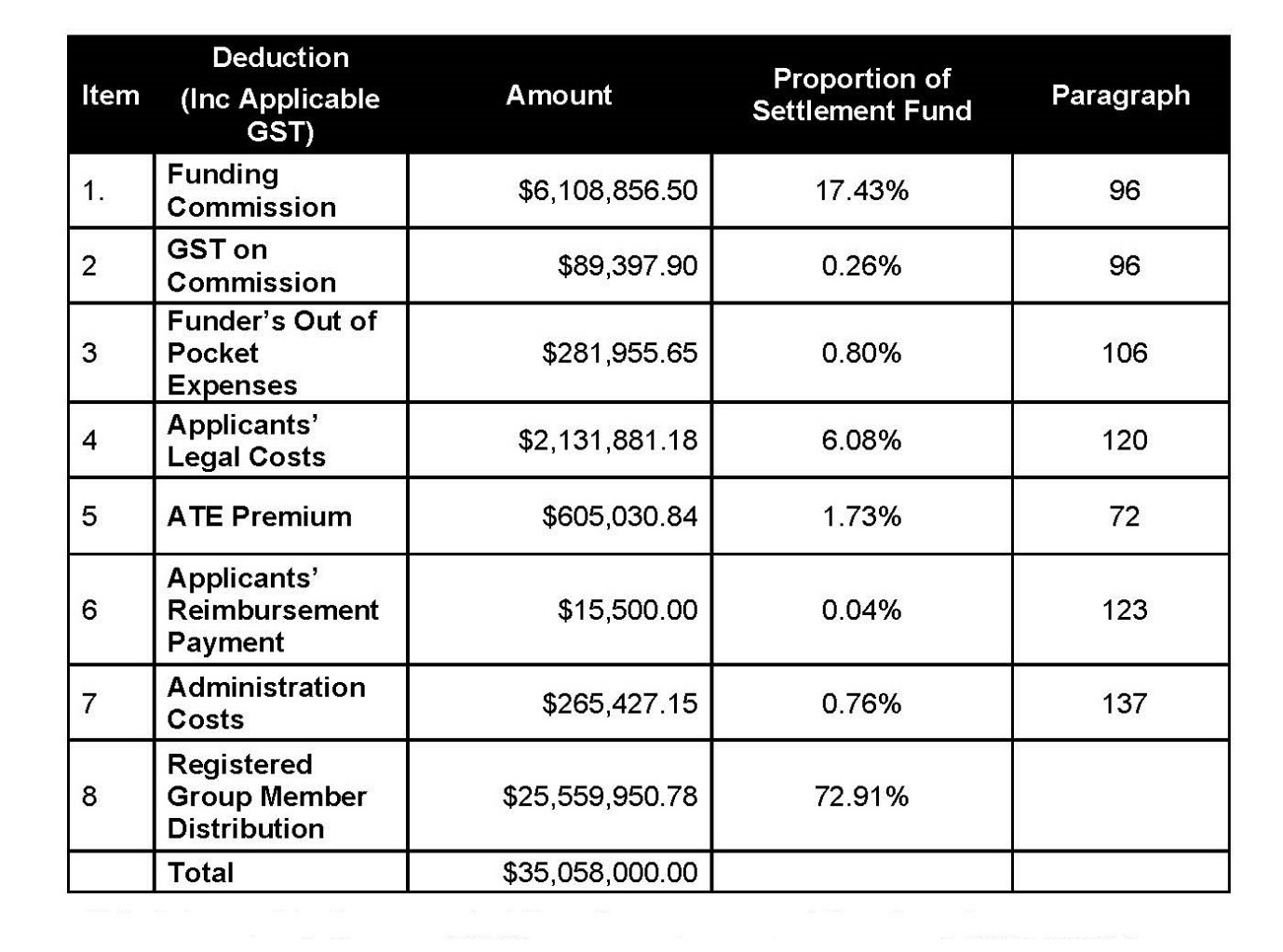
47 In [69] of the First Chuk Affidavit, Mr Chuk states that while it is possible that the calculation of one or more of the above items could vary between the date of affirming the affidavit and the application of the settlement distribution scheme, he is of the view that any such future variation would not reduce registered Group Member distributions by more than 0.25%.
Consideration
Consideration of the objections
48 I will first consider the objections filed by Group Members other than Mr O’Callaghan, and then consider Mr O’Callaghan’s objection. In my view, it is appropriate in all of the circumstances for these Group Members to be treated as registered Group Members for the purposes of the proposed settlement. While the material in support of the objections is in some cases thin, I accept that there is a valid explanation for the failure of these Group Members to register in time. The inclusion of these objectors in the settlement would result in their receipt of a relatively small amount of money in aggregate, and therefore result in a negligible decrease in the distribution to registered Group Members. I note also that the applicants do not oppose an order that these objectors be treated as registered Group Members.
49 By his notice of objection, Mr O’Callaghan contends, in summary, that the proposed distribution to him is inadequate by reference to the magnitude of his loss and damage. For the reasons discussed below, I consider the overall settlement sum to be fair and reasonable. It appears that the objection has failed to appreciate that the claim in the proceeding was only for the inflation in the share price at the time Group Members purchased shares (such “inflation”, in the technical sense, being quantified by reference to the information ultimately disclosed in the corrective disclosures), and not the total cumulative decline in the share price during the period. Further, it is important to emphasise that the settlement necessarily proceeds upon a compromised or discounted assessment of what that inflation might have been. For these reasons, I reject this objection to the proposed settlement.
Fairness and reasonableness between the parties
50 In this section of these reasons, I consider the fairness and reasonableness of the proposed settlement between the applicants (on behalf of themselves and Group Members) and Vocus. I will then consider the fairness and reasonableness of the settlement as between Group Members.
51 It will be apparent from the description of the applicants’ contentions earlier in these reasons that the proceeding involves some complexity. Any trial of the proceeding would likely be of substantial duration (six weeks or more). If the proceeding is not settled, it is unlikely that it would be ready for trial before the second half of 2021. Further, it is unlikely that any judgment in respect of the common issues would be delivered before 2022. With the prospect of appeals, and individual determination of Group Members’ claims, even in the event of success at a trial of common issues, the applicants and Group Members would be unlikely to receive any money from the litigation until 2023 at the earliest.
52 The Counsel Opinion sets out, in section 3, observations regarding the risks of establishing liability. That part of the opinion is confidential. I have had regard to the careful and detailed discussion of the risks in that section of the opinion. In section 4 of the opinion, which is also confidential, counsel for the applicants discuss the risks of establishing causation, loss and damage. I have also had regard to the careful and detailed discussion in that section of the opinion.
53 In section 5 of the Counsel Opinion, the applicants’ counsel consider the fairness and reasonableness of the settlement sum. That section of the opinion is marked as confidential. I have also had regard to the careful and detailed consideration in that section of the opinion. Counsels’ ultimate opinion, as set out at [1.7] (which is not confidential), is that the proposed settlement embodied in the Deed of Settlement represents a fair and reasonable compromise of the claims made on behalf of Group Members, and is in the interests of Group Members. I have had regard to this opinion and the reasoning upon which it is based.
54 In my opinion, having regard to the nature of the claims in the proceeding, their complexity, the prospects of success in establishing liability, the prospects of establishing causation, loss and damage, a comparison between the settlement sum and the best possible recovery, a comparison between the settlement sum and what might reasonably be expected to be achieved in the litigation, the ‘opportunity cost’ of expending greater sums on legal fees to fully litigate the matter as against the time cost of money, and other litigation risks, the settlement sum is a fair and reasonable compromise of the claims of registered Group Members.
Fairness and reasonableness as between Group Members
55 In my opinion, insofar as settlement fund (after deductions) is to be divided among registered Group Members, the settlement distribution scheme, including the (confidential) loss assessment formula, provides a fair and reasonable basis upon which to divide the settlement fund (after deductions). I have regard to the following opinions of counsel as set out in the Counsel Opinion at [7.35]-[7.37] (which are not confidential):
(a) Each group member will receive that proportion of the settlement distribution fund which their claim bears to the aggregate claims of all registered Group Members. The proposed pro rata settlement distribution will thus lead to Group Members receiving an equal return relative to their claims after deduction of all costs allowed to be deducted from the settlement fund.
(b) It is appropriate that the Group Members’ assessed losses be calculated using the weighted average of the assessed losses (LIFO and FIFO), and derived from the artificial inflation series prepared by Dr Zein, as this is the best available information as to the claim value of each Group Member’s claim.
(c) While counsel have noted certain risks to the case, including that the applicants have greater prospects in respect of their later claim period from February 2017 and Vocus’s “alternative counterfactual” calculating inflation at a lower rate only from that date, counsel do not consider that a differential distribution formula is justified in the present case. Counsel indicated that they are aware that such an approach has sometimes been taken in appropriate cases, such as in the Macmahon class action. However, they do not consider it to be appropriate in this case because they are not persuaded that the prospects of success of the early period claim are sufficiently below that of the later period claim to merit such an approach being taken.
56 I note that the settlement distribution scheme contains detailed checks and balances, including a review process, to distribute the proceeds of the settlement between registered Group Members. I note also that no registered Group Member apart from Mr O’Callaghan has objected to the settlement distribution scheme. Mr O’Callaghan’s objection has been discussed above. The matters raised by Mr O’Callaghan do not cause me to question the fairness and reasonableness of the settlement distribution scheme. For these reasons, subject to consideration of the treatment of unregistered Group Members, and the proposed deductions, I consider the proposed settlement to be fair and reasonable as between the Group Members.
Unregistered Group Members
57 I now turn to consider the treatment of unregistered Group Members under the proposed settlement. As noted above, it is proposed that unregistered Group Members (who did not opt out) will not receive any distribution, but will nevertheless be bound by the settlement. Although this proposed treatment was the subject of procedural orders made on 21 May 2019, it is appropriate, in my view, to consider afresh whether the proposed treatment of unregistered Group Members is fair and reasonable in the circumstances. This is consistent with the approach taken by Beach J in Newstart in relation to a comparable issue concerning unregistered Group Members: see Newstart at [65]-[71].
58 In my view, the proposed treatment of unregistered Group Members (who have not opted out) under the proposed settlement is fair and reasonable. First, I am satisfied that the registration process (as adopted in this case) was necessary for there to be a realistic prospect of resolving this dispute prior to trial. Without a registration process such as adopted in the present case, it would not have been possible to determine whether any settlement sum was sufficient from the perspective of the applicants and Group Members. Further, it would not have been possible for the respondent, Vocus, to achieve the necessary degree of certainty from any settlement. For example, looking at the matter from the perspective of the respondent, if any settlement was binding only on registered Group Members (rather than all Group Members), Vocus would face the potential of another proceeding or other proceedings being brought by unregistered Group Members. While it is true that this risk existed (and exists) in relation to Group Members who opted out, the risk is significantly less.
59 Secondly, Group Members were given clear notice of the registration process and the consequences of not registering and not opting out. As set out earlier in these reasons, the June 2019 Notice explained the registration process in some detail, and highlighted (included in bold at the beginning of the notice) the significance of not registering and not opting out. Group Members were provided within a reasonable period of time (some six weeks) in which to register. Further, insofar as certain Group Members sought to register in the period between the deadline and the date of the mediation (2 December 2019), those Group Members are to be treated as registered Group Members by virtue of the orders made on 7 February 2020. Also, insofar as 11 of the 12 objectors have sought to be included, on the basis that their failure to register was due to extenuating circumstances, they also are to be treated as registered Group Members.
60 Thirdly, the effect of failing to register and failing to opt out was reiterated in clear terms in the February 2020 Notice. The February 2020 Notice also made clear that Group Members could object to the proposed settlement, and provided details of how to do so. In these circumstances, it is significant that no unregistered Group Member has objected to the proposed settlement on the basis of the treatment of unregistered Group Members.
61 Two days before the hearing of the present approval application, the Court of Appeal of the Supreme Court of New South Wales delivered judgment in Haselhurst v Toyota Motor Corporation Australia Ltd [2020] NSWCA 66 (Haselhurst). In that case, a bench of five Judges (Bell P, Macfarlan, Leeming and Payne JJA, and Emmett AJA) held that a class closure order made by the primary judge was beyond the power in s 183 of the Civil Procedure Act 2005 (NSW). The leading judgment was given by Payne JA, with whom all other members of the Court agreed. Bell P provided some additional reasons, and all of the other members of the Court agreed with those additional reasons. The parties to the present proceeding presented submissions in relation to Haselhurst. Both parties submitted that the decision should not stand in the way of approval of the proposed settlement. In my view, the judgment of the Court of Appeal is distinguishable on the basis that it concerned a pre-trial class closure order and the question whether such an order could be made under s 183 of the Civil Procedure Act (which corresponds to s 33ZF of the Federal Court of Australia Act). In contrast, the present application seeks approval of a settlement pursuant to s 33V(1) of the Federal Court of Australia Act. The application is made at the conclusion of the proceeding, at which time different considerations arise. Further, the Court of Appeal in Haselhurst referred with apparent approval to the judgment of Beach J in Newstart, in which his Honour approved a settlement in which unregistered group members did not receive a distribution but were nevertheless bound by the settlement: see Haselhurst at [97] per Payne JA; see also at [7] per Bell P. I refer also to the judgment of Jagot J in Inabu Pty Ltd as trustee for the Alidas Superannuation Fund v CIMIC Group Ltd [2020] FCA 510 at [8], in which her Honour accepted a submission that it is clear from the reasoning in Haselhurst that the Court is able to make an order extinguishing a group member’s claim under ss 33V and 33ZB of the Federal Court of Australia Act at the time of approving a settlement.
62 I note for completeness that there are differences between the orders made in the present case on 21 May 2019 and the order under consideration in Haselhurst. In particular, paragraph 16 of the orders made on 21 May 2019 in the present case was expressed to be “subject to any further order of the Court” and sub-paragraph (b) included the words “will not, without the leave of the Court”. In any event, as discussed above, I have considered afresh whether it is fair and reasonable for unregistered Group Members not to receive a distribution but nevertheless to be bound by the settlement.
63 For these reasons, I consider the treatment of the unregistered Group Members under the proposed settlement to be fair and reasonable. I also consider it appropriate to make the proposed order under s 33ZB.
The proposed deductions
64 I now consider the fairness and reasonableness of the proposed deductions from the settlement fund. The proposed deductions are set out in the table in [68] of the First Chuk Affidavit, which has been extracted at [46] above. The basis for each of these deductions is discussed in some detail in the First Chuk Affidavit.
65 It is convenient to deal first with the proposed deductions for: the funder’s out of pocket expenses ($281,955.65); the applicants’ legal costs ($2,131,881.18); the ATE premium ($605,030.84); the applicants’ reimbursement payment ($15,500.00); and the administration costs ($265,427.15). (In other words, all of the proposed deductions apart from the funding commission.) Insofar as the quantum of each of these proposed deductions is concerned, I am satisfied that each of the proposed deductions is reasonable, having regard to the evidence in the First Chuk Affidavit and also the report of Ms Dealehr in relation to costs. In relation to the quantum of the applicants’ legal costs, I note Ms Dealehr’s level of expertise, her opinion that the costs are reasonable, the detailed analysis underpinning that opinion, and the absence of any objection to the amount of the costs. It is proposed that the deductions be borne by all of the registered Group Members, not only those registered Group Members who entered into a funding agreement. This is conventional and appropriate. Although the unfunded Group Members are not in a contractual relationship with the funder, and have not signed costs agreements with the applicants’ solicitors, it is appropriate that they bear a proportion of the costs incurred in bringing the proceeding, in circumstances where it has produced the proposed settlement and they stand to benefit from that settlement. The proposed deductions are therefore “just” for the purposes of s 33V(2) of the Federal Court of Australia Act.
66 The proposed deduction for the funding commission is $6,108,856.50 plus applicable GST, which amounts to $6,198,254.40 including applicable GST. As with the other deductions, it is proposed that this amount be borne by all registered Group Members, not only those who entered into a funding agreement. The proposed deduction for funding commission (excluding GST) represents 17.43% of the settlement sum. That rate is 15% less than the applicable rate under the funding agreements entered into by funded registered Group Members. Under the funding agreements, the applicable contractual commission if the claim proceeds are received by 24 October 2020 is 20.5% plus GST. (A higher rate applies if the claim proceeds are received later, but that can be put to one side for present purposes.) The rate of 17.43% is 15% less than the rate of 20.5%. Of course, the rate of 17.43% is applied to the whole of the settlement sum, not only the portion of the fund referable to the claims of funded registered Group Members.
67 The applicants’ alternative proposal, also addressed in the evidence and submissions, is to deduct the total contracted funding commission, that is, the total of the amounts agreed to be paid by the funded registered Group Members under their funding agreements. Under this approach, the total amount would still be borne by both funded and unfunded registered Group Members, but it would be determined by reference to the total of the amounts that the funded registered Group Members had agreed to pay. If the alternative approach is taken, there are two methods of calculating the funding commission: see the First Chuk Affidavit at [102]-[104]. The first method, which adopts a ‘grossing up’ mechanism, produces a funding commission of $3,897,735.37 (including GST). The second method, which adopts a ‘no grossing up’ mechanism, produces a funding commission of $3,473,149.93 (including GST). Clearly, the alternative approach results in a significantly lower return for Woodsford and ICP, and a significantly greater balance available for distribution to registered Group Members.
68 The parties in their written and oral submissions addressed the question whether the applicants’ primary proposal in respect of funding commission is inconsistent with observations made by members of the majority in BMW Australia Ltd v Brewster (2019) 374 ALR 627; [2019] HCA 45 (BMW). The parties’ counsel, quite properly, drew to my attention features of the primary proposal for funding commission that may be considered to be akin to (what may be described as) a ‘common fund order’ (or CFO). In contrast, the applicants’ alternative proposal was said to constitute a ‘funding equalisation order’ (or FEO). A common fund order was described in the judgment of Kiefel CJ, Bell and Keane JJ in BMW at [1] in the following terms: “Such an order is characteristically made at an early stage in representative proceedings and provides for the quantum of a litigation funder’s remuneration to be fixed as a proportion of any moneys ultimately recovered in the proceedings, for all group members to bear a proportionate share of that liability, and for that liability to be discharged as a first priority from any moneys so recovered.” A funding equalisation order was described by their Honours at [45] as an order to “redistribute settlement funds from unfunded group members to all group members”.
69 The issue before the High Court in BMW was whether the Federal Court under s 33ZF of the Federal Court of Australia Act has power to make a common fund order at an early stage of a proceeding. The High Court, by a majority (Kiefel CJ, Bell, Keane, Nettle and Gordon JJ; Gageler and Edelman JJ dissenting), held that the power in s 33ZF does not extend to the making of such an order.
70 The issue before the Court on the present application is different. No order is sought under s 33ZF; the relevant orders are sought under s 33V. Further, the application is made at the conclusion, rather than at an early stage, of the proceeding. In these circumstances, many of the concerns expressed by the High Court majority in relation to common fund orders have no or little application in the present case. For example, Kiefel CJ, Bell and Keane JJ expressed a concern that an application for a common fund order “invites the court to order the establishment of a complex relationship between group members and a litigation funder with whom the group members would otherwise have no relationship at all” (at [66]). Their Honours also indicated a concern that “[t]he court, in attempting to fix, even provisionally, a rate of remuneration at the outset of the proceeding must necessarily engage in a speculative exercise” (at [67]). These concerns have little or no application at the conclusion of the proceeding. In the following passage, at [68], Kiefel CJ, Bell and Keane JJ contrasted the powers available at the conclusion of a proceeding with the making of a common fund order at an early stage of a proceeding:
The provisions of Pt IVA of the FCA and Pt 10 of the CPA expressly provide for the making of orders distributing any proceeds of a representative proceeding. As will be seen, the occasion for the making of such an order is the conclusion of the proceeding. At that stage, if the group members happen to be indebted to a litigation funder for its support of their claims, the value of the litigation funder’s support to the group members will be capable of assessment and due recognition. That stage is the appropriate occasion for orders for meeting and sharing the cost burden of the litigation because the value of the litigation and the extent of the burden will have been rendered certain. In contrast, an application for a CFO at an early stage of a proceeding necessarily involves speculation on the part of the parties and the court in respect of these matters; and attention to matters of concern to the litigation funder which may not be shared by, and may well be contrary to the interests of, group members.
71 In the course of their judgment, Kiefel CJ, Bell and Keane JJ discussed the difference between common fund orders and funding equalisation orders at [85]-[90]:
85 To the extent that one aspect of the motivation for seeking a CFO is said to be to facilitate the equitable sharing of the costs of a representative proceeding, Pt IVA of the FCA and Pt 10 of the CPA recognise that the representative party ought not (necessarily) bear the entire costs of the proceeding. These provisions allow the courts to prevent the practice of “free riding” by unfunded group members who might seek to take the benefit of the costs and risks assumed by the representative party and funded group members.
86 It may be accepted that the concern to prevent “free riding” is relevant to doing justice as between group members who are parties to the proceeding. But the equitable sharing of the expense of the proceeding may be achieved by the making of a FEO that reduces unfunded group members’ awards by an amount equivalent to that paid by funded group members to the litigation funder. The cost of litigation is thus borne equitably between all group members. Group members necessarily stand in a relationship to one another as a result of the statutory scheme; the claims in the proceeding are litigated on behalf of all of them, and orders in the proceeding bind all of them. Subject to the creation of sub-groups and the determination of individual questions, the statutory scheme treats them as one group. It is, therefore, just that the costs of the proceeding be spread amongst the members of that group.
87 In contrast, there is no reason why the amount taken from unfunded group members’ awards should be directed to the litigation funder, much less that an order to that effect should be made at the outset of the proceeding rather than on the occasion contemplated by s 33ZJ(2) of the FCA and s 184(2) of the CPA. Unfunded group members have no contractual or other relationship with the funder. Nor have they any liability to the funder. The funder has no right to that money under contract or under equitable principles.
88 A CFO is thus not the obvious solution to the problem of “free riding”. A CFO is apt to impose an additional cost on the group by requiring more money to be paid to the litigation funder than would otherwise be the case. The equitable spreading of the cost is, in fact, better achieved by the making of a FEO, which takes, as its starting point, the actual cost incurred in funding the litigation. While it must be accepted that the burden of the amounts that funded group members have agreed to pay to the funder under their agreements with the funder must be distributed fairly, a FEO is apt equitably to distribute those amounts whereas a CFO seeks to impose an additional cost by imposing new obligations on the unfunded group members.
89 A FEO is clearly available where a settlement is reached. A settlement must be approved by the court, and, in approving a settlement, the court must be satisfied that it is “fair and reasonable to all group members”. A settlement that allows some group members to ride for free would not be fair and reasonable to the other group members.
90 Secondly, where a matter runs to judgment (rather than being settled), a FEO may be made under s 33ZF or s 183. That is because justice would not be done in the proceeding if it resulted in unfunded group members gaining a windfall by avoiding costs which others bore for their benefit. A FEO prevents that outcome by redistributing those costs. It falls squarely within the terms of ss 33ZF and 183. The same cannot be said of a CFO.
(Footnotes omitted.)
72 These observations clearly favour the making of a funding equalisation order over a common fund order (implicitly, at the conclusion of a proceeding). However, after careful consideration, I do not consider these observations to express a concluded view that there is no power under s 33V to make a common fund order. First, their Honours in this passage contrasted the making of a common fund order at an early stage of the proceeding with the powers available at the conclusion of a proceeding (e.g. at [87], [90]), indicating that their focus remained on the issue of whether a common fund order could be made at an early stage of the proceeding. Secondly, while their Honours stated in terms, at [89], that a funding equalisation order is “clearly available” where a settlement is reached, they did not state that a common fund order is not available. Had their Honours intended to express a concluded view on this point, it is likely that it would have been stated in this passage. Thus, on balance, I do not take their Honours to be expressing a concluded view on the question whether there is power under s 33V to make a common fund order. I note also the observations of Gordon J at [141], [147], [149] and [152]. These may, at least on one view, go further, and express an opinion that s 33V would not support the making of a common fund order. The other member of the majority, Nettle J, did not directly address the point. Having regard to these matters, I do not consider there to be a clear majority view expressed to the effect that there is no power under s 33V to make a common fund order. See also Lenthall v Westpac Banking Corporation (No 2) [2020] FCA 423 at [6]-[21] per Lee J and McKay Super Solutions Pty Ltd (Trustee) v Bellamy’s Australia Ltd (No 3) [2020] FCA 461 at [15]-[22] and [31] per Beach J.
73 While the observations of the majority may not represent a concluded view on the question of power, they nevertheless express strong reasons for favouring a funding equalisation order over a common fund order. When the observations of Gordon J are added to those of the plurality, a majority of the High Court have indicated strong reasons favouring the making of a funding equalisation order over a common fund order.
74 In the circumstances of the present case, I do not consider it appropriate to approve the applicants’ primary proposal as regards funding commission ($6,198,254.40 including applicable GST). Instead, I consider it appropriate to approve the applicants’ alternative proposal (adopting the first method of calculation), namely $3,897,735.37 (including GST). My reasons are as follows. First, the applicants’ primary proposal imposes an additional cost on the group by requiring more money to be paid to the litigation funder than would otherwise be the case. In contrast, the applicants’ alternative proposal takes, as its starting point, the actual cost incurred in funding the litigation: see the observations of the plurality in BMW at [88]. Secondly, the applicants’ primary proposal goes further than is necessary to address the problem of ‘free riding’. The applicants’ alternative proposal sufficiently ensures that unfunded Group Members who obtain the benefit of the litigation contribute to the cost of the proceeding: see the observations of the plurality in BMW at [89]. Thirdly, while Woodsford and ICP played important roles in funding the litigation (and exposing themselves to risk) for the benefit of registered Group Members, this is sufficiently recognised by the applicants’ alternative proposal, by which Woodsford and ICP receive the funding commission to which they are entitled under the contracts with funded Group Members.
75 In reaching this view, I have had regard to the considerations discussed in the Counsel Opinion at [8.117], which support the applicants’ primary proposal for funding commission. In particular, I have had regard to the fact that the February 2020 Notice set out in clear terms that the applicants proposed to apply for approval of a funding commission of $6.1 million, and no Group Member has objected to that proposed order. I also note that the February 2020 Notice referred to the applicants’ alternative proposal and indicated that this would likely result in a lesser amount being deducted from the settlement sum. Given these statements, it is significant that no Group Member has objected to the applicants’ primary proposal. While these matters weigh in favour of the approval of the applicants’ primary proposal, they are, in my view, outweighed by the considerations referred to in the preceding paragraph.
76 The applicants have put forward cogent reasons to support the adoption of the first method of calculation of their alternative proposal. I consider that method of calculation to be appropriate in the circumstances.
77 For these reasons, I consider the applicants’ alternative proposal as regards funding commission (adopting the first method of calculation) to be fair and reasonable. I consider the deduction of this amount from the settlement sum to be “just” for the purposes of s 33V(2).
Conclusion
78 For these reasons, I will make orders substantially in the terms sought by the applicants, save that in relation to funding commission I will approve the applicants’ alternative proposal (adopting the first method of calculation) rather than their primary proposal. At the hearing of the application, counsel for the applicants indicated that, if I were to take this view, the only change required to the minute of proposed orders would be to [8(b)] of the proposed orders, by inserting the figure for the applicants’ alternative proposal in place of the figure for their primary proposal. In addition, I will make an order that the objectors other than Mr O’Callaghan (who is already registered) be treated as registered Group Members for the purposes of the settlement.
I certify that the preceding seventy-eight (78) numbered paragraphs are a true copy of the Reasons for Judgment herein of the Honourable Justice Moshinsky. |


