

FEDERAL COURT OF AUSTRALIA
Aurora Funds Management Limited v Australian Government Takeovers Panel (Judicial Review) [2020] FCA 496
ORDERS
DATE OF ORDER: |
THE COURT ORDERS THAT:
1. The application be dismissed.
2. Any party wishing to submit to the contrary of the tentative conclusion reached in these reasons on costs file a written submission of no longer than two pages within 14 days.
Note: Entry of orders is dealt with in Rule 39.32 of the Federal Court Rules 2011.
PERRAM J:
Introduction
1 This is an application for judicial review under s 5 of the Administrative Decisions (Judicial Review) Act 1977 (Cth) (‘ADJR Act’) and s 39B of the Judiciary Act 1903 (Cth). The decision under challenge is a decision made on 30 June 2017 by the First Respondent, the Australian Government Takeovers Panel (‘the Panel’). Its decision concerned the Third Respondent, an entity listed on the Australian Stock Exchange called Molopo Energy Limited (‘Molopo’). Molopo is what is generally known as a ‘cash box’, that is, its principal asset is cash and it does not have any other business operations or investments. As at 31 December 2016, Molopo had cash reserves of $67.5 million. It apparently continued at that time to assess opportunities in the oil and gas sector but, pending any such activity, did no more than hold cash.
2 Listed cash boxes have often enough attracted the attention of persons wishing to obtain a controlling stake in them in order to access the sweet flesh of the cash within. The present case is alleged to concern efforts of that kind. Section 606(1) of the Corporations Act 2001 (Cth) (‘the Act’) prohibits a person from acquiring an interest in issued voting shares in a listed company if the effect of doing so would be to increase a person’s voting power in the company to 20% or more. And, in calculating that 20%, the Act requires that the parties who are associated with each other be considered as if their interests were combined: ss 606(1)(c), 610.
3 There were two entities on the share register of Molopo which, whilst each held less than 20% of the shares in it, also held between them more than 20%. These were the Fourth Respondent, a listed entity being Keybridge Capital Limited (‘Keybridge’), and the Applicant, Aurora Funds Management Limited (‘Aurora’). By 21 March 2017, the Applicant held 17.92% of voting rights in Molopo, and by 11 April 2017, Keybridge held 19.95%.
4 On 12 March 2017, Keybridge requisitioned a meeting of the shareholders of Molopo under s 249D of the Act to consider a motion to remove its current three directors and to replace them with three directors nominated by Keybridge. That resolution was to be considered at the annual general meeting scheduled for 15 May 2017. Shortly after the requisition, the Applicant indicated that it would also be nominating a director at the meeting.
5 There is no express provision of the Act which made unlawful Keybridge’s efforts to unseat the current directors of Molopo and to put in place its own directors. Nevertheless, on 11 April 2017 the Second Respondent, the Australian Securities and Investments Commission (‘ASIC’), filed an application with the Panel under s 657C(2)(c) of the Act seeking a declaration that there were unacceptable circumstances in relation to the affairs of Molopo under s 657A. If such a declaration were made, the consequence would be that the Panel would then be empowered to make remedial orders under s 657D. Indeed, ASIC sought a remedial order that Keybridge and the Applicant divest themselves of their shares in Molopo. The basis upon which ASIC sought this relief was that Keybridge and the Applicant were acting or proposing to act in concert to remove the current directors and to take control of Molopo and were, therefore, ‘associates’ within the meaning of s 610 and thus engaging in contraventions of s 606 of the Act. I return to ss 606 and 610 in greater detail below.
6 ASIC identified three aspects of the situation as giving rise to unacceptable circumstances within the meaning of s 657A. These were, first, that between them Keybridge and the Applicant held 37.33% of the issued voting shares in Molopo; secondly, that the non-disclosure of their association meant that the acquisition of control in Molopo was not taking place in an informed market; and, thirdly, that any further acquisition of shares in Molopo by either Keybridge or the Applicant would be a contravention of the rule in s 606(1) because they were associates and their holdings were to be aggregated under ss 606 and 610.
7 On the same day that ASIC filed its application, 11 April 2017, Molopo itself filed an application with the Panel seeking similar relief. The Panel understandably resolved to consider the two applications together.
8 On 19 May 2017, the first iteration of the Panel (‘the Initial Panel’) issued a Supplementary Brief noting its intention to determine that there were unacceptable circumstances in relation to the affairs of Molopo within the meaning of s 657A. It did not do so on the basis that the Applicant and Keybridge were ‘associates’ under s 12 of the Act so that their shareholdings were to be aggregated together. Instead, it concluded that there unacceptable circumstances because, speaking generally for now, the Applicant and Keybridge were influenced by a third party, a Mr Bolton, and the effect of his influence was to create a situation which the Initial Panel was disposed to see as being akin to control. The Initial Panel then made a declaration of unacceptable circumstances under s 657A on 30 May 2017. On 14 June 2017, the Initial Panel ordered that the Applicant divest itself of the shares it held in Molopo. The Initial Panel published reasons for its decision on 23 June 2017.
9 Provision exists for a person who was a party to a decision of the Panel to seek an internal review of the decision: s 657EA. On 1 June 2017, Keybridge applied for such a review, and the Applicant applied for review on 15 June 2017. On 19 June 2017, a second panel (‘the Review Panel’) determined that the two review applications should be heard together. On 30 June 2017, the Review Panel set aside the decision of the Initial Panel: Molopo Energy Limited 03R, 04R & 05R [2017] ATP 12 (‘Review Reasons’). It concluded, contrary to the conclusion of the Initial Panel, that the Applicant and Keybridge were indeed associates within the meaning of both ss 12(2)(b) and (c) so that their share holdings were to be aggregated. The result of this was that the associates’ aggregated shareholding contravened the rule in s 606(1). In addition, like the Initial Panel, the Review Panel also thought that regardless of whether the Applicant and Keybridge were associates, the fact that Mr Bolton was lingering behind the arras also gave rise to circumstances which were otherwise unacceptable. It made a declaration to that effect under s 657A and ordered under s 657D that the Applicant be divested of all of the shares it had acquired in Molopo after 10 August 2016.
10 The Applicant now seeks judicial review of the Review Panel’s finding that the Applicant and Keybridge were associates and its determination that there were unacceptable circumstances under s 657A. It must—and does—pursue a challenge to both of the Review Panel’s conclusions, for it will profit it nothing to have set aside the conclusion that the Applicant and Keybridge were associates unless it extinguishes also the Review Panel’s conclusion that unacceptable circumstances otherwise arose from the role of Mr Bolton. Likewise, quashing its conclusions about the role of Mr Bolton leads nowhere if the conclusion that the Applicant and Keybridge were associates is not also given its quietus. In short, the Applicant must succeed on both grounds elsewise fail.
11 For the reasons which follow, it succeeds on none of its grounds. The Applicant’s application should therefore be dismissed. It must pay ASIC’s costs but there is to be no order as to the costs of the Panel which intervened only in relation to the ambit of its powers.
Statutory Provisions
12 Section 606(1) of the Act provides the ‘20% Voting Rule’. It is in these terms:
606 Prohibition on certain acquisitions of relevant interests in voting shares
Acquisition of relevant interests in voting shares through transaction entered into by or on behalf of person acquiring relevant interest
(1) A person must not acquire a relevant interest in issued voting shares in a company if:
(a) the company is:
(i) a listed company; or
(ii) an unlisted company with more than 50 members; and
(b) the person acquiring the interest does so through a transaction in relation to securities entered into by or on behalf of the person; and
(c) because of the transaction, that person's or someone else's voting power in the company increases:
(i) from 20% or below to more than 20%; or
(ii) from a starting point that is above 20% and below 90%.
(notes omitted.)
13 Section 610 requires that, in the process of applying the 20% Voting Rule, the holdings of ‘associates’ be brought to account. Section 610(1) provides:
610 Voting power in a body or managed investment scheme
Person’s voting power in a body or managed investment scheme
(1) A person’s voting power in a designated body is:
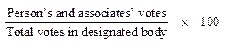
where:
person’s and associates’ votes is the total number of votes attached to all the voting shares in the designated body (if any) that the person or an associate has a relevant interest in.
total votes in designated body is the total number of votes attached to all voting shares in the designated body.
Note: Even if a person’s relevant interest in voting shares is based on control over disposal of the shares (rather than control over voting rights attached to the shares), their voting power in the designated body is calculated on the basis of the number of votes attached to those shares.
14 The concept of an ‘associate’ is dealt with in s 12 of the Act and the definition of ‘relevant agreement’ in s 9. The relevant portion of s 12 is subs (1) and (2), which are as follows:
12 References in Chapters 6 to 6C, and other references relating to voting power and takeovers etc.
(1) Subject to subsection 16(1), but despite anything else in this Part, this section applies for the purposes of interpreting a reference to an associate (the associate reference), in relation to a designated body, if:
(a) the reference occurs in a provision of Chapter 6, 6A, 6B or 6C; or
(b) the reference occurs in a provision outside those Chapters that relates to any of the following matters:
(i) the extent, or restriction, of a power to exercise, or to control the exercise of, the votes attached to voting shares in the designated body;
(ii) the primary person's voting power in the designated body;
(iii) relevant interests in securities in the designated body;
(iv) a substantial holding in the designated body;
(v) a takeover bid for securities in the designated body;
(vi) the compulsory acquisition, or compulsory buy-out, of securities in the designated body.
(2) For the purposes of the application of the associate reference in relation to the designated body, a person (the second person) is an associate of the primary person if, and only if, one or more of the following paragraphs applies:
(a) the primary person is a body corporate and the second person is:
(i) a body corporate the primary person controls; or
(ii) a body corporate that controls the primary person; or
(iii) a body corporate that is controlled by an entity that controls the primary person;
(b) the second person is a person with whom the primary person has, or proposes to enter into, a relevant agreement for the purpose of controlling or influencing the composition of the designated body's board or the conduct of the designated body's affairs;
(c) the second person is a person with whom the primary person is acting, or proposing to act, in concert in relation to the designated body's affairs.
15 Subsection (2)(b) makes reference to a ‘relevant agreement’ which is defined in s 9 in this way:
“relevant agreement” means an agreement, arrangement or understanding:
(a) whether formal or informal or partly formal and partly informal; and
(b) whether written or oral or partly written and partly oral; and
(c) whether or not having legal or equitable force and whether or not based on legal or equitable rights.
16 It was by this route that the questions which the Panel needed to ask itself included whether there was an ‘agreement, arrangement or understanding’ between the Applicant and Keybridge within the meaning of ss 9 and 12(2)(b) or whether they had acted in concert within the meaning of s 12(2)(c). If either of those questions were answered in the affirmative there would then be a holding by the Applicant above the 20% threshold in contravention of s 606.
17 The power of the Panel to declare unacceptable circumstances is conferred by s 657A. Subsections 657A(1)-(3) relevantly provide:
657A Declaration of unacceptable circumstances
(1) The Panel may declare circumstances in relation to the affairs of a company to be unacceptable circumstances. Without limiting this, the Panel may declare circumstances to be unacceptable circumstances whether or not the circumstances constitute a contravention of a provision of this Act.
Note: Sections 659B and 659C deal with court proceedings during and after a takeover bid.
(2) The Panel may only declare circumstances to be unacceptable circumstances if it appears to the Panel that the circumstances:
(a) are unacceptable having regard to the effect that the Panel is satisfied the circumstances have had, are having, will have or are likely to have on:
(i) the control, or potential control, of the company or another company; or
(ii) the acquisition, or proposed acquisition, by a person of a substantial interest in the company or another company; or
(b) are otherwise unacceptable (whether in relation to the effect that the Panel is satisfied the circumstances have had, are having, will have or are likely to have in relation to the company or another company or in relation to securities of the company or another company) having regard to the purposes of this Chapter set out in section 602; or
(c) are unacceptable because they:
(i) constituted, constitute, will constitute or are likely to constitute a contravention of a provision of this Chapter or of Chapter 6A, 6B or 6C; or
(ii) gave or give rise to, or will or are likely to give rise to, a contravention of a provision of this Chapter or of Chapter 6A, 6B or 6C.
The Panel may only make a declaration under this subsection, or only decline to make a declaration under this subsection, if it considers that doing so is not against the public interest after taking into account any policy considerations that the Panel considers relevant.
(3) In exercising its powers under this section, the Panel:
(a) must have regard to:
(i) the purposes of this Chapter set out in section 602; and
(ii) the other provisions of this Chapter; and
(iii) the rules made under section 658C; and
(iv) the matters specified in regulations made for the purposes of paragraph 195(3)(c) of the ASIC Act; and
(b) may have regard to any other matters it considers relevant.
In having regard to the purpose set out in paragraph 602(c) in relation to an acquisition, or proposed acquisition, of a substantial interest in a company, body or scheme, the Panel must take into account the actions of the directors of the company or body or the responsible entity for a scheme (including actions that caused the acquisition or proposed acquisition not to proceed or contributed to it not proceeding).
18 As can be seen, s 657A(3) explicitly requires ‘the purposes of this Chapter’ (being Chapter 6, ‘Takeovers’, of the Act) to be taken into account in the exercise of the power in s 657A. Those purposes are set out in s 602:
602 Purposes of Chapter
The purposes of this Chapter are to ensure that:
(a) the acquisition of control over:
(i) the voting shares in a listed company, or an unlisted company with more than 50 members; or
(ii) the voting shares in a listed body (other than a notified foreign passport fund); or
(iii) the voting interests in a listed registered scheme;
takes place in an efficient, competitive and informed market; and
(b) the holders of the shares or interests, and the directors of the company or body or the responsible entity for the scheme:
(i) know the identity of any person who proposes to acquire a substantial interest in the company, body or scheme; and
(ii) have a reasonable time to consider the proposal; and
(iii) are given enough information to enable them to assess the merits of the proposal; and
(c) as far as practicable, the holders of the relevant class of voting shares or interests all have a reasonable and equal opportunity to participate in any benefits accruing to the holders through any proposal under which a person would acquire a substantial interest in the company, body or scheme; and
(d) an appropriate procedure is followed as a preliminary to compulsory acquisition of voting shares or interests or any other kind of securities under Part 6A.1.
aurora’s Grounds of Review
19 The Applicant’s amended originating application contained five grounds of review. At the hearing, these were largely reduced to three. First, the Applicant submitted that the Review Panel fell into error by finding that the Applicant and Keybridge were ‘associates’ within the meaning of ss 12(2)(b) and (c) of the Act absent a finding or adequate findings of direct communications between them (ground 1). Secondly, absent a finding of ‘association’, the Review Panel failed to determine the effect of the circumstances said to be unacceptable within the meaning of s 657A (grounds 2-3). Thirdly, the Review Panel failed to have any or proper regard to the purposes of the Act set out in s 602 in the process of making a declaration of unacceptable circumstances (grounds 4-5).
Ground 1: Association
20 The Review Panel reached the conclusion that Keybridge and the Applicant were associates because, as it said at [60] of the Review Reasons, it could infer the existence of a ‘consensus’ between them. It did not make any finding that there were express communications between the Applicant and Keybridge. Instead it inferred the consensus from a number of circumstantial matters. The Applicant submits that it was not open to the Review Panel to conclude that there was a consensus without an anterior finding that there was some kind of direct communication between it and Keybridge. Alternatively, it submits that if the Review Panel did conclude that there was a consensus based upon communications between the Applicant and Keybridge, then that conclusion was not reasonably open to it. The result of this is said to be that the Review Panel made an error of law, asked itself the wrong question, or exercised the power conferred by s 657A predicated on a finding on a relevant matter without so making a finding.
21 I do not accept either argument. As noted at [16] above, there were two avenues by which the Panel could make a finding of association in this case. The first was to consider whether the Applicant and Keybridge had reached an ‘agreement, arrangement or understanding’ the purpose of which was controlling or influencing the composition of Molopo’s board or the conduct of its affairs: see s 12(2)(b) and the definition of ‘relevant agreement’ in s 9. As extracted at [15] above, that last-mentioned definition is explicit in declaring that the agreement, arrangement or understanding may be formal or informal. The second avenue arose from s 12(2)(c) and was to consider whether the Applicant was acting, or was proposing to act, ‘in concert’ with Keybridge in relation to the affairs of Molopo.
22 The Applicant’s submission is therefore that it is not possible, as a matter of law, for a decision-maker to conclude that there is an ‘agreement, arrangement or understanding’ without making a finding that there has been some sort of express communication between the parties to that agreement, arrangement or understanding. It must also submit that there can be no ‘acting in concert’ between two parties who have not in some way communicated with each other. Again, the reason for this is that it must succeed in excluding the operation of both relevant avenues in s 12(2) if it is to avoid the conclusion that the Applicant and Keybridge were associates.
Agreement, arrangement or understanding
23 The expression ‘relevant agreement’ in s 9 is broadly defined and includes agreements, arrangements or understandings which may be formal or informal, written or oral, and which need not have legal or equitable force. The slightly different expression ‘contract, arrangement or understanding’ is found in s 45 of the Competition and Consumer Act 2010 (Cth), which provides:
45 Contracts, arrangements or understandings that restrict dealings or affect competition
(1) A corporation must not:
(a) make a contract or arrangement, or arrive at an understanding, if a provision of the proposed contract, arrangement or understanding has the purpose, or would have or be likely to have the effect, of substantially lessening competition; or
(b) give effect to a provision of a contract, arrangement or understanding, if that provision has the purpose, or has or is likely to have the effect, of substantially lessening competition; or
(c) engage with one or more persons in a concerted practice that has the purpose, or has or is likely to have the effect, of substantially lessening competition.
24 In the context of s 45, the expression ‘contract, arrangement or understanding’ has been the subject of considerable judicial exegesis and, in that context, its meaning is now well-known. It appears to have been accepted that authorities considering the meaning of the expression in s 45 are applicable to the meaning of the same expression in s 9 of the Act. For example, Leeming JA (with whom McColl and Gleeson JJA agreed) assumed that cases concerned with the meaning of s 45 could be applied to s 9 in Perpetual Custodians Ltd v IOOF Investment Management Ltd [2013] NSWCA 231; 304 ALR 436 (‘Perpetual Custodians’) at 454 [71]. This is notwithstanding that s 9 speaks in terms of an ‘agreement’ whereas s 45 uses the word ‘contract’. But that difference in itself is likely to be of little moment since both words refer to the same concept.
25 Consistently with these observations, the Applicant itself relied upon several decisions about the meaning of s 45 in its written submissions in developing its contention about the meaning of the nearly-but-not-quite-the-same expression in s 9, including Australian Competition and Consumer Commission v CC (NSW) Pty Ltd [1999] FCA 954; 92 FCR 375 (‘ACCC v CC’), McHugh v Australian Jockey Club Ltd (No 13) [2012] FCA 1441; 299 ALR 363, and Trade Practices Commission v Email Ltd (1980) 31 ALR 53 (‘Email Ltd’) at 63. I take it therefore to be permissible to access the corpus of learning on ‘contract, arrangement or understanding’ about s 45 in construing the meaning of ‘agreement, arrangement or understanding’ in the definition of ‘relevant agreement’ in s 9. Certainly, everyone else is doing it.
26 The case law surrounding s 45 shows that the Applicant’s submission is untenable. The Review Panel approached the matter by asking whether there was an understanding (see, eg, [243]-[244]), so the notions of agreement or contract and arrangement may be put aside. It is well-established that an ‘understanding’ in s 45 can be tacit in the sense that it can be arrived at by each party, either by words or acts, signifying an intention to act in a particular way in relation to a matter of concern to the other party: Australian Competition and Consumer Commission v Leahy Petroleum Ltd [2007] FCA 794; 160 FCR 321 at 331-332 [26] per Gray J. Thus, as I observed in Australian Competition and Consumer Commission v Air New Zealand Ltd [2014] FCA 1157; 319 ALR 388 at 486 [463(3)] (‘Air New Zealand’):
An understanding need not be overt. In in most cases, there will be overt or express action of some kind or another because in practical terms it is quite difficult to reach a consensus without some form of communication. It is not, however, impossible.
(emphasis added.)
27 The consequence of this is that, as Wigney J noted in Australian Competition and Consumer Commission v Colgate-Palmolive Pty Ltd (No 4) [2017] FCA 1590; 353 ALR 460, an understanding can ‘be arrived at without any express negotiation or communication between the parties’: at 476 [50]. This conclusion by his Honour was affirmed on appeal sub nom Australian Competition and Consumer Commission v Colgate-Palmolive Pty Ltd [2019] FCAFC 83 at [53] per Middleton, Perram and Bromwich JJ:
The Commission submitted that the trial judge had ‘erroneously emphasised’ the absence of direct communication between the Suppliers regarding the Withhold Supply Arrangement. In its submission it was not necessary as a matter of law for direct communications to be established. There is no substance to this contention. Of course, it is true that it was not necessary as a matter of law for the Commission to prove the existence of direct communication in order to demonstrate the existence of an understanding (although it may be necessary in order to prove an arrangement—an issue which does not require resolution). But it does not follow that the absence of direct communications is irrelevant either. Just because an understanding can be tacit does not entail that evidence about the lack of contact between the alleged participants is irrelevant. It goes to the strength of the case being advanced …
28 Thus it is not a legally indispensable step in the process of seeking to prove the existence of an understanding to demonstrate that the parties communicated with each other. The existence of an understanding will very often be demonstrated by means of circumstantial evidence. No doubt, in that exercise the presence of communications is perhaps a very relevant circumstantial matter just as its absence may be. However, neither is legally essential for a conclusion that an understanding was reached (or not reached).
29 The Applicant did not submit that the words of subpara (b) of the definition of ‘relevant agreement’ in s 9 (‘whether written or oral or partly written and partly oral’) meant that an understanding must be composed only of elements which are written or oral and must not be composed of any other elements lacking either of those qualities (for example, winking or nodding). On such an observation one might well erect a submission that an understanding having such compositional qualities must arguably exclude the possibility of being tacit (and noting in particular that there is no corresponding provision in the Competition and Consumer Act 2010 (Cth)). Here the argument would be that the word ‘whether’ in subpara (b) has an exhaustive effect on what an understanding may be composed of and, further, that that which is tacit can be neither written nor oral. This strikes me as a plausible but perhaps difficult reading of s 9. Since the matter was not argued it is not necessary to take this matter any further.
30 The Applicant submitted that its argument as to the essentiality of a finding of direct communication was also supported by the decisions in Email Ltd at 63 per Lockhart J, Perpetual Custodians at [110] per Leeming JA, and Re Amcom Telecommunications Ltd (No 4) [2015] FCA 720; 107 ACSR 341 (‘Re Amcom’) at 351-352 [61] per McKerracher J. However, none of these cases support the Applicant’s submission. In Email Ltd, Lockhart J did not say that it was legally necessary to prove communication to establish an understanding; merely that this was ‘normally’ so. The passage in Perpetual Custodians referred to by the Applicant was not concerned with the nature of understandings but instead with the different question of what ‘acting in concert’ meant. It has no bearing on the present issue. Re Amcom did not involve any question about the meaning of the word ‘understanding’. None of these authorities, therefore, provides support for the Applicant’s submission.
31 The Applicant also cited the following passage from Trade Practices Commission v Nicholas Enterprises Pty Ltd (No 2) (1979) 40 FLR 83 at 89 per Fisher J, cited in ACCC v CC at 408 [138]:
A significant feature of each of the above passages is the emphasis placed upon the necessity for each of the parties to have communicated with the other, for each to have raised an expectation in the mind of the other, and for each to have accepted an obligation qua the other. These are in my opinion the essential elements of the requisite meeting of the minds.
However, this passage and the cases to which it referred concerned the notion of an ‘arrangement’ which is not what this case is about. In fact, contrary to these submissions, whether particular facts (such as a common investment, or the presence or absence of communications) support the existence of an association is context-dependent: see, eg, Re Kasbah Resources Limited [2016] ATP 19 at [20].
32 The Applicant also submitted that its construction was supported by ASIC’s Regulatory Guide 5: Relevant interests and substantial holding notices (2013). I reject this submission. It is elementary that a regulatory instrument cannot affect the meaning of a statute.
33 The Applicant submitted correctly that parallel conduct is not sufficient to justify a conclusion that there was an understanding: cf Air New Zealand at [466]-[469]. However, that was not the only basis upon which the Review Panel reached its decision. On the material before it and in relying on the Review Panel’s cumulative skills, knowledge and experience, it concluded that the Applicant and Keybridge embarked on parallel conduct, ‘which each was aware or understood the other was engaging in, to achieve their mutual objectives’ in relation to Molopo: at [60]. Parallel conduct and shared goals were there supportive of a finding of association.
34 Consequently, the Applicant’s submission that the Review Panel erred in law by concluding there was an understanding when it had made no finding of communications is incorrect and must be rejected. In its amended originating application the Applicant put this point in several different forms under the ADJR Act. All fail for the same reason.
Acting in concert
35 The Applicant pointed to a number of authorities, including Bateman v Newhaven Park Stud Ltd [2004] NSWSC 566 at [16]-[23] and Davids Distribution Pty Ltd v National Union of Workers [1999] FCA 1108; 91 FCR 463 at 496 [92], to submit that the Review Panel’s failure to find any direct communications between the Applicant and Keybridge was fatal to an argument that they were acting in concert. It is unclear whether the Review Panel based its decision solely on the basis of a ‘relevant agreement’ under s 12(2)(b) or whether it also relied upon the concept of acting in concert in s 12(2)(c). At [243] of the Review Reasons, after a most extensive review of the evidence, the Review Panel appeared to put its conclusion on both bases when it said this:
We consider that there is sufficient logically probative material now before us to draw inferences supporting a finding that Keybridge and Aurora have an understanding or are acting in concert in relation to Molopo. Their shared goal of wanting ultimately to access Molopo’s cash assets culminated in Keybridge’s requisition of a meeting to replace the Molopo board. However, in our view, the association arose at a much earlier point in time, when there was no concrete plan to requisition a board spill.
36 But then at [244] it seemed perhaps to narrow the basis upon which it was proceeding to a finding of association:
In our view, drawing on our experience, the material described above supports an inference that, by no later than 26 October 2016, the day of Keybridge’s strategy meeting, Keybridge and Aurora had an understanding that they would act together for their mutual benefit to achieve their ultimate goal of gaining access to Molopo’s cash assets.
37 I incline to the view that this is a slip. There is nothing in the Review Reasons to suggest that it was approaching the question of whether there was a relevant agreement between the Applicant and Keybridge any differently to the question of whether they had acted in concert. If it really was looking at these issues differently one would expect to find an analysis supporting such a differential approach. The absence of such an analysis is an indicator that it might be too exact a reading of the Review Panel’s decision to take the statement at [244] as in some way cutting back the width of the broader statement at [243].
38 In any event, whether it does or not is not material to the outcome of the present debate. The Review Panel’s conclusion that the Applicant and Keybridge had reached an understanding is sufficient to mean that its conclusion that they were associates under s 12(2)(b) is not susceptible to challenge on the basis that there was no communication between them. Assuming in the Applicant’s favour that the Review Panel also found that the Applicant and Keybridge did act ‘in concert’ and that the Applicant is right that this conclusion is vitiated by the lack of communication between them, this has no impact on the Review Panel’s conclusion that they were associates which, even on that assumption, rests sufficiently on the finding that there was a relevant agreement within the meaning of s 9.
39 I would reserve for a case where it was necessary to decide the question of whether in demonstrating that parties have acted in concert for the purposes of s 12(2)(c) it must be shown that there were communications between them.
Alternative argument: A finding of communication was not open to the Review Panel
40 It is then necessary to deal with the Applicant’s alternate contention that if it be found that the Review Panel inferred the existence of a consensus based on communications between the Applicant and Keybridge then the drawing of this inference was not reasonably open to the Review Panel. This contention suffers from significant structural defects. It assumes, for example, that the way in which the Applicant has lost the primary argument in this Court is by the Court concluding that the Review Panel did in fact infer the understanding between the Applicant and Keybridge from a constellation of facts which included the fact that there had been communications between them. However, the argument does not appear to have been engineered to survive an encounter with an outcome where the Court concluded that the Review Panel had not been obliged to find that the Applicant and Keybridge had communicated with each other and that it did not find that they had communicated.
41 The gravamen of the Applicant’s argument as explained in its written submissions was that the various findings of the Review Panel could not reasonably sustain the proposition that the Applicant and Keybridge had communicated. However, that contention is irrelevant. The Review Panel did not find that they had communicated and it was not obliged to do so before inferring that there was an understanding between them.
42 Given that the Review Panel did not find that there was a consensus between the Applicant and Keybridge resulting from communications between them, it is not meaningful to determine whether such a finding, had it been made, was a reasonably open one. Consequently, the Applicant’s alternate form of its first ground does not arise.
43 I have also considered whether I should construe the Applicant’s submission so that it is a submission merely that it was not open to the Review Panel to find a consensus at all. However, it is clear from its written submissions that its contention is not that broad. It is only that it was not open to the Review Panel to find a consensus on the basis of communications between them. For example, at §67, those written submissions said this:
In the circumstances, the Review Panel did not make findings to the effect that Aurora and Keybridge had a “meeting of minds” or reached a “consensual understanding” the result of communications between Aurora and Keybridge. Such a conclusion was necessary in order to reach the conclusion that Aurora and Keybridge were associates. Further, to the extent that the Review Panel drew inferences to the effect that there was a “meeting of minds” or “consensual understanding” the result of communications between Aurora and Keybridge, the findings that the Review Panel made did not reasonably permit such inferences …
(emphasis added.)
44 This was reiterated in the Applicant’s reply submissions at §9:
… what is lacking from the Review Decision is findings (or adequate findings) reasonably capable of supporting an inference that the boards of Aurora and Keybridge … knew, as a result of communications between them, that their strategies were being so aligned, and acquiesced.
(emphasis added.)
45 I reject the first ground of review advanced by the Applicant.
Grounds 2 and 3: Unacceptable circumstances
46 The second and third grounds of review concerned the Review Panel’s alternative finding that unacceptable circumstances existed even if there was no association between the Applicant and Keybridge. It was said that, before exercising its power to declare unacceptable circumstances by reason of the matters in ss 657A(2)(a) or (b), the Review Panel was required to make findings ‘with specificity’ of the effects which gave rise to the unacceptable circumstances, and that the failure to do so led it into error.
47 Because the Applicant has failed on the issue of whether the Applicant and Keybridge were associates, it follows that its proceeding must be dismissed. Strictly, that means that it is not necessary to determine the issue of whether the Review Panel erred in reaching its additional finding that there were unacceptable circumstances even if the Applicant and Keybridge were not associates. Even if that were established it would not alter the outcome. Nevertheless, in case the matter goes further, it is useful briefly to examine it.
48 The Review Panel spent much of its reasons explaining its conclusion (contrary to that of the Initial Panel) that the Applicant and Keybridge were associates within the meaning of s 12. It did not, however, directly explain why that conclusion mattered for the purposes of s 657A(2). It was of course only that provision which empowered the Review Panel to declare that there were unacceptable circumstances. This omission is discernible at [247] of the Review Reasons where the Review Panel reached the conclusion that the Applicant and Keybridge were associates without explaining why that had the consequence that there unacceptable circumstances. It may be that it was omitted because the reason is obvious: if the Applicant and Keybridge were associates then that was likely to have an effect on the control of Molopo within the meaning of s 657A(2)(a)(i). The relevant portions of ss 657A(2) and (3)(a)(i) are set out at [17] above.
49 It is clear that the Review Panel thought its conclusion on the association issue was directed to the factual circumstances referred to in s 657A(2)(a) and not to the policy considerations referred to in s 657A(2)(b). The former turned on issues of control and so forth (to which the association issue was naturally apposite) whereas the latter turned on the purposes of the Chapter set out in s 602. Those included, by s 602(a), ensuring that the acquisition of control in listed entities ‘takes place in an efficient, competitive and informed market’. It is apparent that it was this policy based case under s 657A(2)(b) that the Review Panel then considered under the heading ‘Unacceptable circumstances based on consideration of policy’. Under that heading the Review Panel found that Mr Bolton had substantial influence over the affairs both of the Applicant and of Australian Style Group Pty Ltd (‘ASG’) which held 21.16% of Keybridge. Together with other matters the Review Panel reached this conclusion at [258]:
In our view, we consider the actions of Mr Bolton and Mr Patton, combined with the material financial interests each had in Keybridge and Aurora, and the influence that each exerted over Aurora and to an extent over Keybridge, gives rise to a control effect in Molopo that is otherwise unacceptable from no later than 10 August 2016, being the date of Mr Patton’s appointment to the Keybridge board as a director.
50 The structure of the Review Reasons suggest that this conclusion was directed to s 657A(2)(b) rather than s 657A(2)(a). This is suggested by the fact that most of the reasons are devoted to the association issue which is then shortly followed by discussion of policy under the heading ‘Unacceptable circumstances based on consideration of policy’. However, this is put beyond doubt by the Review Panel’s formal statement of the unacceptable circumstances at [24] of its declaration of 30 June 2017:
Further or in the alternative to association, the Panel considers the actions of Mr Bolton and Mr Patton, combined with the material financial interests each had in Keybridge and Aurora, and the influence that each exerted over Aurora and to an extent over Keybridge, gives rise to a control effect in Molopo that is otherwise unacceptable from no later than 10 August 2016. For example:
(a) In addition to Mr Bolton’s substantial influence over the investment strategies of each of Keybridge and Aurora in relation to Molopo, he has at least substantial influence over ASG, Keybridge’s largest shareholder.
(b) Mr Patton is conflicted in his role at Keybridge in relation to the acquisition or use of Molopo shares given his role at Aurora. Information barriers established in Keybridge to address such conflicts were established late and have not been fully effective.
(c) Despite Mr Patton being fully appraised of Keybridge’s strategy in relation to Molopo, there is no evidence of Aurora establishing an information barrier when it embarked on its strategy for Molopo.
51 Why were these circumstances ‘otherwise unacceptable’ (being in the language of s 657A(2)(b) and not s 657A(2)(a))? The answer to this appeared in [28] of the Review Reasons:
It appears to the Panel that the acquisition of control over voting shares in Molopo has not taken place in an efficient, competitive and informed market and the holders of shares in Molopo do not know the identity of persons who have acquired a substantial interest in Molopo.
52 This was a reference to the purpose in s 602(a) of ensuring that the acquisition of control in listed entities should take place in an efficient, competitive and informed market. The findings about control (under s 657A(2)(a)) and policy (under s 657A(2)(b)) were then jointly set out at [29] relevantly in these terms:
It appears to the Panel that the circumstances are unacceptable circumstances:
(a) having regard to the effect that the Panel is satisfied they have had, are having, will have or are likely to have on the control, or potential control, of Molopo
(b) in the alternative, having regard to the purposes of Chapter 6 set out in section 602
…
53 The Applicant submitted that the Review Panel had been bound under s 657A(2)(a) to identify the effect that the identified circumstances had on the issues of control (subpara (i)) and substantial shareholding (subpara (ii)). In relation to this part of the case which is concerned with s 657A(2)(b) this submission is irrelevant. The Review Panel found that the Applicant and Keybridge were associates and this was why there were unacceptable circumstances under s 657A(2)(a). The effect was clearly indicated.
54 The circumstances identified at [258] of the Review Reasons and at [24] of the formal declaration concerned the less direct control effect arising from the roles of Mr Bolton and Mr Patton. My reading of the Review Panel’s findings when regard is had to the form of its declaration is that it used this ‘control effect’ to conclude that persons acquiring shares in Molopo did not know the identity of persons who had acquired a substantial shareholding in it with the consequence that those shares were not acquired in an efficient, competitive and informed market. On that reading the Applicant’s argument is misconceived. The Review Panel did not seek to link the circumstances in [258] to the matters in s 657A(2)(a) but instead to s 657A(2)(b). The argument based on s 657A(2)(a) therefore passes wide of the mark.
55 Even if that were incorrect, however, and the Review Panel’s reasons should be read as seeking to connect the circumstances in [258] to s 657A(2)(a), the argument fails. Section 657A(2)(a)(i) will be satisfied where ‘potential control’ is involved. I do not think that the Review Panel’s statement at [258] fails to specify the effect which the circumstances had had or would have on the potential control of Molopo.
56 The Applicant submitted that the Review Panel had ‘positively refused’ to discuss what disclosure may be required in a case where there is a finding of unacceptable circumstances under s 657A(2)(b) but no finding of association. I am not entirely sure where this argument fits into the broader structure of the Applicant’s case but it does not matter. The Review Panel said this at [264]:
Having found an association, we do not need to discuss what disclosure may be required in the case where there is a finding of unacceptable circumstances based on policy, but no finding of association.
57 I fail to see what is wrong with this. The Applicant also submitted that the manner in which the Review Panel had approached the ss 657A(2)(a) and (2)(b) questions meant that it was not possible to engage in the balancing exercise necessary to gauge whether remedial orders should be denied on the basis that they would be unfairly prejudicial to the Applicant (as provided for in s 657D(1)). As I have said above, it is reasonably clear that the Review Panel thought the circumstances were unacceptable because of a control effect arising from the association. The Review Panel then considered at length the Applicant’s submission that it would be unfairly prejudiced and rejected this at [282]. The Applicant had submitted that any vesting order would be punitive on it and unfair to other Cash Box shareholders because the sale of its shares would depress the market. The Review Panel rejected both propositions. The Applicant did not seek to challenge that conclusion. In that circumstance, this point appears to go nowhere.
58 Finally, the Applicant submitted that whilst the Review Panel’s statement at [270] about the acquisition of shares in a market which was not efficient, competitive and informed was sound where the parties in question are associates, it was not sound where they are not. I fail to see how this can be correct. On the Review Panel’s conclusions Mr Bolton’s position created a ‘control effect’. Where that control effect was not known to the market I fail to see how it can be said that the market was informed. The Applicant sought to parry this by asking rhetorically what the Applicant or Keybridge should have disclosed to the market in order to make the market informed and in that context to repeat its criticism of the Review Panel’s decision not to speculate about that when it had, in fact, concluded there was an association. But the answer to that question does not impact on whether the market was properly informed. In any event, if the question had to be answered the particular circumstances identified by the Review Panel at [251]-[252] would likely be a good place to start:
We consider that there is probative material supporting a finding of unacceptable circumstances, further or in the alternative to our finding of association, based on a consideration of policy and largely agree with the initial Panel’s reasoning above.
We do not need to go so far as finding that Mr Bolton ‘effectively controls’ the relevant affairs of Aurora. In our view, it is sufficient for our finding of unacceptable circumstances based on policy that Mr Bolton has substantial influence over the relevant affairs of Aurora. For the reasons we have described in detail above, we infer that Mr Bolton has substantial influence over the investment strategies and actions of Aurora, including in relation to Molopo.
59 I reject grounds 2 and 3.
Grounds 4 and 5: Relevant considerations for unacceptable circumstances
60 The Applicant submitted that if Aurora and Keybridge were not associates then it was not open to the Review Panel to find there were unacceptable circumstances unless it specified the effect of the circumstances (unless, as I understood, the circumstances also involved a contravention) and had proper regard to the purposes of the Act in s 602 as required by s 657A(3)(a)(i). This issue does not arise because the Review Panel did find that Aurora and Keybridge were associates. If it had arisen, I would reject it for the same reasons I would reject grounds 2 and 3 since it appears to be a version of that argument.
THE additional ground: REASONABLE APREHENSION OF bias
61 On 6 September 2019, after the reasons set out above had been completed, the Applicant filed an interlocutory application seeking leave to re-open on the basis that there was a reasonable apprehension of bias in relation to the Sitting President of the Review Panel, Mr Ian Jackman SC. On 10 October 2019, I granted leave to the Applicant to re-open on that basis and the re-opening was heard on Monday, 23 March 2020.
62 The Applicant relied upon: (a) an affidavit of Mr Marcus John O’Brien sworn 6 September 2019; (b) an affidavit of Mr John Patton sworn 1 November 2019; and, (c) an affidavit of Mr Nicholas Bolton affirmed 23 September 2019. None was required for cross-examination. There were objections to various portions of these affidavits which I deal with below. ASIC relied upon an affidavit of Mr Jackman sworn 29 September 2019 who also was not required for cross-examination.
Relevant Facts
63 As I have already explained, the decision of the Review Panel concerned the affairs of Molopo. The principal issues before it were the extent to which the Applicant and Keybridge were associates and whether the degree of influence exercised over them by Mr Bolton was itself a separate basis for concluding that there were unacceptable circumstances. The events relevant to those questions largely occurred between October 2016 and June 2017.
64 As it happens, Mr Bolton had many years before been involved in a controversy in the affairs of what became known as the Brookfield Prime Property Fund (‘the Fund’). This was a unit trust quoted on the Australian Stock Exchange. It had substantial interests in commercial properties including, for example, the American Express Tower in Sydney. Through a vehicle to which it will be necessary to return, Mr Bolton controlled an approximate 20% holding in the Fund. In 2009 events occurred which brought Mr Bolton into conflict with the trustee of the Fund, Brookfield Multiplex Capital Management Ltd (‘Brookfield’). The details of the debate are not important save as to note that they had nothing to do with Molopo, the Applicant or Keybridge. They did, however, involve Mr Bolton himself and he, at least, is common integer in both the debate the subject of this case and the 2009 debate he had with Brookfield.
65 In 2015 a company associated with Mr Bolton, Australian Style Holdings Pty Ltd (‘ASH’), commenced a proceeding in the Supreme Court of New South Wales against a number of defendants over the affairs of the Fund including Brookfield (‘the Supreme Court Proceeding’). By the time of the commencement of the proceeding in 2015, the entity through which Mr Bolton operated had become ASH. Mr Bolton owns 1% of ASH and his sister owns 99% but ASH brought its suit as the trustee of the Australian Style Investments Unit Trust (‘ASIUT’). Until 17 November 2015, Mr Bolton had been the sole director of ASH but was disqualified as a director from that date for a period of three years by ASIC. It is not clear on the evidence before this Court whether the proceeding was commenced before or after this disqualification but nothing turns on this. Although there is no evidence about who the beneficiaries of the ASIUT were, I propose to assume in the Applicant’s favour that they were in some way associated with Mr Bolton. That assumption is consistent with the role Mr Bolton seems to have had in the dispute with Brookfield. Making that assumption in the Applicant’s favour, it is unnecessary to pay much attention to Mr Bolton’s 1% shareholding in ASH.
66 Brookfield retained King & Wood Mallesons (‘KWM’) to act on its behalf in the Supreme Court Proceeding. On 26 November 2015 they delivered a brief in the proceeding to Mr Jackman. Mr Jackman has no recollection of doing any work on the brief or discussing it with KWM at any time prior to returning the brief. He does recall working on a fresh second brief in the same case which was sent to him in February 2019, well after the events with which this case is concerned (and four months after judgment was initially reserved). Consistent with that evidence, Mr Jackman has no notes of any work done by him on the first brief and he issued no invoices in relation to it, and note-taking and time recording were said to be his ‘invariable’ practice. He says his usual practice is to return briefs which have been inactive for more than a year at the end of each year and that he therefore thinks it likely that he returned the brief to KWM in December 2016.
67 The Applicant wished to cross-examine Mr Jackman about when he returned the first brief but waived its entitlement to do so when ASIC conceded that the Court should not make a finding that Mr Jackman had returned the first brief in 2016 (its written submissions filed in response to the interlocutory application to re-open the hearing at §21 says 2015 but I believe this is in error and the reference should be to 2016: cf Mr Jackman’s affidavit at §11).
68 In that circumstance, I will assume in favour of the Applicant that Mr Jackman had not returned the first brief by the time he participated in the Review Panel. Out for fairness to Mr Jackman I will record that had it been open to me to form a conclusion on this matter I would have accepted that the brief had been returned at the end of 2016. No reason suggested itself on the material before me why he would have departed from his usual practice of clearing out the deadwood at the end of each year. However, the procedural machinations of this case make it appropriate to assume that for whatever reason this first brief had not been returned by June 2017.
69 On that assumption, however, I do not hesitate to find that he did no work on the first brief. That is consistent with the fact that he has no billing record or notes of any work done upon it. It also consistent with what was happening (or rather, not happening) in the Supreme Court Proceeding at that time. I will return below to the security for costs application which was made in the Supreme Court Proceeding by Brookfield in 2018. As the affidavit in support of that application makes clear, ASH took few steps to prosecute the case with dispatch and the case wallowed largely rudderless for some years whilst ASH changed its solicitors several times. Junior counsel was retained in the matter for Brookfield and that fact combined with the case’s rather desultory procedural history corroborates Mr Jackman’s evidence that he did no work on the case until February 2019 when a second brief was delivered to him.
70 Had Mr Jackman read the first brief or discussed it with either his solicitors or junior counsel there would, so it seems to me, have been a note of that occurrence. The Supreme Court Proceeding was a complex piece of trust litigation. To have read the brief would have been a significant undertaking requiring a good deal of work. There was no procedural step coming up in the litigation which required Mr Jackman’s attendance and there were no conferences booked with him for his advice. There is no evidence that his written opinion was ever sought. In that circumstance, I infer that Mr Jackman never did any work on the first brief. So far as the fair-minded lay observer is concerned, I do not think that the proposition that Mr Jackman did any work on the brief is plausible. Consequently, I do not think that it is appropriate to proceed on the basis that the circumstances of the case to be taken into account by the fair-minded lay observer should include the circumstance that there is a dispute about this: CUR24 v Director of Public Prosecutions [2012] NSWCA 65; 83 NSWLR 385 at 397 [44].
71 There is a satellite dispute as to whether the first brief was in an opened condition when it was eventually returned to KWM. Although knowing whether the first brief was returned in mint condition would assist in determining whether Mr Jackman had done any work on it, I have been able to conclude that he did no work on it without that fact. Nevertheless, I will include the existence of this dispute as part of the circumstances known to the fair-minded lay observer.
72 It was in April 2017 that the dispute involving Molopo finally fructified into a dispute before the Takeovers Panel. ASH’s role in that dispute was that it owned all of the shares in another entity, ASG. ASG held 21.16% of the shares in Keybridge. Mr Bolton’s role was that he owned 1% of the shares in ASH and 49.9% of the units in a related trust, the Aurora Trust. It does not appear to have been suggested that ASH held its shares in ASG as part of the corpus of the ASIUT so it is not obvious to me that its role in the Review Panel proceeding had anything to do with its role as the trustee of the ASIUT in the Supreme Court Proceeding. On the other hand, I am prepared to accept that Mr Bolton had some kind of connection with the ASIUT. What that brings into focus, however, is that ASH is a sideshow in the present debate. The fact that it was involved in both sets of proceedings is of little relevance when it was acting as a trustee in one but not the other. Mr Bolton, on the other hand, seems to have had a real role in both cases although was a party to neither.
73 Mr Jackman was contacted by the Takeovers Panel in late May 2017 to see if he would be available to form part of a review panel if necessary and to see whether he had any conflicts of interest (as required by s 185 of the Australian Securities and Investment Commission Act 2001 (Cth)). Mr Jackman disclosed inter alia that (a) he had no relevant activities to disclose; (b) he was not aware of any interest which could conflict with the proper performance of his duties as Sitting President; and, (c) he had no further relevant disclosures to make.
74 Mr Jackman now says the Supreme Court Proceeding simply did not cross his mind in May 2017 when the Panel’s Office Manager contacted him. This buttresses my conclusion that he had not read the first brief. If he had understood that Mr Bolton was involved in both the Supreme Court Proceeding and the matters before the Review Panel I believe that this is a matter that Mr Jackman would most likely have disclosed out of an abundance of caution. That he did not shows that he was ignorant of Mr Bolton’s role in the Supreme Court Proceeding. I return to the security for costs application made by Brookfield below, but prior to that application there was nothing in the fact that the brief existed which would indicate that Mr Jackman would be required to criticise Mr Bolton. It was trust litigation concerned with the correctness of Brookfield’s actions. Although the statement of claim referred to the role of Mr Bolton I reject the Applicant’s submission that the mere holding of a brief entailed that Mr Jackman would be bound to be critical of Mr Bolton. Whether that would be so would depend on what Brookfield’s defence to the suit was. There is no evidence that Brookfield’s defence was ever provided to Mr Jackman prior to June 2017. Unless the contents of that defence made clear that Mr Bolton was to be criticised I cannot see how it can be correct that Mr Jackman would have come under an obligation to be critical of Mr Bolton. More is this so when I am satisfied that even if Mr Jackman had been provided with the defence as part of the first brief, he had not ever read it.
75 Ultimately, the members of the Review Panel were Mr Jackman, Mr Peter Day (Sitting Deputy President) and Mr Tony Osmond (Sitting Member). Prior to the Review Panel commencing its consideration of the matter, the Panel’s Director had written to the parties by letter dated 2 June 2017. In this letter the Panel informed the parties of the composition of the Review Panel and enclosed a declaration of interests provided by Mr Jackman for their information. The Panel provided the same communication to a number of persons and entities which were not parties to the three review applications before it. In its letter it said that these were persons who had ‘been identified in the application or who have informed the Panel of their interest.’ Two of the addressees were ASH and Mr Bolton.
76 The Review Panel made its decision shortly after this letter on 14 June 2017. I am satisfied that at the time Mr Jackman participated in the decision he did not know that ASH was the Plaintiff in the Supreme Court Proceeding, he did not know that it sued in its capacity at the trustee of the ASIUT, he did not know who the beneficiaries of the ASIUT were and he did not know that Mr Bolton was involved in the Supreme Court Proceeding.
77 About a year after the Review Panel’s decision, towards the middle of 2018, the Supreme Court proceeding awoke from a long and restful slumber. In April 2018 Brookfield applied for security for costs. In support of that application its solicitor, Mr Alexander Basil Morris, filed an affidavit sworn on 13 July 2018. In the lead up to the security for costs application, ASH had offered Brookfield by way of compromise a form of security consisting inter alia of an undertaking from Mr Bolton to cover any costs liability ASH as trustee of the ASIUT had to Brookfield for costs. That offer by Mr Bolton is consistent with the assumption I have made above that the ASIUT had something to do with Mr Bolton.
78 At §34 of his affidavit Mr Morris explained the reasons why he did not think that the undertaking proffered from Mr Bolton was satisfactory as a form of security. One of his reasons was that nothing was known of Mr Bolton’s assets and liabilities which ASH had not disclosed. But another of Mr Morris’ reasons involved a fairly direct attempt to show that Mr Bolton was an unworthy person whose undertaking could not be trusted. This Mr Morris did by referring to the fact that the Australian Financial Review had, on 26 April 2018, reported that Mr Bolton was seeking a review of his ban by ASIC before the Administrative Appeals Tribunal and that the Tribunal had indicated that it could take into account the decision of the Review Panel. An article in the same paper dated 9 April 2018 had earlier explained that the Review Panel’s conclusion that Mr Bolton had been involved in the affairs of the Applicant and Keybridge whilst banned as a director was being investigated by ASIC. Here the underlying suggestion was that if Mr Bolton had been behind the scenes with the Applicant and Keybridge pulling the strings in relation to Molopo, contrary to the ASIC’s ban on him being involved in the management of any corporation, his undertaking could not be trusted.
79 The Applicant now submits that Mr Morris’s affidavit showed that Brookfield was relying upon the outcome of the Review Panel’s decision against ASH (and Mr Bolton). No doubt this is true, but the affidavit was purely responsive to ASH’s proposal to put up an undertaking from Mr Bolton as security for costs. It was not until ASH took that step in 2018 that Mr Bolton’s alleged untrustworthiness intruded itself into the Supreme Court Proceeding. When it finally became an issue in the Supreme Court Proceeding it was well after the Review Panel’s decision in June 2017. Although the Applicant relied upon what was contained in Mr Morris’ affidavit to show what Brookfield’s incentives were in relation to Mr Bolton, its reliance ignores that temporal difficulty.
80 Mr Morris’ affidavit dealt with other matters too. Part of that affidavit said ‘KWM has briefed Mr Ian Jackman SC and Mr Justin Williams, of Counsel, in this Proceeding on behalf of the First Defendant’ and then proceeded to set out their respective rates. The significance of this evidence need not be addressed given that I have assumed in the Applicant’s favour that Mr Jackman had not returned the brief by the time he served on the Review Panel.
81 On 7 February 2019 KWM delivered a fresh brief to Mr Jackman and he undoubtedly thereafter performed work pursuant to that retainer. This was perhaps the trial brief for senior counsel to which Mr Morris had referred in his security for costs affidavit and for which Brookfield sought security. On 22 July 2019 the proceeding was listed for directions before Ward CJ in Eq and at that time junior counsel for Brookfield told the Court, inter alia, that Mr Jackman had held a brief since 2015 and that he had availability only on certain dates in September and October of 2019. Mr Jackman disputes the accuracy of this on the basis that by that time he had returned the first brief. But, of course, by this time Mr Jackman had received the second brief and had performed work on it. I do not think it is necessarily the case that junior counsel would have known either that Mr Jackman’s first brief had at some point been returned or that he had received the second brief—this was an administrative matter between Mr Jackman and Mr Morris. Were it to matter, therefore, I would be disinclined to think that junior counsel’s statement to the Supreme Court that Mr Jackman had been retained since 2015 adds to the factual matrix. I infer that junior counsel obtained Mr Jackman’s available dates from his clerk in the usual way (Mr Jackman says he had no knowledge of this but there is no reason to think that he would).
82 It was not long after the directions hearing before Ward CJ in Eq that in August 2019 the Applicant’s solicitor, Mr O’Brien, says that he became aware of the role of Mr Jackman in the Supreme Court Proceeding. He immediately wrote to the solicitors for the Panel raising the Applicant’s concerns about Mr Jackman’s involvement. Correspondence ensued, the details of which need not encumber these reasons. The correspondence eventually resulted in the application to reopen.
83 For completeness, I note two further matters: (a) the evidence of Mr Bolton that if he had known that Mr Jackman had held a brief in the Supreme Court Proceeding he would have objected to him sitting on the Review Panel; and, (b) the evidence of Mr Patton, a director of the Applicant, that it had submitted to the Review Panel that it ought not to reject the sworn evidence of Mr Bolton without him first being cross-examined. I accept both of these matters.
Consideration
84 The Applicant submitted as the first step in its argument that the interests of Brookfield in the Supreme Court Proceeding were in conflict with the interests of ASH and Mr Bolton in that proceeding. They also submitted that the interests of Brookfield were in conflict with the interests of Mr Bolton’s father and sister. It is not necessary to consider further the role of Mr Bolton’s family. If the argument succeeds in relation to Mr Bolton himself that is sufficient for the Applicant’s purposes. If it does not succeed in relation to him it cannot succeed in relation to them either. I mention them therefore only for completeness. I do not see the issue with ASH where it was acting as a trustee of ASIUT in the Supreme Court Proceeding. Attention may therefore be confined to Mr Bolton.
85 The second step was to observe that Mr Bolton’s involvement in the Applicant and Keybridge was a critical issue in the three proceedings before the Review Panel where he gave sworn evidence about his non-participation in the affairs of the Applicant and Keybridge insofar as they pertained to Molopo. The Applicant submitted to the Review Panel that it ought not to reject his evidence without him being first tested under cross-examination which was not a procedure which commended itself to the Review Panel and which it did not adopt. In concluding in its decision that Mr Bolton’s relationship with the Applicant and Keybridge was such as to give rise to unacceptable circumstances the Review Panel had effectively rejected his sworn evidence.
86 On the facts as I have assumed them to be, Mr Jackman was briefed for Brookfield whilst serving on the Review Panel but he had never done any work on the brief and he had no knowledge of the role or ASH in that proceeding. And, as I have said, the fair-minded lay observer would know that there was a dispute as to whether the brief had been returned at the end of 2016.
87 The principles to be applied are clear. A judicial officer (and I will assume that standard is to be applied to the Review Panel) will be disqualified if a ‘fair-minded lay observer might reasonably apprehend that the judge might not bring an impartial mind to the resolution of the question the judge is required to decide’: Ebner v Official Trustee in Bankruptcy [2000] HCA 63; 205 CLR 337 (‘Ebner’) at 344 [6]. To establish a reasonable apprehension one need not establish that reasonable belief and the standard is lower: Health Care Complaints Commission v Wallach [2004] NSWSC 927 at [16]. In carrying out this analysis the fair-minded lay observer is also attributed with knowledge of the training, tradition and oath of a judge (Johnson v Johnson (2000) 201 CLR 488 at [12]) and the fact that a barrister does not become identified with the client and is bound by rules of professional ethics (British American Tobacco Australia Ltd v Gordon [2007] NSWSC 109 [63]).
88 The general question posed in Ebner at 345 [8] is to be answered after turning one’s mind to a two stage analysis requiring:
(1) the identification of what it is said might lead the judge to decide a case other than on its legal or factual merits; and
(2) the articulation of the logical connection between the matter and the feared deviation from the course of deciding the case on the merits.
89 For the purposes of (1), the Applicant identifies Mr Jackman’s association with Brookfield as the relevant matter which might lead him to discharge his duties on the Review Panel other than neutrally. That association was that he had been briefed for Brookfield in the Supreme Court Proceeding although he had never done any work on the brief and was ignorant of Mr Bolton’s role in it.
90 For the purposes of (2), what then is the logical connection between the fact that Mr Jackman had been briefed for Brookfield and a fear that he might discharge his duties on the Review Panel against the Applicant’s interests? That argument would appear to be that by reason of the fact that he was retained by Brookfield in an unrelated proceeding brought by ASH in which the interests of Brookfield were contrary to those of Mr Bolton, Mr Jackman would favour ASIC in proceedings brought by it against the Applicant and Keybridge because he would have a motive to reject Mr Bolton’s evidence.
91 This brings into view what Mr Jackman’s motive would need to be on this hypothesis.
92 One motive he cannot have had is any desire to assist Brookfield because the outcome of the proceedings before the Review Panel were irrelevant to Brookfield. Whether the Applicant and Keybridge were ciphers for Mr Bolton in relation to their attempt to replace the Board of Molopo in 2017 was entirely unrelated to whether ASH’s allegation as the trustee of the ASIUT that Brookfield had breached its duties to the beneficiaries of the Fund in 2009. Whether or not the Applicant and Keybridge (and even if he be involved contrary to his denial, Mr Bolton) were successful on their raid on Molopo had no implications for the outcome of the Supreme Court Proceeding.
93 A riposte to this is the submission that Mr Jackman could have helped Brookfield by making adverse findings about Mr Bolton in the Review Panel’s decision. The argument runs something like this. If Mr Jackman found Mr Bolton was behind the Applicant and Keybridge then this would involve finding that he was a discreditable person whose oath was not to be trusted. It was to Brookfield’s advantage in the Supreme Court Proceeding for Mr Bolton’s name to be blackened in this way.
94 Assuming this to be so, however, does not assist the Applicant because the logic breaks down when the focus returns to Mr Jackman. It may well be the case that Brookfield had some kind of interest in seeing Mr Bolton’s name dragged through the mud before the Review Panel so that it could use that misadventure against him (in an as yet undescribed manner) should he put his head above the parapet and give evidence in the Supreme Court Proceeding. Indeed, we know that in July 2018 when he offered his undertaking as security Brookfield did not hesitate to do so.
95 But the difficulty is that that conclusion goes nowhere unless Mr Jackman can be lassoed into that ambition. Where, as I have found, Mr Jackman had done no work on the brief by June 2017 and had been consulted by no-one about it, I cannot see how it is logical to think that he could have been motivated to act one way or the other vis à vis Mr Bolton because of a brief in relation to which he had done no work and knew not the contents. It has not been demonstrated that Brookfield’s solicitors were contemplating the cross-examination of Mr Bolton in June 2017 although I would accept that it was being contemplated by July 2018. But even if it were possible to conclude that Brookfield’s solicitors were contemplating such a course in June 2017, it has not been shown that this was something Mr Jackman was consulted about and it is therefore irrational to think that his holding of the brief could have caused him to misconduct himself on the Review Panel. In my opinion, Mr Jackman’s actions in not reading the brief and in being altogether unfamiliar with its contents is a matter of which a fair minded lay observer would be aware.
96 Thus I do not accept that it makes any sense to suggest that Mr Jackman would have been (or could have been perceived to be) motivated by a desire to help Brookfield in the Supreme Court Proceeding. His state of knowledge meant he had no access to any such ambition and he could not act on what he did not know. As Kirby P noted in S & M Motor Repairs Pty Ltd v Caltex Oil (Australia) Pty Ltd (1988) 12 NSWLR 358 (‘S & M Motor Repairs’) at 368-369 in cases said to arise from a relationship, ‘it is clearly relevant to know the duration of that relationship, its intensity and nature and the time that has elapsed between its last renewal and the performance of judicial functions to be affected by it.’ My assessment in this case is that Mr Jackman’s relationship with Brookfield was not such as to create a problem.
97 Having surveyed the two questions Ebner requires to be asked, I turn then to the main question which is whether a fair-minded lay observer might reasonably apprehend that the judge might not bring an impartial mind to the resolution of the question the judge is required to decide. Of course, the application of this test requires the application of a double subjunctive.
98 I do not think that the test in Ebner is satisfied. The articulation of why it is that Mr Jackman might have been reasonably apprehended by a fair-minded lay observer to possibly act other than neutrally requires the ascription to him of a motive he cannot have held. The result of the Review Panel’s deliberations could have no impact on the issues in the Supreme Court Proceeding and Mr Jackman had no knowledge either that Mr Bolton would be called by ASH as trustee of the ASIUT in the Supreme Court Proceeding or any proposal to traduce his credit should he do so. Consequently, an apprehension of bias does not arise.
99 For completeness, I reject the Applicant’s submission that Mr Jackman as counsel could not have held a brief for Brookfield and at the same time held a brief for Mr Bolton in any other proceeding. Pitched at a high level of generality the proposition is wrong. It is common for counsel to hold a brief for a client in one interest and against the same client in another. As everyone at the Bar table in this case knows, counsel who appear for the Commonwealth in this Court frequently appear against it at the same time as do those who appear for banks, other large institutions and regulators. At the tax Bar, most counsel act for and against the Commissioner of Taxation.
100 The prohibitions which exist in this area are more subtle and relate to the need to avoid actual or potential conflicts between the duty to the client in first case and the duty to the client in the second: Agricultural Land Management Ltd v Jackson (No 2) [2014] WASC 102; 48 WAR 1 at [266]. Whether such a conflict arises depends upon the circumstances of each case and this will require a consideration of any confidential information into which the barrister may have come into possession in the course of either retainer. To discover the scope of any suggested conflict or potential conflict between the duties arising under the two retainers, it is necessary to attend in detail to what the duties were and this will inevitably involve analysis of the issues in both cases: see, eg, Howard v Federal Commissioner of Taxation [2014] HCA 21; 253 CLR 83 at 107 [59]-[60], 114 [91], 119 [110]-[111].
101 I do not think, therefore, that it is remotely correct to say as the Applicant does that Mr Jackman could not have held any brief for Mr Bolton whilst he held a brief for Brookfield. To take some perhaps extreme examples, Mr Jackman could certainly have appeared for Mr Bolton in a traffic matter in the Local Court or in the High Court about the proper construction of a contract. Mr Jackman therefore could have accepted a brief for Mr Bolton unless his duties to Brookfield actually conflicted with his duties to Mr Bolton in this second hypothetical case or there was real prospect that they might do so. To conduct that analysis the Applicant would need to identify what the duties in the two retainers were. In this case, the Applicant has not identified any aspect of the Supreme Court Proceeding said to give rise to a duty on Mr Jackman to act in a particular away beyond the bland and contentless submission that he had a duty to act ‘contrary’ to Mr Bolton’s interests.
102 The Applicant also sought to bolster its case by reliance upon what Lord Denning MR said in Metropolitan Properties Co (FGC) Ltd v Lannon [1969] 1 QB 577 at 600:
No man can be an advocate for or against a party in one proceeding, and at the same time sit as a judge of that party in another proceeding … a barrister or solicitor (when he sits ad hoc as a member of a tribunal) should not sit … where he is already acting against one of the parties. Inevitably people would think he would be biased.
103 There is doubt as to whether this statement reflects the law in Australia: cf S & M Motor Repairs at 368-369. However, I have applied the Ebner test to arrive at the conclusion above. If what Lord Denning said would require a different outcome then it would be inconsistent with Ebner and I would not follow it. The statement would be a useful input if it purported to explain the content of Australian law or if English law were the same on this topic. However, it is accepted that Australian and English law are differently expressed on the topic of apprehended bias (Ebner at 345-346 [9]) and I do not see that the statement can be used in that way. I therefore do not accept that this authority assists the Applicant. In that circumstance, there is no need to consider ASIC’s submission that the above statement is inconsistent with Ebner or its reliance upon the decision of Barr J in Health Complaints Commission v Wallach [2004] NSWSC 927.
104 The Applicant also relied upon a decision of the European Court of Human Rights (‘ECHR’) in Case of Wettstein v Switzerland (2001) ECHR Application No 33958/96. Again, having arrived at one conclusion about the result Ebner requires I do not see how this case can assist. Even less than Lord Denning’s statement can the deliberations of the ECHR be seen to involve an explication of the Ebner test.
Evidentiary rulings
105 The affidavits of Messrs O’Brien, Bolton and Patton referred to above at [62] were read subject to rulings on a number of objections taken by ASIC. Broadly speaking, there were four areas of dispute.
106 First, ASIC submitted that §18 of Mr O’Brien’s affidavit, which included a contention that Brookfield’s interests in the Supreme Court Proceeding were in conflict with the interests of Mr Bolton and his father and sister, was a contestable matter of opinion and, ultimately, a submission. The Applicant conceded that it was in fact a submission. However, in light of my findings above that the interests were in conflict, and on the basis that this was self-evident, I admit the paragraph.
107 Secondly, ASIC disputed the admissibility of correspondence between the solicitors for the Applicant, the Panel and ASIC surrounding the formulation of the Applicant’s interlocutory application to re-open the hearing on the basis of the hearsay rule in s 59 of the Evidence Act 1995 (Cth) (‘Evidence Act’). This impugned §§9-11 of and annexures NB2-NB4 to Mr Bolton’s affidavit, and §27 of and exhibit MOB-6 to Mr O’Brien’s affidavit. A similar objection to paragraphs of Mr O’Brien’s affidavit which put into evidence excerpt of Supreme Court transcript and Mr Morris’ affidavit was not pressed at the hearing. Although the issue is no longer contentious, I admit the evidence as relevant to the state of affairs as to Mr Jackman having been briefed when the Review Panel proceeding was on foot.
108 Thirdly, objection was taken to evidence concerning the circumstances in which two of the deponents learnt that Mr Jackman was briefed in the Supreme Court Proceeding. Paragraphs 5 (sentences 2 and 3), 8 and 13 of Mr Bolton’s affidavit described the circumstances of his becoming aware of Mr Jackman’s involvement, as well as his assumption that Brookfield had retained Mr Jackman on the second brief ‘specifically because he had made such a strong finding’ against Mr Bolton on the Review Panel. Paragraph 26 of Mr O’Brien’s affidavit included a statement of Mr Patton’s view of Mr Jackman’s ‘undisclosed conflict of interest’. These paragraphs were all said to be statements of opinion and therefore inadmissible under s 76 of the Evidence Act. I admit the evidence subject to it being limited as evidence of the relevant person’s state of mind under s 136.
109 ASIC further submitted that the entirety of §5 of Mr Bolton’s affidavit was irrelevant as it only concerned the time at which Mr Bolton became aware of Mr Jackman’s involvement in the Supreme Court Proceeding, which was not an issue falling for determination. I admit the paragraph.
110 Fourthly, ASIC submitted that the entirety of Mr Patton’s affidavit was irrelevant on the basis that it was directed towards procedural fairness, which was not an issue on the present application. The Applicant submitted that its relevance was to the way in which the Ebner test fell to be applied, because a fair-minded lay observer would have some knowledge of the Panel’s processes in reaching a view of whether senior counsel sitting as a member of the Panel would bring an impartial mind. At no point during written or oral submissions did the Applicant expand on the nexus between why, for example, knowledge that the Panel did not conduct a hearing would have a bearing upon Mr Jackman’s impartiality. Indeed, the absence of a hearing before the Panel might arguably weigh against the Applicant’s contention that Mr Jackman would have the opportunity on the Panel to do damage to Mr Bolton in a manner which was useful to Brookfield in the Supreme Court Proceeding. Nonetheless, I admit the evidence as relevant to the parties’ dispute as to what would or would not be within the scope of the fair-minded lay observer.
Rejected additional grounds of review
111 At the hearing of the Applicant’s interlocutory application seeking leave to re-open, the Applicant advanced two additional formulations of their apprehended bias ground. These were that:
(1) Mr Jackman was presiding over the Review Panel proceeding where one of the parties (Molopo) was represented by the firm (KWM) that was also briefing him in the Supreme Court Proceeding, which might create the reasonable apprehension that he would find in Molopo’s favour not on its legal and factual merits, but so as to secure future work from KWM; and
(2) Mr Jackman failed to disclose his association with Brookfield or with KWM, contrary to s 185 of the ASIC Act and/or what ‘would ordinarily be expected to be disclosed’, which was said to add weight to the contention that an apprehension of bias arose.
112 As to (1), I refused to permit the Applicant to re-open on this basis. A fair-minded lay observer would know of Mr Jackman’s standing in the profession and that of KWM. They would regard as absurd the proposition either that Mr Jackman would have such a concern or that KWM would ever act such a way.
113 As to (2), of course, non-disclosure may strengthen an inference of apprehended bias because it may suggest intentional concealment or that something was ‘wrong about it all’: Aussie Airlines Pty Ltd v Australian Airlines Pty Ltd (1996) 65 FCR 215 at 221 per Merkel J. In this case, however, I do not think that the fact that Mr Jackman did not inform the parties he had held a brief in the Supreme Court Proceeding has any sinister aspect to it. The obvious inference, and the one I draw, is that he did not mention it because the matter was so tangential as not to have entered his mind. Accordingly, I saw nothing in this submission and refused leave to re-open on that basis.
Conclusion
114 The application should be dismissed.
115 It appears to me that that the appropriate costs order is that the Applicant should pay the Second Respondent’s costs as agreed or assessed and that there should be no order as to the First Respondent’s costs or to the costs of the submitting parties. Any party wishing to submit to the contrary should deposit with my Associates a two-page written submission within 14 days.
I certify that the preceding one hundred and fifteen (115) numbered paragraphs are a true copy of the Reasons for Judgment herein of the Honourable Justice Perram. |
Associate:


