

FEDERAL COURT OF AUSTRALIA
Nyamal Palyku Proceeding [2020] FCA 428
Table of Corrections | |
In [57], “Dr David Martin” has been replaced with “Dr Richard Martin” |
ORDERS
WAD 20 of 2019 WAD 23 of 2019 WAD 26 of 2019 WAD 289 of 2018 WAD 482 of 2018 WAD 483 of 2018 | |
IN THE MATTER OF the Nyamal Palyku Proceeding, constituted pursuant to orders made on 31 August 2018 | |
KEVIN CHARLES ALLEN and others (NYAMAL #1) Nyamal #1 Applicant DORIS EATON and others (NYAMAL #10) Nyamal #10 Applicant TAMMY O’CONNOR and others (PALYKU) Palyku Applicant MAVIS WESTERMAN and others (NYAMAL OVERLAP CLAIM) Nyamal Overlap Applicant MAVIS WESTERMAN and others (NYAMAL OVERLAP #2 CLAIM) Nyamal Overlap #2 Applicant KEVIN STREAM and others (PALYKU #2) Palyku #2 Applicant STATE OF WESTERN AUSTRALIA & ORS Respondents | |
DATE OF ORDER: |
THE COURT ORDERS THAT:
1. The Palyku application filed on 10 April 2019 is dismissed.
2. The Nyamal application filed on 20 February 2019 is dismissed.
Note: Entry of orders is dealt with in Rule 39.32 of the Federal Court Rules 2011.
REASONS FOR JUDGMENT
REEVES J:
INTRODUCTION
1 More than 20 years ago, a dispute arose between the Palyku People and the Nyamal (also known as “Njamal”) People with respect to certain overlaps that existed between the areas of land they had each claimed in a number of native title claims they had then recently lodged with the National Native Title Tribunal (the Tribunal). All of the land to which those claims related is located in the Pilbara region in the north of Western Australia. The overlap areas in question were situated in the general vicinity of the southern boundary of the Nyamal claim area and the northern boundary of the Palyku claim area.
2 Following unsuccessful attempts by the Tribunal to mediate the dispute and intensive case management in this Court, Barker J made orders on 22 September 2017 which divided the claim areas of the then remaining claims into three parts: the Nyamal People’s claim area (the Nyamal #1 claim), the Palyku People’s claim area (the Palyku claim – which later became the Palyku #1 claim to distinguish it from the subsequently filed Palyku #2 claim) and the remaining overlap area which surrounded the town of Nullagine (the Nullagine Overlap Area). At that time, the expectations were that the first two parts would proceed to consent determinations and the third part would be determined as a separate question. Those expectations were thwarted in 2018 when, among a number of other things, the authorised applicant of the Palyku People (the Palyku Applicant) filed a new claim (the Palyku #2 claim) which overlapped a further one third, approximately, of the Nyamal #1 claim area.
3 In early 2019, the authorised applicant of the Nyamal People in the Nyamal #1 claim (the Nyamal Applicant) filed the first of the present applications. It seeks to have the Palyku #2 claim dismissed as an abuse of process relying, in part, on an agreement allegedly made in 2001. Seven weeks later, the Palyku Applicant filed the second of the present applications. It seeks leave to withdraw certain admissions made in a statement of agreed facts that was signed and filed in December 2017 pursuant to the September 2017 orders made by Barker J mentioned above. These two applications were heard sequentially with the latter proceeding first. For that reason, I will deal with that application first in these reasons. Before proceeding to do so, it is convenient to describe the lengthy and complex procedural history to these claims and some other factual background which is pertinent to the Palyku Applicant’s application.
FACTUAL BACKGROUND
The early history of the claims
4 Most of the early history of the Nyamal #1 claim and the Palyku claim (excluding the Nullagine Overlap Area) has been recorded in the reasons for the consent determinations that have recently been made in respect of those claims. It is therefore convenient to extract those histories from those reasons.
The early history of the Nyamal #1 claim
5 In the reasons for the Nyamal #1 consent determination ([2019] FCA 1570), the early history of that claim was recorded in the following terms (at [4]–[10]):
4 The present Nyamal Application [the Nyamal #1 claim] results from the combination of nine separate native title determination applications made by the Nyamal People. They were:
(a) Nyamal #1 (WC 1995/031, WAD 6028/1998) lodged on 7 August 1995;
(b) Nyamal #2 (WC 1996/056, WAD 6093/1998) lodged on 24 May 1996;
(c) Nyamal #3 (WC 1996/112, WAD 6137/1998) lodged on 9 December 1996;
(d) Nyamal #4 (WC 1996/115, WAD 6139/1998) lodged on 9 December 1996;
(e) Nyamal #5 (WC 1996/117, WAD 6141/1998) lodged on 30 December 1996;
(f) Nyamal #6 (WC 1997/008, WAD 6145/1998) lodged on 3 February 1997;
(g) Nyamal #7 (WC 1997/034, WAD 6165/1998) lodged on 21 May 1997;
(h) Nyamal #8 (WC 1997/042, WAD 6172/1998) lodged on 9 June 1997; and
(i) Nyamal #9 (WC 1997/045, WAD 6174/1998) lodged on 26 June 1997.
5 All of these applications were lodged with the National Native Title Tribunal (NNTT) pursuant to s 61 of the NTA as it stood (the old Act) prior to the commencement of the Native Title Amendment Act 1998 (Cth) (the Amendment Act). They were all subsequently notified by the Native Title Registrar (Registrar) pursuant to s 66 of the old Act. Under the transitional provisions of the Amendment Act, all nine applications were taken to have been made to the Federal Court and any notifications given by the Registrar pursuant to s 66 of the old Act were taken to be for that application and the same people were to be parties (see the table at Schedule 5, Part 3, Item 6 of the Amendment Act).
6 Nyamal applications #1 – #8 were, in effect, small polygon claims within (or in the case of the Nyamal #8 application, outside) of the boundary of the present Nyamal Application. The boundary of the Nyamal #9 application was larger than, but closely resembled, the boundary of the present Nyamal Application and was lodged over the entire area of land and waters that the Nyamal People claimed were their traditional lands.
7 Accordingly, by order made on 19 March 1999, the Nyamal #1 application was amended so that it included Nyamal applications #2 – #9. It was subsequently entered on the Register of Native Title Claims on 3 June 1999.
8 On 25 May 2006, leave was granted to amend the application to reduce the boundary of the claim area so that certain overlaps with the Ngarla (WAD 6185 of 1998), the Nyiyaparli (WAD 6280 of 1998), the Kariyarra (WAD 6196 of 1998), the Nyangumarta (WAD 6281 of 1998) and the Palyku Application (WAD 6287 of 1998) native title determination applications were either removed entirely or reduced.
9 Over the years since 2006, a number of further amendments have been made to the application, including changes to the constitution of the Nyamal Applicant and the claim group description.
10 By order of the Federal Court dated 15 January 2019, the Nyamal Application was given a new electronic court file proceeding number WAD 20 of 2019.
6 While it does not directly affect the present applications, for context and clarity, it is also worth mentioning a further Nyamal claim that was filed with the Court in May 2000 (the Nyamal #10 claim). It related to an area to the north west of the Nyamal #1 claim area. Its history was recorded in the reasons for the consent determination that was made concurrently with the Nyamal #1 consent determination as follows ([2019] FCA 1571 at [4]–[5] and [14]):
4 The Nyamal #10 Application was filed with the Court under s 61 of the NTA on 25 May 2000. It was subsequently entered on the Register of Native Title Claims on 7 July 2000. It was then notified by the Registrar pursuant to s 66 of the NTA. The notification period under s 66 ended on 17 April 2001.
5 When it was filed, the Nyamal #10 Application overlapped native title determination application WAD 82 of 1998 (Warrarn Application). The application itself was then subsequently overlapped by a portion of native title determination application WAD 77 of 2005 (Ngarla #2 Application).
…
[The resolution of those overlap claims is recorded at [6]–[13] of [2019] FCA 1571, the end result of which was that “[a]ccordingly, from that date [3 October 2014] the Nyamal #10 Application was no longer overlapped by any other native title determination application” ([2019] FCA 1571 at [13]).]
14 By order of the Federal Court dated 16 January 2019, the Nyamal #10 Application was given a new electronic court file proceeding number WAD 26 of 2019.
It should be noted that there is no overlap between this Nyamal #10 claim and the Palyku #2 claim filed in 2018.
The early history of the Palyku claim
7 The early history of the Palyku claim is set out in the reasons for the consent determination relating to that claim (Part A of the claim: see [19(a)] and [19(f)] below) as follows ([2019] FCA 330 at [3]–[9]):
3 … The present proceeding (WAD 23 of 2019) comprises a part of two proceedings (WAD 6250 of 1998 and WAD 6287 of 1998), both of which were made under the NTA as it stood prior to the commencement of the Native Title Amendment Act 1998 (Cth) (the 1998 Act).
4 Douglas and Lindsay Yuline lodged the claim relating to WAD 6250 of 1998 with the National Native Title Tribunal (the NNTT) on 15 June 1998. It was a polygon claim over a small area of the Woodstock reserve (Reserve 22627). It was lodged in response to a future act notice.
5 The claim relating to WAD 6287 of 1998 was lodged with the NNTT on 29 September 1998. It was a claim for the whole of the traditional lands and waters of the Palyku People. It included the area claimed in proceeding WAD 6250 of 1998 mentioned above.
6 As a result of the amendments to the NTA made by the 1998 Act, both of these claims were deemed to have been filed in the Federal Court of Australia. Furthermore, any notifications that had been given by the Native Title Registrar (the Registrar) pursuant to s 66, in its form prior to the amendments made by the 1998 Act, were taken to apply to the proceedings and the parties to them (see the table at Schedule 5, Part 3, Item 6 of the 1998 Act).
7 By an order of this Court made on 31 March 1999, proceedings WAD 6250 of 1998 and WAD 6287 of 1998 were combined and thereafter the two proceedings continued as proceeding WAD 6287 of 1998 (the combined Palyku Application). Moving forward approximately 20 years, the latter proceeding was given a new electronic court file proceeding number WAD 23 of 2019 on 14 January 2019.
8 Returning to 1999, on 21 April, the combined Palyku Application was referred to the Registrar for consideration under s 190A of the NTA (commonly known as the registration test). Upon being satisfied that it passed that test, the Registrar entered the combined Palyku Application on the Register of Native Title Claims on 2 August 1999.
9 The Registrar then notified the combined Palyku Application under s 66 of the NTA. The notification period under s 66 ended on 16 August 2000.
The subsequent joint history of the claims
8 On 30 June 1999 and 7 September 2000, the Nyamal #1 and Palyku claims were referred by the Court to the Tribunal to mediate several disputed issues, including that mentioned above concerning the overlap areas between the two claims. As is also mentioned above, in 2006, those overlap areas were reduced to one area which has since come to be described as the Nullagine Overlap Area. That area comprises approximately 48.8 square kilometres. On 3 August 2012, Barker J ordered that that mediation should cease and the proceedings were then referred for intensive case management. Since that referral, the two Nyamal claims and the Palyku claim have been so managed by a Registrar of the Court. One outcome of that case management process was that, on 2 May 2017, the Nyamal #1 Applicant and the Palyku Applicant filed an agreed statement of facts, issues and contentions.
The 22 September 2017 orders
9 On 22 September 2017, following a number of further case management hearings before a Registrar, Barker J made programming orders in the claims which were directed, in part, to determining the issue concerning the Nullagine Overlap Area. By those orders, that issue was to be determined “separately from any other question in each of proceedings WAD6028/1998 [Nyamal #1] and WAD6287/1998 [Palyku claim]”. The separate question to be so determined was as follows (Order 2):
Are native title rights and interests (as defined in s 223 of the Native Title Act) held in the Overlap Area by the Palyku native title claim group or by the Njamal native title claim group, or by both?
(Emphasis removed)
10 The expression “Overlap Area” was defined in the orders to mean (Order 1(a)):
Overlap Area means the land and waters which are covered by both the Nyamal native title claim (WAD6028/1998) [the Nyamal #1 claim] and the Palyku native title claim (WAD6287/1998) [the Palyku claim], as depicted on the map annexed to these orders;
As can be seen from the map below which was annexed to the orders, the “Overlap Area” was the Nullagine Overlap Area mentioned above:
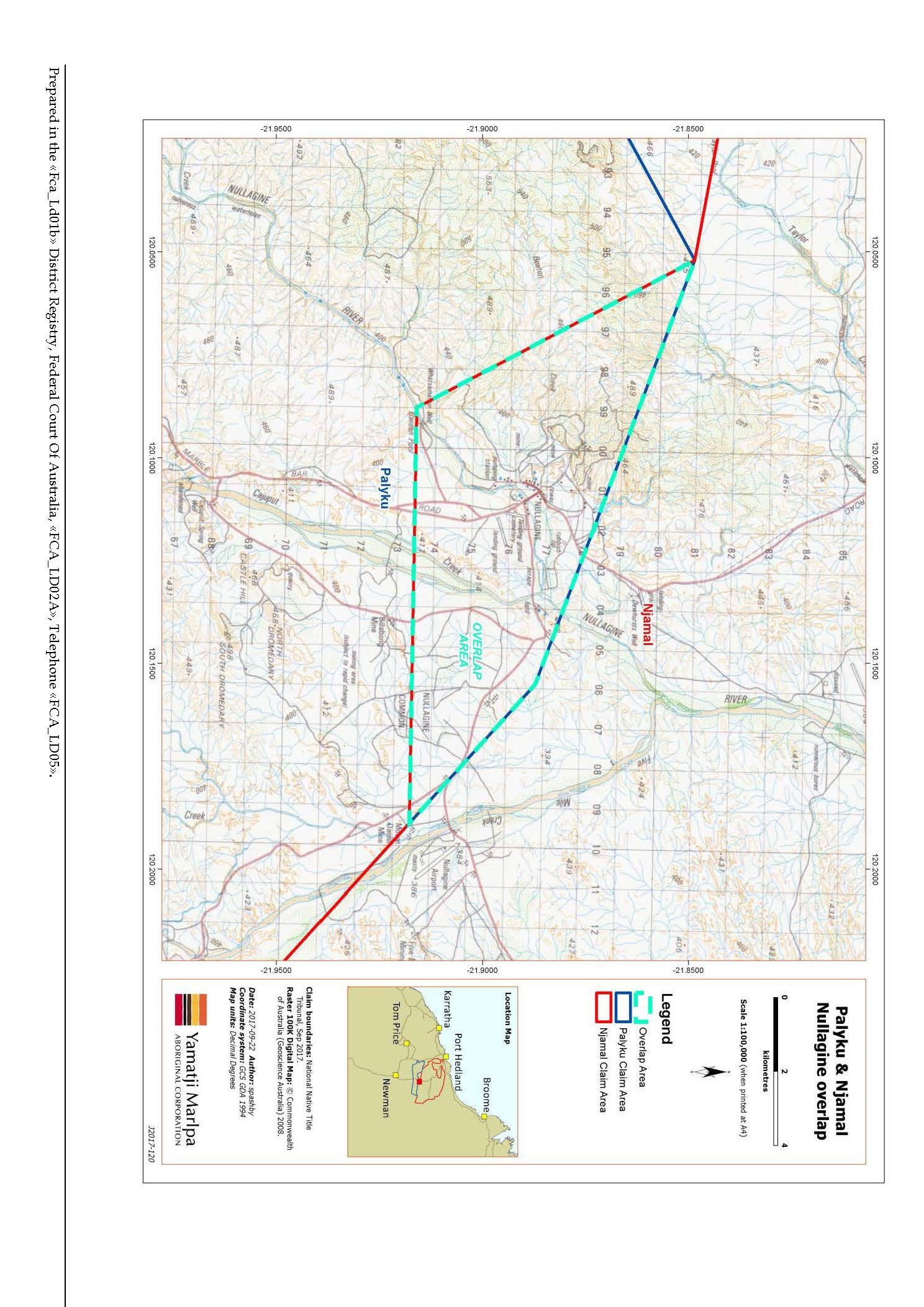
11 The orders contained a program to achieve a hearing of this separate question and provided (Order 32):
The separate question be listed:
(a) for hearing of the evidence of Aboriginal or other lay witnesses on country in Nullagine for five days from a date to be fixed in September 2018; and
(b) the hearing of evidence of expert witnesses in Perth for two days on a date to be fixed after the filing of any supplementary expert reports.
12 Importantly for the purposes of this application, those orders also included the following under the heading “Statement of Agreed Facts” (Orders 9 and 10):
By 24 November 2017, the Participating Parties are to confer with a view to agreeing facts in respect of the following issues:
(a) the existence of a Palyku society and a Njamal society;
(b) the possession of rights and interests by each society under traditional laws and customs;
(c) the connection of the society to land or waters by those laws and customs;
(d) the holding of those rights and interests in respect of their respective claim areas excluding the Overlap Area.
By 1 December 2017, the Applicant in the Palyku native title claim (WAD6287/1998) is to file and serve a Statement of Agreed Facts setting out those facts which are agreed by the Participating Parties following the conferral provided for in order 9.
13 The expression “participating parties” was defined in the orders to mean (Order 1(c)):
Participating Parties means the Applicant in each of the Nyamal native title claim (WAD6028/1998) and the Palyku native title claim (WAD6287/1998), the First Respondent to each claim, and any Participating Respondent.
It was agreed at the hearing of the present applications that there were no participating respondents. Accordingly, the participating parties were limited to the Nyamal Applicant, the Palyku Applicant and the State of Western Australia.
14 On 14 December 2017, about two weeks later than was required by the abovementioned orders, the Palyku Applicant filed the Statement of Agreed Facts which is the subject of its present application (the December 2017 SAF). That document commenced with a preliminary section as follows:
A. This document sets out those facts which are agreed by the Participating Parties for the purposes of these proceedings pursuant to order 10 of the orders dated 22 September 2017.
B. In this document:
(a) the Palyku Applicant means the Applicant or Applicants in the Palyku native title claim (WAD 6287/1998) at the relevant time;
(b) the Nyamal Applicant means the Applicant or Applicants in the Njamal (also known as ‘Nyamal’) native title claim (WAD 6028/1998) at the relevant time;
(c) Palyku Country means all of the land and waters covered by the Palyku native title claim (WAD 6287/1998) other than the Overlap Area;
(d) Nyamal Country means all of the land and waters covered by the Njamal (also known as ‘Nyamal’) native title claim (WAD 6028/1998) other than the Overlap Area; and
(e) defined terms otherwise have the meanings set out in order 1 of the orders dated 22 September 2017.
15 Thereafter, eight facts were set out regarding each of the Palyku People and the Nyamal People. The particular paragraphs of that statement to which this application relates appear in the agreed facts relating to the Nyamal People. They are as follows ([12]–[16]):
12. The Nyamal [P]eople constitute a society in that the Nyamal [P]eople are a body of persons united in and by their acknowledgement and observance of a body of traditional law and customs.
13. The Nyamal [P]eople have constituted a society in Western Australia continuously since before the assertion of British sovereignty in Western Australia in 1829.
14. The Nyamal [P]eople:
(a) possess communal native title rights and interests in Nyamal Country under the traditional laws acknowledged and the traditional customs observed by the Nyamal [P]eople; and
(b) have a connection with Nyamal Country by their traditional laws and customs.
15. The Nyamal Applicant asserts that the Nyamal [P]eople:
(a) possess communal native title rights and interests in the Overlap Area under the traditional laws acknowledged and the traditional customs observed by the Nyamal [P]eople; and
(b) have a connection with the Overlap Area by their traditional laws and customs.
16. The parties agree that if the Nyamal Applicant’s assertion in paragraph 15 is accepted by the Court, then the Nyamal [P]eople possess the same communal native title rights and interests in the Overlap Area as the Nyamal [P]eople possess in Nyamal Country.
16 Since [15(16)] above is contingent on the assertion in [15(15)] above, the Palyku Applicant does not now seek to withdraw the statements in either of those paragraphs. Further, while it does seek to withdraw the statements in [15(12)] and [15(13)] above, its primary concern is the statement in paragraph [15(14)].
Various new sets of orders made in 2018
17 The Nyamal consent determinations (Nyamal #1 and Nyamal #10) were scheduled to take place on 5 April 2018. They did not proceed because, on 13 March 2018, Barker J ordered that Ms Selina Ali be joined as a respondent party in those proceedings (see Allen on behalf of the Nyamal People #1 v State of Western Australia [2018] FCA 320). One of the central issues raised by that joinder application was the composition of the Nyamal native title claim group (see [18] Order 5(b)(i) below).
18 On 17 May 2018, Barker J vacated the orders he made on 22 September 2017 and made a new set of orders. The rationale for that set of orders was recorded in a set of introductory notes to the orders as follows:
THE COURT NOTES THAT:
1. Each of the Nyamal #1 native title claim (WAD6028/1998), the Nyamal #10 native title claim (WAD6003/2000) and the Palyku native title claim (WAD6287/1998) is a native title determination application which has been before the Court for a considerable period of time.
2. Each of the parties to the proceedings has an obligation pursuant to s 37N to conduct the proceedings in accordance with s 37M of the Federal Court of Australia Act 1976 (Cth).
3. Significant progress has been made between the parties regarding resolution of the proceedings by way of agreement, however there apparently remain a number of issues in dispute in relation to each of the proceedings.
4. Attempts by the parties to resolve the remaining issues apparently in dispute without proceeding to hearing have to date been unsuccessful. Although the parties are encouraged to continue these discussions and negotiations, the Court has formed the view it is necessary for the remaining issues in dispute to be programmed for hearing.
5. The Court has formed the view that final hearings are required in the following order:
(a) issues regarding extinguishment and other interests, including the Disputed Palyku Tenures, which are in dispute in relation to the Palyku claim (WAD6287/1998) and the Overlap Area (Nyamal Palyku Extinguishment Hearing);
(b) issues regarding connection which are in dispute in relation to the:
(i) Nyamal Proceedings (WAD6028/1998 and WAD6003/2000) which the Court understands concern the proper composition of the native title holding group; and
(ii) Nyamal #1 (WAD6028/1998) and Palyku (WAD6287/1998) proceedings regarding connection to the Overlap Area,
(together, the Nyamal Palyku Connection Hearing).
6. Any further negotiations or discussions between the parties aimed at resolving the issues in dispute, including mediation, is to occur in parallel to the preparation for and conduct of hearings of the issues on the basis that further delay in these proceedings is not consistent with s 37M of the Federal Court of Australia Act 1976 (Cth).
19 The orders which followed included orders to the following effect:
(a) dividing the Palyku claim into two parts: Palyku Part A and Palyku Part B (Order 11);
(b) providing for the Palyku Part B claim, the Nyamal claims and any native title determination application anticipated to be filed by Ms Ali, to be heard together (defined under Order 7(g) as “the Nyamal Palyku Hearing”, but it is unclear how that definition relates to the two hearings mentioned in note 5 at [18] above) (Order 12);
(c) requiring the parties to engage in a process to identify the issues in dispute with respect to the Nyamal Palyku Hearing (Orders 20 to 24);
(d) fixing the Nyamal Palyku Hearing for two days on a date after 14 December 2018 (Order 25) and programming orders to achieve that hearing (Orders 26 to 32);
(e) separately fixing a hearing in the Nyamal Palyku Connection Hearing after 19 April 2019 (Order 33) and programming orders to achieve that hearing (Orders 34 to 59); and
(f) providing for Part A of the Palyku claim to proceed to a consent determination on a date to be fixed in the week beginning 8 October 2018 (Order 60).
20 On 28 June 2018, a new claim was filed which overlapped the whole of the Nyamal #1 and Nyamal #10 claims. It is referred to as the Nyamal Overlap claim. Ms Ali and Ms Westerman, who were both mentioned in the joinder application that Barker J determined in March 2018 (see at [17] above), are involved with this claim.
21 By 31 August 2018, the Palyku Applicant had confirmed its intention to file a new claim over the southern portion of the Nyamal #1 claim area. As well, the applicant in the Nyamal Overlap Claim had indicated that it intended to file a further claim which may overlap a part of the area of the Palyku #2 claim. Finally, the Nyamal Applicant had indicated that it may apply to summarily dismiss the Palyku #2 claim once it was filed. Accordingly, on that date, Barker J made a further new set of orders, which included the following:
(a) an order vacating the orders made on 17 May 2018 (Order 2);
(b) an order similar to Order 11 of the orders of 17 May 2018 (see [19(a)] above) dividing the Palyku claim into Parts A and B (Order 3);
(c) an order which expanded the proceeding, defined to mean the Nyamal Palyku Proceeding (Order 1(j)), to include the anticipated Palyku #2 claim and the Nyamal Overlap #2 claim mentioned above (Order 4);
(d) an order providing for the following question to be decided separately in the Nyamal Palyku Proceeding (the Separate Question) (Order 5):
But for any question of extinguishment of native title, who are the persons (if anyone) holding the native title rights and interests (as defined in s 223 of the Native Title Act) in the Nyamal Palyku Proceeding Area.
(Emphasis in original)
The Nyamal Palyku Proceeding Area was defined in the orders to mean “the land and waters of the Nyamal Palyku Proceeding being the land and waters described in order 4 below” (Order 1(k)).
(e) an order providing for the anticipated claims mentioned above to be filed by 29 October 2018 (Order 11) and an order requiring any application by the Nyamal Applicant to summarily dismiss (howsoever framed) the anticipated Palyku #2 claim, or the anticipated Nyamal Overlap #2 claim, to be filed on or before 19 November 2018 (Order 14);
(f) orders in similar terms to Orders 20 and 21 of the 17 May 2018 orders (see [19(c)] above) requiring the parties to identify the issues in dispute in relation to the separate question (Orders 16 to 18);
(g) a set of programming orders directed to conducting a hearing of the separate question on a date to be fixed after 29 April 2019 (Orders 19 to 44); and
(h) finally, an order requiring the Palyku Applicant to file a minute of proposed consent determination on or before 18 February 2019 (Order 46).
22 In compliance with Order 11 of the above orders (see [21(e) above]), the Palyku #2 claim and the Nyamal Overlap #2 claim were both filed on 29 October 2018. The Nyamal Overlap #2 claim was filed by and on behalf of the same claimants as the Nyamal Overlap application which was filed on 28 June 2018. The Nyamal Overlap #2 claim overlaps with a portion of the Palyku #1 application area, but not with any of the Nyamal #1 application area. It is also worth noting at this point that, according to an affidavit made by Mr John Edwards, the Nyamal Applicant’s lawyer, the initial Palyku #1 claim comprised an area of 9,497.01 square kilometres, whereas the Palyku #2 claim comprises a larger area of 10,308.48 square kilometres. He also claims that the extent of the overlap between the Palyku #2 claim and the Nyamal #1 claim is “very substantial”.
23 The Nyamal Applicant did not file any application to summarily dismiss either of these anticipated claims in compliance with Order 14 of those orders (see [21(e)] above).
24 On 3 December 2018, orders were made amending the orders of 31 August 2018 and fixing the hearing of the lay evidence in respect of the separate question for a period of 20 days commencing 27 May 2019. Further amendments were made to those orders on 21 December 2018.
The origins of the present applications
25 On 16 January 2019, the parties filed a joint Statement of Facts and Issues in accordance with Order 17 of the 31 August 2018 orders as amended on 21 December 2018 (see [21(f)] above). At [47]–[50] of that document, the parties set out their position with respect to the “abuse of process” issue (see at [74]–[75] below). The process for dealing with these competing contentions was then agitated at a case management hearing which was held on 31 January 2019. Subsequently (on 13 February 2019), a set of orders was filed which reflected the discussions at that hearing. Those orders included the following:
(a) orders vacating most of the outstanding orders made on 31 August 2018, the amendments thereto made on 3 December 2018 and the further amendments thereto made on 21 December 2018 (Orders 5 to 7);
(b) an order requiring the Palyku Applicant to file its present application to withdraw any admission it purportedly made in the Statement of Agreed Facts filed 14 December 2017 (Order 8);
(c) a series of orders requiring the various issues in dispute between the parties to be mediated (Orders 9 to 14);
(d) an order requiring the Nyamal Applicant to file its present application to permanently stay, or dismiss, the Palyku #2 application on the ground that it is an abuse of process (Order 15); and
(e) a set of programming orders to achieve a hearing of those applications once filed (Orders 16 to 22).
26 The Nyamal Applicant filed its application on 20 February 2019. The orders sought in it are set out at [72] below. That application is addressed later in these reasons. The application presently under consideration, the Palyku application, was filed on 10 April 2019. The orders sought in it are set out at [45] below.
27 On 12 March 2019, a consent determination was made with respect to the Palyku Part A claim at Wild Dog Creek in the north of Western Australia.
28 Similarly, the Nyamal #1 claim (excluding the areas of the Nullagine Overlap and the Palyku #2 claim) and the Nyamal #10 claim proceeded to consent determinations on 24 September 2019, at Shaw River, near Port Hedland in the north of Western Australia. This followed an agreement reached with the Nyamal Overlap Applicant in February 2019.
YMAC’s role in the Nyamal and Palyku claims
29 Finally, it is necessary to provide some details of the Yamatji Marlpa Aboriginal Corporation (YMAC), its role in the Nyamal and Palyku claims and how it came to sign the December 2017 SAF. YMAC is a native title representative body established under Part 11 of the Native Title Act 1993 (Cth) (the NTA). To avoid confusion, it should be noted that YMAC is sometimes referred to by the name of its constituent body, Pilbara Native Title Services (PNTS). Until May 2016, it acted for both the Nyamal Applicant and the Palyku Applicant in connection with their respective claims. It apparently did so in discharge of its facilitation and assistance functions under s 203BB(4) of the NTA.
30 On 26 May 2016, YMAC filed a notice with the Court that it had ceased to act for the Nyamal Applicant.
31 At about the same time, McCullough Robertson Lawyers began acting for the Nyamal Applicant in YMAC’s place.
32 On 19 April 2018, that firm, in turn, filed a notice with the Court that it had ceased to act for the Nyamal Applicant and it was replaced by Arma Legal, whose representation continues.
33 Despite having acted for both parties to that time, YMAC continued to act for the Palyku Applicant after May 2016. During that period, Mr Michael Meegan was the Principal Legal Officer of YMAC. On 27 February 2018, Mr Meegan sent a letter to the members of the Palyku claim group. That letter was headed “POTENTIAL NEW PALYKU CLAIM EXTENDING OVER THE NORTHERN BOUNDARY (CORUNNA DOWNS)”. Since this letter is significant to a number of the contentions of the parties in the present application, it is appropriate to set it out in full. In it, Mr Meegan said:
I am writing to you about the Palyku lodging a potential new native title claim over the northern boundary to include the area around Corunna Downs.
As you are aware, the northern boundary of your native title claim WAD 6287 of 1998 shares a border with the southern boundary of the neighbouring Njamal native title claim WAD 6028 of 1998.
However, I understand that some members of the Palyku claim group hold the view that the existing northern boundary of the Palyku native title claim should extend further into the southern boundary of the Njamal native title claim, so that it includes the area around Corunna Downs.
I also understand that this view is held because some Palyku claim group members have a long association with the Corunna Downs area, through having been born at Corunna Downs and/or having lived at Corunna Downs and/or they have relatives who are buried at Corunna Downs.
You may recall that the question of lodging a potential new claim over the northern boundary area was discussed at a community meeting held on 18 April 2016. At that meeting we advised you that YMAC did not consider there to be sufficient anthropological evidence to support the lodging of a new claim over the northern boundary area.
Having said that, it is recognised that Palyku family members hold knowledge of the Corunna Downs area. However, unfortunately it is both our view and that of the research anthropologists involved with the Palyku native title claim that this knowledge alone is not sufficient evidence of Palyku’s traditional connection to the area and would be unsuccessful in meeting the high degree of evidence required under the Native Title Act.
Consequently, whilst YMAC has received no formal instructions from the Palyku applicant to prepare and lodge a new claim over the northern boundary area, I am writing to advise you that YMAC is not able to provide assistance to the Palyku claim group in the event the Palyku decide to proceed with the lodging of a new claim over the northern boundary area.
More importantly, please note that the Njamal native title claim is scheduled to be granted a determination of native title in approximately April 2018 and this will include the area around the Corunna Downs. Further, once a determination of native title is granted, it will not be possible for any other native title claim to be lodged over this area.
A Palyku community meeting is scheduled for Wednesday, 28 March 2018, and we can discuss any questions you have in relation to this at that meeting. However, if you have any questions In the meantime, you can contact Amy Usher on 9268 7000 who will be happy to discuss this with you.
(Emphasis added)
34 As is already mentioned above, contrary to the anticipation mentioned in the penultimate paragraph of Mr Meegan’s letter above, the consent determination in respect of the Nyamal claims did not proceed in April 2018. However, from about March 2018, the Palyku Applicant took steps to find a new lawyer to act for it in relation to the proposed Palyku #2 claim. It was eventually successful in retaining the services of an organisation called Cross Country Native Title Services. By August 2018, the possibility of such a change of lawyers acting for the Palyku Applicant was anticipated in Order 12 of the orders made by Barker J on 31 August 2018 as follows:
In the event that a Palyku #2 Application is filed with the Court, the applicant in the Palyku Application and the applicant in the Palyku #2 Application must, within one week of the filing of the Palyku #2 Application, file a notice:
(a) jointly nominating one legal representative who will have carriage of both Palyku Part B and the Palyku #2 Application for the purpose of the Nyamal Palyku Proceeding; and
(b) including the relevant details for that legal representative (including their name, address for service and listing an email address).
35 Consistent with the above order, on 5 November 2018, Cross Country filed a notice that it acted for the Palyku Applicant in Part B of the Palyku #1 claim and that it acted for the Palyku Applicant in the Palyku #2 claim. In the meantime, YMAC had continued to act for the Palyku Applicant in relation to the Palyku claim and, after Cross Country filed its notice of acting as mentioned above, it continued to act for the Palyku Applicant in relation to Part A of that claim (by then entitled the Palyku #1 claim) until at least the time of the consent determination, which, as is mentioned above, occurred in March 2019.
36 According to an affidavit made in support of this application by Ms Sophie Kilpatrick, a legal practitioner and director of Cross Country, she had some difficulty during 2018 obtaining the Palyku Applicant’s files from YMAC. In the end result, she was not able to obtain all those materials until on or about 6 March 2019. However, in the meantime, she was provided with some documents in stages on 26 November 2018, 6 December 2018 and from 6 February 2019.
The signing of the December 2017 SAF
37 The December 2017 SAF at the centre of the present application was signed shortly before it was filed. It was signed by Mr Greg Young, a lawyer employed by YMAC. Mr Young was, at that time, working under the supervision of Mr Meegan, who, as mentioned above, was the Principal Legal Officer of YMAC.
38 In or about mid-2018, during the early stages of Cross Country’s involvement in the nascent Palyku #2 claim and before it filed its notice of acting mentioned above, Ms Kilpatrick attended two case management hearings in an amicus curiae capacity to assist the Court. One of those case management hearings occurred on 24 July 2018 and the other occurred on 6 August 2018. At the second hearing, Ms Kilpatrick was alerted to the existence of the December 2017 SAF. That occurred when the State’s legal representative, Mr Griff Ranson, stated that such a document had been filed on behalf of the Palyku Applicant and that it included an admission that the Nyamal claim group held native title over all of the Nyamal #1 claim area, except for the Nullagine Overlap Area.
39 Immediately after the 6 August 2018 hearing, Ms Kilpatrick contacted YMAC to gain an understanding of the circumstances in which the December 2017 SAF had been signed and filed. This matter was of importance because, at that time, Ms Kilpatrick had instructions from the Palyku Applicant to prepare for, and convene, a meeting of the Palyku claim group to consider the authorisation of the Palyku #2 claim. One of the questions Ms Kilpatrick asked of YMAC in that initial correspondence was whether YMAC had instructions from the Palyku Applicant to sign and file the December 2017 SAF.
40 In response, on 9 August 2018, Mr Cameron Trees, the Deputy Principal Legal Officer of YMAC, sent a letter to Ms Kilpatrick explaining the context in which the December 2017 SAF came into existence. In that letter, Mr Trees said, among other things, that: it “was filed for the purposes of the separate proceeding [concerning the Nullagine Overlap Area] only”; the orders “concerning the separate proceeding [had] been vacated”; and that it “[did] not apply in any broader context”. He also claimed that the general instructions YMAC obtained during the Palyku claim group meetings on 18 April 2016 and 31 August 2017 to prosecute the Palyku People’s claim over the Nullagine Overlap Area were sufficient to authorise the signing and filing of the December 2017 SAF.
41 On 14 August 2018, Ms Kilpatrick wrote to all of the parties to the Nyamal Palyku Proceeding to ascertain whether they agreed with the assertion in Mr Trees’ letter, in particular, his claim that the December 2017 SAF “was agreed in the context of a separate proceeding”. In its response, the lawyers for the Nyamal Applicant stated that they did not agree.
42 On 18 September 2018, the Palyku claim group met and passed a resolution confirming that it had not authorised YMAC to make the admissions in the December 2017 SAF.
43 Following that meeting, Mr Trees wrote a further letter to all the parties dated 3 October 2018, in which he again claimed that the “Palyku never intended to make any general admission as to the extent of Nyamal native title rights and interests”; and that “the Palyku confirm that they withdraw any and all admissions made by them in agreeing” to the December 2017 SAF. It will be recalled that YMAC was, at this time, still acting for the Palyku Applicant in respect of both Parts of the Palyku claim and that the Palyku #2 claim had not yet been filed.
44 Finally on this aspect, in the affidavits they filed in support of this application, Mr Fred Stream and Ms Elsa Derschow, two of the four persons who comprised the Palyku Applicant at the time the December 2017 SAF was signed and filed, stated that they were not contacted by YMAC about the contents of that statement before it was filed. They further stated that they would not have instructed their lawyer to agree to that statement if they had been asked. Similarly, Mr Kevin Stream and Mr Walter Stream, both members of the Palyku #2 Applicant, and Mr Terry Jaffrey, a member of the Palyku Working Group, stated in their affidavits that YMAC did not seek instructions from them to sign and file the December 2017 SAF.
THE PALYKU APPLICATION
The orders sought and the relevant Rule
45 The Palyku Applicant seeks the following orders in its interlocutory application:
1. Pursuant to Rule 16.53 of the Federal Court Rules 2011 (Cth) (the Rules), the Palyku Applicant has leave to amend the pleadings set out in the document titled Statement of Agreed Facts dated 14 December 2017 by deleting paragraphs [12]–[14] and paragraph [16]; and/or in the alternative
2. to the extent that paragraphs [12]–[14] and paragraph [16] in the document titled Statement of Agreed Facts dated 14 December 2017 constitute admissions made by the Palyku Applicant pursuant to Rule 16.07(2) of the Rules, the Palyku Applicant has leave to withdraw such admissions.
46 Rule 16.53 of the Federal Court Rules 2011 (Cth) (the Rules) provides: “Unless rule 16.51 applies, a party must apply for the leave of the Court to amend a pleading.” Rule 16.51 does not apply in this instance because it permits a party to amend a pleading once without the leave of the Court before the pleadings close.
47 Rule 16.07 relevantly provides:
(1) A party pleading to an allegation of fact in another party’s pleading must specifically admit or deny every allegation of fact in the pleading.
(2) Allegations that are not specifically denied are taken to be admitted.
…
48 Both of these rules concern a “pleading”. That expression is defined in exclusionary terms in the dictionary at Schedule 1 to the Rules to mean:
(a) a statement of claim; or
(aa) an alternative accompanying document referred to in rule 8.05; or
(b) a statement of cross claim; or
(c) a defence; or
(d) a reply; or
(e) any pleading after a reply;
but does not include:
(f) an originating application; or
(g) an interlocutory application
(h) a notice of any kind; or
(i) an affidavit.
49 It follows that rr 16.53 and 16.07(2) are confined to documents that meet the description of a statement of claim, defence, reply, etc above. Even if one were to give a broad meaning to the expression “statement of claim”, putting aside [48(aa)] above which is addressed separately below, I do not consider the December 2017 SAF falls within the terms of this definition. It is not by nature a pleading. It is, as its recital records (see at [14(A)] above), a document which “sets out those facts which are agreed by the Participating Parties”.
50 As for (aa) of the definition of “pleading” above, r 8.05 relevantly provides:
(1) An originating application seeking relief that includes damages must be accompanied by:
(a) unless paragraph (b) or (c) applies—a statement of claim; or
(b) if a practice note issued by the Chief Justice requires the originating application to be accompanied by an alternative accompanying document—the alternative accompanying document; or
(c) if a practice note issued by the Chief Justice permits the originating application to be accompanied by an alternative accompanying document—the alternative accompanying document or a statement of claim.
(2) An originating application seeking relief that does not include damages must be accompanied by:
(a) unless paragraph (b) or (c) applies—a statement of claim or an affidavit; or
(b) if a practice note issued by the Chief Justice requires the originating application to be accompanied by an alternative accompanying document—the alternative accompanying document; or
(c) if a practice note issued by the Chief Justice permits the originating application to be accompanied by an alternative accompanying document—the alternative accompanying document, a statement of claim or an affidavit.
(Notes omitted)
51 The “alternative accompanying document” referred to in r 8.05 is therefore a document that is either required, or permitted, by a Practice Note issued by the Chief Justice. In its submissions on this application, the Nyamal Applicant faintly suggested that the December 2017 SAF may fall within the terms of cl 6.2 of the Native Title Practice Note NT-1. Insofar as that part of the Practice Note refers to pleadings, it states that the parties attending the first case management hearing of an application should give careful consideration to:
…
(g) what connection and extinguishment issues are likely to arise in the proceeding;
(h) whether, when and how the matter should be pleaded, and in respect of how: whether by way of statement of issues, facts and contentions, formal pleadings or points of claim and defence;
(i) where relevant, the nature of interests of respondent parties to a proceeding following the ending of the notification period in respect of an application under the NTA;
…
52 On a generous construction, cl (h) above may implicitly permit an originating application in a native title proceeding, namely the Form 1 (see r 34.103), to be accompanied by a “statement of issues, facts and contentions”. However, even if that is so, I do not consider the December 2017 SAF document answers that description. Quite apart from the fact it did not accompany the originating application, it does not, for the reasons given above, comprise such a statement. Instead, it is confined to setting out the facts which are agreed between the parties.
53 In this respect, it is instructive to compare the December 2017 SAF document with the other similar documents filed by the parties on 2 May 2017 (see at [8] above) and 16 January 2019 (see at [25] above). The former document is headed “Statement of Facts, Issues and Contentions between the parties’ competing anthropologists”. It then sets out a series of propositions under the headings “Agreed Facts”, “Agreed Contentions” and “Issues”. On its face, that document is of the kind referred to in [51(h)] above. The latter document, the “Statement of Facts and Issues” that the parties filed in January 2019, is structured differently, but achieves essentially the same result. It follows the form of a pleading in that it contains a number of propositions of fact and law which each party either admits, does not admit, or denies. In contrast, the December 2017 SAF document only contains agreed facts. It does not attempt to define the issues in dispute between the parties, much less set out their competing contentions on those issues. For these reasons, I do not consider the December 2017 SAF document falls within the terms of r 16.53 or r 16.07(2).
54 But that is not an end to the matter. To explain why, it is instructive to go to the Federal Court Rules 1979 (Cth), the Rules of Court in force until 1 August 2011 when the current Rules came into effect. Those Rules contained, in O 13 r 2(1), a general power to amend “any document in [a] proceeding” as follows:
Subject to the following provisions of this rule, the Court may, at any stage of any proceeding, order that any document in the proceeding be amended, or that any party have leave to amend any document in the proceeding, in either case in such manner as the Court thinks fit.
55 The current Rules do not contain a rule in similar terms. They do, however, contain rules that allow particular documents to be amended. Apart from r 16.53 itself, they include rr 8.21 (amending an originating application), 15.15 (amending a cross-claim) and 36.10 (amending a notice of appeal). Plainly none of these rules applies to the December 2017 SAF. But that does not mean that the Court’s powers to amend are confined to those documents. That is so because the Court’s general powers to amend are contained in Division 1.3 of the current Rules of Court. In particular, r 1.32 provides: “The Court may make any order that the Court considers appropriate in the interests of justice.” In my view, this rule gives the Court ample power to amend, among many other things, the December 2017 SAF provided that it is in the interests of justice to do so. I will therefore proceed to consider the present application on that footing.
The parties’ contentions
56 There was general agreement between the parties as to the principles applicable to an application to amend a document to withdraw an admission. There was no dispute that the admissions in the December 2017 SAF could be withdrawn with leave and that the overriding consideration was the interests of justice. In that respect, it was agreed that the relevant factors included:
(a) the nature and importance of the admission;
(b) whether it was inadvertently or deliberately made;
(c) the reason for the withdrawal;
(d) the detriment or prejudice that the withdrawal may cause another party; and
(e) whether or not the admission is factually correct.
See Centrestate Exports Pty Ltd v Amarantos Shipping Co Ltd [2005] SASC 158 at [32], Australian Competition and Consumer Commission v Construction, Forestry, Mining and Energy Union [2007] FCA 1390 at [4] and Juno Pharmaceuticals Pty Ltd v Millennium Pharmaceuticals, Inc [2019] FCA 526 at [38].
57 In support of its application, the Palyku Applicant contended that the admissions made in the December 2017 SAF were limited to the separate question proceeding relating to the Nullagine Overlap Area and that they could not apply to the Palyku #2 claim proceeding, which did not exist at the time those admissions were made. It further contended that the orders requiring that statement to be filed have since been set aside and replaced by a different set of orders. It also contended that YMAC did not have instructions to make the admissions contained in that document and it did not therefore have the authority to do so. Further, it submitted it would suffer significant prejudice if those admissions applied in the Palyku #2 claim and it were not given leave to withdraw them because they would effectively foreclose on it pursuing that claim. In support of this contention, it relied upon the affidavit of Dr Richard Martin, an experienced anthropologist, to submit that it had reasonable prospects of success in that claim.
58 The Nyamal Applicant made a number of concessions in its written and oral submissions. They included that: YMAC did not seek specific instructions from the Palyku Applicant to make the admissions in the December 2017 SAF and the Palyku Applicant did not specifically instruct YMAC to make those admissions; since around July 2005, certain Palyku People had asserted to YMAC that the boundary between the Nyamal #1 and Palyku claims was incorrectly located and that the Palyku #1 claim should have extended further north; at a meeting of the Palyku claim group on 18 September 2018, those present had resolved to confirm that they had never authorised YMAC to make those admissions on their behalf; the admissions were completely inconsistent with the claims made in the Palyku #2 claim; and in the context of the case management of the Nyamal #1 and Palyku #2 claims since late 2018, there has been no delay on the Palyku Applicant’s part in making its present application.
59 In its submissions in opposition to the present application, the Nyamal Applicant contended that, while YMAC did not have specific instructions to make the admissions in the December 2017 SAF, it had the implied authority to do so arising from the fact that it was acting for the Palyku Applicant in the Palyku #1 claim. It also relied upon the Full Court decision in Celestino v Celestino [1990] FCA 449 (Celestino) to contend that the Palyku Applicant was required to explain how those admissions came to be made. In this respect, it contended that the Palyku Applicant had not produced any evidence from Mr Young, or anyone else at YMAC, giving that explanation. Further, it contended that the Palyku Applicant had not shown good cause why it should be given leave to withdraw the admissions. This contention, relying upon Celestino, can be rejected at once. That judgment dealt with an application to withdraw an informal admission of liability made by an insurer in a personal injuries proceeding after the assessment of damages trial had proceeded for several days. It is therefore clearly distinguishable on its facts from this matter.
60 While the Nyamal Applicant did not submit that the Palyku People had no reasonable prospects of success in their Palyku #2 claim, it did contend that there were “questions about the integrity of the claim”. In particular, it contended that the Palyku People had waited until the last possible moment in pursuing their assertions that the boundary between the Nyamal #1 and the Palyku #1 claim was incorrect and that the Palyku #1 claim should extend further north. Finally, it contended that it will suffer prejudice if the Palyku Applicant is given leave to withdraw the admissions in the December 2017 SAF because that will result in still further delay in the balance of the Nyamal #1 application, which is already approximately 20 years old. In particular, it claimed it will incur additional costs in pursuing that claim and the Nyamal People will experience stress and strain as a consequence of the continuing litigation that will ensue.
Consideration and disposition
The admissions continue to have effect
61 It is convenient to begin by noting that, throughout the hearing of its application, the Palyku Applicant was at pains to emphasise that it was erring on the side of caution, or exercising “manifest caution”, in bringing this application. It contended that was so because the admissions contained in the December 2017 SAF were made pursuant to Court orders that have now been set aside and they were made for the purposes of a quite separate proceeding to the Palyku #2 claim, namely the Nullagine Overlap Area proceeding. In this latter respect, it is important to note that both parties accepted that the admissions were directly inconsistent with the fundamental premise of the Palyku #2 claim. Indeed the Nyamal Applicant went so far as to claim in this application (and its own application considered later in these reasons) that, if the admission were to stand, it would be an abuse of process for the Palyku Applicant to pursue its Palyku #2 claim.
62 I do not accept the first of the Palyku Applicant’s claims above. The fact that the orders of 21 September 2017 were subsequently set aside by the orders of 17 May 2018 does not, in my view, affect the continuing existence and effect of the admissions made under them. Once those admissions were made, they continue to exist and to have effect according to their terms unless and until they are duly withdrawn. The real question therefore is: what is the effect of these admissions? On that question, I consider the Palyku Applicant has made a valid point in the second of its claims above. That is to say, I consider the admissions were made for the purposes of the separate question proceeding relating to the Nullagine Overlap Area and their effect is limited to that proceeding. My reasons for this conclusion are as follows.
The admissions are only binding in the separate question proceeding
63 First, the general rule is that formal admissions are only binding for the purposes of the particular proceeding in which they are made (see Dawson v Great Central Railway [1919] 88 LJKB 1177 at 1181–1182 per Swinfen Eady, MR; Australian Competition and Consumer Commission v ABB Transmission and Distribution Ltd (No 2) (2002) 190 ALR 169, [2002] FCA 559 at [51] per Finkelstein J; and In the matter of HIH Insurance Limited (in liquidation) [2015] NSWSC 790 at [45]–[47] per Brereton J). On this aspect, because it deals with the effect of assertions made in pleadings and, as mentioned above, the December 2017 SAF document cannot be regarded as a pleading, I do not consider the principles expressed in Laws v Australian Broadcasting Tribunal (1990) 170 CLR 70, which was raised by both parties in their submissions, is of assistance in determining this matter.
64 Secondly, it is clear from the terms of the 22 September 2017 orders that they were expressly confined to the separate question proceeding relating to the Nullagine Overlap Area. In the first place, Order 4 of those orders provided that “[t]he proceedings in respect of the separate question be referred to as the separate proceeding” (emphasis in original). Then Order 2 stated the separate question in terms that confined its compass to the native title rights and interests held in the “Overlap Area”. Finally, that expression was defined in Order 1(a) by reference to the map annexed to the orders. It is clear from that map that the area concerned was one and the same as the Nullagine Overlap Area.
65 Thirdly, the December 2017 SAF itself is expressed to apply only for the purposes of the separate question relating to the Nullagine Overlap Area. That appears from its heading: “IN THE MATTER OF a separate question pursuant to orders made on 22 September 2017” (capitalisation in original). Additionally, cl A, under the heading “Preliminary”, states that:
This document sets out those facts which are agreed by the Participating Parties for the purposes of these proceedings pursuant to order 10 of the orders dated 22 September 2017.
(Emphasis added)
66 For these reasons, I consider the admissions contained in the December 2017 SAF document were confined to the separate question proceeding relating to the Nullagine Overlap Area and have no effect in respect of the Palyku #2 claim.
Leave to withdraw the admissions is in the interests of justice
67 Alternatively, even if I had concluded that those admissions were binding for the purposes of the Palyku #2 claim, I would have concluded that it was in the interests of justice that the Palyku Applicant be given leave to withdraw them. My reasons for this conclusion are as follows.
68 First, while it is common ground that YMAC (Mr Meegan or Mr Young) did not have specific instructions to make the admissions, I agree with the Nyamal Applicant that it was not necessary for them to have such specific instructions in the circumstances. That is so because, in their respective capacity as the Principal Legal Officer of YMAC and the lawyer on the record representing the Palyku Applicant in the Palyku #1 claim and as the YMAC lawyer performing that function on a day-to-day basis, Mr Meegan and Mr Young had the implied authority to make admissions for the purposes of that proceeding (see Hoy Mobile Pty Ltd v Allphones Retail Pty Ltd (2008) 167 FCR 314; [2008] FCA 369 at [17]–[18] per Rares J; Singh v De Castro [2017] NSWCA 241 at [80] per Sackville AJA; and JD Heydon, Cross on Evidence (12th ed, LexisNexis, 2019) at [3165]. In this respect I should record that I have not considered it necessary to consider the matters that arose during the hearing of this matter concerning YMAC’s role having acted for both the Palyku and the Nyamal Peoples, nor whether it was acting as a legal firm throughout, nor whether it was properly discharging its functions as a native title representative body under Part 11 of the NTA, although some of those reasons will be addressed later in these reasons.
69 However, given the assertions that various members of, and groups within, the Palyku People had made to YMAC over the years since at least 2005 to the effect that they considered that the Palyku People had native title rights and interests in the southern area of the Nyamal #1 claim (reviewed at [148]–[193] below), I do not consider it would be just to fix the Palyku People with the admissions YMAC made on their behalf. That is so because, as mentioned above, if the admissions were to continue to have effect (on the assumption, for present purposes, that they do) they would effectively deprive the Palyku People of the opportunity to pursue the Palyku #2 claim and obtain a determination in respect of those native title rights and interests if they do, indeed, hold them. In this respect, in addition to their constant affirmation of those rights and interests since at least 2005, there is the affidavit of Dr Martin which attests to their existence, at least on a preliminary or prima facie basis. I would add that these matters are, in my view, broadly consistent with the factors set out at [56] above. Put differently, if it became necessary, I consider that the Palyku Applicant would have shown good cause why it should have been given leave to withdraw the admissions contained in the December 2017 SAF.
70 Finally, while I do not doubt it is genuinely felt, I consider the further delay, additional costs and the continuing stress of the litigation advanced as prejudice by the Nyamal People is outweighed by the prejudice that would be suffered by the Palyku People as described above.
Conclusion on the Palyku application
71 To sum up, for the reasons set out above, I do not consider the admissions contained in the December 2017 SAF document were binding on the Palyku Applicant or the Palyku People for the purposes of the Palyku #2 claim. Instead, I consider those admissions are binding for the confined purposes of the separate question proceeding in respect of the Nullagine Overlap Area. Alternatively, even if those admissions were binding with respect to the Palyku #2 claim proceeding, I would have concluded that it was in the interests of justice to give leave to the Palyku Applicant to withdraw them.
THE NYAMAL APPLICATION
72 In its interlocutory application, the Nyamal Applicant sought the following orders:
1. An order that the Palyku #2 Application, insofar as it relates to land and waters that are also the subject of the Nyamal #1 Application, be summarily dismissed pursuant to r 26.01(1)(d) of the Federal Court Rules 2011 (Cth) or s 31A of the Federal Court of Australia Act 1976 (Cth) on the grounds that it constitutes an abuse of the process of the Court.
2. Alternatively to Order 1, an order that the Palyku #2 Application, insofar as it relates to land and waters that are also the subject of the Nyamal #1 Application, be dismissed or permanently stayed pursuant to the inherent jurisdiction of the Court on the grounds that it constitutes an abuse of the process of the Court.
3. An order that the Palyku #2 Applicant pay the Nyamal #1 Applicant’s costs of the Palyku #2 proceeding.
73 As the Nyamal Applicant pointed out at the case management hearing held on 31 January 2019, it is not necessary to determine an abuse of process application of this kind prior to the trial of a proceeding. However, because the potential dismissal of the Palyku #2 claim would confine the area of overlap between the Nyamal and Palyku claims and therefore significantly affect the nature and extent of the dispute between the parties, I decided to hear and determine the Palyku application in advance of the trial.
74 Before outlining the contentions of the parties on the Nyamal application and addressing the issues that arise therefrom, it is convenient to describe how those issues were raised in the first place. This matter has already been touched on briefly above (see at [25]). The 31 August 2018 orders as amended required the parties to file a Statement of Facts and Issues. At [47]–[50] of that document, the parties set out, in quite some detail, their positions under the heading “ABUSE OF PROCESS”. The Nyamal Applicant described its position as follows:
47. The Nyamal Applicant and the Nyamal Overlap Applicant say that:
(a) the Separate Question is directed to “native title rights and interests (as defined in s 223 of the Native Title Act)” and therefore raises the question of whether any rights and interests that may be found to exist can or should be recognised in a determination of native title;
(b) any rights and interests that may be found to exist cannot or should not be recognised in a determination of native title, where the commencement or prosecution of that native title determination application constitutes an abuse of the Court’s process.
48. The Nyamal Applicant and the Nyamal Overlap Applicant contend that the commencement and prosecution of the Palyku #2 Application constitutes an abuse of process. This contention is primarily based on the following matters:
(a) the Palyku #2 Application was commenced approximately 20 years after the Palyku Application, which was, over the years, the subject of numerous case management conferences or hearings;
(b) the Palyku #2 Application was commenced at a time when the Nyamal Applications were in an advanced state of negotiation with the First Respondent;
(c) unlike the very small, pre-existing overlap between the Nyamal #1 Application and the Palyku Application, the Palyku #2 Application created a very large overlap with the Nyamal #1 Application;
(d) the Palyku #2 Application was commenced, notwithstanding that in 2001 an agreement about the boundary between Nyamal country and Palyku country was struck between senior Nyamal claimants and senior Palyku claimants in the presence of a number of other regional elders and an anthropologist;
(e) a term of the agreement referred to at (d) above was that the Nyamal representatives agreed to amend their application by significantly reducing the area claimed and the Nyamal Applicant subsequently amended the application accordingly; the area that was thus no longer claimed by the Nyamal People formed and still forms part of the Palyku Application;
(f) by Statement of Agreed Facts filed on 14 December 2017, the Palyku Applicant agreed that the Nyamal [P]eople possess communal native title rights in Nyamal Country under the traditional laws acknowledged and the traditional customs observed by the Nyamal People and have a connection with Nyamal Country by their traditional laws and customs, “Nyamal Country” being defined in substance as all the land and waters covered by the Nyamal #1 Application, other than the Nullagine Overlap Area.
75 The Palyku Applicant described its position as follows:
49. The Palyku Applicant, in respect of paragraph [47]:
(a) denies sub-paragraph [47(a)]; and
(b) says that:
(i) consistent with paragraphs [2] – [3] of this Statement, the Separate Question is concerned with the identity of persons who hold, or may hold, native title rights and interests, rather than identifying what those native title rights and interests are, or whether such rights and interests are capable of being recognised in a determination of native title;
(ii) if the Nyamal Applicant asserts that the commencement and prosecution of the Palyku #2 Application constitutes an abuse of process, the appropriate remedy was to apply for an order that the Palyku #2 Application be summarily dismissed;
(iii) on 31 August 2018, the Court made orders that any application for summary dismissal be brought by 19 November 2018 and on 3 December 2018, this timeframe was extended to 10 December 2018;
(iv) no application for summary dismissal was brought by any party within the timeframes set by the Court; and
(v) accordingly, paragraphs [47] – [48] ought to be struck from this Statement.
50. Further, or in the alternative to paragraph [49], if paragraphs [47] and [48] are not removed from this Statement, then the Palyku Applicant:
(a) denies that the Palyku #2 Application constitutes an abuse of process;
(b) admits subparagraphs [48(a)] – [48(b)] (but see paragraph [49] above);
(c) admits that the overlap between the Palyku #2 Application and the Nyamal #1 Application is larger than the overlap between the Palyku Application and the Nyamal #1 Application and says that a substantial portion of the Palyku #2 Application does not overlap the Nyamal #1 Application in any way and that a smaller portion of the Palyku #2 Application is unoverlapped by any other application but otherwise denies subparagraph [48(c)] as an assertion of fact;
(d) admits that two (2) Palyku claimants attended a field trip in 2001 (the 2001 field trip) with a number of Nyamal claimants and other regional elders, and that one (1) of those Palyku claimants was senior, but otherwise denies subparagraph [48(d)] and further says that:
(i) no agreement or undertaking was made on behalf of the Palyku People that binds the Palyku People; and
(ii) if any agreement was reached by the participants during the 2001 field trip, it was an agreement as to the participants’ opinions about amendments that ought to be made to the Palyku Application and the Nyamal Application rather than opinions of the extent of Palyku country and Nyamal country;
(e) admits that the Nyamal #1 Application was amended following the 2001 field trip but says that, if such amendment was made consistent with any undertaking made by Nyamal representatives during the 2001 field trip on behalf of the Nyamal People as pleaded at subparagraph [48(d)], then this undertaking has been breached by virtue of the Nyamal Overlap #2 Application, which has been made in respect of lands and waters from which the Nyamal #1 Application was withdrawn;
(f) consistent with subparagraph [50(e)], denies that the Nyamal People have honoured any undertaking they made on the 2001 field trip and denies that the land and waters from which the Nyamal #1 Application was withdrawn is now the subject of the Palyku Application; and
(g) in respect of subparagraph [48(f)]:
(i) says that the Palyku Applicant has never instructed its legal representatives to agree on its behalf that the Nyamal People possess communal native title rights in Nyamal Country under the traditional laws acknowledged and the traditional customs observed by the Nyamal People and have a connection with Nyamal Country by their traditional laws and customs, “Nyamal Country” being defined in substance as all the land and waters covered by the Nyamal #1 Application, other than the Nullagine Overlap Area: and
(ii) denies the Statement of Agreed Facts filed 14 December 2017 has the effect pleaded at this subparagraph.
76 The issue concerning the Statement of Agreed Facts ([74[48(f)]] and [75[50(g)]] above) has already been disposed of above. As is also mentioned above, the issues raised by [75[49(b)(ii)]]– [75[49(b)(v)]] were disposed of at the case management hearing on 31 January 2019.
The contentions of the parties
77 There is no dispute between the parties as to the relevant principles applicable to applications founded on abuse of process, or applications for summary judgment under s 31A of the Federal Court of Australia Act 1976 (Cth) (the Act), or r 26.01 of the Rules. On the substantive issues, the basic positions of the parties are set out in the Statement of Facts and Issues above. Those positions were then developed in some detail in their outlines of written submissions.
78 In summary, the Nyamal Applicant contended that the native title claims that the Palyku People lodged in the late 1990s, which became the Palyku #1 claim, were considered claims by them to the whole of their traditional country. The factors supporting this conclusion, so it contended, included that the senior Palyku People at the time were closely involved in lodging those claims and the boundaries to them were carefully considered before they were lodged. Against this background, the Nyamal Applicant contended that the use of the Court’s processes involved in filing of the Palyku #2 claim in 2018, 20 years after lodging such a well-considered claim, constituted an abuse of process. It also contended that the pursuit of that claim was unjustifiably oppressive to the Nyamal People and/or brings the administration of justice into disrepute. It contended these consequences arose from the lengthy delay that preceded the filing of the Palyku #2 claim, combined with the dilatoriness of the Palyku People, and particularly the Stream brothers, in pursuing that claim. It contended that delay caused the Nyamal People to suffer serious prejudice because of the unavailability of senior, knowledgeable Nyamal witnesses who have since passed away and “the disappointment and distress felt by Nyamal claimants who have had a twenty-year journey towards a determination of native title, only to find at the last minute that this would not happen in respect of a substantial portion of the country that, until very recently, they and they alone had claimed”.
79 The Nyamal also contended that an agreement was struck between the Palyku and Nyamal participants on the field trip conducted in April 2001 whereby:
(a) “the Nyamal [P]eople agreed to withdraw their southern boundary [of the Nyamal #1 claim] to a line proceeding roughly in an east-south-east direction from the vicinity of Hillside Station to the north-east corner of the Palyku claim, with Hillside Station remaining in the Palyku claim”; and
(b) “the Palyku [P]eople agreed to amend their boundary [of the Palyku #1 claim] to ensure that Nullagine fell within the boundaries of the Nyamal [#1] claim; that is, they agreed to withdraw their claim (approximately a small triangle) bounded by a line dropped from the northern most point of their claim in the vicinity of Nullagine to Garden Pool, due east of their boundary in the vicinity of the Mount Daniel Mine and then north-west (approx.) to the first point”.
80 In addition to those express terms of this agreement, the Nyamal Applicant contended that there was an implied term that neither party would bring any future native title claim “that proceeds on the basis that the boundary which was agreed in 2001 is incorrect”. It contended that this agreement was endorsed at a meeting of the Palyku Working Group held on 4 May 2001 and was binding on the Palyku People. In respect to the Palyku Working Group, it contended that, because it included four members of the Palyku Applicant, it had the authority to endorse the agreement on behalf of the Palyku claim group. If no such binding agreement was made on behalf of the Palyku People, in the alternative, it contended that there was a “(non-binding) agreement” to the same effect which should be taken into account in assessing whether the filing of the Palyku #2 claim in 2018 constituted an abuse of process.
81 In response, the Palyku Applicant denied that the Palyku People’s claims, which became the Palyku #1 claim, constituted a “whole of traditional Palyku country” claim. Further, it denied that the conduct of the Palyku claimants in filing the Palyku #2 claim caused unjustifiable oppression to the Nyamal People. Finally, it denied that the agreement as alleged by the Nyamal Applicant had been made during, or as a result of, the 2001 field trip.
82 In support of the first of these denials, the Palyku Applicant claimed that, from the outset, there were unresolved issues about the boundaries between the Nyamal and Palyku People’s countries within the area that is now covered by the Palyku #2 claim, including places such as Spear Hill, Cooglegong and Bonney Downs. It further contended that, despite their constant reaffirmation of these claims over the years since, they had been unable to persuade YMAC to pursue them. It also claimed that, as a group, they did not have the resources to employ lawyers to pursue their claims independently of YMAC.
83 As for the 2001 field trip, the Palyku Applicant contended that it was directed to resolving overlaps between the Palyku, the Nyiyaparli and the Nyamal claims and not to the boundaries between Palyku and Nyamal country. It further contended that Mr Pixie Christian was the only senior Palyku person who participated in that trip and he did not have the authority to speak for the Palyku People as a whole. It denied that the agreement alleged by the Nyamal Applicant was made on that trip and that the Palyku Working Group meeting on 4 May 2001 endorsed any such agreement. In the alternative, it contended that, even if an agreement was reached during that trip and even if that agreement was endorsed at that meeting, the meeting was a meeting of the Palyku Working Group and any endorsement was not that of the Palyku Applicant nor, more importantly, the Palyku claim group. Further, it contended that, for any such agreement to be binding on the Palyku People, it would have had to be endorsed by the Palyku claim group. As well, it contended that the fact the Nyamal People have not taken any steps to enforce the terms of the alleged agreement concerning the Nullagine Overlap Area since 2001 supported its non-existence. Finally, it contended that, if the alleged agreement had been made, because it related to an interest in land, s 34(1)(a) of the Property Law Act 1969 (WA) required it to be in writing for it to be enforceable and there is no evidence of any such writing.
84 In a set of supplementary submissions filed by leave after the hearing, the Nyamal Applicant advanced a number of additional contentions about the authority of the Palyku Applicant and the binding effect of the alleged agreement mentioned above. They included contentions that the Palyku Applicant had the authority under s 62A of the NTA to enter into that agreement on behalf of the Palyku claim group because it was a “matter arising under this Act in relation to the application”. Alternatively, it contended that: the agreement was entered into by the Palyku Working Group, which was, itself, duly authorised by the Palyku claim group; or, alternatively, that the meeting on 4 May 2001 was a meeting of the Palyku claim group (as distinct from the Palyku Working Group); or, alternatively, that the agreement was entered into at a meeting of the claim group prior, but proximate, to 28 October 2003. As well, it contended that the agreement did “not infringe any provision of the NTA”. Finally, it contended that the agreement did not have to take the form of an Indigenous Land Use Agreement (ILUA) under the NTA because the NTA did not require that an agreement between competing native title parties relating to the resolution of overlapping claims must proceed by way of an ILUA.
85 In its supplementary submissions, the Palyku Applicant contended that, if the alleged agreement was not countenanced by the NTA, then the Palyku Applicant was not authorised, and was therefore not “free to make” the agreement, on behalf of the Palyku claim group. In the alternative, it contended that the Palyku Applicant was not authorised to make an agreement which included an implied term preventing the Palyku People from bringing the Palyku #2 claim. In this respect, it contended that the Palyku #1 Applicant did not have the authority under the NTA to deal with interests in land other than land covered by the Palyku #1 claim. It further contended that, if there was a binding or enforceable agreement reached at, or subsequent to, the 2001 field trip, it only related to the Nullagine Overlap Area and it was not necessary to give business efficacy to that agreement to imply the term advanced by the Nyamal Applicant.
86 As to the status of the Palyku Working Group, the Palyku Applicant contended that it was established at a Palyku community meeting on 3 February 2001 and the nature or extent of any purported delegation of decision-making powers was not discussed, or agreed upon, at that meeting. In any event, it contended that only the Palyku claim group and the Palyku Applicant had any standing, or authority, under the NTA. It also contended that there was no documentary evidence to support the Nyamal Applicant’s claim that the alleged agreement was made, or endorsed, proximate to a Nyamal meeting held on 28 October 2003. Finally, it contended that the only way in which the Palyku Applicant and/or the Palyku claim group could have entered into such an agreement which bound all Palyku People and prevented them from filing any future Palyku #2 claim was by way of a registered ILUA under the NTA. In this respect, it contended that an Aboriginal community does not have any legal status or identity in that it constitutes an “ever-changing aggregation of individuals with no ability to enter into contracts or to commence legal proceedings”.
The central questions
87 These contentions essentially raise three central questions as follows:
(a) Was an agreement made between the Palyku and Nyamal Peoples during the 2001 field trip and endorsed by the Palyku People thereafter that is binding on the Palyku People such as to constitute their current pursuit of the Palyku #2 claim as an abuse of process (the Binding Agreement Question)?
(b) Were the claims the Palyku People lodged with the Tribunal in 1998 claims in respect of the whole of their traditional country such that pursuing the Palyku #2 claim in 2018 constituted an abuse of process (the Whole of Country Question)?
(c) Have the Palyku People unreasonably delayed in filing the Palyku #2 claim and/or otherwise conducted themselves in the pursuit of that claim such as to cause unjustifiable oppression to the Nyamal People (the Unreasonable Delay Question)?
Some more details of the factual background
88 Before turning to consider these questions, it is necessary to set out some more details of the factual background to this application. Some of the procedural history related to the filing of the Palyku #2 claim is already set out above. However, there is a range of factual events and issues canvassed in the contentions above which were not detailed in that history. Accordingly, they are set out below in approximate chronological order.
The nature and scope of the Palyku claims lodged in the late 1990s
89 As is apparent from the early history of the Nyamal and Palyku claims set out earlier (at [5]–[7]), in the late 1990s and early 2000s the Pilbara region of Western Australia was covered by numerous native title claims, many of which were overlapping, and, as permitted by the NTA in force at that time, were brought by individuals. The bundles of documents tendered by both the Nyamal Applicant and the Palyku Applicant in this application show that issues arose between various groups of Aboriginal people in that region at that time as to which groups were able to claim which areas.
90 In that environment, disputation between the Nyamal and Palyku Peoples about their respective claims emerged from the late 1990s. An example of that disputation appears in an affidavit annexed to the amended Form 1 for one of the first Palyku claims (WAD6287/1998) filed on 21 April 1999. In that affidavit, Mr Douglas Yuline, one of the original Palyku claimants, said, among other things:
3. The Palyku [P]eople made the decision to lodge a native title claim following the lodgement of the Nyamal Claim WC97/45, lodged by the ALS on 26th June 1997 without any consultation or negotiations with the Palyku People. The Nyamal claim far exceeded their traditional customary boundaries and claimed a lot of Palyku Country. The Palyku People requested the [Pilbara Aboriginal Land Council] to notify the Nyamal People that they were not happy and intended to put in their own claim.
4. The people had many meetings to discuss native title and started to sort out our land and our people. The elders requested the PALC to complete a boundary survey with the elders so that the Palyku People could start to develop the claim, which started on the 15/6/98.
5. On the 24th July 1998 the PALC organised a meeting at the Shaw River to discuss the proposed boundary and claims and to sort out the claimants to complete the application. All the main people were there at this meeting which also included elders of the Nyamal People.
6. The Palyku People were notified by letter, fax. phone and we also visited the elders and talked to them explaining what the meeting was for and why it was important for them to be there. The PALC also arranged transport and assistance with fuel for this important meeting.
7. It was decided at this meeting that the Palyku People would lodge their claim separate from the Nyiyaparli Claim. as there were some claimants who had no connection with the Nyiyaparli People.
(Errors in original)
91 As can be seen from the contentions summarised above, one of the issues raised by the Nyamal Applicant in the present application is whether the Palyku #1 claim was intended to cover the whole of the traditional country of the Palyku People. In support of that contention, it pointed out that Mr Yuline above, together with Mr Lennie Stream, Mr Christian and Mr Dudley Wabbie (all members of the “Palyku Group” or the “Palyku Language Group” and senior knowledgeable Palyku men) made separate affidavits in support of the Palyku claim above in 1999 in which they each stated:
Our native title claim is for our traditional lands which is based on ancestral clan estate and includes all native title rights and interests to an area of land which is defined by our traditional boundaries identified by the natural environment of hills, waterholes, springs, ranges and rivers.
(Footnote omitted)
92 The Nyamal Applicant also instanced the following statements made elsewhere in the supporting affidavits of Mr Christian and Mr Wabbie where they each stated:
(a) “the holders of our land are initiated lawmen who hold our law and are responsible for the preservation, maintenance and celebration of our ceremonies, the protection of our sites, tradition and customs”; and
(b) “I am an initiated lawman of the Palyku [P]eople and I am the holder of the land and the law for our people”.
93 Additionally, the Nyamal Applicant relied upon the affidavit evidence of its lawyer, Mr Edwards, who had made a comparison of the membership of the Palyku #1 and the Palyku #2 Applicants. That comparison demonstrated that Mr Walter Stream was the only member of the Palyku #2 Applicant who had not, at some stage, been a member of the Palyku #1 Applicant.
94 Finally, the Nyamal Applicant pointed to the fact that the Palyku People had taken, what it described as, the unusual step of including in the materials supporting their claims a report by a licensed surveyor, Mr R Green, which described the areas claimed as the “traditional language boundary” and the “Palyku language boundary”.
The formation and role of the Palyku Working Group
95 It can be seen from the contentions of the parties above that a group known as the Palyku Working Group had a prominent role in the events surrounding the 2001 field trip and the agreement which was allegedly made between the Palyku and the Nyamal Peoples during that field trip. It is therefore convenient next to describe the formation and role of that Group. According to the minutes of the “Palyku Meeting” held at the PNTS offices in South Hedland on 31 [sic] November 2000, Ms Marnie Parkinson, a PNTS lawyer, explained to the meeting that “it would be necessary to hold a community meeting of Palyku People in order to take nominations for and from a Working Group”. The minutes went on to note that Ms Parkinson “explained the roles and responsibilities of Working Group members and registered applicants”. The minutes do not, however, record any further information about those roles and responsibilities. They concluded by recording that “[t]he meeting decided that this meeting should be held on 3 February 2001”.
96 In her affidavit, filed by the Nyamal Applicant in support of this application, Ms Jodi Neale, an anthropologist employed by PNTS, said, about the working groups formed at about this time, that:
3. There was a working group for each of the Nyamal, Palyku and Nyiyaparli claims. The members of these working groups were nominated at community i.e. claim group meetings. Key business for each of these claims was considered at meetings of the respective working groups. Each of these groups typically undertook a large amount of work in relation to issues arising in the respective claims.
4. Key Nyiyaparli and Palyku individuals I recall working with, usually as suggested by the Palyku and Nyiyaparli Working Groups, included Pixie Christian, Florrie Sam, Susie Yuline, Bonny Tucker, David Stock and Gordon Yuline, as well as interviews or discussions with Tommy Stream, Fred Stream, Amy Jones, Bruce Bung, Henry and Patrick Long, Victor Parker, Cheryl Mackay, Charmaine Sinclair, Cheryl Yuline, Gladys Milroy, Terry Jaffrey and Albert Corunna.
The 3 February 2001 Palyku meeting
97 The “community meeting” anticipated by the 30 November 2000 minutes above took place as planned on 3 February 2001. Again, it was held at the PNTS offices in South Hedland. The minutes of that meeting record that it was a “PALYKU MEETING” and that the following people were in attendance:
Lenny Stream
Walter Stream
Michael Stream
Cheryl Yuline
Cheryl MacKay
Fred Stream
Duddley Wabbi [sic]
Pixie Christian
Jillian Harris (nee Dershow) [sic]
Cynthia Brockman
Elsa Dershow [sic]
Peter Jaffrey
Jean Jaffrey
Terry Jaffrey
Owen Jaffrey
Jean Jaffrey [sic].
98 Among other things, the minutes then record the following:
Working Group selected:
Working Group: | |
Walter Stream | Cheryl MacKay |
Terry Jaffrey | Fred Stream |
Elsa Dershow [sic] | Peter Jaffrey |
Charmaine Sinclair | Ashley Sam |
Cynithia Brockman [sic] | Pixie Christian |
Dudley Wabbie | Florrie Sam |
The fact this group was separate and distinct from the Palyku Applicant is indicated by the minute which immediately preceded the above, as follows:
Instructions were given to add Douglas & Lindsay Yuline & Walter Stream to be Registered Applicants.
99 There was also another Palyku group operating at about this time, namely the “Elders Advisory Council”. There are two references to that Council in these minutes, one express and the other implicit, as follows:
To add Tom Stream to Elders Advisory Council.
…
Marnie Parkinson able to organise meeting with Elders …
100 I interpolate that the role and authority of these two groups (the Palyku Working Group and the Elders Advisory Council) are not detailed in these minutes. Nor can they be readily inferred from their contents. In particular, it is unclear how the Palyku Working Group interacted, if at all, with the Palyku Applicant, or what role it had in respect of the Palyku claim. There were two other pertinent items recorded in the minutes of the 3 February 2001 meeting. First, they note that the date of the next meeting was to be 20 February 2001. Secondly, they record that: “Marnie Parkinson able to organise meeting with Elders from Overlapping claims to do work on boundaries”.
The 20 February 2001 Palyku Working Group meeting
101 As was anticipated in the minutes of the 3 February 2001 meeting, the newly formed Palyku Working Group met on 20 February 2001. The following passages pertinent to the 2001 field trip appear in the minutes of that meeting in a section headed “Boundaries to be ascertained”:
The point was raised that the boundaries may not be correct. It was suggested that a meeting be organized to go on country to sort out the boundaries. An Anthropologist would work with the group to work out how far the country goes. Consultation with the Elders of Palyku and Najamal [sic] should take place as to where the boundaries lie.
It was asked of the group if it would be OK to have a meeting with the Elders of the Najamal [sic] community and Palyku Elders with regard to the boundaries, to which the group responded by saying ‘‘yes that would be good, we need to get together to work the boundaries out”.
It was maintained by the group that the appropriate people from the Palyku group to [go] on country and sort out the borders would be:
Dudley Wabbie
Pixie Christian
Tommy Stream
Jean Jaffrey
Alec McKay
Fred Stream
Kevin Stream
In conclusion the group agreed to have the claim handled by the Tom Price office.
The 23 March 2001 meeting
102 The next relevant event preceding the 2001 field trip occurred on 23 March 2001. According to a filenote prepared by Ms Parkinson, on that date she attended a meeting of Nyamal and Palyku elders “to discuss the resolution of their overlapping claims”. Ms Parkinson noted the discussion which occurred at that meeting and the instructions she received as follows:
The meeting discussed the general area of the overlaps for some time but was unable to make any final decisions without good topographical maps for the eastern overlap and thought that it was probably best to make a survey trip.
I was instructed as follows:
1. When PNTS has a staff anthropologist in Hedland, two survey trips need to be made. The first to Abydos/Hillside and the second to Nullagine and east.
The April 2001 Field Trip
Mr Gallagher’s evidence
103 In April 2001, PNTS engaged Mr Michael Gallagher, an anthropologist, to undertake a field trip with senior representatives of the Nyamal, Nyiyaparli and Palyku native title claim groups. That field trip (described in these reasons as “the 2001 field trip”) took place between 18 April and 20 April 2001. Fourteen “traditional owners” participated, together with two employees of PNTS who were also from the same region.
104 Mr Gallagher said in his evidence that 12 of the 16 participants in that trip were, in his view, senior Aboriginal men who were considered to be “bosses for country and for ceremony” (see below at [106(19)]). Ms Neale, the anthropologist engaged by PNTS mentioned earlier, concurred. She said in her affidavit that she considered the 16 participants were “some of the most senior and knowledgeable Nyamal, Nyiyaparli, Martu … and Palyku men alive at the time”. Ms Neale also said that, with the exception of five people, including Mr Yuline, all of the people who were present on that trip have since passed away. In respect of Mr Yuline, Ms Neale said that he was, at this time, “a relatively young man … probably in his 30s”. Mr Charlie Coppin, one of the PNTS staff members on that trip, was, according to Ms Neale, “the senior Aboriginal Liaison Officer at PNTS … He is a knowledgeable man and regional elder”. She also said that she and others referred to him as:
… the ‘Encyclopedia [sic] of the East Pilbara’ as he has an extensive and detailed knowledge of people – their family and kin connections, their connection to parts of the Pilbara region and their local histories. He has detailed knowledge of country in the northern part of the East Pilbara. He also has broad country knowledge of the southern part (which includes the Nyamal and Palyku overlap areas) albeit I think less detailed than of the northern part. He is certainly likely to have known who are or were the persons with detailed country knowledge for the southern area of the Nyamal claim.
105 For the purposes of the present application, Mr Gallagher made an affidavit in which he described the events leading up to the 2001 field trip in the following terms:
5. In April 2001 I was engaged by [PNTS] to undertake a field trip with senior representatives of the Nyamal, Nyiyaparli and Palyku native title claim groups to conduct consultations in relation to claim area overlaps involving those three claims.
6. On 11 April 2001 at Perth I met with Malcolm Allbrook, [PNTS’] then Director of Research. Mr Allbrook told me:
(a) the Nyamal, Palyku and Nyiyaparli overlaps had been an impediment to the progress of these claims and [PNTS] lawyers had discussed the claim overlaps at working group meetings several times;
(b) to liaise with PNTS staff based in Port Hedland, Ian Taylor and Peter Jebb, to make arrangements for the field trip; and
(c) to speak with PNTS lawyers based in Port Hedland: Ms Marnie Parkinson, in relation to Nyamal matters; and Mr Jeremy Ryan in relation to Nyiyaparli and Palyku matters.
…
11. On 17 April 2001, I met with Ms Parkinson in Port Hedland. We discussed the relationship between Palyku [P]eople and Nyiyaparli [P]eople. She told me that the senior Palyku men nominated for the field trip were: Pixie Christian, Dudley Wabbie and Tommy Stream. She said that Pixie, Dudley and Tommy were very old men and may not want to come on a difficult three-day drive. The field trip was going to be difficult because we planned to travel in rough, remote areas far from any effective help if something went wrong.
…
13. PNTS staff organised the field trip party. I was not involved in this. They arranged for the attendance of all the proposed field trip party, except for Dudley Wabbie and Tommy Stream.
14. I was given a list of attendees for the field trip when I got to Port Hedland … Ross Norling and Brian Samson (Martu) did not end up coming. I found out at Port Hedland that Dudley Wabbie and Tommy Stream would not be coming on the field trip and that there was some doubt about Pixie Christian. On more than one occasion I said to Peter Jebb and other PNTS staff that the field trip could not go ahead without Palyku [P]eople. I cannot recall which other PNTS staff were present at these discussions although I know that Charlie Coppin and Gordon Yuline were also helping to organise the field trip. I asked Peter Jebb and Charlie Coppin if they could do anything to get these Palyku men to come. Peter Jebb told me he called Tommy Stream’s family at Marble Bar to try to encourage him to come. I cannot recall when exactly but sometime on 17 April Pixie Christian’s attendance was confirmed. I recall that the PNTS staff and I decided to go ahead with the field trip because Pixie Christian could come, everyone else was ready and some of the Nyiyaparli men present could help Pixie Christian, including Gordon Yuline. Pixie Christian at one time was married to Gordon Yuline’s mother.
106 Mr Gallagher then described what occurred during the field trip itself as follows:
15. The first day of the field trip was 18 April 2001. At 2.00 pm we left Port Hedland for Nullagine.
16. We arrived at Nullagine late in the afternoon. Before dinner we had a meeting at the Conglomerate Hotel. I laid out large maps on a table. Everyone stood around the maps. I explained the claim boundaries that were at issue. The party seemed quite familiar with the task at hand. The Nyamal men present talked about pulling the Nyamal boundary back to the northern Palyku and Nyiyaparli boundaries and pulling the Nyamal claim out of the “saddle area” to the west of Nullagine. Johnson Taylor expressed a strong view that Nullagine was Nyamal country. Some time was spent discussing precise changes to the Palyku boundary to ensure that the town of Nullagine remained within the Nyamal claim. During this meeting I marked one of the large maps with the claim boundary changes discussed by the men at this meeting. I do not have this map and do not know where it is or if it still exists. The claim boundary changes I marked on that map are reflected in the claim boundary I identify in my report of the field trip …
17. The following men were present at this meeting on 18 April: Gordon Yuline (Nyiyaparli) and Charlie Coppin (Ngarla) of PNTS; Ross Allen, Teddy Allen, Peter Coppin and Johnson Taylor (Nyamal); Colin Malana and Reggie Malana (Martu and Nyamal); Victor Parker, David Stock and Lindsay Yuline (Nyiyaparli and Palyku); Pixie Christian (Palyku); and Toby Jones, Joe Jones, Matimati Gray and Pintja Rubin (Martu).
18. Except for Pixie Christian I knew all these men, some of them for over 15 years …
19. Based on my then history and experience in this part of the Pilbara, I knew that at the time Pixie Christian, the Malana brothers, Toby Jones, Joe Jones, Matimati Gray, Pintja Rubin, Peter Coppin, Ted Allen, Johnson Taylor, Gordon Yuline and David Stock were all well respected, senior Aboriginal men. They were considered bosses for country and for ceremony.
…
23. After breakfast the next day, 19 April 2001, the party left Nullagine and headed south. Near Garden Pool, a few kilometres south of Nullagine, the party stopped to get their bearings in relation to the proposed new boundary south of Nullagine for the Palyku claim.
24. I travelled with Pixie Christian on this second day. I had not met him before. He was an elderly man. I estimate that, at that time, he would have been in his late 60s. He told me that he had worked on Hillside Station as a boy and then at Bamboo Springs and Bonney Downs. In response to a question about country east of the Nullagine River he said that Duraji knew about that. I know that Duraji was Billy Dunn. I knew Billy Dunn well. He called himself a Ngulipartu man. He was a very knowledgeable Aboriginal man who people deferred to on matters of country. He lived at Billanooka Station, south of Balfour Downs Station near Jigalong. My recollection is that we dropped into Billy’s place with the intention of trying and persuade him to join the field trip, but he wasn’t home.
25. The party drove on to Mount Divide Station. We stopped at a gate on the Nullagine Road. It had been raining and we were worried about the road being too wet ahead to drive on. We got to Mount Divide Station by the Jigalong track instead. It appeared to me that the men on the field trip knew the country intimately.
26. The party arrived at [Mount] Divide Station at the south-east corner of the Palyku claim boundary about 5.00pm … At this camp Peter Coppin said he was happy with the field trip and that it was the first time the men had got together to deal with the claim overlaps.
…
28. The next day, 20 April 2001, the party drove 15 km nor’north-east from [Mount] Divide Station, along the Palyku/Nyiyaparli boundary to the Noonganoonga rock hole to discuss the Nyamal-Nyiyaparli overlap. During this discussion the Nyamal representatives indicated that they agreed to withdraw their eastern boundary to the north-east corner of the Nyiyaparli claim and then west along the northern boundaries of the Nyiyaparli and Palyku claims to the north-west corner of the Palyku claim in the vicinity of the old Woodstock homestead. They noted the new, small amendment around Nullagine and the removal of the Nyamal claim between Nullagine and the Hillside homestead to allow Palyku to claim this area.
29. The party then drove north to the Davis River for lunch and there was a meeting around the map to confirm the findings of the field trip. Teddy Allen said he was surprised that the Nyamal boundary had been drawn so far south …
30. We returned to Port Hedland on 20 April 2001. We followed the Oakover River to the Marble Bar Port Hedland Road and then went on to Port Hedland.
31. I have no recollection of any Palyku or other person on the field trip stating that Palyku country extended or may have extended to the north of the area then subject to the Palyku claim. If I had heard any such statement, I believe that I would have recorded it in my field notes. No such statement is recorded in my field notes.
107 As for the events which occurred after the field trip, Mr Gallagher said in his affidavit:
33. I attended a Palyku working group meeting and a Nyiyaparli working group meeting after the field trip …
34. The Palyku working group meeting was held at Port Hedland on 4 May 2001 I recorded the following attendees at this meeting: Pixie Christian, Elsie Derschow, Terry Jaffrey, Peter Jaffrey, Gladys Milroy, David Milroy, Ashley Sam, Florrie Sam, Sonya Sam, Dudley Wabbie, Cheryl Yuline and Margaret Yuline. It was facilitated by Jeremy Ryan and Pam McGrath of PNTS. I gave a presentation about the field trip at this meeting. The proposed boundary coming out of the [field] trip was not contentious at this meeting. No one raised any issues about it.
…
36. From my report of the field trip to [PNTS] I know that there was a Nyamal working group meeting held on 30 May 2001. I did not attend this meeting.
37. Shown to me now and marked “MG-2” and annexed to my affidavit is a copy of my report to [PNTS] and an accompanying map. To the best of my knowledge, the contents of this report and map are accurate. I drew a dashed line on the map to indicate where the proposed new Nyamal–Palyku boundary would be located west of Nullagine. The handwritten notes on the map are not mine and I do not know whose they are. The notes were not on the map when I provided it and the report to [PNTS]. This copy of the map was provided to Arma Legal by [PNTS] this year. I do not have my own copy of this map in my records.
38. I did not speak with any Nyamal, Palyku or Nyiyaparli [P]eople separately about the field trip outside of these working group meetings.
39. The preparation my report and provision of it to [PNTS] was the last thing I did in relation to the field trip. I do not have a record and cannot recall when I provided the report to [PNTS].
40. My report to [PNTS] contains co-ordinates for a Nyamal, Palyku, Nyiyaparli boundary. We did not visit these co-ordinates during the field trip.
41. During the period that I worked for FMG I dealt with Palyku [P]eople about various Aboriginal cultural heritage matters. I did a lot of work with Terry Jaffrey. He was working for FMG at the time. I met members of the Stream family during this period. At no time did any Palyku person raise the field trip with me. I cannot recall any Palyku person asserting to me at any time that Palyku country extended further north into the reduced Nyamal claim area after the revision of its southern boundary as discussed above. Quite a few times Palyku [P]eople would talk to me about their historical association with Corunna Downs.
108 Mr Gallagher’s report to PNTS is annexed to his affidavit. Under the heading “Nyamal-Palyku overlap”, it records:
The Nyamal representatives agreed to withdraw their southern boundary to a line proceeding roughly in a [sic] east-south-east direction from the vicinity of Hillside Station to the north-east corner of the Palyku claim. Hillside Station remains in the Palyku claim.
The Palyku representatives agreed to amend their boundary to ensure that Nullagine fell within the boundaries of the Nyamal claim. That is, they agreed to withdraw from their claim the area (approx. a small triangle) bounded by a line dropped from the northern most point of their claim in the vicinity of Nullagine to Garden Pool, due east to their boundary in the vicinity of the Mount Daniel Mine and then north-west (approx.) to the first point.
The description of the amended Nyamal/Palyku boundary follows the Nyamal southern boundary in common with Palyku in an east to west direction, [i.e.] beginning at the north-east point of the Palyku claim.
109 Mr Gallagher was cross-examined on the contents of his affidavit at the hearing of this application. In the course of that cross-examination, he said, among other things, that he was not mapping boundaries or undertaking anthropological research during the field trip, but he was instead considering whether the overlap areas should be withdrawn. As a consequence, he said he was not questioning the participants about cultural matters. He described his task as “to facilitate a group of old men, three claimant groups, to go out and have a chat”. He said that a lot of work had been done before the field trip and “the deal had already been done in a sense … nobody was expecting argument”. He said the senior knowledgeable Nyamal men “were fairly quick to agree that they could withdraw the southern boundary of the Nyamal back to that northern boundary of Palyku”.
110 Mr Gallagher accepted that Mr Christian was the only senior Palyku man on the field trip and he eventually agreed with the proposition that he was “vastly outnumbered” by the Nyamal men present. However, he later qualified this statement by saying that he appeared to be comfortable and among family. He was taken through his field notes relating to the field trip and asked about certain notations he had made in those notes. Specifically, he had written “Hillside” next to Mr Christian’s name, “Bonney Downs” next to Mr Dudley Wabbie’s name and “Corunna Downs” next to Mr Tommy Stream’s name. He explained that those notations were based on information that he received from an employee at PNTS before the field trip to the effect that each of those men could speak for each of those areas.
111 Mr Gallagher said that during the field trip Mr Christian often deferred to Mr Billy Dunn Duraji, who did not participate in the field trip, in respect of the country east of the Nullagine River (see further at [106(24)] above). He said that Mr Johnson Taylor, a Nyamal man who did participate during the field trip, spoke strongly about the Nullagine Overlap Area being Nyamal country. He said that Mr Christian and Mr Peter Coppin were senior knowledgeable old men. When taken to a note he had made to the effect that Mr Coppin was not knowledgeable, he said that was something he was told by Ms Marnie Parkinson, but that did not accord with his view.
Mr Charlie Coppin’s evidence
112 Mr Charlie Coppin is the only other person to give evidence who actually participated in the 2001 field trip. A medical condition prevented him from being available for cross-examination. The Nyamal Applicant contended that his evidence should therefore be given little if any weight. His affidavit is relatively brief so it is convenient to set it out in full:
1. My name is Charlie Coppin. My name is also Goodyeri. That name is Ngarla. I am a Ngarla man. I’m also Palyku through my grandmother.
2. I am a senior man for the Pilbara area.
3. I went on a trip with Michael Gallagher a good while ago. We had a meeting at Nullagine and then we went to ngugamunya, a rockhole. All sorts of [P]eople were there – Nyamal, Palyku, Wanman from Jigalong. Lindsay Yuline was there for Palyku. He was a young man. He did no wonga, no talking. Pixie Christian was there for Palyku too.
4. I can’t read maps. Pixie Christian couldn’t read maps either. Lindsay Yuline couldn’t either.
5. Corunna Downs – what I’ve heard is that White Cocky (Terry Rastus) is claiming it. I don’t know why. Tommy Stream and the Palyku mob belong there. That’s what we know.
6. Cooglegong/Spear Hill belongs to Palyku [P]eople. Nyamal [P]eople can’t claim it. Cultural way, that’s wrong. Nobody should go around to try and get someone else’s area.
7. Twenty Mile/Sandy Creek belong to Palyku mob.
8. Boodalyarri Creek (top end) is also Palyku mob.
9. I’ve always known all of these places were Palyku. In the strike we were walking around on that country and we always knew it was Palyku country.
10. I had a row with that Michael Gallagher. Some places he didn’t put down. I asked him for the paper after that trip and we never got it. When we came back, I wanted to go over it all again to check and see if it was right. But never got the chance to make sure. I didn’t talk about Corunna Downs or Cooglegong or Boodalyarri Creek on that trip. I did not understand that all the men were agreeing that Palyku country stops at Garden Pool. We never went there.
Ms Doris Eaton’s evidence
113 A number of other witnesses gave evidence about aspects of the 2001 field trip. Because none of them actually participated in that trip, their evidence is, as they each acknowledged, either hearsay, or based upon reconstruction from written records, or both. It is convenient to review that evidence at this point (see also the evidence of Mr Jaffrey at [138]–[139] below). The first of those witnesses was Ms Doris Eaton. She made an affidavit which was filed by the Nyamal Applicant and she was later cross-examined on its contents. She said she is a Board Member of PNTS and YMAC, having been associated with those entities for about 15 to 20 years. She described her knowledge of the 2001 field trip in the following terms:
7 I know (or at least I knew) all the men who went on that field trip in April 2001 to sort out the boundaries between Nyamal, Palyku and Nyiyaparli. I’ve known for years the main ones who were on that trip. Arma Legal has recently told me all the names. They were all senior law men, except for a couple of young fellas like Ross Allen. All the tribes were there – Nyamal, Nyiyaparli, Palyku and Martu. Nyiyaparli People and Palyku [P]eople are closely related.
8 They were law carriers coming together to sort out an overlap in a law and culture way. We cannot say they were wrong; we cannot go back on that decision. We have to respect it; it would be wrong for Nyamal [P]eople to try to move that current boundary further to the south. They were our cultural elders and they are mostly gone now. They taught us. They left that boundary there. We have to follow that.
9. Peter Coppin told me that Dudley Wabbie (Wobbie) was supposed to be on that field trip too. I knew Dudley. He was Palyku and a senior law and culture man too. I know that Tommy Stream was not on the field trip; he was very old at that time. The men there were all law carriers and you cannot go back on what they decided.
114 In cross-examination, Ms Eaton said that the 2001 trip was “only men’s business” and she did not therefore participate in it. It necessarily follows that she was not in a position to give direct evidence as to what, if anything, was agreed during the field trip. While Ms Eaton said in cross-examination that a Nyamal Working Group meeting was held about two to three weeks after the field trip and “our men told exactly what they decided to do”, she agreed that women were also not allowed to attend that meeting. Accordingly, she was also not in a position to give direct evidence about what, if any, agreement was endorsed at that Nyamal meeting, nor what it was that the Nyamal “cannot go back on”.
Mr Kevin Stream’s evidence
115 The other two witnesses whose evidence related, at least in part, to the 2001 field trip were two of the Stream brothers: Mr Kevin Stream and Mr Walter Stream. The evidence of the third Stream brother, Mr Frederick Stream, did not concern the 2001 field trip. Mr Kevin Stream said in his evidence that he was a member of the applicant in the Palyku #1 and Palyku #2 claims. He said that he first went “through the law” about nine years ago. In his affidavit, he recounted his personal history as follows:
5. I was born on 30 June 1959 in Marble Bar.
6. My father was Tommy Stream and my mother was Beryl Walker. Dad’s name in Palyku or Nyiyiparli [sic] was Mikuwingu and Mum’s name was Babangu. My skin group is Milanga.
7. I am a Palyku man. I identify as Palyku because my father was Palyku and he told me that he was Palyku and I was Palyku too. My mother had Palyku ancestors too. I have always called myself a Palyku man.
8. Dad was born in the bush at Corunna Downs, which is in the Palyku #2 claim area, and he is buried there too. Dad’s mother died when Dad was born and she too is buried near the Corunna Downs homestead by the creek.
9. According to my birth certificate, my father was 47 years old when I was born, so that would mean he was born in about 1912. He was very old when he passed away in 2007.
10. My mother was Beryl Walker. My birth certificate says my mother was 32 years old when I was born, so that means she would have been born in about 1927.
11. Mum’s father was Palyku and Nyamal mix. Her mother was from down south. Even though I have some Nyamal ancestry through my mother’s side of the family, I have never identified as Nyamal and I’m not on any Nyamal native title claim. I only follow my Palyku side.
116 Despite saying in cross-examination that he had only found out about the 2001 field trip “recently”, in his affidavit he deposed to the following:
16. … there was a field trip undertaken on 18-20 April 2001 … but only one of the 7 people recommended by the Working Group to attend the [field] trip did attend … That person was the elderly Pixie Christian, who at that time I know had early stages of dementia and had very limited English language skills. Neither Pixie Christian nor his brother Dudley Wabbie were considered by Palyku [P]eople to be elders who could speak for Nullagine or any area in Palyku country north from Nullagine. At that time, my father Tommy Stream was considered by Palyku [P]eople to be the elder who could speak on behalf of Palyku [P]eople for Nullagine and the areas north of there. Me and my brothers now have that responsibility and speak with the support of Warnman western desert elders for Palyku country at Nullagine and north of Nullagine.
17. The only other Palyku person to attend the 2001 field trip was Lindsay Yuline (who was young at the time) who would not, because of his age, be able to speak for the area north of the Palyku #1 claim boundary … As far as I am concerned the right people to speak for that area would be the Stream family and it would have been appropriate for my father, Tommy Stream, to go on that boundary trip. I don’t know why the Stream elders were not consulted or invited.
(Errors in original; references omitted)
117 Since this evidence is not directed to what occurred during the 2001 field trip, but instead to expressing views about the authority or capacity of the participants and others who did not participate, it does not suffer from the same vice as Ms Eaton’s evidence above. I will return to the latter issue later in these reasons.
118 At [18] of his affidavit, Mr Stream made the following statements about the agreement allegedly made after the 2001 field trip:
The Nyamal say that the 2001 field trip resulted in a finalised agreement about the boundary. We never knew there was an agreement with the Nyamal. And despite this supposed agreement, we did not pull back our Palyku #1 claim and we continued to negotiate with the Nyamal [P]eople about that area. We have never given up telling our lawyers that our boundary should have been further north and that the country up to Corunna Downs was Palyku. Also a letter from the National Native Title Tribunal to Justice French dated 31 October 2002 says that the overlap issue had not been resolved and another field trip was proposed to take place.
(References omitted)
In cross-examination, he said he did not remember saying this in his affidavit. Nonetheless, he said that he had heard about the agreement “[p]robably back around 2001”. In apparent reference to the 4 May 2001 meeting, he said “I don’t know if I was at the meeting or not, I don’t know nothing about that now”. Patently, this evidence does not provide any illumination on the deliberations at that meeting.
119 On the question of delay, while he said he had no specific recollection, he claimed that his family was involved when the Palyku claims were first lodged in 1998. He said that his father, Mr Tommy Stream, was a senior Palyku man and he was very old at that time, perhaps 86 years or older. He said that his father was blind and therefore did not go to meetings concerning the Palyku claims. In his affidavit (at [14]) he expressed bemusement as to why the Palyku #2 claim was not pursued earlier, as follows:
My father was a very senior elder and he had always told us that the Palyku #2 area belonged to Palyku [P]eople. I don’t know why the original Palyku #1 claim area didn’t include the Palyku #2 claim area. I was not involved in putting the claim together in 1998. As far as I know, Dad wasn’t involved either, which is strange, because he was a senior Palyku Law man, and was a Law boss for the region the subject of the Palyku #1 and #2 claim areas. The Palyku #1 claim did not include areas that I know are Palyku, like Corunna Downs, and also it did not include the area to the north of the Palyku #1 boundary that my family speaks for like the north portions of Bamboo Springs and Bonney Downs.
120 He agreed that his family was not actively involved in meetings concerning the Palyku claims until about 2005. He said “we was always out bush” or “out working and stuff”. He also agreed that was so even though he and his brothers were on the Palyku Working Group from 2001. He said that in this period he was content to leave it to the members of the Palyku Applicant, Mr Christian, Mr Wabbie, Ms Florrie Sam and Ms Cheryl Yuline.
121 Mr Stream said that he had always been unhappy with YMAC. He explained that was because “we always want to put an overlap on and they said they couldn’t put it on”. He was taken to the minutes of a number of meetings dating from September 2006 where various YMAC employees had informed him and other Palyku People that they could either go elsewhere, or obtain their own legal advice. When asked why they had not pursued that course, he said they did not have the financial resources to do so. He maintained the same position notwithstanding being taken to evidence of meetings where the Palyku People had dealt with BHP and FMG in relation to future act matters and obtained some income as a result.
122 The passages of Mr Stream’s affidavit evidence concerning events in the Palyku claims from 2005 to the present time are included at the relevant points in the chronology below (see at [171], [172], [174], [177] and [193]).
Mr Walter Stream’s evidence
123 Mr Walter Stream said in his oral evidence that he went “through the law” about six years ago. He claimed that there was an explanation why he and his brothers did not go through the law until they were in mid-life, but he said he was not at liberty to give that explanation in open court.
124 In his affidavit, he set out his personal background as follows:
5. I was born on 8 July 1967 in Marble Bar.
6. I am a Palyku man. I refer to the affidavit of my brother Kevin Stream signed 19 May 2019 (Kevin’s Affidavit) at [7], [8], [9], [10], [11], [12] and agree and adopt the evidence contained in those paragraphs about my mother, father and grandparents. My skin group is also Milanga and all the Stream brothers [sic] skin is Milanga.
The paragraphs of his brother’s affidavit, to which Mr Stream refers above, are set out at [115] above.
125 He said it was “too long ago” for him to remember the meetings that were held before the 2001 field trip. He said that he was “not really” aware of that field trip. He also said that he was not aware that any agreement had been struck during the course of that field trip which was supposedly endorsed by a Palyku Working Group meeting on 4 May 2001.
126 He agreed that the Palyku Working Group had an important job in supporting the Palyku Applicant. He said that he was a contract musterer and therefore had difficulty attending meetings of that group in the early stages of the Palyku claims. He also said that his father, Mr Tommy Stream, was an “[o]ld man couldn’t read and write and that’s why he never, like, came to any meetings”.
127 Mr Stream also gave evidence about a number of other matters. First, in his affidavit, he described his views with respect to the area covered by the Palyku #2 claim and the pursuit of that claim in the following terms:
8. I have always believed that the area covered by the Palyku #2 claim is Palyku land and have always asserted that it is to YMAC lawyers, anthropologists and the Nyamal whenever I got the chance. For the past two decades I have expressed this view to many YMAC lawyers representing our claim group. For many years my brothers Fred, Kevin, my dad Tommy, and other Palyku [P]eople have also told the YMAC lawyers that we have a connection to the Palyku #2 claim area, and that we have rights and interests in the claim area in accordance with our traditional laws and customs. We also told the Nyamal anthropologist Jodi Neale when she was the Palyku anthropologist.
9. We have tried several times to negotiate with the Nyamal [P]eople about the claim boundaries [since] 2001. YMAC were pretty slow at organising those meeting [sic] even though we kept asking for them. My brother Kevin has explained the number of times these concerns were expressed to YMAC staff since the early 2000s. I was involved in many of these discussions and aware of the ongoing desire to put on a claim to the north of the existing claim area. It was a tiring and frustrating process for me and my family.
128 As is mentioned above, Mr Stream agreed that the members of his family did not attend Palyku Working Group meetings before about 2005. He claimed that they had “a lot of car issues” at that time. He also said that he could not recall if he was a member of the Palyku Working Group in this period, nor whether any members of his family were.
129 Mr Stream’s involvement with various events in the Palyku claims from 2005 until about 2012 are reviewed in the course of the chronology relating to the Palyku claims set out below.
130 In recent years, Mr Stream said that he has regularly attended meetings in connection with the Palyku claims. In his affidavit, he described his involvement with the Palyku claims since about 2012 in the following terms:
15. Very little progress was made on our claim until 2012 when Jitendra Kumerage resumed working on our connection report. In Kevin’s Affidavit he discusses the concerns that our family raised with Dr Kumerage [sic] about the way YMAC was managing our claim [see at [171] and [172] below]. Like Kevin I was very concerned that YMAC had been ignoring our requests to sort out the larger area to the north of our claim and only focusing on the smaller overlap area that had been part of the Nyamal #1 claim. But even then nothing was done.
16. After almost a decade of requesting meetings with the Nyamal we finally made some progress towards a mediation session in 2013 and 2014. At a community meeting in Port Headland in October 2013 the Palyku Community nominated me and 7 other individuals to attend a mediation, called a Land Summit, with the Nyamal. The Land Summit happened on 2 and 3 April 2014 which I attended along with my brother Kevin Stream and other Palyku [P]eople. However, the mediation was unsuccessful and we did not reach an agreement [see at [174] and [177] below].
17. We began discussing putting on a claim as discussed in Kevin’s Affidavit at [42] and [44]. At the very last minute, only two months before the Nyamal consent determination was due YMAC said they would not support our claim … Previously they had kept delaying and deflecting the research to our claim to the north by saying there was not enough evidence but also refusing to fund more research. Eventually, as set out in Kevin’s Affidavit at [44] and [45] we hired new lawyers and were able to put on the Palyku #2 claim in 2018 [see at [193] below].
The map drawn by Mr Tommy Stream
131 Finally, Mr Stream also gave some evidence on another topic which is of some significance in this application and which is convenient to address at this juncture. It concerns a map that his father, Mr Tommy Stream, drew showing the Palyku cultural boundaries. Mr Stream said that his brother, Mr Frederick Stream, provided a copy of that map to PNTS in October 2004.
132 Despite this claim, Mr Frederick Stream did not give any evidence on this topic.
133 However, Mr Kevin Stream did. He said in his affidavit (at [20]):
In about 2004, my brother Walter Stream met with staff members at YMAC and gave them a map showing my family’s country to the north of the Palyku #1 claim area. We asked YMAC to prepare a new native title claim for us and other Palyku families with connection to that area. I don’t know why a claim wasn’t prepared. We had given a similar map to YMAC staff earlier than 2004 but it got lost. I don’t know when it was that we gave them that earlier map but it was a few years earlier than 2004. Walter and I had been asking YMAC staff for the map. They said they had lost it so we gave them another map of our country where my father said Palyku country was to the north.
134 In her affidavit, Ms Neale confirmed that Mr Frederick Stream had provided this map to her in 2004. She described that event and the notations on the map as follows (at [33]):
Now shown to me and marked “JLN-6” and annexed to my affidavit is a copy of a map provided by Fred Stream. The map is annotated with the words ‘Map given by Fred Stream 13/10/2004. Line shows where he & Walter etc say Palyku country is JN’. These words were written by me at or around the time that I was given the map by Fred and I believe them to be accurate. It was around this time that I became aware that some Palyku claimants asserted that Palyku country extended beyond Nullagine into the Nyamal claim area. When I was working with Palyku [P]eople in 2004 I saw Fred Stream from time to time, but to the best of my knowledge I did not see either Kevin or Walter Stream.
135 However, in the next paragraph of her affidavit, Ms Neale appeared to discount these claims by saying (at [34]) that:
For example, I recall senior Palyku man Pixie Christian telling me very clearly that the boundary between Nyamal and Palyku is “at the swimming pool” at Nullagine, which I later learned was a reference to Garden Pool in the Nullagine River just south of the town of Nullagine.
136 It is to be noted that this map was mentioned nine years later in YMAC’s letter to Mr Corunna of 21 March 2014 (see the emphasis in [176] below).
The 4 May 2001 Palyku Working Group meeting
137 I return to the chronology and the pertinent events that occurred soon after the 2001 field trip, particularly the 4 May 2001 meeting of the Palyku Working Group. Mr Gallagher’s recollection of this meeting is already set out at [107(34)] above. At least with respect to this Palyku meeting, that recollection is consistent with an entry at the end of his report to PNTS about the 2001 field trip: “[t]hese amendments have been considered and endorsed at meetings of the three Working Groups: Nyamal – 30 May; Nyiyaparli – 1 May; Palyku – 4 May”. It is also consistent with the followings minutes of a Palyku Working Group meeting that occurred on that date. Under the heading “Overlap result”, those minutes record the following discussion and resolution:
Showed people larger claim map to locate Palyku.
Mike Gallagher – explaining overlap, two weeks ago went to Nullagine. Reps from Nyamal and Nyiyaparli
Gordon [Yuline]
Charlie [Coppin]
Pixie [Christian]
Peter Coppin
Camped over night at Nullagine. Looked at country to the west of Nullagine over to Hillside Station. Fairly easy agreement that Nullagine is Nyamal. The boundary between Hillside and Nulligine was moved up to be a straight line.
Hillside Station Florence’s father’s land.
There is still an overlap on the claim with Kariyarra Indjibandi, in the northwest of the claim
Jeremy [Ryan, PNTS staff member] – Does the working group agree with the negotiated boundary?
Jeremy Ryan – If amending claim then, we need to get affidavits from applicants saying they agree with the new negotiated boundary. Need a new map and statements, this will take time.
Terry [Jaffrey] – in agreement, the elders have been out there and seen the country and talked with Nyamal elders, so that’s ok.
MOTION:
Working Group endorses newly negotiated boundary with Nyamal and Palyku in accordance with fieldtrip undertaken with Elders b/w 17 –20 April 2001.
MOVED: | Peter Jefferies |
SECONDED: | Florence |
PASSED |
Mike Gallagher spoke to Gordon [Yuline] and there are four main ancestors, Pixie Christian, Dudley Wabbie, Tommy Stream (Marble Bar), Old man Brockman.
(Errors in original)
138 The Palyku Applicant filed an affidavit by Mr Jaffrey in which he described his involvement in this meeting as follows:
6. I was on the Palyku Working Group at the time the 2001 field trip with Michael Gallagher was taken with Pixie Christian and Lindsay Yuline and other Nyamal and Desert people … When the short report from the field trip was given to the Working Group meeting on 4 May 2001 we agreed to endorse the boundaries that they suggested because we were told that our elders had been on the [field] trip … Our law and custom is that we must follow the elders’ guidance. At the meeting I said “the elders have been out there and seen the country and talked with Nyamal elders, so that’s ok”. We understood that the endorsement would need to go back to the claim group and applicant.
7. I did not know at the time that only Pixie Christian, one of many Palyku [P]eople nominated to attend at the previous working group meeting (my brother Peter Jaffrey attended) had participated in this survey. In particular, no-one from the Stream family attended. Pixie Christian was very old and frail at the time of the [field] trip. I did not think that Lindsay Yuline would speak for the area north of the Palyku #1 claim boundary because he was too young to speak under or [sic] laws and customs for country. I know that the borders suggested on that trip are not correct, because the Stream family, who have the most knowledge of the northern area were not consulted and they had been nominated to participate in that field trip.
139 In cross-examination, Mr Jaffrey agreed that Mr Christian, Mr Wabbie and Mr Tommy Stream were the three most senior knowledgeable Palyku men at that time. He said that he left it up to those elders to organise who would go on the 2001 field trip. He said that the purpose of that trip was “to have a look at the overlaps”. He agreed with the following description of the role of the Palyku Working Group: “to provide a bit of support for the applicant, to have some other heads there that are able to contribution [sic] to the decision-making process”. He said he did not have any memory of the 4 May 2001 meeting. He said of his recollection that “[i]t’s vague. Not really. A long time ago”.
The three Nyamal meetings held after the 2001 field trip
140 According to Mr Gallagher’s affidavit (see at [107(36)] above) and Ms Eaton’s evidence (see at [114] above), a Nyamal meeting was held in May 2001 – Mr Gallagher said it was held on 30 May 2001 – where the 2001 field trip was discussed. However, there is no reliable evidence as to what occurred at that meeting. No minutes were tendered in evidence and, as is already explained above (at [114]), Ms Eaton’s evidence on that topic can be given little, if any, weight. There are, however, minutes of three meetings of the Nyamal community (or claim group) held in the years after the 2001 field trip which mentioned that trip and considered proposed boundary changes to the Nyamal #1 claim. They occurred on 5 December 2001, 27 and 28 October 2003 and 23 May 2005, as summarised immediately below.
141 The minutes of the first meeting (5 December 2001) record the following under the heading “Nyamal/Palku/Nyiarparli [sic] Overlap”:
Marnie [Parkinson] told the group that some of the old people from these groups went on a field trip with Michael Gallagher. According to Michael’s report, Nyamal agreed to pull back the claim off Nyiarparli [sic] and Palyku. Marnie asked the group whether this ws [sic] correct? The group agreed that it was and agreed to pull back the boundary to remove the overlap.
142 The minutes of the second meeting (27 and 28 October 2003) record the following under the heading “Nyamal Boundaries”:
Nick Smith attended the meeting to discuss the Nyamal overlaps with Nyiyaparli and Palyku[.] He explained that a field trip was conducted with participants of each of the 3 groups over the areas. However, the anthropologist who did the field trip did not produce a proper report. Each of the claim groups has indicated that what was agreed to on that trip still stands.
Because there was no paperwork, Nic [sic] has to satisfy himself, as do the lawyers, why the boundary is where it is.
The group discussed the matter. Those who conducted the field trip confirmed that the boundary was agreed to by all the relevant parties and that it is correct.
The claim group instructed the PNTS to talk to those who were on the field [trip] again [to] confirm the boundary. If the old people confirm the results of the field trip then the boundary should be amended to remove the overlaps with Palyku and Nyiyarparli [sic].
143 It should be noted that there is a different version of this minute in evidence. It appears as Annexure CGA2 to the affidavit of Ms Araujo which was filed in support of the Nyamal Applicant’s application to amend the boundaries to the Nyamal #1 claim. That application sought to amend the Nyamal #1 claim to remove overlaps with five neighbouring claims: Ngarla (WAD 6185/1998), Palyku (WAD 6287/1998), Nyangumarta (WAD 6281/1998), Nyiyaparli (WAD 6280/1998) and Kariyarra (WAD 6169/1998) claims and to reduce the overlap with Palyku (WAD 6287/1998). It is to be noted that the Palyku #1 claim appears twice creating an ambiguity as to whether the overlap with it was removed or reduced. In fact, the orders of 25 May 2006 mentioned below achieved the latter (see at [154]). The annexed minute is in the following form:
Nick Smith attended the meeting to discuss the Nyamal overlaps with Nyiyaparli and Palyku and Nyangumarta. He explained that one field trip was conducted with Nyamal, Palyku and Nyiyaparli elders to look at the boundaries of those claims and another with Nyamal and Nyangumarta elders
The claim group discussed the results of the [field] trip with Palyku and Nyiyaparli. . Each of the claim groups has indicated that what was agreed to on that trip still stands.
Those Nyamal people present who conducted the field trip confirmed that the boundary was agreed to by all the relevant parties and that it is correct.
The Nyamal claim group discussed the small Nyamal/Nyangumarta overlap in the north east of the claim (‘Mijijimaya’) and the results of the field trip. Those who attended the field trip explained the results. It was agreed that the Nyamal should withdraw from this area.
The following resolution was passed unanimously:
The members of the Nyamal native title claim group resolve to instruct that:
1. the PNTS talk to those who were on the field trip again to confirm the boundary. If the old people confirm the results of the field trip then the boundary should be amended to remove the Nyiyarparli [sic] overlap and reduce the overlap with Palyku.
2. That the PNTS take all steps necessary to amend the Form 1 to remove the overlap with Nyangumarta.
(Errors in the original; Emphasis added to highlight some of the differences)
I will not attempt to resolve how these differences came to occur and instead will proceed on the basis that together these two documents accurately record the deliberations of this meeting.
144 Finally, the deliberations of the last meeting (23 May 2005) are recorded in a memorandum prepared by Ms Araujo, a YMAC lawyer (who is also recorded as being present at the second meeting above), entitled “NJAMAL BOUNDARY AMENDMENTS” as follows:
On the 23rd of May 2005, the Njamal community met to attend the Federal Court Mediation.
Prior to the commencement of the mediation, the Njamal claim group met to discuss Njamal boundaries. Nick Smith (Senior Anthropologist) displayed and explained a map which incorporated all the amendments that the Njamal claim group had instructed PNTS to make. Nick ran through the following amendments:
• Njamal removing overlap with Nyiyaparli, Nyanguamarta, Kariyarra and Ngarla; and
• Substantially reducing the overlap with Palyku.
The Njamal community confirmed that this was correct and that they were happy with the proposed amendments and map and instructed PNTS to proceed with the amendments.
…
Events in the Palyku claims from 2002 to 2005
145 Having described the pertinent events of 2001, I now turn to the events that have had a bearing on the Palyku claims since 2002, beginning with the period from 2002 to 2005 inclusive.
The 19 April 2002 Palyku Working Group meeting
146 Only one Palyku meeting was held in connection with the Palyku claims in each of the years 2002 and 2004. The first of those meetings was a meeting of the Palyku Working Group held on 19 April 2002. Nine members of the Palyku Working Group were present. Among other things, the minutes of that meeting record that a PNTS lawyer (Mr Jeremy Ryan) referred to the need to extend the Palyku claim area as follows:
An area of country needs to be added to the Palyku claim. This area was identified in the Njamal Palyku overlap field trip that occurred in 2001. The area will be added when the Njamal are in a position to remove their overlap.
The 19 and 20 November 2004 Palyku community meeting
147 The other meeting was held on 19 and 20 November 2004. In the minutes of that meeting, it was described as a “Palyku Community meeting”. On the first day of that meeting, those in attendance did not discuss the Palyku claim specifically, but rather discussed more general topics such as “current issues in native title” and “some of the issues the Palyku community has with PNTS”. However, in the course of the second day of that meeting, the minutes record a discussion about “Family Trees” and “Other family history”. Ms Neale participated in the first of these discussions during which “Sally [Morgan] expressed her concern that the Old People were being taken away from working on Family Trees with Jodi [Neale]”, and further that “[t]he Group expressed their concern that more research had not been done and Jodi said this had been due to logistics. Sally said that there should be a plan. Jodi agreed with this and advised that she has begun working on a plan for 2005”.
The 12 April 2005 letter from PNTS to Mr Jaffrey
148 On 12 April 2005, a PNTS lawyer, Ms Victoria Wetherby, wrote to Mr Jaffrey enclosing a map and a letter to Mr Walter Stream. The letter stated that the map showed:
… the proposed northern boundary following [the] field trip with Elders in April or May 2001 marked in purple, Walter Stream’s proposed boundary in yellow and the Njamal boundary and arrows showing how much they are willing to pull off in orange.
149 Mr Stream mentioned this exchange in his affidavit evidence as follows:
10. I received a memo from the Palyku working group dated 6 April 2005 expressing concerns and asking for my assistance in talking to the Warnman [D]esert [P]eople about the area … I know that YMAC was aware of this because I communicated with YMAC lawyer Victoria Wetherby about it and she later forwarded the memo to Terry Jaffrey …
11. This issue was later discussed in meetings such as the claimant meeting held at Nullagine on the 15 and 16 September 2006 where I explained that the current borders are incorrect and we need to ensure that we claim the land to the north of our current borders … Everyone at the meeting agreed that I should select 10 people who would talk to the Nyamal about the northern boundary. I thought that it was important because there were mines on our land there and Palyku [P]eople should have been able to speak for that country and protect it.
The meeting referred to in [149(11)] above is reviewed at [156] below.
The 18 May 2005 letter from YMAC to the Palyku Working Group
150 On 18 May 2005, YMAC sent a letter to the Palyku Working Group to provide it with an update on the Palyku claim. That letter was signed by Mr Michael Ryan, Senior Regional Legal Officer, and Ms Jane Carter, Legal Officer. It dealt with a number of issues, including the boundary to the Palyku claim. On that matter, under the heading “Clarification of resources for claim group”, the letter stated:
We understand that the Working Group has raised the issue of resources allocated to the Palyku Native Title claim. As you are aware, the Pilbara Native Title Service (“PNTS”) receives limited funding from the Department of Immigration and Indigenous Affairs (“DIMIA”) to perform our statutory functions under the Native Title Act (“the Act”). The PNTS has been under-resourced for some time and the level of funding received generally has not changed to reflect the increasing workload of the PNTS. As such, it is necessary to prioritise all the native title claim applications represented by the PNTS towards a determination of native title.
The PNTS is required to prioritise the native title claims which it represents. Priority of claims is allocated on the basis of a range of factors including: whether or not there are any overlapping claims; the particular land tenure covered and whether or not the claim, if successful, could stand as a precedent (an example to be followed by others). This is by no means an exhaustive list of all the factors that are taken into consideration when allocating a priority to a claim.
Once a claim has been prioritised, the limited resources of the PNTS are allocated accordingly. This means that native title claim groups are allocated one to four Working Group meetings per year and one community meeting. according to their priority. The Palyku native title claim has been allocated one Working Group meeting and one community meeting per financial year.
Nevertheless, as you know, additional claim work can occur outside these financial constraints. For instance, claim work and claim related matters can be discussed at Future Act negotiation meetings. These meetings can be used to raise issues with the claim lawyer and to get an update of how the claim is progressing. This practice is already occurring and can continue to be used as a way of maintaining a discussion about your claim.
We understand that you have also requested that a day be devoted to research. Jodi Neale (Anthropologist) compiled a report at the end of last year into the relationship between the Palyku and Nyiyaparli Peoples. This work is preliminary research, and further advice on the research will be provided to the Working Group in due course. As outlined above, such a meeting is subject funding constraints. However, research matters can be discussed at the next normal Working Group meeting and time can also be allocated at some of the negotiation meetings. As requested, we will also endeavor [sic] to invite Bonny Tucker and Susan Yuline to the next Working Group meeting.
The PNTS appreciates your concerns as to your Elders and the collection of their stories. These concerns may be addressed through some or your Future Act negotiations. We understand that the Working Group has requested that the PNTS assist the Palyku [P]eople to achieve this outcome.
We understand you may also have concerns about the current boundary of your claim. We are advised that Victoria has contacted the anthropologist (Mike Gallagher) who conducted that research trip. It may be that any outstanding concerns you may have regarding the outcome of the research trip can be resolved through discussions between yourselves and the other claimant groups. In order to amend any boundaries, the Palyku claimants would need to discuss this with the other native title claim groups, keeping in mind that any amendments need to be supported by historical and current research.
The 8 July 2005 Palyku Working Group meeting
151 On 8 July 2005, the Palyku Working Group met and discussed, among other things, the budget for the Palyku claim, the prioritisation of funding for claims, the Nyamal boundary and the Nullagine Overlap Area. On the former topics, the minutes of that meeting record the following:
2. Palyku Native Title claim – priority and budget
Jane [Carter] introduced Simon [Hawkins]. Simon provided an overview of the budget allocated to the Palyku native title claim group.
PNTS have applied to OIPC (who determine funding) and have put together operational plan and budget request. We are still waiting to hear from them. Have applied for $74 000 for Palyku. This would include 3 working group meetings and one community meeting, and staff time in assisting the claim. Last year there was only one meeting so there has been an increase in the budget allocated to the Palyku. We are fairly confident that the budget will be approved.
Also, its [sic] worth noting that mining companies fund community meetings to sign off on agreements so there is scope for additional community meetings for that purpose.
…
Cheryl [MacKay] discussed the groups [sic] concerns about the Nullagine area and concerns about Nyamal overlap.
There was discussion about having community meetings as the beginning and end of negotiations. Simon said that the concept is a good idea but it’s an issue of dollars, Christina [Araujo] explained that mining companies often have a budget for native title which will include the costs of negotiations and the compensation. If money is spent on lots of meetings this invariably reduces the amount of compensation available to the group.
Alum [Cheedy] said that the Palyku [P]eople are entitled to have a community meeting through DIMIA funding and Justin [Cvitan, PNTS staff member] also said that within the next week he should know when there is going to be a community meeting with Wedgetail.
Simon discussed the prioritizing of claims and the various factors which determine how resources are allocated to the claims. Palyku is in the middle of the 19 claims. Prioritizing is a very difficult decision. The priority decision is made as a result of recommendations from staff and discussed by the governing committee and it also forms part of the operational plan.
Cheryl said the concern of the group is that recently old people have passed away and information and evidence is being lost. Jane also discussed preservation evidence through the Federal Court. Christina explained that this process is also subject to budgetary constraints, as the PNTS only have 1 part time counsel to perform this task, as well as many other tasks.
Alum said that groups doing their own research may assist in prioritization even if you can’t use it for the native title claim research at the moment. It will also save on resources which can be used on other research. There was a discussion about confidentiality and access to government records.
(Emphasis added)
152 On the latter topics, as well as the passage emphasised above, the minutes record the following under the heading “Research/Boundary issues”:
Cheryl raised the issue of boundaries. Fred talked about the Wanman [P]eople and the Nyamal boundary and Nullagine.
The Palyku working group wants to meet with Nyamal to discuss boundaries … The working group has asked that the PNTS write to the Nyamal working group, raising their issues with the current boundary. Depending on their response, representatives from the Palyku working group will arrange to meet with representatives from the Nyamal working group to discuss the matter further.
The 24 August 2005 letter from Ms Carter of PNTS to Ms Araujo
153 Following the 5 July meeting above, Ms Carter wrote a letter dated 24 August 2005 to Ms Christina Araujo, the lawyer then acting for the Nyamal Applicant. In that letter, Ms Carter stated, among other things, that:
The Palyku Working Group met on 8 July and discussed a range of matters relating to their native title claim. In particular a number of Palyku Working Group members raised concerns in relation to the boundary shared between the Palyku native title claim and the Njamal native title claim.
Specific members of the Palyku Working Group have indicated that the current boundary may not accurately reflect the Palyku Claimant Group’s asserted connection to the area.
The issue relates to the southern boundary of the Njamal native title claim that is shared with the northern boundary of the Palyku native title claim.
Palyku representatives suggest that the Palyku boundary should be extended further north, so it includes a greater area. For instance, they believe that particular places such as Corunna Downs should be included in the Palyku native title claim area (Corunna Downs is currently clearly within the Njamal claim area).
The Palyku Working Group have asked me to write to you to raise this issue with the Njamal Working Group, and request the Group’s permission for Palyku representatives to attend a Njamal Working Group meeting, to discuss this issue further.
(Heading omitted)
Events in the Palyku claims from 2006 to 2012
The 25 May 2006 orders amending the Nyamal #1 claim
154 As is already mentioned above (at [5(8)]), “[o]n 25 May 2006, leave was granted to amend the [Nyamal #1 claim] to reduce the boundary of the claim area so that certain overlaps with the … [Palyku #1 claim] were either removed entirely or reduced”. The Nyamal claim group meeting at which these amendments were approved has already been described above (see at [143]). The delay in making this application appears to be explained in part by uncertainty within the Nyamal claim group about where the new boundary was to be located. As well as the minutes of the Nyamal claim group meeting held on 23 May 2005 described at [144] above, this uncertainty was apparent from the minutes of a meeting of the Nyamal working group held on 4 October 2005. Under the heading “Boundaries”, the minutes of that meeting record that there was a discussion about the border between the Nyamal #1 claim and various other claims, including the Palyku claim. With respect to the Palyku claim, the minutes record:
[Christina Araujo] explains that [Palyku] want to meet with [Nyamal] about the boundary some time in the future to talk about it a bit more. Nick [Smith] explains that we only change the Form 1 if the research demonstrates and supports any proposed revisions.
155 I interpolate to note that there is in evidence some handwritten notes of what appears to be a Palyku Working Group meeting held during 2006. However, since those notes are largely illegible, it is not possible to describe what occurred at that meeting.
The 15 and 16 September 2006 Palyku claim group meeting
156 A meeting described as a “Nullagine claimant meeting” was held at Nullagine on 15 and 16 September 2006. Among other things, the minutes of that meeting record:
Discussion about boundaries follows. People gather around map and say that boundaries of Palyku claim are at Cook Creek, Noreena Downs, 5 mile creek [sic] and 1 mile [sic].
…
Short discussion of borders between Palyku and Njamal. Suggestion that current borders are incorrect and that Njamal are gaining mining royalties from mines that should be part of the Palyku claim.
Suggestion that Palyku have a meeting with Njamal. Justin Cvitan [PNTS staff member] says Palyku need to choose people to talk with Njamal. Walter Stream [a member of the Palyku NTCG] offers to provide names of people to represent Palyku re northern border with Njamal.
…
Agreement that Palyku will select 10 people who can talk to Njamal about the position of the northern boundary. Walter Stream will take care of the selection.
…
The 25 October 2006 Palyku claim group meeting
157 A meeting of the “Palyku” was held on 25 October 2006. While the minutes of that meeting are headed “Palyku”, it is apparent from their contents that it was a meeting of the Palyku claim group. That is so because, among other things, that meeting decided to change the membership of the authorised applicant for the Palyku #1 claim. The resolution defining the authority of the reconstituted applicant passed unanimously at that meeting was in the following terms:
Resolution 4:
The people referred to in resolution 3, as the Applicant, are authorised to make and deal with matters related to the Palyku Native Title claim (WAG 6287/98), in accordance with the decisions of the wider Palyku claim group through community meetings and Palyku working group meetings, in accordance with traditional laws and customs.
158 Later in that meeting, the minutes record that Ms Neale provided the following “Claim update”:
4. Claim update
Jodi Neale gives an update on where Palyku are in terms of research. She explains how the research budget is allocated and why it is allocated in that way.
She explains that Palyku are free to seek alternative sources of funding for research such as from mining companies (eg Wedgetail have agreed to put aside $5000 for research for Palyku).
Jodi Neale leaves meeting at 14:15
General discussion about Trust and financial matters
The 19 November 2007 Palyku community meeting
159 A meeting of the Palyku community was held on 19 November 2007. At the beginning of that meeting, the minutes record that there was a lengthy discussion about the “Trust. Auditors’ report and balance of trust funds and beneficiaries”. Later in the morning, the minutes record the following discussion about the budget for the Palyku claim and the progress of that claim:
Sukhpal [Singh, YMAC staff member] Native Title. Reminds them that last year Palyku was low priority claim but to remain registered claimants by keeping boundaries. Says PNTS represent groups in Pilbara Claims in the Federal Court for Native Title. Have not proved “Connection for Native Title. Takes a long time. Claims must be registered. Palyku – claim registered in 1998. Registration gives Palyku rights to talk Mining Companies. Advises do not get deregistered.
Sukhpal advises that Palyku is to maintain registration so that mining companies can talk to them, which they cannot do if not registered.
Says that Priority claims are as follows:
Ngarla
Kariyarra
Nyangumarta
Njamal
Nyiyaparli
Palyku
Palyku- Low priority claim because of lack of resources. If becomes high priority claim we need to do work to refine the claim group description. The good news still a registered claim.
Sukhpal explained state government involvement in Native Title issues. Palyku have to satisfy WA Sate [sic] Government that Palyku [P]eople have Native Title As act 1829 – date of sovereignty. Connection reports to prove NT rights and interests as of 1829.
Palyku last on the list of connection reports. Connection report requires lots of research and work etc etc.
We have lots of information in our offices on Palyku [P]eople, we have to get through all this and then prepare a connection report down the track. There will be difficulties in preparing Connection report. Sukhpal hopes that in the next 12 months we will begin connection report.
Sukhpal explains how connection reports are prepared by anthropologists research etc etc.
Federal court is not happy with the progress of the claims. Judge Black never asks about Palyku – PNTS say not a high priority claim.
(Errors in original)
160 Thereafter, the minutes record the following discussion concerning the boundaries of the Palyku and Nyamal claims:
Sukhpal identifies Palyku claim area boundaries. Sukhpal enquires whether Palyku and Nyyaparli [sic] [P]eople one idea is to join the claim of these two groups. What do you think?
Fred Stream – Nyiyaparli [P]eople are one and says its ok to join with them.
Kevin Stream – Got papers that say Foresque [sic] River area partly Palyku. Questions the top boundary, which follows the road.
Sukhpal says if Palyku have dispute about boundaries they should have a meeting with Njamal regarding the road boundary.
Rainer [Matthews, PNTS staff member] – hands out summary of boundaries and discusses at length and advises that boundary mapped by (PALC). Gives history of nine boundaries.
Fred Stream says clear that there is a dispute about the boundaries with Njamal. Palyku have to get it sorted out with Njamal.
Sukhpal – seeks resolution that triangular area be claimed as Palyku country since Njamal have pulled back. Need to discuss boundaries with Palyku want and then meet with Njamal to agree boundaries.
Rainer –Palyku should meet some time next year to discuss boundaries with Nyiyaparli / Njamal.
The Group says good ideas to sort this out. Nyiyaparli and Palyku speak the same language but the country is different. Nyiyaparli – nothing to do with the country.
David Milroy says discuss and negotiate the northern boundary before Njamal goes to final process negotiations for their Consent Determination.
Sukhpal says connection report by Njamal will be sent to the State Government and then Palyku has the right to dispute. The boundaries with Njamal before consent determination.
Fred Stream, Albert Corunna – Want meeting on country to discuss boundaries.
(Errors in original)
161 When the meeting resumed after the luncheon break, the minutes record the following discussion, which appears to relate to the Nullagine Overlap Area:
Sukhpal discusses the triangular area to be claimed by Palyku.
Albert says that any resolution should say that in claims [sic] triangular area Palyku does not mean that they accept the other boundaries with Njamal.
Sukhpal discusses the boundaries issues. This can become an area of dispute.
Resolutions Sought:
1. The Palyku native Title claim groups authorises and directs the PNTS to the Palyku NT claim the unclaimed area in the Northern boundary of the Palyku claim boundary but reserves its right … to determine the Northern claim boundary.
2. The Palyku NTC Group authorises and directs PNTS to facilitate discussions between Palyku and Njamal NTC group to facilitate discussions with the Njamal [P]eople to resolve outstanding boundary issues.
3. David Milroy suggests these wording changes: [“]Changes to resolve outstanding boundary issues” and “changes to discussions with the Njamal people to resolve any outstanding boundary issues”.
…
(Errors in original)
162 Following a discussion about negotiations with BHP, and after the afternoon break, the minutes record the following:
Rainer says when you lodge a Native Title Claim we have to go through a formal process. This is for Palyku # 2. This is unclaimed land and explains map.
Resolutions
1. The Palyku NTC group authorises and directs the PNTS to facilitate discussions with Njamal NTC group to reserve outstanding boundary issues.
2. Proposed Ian McDonald
Seconded – Florrie Sam
Resolution – passes unanimously by Palyku group.
Rainer says we must now appoint applicants. Choose the applicants by either traditional process or by alternate method such as agreement. PNTS recommends an agreed process by vote at Community meetings.
Rainer asks whether there a traditional; process to choose Native Title applicants by Palyku.
Rainer amends resolution. “The Palyku NT claim group authorises and directs the PNTS to lodge a new claim over the unclaimed area on the Northern boundary of the Palyku northern claim boundary”
Proposed – Albert Corunna
Seconded – Stanley Ball
Passes unanimously
Rainer reads and asks for Resolutions (technical and legal) on separate sheet.
Proposed and seconded by Palyku Group.
(Errors in original)
The 28 and 29 August 2008 Palyku claim group meeting
163 On 28 and 29 August 2008, the Palyku People held a community meeting. Most of that meeting was held at Marble Bar, but a part of the second day was held at Corunna Downs within the Palyku #2 claim area. A number of PNTS staff members were present, including its CEO, Mr Simon Hawkins. On the afternoon of the first day of the meeting, there was an “[o]pen forum for Palyku to voice any concerns or questions they may have with PNTS”. The minutes of that part of the meeting include the following:
… Arthur [Gear] explains that he has had concerns with PNTS but with phone conferences and meetings with Simon [Hawkins] he has managed to fix some of theses [sic] issues. Arthur says that he is still not happy with the way Heritage agreements are signed off on. Cheryl [MacKay] expresses the concerns that she has with PNTS to Simon speaks of an anthropologist within Palyku and when will that happen. Cheryl says she wants to record her Native Title history. David [Milroy] says Palyku has requested genealogies etc but to no avail. Jim Corbett says problems with recognition within Palyku [P]eople he has been writing letters for years about recognition and that nothing ever happens been asking to put our names on the family tree. Recognition as a family. David says we don’t try to discriminate against anyone who is Palyku we need genealogies ASAP. Cheryl says heritage surveys that anyone can go on surveys because mining companies and PNTS stuffed it up. Louise [Hansen] asks about collatatoin [sic] of surveys and information with tenements etc whose responsibility is. Dennis [Jacobs] explains. Palyku expresses general concerns about PNTS and peoples roles. Louise [sic] mum expresses concerns about traditional Palyku [P]eople with genealogies. Albert [Corunna] says boundary needs to be sorted out we want real steps to be taken form [sic] now on we need to be on our land when we are talking about it. PNTS have had plenty of time to sort that out. Albert says all this over payments then we have to repay all this money why does this happen. Palyku express concerns about the deceased being on the Attendance register list. Cheryl asks whether Simon is a lawyer and if he got legal advice before signing off on our heritage agreements. Simon replies with I don’t need any advice.
164 Next, under a section headed “Palyku Questions”, the minutes include the following:
3. … Kim talks about the Native Title process to Palyku gives a brief description about past Native Title claims. Charmaine says that our boundary has gotten smaller and smaller according to Native Title. Walter gives a description of the boundary, Arthur talks about the cloud break line. Simon [Hawkins] explains the boundary matters. General discussions about boundary lines within Palyku claim. Simon says once funding comes in from BHP from the negotiations we can start sorting out boundaries connection report etc. Simon says end of Sept Palyku can meet with BHP. Kim says we wants a professional working on the Palyku claim he itinerates that a proper connection report should be done between 110-120 days. General discussions about boundaries continue.
(Errors in original)
165 Later in that section, Mr Hawkins is recorded as telling those present that they could “go elsewhere” if they were dissatisfied with PNTS, as follows:
… Simon asks the group whether talks about having Palyku not having a good relationship with PNTS reiterates that if Palyku would rather go elsewhere that’s fine …
166 Among the resolutions passed unanimously on the first day was the following:
3. Request Njamal to meet with Palyku to commence discussion on the boundary issue.
167 On the second day of the meeting at Corunna Downs, those present were invited to speak about “their connection to Corunna Downs and the surrounding Palyku country”. The minutes record that the following people expressed their views on that subject: Albert Corunna, Gladys Milroy, Tom Corbett, Aunty Florrie Sam, Walter Stream, Vivienne Sahanna, and Jim Corbett.
168 Mr Walter Stream mentioned the exchange described at [165] above and the second day of the meeting described at [167] above in his affidavit as follows:
12. I also attended a Palyku community meeting on 28 and 29 August 2008 where Simon Hawkins, the CEO from YMAC, told the meeting that a connection report and the boundaries would be sorted out soon but that depended on funding coming in from BHP … At this meeting we also mentioned broader concerns that other Palyku [P]eople raised with the way that YMAC (then PNTS) was handling our matter. Simon Hawkins said that if “Palyku would rather go elsewhere that’s fine.” I recall explicitly requesting that Nyamal meet with Palyku to discuss boundary issues.
13. I also would add that the second day of the meeting on 29 August 2008 was held at Corunna Downs, which is where my father was born and buried. We asked for the meeting to be held at Corunna Downs because it is an important Palyku place.
The 23 and 24 July 2009 meeting of the Palyku
169 On 23 and 24 July 2009, there was a meeting of the “Palyku Negotiating team & Heritage Subcommittee”. The minutes of that meeting are extensive (approximately 16 pages) and cover a wide range of topics. Included among those topics was a heading “Boundaries” under which appeared the following:
A [Arthur Gear] –Our boundaries aren’t right with Tindale and Radcliffe. When they went around there was no reason to give information and so it was not done to perfection. Expressed concern over boundaries effects on determination.
R [Rodney Nichole, YMAC staff member] –The anthropologist will consider that. Right now we are concerned with who are the Palyku.
A - Because of the boundary relationships are deteriorating. An area was cleared for a power station over one of our graveyards.
C [Cheryl MacKay] – Expressed concern over PNTS not listening to the Palyku.
R – The overlap areas are unclaimed. PNTS are proposing to have WG in September to have a meeting with Njamal to discuss the unclaimed area
C – Didn’t they give that land back?
Informal discussion.
Lindsay [Yuline] (L)- outside the river ...
R – we will meet with Njamal about that
L – There should be a meeting with Kariyarra too as that boundary is not right. They got some of their country.
(Errors in original)
170 I interpose to note that, in his affidavit, Mr Frederick Stream relied upon four of the meetings described in the preceding paragraphs (8 July 2005, 15 and 16 September 2006, 19 November 2007, and 23 and 24 July 2009) as evidence of the Palyku People “raising concerns with YMAC lawyers over the years about the boundary between the Palyku and Nyamal claim areas”.
Mr Kevin Stream’s evidence from 2005 to 2011
171 In his affidavit, Mr Kevin Stream described, by reference to the Palyku records in his possession, the steps taken in the Palyku claim from approximately 2005 until approximately 2011 and the dealings between various Palyku members and PNTS. While this review overlaps with some of the above paragraphs, it is still worth setting it out in full as follows:
21. An anthropologist named Jodi Neale was hired in 2004 to work on our genealogies. However not much research was done in 2004 and I felt that Jodi Neale was doing a lot of work for the Nyamal and was not finishing our family trees. I have seen the minutes of a Palyku Community Meeting on 20 November 2004 where it states that “the group expressed their concern that more research had not been done and Jodi said this had been due to logistics” … Jodi was going to work on a plan for 2005 but that never eventuated [see at [147] above].
22. When we complained about the lack of resources being allocated to our claim we received a letter from Michael Ryan on 18 May 2005 telling us that PNTS (YMAC) received limited funding and was “under-resourced” and all the native title claims had been ‘prioritised’ … We were told that PNTS had allocated one working group meeting and one community meeting to the Palyku claim … for that year [see at [150] above].
23. The working group had also been discussing the northern boundary issues and corresponding with my brother Walter in early 2005. In the same letter from Michael Ryan (he said that outstanding concerns about the boundary from the 2001 research trip would be discussed with the claim group[)] … Michael said that funding constraints limited any access to research … I felt like our claim was being ignored and overlooked.
24. I know that a month later the Palyku lawyer wrote to Nyamal on 24 August 2005 to raise our concerns and state our belief that our borders should be extended … I do not know what the response was or why no meeting was called with the Nyamal for such a long time [see at [153] above].
25. The northern boundary issue was raised at every meeting I attended. At a Nullagine Claimant meeting in September 2006 my brother Walter offered to provide the names of people who could speak with the Nyamal for Palyku country for the northern boundary … The meeting with Nyamal that we requested did not happen [see at [156] above].
26. Despite our repeated expressions of the need to undertake further research into the claim area and have a meeting with the Nyamal about the northern boundary, there was no action taken by YMAC. At a meeting on 25 October 2006 Jodi Neale provided an update on research and said that funds were running low for continued research into the Palyku claim … She suggested that we could get funding from a mining company if we wanted to conduct further research … [see at [157]–[158] above].
27. The following year I attended a meeting on 19 November 2007 and at the meeting I felt like YMAC lawyers were not taking us seriously about our boundaries … Mr Singh said that if we have a dispute about the northern boundary with the Nyamal we should meet with them … My brother Fred said it was clear that there was a dispute about the northern boundary with the Nyamal and we had to get it sorted … Another lawyer, Mr Matthews said that Palyku “should meet some time next year” with Nyamal. Resolutions were drafted and passed to the effect that PNTS would facilitate discussions between Palyku and Nyamal to resolve outstanding boundary issues … [see at [159]–[162] above].
28. At the meeting YMAC lawyer, Sukhpal Singh, told us that our claim was a low priority and if we changed the boundaries we may get deregistered … It was never explained to us why Palyku was a low priority claim. We had been talking about the ‘Saddle’ area for years and I was starting to think that YMAC would never put the claim on the Saddle as they said they would. We had been asking to meet with the Nyamal for years as well but there was no progress made and I was starting to lose my trust in the lawyers representing us. It didn’t seem as though they were concerned about the Palyku claim and they kept pushing our concerns and questions aside.
29. They kept deferring our requests and saying they would take action, but then nothing would happen. At a meeting on 19 November 2007 they told us that they hoped to begin preparing a connection report in the next 12 months … I have seen the minutes of a meeting held on 28 August 2008 where the lawyers said that we needed to wait for funding from BHP for a boundary connection report … I have also seen the minutes of a subcommittee meeting on 24 July 2009 where the Palyku [P]eople again told the YMAC lawyers that the boundaries weren’t right and we needed to meet with Nyamal … [see at [163]–[169] above].
30. Despite this, no-one came to speak to us about our connection to country until 2010 when Jitendra Kumarage spoke to me and my brothers. I understand that Jitendra Kumarage is an anthropologist, who started working on a connection report for the Palyku #1 claim in 2010. However, I do not believe any research was completed in 2010 and didn’t have much to do with Jitendra until 2012 when the Palyku #1 claim members were sent a letter stating that he had been re-employed …
(Errors in original)
Events in the Palyku claims from 2012 to the present
The 2012 field trip
172 In March 2012, a joint field trip was undertaken involving Palyku and Nyamal participants. Mr Kevin Stream participated in that field trip. He described what occurred during the field trip, and its outcome, in his affidavit in the following terms:
31. On 6-7 March 2012, I attended a joint fieldwork exercise with Mr Kumarage, members of the Nyamal claim group, and the anthropologist doing their research, Jodi Neale. I remember having a discussion with the Nyamal participants and they said they would withdraw their claim from the Nullagine overlap area if we (the Palyku) agreed not to make any further native title claims to land and waters in the Nyamal claim. My brothers and I explained that we couldn’t agree to this, because we considered we have a connection to that land in what is now the Palyku #2 claim area, and we were assisting Mr Kumarage with his native title research. The Nyamal were aware that we asserted interests in the area at that time.
32. Also on the field trip in 2012 were my brothers Fred and Walter Stream. Other Palyku [P]eople who attended were David Millroy, Stanley Ball as well as Cheryl, Margaret and Lindsay Yuline. Cheryl and Lindsay Yuline’s mother, who identified as Nyamal/Nyiyaparli, Suzie Yuline also attended the field trip. Other Nyamal [P]eople who also attended were Johnson Taylor, Joseph Taylor, Doris Eaton, Judy Dewing, Biddie Norman and Alice Mitchell. Other people who attended were Reggie Malana, John Cadigan and Michael Martin, David Stock (both Nyiyaparli), Charlie Coppin (Ngarla), and Warnman [P]eople Amy French, Lily Long, Phyllis Francis, Gloria Francis, Colin Crusoe, George Dunn and Clyde Delwyn.
33. I offered to take them on the [field] trip to teach Suzie Yuline and her family and Judy Dewing (who have Palyku ancestors too) more about Palyku country because I thought they were Palyku. I didn’t know our trip had anything to do with the Nyamal so it was a shock when I found they were talking about their Nyamal side. I was teaching them everything while we were out there. Now I wish I hadn’t. Mr Kumarage could not assure us that our information would stay safe and would not be shared with the Nyamal. Walter and I refused to go on any field trips after that because we thought the Nyamal were getting our knowledge and using for themselves. So we didn’t show Mr Kumarage all of our sites.
34. We also told Mr Kumarage that we were concerned that YMAC was not prioritising our concerns about the larger boundary overlap. I am now aware that Mr Kumarage raised these concerns with YMAC, in a memo to Olivia Norris dated 22 March 2012 … Even though they knew about our concerns YMAC did not make any effort to do anything about putting on a claim for us.
35. YMAC still said that there was no agreed outcome in a letter sent on 15 June 2012 … Mr Kumarage told us that he considered that the Nullagine area was Palyku.
The 15 June 2012 letter from YMAC to Palyku member
173 As mentioned in [35] of Mr Stream’s affidavit above, on 15 June 2012, Mr Rodney Nichole, YMAC’s Deputy Principal Legal Officer (Pilbara Region) wrote a letter addressed to “Dear Palyku Member” in which he said, with respect to that field trip:
We refer to your Claim and ongoing Connection Research and advise by way of a progress report that YMAC convened a joint field trip in early April 2012 involving Njamal elders, Palyku elders, other elders and YMAC consultant anthropologists namely Jodi Neale on behalf of Njamal and Jitendra Kumerage on behalf of Palyku. The YMAC consultant anthropologists did not achieve an agreed outcome on the Nullagine overlap area with the Njamal because the relevant elders held differing opinions.
Accordingly, the YMAC consultant anthropologists concluded that the areas subject to Palyku’s further assertions (the unclaimed saddle between the existing Palyku and Njamal claim areas and north into the existing Njamal claim area, and west to the unclaimed area between the existing Palyku, Njamal and Kariyarra People claim areas) required further research and field trips which will occur in the second half of this year.
The joint field trip in early April 2012 only visited and addressed to some extent the areas which are the subject to [sic] Palyku’s asserted interests to the north of their current claim boundary and into the existing Njamal claim area.
However we advise that positive progress was made on the field trip because the Njamal and Palyku and third party informants participated in and provided the anthropologists with important information.
The Njamal and Palyku indicated that they are motivated to try to resolve their competing claims/assertions to native title rights and interests in the Nullagine overlap area and in the areas which are the subject of Palyku’s potential claim in the southern area of the current Njamal claim.
(Errors in original)
The 2013 to 2014 period in general
174 The pertinent events of 2013 and 2014, insofar as they concern the Palyku claim and the Palyku People’s dealings with PNTS, were recounted in Mr Kevin Stream’s affidavit in the following terms:
36. In 2013 and 2014, members of my family, and members of the Corunna/Milroy families, again spoke with YMAC staff about our connections to land in the Palyku #2 claim area, in particular, Corunna Downs. We finally started to see YMAC take some action and begin to organise a mediation with Nyamal, following our instructions to them on 25 October 2013. I believe this was in response to us agitating strongly for a new claim. We wanted to know why we couldn’t make a claim to this country, which we considered to fall within our traditional country. In particular we were concerned that the Nyamal claim would be finally determined.
37. Albert Corunna, a senior Palyku man from the Corunna family wrote to YMAC asking for assistance to become a party to the Nyamal claim and to make the claim on our behalf … Me and my brothers Walter and Fred supported Mr Corunna in writing this letter as we wanted YMAC to help us make a claim. In the letter Albert stated that Nyamal must be aware of the interests we have in the area and he sought assistance from YMAC in making a new Palyku claim over the northern area …
The 13 March 2014 letter from Mr Corunna to Mr Meegan of YMAC
175 Mr Albert Corunna’s letter mentioned above (at [174(37)]) was dated 13 March 2014. It was addressed to Mr Meegan, YMAC’s Principal Legal Officer. In it, Mr Corunna stated:
I am writing to you on behalf of the Corunna family and as a Palyku elder to talk about some concerns we have about how YMAC is managing the Njamal and Palyku native title claims. I am also writing to seek YMAC’s help.
We understand that the Njamal native title claim is very close to a determination. We are very worried about this because we assert native title rights and interests over the Corunna Downs Pastoral Lease and other areas which fall wholly within the Njamal claim area. We know that if the Njamal Claim gets determined by consent, we will miss out on native title recognition within the Njamal claim area forever, because we are not a part of the Njamal Claim Group.
We have been telling YMAC for many years that Corunna Downs is Palyku country and that the border between Njamal and Palyku is wrong. My family has very strong ties to Corunna Downs. However YMAC have not been listening to us about this. We have told the Palyku claims [sic] lawyer, Rodney Nichole. Other people we have told include Sukhpal Singh and other lawyers that have represented us from YMAC going back many years. We were not completely satisfied with YMAC’s anthropological research into our connections to Corunna Downs which has resulted in us paying for our own research into the issue. We do not understand why YMAC refuses to do this because we know YMAC must, under the Native Title Act, consult with, and have regard to the interests of persons who may hold native title who are affected by YMAC’s actions when it performs its facilitation and assistance functions (see section 203BC(l)).
YMAC has some information about our connection to Corunna Downs including:
• A map prepared by senior Palyku man Tommy Stream (now deceased);
• Some anthropological research done by Djitendra [sic] Kumarage which we were not completely satisfied with; and
• Anthropological research we have paid for ourselves which maps out our view of where the Njamal/ Palyku border should be (provided to Djitendra [sic] Kumarage).
We also know that Jodi Neale, who prepared the Njamal connection report, is aware that we assert rights and interests in Corunna Downs.
Request for Assistance
Because we are worried about missing out forever on the chance to have our native title recognized over Corunna Downs, we are asking YMAC to do two things:
1. Please ensure the parties to the Njamal claim are aware that we assert rights and interests in Corunna Downs and other areas within their claim area and that no determination of native title happens until we can be in a position to assert our rights and interests. YMAC could do this by becoming a party to the Njamal claim (if it isn’t already) and by referring to its duties to us as a native title representative body.
2. Please provide us with assistance to prepare and make our own Palyku native title claim to Corunna Downs and other areas within the Njamal claim area. Given YMAC represents the Njamal claim, we ask that YMAC helps us by briefing out the matter to an independent lawyer under section 203B8(5) of the Native Title Act. We understand the claim group would need to include all Palyku [P]eople who have a connection to Corunna Downs.
Would you please let me know within 14 days of the date of this letter if YMAC will give us the assistance we have asked for?
I look forward to hearing from you.
The 21 March 2014 letter from Mr Meegan to Mr Corunna
176 Mr Meegan, on 21 March 2014, responded to Mr Corunna’s letter as follows:
…
We wish to assure you, at the outset, that YMAC is aware of the claims and connection of the Corunna family to areas in the Corunna Downs Pastoral Lease. These are also included in the Palyku connection report, as we explain in more detail below.
The meetings, on 2-3 April 2014, have been organised for representatives of the Palyku and Njamal to talk about connection to country around Nullagine and other areas including in the Bonney Downs and Corunna Downs stations. Both groups will have senior people present, and have separate lawyers for any advice or assistance they want. We hope that this will contribute to a negotiated outcome about those areas where both Palyku and Njamal claim a connection, which can then be taken back to each group for consideration. We will be reporting to all Palyku [P]eople following those meetings, to keep everyone informed.
…
… To reassure you in relation to Corunna Downs, however, we think it is important that you are aware of the following matters from the report.
• The report states that ‘In addition to the Nullagine overlap, many Palyku claimants say that Palyku country extends much further north into the southern part of the Nyamal claim area’.
• The report includes the map drawn by Tommy Stream around 2004, which identifies areas said to be Palyku. The report says this includes ‘Pilga, Split Rock and Corunna Downs’.
• The report explains that many Palyku families have a long presence on Corunna Downs, including the Corunna family, and gives more details in relation to these.
…
We hope that these brief extracts reassure you that the connection report, and YMAC, is not ignoring Palyku connection and claims around Corunna Downs station and nearby areas. These issues will most certainly arise during the meetings on 2 and 3 April 2014. YMAC’s In House Counsel, John Southalan, and Senior Anthropologist. Imogen Dexter, will be assisting and advising the Palyku representatives before and at this meeting. The Njamal representatives will be separately represented by a different YMAC lawyer. We can assure you that Imogen and John will be encouraging and helping the Palyku representatives to explain the Palyku connections and interests in all areas where these exist regardless of the current location of any native title claim boundaries.
…
We note your request for assistance to make a native title claim over Corunna Downs and surrounds. We suggest that your request be deferred and should await the outcomes of the April meetings…
(Errors in original; emphasis added)
The April 2014 Land Summit
177 Two matters mentioned in Mr Meegan’s letter above require some further elaboration. They are the 2 and 3 April meeting, or Land Summit, and the map drawn by Mr Tommy Stream in 2004. The latter topic has already been examined at [131]–[136] above. As for the former, Mr Kevin Stream gave evidence that he participated in that Summit. In his affidavit, at [39], he described that involvement in the following terms:
The meeting on 2 and 3 April 2014 was called a ‘Land Summit’ between the Nyamal and Palyku. I attended along with my brother Walter and other Palyku [P]eople. I understand I’m not allowed to talk about what was said during the Land Summit because it was conducted on a confidential basis. No agreement was reached between the Palyku and Nyamal about where the Palyku northern boundary and the Nyamal Southern boundary should be. After the summit the Nyamal made an offer on 10 April 2014 … which requested, amongst other things, the Palyku withdraw their claim from Nullagine in exchange for an inter-indigenous agreement to share the area with the Nyamal and provided for the Stream family to have rights ‘as if they were native title rights and interests’ to Corunna Downs …
The 8 May 2014 letter from Mr Young of YMAC to the Palyku community
178 On 8 May 2014, Mr Greg Young of YMAC wrote to the members of the Palyku community. Mr Young began that letter by providing a “CLAIM UPDATE” as follows:
Connection Report
Much progress has been made on Palyku’s native title claim over the last year. Following on from the preliminary presentation of connection material over two days in July last year, YMAC held family meetings and a two-day authorisation meeting for the connection report that was authored by Jitendra Kumerage, an independent anthropologist. The Palyku community authorised the connection report to be submitted to the State government for its consideration. This process required further work in the final stages of editing the report.
This final report, including a site map and register, was submitted to the State government in April of this year. YMAC has also committed to sending family representatives a copy of their family tree and the paragraphs in the connection report which relate to their particular family’s connection. This task was awaiting the finalisation of the report and will be completed within the next couple of months.
Nullagine overlap with Njamal
In early 2012 Jitendra Kumerage, the consultant anthropologist for Palyku and Jodi Neale, the consultant anthropologist for Njamal, made a joint field trip to Nullagine. During this field trip both the Palyku and the Njamal expressed a desire for the overlap to be resolved, as it was holding up both claims. However, Palyku did not feel they were in a position to make decisions regarding the overlap until their connection research had been completed and the issue was put on hold until Palyku was able to consider Jitendra Kumerage’s opinion on the extent of their northern boundary.
At the authorisation meeting for Palyku’s connection report, held in October 2013, nominated regional and knowledgeable Palyku representatives were chosen to attend a land summit with representatives from Njamal. The land summit took place on 2 & 3 April 2014 at Nullagine, where the Njamal and Palyku representatives and their lawyers and anthropologists discussed and negotiated the Nullagine overlap and the Palyku [P]eople’s potential claim into the southern area of the Njamal claim (the overlaps).
The individuals that Palyku nominated at the community meeting in November 2013 to attend this workshop were invited to the land summit. There was much positive discussion between the two groups, which is an encouraging sign considering the length and history of this overlap.
Following the discussions and negotiations at the land summit, the Njamal People at their community meeting on 10 April 2014 authorised and made the following formal offer to the Palyku [P]eople to settle the overlaps (see enclosed letter dated 10 April 2014 and attachment and map from Njamal):
(Errors in original)
179 Thereafter, Mr Young set out the terms of an offer by the Nyamal People to the Palyku People which included: that the Palyku would withdraw their claim to the Nullagine Overlap Area; that the Nyamal would enter into an ILUA with the Palyku to grant them certain rights in respect of that area; that the Nyamal would acknowledge the “historical association” of the Stream family with Corunna Downs; and that the Palyku and Nyamal would agree not to lodge any further claims which would result in an overlap between their existing claims. Mr Young concluded his letter by stating that: “Sometime in the 2014/2015 financial year, YMAC will convene a community meeting to obtain Palyku instructions about the Njamal offer and any counter-offers the Palyku [P]eople may wish to make to settle the overlaps”. He added that: “At the community meeting YMAC will also be seeking to authorise a new claim in the unclaimed area, often referred to as the ‘saddle’, south of Hillside and west of Nullagine, from which the Njamal withdrew their claim.”.
The 22 July 2015 letter from YMAC to Palyku Working Group members
180 On 25 January 2012, Mr Young wrote to Mr Lindsay Yuline stating “Recently funding has resumed for your claim after a one year break”. Then, on 22 July 2015, he wrote to the members of the Palyku Working Group prior to a meeting which was scheduled for 12 August 2015. He commenced the letter by stating that: “There are three issues that YMAC wishes to raise at the meeting”. Under the heading “The Nullagine boundary overlap & the northern boundary issue” he said:
The literature that speaks about the Palyku and Njamal claims says that the north-eastern boundary between the groups is somewhere near Nullagine, and there is an overlap between the claims in that area of about 50 square kilometres. In 2001, Njamal agreed to withdraw their claim boundary northwards and Palyku agreed to withdraw southwards, with the boundary between the two claims to be at Garden Pool. Palyku had a working group meeting shortly afterwards and endorsed that decision, but some Palyku [P]eople who were not involved in that meeting claim that the overlap has not been resolved. Njamal withdrew their claim boundary northwards in 2006.
The northern boundary of the Palyku claim is shared with the southern boundary of the Njamal claim. Some Palyku [P]eople contend that the Palyku northern boundary should extend further north, to include places such as Corunna Downs in the Palyku claim. Njamal acknowledges that certain members of the Stream family have a historical association within the Corunna Downs area, but also recognises Corunna Downs as being in the Njamal claim area.
Both Palyku and Njarnal [sic] have expressed a desire for the Nullagine overlap and the northern boundary issue (the overlaps) to be resolved. At a Njamal community meeting in November 2013, Njamal invited Palyku representatives to a land summit mediation to discuss the overlaps. The land summit took place on 2 & 3 April 2014 at Nullagine, where Njamal and Palyku representatives and their lawyers and anthropologists discussed and negotiated the overlaps, and there was positive discussion between the groups.
(Errors in original)
181 Mr Young then set out an offer in similar terms to that contained in his 8 May 2014 letter above (at [178]).
The 12 August 2015 Palyku Working Group meeting
182 It is apparent from Mr Young’s letter above (at [180]) and from the minutes of the Palyku community meeting held on 18 April [sic – March] 2016 below (see at [183]) that a Palyku Working Group meeting was held on 12 August 2015 to consider the Nyamal offer above. The only record in evidence of what occurred at that meeting is emphasised at [183] below.
The 18 April [sic – March] 2016 Palyku Community Meeting
183 In Mr Meegan’s letter to the Palyku Applicant of 27 February 2018 (set out [33] above), he described a Palyku community meeting which was held on 18 April 2016. Mr Meegan said of that meeting: “You may recall that the question of lodging a potential new claim over the northern boundary area was discussed at a community meeting held on 18 April 2016. At that meeting we advised you that YMAC did not consider there to be sufficient anthropological evidence to support the lodging of a new claim over the northern boundary area”. It should also be noted that Mr Trees relied upon this meeting (and one other) as the source of YMAC’s general instructions to sign and file the December 2017 SAF (see at [40] above).
184 There are no minutes of that meeting in evidence and nor is there any other record of it. However, there is a record of a meeting of the Palyku Community held at about that time, namely a YMAC document entitled “Outcomes & Resolutions of the Palyku Community meeting held … [on] 18 March 2016”. Three agenda items were discussed at that meeting: (1) the Nullagine Overlap Area; (2) unclaimed areas, The Saddle and Thieves’ Well; and (3) electing a new working group. The record of the discussion concerning the first agenda item – the Nullagine Overlap Area – was as follows:
AGENDA ITEM 1 – NULLAGINE OVERLAP
There are two separate issues: (a) the overlap between Palyku & Njamal, which includes the town of Nullagine; and (b) whether Palyku should extend as far north as Corunna Downs. At the moment, we’re only discussing the Nullagine overlap, because that matter is now in a case management conference before the Federal Court.
Njamal made an offer that if Palyku pulls back its claim boundary, then Njamal will enter into an agreement with Palyku that allows Palyku to exercise rights within the Nullagine overlap area, as if they were native title rights, and acknowledges that certain members of the Stream family have a historical association within the Corunna Downs area.
The Palyku connection report indicates that there’s enough evidence now to show that the Nullagine overlap area is Palyku country. The Palyku working group, at the meeting on 12 August 2015, advised they want Palyku to assert its claim over the overlap area. If the community agrees, then we’ll get resolutions today.
Previous Palyku meetings have confirmed that there’s no process of decision making for authorizing native title determination applications under the traditional laws and customs of the Palyku [P]eople. You agreed to use an adopted decision making process (e.g. a majority vote by a show of hands). That would be the process again today.
(Emphasis added)
185 Thereafter, two resolutions were noted as having been passed by consensus. The first adopted a decision-making process and the second related to “Response to the Njamal offer regarding the Nullagine overlap”. The latter was in the following terms:
The Palyku community has considered the offer made by the Njamal claim group in relation to the Nullagine overlap area and instructs their claim lawyer to respond to the Njamal offer in terms that the Palyku claimants:
(a) do not accept the Njamal offer; and
(b) will continue to assert their claim over the Nullagine overlap area,
on the basis that the Palyku connection report indicates that the Nullagine overlap area is Palyku country.
186 With respect to the second issue mentioned above, later in that meeting, the following resolution was passed:
Resolution 5: Filing of Palyku No 2 Claim
The Applicant and the native title claim group authorise and instruct YMAC to:
(a) prepare the application for the Palyku No 2 claim over the Saddle & Thieves’ Well areas and to act as the solicitor on the record for that application;
(b) provide facilitation and assistance to the applicant in respect of the Palyku No 2 claim, on the same terms as any existing retainer agreement in relation to the current Palyku claim;
(c) consider whether to certify the Palyku No 2 claim and to certify it if considered appropriate;
(d) file the Palyku No 2 claim in the Federal Court; and
(e) take all appropriate steps to enable the Palyku No 2 claim to be registered in the NNTT.
The 31 August 2017 Palyku Community Meeting
187 There is also in the evidence a YMAC document entitled “Outcomes of the Palyku Community Meeting held … on 31 August 2017”. The purpose of that meeting was recorded in the opening paragraph of that document as follows:
Michael Meegan: This meeting is to begin a conversation regarding the Palyku consent determination. It will be 12-18 months before a consent determination, subject to what you have to say and what you instruct us to do …
188 The following resolution is then recorded as one of the outcomes of that meeting:
2. The Palyku & Njamal overlap around Nullagine
Resolution: 31/08/17.1
The Palyku [P]eople:
• instruct YMAC to advise Njamal and the Federal Court that they consent to the Court listing the matter for a trial in the latter half of 2018 and leave open the possibility for mediation if appropriate;
• authorise the working group to provide instructions to YMAC on any minor matters necessary to ensure the progress of this matter.
Moved: Walter Stream
Seconded: Susan Sam
Abstaining: Lindsay Yuline
Perth office unanimously agree
Carried
(Emphasis in original)
189 This meeting, it should be noted, was the other meeting upon which Mr Trees relied as the source of YMAC’s general instructions to sign and file the December 2017 SAF (see at [40] above).
The 27 February 2018 letter from Mr Meegan to the Palyku claim group
190 The letter dated 27 February 2018 from Mr Michael Meegan to the Palyku claim group is already set out above (see at [33]).
The 30 May 2018 letter from the Palyku claim group to YMAC
191 On 30 May 2018, the Palyku claim group respond to YMAC by letter in the following terms:
As you know, the Palyku native title claimants have for many years sought the assistance of YMAC in relation to pursuing Palyku native title rights and interests in country located within the Nyamal native title claim area to the north of the current Palyku claim area, including the Corunna Downs area (Palyku northern boundary country). As you are also aware. YMAC has made it clear that it is unwilling to act for us or provide us with assistance in relation to the rights we assert in Palyku northern boundary country.
Accordingly, at a Palyku community meeting on 28 March 2018, the Palyku native title claim group resolved to instruct an independent law firm, Cross Country Native Title Services (Cross Country), to work with us to prepare and file a new Palyku native title claim over the Palyku northern boundary country.
The Palyku claim group also made the following resolution:
To instruct Yamatji Land and Sea Council (“YMAC”) to cooperate with Cross Country Native Title Services in relation to the proposed new claim, including by way of providing information held by YMAC that is relevant to the proposed new claim.
Moved: EIsa Desrchow [sic]
Seconded: Terry Jaffrey
Carried
(Emphasis in original)
192 The events after this letter are already described in some detail above (at [18]–[28] and [38]–[43]). They include the following important events:
the Palyku claim group meeting on 18 September 2018 (see at [42] above);
the filing of the Palyku #2 claim on 29 October 2018 (see at [22] above); and
the filing of the Nyamal Applicant’s present application on 20 February 2019 (see at [26] above).
Mr Kevin Stream’s evidence from 2014 to the present
193 In his affidavit, Mr Kevin Stream set out his recollections of the steps taken in relation to the Palyku claim from approximately 2014 and the dealings between members of the Palyku community and PNTS or YMAC. While that review also overlaps with some of the above paragraphs, it is worth setting it out in full as follows:
40. In Palyku claim group meetings after the April 2014 Land Summit, at various times, different Palyku [P]eople asked YMAC about bringing a claim on their behalf. There was a Working Group meeting on 12 August 2015 where the Nyamal’s offer from the Land Summit in relation to Nullagine and Corunna Downs was discussed and rejected … On 18 March 2016 the claim group decided to file a second claim over an area called the ‘Saddle’ and Thieves [sic] Well … YMAC never lodged that claim.
41. On 22 September 2017 the court ordered that a separate question be heard regarding the native title rights and interests in the Nullagine overlap area. I know we had meetings about the separate question over Nullagine but I have not seen any documents produced by YMAC about it. In those meetings we also talked about another claim north of Nullagine to Corunna Downs.
42. We raised with the YMAC lawyers the fact that no second claim had been made since we made the decision on 18 March 2016 and we considered that the second claim should also include moving the northern boundary to include Corunna Downs and areas nearby. Finally, on 27 February 2018 Michael Meegan wrote to the claim group identifying that any claim to the north of the current claim would overlap with the Nyamal claim … He said that lodging a second Palyku claim further north was discussed at the community meeting held on 18 April [sic 2016] where YMAC had advised it did not consider there to be enough evidence to support the lodging of a new claim over the northern boundary area … He advised that YMAC was not able to provide assistance to a second Palyku claim if we decided to lodge one. I was shocked to read in that letter that the Nyamal were scheduled to have native title recognised over their claim area (the subject of a proposed second Palyku claim), in April 2018. He said that once a determination of native title was granted it would not be possible for any other native title claims to be made over the area. I felt like YMAC waited until the last minute to tell the Palyku that they would not assist us with making a second claim and I was alarmed that we would lose any chance of making that claim if the Nyamal got a determination in two months [sic] time.
43. We urgently called a Palyku claim group meeting on 28 March 2018. At that meeting, the Palyku agreed that a second claim would be filed that covered the area north to Corunna Downs. We had to do this urgently and to find legal representation to help us do that before the Nyamal claim was determined. We authorised two people, David Milroy and Tammy O’Connor to do this on our behalf …
44. On 30 May 2018 me and the other persons who comprised the applicant wrote to the YMAC lawyer Greg Young requesting that he cooperate with our legal representatives Cross Country Native Title Services and provide them with information held by YMAC that was relevant to the new claim, including the Palyku Connection Report and any witness statements. YMAC continued to be our legal representative on the Palyku # 1 claim through to the consent determination on 12 March 2019. Cross Country Native Title Services has the carriage of the outstanding Nullagine overlap in Palyku # 1 Part B.
45. Between March and October 2018 I worked with our new lawyers, Cross Country Native Title Services, and other Palyku [P]eople, on identifying who should be on the Palyku #2 claim, the claim area, and what information there was in existence to support the claim. The Palyku # 2 application was filed on 29 October 2018.
The progress of the Nyamal claims
194 Since the Palyku Applicant has made comparisons between the manner in which YMAC progressed its claims compared with that with which it progressed the Nyamal claims, it is convenient to set out Ms Neale’s evidence about the latter as follows:
6. I ceased undertaking research work with the Palyku at about the end of 2004 but continued to undertake some research work with the Nyiyaparli during 2005. From early 2005, I was also assigned to progress the Nyamal connection research and commenced field-based research with senior Nyamal [P]eople.
7. Nyamal research participants included Peter Coppin, Teddy Allen, Ernie Johnson, Biddy Norman, Dan Murphy, Johnson Taylor, Joe Taylor, Jane Taylor, Tina Taylor, Tony Taylor, Davis Woodman, Molly Woodman, Alice Mitchell, Morris Coppin, Kevin Allen, Willie Jumbo, Kimmy Jumbo, Harry Norman (also known as Eginbah), Hilda Jenkins, Henry Whalebone, Julie Whalebone, Kevin Geary, Polyx Pamparu, Sandy Brown, Doris Monaghan, Clara Geary, Michelle Perry, Darren Geary, Susie Yuline, Doris Hall, Henry Whalebone, Julie Whalebone, Cheryl Yuline, Margaret Yuline, Jack (Les) Ball, Lucy Mitchell and Doris Eaton, Hilda Jenkins, Elaine Tink, Shiela Corbett. Charlie Coppin was involved in much of the Nyamal research as a knowledgeable senior regional man and senior Aboriginal Liaison Officer of PNTS, as was Steven Stewart (also known as No.2 and a senior law man and very knowledgeable regional elder) and, to a lesser extent, Donny Wilson who was also an Aboriginal liaison officer at PNTS.
8. Between 2005 and 2009, I undertook approximately 42 days of fieldwork (spread over 13 field trips) and many hours of interviews, including genealogical interviews, in relation to the Nyamal claim. Between approximately 2007 and 2009, I spent the equivalent of about 18-months full-time work undertaking desktop research and writing up a connection report and associated materials in relation to the Nyamal claim. Since 2009, I have undertaken approximately 12 further days of field work and have also conducted further interviews in relation to the claim. Areas within the current overlap between the Nyamal and Palyku claims have been the focus of about 7 days field work and 25 days of desktop research and report writing in relation to the Nyamal claim.
9. I finalised the Nyamal connection material in 2009 at which time it was also submitted to the State of Western Australia (State). After the State indicated it was prepared to negotiate a consent determination of native title with Nyamal, I was engaged from time to time to produce reports responding to particular issues that had arisen in the consent determination negotiations. There were five such reports between 2012 and 2017. Additional research participants who were involved in this later research included Judy Dewing (also known as Kilikili), Terry Rastus, Jeremy Corbett, Roy Toby (also known as Three Bob), Ronald Walker, Monty Hale and Reggie Malana.
10. In 2012 I was engaged by YMAC to provide anthropological advice in connection with an attempt by Nyamal and Palyku [P]eople to mediate what was then the only overlap area between the two claims; this was a very small area that included the town of Nullagine. Mr Jitendra Kumarage, a consultant anthropologist, was engaged by YMAC to provide anthropological advice to YMAC and Palyku [P]eople.
11. In 2013 I was engaged by YMAC to prepare a report in relation to the part of the Nyamal claim area that is approximately the area of the current much larger overlap between the Nyamal and Palyku claims.
12. In 2016 I was engaged by the solicitors McCullough Robertson, who were then acting for the Nyamal Applicant, to participate in a confidential case management hearing with the Palyku anthropologist, Mr Kumarage, in December of that year. This hearing was conducted by Justice Barker and covered issues relating to the very small overlap area around the town of Nullagine. In addition to Mr Kumarage and I, the legal representatives for the Nyamal and the Palyku were present, as was a YMAC senior anthropologist, Imogen Dexter.
CONSIDERATION
195 Having set out this further review of the factual background to this application, I now turn to consider the three central questions set out above (at [87]) beginning with a review of the principles relating to an application of this kind.
The principles on summary judgment and abuse of process
196 In its interlocutory application (see at [72] above), the Nyamal Applicant has relied on r 26.01(1)(d) of the Rules, or s 31A of the Act, to have the Palyku #2 claim “summarily dismissed” or, in the alternative, permanently stayed. Since r 26.01 and s 31A only provide for the Court to give judgment on an application, I will assume that is what the Nyamal Applicant seeks in the present application. Save that s 31A(3) (the lack of necessity to establish hopelessness or that the proceeding or defence is bound to fail) is not included in r 26.01, the section and the rule contain identical tests (see Zippo Manufacturing Co v Jaxlawn Pty Ltd [2011] FCA 1125 at [20] per Gordon J and Australian Securities and Investments Commission v Cassimatis (2013) 220 FCR 256; [2013] FCA 641 at [13] per Reeves J).
197 As is already noted above, there is no dispute between the parties on the principles applicable to an application for summary judgment of the present kind. Those principles were conveniently summarised by Perry J in Eliezer v University of Sydney (2015) 239 FCR 381; [2015] FCA 1045 at [35]–[39] (approved by the Full Court in Kimber v Owners of Strata Plan No 48216 (2017) 258 FCR 575; [2017] FCAFC 226 at [62]) as follows:
35 … the moving parties bear the onus of persuading the Court that the application has no reasonable prospects of succeeding ...
36 Secondly, … the intention behind the enactment of s 31A is “to lower the bar for obtaining summary judgment (including summary dismissal) below the level that had been fixed by such authorities as Dey v Victorian Railway Commissioners (1949) 78 CLR 62 at 91–92, and General Steel Industries Inc v Commissioner for Railways (NSW) (1964) 112 CLR 125 at 129–130 …
37 Thirdly, the assessment required by s 31A of whether a proceeding has no reasonable prospects of success necessitates the making of value judgments in the absence of a full and complete factual matrix and argument, with the result that the provision vests a discretion in the Court .... That discretion includes whether to deal with the motion at once or at some later stage in the proceedings when the legal and factual issues have been more clearly defined …
38 In the fourth place, despite the threshold for summary dismissal having been lowered, the discretion must still be exercised with caution … Consistently with this, the discretion is concerned “with the bringing and defending of proceedings, not just with pleadings; with substance, not just with form” …
39 Finally, …:
… the determination of a summary dismissal application therefore does not require a mini-trial based upon incomplete evidence to decide whether the proceedings are likely to succeed or fail at trial. Instead, it requires a critical examination of the available materials to determine whether there is a real question of law or fact that should be decided at trial. Each application for summary judgment or summary dismissal has to be determined according to its particular circumstances. What is required is a practical judgment of the case at hand. The relevant circumstances will partly depend upon the stage which the proceedings have reached. Among other things, this will affect the materials available to the Court considering the application, for example, whether pleadings have been exchanged, or discovery of documents has occurred.
(Citations omitted; emphasis removed)
198 In the context of native title proceedings, McKerracher J expressed these principles above in Murray on behalf of the Yilka Native Title Claimants v State of Western Australia (No 5) [2016] FCA 752 at [2232] in the following terms:
An application for summary dismissal for abuse of process will only succeed in a very clear case and the power to make such an order is to be exercised only with exceptional caution (Co-Ownership Land Development v Queensland Estates Pty Ltd (1973) 47 ALJR 519 (at 521 per Walsh J) …
199 As for the principles relating to abuse of process, the Palyku Applicant accepted as broadly accurate the following statements of principle set out in the Nyamal Applicant’s written submissions:
5. In Walton v Gardiner [1993] HCA 77; (1993) 177 CLR 378 at 393, the majority (Mason CJ, Deane and Dawson JJ) said that, in Hunter v Chief Constable of the West Midlands Police, Lord Diplock had correctly described the power of the court in relation to abuse of process as:
the inherent power which any court of justice must possess to prevent misuse of its procedure in a way which, although not inconsistent with the literal application of its procedural rules, would nevertheless be manifestly unfair to a party to litigation before it, or would otherwise bring the administration of justice into disrepute among right-thinking people.
6. The term “abuse of process” has been, and still is, used in many senses: Batistatos v Roads and Traffic Authority of New South Wales [2006] HCA 27; (2006) 226 CLR 256 (Batistatos) at [1] (Gleeson CJ, Gummow, Hayne and Crennan JJ).
7. What amounts to abuse of court process is insusceptible of a formulation comprising closed categories: Batistatos at [9] (Gleeson CJ, Gummow, Hayne and Crennan JJ). This is because notions of justice and injustice, as well as other considerations that bear upon public confidence in the administration of justice must reflect contemporary values and, as well, take account of the circumstances of the case: Dietrich v The Queen (1992) 177 CLR 292 at 328-329, 364, cited by the majority in Batistatos at [14].
8. The majority in Batistatos also drew attention to “the duality of available avenues with respect to the agitation of allegations of an abuse of process leading to stay or dismissal, and the attendant possibility of confusion at several levels”: Batistatos at [26]. The dual avenues referred to by their Honours were the inherent jurisdiction of the court and the power of summary dismissal under the court’s rules: Batistatos at [22]-[23].
9. In PNJ v The Queen [2009] HCA 6; (2009) 83 ALJR 384 at [3] (French CJ, Gummow, Hayne, Crennan and Kiefel J), the High Court noted that many cases of abuse of process exhibited at least one of three characteristics:
(a) the invoking of a court’s processes for an illegitimate or collateral purpose;
(b) the use of the court’s procedures would be unjustifiably oppressive to a party; or
(c) the use of the court’s procedures would bring the administration of justice into disrepute.
10. The inherent jurisdiction of a superior court to stay its proceedings on grounds of abuse of process extends to all those categories of cases in which the processes and procedures of the court, which exist to administer justice with fairness and impartiality, may be converted into instruments of injustice or unfairness.
11. In UBS v Tyne [2018] HCA 45 (UBS) at [1], Kiefel CJ, Bell and Keane JJ said in relation to the power to permanently stay proceedings as an abuse of process:
Either of two conditions enlivens the power: where the use of the court’s procedures occasions unjustifiable oppression to a party, or where the use serves to bring the administration of justice into disrepute…
12. The power to stay proceedings permanently on the ground that they are an abuse of process should be exercised with caution and only in the most exceptional or extreme case: Walton at 392 (Mason CJ, Deane and Dawson JJ).
13. It is well established that the onus of satisfying the court that there is an abuse of process lies upon the party alleging it and it is “a heavy one”: Williams v Spautz [1992] HCA 34; (1992) 174 CLR 509 at 529 (Mason CJ, Dawson, Toohey and McHugh JJ); UBS at [136] (Gordon J).
(Footnotes omitted)
200 In Fortescue Metals Group v Warrie on behalf of the Yindjibarndi People [2019] FCAFC 177 (Fortescue Metals) at [108], [109], [111], [113] and [114] (per Jagot and Mortimer JJ), a Full Court recently made the following observations about the application of these principles in the context of native title proceedings:
108 Nor is there any rule or requirement in the scheme created by the Native Title Act that those who hold native title rights and interests and seek to have them recognised in relation to particular land and waters must bring forward all of their claims, over all land and waters, at once, and have them all determined on the same evidence. The realities of making and establishing claims under this legislative scheme, resolving intra-Indigenous claims over the same, or overlapping, country, and the experience of this Court over the last 20 years, makes it clear no such approach has been taken, nor is it required.
109 The uniqueness of the process for which the Native Title Act provides should inform the resolution of an allegation of abuse of process. In the joint judgment in North Ganalanja Aboriginal Corporation v Queensland [1996] HCA 2; 185 CLR 595 at 614–615 the High Court said the Act must be “read with an understanding of the novel legal and administrative problems involved in the statutory recognition of native title”. This observation was endorsed in Fejo v Northern Territory [1998] HCA 58; 195 CLR 96 at [24].
…
111 The “considerations of finality and fairness” which inform the common law doctrine of estoppel in relation to judicial determinations (see Tomlinson v Ramsey Food Processing [2015] HCA 28; 256 CLR 507 at [21]) and are also at work in the wider and more flexible concept of abuse of process (see Tomlinson at [25]) will need to be applied rather differently in the context of the Native Title Act. That is the point made by the Full Court in Dale at [90]-[93].
…
113 Although abuse of process as a concept may be broader and more flexible than estoppel (see Tomlinson at [25]), the two touchstones for abuse of process to which the High Court in Tomlinson referred were that the use of the Court’s procedures:
(a) would be unjustifiably oppressive to a party; or
(b) would bring the administration of justice into disrepute.
114 That formulation was repeated and endorsed by the plurality in UBS AG v Tyne [2018] HCA 45; 360 ALR 184 at [1] …
See also Robertson and Griffiths JJ at [374]–[380].
The Binding Agreement Question
201 With these principles in mind, I turn now to the first of the three central questions posed above (at [87(a)]): the Binding Agreement Question. It is convenient to begin by making the following factual findings that are necessary to answer this question.
202 First, the purpose of the 2001 field trip was to bring together senior representatives of the Nyamal, Palyku and Nyiyaparli claim groups to discuss and resolve overlap areas between the Nyamal claim area, on the one part, and the neighbouring Palyku and the Nyiyaparli claim areas, on the other (see [105(5)] and [109] above). With respect to the Palyku and Nyamal claims, that required a determination by the Nyamal representatives whether to exclude certain areas from the southern part of the Nyamal #1 claim area (see [105] above). The field trip was not intended to involve “mapping boundaries or undertaking anthropological research” (see at [109] above). Further, the meeting of the Nyamal and Palyku elders held on 23 March 2001, approximately one month before the field trip, decided that there needed to be a focus on two areas, that is the Abydos/Hillside area and Nullagine and the area east of it (see at [102] above). Hence, the field trip did not focus on the claims the Palyku believed they had to areas to the north and west of Nullagine such as Corunna Downs and Spear Hill. This provides a likely explanation for the observation made by Mr Gallagher in his affidavit that there was no discussion of the Palyku claims to those areas during the field trip (see at [106(31)] above).
203 Secondly, the Palyku Working Group meeting of 20 February 2001 nominated seven Palyku People to participate in the field trip (see at [101] above). However, in her discussion with Mr Gallagher shortly before the field trip, Ms Parkinson, a PNTS lawyer, said that three senior Palyku men had been nominated to attend: Mr Wabbie, Mr Tommy Stream and Mr Christian (see at [105(11)] above). In the end result, only one senior Palyku man participated in the field trip: Mr Christian. I have excluded Mr Lindsay Yuline from this category because the evidence shows that, at the time, he could not be described as a senior Palyku man (see [104], [116(17)] and [138(7)] above). Mr Charlie Coppin has also been excluded because, while he was very knowledgeable about the issues to be considered on the field trip, his role was as a PNTS staff member (see at [104] above). It is immaterial, for present purposes, whether Mr Wabbie’s and Mr Stream’s absence was occasioned by age and infirmity, or the result of a deliberate decision by them not to attend.
204 Thirdly, I do not accept Mr Stream’s assertion that, at the time of the field trip, Mr Christian was suffering from the early stages of dementia (see at [116(16)] above). Instead, I have had regard to the evidence of Mr Gallagher, who dealt with Mr Christian during the field trip, and have relied on the fact that he did not make any critical comments about Mr Christian’s mental capacity while he was on the field trip. I do, however, accept Mr Kevin Stream’s evidence about which Palyku People could, or could not, speak for Nullagine and the areas north of it.
205 On that aspect, as regards Mr Christian, I accept the evidence of Mr Gallagher that his country was around Hillside Station (see at [110] above). That Station is located south-west of Nullagine. It was originally located in the claim area of the Nyamal #1 claim and was removed from that claim area in 2006 when the Nyamal People withdrew their claim boundary to the north. This was, of course, one of the outcomes of the 2001 field trip. However, having regard to the location of Mr Christian’s country and Mr Gallagher’s evidence that he tended to defer to others, particularly Mr Billy Dunn, when the discussion turned to Nullagine during the field trip (see at [106(24)] and [111]), I accept Mr Kevin Stream’s evidence that Mr Christian could not speak for Nullagine and the areas north of it. Given that Mr Christian was the only senior Palyku man on the field trip, this provides a further explanation as to why there was no discussion of the Palyku claims to that area during the field trip.
206 As for the other two senior Palyku men who were anticipated to go on the field trip, I accept Mr Gallagher’s evidence that Mr Wabbie could speak for the country in and around Bonney Downs Station (see at [110] above). Bonney Downs Station or pastoral lease is located to the north-east of Nullagine. With respect to Mr Tommy Stream, Mr Gallagher’s evidence was that his country was in and around Corunna Downs (see at [110] above). That evidence is consistent with the evidence of Mr Coppin (see at [112(5)] above). Corunna Downs is located to the north-west of Nullagine. Accordingly, with the qualification that Mr Wabbie may have also fallen into the same category, I am prepared to accept Mr Kevin Stream’s evidence that his father, Mr Tommy Stream, was considered by the Palyku People to be a person “who could speak on behalf of Palyku People for Nullagine and the areas north of there” (see at [116(16)]). Finally on this aspect, it should be noted that, from the outset of the Nyamal #1 claim, Corunna Downs fell within the claim area of that claim and it now also falls into the Palyku # 2 claim area.
207 Fourthly, the first day of the field trip was spent travelling to, and staying at, Nullagine ([106(15)]–[106(16)]). Thereafter, on the morning of the second day, the party travelled a few kilometres south of Nullagine to a point near Garden Pool, then south-east to Billanooka Station and then north-east to Mount Divide Station where they camped overnight ([106(23)]–[106(26)]). On the third day they travelled generally north-west back to Port Hedland ([106](28)]–[106(30)]). While Hillside Station is mentioned in Mr Gallagher’s affidavit (see [106(24)], there is no indication that Station was visited during the field trip, or that the party travelled west of Nullagine.
208 Fifthly, during the field trip, a map or maps were used to facilitate at least two of the discussions that occurred (see at [106(16)] and [106(29)] above). On this aspect, I accept the evidence of Mr Coppin that neither he, nor Mr Christian, could read maps (see at [112(4)] above). Accordingly, I do not consider Mr Christian could have properly participated in those discussions. Furthermore, apart from his discussion with Mr Christian mentioned earlier, Mr Gallagher did not record him (Mr Christian) saying anything of note in respect of the issues that were discussed during the field trip (see at [106]–[110] above). Mr Gallagher did, however, specifically record that one of the senior Nyamal men present, Mr Johnson Taylor, “expressed a strong view that Nullagine was Nyamal country” (see at [106(16)] above).
209 Sixthly, I note the following features of Mr Gallagher’s evidence bearing on the question whether any relevant agreement was reached during the field trip. First, the only mention in Mr Gallagher’s affidavit of any agreement having been reached during the field trip appeared in his description of what occurred on the second day concerning the Nyamal-Nyiyaparli overlap area (see at [106(28)] above). In contrast, he did not speak of any agreement being reached on the first day at Nullagine when the discussion took place with respect to the boundaries of the three claims. Nonetheless, he did record the Nyamal men present during that discussion talking about “pulling the Nyamal boundary back” (see at [106(16)] above). He also recorded Mr Teddy Allen, one of the senior Nyamal men present, expressing his surprise on the second day of the field trip that “the Nyamal boundary had been drawn so far south” (see at [106(29)] above). Finally on this aspect, Mr Gallagher did mention in his affidavit that, on the last day of the field trip, the participants gathered around a map to “confirm the findings of the field trip”. However, he did not say what those findings were (see at [106(29)] above).
210 Next, on this aspect, it is to be noted that Mr Gallagher’s affidavit stands in stark contrast to the report which he provided to PNTS some time after the field trip. As can be seen from [108] above, in that report he expressly records that “the Nyamal representatives” and “the Palyku representatives” agreed to undertake specific actions. In the case of the Nyamal representatives, it was “to withdraw their southern boundary to a line proceeding roughly in a [sic] east-south-east direction from the vicinity of Hillside Station to the north-east corner of the Palyku claim”. In respect of the Palyku representatives, it was “to amend their boundary to ensure that Nullagine fell within the boundaries of the Nyamal claim”.
211 Then, on this aspect, it is to be noted that, as with his affidavit evidence, Mr Gallagher did not recall the detail above in his oral evidence. Instead, he merely said that a “deal had already been done” before the field trip and that the Nyamal men “were fairly quick to agree that they could withdraw the southern boundary of the Nyamal back to the northern boundary of Palyku” (see at [109] above). That is, he essentially described what occurred on the field trip as an easily made unilateral concession by the Nyamal representatives concerning the southern boundary to their claim.
212 Finally, on this aspect, there is the evidence of Mr Charlie Coppin, the only other surviving participant on the field trip to give evidence. He said in his affidavit that he did not believe “all the men were agreeing that Palyku country stops at Garden Pool” (see at [112(10)] above). Garden Pool is located “a few” kilometres south of Nullagine (see at [106(23)] above). Mr Coppin added that they did not go to Garden Pool during the field trip. This may be inconsistent with the evidence of Mr Gallagher who said they were “near Garden Pool” on the morning of the second day of the field trip (see at [106(23)] above). If it is, since Mr Coppin was unavailable for cross-examination and Mr Gallagher was, I prefer the latter’s evidence on this point. However, nothing turns on this discrepancy.
213 Mr Coppin’s evidence also raises a query about the accuracy of Mr Gallagher’s report. He said he had a “row” with Mr Gallagher about “[s]ome places he didn’t put down” and that he wanted to check “the paper” after the field trip (see at [112(10)] above). I take this to be a reference to Mr Gallagher’s report. While Mr Coppin’s unavailability for cross-examination means this evidence must also be given lesser weight, I note there is some other evidence that also raises a query about the accuracy of Mr Gallagher’s report. That appears in the statement Mr Nick Smith, an anthropologist, made at the Nyamal claim group meeting on 28 October 2003 that Mr Gallagher “did not produce a proper report” and that “there was no paper work” (see the first version of the minutes of that meeting at [142] above).
214 Seventhly, having dealt with the evidence about what occurred on the 2001 field trip, it is convenient next to review what happened after that trip commencing with the Palyku Working Group meeting on 4 May 2001. Mr Gallagher’s affidavit evidence about that meeting was brief (see at [107(34)] above). Notably, in that passage of his affidavit, he did not mention any agreement having been reached between the Nyamal representatives and the Palyku representatives. Further, he did not, mention the Nullagine Area, or the Palyku People agreeing to do anything in respect to that Area. Instead, he said the “proposed boundary” was uncontentious at the meeting. In this respect, I do not consider his use of the word “proposed” sits well with the definitive agreement described in his report above.
215 However, the minutes of the 4 May 2001 meeting do provide support for the statements in Mr Gallagher’s report that there was an agreement reached between the representative/s of the Palyku People and the representatives of the Nyamal People during the 2001 field trip. That is, those minutes refer to a “[f]airly easy agreement that Nullagine is Nyamal” (see at [137] above). As well, they record that “[t]he boundary between Hillside and Nullagine was moved up to be a straight line”. However, the resolution passed at that meeting is more ambiguous. It “endorses” the “newly negotiated boundary” and says nothing about the Nullagine Overlap issue or about any agreement having been reached during the field trip.
216 While Mr Jaffrey’s evidence about the 4 May 2001 meeting cannot be given much weight, essentially because he does not recall that meeting (see at [139] above), his evidence (see at [138(7)] above) does highlight an important point on a different aspect, namely that Mr Coppin was the only person out of the seven Palyku elders nominated at the Palyku Working Group meeting on 20 February 2001 who participated in the field trip (see at [101] above). This evidence therefore serves to qualify the statement Mr Jaffrey is recorded to have made at the 4 May 2001 meeting about endorsing the actions of “the elders” (see at [137] above).
217 Two other aspects of the minutes of the 4 May 2001 meeting are worth mentioning. That is the advice Mr Ryan is recorded to have given to the meeting that the Palyku Applicant will have to be involved in the process and that its members will have to “agree with the new negotiated boundary” (see at [137] above). This is consistent with the apparent distinction drawn at the Palyku community meeting on 3 February 2001 between the Palyku Working Group and the Palyku Applicant (see at [98] above). It also suggests a view that the Palyku Working Group lacked the authority to confirm any agreement if one had been reached during the field trip. The second concerns the discrepancy between the areas Mr Gallagher said in his affidavit evidence were visited during the field trip (see at [207] above) and the statement in the minutes on that subject, namely “[l]ooked at country to the west of Nullagine over to Hillside Station” (see at [137] above). One of these statements is plainly incorrect. Since the description of the course of the field trip was based on Mr Gallagher’s contemporaneous notes, I conclude that it must be the latter. This, in turn, raises a query about the accuracy of the 4 May 2001 minutes.
218 Eighthly, aside from the deliberations at the 4 May 2001 meeting, the following features of the conduct of the Palyku People in subsequent years have a bearing on whether an agreement was reached during the 2001 field trip. First, there is no evidence that the Palyku Working Group, or anyone on their behalf, took any steps to communicate to the Nyamal People the outcome of the 4 May 2001 meeting. Further, there is also no evidence that the Palyku Working Group, or the Palyku Applicant, or the Palyku claim group, took any steps that are consistent with such an agreement having existed, for example, taking any steps to amend the Palyku #1 claim to remove the Nullagine Overlap Area. To the contrary, the dispute about that overlap area remains on foot to this day. On that issue, there is also the evidence that on 18 March 2016, the Palyku People rejected an offer made by the Nyamal People in 2014 to relinquish its claim to the Nullagine Overlap Area on certain terms (see at [184]–[185] and at [179] above respectively).
219 Further on this aspect, the record shows that, from time to time since 2001, the Palyku People have reiterated their claims over the Nullagine Overlap Area and/or the area to the north and west of Nullagine, including, for example, Corunna Downs (see, for example: the 18 May 2005 letter at [150] above; the 8 July 2005 Palyku Working Group meeting at [151] above; the 24 August 2005 letter at [153] above; the 15 and 16 September 2006 Palyku claim group meeting at [156] above; the 19 November 2007 Palyku community meeting at [159] above; the 28 and 29 August 2008 Palyku claim group meeting at [163] above; the 23 and 24 July 2009 meeting of the Palyku at [169] above; and the 13 March 2014 and 21 March 14 letters at [175] and [176] above).
220 Finally on this aspect, the record also shows that the Palyku Working Group waited for the Nyamal People to amend the Nyamal #1 claim boundary to give effect to their decision to act to “pull back” the boundary of their claim and then, once that finally occurred in 2006, decided to make a claim over the area so removed (see the 19 April 2002 Palyku Working Group meeting at [146] above and the 19 November 2007 Palyku community meeting at [159] above respectively). This provides further support for the conclusion mentioned above about the Nyamal representatives on the field trip having made a unilateral concession with respect to the location of the southern boundary of their claim area.
221 Ninthly, I turn to the Nyamal People’s conduct after the 2001 field trip and what it may evidence about whether any agreement was reached during that trip. It is convenient first to consider the Nyamal meetings held since April 2001 where the issues of the 2001 field trip and the proposed boundary changes to the Nyamal #1 claim boundary were discussed.
222 First, while Mr Gallagher (at [107(36)] above) and Ms Eaton (at [114] above) gave evidence that there was a Nyamal working group meeting in May 2001, there is no reliable evidence as to what occurred at that meeting. That meeting aside, in the following four years, there were at least three minuted meetings where the 2001 field trip and the proposed boundary changes to the Nyamal #1 claim were discussed. Each of those meetings appears to have been a meeting of the Nyamal claim group. That appears on the face of the minutes of the last two meetings. With respect to the first meeting, I infer that to be so from the items that were discussed at that meeting, for example the claim group description.
223 The minutes of the first of those meetings (on 5 December 2001) merely refer to the Nyamal People agreeing to “pull back” their claim boundary “to remove the overlap” (see at [141] above). There is no mention of the Palyku People having to do anything in return, much less of any agreement having been reached.
224 Both versions of the minutes of the second of those meetings (on 27 and 28 October 2003) are to substantially the same effect. They both record that the boundary was agreed to by all the relevant parties and that it was correct (see at [141] and [142] above). This provides better evidence that an agreement was reached during the field trip, but it is equivocal as to what action the Palyku People were required to take by that agreement. Further, both sets of minutes imply some uncertainty about the outcome of the field trip because they record that PNTS was required to speak to those who were on the field trip to confirm the boundary.
225 The minutes of the third of those meetings (on 23 May 2005) record that the Nyamal claim group were happy with certain “proposed amendments” which, among other things, “substantially reduc[ed] the overlap with Palyku” (see at [144] above). Again, there is no indication from those minutes that the Palyku People were required to take any steps in return for the reduction referred to, much less of any agreement having been reached. Further, the reference to “substantially reduc[ed]” implied that some overlap would remain, namely, one must assume, the Nullagine Overlap Area.
226 The only other pertinent item of conduct of the Nyamal People in this period after the 2001 field trip is that already mentioned above, namely the lack of any attempt by the Nyamal People to enforce the alleged agreement with the Palyku People relating to the withdrawal of their claim over the Nullagine Overlap Area. Since this was, on the Nyamal Applicant’s case, the express term of the agreement allegedly reached, it is telling as to the existence or non-existence of that agreement that the Nyamal Applicant has taken no action to enforce it.
227 Having regard to these factual findings, I consider the question posed at [87(a)] above must be answered in the negative. If no such agreement was reached, it self-evidently cannot found this aspect of the Nyamal Applicant’s abuse of process case. My reasons for this conclusion are as follows. It is convenient to begin with the strongest evidence of an agreement having been reached during the 2001 field trip and endorsed at the 4 May 2001 meeting. That is contained in Mr Gallagher’s report about the actions the representatives of each group agreed to undertake (see at [108] above), together with the statement in the 4 May 2001 minutes: “Fairly easy agreement that Nullagine is Nyamal. The boundary between Hillside and Nulligine [sic] was moved up to be a straight line” (see at [137] above). Against that evidence, there are the matters summarised below which, on balance, lead me to conclude that no such agreement was likely to have been reached. Instead, it is most likely, in my view, that the senior Nyamal men present on the field trip agreed among themselves to “pull back” the boundary of their claim as a unilateral concession to the traditional realities that confronted them, namely that, in the process of lodging their nine claims between 1995 and 1997 (see at [5(4)] above), they ended up with a boundary of their combined claim, the Nyamal #1 claim, which was located too far to the south.
228 First, and perhaps most importantly, the traditional country of Mr Christian, the sole senior Palyku man present on the field trip, was in and around Hillside Station to the south-west of Nullagine. He could not, as I have found above, therefore, speak for the country north of Nullagine. This is partly reflected by the fact that, during the field trip, he deferred to Mr Billy Dunn in respect of the country around Nullagine. It is, therefore, most unlikely, in my view, that he said anything of moment about the Nullagine Area during the field trip, much less that he made an agreement to withdraw the Palyku claim over that area. Furthermore, I think it is even less likely that he made a “[f]airly easy agreement that Nullagine is Nyamal”, as the 4 May 2001 minutes seem to suggest.
229 The other matters that I have had regard to in reaching this conclusion, in summary, include the following. First, that the particular purpose and focus of the 2001 field trip was the southern boundary of the Nyamal #1 claim, not the Nullagine Overlap Area, nor the areas north of Nullagine including Corunna Downs. Secondly, the doubt about the accuracy of Mr Gallagher’s report raised by Mr Charlie Coppin in his evidence, which is supported by Mr Nick Smith’s statement at the Nyamal claim group meeting on 28 October 2003. Thirdly, the ambivalence in Mr Gallagher’s written and oral evidence about whether an agreement was reached during the field trip. Fourthly, the ambiguities in the minutes of the post-field trip meetings, including the 4 May 2001 meeting of the Palyku Working Group and the three Nyamal claim group meetings, and the inaccuracy in the minutes of the former. And finally, the fact that, in the months and years after April/May 2001, neither the Palyku People nor the Nyamal People acted in a way that was consistent with an agreement having been reached of the kind described in Mr Gallagher’s report, or in the 4 May 2001 minutes. Instead, the Nyamal People gave effect to the unilateral concession they had made about the boundary of their claim being “too far south” and the Palyku continued to assert their claims to the Nullagine Overlap Area and/or the areas north of Nullagine.
230 Since there was no agreement to the effect alleged by the Nyamal Applicant at [79] above, it necessarily follows that there could not have been any express term of that non-existent agreement that required the Palyku People to withdraw their claim over the Nullagine Overlap Area. Moreover, since there was no such agreement and no such express term to that effect, it follows that there was no warrant to imply a term which restricted the Palyku People from making any future claim over the area now covered by the Palyku #2 claim. Furthermore, even if there had been such an agreement reached, it is difficult to see how commercial contractual concepts such as “business efficacy” should be employed to imply a term into a relationship between two native title claim groups with respect to their native title rights and interests to an area of land under the NTA. Finally, it is worth noting one of the ironies of the Nyamal Applicant’s present application. It is that, even if it succeeded in this application to have the Palyku #2 claim summarily dismissed, that would not result in a final determination of the longstanding dispute between the Palyku People and the Nyamal People with respect to the Nullagine Overlap Area.
231 It follows from this conclusion that there is no occasion to consider a number of other issues raised by the parties in connection with this agreement question. That includes the Nyamal Applicant’s peculiar non-binding agreement contention. It also includes the contentions relating to the authority of the Palyku Working Group, and/or the separate authority of the Palyku Applicant under s 62A of the NTA, to enter into an agreement that would have been binding on the then present and future generations of the Palyku People; or, relatedly, whether such an agreement had to take the form of a registered ILUA under the NTA for it to achieve that binding effect. On these questions, I would simply refer to my discussion in QGC Pty Limited v Bygrave (No 2) (2010) 189 FCR 412; [2010] FCA 1019 at [64]–[69] and observe that the Nyamal Applicant’s contentions on these aspects are fraught with difficulty.
The Whole of Country Question
232 I turn, next, to the second of the three central questions posed above ([87(b)]): the Whole of Country Question.
233 It is apt to begin by saying something about the changeable statutory environment that prevailed with respect to native title claims in the late 1990s, when the dispute between the Palyku People and the Nyamal People first arose. By that time, the NTA had been in force for less than five years, the substantive provisions of which came into effect on 1 January 1994. As is mentioned above, during that period numerous overlapping native title claims were lodged over various parts of the Pilbara Region of Western Australia, many of which were brought by individuals.
234 On 30 September 1998, a great number of amendments to the NTA came into effect. Those amendments resulted from a number of High Court decisions, including Wik Peoples v State of Queensland (1996) 187 CLR 1, which was delivered on 23 December 1996, and Brandy v Human Rights and Equal Opportunity Commission (1995) 183 CLR 245, which was delivered on 23 February 1995.
235 They introduced a very different statutory regime in respect of many aspects of the NTA. One important difference was that claims could no longer be brought by individuals, but instead had to be filed by an applicant authorised by the native title claim group for that purpose (s 61(1)). This change directly affected the second of the Palyku claims (WAD 6287/1998), which was lodged with the Tribunal on 29 September 1998, one day before those amendments came into effect.
236 As well as requiring claimant applications to be brought by an authorised applicant, the 1998 amendments to the NTA required that such an application should contain a raft of details about the application. In particular, s 62(1)(b) required a claimant application to contain the details specified in s 62(2). That subsection provided:
For the purposes of paragraph (1)(b), the details required are as follows:
(a) information, whether by physical description or otherwise, that enables the boundaries of:
(i) the area covered by the application; and
(ii) any areas within those boundaries that are not covered by the application;
to be identified;
(b) a map showing the boundaries of the area mentioned in subparagraph (a)(i);
(c) details and results of all searches carried out to determine the existence of any non native title rights and interests in relation to the land or waters in the area covered by the application;
(d) a description of the native title rights and interests claimed in relation to particular land or waters (including any activities in exercise of those rights and interests), but not merely consisting of a statement to the effect that the native title rights and interests are all native title rights and interests that may exist, or that have not been extinguished, at law;
(e) a general description of the factual basis on which it is asserted that the native title rights and interests claimed exist and in particular that:
(i) the native title claim group have, and the predecessors of those persons had, an association with the area; and
(ii) there exist traditional laws and customs that give rise to the claimed native title; and
(iii) the native title claim group have continued to hold the native title in accordance with those traditional laws and customs;
(f) if the native title claim group currently carry on any activities in relation to the land or waters—details of those activities;
(g) details of any other applications to the High Court, Federal Court or a recognised State/Territory body, of which the applicant is aware, that have been made in relation to the whole or a part of the area covered by the application and that seek a determination of native title or a determination of compensation in relation to native title;
(h) details of any notices under section 29 (or under a corresponding provision of a law of a State or Territory), of which the applicant is aware, that have been given and that relate to the whole or a part of the area.
(Note omitted)
237 It can be seen from ss 62(2)(a) and (b) above that an applicant was required to include in a claimant application details about the boundaries of the area claimed. There was no similar requirement in s 62 of the original NTA. While it required a “description of the area over which the native title is claimed” (s 62(1)(c)), it did not mention the word “boundary”, nor require the detail set out in these subsections. It can, therefore, be readily inferred that it was these provisions that caused the Palyku Applicant to obtain the assistance of the surveyor, Mr Green, in the course of preparing the application it filed in April 1999 (approximately seven months after the 1998 amendments came into effect) to amend WAD 2047/1998 (see at [94] above).
238 Furthermore, it can be seen from ss 62(2)(d) to (f) above that an applicant was required to provide detailed information about the native title interests claimed in an application. The corresponding provisions in the original NTA were quite broad requiring only that the applicant swear that he/she “believes that native title has not been extinguished in relation to any part of the area” (s 62(1)(a)(i)). Again it can be readily inferred that it was these provisions that caused the Palyku Applicant to obtain the affidavits from the Palyku elders to which the Nyamal Applicant has referred in support of its contention that the Palyku claims “were considered claims ... to the whole of their traditional country” (see at [91]–[92]).
239 In short, I consider it was these aspects of the new regime established by the 1998 amendments to the NTA that motivated the Palyku Applicant to take these steps with respect to its claim. It was not a desire to file a claim which described the whole of the Palyku People’s traditional country. Even if that had been the desire, as the observations of Jagot and Mortimer JJ in Fortescue Metals Group at [108] above made clear, that would not, at least in the context of an abuse of process application such as this, have prevented the Palyku People from authorising an applicant to file a later claim to a different or more expanded claim area provided that they genuinely believed they held native title rights and interests in that new area. For these reasons, I do not consider there is any merit in the Nyamal Applicant’s “whole of country” contention. It follows that the second question posed at [87(b)] above must be answered in the negative.
The Unreasonable Delay Question
240 I turn finally to the third question posed at [87(c)] above: the unreasonable delay question. In advancing their case that the Palyku People had unreasonably delayed in pursuing their rights and interests to the Palyku #2 claim area, the Nyamal Applicant essentially focused on three matters: the 20 year delay in filing the Palyku #2 claim; the alleged dilatoriness of the Palyku People, and particularly the Stream brothers, in pursuing their rights and interests at the heart of that claim; and the delay connected with the failure of the Palyku People to employ private lawyers when they became dissatisfied with the services being provided by YMAC.
241 On the extent of the Palyku People’s delay, the Nyamal Applicant emphasised that it was a “very great delay” and, with respect to the Palyku #2 claim, it contended that “it could not have been filed any later”. In respect of the Stream brothers, the Nyamal Applicant contended that, until about 2005, they had not been actively involved in any of the Palyku groups pursuing the claims to the Palyku #2 claim area, whether that be the Palyku Working Group, the Palyku Applicant or the Palyku claim group. As for the Palyku People more generally, they claimed that they were also “partly responsible” for this delay. In support of that contention, they instanced the following examples: that from 2012, some members of the Palyku People had decided not to participate in claim research for the Palyku #2 claim; and the two years’ delay between April 2014 and April 2016 when, having received the Nyamal Applicant’s offer, the Palyku People waited before deciding to file a new claim.
242 In respect of the Palyku People’s relationship with YMAC, the Nyamal Applicant appeared to defend YMAC by claiming that it had, in fact, acted on the Palyku People’s instructions. In this respect, it pointed to the five year period between September 2009 and April 2014 when it was actively involved in three attempts to resolve matters with the Nyamal People by agreement. It also contended that, as long ago as August 2008, YMAC’s CEO, Mr Hawkins, had told a Palyku community meeting that, if they were dissatisfied with YMAC, it was open to them to “go elsewhere” and the Palyku People had taken no steps to do so. On this aspect, they contended that the Palyku People had the financial resources to retain private lawyers from as early as 2006. In support, they submitted a list of evidence references which may be summarised as follows:
(a) during the Nullagine Claimant Meeting, held across 15 and 16 September 2006, Mr Walter Stream and Ms Gail Jones asked whether the Palyku could pay for connection reports and independent legal advice respectively, both of which were answered in the affirmative;
(b) during the Palyku Community Group Meeting on 19 November 2007 there is a discussion regarding the Palyku obtaining independent legal advice regarding any trust issues;
(c) during the Palyku Community Meeting on 28 August 2008, YMAC’s CEO, Mr Simon Hawkins, explained how money received from mining companies has been used to fund some Palyku meetings;
(d) the “Outcomes & Resolutions of the Palyku Community meeting [on] 18 March 2016” document records that, at the Palyku Community Meeting on 22 August 2011, the Palyku authorised MacLean Legal to represent them in relation to “all matters arising from future act applications or otherwise, including objection matters … and YMAC will represent Palyku in relation to the Native Title claim [and] the filing of objections to s.29 notices”;
(e) in his letter to YMAC dated 13 March 2014, Mr Corunna asserted that they had paid for their own connection research as a result of being “not completely satisfied with YMAC’s anthropological research into [the] connections to Corunna Downs”;
(f) YMAC sent the Palyku a letter on 27 February 2018 advising them that they would be unable to assist the Palyku Applicant to prepare and lodge a new claim over the northern boundary area; and
(g) the following documents which refer to future acts:
(i) the minutes of the Palyku Working Group Meeting on 20 February 2001;
(ii) the minutes of the Palyku Meeting on 4 May 2001;
(iii) the minutes of the Palyku Community Meeting on 20 November 2004; and
(iv) the minutes of the Palyku Working Group Meeting on 8 July 2005.
243 There is a number of reasons why I consider these contentions cannot be accepted. Before I outline them, it is convenient first to dispose of a related contention of the Nyamal Applicant. That is its claim that, allowing the Palyku People to pursue their Palyku #2 claim, in the circumstances outlined above, will bring the administration of justice into disrepute. The Nyamal Applicant’s contention on this aspect cannot be accepted because it ultimately depends upon who out of the Palyku People and the Nyamal People are correct in their claims to hold native title rights and interests in the area in contention and that issue cannot be determined in this interlocutory application. On the one hand, if the Nyamal People ultimately establish that they hold the native title rights and interests in that area, the Nyamal Applicant would probably be correct in claiming that reasonable members of the public would likely think less of a judicial system that required it to suffer the further delay inherent in allowing the Palyku People to pursue the Palyku #2 claim to failure. On the other hand, if the Palyku People ultimately establish that they hold the native title rights and interests in that area, the same reasonable members of the public would likely think less of a judicial system that allowed those substantive rights to be defeated by an argument about the amount of time they had taken to assert and establish them. This, all the more so, in circumstances where delays in native title litigation are, regrettably, commonplace.
244 I return to the unreasonable delay question above. On that question there is an important matter to be noted at the outset. It is that there is no time limit for the filing of a native title determination application under s 13(1) of the NTA. Accordingly, while it has not expressed its case on this question in such terms, the Nyamal Applicant appears to be claiming that the Palyku People are guilty of “gross laches” in the sense propounded by Deane J in Orr v Ford (1989) 167 CLR 316 (Orr) at 341: “where inaction or standing by (with knowledge) by a plaintiff over a substantial period of time assumes an aggravated character in that it will, if the plaintiff is granted the relief which he seeks, give rise to serious and unfair prejudice to the defendant or a third party”. Put differently and expressed by reference to the abuse of process principles set out above, the Nyamal Applicant appears to be claiming that the unreasonable delay on the part of the Palyku People in pursuing their claims to hold native title rights and interests in the claim area of the Palyku #2 claim makes their filing of that claim in this Court in 2018 seeking a determination of those rights, unjustifiably oppressive to the Nyamal People.
245 As in Orr, the main component of the serious and unfair prejudice the Nyamal Applicant says will give rise to that oppression is the unavailability of witnesses who have passed away in the intervening period and whose evidence would be likely to allow them to defeat the Palyku #2 claim. The witnesses concerned are detailed in a table which is annexed to the affidavit of Ms Neale. They include numerous senior knowledgeable Nyamal People many of whom had, for much of their lives, lived and worked in and around Nullagine and the Palyku #2 claim area. As a secondary matter, the Nyamal Applicant has also relied on the disappointment and distress the Nyamal People will suffer in having the determination of their native title rights and interests further delayed. I should say at once that I consider this component falls into a similar category to that above (see at [243]–[243]).
246 It may be accepted that, even in the context of native title litigation, where long delays are regrettably all too common, the 20 year period between the late 1990s when the Palyku People first asserted their claims to hold rights and interests in the area now covered by the Palyku #2 claim and the filing of that claim in 2018 is significant. Nonetheless, the critical question in this application is whether, in all the relevant circumstances, the Palyku People, or certain of their members, or YMAC and/or the lawyers employed by it, by their conduct, should be held responsible for that delay such that the Palyku #2 claim should be summarily dismissed as an abuse of process.
247 For the reasons that follow, I consider that YMAC and/or the lawyers employed by it were responsible for most of the delay in this matter and I do not accept the Nyamal Applicant’s contention that the Palyku People should be visited with some, or all, of that delay because they did not use their resources to retain private lawyers soon after they became dissatisfied with YMAC’s services.
248 It is appropriate to begin by noting YMAC’s, or PNTS’, role as a Representative Aboriginal and Torres Strait Islander Body, or what is commonly referred to as a native title representative body, under Part 11 of the NTA.
249 Under s 203B of the NTA, a native title representative body like YMAC is vested with a number of functions. One of those functions is a “facilitation and assistance function”. The content of that function is prescribed by s 203BB(1) of the NTA as follows:
The facilitation and assistance functions of a representative body are:
(a) to research and prepare native title applications, and to facilitate research into, preparation of and making of native title applications; and
(b) to assist registered native title bodies corporate, native title holders and persons who may hold native title (including by representing them or facilitating their representation) in consultations, mediations, negotiations and proceedings relating to the following:
(i) native title applications;
(ii) future acts;
(iii) indigenous land use agreements or other agreements in relation to native title;
(iv) rights of access conferred under this Act or otherwise;
(v) any other matters relating to native title or to the operation of this Act.
250 However, a native title representative body must not perform this function unless it has been requested to do so (see s 203BB(2)). Once such a request has been made, the body concerned must “use its best efforts” to perform that function “in a timely manner” (see s 203BA(1)). At the same time, it is required to determine the priorities it will give to the performance of its functions (see s 203B(4)); and maintain organisational structures and processes which, among other things, “promote the satisfactory representation by [it] of … persons who may hold native title” in its area of responsibility (see s 203BA(2)).
251 Furthermore, and importantly for this matter, s 203BB(4) contains a constraint on the performance of this facilitation and assistance function. It applies where a native title representative body is requested by two or more different bodies or persons to perform that function in relation to “a particular matter that relates to particular land or waters” (see s 203BB(4)(a)). The word “matter” is defined in s 203BB(6) to mean “a native title application, or a consultation, mediation, negotiation or proceeding of a kind referred to in paragraph (1)(b)”.
252 It should also be noted that s 203BB(5) does not prevent a native title representative body briefing out its facilitation and assistance function.
253 Since the dispute between the Palyku People and the Nyamal People was, at the very least, a matter “relating to native title” (see s 203BB(1)(b)(v) above) and, from its outset, concerned the “particular land or waters” in and around Nullagine, there can be little doubt that the constraint in s 203BB(4) applied from an early stage.
254 While there is no evidence on this subject, it can be inferred that a person or persons associated with both the Palyku People and the Nyamal People made a request of YMAC, or its predecessor PNTS, for it to perform its facilitation and assistance function in respect of their respective claims to hold native title rights and interests in the land or waters mentioned above.
255 There is also no evidence as to which out of the Palyku People and the Nyamal People made that request first. It might be inferred from the fact that the Palyku People’s claims were lodged in response to the Nyamal People’s claims (see at [90(3)] above) that it was a person associated with the Nyamal People, but that does not necessarily follow. Among other things, this issue is complicated by the fact that the provisions of Part 11, including s 203BB in its current form, did not fully come into effect until 1 July 2000, well after those claims were lodged (see Quall v Northern Land Council [2018] FCA 989 at [16]–[18]).
256 Perhaps most importantly of all, there is no evidence that YMAC, or PNTS, ever turned its mind to the provisions of s 203BB(4) of the NTA, or ever considered obtaining the consent of whichever party first made the request referred to above, to its continuing to act for the other party. There is also the further complication that, quite apart from this statutory provision, the circumstances outlined above would appear to have given rise to a conflict of duty on the part of the lawyers involved at YMAC, or PNTS. That is, in acting for two different parties in court proceedings (after 30 September 2018 when the 1998 amendments came into effect) involving a conflict with respect to their rights and interests over the same area of land.
257 In making these observations, I should hasten to add that neither YMAC, nor PNTS, nor the lawyers employed by them, are parties to these proceedings and none of them has been afforded the opportunity to explain their position on these matters. These observations, and what follows, must therefore be read in that light.
258 The inherent difficulties associated with YMAC’s (PNTS’) failure to address the matters mentioned above are, in my view, the source of most of the delay that has occurred in the filing of the Palyku #2 claim. Those difficulties included the following factors. First, YMAC (PNTS) gave priority to researching and pursuing the claims of the Nyamal People and assigned a low priority to advancing the claims of the Palyku People. So much is apparent, in my view, from the comparison between the relatively expeditious approach taken to advancing the Nyamal People’s claims as outlined at [194] above, with that taken in respect of the Palyku People’s claims, as emerges from the review of the record at [89]–[193] above. Secondly, when the Palyku People began to complain about the lack of progress in their claims in 2008 (see at [163]–[165] above), YMAC unhelpfully dismissed those complaints by saying that they could “go elsewhere” rather than proactively assisting them to facilitate that course or otherwise addressing them. Thirdly, when ultimately presented with the stark and direct conflict between the claims of the two groups, YMAC initially took no effective action and then issued a last minute ultimatum requiring the Palyku People to “go elsewhere”. This occurred between 18 April 2016 (18 March 2016 see at [183]–[184] above) when the Palyku People decided to pursue what became the Palyku #2 claim (see at [186] above) and the letter dated 27 February 2018 from Mr Meegan presenting the Palyku People with the ultimatum mentioned above (see at [33]).
259 With the value of hindsight, one might be critical of the Palyku People for having failed to address YMAC’s shortcomings earlier. The evidence highlighted by the Nyamal Applicant above demonstrates, in my view, that they probably had the financial resources at their disposal to employ private lawyers. However, when one takes account of the fact that YMAC was the statutory body established under the NTA with the function of, among other things, providing assistance to the Palyku People to pursue their claims under the NTA, I am not inclined to adopt that criticism. That is to say, I consider it was reasonable for the Palyku People to expect that YMAC would properly discharge its facilitation and assistance function to them in accordance with the provisions of Part 11 of the NTA. In all the circumstances, I would not characterise their failure to address YMAC’s failure as unreasonable such as to make them responsible for the long delay mentioned above.
260 Finally, it is necessary to briefly address the matters upon which the Nyamal Applicant has relied to contend that the Stream brothers, and the Palyku People more generally, were responsible for some, or all, of this delay.
261 In their evidence, two of the Stream brothers, Mr Kevin Stream and Mr Walter Stream, readily conceded that they were not actively involved in the Palyku claim group’s deliberations with respect to its claims to the Palyku #2 claim area before 2005 (see Mr Kevin Stream at [120] and Mr Walter Stream at [126] and [128] above). The third brother, Mr Frederick Stream, did not give any evidence on this point. Mr Kevin Stream said in explanation that he was content to leave those matters to the Palyku Applicant (see at [120] above).
262 There is a number of reasons why I do not consider this conduct played any significant part in creating the long delay mentioned above. First, while the Stream brothers have conceded that they were not actively involved within the Palyku claim group, the evidence shows that, as early as 2004, either Mr Frederick Stream, or Mr Walter Stream, presented their father’s map to Ms Neale as evidence of their claims to the area now covered by that claim (see at [131]–[136] above). Secondly, as the review conducted earlier in these reasons shows, during the period up to 2005 there were, in any event, other far more senior Palyku men active within the Palyku claim group. It is also worth adding that there is no dispute that the three Stream brothers have been actively involved in the pursuit of the rights and interests that are central to the Palyku #2 claim in the 13 year period since about 2005. Thirdly, and perhaps most importantly, during the period up to about 2005, little, if any, effort appears to have been devoted to advancing any of the claims, that is, of either the Nyamal People, or the Palyku People. This is partly demonstrated by the evidence of Ms Neale that the research for the Nyamal #1 claim did not begin in earnest until about 2005 (see at [194] above).
263 In all these circumstances, I do not consider the non-involvement of the Stream brothers in pursuing the claims at the heart of the Palyku #2 claim prior to 2005 contributed in any significant degree to the 20 year delay in filing that claim.
264 I turn next to the Palyku People more generally. As has already been mentioned on this aspect, the Nyamal Applicant has identified two matters: the non-participation of some members of the Palyku claim group since 2012 in research for the Palyku #2 claim; and the two year delay that allegedly occurred between 2014 and 2016.
265 Before addressing these two matters, the following observations are appropriate. First, the record reviewed earlier in these reasons shows that, from early in the piece, the Palyku People regularly reiterated their claims to hold native title rights and interests in the areas north and west of Nullagine which are now covered by the claim area of the Palyku #2 claim (see the summary at [218] above).
266 Secondly, in the same period, consistent with the central object of the NTA to resolve native title matters through a negotiated outcome (see Widjabul Wia-Bal v Attorney-General of New South Wales [2020] FCAFC 34 at [32] quoting the Explanatory Memorandum to the 2009 amendments to the NTA), the Palyku People regularly sought to meet with the Nyamal People to attempt to resolve their dispute with them (see, for example, the Palyku Working Group meeting of 20 February 2001 and the subsequent Palyku and Nyamal elders meeting of 23 March 2001 at [101]–[102] above; the Palyku Working Group meeting of 8 July 2005 and the subsequent letter at [151]–[153] above; the Palyku meeting of 23 and 24 July 2009 at [169] above; the 2012 field trip and the April 2014 Land Summit at [172] and [177] above; and the Palyku community meeting of 31 August 2017 at [186] above).
267 Against that background, I return to the two matters mentioned above. As to the former, even accepting that non-participation occurred, having regard to the review of events set out earlier in these reasons (see at [172]–[187] above), I do not consider it significantly affected the pursuit by the Palyku People more generally of the rights and interests now at the heart of the Palyku #2 claim, nor, for that matter, the ongoing negotiations between them and the Nyamal People concerning the dispute with respect to those rights.
268 As to the latter, that same review shows that the following relevant events occurred in the period from 2014 to 2016. First, on 13 March 2014, Mr Corunna wrote a letter to YMAC expressing concerns “about how YMAC is managing the Nyamal and Palyku native title claims” (see at [175] above). In that letter, Mr Corunna went on to request YMAC’s assistance to do two things: to make the Nyamal People aware that the Palyku People asserted rights and interests in Corunna Downs and other areas within their claim area; and to provide the Palyku People with assistance to prepare and make their own native title claim to those areas. About a week later (on 21 March 2014), Mr Meegan responded to Mr Corunna’s letter and, after a lengthy explanation, concluded with this statement: “We suggest that your request be deferred and should await the outcomes of the April meetings” (see at [176] above).
269 The details of the “April meetings”, or the “April Land Summit” as it was entitled, are set out earlier in these reasons (see at [177] above). Following that Summit, Mr Young of YMAC wrote to the members of the Palyku community on 8 May 2014 and, among other things, set out an offer by the Nyamal People to resolve their dispute (see at [178]–[179] above). Mr Young concluded that letter by stating “Sometime in the 2014/2015 financial year, YMAC will convene a community meeting to obtain Palyku instructions about the Njamal offer and any counter-offers the Palyku [P]eople may wish to make to settle the overlaps” (see at [179] above).
270 No Palyku meeting was convened by YMAC during that period. However, two Palyku claim group meetings were held in the succeeding period, one on 12 August 2015 (see at [180] above) and the other on either 18 March, or 18 April 2016 (see at [183]–[185] above). In the meantime, Mr Young wrote again to the members of the Palyku community repeating the Nyamal People’s offer in essentially the same terms (see at [182] above). It is not immediately apparent why that was considered necessary. In any event, at the second of the Palyku claim group meetings referred to above, those present decided to reject the Nyamal People’s offer and to file what became the Palyku #2 claim (see at [185]–[186] above).
271 When all these events are considered as a whole, and in context, I do not consider there is any validity in the Nyamal Applicant’s contention that the Palyku People were responsible for any significant delay in this period.
272 For these reasons, I do not consider that the Nyamal Applicant has established that the Palyku People were guilty of unreasonable delay in filing the Palyku #2 claim. The question posed by [87(c)] above must therefore be answered in the negative.
Conclusion on the Nyamal application
273 Since I have concluded that each of the three central questions raised by the Nyamal Applicant’s contentions at [87] above should be answered in the negative, it necessarily follows that I do not consider it has met the heavy onus required to establish that the Palyku #2 claim should be dismissed as an abuse of process.
OVERALL CONCLUSION
274 For the above reasons, each party’s interlocutory application must be dismissed. Since the Nyamal Applicant has failed in its application, it is not entitled to the costs order it sought. The Palyku Applicant did not seek a costs order. Accordingly, consistent with s 85A, there will be no order for costs in respect of either application. The orders will therefore be:
1. The Palyku application filed on 10 April 2019 is dismissed.
2. The Nyamal application filed on 20 February 2019 is dismissed.
I certify that the preceding two hundred and seventy-four (274) numbered paragraphs are a true copy of the Reasons for Judgment herein of the Honourable Justice Reeves. |
Associate:


