

FEDERAL COURT OF AUSTRALIA
Richardson on behalf of the Djabugay-Bulway-Yirrgay-Nyakali-Guluy People v State of Queensland [2020] FCA 342
ORDERS
DATE OF ORDER: |
THE COURT ORDERS THAT:
1. The interlocutory application filed on 20 May 2019 be dismissed.
Note: Entry of orders is dealt with in Rule 39.32 of the Federal Court Rules 2011.
ORDERS
QUD 692 of 2016 | ||
| ||
BETWEEN: | TYRONE CANNON, JEANNETTE SINGLETON, WILLIAM BRIM AND GLEN WILLIAMS ON BEHALF OF THE CAIRNS REGIONAL CLAIM GROUP Applicant | |
AND: | STATE OF QUEENSLAND First Respondent CAIRNS REGIONAL COUNCIL Second Respondent COMMONWEALTH OF AUSTRALIA (and others named in the Schedule) Third Respondent | |
JUDGE: | REEVES J |
DATE OF ORDER: | 13 March 2020 |
THE COURT ORDERS THAT:
1. The interlocutory application filed on 10 April 2019 be dismissed.
Note: Entry of orders is dealt with in Rule 39.32 of the Federal Court Rules 2011.
REEVES J:
INTRODUCTION
1 Ms Ann-marie Keating is a Muluridji person. In that capacity, she claims to have a native title interest in the claim areas of the Cairns Regional Claim (QUD692/2016) and the Djabugay-Bulway-Yirrgay-Nyakali-Guluy People’s claim (DBYNG) (QUD398/2015). Since she claims that her interest may be affected by a determination of native title in both of those claims, she has sought to be joined as a respondent party in both proceedings under s 84(5) of the Native Title Act 1993 (Cth) (the NTA).
2 Both applications are opposed by the authorised applicant for the claim group in the two claims.
3 The State of Queensland, the main respondent party in both claims, neither opposes nor consents to Ms Keating’s applications.
4 Her two applications were heard together.
THE AREAS CONCERNED
5 The native title determination application known as the Cairns Regional Claim covers an area of land and waters to the west and south west of Cairns extending to Mareeba and north to a point in the vicinity of the southern area of Four Mile Beach south of Port Douglas. That claim area is shown on the map annexed to these reasons.
6 The DBYNG claim relevantly covers a much smaller area in the vicinity of the south western tip of the Cairns Regional Claim area at a point due south of Mareeba. That claim area is also shown on the map annexed to these reasons.
7 According to Ms Keating, the country of the Muluridji People in which she claims an interest extends through the western side of the Cairns Regional Claim area and overlaps entirely the DBYNG claim area. Ms Keating described the boundaries of that country as lying west of a line extending from the south west corner of the Cairns Regional Claim, north east to Clohesy River, north to Flaggy Creek, north to Mona Mona and north west to Rifle Creek.
THE ORDERS SOUGHT
8 In the interlocutory application Ms Keating filed in the Cairns Regional Claim proceeding, she sought the following orders:
1. To become a party to the Native Title Claim outside [the] notification period.
2. Recognise and uphold traditional tribal boundaries.
9 In the DBYNG claim proceeding, she sought the following orders:
1. To become a party to the claim outside the notification period.
2. Logan, J decision (2011) be reopened.
3. Investigate the knowingly, willingly and intentional discrimination, oppression and proceeding with this native title claim for financial gain whilst excluding the right people, right country.
4. Those involved be held accountable for their actions.
5. The lot in question be transferred to Mareeba Tribe Indigenous Corporation (ICN: 9060).
6. The outcome of this native title claim be linked to the Cairns Regional Claim as it is within their application area which I am also disputing.
(Errors in original.)
THE EVIDENTIARY MATERIALS
10 In her affidavits filed in support of her applications, Ms Keating claims that her great grandfather is Mick Sheppard. She claims that the country described above is the birthplace of her grandmother and her mother’s father. She claims that her great grandfather originally went to that country several months before any Djabugay People were removed to that area. She claims it is Muluridji country and not Djabugay country. She claims that when her great grandfather and her grandfather, William Sheppard, were moved off Muluridji country, they asked to go to Mona Mona Mission.
11 Ms Keating claims that she is not a Djabugay person and she objects to the authorised applicants in both the Cairns Regional Claim and the DBYNG describing her as such. While she was successful in having her mother’s great grandmother, Winmai, removed as an apical ancestor in the Cairns Regional Claim, Ms Keating resents the fact that she is still included as a claim member in the DBYNG claim. Accordingly, she rejects most of the claims made by Ms Kara Dunn in her affidavits (see at [14] below). Ms Keating said in one of her affidavits in support of her applications that “I wish to become a party to this claim and have my tribal area/clan estate area removed from this claim and placed in the care of those who rightfully belong to it to care and protect our cultural heritage for the future generations”.
12 In support of her applications, Ms Keating also relied upon affidavits made by Mr Mervyn Riley and Mr Herbie Green. Mr Riley is a senior elder of the Muluridji People. He said in his affidavit that he was born at Mona Mona Mission in 1928. He said that his grandfather, Mick Sheppard, lived in the Flaggy Creek area. He said in his affidavit that “[t]his Cairns Regional Claim is taking our country”.
13 In his affidavit, Mr Green said that his great grandfather was Mick Sheppard. He said that he went to Mona Mona when he was 14 years of age and lived there until he was 27. He said that he has been told by his elders that “this is your great grandfather [sic] place here and … this is where you come from”.
14 The authorised applicant in both claims filed an affidavit by Ms Kara Dunn. Ms Dunn is employed by the North Queensland Land Council as an anthropologist. In her affidavit concerning the DBYNG claim, she described why Ms Keating had been included in the claim group for that claim in the following terms:
13. I first met Ms Keating and her family on or about May 2015 and I am familiar with her Aboriginal genealogical information.
14. I know that Ms Keating has ancestral links to a number of ancestors whose descendants hold native title in the area around Cairns and Mareeba. One of her ancestors, Mick Shep[p]ard, has been determined by the Court as being Muluridji in the Muluridji determinations. Another ancestor of hers, Waikanigai, has been determined as being a Djabugay man in Djabugay People v Queensland [2004] FCA 1652 (17 December 2004) (the Djabugay determination).
15. Both this proceeding and the [Cairns Regional Claim] proceeding are based on essentially the same landholding native title claim group as the landholding group in the Djabugay determination; namely, the Djabugay-Bulway-Yirrgay-Nyakali-Guluy People.
16. Consequently, I know that Ms Keating is included in the native title claim description for this proceeding and for the [Cairns Regional Claim] proceeding because she is a descendent of Waikanigai who is listed in Schedule A of the Form 1’s in both proceedings …
17. I have prepared a genealogy that shows Ms Keating’s descent from Waikanigai … This genealogy is primarily based on the Tindale sheets and general research undertaken in support of the Djabugay determination and this proceeding.
18. The genealogy … also shows that Winmai was the mother of Mick Shepherd [sic] and a direct ancestor of Ms Keating. The evidence on NQLC files that I am familiar with shows Winmai was a Djabugay lady. I understand Winmai to be the lady Ms Keating refers to in the fifth paragraph of her affidavit filed on 2 April 2019, in the related [Cairns Regional Claim] proceeding, as her Great Great Grandmother.
19 . In this proceeding Winmai is listed as an apical ancestor … Therefore, Ms Keating is also included in the native title claim group description through her ancestor Winmai as well as Waikanigai.
20. For reasons explained in my affidavit filed in the [Cairns Regional Claim] proceeding, Winmai has been removed as an apical ancestor from the [Cairns Regional Claim] proceeding but remains in this proceeding.
15 In a similar affidavit filed in the Cairns Regional Claim proceeding, Ms Dunn repeated [13]–[17] above (at [14] – [18]) and then explained why Winmai was removed as an apical ancestor in that claim in the following terms:
22. As I detail in the genealogy … and that I refer to above at [18], I know Ms Keating has an ancestor named Winmai who was the mother of Muluridji determined apical ancestor Mick Shepherd [sic] and whom the evidence shows was a Djabugay lady. I understand Winmai to be the lady Ms Keating refers to in the fifth paragraph of her affidavit filed 15 April 2019 as her Great Great Grandmother.
23. The claim group in this proceeding agreed to remove Winmai from the list of apical ancestors in this proceeding under circumstances I set out below.
24. In my capacity as an in-house anthropologist, I have been present at many meetings related to this proceeding and the DBYNG proceeding. I have observed Ms Keating at a number of these meetings. At such a meeting on 27 May 2016, I observed the claim group in this proceeding authorise the exclusion of Ms Keating’s ancestor Winmai from the claim group at her request and on the basis of submissions Ms Keating made to the claim group, which I observed her making.
THE RELEVANT STATUTORY PROVISIONS AND PRINCIPLES
16 Under s 84(3) of the NTA, a person can elect to become a respondent party to a native title proceeding if, among other things, he or she “claims to hold native title in relation to land or waters in the area covered by the application” (s 84(3)(a)(ii)). In that event, the person becomes a party by filing a notice in Form 5 to the Native Title (Federal Court) Regulations 1998 (Cth). If the person fails to adopt that course, he or she may still apply to become a respondent party under s 84(5) of the NTA, which provides:
The Federal Court may at any time join any person as a party to the proceedings, if the Court is satisfied that the person’s interests may be affected by a determination in the proceedings and it is in the interests of justice to do so.
The disadvantage of the latter course over the former is that a person wishing to become a party bears the onus of persuading the Court that he or she has a sufficient interest and that it is in the interests of justice that he or she be joined as a respondent party in the proceeding. Ms Keating bears that onus in these applications.
17 The principles bearing on an application under s 84(5) of the NTA are well-established. I summarised them recently in Foster on behalf of the Gunggari People #4 v State of Queensland [2019] FCA 1300 (Foster) at [9]–[12].
CONSIDERATION
The sufficient interest
18 As is outlined above, Ms Keating claims to have a native title interest as a Muluridji person in the claim areas of the two claims presently in contention. The authorised applicants for those claims do not challenge the genuineness of Ms Keating’s beliefs in this regard, however they do dispute whether her claims are supported by the materials upon which she relies. In that respect, they describe her claims as “assertions”. They also claim, based upon the evidence of Ms Dunn set out above, that Ms Keating is a descendant of a Djabugay apical ancestor and is, therefore, correctly included as a member of the DBYNG native title claim group. As can be seen from the summary of Ms Keating’s affidavit material above, she strongly disputes this claim.
19 The difficulty with accepting the authorised applicants’ contentions on this aspect of these applications is that they have not approached Ms Keating’s claims on a prima facie basis. Rather, they have sought to contest them as if this were a final hearing. As the principles set out in Foster demonstrate, an applicant in Ms Keating’s position need only establish her interest on a prima facie basis. Accordingly, I reject the applicants’ contentions on this aspect and find that Ms Keating has established a sufficient interest for the purposes of s 84(5) of the NTA.
The interests of justice
20 On this aspect, the authorised applicants in both claims have advanced a range of reasons for claiming that it is not in the interests of justice for Ms Keating to be joined as a respondent party in these proceedings. In the first place, they claim that she is already a member of the Djabugay claim group and therefore should be treated as a dissentient member of that group. As such, they claim there are numerous authorities which stand against her being joined as a respondent party in these proceedings. This contention can be rejected at once. While the latter proposition is correct, I do not consider that the evidence set out above demonstrates that Ms Keating can be properly characterised as a dissentient member of either of the present claim groups. She is not seeking to challenge the actions of the authorised applicants in their pursuit of those claims. Instead, she is in a similar position to the Chongs in Alvoen on behalf of the Wakaman People #3 v State of Queensland [2019] FCA 1469 at [32]–[33] per Reeves J. That is, she is steadfastly opposed to being treated as a member of both claim groups and is fundamentally opposed to the claims they are presently pursuing.
21 However, the other contentions of the authorised applicants on this aspect cannot be dismissed so easily. The first is that Ms Keating is seeking to use her position as a respondent party in both proceedings to pursue a native title determination on behalf of the Muluridji People, or alternatively, she is seeking to act in a representative capacity on behalf of her family, clan, or estate group. It is well-established that a person cannot use his or her status as a respondent party to pursue a positive determination of native title, nor to act in a representative capacity on behalf of others (see, for example, Bonner on behalf of the Jagera People #2 v State of Queensland [2011] FCA 321 at [19] per Reeves J and Miller v State of South Australia (Far West Coast Sea Claim) (No 2) [2018] FCA 599 (Miller) at [107] and [110] per White J). They also point to the orders sought by Ms Keating in her interlocutory applications above and contend that they do not disclose a “clear and legitimate objective” for her becoming a respondent party in these proceedings (see Miller at [109]). Further, they contend that those orders provide evidence that she is likely to frustrate and delay these proceedings if she were to be joined as a respondent. Finally, they contend that Ms Keating has not provided a satisfactory explanation for her delay in making these applications.
22 There is much force in the first two of these contentions. Each of them provides a sufficient reason, in itself, to reject Ms Keating’s applications in the interests of justice. As for the first, when Ms Keating was asked at the hearing of her applications whether she was pursuing a claim on behalf of, what she had described as, “our tribal group”, she responded that she was. When she was then informed that she could not ordinarily pursue that course as a respondent party in a proceeding, she immediately resiled from that position and claimed: “I’m acting on behalf of my family. So Mick Shepherd [sic] and – I’m acting on myself. There’s no native title claim at the moment. I’m just acting to protect that area for myself and my family”. Later in the hearing, Ms Keating added further confusion by saying: “At this moment, we are not in a position to put any native title claim”. These statements were at least implicitly confirmed in Ms Keating’s affidavits where, as is already noted above, she said: “I wish to become a party to this claim and have my tribal area/clan estate area removed from this claim and placed in the care of those who rightfully belong to it to care and protect our cultural heritage for the future generations” (see at [11] above). Given the ambivalence displayed by these statements, I do not consider that Ms Keating has established that it is in the interests of justice that she be joined as a respondent party in these proceedings. That is so because I think it is likely that Ms Keating is seeking to use her status as a respondent party in these proceedings to act as a representative on behalf of her family, or clan group; or alternatively, she intends to use that status as a substitute for pursuing a native title determination application on behalf of her Muluridji “tribal group”. As the authorities mentioned above demonstrate, neither of these courses provides a permissible basis for joinder in these proceedings.
23 Turning to the second contention of the authorised applicants above, it has to be said that the orders sought by Ms Keating in her interlocutory applications are, in many respects, quite irrational (see at [8] and [9] above). The re-opening of the “Logan, J decision (2011)” and the proposal to transfer an unspecified “lot in question” to a third party corporation provide two prime examples of this. They are the antithesis of the “clear and legitimate” objective mentioned in Miller at [109]. More importantly, I agree with the authorised applicants’ contentions that those orders provide good evidence of the likely delays and expense that may eventuate if Ms Keating were to be joined as a respondent party in these proceedings. This provides a further reason for concluding that Ms Keating has not established that it is in the interests of justice that she be joined as a respondent party in these proceedings.
24 Finally, for completeness, I do not consider the authorised applicants’ third contention can be accepted as a ground for rejecting these applications because, while I do not consider Ms Keating has provided a satisfactory explanation for her delay in making these applications, the authorised applicants have not claimed to suffer any prejudice as a consequence of that delay.
CONCLUSION
25 For these reasons, while I consider Ms Keating has discharged her onus to establish, on a prima facie basis, that she has a sufficient interest in the claim areas of these two claims, I do not consider it is in the interests of justice that Ms Keating be joined as a respondent party in these proceedings. Accordingly, I will order that the interlocutory application Ms Keating filed in each proceeding be dismissed.
I certify that the preceding twenty-five (25) numbered paragraphs are a true copy of the Reasons for Judgment herein of the Honourable Justice Reeves. |
Associate:
ANNEXURE
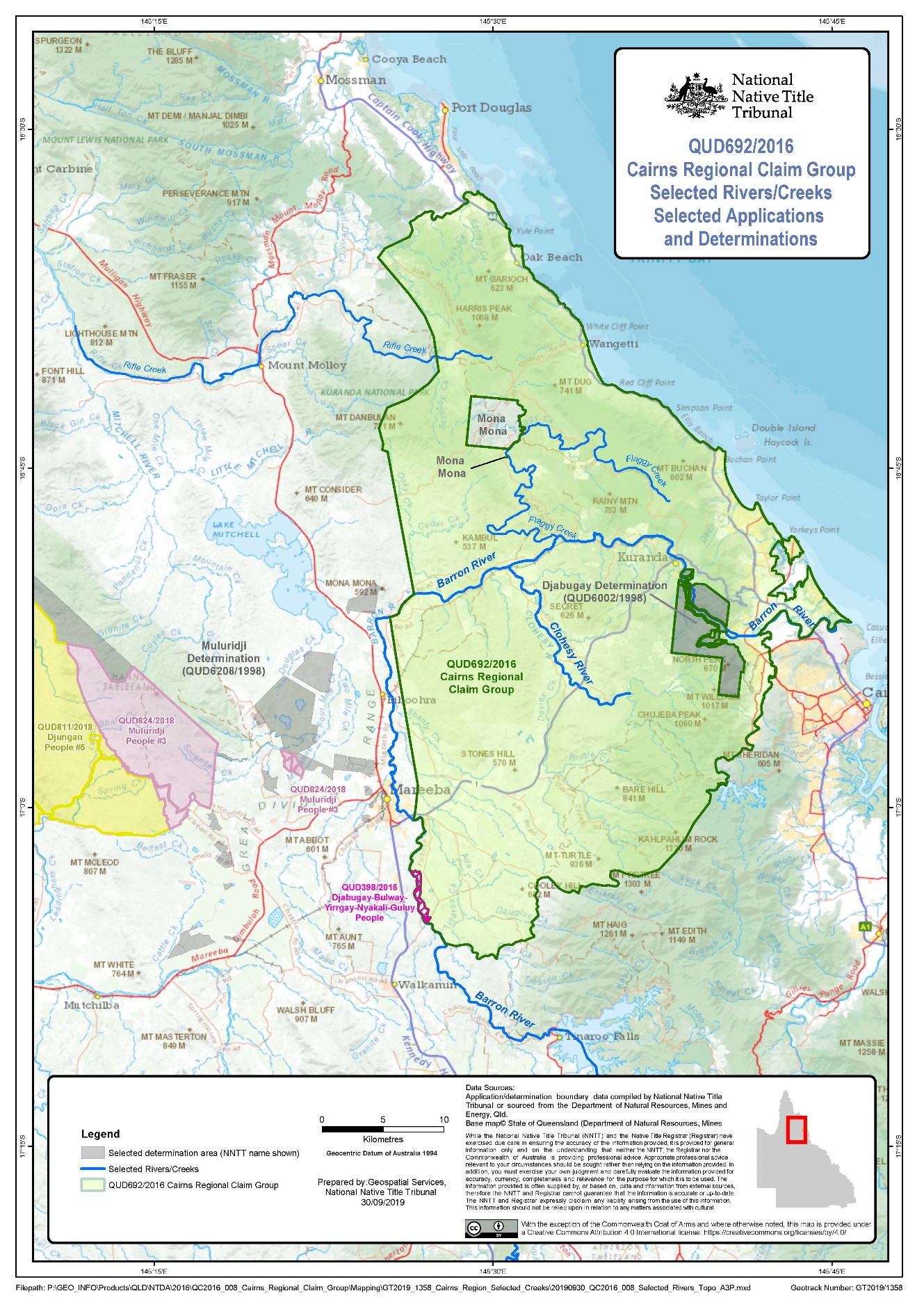
QUD 398 of 2015 | |
SARAH ADDO | |
Fifth Respondent: | HENDRICK CLAINE FOURMILE |
Sixth Respondent: | SEITH HARDY FOURMILE |
Seventh Respondent: | ERGON ENERGY CORPORATION LIMITED ACN 087 646 062 |
Eighth Respondent: | IAN EARL WALLACE |
Ninth Respondent: | ROBERT JOHN WALLACE |
Interlocutory Application | |
Interlocutory Applicant: | ANN-MARIE KEATING |
QUD 692 of 2016
Respondents | |
Fourth Respondent: | DOUGLAS SHIRE COUNCIL |
Fifth Respondent: | MAREEBA SHIRE COUNCIL |
Sixth Respondent: | CHARLES KORNELL ADDO |
Seventh Respondent: | SARAH ADDO |
Eighth Respondent: | JABALBINA YALANJI ABORIGINAL CORPORATION |
Ninth Respondent: | TELSTRA CORPORATION LIMITED ABN 33 051 775 556 |
Tenth Respondent: | KEITH REGINALD ARMSTRONG |
Eleventh Respondent: | MARGARET ROSE ARMSTRONG |
Twelfth Respondent: | RON REDDICLIFFE |
Thirteenth Respondent: | SKYRAIL PTY LTD |
Fourteenth Respondent: | IAN WALLACE |
Fifteenth Respondent: | ROBERT WALLACE |
Sixteenth Respondent: | YVONNE WALLACE |
Seventeenth Respondent: | KAREN BARBARA ALLAN |
Eighteenth Respondent: | MARK EDWIN ALLAN |
Nineteenth Respondent: | DUANE CASH |
Twentieth Respondent: | COLDAV PTY LTD |
Twenty-First Respondent: | THE EXECUTOR AND SOLE BENEFICIARY OF THE ESTATE OF MARC EDWARD ALIN LA BAYSSE CORRINE MARIE NOEL LA BAYSSE |
Twenty-Second Respondent: | TEGAN MARIE FORD |
Twenty-Third Respondent: | HARTLEY’S CREEK CROCODILE FARMING CO PTY LTD |
Twenty-Fourth Respondent: | DEAN MAHONEY |
Interlocutory Application | |
Interlocutory Applicant: | ANN-MARIE KEATING |


