

FEDERAL COURT OF AUSTRALIA
Jones v Westpac Banking Corporation [2020] FCA 238
Table of Corrections | |
5 March 2020 | In paragraph 55 the words “credit cards” have been replaced with the words “debit cards”. |
In paragraph 62 the words “credit card” have been replaced with the words “debit card”. |
ORDERS
Applicant | ||
AND: | Respondent | |
DATE OF ORDER: |
THE COURT ORDERS THAT:
1. Pursuant to s 46PO(3A) of the Australian Human Rights Commission Act 1986 (Cth), leave to make application to this Court be refused to the Applicant.
Note: Entry of orders is dealt with in Rule 39.32 of the Federal Court Rules 2011.
KERR J:
BACKGROUND
1 The Applicant, Ms Jones, is a former customer of the Respondent, Westpac Banking Corporation (Westpac). Ms Jones alleges that Westpac discriminated against her on the basis of her race, sex and/or disability. She submits that Westpac thereby contravened the Racial Discrimination Act 1975 (Cth) (RDA); Sex Discrimination Act 1984 (Cth) (SDA); and the Disability Discrimination Act 1992 (Cth).
2 In 2018 Ms Jones lodged a complaint regarding the conduct of Westpac with the Financial Ombudsman Service Australia (FOS). That complaint primarily concerned issues distinct from those which she raises for the consideration of this Court. On 9 August 2018, a FOS case manager wrote to Ms Jones providing a preliminary view of the dispute. The case manager found predominately in favour of Westpac, but expressed the view that Westpac:
… did not appropriately investigate and respond to Ms Jones’ dispute, and it should compensate her $500.00 for the stress and inconvenience she suffered.
3 On 20 August 2018, Ms Jones lodged a complaint with the Australian Human Rights Commission (AHRC). In that complaint, she alleged that Westpac had discriminated against her.
4 On 16 May 2019, the AHRC terminated Ms Jones’ complaint pursuant to s 46PH(1)(c) of the Australian Human Rights Commission Act 1986 (Cth) (AHRCA). That provision is as follows:
Termination of complaint
Discretionary termination of complaint
(1) The President may terminate a complaint on any of the following grounds:
…
(c) the President is satisfied, having regard to all the circumstances, that an inquiry, or the continuation of an inquiry, into the complaint is not warranted;
5 Ms Jones was provided with a notice of termination. Attachment A to that notice set out the reasons for the termination. It is convenient to extract those reasons in full:
By way of background, the Commission has the power to inquire into complaints of unlawful discrimination under the RDA, SDA and DDA. However, continued inquiry into alleged unlawful discrimination may not be warranted in all circumstances.
When considering whether or not to continue an inquiry under section 46PH(1)(c) of the AHRCA, the types of factors that I can consider include: the apparent merit of the claim (including if it is ill-conceived or vexatious or where there is not sufficient material to support the claims); other actions that have been taken and/or other remedies that are available; and the prospects of a practical outcome or remedy being achieved through the Commission’s process.
The Commission appreciates that you feel strongly about the allegations and surrounding events and acknowledges there are complex circumstances over many years which have led you to raise the concerns you have described. I have considered your submissions on why you believe that Westpac have discriminated against you in their dealings with you while you have resided in South Africa. However, I am of the view that there is insufficient information before the Commission to support that the alleged treatment is based on or by reason of your race, sex or pregnancy/potential pregnancy and/or disability in all the circumstances. I note that there may be other relevant factors about the service concerns you have raised, including the implications of geographical location at the time of the alleged events. It is also noted that Westpac refutes your claims that it treated you less favourably due to your race, sex, pregnancy/potential pregnancy and/or disability and states that every decision Westpac has made in relation to your custom has been made on a commercial basis only.
Considering any other actions taken and/or other remedies which are available in relation to this complaint, the information before the Commission indicates that prior to you contacting this Commission you raised concerns related to some of the claims contained in this complaint with the FOS. I note your submission that your complaint to the FOS was about privacy breaches. However, I consider that some of the events that are part of your complaint to this Commission were also considered by the FOS. FOS’ letter to you of 9 August 2018 (attachment C to Westpac’s response) indicates they considered concerns about closure of your accounts, privacy and SMS codes and provided a preliminary view. You noted in your complaint form that the dispute was resolved ‘with FOS indicating that Westpac had not provided the requisite information (call recordings, notes and logs and SMS logs) and that there was insufficient proof of a privacy breach. FOS awarded [you] $500 for the stress’.
The Commission has explored the resolution of your complaint with the parties and has passed information and proposals between you and Westpac to try and resolve the matter. Westpac considered your resolution proposal of 7 March 2019 and indicated they were not agreeable to your proposal. They provided a counter-proposal for you to consider, which you indicated was rejected and you said your proposal of 7 March 2019 remains unchanged. Westpac considered this and confirmed they had no further offers to put forward.
Following your email of 26 March 2019 about the DDA, the Commission clarified Westpac’s position and they confirmed their views regarding conciliation remain unchanged. You provided another proposal on 17 April 2019. Westpac did not agree to it but provided a counter-offer and you explained on 13 May 2019 that it is rejected by you. The Commission has exchanged proposals and allowed the opportunity for ideas in relation to resolution of this matter to be put forward. However, the parties have not been able to reach agreement as to how to resolve the complaint.
Overall, I am of the view that the prospects of you achieving your desired outcome through the Commission’s conciliation process are limited.
6 Ms Jones was not satisfied with the decision of the AHRC. On 15 July 2019, she therefore filed in this Court an originating application under the AHRCA.
7 Under s 46PO(3A) of the AHRCA however, Ms Jones requires leave to have her allegations of discrimination heard and determined by this Court. Section 46PO provides, relevantly:
Application to court if complaint is terminated
(1) If:
(a) a complaint has been terminated by the President under section 46PE, paragraph 46PF(1)(b) or section 46PH; and
(b) the President has given a notice to any person under subsection 46PH(2) in relation to the termination; any person who was an affected person in relation to the complaint may make an application to the Federal Court or the Federal Circuit Court, alleging unlawful discrimination by one or more of the respondents to the terminated complaint.
…
(3A) The application must not be made unless:
(a) the court concerned grants leave to make the application …
8 As noted above at [4], it is uncontentious that Ms Jones’ complaint was terminated under s 46PH of the AHRCA.
9 I decline to grant such leave. My reasons are as follows.
APPLICANT’S CASE
10 Ms Jones has filed in this Court two documents read in her application that address the substance of her claims: an originating application (filed 15 July 2019) and a lengthy affidavit (filed 22 August 2019). Ms Jones was, and remains, self-represented. On 29 August 2019, I therefore ordered that she be permitted to rely on those materials as constituting her application for leave pursuant to s 46PO(3A) of the AHRCA. On that date I also ordered that Ms Jones file an outline of submissions and any further materials on which she would wish to rely. However, Ms Jones chose not to file an outline of submissions.
Alleged adverse treatment
11 Ms Jones’s case is that on a number of occasions, Westpac subjected her to adverse treatment on the basis of her race, sex and/or disability. It is convenient to address the events on which she relies as giving rise to those claims in chronological order.
12 Ms Jones submits that she was a customer of Westpac for 12 years, during which she held a number of different accounts. For a number of years she has resided in South Africa and banked only with Westpac.
Emergency replacement cards
13 Between mid-2007 and 2013, Ms Jones alleges that issues arose with respect to Emergency Replacement MasterCards issued to her by MasterCard International.
14 Ms Jones acknowledges that on number of occasions she lost her Westpac Debit MasterCard. She says that she was in consequence issued with Emergency Replacement MasterCards and MasterCard Emergency Cash Advances, concurrently with Westpac Debit MasterCards “for more permanent use”.
15 The Emergency Replacement MasterCards with which she was provided had no Personal Identification Numbers (PINs). Ms Jones submits that:
16. … As a result, a great number of these cards were stolen from me, I’m assuming by people who had noticed the lax security requirements for making purchases using the Emergency Replacement MasterCard.
16 Ms Jones also submits that the more permanent Westpac Debit MasterCards took a long time to arrive at her location in South Africa or Zimbabwe, and sometimes did not arrive at all.
Internet banking services
17 From 24 January 2014 to 9 March 2018, a new problem arose. Ms Jones submits that during this period, Westpac revoked her Westpac Debit MasterCard access altogether. She submits that:
23. … The reason Westpac gave for the card revocation, was my failure to mitigate losses due to fraud and identity theft on my account, even though I had taken all their suggested steps to prevent fraud, Westpac held the opinion that I had reached my “cap” of fraudulent account activity.
18 She submits that the time of revocation:
… the Westpac Customer Relations team indicated that I was registered for internet banking and so, could access my funds in South Africa via International Payments.
19 Ms Jones submits that the International Payments internet banking system was “inconvenient and expensive” compared to her Westpac Debit MasterCard. She also submits that the system was less secure. She submits that she was subject to “spoofing”, whereby she received text messages purportedly from Westpac confirming international payments that did not originate from Westpac’s telephone number. That led her to believe that her payments “were being intercepted by an unknown person/s”.
20 In light of those issues, Ms Jones states that she then made arrangements to obtain MasterCards so that she would no longer need to rely upon internet banking. She submits that Westpac were difficult to deal with in this regard. She notes for example that at this time she indicated to Westpac that she intended to visit the United Kingdom later in the year. A Westpac customer manager:
… insisted that the Debit MasterCard should be sent to the United Kingdom, rather than to South Africa. I made it clear that I wanted a Debit MasterCard sent to me, whilst in South Africa.
21 For reasons which will later become apparent, it is important to note that on another occasion during this period Ms Jones notes that she was asked for the following information:
(f) As a necessary step to complete my application, Westpac requested that I answer some questions of their choosing to verify my identity to Westpac’s satisfaction.
(g) I was asked my mother’s maiden name. My mother’s maiden name is Ndebele, which is the native language of the Ndebele peoples of Zimbabwe and South Africa.
(h) I was asked whether I could pronounce my mother’s maiden name. I did.
(i) I was then asked what nationality of passport I carried, and the passport number.
22 However, Ms Jones acknowledges that she did receive an Emergency Replacement MasterCard on 12 March 2018, and a Westpac Debit MasterCard on 14 March 2018.
Exclusion from all Westpac services
23 Ms Jones claims that on 4 July 2018, her Westpac Choice Account (ending 8300) (the 8300 account) was “closed without any prior notice or reason”. She submits that she encountered a number of difficulties in contacting Westpac regarding that issue, finding the bank to be generally unresponsive and unhelpful.
24 Ms Jones states that she had then opened another Westpac Choice Account (ending 3086) (the 3086 account). I infer that her having done so must have occurred at some point between 4 and 11 July 2018.
25 Ms Jones states that on 11 July 2018, she received a phone call from a Westpac Customer Manager. Ms Jones submits that that Manager told her that for “commercial reasons which he couldn’t divulge” the 8300 account had been closed. She was to be “refused any other future financial services from all members of the Westpac Group”. As such, the 3086 account would also be closed. That Manager then sent her a letter, attached to an email, to confirm that advice.
26 On 18 July 2018, Ms Jones had further dealings with Westpac telephone banking representatives. She submits that she was told that the “Fraud Department of Westpac” had placed blocks on her accounts which would remain in place until she attended a Westpac Branch with photo ID so that her identity could be verified visually. That would have required Ms Jones to travel to Australia.
Failure to address “Unfit to Work” claim
27 Ms Jones claims that around the same period she suffered the stillbirth of her daughter and subsequently experienced depression. She submits that she therefore:
118. … requested an ‘Unfit to Work’ claim form from Westpac Insurance in June 2018. I informed Westpac that my claim was the result of the stillbirth of my daughter and the subsequent depression was making it hard for me to manage my work. A copy of my email to Westpac Insurance is Annexed and marked as ‘CSJ12’.
28 Ms Jones submits that on 8 June 2018 she received from Westpac a claim form “with claim number assigned and printed atop each page of the claim form”. Ms Jones submits that Westpac did not address her claim either during or after the events of July 2018.
The generic basis of Ms Jones’ claims to have suffered alleged adverse treatment for a prohibited reason
Alleged racial discrimination
29 By way of background, in her written materials Ms Jones states that she is a “mixed-race, female of African ethnic origin, specifically of Zimbabwean nationality”. Having regard to those circumstances, she contended in those written materials that:
11. From 1 February 2008 to 1 February 2015, Gail Kelly was the CEO of Westpac. Gail Kelly is South African born. In the late 1970s, when the civil war to liberate the black majority from white minority oppressive rule (Rhodesian bush war) was near to closing, the United Nations Security Council in their Resolution 411, referred to the Rhodesian government of the day as “the illegal, racist regime in Southern Rhodesia”. While Gail Kelly taught at a Rhodesian High School, her husband fought on the side of the Rhodesian Army. The aim of the Rhodesian Army was to protect the rule of the oppressive and racist regime, whose will being to prevent Africans, like me, from having equal rights with white citizens of Rhodesia, and have the black native citizenry occupy a pseudo-slave class. For these reasons, I believe that I was targeted for differential treatment by Westpac.
(Emphasis added).
30 Ms Jones also advanced written submissions regarding institutional racism generally, before submitting that banks including Westpac:
116. … have exhibited a pattern of, first, socially constructing the characteristic of different ethnicities and races, like how a specific race or ethnicity should look, speak, behave and what names they should carry (see Paragraph 60), then subjecting those ‘socially-constructed racial and/or ethnic groups to discrimination amounting to institutional racism (see paragraph 106). This practice is observed in the following two instances:
(a) The conciliation Register on the website of the Australian Human Rights Commission (AHRC) lists de-identified past conciliated disputes. One of the listed cases is of a man of Indian ethnicity whose Credit Card was frozen pending his attendance to the (de-identified) bank branch because a telephone banking consultant felt that his accent did not match his name.
(b) A Geelong Catholic Church employee who had never physically seen me, only spoken to me over the phone, was prevented by the Westpac Geelong Bank branch manager, Christine Howard, from making a deposit into my Westpac account. The Catholic Church employee told me that Ms Howard did not believe that I was African, because of my name, Colleen Jones, and had therefore concluded that I was an Australian con-artist pretending to be an African woman so as to gain his sympathy.
31 At the hearing, Ms Jones appeared in person by telephone from South Africa. She did not press either of the above submissions as a basis upon which leave should be granted. However, assuming neither submission was abandoned, I nonetheless reject that either establishes a sufficient basis for this Court to conclude that her application has a reasonably arguable prospect of success. The ethnic and family background of Ms Kelly does not and cannot in the abstract provide a sound basis on which to attribute institutional racism to the bank in which she formerly held a leadership role. Equally, there may be a report in AHRC records that it had conciliated a complaint (not expressly asserted to have involved Westpac) brought by a person who had been refused a credit card because his accent did not appear to match his name. That circumstance however does not and cannot establish that any of the circumstances relied upon by Ms Jones were products of institutional racism. Nor would one instance, whether justified or otherwise, of a staff member seeking to protect another customer from fraud. That is all the more so given that in the circumstances later discussed, I apprehend that a fear that Ms Jones’ account may have come to be fraudulently operated was in fact held by the bank.
32 Given that Ms Jones was self-represented, with the parties’ agreement I required counsel for the Respondent Ms Davern to make her submissions as to why leave should be refused before Ms Jones was required to make submissions. I did so in order that Ms Jones might best be able to respond to the objections that Ms Davern was pressing against her application. It is therefore convenient to set out the parties’ respective submissions in that order.
RESPONDENT’S SUBMISSIONS AND APPLICANT’S RESPONSE
33 On Westpac’s behalf Ms Davern read the affidavit of Ms Turner, dated 19 November 2019. In her affidavit, Ms Turner outlines the Respondent’s position regarding the factual background to Ms Jones’ complaint. The relevant paragraphs of Ms Turner’s affidavit are as follows:
3. In or around September 2006, Westpac commenced providing banking and financial services to Ms Jones.
4. On or around 28 May 2018, Westpac sent a letter to Ms Jones informing her that Westpac was no longer able to provide Ms Jones with banking and financial services effective 28 June 2018. Now produced and shown to me and marked, “LMT-1” is a copy of the letter dated 28 May 2018.
5. The decision to cease providing Ms Jones with banking and financial services was based on commercial and risk concerns based on the number of fraud claims lodged by Ms Jones. The decision to cease providing Ms Jones with banking and financial services was not in any way based on race, ethnic origin, sex, or disability.
6. On 28 June 2018, Westpac sent a further letter to Ms Jones informing Ms Jones that her account had been closed. Now produced and shown to me and marked “LMT-2” is a copy of the letter dated 28 June 2018.
Unfit to Work Claim
7. I have read the affidavit of Ms Jones dated 21 August 2019 (Jones Affidavit). Annexure CSJ-13 to the Jones Affidavit is a blank Unfit for Work Claim Form which Ms Jones says at paragraph 119 of the Jones Affidavit was provided to her by Westpac’s Insurance Department with a claim number assigned.
8. I requested the Credit Card Insurance (CCI) team to search available records and no completed Unfit for Work Claim Form lodged with the CCI team in Westpac was located.
9. Neither have I been able to locate any record of Ms Jones informing Westpac of the reason for any potential claim using the Unfit for Work Claim Form, or record that demonstrates Westpac was aware of any issues concerning Ms Jones’ depression or still birth prior to her lodging her complaint with the Australian Human Rights Commission.
10. The reason Ms Jones’ Unfit for Work Claim was not processed was simply because no completed form was lodged with Westpac and was not in any way based on race, ethnic origin, sex, or disability.
34 Against those circumstances, the Respondent’s written submissions were as follows:
6. … The reason that the Respondent ceased providing the Applicant with banking and financial services [on 28 June 2018] was entirely based on commercial reasons based on the number of fraud claims lodged by the Applicant.
7. The Applicant alleges that her claims of disability and sex discrimination arise from the failure of the Respondent to assess her “Unfit to Work Claim” (the Sex and Disability Claims). As set out in the Applicant’s statement of facts and contentions dated 16 January 2019, which forms part of her initial complaint form (Attachment B), the Applicant states that the insurance policy pursuant to which this insurance claim was alleged to have been based was her Credit Card Protection insurance. The applicant alleges her disability is depression, which she states she suffered after a still-birth in 2014 and that still-birth is a characteristic of pregnancy or imputed pregnancy.
8. The Sex and Disability Claims have no merit. They are simply not arguable, let alone have any reasonable prospects of success for the following reasons.
(a) First, the Applicant does not allege she lodged the Unfit to Work Claim prior to her being informed by the Respondent on 28 May 2018 that it would no longer provide her with banking and financial services from 28 June 2018, or even before the Respondent ceased providing her with banking and financial services from 28 June 2018. Instead it is clear that the Applicant informed the Respondent by email dated 27 August 2018 that she had deliberately chosen not to complete the claim and sign the Unfit to Work Claim form, as at that date because her complaint to the Financial Ombudsman Service (FOS) had not been determined and she wished to maintain her privacy rights. The Applicant also acknowledged to the AHRC by email on 11 September 2018 that the Respondent ceased providing her with banking and financial services before she lodged any Unfit to Work Claim. The Respondent is not in possession of any completed Unfit to Work Claim form lodged by the Applicant and the Respondent has not located any record of the Applicant disclosing to it the basis for any potential Unfit to Work Claim prior to her complaint to the AHRC. The Applicant has not provided any evidence of either the Unfit to Work Claim form or record of disclosure as part of her complaint to the AHRC or in the Applicant’s Affidavit or the Applicant’s Further Affidavit.
(b) Second, the reason that the Respondent did not “assess”, allow or consider the Unfit to Work Claim was simply because it was never lodged with the Respondent. There is no less favourable treatment on the basis of sex or disability. No person who fails to lodge a claim with the Respondent would have his or her claim “assessed”, let alone allowed. The claim is nonsensical.
(c) Third, that the basis for the Applicant’s potential Unfit to Work Claim was her inability to work because of depression due to the Applicant’s going through the tragedy of a stillbirth in 2014, does not make the reason for the treatment sex and disability. There is simply no basis for such an allegation. As set out in the Turner Affidavit, the Respondent has no record of the Applicant disclosing to it the basis for any potential Unfit to Work Claim prior to her complaint to the AHRC. There is simply no causal connection between the alleged treatment and the attribute.
9. In terms of race, in her initial complaint (Attachment B) the Applicant stated that her race/colour is ‘Mixed race African’ and her ethnic/national origin is ‘Zimbabwean’. She also says she is currently resident in South Africa. The Applicant’s Affidavit also states that “for a number of years now, I’ve been resident in South Africa”. Her claims of race discrimination relate to a number of concerns about the provision of banking services to the Applicant by the Respondent from January 2014 until the Respondent ceased providing her with banking and financial services for commercial reasons on 28 June 2018 (the Race Claims).
10. The Race Discrimination Claims have no merit. They are simply not arguable, let alone have any reasonable prospects of success for the following reasons.
(a) The Respondent informed the Applicant on 28 May 2018 that it would no longer provide her with banking and financial services from 28 June 2018 purely for commercial reasons. This was based on the number of fraud claims lodged by the Applicant.
(b) There is no less favourable treatment on the basis of race or ethnic origin. Any customer of the Respondent who posed the same commercial risk as the Applicant would also have been refused the provision of continuing banking and financial services. As set out in the Turner Affidavit, the Respondent’s decision was based purely on these commercial reasons. There is simply no causal connection between the alleged treatment and the attribute.
(Footnotes omitted).
35 Westpac submitted that having regard to the reasoning of Mortimer J in James v WorkPower Inc [2018] FCA 2083 (WorkPower), the following factors should also lead to the Court refusing leave:
(a) the AHRC has dealt thoroughly with the complaint and has quite properly determined having regard to all the circumstances, that an inquiry, or the continuation of an inquiry, into the complaint was not warranted;
(b) on the Applicant’s own case, the Respondent refused to provide her with a Debit MasterCard for over four years (from 24 January 2014 until 9 March 2018), and she has provided no basis for her failure to complain about that conduct until lodging her complaint with the AHRC on 20 August 2018. Such delay is inordinate and dealing with such stale complaints will be oppressive on the Respondent;
(c) the Applicant’s concerns have already been raised with FOS. Whilst the Applicant characterises her complaint to FOS as about privacy breaches, it is clear from FOS’ letter to the Applicant of 9 August 2018 (attachment C to Westpac’s response to the AHRC) that some of the events that are part of the Applicant’s complaint to the AHRC were considered by FOS. The letter makes clear that FOS considered concerns about closure of the Applicant’s accounts, privacy and SMS codes and provided a preliminary view. The Applicant’s complaint form (Attachment B) noted that the dispute was resolved on the basis of there being ‘insufficient proof of a privacy breach. FOS awarded [the Applicant] $500 for the stress’; and
(d) importantly when considering the resources of the Court and that the claim is one where significant costs are likely to be incurred and where the Applicant may be exposed to very significant costs orders, the fanciful matters raised by the Applicant in the Applicant’s Affidavit such as:
(i) the alleged political and social views of a former CEO of the Respondent (whose tenure with the Respondent ended more than three years before the Respondent ceased providing banking and financial services to the Applicant) and her husband influencing the decisions regarding the Applicant’s credit card;
(ii) the alleged bias of the AHRC based on the award to the current President of the AHRC, whose appointment commenced on 30 July 2017, due to the award acknowledgement in 2014 for her contributions to public policy as one of Australia’s ‘100 Women of Influence’ in the Australian Financial Review and Westpac awards;
which demonstrate the necessity for s 46PO(3A) to be applied as “a filter to preclude a complaint whose merits are disproportionate to the time and resources likely to be consumed by dealing with them in a whole proceeding”.
15. In exercising the discretion, the question to be answered is whether the complaint has a reasonable prospect of success. It does not, it is fanciful, without merit, is the subject of inordinate delay and has been already dealt with by FOS, where the Applicant was provided with $500 as a remedy.
(Footnotes omitted).
36 In oral argument, Ms Davern adopted and summarised the bank’s written submissions. She further refined its legal propositions as to the test required to be applied, having regard to recent case law that had emerged since their filing. Ms Davern submitted that the cases of Pathmanathan v St John of God Healthcare Inc [2019] FCA 1460 (Pathmanathan) and Matthews v Markos [2019] FCA 1827 (Matthews) had each broadly confirmed the authority of WorkPower, but that that the test outlined in that decision should be applied having regard to the qualification expressed by Charlesworth J in Budini v Sunnyfield [2019] FCA 2164 (Budini).
37 Ms Davern submitted the Court should apply paragraph 52 of Charlesworth J’s reasoning in Budini, which reads as follows:
52. To [Mortimer J’s observations in WorkPower] I would add the qualification that in a case where a respondent to a complaint alleges that the allegations have no reasonable prospects of success, the Court may be guided by the same principles informing the exercise of discretionary powers such as that conferred by r 26.01 of the Federal Court Rules. It would not serve the interests of the administration of justice to grant leave to commence an action that would be liable to be the subject of an order for summary judgment in whole or in part either because:
(a) the applicant has no reasonable prospect of successfully prosecuting the proceeding or part of the proceeding; or
…
(c) no reasonable cause of action is disclosed
38 Having regard to those principles, Ms Davern submitted that in truth only one factor was relevant to the outcome of Mr Jones’ application: leave should not be granted because there was a complete lack of merit in the case she sought to advance. There was no evidence to suggest that Westpac had conducted itself other than for legitimate commercial reasons. Ms Jones had been denied services on non-discriminatory grounds while she was residing in South Africa, and her entitlement to banking and financial services had been withdrawn for purely commercial reasons having regard to a history of her credit facilities being misused and her making fraud claims. To the extent that Westpac could be criticised for less than exemplary customer relations, Ms Davern acknowledged that it was a matter of public record that Australian banks had a poor record in that regard. However such a finding in Ms Jones’ case, even if warranted, provided no basis on which the Court might conclude that that the Respondent’s poor customer relations had been to any degree motivated by a prohibited factor.
39 Ms Davern also submitted that the Court was entitled to have regard to the practical consequences of Ms Jones being permitted to have her complaint heard and determined in this Court, where she might be exposed to an order for costs. In that regard she noted that at this stage, the Respondent sought only that the application be dismissed with no order as to costs. With respect to that factor, Ms Davern referred the Court to the following passage from the decision of Lehane J in Travers v New South Wales [2000] FCA 1565:
It is in the public interest, as well as the interests of both parties, that a hearing of a complaint which is clearly shown to be lacking in substance should be summarily terminated. Certainly, it is no kindness to a complainant to shrink from the exercise of the power in circumstances where the exercise is clearly warranted. That is especially so, perhaps, in this court where an unsuccessful litigant, if proceedings are protracted, may face what can be the considerable burden of a costs order.
Applicant’s oral submissions
40 Prior to Ms Jones making her oral submissions, I explained that having regard to the way in which Ms Davern had advanced the Respondent’s arguments she would be assisted if she were to focus her submissions on persuading the Court that there was a reasonably arguable basis on which the Court might conclude that any poor customer service that she received from Westpac was linked to a characteristic based on her race, or any other prohibited discriminant.
Alleged racial discrimination
41 In respect of her complaint that her treatment as a customer was in some measure a product of racial discrimination, I advised Ms Jones as follows:
Just for your assistance, I mentioned to Ms Davern that Australians have become very sceptical of the conduct of banks towards their customers. That is not surprising giving the findings of the … Superannuation and Banking Royal Commission. And Ms Davern very properly didn’t dispute that. So what might be the case is that you’ve got to … suggest something that takes this beyond (and I use this expression as an Australianism) … it is often said that all banks are bastards, that there’s nothing more to what happened to you than would happen to any other customer. Very unfortunate. Perhaps properly to be criticised. But nothing in what you have put forward, the bank says, suggests it was motivated by racism. So … that’s what you’ve got to grapple with and persuade the Court of, that there’s something that plausibly could link your experience to a case that what occurred to you was more than just a series of bad behaviours by the bank similar to that [which] other customers have suffered or might suffer and in some way can be said to have been influenced by, caused by – in or part or in whole – by racism …
…
What remains significantly in dispute between you and the bank and what I perhaps need to focus on is whether there’s anything in your materials that gives rise to a plausible basis to think what happened to you was because of a discrimination based on race. So if you focus on that that would be helpful.
42 Ms Jones thereafter submitted that there were a number of reasons why the Court ought to conclude that the way in which the Respondent had treated her was linked to her race:
Reason 1: Geographical bar
43 Ms Jones submitted that Westpac:
… restrict[s] what services they’re going to provide you with based on your location. For instance, I was not allowed to get a fully functional service based on the fact that I was in South Africa … this is Africa … it’s full of Africans.
44 As Ms Jones later submitted with respect the alleged practice of “reverse redlining” (addressed below), location is “tied to” race as “racial groups stay in certain places”.
45 The Court asked Ms Jones to respond to the proposition advanced by Westpac that there appeared to be nothing to suggest that a restriction of access to banking services based on customer location (in this case, South Africa) constituted a distinction on the basis of race. A geographical bar of the kind that Westpac had imposed would apply in respect of a customer of any race who was located in South Africa.
46 In response, Ms Jones accepted there was racial diversity in South Africa and that the geographical bar would apply to persons of all races. She submitted however that that circumstance created specific “dynamics” which had led Westpac to discriminate against her based on racial “stereotyping or profiling” because:
it’s unusual for persons who [are] not Caucasian to carry a name like mine. And although people in Africa are accustomed to it, people in Australia are not.
Reason 2: Steps taken to verify identity
47 As noted above at paragraph 21, Ms Jones claims that when she applied for a Debit MasterCard an employee of the Respondent asked her for mother’s maiden name, and further asked to pronounce that name. Ms Jones submitted that the reason that this had occurred was:
to separate people based on whether or not I’m Australian in South Africa at the time or an African or South African in Africa with an Australian bank account, and based on that criteria you get treated differently.
48 At the hearing, the Court asked Ms Jones to respond to the proposition that it was not unusual that a customer of a bank – particularly if they were located overseas – might be asked questions such as their mother’s maiden name for the purpose of verifying their identity. I asked Ms Jones why she suggested that this question was asked with the intention of verifying her race.
49 In response, Ms Jones submitted that:
Westpac does not have my mother’s maiden name on record … [s]o it served no purpose to know what my mother’s maiden name was, because it wouldn’t confirm anything because they had no record of it prior to that.
50 As noted above at paragraph 26, Ms Jones also claims that the Respondent required her to verify her identity by attending an Australian bank branch in person before opening any new account. At the hearing, Ms Jones submitted that this demonstrated that there was a:
culture of the bank stereotyping its customers based on what they believe that racially and ethnically they should be like in order to fit the ..... description of what they have in mind for that person.
…
And I had so many different exclusions and criteria and distinctions applied to me when I was a customer of Westpac that I believe that – well, it was differential treatment, definitely. And … I do think they have made more than enough references to my ethnic origins for me to reasonably infer that that was based on race – ethnic origin, definitely. Race could be a factor. But definitely because I’m from Africa. And the normal picture that pops into people’s head when you are from Africa is not exactly what applies to me.
51 Ms Jones submitted that the Respondent’s intention to confirm “[her] appearance against [her] name” in those circumstances was indicative of racial discrimination.
Reason 3: Reverse redlining
52 Ms Jones submitted that the term “reverse redlining”, which appears in the written material that she filed, refers to the circumstance where:
minority customers are targeted for expensive products and then they can no longer keep up with those – if it’s a loan, keep up with the payments. Then they’re cut off. That’s the exact definition of reverse redlining. It’s actually a term coined in the US, but … it has crept into South Africa to describe what the banks do here, and it is based primarily on race, normally based on location, but location is always tied to, you know, racial groups stay in certain places.
53 Ms Jones submitted that her treatment by the Respondent was consistent with reverse redlining on Westpac’s part in that she had been required to use the more expensive international payments system, and when she had sought instead to access cheaper banking services she had been refused further services altogether:
I’m just deducing that reverse redlining did play a part in it, because practically as soon as I stopped doing international payments and I started using an ATM card then my account was closed, all that happened. So I just think that I was no longer any benefit to the bank.
Reason 4: Communication with Westpac
54 Ms Jones further relied upon certain communications that she had with Westpac as follows:
I was first told that I was going to get a card on 27 February 2018, and by 9 March I hadn’t heard any word about it. I contacted the bank and asked about the card, and I was told that they had, in so many words, reversed their decision, and that they would only provide me with the card if I were in Australia. So that was that instance, but it is more for me the comment that was made by the staff at that time. I remember the person I spoke to. His name was Oliver, and he said, “If we send you a card, the people on the South African side, the DHL,” for instance, like, because they were going to ship it out by DHL, and by the time it gets into Africa, South Africa, the people in South Africa on the DHL side in South Africa would steal from it …
55 The Court asked Ms Jones whether she accepted Westpac’s contention that there was a history of her debit cards going missing or being stolen, resulting in their misuse, which would provide a legitimate explanation for the bank’s concerns. Ms Jones submitted that her cards had not gone missing or been stolen from the mail, but rather had been stolen directly from her: a circumstance she attributed to the Emergency MasterCards lacking security because they did not require a PIN or signature to use. Ms Jones submitted that that circumstance was quite distinct from that to which “Oliver” had referred. He had told her that the card:
would be fine in transit until it got to South Africa, at which case the couriers, which was DHL, in South Africa would steal from it because it was active, as in, it was activated by the bank. That’s what – that was his precise wording. And I had to pretty much argue that because you’re in Africa doesn’t mean that every single person on this side would steal. That was pretty much it, that it was a sentiment that I had heard repeated several times during the process, that the reason I was having problems with protective SMSs was because they were … coming to South Africa. However … my location couldn’t affect the fact that there was a security breach on Westpac’s side. … But I kept hearing that any criminal activity, anything that went wrong … every time I spoke to someone about an issue … sometimes it would be things like the spoof call or the protective SMSs. I would always call. It’s because it’s South Africa and South Africans do that, and Africans do that, and it’s the nature. It’s the criminal environment of Africa. Everything was treated like this.
56 In the written materials she filed Ms Jones had also submitted that when in February 2018 she had addressed certain concerns regarding fraud during a conversation with a Westpac Customer Manager, that Manager had said:
49. … she would not like to be in South Africa, referring to crime in South Africa, and suggesting that South Africans were responsible for the Australian Bank (Westpac) employee spoofing her call to me. By now, I had noticed the pattern of blaming any failing or misconduct of Westpac or their employees on South Africans or Africans in general.
Reason 5: Clandestine nature of account closure
57 Ms Jones finally pointed to the fact that, in her submission, she had not been given proper notice of Westpac’s decision to close her accounts and cease providing financial services to her. She submitted that this circumstance indicated that the legitimate commercial reasons that Westpac had claimed as underpinning that decision were not those which had actually motivated it:
… the clandestine nature by which they closed the account, knowing full well that I did not know they were going to do that, it suggests to me … that something else was at work, because if they had said that, I could very well understand it. But they didn’t say anything of the sort. Instead, they secretly closed an account and ended a relationship over 12 years without so much as an explanation as to why, which makes me think that that is not the reason at all that that was done.
58 Ms Jones submitted that Westpac must have “some sort of etiquette” or general practice that it followed when communicating with customers whose accounts were to be closed. She submitted that from Westpac’s apparent failure to follow such a practice, it could be inferred that the bank was conscious that its conduct in her case was illegitimate.
59 Ms Jones also referred to what she alleged to be the misleading conduct of Westpac’s representatives in responding to these proceedings as supporting the same inference.
Clarification of the facts regarding fraud claims
60 In the course of Ms Jones’ submissions, I asked Ms Jones to respond to the proposition advanced on Westpac’s behalf that its decision to cease providing her with banking services had been made for purely commercial reasons: having regard to what Westpac claimed to be the abnormally high number of fraud claims that she lodged. She responded:
I can’t say I accept it or don’t accept, because I’m not sure what the normal number is.
61 I then asked Ms Jones how many fraud claims she had lodged, as to which she responded:
I’m not sure about that. They can only tell me, because I always heard that from the fraud department but I was never told exactly … it’s like a charge back the account goes into, so I’m not sure how many they would have, because if it’s just a straightforward claim it couldn’t have been more than three. But if it’s, like, a charge back, then I know that those two are considered under fraud, so I’m not sure … Or a refund issue or something, online things, online shopping things, like, those kind of issues are also considered under fraud.
62 Ms Jones subsequently confirmed that I was correct to understand that answer to mean that she accepted she had made three fraud claims and had also sought a number of online shopping refunds where a debit card in her name had been misused after it had been stolen. There had been “probably quite a few” of what she described as “charge back issues and refund issues” along with her fraud claims.
Alleged sex discrimination and disability discrimination
63 In her written materials, Ms Jones had claimed that Westpac’s failure to assess her Unfit to Work claim was due to the fact that that claim was on the basis of depression flowing from her daughter’s stillbirth. That failure therefore constituted sex discrimination and/or disability discrimination
64 At the hearing, Ms Jones confirmed that she continued to press that contention. Ms Jones did not dispute the accuracy of Ms Davern’s submission that she had never made an Unfit to Work claim. She accepted that she had only asked Westpac to provide her with a claim form. Nonetheless, she submitted that she:
did not know that I had a timeline by which to lodge it. So that, in itself, was pretty deceptive to me. Because they gave me a form knowing full well that I wouldn’t get this assessed if they say that they terminated any further financial services on 28 May, yet sent me those forms on 6 June – nine days later. I’m not sure what the intention was but I don’t think it was for me to lodge an application. Because then, in that case, they would have had to tell me that … that window was closed. And, furthermore, they have never acknowledged that … they were also closing that insurance account.
Alleged failure of AHRC to afford Ms Jones natural justice
65 Standing apart from her allegations concerning the conduct of Westpac, Ms Jones expresses concern in her written materials regarding the process by which the AHRC addressed her complaint. She submits that she was not afforded natural justice, in that the AHRC had been uncommunicative and had refused to put certain of the more serious aspects of her claim to Westpac. Ms Jones claims that she had expressed concern that the AHRC might be biased towards Westpac because the President of the AHRC and the Sex Discrimination Commissioner had both been nominated for the “Westpac 100 Women of Influence Awards”.
CONSIDERATION OF WHETHER LEAVE SHOUL DBE GRANTED
Principles to be applied
66 In WorkPower, Mortimer J identified the principles which her Honour considered should apply to an application for leave pursuant to s 46PO(3A) of the AHRCA as follows:
37 I am satisfied that the text, context and purpose of the leave requirement in s 46PO(3A) suggests that it is appropriate for the Court to consider in determining whether to grant leave whether the claims made by an applicant are reasonably arguable, and are – at the least – not fanciful. This is consistent with the language used in s 46P(1A). I do not consider, read in context, that s 46PO(3A) sets the bar particularly high: the purpose of the provision is to act as a filter to preclude complaints whose merits are disproportionate to the time and resources likely to be consumed by dealing with them in a whole proceeding, but not to impose a barrier of any substantively greater level.
38 There may be a range of other permissible considerations including:
(1) the circumstances of the parties: how important the subject matter of the complaint is to both the applicant and any respondent, and to their respective circumstances;
(2) the nature of the allegations made (including whether for example they involve allegations of continuing discrimination, or how serious the discrimination is alleged to be);
(3) how thoroughly the Commission has dealt with the merits of the complaint. For example, it may be the Commission’s termination reasons thoroughly answer the alleged merits of a complaint and make it clear the complaint is not reasonably arguable;
(4) whether an applicant has delayed in complaining about the alleged discrimination and if so whether there are any explanations for that delay;
(5) whether a respondent has attempted to address the allegations in any way outside the Commission process and whether the allegations have been addressed or resolved in any way;
(6) the factual and legal complexity of the matters raised by the allegation of unlawful discrimination;
(7) whether the allegations raise issues of public importance, or of general application. The express power given to the President in s 46PH(1)(h) does not exhaust the circumstances in which this factor might be considered; and
(8) other factors that are often considered in leave applications – such as prejudice to a party.
39 As I have noted in other contexts, it is important with judicial discretions concerning leave not to conflate the task of granting leave with the task of considering what is the correct conclusion on the facts and the law at final hearing: see my comments to similar effect in Kaur v Minister for Immigration and Border Protection [2015] FCA 584; 233 FCR 507 at [28]-[31] and in DJS16 v Minister for Immigration and Border Protection [2018] FCA 2037 at [27]. It would be a denial of procedural fairness to an applicant at the very least and, in my opinion, a misunderstanding of the role to be played by the leave requirement in s 46PO(3A), if the Court were to embark on a detailed consideration and determination of the merits of the applicant’s underlying arguments about unlawful discrimination. Questions of fact, and questions of law, which are arguable are to be determined at trial, subject to any Court-directed processes such as the stating of a separate question under r 30.01 of the Federal Court Rules.
67 Her Honour further identified the purpose of s 46PO(3A) as being primarily to:
43. … filter out plainly unmeritorious complaints where the arguments are fanciful, or so obviously misconceived that what is being suggested by the applicant should not be entertained by the Court – whether because they are not arguable as a matter of law, or because there is no rational factual sub-stratum for the allegations, or because there is no utility in the proceeding
68 The principles articulated by Mortimer J in WorkPower have been approved of and applied in several subsequent cases. The first such decision is that of Steward J in Pathmanathan. In that case, the applicant was a medical specialist who had made complaints of discrimination by her employer arising out of an adverse event that had ultimately led to a decision by the Medical Board of Australia that affected her ability to practice. Steward J granted the Applicant leave pursuant to s 46PO(3A). In granting that leave, his Honour took into account the “grave importance” of the matter to the doctor and the fact that his Honour could not be “confident” that discrimination had not occurred (at [21]) notwithstanding that the Applicant’s case was “not compelling, and only just arguable” (at [25]). Those circumstances did not preclude the granting of leave.
69 Abraham J has also given attention to the s 46PO(3A) leave requirement in two decisions: Ryan v Commissioner of Police, NSW Police Force [2019] FCA 1607 (Ryan) and Matthews. In each instance, her Honour granted the leave sought. In Ryan, her Honour relevantly noted:
44. … it cannot be said that the claims made by the applicant are fanciful or so obviously misconceived as to warrant leave being refused. Indeed, the nature and extent of the argument on the question of leave reflects that these are issues which have competing arguments. The questions raised in this matter are such that debate should be had at trial before they are determined.
70 In Matthews, with respect to the proposition that merit should be the “overarching” consideration in the Court’s determination of whether leave should be granted, her Honour observed:
37. … [w]hether ‘overarching’ is the correct description may be debateable. Nonetheless, certain matters are clear. First, the purpose of s 46PO(3A) in this legislative scheme is, as described by Mortimer J in James v WorkPower Inc at [37], “to act as a filter to preclude complaints whose merits are disproportionate to the time and resources likely to be consumed by dealing with them in a whole proceeding, but not to impose a barrier of any substantively greater level”. Second, whether a matter is reasonably arguable is a consideration, unlike others, which must necessarily be satisfied before leave will be granted. It would be perverse, and contrary to the legislative scheme to grant leave if the matter were considered by a Court to be without any merit (in the manner described in James v WorkPower Inc). Third, if a matter is considered to be reasonably arguable, the other relevant considerations do not fall away. Rather, the weight to be given to each of the relevant considerations will necessarily be case specific. Moreover, the content of each of the considerations referred to in James v WorkPower Inc may inform the significance of other considerations (e.g. delay may contribute to the assessment of whether a matter is reasonably arguable if it affects the ability to establish the factual basis of the claim, and may also inform the question of prejudice to the respondents).
71 On the facts of Matthews, while bearing in mind that “it is not appropriate at this stage to give detailed consideration and determination of the merits of the arguments” ([83]) Abraham J held that it was apparent that the nature of the alleged discrimination had been identified and that there were clear factual and legal issues in dispute, such that the claim was neither “fanciful” nor “obviously misconceived”; it was “reasonably arguable” ([84]-[86]). Other considerations (including delay) did not outweigh that consideration. Leave was granted.
72 In Budini, Charlesworth J reasoned at [52] as follows:
52. To [Mortimer J’s observations in WorkPower] I would add the qualification that in a case where a respondent to a complaint alleges that the allegations have no reasonable prospects of success, the Court may be guided by the same principles informing the exercise of discretionary powers such as that conferred by r 26.01 of the Federal Court Rules. It would not serve the interests of the administration of justice to grant leave to commence an action that would be liable to be the subject of an order for summary judgment in whole or in part either because:
(a) the applicant has no reasonable prospect of successfully prosecuting the proceeding or part of the proceeding; or
…
(c) no reasonable cause of action is disclosed
73 I am not persuaded that that the qualification Charlesworth J expressed in Budini was intended by her Honour to import a stricter application of the test or a heightening of the level of the bar referred to by Mortimer J at paragraph [37] in WorkPower. In that passage, Mortimer J refers to the commencing point being “whether the claims made by an applicant are reasonably arguable, and are – at the least – not fanciful”. In my view, the application of that test would usually exclude the granting of leave with respect to a case liable to be the subject of an order for summary judgment. That position is reinforced when regard is had to Mortimer J’s further reasoning that although s 46PO(3A) does not set the bar particularly high, the purpose of the provision is to act as a filter to preclude complaints the merits of which are disproportionate to the time and resources likely to be consumed by dealing with them in a final hearing: but not to impose a barrier of any substantively greater level. I take that to reflect a principle that is also inherent in the provisions in r 26.01 of the Federal Court Rules 2011 (Cth). For that reason, while I do not cavil with the qualification stated in Budini it may be a rare case in which there will be scope for its application. In any event, I am satisfied that authority requires me to apply the analysis in WorkPower before giving any attention to the prospect that this case may additionally be of the character identified by Charlesworth J.
Merit
74 Applying the WorkPower principles, the first consideration is whether Ms Jones’ claims of race, sex and/or disability discrimination are “reasonably arguable, and are – at the least – not fanciful”.
75 Under s 144(1) of the Evidence Act 1995 (Cth), the Court is entitled to take judicial notice of common knowledge that is not reasonably open to question. It is common knowledge that the customers of banks are not always satisfied with the service that they receive. Indeed, I venture to add that the conduct of Australian banks - including Westpac - with respect to their customers has been the subject of very substantial criticism in the recent past.
76 Against that background, Ms Jones’ allegation that she has received poor service from Westpac might be thought to be - regrettably - wholly unexceptional.
77 To establish that her case is reasonably arguable, Ms Jones must therefore point to some link that would entitle her attribute any poor service she has suffered to her race, sex and/or disabilities. That link cannot be fanciful. Ms Jones must provide some basis on which the Court might find - either directly or by way of inference - that one or more of those characteristics were in some way related to the poor service that she can be accepted (for the purposes of her leave application) to have received.
78 For example, to establish a reasonably arguable case that the Respondent subjected her to unlawful racial discrimination contrary to s 9 of the RDA Ms Jones would need to put forward some basis on which the Court might find it to be reasonably arguable that she was subjected to poor customer service involving:
a distinction, exclusion, restriction or preference based on race, colour, descent or national or ethnic origin which has the purpose or effect of nullifying or impairing the recognition, enjoyment or exercise, on an equal footing, of any human right or fundamental freedom in the political, economic, social, cultural or any other field of public life.
(Emphasis added).
79 Similarly, for Ms Jones to establish a reasonably arguable case that poor customer service constituted unlawful sex discrimination contrary to s 22(1) of the SDA there would need to be some material before the Court suggesting that in providing that poor service Westpac might have discriminated against her:
on the ground of [her] sex, sexual orientation, gender identity, intersex status, marital or relationship status, pregnancy or potential pregnancy, or breastfeeding.
(Emphasis added).
80 I have given careful attention to those of Ms Jones’ submissions which might suggest a link between her race, sex and/or disability and the treatment which she received from Westpac. In doing so, I have had regard to the fact that Ms Jones is self-represented.
81 However, for the reasons I set out in more detail below I am not satisfied that Ms Jones has identified any rational basis which would enable the Court to conclude that there exists a reasonably arguable case that there was a link between any of the relevant conduct of Westpac and her race, sex, or disability. Her claim accordingly falls squarely within that category of case which s 46PO(3A) of the AHRCA was intended to filter out.
Alleged racial discrimination
82 The Respondent claims that it ceased providing Ms Jones with financial services due to “commercial and risk concerns based on the number of fraud claims” she had lodged. That claim is facially plausible, given the evident difficulties attendant on providing banking services over a long period of time to a customer in another country in which a bank had no physical presence. Ms Jones further accepted that she had indeed made a number of fraud claims, and more generally that the security of her account with Westpac had been compromised at various times.
83 I have considered the five reasons on which Ms Jones relies in attempting to put forward a reasonably arguable case that the Respondent’s poor customer service (including, but not limited to, its decision to cease providing her with baking services) was in fact based on her race. I acknowledge that following WorkPower, it would be not be appropriate to give “detailed consideration and determination of the merits of the arguments” at this stage. Nonetheless, I am entirely unpersuaded that Ms Jones’ complaint gives rise to an arguable question of fact or law that should be determined at trial. Addressing each of the reasons in turn:
(1) As to Ms Jones’ submissions regarding the geographical bar, the Respondent’s decision not to provide Ms Jones with particular services while she remained in South Africa is readily explicable on a commercial basis. Given that South Africa is a racially diverse country, Ms Jones herself concedes there is no basis on which it might be inferred that the bank would have offered those services to a customer in the same circumstances who also resided in South Africa but was of a different race. There is nothing in the material before the Court to support Ms Jones’ claim regarding racial stereotyping.
(2) There is no evidence that the steps that the Respondent took to verify Ms Jones’ identity were anything other than what they seemed. I accept that Westpac had cause to make sure that Ms Jones’ account was not being fraudulently misused. I take it to be common knowledge that banks often employ means of verification such as asking a customer to supply their mother’s maiden name when establishing a new account or verifying an existing one. Westpac’s doing so was entirely unsurprising in the circumstances, given that on Ms Jones’ own admission her account had been significantly affected by fraud. I reject the proposition that it suggests a racial motivation for Westpac’s conduct.
(3) The fact that the course of Ms Jones’ treatment by the Respondent appears to her to reflect “reverse redlining” does not establish that the Respondent’s conduct was in fact so motivated. I do not suggest that where a bank’s conduct is otherwise unexplained, “redlining” or “reverse redlining” may never be inferred to have been the reason for that conduct. However, the difficulty I have with Ms Jones’ submissions regarding alleged “reverse redlining” on the facts of her case is that there is a simpler and more obvious explanation for what happened. She was simply a difficult and expensive customer to service. She was disposed of as a customer for commercial reasons. In that regard, I refer to the following exchange between the Bench and Ms Jones during the hearing:
HIS HONOUR: If there were a number of incidences where cards held by you were misused, you would accept, I think, that you had become an expensive customer for the bank, because the bank has had to meet a significant number of fraud claims. It need not be that any of that is your fault. But the bank as a commercial entity would think perhaps, look, this is a difficult customer to service. We’re not making a profit from this. We’re losing money. I don’t know whether that’s what the bank thought, but the bank says we did this only for commercial reasons, and I assume that’s the commercial reason. We’re losing money on you as a customer. Aren’t they entitled to do that?
MS JONES: I would accept that was their thinking if they had at least told me that they intended to do that. But the clandestine nature by which they closed the account, knowing full well that I did not know they were going to do that, it suggests to me – it alludes to me that something else was at work, because if they had said that, I could very well understand it. But they didn’t say anything of the sort. Instead, they secretly closed an account and ended a relationship over 12 years without so much as an explanation as to why, which makes me think that that is not the reason at all that that was done.
Westpac could have handled its communications with Ms Jones in a far better way. The way it went about informing her and explaining its decision does not reflect well on its customer relations. However, at the hearing Ms Jones ultimately acknowledged that in fact the bank had written to advise her that it would be closing her accounts in advance. She further accepted that Westpac sent that letter to an address that she had provided to it, which indeed was the same address that she has used as her address for service in these proceedings. It has emerged during these proceedings that that letter was returned to sender. Nonetheless, against those circumstances I reject the proposition that Ms Jones has any prospect of making good her contention that Westpac’s conduct was clandestine.
(4) Ms Jones’ evidence of her communications with bank employees expressing concern regarding the situation South Africa do not provide a basis on which a link between its commercial decisions and her race might be inferred. Ms Jones does not suggest that a commercial bank would not be entitled for legitimate commercial reasons to offer different services in different countries, depending on its assessment of profit and risk. I once again reject that Westpac’s declining to offer certain services to residents of South Africa is evidence of racial profiling. Its services were equally unavailable to every resident of that racially diverse nation.
(5) As I have earlier observed, the evidence does not establish that the Respondent operated in a clandestine manner in closing Ms Jones’ account. Notice of that closure was sent at an appropriate time to an address which Ms Jones accepts she had provided to the bank.
84 I have concluded that Ms Jones has not made out, and has no prospect of making out, a reasonably arguable case of racial discrimination by the Respondent. In that regard I note that at the conclusion of the hearing, Ms Davern provided the following succinct encapsulation of the Respondent’s position regarding Ms Jones’ submissions:
What Ms Jones has said to you in relation to her race discrimination complaint is this. She was told that the reason for the refusal to provide her certain services to her MasterCard was her location. And that if she was in a different location, she would be provided those services. She also accepts, clearly, that there were issues with her MasterCard being stolen. She also clearly accepted that she made at least three fraud complaints and she said that she also made a number of refund and other complaints. … [A]ll of that evidence is consistent with the reason given by the bank for the closure of her account, which is for commercial and fraud reasons. Where the evidence and submissions of the applicant, herself, support the reason that the bank has provided you, we say the logical conclusion is that’s the proper response.
Ms Jones then went on to say you should ignore that logical conclusion because of what she described as the clandestine closure of her accounts … [I]n my submission it makes no moment about whether these letters were received or not because what they demonstrate is the decision of the bank to make the closure occur at these times. But … because of what Ms Jones said about criminal conduct and lying, I do need to take you to the affidavit … of Ms Turner. She says at paragraph 4 that:
On or around 28 May Westpac sent a letter to Ms Jones informing her that Westpac would provide no more services from 28 June.
And that letter is annexed as LT1. And … your Honour, I asked Ms Jones whether that was an address that she provided to the bank and she said to you it was. … Ms Jones’ affidavit also has made clear that for many years she has lived in South Africa. But the address on that letter, your Honour, is:
2 Bartlett Court, Corio, Vic, 3214.
That is exactly the same address that Ms Jones has provided as her address for service in this proceeding. Ms Turner does not affirm to Ms Jones receiving the letter, only that it was sent. She then affirms, in paragraph 6, that a further letter was sent on 28 June. That, again, was addressed to the same address at Bartlett Court in Corio. Whether or not Ms Jones received the letters, your Honour, is of no moment. But it’s clear that an attempt was made to inform her. There was nothing clandestine about it. And it was sent, in fact, to the address that Ms Jones maintains to this day as her address for service in this country. In all the circumstances, your Honour, in our submission, the obvious and logical conclusion is that, as Ms Jones has admitted, there was – there were fraud claims on her account, there were difficulties in MasterCards being stolen, there was a need to confirm her identity, she was offered the services in a different location. And there’s nothing on which you should draw any inference that there was any racial discrimination. And that’s my submission, your Honour.
85 I accept those submissions.
86 I acknowledge that the authorities establish that s 46PO(3A) does not set a high bar. I further acknowledge that leave may be granted in a compelling instance even if a case is “only just arguable”. I also acknowledge that if the disposition of a leave application requires an arguable question of fact or law to be determined, it would be appropriate for me to defer consideration of such an issue to trial.
87 That acknowledged, in my opinion insofar as Ms Jones’ application is based on a claim of racial discrimination it has no realistic prospects of success. Permitting her to advance such a claim at trial would be contrary to the purpose of s 46PO(3A), which was designed to filter out cases where the “merits are disproportionate to the time and resources likely to be consumed”.
88 For avoidance of doubt I record that I give no weight to Ms Davern’s submission that the Court is entitled to have regard to the practical consequences of Ms Jones being permitted to have her complaint heard and determined in this Court, where she might be exposed to an order for costs. Assuming that Ms Jones’ case had had sufficient merit to proceed, I would have granted the leave she sought. I reject the proposition it is open to this Court, even if well-intentioned, to fail to grant leave to a person seeking a remedy for alleged racial discrimination: provided that they have a reasonably arguable case and there are no significant countervailing factors among those identified in WorkPower. Applicants are entitled to self-determination.
Alleged sex and/or disability discrimination
89 I turn then to Ms Jones’ allegations that Westpac’s failure to process her Unfit for Work claim was linked to her sex and/or disability. Ms Jones has provided no basis whatsoever on which the Court might infer there to be a reasonably arguable case that that was so. As Ms Davern submitted:
There is no basis, even taking Ms Jones’ claim at its highest, to infer in any way that the reason that the applicant’s unfit-to-work claim was not assessed, allowed or considered by the respondent was either her sex or her disability. And that’s quite simply because the applicant never lodged an unfit-to-work claim either before or after the respondent ceased providing her with banking services.
90 That submission must be accepted.
91 Ms Jones oral submissions on this point take the issue no further. They do not establish any basis on which it might be inferred that her sex and/or disability were relevant to the Respondent’s handling of her claim. On the contrary, as Ms Davern submitted:
… not only did [Ms Jones] not lodge the application, which is why the Respondent could not dealt with it, it wasn’t even aware of the basis on which any claim could have been made until this claim was made to the Human Rights Commission.
92 Again, I accept that submission.
Other considerations
93 In my view, the lack of merit in Ms Jones’ complaints is sufficient to dispose of her application for leave. On the facts of this case, it is such a compelling consideration that the additional factors that her Honour Mortimer J identified in WorkPower as potentially relevant to such an application need not be considered. In this regard I note and adopt the observation of her Honour Abraham J in Matthews that:
37. … whether a matter is reasonably arguable is a consideration, unlike others, which must necessarily be satisfied before leave will be granted. It would be perverse, and contrary to the legislative scheme to grant leave if the matter were considered by a Court to be without any merit …
94 In any event, I would have declined to place any reliance upon Ms Davern’s submissions referred to above at [35(a)] given Ms Jones’ submissions as I have noted at [65].
DISPOSITION
95 I will order that Ms Jones’ intended application for leave to bring her complaint to this Court pursuant to s 46PO(3A) of the AHRCA be dismissed, with no order as to costs.
OUTSTANDING QUESTION: CONSENT TO BRING A PRIVATE PROSECUTION
96 Having resolved the issue of leave, there is one outstanding matter that the Court must address. On 9 December 2019 Ms Jones filed an affidavit in which she challenged the truth of two propositions that had been asserted by Westpac’s representatives, Ms Jedlin and Ms Turner, in affidavit material filed on Westpac’s behalf. Ms Jones subsequently (on 20 January 2020) sent by email directly to my Chambers, without copying in the Respondent, a purported:
application for leave to prosecute Lucy Jedlin and Leigh Turner for perjury under s338(1)(c) of the Crimes Act 1900 which requires the leave of the Kerr J.
97 My associate reminded Ms Jones of her obligation not to communicate with the Court unless she made that correspondence available to other the other party in these proceedings. My associate then ensured that the Respondent was aware of Ms Jones’ purported application.
98 Against those circumstances it is appropriate to briefly address, on the papers as are before me, whether it would be appropriate for me to grant such leave.
99 In support of her application, Ms Jones in an affidavit dated 9 December 2019 provided the following relevant evidence and submission with respect to Ms Jedlin:
3. On 16 May 2019, my complaint against Westpac Banking Corporation (Westpac) alleging Race, Sex and Disability Discrimination … was terminated by the AHRC on 16 May 2019 under section 46PH(1)(c) of the Australian Human Rights Commission Act 1986 (Cth).
4. The Notice of Termination from the AHRC, dated 16 May 2019, was accompanied by three Attachments: Attachment A (reasons given by the AHRC for the termination of the complaint), Attachment B (the AHRC Copy of Complaint at the time of Termination) and Attachment C (the AHRC amendment to the complaint pertaining to Racial Discrimination 2018-14494).
5. On 15 July 2019, I filed an Originating Application under the Australian Human Rights Commission Act 1986 (Cth). Rule 34.163(2)(a) and (b) of the Federal Court Rules 2011, require that the Originating Application be accompanied by: (a) a copy of the original complaint to the Commission; and (b) a notice of termination of the complaint given by the President of the Commission. To the Originating Application filed 15 July 2019, I attached: (a) a copy of the complaint webform, electronically lodged on the AHRC on 20 August 2018, being, ‘a copy of the original complaint provided to the Commission’; and (b) the Notice of Termination of the complaint given to me by the President of the Commission on 16 May 2019.
…
7. On 2 September 2019, the Respondent began to ask me for copies of Attachments A and C to the Notice of Termination of my complaint given by the President of the Commission. I decline the Respondent’s request …
8. The Respondent persisted in requesting Attachments A and C, in spite of my refusal, to the point where I asked the Victoria Registry if there was a way to stop the Respondent from harassing me to provide documents which I had declined to provide.
9. On 8 October 2019, the Respondent wrote to the Associate of Kerr J requesting [that] I be ordered to file and serve Attachments A and C to the Notice of Termination, to the Respondent. In support of the Respondent’s requested orders, the solicitor for the Respondent, Lucy Mary Jedlin, filed an Affidavit dated 10 October 2019 (the Jedlin Affidavit).
10. On Paragraph [1] of the Jedlin affidavit, Lucy Jedlin states that she is employed at Ashurst Australia. The occupation listed by Lucy Jedlin, on the Jedlin Affidavit, is that of ‘solicitor’.
11. On lines 1,2, 3 and 4 of page 2 of Paragraph [3] of the Jedlin Affidavit, Lucy Jedlin falsely states that I had already attached Attachment B to my Originating Application and had then declined to provide the other two Attachments A and C.
12. I was not audiolinked into the case management hearing at 4:30pm on 11 October 2019 (as previously done on 29 August 2019), so I did not get the chance to expose the false statement in the Jedlin Affidavit, which had been filed in support of the Respondent’s requested orders.
13. On [1] in the orders of Kerr J, dated 11 October 2019, I was order to file and serve either Attachments A and C to the Notice of Termination dated 16 May 2019, or alternatively, the Notice of Termination with attachments dated 16 May 2091 by 4:00pm on 25 October 2019. I opted for the latter. Additionally, at [1], under ‘THE COURT NOTES THAT’ Kerr J notes that I ‘be sent a copy of the relevant extract of the transcript in which his Honour gave short oral reasons for the above orders’.
14. On 15 October 2019, as noted by the orders of Kerr J dated 11 October 2019, I received a transcript by way of email sent from the Associate of Kerr J of the transcript of Kerr J giving reasons for those orders …
15. On line 22 of the transcript, Kerr J repeats the false evidence from lines 1,2,3 and 4 of page 2 of Paragraph [3] of the Jedlin Affidavit, where Lucy Jedlin falsely states that I had already filed Attachment B with my Originating Application. It is apparent that the false evidence in lines 1,2,3 and 4 of page 2 of Paragraph [3] of the Jedlin Affidavit has influenced the orders of Kerr J dated 11 October 2019.
100 Ms Jones also provided the following relevant evidence and submission with respect to Ms Turner:
19. On paragraph [4] of the Turner Affidavit, Leigh Turner states that ‘on or around 28 May 2018, Westpac sent a letter to Ms Jones informing her that Westpac was no longer able to provide Ms Jones with banking and financial services effective 28 June 2018’. Annexed and marked ‘CSJ8’ to the Jones Affidavit filed 22 August 2019, is a copy of an email from Ms Rita Harmon, a Westpac Customer Manager, informing me that this letter mentioned in Paragraph [4] of the Turner Affidavit, was returned, undelivered, to Westpac on 22 June 2018. Therefore, Westpac had been aware since before closing my account ending 8300 that I was never given prior notice of their intent to close my account and ban me from receiving further financial services from any Westpac Group member, ‘effective 28 June 2018’.
20. As a solicitor employed by Westpac and having read the Jones Affidavit dated 21 August 2019 and filed 22 August 2019, and seen annexure ‘CSJ8’ (the email from Westpac informing that the letter described in Paragraph [4] of the Turner Affidavit was returned undeliverable to Westpac), then Leigh Turner knowingly made a false statement in Paragraph [4] of the Turner Affidavit.
21. The false statement of Paragraph [4] of the Tuner Affidavit is the predication on which false statements on Paragraphs [6], [7], [8], [9] and [10] are made.
22. Paragraphs [6], [7], [8], [9] and [10] of the Turner Affidavit refer to the ‘Unfit to Work’ claim, which Leigh Turner, in the Turner Affidavit, states that I never lodged before being banned from receiving further financial services from Westpac, misleadingly and implicitly implying that I could have lodged in due time (before being banned from receiving further financial services from any Westpac group member) on receiving the letter referred to in Paragraph [4] of the Turner Affidavit. As Leigh Turner knew, I never received that letter which she refers to in Paragraph [4] of the Turner Affidavit, therefore, Paragraphs [6], [7], [8], [9] and [10] of the Turner Affidavit are also knowingly false.
23. On Paragraph [1] of the ‘Outline of Submissions’ fled on 19 November 2019 by Rebecca Davern-Nelson, the Barrister representing the Respondent in this proceeding, Ms Davern-Nelson indicates that her ‘Outline of Submissions’ is supported by the Turner Affidavit. The Turner Affidavit comprises 11 paragraphs. Of those 11 paragraphs, Paragraphs [3] through to Paragraph [11] of the Turner Affidavit pertain to matters concerning Westpac and me. Of those Paragraphs [3] through to Paragraph [11] of the Turner Affidavit, Paragraph [4] Is false, and the falsehood of Paragraph [4] predicates that Paragraphs [6], [7], [8], [9] and [10] are also false.
101 In that affidavit, Ms Jones also notes that she has brought to the attention of the Court and the Respondent Wavetrain Systems AS v Next Generation Rail Technologies SL [2019] FCA 350 and r 20.1 of the Legal Profession Uniform Law Australia Solicitors Conduct Rules, as she submits are relevant to her application.
102 Given the conclusion I have reached with respect to Ms Jones’ application, I did not think it necessary to seek submissions from or to hear counsel on behalf of Ms Jedlin or Ms Turner.
Attachments to notice of termination of complaint
103 It is uncontentious that the AHRC notice of termination of Ms Jones’ complaint was accompanied by three attachments: Attachment A (reasons for the decision); Attachment B (the complaint before the AHRC) and Attachment C (an amendment to the complaint).
104 When Ms Jones filed her originating application and affidavit supporting her intended application for leave on 15 July 2019, she attached only a copy of her complaint to the AHRC in the original form in which she had submitted it on the AHRC website.
105 The Respondents then sought access to Attachments A and C, in order to properly respond to Ms Jones’ application for leave. In an affidavit supporting that request dated 10 October 2019 Ms Jedlin, a solicitor acting for Westpac, deposed as follows:
3. I am instructed that the Australian Human Rights Commission (the AHRC) provided the Respondent with a notice dated 16 May 2019 terminating the Applicant’s complaint (the Notice of Termination). The Notice of Termination includes three attachments: Attachment A (the AHRC’s reasons for decision), Attachment B (the Applicant’s complaint to the AHRC); and Attachment C (the amended complaint). The Applicant attached the Notice of Termination and Attachment B to her Originating Application. The Applicant has refused to provide Attachment A or Attachment C to the Respondent despite repeated requests.
106 That issue was addressed at a case management hearing on 11 October 2019 in which I made the following order:
The Applicant file and serve either the entire notice of termination of her complaint dated 16 May 2019 provided to her by the Australian Human Rights Commission, or alternatively Attachment A and Attachment C to that notice of termination as separate identifiable documents, no later than 4:00pm 25 October 2019 so that the Court may give consideration to the matters which it is required to take into account under s 46PO(3A) of the Australian Human Rights Commission Act 1986 (Cth).
107 In oral reasons, I said with respect to that order:
In her originating application, Ms Jones has provided the form of a notice of determination made by the Commission, but that in turn refers to three attachments: the first attachment, setting out the reasons for the Commission; second, Ms Jones’ original complaint; and the third, her amended complaint. I take it as uncontroversial and I proceed on the basis that the Commission’s notice of determination includes, not only the formal statement that the proceeding has been discontinued, but those three attachments that, in my opinion, form part of the notice of determination. Ms Jones has provided item B –that is, her original complaint – but has thus far declined to provide annexure A or C.
108 On 23 October 2019, Ms Jones electronically filed Attachments A, B and C to the notice of termination as three separate PDF documents.
109 Ms Jones submits that Ms Jedlin’s sworn statement that Ms Jones had provided Attachment B when filing her originating application was false. On close examination of the materials, I accept that this may be technically correct. Attachment B (as Ms Jones has filed it) appears to include not only the complaint submitted by Ms Jones using the online form, but also certain additional information separately provided by her to the ARHC regarding her complaint. That includes a number of emails and a “Statement of Facts and Contentions”.
110 However, the additional documents now before the Court as part of Attachment B do not appear to have been identified by the AHRC as annexures to Attachment B. Moreover, the pagination is not continuous throughout that document. Nonetheless, the Respondent does not now dispute that the additional material was in fact part of Attachment B.
111 I reject the proposition that anything material to the disposition of the substantive question before the Court turned on the issue. The Respondent had nothing to gain, and did in fact gain nothing, from Ms Jedlin having deposed that Part B was attached to Ms Jones’ application. If the Respondent made an error in that regard, it was only an error insofar as it accepted that Ms Jones had already complied with her obligations in that specific regard when in fact she had only partially done so.
112 Contrary to Ms Jones’ submissions, I decline to impute a dishonest motive to Ms Jedlin. Rather, I am satisfied that the more likely explanation is that at the relevant time Ms Jedlin was simply unaware that Part B ought to have included those further documents. In any event my orders of 11 October 2019 were designed to, and did, ensure that all the relevant materials were before the Court.
Westpac’s notice to Ms Jones of her termination
113 As noted above, Ms Jones’ case is that Westpac closed her account “without any prior notice or reason” and thus behaved in a “clandestine” fashion.
114 It will be recalled that Ms Turner for the Respondent deposed as follows:
4. On or around 28 May 2016, Westpac sent a letter to Ms Jones informing her that Westpac was no longer able to provide Ms Jones with banking and financial services effective 28 June 2018. Now produced and shown to me and marked, “LMT-1” is a copy of the letter dated 28 May 2018.
115 Ms Jones submits that paragraph of Ms Turner’s affidavit contains a self-evident falsehood, and that other parts of the affidavit which in her submission flow from that premise are accordingly also false. Specifically, she submits that the affidavit “misleadingly” implies that Ms Jones could have lodged an Unfit to Work claim before her account was closed.
116 Ms Jones provided to the Court - as annexure “CSJ-8” to an affidavit filed in these proceedings - the following email, which suggests that Westpac was aware prior to the date on which they decided to cease providing her with financial services that she had not received the letter to which Ms Turner referred in her affidavit. Annexure CSJ8 includes some blacked out correspondence. It then includes the following email:
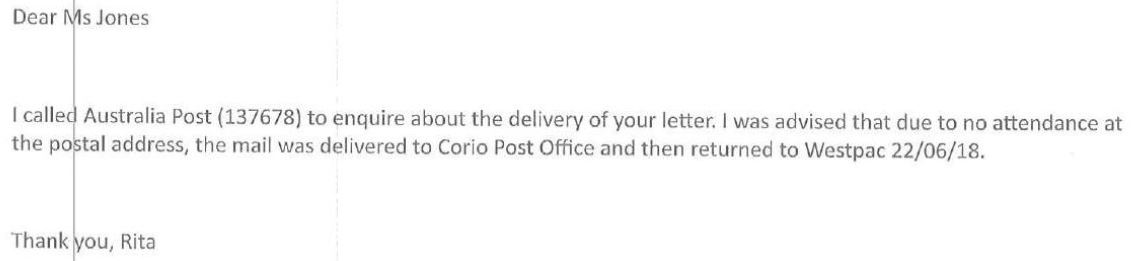
117 However at the hearing, as I have earlier observed, Ms Jones accepted that notwithstanding that she was resident in South Africa the letter informing her that Westpac was no longer able to provide Ms Jones with banking and financial services effective 28 June 2018 had been sent to an address in Australia which she had provided to Westpac for the purposes of correspondence. As Ms Davern observed, the address is identical to that which Ms Jones provided as her address for service in these proceedings.
118 Ms Jones submits however that although she was at the relevant time dealing with the Respondent’s employees “practically on a day-to-day basis”, she was never orally advised of the intended closure of her account. She further submits that a few months earlier, the Respondent had sent a card to her South African address. She submits that against those circumstances, sending the letter to the Australian address was consistent with her account having been closed on a “clandestine” basis. She submits Ms Turner breached her duty to the Court by swearing a false or misleading affidavit.
119 Counsel for the Respondent Ms Davern addressed the issue as follows:
Ms Turner does not affirm to Ms Jones receiving the letter, only that it was sent. She then affirms, in paragraph 6, that a further letter was sent on 28 June. That, again, was addressed to the same address … Whether or not Ms Jones received the letters, your Honour, is of no moment. But it’s clear that an attempt was made to inform her. There was nothing clandestine about it. And it was sent, in fact, to the address that Ms Jones maintains to this day as her address for service in this country.
120 I accept Ms Davern’s submissions in that regard.
Disposition with respect to purported application for leave to prosecute for perjury
121 In respect to each of those two asserted instances of perjury, I conclude that there is no proper basis for me to grant leave to Ms Jones to bring a private prosecution against Ms Jedlin or Ms Turner.
122 Nothing I have concluded in this matter should be understood as casting any doubt upon the genuineness of Ms Jones’ belief that she was the subject of discrimination by reason of a prohibited consideration. Whether Ms Jones would have had such a view had the bank communicated its position with greater clarity and with greater regard to the interests of its customer is not a subject for decision by this Court. The Court however notes that the Financial Ombudsman Service Australia recognised that Westpac had not appropriately investigated other matters that Ms Jones had put in dispute. It is a matter of regret that a similar observation might be made in this instance, but the jurisdiction of the Court does not extend to a remedy for such a shortfall.
I certify that the preceding one hundred and twenty-two (122) numbered paragraphs are a true copy of the Reasons for Judgment herein of the Honourable Justice Kerr. |
Associate:


