FEDERAL COURT OF AUSTRALIA
CAV18 v Minister for Home Affairs [2020] FCA 173
ORDERS
Appellant | ||
AND: | First Respondent ADMINISTRATIVE APPEALS TRIBUNAL Second Respondent | |
DATE OF ORDER: |
BY CONSENT, THE COURT ORDERS THAT:
2. Orders 2 and 3 made by the Federal Circuit Court of Australia on 11 July 2019 be set aside and in lieu thereof:
(1) The decision of the second respondent made on 27 March 2018 (AAT case number 1732691) be quashed.
(2) The matter be remitted to the second respondent requiring it to determine according to law the Application for Review made by the appellant on 22 December 2017 upon the basis that it has jurisdiction to do so.
(3) The first respondent pay such costs as the appellant is entitled to as a self-represented litigant.
3. The first respondent pay such costs of the Appeal to this Court as the appellant is entitled to as a self-represented litigant.
AND THE COURT ORDERS THAT:
4. The copy letter dated 3 February 2017 from the Department of Immigration and Border Protection to the visa applicant later identified as DFQ17 be marked as Exhibit 1.
5. The copy letter dated 21 April 2017 from the Department of Immigration and Border Protection to the visa applicant Gohar Ali be marked as Exhibit 2.
6. The copy letter dated 9 January 2018 from the Department of Immigration and Border Protection to the visa applicant later identified as BMY18 be marked as Exhibit 3.
Note: Entry of orders is dealt with in Rule 39.32 of the Federal Court Rules 2011.
FOSTER J:
1 The appellant appeals from a judgment of the Federal Circuit Court of Australia (the Circuit Court) dismissing his application for judicial review of a decision of the Administrative Appeals Tribunal (the Tribunal): CAV18 v Minister for Immigration, Citizenship, Migrant Services and Multicultural Affairs [2019] FCCA 1921. The Tribunal had determined that it did not have jurisdiction in relation to the appellant’s Application for Review.
2 The appellant is a Chinese national who was born in July 1970. He first arrived in Australia on 27 December 2016 on a Visitor (Class 600) visa. On 23 February 2017, the appellant applied for a Protection (subclass XA866) Permanent Protection visa under s 65 of the Migration Act 1958 (Cth) (the Act). On 9 May 2017, a delegate of the Minister for Immigration (the Minister), who is the first respondent in this proceeding, refused that visa application.
3 On 22 December 2017, the appellant applied to the Tribunal for a review of the delegate’s decision. On 19 February 2018, the Tribunal wrote to the appellant advising him that his Review Application did not appear to have been lodged within the relevant time period. The appellant was asked to comment by 5 March 2018. No response to that invitation to comment was ever received by the Tribunal.
4 On 27 March 2018, the Tribunal concluded that it did not have jurisdiction to conduct the review sought by the appellant because his Review Application had not been lodged within the requisite 28 day time period from 9 May 2017 as specified in r 4.31(2) of the Migration Regulations 1994 (Cth). The 28 day time period had actually expired on 5 June 2017. Accordingly, the Tribunal held that it had no jurisdiction to hear the matter.
5 By Application for Judicial Review dated 23 April 2018 and filed by the appellant in the Circuit Court on 9 May 2018, the appellant sought judicial review of the Tribunal’s decision. The grounds which the appellant set out in his Application in the Circuit Court were expressed as follows:
1. I was not notified of the decision for my application for protection visa.
2. I didn’t received the letter by post.
3. AAT made a mistake to say it has no jurisdiction in this matter.
6 On 6 January 2020, the Minister’s solicitor emailed to the Court proposed Consent Orders (Proposed Orders) that had the effect of allowing the appeal and granting consequential relief upon the basis that the notification letter dated 9 May 2017 sent by the Department of Immigration and Border Protection to the appellant did not meet the requirements of s 66(2)(d)(ii) of the Act because it failed to state with clarity the fact that the appellant had a right of review in the Tribunal and the time limit within which that right must be exercised. The parties relied upon two authorities of the Full Court: DFQ17 v Minister for Immigration and Border Protection [2019] FCAFC 64 (DFQ17) and BMY18 v Minister for Home Affairs [2019] FCAFC 189 (BMY18).
7 By email sent by a Registrar at my direction on 13 January 2020, the parties were informed that I was not minded to make the Proposed Orders in Chambers and that I required further assistance. I also sought from the Minister a copy of the notification letters and, as appropriate, any accompanying emails which had been under consideration by the Full Court in DFQ17 and in BMY18. I made a similar request in respect of a notification letter under consideration in a third case, Ali v Minister for Home Affairs [2019] FCA 1102 (Ali) which is a judgment of Nicholas J. A number of issues were raised in the Court’s email dated 13 January 2020 which I directed the parties to address in Written Submissions.
8 The appellant filed no Written Submissions in response to the Court’s email but the Minister filed a most helpful Written Submission dated 5 February 2020.
9 The appeal hearing proceeded in accordance with the original timetabling directed by the Court. When the matter was called on for hearing, the appellant made no oral submissions of substance, simply informing me that he was “in the hands of the Court”. Counsel for the Minister supplemented the Minister’s Written Submissions with short oral submissions.
The Primary Judgment
10 The primary judge held that the appellant had provided to the Department an email address as his nominated contact address and that the notification letter dated 9 May 2017 had been sent to that address.
11 At [11]–[13] of his Honour’s Reasons for Judgment, the primary judge said:
The Tribunal has no jurisdiction, unlike this Court, to extend the time period for the filing of an application. The 28 day time period expired on 5 June 2017. Accordingly, I am satisfied that the applicant was lawfully advised via email of the delegate’s decision and that the time period commenced on 9 May 2017 had expired at midnight on 5 June 2017. The application to the Tribunal was not filed until 22 December 2017, some seven months after the decision of the delegate to refuse the visa. Accordingly, Ground 1 and 3 cannot be made out.
Ground 2 cannot be made out because there was no requirement for the delegate’s decision letter to be sent by post. As there was no capacity for the Tribunal to extend the time period, the Tribunal made a lawful decision in relation to the dismissal of the application as out of time. No jurisdictional error has been made out. It has been brought to my attention by the first respondent that the issues in DFQ17 v Minister for Immigration and Border Protection [2019] FCAFC 64 per Rares, Perram and Farrell JJ, do not apply in this matter, as the electronic notification included the following words (see Court book 57):
‘As this letter was sent to you by email, you are taken to have received it at the end of the day it was transmitted.’
The letter then went on to say what the time period was for the lodgement of an appeal. It cannot be said that the applicant was not aware of the 28 day timeframe.
Conclusion
The application is dismissed.
Consideration
12 Counsel for the Minister addressed the issues raised by me in the Court’s email of 6 January 2020 under a series of issue headings. I shall proceed to consider those submissions by reference to the same headings.
Issue One: Whether the issue raised in the proposed Consent Orders was a ground of review before the Circuit Court, whether it has been raised by the appellant on appeal in this Court and, if not, whether this Court should permit it now to be raised
13 The Minister conceded that the precise underlying issue raised in the Proposed Orders (viz compliance with s 66(2)(d)(ii) of the Act) had not been expressly raised by the appellant in the Circuit Court. Notwithstanding this, the Minister submitted that it would be open for this Court to conclude that grounds 1 and 3 in the appellant’s Circuit Court Application were sufficiently broad to encompass that issue, especially given that the appellant was self-represented below and that neither DFQ17 or BMY18 had been decided at the time that the appellant filed his Application in the Circuit Court. The Minister emphasised the terms of ground 3 in the appellant’s Application in the Circuit Court and submitted that one of the Tribunal’s findings, necessary for its conclusion that it did not have jurisdiction, was that the appellant had been notified of the delegate’s decision in accordance with the statutory requirements. That finding, in substance, was that there had been compliance with s 66 of the Act. That is a finding that is, in substance, challenged by ground 3.
14 The Minister also submitted that, notwithstanding the manner in which the appellant formulated his grounds of review in the Circuit Court, the primary judge dealt with the case upon the basis that he was required to be satisfied that the appellant had been lawfully advised by email of the delegate’s decision. The primary judge then stated that he was so satisfied.
15 The Minister submitted that the Court’s task, on appeal by way of rehearing, is the correction of error by the Court below and that this Court is required to give that judgment which, in its opinion, ought to have been given in the first instance (see Minister for Immigration and Border Protection v SZVFW (2018) 264 CLR 541 at 555–557 [29]–[34] per Gageler J). The Minister went on to submit that the effect of the Full Court’s judgment in BMY18 (delivered subsequently to the primary judge’s decision in this matter) is that the fundamental finding by the primary judge underpinning his decision is wrong.
16 In this Court, the grounds of appeal raised by the appellant are:
1. AAT failed to find the mistakes made by the Minister for Immigration.
2. Federal Circuit Court didn’t overturn the decision made by AAT.
3. I should be given another fair chance as I was not correctly notified of my visa application.
17 Ground 3 specifically refers to the fact that the appellant had not been “correctly notified” of his visa application. The Minister submitted that, were the Court to take a broad view of the language deployed in that ground, the Court would be satisfied that the underlying issue concerning notification of the appellant’s review rights is fairly raised by ground 3.
18 Finally, the Minister submitted that, if the Court were not satisfied that the fundamental issue in the present case was raised in the Circuit Court and is raised in this Court, the Court has power to grant leave to the appellant to permit it to be raised now and should, in the circumstances of the present case, allow the issue to be raised now.
19 The submissions made on behalf of the Minister which I have summarised above are correct and I accept them. I think that the fundamental issue now raised concerning notification of the appellant’s review rights was encapsulated in the grounds of review relied upon by the appellant in the Circuit Court and is also covered by ground 3 in this Court. If I am not correct about this, I would give leave to the appellant to raise the issue now. In the circumstances, I do not think it is necessary to grant such leave.
Issue Two: Whether the Full Court’s decision in BMY18 is correctly decided and whether I am bound to follow it, or ought to follow it, if I consider it to have been incorrectly decided
20 The Minister did not submit that either DFQ17 or BMY18 was incorrectly decided. Rather, the Minister submitted that, notwithstanding that s 25(1AA) of the Federal Court of Australia Act 1976 (Cth) permits a single judge to exercise the appellate jurisdiction of the Court in the circumstances therein specified, a single judge exercising such appellate jurisdiction is not entitled to refuse to follow a decision of a Full Court even if that single judge considers that the Full Court’s decision is wrong. The Minister referred me to SZGME v Minister for Immigration and Citizenship (2008) 168 FCR 487 (SZGME). In that case, at 500–501 [42]–[43], Black CJ and Allsop J (as his Honour then was) said:
In coming to that conclusion, the Federal Magistrate did not accept the conclusion of the single Judge in SZECD 150 FCR 53 that Li was inconsistent with Yilmaz and should not be followed. For the reasons we have given, we have come to the same conclusion. We should observe, however, that the principles of precedent required that the Federal Magistrate follow the decision in SZECD, being a decision of this Court in the appellate jurisdiction from the Federal Magistrates Court. We do not think that it was open to her Honour to regard what was said in SZECD as obiter. In this regard the observations of Lord Simon of Glaisdale in Miliangos v George Frank (Textiles) Ltd [1976] AC 443 at 478 are apposite, though his Lordship was in dissent. His Lordship said:
It is the duty of the subordinate court to give credence and effect to the [more recent] decision of the immediately higher court, notwithstanding that it may appear to conflict with the [earlier] decision of a still higher court. The decision of the still higher must be assumed to have been correctly distinguished (or otherwise interpreted) in the decision of the immediately higher court.
See also the valuable guidance in this respect in the judgment of Moffitt P in Proctor v Jetway Aviation Pty Ltd [1984] 1 NSWLR 166, in particular at 177-180.
Before turning to the question of the exercise of discretion to withhold relief, it is also appropriate to say something about the approach taken by the single Judge in SZECD. The conclusion that a Full Court decision should not be followed should be one left to another Full Court, even if the judge is exercising the appellate jurisdiction of the Court. The Court in Li said that Yilmaz was distinguishable. That should have been sufficient for a single Judge, if the appeal were not to be referred to a Full Court for hearing.
21 In an earlier decision (SZECD v Minister for Immigration and Multicultural and Indigenous Affairs (2006) 150 FCR 53 (SZECD), a single judge sitting in the appellate jurisdiction of the Court, had held that two earlier Full Court decisions were inconsistent and that, in those circumstances, she was entitled to choose to follow that decision which she considered to be correct. In SZGME, the Full Court held that there was no inconsistency between the two cases under consideration in SZECD (Yilmaz v Minister for Immigration and Multicultural Affairs (2000) 100 FCR 495 and Minister for Immigration and Multicultural Affairs v Li (2000) 103 FCR 486) and that the single judge who decided SZECD was not entitled to decline to follow both cases. The remarks made by Black CJ and Allsop J at 500–501 [42]–[43] have to be understood in that context. Strictly speaking, they were obiter dicta.
22 Justice Lander in SZNPT v Minister for Immigration and Citizenship (2009) FCA 1408 (SZNPT) at [29] expressed the same view perhaps more strongly when he said:
The Federal Magistrate was right to conclude that those decisions meant that those grounds before him had to be dismissed. I am also bound by those same decisions even though I am sitting in the appellate jurisdiction. A judge sitting alone in the appellate jurisdiction of the Court is not entitled to refuse to follow a decision of the Full Court of this Court if that judge considers the decisions to be wrong. The point is somewhat academic here because I not only do not consider the two decisions to be wrong but, indeed, I agree with them. In those circumstances, I should follow and apply those decisions which means that those two grounds of appeal must be dismissed.
23 Before me, the Minister went on to submit that the notification letter in BMY18 was in all relevant respects in the same form as the notification letter in the present case and that I was not entitled not to follow the reasoning in BMY18 and not entitled to decline to apply that reasoning in the present case. The Minister contended that, for that reason, I should make the Proposed Orders.
24 The Minister also submitted that the proper course to be followed were the Court minded to reconsider the reasoning in BMY18 was to assemble another Full Court. The Minister made clear to me that he made no application that such a course should be adopted in the present case.
25 I do not think that the observations made by Black CJ and Allsop J in SZGME or by Lander J in SZNPT amount to a holding that a single judge sitting in the appellate jurisdiction of this Court confronted with a Full Court decision with which he or she does not agree is bound as a matter of strict precedent to follow the Full Court decision. Indeed, their Honours did not explain the jurisprudential foundation for the remarks which they made. Nonetheless, I propose to apply the dicta of Black CJ and Allsop J in SZGME and of Lander J in SZNPT. Litigants are entitled to expect, in the ordinary course, that decisions of the Full Court will be applied by single judges, even when sitting in the appellate jurisdiction of the Court.
26 In EUQ17 v Minister for Home Affairs [2018] FCA 1645, Banks-Smith J referred to SZGME and SZNPT and then observed at [19] that she would only depart from a decision of a Full Court if she were convinced that it was plainly wrong. In FPL17 v Minister for Home Affairs [2018] FCA 1766 at [13], Steward J suggested that it may be open for a single judge sitting in the appellate jurisdiction to decline to follow a Full Court decision if that judge considered that Full Court decision to be plainly wrong. I do not think that the observations made by Black CJ and Allsop J in SZGME and by Lander J in SZNPT to which I have referred at [20]–[25] above accommodate the notion that a single judge sitting in the appellate jurisdiction of this Court can decline to follow a decision of a Full Court of this Court if that judge considers that decision to be “plainly wrong”. Their Honours did not mention any such exception to the general rule.
27 In addressing Issue 2, the Minister did not need to submit that BMY18 was correctly decided as his submissions held good whether or not BMY18 was correctly decided.
Issue Three: Whether BMY18 was correctly decided
28 Section 66(1) and (2)(d) provide:
66 Notification of decision
(1) When the Minister grants or refuses to grant a visa, he or she is to notify the applicant of the decision in the prescribed way.
(2) Notification of a decision to refuse an application for a visa must:
…
(d) if the applicant has a right to have the decision reviewed under Part 5 or 7 or section 500—state:
(i) that the decision can be reviewed; and
(ii) the time in which the application for review may be made; and
(iii) who can apply for the review; and
(iv) where the application for review can be made; and
29 At [48] of DFQ17, Perram J said:
Attention may therefore be confined to the first two steps. One starts with the meaning to be given the word ‘state’ in s 66(2)(d)(ii). The relevant principles of statutory construction are set out above at [31]. The legislative context of the word ‘state’ in s 66 was considered by Allsop J in Zhan. In that case Allsop J was concerned with s 66(2)(d)(iv) which required the notification to ‘state... where the application for review can be made’. The letter in Zhan relevantly said:
…
30 As Perram J noted at [49] in DFQ17, the question in Zhan v Minister for Immigration and Multicultural and Indigenous Affairs (2003) 128 FCR 469 (Zhan) was whether the letter in that case sufficiently stated where the review application could be made when it did not provide any address for the Tribunal. Justice Allsop in Zhan held that complete information as to the place where the review application could be lodged needed to be provided.
31 At [51]–[62], Perram J continued:
It has been said that ‘the evident purpose of the provisions of s 66(2)… is to ensure that the legislative scheme in relation to rights of review of decisions operates fairly’ (Chan at 320 [45] per Gray J). In a sense, that observation mirrors Allsop J’s concern that s 66(2) is be interpreted so that what is conveyed by the notification is complete information.
Neither decision quite answers the question which this case presents. Carefully read by a person skilled in reading Commonwealth regulations, the letter does disclose the information that the review application had to be made by Tuesday 13 March 2017. Both Zhan and Chan were cases, in contrast, where the information was not contained within the letter at all. They do establish, however, that the context in which word ‘state’ appears in s 66(2) suggests that it requires the provision of complete information so as to allow a fair, if strict, chance of engaging the review process.
The word ‘state’ is an ordinary English word. It is permissible in an enterprise such as the present to consult dictionary definitions but important to keep in mind the limits of the exercise. As Mason P has observed ‘[dictionaries] can illustrate usage in context, but can never enter the particular interpretive task confronting a person required to construe a particular document for a particular purpose’ (House of Peace Pty Ltd v Bankstown City Council [2000] NSWCA 44; 48 NSWLR 498 at 505 [28]). That observation was endorsed by the Full Court of this Court in Polo/Lauren Company LP v Ziliani Holdings Pty Ltd [2008] FCAFC 195; 173 FCR 266 at 273 [24].
The online Oxford English Dictionary presently defines the verb ‘state’ in a number of ways. Most relevant seem definitions 9a and 9b:
9.a. To express in speech or writing; to declare clearly, definitely, or formally (that which one believes to be true); to put forward, proclaim, assert.
9.b. To specify or quote (an amount, price, etc.).
The online Macquarie Dictionary defines it this way in definitions 18-20:
18. to declare definitely or specifically.
19. to set forth formally in speech or writing.
20. to set forth in proper or definite form.
I do not think that the OED’s definition 9b is the sense in which s 66(2) is using the word. It lacks the numerical flavour which this definition suggests. Definition 9a seems closer to the mark. So far as the Macquarie Dictionary definitions are concerned, I do not think s 66(2) is speaking in terms of something to be declared so definition 18 may be put to one side too. The most likely meaning is definition 20 but it could mean definition 19 as well. These are quite close to the OED’s definition 9a.
Regardless of which of these three definitions most comfortably fits the language of s 66(2), they all have a flavour of precision, formality or definitiveness. Those meanings are consonant, so it seems to me, with the observations made by Allsop J in Zhan as to how the scheme of the Act operates in relation to time limits. The regime creates a strict review system but requires certain critical information to be provided to an applicant. That scheme would be undermined were the information provided under s 66(2) either less than complete or less than clear.
I conclude that when s 66(2) uses the word ‘state’ it means that the notification must set out the information in each of the subsections in a way which is not only complete (as Zhan holds) but clear as well. This required the letter of 3 February 2017 annexed below clearly to convey to the Appellant that the period in which she could seek review ended on 13 March 2017.
Turning then to the letter of 3 February 2017, the question is whether it ‘states’ the time within which a review application must be made within the meaning of s 66(2). This is a question of law: Vetter v Lake Macquarie City Council [2001] HCA 12; 202 CLR 439 at 450 [24] per Gleeson CJ, Gummow and Callinan JJ. As I have explained, the question of whether the notification stated ‘the time in which the application for review may be made’ necessarily devolves to an inquiry into whether that information was clearly conveyed.
As described above, the letter referred to the time in which the application for review may be made in different sections across different pages. On page 2 of the letter under the heading ‘Review Rights’ the letter referred to the 28-day period during which the Appellant could seek review of the delegate’s refusal decision. The letter then referred to the seven working day period by which the Appellant was taken to have received the notification on page 3 under the heading ‘Financial or Case Worker Assistance’. The date of the letter was on the top left of page 1. It was from these three separate pieces of information across three pages under different headings that the Appellant, whilst remembering to double-count 14 February 2017, was expected to calculate 13 March 2017.
The Minister submitted that there was nothing misleading or erroneous about putting the statement as to the date on which the letter was taken to be received on a separate page because the period in which review may be sought was not the only matter in the letter that proceeded by reference to that date. Accordingly, it made logical drafting sense to express the deemed notification period separately from the explanation of the period in which review may be sought. Whilst that may explain the intent behind the drafting choices of the Minister, the present question is whether the letter clearly conveyed that the time in which the application for review may be made ended on 13 March 2017.
I have no doubt that in this case the letter of 3 February 2017 failed to convey clearly the information that any review application had to be made by 13 March 2017. It was piecemeal, entirely obscure and essentially incomprehensible. Consequently, the letter did not state the matter in s 66(2)(d)(ii). It was not in dispute that this meant that time had not yet commenced to run. The Tribunal erred in concluding that the review application was out of time and was therefore wrong in thinking it had no jurisdiction to entertain the review application.
32 Rares J agreed with Perram J insofar as ground 2 was concerned. Farrell J agreed with both Rares J and with Perram J.
33 In DFQ17, the Court attached the notification letter dated 3 February 2017 as Annexure A to the Court’s judgment. I now set out that letter in full:
3 February 2017
[Name and address redacted]
In reply please quote:
Client Name [Redacted]
Date of Birth [Redacted]
Date of Visa Application 07 July 2016
Application ID [Redacted]
File Number [Redacted]
Visa Application Charge Receipt Number [Redacted]
Transmission Method Post
Dear [Redacted]
Notification of refusal of application for a Protection (subclass 866) visa
This letter refers to your application for a Protection (subclass 866) visa, which was lodged at Sydney City Office on 07 July 2016.
Decision on Protection (subclass 866) visa
I wish to advise you that the application for a Protection (subclass 866) visa has been refused for the following applicant(s):
[Redacted]
After careful consideration of all the information available to me, I was not satisfied that you met the relevant criteria for the grant of this visa as set out in Australian migration law.
This application was refused because you did not satisfy subsection 36(2) of the Migration Act 1958 (the Act). That provision requires you to be a non-citizen in Australia in respect of whom Australia has protection obligations or a member of the same family unit as such a person.
The attached Decision Record provides more detailed information about this decision and the applicant(s) it applies to.
Review Rights
The department cannot consider your visa application any further. However, you are entitled to apply to the Administrative Appeals Tribunal (AAT) for a merits review of this decision.
An application for merits review of this refusal decision must be given to the AAT within the prescribed timeframe. This timeframe commences on the day on which you are taken to have been notified of this decision, and ends at the end of 28 days.
Please note that this review period is prescribed in law and an application for merits review may not be accepted after that date.
Lodging an application for merits review
Applications for merits review can be lodged online, in person, faxed or posted to any registry of the Administrative Appeals Tribunal (AAT).
Registries of the Administrative Appeals Tribunal
New South Wales Level 6 83 Clarence Street Sydney NSW 2000 | Victoria Level 10 120 Spencer Street Melbourne VIC 3000 | Queensland Level 4 119 North Quay Brisbane OLD 4000 |
South Australia (before 24 October 2016) 11th Floor 91 Grenfell Street Adelaide SA 5000 | South Australia (from 24 October 2016) Level 2 1 King William Street Adelaide SA 5000 | Western Australia Level 5 111 St Georges Terrace Perth WA 6000 |
You can lodge an application for review online at www.tribunalonline.mrt-rrt.gov.au. Alternatively, review application forms can be lodged by email to MRDivision@aat.gov.au or by fax to 02 9276 5599 or 03 8600 5801.
Further information about the merits review process is available from the AAT on the Tribunal website at www.aat.gov.au
If you apply for a merits review of the decision to the AAT and the Tribunal determines that you are not a person to whom Australia has protection obligations, a post-decision fee will be payable. If this fee is not paid, it may affect any future visa application made by you or members of your family.
Your Immigration status
When this application for a Protection (subclass 866) visa was lodged, you were granted a bridging visa to allow you to remain in Australia lawfully during the processing of the application. The details and conditions of this bridging visa were included in the Visa Application Summary or Bridging Visa Grant Notice previously provided to you. You can also check your current visa details and conditions using Visa Entitlement Verification Online (VEVO) at www.border.gov.au/Busi/Visa
Your bridging visa will cease 28 calendar days after you are taken to have received this letter, unless you are eligible to apply and make a valid application for, merits review of this decision.
Leaving Australia
If you do not hold a current visa other than your bridging visa, and you are not eligible to apply for, or do not make a valid application for merits review of this decision, then you must depart Australia by the date your bridging visa ceases. If you stay in Australia after this date (and you do not hold another visa) you will be here unlawfully. This has serious consequences including possible detention and removal from Australia.
If there are reasons why you cannot depart Australia by the time your bridging visa ceases, you should contact the department for advice and assistance as soon as possible.
Lodging another application
While you are in Australia, you can only lodge another application for a visa to allow you to remain in Australia in very limited circumstances. Refer to Form 1026i Limitations on Applications in Australia available at www.border.gov.au/Forms/ Documents/1026i.pdf
If you lodge a further valid application, you may be granted a bridging visa which will remain in effect until you are notified of a decision on that application.
Any new application will be considered on its individual merits.
Financial or case worker assistance
If you are receiving Status Resolution Support Services (SRSS), you are refused a protection visa, and you do not lodge an application for review with the AAT, you will be transitioned out of the SRSS programme within seven business days from the end of the prescribed timeframe for seeking merits review.
As this letter was mailed to an Australian address from within Australia, you are taken to have received it seven working days after the date of this letter. A working day does not include weekends or public holidays in the Australian state or territory to where this letter was posted.
Questions about this decision
The Department cannot consider your visa application any further.
lmmiAccount Bridging Visa Application Lodgement
Your lmmiAccount cannot be used to lodge further Bridging visa applications linked to this application. Applications for a bridging visa while you are seeking review of a decision must be made using Form 1005 Application for a Bridging visa.
Form 1005 is available on our website at www.border.gov.au/Forms/Documents/ 1005.pdf
Client service information
We value your compliments, complaints and suggestions. Your compliments let us know where we are performing well and your complaints help us improve our services.
Further information on our client service charter and how to make a compliment, complaint or suggestion is available at www.border.gov.au/about/contact/provide-feedback
Yours sincerely
John
Position Number: 00001896
Department of Immigration and Border Protection
34 After DFQ17 was decided, Nicholas J decided Ali. The notification letter in Ali was dated 21 April 2017. I set out that letter below:
21 April 2017
Gohar ALI
[Redacted]
In reply please quote:
Client Name Gohar ALI
Date of Birth [Redacted]
Date of Visa Application 11 April 2017
Application ID [Redacted]
File Number [Redacted]
Visa Application Charge Receipt Number [Redacted]
Transmission Method Email sent to [Redacted]
Dear Gohar ALI
Notification of refusal of application for a Medical Treatment (Visitor) (class UB) Medical Treatment (subclass 602) visa
Refused Applicant
I wish to advise you that the application for this visa has been refused on 21 April 2017 for the following applicant:
Client Name | Gohar ALI |
Date of Birth | [Redacted] |
The applicant did not satisfy the provisions of the Migration Regulations 1994.
The attached Decision Record provides detailed information about this decision as it applies to this applicant.
Review rights
The decision can be reviewed.
The Department cannot consider your visa application any further. However, you are entitled to apply to the Administrative Appeals Tribunal (AAT) for a merits review of this decision. An application for merits review of this decision must be given to the AAT within 21 calendar days after the day on which you are taken to have received this letter.
You may only seek merits review of this decision with the AAT if you are physically present in Australia at the time this application for merits review is made.
This review period is prescribed in law and an application for merits review may not be accepted after that date.
Your immigration status
During the processing of your visa application, a bridging visa was granted to you for the duration of the visa processing period. If you make a valid application for merits review of this refusal decision then that bridging visa will remain in effect during the merits review proceedings. Otherwise your bridging visa will cease 35 calendar days after the date of the decision. More information on bridging visas is at www.border.gov.au/Trav/Visi/Visi/Bridging-visas.
Leaving Australia
You must depart Australia by the date your bridging visa ceases. If you stay in Australia after the date your bridging visa ceases (and you do not hold another visa) you will be here unlawfully. This has serious consequences including possible detention and removal from Australia.
If there are reasons why you cannot depart Australia by the time your visa ceases, you should contact us for advice and assistance as soon as possible. You can call 131 881 between 8.30 am and 4.30 pm Monday to Friday or you can visit any one of the Department’s offices. Details of our office locations and opening hours are available at www.border.gov.au
Lodging another application
While you are in Australia, you can only lodge another application in very limited circumstances for a visa to allow you to remain in Australia. Refer to Form 1026i Limitations on Applications in Australia available at www.border.gov.au/Forms/ Documents/1026i.pdf
If you lodge a new application, you may be granted a bridging visa which will remain in effect until you are notified of a decision on that application.
Any new application will be considered on its individual merits.
Lodging an application for merits review
Applications for review can be lodged online, in person, faxed or posted to any registry of the Administrative Appeals Tribunal (AAT).
Registries of the Administrative Appeals Tribunal
New South Wales Level 6 83 Clarence Street Sydney NSW 2000 | Victoria Level 10 120 Spencer Street Melbourne VIC 3000 | Queensland Level 4 119 North Quay Brisbane QLD 4000 |
South Australia Level 2 1 King William Street Adelaide SA 5000 | Western Australia Level 5 111 St Georges Terrace Perth WA 6000 |
You can lodge an application for review online at www.tribunalonline.mrt-rrt.gov.au. Alternatively, review application forms can be lodged by email to MRDivision@aat.gov.au or by fax to 02 9276 5599 or 03 8600 5801.
Further information about the merits review process is available from the AAT on the Tribunal website at www.aat.gov.au
As this letter was sent to you by email, you are taken to have received it at the end of the day it was transmitted.
Questions about this decision
The Department cannot consider your visa application any further.
Visa application charge
The visa application charge which has already been paid can only be refunded in limited circumstances, regardless of the application outcome.
A receipt for your payment is available through your ImmiAccount.
ImmiAccount Bridging Visa Application Lodgement
Your ImmiAccount cannot be used to lodge further Bridging visa applications linked to this application. Applications for a bridging visa while you are seeking review of a decision must be made using Form 1005 Application for a Bridging visa.
Form 1005 is available on our website at www.border.gov.au/Forms/Documents/ 1005.pdf
Client service information
We value your compliments, complaints and suggestions. Your compliments let us know where we are performing well and your complaints help us improve our services.
Further information on our client service charter and how to make a compliment, complaint or suggestion is available at www.border.gov.au/about/contact/provide-feedback
Yours sincerely
Leonie
Position Number: 00005944
Department of Immigration and Border Protection
35 After referring to the judgment of Perram J in DFQ17 (at [58]–[59]), Nicholas J in Ali (at [24]–[32]) said the following:
In the present case the Minister has submitted that the Full Court’s decision in DFQ17 is distinguishable. I accept that submission. In my view the facts of this case are different from DFQ17. In DFQ17 Perram J considered that the information as to the time within which the relevant application had to be made in that case was (at [62]) “… piecemeal, entirely obscure and essentially incomprehensible.”
I am bound by DFQ17 and must follow it in so far as it concerns the proper construction of s 66(2)(d) of the Act. It is authority for the proposition that s 66(2)(d)(ii) requires that the relevant information (ie. the time in which the application for review may be made) must be clearly conveyed.
The letter sent to the appellant on 21 April 2017 included the following (at pages 1-2):
Review rights
The decision can be reviewed.
The Department cannot consider your visa application any further. However, you are entitled to apply to the Administrative Appeals Tribunal (AAT) for a merits review of this decision. An application for merits review of this decision must be given to the AAT within 21 calendar days after the day on which you are taken to have received this letter.
You may only seek merits review of this decision with the AAT if you are physically present in Australia at the time this application for merits review is made.
This review period is prescribed in law and an application for merits review may not be accepted after that date.
(emphasis added)
The letter described how an application for review can be lodged and included the following:
Lodging an application for merits review
Applications for review can be lodged online, in person, faxed or posted to any registry of the Administrative Appeals Tribunal (AAT).
Registries of the Administrative Appeals Tribunal
[The letter included a table setting out the addresses of the five registries]
You can lodge an application for review online at www.tribunalonline.mrt-rrt.gov.au. Alternatively, review application forms can be lodged by email to MRDivision@aat.gov.au or by fax to 02 9276 5599 or 03 8600 5801.
Further information about the merits review process is available from the AAT on the Tribunal website at www.aat.gov.au
As this letter was sent to you by email, you are taken to have received it at the end of the day it was transmitted.
(emphasis added)
The first of the emphasised statements appears on page 1 of the letter whereas the second appears on page 3. But the letter must be read as a whole and the fact that these statements appear on different pages does not mean that the relevant information is not clearly conveyed.
A person exercising a reasonable amount of care when reading the letter would understand it to convey that an application for review had to be lodged within 21 calendar days after the date the letter was emailed. In my opinion the letter provided sufficient information to facilitate the timeous lodgement of an application for review: Zhan at [66].
None of the complexities that the appellant in DFQ17 faced in determining the time in which an application for review could be made are present in this case. I find that the letter sent to the appellant by email on 21 April 2017 clearly conveyed that an application for review was required to be lodged within 21 days of the date the email was transmitted and that it complied with the relevant requirements of s 66(2)(d) of the Act.
In all the circumstances, I am satisfied that the Tribunal was correct to conclude that it did not have jurisdiction to review the Delegate’s decision for the reasons it gave and that the primary judge was correct to conclude that the application for judicial review filed by the appellant did not raise any arguable case for the relief claimed by the appellant.
The appeal will be dismissed.
36 Subsequently, on 31 October 2019, BMY18 was decided. The notification letter in that case was dated 9 January 2018. I set out that letter in full below:
9 January 2018
[Redacted]
In reply quote:
Client Name [Redacted]
Date of Birth [Redacted]
Date of Visa Application 18 July 2017
Application ID [Redacted]
File Number [Redacted]
Visa Application Charge Receipt Number [Redacted]
Transmission Method Email sent to [Redacted]
Dear [Redacted]
Notification of refusal of application for a Protection (subclass 866) visa
This letter refers to your application for a Protection (subclass 866) visa, which was lodged at Sydney City Office on 18 July 2017.
Decision on Protection (subclass 866) visa
I wish to advise you that the application for a Protection (subclass 866) visa has been refused for the following applicant(s):
[Redacted]
After careful consideration of all the information available to me, I was not satisfied that you met the relevant criteria for the grant of this visa as set out in Australian migration law.
This application was refused because you did not satisfy subsection 36(2) of the Migration Act 1958. That provision requires you to be a non–citizen in Australia in respect of whom Australia has protection obligations or a member of the same family unit as such a person.
The attached decision record provides more detailed information about this decision and the applicant(s) it applies to.
Review Rights
The department cannot consider your visa application any further. However, you are entitled to apply to the Administrative Appeals Tribunal (AAT) for a merits review of this decision. An application for merits review of this refusal decision must be given to the AAT within the prescribed timeframe. This timeframe commences on the day on which you are taken to have been notified of this decision, and ends at the end of 28 days.
Please note that this review period is prescribed in law and an application for merits review may not be accepted after that date.
Lodging an application for merits review
Applications for merits review can be lodged online, in person, faxed or posted to any registry of the Administrative Appeals Tribunal (AAT).
Online
www.aat.gov.au/apply-online
Registries of the Administrative Appeals Tribunal
New South Wales Level 6 83 Clarence Street Sydney NSW 2000 | Victoria (before 27 November 2017) Level 10 120 Spencer Street Melbourne VIC 3000 | Australian Capital Territory Level 8 14 Moore Street Canberra ACT 2601 |
South Australia Level 2 1 King William Street Adelaide SA 5000 | Victoria (from 27 November 2017) Level 4 15 William Street Melbourne VIC 3000 | Western Australia Level 13 111 St Georges Terrace Perth WA 6000 |
Tasmania 39-41 Davey Street Hobart TAS 7000 | Queensland Level 6 295 Ann Street Brisbane QLD 4000 |
Alternatively, review application forms can be lodged by email to mrdivision@aat.gov.au or by fax to 02 9276 5599 or 03 8600 5801 or 07 3361 3069. Make sure to include a copy of this letter and the attached decision record when lodging any application for review.
Further information about the merits review process is available from the AAT on the Tribunal website at www.aat.gov.au, or by telephoning 1800 228 333.
If you apply for a merits review of the decision to the AAT and the Tribunal determines that you are not a person to whom Australia has protection obligations, a post–decision fee will be payable. If this fee is not paid, it may affect any future visa application made by you or members of your family.
Your Immigration status
When this application for a Protection (subclass 866) visa was lodged, you were granted a bridging visa to allow you to remain in Australia lawfully during the processing of the application. The details and conditions of this bridging visa were included in the Visa Application Summary or Bridging Visa Grant Notice previously provided to you. You can also check your current visa details and conditions using Visa Entitlement Verification Online (VEVO) at www.border.gov.au/Busi/Visa
Your bridging visa will cease 35 calendar days after the date of the decision, unless you are eligible to apply and make a valid application for, merits review of this decision.
Leaving Australia
If you do not hold a current visa other than your bridging visa, and you are not eligible to apply for, or do not make a valid application for merits review of this decision, then you must depart Australia by the date your bridging visa ceases. If you stay in Australia after this date (and you do not hold another visa) you will be here unlawfully. This has serious consequences including possible detention and removal from Australia.
If there are reasons why you cannot depart Australia by the time your bridging visa ceases, you should contact the department for advice and assistance as soon as possible.
Lodging another application
While you are in Australia, you can only lodge another application for a visa to allow you to remain in Australia in very limited circumstances. Refer to Form 1026i Limitations on Applications in Australia available at www.border.gov.au/Forms/ Documents/1026i.pdf
If you lodge a further valid application, you may be granted a bridging visa which will remain in effect until you are notified of a decision on that application.
Any new application will be considered on its individual merits.
Financial or case worker assistance
If you are receiving Status Resolution Support Services (SRSS), you are refused a protection visa, and you do not lodge an application for review with the AAT, you will be transitioned out of the SRSS programme within seven business days from the end of the prescribed timeframe for seeking merits review.
As this letter was sent to you by email, you are taken to have received it at the end of the day it was transmitted.
Questions about this decision
We cannot consider your visa application any further.
Border Watch - report something suspicious
If someone has given you incorrect information about applying for a protection visa or if someone has applied on your behalf without your knowledge, you can report this information through the Department’s website www.border.gov.au/report
Yours sincerely
Sarah Bernadette
Position Number: 00001142
Department of Immigration and Border Protection
37 At [30]–[35] in BMY18, the Full Court said:
In DFQ17 Perram J held that in order to have ‘stated’ within the meaning of s 66(2)(d)(ii) the time within which an application for review could be made, the notification had to ‘set out the information in each of the subsections in a way which is not only complete (as [Zhan v Minister for Immigration and Multicultural and Indigenous Affairs [2003] FCA 327; 128 FCR 569] holds) but clear as well’: at [58]; Rares J at [1] and Farrell J at [67] agreeing. As Nicholas J observed in Ali v Minister for Home Affairs [2019] FCA 1102 (‘Ali’) at [25] this is the ratio decidendi of the decision. At [62] Perram J then concluded that the letter in that case did not meet that standard because it was ‘piecemeal, entirely obscure and essentially incomprehensible’. The Federal Circuit Court has on a number of occasions applied that phrase as if it were the ratio decidendi of DFQ17 so that if a notification is not ‘piecemeal, entirely obscure or essentially incomprehensible’ then the standard in s 66(2)(d)(ii) is satisfied: see, for example, Arshad v Minister for Immigration, Citizenship, Migrant Services & Multicultural Affairs [2019] FCCA 2075 at [19] where it was held that DFQ17 did not avail the applicant in that case because ‘there is nothing piecemeal, obscure or incomprehensible about the statement of the required information’. Reasoning of this kind does not involve a correct application of DFQ17.
The notification in DFQ17 was described at [60]:
… the letter referred to the time in which the application for review may be made in different sections across different pages. On page 2 of the letter under the heading ‘Review Rights’ the letter referred to the 28-day period during which the Appellant could seek review of the delegate’s refusal decision. The letter then referred to the seven working day period by which the Appellant was taken to have received the notification on page 3 under the heading ‘Financial or Case Worker Assistance’. The date of the letter was on the top left of page 1. It was from these three separate pieces of information across three pages under different headings that the Appellant, whilst remembering to double-count 14 February 2017, was expected to calculate 13 March 2017.
Was the notification in this case ‘clear’? As in DFQ17 the time when the notification was taken to have been received was located on p 3 under the heading ‘Financial or case worker assistance’ and not under the section dealing with the right to apply for a review. As in DFQ17 the calendar date of sending or transmission was located on a different page to either the section headed ‘Review Rights’ or the section headed ‘Financial or case worker assistance’. In DFQ17 the critical date was the date on the letter (since it was sent by post) which was located on p 1. In this case, the critical date was the date of the email (since the notification was transmitted as an attachment to an email). The date of the email was necessarily located outside the letter which it attached and hence even further from the section headed ‘Review Rights’. In this case, there was no difference between the date of the email and the date of the letter (which would generate it owns problems were it to occur).
The fact that the notification was sent by email does, however, remove one of the difficulties present in DFQ17. As explained in DFQ17 at [45] where a notification is sent by post it is taken to have arrived on the seventh day after the date it bears but the 28 day review application period (or 21 days for Part 5-Reviewable Decisions under s 347(1)(b)) is taken to commence on that day with the consequence that the seventh day counts twice. In consequence, the time to apply for a review is within 34 days of the date the letter bears. This is the sum of the number of days the letter is taken to arrive (7) plus the review period (28) less the fact that the review period starts on the seventh day (-1). The temptation to add 7 to 28 to get 35 must be resolutely resisted.
In contrast, where a notification is sent by email, the time to apply for a review is a 28 day period commencing on the day the email is sent; that is to say, the review must be lodged before the end of the 27th day after the email was sent. So the appeal time for notifications sent by post is 34 days and for those sent by email 27 days. Both of these are confusing, especially since a correct statement of what the regulation necessitates—using the number 28—does not feature in either outcome. But the 34 day requirement, it may accepted, is more confusing than the 27 day requirement.
Consequently, DFQ17 does not directly control this case. Be that as it may, the placing of the information as to when the notification is taken to have been received on p 3 under the incorrect heading ‘Financial or case worker assistance’ and away from the pertinent section on p 2 headed ‘Review Rights’ means that the letter was confusing and misleading. Consequently, it does not state clearly the matter required by s 66(2)(d)(ii).
38 At [36], the Full Court distinguished Ali, in part, because the statement that the email in question in that case was taken to have been received on the day it was transmitted was correctly located under the heading “Lodging an Application for Review”. Placing the statement there was considered to have been sensible. The Court then said:
In general, where the information as to when the notification is taken to have been received is located in the notification away from the section dealing with review rights and under an incorrect heading, there is likely to be a problem and that problem is not solved merely because it was sent by email.
39 At [37], the Court continued as follows:
On the other hand, where the information as to when the notification is correctly located under a sensible heading having a connection with the exercise of review rights it is likely that the notification will be clear in the requisite sense, as Ali holds. Although what the regulation requires by way of time limits is very poorly drafted, we would not hold that an accurate statement of what the regulations require is unclear just because the regulation itself is. Nor would we hold that the obligation can only be discharged by nominating an actual date although this would certainly be a far better outcome for all concerned. But we would emphasise that clarity is not demonstrated just because the reader can put all the pieces together and arrive at the correct answer. Another way of putting this is the standard of clarity is not achieved merely because the letter is formally correct: a document may be correct without being clear, as anyone who reads the output of ultimate appellate courts will attest. For example, if a notification informs its recipient of the time within which a review application must be made by means of integers of correct information scattered in a disconnected manner over several pages but which can be assembled into the correct answer, then the notification will be clear in the way that a jig-saw puzzle is. So too, where the correct information is included under a heading which is apt to suggest that the information following it has nothing to do with review rights then this will be confusing. It is trivial that that which is confusing is not clear.
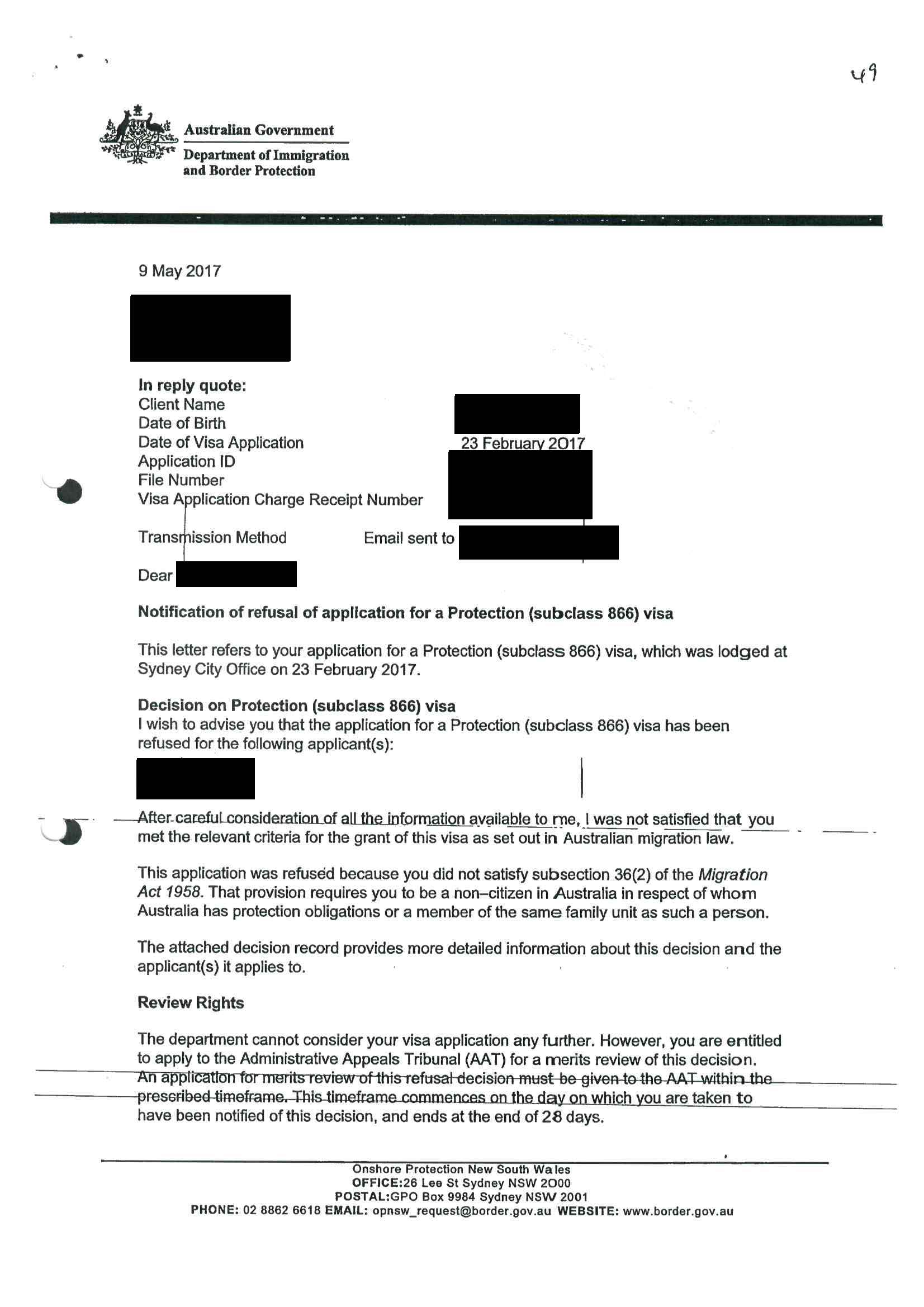
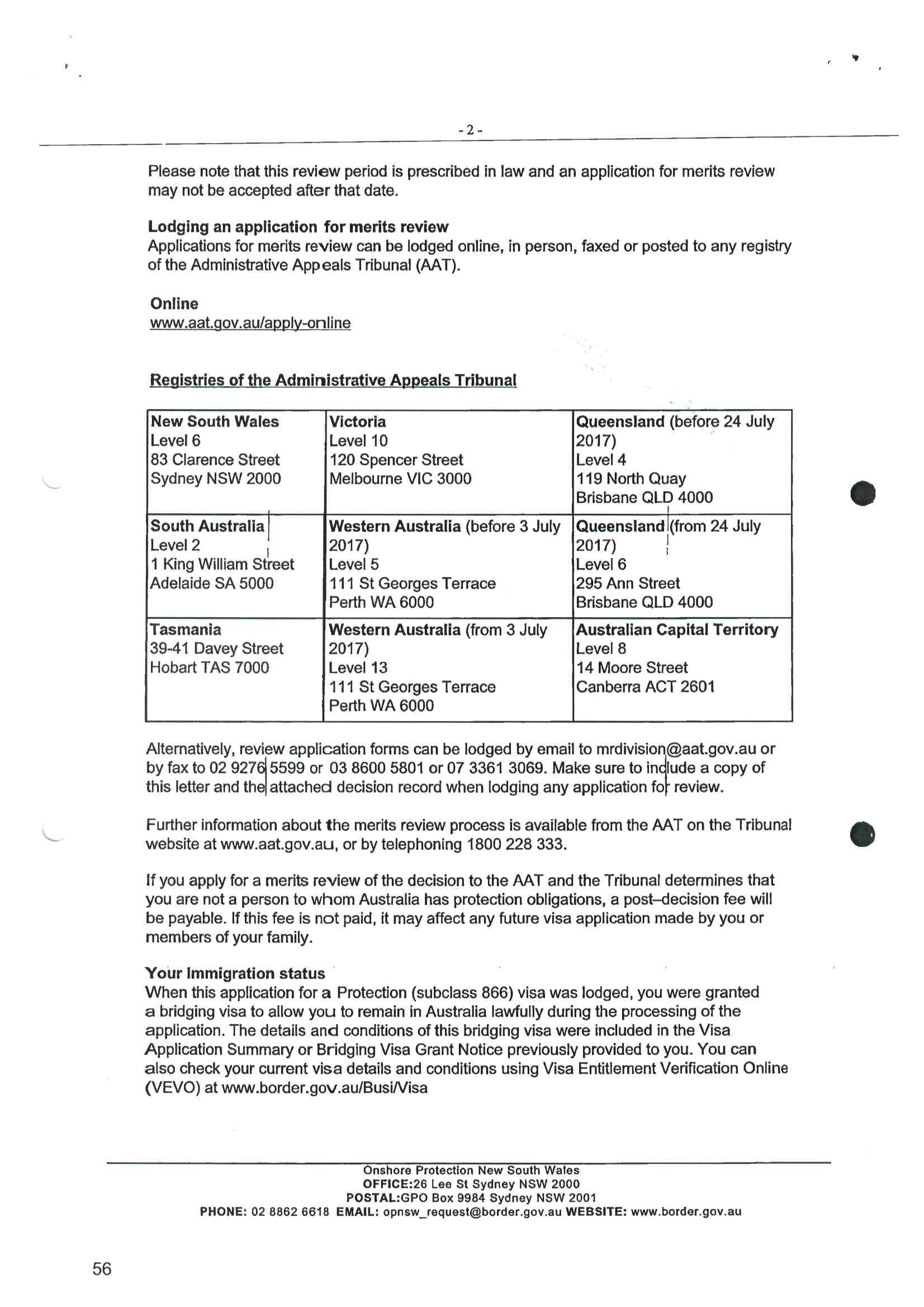
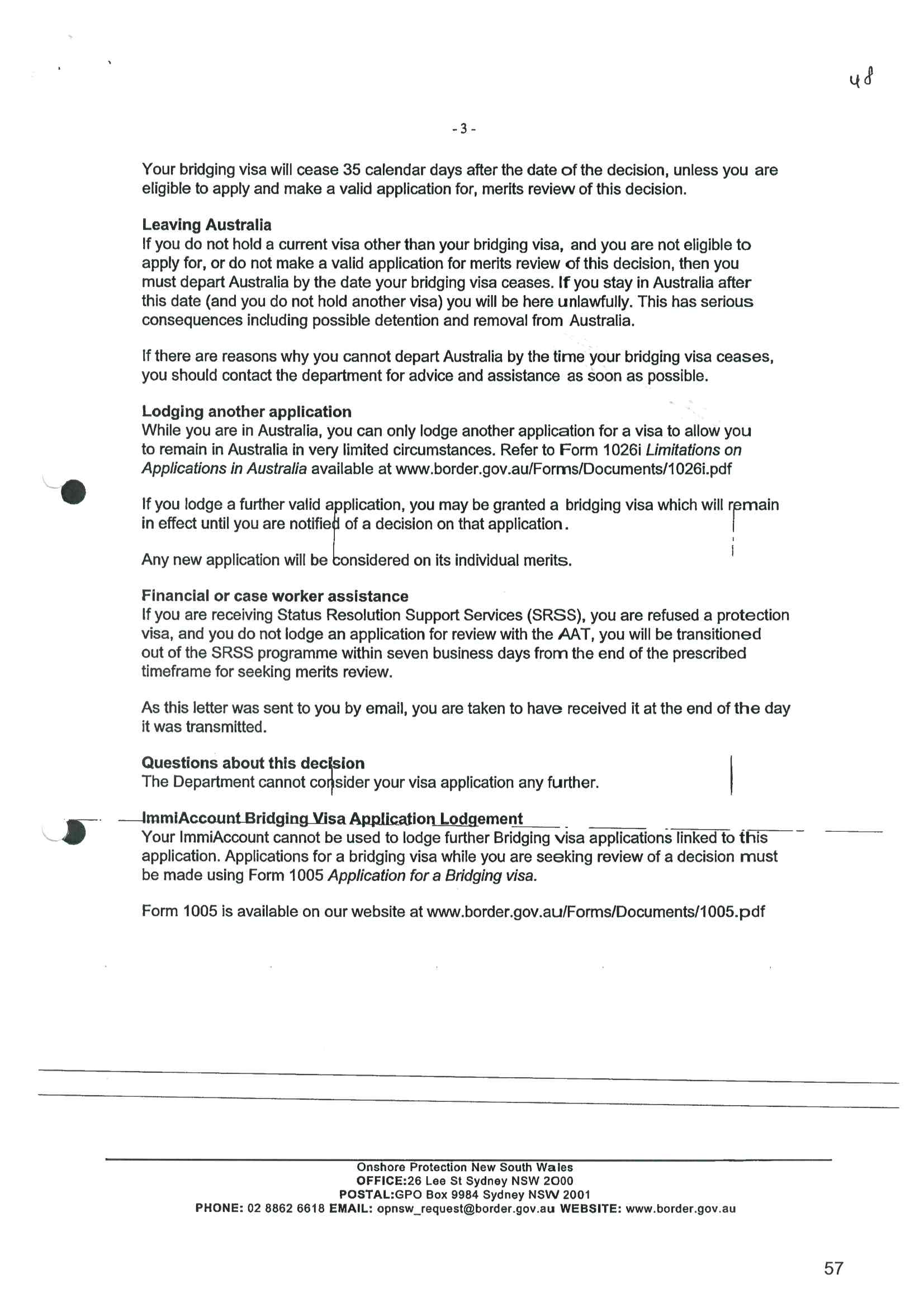
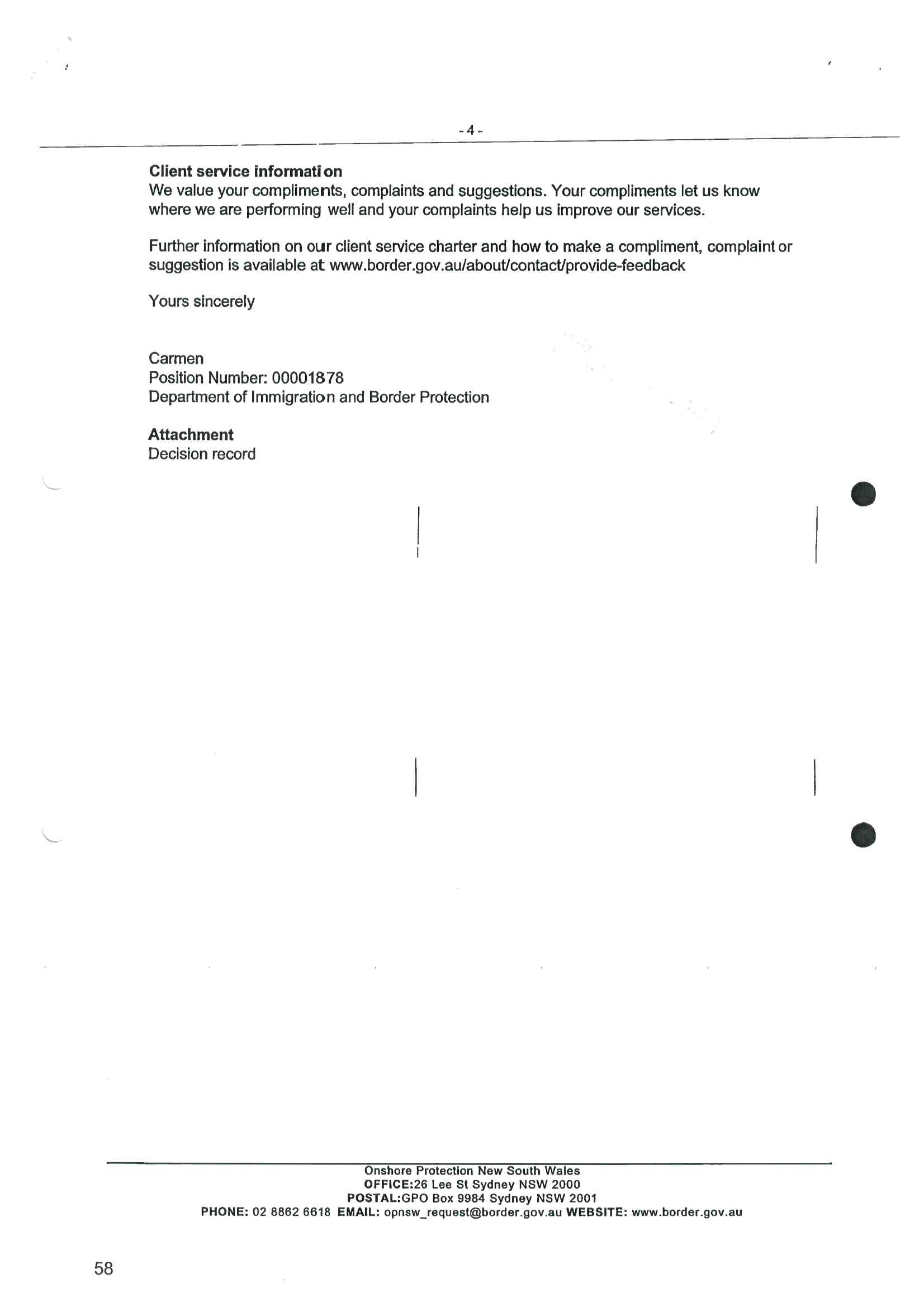
40 In the present case, the Minister submitted (correctly) that the form of the notification letter sent to the appellant on 9 May 2017 is indistinguishable from the letter under consideration in BMY18. It is also substantially the same as the letter under consideration in DFQ17. I have attached a redacted copy of the 9 May 2017 letter as Attachment A to these Reasons for Judgment.
41 In both DFQ17 and BMY18, the Full Court held that the two critical statements concerning the relevant visa applicant’s review rights (namely that the applicant had such review rights and needed to exercise them within a specified time and that the time would run from the date when the communication was sent in the case of emails or from some other date to be calculated in the case of correspondence) were separated by text within the relevant notification letters and that the second relevant statement was misleadingly located under a heading “Financial or case work assistance”. Both Full Courts held that these circumstances rendered the requisite statutory communication of the visa applicant’s review rights unclear and non-compliant with the requirements of s 66(2)(d)(ii) of the Act.
42 The notification letter in Ali differs from the other letters. The material under the heading “Review rights” on pp 1 and 2 of the letter is substantially the same as the material under that heading in the letters in the other matters.
43 The statement that, because the letter had been sent to Mr Ali by email, he would be taken to have received it at the end of the day it was transmitted appears on page 3 under the overall heading “Lodging an application for merits review”. Thus, in the Ali notification letter, there is a separation between the statement that the recipient could seek merits review within 21 calendar days after the day on which the recipient is taken to have received the letter and the further statement that he will be taken to have received the letter at the end of the day it was transmitted. The essential difference between the notification in Ali and the notification in DFQ17, BYM18 and in the present case is that the second statement in those cases appears under a heading on page 3 “Financial or case worker assistance”.
44 In the notification letters under consideration in DFQ17 and BMY18, the material under the heading “Financial or case worker assistance” is not entirely disconnected from the communication of the fact that the recipient of the letter has a right to seek merits review. In fact, the right to seek merits review is specifically referred to in the last few words of the first paragraph under that heading which, of course, appears in the letter immediately before the statement to the following effect:
As this letter was sent to you by email, you are taken to have received it at the end of the day it was transmitted.
45 In my opinion, the decision in Ali does not sit comfortably with the decisions in DFQ17 and BMY18. In Ali, Nicholas J ultimately held that the notification of the right to seek merits review and the timeframe within which to do so were stated clearly enough and would have been noted and understood by a person reading the letter with appropriate care. I think that his Honour’s conclusion was correct. After all, the Court is entitled to assume that persons receiving a serious letter of the kind in question in the present case and under consideration in the other cases, will read that letter very carefully and, to the extent that that person requires translator assistance to overcome any language difficulty, that person will seek such assistance.
46 Whilst I do not doubt that the notification letter required by the Act and the Regulations must state the information set forth in s 66(2)(d)(ii) in such manner as can be understood by a person reading the letter with appropriate care, with great respect to the Full Courts in DFQ17 and BMY18, I do not agree that the letters in question in those cases and the letter in question in the present case failed to state that information as required by s 66(2)(d)(ii). It is true that the letters were clumsily drafted and could have been expressed with greater clarity. However, in my view, that is not to the point. The question is whether or not the relevant information has been stated as required by s 66(2)(d)(ii). For the reasons which I have endeavoured to explain, I think that the information was so stated.
47 However, as I have already accepted, notwithstanding my disagreement with the reasoning and the result in DFQ17 (on the point of interest here) and BMY18 in relation to the requirements of s 66(2)(d)(ii), I accept that I am not entitled to decline to follow those cases and therefore will do so in the present case. This necessarily means that I will make the Proposed Orders.
Issue Four: Whether, in all the circumstances of the case and on the assumption that BMY18 must be applied, the appropriate remedy is to make the Consent Orders
48 The Minister submitted that I should make the Proposed Orders. I intend to do so. Pursuant to those Orders, I am asked to allow the appeal, to quash the Tribunal’s decision dated 27 March 2018 and to remit the matter the matter to the Tribunal to be determined according to law.
Conclusion
49 For all of the above reasons, I will make orders substantially in the form of the Proposed Orders.
I certify that the preceding forty-nine (49) numbered paragraphs are a true copy of the Reasons for Judgment herein of the Honourable Justice Foster. |
Associate:
Attachment A