

FEDERAL COURT OF AUSTRALIA
Rose v Essential Energy [2020] FCA 124
ORDERS
Prospective First Applicant SUSAN ELIZABETH ROSE Prospective Second Applicant | ||
AND: | ESSENTIAL ENERGY ABN 37 428 185 226 Prospective Respondent | |
DATE OF ORDER: |
THE COURT ORDERS THAT:
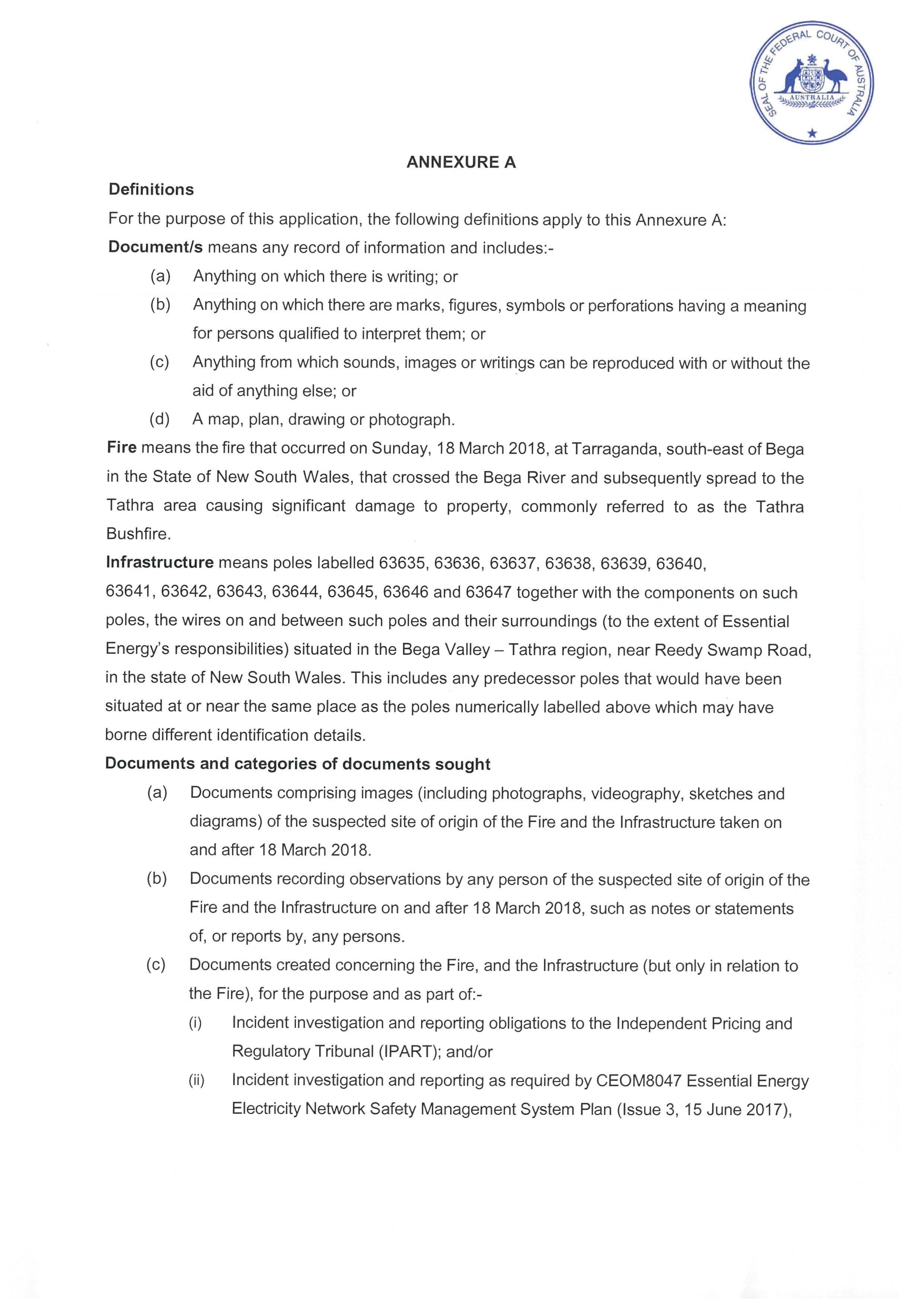
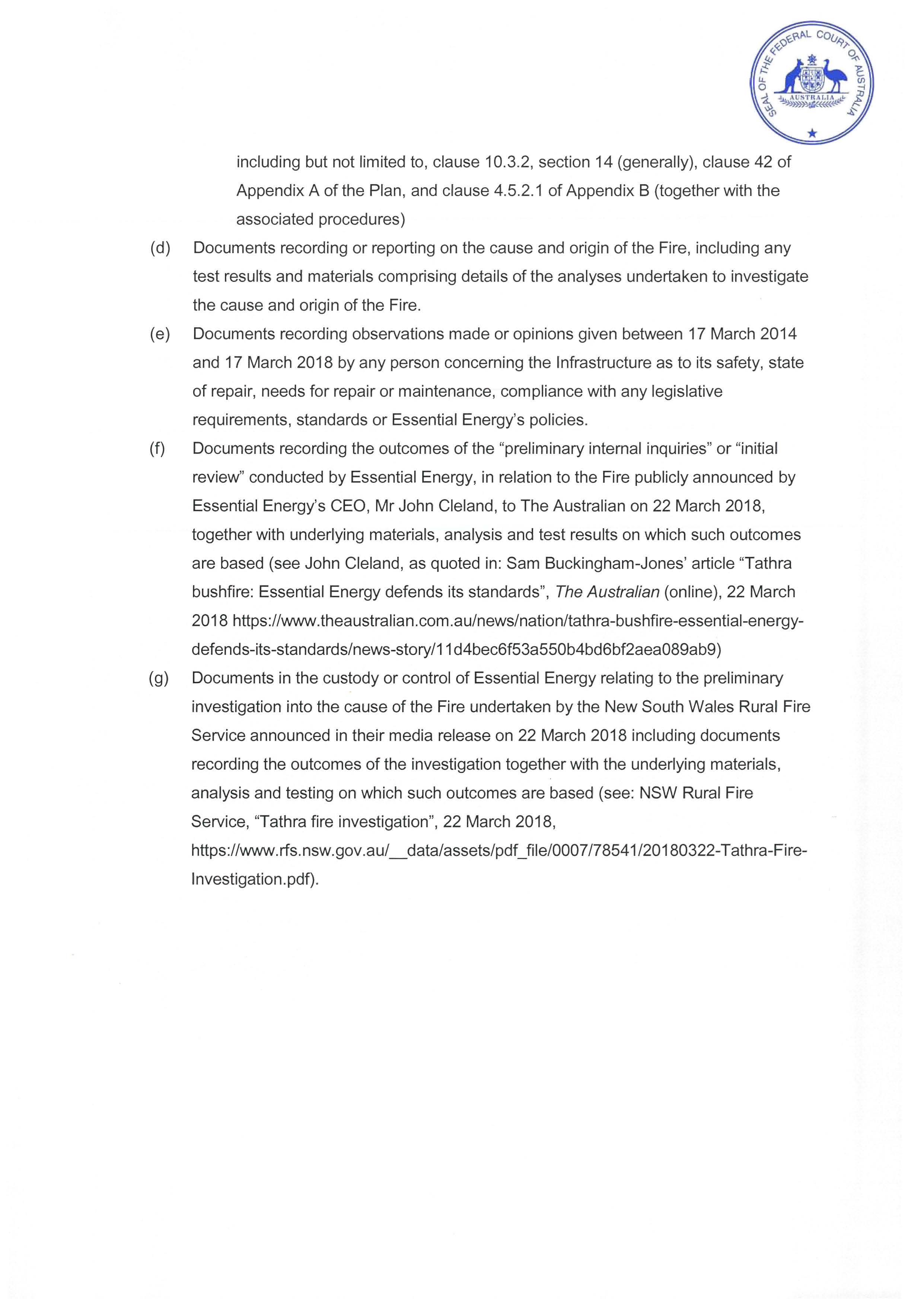
1. Pursuant to r 7.23 of the Federal Court Rules 2011 (Cth) (Rules) the prospective respondent give discovery to the prospective applicants of the documents and categories of documents identified in Annexure A to these Orders.
2. Pursuant to r 7.25 of the Rules the prospective respondent file and serve on the prospective applicants a list of documents in accordance with r 20.17 of the Rules on a date to be determined by agreement between the parties or, if the parties cannot agree, by the Court. If the parties cannot agree, liberty is given to any party to relist the matter on two days’ notice for determination of the date on which the list of documents is to be filed and served.
3. The parties are to agree on the dates for and manner of inspection of the discovered documents. If the parties cannot agree, liberty is given to any party to relist the matter on two days’ notice for further orders concerning inspection.
4. Within seven days of the date of these Orders the prospective applicants are to file and serve any submissions, not exceeding four pages in length, in relation to the question of the costs of the provision of the discovery the subject of Order 1 and of this application.
5. Within 14 days of the date of these Orders the prospective respondent is to file and serve its submissions, not exceeding four pages in length, in relation to the question of costs of the provision of the discovery the subject of Order 1 and of this application.
6. If neither party requests that there be an oral hearing, the question of costs of the provision of the discovery the subject of Order 1 and of this application will be determined on the papers.
Note: Entry of orders is dealt with in Rule 39.32 of the Federal Court Rules 2011.
MARKOVIC J:
1 This is an application for preliminary discovery pursuant to r 7.23 of the Federal Court Rules 2011 (Rules). That rule provides that:
(1) A prospective applicant may apply to the Court for an order under subrule (2) if the prospective applicant:
(a) reasonably believes that the prospective applicant may have the right to obtain relief in the Court from a prospective respondent whose description has been ascertained; and
(b) after making reasonable inquiries, does not have sufficient information to decide whether to start a proceeding in the Court to obtain that relief; and
(c) reasonably believes that:
(i) the prospective respondent has or is likely to have or has had or is likely to have had in the prospective respondent’s control documents directly relevant to the question whether the prospective applicant has a right to obtain the relief; and
(ii) inspection of the documents by the prospective applicant would assist in making the decision.
(2) If the Court is satisfied about matters mentioned in subrule (1), the Court may order the prospective respondent to give discovery to the prospective applicant of the documents of the kind mentioned in subparagraph (1)(c)(i).
2 The prospective applicants are Lawrence James Rose and Susan Elizabeth Rose. The prospective respondent is Essential Energy (Essential).
3 Mr and Mrs Rose own land, together with dwellings, fixtures and chattels, at Tathra, New South Wales which was damaged by a bushfire that ignited on 18 March 2018 near, and spread to, Tathra (Tathra Bushfire). As a result of the Tathra Bushfire Mr and Mrs Rose suffered losses which are described more fully below.
4 Essential is a statutory state owned corporation created pursuant to s 7 of the Energy Services Corporations Act 1995 (NSW) (ESC Act) and is a provider of electricity, including in and around Tathra.
5 In Annexure A to their originating application Mr and Mrs Rose seek discovery of the following documents:
(a) Documents comprising images (including photographs, videography, sketches and diagrams) of the suspected site of origin of the Fire and the Infrastructure taken on and after 18 March 2018.
(b) Documents recording observations by any person of the suspected site of origin of the Fire and the Infrastructure on and after 18 March 2018, such as notes or statements of, or reports by, any persons.
(c) Documents created concerning the Fire, and the Infrastructure (but only in relation to the Fire), for the purpose and as part of:-
(i) Incident investigation and reporting obligations to the Independent Pricing and Regulatory Tribunal (IPART); and/or
(ii) Incident investigation and reporting as required by CEOM8047 Essential Energy Electricity Network Safety Management System Plan (Issue 3, 15 June 2017), including but not limited to, clause 10.3.2, section 14 (generally), clause 42 of Appendix A of the Plan, and clause 4.5.2.1 of Appendix B (together with the associated procedures).
(d) Documents recording or reporting on the cause and origin of the Fire, including any test results and materials comprising details of the analyses undertaken to investigate the cause and origin of the Fire.
(e) Documents recording observations made or opinions given between 17 March 2014 and 17 March 2018 by any person concerning the Infrastructure as to its safety, state of repair, needs for repair or maintenance, compliance with any legislative requirements, standards or Essential Energy’s policies.
(f) Documents recording the outcomes of the “preliminary internal inquiries” or “initial review’’ conducted by Essential Energy, in relation to the Fire publicly announced by Essential Energy’s CEO, Mr John Cleland, to The Australian on 22 March 2018, together with underlying materials, analysis and test results on which such outcomes are based (see John Cleland, as quoted in: Sam Buckingham-Jones’ article “Tathra bushfire: Essential Energy defends its standards”, The Australian (online), 22 March 2018 https://www.theaustralian.com.au/news/nation/tathra-bushfire-essential-energydefends-its-standards/news-story/11d4bec6f53a550b4bd6bf2aea089ab9).
(g) Documents in the custody or control of Essential Energy relating to the preliminary investigation into the cause of the Fire undertaken by the New South Wales Rural Fire Service announced in their media release on 22 March 2018 including documents recording the outcomes of the investigation together with the underlying materials, analysis and testing on which such outcomes are based (see: NSW Rural Fire Service, “Tathra fire investigation”, 22 March 2018, https://www.rfs.nsw.gov.au/_data/assets/pdf_file/0007/78541/20180322-Tathra-FireInvestigation.pdf).
6 Mr and Mrs Rose contend that those documents are necessary to decide whether to bring proceedings against Essential in relation to the Tathra Bushfire. Those proceedings, if brought, are intended to be in the form of a representative proceeding under Pt IVA of the Federal Court of Australia Act 1976 (Cth) (Federal Court Act).
7 Essential opposes the application contending that Mr and Mrs Rose have failed to establish that they meet the requirements of r 7.23(1)(a) and (b) of the Rules.
EVIDENCE
8 Mr and Mrs Rose relied on three affidavits sworn by Blagoj (Bill) Petrovski, a principal of their solicitors, William Roberts Lawyers, on 18 October 2018, 16 November 2018 and 5 February 2019 and an affidavit sworn by Anthony Mangafas, a solicitor in the employ of William Roberts Lawyers, on 29 January 2019.
9 Essential relied on three affidavits sworn by Christopher Donald Wood, a partner of Sparke Helmore Lawyers, who are its solicitors, on 9 January 2019, 28 February 2019 and 1 March 2019.
The parties
10 Mr and Mrs Rose are the registered proprietors of lots 128 and 129 in deposited plan 78638 at Tathra being 23-25 Ocean View Terrace Tathra, New South Wales (Land). Mr Petrovski has been informed by Mr Rose that:
(1) in or about 1990 he built a residential dwelling on the Land which, prior to and as at 18 March 2018, was Mr and Mrs Rose’s primary residence (Primary Residence);
(2) there is also a residential dual occupancy dwelling situated on the Land which, prior to and as at 18 March 2018, was leased to tenants; and
(3) as at 18 March 2018 there were other fixtures and chattels situated on the Land,
(collectively, Property).
11 Mr Petrovski has also been informed by Mr Rose that:
(1) the initial connection of the electricity distribution network to the Primary Residence was arranged by Mr and Mrs Rose and occurred in or about 1990 when the Primary Residence was built;
(2) the connection and supply of electricity to the Property has been continuous since that time;
(3) Mr Rose has not been able to locate a copy of any application or contractual documents concerning the initial connection of the Primary Residence to the electricity distribution supply. If Mr and Mrs Rose did retain a copy prior to 18 March 2018 it would have been in the Primary Residence and burnt as a result of the Tathra Bushfire;
(4) Mr Rose has lived in the Primary Residence since it was built with Mrs Rose and their son Richard J Rose;
(5) the electricity retailer for the Property as at the date of the Tathra Bushfire was Origin Energy Electricity Limited (Origin). In about August or September 2016 Mr and Mrs Rose made arrangements to switch to Origin and arranged with Origin for the retail account to be in their son’s name. Prior to switching to Origin, all accounts with Origin’s predecessors were in Mr and Mrs Rose’s name. Mr and Mrs Rose have paid Origin’s charges since that time as they had done with such charges for Origin’s predecessors; and
(6) at no time from when the Primary Residence was built on the Land, was there ever any electricity generating device connected to what was at 18 October 2018 Essential’s electricity distribution system.
12 Essential is subject to a number of legislative instruments and standards which vest powers and impose obligations on it including the:
(1) ESC Act;
(2) Electricity Supply Act 1995 (NSW);
(3) Electricity Supply (Safety and Network Management) Regulation 2014 (NSW) (ES Regulation); and
(4) Australian Standard – Electricity network safety management systems AS-5577-2013,
(collectively, Relevant Legislative Instruments).
13 According to Mr Petrovski Essential has implemented a collection of strategies, policies and procedures in relation to the safety and management of its electricity network, the investigation and reporting of incidents involving its network and the application of the Relevant Legislative Instruments. Mr Petrovski referred to a number of documents published by Essential which demonstrated the implementation of such strategies, policies and procedures including:
(1) Essential’s annual report for the year ended 30 June 2017 which includes a statement under the heading “Bushfire risk management” that Essential “has in place a range of measures to minimise the risk of bushfires across the network, including managing operations in a safe and responsible manner to reduce the likelihood of bushfires, engaging with relevant agencies and fire authorities, and implementing technologies to mitigate this risk”;
(2) a bushfire risk management plan dated 27 March 2017 which addresses, among other things, “fire start investigation and analysis”, “plan performance” and “LGA & fire agencies relationships”. Under the heading “LGA & fire agencies relationships” it is noted that Essential liaises with and provides access to network assets when requested by, among others, fire agencies or other relevant state or local government emergency agencies about bushfire related issues; and
(3) an electricity network safety management system plan dated 20 June 2017 which is mandated by regs 7 and 8 of the ES Regulation and sets out, among other things, the purpose of the plan, network management including “post incident response, investigation and reporting”, network asset inspection and maintenance and environmental management including a “bushfire risk management plan”.
Information about the ignition and spread of the Tathra Bushfire
14 According to Mr Petrovski, his firm has obtained a number of documents about the ignition, place of origin, spread and damage caused by the Tathra Bushfire. I do not propose to set out all of those documents but note, by way of example, that they include:
(1) in relation to cause and origin:
(a) a New South Wales Rural Fire Service (NSW RFS) media release dated 22 March 2018 titled “Tathra fire investigation” which states:
NSW Rural Fire Service fire investigators have completed their preliminary investigation into the cause of the bush fire near Tathra on Sunday.
The investigation has found electrical infrastructure on Reedy Swamp Road as the likely cause of the fire.
This information has been provided to NSW Police which will provide a report to the Coroner, who will formally determine the cause of the fire.
(b) a document titled “Reedy Swamp Road 18/3/2018” prepared by Essential which includes:
(i) under the heading “Introduction”:
On 18 March 2018 at 12.01 PM according to the BOM, Tathra experienced high winds gusting to over 70km/h from the North-West.
Essential Energy experienced three Reclosers trips in the Tathra Bega area.
15-R216 at 12:18 on earth fault
15-R11972 at 12:19 on sensitive earth fault
15-R746 at 13:28 on over current, three-phase fault
18 March 2018 was declared as a total fire ban day (TOBAN) for a significant part of the Essential Energy network including the Tathra area (bushfire region 6 – far south coast). As a result of the TOBAN, all Reclosers within that bushfire region were set to non-auto reclose as part of the bushfire mitigation measures. This was the case 15-R216, 15-R11972 and 15-R746.
(ii) under the heading “Recloser 15-R11972 Operation”:
At 12:19:44 on the 18/3/18, Recloser 15-R11972 tripped on sensitive earth fault (SEF) with the recorded current magnitudes at the time of the trip of Max(In)=16A, A=3A, B=3A, C=18A, E=15A as shown in Figure 3. Incident number INCD-1778409-a and fault F-1451-h were raised with the recorded loss of supply to 43 customers.
The Recloser 15-R11972 is on the feeder supplying properties in and around Reedy Swamp Road. The Recloser picked up on SEF 12:19:38.249 with the trip signal sent 5.999 seconds following this and operated as designed, tripping at 6.049 seconds as shown in Figure 4. It is noted that the suspected fault location is downstream of high voltage fuses 15-F13943, however these fuses are not intended to detect lower level faults to earth. Such low-level earth fault detection is provided by Recloser 15-R11972, using SEF protection.
The protection scheme operated as designed and expected, with the primary Recloser operating to isolate the faulted network. The upstream Recloser 15-R213 also had an SEF pickup, however due to the designed protection discrimination this Recloser was not required to operate and as a result maintained supply to the unaffected area between 15-R213 and 15-R11972.
(iii) an image which marks out, among other things, the “Suspected Fault Location”:
(iv) under the heading “Conclusion”:
All protective devices worked as designed, isolating the faulted sections of the network whilst maintain supply to the unaffected area.
The fault in the portion of the network in the suspected fire ignition area in the Reedy Swamp Road vicinity was detected and isolated by Recloser 15-R11972. Due to the nature of the fault (being a low level earth fault) the designed protection scheme (SEF on 15-R11972) operated as intended.
(c) an article published by the Sydney Morning Herald online on 20 March 2018 which includes:
Meanwhile, locals have pointed to fallen powerlines as the source of the fire that burned 69 homes to the ground, saying they saw “fires under the powerlines” which were moving in “hideous” winds.
…
Jo Dodds, a councillor with the Bega Valley Shire, whose house was under threat from the blaze, said powerlines may have been the ignition source.
(d) an article titled “Rural Fire Service confirms Tathra fire caused by fallen powerlines” published by the Sydney Morning Herald online on 22 March 2018 which includes:
The investigation has found electrical infrastructure on Reedy Swamp Road as the likely cause of the fire,” NSW RFS said in a statement.
…
Supplier Essential Energy said an internal review indicated its network protection equipment “activated as it is designed”, and denied claims from the ESU that it hadn’t kept maintenance of nearby vegetation up to standard.
In a statement to Fairfax Media, CEO John Cleland said Essential Energy understands “trees fell onto powerlines during the extreme weather conditions, “but the company’s specialist internal investigators had not yet been able to fully access Reedy Swamp Road to make a conclusive determination of what happened.
The RFS investigation finding confirms residents’ eyewitness reports they had seen “fires under the powerlines” that were moving under “hideous” winds.
…
The article includes a photo captioned “Aerial shot of the Reedy Swamp Rd fire ignition point. The bushfire would go on to destroy 65 homes in nearby Tathra”.
(2) in relation to the spread of the Tathra Bushfire:
(a) an extract from the NSW RFS website titled “Major Fire Updates: Advice – Reedy Swamp, Bega (Bega Valley LGA) 2018-03-19 20:27” which includes:
Current Situation
The fire started in the area of Tarraganda, to the south-east of Bega. The fire crossed the Bega River and has impacted on properties in the Tathra area.
…
Community Information
NSW RFS Building Impact Assessment teams have completed their first assessment to homes and other buildings.
At this stage, the following has been confirmed.
 69 houses destroyed
39 houses damaged
398 houses saved or not affected
30 caravans or cabins destroyed
(b) a map published by the NSW RFS on the @NSWRFS Twitter page on 19 March 2018 at 2.30 am showing the areas affected by the fire; and
(3) in relation to damage caused:
(a) a NSW RFS media release dated 21 March 2018 titled “Tathra area bush fire update” which provides:
NSW Rural Fire Service Building Impact Assessment teams have completed their assessment of the area affected by the weekend bush fire near Tathra.
The following losses are confirmed:
Reedy Swamp fire (Bega Valley)
65 houses destroyed
48 damaged
810 saved or untouched
35 caravans and cabins destroyed
The number of houses destroyed has reduced from 69 due to closer inspection of properties, particularly housing units and areas with limited access.
(b) an Insurance Council of Australia news release dated 11 April 2018 titled “Insurance Council announces Tathra bushfire forum for claims guidance” which notes that the “current insurance bill from the Tathra bushfire is $30 million, with 340 claims lodged”.
Loss and damage suffered by Mr and Mrs Rose
15 On 18 March 2018 Mr Rose was at the Property and observed flying embers from the fire outside and near the Primary Residence. Mr Rose evacuated quickly.
16 After the fire Mr Rose returned to find that the Primary Residence, together with its contents, was totally destroyed by fire and that the dual occupancy rental residence was damaged but not totally destroyed. The only item which they were able to salvage from their homes was Mrs Rose’s wedding ring which was under a fire damaged dishwasher.
17 As at 18 March 2018 Mr Rose had a home and contents insurance policy in place that covered the Property (Policy) with Westpac General Insurance Limited (Westpac). Mr Rose made a claim on the Policy for the loss and damage referred to in the preceding paragraph.
18 Mr Petrovski has been informed by Mr Rose that:
(1) MK3 Building Consultants was appointed by Westpac and provided a quote of approximately $1,947,000 to remedy the damage to the buildings component of the Property caused by the Tathra Bushfire;
(2) Mr Rose estimated his landscaping costs at approximately $100,000;
(3) Mr Rose estimated the total replacement costs for chattels damaged as a result of the Tathra Bushfire at approximately $120,000; and
(4) accordingly the estimated value of his and Mrs Rose’s loss and damage from the Tathra Bushfire is $2,167,000.
19 Mr Petrovski points out that as at the date of swearing his affidavit, 18 October 2018, the rectification work was not yet complete and thus the estimates set out in the preceding paragraph and the estimated total loss and damage may change.
20 Under the Policy Westpac paid a total sum of $1,587,613.64 for building repairs, contents and accommodation expenses for Mr and Mrs Rose’s loss and damage caused by the Tathra Bushfire, leaving a significant estimated amount of uninsured loss and damage suffered by Mr and Mrs Rose.
Funding arrangements with IMF Bentham Ltd
21 Mr and Mrs Rose have entered into a litigation funding agreement (Funding Agreement) with IMF Bentham Ltd and IMF Bentham Ltd on behalf of IMF Bentham (Fund 2) Pty Ltd and IMF Bentham (Fund 3) Pty Ltd (collectively, IMF) for the investigation of any potential action for loss and damage suffered as a result of the Tathra Bushfire, including as against Essential, and the prosecution of any meritorious action that is identified.
22 Mr Petrovski has been informed by Gavin Beardsell, an investment manager employed by IMF, that if proceedings are to be commenced against Essential to recover damages for loss caused by the Tathra Bushfire, it is Mr Beardsell’s intention to provide instructions for such proceedings to be in the form of a representative proceeding under Pt IVA of the Federal Court Act. Mr Petrovski has been informed by Mr Rose that it is Mr and Mrs Rose’s intention to be a part of such a representative proceeding.
Inquiries made on behalf of Mr and Mrs Rose
23 To date a number of inquiries have been made to obtain information on behalf of Mr and Mrs Rose. Mr Petrovski gives detailed evidence of those inquiries which I summarise below.
24 On 23 March 2018 Mr Petrovski caused an application to be made to the Commissioner of Fire and Rescue NSW seeking access to information in relation to the Tathra Bushfire under the Government Information (Public Access) Act 2009 (NSW) (GIPA Act). According to Mr Petrovski no relevant information or documents were produced. That is borne by the documents in evidence before me. In particular, in a letter dated 17 April 2018 from Fire and Rescue NSW to William Roberts Lawyers, Fire and Rescue NSW states, among other things, that all of the documents “comprise of information which is subject to ‘Judicial and prosecutorial information’ as outlined in Schedule 2, Clause 1 of the GIPA Act” and that accordingly “the entirety of the documents … will be withheld from release”.
25 On 23 March 2018 Mr Petrovski caused an application to be made to the Right to Information Officer of the New South Wales Police Force (NSW Police) seeking access to information in relation to the Tathra Bushfire under the GIPA Act. Mr Petrovski says that no relevant documents were produced. In that regard:
(1) by a notice of decision dated 27 March 2018 a review officer in the NSW Police determined that access to the information should be refused because “there is an overriding public interest against disclosing the information … as the Section 12 factors are outweighed by the need to protect the integrity of the ongoing investigation”;
(2) in response to an application for internal review made by Mr Petrovski’s firm, a notice of decision from the NSW Police dated 16 May 2018 stated, among other things, that:
Given the sensitive and serious nature of the investigation itself and the matter currently under investigation, I consider that, in light of the fact that disclosure under the Act is, in effect, disclosure to the whole world, prejudice to this investigation could be reasonably expected.
…
The refusal is designed to preserve the integrity of evidence gathering as a method of preventing contraventions or possible contraventions of the law.
…
Accordingly, as I believe that release of any information at the time when you requested the documents, would prejudice the investigation of a contravention or possible contravention of the law pursuant to Section 14 Table 2(b) of the Act.
26 On 23 March 2018 Mr Petrovski caused an application to be made to the Right to Information Officer of the NSW RFS seeking access to information in relation to the Tathra Bushfire under the GIPA Act. By notice of decision dated 4 June 2018 the authorised decision-maker for the NSW RFS determined to refuse access in full to the documents sought. The notice of decision included under the heading “Balancing the public interest test”:
I have applied the public interest test and considered the relevant public interest considerations in favour of and against disclosure of the information you have requested.
The Reedy Swamp fire was a significant fire which impacted numerous properties. It is imperative that any investigation or inquiry into the cause and origin and any other matter relating to this fire is not prejudiced by the premature release of information. Any compromise of the integrity of such an inquiry or investigation has the potential to adversely affect a large number of people, whose properties were damaged by this fire.
The advice from the NSW Police Force and NSW State Coroner is that this matter is still under investigation and the objection to the release of the requested information on this basis, therefore, adds significant weight to the consideration against disclosure.
After balancing the interests in favour of disclosure and non-disclosure, I have formed the view that the considerations against disclosure are weightier than the considerations in favour of disclosure. Accordingly, I consider that there is an overriding public interest against disclosure of documents 1-36.
27 On 23 March 2018 Mr Petrovski caused an application to be made to the Right to Information Officer of Essential seeking access to information in relation to the Tathra Bushfire under the GIPA Act (First Essential GIPA Application). The First Essential GIPA Application was amended on two occasions so that it ultimately sought the following documents in relation to the Tathra Bushfire:
2. We request copies of all documents in relation to the fire, including:
a. All reports, including but not limited to those regarding the cause and/or origin of the fire;
b. Any correspondence or documents containing information relating to the “preliminary internal inquiries” or “initial review” conducted by Essential Energy, or any other party, in relation to the fire;
c. Any correspondence;
d. Any files, file notes, statements;
e. All diagrams, drawings and topographical maps of the areas affected by the fire;
f. All images and photographs of the areas affected by the fire;
g. Any other record, including but not limited to file notes, files, statements, correspondence, purporting to detail the cause and/or origin of the fire; and
h. Work orders and service records in respect of:
I. any and all power poles; electricity poles and any other poles; or power lines, on all land (whether private or public);
II. network protection equipment; and
III. any other electrical infrastructure
from the zone substation supplying the feeder up to and including poles 63635 to 63647 inclusive (or their predecessor poles).
i. Documents relating to the operation of the protection systems, during 18 March 2018, of the feeder supplying the powerlines on power poles 63635 to 63647, inclusive (or the predecessor poles), located near Reedy Swamp Road (“Protection Systems”);
j. Documents setting out the details of the settings of the Protection Systems prevalent as at 17 and 18 March 2018 (ie prior to any operation of such Systems during 18 March 2018);
k. Documents comprising the records of maintenance of the poles and other electrical infrastructure on poles 63635 and 63647, inclusive (or their predecessor poles), from 1 March 2013 to 19 March 2018;
l. Documents comprising the records of inspection, maintenance and management (including aerial or other images) of vegetation in the inspection and clearing zones of poles 63635 and 63647, inclusive (or their predecessor poles) from 1 March 2013 to 19 March 2018. “Inspection and clearing zones” are those as defined in the Essential Energy Vegetation Management Plan CEOP8008;
m. Documents comprising geographic and schematic diagrams of the electrical infrastructure from the zone substation supplying the feeder up to and including, poles 63635 to 63647, inclusive (or their predecessor poles);
n. Documents setting out the directions and reasons for the need to replace, and the replacement of poles within the range of poles 63635 to 63647, inclusive (or their predecessor poles); and
o. Documents comprising details of the design and construction of the electrical infrastructure from poles 63635 to 63647, inclusive (or their predecessor poles). This should include stringing tensions and conductor details.
(Footnote omitted.)
28 By letter dated 2 May 2018 Markus Lutz, Essential’s Right to Information Officer, informed William Roberts Lawyers of his decision in relation to the First Essential GIPA Application including that (as written):
Under section 58(1)(a) of the GIPA Act, I have determined to provide access to the information being sought as set out below. Responses are in line with the structure of your request as set out in Attachment 1.
As you are aware Essential Energy is currently preparing material for the Coroner at the direction of a NSW Police investigation, it is my view and instruction that to release that material would prejudice those proceedings as set out below.
2. a. Essential Energy will not produce any material in response to this point. There is public interest consideration against disclosure of the information as disclosure of the information could reasonably be expected to have the effect of prejudicing court proceedings by revealing matter prepared for the purposes of or in relation to current of future proceedings.
b. Refer to 2.i through o., to the extent that the material sought is not privileged and affected by the above public interest consideration.
c. Refer to 2.i through o., to the extent that the material sought is not privileged and affected by the above public interest consideration.
d. Refer to 2.i through o., to the extent that the material sought is not privileged and affected by the above public interest consideration.
e. Essential Energy provides the diagram within Attachments “Bega Recloser Details” and “Bega Valley Protection systems”, showing the Rural Fire Service fire area overlay.
f. Essential Energy provides the images attaching to item 2l below and otherwise will not produce any material in response to this point. There is a public interest consideration against disclosure of the information as disclosure of the information could reasonably be expected to have the effect of prejudicing court proceedings by revealing matter prepared for the purposes of or in relation to current of future proceedings.
g. Essential Energy will not produce any material in response to this point. There is a public interest consideration against disclosure of the information as disclosure of the information could reasonably be expected to have the effect of prejudicing court proceedings by revealing matter prepared for the purposes of or in relation to current of future proceedings.
h. Essential Energy notes that this request provides no limitation as to a relevant time period, however, we have assumed that items i. through l. provide the appropriate limitations on your request and we have responded to those queries accordingly.
i. Essential Energy provides the material set out at Attachment “2i”, “Bega Recloser Details” and “Bega Valley Protection Systems”.
j. Essential Energy provides the material set out at Attachment “2j” and “Bega Recloser Details” and “Bega Valley Protection Systems”:
k. Essential Energy provides the material set out at Attachment “2k”.
l. Essential Energy provides the material set out at Attachment “21” and separately other aerial images.
m. Essential Energy provides the material set out at Attachments “Bega Recloser Details” and “Bega Valley Protection Systems”.
n. Essential Energy notes that this request provides no limitation as to a relevant time period, however, we have assumed for the purposes of providing a response that you refer to a period commencing from installation up to the 19 March 2018, i.e. pre-dating the fire. Essential Energy does not hold any record of any direction or reason to replace any of the subject poles during that period.
o. Essential Energy provides the material set out at Attachment “2o(1)”, “2o(2)” and “2o(3)”.
29 In summary the outcome of the First Essential GIPA Application was that Essential produced some but not all of the information sought in the First Essential GIPA Application. Copies of the information that was produced was in evidence before me.
30 On 30 May 2018 Mr Petrovski caused an application to be made to Essential’s Right to Information Officer seeking internal review of the decision made in relation to the First Essential GIPA Application. The outcome of that initial review was that some further information was provided by Essential, a copy of which was in evidence before me.
31 On 25 June 2018 Mr Petrovski caused a second application to be made to Essential’s Right to Information Officer seeking access to information in relation to the Tathra Bushfire under the GIPA Act (Second Essential GIPA Application). The Second Essential GIPA Application was subsequently amended to seek the following documents:
3. We request the following:
(a) Documents comprising ground or aerial high definition pole top photography or videography (Pole Top HD Photo or Video) and any other level of definition of photography or videography in addition to the Pole Top HD Photo or Video, of the Relevant Infrastructure and any Predecessor Infrastructure taken in the period between 1 January 2016 6 October 2015 and 17 March 2018 (inclusive).
(b) Documents comprising LIDAR scans generated in the period between 1 January 2016 to 17 March 2018 (inclusive) of the Relevant Infrastructure and any Predecessor Infrastructure, including the inspection and clearing zones around such infrastructure.
(c) Documents comprising records of inspection and maintenance (including but not limited to the installation of vibration dampeners) for the Relevant Infrastructure and any Predecessor Infrastructure created during the period 1 January 2016 6 October 2015 and 17 March 2018 (inclusive).
(d) Documents comprising the relevant final versions of the following policies, manuals or plans applicable and effective during the period 1 January 2016 to 17 March 2018 (inclusive):
(i) CECG3000.01 – Code of Conduct
(ii) CECM1000.06 – SSHE Manual: Auditing and Inspection
(iii) CECM1000.13 – HSE Manual: Bushfire Prevention & Survival
(iv) CECM1000.77 – HSE Manual: Flora & Fauna
(v) CECP0002 – Governance Policy
(vi) CECP1000 – Safety, Security, Health & Environment
(vii) CECP1004 – Asset Management Policy
(viii) CECP1021 – Risk Management
(ix) CEOF1001.01 – SSHE Manual System Audit Report Template
(x) CEOM7005 – Asset Inspection Manual
(xi) CEOM7005.08 – Operational Manual: Aerial Surveillance: Overhead Electricity Networks including Fault & Emergency Patrols
(xii) CEOM7047 – Operating Manual
(xiii) CEOM7097 – Overhead Design Manual
(xiv) CEOM7099 – Overhead Construction Manual Index
(xv) CEOM8047 – Electricity Network Safety Management System Plan
(xvi) CEOP1121 – Demand Management Strategy
(xvii) CEOP20008 – Network: Capital Expenditure
(xviii) CEOP2034 – Asset Inspection: Critical Distribution Equipment
(xix) CEOP2062 – Network Operations: Manual reclosing of overhead lines
(xx) CEOP2090 – Quality of Supply Strategy
(xxi) CEOP2091 – Distribution Growth Strategy
(xxii) CEOP2111 – Risk: Corporate Risk Management Procedure
(xxiii) CEOP2137 – Electricity Networks Escalation and Recovery Plan
(xxiv) CEOP2223 – Major Issues: Management
(xxv) CEOP2245 – Asset Refurbishment Strategy Zone Substations
(xxvi) CEOP2446 – Maintenance Strategy – Pole and Line Inspection
(xxvii) CEOP2463 – Reliability Strategy
(xxviii) CEOP8002 – High Voltage Protection Guidelines
(xxix) CEOP8007 – Mains & Distribution Field Equipment Maintenance
(xxx) CEOP8009 – Distribution Substation and Switchgear Maintenance
(xxxi) CEOP8010 – Electricity Network Asset Inspection
(xxxii) CEOP8011 – Sub-Transmission & Zone Substation: Maintenance
(xxxiii) CEOP8018 – Asset Management
(xxxiv) CEOP8019 – Capital Contributions Policy
(xxxv) CEOP8029 – Network Management Plan Chapter 1: Network Safety and Reliability
(xxxvi) CEOP8032 – Transmission & Zone Substations: Design Guidelines
(xxxvii) CEOP8042 – Networks: Asset Identification & Operational Labels
(xxxviii) CEPG8003 – Sub Transmission and Distribution Network Planning Criteria & Guidelines
(xxxix) Distribution Annual Planning Report
(xl) Electricity Supply Development Review
32 By letter dated 24 July 2018 Mr Lutz set out his decision in relation to the Second Essential GIPA Application including that:
Under section 58(1)(a) of the GIPA Act, I have determined to provide access to the information being sought as set out below. Reponses are in line with the structure of your request as set out in Attachment 1.
3. (a) I produce 3 pole top images taken on 16 March 2016.
(b) I produce 4 files that are in a format known as “las” files. These files need to be opened on a specialised program such as “Quick Terrain Reader”. As per the phone discussion with Mr Petrovski of your office on 16 July 2018, if you are unable to open them, we are prepared to arrange for you to view them at our Port Macquarie Office, at a mutually convenient time. I also produce 2 excel spreadsheets showing data that is provided by our supplier, together with a report that relates to the Bega area within which the Relevant Infrastructure is located.
(c) I produce a spreadsheet capturing our records of inspection and maintenance of the Relevant Infrastructure. Consistent with phone discussions with yourself, Mr Mangafas and Mr Petrovski of your office, I have provided for a broader date range than your request, namely 6 October 2015 to 17 March 2018, so as to demonstrate the current inspection and maintenance cycle. I have produced documents and photos associated with the records within the spreadsheet, including as to the asset inspection and the maintenance tasks. I note your reference to “vibration dampeners” and advise that the Relevant Infrastructure is not equipped with such. I have also not produced vegetation inspection and maintenance records as they were produced previously to you.
(d) I produce relevant and final versions of all the policy documents applicable in the time period requested. However, please note the annotations provided where a document has been superseded, archived or not published;
…
Save for four files that were produced in “LAS format”, the material produced by Essential in response to the Second Essential GIPA Application was in evidence before me.
33 Mr Petrovski also:
(1) caused searches to be undertaken to obtain publicly available information in relation to the ignition, place of origin and spread of the Tathra Bushfire and in relation to Essential’s relevant internal systems, procedures and matters of compliance for regulatory purposes. That information comprised various reports prepared by Essential, a report prepared by the Independent Pricing and Regulatory Tribunal of New South Wales (IPART) and various newspaper articles;
(2) obtained a copy of the Essential Energy Deemed Standard Connection Contract effective from 1 February 2019 and, with the assistance of Mr Johannes, a copy of the Essential Energy Deemed Standard Connection contract effective from 1 December 2017 (Connection Contract);
(3) obtained extracts from Essential’s website comprising pages headed “What we do”, “Summary of customer rights and obligations”, “Our Network”, “Vegetation Management” and “Bushfire Safety”; and
(4) obtained YouTube videos concerning Essential published on 27 April 2011 and 16 May 2011.
The Connection Contract
34 Central to Mr and Mrs Rose’s belief that they may have a claim for relief based on s 60 of the Australian Consumer Law being Sch 2 to the Competition and Consumer Act 2010 (Cth) (ACL) is the Connection Contract. It is therefore convenient at this point to set out some of the provisions of that contract.
35 The Connection Contract commences with a “preamble” which provides:
This contract is about the services which cover connection of your premises to our distribution system, and the energy supplied to the premises. These services are called “customer connection services”.
In addition to this contract, we are required to comply with energy laws and other consumer laws in our dealings with you.
You also have a separate contract with your retailer dealing with the sale of energy to the premises.
More information about this contract and other matters is on our website:
www.essentialenergy.com.au
36 Clause 1 sets out the parties to the Connection Contract namely, Essential, which provides “customer connection services” at the premises, and the “customer” to whom the Connection Contract applies.
37 Clause 2 is headed “definitions and interpretation” and provides that capitalised or italicised terms in the Connection Contract have the same meanings as they have in the National Energy Retail Law and the National Energy Retail Rules (Retail Rules) but that for ease of reference “a simplified explanation of some terms is given at the end of” the Connection Contract in Sch 1. That clause also provides that where the simplified explanations differ from those in the National Energy Retail Law and the Retail Rules, the definitions in the latter will prevail.
38 It is convenient to then set out some of the definitions included in Sch 1 which is titled “simplified explanation of terms” and relevantly defines:
(1) “customer connection services” to “include services relating to the flow of energy to your premises”;
(2) “energy” to mean “electricity or gas (as relevant to this contract)”;
(3) “energy laws” to mean “national and State and Territory laws and rules relating to energy and the legal instruments made under those laws and rules”;
(4) “National Energy Retail Law” to mean “the Law of that name that is applied by each participating State and Territory”;
(5) “premises” to mean “the address at which the customer connection services are provided to you and, to avoid doubt, may include your electrical or gas installation”; and
(6) “Rules” to mean “the National Energy Retail Rules made under the National Energy Retail Law”.
39 Clause 3 is headed “do these terms and conditions apply to you?” and relevantly provides:
3.1 These are our terms and conditions
This contract sets out the terms and conditions for the standard connection contract for customers under the National Energy Retail Law and the Rules.
3.2 Does this contract apply to you?
This contract applies to you if your premises are connected to our distribution system, and you do not have another customer connection contract with us for those premises.
40 Clause 5 is headed “scope of this contract” and relevantly includes:
5.1 What is covered by this contract?
(a) Under this contract we agree to provide customer connection services at the premises. We also agree to meet other obligations set out in this contract and to comply with the energy laws.
(b) Charges for customer connection services will be billed under your contract with your retailer.
…
5.3 Services and your connection point
(a) We must provide, install and maintain equipment for the provision of customer connection services at your premises safely and in accordance with the energy laws.
(b) Our obligations extend up to the connection point where energy is to be supplied to the premises (as defined by us) and not beyond.
5.4 Guaranteed service levels
(a) If you are a small customer, we are required under the laws of New South Wales to meet certain guaranteed service levels. These requirements are set out in Schedule 2. We may also be required to pay you compensation if we do not meet the reliability of supply standards prescribed by our licence.
If we do not meet a relevant guaranteed service level and you are entitled to a payment under those laws, we will make a payment to you in accordance with the relevant laws.
41 Mr Wood who, as noted above, is a partner of Sparke Helmore Lawyers, Essential’s lawyers, gives evidence about the Connection Contract, based on information provided to him by David Mattson, a long serving employee of Essential who is currently its compliance manager and who, among other things, manages the team responsible for connection contracts. Mr Wood says that:
(1) the Connection Contract was in place as at 18 March 2018;
(2) the Connection Contract is a standard term contract the terms of which are specified by the Retail Rules;
(3) Essential is a “distributor” within the meaning of the National Energy Retail Law (NSW);
(4) under s 66 of the National Energy Retail Law (NSW) Essential is obliged to provide persons in the position of Mr and Mrs Rose with “customer connection services” which are defined in s 2 of the National Energy Retail Law (NSW);
(5) the Connection Contract is formed between Essential and a customer in accordance with Div 4 of Pt 3 of the National Energy Retail Law (NSW) to dictate the terms on which Essential will provide the customer connection services;
(6) Essential does not sell the electricity to customers such as Mr and Mrs Rose. That is performed by an energy retailer which, in turn, has a separate deemed contract for that sale with the customer. The relevant retailer for Mr and Mrs Rose was Origin;
(7) historically, Essential’s predecessor entities acted as both retailer and distributor but in the early 2000s there was a separation of retail and distribution of electricity. Essential does not provide retail services; and
(8) Div 4 of Pt 3 of the National Energy Retail Law (NSW) places the obligation on distributors to bill the retailers for the provision of customer connection services. Essential does not have any direct billing relationships with customers such as Mr and Mrs Rose.
Correspondence between the parties prior to commencement of this proceeding
42 On 11 October 2018 Mr Petrovski caused a letter to be sent to Essential seeking production of the documents the subject of this application by 18 October 2018. William Roberts Lawyers stated in their letter that if the documents were not produced within the requested timeframe, they were instructed to bring an application for preliminary discovery pursuant to r 7.23 of the Rules. By letter dated 12 October 2018 Essential, through its solicitors, Sparke Helmore Lawyers, informed Mr Petrovski that based on the information provided it was not able to determine whether Mr and Mrs Rose were entitled to discovery of those documents and sought further information so that it could properly consider the request. Sparke Helmore’s letter included:
5. So that Essential Energy can consider whether your clients are entitled to receipt of the discovery of documents falling within the categories set out in the Letter, please provide the following:
5.1. Particulars in broad terms of the nature and elements to the cause(s) of action which is said to ground the claim(s) for relief which your clients consider they might be able to make against Essential Energy.
5.2. Details of all enquiries carried out to date designed to determine whether the claim(s) for relief has prospects of success (in that regard, we would appreciate it if you would kindly provide documents received in consequence of those enquiries).
5.3. Details as to the basis upon which your clients contend that provision of the Documents sought by each category set out in the Letter will assist them in either:
(a) determining whether or not they are entitled to make the claim(s) for relief articulated in response to the request posed at 5.1; or
(b) filling in evidentiary gaps in the materials provided in accordance with the request posted at 5.2.
6. For an abundance of clarity, we confirm that Essential Energy is willing to consider your clients’ request for documentation without the need for legal proceedings or unnecessary delay. However, as it holds private, privileged and commercially sensitive information, it seeks additional information from your clients so that Essential Energy can assess whether the request for documentation has been properly made before responding.
43 On 24 October 2018 Mr and Mrs Rose commenced this proceeding.
Mr and Mrs Rose’s evidence as to the sufficiency of the information obtained to date
44 Mr Petrovski says that, based upon the Relevant Legislative Instruments and the information obtained from the inquiries undertaken to date (see [23]-[33] above), Mr and Mrs Rose have been able to ascertain or infer the following matters:
(1) Essential is named as being an energy distributor in Sch 1, Pt 2 of the ESC Act;
(2) Essential is responsible for the electrical infrastructure consisting of power lines and associated equipment used for distribution of electricity situated in the Bega/Tathra region, including the electricity poles labelled 63635, 63636, 63637, 63638, 63639, 63640, 63641, 63642, 63643, 63644, 63645, 63646 and 63647 near Reedy Swamp Road, Tarraganda;
(3) the ignition point of the Tathra Bushfire may have been in the vicinity of the electricity poles between 63635 to 63647, and more specifically, may have been within the immediate vicinity of electricity pole 63639;
(4) it was the failure of the electrical infrastructure referred to in the preceding subparagraph which may be the likely cause of the Tathra Bushfire;
(5) once the fire ignited near Reedy Swamp Road, Tarraganda, the fire quickly spread in an east south-easterly direction, being fanned by strong winds, to the township of Tathra;
(6) the Tathra Bushfire caused widespread destruction to the township of Tathra;
(7) the Tathra Bushfire reached Ocean View Terrace, Tathra, and caused loss and damage to the properties within the vicinity of Ocean View Terrace, Tathra; and
(8) the Property was damaged by the Tathra Bushfire.
45 Mr Petrovski also says that based on the available information Mr Rose believes that he may have the right to obtain relief in the form of damages from Essential for the loss and damage suffered by him as a result of the Tathra Bushfire on the following bases:
(1) the ignition of the Tathra Bushfire resulted from Essential’s duty of care owed to him, i.e. a claim for negligence;
(2) Essential is responsible for the state of affairs that culminated in the ignition of the Tathra Bushfire, which caused unreasonable and substantial interference with Mr and Mrs Rose’s enjoyment and use of the Property, i.e. a claim in nuisance; and/or
(3) Essential’s failure to comply with its guarantee pursuant to s 60 of the ACL that the services Essential provided to Mr and Mrs Rose would be rendered with due care and skill (ACL Claim).
46 However according to Mr Petrovski, based on the material that is currently available to Mr and Mrs Rose (see [14]-[33] above), Mr and Mrs Rose do not have sufficient information to decide whether to start a proceeding in this Court in negligence, nuisance and/or for breach of s 60 of the ACL because they cannot ascertain:
(1) whether the inferences that have been drawn and information obtained from the available materials as to the place of origin of the Tathra Bushfire are accurate:
(2) whether the inferences that have been drawn and information obtained from the available materials that the source of ignition and cause of the Tathra Bushfire was Essential’s infrastructure are accurate;
(3) the mechanism of the ignition of the fire and the state of affairs leading to the mechanism of ignition; and
(4) whether the inferences drawn in relation to the spread and consequences of the fire are accurate,
(collectively, Further Information).
47 Mr Petrovski says that without the Further Information Mr and Mrs Rose are unable to decide whether to start a proceeding against Essential and that the documents the subject of Mr and Mrs Rose’s application for preliminary discovery relate to the Further Information. Mr Petrovski says that if the documents sought in this application are discovered and made available for inspection by Essential that would assist Mr and Mrs Rose to decide whether to start a proceeding against it.
48 Mr Petrovski is of the opinion that Essential is likely to have the documents sought by Mr and Mrs Rose in this application in its control because:
(1) Essential’s internal systems and procedures, implemented to adhere to the obligations arising from the Relevant Legislative Instruments, set out the requirements for it to investigate and report on incidents such as the Tathra Bushfire;
(2) based on its response to the First Essential GIPA Application, Essential has been preparing material relating to those documents for the New South Wales State Coroner at the direction of the NSW Police;
(3) given some of the policies and procedures adopted by Essential for the safety and management of its electricity network, Mr Petrovski expects that Essential has prepared investigative materials, documents and reports; and
(4) Essential is likely to have prepared investigative materials, documents and reports to comply with its various incident reporting obligations to IPART which are likely to relate to the documents the subject of this application and the Further Information.
Essential’s evidence
49 As set out at [41] above, Essential relies on evidence given by Mr Wood. In relation to this matter and any potential claims arising out of the Tathra Bushfire, Mr Wood takes instructions from David Chinn, Essential’s insurance manager. In that role, Mr Chinn is responsible for negotiating, placing and managing Essential’s insurance program, including claims arising thereunder, and ensuring Essential complies with its obligations to keep its insurers informed of the status of circumstances likely to give rise to a claim under any insurance policy (collectively, Insurance Obligations).
50 Mr Chinn has identified that a potential claim arising out of the Tathra Bushfire is one such circumstance that he is required to disclose and discuss with Essential’s insurers consistent with its Insurance Obligations.
51 In order to comply with the Insurance Obligations, Mr Chinn is aware of the searches performed to respond to the First Essential GIPA Application and the Second Essential GIPA Application (collectively, Essential GIPA Applications) and the records disclosed by Essential in answer to those applications. Mr Chinn’s knowledge of the nature of the information disclosed to William Roberts Lawyers in answer to the Essential GIPA Applications is as a result of his experience fulfilling the Insurance Obligations in respect of claims unrelated to the Tathra Bushfire and in respect of the placement of Essential’s insurance program, and his own discussions with personnel within Essential whose day to day work involved completing, analysing, reviewing or preparing the material provided in answer to the Essential GIPA Applications.
52 Mr Wood has taken instructions from Mr Chinn about the nature of the information set out in some of the material provided by Essential in answer to the Essential GIPA Applications and sets out his instructions in that regard providing, by reference to the documents produced, a summary of the content of those documents. I do not propose to set out that evidence. It is of limited assistance.
53 Mr Wood has been instructed by Mr Chinn that:
(1) Essential employs approximately 3,000 staff based at more than 100 locations across New South Wales and parts of Queensland;
(2) a complete forensic search for the documents requested by Mr and Mrs Rose in their application could necessitate examination of records held or created by hundreds of past and present Essential staff at various locations;
(3) against the background in subparas (1) and (2) above, Essential made searches to produce records to Mr Rose’s representative in answer to the Essential GIPA Applications. Further searches which may be performed are forensic analysis of Essential’s email servers and local electronic files and databases, including computer hard drives, and a further search of various physical depots where handwritten records might possibly be held;
(4) save for the matters referred to at subparas (5) and (6) below and against the background in subpara (3) above, the material provided in answer to the Essential GIPA Applications comprises relevant documents that Essential has regarding the Tathra Bushfire as called for by those applications including documents in relation to:
(a) vegetation and infrastructure inspections and maintenance for the Relevant Infrastructure, being poles 63635 to 63647 inclusive and the associated infrastructure such as cross arms and wires;
(b) vegetation management of the Relevant Infrastructure, including detailed aerial photographic records; and
(c) operation of protection systems on the Relevant Infrastructure prior to and during the Tathra Bushfire;
(5) as disclosed in Essential’s responses to the Essential GIPA Applications, Essential contends that the balance of the documentation called for by those applications is subject to a valid claim for legal professional privilege; and
(6) as disclosed to Mr and Mrs Rose, the basis of resisting production of documents on the ground of “prejudice in court proceedings” was in addition to a claim for legal professional privilege in respect of those documents.
A possible coronial inquiry
54 Mr Wood says that the circumstances of the Tathra Bushfire are the subject of a current police investigation and that another partner at Sparke Helmore Lawyers, Catherine Wilkinson, has been instructed to act for Essential in connection with the investigation and any resulting inquiry (Possible Coronial Inquiry) to be conducted by the Coroner pursuant to the Coroners Act 2009 (NSW) (Coroners Act). According to Mr Wood, Ms Wilkinson, who was admitted to practice in June 1991 and has been with Sparke Helmore Lawyers for over 20 years, has advised and represented numerous clients in connection with coronial matters.
55 Mr Wood has discussed the Possible Coronial Inquiry with Ms Wilkinson who confirmed his knowledge of the following information:
(1) the NSW Police is currently in an investigation phase and is preparing a brief of evidence in respect of the Tathra Bushfire to provide to the Coroner and/or those assisting the Coroner;
(2) as envisaged by the Coroners Act, a Coroner, solicitor assisting the Coroner and counsel assisting the Coroner have been appointed to conduct an inquiry in respect of the Tathra Bushfire;
(3) documents gathered by the NSW Police for the purposes of its investigation will form the basis of a brief of evidence which will be provided to the Coroner for review;
(4) the Coroner has discretion to dispense with the Possible Coronial Inquiry based on a review of the brief of evidence if he or she considers the cause or origin of the Tathra Bushfire is sufficiently disclosed or such an inquiry is unnecessary;
(5) the Coroner’s jurisdiction confers power on the Coroner to consider and, if necessary, make recommendations in relation to public safety arising from a coronial inquiry. When the Coroner receives the brief of evidence he or she may consider there are issues of public safety which warrant the calling of evidence and examination of witnesses to determine if such recommendations are needed. The Coroner may prepare a list of preliminary or draft issues to be considered during any public hearings which at the time are distributed to the interested parties for their information and comment;
(6) having regard to the matters referred to in the preceding subparagraph, the damage to property and the likely cost of repair and rebuilding, the damage to infrastructure and the likely cost of repair, the widely publicised nature of the Tathra Bushfire and the manner in which the Coroner has dealt with similar bushfires in the past, it is highly likely that a public inquiry will be held by the Coroner;
(7) if a party has sufficient interest in a coronial investigation it may ask to be kept informed of developments;
(8) at the time the brief of evidence is served, or shortly beforehand, the Coroner’s Court will list the matter for a preliminary directions hearing prior to any hearing date being set. At that time parties are able to seek leave to appear on the basis that they have a sufficient interest in the subject matter of the inquiry, the Coroner may request that certain parties prepare evidence or parties may seek leave from the Coroner to prepare evidence that may insist the inquiry and parties may request that the Coroner make a crime scene order allowing the parties to enter private property for various purposes;
(9) typically the Coroner’s Court will set a timeline for the provision of any evidence by the various interested parties;
(10) in the hearing of a general inquiry the Coroner has broad powers to examine any circumstances surrounding the Tathra Bushfire;
(11) the Coroner can request parties to provide oral submissions at the conclusion of an inquiry but, in circumstances where the subject matter of an inquiry is highly technical or there is a large amount of material, it is more likely that an order will be made for the provision of written submissions; and
(12) the Coroner will hand down his or her findings in relation to the cause and origin of the Tathra Bushfire and may potentially make recommendations.
56 According to Mr Wood, in Ms Wilkinson’s opinion, it was highly likely, if not almost certain, that Mr Rose and/or other affected property owners would be provided an opportunity to appear and consider the evidence in the Possible Coronial Inquiry and Ms Wilkinson expected that public hearings for the Possible Coronial Inquiry would have been held in late 2019 with the brief of evidence made available to interested parties in advance of such hearings.
The discovery process
57 Mr Wood has caused preliminary inquiries to be made of e-discovery providers to assist with the process of providing discovery in answer to Mr and Mrs Rose’s application. As a result of those inquiries a quote was obtained from TransPerfect Legal Solutions (TransPerfect) for the forensic collation and filtering of records prior to their review. That quote is for $81,000- $84,000 exclusive of GST and covers provision of the following services:
(1) targeted collection which would ensure that only the most relevant content is collected for the review process, reducing volumes;
(2) pre-review analytics; and
(3) file type filtering which is the reduction or removal of files that are either irrelevant or very large in size.
58 Mr Wood gives evidence of the process that would be carried out by TransPerfect and the assumptions on which its quote is based including the volume of data likely to be collected from servers and notes that TransPerfect’s quote does not include:
(1) the cost of his staff reviewing the documents once they are collated to determine whether they respond to the categories set out in Mr and Mrs Rose’s application;
(2) Essential staff being diverted from their normal duties; and
(3) the monthly hosting fees for holding the data on TransPerfect’s servers for the review process, which would be around $2,500 per month exclusive of GST.
RELEVANT PRINCIPLES
59 In Pfizer Ireland Pharmaceuticals v Samsung Bioepis AU Pty Ltd (2017) 257 FCR 62 (Pfizer) at [2] Allsop CJ observed that the words of r 7.23 of the Rules are “the framework of analysis for deciding applications under the rule” and that applications under r 7.23 are “summary applications not mini-trials”. At [8] his Honour said:
… The foundation of the application in r 7.23(1)(a) is that an applicant (a person or a corporation) reasonably believes that he, she or it may have a right to relief. The belief therefore must be reasonable (expressed in the active voice that someone reasonably believes) and it is about something that may be the case, not is the case. It is unhelpful and likely to mislead to use different words such as “suspicion” or “speculation” to re-express the rule. …
(Original emphasis.)
60 To like effect at [108] Perram J (with whom Allsop CJ generally agreed) said:
As I have noted already, it is not the requirement of this rule that there be a reasonable belief that there is a right to obtain relief. This is an important qualification and it colours necessarily the analysis involved in assessing the reasonableness of the belief. FCR 7.23(1) is not about giving preliminary discovery to those who believe they do have a case. Its wording unequivocally shows that it is about those who do not know that they have a case but believe that they may. In terms, it authorises what traditionally have been referred to as fishing expeditions; that is to say, evidentiary adventures in which the goal is not to find proof of a case already known to exist, but instead to ascertain whether a case exists at all.
(Original emphasis.)
61 At [110] his Honour continued:
Consistently with this broad view, recent authority in this Court has affirmed that the question is whether there is a belief that a right to obtain relief may exist: see, e.g., Bonham v Iluka Resources Ltd (2017) FCR 58 at [49]. And some first instance judges have, with respect, been astute to observe that a belief that a right to obtain relief in fact exists is certainly not what the rule requires: Toll Transport Pty Ltd v Fleiter [2017] FCA 376 at [15] per Logan J; Poole at [39(5)] per Bromwich J.
(Original emphasis.)
62 At [120]-[121] Perram J set out a number of propositions about the requirement for a “reasonable belief” for the purpose of an application under r 7.23:
120 The following propositions about preliminary discovery applications should be accepted:
(i) the prospective applicant must prove that it has a belief that it may (not does) have a right to relief;
(ii) it must demonstrate that the belief is reasonable, either by reference to material known to the person holding the belief or by other material subsequently placed before the Court;
(iii) the person deposing to the belief need not give evidence of the belief a second time to the extent that additional material is placed before the Court on the issue of the reasonableness of the belief. That belief may be inferred;
(iv) the question of whether the belief is reasonable requires one to ask whether a person apprised of all of the material before the person holding the belief (or subsequently the Court) could reasonably believe that they may have a right to obtain relief; and
(v) it is useful to ask whether the material inclines the mind to that proposition but very important to keep at the forefront of the inclining mind the subjunctive nature of the proposition. One may believe that a person may have a case on certain material without one’s mind being in any way inclined to the notion that they do have such a case.
121 In practice, to defeat a claim for preliminary discovery it will be necessary either to show that the subjectively held belief does not exist or, if it does, that there is no reasonable basis for thinking that there may be (not is) such a case. Showing that some aspect of the material on which the belief is based is contestable, or even arguably wrong, will rarely come close to making good such a contention. Many views may be held with which one disagrees, perhaps even strongly, but this does not make such a view one which is necessarily unreasonably held. Nor will it be an answer to an application for preliminary discovery to say that the belief relied upon may involve a degree of speculation. Where the language of FCR 7.23 relates to a belief that a claim may exist, a degree of speculation is unavoidable. The question is not whether the belief involves some degree of speculation (how could it not?); it is whether the belief resulting from that speculation is a reasonable one. Debate on an application will rarely be advanced, therefore, by observing that speculation is involved.
(Original emphasis.)
63 At [122]-[123] Perram J noted that there were many cases to the contrary, referring by way of example to Specsavers Pty Ltd v Canstar Blue Pty Ltd [2010] FCA 1153. At [123]-[125] his Honour relevantly said:
123 … Ultimately, a degree of speculation on a preliminary discovery application is an inevitable consequence of the nature of the application itself. However, the concept of speculation operates on a broad spectrum. There will, obviously enough, be cases where the prospective applicant’s claims are so speculative as to warrant the dismissal of the preliminary discovery application. But what must be shown by the prospective respondent to defeat the application in such cases is not the existence of speculative reasoning on the part of the prospective applicant, but rather that the applicant’s belief that there may be a right to obtain relief in the circumstances is not a belief reasonably held.
124 There are three further observations I would make in the present context. First, many, if not most, preliminary discovery applications will rest on case architecture which is circumstantial in nature. In assessing such cases it is to be kept in mind that it is not to be asked whether each integer of the circumstances may prove the case. Rather, it is to be asked whether they do when taken together: Palmer v Dolman [2005] NSWCA 361 at [41].
125 Secondly, it may prove practically difficult to disprove a reasonable belief that a case may exist by seeking to demonstrate that the internal legal mechanics of the suspected case are faulty or contestable. In many cases this will have little impact on the question of whether the belief that a case may exist is reasonably held. More likely fruitful will be arguments to the effect that no reasonable person apprised of what the prospective applicant puts before the Court would think that a right to obtain relief might exist. Couched in those terms the difficulty confronting a prospective respondent on a preliminary discovery application may be clearer.
64 The second requirement of r 7.23 is that the prospective applicant must show that, after making reasonable inquiries, it does not have sufficient information to decide whether to start a proceeding to obtain the identified relief: see r 7.23(1)(b).
65 In Optiver Australia Pty Ltd v Tibra Trading Pty Ltd (2008) 169 FCR 435 (Optiver) a Full Court of this Court (Heerey, Gyles and Middleton JJ) considered an appeal from an order refusing an order for preliminary discovery under the former O 15A, r 6 of the Federal Court Rules 1979 (Cth). At [3] and [21] the Court noted that the primary judge had imposed a requirement of a “bare pleadable case” in that if a prospective applicant had sufficient material to meet the threshold of a “bare pleadable case”, an order for preliminary discovery is no longer appropriate. In relation to that approach at [32] their Honours said:
More importantly, the criterion of a “bare pleadable case” substitutes a quite different test from that which O 15A, r 6(b) prescribes and elides the difference between O 15A, r 6(a) and O 15A, r 6(b), each of which must be satisfied. As the Full Court said in Hooper v Kirella Pty Ltd (1999) 96 FCR 1 at [40]:
Fifthly, an order may be made in favour of an applicant who already has available evidence establishing a prima facie case for the granting of relief: Alphapharm Pty Ltd v Eli Lilly Australia Pty Ltd (unreported, Federal Court, Lindgren J, No 391 of 1996, 24 May 1996), at p 33. But the applicant, after having made all reasonable inquiries, must not have sufficient information to enable a decision to be made whether to commence a proceeding in the Court to obtain relief against the prospective respondent: see par (b). The absence of sufficient information is to be assessed objectively: Alphapharm at p 31.
66 At [36] their Honours concluded on the issue as follows:
The concept of a “bare pleadable case” is not only a gloss on the text of the rule but is fundamentally inconsistent with its purpose. The policy behind the rule is that even where there is a reasonable cause to believe that a person may have a right to relief, nevertheless that person may need information to know whether the cost and risk of litigation is worthwhile. As Hely J pointed out in St George Bank Ltd v Rabo Australia Ltd (2004) 211 ALR 147 at [26], the question does not concern the right to relief but rather “whether to commence proceedings”. Inspection of documents in the possession of the proposed defendant may enable a properly informed decision to be made whether to commence a proceeding to obtain the relief. The “bare pleadable case” approach diverts attention from the true purpose of the rule. A person may have a pleadable case, but still not sufficient information upon which to decide whether to embark upon litigation. We are satisfied that his Honour asked himself the wrong question on this ground and that his conclusion cannot stand. There is ample material upon which this Court can consider the ground for itself.
67 In McFarlane as Trustee for the S McFarlane Superannuation Fund v IOOF Holdings Limited [2018] FCA 692 (IOOF) at [64]-[65] Gleeson J said:
64 The applicant must demonstrate as an objective fact that he lacks sufficient information to decide whether to start a proceeding. It is not sufficient that the applicant might genuinely feel unable, because of a lack of information, to decide to commence a proceeding: Alphapharm Pty Ltd v Eli Lilly Australia Pty Ltd [1996] FCA 391 (“Alphapharm”) (per Lindgren J), cited with approval by Tamberlin J in Matrix Film Investment One Pty Limited v Alameda Films LLC [2006] FCA 591 (“Matrix”) at [17] and by Emmett J in Benchmark at [6].
65 The purpose of preliminary discovery is not to produce material which will strengthen or enhance a decision to commence proceedings, but rather to provide what is reasonably necessary to enable the decision to be made: Matrix at [19]; see also Costin v Duroline Products Pty Limited [2013] FCA 501 at [45] (per Yates J).
68 The third requirement of r 7.23(1) is that the prospective applicant must reasonably believe that the documents are directly relevant to the question whether it has a right to obtain relief against the prospective respondent: see r 7.23(1)(c). As observed by Gleeson J in IOOF at [67]-[68], the prospective applicant must “identify specific issues for which the documents are likely to be directly relevant, and in relation to which there is an insufficiency of information” and the measure of preliminary discovery is the extent of information that is necessary, but no more than reasonably necessary, to overcome the insufficiency of information already in the possession of the prospective applicant after it has made all reasonable inquiries to enable it to make a decision about whether to commence a proceeding.
DO MR AND MRS ROSE REASONABLY BELIEVE THAT THEY MAY HAVE A RIGHT TO OBTAIN RELIEF FROM ESSENTIAL?
69 As set out at [45] above, Mr and Mrs Rose reasonably believe that they may have a right to obtain relief in the form of damages from Essential for loss and damage suffered by them as a result of the Tathra Bushfire in negligence, nuisance and/or for breach of s 60 of the ACL.
70 Essential accepts that Mr and Mrs Rose have a reasonable belief that they may have the right to obtain relief based on causes of action in negligence and/or in nuisance but nonetheless contend that Mr and Mrs Rose do not meet the requirements of r 7.23(1)(a) of the Rules for two reasons. First it says that Mr and Mrs Rose’s prospective claim under the ACL cannot found a reasonable belief as required by r 7.23(1)(a); and secondly it says, if that is so, then Mr and Mrs Rose’s prospective negligence and nuisance claims cannot be brought in this Court for want of jurisdiction.
The prospective claims in negligence and/or nuisance
71 Having regard to the evidence relied on by Mr and Mrs Rose I am satisfied that they reasonably believe that they may have a right to obtain relief in the form of damages from Essential for loss or damage suffered by them as a result of the Tathra Bushfire in negligence and/or in nuisance. Essential did not take issue with any of the matters relied on by Mr and Mrs Rose to justify that they have a reasonable belief that they may have a claim for relief in the form of damages for loss or damage suffered by them as a result of the Tathra Bushfire in negligence and/or in nuisance nor does it contend that Mr and Mrs Rose’s belief is not reasonably held.
72 Mr and Mrs Rose’s belief is based on the following matters which were established by the material before the Court:
(1) Mr and Mrs Rose are the owners of the Land and thus have title to sue;
(2) Mr and Mrs Rose have suffered loss and damage as a result of the Tathra Bushfire;
(3) a NSW RFS preliminary investigation found “electrical infrastructure on Reedy Swamp Road as the likely cause of the fire” (see [14(1)(a)] above);
(4) Essential is responsible for the electrical infrastructure on Reedy Swamp Road and has a range of statutory obligations in relation to that infrastructure including eliminating and mitigating the risk of ignition of bushfires by its network and ensuring that it is safe and reliable;
(5) related to its statutory obligations and contracts with Mr and Mrs Rose (and other potential group members), Essential supplied a range of services to them;
(6) the Tathra Bushfire spread and caused substantial damage to the Tathra area including the Property; and
(7) Mr Rose believes that:
(a) the ignition of the Tathra Bushfire resulted from Essential’s breach of common law duty of care owed to him; and/or
(b) Essential is responsible for the state of affairs that resulted in the ignition of the Tathra Bushfire, causing unreasonable and substantial interference with his and Mrs Rose’s enjoyment and use of the Property.
73 In relation to the claim in negligence Mr and Mrs Rose also rely on the following legal matters to establish that their belief that they may have a right to obtain relief from Essential based on that cause of action is reasonable:
(1) Essential had powers and obligations to ensure that its distribution network was safe and reliable and to maintain it including eliminating and mitigating the risk of ignition of bushfires by its network;
(2) Essential owed Mr and Mrs Rose a duty to take reasonable care in exercising those powers and performing those obligations because it could reasonably be expected to have foreseen that if it did not take care they would suffer loss or damage;
(3) Essential thus had a duty to take reasonable precautions against foreseeable risks of significant harm arising out of the operation of its network which duty is non-delegable because Essential’s network is a dangerous use of land in its control and Mr and Mrs Rose and others nearby are in a position of special vulnerability;
(4) a preliminary investigation suggested that Essential’s electrical infrastructure was the likely cause of the Tathra Bushfire. Faults in that electrical infrastructure as a result of faulty or inadequate maintenance would breach Essential’s duty of care;
(5) proof of causation of ignition and spread to cause loss or damage to the Property only requires that, according to the course of common experience, the more probable inference appearing from the evidence is that Essential’s negligence caused the harm;
(6) it is sufficient for causation if the relative contribution of two or more factors to a particular harm cannot be determined, so long as each factor was part of a set of conditions necessary to the occurrence; and
(7) harm to the Property and other properties in the Tathra area was reasonably foreseeable and the risk of harm from electrically generated bushfire in the area was not remote, far-fetched or fanciful.
74 In relation to the claim in nuisance Mr and Mrs Rose also rely on the following legal matters to establish that their belief that they may have a right to obtain relief from Essential based on that cause of action is reasonable:
(1) a cause of action in nuisance will be available if a state of affairs created, adopted or continued by Essential harmed Mr and Mrs Rose’s enjoyment of the Property unless its conduct involved no more than reasonable or convenient use of the land occupied by its network;
(2) Essential will be liable for continuing nuisance if, with knowledge or presumed knowledge of the state of affairs, it failed to take reasonable steps to bring it to an end;
(3) while negligence is not essential, some sort of fault is required;
(4) emanations of any kind crossing from Essential’s network property and materially interfering with Mr and Mrs Rose’s enjoyment and use of the Property would constitute a nuisance;
(5) the basis for Mr and Mrs Rose’s claim would be that:
(a) Essential caused the state of affairs that gave rise to the fire and thereby caused the fire or allowed it to occur as a result of maintenance failures, faulty equipment or otherwise;
(b) Essential failed to take reasonable steps to remedy the state of affairs of its relevant infrastructure within a reasonable time and failed to prevent the fire spreading after it was ignited;
(c) the fire escaped the Property in Essential’s control and spread to and interfered with Mr and Mrs Rose’s enjoyment of the Property;
(d) the fire and its escape was not the inevitable result of doing what Essential had been authorised to do and was a result of lack of care and skill on its part; and
(e) the mere fact that the provision of electricity is a socially useful enterprise does not justify a nuisance.
75 The legal matters relied on assist in establishing that Mr and Mrs Rose have a reasonable basis for believing that they may have a right to damages for loss and damage suffered based on a claim in negligence and/or nuisance.
The prospective ACL Claim
76 I turn then to consider the prospective claim based on s 60 of the ACL. If Mr and Mrs Rose can establish that they reasonably believe that they may have a right to obtain relief for alleged breach of s 60 of the ACL then Essential’s argument about jurisdiction, because the only remaining prospective claims are based on negligence and nuisance, falls away.
Legislative provisions
77 Section 60 of the ACL, which appears in Subdiv B titled “Guarantees relating to the supply of services” of Div 1 of Pt 3-2 of Ch 3, provides that:
If a person supplies, in trade or commerce, services to a consumer, there is a guarantee that the services will be rendered with due care and skill.
78 Section 3 of the ACL concerns consumers and in relation to acquiring services as a consumer provides:
(3) A person is taken to have acquired particular services as a consumer if, and only if:
(a) the amount paid or payable for the services, as worked out under subsections (4) to (9), did not exceed:
(i) $40,000; or
(ii) if a greater amount is prescribed for the purposes of subsection (1)(a)—that greater amount; or
(b) the services were of a kind ordinarily acquired for personal, domestic or household use or consumption.
79 The terms “services” and “supply” are defined in s 4 of the Competition and Consumer Act 2010 (Cth) (CCA) as follows:
services includes any rights (including rights in relation to, and interests in, real or personal property), benefits, privileges or facilities that are, or are to be, provided, granted or conferred in trade or commerce, and without limiting the generality of the foregoing, includes the rights, benefits, privileges or facilities that are, or are to be, provided, granted or conferred under:
(a) a contract for or in relation to:
(i) the performance of work (including work of a professional nature), whether with or without the supply of goods;
(ii) the provision of, or the use or enjoyment of facilities for, amusement, entertainment, recreation or instruction; or
(iii) the conferring of rights, benefits or privileges for which remuneration is payable in the form of a royalty, tribute, levy or similar exaction;
(b) a contract of insurance;
(c) a contract between a banker and a customer of the banker entered into in the course of the carrying on by the banker of the business of banking; or
(d) any contract for or in relation to the lending of moneys;
but does not include rights or benefits being the supply of goods or the performance of work under a contract of service.
supply, when used as a verb, includes:
(a) in relation to goods—supply (including re‑supply) by way of sale, exchange, lease, hire or hire‑purchase; and
(b) in relation to services—provide, grant or confer;
and, when used as a noun, has a corresponding meaning, and supplied and supplier have corresponding meanings.
80 Section 4B of the CCA concerns consumers and relevantly provides that:
(3) Where it is alleged in any proceeding under this Act or in any other proceeding in respect of a matter arising under this Act that a person was a consumer in relation to particular goods or services, it shall be presumed, unless the contrary is established, that the person was a consumer in relation to those goods or services.
To like effect s 3(10) of the ACL provides that where in a proceeding under the ACL, or in any other proceeding in respect of a matter arising under the ACL, that a person was a consumer in relation to, relevantly, particular services, it is presumed unless the contrary is established that the person was a consumer in relation to those services.
81 Section 267(1) of the ACL provides that a consumer may take action under s 267 if a person supplies, in trade or commerce, services to the consumer and there is a failure to comply with a guarantee that applies to the supply under Subdiv B of Div 1 of Pt 3-2 of Ch 3, which includes the guarantee in s 60. Section 267(4) provides that the consumer may by action against the supplier recover damages for any loss or damage suffered by it as a result of the failure to comply with the guarantee if it was reasonably foreseeable that the consumer would suffer such loss or damage as a result of that failure.
Mr and Mrs Rose’s submissions
82 Mr and Mrs Rose submit that they reasonably believe that they may have a right to obtain relief from Essential because of its failure to comply with the consumer guarantee in s 60 of the ACL based on the matters set out at [73] above, Mr Rose’s belief that the ignition of the Tathra Bushfire resulted from, among other things, Essential’s failure to comply with its guarantee pursuant to s 60 of the ACL that the services Essential provided to Mr and Mrs Rose would be rendered with due care and skill and the following further legal matters:
(1) Essential is a corporation such that, pursuant to s 131(1) of the CCA, Chs 2, 3 and 4 of the ACL apply to it;
(2) s 60 of the ACL applies to the services Essential supplies, subject to s 65(1) of the ACL which does not apply;
(3) the services provided by Essential to Mr and Mrs Rose (and other potential group members) involved providing the distribution network through which electricity was transmitted and delivered to them on an ongoing basis and included:
(a) looking after the polls and wires that deliver electricity to 95% of New South Wales, including the Reedy Swamp Road and Tathra areas;
(b) constantly maintaining the polls and wires to meet customers’ needs;
(c) providing customer connection services;
(d) ensuring a safe and reliable electricity supply;
(e) managing electricity network emergency responses to electricity network related matters;
(f) operating and maintaining Australia’s largest energy network;
(g) preventing potential bushfires;
(h) regularly inspecting power lines to maintain fire safety and power supply reliability; and
(i) otherwise taking all reasonable steps to ensure that the design, construction, commissioning, operation and decommissioning of its network, or any part thereof, is safe,
(collectively, the Services);
(4) the Services were supplied in trade or commerce to Mr and Mrs Rose (and other potential group members);
(5) pursuant to s 60 of the ACL Essential guaranteed that the Services would be rendered with due care and skill. That guarantee obliged it to take reasonable care to avoid property damage in providing or otherwise supplying the Services;
(6) Essential will have failed to comply with the guarantee in s 60 of the ACL if its electrical infrastructure caused the Tathra Bushfire as a result of faulty or inadequate maintenance or any other lack of due care or skill;
(7) assuming that cause can be established, the harm to the Property and loss and damage suffered by Mr and Mrs Rose will have been caused by Essential’s failure to comply with the guarantee in s 60 the ACL and it was reasonably foreseeable that Mr and Mrs Rose (and other consumers in the Tathra region) would suffer that loss or damage as a result of the failure to comply; and
(8) s 267(4) of the ACL confers a right to damages in such circumstances.
Essential’s submissions
83 Essential submits that it does not suggest that Mr and Mrs Rose need to demonstrate a prima facie case to succeed in their application for preliminary discovery but that the prospective ACL claim is “so far-fetched as to not even be arguable”. Essential contends that it is accordingly not possible for Mr and Mrs Rose to reasonably believe that they “may have the right to obtain relief” from it in relation to such a claim as required by r 7.23(1)(a) of the Rules.
84 Essential first focusses its submission on the Connection Contract. It notes that the only contract between it and Mr and Mrs Rose that is referred to is the Connection Contract for the supply of electricity to Mr and Mrs Rose’s premises. In relation to the Connection Contract Essential submits that:
(1) it is a contract imposed by law between it and individual customers within its distribution area;
(2) it governs the terms on which Essential is to provide “customer connection services” at a customer’s premises;
(3) “customer connection services” are defined in the Connection Contract to “include services relating to the flow of energy to your premises”; and
(4) thus a “connection service” refers to the “benefit or facility” provided to a customer in respect of connection to Essential’s electricity distribution network and is, in effect, the ability to receive electricity from the network which is separate from a customer’s obligations under a retail contract with an electricity retailer, such as the obligation to pay the retailer for the amount of electricity used.
85 Essential observes that the Connection Contract deals with a range of matters relevant to customer connection services including guaranteed service levels, exclusion of liability for any loss or damage suffered as a result of the total or partial failure to supply energy to the customer’s premises, the customer’s obligation to provide access to the premises for various purposes relevant to the customer connection services, the circumstances in which the supply of energy to the premises may be interrupted, the circumstances in which a customer may be disconnected, reconnection after disconnection and a non-compulsory procedure for dealing with complaints and disputes concerning the supply of energy to the premises.
86 Essential then turns to address the actual claim which Mr and Mrs Rose believe they may have based on s 60 of the ACL.
87 Essential observes that the Tathra Bushfire is suspected to have ignited in a location unrelated to the Property in the vicinity of Reedy Swamp Road, Tarraganda about 6.4 km away from the Property.
88 Essential submits that a claim under s 60 of the ACL is a claim in respect of an implied guarantee of due care and skill in relation to “services” and that Mr and Mrs Rose have failed to show how the events at Reedy Swamp Road may be said to have any relationship to the specific “customer connection services” to the Property and, in turn, any relevant lack of due care and skill in the delivery of such services on its part.
89 Essential contends that Mr and Mrs Rose have not even attempted to explain how the prospective ACL claim relates to “customer connection services” provided to them by Essential within the scope of the Connection Contract. It says that Mr and Mrs Rose have defined Services at a very high level of generality (see [82(3)] above) which is flawed.
90 Essential submits that, contrary to Mr and Mrs Rose’s contentions, the Connection Contract is not a contract to provide Mr and Mrs Rose and other unspecified persons with an electricity distribution network and other services across the State but that it deals with rights and responsibilities in respect of a connection to specific premises, not the condition of the network generally. Essential notes that the Connection Contract is a contract with each individual small customer in its distribution area; each such contract is in standard, identical terms; and, other than the Connection Contract between it and Mr and Mrs Rose, they do not identify any other relevant contractual or commercial relationship with Essential.
91 Essential says that Mr and Mrs Rose’s submission that s 60 requires Essential to exercise due care and skill across the entirety of a network that covers 95% of New South Wales amounts to a proposition that the ACL creates an implied warranty on the part of Essential for the benefit of Mr and Mrs Rose (and other unidentified group members) requiring it to maintain its network and prevent bushfires across the entire New South Wales network. Essential submits that such an extraordinary proposition need only be stated to be rejected and that having regard to the broad definition of Services contended for by Mr and Mrs Rose (see [82(3)] above), they are effectively asserting standing to bring proceedings in respect of any incident or defect anywhere across the network (including in respect of the customer connection services of other customers).
92 Essential submits that, whether under the Connection Contract or otherwise, it did not undertake (or promise) to provide services to Mr and Mrs Rose in respect of providing or maintaining the electricity network, preventing potential bushfires or any of the other matters Mr and Mrs Rose identify as Services. Essential contends that it is not surprising that the Services alleged by Mr and Mrs Rose are not defined by reference to the Connection Contract or any other contractual or commercial relationship with it but are defined by reference to the subject matter of the broader electrical distribution network for the apparent purpose of alleging a connection to the Tathra Bushfire. Essential submits that Mr and Mrs Rose do not explain how they may be said to be “consumers” of such Services within the meaning of s 60 of the ACL.
93 Essential identifies the difficulty to be that the cause of the Tathra Bushfire was not related to the provision of “customer connection services”, or any want of care or skill in relation to such services, to Mr and Mrs Rose or any other prospective group member. It notes that it is important in that context to remember that “customer connection services” are the services by which Essential permits a specific customer to be connected to the network and receive electricity, not the provision of the network itself.
94 Essential submits that Mr and Mrs Rose have failed to show how any breach of s 60 of the ACL by Essential could possibly have caused the Tathra Bushfire, having regard to the services provided by Essential within the proper scope of the Connection Contract. It contends that the prospective ACL claim is hopeless and would be liable to be struck out and cannot found a reasonable belief of the kind required by r 7.23(1)(a) of the Rules.
95 In oral submissions Essential referred to the National Energy Retail Law (NSW) and in particular:
(1) s 68 which provides that the Retail Rules must set out model terms and conditions for deemed standard connection contracts;
(2) s 69(1) which requires a distributor to adopt a form of deemed standard connection contract and publish it on the distributor’s website; and
(3) s 70(1) which provides for the entry into of a contract in the form of a distributor’s deemed standard connection contract.
96 Essential submits that those provisions provide the backdrop for the Connection Contract, which is a form of statutory contract created pursuant to a rule-making power and thus which is more appropriately to be construed in accordance with ordinary principles of statutory interpretation.
97 In that context Essential submits that Mr and Mrs Rose sought to apply too broad a construction of the Connection Contract. It contends for example that, in relation to cl 5.1(a) of the Connection Contract, the agreement on the part of Essential to comply with other energy laws should be read as energy laws relevant to the Connection Contract rather than energy laws at large as contended by Mr and Mrs Rose. Essential sought to illustrate and reinforce that argument by referring to other parts of the Connection Contract which also referred to compliance with, or a requirement to do something in accordance with, the energy laws. Essential contends that the obligation in cl 5.1(a) is not a freestanding obligation intended to import the requirements of all energy laws and make them a basis for a private action that might be taken by a customer. It submits that, in the context of a contract directed only to customer connection services, and not the provision of network services, it is a strained and artificial reading of those words to seek to direct them to subject matter that has no relationship to the provision of connection services at a customer’s premises and is inconsistent with the object and purpose of the Connection Contract as reflected, for example, in its preamble.
98 Essential also submits that Mr and Mrs Rose’s construction of the Connection Contract is inconsistent with the statutory scheme. By way of example Essential referred to reg 5 of the ES Regulation which provides that a network operator must take all reasonable steps to ensure that the design, construction, commissioning, operation and decommissioning of its network, or any part thereof, is safe. A breach of reg 5 carries a maximum penalty of 5,000 penalty units in the case of a corporation. Essential contends that the requirement in reg 5 deals with the whole network and that it is inconsistent with the purpose of the legislation to seek to give a right of private action to individuals in respect of a matter that is regulated by IPART. Essential also contends that the fact that penalty units are specified in the case of breach is a strong indication that the draftsperson did not intend to give a right of private action.
99 A further problem which Essential identifies as arising from Mr and Mrs Rose’s proposed interpretation of the Connection Contract is that it would give private rights of action to individual customers in relation to a whole range of matters coming under the energy laws. In support of that submission, by way of example, Essential referred to s 45 of the Electricity Supply Act 1995 (NSW) which permits a network operator to carry out specified work for the purpose of exercising its functions but also provides that no such work can be carried out without first giving notice of the proposed work to the local council, giving the local council the opportunity to make submissions about the proposed work and considering any submissions made. Essential contends that one could see a situation where a person might seek to bring an action on the basis that a network operator had failed to give due consideration to submissions made by a local council in relation to work to be done in their area, illustrating why causation is not a sufficient control.
100 Essential also addressed Mr and Mrs Rose’s alternate basis for the ACL claim, namely that because Mr and Mrs Rose contribute to the cost of the network services by paying distribution charges, as a matter of substance, the Services extend to providing Essential’s customers with a safe and reliable network. Essential submits that read in context, where its own website on a page headed “summary of customer rights and obligations” refers to ensuring “safe and reliable electricity supply”, that should be understood as referring to a safe and reliable supply to a customer and the references to “services” should be understood to be the service of the provision of connection to a customer’s premises and things necessarily related to that.
101 Essential contends that it does not have a direct relationship with a customer and that costs are charged by the retailer which then returns funds to the distributor as a means of providing for the costs of operating the network. Essential says that it does not follow that the services provided to the consumer include everything that is required to maintain the network covering 95% of New South Wales.
102 In summary Essential contends that the services it provides are connection services enabling Mr and Mrs Rose to connect to Essential’s existing network and that, while it accepts that the Court’s assessment is not confined to the terms of the Connection Contract, in this case there are no other “dealings” in the relevant sense and there is no basis on which it can be said that the provision of the network by Essential, as opposed to the connection services, is the service for the purpose of s 60 of the ACL.
Consideration
103 Mr and Mrs Rose as the prospective applicants must establish that they have a belief that they may have a right to relief under s 60 of the ACL and must demonstrate that belief is reasonable, either by material known to them or by material subsequently placed before the Court: see Pfizer at [120]. Essential’s position is that Mr and Mrs Rose’s belief that they may have a claim based on a breach of s 60 of the ACL is not reasonably held because the claim is “so far-fetched as to not even be arguable”.
104 In determining Mr and Mrs Rose’s application, it is necessary to have regard to the structure and requirements of r 7.23 of the Rules. Insofar as r 7.23(1)(a) is concerned, the relevant inquiry is whether I am satisfied that Mr and Mrs Rose as prospective applicants reasonably believe that they may have a right to obtain relief in the Court from the prospective respondent, Essential. In order to defeat an application for preliminary discovery it is necessary to show either that “the subjectively held belief does not exist” or that if it does “there is no reasonable basis for thinking that there may be (not is) such a case”: Pfizer at [121].
105 Essential does not challenge Mr Rose’s subjectively held belief that he and Mrs Rose may have a right to relief arising out of the ACL Claim. Rather, its opposition amounts to a contention that Mr and Mrs Rose can have no reasonable basis for thinking that there may be a case for breach of s 60 of the ACL. As I understand its submissions, Essential seeks to argue that no reasonable person apprised of what Mr and Mrs Rose have put before the Court would think that a right to obtain relief might exist: see Pfizer at [125].
106 In my opinion, by reference to the evidence relied on by them, Mr and Mrs Rose have established that they have a reasonable belief that they may have a right to obtain relief against Essential based on an alleged breach of s 60 of the ACL. Essential’s attempts to displace that reasonable belief have not succeeded. My reasons for reaching that conclusion follow.
107 Essential raises a number of technical and somewhat complex legal arguments as to why Mr and Mrs Rose could not reasonably believe that they may have a right to obtain relief based on the ACL Claim. Those arguments, at their highest, establish that the bases for the alleged claim are contestable or that the “internal legal mechanics” are arguably faulty. But they do not rise to the level required to conclude that Mr and Mrs Rose could not reasonably believe that they may have a right to obtain the relief.
108 First, Mr and Mrs Rose rely on the Connection Contract to establish that they may have a right to relief against Essential based on the ACL Claim.
109 The Connection Contract applies to the “customer” if the premises, that is, the address at which the customer connection services are provided, are connected to Essential’s distribution system and there is no other customer connection contract in place with Essential for those premises. It was not in dispute that the Land was so connected and that the Connection Contract applied as at the date of the Tathra Bushfire.
110 Under cl 5.1 of the Connection Contract Essential agrees to do three things: to provide customer connection services which includes “services relating to the flow of energy to” relevantly the Land; to meet other obligations set out in the Connection Contract; and to comply with the energy laws which relevantly are national and State laws and rules relating to energy and the legal instruments made under those laws and rules. Mr and Mrs Rose contend that that clause should be given its ordinary and natural meaning and that “energy laws” is not confined in any way. It includes for example reg 5 of the ES Regulation which provides that a network operator must take all reasonable steps to ensure that the design, construction, commissioning, operation and decommissioning of its network, or any part thereof, are safe. In that way Mr and Mrs Rose say that on the Connection Contract alone it is arguable that the services that are provided include compliance with that regulation which is a requirement that Essential operate the network safely.
111 Essential argues that the Connection Contract should be construed narrowly. In summary it says that the Connection Contract is limited to the customer’s ability to receive electricity from the network, i.e. connection services and not network services, and that the reference to “energy laws” should be read such that it is confined to those laws that are “relevant to the Connection Contract” and thus which concern the provision of connection services. In contrast, Mr and Mrs Rose contend that the Connection Contract should not be construed so narrowly and that the reference to “energy laws” should not be confined in the way contended for by Essential.
112 The proper construction of the Connection Contract is not a matter to be determined on this application. The construction contended for by Mr and Mrs Rose is not such that no reasonable person apprised of the material now before the Court would believe that a right to obtain relief based on the ACL claim might exist. Essential raises a number of complex legal arguments as to why Mr and Mrs Rose’s construction should be rejected. These are matters to be determined at a trial after hearing fully from the parties and considering the material in detail and not on an application of this nature. Suffice to say on the material presently before the Court I am satisfied that the construction of the Connection Contract contended for by Mr and Mrs Rose gives rise to a reasonable belief that they may have a claim for relief against Essential based on the ACL Claim.
113 Secondly, Mr and Mrs Rose contend that the services provided by Essential extend to ensuring that its network is generally safe, that they, together with others, indirectly fund Essential’s operations and those funds are not used only for each person’s specific network connection but are used to enable Essential to operate a safe network for the benefit of all its customers.
114 Mr and Mrs Rose rely on a number of documents in support of that contention including the following:
(1) a document titled “Distribution Network Growth Strategy – CEOP2092 2019-2024” dated June 2018 which includes:
(a) in the executive summary under the heading “strategy synopsis” that “Essential … is committed to using reasonable and practical methods to deliver cost-effective capacity and supply quality performance within our distribution network” and a “distribution growth investment forecast summary” which summarises the forecast capital investments for the period 2019-24 for “distribution growth investment” and “network technology investment” based on historical expenditure patterns. The “primary needs and justifications” for those investments are said to include:
(i) minimising bushfire ignition network causes that may result from overloaded, or under protected equipment; and
(ii) ensuring equipment is safely operated within design ratings; and
(b) in the background section under the heading “history and need for an electrical distribution network” that “our current lifestyle depends on the availability of a safe and reliable power supply”; and
(2) Essential’s annual report for 2016-17 which includes:
(a) in the chief executive officer’s review that “affordability also continues to be a key customer challenge” and that Essential “recognises this and is focused on delivering network charge reductions for customers over time, alongside improved financial performance”;
(b) in the section “year in review” that Essential “continued its path of transformation based on four core objectives” which included “continuous improvement in safety culture and performance” and delivery of “real reductions in customers’ network charges”, that its customers told it that “affordability and reliability continue to be key concerns” and that Essential’s “focus remains on minimising charges and improving services”; and
(c) in the section “enduring” under the heading “customer engagement” that:
The electricity industry is undergoing significant change as it responds to customer demand for lower prices, energy alternatives and greater control of their electricity supply.
As [Essential’s] business evolves and adapts to the opportunities this presents, the business needs to ensure its plans deliver what customers want and allow it to keep improving safety, efficiency, productivity and delivery cost. [Essential’s] understanding of what customers value, need and expect from the business, now and into the future, is critical information for decision-making and business planning.
115 Mr and Mrs Rose also rely on a 2019-24 regulatory proposal prepared by Essential which summarises Essential’s “proposed five-year plan for operating and maintaining NSW’s largest electricity network from 2019 to 2024” in which:
(1) the message from the chief executive officer includes:
The [Essential] network is funded though charges that form part of the electricity bills issued by your retailer. Each bill covers everything from electricity generation to transmission, distribution ([Essential]), retail and State and Federal Government charges. With [Essential’s] distribution network charges (tariffs) making up around 37 per cent of the typical total bill, our revenue is set by the Australian Energy Regulator (AER).
Every five years, we submit a Regulatory Proposal to the AER, which lays out exactly what we plan to do and the funding we’ll need to do it. The AER reviews our Proposal, considers customer feedback, and tells us how much we can charge customers to cover the next five years of operations.
Our Proposal’s key objectives are to deliver a safe, reliable and efficient electricity network for customers; limit increases in distribution network charges for customers and deliver long-term price stability; set the business up to service customers’ future needs in a rapidly evolving energy ecosystem; and deliver satisfactory shareholder returns.
(2) under the heading “funding a safe and reliable network” it is noted that the revenue requirement outlined in the proposal to “ensure the network is available and operating safely is $5.1 billion over the five years” and that “this revenue enables us to operate and maintain a safe, reliable and efficient network”; and
(3) under the heading “listening and acting” it provides that “safety is essential for doing business”, “customers expect safety to be fundamental to everything we do”, “safety remains our number one priority” and “customers see our distribution costs are good value for money at around 37% of a typical residential bill”.
116 That material and other material like it which was before me in evidence is sufficient to establish that arguably the services provided by Essential extend beyond connection services to the provision of a safe network and that Mr and Mrs Rose (and others like them) are customers who indirectly pay and/or fund Essential for the provision of a network.
117 Mr and Mrs Rose rely on the decisions in Castlemaine Tooheys Ltd v Williams & Hodgson Transport Pty Ltd (1985) 7 FCR 509 (Castlemaine) and Australian Competition and Consumer Commission v Flight Centre Ltd (No 2) (2013) 307 ALR 209; [2013] FCA 1313 (ACCC v Flight Centre) to support their proposition that the term “supply” has been widely construed and that the absence of a contract does not preclude reliance on s 60 of the ACL.
118 Castlemaine was an appeal from a decision concerning the exclusive dealing provisions of the then Trade Practices Act 1974 (Cth) (TPA). The primary judge had found that there had been a breach of s 47(6) of the TPA and a threat of a breach of s 47(7) of that Act. Relevantly, s 47(6) of the TPA provided that a corporation engages in the practice of exclusive dealing if it: supplies, or offers to supply, goods or services; supplies, or offers to supply, goods or services at a particular price; or gives or allows, or offers to give or allow, a discount, allowance, rebate or credit in relation to the supply or proposed supply of goods or services by the corporation, on the condition that the person to whom the corporation supplies or offers or proposes to supply the goods or services will acquire goods or services of a particular kind or description directly or indirectly from another person.
119 The appeal was dismissed by majority (Fox J dissenting). At 532 Lockhart J considered the meaning of “supply” noting that it was a word of wide import and that the subject matter of the TPA and its purposes did not call for any reading down of its ordinary meaning. His Honour said that “[t]he prohibited supply is essentially the supply of goods or services pursuant to business transactions”, citing Commonwealth v Sterling Nicholas Duty Free Pty Limited (1972) 126 CLR 297.
120 A similar approach to the meaning of the word “supply” was taken in ACCC v Flight Centre in the context of s 76 of the TPA where at [129]-[131] Logan J said:
[129] “Supply” is defined by s 4C of the TPA but in an inclusive circular way; materially:
• in s 4:
supply, when used as a verb, includes:
(a) in relation to goods—supply (including re-supply) by way of sale, exchange, lease, hire or hire-purchase; and
(b) in relation to services—provide, grant or confer; and, when used as a noun, has a corresponding meaning, and supplied and supplier have corresponding meanings.
(d) a reference to the supply or acquisition of services includes a reference to the supply or acquisition of services together with property or other services, or both;
[130] Such is the breadth of the ordinary meaning of the word “supply”, “[t]o provide, or provide with, something. a. trans; to furnish or provide (a person) with something; (in early use) to satisfy the wants of, provide for; (now usually) to furnish with regular supplies of a commodity. Freq. with with” (Oxford English Dictionary, online edition, accessed 14 Nov. 2013), I doubt that the inclusive quality of the s 4 definition adds much, if anything, to the meaning of the word for the purposes of the TPA. It has long been regarded as a word of wide import: Commonwealth v Sterling Nicholas Duty Free Pty Ltd (1972) 126 CLR 297 at 309; [1972–73] ALR 23 at 30. That said, statutory context and subject matter, scope and purpose of the Act and the provision in which a term appears are always relevant considerations when considering its meaning. The addressing of the restrictive trade practices to which Part IV of the TPA is directed and of which ss 45 and 45A are paradigms “can only be understood if economic theory and writings are considered”: Boral Besser Masonry at [247] per McHugh J. To recognise this is not to violate the warning in Visy Paper against the substitution of economic jargon for the language of the TPA but rather to recognise that the context in which the term, “supply” appears in the TPA is in an Act which “combines legal and economic analysis”: Boral Besser Masonry at [247] .
[131] Bearing this in mind, it may readily be accepted that the inclusive qualities in the definition of the word “supply” confirm what its breadth of ordinary meaning would suggest, which is that it is not necessary for a person to be in a contractual relationship with a consumer in order for that person to be a supplier of a service to that consumer. To this extent, the commission’s submission may be accepted. IMB and IMB Appeal, in which the meaning of s 47 of the TPA was considered, do not, in my view, support a further extension of the embrace of the word “supply” such that, in the different context of ss 45 and 45A of the TPA, where “supply” and “acquire” are not generally augmented by the adverbs, “directly or indirectly”, procuration or facilitation by an agent of a service (the air travel) provided by that agent’s principal is also a “supply” of that service by the agent.
121 The material relied on by Mr and Mrs Rose, including the authorities set out above, provide a proper basis for them to reasonably believe that they may have a right to relief against Essential arising out of the ACL Claim even absent the Connection Contract. Essential’s attempt to undermine that reasonable belief goes no further than to challenge or contest the basis upon which Mr and Mrs Rose put their claim. It does not rise to the level of establishing that no reasonable person apprised of the matters put before the Court would think that a right to obtain the relief might exist. That is not to say that the issues raised by Essential are not arguable. They are but they are arguments to be ventilated and considered on another occasion, if a proceeding is commenced and a claim in the nature which Mr and Mrs Rose believe they may have is in fact made.
122 Given the conclusion I have reached about the ACL Claim it is not necessary for me to consider the jurisdictional issue raised by Essential. That issue would only arise for determination if Essential was successful in establishing that Mr and Mrs Rose’s belief that they may have a claim for relief based on the ACL Claim was not reasonably held, which it has not done.
123 In the context of the jurisdictional issue Mr and Mrs Rose also submitted that in any proceeding commenced against Essential in which they claim the contemplated relief, the Court will be required to decide matters arising under the Insurance Contracts Act 1984 (Cth) (IC Act) at least to determine the application of s 67 of that Act and the rights of Mr and Mrs Rose and other potential group members and their insurers given that both insured and uninsured losses have been incurred by Mr and Mrs Rose and presumably other potential group members. Mr Petrovski gave evidence that if proceedings are commenced relief will be sought under s 67 of the IC Act and that both insureds and insurers will be conducting the proceedings in accordance with, and maintaining rights arising under, s 67 of the IC Act. As this issue was raised in the context of this Court’s jurisdiction to make the orders sought by Mr and Mrs Rose pursuant to r 7.23 of the Rules, I do not propose to consider the submissions relating to it any further.
DO MR AND MRS ROSE HAVE SUFFICIENT INFORMATION?
124 The next matter of which the Court must be satisfied is that, after making reasonable inquiries, the prospective applicants do not have sufficient information to decide whether to start a proceeding to obtain the relief.
125 Mr and Mrs Rose submit that the evidence establishes that, having made reasonable inquiries, they do not have sufficient information to start a proceeding in the Court to obtain relief from Essential.
126 Essential submits to the contrary.
127 In relation to whether Mr and Mrs Rose have sufficient information Essential submits that Mr and Mrs Rose have received very substantial quantities of documents from it as a result of the Essential GIPA Applications, comprising more than 1,500 pages of documents and electronic data files. It also submits, based on Mr Wood’s evidence, that Mr and Mrs Rose have received a range of its business records including documents which show or identify:
(1) the suspected area of origin of the Tathra Bushfire;
(2) the relevant electrical infrastructure in the vicinity of the suspected area of origin;
(3) the relationship of the relevant electrical distribution infrastructure to nearby vegetation using photographs;
(4) equipment and vegetation maintenance undertaken in relation to such infrastructure; and
(5) the electrical protection systems associated with the infrastructure and how they operated before and at the time of the fire.
128 Essential says that significantly the material provided by it to Mr and Mrs Rose includes an incident report it prepared after the Tathra Bushfire which explains the operation of electrical protection systems on the day of the fire (referred to at [14(1)(b)] above). Essential also notes that Mr and Mrs Rose have been provided with 3-D computerised imagery of the infrastructure and vegetation in the area and that the material provided also includes policies and standards in relation to the maintenance of electrical infrastructure.
129 Essential submits that Mr and Mrs Rose’s desire to know whether the inferences they have drawn and the information obtained are correct is not a proper basis for saying that they do not have sufficient information, relying on IOOF at [65].
130 Essential also submits that, contrary to Mr Petrovski’s evidence, Mr and Mrs Rose already have sufficient prima facie evidence of a causal relationship between the infrastructure and the fire and points, in particular, to the information that the NSW RFS believes, based on its preliminary investigations at the scene, that Essential’s infrastructure was the likely cause of the Tathra Bushfire. Essential also notes that Mr and Mrs Rose have information about the infrastructure and its relationship to surrounding vegetation and the evidence given by Mr Petrovski that Mr Rose believes that the Tathra Bushfire resulted from breaches by Essential of legal obligations owed to him.
131 Essential contends that Mr and Mrs Rose are already in a position to make normal pre-litigation inquiries in respect of the mechanism of ignition, that they can brief an expert fire investigator to examine the site and identify the point of origin of the fire and develop hypotheses as to its potential causes and that they can brief an expert electrical engineer to identify the most likely mechanisms by which electrical infrastructure may be involved in fire ignition.
132 Essential also contends that in order to rule out other fire causes Mr and Mrs Rose need information which it could not reasonably be expected to hold but which the NSW RFS and/or NSW Police will almost certainly have, for example information about lightning strikes and eyewitness information. Essential notes that it is not a fire investigation agency and, to the best of Mr Chinn’s knowledge, it does not employ staff with the requisite qualifications or training to undertake fire scene investigations for the purpose of establishing the origin and cause of a bushfire.
133 In relation to the issue of reasonable inquiries, Essential submits that Mr and Mrs Rose have failed to make reasonable inquiries in respect of categories (a) to (d) of the documents sought in Annexure A to their originating application because they did not, in terms, seek these categories in either of the Essential GIPA Applications.
Consideration
134 It is convenient to consider first the issue of whether Mr and Mrs Rose have made reasonable inquiries.
135 The evidence of inquiries made to date is set out at [23]-[33] above. In my opinion those inquiries have been extensive and include extensive GIPA applications to a number of agencies including Essential.
136 Essential raises two criticisms.
137 First, it says that no inquiries have been made for the categories of documents sought in paras (a) to (d) of Annexure A to the originating application. Those categories are set out at [5] above. True it is that documents in the exact terms of paras (a) to (d) of Annexure A to the originating application were not sought in the Essential GIPA Applications but documents in categories of the same nature or which are substantially the same were sought in those applications. In particular, in the First Essential GIPA Application, Mr and Mrs Rose sought copies of all documents in relation to the fire including relevantly:
(1) “all diagrams, drawings and topographical maps of the areas affected by the fire” and “all images and photographs of the areas affected by the fire”. Those categories, taken together, seek substantially the same documents as those sought in para (a) of Annexure A to the originating application;
(2) “any files, file notes, statements” and “work orders and service records in respect of: (i) any and all power poles; electricity poles and any other poles; or power lines, on all land (whether private or public); (ii) network protection equipment; and (iii) any other electrical infrastructure, from the zone substation supplying the feeder up to and including poles 63635 to 63647 inclusive (or their predecessor poles)”. These categories as well as more generally each of the categories of documents sought in the First Essential GIPA Application (see [27] above) seek substantially the same documents as those sought in para (b) of Annexure A to the originating application;
(3) “all reports, including but not limited to those regarding the cause and/or origin of the fire”. That category seeks substantially the same documents as those sought in para (c) of Annexure A to the originating application; and
(4) “all reports, including but not limited to those regarding the cause and/or origin of the fire” and “any other record, including but not limited to file notes, files, statements, correspondence, purporting to detail the cause and/or origin of the fire”. Those categories seek substantially the same documents as those sought in para (d) of Annexure A to the originating application.
138 It is not surprising that, with the benefit of the disclosure of some material as a result of the Essential GIPA Applications and, I assume, some further consideration of the categories of documents required, the categories now sought in Annexure A to the originating application do not replicate exactly the categories in the Essential GIPA Applications. But it is clear that documents of the nature now sought in paras (a) to (d) of the originating application were previously sought from Essential.
139 Secondly, although no argument was developed in relation to it, in its written submissions, Essential refers to the exchange of correspondence between the parties’ respective solicitors prior to commencement of this proceeding (see [42] above) and notes that its solicitors did not receive a response to their inquiries prior to commencement of this proceeding. That is so and no explanation is given by Mr and Mrs Rose for the lack of any response save for an oral submission to the effect that Sparke Helmore’s letter indicated some willingness to consider the request for documents but sought all of the information required to satisfy r 7.23 of the Rules which was provided by filing the originating application commencing this proceeding.
140 Putting that to one side, when seen in the context of the inquiries made on behalf of Mr and Mrs Rose between March and July 2018, the failure to respond to Sparke Helmore’s letter in terms does not cause me to conclude that Mr and Mrs Rose failed to make reasonable inquiries.
141 I turn then to consider the issue of whether Mr and Mrs Rose have sufficient information to decide whether to start a proceeding to obtain the relief. The principles which guide the determination of whether a prospective applicant has sufficient information are set out at [65]-[67] above. I do not propose to repeat them here but note that, in summary, whether a prospective applicant has sufficient information requires an objective assessment and the prospective applicant must demonstrate that he or she lacks sufficient information to decide whether to commence a proceeding. A person may have reasonable cause to believe that they may have a right to relief or have a pleadable case but may still not have sufficient information to decide whether to commence a proceeding.
142 Mr and Mrs Rose’s positon is that no substantial material has been provided by Essential in response to the Essential GIPA Applications and that much of the material that would inform a decision whether to commence a proceeding was not produced on the ground that it would prejudice a court proceeding, the Possible Coronial Inquiry, or was subject to a claim for legal professional privilege. In particular while Mr and Mrs Rose may have received material that points to a causal relationship between Essential’s infrastructure and the Tathra Bushfire, it has not been provided with any material going to Essential’s conduct in relation to that infrastructure, i.e. material which points to the likely cause of the Tathra Bushfire. Mr Petrovski sets out the information that Mr and Mrs Rose do not have but which is required to make a decision about whether to commence a proceeding (see [46] above).
143 Having regard to the material provided by Essential to date and the parties’ respective evidence and submissions about that material, I am satisfied that Mr and Mrs Rose have established that they do not have sufficient information to decide whether to commence a proceeding for a right to relief that they reasonably believe they may have against Essential.
144 While a large volume of material has been provided by Essential to Mr and Mr Rose as a result of the Essential GIPA Applications, the material provided is not sufficient in the sense contemplated by r 7.23 of the Rules. Mr and Mrs Rose are not in a position to decide whether to commence a proceeding. I accept Mr and Mrs Rose’s submission that none of the documents provided to date inform them about the source, cause or mechanism for ignition of the Tathra Bushfire or the state of affairs leading to the ignition including the state of the infrastructure leading up to the fire. Those are matters about which Mr and Mrs Rose seek information in order to determine whether to commence a proceeding. A preliminary report from the NSW RFS as to the cause of the fire is not sufficient to enable them to make the necessary determination.
145 Essential contends that Mr and Mrs Rose are already in a position to brief experts in relation to the mechanism of ignition of the Tathra Bushfire but in the absence of evidence from an appropriately qualified person, based on the material provided pursuant to the Essential GIPA Applications, I am unable to come to that conclusion. In other words, as submitted by Mr and Mrs Rose, that submission rises no higher than a bare assertion. Further that the NSW RFS and/or the NSW Police may have documents that are germane to the issues is not to the point. There may well be relevant material held by other agencies; indeed the response received by Mr and Mrs Rose in response to GIPA applications directed to those agencies suggest that is the case. However, that is not a reason why Essential would not be required to discover any material it may have in response to the proposed categories.
146 Essential also raises that it is not a fire investigation agency and that it does not employ any staff with the requisite expertise to undertake fire scene investigations for the purpose of establishing the origin and cause of a bushfire. Again that is not a matter that would impact on an assessment of whether Mr and Mrs Rose have sufficient information to determine whether to commence a proceeding.
147 It follows from the matters set out above that I am satisfied first that Mr and Mrs Rose have made reasonable inquiries and secondly, that having done so, they do not have sufficient information to decide whether to start a proceeding to obtain the foreshadowed relief.
DOES ESSENTIAL HAVE CONTROL OF RELEVANT DOCUMENTS AND WILL INSPECTION ASSIST?
148 Rule 7.23(1)(c) of the Rules requires that the prospective applicants, in this case Mr and Mrs Rose, reasonably believe that the prospective respondent, Essential, has or is likely to have or has had or is likely to have had in its control documents directly relevant to the question whether Mr and Mrs Rose have a right to obtain the relief and that inspection of the documents by Mr and Mrs Rose would assist in making the decision. I am satisfied that is the case.
149 The evidence before me establishes that Mr and Mrs Rose reasonably believe that Essential is likely to have or have had in its control documents directly relevant to the question whether they have a right to obtain relief against Essential and that inspection of those documents would assist them in making their decision. That that is so is supported by the following matters:
(1) Mr Petrovski’s evidence that both he and Mr Rose believe that Essential has or is likely to have relevant documents and that inspection would assist Mr and Mrs Rose in making their decision whether to commence a proceeding;
(2) Essential has confirmed that it is preparing material for the Coroner in relation to the Tathra Bushfire but has declined to release that material in response to the Essential GIPA Applications; and
(3) Essential’s correspondence in response to the First Essential GIPA Application either expressly or impliedly indicates that relevant documents exist.
DISCRETIONARY FACTORS
150 Rule 7.23(2) of the Rules provides that if the Court is satisfied about the matters set out in subr (1) the Court may order the prospective respondent to give discovery to the prospective applicant.
151 Essential raises two matters which it says would impact on the exercise of the Court’s discretion to make an order under r 7.23(2) of the Rules.
152 First, Essential submits that if the Court finds, contrary to their submissions, that Mr and Mrs Rose do not have sufficient information to decide whether to start a proceeding, then it would be reasonable for them to await the Possible Coronial Inquiry. Essential relies on Mr Wood’s evidence to the effect that it is highly likely that there will be such an inquiry to establish the cause and origin of the Tathra Bushfire having regard to the issues of public safety, the extent of property damage caused by the Tathra Bushfire and its widely publicised nature.
153 Essential submits that the Possible Coronial Inquiry is likely to provide Mr and Mrs Rose with significant documentary information as well as the opportunity to cross-examine a range of relevant witnesses, if they participate as interested parties. Essential also submits that it is likely that Mr and Mrs Rose would be able to obtain significant additional information at the time of receipt of the Coroner’s brief of evidence which is expected to be available in advance of any hearings and which, it is reasonable to assume, will include material produced by the NSW Police and the NSW RFS.
154 Essential contends that, contrary to Mr and Mrs Rose’s submissions, the Possible Coronial Inquiry is not irrelevant and that the Court’s discretion under r 7.23(2) of the Rules is not confined and may take account of any circumstance that is reasonably relevant to the decision whether to grant preliminary discovery.
155 Secondly, Essential submits that the cost involved in providing the preliminary discovery sought by Mr and Mrs Rose is a powerful reason for the Court to exercise its discretion to refuse their application, especially in circumstances where further relevant information is expected to come to light in the course of the Possible Coronial Inquiry. Essential notes that that if the Court grants the application over its objection then it seeks an order that Mr and Mrs Rose pay its costs of preliminary discovery pursuant to r 7.29 of the Rules.
Consideration
156 In my opinion neither of the matters raised by Essential is sufficient to persuade me to decline to make an order pursuant to r 7.23(2) of the Rules in favour of Mr and Mrs Rose requiring Essential to provide preliminary discovery.
157 In Optiver at [45] the Court observed that normally there will “be little scope for refusal of relief where the requirements of [the rule] have been met” and that “[t]he remedy is beneficial and should not be refused, save for good cause”. The two matters raised by Essential do not constitute “good cause” so as to exercise my discretion by refusing to make an order.
158 In relation to the Possible Coronial Inquiry, the evidence went no higher than to establish that there may be a coronial inquiry into the Tathra Bushfire at some point in the future. The timing of that inquiry was purely speculative. The Court was informed, through Mr Wood’s evidence, that a solicitor assisting the Coroner and counsel assisting the Coroner had been appointed but the persons were not identified by name nor was any factual detail given about the Possible Coronial Inquiry. Again, whether Mr and Mrs Rose would be participants as interested parties and receive material was a matter of speculation.
159 Similarly, the costs of providing preliminary discovery is not a reason not to make an order. Essential can and has foreshadowed that it will seek an order for its costs of providing any discovery that is the subject of any order. There is no evidence before me that Mr and Mrs Rose will not be able to meet any order for costs if made.
CONCLUSION
160 It follows from the matters set out above that Mr and Mrs Rose have satisfied me of the matters set out in r 7.23(1) of the Rules and that I will make an order pursuant to r 7.23(2) of the Rules that Essential provide discovery to Mr and Mrs Rose in the categories set out in Annexure A to their originating application.
161 Mr and Mrs Rose also seek an order that Essential file and serve their list of documents prepared in accordance with r 20.17 of the Rules within seven days of an order for discovery being made and that the documents be made available for inspection forthwith. There is some evidence before me about the volume of material that would need to be reviewed in order to provide the discovery sought. In light of that evidence I am not prepared to require that any list of documents be provided within seven days of the making of the order for discovery. Rather, the timing of the provision of the list of documents and inspection thereafter should be a matter for discussion and, if possible, agreement between the parties. If the parties cannot reach agreement then the proceeding can be relisted so that the question of timing can be determined.
162 I will, in accordance with the agreement of the parties, invite submissions from them on the question of the costs of the provision of the preliminary discovery and the costs of this application.
I certify that the preceding one hundred and sixty-two (162) numbered paragraphs are a true copy of the Reasons for Judgment herein of the Honourable Justice Markovic. |
Associate:


