FEDERAL COURT OF AUSTRALIA
ORDERS
VID 1377 of 2019 | ||
| ||
BETWEEN: | SANDRA BOOTH Applicant | |
AND: | MURAT KAYA Respondent | |
JUDGE: | ANASTASSIOU J |
DATE OF ORDER: | 22 JANUARY 2020 |
THE COURT ORDERS THAT:
Interim control order
1. The Court makes an interim control order pursuant to s 104.4 of the Criminal Code Act 1995 (Cth) in the terms set out in the Schedule.
Confirmation hearing
2. The confirmation hearing of the interim control order is listed at 10:15 am on 3 June 2020.
Endorsement pursuant to Rule 41.06
To: Murat Kaya
You will be liable to imprisonment, sequestration of property or punishment for contempt if:
(a) for an order that requires you to do an act or thing – you neglect or refuse to do the act or thing within the time specified in the order; or
(b) for an order that requires you not to do an act or thing – you disobey the order.
Note: Entry of orders is dealt with in Rule 39.32 of the Federal Court Rules 2011.
REASONS FOR JUDGMENT
ANASTASSIOU J:
1 The applicant applies for an interim control order pursuant to section 104.4 of the Criminal Code Act 1995 (Cth). The applicant is a member of the Australian Federal Police (AFP) holding the rank of Acting Assistant Commissioner. The terms of the interim control order the applicant seeks impose numerous restrictions upon the respondent’s personal freedom in a variety of ways, including the freedom to travel both within and outside Australia and the freedom to access various means of communication. The respondent is currently incarcerated but is due to be released imminently.
2 The respondent opposes the making of any control order on the grounds that the Court does not have power in the circumstances to make an order. Alternatively, he submits that several of the proposed controls are not reasonably necessary, and reasonably appropriate and adapted.
background
3 In February 2019 the respondent pleaded guilty to one count of preparation for incursion into a foreign country for the purpose of engaging in hostile activities, contrary to sections 11.2A and 119.4(1) of the Criminal Code. The respondent committed this offence jointly with five others. Each of the respondent’s co-offenders pleaded guilty. The respondent and his co-offenders were sentenced by Justice Croucher in the Supreme Court of Victoria over a number of days on 22 and 26 February and 3 May 2019. On 22 February 2019, Justice Croucher sentenced the respondent to three years and eight months’ imprisonment, with a non-parole period of two years and nine months. On 2 September 2019 the Attorney-General provided notice that the respondent’s application for parole had been refused. The respondent’s sentence expires tomorrow, 23 January 2020.
4 The sentencing remarks of Croucher J provide a detailed narrative of the events and conduct of the respondent and his co-offenders: R v Cerantonio & Ors [2019] VSC 284. In summary, the Crown’s case was that between 22 October 2015 and 10 May 2016, the respondent and his co-offenders joined in an agreement to engage in conduct in Australia, and did engage in such conduct, preparatory to one or more of them entering the Philippines with intent to encourage or join with others there in conduct aimed at overthrowing the government of the Southern Philippines by force or violence. The Crown alleged that the motivation for the agreement between the respondent and his co-offenders was to enable the Southern Philippines ultimately to be governed by Islamic law, otherwise known as “Sharia law”. The hostile activity that the respondent and his co-offenders intended was that one of them, Mr Cerantonio, would enter the Philippines to encourage persons of the Islamic faith to carry out actions directed at achieving the overthrow by force or violence of the government of the Southern Philippines.
5 By 22 October 2015, neither the respondent or any of his co-offenders were able to gain entry to a foreign country or to assist Mr Cerantonio to do so. At different times during 2015 and 2016, a number of the co-offenders, including the respondent, had sought to leave Australia but were refused departure by the authorities. Eventually, all six of the co-offenders had their Australian passports cancelled. In that context, they agreed to acquire a boat and other necessary equipment to leave Australia in a covert manner to facilitate ultimate entry to the Philippines. An element of their agreement was that only Mr Cerantonio was to be involved in actually encouraging others to attempt to overthrow the government of the Southern Philippines by force or violence. There was no formed plan by Mr Cerantonio as to how the encouragement of others in the Philippines was to occur. The means by which he was to encourage others, and who those others might be, were unknown.
6 In the course of his sentencing remarks, Croucher J observed at [91]:
First, as I have just intimated, the whole venture was poorly planned and, I fear, foredoomed to failure. Given the ill-suited vessel the group had purchased and their lack of serious boating experience, it is hard to imagine that they would have made it very far past the breakers off the far north of Queensland.
Relevant Statutory Provisions
7 The statutory provisions (or part thereof) relevant to the present application are set out below:
Criminal Code
104.4 Making an interim control order
(1) The issuing court may make an order under this section in relation to the person, but only if:
(a) the senior AFP member has requested it in accordance with section 104.3; and
(b) the court has received and considered such further information (if any) as the court requires; and
(c) the court is satisfied on the balance of probabilities:
(i) that making the order would substantially assist in preventing a terrorist act; or
(ii) that the person has provided training to, received training from or participated in training with a listed terrorist organisation; or
(iii) that the person has engaged in a hostile activity in a foreign country; or
(iv) that the person has been convicted in Australia of an offence relating to terrorism, a terrorist organisation (within the meaning of subsection 102.1(1)) or a terrorist act (within the meaning of section 100.1); or
(v) that the person has been convicted in a foreign country of an offence that is constituted by conduct that, if engaged in in Australia, would constitute a terrorism offence (within the meaning of subsection 3(1) of the Crimes Act 1914 ); or
(vi) that making the order would substantially assist in preventing the provision of support for or the facilitation of a terrorist act; or
(vii) that the person has provided support for or otherwise facilitated the engagement in a hostile activity in a foreign country; and
(d) the court is satisfied on the balance of probabilities that each of the obligations, prohibitions and restrictions to be imposed on the person by the order is reasonably necessary, and reasonably appropriate and adapted, for the purpose of:
(i) protecting the public from a terrorist act; or
(ii) preventing the provision of support for or the facilitation of a terrorist act; or
(iii) preventing the provision of support for or the facilitation of the engagement in a hostile activity in a foreign country.
…
119.1 Offence for engaging in a hostile activity in a foreign country
(2) A person commits an offence if:
(a) the person engages in a hostile activity in a foreign country; and
(b) when the person engages in the activity, the person:
(i) is an Australian citizen; or
(ii) is a resident of Australia; or
(iii) is a holder under the Migration Act 1958 of a visa; or
(iv) has voluntarily put himself or herself under the protection of Australia.
Penalty: Imprisonment for life.
…
119.4 Preparations for incursions into foreign countries for purpose of engaging in hostile activities
Preparatory acts
(1) A person commits an offence if:
(a) the person engages in conduct (whether within or outside Australia); and
(b) the conduct is preparatory to the commission of an offence against section 119.1 (whether by that or any other person); and
(c) when the person engages in the conduct, the person:
(i) is an Australian citizen; or
(ii) is a resident of Australia; or
(iii) is a holder under the Migration Act 1958 of a visa; or
(iv) has voluntarily put himself or herself under the protection of Australia; or
(v) is a body corporate incorporated by or under a law of the Commonwealth or of a State or Territory.
Penalty: Imprisonment for life.
117.1 Definitions
"engage in a hostile activity" : a person engages in a hostile activity in a foreign country if the person engages in conduct in that country with the intention of achieving one or more of the following objectives (whether or not such an objective is achieved):
(a) the overthrow by force or violence of the government of that or any other foreign country (or of a part of that or any other foreign country);
(b) the engagement, by that or any other person, in action that:
(i) falls within subsection 100.1(2) but does not fall within subsection 100.1(3); and
(ii) if engaged in in Australia, would constitute a serious offence;
(c) intimidating the public or a section of the public of that or any other foreign country;
(d) causing the death of, or bodily injury to, a person who is the head of state of that or any other foreign country, or holds, or performs any of the duties of, a public office of that or any other foreign country (or of a part of that or any other foreign country);
(e) unlawfully destroying or damaging any real or personal property belonging to the government of that or any other foreign country (or of a part of that or any other foreign country).
Crimes Act 1914 (Cth)
3 Interpretation
(1) In this Act, unless the contrary intention appears:
terrorism offence means:
(a) an offence against Subdivision A of Division 72 of the Criminal Code; or
(aa) an offence against Subdivision B of Division 80 of the Criminal Code; or
(b) an offence against Part 5.3 or 5.5 of the Criminal Code; or
(c) an offence against either of the following provisions of the Charter of the United Nations Act 1945:
(i) Part 4 of that Act;
(ii) Part 5 of that Act, to the extent that it relates to the Charter of the United Nations (Sanctions—Al‑Qaida) Regulations 2008.
Preconditions for making an interim control order
8 There are four preconditions which must be satisfied before an interim control order can be made pursuant to ss 104.4(1) of the Criminal Code. The first condition in ss 104.4(1)(a) requires that a senior AFP member has requested the interim control order in accordance with s 104.3 of the Criminal Code. This precondition is plainly satisfied as it is clear on the evidence that Ms Booth is a senior AFP member as defined in the Code and she has requested an interim control order in accordance with s 104.3. Ms Booth’s affidavit in support of the application has established that each of the requirements in s 104.3 has been satisfied.
9 The second precondition is that the Court has received and considered such further information (if any) as the Court requires. That precondition was not applicable to this application as the Court did not require any further information.
10 The third precondition is the subject of the respondent’s opposition to the making of an interim control order. The applicant relies upon two elements of this third condition, namely ss 104.4(c)(iv) on the ground that the respondent has been convicted in Australia of an offence relating to terrorism within the meaning of that sub-section. Further or alternatively, the applicant relies upon ss 104.4(c)(vii) contending that the respondent is a person who has provided support for or otherwise facilitated the engagement in a hostile activity in a foreign country.
11 The respondent contends that the offence for which he pleaded guilty and was convicted was not an offence relating to terrorism within the meaning of ss 104.4(1)(c)(iv) of the Criminal Code and nor does the conviction constitute sufficient evidence that the respondent provided support for or otherwise facilitated the engagement in a hostile activity in a foreign country within the meaning of ss 104.4(1)(c)(vii).
Section 104.4(1)(c)(iv) – an “offence relating to terrorism”
12 The respondent contended that the offence for which he was convicted, namely for conduct preparatory to the commission of an offence against s 119.1 of the Criminal Code in contravention of s 119.4 of the Criminal Code is not per se an offence relating to terrorism. It was submitted on behalf of the respondent that in the absence of a definition of the expression “an offence relating to terrorism” it is necessary to consider the respondent’s conduct underlying his conviction. In support of this argument, the respondent contrasted the terms of ss 104.4(1)(c)(v). The latter concerns a conviction in a foreign country of an offence constituted by conduct that, if engaged in in Australia, would constitute a terrorism offence within the meaning of ss 3(1) of the Crimes Act 1914 (Cth). I do not accept these contentions.
13 It was common ground that there is no internationally accepted definition of what would constitute terrorism or a terrorism offence. Sub-section 104.4(1)(c)(v) is concerned with conduct outside Australia, and with a conviction in a foreign country arising from conduct in that place. Given these predicates, it is not surprising that ss 104.4(1)(c)(v) should be harnessed to an explicit definition of a terrorism offence which is to be found in ss 3(1) of the Crimes Act.
14 Sub-section 104.4(1)(c)(iv) on the other hand concerns a conviction within Australia arising from conduct whether within or outside Australia. The predicate of ss 104.4(1)(c)(iv) is therefore materially different as it concerns a conviction in Australia for a contravention of an offence under Australian law.
15 The respondent submitted that as there is no definition of an offence relating to terrorism in ss 104.4(1)(c)(iv) and in contrast to ss 104.4(1)(c)(v) there is no incorporation by reference to the definition of terrorism offence in ss 3(1) of the Crimes Act, a conviction pursuant to a contravention of s 119.4 (which falls within Part 5.5 of the Criminal Code and is therefore a terrorism offence as defined in ss 3(1)(b) of the Crimes Act) is not sufficient to satisfy the condition in ss 104.4(1)(c)(iv). In contrast, if the person had been convicted in a foreign court for conduct that, if engaged in in Australia would constitute a contravention of s 119.4, on the respondent’s construction that would be sufficient of itself to constitute an “offence relating to terrorism” because ss 104.4(1)(c)(v) incorporates the definition of terrorism offence in the Crimes Act and that definition in turn incorporates Part 5.3 of the Criminal Code.
16 In my opinion it would be anomalous to construe s 104.1 of the Criminal Code as requiring in the case of a conviction in Australia for a contravention of s 119.4 of the Criminal Code anything more than proof of the conviction, whereas in the case of a conviction in a foreign court, that conviction is sufficient provided the conduct, had it occurred in Australia, would constitute an offence against Part 5.3 or Part 5.5 of the Criminal Code. I do not accept the submission that the absence of explicit reference to the definition of a terrorism offence in ss 3(1) of the Crimes Act in ss 104.4(1)(c)(iv) of the Criminal Code implicitly conveys that something more than proof of the conviction is necessary or required. In my view, the question is whether the offence for which the person was convicted may properly be characterised as an offence relating to terrorism.
17 The language of ss 104.4(1)(c)(iv) is broad. It is unnecessary to attempt any expression of the outer limits or delineation of what is meant by an offence relating to terrorism. However, it is conceivable that many and varied offences against a person or property that are ubiquitous and not uniquely connected to any terrorist objective may fall within the scope of ss 104.4(1)(c)(iv) of the Criminal Code if the offence is committed with a terrorist objective or intention. The offence of murder is an example of an offence which may be related to terrorism within the meaning of ss 104.4(1)(c)(iv) if committed with a terrorist objective. Needless to say, murders are committed in a myriad of circumstances unconnected to any terrorist objective.
18 The offence in respect of which the respondent pleaded guilty and was convicted was demonstrably an offence relating to terrorism. The offence involved conduct in Australia that was preparatory to the commission of an offence against s 119.1 of the Criminal Code, namely entering a foreign country with the intention of engaging in a hostile activity. The hostile activity involved an intention or objective of overthrowing by force or violence the government of the Southern Philippines. In my opinion, if the offence for which the person has been convicted is, as here, an offence which by definition involves hostile activity of the kind in which the respondent was engaged and which falls within the definition in s 117.1 of the Criminal Code, it is properly characterised as an offence relating to terrorism. In such circumstances, it is both unnecessary and undesirable to in effect go behind the conviction and consider the conduct underlying the conviction for the purpose of characterising the offence as one related to terrorism, or not. The position may be different if the offence in question was of a more generic kind such as murder.
19 Both parties referred to McCartney v EB (2019) 263 FCR 170 in which Wigney J discussed the preconditions to the exercise of the power under ss 104.4(1) and in particular the expression an offence “relating to terrorism”. I respectfully agree with the analysis of Wigney J at [24] to [35]. His Honour further observed (at [36]) that even if it be accepted that some of the actions of the defendant that fall within the defined meaning of engage in a hostile activity for the purposes of ss 119.4(5) might not constitute what would generally be considered to be terrorism or acts of terrorism, the agreed facts upon which the offender was sentenced and the findings of the sentencing judge assisted in drawing an inference that the offender in that case intended to or engaged in acts which would constitute terrorism. His Honour observed that the facts in that case clearly showed that the offence which had been committed related to terrorism. Although His Honour referred to the underlying facts and conduct which supported the conviction, it was on the basis that reference to those facts further supported the characterisation of the offence as one relating to terrorism, and not on the basis that it was necessary to have regard to such underlying facts in order to reach a conclusion that the offence was properly characterised as one “relating to terrorism”.
20 For the above reasons the third precondition in ss 104.4(1)(c)(iv) is satisfied.
Section 104.4(1)(c)(vii) – support for hostile activity … in a foreign country
21 The further and alternative element in ss 104.4(1)(c)(vii) in my opinion is an unassailable basis upon which this condition is satisfied. The offence in s 119.4 of the Criminal Code involves conduct preparatory to the commission of the hostile activity whether by that person or not. The agreement to which the respondent was a party was that another person, Mr Cerantonio, would engage in the hostile activity in the Philippines, namely to encourage others to attempt to overthrow the government of the Southern Philippines by force or violence. As Croucher J observed in his sentencing remarks referred to earlier, the agreement as to how the encouragement of others was to occur, and who those others might be, were unknown, and accordingly the ultimate aim of the plan was only remote. The fact that the agreement was not fully formed in relation to how it was to be implemented does not detract from the fact that the essence of the respondent’s conviction was engaging in conduct in Australia in preparation for a commission of an offence contrary to s 119.1 to be implemented in a direct sense by Mr Cerantonio in the Philippines. That the agreement contemplated a number of steps by others in the Philippines, commencing with Mr Cerantonio’s encouragement of unspecified persons to overthrow the government of the Southern Philippines, does not render the respondent’s conduct any less capable of being properly characterised as meeting the description of s 104.4(1)(c)(vii) of the Criminal Code. For these reasons, in my opinion this sub-section provides a further and alternative basis for satisfying the third precondition.
22 The fourth precondition for the making of an interim control order is contained in ss 104.4(1)(d). Sub-sections 104.4(2) and (2A) of the Code contain relevant matters that the Court must have regard to in determining whether the obligations imposed on the person the subject of the order is reasonably necessary, reasonably appropriate and adapted to the relevant purposes. In McCartney v EB, Wigney J at [47] and [48] conveniently extracted the statements by Gleeson CJ in Thomas v Mowbray (2007) 233 CLR 307 at [19] and by Gummow and Crennan JJ at [99] concerning the task of the court when considering this precondition. Gleeson CJ summarised the requirement as involving an evaluation of the proportionality of the control order and Gummow and Crennan JJ characterised the task of assessing what is “reasonably necessary” and what is “reasonably appropriate and adapted” for the purpose of protecting the public from a terrorist act as involving a “balancing exercise” between the attainment of that protection and the impact upon the circumstances of the person in question.
23 As I have noted above, the respondent’s sentence expires on 23 January 2020. The originating application was filed on 19 December 2019 and was listed for mention before me on 20 December 2019, at which time I fixed the application for hearing on 20 January 2020. At the mention I urged the parties to engage in discussions with the view to narrowing the ambit of any dispute concerning the terms of the proposed interim control order.
24 At the hearing of the application on 20 January 2020, most of the time was occupied with submissions concerning the question of the Court’s power to make a control order referred to above. I again encouraged the parties to continue any discussions concerning the terms of the interim control order. These discussions have led to a resolution so far as the parties are concerned as to the terms of the interim control order, save in relation to two controls which remain in dispute between the parties. Before turning to these disputed controls, I note that notwithstanding the agreement between the parties as to the balance, the Court must be satisfied that the controls are reasonably necessary, reasonably appropriate and adapted as required by s 104.4(1)(d). I am satisfied that each of the controls which are not disputed for the purpose of making an interim control order are proportionate based upon all of the circumstances set out in the evidence before me and in particular in paragraphs 33 to 52 of the applicant’s affidavit sworn on 19 December 2019.
25 I turn now to the two disputed controls.
26 The two disputed controls are:
(1) Control 1, pursuant to which the applicant seeks to impose a curfew requiring the respondent to remain at his premises between 10 pm and 6 am; and
(2) Control 2, pursuant to which the applicant seeks an order requiring the respondent to report to a specified police station twice weekly on every Monday and Thursday between 11 am and 7 pm.
27 As explained by the applicant in paragraph 27 of her affidavit, while the individual controls are separate they are also complimentary to one or more other controls. The aim of the curfew and reporting obligations is to assist police to monitor the respondent and ensure compliance with other controls, such as those prohibiting the respondent from attending certain exclusion zones near airports, and control 4, which prohibits the respondent from leaving Australia.
28 In relation to the curfew, the respondent contends that there is no greater risk of him engaging in behaviour contrary to the objective of protecting the public from terrorist activities between the hours of 10 pm and 6 am and he challenges the utility of the curfew as a monitoring tool. For the purpose of making an interim control order I am not persuaded by the respondent’s contentions as to the inutility of a curfew nor that a curfew is disproportionate or inappropriately adapted. In my view, there is considerable force in the proposition that the controls should be considered as a suite of controls which, working together, assist in attaining the objective of protection of the community through effective monitoring and supervision of the respondent. In the alternative, the respondent submitted that if any curfew were to be imposed it should be for the hours between 12 am and 6 am. There is necessarily a degree of arbitrariness in setting curfew hours. It is also self-evident that imposing a curfew upon the liberty of an individual is an intrusive constraint upon that person’s freedom. Doing the best I can to balance the competing interests, I consider that the curfew between the hours of 12am and 6am more fairly strikes that balance and thus better adapts the control to the circumstances of this application. It remains open for the applicant and respondent to seek to vary this and other controls at the confirmation hearing to be fixed in several months’ time.
29 In relation to the reporting requirement, in my opinion it is both reasonable and proportionate, particularly in the early period post release, that the applicant report twice per week to the nominated police station. In my opinion, this is not unduly inconvenient or intrusive upon the respondent’s personal freedom. I also note that the respondent has not suggested that the specified police station is inconveniently located to his residence.
disposition
30 Subject to amending the curfew hours, I shall make orders in the terms proposed by the applicant and fix 3 June 2020 for the confirmation hearing.
I certify that the preceding thirty (30) numbered paragraphs are a true copy of the Reasons for Judgment herein of the Honourable Justice Anastassiou. |
Associate:
SCHEDULE – INTERIM CONTROL ORDER
1. This interim control order relates to the Respondent, Murat Kaya.
2. The Court is satisfied on the balance of probabilities that the respondent has been convicted in Australia of an offence relating to terrorism (ss 104(1)(c)(iv) of the Criminal Code).
3. The Court is satisfied on the balance of probabilities that the respondent has provided support for or otherwise facilitated the engagement in a hostile activity in a foreign country (ss 104(1)(c)(vii) of the Criminal Code).
4. Further, the Court is satisfied on the balance of probabilities that each of the obligations, prohibitions and restrictions to be imposed on the Respondent by the order is reasonably necessary, and reasonably appropriate and adapted, for the purpose of:
(a) protecting the public from a terrorist act (ss 104.4(1)(d)(i) of the Criminal Code);
(b) preventing the provision of support for or the facilitation of a terrorist act (ss 104.4(1)(d)(ii) of the Criminal Code); and
(c) preventing the provision of support for or the facilitation of the engagement in a hostile activity in a foreign country (ss 104(1)(d)(iii) of the Criminal Code).
5. The obligations, prohibitions and restrictions to be imposed on the Respondent by this Interim Control Order are those set out in Annexure A to this Schedule.
6. A summary of the grounds on which the order is made is set out in Annexure B to this Schedule.
7. This Interim Control Order does not begin to be in force until it is served personally on the Respondent and the Respondent is released from custody.
8. If this Interim Control Order is confirmed, the confirmed control order is to be in force for 12 months after the day on which this Interim Control Order is made.
9. The Respondent may attend the Federal Court of Australia which is located at Commonwealth Law Courts at 305 William Street, Melbourne, Victoria, on 3 June 2020 at 10:15 am for the Court to:
(a) confirm (with or without variation) this Interim Control Order,
(b) declare this Interim Control Order to be void, or
(c) revoke this Interim Control Order.
10. The Respondent’s lawyer may attend the Australian Federal Police Melbourne office at 383 La Trobe Street, Melbourne, Victoria between 9:00 am and 4:00 pm, Monday to Friday in order to obtain a copy of this Interim Control Order.
ANNEXURE A – TERMS OF INTERIM CONTROL ORDER
1. Control 1
1.1. You are required to remain at [redacted] or other such premises
a. nominated by you within 24 hours from the time that this Interim Control Order comes into force; and
b. approved in writing by an AFP Superintendent
(the specified premises),
between the hours of 12:00 am and 6:00 am each day (the curfew period) from the day on which this Interim Control Order comes into force until the day that it ceases to be in force.
1.2. In relation to Control 1.1., you are excepted from remaining at the specified premises on the following dates and at the following locations (the holiday premises):
[redacted]
1.3. The curfew period also applies at the holiday premises in Control 1.2.
1.4. You must present and identify yourself at the specified premises and at the holiday premises during the curfew period upon request by a police officer.
2. Control 2
2.1. You are required to report to a police officer every Monday and Thursday between 7 am and 7 pm at Keilor Downs Police Station, 1 Copernicus Way, Keilor Downs, Victoria, except for the dates specified in Control 1.2.
2.2. On the dates specified at Control 1.2 when they fall on a Monday or Thursday, you are required to report to police stations as follows:
a. [redacted] – Apollo Bay Police Station, 35A Nelson St, Apollo Bay, Victoria.
b. [redacted] – Daylesford Police Station, 12 Vincent St, Daylesford Victoria;
c. [redacted] – Surfers Paradise Police Station, 23 Orchid Ave, Surfers Paradise Queensland.
3. Control 3
3.1. You are prohibited from being at any of the following areas:
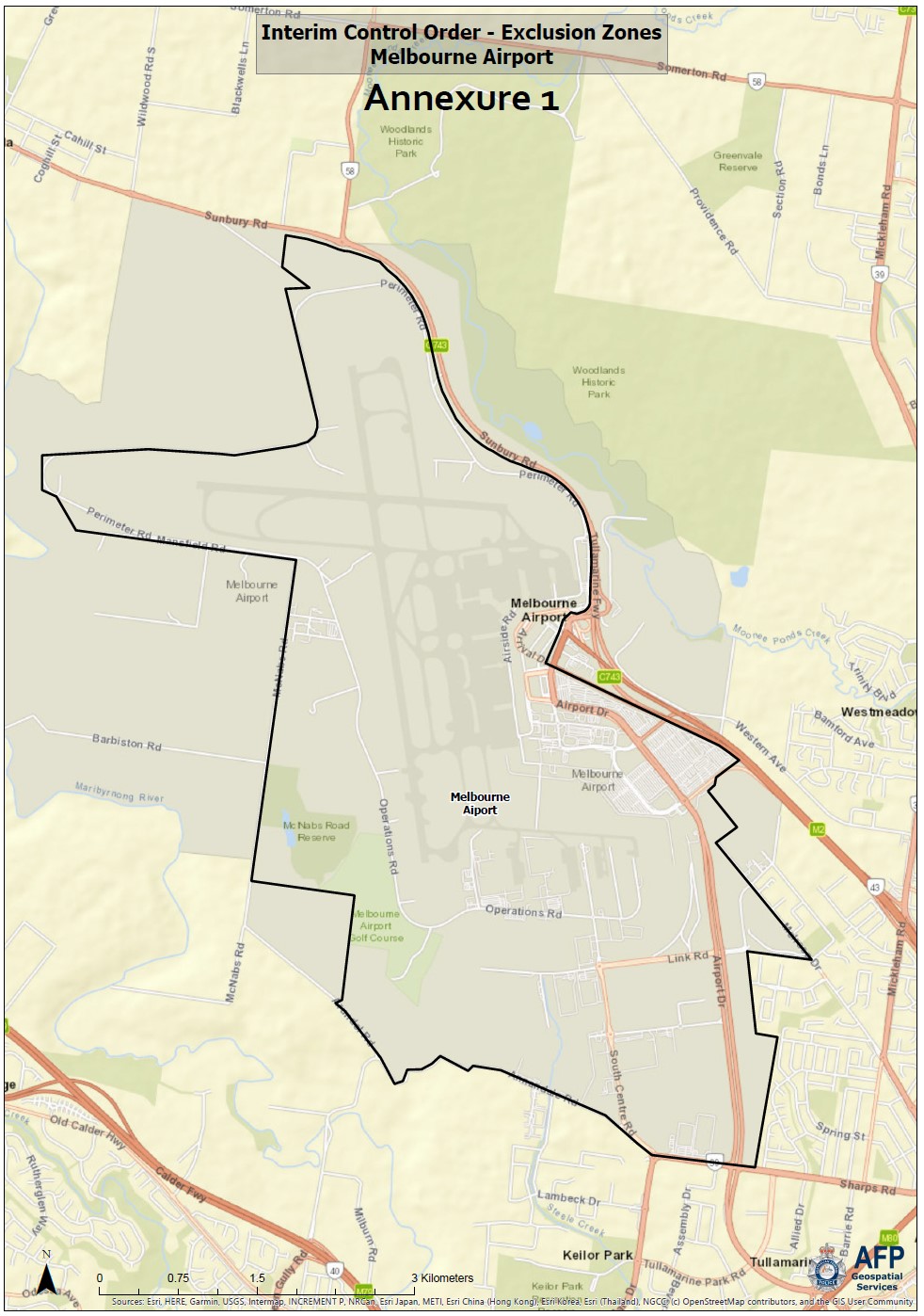
a. within the exclusion zone set out in Annexure 1 at Melbourne International Airport (Tullamarine) save and except on 26 March 2020 and 2 April 2020;
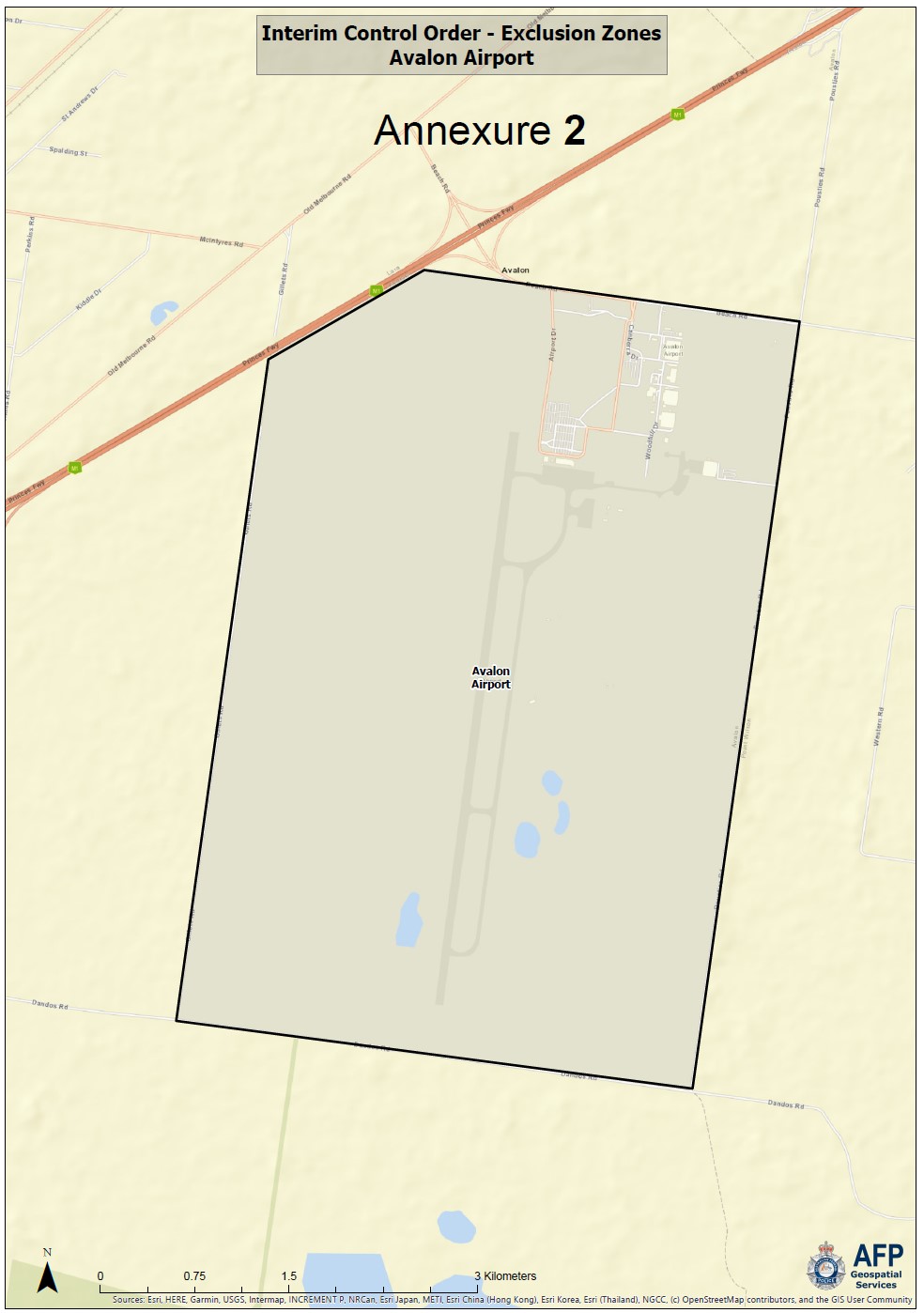
b. within the exclusion zone set out in Annexure 2 at Avalon Airport;
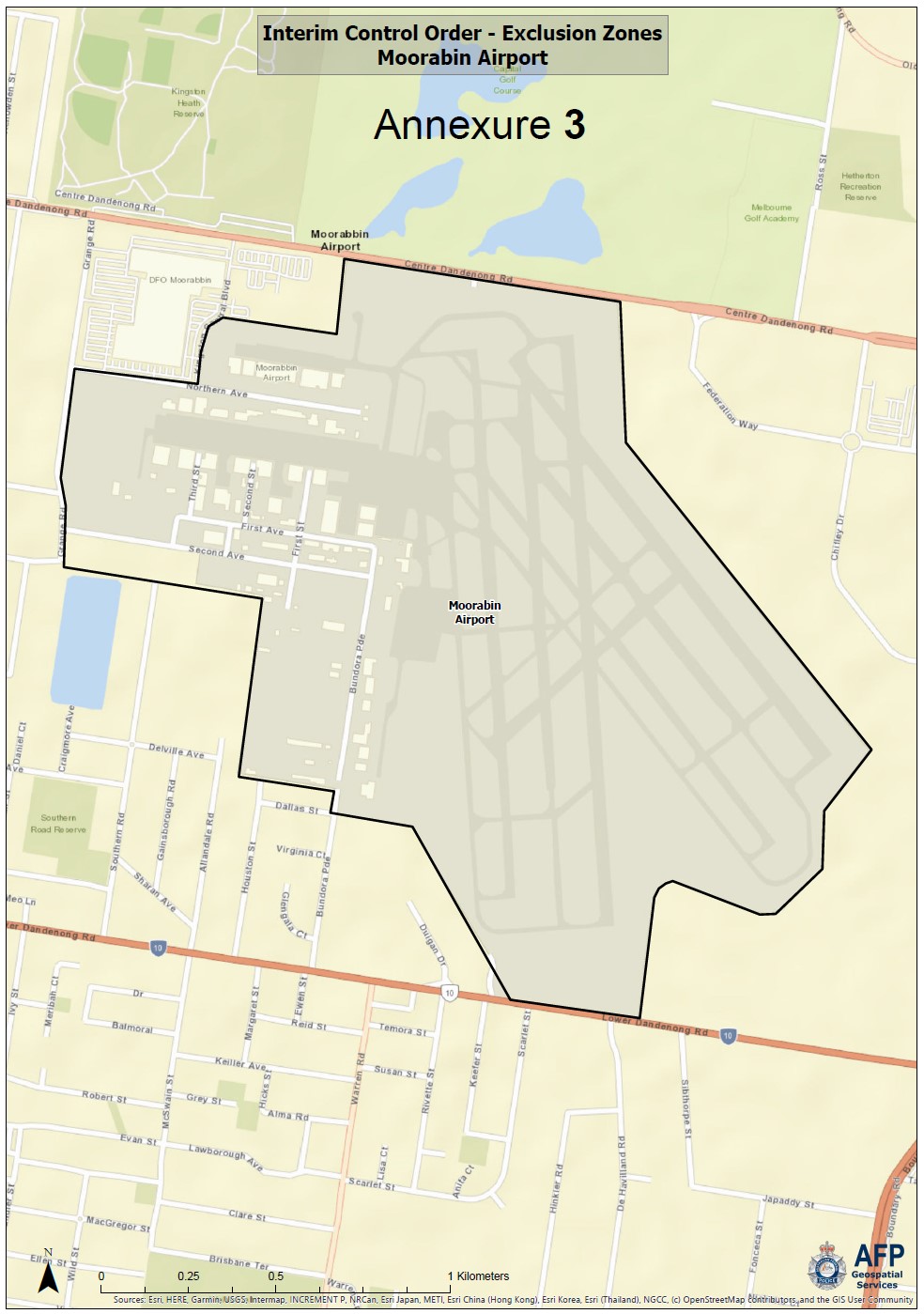
c. within the exclusion zone set out in Annexure 3 at Moorabbin Airport;
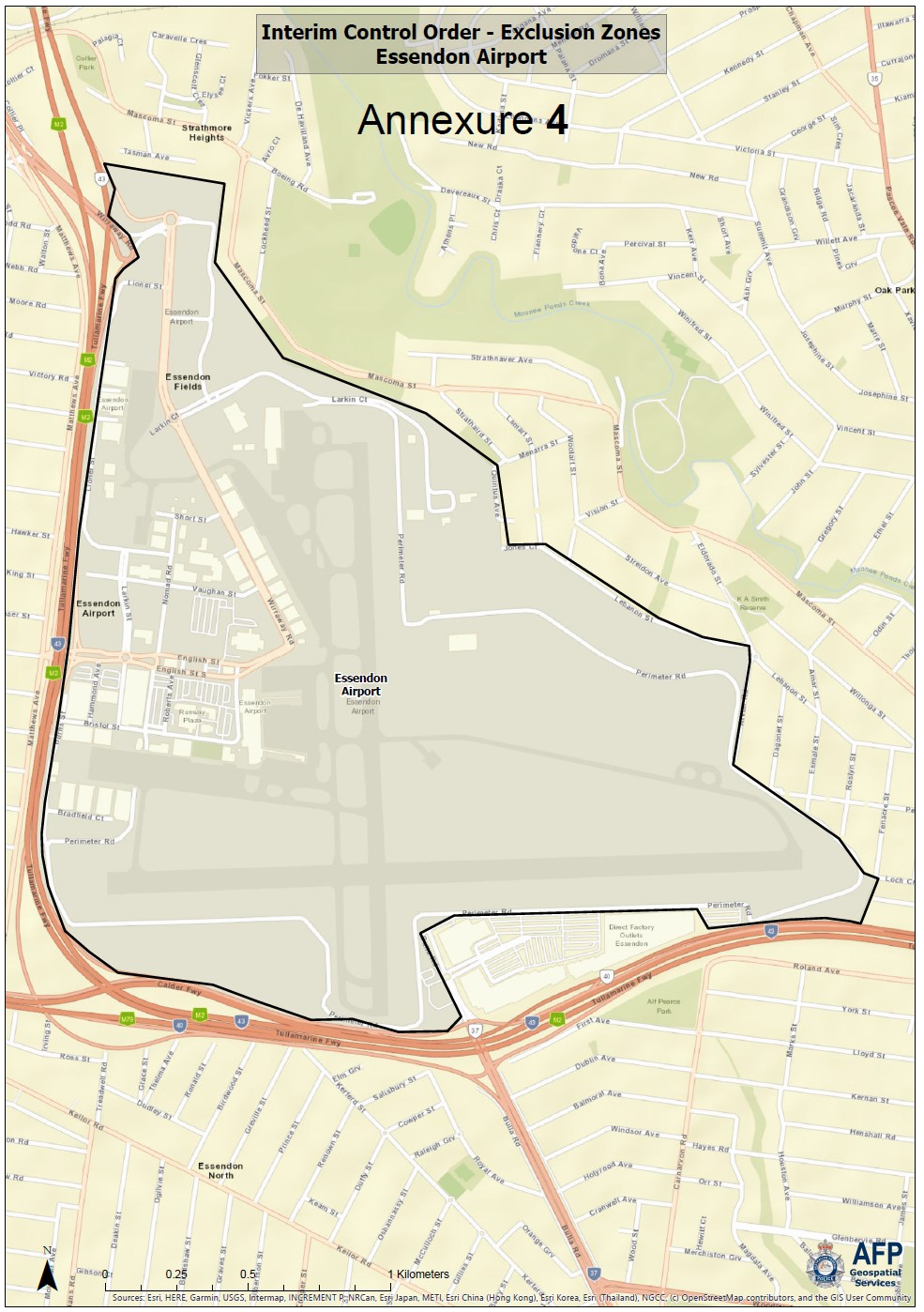
d. within the exclusion zone set out in Annexure 4 at Essendon Fields Airport;
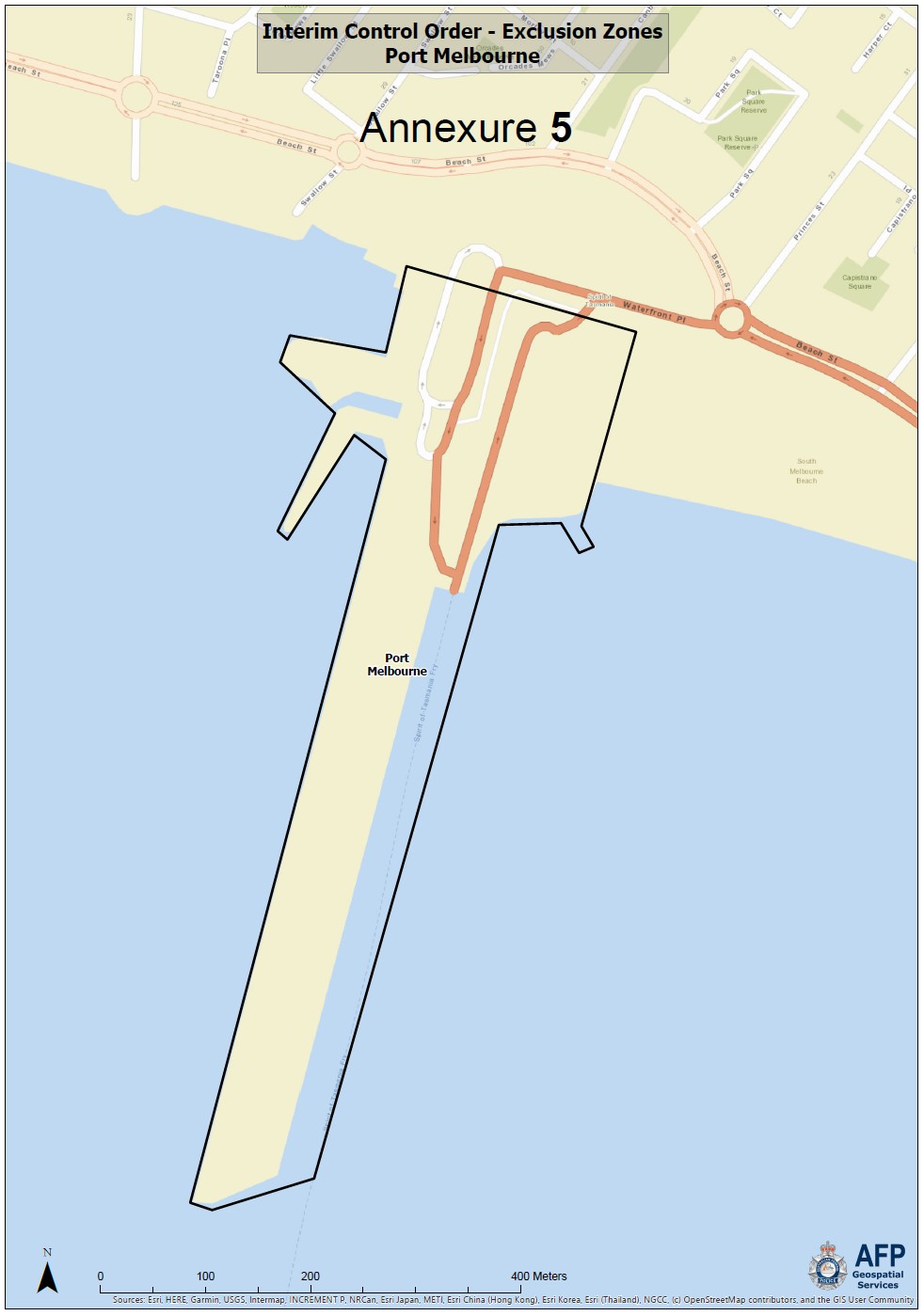
e. within the exclusion zone set out in Annexure 5 at Port Melbourne;
f. within 1 km of any Australian airport (besides Melbourne Tullamarine Airport, Avalon Airport, Moorabbin Airport, and Essendon Fields Airport which is addressed in Controls 3.1a, 3.1b, 3.1c and 3.1d) and besides [redacted] Airport on [redacted] which has an international point of departure, or from which a person can board or charter a flight for an international destination;
g. within 1 km of any Australian port (besides Port Melbourne, which is addressed in Control 4.1e) that has an international point of departure, or from which a person can board or charter a marine vessel for an international destination;
h. inside, or in the grounds of, any prison or correctional facility unless you are incarcerated there;
i. at the residence of any person with whom, by reason of Control 11, you are prohibited from communicating or voluntarily associating;
j. any place in Australia outside the state of Victoria save and except during the period [redacted].
4. Control 4
4.1. You are prohibited from leaving Australia.
5. Control 5
5.1. You are prohibited from carrying out the following specified activities (including in respect of your work or occupation), namely: accessing, acquiring, possessing, producing, storing or distributing documents (including documents in electronic form) or electronic media, or attempting to access, acquire, possess, produce, store or distribute documents (including documents in electronic form) or electronic media, which relate to any of the following:
a. explosives, explosive devices, initiation systems or firing devices;
b. firearms, ammunition or knives;
c. anti-surveillance or counter surveillance.
unless that material is:
d. published by a ‘constituent body’ of the Australian Press Council;
e. broadcast on Australian free to air television;
f. broadcast on Australian pay television;
g. shown in a commercial movie cinema;
h. broadcast on one of the following streaming services: Netflix; STAN; ABC iView; or ‘SBS on demand’; or
i. served on you or your legal representatives by or on behalf of a senior AFP member in the Federal Court proceeding relating to this interim control order, including any appeal from such proceeding, and is accessed, possessed, and stored solely for the purposes of proceedings in the Federal Court relating to this interim control order, including any appeal from such proceeding.
6. Control 6
6.1. You are prohibited from carrying out the following specified activities (including in respect of your work or occupation), namely: accessing, acquiring, possessing, producing, storing or distributing documents (including documents in electronic form) or electronic media, or attempting to access, acquire, possess, produce, store or distribute documents (including documents in electronic form) or electronic media, depicting or describing any:
a. execution;
b. beheading;
c. suicide attack;
d. bombing;
e. terrorist attack;
f. propaganda and promotional material for a terrorist organisation within the meaning of s 102.1(1) of the Schedule to the Criminal Code Act 1995 (Cth); or
g. activities of, or associated with, a terrorist organisation within the meaning of s 102.1(1) of the Schedule to the Criminal Code Act 1995 (Cth),
unless that material is:
h. published by a ‘constituent body’ of the Australian Press Council; or
i. broadcast on Australian free to air television;
j. on Australian pay television;
k. shown in a commercial movie cinema;
l. on one of the following streaming services: Netflix; STAN; ABC iView; or SBS on demand; or
m. served on you or your legal representatives by or on behalf of a senior AFP member in the Federal Court proceeding relating to this interim control order, including any appeal from such proceeding, and is accessed, possessed, and stored solely for the purposes of proceedings in the Federal Court relating to this interim control order, including any appeal from such proceeding.
7. Control 7
7.1. You are prohibited from the following specified activities (including in respect of your work occupation), namely: producing or distributing documents (including documents in electronic form) or electronic media relating to:
a. explosives, explosive devices, initiation systems or firing devices;
b. firearms, ammunition or knives;
c. anti-surveillance or counter surveillance;
d. execution;
e. beheading;
f. suicide attack;
g. bombing;
h. terrorist attack;
i. Islamic State;
j. propaganda and promotional material for a ‘terrorist organisation’ within the meaning of s 102.1(1) of the Schedule to the Criminal Code Act 1995 (Cth);
k. activities of, or associated with, a ‘terrorist organisation’ within the meaning of s 102.1(1) of the Schedule to the Criminal Code Act 1995 (Cth).
8. Control 8
8.1. You are prohibited from carrying out the following specified activities (including in respect of your work or occupation), namely: purchasing, renting or driving any vehicle which exceeds a gross vehicle mass of 4.5 tonne.
9. Control 9
9.1. You are prohibited from carrying out the following specified activities (including in respect of your work or occupation), namely: undertaking paid work without first notifying the AFP Superintendent in writing.
9.2. In notifying the AFP Superintendent, you must submit a written notice to the AFP Superintendent which includes information about the proposed work, including details of the person for whom you will be undertaking the work (e.g., the employer), including their name and place of business, and the nature of the work that will be undertaken.
10. Control 10
10.1. You are prohibited from possessing or using, or causing any person to act on your behalf to possess or use, any of these specified articles or substances, namely:
a. firearms or cartridge ammunition within the meaning of s 3(1) of the Firearms Act 1996 (Vic);
b. a ‘prohibited weapon’ within the meaning of s 3(1) of the Control of Weapons Act 1990 (Vic);
c. any quantity of petrol exceeding 4 litres;
d. any quantity of any chemical which is not consistent with reasonable domestic use;
e. an article or device, not being a firearm, capable of discharging by any means:
i. any irritant matter in liquid, powder, gas, chemical form or any dense smoke; or
ii. any substance capable of causing bodily harm;
f. a detonator;
g. a fuse capable of use with an explosive or a detonator;
h. a knife, in a public place, without reasonable excuse;
i. anything intended, by the person having custody of the thing, to be used to injure or menace a person or damage property.
11. Control 11
11.1. You are prohibited from communicating or voluntarily associating with:
a. apart from your brother, Kadir KAYA, any person incarcerated in any correctional facility, unless you are yourself incarcerated in that correctional facility;
b. any person located in Turkey save and except the following persons subject to the provision of the phone numbers, addresses and dates of birth of those persons to the AFP Superintendent:
[redacted]
c. any person located in Iraq, Syria or the Philippines;
d. any of the following specified individuals:
i. Paul DACRE (Date of birth: 6 July 1985);
ii. Antonino GRANATA (Date of birth: 10 November 1990);
iii. Shayden THORNE (Date of birth: 3 February 1988);
iv. Robert CERANTONIO (Date of birth: 28 January 1985).
12. Control 12
12.1. You are prohibited from accessing or using, any mobile telephone device other than the one mobile telephone device (the permitted mobile phone), and your use of the permitted mobile phone is subject to the following conditions:
a. before using the permitted mobile phone, you must present it to an AFP Superintendent (or a police officer specified in writing by an AFP Superintendent) for inspection;
b. before using the permitted mobile phone, you must advise an AFP Superintendent, in writing, of the following information: the International Mobile Equipment Identity number for the permitted mobile phone, the Integrated Circuit Card Identifier for the SIM card you will use with the permitted mobile phone, the telecommunication service provider which you will use with the permitted mobile phone, the password for the permitted mobile phone and the phone number to which the permitted mobile phone will be connected;
c. once you have advised an AFP Superintendent of the information required by paragraph 13.1b above, you must not change, remove, modify or disconnect or cause any other person to change, remove, modify or disconnect on your behalf (including any employee or person acting on behalf of a telecommunications service provider) the SIM card, telecommunication service provider or phone number connected to the permitted mobile phone; and
d. if you change the password for the permitted mobile phone, you must provide the new password to an AFP Superintendent, or a police officer acting under an AFP Superintendent’s direction, if you are requested to do so by an AFP Superintendent or that police officer’.
e. You must present the permitted mobile phone to police upon request.
12.2. You are prohibited from causing another person to use or access the permitted mobile phone, with the exception of your [redacted] who is permitted to use or access the permitted mobile phone.
12.3. You are prohibited from causing or permitting another person to use or access any mobile telephone device on your behalf.
13. Control 13
13.1. You are prohibited from accessing or using, or causing any person to access or use on your behalf, any fixed or landline telephone service other than one service that has been approved in writing by an AFP Superintendent for you to access or use.
13.2. To seek approval, you must:
a. submit a written request to an AFP Superintendent which nominates the fixed or landline telephone service; and
b. provide an AFP Superintendent with sufficient detail and any information requested by an AFP Superintendent for the purpose of identifying the fixed or landline telephone service that you will be accessing or using.
14. Control 14
14.1. You are prohibited from accessing or using, or causing any person to access or use on your behalf, any public telephone except in the case of an emergency, provided that you contact an AFP Superintendent as soon as possible after accessing or using such a public telephone and:
a. provide sufficient detail to an AFP Superintendent to identify the public telephone that you accessed or used, and the date, time and phone number called; and
b. you explain the nature of the emergency which required you to access or use, or cause another person to access or use on your behalf, that public telephone.
15. Control 15
15.1. You are prohibited from accessing or using, or causing any person to access or use on your behalf, any satellite telephone service.
16. Control 16
16.1. You are prohibited from accessing or using, or causing any person to access or use on your behalf, any of the following websites, applications or computer programs (collectively, platforms), as the case may be:
a. FaceTime
b. WhatsApp
c. Viber
d. Telegram
e. Skype
f. Facebook
g. Facebook Messenger
h. Instagram
i. Snapchat
j. KIK
k. iCall
l. WeTalk
m. Lync2013
n. Nimbuzz Messenger
o. Whistle Phone
p. Talkatone
q. Discord
r. Google Duo
s. MagicApp
t. Signal Private Messenger
u. Zoiper IAX SIP VOIP Softphone
v. Beejive
w. Fring
x. JaJah
y. Line2
z. Talkatone
aa. Truphone
bb. Twitter
cc. Yahoo
dd. ICQ
ee. Google Talk
ff. MSN Messenger
gg. AIM
hh. Yahoo Messenger
ii. Packet8
jj. Google Hangouts.
16.2. In addition to the platforms listed in Control 16.1, you are prohibited from accessing or using, or causing any person to access or use on your behalf, any gaming applications or software that connects to other users or servers, via the internet or Local Area Network (LAN).
16.3. In addition to the platforms listed in Control 16.1, you are prohibited from accessing or using, or causing any person to access or use on your behalf, any Voice Over Internet Protocol (VOIP) service, including any software, mobile application or hardware.
16.4. In addition to the platforms listed in Control 16.1, you are prohibited from accessing or using, or causing any person to access or use on your behalf, any internet based messaging service, including any software, mobile application or hardware.
16.5. Controls 18.1 to 16.4 does not prohibit access to or use of a website which includes an ‘instant chat’ function that allows a visitor to the website to send messages to, and receive messages from, the website host solely for the purpose of obtaining or providing customer service.
17. Control 17
17.1. You are prohibited from accessing or using, or causing any person to access or use on your behalf, any internet service other than:
a. the one service that has been approved in writing by an AFP Superintendent for you to access or use (the permitted internet service); and
b. a television connected to an internet service at the specified premises, subject to all of the existing controls.
17.2. To seek approval of an AFP Superintendent you must submit a written request and:
a. nominate the internet service provider account;
b. nominate what devices you will connect to the internet service (including but not limited to any computer, televisions, and other smart devices); and
c. provide any other information requested by, or on behalf of, the AFP Superintendent, in relation to, or for the purpose of identifying, the nominated account and devices.
17.3. You are prohibited from allowing any other person to access or use the permitted internet service.
17.4. You are prohibited from causing any other person to access or use on your behalf any other internet service.
17.5. You are prohibited from:
a. using a virtual private network (VPN) service;
b. using the TOR network; and
c. accessing any Darknet services (denoted by “onion” top level domain suffix).
18. Control 18
18.1. You are prohibited from accessing or using, or causing any person to access or use on your behalf, any electronic mail (email) account other than one account that has been approved in writing by an AFP Superintendent for you to access or use (the permitted email account).
18.2. To seek approval of an AFP Superintendent you must submit a written request and:
a. nominate the email account; and
b. provide any other information requested by, or on behalf of, the AFP Superintendent in relation to, or for the purpose of identifying, the nominated account which you will be accessing or using’.
18.3. You are prohibited from causing or permitting another person to use or access the permitted email account.
19. Control 19
19.1. You are prohibited from accessing or using any computer or tablet device other than a computer or tablet device that has been approved in writing by an AFP Superintendent for you to access or use (the permitted computer or tablet device) and your use of the permitted computer or tablet device is subject to the following conditions:
a. before using the permitted computer or tablet device, you must provide the password for the permitted computer or tablet device to the AFP Superintendent; and
b. if you change the password for the permitted computer or tablet device, you must provide the new password to the AFP Superintendent, or a police officer acting under the AFP Superintendent’s direction, if you are requested to do so by the AFP Superintendent or the police officer.
19.2. To request approval under Control 21.1 you must:
a. submit a written request to the AFP Superintendent which nominates the computer or tablet device; and
b. provide any information requested by or on behalf of the AFP Superintendent in relation to, or for the purpose of identifying and accessing, the nominated computer or tablet device.
20. Control 20
20.1. You are required to consider in good faith participating in counselling or education relating to your spiritual, emotional and physical wellbeing, with a suitably qualified professional counsellor or publicly recognised religious leader, for at least 60 minutes per week.
20.2. If you agree to participate in such counselling or education you must advise the AFP Superintendent in writing that you have commenced the counselling or education and provide the AFP Superintendent the name and qualifications of the professional you have engaged.
21. Exemption
21.1. You may request the AFP Superintendent approve an exemption to the requirements or prohibitions (as the case may be) specified in Controls 1.1, 3.1, 3.3.1.j., 8, and 12.1.b.
21.2. To request an exemption, you must:
a. submit a written request to the AFP Superintendent which: (i) identifies the Control in respect of which you seek an exemption; (ii) explains the extent to which you seek to be exempted from the Control; and (iii) explains your reason(s) for seeking the exemption; and
b. provide any other information requested by, or on behalf of, the AFP Superintendent for the purposes of determining whether to approve the exemption.
21.3. The AFP Superintendent may grant an exemption subject to conditions specified in writing.
21.4. You must comply with all of the conditions specified in writing by the AFP Superintendent. If you do not comply with a condition to an exemption, the exemption is (and will be taken to have been for all purposes) of no effect.
21.5. A request for an exemption must be made three business days before the material time and date.
21.6. The AFP Superintendent will convey their response to the request for an exemption no later than a day before the material time and date.
Interpretation
21.7. In this Interim Control Order:
a. AFP Superintendent means a member of the Australian Federal Police performing the duties of a Superintendent within the Counter-Terrorism portfolio.
b. Password includes but is not limited to any passcode, swipe pattern or any information or function necessary to facilitate access to the applicable device.
c. Police officer means a ‘member’ or ‘special member’ of the Australian Federal Police, as defined by the Australian Federal Police Act 1979 (Cth), or a ‘police officer’ within the meaning of the Victoria Police Act 2013 (Vic).
d. Material time and date means:
i. in relation to a request for an exemption to the requirement in Control 1.1 – as the commencement of the curfew period that is the subject of the request (and, if more than one curfew period is the subject of the request, the first of those curfew periods);
ii. in relation to a request for an exemption to the requirement in Control 3.1 – before the conclusion of the reporting period that is the subject of the request (and, if more than one reporting period is the subject of the request, the first of those reporting periods);
iii. in relation to a request for an exemption to the requirement in Control 4.1.j – the time and date at which you wish to depart Victoria;
iv. in relation to a request for an exemption to the requirement in Control 8 – the time and date at which you wish to carry out the specified activity;
v. in relation to a request for an exemption to the requirement in Control 12.1.b – the time and date at which you wish to communicate with a person located in Turkey.
Annexure B – Summary of grounds on which interim control order made
Overview
1. On 22 February 2019, following a plea of guilty, Mr Murat Kaya was convicted of an offence of preparing for incursions into foreign countries for the purpose of engaging in hostile activities, contrary to s 119.4(1) of the Criminal Code 1995 (Cth): SOF 4. That is an offence relating to terrorism.
2. Mr Kaya was sentenced to three years and eight months’ imprisonment with a non-parole period of two years and nine months in the Supreme Court of Victoria. Mr Kaya has been refused parole, and his period of imprisonment expires on 23 January 2020: SOF 9.
3. By reason of the following matters, Mr Kaya presents an ongoing risk of committing, supporting or facilitating a terrorist act in Australia or overseas; or committing, supporting or facilitating engagement in a hostile activity in a foreign country:
3.1. the nature and circumstances of, and background to, Mr Kaya’s offending and the extreme ideology that he held at that time, including:
3.1.1. his attempt to travel to Turkey, and subsequent further attempt (by agreement with his co-offenders) to travel to the Southern Philippines (where a number of Islamist militant groups operated) to engage in hostile activities despite the cancellation of his passport by the Minister;
3.1.2. demonstrated support for Islamic State and extremist ideology supportive of violence; and
3.1.3. his susceptibility to others who espouse extremist ideology as demonstrated by his susceptibility to the influence of Mr Robert Cerantonio;
3.2. that he has continued whilst in custody to espouse extremist ideology, including violence, contempt towards non-Muslims and Australian law; and
3.3. his continued association with persons of security concern whilst in custody, in view of his susceptibility to influence.
Ongoing risk factors
Nature and circumstances of, and background to, his offending
4. The nature and circumstances surrounding Mr Kaya’s offending included:
4.1. Persistent attempts to travel offshore to engage in hostile activities:
4.1.1. On 10 February 2015 Mr Kaya attempted to travel out of Australia from Melbourne International Airport to Turkey but was stopped and interviewed by members of the AFP: SOF 19. On 25 February 2015 the Minister for Foreign Affairs cancelled Mr Kaya’s passport on the basis that he would ‘be likely to engage in conduct that might prejudice the security of Australia or a foreign country’: SOF 21.
4.1.2. Following his being prevented from leaving Australia by plane, and having his passport cancelled, he entered into an agreement with his co-offenders to acquire a boat and other equipment in preparation for leaving Australia to enter the Southern Philippines.
4.1.3. Mr Kaya made enquiries about the purchase of a boat for the purpose of travel to the Philippines: SOF 39 and made a deposit on a boat in Darwin: SOF 42.
4.1.4. In February 2016, Mr Kaya travelled with co-offender, Mr Dacre, to Darwin for the purpose of purchasing a boat to travel to the Philippines: SOF 66-68, but ultimately determined that the particular boat was not fit for purpose: SOF 68.
4.1.5. Upon his return to Melbourne, from March to May 2016, Mr Kaya continued to participate in the planning of the purchase of another boat, and ultimately paid a deposit for a boat in Bendigo: SOF 78. On 10 May 2016, his co-offenders travelled to Cape York in Queensland with the purchased boat and were arrested SOF 80. Mr Kaya was arrested in Melbourne on 27 May 2016: SOF 81.
4.2. Demonstrated support for Islamic State and extremist ideology:
4.2.1. Islamic State follows an extreme interpretation of Islam which is anti-Western, promotes sectarian violence and targets those that do not agree with its extreme interpretations. Islamic State has a goal of ‘global jihad’ and has exhorted followers to kill disbelievers. Islamic State inspires, encourages, enables and directs terrorist attacks internationally: SOF 12-13.
4.2.2. On 2 July 2015, Mr Kaya posted on Facebook that ‘whoever votes had committed kuffar [disbeliever] and whoever rules by the other than Allah is also a kaafir and must have baraa [dissociation] from the[m]’: SOF 27.
4.2.3. On 7 July 2015, Mr Kaya posted on Facebook that ‘anyone who believes that the laws of Australia must be honoured’ has committed apostasy and that no law is honoured except ‘the law of Allah’: SOF 28.
4.2.4. On 13 July 2015, Mr Kaya posted on Facebook that dispensing justice sometimes requires ‘violence’, and that when people say ‘islam means peace they are lying’: SOF 29.
4.2.5. On 17 July 2015, Mr Kaya and his co-offenders attended an organised meeting at Footscray Park, at which ISIS flags were flown by the co-offenders, and they each raised their index fingers (sometimes known as the ‘shahada finger’ in the ‘tawheed salute’ which has come to be used as a widely recognized symbol of support for Islamic State: SOF 30.
4.2.6. On 11 September 2015, Mr Kaya posted on Facebook ‘democracy is a system where judgment belongs to man therefore making it kuffar … democracy is kuffur’: SOF 34.
4.2.7. On 15 January 2016, Mr Kaya attended an address where Mr Cerantonio openly said that he was a supporter of Islamic State: SOF 45 and Mr Kaya participated in a conversation where they spoke about the growth of Islamic State over 15 years: SOF 46.
4.2.8. On 12 February 2016, in a Telegram chat group he posted an article about the ISIS leader, Abu Bakr al-Baghdadi: SOF 58.
4.2.9. From 19 February 2016, during his trip to Darwin he listened to recorded speeches by Mr Cerantonio where he advocated the use of violence by Muslims to establish an Islamic State under Sharia law: SOF 62.
4.2.10. In February 2016, he stated that the Australian Government is taghut [tyrant ruler]: SOF 72.
4.2.11. On his return from Darwin he spoke to co-offender, Mr Dacre, about escaping ‘this country’ and starting up Islamic State in the Philippines. Mr Kaya said that one day they could discuss conquering ‘these lands and establish[ing] sharia’: SOF 71.
4.2.12. Mr Kaya posted variously on Facebook that ‘every muslim should support Khalifah’ [the Caliph]: SOF 24, that Muslims living in the West are ‘servants to the kuffar’ [disbelievers] and that they have no ‘honour or dignity’: SOF 25 and that ‘anyone who believes that the laws of Australia must be honoured’ has committed apostasy’: SOF 28.
4.3. Susceptibility to the influence of Mr Cerantonio: From at least 21 August 2015, Mr Kaya was closely associated with Mr Cerantonio whom he looked to for religious guidance and leadership. Mr Cerantonio was the person to whom Mr Kaya and his co-offenders turned to for leadership and religious and spiritual guidance. He enhanced or persuaded Mr Kaya towards extremist ideas. Mr Certanonio advocated support for the establishment of an Islamic State under Sharia law in the Southern Philippines: SOF 18.
Continued extremist ideology whilst in custody
5. Mr Kaya has maintained his extremist ideology including resentment towards non-Muslims and Australian laws while in custody, as evidenced by the following:
5.1. Sometime prior to 22 April 2017, he wrote to his brother referring to his incarceration as ‘nothing but a test from Allah’ which is indicative of someone who does not accept responsibility, but merely sees his incarceration as oppression by non-believers and a test of his fortitude: SOF 82.
5.2. On 13 March 2018, further handwritten notes were located in his prison cell which he identified as being rap lyrics. The notes say that he will not be ‘heard coming’ as he is a ‘silent assassin’, he also speaks about killing children in their sleep. He describes himself as the ‘meanest’ maker of future war and being ‘psychopathically demented’. He further describes himself as an anarchist ‘causing mass atrocity’ and speaks of making the ‘feds’ (the police) mad, and that he finds that funny: SOF 87.
5.3. On 4 March 2018, he spoke with an unidentified male and referred to living in Australia and having to live ‘amongst their laws’: SOF 88.
Susceptibility to influence and continued communication with persons of security concern
6. As noted in the SOF 18 and above, Mr Kaya was influenced by Mr Cerantonio and frequently listened to his addresses. This susceptibility to such influence increases the risk that Mr Kaya may pose to the community.
7. While in custody, on 10 January 2018, Mr Kaya wrote to Mr Hamza Abbas, a convicted terrorist who was sentenced to 22 years imprisonment for a Melbourne Christmas Day terror plot: SOF 86. Mr Kaya expressed a desire to communicate with Abbas ‘soon’ and drink ‘some cold Hallal beers ... joking about these days’. Mr Kaya’s desire to reach out to others charged with terrorist offences while on remand for a similar offence increases the risk that he will seek out similar associations of security concern upon release into the community.
8. Mr Kaya intends to reside with, Mr Tahair Cakici who has an extensive criminal history with over 300 charges. Further, Mr Kaya’s father, Mr Haci Kaya, deposited large sums into both his sons’ accounts before their attempt to purchase a boat in Darwin, and appears to have supported Mr Kaya’s plans to depart Australia: SOF 91-92.
Overall assessment of risk
9. In view of the matters outlined above, there is a real risk that in the absence of appropriate controls, Mr Kaya will commit, support or facilitate a terrorist act in Australia or overseas or support or facilitate the engagement in a hostile activity in a foreign country.
10. While Mr Kaya has not professed a desire to commit, support or facilitate a terrorist act in Australia, the risk of this is still a real one. Mr Kaya has not renounced his extreme ideology. The AFP’s experience in recent years is that as more and more Islamic extremists are prevented from travelling to foreign conflict zones, the risk of those persons shifting their focus to domestic terrorist acts increases. Examples of such occurrences in Australia are as follows:
10.1. Sevdet Ramadan Besim wished to fight for the Islamic State. However, in December 2014 he was advised that his passport application was under review and that a recommendation may be made against its issue. He instead undertook acts in preparation for an attack, which was to involve hitting a police officer with his car and beheading that officer with a knife, on Anzac Day in 2015. He pleaded guilty and was sentenced in September 2016.
10.2. Abdullah Chaarani and Ahmed Mohamed, had their passports cancelled in 2015. They subsequently undertook acts in preparation for a terrorist act together with Hamza Abbas, intended to be carried out in Melbourne’s central business district over the Christmas period in 2016, for which they were convicted in 2018. These preparations were motivated by support for Islamic State. In May 2019, Chaarani and Mohamed were also found guilty of a separate terrorist act – namely, the burning of a Shia Mosque in Melbourne in December 2016.
10.3. Hassan Khalif Shire Ali had his passport cancelled in 2015. On 9 November 2018, he carried out a terrorist attack in Bourke Street, Melbourne, which included him setting fire to a vehicle and stabbing three people, one of whom died from his injuries. The Islamic State has claimed responsibility for this attack online.
10.4. Milad Atai’s request to renew his Australian passport was refused in 2014. In November 2018 he was convicted of aiding and abetting a terrorist act, being the fatal shooting of Curtis Cheng outside New South Wales Police Headquarters and offences relating to being a member of Islamic State and the organisation of funding and support for Islamic State. Atai was part of an online ‘WhatsApp’ closed chat group where he and others shared views and discussed ideas supportive of Salafi Islam and the Islamic State.
10.5. Agim Kruezi intended to travel to Syria in 2014 to join in the fight against the Assad regime. Following the cancellation of his passport in 2014, he instead used the money set aside for his trip to Syria to plan an attack on Australian soil in a public place with the intention to die as a martyr in that attack. In doing so, he contemplated attracting and attacking law enforcement officers. He was subsequently convicted of making acts of preparation for a terrorist attack and making preparatory acts for incursion into a foreign state.
10.6. Omarjan Azari’s passport was cancelled in 2013. He was subsequently convicted of offences of attempting to make funds available to Islamic State and committing an act in preparation for or planning a terrorist act. The latter conviction related to a phone conversation during which he discussed a plan for a future terrorist act or acts to be committed in Australia, namely the killing of random members of the public, with a senior Australian figure in Islamic State who was in Syria or Iraq at that time.
10.7. On 23 September 2014, the day after he had been advised that his passport had been cancelled, Ahmad Numan Haider stabbed two Joint Counter Terrorism Taskforce police officers outside of a Melbourne police station. Haider was killed by police acting in self-defence. In the period leading up to the attack, Haider had been accessing websites inciting jihad and martyrdom, graphic materials of executions and beheadings and recruitment propaganda for Islamic State.
10.8. In 2016, Mohammed Kiad and Omar Al-Kutobi were convicted of conspiring to commit acts in preparation for or planning a terrorist attack. One feature of the intended attack was the detonation of an improvised explosive device to damage or destroy a building. At the time, Al-Kutobi was unable to travel as he did not yet qualify for an Australian passport. Kiad and Al-Kutobi were supporters of Islamic State and had conducted extensive internet research on Islamic State ideology, weapons and improvised explosive devices.
10.9. In February 2016, Tamim Khaja was intercepted as he attempted to travel to Syria, resulting in the cancellation of his passport in March 2016. In May 2016, he undertook various acts in preparation for or for the planning of a terrorist act, including conducting reconnaissance of army barracks in western Sydney and court buildings in Parramatta for the purpose of carrying out an attack with firearms and explosives. Khaja advised undercover operatives that he intended to kill as many non-Muslims as he could prior to being killed himself.
11. These acts are consistent with directions given by Islamic State known as ‘Hijrah’ to its supporters to kill non-Muslims in Western countries: see SOF 12-13. In recent years, Islamic State has exploited social media to recruit, motivate and radicalise individuals – including within Australia. A recurring theme of the recent online propaganda is that the West is at war with Islam and terror attacks in the West are permissible. There is accordingly a greater emphasis on local sympathisers to act domestically. The primary terrorist threat in Australia therefore arises from a small number of Islamic extremists, principally lone actors or small groups. Single offender attacks are more likely to go undetected and require less planning and resourcing to carry out in a very short period of time.
12. The obligations, prohibitions and restrictions set out in the proposed interim control orders are reasonably necessary, and reasonably appropriate and adapted, for the purpose of preventing a terrorist attack, preventing the provision of support for or the facilitation of a terrorist attack here or abroad and preventing the provision of support for or facilitation of the engagement in hostile activity in a foreign country. They will ensure that Mr Kaya:
12.1. is provided with the opportunity to engage positively with the community (through employment, religious observation, counselling and education),
12.2. is capable of being monitored by police during his re-engagement with the community, and
12.3. is prohibited from engaging in behaviours, and being exposed to influences, which may lead him to commit a terrorist act or provide support for or facilitate a terrorist act here or abroad or the engagement in hostile activity in a foreign country,
and thereby reduce the risks outlined above.
13. The interim control orders should be made notwithstanding the matters set out in the SOFN, for the following reasons:
13.1. While Mr Kaya’s wife wrote to the Supreme Court of Victoria indicating that ‘Mr Kaya does not intend on associating with anyone who may be considered a risk to society, Mr Kaya has engaged with such a person while on remand (as noted above). Further, Mr Kaya’s wife was part of the plan to leave for the Philippines in 2016: SOF 69.
13.2. While on 5 March 2019, Mr Kaya wrote that he had ‘pled guilty… and I deeply regret what I have done and how my actions have affected all those around me and would like to now make it up to all my loved ones by becoming the best person I can be’ and that ‘upon my sentencing my [sic] Judge Justice Croucher made some very positive comments saying he believes I have sown good signs of rehabilitation’, it contains no renouncement of his extremist views and no remorse towards the community for his actions. Further, statements he has made whilst in custody, and material found in his cell (see paragraph 5 above), are inconsistent with Mr Kaya having renounced his extremist views or holding genuine remorse for his actions.
13.3. Although the report of Dr Matea Doroc notes that since becoming a sentenced prisoner Mr Kaya has been referred to the Community Integration and Support Program and reports a willingness to participate, there is no evidence that he no longer holds extreme ideological beliefs which has characterised his behaviour as outlined in the SOF.
13.4. While an Operational Threat Assessment (OTA) assessed that Mr Kaya ‘unlikely … has the confidence to pursue foreign incursion” or “resources to depart Australia’, Mr Kaya has in the past been susceptible to the influence of others and has continued to be in contact with persons of security concern while in custody. There is a risk that he would support those who do engage in violence or support acts of violence, or be influenced by persons to commit violent acts himself, including overseas.
13.5. Finally, while Mr Kaya wrote to the Attorney-General stating that he has ‘never indicated any allegiance to Islamic State’, his offending was motivated by an adherence to extremist ideology and his allegiance to Islamic State, and he was sentenced on that basis. In the same letter, Mr Kaya states that he has never shown any willingness to fight for Islamic State in a combat scenario. This is inconsistent with evidence of participation in conversation with Mr Dacre about ‘planning [to] escape this country and start up Islamic State in the Philippines’ SOF: 71.
ANNEXURES 1 TO 5 – EXCLUSION ZONES MAPS
ANNEXURE 1
ANNEXURE 2
ANNEXURE 3
ANNEXURE 4
ANNEXURE 5