FEDERAL COURT OF AUSTRALIA
Australian Competition and Consumer Commission v Optus Internet Pty Limited [2019] FCA 2221
ORDERS
AUSTRALIAN COMPETITION AND CONSUMER COMMISSION Applicant | ||
AND: | First Respondent OPTUS MOBILE PTY LIMITED Second Respondent | |
DATE OF ORDER: |
NOTICE TO: OPTUS INTERNET PTY LIMITED (ACN 083 164 532) and OPTUS MOBILE PTY LIMITED (ACN 054 365 696) IF YOU (BEING THE PERSON BOUND BY THIS ORDER): A. REFUSE OR NEGLECT TO DO ANY ACT WITHIN THE TIME SPECIFIED IN THIS ORDER FOR THE DOING OF THE ACT; OR B. DISOBEY THIS ORDER BY DOING AN ACT WHICH THE ORDER REQUIRES YOU NOT TO DO, YOU WILL BE LIABLE TO IMPRISONMENT, SEQUESTRATION OF PROPERTY OR OTHER PUNISHMENT. ANY OTHER PERSON WHO KNOWS OF THIS ORDER AND DOES ANYTHING WHICH HELPS OR PERMITS YOU TO BREACH THE TERMS OF THIS ORDER MAY BE SIMILARLY PUNISHED. |
THE COURT DECLARES THAT:
1. On 24 May 2018, Optus Internet Pty Limited (Optus Internet) and Optus Mobile Pty Limited (Optus Mobile) (together, Optus), in trade or commerce:
(a) engaged in conduct that was misleading or deceptive, or likely to mislead or deceive, in contravention of section 18 of the Australian Consumer Law (ACL), being Schedule 2 to the Competition and Consumer Act 2010 (Cth); and
(b) in connection with the supply or possible supply of services, and the promotion of the supply or use of services, made false or misleading representations concerning the need for services, in contravention of section 29(1)(l) of the ACL,
by representing, in an email Optus sent to 138,988 customers who were currently acquiring mobile telecommunications services from a member of the Optus corporate group (Recipients), that their current broadband service would be disconnected within a short period and consequently that the Recipient needed to acquire an NBN based service in the near future in order to continue to receive broadband services, in circumstances where the Recipients did not face the prospect of imminent disconnection of their broadband service, and so had no such need.
THE COURT ORDERS THAT:
2. Optus is restrained for a period of 3 years from the date of this Order, whether by itself, its servants, its agents or otherwise, in trade or commerce in connection with the supply or possible supply of services provided using the NBN (NBN based services), or the promotion of supply or use of NBN based services, from making any representation to the effect that a customer's broadband service would be disconnected within a short period and consequently that the Recipient needs to acquire an NBN based service in the near future in order to continue to receive broadband services in circumstances where:
(a) the customer does not face the prospect of imminent disconnection of their broadband service, and so has no such need; or
(b) Optus does not have reasonable grounds for making that representation.
3. Within 30 days of the date of this Order:
(a) Optus Internet pay to the Commonwealth of Australia a pecuniary penalty of $3.2 million; and
(b) Optus Mobile pay to the Commonwealth of Australia a pecuniary penalty of $3.2 million,
in respect of the contraventions of s 29(1)(l) of the ACL that are the subject of the declaration in paragraph 1.
4. Optus, at its own expense:
(a) within 30 days of the date of this Order, appoint a suitably qualified compliance professional with expertise in consumer law who is independent of the Optus Group and has not previously been engaged by Optus (Reviewer) to review the efficacy of:
(i) Optus’ internal trade practices compliance program insofar as that program is designed to minimise the risk of contraventions of the ACL (Compliance Program);
(ii) the process adopted by Optus for internal legal review of communications by Optus to its customers or potential customers, insofar as that process is designed to minimise the risk of contraventions of the ACL (Legal Process); and
(iii) Optus’ implementation of the Compliance Program and Legal Process;
(b) instruct the Reviewer to prepare a written report to Optus within a period of 3 months of the date of their appointment that makes recommendations which identify:
(i) any revisions to Optus’ Compliance Program and Legal Process, and Optus’ implementation of that program and process, that are reasonably necessary to limit the risk of future contraventions of the ACL of the nature of those the subject of this proceeding; and
(ii) any material deficiencies in the Compliance Program, Legal Process or Optus’ implementation of that program or process that are reasonably necessary to be rectified, and should be rectified, to limit the risk of future contraventions of the ACL of the nature of those the subject of this proceeding;
(c) use best endeavours to provide the Reviewer with access to all sources of information in Optus’ possession, power or control that is relevant to the Reviewer’s review;
(d) within 30 business days of receiving the Reviewer’s written report, provide a copy of that report to the Applicant; and
(e) use best endeavours to implement with due diligence any recommendations made by the Reviewer.
5. Optus serve on the Applicant:
(a) an affidavit verifying that it has carried out its obligations under paragraph 4(b) above, within 10 days of Optus appointing the Reviewer; and
(b) an affidavit verifying that it has carried out its obligations under paragraph 4(e) above, within 8 months of the date of this Order
6. Within 30 days of the date of this Order, Optus Internet pay the Applicant $50,000 in respect of the Applicant’s costs of the proceeding.
Note: Entry of orders is dealt with in Rule 39.32 of the Federal Court Rules 2011.
ANASTASSIOU J:
1 The present application is brought by the Australian Competition and Consumer Commission (ACCC) against Optus Internet Pty Limited and Optus Mobile Pty Limited (together, Optus). By its originating statement dated 24 June 2019, the ACCC alleged that Optus had, by representing to approximately 138,988 customers that they would need to acquire National Broadband Network (NBN) based services in order to prevent their internet being disconnected, engaged in conduct in contravention of ss 18, 29(1)(l) and 34 of the Australian Consumer Law (ACL), being Sch 2 to the Competition and Consumer Act 2010 (Cth). The ACCC sought injunctions, pecuniary penalties, compliance orders, declarations and costs (under ss 232, 224 and 246 of the ACL, and 21 and 43(1) of the Federal Court of Australia Act 1976 (Cth) (FCA Act) respectively).
2 Ultimately, an agreed position was reached pursuant to which the ACCC did not press its application in respect to s 34 of the ACL and Optus admitted that its conduct contravened ss 18 and 29(1)(l).
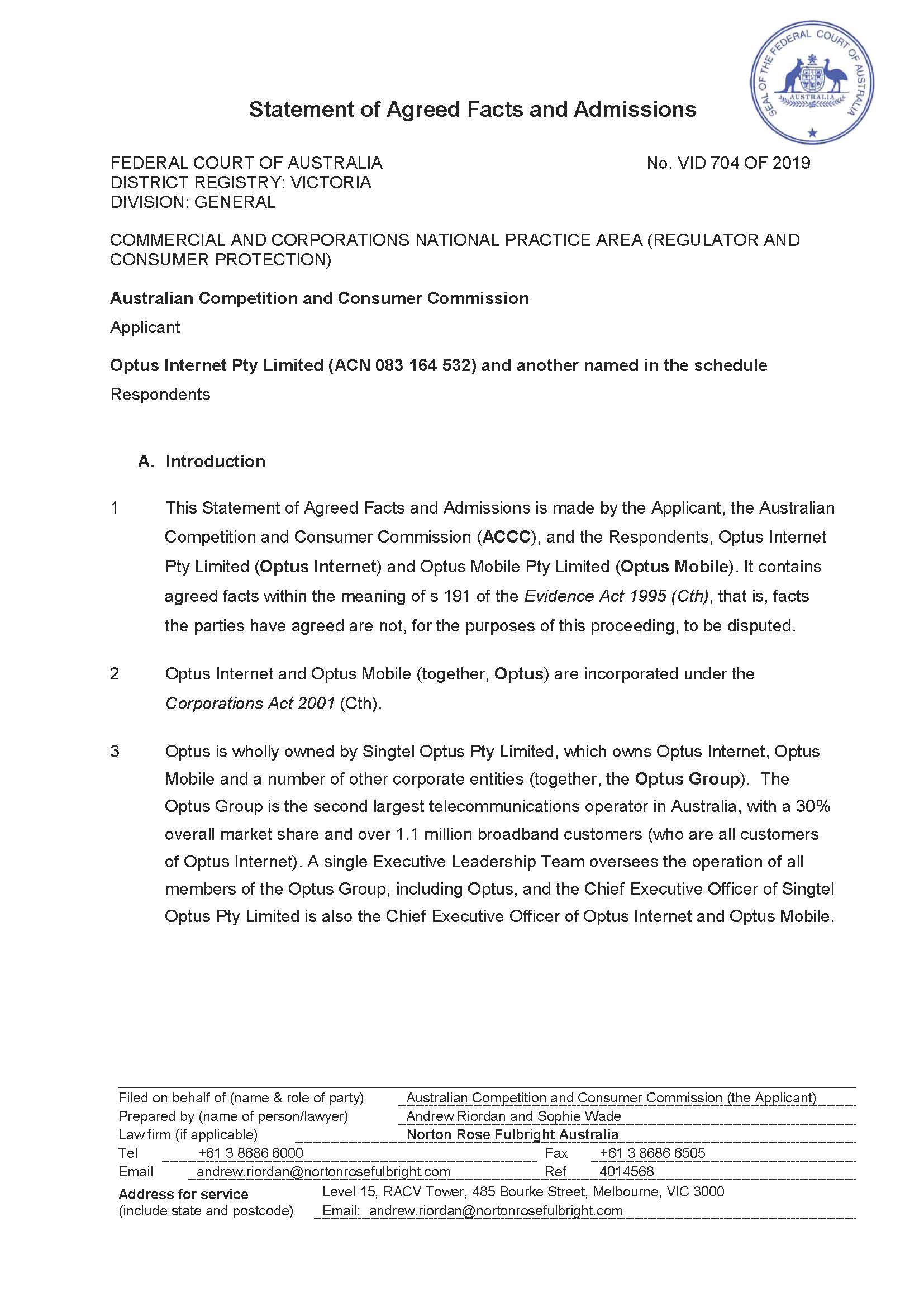
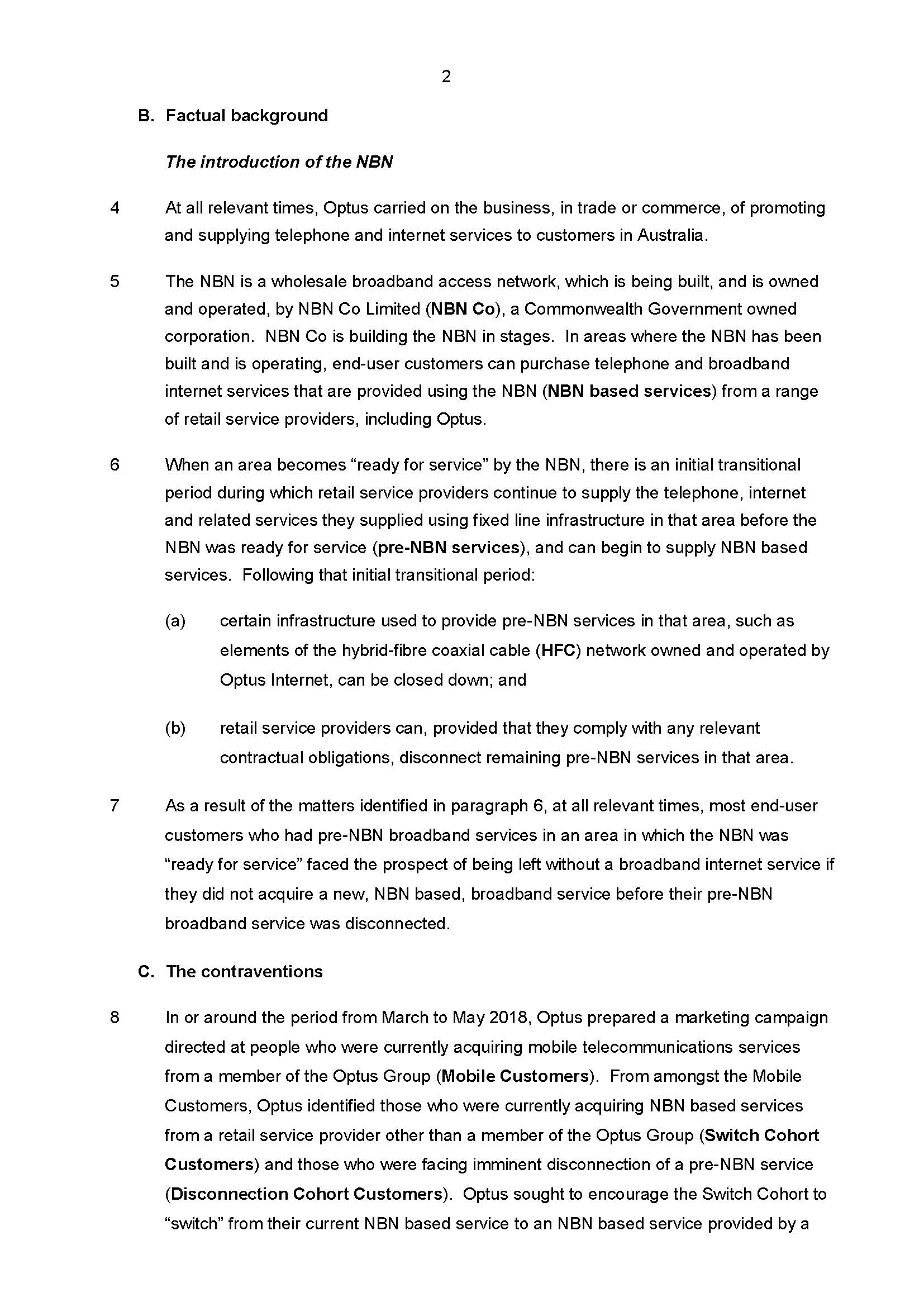
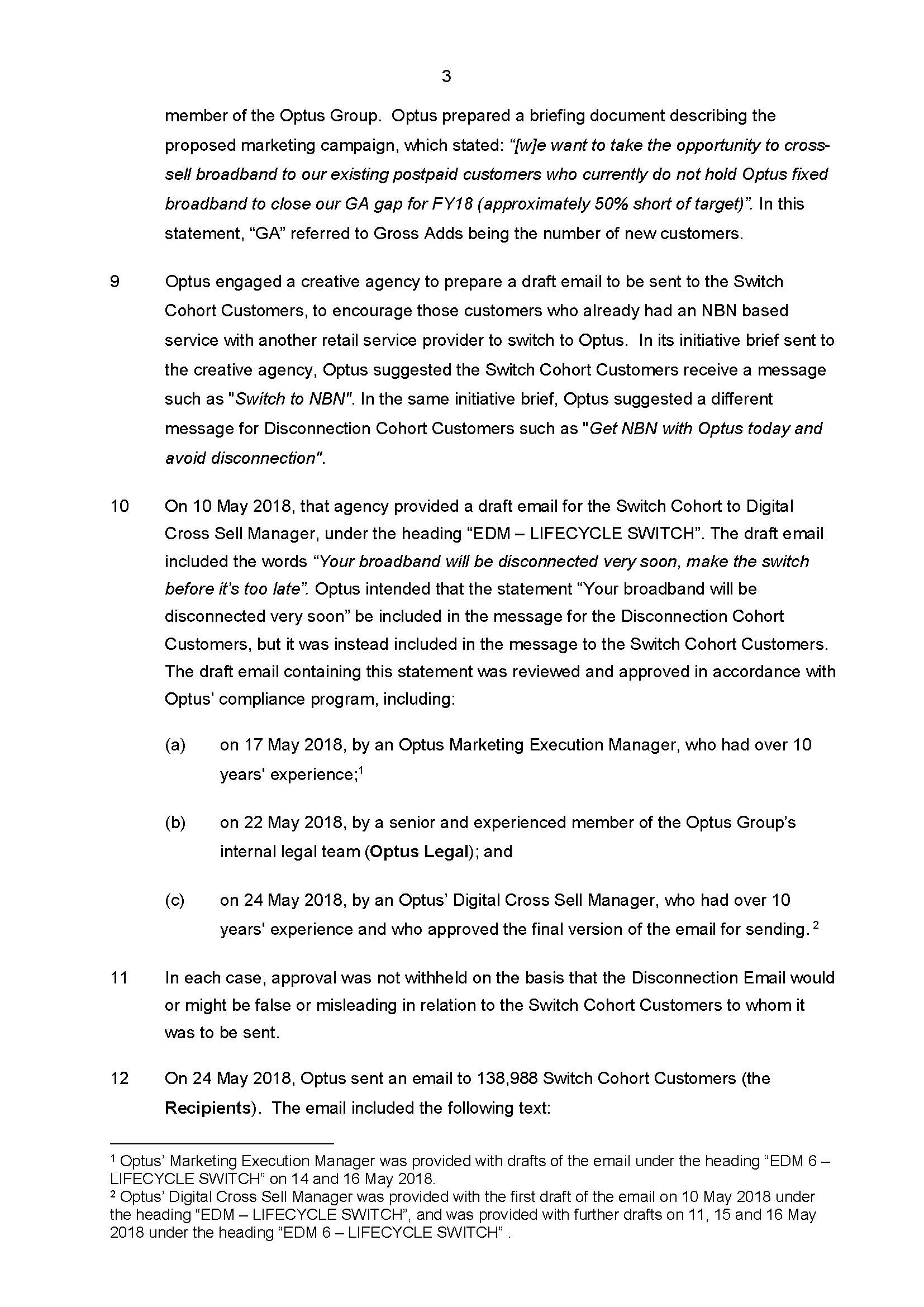
3 The parties also reached an agreed position on the appropriate penalties. In support of the agreed position, the parties filed a statement of agreed facts and admissions, joint submissions and an agreed minute of proposed orders containing penalties and costs. I have included the statement of agreed facts as annexure A to this judgment for reference, though I shall set out below a brief summary of the salient aspects of the agreed facts.
4 On 29 November 2019 the parties’ application for the agreed penalties came before me for consideration. I allowed the application and gave brief ex tempore remarks setting out the conclusions I had reached. I imposed a penalty of $6.4 million to be paid in equal shares by each of the Optus entities. I made orders restraining Optus from engaging in certain prescribed conduct for three years and requiring it to conduct an independent review of its consumer law compliance practices (as set out in the orders above, together, the penalties). The penalties mirrored those agreed between the parties. What follows is a fuller explanation for making the above orders in accordance with the agreement between the parties.
Offending conduct
5 Optus is wholly owned by Singtel Optus Pty Limited, which also owns Optus Internet, Optus Mobile and a number of other corporate entities (together, the Optus Group). Optus is the second largest supplier of telecommunications services in Australia. Optus has over 1.1 million broadband customers.
6 Optus provides multiple forms of telecommunications services. Relevant to the present, are NBN services and mobile telecommunications services. The NBN is a wholesale broadband access network being built, owned and operated by NBN Co Limited. ‘NBN services’ are those provided to customers to access the NBN. NBN Co provides wholesale access to the NBN to retail and other telecommunications providers such as Optus, who then provide products to consumers.
7 When the NBN is complete in a given area it is considered ‘ready for service’. This begins a transition period during which time retail providers such as Optus continue to supply services to customers in the ready for service area using the existing fixed-line network, while also offering customers access to NBN based services. After the initial transition period has passed certain pre-NBN infrastructure that is owned by the retail provider in the area may be decommissioned. Provided certain preconditions are met, retail providers may then disconnect remaining pre-NBN services.
8 The representations in issue in the present proceeding were made by Optus to a subset of its customers. The subset comprised those customers who at the time received mobile telecommunications services from a member of the Optus Group, but who were receiving NBN services from a provider other than from the Optus Group (referred to as the Switch Cohort Customers).
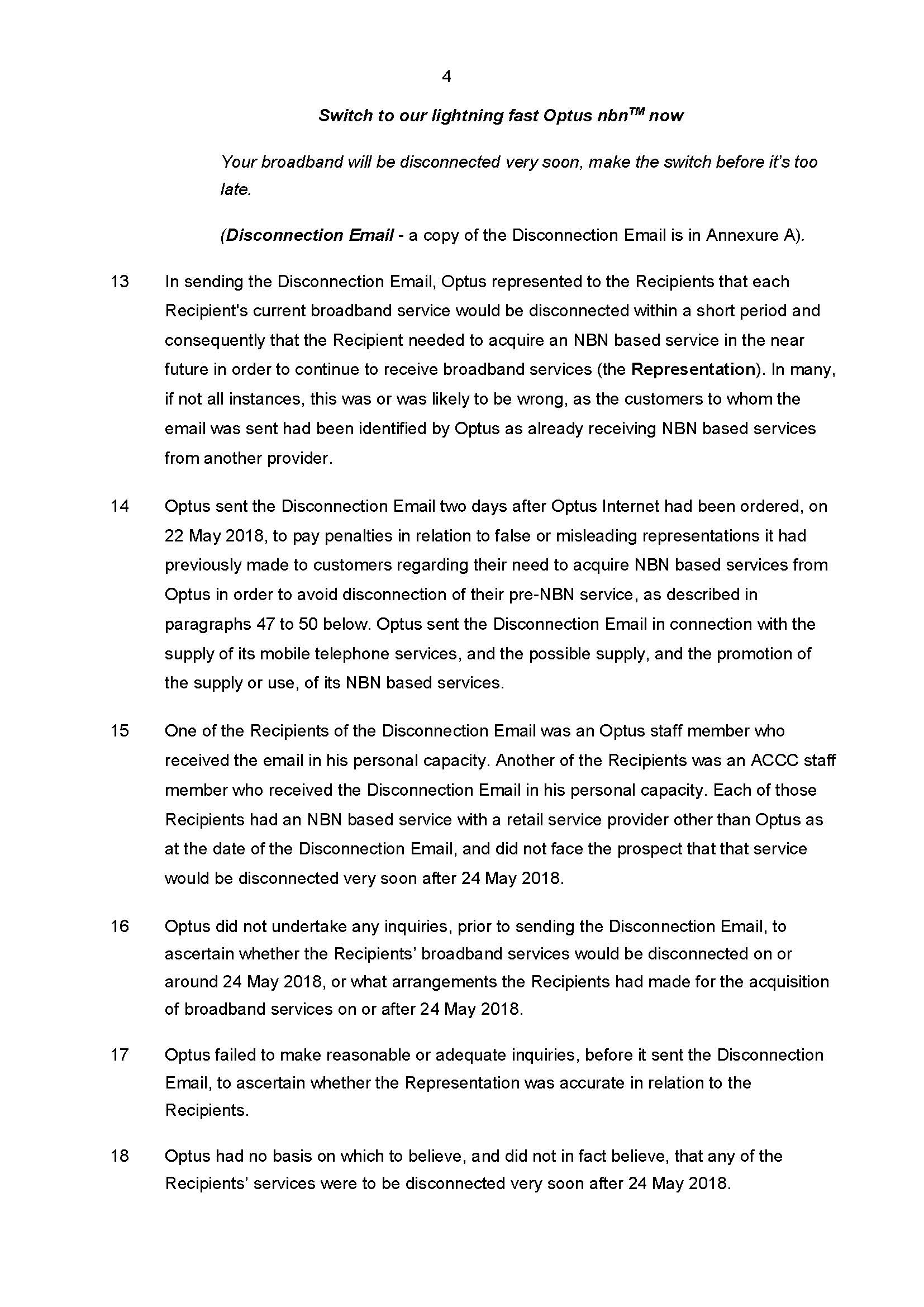
9 On 24 May 2018, Optus sent a marketing email to the Switch Cohort Customers which included the following text (referred to as the Disconnection Email):
Switch to our lightning fast Optus nbnTM now
Your broadband will be disconnected very soon, make the switch before it’s too late.
10 The misleading effect of the Disconnection Email is plain: it was sent to a group of customers which were already being provided NBN services by a different service provider, and hence, who were not at risk of disconnection. The email was in fact misleading to at least two of the recipients. One of the recipients of the Disconnection Email was an employee of Optus, and another an employee of the ACCC. Both employees were already receiving NBN based services from a retail service provider other than Optus, and neither faced the prospect of imminent disconnection.
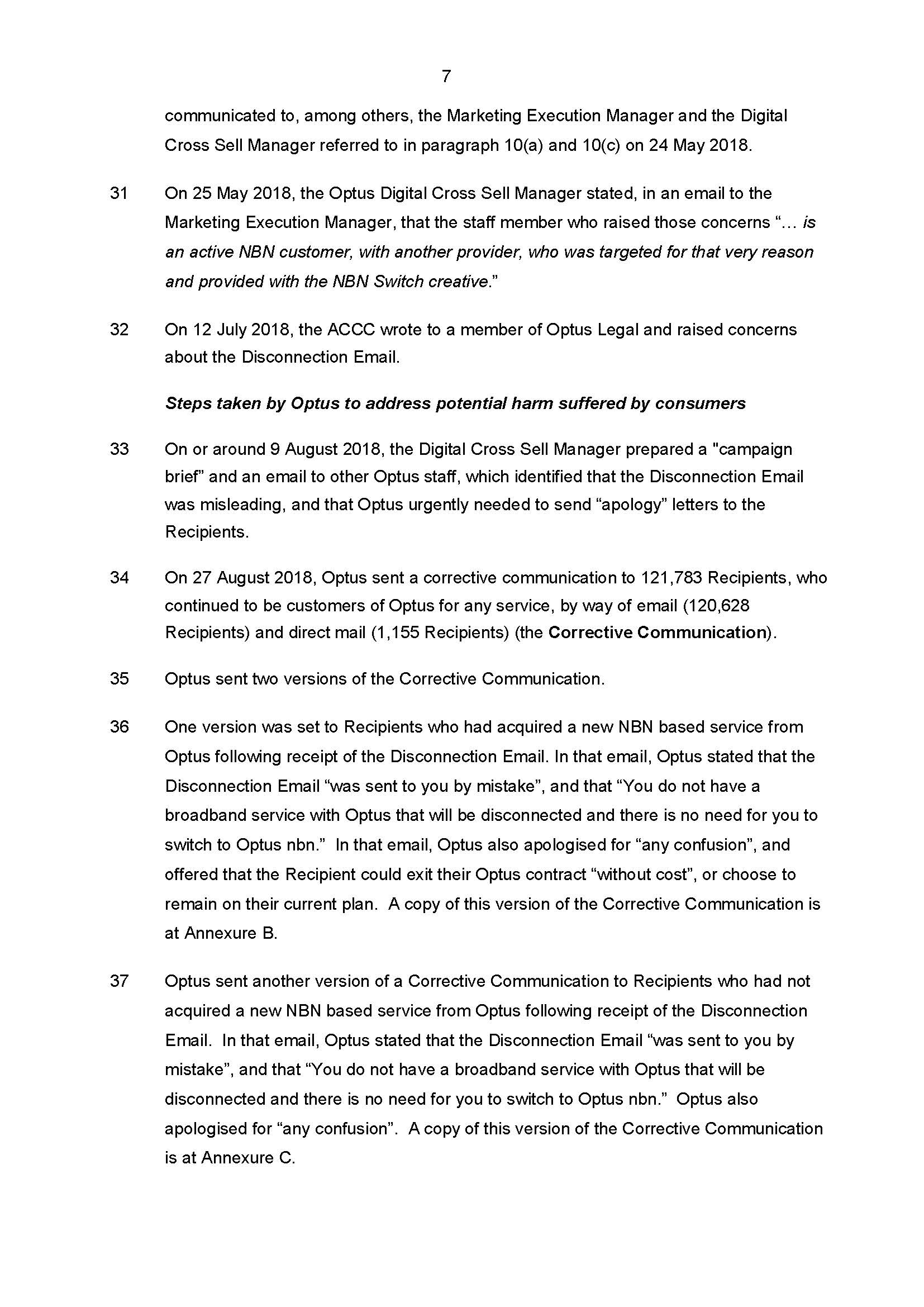
11 It appears from the statement of agreed facts that Optus did not intend the Disconnection Email to be sent to the Switch Cohort Customers. The Disconnection Email was developed by an external marketing consultant engaged by Optus to prepare a marketing campaign. The campaign was to target two groups: the Switch Cohort Customers, and, a second group containing people obtaining telecommunications services from the Optus Group but who had not switched to NBN based services and thus were at risk of disconnection (referred to as the Disconnection Cohort Customers). The statement of agreed facts states (at [10]) that “Optus intended that the statement “Your broadband will be disconnected very soon” be included in the message for the Disconnection Cohort Customers, but it was instead included in the message to the Switch Cohort Customers.”
12 Despite the plainly misleading effect of the Disconnection Email in the context of its actual recipients, a draft containing the misleading statement was reviewed and approved in accordance with Optus’ compliance program. More specifically, it was approved:
on 17 May 2018, by an Optus Marketing Execution Manager, who had over 10 years' experience;
on 22 May 2018, by a senior and experienced member of the Optus Group’s internal legal team (Optus Legal); and
on 24 May 2018, by an Optus’ Digital Cross Sell Manager, who had over 10 years' experience and who approved the final version of the email for sending.
13 Optus did not undertake any enquiries, prior to sending the Disconnection Email, to ascertain whether the Recipients’ broadband services would be disconnected on or around 24 May 2018, or what arrangements the Recipients had made for the acquisition of broadband services on or after 24 May 2018 (statement of agreed facts at [16]).
14 Further, the Disconnection Email was sent two days after the imposition of a penalty on Optus by this court in ACCC v Optus Internet Pty Limited [2018] FCA 777. The conduct there impugned also related to Optus misrepresenting the need for customers to acquire NBN based services from Optus in order to avoid disconnection.
Appropriate penalties
15 As above, the ACCC brought the action in part for breaches of ss 18 and 29(1)(l) of the ACL. Section 18 provides:
18 Misleading or deceptive conduct
(1) A person must not, in trade or commerce, engage in conduct that is misleading or deceptive or is likely to mislead or deceive.
(2) Nothing in Part 3-1 (which is about unfair practices) limits by implication subsection (1).
Sub-section 29(1)(l) provides:
29 False or misleading representations about goods or services
(1) A person must not, in trade or commerce, in connection with the supply or possible supply of goods or services or in connection with the promotion by any means of the supply or use of goods or services:
…
(l) make a false or misleading representation concerning the need for any goods or services; or
…
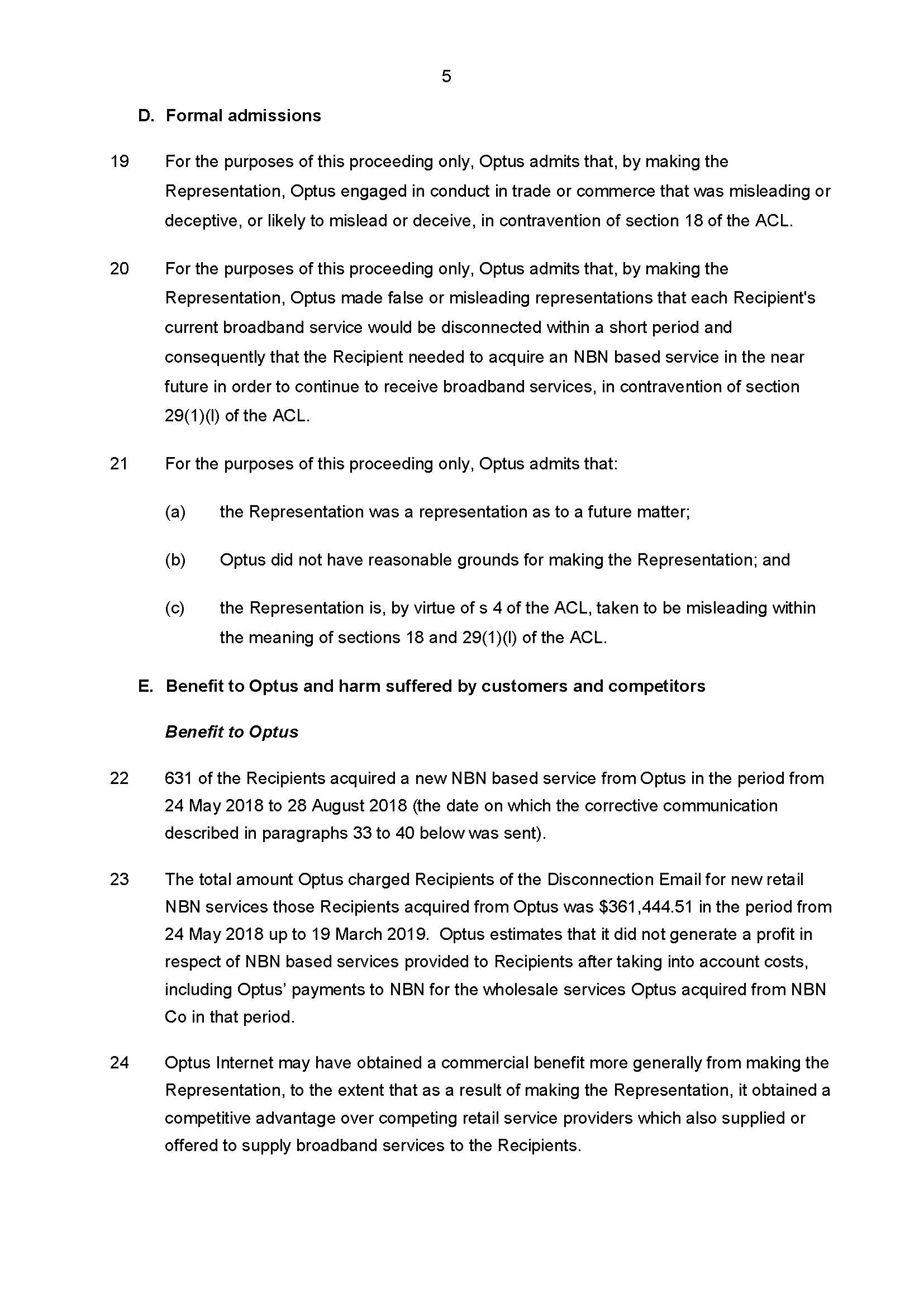
16 The statement of agreed facts contains the following admissions in relation to those sections (at [19]-[21]):
19 For the purposes of this proceeding only, Optus admits that, by making the Representation, Optus engaged in conduct in trade or commerce that was misleading or deceptive, or likely to mislead or deceive, in contravention of section 18 of the ACL.
20 For the purposes of this proceeding only, Optus admits that, by making the Representation, Optus made false or misleading representations that each Recipient's current broadband service would be disconnected within a short period and consequently that the Recipient needed to acquire an NBN based service in the near future in order to continue to receive broadband services, in contravention of section 29(1)(I) of the ACL.
21 For the purposes of this proceeding only, Optus admits that:
(a) the Representation was a representation as to a future matter;
(b) Optus did not have reasonable grounds for making the Representation; and
(c) the Representation is, by virtue of s 4 of the ACL, taken to be misleading within the meaning of sections 18 and 29(1)(l) of the ACL.
17 The parties have agreed certain penalties be imposed under ss 232, 224 and 246 of the ACL, and ss 21 and 43(1) of the FCA Act. The following forms of relief were agreed to be appropriate in this case:
(1) Declarations under s 21 of the FCA Act that Optus had contravened ss 18 and 29(1)(l) of the ACL by the conduct described above (declarations);
(2) Orders under s 224(1)(a)(ii) of the ACL requiring Optus to pay $6.4 million by way of pecuniary penalty (pecuniary penalties);
(3) Orders under ss 232 and 233 of the ACL enjoining Optus for three years from engaging in conduct similar to the above (injunctions); and
(4) Orders under s 246(2)(b) of the ACL requiring Optus to undertake an independent review of its compliance program, for the reviewer to provide a report with recommendations, and to put on affidavit evidence that it has carried out its obligations as such (compliance orders).
18 The proper approach to civil regulatory orders sought on an agreed basis was discussed by the High Court in Commonwealth v Director, Fair Work Building Industry Inspectorate (2015) 258 CLR 482 (see a recent consideration of this case in Australian Competition and Consumer Commission v Medibank Private Limited [2020] FCA 1030 at [10]-[15] per Anderson J). In Commonwealth v Director the plurality judgment of French CJ, Kiefel, Bell, Nettle and Gordon JJ stated (at [58]):
… Subject to the court being sufficiently persuaded of the accuracy of the parties' agreement as to facts and consequences, and that the penalty which the parties propose is an appropriate remedy in the circumstances thus revealed, it is consistent with principle and, for the reasons identified in [Trade Practices Commission v Allied Mills Industries Pty Ltd [1981] FCA 156; 37 ALR 256 at 259 per Sheppard J], highly desirable in practice for the court to accept the parties' proposal and therefore impose the proposed penalty.
(Emphasis added)
19 I will consider each remedy in turn against the High Court’s dictum in Commonwealth v Director that such remedy must be ‘an appropriate remedy in the circumstances’.
20 It is plain from the facts and admissions stated in the statement of agreed facts that Optus has engaged in the contraventions alleged. It is appropriate the Court’s disapproval of such conduct should be recorded by way of declaration of contravention.
21 Pursuant to s 224(1)(a)(ii) of the ACL, if the Court is satisfied a person has contravened a provision of Part 3-1 of the ACL, which relevantly includes s 29, the Court may order that person pay an appropriate penalty. Section 224(2) provides:
In determining the appropriate pecuniary penalty, the court must have regard to all relevant matters including:
(a) the nature and extent of the act or omission and of any loss or damage suffered as a result of the act or omission; and
(b) the circumstances in which the act or omission took place; and
(c) whether the person has previously been found by a court in proceedings under Chapter 4 or this Part to have engaged in any similar conduct.
22 The parties set out several matters supportive of the pecuniary penalties being appropriate in the present circumstances. I have considered those matters in addition to the factual matrix disclosed by the statement of agreed facts.
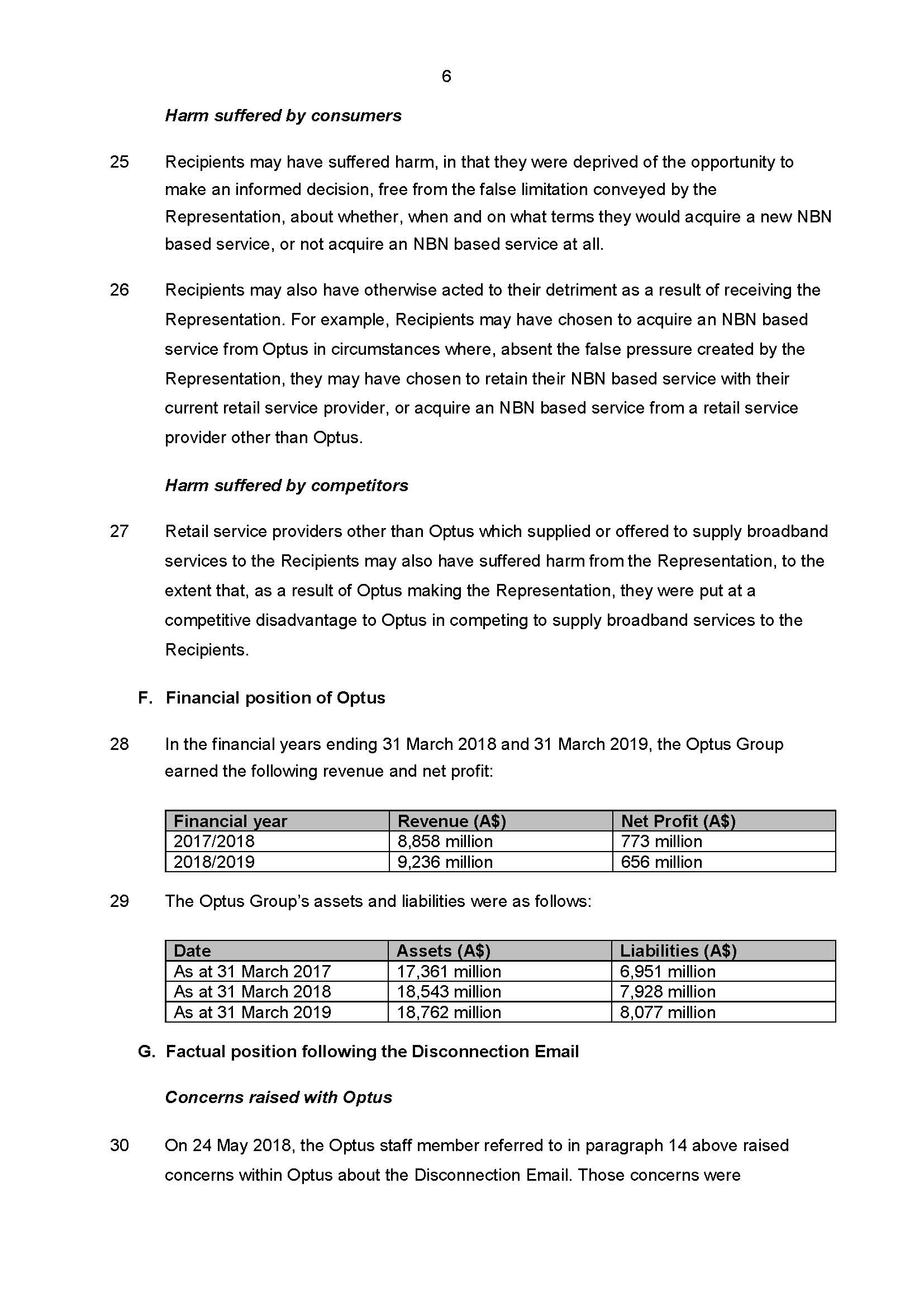
23 It has been long accepted that the primary role of civil penalties is to ensure deterrence: ACCC v TPG Internet Pty Ltd (2013) 250 CLR 640, at [65]. The Court should seek to impose a penalty that will deter the offending “…from the cynical calculation involved in weighing up the risk of penalty against the profits to be made from contravention”: Singtel Optus Pty Ltd v ACCC [2012] FCAFC 20; 287 ALR 249; (2012) ATPR ¶42–387, at [63]. In the present case specific deterrence is of particular relevance given Optus was fined $1.5 million in ACCC v Optus two days before the Disconnection Email was sent. This is not to say that Optus engaged in a ‘cynical calculation’. The statement of agreed facts and the submissions of the parties rebut such an inference. The statement of agreed facts states that of the 138,988 recipients of the Disconnection Email, only 631 acquired a new NBN based service from Optus in the relevant period, and that Optus estimates it did not generate a profit in respect of NBN based services provided to recipients after taking into account its costs of providing those services (at [23]). However, Optus ought reasonably been aware of the deficiencies in their internal compliance program and aware of the misleading nature of the Disconnection Email.
24 The submissions also made reference to the penalties applied in cases similar in some respects to the present: ACCC v AGL South Australia Pty Ltd [2015] FCA 399; 146 ALD 385, ACCC v Origin Energy Limited [2015] FCA 55, ACCC v Valve Corporation (No 7) [2016] FCA 1553, ACCC v MSY Technology Pty Ltd [2017] FCA 1251, ACCC v Optus Mobile Pty Limited [2019] FCA 106, and ACCC v Telstra Corporation Limited [2018] FCA 571; (2018) ATPR ¶42–593. I do not propose to consider and compare the facts in those cases to the present. I note that the penalty I have applied in this case falls in the upper end of the range of what appears appropriate relative to the conduct concerned and the penalties imposed in those cases. It is unnecessary to engage in a granular comparison between the present proceedings and those other similar cases. Such comparisons are apt to be unhelpful at a close specific level as there are invariably factual and circumstantial variations that render a comparison at that level more likely to reveal differences rather than similarities. In my view, it is sufficient for the purposes of ensuring reasonable consistency and proportionality to consider broadly similar cases at a higher level of comparison. I am satisfied that the level of the penalty agreed between the parties is within the range, indeed at the higher end of the range, for broadly similar contraventions involving offending of comparable scale and means.
25 I am also satisfied that the injunctions sought are appropriate remedies. I am fortified in my conclusion that injunctions are justified by the circumstance that Optus has recently been fined for similar conduct as discussed above. Though Optus’s offending conduct is not continuing, an order enjoining Optus from engaging in further like conduct for a period of three years carries with it the additional potential sanctions for contempt in the event of later contraventions. Thus potentially there is utility in making those orders.
26 Finally, turning to the compliance orders, it appears evident from the several reviews within Optus of the Disconnection Email, that their compliance process failed to identify its misleading nature. This suggests that Optus’s compliance program was deficient. Optus appears to accept as much by consenting to the orders that they conduct an independent review of their compliance program, in effect to be overseen by the ACCC. This too is clearly an appropriate preventative remedy in the circumstances.
Disposition
27 For the above reasons, I am satisfied the agreed orders are an appropriate remedy to impose.
I certify that the preceding twenty-seven (27) numbered paragraphs are a true copy of the Reasons for Judgment herein of the Honourable Justice Anastassiou. |
Associate:
Annexure A – Statement of Agreed Facts