

FEDERAL COURT OF AUSTRALIA
ORDERS
Applicant | ||
AND: | Respondent | |
DATE OF ORDER: |
THE COURT ORDERS THAT:
1. Pursuant to s 104.4 of the Criminal Code, being the Schedule to the Criminal Code Act 1995 (Cth), upon the respondent being personally served and being released from custody (whichever is the latter), the respondent is bound by the terms of the Interim Control Order set out in the Schedule to these orders.
2. The applicant take all reasonable steps to ensure that any request for approval which the respondent makes to the AFP Superintendent (as defined in paragraph 23.1(b) of the Interim Control Order) in accordance with the Interim Control Order, including any request for exemption under paragraph 22, is determined as soon as reasonably practicable.
Note: Entry of orders is dealt with in Rule 39.32 of the Federal Court Rules 2011.
SCHEDULE
1. This Interim Control Order relates to the respondent, Alo-Bridget Namoa.
2. The Court is satisfied on the balance of probabilities that, for the purpose of s 104.4(1)(c)(iv) of the Criminal Code (being the Schedule to the Criminal Code Act 1995 (Cth)), the respondent has been convicted in Australia of an offence relating to terrorism or a terrorist act, namely conspiring to do acts in preparation for, or planning, a terrorist act between 8 December 2015 and 25 January 2016 at Sydney, contrary to ss 11.5 and 101.6 of the Criminal Code.
3. The Court is satisfied on the balance of probabilities that each of the obligations, prohibitions and restrictions to be imposed on the respondent by the Interim Control Order is reasonably necessary, and reasonably appropriate and adapted, for the purposes of s 104.4(1)(d)(i) and (ii) of the Criminal Code.
4. The obligations, prohibitions and restrictions to be imposed on the respondent by this Interim Control Order are those set out in Annexure A to this Schedule.
5. A summary grounds on which the Interim Control Order is made is set out in Annexure B to this Schedule.
6. This Interim Control Order does not begin to be in force until it is served personally on the respondent and the respondent is released from custody.
7. If this Interim Control Order is confirmed, the confirmed control order is to be in force for 12 months after the day on which this Interim Control Order is made.
8. The respondent may attend the Federal Court of Australia, which is located at Level 17, Law Courts Building, 184 Phillip Street, Queens Square, Sydney NSW on 3 February 2020 at 9.30am for the Court to:
8.1. confirm (with or without variation) this Interim Control Order
8.2. declare this Interim Control Order to be void, or
8.3. revoke this Interim Control Order.
9. The respondent’s lawyer may attend the AFP Sydney office at 110 Goulburn St, Sydney NSW between 9 am to 4 pm, Monday to Friday in order to obtain a copy of this Interim Control Order.
Annexure A
1. Control 1
1.1. You are required to remain at premises:
a. nominated by you within 24 hours from the time that this Interim Control Order comes into force; and
b. approved in writing by the AFP Superintendent
(the specified premises),
between the hours of 10:00 pm and 6:00 am (the curfew period) each day from the day on which this Interim Control Order comes into force until the day that it ceases to be in force.
1.2. You must present and identify yourself at the specified premises during the curfew period upon request by a police officer.
2. Control 2
2.1. You are required to report to a police officer every Monday, between 7:00 am and 7:00 pm (the reporting period), at Fairfield Police Station, 40 Smart St, Fairfield, NSW, 2165.
3. Control 3
3.1. You are prohibited from being at any of the following areas:
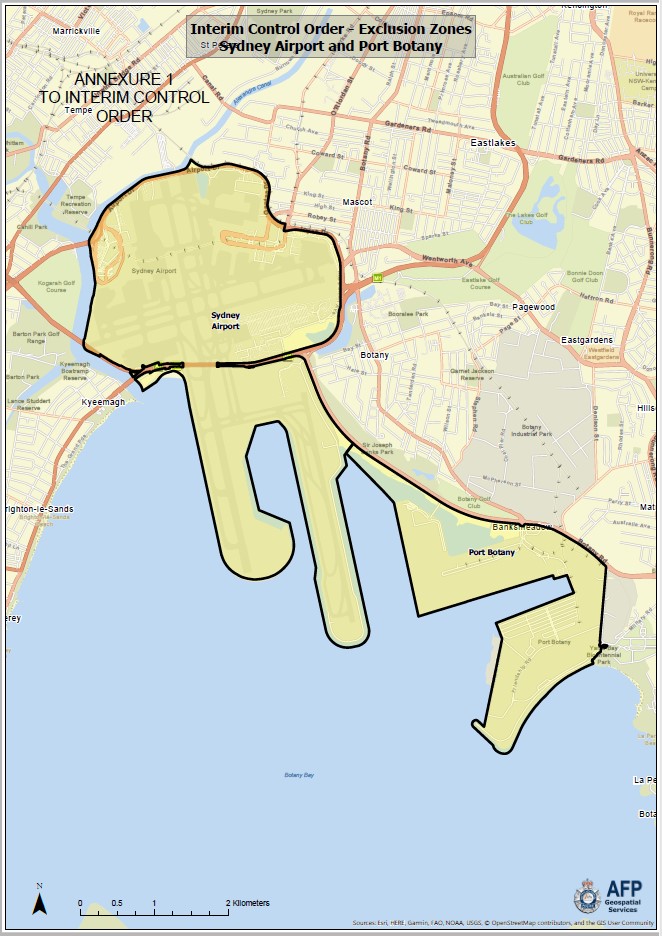
a. within the exclusion zone at Sydney Airport, as identified by yellow shading in Annexure 1;
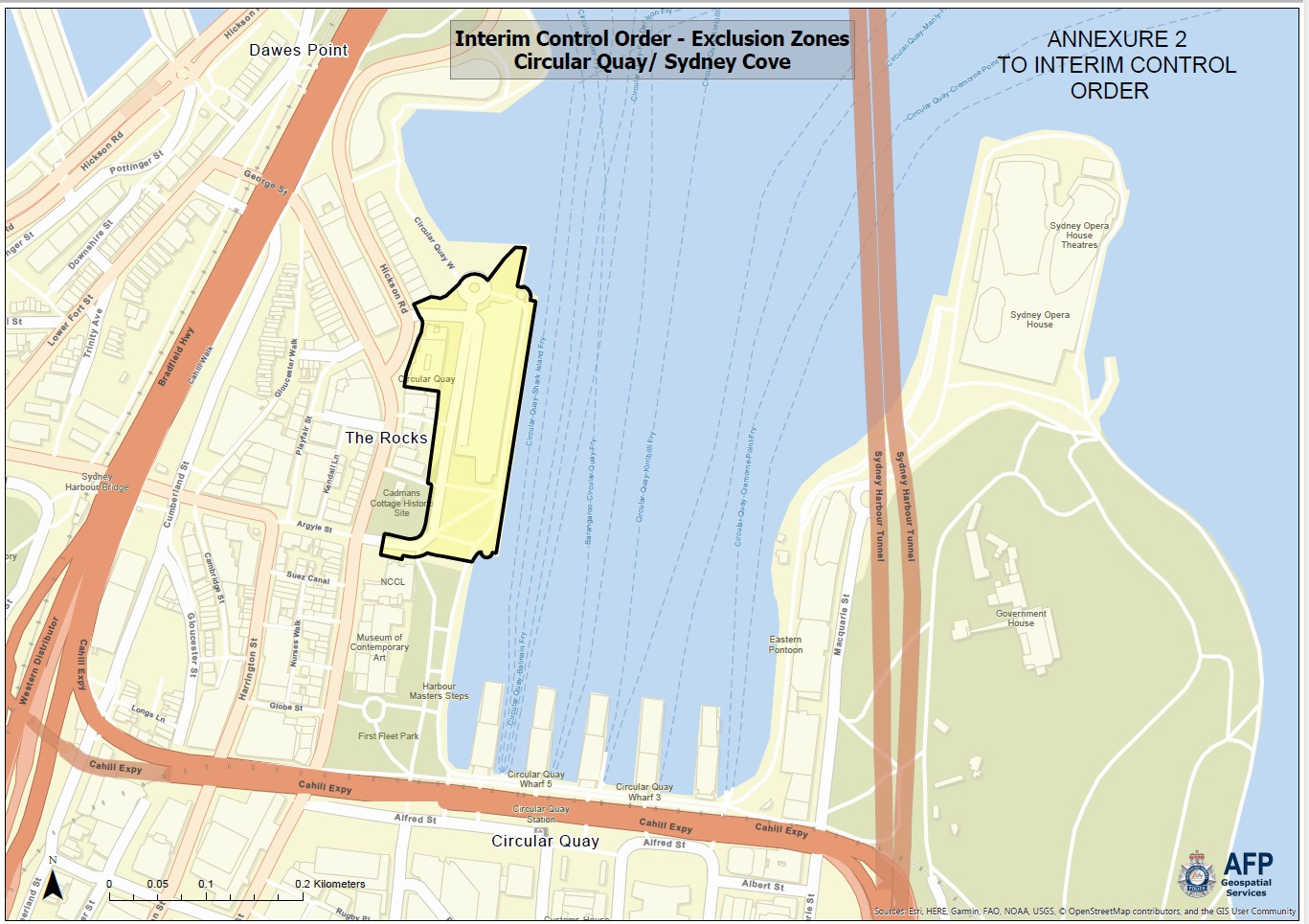
b. within the exclusion zone at Circular Quay, as identified by yellow shading in Annexure 2;
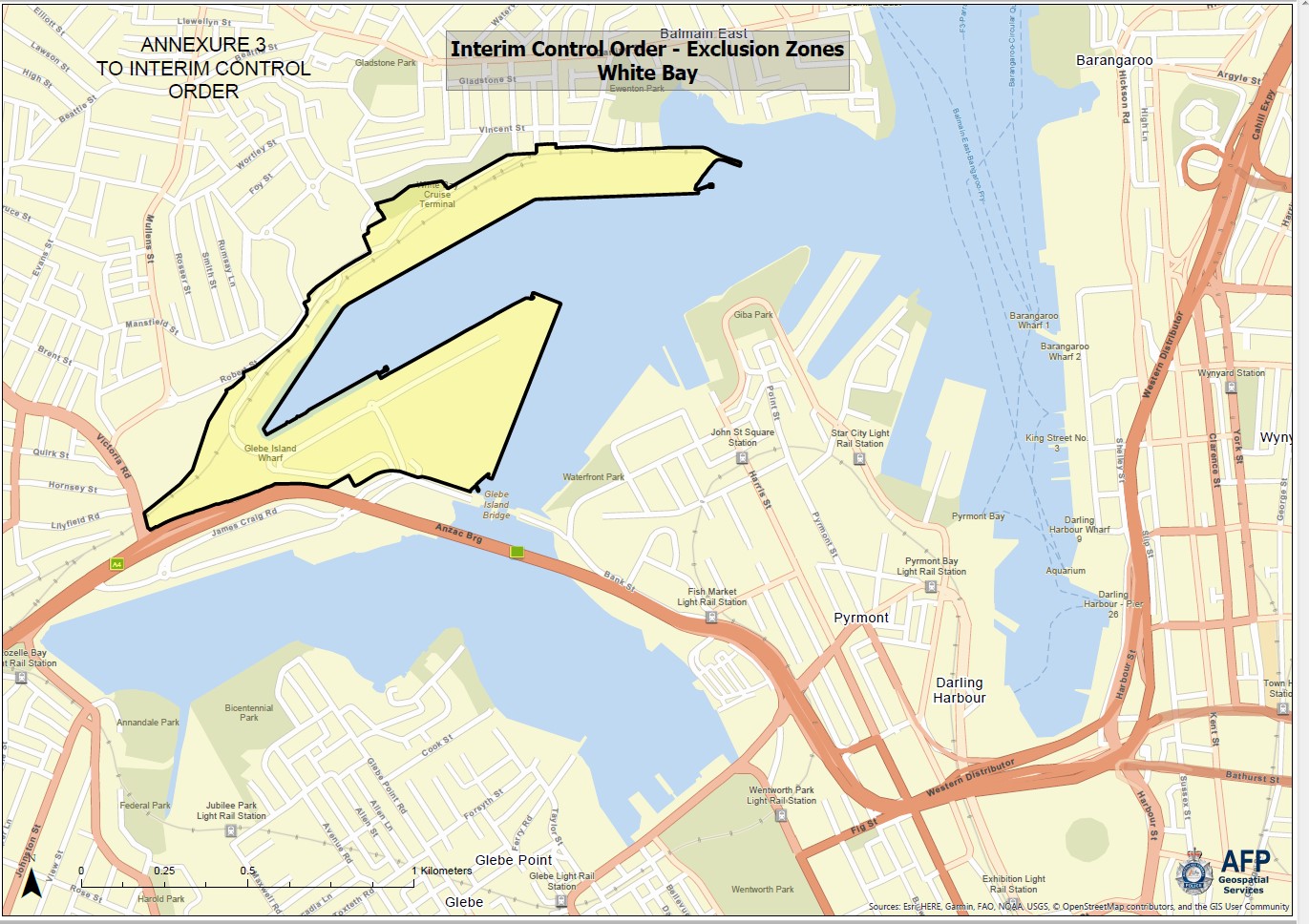
c. within the exclusion zone at White Bay, as identified by yellow shading in Annexure 3;
d. within 1 km of any Australian airport (besides Sydney Airport, which is addressed in Control 3.1.a) which has an international point of departure, or from which a person can board or charter a flight for an international destination;
e. within 1 km of any Australian port (besides Circular Quay and White Bay, which are addressed in Controls 3.1.b and 3.1.c) which has an international point of departure, or from which a person can board or charter a marine vessel for an international destination;
f. inside, or in the grounds of, any prison or correctional facility unless you are incarcerated there;
g. at the following residential addresses specified below:
i. Unit 2, 22 Owen St, Punchbowl, NSW, 2196 (Rose Karroum)
ii. 1 Miriam St, Bass Hill, NSW, 2197 (Siaunofilalao Kepu)
h. at the residence of any person with whom, by reason of Control 11, you are prohibited from communicating or associating; and
i. any place in Australia outside the state of New South Wales.
3.2. However, Control 3.1.a does not prohibit you from travelling via train through the exclusion zone identified in Annexure 1, although you are prohibited from getting on or off the train within that exclusion zone.
4. Control 4
4.1. You are prohibited from leaving Australia.
5. Control 5
5.1. You are prohibited from carrying out the following specified activities (including in respect of your work or occupation), namely: accessing, acquiring, possessing or storing documents (including documents in electronic form) or electronic media, or attempting to access, acquire, possess or store documents (including documents in electronic form) or electronic media, which relate to any of the following:
a. explosives, explosive devices, initiation systems or firing devices;
b. firearms, ammunition or knives;
c. anti-surveillance or counter surveillance,
unless that material is:
d. published by a ‘constituent body’ of the Australian Press Council;
e. broadcast on Australian free to air television;
f. broadcast on Australian pay television;
g. shown in a commercial movie cinema;
h. broadcast on one of the following streaming services: Netflix; STAN; ABC iView; or SBS on demand; or
i. contained in material that is served on you or your legal representatives by or on behalf of the applicant in Federal Court proceeding Booth v Namoa (NSD 2028 of 2019), including any appeal from that proceeding.
6.1. You are prohibited from carrying out the following specified activities (including in respect of your work or occupation), namely: accessing, acquiring, possessing or storing documents (including documents in electronic form) or electronic media, or attempting to access, acquire, possess or store documents (including documents in electronic form) or electronic media, depicting or describing any:
a. execution;
b. beheading;
c. suicide attack;
d. bombing;
e. terrorist attack;
f. propaganda and promotional material for a ‘terrorist organisation’ within the meaning of s 102.1(1) of the Schedule to the Criminal Code Act 1995 (Cth); or
g. activities of, or associated with, any ‘terrorist organisation’ within the meaning of s 102.1(1) of the Schedule to the Criminal Code Act 1995 (Cth),
unless that material is:
h. published by a ‘constituent body’ of the Australian Press Council;
i. broadcast on Australian free to air television;
j. broadcast on Australian pay television;
k. shown in a commercial movie cinema;
l. broadcast on one of the following streaming services: Netflix, STAN, ABC iView, SBS on demand; or
m. contained in material that is served on you or your legal representatives by or on behalf of the applicant in Federal Court proceeding Booth v Namoa (NSD 2028 of 2019), including any appeal from that proceeding.
7. Control 7
7.1. You are prohibited from the following specified activities (including in respect of your work or occupation), namely: producing or distributing documents (including documents in electronic form) or electronic media relating to:
a. explosives, explosive devices, initiation systems or firing devices;
b. firearms, ammunition or knives;
c. anti-surveillance or counter surveillance;
d. execution;
e. beheading;
f. suicide attack;
g. bombing;
h. terrorist attack;
i. propaganda and promotional material for a ‘terrorist organisation’ within the meaning of s 102.1(1) of the Schedule to the Criminal Code Act 1995 (Cth);
j. activities of, or associated with, any ‘terrorist organisation’ within the meaning of s 102.1(1) of the Schedule to the Criminal Code Act 1995 (Cth).
8. Control 8
8.1. You are prohibited from carrying out the following specified activities (including in respect of your work or occupation), namely: renting, purchasing, or driving any vehicle which exceeds a gross vehicle mass of 4.5 tonne.
9. Control 9
9.1. You are prohibited from undertaking paid employment without first notifying the AFP Superintendent in writing of the name and place of business of the employer.
9.2. The prohibitions, restrictions and requirements in Controls 12, 13, 16, 17, 18, 19 and 20, do not apply to your use of, or access to, the devices and services referred to therein for the sole purpose of your paid employment, provided you give written notice to the AFP Superintendent containing the following information:
9.2.1. In respect of a mobile telephone device – the phone number and make of the device, within 24 hours of your first use of the device;
9.2.2. In respect of a fixed or landline telephone service – the phone number of the service, within 24 hours of your first use of the service;
9.2.3. In respect of the platforms or services referred to in Control 16 – the name of the platform or service you have used, the username or account name you have used to access the platform or service, within 24 hours of your first use of the platform or service;
9.2.4. In respect of an internet service – the location at which the service is accessible and the device which you use to access the service, within 24 hours of your first use of the service;
9.2.5. In respect of an email account – the email address, within 24 hours of your first use of the account;
9.2.6. In respect of a computer – the location of the computer, within 24 hours of your first use of the computer; and
9.2.7. In respect of a tablet device – the model of the device, within 24 hours of your first use of the device.
9.3. The exception in paragraph 9.2.1 permits you to use, in addition to the permitted mobile phone referred to in Control 12, no more than one mobile telephone device at any one time.
9.4. The prohibitions, restrictions and requirements in Controls 16, 17, 18, 19 and 20, do not apply to your use of, or access to, the devices and services referred to therein for the sole purpose of undertaking a course of education or study, provided you give written notice to the AFP Superintendent containing the following information:
9.4.1. The name of the education or training provider, the course of study, the location of the campus, proof of enrolment and class schedule; and
9.4.2. In respect of the platforms or services referred to in Control 16 – the name of the platform or service you have used and the username or account name you have used to access the platform or service, within 24 hours of your first use of the platform or service;
9.4.3. In respect of an internet service – the location at which the service is accessible and the device which you use to access the service, within 24 hours of your first use of the service;
9.4.4. In respect of an email account – the email address, within 24 hours of your first use of the account;
9.4.5. In respect of a computer – the location of the computer, within 24 hours of your first use of the computer; and
9.4.6. In respect of a tablet device – the model of the device, within 24 hours of your first use of the device.
9.5. The exception in paragraph 9.4.2 is limited to use of or access to the platforms or services only via the ‘permitted mobile phone’ (as defined in Control 12) or the ‘permitted computer’ (as defined in Control 19).
10. Control 10
10.1. You are prohibited from possessing or using, or causing any person to act on your behalf to possess or use, any of these specified articles or substances, namely:
a. firearms, firearm part of or ammunition within the meaning of s. 4 of the Firearms Act 1996 (NSW);
b. a ‘prohibited weapon’ within the meaning of the Weapons Prohibition Act 1998 (NSW) legislation;
c. any quantity of any chemical which is not consistent with reasonable domestic use;
d. an article or device, not being a firearm, capable of discharging by any means:
i. any irritant matter in liquid, powder, gas, chemical form or any dense smoke; or
ii. any substance capable of causing bodily harm;
e. a detonator;
f. a fuse capable of use with an explosive or a detonator;
g. a knife, in a public place, without reasonable excuse;
h. anything intended, by the person having custody of the thing, to be used to injure or menace a person or damage property.
11.1. You are prohibited from communicating or associating with:
a. any person incarcerated in any correctional facility;
b. any person located in Turkey, Iraq or Syria;
c. any of the following specified individuals:
i. Amnah RIMA (nee HAMZE) (Date of Birth: 08/09/1975);
ii. Bassam HAMZY (Date of Birth: 03/01/1979);
iii. Rose Honor KARROUM (Date of birth: 29/06/1990);
iv. Siaunofilalao KEPU (Date of Birth: 11/11/1998).
12. Control 12
12.1. You are prohibited from accessing or using, any mobile telephone device other than one mobile telephone device (the permitted mobile phone), and your use of the permitted mobile phone is subject to the following conditions:
a. before using the permitted mobile phone, you must present it to the AFP Superintendent (or a police officer specified in writing by the AFP Superintendent) for inspection;
b. before using the permitted mobile phone, you must advise the AFP Superintendent, in writing, of the following information: the International Mobile Equipment Identity number for the permitted mobile phone, the Integrated Circuit Card Identifier for the SIM card you will use with the permitted mobile phone, the telecommunication service provider which you will use with the permitted mobile phone, the password for the permitted mobile phone and the phone number to which the permitted mobile phone will be connected;
c. once you have advised the AFP Superintendent of the information required by paragraph 12.1.b above, you must not change, remove, modify or disconnect or cause any other person to change, remove, modify or disconnect on your behalf (including any employee or person acting on behalf of a telecommunications service provider) the SIM card, telecommunication service provider or phone number connected to the permitted mobile phone; and
d. if you change the password for the permitted mobile phone, you must provide the new password to the AFP Superintendent, or a police officer acting under the AFP Superintendent’s direction, if you are requested to do so by the AFP Superintendent or the police officer.
12.2. You are prohibited from causing or permitting another person to use or access the permitted mobile phone.
12.3. You are prohibited from causing or permitting another person to use or access any mobile telephone device on your behalf.
13. Control 13
13.1. You are prohibited from accessing or using any fixed or landline telephone service other than one service that has been approved in writing by the AFP Superintendent for you to access or use.
13.2. To seek approval, you must:
a. submit a written request to the AFP Superintendent which nominates the fixed or landline telephone service; and
b. provide any other information requested by or on behalf of the AFP Superintendent for the purpose of identifying the nominated fixed or landline telephone service.
13.3. You are prohibited from causing another person to use or access any fixed or landline telephone service on your behalf.
14. Control 14
14.1. You are prohibited from accessing or using, or causing any person to access or use on your behalf, any public telephone except in the case of an emergency, provided that you contact the AFP Superintendent as soon as possible after accessing or using such a public telephone and:
a. provide sufficient detail to the AFP Superintendent to identify the public telephone that you accessed or used, the date, time and phone number called; and
b. you explain the nature of the emergency which required you to access or use, or cause another person to access or use on your behalf, that public telephone.
15. Control 15
15.1. You are prohibited from accessing or using, or causing any person to access or use on your behalf, any satellite telephone service.
16. Control 16
16.1. You are prohibited from accessing or using, or causing any person to access or use on your behalf, any of the following websites, applications or computer programs (collectively, platforms), as the case may be:
a. FaceTime
b. WhatsApp
c. Viber
d. Telegram
e. Skype
f. Instagram
g. Snapchat
h. KIK
i. iCall
j. WeTalk
k. Lync2013
l. Nimbuzz Messenger
m. Whistle Phone
n. Talkatone
o. Discord
p. Google Duo
q. MagicApp
r. Signal Private Messenger
s. Zoiper IAX SIP VOIP Softphone
t. Beejive
u. Fring
v. JaJah
w. Line2
x. Talkatone
y. Truphone
z. Twitter
aa. Yahoo
ab. ICQ
ac. Google Talk
ad. MSN Messenger
ae. AIM
af. Yahoo Messenger
ag. Packet8
ah. Google Hangouts.
16.2. In addition to the platforms listed in Control 16.1, you are prohibited from accessing or using, or causing any person to access or use on your behalf, any Voice Over Internet Protocol (VOIP) service.
16.3. In addition to the platforms listed in Control 16.1, you are prohibited from accessing or using, or causing any person to access or use on your behalf, any internet based messaging service.
16.4. However, Controls 16.2 and 16.3 do not prohibit access to or the use of:
a. Facebook (including Facebook Messenger), provided that:
i. you are limited to using a single Facebook account; and
ii. if that Facebook account exists at the time of making this Interim Control Order before accessing or using it, you advise the AFP Superintendent in writing of the profile name and account number of that account; or
iii. if that Facebook account does not exist at the time of making this Interim Control Order within 24 hours of creating it, you advise the AFP Superintendent in writing of that account’s profile name and account number; and
b. a website which includes an ‘instant chat’ function that allows a visitor to the website to send messages to, and receive messages from, the website host solely for the purpose of obtaining or providing customer service.
17. Control 17
17.1. You are prohibited from accessing or using any internet service other than a service that has been approved in writing by the AFP Superintendent for you to access or use (the permitted internet service).
17.2. To seek approval:
a. you must submit a written request to the AFP Superintendent which:
i. nominates the internet service provider account; and
ii. nominates the devices you will connect to the internet service (including but not limited to computers and televisions);
b. provide any other information requested by, or on behalf of, the AFP Superintendent, in relation to, or for the purpose of identifying, the nominated account and devices.
17.3. You are prohibited from causing any other person to access or use on your behalf any other internet service.
18. Control 18
18.1. You are prohibited from accessing or using any electronic mail (email) account other than an account that has been approved in writing by the AFP Superintendent for you to access or use (the permitted email account).
18.2. To seek approval:
a. you must submit a written request to the AFP Superintendent which nominates the email account; and
b. provide any other information requested by, or on behalf of, the AFP Superintendent in relation to, or for the purpose of identifying, the nominated account which you will be accessing or using.
18.3. You are prohibited from causing or permitting another person to use or access the permitted email account.
18.4. You are prohibited from causing any other person to access or use on your behalf any email account.
19.1. You are prohibited from accessing or using any computer other than a computer that has been approved in writing by the AFP Superintendent for you to access or use (the permitted computer) and your use of the permitted computer is subject to the following conditions:
a. before using the permitted computer, you must provide the password for the permitted computer to the AFP Superintendent; and
b. if you change the password for the permitted computer, you must provide the new password to the AFP Superintendent, or a police officer acting under the AFP Superintendent’s direction, if you are requested to do so by the AFP Superintendent or the police officer.
19.2. To request approval under Control 19.1 you must:
a. submit a written request to the AFP Superintendent which nominates the computer; and
b. provide any information requested by or on behalf of the AFP Superintendent in relation to, or for the purpose of identifying and accessing, the nominated computer.
20.1. You are prohibited from accessing or using, or causing any person to access or use on your behalf, any tablet device, including but not limited to an iPad or a Samsung Galaxy Tab.
20.2. However, Control 20 does not prohibit you from accessing or using a computer with tablet device functionalities that is approved for use as the ‘permitted computer’ pursuant to Control 19.
21. Control 21
21.1. You are required to consider in good faith participating in counselling or education relating to your spiritual, emotional and physical wellbeing, with a suitably qualified professional counsellor or publicly recognised religious leader, for at least 60 minutes per week.
21.2. If you agree to participate in such counselling or education you must advise the AFP Superintendent in writing that you have commenced the counselling or education and provide the AFP Superintendent the name and qualifications of the professional you have engaged.
22. Exemption
22.1. You may request the AFP Superintendent approve an exemption to the requirements or prohibitions (as the case may be) specified in Control 1.1, Control 2.1, Control 3.1.i and Control 11.1.b.
22.2. To request an exemption, you must:
a. submit a written request to the AFP Superintendent which: (i) identifies the Control in respect of which you seek an exemption; (ii) explains the extent to which you seek to be exempted from the Control; and (iii) explains your reason(s) for seeking the exemption; and
b. provide any other information requested by, or on behalf of, the AFP Superintendent for the purposes of determining whether to approve the exemption.
22.3. The AFP Superintendent may grant an exemption subject to conditions specified in writing.
22.4. You must comply with all of the conditions specified in writing by the AFP Superintendent. If you do not comply with a condition to an exemption, the exemption is (and will be taken to have been for all purposes) of no effect.
22.5. A request for an exemption must be made before the material time and date.
22.6. If the AFP Superintendent has not approved an exemption by the material time and date, the request is deemed to have been refused.
23. Interpretation
23.1. In this Interim Control Order:
a. Material time and date means:
i. in relation to a request for an exemption to the requirement in Control 1.1 the commencement of the curfew period that is the subject of the request (and, if more than one curfew period is the subject of the request, the first of those curfew periods);
ii. in relation to a request for an exemption to the requirement in Control 2.1 before the conclusion of the reporting period that is the subject of the request (and, if more than one reporting period is the subject of the request, the first of those reporting periods);
iii. in relation to a request for an exemption to the requirement in Control 3.1.i the time and date at which you wish to depart New South Wales; and
iv. in relation to a request for an exemption to the requirement in Control 11.1.b the time and date at which you wish to communicate with a person located in Turkey, Iraq or Syria.
b. AFP Superintendent means a member of the Australian Federal Police performing the duties of a Superintendent within the Counter Terrorism portfolio.
c. Password includes but is not limited to any passcode, swipe pattern or any information or function necessary to facilitate access to the applicable device.
d. Police officer means a ‘member’ or ‘special member’ of the Australian Federal Police, as defined by the Australian Federal Police Act 1979 (Cth), or a ‘police officer’ within the meaning of the Police Act 1990 (NSW).
(REVISED FROM THE TRANSCRIPT)
RARES J:
1 This is an application for an interim control order in respect of the respondent, Alo-Bridget Namoa, under s 104.4 of the Criminal Code in the Schedule to the Criminal Code Act 1995 (Cth). The applicant, Sandra Booth, holds the rank of commander in the Australian Federal Police.
2 On 5 October 2018, after a four week trial in the Supreme Court of New South Wales before Fagan J and a jury, Ms Namoa and her co-offender, Sameh Bayda, were both found guilty by a jury of the offence of conspiring between 8 December 2015 and 25 January 2016 at Sydney and elsewhere to do acts in preparation for, or planning, a terrorist act, contrary to ss 11.5(1) and 101.6(1) of the Code.
3 On 31 January 2019, Fagan J sentenced Ms Namoa and Mr Bayda to imprisonment. Ms Namoa was sentenced to three years and nine months, commencing on 23 March 2016 and expiring on 22 December 2019. His Honour fixed a non-parole period of two years and 10 months: R v Bayda; R v Namoa (No 8) [2019] NSWSC 24. However, the Attorney-General for the Commonwealth, in the exercise of his discretion, did not grant Ms Namoa any period of parole.
4 Senior counsel has appeared today for Ms Namoa and he with her lawyers have been able to cooperate with Commander Booth in formulating terms of the interim control order. As I will explain below, the parties have cooperatively reformulated those terms following concerns that I raised about what Commander Booth originally had proposed be the form of control in relation to circumstances for which Ms Namoa could obtain employment.
The legislative context and preconditions for the making of an interim control order
5 The hearing of an application for an interim control order is an interlocutory, not final, hearing by force of s 104.28A(2)(i).
6 Part 5.3 of the Code is headed “Terrorism” and provides for both the substantive offence the subject of the conspiracy for which Ms Namoa was convicted and the making of control orders. Division 104 in Pt 5.3 deals prescriptively with control orders. I consider below the provisions in Div 104 relevant for present purposes.
7 Commander Booth is a senior AFP member as defined in s 100.1 of the Code, being a member of the Australian Federal Police of or above the rank of superintendent for the purposes of s 104.4(1)(a).
8 On 5 December 2019, pursuant to s 104.2(1), the Minister, in writing, consented to Commander Booth making a request for the issue of an interim control order under s 104.3 of the Code. The Code creates a myriad of matters that the Court must state in both an interim control order and in the reasons it must give reasons in the ordinary performance of its judicial functions.
9 The substantive offence the subject of the conspiracy, within the meaning of s 11.5 of the Code, was that in s 101.6(1) of the Code. That provides that “A person commits an offence if the person does any act in preparation for, or planning, a terrorist act”.
10 Significantly for present purposes, s 101.6(2)(a) provides that the person commits the offence even if a terrorist act does not occur. As Wigney J pointed out in McCartney v EB (2019) 263 FCR 170, at 175 [25]:
Curiously, in a piece of legislation which, like most modern Commonwealth legislation, contains a plethora of labyrinthine definitional provisions, the expression “offence relating to terrorism” is not defined. Nor indeed, is the word “terrorism”. That is all the more curious given that the expression “terrorist act” is defined for the purposes of Pt 5.3 of the Code, which is entitled “Terrorism”. The Crimes Act 1914 (Cth) also defines “terrorism offence” and, as will be seen, that definition is relevantly picked up by s 104.4(1)(c)(v) of the Code.
11 His Honour discussed the meaning of the expression “offence relating to terrorism” and concluded that the offence for which EB had been convicted fell within the definition.
12 Here, Ms Namoa’s offence consisted of a conspiracy to do acts in preparation for or planning a terrorist act. I am satisfied, on the balance of probabilities, that Ms Namoa is a person who has been convicted, in Australia, of an offence relating to, first, a terrorist act and secondly, terrorism, within the meaning of s 104.4(1)(c)(iv).
13 The next condition which the Code prescribes in order to enliven the power to make an interim control order is that the Court be satisfied, on the balance of probabilities, that each of the obligations, prohibitions and restrictions to be imposed on the person by the order is reasonably necessary, reasonably appropriate and adapted for the purpose of, relevantly, protecting the public from a terrorist act or preventing the provision of support, or the facilitation of, a terrorist act (s 104.4(1)(d)(i) and (ii)). Under 104.4(2)(a) and (c) the Court is bound to take into account for the purposes of being so satisfied, first, as a paramount consideration, the objects of Div 104 in s 104.1 of the Code and, secondly, the impact of each obligation, prohibition or restriction in the interim control order on the person’s circumstances, including his or her financial and personal circumstances. The objects of Div 104 are:
104.1 Objects of this Division
The objects of this Division are to allow obligations, prohibitions and restrictions to be imposed on a person by a control order for one or more of the following purposes:
(a) protecting the public from a terrorist act;
(b) preventing the provision of support for or the facilitation of a terrorist act;
(c) preventing the provision of support for or the facilitation of the engagement in a hostile activity in a foreign country.
Background
14 Ms Booth set out a comprehensive account of the factual background to Ms Namoa’s and Mr Bayda’s offending. On 30 December 2015, Ms Namoa and Mr Bayda went through an Islamic ceremony of marriage, but he, and possibly she, no longer regard that ceremony as legally effective.
15 Part of Ms Namoa’s current circumstances appear in the sentencing remarks of Fagan J. His Honour had the benefit of hearing from both Ms Namoa and her co-offender in the sentencing hearing. He was able to observe them being cross-examined and used that opportunity to make his findings of fact. In sentencing, his Honour found (at [5]) that the offence was of a relatively low order of seriousness and that there were significant mitigating circumstances with respect to each of the offenders, justifying determinate sentences of moderate duration.
16 He found that Ms Namoa was in agreement with, and expressly supported, Mr Bayda’s intention to carry out a terrorist act. Initially, her co-offender agreed to carry out an attack on people in Sydney during the New Year’s Eve festivities on 31 December 2015. His Honour found that the agreement extended beyond that proposed attack, which, in the event, was aborted. He found that Ms Namoa had encouraged her co-offender to perpetrate that attack, including by sending him a text message that she said: “I wanna do an Islamic bonnie and Clyde version on the kuffs haha”. Fagan J found that the expression “kuffs” was a contemptuous reference that both offenders used to refer to people who did not follow Islam (at [10]–[13]).
17 His Honour found that on 13 January 2016 Ms Namoa was in possession of a weapon being a 20cm knife, which was wrapped in an Islamic State flag and that Mr Bayda had been in possession of the knife and flag previously. Fagan J found that those circumstances would justify the jury finding that she was holding the knife and flag in safekeeping pursuant to an arrangement between her and Mr Bayda and that it was implicit in the jury’s verdict that they had found the agreement subsisted from 30 December 2015 to at least 13 January 2016, although his Honour found that the agreement extended for a lengthier period when entering the conviction.
18 Importantly, his Honour had regard to both Ms Namoa’s evidence and a report by Dr Richard Furst dated 1 December 2018. Dr Furst is a consultant forensic psychiatrist. His Honour found (at [38]) that Ms Namoa’s induction into Islam and Dr Furst’s report on her education and psychology showed that she was naïve and suggestible. He said that her evidence on sentence and her demeanour in the witness box:
left me with the impression she could well have been taken in by false boasting from Bayda that he was on a suicide mission.
19 His Honour found that, soon after the authorities seized the 20cm knife from Ms Namoa on 13 January 2016, Mr Bayda purchased another knife with a folding blade. His Honour accepted Ms Namoa’s evidence that Mr Bayda had not consulted her about buying the new knife and that, as soon as she found he had it, she disposed of it (at [41]). His Honour quoted (at [51]) from a letter that Ms Namoa had written to him as the sentencing judge (that is also in evidence before me) in which she said:
I acknowledge that I was a fanatic and that I’ve accessed a substantial amount of Islamic State propaganda, as well as downloading various books and documents onto my phone.
20 Fagan J also found (at [71]) that both offenders had adopted a fanatical Islamic hostility toward non-Muslims and towards Australia’s liberal democratic society in accordance with religious instruction they had received, both directly and online, and that those views were not capable of being regarded as mere antisocial or political views, but involved the infliction of violence on non-Muslims as an act of religious duty and devotion. His Honour found (at [94]) that Ms Namoa’s conduct at the time of her arrest and her letters from prison showed her immaturity, lack of critical judgment and previous immersion in jihadist thinking.
21 He found that she had told Dr Furst that she had abandoned her extremist views by about December 2017, and that she had learned that Mr Bayda had by then become a Christian and that she wanted to follow him. Fagan J found (at [97]) that, on 7 October 2018, two days after the jury returned the guilty verdict, Ms Namoa informed correctional staff at the facility where she was held that she had renounced Islam altogether and had reverted to Christianity. His Honour said that, on first impression, that conduct provoked cynicism about her sincerity. However, he accepted her evidence as genuine and found that she had continued to wear the hijab on the advice of correctional staff in order to conceal from other inmates that she was not practising the Islamic religion. His Honour accepted that there would be a risk of violence towards her by other Muslim inmates if they believed she had renounced their faith.
22 Although his Honour did not find it necessary to determine with what degree of sincerity Ms Namoa had reverted to Christianity, he was satisfied (at [101]) that she no longer accepted any command of Allah for Islamic domination by violence. Fagan J also found support in the surrounding circumstances (at [102]) for her evidence that her belief in jihadism was a childish phase from which she had matured, including that she had not studied Islamic scriptures with sufficient thoroughness or understanding to have acquired them from them a deeply embedded intellectual belief in a duty of religious warfare. His Honour found that she had been drawn into her previous salafi jihadism beliefs at a superficial and emotional level, because that doctrine gave her a sense of belonging to something, as well as a sense of purpose and a channel for expression of aggressive feelings.
23 Fagan J found that, being 18 years of age at the time of the offending, Ms Namoa was highly susceptible to Islamic brainwashing and that her educational difficulties and concomitant frustration and anger during school years necessarily led to her feeling a degree of isolation that was probably compounded by her lack of involvement in the workforce since leaving school at 16. His Honour said (at [103]–[104]) that, having considered Ms Namoa’s developmental history, her extensive text exchanges and intercepted phone conversations with her co-offender, her letters, oral evidence and her demeanour in the witness box, he had no hesitation in accepting the analysis of Dr Furst that his Honour set out in his reasons which I repeat below, namely:
Ms Namoa has a history of mental health problems that have been present since at least 2010, probably longer, and persisted throughout her late childhood and teens, including depression, anxiety, emotional dysregulation, low self-esteem, low self-worth, anger issues, learning difficulties and a level of cognitive function that appears to be well below average…
Her history of emotional and behavioural instability, low self-esteem, and low self-worth were identified by [a clinical psychologist who reported on her in 2011, 2012 and 2016] as factors that made Ms Namoa vulnerable to being influenced by others and were also thought to be related to her recent conversion to Islam. Her suspected learning difficulties were thought to be manifesting in social and cognitive immaturity, with suspected deficits in consequential thinking and a general executive function ... including problem-solving and higher order thinking.
In my opinion, the deficits identified by [the clinical psychologist] are clearly related to her mental disorders/conditions and likely played a role in her conversion to Islam and attraction towards the extremist Jihadist ideologies of Islamic State…
Her mental health problems outlined above probably also made her vulnerable to the influence of her co-offender and/or other individuals holding extremist Jihadist ideologies, which is likely to have been a significant factor in her offending.
24 His Honour made allowance for her youth that allowed her to be seduced by an ideology promoted by propaganda. He found that Ms Namoa lacked the intellectual strength to bring reason and humanity to prevail against the outrageous concepts that had previously influenced her.
25 His Honour also found (at [105]) that a crime of the nature the subject of the two offenders’ convictions was an attack on the framework of government and law. He found (at [115]) that neither of the co-offenders, at the time of his sentencing, remained motivated by jihadist ideology.
26 He also found (at [117]) that the causal effect of Ms Namoa’s mental disturbances made it inappropriate to penalise her at a level that otherwise might have been called for by way of a deterrent to others. Fagan J found that both Ms Namoa and Mr Bayda were demonstrably immature, even for their age, and that Dr Furst’s opinion supported that finding in Ms Namoa’s case. He found (at [120]) that both offenders were genuine both in their renunciation of fanatical beliefs and in their expressions of remorse and contrition (at [120] and [125]). He said (at [121] and [125]):
Both offenders have at least commenced to develop reason and humanity in place of blind, submitting belief. The evidence heard since the jury gave their verdict justifies some confidence that on their return to the community Bayda and Namoa will show respect for the beliefs of others and for the laws of this country which protect the freedom of its citizens to pursue personal spirituality in their own way.
…
Namoa has cooperated with police to the extent of allowing herself to be interviewed in custody and answering questions in a manner which the responsible officer regards as frank. I do not consider that her compliance with the police request in this respect warrants specification of a particular discount but I treat it as reinforcing her expressions of contrition and confirming her progress in rehabilitation. It contributes to the overall mitigation of her penalty.
27 The material before Fagan J, including the transcript of Ms Namoa’s evidence on sentence and the documents she had written, are in the material before me. Ms Namoa a year ago gave evidence at the sentencing hearing. There is no more recent, relevant material to suggest any reason to think, for present purposes, that the positive factors in Ms Namoa’s favour to which Fagan J referred have not continued to be in place.
Consideration
28 On my assessment, there is still a real and reasonable risk that Ms Namoa remains a person about whom it is not possible conclusively to say that she is not at risk of relapsing to, or actually maintaining, the offending behaviours that led to her conviction, although, as I have said, there are many positive indications that she has abandoned those behaviours.
29 The statement of facts pursuant to s 104.2(3)(aa)(i) relating to why Commander Booth contended that the interim control order should be made contains evidence that Ms Namoa wrote letters on 28 October 2018 and 2 July 2019 to two other inmates in the prison in which she described herself as “your baby terrorist”. The content of those letters may be explicable as consistent with the advice of the prison officials to which Fagan J referred, namely that Ms Namoa maintain a semblance in prison that she was adhering to her earlier beliefs and behaviours, for her own protection in that environment.
30 The problem with which I am faced is that in cases involving persons who have been prepared to ascribe to, and act on, fundamentalist, violent or antisocial beliefs or practices, it is not always possible, objectively, to ascertain whether a subsequent renunciation is genuine or, even if genuine, one that the person can maintain because of his or her personality traits, education and psychological conditions that led to the initial adoption of those toxic beliefs. Experience of life requires a recognition that vulnerable people, such as Ms Namoa, are able to exhibit strength in certain situations, but when re-exposed to the company of persons who still adhere to those toxic beliefs or practices, will not be able to maintain the reformed strength and will succumb to the previous malign influence.
31 The evidence presently before me indicates that Ms Namoa is a person who is vulnerable and, in the past, has succumbed to those vulnerabilities by adopting jihadist or fundamentalist beliefs and behaviours that resulted in her conviction. On her evidence and Fagan J’s findings that accepted that evidence, she maintained those behaviours for some time from the age of about 15 until abandoning those beliefs and behaviours in prison.
32 In Minister for Immigration and Ethnic Affairs v Guo (1997) 191 CLR 559 at 574 to 575, Brennan CJ, Dawson, Toohey, Gaudron, McHugh and Gummow JJ said:
The course of the future is not predictable, but the degree of probability that an event will occur is often, perhaps usually, assessable. Past events are not a certain guide to the future, but in many areas of life proof that events have occurred often provides a reliable basis for determining the probability — high or low — of their recurrence. The extent to which past events are a guide to the future depends on the degree of probability that they have occurred, the regularity with which and the conditions under which they have or probably have occurred and the likelihood that the introduction of new or other events may distort the cycle of regularity. In many cases, when the past has been evaluated, the probability that an event will occur may border on certainty. In other cases, the probability that an event will occur may be so low that, for practical purposes, it can be safely disregarded. In between these extremes, there are varying degrees of probability as to whether an event will or will not occur. But unless a person or tribunal attempts to determine what is likely to occur in the future in relation to a relevant field of inquiry, that person or tribunal has no rational basis for determining the chance of an event in that field occurring in the future.
Determining whether there is a real chance that something will occur requires an estimation of the likelihood that one or more events will give rise to the occurrence of that thing. In many, if not most cases, determining what is likely to occur in the future will require findings as to what has occurred in the past because what has occurred in the past is likely to be the most reliable guide as to what will happen in the future. It is therefore ordinarily an integral part of the process of making a determination concerning the chance of something occurring in the future that conclusions are formed concerning past events.
(emphasis added)
33 The making of a control order requires the Court to engage in the process of evaluating, through the balancing exercise that Div 104 of the Code prescribes, what obligations, prohibitions and restrictions ought be imposed on a person, having regard to what is reasonably necessary, reasonably appropriate and adapted for the purposes of protecting the public from a terrorist attack or preventing the provision of support for, or the facilitation of, a terrorist act.
34 In Thomas v Mowbray (2007) 233 CLR 307 at 331 [19], Gleeson CJ said that a requirement of that kind would sometimes be described as a requirement of proportionality and that judgments about proportionality often require courts to evaluate considerations that are, at least, as imprecise as those involved in formulating a control order. He said (233 CLR at 334 [28]):
I am unable to accept that there is a qualitative difference between deciding whether an angry person poses an unacceptable risk to his or her family, or to the community or some section of the community, or whether a sexually dysfunctional man poses an unacceptable risk to women, and deciding whether someone who has been trained by terrorists poses an unacceptable risk to the public. The possibility that the person will do what he or she has been trained to do, or will be used as a “resource” by others who have been so trained, is capable of judicial evaluation.
(emphasis added)
35 Gummow and Crennan JJ expressed similar conclusions, with which Heydon J agreed (233 CLR at 526 [651]). Gummow and Crennan JJ described the notion of a sufficient connection between the desired end and the means proposed for its attainment as possibly having its origins in constitutional law. They said that such a connection was capable of judicial application elsewhere, and that s 104.4(1) of the Code was an example (233 CLR at 353 [103]). Callinan J agreed generally with Gummow and Crennan JJ on this issue (233 CLR at 507 [594]–[595], 509 [600]). As Callinan J said (at 507 [595]):
The making of orders by courts to intercept, or prevent conduct of certain kinds is a familiar judicial exercise. Every injunction granted by a court is to that end. And every application for an interlocutory injunction requires the court to undertake a balancing exercise, that is to say of the convenience of the competing interests, and the efficacy and necessity of the orders sought. Injunctions to restrain public nuisances require the same approach. Orders to prevent apprehended violence, to bind people over to keep the peace, and, more recently, as in Fardon v Attorney-General (Qld)[(2004) 223 CLR 575], to approve curially continued detention as a preventative purpose to protect the public, are exercises undertaken, and, in my view, as here, better so undertaken by the courts. Protection of the public is frequently an important, sometimes the most important of the considerations in the selection of an appropriate sentence of a criminal. That too is necessarily both a balancing and a predictive exercise. It is one that necessarily takes account of the role of the police and other officials in preventing crime, and even of further criminal conduct on the part of the offender to be sentenced, as well as his personal circumstances.
(emphasis added)
36 In McCloy v New South Wales (2015) 257 CLR 178, French CJ, Kiefel, Bell and Keane JJ discussed the implied constitutional freedom of communication on government and political matter and the test of proportionality, being the test that the Court applies to determine whether an impugned law is reasonably appropriate and adapted for the purposes of maintaining a system of representative government for which the Constitution provides. They discussed the concept of proportionality, saying (257 CLR at 215–216 [74]):
Proportionality provides a uniform analytical framework for evaluating legislation which effects a restriction on a right or freedom. It is not suggested that it is the only criterion by which legislation that restricts a freedom can be tested. It has the advantage of transparency. Its structured nature assists members of the legislature, those advising the legislature, and those drafting legislative materials, to understand how the sufficiency of the justification for a legislative restriction on a freedom will be tested.
37 Here, of course, the requirements of Div 104 of the Code are a legislative and constitutionally valid response to a situation in order to achieve the objects in s 104.1 (see Thomas v Mowbray (2007) 233 CLR 307). The Parliament enacted Div 104 for the purpose of protecting the public from a terrorist act, preventing the provision of support for, or the facilitation of, a terrorist act and preventing the provision of support for, or the facilitation of, the engagement in hostile activity in a foreign country. I must take into account those objects as a paramount consideration in evaluating the terms and provisions of the interim control order that I am asked to make.
38 French CJ, Kiefel, Bell and Keane JJ said in McCloy (257 CLR at 217 [79]) that there were three stages for assessing the proportionality of a statute, namely, first, whether it was suitable, secondly, it was necessary, and, thirdly, adequate in its balance. They said that suitability was also referred to as “appropriateness” or “fit”, but the measure was to be tested by ascertaining whether it would contribute to the realisation of the statute’s legitimate purpose. Unless that could be done, its use could not be said to be reasonable. The test at the first stage required there be a rational connection between the provision in question and the statute’s legitimate purpose, so that its purpose could be furthered.
39 Their Honours said that the second stage of the test looked to whether there were other equally effective means of achieving the legislative object – which had a less restrictive effect on the freedom and were obvious and compelling. In cases where such alternative measures were available, the use of a more restrictive one was not reasonable and could not be justified (McCloy 257 CLR at 217 [81]).
40 French CJ, Kiefel, Bell and Keane JJ identified the third stage, adequacy, as involving a question of whether the burden on the freedom was undue or impermissibly burdensome, again having regard to the statutory purpose (257 CLR at 218 [86]).
The controls
41 Here, the controls as now proposed require Ms Namoa to nominate where she intends to live to the AFP officer who is “the superintendent” within 24 hours from the time that the interim control order comes into effect, so that she will remain at those premises between 10 pm and 6 am during the currency of the order (control 1). Control 2 requires her to report every Monday between 7 am and 7 pm to police at a police station near to where she lives. Control 3 prohibits her from being at Sydney Airport and the areas of the overseas terminals at Circular Quay and White Bay, being places where she may be able to depart from Australia, although she is permitted to use a train that passes through the airport for transport other than to the airport, if she need do so, including for work or education. Control 3 prohibits her from being at the residential addresses of two persons who appear to have been involved in her former jihadist behaviours. She is prohibited from leaving Australia or engaging in activities for acquiring, or possessing, or storing documents or other things relating to explosives, firearms, or counter-surveillance matters unless those things are effectively freely available through ordinary news media or in material that are served on her for the purposes of these proceedings (controls 4, 5, and 7).
42 The material that was in evidence in the criminal trial demonstrated that Ms Namoa had had access on a variety of devices and platforms to highly disturbing jihadist and fundamentalist material and that the viewing of those matters may have led to her engaging in the conspiracy of which she was convicted.
43 She will also be prohibited from viewing or reading on any devices other than in ordinary news media, material that relates to various terrorist activities (control 6). She cannot use, rent or purchase any vehicle which exceeds a gross vehicle mass of 4.5 tonnes (control 8).
44 The controls also will restrict her use of mobile and fixed telephones, computer devices, social media and similar communication platforms. However, those restrictions are subject to Ms Namoa being able to inform the superintendent of her use of those communication and electronic devices in certain limited ways, including allowing her to use Facebook and Facebook Messenger on a single account.
45 Initially, control 9 sought to prohibit Ms Namoa from undertaking paid employment without first notifying the superintendent in writing and submitting written information about the proposed employment, details of the employer, including the name and place of business and the nature of the work that would be undertaken.
46 I raised with the parties that a control to that effect may effectively prejudice her ability to find any useful employment because it would require Ms Namoa, in advance, to inform employers of the interim control order’s impact on her restricted ability to access any form of telephony, or computer or electronic devices, which are now commonplace in daily life, including in almost all places in which people with her qualifications and abilities could find work. The parties were able to refine the prohibitions that are proposed to apply so as to enable Ms Namoa to obtain work. She must inform the superintendent before she undertakes paid employment. Once employed, she may use only one device in each category for the purposes of her work and that, when she does so, she must, within 24 hours, inform the superintendent of the device and any relevant information to enable any use of it by her to be checked (controls 9, 12–20).
47 Controls 10 and 11 prohibit or restrict Ms Namoa from possessing or using weapons or weapon making articles or associating with particular persons or classes of person.
48 Finally, control 21 requires her to consider in good faith participating in counselling or education relating to her spiritual, emotional and physical wellbeing with a suitably qualified professional counsellor or publicly recognised religious leader for at least one hour per week.
49 I am also mindful that the lack of exposure to freedom in the community has left Ms Namoa in the position, at present, where it is not feasible to ascertain with any certainty that she will behave in any particular way on her release. According to her evidence, that Fagan J accepted, she has had to conform to what other fundamentalists within the prison system expected of her, albeit that subsequently she has disavowed those beliefs to the prison officials themselves and in the sentencing process before Fagan J. Therefore, there is still a risk that, on release, she may or may not revert to her previous offending behaviour, or the behaviours that led to her offending and which she maintained for a period while being held on remand pending her trial.
Conclusion
50 I have considered the terms of the proposed controls, having regard to the fact that Ms Namoa’s behaviours are untested outside the prison environment and in light of the circumstances of her offending.
51 Having regard to the protective objects of Div 104 in s 104.1, I am satisfied on the balance of probabilities that, first, each of the proposed obligations, prohibitions and restrictions in the final version of the proposed interim control order, that I have settled with the assistance of counsel for the parties, imposes on Ms Namoa no more than is reasonably necessary, reasonably appropriate and adapted for the purpose of the paramount consideration of protecting the public from a terrorist act, and preventing the provision of support for or the facilitation of a terrorist act, and, secondly, the proposed orders are also reasonably necessary, reasonably appropriate and adapted to minimise, consistently with the object of the rehabilitation of Ms Namoa, the impact of the controls on her financial and personal circumstances, having regard to the time between her release from prison on Sunday, 22 December 2019, and the confirmation hearing on 3 February 2020.
52 For these reasons, I am of opinion that the interim control order as now proposed should be made on the basis that the confirmation hearing will be fixed for 3 February 2020.
I certify that the preceding fifty-two (52) numbered paragraphs are a true copy of the Reasons for Judgment herein of the Honourable Justice Rares. |
Associate:


