

FEDERAL COURT OF AUSTRALIA
AIRR Holdings Ltd, in the matter of AIRR Holdings Ltd [2019] FCA 2180
ORDERS
Plaintiff | ||
AND: | ||
ELDERS LIMITED ACN 004 336 636 Intervener | ||
DATE OF ORDER: |
THE COURT ORDERS THAT:
1. Elders Limited be granted leave to intervene in the proceeding pursuant to rule 9.12 of the Federal Court Rules 2011 (Cth).
2. Pursuant to s 411(1) of the Corporations Act 2001 (Cth) (Act), the Plaintiff convene and hold a meeting of holders of fully paid ordinary shares in the Plaintiff (Shareholders) to be held at Bayview on the Park, 52 Queens Road, Melbourne, Victoria, on 25 October 2019 at 11:00am (Melbourne time) (Scheme Meeting) for the purpose of considering and, if thought fit, approving with or without modifications, the scheme of arrangement proposed between the Plaintiff and the Shareholders (Scheme), being the document at Annexure C of the explanatory booklet and explanatory statement, which explanatory booklet is annexed at Exhibit BMC-31 to the Third Affidavit of Brett Maitland Cowell sworn on 16 September 2019 (Explanatory Booklet).
3. The Explanatory Booklet, which contains an explanatory statement required by s 412(1)(a) of the Act and includes the Notice of Scheme Meeting (being the document at Annexure E of the Explanatory Booklet) be and is approved, subject to:
(a) correction of any minor typographical or grammatical errors;
(b) insertion of the date of the second court hearing as provided in paragraph 10 below of these orders;
(c) any minor amendments required or approved by the Australian Securities and Investments Commission (ASIC) for registration under s 412(6) of the Act; and
(d) the use of the words “All Cash” and “All Shares” in relation to the Scheme Election be deleted and replaced with “Maximum Cash” and “Maximum Shares”.
4. Subject to registration of the Explanatory Booklet with the ASIC pursuant to s 412(6) of the Act, the Plaintiff is to dispatch, on or about 20 September 2019, a document substantially in the form of the Explanatory Booklet (as amended in order 3 above) and the applicable proxy and election forms to the Shareholders who appear on the register of members as at 5:00pm (Melbourne time) on 19 September 2019 by:
4.1 in the case of each Shareholder who has nominated an electronic address for the purposes of receiving notifications of notices of any meeting, by email to the nominated email address, with such email to contain a link through which those Shareholders can access the relevant documents; or
4.2 in the case where a Shareholder has not nominated an electronic address for the purposes of receiving notifications of notices of any meeting, by ordinary pre-paid post.
5. Dispatch of the documents referred to in order 4 above in accordance with the method set out in order 4 above is taken to be sufficient notice of the Scheme Meeting.
6. Pursuant to s 1319 of the Act, rules 2.15, 3.4 and Form 6 of the Federal Court (Corporations) Rules 2000 (Cth) and regulations 5.6.11 to 5.6.12 and 5.6.13A to 5.6.36A of the Corporations Regulations 2001 (Cth) do not apply to the scheme meeting. Subject to these orders, the Scheme Meeting is to be (so far as practicable)
(a) convened, held and conducted in accordance with the provisions of Part 2G.2 of the Act that apply to members of a company and the provisions of the Plaintiff’s constitution that are not inconsistent therewith and that apply to meetings of members;
(b) the Plaintiff may determine that, for the purposes of the Scheme Meeting, all the shares in the Plaintiff be taken to be held by the person, persons or bodies corporate who held them as at 7:00pm (Melbourne time) on 23 October 2019, in accordance with the register held and maintained by the Plaintiff;
(c) a proxy form in respect of the Scheme Meeting will be valid and effective if, and only if, it is completed and delivered in accordance with its terms by 10:00am (Melbourne time) on 23 October 2019;
(d) Mr Craig Lehmann Farrow or, failing him, Mr Graeme Douglas Jolly be appointed to act as chairperson of the Scheme Meeting;
(e) the Chairperson of the Scheme Meeting shall have the power to adjourn the meeting in his absolute discretion to such time, date and place as he considers appropriate; and
(f) a poll must be taken to decide the resolutions put to the vote at the Scheme Meeting, except for procedural motions.
7. Two shareholders present in person or by proxy, corporate representative or attorney under power and entitled to vote shall constitute a quorum for the Scheme Meeting.
8. Voting on the resolution to approve the Scheme at the Scheme Meeting is to be conducted by way of poll.
9. Subject to the requisite majorities of Shareholders voting in favour of the Scheme at the Scheme Meeting, the Plaintiff is publish a Notice of Hearing in The Australian newspaper, in substantially the form that appears at Annexure ‘A’ hereto not later than 5 days prior to the date fixed for the hearing of any application to approve the Scheme.
10. The matter be relisted on 29 October 2019 at 10:00 am (Adelaide time) for such application as appropriate following the Scheme Meeting.
11. The Plaintiff is to lodge an office copy of these orders with ASIC as soon as is practicable after these orders have been made.
12. The Plaintiff, ASIC and any interested party has liberty to apply to relist the matter on 24 hours’ written notice.
Note: Entry of orders is dealt with in Rule 39.32 of the Federal Court Rules 2011.
Annexure A
Notice of hearing to approve compromise or arrangement
(rule 3.4)
TO all the creditors and members of AIRR Holdings Limited ACN 129 875 190 (AIRR).
TAKE NOTICE that at [ ] (Adelaide time) on [ ] the Federal Court of Australia at [insert court room] (situated at the Commonwealth Law Courts Building, 3 Angas St, Adelaide) will hear an application by AIRR seeking the approval of an arrangement between AIRR and its members as proposed by a resolution passed by the meeting of the members of AIRR held on [ ] at [ ] at [ ] (Melbourne time).
[If applicable] The proposed compromise or arrangement as passed by the meeting was amended from the form of arrangement previously sent to you in the following respects:
[the details of any amendment made at the meeting will be set out if applicable]
If you wish to oppose the approval of the arrangement, you must file at Court and serve on AIRR a notice of appearance, in the prescribed form, together with any affidavit on which you wish to rely at the hearing. The notice of appearance and affidavit must be served on AIRR at its address for service at least 1 day before the date fixed for the hearing of the application.
The address for service on AIRR is:
c/- Cowell Clarke
Level 9, 63 Pirie Street
Adelaide South Australia 5000
Australia
Craig Lehmann Farrow
Chairman
AIRR Holdings Limited
ORDERS
SAD 194 of 2019 | ||
IN THE MATTER OF AIRR HOLDINGS LTD (ACN 129 875 190) | ||
BETWEEN: | AIRR HOLDINGS LTD Plaintiff | |
AND: | ||
ELDERS LIMITED ACN 004 336 636 Intervener | ||
JUDGE: | BESANKO J |
DATE OF ORDER: | 29 October 2019 |
THE COURT ORDERS THAT:
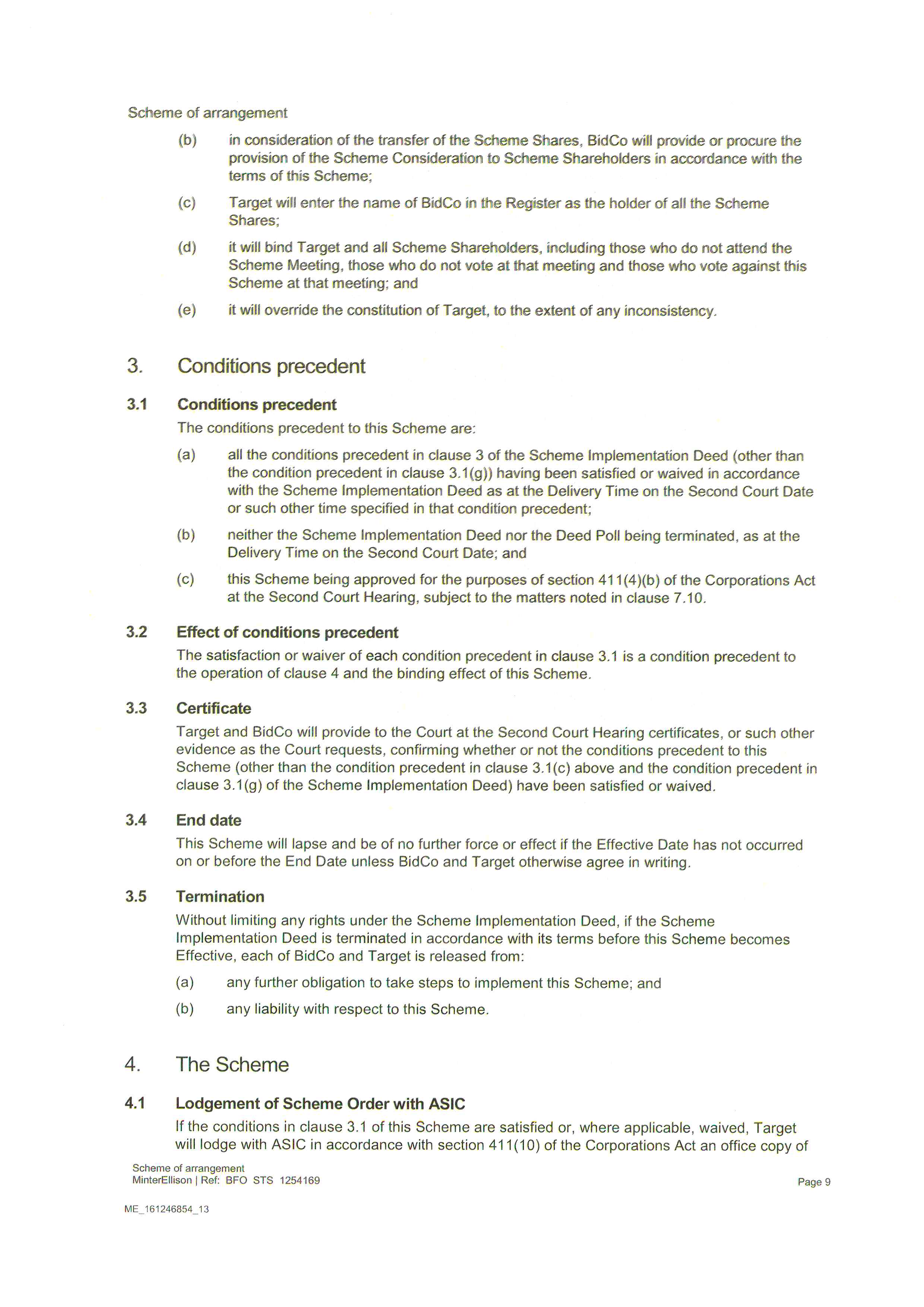
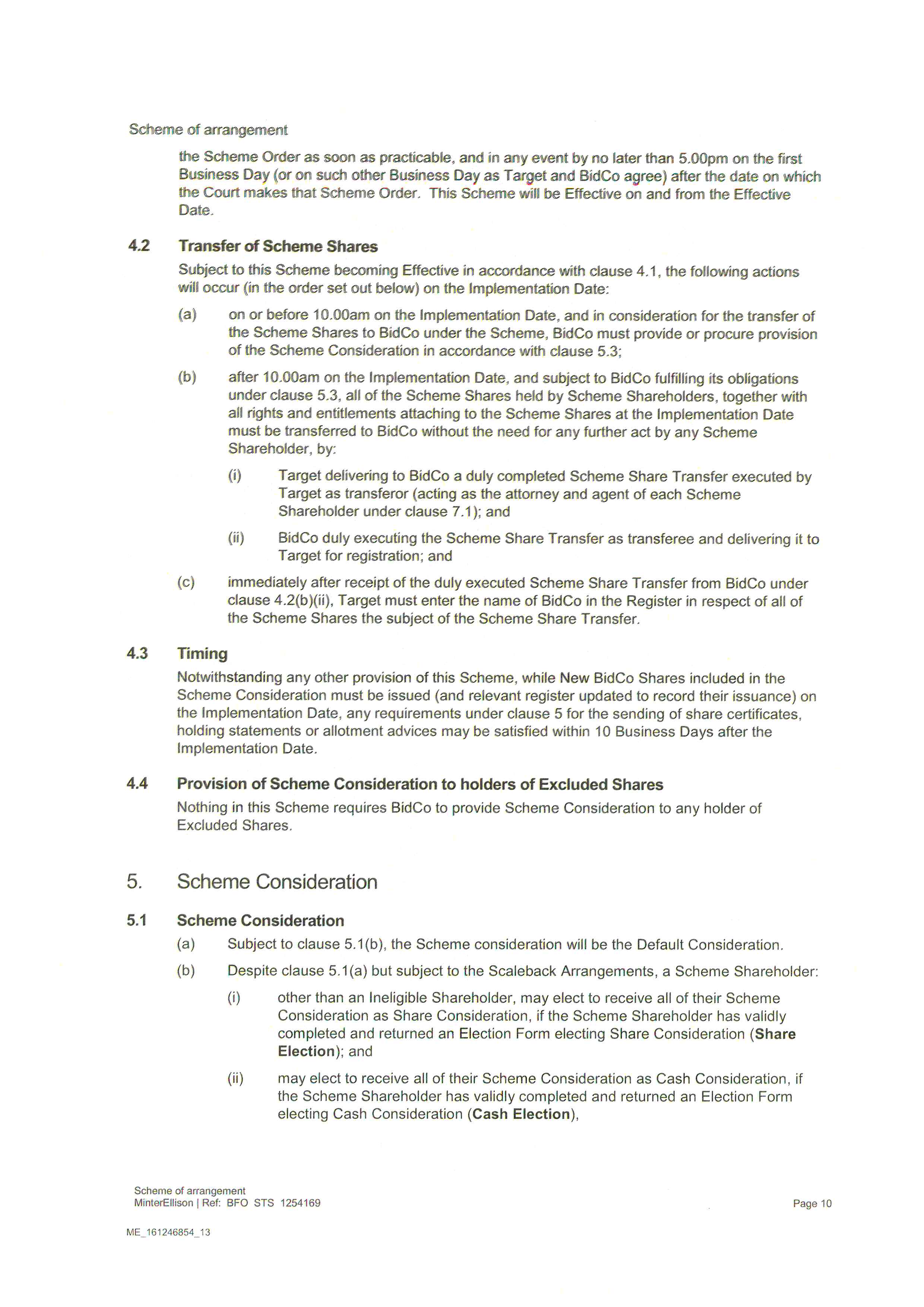
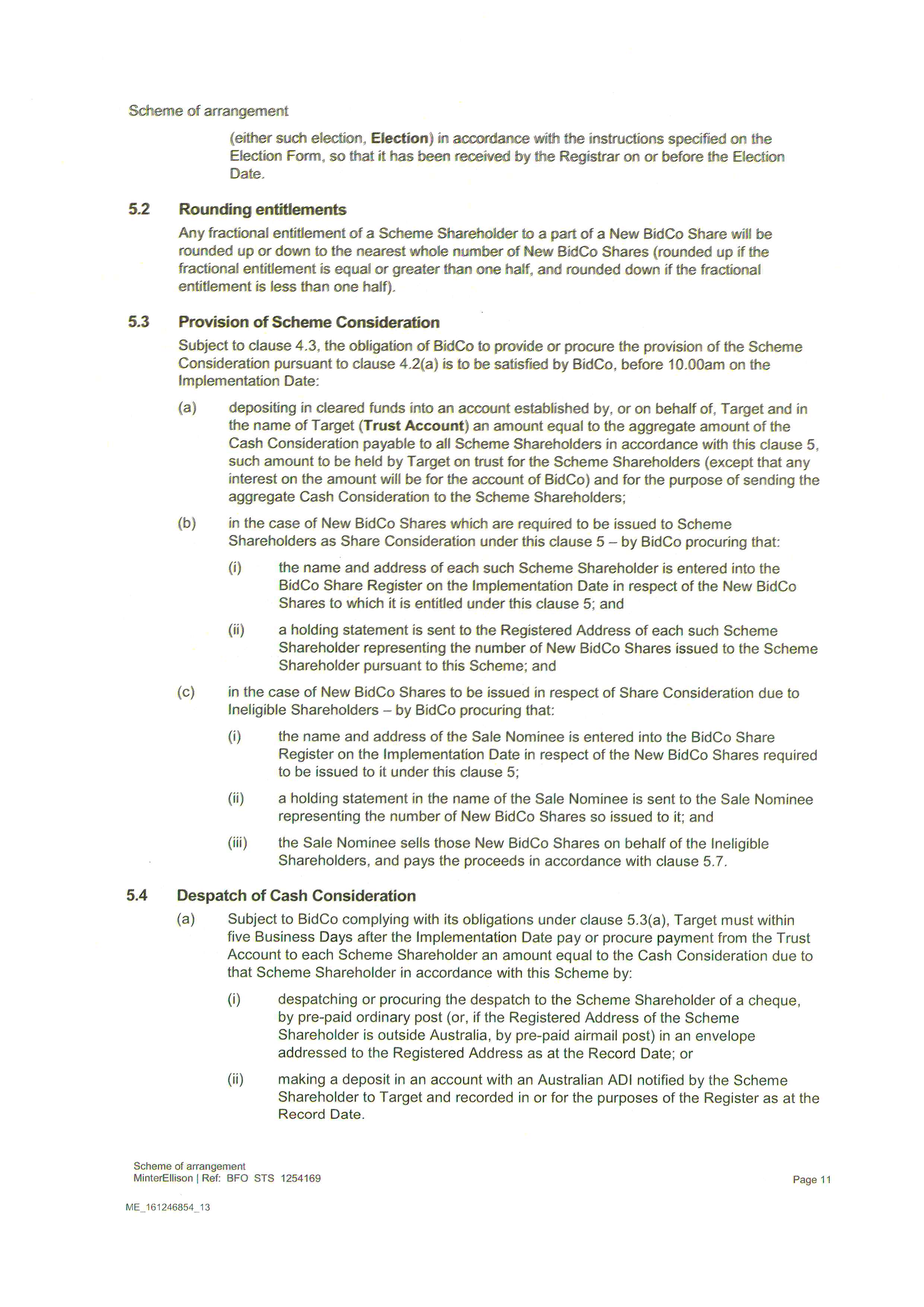
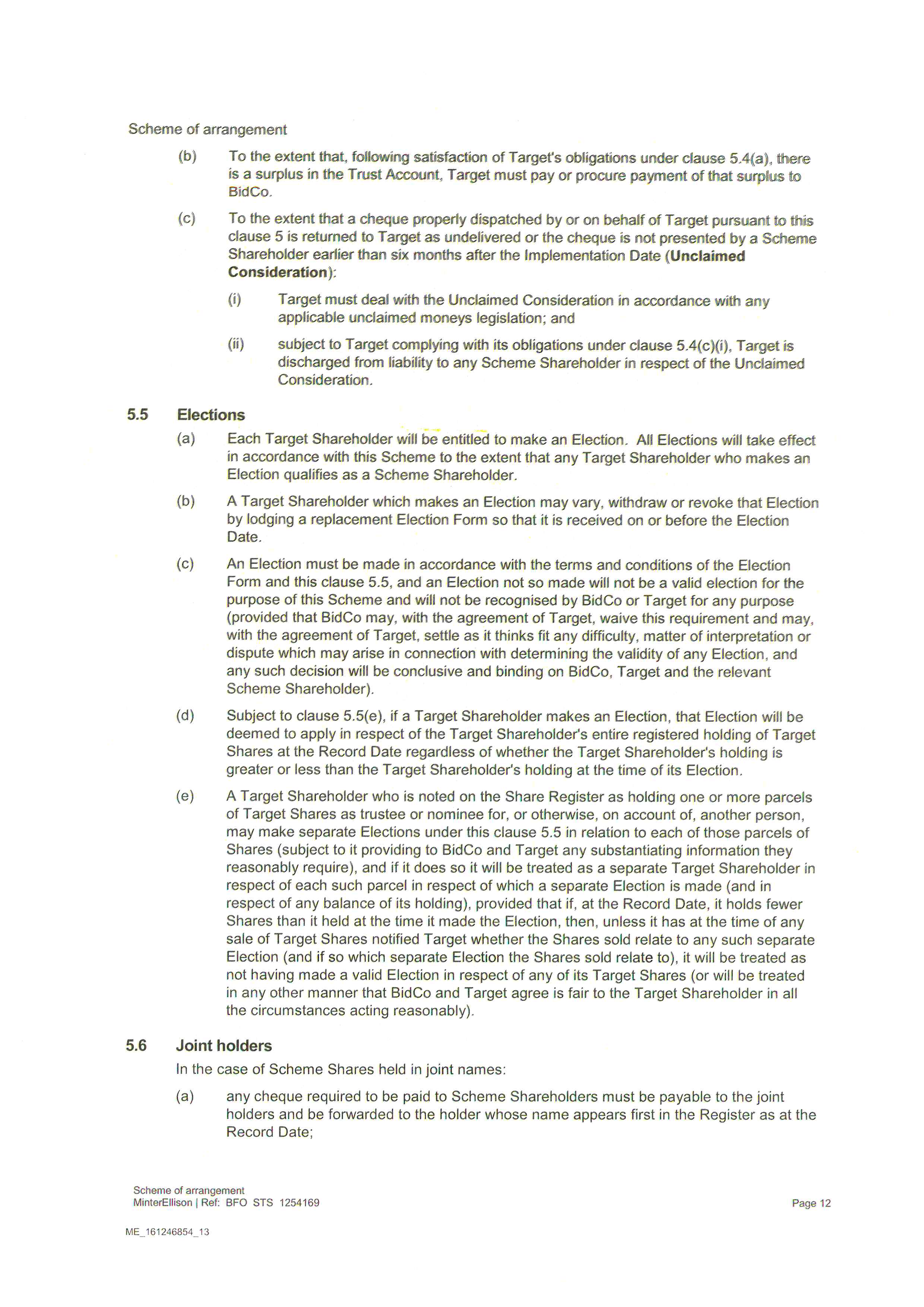
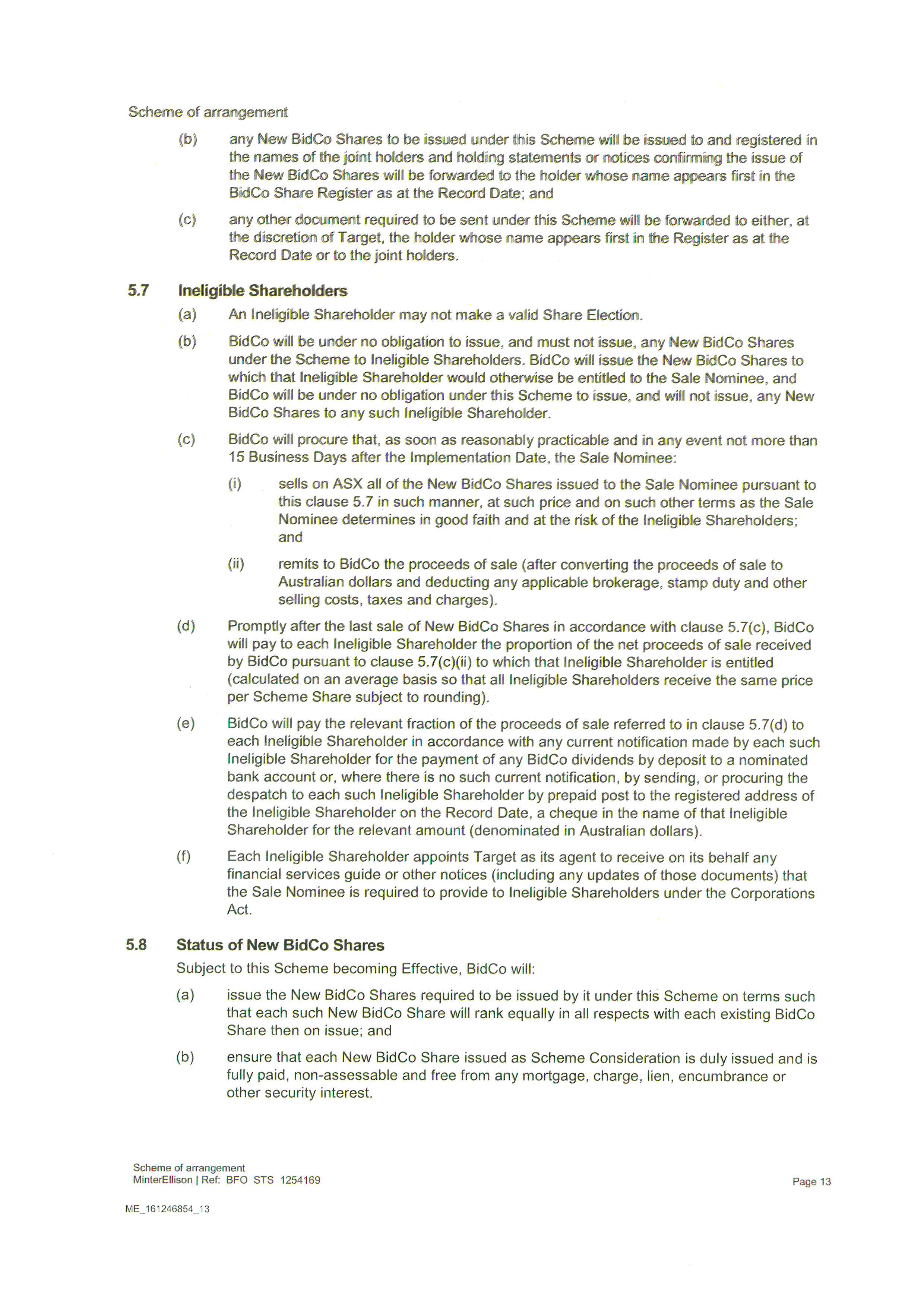
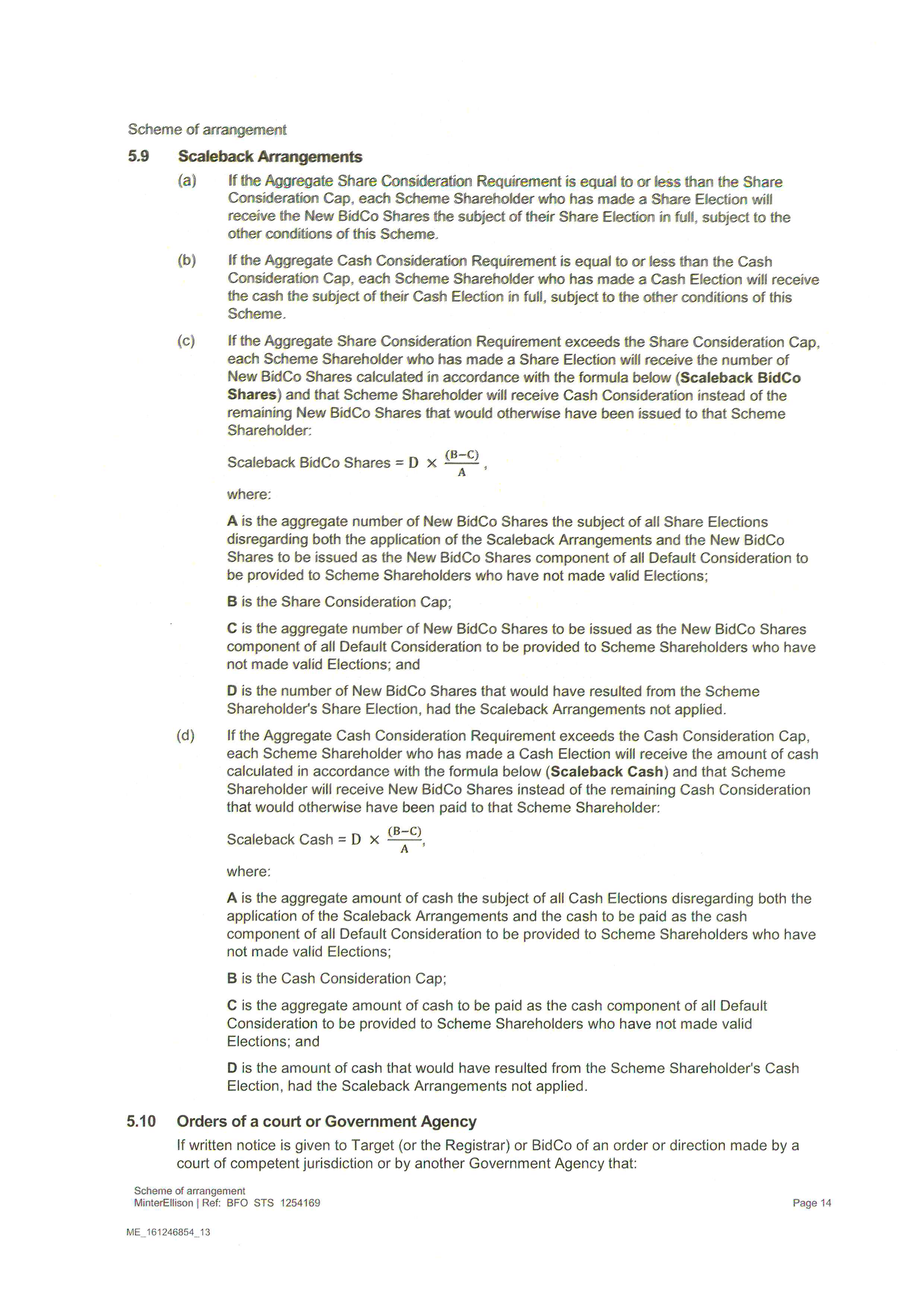
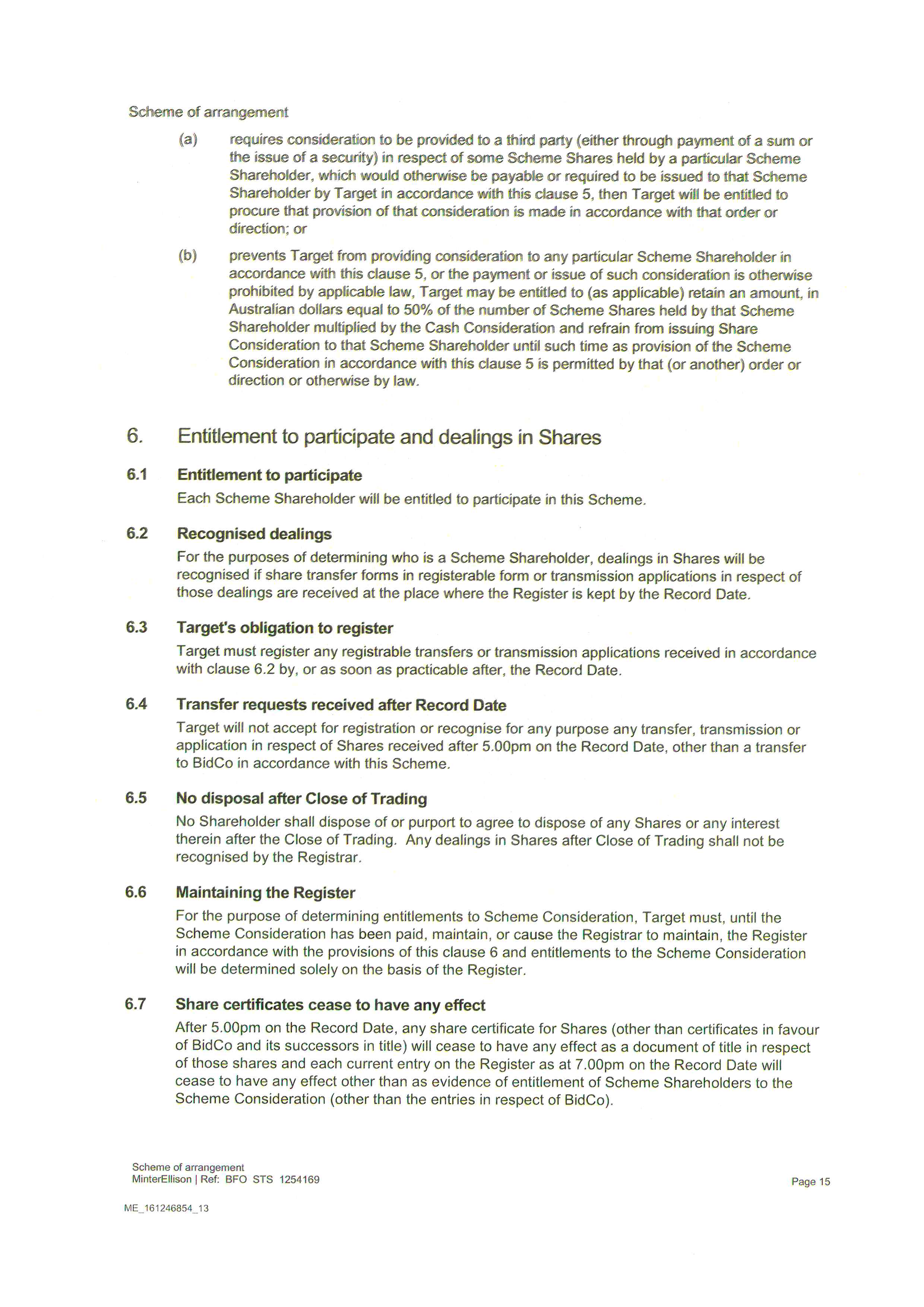
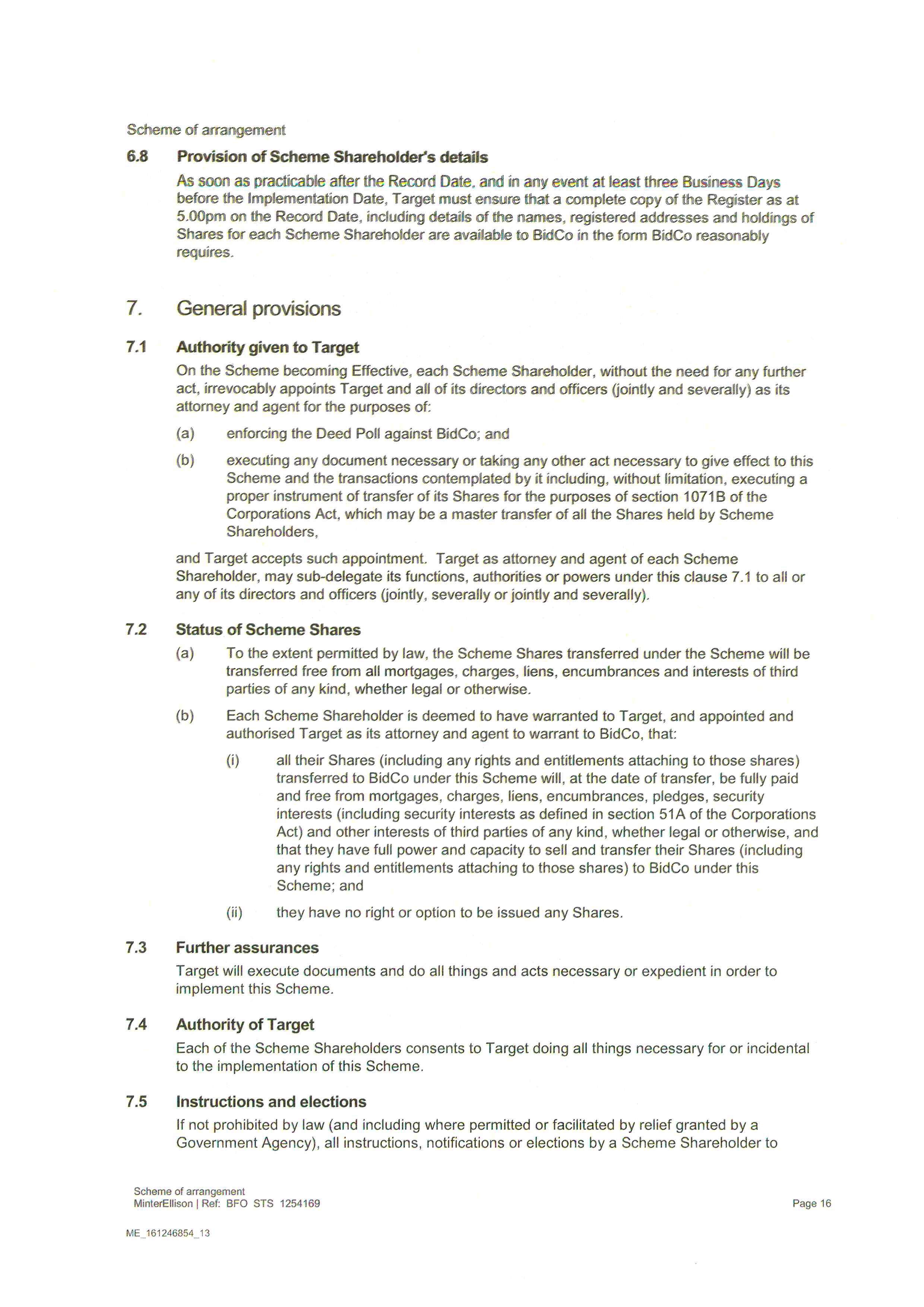
1. Pursuant to s 411(4)(b) of the Corporations Act 2001 (Cth) (Act), the scheme of arrangement proposed between the Plaintiff and its Shareholders (Scheme), being the scheme of arrangement in the form annexed hereto be and is hereby approved
2. Pursuant to s 411(12) of the Act, the Plaintiff is exempted from compliance with s 411(11) of the Act.
3. The Plaintiff is to lodge an office copy of these orders with ASIC as soon as is practicable after these orders have been made.
Note: Entry of orders is dealt with in Rule 39.32 of the Federal Court Rules 2011.
BESANKO J:
INTRODUCTION
1 This proceeding involved two applications under s 411 of the Corporations Act 2001 (Cth) (the Act). I made two sets of orders on 16 September 2019 and 29 October 2019 respectively. These are my reasons for making those orders.
APPLICATION FOR ORDERS UNDER SECTION 411(1) OF THE CORPORATIONS ACT 2001 (CTH) — ORDERS MADE ON 16 SEPTEMBER 2019
Introduction
2 By Originating process filed on 10 September 2019, AIRR Holdings Ltd (AIRR) sought an order pursuant to s 411(1) of the Act that a meeting (Scheme Meeting) of the holders of its fully paid ordinary shares (AIRR Members) be convened for the purposes of considering and, if thought fit, approving, with or without modifications, the scheme of arrangement proposed between AIRR and AIRR Members (the Proposed Scheme).
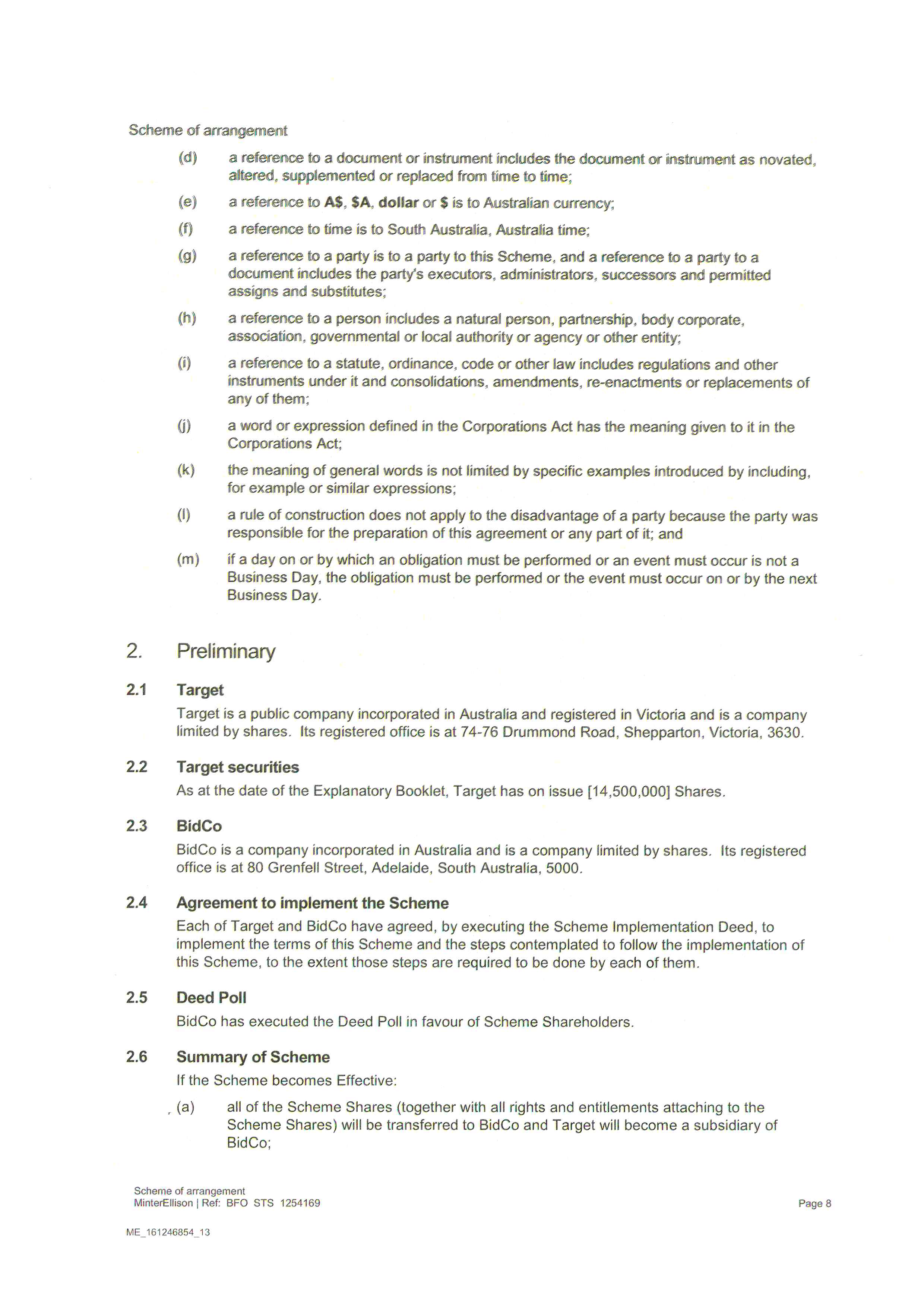
3 AIRR is an unlisted public company registered in Victoria. It was incorporated on 2 February 2008. It is a member based buying and marketing group that stocks and supplies rural merchandise and pet and produce stores with products to sell to end users. Its operating model is that it sells products as a wholesaler to both member retailers (which are retailers who pay a yearly fee to AIRR to, among other things, access discounted prices on the products sold by AIRR) and other wholesale customers located throughout Australia.
4 AIRR’s managing director is Mr Peter Law. Its chairman is Mr Craig Farrow. Mr Glenn Pearsall, Mr Lachlan Cox and Mr Graeme Jolly are non-executive directors.
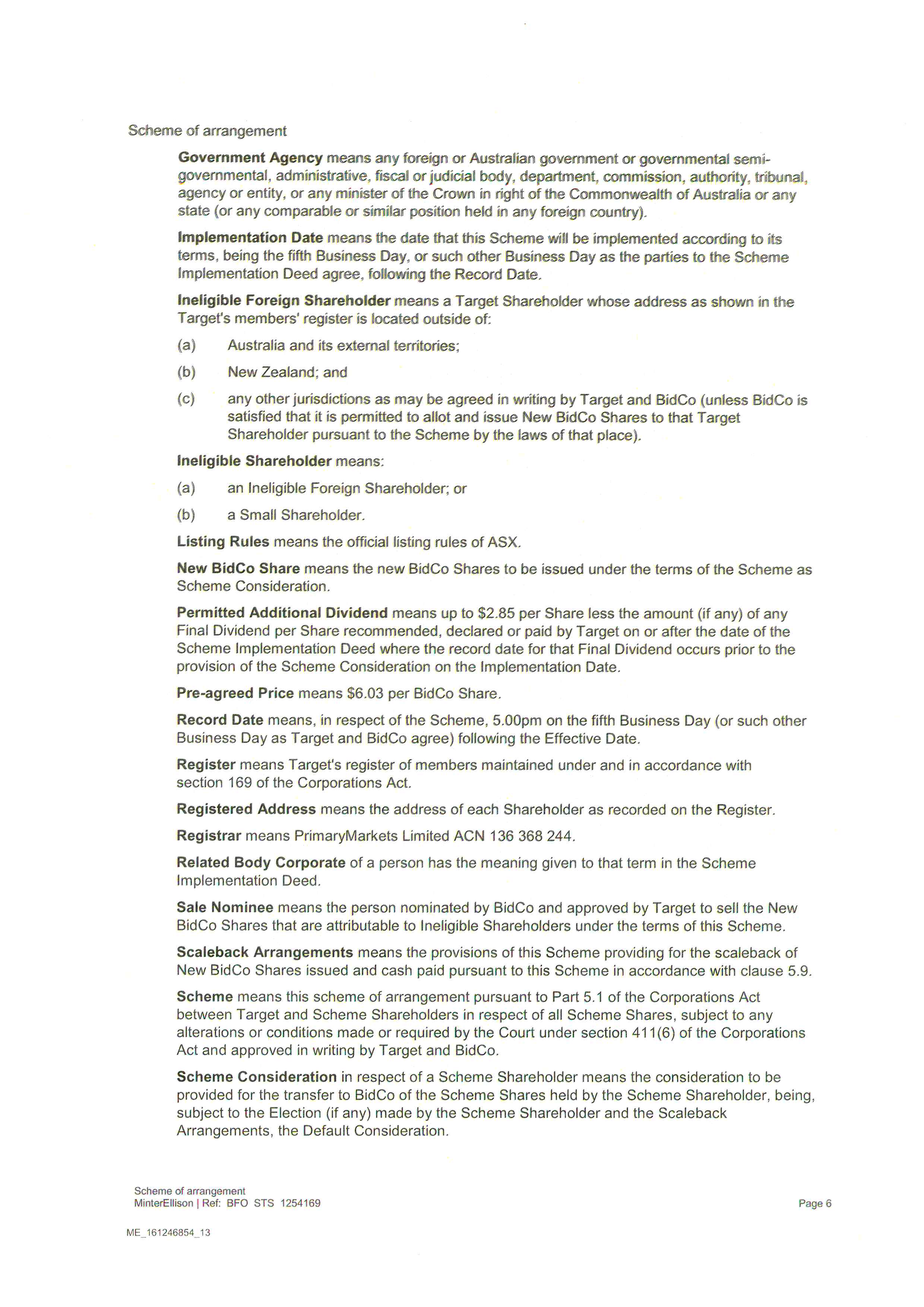
5 As at 31 July 2019, AIRR had a total issued share capital of 14,500,000 shares and 200 shareholders.
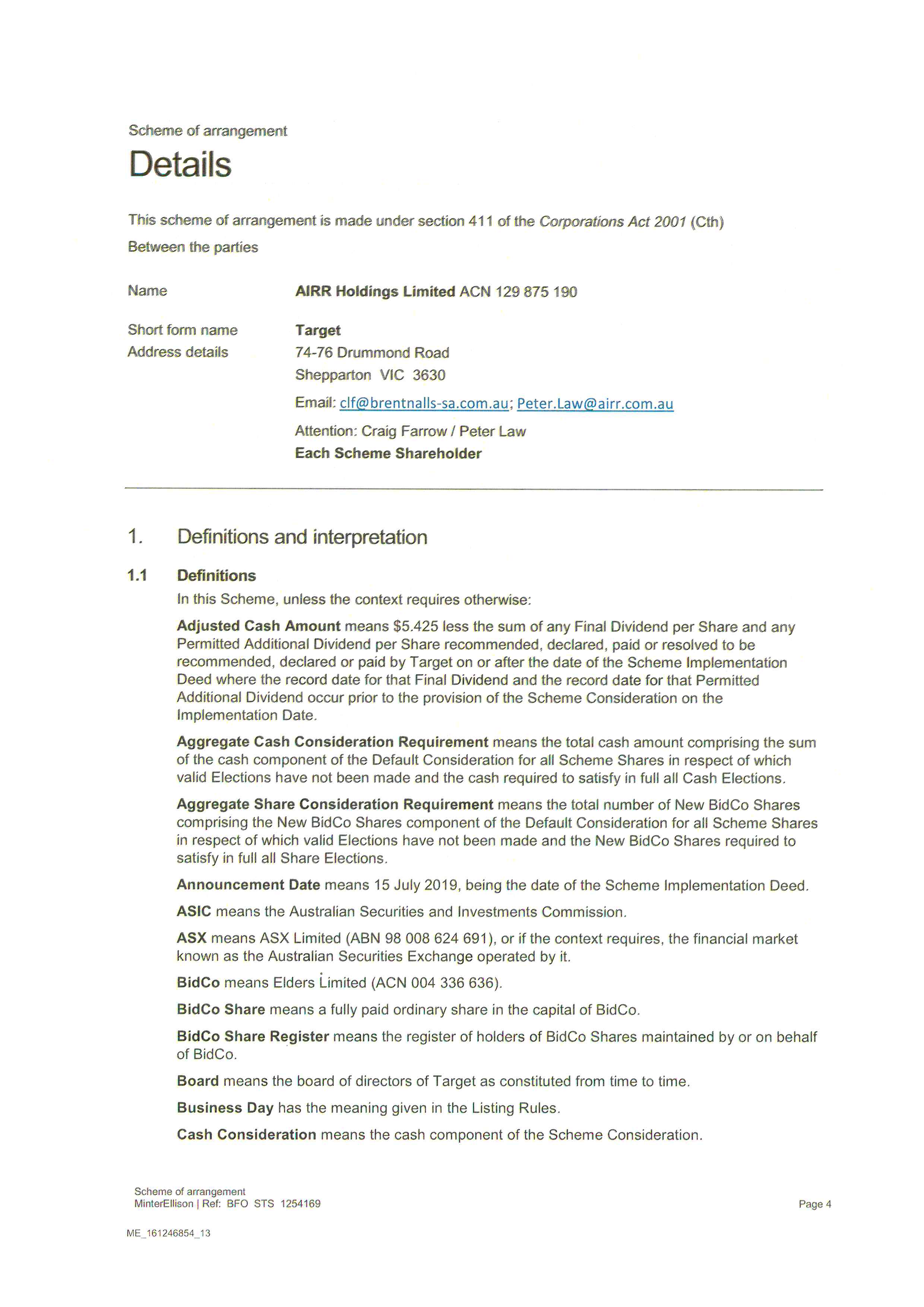
6 The Proposed Scheme, if implemented, will result in the acquisition of all of the shares in AIRR by Elders Ltd (Elders). AIRR will become a wholly owned subsidiary of Elders and will continue to operate as a standalone business.
7 It was proposed that the Scheme Meeting be held at 11:00am (AEST) on Friday, 25 October 2019 at Bayview on the Park, 52 Queens Road, Melbourne, Victoria.
8 On 16 September 2019, I made orders convening the Scheme Meeting.
The Proposed Scheme
Background
9 On 15 April 2019, Elders submitted an unsolicited, confidential, incomplete and non-binding offer to acquire 100% of the issued share capital in AIRR by way of a scheme of arrangement. This was followed by a second confidential, complete and non-binding offer submitted by Elders on 14 May 2019.
10 On or around 15 July 2019, AIRR and Elders entered into a Scheme Implementation Deed (the Implementation Deed) pursuant to which AIRR agreed to propose and implement the scheme of arrangement attached to the Implementation Deed. AIRR subsequently wrote to the AIRR Members and advised them that it had entered into the Implementation Deed. Elders also released an announcement on the Australian Securities Exchange (ASX) that it had entered into the Implementation Deed and that it would be seeking to fund the acquisition through, among other things, an equity raising.
11 On 17 July 2019, Elders informed the ASX that it had completed the equity raising.
Scheme Consideration
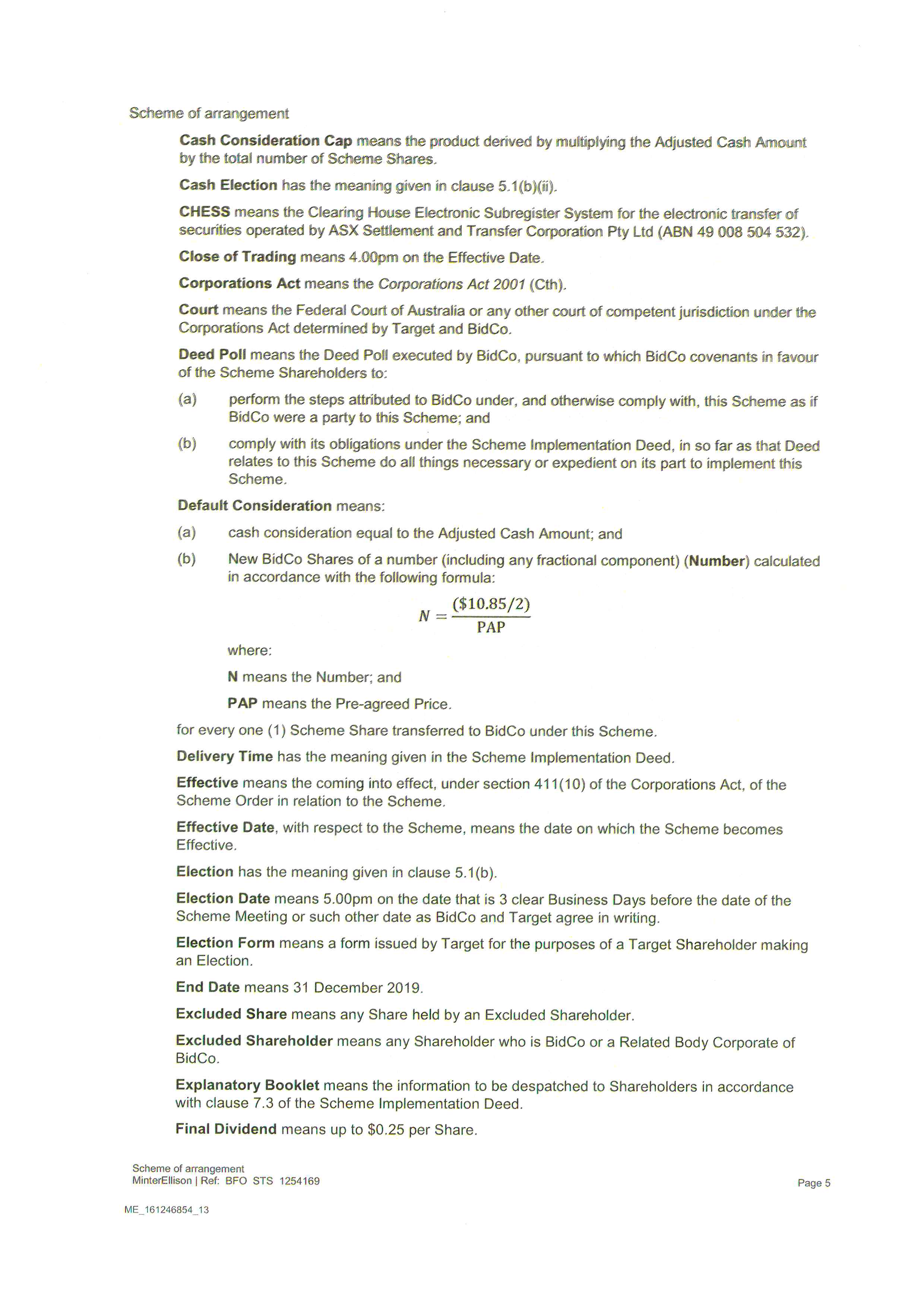
12 Under the Proposed Scheme, Elders proposes to acquire all of the shares in AIRR for a total consideration payable by Elders of $10.85 per share (the Scheme Consideration). The Scheme Consideration comprises 50% cash and 50% shares.
13 The total cash consideration payable by Elders is approximately $79 million or $5.425 per share in AIRR. This includes the amount of any “Permitted Special Dividend” and any “Final Dividend” (the Dividends).
14 The board of AIRR proposes to declare a fully franked Permitted Special Dividend of up to $2.60 per share at a meeting of directors on 25 October 2019. If the board of AIRR resolves to declare a Permitted Special Dividend, then the amount of that dividend will be provided to AIRR by Elders in the form of an unsecured, interest free loan. If the board of AIRR does not resolve to declare a Permitted Special Dividend, or resolves to declare a Permitted Special Dividend but for an amount less than $2.60 per share, Elders will increase the cash component payable to AIRR Members by a corresponding amount.
15 The board of AIRR also declared a fully franked Final Dividend of $0.25 per share on 20 August 2019. This is to be paid on 27 September 2019 regardless of whether the Proposed Scheme is implemented.
16 AIRR Members will also receive, if available to them, the benefit of franking credits attached to the Dividends of $1.22 per share.
17 The total cash consideration also includes the balance of the cash consideration of $2.575 per share.
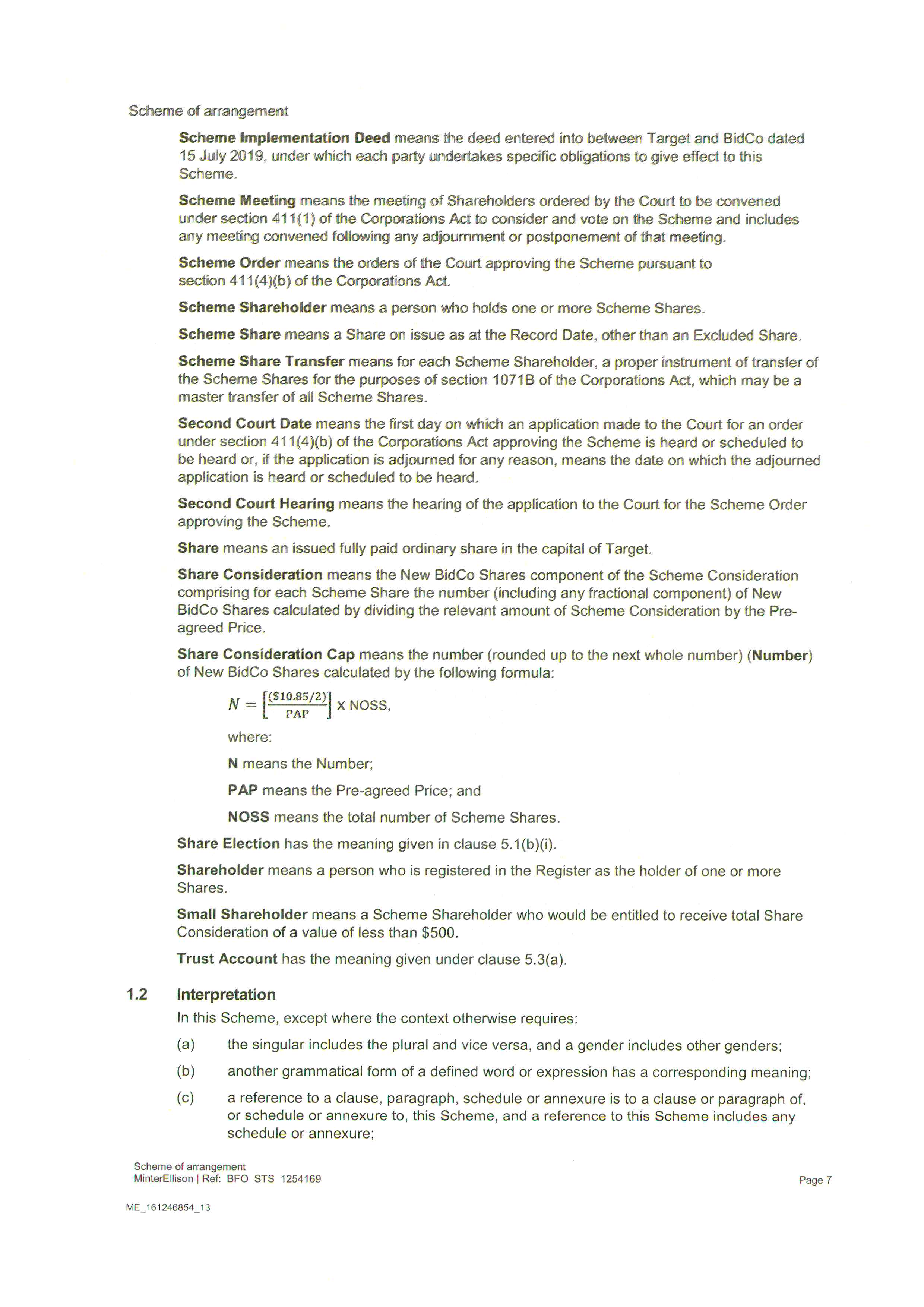
18 The total consideration payable by Elders by way of the issue of shares is approximately $79 million. This is comprised of the issue of 13 million shares in Elders at an agreed value of $6.03 per share. Those shares were trading at $6.78 per share at the close of trade on 9 September 2019.
19 The maximum cash consideration is $79 million (including the Dividends) and the maximum share consideration is 13 million Elders shares.
20 AIRR Members may elect to receive the Scheme Consideration (after the payment of the Dividends) in cash or shares. If, as a result of elections by AIRR Members, the ratio of cash consideration to share consideration exceeds 50:50, an adjustment will be made. If a member does not make an election then the member will receive the “default” consideration of $5.425 in cash (reduced by the Dividends) and $5.425 in Elders shares.
21 Elders will also assume AIRR’s liabilities in the amount of approximately $30 million.
Conditions Precedent
22 The Implementation Deed provides for a number of conditions precedent to the Proposed Scheme becoming effective (clause 3.1). It also provides that AIRR will provide to the Court a number of certificates confirming whether those conditions have been satisfied or waived on the hearing of any application made under s 411(4)(b) of the Act.
23 In addition to the conditions precedent expressly provided for in the Implementation Deed, the Proposed Scheme is conditional on AIRR Members voting in favour of a resolution to amend and replace AIRR’s constitution. It is proposed that AIRR will hold an Annual General Meeting of AIRR Members immediately prior to the Scheme Meeting at which time the AIRR Members will have the opportunity to vote on a resolution to amend AIRR’s constitution so as to: (1) allow Elders to become a shareholder of AIRR due to the fact that it is otherwise prohibited from doing so as a “competitor” within the meaning of clause 13.1 of the constitution; and (2) enable Elders to hold more than 15% of the issued shares in AIRR due to the fact that it is otherwise prohibited from doing so by operation of clause 13.4 of the constitution.
Section 411(1) of the Corporations Act 2001 (Cth)
24 Part 5.1 of the Act provides for a procedure whereby a scheme of arrangement may be used to reorganise a company in a manner which is binding on all of the company’s members. The procedure has three stages.
25 The first stage is an application to the Court made pursuant to s 411(1) of the Act for an order that a meeting of members be convened to consider and vote on a resolution to approve the proposed scheme of arrangement.
26 The second stage involves the holding of the meeting of members to consider and vote on the resolution to approve the proposed scheme of arrangement.
27 The third stage is an application made to the Court pursuant to ss 411(4) and (6) of the Act for an order that the proposed scheme of arrangement be approved.
28 This section of my reasons concerns the first stage of the procedure.
The Formal Requirements
29 At the first stage, the Court must be satisfied that:
(1) AIRR is a Pt 5.1 body;
(2) the Proposed Scheme is an “arrangement” within s 411(1) of the Act;
(3) there has been or will be proper disclosure to AIRR members;
(4) the Proposed Scheme is bona fide and properly proposed;
(5) the Australian Securities and Investments Commission (ASIC) was given 14 days’ notice of the hearing of the application made pursuant to 411(1) and has had a reasonable opportunity to examine the terms of the Proposed Scheme and the draft explanatory statement and to make submissions; and
(6) any other procedural requirements have been complied with.
30 With respect to the above matters, I reached the following conclusions.
31 First, I was satisfied that AIRR is a Pt 5.1 body within the meaning of s 9 of the Act. It is a company registered under the Act.
32 Secondly, I was satisfied that the Proposed Scheme is an “arrangement” within the meaning of s 411(1) of the Act. It is a scheme of arrangement designed to effect the acquisition of the shares of AIRR by Elders: see Re Foundation Healthcare Ltd [2002] FCA 742; (2002) 42 ACSR 252 at [39] per French J; DuluxGroup, in the matter of DuluxGroup Ltd [2019] FCA 961; (2019) 136 ACSR 546 (DuluxGroup (No 1)) at [17] per O’Bryan J.
33 Thirdly, I was satisfied, having regard to the first affidavit (including exhibits) of Mr Farrow affirmed on 10 September 2019 and to the first affidavit (including exhibits) of Mr Peter Hastings affirmed on 13 September 2019, that there has been proper disclosure to AIRR Members. Mr Farrow gave evidence that he believed that the statements of fact relating to AIRR in the explanatory booklet are correct. Mr Hastings gave evidence that Elders had verified that the statements made about Elders in the explanatory booklet are correct. Further, Mr Farrow gave evidence that KPMG Financial Advisory Pty Ltd, which were engaged by AIRR to act as an independent accountant, provided an opinion that nothing had come to their attention that caused them to believe that the “Combined Group Unaudited Pro Forma Financial Information” was not properly complied with.
34 Fourthly, I was satisfied that the Proposed Scheme is bona fide and has been properly proposed. I accepted AIRR’s submission that the Implementation Deed entered into by AIRR and Elders, pursuant to which the parties agreed to implement the Proposed Scheme upon, and subject to, the terms of the Deed, is prima facie evidence of those facts: see EcoBiotics Limited, in the matter of EcoBiotics Limited [2017] FCA 643 at [34] per Gleeson J.
35 Fifthly, I was satisfied that ASIC has been provided with more than 14 days’ notice of the hearing. ASIC has also had a reasonable opportunity to examine the terms of the Proposed Scheme and the draft explanatory booklet. ASIC was provided with a copy of the draft explanatory booklet on 26 August 2019 and the updated draft explanatory booklet on 2 September 2019. At the hearing, AIRR tendered a bundle of emails and a table which was marked as exhibit A1. In those emails, ASIC set out the following “material concerns” with the draft explanatory booklet:
Firstly, we are concerned that the statements relating to “all cash” or “all share” elections may potentially be misleading given the likelihood of shareholders who make either an “all cash” or “all share” election actually receiving all cash or all shares. Offers that provide for an “all cash” or “all share” alternative are not normally subject to scaleback.
…
Secondly, we are concerned that the additional tables that were inserted into section 2.6.3 of the draft scheme booklet provided to us last Friday, are not in the form contemplated and suggested to you last Thursday, based on the Asciano Limited scheme of arrangement. … The tables enable shareholders to see the impacts of the shareholder elections for maximum cash or maximum shares subject to scaleback on a % basis. The tables in section 2.6.3 of the AIRR draft scheme booklet [do] not appear to contemplate both axis [sic] for possible elections. The purpose of this information is for shareholders to be able to see the likelihood (if any) of them receiving maximum cash or maximum shares depending on their election and to better understand the possible scheme consideration they may actually receive before the time when notice of the outcome of elections is provided. We consider this information to be of assistance to shareholders given the very complicated calculations that are required in order to consider the possible permutations under the scheme terms.
36 With respect to the first concern, AIRR proposed to include an amendment to the orders it sought to the effect that the explanatory booklet be approved, subject to the use of the words “All Cash” and “All Shares” in relation to the Scheme Election being deleted and replaced with “Maximum Cash” and “Maximum Shares”. With respect to the second concern, AIRR proposed to include an amendment to the orders it sought to the effect that the explanatory booklet be approved, subject to any minor amendments required or approved by ASIC for registration under s 412(6) of the Act. I was satisfied that these amendments were appropriate and included them in the orders I made.
37 As to the final matter, I was satisfied that, having regard to the annexure to AIRR’s written outline of submissions, the relevant procedural requirements have been satisfied. Mr Farrow has consented to being nominated as chairperson at the Scheme Meeting and Mr Jolly has consented to being nominated as an alternate chairperson.
The Exercise of the Court’s Discretion
38 If the Court is satisfied of the formal requirements, its discretion to make an order under s 411(1) of the Act is enlivened.
39 With respect to the role of the Court in exercising its discretion under s 411(1), Barrett J said the following in Re Westfield Holdings [2004] NSWSC 458; (2004) 49 ACSR 734 at [4]:
The court’s role on a s 411 application of this kind has been described in a number of cases. According to the formulation adopted by Santow J in Re NRMA Insurance Ltd (2000) 33 ACSR 523, the court must see, on the material placed before it, that the proposal fits within the statutory concept of arrangement or compromise, that there will be available to members all the main facts relevant to the exercise of their judgment, that ASIC has had a reasonable opportunity to examine the proposal and that the scheme is so conceived and presented as to that structure, purpose and effect that there is no apparent reason, so far as can be foreseen, why it should not, in due course, receive the court’s approval if the necessary majority of members’ votes is achieved. To substantially similar effect are observations of Austin J in Re GIO Building Society Ltd (2001) 39 ACSR 77, French J in Re Foundation Healthcare Ltd (2002) 42 ACSR 252 and Parker J in Re Ranger Minerals Ltd (2002) 42 ACSR 582. Slightly different, but by no means conflicting, are the criteria enunciated by Emmett J in Re Central Pacific Minerals NL [2002] FCA 239 and repeated in the following terms by Conti J in Re CSR Ltd (2003) 45 ACSR 34:
(i) the likelihood or otherwise that the court will approve the scheme of arrangement, if the statutory majority of shareholders is achieved at the proposed scheme meeting;
(ii) whether there has been compliance with such preliminary matters as are relevant to the holding of the meeting;
(iii) where [sic] there will be sufficient disclosure, to those persons and entities who will be affected by the scheme of arrangement, of its detail and effects; and
(iv) whether there has been reasonable opportunity for the commission to examine the terms of the scheme of arrangement.
40 It is well-established that the Court does not consider the business or commercial efficacy of the scheme of arrangement at the first stage, and that it will not substitute its commercial judgment for that of the members: Re ACM Gold Ltd (1992) 34 FCR 530; (1992) 7 ACSR 231 at 235–236 per O’Loughlin J; Adelaide Bank Limited, in the matter of Adelaide Bank Limited [2007] FCA 1582 at [24] per Lander J.
41 AIRR referred me to the following statement of Beach J in Amcor Limited, in the matter of Amcor Limited [2019] FCA 346 at [47]:
My function on an application to order the convening of a meeting is supervisory. At this stage I should generally confine myself to ensuring that certain procedural and substantive requirements have been met including dealing with adequate disclosure, with limited consideration of issues of fairness. But having said that, it is appropriate to consider the merits or fairness of a proposed scheme at the convening hearing if the issue is such as would unquestionably lead to a refusal to approve a proposed scheme at the approval hearing, that is, the proposed scheme appears now to be on its face “so blatantly unfair or otherwise inappropriate that it should be stopped in its tracks before going any further” (Re Foundation Healthcare Ltd (2002) 42 ACSR 252 at [44] per French J).
(emphasis in original)
42 AIRR raised the following matters as relevant to the exercise of the discretion:
(1) performance risk;
(2) the break fee;
(3) the exclusivity provisions; and
(4) the Proposed Scheme is not fair but is reasonable.
Performance Risk
43 In DuluxGroup (No 1), O’Bryan J said the following (at [25]):
… [T]he entity that will be providing the Scheme Consideration is not party to the Scheme and is not (and cannot be) directly bound by it. As such, its obligations do not depend upon s 411 of the Act, which is confined to the obligations of the plaintiff company and its members: Re Westfield Holdings Ltd (2004) 49 ACSR 734 at 739. In considering whether to approve a scheme involving the participation of a person other than the plaintiff company and its members (here, Nippon Paint), it is important to ensure that that other party is bound to perform the role assigned to it and that its obligations are able to be enforced. In this context, the courts have considered the “performance risk” as regards the obligations to be performed by the non-scheme party: see for example Re Amcor Ltd [2019] FCA 346 at [53]; Re Coles Group Ltd (2007) 25 ACLC 1380 at 1386 [38]; Re Lonsdale Financial Group Ltd [2007] VSC 394 at [42]; Re KAZ Group Ltd [2004] FCA 738 at [4]–[5]; Re Healthscope Ltd [2010] VSC 367 at [31]–[32]; Re Mitchell Communication Group [2010] VSC 423 at [30]–[31]; Re AWB Ltd [2010] VSC 456 at [16]; and Re AXA Asia Pacific Holdings Ltd [2011] VSC 4 at [21]–[25].
44 Under the Proposed Scheme, if it becomes effective, Elders will, in consideration of the transfer of the “Scheme Shares”, provide or procure the provision of the “Scheme Consideration” to “Scheme Shareholders” in accordance with the terms of the Proposed Scheme. Critically, the effect of clause 4.2 of the Proposed Scheme is such that the transfer of Scheme Consideration by Elders is to precede the transfer of the Scheme Shares by Scheme Shareholders.
45 Further, the obligations of Elders will be secured by its entry into a Deed Poll in favour of the AIRR Members. Under the Deed Poll, which is annexed as Sch 2 to the Implementation Deed, Elders has undertaken to: (1) perform the actions and obligations attributed to it under the Proposed Scheme; and (2) provide the “Scheme Consideration” to each “Scheme Shareholder” in accordance with the terms of the Proposed Scheme.
46 I was satisfied that the above provisions mean that AIRR Members are adequately protected against any performance risk: see ABB Grain Ltd, in the matter of ABB Grain Ltd [2010] FCA 1309 at [33].
Break Fee
47 Under the Implementation Deed, AIRR and Elders agree that if they enter into the Implementation Deed and the Proposed Scheme is subsequently not implemented, Elders will incur significant costs. In those circumstances, the Implementation Deed provides that AIRR is required to pay to Elders a break fee of $1,537,250 (exclusive of GST) in certain prescribed circumstances. It is significant that the break fee is not payable simply because the AIRR Members do not approve the Proposed Scheme pursuant to s 411(4)(a)(ii) of the Act.
48 In DuluxGroup (No 1), O’Bryan J said the following (at [31]):
Break fees have become a common feature of commercial transactions of this nature. The effect of such fees on the interests of shareholders has been considered by the courts in connection with schemes of arrangement and by the Takeovers Panel in connection with share acquisitions, the control of companies and the purposes of Chapter 6 of the Act. In general terms, the courts and the Takeovers Panel accept that break fees can be justified by reference to the costs incurred by the offeror and the benefit that an offer may confer on the members of the target company by increasing its value. However, such fees may adversely affect the interests of shareholders if the amount of the fee is such that it is likely to coerce shareholders into agreeing to a scheme or to deter the making of a competing offer for the company’s shares: see Re SFE Corporation Ltd (2006) 59 ACSR 82 at [7] per Gyles J; Re APN News & Media Ltd (2007) 62 ACSR 400 at [37]–[55] per Lindgren J; Re Toll Holdings Ltd [2015] VSC 123 at [27]–[30] per Robson J; Takeovers Panel, Guidance Note 7 – Lock Up Devices (Issue 4, 11 February 2010) at [7].
49 I was satisfied that the break fee in this case was not of such magnitude that it could influence voting or that there were other unusual circumstances.
50 The break fee represents approximately 1% of the total equity value of AIRR based on the Scheme Consideration of $10.85 per share. In its current Guidance Note 7: Lock-up Devices, the Takeovers Panel has stated that, in the absence of other factors, a break fee not exceeding 1% of the equity value of the target does not generally give rise to unacceptable circumstances.
51 I was also satisfied, having regard to the first affidavit of Mr Farrow sworn on 10 September 2019, that the break fee was agreed to as the result of arm’s length negotiations between AIRR and Elders.
52 With respect to the commercial basis for the break fee, AIRR submitted that the courts and the Takeovers Panel, when considering schemes of arrangement and share acquisitions, have accepted that break fees can be justified by reference to the costs incurred by the offeror and the benefit of an offer to the members of the target company by increasing its value. It also submitted that such fees may adversely affect members if the amount of the fee is likely to coerce members into agreeing to a scheme or deter a competing offer. AIRR referred me to DuluxGroup (No 1) at [31].
53 Clause 13.2(a) of the Implementation Deed, which addresses the basis for the break fee, provides the following:
13.2 Costs Incurred by [Elders]
(a) The fee payable under clause 13.3 has been calculated to reimburse [Elders] for the following:
(i) fees for legal and financial advice in planning and implementing the Proposed Transaction;
(ii) reasonable opportunity costs incurred in engaging in the Proposed Transaction or in not engaging in other alternative acquisitions or strategic initiatives;
(iii) costs of management and directors’ time in planning and implementing the Proposed Transaction;
(iv) out of pocket expenses incurred in planning and implementing the Proposed Transaction;
(v) costs associated with the financing arrangements in respect of the Proposed Transaction; and
(vi) any damage to [Elders]’s reputation associated with a failed transaction and the implications of those damages if [Elders] seeks to execute alternative acquisitions in the future,
(vii) in each case, incurred by [Elders] directly or indirectly as a result of having entered into this deed and pursuing the Proposed Transaction.
(b) The parties agree that:
(i) the amount of fees, costs and losses referred to in this clause 13.2 is inherently unascertainable and that, even after termination of this deed, the costs will not be able to be accurately ascertained; and
(ii) the amount of the costs payable under clause 13.3 is a genuine and reasonable pre-estimate of those fees, costs and losses (it being acknowledged by the parties that the costs would most likely be in excess of this amount).
54 Elders also submitted that it has undertaken an equity raising and entered into arrangements with financiers to have funds in place as contemplated by the conditions precedent to the transaction. It submitted that this is sufficient evidence to satisfy the Court that the break fee has been arrived at on an appropriate basis.
55 I also note that the break fee was clearly disclosed in the explanatory booklet.
56 In the circumstances, I was satisfied that the terms of the break fee do not amount to a reason to decline to make an order under s 411(1) of the Act.
The Exclusivity Provisions
57 The Implementation Deed contains the following exclusivity provisions:
(1) “no existing discussions” (clause 15.1);
(2) “no shop” restriction (clause 15.2);
(3) “no talk” restriction (clause 15.3); and
(4) “no due diligence” (clause 15.4).
58 In Re Arthur Yates & Co Ltd [2001] NSWSC 40; (2001) 36 ACSR 758 at [9], Santow J said, by reference to a “no shop provision”, that an exclusivity provision should satisfy the following requirements:
(1) it should be for no more than a reasonable period capable of precise ascertainment, hence the need to ensure that any exclusivity period is properly defined,
(2) while an exclusivity clause may differentiate between actively soliciting an alternative merger proposal or simply dealing with an unsolicited one, in either case it is important that such an exclusivity clause be framed so that it is subject to the overriding obligation not to breach the directors’ fiduciary duties or be otherwise unlawful, and
(3) there should be adequate prominence given to that constraint in the explanatory memorandum sent to shareholders.
(original formatting retained.)
59 I was satisfied that the exclusivity period was capable of precise ascertainment and was for a reasonable period. The exclusivity period is defined in the Implementation Deed as commencing on the date of the Implementation Deed, being 15 July 2019, and ending on the earliest of 31 December 2019, the date the Proposed Scheme becomes effective, or the date the Implementation Deed is terminated in accordance with its terms.
60 Under the Implementation Deed, the “no talk” and “no due diligence” exclusivity provisions are subject to a “fiduciary carve-out”. Clause 15.5 provides that:
15.5 Exceptions
Clauses 15.3 and 15.4 do not apply if the [AIRR] Board, acting in good faith, determines:
(a) where there is a written Competing Proposal, that the Competing Proposal is a Superior Proposal or the steps which the [AIRR] Board proposes to take may reasonably be expected to lead to a Competing Proposal which is a Superior Proposal; and
(b) after receiving written legal advice from [AIRR]’s external legal advisers, that failing to respond to the Competing Proposal may constitute a breach of its fiduciary or statutory duties.
61 ASIC raised a concern in relation to the use of the “reasonableness limitation” in the fiduciary carve-out. In an email to Mr Brett Cowell and Ms Anna Young on 10 September 2019, Priti Joshi of ASIC stated that:
Clause 15.5 limits the board’s fiduciary obligations with a “reasonableness limitation”. In ASIC’s view, requiring a target’s board to act “reasonably” when discharging its fiduciary duties can undermine the board’s ability to carry out its duties and can impact on the takeover process. We consider that the word “reasonably” should be removed from sub-clause (a). For further information, please see ASIC report 612.
62 In response to this email, Mr Cowell provided by email a memo to ASIC that addressed this concern on 12 September 2019. AIRR submitted that the concern is a misapprehension on ASIC’s part because the word “reasonably” in clause 15.5 does not qualify or fetter the fiduciary duty. It referred me to the decision of Ross Human Directions Limited [2010] ATP 8 in which the Takeovers Panel considered (at [35]–[36]) that wording identical to that in clause 15.5 addressed its concerns in relation to the fiduciary carve-out. Elders also submitted that the Court could be satisfied that the fiduciary carve-out is in an appropriate form consistent with practice and authority.
63 In my opinion, the submission of AIRR was correct. On a fair reading of clause 15.5, the word “reasonably” does not require the AIRR board to act reasonably when discharging its fiduciary duties. Additionally, as Elders submitted, the fiduciary carve-out is in an appropriate form consistent with practice and authority. I note that in any event, the concern on the part of ASIC does not appear to be a continuing one. ASIC has not responded to or addressed Mr Cowell’s email or memo of 12 September 2019.
64 I was otherwise satisfied that the fiduciary carve-out is appropriate in the circumstances. Although the “no-shop” provision was not subject to the fiduciary carve-out, I did not consider this to be inappropriate: see Re Healthscope Ltd [2010] VSC 367 at [19]–[22] per Davies J.
65 I was also satisfied, having regard to the first affidavit of Mr Farrow, that the exclusivity provisions were agreed to as a result of arm’s length negotiations between AIRR and Elders.
66 Further, it is clear that the exclusivity provisions were given adequate prominence in the information provided to AIRR Members. The substance and effect of the provisions and the fiduciary carve-out were summarised in the explanatory booklet in a section entitled “Considerations relevant to your vote” and set out in more detail in section 4.1.
67 In the circumstances, I did not consider there to be any reason why the exclusivity provisions should lead me to decline to make an order under s 411(1) of the Act.
The Proposed Scheme is not fair but is reasonable
68 In or around early June 2019, AIRR engaged Leadenhall Corporate Advisory Pty Ltd (Leadenhall) to prepare an independent expert report setting out its opinion as to whether the Proposed Scheme was fair and reasonable and in the best interests of AIRR Members.
69 Leadenhall concluded that the Proposed Scheme is not fair but is reasonable to AIRR Members and is therefore in their best interests.
70 With respect to the fairness of the Proposed Scheme, Leadenhall set out its opinion in its report that:
(1) AIRR had a maintainable Earnings Before Interest and Tax (EBIT) of between $21.5 million and $23.5 million and an EBIT multiple of 9.5 times to 10.5 times;
(2) the assessed value of AIRR’s shares was between $12.41 and $15.34 per share; and
(3) the assessed value of the Scheme Consideration was between $11.50 and $11.95.
71 With respect to (3), Leadenhall noted that the value range for AIRR’s shares represented a 40–46% premium to the volume weighted average price for the last six months of trading of AIRR’s shares. Additionally, Leadenhall did not consider the value of franking credits on the Dividends as part of its assessment, but noted that, to the extent that individual shareholders may use those franking credits, it may increase the attractiveness of the offer. Leadenhall also noted that their assessed value represents a control premium of between 37.9% and 70.5% which it said was at the higher end of what it would consider to be reasonable.
72 Leadenhall concluded that the Proposed Scheme is not fair because the assessed value range of the Scheme Consideration is below the assessed value range of an AIRR share.
73 With respect to the reasonableness of the Proposed Scheme, Leadenhall considered that the Proposed Scheme had the following advantages:
(1) Liquidity event: the Proposed Scheme would provide for liquidity in the form of a partial cash payment as well as shares that are traded on a public market, in circumstances where AIRR shares have historically been “extremely illiquid”;
(2) Succession planning: the Proposed Scheme provides for the medium to long term transition of Mr Law (the CEO and largest shareholder of AIRR) out of the business with the assistance of Elders’ experienced managerial team;
(3) Retained exposure to rural sector: the offer of Elders’ shares allows AIRR Members to retain exposure to the rural sector if they wish to do so;
(4) Permitted Special Dividend: the payment of the Permitted Special Dividend as part of the Scheme Consideration may increase the attractiveness of the Proposed Scheme to AIRR Members who can use the associated franking credits;
(5) Limited number of alternate buyers: there is a limited number of alternate buyers with likely only one other strategic buyer in Australia, being Ruralco;
(6) No superior alternative offer: Leadenhall was not aware of any competing proposals to acquire AIRR by any third party;
74 Leadenhall considered the Proposed Scheme to have the following disadvantages:
(1) Synergy benefits: notwithstanding the fact that Elders identified a significant amount of “revenue synergies”, Leadenhall did not consider the Scheme Consideration to include a material amount related to synergy benefits on the basis that the Scheme Consideration is below Leadenhell’s assessed value of an AIRR share excluding synergy benefits (although Leadenhall did note that it is common for the consideration not to include potential synergy benefits where there are no competing offers);
(2) Tax implications: the Proposed Scheme gives rise to varying tax implications for different shareholders with some shareholders potentially incurring a tax liability as a result of the proposed Scheme; and
(3) Break free: AIRR will have to pay a break fee in the circumstances set out in the Implementation Deed.
75 Leadenhall gave its opinion that the Proposed Scheme was reasonable on the basis that the advantages outweighed the disadvantages to AIRR Members.
76 AIRR referred me to Blackgold International Holdings Ltd, in the matter of Blackgold International Holdings Ltd [2017] FCA 601 (Blackgold). That case involved an independent expert report which concluded that the scheme consideration in question was not fair but was reasonable. Justice Siopis considered whether such a conclusion would preclude the Court from making final orders at the second court hearing. At [18]–[19], his Honour said:
18. The shareholders will make of the expert report what they make. However, in my view, this is a case where the observations of French J (as he then was) in Re Foundation Healthcare (2002) 42 ACSR 252 at 265 are pertinent. At [44], French J observed:
The court at the stage of ordering a meeting to approve a scheme does not ordinarily go very far into the question of whether the arrangement is one which warrants the approval of the court: Re NRMA Ltd at FLR 359; ACSR 605. That question is to be answered when the scheme returns to the court for final approval. That is not to exclude the possibility that a scheme may appear on its face so blatantly unfair or otherwise inappropriate that it should be stopped in its tracks before going any further. The court is not required to be satisfied either at the convening or approval stage that no better scheme could have been devised. The scheme, on the face of it, is not obviously unfair or otherwise inappropriate. If there are interests adversely and unfairly affected then the probability is that the question will arise at either or both the scheme meetings or the final approval stage.
19. In my view, the expert report does not warrant the Court coming to the view that the scheme is so obviously unfair or unreasonable that it should not be allowed to go to a meeting. It will always be open to an objecting shareholder, or group of shareholders, to make submissions opposing the approval of the scheme at the second hearing.
77 AIRR contended that I ought to adopt the same approach in the present case because:
(1) the trading history of AIRR shares, including their volume and price, and the valuations prepared by CoggerGurry, AIRR’s auditors, up to the year ended 30 June 2018 (which valued the shares at $7.89 per share as at 30 June 2018 using a multiple of between 6.4 and 6.8); the premium offer for AIRR shares under the Proposed Scheme (see [71] above); and
(2) the conclusion by Leadenhall that the Scheme Consideration is reasonable (but is not fair) and was in the best interests of AIRR Members.
78 In my opinion, the independent expert’s opinion was an unusual feature of the Proposed Scheme, but not one which I think should have precluded the Court from making an order under s 411(1) of the Act. The Proposed Scheme was not so obviously unfair or unreasonable that it should not be allowed to go to the Scheme Meeting for consideration by AIRR Members: see Blackgold at [19].
Conclusion
79 It was for these reasons that I considered that the Proposed Scheme was fit for consideration by the AIRR Members and that there was no reason that was likely to preclude the approval of the Proposed Scheme if it came before the Court for approval. It was therefore appropriate to make the orders sought by AIRR.
APPLICATION FOR ORDERS UNDER SECTION 411(4) OF THE CORPORATIONS ACT 2001 (CTH) — ORDERS MADE ON 29 OCTOBER 2019
Introduction
80 On 16 September 2019, I made orders pursuant to s 411(1) of the Act convening the Scheme Meeting of AIRR Members for the purposes of considering and, if thought fit, approving, with or without modifications, the Proposed Scheme. I will refer to those orders as the Convening Orders.
81 On 25 September 2019, at the Scheme Meeting convened pursuant to the Convening Orders, the Proposed Scheme was approved by 99.47% of the votes cast and by 97.84% of AIRR Members present and voting either in person or by proxy.
82 On 29 October 2019, at the second court hearing, AIRR sought an order that the Proposed Scheme be approved pursuant to s 411(4) of the Act. Elders appeared at this hearing. No shareholder or other person appeared to oppose the approval of the Proposed Scheme.
83 At the conclusion of the second court hearing, I made orders approving the Proposed Scheme pursuant to s 411(4) of the Act.
The Proposed Scheme
84 The details of the Proposed Scheme are set out earlier in my reasons. I will not repeat them.
Section 411(4) of the Corporations Act 2001 (Cth)
85 Section 411(4) of the Act provides that an arrangement is binding on a company and its members only if:
(1) at a meeting of members convened in accordance with an order made by the Court under s 411(1), it is agreed to by a majority of members present and voting (in person or by proxy) and by 75% of the votes cast; and
(2) it is approved by order of the Court.
86 Section 411(6) provides that the Court may grant its approval to the arrangement subject to such alterations or conditions as it thinks just.
87 The Court will ordinarily have regard to the following matters when considering whether to make an order granting approval of a scheme of arrangement:
(1) whether the orders of the Court relating to the meeting of members convened in accordance with an order made by the Court under s 411(1) of the Act have been complied with;
(2) whether the meeting of members convened by the orders of the Court has approved the scheme with the requisite majority under s 411(4)(b);
(3) whether all other requirements of the Act have been satisfied;
(4) whether the scheme is fair and reasonable;
(5) whether there has been full and fair disclosure to members of all information material to the decision whether to vote for or against the proposed scheme; and
(6) whether the plaintiff has brought to the attention of the Court all matters that could be considered relevant to the exercise of the Court’s discretion.
(see Re Hostworks Group Limited (No 2) [2008] FCA 248 at [10]–[23] per Mansfield J; Re Solution 6 Holdings Ltd (2004) 50 ACSR 113 at [18]–[24] per Jacobson J; Re Permanent Trustee Co Limited (2002) 43 ACSR 601 at [8]–[10] per Barrett J; Re Central Pacific Minerals NL [2002] FCA 239 (Re Central Pacific Minerals) at [8]–[14] per Emmett J; Re Signature Capital Investments Ltd (No 2) [2016] FCA 385; DuluxGroup Limited, in the matter of DuluxGroup Limited (No 2) [2019] FCA 1225 at [10] per O’Bryan J).
88 It is well-established that the role of the Court at this stage is supervisory: see Re Central Pacific Minerals at [13]. The Court retains a residual discretion to withhold its approval of the scheme notwithstanding the satisfaction of and compliance with all procedural matters and orders, although the role of the Court does not extend to usurping the views of members: Re Sierra Mining Ltd, in the matter of Sierra Mining Ltd [2014] FCA 694 (Re Sierra Mining) at [32]; Mantra Group Limited, in the matter of Mantra Group Limited (No 2) [2018] FCA 805 at [7].
Compliance with the orders convening the meeting
89 As far as procedural matters were concerned, I was satisfied that there had been compliance with the orders made by the Court on 16 September 2019.
The Scheme Meeting
90 The Scheme Meeting was held at 11:00am (AEST) on Friday, 25 October 2019 at Bayview on the Park, 52 Queens Road, Melbourne, Victoria in accordance with Order 2 of the Convening Orders.
91 Mr Farrow was chairperson of the meeting in accordance with Order 6.4 of the Convening Orders.
92 A quorum was present at the Scheme Meeting, as required by Order 7 of the Convening Orders.
93 A poll was taken at the Scheme Meeting, as required by Order 6.6 and Order 8 of the Convening Orders.
94 As I have said, the Proposed Scheme was approved by 99.47% of the votes cast and by 97.84% of AIRR Members present and voting either in person or by proxy. The requisite statutory majorities were satisfied (ss 411(14)(a)(ii)(A) and (B)).
The Proposed Scheme is not fair but is reasonable
95 Earlier in my reasons, I considered the issue of whether the Proposed Scheme was fair and reasonable and in the best interests of AIRR Members (at [68]–[78]). I reached the conclusion that, despite the opinion of the independent expert engaged by AIRR that the Proposed Scheme was not fair but was reasonable, the Proposed Scheme was not so obviously unfair or unreasonable that it should not be allowed to go to the Scheme Meeting for consideration by AIRR Members.
96 AIRR referred me to Re Sierra Mining in which Gilmour J considered an independent expert’s opinion that the consideration for the scheme in question was not fair but was reasonable. His Honour referred (at [43]) to the following passage from Zenyth Therapeutics Ltd v Smith [2006] VSC 436; (2006) 60 ACSR 548 at [109]–[114] (per Dodds-Streeton J):
[109] In Re Rancoo Ltd [(1995) 17 ACSR 206] Hayne J referred to ASIC Policy Statement 75 and expressed reservations about the attribution of different meanings to the concepts “fair” and “reasonable”. He acknowledged the difficulty in accepting that an offer which was not fair could still be reasonable.
[110] Hayne J stated:
Policy Statement 75 expresses the views of the commission about the expression “fair and reasonable”. It does so in a way that seeks to attribute different meanings to the words “fair and reasonable”. The policy statement does not treat the expression “fair and reasonable” as a single portmanteau statement conveying a meaning to the listener but, rather, seeks to take each element of the expression and attribute a different meaning to it. Thus, the policy statement expressly contemplates the circumstance that an expert might conclude that a particular offer is not fair but nevertheless is reasonable.
I must say that, for myself, I find the proposition that an offer may be “not fair” and yet still “reasonable” one which presents some difficulty. Perhaps that view stems from the impression I have that the expression “fair and reasonable” is but a single expression intended to convey a single overall meaning which is not to be identified by reference to particular constituent elements.
[111] Hayne J observed that “the net effect of the two transactions is thus, an effect which leads to the overall benefit of the remaining shareholders of Rancoo by a considerable sum, and it is on that basis that the expert concluded that the selective capital reduction is reasonable”.
[112] Despite his reservations, Hayne J confirmed the reduction of capital, which was unopposed. He stated that “Thus the reduction that has been proposed is a step that is to be taken, as a part of that overall transaction”.
[113] There is great force in Hayne J’s reservations about an offer which, although not fair, is nevertheless reasonable. Although Re Rancoo Ltd constitutes an example of a reduction of capital which was recognised to be such, persuasive applications of the distinction are likely to be rare.
[114] Courts should adopt a cautious approach to the approval of any scheme which the independent expert considers “not fair”, particularly when it may involve expropriation at an undervalue. In my opinion, a scheme involving an offer of an undervalue, which is not fair, should generally not be considered reasonable unless it is accompanied by some positive compensatory feature. The fact that the security holders are unable to exact fair, or better, consideration through any avenue alternative to the scheme would not necessarily render an unfair scheme reasonable in the relevant sense.
(Footnotes omitted.)
97 AIRR submitted that in Re Sierra Mining, although the inability of the security holders to extract fair or better consideration through an alternative to the scheme would not necessarily render an unfair scheme reasonable, Gilmour J ultimately held that the scheme in question was reasonable because:
(1) the independent expert expressed more precisely the basis of the opinion that the scheme was not fair but was reasonable and therefore in the best interests of security holders;
(2) ASIC was content with the independent expert report and the form of the explanatory booklet, and this was disclosed at the first court hearing;
(3) having regard to the vote at the respective meetings of security holders, there was no suggestion that the scheme was not proposed in good faith or that it was commercially immoral; and
(4) the reasons underlying the scheme were clearly stated and put to all security holders.
(see Re Sierra Mining at [44]–[47].)
98 AIRR submitted that each of the above matters was applicable in the present case and that AIRR Members had voted overwhelmingly in favour of the Proposed Scheme at the Scheme Meeting and obviously had determined that it was in their best interests to accept the offer. AIRR also made reference to Blackgold in which Siopis J observed (at [75]) that “the shareholders will make of the expert report what they make” (see [76] above).
99 In my opinion, the matters identified by Gilmour J in Re Sierra Mining at [44]–[47] have been satisfied in the present case. I was satisfied that the Proposed Scheme was at least so far fair and reasonable that an intelligent and honest person who is an AIRR Member, properly informed and acting alone, might approve the Proposed Scheme: see Re Sierra Mining at [32]. It was therefore appropriate to exercise the Court’s residual discretion to approve the Proposed Scheme.
Full and Fair Disclosure to Members
100 As I have said, the explanatory booklet was registered with ASIC on 19 September 2019. Prior to registration and to the making of the Convening Orders, the draft explanatory booklet had been submitted to ASIC and had been the subject of consideration by ASIC and of communications between AIRR and ASIC. I considered the contents of the explanatory booklet provided to AIRR Members at the first court hearing. I was satisfied that the explanatory booklet satisfied the requirements in ss 411(3) and 412 of the Act and that there had been full and fair disclosure to AIRR Members of all information material to the decision as to whether to vote for or against the Proposed Scheme.
Conditions Precedent
101 Clause 3.1 of the Proposed Scheme sets out the conditions precedent to the Proposed Scheme, which comprise:
(1) the conditions set out in the Implementation Deed;
(2) neither the Implementation Deed nor the Deed Poll being terminated as at the “Delivery Time” of the second court hearing; and
(3) the Proposed Scheme being approved for the purposes of s 411(4)(b) of the Act.
102 Clause 3.3 of the Proposed Scheme provides that AIRR and Elders will provide certificates or such evidence as the Court may require confirming that the conditions precedent have been waived or satisfied (except for the condition precedent in clause 3.1(b) of the Proposed Scheme and clause 3.1(g) of the Implementation Deed, both of which refer to the approval of the Proposed Scheme by the Court pursuant to s 411(4)(b) of the Act). At the second court hearing, the parties provided such certificates to the Court in satisfaction of this requirement.
Section 411(17) of the Act
103 Section 411(17) of the Act provides that the Court must not approve an arrangement under s 411(4) unless:
(1) it is satisfied that the arrangement has been proposed for the purposes of enabling any person to avoid the operation of any of the provisions of Ch 6 of the Act; or
(2) there is produced to the Court a statement in writing by ASIC to the effect that ASIC has no objection to the arrangement,
but the Court need not approve an arrangement merely because ASIC has produced such a statement.
104 ASIC has issued a letter stating that it has no objection to the Proposed Scheme. That letter has been produced to the Court. There is therefore no need to consider s 411(17)(a), although, for completeness, I note that I was satisfied that there is no evidence or suggestion that the Proposed Scheme has been promulgated for the purpose of avoiding Ch 6 of the Act.
All necessary matters have been brought to the attention of the Court
105 At the first court hearing, AIRR brought to the attention of the Court various matters which it considered relevant to the exercise of the Court’s discretion to convene the meeting. I considered those issues and was satisfied that they do not justify declining to approve the Proposed Scheme.
106 At the second court hearing, AIRR contended that it was not aware of any other matters which should be brought to the attention of the Court.
Conclusion
107 It was for these reasons that I considered that it was appropriate to make an order approving the Proposed Scheme.
I certify that the preceding one hundred and seven (107) numbered paragraphs are a true copy of the Reasons for Judgment herein of the Honourable Justice Besanko. |
Associate:


