

FEDERAL COURT OF AUSTRALIA
Lloyd v Belconnen Lakeview Pty Ltd [2019] FCA 2177
File numbers: | NSD 1417 of 2017 NSD 1555 of 2018 |
Judge: | LEE J |
Date of judgment: | 20 December 2019 |
Catchwords: | CONTRACT – money had and received – failure of consideration and mistake – contract between vendors and purchasers – price included an amount payable referable to GST – GST component a distinct part of consideration paid by purchasers – vendors not liable to pay GST – purchasers sought repayment of money as a result of failure of consideration and mistake – whether vendors had title to retain the money in whole or part – whether failure a distinct and severable part of the consideration RESTITUTION – recovery – unjust enrichment – relevance of contract – whether vendors had a duty to make restitution to the purchasers in whole or part –whether defence applies to obligation to repay in whole or part TAXATION AND REVENUE LAW – A New Tax System (Goods and Services Tax) Act 1999 (Cth) – consequences of decision in Federal Commissioner of Taxation v Gloxinia Investments Ltd [2010] FCAFC 46; (2010) 183 FCR 420 – operation of transitional arrangements and sale of residential premises by developers an input taxed supply REPRESENTATIVE PROCEEDINGS – representative proceedings – complex class action – Merck orders concerning initial trial – adjudication of individual claims, common issues and ‘issues of commonality’ TRADE PRACTICES – consumer protection – misleading and deceptive conduct and unconscionable conduct –– whether respondents’ conduct towards applicants amounted to contravening conduct TRADE PRACTICES – consumer protection – whether respondents’ conduct unconscionable DAMAGES – measure of damages – respondent a willing vendor – if properly informed an applicant would have sought reduction in purchase price for unit – causation – loss of a chance – standard of proof – calculation of loss |
Legislation: | Australian Consumer Law ss 18, 21 Australian Securities and Investments Commission Act 2001 (Cth) s 12CB A New Tax System (Goods and Services Tax) Act 1999 (Cth) ss 9-5, 9-10, 9-70, 11-5, 19-10(1)(c), 29-70, 38-325, 75-5, 75-10, 75-20, 75-30 Civil Law (Sale of Residential Property) Act 2003 (ACT) Competition and Consumer Act 2010 (Cth) Pt XI Constitution s 90 Evidence Act 1995 (Cth) s 136 Federal Court of Australia Act 1976 (Cth) ss 33ZB Land Titles Act 1925 (ACT) s 48 Tax Laws Amendment (2011 Measures No. 9) Act 2012 (Cth) Trade Practices Act 1974 (Cth) |
Cases cited: | A & A Property Developers Pty Ltd v MCCA Asset Management Ltd [2017] VSCA 365 Abigroup Contractors Pty Ltd v Sydney Catchment Authority (No 3) [2006] NSWCA 282; (2006) 67 NSWLR 341 ABN AMRO Bank NV v Bathurst Regional Council [2014] FCAFC 65; (2014) 224 FCR 1 Australia and New Zealand Banking Group Limited v Westpac Banking Corporation (1988) 164 CLR 662 Australian Competition and Consumer Commission v Universal Music Australia Pty Ltd [2001] FCA 1800; (2001) 115 FCR 442 Australian Financial Services and Leasing Pty Limited v Hills Industries Limited [2014] HCA 14; (2014) 253 CLR 560 Australian Securities and Investments Commission v Hellicar [2012] HCA 17; (2012) 247 CLR 345 Australian Securities and Investments Commission v Kobelt [2019] HCA 18; (2019) 93 ALJR 743 Avon Products Pty Limited v Commissioner of Taxation [2006] HCA 29; (2006) 230 CLR 356 Badenach v Calvert [2016] HCA 18; (2016) 257 CLR 440 Baltic Shipping Company v Dillon (1993) 176 CLR 344 Bowler v Hilda Pty Ltd [2000] FCA 899 Brady King Pty Ltd v Commissioner of Taxation [2008] FCAFC 118; (2008) 168 FCR 558 Bullabidgee Pty Ltd v McCleary [2011] NSWCA 259 Butcher v Lachlan Elder Realty Pty Limited [2004] HCA 60; (2004) 218 CLR 592 Campbell v Backoffice Investments Pty Ltd [2009] HCA 25; (2009) 238 CLR 304 Chowder Bay Pty Ltd v Paganin [2018] FCAFC 25 Commercial Union Assurance Company of Australia Limited v Ferrcom Pty Ltd (1991) 22 NSWLR 389 Commissioner of State Revenue (Vic) v Royal Insurance Australia Limited (1994) 182 CLR 51 Commissioner of Taxation v DB Rreef Funds Management Limited [2006] FCAFC 89; (2006) 152 FCR 437 Coshott v Lenin [2007] NSWCA 153 Darvall McCutcheon v H K Frost Holdings Pty Ltd [2002] VSCA 85; (2002) 4 VR 570 David Securities Pty Limited v Commonwealth Bank of Australia (1992) 175 CLR 353 Demagogue Pty Ltd v Ramensky (1992) 39 FCR 31 Dillon v RBS Group (Australia) Pty Limited [2017] FCA 896; (2017) 252 FCR 150 Dovuro Pty Limited v Wilkins [2003] HCA 51; (2003) 215 CLR 317 Duoedge Pty Ltd v Leong [2013] VSC 36 Equuscorp Pty Ltd v Haxton [2012] HCA 7; (2012) 246 CLR 498 Falkingham v Hoffmans (a firm) [2014] WASCA 140; (2014) 46 WAR 510 Farah Constructions Pty Limited v Say-Dee Pty Limited [2007] HCA 22; (2007) 230 CLR 89 Federal Commissioner of Taxation v Gloxinia Investments Ltd [2010] FCAFC 46; (2010) 183 FCR 420 Gill v Ethicon Sàrl (No 3) [2019] FCA 587 Graham & Linda Huddy Nominees Pty Ltd v Byrne [2016] QSC 221 Graham Barclay Oysters Pty Limited v Ryan [2002] HCA 54; (2002) 211 CLR 540 Ha v New South Wales (1997) 189 CLR 465 Hanave Pty Ltd v LFOT Pty Ltd (formerly Jagar Projects Pty Ltd) [1999] FCA 357; (1997) 43 IPR 545 Hodgson, D H, “The Scales of Justice: Probability and Proof in Legal Fact-finding” (1995) 69 ALJ 731 HTW Valuers (Central Qld) Pty Ltd v Astonland Pty Ltd [2004] HCA 54; (2004) 217 CLR 640 Jones v Dunkel (1959) 101 CLR 298 Klemweb Nominees Pty Ltd (as trustee for the Klemweb Superannuation Fund) v BHP Group Limited [2019] FCAFC 107; (2019) 369 ALR 583 Kovan Engineering (Aust) Pty Ltd v Gold Peg International Pty Ltd [2006] FCAFC 117; (2006) 234 ALR 241 La Trobe Capital & Mortgage Corporation Ltd v Hay Property Consultants Pty Ltd [2011] FCAFC 4; (2011) 190 FCR 299 Lipkin Gorman v Karpnale Ltd [1991] 2 AC 548 Mann v Paterson Constructions Pty Ltd [2019] HCA 32; (2019) 373 ALR 1 Masters Home Improvement Australia Pty Ltd v North East Solutions Pty Ltd [2017] VSCA 88 Merck Sharp & Dohme (Australia) Pty Ltd v Peterson [2009] FCAFC 26; (2009) 355 ALR 20 Miller & Associates Insurance Broking Pty Ltd v BMW Australia Finance Limited [2010] HCA 31; (2010) 241 CLR 357 Mount Bruce Mining Pty Limited v Wright Prospecting Pty Limited [2015] HCA 37; (2015) 256 CLR 104 Nikolic v Oladaily Pty Ltd [2007] NSWCA 252 Niru Battery Manufacturing Co v Milestone Trading Ltd [2002] EWHC 1425 (Comm); 2 All ER (Comm) 705 Nunin Holdings Pty Ltd v Tullamarine Estates Pty Ltd [1994] 1 VR 74 Paciocco v Australia and New Zealand Banking Group Ltd [2015] FCAFC 50; (2015) 236 FCR 199 Parkdale Custom Built Furniture Proprietary Limited v Puxu Proprietary Limited (1982) 149 CLR 191 Pavey & Matthews Proprietary Limited v Paul (1987) 162 CLR 221 Pereira v Director of Public Prosecutions (1988) 82 ALR 217 Prasad v Sangha [2012] NSWCA 92 Regent Holdings Pty Ltd v State of Victoria [2012] VSCA 221; (2012) 36 VR 424 Rinbridge Marketing Pty Ltd v Walsh [2000] FCA 1738 Roxborough v Rothmans of Pall Mall Australia Limited [2001] HCA 68; (2001) 208 CLR 516 Sellars v Adelaide Petroleum NL (1994) 179 CLR 332 Sindel v Georgiou (1984) 154 CLR 661 Smith v Moloney [2005] SASC 305; (2005) 92 SASR 498 Sterling Guardian Pty Ltd v Commissioner of Taxation [2006] FCAFC 12; (2006) 149 FCR 255 Taco Company of Australia Inc v Taco Bell Pty Ltd (1982) 42 ALR 177 Ted Brown Quarries Pty Ltd v General Quarries (Gilston) Pty Ltd (1977) 16 ALR 23 Thomas v SMP (International) Pty Ltd [2010] NSWSC 822 Waribay Pty Ltd v Minter Ellison [1991] 2 VR 391 WesTrac Pty Ltd v Eastcoast OTR Tyres Pty Ltd [2009] NSWSC 728 Wilkie v Gordian Runoff Limited [2005] HCA 17; (2005) 221 CLR 522 Wyzenbeek v Australasian Marine Imports Pty Ltd (in Liq) [2019] FCAFC 167 Yorke v Lucas (1985) 158 CLR 661 Woolf, H, Access to Justice Report, Final Report (London, HMSO), 1996 Allsop, J, “Restitution: Some historical remarks” (FCA) [2015] FedJSchol 22 Birks, P, “Failure of Consideration and its Place on the Map” (2002) 2 OUCLJ 1 Edelman, J and Bant, E, Unjust Enrichment (Oxford, 2nd ed, 2016) Heydon, JD, Heydon on Contract (2019, Thomson Reuters) Jackman, I, The Varieties of Restitution (Federation Press, 2nd ed, 2017) Mason K, Carter J W, and Tolhurst G J, Restitution Law in Australia (LexisNexis, 3rd ed, 2016) |
Date of hearing: | 1, 2, 3, 9, 22 May, 3, 24, 25, 26 June, 5 October 2019 |
Date of last submission: | 23 October 2019 |
Registry: | New South Wales |
Division: | General Division |
Nation practice area: | Commercial and Corporations |
Sub-Area: | Commercial Contracts, Banking, Finance and Insurance |
Category: | Catchwords |
Number of paragraphs: | 392 |
Counsel for the Applicants | Mr A J L Bannon SC, Mr C Colquhoun, Mr C McMeniman |
Solicitor for the Applicants | Corrs Chambers Westgarth |
Counsel for the First Respondent in NSD1417/2017 | Mr N C Hutley SC, Mr A J McInerney SC, Mr A R R Vincent |
Counsel for the Second and Third Respondents in NSD1417/2017 | Mr N Hutley SC, Mr A R R Vincent |
Solicitor for the Respondents in NSD1417/2017 | HWL Ebsworth Lawyers |
Counsel for the Respondents in NSD1555/2018 | Mr N Hutley SC, Mr J Hewitt |
Solicitor for the Respondents in NSD1555/2018 | K & L Gates |
ORDERS
NSD 1417 of 2017 | ||
| ||
BETWEEN: | SUSAN MARGARET LLOYD Applicant | |
AND: | BELCONNEN LAKE VIEW PTY LTD ACN 127 550 029 First Respondent JOHN KINLOCH HINDMARSH Second Respondent GERALD JOHN RYAN Third Respondent | |
JUDGE: | LEE J |
DATE OF ORDER: | 20 DECEMber 2019 |
THE COURT ORDERS THAT:
1. By 3pm on 24 December 2019 the parties are to provide to the Associate to Justice Lee agreed or competing Short Minutes of Order which provide a timetable for the exchange of further submissions and proposed orders, including orders pursuant to s 33ZB of the Federal Court of Australia Act 1976 (Cth).
Note: Entry of orders is dealt with in Rule 39.32 of the Federal Court Rules 2011.
ORDERS
DATE OF ORDER: |
THE COURT ORDERS THAT:
1. By 3pm on 24 December 2019 the parties are to provide to the Associate to Justice Lee agreed or competing Short Minutes of Order which provide a timetable for the exchange of further evidence in relation to the case of the first and second applicants and further submissions and proposed orders, including orders pursuant to s 33ZB of the Federal Court of Australia Act 1976 (Cth).
Note: Entry of orders is dealt with in Rule 39.32 of the Federal Court Rules 2011
LEE J:
[1] | |
[17] | |
[17] | |
[21] | |
B.3 The Centrality of the Contracts to the Resolution of all Issues | [24] |
[31] | |
[31] | |
[45] | |
[49] | |
[52] | |
[69] | |
[71] | |
[86] | |
[86] | |
[97] | |
[97] | |
[99] | |
[116] | |
[132] | |
[140] | |
[140] | |
[166] | |
[166] | |
[176] | |
[178] | |
[178] | |
[181] | |
[182] | |
[197] | |
[210] | |
[210] | |
[212] | |
[217] | |
[222] | |
[222] | |
[228] | |
[235] | |
[235] | |
[237] | |
[254] | |
[260] | |
[261] | |
[268] | |
[288] | |
[289] | |
[289] | |
[293] | |
[294] | |
[295] | |
[301] | |
[304] | |
[305] | |
[311] | |
[311] | |
[312] | |
[313] | |
[313] | |
[318] | |
[325] | |
[333] | |
[337] | |
[370] | |
[372] | |
[373] | |
[374] | |
[387] |
A INTRODUCTION & FACTUAL BACKGROUND
1 These two class actions give rise to a number of legal complexities, but their genesis is easily understood.
2 As is generally known, even by those with no detailed knowledge of the entrails of the A New Tax System (Goods and Services Tax) Act 1999 (Cth) (GST Act), a supply of residential premises is generally an input taxed supply, and hence not subject to goods and services tax (GST). As a result, ordinary property owners need not pay an amount representing GST on their homes, nor on their investment properties. Despite this, generally, a supply of new residential premises is not input taxed and will be subject to GST. The apparent rationale being that GST is levied on the value added to the property by the developer.
3 Speaking generally, “new residential premises” is a term defined in the GST Act to include residential premises which have not previously been sold as residential premises and have not been the subject of a long-term lease. It is often the case that development of flats occurs where a developer enters into a development lease, the terms of which require the developer to undertake the development and, once completed, the development lease is surrendered and the land upon which the flats are built is supplied to the developer by way of sale or grant of a long-term lease. For some time, it was thought that when developers later sold the flats, there was a sale of “new residential premises” and GST was payable. But as it turned out, things were not quite so simple.
4 In Federal Commissioner of Taxation v Gloxinia Investments Ltd [2010] FCAFC 46; (2010) 183 FCR 420, the Full Court, by majority, held that in the circumstances described above, the sale of residential premises by the developer was an input taxed supply. The flats or home units were no longer “new” because they had been the subject of a long-term lease. Given that this was a departure from the then prevailing understanding of the Australian Taxation Office (ATO), unsurprisingly and promptly thereafter, legislation was passed (Tax Laws Amendment (2011 Measures No. 9) Act 2012 (Cth) (Amending Act)), which meant, subject to transitional arrangements, sales of newly constructed residential premises, which were the subject of a development lease arrangement, are subject to GST.
5 For the developers sued in these class actions, this presented an opportunity. Spurred on by an entrepreneurial accounting firm, Maxim Chartered Accountants (Maxim), the respondents engaged Maxim to apply for a private ruling from the ATO to the effect that sales to be made to purchasers were not taxable supplies, by reason of the operation of the transitional provisions contained in the Amending Act.
6 The first developer was Belconnen Lakeview Pty Limited (the trustee of the Belconnen Lakeview Unit Trust) (Belconnen). It was the developer of the “Altitude Apartments” (Altitude), located on land in the suburb Belconnen, in the Australian Capital Territory. In 2007, Belconnen purchased the unexpired term of the relevant Crown Lease and was granted development approval in 2009. From about 2010, Belconnen offered to enter into, and entered into, contracts to sell the unexpired term of the then unregistered unit leases for the flats to be developed in Altitude (the building of which commenced in mid-2011). Eventually, in February 2013, the units plan was registered and upon registration, the Crown Lease ended and Belconnen became the holder of an estate in leasehold in each of the unit leases and Belconnen was entitled to sell the flats (strictly speaking, the unexpired term of the unit leases for the units) (Altitude Units). The contracts for the Altitude Units (Altitude Contracts) started settling from 8 February 2013 and did not finish settling until 3 September 2015.
7 Discussions with Maxim had started around the middle of 2012 and Maxim was engaged in January 2013. A private ruling request was lodged on behalf of Belconnen with the ATO on 8 February 2013. Shortly thereafter, on 12 March 2013, the Commissioner of Taxation (Commissioner) issued a private ruling to Belconnen to the effect that the sales of the Altitude Units were input taxed and not taxable supplies, subject to Belconnen amending any GST returns that had been lodged to ensure that all acquisitions were treated as not being creditable acquisitions (Altitude Private Ruling). GST returns were subsequently amended in March and April 2013.
8 Despite this, all the Altitude Contracts were prepared on the basis that the sales of the Altitude Units would be taxable supplies. The price of the Altitude Units (Price) was described in the Altitude Contracts as being inclusive of GST.
9 The second developers were Barton Nine Pty Limited as trustee of the Barton Nine Settlement and 13.9 Barton Pty Limited as the trustee of the 13.9 Barton Commercial Property Trust (Barton Developers). The history of this development is broadly similar to that of Altitude, although there are differences, which will become evident.
10 The Barton Developers were the developers of the “Governor Place Apartments” (Governor Place), on land in Barton, ACT (Governor Place Property). In June 2010, the Barton Developers were granted a holding lease of the Governor Place Property and commenced development. From about August 2013, the Barton Developers entered into contracts to sell the unexpired term of the then unregistered unit leases for the flats to be developed in Governor Place. Eventually, in May 2015, the Governor Place units plan was registered, and the Barton Developers were entitled to proceed to settle the units in Stage 1 of Governor Place (Governor Place Units). Contracts for sale were entered into between 15 August 2013 and 15 June 2016.
11 Following the retention of Maxim in June 2014, that firm lodged on behalf of the Barton Developers a private ruling request on 11 April 2015 and obtained it on 13 July 2015. As with the Altitude Private Ruling, the private ruling was to the effect that the sales of the Governor Place Units were input taxed and not taxable supplies, subject to Belconnen amending GST returns (Governor Place Private Ruling). Again, GST returns were then amended, partly in July 2015 and finally in November 2015.
12 Although at least two types of contracts were entered into with purchasers of the Governor Place Units, for reasons I will explain, they were both prepared on the basis that the sales of the Governor Place Units would be taxable supplies, and that the sale price was inclusive of GST.
13 As will also become evident, the precise chronology and interrelationship of the events summarised above have significance in both proceedings. Conveniently, the parties in each proceeding have agreed on the details of relevant events. This has allowed me to set out, as an annexure to this judgment (Annexure A), a table which identifies the relevant events and records my findings as to when they occurred. In understanding these reasons, it will be necessary to make reference to Annexure A at various times.
14 The allegation of the applicants in these two separate Part IVA representative proceedings is that both the Belconnen and the Barton Developers implemented essentially similar schemes, both motivated by profit and driven by self-interest. These schemes, it was contended in final submissions, allowed Belconnen and the Barton Developers to retain amounts which purchasers believed would be required to have been paid over by the respondents to the ATO to discharge the GST liability arising upon the taxable supply. Although, as will be explained below, the factual contest is relatively limited, the respondents contend the applicants’ characterisation of their actions is unpleaded, ahistorical and inapt and, more significantly, all the applicants’ claims for relief are misconceived.
15 As would be by now obvious, there are some common factual threads running through the two proceedings and both cases give rise to similar legal issues. Although the initial trials of both proceedings were heard together, there are, however, some differences of real significance, and evidence in one proceeding is not evidence in the other.
16 It is convenient to commence by identifying the two proceedings and the issues that are the subject of this judgment following concurrent hearing of the initial trials.
B PROCEEDINGS AND SCOPE OF THE INITIAL TRIALS
17 The applicant in the proceeding NSD 1417 of 2017 (Altitude proceeding), Mrs Susan Lloyd, and each of the represented persons in the Altitude proceeding (Altitude group members) purchased an Altitude Unit pursuant to an Altitude Contract.
18 Mrs Lloyd brings the Altitude proceeding on her behalf and on behalf of the Altitude group members, to recover the component of the purchase price payable pursuant to the Altitude Contract said to be referable to GST. She pleaded an array of causes of action, including for money had and received, breach of contract, misleading or deceptive conduct and unconscionable conduct (contrary to the provisions of the Australian Consumer Law, as applied by Pt XI of the Competition and Consumer Act 2010 (Cth) (ACL) and the Trade Practices Act 1974 (Cth) (TP Act)).
19 Accessorial claims are also brought against two officers of Belconnen, Mr John Hindmarsh and Mr Gerald Ryan, on the basis that they were knowingly involved in the statutory contraventions.
20 On 30 April 2019, an order was made in the Altitude proceeding that the following matters would be determined at the initial trial, being: the whole of the claim of Mrs Lloyd; and various agreed common issues of law or fact set out in Schedule 1 to those orders. The issues of law and fact identified (cross referenced to the then extant pleadings) were as follows:
Issue | Pleadings |
GST | |
1. Was GST payable by [Belconnen] in respect of the sale of the unexpired term of a Unit Lease for [an Altitude Unit]? | SOC [26]-[29] D [9]-[10] |
Restitution | |
2. Did the price paid by the [Altitude group members] to [Belconnen] under the [Altitude Contracts] include a distinct and severable component which was referable to GST? | SOC [30] S [11] |
3. Is [Belconnen] liable to pay to the [Altitude group members] an amount equivalent to the component of the price paid under the [Altitude Contracts] which was referable to GST (if any)? | SOC [31]-[35] D [12]-[14] |
Breach of contract | |
4. Was there an express or implied term of the [Altitude] Contracts that [Belconnen] warranted that: a. GST was payable in respect of the sale of the unexpired term of a Unit Lease for [an Altitude Unit]; and/or b. GST would be paid to the [ATO]? | SOC [36] D [15] |
5. If so, did [Belconnen] breach such term? | SOC [37] D [16] |
6. Did the [Altitude group members] suffer loss and damage by reason of any breach of the pleaded term? | SOC [38] D [17] |
7. Was there an implied term of the [Altitude] Contracts that if GST was not payable in respect of the sale of the unexpired term of a Unit Lease for [an Altitude] Unit, [Belconnen] would pay to the [Altitude group members] an amount equivalent to the component of the price paid under the [Altitude] Contracts which was referable to GST? | SOC [39] D [18] |
8. If so, did [Belconnen] breach the implied term? | SOC [40] D [19] |
9. Did the [Altitude group members] suffer loss and damage by reason of any breaches of the implied term of the [Altitude] Contracts? | SOC [41] D [17] |
False, misleading or deceptive conduct | |
10. Did the Altitude Contracts proffered by [Belconnen] to the [Altitude group members] represent that: a. GST was payable in respect of the sale of the unexpired term of a Unit Lease for [an Altitude] Unit; and/or b. GST would be paid to the Australian Taxation Office? | SOC [42]-[43] D [21]-[22] |
11. Did [Belconnen’s] conduct as pleaded in paragraphs 42 and 44 of the SOC constitute false, misleading or deceptive conduct in respect of the [Altitude group members] in contravention of ss 52 and/or 53A(b) of the TP Act and/or ss 18(1) and/or 30(1)(c) of the ACL? | SOC [46]-[49] D [24]-[26] |
12. Did the [Altitude group members] suffer no loss and damage because of conduct of [Belconnen] as pleaded in paragraphs 42 and 44 of the SOC in contravention of ss 18(1) and/or 30(1)(c) of the ACL (if any) by reason that: a. the market value of the Unit Lease was the price paid for it by the [Altitude group members]; and/or b. the market value of the Unit Lease was equal to or exceeded the price paid for it by the [Altitude group members]; and/or c. the market value of the Unit Lease is unaffected by whether the sale of the Unit Lease was a taxable supply or input taxed? | SOC [51] D [28], [37] |
Unconscionable conduct | |
13. Did [Belconnen] engage in the following system of conduct or pattern of behavior in respect of the [Altitude group members]: a. As pleaded in paragraphs 16 to 22 of the SOC, offering to enter into, enter into and settle on [Altitude] Contracts containing terms to the effect that the sale of the unexpired term of a Unit Lease for [an Altitude] Unit was a taxable supply and the Price was inclusive of GST; b. From at least November 2012, taking the position that the sale of the unexpired term of a Unit Lease for [an Altitude] Unit was (or was likely to be) input taxed and that GST was not (or was unlikely to be) payable; c. At all material times prior to the settlement of the [Altitude] Contracts, failing to inform the applicants and the [Altitude] group members that GST was not (or was unlikely to be) payable in respect of the sale of the unexpired term of a Unit Lease for [an Altitude] Unit; and d. Retaining for its own benefit an amount equivalent to the component of the Price paid by the [Altitude group members] referable to GST? | SOC [51DA] D [29], [32] |
14. Were the [Altitude group members] in a position of special disadvantage with [Belconnen] by virtue of the factual matters pleaded at paragraph 51A of the SOC and did [Belconnen] take advantage of the [Altitude group members]? | SOC [51A]-[51D] D [30]-[32] |
15. Did [Belconnen’s] conduct as pleaded in paragraph 51A-51E of the SOC constitute unconscionable conduct in respect of the [Altitude group members] in contravention of ss 51AA and/or 51AB of the TP Act and/or ss 20-21 of the ACL? | SOC [51F] D [32] |
16. Did the [Altitude group members] suffer no loss and damage because of alleged unconscionable conduct of [Belconnen] in contravention of ss 20 and 21 of the ACL (if any) by reason that: a. the market value of the Unit Lease was the price paid for it; and/or b. the market value of the Unit Lease was equal to or exceeded the price paid for it; and/or c. the market value of the Unit Lease is unaffected by whether the sale of the Unit Lease was a taxable supply or input taxed? | SOC [51G] D [32], [37] |
Knowing involvement | |
17. Were [Mr Hindmarsh or Mr Ryan] knowingly involved, as pleaded in paragraphs 52 and 53 of the SOC, in contraventions of [Belconnen] for the purposes of s 75B of the TP Act and/or s 2 of the ACL? | SOC [52]-[53] D [33]-[34] |
B.2 The Governor Place Proceeding
21 The first and second applicants in proceeding NSD 1555 of 2018 (Governor Place proceeding), Mr Hassan El-Zein and Mrs Deborah El-Zein, and the third and fourth applicants, Mr Glenn Eppelstun and Mrs Atsuko Eppelstun and each of the represented persons in the Governor Place proceeding (Governor Place group members) purchased a Governor Place Unit pursuant to a contract. As will be explained further below, there were different contracts entered into (Governor Place Contracts): Mr and Mrs El-Zein and the Taxable Supply Group Members (from about 15 August 2013 to about 23 June 2015) entered into the Taxable Supply Contracts; while it appears other group members (from about 30 July 2015) entered into the Margin Scheme Contracts. Mr and Mrs Eppelstun themselves entered into a form of Margin Scheme Contract which had peculiarities (Eppelstun Contract), which I will examine below. Importantly, no other claim of a group member who executed a Margin Scheme Contract was brought forward for determination. Although some comments were made from the bar table as to group members signing a different form of Margin Scheme Contract from Mr and Mrs Eppelstun, I do not have a secure foundation to ascertain the precise form or prevalence of Margin Scheme Contracts that differ from the express terms of the Eppelstun Contract.
22 Mr and Mrs El-Zein and Mr and Mrs Eppelstun seek to recover the component of the purchase price payable said to be referable to GST. The applicants in the Governor Place proceeding plead a similar miscellany of causes of action as those in the Altitude proceeding. On 30 April 2019, a consent order was made in the Governor Place proceeding that at the initial trial the whole of the claims of Mr and Mrs El-Zein and Mr and Mrs Eppelstun would be determined, together with issues of law and fact, which were identified as follows:
Issue | Pleadings |
GST | |
1. Was GST payable by the [Barton] Developers in respect of the sale of the unexpired term of a Unit Lease for a [Governor Place] Unit? | SOC [30]-[34] D [30]-[34] |
Restitution | |
2. Did the price paid by the [Governor Place group members] to the [Barton] Developers under the [Governor Place] Contracts include a distinct and severable component which was referable to GST? | SOC [37] D [37] |
3. Are the [Barton] Developers liable to pay to the [Governor Place group members] an amount equivalent to the component of the price paid under the [Governor Place] Contracts which was referable to GST (if any)? | SOC [38]-[42] D [39]-[42] |
Breach of contract | |
4. Was there an express or implied term of the [Governor Place] Contracts that the [Barton] Developers warranted that: a. GST was payable in respect of the sale of the unexpired term of a Unit Lease for a [Governor Place] Unit; and/or b. GST would be paid to the Australian Taxation Office? | SOC [51] D [51] |
5. Was there: a. in the [Taxable Supply Contracts], an express term that if the sale of the unexpired term of a Unit Lease for a [Governor Place] Unit was not in fact a taxable supply the Barton Developers would pay to the [Governor Place group members] an amount equal to one-eleventh of the Price; or b. in the [Governor Place] Contracts, an implied term that if the sale of the unexpired term of a Unit Lease for a [Governor Place Unit] was not in fact a taxable supply the [Barton] Developers would pay to the [Governor Place group members] an amount equivalent to the component of the Price referable to GST? | SOC [43], [47] D [43], [47] |
6. Did the [Barton] Developers breach the express or implied terms of the [Governor Place] Contracts referred to in Questions 4 or 5 above? | SOC [44]-[45], [48]-[49], [52] D [44]-[45], [48]-[49], [52] |
7. Did the [Governor Place group members] suffer loss and damage by reason of any breaches of the express or implied terms of the [Governor Place] Contracts? | SOC [46], [50], [53] D [46], [50], [53] |
8. Were the rights of the [Governor Place group members] to sue on the terms of the [Governor Place] Contracts extinguished by merger? | D [45], [49], [52] |
9. Should relief be withheld from the [Governor Place group members] on the grounds that the terms of the [Governor Place] Contracts referred to in Question 5 above were a penalty? | D [45], [49] |
10. In the [Margin Scheme Contracts], should relief be withheld from the [Governor Place group members] on the grounds of mistake? | D [49] |
False, misleading or deceptive conduct | |
11. Did the [Governor Place] Contracts proffered by the [Barton] Developers to the [Governor Place group members] represent that: a. GST was payable in respect of the sale of the unexpired term of a Unit Lease for a [Governor Place] Unit; and/or b. GST would be paid to the [ATO]? | SOC [54]-[55] D [54]-[55] |
12. If the answer to Question 11 is yes, did the [Barton] Developers have reasonable grounds for making the representations? | SOC [58] D [58] |
13. Did the Barton Developers’ conduct as pleaded constitute false, misleading or deceptive conduct in respect of the [Governor Place group members] in contravention of ss 18 and/or 30(1)(c) of the ACL? | SOC [58]-[61] D [58]-[61] |
14. Did the [Governor Place group members] suffer no loss and damage because of conduct of the [Barton] Developers in contravention of ss 18 and/or 30(1)(c) of the ACL (if any) by reason that: a. the value of the Unit Lease equals or exceeds the amount paid for it; and/or b. the value of the Unit Lease is unaffected by whether the sale of the Unit Lease was a taxable supply or input taxed? | SOC [63] D [63] |
Unconscionable conduct | |
15. Did the [Barton] Developers: a. Offer to enter into, enter into and settle on [Governor Place] Contracts containing terms to the effect that the sale of the unexpired term of a Unit Lease for a [Governor Place] Unit was a taxable supply and the Price was inclusive of GST; b. Take the position that the sale of the unexpired term of a Unit Lease for a [Governor Place] Unit was (or was likely to be) input taxed and that GST was not (or was unlikely to be) payable; c. Fail to inform the Applicants and the [Governor Place group members] that GST was not (or was unlikely to be) payable in respect of the sale of the unexpired term of a Unit Lease for a [Governor Place] Unit; and d. Retain an amount equivalent to the component of the Price referable to GST. | SOC [63A]-[63C], [63F]-[63G] D [63A]-[63C], [63F]-[63G] |
16. Were the [Governor Place group members] in a position of special disadvantage and did the [Barton] Developers take advantage of the Purchasers? | SOC [63D]-[63F] D [63D]-[63F] |
17. Did the [Barton] Developers’ conduct as pleaded constitute unconscionable conduct in respect of the [Governor Place group members] in contravention of ss 20-21 of the ACL? | SOC [63I] D [32] |
18. Did the [Governor Place group members] suffer no loss and damage because of conduct of the [Barton] Developers in contravention of ss 20-21 of the ACL (if any) by reason of either of the matters referred to in Question 14 above? | SOC [63J] D [63J] |
23 After the evidence and prior to submissions, all claims for breach of contract in both proceedings were abandoned (save for a claim for damages for breach of cl 24.6 made by Mr and Mrs El-Zein on behalf of themselves and the Taxable Supply Group Members). Additionally, it became apparent that a number of the questions identified in the consent orders are not truly common and there are difficulties in the wording of some of the common questions. I mention this because although I will identify my conclusions as to the cases of the applicants, there will be a need for caution and close attention in preparing appropriate orders pursuant to s 33ZB of the Federal Court of Australia Act 1976 (Cth) (FC Act) reflecting those conclusions (and which serve to identify the precise metes and bounds of the “statutory estoppel” binding group members who have not opted out). These orders will also need to take into account any substantive difference between the Eppelstun Contract, and any other types of Margin Scheme Contracts, which were not only not the subject of claims advanced at the initial trial, but were not in evidence before me.
B.3 The Centrality of the Contracts to the Resolution of all Issues
24 Reference has already been made to the fact that the applicants in both proceedings advanced various causes of action, including for breach of contract. Notwithstanding that claims in contract have been largely abandoned, this does not diminish the importance of the proper construction of the Altitude Contracts, the Taxable Supply Contracts and the Eppelstun Contract (collectively, Contracts) as being the logical starting point of any analysis of the legal issues.
25 The reasons why this is so, are important.
26 First, although the main thrust of the case advanced in final submissions was one based on application of restitutionary principles, restitution cannot impose a liability that would subvert or undermine an existing allocation of risk established by contract. Reference has often been made to the “gap-filling role” of restitution. As the authors (Professor J W Carter, K Mason QC and G J Tolhurst) of Restitution Law in Australia (LexisNexis, 3rd ed, 2016) explain at 95 [215], it is fundamental that as a general rule “restitutionary issues arise in respect of ineffective rather than effective contracts”. It will be necessary to deal with the role of restitutionary remedies in far more detail below, but by way of introduction, very recently, in Mann v Paterson Constructions Pty Ltd [2019] HCA 32; (2019) 373 ALR 1, Kiefel CJ, Bell and Keane JJ (although in the minority in the result), conveniently collected statements from a number of authorities under the heading “Contract and the subsidiarity of restitutionary claims” (at 7-8 [14]–[18]):
Restitutionary claims must respect contractual regimes and the allocations of risk made under those regimes. In Pavey & Matthews Pty Ltd v Paul, in a passage cited with approval by French CJ, Crennan and Kiefel JJ in Equuscorp Pty Ltd v Haxton, Deane J said:
“The quasi-contractual obligation to pay fair and just compensation for a benefit which has been accepted will only arise in a case where there is no applicable genuine agreement or where such an agreement is frustrated, avoided or unenforceable. In such a case, it is the very fact that there is no genuine agreement or that the genuine agreement is frustrated, avoided or unenforceable that provides the occasion for (and part of the circumstances giving rise to) the imposition by the law of the obligation to make restitution.”
In Pan Ocean Shipping Co Ltd v Creditcorp Ltd (“The Trident Beauty”), Lord Goff of Chieveley spoke to similar effect:
“[A]s a general rule, the law of restitution has no part to play in the matter; the existence of the agreed regime renders the imposition by the law of a remedy in restitution both unnecessary and inappropriate.”
In Lumbers v W Cook Builders Pty Ltd (In liq), Gleeson CJ noted that the contractual arrangements in that case “effected a certain allocation of risk” and that there was “no occasion to disturb or interfere with that allocation” and “every reason to respect it”. Gummow, Hayne, Crennan and Kiefel JJ spoke of taking “proper account” of the contractual rights and obligations that existed…
Their Honours noted that it is essential to consider how the claim fits with contracts the parties have made because, as Lord Goff “rightly warned” in The Trident Beauty, “serious difficulties arise if the law seeks to expand the law of restitution to redistribute risks for which provision has been made under an applicable contract”.
In MacDonald Dickens & Macklin (a firm) v Costello in the Court of Appeal of England and Wales, Etherton LJ, with whom Pill and Patten LJJ agreed, in rejecting a restitutionary claim, said:
“The general rule should be to uphold contractual arrangements by which parties have defined and allocated and, to that extent, restricted their mutual obligations, and, in so doing, have similarly allocated and circumscribed the consequences of non-performance. That general rule reflects a sound legal policy which acknowledges the parties’ autonomy to configure the legal relations between them and provides certainty, and so limits disputes and litigation.”
(endnotes and internal citations omitted)
27 It follows that in the individual Contracts with which we are presently concerned, the starting point is to ascertain whether a relevant agreed regime is absent (as the applicants contend) or whether (as the respondents would have it) there is no sphere of operation of restitutionary principles because the bargains reflected in the Contracts provided for an effective “contractual allocation of risk”: Coshott v Lenin [2007] NSWCA 153 per Mason P at [10]; see also Nikolic v Oladaily Pty Ltd [2007] NSWCA 252 per Mason P at [101] (Campbell JA and Handley AJA agreeing).
28 Secondly, the assessment as to whether conduct is misleading and deceptive is a question of fact to be determined in the context of the evidence as to the alleged conduct and all relevant surrounding facts and circumstances: Taco Company of Australia Inc v Taco Bell Pty Ltd (1982) 42 ALR 177 at 199 per Deane and Fitzgerald JJ. A fundamental requirement is that, in the circumstances, the impugned conduct induces or is capable of inducing error: Parkdale Custom Built Furniture Proprietary Limited v Puxu Proprietary Limited (1982) 149 CLR 191 at 198 per Gibbs CJ. It necessarily follows that context, including the contractual context, is critical – a fortiori, in a case where impugned representations are said, at least in part, to have been conveyed by the express terms of a contract.
29 Thirdly, the primary pleaded norm prohibiting unconscionable conduct (s 21 of the ACL) is directed to prohibiting conduct that is, “in all the circumstances”, unconscionable, including, of course, the circumstances of the paction between the parties.
30 Accordingly, it is necessary to turn initially to the terms and proper construction of the Contracts, being the contract representative of the Altitude Contracts (Lloyd Contract), the contract representative of the Taxable Supply Contracts (El-Zein Contract) and the bespoke Margin Scheme Contract before tghe Court (Eppelstun Contract).
C AN ANALYSIS OF THE CONTRACTS
C.1 Relevant Principles, the Printed Terms and GST
31 Unsurprisingly, the relevant principles were not in contest and do not require excursus in this judgment other than to note that the rights and liabilities of parties under a contract are determined objectively, by reference to its text (being the entire text of the contract as well as any document or statutory provision referred to in the text), context and purpose: Mount Bruce Mining Pty Limited v Wright Prospecting Pty Limited [2015] HCA 37; (2015) 256 CLR 104 at 116 [46].
32 As is routine with contracts for the sale of land, each of the Contracts were adapted from a standard form; in these cases, the Law Society of the Australian Capital Territory (ACT) Contract for Sale forms. The Altitude Contracts were adapted from the 2013 Edition, while the Governor Place contracts were adapted from the 2008 Edition. Given that there were no material differences in the provisions between these two editions for the purpose of these proceedings, I will refer to the printed terms compendiously (Printed Terms). The Printed Terms provided for a two page schedule of details to be populated (Schedule) and provided, by way of identification in the Schedule, for various documents to be attached which were to form part of the Contracts and were augmented by special conditions drafted by the solicitors for the vendor, or to use the contractual term, the “Seller” (Special Conditions). The first of the substantive terms provided for by the Printed Terms provided that “[t]he Seller agrees to sell and the Buyer agrees to buy the Property for the Price on these terms”.
33 The Schedule, as one would expect, set out, on page one, the conventional particulars of the conveyance identifying a number of what became defined terms including the: Land, Seller, Seller Solicitor, Stakeholder, Seller Agent, Goods (that is, inclusions), Date for Completion, Buyer, Buyer Solicitor and Date of this Contract. Importantly, as noted above, the defined term “Price” was specified, as being a total amount, followed by the words:
(GST inclusive unless otherwise specified).
34 After referring to any details of co-ownership, page one also provided space for execution. The following page, again conventionally, identified documents included in, and forming part of the Contracts, and then identified further particulars, including the following boxes relating to GST:

35 I will return to the significance of these boxes relating to GST contained in the Schedule (GST Schedule) below.
36 It is common ground that the Printed Terms are drafted so as to be applicable to all conveyances of land in the ACT, which, like elsewhere in Australia, is a type of property transfer closely regulated by statute. Accordingly, the Printed Terms may or may not be applicable depending upon the peculiar circumstances of the conveyance. Similarly, the Schedule includes space for including individual details which may or may not be relevant depending upon the circumstances.
37 One of those individual circumstances is, of course, the nature of the supply. A sale of real property can be taxable, input taxed or GST free. Only taxable supplies, of course, are subject to GST (as a supply is not a taxable supply to the extent that it is GST free or input taxed: see s 9-5 of the GST Act). A consequence of the supply being input taxed, is that there is no entitlement to any input tax credits in relation to anything acquired to make the supply.
38 Notwithstanding that “supply” is defined very broadly in s 9-10(1), and includes “a grant, assignment or surrender of real property”, s 9-10(2)(d) makes it clear that there is no “supply” within the meaning of the GST Act upon exchange of contracts for the sale of land. It is therefore conceivable that after exchange, and prior to settlement (which in the case of “off the plan” sales could be a very considerable period), the characterisation of the anticipated supply could change from a taxable supply to a supply which is not taxable or vice versa.
39 It necessarily follows that the Printed Terms must accommodate four matters relevant to GST. The first has already been remarked upon: the Printed Terms must express the fact that on the information then available, the sale will, upon settlement, be a supply that is taxable, input taxed or GST free.
40 The second matter the Printed Terms accommodate relevant to GST, is that this classification of the supply may change between the time of exchange and later settlement.
41 The third matter the Printed Terms accommodate relevant to GST, is the possible operation of the “margin scheme” which, by definition, can only apply when the supply is a taxable supply. It is necessary to pause to explain this briefly. Ordinarily, of course, the amount of GST payable on a taxable supply is 10% of the value of the taxable supply (GST Act s 9-70), but the GST Act contains a margin scheme provision which, when it applies to a taxable supply, means the amount of GST payable is one-eleventh of the “margin”, that is, speaking generally, the difference between the price for which the supplier supplied the property, and the price for which it was initially purchased by that supplier (GST Act s 75-10). The reason for this is obvious: it was designed to correct what would otherwise be an anomaly arising where GST is attracted on the supply of land, but no input tax credit is available: see Brady King Pty Ltd v Commissioner of Taxation [2008] FCAFC 118; (2008) 168 FCR 558 at 560 [8]. What is of further significance is that the margin scheme may apply to the sale of the type of property with which we are concerned, but it will only do so if both the supplier and the recipient of the supply have agreed in writing that the margin scheme is to apply: GST Act s 75-5(1). To anticipate matters, it is worth noting that prior to the Altitude Private Ruling, Belconnen were treating the sale of an Altitude Unit as a taxable supply and intended to apply the margin scheme (because no input tax credit was available to Belconnen); whereas despite indications in some Governor Place Contracts to the contrary, the Barton Developers could not make use of the margin scheme (because the relevant land was initially acquired as a taxable supply and an input tax credit was available).
42 The fourth matter the Printed Terms accommodate relevant to GST, is how the standard form regulates the rights of the Seller and Buyer substantively depending upon whether the sale of the property was taxable (and whether or not the Buyer and Seller agreed to apply the margin scheme), or was input taxed, or was GST free. Depending upon the relevant box ticked in the GST Schedule (see [34] above), the Printed Terms had a section (cl 24 headed “GST”) which had subclauses that would operate in different ways depending upon the nature of the supply ascertained upon settlement. Clause 24 is as follows:
24 GST
24.1 If a party must pay the Price or provide any other consideration to another party under this Contract, GST is not to be added to the Price or amount, unless this Contract provides otherwise.
24.2 If the Price is stated in the Schedule to exclude GST and the sale of the Property is a taxable supply, the Buyer must pay to the Seller on Completion an amount equal to the GST payable by the Seller in relation to the supply.
24.3 If under this Contract a party (Relevant Party) must make an adjustment, pay an amount to another party (excluding the Price but including the Deposit if it is released or forfeited to the Seller) or pay an amount payable by or to a third party:
24.3.1 the Relevant Party must adjust or pay at that time any GST added to or included in the amount; but
24.3.2 if this Contract says this sale is a taxable supply, and payment would entitle the Relevant Party to claim an input tax credit, the adjustment or payment is to be worked out by deducting any input tax credit to which the party receiving the adjustment or payment is or was entitled multiplied by the GST Rate.
24.4 If this Contract says this sale is the supply of a going concern:
24.4.1 the parties agree the supply of the Property is the supply of a going concern;
24.4.2 the Seller must on Completion supply to the Buyer all of the things that are necessary for the continued operation of the enterprise;
24.4.3 the Seller must carry on the enterprise until Completion;
24.4.4 The Buyer warrants to the Seller that on Completion the Buyer will be registered or required to be registered;
24.4.5 If for any reason (and despite cl. 24.1 and 24.4.1) the sale of the Property is not the supply of a going concern but is a taxable supply:
(a) the Buyer must pay to the Seller on demand the amount of any GST payable by the Seller in respect of the sale of the Property; and
(b) the Buyer indemnifies the Seller against any loss or expense incurred by the Seller in respect of that GST and any breach of cl 24.4.5(a).
24.5 If this Contract says that the Buyer and Seller agree that the margin scheme applies to the supply of the Property, the Seller warrants that it can use the margin scheme and promises that it will.
24.6 If this Contract says the sale is a taxable supply, does not say the margin scheme applies to the sale of the Property, and the sale is in fact not a taxable supply, then the Seller must pay the Buyer on Completion an amount of one-eleventh of the Price.
24.7 On Completion the Seller must give the Buyer a tax invoice for any taxable supply by the Seller by or under this Contract.
43 In addition to the GST Schedule and the reference to the Price being GST inclusive, the terms of cl 24 reflect the bargain relating to the imposition of GST. For this reason, it is worth examining how the various aspects of the clause operate in the different circumstances contemplated by the standard contract:
(1) Clause 24.1: Consistently with the Schedule, this subclause confirms that the Price is, in the case of taxable supplies, GST inclusive.
(2) Clause 24.2: Although not presently relevant to the Contracts because they are all GST inclusive, this “GST gross up” provision provides, where the Price in the Schedule excludes GST, for an increase in the consideration for GST in the event the sale on completion is a taxable supply. It operates together with cl 24.7, which provides for the provision by the Seller to the Buyer of a tax invoice on settlement.
(3) Clause 24.3: Again not directly relevant here, this subclause is aimed at circumstances where: (a) an adjustment is made on settlement; or (b) a payment is made as reimbursement for an agreed cost; or (c) a purchaser forfeits the deposit, thus triggering GST for the Seller on the amount of the deposit amount. The subclause operates to provide that the party making the adjustment or payment must include any applicable GST (cl 24.3.1), except to the extent an input tax credit is available (cl 24.3.2).
(4) Clause 24.4: This “going concern” provision applies where the Property is sold as part of an operating enterprise, for example, where the realty forms part of a business sale or involves the sale of leased commercial premises. The going concern requirements are set out in s 38-325 of the GST Act and (mercifully) are unnecessary to recount here. It is only noteworthy because, as explained above, it contemplates a change in the position between exchange and settlement. If it is determined that the sale was not GST-free as a going concern, the Buyer must pay the Seller an additional amount for GST (notwithstanding the Price may have been expressed to be GST inclusive (cl 24.1) and the sale was agreed to be GST-free as a going concern (cl 24.4.1)).
(5) Clause 24.5: This clause is of importance. If there is agreement (by crossing the box in the GST Schedule or otherwise in the contract) that the margin scheme applies to the future supply, the “Seller warrants that it can use the margin scheme and promises that it will”. This warranty safeguards the position of the Buyer if the position changes between the time of exchange and settlement. Sometimes a breach of this warranty could result in nominal damages, and sometimes in compensatory damages. For example, a developer Buyer may want to acquire a residential development site from another developer Seller under the margin scheme, so that it is eligible to apply the margin scheme on its own future taxable supplies of “new residential premises”. As explained above, the developer Buyer will not be entitled to any input tax credits for GST paid on the purchase under the margin scheme (s 75-20), but the developer Buyer will suffer a loss if the margin scheme is not applied as promised by the Seller (being the increased GST on the future sales). However, for ordinary residential Buyers, there is no similar loss because they are not entitled to an input tax credit for their purchase nor liable for GST on any future sale, thus only nominal damages would be payable upon any breach of warranty by the Seller.
(6) Clause 24.6: This only applies where the taxable supply box is crossed (or the Contract otherwise provides that the sale is a taxable supply) but the margin scheme does not apply and yet the sale, as it turns out, is not a taxable supply. Obviously enough, if the Seller is making a taxable supply of a commercial premises, and the Price is GST inclusive, the Buyer may be entitled to an input tax credit if the purchase is a “creditable acquisition” (s 11-5). This would usually be the case for a sale of commercial property as one would expect the Buyer to be GST registered and the acquisition to be for a creditable purpose. If the sale changed from being a taxable supply prior to settlement, the Buyer would not be entitled to an input tax credit (such as where the Seller ceases to carry on any enterprise and cancels its GST registration prior to settlement). Subclause 24.6 would then operate to provide the Seller an abatement on settlement of one-eleventh of the GST inclusive price to reflect the inability of the Buyer to claim an input tax credit. Importantly, this is an abatement operating as an adjustment on completion, and does not operate so as to provide for an adjustment of the Price for the conveyance. Obviously enough, the same issues requiring an abatement do not arise for domestic residential Buyers because they do not make a “creditable acquisition” and, even leaving aside registration, they cannot claim any credits. Clause 24.6 does not apply to contracts which apply the margin scheme because, as noted above, cl 24.5 provides that the Seller warrants that it can use the margin scheme and promises that it will.
(7) Clause 24.7: This requires the Seller to give a tax invoice for any taxable supply to the Buyer on settlement. Section 29-70(1)(c)(vi) of the GST Act requires such an invoice to identify the amount of GST payable in relation to the taxable supply. The GST Act provides that there is no obligation on a supplier to provide a tax invoice except where the supply is a taxable supply (s 75-30); and the purchaser has requested that the supplier provide a tax invoice (s 29-70(2)). Subclause 24.7 constituted such a request.
44 In the context of evaluating the applicants’ arguments, I will examine below the relationship between the crosses made in the boxes in the GST Schedule and cl 24. But having identified and explained the Printed Terms common to all the Contracts, it is now appropriate to go to the circumstances and Standard Conditions of each of the three types of Contracts that, in each case, incorporated these Printed Terms.
C.2 The Terms of the Lloyd Contract
45 Each of the Altitude Contracts, including the Lloyd Contract, provided that the Price was “GST inclusive”. In the case of Mrs Lloyd, the Price was “$554,900.00 (GST inclusive unless otherwise specified)”.
46 In the GST Schedule (see [34] above), the following appeared:
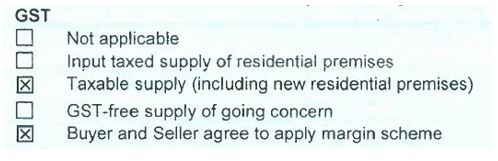
47 In addition to cl 24 of the Printed Terms, three Special Conditions in the Lloyd Contract (and the other Altitude Contracts) have relevance. They are as follows:
(1) Clause 52 of the Special Conditions:
52. Price inclusive of GST
(a) The Price payable in accordance with this Contract is inclusive of GST (within the meaning of the A New Tax System (Goods & Services Tax) Act 1999 (sic) as amended from time to time.)
(b) The Buyer agrees with the Seller that any GST the Seller is liable to pay on the supply of the Unit to the Buyer under this Contract is calculated under Division 75 of the A New Tax System (Goods & Services Tax) Act 1999 (sic) (ie. the Margin Scheme).
(2) Clause 56 of the Special Conditions:
56. Representations
56.1 Entire agreement
The Buyer agrees that this Contract sets out the entire agreement of the parties on the subject matter of this Contract and supersedes any prior agreement, advice, material supplied to the Buyer or understanding on anything connected with the subject matter of this Contract.
56.2 No reliance
Each party has entered into this Contract without reliance upon any representation, statement or warranty (including sales and marketing material and preliminary art work), except as set out in this Contract.
(3) Clause 60 of the Special Conditions:
60. Definitions
60.1 Definitions
In these Special Conditions the following words have the following meanings:
“Contract” means this contract for sale including the Printed Terms and these Special Conditions and any annexure or schedules to it.
…
“Printed Terms” means the printed terms of the standard ACT Law Society Contract 2013 Edition.
60.2 Same meanings
For the avoidance of any doubt, unless otherwise stated, the terms that are defined in the Printed Terms of the Contract have the same meanings in these Special Conditions.
48 At present I need only comment upon cl 52 which serves to reinforce the fact that the Lloyd Contract was GST inclusive and that the Special Conditions in the Lloyd Contract (which had paramountcy) did not provide “to the contrary” of the Printed Terms. Additionally, cl 52(b) contemplated that Belconnen may not be liable for GST on the supply (“any GST the Seller is liable to pay on the supply …”) and that only Belconnen could have a liability for GST, if applicable on settlement, as Belconnen, as Seller, was the entity making the supply.
C.3 The Terms of the El-Zein Contract
49 The El-Zein Contract also provided that the Price was “GST inclusive” and the Price for the relevant Governor Place Unit was “$435,900.00 (GST inclusive unless otherwise specified)”.
50 In the GST Schedule (see [34] above), the following appeared:
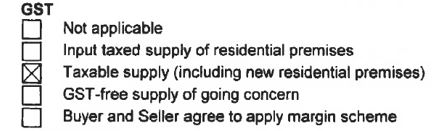
51 In addition to cl 24 of the Printed Terms, there were Special Conditions in the El-Zein Contract, in substantively the same terms as the Lloyd Contract, as to confirmation that the Price was inclusive of GST (cl 44.1) and as to an “entire agreement” and “representations” (cl 47). Apart from the fact that the margin scheme did not apply, the contractual position as between the Barton Developers and Mr and Mrs El-Zein was similar to that applying as between Belconnen and Mrs Lloyd.
C.4 The Terms of the Eppelstun Contract
52 The position as to the Eppelstun Contract was somewhat different and the source of some contention (although the Special Conditions identified above as to the Price being GST inclusive (cl 32.1) and as to an “entire agreement” and “representations” (cl 35) were also present).
53 Mr and Mrs Eppelstun agreed to purchase their relevant Governor Place Unit for a Price specified as being “$400,900.00 (GST inclusive unless otherwise specified)”. As is common with conveyancing contracts, the Eppelstun Contract was executed in counterpart. The counterpart signed by Mr and Mrs Eppelstun and provided by their solicitors on exchange to the Barton Developers (Buyer Counterpart) was, like the El-Zein Contract, as follows:
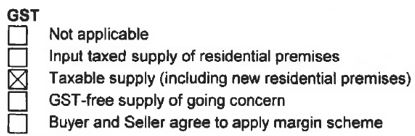
54 However, the counterpart signed on behalf of the Barton Developers and provided on exchange to the solicitors for Mr and Mrs Eppelstun (Seller Counterpart) was different and as follows:
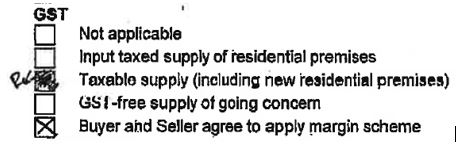
55 The evidence does not allow a definitive conclusion to be reached as to who crossed, rubbed out and then initialled next to the “Taxable supply (including new residential premises)” box on the Seller Counterpart. The Barton Developers did not call their solicitor, Mr Archie Tsirimokos, of Meyer Vandenberg, who executed the Seller Counterpart. It is possible to conclude, however, that the changes were placed on the Seller Counterpart prior to exchange and were on the Seller Counterpart when it was received by the solicitors for Mr and Mrs Eppelstun. In any event, the disconformity, such as it was, was either overlooked by the solicitors or regarded as being sufficiently insignificant not to stand in the way of exchange having been effected and the ultimate settlement of the conveyance.
56 It is necessary to resolve the competing contentions of the parties as to the contractual significance of the difference between the counterparts. The Barton Developers assert that the margin scheme box was “ticked by mistake” on the Seller Counterpart. The evidence discloses that in July 2013 a conveyancer at Meyer Vandenberg enquired as to whether the margin scheme applied to the sale of the Governor Place Units and was then informed by a development manager at Morris Property Group that the “[m]argin scheme is not able to be applied”. Later in July 2013, Meyer Vandenberg prepared a revised version of the master contract with the relevant margin scheme special condition (cl 45.2) deleted. A marked up draft of the Special Conditions to the master contract included a comment that “[a]s this land was sold to us as a taxable supply, we cannot nominate the margin scheme” and an instruction was given to Meyer Vandenberg to “ensure the front page reflects same”.
57 After registration of the Governor Place units plan, Meyer Vandenberg was asked to update the contracts and it is evident that this revision of the Special Conditions reintroduced the margin scheme in a special condition (cl 32.2). Clause 32 is of importance (and is essentially the same as cl 52 of the Altitude Contracts) and merits setting out in full:
32. PRICE INCLUSIVE OF GST
32.1 Price Inclusive
The Price payable in accordance with this Contract is inclusive of GST (within the meaning of the A New Tax System (Goods & Services Tax) Act 1999 (Cth) (sic) as amended from time to time.)
32.2 Margin Scheme
The Buyer and the Seller agree that any GST that the Seller is liable to pay on the supply of the Unit to the Buyer under this Contract is to be calculated under Division 75 of the A New Tax System (Goods & Services Tax) Act 1999 (Cth) (sic) ie. the Margin Scheme.
58 In any event, as noted above, at some time around when the Seller Counterpart was executed by Mr Tsirimokos on or about 6 October 2015 under the power of attorney, the margin scheme box was ticked and both the Seller Counterpart and the Buyer Counterpart included the margin scheme Special Condition cl 32.2 set out above.
59 Senior Counsel for the Barton Developers submitted that “if one put it in terms of offer and acceptance” there was “no meeting of minds about the relevant topic of engagement”; this is because “it’s not just the tick… It’s the tick plus the promises attached to the tick which is the offer. The ticks are there to engage [cl] 24” (T.85 24.6.19). In effect, it was contended, “[a]ll that has happened is there is no relevant ticking at all under GST. None” (T.86 24.6.19).
60 Mr and Mrs Eppelstun submit that the submission of the Barton Developers is both incomplete and misconceived. Whatever the position as to the ticking of the box in the GST Schedule and the inclusion of special condition cl 32.2, the evidence relied on by the Barton Developers is said to fall short of establishing any mistake because, apart from anything else, it is left unsatisfactorily unclear why the person who made the amendments did what they did.
61 Ultimately, however, the issue comes down to one of construction. Contractual construction, of course, depends on finding the meaning of the language of the Eppelstun Contract. I think notions of offer and acceptance in the present context can be a distraction. The Eppelstun Contract was, of course, comprised by two counterparts and although it may sometimes be possible to regard the party who signs first as being the offeror, where a contract for the sale of land is formed by an exchange of counterparts, to attempt to analyse the formation of agreement in terms of a succession of offer and acceptance is somewhat artificial: see Nunin Holdings Pty Ltd v Tullamarine Estates Pty Ltd [1994] 1 VR 74 at 81 (Hedigan J). Nor is the issue one that involves consideration of rectification, as Mr and Mrs Eppelstun say the proper construction is clear and rectification is unnecessary; and the Barton Developers say there was no common intention as to the nature of the proposed supply and hence the instruments cannot be rectified to bring them into conformity with the common intention of the parties: see Sindel v Georgiou (1984) 154 CLR 661 at 667.
62 Hence the issue is simply whether, as a matter of interpretation, the Eppelstun Contract records a consensus on the relevant terms. This involves reading the Eppelstun Contract as a whole giving weight to all clauses in an endeavour to give effect to the intention of the parties as reflected in the language which they have used. In doing so, of course, the court will try to ensure the congruent operation of its various components as a whole (Wilkie v Gordian Runoff Limited [2005] HCA 17; (2005) 221 CLR 522 at 529 [16]) and a court is entitled to approach the task on the assumption “that the parties ... intended to produce a commercial result” and to avoid the Eppelstun Contract “making commercial nonsense or working commercial inconvenience”: Mount Bruce at 117 [51] (French CJ, Nettle and Gordon JJ).
63 If one is to approach the examination of the text in the context of the surrounding circumstances known to both the parties, including the purpose and object of the transaction and by assessing how a reasonable person would have understood the language in that context, then the objectively ascertained answer to what the parties intended relating to GST emerges.
64 Clause 32.2 provided, in terms, that Mr and Mrs Eppelstun agreed with the Barton Developers that “any GST” would be calculated under the margin scheme. This provision can be read together with the Buyer Counterpart (which simply noted that the supply was taxable). In truth there is no real inconsistency between them, this is because one supplements the other and in accordance with s 75-5(1) of the GST Act, an agreement between the parties to apply the margin scheme to the taxable supply (see [41] above) is found upon consideration of the instruments as a whole. Moreover, cl 32.2 is consistent with all other terms of the Seller Counterpart (which noted the agreement that the margin scheme was to apply, and hence the supply was necessarily taxable). Moreover, the mere fact that the agreement to apply the margin scheme might be found in the Special Conditions where the relevant box is not ticked in the GST Schedule, does not undermine the operation of cl 24.5 of the Printed Terms, which contemplates the agreement to apply the margin scheme being found anywhere in “this Contract”.
65 When read as a whole, including by reference to how a reasonable person would have understood the language in context, it seems to me that in addition to Mr and Mrs Eppelstun agreeing with the Barton Developers on exchange that the Price was GST inclusive, the Eppelstun Contract says that Mr and Mrs Eppelstun and the Barton Developers agreed that the margin scheme applies to the supply and hence the Barton Developers warranted by cl 24.5 (incorrectly as it turns out) that it could use the margin scheme and promised that it would.
66 For the sake of completeness, I note I do consider the answer to this construction issue is found by reference to the “override” clause (cl 38) (which conventionally, like many conveyancing contracts, gives paramountcy to the Special Conditions over the Printed Terms). This is for two reasons: first, properly understood, there is not, in truth, an inconsistency between the Special Conditions and the Schedule if the contract is read as a whole; and secondly, in any event, the better view is that the particulars and markings in the Schedule do not form part of the Printed Terms as that term is defined (see cl 27.1(c) of the Special Conditions).
67 It may be accepted that given the history of the Governor Place development recounted at [10]-[11] above, the Barton Developers did not intend to apply the margin scheme (a matter unknown to Mr and Mr Eppelstun), but the subjective intentions of the Barton Developers are, of course, not to the point. Of course, the actual state of one party’s mind is generally irrelevant for the purposes of construction including in circumstances where the other contracting party does not know the other is labouring under a “mistake”: see J D Heydon QC, Heydon on Contract (2019, Thomson Reuters) at [8.170], [8.180] and [9.330]. Here, even if one was to accept that there was a “mistake” as alleged, it was entirely unilateral and it was not suggested that Mr and Mrs Eppelstun were in any way aware of it.
68 Determining this issue of construction brings into focus the relationship between the Schedule and cl 24 of each of the Contracts; this is an issue that is fundamental in: (a) ascertaining whether there is a relevant “gap” in the Contracts as alleged; and (b) ascertaining what was represented by the Seller to the Buyer by placing crosses in the GST Schedule in the draft contract for exchange, a matter central to the way the express representation case advanced by the applicants is pleaded.
69 Having dealt with the terms of the Contracts and prior to considering how the Printed Terms deal with the rights and obligations of the parties relating to GST inter se, it is useful to set out from Annexure A, in tabular form, the relevant dates and also what each Contract said about the nature of the anticipated supply and what, in truth, the positon was on completion:
CONTRACT | EXCHANGE | WHAT THE CONTRACT “SAYS” ON EXCHANGE | COMPLETION | NATURE OF SUPPLY ON COMPLETION |
Lloyd Contract | 10 March 2015 | Taxable supply – agreement to apply margin scheme | 7 April 2015 | Input taxed |
El-Zein Contract | 15 April 2015 | Taxable supply – no agreement to apply margin scheme | 5 June 2015 | Taxable Supply |
Eppelstun Contract | 5 October 2015 | Taxable supply – agreement to apply margin scheme | 5 November 2015 | Input taxed |
70 As can be from the above table, it is important to note that no claim has been brought forward in either case in which: (a) the relevant contract said on exchange there was to be a taxable supply; (b) there was an agreement to apply the margin scheme; and (c) the supply was a taxable supply upon settlement.
C.6 The Relationship between the GST Schedule & Clause 24
71 The GST Schedule and cl 24 cannot be considered otherwise than in the context of each of the Contracts as a whole. Obviously enough, when one considers how the Contracts deal with the rights and obligations of the parties relating to GST, the starting point (page 1 of the Schedule) is that the Price is “GST inclusive unless otherwise specified” and the contractual choice of the parties was not to otherwise specify.
72 As noted above, however, the fact that the Price was GST inclusive is not the same as saying that the supply on completion would necessarily be a taxable supply, or that GST would necessarily be payable following the supply. As explained above, the Contracts necessarily contemplated that the characterisation of the supply could change between exchange and settlement. Subject to further qualification by other terms, what “GST inclusive” means in the standard contract for the sale of real property in the ACT is that irrespective of what happens between exchange and settlement or prior to GST becoming payable, the Buyer will have no liability for payment of GST. In this sense, the “risk” of liability for GST lies with the Seller.
73 This is neither novel nor surprising. In Duoedge Pty Ltd v Leong [2013] VSC 36, a purchase was made in accordance with the standard Real Estate Institute of Victoria contract for sale of real estate, which included a condition:
13 GST
13.1 The Purchaser does not have to pay the Vendor any GST payable by the Vendor in respect of a taxable supply made under this Contract in addition to the price unless the Particulars of Sale specify that the Price is ‘plus GST’…
74 The parties filled in the purchase price but added a handwritten annotation so that it read “$916,000 GST inclusive”. A special condition required the vendor to provide the purchaser with a tax invoice and, prior to settlement, the vendor provided a tax invoice. Having subsequently developed and sold off the developed land, the purchaser claimed an input tax credit, but this was rejected by the ATO and the purchaser commenced proceedings in the Magistrate’s Court against the vendor seeking a refund of an amount representing the GST amount identified in the tax invoice. In the course of allowing an appeal against the findings of a Magistrate that a term could be implied that if the supply was not taxable, the vendor would refund the GST amount identified in the tax invoice and curiously (in the light of the foregoing conclusion) that rectification of the contract was appropriate, John Dixon J at [23] explained:
The plain meaning of this contract is that the GST risk lay with the vendor … The parties have expressed the intention that the purchaser has no obligation to make a further payment in respect of any GST assessment that might later follow. In other words, the parties plainly intended that the risk that GST might need to be remitted to the Tax Office lay with the vendor. If the transaction did not involve a taxable supply, that risk was abated to the benefit of the vendor, who retains the full price that it contracted to receive for the property. Objectively assessed, this is what the terms relating to GST show to be the intention of the contracting parties. This construction is neither uncertain, nor ambiguous.
75 It seems to me the argument of the applicants that “GST inclusive” as used in the context of these Contracts means something different to its use in the contract considered by John Dixon J, does not withstand scrutiny. Like with the Victorian contract, the “default” position under the Printed Terms was that the Price was inclusive of GST. The Contracts necessarily accommodated the possibility, irrespective of the crossing or crossings in the GST Schedule, that the nature of the supply could change when it later came time, upon completion, to make the supply. As explained above, this possibility is reflected in parts of cl 24 (see [43] above) and also in cl 52(b) of the Altitude Special Conditions (see [48] above) and cl 32.2 of the Eppelstun Contract (see [57] above).
76 What follows from this are two matters of importance in understanding the operation of the Contracts: first, as a general proposition, to the extent that there is a risk of the supply being taxable on settlement, subject to any terms to the contrary, such a risk is allocated to the Seller as the party liable to remit any GST payable to the ATO; secondly, as noted above, there is an identifiable risk to be allocated, because the time of the relevant supply is at completion and not exchange, which, in the case of at least some of the “off-the-plan” sales, might be years in the future.
77 What then does the crossing of a box in the GST Schedule signify?
78 The first function is that crossing a box in the GST Schedule serves to engage cl 24 of the Printed Terms. Contrary to the argument initially advanced by the applicants (later not seriously pressed), the ticking of the box itself does not constitute a promise or a warranty about what would happen upon settlement. The primary role of placing a cross or crosses in the boxes is to signify which subclauses within cl 24 apply, subject to any Special Conditions. For example (like any other provision of the Contracts which noted an agreement the margin scheme would apply, such as cl 52(b) of the Altitude Contracts or cl 32.2 of the Eppelstun Contract), the ticking of the box notifying that the parties agreed the margin scheme would apply, operates to engage cl 24.5. Similarly, the ticking of the box that says the sale is a taxable supply (without the parties agreeing the margin scheme would apply), engages cl 24.6. Of course, cll 24.3.2 and 24.7 could also be engaged depending upon the circumstances. If the sale was GST exclusive and the taxable supply box is crossed, subject to any change of the nature of the supply on settlement, cl 24.2 would then operate.
79 A second function, when properly analysed, is connected to the first. It is not in contest that the crossing of the boxes on the Contracts was performed on behalf of the Seller in a version of the relevant Contract provided to the Purchaser. The respondents contested the notion that the crossing of the boxes constituted any statement or representation by the Seller, but submitted that to the extent it did so, the representation that was conveyed was not as alleged by the applicants: see Final Submissions of Belconnen (SB) at [395], [499], [502], [511]; Final Submissions of Barton Developers (SBD) at [13], [83], [166].
80 The applicants assert that what was conveyed by the crossing of the GST Schedule, in combination with other matters, was a specific twofold representation made to the Buyer. In the Altitude proceeding, Mrs Lloyd contends in the second further amended statement of claim (ASOC) at [42] that a representation was made in the Altitude Contracts that:
(a) GST was payable in respect of the sale of an unexpired term of a Unit Lease for a Unit; and
(b) GST would be paid to the Australian Tax Office
(together, GST Representations).
81 In the Governor Place proceeding, the same contention is made by the applicants in the further amended statement of claim (GPSOC) at [54].
82 Both respondents say the crossing of the box is not a representation at all, but rather, in the manner I have explained above, simply serves the purpose of engaging the subclauses of cl 24: SB [395], SBD [168]. But to the extent there was a representation, it was of the Seller’s present opinion at the date of exchange that on settlement the supply of the unit would be a taxable supply to which the margin scheme would apply: SB [511]. Indeed, Belconnen goes somewhat further and submits (SB [397]-[399]) that crossing the boxes amounted to: (a) an express statement by which the Buyer and Seller “acknowledge that, at the time of exchange, the statement made by ticking the box could be wrong in fact, or could become wrong at any time before supply”; (b) an express acknowledgment that the Seller’s tax treatment of the supply could be incorrect at the time of exchange, or after exchange the tax treatment could change and become incorrect before settlement; and (c) a statement at the time of exchange of “the allocation of the specific GST risk chosen by the buyer and seller under cl 24 of the Printed Terms”.
83 In my view, none of these positions is entirely correct, although I do consider the alternative argument of the Barton Developers to be closest to the mark. It seems to me plain that having regard to the Contracts as a whole, the crossing of the boxes on the Contracts provided to the solicitors for the Buyer by the solicitors for the Seller, conveyed: (a) a representation that at the time, it was the Seller’s opinion, that upon settlement, the supply would be as identified by the crossing of the GST Schedule and other relevant terms of the Contracts; and (b) impliedly, a representation that the Seller actually holds the opinion and that there was a reasonable basis for it (Completion Representations). I also consider a further representation was made (again a statement of opinion) that on the basis of the information then known to the Barton Developers, it was likely, following settlement, an amount representing GST on the supply would, in due course, be paid to the ATO (Likely Payment Representation).
84 It is accepted as between the parties, however, that whether in fact the Completion Representations and/or the Likely Payment Representation were actually conveyed to an individual purchaser is a question that cannot be answered in the abstract, divorced from consideration of all the communications between the Seller and Buyer which may bear upon the question.
85 I have already indicated that understanding the relationship between the Schedule and cl 24 of each of the Contracts is necessary to understand how the express representation case is put by the applicants. As I will explain below, it is also fundamental to assessing whether there is a relevant “gap” in the Contracts. I will turn to these questions in the context of dealing with the individual claims for relief by the applicants. Prior to doing so, however, it is appropriate to make some further common factual findings in both the Altitude proceeding (Section D) and the Governor Place proceeding (Section E). I will then complete making any individual factual findings in the context of dealing with the claims of Mr and Mrs El-Zein (Section F), Mr and Mrs Eppelstun (Section G) and finally, Mrs Lloyd (Section H). I will proceed with the individual claims in this order because it is appropriate to consider any remaining allegations of breach of contract before considering restitutionary relief.
D FURTHER COMMON FINDINGS – ALTITUDE
86 In or around August 2008, Belconnen retained Clayton Utz to prepare a master Altitude Contract and to act on any sales. A partner of Clayton Utz was appointed a power of attorney by Belconnen to sign Altitude Contracts on its behalf.
87 It will be recalled that the second respondent, Mr Hindmarsh, is the sole director and 50% shareholder of Belconnen and the third respondent, Mr Ryan, who unlike Mr Hindmarsh gave evidence, was the company secretary of Belconnen and, until recently, the CFO of the Hindmarsh Group. I will return below to issues relating to the credit of Mr Ryan and the inferences available by reason of the failure of Mr Hindmarsh to give evidence below.
88 In any event, in about 2012, Mr Ryan became aware of the amendments to the GST Act, resulting in the supply of the leasehold estate for new residential premises being a taxable supply. Mr Ryan was aware that the amendment was retrospective and applied to all supplies that occurred on or after the beginning of January 2011. Although he was aware there were exceptions to the amendment and some developments were “grandfathered”, Mr Ryan was not aware of whether the exceptions applied to the Altitude Units.
89 Mr Ryan met with Mr Mile Petrevski and Mr Warwick Burr of Maxim on 16 May 2012. During that meeting, Mr Ryan provided Messrs Petrevski and Burr with some information about Hindmarsh Group’s ongoing developments and they discussed Gloxinia. Subsequently, there was an exchange of information and further meetings.
90 On 20 December 2012, Mr Petrevski sent Mr Ryan a letter confirming the terms of engagement between Belconnen and Maxim, and on 23 January 2013, Mr Ryan sent an email to Mr Hindmarsh and Mr Darren Dougan (the then CEO of the Hindmarsh Group) that attached the Maxim engagement letter and provided a useful recounting of the background to the engagement:
As discussed last week, I have agreed to a proposal from Maxim Chartered Accountants to provide consultancy services to Hindmarsh to prepare a request for a Private Binding Ruling (PBR) to be lodged with the ATO during January, regarding the treatment of GST that Hindmarsh should follow for GST relating to the settlements at Altitude…
To summarise, Maxim approached me before Christmas advising that they had recently been successful with PBRs for 2 development clients where there were very specific circumstances that applied, and offered to review the facts around any Hindmarsh projects that were similar. On the basis of high level information I provided on the Altitude project, they assessed it as a close fit with the circumstances and timing in which amendments to the GST law during 2011 and 2012 allowed for certain sales of new residential apartments to be input-taxed.
By treating sales as input-taxed, Hindmarsh would not have to remit GST on the sale prices received for the apartments, but would have to refund any GST input credits previously received by Hindmarsh from expenditure on the project. This would increase the Altitude profit by approximately $3m (GST on sales of $13m less $10m in credits refunded)…
The timing of lodgement of the PBR is crucial, so that we are in a position to decide whether to go ahead with this treatment before we have to remit the GST on the first settlements to occur at Altitude…
I am confident that this is a low risk proposal for Hindmarsh, on the basis of the fee arrangement and Maxim’s reputation and experience in these matters…
I will advise you when the PBR is ready for lodgement.
91 On 4 February 2013, Mr Burr sent Mr Ryan an email attaching a copy of the draft private ruling request for Belconnen. In this email, Mr Burr asked Mr Ryan to review the contents, confirm that the facts and circumstances were accurate and sign the declaration to go with the private ruling request. The private ruling request was later lodged on behalf of Belconnen with the ATO on 8 February 2013, before any settlements occurred.
92 Later, Mr Ryan became concerned about the delay in obtaining the private ruling. He sent an email to Mr Burr on 18 February 2013 requesting an update on whether any feedback had been received from the ATO and stating: “[f]or information, as at COB today there have been 44 settlements in Stage 1 (Chandler St) for a gross proceeds of $18,485,075 and a GST value under the margin scheme of $1,706,073”.
93 On 12 March 2013, the Altitude Private Ruling was issued and the following day, Mr Burr sent Ms Margaret O’Shea (Financial Controller at the Hindmarsh Group) an email, copied to Mr Ryan, stating: “[as] discussed with Gerry this morning, the ATO have confirmed that sales of residential apartments at Altitude are eligible to be treated as input taxed” and thereafter provided Ms O’Shea some instructions with respect to preparing the February 2013 and later business activity statements (BAS) on an input taxed basis, amending prior BAS upon which Belconnen had claimed input tax credits, and repaying all relevant input tax credits previously claimed.
94 The February 2013 BAS was prepared on the basis that all of the sales that had occurred during this month were input taxed supplies, not taxable supplies. An email sent by Ms O’Shea to Mr Burr on 20 March 2013 attached a GST calculation worksheet showing that the sales throughout February 2013 amounting to $25,703,393 were treated as input taxed. Also, in or about March 2013, Belconnen filed amended GST returns and on or about 21 March 2013, Belconnen repaid $2,086,245 (being some of the input tax credits).
95 On 30 April 2013, Maxim issued an invoice to the Hindmarsh Corporate Unit Trust for $712,250, being an amount it calculated as 15% of the benefit obtained by Belconnen from treating the sales as input taxed, plus GST. An email from Mr Burr to Mr Ryan had noted that “I have made the invoice out to Belconnen Lakeview (per our engagement letter) … I note that as Belconnen Lakeview is treating is [sic] sales input taxed, it is unlikely to be able to claim the GST on our fee. Please advise if you would like us to invoice an alternate Hindmarsh entity”. Mr Ryan responded, reflecting the distinct benefit received by Belconnen, by noting he was happy with the fee calculation as it “appropriately reflect[s] the benefit coming to Hindmarsh from the change of GST status to input taxed”.
96 The Commissioner had issued a number of revised private rulings and each revised private ruling had the effect of replacing the earlier private ruling, however, on 12 March 2013, the Commissioner issued a final private ruling to Belconnen to the effect that the sale of the Altitude Units were input taxed and not taxable supplies, being the Altitude Private Ruling.
D.2 Findings in relation to Mr Ryan
I Introduction and the Issues of Credit
97 It is next appropriate to deal with my findings which relate directly to the evidence of Mr Ryan. The evidence is somewhat controversial as Mrs Lloyd contends that Mr Ryan was not a credible witness and his evidence largely ought not to be accepted; whereas Belconnen contends the cross-examination of Mr Ryan proceeded on a number of incorrect assumptions and that he was an honest and impressive witness.
98 Mr Ryan is sued for knowing involvement, and perhaps unsurprisingly, the controversy as to his credit primarily related to evidence that at relevant times Mr Ryan was unaware of the basis upon which Belconnen had contracted with Altitude Group Members, and that he was not involved in instructing Clayton Utz about the Altitude Contracts. More specifically, there was dispute as to whether the Court should accept Mr Ryan’s evidence that, following the Altitude Private Ruling on 12 March 2013, Mr Ryan was unaware that Clayton Utz had continued to treat sales of Altitude Units as taxable supplies to which the margin scheme applied, rather than treating the sales as input taxed. Further, Mr Ryan, although having nothing directly to do with the negotiation of the sale to Mrs Lloyd, gave the only testimony said to be relevant to the approach of Belconnen to setting and agreeing upon sales prices of the Altitude Units. He gave evidence as to the attitude that Belconnen would have taken in a counterfactual where Mrs Lloyd had been apprised that the sale to her was not a taxable supply and his evidence was the subject of challenge. I will come back to this last aspect of Mr Ryan’s evidence below, but before doing so it is convenient to deal initially with the credit attack as to the extent of his knowledge of the basis upon which Belconnen contracted.
II Mr Ryan’s Evidence as to his Knowledge and Findings
99 The assessment of Mr Ryan’s credit in this aspect of his evidence arises against the background of his affidavit evidence and exhibit A4 which, when taken together, give rise to real concerns.
100 In his affidavit at [181]–[184], Mr Ryan dealt with the “notification to Clayton Utz” of the change in the GST treatment of the sales on 12 October 2015. This evidence was as follows:
On 12 October 2015, I received an email from Amanda Noy, a Law Clerk in the employ of Clayton Utz, asking for instructions in relation to the tax treatment for the sale of two residential units in the Altitude Development. As noted earlier in my affidavit, I was not in regular contact with Clayton Utz in relation to the conveyances for the Altitude Development. However, the two residential units that were being sold both had tenants and as such, are treated differently to ordinary sales from a taxation perspective.
On reading the email I formed the view that Clayton Utz had not been treating the other supplies as input taxed, which I was not previously aware they were doing, as I had assumed that they had treated the supples as input taxed pursuant to the First PBR as reinstated by the Fourth PBR Notice. I was not responsible for the day to day negotiation of contracts or the ordinary conveyancing dealings with Clayton Utz so I had not previously turned my mind to the issue of the amendment of contracts for sale of units in the development, as well as the fact that, amongst the other reasons set out above, it was my view that the difference in tax treatment had no practical impact on any of the purchasers.
On 12 October 2015, I replied to Ms Noy’s email and confirmed that BL had been treating the sale of all residential units in the Altitude Development as input taxed, as per the First PBR.
From my review of the Sale Schedule, I understand Clayton Utz amended the contracts for sale in respect of the sale of all residential units in the Altitude Development on and from 12 October 2015, such that on page 2 of those contracts for sale, “input taxed supply” was ticked, and “taxable supply” and “buyer and schedule agree to apply the margin scheme” were not ticked. A total of 24 residential units were sold on this basis.
101 Although the email correspondence with Ms Amanda Noy (being exhibit A4) was referred to, it was not annexed to the affidavit, despite Mr Ryan having seen the emails at the time he made his affidavit. This decision to exclude the emails was made despite Belconnen later expressly accepting (BS at [648]) that they contain “two critical statements”. These statements were: first, the reference by Ms Noy to Mr Ryan that “[w]e note remaining Altitude units that have never been rented out are still being sold under the margin scheme – if this is to change please let us know”; and the second “critical” statement was made by Mr Ryan in his reply to Ms Noy that:
I confirm we’ve been treating all Altitude sales as input tax, consistent with the private buyer ruling issued to Belconnen Lakeview by the ATO in 2013. Please amend any new contracts to reflect this.
102 The emails were not only not annexed to the affidavit, but Belconnen contended, until shortly before the initial trial, that they were subject to a claim for legal professional privilege, notwithstanding the service of Mr Ryan’s affidavit. Mrs Lloyd contends that this claim was significant because Mr Ryan omitted material parts of the email exchange from his affidavit in circumstances where it would reasonably have been supposed, at the time the affidavit was sworn, that the emails would not become available.
103 Why this matters is because the omission from the affidavit deprived the reader of what is now expressly accepted by Belconnen to be “critical” information including the instruction by Mr Ryan (“Please amend any new contracts to reflect this”) which, naturally enough, suggests he was the person responsible within Belconnen, at least at some time, for providing instructions to Clayton Utz. In this regard, the email from Ms Noy was sent to Mr Ryan only, and he responded to it without seeking to involve any other person at Belconnen. As Mr Ryan accepted in cross-examination, he assumed the Altitude Contracts needed amendment because he identified in the email the incorrect treatment was being used. The representation omitted also went to undermine, at least arguably, the impression Mr Ryan was apparently seeking to convey by the affidavit at [184], that he only became aware that the Altitude Contracts had been amended, upon his review of the sale schedule in the context of the proceeding.
104 Mrs Lloyd submits that it “beggars belief that this [that is, the email] is the first time that Mr Ryan and Clayton Utz discussed the contractual treatment of GST”. It is said the attempt by Mr Ryan to describe his instruction to Clayton Utz as a mere “indication” was wholly unmeritorious.
105 There were four further matters relied upon by Mrs Lloyd which were also said to be relevant in assessing the credit of Mr Ryan and which relate to the question as to whether the Court should accept his evidence of being ignorant of the basis of the Altitude Contracts prior to the receipt of exhibit A4:
(1) The first was that although in cross-examination Mr Ryan initially sought to suggest that he had “never seen the contracts” and “didn’t know for sure what was in them”, he later accepted that he had understood that Belconnen had contracted on the same terms as those contained in the version sent to him by Ms O’Shea in December 2012, and that he was not aware of any steps taken to change the form of the contract after the Altitude Private Ruling; he further accepted that he was aware that the “form of the contract… indicated that it was a taxable supply”.
(2) The second was that although Mr Ryan sought to suggest at [164] of his affidavit that Belconnen obtained the funds it needed to repay the input tax credits by “entering into an arrangement negotiated with NAB, its financier, for it to deposit what would have been the ‘GST’ portion of each settlement (calculated pursuant to the margin scheme) into an account maintained by [Belconnen]”, that representation “was clearly wrong” in that Belconnen never disclosed to NAB that it had obtained the Altitude Private Ruling and it never entered into any arrangement with NAB to deposit the amount of the price referable to GST into an account maintained by Belconnen. What Mrs Lloyd submits rather, was Belconnen allowed NAB to labour under the misapprehension that GST was payable, even though it was not treating sales as taxable supplies. This was done, it was said, to ensure that monies could be used by Belconnen for its own benefit, rather than paying down the debt with NAB.
(3) The third was that Belconnen was content for Clayton Utz to continue to issue settlements which included the words “Price inclusive of GST - margin scheme”. It is contended by Mrs Lloyd that it should be inferred that this was because Belconnen was aware that if Clayton Utz had been informed of the true position, the Clayton Utz partner, Mr Del Rio, who executed the Altitude Contracts in this form under a power of attorney, would not have done so.
(4) The fourth was that in cross-examination Mr Ryan also said a sales schedule was prepared and updated by Clayton Utz, which included specific information about each Altitude Contract, including that the taxable supply and margin scheme boxes were ticked and that they included clauses pertaining to GST. Mr Ryan accepted that the sales schedule he received from Clayton Utz included information about what purchasers were being told in relation to the nature of the Altitude Contracts, and how they treated GST, and that he received the table of settlements on a regular basis and read it.
106 By way of contrast, the submission made by Belconnen and Mr Ryan was that exhibit A4 corroborates that Mr Ryan did not know Clayton Utz had continued to mark the Altitude Contracts as a taxable supply to which the margin scheme applied and this is evident from the fact that as soon as Mr Ryan became aware that Clayton Utz had treated the supplies this way, Mr Ryan corrected the situation. It is said there is no plausible explanation for why Mr Ryan would reply to Ms Noy in the manner he did unless Mr Ryan was ignorant of the fact that Clayton Utz had been treating post-Altitude Private Ruling sales as taxable supplies to which the margin scheme would apply. Further, Belconnen and Mr Ryan accept that an error was made in making a claim for legal professional privilege in respect of exhibit A4. It was ultimately submitted by Belconnen that although the claim for privilege was not justified, such matters were beyond the control of Mr Ryan and as such “[n]o criticism can be made of Mr Ryan in relation to the form of his affidavit”.
107 Moreover, as to the additional matters relied upon by Mrs Lloyd: (a) Mr Ryan was adamant he did not deliberately exclude reference to the words “[p]lease amend any new contracts to reflect this”, because he thought the other side would not obtain access to exhibit A4 (T139.5-11 2.5.19) and, at the time that Mr Ryan sent his email to Ms Noy, Mr Ryan denied that he assumed that Belconnen was still using the same form of Altitude Contract that had been used earlier (T150.24-26); (b) as to any submission relating to misleading NAB, this is entirely irrelevant to Mr Ryan’s credit (who did not have any role in directly dealing with NAB after 12 March 2013); and (c) the sales schedule cross-examined on, was produced by Belconnen’s solicitors as a mistake (as it was not a contemporaneous record) and it is to Mr Ryan’s credit that, notwithstanding he was shown in cross-examination a sales schedule document he could not have seen at any time before 12 October 2015, he maintained that he did not know what was in the Altitude Contracts.
108 In my view, the position in relation to Mr Ryan is somewhat more nuanced than is reflected in the competing submissions.
109 It is unfortunate that the affidavit of Mr Ryan was drafted the way it was. As Belconnen and Mr Ryan now accept, it left out a critical statement which recorded Mr Ryan making a specific instruction to Clayton Utz and the affidavit, as drafted, bolstered the impression that Mr Ryan only belatedly became aware that the Altitude Contracts had been amended. What made this worse, was that the affidavit gave, at best, an incomplete impression of exhibit A4 when a claim for privilege was mistakenly being maintained over the document.
110 As unfortunately is often the case, it appears the affidavit of Mr Ryan is less a reflection of the unassisted recollection of the witness, but a closely drafted position paper put together by solicitors after pouring over the contemporaneous documents with the assistance of the witness. These types of documents, served regularly in commercial litigation, are largely exercises in reconstruction and serve to do little more than fashion a narrative to suit perceived forensic exigencies of the case being advanced by the party calling the witness. By their own lights, I accept those responsible for preparing the affidavit were doing what they considered to be appropriate, but regrettably, the affidavit presented a less than candid and fully truthful account.
111 In making this point, two observations referred to by Pembroke J in Thomas v SMP (International) Pty Ltd [2010] NSWSC 822 at [24]-[26] have resonance. The first is by Lord Woolf contained in the Access to Justice Report, Final Report (HMSO), 1996 at [55] that:
Witness statements have ceased to be the authentic account of the lay witness; instead they have become an elaborate, costly branch of legal drafting.
112 The second is the more colourful aphorism attributed to Lord Buckmaster (repeated often by the Hon T E F Hughes AO QC), that “the truth sometimes leaks out of an affidavit – like water from the bottom of a well”.
113 My task is to assess Mr Ryan’s credit, not to visit upon him inadvertent lapses for which I find he was not directly responsible. I reject the suggestion that Mr Ryan was attempting to mislead the Court about his true recollection, but nor do I accept that the true position was as set out in his evidence in chief.
114 At the conclusion of his evidence, the following exchange occurred:
HIS HONOUR: And before answering this question, can you just refresh your recollection of these two emails. You will recall there was the email of 12 October - - -?---Yes.
- - - from Ms Noy?---Yes.
If you could read that email, and then if you could also read your response, and tell me when you finish?---Yes.
My question is – are you satisfied you’ve read those emails?---Yes, I’m happy. Yes.
Why did you consider it necessary to say to Clayton Utz in this email at the top of the page that they should amend any new contracts to reflect Altitude sales as being input-taxed?---To provide further information.
To whom?---To the – the Clayton Utz person.
Now, don’t answer this question if anyone objects. I think you agreed in some questions earlier that you believe that prior to this time, that is, October 2015, contracts were not in a form which did not reflect this, that is, did not reflect all Altitude sales as being input-taxed; correct?---Yes. Well, I wasn’t aware of what the contract said.
When you say you weren’t aware, did you have a belief one way or the other?---I didn’t honestly put my mind to it.
115 When given orally, this highlighted evidence had a crystal clear ring of truth about it. I am satisfied that Mr Ryan did not, at any time during this process, give any real or considered thought to how the Altitude Contracts were drafted. If he was asked about the how the Altitude Contracts dealt with GST, at any time prior to the date of the emails which became exhibit A4, I am confident that Mr Ryan would have responded that he believed that the Altitude Contracts would have provided for the Price to be GST inclusive and that they would have treated the sales as taxable supplies to which the margin scheme would apply. In this respect, his professed ignorance of these matters in chief overstates the position; but this is not the same thing as saying that he did, in fact, turn his mind to the drafting until it was specifically raised by Clayton Utz. It is more likely that like most property developers, Mr Ryan was focussed primarily on the progress of the development and achieving sales and leaving the prosaic contractual details to others, unless the issue called for his specific involvement. If it had crossed his mind earlier, I think it likely the instructions given by exhibit A4 would have been given at an earlier time by Mr Ryan. Doing my best to assess the inherent probabilities and the oral evidence of Mr Ryan, it is more probable than not that a failure by him to provide instructions earlier is not, as Mrs Lloyd asserted in submissions, attributable to a malign intention to dissemble the true position, but rather his focus on other matters.
III Mr Ryan’s Further Evidence and Findings
116 Mr Ryan gave evidence that the progress of the development was not straightforward. Construction commenced in early to mid-2011, which was a significant period of time after Belconnen had obtained the necessary approvals and the significant delays in commencing and completing works increased the overall costs of the development.
117 As noted above, Mr Ryan had no direct involvement with the setting of the sale prices of individual units. Belconnen sought and obtained recommendations from the selling agent, Independent Property Group (IPG), as well as other valuation sources in setting prices. He gave generalised evidence that he was aware that price setting was “not a simple exercise” as it was “dependent on a number of internal and external factors”, such as internal cash flow demands and the need to generate cash expeditiously to invest into other projects. This dependability on internal factors was, apparently, particularly relevant to the sale of units which occurred after completion of the building of the Altitude development (that is, at the time of the Lloyd Contract). He also gave evidence, consistent with his experience, that it “was important to factor in total GST costs into any overall profitability or feasibility calculation for the development”.
118 Although these generalised observations made intuitive sense as far as they went, it is apparent that Mr Ryan’s evidence as to the setting of prices of individual units and of the approach of Belconnen to negotiations as to the sale price of individual units was of quite limited utility. Initially, in early 2010, prior to the first off-the-plan contract exchange, a pricing schedule for the units was prepared and thereafter, from time to time, representatives of Belconnen (but not Mr Ryan) met with representatives of IPG to discuss market trends and unit pricing. Indeed, Mr Ryan’s involvement was limited to essentially “considering the total aggregate sale price of all units in the context of the overall feasibility” of the development. What occurred at these meetings with IPG was not the subject of any direct evidence from any participant notwithstanding it is evident, from Mr Ryan’s indirect evidence, that Belconnen regularly reviewed and changed unit prices of unsold units in Altitude to reflect changes in the market. More particularly, Mr Matthew Wykes of IPG who was the selling agent and dealt with Mrs Lloyd was not called, nor was the person within Belconnen who was responsible for giving instructions to Mr Wykes on behalf of Belconnen in the negotiations with Mrs Lloyd.
119 Mr Ryan gave evidence in chief of his view that GST was not relevant to the setting of a price of the individual flats (this view being based on the premise that the buyer of a residential unit is not entitled to claim an input tax credit). More specifically, in his affidavit evidence restricted pursuant to s 136 of the Evidence Act 1995 (Cth) (EA) to evidence of his opinion, he said that Belconnen “would not under any circumstance” have agreed to reduce the sale price of any residential unit in the Altitude development (including that unit the subject of the Lloyd Contract) by “an amount equal to any GST that [Belconnen] may have been required to remit to the ATO if the supply of that residential unit was a taxable supply”. In short, this was because the price “was set based on what the market would pay and was not influenced by GST”. Notwithstanding it was only evidence of his opinion, he was cross-examined closely on this evidence in oral evidence (being evidence that was not the subject of any limitation).
120 Mr Ryan was taken to the evidence that Belconnen agreed to provide abatements to Mrs Lloyd on settlement relevant to stamp duty (which was to be paid by Belconnen) and a window treatment rebate. Although again being unaware of “specifics”, Mr Ryan was aware of the practice of offering “incentives”. He then gave evidence as to the fact that as at the date of the Lloyd Contract, his estimate was that there “would be 50 to 60 apartments still unsold, possibly a bit less” and focussing on these remaining Altitude Units, the following evidence (T174-5 2.5.19) was given:
[Belconnen] was not selling [the remaining Altitude Units] at the prices which were listed because, plainly, as you understood it, no one was prepared to pay those prices; correct?---Yes.
All right. And may we take it you understood, as a matter of theory, that the company could have lowered the prices?---Yes, the company can make decisions on pricing, yes.
And that would have reduced the margin of the company on those units?---Yes.
All right. And may we take it that it follows that, as you understood it, the company didn’t want to reduce its margin on those units by meeting the market?---The company would try and maintain as much – as big a margin as it – as it could---
(emphasis added)
121 Mr Ryan accepted (T175 2.5.19) that the Altitude Private Ruling had “reduced one of [Belconnen’s] costs elements” and then gave the following evidence:
And [Belconnen] had a greater margin to play with and it had a greater scope to negotiate price and still maintain a desired margin, didn’t it?---It had scope to negotiate, yes.
And still maintain a desired margin?---Yes.
And that information would be relevant to a purchaser seeking to negotiate with the vendor as to price, wouldn’t it? Well, it’s a commercial negotiation, so---
It would be relevant to a purchaser, wouldn’t it?---Only to the extent of how much the purchaser thought that they could drive the price down from the vendor.
It’s blindingly obvious it would be relevant to the purchaser, isn’t it?---Well, it’s like any other cost associated with this. If the purchaser wants to say to a vendor “what’s your cost base, and I will give you 10 per cent over”.
Are you deliberately trying to not assist the court by refusing to agree that it’s a blindingly obvious proposition information about improved margin of a vendor would be relevant to a purchaser?---I don’t agree that it’s blindingly obvious that a purchaser would ask for that information.
I suggest to you you appreciate that it would be relevant to a purchaser, and it’s one of the reasons why you didn’t disclose the information about the ruling for purchases?---No. I didn’t disclose the ruling, or I didn’t know that the ruling hadn’t been disclosed to the purchasers because I thought it was irrelevant.
And I want to suggest to you, you knew absolutely relevant – it was relevant to the purchasers and deliberately didn’t disclose it?---The purchasers were negotiating to buy a – a – a apartment at the market price.
(emphasis added)
122 The evidence of Mr Ryan as to his entirely subjective view as to the importance of information being disclosed during the course of a negotiation is not relevant when it comes to determining the objective question as to whether the non-disclosure of the true position amounted to contravening conduct. Having said that, Mr Ryan’s subjective evidence is not irrelevant to the different question as to whether Belconnen would have regarded the information as likely to prompt a response (such as its potential use “to drive the price down”) from a purchaser such as Mrs Lloyd. Of course, what would have been of real assistance was direct evidence, from those involved in negotiations, as to the willingness of Belconnen to discount the purchase price at the time with which we are presently concerned, that is, the fag end of a lengthy development period.
123 Parts of the evidence of Mr Ryan given in cross-examination were unpersuasive. First, when it came to the reason as to why Belconnen did not disclose the correct position following the Altitude Private Ruling, it was not because the topic of disclosure was considered by Mr Ryan and dismissed as irrelevant (which seems to me to be a reconstruction) but rather because nobody had directed their mind to the disconformity between the proposed or executed Lloyd Contract and the true position as to whether the supply was going to be taxable. Secondly, although Mr Ryan at one point accepted that information that Belconnen “had a greater margin to play with” would be relevant to a purchaser “to the extent of how much the purchaser thought that they could drive the price down from the vendor”, I do not consider cogent his apparently inconsistent evidence that information that no GST would be payable (which meant Belconnen was to enjoy a greater margin) would be irrelevant to a purchaser.
124 To the extent that Mr Ryan’s evidence was, following cross-examination, evidence of the truth of the representation that Belconnen would not under any circumstance have agreed to reduce the sale price of Mrs Lloyd’s flat by any amount because GST was not payable, I reject it. I do so for a number of related reasons.
125 First, although Mrs Lloyd did not lead evidence of a decline in market value of the Altitude flats during the course of the development (and, somewhat surprisingly, made an application to limit that part of Mr Ryan’s affidavit ([62]) which did give evidence of a decline of market value between 2011 to 2015), evidence was also given, which was not the subject of a limitation, as to the “fluid nature” of Belconnen’s approach to pricing (Ryan [59]), by which I understood there was a willingness to meet the market as it moved.
126 Secondly, the market was not in line with the previous estimates of Belconnen; when it came to the 50 or so Altitude units at the concluding part of the sales process, as can be seen from the emphasised extract above, Mr Ryan assented to the proposition that they were not selling at the listed price because no one was prepared to pay the listed prices.
127 Thirdly, Mr Ryan’s subjective evidence as to Belconnen’s willingness to discount the asking price in the counterfactual by an amount referable to GST in his affidavit at [65], was given in an omnibus fashion by reference to “any” Altitude Unit. This evidence was limited to be evidence of his opinion only. Relevantly, no explanation was given as to why Mr Wykes was not called, nor anyone else from IPG or Belconnen who attended the pricing meetings or was otherwise directly involved in the negotiation of prices for individual flats. Indeed it is not entirely clear to me who was the person within Belconnen who was responsible for giving instructions to IPG in negotiations with purchasers generally and particularly in relation to the flats sold at around the time of Mrs Lloyd’s purchase.
128 As French CJ, Gummow, Hayne, Crennan, Kiefel and Bell JJ explained in Australian Securities and Investments Commission v Hellicar [2012] HCA 17; (2012) 247 CLR 345 at 412-413 [165]-[167], disputed questions of fact must be decided according to the evidence that the parties adduce, not according to speculation about what other evidence might possibly have been led. To this end, Jones v Dunkel (1959) 101 CLR 298 is a particular example of the principles that govern how the demonstration that other evidence could have been called, but was not, may be used. Further, the two inferences that may be drawn in accordance with principle (a topic which Heydon J addressed at 432 [232]) are: first, a trier of fact may infer that the evidence of the absent witness would not assist the case of that party; and the second, that the trier of fact may draw an inference unfavourable to that party with greater confidence. What is also clear, is that Jones v Dunkel does not enable the trier of fact to infer that the evidence of the absent witness would have been positively adverse to the party that did not call the witness.
129 In the absence of any evidence from any person involved in negotiating with Mrs Lloyd or setting the price for Mrs Lloyd’s unit or giving evidence in chief as to the truth of the representations made as to the general negotiating position of Altitude at material times, I must do the best I can with Mr Ryan’s evidence and any inferences that are available to be drawn in accordance with principle. As I note below, it seems to me there is a basis in Mr Ryan’s evidence for concluding that by the end of the Altitude development, at a time when Mrs Lloyd purchased, Altitude was a willing seller and would have been reluctant to lose Mrs Lloyd as a purchaser. Although not determinative of whether this fact should be found, I do find it with greater confidence in the absence of evidence from Mr Wykes or anyone else responsible for negotiation with Mrs Lloyd or giving instructions in relation to that negotiation. That is not to say the absent witnesses would have been adverse to Belconnen, but rather that their evidence would not have assisted Belconnen.
130 Fourthly, for reasons I have already explained, Mr Ryan’s affidavit evidence needs to be approached with a degree of caution. I place much greater weight on his oral evidence, which was not exactly hostile to the notion that Belconnen would have been willing to consider discounts to secure a sale, at least at the time when Mrs Lloyd’s unit was sold. He gave evidence that Belconnen had, on numerous occasions, provided rebates for stamp duty on sales in the Altitude development as a matter of “negotiation strategy” (T170.45-171.7 2.5.19); indeed, although he was unaware of specifics, a number of “different strategies” were approved to achieve sales of Altitude Units (T171.10, T172.36 2.5.19). As noted in the extract above, when it came to the 50 or so Altitude units at the concluding part of the sales process, although Belconnen would try to maintain “as big as a margin… as it could”, as a result of the Altitude Private Ruling Belconnen had reduced one of its costs elements giving it scope to negotiate while still maintaining its previously desired margin (T175.3-19 2.5.19).
131 Particularly towards the end of a long project, I am satisfied on the evidence (including but not depending on the absence of evidence from those directly involved in pricing the 50 or so units at the end of the development) that the commercial position was such that it is more likely than not that Altitude was a willing vendor and hence potentially open to renegotiation as the price for securing or keeping a sale.
D.3 Findings in relation to Mr Hindmarsh
132 Despite Mr Hindmarsh providing an affidavit, it was not read in his case. The failure to call Mr Hindmarsh as a party is said to be significant by Mrs Lloyd in circumstances where he was the sole director of Belconnen, owned 50% of the shares in the company (with the other 50% apparently being held by his wife) and he was the Executive Chairman of the Hindmarsh Group, of which Belconnen formed a part.
133 Given the absence of direct evidence as to responsibility for the review and approval of the Altitude Contracts, Mrs Lloyd submits it “should be inferred that Mr Hindmarsh, as the sole director of Belconnen …was responsible”. The inference is said to arise by reason of the following combination of facts otherwise proved in the evidence:
(1) Mr Hindmarsh had been involved in other developments which involved contracts prepared on the basis that GST was payable and was to be calculated in accordance with the margin scheme (T180.20-23 2.5.19);
(2) Mr Hindmarsh was briefed by Mr Ryan in relation to the critical elements of the GST scheme. Mr Ryan accepted that he had discussed “all the significant matters” relating to the GST scheme with Mr Dougan, who then reported those matters to Mr Hindmarsh; this would have included that Belconnen “will be able to retain as profit” the amount of $13,797,232;
(3) An email was sent from Mr Ryan to Mr Hindmarsh dated 23 January 2013 which referred to a discussion that had occurred in the week commencing 14 January 2013 (being the date that the Maxim engagement letter was signed) and advised that Maxim considered that the sales could be treated as input taxed, meaning that Belconnen would not have to remit GST on the sale prices, thereby increasing profit by approximately $3 million. It further advised that the timing of the lodgement of the proposed application for a private ruling was crucial, and described Maxim’s fee as “15% of the net GST gain”; and Mr Hindmarsh was sufficiently involved that he wanted to provide “feedback” to Maxim about the engagement.
134 For completeness, it is worth noting that there was no suggestion Mr Hindmarsh could have given any evidence relevant as to the willingness of Belconnen to negotiate with Mrs Lloyd or any other purchaser.
135 In response, Belconnen and Mr Hindmarsh assert there is no basis in the evidence for an inference to be drawn that Mr Hindmarsh was responsible for reviewing and approving the Altitude Contracts. What is established on the evidence is that Clayton Utz had a power of attorney to sign contracts on behalf of Belconnen. The problem for Mrs Lloyd is said to be that there is an absence of any evidence that establishes that Mr Hindmarsh had any relevant involvement in reviewing or approving any of the Altitude Contracts, or any day to day dealings with Clayton Utz.
136 The passage of the cross-examination of Mr Ryan upon which Mrs Lloyd relies was, it is submitted, when read in context, directed to the “significant matters” relating to the “whole issue”. It is further said Mrs Lloyd has conflated Mr Ryan’s email of 23 January 2013 to Messrs Dougan and Hindmarsh with Mr Ryan’s email of 11 April 2013 to Mr Dougan only, and that Mr Ryan’s evidence that he understood that Mr Dougan reported relevant matters to Mr Hindmarsh, provides no proper basis for proving knowledge of Mr Hindmarsh.
137 In broad terms, the submissions made by Belconnen and Mr Hindmarsh ought to be accepted.
138 I have already set out the principles governing when the trier of fact may draw an adverse inference. A number of the submissions of Mrs Lloyd flirted with the notion that the absence of evidence from Mr Hindmarsh allowed the Court to be bold in allowing definite conclusions to be drawn as to the state of his knowledge. With respect, however, when approaching the absent evidence, care must be taken to ensure speculation is not used to make up a deficiency of evidence as to the involvement of Mr Hindmarsh. Hence, although no attempt was made to explain the absence of Mr Hindmarsh, the difficulty for Mrs Lloyd is fundamental: an adverse inference is unavailable unless the evidence otherwise provides a basis upon which that unfavourable inference can be drawn and this has not been established.
139 There is no sound basis in the evidence that would allow me to conclude affirmatively that Mr Hindmarsh had anything to do with the review and approval of the Altitude Contracts. To suggest that he did so would be to engage in speculation.
E FURTHER COMMON FINDINGS – GOVERNOR PLACE
E.1 Further Factual Findings and the Evidence of Mr Domazet
140 As noted above, each of the Barton Developers’ companies were incorporated for the sole purpose of constructing and developing Governor Place and were not involved in any other development project. Barton Nine Pty Limited (Barton Nine) is an entity within the Morris Property Group (Morris Group), a property investment, asset management, development and construction group; the second respondent, 13.9 Barton Pty Limited (13.9 Barton) is an entity within the “Doma group of companies” (Doma Group), an investment and property development group based in Canberra.
141 Mr Jure Domazet is the sole director of 13.9 Barton and gave evidence in the Governor Place proceeding. In addition to being the sole director of 13.9 Barton, Mr Domazet is the Managing Director of the Doma Group and is responsible for its strategic decisions and operations. Mr Domazet’s evidence is that he actively participates in development projects through the early planning stages and design aspects including commercial feasibility, pricing and cost review. He gave evidence in chief that he has the “final sign off” on any development the Doma Group undertakes.
142 For the purposes of the Barton development, the Morris and Doma Groups divided up the responsibility of various stages of the development, with the Doma Group taking responsibility for liaising with external advisers, including Maxim, in relation to GST issues for all of the Governor Place development.
143 The division of responsibility was made primarily by reference to the “stages” of the property development. Governor Place was described by Mr Domazet as a “three-staged mixed use property development” comprising Stage 1 (residential apartments and basement car parking); Stage 2 (retail space and car parking); and Stage 3 (combination of retail and residential space and basement car parking). The Governor Place proceeding only concerns flats contained within Stage 1.
144 Maxim had been the Doma Group’s longstanding accounting advisers and Mr Domazet was in contact with Mr Petrevski of Maxim on a regular basis. During 2012 and 2013, Mr Petrevski and Mr Domazet attended a number of meetings together at which they discussed the decision in Gloxinia, what impact that may have on Doma Group’s developments in the ACT and the subsequent legislation (and its transitional provisions) enacted in March 2012. The outcome of those early meetings (and a preliminary review conducted by Mr Petrevski in February and March 2013) was that Maxim advised Doma Group that the residential sales at Governor Place did not satisfy the conditions set out in the transitional provisions to the amending act and therefore the GST treatment would be unaffected.
145 Nothing of particular significance then occurred until mid-2014. On 19 June 2014, Mr Petrevski sent an important email to Mr Domazet and others outlining what was described as the “preferred approach”:
You will recall that we previously commenced a thorough review of the background facts for Barton (about 15 months ago) to determine if you would be eligible to treat residential sales as input taxed … Given the ATO’s recently updated position, we think there is merit in reviewing the matter again.
Our preferred approach is as follows:
1. Re-view the relevant background documents & underlying lease etc to form an initial view as to the likelihood of being able to treat sales as input taxed;
2. Subject to the outcome of 1 above, proceed to obtain a private binding ruling from the ATO which confirms that sales can be treated as input taxed
(emphasis added)
146 Mr Domazet forwarded the email to Mr Morris observing that “based on having to pay just under $4 million in GST on the construction, the net benefit is close to $2.5 million to the project”. Mr Domazet instructed Maxim that day to proceed with the proposal and asked Maxim to confirm how they should treat GST in the meantime. The response was “[y]ou should continue to claim all input tax credits in the usual manner until we get ATO advice that advises otherwise”.
147 On 30 September 2014, Mr Domazet followed up with Maxim on the progress of the private ruling noting that settlements were expected to occur in early 2015. The delay, was that Mr Petrevski wanted to discuss some of the technical legal issues with Ms Gina Lazanas, a solicitor experienced in GST matters.
148 On 21 October 2014, Mr Domazet received a copy of the draft application for the Governor Place Private Ruling for his review and comment. Mr Domazet’s evidence was that the reason he did not consider the transitional provisions of the amendments to the GST Act to apply was because Governor Place was subject to a holding lease (as opposed to a development lease) since 16 June 2010. Mr Domazet raised the issue again by email to Mr Petrevski dated 27 October 2014 including the possibility that the private ruling may not be granted because the Holding Lease may not impose time limitations for commencement or completion, or an obligation to build residential apartments on the property. Mr Petrevski answered those concerns by return email that same day indicating that they would be relying upon relevant development work documents to demonstrate the “parameters” imposed for the development.
149 The communications between Mr Domazet and Maxim from late October 2014 were largely concerned with the Barton Developers’ review of (and suggestions in relation to) the draft application for the Governor Place Private Ruling. Further material was provided to Maxim by Mr Domazet and Mrs Louise Millwood (née Morris), the development manager for Stage 1 of Governor Place. By way of example:
(1) On 27 October 2014, Mr Domazet sent an email within the Barton Developers noting that he was concerned with issues surrounding the private ruling and that he believed “it is fatal to the private ruling if we were not ‘commercially committed’ to the development. The commence/complete clause has been one of the factors that has been critical to this”;
(2) On 9 December 2014, Mr Domazet asked Miss Morris for any documentation in relation to whether the Commonwealth believed they were able to trigger the commence/complete clause in the lease;
(3) On 22 January 2015, Miss Morris told Mr Domazet that the Commonwealth had not stated their view on the source of their right to impose development covenants but that they would require completion covenants in the Crown Lease; she subsequently sent Mr Petrevski an email setting out further information about the Barton Developers’ communications with the Commonwealth regarding the Holding Lease and Master Plan Implementation Strategy and asking Maxim to confirm if that information altered their advice on the prospects of success of the application for the Governor Place Private Ruling;
(4) On 4 March 2015, Mr Petrevski advised that the material provided did not assist the Governor Place application but that “there is still a chance that the ATO will rule favourably. It comes down to whether they (sic) are prepared to take a more expansive view of the transitional provisions such that the building works can be specified after 27 January 2011 in circumstances where the taxpayer has made a commercial commitment to the arrangement (in terms of the value of acquisitions made in relation to the project) prior to that date”; Mr Domazet says this communication confirmed his view that the Governor Place development was unlikely to satisfy the conditions for transitional relief and that the sales of the residential units would be taxable supplies.
150 The application for the Governor Place Private Ruling was lodged on 11 April 2015. Mr Domazet gave evidence that either he or Mr Gavin Edgar would have given approval for it to be lodged.
151 The substance of the Governor Place Private Ruling application was that the exception contained in item 12 of sch 4 to the amending GST Act applied, and the Governor Place residential sales were therefore input taxed. Item 12 of sch 4 to the amending GST Act was in the following terms:
(1) Subsection 40-75(2B) of the A New Tax System (Goods and Services Tax) Act 1999 (as inserted by this Schedule) does not apply to a supply (the wholesale supply) of residential premises if:
(a) the wholesale supply happens:
(i) on or after 27 January 2011; or
(ii) before 27 January 2011, and the next supply of the residential premises happens on or after 27 January 2011; and
(b) subitem (2) is satisfied in relation to the wholesale supply.
(2) This subitem is satisfied in relation to the wholesale supply if:
(a) the premises from which the residential premises were created had earlier been supplied to the recipient of the wholesale supply or one or more of its associates; and
(b) immediately before 27 January 2011, the recipient of the wholesale supply or one or more of its associates were commercially committed to an arrangement; and
(c) under the arrangement, the wholesale supply was conditional on specified building or renovation work being undertaken by the recipient of the wholesale supply or by one or more of its associates; and
(d) no GST return (as amended) given to the Commissioner reports a net amount for a tax period that includes amounts equivalent to the input tax credits that the recipient of the wholesale supply would have been entitled to if its acquisitions relating to the next sale or long term lease of the residential premises were creditable acquisitions.
Note: The premises referred to in paragraph (a) could be vacant land.
(3) In this item:
arrangement includes an agreement.
commercially committed: to be commercially committed, in relation to an arrangement, means:
(a) to be a party to the arrangement, where the arrangement is legally binding; or
(b) to be the preferred tenderer (however described) in the final step in a bidding or tendering process relating to the arrangement; or
(c) to have directly made (with associates) acquisitions, having a total GST exclusive value of at least $200,000, in relation to the arrangement; or
(d) to have directly incurred (with associates) internal direct costs, of at least $200,000, in relation to the arrangement.
152 Item 12 was said to apply because: (a) there had been an earlier supply made to the recipients of the wholesale supply; (b) the Barton Developers were commercially committed, satisfying Item 12(3); (c) the wholesale supply to the Barton Developers was conditional on specified building or renovation work being undertaken by them; and (d) with respect to lodged GST returns in which input tax credits had already been claimed, those returns would be reviewed and amended if required.
153 Pausing here, when the request was lodged four days prior to the entry into the El-Zein Contract, it relevantly included an assertion that with regard to lodged GST returns in which the Barton Developers had claimed input tax credits, “[t]he taxpayer advises that in the event that the future supplies are correctly classified as input taxed supplies … they will review and amend any prior GST returns that have been lodged in relation to the development of the Land to ensure that all acquisitions are treated as not being creditable acquisitions”. Additionally, the request included declarations that the Barton Developers were “seriously considering the scheme or circumstance” and were “reasonably certain of the facts” set out in the application and it was signed, by the agent from Maxim, declaring that “this document and any attached documents have been prepared according to information supplied” by the Barton Developers and that Maxim had “received a declaration from each client stating that the information” provided was “true and correct”.
154 Moreover, as noted above, either Mr Domazet or Mr Edgar provided express approval on behalf of the Barton Developers for the lodgment of the application and there was a recognition within the Barton Developers (as the evidence of Mr Domazet confirmed) that it was important to provide Maxim with correct, accurate information, otherwise it would render the application pointless.
155 Having reviewed the material, despite indications that Mr Domazet was initially skeptical of the prospects of success of the application, by the time it came to being lodged, I do not consider that the application should be treated as anything other than a culmination of a process that had been pursued as long ago as June 2014, when Mr Petrevski had identified the “preferred approach”, being “to form an initial view as to the likelihood of being able to treat sales as input taxed” and, subject to this view being formed, to “proceed to obtain a private binding ruling from the ATO which confirms that sales can be treated as input taxed”.
156 None of the later communications suggest that the ultimate lodgement of the application was not logically subsequent to a favourable conclusion being reached within Maxim as to the “likelihood of being able to treat sales as input taxed”, which, after all, is the view ultimately expressed in the application. Indeed, in the absence of evidence from anyone from Maxim, I would infer that this was the case. It accords with the inherent probabilities that Maxim, which was being paid on success, would not undertake the work up until the request being lodged (a not inconsiderable undertaking), unless there was reason for some confidence of success and that the views of Maxim would have been provided to those responsible within the Barton Developers.
157 It may be accepted that when the application was crowned by success, Mr Domazet was pleasantly surprised, but that does not mean that this was a view shared by others involved in the process who were not called (such as Mr Petrevski, or a solicitor apparently engaged, Ms Gina Lazanas, or Mr Edgar who, according to Mr Domazet’s evidence, may have approved the lodgement). When the Governor Place Private Ruling was ultimately received by the Barton Developers on 20 July 2015, Mr Domazet did remark that he continued “to be amazed by these rulings” and that he “never thought that they would get up” but three matters should be noted to the extent his subjective views have relevance. First, this was evidently not the first time he had received news of a similarly favourable ruling; secondly, the email notes that his gloominess was “mostly motivated” by an irrational reason: being that he “was so angry at the ATO over how they were conducting” an audit; and thirdly, I formed the distinct impression, in hearing the evidence of Mr Domazet, that he was intent on exaggerating his level of pessimism (by the time approval was given for the application to be lodged) as to the likely favourable outcome of the application.
158 I do not accept the notion that at least by the time the application for the private ruling was lodged, those authorising the application within Barton Developers were acting on the basis that their advisers were on some sort of frolic. I am comfortably satisfied that by the time the application was lodged, based on the advice of Maxim, those responsible for approval of the application by Barton Developers thought it contained truthful statements and that not only could it be made conscientiously, but that it was thought to have reasonably good prospects of success. Although I consider that this expectation had clearly been formed by the time of the making of the application, the more difficult question becomes: at what earlier point a view could be said to have been formed on behalf of the Barton Developers that the future application would have reasonably good prospects of success? Although it is unnecessary for me to decide this factual matter in relation to the present individual claims, I am satisfied that this is not an hypothetical inquiry as although it is not a common issue in the strict sense, it is an issue of commonality (see Dillon v RBS Group (Australia) Pty Limited [2017] FCA 896; (2017) 252 FCR 150 at 164 [63]-[65]).
159 This question is complicated by the fact that Mr Domazet had stayed out of the application process “for a fair while” and that Miss Morris was dealing with Mr Edgar and they “had got carriage of interface” with Mr Petrevski of Maxim. It seems to me that from at least 4 March 2015, it could be said objectively the future application had reasonably good prospects of success and that this fact was understood within Barton Developers by those responsible for giving instructions to (and receiving advice from) Maxim.
160 Although as noted above at [133], I accept that on 4 March 2015, Mr Petrevski was less than definitive in his advice (noting it may come down to whether the ATO are prepared to take an “expansive view”), Mr Domazet replied the same day and confirmed that any development had to comply with “Appendix U”. Appendix U of the National Capital Plan referred to the intended use of the land for residential development and, as a much later letter from Maxim to the ATO of 12 June 2015 made plain, it “sets out specific building requirements in relation to the residential development”. Indeed as Maxim again made clear on 12 June 2015:
Based on these facts [that is, the contents of Appendix U], we cannot see how the conclusion could be reached that the Item 12 exception doesn’t apply in the circumstances. It is clearly the legal effect of cl. 3(b) of the Holding Lease that the taxpayer was required to comply with the specified building requirements in Appendix U of the National Capital Plan in order for the wholesale apply [sic] to occur.
161 Despite Mr Domazet’s evidence to the contrary, and in the absence of any direct evidence from either Mr Petrevski or Mr Edgar, I consider that this was the genuine view held by Maxim at the earlier time of 4 March 2015 and this provided a foundation for the fact that the future application would have reasonably good prospects of success. There is no reason why I would draw the conclusion that this was not also the genuine view within Barton Developers held by those dealing with Maxim and receiving advice from them; indeed given that the Barton Developers were relying upon the expertise of Maxim, there is every reason to consider that it was more likely than not that this was the case.
162 Turning to the evidence of Mr Domazet as to any potential renegotiation of the price of Stage 1 of the Governor Place development, the evidence given by Mr Domazet was in some respects similar but in important respects different to that given by Mr Ryan in relation to Altitude.
163 It was similar, because in many respects it was not particularly helpful. Mr Domazet did not have direct involvement in setting or negotiating prices; this was the responsibility primarily of Morris Property Group and Mr Edgar (Mr Domazet’s applicable development manager who would liaise with others concerning prices). No evidence was called from those involved in any specific negotiations and Mr Domazet was unable to assist in providing evidence of any policy of rebates or allowances. I assume it was for this reason that notwithstanding leave was granted for oral evidence to be led in chief as to Mr Domazet’s view of the opportunity for purchasers to renegotiate price (T188 2.5.19), no oral evidence was adduced in chief directed to this topic. No submission was made that an adverse inference should be drawn in this circumstance (cf Commercial Union Assurance Company of Australia Ltd v Ferrcom Pty Ltd (1991) 22 NSWLR 389 at 418) and, even if it was, I would not have been disposed to draw it, given that Mr Domazet was not aware of the specifics.
164 The evidence in the Governor Place proceeding was different, however, in that the Governor Place sales with which we are concerned (Stage 1 of the Governor Place development) occurred at a different time in the life of the overall three stage development as compared to Mrs Lloyd’s purchase at the end of the Altitude development. Mr Domazet gave evidence, which was not relevantly challenged, that the sale of the Stage 1 development went “particularly well” (T239.4 3.5.19). There was no pressing commercial need to discount prices it seems as the “market was receptive to these apartments” (T237.42 3.5.19); indeed, to the contrary, there was a sound commercial reason to maintain or “protect” prices; as Mr Domazet explained on a number of occasions, to allow discounting would potentially affect the ability to obtain optimum sale revenue from the later residential stage. As he said (T237.34-36 3.5.19):
The critical thing for us … on stage 1 was stage 1 would set the prices for stage 3 which was a much larger development.
165 Finally, for completeness, it is worth making mention of another aspect of Mr Domazet’s evidence. In cross-examination (T233-234 3.5.19), Mr Domazet accepted that he would have expected that purchasers after the Governor Place Private Ruling would have been notified of the change of GST treatment, including those who had exchanged but not yet completed. This notification, “because there was a change in the GST position”, would have allowed the Barton Developers “to assess what their response was” (T233.23 3.5.19). Although he also accepted that purchasers might have sought an opportunity to renegotiate (T234.1-2 3.5.19), his evidence, which I accept, is that “we would [not] have engaged with them on that basis”.
F DETERMINATION – THE EL-ZEINS’ CASE
F.1 The Facts Relating to Mr and Mrs El-Zein
166 Mr and Mrs El-Zein have some experience in property investment. They have purchased several investment properties with a view to generating income to fund their retirement. They have purchased and since sold three investment apartments in Canberra in addition to their current investments in property in the United States and the Governor Place Unit.
167 Mrs El-Zein had very little substantive involvement in the purchase of their Governor Place Unit. While she recalls attending the offices of her solicitor to sign the contract and the offices of the developer to choose colours and fittings, she otherwise deferred to her husband on all decisions and matters associated with the purchase.
168 Mr El-Zein learned of Governor Place in early 2014 through his relationship officer at financial services company, HSBC. Mr El-Zein obtained a list of prices for various apartments available for purchase off the plan at Governor Place. Mr El-Zein was only interested in purchasing a one-bedroom apartment because of advice he had received that a two-bedroom apartment would not attract a high enough rent to warrant the purchase price.
169 Following a review of brochures and drawings about Governor Place, Mr El-Zein decided he was interested in proceeding in relation to a particular apartment. He was informed by the real estate agent that the price for the relevant Governor Place Unit was $435,900. Importantly (and consistently with the evidence of Mr Domazet), Mr El-Zein got the impression that there was not any room to negotiate this price. He understood that the price was “inclusive of everything except stamp duty, and that the sellers would only include any additional charges if they were required to do so by law”. At some time prior to April 2014, Mr El-Zein formed the view that the Governor Place Unit was a good investment property; he explained this to Mrs El-Zein, and they agreed to proceed.
170 Initially (and because the Governor Place Unit was an investment property), the El-Zeins decided to purchase it through their self-managed superannuation fund. Accordingly, a sale contract was prepared with the Buyer being El-Zein Company Pty Ltd, the trustee of the El-Zein Family Superfund.
171 On 6 May 2014, the El-Zeins attended the offices of their solicitors, O’Connor Harris & Co who had received a copy of the contract. Mr El-Zein says that his solicitor, Ms Jane Lally, was very thorough and took Mr and Mrs El-Zein through the terms contained on the first few pages of the contract, including the section on GST. Because of Mr El-Zein’s finance background, he understands the concept of GST. Mr El-Zein says he only had a “quick look” at the contract, after which he and his wife signed the contract and paid a deposit.
172 On 7 May 2014, the El-Zeins were notified that the contracts had been exchanged and that settlement would be due within 14 days of them being notified of the registration of the units plan. However, later that year, the El-Zeins decided to close their self-managed superfund (for reasons that are presently immaterial) and purchase their Governor Place Unit in their own names. On 23 March 2015, Mr El-Zein’s solicitors received a draft contract and deed of rescission so as to allow the El-Zeins to purchase in their own names.
173 As they had on the last occasion, the El-Zeins attended their solicitors’ offices on 14 April 2015 to review the contract. Their solicitor explained the key terms of the contract to the El-Zeins although that explanation was brief because, as Mr El-Zein describes it: “she was aware that we had seen the contract before. She did not say that there were any differences between this contract and the one we had signed in 2014”. Mr and Mrs El-Zein signed the El-Zein Contract and deed of rescission that day.
174 Between March and early June 2015, Mr El-Zein exchanged emails with his solicitors in relation to matters leading up to settlement and on 2 June 2015, Mr El-Zein received notification that settlement had been scheduled for 5 June 2015 and settlement took place on that day.
175 Mr El-Zein says that had he learned, prior to completion of the contract, that the Barton Developers were not required to remit any GST in respect of the sale, he would have obtained legal advice in relation to his options under the El-Zein Contract. He says that if he had been advised that he did not have to proceed, he would not have. If he was advised that he was bound by the El-Zein Contract but had grounds to sue the Barton Developers, he would have taken that action. Mr El-Zein also says that if he had learned the Barton Developers were not required to remit GST in respect of the sale prior to him signing, he would have either explored a reduction in the sale price or, if a reduction was refused, not proceeded with the sale. I accept his evidence.
176 The residuum of the contract case can be dealt with briefly. The claim relies upon an alleged breach of cl 24.6, which states: “[i]f this Contract says the sale is a taxable supply, does not say the margin scheme applies to the sale of the Property, and the sale is in fact not a taxable supply, then the Seller must pay the Buyer on Completion an amount of one-eleventh of the Price”. Mr and Mrs El-Zein contend that the three conditions predicating breach of cl 24.6 are satisfied: first, the El-Zein Contract said the sale was a taxable supply (see [50] above); secondly, the El-Zein Contract did not say that the margin scheme applied to the sale; and thirdly, the sale was in fact not a taxable supply. It follows axiomatically, it is submitted, that because the Barton Developers did not pay the amount of one-eleventh of the Price to Mr and Mrs El-Zein on completion, they are in breach of contract.
177 There are two difficulties with this argument. The first is that on settlement in June 2015, the sale was a taxable supply. As Annexure A makes clear, it was only later in July 2015, after the Barton Developers took steps to comply with the transition exception in item 12 of sch 4 of the Amending Act (by amending the GST returns) that there was an “adjustment event” under s 19-10(1)(c) of the GST Act and the GST characterisation of the supply changed from being taxable to input taxed. Secondly, the submission of Mr and Mrs El-Zein rests on the incorrect premise that the concluding words of cl 24.6 (“then the Seller must pay the Buyer on Completion an amount of one-eleventh of the Price”) merely identify, non-exhaustively, when the Barton Developers must pay one-eleventh of the Price to the purchaser. This cannot be correct. As explained at [43(6)] above, the clause, where applicable, provides for an abatement operating as an adjustment on the amount to be paid by the Buyer upon completion; it is at settlement (like with other adjustments on a conveyance) that any adjustment occasioned by the abatement is to take place; it is also at this time, and not later, that any comparison is to take place between what was anticipated to be the nature of the supply as identified in the GST Schedule and whether the sale is in fact a taxable supply. It is fundamental to the transaction contemplated by the El-Zein Contract that the adjusted amount (including reflecting any abatement) is paid over at settlement in exchange for the transfer of the land in registerable form (like with any conveyance of land subject to a title by registration regime). There was no breach of cl 24.6 of the El-Zein Contract as alleged.
F.3 False, Misleading or Deceptive Conduct
178 The relevant principles are well known and do not require setting out in detail. It suffices to note that the first step is to determine whether the impugned conduct took place as alleged. The second was explained in Campbell v Backoffice Investments Pty Ltd [2009] HCA 25; (2009) 238 CLR 304 at 341-342 [102], where Gummow, Hayne, Heydon and Kiefel JJ approved the following statements of McHugh J in Butcher v Lachlan Elder Realty Pty Limited [2004] HCA 60; (2004) 218 CLR 592 at 625 [109]:
The question whether conduct is misleading or deceptive or is likely to mislead or deceive is a question of fact. In determining whether a contravention of [the misleading and deceptive conduct norm] has occurred, the task of the court is to examine the relevant course of conduct as a whole. It is determined by reference to the alleged conduct in the light of the relevant surrounding facts and circumstances. It is an objective question that the court must determine for itself. It invites error to look at isolated parts of the [person’s] conduct. The effect of any relevant statements or actions or any silence or inaction occurring in the context of a single course of conduct must be deduced from the whole course of conduct. Thus, where the alleged contravention of [the misleading and deceptive conduct norm] relates primarily to a document, the effect of the document must be examined in the context of the evidence as a whole. The court is not confined to examining the document in isolation. It must have regard to all the conduct of the [person] in relation to the document including the preparation and distribution of the document and any statement, action, silence or inaction in connection with the document.
(Emphasis added, citations omitted)
179 As the Full Court (Besanko, Markovic and Lee JJ) explained in Chowder Bay Pty Ltd v Paganin [2018] FCAFC 25 at [30]-[31], this task is more straightforward when one is dealing with the representation of existing fact; representations as to opinions raise particular issues. The initial step is to identify precisely what representations the statement of opinion entails. Opinions may carry with them one or more implied representations according to the circumstances of the case. There will ordinarily be an implied representation that the person offering the opinion actually holds it. Another implied representation may be that the opinion is based upon reasonable grounds. As may already be obvious from the formulation of the Completion Representations at [83] above, I consider that such implications were present in the case of Mr and Mrs El-Zein.
180 I will return to how misleading omissions arise below, but by way of introduction, the final principle to which it is necessary to make reference is that in cases such as the present, where the misleading or deceptive conduct is directed not to a class but to specific individuals (Mr and Mrs El-Zein, through their solicitor), the Court must necessarily take into account the knowledge of the persons to whom the conduct is directed: Butcher at 604-605 [37] per Gleeson CJ, Hayne and Heydon JJ. In this regard, as French CJ noted in Campbell at 319 [26]:
Characterisation [of the conduct] may proceed by reference to the circumstances and context of the questioned conduct. The state of knowledge of the person to whom the conduct is directed may be relevant, at least in so far as it relates to the content and circumstances of the conduct.
181 The GST Representations case has already been partly explained at [80] above. But there is another aspect of the misleading and deceptive conduct case. In the GPSOC at [56]-[61], Mr and Mrs El-Zein plead that the Barton Developers failed to disclose to them that: (a) the Barton Developers intended to apply for, had applied for or had obtained the Private Ruling; and (b) GST was not, or was unlikely to be, payable in respect of the sale of the unexpired term of a Unit Lease for a Unit (GST Omissions). It is alleged that both the making of the GST Representations and the engaging in the GST Omissions amounted to conduct that continued up until the date of settlement and was conduct contrary to the statutory norm contained in s 18(1) of the ACL. Despite the respondents initially putting in issue (remarkably) whether the relevant conduct was in trade and commerce, this line of defence was sensibly abandoned.
III Consideration of Contravention
182 The GST Representations case as pleaded can be disposed of shortly. No such representations were conveyed. The allegation, in summary, is that by proffering the El-Zein Contract, the Barton Developers represented that GST was payable in respect of the sale of the Unit and that GST would be paid to the ATO. Such a representation could not have been made when, as explained above, the El-Zein Contract that contemplated the sale, upon completion, may not be a taxable supply and that what was conveyed was a statement of opinion and an implied representation that this opinion was held (and held reasonably) as captured in the formation of the Completion Representations. Given the nature of the supply could change, although a statement of opinion that on the information then known to the Barton Developers, it was likely an amount representing GST on the supply would, in due course, be paid to the ATO (being the Likely Payment Representation) was made, a representation that GST was payable and would be paid is put too highly.
183 The GST Omissions fall into a different category.
184 It is common ground that at all material times prior to the completion of the El-Zein Contract, the Barton Developers did not disclose to any purchaser that the Barton Developers: (a) intended to apply for, had applied for, or had obtained the Governor Place Private Ruling; and (b) GST was not, or was unlikely to be, payable in respect of the sale of the Governor Place Units. Of course, in the case of Mr and Mrs El-Zein, the El-Zein Contract was exchanged on 15 April 2015, four days after Maxim lodged on behalf of the Barton Developers a private ruling request on 11 April 2015 (which was later obtained on 13 July 2015, a little over a month after the El-Zein Contract had been completed).
185 It is trite that silence or omitting to disclose information is to be assessed as a circumstance like any other and its significance falls to be considered in context, which may or may not include facts giving rise to a reasonable expectation of disclosure: see Demagogue Pty Ltd v Ramensky (1992) 39 FCR 31 at 32 (Black CJ). Part of that context is whether, like here, the non-disclosure arises between parties to a commercial negotiation. In Miller & Associates Insurance Broking Pty Ltd v BMW Australia Finance Limited [2010] HCA 31; (2010) 241 CLR 357, French CJ and Kiefel J explained at 369-370 [20]:
In commercial dealings between individuals or individual entities, characterisation of conduct will be undertaken by reference to its circumstances and context. Silence may be a circumstance to be considered. The knowledge of the person to whom the conduct is directed may be relevant. Also relevant, as in the present case, may be the existence of common assumptions and practices established between the parties or prevailing in the particular profession, trade or industry in which they carry on business. The judgment which looks to a reasonable expectation of disclosure as an aid to characterising non-disclosure as misleading or deceptive is objective. It is a practical approach to the application of the prohibition [of misleading and deceptive conduct].
186 In considering the GST Omissions, it is necessary to recognise that mere silence in the context of a commercial dealing as closely regulated by statute as a land conveyance, without more, is unlikely to constitute misleading or deceptive conduct. Unlike most contracts, legislation intrudes on conveyancing contracts requiring express disclosure of particular information and documents (as is reflected by the “Required Documents” referred to in the Schedule): see the Civil Law (Sale of Residential Property) Act 2003 (ACT) which provides for disclosures in a conveyancing transaction (s 9) and specifies terms that are “taken to be included” in a contract for the sale of residential property if not otherwise included (s 11). Additionally, although requisitions have traditionally related to the title to be supplied by the vendor, it is well known to those with any experience of conveyancing, that interrogation as to matters travelling well beyond title are very common.
187 Notwithstanding this, like in other commercial contexts, remaining silent in the context of a land conveyance will be misleading or deceptive if the circumstances give rise to a reasonable expectation that if some relevant fact does exist, it will be disclosed. It is not possible to be definitive as to all the circumstances in which a reasonable expectation of disclosure may arise, but the question of whether there is something which gave rise to a reasonable expectation of disclosure is a factual enquiry based on the dealings between the parties.
188 It follows, in considering the GST Omissions case, it is necessary not only to have regard to the highly regulated contractual context of the dealing, the fact that Mr and Mrs Zein were represented by a solicitor who could make enquires of her counterpart but also what the Barton Developers were conveying to Mr and Mrs El-Zein and their solicitor by the provision of the El-Zein Contract as a whole. As explained above, the opinions captured by the Completion Representations and the Likely Payment Representation were conveyed. It seems to me the question of whether there was a reasonable expectation of disclosure of the GST Omissions, prior to entry into the El-Zein Contract on 15 April 2015 (and at all times prior to settlement on 5 June 2019), includes consideration of the important contextual matter, explained above, that at the time the application was lodged, there were objectively sound reasons for considering the private ruling application had reasonably good prospects of success, and that this view was subjectively held by the expert advising the Barton Developers and those approving the application being filed.
189 There is no suggestion that the knowledge of those approving the application being filed should not be attributed to Barton Developers. Hence if the application had and was thought to have had reasonably good prospects of success, the question becomes: whether this fact, taken together with all the other circumstances, gave rise to a reasonable expectation of disclosure that “GST was not, or was unlikely to be, payable” in respect of the sale of the Governor Place Unit to Mr and Mrs El-Zein?
190 In answering this question, it is necessary to have regard to three further important contextual matters. The first is that when the El-Zein Contract was provided to Mr and Mrs El-Zein’s solicitors, the Date for Completion was 14 days after receipt of written notification that the pre-conditions to settlement had occurred (Special Condition 39.2). These pre-conditions related to registration of the Governor Place units plan and the issue of necessary approvals to allow occupation. It will be recalled that this occurred in May 2015, allowing for settlement on 5 June 2015. Hence what the Barton Developers were actually conveying in April 2015, was that the Seller’s opinion (reasonably formed) was that the supply on settlement (likely on the information then available to be relatively soon) would be taxable. The second is, as explained at [151]–[152] above (and as the application demonstrates that the Barton Developers understood at the time), it would only be after the Barton Developers took steps to comply with the transition exception in item 12 of sch 4 of the Amending Act (by amending the GST returns), that any anticipated supplies of the Governor Place Units would change to being input taxed on settlement, something that would only take place after the ruling was obtained and would not realistically happen prior to the anticipated date of completion of the particular contract with which we are interested, being the El-Zein Contract.
191 In this way it could not be said, in relation to the El-Zein Contract, that an opinion the supply would be taxable on settlement, anticipated to be relatively shortly thereafter, was held unreasonably. Further, like the express representation case, the notion that there was an omission in not disclosing that GST was not payable puts the matter too highly. But this leaves the question of whether it amounted to contravening conduct not to disclose that GST would be unlikely to be paid.
192 The third contextual matter, and upon which significance was placed by the Barton Developers, is as follows: given the sale was GST inclusive and the GST risk lay with the Seller, “it’s a matter of indifference to the purchaser whether [a Seller in the position of the Barton Developers] complies or does not comply with its tax obligations”, or is likely to do so. But, with respect, I think this overstates the position considerably. Speaking generally (as was the submission), it is far from self-evident that it would be a matter of indifference to a Buyer that the Price, thought to be struck by reference to the fact that the Seller would need to remit part of the proceeds to the ATO, is likely not, in truth, to be remitted. In this regard, the El-Zein Contract provided, by cl 24.7, that if the sale was taxable on settlement, the Barton Developers were to have issued a tax invoice. As I explain below, the solicitor acting for Mr and Mrs El-Zein did not require the Barton Developers to comply with this obligation for understandable reasons (as they were not entitled to an input tax credit on the acquisition), but the prospect of an anticipated supply changing its GST status after supply (that is, an “adjustment event”) would clearly have been a matter of potential interest to someone advising a potential purchaser who, unlike Mr and Mrs El-Zein, may have been entitled to an input tax credit. In these circumstances, the purchaser may have become liable for an increasing adjustment (see s 134-15 GST Act). It will be recalled that cl 24.6 applies where the Contract says the sale is a taxable supply, the margin scheme does not apply and yet the sale on settlement is not a taxable supply. The clause then operates to provide an abatement on settlement of one-eleventh of the GST inclusive price to reflect the inability of the Buyer to claim an input tax credit. Although this clause could not apply in the present circumstances because the supply on settlement was a taxable supply, this clause reflects the interest some potential buyers (making a creditable acquisition) would have in the information that the nature of the supply could be the subject of a post-settlement adjustment event.
193 Mr and Mrs El-Zein were not buyers making a creditable acquisition and hence could not be liable for an increasing adjustment. Accordingly, focusing on their individual case, the prospect of an “adjustment event” would not have been of significance to them and its prospect in their individual case can be put to one side, but that does not mean it was a “matter of indifference” to Mr and Mrs El-Zein that GST would be unlikely to be paid. Although on the evidence I do not find that the Barton Developers would have compromised the proposed Price, this does not mean that purchasers in the position of Mr and Mrs El-Zein would not be entitled to try to exploit an opportunity to obtain a discounted Price if they knew an amount in a “GST inclusive” purchase price was unlikely to be paid even if they thought there may be little room for compromise. Additionally, post-exchange, it might be thought relevant to a domestic purchaser to consider their options, including obtaining legal advice, if they were faced with the peculiar circumstance that the Contract had told them one thing and yet the true positon was that at the time of exchange it was unlikely that GST would be paid.
194 At bottom, once it is appreciated that the Barton Developers were expressing an opinion such as the Likely Payment Representation, viewed objectively, a reasonable expectation existed that if it was unlikely that GST on the supply would be remitted to the ATO, this fact would be revealed. This fact should have been disclosed in the circumstances where this reasonable expectation existed (Relevant Omission).
195 The incomplete picture created by what was actually conveyed by the provision of the El-Zein Contract (combined with the Relevant Omission), was apt to create a false impression or misapprehension in the mind of a person in the position of Mr and Mrs El-Zein. In all the circumstances, the non-disclosure constituted conduct which was likely to mislead and deceive.
196 The way I have framed the Relevant Omission is not quite the way the GST Omissions were pleaded, but I cannot conceive of any prejudice to the Barton Developers occasioned by this minor reformulation (as Senior Counsel accepted, albeit in the somewhat different context of a reformulation of the express representation case, which emerged upon an objective review of the Contracts). The Relevant Omission is substantially similar to part of the GST Omission pleaded. It follows that the Barton Developers engaged in conduct in relation to Mr and Mrs El-Zein in contravention of s 18(1) of the ACL.
197 The heading of this section refers advisedly to causation and not to reliance. Given the only proven contravening conduct is an omission, it is not appropriate to formulate the test for causation in terms of reliance, that is, as a question as to whether the conduct was a real inducement for Mr and Mrs El-Zein to act the way they did. In a silence case, it is preferable to consider the causation inquiry as a question based on a counterfactual, namely, what Mr and Mrs El-Zein would have done had the Barton Developers not engaged in the contravening conduct: see Smith v Moloney [2005] SASC 305; (2005) 92 SASR 498 at 514–515 [51] (Besanko and Vanstone JJ); Abigroup Contractors Pty Ltd v Sydney Catchment Authority (No 3) [2006] NSWCA 282; (2006) 67 NSWLR 341 at [51]-[52].
198 The relevant pleaded claim, refined so as to relate to Mr and Mrs El-Zein, is as follows:
62. By reason of the… GST Omissions, [Mr and Mrs El-Zein] entered into the [El-Zein Contract] and, upon completion of the [El-Zein Contract], paid the Price to [the Barton Developers], which included an amount equivalent to the component of the Price referable to GST.
63. By reason of the matters pleaded in paragraph 62 above, [Mr and Mrs El-Zein] have suffered loss and damage in that if the… GST Omissions had not occurred:
(a) [Mr and Mrs El-Zein] would have completed the [El-Zein Contract] but would not have paid an amount equivalent to the component of the Price referable to GST.
Particulars
They would not have paid an amount equivalent to the component of the Price referable to GST because:
(i) They would have tendered a price which did not include an amount equivalent to the component of the Price referable to GST;
(ii) They would have exercised their rights [to compensation] under the [El-Zein Contract] as pleaded in paragraph 19 [of the GPSOC]; and
(iii) [the Barton Developers] would have accepted a price which did not include an amount equivalent to the component of the Price referable to GST.
Their loss or damage is an amount equivalent to the component of the Price referable to GST.
199 The high level of generality of this pleading reflects the fact that the pleading of the individual claims is mixed up with the pleading of the separate claims of group members, a course undesirable in Pt IVA cases since it creates confusion as to whether all of the pleading is actually pressed in relation to the claim of the representative applicants. It also creates another potential difficulty when one comes to the ambit of the statutory estoppel that will arise when orders are made under s 33ZB of the FC Act (a matter to which I will return below).
200 As can be seen from the pleading, the claim relies on contravening conduct both prior to and after the entry into the El-Zein Contract. I need deal only with the case maintained in final submissions: being that the Court ought accept Mr El-Zein’s evidence that if he had been made aware prior to completion that the Barton Developers “were not required to remit any GST in respect of the sale, he would have gone to his solicitor to find out” his options. If his solicitor had advised that the El-Zeins did not have to go through with the purchase, Mr El-Zein would have walked away. If his solicitor had advised that they could not get out of the purchase, but could make a claim on settlement, Mr El-Zein would have proceeded to do so.
201 Mr El-Zein did not give direct evidence of what he would have done if he was apprised of the subtly different information that there were reasonably good prospects, that irrespective as to whether the sale may be input taxed by the time of settlement, it was unlikely that GST on the supply would be remitted to the ATO. But the counterfactual evidence referred to at [200] above gives a good picture as to how he would have behaved. Although it is prudent to approach any subjective counterfactual evidence with caution, it seems to me inherently likely, consistent with this evidence of Mr El-Zein, that if informed of the true position pre-exchange they would have sought a reduction in price and, if informed post-exchange, they would have sought advice about what they could do.
202 What was put finally (Final Submissions of Governor Place applicants (GPAS) [323]-[327]) was that “depending on” advice from their solicitor, Mr and Mrs El-Zein would have taken all reasonable steps to obtain a lower purchase price and accordingly, they “have suffered loss and damage by entering into and completing their Contracts”. In this way, notwithstanding there is no evidence from the solicitor for Mr and Mrs El-Zein as to what the advice would have been, the damages case morphed into a “loss of opportunity to renegotiate” case.
203 This was no doubt a reflection of the fact that a “no transaction” case, or a damages claim based upon the application of Potts v Miller (1940) 64 CLR 282 principles, was not, in the circumstances of this case, going to result in damages. As the Barton Developers pointed out: the value of the relevant Governor Place Unit equals or exceeds the amount paid for it; and the market value of the relevant Governor Place Unit, on the evidence, was likely unaffected by whether the sale was a taxable supply or input taxed. Put more specifically, what was said in the end to be the causally related loss, was the lost “opportunity to negotiate a discount to the Price to take account of the changed tax position”.
204 As a general proposition, this was not heterodox. If contravening conduct caused a person to forgo an opportunity to enter a contract which would have been on different and more favourable terms, the loss, subject to appropriate discounts, will be recoverable under TPA s 82 or ACL s 236 “on the footing that it is part of the loss … suffered in consequence of [the claimant] altering his position” by reason of the contravening conduct: Gates v City Mutual Life Assurance Society Limited (1986) 160 CLR 1 at 13. In this way, even if a contract entered into would have been entered into absent the contravening conduct, damages may be awarded if the conduct deprived the claimant of the opportunity to negotiate a better bargain without the influence of the inaccuracies or misleading element of the conduct: Bullabidgee Pty Ltd v McCleary [2011] NSWCA 259 at [57] per Allsop P (Basten and Young JJA agreeing).
205 The problem in the Governor Place proceeding is not legal, but evidentiary. Part of the submission of Mr and Mrs El-Zein is that the Barton Developers “would have compromised the Price to the extent of their windfall gain of the GST (that they had factored into their feasibility analysis and Price) that they were ultimately not required to pay”. But I do not accept that this has been established on the evidence. If the true position was conveyed prior to exchange, then I accept that Mr El-Zein would probably have decided to walk away, but a “no transaction” loss was not proved.
206 If the true position was revealed post-exchange but prior to completion, any negotiation would have taken place in circumstances where Mr and Mrs El-Zein were (absent statutory or equitable intervention) bound by the terms of the El-Zein Contract to pay the Price in full to compel the Barton Developers to provide a transfer in registrable form. Given the buoyant market for Stage 1 of the development, for reasons I have already explained in making findings as to the evidence of Mr Domazet, I do not consider the Barton Developers would have conducted a negotiation of the sale price by reference to revelation of the true position as to their likely GST liability. Unlike the evidence of Mr Ryan in relation to the “fag end” of the Altitude development, the evidence of Mr Domazet has a ring of truth about it when one considers that Stage 1 of Governor Place was smaller than Stage 3 and any compromises on the earlier sales of Governor Place Units in Stage 1 would have likely affected the prices able to be achieved for Stage 3.
207 It is unclear on the evidence that in the counterfactual Ms Lally (the solicitor for Mr and Mrs El-Zein) would have threatened the Barton Developers with a misleading and deceptive conduct case seeking statutory or equitable relief post exchange and prior to settlement (still less whether such a course would have been pursued). This is notwithstanding the view I take that such a misleading and deceptive conduct course could have succeeded because of the Relevant Omission.
208 In the absence of any precise and detailed evidence as to what would have occurred in the relevant counterfactual, we are now entering the realm of speculation but even if such a proceeding was threatened or commenced, there was no real or substantial prospect the response, consistent with the evidence of Mr Domazet, would have been to renegotiate the Price. Rather, it seems to me that the overwhelming likelihood is that the Barton Developers if not insisting upon settlement in accordance with the El-Zein Contract, would have resolved the matter by agreeing upon a mutual rescission of the El-Zein Contract.
209 Whatever would have happened in this regard, there was no loss of opportunity to renegotiate of worth forgone and hence, despite Mr and Mrs El-Zein proving that the Barton Developers did engage in contravening conduct in their dealings with them, there is no entitlement to statutory compensation.
210 On several occasions prior to the initial trial, I entreated the applicants to consider whether a claim for unconscionable conduct should be pursued in accordance with the overarching purpose. It seemed to me impossible to conceive of an outcome where the conduct of the Barton Developers would not be misleading and deceptive and yet somehow be unconscionable. Certainly none was articulated. As I will shortly explain, the converse is not true. Moreover, if the conduct was misleading and deceptive, no additional statutory compensation would be payable if the conduct was also stigmatised as being unconscionable.
211 In any event, despite the fact that for reasons I have explained, no statutory compensation would be payable even if one of the statutory unconscionability norms was breached, I will proceed to deal with the claim. The claim is, in fact, three claims: first, Mr and Mrs El-Zein seek relief relying upon equitable principles. Secondly, Mr and Mrs El-Zein rely upon the concept of statutory unconscionability in s 20 of the ACL (which reflects the principles of equity including the requirement the innocent party be subject to a special disadvantage which seriously affects the ability of the innocent party to make a judgment as to the innocent party’s own best interests). Thirdly, Mr and Mrs El-Zein rely on s 21 of the ACL, which is broader in that it is not subject to the same limitations as the equitable concept: s 21(4). Given that there is no issue that if relief was not available under s 21 of the ACL, it would not be available in equity, it is sufficient to focus solely on this broader claim.
212 Very recently, in Australian Securities and Investments Commission v Kobelt [2019] HCA 18; (2019) 93 ALJR 743, the High Court considered s 12CB(1) of the Australian Securities and Investments Commission Act 2001 (Cth), which relevantly provides that a person must not, in trade or commerce and in connexion with the supply of financial services, engage in conduct that is, in all the circumstances, unconscionable. A majority of four judges dismissed the appeal and five sets of reasons for the decision were provided; thus illustrating a point often made that although the legal principles on the meaning of statutory unconscionability may be settled, the evaluative judgment that impugned conduct is “in all the circumstances” unconscionable means minds might legitimately differ as to the ultimate result. Although the statutory norm is capable of applying to a system of conduct or pattern of behaviour (see s 12CB(4)(b)), by majority the Court held that the respondent’s conduct was not unconscionable and that although the impugned system at issue rendered persons more vulnerable to exploitation, no feature of the respondent’s conduct exploited or otherwise took advantage of the customers’ vulnerability as the basic elements of the impugned system were understood and voluntarily accepted by the customers. Several expressions of principle are useful to identify arising from the different reasons of the judges.
213 Chief Justice Kiefel and Bell J, who together with Gageler and Keane JJ formed the majority, observed at 751 [14], that the term “unconscionable” bears its ordinary meaning in that it relates to conduct that objectively answers the description of being against conscience. The values that inform the standard of conscience include “certainty in commercial transactions, honesty, the absence of trickery or sharp practice, fairness when dealing with customers, the faithful performance of bargains and promises freely made”, and “the protection of those whose vulnerability as to the protection of their own interests places them in a position that calls for a just legal system to respond for their protection, especially from those who would victimise, predate or take advantage”: see Paciocco v Australia and New Zealand Banking Group Ltd [2015] FCAFC 50; (2015) 236 FCR 199 at 274 [296].
214 Justice Gageler did not consider that the evidence provided a sufficient basis to characterise the impugned conduct as involving exploitation of the relevant customers’ vulnerability thus the systemic conduct was not “so offensive to the norms of wider Australian society as to warrant its condemnation as unconscionable”: at 797 [111]. This reflected his Honour’s view that conduct proscribed as unconscionable is conduct that is so far outside societal norms of acceptable commercial behaviour as to warrant condemnation as conduct that is offensive to conscience: at 763-764 [92]. Justice Keane agreed that it had not been established that, upon “a scrutiny of the exact relations established between the parties”, the impugned conduct could properly be characterised as unconscionable and, in particular, there was no evidence of exploitation: at 767-768 [115].
215 Justices Nettle and Gordon emphasised voluntariness in the context of the system of conduct in issue and noted, at 776 [157], that conduct can be unconscionable “even where the innocent party is a willing participant; the question is how that willingness or intention was produced” (italics in original). Justice Edelman agreed with the reasons of Nettle and Gordon JJ at 791 [268] and canvassed the evidence of a number of specific customers at 800 [297]-[301] in reaching the conclusion the impugned system was unconscionable.
216 Little is to be gained by canvassing the cases which, as Kobelt reinforces, turn on their own facts and assist only to the extent they provide an explication of the applicable principles. Relevantly, these principles include: (a) that a norm such as s 21 is capable of applying to a system of conduct, irrespective as to whether an individual is identified as having been disadvantaged by the conduct; (b) that it is not limited to conduct that has been held to be unconscionable under the general law; (c) that nevertheless the unwritten law still has a significant part to play in ascribing meaning or content to the term “unconscionable” (such that it is conduct which warrants being described as such and that the statutory concept permits consideration of, but does not require, a special disadvantage, or the taking of advantage of that special disadvantage); and (d) that more is required than merely “unreasonableness” or “unfairness” to establish unconscionable conduct.
217 Although the precise metes and bounds of what constitutes statutory unconscionability may be less than pellucid, one thing is clear: it is not an apt description of what was going on here.
218 What was said by Mr and Mrs El-Zein to be unconscionable about the conduct of the Barton Developers generated some heat and light in final submissions. The case put in final written submissions at GPAS [168] was that the Barton Developers implemented a scheme which involved “critical elements” including: (a) allowing the applicants and Governor Place group members to enter into and settle on Governor Place Contracts on the basis that the sales were taxable supplies, and the price was GST inclusive even after they amended their BAS and repaid the input tax credits; (b) deferring the application to allow the Barton Developers to claim refunds of GST from the ATO on account of the input tax credits it claimed on the development costs thus obtaining interest free “financing”; (c) ensuring that the change in the GST treatment of the sales occurred before the GST on the settlements of the sales became payable because if the Barton Developers sought to change the GST treatment of the sales after GST had been remitted, the ATO would not have permitted any refund of GST without an assurance that the purchasers would be reimbursed the full GST amount and the Barton Developers wanted to avoid giving that assurance; (d) treating any settlements that occurred before the amended BAS were lodged as input taxed supplies, even though this was contrary to the Governor Place Private Ruling and the Amending Act (which required the amendment of the BAS before the sales were treated as input taxed supplies) because if these sales had been correctly treated as taxable supplies, the Barton Developers would have been obliged to remit the GST and issue a tax invoice to the purchasers in accordance with cl 24.7; and (e) not taking steps to inform the purchasers about the change in the GST treatment, even though the Barton Developers were well aware that their GST treatment of the sales was now fundamentally inconsistent with the contract between the parties. Similarly, the Barton Developers did not inform their solicitors about the change.
219 This case went well beyond the pleading and there was some retreat to the pleaded case in oral submissions. But even if (which was not the case) the full amplitude of the unconscionability case was open to be put, it is misconceived on the facts. The same could be said of the narrower case that was able to be put.
220 At the end of the day, as explained above, this was not a multifaceted scheme involving deliberate deception or exploitation. It did involve inadvertent misleading of Mr and Mrs El-Zein, but was not predatory. The Barton Developers pursued their own interests which (save for the misleading conduct constituted by the Relevant Omission), they were entitled to do. The pattern of conduct was not relevantly unconscionable and, to the extent relevant, there was no taking of advantage contrary to the standards of right thinking people: in this regard, the Barton Developers must be taken to have known Mr and Mrs El-Zein were legally represented, and it was reasonable to expect that the interests of Mr and Mrs El-Zein would be protected by their solicitor. To the extent those solicitors may have been misled by the Relevant Omission any remedy for this lies elsewhere than in unconscionability.
221 The Barton Developers did not engage in unconscionable conduct in equity or in contravention of ss 20 or 21 of the ACL.
I Introduction
222 The contemporary (and not so contemporary) controversies as to the roots, history and contribution of equity to the history and development of restitutionary principles are both very well-tilled ground and beyond the scope of this judgment. A useful account of these controversies and a description of the winding path that has led to the modern Australian law of restitution can be obtained by reference to a lecture given by Chief Justice Allsop to the Forbes Society in November 2015 (“Restitution: Some historical remarks” (FCA) [2015] FedJSchol 22) and, most recently, by the various reasons for judgment in Mann v Paterson.
223 What is evident is that the state of the law in Australia is that: (a) the notion of unjust enrichment is not the statement of a premise or principle of recovery, rather it is an informing principle or unifying or organising concept; (b) a two-stage approach is required: first, the identification of an unjust, qualifying or vitiating factor that causes enrichment such as mistake or failure of consideration; and secondly, consideration of the recipient’s entitlement to retain the enrichment (including whether any “defences” are available, such as change of position): Roxborough v Rothmans of Pall Mall Australia Limited [2001] HCA 68; (2001) 208 CLR 516 at 527 [20]; and (c) as explained in Australian Financial Services and Leasing Pty Limited v Hills Industries Limited [2014] HCA 14; (2014) 253 CLR 560 at 596 [78], the relevant enquiry “in Australia is directed to who should properly bear the loss and why” with that enquiry being “conducted by reference to equitable principles”.
224 What is also clear, as Deane J explained in Pavey & Matthews Proprietary Limited v Paul (1987) 162 CLR 221 at 256, is that where the relevant contract is for some reason ineffective, it is the absence of a genuine agreement or the fact that it is not applicable that provides the occasion for (and part of the circumstances giving rise to) the imposition by the law of the obligation to make restitution, but this fact by itself is insufficient to give rise to a claim for restitution as there must also be present an element of unjust enrichment. Indeed if there can be said to be a general function of restitution law, it is not to redress a wrong but rather, as was explained in Restitution Law in Australia at 91 [211], it is to reverse or prevent an unjust enrichment.
225 The importance of the ability of parties to allocate risk among themselves and agree upon the consequences of breach was recently reinforced in Mann v Paterson. In that case, a majority of the Court (Nettle, Gordon, Edelman JJ and (separately) Gageler J), held that a builder would not be entitled to a quantum meruit claim for work done where the builder had accrued a right to payment under the contract. Although the majority did find that a builder could commence a quantum meruit claim where the builder has not accrued a right to payment under the contract, for example, where payment is not due until the completion of the whole of the works: [62]-[64] (Gageler J); [176] (Nettle, Gordon and Edelman JJ); [21]-[22] (Kiefel CJ, Bell and Keane JJ) cf [30]-[32] (Kiefel CJ, Bell and Keane JJ). The existence of the contract meant, however, that the total amount recoverable on a quantum meruit claim, where a contract is terminated for repudiation, is limited to the contract price for the particular stage of the works: [101]-[102] (Gageler J) and [205] (Nettle, Gordon and Edelman JJ). Having noted this, Nettle, Gordon and Edelman JJ (at [216]-[217]) observed that there may be circumstances where it is appropriate that a builder recover an amount greater than the contract price, although this would be only in exceptional cases (an observation not embraced by the other judges: see [21]-[22] (Kiefel CJ, Bell and Keane JJ) and [101]-[102] (Gageler J)).
226 As I noted at [26] and consistently with Mann v Paterson, examining whether there is room for operation of restitutionary principles begins with consideration of the El-Zein Contract, but before turning to this task, it is important to note that although equitable principles found expression in the common law count for money had and received, the role of unconscionability in this context does not mean that whether enrichment is unjust is to be determined by reference to an idiosyncratic evaluation of what might be regarded as “fair”: see Equuscorp Pty Ltd v Haxton [2012] HCA 7; (2012) 246 CLR 498 at 517-518 [32] (French CJ, Crennan and Kiefel JJ). Many of the submissions made on behalf of Mr and Mrs El-Zein, unsurprisingly, focussed on the subjective unfairness of what occurred – after all, the El-Zein Contract said something which although literally true was, as I have explained, likely to mislead. But this must not obscure the fact, as was stressed in Farah Constructions Pty Limited v Say-Dee Pty Limited [2007] HCA 22; (2007) 230 CLR 89 at 156 [150] (Gleeson CJ, Gummow, Callinan, Heydon and Crennan JJ) that “recovery rather depends on the existence of a qualifying or vitiating factor falling into some particular category”.
227 As I indicated during the course of the hearing, one would expect that the orthodox remedy Mr and Mrs El-Zein would have sought would be an account. Although the relevant relief sought was “[a]n order that [the Barton Developers or either of them individually] repay to [Mr and Mrs El-Zein] an amount equivalent to the component of the price paid by them which was referable to GST”, being one-eleventh of their Price, $39,627.27, there was no doubt that what was being sought was a common count applied to money had and received by the defendant (Barton Developers) to the use of the plaintiffs (Mr and Mrs El-Zein). It is useful to think in terms of the common money count as a reminder that the common law required two conditions to be met and that these continue to govern modern restitutionary claims, in which the failure of consideration signifies an unjust enrichment of the defendant: first, the failure must be total (unless the court can apportion payments or can characterise them, like in Roxborough, as a separate and distinct component of the overall purchase price); and secondly, there must be no express or implied provision in the contract providing that the money in question is to be retained by the defendant.
II Consideration of the Contract
228 The way Mr and Mrs El-Zein put their case about the absence of an express or implied provision providing that the money in question is to be retained by the Barton Developers, or more generally, the absence of an applicable contractual regime preventing the availability of restitutionary relief due to an allocation of risk, can be seen from the following extract from the GPAS at [165] and [167]:
Clause 24.6 provides that if the Governor Place Contract says the sale is a taxable supply, does not say the margin scheme applies to the sale of the Governor Place Unit, and the sale is in fact not a taxable supply, then the developer must pay the purchaser on completion an amount of one-eleventh of the Price. It is important because it evinces an intention that the purchasers receive the full one-eleventh of the Price if the sale was in fact was not a taxable supply.
…
Clause 24.6 did apply on its terms to the El-Zein Contract, because it did not say that the margin scheme applied to the sale of the Governor Place Unit. However, the Barton Developers say that they are not liable to pay one-eleventh of the Price because the sale was a taxable supply at the time of the completion of the El-Zein Contract… but even if the Barton Developers’ argument be accepted, the El-Zein Contract can be seen to work conformably with the GST Act to lead to the same result provided for by clause 24.6: if the sale was taxable on settlement, the developer ought to have issued a tax invoice and remitted any GST to the ATO, such that if there was a later change in the GST treatment and the sale was no longer a taxable supply, the purchaser is notified by the issuance of an adjustment note and the developer is required to pay the full amount of the GST to the purchasers. As explained below, the Barton Developers deliberately refrained from taking those steps in the present case in order to avoid that very outcome.
(emphasis added)
229 As to the words emphasised in the above quotation, to the extent it was initially suggested in the event a tax invoice and then a subsequent adjustment note had in fact been provided to Mr and Mrs El-Zein, that they were entitled by reason of this to obtain a refund of GST from the Barton Developers, this is no longer pressed in this form. There is no requirement in the GST Act for either party to a taxable supply to make a payment to the other party following an adjustment event. If a supply of new residential premises ceases to be taxable following an adjustment event post-completion then: (a) the Seller is entitled to a “decreasing adjustment” for the GST previously attributed in respect of the supply (GST Act s 19-55); and (b) the Buyer (like Mr and Mrs El-Zein) is not making a creditable acquisition, is not liable for an “increasing adjustment”, as the Buyer was not previously entitled to an input tax credit on the acquisition (GST Act s 19-80). What Mr and Mrs El-Zein assert is that if the supplies only became input taxed upon the finalisation of the amended BAS in November 2015, then the Barton Developers were obliged to report the sales as taxable supplies in their monthly BAS and to pay GST on those sales (which they did not do). If they had, and then subsequently sought a refund of the GST from the ATO (upon the sales becoming input taxed in November 2015), they would have been obliged to reimburse the overpaid GST. The complaint now, in effect, is that the Barton Developers breached their statutory obligations by reporting to the ATO that the sales were input taxed (when they were not), and thereby avoided the obligation to pay GST on the sales, and the consequential obligation to reimburse that GST.
230 Returning to the contractual terms, given the acceptance by Mr and Mrs El-Zein that cl 24.6 did apply, the argument advanced by the Barton Developers has two components. First, they contend the crossing of the taxable supply box engages cl 24.6 because the El-Zein Contract “says the sale is a taxable supply but does not say the margin scheme applies to the sale of the Property”. As I have explained, the Barton Developers did not have to pay Mr and Mrs El-Zein, an amount of one-eleventh of the Price on completion because, as it happened, the sale on completion was a taxable supply. Secondly, and connected to the first point, more generally the El-Zein Contract provided that the Price was “GST inclusive” and this reflected a contractual allocation of risk which placed the risk of liability for GST on the vendor: A & A Property Developers Pty Ltd v MCCA Asset Management Ltd [2017] VSCA 365 at [26] and [47] per Tate JA citing Duoedge at [23]. It follows that the remedy sought by Mr and Mrs El-Zein would, if granted, undermine the bargain referable to GST by providing Mr and Mrs El-Zein with a remedy if the tax paid on the transaction was less than originally expected, in circumstances where Mr and Mrs El-Zein could not be asked to pay more if the tax liability was more than originally expected (for example, by reason of an increase in the rate of tax or the imposition of interest or penalties).
231 The response of Mr and Mrs El-Zein is straightforward. They say that cl 24.6 simply did not contemplate what actually occurred here: the El-Zein Contract says the sale is a taxable supply, does not say the margin scheme applies and although the sale on completion was a taxable supply, no GST was in fact payable. It is because of this concatenation of circumstances that a relevant contractual gap exists.
232 Contrary to the submission of the Barton Developers, it cannot be said that the El-Zein Contract provided for an effective contractual allocation of risk such that there is no sphere of operation of restitutionary principles in these circumstances. More specifically, there is no express or implied provision in the El-Zein Contract providing that in the present circumstances the money in question is to be retained by the Barton Developers.
233 As Gageler J put it in Mann v Paterson at 24 [83]:
Contracting parties are, of course, at liberty to determine by contract the “secondary” obligations, which are to arise in the event of breach or termination of the “primary” obligations they have chosen to bind them. Even where the parties have not so determined, it may for some purposes be appropriate to describe obligations that the common law imposes to pay damages for breach of contract as “secondary” obligations which, in the event of termination by acceptance of a repudiation, are “substituted” for the primary obligations... Parties contract against the background of the gamut of remedies that the legal system makes available to them. The common law gives to them the benefit, and saddles them with the detriment, of what they expressly or impliedly agree in their contract. Outside the scope of what they agree in their contract, the common law gives to them what the common law itself allows them to get.
(emphasis added)
234 Accordingly, it is then necessary to proceed further to ascertain what the common law will allow Mr and Mrs El-Zein “to get”; or to put it more specifically, to determine whether they are entitled to restitutionary relief.
235 In considering the restitutionary claim for money had and received made by Mr and Mrs El-Zein, a two-stage approach is required (as noted at [223] above): first, the identification by Mr and Mrs El-Zein of an unjust factor; and secondly, consideration of the entitlement of the Barton Developers to retain the alleged enrichment.
236 As to the vitiating or unjust factor, this is put by Mr and Mrs El-Zein on two bases: a failure of consideration in respect of the GST component of the Price, and a mistake of fact, law or mixed fact and law in paying the GST component of the Price.
237 It is well established that failure of consideration is a “qualifying or vitiating” factor which can operate to render the retention of a benefit by a recipient unjust, which then gives rise, by operation of law, to a prima facie obligation to make restitution: David Securities Pty Limited v Commonwealth Bank of Australia (1992) 175 CLR 353 at 379; Farah Constructions at 156 [150]; Equuscorp at 516-517 [30]-[31] (French CJ, Crennan and Kiefel JJ).
238 Shorn of unnecessary complexities, the thrust of the argument advanced by Mr and Mrs El-Zein is that the present case is relevantly indistinguishable from (or at least represents an orthodox application of) the principles explained by the majority of the High Court in Roxborough. In Mann v Paterson, Kiefel CJ, Bell and Keane JJ noted (at [23]-[24]) that cases such as Mann v Paterson (involving a restitutionary claim for work performed under a contract upon its termination, “stand in marked contrast” with cases of restitution such as Roxborough which was not a case of breach of contract on the part of the recipient where the compensatory principle of the law of contract was engaged and “the restitutionary claim did not cut across the contractual charter of the parties’ rights and obligations”. Given the importance of Roxborough in the argument, it is useful to consider this case in a little detail.
239 Under the Business Franchise Licences (Tobacco) Act 1987 (NSW), a periodic licence fee was imposed on wholesalers and retailers of tobacco products (such as Rothmans). The appellants (including Roxborough) were licensed retailers who purchased tobacco from Rothmans, a licensed wholesaler. The purchase price comprised, and was expressly apportioned in invoices between: (a) the wholesale price of the products sold; and (b) amounts in respect of the tobacco licence fee. In effect, Rothmans passed its licence fee on to the appellants. Ultimately the fee was borne by consumers in the form of higher retail prices. The High Court in Ha v New South Wales (1997) 189 CLR 465, declared the legislation to be constitutionally invalid, as the licence fee was in substance an ad valorem tax on goods levied impermissibly (by virtue of s 90 of the Constitution) by a state. By that time, the appellants had already paid amounts to Rothmans, as part of the purchase price, in anticipation of licence fees for products supplied. An action was brought in the Federal Court for, inter alia, money had and received by reason of a total failure of consideration, seeking repayment of the component of the purchase price that represented the unconstitutional licence fee. The claim was dismissed by the primary judge and the Full Court and the appellants appealed, by leave, to the High Court. In allowing the appeal, the majority found at 528-529 [24] (Gleeson CJ, Gaudron and Hayne JJ); 558 [109] (Gummow J); and 587-588 [196] (Callinan J) that the component of the purchase price which represented the tobacco licence fee was separate, distinct and severable from the remainder of the consideration for which the purchase price was paid and also found (at 527-528 [21], 528-529 [24]; 557 [104]; 589 [199]) that the unconstitutionality of the legislation resulted in a total failure of a severable part of the consideration.
240 The majority also found (at 528-529 [24]-[25], 530 [28]; 542 [69]; 570 [143]) that the fact the appellants had passed on the invalid licence fee to consumers in the form of higher retail prices was not by itself a general defence upon which Rothmans could rely in response to a claim in restitution and that as between the parties to the payments, Rothmans had no right to retain the licence fee component. Further, as Gleeson CJ, Gaudron and Hayne JJ explained at 528 [23], it cannot be said that Rothman’s enrichment was at the expense of the consumers and not the appellants, as this assumes that it would only be unconscionable to withhold repayment if the appellants were ultimately left impoverished to that extent. Even though the appellants recouped the tax in the form of charging higher prices to consumers, as between the licensees it was the appellants who incurred the expense and the critical question was as between the parties to the litigation, who has the superior claim? The payment was for a consideration which has failed, and the recipient had no title to retain the moneys (at 528-529 [24], 529 [27]); in these circumstances, the appellants could recover, in an action for money had and received, the money which they paid in respect of the licence fee component: at 528-529 [24], 530 [30].
241 To put it in terms of broader principle, as Gummow J observed (at 554-555 [100], 557 [104]), in cases where money has been paid upon a consideration which happens to fail, equity acts to prevent a person from asserting or exercising a legal right in circumstances where the assertion or exercise would constitute unconscionable conduct.
242 The importance of Roxborough is first, that as Gummow J pointed out, failure of consideration for the purpose of a claim for money had and received is not confined by contractual principles (as explained above there had not been a failure of performance by Rothmans of any promise it had made); the relevant question was whether it was “unconscionable” for Rothmans as the recipient of payments to retain them in circumstances in which it was not specifically intended or especially provided that it should so enjoy them: at 557 [104] and Gleeson CJ, Gaudron and Hayne JJ at 528-529 [23]-[24]. Secondly, although the decision of the Full Court (Roxborough v Rothmans of Pall Mall Australia Ltd [1999] FCA 1535; (1999) 95 FCR 185 affirming [1999] FCA 107; (1999) 161 ALR 253 (Emmett J)) had reflected the traditional approach that where failure of consideration was merely partial restitution was not available, the High Court had identified a failure of consideration in respect of a severable portion: at 528–9 [24] (Gleeson CJ, Gaudron and Hayne JJ); 589 [199] (Callinan J). Thirdly, as a consequence of the above, a partial failure of consideration will suffice if the relevant contract is severable, and provided the contract is discharged by performance: at 557-558 [104]-[109] (Gummow J). Fourthly, although traditionally the concept of severability required a separate payment for a severable part of the promisor’s performance, it was explained it was sufficient that the payment was separately identified, even though the promisor had no distinct contractual obligation.
243 Turning to the present circumstances, it seems to me that the state of affairs contemplated by the El-Zein Contract as the basis or reason for the payment of the GST component of the Price was that on settlement the sale was a taxable supply under the GST Act, and the price payable was inclusive of GST.
244 As Mr and Mrs El-Zein submitted, GST as imposed by the GST Act, like the tax at issue in Roxborough, is an ad valorem tax, and the amounts to be paid in respect of it represented a distinct part of the consideration for the supply of their Unit and, importantly, the El-Zein Contract proceeded upon the basis that GST was a separate and distinct part of the payments to be made by Mr and Mrs El-Zein. In this respect, as noted above: (a) cl 24.1 speaks of GST being “added” to the price or other consideration; (b) cl 24.2 contemplates Mr and Mrs El-Zein paying an amount equal to the GST payable by the Barton Developers “[i]f the Price is stated in the Schedule to exclude GST”, but “the sale of the Property is a taxable supply”; (c) cl 24.6 provides that if “this Contract says the sale is a taxable supply” but (contrary to what happened in fact) “the sale is in fact not a taxable supply”, then the Barton Developers would have been required to pay to Mr and Mrs El-Zein on completion an amount of one-eleventh of the Price; (d) cl 24.7 required the Barton Developers to give a tax invoice on a taxable supply to Mr and Mrs El-Zein on settlement (and s 29-70 of the GST Act requires such an invoice to identify the amount of GST payable in relation to the taxable supply).
245 In Roxborough, the appellants were required to bear, as a component of the total cost to them of the products, a part of the licence fees which Rothmans was expected to incur at a future time, and which was referable to the products being sold. It was in the common interests of the parties that the fees, when so incurred, would be paid to the authorities by Rothmans, and it was the common intention of the parties (and the authorities) that the cost of the goods would include the fees. In the events that happened, the anticipated licence fees were not incurred. The state of affairs, which was within the contemplation of the parties as the basis of their dealings concerning tax liability, altered and it did so in circumstances which permitted, and required, severance of part of the total amount paid. Put another way, the failure of the tax involved the failure of a severable part of the consideration for which the amounts shown on the invoices were paid.
246 The notion that restitution will be ineffectual if the value in question passed under the contract has, as its rationale, the proposition that contracts must not be subverted and a contradiction between the law of contract and the law of restitution cannot be allowed. As Professor Peter Birks (a critic of the reasoning in Roxborough) noted in his article “Failure of Consideration and its Place on the Map” (2002) 2 OUCLJ 1, the “really difficult point” obscured in Roxborough was the operation of the orthodox doctrine, relied upon by the Barton Developers, that an enrichment transferred under a valid contract cannot be recovered unless the contract is rescinded or terminated. However, as Professor Birks noted at 5:
Orthodoxies are sometimes stated too widely … a distinction should be drawn between cases in which restitution would disturb legitimate hopes and fears inherent in the bargain and others where it would not. In the latter the orthodox rule should give way. This seems to be exactly the right way to approach [Roxborough]. The crucial fact is that neither the payment of the tax nor the amount of that payment were viewed as negotiable. There were no hopes and fears in that regard. No tax, no payment. As between the parties there is no doubt whatever that restitution of the tax returned them to exactly the position they would have been in if, to their knowledge, the tax had been annulled or repealed before the payment.
247 On this point, there is no real difference between a “Birksian” view and what can be seen from Roxborough at 528-529 [21], where Gleeson CJ, Gaudron and Hayne JJ explain that the result in that case:
… accords with the basis of dealing, and contractual arrangements, between the appellants and the respondent to regard that part of the net total amount of each invoice referable to the “tobacco licence fees” as a severable part of the consideration, which has failed. There is no conceptual objection to this. For the reasons already given, the tax component of the net total wholesale cost was treated as a distinct and separate element by the parties. It was externally imposed. It was not agreed by negotiation. It was not like the discounts, which might differ between retailers, just as the wholesale list price would vary from time to time in accordance with market conditions. To permit recovery of the tax component would not result in confusion between rights of compensation and restitution, or between enforcing a contract and claiming a right by reason of events which have occurred in relation to a contract.
(footnotes omitted)
248 Although not identical, the position here is relevantly and sufficiently similar. As Mr and Mrs El-Zein submitted, their position in having settled prior to the amendments of the GST returns having been finalised in December 2015 is closely analogous to the position of the retailers in Roxborough, in that the tax was held to be void after the appellants had made payments to Rothmans on account of the tax.
249 The Barton Developers advanced a number of overlapping contentions as to why they contend there was not a failure of a distinct and severable part of the consideration.
250 First, although not advanced by senior counsel orally, in writing, the Barton Developers contend that restitution is available only if there has been a total, and not merely a partial, failure of consideration. Baltic Shipping Company v Dillon (1993) 176 CLR 344 at 355-356 (Mason CJ) was relied upon to support this assertion. As a result, because “the common law has no doctrine of apportionment in respect of a partial failure of consideration”, once there had been performance by the Barton Developers of their obligations under the El-Zein Contract, their right to retain the payment of the purchase price under the El-Zein Contract became unconditional and could not be subject to any claim in restitution: Baltic Shipping at 388-389 (McHugh J). I have already explained why the contention of the Barton Developers, expressed at this level of generality, is no longer a correct summary of the law as it has been developed and explained in Roxborough and Equuscorp.
251 Secondly, it was asserted that the instruments of transfer record a transfer for a unitary consideration specified in the instrument of transfer with the Price expressed as a single, indivisible sum, for the “whole” of the estate or interest. The El-Zein contract then expresses the price as “GST inclusive” with no reference to how much the GST may be. In this regard, it was said to be “absurd” to suggest that under the terms of the El-Zein Contract, the purchasers could have “severed their obligation to pay [one-eleventh] of the price” but still impose an obligation on the Barton Developers to transfer the Unit. So much may be accepted, but this is not to the point. What matters is when the El-Zein Contract is construed as a whole, the El-Zein Contract contemplated a tax liability of a separate and specific amount (as was the case in Roxborough). In fact, this would have been plain as a pikestaff from a tax invoice if the Barton Developers had issued one identifying the relevant GST component of the Price as required by s 29-70(2) of the GST Act (in the light of the request made in cl 24.7 or, even if contrary to my view this provision is not properly characterised as being a request, if such a document had been required to be provided on settlement by Mr and Mrs El-Zein’s solicitors). The criticism of the argument by reference to the fact that Mr and Mrs El-Zein could not have required performance by Barton Developers upon tender of anything other than the Price is trite but irrelevant as we are concerned here with a failure of a severable part of the consideration.
252 Thirdly, the Barton Developers submitted no claim is available while there is a valid deed governing the right of the Barton Developers to the payment of the whole of the price under the El-Zein Contract: Restitution Law in Australia at 334-336 [909]. In the present case, Mr and Mrs El-Zein registered the transfer which, upon registration, is taken to have the effect of a deed duly executed by the parties under s 48(8) the Land Titles Act 1925 (ACT). This argument appears to rely upon the notions that I have already rejected being: (a) that the El-Zein Contract did provide that the money in question is to be retained by the Barton Developers; or (b) that a unitary consideration specified in the instrument of transfer is determinative of the issue (how later registration is said to change the position, was never explained).
253 Upon analysis, none of the arguments of the Barton Developers are barriers to acceptance of the submission that there was a failure of a distinct and severable part of the consideration for the payment of the Price. It follows that having identified an unjust factor; it is necessary to turn to the second stage, that is, consideration of the entitlement of the Barton Developers to retain the alleged enrichment. Before doing so, however, it is necessary to deal briefly with the second qualifying or vitiating factor identified by Mr and Mrs El-Zein.
254 Mr and Mrs El-Zein correctly submitted that money may be recovered where it is paid under a mistake, and mistake is also recognised as one of the categories of cases in which the facts give rise to a prima facie obligation to make restitution: Australia and New Zealand Banking Group Limited v Westpac Banking Corporation (1988) 164 CLR 662 at 673 (Mason CJ, Wilson, Deane, Toohey and Gaudron JJ); David Securities at 379 (Mason CJ, Deane, Toohey, Gaudron and McHugh JJ); Prasad v Sangha [2012] NSWCA 92 at [12] per Meagher JA.
255 As was explained in Restitution Law in Australia at 148 [403]:
It is easy to see why the law favours recovery in mistake situations. The receipt of the money benefits the payee. A mistaken payment is unofficious, almost by definition. The destruction of the basis upon which the payment was made, through negating the payer’s intention to pay in the light of the true facts, leaves the payee as the unintended recipient of a windfall whose amount corresponds directly to the countervailing detriment of the mistaken payer. The payee’s receipt due to the payer’s mistake makes the payee’s enrichment unjust, thereby satisfying the underlying concept identified by the High Court in Pavey & Matthews Pty Ltd v Paul (1987) 162 CLR 221.
256 It can be seen that there is some relationship between the concept of mistake and a situation, such as here, where there is a failure of consideration of a severable part of an amount paid pursuant to a contract. The reason why there was a failure of a severable and distinct part of the consideration was because there was a destruction of the basis upon which this severable part of the payment was made. But the focus of the categories is somewhat different: in cases of mistake it is necessary to concentrate on what caused the payment to be made, whether or not this was known to the recipient; by way of contrast, claims based on the failure of consideration look to the common, objectively discernible basis of the payment: see Restitution Law in Australia at 151-152 [408]. Having said this, sometimes the same facts will justify a finding on each basis.
257 Although it is correct that a plaintiff will be entitled prima facie to recover moneys paid if it appears that the moneys were paid by the payer in the mistaken belief that the payee was legally entitled to payment of the moneys (such that the mistake was causative of the payment), this is not the case pleaded here. Mr and Mrs El-Zein submitted that “there cannot be any serious dispute” that they “paid the GST component of the price in the mistaken belief that the sale was a taxable supply, and accordingly GST was payable on the sale”. But the fact is that it was a taxable supply.
258 The mistake is pleaded to be that Mr and Mrs El-Zein paid the Price on the basis that GST was payable in circumstances where GST was not payable: GPSOC [40]-[41]. As I have explained, at the time of settlement there was a taxable supply, although it was not likely that GST would be payable. Mr and Mrs El-Zein were required to pay the full amount of the Price to obtain a transfer in registerable form on settlement and that is what they subjectively intended in making the payment; classically, of course, a claim for mistake fails if the payer intended that the payee shall have the money: David Securities at 380.
259 It seems to me, like in Roxborough, the relevant qualifying or vitiating factor here was a failure of consideration of a severable part of an amount paid.
260 The second stage of the analysis requires consideration of the fundamental premise of a claim for money had and received, that is, the money was received in circumstances where it would be an offence to equity and good conscience for the Barton Developers to retain it: AFSL v Hills Industries at 570 [6], 592-593 [65], 594 [70]-[72], 595-596 [75]-[76], 600 [88]. Given the breadth of matters which could conceivably bear upon the question as to who should properly bear the loss and why, with that enquiry being conducted by reference to equitable principles, the parties’ submissions on this aspect of the case were wide ranging.
261 Mr and Mrs El-Zein correctly pointed out two important points: first, that having reached this stage, it is the Barton Developers who bear the onus of proving why an order for restitution would be unjust: David Securities at 384; and secondly, a claim for money had and received is not an action for compensation for loss. As Mason CJ recognised in Commissioner of State Revenue (Vic) v Royal Insurance Australia Limited (1994) 182 CLR 51 at 75:
Restitutionary relief, as it has developed to this point in our law, does not seek to provide compensation for loss. Instead, it operates to restore to the plaintiff what has been transferred from the plaintiff to the defendant whereby the defendant has been unjustly enriched. As in the action for money had and received, the defendant comes under an obligation to account to the plaintiff for money which the defendant has received for the use of the plaintiff. The subtraction from the plaintiff’s wealth enables one to say that the defendant’s unjust enrichment has been “at the expense of the plaintiff” …
262 The Price was GST inclusive and Mr and Mrs El-Zein paid it; the payment was for a severable consideration which has failed; so the issue becomes, as between the Barton Developers and Mr and Mrs El-Zein, who has the superior claim to the monies. In resolving the issue as to whether it would be an offence to equity and good conscience for the Barton Developers to retain the whole or part of the payments, it is necessary to have regard to all of the circumstances including, the nature of the payment made and consider the contextual matter of how the GST Act deals with the issue of payments made where GST was not payable.
263 As to the nature of the payment, as the Full Court explained in Commissioner of Taxation v DB Rreef Funds Management Limited [2006] FCAFC 89; (2006) 152 FCR 437 at 441 [7]: “[i]t is a fundamental premise of the GST Act that a supplier is entitled, and indeed expected, to pass on to the recipient of the supply the burden of the GST…” (Edmonds J with whom Ryan and Heerey JJ agreed). Similarly, in Sterling Guardian Pty Ltd v Commissioner of Taxation [2006] FCAFC 12; (2006) 149 FCR 255, the Full Court (Heerey, Dowsett and Conti JJ) observed at 258 [15]: “[i]n economic terms it may be correct to call the GST a consumption tax, because the effective burden falls on the ultimate consumer”.
264 Further, in appreciating how the nature of the payment interacts with circumstances where GST is not ultimately payable, the observations of Giles JA (with whom Beazley and Bryson JJA agreed) in ETO Pty Ltd v Idameneo (No 123) Pty Ltd [2004] NSWCA 368; (2004) 215 ALR 152 at 159-160 [38]–[43] merit attention. In speaking of the assumptions that underlay a set of provisions in a conveyancing contract not dissimilar to the ones with which we are concerned, his Honour noted, in the context of discussing those provisions, at 159-160 [42]–[43]:
The evident assumption was that the price had been struck with a GST uplift on the basis that the supply of the property was a taxable supply, and the evident purpose was that if the basis was falsified the vendor should pay the purchaser the amount of the GST which the vendor was not liable to pay.
… If the contract “does not say the margin scheme applies to the property”, which would be so if the yes box was not completed and by the default negative would mean that the contract said that the margin scheme did not apply to the property, the evident assumption was that the price had been struck with a full GST uplift on the basis that the margin scheme did not apply. One would think the purpose was that if the basis was falsified the vendor should pay the purchaser the amount of the GST which the vendor was not liable to pay. The amount to be paid by the vendor to the purchaser, however, was not the amount of the GST which the vendor was not liable to pay. It was the full one-eleventh of the price.
265 These assumptions seem to me to be consistent with the relevant operation of the GST Act. Although it may be possible to say that as a general rule, the Commissioner is only able to collect and retain taxes that are properly due and must refund overpaid tax, this is not invariably the case. The former s 105-65 of Sch 1 to the Taxation Administration Act 1953 (Cth) restricted the ability of a taxpayer to recover overpaid GST in certain circumstances. This was replaced by Div 142 of the GST Act, which introduced a concept of “passing on”, in that overpaid GST was only to be refunded to the payer of the GST to the extent that it has not been passed on to the person receiving the supply. The Explanatory Memorandum provided (at [2.67]-[2.76]) an analysis of the concept of “passing on”, and noted guidance could be obtained from the decision of the High Court in Avon Products Pty Limited v Commissioner of Taxation [2006] HCA 29; (2006) 230 CLR 356. The Explanatory Memorandum to the amending legislation introducing the proposed Div 142 stated as follows:
In Avon, the High Court noted that a central feature of the sales tax regime was that ‘the economic burden of the impost is generally not intended to be borne by the person liable to remit it; it is passed on’.
The GST regime is similar to the former sales tax regime in that the entity liable to remit the tax is not intended to be the entity that actually bears the cost of the tax. As such, a number of judicial observations can be readily adapted to a GST context:
• in an economy geared to making a profit, GST is expected to be passed on;
• businesses set prices to cover foreseeable costs;
• GST will be passed on in the usual course of doing business;
• it is inherent in an indirect system that GST will be passed on; and
• it is for the taxpayer to establish a circumstance out of the ordinary, namely that the amount of the overpayment has not been passed on.
(emphasis added)
266 In my view, the fact that Mr and Mrs El-Zein were intended as between the parties to bear the cost of the GST, although not liable to remit the tax, is relevant. Although I accept the submissions of the Barton Developers that: (a) Div 142 does not require a reimbursement to the recipient of the supply of the amount of “overpaid” GST; (b) there is no substance in any allegation that the GST returns of the Barton Developers were prepared other than appropriately; and (c) there was no input tax credit available to Mr and Mrs El-Zein because they were not making a creditable acquisition; these matters are not determinative.
267 If one focusses on whether it is unconscionable for the Barton Developers as the recipient of payments to retain a windfall in circumstances in which it was not specifically intended or especially provided that they should so enjoy them, then the answer to whether they should be entitled to retain a windfall seems to be relevantly indistinguishable to the position in Roxborough: see Gleeson CJ, Gaudron and Hayne JJ at 528-529 [23]-[24]; Gummow J at 557 [104]. Although there has been no failure in the performance of any promise that the Barton Developers made in relation to the El-Zein Contract, the failure of a distinct and severable part of the consideration meant that there was a failure to sustain the state of affairs contemplated by the parties and which constituted the basis for the payment of the GST component of the Price. As between the parties to the El-Zein Contract, the Barton Developers have no right to retain any “windfall” and it would be contrary to good conscience to allow them to do so.
268 In the last paragraph, I used the word “windfall” advisedly. This is because a further contention of the Barton Developers, which occupied considerable time at the hearing, was that it would be inequitable in all the circumstances to require the Barton Developers to make any restitution of a particular portion (allegedly 81%) of one-eleventh of the Price. Again these submissions were not directed to the individual cases of the applicants, and it was contended that such a percentage is equal to the input tax credits repaid to the Commissioner pursuant to the Governor Place Private Ruling ($5,153,563) as compared to the total sum of one-eleventh of the total price received by the Barton Developers for all Governor Place Units ($6,342,572.64).
269 Further, the Barton Developers submit that a judgment in favour of Mr and Mrs El-Zein, would result in a windfall for them, and, in effect, the double payment of tax under the GST Act by the Barton Developers. That submission was developed by reference to an assumption (incorrect as it turns out) that a liability to account to Mr and Mrs El-Zein would mean a liability to account to all Governor Place group members. That being said, the argument proceeded as follows: because the Barton Developers have paid the tax payable by them under the GST Act by paying tax on the relevant inputs; these were effectively paid by the Barton Developers by the payments made to the Commissioner of $5,153,563 on 29 July 2015 and on 17 and 25 November 2015; if the Barton Developers were required to pay $6,342,572.64 to the applicants and the Governor Place group members, they, in effect, will have paid tax twice, once to the Commissioner and once again to the applicants and the Governor Place group members. The Barton Developers further submit that such a payment would amount to a windfall for Governor Place group members who can (and, in the case of some Governor Place group members, already have) recouped the purchase price (including any component referable to GST) by selling the flat for a profit.
270 In summary, given the repaid input tax credits were the “price” paid to obtain the benefit of the Governor Place Private Ruling, the Barton Developers submit it would be inequitable in all the circumstances to require them to make restitution of all payments made referable to GST, including the full amount paid pursuant to the El-Zein Contract.
271 I remarked above that the issue as to whether it would be “unjust” for a recipient to retain a payment the subject of a restitutionary claim overlaps with defences to such a claim. This is a good example. It is said that upon receipt of the consideration under the El-Zein Contract, the Barton Developers changed their position in relation to the GST treatment of the sale by amending the GST returns and repaying to the Commissioner an amount equivalent to the input tax credits previously claimed on a non-refundable basis and would suffer a detriment or disadvantage if they were now required to repay to Mr and Mrs El-Zein one-eleventh of the Price under the El-Zein Contract.
272 This defence relies upon the “disadvantage which would result to the recipient if the payer were to be permitted to recover payments” where they have been applied by the recipient and considers whether it would be inequitable to require the recipient to repay the money: AFSL v Hills Industries at 598-599 [84] and 602 [96]. As was explained by Lord Goff in Lipkin Gorman v Karpnale Ltd [1991] 2 AC 548 at 580F, the defence is available to a person whose position has so changed that “it would be inequitable in all the circumstances to require him to make restitution, or alternatively to make restitution in full”: see AFSL v Hills Industries at 576-577 [17] (French CJ), 594 [72], 597 [80] (Hayne, Crennan, Kiefel, Bell and Keane JJ), 620 [144] (Gageler J). Thus where an innocent recipient’s position is so changed that the recipient will suffer an injustice if called upon to repay or to repay in full, the injustice of requiring repayment outweighs the injustice of denying restitution.
273 As was explained in Restitution Law in Australia at 182 [443]:
The corollary of the ‘prima facie’ right of recovery of a mistaken payment is the availability of certain defences. In broad principle, each reflects the absence of the underlying concept of unjust enrichment. However, the same fear of unloosing idiosyncratic judicial discretions which led the High Court to emphasise that unjust enrichment remains a concept explaining the basis for recovery in traditional cases like mistake, rather than a cause of action in its own right, has seen the court expressing caution about too abstract an approach to ‘defences’.
274 A good example of the capability of the defence of change of position to operate pro tanto is provided by the facts in Lipkin Gorman v Karpnale Ltd, where solicitors sued a gambling club and traced funds defalcated by one of the partners. The delinquent partner had made cheques out payable to cash and this money was followed into the hands of the gambling club which did not receive it for good consideration because of the public policy of not enforcing gambling contracts. In fashioning relief, however, their Lordships treated the gambling club’s “net loss” as the extent of its change of position. The club was required to repay the money it had earned as profit from the partner’s gambling, but was not required to repay the money it had spent on paying the partner’s winnings from time to time.
275 Lord Goff made it clear that the defence is not limited to cases of mistaken payments (at 580E-F). As is explained by Mr Ian Jackman SC in The Varieties of Restitution (Federation Press, 2nd ed, 2017) at 203:
That proposition is illustrated by South Tyneside MBC v Svenska International plc, in which Clarke J held that in principle (although not on the facts) the defence of change of position could be used to defeat a claim based on total failure of consideration. Like cases of mistaken payment where the defendant is ordinarily innocent, the ground of total failure of consideration is typically based on the morally neutral circumstance that the fundamental reason for a transaction has failed…. It would only be in cases where the total failure of consideration is occasioned by the defendant’s fundamental breach of contract that the defendant’s conduct would exclude the operation of the defence.
(footnotes omitted)
276 Mr and Mrs El-Zein submit that any restitutionary claim should succeed as to the whole of the amount paid by Mr and Mrs Zein referable to GST. In doing so, they make a number of points. These submissions were all made in the context of why the change of position defence should fail but are equally relevant if one was to frame the issue more broadly as being whether the Barton Developers have established that a partial retention of the payments would not, as between the parties, be “unjust”.
277 First, it is said the central element of the defence of change of position is that the recipient has acted to his or her detriment “on the faith of the receipt” and this did not occur because the repayment of the input tax credits was completely unrelated to the receipt of the funds from Mr and Mrs El-Zein. What actually caused the Barton Developers to make payments to the ATO was, it was submitted, the decision to treat the sales as input taxed, not the receipt of the settlement proceeds from Mr and Mrs El-Zein. It is also said that there is a want of evidence from the Barton Developers that but for the payments of GST via the settlement proceeds they would not have repaid the input tax credits they had previously claimed. But the question I am faced with is somewhat different, that is determining, where there is a prima facie right of recovery, whether the Barton Developers have established that their position has so changed due to the repayment of the input tax credits that it would be inequitable in all the circumstances to require them to make full restitution for all amounts received referable to GST.
278 Secondly, it is said the defence only operates in relation to innocent recipients of mistaken payments, who have acted in good faith. A lack of good faith, in this context, has been said to be “capable of embracing a failure to act in a commercially acceptable way and sharp practice of a kind that falls short of outright dishonesty as well as dishonesty itself”: Niru Battery Manufacturing Co v Milestone Trading Ltd [2002] EWHC 1425 (Comm); 2 All ER (Comm) 705 at 741 [135] per Moore-Bick J. Thus, a recipient’s wrongdoing will often bar the defence; to allow change of position to be raised by a recipient whose deliberate deceit or threats to harm has triggered the claim would be clearly unjust and would stultify the very reason for the claim: Restitution Law in Australia at [2419]. However, what constitutes a want of good faith is fact dependent and regard must be had to the way the case was put in the pleadings and in submissions. The argument that there was conduct depriving the Barton Developers from relying on the defence of change of position rested expressly upon acceptance of the notion that the Barton Developers engaged:
…in a calculated scheme to charge GST to unsuspecting purchasers of the units whilst also obtaining a private ruling from the ATO which permitted it to pocket the “net benefit” of the GST. They knew that the purchasers were not aware, and had no way of becoming aware, that they had altered the treatment of GST. By their own admission, they knew that the contracts premised on the sale being a taxable supply and the price being inclusive of GST were “misleading”.
279 Allied to this was the notion the Barton Developers timed the change in the GST treatment of the sales such that “they continued to obtain the benefit of the interest free payments from the ATO until the project had completed, but avoided the statutory obligation that made any refund of GST contingent” and “they deliberately refrained from issuing tax invoices to purchasers in accordance with their obligations under cl 24.7 of the contract, presumably because that would involve putting those purchasers on notice of the change in the GST treatment”. The problem with this argument is that it fails on the facts. Although I have found that there was conduct by the Barton Developers which amounted to misleading and deceptive conduct (amounting to a failure, albeit a non-deceitful failure, to act in a commercially acceptable way), I do not accept that the Barton Developers did not act in good faith as was alleged.
280 Thirdly, the Court is not to undertake a mathematical exercise of determining the extent to which a recipient may have been “disenriched” as this approach (rejected by the majority in ASFL v Hills Industries Ltd), “seeks to give effect to an understanding of unjust enrichment as a principle of direct application, which operates by measuring the extent of enrichment or, where a defence of change of position is invoked, the extent of disenrichment subsequent to that receipt”. But there is no substance in the submission that in circumstances where the Barton Developers have repaid the input tax credits, consideration should be given to whether it would be inequitable in all the circumstances to require them to make full restitution for all amounts received referable to GST. The approach I am adopting reflects the relevant inquiry in relation to restitutionary relief in Australia being: who should properly bear the loss and why?
281 Fourthly, the El-Zein Contract expressly provided for protection from the Barton Developers’ enrichment by requiring repayment of the full GST amount (i.e. one-eleventh of the Price) if the supply turned out not to be taxable and in circumstances where the margin scheme did not apply. This provision reflects the loss or detriment that the parties considered a purchaser would suffer if it turned out the sale was not a taxable supply. It is submitted that this was because whether, and the extent to which, the Barton Developers claimed input tax credits was essentially irrelevant to the purchasers of the units. It might be accepted (subject to any opportunity to negotiate) that whether the Barton Developers claimed input tax credits may have been irrelevant to persons such as Mr and Mrs El-Zein but, as I have explained, put generally, it is not a matter of the subjective views of Mr and Mrs El-Zein. The relevant question is whether the Barton Developers have established that it would be consistent with notions of good conscience for the Barton Developers to retain them in part (notwithstanding that it was not mutually intended that the Barton Developers should enjoy the severable GST payments).
282 Fifthly, when it came to the evidence adduced, the Barton Developers sought to contend that the entirety of the $5,011,724 paid to the ATO was referable to Stage 1 of the development. That evidence was said to be deficient in a variety of ways and the basis upon which input tax credits were allocated between Stages 1 and 3 is alleged to be “entirely unclear”. This complaint was addressed by a consensus emerging between the parties, by the end of oral submissions at the initial trial, that I should determine the issue of principle first and, if restitutionary relief is available, consider quantum later.
283 Sixthly, it is said the Court must take into account the benefit to Barton Developers of having the input tax credits for some years without having to borrow additional funds to meet those costs or pay interest on those funds, which may have impacted significantly on the profitability of the project. Consistent with the agreed position to defer all issues of quantum, I do not propose presently to deal with the question as to whether some allowance should be made of this benefit in arriving at a final amount that the Barton Developers are required to account to the benefit of Mr and Mrs El-Zein. Any further evidence as to the extent of this benefit and further submissions can be received at the same time as other material is provided to the Court as to quantum.
284 I noted above that the defence of change of position is capable of operating pro tanto only as to the extent of the change of position. In Restitution Law in Australia at 871 [2413], it is noted that this is the “hallmark of change of position”; that is, it does not provide a complete defence unless the change of position is to the full extent of the recipient’s unjust enrichment.
285 Post ASFL v Hills Industries Ltd, at least in Australia, a change in position defence is one which focusses on detriment. The evident purpose of this is to prevent any injustice to the recipient which might be brought about by requiring restitution to be made in whole or in part when this would leave the recipient worse off than would have been the case prior to the transaction. In Edelman, J and Bant, E, Unjust Enrichment (Oxford, 2nd ed, 2016) at 332-346, the main elements of the defence under Australian Law are identified as being: (a) a detriment to the recipient; (b) a cause or link between the detriment and the recipient’s receipt of the benefit; and (c) good faith on the part of the defendant.
286 The elements of the defence have been made out in this case as to part of the impugned payment. Putting it another way, I consider that there would be an injustice to the Barton Developers if they were required to make restitution of the entire amount referable to the GST payments.
287 It is unnecessary for me to deal further with the related contention that Mr and Mrs El-Zein are “precluded by their delay in making their claim for repayment or compensation after completion and after the repayment to the Commissioner by the Barton Developers of amounts equivalent to the input tax credits previously claimed on a non-refundable basis”. Although I should note I reject the written submission (which seems remarkable in the circumstances) and was again not advanced orally by Senior Counsel, that if Mr and Mrs El-Zein had a valid claim against the Barton Developers they were required under cl 17.1 of the El-Zein Contract to give notice to the Barton Developers before completion and they did not do so.
288 In the circumstances, Mr and Mrs El-Zein are entitled to have the Barton Developers account to them for an amount representing the GST paid by them pursuant to the terms of El-Zein Contract but excluding the proportion of that sum which is referable to the repayment of any input tax credit to the Commissioner. The Barton Developers have established that they have changed their position, but only to the extent that payments were made to repay the input tax credits. AFSL v Hills Industries Ltd explained the role of equitable principles in considering the question as to who among the parties should properly bear any relevant loss and why. To consider that in all the circumstances it would be inequitable to require the Barton Developers to account for the whole of the component of GST is not to fall into the error of considering whether enrichment is unjust by reference to what might be regarded as being fair, but rather focusses on whether, having regard to all the circumstances, it would be unconscionable for the whole payment to be retained.
G DETERMINATION – THE EPPELSTUNS’ CASE
G.1 The Facts Relating to Mr and Mrs Eppelstun
289 Mr and Mrs Eppelstun both gave evidence and Mr Eppelstun, alone among the applicants, was cross-examined.
290 In 2015, Mr and Mrs Eppelstun decided to use some of their savings to invest in either shares or property. They decided to look for an investment apartment for around $400,000 and the third apartment they saw was a Governor Place Unit.
291 It appears from the evidence that the Eppelstuns decided to purchase their Governor Place Unit sometime in mid-2015. The precise date is of no moment. After deciding to purchase, they retained a solicitor, Mr Lindsay Peak of Ray Swift, to act on their behalf and on about 6 October 2015, Mr and Mrs Eppelstun visited the offices of their solicitor to discuss the contract. They went through the contract with Mr Peak. Mr Eppelstun’s evidence is that he and Mrs Eppelstun were relying on Mr Peake to confirm the contract was “as it should be from a legal perspective” but that they also wanted to do their “own due diligence”. Mr Eppelstun’s evidence is that the only matters requiring clarification concerned insurance and connecting water and electricity. Mr and Mrs Eppelstun each say that they reviewed the contract prior to signing it and that there was nothing they considered unusual. Mr Eppelstun recalled seeing that the sale was GST inclusive but that was consistent with his understanding that the sale of a new residential apartment was a taxable supply.
292 On 7 October 2015, Mr and Mrs Eppelstun received confirmation from their solicitor that the Eppelstun Contract had been exchanged and that settlement would take place on 5 November 2015. They paid the purchase price out of their own resources and a $300,000 loan. Settlement took place on 5 November 2015 and the relevant Governor Place Unit is currently rented out to a third party.
293 As noted above, the contract claim on behalf of Mr and Mrs Eppelstun is no longer pressed.
G.3 False, Misleading or Deceptive Conduct
I Consideration of Contravention
294 It is necessary to distinguish the Eppulstuns’ misleading and deceptive conduct case from that of Mr and Mrs El-Zein. The Eppelstun Contract was entered into on 6 October 2015 and completed on 5 November 2015. As can be seen from Annexure A, it was on 13 July 2015, almost three months earlier, that the Governor Place Private Ruling was issued, which said that subject to the Barton Developers amending the GST returns any supplies of the residential premises by the Barton Developers will be input taxed supplies. The Barton Developers filed amended GST returns from on or about 29 July 2015 and repaid the input tax credits which had previously been claimed in an aggregate amount of $5,153,563. The Barton Developers accept that from on or about 29 July 2015 (at the earliest) the sale by the Barton Developers of the Governor Place Units stopped being taxable supplies and instead became input taxed supplies.
295 In the case of Mr and Mrs Eppelstun (for the same reasons as explained above in the context of the draft El-Zein Contract), at the time of the provision of the drafts of the Eppelstun Contract, the Barton Developers conveyed to Mr and Mrs Eppelstun and their solicitor the Completion Representations (see [83] above). It will recalled, however, that the draft which became the Seller Counterpart (see [54] above) was different to the draft El-Zein Contract. The draft Seller Counterpart, taken in isolation, expressly conveyed to a proposed Buyer the representation that the Buyer and Seller could agree to apply the margin scheme and hence, arguably, also impliedly conveyed the representation that the proposed supply was likely, on the information then known to the Barton Developers, to be taxable. However, the draft Seller Counterpart is not to be viewed in isolation; the draft Buyer Counterpart, also furnished by the Barton Developers, was the same as the draft El-Zein Contract and hence, when taken together, also conveyed the Likely Payment Representation (see [83] above).
296 As noted above, it important to bear in mind that what was conveyed to Mr and Mrs Eppelstun and their solicitor occurred after the Governor Place Private Ruling was obtained (and at a time when the proposed supply was clearly never going to be taxable). Having regard to the terms of the draft counterpart Eppelstun Contracts as a whole (see [53]-[55] above) and absent any further relevant communication, what was conveyed to Mr and Mrs Eppelstun and their solicitor by the Barton Developers, albeit unintentionally, was that on the information then available to the Barton Developers, that: (a) it was likely GST was payable in respect of the sale of the relevant Governor Place Unit; and (b) it was likely an amount representing GST on the supply would, in due course, be paid to the ATO. In the balance of these reasons, I will describe what was conveyed as the Post-ruling Representation. This was a continuing representation until completion. For completeness, I note that I also consider it was impliedly represented that the Seller actually held the opinion conveyed and that there was a reasonable basis for it, but it is unnecessary for the case of Mr and Mrs Eppelstun (or, for that matter Mrs Lloyd whose case against Belconnen I will consider below), to consider this implied representation further.
297 It is not in dispute that at all material times prior to the completion of Eppelstun Contract, the Barton Developers did not disclose to Mr and Mrs Eppelstun that the Barton Developers: (a) had obtained the Governor Place Private Ruling; and (b) GST was not payable in respect of the sale of the relevant Governor Place Unit.
298 As can be seen from the transcript (at T52-54 25.06.19), when a formulation of the express representation was expressed in terms of likelihood (that is, consistently with the Post-ruling Representation), Senior Counsel for the respondents noted: (a) that this was the first time such a formulation was advanced in the case; (b) the difficulty was that it was a formulation to which none of the witnesses addressed their evidence; and (c) the respondents could not point to any particular prejudice if such a formulation was said to arise from the language of the contract. The real point made by the respondents was that it was disputed that a representation such as the Post-ruling Representation was conveyed because, in effect, the representation was too complex and could only be said to emerge following someone thinking deeply about the contract and not simply in an impressionistic way. With respect, I disagree. Although, given the bespoke peculiarities of the Eppelstun Contract, the position is less clear than in the case of the Lloyd Contract discussed below, the crossing of the boxes meant something to those that reviewed the GST Schedule. At the very least, it seems to me, it meant that the Seller had an opinion about what was likely to be the nature of the supply made on completion of the conveyance and that this opinion was based on reasonable grounds.
299 The question whether the conduct in making the Post-ruling Representation by the Barton Developers was misleading or deceptive or is likely to mislead or deceive is, of course, a question of fact. In determining the objective question as to whether a contravention has occurred, the task is to examine the relevant course of conduct as a whole in the light of the relevant surrounding facts and circumstances and it invites error to look at isolated parts of the conduct. Given that the Barton Developers plainly intended, at all times following the Governor Place Private Ruling, to treat any sales as being input taxed, the representation that it was likely GST was payable in respect of the sale of the relevant Governor Place Unit and it was likely an amount representing GST on the supply would, in due course, be paid to the ATO was made without any reasonable basis and was misleading and deceptive in contravention of s 18(1) of the ACL.
300 The case of Mr and Mrs Eppelstun was also put in terms of the Barton Developers failing to disclose to Mr and Mrs Eppelstun that they had obtained the Altitude Private Ruling; and/or GST “was not, or was unlikely to be, payable” (GPSOC [56]). Unlike the position in relation to Mr and Mrs El-Zein, however, given I have found that the Post-ruling Representation was made and that the conveying of it amounted to contravening conduct, framing the conduct in terms of an omission, adds nothing to the case. If, however, I was wrong to conclude that the Post-ruling Representation was conveyed, for essentially the reasons set out in relation to the dealings with Mr and Mrs El-Zein, I consider that in all the circumstances the conduct in not revealing that GST was unlikely to be payable would have amounted to contravening conduct.
301 Again, the relevant pleaded claim is framed in terms which bore only passing resemblance to the case finally advanced. At GPSOC [63] it is relevantly asserted that but for the contravening conduct, Mr and Mrs Eppelstun would have completed the Eppelstun Contract, but would not have paid an amount equivalent to the component of the Price referable to GST because they would have: (a) tendered a price which did not include an amount equivalent to the component of the Price referable to GST; (b) would have exercised their rights under the Eppelstun Contract to compensation on completion (and the corresponding reduction in the Price) for an error of any kind or misdescription if the claim for compensation was made before completion (cl 16.1); and (c) the Barton Developers “would have accepted a price which did not include an amount equivalent to the component of the Price referable to GST”.
302 As was explained in relation to Mr and Mrs El-Zein, this pleaded case was not pursued in written submissions and what was also advanced by Mr and Mrs Eppelstun (GPAS [323]-[327]) was that depending upon legal advice, Mr and Mrs Eppelstun would have taken all reasonable steps to obtain a lower purchase price and that they suffered loss and damage by settling the purchase.
303 Given that there is some reason to doubt whether what the draft counterparts said about GST was ever looked at or appreciated by the Eppulstuns or their solicitor (see [55] above), there may be difficult questions as to reliance that arise (particularly in relation to any case based upon prior exchange conduct); but there is no need to dwell upon these issues because the loss of opportunity case fails for the same reasons as that of Mr and Mrs El-Zein and Mr and Mrs Eppelstun have no entitlement to statutory compensation.
304 For the reasons explained in relation to Mr and Mrs El-Zein, the Barton Developers did not engage in unconscionable conduct in equity or in contravention of ss 20 or 21 of the ACL in relation to Mr and Mrs Eppelstun.
305 Again the starting point remains a consideration of the Eppelstun Contract and the issue as to whether there was an effective and continuing contractual arrangement providing for a contractual allocation of risk.
306 The way Mr and Mrs Eppelstun put their case about the existence of a gap in relation to the Eppelstun Contract can be seen from the following extract from the GPAS at [166]:
Clause 24.6 did not apply on its terms to the Eppelstun Contract [unlike the El-Zein Contract], because it said that the margin scheme applied to the sale of the Governor Place Unit. It was unnecessary to include an equivalent to cl 24.6 in Contracts which applied the margin scheme because cl 24.5 provided that if the parties agreed that the margin scheme applied, the developer warranted that it could use the margin scheme and promised that it would; in other words, the parties did not contemplate a circumstance where the margin scheme applied but the supply would actually become input taxed. Moreover, clause 24.5 does not provide a remedy in circumstances where, contrary to the expectation of the parties, no GST was in fact payable. It operates in an assumed circumstance where GST is payable; it does not operate in the present circumstances whereby, by reason of the acts of the Barton Developers, GST was not payable… that is the “gap” in the Governor Place Contract that is filled by the remedy of restitution.
307 I do not accept this submission.
308 Unlike the El-Zein Contract (where cl 24.6 did apply because the sale is a taxable supply but the margin scheme did not apply), as I have explained above, properly construed, the bargain struck between the Barton Developers and Mr and Mrs Eppelstun was that the supply was to be taxable and that the margin scheme was to apply. When engaged, cl 24.5, it will be recalled, expressly provided that the Barton Developers warranted: first, they could use the margin scheme; and secondly, they promised that they would. Although this warranty may have been given by the Barton Developers unintentionally, it was part of the bargain and it was breached. There is no relevant gap in the Eppelstun Contract.
309 As Keifel CJ, Bell and Keane JJ explained in Mann v Paterson at 10 [24]:
In Roxborough, consistently with the view later taken in Lumbers, Gummow J explained that restitutionary claims, such as an action to recover moneys paid on the basis of a failure of consideration, “do not let matters lie where they would fall if the carriage of risk between the parties were left entirely within the limits of their contract”. His Honour was at pains to explain that where a plaintiff already has “a remedy in damages ... governed by principles of compensation under which the plaintiff may recover no more than the loss sustained”, allowing the plaintiff to claim “restitution in respect of any breach ... would cut across the compensatory principle” of the law of contract.
310 To allow a claim in the present circumstances would cut across the agreement which identified the nature of the warranty given and allowed a claim in breach of contract to be the consequence of breach. Put another way, the common law imposed an obligation to pay damages for breach of contract, in the event of breach, which was relevantly “substituted” for the primary obligations contained in the cl 24.5. The remedy of Mr and Mrs Eppelstun is not restitutionary, it is a common law action for breach of contract. The fact that compensatory damages may not be available (and only nominal damages arise) cannot be relevant to the question as to whether the contract allocated risk and provided for the consequences of breach.
H DETERMINATION – MRS LLOYD’S CASE
H.1 The Facts Relating to Mrs Lloyd
311 Mrs Lloyd is a 66 year old widow. Following the death of her husband and her retirement in 2014, she decided to move to Canberra and looked at various properties in Canberra, including a two-bedroom apartment in Altitude. Following negotiations, Mrs Lloyd exchanged the Lloyd Contract for the purchase of her Altitude Unit on 10 March 2015 for the Price of $554,900, two years after Belconnen had received the Altitude Private Ruling and started treating Unit sales as input taxed. Settlement of the Lloyd Contract occurred on 7 April 2015.
312 As noted above, the contract claim on behalf of Mrs Lloyd is no longer pressed.
H.3 False, Misleading or Deceptive Conduct
I Consideration of Contravention
313 The liability aspects of Mrs Lloyd’s misleading and deceptive conduct case is essentially the same as that of Mr and Mrs Eppelstun (although Mrs Lloyd’s case is more straightforward given the lack of complication caused by the disconformity in the draft counterparts).
314 As noted above, the Lloyd Contract was entered into two years subsequent to the Altitude Private Ruling having been issued and the amended BAS being lodged. From this time the sale by Belconnen of the Altitude Units became input taxed supplies.
315 In the ASOC at [42]–[45] the GST Representation was pleaded (that Belconnen represented to Mrs Lloyd that GST was payable in respect of the sale of the unexpired term of a Unit Lease for a Unit; and GST would be paid to the ATO). The GST Omissions were also pleaded (that Belconnen failed to disclose that: (a) it had obtained the Altitude Private Ruling; (b) GST was not payable in respect of the sale of the unexpired term of a Unit Lease for a Unit; and/or (c) Belconnen “intended to retain an amount equivalent to the component of the Price referable to GST as purely a windfall gain”.
316 It is not in dispute that at all material times prior to the completion of the Lloyd Contract, Belconnen did not disclose to Mrs Lloyd that Belconnen: (a) had obtained the Altitude Private Ruling; and (b) GST was not payable in respect of the sale of the relevant Altitude Unit. This was despite the fact that Belconnen intended, at all times following the Altitude Private Ruling, to treat any sales as being input taxed. Again, despite the pleading, I do not consider that there is any prejudice in dealing with the case with regard to what I have defined above as the Post-ruling Representation.
317 For the same reasons I have explained in relation to Governor Place, when properly analysed, what Belconnen’s statement of opinion conveyed to Mrs Lloyd and her solicitor was that on the information then known to Belconnen, it was likely GST was payable in respect of the sale of the relevant Altitude Unit and it was likely an amount representing GST on the supply would, in due course, be paid to the ATO: that is, what I have described above as the Post-ruling Representation. Again, there was simply no reasonable basis for the statement of opinion at the time it was conveyed as it was plainly evident at that time the supply would be input taxed. As a result, the conduct of Belconnen in making the Post-ruling Representation was misleading and deceptive in contravention of s 18(1) of the ACL. An omission case adds nothing in these circumstances.
318 A case is pleaded that both Mr Hindmarsh and Mr Ryan were knowingly involved in the breach of the norm prohibiting misleading or deceptive conduct. Mrs Lloyd’s case against Mr Hindmarsh and Mr Ryan was mixed up with a broader pleading of claims by Altitude Group Members. Read beneficially to Mrs Lloyd, the case is pleaded:
(1) against Mr Hindmarsh on the basis he was “the directing mind and will” of Belconnen and that he was aware: (a) that pursuant to the Lloyd Contract, the Price included an amount which was referable to GST; (b) the Price included an amount equivalent to the component of the Price referable to GST; (c) Belconnen had obtained the Altitude Private Ruling; (d) GST was not payable in respect of the sale of the Unit; and (e) Belconnen’s retention of an amount equivalent to the component of the Price referable to GST was purely a windfall gain;
(2) against Mr Ryan on the basis he was an officer of Belconnen and CEO of the Hindmarsh Group, had an involvement in its business and that he was aware: (a) that pursuant to the Lloyd Contract, the Price included an amount which was referable to GST; (b) the Price included an amount equivalent to the component of the Price referable to GST; (c) Belconnen had obtained the Altitude Private Ruling; (d) GST was not payable in respect of the sale of the Altitude Units; and (e) Belconnen’s retention of an amount equivalent to the component of the Price referable to GST was purely a windfall gain.
319 In Section D.2 above, I have set out my factual findings in relation to Mr Ryan. I have performed the same task in relation to Mr Hindmarsh in Section D.3.
320 These are knowing involvement cases. Accordingly, as is well known, since Yorke v Lucas (1985) 158 CLR 661 at 667 per Mason ACJ, Wilson, Deane and Dawson JJ, it is plain that “involvement” in the breaches of the statutory norms relied upon by Mrs Lloyd requires knowledge of the essential matters which go to make up the contravention (at 670) and, pursuant to the dominant view, this includes knowledge of the impugned conduct and of “the circumstances which give [the conduct] a misleading or deceptive character” (at 677 per Brennan J) which, in the case of misrepresentations, means knowledge of the falsity of the statement: Rinbridge Marketing Pty Ltd v Walsh [2000] FCA 1738 at [26] per Lindgren, North and Hely JJ. Despite this, of course, there is no need to prove knowledge that the impugned conduct would amount to a breach; it is enough to prove awareness of “the fact that made the representations misleading”: Kovan Engineering (Aust) Pty Ltd v Gold Peg International Pty Ltd [2006] FCAFC 117; (2006) 234 ALR 241 at 262 [114] per Heerey and Weinberg JJ (Allsop J agreeing).
321 Relevant in the present case, proof of carelessness or recklessness will not be sufficient to establish involvement under the ACL, although actual knowledge may be inferred from ignorance dishonestly and deliberately maintained or wilful blindness, such “knowledge must be the only rational inference available” for that conclusion to be drawn: see Pereira v Director of Public Prosecutions (1988) 82 ALR 217 at 220 per Mason CJ, Deane, Dawson, Toohey and Gaudron JJ; WesTrac Pty Ltd v Eastcoast OTR Tyres Pty Ltd [2009] NSWSC 728 at [34] per Barrett J.
322 In relation to Mr Ryan, I have found (see [115] above) that it was more probable than not that a failure of him to provide instructions was a consequence of the fact that he simply did not turn his mind at the relevant time to the Altitude Contracts, including the Lloyd Contract, and his focus was on other matters. Further, I do not find that he had knowledge of the pleaded fact, dealt with elsewhere, that Belconnen’s retention of the amount paid by Mrs Lloyd for GST was “purely a windfall gain”. Indeed, for the reasons that I have already explained in relation to the case of Mr and Mrs El-Zein, I do not consider the full amount paid by Mrs Lloyd constituted a windfall gain. Moreover, there is insufficient evidence to prove Mr Ryan knew of the content of all the dealings between the agent and Mrs Lloyd and what in truth passed between them. Again, one of the difficulties with the way the case is pleaded is that it is pitched at such a high level of generality by reference to group members; but a case of knowing involvement in contravening conduct directed to an individual requires knowledge of what was conveyed (and not conveyed) to the individual, which amounted to the conduct which was in contravention of the statutory norm. This is not a prospectus case or a case involving representations to a market; all parties accepted that this is a case which involves consideration of the individualised dealings between a vendor and purchaser, represented by solicitors, in a conveyance. It follows, for a number of reasons, the knowing involvement case against Mr Ryan must fail.
323 In the case of Mr Hindmarsh, although I accept knowledge may more easily be inferred against a respondent who fails to give evidence, the “proven facts” must, however, be “capable of raising the inference”: Australian Competition and Consumer Commission v Universal Music Australia Pty Ltd [2001] FCA 1800; (2001) 115 FCR 442 at 556 [509], 557 [515], 558 [522], 559 [529] per Hill J; Bowler v Hilda Pty Ltd [2000] FCA 899 at [79] per Finn J. I have found in relation to Mr Hindmarsh that Mrs Lloyd has failed to prove that Mr Hindmarsh had anything to do with the review and approval of the Altitude Contracts (see [139] above) or, for that matter, knowledge of the content of the dealings with purchasers including Mrs Lloyd or that Belconnen’s retention of an amount equivalent to the component of the Price referable to GST was purely a windfall gain. It follows that no knowing involvement case can be made out against Mr Hindmarsh.
324 Finally, for completeness, I should note that Mrs Lloyd did not plead any case premised on the “GST scheme” against Mr Hindmarsh, and is not permitted to put a case that “Mr Hindmarsh was so involved in the GST scheme that he wanted to provide “feedback” to Maxim”.
325 In final submissions (Altitude Applicant’s Final Submissions (AFS)), the causation case of Mrs Lloyd was articulated at [293]-[295]. In summary, it was submitted that reliance can be inferred because the contravening conduct (which I have found to be the conveyance of the Post-ruling Representation) was objectively likely to act as an inducement for Mrs Lloyd to act in a particular way in that “it is simply inconceivable that Mrs Lloyd would have settled… on the basis of a Price that included GST had Belconnen disclosed the true position”: see Hanave Pty Ltd v LFOT Pty Ltd (formerly Jagar Projects Pty Ltd) [1999] FCA 357; (1997) 43 IPR 545 at 555-556 [45] per Kiefel J; and 548 [11] per Wilcox J.
326 It is said that Mrs Lloyd’s evidence supports such a conclusion. Although she is unable to recall whether, at the time, she believed her purchase was subject to GST, she recalls reading the Lloyd Contract and her solicitor’s email which stated that the Price was inclusive of GST. Relevantly, Mrs Lloyd understood at the time that her purchase was subject to GST and the Price included GST. More specifically, her evidence was that: (a) if Belconnen had told her before settlement that the sale was not subject to GST, she would have sought advice from her conveyancer (Colquhoun Murphy, who had been recommended by Mr Wykes) or a local solicitor and discussed the matter with her family; (b) she would have asked Colquhoun Murphy what effect it had on her rights; (c) if told she might have a right to reduce the amount payable on completion because GST was not payable, she would have asked Colquhoun Murphy to take steps to ensure that Belconnen “did not get a windfall at her expense”; and (d) if Belconnen “had refused to make any adjustment”, she would have been prepared to walk away from the Altitude Contract, including because: there were many other apartments on the market in Canberra at the time and she was in no particular rush; she was stretched beyond her budget as it was; and she dislikes dishonesty and “bad ethics”.
327 Mrs Lloyd, whose evidence was unchallenged, comes across as not only someone who was concerned about ethical business practices, but also as a quite careful and relatively sophisticated purchaser. Detailed evidence was given of her communications with Mr Wykes after she settled upon her preferred flat. Mrs Lloyd explained that after Mr Wykes had shown her the flat, there was discussion of price and it appears to be the case that it was Mrs Lloyd who raised the issue as to whether “there was any room for negotiation”, with particular reference to stamp duty. The listed price for the unit was $554,900, which was well over Mrs Lloyd’s budget. Mr Wykes then gave her a document that showed the amount of stamp duty on various purchase prices and Mrs Lloyd made a note on the document that the stamp duty on a price of $555,000 would be about $18,550. Mrs Lloyd was still unsure whether to proceed at that point, but Mr Wykes agreed that he would approach Belconnen to see if it would “waive” the stamp duty and she also asked if window coverings could be included as part of the purchase price, as the other three flats Mr Wykes had shown her had included fitted window coverings. Again, Mr Wykes advised that he would approach Belconnen “to find a solution” for her. It was only after Mr Wykes called her and advised Belconnen would pay the stamp duty and give an allowance for window fittings of $3,000 that Mrs Lloyd “told Mr Wykes that [she] was interested in buying unit 202” and she shortly thereafter (but prior to getting the draft contract) “paid a deposit of $1,000 to Independent Property Group”.
328 Evidence was also given of her communications with Ms Shannon Watt of Colquhoun Murphy. These communications also show a careful purchaser seeking clarification of issues and who was sufficiently interested to read the draft contract.
329 Finally, evidence was also adduced that she made a loss when she eventually sold her flat in July 2017 at a sum approximately $64,000 less than the Price.
330 The claim for statutory compensation was pleaded in the ASOC at [50]–[51]. It was in the following terms (as adapted to reflect the individual case of Mrs Lloyd):
50. By reason of the GST Representations and/or the GST Omissions, [Mrs Lloyd] entered into the [Lloyd] Contract and, upon completion of the [Lloyd] Contract, paid the Price to [Belconnen], which included an amount equivalent to the component of the Price referable to GST.
51. By reason of the matters pleaded in paragraph 50 above, [Mrs Lloyd] has suffered loss and damage in that if the GST Representations had not been made or the GST Omissions had not occurred:
(a) [Mrs Lloyd] would have completed the [Lloyd] Contract, but would not have paid an amount equivalent to the component of the Price referable to GST; or
Particulars
They would not have paid an amount equivalent to the component of the Price referable to GST because:
(i) They would have tendered a price which did not include an amount equivalent to the component of the Price referable to GST;
(ii) They would have exercised their rights under the Contract as pleaded in paragraph 21 above [being compensation on completion (and the corresponding reduction in the Price) for an error of any kind or misdescription if the claim for compensation was made before completion (cl 16.1)]; and/or
(iii) [Belconnen] would have accepted a price which did not include an amount equivalent to the component of the Price referable to GST.
Their loss or damage is an amount equivalent to the component of the Price referable to GST.
(b) [Mrs Lloyd] would not have completed the [Lloyd] Contract, and would not have paid the Price to [Belconnen].
Particulars
Their loss or damage is an amount equivalent to the difference between the present value of the Price [Mrs Lloyd] paid to [Belconnen] and the current market value of the unexpired term of the Unit Lease for the Unit.
331 Again the way the damages case was put changed (or at least reduced in scope significantly) during the course of the hearing. Initially at least it seemed that there was a case based upon Mrs Lloyd’s capital loss of $64,000 (Direct Loss Case). This was supplemented by a case that given her evidence she would have sought to negotiate a discount, her loss amounts to the component of the Price referable to GST (Loss of Opportunity to Negotiate Case). In final submissions, the loss of opportunity case was framed as (AS [299]–[300]) “Mrs Lloyd lost the opportunity to renegotiate the Price or walk away” and:
… with regards to the lost opportunity to renegotiate the Price, Mrs Lloyd is entitled to the amount equivalent to the component of the Price referable to GST that has been agreed as being $46,759 (which equates to 8.43% of the Price). With regards to the lost opportunity to walk away, Mrs Lloyd’s loss is $64,000, being the different (sic) between the Price ($554,900) and the $490,000 that her unit was sold for at auction on 29 July 2017.
332 It is necessary to deal with all these variations, notwithstanding their differences from the pleaded case.
333 In a case not characterised by economy in submissions, apart from being noted, the Direct Loss Case was not developed and was, in these circumstances, not the subject of a detailed response. As noted above, there was no valuation evidence which would have led to a conclusion an approach of subtracting value from price (that is, the rule in Potts v Miller) was available. What is evident, however, from cases including HTW Valuers (Central Qld) Pty Ltd v Astonland Pty Ltd [2004] HCA 54; (2004) 217 CLR 640 at 656-657 [35] (Gleeson CJ, McHugh, Gummow, Kirby and Heydon JJ), is that this approach, commonly employed where deceit has induced the acquisition of land, is not an inflexible approach that is universal or rigid and “provided that there is some evidence of damage… ‘as in other fields, a tribunal of fact must do the best it can in assessing damages’”: at 661 [47] quoting Barwick CJ in Ted Brown Quarries Pty Ltd v General Quarries (Gilston) Pty Ltd (1977) 16 ALR 23 at 26.
334 There is no need for me to rehearse the well-known authorities at length. Recently, the Full Court (Rares, Burley and Anastasiou JJ) in Wyzenbeek v Australasian Marine Imports Pty Ltd (in Liq) [2019] FCAFC 167 at [67]–[121] considered, at some length, the principled approach to causation and statutory compensation for a breach of the misleading and deceptive conduct norms and how recovery is permitted of the whole of the loss or damage suffered by a person who establishes that the contravening conduct was a cause of that loss or damage.
335 As the Full Court noted in ABN AMRO Bank NV v Bathurst Regional Council [2014] FCAFC 65; (2014) 224 FCR 1 at 188 [969], labelling the Potts v Miller approach a “rule” is unhelpful and dangerous because it obscures the fundamental inquiry: what are the facts, do those facts establish a compensable loss and if so, what was its true measure?
336 Again, the fundamental problem for the applicant is the facts. Here there has been a capital loss, but the evidence is entirely obscure as to why this occurred. Leaving aside there is no evidence that Mrs Lloyd’s flat was worth anything less than what she paid at the time of purchase, we also do not know the detailed terms of the June 2017 sale and whether this sale was at market value. Moreover, on the assumption that there was an actual decline in value, there has been no explanation as to whether the value of the asset was diminished by wholly extraneous factors, such as the physical condition of the flat or the general market for comparable real estate in the ACT. Further, there was no case mounted here that Mrs Lloyd was locked into the asset by the continuing effect of the misrepresentation or by reason of the fact the flat was not saleable: cf HTW Valuers at 667–668 [65]–[66]. The Direct Loss Case fails on the evidence.
Loss of Opportunity to Negotiate Case
337 Mrs Lloyd submits that Belconnen was willing to compromise by paying stamp duty and for new blinds. As noted above, Belconnen had agreed to negotiate the Price by allowing a “stamp duty rebate” and a “window treatment rebate” that reduced the Price by $18,545 and $3,000 respectively. Mrs Lloyd relied upon the evidence, dealt with above, that Mr Ryan acknowledged that such discounts were provided on numerous occasions, and that it was a negotiation strategy to achieve a sale. Further, it is said Mr Ryan conceded that although Belconnen would try to maintain as much of a margin as it could, as a result of the Altitude Private Ruling, Belconnen had a greater margin to play with in setting the Price because it did not have to remit any GST. It is further contended by Mrs Lloyd that the objective evidence of discounts establishes that Belconnen would have compromised on Price to the extent of their windfall gain of the GST (that they had factored into their feasibility analysis and Price) and that “[s]elf-serving evidence of Mr Ryan to the contrary should be given no weight”.
338 In response, Belconnen submits that the Court cannot infer that just because Belconnen provided some discounts that it would have provided discounts in the event Mrs Lloyd had been apprised of the change in GST treatment. Mr Ryan’s evidence was that there are a multitude of factors that would influence whether a discount would be offered or not. Although it is true that Belconnen unsurprisingly would attempt to maintain its margin, it does not follow that the Price would be adjusted to maintain a “desired” margin. Indeed, Belconnen submits it would not be economically rational to adjust the Price for a particular Altitude Unit unless the entire market had moved. Given the nature and size of the residential market, it is implausible to suggest that a change in the tax treatment of one development would have any bearing on the market price.
339 Belconnen contends that Mr Ryan’s evidence should be accepted; that Belconnen would not have compromised on the Price of units, including that of Mrs Lloyd, to the extent of any perceived “windfall” gain of GST. It is said that this “proposition is at odds with the very purpose of Belconnen applying for the private ruling in the first place”. The fact that Belconnen compromised on other concessions (such as stamp duty rebates and other inclusions) is irrelevant as it is not uncommon for developers to provide such inclusions and rebates without compromising on price.
340 Of course, as would have already been evident from my detailed findings relating to the evidence of Mr Ryan, I do not accept Belconnen’s submissions in this regard having found that Belconnen would have likely been willing to discount price, at least at the relevant time.
341 In the light of this finding, it is necessary to examine the principles that inform the determination of a claim for statutory compensation based on a loss of a commercial opportunity.
342 Although an applicant may only recover compensation for actual loss or damage (as distinct from potential or likely damage), a breach which denies the applicant of a commercial opportunity is compensable. But as was made clear in Sellars v Adelaide Petroleum NL (1994) 179 CLR 332, damages for lost commercial opportunity are to be ascertained by reference to the prospects of success, had the opportunity been pursued and the value is to be determined based on the degree of probabilities or possibilities. It is up to Mrs Lloyd to prove, on the balance of probabilities, that she lost an opportunity of real value; that is, of more than theoretical or negligible value.
343 This is evident from Badenach v Calvert [2016] HCA 18; (2016) 257 CLR 440 (a case concerning alleged professional negligence), in which, at 454 [39]-[40], French CJ, Kiefel and Keane JJ said in summarising the principles in Sellars:
It may be accepted that an opportunity which is lost may be compensable in tort. But that is because the opportunity is itself of some value. An opportunity will be of value where there is a substantial, and not a merely speculative, prospect that a benefit will be acquired or a detriment avoided.
It remains necessary to prove, to the usual standard, that there was a substantial prospect of a beneficial outcome. This requires evidence of what would have been done if the opportunity had been afforded.
(footnotes omitted)
344 Before revisiting the pleading and then an examination of the claim in more detail, it is worth making a few relevant points about the general principles that inform the determination of such a claim.
345 First, it is important to bear in mind the distinction between the fact of loss, and the value of loss, both to the proper determination of liability and quantum. As Young CJ and Kaye J noted in Waribay Pty Ltd v Minter Ellison [1991] 2 VR 391 at 398 error is sometimes seen where the trier of fact has “not separated from the question, what has the plaintiff lost, the question what is the value of that which he is satisfied has been lost”.
346 Secondly, in general, the question whether a commercial opportunity has some value, and the extent of that value, requires subjective probability assessments to be made; as to the question of whether there is some value, the court must form a belief as to the existence of a valuable opportunity, with the strength of that belief satisfying the balance of probabilities in accordance with s 140 of the EA; as to the question of the extent of value, the court must form a belief as to the extent of the value of the opportunity: see Hodgson, D H, “The Scales of Justice: Probability and Proof in Legal Fact-finding” (1995) 69 ALJ 731.
347 Thirdly, a claim for loss of a commercial opportunity represents a claim for the value of a chance or opportunity to receive an expected benefit or to avoid an expected loss or liability; it is not a claim for the value of the expected benefit or loss or liability itself, and the opportunity to receive an expected benefit is the probability that the benefit would accrue in the manner expected: Darvall McCutcheon v H K Frost Holdings Pty Ltd [2002] VSCA 85; (2002) 4 VR 570 at 578 [29] (Chernov JA; Ormiston and Callaway JJA agreeing); Falkingham v Hoffmans (a firm) [2014] WASCA 140; (2014) 46 WAR 510 at 522 [39] (Pullin and Murphy JJA).
348 Fourthly, in order for a commercial opportunity to have some value the opportunity must have a non-negligible value in the sense that it must be real or ‘”substantial” and not “negligible” or “speculative”: see Sellars at 355 (Mason CJ, Dawson, Toohey and Gaudron JJ); 364 (Brennan J); Badenach v Calvert at 454 [40] (French CJ, Kiefel and Keane JJ).
349 Fifthly, more specifically, the three steps to be taken were summarised by the Victorian Court of Appeal (Santamaria, Ferguson and Kaye JJA) in Masters Home Improvement Australia Pty Ltd v North East Solutions Pty Ltd [2017] VSCA 88 at [411] observed:
In considering damages for loss of a commercial opportunity, the court asks first whether there was a commercial opportunity of some value (which is more than speculative or negligible); that is, was there a chance? Secondly, the court looks to whether that opportunity has been lost; that is, would the plaintiff have pursued the opportunity? The third step is to consider what amount should be awarded having regard to the prospects of success if the opportunity had been pursued. In taking this third step, the courts’ task is to apply a discount which reflects the prospects of success. This is sometimes referred to as a Sellars discount.
(footnotes omitted)
350 It is useful to examine the case of Mrs Lloyd by reference to these three steps. But before I do so, I should make some comment about the pleading. In Graham & Linda Huddy Nominees Pty Ltd v Byrne [2016] QSC 221 at [50]-[51], Jackson J noted:
First, it is necessary for a plaintiff who alleges loss of a valuable commercial opportunity to plead that the loss it has suffered is a loss of a valuable commercial opportunity, identifying the opportunity with some particularity. Second, it is also necessary that the plaintiff pleads what it would have done, where what the plaintiff would have done if the defendant had not been in breach of duty is a necessary causal condition to deciding factual causation. Third, it is necessary for a plaintiff who alleges such a loss to plead the percentage or proportion of the opportunity that was lost, in assessing value on the possibilities, in order to plead the amount of the damages claimed, as is specifically required. Fourth, where a plaintiff alleges a loss of a 100 per cent possibility or the certainty that they would have obtained the hoped for or expected benefit under a transaction which did not occur, it is to be expected that the plaintiff will allege with some particularity the facts by which that certain outcome would have been achieved.
…
In a similar vein, in my view, where a plaintiff alleges loss of a valuable commercial opportunity, the plaintiff should in most cases also allege the extent of the loss it says it suffered on the possibilities. It is not sufficient for a plaintiff simply to allege a 100 per cent possibility of obtaining the hoped for or expected benefit, leaving it open to contend that the issue to be decided by the court is the actual degree of likelihood anywhere between 100 per cent and 1 per cent…
351 As to the Loss of Opportunity to Negotiate Case, it seems to me to be within the pleading (as particularised in particular (iii) subjoined to ASOC [51(a)] extracted at [330] above). Stripping away irrelevancies and inserting reference to the Post-ruling Representation, the relevant part of the pleading (at ASOC at [43], [50]-[51]) was a pleading that: (a) by reason of the continuing Post-ruling Representation, Mrs Lloyd, upon completion of the Lloyd Contract, paid the Price to Belconnen, which included an amount equivalent to the component of the Price referable to GST; and (b) suffered loss in that if the Post-ruling Representation had not been made, Belconnen “would have accepted a price which did not include an amount equivalent to the component of the Price referable to GST”; and (c) loss “is an amount equivalent to the component of the Price referable to GST” (emphasis added).
352 Although Mrs Lloyd has pleaded a loss of an identified commercial opportunity, she has not pleaded with specificity what she would have done; and although Mrs Lloyd alleges she would have, in any negotiation, secured a total capitulation of Belconnen (in achieving a discount equivalent to the entire amount referable to GST), it seems, contrary to the admonitions of Jackson J, Mrs Lloyd has, among other things, simply left it to the Court to decide the actual degree of likelihood as anywhere between 100 per cent and 1 per cent if this case was not accepted. Although the generality of the pleading is not ideal, I do not consider that there has been any relevant denial of procedural fairness in relation to the Loss of Opportunity to Negotiate Case generally. The pleading outlined, in general terms, the Loss of Opportunity to Negotiate Case and the forensic battleground marking out this aspect of the case (which was the only part of the misleading and deceptive conduct case that was run with enthusiasm) was opened upon, cross-examined upon, was defined by the end of the case, and was the subject of competing submissions. If the claim did not founder at an earlier stage, it was always necessary for the Court to take the “third step” in a loss of opportunity case to consider what amount should be awarded and to apply a discount which reflects the prospects of success if appropriate to do so (notwithstanding an alternative case as to the appropriate “Sellars discount” was not specifically pleaded by Mrs Lloyd).
353 Having said that, the determination of this aspect of the case has not been assisted by reason of both parties providing submissions as though they were running and resisting a case mounted by all Altitude Group Members rather than the individual case of Mrs Lloyd. In any event, the generalised pleading was reflected in the final submissions of Mrs Lloyd and the response of Belconnen was to contend that there was no loss and that Mrs Lloyd “has led no evidence as to the value of the ‘loss of opportunity’”: Final Submissions of Belconnen in Reply (SBR) at [481]. Further, Belconnen made the submissions I have already summarised at [338] above (SBR at [482]-[486]).
354 Before leaving the pleading and submissions, it is important to be specific about the opportunity the subject of the claim and when it arose. Although the submissions of Mrs Lloyd did not abandon a case premised on a counterfactual whereby the true position was revealed prior to exchange, I am satisfied that any such case is unavailable. Mrs Lloyd settled upon her intention to purchase her flat without any reference whatsoever to GST. She entered into negotiations with Belconnen through Mr Wykes, was satisfied with the result, and decided to proceed and pay an initial deposit following the call with Mr Wykes on 16 February 2015. If the draft Lloyd Contract subsequently provided to her had revealed the true position and its provision had not amounted to conduct conveying the Post-ruling Representation, I am not satisfied that it would have made any difference to her decision to exchange and then later settle and pay the Price for which she had bargained (indeed I would go further and say I am affirmatively satisfied it would have made no difference).
355 However, the Post-ruling Representation was a continuing representation, and the question I deal with below is whether the proven contravening conduct materially contributed to Mrs Lloyd, upon completion of the Lloyd Contract, paying the stipulated Price to Belconnen and suffering an identified loss (being the loss of opportunity to negotiate post-exchange but before completion). This is the loss of opportunity to which I now turn, by reference to the three steps identified in Masters Home Improvement.
Was there an Opportunity of Some Value?
356 In Section D.2 above, based primarily on the evidence of Mr Ryan, I explained why I was satisfied that the position during the relevant period (that is, between exchange on 10 March 2015 and settlement less than a month later on 7 April 2015) was such that it is more likely than not that Altitude was a willing vendor and hence potentially open to renegotiation as to the price for securing or keeping a sale. The opportunity to negotiate with Belconnen has been proved, on the balance of probabilities, to have a non-negligible value, in that it was real and more than speculative.
Would Mrs Lloyd have pursued the Opportunity?
357 Additionally, I am comfortably satisfied that if Mrs Lloyd had been apprised of the true position during the relevant period that the Lloyd Contract incorrectly indicated that the supply was taxable (and hence the Post-ruling Representation was wrong), this would have been of real significance to her. Mrs Lloyd was evidently no shrinking violet. She not only was someone who was not coy about negotiating, but gave unchallenged evidence she was prepared to walk away if Belconnen “had refused to make any adjustment” to the amount payable. Importantly, she was a person who obviously had a relatively acute sensitivity about business ethics giving the following (again unchallenged) evidence in her affidavit at [68]:
(c) I dislike dishonesty and bad ethics, and I would have seen [Belconnen’s] attempt to keep the GST component for itself as bad practice. I have had bad experiences with real estate agents before, in Lismore, and the justice of these situations is important to me; and
(d) I have been a Justice of the Peace in both the ACT and New South Wales, and I believe that businesses should treat their customers honestly and fairly and should ensure their contracts are correct, accurate and compliant with relevant laws. I pride myself in being ethical as a person and as a Rotarian, so expect others to act the same.
358 In the relevant counterfactual Mrs Lloyd would have had concerns about what she subjectively would have perceived as bad practice and would have tried to reopen negotiations. But even if she was somehow assuaged as to her concerns that Belconnen had attempted to do something wrong (for example, by reason of Belconnen voluntarily correcting the Post-ruling Representation and revealing the true position prior to settlement), I do not think there is any real doubt she would have attempted to use this information revealed belatedly to her advantage and tried, to use Mr Ryan’s words, to “drive the price down from [Belconnen]” (T175.22 2.5.19). In this way, causation is established because the contravening conduct deprived Mrs Lloyd of the opportunity to negotiate a better bargain: see Bullabidgee Pty Ltd v McCleary at [57] per Allsop P (Basten and Young JJA agreeing).
What Amount should be awarded having regard to the Prospects?
359 It is the third aspect of the analysis that is more complicated, involving an assessment of the prospect of a beneficial outcome, or as the plurality (Mason CJ, Dawson, Toohey and Gaudron JJ) put it in Sellars at 355, the value of the lost opportunity determined “by reference to the degree of probabilities or possibilities”. As explained above, proof on the balance of probabilities has no part to play in the evaluation of such probabilities or possibilities, and the evaluation “is a matter of informed estimation”: see Brennan J in Sellars at 368.
360 As noted above, Mrs Lloyd’s submissions assumed, without any elaboration, that Belconnen would have simply agreed to accept less than the Price on settlement by an amount equivalent to the GST component by, in effect, reducing the sale price. This strikes me as somewhat jejune. Belconnen had a real interest in maintaining nominal sale prices. As Mr Ryan frankly conceded in cross-examination (see T171 2.5.19), notwithstanding “discounts” were offered which had the practical effect of reducing the amount paid for the transfer to be effected (for example, stamp duty rebates) or the value of what was transferred was augmented by incentives (for example, window treatments or appliances), the nominal contract price remained the same. This reflected the reality that from Belconnen’s perspective there was an important commercial reason for this: the price paid was public and was “published on some website for sales that have occurred” as the nominal price; it hence became a comparison for future sales. Belconnen had a real interest in providing any “discounts” in a way which did not undercut price maintenance, particularly at a time when as Mr Ryan’s evidence revealed, no-one was prepared to purchase the remaining Altitude Units at the listed prices (T174.5).
361 Moreover, with respect, Mrs Lloyd’s submissions did not really recognise that a claim for loss of a commercial opportunity represents a claim for the value of the opportunity, not a claim for the value of the expected benefit (and the opportunity is the probability that the benefit would accrue in the manner expected).
362 Belconnen’s submission (SBR [485]) was simply that the evidence is insufficient to support the proposition that it would have compromised on price to the extent of any “windfall gain” of GST; it also went so far as to submit (SBR [486]) that the fact Belconnen compromised on other concessions (such as stamp duty rebates and other inclusions) “is simply irrelevant”. Although, for reasons I will explain, there is some substance in the first of these submissions, the second has no merit at all. It is wrong because there clearly was a recognition that to secure sales, at least towards the end of the project, Belconnen was prepared to move away from the listed prices and negotiate. Although the evidence as to how these negotiations on an individual basis were conducted, and how far Belconnen was prepared to go is opaque (because of the forensic decision of Belconnen not to call anyone directly involved in the negotiations, or in the ongoing meetings discussing pricing with the selling agent), the picture of a willing vendor is clear. And it is picture which stands in contrast to that which emerges in relation to Stage 1 of the Governor Place development. This willingness to treat prior to exchange with individual purchasers, (including, importantly, Mrs Lloyd), together with the “soft” market for the remaining flats, provides important context in assessing the degrees of probability or possibility of Mrs Lloyd securing a commercial advantage if she became armed with information that allowed her to “drive the price down from [Belconnen]” between exchange and completion.
363 Unlike many loss of opportunity cases, here Mrs Lloyd can point to a particular opportunity which has been lost as a result of contravening conduct with an identified maximum benefit. As such, as Jacobsen and Besanko JJ explained in La Trobe Capital & Mortgage Corporation Ltd v Hay Property Consultants Pty Ltd [2011] FCAFC 4; (2011) 190 FCR 299 at 323 [112], she has “an easier path to establishing what is necessary for the purposes of recovery” than when the opportunity is more difficult to identify and the extent of the financial benefit is less readily quantifiable. In the same case, Finkelstein J, at 321 [97]-[98], found it convenient to calculate the value of the lost opportunity mathematically so as to provide an analytical framework for the assessment (although recognising that the assessment of damages in this kind of case was not precise). This approach has limited utility in the present case because of the nature of the opportunity and the ability to identify its maximum value with some precision. But still it is an exercise of identifying the value of the opportunity and discounting it by reference to the probability of realising the opportunity.
364 The maximum value that could be achieved in the negotiation was the amount of $46,759, being the agreed amount equivalent to the component of the Price referable to GST pursuant to the terms of the Lloyd Contract. Although this is the maximum value of the expected benefit of any negotiations, as I have explained, even if Mrs Lloyd was successful in securing a discount to the extent of the maximum value, it is far from clear that this would have been reflected in a reduction of the Price. I think it far more likely in the counterfactual that Belconnen would not have agreed to a reduction in the “nominal” sale price but rather there would have been some “abatement” of the sum paid over at settlement, and it may have been accompanied by a variety of incentives of perceived value which would have been more readily agreed to by Belconnen.
365 When one comes to the probability of realising the opportunity, I have to do the best that I can, notwithstanding the lack of clarity as to the circumstances in which the negotiation would have taken place. The context in which the negotiations took place would have been of some importance. For example, even in the absence of evidence from Mrs Lloyd’s conveyancing or family solicitor, it is possible to conclude that any competent legal advice given to Mrs Lloyd during the relevant period is that the incorrect information given to her pre-exchange, more likely than not, gave her a basis to at the very least threaten Belconnen with the prospect Mrs Lloyd would seek statutory relief to relieve her of her obligations under the Lloyd Contract and seek recovery of an amount representing that paid over by way of deposit. For reputational reasons, as well as for more specific reasons relating to a potential loss of the individual sale, I do not consider that this is a prospect that Belconnen would have faced with equanimity. This would have dealt Mrs Lloyd a very powerful hand in doing a deal. But another scenario is possible, that is, the negotiations took place following an unsolicited approach from the agent Mr Wykes explaining that an innocent mistake had been made and that Belconnen were willing, in all the circumstances, as a gesture of goodwill, to “throw in” better quality appliances and other miscellaneous benefits. Although, in either of the scenarios I have outlined, I am confident that: (a) Mrs Lloyd would have approached any negotiation with some competence and without being shy seeking out the best deal she could; and (b) Belconnen would have been keen to do what it could do to not jeopardise the completion of the sale to Mrs Lloyd, these are very different, yet equally plausible scenarios.
366 Further, much might depend upon Mrs Lloyd’s subjective reaction to the circumstances in which the information was revealed. Her Rotarian mission of maintaining high ethical standards in her professional and personal life was evidently of importance to Mrs Lloyd. Although implicit in her unchallenged evidence is that upon understanding the true position she would have allowed Belconnen the opportunity “to make any adjustment” to the amount payable before considering walking away (hence leading me to conclude she would have pursued the opportunity), the vigour with which she would have pursued the negotiations may have been rationally affected by her sense of how far she thought Belconnen had strayed from playing with a straight bat in its dealings with her.
367 The uncertainties of context, unavoidable in a case of loss of opportunity to negotiate such as the present, demonstrate the difficulties with the task of informed estimation. But the inherent difficulties and the impossibility of precision do not mean the task cannot be assayed.
368 Having regard to the circumstances proved in the evidence, and recognising that giving a percentage figure gives a patina of precision to a task which is no more than informed estimation, the degrees of probabilities or possibilities are such that if the true position had been revealed post-exchange and prior to completion, then I expect that Mrs Lloyd and Belconnen would have done a deal to secure settlement of the Lloyd Contract and that this would have involved Mrs Lloyd securing a benefit. But given the inherent uncertainties, I consider that having identified the maximum value of the opportunity at $46,759, it should be discounted and the sum awarded should reflect a 50% probability of realising the opportunity.
Conclusion on the Loss of Opportunity to Negotiate Case
369 In the circumstances, for the above reasons, Mrs Lloyd is entitled to an award of statutory compensation in an amount calculated as explained above together with interest from the date of settlement, being 7 April 2015.
The so-called “Loss of Opportunity” to Walk Away Case
370 As noted above, Mrs Lloyd now also contends she “lost the opportunity to walk away”, and as a consequence her loss is $64,000, being the difference between the Price ($554,900) and the $490,000 obtained at the later sale. I do not understand why this case has been framed in this way or in what way it is different to the Direct Loss Case, although framed curiously as a “loss of opportunity” – this capital loss was either sufficiently causally related to the contravening conduct or it was not. I have already explained that this is not the case.
371 It follows from the above that Mrs Lloyd has established an entitlement to statutory compensation, but only for the Loss of Opportunity to Negotiate Case.
372 For essentially the same reasons that I have explained in relation to the case against the Barton Developers, I do not consider Belconnen engaged in unconscionable conduct in equity or in contravention of ss 20 or 21 of the ACL in relation to Mrs Lloyd. Belconnen may have engaged in misleading and deceptive conduct, but its conduct did not offend notions of good conscience in such a way as to stigmatise it as unconscionable. Further, the involvement of Mr Ryan and Mr Hindmarsh in any conduct of Belconnen was not to further some “GST Scheme” which set out to prey on potential purchasers as was put in final submissions, but as I have explained, represented nothing more than Belconnen seeking to obtain the financial benefits proposed to them by Maxim.
373 Again the starting point remains consideration of the Altitude Contract. Again, the Lloyd Contract exchanged on 10 March 2015 and settled on 7 April 2015 provided that the supply was taxable and the margin scheme was to apply but on completion the nature of the supply was input taxed. It necessarily follows that cl 24.5 applied. That is, there was an express agreement that Belconnen warranted that it could use the margin scheme and promised that it would. This contractual promise does not admit of any ambiguity. If the margin scheme was not able to be applied, for whatever reason, there was a clear breach of contract by Belconnen. The breach of warranty was one which would sound in common law damages and I do not consider, for reasons I have already explained in relation to Mr and Mrs Eppelstun that any restitutionary claim is able to be maintained in these circumstances. Mrs Lloyd has not sought nominal damages for breach of contract and her entitlement to compensatory relief lies elsewhere, as I have explained.
I COMMON ISSUES AND SECTION 33ZB
374 Recently, in Gill v Ethicon Sàrl (No 3) [2019] FCA 587, I described s 33ZB of the FC Act as being the most important provision within Pt IVA. I then went on to note at [4]-[6] that:
… This provision provides that a judgment given in a representative proceeding must describe or otherwise identify the group members affected by it and binds all such persons other than any person who has opted-out of the proceeding under s 33J. This provision was described by the Full Court in Femcare Ltd v Bright [2000] FCA 512; (2000) 100 FCR 331 at 338 [25] (Black CJ, Sackville and Emmett JJ) as, in one sense, the “pivotal provision” in Pt IVA.
In Timbercorp Finance Pty Ltd (in liquidation) v Collins [2016] HCA 44; (2016) 259 CLR 212 , the High Court held that so long as it was reasonable for group members not to have raised individual defences in a group proceeding, group members were not precluded by way of Anshun estoppel or an abuse of process from subsequently raising individual claims. The reasoning of the Court was based on an analysis of both the structure and specific provisions of Pt 4A of the Supreme Court Act 1986 (Vic) (the structure and provisions being relevantly identical to those in Pt IVA). In particular, the High Court focussed on the notion that the representative applicant acts on behalf of group members, but only acts on their behalf in a limited way. French CJ, Kiefel, Keane and Nettle JJ explained at 235–236 [52]–[53] as follows:
Part 4A creates its own kind of statutory estoppel. Section 33ZB requires that a judgment in a group proceeding identify the group members affected by it and, subject to a provision not presently relevant, provides that that judgment “binds all persons who are such group members at the time the judgment is given”. In order to understand that to which the group members are bound, it is necessary to read s 33ZB in the context of Pt 4A as a whole and ss 33C(1) and 33H in particular. By that process it will be seen that group members are bound by the determination of the claims giving rise to the common questions.
The provisions of Pt 4A therefore confirm that a plaintiff in group proceedings represents group members only with respect to the claim the subject of that proceeding, but not with respect to their individual claims…
In this way, it can be seen that Pt IVA expressly contemplates and provides for the individuality of claims within a group proceeding. The focus of the proceeding is on answering either one or more common questions of fact or law for persons whose claims involve the same, similar or related circumstances. Section 33C recognises that each group member may, as an individual, have different claims against a respondent, but for a representative proceeding to be validly commenced it is necessary that any such claims (being claims which have an existence anterior to, and separately from, the proceeding) have the relevant commonality contemplated by the statutory provisions.
375 When this is appreciated, there is a necessity to pay close attention as to the metes and bounds of the statutory estoppel that will arise upon the making of orders under s 33ZB of the FC Act. In Sections B.1 and B.2 above, I describe the orders made by consent on 30 April 2019 which sought to identify common issues of law or fact to be determined at the initial trial, in addition to the whole of the claims of the three applicants. These types of orders are commonly known as “Merck orders”. That description comes from the decision of the Full Court in Merck Sharp & Dohme (Australia) Pty Ltd v Peterson [2009] FCAFC 26; (2009) 355 ALR 20. Merck was an application for leave to appeal and appeal from the decision of the primary judge, Jessup J, who consistently with the then prevailing orthodoxy, had proposed that following the conclusion of the initial trial, the Court would hear further argument and make common findings which (following reflection in s 33ZB orders) would be relevant to determining the individual cases of group members. The Full Court (Moore, Sundberg and Tracey JJ), however, adopted a different approach noting (at 22 [5]) that the difficulty was that the pleading raised questions of the liability of the respondent to all group members and not just to the applicant and went on to observe at 22-23 [6]–[7]:
In our opinion it is desirable, if not necessary, to identify precisely what issues will be determined in the “trial” (and those that will not be determined) on the assumption, which the parties did not gainsay, that at the end of the “trial”, orders will be made which reflect the determination made by the trial judge on both questions of fact and law or mixed questions of fact and law. That the “trial” will result in a determination of Mr Peterson’s claim (personal to him), is a given. As Sackville J did in Courtney v Medtel Pty Ltd (2003) 126 FCR 219 (by making orders on 16 August 2002 posing a number of questions which were partly answered on 3 March 2003 [2003] FCA 129), an order can be made identifying Mr Peterson’s claim as a matter (in the sense of subject matter entailing questions of fact and law) to which the trial will be directed.
Also, common issues can be determined. There is plainly a controversy about which issues are common. Merck disputes that the issues pleaded in Mr Peterson’s statement of claim are, in truth, common questions. However, it is tolerably clear that the scheme of Part IVA of the Federal Court Act is that whilst a proceeding continues as a representative proceeding, the Court should, in the ordinary course (at least in relation to proceedings involving a sizable group where liability may depend on each member’s individual circumstances), initially deal with issues that are common to all members of the representative group or a sub-group of that group. So much is apparent from ss 33Q and 33R. Indeed an important procedural step is contemplated by that latter section whereby an individual group member might, by direction, be permitted to appear in the proceeding for the purposes of determining an issue that relates only to the claims of that member. At the very least the Court would need to consider whether such a direction is made before determining an issue which was not a common issue and might be characterised as an issue that relates only to the claims of a particular member.
376 As a consequence of these observations, it has been very common, at various stages prior to an initial trial, for the Court to make an interlocutory order seeking to give some structure to the issues that will be determined. In Dillon v RBS Group, I noted that the identification of issues to be determined at an initial trial are not restricted to the claim of the representative applicants and common issues per se. At 163-167 [62]–[75], I noted that the boundaries of what can be determined at an initial trial are the boundaries of the principled exercise of judicial power, being questions or facts in issue which are neither abstract nor hypothetical. At the end of the day, it is case management imperatives, procedural fairness and the mandate of the overarching purpose which informs the identification of issues to be determined initially and the scope of what can be determined can, in appropriate cases, extend to what I described in Dillon v RBS Group as “issues of commonality”, as well as common issues that arise in relation to all of the cases of group members.
377 A Merck order, as the Full Court recognised, is useful in structuring an initial trial and identifying what issues should, and are to be, determined. In doing so, it allows the Court to identify whether the representative applicant’s case provides an appropriate vehicle to resolve some of those issues, or an additional claim is required to be accelerated lest there be a danger the Court may stray into an impermissible hypothetical exercise. But like in so many instances with Pt IVA proceedings, care must be taken to avoid elevating specific decisions as to practice and procedure which may arise in one case as if they were determinative precepts and principles of universal application: see Regent Holdings Pty Ltd v State of Victoria [2012] VSCA 221; (2012) 36 VR 424 at 429 [19] (Nettle, Redlich and Osborn JJA). A Merck order is not set in stone: it is an interlocutory order which may be adapted and changed as circumstances require.
378 It became apparent that at the commencement of the hearing there was a recognition by both parties that there were certain deficiencies in the Merck orders that had initially been proposed by consent. This is not an unexpected development in class actions as the intense preparation prior to the commencement of the initial trial and the hearing itself can lend clarity to identifying what, in truth, are the common, or largely common, contested issues. The parties recognised that this was such a case for at least two reasons.
379 The first issue that arose has some importance. Despite advancing written submissions which tended to meet the misleading and deceptive conduct case at a level of generality as if it was being determined on behalf of all group members, the respondents in both cases accepted (indeed, at times, stressed) the prospect that the determination of a misleading and deceptive conduct case, or an unconscionability case, in relation to a representative applicant, will not be determinative of the case that may be made by an individual group member. They were correct to do so.
380 Individual group members in both proceedings may have a range of individual circumstances, which may be relevant to the circumstances of determining whether there has been contravention of a relevant statutory norm and, if so, whether casually related loss was suffered. As counsel for Belconnen and the Barton Developers noted, an obvious example is that we do not know the precise dealings between any solicitors acting for individual group members and the solicitors for Belconnen or the Barton Developers. These communications may have qualified the representations which I have found were made to the representative applicants. A further example is that a group member may have suffered damage which is peculiar; for example, if the group member had received the representations I have found to be conveyed in the cases I have determined and yet been apprised of the true position after receiving a version of the Altitude or Governor Place Contract, the group member might have concluded that there was something odd going on and, instead of purchasing an Altitude Unit or Governor Place Unit, made an alternative investment. Assuming that alternative investment was a more profitable one and without seeking to determine issues of causation which would be entirely fact dependent, it is arguable that a different type of loss of opportunity case might be available to a group member than that which I have determined in relation to Mrs Lloyd. Or in considering damages for loss of a commercial opportunity to negotiate by an individual group member, the evidence may reveal individual dealings between the group member and officers of the relevant respondent which is germane in assessing the value of some non-negligible commercial opportunity of some value. At present this is all speculation.
381 Why this is important is that as I explained in Klemweb Nominees Pty Ltd (as trustee for the Klemweb Superannuation Fund) v BHP Group Limited [2019] FCAFC 107; (2019) 369 ALR 583 at 600 [77], speaking of the individual claims of group members:
… the relevant “claim” of a person has the characteristics identified in 33C [of the FC Act]: that is, that it has sufficient commonality in the sense that it is in respect of, or arises out of, the same, similar or related circumstances and gives rise to at least one substantial common legal or factual question. When this is appreciated, as Professor Michael Legg and Samuel J Hickey explain in some detail in “Finality and Fairness in Australian Class Action Settlements” (2019) 41(2) Sydney Law Review 185 at 190, an individual group member might have the following types of justiciable issues: (a) common issues within s 33C which are pleaded in a class action and identified pursuant to s 33H; (b) common issues within s 33C that are not pleaded in a class action nor identified pursuant to s 33H; (c) individual issues that are part of the claims that give rise to the pleaded common issues; and (d) individual causes of action separate from the claims being pursued in a class action, that is, which are not within the statutory definition of “claim” for the purposes of s 33C.
382 As I have noted above, the course taken by the representative applicants in both these proceedings was to descend into some detail and plead, with some specificity, the misleading and deceptive conduct claims of both the applicants and group members. I have not heard any argument as to whether that course could affect the ability of group members to now bring different damages cases based on the findings of contravening conduct I have made. At first blush there may be a certain irony in the respondents on the one hand saying it is impossible for the Court to determine liability questions without recourse to the individual facts of group members and yet say that those group members are bound by the way the representative applicants particularised their case for statutory compensation without any reference to their individual circumstances, but this can be a debate for another day.
383 Of immediate relevance is the problem of being overly ambitious in drawing legal conclusions following an initial trial. This issue has arisen in the context of other class actions. In Graham Barclay Oysters Pty Limited v Ryan [2002] HCA 54; (2002) 211 CLR 540, a final judgment at an initial trial was entered in relation to the individual claim of the representative applicant but the primary judge went on to make a declaration in connexion with claims of group members. As I put it in Dillon v RBS Group at 156 [25], the Court purported to make an interlocutory order in the form of a declaration affecting the rights of the respondent and group members. In noting that the making of such a declaration was “wrong”, Gummow and Hayne JJ said that an: “‘[i]nterlocutory declaration’ is a form of order not known to the law ...” at 590 [128]. The same point was made in another representative proceeding by Hayne and Callinan JJ in Dovuro Pty Limited v Wilkins [2003] HCA 51; (2003) 215 CLR 317 at 363 [143]. As I noted in Dillon v RBS Group at 157 [30]-[31]:
The problem in Graham Barclay Oysters and Dovuro was that the declarations made by the primary judge operated as a form of provisional statement of entitlements of the represented persons, by declaring that each was entitled to succeed in negligence if the group member could prove that they had suffered damage. It followed that this did not amount to a final determination of rights or quelling of this aspect of the justiciable controversy between the group members and the respondent.
I pause here to note that is why Merck Orders work; they quell aspects of the overall justiciable controversy by reason of the keystone provision of Part IVA, s 33ZB, which provides that the orders made at the conclusion of an initial trial will bind all group members (other than any person who has opted out) by what the High Court described as a “kind of statutory estoppel”: see Timbercorp Finance Pty Ltd (in liquidation) v Collins; Timbercorp Finance Pty Ltd (in liquidation) v Tomes [2016] HCA 44; (2016) 91 ALJR 37 at 47 [52]. Of course, the orders finally bind the applicant and respondent as parties in accordance with usual principles of res judicata subject only, of course, to a right of appeal.
384 The “trick”, as it were, is to ensure s 33ZB orders are properly framed as to make factual findings and resolve legal questions which cannot be affected by different facts being found in the cases of group members, but to avoid either provisional statements of entitlements or disentitlement.
385 The second difficulty with the Merck orders was that a number of claims, particularly the contractual claims, were abandoned and there was a considerable change in the way in which the misleading and deceptive conduct case was put on behalf of the applicants. By way of illustration, there was an eventual recognition that because the Altitude Contracts and Governor Place Contracts necessarily contemplated a possible change in the GST position post-exchange but prior to settlement, it could not be maintained by the applicants that the mere proffering of the Contracts to group members represented that GST was payable in respect of the sale; and/or GST would be paid to the ATO. Again, such changes in a way a case is finally presented are hardly novel in complex litigation.
386 The consequence of all of this is that I propose to defer the making s 33ZB orders until the parties have had the opportunity of considering my judgment and identifying what common issues or issues of commonality they consider have been determined in the course of my adjudication of the claims of the three individual applicants.
J SUMMARY OF CONCLUSION AND ORDERS
387 In summary, I have concluded that in the case of Mr and Mrs El-Zein, they are entitled to have the Barton Developers account to them for an amount representing the GST paid by them pursuant to the terms of El-Zein Contract, but excluding the proportion of that sum which is referable to the repayment of any input tax credit to the Commissioner. I have also found they have proven misleading and deceptive conduct on the part of the Barton Developers, but have failed in their claims for statutory compensation. They have also failed in their unconscionability claim and breach of contract case.
388 The position in relation to Mr and Mrs Eppelstun is the same (in that they have proven misleading and deceptive conduct on the part of the Barton Developers, but are not entitled to statutory compensation); the difference, is that unlike Mr and Mrs El-Zein, they are not entitled to any restitutionary relief.
389 As for Mrs Lloyd, she has succeeded in establishing misleading and deceptive conduct on the part of Belconnen and, in relation to her Loss of Opportunity to Negotiate Case, she is entitled to statutory compensation; but she has failed in her claim for restitutionary relief and in her unconscionability case; she has also not succeeded in proving any liability on the part of Mr Ryan or Mr Hindmarsh.
390 In the light of these reasons it will be necessary to make final orders determining the claims of Mr and Mrs Eppelstun and Mrs Lloyd and also to provide for submissions to be received in relation to what other orders should be made identifying the boundaries of the statutory estoppel which will arise upon the making of s 33ZB orders. Orders for costs will need to be considered and made reflecting the outcome in relation to the initial trial. So as to protect the position of any of the parties who may wish to appeal, my present intention is to defer making any substantive orders, including those disposing of the claims of Mr and Mrs Eppelstun and Mrs Lloyd, until after I have heard any argument on the proposed form of s 33ZB orders and the individual case of Mr and Mrs El Zein has been finalised.
391 Accordingly, recognising that the formulation of s 33ZB orders is not an insignificant task, my only present order will be to require the parties, by 3pm on 24 December 2019, to provide a timetable for the filing of proposed detailed draft orders and submissions (and a timetable for any further evidence in relation to the account in relation to Mr and Mrs El-Zein). I will also, when ordering a timetable, list the matter for further case management in the first week of the new term. The parties should also consider alternatives to convening another hearing in relation to finalising the quantum of the claim of Mr and Mrs El-Zein. In particular, if agreement remains elusive, it may be that the appointment of a referee is appropriate.
392 This means there is likely to be some delay between the publication of these reasons and the making of final orders. With the benefit (such as it is) of these reasons and recognising that absent non-curial resolution, any final quelling of the dispute between the respondents and group members is going to involve complexity and significant cost, the issue arises as to whether an order should be made requiring a further mediation of this matter during this stasis. My present inclination is that it would facilitate the overarching purpose to make an order pursuant to s 53A of the FC Act for the whole of these proceedings to be referred to an experienced commercial mediator for mediation as soon as practicable and prior to final orders being made in the New Year. If any party objects to such an order, then they should provide a short submission setting out their reasons for opposition to my Associate by 3.00pm on 24 December 2019.
I certify that the preceding three-hundred and ninety-two (392) numbered paragraphs are a true copy of the Reasons for Judgment herein of the Honourable Justice Lee. |
Associate:
ANNEXURE A

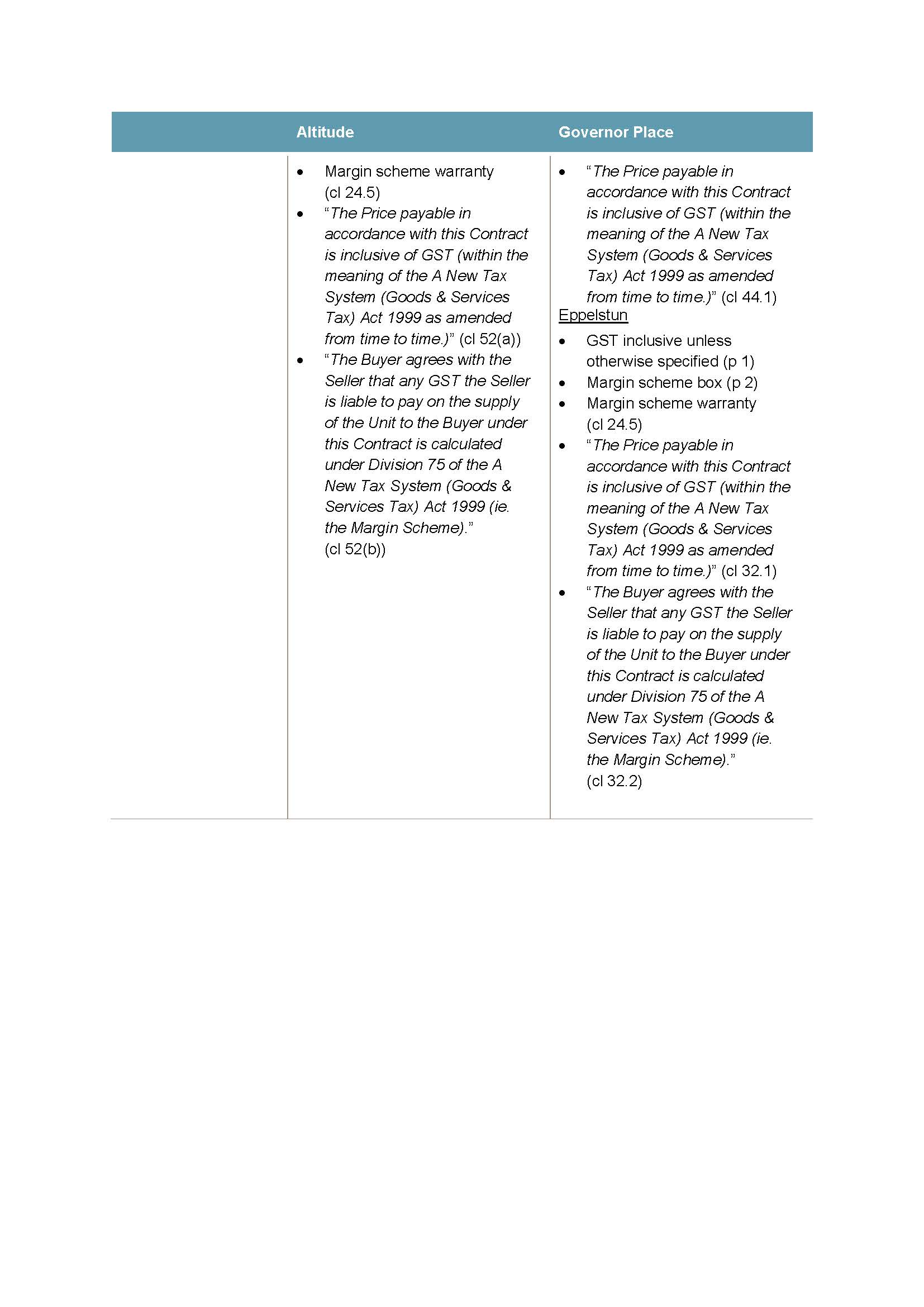
SCHEDULE OF PARTIES
NSD 1555 of 2018 | |
Applicants | |
Second Applicant | DEBORAH MARGARET EL-ZEIN |
Third Applicant | GLENN ANDREW EPPELSTUN |
Fourth Applicant: | ATSUKO EPPELNSTUN |
Respondents | |
Second Respondent | 13.9 BARTON PTY LIMITED AFT THE 13.9 BARTON COMMERCIAL PROPERTY TRUST ACN 143 733 706 |
Cross-Claimants | |
Second Cross-Claimant: | 13.9 BARTON PTY LIMITED AFT THE BARTON COMMERCIAL PROPERTY TRUST ACN 143 733 706 |
Cross-Respondents | |
Second Cross-Respondent | DEBORAH MARGARET EL-ZEIN |
Third Cross-Respondent | GLENN ANDREW EPPELSTUN |
Fourth Cross-Respondent | ATSUKO EPPELNSTUN |


