

FEDERAL COURT OF AUSTRALIA
QMS Media Limited, in the matter of QMS Media Limited [2019] FCA 2172
ORDERS
Plaintiff | ||
DATE OF ORDER: |
OTHER MATTERS:
A. The Court notes that the Australian Securities and Investments Commission (ASIC) was provided with at least 14 days’ notice of the hearing of this application.
B. The Court is satisfied that ASIC has had a reasonable opportunity to:
(a) examine the terms of the proposed scheme of arrangement to which the application relates and a draft explanatory statement relating to that arrangement; and
(b) make submissions to the Court in relation to the proposed scheme of arrangement and the draft explanatory statement.
C. The Court notes the letter from ASIC to Lander & Rogers on behalf of QMS Media Limited ACN 603 037 341 (QMS) dated 11 December 2019 produced at the hearing notifying QMS that it does not currently propose to appear to make submissions or intervene to oppose the Scheme at the first hearing under section 411(1) of the Corporations Act 2001 (Cth).
THE COURT ORDERS THAT:
1. Pursuant to rule 2.13(1) of the Federal Court (Corporations) Rules 2000 (Cth) (Rules), Shelley BidCo Pty Ltd ACN 634 292 881 has leave to be heard in the proceeding without becoming a party to it.
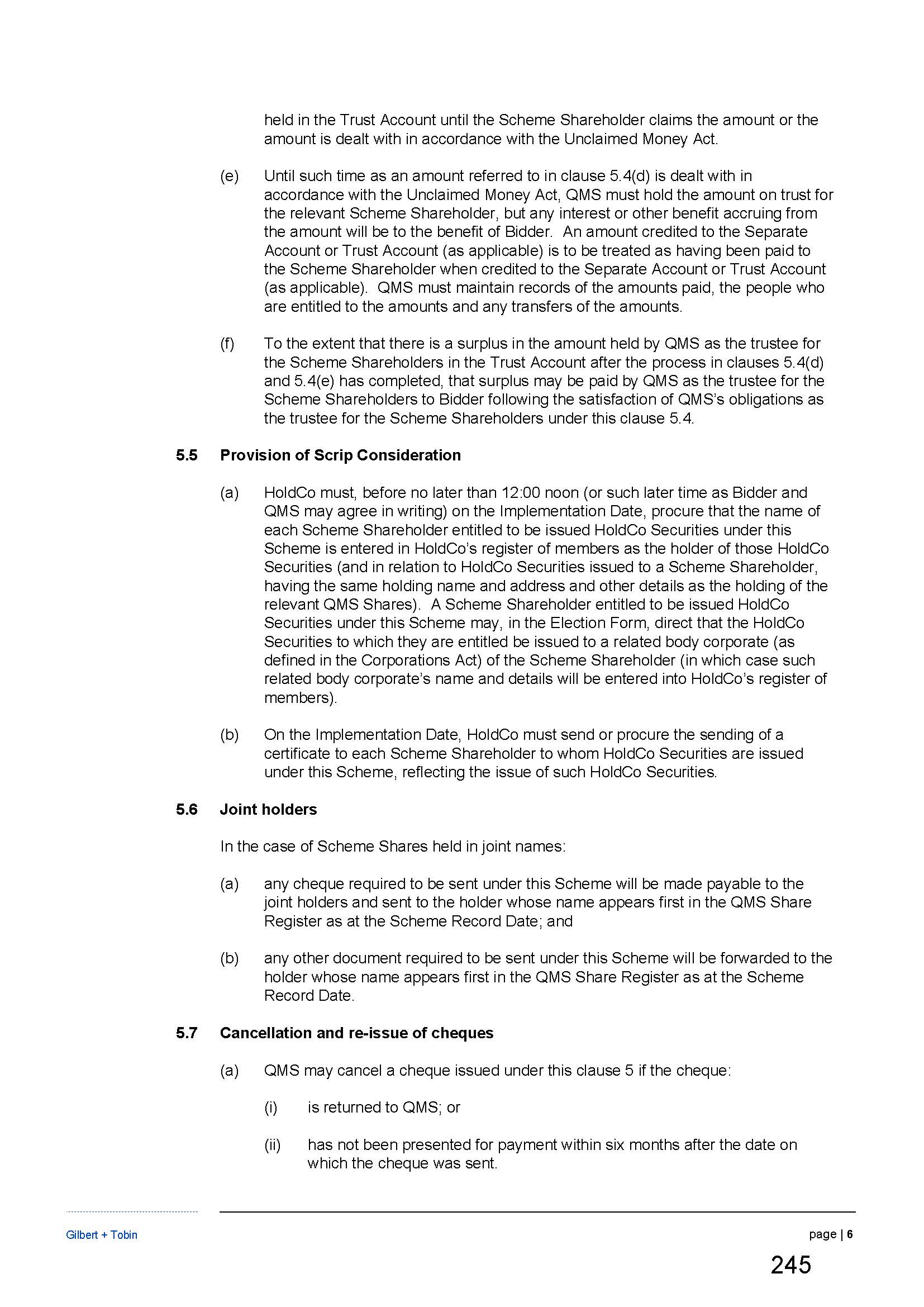
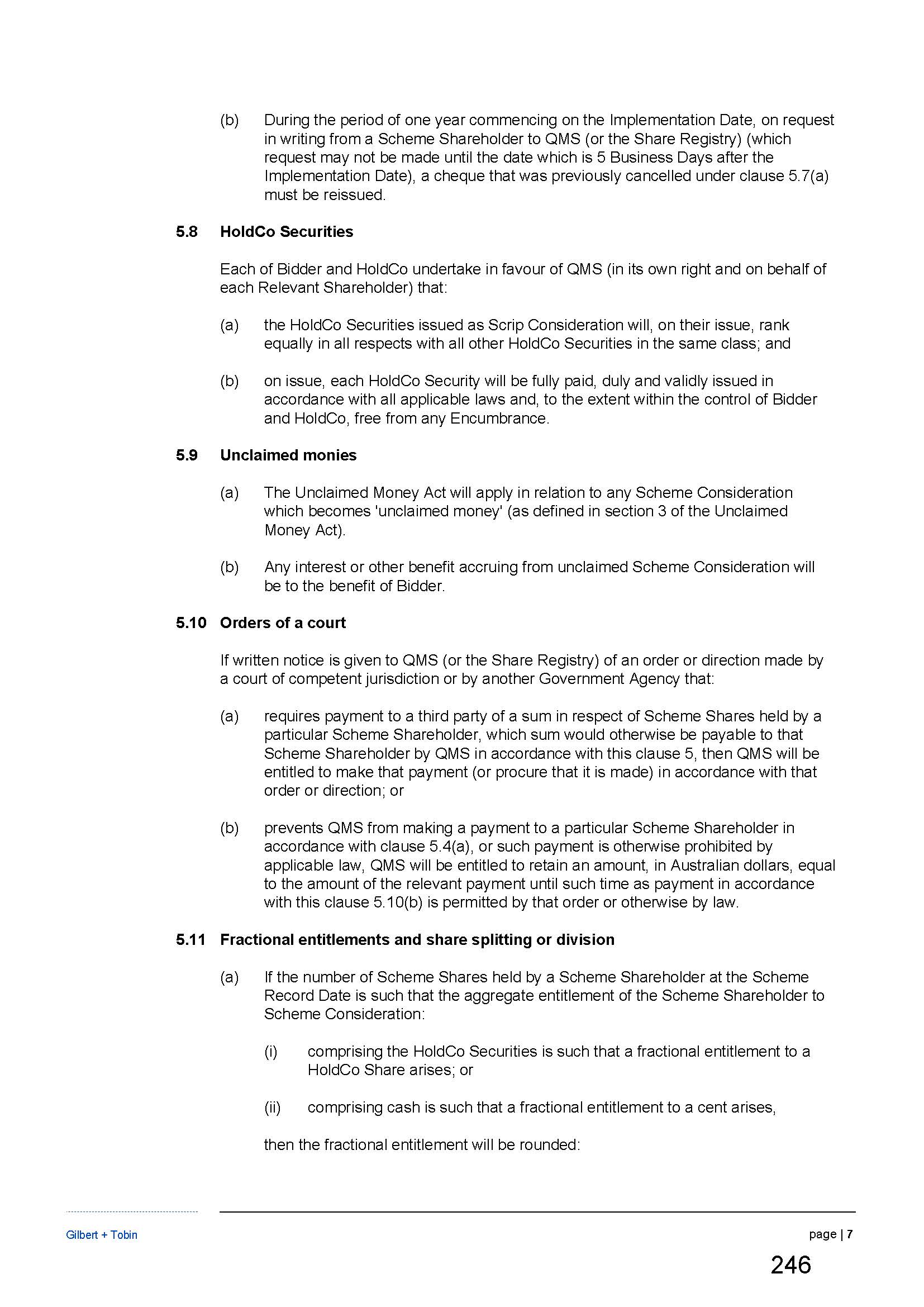
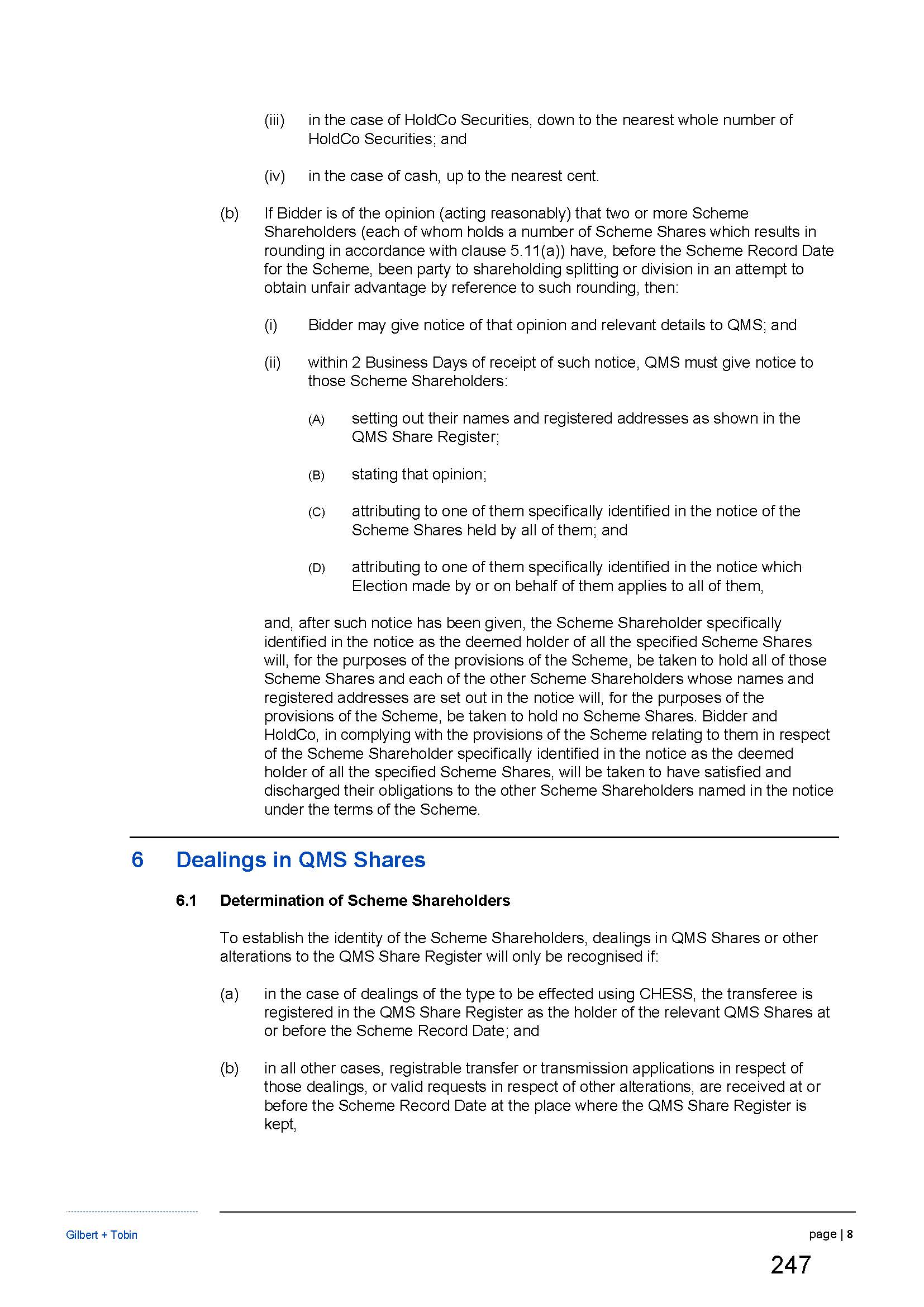
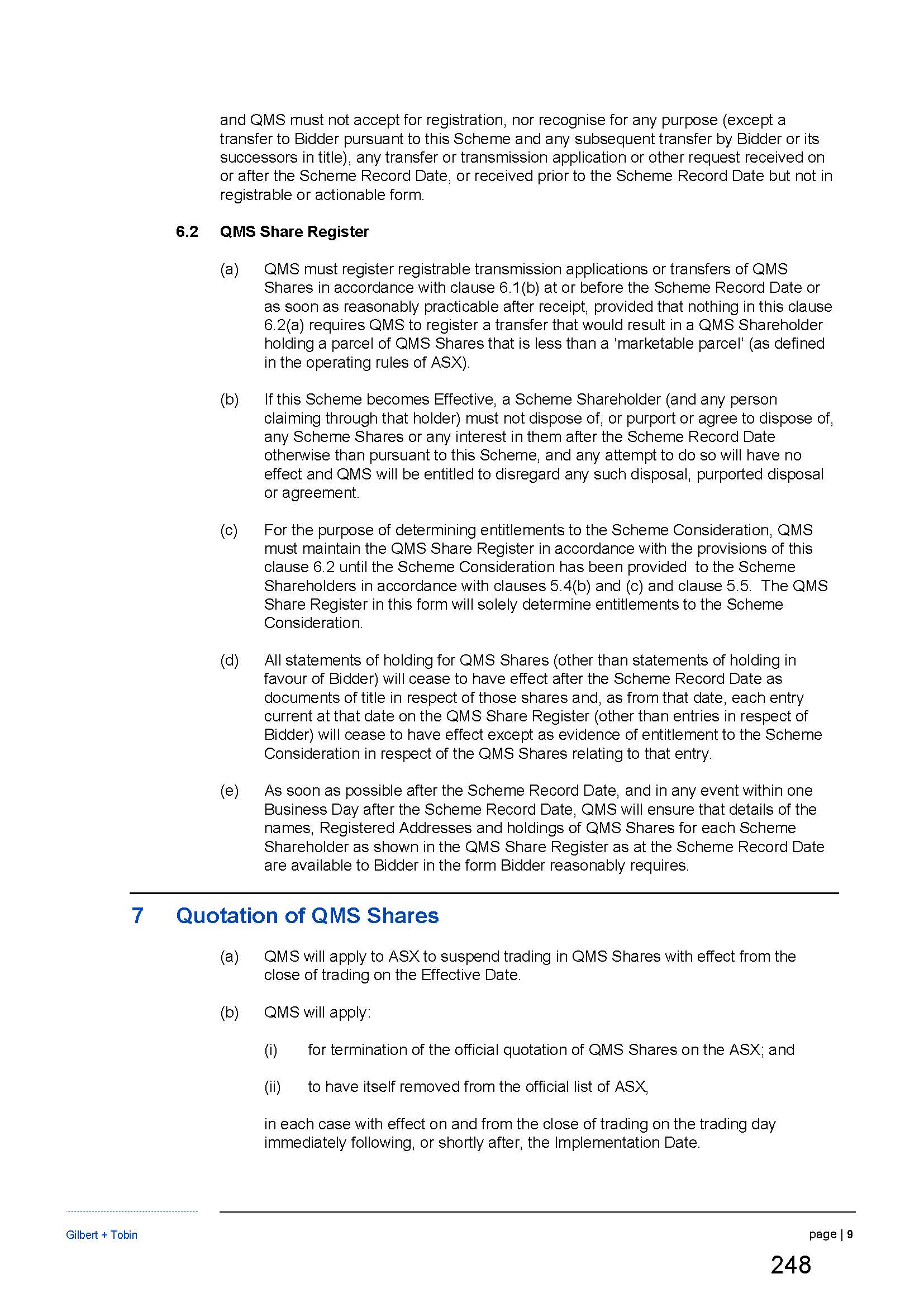
2. Pursuant to s 411(1) of the Corporations Act 2001 (Cth) (Act), the Plaintiff convene and hold the following meetings (Scheme Meetings) to be held at the RACV Club, 501 Bourke Street Melbourne, Victoria to consider, and, if thought fit, to approve (with or without any alterations or conditions) the scheme of arrangement (Scheme) proposed to be made between the Plaintiff and its shareholders, the terms of which are as set out in Annexure B to these orders:
(a) a meeting of the holders of fully paid ordinary shares in QMS, other than Barctin Superannuation Pty Ltd as trustee for the Barctin Superannuation Fund, Wenvale Pty Ltd as trustee for the Barclay Nettlefold Family Trust and John O’Neill Pty Ltd as trustee for the O’Neill Pastoral Discretionary Trust (collectively Rollover Shareholders), such meeting of shareholders (General Shareholders) to be held at 10am (Melbourne time) on 6 February 2020 (General Scheme Meeting); and
(b) a meeting of the Rollover Shareholders (Rollover Shareholders Scheme Meeting), such meeting to be held immediately following the conclusion of the General Scheme Meeting.
3. The Scheme Meeting be convened by sending on or before 19 December 2019:
(a) in the case of General Shareholders who have elected to receive shareholder communications electronically by way of email (Email Shareholders), an email substantially in the form of tab 10 of annexure “GJM-3” to the affidavit of Gregory James McKenzie sworn 12 December 2019 (Third McKenzie Affidavit) and which contains links to:
(i) a copy of the scheme booklet substantially in the form of tab 2 to annexure “GJM-3” to the Third McKenzie Affidavit, which comprises the explanatory statement as required by s 412(1)(a) of the Act (Scheme Booklet) which contains, among other things, the Notice of the General Scheme Meeting at Annexure D to the Scheme Booklet; and
(ii) an online portal or website that is accessible by the Email Shareholder which enables the Email Shareholder to lodge a proxy form for the General Scheme Meeting and provide their voting instructions online; and
(b) in the case of General Shareholders who are not Email Shareholders and whose registered address is in Australia, the following documents by pre-paid post addressed to the relevant addresses recorded in the Plaintiff’s register:
(i) a document substantially in the form of the Scheme Booklet, which contains, among other things, the Notice of the General Scheme Meeting at Annexure D;
(ii) a proxy form which is substantially in the form of tab 14 of annexure “WHS-1” of the Stevenson Affidavit) (Proxy Form); and
(iii) a reply-paid envelope for the return of the Proxy Form;
(c) in the case of General Shareholders who are not Email Shareholders and whose registered address is outside Australia, the following documents by airmail service addressed to the relevant addresses recorded in the Plaintiff’s register:
(i) a document substantially in the form of the Scheme Booklet, which contains, among other things, the Notice of the General Scheme Meeting at Annexure D;
(ii) a Proxy Form; and
(iii) a return envelope for the return of the Proxy Form; and
(d) in the case of Rollover Shareholders, the following documents by pre-paid post addressed to the relevant addresses recorded in the Plaintiff’s register:
(i) a document substantially in the form of the Scheme Booklet, which contains, among other things, the Notice of Rollover Shareholders Scheme Meeting at Annexure E to the Scheme Booklet;
(ii) a proxy form for the Rollover Shareholders Scheme Meeting, substantially in the form of tab 15 of annexure “WHS-1” of the Stevenson affidavit (Rollover Proxy Form);
(iii) an Election Form substantially in the form of tab 16 of annexure “WHS-1” of the Stevenson affidavit; and
(iv) a reply-paid envelope for the return of the Rollover Proxy Form.
4. Subject to these Orders, the Scheme Meetings be convened, held and conducted in accordance with the provisions of:
(a) Part 2G.2 of the Act (save for any applicable replaceable rule) that apply to a meeting of the Plaintiff’s members; and
(b) the Plaintiff’s constitution that apply in relation to meetings of member and that are not inconsistent with Part 2G.2 of the Act.
5. Voting on the resolution to approve the Scheme at each Scheme Meeting is to be conducted by way of a poll as declared by the Chairperson.
6. A Proxy Form or online proxy / voting instructions in respect of the General Scheme Meeting and a Rollover Proxy Form in respect of the Rollover Shareholders Scheme Meeting will be valid and effective if, and only if, it is completed and delivered in accordance with its terms by 10.00am (Melbourne time) on 4 February 2020.
7. Mr Wayne Hugh Stevenson, or failing him, Mr Robert Alexander, be Chair of the Scheme Meetings.
8. The Chair of the Scheme Meetings shall have the power to adjourn the meeting to such time, date and place as he considers appropriate.
9. Compliance with rule 2.15 of the Federal Court (Corporations) Rules 2000 (Cth) (Rules) is dispensed with.
10. Compliance with rule 3.4 and Form 6 of the Rules is dispensed with.
11. The Plaintiff publish in The Australian newspaper once on or before 29 January 2020 an advertisement substantially in the form of Annexure A to these Orders.
12. The further hearing of the Originating Process is adjourned to a hearing before Justice O’Callaghan on 10 February 2020 at 10.15am (Melbourne time).
13. Liberty to apply.
ANNEXURE A
Notice of Second Court Hearing
Notice of hearing to approve compromise or arrangement
TO all the members of QMS Media Limited (ACN 603 037 341) (QMS)
TAKE NOTICE that at 10.15am on Monday, 10 February 2020 the Federal Court of Australia (Victorian Registry) at 305 William Street Melbourne VIC 3000 will hear an application by QMS seeking the approval of a compromise or arrangement between QMS and its members if agreed to by a resolution to be considered, and, if thought fit, passed at two meetings of such members to be held on 6 February 2020 at RACV Club, 501 Bourke Street, Melbourne, Victoria, with the first meeting commencing at 10.00am (Melbourne time) and the second meeting commencing immediately following the first meeting.
If you wish to oppose the approval of the compromise or arrangement, you must file and serve on QMS a notice of appearance, in the prescribed form, together with any affidavit on which you wish to rely at the hearing. The notice of appearance and affidavit must be served on QMS at its address for service by 5.00pm on Friday, 7 February 2020.
The address for service of QMS is: c/o Lander & Rogers, Lawyer, Level 12, 600 Bourke Street, Melbourne, Victoria, 3000 [Ref: Greg McKenzie].
ANNEXURE B
Scheme
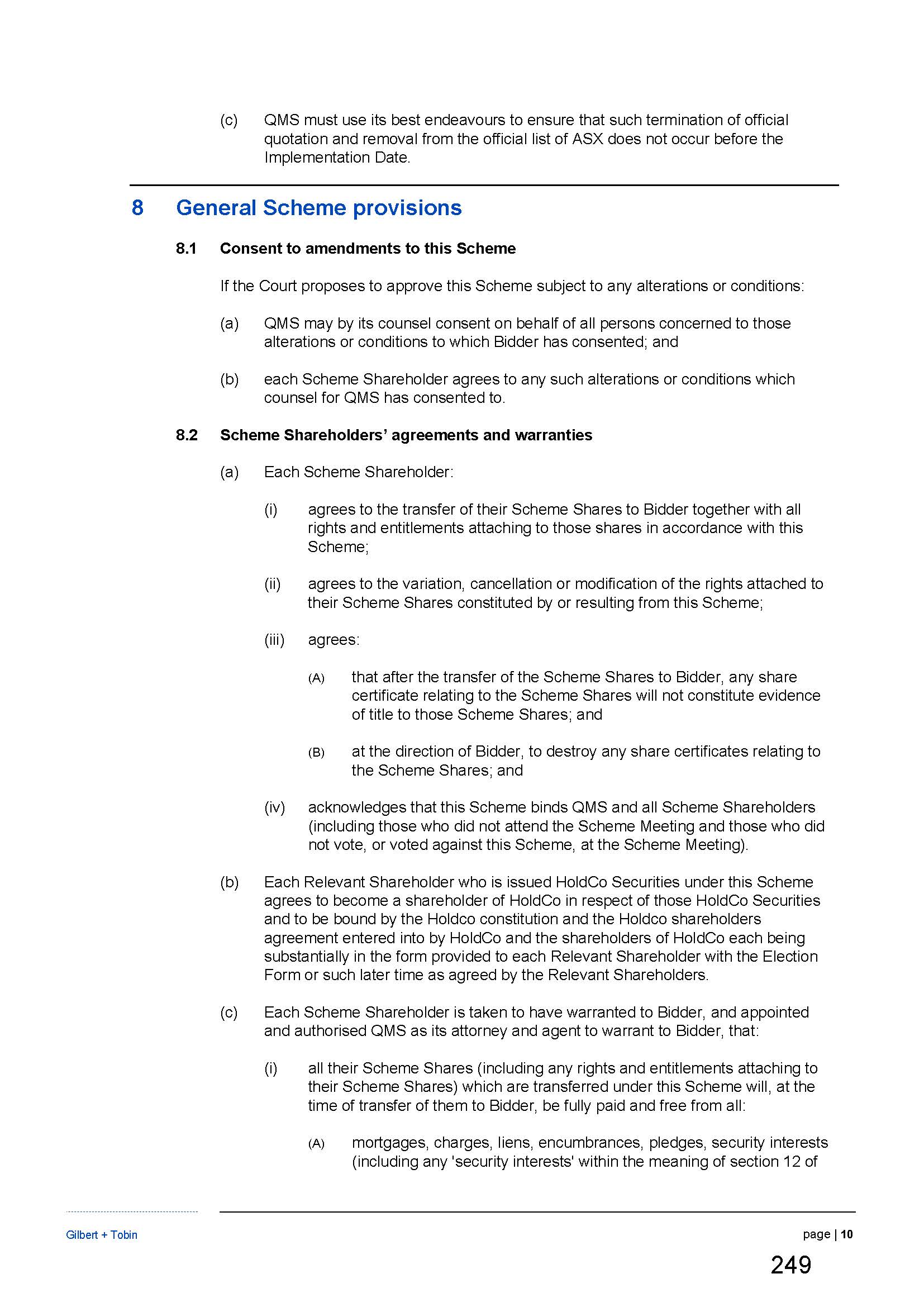
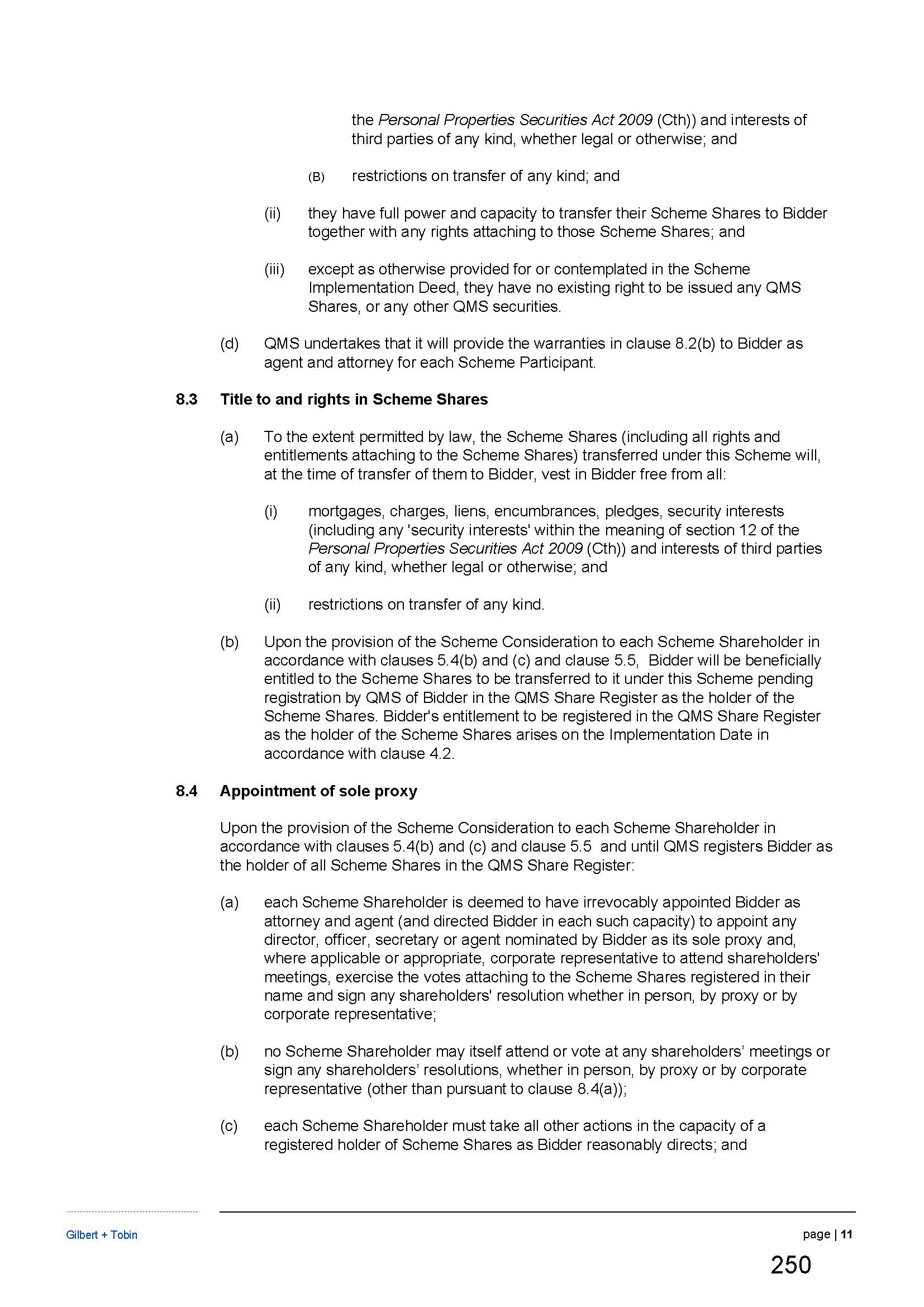
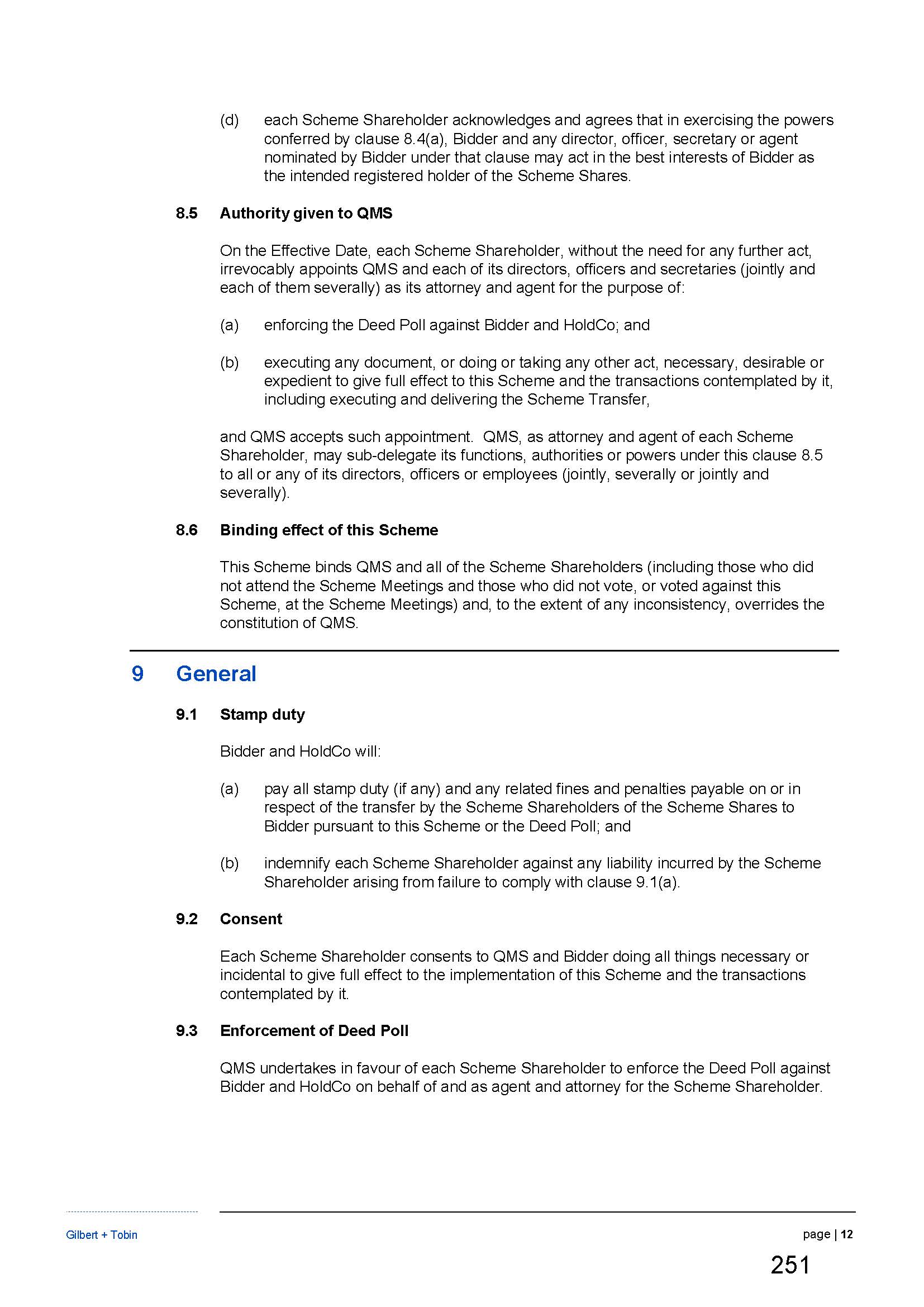
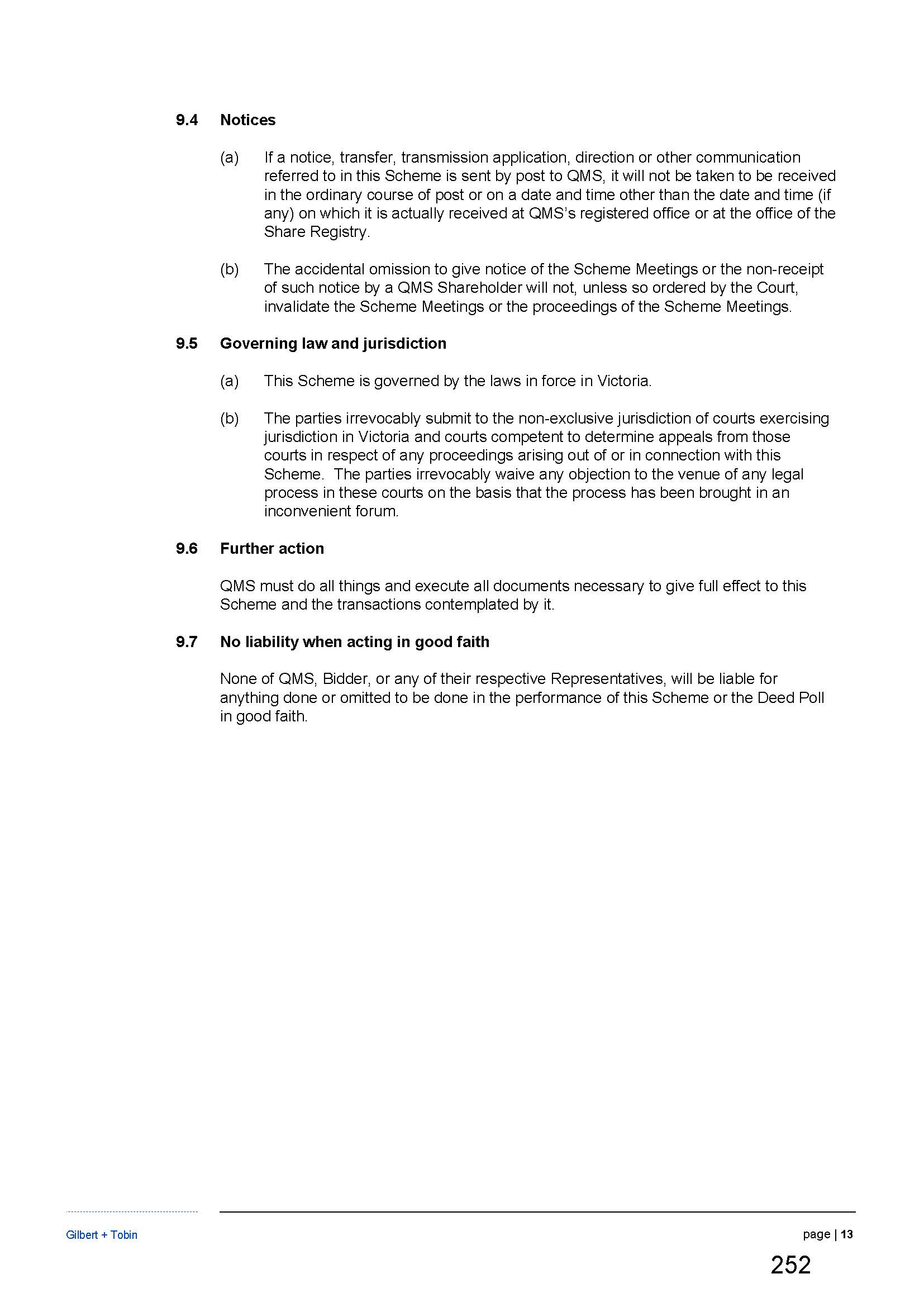
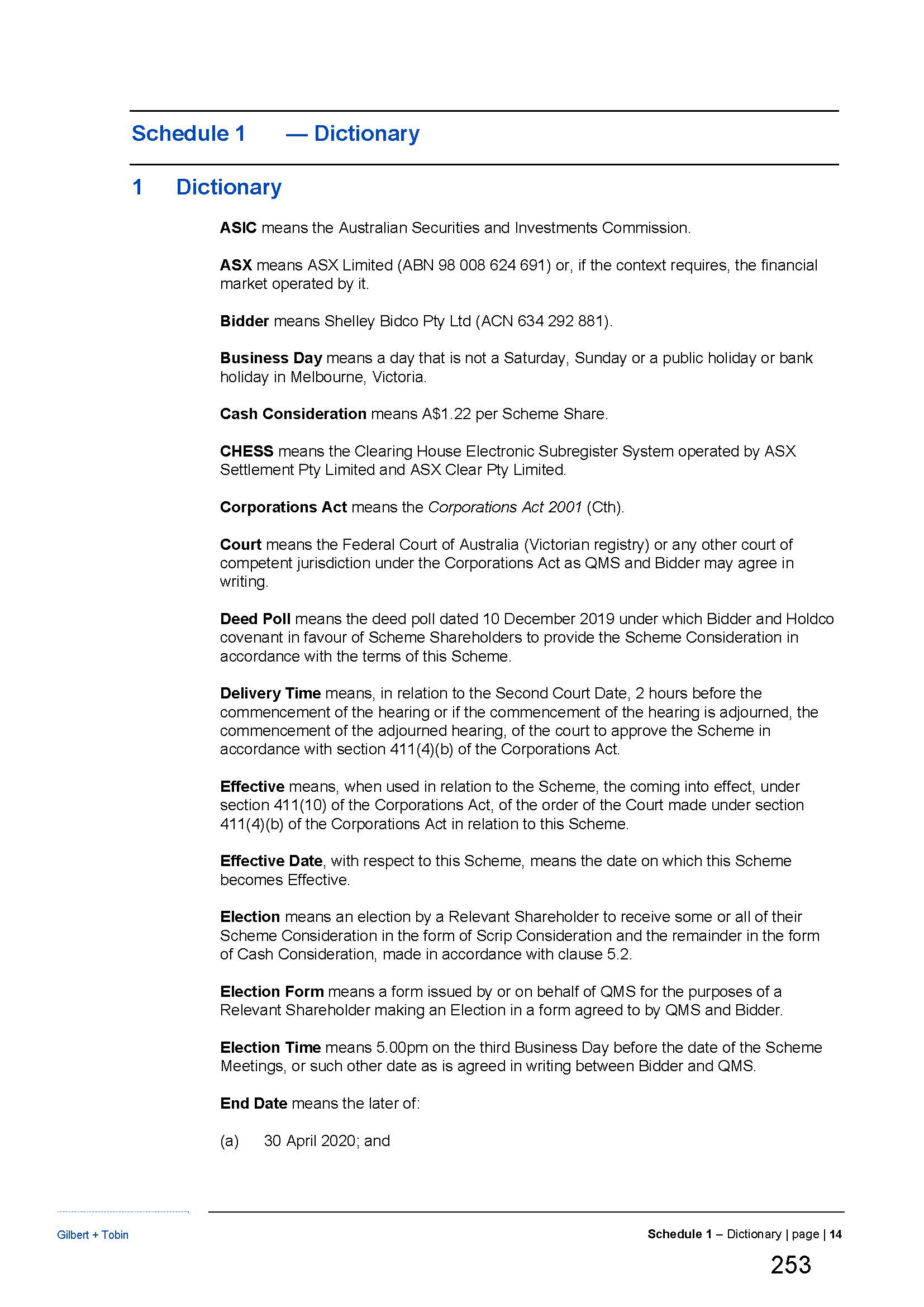
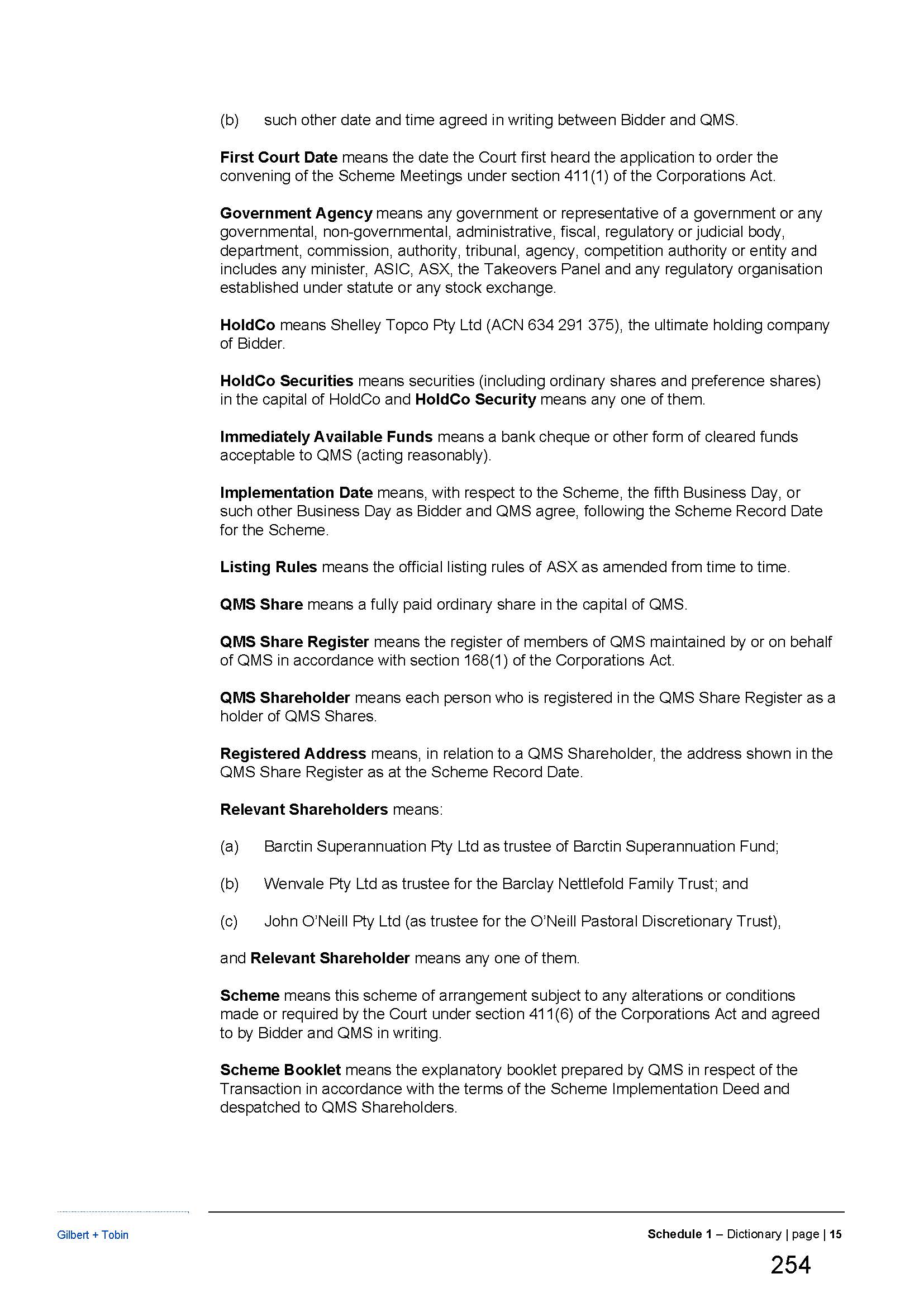
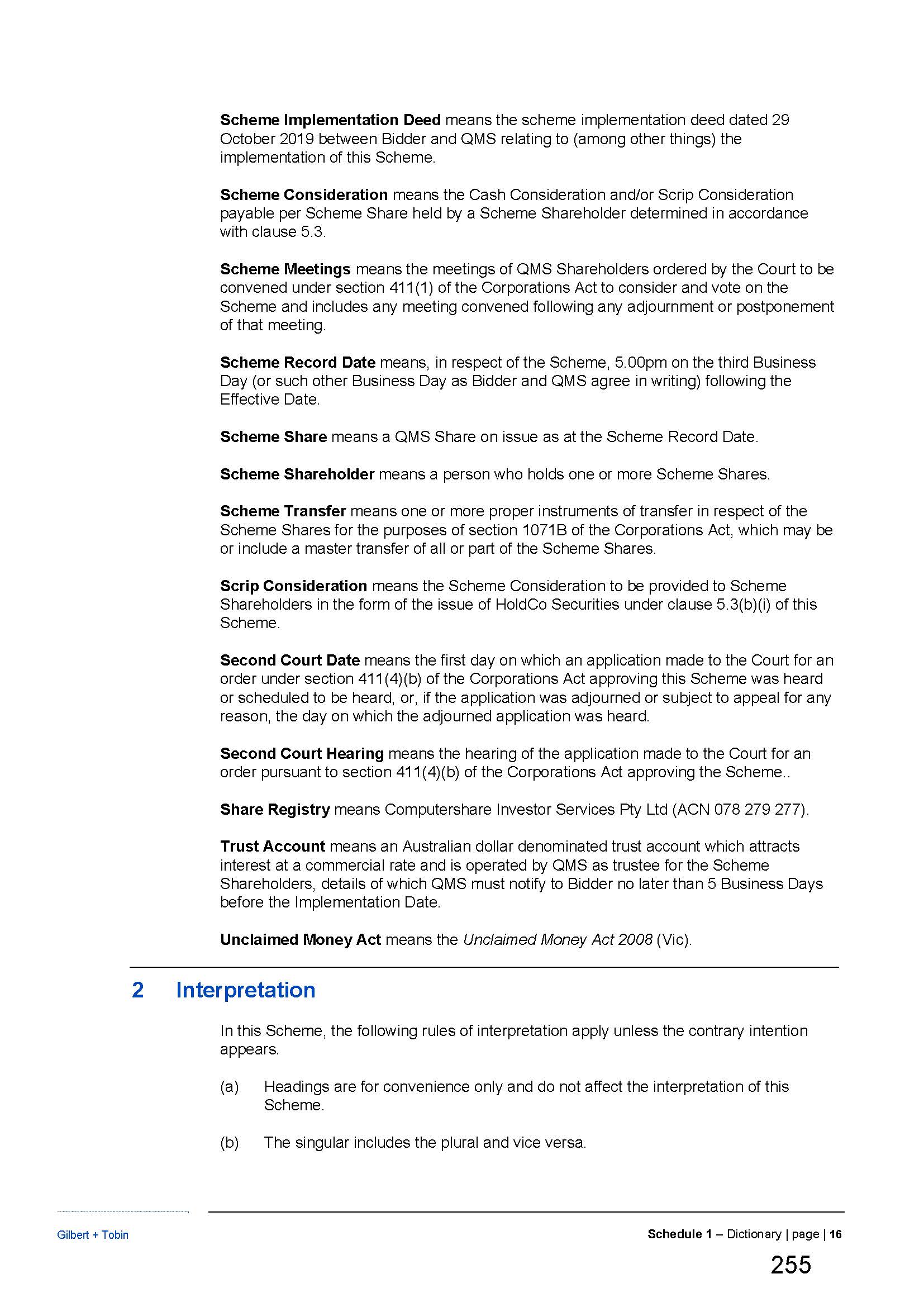
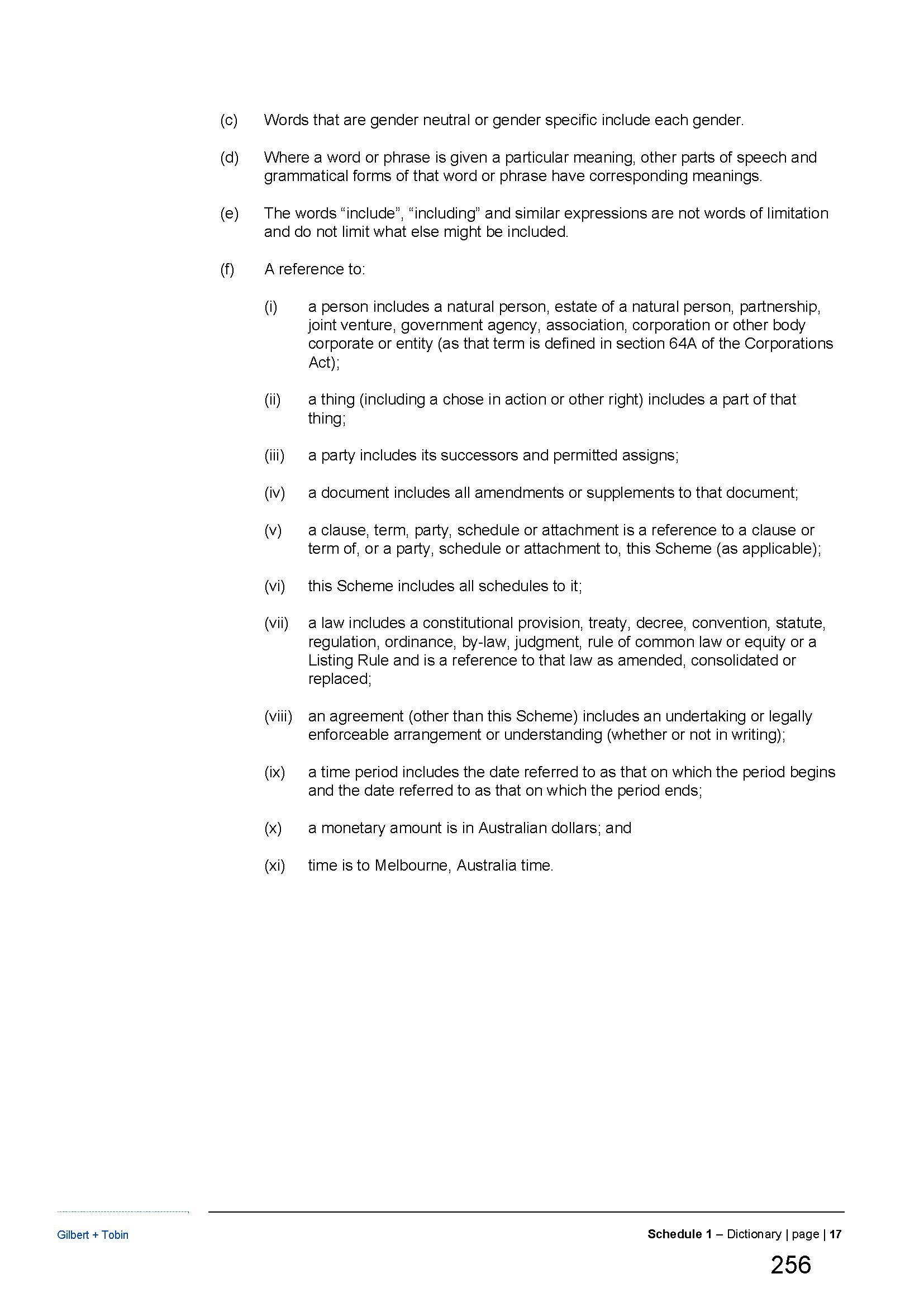
Note: Entry of orders is dealt with in Rule 39.32 of the Federal Court Rules 2011.
O’CALLAGHAN J:
Introduction
1 After a hearing on 12 December 2019, I made the orders set out above. These are my reasons for making the orders.
2 This is an application made by QMS Media Limited (QMS) pursuant to s 411(1) of the Corporations Act 2001 (Cth) (the Corporations Act) for an order convening separate meetings (the Scheme Meetings) of two classes of the holders of its fully paid ordinary shares (the QMS Shareholders) for the purposes of them considering and, if thought fit, agreeing to a proposed scheme of arrangement (the Scheme) between them and QMS.
3 The application was supported by affidavits, a summary of which appears at Annexure 1 to these reasons.
4 The Scheme, if implemented, will result in the acquisition of all the ordinary shares in QMS (the QMS Shares) by Shelley BidCo Pty Ltd (BidCo) and the subsequent delisting of QMS. BidCo is a special purpose entity established for the purpose of acquiring all of the QMS Shares under the proposed Scheme. It is an indirect wholly owned subsidiary of Shelley Topco Pty Ltd (HoldCo), which is the vehicle set up for investment in QMS by Quadrant Private Equity (Quadrant), an independent Australian private equity firm.
5 There are three “Rollover Shareholders”:
(1) two entities controlled by Mr Barclay Nettlefold (the Global Chief Executive Officer and executive director of QMS); and
(2) one entity controlled by Mr John O’Neill (the QMS Australia Chief Executive Officer).
6 Mr Nettlefold, Mr O’Neill and the Rollover Shareholders have entered into separate Voting and Rollover Agreements, under which the Rollover Shareholders have agreed to elect to receive scrip consideration (being securities in HoldCo) in respect of a certain percentage of their QMS Shares, being $40m in value in respect of the Nettlefold Rollover Shareholders and $3m in value by the O’Neill Rollover Shareholders.
7 The scrip consideration for the Rollover Shareholders arose because to obtain the price of $1.22 per QMS Share (which is payable in cash to all QMS Shareholders other than the Rollover Shareholders), Quadrant required Mr Nettlefold and Mr O’Neill to accept a proportion of their Scheme consideration in the form of scrip consideration.
8 The General Scheme Meeting is proposed to be held at 10am (Melbourne time) on 6 February 2020 at the RACV Club, 501 Bourke Street, Melbourne, Victoria, with the Rollover Shareholders Scheme Meeting to be held immediately afterwards.
Overview of the Scheme
9 Under the terms of the Scheme:
(a) Rollover Shareholders may elect whether they receive cash consideration of $1.22 per QMS Share or scrip consideration (being securities in HoldCo);
(b) on the “Implementation Date”:
(i) BidCo will acquire all of the QMS Shares;
(ii) the Rollover Shareholders will receive the scrip and any cash consideration which they have elected to receive;
(iii) the other QMS Shareholders will receive (as consideration for the acquisition of their shares) cash consideration payable by BidCo of $1.22 per QMS Share;
(c) the transfer of the QMS Shares to BidCo on the “Implementation Date” is subject to:
(i) HoldCo issuing the scrip consideration to the Rollover Shareholders; and
(ii) BidCo providing the cash consideration to QMS who will in turn despatch it to those QMS Shareholders who are entitled to receive cash.
10 The Scheme was announced by QMS to the ASX on 29 October 2019. The aggregate amount of the Scheme consideration, based on the number of QMS Shares on issue at the time of announcement, being 344,737,836 multiplied by $1.22 per QMS Share, is approximately $420.6 million. The proposed implementation date for the Scheme is expected to be in the first quarter of calendar year 2020.
11 QMS currently has issued 8,055,254 performance rights to 41 people, including Mr Barclay Nettlefold and Mr David Edmonds (an executive director of QMS). Following a resolution of the QMS board to accelerate some of those performance rights and to cancel the remainder, Mr Nettlefold and Mr Edmonds will hold respectively 592,463 and 287,569 performance rights which will convert into QMS Shares if the Scheme becomes effective, with the result that Mr Nettlefold and Mr Edmonds will be entitled to receive Scheme consideration in relation to those shares.
12 Based on the cash consideration of $1.22 per share, the draft Independent Expert’s report opines that the Scheme is fair and reasonable and therefore in the best interests of QMS Shareholders in the absence of a superior proposal. (The Independent Expert makes no assessment, based on the scrip consideration, of whether the Scheme is fair and reasonable and therefore in the best interests of the Rollover Shareholders, subject to a superior proposal, because the Rollover Shareholders are already committed to vote in favour of the Scheme and receive specified percentages of cash and scrip, are sophisticated or professional investors with a deep understanding of QMS’s business and can form their own views about the merits of the cash consideration component).
13 The Directors of QMS have unanimously recommended that QMS Shareholders vote in favour of the Scheme in the absence of a “Superior Proposal” (as that term is defined in the draft Scheme Booklet and in the Scheme Implementation Deed referred to below). As noted above, each of Mr Nettlefold and Mr Edmonds also holds performance rights, some of which will convert into QMS Shares, such that Mr Nettlefold and Mr Edmonds will receive the Scheme consideration for those shares. For reasons set out below, I agree with counsel’s submission that it is appropriate for both Mr Nettlefold and for Mr Edmonds to join with the other directors in making a recommendation that QMS Shareholders vote in favour of the Scheme on the basis that the additional benefits to be received by them if the Scheme is implemented are appropriately disclosed in the Scheme Booklet.
Notice to ASIC
14 On 22 November 2019, a draft Scheme Booklet (which included the explanatory statement for the Scheme required by s 412(1) of the Corporations Act) was lodged with ASIC. On 26 November 2019, a copy of the originating process filed 26 November 2019 and supporting affidavit were sent to ASIC.
15 Under s 411(2) of the Corporations Act, the Court must not make a meeting order under s 411(1), unless 14 days’ notice of the hearing of the application, or such lesser period of notice as the Court or ASIC permits, has been given to ASIC, and the Court is satisfied that ASIC has had a reasonable opportunity to examine the terms of the Scheme and a draft of the explanatory statement, and to make submissions to the Court in relation to the Scheme and the draft explanatory statement.
16 The draft Scheme Booklet was sent to ASIC on 22 November 2019, so the 14 day notice period has been satisfied.
QMS
17 QMS (incorporated as Digital Outdoor Media Ltd) was registered as a public company limited by shares on 25 November 2014 and changed its name to QMS Media Ltd on 20 April 2015.
18 QMS is a digital outdoor and sports media company, which operates the following businesses:
(a) outdoor digital advertising billboards in Australia;
(b) global sports media technology development and aggregating sports media rights; and
(c) multi-media platforms across New Zealand.
19 As at 10 December 2019, QMS had on issue 344,737,836 fully paid ordinary shares and 8,055,254 performance rights.
20 QMS’s market capitalisation on 23 October 2019 was approximately $308,540,363 (represented by 344,737,836 shares multiplied by the $0.895 closing share price on that date). QMS’s market capitalisation as at 6 December 2019 was approximately $406,790,646 (based on the closing price of $1.18 per QMS Share on that date).
BidCo and HoldCo
21 BidCo was incorporated on 21 June 2019. It is a special purpose company controlled by Quadrant established for the purpose of acquiring all the shares in QMS.
22 HoldCo was also incorporated on 21 June 2019 and is an indirect parent of BidCo. It is a special purpose company controlled by Quadrant which was established for the purpose of implementing the Scheme, including dealing with the costs, fees and expenses connected with the Scheme.
Statutory framework
23 The statutory framework relating to schemes of arrangement involves a three stage process:
(a) the hearing of an application to the court for orders to convene a meeting or meetings (s 411(1));
(b) the holding of the meeting or meetings (s 411(4)(a)); and
(c) the hearing of an application to the court for an order to approve the scheme (ss 411(4)(b) and 411(6)).
Orders to convene meetings – role of the court
24 It is not necessary here to recite in detail the court’s role when considering an application for orders at the first stage. It suffices to say that s 411 confers a discretion on the court to make appropriate orders if:
(a) a compromise or arrangement is proposed between a Part 5.1 body and its members (or any class of them);
(b) application for the order is made in a summary way by the body;
(c) 14 days’ notice of the hearing of the application has been given to ASIC (or such lesser period as the court or ASIC permits); and
(d) the court is satisfied that ASIC has had a reasonable opportunity to:
(i) examine the terms of the proposed compromise or arrangement to which the application relates and a draft explanatory statement relating to the proposed compromise or arrangement; and
(ii) make submissions to the court in relation to the proposed compromise or arrangement and the draft explanatory booklet.
25 I am satisfied that these requirements are met in this case and that the court’s discretion to make the orders sought is enlivened.
26 As to the exercise of the court’s discretion whether or not to convene a scheme meeting, the court needs to be satisfied of two matters, viz that:
(a) the scheme is fit for consideration by the proposed meeting in the sense that it is of such a nature and cast in such terms that, if it achieves the statutory majority at the meeting, the court would be likely to approve it on the hearing of a petition which is unopposed; and
(b) members are to be properly informed as to the nature of the scheme before the scheme meeting.
27 The question whether or not to accept particular consideration for shares is quintessentially a commercial matter for the members to assess. Members are not to be prevented from having the opportunity to do so provided that the court is satisfied that they are acting on sufficient information and with time to consider what they are voting on.
28 As Finkelstein J explained in Re CSR Ltd (2010) 183 FCR 358 at 379, [74] and [76], at the first court hearing the court should generally confine itself to ensuring that certain procedural and substantive requirements are met (including that there will be adequate disclosure), with limited consideration of issues of fairness, and the court should only consider the merits or fairness of a proposed scheme at such a hearing if the issue is such as would unquestionably lead to a refusal to approve the scheme at the approval hearing.
Is the Scheme fit for consideration?
The Scheme
29 As explained in the Scheme Booklet, a “Scheme Shareholder” means a person who holds one or more Scheme Shares and a “Scheme Share” means a QMS Share on issue as at the Scheme Record Date.
30 The “Scheme Record Date” is defined in the Scheme to mean 5.00pm on the third business day (or such other business day as the parties agree in writing) following the “Effective Date”. On the current timetable, it is proposed that the Scheme Record Date will be 5.00pm on Friday 14 February 2020.
31 The “Implementation Date” means the fifth Business Day, or such other Business Day as the parties agree, following the Scheme Record Date. The proposed Implementation Date is Friday 21 February 2020.
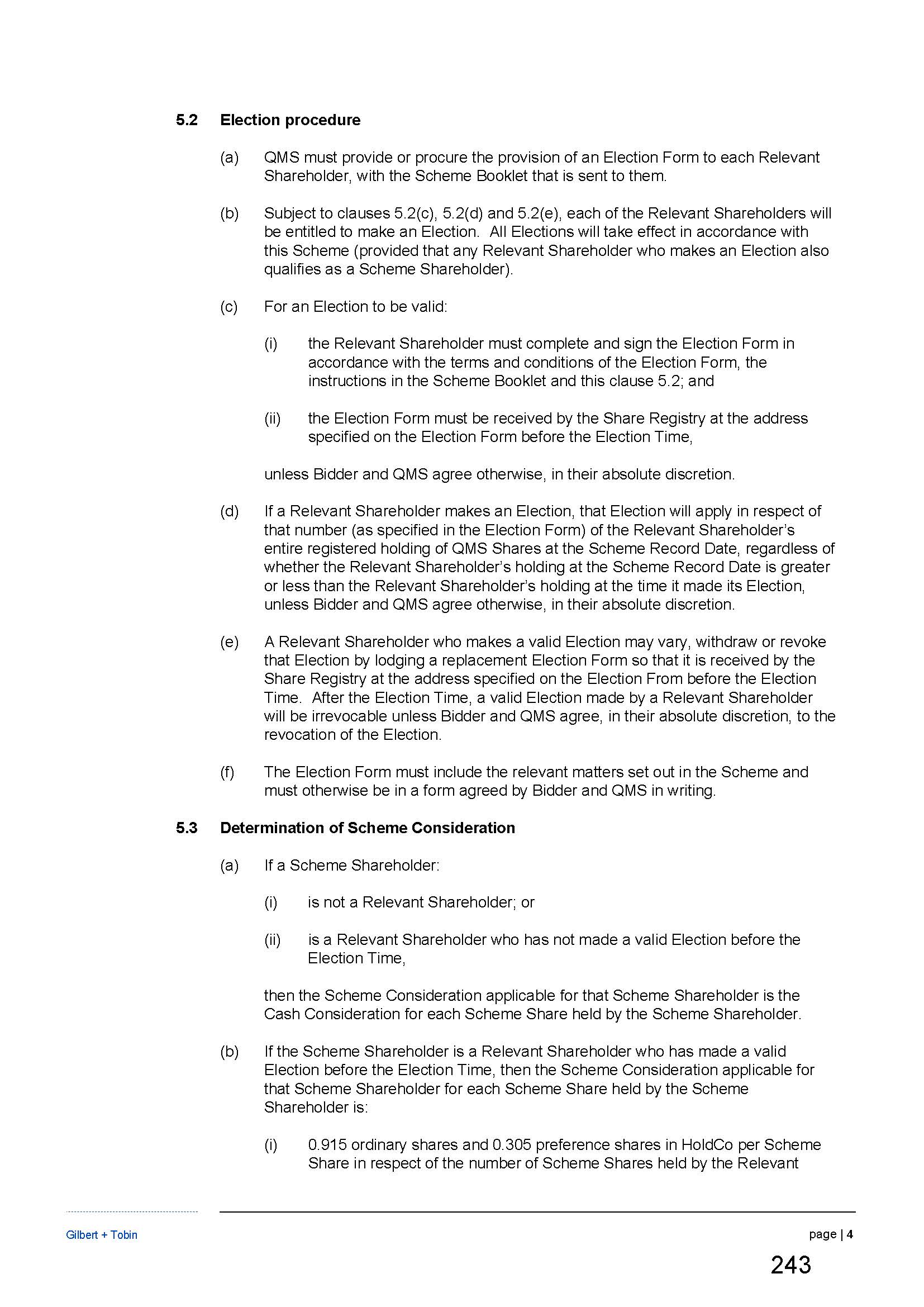
32 Under the terms of the Scheme, QMS Shareholders (other than the Rollover Shareholders) will receive, as their Scheme consideration, the cash consideration of $1.22 per QMS Share. The Rollover Shareholders can elect whether to receive scrip in HoldCo or cash consideration for each of their shares. If they make a valid election, they will receive scrip or cash (or a combination of both) in accordance with their election. If they do not make a valid election, they will receive cash consideration.
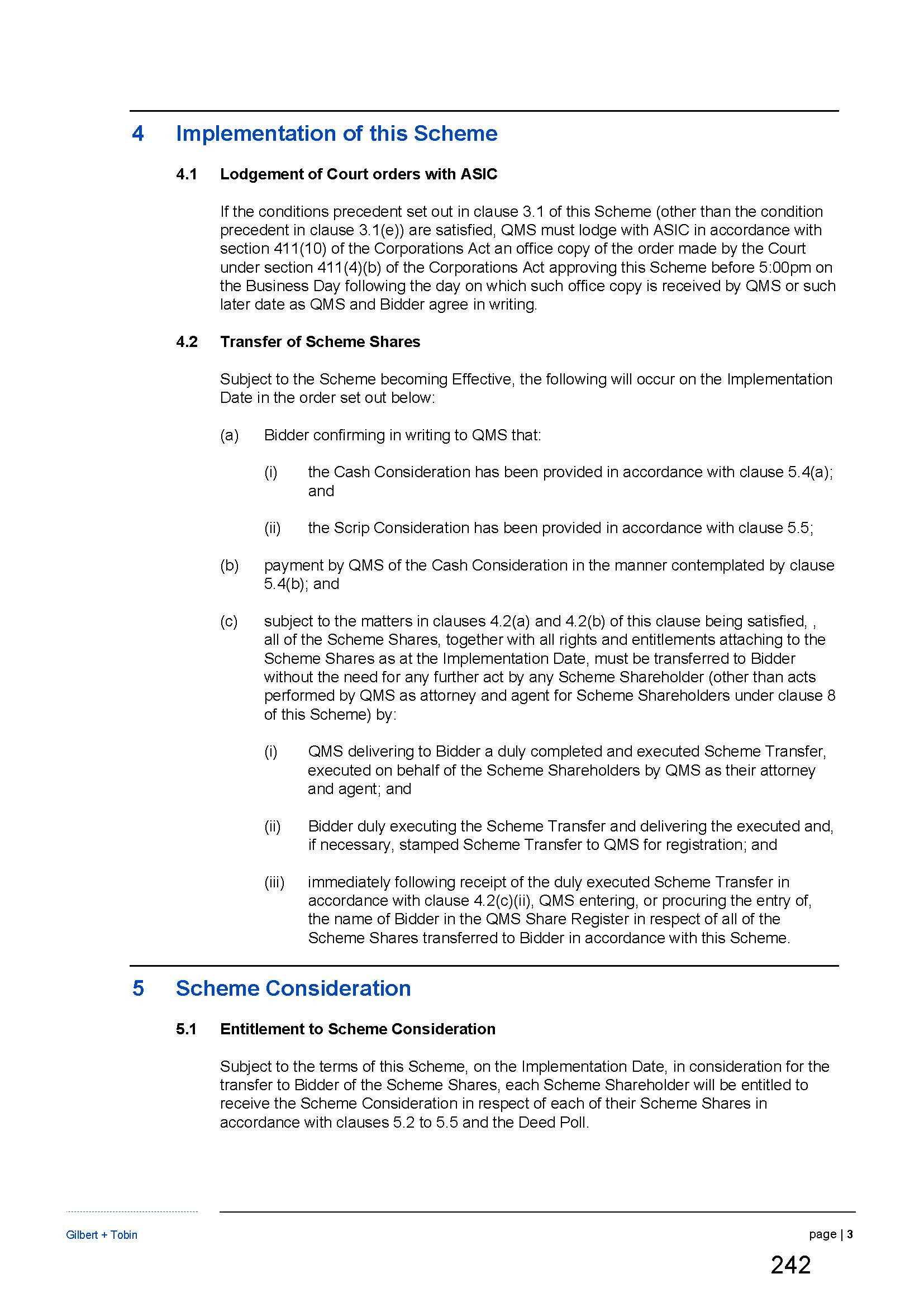
33 The following terms of the Scheme set out the steps to be taken on or before the Implementation Date for the provision of the Scheme consideration to the Scheme Shareholders and the transfer of the Scheme Shares to BidCo:
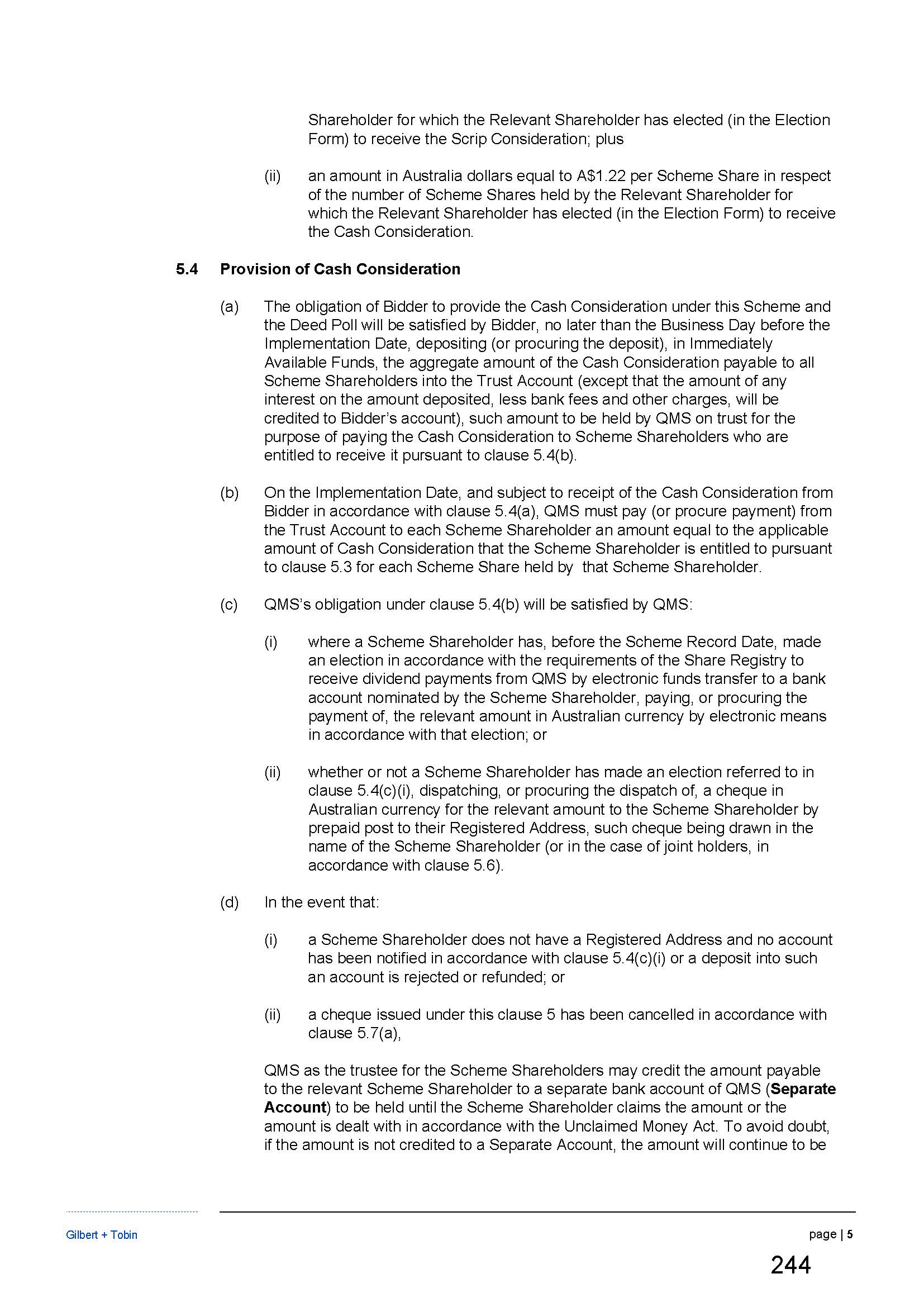
(a) BidCo must, no later than the Business Day before the Implementation Date, deposit (or procure the deposit), by bank cheque or other form of cleared funds acceptable to QMS, into a trust account operated by QMS as trustee for the Scheme Shareholders, the aggregate amount of cash consideration payable to all Scheme Shareholders, such amount to be held by QMS on trust for the purpose of paying the cash consideration to the Scheme Shareholders who are entitled to receive it, subject to any interest on the amount deposited which, less any bank fees and other charges, will be credited to BidCo;
(b) HoldCo must:
(i) before no later than 12.00 noon (or such later time as BidCo and QMS may agree in writing) on the Implementation Date, procure that the name of each Scheme Shareholder entitled to be issued HoldCo Securities under the Scheme (or their nominated related body corporate) is entered in HoldCo’s register of members as the holder of those HoldCo Securities;
(ii) on the Implementation Date send or procure the sending of a certificate to each Scheme Shareholder to whom HoldCo Securities are issued under the Scheme, reflecting the issue of such HoldCo Securities;
(c) on the Implementation Date, and subject to the receipt of the cash consideration from BidCo, QMS must pay (or procure payment) from the Trust Account to each Scheme Shareholder an amount equal to the applicable amount of cash consideration that the Scheme Shareholder is entitled to by:
(i) electronic transfer to a bank account nominated by the Scheme Shareholder for receipt of dividends; or
(ii) dispatching a cheque in Australian dollars by prepaid post to their address registered in the Computershare share registry;
(d) the Scheme Shares will be transferred to BidCo on the Implementation Date and subject to:
(i) BidCo confirming in writing to QMS that:
(A) the cash consideration has been provided;
(B) the scrip consideration has been provided;
(ii) QMS paying the cash consideration.
34 The Scheme Implementation Deed additionally provides that, subject to the Scheme consideration having been delivered to Scheme Shareholders in accordance with the Scheme, QMS must as soon as practicable take all reasonable steps to cause the appointment of BidCo’s nominees to the QMS Board and to procure that each QMS Independent Director resigns from the office as a director of QMS.
35 The effect of the Scheme, if implemented, is that BidCo will acquire 100% of the Scheme Shares, following which QMS will be delisted from the ASX.
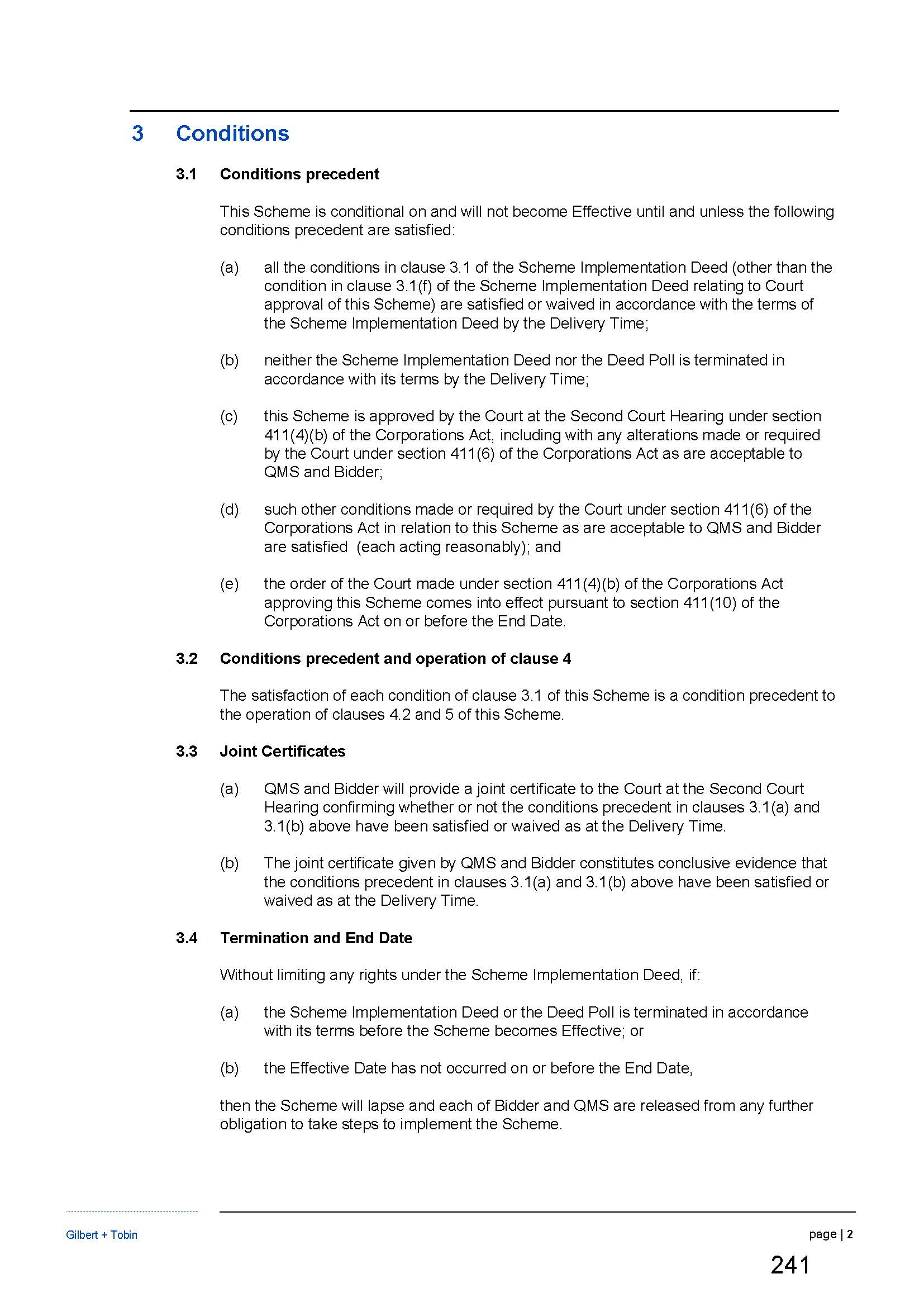
36 Clause 3.1 of the Scheme provides that the Scheme is conditional on:
(a) all the conditions in clause 3.1 of the Scheme Implementation Deed (other than Court approval of the Scheme) being satisfied or waived in accordance with the terms of the Scheme Implementation Deed by two hours before the Second Court Hearing or any adjourned date for that hearing;
(b) neither the Scheme Implementation Deed nor the Deed Poll being terminated in accordance with its terms by two hours before the Second Court Hearing or any adjourned date for that hearing;
(c) the Scheme being approved by the Court at the Second Court Hearing under s 411(4)(b) of the Corporations Act, including with any alterations made or required by the Court under s 411(6) of the Corporations Act as are acceptable to QMS and BidCo;
(d) such other conditions made or required by the Court under s 411(6) of the Corporations Act in relation to this Scheme as being acceptable to QMS and BidCo are satisfied; and
(e) the order of the Court made under s 411(4)(b) of the Corporations Act approving this Scheme comes into effect pursuant to s 411(10) of the Corporations Act on or before 30 April 2020 or any later date agreed by QMS and BidCo.
Funding
37 As the Scheme Booklet explains, Bidco intends to fund the Scheme consideration through equity and debt funding. As to the equity component, Holdco has entered into legally binding equity commitment letters with Quadrant, under which those entities agree to provide Holdco an aggregate amount of up to $338,250,000 if the Scheme becomes effective. Bidco has entered into a legally binding equity commitment letter with Holdco under which Holdco agrees to provide Bidco an aggregate amount up to that equity funding amount if the Scheme becomes effective. The equity commitment letters are expected to be superseded prior to the second court hearing by subscription arrangements with Holdco on the same material terms contemplated by the equity commitment letters. The equity funding is to be provided for the sole purpose of providing the Scheme consideration, the refinancing of existing QMS debt and associated transaction costs.
38 Bidco has also entered into a legally binding debt commitment letter under which Nomura Singapore Limited (and any other bank or financial institution or fund appointed by it) has agreed to provide a secured debt in the amount of up to approximately $330 million. Bidco is permitted to use the proceeds of borrowings under the relevant facility to fund, among other things, the Scheme consideration and certain related transaction costs, fees and expenses. It is expected that the debt commitment letter will be superseded by a binding long form agreement and related documentation on the same material terms contemplated by the debt commitment letter prior to the second court hearing.
Performance risk
39 In considering whether to approve a scheme involving the participation of a person other than the company and its members, the Court will wish to ensure that the relevant party is bound to perform the role assigned to it and that its obligations are able to be enforced. Its obligations do not depend upon s 411, which is confined to the obligations of the company and its members or creditors (as the case may be). See for example Re Westfield Holdings Ltd [2004] NSWSC 458; (2004) 49 ACSR 734 at 739.
40 In this context, the Court gives consideration to the question of “credit risk” or “performance risk” as regards the obligations to be performed by the non-scheme party.
41 As set out above, if the Scheme is approved by the Court and becomes effective, then the transfer of the QMS Shares to Bidco under the Scheme is subject to (i) the cash component of the Scheme consideration having been dispatched by QMS (then under its present management and control) to the Scheme Shareholders; and (ii) the scrip consideration having been issued to the Rollover Shareholders and the certificates in respect of such scrip consideration having been sent to the Rollover Shareholders.
42 As counsel for QMS submitted, having the transfer of the QMS Shares to Bidco subject to the delivery of the Scheme consideration to the Scheme Shareholders effectively removes any performance risk in so far as the transfer of QMS Shares in return for the Scheme consideration is concerned.
43 Further, each of Bidco and Holdco have entered into a Deed Poll in favour of the Scheme Participants. Under that Deed Poll, Bidco and Holdco have each undertaken in favour of each Scheme Shareholder to:
(a) provide or procure the provision of the Scheme consideration for all Scheme Shareholders in accordance with the terms of the Scheme; and
(b) undertake all other actions attributed to them under the Scheme,
in each case as if named as a party to the Scheme and in each case subject to and in accordance with the terms of the Scheme.
44 As counsel for QMS submitted, while the Deed Poll is in place, by reason of the terms of the Scheme, Scheme Shareholders will likely not need to rely on any of the covenants in the Deed Poll as far as the receipt of the Scheme consideration in return for the transfer of their shares to Bidco is concerned.
Exclusivity provisions
45 Clause 11 of the Scheme Implementation Deed contains certain exclusivity provisions. These exclusivity provisions are defined under the following headings:
(a) “Termination of existing discussions” (clause 11.1);
(b) “No shop” (clause 11.2);
(c) “No talk” (clause 11.3);
(d) “No due diligence” (clause 11.4);
(e) “Notification of approaches” (clause 11.5); and
(f) “Matching Right” (clause 11.7).
46 Exclusivity restrictions of this kind have been accepted in many company schemes of arrangement. The following general principles apply:
(a) the exclusivity period should be a reasonable period and capable of precise ascertainment;
(b) there should be fiduciary carve outs in respect of no-talk and no due diligence arrangements;
(c) the exclusivity arrangements and their effect should be adequately disclosed in the scheme booklet; and
(d) it is desirable that proponents of the scheme tender evidence directed to showing that the exclusivity provisions are the result of a normal commercial negotiation.
47 The period of exclusivity under the Scheme Implementation Deed is around 6 months (see the definition of Exclusivity Period in Schedule 1) being the period from the date of the Scheme Implementation Deed (29 October 2019) to the earlier of the “End Date” (defined in Schedule 1 as 30 April 2020 or such other date as QMS and Bidco agree in writing), the “Effective Date” (being the date when any order from the second Court hearing takes effect, anticipated to be 11 February 2020) or the date that the Scheme Implementation Deed is terminated in accordance with its terms.
48 This is a reasonable period, as the cases make clear.
49 As to the definition of “End Date” in the Scheme Implementation Deed, which provides for the extension of the exclusivity period by agreement, I agree with QMS’s submission that this definition conforms with the approach often adopted in change of control schemes.
50 The authorities also establish that a “no-shop” restriction of the type contained in clause 11.2 of the Scheme Implementation Deed is not subject to a fiduciary or statutory duty exception.
51 Each of the “no talk” provision in clause 11.3 and the “no due diligence” restriction in clause 11.4 are subject to the fiduciary or statutory obligations carve out in clause 11.6, which provides that such restrictions and obligations do not apply to the extent they restrict QMS from taking or refusing to take any action with respect to a “Competing Proposal” if the Competing Proposal is made by a person that the QMS Board considers to be of sufficient commercial standing to complete the transaction and the QMS board determines, acting in good faith:
(a) after consulting with its legal and financial advisers that the Competing Proposal is, or may reasonably be expected to lead to, a “Superior Proposal”; and
(b) after receiving advice from its external corporate law advisers that failing or refusing to take action with respect to the Competing Proposal would be reasonably likely to constitute a breach of any of the fiduciary or statutory duties of its directors.
52 Clause 11.5(a)(i) of the “Notification of approaches” provision provides that during the Exclusivity Period, QMS must as soon as possible and within 24 hours notify Bidco if it is approached by any person in relation to an actual or potential Competing Proposal, with the notice to set out reasonable details of the approach. Clause 11.5(b)(i) of the “Notification of approaches” provision provides that during the Exclusivity Period, QMS must, as soon as possible and within 24 hours, give Bidco notice in writing of any request made by a third party for any information in relation to QMS or its businesses or operations that the QMS board has reasonable grounds to suspect may be in connection with such a third party formulating, developing or finalising, or assisting in the formulation of a Competing Proposal. In each case, the notice provided must include the identity of the third party which made the Notifiable Proposal and the material terms and conditions of any actual or proposed Competing Proposal (including price, conditions precedent, timetable and any break fee). The information provided is subject to the confidentiality regime in place between the parties and Bidco is prohibited from contacting the third party that made the Notifiable Proposal for any purpose relating to it, the Scheme or a similar transaction.
53 The “Matching right” provision provides that during the Exclusivity Period, QMS must not enter into any legally binding agreement, arrangement or understanding in relation to a Competing Proposal and must procure that none of its “Authorised Persons” does so and must direct each QMS Independent Director not to change their voting intention regarding the Scheme or publicly recommends a Competing Proposal unless:
(a) the Competing Proposal is a Superior Proposal;
(b) QMS has provided Bidco with the material terms and conditions of the Competing Proposal (including price, conditions, timing and the identity of the third party making the Competing Proposal);
(c) QMS has given Bidco at least 3 business days after the provision of such information to provide a proposal that is no less favourable or superior to the Competing Proposal; and
(d) Bidco has not provided an Updated Bidder Proposal which the QMS Directors determine (acting reasonably and in good faith) would be reasonably likely to provide an outcome for QMS Shareholders which is no less favourable or more favourable than the Competing Proposal.
54 The matching right is not subject to a fiduciary exception or carve-out. That position is consistent with authority.
55 In light of the matters set out above, I accept that the exclusivity provisions contained in clause 11 of the Scheme Implementation Deed are reasonable and sufficiently disclosed in the Scheme Booklet.
Break fee
56 There is a break fee of $4.2 million payable by QMS to Bidco in certain defined circumstances. Clause 12.1(a) of the Scheme Implementation Deed acknowledges that if the Scheme is not implemented, Bidco will incur significant costs, including advisory costs, costs of management and directors’ time, financing costs and out-of-pocket expenses. Clause 12.1(b) provides that in those circumstances, QMS has agreed for provision to be made for the payment of the break fee in accordance with clause 11.2 without which Bidco would not have entered into the Scheme Implementation Deed.
57 The circumstances in which the break fee is payable are set out in clause 12.2. Clause 12.2(c) provides that for the avoidance of doubt, no break fee is payable under clause 12.2 if the QMS Shareholders do not approve the Scheme at the Scheme Meetings.
58 Guidance Note No. 7 issued by the Takeovers Panel provides that a break fee should not exceed 1% of the equity value of the target and that for this purpose, the equity value was “[t]he aggregate of the value of all classes of equity securities issued by the target having regard to the value of the bid consideration when announced.”
59 The break fee of $4.2 million in the present case is 0.999 of the equity value of QMS (being $420,580,160 based on the amount of $1.22 per QMS Share multiplied by 344,737,836 QMS Shares on issue on 29 October 2019) and 0.984% of the equity value of QMS (being $420,580,879) plus the amount of $1.22 per QMS Share in respect of the additional 5,235,835 QMS Shares expected to be issued in respect of the QMS performance rights on issue (being $6,387,718.70).
60 The Takeovers Panel Guidance Note figure of 1% has been considered and adopted by the courts in considering whether the amount of the break fee in change of control transactions undertaken by way of a scheme of arrangement is reasonable. See, by way of example, Re Healthscope Limited [2019] FCA 542 at [146]-[152] (break fee less than 1%), Re Amcor Ltd [2019] FCA 346 at [66]-[70] (break fee less than 1%) and Re DuluxGroup Ltd [2019] FCA 961 at [28]-[32].
61 In my view, the break fee is reasonable.
Warranties
62 Clause 8.2(c) of the Scheme contains the following warranty by Scheme Participants:
Each Scheme Shareholder is taken to have warranted to Bidder [Bidco], and appointed and authorised QMS as its attorney and agent to warrant to Bidder that:
(i) all their Scheme Shares (including any rights and entitlements attaching to their Scheme Shares) which are transferred under this Scheme will, at the time of transfer of them to Bidder, be fully paid and free from all:
(A) mortgages, charges, liens, encumbrances, pledges, security interests (including any ‘security interests’ within the meaning of section 12 of the Personal Properties Securities Act 2009 (Cth)) and interests of third parties of any kind, whether legal or otherwise; and
(B) restrictions on transfer of any kind; and
(ii) they have full power and capacity to transfer their Scheme Shares to Bidder together with any rights attaching to those Scheme Shares; and
(iii) except as otherwise provided for or contemplated in the Scheme Implementation Deed, they have no existing right to be issued any QMS Share, or any other QMS securities.
63 Reference is made to the Warranties by Shareholders in the FAQ and sections 3.4.5 and 5.4.8 of the Scheme Booklet.
64 Deemed warranty clauses are commonly found in schemes of arrangement and are acceptable provided they are sufficiently disclosed.
65 Here, the warranty clause in clause 8.2(c) of the Scheme is acceptable and the warranty clause has been sufficiently disclosed in the Scheme Booklet.
Performance Rights
66 QMS has 8,055,254 performance rights on issue. None of the rights has vested. Clause 4.10 of the Scheme Implementation Deed implicitly refers to 11,394,435 performance rights (which includes 481,621 performance rights the subject of invitations to Mr Nettlefold and Mr Edmonds, which required shareholder approval and which have not yet been issued).
67 On 19 November 2019, the QMS Board resolved that, of the 11,394,435 performance rights, 2,857,560 performance rights should lapse irrespective of the Scheme and, at the same meeting, the Board also resolved that 481,621 performance rights the subject of the invitations to Mr Nettlefold and Mr Edmonds in respect of the six months ended 31 December 2019 would lapse if the Scheme became effective.
68 Performance rights issued by QMS have a three-year duration and the exercise price to convert a QMS Performance Right into a QMS Share is nil.
69 The vesting of the performance rights is contingent on meeting service-based criteria and on two equally-weighted performance-based criteria: a market performance criterion, based on total shareholder return against comparative listed stocks, and a non-market performance criterion, assessed by reference to compound annual growth in earnings per share over a three-year period. The QMS Remuneration and Nomination Committee (RNC) (comprising the four non-executive directors) make decisions concerning the “QMS Rights Plan” and these go to the Board for approval.
70 Clause 27 of the QMS Rights Plan provides that, upon a change of control, the vesting conditions cease to apply and the Board will determine in its sole discretion whether or not the rights will vest, having regard to the progress made towards the vesting conditions and the value created for shareholders.
71 On 19 November 2019, the RNC considered a range of relevant factors and determined to recommend to the board that 5,235,835 of the remaining 8,055,254 performance rights would vest and the remainder would lapse. Also on 19 November 2019, the Board (Barclay Nettlefold and David Edmonds abstaining) approved the RNC recommendation.
72 The result of the Board’s determination and clause 4.10 of the Scheme Implementation Deed is that 5,235,835 of the 8,055,254 performance rights will vest and be converted to QMS Shares before the Effective Date and the balance will lapse on or before the Effective Date.
Voting deeds
73 On 29 October 2019, Bidco entered into two Voting and Rollover Agreements with:
(a) Mr Nettlefold and two entities associated with him, Barctin Superannuation Pty Ltd (as trustee for the Bactin Superannuation Fund) and Wenvale Pty Ltd (as trustee for the Barclay Nettlefold Family Trust); and
(b) Mr O’Neill and one entity associated with him, John O’Neill Pty Ltd as trustee for the O’Neill Pastoral Discretionary Trust.
74 Under each agreement, the shareholder parties agree to vote in favour of the Scheme, to elect to receive scrip consideration in respect of their shares as represents $40 million in aggregate between both Rollover Shareholders and to receive cash consideration for the balance of their shares.
75 The agreements also contain Exclusivity Provisions which broadly mirrored those in the Scheme Implementation Deed, although unlike the Scheme Implementation Deed, there is no fiduciary carve-out to the “No-talk” and “No due diligence” restrictions.
76 The agreements also contain withdrawal and termination provisions which provide that the agreements terminate at the earlier of the Implementation of the Scheme, one year from the date of the agreement (29 October 2020) or, provided the shareholder parties and QMS complied with their obligations, the QMS Board recommends a Superior Proposal.
Two classes of scheme shareholders
77 As noted above:
(a) Mr Nettlefold and Mr Edmonds are both holders of QMS Performance Rights and QMS Shareholders (with Mr Nettlefold having a relevant interest in QMS Shares through his controlled entities, Barctin and Wenvale);
(b) 11 other holders of QMS Performance Rights are also QMS Shareholders; and
(c) Mr Nettlefold and Mr O’Neill have entered into Voting and Rollover Agreements with Bidco.
78 Counsel for QMS submitted, and I agree, that none of these factors of themselves requires the relevant QMS Shareholder who also holds performance rights or who has entered into a voting agreement to meet separately from the other QMS Shareholders in order to consider and vote on the proposed scheme resolution at the Scheme Meeting.
79 Mr Nettlefold and Mr O’Neill (through their controlled entities, the Rollover Shareholders) are being treated differently under the terms of the Scheme because they can elect to receive scrip consideration (which election option is not open to the other QMS Shareholders).
80 Accordingly, there will be a separate scheme meeting of the Rollover Shareholders and a separate scheme meeting of the remaining QMS Shareholders. I agree with the submission put by QMS’s counsel that the option afforded to the Rollover Shareholders under the Scheme to elect to receive scrip consideration means that their interests are sufficiently different from those of the other QMS Shareholders to warrant them meeting as a separate class in a separate scheme meeting.
The Voting Element of the Voting and Rollover Agreements
81 The terms of the Voting and Rollover Agreements do not provide, on their face, for the payment for any consideration in return for the agreement on the part of Mr Nettlefold, Mr O’Neill and their respective Rollover Shareholders under those agreements to vote in favour of the Scheme. Further, to obtain the cash consideration amount of $1.22 per QMS Share, Quadrant ultimately required that Mr Nettlefold and Mr O’Neil accept a proportion of the amount payable for their QMS Shares in the form of scrip consideration. Accordingly, as counsel for QMS submitted, the agreement on the part of Mr Nettlefold, Mr O’Neill and their respective Rollover Shareholders to agree to make the scrip elections referred to in those agreements does not constitute the provision of consideration to those persons or entities in return for them agreeing to vote in favour of the Scheme.
82 Accordingly, I agree that the voting element of the Voting and Rollover Agreement does not give rise to a class question.
Director benefits and recommendation of the Scheme
83 Clause 6.1 of the Scheme Implementation Deed provides that QMS must procure that each QMS Director will recommend that QMS Shareholders vote in favour of the Scheme, “in the absence of a superior proposal and subject to the independent expert concluding and continuing to conclude that the Scheme is in the best interests of the QMS Shareholders”.
84 The QMS Board unanimously recommends that QMS Shareholders vote in favour of the Scheme, in the absence of a Superior Proposal and subject to the Independent Expert continuing to conclude that the Scheme is in the best interests of QMS Shareholders.
85 I need not rehearse what I said in Re Kidman Resources Limited [2019] FCA 1226 at [103]-[115] about whether a director who receives benefits under a scheme different from that of other shareholders should make a recommendation to shareholders to vote in favour of the scheme.
86 Since that decision, the issue has been considered by Black J in Re Villa World Limited [2019] NSWSC 1207 at [31]-[40]. With respect, I agree entirely with the views expressed by his Honour in the following passages of his reasons in that case:
31 In submissions, Villa World acknowledges that, where a director will receive a substantial benefit in relation to the scheme that other shareholders will not receive, then that benefit should be fully and prominently disclosed as a matter for shareholders to take into account when considering that director’s recommendation: Re SMS Management & Technology Ltd [2017] VSC 257; Re Nzuri Copper Ltd [2019] WASC 189 at [88]; Re Ruralco Holdings Ltd [2019] FCA 878 at [28]; Re Kidman Resources Ltd [2019] FCA 1226 at [115].
32 In Re SMS Management & Technology Ltd above at [25]–[27], Robson J addressed this issue and noted that reg 8301(a) of Schedule 8 of the Corporations Regulations 2001 (Cth) required that the information provided to members in respect of a members scheme of arrangement must set out, in relation to each director of the company:
(i) whether the director recommends the acceptance of the Scheme or recommends against acceptance and, in either case, his or her reasons for so recommending; or
(ii) if the director is not available to consider the Scheme — that the director is not so available and the cause of his or her not being available; or
(iii) in any other case — that the director does not desire to make, or does not consider himself or herself justified in making, a recommendation and, if the director so requires, his or her reasons for not wishing to do so...
33 His Honour there noted a recommendation supporting the scheme by a director who would receive such a benefit, where the nature of that benefit was disclosed in the scheme booklet, and observed (at [26]) that:
In my view, it is appropriate for [the managing director] to make the recommendation that he proposes. I think it is important that the managing director, who in this case is the main moving force behind the company, give his reasons for putting forward the scheme. In my opinion, the footnote to the chairman’s letter [disclosing the benefit] satisfies the concerns raised by ASIC.
34 Mr Jackman recognises that two recent cases have taken the different view that, as a general rule, a director who will receive such a benefit should decline to make a recommendation to shareholders as to how they should vote. In Re Gazal Corporation Ltd [2019] FCA 701 at [30], Farrell J observed that:
In my view, it would have been better practice for [the director who would receive a benefit] to adopt the common practice of declining to make a recommendation to shareholders as to how they should vote, and to explain that the reason for that is that he will receive a substantial benefit depending on the outcome of the scheme which other shareholders will not receive. While it is most important that there be prominent disclosure in a scheme booklet of those matters which might, realistically, affect a director’s judgment in making a recommendation about whether shareholders should vote in favour of approving a scheme, directors who are interested in the outcome of the scheme because they stand to receive a bonus or benefit (other than as a shareholder) only if the scheme proceeds should exercise caution in making recommendations and, in my view, generally should not do so. As demonstrated in this case, the disclosure did not carry over in summary statements of the directors’ recommendation. Both the front of the Scheme Booklet and the script used for telephone canvassing of shareholders contained the directors’ recommendation without reference to the fact that [the director] would receive a bonus.
35 In Re Navitas Ltd (No 2) [2019] WASC 218 at [32], Vaughan J took the same view as Farrell J in Re Gazal Corporation Ltd above.
36 However, that view was not followed in Re Kidman Resources Ltd above at [105]–[115], where O’Callaghan J considered that view was inconsistent with the combined effect of s 412(1)(a) of the Act, reg 5.1.01(i)(b) of the Corporations Regulations and reg 8301(a) of Schedule 8, and was inconsistent with the ordinary expectations of shareholders, and preferred the reasoning in Re SMS Management & Technology Ltd above.
37 Mr Jackman submits that the reasoning Re SMS Management & Technology Ltd above and Re Kidman Resources Ltd above should be preferred to that of Re Gazal Corporation Ltd above on this issue, and the scheme booklet prepared by Villa World proceeds on that basis so far as Mr Treasure makes a recommendation supporting the scheme. Mr Jackman also submits that a resolution of the different views expressed in the recent cases would be of assistance to practitioners who are advising in respect of schemes of arrangement. While it may be unlikely that one further judgment will resolve this position, I should indicate my view as to this issue, which squarely arises in this application.
38 On balance, and for three reasons, I prefer the approach adopted in Re SMS Management & Technology Ltd above and Re Kidman Resources Ltd above to the approach adopted in Re Gazal Corporation Ltd above and Re Navitas Ltd (No 2) above. First, it seems to me that reg 8301(a) of Schedule 8 of the Corporations Regulations contemplates that a director should make a recommendation and give reasons for doing so, unless he or she does not feel justified in doing so; and, as I will note below, there would be real inconsistency in a director at once supporting a scheme as a member of the board and then taking the position in the scheme booklet that he or she was not justified in making a recommendation about it to shareholders.
39 Second, I am not persuaded that there is or should be any general rule or principle that it is preferable that a director should not make a recommendation to shareholders on the basis of an interest in the outcome of the scheme arising from incentive or performance rights or the like. It seems to me that in many, or most cases, shareholders will benefit from such a recommendation, with appropriate disclosure as to the nature of the interest to allow them to assess the weight to be given to it. The importance of such disclosure was, of course, recognised in each of the cases to which I have referred above and, in Re Ruralco Holdings Ltd above, Farrell J made orders convening a scheme meeting although a director had there recommended to shareholders that they vote in favour of the scheme, where the director would receive an immediate cash payment under an executive performance plan as a result of implementation of the scheme.
40 Third, there will be many cases where an executive director of a scheme company, who has an interest in the outcome of a scheme arising from incentive or performance rights or the like, would properly participate in the board’s decision whether to go forward with the proposed scheme, as distinct from any decision as to how his or her incentive or performance rights should be treated if the scheme is implemented. Possibly rarely, a director in that situation may be entitled to participate in board decisions concerning the proposed scheme because the benefit arising from any incentive or performance rights or the like that would arise from implementation of the scheme is not a material personal interest for the purposes of s 195 of the Corporations Act, and the company’s constitution permits his or her participation after he or she has disclosed his or her interest. Second, a director in that situation may be entitled to participate in such board decisions because that interest falls within an exception in s 195(1A), where it is not required to be disclosed under s 191 of the Act , and the company’s constitution permits his or her participation. Third, a director in that situation may be entitled to participate in such board decisions because other directors have authorised his or her participation in them in the manner contemplated by s 195(2) of the Corporations Act. It seems to me that, where a director was entitled to and did participate in a decision that a company should go forward with a scheme, there would be little utility and real inconsistency in then preventing that director from making a recommendation to shareholders consistent with the view that he or she took as a member of the board, subject to appropriate disclosure of his or her personal interest in the explanatory materials for the scheme.
87 I respectfully do not agree with the view expressed by O’Bryan J in Re Wellcom Group Limited [2019] FCA 1655 at [60] that no inconsistency of the type described by Black J would arise. There will be many cases, as Black J explains, where a director with an interest in the outcome of a proposed scheme may properly participate in the board’s decision whether to proceed with it. In my view, as Black J says, there would be little utility and real (and I think undesirable), inconsistency “in a director at once supporting a scheme as a member of the board and then taking the position in the scheme booklet that he or she was not justified in making a recommendation about it to shareholders”. That outcome would be contrary to the expectation of shareholders and does not sit well with regs 8301(a) and 8302 of Schedule 8 of the Corporations Regulations 2001 (Cth). See Re Kidman Resources Limited [2019] FCA 1226 at [103]-[115].
88 Be that as it may, as all the cases make clear, the critical consideration for the court at this stage is to determine whether the relevant benefit or benefits have been properly disclosed.
89 In the present case, the opening page of the Scheme Booklet contains a footnote that reads: “In respect of the recommendations of Barclay Nettlefold and David Edmonds, QMS Shareholders should have regard to the fact that, if the Scheme is implemented, Barclay Nettlefold and David Edmonds will receive benefits as further detailed in Section 2”. Section 2 is at pages 12-13 and is headed: “IMPORTANT INFORMATION REGARDING DIRECTORS’ RECOMMENDATIONS”. All the relevant and important information about the benefits that they will receive if the Scheme is implemented is then set out in detail.
90 The footnote is then repeated at pages 14, 15, and 19 under the rubric of “KEY CONSIDERATIONS RELEVANT TO YOUR VOTE”, at page 23 under “FREQUENTLY ASKED QUESTIONS” and at page 79 under “RISKS”.
91 And the text of the footnote also appears in the body of the Chairman’s letter at page 9.
92 In such circumstances, there is proper (and repeated) disclosure which no reasonable reader could possibly miss, or fail to understand.
ASIC approval
93 Section 411(17) of the Corporations Act provides that the Court must not approve a compromise or arrangement under this section unless:
(a) it is satisfied that the compromise or arrangement has not been proposed for the purpose of enabling any person to avoid the operation of any of the provisions of Chapter 6 [being the takeover provisions]; or
(b) there is produced to the Court a statement in writing by ASIC stating that ASIC has no objection to the compromise or arrangement.
94 On 11 December 2019, ASIC provided QMS’s solicitors with a preliminary “no objection” letter, stating that, based on ASIC’s examination of the terms of the Scheme and the Scheme Booklet, it does not currently propose to appear to make submissions, or intervene to oppose the Scheme at the first hearing.
Will QMS shareholders be properly informed?
95 The second principal aspect relevant to the exercise of the Court’s discretion is the adequacy of information to be provided to shareholders. In this regard, the court has regard to:
(a) information for shareholders;
(b) the independent expert’s report; and
(c) verification by QMS and Bidco of the draft scheme booklet.
Information for shareholders
96 In Re Amcor Ltd [2019] FCA 346, Beach J said (at [91]) that there were three aspects to the requirements of s 412(1):
(a) First, the explanatory statement must explain the effect of the compromise or arrangement, and in particular state any material interest of the directors and the effect of those interests on the compromise or arrangement so far as it is different from the effect of the like interests of other persons. Now these matters are addressed in the draft Scheme Booklet. And the information makes it clear that that the effect of the arrangement on the director’ interests is the same as on the like interests of others.
(b) Second, the explanatory statement must set out the prescribed information. That prescription is in reg 5.1.01 and Schedule 8 (part 3) of the Regulations. Now a helpful table has been provided showing the specific requirements of the Act and the Regulations and the location in the draft Scheme Booklet of the statements by which those requirements are complied with. I am satisfied as to both its accuracy and its comprehensiveness.
(c) Third, the explanatory statement must set out any other information that is material to the making of a decision whether to agree with the compromise or arrangement, being information which is within the knowledge of the directors and has not previously been disclosed. In my view the draft Scheme Booklet on its face seems to satisfy that requirement.
97 Here:
(a) the Scheme Booklet sets out the features and effects of the Scheme and includes the explanatory statement as required by s 412(1)(a) of the Corporations Act;
(b) the directors’ unanimous recommendation that QMS Shareholders vote in favour of the Scheme is set out (among other places) on the front page, in the Chairman’s letter and in the Scheme Booklet;
(c) insofar as the directors have different interests from the other QMS Shareholders (eg Mr Nettlefold as a Rollover Shareholder) and in so far as the proposed treatment of the performance rights of Mr Nettlefold and Mr Edmonds are concerned, they are addressed in the Chairman’s letter and in other sections of the Scheme Booklet;
(d) as far as the prescribed information is concerned, a schedule 8 compliance statement has been prepared; and
(e) as to the information provided to QMS Shareholders, the Scheme Booklet contains, among other sections, an overview of the Scheme, a Chairman’s letter which sets out details of the Scheme and how to vote, key considerations relevant to each QMS Shareholder’s vote, a frequently asked questions section, information on QMS, information about Bidco and Holdco, key risk factors, and tax implications of the Scheme.
The independent expert’s report
98 The independent expert has expressed the opinion in its draft report that the Scheme is fair and reasonable to Scheme Shareholders and therefore is in the best interests of the Scheme Shareholders in the absence of a superior proposal.
99 The independent expert has not made any assessment, based on the scrip consideration, of whether the Scheme is fair and reasonable and therefore in the best interests of the Rollover Shareholders in the absence of superior proposal because each of the Rollover Shareholders has already made a binding commitment to take a certain percentage of scrip, are sophisticated investors who are familiar with the operations of QMS and, to the extent that they take cash consideration, this is already addressed in the Independent Expert report.
Verification of the draft scheme booklet
100 I am satisfied that the processes undertaken by QMS and Bidco to verify the QMS information were implemented with the aim of ensuring that the Scheme Booklet includes all information material to the making of a decision by a shareholder whether or not to agree to the Scheme; that each relevant statement is accurate; that no material facts or considerations have been omitted; and that the document is not misleading or deceptive in any material respect.
Prospects of final approval
101 For the foregoing reasons, I am satisfied that the Scheme is of such a nature and cast in such terms that, if it achieves the statutory majorities at the Scheme Meeting, the court would be likely to approve it and that it is therefore appropriate that orders be made convening the Scheme Meeting.
I certify that the preceding one hundred and one (101) numbered paragraphs are a true copy of the Reasons for Judgment herein of the Honourable Justice O'Callaghan. |
Associate:
ANNEXURE 1
Deponent | Date | Deponent’s role | Summary of affidavit |
Affidavits relied on by the plaintiff (QMS) | |||
Gregory James McKenzie | 25 November 2019 | Partner at Lander & Rogers, solicitors for QMS | • Affidavit in support of originating process. |
Wayne Hugh Stevenson | 10 December 2019 | Independent non-executive director and chairman of QMS | • Background and overview of scheme (annexing Scheme Implementation Deed, Voting and Rollover Agreements and Scheme Booklet); • Information about QMS, including operational and financial information, directors, and capital structure (annexing QMS constitution, financial statements, and 30 June 2019 half year report); • Information about Bidco and Quadrant; • Operation of Scheme Implementation Deed and the scheme; • Exclusivity and break provisions; • Proposed treatment of performance rights (annexing QMS Rights Plan); • Directors’ interests and shareholder voting recommendation; • The final dividend; • Scheme booklet (annexing proxy and election forms); • Disclosures; and • Takeover provisions. |
Gregory James McKenzie (No 2) | 11 December 2019 | Partner at Lander & Rogers, solicitors for QMS | • Lodgement of scheme documents with ASIC; • Correspondence with ASIC (annexed); • Notice of scheme meetings; • Bidco’s interest in QMS shares; • Deed of accession; • ASIC waiver; and • Guidance papers. |
Nathan Benjamin Toscan | 11 December 2019 | Director of Lonergan Edwards and Associates Limited | • Annexes draft independent expert report, prepared by Lonergan Edwards. |
Wayne Hugh Stevenson (No 2) | 11 December 2019 | Independent non-executive director and chairman of QMS | • Corrects and clarifies parts of his first affidavit. |
Davina Aliotta | 11 December 2019 | Senior Legal Counsel for QMS | • Verification process (annexing scheme booklet, verification memorandum, and verification certificates). |
Gregory James McKenzie (No 3) | 12 December 2019 | Partner at Lander & Rogers, solicitors for QMS | • Correspondence with ASIC; • Updated scheme booklet (annexing amended scheme booklet and letter from ASIC); • Updated verification process (annexing verification certificates); • ASIC waiver (annexing letter); and • Election form, email to shareholders, and shareholder information line (annexed). |
Affidavit relied on by Bidco | |||
Michael James Hruby | 10 December 2019 | Investment at Quadrant and director of Bidco | • Proposed transaction; • Scheme booklet and Quadrant information (annexing relevant scheme booklet pages); • Drafting and verification overview (annexing email from Gilbert + Tobin to verifying persons, and circular resolution by Bidco’s board of directors); • Confirmation of the verification process; • Exclusivity and break fee provisions; • Deed poll between Bidco and Holdco (annexed). |


