

FEDERAL COURT OF AUSTRALIA
CXK17 v Judge of the Federal Circuit Court of Australia [2019] FCA 2089
ORDERS
Applicant | ||
AND: | JUDGE OF THE FEDERAL CIRCUIT COURT OF AUSTRALIA First Respondent MINISTER FOR HOME AFFAIRS Second Respondent | |
DATE OF ORDER: |
THE COURT ORDERS THAT:
1. The application pursuant to s 39B of the Judiciary Act 1903 (Cth) be dismissed.
2. The Applicant pay the Second Respondent’s costs of the application.
Note: Entry of orders is dealt with in Rule 39.32 of the Federal Court Rules 2011.
BESANKO J:
Introduction
1 This is an application pursuant to s 39B of the Judiciary Act 1903 (Cth) for a writ of certiorari quashing a decision and orders made by the Federal Circuit Court of Australia on 7 May 2018. On that day, the Federal Circuit Court dismissed the applicant’s application under s 477(2) of the Migration Act 1958 (Cth) (the Act) for an extension of time within which to make an application for judicial review in relation to a decision of the Immigration Assessment Authority (the IAA) made on 20 October 2016. The applicant also seeks an injunction preventing the Minister for Home Affairs (now the Minister for Immigration, Citizenship, Migrant Services and Multicultural Affairs) from relying on the IAA’s decision “because the decision has not been subject of a process of lawful judicial review”.
2 The Minister appeared on the application and opposed it. The Federal Circuit Court of Australia filed a Submitting Notice.
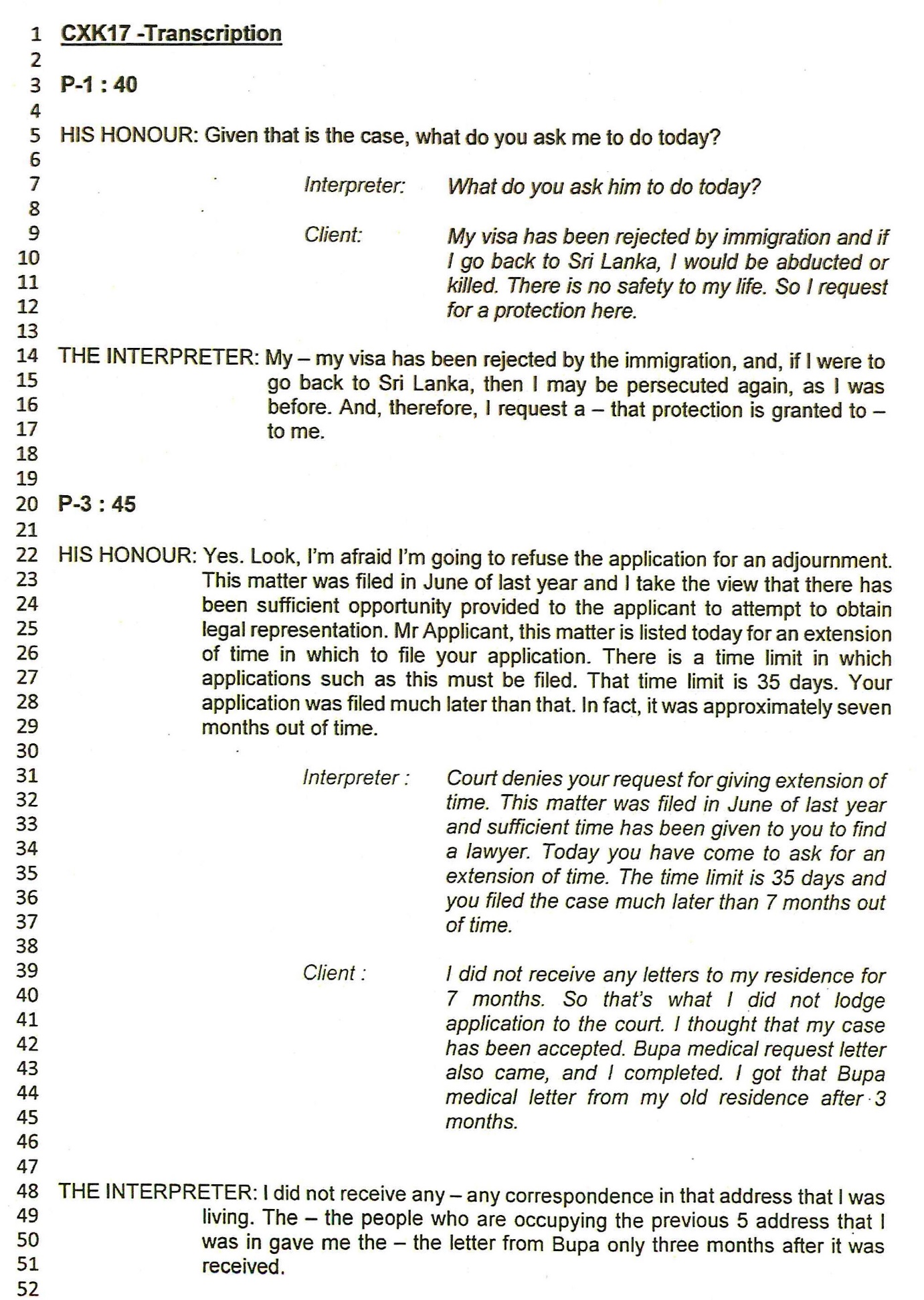
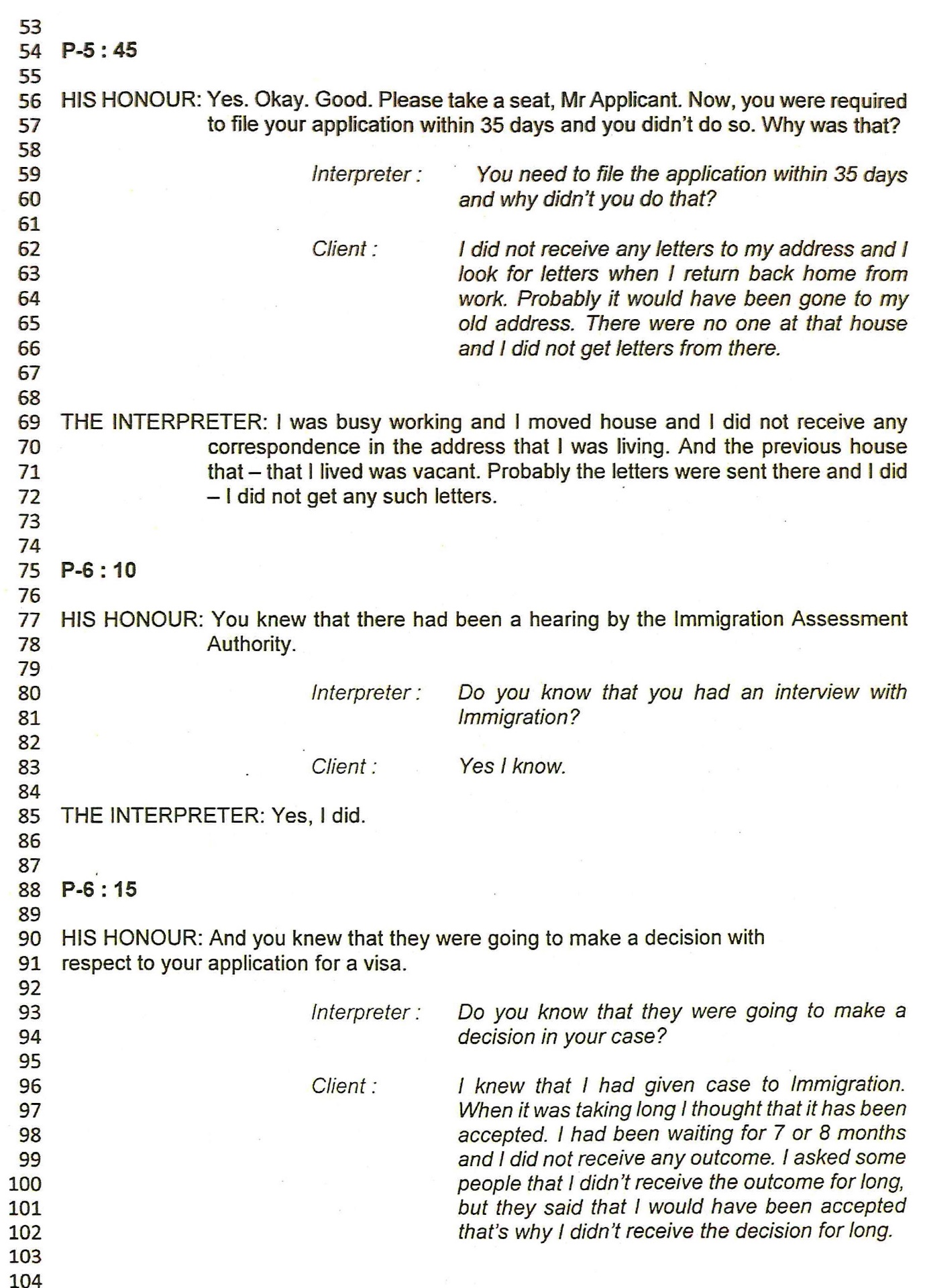
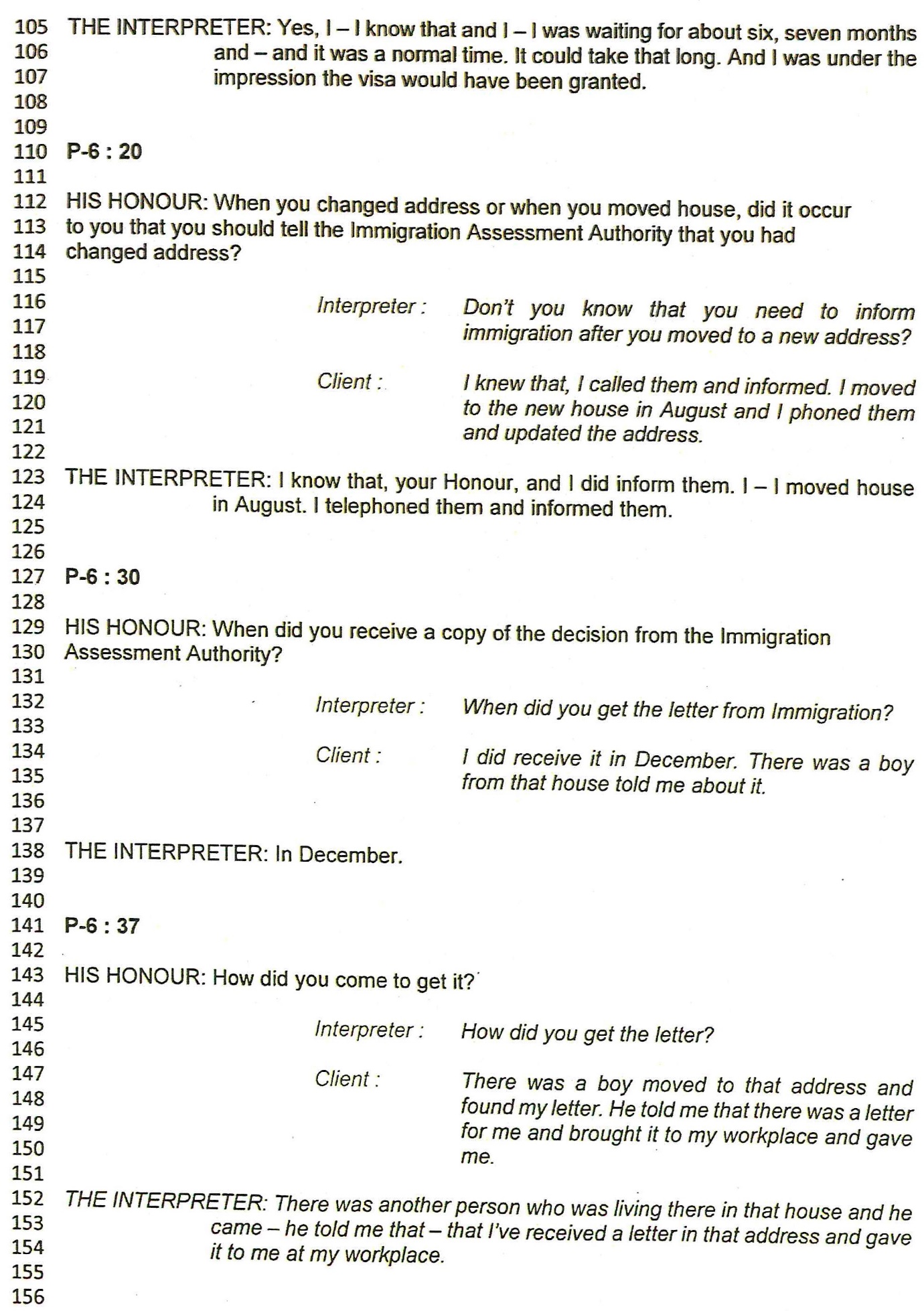
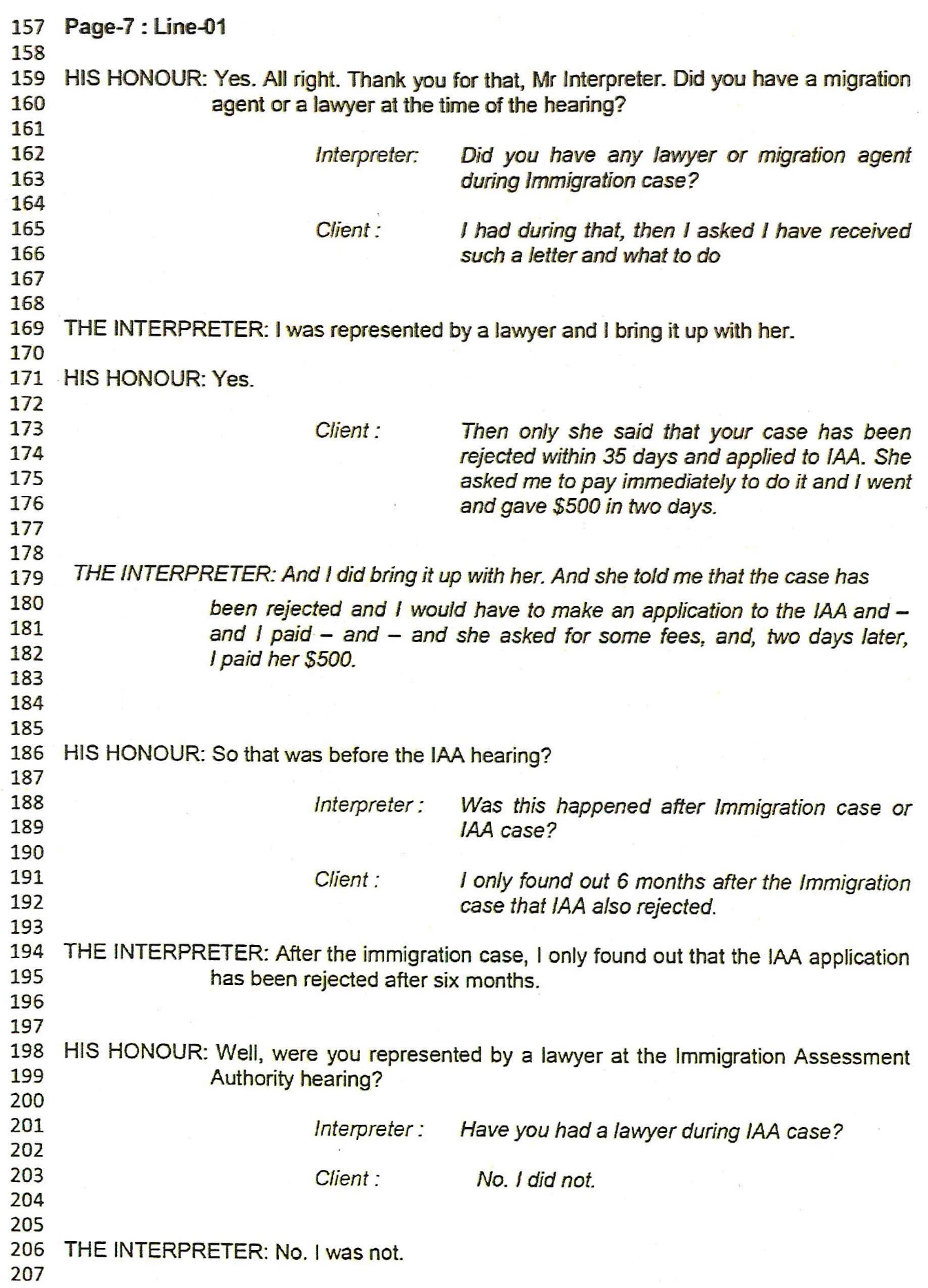
3 The applicant tendered evidence on the application consisting of an affidavit of Ms Aminata Conteh affirmed on 20 May 2019 and an affidavit of Mr Piragalathan Buvaneswaran affirmed on 4 July 2019. Ms Conteh is a paralegal employed by the applicant’s solicitors and she annexed to her affidavit the application for judicial review which the applicant filed in the Federal Circuit Court on or about 30 June 2017. Mr Buvaneswaran is an accredited interpreter and a Sri Lankan Tamil speaker. He listened to an audio recording of the hearing before the Federal Circuit Court on 16 February 2018. The applicant was not represented at that hearing. He had the assistance of an interpreter. Mr Buvaneswaran produces a transcript which sets out in English a number of the primary judge’s questions, how they were interpreted to the applicant, the applicant’s answers and how they were interpreted for the primary judge.
4 In terms of evidence, the Minister relied on the Court Book he had prepared.
Background
5 The applicant is a national of Sri Lanka from Batticaloa in the Eastern Province. He is a Tamil and a Hindu. He arrived in Australia on or about 17 August 2012. He was an irregular maritime arrival. He made an application for a Safe Haven Enterprise visa (SHEV) on or about 24 December 2015. His application for a SHEV was refused by a delegate of the Minister for Immigration and Border Protection on or about 17 August 2016. The applicant’s matter was referred to the IAA on 18 August 2016 because the decision made in his case was a fast track reviewable decision (s 473CA of the Act). The material in the Court Book indicates the following. On 29 September 2016, the applicant completed a form appointing a person as an authorised recipient. The IAA’s Practice Direction provides that if an applicant appoints a person to receive his or her correspondence, then the IAA will send correspondence about the applicant’s review to that person and not to the applicant. On or about 29 September 2016, the applicant’s representative applied to the IAA for an extension of time within which to make submissions. As far as I can see, no submissions were made. On 20 October 2016, the IAA made its decision and that decision was to affirm the decision not to grant the referred applicant a Protection visa. Notice of the decision was given to the applicant’s authorised recipient.
6 On or about 30 June 2017, the applicant issued an application for judicial review of the IAA’s decision in the Federal Circuit Court. The application included an application for an extension of time. The latter application was supported by an affidavit from the applicant. The applicant’s application for an extension of time came on for hearing before the Federal Circuit Court on 16 February 2018. The applicant appeared before the Court and he had the assistance of an interpreter in the Tamil and English languages. He did not have legal representation. The applicant’s affidavit did not address the delay in issuing the application for judicial review and the applicant was invited by the primary judge and did give oral evidence in support of his application. The Court made an order dismissing the applicant’s application to extend the time in which the proceeding was to be filed (CXK17 v Minister for Immigration & Anor [2018] FCCA 1041) and it is that order which is the subject of the present application.
7 The applicant purported to appeal from the order made by the Federal Circuit Court, but his appeal was dismissed as incompetent on 19 November 2018 (CXK17 v Minister for Immigration and Border Protection [2018] FCA 1872).
The Legal Basis of the application
8 It was common ground that in order to succeed, the applicant must establish that the Federal Circuit Court had committed a jurisdictional error. There was no suggestion of an error of law on the face of the record (Kirk v Industrial Court of New South Wales [2010] HCA 1; (2010) 239 CLR 531 (Kirk)). For the purposes of this doctrine, the record does not include the reasons of the Federal Circuit Court (SZTSU v Federal Circuit Court of Australia [2015] FCAFC 129 at [16]; DMI16 v Federal Circuit Court of Australia [2018] FCAFC 95; (2018) 264 FCR 454 (DMI16)).
9 The jurisdictional errors alleged by the applicant are a breach of procedural fairness and legal unreasonableness. The authorities are to the effect that the concept of jurisdictional error is narrower in the case of inferior courts, such as the Federal Circuit Court, than it is in the case of administrative bodies (Craig v State of South Australia [1995] HCA 58; (1995) 184 CLR 163 (Craig) at 177–183 per Brennan, Deane, Toohey, Gaudron and McHugh JJ; Kirk at [67]-[73]; DMI16 at [39]–[42]; CNC15 v Federal Circuit Court of Australia [2018] FCAFC 204 at [46]-[47] and Huynh v Federal Circuit Court of Australia [2019] FCA 891 at [21]–[43]).
10 In Craig, the High Court explained the reasons for the difference in approach between inferior courts and administrative bodies as follows:
In contrast, the ordinary jurisdiction of a court of law encompasses authority to decide questions of law, as well as questions of fact, involved in matters which it has jurisdiction to determine. The identification of relevant issues, the formulation of relevant questions and the determination of what is and what is not relevant evidence are all routine steps in the discharge of that ordinary jurisdiction. Demonstrable mistake in the identification of such issues or the formulation of such questions will commonly involve error of law which may, if an appeal is available and is pursued, be corrected by an appellate court and, depending on the circumstances, found an order setting aside the order or decision of the inferior court. Such a mistake on the part of an inferior court entrusted with authority to identify, formulate and determine such issues and questions will not, however, ordinarily constitute jurisdictional error. Similarly, a failure by an inferior court to take into account some matter which it was, as a matter of law, required to take into account in determining a question within jurisdiction or reliance by such a court upon some irrelevant matter upon which it was, as a matter of law, not entitled to rely in determining such a question will not ordinarily involve jurisdictional error.
11 The Court identified the following errors by an inferior court as jurisdictional errors:
Less obviously, an inferior court can, while acting wholly within the general area of its jurisdiction, fall into jurisdictional error by doing something which it lacks authority to do. If, for example, it is an essential condition of the existence of jurisdiction with respect to a particular matter that a certain event or requirement has in fact occurred or been satisfied, as distinct from the inferior court’s own conclusion that it has, there will be jurisdictional error if the court or tribunal purports to act in circumstances where that event has not in fact occurred or that requirement has not in fact been satisfied even though the matter is the kind of matter which the court has jurisdiction to entertain. Similarly, jurisdictional error will occur where an inferior court disregards or takes account of some matter in circumstances where the statute or other instrument establishing it and conferring its jurisdiction requires that that particular matter be taken into account or ignored as a pre-condition of the existence of any authority to make an order or decision in the circumstances of the particular case. Again, an inferior court will exceed its authority and fall into jurisdictional error if it misconstrues that statute or other instrument and thereby misconceives the nature of the function which it is performing or the extent of its powers in the circumstances of the particular case. In the last-mentioned category of case, the line between jurisdictional error and mere error in the exercise of jurisdiction may be particularly difficult to discern.
(Citation omitted.)
12 In Kirk, the plurality observed that the three examples given by the High Court in Craig were just that and that they were not to be taken “as marking the boundaries of the relevant field” (at [73]).
13 The Minister accepted that the following errors are jurisdictional errors in the case of an inferior court: (1) a denial of procedural fairness; (2) the misconstruction of a statute; and (3) a failure to consider a matter the inferior court is obliged to consider. He submitted, correctly so far as I can see from the authorities to which I was referred or am aware, whether legal unreasonableness in the sense described in Minister for Immigration and Citizenship v Li [2013] HCA 18; (2013) 249 CLR 332 which is a jurisdictional error in the case of an administrative body is a jurisdictional error in the case of an inferior court has not been decided (MZABP v Minister for Immigration and Border Protection [2015] FCA 1391; (2015) 242 FCR 585 at [76] per Mortimer J). He submitted that that issue did not need to be resolved in this case.
The Grounds of the Applicant’s Application and the evidence Relied Upon BY THE APPLICANT
14 The applicant contends that the Federal Circuit Court committed a jurisdictional error in refusing the application for an extension of time and the grounds upon which he relies are as follows:
a. The Federal Circuit Court denied procedural fairness to the Appellant or otherwise acted unreasonably in the sense described in Li [2013] HCA 18 and Singh [2016] FCAFC 183 in that it:
i. Failed to provide a satisfactory interpreter, and relied on the interpretation provided,
ii. Failed to read and/or consider the complete grounds of the Appellant’s Application, in that it failed to consider that the Applicant was not able to use his phone in detention.
iii. Failed to take sufficient steps to explain its processes and procedures to the Appellant,
iv. Failed to properly enquire about the Appellant’s personal circumstances in determining whether an extension of time may be in the interests of the administration of justice under s477(2)(b).
v. Failed to consider whether the actions of his former representative constituted fraud or circumstances analogous to fraud,
b. The Federal Circuit Court failed to give active intellectual consideration and/or failed to determine the Appellant’s claim in that it did not consider whether the actions of his former representative constituted fraud or circumstances analogous to fraud.
15 The evidence before the primary judge consisted of the application for judicial review and the oral evidence he gave. As I have said, the applicant’s affidavit did not address the delay or the merits of his challenge to the IAA’s decision.
16 The two relevant parts of the application for judicial review are those dealing with his grounds for an extension of time and his grounds of challenge to the IAA’s decision. As to the former, the following appears:
I was not aware that my bridging visa had expired until the Department of Immigration officers came to my workplace and checked all employees. When I first tried to contact my migration agent, she was in India. I made 2 appointments to see her, but each time I visited the office, it was closed. I checked my emails every day and did not receive an email from her about the IAA decision. I was at work when she left a message about payment. I had already paid $4000 for the SHEV application and $500 for a submission to IAA. She wanted another $500 but I could not pay. The messages are on my mobile phone, but it is locked away in immigration detention property and I am not allowed to use my phone in detention.
As to the latter, no more than the following appears:
I believe that the IAA committed jurisdictional error in my case.
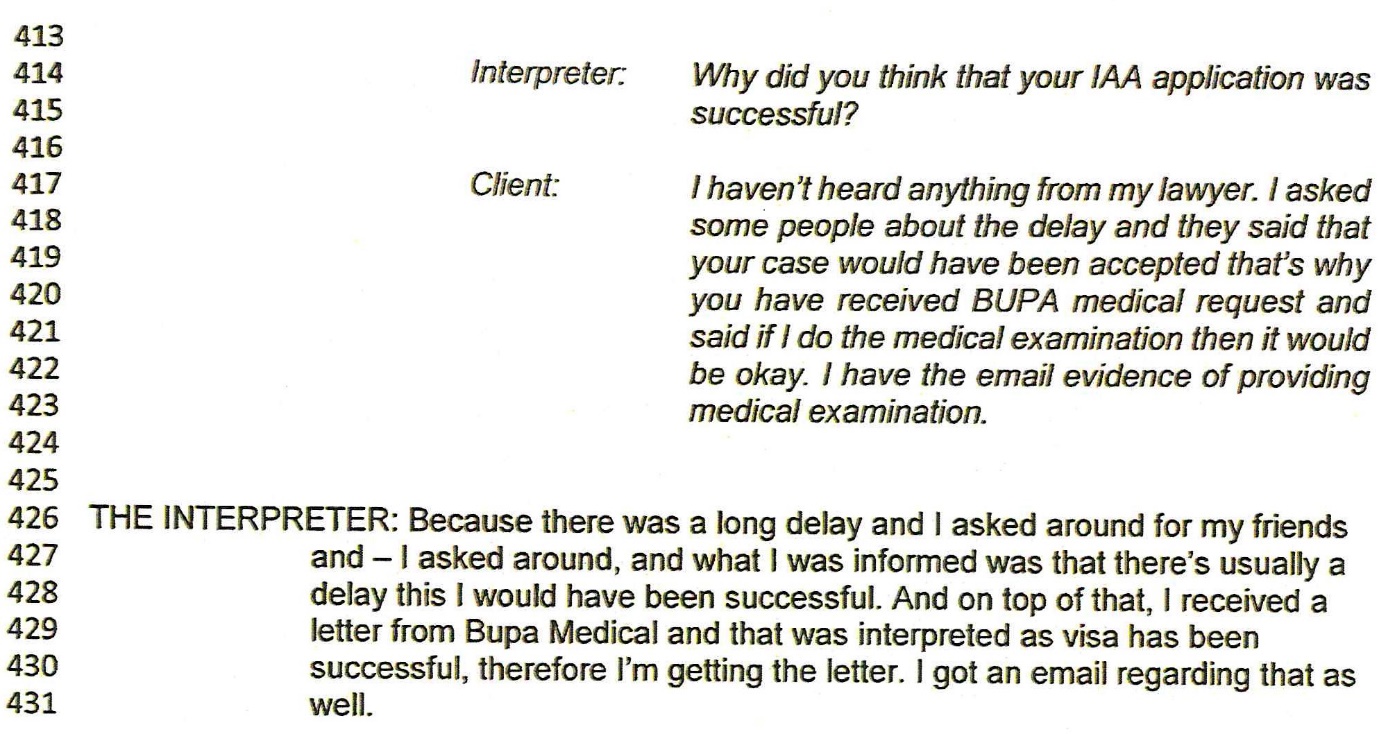
17 The oral evidence in the case is set out in the transcript. Mr Buvaneswaran’s transcript is lengthy, but it is necessary to set it out in full.
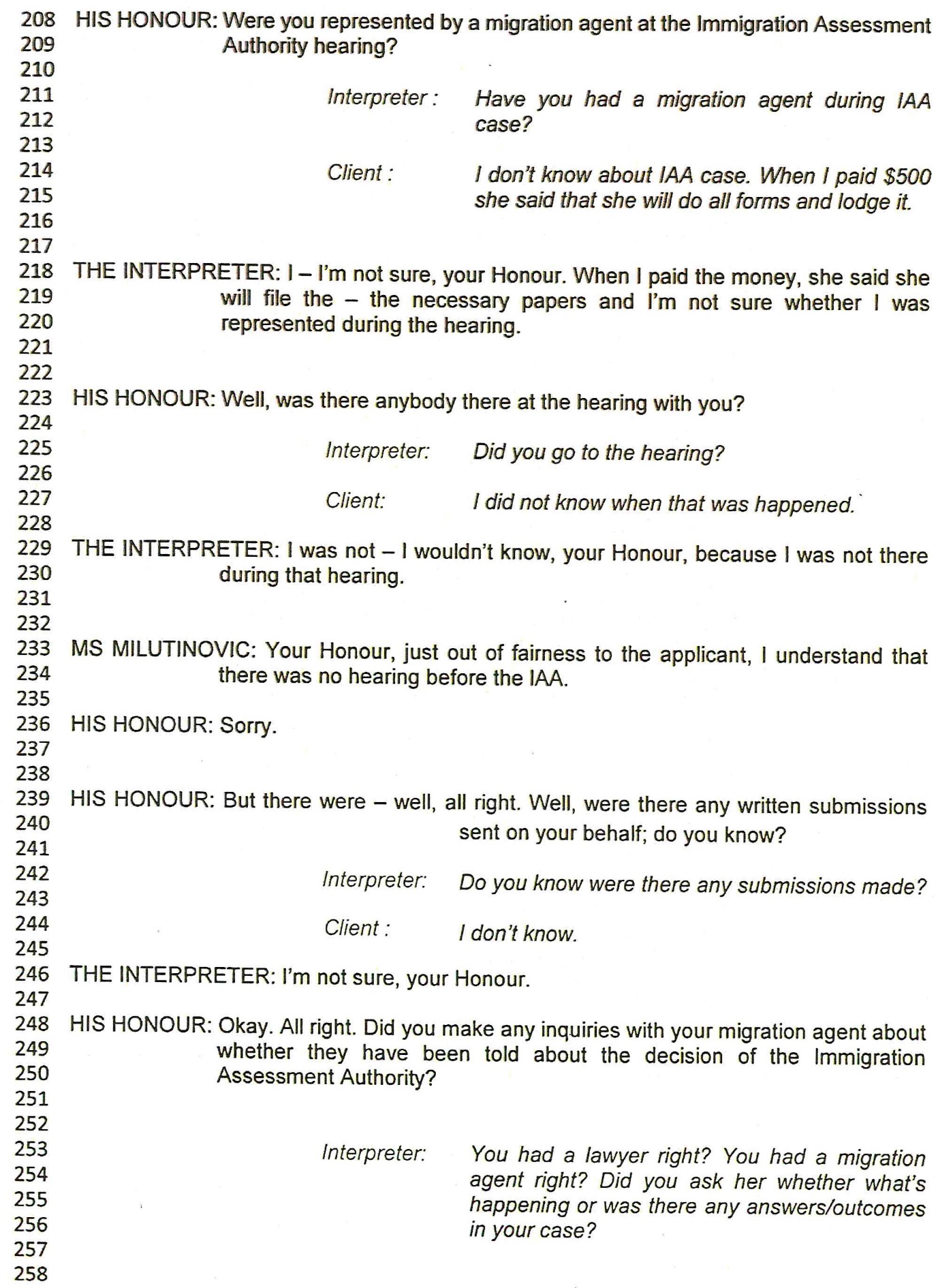
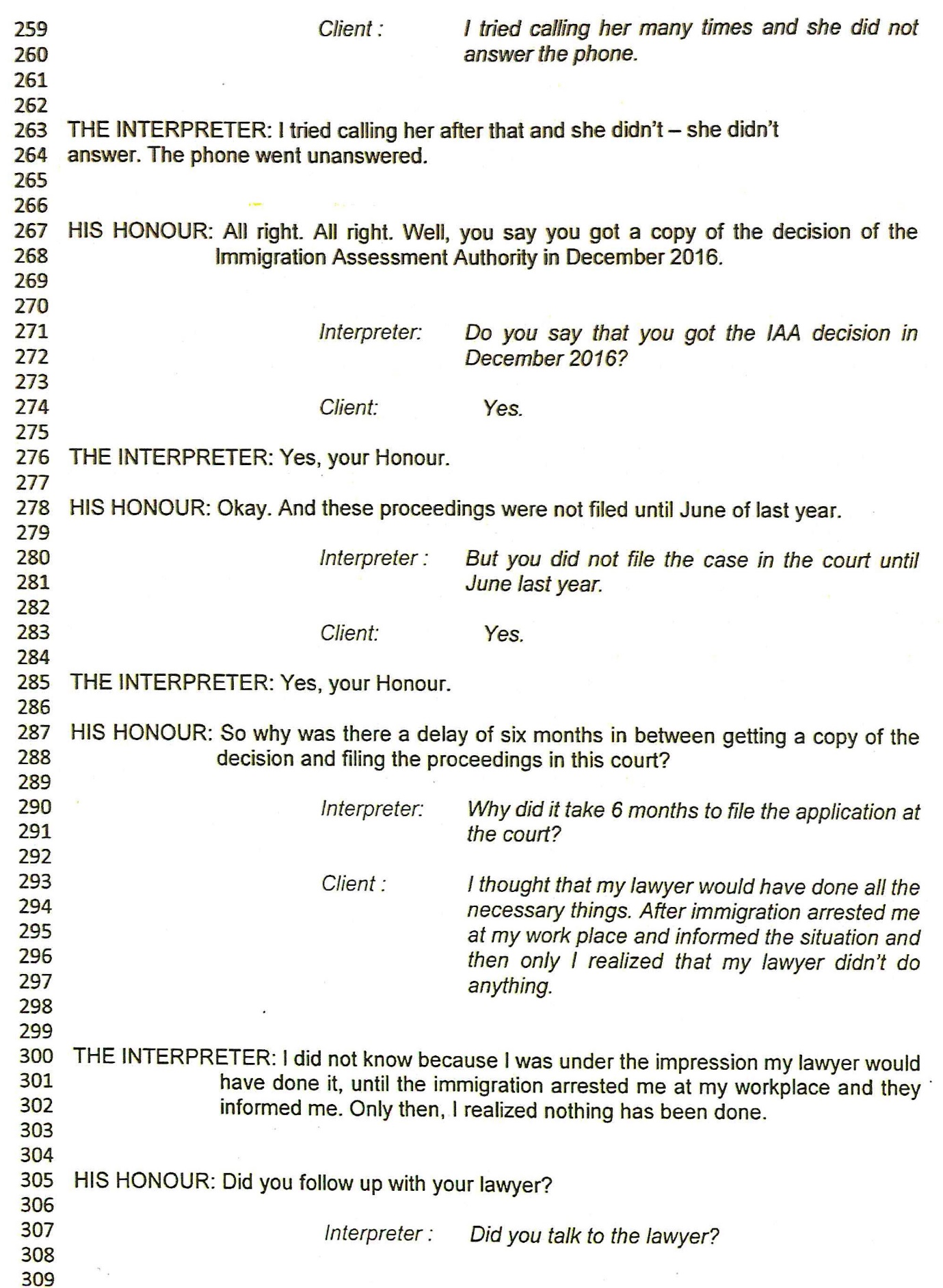
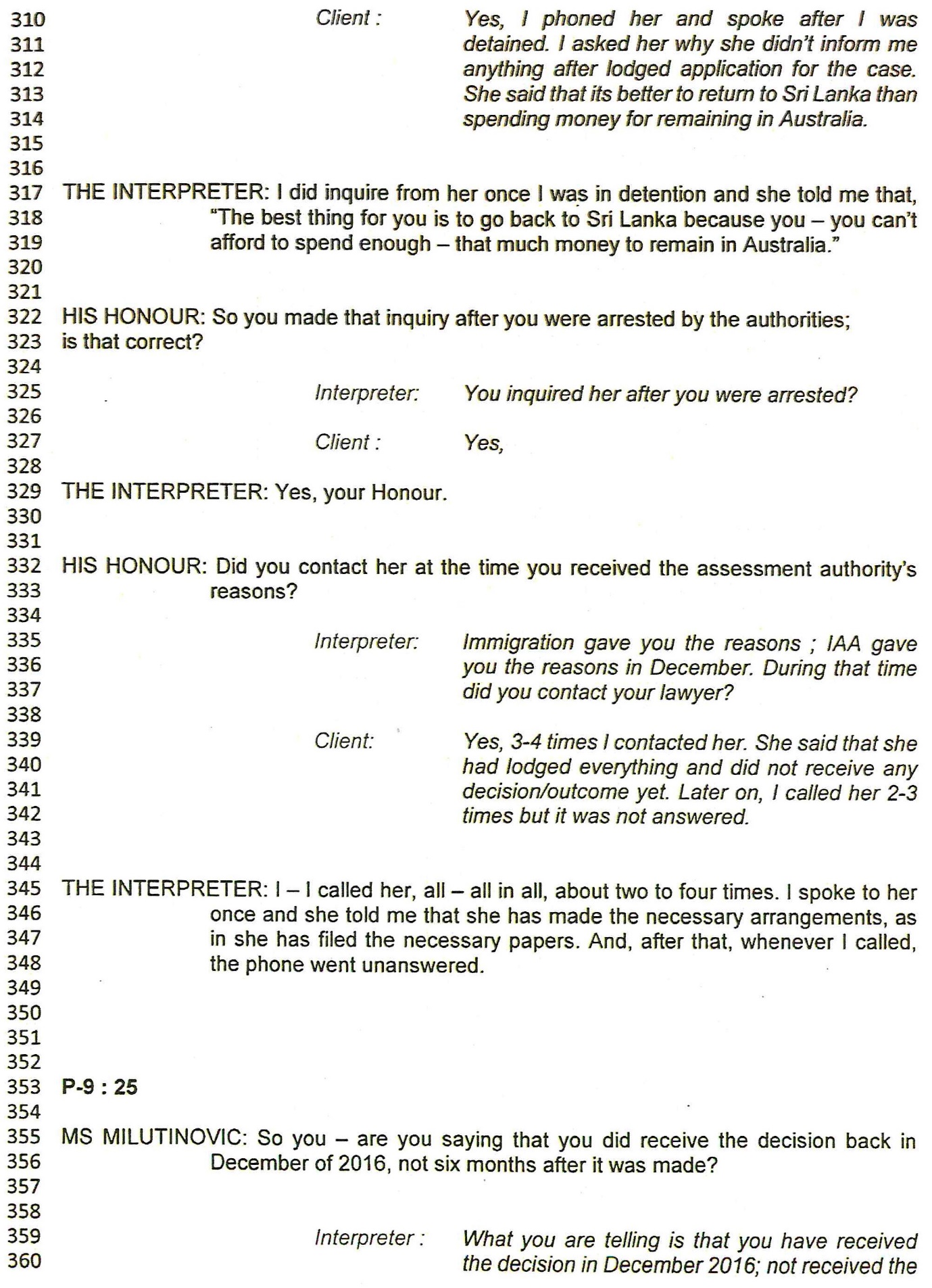
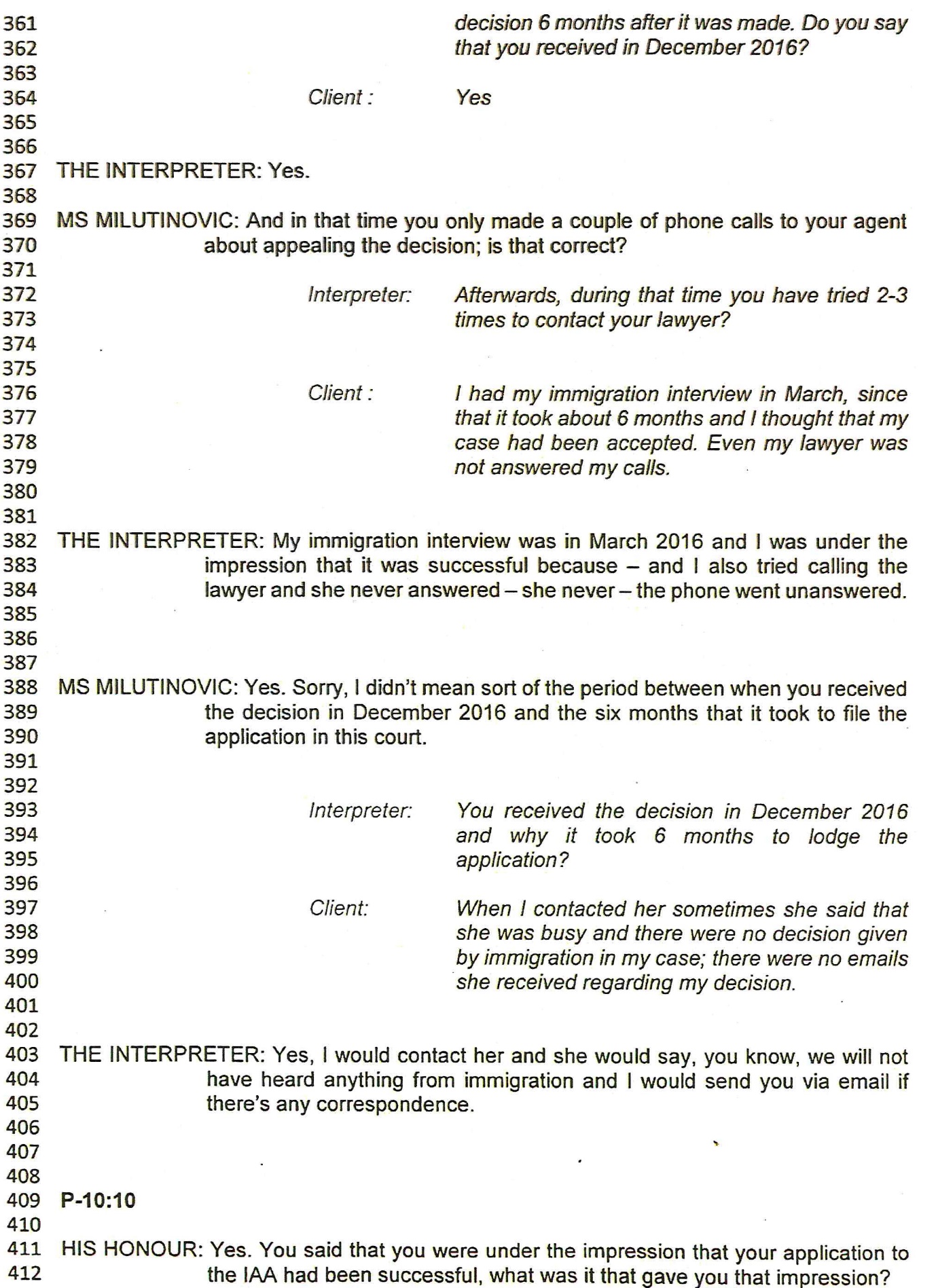
The Reasons of the Federal Circuit Court
18 Section 477(1) of the Act provides that an application to the Federal Circuit Court for a remedy to be granted in the exercise of the Court’s original jurisdiction under s 476 must be made to the Court within 35 days of the date of the migration decision. Section 477(2) of the Act provides as follows:
The Federal Circuit Court may, by order, extend that 35 day period as the Federal Circuit Court considers appropriate if:
(a) an application for that order has been made in writing to the Federal Circuit Court specifying why the applicant considers that it is necessary in the interests of the administration of justice to make the order; and
(b) the Federal Circuit Court is satisfied that it is necessary in the interests of the administration of justice to make the order.
19 The primary judge began his reasons by noting that the applicant’s application for judicial review should have been filed by 24 November 2016. His Honour noted that the applicant was not represented. His Honour referred to the grounds of the application for an extension of time set out in the application for judicial review (see [16] above).
20 The primary judge noted that the only statement in the application for judicial review relating to the substantive grounds for the application was that the applicant believed that the IAA had committed jurisdictional error in his case.
21 The primary judge said that, given the applicant was unrepresented, he allowed him to give some brief oral evidence on affirmation to explain his reasons for the delay in filing the application. The primary judge made the following observations on the applicant’s evidence:
5. His evidence was that he did not file his application within time because he was busy working and he had moved house, and he did not receive any correspondence. He said that the previous house he was living in was vacant after he left it and, probably, the letter was sent there, but he did not get it. He acknowledged that he knew that he had an outstanding application before the Independent Assessment Authority. He said that he knew that there was to be a decision and he waited for about six or seven months but, given that he had been told by people that it could take a long time, he was not concerned. He said that he telephoned the Immigration Assessment Authority and informed them that he had changed his address. He told the Court that he received a copy of the written decision and reasons in December of 2016. This occurred because another person was living at the house that he had vacated and that person told him that there was a letter for him, and gave it to him at his workplace.
6. When asked why, given that he had received the reasons in December of 2016, it took six months for him to file an application in this Court, he said that he was under the impression that his lawyer would do it, until the point at which he was arrested by immigration authorities at his workplace. His evidence was that he called his lawyer three to four times after he received the written decision and reasons, and spoke to her on one occasion. He said that he had been assured by her that she had made all the necessary arrangements with respect to an application to this Court, and then after that point his further calls to her went unanswered.
7. I note that that is inconsistent with the grounds of application for an extension of time. He told the Court that he was under the impression that his application before the Independent Assessment Authority had been successful because there was a long delay, and also because he got a letter from Bupa Medical which he interpreted as meaning that he had been successful. For that reason, he said he did not take any further action.
22 The primary judge referred to the Court’s power to extend time in s 477(2) of the Act and noted that the applicant had complied with a precondition in paragraph (a). The primary judge referred to what he described as six non-exhaustive matters which the authorities establish are relevant to the issue of an extension of time. The first and second matters were the adequacy of any reason for the delay and the length of the delay respectively. The primary judge found that there was a very lengthy delay between the applicant’s receipt of a copy of the written reasons (in December 2016, see [6] of the primary judge’s reasons) and the filing of the application for judicial review in the Federal Circuit Court, and the primary judge said that he was not satisfied that the evidence provided by the applicant amounted to an adequate explanation for that delay. The primary judge noted that an extension of time would not result in any prejudice to the Minister. He said that that was a matter to be taken into account, but was not of itself determinative. He referred to the impact on the applicant if he refused an extension of time and noted that it would be significant. He said that the prejudice to the applicant if he did not extend time would almost certainly be that the applicant will be returned to Sri Lanka and that as he, the applicant, has not lived in Sri Lanka since some time in the middle of 2012, such a return may of itself be a form of hardship. The primary judge said that it is well-established that there is a public interest in statutory time limits for the issue of proceedings being observed and that there is a public interest in there being an end to the curial process. The primary judge said that he considered that the public interest was reflected in the fact that Parliament had seen fit to set a time limit of 35 days to file an application of the kind before the Court. The primary judge turned to consider the merits of the proposed application and, in that respect, he referred in some detail to the findings of the IAA. The primary judge said that the applicant had not identified any proper grounds of judicial review and that that in itself was a sufficient reason to dismiss the application (WZAVW v Minister for Immigration and Border Protection [2016] FCA 760 at [35]). The primary judge concluded that the applicant’s complaint about the decision of the IAA was a complaint about its assessment of the merits of his application in circumstances where the delay in issuing the application for judicial review was very substantial. The primary judge did not regard the sole ground of review as having a reasonable prospect of success. In those circumstances, the primary judge decided to refuse the application for an extension of time.
Analysis
23 The first ground of alleged jurisdictional error is that the Federal Circuit Court denied procedural fairness to the applicant and acted unreasonably in that it failed to provide a satisfactory interpreter and relied on the interpretation. As developed in submissions, this was a complaint about a denial of procedural fairness because of the poor quality of the translation provided. As I understood the submission, it was that the translation provided involved mistranslations and non-translations and, in the circumstances, the applicant was not afforded an adequate opportunity to present and explain his case on the application for an extension of time. In the circumstances, he was denied a fair hearing.
24 A failure to accord procedural fairness would be a jurisdictional error on the part of the Federal Circuit Court. It would not matter that the judge who conducted the hearing was not aware of the problems with the translation.
25 Before I consider the transcript of the hearing produced by Mr Buvaneswaran, I will refer to the authority on the issue of how deficient translation (mistranslation or non-translation) can affect the validity of a hearing.
26 A leading authority is the decision of the Full Court of this Court in SZRMQ v Minister for Immigration and Border Protection [2013] FCAFC 142; (2013) 219 FCR 212 (SZRMQ). This case concerned an interview of the appellant during an Independent Merits Review concerning the appellant’s entitlement to a protection visa. The failures in the translation in the course of the interview comprised errors in the translation and two instances of a failure to translate particular statements. The Court decided that the mistranslations identified did not, in the aggregate, constitute a denial of procedural fairness. Chief Justice Allsop explained the link between mistranslations and non-translations on the one hand, and the requirement that a hearing be fair on the other. The Chief Justice said (at [9]):
The question whether standards of interpretation have affected a hearing as an opportunity to be heard is a question of evaluation as to whether the hearing was fair. That in turn involves the recognition of the purpose of the hearing: to give the person concerned or affected by the exercise of power a real opportunity to place before the repository of the power such information as is relevant. This will require a substantially effective mechanism of communicating oral and written information, both from, and to, the person. To the extent that interpretation or translation is necessary, it must be adequate to convey the substance of what is said, to a degree that the hearing can be described both as real and fair. It will be a matter of evaluation in all the circumstances, by reference to the issues, the nature of the evidence, the character and frequency of any proven errors in interpretation, and any other factor apparently relevant to the quality of the communication, as to whether the hearing was fair. Relevant to the task will be how the decision-maker approached the resolution of the task before her or him.
27 The Chief Justice also considered the extent to which an applicant must show that the mistranslations or non-translations affected the decision. His Honour said (at [10]):
How the decision-maker approached the matter may be critical. If an error of interpretation or translation can be seen to lead to a material and adverse finding relevant to a decision against the person, the unfairness of the hearing is self-evident. It may not be possible, however, to show how one or more inaccuracies affected the decision, since it will often be impossible to show what the decision-maker would have done with different information. This is especially so if the decision is based in part, or in whole, on credit. It is at this point that the focus upon the process becomes important. The enquiry is not to investigate, and the applicant’s burden is not to establish, a precise causal link between any irregularity and an adverse result, but to assess whether the decision-making process (including the hearing and the making of the decision) was fair. Even if one cannot show an operative causal influence of any irregularity upon the decision, it may still be that the irregularity might reasonably have had such an effect through its materiality or repetition or context. Any such conclusion may affect the legitimacy of the process in that it may not be able to be concluded that it was fair. Such may be expressed as requiring the appearance of a fair hearing: cf Assistant Commissioner Condon v Pompano 295 ALR at 693 [209]; NIB Health 115 FCR 561 at 583 [84]; R v Tran [1994] 2 SCR 951 at 988, Lamer CJ, writing for the Canadian Supreme Court otherwise comprised of La Forest, Sopinka, Cory, McLachlin, Iacobucci and Major JJ, in a passage cited by Kenny J in her Honour’s influential decision in Perera v Minister for Immigration and Multicultural Affairs [1999] FCA 507; 92 FCR 6 at 19-20 [30]. It can, in this context of adequacy of communication through interpretation, be perhaps better expressed as requiring that the hearing be fair. How, it might be asked rhetorically, can a hearing be described as fair, when it can be shown that real and potentially material errors of substance occurred in interpreting or translating a person’s version of events to a decision-maker, being errors that may well have affected the decision in a real way, though such causal effect cannot be demonstrated one way or another?
28 On this issue, Flick J said (at [50]):
It is, with great respect, a fundamental mistake for a reviewing Court to focus its attention too narrowly upon errors in translation and whether any such errors materially affected findings of fact made by an administrator and whether such findings were relevant to the ultimate conclusions reached. Such an approach has the potential to divert the Court’s attention away from the need for any administrative process of decision-making to be seen to be procedurally fair.
29 Justice Robertson said (at [67]–[69]):
Attention must be given to the course the hearing took as well as to the ultimate reasoning of the decision-maker. A causative impact on the decision-maker’s ultimate conclusion would usually be sufficient to establish a lack of procedural fairness, but may not be necessary. Even where a causative impact is being examined, the court on judicial review should consider whether the mistranslation or non-translation had or could have had significance if the applicant’s words had not been mistranslated or, in the case of a non-translation, had been translated.
The significance of the error or errors is not to be assessed by reference only to the reasoning in fact used by the decision-maker because the decision-maker was, by definition, unaware of the mistranslation or non-translation, singular or plural and because the process is central.
If a mistranslation or non-translation could have affected the outcome then, depending on the circumstances, that may be sufficient to establish denial of procedural fairness.
30 Before I leave this case, one other important point should be noted. Mistranslations or non-translations are separate from mere errors of fact and as Robertson J said (at [73]) “it may be that a translation is confused and confusing because what an applicant has said is confused and confusing”.
31 The question for this Court is whether the hearing before the Federal Circuit Court was fair and, in turn, whether there were real and potentially material errors of substance in the interpreting or translating of the applicant’s version of events to the Court, being errors that may well have affected the decision in a real way, although as the Chief Justice in SZRMQ put it, “such causal effect cannot be demonstrated one way or another”.
32 In considering the nature and effect of the translation in this case, the following matters need to be borne in mind. First, the hearing involved an application for an extension of time. The focus of the primary judge’s questions were, understandably in view of the length of the delay, on the reasons for that delay. Secondly, the primary judge had before him a brief account of the reasons for the delay by the applicant in the application for judicial review. The thrust of what the applicant says is that he was unaware that his bridging visa had expired and he did not receive an email from his migration agent “about the IAA decision”. He tried to contact his migration agent, but with no success. At some point, his migration agent sent him an email at work. She wanted a further payment of $500, but he could not pay. He had already paid his migration agent $4,000 for his SHEV application and $500 for a submission to the IAA. This explanation is unclear as to when the applicant became aware that the IAA had affirmed the delegate’s decision. Thirdly, it is necessary to bear in mind the primary judge’s findings in relation to the explanation for the delay. There are two key findings leading to his Honour’s conclusion that the applicant’s explanation for the lengthy delay after the applicant received a copy of the IAA’s written reasons was inadequate. First, the applicant acknowledged that he received a copy of the written decision and reasons of the IAA in December 2016. Secondly, the primary judge referred to the asserted breakdown in the applicant’s relationship with his solicitor or migration agent after December 2016 suggesting that he was not making a finding about whether there was or was not such a breakdown. His Honour had earlier noted that this explanation was inconsistent with other evidence the applicant had given that he thought his application had been successful. As I understand the primary judge’s reasons, he found that either way, his explanation for the lengthy delay was inadequate.
33 I turn now to the transcript of the hearing in the Federal Circuit Court. The applicant’s original explanation was that he thought that his case had been accepted. He had moved house and letters may have gone to his old house. The primary judge introduced an element of confusion when he asked about a hearing by the IAA (line 77) and this was translated as an interview with “Immigration”. In fact, there was a SHEV interview with the delegate on 7 March 2016, but no hearing before the IAA between the reference to the IAA on 18 August 2016 and its decision on 20 October 2016. The applicant’s answer at line 96 suggests he took the reference to “Immigration” to be a reference to the delegate, rather than the IAA and that as a result of the delay between application and decision in the case of the process before the delegate, he considered that his application had been approved. There is then a mismatch or disconnect between the questions and answers and this may have been brought about by translating the “IAA” as “Immigration” and “decision” as “letter”. The misconception that there was a hearing before the IAA continues at lines 159–160. That seems to direct the applicant’s attention to the period before the IAA’s decision and his assertion that he paid his migration agent to make submissions. Finally, at lines 233–234, the misconception about a “hearing” before the IAA is corrected. There was no hearing before the IAA. There is potential for confusion in the translation of the question at line 248 because the translation does not specify a particular point in time, simply referring to “your case”.
34 The question and answer at lines 267–274 are important and were emphasised by the Minister. I see no reason not to accept the question and answer at face value in the sense that there is no reason to think that the applicant misunderstood the question, or that he did not provide the answer he wished to provide. His explanation for his failure to act during the period from December 2016 to June 2017 was that he thought his lawyer or migration agent had done “all necessary things”. The applicant’s evidence that he received the IAA’s decision in December 2016 was confirmed at lines 355–364. I accept that there appears to be some confusion about the time period being addressed between lines 369–405 with the applicant apparently addressing the period between the SHEV application and the delegate’s decision and interrogator addressing events after the IAA’s decision. However, I think the evidence is clear that the applicant received the IAA’s decision in December 2016. It is clear that there was some problem with his lawyer or migration agent thereafter. At all events, the primary judge found that the applicant’s explanation for the delay was inadequate.
35 I am not satisfied, having regard to the primary judge’s reasons, that there were real and potentially material errors of substance in the interpreting or translating of the applicant’s version of events to the Court, being errors that may have affected the decision in a real way.
36 The second ground of alleged jurisdictional error in terms of order of importance from the applicant’s point of view is that the Federal Circuit Court denied procedural fairness to the applicant or otherwise acted unreasonably in that the Court failed to consider whether the actions of the applicant’s former representative constituted fraud or circumstances analogous to fraud and the Federal Circuit Court failed to give actual intellectual consideration and/or failed to determine the applicant’s claim in that it did not consider whether the actions of his former representative constituted fraud or circumstances analogous to fraud.
37 The second ground has two limbs and is related to the third ground. The two limbs are fraud or conduct analogous to fraud and its relevance to the application for an extension of time, and fraud or conduct analogous to fraud and its relevance to the substantive challenge to the IAA’s decision. The third ground of alleged jurisdictional error is that the Federal Circuit Court denied procedural fairness to the applicant and acted unreasonably in that it failed to take sufficient steps to explain its processes and procedures to the applicant.
38 The first task is to identify the conduct by the applicant’s lawyer or migration agent which is said to constitute fraud or conduct analogous to fraud. As I understood the applicant’s submissions, there were, in essence, two acts or failures by the lawyer or migration agent which were fraudulent or analogous to fraud. The first was to charge $500 to make submissions and then fail to make the submissions. The second was to fail to advise the applicant of the IAA’s decision.
39 I should say that there was a suggestion in the course of submissions that, in addition to the above matters, the applicant’s evidence that his registered migration agent had undertaken to bring proceedings challenging the IAA’s decision and yet had failed to do so was evidence of fraud. That suggestion is rejected. That conduct could not be fraud on the IAA and, as far as the Federal Circuit Court is concerned, the evidence, if accepted, might be a good reason to extend time, but I am unable to see how it amounts to fraud on the Court.
40 The background to the first alleged act of fraud is that the applicant appointed his solicitor and migration agent as his authorised representative on 29 September 2016 and gave notice to the IAA to that effect on that day. That was, according to the IAA’s Practice Note, the last day for the making of submissions to the IAA. The applicant’s solicitor and migration agent applied to the IAA for an extension of time. The IAA responded by saying that it would not be making a decision before 7 October 2016 and any submissions should be received by that date. There are no submissions in the Court Book and the IAA does not refer to any submissions in its reasons. I infer that no submissions were made. In the grounds for an extension of time in the application for judicial review, the applicant said that he paid $500 to his migration agent for submissions to the IAA.
41 The background to the second alleged act of fraud may be simply stated. The applicant said in the grounds for an extension of time in the application for judicial review that he did not receive an email from his migration agent “about the IAA”.
42 Taking the second matter first, even if it is true, there is nothing to suggest that this is fraud. It may have been negligent, but in any event, it does not seem to have been operative in anyway in view of the primary judge’s finding that the applicant had received the IAA’s decision in December 2016. Even if there was a duty to assist the applicant further and the primary judge failed in his duty (and I am not to be taken as making a finding to this effect), it would not have led anywhere.
43 That leaves for consideration the first alleged act of fraud. This could only be relevant to a substantive challenge to the IAA’s decision.
44 The first point is that it is not clear that there was fraud. The second point is that, even if there was, it is not clear that it would have vitiated the IAA’s decision. The circumstances in this case are quite different from the circumstances in SZFDE v Minister for Immigration and Citizenship [2007] HCA 35; (2007) 232 CLR 189 in which the High Court said (at [51]–[53]):
No doubt Mr Hussain was fraudulent in his dealings with the appellants. But the concomitant was the stultification of the operation of the critically important natural justice provisions made by Div 4 of Pt 7 of the Act. In short, while the Tribunal undoubtedly acted on an assumption of regularity, in truth, by reason of the fraud of Mr Hussain, it was disabled from the due discharge of its imperative statutory functions with respect to the conduct of the review. That state of affairs merits the description of the practice of fraud “on” the Tribunal.
The consequence is that the decision made by the Tribunal is properly regarded, in law, as no decision at all. This is because, in the sense of the authorities, the jurisdiction remains constructively unexercised. The authorities were collected in Bhardwaj.
The significance of the outcome in this appeal should not be misunderstood. The appeal has turned upon the particular importance of the provisions of Div 4 of Pt 7 of the Act for the conduct by the Tribunal of reviews and the place therein of the ss 425 and 426A. In the Full Court French J correctly emphasised that there are sound reasons of policy why a person whose conduct before an administrative tribunal has been affected, to the detriment of that person, by bad or negligent advice or some other mishap should not be heard to complain that the detriment vitiates the decision made. The outcome in the present appeal stands apart from and above such considerations.
(Citations omitted.)
45 I do not need to pursue this any further than I have because the key question is whether the Federal Circuit Court committed a jurisdictional error in that it did not conclude that the alleged fraud had a reasonable prospect of success in terms of the challenge to the IAA’s decision. A claim in fraud was not articulated before the Federal Circuit Court and had the applicant been represented, I would have no difficulty in concluding that such a claim was not advanced and there was no error in not considering it. It was in this respect that the applicant sought to deploy the Court’s duty to explain to unrepresented litigants its practice and procedure. The application referred to Hamod v State of New South Wales and Anor [2011] NSWCA 375 at [309]–[316] and SZRUR v Minister for Immigration and Border Protection [2013] FCAFC 146; (2013) 305 ALR 557 at [38]–[44] per Allsop CJ; at [52]–[55] per Robertson J; at [59]-[60] per Mortimer J. I reject the applicant’s contention. Fraud is a very serious allegation. On the evidence and material in this case, it is not even clear the applicant had it in mind. Such a claim would not have been apparent to the primary judge and I think that his Honour was entitled to proceed in the way in which he did.
46 I have already addressed the third ground of alleged jurisdictional error in the course of addressing the second ground.
47 The fourth ground is that the Federal Circuit Court denied procedural fairness to the applicant or acted unreasonably in that it failed to inquire properly about the applicant’s personal circumstances in determining whether an extension of time may be in the interests of the administration of justice under s 477(2)(b). The starting point for the applicant’s submissions in relation to this ground were the following observations of Mortimer J in MZZIV v Minister for Immigration and Border Protection [2013] FCA 1203 at [5]:
The discretion to extend time is reposed in the Court to ensure that the interests of the administration of justice are served, and parties whose substantive appeals should be heard and determined in accordance with law are able to secure that outcome. Identifying which parties fall into that category requires analysis of the factual circumstances in each case. Sometimes, matters such as lack of legal representation, little or no proficiency in English, and little or no understanding of the Australian legal system may combine to suggest a delay is explicable. Other factors such as the length of the delay, the steps taken by an applicant during the running of the time period, and the time at which the applicant received a copy of the Court’s orders and reasons may be significant. The party’s personal circumstances may need to be considered. The importance of the subject matter of the proceeding to the party requesting an extension of time may also be relevant. The more there is at stake, the more confident the Court may need to be before it refuses an extension of time, especially if the delay is not significant. The manner in which a discretion such as this should be exercised cannot be answered by general statements about certain attributes or the circumstances of a party being insufficient.
48 I think that in the end the way this ground was put was not as a procedural fairness complaint, being a failure to explain matters to the applicant, but as a failure by the primary judge to take certain matters into account. Whether if that were so, that would constitute a jurisdictional error by the Federal Circuit Court is not a matter I need to address because I consider that the primary judge took into account the matters identified by the applicant, other than the alleged fraud of his migration agent which, for reasons previously given, he was not bound to consider. The fact that the applicant had little proficiency in English and little or no understanding of the Australian legal system would have been obvious to the primary judge. The importance of the application to the applicant and the absence of prejudice to the respondent should the application be allowed were matters expressly taken into account by the primary judge.
49 The fifth ground of alleged jurisdictional error is that the Federal Circuit Court denied procedural fairness to the applicant or otherwise acted unreasonably in that the Court failed to read and/or consider the complete grounds of the applicant’s application, in that it failed to consider that the applicant was not able to use his phone in detention.
50 It may be that the statement of the applicant’s grounds for an extension of time in his application for judicial review as before the primary judge was cut off so that it excluded the words “and I am not allowed to use my phone in detention”. When his Honour reproduced the statement of the applicant’s grounds for an extension of time in his application for judicial review, the primary judge did not include these words.
51 This matter was not the subject of any detailed submissions by the applicant, either in writing or orally. It is not clear to me what the applicant seeks to make of this point. Insofar as it may be suggested that it was relevant to the application by the applicant for an extension of time, I consider that the Minister’s response determines the point against the applicant. The applicant was taken into immigration detention on 7 June 2016 and his application for judicial review is dated 30 June 2017. The fact (if it be the fact) that he did not have access to his phone whilst he was in immigration detention is of little significance in terms of the delay of about seven months.
Conclusion
52 The applicant has not established any of his grounds of alleged jurisdictional error and his application must be dismissed with costs.
I certify that the preceding fifty-two (52) numbered paragraphs are a true copy of the Reasons for Judgment herein of the Honourable Justice Besanko. |
Associate:


