

FEDERAL COURT OF AUSTRALIA
Director of Consumer Affairs Victoria v Hoskins (Maroondah) Pty Ltd [2019] FCA 1973
ORDERS
DIRECTOR OF CONSUMER AFFAIRS VICTORIA Applicant | ||
AND: | First Respondent BRENT ROBERT PETERS Second Respondent | |
DATE OF ORDER: |
THE COURT DECLARES BY CONSENT THAT:
Declaration that Hoskins Maroondah made false or misleading statements to prospective purchasers
1. The Respondent (Hoskins Maroondah), in trade or commerce:
(a) at various times between 2015 and 2016, published advertisements in respect of the sale of the properties listed in Annexure A (Properties):
(i) on websites accessible at the URL www.realestate.com.au and www.domain.com.au; (Property Websites); and
(ii) in a bulletin distributed by email to potential purchasers (Buyer Bulletin); and
(b) made representations in those advertisements:
(i) that Hoskins Maroondah in fact believed and held the opinion, on reasonable grounds, that the Properties would be sold at, or not substantially more than the price explicitly stated in the advertisements (Display Price) as the estimated selling the price for those Properties; and/or
(ii) the likely selling price, or market value, of the Properties was, or was not substantially more than, the Display Price;
(c) in circumstances where:
(i) Hoskins Maroondah had arrived at a much higher estimate (internally) in a “Nearest to the Pin” game (NTP Game); and/or
(ii) a director of Hoskins Maroondah had expressed the view that the Display Price was too low; and/or
(iii) a member or members of Hoskins Maroondah’s board had expressed the view that the Display Price was too low; and/or
(iv) the vendor or vendors had told Hoskins Maroondah that they would not sell the properties for a price that was either within or not substantially above the Display Price; and/or
(v) Hoskins Maroondah had told individual potential purchasers who had inquired about the likely selling price of the properties that the properties would sell for a price that was above or substantially above the Display Price; and
(vi) the properties later sold for a price that was above or substantially above the Display Price.
(d) Hoskins Maroondah did, in trade or commerce:
(i) engage in conduct that was misleading or deceptive or likely to mislead or deceive contrary to section 18 of the Australian Consumer Law (ACL) and ACL(Vic); and
(ii) made a false and misleading representation concerning the price payable for the properties contrary to s 30 of ACL and ACL(Vic).
Declaration that Hoskins Maroondah made false or misleading statements to the vendor of the Cass Avenue Property
2. Hoskins Maroondah, in trade or commerce:
(a) on or around 2 September 2015, made a representation to the vendor of a property located at 30 Cass Avenue, Croydon (Cass Avenue Property) that:
(i) the Cass Avenue Property would sell for an amount around or not substantially above $520,000 (Cass Avenue ESP);
(ii) Hoskins Maroondah genuinely believed that the Cass Avenue Property would sell for an amount around or not substantially above the Cass Avenue ESP;
(b) in circumstances where:
(i) the NTP Game average estimate was $647,000;
(ii) in or around 12 September 2015 a director of Hoskins Maroondah had expressed the view that an advertised price of $495,000 to $550,000 for the Cass Avenue Property was too low and made Hoskins Maroondah look like “shifty underquoters”;
(iii) Hoskins Maroondah had told individual potential purchasers, who had inquired about the likely selling price of the Cass Avenue Property, that the property would sell for a price that was above or substantially above the Cass Avenue ESP; and
(iv) the Cass Avenue Property sold for a price that was substantially above the Cass Avenue ESP;
(c) Hoskins Maroondah did, in trade or commerce:
(i) engage in conduct that was misleading or deceptive or likely to mislead or deceive contrary to s 18 of ACL and ACL(Vic); and
(ii) made a false and misleading representation concerning the price payable for the Cass Avenue Property contrary to s 30 of ACL and ACL(Vic).
Declaration that Hoskins Maroondah engaged in unconscionable conduct in dealings with the vendor of the Cass Avenue Property
3. In contravention of s 21 of the ACL and ACL(Vic) Hoskins Maroondah engaged in conduct, in trade or commerce, that was, in all the circumstances, unconscionable because:
(a) Hoskins Maroondah:
(i) sought the insertion of a provision in the authority, to list the Cass Avenue Property, that entitled Hoskins Maroondah to be paid an incentive commission (Cass Avenue Incentive Commission);
(ii) rendered an invoice to the vendor of the Cass Avenue Property for the payment of commission that included the Cass Avenue Incentive Commission; and
(iii) accepted payment from the vendor of the Cass Avenue Property of commission that included the Cass Avenue Incentive Commission;
(b) in circumstances where Hoskins Maroondah knew or ought to have reasonably known that:
(i) the vendor was in a weak bargaining position relative to Hoskins Maroondah by reason of the fact that;
A. Hoskins Maroondah had superior knowledge and expertise in the local property market;
B. Hoskins Sales Staff were highly skilled sales people who had superior negotiation skills;
(ii) the vendor trusted and relied on Hoskins Maroondah’s superior knowledge and expertise in the local property market;
(iii) Hoskins Maroondah had made false or misleading and deceptive representations to the vendor as to the value of the Cass Avenue Property;
(iv) Hoskins Maroondah did not forewarn the vendor that the NTP Average was $647,000;
(v) Hoskins Maroondah did not forewarn the vendor that $560,000 (above which the Cass Avenue Incentive Commission was payable) was not an ambitious sale price for the Cass Avenue Property;
(vi) Hoskins Maroondah did not forewarn the vendor that it had received buyer interest in the Cass Avenue Property over $600,000;
(vii) the vendor could have acquired the same or similar services for a much lower price than the vendor actually paid; and
(viii) Hoskins Maroondah had received a complaint or feedback from the vendor about the commission charged by Hoskins Maroondah and Hoskins Maroondah failed and/or refused to respond to the vendor.
Declaration that Hoskins Maroondah made false or misleading statements to the vendors of the Rodleigh Street Property
4. Hoskins Maroondah, in trade or commerce:
(a) on or about 9 April 2015 made a representation to the vendors of a property located at 23 Rodleigh Street, Croydon (Rodleigh Street Property) that:
(i) the Rodleigh Street Property would sell for an amount around or not substantially above the low $500,000s (Rodleigh Street ESP); and
(ii) Hoskins Maroondah genuinely believed that the Rodleigh Street Property would sell for an amount around or not substantially above the Rodleigh Street ESP;
(b) in circumstances where:
(i) Hoskins Maroondah had told potential purchasers, who had inquired about the likely selling price of the Rodleigh Street Property, that the property would sell for a price that was substantially above the low $500,000s price range; and
(ii) the Rodleigh Street Property sold for $605,000.
(c) Hoskins Maroondah did, in trade or commerce:
(i) engage in conduct that was misleading or deceptive or likely to mislead or deceive contrary to s 18 of ACL and ACL(Vic); and
(ii) made a false and misleading representation concerning the price payable for the properties contrary to s 30 of ACL and ACL(Vic).
Declaration that Hoskins Maroondah engaged in unconscionable conduct in dealings with the vendors of the Rodleigh Street Property
5. In contravention of s 21 of the ACL and ACL(Vic) Hoskins Maroondah engaged in conduct, in trade or commerce, that was, in all the circumstances, unconscionable because:
(a) Hoskins Maroondah:
(i) sought the insertion of a provision in the authority, to list the Rodleigh Street Property, that entitled Hoskins Maroondah to be paid incentive commission (Rodleigh Street Incentive Commission);
(ii) rendered an invoice to the vendors for the payment of commission that included the Rodleigh Street Incentive Commission; and
(iii) accepted payment from the vendors of commission that included the Rodleigh Street Incentive Commission;
(b) in circumstances where Hoskins Maroondah knew or ought to have reasonably known that:
(i) the vendors were in a weak bargaining position relative to Hoskins Maroondah by reason of the fact that;
A. Hoskins Maroondah had superior knowledge and expertise in the local property market; and
B. Hoskins Sales Staff were highly skilled sales people who had superior negotiation skills;
(ii) the vendors trusted and relied on Hoskins Maroondah’s superior knowledge and expertise in the local property market;
(iii) Hoskins Maroondah had made false or misleading and deceptive representations to the vendors as to the value of the Rodleigh Street Property;
(iv) Hoskins Maroondah did not forewarn the vendors that $525,000 (above which the Rodleigh Street Incentive Commission was payable) was not an ambitious sale price for the Rodleigh Street Property;
(v) Hoskins Maroondah did not forewarn the vendors that it had received buyer interest in the Rodleigh Street Property over $550,000; and
(vi) the vendors could have acquired the same or similar services for a much lower price than the vendors actually paid.
Declaration that Peters involved in the ACL contraventions
6. Peters aided and abetted Hoskins Maroondah’s contraventions of the ACL and ACL(Vic).
THE COURT ORDERS BY CONSENT THAT:
Injunctions
7. Hoskins Maroondah and Peters, whether by its servants, agents or otherwise, each;
(a) be restrained from publishing or causing to be published, giving or making, by any means, any public announcement or advertisement of, or about, any Victorian real estate in respect of which it has been engaged or appointed as an estate agent to market and attempt to sell, that includes an indication of the estimated, or likely, sale price of that real estate, expressed either as a fixed sum or as a range (Price Estimate) unless such Price Estimate is not less than the highest Price Estimate in:
(i) each prior Price Estimate of that real estate prepared by, or on behalf of, Hoskins Maroondah or Peters and published, given or made to any person, at any time within 6 months of Hoskins Maroondah entering into an engagement or appointment as an estate agent to market and attempt to sell that real estate unless;
A. the market conditions since the prior Price Estimate has substantially changed; and
B. the change in market conditions is recorded in a note and retained for a period of 5 years from the date of its preparation; and
(b) be required to provide the estimate of the selling price of that real estate in the written authority, or engagement, to market and attempt to sell the real estate in compliance with s 47A of the Estate Agents Act 1980 (Vic) (EAA);
(c) be restrained from publishing, giving or making, by any means, a Price Estimate of, or about, any Victorian real estate for sale, either by private sale, auction or otherwise, unless it complies with the requirements imposed upon such Price Estimates under ss 47AB and 47AC of the EAA;
(d) be required to retain, for a period of 5 years from their preparation, each document that is or contains a Price Estimate of Victorian real estate prepared by, or on behalf of, Hoskins Maroondah or Peters and published, given or made to any person by or on behalf of Hoskins Maroondah or Peters;
(e) be required, where a Price Estimate is given by, or on behalf of, Hoskins Maroondah or Peters, to any person otherwise than in writing (Oral Price Estimate), to prepare and retain, for a period of 5 years of its creation, a document sufficient to identify:
(i) when;
(ii) by whom –
the Oral Price Estimate was given; and
(iii) to whom; and
(iv) when –
the Oral Price Estimate was given.
Pecuniary Penalties
Hoskins Maroondah
8. Hoskins Maroondah pay to the State of Victoria a total pecuniary penalty of $430,000 consisting of:
(a) $15,000 each for the 24 properties listed in Annexure A in respect of which the Respondents made false or misleading representations to prospective purchasers in breach of section 30 of the ACL(Vic) (such penalty totalling $360,000);
(b) $17,500 each for the Cass Avenue Property and the Rodleigh Street Property in respect of which the Respondents made false or misleading representations to the vendors of the properties in breach of section 30 of the ACL(Vic) (such penalty totalling $35,000); and
(c) $17,500 each for the Cass Avenue Property and the Rodleigh Street Property in respect of which the Respondents engaged in conduct that was, in all the circumstances, unconscionable in breach of section 21 of the ACL(Vic) (such penalty totalling $35,000)
over three years in 7 equal instalments, the first such instalment payable within 30 days from the date of these orders.
Peters
9. Peters pay to the State of Victoria a total pecuniary penalty of $430,000 consisting of:
(a) $15,000 each for the 24 properties listed in Annexure A in respect of which the Respondents made false or misleading representations to prospective purchasers in breach of section 30 of the ACL(Vic) (such penalty totalling $360,000);
(b) $17,500 each for the Cass Avenue Property and the Rodleigh Street Property in respect of which the Respondents made false or misleading representations to the vendors of the properties in breach of section 30 of the ACL(Vic) (such penalty totalling $35,000); and
(c) $17,500 each for the Cass Avenue Property and the Rodleigh Street Property in respect of which the Respondents engaged in conduct that was, in all the circumstances, unconscionable in breach of section 21 of the ACL(Vic) (such penalty totalling $35,000)
over three years in 7 equal instalments, the first such instalment payable within 30 days from the date of these orders.
10. If either or both of the Respondents fail to pay any of the instalment amounts by the due date, the full amount of the penalty outstanding (not just the instalment amount) becomes immediately due and payable and must be paid by either or both of the Respondents within 30 days of receiving a letter from the Applicant requesting or demanding the amount outstanding.
Adverse publicity orders
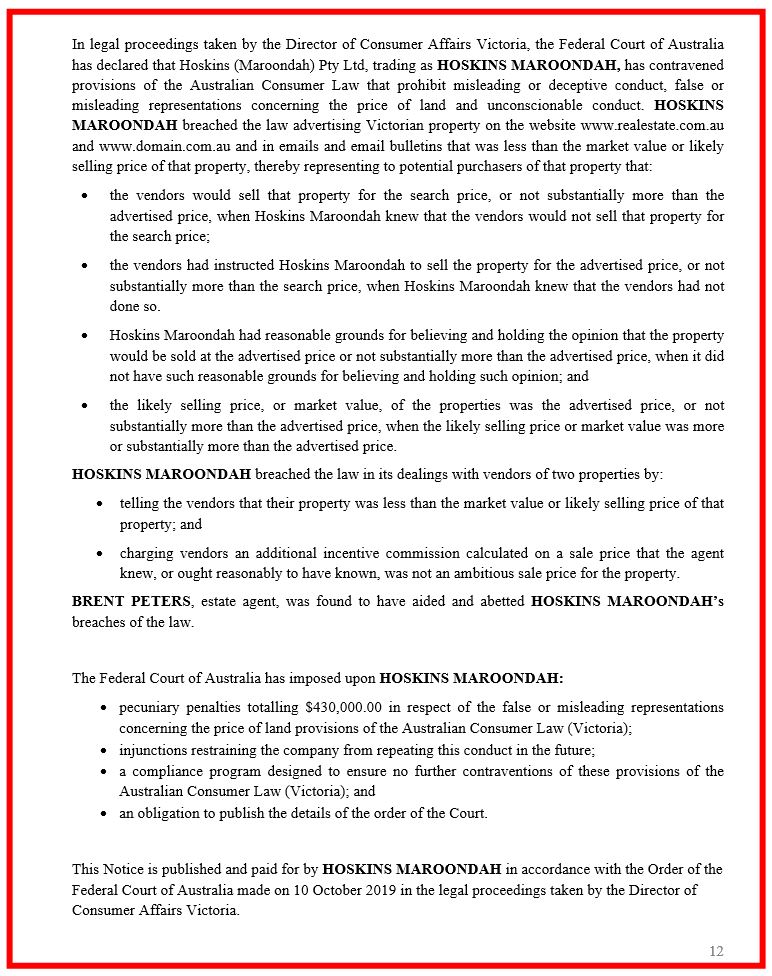
11. Hoskins Maroondah, having contravened a provision of Chapter 3 of the ACL (Vic), must, within 10 days of the date of the Court’s orders, cause to be displayed, prominently, conspicuously and continuously, for a period of 6 months, in the public area at each of the premises from which it carries on the business of an estate agent, a public notice in the form and with the content of Annexure B to this Order (Public Notice). The Notice must:
(a) be on A4 size paper or greater;
(b) use a minimum type size of 12-point Times New Roman or equivalent; and
(c) be in full colour.
12. Hoskins Maroondah take all reasonable steps to cause the Public Notice to be published on:
(a) the Property Website; and
(b) the internet at the homepage of all websites which are presently owned, operated or maintained by or behalf of Hoskins Maroondah, or if any such URL is replaced or changed, the internet home page of the corresponding website, for a period of 6 months from the date of the Court’s orders, and use its best endeavours to ensure that:
(i) the Public Notice is to be viewable by clicking through a “click-through” icon located on the Hoskins Maroondah website;
(ii) the “click-through” icon referred to in the sub-paragraph (i) above is located in a central position on the page first accessed when a user searches for real estate in Maroondah, Victoria, on the property website;
(iii) the “click-through” icon referred to in the sub-paragraph (i) above is located in a central position on the page first accessed when the user opens to the home page of any Hoskins Maroondah website;
(iv) the “click-through” icon must contain the words “FALSE, MISLEADING AND DECEPTIVE CONDUCT AND UNCONSCIONABLE CONDUCT – IMPORTANT NOTICE ORDERED BY FEDERAL COURT OF AUSTRALIA” (in capital letters and use a minimum type size of 16-point Times New Roman or equivalent), clearly and prominently in red on a contrasting background and the words “Click Here”; and
(v) the Public Notice occupies the entire webpage which is accessed via the “click-through” icon referred to above.
Non-punitive orders (Compliance Program) – s 246 ACL(Vic)
13. Hoskins Maroondah, at its own expense, establish, within 3 months of the date of the Court’s orders, a compliance program which meets the requirements set out in Annexure C to this Order and maintain the compliance program for 3 years from the date on which it is established.
14. Hoskins Maroondah file and serve on the Applicant, within 3 months of the date of the Court’s orders, an affidavit of its proper officer verifying that it has carried out its obligations under the Orders of the Court made under paragraphs 8-13 above detailing what it has done including:
(a) in respect of paragraph 11 above, by providing a copy of the corrective advertisement displayed at the each of the premises from which it carries on the business of an estate agent; and
(b) in respect of paragraph 12 above:
(i) a date-stamped screen capture of each website showing the click-through link; and
(ii) a date-stamped screen capture of the stand-alone web page containing the notice.
Orders for non-party consumers (compensation) – s 239 ACL and ACL(Vic)
15. Hoskins Maroondah and/or Peters refund:
(a) the sum of to $17,550 to the vendor of the Cass Avenue Property; and
(b) the sum of $12,000 to the vendors of the Rodleigh Street Property
within 30 days from the date of these orders.
Costs – s 43 FCAA
16. Hoskins Maroondah pay the Applicant $5,000 as a contribution to the Applicant’s costs.
17. Peters pay the Applicant $5,000 as a contribution to the Applicant’s costs.
Note: Entry of orders is dealt with in Rule 39.32 of the Federal Court Rules 2011.
STEWARD J:
1 In recent years, the Director of Consumer Affairs Victoria (the “Director”) has commenced multiple proceedings in this Court against real estate agents alleging contraventions of the Australian Consumer Law (Sch 2 to the Competition and Consumer Act 2010 (Cth)) (“ACL”) and the Australian Consumer Law (Victoria) (the ACL as it applies in Victoria pursuant to s 8 of the Australian Consumer Law and Fair Trading Act 2012 (Vic)) (“ACL(Vic)”). This is one of those proceedings.
2 The first respondent (“Hoskins Maroondah”) carries on a real estate business in Victoria as a licensed estate agent. The second respondent (“Mr Peters”) is, and was at all material times, a director and the officer in effective control of Hoskins Maroondah. He too is a licensed estate agent.
3 The Director alleged that during 2015 and 2016:
(a) Hoskins Maroondah had engaged in misleading or deceptive conduct and had made false or misleading representations concerning the likely selling price for 26 residential properties at various addresses in Croydon and its neighbouring suburbs in breach of ss 18 and 30 of the ACL and ACL(Vic);
(b) Hoskins Maroondah had engaged in unconscionable conduct in its dealings with the vendors of two of the aforementioned properties in breach of s 21 of the ACL and ACL(Vic); and
(c) Mr Peters had been involved in Hoskins Maroondah’s contraventions of the ACL and ACL(Vic).
4 The claims concerning unconscionable conduct were said to set this proceeding apart from other cases recently brought by the Director in this Court: Director of Consumer Affairs Victoria v Hocking Stuart (Richmond) Pty Ltd [2016] FCA 1184 per Middleton J; Director of Consumer Affairs Victoria v Fletcher & Parker (Balwyn) Pty Ltd [2017] FCA 1521 per Murphy J; Director of Consumer Affairs Victoria v Manningham Property Group Pty Ltd [2017] FCA 1448 per Murphy J; and Director of Consumer Affairs Victoria v Melbourne South Eastern Real Estate Pty Ltd [2018] FCA 1763 per Mortimer J.
5 Both respondents in this proceeding have admitted liability concerning their conduct in relation to the 24 residential properties that are listed in Annexure A to these reasons (the “Properties”). Consequently, the parties filed with the Court both a Statement of Agreed Facts and proposed consent orders. In accordance with established authority, I made the orders proposed by the parties at a hearing on 10 October 2019. These are my reasons for doing so. As will be seen, some of those orders were not made without a degree of reservation on my part.
Legislative Provisions
6 Section 18 of the ACL and ACL(Vic) relevantly provides:
Misleading or deceptive conduct
(1) A person must not, in trade or commerce, engage in conduct that is misleading or deceptive or is likely to mislead or deceive.
…
7 Section 30(1)(c) of the ACL and ACL(Vic) specifically prohibits false or misleading representations in relation to the promotion of land sales. It provides:
False or misleading representations about sale etc. of land
(1) A person must not, in trade or commerce, in connection with the sale or grant, or the possible sale or grant, of an interest in land or in connection with the promotion by any means of the sale or grant of an interest in land:
…
(c) make a false or misleading representation concerning the price payable for the land; or
…
8 Section 21(1) of the ACL and ACL(Vic) provides:
Unconscionable conduct in connection with goods or services
(1) A person must not, in trade or commerce, in connection with:
(a) the supply or possible supply of goods or services to a person; or
(b) the acquisition or possible acquisition of goods or services from a person;
engage in conduct that is, in all the circumstances, unconscionable.
9 Section 2(1) of the ACL and ACL(Vic) relevantly defines the term “involved” as follows:
involved: a person is involved, in a contravention of a provision of this Schedule or in conduct that constitutes such a contravention, if the person:
(a) has aided, abetted, counselled or procured the contravention …
Facts
10 The Statement of Agreed Facts before the Court sets out the narrative of conduct in respect of each of the Properties. For present purposes, it is not necessary for me to descend into that level of detail. I shall instead provide an overview of the impugned conduct, relying on the Statement of Agreed Facts which was admitted pursuant to s 191 of the Evidence Act 1995 (Cth).
The representations in advertisements to potential purchasers
11 In 2015 and 2016, Hoskins Maroondah was engaged by the vendors of each of the Properties. Mr Peters was the listing agent for all of the Properties (with the exception of one home). He was otherwise responsible for advertising and negotiating the sale of all of the Properties.
12 At various times between 2015 and 2016, Hoskins Maroondah published advertisements in respect of the Properties on the websites “realestate.com.au” and “domain.com.au” and in a bulletin distributed by email to potential purchasers. The advertisement for each of the Properties contained a “Display Price”, which was the estimated selling price for the relevant property. Hoskins Maroondah made representations in those advertisements: (i) that it in fact believed and held the opinion, on reasonable grounds, that the Properties would be sold at, or not substantially more than, the applicable Display Price; and/or (ii) that the likely selling price, or market value, of the Properties was, or was not substantially more than, the applicable Display Price. Those representations did not reflect the true position.
13 At the time Hoskins Maroondah made those representations, one or more of the following had occurred with respect to each of the Properties:
(a) Hoskins Maroondah had internally arrived at an estimate of the selling price which greatly exceeded the Display Price. That estimate was struck in a game played by sales and sales support staff of Hoskins Maroondah (and a sister agency) known as “Nearest to the Pin”;
(b) a director of Hoskins Maroondah had expressed the view that the Display Price was too low;
(c) a member or members of Hoskins Maroondah’s board had expressed the view that the Display Price was too low;
(d) the vendor or vendors told Hoskins Maroondah that they would not sell the relevant home for a price that was either not substantially above the Display Price or, where there was a finite range stipulated as the Display Price, within that Display Price range;
(e) Hoskins Maroondah, notwithstanding its adherence to the Display Price in its advertisements, had told individual potential purchasers, who had inquired about the likely selling price of the relevant home, that the home would sell for a price that was above or substantially above the Display Price.
14 In view of those circumstances it is perhaps unsurprising that all of the Properties later sold for a price that was above or substantially above the Display Price. The table below illustrates the degree of variance:
Property | Display Price | Sale Price |
Alma Court, Ringwood | $690,000 Plus | $830,000 |
Ambon Rise, Croydon North | $695,000 Plus | $891,000 |
Campaspe Drive, Croydon Hills | $650,000 Plus | $811,000 |
Cass Avenue, Croydon | $495,000-$550,000 | $677,000 |
Crawley Grove, Ringwood North | $925,000 Plus | $1.2 million |
Drysdale Court, Croydon Hills | $690,000 Plus | $831,000 |
Glen Avenue, Croydon | $890,000 Plus | $1.21 million |
Hannora Crescent, Croydon | $610,000-$710,000 | $782,000 |
Henry Smith Place, Croydon Hills | $770,000 Plus | $930,500 |
Highland Avenue, Croydon | $690,000 Plus | $872,000 |
Hyton Crescent, Croydon | $630,000 Plus | $865,000 |
Janson Court, Croydon North | $695,000 Plus | $800,000 |
Kelly Court, Warranwood | $770,000 Plus | $923,000 |
Mundarra Drive, Ringwood | $690,000 Plus | $880,000 |
Partridge Way, Mooroolbark | $650,000 Plus | $832,000 |
Rodleigh Street, Croydon | $470,000 Plus | $605,000 |
Roymar Court, Wonga Park | $590,000 Plus | $710,000 |
Settlers Hill Crescent, Croydon Hills | $495,000-$580,000 | $625,000 |
Timms Avenue, Croydon | $555,000 Plus | $710,000 |
Webster Avenue, Croydon | $670,000 Plus | $875,000 |
Western Way, Mooroolbark | $545,000 Plus | $730,000 |
Williams Road, Park Orchards | $1.28 million - $1.48 million | $1,588,000 |
Wilton Close, Croydon North | $690,000 Plus | $866,000 |
Valkyrie Crescent, Ringwood | $540,000-$620,000 | $741,000 |
I note parenthetically that the Display Price for some of the Properties was revised during the advertising period; what I have set out above is the Display Price advertised just before the sale of the Property.
The representations and unconscionable conduct in respect of the Cass Avenue Property and the Rodleigh Street Property
15 The extent of contravening conduct was graver in connection with the sale of two of the Properties, which were referred to as the Cass Avenue Property and the Rodleigh Street Property. First, the Director alleged, and the respondents admitted, that Hoskins Maroondah: had made false or misleading and deceptive representations to the vendors respecting the value of those properties. In essence, Hoskins Maroondah represented that it genuinely believed that the Cass Avenue Property would sell for an amount around or not substantially above $520,000, and that the Rodleigh Street Property would sell for an amount around or not substantially above “the low $500,000s” (together, the “Estimated Selling Prices”). Again, those representations did not reflect the true position. They had been made in circumstances where, for example, Hoskins Maroondah had told potential purchasers, who had inquired about the likely selling price of those properties, that the properties would sell for a price above or substantially above those Estimated Selling Prices.
16 Secondly, the Director alleged, and the respondents admitted, that Hoskins Maroondah had engaged in unconscionable conduct. The parties agreed that unconscionability arose on the following facts. In brief compass, Hoskins Maroondah secured an incentive commission from the vendors of those properties in circumstances where it knew or ought to have reasonably known that:
(a) the vendors were in a weak bargaining position relative to Hoskins Maroondah;
(b) the vendors trusted and relied on Hoskins Maroondah’s superior knowledge and expertise in the local property market;
(c) Hoskins Maroondah had made false or misleading and deceptive representations to the vendors as to the value of the Cass Avenue Property and the Rodleigh Street Property;
(d) Hoskins Maroondah did not forewarn the vendors that the price above which the incentive commission was payable (the “Incentive Price”) was not an ambitious sale price for the Cass Avenue Property and the Rodleigh Street Property respectively;
(e) Hoskins Maroondah did not forewarn the vendors that it had received buyer interest in the Cass Avenue Property and the Rodleigh Street Property to purchase those properties for a price which exceeded the Incentive Price; and
(f) the vendors could have acquired the same or similar services for a much lower price than the vendors actually paid.
17 Further, in respect of the Cass Avenue Property, Hoskins Maroondah did not forewarn the vendor that the average estimated price according to the Nearest to the Pin game was $647,000. Hoskins Maroondah also failed and/or refused to respond to the vendor’s complaint/feedback about the commission charged by it.
18 It should be observed that given that the parties reached a position of consent, the Court was not itself called upon to make findings with respect to unconscionability. The above should therefore not be taken as establishing a precedent of this Court as to what practices in the real estate industry amount to unconscionable conduct for the purposes of s 21 of the ACL and ACL(Vic).
The Appropriateness of the Orders
Relevant principles
19 In Melbourne South Eastern Real Estate Pty Ltd, Mortimer J helpfully distilled the following principles at [72]-[75]:
72 I accept the Director’s submission, by reference to the decision of French J (as his Honour then was) in Australian Competition and Consumer Commission v Real Estate Institute of Western Australia Inc [1999] FCA 18; 161 ALR 79, that in regulatory matters, where the parties have reached an agreed settlement of a proceeding, involving a range of remedies, the Court’s role is a restrained one in terms of considering whether different remedies should be imposed. His Honour said (at [20]):
A general principle of judicial restraint in the scrutiny of proposed settlements was enunciated early in the history of the Trade Practices Act. It is not the function of the court to impede settlements between parties legally represented and able to understand and evaluate the desirability of agreeing to a settlement nor to refuse to give effect to terms of settlement by refusing to make orders or accept undertakings where they are within the court’s jurisdiction and otherwise unobjectionable.
73 The Court must be satisfied the remedies are just and appropriate, but whether they are “just” will be substantially informed by the fact that they have been agreed, after a negotiation between legally represented parties, bearing in mind the regulator (here the Director) acts in the public interest. That is an approach which is common in civil proceedings, including regulatory proceedings of the current kind which are plainly civil proceedings. In Commonwealth of Australia v Director, Fair Work Building Industry Inspectorate [2015] HCA 46; 258 CLR 482 the plurality said (at [57]):
In contrast, in civil proceedings there is generally very considerable scope for the parties to agree on the facts and upon consequences. There is also very considerable scope for them to agree upon the appropriate remedy and for the court to be persuaded that it is an appropriate remedy. Accordingly, settlements of civil proceedings are commonplace and orders by consent for the payment of damages and other relief are unremarkable. So are court-approved compromises of proceedings on behalf of infants and persons otherwise lacking capacity, court-approved custody and property settlements, court approved compromises in group proceedings and court-approved schemes of arrangement. More generally, it is entirely consistent with the nature of civil proceedings for a court to make orders by consent and to approve a compromise of proceedings on terms proposed by the parties, provided the court is persuaded that what is proposed is appropriate.
74 Thus, where a full settlement has been reached, contraventions admitted, and a suite of orders proposed to reflect that settlement, whether the remedies proposed by the parties is “appropriate” is the task for the consideration of the Court.
75 Further, when considering whether the remedies proposed are appropriate, the Court must focus on the protective purpose of the ACL and of the imposition of remedies such as civil penalties, and assess what is proffered against that standard. The plurality made this clear in Commonwealth of Australia v Director, Fair Work Building Industry Inspectorate at [55]:
No less importantly, whereas criminal penalties import notions of retribution and rehabilitation, the purpose of a civil penalty, as French J explained in Trade Practices Commission v CSR Ltd, is primarily if not wholly protective in promoting the public interest in compliance:
“Punishment for breaches of the criminal law traditionally involves three elements: deterrence, both general and individual, retribution and rehabilitation. Neither retribution nor rehabilitation, within the sense of the Old and New Testament moralities that imbue much of our criminal law, have any part to play in economic regulation of the kind contemplated by Pt IV [of the Trade Practices Act] … The principal, and I think probably the only, object of the penalties imposed by s 76 is to attempt to put a price on contravention that is sufficiently high to deter repetition by the contravenor and by others who might be tempted to contravene the Act.”
(citations omitted)
20 I respectfully adopt the foregoing statements of principle.
The parties’ proposed orders
21 The proposed orders before me bore great resemblance to the orders made by Middleton J in Hocking Stuart (Richmond) Pty Ltd, being orders for declarations, pecuniary penalties, adverse publicity notices, the establishment of a compliance program and costs. There were, however, two differences in the present case. First, the Director additionally sought an order to compensate the vendors of the Cass Avenue Property and the Rodleigh Street Property for the incentive commissions they had paid. This proposed order did not concern me in light of the respondents admitting to the unconscionable conduct claim. Second, the Director additionally sought injunctive relief. This proposed order did concern me. Seen in the context of the other remedies sought, I found it difficult to discern the appropriateness of the injunction in the circumstances of this case. I shall elaborate.
The appropriateness of injunctive relief
22 It is true that s 232 confers upon the Court a wide injunctive power. By way of illustration, s 232(4) provides that the Court may grant an injunction “whether or not it appears to the court that the person intends to engage again, or to continue to engage, in conduct of a kind” that would contravene the ACL. The foregoing does not, however, mean that it will be appropriate for the Court to enjoin contravening conduct as a matter of course.
23 In Australian Competition and Consumer Commission v Dataline.Net.Au Pty Ltd (in liquidation) (2007) 161 FCR 513, the Full Court of this Court discussed the grant of injunctive relief pursuant to former s 80 of the Trade Practices Act 1974 (Cth). Moore, Dowsett and Greenwood JJ made the following observations at 543-544 [110]-[111] and 114:
110 We are inclined to think that in general, a court order requiring a person to conduct themselves in a particular way when a statute requires that conduct in any event, will add little to the statutory prescription or proscription and the statutory sanctions attending non-compliance. We accept that such an order may add the possibility of imprisonment for contempt where the relevant contravention would not otherwise lead to that consequence. However, if Parliament has not provided for imprisonment in connection with a contravention, it may not be appropriate for a court to enjoin such conduct simply in order to create the possibility of imprisonment. While Parliament has provided for an injunction as a possible remedy, it may be doubted that it intended that an injunction would be a remedy granted in the ordinary course in the face of the statutory sanctions Parliament has itself provided. Moreover, a Court has an interest in maintaining the efficacy of injunctive relief which requires that orders be respected. They will only be respected if they consistently serve a useful purpose and if breaches are discovered and punished. It may also be doubted that a court order requiring conduct which a statute otherwise requires will be seen to have some greater or different significance to the statutory requirement.
111 Many contraventions simply will not justify injunctive relief. We doubt whether unintentional misconduct in contravention of s 52 [of the Trade Practices Act 1974 (Cth)] would lead to such relief. An isolated intentional breach may also not warrant it. Conduct which occurred many years before the enforcement proceedings may not do so, especially if the offender has not recently infringed the law, or is no longer in a position where contravention is likely. These are obvious cases, but they raise questions as to the relevant factors in considering whether to grant such relief. The discretion is at large. It is for the relevant applicant to demonstrate that the injunction will serve a purpose. That purpose may involve the protection of the public interest or private rights.
…
114 The experience of the law is that unlawful or illegal conduct does not lead to an injunction against repetition of such conduct being sought or granted. A range of other remedies exist in the civil and criminal law which are treated as adequate and appropriate sanctions for such conduct. Normally, it is only where there is a real risk of further misconduct that injunctive relief is contemplated. It is, we think, no answer to this experience to say that subss (4) and (5) provide that absence of any threat of further contravention is no longer a bar to the grant of such relief. An injunction should not be seen as a necessary vindication of the applicant’s conduct in bringing the proceedings. Other relief may better serve that purpose. Nor should an injunction be sought primarily for public relations purposes, however worthy such purposes may be.
24 More recently, in Australian Competition and Consumer Commission v PT Garuda Indonesia Ltd (Remedies) [2019] FCA 786, Perram J declined to grant injunctive relief under s 80 of the Competition and Consumer Act 2010 (Cth). After referring to [114] of Dataline, his Honour said at [257]-[259]:
257 I read this paragraph as indicating that there should be no injunction granted where the conduct to be restrained is, in any event, subject to penalty under the CCA unless there is a ‘real risk of further misconduct’. The Commission submitted that injunctive relief was appropriate in this case because: first, Garuda’s submissions showed that it exhibited no contrition and regarded its contraventions of Australian law as merely technical or happenstance. This was so because of Garuda’s submission that it had not taken part in the activities which showed there was a market in Australia for the purposes of s 4E; secondly, because Garuda had submitted that any further conduct would not be unlawful; and, thirdly, there was a significant public interest in preventing any repetition of the conduct in view of the harm it would cause.
258 Whilst I acknowledge the force of this submission, I do not accept it. The conduct which the Commission seeks to have restrained is already unlawful and would expose Garuda to substantial civil penalties. These penalties would be augmented by the fact that it would not be the first time that Garuda had been found to have breached the CCA. That fact is not to be ignored in assessing what Garuda is likely to do in the future.
259 Whilst it may be possible to grant an injunction where there is a real risk that the conduct might be repeated, it is not possible to describe the risk which Garuda presents as a ‘real risk’ in the sense discussed in Dataline …
His Honour then went on to observe that the size of the pecuniary penalty imposed was “highly likely” to deter the respondent in that case from engaging in unlawful conduct in the future. Those factors considered cumulatively led his Honour to conclude that the respondent should not be restrained.
25 In view of these authorities, which I consider to apply in the context of exercising the power under s 232, I had reservations about the injunctive relief sought. My reservations were underpinned by the following factors: first, since the commencement of this proceeding in 2017, almost two years ago, it has not been alleged that the respondents have repeated their unlawful conduct; secondly, there was no evidence before me that there was a “real risk” that the respondents would repeat their unlawful conduct in the future; and thirdly, both respondents had agreed to pay a significant pecuniary penalty ($860,000 in total). In those circumstances, I was inclined to the view that injunctive relief was not appropriate.
26 Dr Sharpe of Counsel, who appeared for the Director, submitted that an injunction was an appropriate remedy for two reasons: it marks the Court’s condemnation of the respondents’ conduct, and it may avail an easier mechanism by which to enforce the law should there be any repetition of the unlawful conduct. The necessity of the injunction, it was said, was not displaced by the low likelihood of the offending conduct being repeated. Dr Sharpe also drew my attention to the decision of Murphy J in Manningham Property Group Pty Ltd where very similar injunctive relief had been granted against another real estate agency in analogous circumstances.
27 With respect, in my view, the declarations that the respondents had contravened the law coupled with the pecuniary penalties would have sufficiently marked the Court’s disapproval of the respondents’ conduct. It is not for this Court to deploy every weapon in its remedial armoury in a bid to condemn unlawful conduct. Further, I remain unimpressed with the proposition that the possibility of an easier enforcement mechanism justifies the grant of an injunction, particularly where the risk of re-offending is low.
28 In any event, despite my reservations, at the hearing I concluded that I should grant the injunction given Murphy J’s decision in Manningham Property Group Pty Ltd. That conclusion was fortified by the fact that the proposed injunction was consented to and had been the product of significant negotiation between legally represented parties. It was also fortified by the need for judicial comity and consistency in relation to a series of decisions involving the same essential subject matter. Had it not been for the foregoing factors, I would have declined to grant the injunction.
The appropriateness of the other proposed orders
29 Applying the approach taken in Hocking Stuart (Richmond) Pty Ltd, Manningham Property Group Pty Ltd, Fletcher & Parker (Balwyn) Pty Ltd and Melbourne South Eastern Real Estate Pty Ltd, and having regard to the nature and extent of the respondents’ contravening conduct, I was otherwise satisfied that the proposed declarations, pecuniary penalties, adverse publicity notices, compliance program and order as to costs were appropriate.
Conclusion
30 Having been sufficiently persuaded of the accuracy of the parties’ agreement as to the facts and consequences, and that the proposed remedies were appropriate, I accepted that it was highly desirable for me to give effect to the parties’ proposal. The orders have therefore been entered in the terms sought by the parties.
I certify that the preceding thirty (30) numbered paragraphs are a true copy of the Reasons for Judgment herein of the Honourable Justice Steward. |
Associate:
ANNEXURE “A” (Properties)
(a) 3 Alma Court, Ringwood
(b) 2 Ambon Rise, Croydon North
(c) 7 Campaspe Drive, Croydon Hills;
(d) 30 Cass Avenue, Croydon (Cass Avenue Property)
(e) 48 Crawley Grove, Ringwood North
(f) 6 Drysdale Court, Croydon Hills
(g) 12 Glen Avenue, Croydon
(h) 6 Hannora Crescent, Croydon
(i) 3 Henry Smith Place, Croydon Hills
(j) 43 Highland Avenue, Croydon
(k) 21 Hyton Crescent, Croydon
(l) 15 Janson Court, Croydon North
(m) 30 Kelly Court, Warranwood
(n) 47 Mundarra Drive, Ringwood
(o) 96 Partridge Way, Mooroolbark
(p) 23 Rodleigh Street, Croydon (Rodleigh Street Property)
(q) 14 Roymar Court, Wonga Park
(r) 16 Settlers Hill Crescent, Croydon Hills
(s) 33A Timms Avenue, Croydon
(t) 14 Webster Avenue, Croydon
(u) 12 Western Way, Mooroolbark
(v) 8-12 Williams Road, Park Orchards
(w) 8 Wilton Close, Croydon North
(x) 8 Valkyrie Crescent, Ringwood
ANNEXURE B (Public Notice)
ANNEXURE C (Compliance Program)
Hoskins Maroondah will establish a Compliance Program (Compliance Program) that complies with each of the following requirements:
Appointments
(1) Within 30 days of the date of the Order of the Court (Court Order) coming into effect Hoskins Maroondah will appoint a Director or a Senior Manager with suitable qualifications or experience in corporate compliance as Compliance Officer with responsibility for ensuring the Compliance Program is effectively designed, implemented and maintained.
(2) Within 2 months of the date of the Court Order coming into effect Hoskins Maroondah shall appoint a qualified, internal or external, compliance professional with expertise in the Australian Consumer Law (Victoria) (ACL(Vic)) and the Estate Agents Act 1980 (Vic) (EAA) (the Compliance Advisor). Hoskins Maroondah shall instruct the Compliance Advisor to conduct a risk assessment (Risk Assessment) in accordance with 2(a) – 2(d) below:
(a) Identify the areas where Hoskins Maroondah is at risk of breaching:
(i) the ACL(Vic):
A. section 18 of Part 2-1 (misleading or deceptive conduct);
B. section 21 of Part 2-2 (unconscionable conduct);
C. section 30 of Part 3-1, Division 1 (false or misleading representations etc.); and
(ii) the EAA:
A. sections 47A to AF (inclusive) (price estimates);
B. section 47B (false representations to prospective seller); and
C. section 47C (false representations to prospective purchaser);
(b) assess the likelihood of these risks occurring and the consequences of the risks to the estate agent business operations of Hoskins Maroondah should they occur;
(c) identify where there may be gaps in Hoskins Maroondah’s existing procedures for managing these risks; and
(d) provide recommendations for action having regard to the assessment.
Compliance Policy
(3) Hoskins Maroondah will, within 30 days of the Court Order coming into effect, issue a policy statement outlining Hoskins Maroondah’s commitment to trade practices compliance (the Compliance Policy). Hoskins Maroondah will ensure that the Compliance Policy:
(a) is written in plain language;
(b) contains a statement of commitment to comply with the ACL(Vic) and the EAA;
(c) contains a strategic outline of how the commitment to comply will be realised within Hoskins Maroondah;
(d) contains a requirement for all staff to report any Compliance Program related issues concerns to the Compliance Officer;
(e) contains a guarantee that whistleblowers will not be prosecuted or disadvantaged in any way for making a genuine report and that their reports will be kept confidential and secure; and
(f) contains a clear statement that Hoskins Maroondah will take action internally against any persons who are knowingly or recklessly concerned in a contravention of the applicable legislation administered by the Applicant (including the ACL(Vic) and the EAA) and will not indemnify them.
Complaints Handling System
(4) Hoskins Maroondah will ensure that the Compliance Program includes a complaints handling system. Hoskins Maroondah shall use its best endeavours to ensure this system is consistent with AS/ISO 10002:2006 Customer satisfaction – Guidelines for complaints handling in organizations, though tailored to Hoskins Maroondah’s circumstances. Hoskins Maroondah will ensure that staff and customers are made aware of the complaints handling system.
(5) Hoskins Maroondah will ensure that the Compliance Program includes whistleblower protection mechanisms to protect those coming forward with complaints. Hoskins Maroondah shall use its best endeavours to ensure that these mechanisms are consistent with Australian Standard 8004:2003 Whistleblower protection programs for entities, though tailored to Hoskins Maroondah’s circumstances.
Reports to Board/Senior Management
(6) Hoskins Maroondah will ensure that the Compliance Officer reports to its senior management meetings every 12 months on the continuing effectiveness of the Compliance Program and any recommendations for improvement of the Compliance Program.
Training
(7) Hoskins Maroondah will ensure that the Compliance Program provides for regular (at least once a year) and practical training for all directors, officers, employees, representatives and agents of Hoskins Maroondah, whose duties could result in them being concerned with conduct that may contravene:
(a) the ACL(Vic):
(i) section 18 of Part 2-1 (misleading or deceptive conduct);
(ii) section 21 of Part 2-2 (unconscionable conduct);
(iii) section 30 of Part 3-1, Division 1 (false or misleading representations etc.); and
(b) the EAA:
(i) sections 47A to AF (inclusive) (price estimates);
(ii) section 47B (false representations to prospective seller); and
(iii) section 47C (false representations to prospective purchaser);
(8) Hoskins Maroondah must ensure that the training is conducted by a suitably qualified compliance professional or legal practitioner with expertise in the ACL(Vic) and the EAA.
(9) Hoskins Maroondah will ensure that the Compliance Program includes a requirement that awareness of ACL(Vic) and the EAA compliance issues forms part of the induction of all new directors, officers, employees, representatives and agents, whose duties could result in them being concerned with conduct that may contravene:
(a) the ACL(Vic):
(i) section 18 of Part 2-1 (misleading or deceptive conduct);
(ii) section 21 of Part 2-2 (unconscionable conduct);
(iii) section 30 of Part 3-1, Division 1 (false or misleading representations etc.); and
(b) the EAA:
(i) sections 47A to AF (inclusive) (price estimates);
(ii) section 47B (false representations to prospective seller); and
(iii) section 47C (false representations to prospective purchaser).
Supply of Compliance Program Documents to the Applicant
(10) Hoskins Maroondah shall, at its own expense, within 3 months of the date of the Court Order coming into effect, cause to be produced and provided to the Applicant copies of each of the documents constituting the Compliance Program and implement promptly and with due diligence any recommendations that the Applicant may make that are reasonably necessary to ensure that Hoskins Maroondah maintains and continues to implement the Compliance Program in accordance with the requirements of the Court Order.
Recommendations
(11) Hoskins Maroondah shall implement promptly and with due diligence any recommendations made in the report referred to in paragraph 6 above.


