

FEDERAL COURT OF AUSTRALIA
Think Childcare Limited, in the matter of Think Childcare Limited [2019] FCA 1862
ORDERS
THINK CHILDCARE LIMITED ACN 600 793 388 Plaintiff | ||
DATE OF ORDER: |
THE COURT ORDERS THAT:
1. Pursuant to s 411(1) of the Corporations Act 2001 (Cth) (Act), the plaintiff convene and hold a meeting (Scheme Meeting) of holders of fully paid ordinary shares in the plaintiff (Scheme Shareholders):
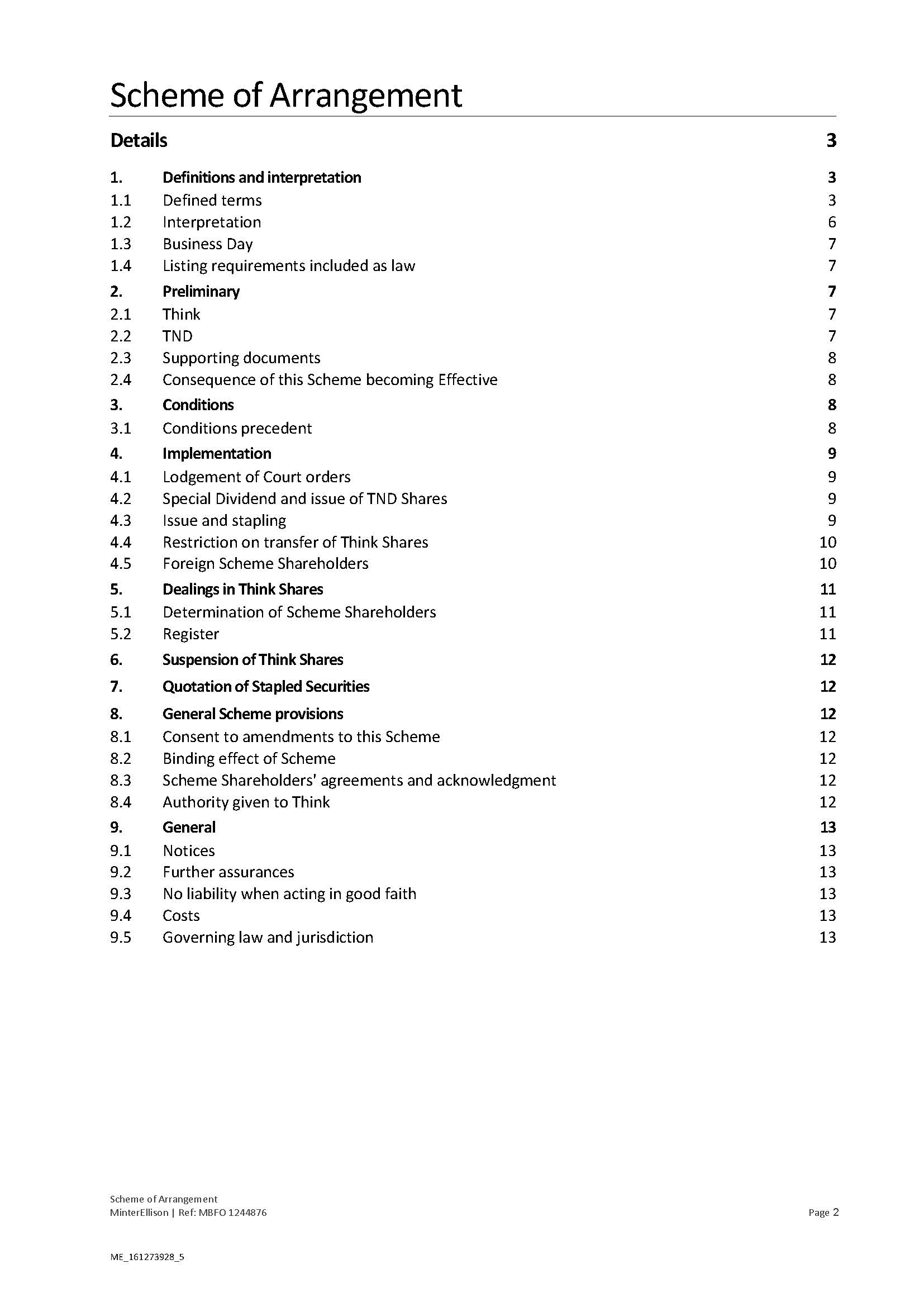
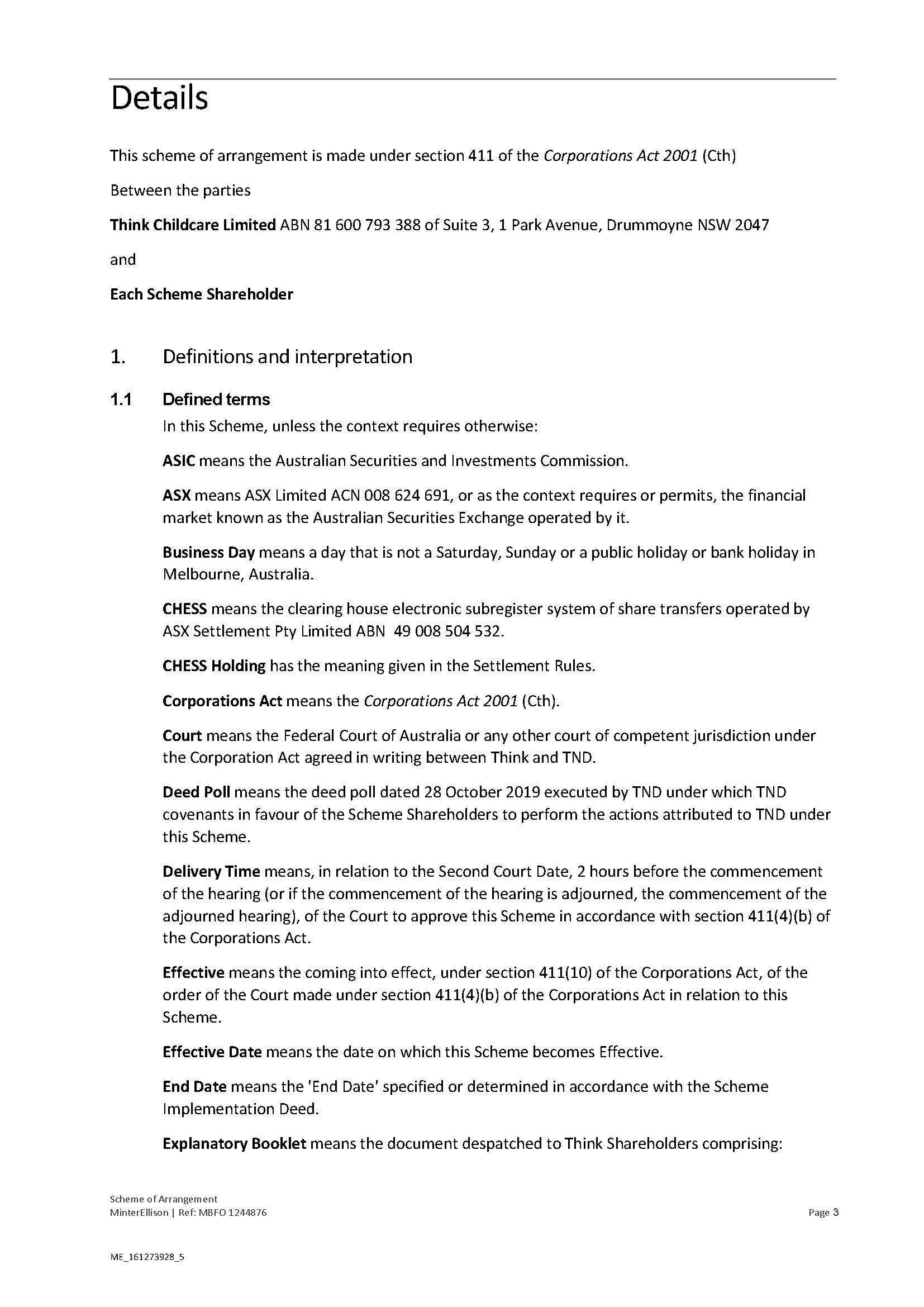
(a) to consider and, if thought fit, to approve (with or without modification) the scheme of arrangement (Scheme) proposed to be made between the plaintiff and Scheme Shareholders, the terms of which are set out in Annexure B to these Orders; and
(b) to be held at 10.30 am (Melbourne time) on Thursday, 5 December 2019 at the offices of MinterEllison, Rialto Towers, 525 Collins Street, Melbourne, Victoria.
2. The Scheme Meeting be convened by sending on or before 5 November 2019:
(a) in the case of Scheme Shareholders who have elected to receive shareholder communications electronically by way of email (Email Shareholders), an email substantially in the form at Annexure ‘ME22’ to the affidavit of Mathew Graeme Edwards sworn 29 October 2019 (Edwards Affidavit) and which contains links to:
(i) an electronic copy of a document substantially in the form of the explanatory booklet, a draft of which is at Annexure ‘BFO12’ to the affidavit of Bernard Frederic Oude-Vrielink sworn on 30 October 2019 (Explanatory Booklet), which contains, among other things, the Notice of Scheme Meeting at Appendix 3 to the Explanatory Booklet; and
(ii) an online portal or website that is accessible by the Email Shareholder and which enables the Email Shareholder to lodge their proxy for the Scheme Meeting and voting instructions online; and
(b) in the case of Scheme Shareholders who are not Email Shareholders and whose registered address is in Australia, the following documents by pre-paid post addressed to the relevant addresses recorded in the plaintiff’s register:
(i) a document substantially in the form of the Explanatory Booklet, which contains, among other things, the Notice of Scheme Meeting at Appendix 3 to the Explanatory Booklet;
(ii) personalised proxy form for the Scheme Meeting, substantially in the form at Annexure ‘ME23’ to the Edwards Affidavit (Proxy Form); and
(iii) a reply paid envelope for the return of the Proxy Form; and
(c) in the case of Scheme Shareholders who are not Email Shareholders and whose registered address is outside Australia, the following documents by airmail addressed to the relevant addresses recorded in the plaintiff’s register:
(i) a document substantially in the form of the Explanatory Booklet, which contains, among other things, the Notice of Scheme Meeting at Appendix 3 to the Explanatory Booklet;
(ii) a personalised Proxy Form; and
(iii) a return envelope for the return of the Proxy Form.
3. Voting on the resolution to approve the Scheme is to be conducted by way of a poll.
4. A Proxy Form in respect of the Scheme Meeting will be valid and effective if, and only if, it is completed and delivered in accordance with its terms by 10.30 am (Melbourne time) on Tuesday, 3 December 2019.
5. Mr Mark Gregory Kerr, or failing him, Mr Joe Leonard Dicks be Chairperson of the Scheme Meeting.
6. The Chairperson of the Scheme Meeting shall have the power to adjourn the meeting to such time, date and place as he considers appropriate.
7. Compliance with r 2.15 of the Federal Court (Corporations) Rules 2000 (Cth) (Rules) is dispensed with.
8. Compliance with r 3.4 and Form 6 of the Rules is dispensed with.
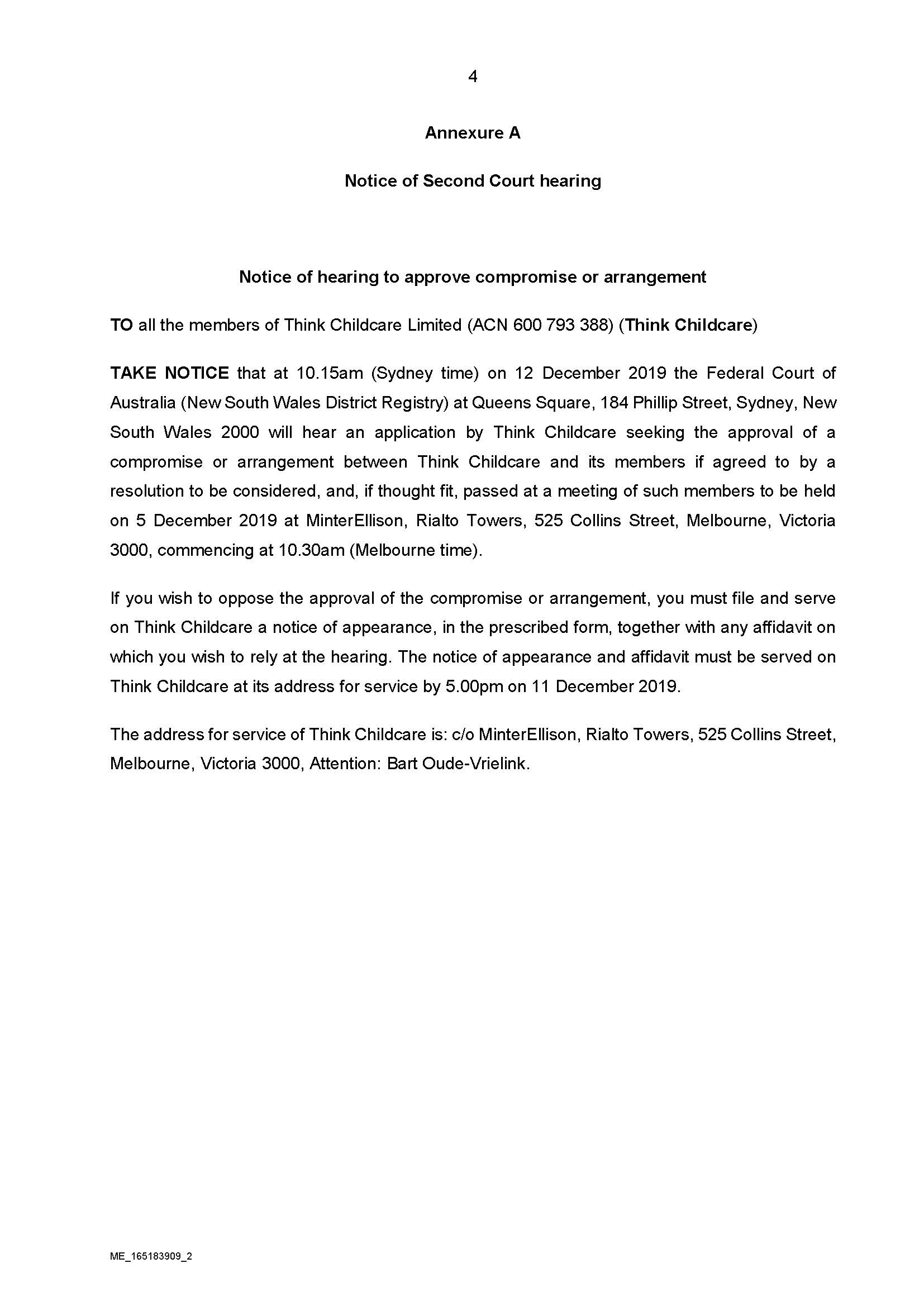
9. The plaintiff publish in The Australian newspaper once on or before 28 November 2019 an advertisement substantially in the form of Annexure A to these Orders.
10. The further hearing of the Originating Process is adjourned to a hearing before Markovic J on 12 December 2019 at 10.15 am (Sydney time) or as soon thereafter as the business of the Court allows.
11. There be liberty to apply.
Note: Entry of orders is dealt with in Rule 39.32 of the Federal Court Rules 2011.
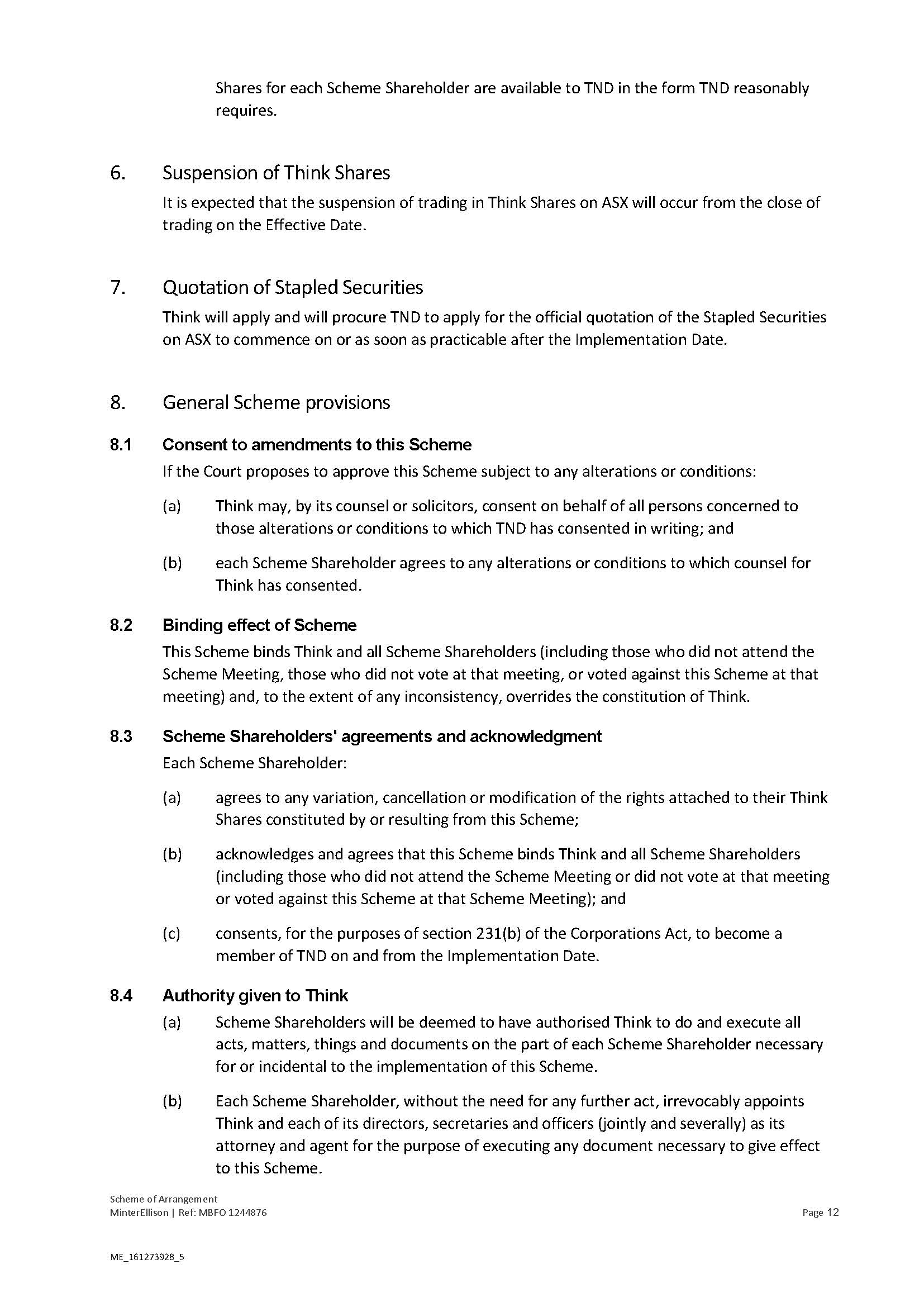
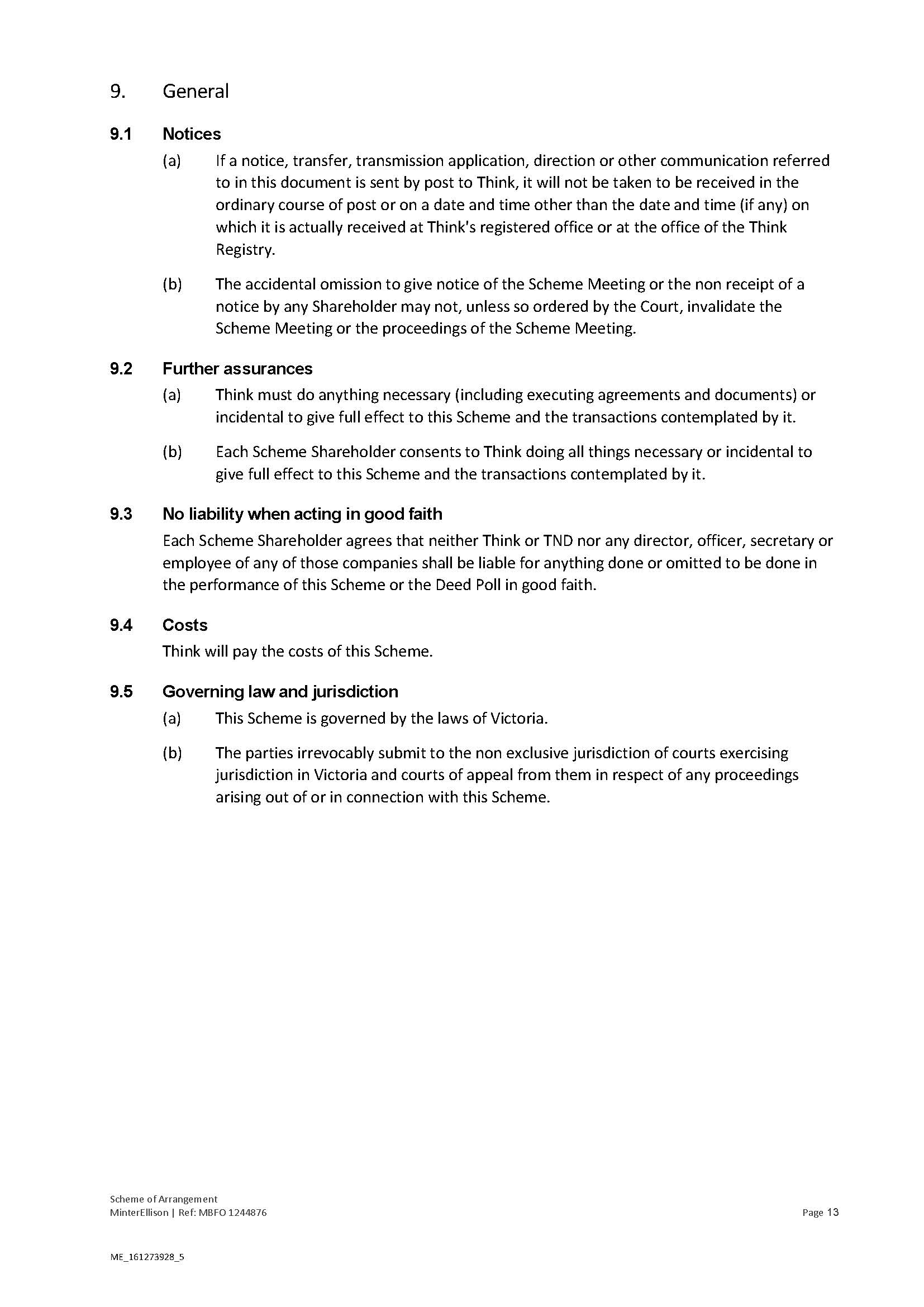
Annexure B
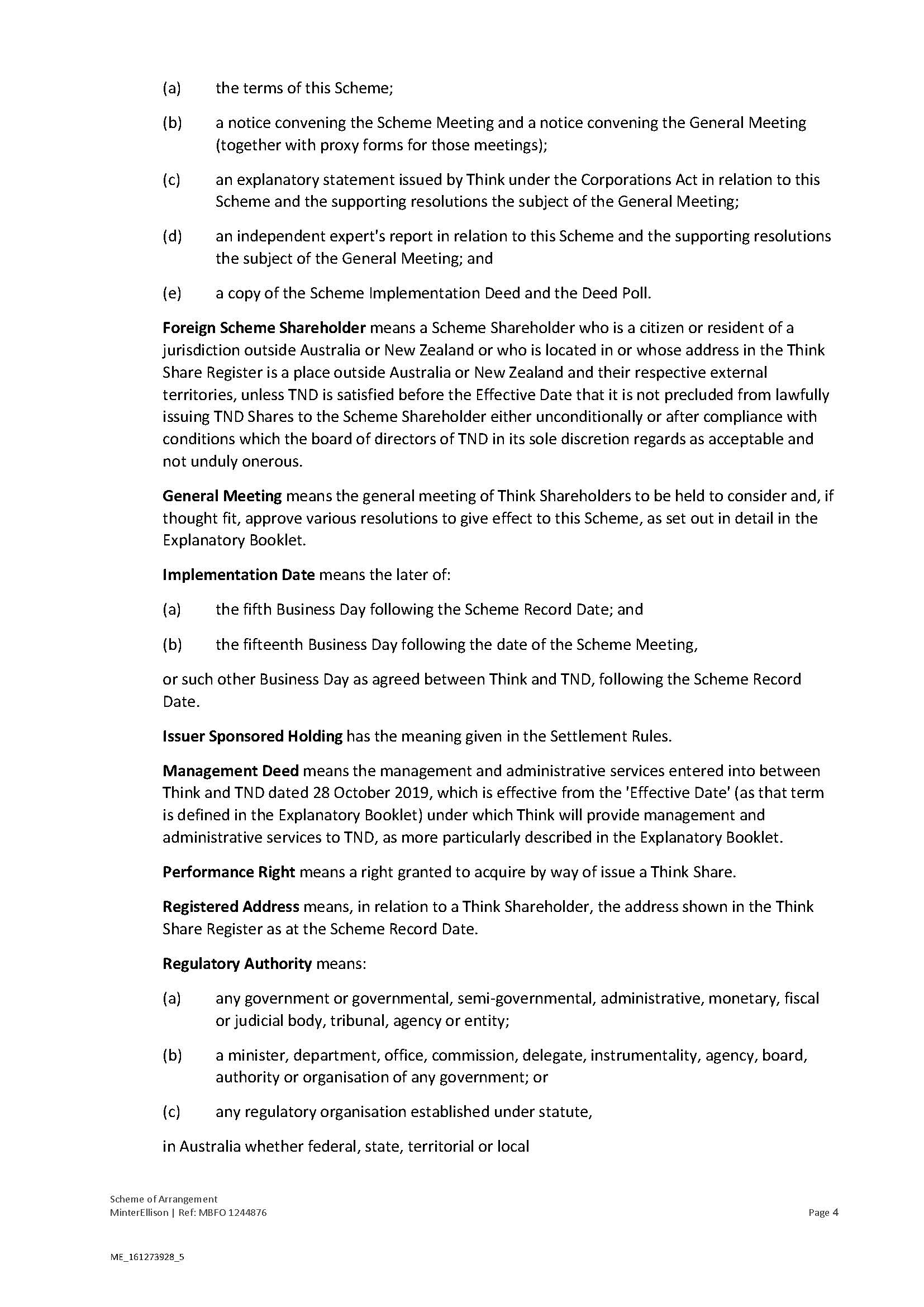
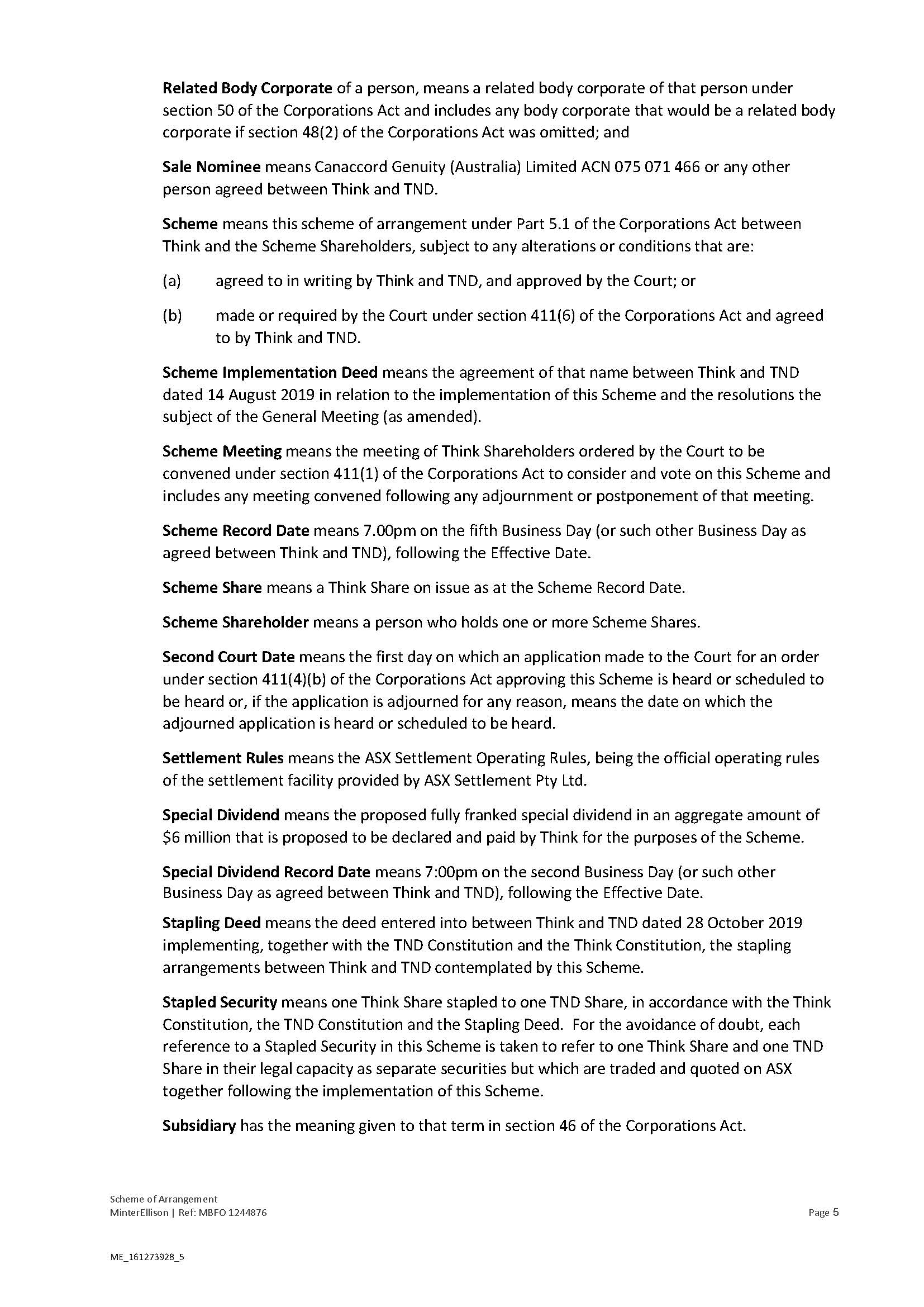
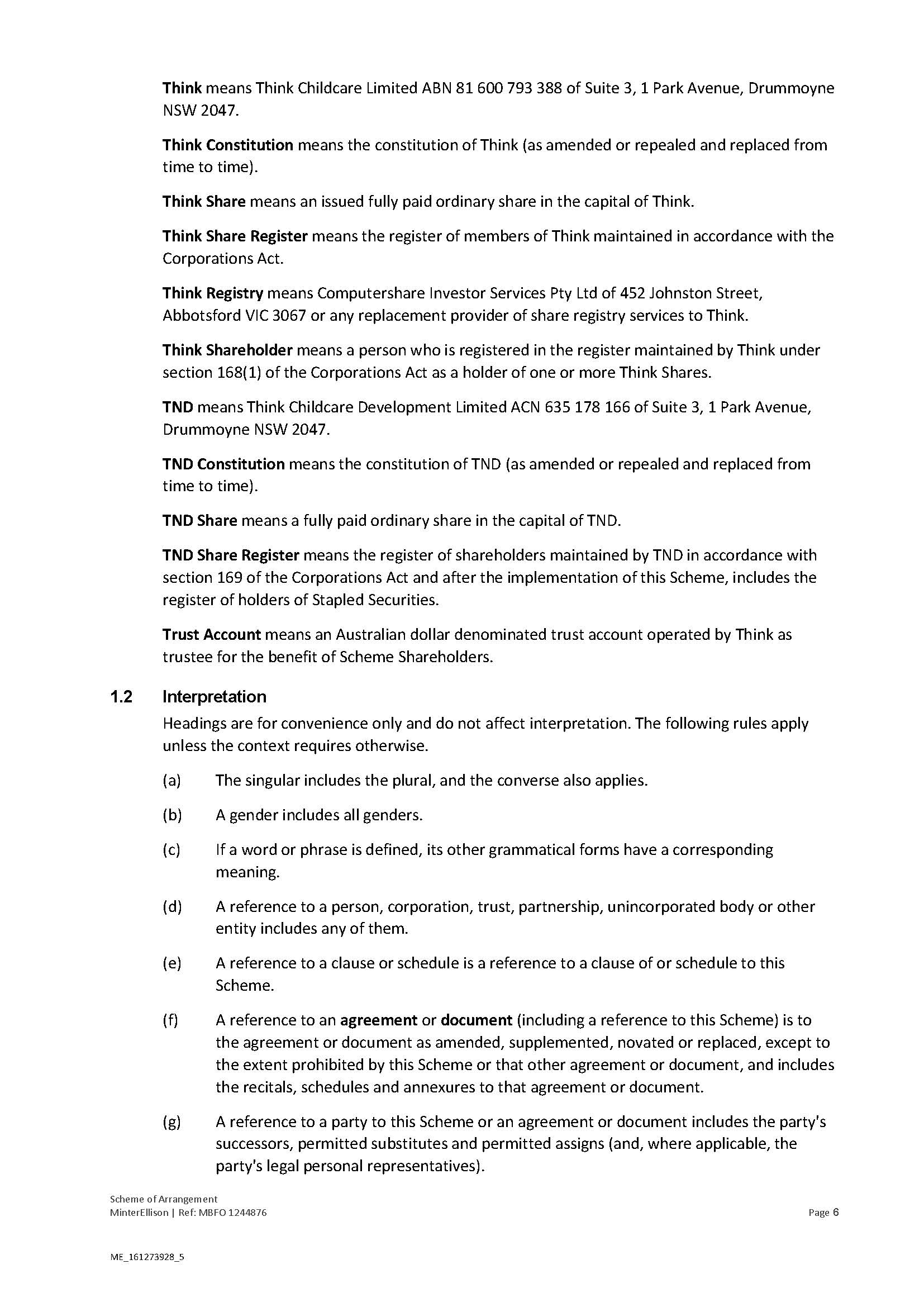
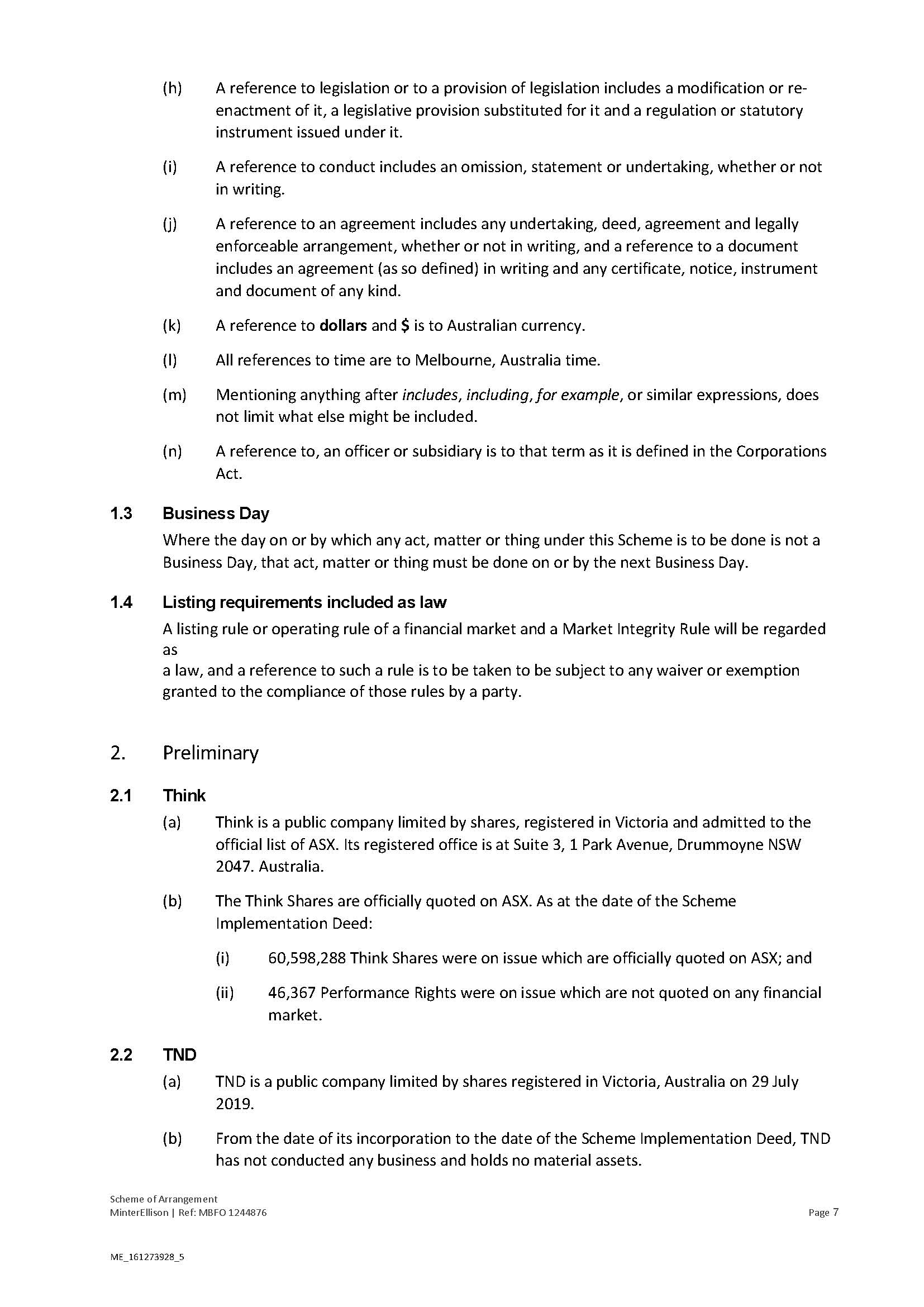
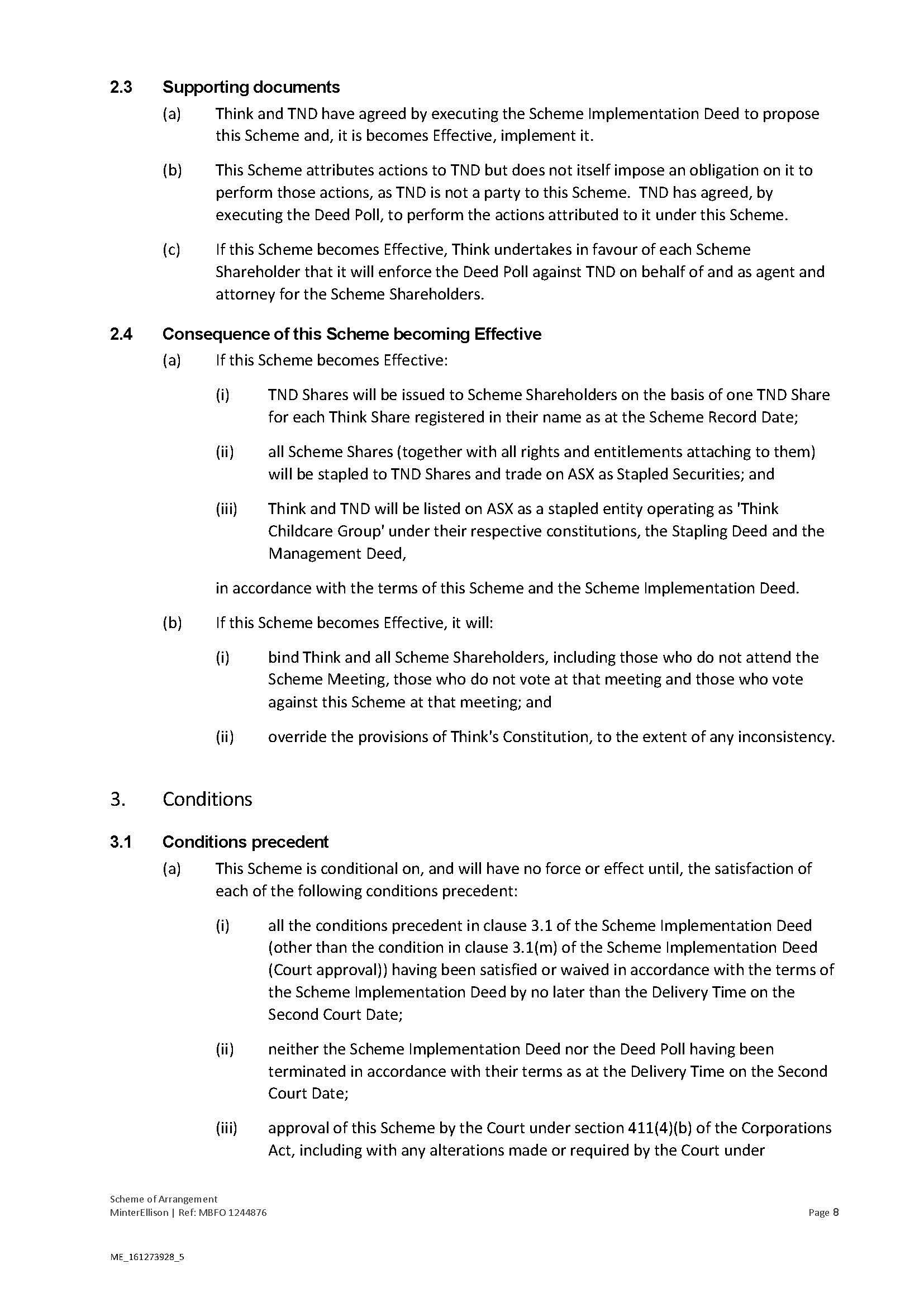
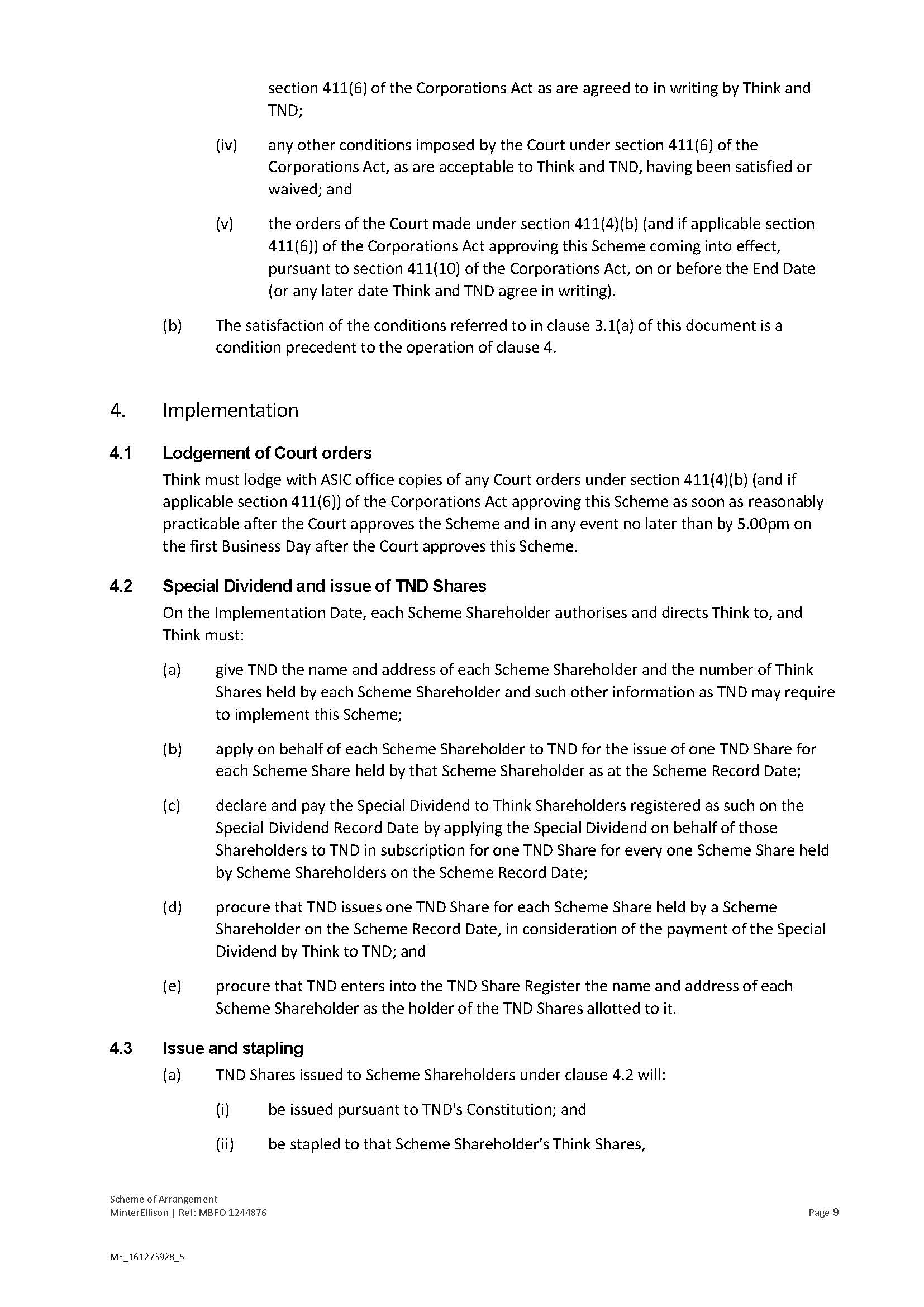
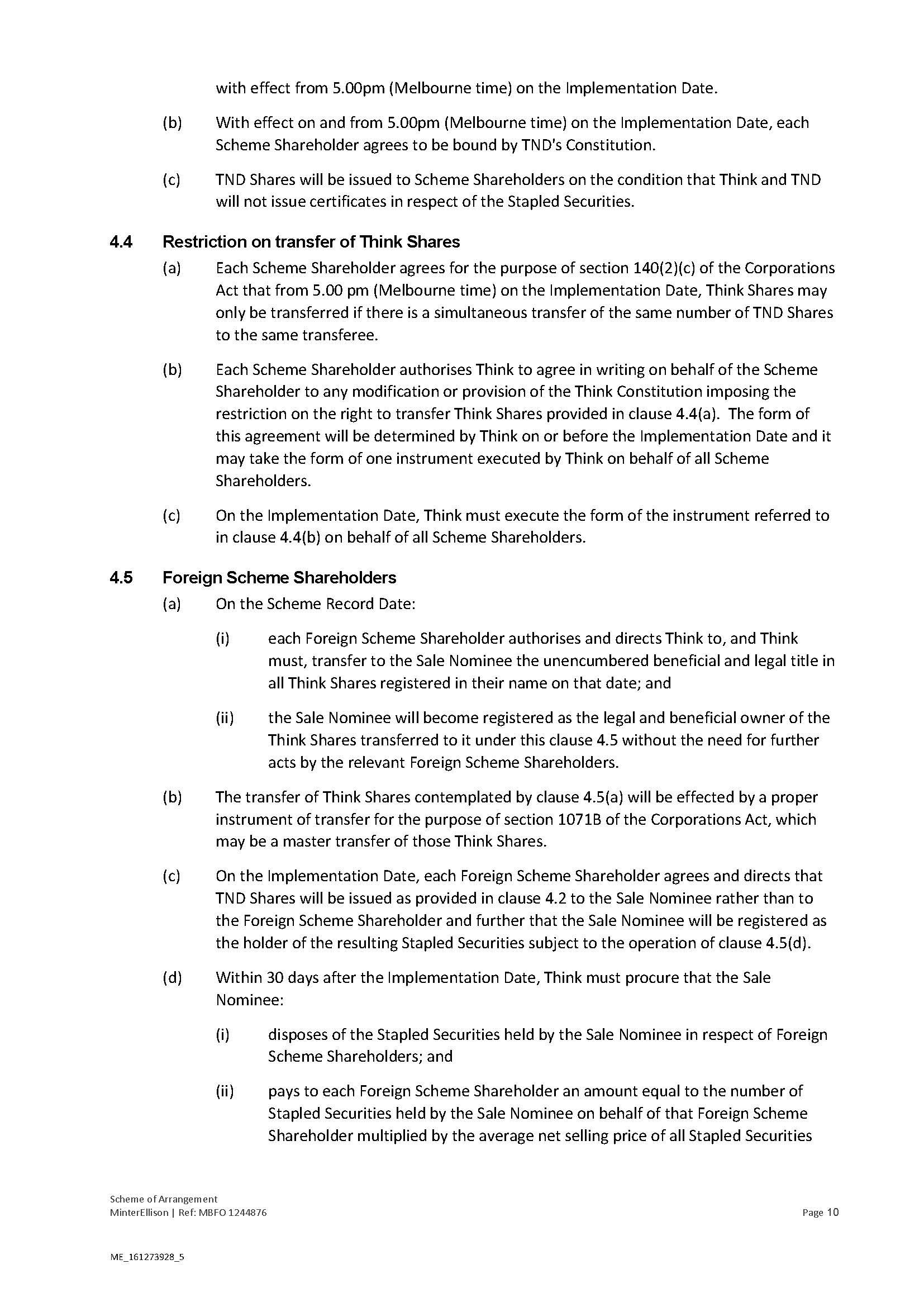
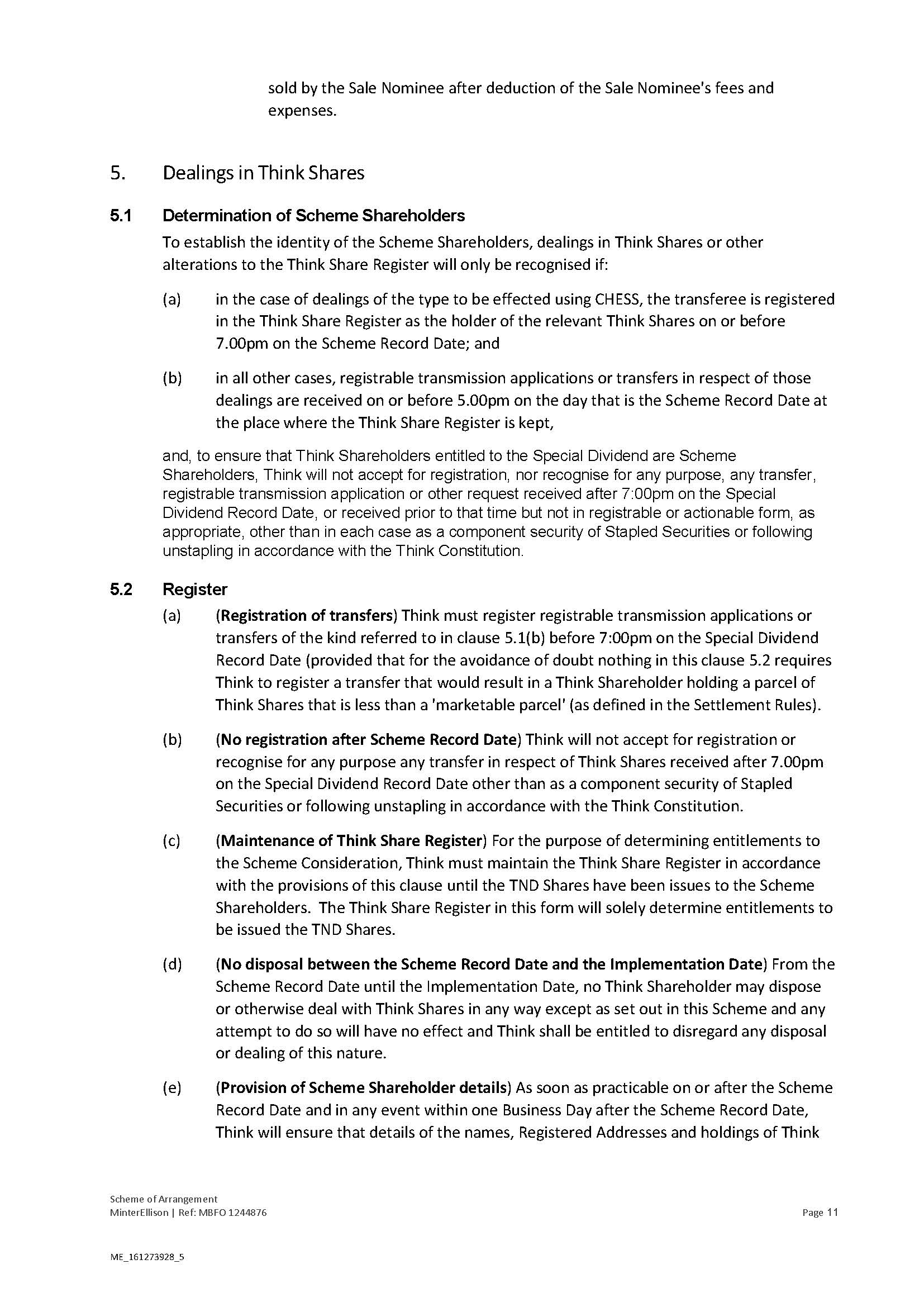
MARKOVIC J:
1 On 31 October 2019 I made orders pursuant to s 411(1) of the Corporations Act 2001 (Cth) (Act) including, among others, an order convening a meeting of Think Childcare Limited’s (TNK) ordinary shareholders (Scheme Shareholders) for the purpose of considering, and if thought fit, agreeing to a scheme of arrangement (Scheme) proposed to be made between TNK and the Scheme Shareholders bound by the Scheme (Scheme Meeting). These are my reasons for making those orders.
2 The Scheme, if implemented, will result in fully paid ordinary shares in TNK being stapled to fully paid ordinary shares in Think Childcare Development Limited (TND) on a one for one basis, and securities in TNK (Scheme Shares) and TND (TND Shares) being quoted on the Australian Stock Exchange (ASX) together so that one such security may not be dealt with without the other or others being dealt with in an identical manner and at the same time and with such restriction on dealing being denoted on the register of each such stapled security (referred to as Stapling or Stapled).
BACKGROUND
3 TNK was incorporated in July 2014. Its shares trade on the ASX. Through various wholly owned subsidiaries, TNK owns, manages and operates child care services in Australia for children aged from six weeks to six years old. As at 18 October 2019, TNK operated 85 long day child care services in Australia, of which 61 are owned and operated by TNK subsidiaries. Its growth was achieved through a combination of acquisitions from third party incubators (third parties who enter into a centre management deed with TNK), undertaking new child care developments and entering into agreements to manage and operate third party owned child care services.
4 As at 18 October 2019 TNK had 60,862,889 shares on issue and 1,166 shareholders of which:
(1) seven shareholders had registered addresses outside of Australia and New Zealand who between them hold 106,872 TNK shares, being approximately 0.18% of TNK shares on issue (Foreign Scheme Shareholders);
(2) 24 shareholders had registered addresses in New Zealand;
(3) 722 shareholders had elected to receive notices of meetings and other communications by email; and
(4) 12 shareholders are return mail shareholders meaning that mail has been sent to them and returned and for whom TNK does not have current contact addresses.
5 TND is a wholly-owned subsidiary of TNK. It was incorporated on 29 July 2019 and is presently capitalised by a redeemable share which will be redeemed upon the capitalisation contemplated by the transaction. TND owns and operates two new child care services (which opened in October 2019). In addition, TND has entered into a share sale agreement with a subsidiary of TNK to acquire all of the issued share capital in two TNK subsidiaries that are parties to agreements for lease and leases with landlords for two additional new child care services. The share sale agreement and thus the transfer of the issued share capital in the two TNK subsidiaries to TND is subject to each landlord’s consent to a change of control and the Scheme becoming effective. TND has not otherwise traded or incurred any obligations or liabilities.
The Scheme
6 The purpose of the Scheme is to effect the Stapling. The Scheme is an interdependent element of:
(1) the Stapling;
(2) the proposed fully franked TNK special dividend in an aggregate amount of $6m which will be captured by the Scheme and applied to the capitalisation of TND prior to the Stapling (Special Dividend); and
(3) the following proposed resolutions to be considered and voted on at a general meeting of Scheme Shareholders to be held on Thursday, 5 December 2019 (General Meeting):
(a) a special resolution of Scheme Shareholders to repeal the TNK Constitution and to replace it with a new constitution (TNK Replacement Constitution);
(b) an ordinary resolution of Scheme Shareholders to approve the provision of financial benefits by TNK to related parties as contemplated by the stapling deed; and
(c) an ordinary resolution of Scheme Shareholders to approve the provision of financial benefits by TNK to related parties as contemplated by the management deed with TND,
(collectively, Supporting Resolutions),
such that one TNK share and one TND Share are separate securities which are listed for quotation on the ASX and traded together as stapled securities following the Stapling in accordance with the TNK Replacement Constitution, the TND constitution and the stapling deed (Stapling Proposal).
7 As described by Mathew Graeme Edwards, the managing director and chief executive officer of TNK, in summary, under the Scheme:
(1) TNK will be authorised and directed by Scheme Shareholders to apply the Special Dividend of $6m to be payable to Scheme Shareholders to subscribe for TND Shares on behalf of each Scheme Shareholder in their respective proportions of TNK shares held as at the Record Date, which is expected to be 19 December 2019; and
(2) each Scheme Shareholder agrees and authorises TNK to agree in writing on their behalf for the purpose of s 140(2) of the Act to the restriction on transfer of TNK shares which is inherent in the Stapling Proposal. After Stapling, a TNK share may only be transferred together with a TND Share, with both being transferred to the same transferee.
8 The board of TNK unanimously recommends that, in the absence of a superior proposal, Scheme Shareholders vote in favour of the Scheme and the Supporting Resolutions and, on the same basis, each TNK director intends to vote any shares they hold directly or control in TNK in that way. The directors of TNK, having considered various alternatives, have recommended the Stapling Proposal as they believe it will facilitate TNK’s:
growth strategy of Child Care Services internally within the Stapled Group and will create a structure that enables separation of risk associated with Trade-up Operations (being the Trade-up of New Child Care Services and Existing Child Care Services, which are intended to be predominantly undertaken through TND) form the operation of Mature Child Care Services (which are intended to be predominantly operated through TNK).
Independent expert
9 The directors of TNK have retained Ernst & Young Transaction Advisory Services Limited (EY) to prepare an independent expert’s report to consider whether or not, in its opinion, the Scheme is in the best interests of Scheme Shareholders and to set out the reason for that opinion.
10 In its report EY has concluded that the potential advantages of the Stapling Proposal outweigh its potential disadvantages and that the Scheme is in the best interests of Scheme Shareholders.
RELEVANT PRINCIPLES
11 The principles applicable to the Court’s approach to and consideration of the issues that arise on a first court hearing at which orders are sought under s 411(1) of the Act are well settled.
12 There are three stages to an application under s 411:
first, the Court approves the convening of a scheme meeting and the draft explanatory statement to be sent to the scheme members;
secondly, the members vote on the proposed scheme at the scheme meeting; and
thirdly, the Court approves the proposed scheme,
see Re CSR Ltd (2010) 183 FCR 358 at [7] (Keane CJ and Jacobson J); Central Pacific Minerals NL [2002] FCA 239 at [6]; Amcom Telecommunications Ltd, in the matter of Amcom Telecommunications Ltd [2015] FCA 341 (Re Amcom) at [8]).
13 The approach of the Court at the first court hearing is that it “will not ordinarily summon a meeting unless the scheme is of such a nature and cast in such terms that, if it achieves the statutory majority at the ... meeting the court would be likely to approve it on the hearing of a petition which is unopposed”: see F T Eastment & Sons Pty Ltd v Metal Roof Decking Supplies Pty Ltd (1977) 3 ACLR 69 at 72 (Street CJ with whom Hutley and Samuels JJA agreed); approved in Australian Securities Commission v Marlborough Gold Mines Ltd (1993) 177 CLR 485 at 504.
14 As Gleeson J observed in Staging Connections Group Ltd, in the matter of Staging Connections Group Ltd [2015] FCA 1012 (Re Staging Connections) at [22]-[23]:
22 At the first court hearing the Court exercises its supervisory jurisdiction to review the scheme and the explanatory statement and raise any queries with the plaintiff. In Re Crusader Ltd [1996] 1 Qd R 117; (1995) 120 FCR 219, Thomas J said at 125 that “the courts are concerned with the notion of a fair picture being presented” and went on to embrace the observations of the Full Federal Court in Fraser v NRMA Holdings Ltd (1995) 55 FCR 452 at 468:
If every possible formulation of the commercial objective of the proposal, and arguments for and against every theoretical possibility, were set forth the total package of information to members would be likely to confuse rather than illuminate the issue for decision, even for people having a familiarity with corporate law and commerce. The need to make full and fair disclosure must be tempered by the need to present a document that is intelligible to reasonable members of the class to whom it is directed, and is likely to assist rather than confuse.
23 The second court hearing is where the court makes its “final determination”, and is the most important hearing if the matter becomes contested, but in practice the first court hearing is where the court intervenes if it has any concerns. One reason for this is that (per Santow J in Re Archaean Gold NL (1997) 23 ACSR 143 at 147):
...court approval to convene the scheme meetings is viewed by the market as giving assurance that the scheme is at least in form and substance such as warranted receiving such preliminary court clearance. It must not be forgotten that trading thereafter takes place on that basis.
15 At the first court hearing, the Court should order the convening of the scheme meeting if satisfied of the following matters:
(1) the proposed scheme is an arrangement in respect of which the Court may order a meeting of members pursuant to s 411(1) of the Act. That is, the scheme is an arrangement, the scheme company is a “Part 5.1 body”, the scheme participants are members of the scheme company; the scheme meeting will be convened between members of the same class; and the proposed scheme is bona fide and properly proposed;
(2) the Australian Securities and Investments Commission (ASIC) has had a reasonable opportunity to examine the terms of the scheme and the explanatory booklet and make submissions to the Court in relation to those matters: s 411(2)(b) of the Act;
(3) the explanatory booklet provides adequate disclosure and contains the prescribed information in s 412(1)(a)(ii) of the Act, reg 5.1.01 and cll 8301-8310 of Sch 8 to the Corporations Regulations 2001 (Cth);
(4) the procedural requirements of the Federal Court (Corporations) Rules 2000 (Cth) have been met; and
(5) there is no apparent reason why the scheme should not, in due course, receive the Court’s approval if the necessary majority of votes are achieved,
see Re Amcom at [12]; Re Staging Connections at [19]-[20].
CONSIDERATION
16 Based on the evidence before me I was satisfied that:
(1) TNK is a Part 5.1 body. The definition of “Part 5.1 body” in s 9 of the Act includes a “company” which, in turn, is also defined in s 9 to mean a company registered under the Act. TNK is a company registered under the Act;
(2) the Scheme is an arrangement within s 411 of the Act;
(3) the explanatory booklet will provide proper disclosure to members. Bernard Frederic Oude-Vrielink, the partner in the firm of solicitors acting for TNK who is responsible for the transaction, deposes that TNK has undertaken a verification process which he describes and which he oversaw. To the best of Mr Oude-Vrielink’s knowledge, information and belief the information in the draft explanatory booklet (excluding the EY report) is complete and accurate in all material respects, is not misleading or deceptive in any material respect and there are no material omissions in that information which would render it misleading or deceptive in any material respect;
(4) the Scheme is bona fide and properly proposed;
(5) ASIC has had a reasonable opportunity to examine the Scheme and draft explanatory statement and reasonable notice of the first court hearing date. ASIC informed TNK that it did not propose to appear to make submissions or intervene to oppose the Scheme at the first court hearing under s 411(1) of the Act; and
(6) other procedural requirements had been met. Consents to act as chair or alternate chair of the Scheme Meeting were in evidence before me.
Other matters
17 TNK brought a number of specific matters to my attention. I address two of those below.
18 The first concerns the treatment of Foreign Scheme Shareholders. As noted at [4(1)] above, as at 18 October 2019 there were seven such shareholders holding 0.18% of TNK shares on issue between them.
19 It is proposed that Foreign Scheme Shareholders not be eligible to receive Stapled securities pursuant to the Scheme because of restrictions in foreign jurisdictions on offering and receiving securities or other financial products. Instead, it is proposed that they will receive, through an arrangement involving a sale nominee, an equivalent cash amount determined by the average net selling price of all Stapled securities sold by the sale nominee. Mr Edwards gives evidence about the process to be undertaken which is also described in the draft explanatory booklet.
20 There is seemingly a difference in treatment between the Foreign Scheme Shareholders and other Scheme Shareholders. Unlike the Scheme Shareholders, those shareholders will cease to be members of TNK and have their shares sold. This raises the issue of whether this differentiation means that the Foreign Scheme Shareholders constitute a separate class of shareholders for the purpose of the Scheme.
21 In Re Hills Motorway Ltd (2002) 43 ACSR 101; [2002] NSWSC 897 (Re Hills Motorway) Barrett J considered the issue of classes of shareholders. There, one provision of the proposed scheme singled out a particular member for differential treatment and another had the effect that the stapled securities issued for the compulsory transfer made by holders with addresses in certain foreign countries, where distribution or receipt of new securities may contravene domestic law, would be issued to a nominee rather than to those holders. The nominee was to sell the securities and account to the holders for the net proceeds.
22 Justice Barrett was satisfied that the features described by him could not be regarded as having the consequence that the relevant members subject to different treatment constituted a different class or classes for the purposes of s 411 of the Act. At [10]-[12] his Honour said:
10 … Resolution of class questions in this statutory context must always be undertaken in accordance with the principles laid down in Sovereign Life Assurance Company v Dodd [1892] 2 QB 573. Although that case dealt with a creditors’ scheme, the principles are equally applicable to a members’ scheme such as the present. Lord Esher MR said (at 579-80):
The Act says that the persons to be summoned to the meeting (all of whom, be it said in passing, are creditors) are persons who can be divided into different classes – classes which the Act of Parliament recognises, though it does not define them. This, therefore, must be done: they must be divided into different classes. What is the reason for such a course? It is because the creditors composing the different classes have different interests; and, therefore, if we find a different state of facts existing among different creditors which may differently affect their minds and their judgment, they must be divided into different classes.
11 To similar effect was the observation of Bowen LJ that “class” (at 583):
... must be confined to those persons whose rights are not so dissimilar as to make it impossible for them to consult together with a view to their common interest.
12 The test is thus not one of identical treatment. It is one of community of interest. The court must ask itself whether the rights and entitlements of the different groups, viewed in the totality of the scheme’s context, are so dissimilar as to make it impossible for them to consult together with a view to their common interest. The focus is not on the fact of differentiation but on its effects. The extent and nature of the differentiation must be measured in terms of the effect on the ability to consult together in a common interest or, in other words, the ability to come together in a single meeting and to debate the question of what is good or bad for the constituency as a whole and where the common good lies. Only if the differentiation destroys that ability - the word used by Bowen LJ is “impossible” - does class distinction come to prevail.
23 A similar proposal in relation to the treatment of certain foreign shareholders was before the court in Re CSR Ltd (2003) 45 ACSR 34; [2003] FCA 82 (Re CSR). At [5] Conti J concluded that the different treatment of those shareholders would not result in there being separate classes of shareholders for the purposes of the scheme under consideration, citing Re Hills Motorway.
24 TNK submitted that the treatment of Foreign Scheme Shareholders in this case is, in effect, no different to their treatment in a more common scrip acquisition scheme of arrangement. It contended that, in substance, albeit not in legal terms, Scheme Shareholders will exchange their existing TNK shares for the Stapled securities and Foreign Scheme Shareholders will instead receive cash but there is nothing to stop Foreign Scheme Shareholders from buying new Stapled securities.
25 TNK also noted that TNK Shareholders will receive a benefit as a result of continuing to hold Stapled securities in that they will not be deemed to have disposed of their TNK shares for Australian capital gains tax purposes. TNK submitted that this is the significant difference between the Scheme and the more familiar type of scheme where this issue arises, in which existing shares are transferred to a bidder in exchange for new shares in the bidder. TNK submitted that this circumstance does not give rise to a separate class of Foreign Scheme Shareholders because, as the “Taxation implications” section in the explanatory booklet further indicates (at section 9.3), Foreign Scheme Shareholders will not be subject to Australian capital gains tax on the deemed sale of their Stapled securities in any event.
26 TNK noted that it had not identified any Australian authority which dealt with this issue in the context of a stapling scheme but referred to the matter of Re Primelife Corporation Limited (Supreme Court of Victoria, unreported, No CEQ 6454 of 2007, Dodds-Streeton J) (Re Primelife) where the court approved a stapling scheme which included substantially similar arrangements in respect of foreign shareholders without requiring separate class meetings. As explained to me her Honour did not give reasons but the orders made in Re Primelife were in evidence before me as was the explanatory memorandum that was approved by the court.
27 In my opinion the Foreign Scheme Shareholders do not constitute a different class. That they will dispose of their Stapled securities does not put them, as a group, at a practical disadvantage compared to the Australian and New Zealand Scheme Shareholders. The Foreign Scheme Shareholders are not subjected to adverse Australian capital gains tax consequences as a group as a result of that disposal and, as submitted by TNK, the legal difference between the Scheme and those considered in Re Hills Motorway and Re CSR is therefore of no practical significance. On that basis, I was satisfied that there is a sufficient measure of community of interest between the Foreign Scheme Shareholders and the Australian and New Zealand Scheme Shareholders.
28 The second matter concerns performance rights.
29 As at 29 October 2019 46,367 performance rights were on issue to two people: 14,621 had been issued to Mr Edwards and were held by Isamax Pty Ltd as trustee for the Edwards Family Trust; and 31,746 had been issued to Jennifer Saliba, TNK’s chief financial officer, and were held by J Saliba Holdings Pty Ltd as trustee for the Saliba J Family Trust (collectively Performance Rights Holders). None of the TNK performance rights on issue have vested.
30 TNK performance rights are not quoted on the ASX or any other financial market and have been issued under TNK’s Employee Share Option Plan dated 10 March 2016 (TNK Performance Rights Plan). The TNK Performance Rights are governed by the rules of the TNK Performance Rights Plan.
31 Mr Edwards explains that vesting of TNK performance rights is determined according to the achievement of certain measures of performance set by the TNK board. A right to receive newly issued TNK shares “vests” and becomes exercisable after the relevant vesting conditions have been satisfied. On exercise, each TNK performance right entitles the relevant TNK Performance Rights Holder to acquire by way of issue one fully paid ordinary TNK share, at no cost to the TNK Performance Rights Holder.
32 Under cl 4 of the scheme implementation deed, as soon as practicable after the date of that deed, the TNK board must give a written notice to each TNK Performance Rights Holder stating that:
(1) subject to obtaining the necessary waivers from the ASX and the Scheme being approved by Scheme Shareholders at the Scheme Meeting, the TNK Performance Rights Plan rules will be amended and outlining the terms of such amendment; and
(2) on vesting of a Performance Right, TNK agrees to issue to the TNK Performance Rights Holder such number of Stapled securities to which the TNK Performance Rights Holder is entitled.
33 The regime set out in cl 4 of the scheme implementation deed is intended to effect an amendment to the TNK performance rights with effect from the Scheme Record Date; on vesting TNK Performance Rights Holders are issued with Stapled securities rather than unstapled TNK shares. The proposed amendment to the terms of the TNK Performance Rights Plan involves a change to the securities to be issued on vesting and exercise of the TNK performance rights (from TNK shares to Stapled securities following implementation of the Stapling Proposal). It does not concern the removal or relaxation of any vesting conditions which TNK shareholders have previously approved.
34 As submitted by TNK these circumstances do not give rise to TNK Performance Rights Holders constituting a different class of shareholder as there is no relevant distinction between the rights of Scheme Shareholders. As Finkelstein J observed in Re Opes Prime Stockbroking Ltd (No 2) (2009) 179 FCR 20 at [64], it is “the difference in rights, not interests, that are relevant to determining whether or not separate classes exist”. See too Re Hills Motorway at [22] above.
CONCLUSION
35 Having regard to the matters set out above and the other matters brought to my attention by TNK, I was satisfied that the Scheme is of such a nature and is cast in such terms that, if it was considered and agreed to by the requisite statutory majority, the Court would be likely to approve it on the hearing of an unopposed application.
36 Accordingly, I made the orders sought by TNK.
I certify that the preceding thirty-six (36) numbered paragraphs are a true copy of the Reasons for Judgment herein of the Honourable Justice Markovic. |
Associate:


