

FEDERAL COURT OF AUSTRALIA
Construction, Forestry, Maritime, Mining and Energy Union v Personnel Contracting Pty Ltd [2019] FCA 1806
ORDERS
CONSTRUCTION, FORESTRY, MARITIME, MINING AND ENERGY UNION First Applicant DANIEL ROBERT MCCOURT Second Applicant | ||
AND: | First Respondent HANSSEN PTY LTD Second Respondent | |
DATE OF ORDER: |
THE COURT ORDERS THAT:
1. The proceeding be dismissed.
Note: Entry of orders is dealt with in Rule 39.32 of the Federal Court Rules 2011.
O’CALLAGHAN J:
INTRODUCTION
1 This is an application made under s 545(1) of the Fair Work Act 2009 (Cth) (the FW Act) by the Construction, Forestry, Maritime, Mining and Energy Union (the CFMMEU) and a worker, Mr McCourt, seeking compensation from the first respondent, Personnel Contracting Pty Ltd (trading as Construct) for contraventions of the FW Act for breaches of the Building and Construction General On-Site Award 2010 (the Award). The applicants also seek compensation from the second respondent (Hanssen) on the basis that it is accessorily liable for Construct’s alleged breaches.
2 Construct is a labour hire company based in Perth which engages workers, such as Mr McCourt, and supplies them to builders, such as Hanssen. Hanssen is a builder of high-rise residential apartments, and to a lesser extent offices.
3 The central question that arises is whether Mr McCourt was an employee of Construct.
4 The applicants did not dispute that Construct intended to engage Mr McCourt as an independent contractor. And they do not contend, and expressly disavowed, that the contract between Construct and Mr McCourt, the “Administrative Services Agreement” (the ASA), was a sham, or a pretence.
5 For the reasons set out below, the proceeding, which was heard in Perth in June this year in conjunction with Fair Work Ombudsman v Personnel Contracting Pty Ltd [2019] FCA 1807, must be dismissed. The accessorial claims against Hanssen in this proceeding therefore do not arise.
THE FACTS
6 Construct is a company which organises for workers to work at the sites of its clients, under the supervision of the client. At any one time, Construct has about 1,000 workers on its books, and between 300 and 350 of its workers working at its clients’ sites.
7 Hanssen is a client of Construct, and in the relevant year (2017) accounted for between 70 to 75 percent of all workers supplied to clients by Construct.
8 The gist of the arrangement between Hanssen and Construct is that Hanssen places an order with Construct, which then arranges for workers it has listed on its register to present themselves at the work site and work under Hanssen’s supervision. Hanssen pays Construct, and Construct pays the workers for their hours worked. The amount Hanssen pays Construct varies according to how much the worker is paid, which can be negotiated between the worker and Hanssen.
9 Construct and Hanssen’s relationship was (and is) governed by a Labour Hire Agreement (LHA), the relevant terms of which are set out at Annexure A.
10 At trial, counsel for the applicants conceded that no contract could be said to exist, implied or otherwise, between Hanssen and Mr McCourt, and the pleaded case along those lines was abandoned.
11 I turn now to deal with the not inconsiderable body of evidence adduced by the parties in respect of Mr McCourt.
Key documents
The ASA
12 It is convenient to set out here the terms of the ASA in full.
RECITAL
A. Construct is an administrative services agency operating essentially within the building industry, liaising between builders (or their contractors) (both described as “builders”) and self-employed contractors for the provision of labour by self-employed contractors to builders and supplying to the self-employed contractors financia1 administrative services.
B. The Contractor requires Construct to keep the Contractor informed of opportunities for the Contractor to provide builders with labour services and to provide the Contractor with financial administrative support to enable the Contractor to concentrate on maximising the supply of quality labour to builders.
IT IS AGREED
1. Construct’s Responsibilities
Construct shall
(a) Use reasonable endeavours to keep informed of opportunities in the building industry for the Contractor to supply labour to builders identified by Construct;
(b) Inform the Contractor when, and on what basis, an opportunity arises for the Contractor to supply labour to a builder;
(c) Liaise between builders and the Contractor regarding the means by which the Contractor shall supply labour to such builders, including the duration that the builder requires such labour, the place at which labour is to be supplied, the daily hours of work during which labour is to be supplied and any other terms and conditions upon which labour is to be supplied by the Contractor to the builder;
(d) Subject to performance by the Contractor of his or its obligations under this Agreement, underwrite payment to the Contractor, within 7 days of receipt of an invoice from the Contractor, of all payment rates payable by the builder in respect of the supply of labour to the builder by the Contractor, including payment rates negotiated by the Contractor directly with the builder;
(e) Complete administrative forms and undertake necessary correspondence with Government authorities as may be required under any law of Western Australia relating to labour supplied to builders under this agreement, other than the completion by the Contractor of his taxation returns, including any instalment activity statement or business activity statements.
2. Construct’s Rights
Construct shall be entitled to
(a) Negotiate with any builder a payment rate for the supply by the Contractor of labour to the builder, provided that the Contractor shall be at liberty to negotiate with the builder an increase in the payment rate and any other terms and conditions upon which labour is to be supplied by the Contractor to the builder, subject to the Contractor properly performing his obligations under this Agreement;
(b) Negotiate with the builder the basis upon which Construct is to be remunerated on a commission basis as a percentage of the agreed payment rate for the supply of services by the Contractor to the builder;
(c) Negotiate with the builder for remuneration in respect of any increase in the payment rate negotiated directly by the Contractor with the builder;
(d) Withhold from the Contractor payment of any monies reasonably required by Construct to compensate it for any claim made against Construct by the builder in respect of the supply of labour by the Contractor to the builder.
3. The Contractor’s Warranties
The Contractor warrants that:
(a) He has provided Construct with true and accurate information regarding his work experience and capability for the supply of labour to builders;
(b) He is self-employed;
(c) He does not require Construct to guarantee the Contractor work of any type or of any duration;
(d) That he shall keep Construct fully informed of the outcome of negotiations with the builder by the Contractor in order to ensure that Construct is promptly and accurately informed of any higher rate of payment agreed by the builder and the value of any other terms and conditions agreed with the builder by the Contractor;
(e) Construct shall not be liable to pay the Contractor any amounts in respect of annual leave, sick leave, long service leave or any other statutory entitlement required in an employer-employee relationship.
4. The Contractor’s Obligations
The Contractor shall:
(a) Co-operate in all respects with Construct and the builder in the supply of labour to the Builder;
(b) Ensure accurate records are maintained as to the amount of labour supplied to the builder by the Contractor;
(c) Attend at any building site as agreed with the Builder at the time required by the Builder, and shall supply labour to the Builder (subject to notification under clause 5(c)) for the duration required by the Builder in a safe, competent and diligent manner;
(d) Indemnify Construct against any breach by the Contractor of sub-paragraph 4(c) hereof;
(e) Supply such tools of trade and equipment, for safety or other reasons, as may be required by the builder, in respect of which the Contractor is solely responsible;
(f) Possess all statutory certification relevant to the supply of labour, and shall ensure that these certificates be both current and valid in Western Australia;
(g) In the event that the Contractor reasonably considers that his safety is endangered by conditions on the building site, promptly report the unsafe conditions to Worksafe if unable to have the unsafe conditions rectified by the builder promptly;
(h) Not represent himself as being an employee of Construct at any time or otherwise represent himself as authorised to act on behalf of Construct other than strictly under the terms of this Agreement.
5. The Contractor’s Rights
The Contractor is entitled to:
(a) Receive payment from Construct of all amounts negotiated with the builder by Construct and the Contractor within seven (7) days of the issue by the Contractor of a valid invoice delivered to Construct by the Contractor for the supply of labour to the builder by the Contractor;
(b) Refuse to accept any offer of work from a builder;
(c) Notify the builder and Construct on 4 hours notice that he is no longer available for the supply of labour under the terms of this Agreement.
13 The FAQ provided along with the ASA was relevantly in these terms:
MOST FREQUENTLY ASKED QUESTIONS
What is Construct Contractor Solutions?
Construct is an administrative agency. It connects self-employed contractors to work, for companies and principle contractors. In its capacity as an agency, Construct performs the following tasks:
a. finds workers for companies and principle contractors,
b. offers work to self-employed independent contractors,
c. administers documentation and statutory responsibilities that accompany the work, and
d. administers payment for the work.
How do I get work through Construct?
You first must determine that you want to work as a contractor and not an employee. If you are happy to accept the benefits of being a self-employed contractor and being your own boss, you are welcome to enter into an “Administrative Services Agreement” with Personnel Contracting Pty Ltd. This contract agreement makes you available to be offered work through Construct, as and when work becomes available. By entering into this agreement you remain a free agent and are free to accept or reject any work offered to you. Construct does not guarantee you work. It is helpful if you keep Construct informed as to your availability for work or if you know that you will soon be out of work and available for further work.
Who do I work for?
If you choose to accept work, you do so as a self-employed independent contractor, hired on a daily basis. Construct is not your employer and is not your boss. Nor is the company or principal contractor, to whom you are sent to work. You are essentially seen as your own boss, conducting your own business, even though your work is directed by the company or principal contractor.
What will Construct do for me?
As an administrative agent, Construct works for you to connect you with suitable work. Construct guarantees to make payment to you for the work you complete and covers all statutory workers’ compensation and superannuation liabilities applicable to you as a self-employed independent contractor.
Does Construct pay Superannuation?
Construct pays superannuation at the Superannuation Guarantee Levy rate for all contractors, unless you are contracting through Construct via a company. Construct pays superannuation monthly into any complying superannuation fund or Retirement Savings Account of your choice, and with which Construct is able to establish a contractual relationship. If Construct does not receive a nomination of fund from you within 28 days of signing the “Administrative Services Agreement”, your monthly superannuation entitlement may be paid into a default fund for you, which is administered by Australian Super.
What rates of pay can I expect?
You will be advised of the rate of payment for each assignment of work that is offered to you by Construct. Rates of pay and type of rates (ie. hourly rate or piece rate) will differ between jobs and between Construct’s clients. All hourly rates of pay are flat rates. No penalties apply.
How do I get paid?
Construct’s pay week runs from Monday through to Sunday. All payments are made by direct credit into your nominated bank account. Contractors are paid on a weekly basis. To ensure you are paid for any week’s work, you must first invoice Construct by phone, fax, SMS or email by 5pm the following Monday. Assuming no bank holidays or system faults, you can expect that the payment will be available for drawing against by the following Thursday morning.
Who pays my tax?
As for all workers, you are required to pay tax. You will be operating under the PAYG (previously PPS) tax arrangements.
Construct will withhold the appropriate rate of tax from your payment and submit the tax on your behalf to the ATO on a monthly basis. On the PAYG system, all contractors on $15/hour or greater will have tax withheld at standard minimum flat rate of 20% or otherwise, as negotiated annually with the ATO. A higher standard flat rate of tax can be arranged, as determined by you, to suit your level of income. At the end of each financial year Construct will forward you a PAYG Payment Summary (similar to the old Prescribed Payment Summary).
What is expected of me?
As for all Construct contractors, it is expected that you conduct your work in a timely, professional manner. It is a basic expectation that you arrive to work at the agreed time, with appropriate tools and equipment as is necessary to perform your work. If you are unable to attend, it is only courteous to call and advise us of the problem as soon as possible so that we can make alternative arrangements with the company or principal contractor.
You must supply all relevant work-wear. As a service to our contractors, Construct can arrange to supply basic safety gear (e.g.- hard hats, high visual vests etc) at wholesale prices. Your tools and equipment remain your total responsibility.
You must ensure that you hold all certificates relevant to your assigned work and work situation (e.g.- SAT White Card, Tilt Panel, Dogger etc.). It is your responsibility to ensure that these are both current and valid in Western Australia.
14 Mr McCourt was also given a “Contractor Safety Induction”, which he signed. It was relevantly in these terms:
ACKNOWLEDGEMENT:
I acknowledge that:
1. I have read, or had explained to me, the Contractor Safety Induction, and have understood its content. I will ask the CONSTRUCT representative or the site supervisor if I have any questions in regard to site health and safety.
2. I will follow all worksite safety rules and procedures given by the ‘host client’.
3. I will wear and use the correct PPE and clothing required for work assigned to me.
4. I will NOT conduct any work other than that which is specifically assigned to me.
5. I will NOT conduct any work or operate any machinery for which I am not currently qualified.
6. It is my responsibility to have current licences and/or competencies relevant to work assigned to me.
7. I will immediately advise CONSTRUCT if my job is altered by the ‘host client’.
8. I have a duty to take reasonable care of my own safety and that of others in the workplace.
9. I will report safety hazards and incidents to the site supervisor or administrator, and to CONSTRUCT.
10. I will immediately report any injury to the site supervisor or administrator, and at the soonest opportunity to CONSTRUCT.
15 He was also given a document entitled “Guide to Work at a Glance”, set out at Annexure B.
16 I will now turn to the witness evidence.
17 A number of witnesses were cross-examined, but no party suggested that any evidence or concession elicited during the course of it has any particular bearing on the central issue of the proper characterisation of the relationship between Mr McCourt and Construct. The facts set out below were largely uncontested, and are derived principally from the affidavit material.
The evidence adduced by the CFMMEU and Mr McCourt
Evidence of Daniel McCourt
18 Prior to his arrival in Australia, Mr McCourt had worked in the UK part-time as a brick-layer and a food and beverage attendant at a kiosk, and full-time as a “bar associate” and in the kitchen at a pub at the Liverpool Airport, in England.
19 In June 2016 he arrived in Melbourne on a working holiday visa, and found work for two weeks installing tablet computers in cabinets at a workshop and later at a stadium.
20 He then left Melbourne to travel to Perth, where he arrived in July 2016. He then started looking for work. While looking for work, he obtained a “white card”, which he needed in order to work on construction sites.
21 Mr McCourt was told by a friend that Construct was looking for workers, and he contacted Construct to express his interest.
22 On 22 July 2016, Mr McCourt was invited to send a copy of his CV and his white card to Construct, which he did.
23 He then received a text message from Mr van der Plas inviting him to attend an interview.
24 On 25 July 2016, Mr McCourt attended Construct’s office for his interview with Mr van der Plas. At the interview, Mr McCourt says he told Mr van der Plas that he was prepared to do any construction labouring that he was capable of and to work on weekends; that he had his own means of transport to get to jobs; and that he was available to start work immediately.
25 Mr van der Plas asked him whether he had a hard hat, steel-capped boots and hi-vis clothing, which he did, having purchased them in Perth in the hope of getting construction work, for less than $100.
26 Mr McCourt says Mr van der Plas also told him he would be doing construction work, but that Construct could not guarantee any work. He told Mr McCourt the rate at which he would be paid, and provided to Mr McCourt the documents referred to above.
27 Mr McCourt, in a second affidavit dated 22 May 2019, swore:
The interview was about 20 minutes long, in which Leon van der Plas went through all of the interview documents. After the interview Leon left me alone for approximately 20 to 30 minutes. During that period I read all of the material and signed the interview documents.
28 Mr McCourt listed in his first affidavit various questions that Mr van der Plas “did not ask”, including whether he had assets or equipment to run a business; a business name; a building from which to run a business; “invoicing systems”; standard rates, terms or conditions of trade; payment or debt collection systems; budgeting or forecasting systems; and whether he was registered for GST or had an ABN.
29 The next day, Mr Todd Marshall called Mr McCourt to tell him that there was work at a Hanssen site, that it would start the following day, and that it would likely run until at least Christmas. Mr McCourt confirmed with Mr Marshall that he was happy to commence work the next day. Mr McCourt then received the following text message:
Daniel, The address of the job is ‘Concerto’ at 189 Adelaide Tce, East Perth. The site is next to/behind the old ABC building … Arrive onsite for induction at 6:45am. Make sure that you have steel capped boots, a hard hat and a high viz shirt/vest. Todd. Construct.
30 On 27 July 2016, Mr McCourt arrived at the Concerto Project before 6:45am. He was required to perform a drug and alcohol test and go through a site induction with other labourers referred by Construct who were starting at the same time. During the induction, Mr McCourt was given a Hanssen site safety induction form (Hanssen Induction Form) (see Annexure C); and the Hanssen site rules (Hanssen Site Rules) (see Annexure D).
31 Mr McCourt gleaned either from the documents or the induction or both the following information:
(a) the “core site hours”;
(b) the smoko hours;
(c) to cooperate with Site Management at all times;
(d) to clock in before starting work and clock off when you have finished work;
(e) that all site personnel must adhere to all site notices and directions at all times;
(f) that there was a compulsory “toolbox meeting” every day at 7am;
(g) that no mobile phones were to be used for personal use within work time;
(h) that workers were to start at 7am, with anyone arriving late to be sent home without pay or dismissed for repeated lateness;
(i) that he was required to contact the Site Manager of Site Administrator prior to 7:00am if he was ill or could not otherwise come to work;
(j) that holidays must be booked at least one week in advance; and
(k) that any rule breaches would result in disciplinary action.
32 Mr McCourt was then introduced to his supervisor, Ms Amy O’Grady, and was told to report to her every day after the “toolbox meeting”.
33 Mr McCourt initially worked at the Concerto Project between 27 July 2016 and 6 November 2016. Mr McCourt then finished work there and left Perth. He returned in March 2017. On 9 March 2017 he contacted Ms O’Grady to ask her if there was any more work available. She told him that there was, and that he could commence work from 14 March 2017. He then worked at the Concerto Project until 24 June 2017.
34 Mr McCourt swore that while working at the Concerto Project he “almost always” performed work in the following way:
(a) I would arrive at the Concerto Project prior to 7am.
(b) I would head down the ramp and go clock in to the machine outside the office. …
(c) I would then walk around the corner of the smoko room where I would put my lunch in the fridge and make myself a cup of tea.
(d) I would then sit at one of the lunch tables whilst waiting for Hanssen management to come out of the site office at 7 a.m. to conduct the toolbox meeting. I would put on my hard hat. I’d already be wearing my steel cap boots.
(e) At the toolbox meetings, one or more of Hanssen management … would tell us what deliveries there were for the day, whether there were any concrete pours, what the crane lifts were, other operational updates and a brief chat about health and safety.
(f) Unless directed otherwise, after the toolbox meeting I would report to O’Grady to be assigned tasks for the day.
(g) I would then perform work that O’Grady or other Hanssen management instructed me to perform. In the morning I was usually required to take full bins of rubbish down in the man and materials hoist out to the road so that the rubbish truck could collect them. This was the usual morning task.
(h) Throughout the day O’Grady would text me instructions…O’Grady would also text or call me throughout the day to instruct me that different or additional work needed to be performed, and I would perform it.
(i) Throughout the day I would text or call O’Grady when I had completed assigned work, or to seek different or additional work and I would perform the work as instructed.
(j) [deleted]
(k) Ordinarily after the smoko break I would go and collect the empty bins and bring them back up the hoist to where the trade-workers required them. I would otherwise perform work as directed. On completion of the work I would then text or call O’Grady seeking instruction for what other tasks were required to be performed. O’Grady would then direct me to perform other work, ranging from moving materials, cleaning or using power tools.
(l) At 1:00pm I would take my lunch break for 30 minutes between 1:00pm to 1:30pm.
(m) On weekdays, ordinarily after the lunch break, I would go and check the bins. Any full bins I would bring down in hoist prior to the 2:30pm collection. After 2:30pm. I would bring the empty bins back to where they were required.
(n) I would then continue performing tasks that O’Grady or other Hanssen management would instruct me to perform until 4:45pm.
(o) At 4:45pm I would make my way back downstairs to the smoko room and I would fill out my timesheet detailing what tasks l had performed.
(p) A little after 4:45pm I would clock out. I would then leave to go home.
(q) When the work was done in a manner or to a standard that was different to the manner or standard O’Grady (or another supervisor from Hanssen) wanted, O’Grady (or supervisor) would instruct me to redo the work and I would comply with those instructions.
35 Mr McCourt in his second affidavit also swore that during his time working at the Concerto Project, he “received directions about work from a number of people who worked on the Concerto site, not just Amy O’Grady”.
36 At [55] of his first affidavit, Mr McCourt swore:
In the week ending 24 June 2017 the supervisor at Concerto from Hanssen, Jackson, and my leading hand, Amy, said that on account of the Concerto Project finishing I would be moved over to the Hanssen site at the Aire Project in West Perth. Later Marshall from Construct informed me that on account of the Concerto Project finishing I would be moved over to the Hanssen site at the Aire Project in West Perth.
37 During cross-examination, Mr McCourt conceded that he was not told that he would be moving, but that he asked Ms O’Grady whether there was another project he could work at due to the Concerto Project finishing.
38 Mr McCourt says that the performance of work at the Concerto Project was “substantially identical” to that at the Aire Project, where Mr McCourt worked for a short time after his work at the Concerto Project, between 23 June and 30 June 2017.
39 Mr McCourt described the nature of the work he performed as a general labourer as being principally cleaning areas of the Concerto Site; preparing areas to be worked in; moving materials like glass panels, granite, splash backs, doors, kitchen units, tiles etc.; and using a variety of tools and machines, including bins, demolition hammers, drills, grinders, jack hammers of different sizes, levels, man and materials hoists, pressure washers, sanders, saws, and water spraying equipment.
40 Mr McCourt also gave evidence that of all the equipment he used, he supplied his own steel cap boots, hard hat and hi-vis shirt. All other tools were supplied by Hanssen.
41 While working at the Concerto and Aire Projects, Mr McCourt was directed by the leading hand, who told him what work to do and the way in which it had to be done. He was also told sometimes what to do by other people including site managers.
42 Mr McCourt also said that he was working long hours (“usually about 50 hours per week”), that the work was physically hard, and that “[i]t was not feasible for me to have an additional job in construction after working for nine hours on week days or four to five hours on Saturdays.”. He said that he was never told, by either Construct or Hanssen, that he could delegate or assign the performance of the work assigned to him to a third party. Further, he was never asked to organise a substitute worker to perform the work.
43 Mr McCourt said that he “clocked on” each morning and “clocked off” each night by means of a fingerprint scan, and then filled in a timesheet and entered a description of the tasks he had performed each day. He also said that he did not keep a record of his hours worked, nor did he keep a record of the timesheets he filled in, and was never asked to provide any invoice or statement of hours worked. Construct provided him only with payment advices at the end of each week, which showed that he was paid a flat rate of $22/hour for the hours of work performed until October 2016, and then $23/hour thereafter. Mr McCourt was paid weekly by Construct, with a superannuation contribution.
44 Mr McCourt said that “[t]he hourly rate of pay was set by Construct and was not the subject of negotiation between me and Construct or me and Hanssen.”
45 Further, he said that “[t]here was no penalty schedule, or a similar system, in place…whereby I would be paid less if I did not perform work in a competent and diligent manner. My pay was never reduced in this way. Whenever I was asked by Hanssen to correct any errors at work, I was paid in accordance with the ordinary hourly rate.”
46 Mr McCourt also said that if he was ill or running late he would tell the site manager ahead of time. He also said that he took leave of a few days to go a short holiday between 19 October 2016 and 23 October 2016, for which he says he “had to put in a request for leave with Hanssen to take this period and notify them”. He also said that when he was absent due to holiday or illness he was not paid.
47 On 26 June 2017, Mr McCourt commenced work at the Aire Project. On 30 June 2017, he was contacted by Mr Marshall from Construct who told him that he was not to go back to the Aire Project to work, and that Hanssen had not given Mr Marshall a reason why he was not to go back.
48 Mr McCourt then sought further work from Construct. On 4 July 2017, and then again on 11 July and 14 July, he sent Todd Marshall text messages asking for work, but received no reply. On 17 July he sent Mr Marshall another text message looking for work, and received a reply saying “Daniel, all I can do mate is send you if they’re suitable work available” (sic). On 24 July, he again sent Mr Marshall a message and received a reply saying: “G’day Daniel, I don’t mean to sound repetitive, but again, all I can do is call you up if I can get you started somewhere”.
49 In his second affidavit, Mr McCourt gave this evidence:
7. A few days after I started work at the Concerto site Marshall came to the site. He saw me wearing a harness. He said I shouldn’t have been wearing a harness or doing that sort of work, or something to that effect. I can’t remember the details.
8. I refer to the document … titled Contractor Site Checklist dated 29 July 2016. I understand by looking at it that it is a checklist that Mr Marshall ran through with me a couple of days after I started at Concerto. It contains various acknowledgments. To the best of my recollection, Mr Marshall ran though those nine dot points at the foot of the page and told me those things.
The evidence adduced by Construct
Evidence of Peter Wieske
50 Mr Peter Wieske is a director of Construct. In his affidavit of 29 April 2019, Mr Wieske said that he has managed the business since 2001, but that he has been less involved in the day-to-day duties since about 2013, when Mr John van der Plas (the father of Leon van der Plas) became the Operations Manager. From mid-2016 to mid-2018 Mr Wieske said that he had minimal involvement in the day-to-day operation of the business, because he was studying overseas.
51 The first Mr Wieske had heard of Mr McCourt was when he was shown a letter of demand on 28 November 2017.
52 Mr Wieske gave evidence that in 2003, following the CFMEU’s instigation of a court action against Construct in the Western Australian Industrial Appeal Court, but prior to its resolution (in favour of Construct (Personnel Contracting Pty Ltd (t/as Tricord Personnel) v Construction, Forestry, Mining and Energy Union of Workers [2004] WASCA 312; 141 IR 31)), he engaged lawyers to assist with the drafting of what became the ASA, which Construct began using in January 2005. Mr Wieske said that “[o]ther than some very minor set-out changes, this document remains unamended to today”. He went on to say that:
I believed the “Administrative Services Agreement” drafted by Hotchkin Hanly was an improvement from the previous agreements and that it would be effective in establishing a contract for services for independent contractors once a worker accepted an offer of work. That is why I had the document drafted by lawyers.
53 He also swore that “[s]ince 2004, some of the system explanatory documents have been amended, whereas others have been introduced, as have safety, superannuation, taxation, and immigration documents.”
54 Mr Wieske gave the following evidence in respect of Construct’s relationship with its contractors:
40. Over the past 18 years Construct has engaged contractors of a wide variety of ages, skill levels and trades. Many of the contractors are highly skilled tradespersons, including carpenters, electricians, plumbers, tilers, bricklayers, painters, etc. Each one supplies their own tools of trade, however the extent of supply depends on the client’s and the job’s requirements. Construct also engages numerous labourers, ranging from cleaners to highly skilled riggers and crane drivers. Once again, the client and the particular job will determine the extent of personal tool supply.
41. Due to ongoing labour shortages in WA, Construct also engages numerous backpackers to fill tradesperson and labouring jobs. Due to the temporary nature of their residency, it is not unusual that backpackers are unable to supply the range of tools which local contractors might have access to. Due to backpacker time and tool constraints, they may be contracted in lower skilled jobs with little more than the requirement to supply PPE and appropriate work attire.
42. Each year Construct might engage between 800 to more than 1000 contractors, some of which might work for a few hours and others might work for the whole year. At any one time, Construct might have between 300 to 350 contractors working through our agency. Other than the odd inquiry, either on site or by phone, to correct hours or piece rates, Construct receives very few complaints from its contractors. Considering the numbers of contractors that we work with, I see this as an overwhelming vote of support for the Tricord Contracting System. Since the 2003/4 court case, and up until the current court action, we have not had any challenges from the CFMEU, other than one enquiry in 2016 on behalf of an injured Construct contractor and CFMEU member. I see the support from our contractors and the lack of challenges or complaints as an affirmation of the legitimacy of our system of contracting.
43. Each worker engaged by Construct is engaged as an independent contractor in accordance with their ASA. Construct facilitates these contractors to do contract work for our clients.
44. This contract work is most often accounted by hours worked, however, it is also accounted by piece-rate on jobs where that is possible. Piece-rate is often measured by square metres (e.g. painting), or lineal metres (e.g. skirting fixing), but can be measured per item fixed (e.g. doors hung).
45. Construct does not exercise any control over any worker that it refers to a client. Though some of the staff at Construct may have some construction experience, which is helpful in communicating with clients and contractors alike, Construct staff do not advise or instruct in regard to any job or any work.
46. Construct does, however, have a legal duty of care to the contractors it engages and facilitates, to the clients, and to the general public, in regard to safety. In light of this duty of care, Client Services Representatives are required to make OH&S assessments, referrals and advisory recommendations. Should a Client Services Representative identify a safety issue, such as a contractor from Construct, or any worker on site, working in an unsafe manner, the representative will notify the safety hazard to the individual worker, the respective supervisor, and site management. Follow-up systems are in place to ensure adequate rectification is applied. Bringing attention to a safety hazard is a duty-of-care responsibility for anyone on or near a construction site, however, it is the client’s responsibility to implement rectification measures.
47. Construct staff do not direct any of the contractors in their work, since Construct’s business is not building, subcontracting or giving building advice. Construct is engaged by its clients to arrange contract labour. Construct has no authority to control or direct any of its contractors in the performance of their work. Construct’s clients are builders who are responsible for construction and would not tolerate Construct even attempting to control or direct the contractors. All contractors that are engaged through Construct are directed in their work by site supervisors, and ultimately by the client sub-contractor or client builder, in the same manner in which any worker is ultimately directed on any construction site by the company responsible for that site.
48. As I have said above, contractors have the freedom to accept the work and terminate the work as they please and are able to work for other sub-contractors or builders.
49. Construct does not require any of the contractors to wear any form of uniform. The contractors are independent and not a part of the Construct organisation. Only the staff working in or out of Construct’s office, and who are employed by Construct, wear any form of uniform, which Construct supplies. All contractors are required to supply their own appropriate work clothing and PPE for the job they are sent to perform. On occasion Construct has given away polo shirts to clients and contractors for the purpose of advertising, but this is not intended as a uniform or to be worn at work, though some clients and contractors may choose to.
50. Construct does not use timesheets for contractors, but as stated in the ASA, Contractors are required to ‘invoice’ their hours or piece-rate work to Construct to enable verification with the respective client and payment. The invoicing method is adapted to suit each client and contractor situation. In the very early years of operation, the invoicing was conducted either on paper, or the more common practice was by phone ‘invoicing’. Paper invoicing is not a current practice, yet phone invoicing still occurs with contractors working for smaller clients. As Construct shifted to working with larger clients, such as Hanssen Pty Ltd (“Hanssen”), the paper and phone invoicing methods became too sluggish to enable payment of contractors in an acceptable time frame. To overcome unnecessary delays Construct arranged to use on-site data collection. This data comes from site clock-in/out systems, correlated with “time allocation sheets”. The “time allocation sheets” are completed by each contractor and the data is collected by Hanssen who then forwards the contractor hours or piece-rate quantities to Construct.
55 In respect of pay rates for workers, Mr Wieske said that “specific rates for job orders or individual contractors are negotiated by the Client Services Representatives with the client or with site management, which is most often the site supervisor on large construction sites.” He also said that “[a]s per the wording of our ASA, Construct has always encouraged contractors, once on a job, to negotiate directly with our client in regard to increase to their pay rates.” Further, in the event of clients refusing to pay Construct, or paying late, Construct always pays the workers what they are due.
56 During cross-examination, Mr Wieske agreed that Hanssen could set the hours for work at a site, and could change them if it wanted to and that the effect of Construct’s arrangements with its workers was that the workers would be subject to direction and supervision by Hanssen.
Evidence of John van der Plas
57 Mr John van der Plas, the Operations Manager at Construct, gave evidence that he has worked at Construct since 2003, and since about 2014 in his current role, working under Mr Wieske. During the period between mid-2016 and mid-2018, he had a greater role in running Construct, because Mr Wieske was overseas.
58 Mr van der Plas gave evidence that Construct “sources many different types of workers for our clients’ construction sites”, including general labourers, truck drivers, traffic controllers, steel fixers, riggers, crane operators, brickies, workers with specific trades, such as cabinet makers, carpenters, concrete finishers, glaziers, painters, plumbers, tilers, leading hands and supervisors.
59 In relation to the extent to which each provides their own equipment and tools, he said that it “varies according to the type of work [the workers] are contracted to perform. Carpenters for example use their own basic hand tools and power tools. Steel fixers use their own wire reels and snips. General labourers who provide labour don’t have tools but some could come to work with some basic equipment such as a tool belt, hammer or tape measure”.
60 Mr van der Plas also gave evidence about the nature of the supervision and direction given to their workers when they are on a site, as follows:
18. When Construct sources and places a worker onto one of our construction client’s sites, they work under that client’s supervision and direction. It does not matter if that worker is a highly specialised trade or general labourer, if they are on one of our client’s sites, they follow that client’s directions. We do not have any day-to-day control of the work or jobs being performed by that worker; it does not matter what job he or she is asked to perform by our client. Construct’s position is not to manage the client’s work and how they do it but to provide contractors to perform the work allocated and directed by the client.
19. If a supervisor or leading hand is placed on a construction site they do not report back to Construct. The supervisors and leading hands perform their work for the client and report to and deliver on behalf of the client. Construct has no control over what they do.
20. When a Construct Client Services Representative does a site follow up visit with a contractor who has commenced working for a client, they are not in a position to direct the worker as to what they are to do or how to perform a particular job.
21. If the Client Service Representative becomes aware of a safety breach or risk on site, they have a duty of care to bring it to the attention of the contractor and client supervisor. If a safety risk is evident during a site visit or follow up, they will advise the contractor to immediately speak to the supervisor to have the risk removed and to inform the Client Services Representative if the matter is not resolved. The Client Services Representative will also notify the client’s supervisor or manager of the risk to have it rectified or removed.
61 Like Mr Wieske, Mr van der Plas said that he did not know of Mr McCourt until he made his claim for unpaid employee entitlements.
Evidence of Leon van der Plas
62 Mr Leon van der Plas is a Client Representative at Construct, where he has worked, in his current role, since 2013.
63 He lists the following as his daily tasks as a Client Representative:
(1) interviewing applicants for the purpose of determining whether they should be offered work;
(2) arranging training for workers;
(3) liaising with Construct’s clients in relation to sourcing workers for their construction projects; and
(4) conducting site inspections and meeting with recently placed workers to make sure that the worker placed onto one of Construct’s client’s construction sites has arrived for work, has been properly inducted, is wearing the appropriate personal protection equipment (PPE) and has the appropriate banking or superannuation details.
64 Mr van der Plas said that, on 22 July 2016, he received a forwarded email from Mr McCourt attaching copies of his resume and White Card. He said that he spoke with Mr McCourt on the telephone, and rang to “tell him about Construct’s business and to determine whether he was a suitable applicant for an interview.” He said that while he “recall[s] speaking with Mr McCourt on the phone [he did] not recall specifically what was said.” He swore that during his initial telephone call with an applicant he completes a standard form “Registration” document, based on answers to standard questions about the following:
(a) the applicant’s full name, address and contact details;
(b) whether they have a current drivers’ licence;
(c) whether they have reliable transport;
(d) would they complete a drug and alcohol test;
(e) would they undertake a police clearance check;
(f) would they attend a general medical exam;
(g) whether they be called after hours if necessary;
(h) whether Construct can disclose their details to any of Construct’s clients to help them find work;
(i) whether they are an Australian citizen;
(j) if they are not an Australian citizen, whether they have a valid working Visa;
(k) the type of their Visa and their country of origin, if they are not Australian;
(l) how long they have been in Australia, if they are not from Australia;
(m) how long they intend to stay in Perth;
(n) whether they have a White Card;
(o) whether they are a union member; and
(p) whether they have their own tools.
65 He went on to say the following about his general practice during this telephone discussion:
It is always my general practice during my initial telephone discussion with an applicant to briefly explain how Construct is a contractor administrative services business, how the business operates and how the applicant as one of our independent contractors will operate through us. This gives the applicant an opportunity to say whether or not he or she is interested in progressing to an interview. It also saves me wasting time with an interview if the applicant is not interested in working as an independent contractor. I would rather have a 10 minute conversation and then the applicant inform me that they are not interested, than a 60-90 minute interview with the same outcome. I have had on occasion applicants say that they are not interested in being an independent contractor, rather than an employee.
66 Mr van der Plas also said that following his phone interview with Mr McCourt, he arranged a time for the interview and advised him that he would send a text message with all the details of the interview, which he then sent. He gave evidence that in accordance with his usual practice he would have provided to Mr McCourt the following:
(1) a booklet entitled “Contractor Safety Induction Construction”:
(2) an acknowledgment form entitled “Contractor Safety Induction Construction”;
(3) a document entitled “Contractor Safety Induction Construction – Questionnaire”;
(4) a document entitled “Most Frequently Asked Questions”;
(5) a document entitled “Guide to Work at a Glance”;
(6) a medical declaration and privacy declaration;
(7) the ASA;
(8) a Tax File Number Declaration form;
(9) a Superannuation Standard Choice form; and
(10) an “Authority to Obtain Details of Work Rights Status” form.
67 Mr van der Plas gave the following evidence about his usual practice in the interview as follows:
(a) I complete the Registration Form in the event that I still have any outstanding information which I did not obtain during my initial telephone call with the applicant. I never provide this document to the applicant to fill-out themselves.
(b) The first document that I present to and take the applicant through is the “Contractor Safety Induction Booklet”... This is a 9-page document. I explain that Construct has a responsibility to all contractors to ensure that they understand workplace safety on construction sites. I advise then that I understand and appreciate that they may have just completed their White Card Course, which course takes them through similar information, and that they may have some industry experience, but regardless of the applicant’s past experience, it is important that they thoroughly read through the Contractor Safety Induction Booklet as it provides a comprehensive outline of safe work practices on construction sites and particularly high rise construction sites.
(c) I then take the applicant to page 9 of the Contractor Safety Induction Booklet, which is titled “Contractor Safety Induction - Acknowledgement”…
(d) I explain that by signing the “Acknowledgement” the applicant is acknowledging that they have understood and agree with the 10 points listed on that page. I take the applicant through and explain each of the 10-points.
(e) The next document I provide and explain is the “Contractor Safety Induction Construction - Questionnaire”. ... I explain to the applicant that they are required to answer the questions on the Questionnaire but it is an “open book” test, similar to the White Card course. I explain that by correctly completing the Questionnaire, they demonstrate that they understand workplace safety to Construct’s required standard. If the applicant does not correctly answer the questions or shows insufficient understanding of the appropriate safety requirements, the applicant will not be offered work. However, I do tell the applicant that if they are not exactly sure of some of the answers to the questions, I will go through those questions with them at the end of the interview once they have completed all of the paperwork. I remind the applicant that they do have a number of documents to read and complete, and that I will give them time to complete all the documentation once I have been through the rest of the interview documents.
(f) I then give the applicant the “Most Frequently Asked Questions” document (FAQ). ... I ask the applicant to read the FAQ so they can ask me any questions that they may have at the end of the interview. I say that the FAQ is an important document and obviously goes through the most frequently asked questions Construct has received from past workers and in doing so explains how Construct operates as an administrative services company. I tell them that the FAQ is for their records and they are to keep it, as the document has all of Construct’s contact details, as any of Construct’s Client Representatives may contact them to offer them work. Those details are at the bottom of the back of the FAQ.
(g) The next document I take the applicant through is the “Guide to Work At A Glance” (Guide). ... I tell the applicant that this document is for them to take for their records as it provides a summary of the procedure of working through Construct. I explain that Construct’s business is called “Construct Contractor Solutions” and that it is a contracting agency based in Perth. I explain that Construct is a form of labour hire business but we are not an employment agency and do not employ workers. I say that all workers engaged through us and placed onto our client’s construction sites are engaged as self-employed independent contractors, not employees. I explain this document with every applicant bullet-point by bullet-point, starting under the heading “Work Guidelines” and working around the page clockwise.
(h) While going through the Guide, I make a real point of explaining our workers are contractors, not employees. That is the first item in the Guide that I explain. When I get to the bullet point: “No Binding Contracts” I explain that there are no binding contracts, that they are not bound to accept any work or to work for Construct for any specific time period or job, and that they are free to leave or to refuse work at any time.
(i) I explain that all work is “Tax File Number Work”, which is an ATO requirement, and means that Construct withholds and remits all tax on the worker’s behalf and they do not need an ABN (even if they may already have one), we pay their superannuation, we cover all their insurance requirements, and we make sure that the worker is paid every week for the hours that they worked the previous week.
(j) If I know at the time of the interview that I need a worker for a specific job, I will confirm the rate of pay for that job. Alternatively, if the applicant is applying for certain jobs but I’m not necessarily trying to fill those positions at that time, I will still inform the applicant of the rates of pay for the jobs the applicant is applying for. In both of the situations described above, I will normally also advise the applicant of the relevant pay rates in our initial phone conversation. I explain that the rate is a “flat-rate” which will be paid per hour whether, for example, the applicant works 40 or 60 hours per week, and the hourly rate remains the same per hour worked on a Saturday or Sunday, if required. I explain that the worker does not receive any long service leave entitlements, holiday pay, sick pay or any penalty rates. I explain also that the worker may seek to negotiate an increase to their rate of pay directly with the client’s supervisor if they consider they deserve to be paid more for the work they are performing.
(k) I then briefly go through the applicant’s obligations to Construct and our client. I advise that they are required to show up for work on time, to communicate with their client’s supervisor on the construction site and to advise the client’s supervisor and one of Construct’s client representatives if they are unable to attend work (for example if they are sick). I ask the applicant whether they have any questions at that point of the interview, as I have had applicants in the past tell me that they aren’t prepared to work on those terms particularly where they are not going to be paid overtime or penalties for working on a Saturday.
(l) I then take the applicant through the “Medical Declaration” Form. … I explain that Construct has a responsibility to make sure that they are fit and healthy to do the work they are applying for. I tell them that they need to answer the questions honestly.
(m) On the back of the Medical Declaration form is a Privacy Declaration, which I explain means that Construct will keep all of the applicant’s information private and confidential. I explain that we do not provide any of their information to anybody we are not authorised to do so. I inform the applicant that Construct has to provide their income details to the ATO for tax purposes, which is a legal requirement, and that if they do accept an offer of work with a builder, we have to email a copy of their photo identification, White Card, and relevant licences or qualifications to our client for the site induction records. I then request that they complete the other relevant details on the form, which include their bank account details, superannuation account details and emergency contact information.
(n) The next document I take the applicant to and explain is the three-page ASA … I reiterate that the terms of the ASA do not create a binding contract in relation to time, that is, the worker is not bound to accept any job offered or to work for a certain time and is free to leave at any time. I explain that if the applicant accepts an offer of work, the work is engaged on a “daily basis”. I then explain that under the terms of the ASA, the applicant and Construct both have obligations. Construct agrees to:
(i) pay the contractor;
(ii) take out their tax;
(iii) pay their superannuation; and
(iv) cover them for insurance,
and the applicant agrees to:
(i) attend for work and work as agreed;
(ii) communicate with their supervisor on the construction site; and
(iii) advise of their availability.
(o) I tell the applicant that it is important that they read the ASA carefully and ask any questions they may have before signing. I say again that I will go through any questions that they may have at the end of the interview once all the paperwork is complete.
(p) I advise the applicant that they are hired on a daily basis, however, if the client’s supervisor on the construction site is happy with their work, they could be working on that site for that builder as long as the building is being built (subject to any visa restrictions). I also advise the applicant that if the client’s supervisor is not happy with their work, they may be finished up at any point. I tell them that if it’s a big job, they are likely to have ongoing work. I tell them however, there is no obligation to continue working and they are free to go at any time. I tell them they are not bound to work for any certain job or any length of time. We don’t ‘force’ anyone to stay. I tell them that if they want to or have to leave, they are free to go.
(q) I then go through the Tax File Number Declaration form (TFND) and ask the applicant whether they know how to complete that document. I provide as much assistance as they require …
(r) I then take the applicant through the “Superannuation Standard Choice” form and advise them what information we require to pay their superannuation …
(s) Finally, if the applicant is not an Australian Citizen, I take him or her through a Department of Immigration and Citizen document titled “Authority to Obtain Details of Work Rights Status”. I explain that this form authorises Construct to obtain details of their work rights from the relevant government departments.
68 Mr van der Plas also gave evidence that his usual practice during the course of the interview is to fill out two (internal) documents: one entitled “Interview Questions” and another entitled “Interview Observations”.
69 His usual practice also includes asking the interviewee if have their own safety gear or PPE, and informing them that they are not required to wear any uniform with Construct’s logo on it.
70 Having finished explaining the documents, which he says usually takes about 20 minutes, Mr van der Plas said that he would leave the room to take photocopies of relevant documents, then comes return and tell the applicant that they can have as much time as they need to complete the paperwork. He would then again leave the room so that they can do so, and returns in about 20 to 30 minutes.
71 Once the applicant has completed their paperwork, he returns to review their answers. If he thinks the interview has gone well, he would then inform the applicant that he would like to offer them work when a job becomes available.
72 He says that prior to the introduction of drug testing the interviews took anywhere between one and one and half hours, and now take longer.
73 Following the interview, he will create a new entry for them in the contractor database, and they can then be contacted when a client contacts Construct looking for workers.
Evidence of Todd Marshall
74 Mr Todd Marshall is also a Construct Client Representative, and has been since 2006. In 2016 and 2017, he was Construct’s Client Representative for the Concerto and Aire Projects. He describe his daily tasks as follows:
(a) communicating with clients’ site admin offices and supervisors by phone and email in relation to contractors starting and other worker movements;
(b) liaising with supervisors and leading hands on the phone and in person on clients’ construction sites. On a daily basis, I have discussions with our clients’ supervisors in relation to resourcing requirements and discuss any issues and receive feedback on the contractors we have arranged for their sites;
(c) reviewing applications for work and responding to emails, text messages, voicemails and missed calls from potential applicants;
(d) conducting interviews with potential contractors. Most days I have at least one interview and some days I have as many as five interviews;
(e) communicating with other Construct Client Representatives in relation to contractor movements and site requirements and filling open Job Orders;
(f) communicating with Construct admin staff in relation to information they require. For example, contractors often update their banking or contact details and I then need to pass this information onto Construct’s admin staff so that they can update our contractor database;
(g) conducting site inspections and meeting with recently placed workers to make sure that the worker placed onto one of Construct’s client’s construction sites has arrived for work. A visit to site involves:
(i) arriving at the site office and registering as a visitor on the construction site;
(ii) touching base with the site office administration staff regarding any contractor issues, injuries and new starts;
(iii) walking around the site, checking-in with new contractors and touching-base with other Construct contractors that may be working on the site;
(iv) discussing any safety issues or contractor issues with the site supervisors;
(v) making sure the new contractors are wearing the appropriate personal protection equipment (PPE); and
(vi) taking notes in relation to my site visit as required. I complete a Contractor Site Checklist form with the contractor each time a new contractor starts on a new site. I discuss this process further below.
75 Mr Marshall also gave evidence in respect of leading hands or forepersons on a site that they “will usually still be engaged by us but they haven’t started as a leading hand or foreperson; they have been promoted to this job by Hanssen’s or the client’s Site Supervisor. In that role, they take direction from and act on behalf of the client. They do not report to and Construct does not ever give them directions.”
76 Mr Marshall gave evidence that he attends sites primarily to “to meet with new contractors … to check that they have received a site induction from the builder, have the correct PPE, that there are no safety issues pertaining to what they are doing, that if there are any problems they know who to ask, that they understand what their task or role is on site and that they are receiving instruction from their leading hand in relation to performing their work safely and efficiently.” He will also complete a “Contractor Site Checklist” form as he does so. He also gave evidence that, while conducting his site visits, he does “not exercise any control over the jobs that are being performed by the contractors. I don’t tell contractors what work to do or which job to perform, because it is not my role and I’m not engaged by the builder on the site as a supervisor of the works being performed by the contractor”.
77 He went on to say:
While I don’t exercise any control over the jobs that are being performed by contractors, I do have a duty of care to ensure that contractors work safely and that includes wearing the appropriate PPE. If a contractor isn’t wearing the appropriate PPE on site or is working in a high risk job without the appropriate tickets or licences, I will instruct them to put on the right PPE but, as I have said above, I will not instruct them how to perform any jobs. I’ll go and tell their supervisor that the worker shouldn’t be doing the high risk job if they don’t have the appropriate licence to do so. In section 4(c) of the ASA it lists supplying labour in a ‘safe’ manner as one of the contractor’s responsibilities. Wearing the right PPE for the task would be included in that.
78 Mr Marshall said that he does not remember first meeting McCourt, but that he had been shown a job order form dated 22 July 2016 in his hand writing, which he said he would have completed after a discussion with Ms O’Grady.
79 Mr Marshall described his usual practice upon receiving a job order as follows:
When I receive a Job Order I will usually check on the contractor database for available contractors if I haven’t recently interviewed an applicant who I think will be suitable to offer the work. I will then phone a contractor to offer them the work. I explain to the contractor when the work is available from, the builder, the site, what they will be doing and the rate of pay. I offer them the work at a particular rate and they choose to accept or reject it. I have had occasions where contractors have not accepted the rate offered. If the contractor accepts the offer of work, I will follow up my call with a text message confirming the address of the job, the client’s contact, the start time and to make sure they have their PPE.
80 He went on to say that that process is likely the process that he followed with Mr McCourt.
81 Mr Marshall also agreed that he sent a text message on 26 July 2016 confirming the address of the Concerto site and other matters. While he also does not recall calling Mr McCourt on that day, he says that he also “would have phoned him to offer the work, consistent with my general practice. After my call, I sent an email to Hanssen’s supervisors at the Concerto site to provide the details of the new contractors that were due to start work the next day.”
82 He also gave evidence in respect of a visit he made to the Concerto Project soon after Mr McCourt had commenced work as follows:
35 On 29 July 2016, I attended the Concerto site to conduct my usual check-up on the Construct contractors that had recently started on the site. I do not recall why I was not able to get to the site the day Daniel started working on the site. While I cannot specifically recall what I said during that site visit, I do recall catching up with Daniel to make sure that he had completed his induction for the site and that he was wearing his appropriate PPE. I remember thinking Daniel looked like one of the Beatles. I thought he was from Liverpool as he had a Liverpool accent.
36. I do recall that after I saw Daniel wearing a harness I had to talk to Tom Harper, a finishing leading hand on the site, and Ms O’Grady, a supervisor, about changing the work Daniel was doing because he did not have any qualifications to work at heights.
83 When Mr Marshall noticed that Mr McCourt had not entered his hours to be paid, he sent him a text message on 25 November 2016, to which Mr McCourt replied that day, asking whether he could stay on Construct’s system in case he returned to Perth.
84 On 15 March 2017, Mr Marshall received a text message from Mr McCourt saying that he had recently returned to Perth and had the day before started working at the Concerto Project, to which he replied “ok”. A job order form for Mr McCourt was entered onto the Construct system on 15 March 2017.
85 Mr Marshall also said that on 23 June 2017 he “either received a call from Mark Chatburn, Hanssen’s Site Supervisor at the Aire construction site, or Denby Jackson, who was the Site Supervisor at the Concerto site, advising me that Daniel was going to be moved from the Concerto site to Aire site so that he could keep working.” He then confirmed with Mr McCourt that he was aware of this.
86 On 26 June 2017, Mr Marshall attended the Aire construction site to conduct his usual check-up on the Construct contractors that had recently started on the Aire site. While he cannot remember the details of the conversation he had with Mr McCourt, he remembers speaking to him to confirm that he had completed his induction for the new site and was wearing his PPE.
87 On 30 June 2017, Mr Marshall spoke with Mark Chatburn (the site foreman at the Aire Project) who asked him to “finish-up” Mr McCourt because he was not satisfied with his work ethic.
88 Although he later received text messages from Mr McCourt asking for more work, Mr Marshall did not offer him any additional work as none was available for him.
Evidence of Gerardus Hanssen
89 Mr Hanssen is the sole director and shareholder of Hanssen, and is responsible for its day to day running, including the engagement of the various contractors who work on Hanssen projects and the relationship with labour hire suppliers, such as Construct.
90 Mr Hanssen gave the following evidence by way of affidavit in respect of Hanssen’s obtaining labour from Construct:
20. The process for Hanssen obtaining labour from Construct involves a Hanssen representative at a building site contacting a Construct representative and placing a request for labour. Usually the Site Manager determines the need for labour.
21. Construct are responsible for vetting and engaging workers who are then placed on site. Hanssen does not operate any veto over workers recruited by Construct. The exception to this may be where a worker proposed by Construct has previously worked on a Hanssen job and was considered to be a poor performer. Although Hanssen may occasionally refer people who have contacted Hanssen directly about the prospect of work to Construct, the recruitment of workers is Construct’s responsibility.
22. I am not aware how Construct recruit or vet workers nor have I ever had any involvement in the administration of Construct’s business.
91 Mr Hanssen says he did not know Mr McCourt and did not recall ever meeting him, and that he “was not aware of his engagement through Construct”.
92 For the purposes of this proceeding, Mr Hanssen was provided with copies of the documents provided to Mr McCourt at his interview, as well as Mr McCourt’s CV, the Construct Registration Form, and the interview questions used by Mr Leon van der Plas in his interview.
93 Understandably enough, Mr Hanssen had “no knowledge of McCourt’s induction when he arrived at site. However, everyone attending site is required to undertake an induction for safety purposes regardless of how they are engaged or who they work for”. Mr Hanssen also said that “[p]rior to this proceeding, [he had] not seen the site safety induction form… completed for McCourt for the Concerto projects.”
94 In respect of McCourt’s work at the Aire Project, Mr Hanssen says that he has “no knowledge of how McCourt came to be engaged on the Aire Project or of his induction when he arrived at site”, and that he did not “know the circumstances of Mr McCourt ceasing work at the Aire Project”.
95 Mr Hanssen also said that numerous people, such as Mark Chatburn, Amy O’Grady and Matthew Henson have at some stage in the past been engaged by Construct to work on Hanssen sites, and then, through entities owned by them, become engaged by Hanssen. (See transcript p 193 (lines 1-5); 197 (line 30)).
Evidence of Mr Mark Chatburn
96 Mr Mark Chatburn is currently a site foreman on a Hanssen site, and in July 2017 was the site foreman at the Aire Project.
97 In this role he was responsible for supervising the work of Mr McCourt, and he gave the following evidence:
I would have told McCourt when, how and where to do certain tasks. This was my practice with all other workers on site, including those workers who were engaged through other larger contractors. For example, if I thought that a plumber had undertaken a job incorrectly, I would have instructed him to re-do it.
98 He continued:
McCourt worked at the Aire Project for less than a week. During that time he was generally engaged in the tasks of cleaning floors and doing remediation works to the floors, eg grinding, scraping and sweeping using tools including a five inch grinder, a jackhammer, a floor scraper and a broom and shovel which would have been available from the Hanssen storeroom on site.
Evidence of Amy O’Grady
99 Ms O’Grady is employed by a company called PM Principles Pty Ltd, and works as a Finishing Foreman under a contract with Hanssen. Before that she was employed by Hanssen for two years, and prior to that she was engaged by Construct and provided services to Hanssen.
100 As a Finishing Foreman, she was and is responsible for the co-ordination of the construction process after the structure of a floor in the building has been completed. She gave the following affidavit evidence about how she obtained workers from Construct:
(a) first I would identify a need for labour on site. I would usually speak to the Site Foreman to agree on the labour that is required;
(b) once this was agreed I would then contact a representative from Construct to enquire whether they had anybody available that they could supply to the site;
(c) Construct would then let me know if they had a worker available at that time or whether they needed to recruit someone. This would usually be done by phone;
(d) Construct would tell me about the worker they proposed to send to the site; and
(e) if I had no concerns about the worker Construct had proposed, Construct would then send an email to the site administrative staff (copying me in) to confirm the worker’s start date on the project and their rate of pay.
101 She also said that she does not know how Construct recruits workers.
102 She gave evidence that there was a Construct representative, typically Mr Marshall, on site every day to come and check on the Construct workers. She said that she remembered that Mr Marshall once spoke to her about Mr McCourt not being able to work at heights without a licence and asked her to give Mr McCourt different work to do.
103 Ms O’Grady was the Finishing Foreman at the time Mr McCourt was working at the Concerto Project. She says that there were approximately 250 people working on the site at any one time.
104 Ms O’Grady gave the following account of how work was performed generally at the Concerto Project:
18. Work on the project commenced at 7.00 am. Everybody on site had to attend a pre-start meeting in the smoko room in basement 1. All sub-contractors were required to attend that meeting, without exception. At the pre-start meeting, the Site Foreman, Denby Jackson (Jackson), would go through the main things happening on site that day and identify any issues that had arisen over the previous day that workers needed to be aware of. He would also discuss any safety issues.
19. After the pre-start meeting, everyone then disbursed into groups (usually by trade) directed by a Leading Hand. The Leading Hands reported to the various foremen on the site. Some workers didn’t report to a Leading Hand and would report to a Foreman. McCourt reported directly to me.
20. We then had a smoko break between 9.30 am and 10.00 am, 15 minutes of which was paid.
21. The lunch break was then taken between 1.00 pm and 1.30 pm, which was an unpaid break.
22. Everybody then usually clocked off at 4.45 pm and left site. The site was, however, open until 6.00 pm if further work was needed to be done that day. No contractors were allowed to remain on site after 4.45 pm unless supervised by a Foreman or Leading Hand.
23. Everybody engaged on site would clock in and out using a finger scanner known as People Key located outside of the site office. Timesheets with everyone’s hours are then sent by Hanssen’s head office to the site admin office. The site admin office then compiles separate records of the hours worked for each contractor and labour hire company and cross-checks the hours recorded against the daily activity sheets submitted by each worker to ensure the hours of work are correct.
24. Daily activity sheets are documents that are completed by each worker at the end of each day describing the type of work they have undertaken and how many hours they worked. The format of these activity sheets changed from time to time….
25. The hours of work are then sent out by Hanssen to each contractor or labour hire company in respect of the hours worked by their workers. I do not know what happens in relation to the payment of contractors after this.
105 As to Mr McCourt’s work at the Concerto Project, Ms O’Grady gave the following evidence:
Whilst working on site, I directed McCourt about the work that he was required to perform. Any tools that he required he would obtain from the store room on site. Whilst at Concerto, McCourt was mainly performing cleaning work. He did not have any need to use a grinder or level. I am not aware of him having to use any drills or saws.
106 Ms O’Grady gave the following evidence about Mr McCourt leaving the Concerto Project:
In around October or November 2016, I recall McCourt telling me that he and his girlfriend were going travelling. He asked me whether it was ok if he came back to the Concerto Project after he returned from his trip. I told him that should be fine if work was available. I cannot recall who informed Construct that McCourt was finishing up on the project. McCourt did not ask for my, or Hanssen’s consent or permission, to leave the project. He just simply informed me that he was leaving.
107 Ms O’Grady gave the following evidence about Mr McCourt’s return to the Concerto Project:
35. McCourt got in touch with me by telephone on or around 9 March 2017 to ask whether or not he could return to the Concerto Project. I then texted McCourt at 9.59am on 9 March stating “I let you know this evening if we have a job for you (sic)”. McCourt texted me at 10.01am that day saying “Okay thanks, no worries though if there’s nothing just thought I’d ask”. He followed this up with a further text at 12.50pm the next day, 10 March 2017, asking me to let him know if anything comes up... As there was labouring work available I then spoke to Jackson to confirm if he was happy for McCourt to come back to site, which he was. I then called McCourt to notify him that work was available and told him I would need to contact Construct about him coming back to site. This was because I understood that McCourt would be engaged by Construct, not Hanssen. McCourt and I then engaged in a text exchange throughout the course of that day… I also spoke to Marshall to advise him that McCourt had been in touch with me. Marshall told me that he would come and visit McCourt when he was back on site.
…
37. When McCourt returned to work on the Concerto Project in March 2017, he performed the same type of work and in the same manner as he did prior to his leaving in November 2016.
108 Ms O’Grady said that she did “not specifically recall a conversation where I told McCourt about the opportunity for him to move to the Aire Project”, but that “McCourt was not directed to work at the Aire Project.” She says that “[i]f I confirmed with Construct and the Site Foreman at the Aire Project (Mark Chatburn) that work was available for McCourt I would, in keeping with my usual practice, have notified McCourt that work was available if he was interested. This was because I knew that McCourt wanted to keep working.”
109 Ms O’Grady also gave the following evidence in respect of the “schedule” of work, the site rules and the requirement for workers to give notice if they could not or did not intend to work:
3. All of the work performed on the Concerto Project was performed in accordance with a schedule (or programme) of work which outlined the nature of the work that needed to be undertaken at various stages of the project and any deadlines. It was important for planning purposes that work was completed in accordance with the schedule of work because any delays in the completion of particular jobs could have a knock on effect on subsequent jobs or works that needed to be completed on the project. This could have resulted in Hanssen then failing to meet key deadlines for the project.
4. For this reason it was important for Hanssen to have an understanding of what labour it had available to complete work on any given day.
5. The site rules require all contractors, irrespective of who they are engaged by, to notify the Site Manager or Site Administrator if they are ill and will not be at work, or to give notice if they intend to take leave. This then enables Hanssen to either reallocate someone from another area of the project to perform the work of that worker who will not attend the site or ask Construct to provide another worker, to ensure that the programme of works was not delayed (or at least to minimise that delay).
6. The site rules require that notification that someone is sick or will not be at work is given before 7am. This enables Foreman and leading hands to allocate work for the day immediately after the pre-start meeting that takes place at 7am.
7. It is more practical for Construct workers to contact the Site Manager or Site Administrator because Construct’s office does not open until 8am. If the worker was only required to contact Construct’s office at 8.00am, this would make it harder to re-allocate the work as described above.
8. With regards to taking time off for a holiday, Hanssen asks all workers to book the time off at least 1 week in advance. This again enables Hanssen to cover the absence of that worker and to plan the labour that will be required for work due to be completed at that time.
9. Although the site rules require notice to be provided, Hanssen does not have a right to refuse a request. We may ask a worker if they can postpone their absence to another time if, for example, they don’t provide enough notice but ultimately we cannot stop the worker from taking time off.
10. If there was a serious breach of the site rules or if there was an issue with the standard of the work of a Construct worker that I couldn’t resolve I would contact Construct to ask them to provide a replacement worker.
11. I would take the same approach with workers engaged by the larger contractor companies working on the project.
110 In cross-examination Ms O’Grady accepted that it was necessary for Hanssen to be able to direct workers to tell them how and where to work. (See transcript at 231, lines 1-5).
Evidence of Peter Church
111 Peter Church is the Chief Financial Officer/Accounts Manager at Hanssen, and is engaged by Hanssen as a contractor.
112 He gave evidence about Hanssen’s relationship with Construct.
113 He said that “Hanssen does not receive any confirmation that Construct pay the workers, nor do we see any records relating to any payments made by Construct to workers.” In his oral evidence he confirmed that Hanssen does not ever know what Construct pays to any person engaged by them.
114 He also gave evidence that to the best of his knowledge, the following documents were not in the possession or control of Hanssen at any time between 2010 and 2017:
(a) the ASA in its unexecuted form;
(b) the FAQ;
(c) the Guide to Work; and
(d) the Construct Induction Manual in its unexecuted form;
RELEVANT LEGAL PRINCIPLES
115 There is no single test to apply to determine whether a relationship is one of employment. Formerly, the law looked to the question of “control”. Nowadays, a so-called “multi-factorial” approach is to be adopted, requiring an assessment of the totality of the relationship. As Mason J said in Stevens v Brodribb Sawmilling Co Pty Ltd (1986) 160 CLR 16, at 29 (approved by the majority in Hollis v Vabu Pty Ltd (2001) 207 CLR 21 at 41, [44]):
[T]he common law has been sufficiently flexible to adapt to changing social conditions by shifting the emphasis in the control test from the actual exercise of control to the right to exercise it, ‘so far as there is scope for it’, even if it be ‘only in incidental or collateral matters’: Zuijs v Wirth Brothers Pty Ltd [(1955) 93 CLR 571]. Furthermore, control is not now regarded as the only relevant factor. Rather it is the totality of the relationship between the parties which must be considered.
116 The “modern approach” and the difficulties associated with it were explained by Wilson and Dawson JJ in Stevens v Brodribb at 35, as follows:
The classic test for determining whether the relationship of master and servant exists has been one of control, the answer depending upon whether the engagement subjects the person engaged to the command of the person engaging him, not only as to what he shall do in the course of his employment but as to how he shall do it … The modem approach is, however, to have regard to a variety of criteria. This approach is not without its difficulties because not all of the accepted criteria provide a relevant test in all circumstances and none is conclusive. Moreover, the relationship itself remains largely undefined as a legal concept except in terms of the various criteria, the relevance of which may vary according to the circumstances. Thus when Windeyer J in Marshall v. Whittaker’s Building Supply Co. [(1963) 109 CLR 210 at 217] said that the distinction between a servant and an independent contractor “is rooted fundamentally in the difference between a person who serves his employer in his, the employer’s, business, and a person who carries on a trade or business of his own”, he was really posing the ultimate question in a different way rather than offering a definition which could be applied for the purpose of providing an answer.
(Citation omitted)
117 Of this passage, the majority in Hollis v Vabu said (at 41, [45]):
So it is that, in the present case, guidance for the outcome is provided by various matters which are expressive of the fundamental concerns underlying the doctrine of vicarious liability. These include, but are not confined to, what now is considered “control”.
118 In ACE Insurance Ltd v Trifunovski (2013) 209 FCR 146 at 173, [103], Buchanan J, having reviewed the relevant authorities, said that a right of control “… remains an important consideration in many cases. It may be found in a right of organisation and allocation of work, as much as in some theoretical right to say how actual work should be done”.
119 In assessing the “totality of the relationship”, both the terms of the contract between the parties and the work practices imposed by the putative employer are relevant. See Hollis v Vabu at 33, [24]. Neither is dispositive, obviously. As Wilson and Dawson JJ said in Stevens v Brodribb at 36-37:
The other indicia of the nature of the relationship have been variously stated and have been added to from time to time. Those suggesting a contract of service rather than a contract for services include the right to have a particular person do the work, the right to suspend or dismiss the person engaged, the right to the exclusive services of the person engaged and the right to dictate the place of work, hours of work and the like. Those which indicate a contract for services include work involving a profession, trade or distinct calling on the part of the person engaged, the provision by him of his own place of work or of his own equipment, the creation by him of goodwill or saleable assets in the course of his work, the payment by him from his remuneration of business expenses of any significant proportion and the payment to him of remuneration without deduction for income tax. None of these leads to any necessary inference, however, and the actual terms and terminology of the contract will always be of considerable importance.
(Emphasis added).
Trilateral arrangements
120 I now turn to cases which have considered trilateral labour hire arrangements, like those in this case, where:
(1) a contract exists between the worker and the labour hire company;
(2) a contract exists between the labour hire company and the builder, whereby the labour hire company agrees to provide the worker to perform the work and the builder agrees to pay the labour hire company for the worker’s services; and
(3) no contract exist between the worker and the builder.
121 In Odco Pty Ltd v Building Workers Industrial Union and others [1989] FCA 483, Odco Pty Ltd, trading as Troubleshooters Available (TSA) provided workers to builders. Each of the workers signed a document entitled “Agreement to Contract”, which contained the following:
(1) an acknowledgment that there was no relationship of employer-employee;
(2) an acknowledgment that the worker was self-employed and not bound to accept work;
(3) an acknowledgment that the worker had no claims on TSA in respect of holiday pay, sick pay, superannuation, long service leave or the like,
(4) an agreement that the worker would supply his or her own plant and equipment, safety gear, boots and gloves; and
(5) an agreement that the worker agreed to carry out all work that they agreed to do “in a workmanlike manner” and that TSA was “hereby guaranteed against faulty workmanship”.
122 As between TSA and its builder clients, the builders were required to pay TSA, and the contract contained the following: “The personnel we supply to you are yours to direct and the onus of inspection and satisfaction is yours”, and also “[w]e pay the personnel and your liability is to pay us”. The rates which TSA paid the workers varied unilaterally by TSA each year without the workers being consulted. The workers the subject of the decision were labourers.
123 Woodward J found that the workers in that case were not employees, and in arriving at his conclusion described facts which resemble those in this case, as follows (at 120-122):
The way in which the argument is put for the respondents is that Troubleshooters men “exhibit decisively the features of employees” and the combination of control and payment by Troubleshooters point to that company as the employer. It is said that Troubleshooters operates in a way analogous to building employers who charge out labour to another builder, or to labour hire companies which hire out their employees.
However it is clear that the arrangements which Troubleshooters makes with its workers are very different form (sic) those made by other labour hire agencies. It makes it clear that it does not intend its workers to be its employees. They are not paid a weekly wage nor do they receive any of the normal benefits of a wages employee, particularly annual leave and sick leave. There is no obligation upon any man registered with Troubleshooters to work at any particular time. Equally there is no obligation on Troubleshooters to find work for the man on any particular day.
So far as payment is concerned, what Troubleshooters does, in practice, is to pay to the worker his share of the amount which will in due course be received from the builder; Troubleshooters’ share represents its outgoings, including its superannuation and public liability insurance payments on behalf of the worker, and its profits. It is true that Troubleshooters normally pays the worker before it has received anything from the builder and, furthermore, it makes the payment even though it may never receive payment from the particular builder. But Troubleshooters only pays its men for work which they claim actually to have done for a builder, and it does so in the confident expectation that it will soon be reimbursed.
So far as control is concerned, the workers are free to work when they please. The only requirement is that they keep Troubleshooters informed of their availability if they want work, or if they are ceasing to work at a site where Troubleshooters labour is still required. The elements of stability and continuity, which are such a central part of every contract of service extending over a period of time, are not present. Troubleshooters exercises absolutely no control over the way in which work is carried out. It merely passes on to the worker the time and place at which a builder wishes him to report. If the worker does not like the sound of the particular job - perhaps because of its location - he is under no obligation to accept that engagement. I have no doubt that, in acting as an agency finding work for persons in the building trade, Troubleshooters creates a relationship, between it and the men who use its services, of principal contracting parties and not of employer and employee.
124 That decision was affirmed on appeal. See Building Workers’ Industrial Union of Australia v Odco Pty Ltd (1991) 29 FCR 104. Wilcox, Burchett and Ryan JJ said the following about the question of control (at 124-125):
[I]t could not truly be said that, even after acceptance of an offer from Troubleshooters of work at a particular site on a given day, the worker was subject to Troubleshooters’ control or directions. It seems to have been accepted by counsel for the appellants in the course of argument that Troubleshooters had no power to direct or require one of its workers to rectify allegedly defective work. Rather, it was indicated, Troubleshooters confined itself to a role of mediating between the builder and the worker when allegations of that kind were made.
It is easier to impute the requisite degree of control, in the sense of the right to exercise it, to a putative employer who maintains a body of workers paid by the week, whom he lends or “charges out” by the day or part of a day to contractors or others requiring particular work to be done…In our view there was no reservation of a power in Troubleshooters to require one of its workers to move from one site to another, or to work beyond the initial agreed day, sufficient to permit the imputation of a right to control that worker which would satisfy the test enunciated by Mason J in Stevens v Brodribb.
125 Their Honours then noted that the modern approach is to have regard to a variety of factors, and went on to say (at 126) that:
The application of the other criteria to the features of the relationship between Troubleshooters and its workers is, we consider, inconclusive except in respect of those criteria which reflect the intention of the parties to the relationship.
126 The decision of the Industrial Appeal Court of Western Australia in Personnel Contracting Pty Ltd (t/as Tricord Personnel) v Construction, Forestry, Mining and Energy Union of Workers [2004] WASCA 312; 141 IR 31 was a proceeding involving Construct (when it traded under a different name) and the CFMEU, and it involved the same fundamental question that arises here, as Simmons J (at 44-45, [55]) explained:
Personnel Contracting Pty Ltd is a labour hiring business trading as Tricord Personnel (Tricord). It registers individuals whom from time to time it may approach, or who approach it, to do work, under contract with Tricord, for clients of Tricord. The work includes work in construction. Two particular individuals performed construction work under these arrangements. Their circumstances gave rise to the question whether the arrangements under which they worked could result in disputes with Tricord on “industrial matters” for the purposes of the Industrial Relations Act 1979 (WA) (the Act).
127 As in the present case, the Court in that case was required to decide whether or not the workers in question were employees.
128 Justice Steytler at 41, said:
40. There can be no doubt that the intention of the parties, as it appears from each contract, was to categorise the relationship as one of principal and independent contractor and not as one of employer and employee. While, as the cases make plain, that, of itself, cannot be determinative, this is, in my respectful opinion, a case in which the “label” put upon their relationship by the parties does not contradict the effect of the agreement as a whole and in which the other indicia to which I have referred (and which have been referred to in the judgments of EM Heenan J and Simmonds J) do not point clearly in any one direction. Rather, they seem to me to be ambiguous or uncertain as regards the true relationship of the parties, many of the provisions referred to by EM Heenan J being, in my respectful opinion, of potential application to both employees and independent contractors (as, for example, those requiring the worker to undertake the work in a timely, professional manner, to undertake it to a high standard of workmanship, to comply with work safety laws and regulations, to follow safe working practices and to report difficulties encountered in the performance of the work to the appellant).
41 In such a case, and in circumstances in which (contrary to what was said by the Full Bench) there is, in my respectful opinion, little to suggest that the label applied by the parties is a sham (and a good deal to suggest that it is not), it seems to me that the evident intention of the parties should be given effect and that the relationship between them should, in each case, be found to be that which they have been at some pains to describe, namely, that of independent contractor and principal and not that of employer and employee.
129 To similar effect, Simmonds J said at 62:
145. In these circumstances … I do not believe it is possible to put the clause aside on the basis it is a “sham”. Rather, this is, as was put for Tricord, a case where there are indications pointing in both directions, none of which is determinative. In this situation, the correct approach appears to be as the Privy Council put it in AMP (at 389), quoting with approval from the judgment of Lord Denning MR in Massey v Crown Life Insurance Co [1978] 1 WLR 676:
If their relationship is ambiguous and is capable of being one way or the other [ie, either service or agency], then the parties can remove that ambiguity, by the very agreement itself which they make with one another. The agreement itself then becomes the best material from which to gather the true legal relationship between them.
146. To a similar effect, as is noted in Odco, are Wilson and Dawson JJ in Stevens (at 37):
None of this leads to any necessary inference however, and the actual terms and terminology of the contract will always be of considerable importance.
147. This does not mean that the clause in the Contractor’s Agreement which labelled the parties’ relationship is then simply given effect to, without further analysis. The possibility must also be considered (as I have indicated) that that language is overborne by other language (including most importantly the rights and duties that language gives rise to) in the Agreement. Here, however, there is no such overbearing, on the analysis I have already set out. Rather, there is, to set alongside the features of the parties’ relationship that (as I have indicated) might be seen to point the other way, the other features that, throughout the Agreement, and its Guide, might be seen to point towards independent contractor status.
CONSIDERATION
130 The applicants did not dispute that Construct intended to engage Mr McCourt as an independent contractor, and that Mr McCourt was aware that this was the legal relationship that the ASA was intended to create. Recital A to the ASA states, three times, that those engaged by Construct are “self-employed contractors”, as follows:
Construct is an administrative services agency operating essentially within the building industry, liaising between builders (or their contractors) (both described as “builders”) and self-employed contractors for the provision of labour by self-employed contractors to builders and supplying to the self-employed contractors financia1 administrative services.
131 Mr McCourt further warranted, at clause 3(b), that he was self-employed; in clause 3(c), that he “[did] not require Construct to guarantee [him] work of any type or of any duration”; and in clause 3(e) that “Construct shall not be liable to pay [him] any amounts in respect of annual leave, sick leave, long service leave or any other statutory entitlement required in an employer-employee relationship.” Clause 4(h) also provides that Mr McCourt shall “[n]ot represent himself as being an employee of Construct at any time or otherwise represent himself as authorised to act on behalf of Construct other than strictly under the terms of this Agreement.”
132 The Guide to Work at a Glance also makes clear that the worker will be a self-employed independent contractor.
133 Other salient terms of the ASA include Construct’s obligation to underwrite payment to the worker (cl 1(d)) and the worker’s right to receive payment for work done (cl 5(a)), their obligation to give four hours’ notice (cl 5(c)), and the following obligations in clause 4:
4. The Contractor’s Obligations
(a) Co-operate in all respects with Construct and the builder in the supply of labour to the Builder;
(b) Ensure accurate records are maintained as to the amount of labour supplied to the builder by the Contractor;
(c) Attend at any building site as agreed with the Builder at the time required by the Builder, and shall supply labour to the Builder (subject to notification under clause 5(c)) for the duration required by the Builder in a safe, competent and diligent manner;
(d) Indemnify Construct against any breach by the Contractor of sub-paragraph 4(c) hereof;
(e) Supply such tools of trade and equipment, for safety or other reasons, as may be required by the builder, in respect of which the Contractor is solely responsible.
Control
134 Construct’s case is that Hanssen, not it, controlled all aspects of Mr McCourt’s work at site, and that it was Ms O’Grady and others working for Hanssen who directed Mr McCourt what work he was to do, and when and how he was to do it. Construct says that it had no control over the way that Mr McCourt carried out his work, and that Mr McCourt was free to work when he pleased. Construct says this consideration is of particular importance as an indicator that Mr McCourt is not its employee.
135 The applicants’ principal case to the contrary is that Construct had either control, or a right of control, over Mr McCourt, because he was contractually bound to Construct to obey Hanssen’s directions. The case was put this way by senior counsel for the applicants, Mr M A Irving QC, in his written opening submission (at [74] ff):
74. It is agreed that the ASA forms the core of the express terms. It contains the following clauses regulating control. The contractor shall:
d) ‘Co-operate in all respects with Construct and the Builder in the supply of labour to the builder’;
e) ‘Attend at any building site as agreed with the Builder at the time required by the Builder, and shall supply labour to the Builder (subject to notification under clause 5(c)) for the duration required by the Builder in a safe, competent, and diligent manner’;
f) ‘Indemnify Construct against any breach by the Contractor of sub-paragraph 4(c) hereof’;
g) ‘Supply such tools of trade and equipment, for safety or other reasons, as may be required by the Builder, in respect of which the Contractor is solely responsible’ …
75. By these clauses, Construct exercises control about where the work is to be done: it requires it to be done at the site agreed with the builder. It regulates when the work is to be done – “at the time required by the builder”. It regulates how the work is to be done – “supply labour to the builder … for the duration required by the builder in a safe, confident and diligent manner”. It regulates what work will be done: “supply labour… in a safe, confident and diligent manner”. It imposes continuing obligations about that work: “cooperate in all respects … with the builder in the supply of labour”. It reinforces each of these obligations by requiring McCourt to indemnify Construct against any breach of his obligations.
76. It is contended by the Applicants that the Construct induction document further contains express terms exercising control. It is nine pages of directions. It concludes with McCourt agreeing to “ensure” that he will follow all safety rules and procedures given by the host client. The notion that in the light of these express terms, there was no control, is incorrect.
77. Pausing at this point: the contract expressly regulated what, when, how and where work was to be done. That was control. It required the worker obey the builder. That is control. There is a good deal of evidence from the Respondents that no-one from Construct attended the site and told what work was to be done. John Van der Plas for example says: Construct has no control over the work of the workers; the workers perform work under client’s supervision and direction; they follow clients’ directions; Construct no day to day control; Construct are not in a position to direct the work. However, having contractually bound McCourt to obey Hanssen, any direction by Hanssen was the obedience of that contractual grundnorm. And Hanssen, it appears all agree, gave hundreds of directions.
136 I do not accept the applicants’ submission that the “core terms” of the ASA vest in Construct a right to say what work is to be done and where, when, how it is to be done, because that is not what the ASA says.
137 In my view, generally expressed obligations to co-operate, to turn up for work at a nominated hour, and to work safely, competently and diligently, do not vest in Construct a right to control or direct the way in which particular work is carried out on site from time to time or to obey any other lawful orders.
138 As for the other submission that “having contractually bound McCourt to obey Hanssen, any direction by Hanssen was the obedience of that contractual ‘grundnorm’” (a German word, meaning “fundamental norm”), if it means that in obeying any lawful direction given by Hanssen on site, that Mr McCourt was complying with his obligations to Construct to co-operate, to turn up for work at a nominated hour, and to work safely, competently and diligently, then it may readily be accepted. It if means that by doing so, Construct relevantly “controls” Mr McCourt, then I reject the submission. On any view, the entity with the ultimate authority over Mr McCourt in the performance of his work, the entity to whose orders and directions he was subject, was Hanssen, not Construct.
139 The applicants also submitted that the following matters go to the question of Construct’s “control” over Mr McCourt (at [80] ff):
Control when the work was done
80. The power to dictate when work is to be performed is indicative of control. The stipulation of starting and finishing times, the right to grant or deny time off for a worker, and the power to require the worker to attend the employer’s premises are all indicative of control.
81. Clause 4 (c) of the ASA imposed an obligation on McCourt to attend at the building site at the time required by the builder, and for the duration required by the builder ...
82. The hours of work were set in Hanssen’s site rules and induction form. It set the core hours. It set when the smoko was taken and the starting and finishing hours. It imposed the requirement to text when the worker was ill, and McCourt complied with the direction. It imposed the requirement to book holidays in advance. McCourt was told when to perform the work. It set when the toolbox meeting was held. He worked the hours set. McCourt was obeying and performing his contract with Construct by working the hours he did.
Control over where and how the work is done
83. The power to dictate where work is to be performed is indicative of control. The fact that the employer is not in a position to directly supervise the work does not mean that the control test cannot be satisfied. After all, sailors were employees before there was GPS. Clause 4 (c) of the ASA imposed an obligation on McCourt to attend at the building site required by the builder. McCourt was obliged by his contract with Construct to comply. He did so. The Respondents admit that Hanssen had the power to determine where McCourt performed the work, and Hanssen exercised that power.
84. The right to dictate how the work is performed is indicative of control. This includes telling the worker how to perform the task, requiring the worker to rectify errors and directing the worker how to conduct herself when dealing with clients. It is admitted by both Respondents that when the work was being performed in a manner that was different to the way McCourt’s leading hand (or another supervisor from Hanssen) wanted the work performed, the leading hand (or supervisor) would instruct McCourt as to the manner in which it should be done, and McCourt would comply with those instructions. It is admitted that when the work was done in a manner or to a standard that was different to the manner or standard McCourt’s leading hand (or another supervisor from Hanssen) wanted, the leading hand (or supervisor) would instruct McCourt to redo the work and McCourt would comply with those instructions.
85. The control over how work was done was regulated by the express terms imposing an obligation to cooperate with the Builder and the obligation to provide labour in a competent and diligent manner.
Control over what work was done
86. An employer has the power to dictate what work is to be done by the employee, subject to any contrary express term. It is admitted that throughout his working day McCourt’s leading hand would text or call McCourt and instruct him that different or additional work needed to be performed, and McCourt would perform it. It is also admitted that throughout the day McCourt would text or call his leading hand when he had completed assigned work, seek different or additional work and McCourt would perform the work as instructed[.]
140 In my view, each of those submissions serves to emphasise the control that Hanssen, not Construct, exercised over Mr McCourt.
141 It is, of course, well established that the importance of control lies as much in the right to exercise it, as in its actual exercise. Here, there is no doubt that Mr McCourt owed obligations to Construct under the ASA which, in appropriate circumstances, Construct could enforce. To that extent, it may be accepted that Construct may control Mr McCourt by withdrawing him from an assignment to Hanssen and perhaps terminating the ASA. Such a right would probably be implied into the ASA, but as Woodward J said in Odco (see [123] above), the notion of suspension or termination does not sit well, since Construct is not obliged to find work for any particular person registered with it, and that person is not obliged to hold himself available for it. But in circumstances where it is Hanssen that has the authority to direct every aspect of his work (the when, what, where and how of it), and where it is Hanssen that has the express right to terminate the worker’s retainer, whatever Construct’s potential rights against Mr McCourt (which do not in any event involve the giving of directions) seem to me to pale into insignificance, when one weighs them in the balance.
142 The question of control also concerns the level of independence or control over their own work enjoyed by the worker.
143 Here, Mr McCourt was free to accept work from Hanssen, or reject it, as he wished. In Building Workers Industrial Union of Australia v Odco Pty Ltd (1991) 29 FCR 104 at 124, the Full Court said that the fact the “the workers are free to work when they please” was an indicator of a lack of control, noting that “[t]he elements of stability and continuity, which are such a central part of every contract of service extending over a period of time, are not present.”
144 On the other hand, an inability of a worker to delegate their tasks or work to another is an indicator of a lack of control on the part of the worker. In Stevens v Brodribb Sawmilling Co Pty Ltd (1986) 160 CLR 16 at 26, Mason J said that the power to delegate by employing another worker is an important factor in deciding whether a worker is an employee or not. His Honour cited the decision of the Privy Council in Australian Mutual Provident Society v Chaplin (1978) 52 ALJR 407 at 410. The passage cited includes the following:
In the present case there appears to be nothing in the written agreement to prevent the respondent from delegating the whole performance of his work to one or more sub-agents. In the opinion of their Lordships this power of unlimited delegation is almost conclusive against the contract being a contract of service … The unlimited extent of the power of delegation is one consequence of the striking absence of any express obligation upon the respondent to perform any particular duties, or to work any particular hours, or indeed to do any work at all on behalf of the Society.
145 In this case, Mr McCourt was required to perform the work personally. He had no right of delegation, he had to give four hours’ notice if he wished to stop working, and he was told by Hanssen that he had to give a week’s notice for any holiday that he wished to take, which are indicia that point away from him being an independent contractor.
146 On the other hand, Mr McCourt had the right under the ASA to work for others. The applicants submitted that this was “impractical” in the particular facts here, because of the long hours he worked for Construct, but the entitlement to do so is an indicator pointing to him not being an employee.
147 All that being so, although there are more “control indicia” pointing to Mr McCourt not being an employee, the question of control is not dispositive. As McDougall J said in Forstaff Pty Ltd v Chief Commissioner of State Revenue (2004) 144 IR 1; [2004] NSWSC 573 at [114]:
I do not think that the control test is dispositive in the present case. It may be acknowledged readily, as the cases that I have referred to indicate, that the control test is in many cases dispositive and in most, if not all, cases significant. However, historically, the control test has been considered in the context of a bilateral, rather than trilateral (or multilateral) relationship. Significantly, in the cases that do involve a trilateral relationship … the control test has not been regarded as dispositive. That, I think, reflects the reality that in a changing workforce, with evolving relationships, including those of the kind presently under consideration and those considered in the cases just referred to, the concept of control is not readily susceptible of analysis according to the traditional master/servant matrix. The true meaning and nature of the relationships that are embodied within the word “control” will vary, of necessity, according to the factual and contractual context within which control is located and exercised.
Running a business
148 The applicants submitted that it is a critical factor that Mr McCourt was not operating a business of his own.
149 The applicants say that the determinative issues are “[W]as McCourt conducting his own business? Was he in business on his own account? If the answers are no, then McCourt was an employee”.
150 Construct did not gainsay the factual proposition that prior to joining Construct Mr McCourt was not operating a business of his own. But it does dispute the legal significance sought to be placed on that fact by the applicants.
151 The applicants’ counsel relied on the observations of North and Bromberg JJ (Barker J agreeing) in Fair Work Ombudsman v Quest South Perth Holdings Pty Ltd (2015) 228 FCR 346, that “[i]t is uncontroversial that a multi-factorial assessment is required in evaluating whether a person providing personal services is an employee or alternatively an independent contractor” (at 389, [176]), but that “the running of a business [is] the essential hallmark of an independent contractor” (at 389, [177]) and that “[w]here the hallmarks of a business are absent, it will be a short step to the conclusion that the worker is an employee” (at 391, [184]).
152 Two important things need to be said about the proposition that the running of a business is the essential hallmark of an independent contractor and that where the hallmarks of a business are absent, it will be a short step to the conclusion that the worker is an employee.
153 First, it is obiter dicta. And secondly, it is inconsistent with a multi-factorial assessment to say that the absence of one factor (or the presence of it, for that matter), should for practical purposes dictate a result. As Jessup J said in Tattsbett Ltd v Morrow (2015) 233 FCR 46 (Allsop CJ and White J agreeing) at 62, [62] the positing of a dichotomy of the kind that their Honours envisaged in Quest is impermissibly to shift the focus from the central question:
[The primary judge] ultimately saw the question as one which involved, in effect, a dichotomy between a situation in which the putative employee works in the business of another and a situation in which he or she conducts his or her own business as an “entrepreneur”. To view the matter through a prism of this kind is, however, to deflect attention from the central question, whether the person concerned is an employee or not; or, perhaps, as Mason J put it in Stevens v Brodribb Sawmilling Company Pty Ltd (1986) 160 CLR 16 at 28, to “shift the focus of attention” to a no less problematic question. As Buchanan J put it in ACE Insurance (209 FCR 146 at [128]), “[w]orking in the business of another is not inconsistent with working in a business of one’s own”. On the other hand, if the putative employee’s circumstances exhibit the characteristics of a business, that will undoubtedly be a matter proper to be taken into account in determining the question at hand, so long as sight is not lost of the question itself. The question is not whether the person is an entrepreneur: it is whether he or she is an employee.
154 Further, as Buchanan J (with whom Lander and Robertson JJ agreed) explained in ACE Insurance Ltd v Trifunovski (2013) 209 FCR 146 at 167, [87], in Stevens v Brodribb Sawmilling Co Pty Ltd (1986) 160 CLR 16 at 35-36, Wilson and Dawson JJ “did not regard the identification of a ‘business’ as supplying an alternative, or a preferable, test”. And as Thawley J said in Whitby v ZG Operations Australia Pty Ltd [2018] FCA 1934 at [126]:
It is inapt to resolve the issue of whether a person is an employee by first examining whether they were engaged in the conduct of their own business: Tattsbet Limited v Morrow [2015] FCAFC 62; (2015) 233 FCR 46 at [61], per Jessup J (with whom Allsop CJ and White J agreed); Fair Work Ombudsman v Ecosway Pty Ltd [2016] FCA 296 at [78], per White J. In essence, the point which was being made was that it is important to approach the matter by asking the question: “is the person an employee?”, rather than: “is the person conducting a business?”.
155 Counsel for the applicants also relied on On Call Interpreters & Translators Agency Pty Ltd v Commissioner of Taxation (No 3) (2011) 214 FCR 82, at 122, [207] in support of the proposition that “[u]nless the work is being provided by an independent contractor as a representative of that entrepreneur’s own business and not as a manifestation of the business receiving the work, the person providing the work is an employee”. But for reasons that I have explained, that proposition, and the submission of the applicants upon which it is founded, is inconsistent with the cases, including the decision of the Full Court in Tattsbett Ltd v Morrow (2015) 233 FCR 46 at 62, [62] (Jessup J, Allsop CJ and White J agreeing).
156 In this case, it is obvious that Mr McCourt did not operate a business on his own account. He was an unskilled labourer. To provide his services he needed a robust constitution, a hard hat and boots, so he had no expenses to speak of, and no need to set up a separate business of his own.
157 In those circumstances, the fact that Mr McCourt did not operate a business on his own account is one indicator. in the context of the multi-factorial approach, that he was an employee.
Mode of remuneration
158 Mr McCourt was paid by the hour, not for the performance of a task. The applicants submitted that independent contractors tend to be paid for the performance of a task or the production of a particular identifiable result, and employees tend to be paid for the hours they work, citing: Articulate Restorations and Development Pty Limited v Crawford (1994) 57 IR 371 at 378–9, Yaraka Holdings Pty Ltd v Giljevic (2006) 149 IR 339 at [49], Roy Morgan Research Pty Ltd v Commissioner of Taxation (2010) 184 FCR 448 at 463, [42], Price v Grant Industries Pty Ltd (1978) 21 ALR 388 at 393 and 398, Queensland Stations v Federal Commissioner of Taxation (1945) 70 CLR 539 at 548 and 550–1, J A & B M Bowden & Sons Pty Ltd v Chief Commissioner of State Revenue [2001] NSWCA 125, 47 ATR 94 at [94]–[100], Blake v Sitefate Pty Limited (1997) 74 IR 466 at 469.
159 I am inclined to think that, nowadays, the mode of remuneration is inconclusive because, on its own, it tells you little, if anything, about the true characterisation of the relationship between a worker and an employer. Compare Building Workers Industrial Union of Australia v Odco Pty Ltd (1991) 29 FCR 104 at 126.
Provision of tools and equipment
160 A worker’s provision and maintenance of the tools and equipment necessary to perform the work tends to suggest the relationship is not one of employment. See Queensland Stations v Federal Commissioner of Taxation (1945) 70 CLR 539 at 548 (Rich J) and 551 (Dixon J), and Stevens v Brodribb Sawmilling Co Pty Ltd (1986) 160 CLR 16 at 37. In Hollis v Vabu (at 44, [57]), however, the High Court found that the fact that the bicycle couriers were required to provide their own bikes favoured, “if anything, a finding that the bicycle couriers were employees … Although a more beneficent employer might have provided bicycles for its employees and undertaken the cost of their repairs, there is nothing contrary to a relationship of employment in the fact that employees were here required to do so.”
161 Mr McCourt was required under the terms of the ASA to provide “such tools of trade and equipment, for safety or other reasons, as may be required by the builder, in respect of which the Contractor is solely responsible”.
162 However, he provided only a hard hat, boots, and a high visibility shirt that he acquired for less than $100, and Hanssen provided a significant amount of equipment to McCourt to enable him to do the work.
163 In my view, the fact that Mr McCourt only provided equipment to a limited extent is one indicator that he was an employee.
Integration in the organisation
164 On the other hand, it tends, slightly, against a conclusion that he was an employee that Mr McCourt was not “integrated” in the business of Construct, in the sense that he did not have a Construct email address, phone, business cards, vehicle, office or any of the other benefits which Construct employees have; he was not included in staff communications or staff functions or celebrations; he was not provided with and did not wear a uniform or any Construct branding; the ASA expressly required McCourt not to represent himself as an employee of Construct at any time; and insofar as he participated in site meetings and performed his work as part of a team, that was organised by Hanssen, not Construct.
165 Counsel for the applicants submitted that Mr McCourt was integrated into Construct’s business because “the core business of Construct was providing…labour”. I do not accept that proposition, because I fail to see how the characterisation of a business has anything to do with the question whether a worker is integrated in to it.
Right to negotiate rate increases
166 Mr McCourt’s right to negotiate increased payment is not indicative of employment one way or another. Such a right is typically available to both employees and independent contractors.
Taxation and superannuation
167 As Lander J said in ACE v Trifunovski (2013) 209 FCR 146 at 153, [37]:
It is also difficult, in my view, to give much independent weight to arrangements about taxation, or even matters such as insurance cover or superannuation. These are reflections of a view by one party (or both) that the relationship is, or is not, one of employment. For that reason, in my view, those matters are in the same category as declarations by the parties in their contract (from which they often proceed). They may be taken into account but are not conclusive. These matters are less important than the adoption by the parties (where this occurs) of rights and obligations which are fundamentally inconsistent with basic requirements of a contract of employment, such as the ability to delegate the discharge of obligations under a contract to another person, or where there is a lack of control over how work is done.
168 I agree that the arrangements between the parties in this case as to taxation and superannuation (namely, that the worker is responsible for them) are consistent with their stated (and mutual) intention at the time of signing the ASA that Construct engage Mr McCourt as an independent contractor, but it is, as Lander J said, difficult to give much independent weight to them.
No paid leave or other employee entitlements
169 The same can be said of the absence of paid leave entitlements and other typical employee entitlements. As counsel for the applicants put it in oral closing submissions, and I agree, “the non-provision of annual leave and sick leave … benefits usually associated with employment are a function of a party’s understanding of whether or not the contract is one of employment. The understanding of the putative employer is partly relevant, but it shouldn’t be counted twice. The non-provision of annual leave and sick leave is not a separate, differently weighed consideration to the former, it’s just a consequence”.
CONCLUSION
170 As is clear from my consideration of the various indicia, as is often the case in contested matters of this sort, there are significant matters that point in opposite directions on the critical question of whether Mr McCourt was an employee.
171 It is important to keep in mind when assessing the various criteria that in cases such as this courts are not involved in a box-checking exercise. “The ultimate question will always be whether a person is acting as the servant of another or on [their] own behalf and the answer to that question may be indicated in ways that are not always the same and which do not always have the same significance”. See Stevens v Brodribb Sawmilling Co Pty Ltd (1986) 160 CLR 16 at 37 (per Wilson and Dawson JJ).
172 In addressing that ultimate question, it is always important to pay close regard to the way in which the parties have characterised their relationship. Compare Forstaff Pty Ltd v Chief Commissioner of State Revenue (2004) 144 IR 1; [2004] NSWSC 573 at [120] (per McDougall J). See also Fair Work Ombudsman v Ecosway Pty Ltd [2016] FCA 296 at [75] (per White J) (“The ‘label’ which the parties themselves place on their relationship is relevant but not conclusive. The parties cannot deem the character of their relationship to be something it is not … However, when the competing indicia are reasonably evenly balanced, the parties’ own understanding of their relationship may be decisive …”).
173 As Woodward J said in Odco Pty Ltd v Building Workers’ Industrial Union of Australia [1989] FCA 483 at 76 the intention of the parties “is a very important consideration in most cases”. His Honour continued:
… The only reason it is not as decisive in determining the nature of the contract as it is in determining its content is that the parties may intend to create one type of contract, but include in it provisions which require the law to classify it differently. Allowance must also be made for the fact that the expressed intention of the parties may be a sham, designed to achieve some taxation or other advantage; but in that case the real intention of the parties is to be ascertained from material other than their declared intentions; see, for example, Ferguson v John Dawson and Partners (Contractors) Ltd [1976] EWCA Civ 7; (1976) 1 WLR 1213; Massey v Crown Life Insurance Co (1978) 1 CR 590 at 594.
However, where the parties are behaving honestly, and where the nature of their proposed relationship is such that it could become that of either employer/employee or principal/contractor, then it is open to them to mould their legal relationship in either form: DCT v Bolwell (1967) 1 ATR 862 at 868, per Lush J. See also Queensland Stations Pty Ltd v Federal Commissioner of Taxation (1945) 70 CLR 539 per Dixon J at 552. Their intentions will then tend to influence the details of their agreement, and any apparently contrary indicia would need to be closely examined against the background of the parties’ intentions. Beattie J, in Harker v Boon (1956) AR (NSW) 178 at 183 said,
The important matter is to determine whether the intention of the contracting parties was to establish the relationship of employer and employee, and the facts of the particular case, looked at as a whole, may well negative the conclusion that the exercise of control by one party over the work of another flows from the relationship of master and servant.
Denning LJ in Massey (above, at the page cited) after dealing with dishonest labels attached to contracts went on to say,
On the other hand, if the parties’ relationship is ambiguous and is capable of being one or the other, then the parties can remove that ambiguity, by the very agreement itself which they make with one another. The agreement itself then becomes the best material from which to gather the true legal relationship between them. This is clearly seen by referring back to Inland Revenue Commissioner v Duke of Westminster (1936) AC 1.
This statement was cited with approval by the Privy Council in Australian Mutual Provident Society v Chaplin (1978) 18 ALR 385 at 389, where the Privy Council also said of a clause in an agreement stating a relationship to be “that of Principal and Agent and not that of Master and Servant”, that
Clearly cl 3 which, if it stood alone, would be conclusive in favour of the Society, cannot receive effect according to its terms if they contradict the effect of the agreement as a whole.
174 There are similar statements in other cases about the importance of the words that the contracting parties have adopted to describe the nature of their legal relationship. See [129] above.
175 Of course, the proper (objective) classification of a contractual relationship must be determined by the rights and obligations which the contract creates, not the label the parties put on it. See Hollis v Vabu Pty Ltd (2001) 207 CLR 21 at 45, [58]. That will include an examination of the reality of the relationship in practice. See Fair Work Ombudsman v Ecosway Pty Ltd [2016] FCA 296 at [76] (per White J).
176 But “the terms of the parties’ written agreement when such exists are usually fundamental”. See Fair Work Ombudsman v Ecosway Pty Ltd at [76].
177 In those circumstances, where the question might be seen to be reasonably evenly balanced, and where any suggestion of sham or pretence is disavowed, it seems to me that there is no sufficient reason not to find that the parties’ agreement that Mr McCourt was self-employed means, and was intended to mean, what it says. The terms of the ASA clearly indicated that the relationship between Construct and McCourt was to be one of principal and self-employed contractor, including as follows:
(a) Mr McCourt was defined and referred to throughout the document as the “Contractor”, not an employee;
(b) “Construct is an administrative services agency ... liaising between builders … and self-employed contractors for the provision of labour by self-employed contractors to builders and supplying to the self-employed contractors financial administrative services” (Recital A);
(c) “The Contractor warrants that: ... he is self-employed” (clause 3(b)); and
(d) “The Contractor shall ... not represent himself as being an employee of Construct at any time” (Clause 4(h)).
178 Each of these statements is a clear statement of intent that the relationship between Construct and Mr McCourt was not to be one of employment, but one of principal and self-employed contractor.
179 Mr McCourt acknowledged that he read all the documents he was given, including the ASA. So, absent some other reason (none is advanced) he is taken to have read and approved them. And that must be so, because otherwise serious and obvious mischief might result. See Toll (FGCT) Pty Ltd v Aplhapharm Pty Ltd (2004) 219 CLR 165, 180, [42]ff.
180 I should also again briefly mention Personnel Contracting Pty Ltd v Construction Forestry Mining and Energy Union [2004] WASCA 312. See [126]-[129] above. Mr Blackburn opened his case for Construct by saying that “we’ve been here before…in the Supreme Court of Western Australia there was a similar proceeding in relation to two contractors engaged by Construct…and provided to Hanssen”. But I do not consider that case to be of particular assistance, because the facts here are different, including the terms of the (new) ASA.
DISPOSITION
181 For the reasons set out above, Mr McCourt was not an employee of Construct. The Award does not apply to him, so the allegations of breach and for damages made in the proceeding do not arise.
182 In those circumstances, the applicants’ claim founded on allegations of accessorial liability against Hanssen also does not arise, and it too will be dismissed.
I certify that the preceding one hundred and eighty-two (182) numbered paragraphs are a true copy of the Reasons for Judgment herein of the Honourable Justice O'Callaghan. |
Associate:
ANNEXURE A
TERMS OF BUSINESS
1. THE BENEFITS
Construct Contractor Solutions is an administrative services agency, liaising between the client and self-employed contractors for the provision of labour by self-employed contractors to the client.
Utmost care is taken by Construct Contractor Solutions to ensure that contractors are suitable for the work they are contracted to do for the client. If Construct Contractor Solutions is notified of the unsuitability of a contractor within four (4) hours on the first day of an assignment, no charge will be applied to the client and the contractor will be replaced as soon as practicable.
2. HEALTH AND SAFETY
The client must comply with all applicable workplace health and safety laws, codes and standards applicable to self-employed contractors.
3. CHARGE OUT RATES
Construct Contractor Solutions contractors are referred on a daily hire basis. The charge-out is on flat hourly rates as negotiated between the client and Construct Contractor Solutions.
4. DIRECTION
Construct Contractor Solutions contractors are under the client’s direction and supervision from the time they report to the client and for the duration of each day on the assignment.
5. INDEMNITY
The client acknowledges that Construct Contractor Solutions is not performing the services required of our contractors; but is instead the referrer of contractors, to perform work at the client’s request.
The client agrees Construct Contractor Solutions will not be liable to the client in respect of any damage, loss or injury of whatsoever nature or kind, however caused, whether by Construct Contractor Solutions’ negligence or the negligence of one of it’s (sic) contractors, their servants or agents or otherwise, which may be suffered or incurred, whether directly or indirect in respect of the services provided under this agreement.
6. MINIMUM PERIOD OF HIRE
The minimum period of hire is four (4) hours on any given day. This minimum does not apply where:
(a) special arrangements have been made between the client and the contractor (including inclement weather);
(b) the contractor chooses to leave the site early;
(c) the contractor is dismissed due to client dissatisfaction; and
(d) the contractor is late getting to work.
7. DIRECT OR INDIRECT EMPLOYMENT
The client agrees not to employ or contract any contractors referred by Construct Contractor Solutions, either directly or indirectly through an interposed entity, within twelve months of their commencement of work with the client’s organisation.
8. WEEKLY SCHEDULE OF UNITS
The client must ensure that a weekly schedule of units is:
(a) accurately compiled with the hours or pieces completed for each contractor per week; and
(b) sent to Construct Contractor Solutions by phone, fax or email by 5.00pm on the Monday following the payment period.
9. PAYMENT TERMS
Construct Contractor Solutions will invoice the client on a weekly basis. The invoiced charges shall include the amounts due; with regard to the agreed charge-out rate and the hours or pieces completed, and any other charges due.
The client agrees to pay on invoice within 7 days of Construct Contractor Solutions invoicing the client. If the client does not pay an amount under this agreement by the due date for payment, Construct Contractor Solutions reserves the right to:
(a) charge interest at banker’s overdraft rates from the due date for payment until paid; and
(b) cease to provide services to the client.
The client agrees to pay all costs, expenses or disbursements incurred by Construct Contractor Solutions in the maintenance of the client’s account including collection agency fees and legal costs arising:
(a) as a consequence of the client’s default in observing the terms of business;
(b) as a result of any of the client’s cheques being dishonoured; or
(c) by reason of Construct Contractor Solutions requiring any further security to be provided.
The client must pay to Construct Contractor Solutions on demand any amount due in connection with this agreement.
10. GUARANTEE
The client or the officer signing this agreement on behalf of the client guarantees to Construct Contractor Solutions:
(a) that the client is solvent and able to pay debts as and when they become due; and
(b) the payment of the client’s obligations under this agreement including without limitation the due payment of all charges payable to Construct Contractor Solutions in connection with this agreement.
11. AGREEMENT TERMINATION
Construct Contractor Solutions, without payment of compensation, may end this agreement immediately if the client breaches any conditions of this agreement.
12. CREDIT REFERENCE CHECKING
The client authorises Construct Contractor Solutions to make such inquiries and obtain reports from a credit reporting agency as Construct Contractor Solutions deems necessary for the purposes of assessing the client’s credit worthiness.
ANNEXURE B
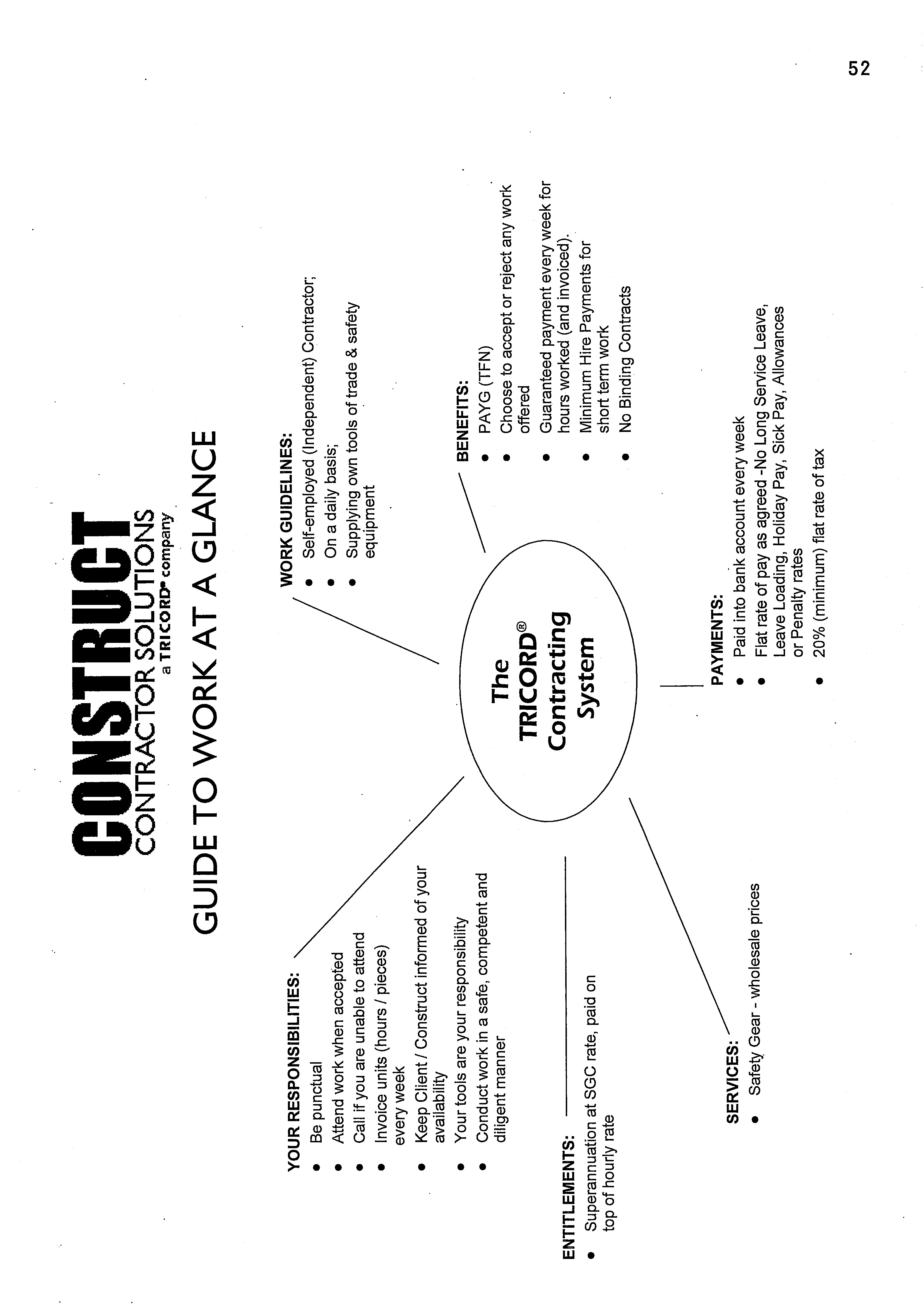
ANNEXURE C
INDUCTION - CONCERTO
Site Safety Induction Form
Site Name: | Concerto Apartments |
Site Address: | 189 Adelaide Terrace, East Perth |
Core Site Hours | Mon-Thurs: 7.00am -4.45pm Friday: 7.00am - 3.45pm Saturday: 7.00 - 12pm We start at 7.00am. If you think you are going to be late, please contact Denby or Darren; otherwise you will be sent home with no pay |
Morning/Lunch Break: | Smoko: 9.30am - 10.00am Lunch: 1.00pm - 1.30pm |
TOOL BOX MEETING DAILY | 7am - Attendance is compulsory. |
Sjte Manager | Denby Jackson - 0438 ### ### Darren Linton - 0422 ### ### |
Site Administrator: | Mariana Carceag - 0410 ### ### Site Office – 6218 #### |
Site Email | ### |
Associated Booklet: | Hanssen Pty Ltd - Construction Occupational Safety & Health Induction Booklet (emphasizes Duty of Care to self and others) |
Related Policy | No Smoking on site. An area is set aside for smoking in breaks. No phones on site; unless Is work related. Shirt to be worn all times |
Compulsory Safety Equipment: | Hard hats, safety boots plus safety glasses and gloves as appropriate. |
SAFETY PROCEDURES
• Report to management any defective plant, equipment and unsafe practices
• Electrical leads should never be tied to scaffold or handrails (they must hang from yellow cable hooks) and are to be plugged into the electrical distribution box by threading the lead through the hole in the bottom of the distribution box, not directly into the box. Electrical distribution boxes must be used in every instance therefore leads are not to be plugged into each other, or into an RCD box.
• All loose material must be securely stacked each night when winds are causing a problem on exposed areas of the site.
• If you need to use explosive power tools, you must provide relevant licences (if required) and place warning signs around the work area.
• Subcontractors are to notify the Site Administrator prior to bringing any new chemical and hazardous material onto the site. These must be in a clearly labelled manufacturer container and be accompanied by a Material Safety Data Sheet. Any flammable material needs to be stored in a ventilated area with adequate fire extinguishers at hand.
• All areas are to be clean and tidy at all times with particular attention being paid to maintain access through work areas. This is an ongoing item and must be maintained at all times.
• All workers and subcontractors will check, clear, tag and maintain in a safe condition all electrical equipment, leads, etc. Tagging must be done by a licensed electrician or the trained store man and any equipment with a “Danger” tag must not be used.
• All lifting gear is to be WorkSafe approved and to be operated by qualified personnel only.
• Contact the Site Manager of Safety Representative if you feel the job you have been given to do cannot be done safely. You must also report any situation you consider to be unsafe and cannot correct yourself.
• All workers and subcontractors shall familiarize themselves with wall current Occupational Health and Safety requirements and provide all personal protective clothing and equipment as required.
• All scaffolding is to have stair access and handrails before it can be used for any work. Any scaffolding over one (1) lift must be erected and lagged safe for use -by a licensed scaffolder.
• Subcontractors-will-provide Safe-Work Method Statements as required.
• All injuries are to be reported to the Site First Aid immediately and any accident or near miss is to be reported to the Site Manager without fail.
• If you need to work at heights where no protection is available, you must wear a safety harness. Working at heights, in this context, shall mean working within 2 meters of an unprotected edge which is higher than 2.0 meters off the ground. If this is necessary, you must be adequately trained and submit a Safe Work Method Statement before commencing work.
• Nine inch angel grinders must have a ‘dead mans’ switch installed. When using an angle grinder, the operator must have the relevant personal protective equipment.
• If your role requires you to have a ticket then this must be provided to the Site Administrator prior to commencing work on site.
• You must keep all oxy-acetylene bottles in a regulation or approved type trolley cage. They must also have flash back arresters fitted and be accompanied by a fire extinguisher.
• If you are going to do any electric arc welding, you must place screens and signs around the area and you must use the relevant personal protective equipment. Only helmet type visors are to be used.
• Excavation Permits are· required to be used by all personnel and must be signed by the Plumber and Electrician before starting any excavations.
• Any exposed steel reinforcement to have plastic safety caps on at all times.
• An Evacuation Procedure is in place on this site (see evacuation plan). If you hear a continuous blast of the siren, you must leave the site immediately. Two short blasts means a First Aid Officer is needed at the First Aid shed.
• All personnel are to have completed a Safety Induction Course (White/Blue Card) and have a white card before starting work on site.
• All hazardous areas are to be identified in accordance with the current regulation (i.e. Bunting and Signage).
• Anyone working in an area where tilt up panels are being installed needs to either have a tilt up panel certificate or have authorization from the Site Manager to work in that area.
• Participation in random drug and alcohol tests is mandatory.
ANNEXURE D
SITE RULES
1. Cooperate with Site Management at all times
2. Work safely and have consideration for yourself and others who may be affected by your actions or failure to act.
3. Keep the workplace TIDY and free of any hazards
4. Clock in before starting work and clock off when you have finished work
5. All new personnel must report to the Manager doing Site inductions prior to commencement of any work on site to comply with all the induction requirements
6. All site personnel must adhere to all site notices and directions at all times. They are there for your safety
7. PPE (Hard Hat and Steel Cap boots) must be worn on site at all times
8. There is a TOOL BOX MEETING every day at 7am. Attendance is compulsory
9. The site is a NO SMOKING site and NO MOBILE PHONES to be used for personal use within work time
10. We START at 7am. Anyone arriving late for work may be sent home without pay for the day or if lateness is a reoccurring issue, will be dismissed
11. You must send a text message to either the Site Manager or the Site Administrator priority 07:00 if you are ill / not in work
12. Holidays must be booked with at least 1 week in advance. Please, speak to site manager or site administrator.
13. Do not indulge in rough play or be under the influence of drugs or alcohol on site
14 Do not .intentionally misuse or cause anyone else to misuse anything provided in the interests of health and safety
NOTE: Breaches of any rules will result in disciplinary action


