

FEDERAL COURT OF AUSTRALIA
Shepard (Trustee) v Behman [2019] FCA 1801
File number(s): | NSD 1509 of 2018 |
Judge(s): | THAWLEY J |
Date of judgment: | |
Catchwords: | BANKRUPTCY AND INSOLVENCY – transfer of property before bankruptcy – application by trustee for relief under ss 120 and 121 of the Bankruptcy Act 1966 (Cth) and s 37A of the Conveyancing Act 1919 (NSW) in relation to a Deed of Settlement and transfer of property –whether intention to defeat creditors – whether consideration was less than the market value – whether transfer made in good faith – consideration of the transferor’s “main purpose” EQUITY – claim of equitable interest in property – constructive trust – based on common intention – money contributed to common pool of funds used for mortgage repayments and various other expenses |
Legislation: | Bankruptcy Act 1966 (Cth) ss 5(2), 5(3), 115, 116(2), 120, 121, 236(1)(d) Conveyancing Act 1919 (NSW) s 37A Evidence Act 1995 (Cth) s 140(2) Jurisdiction of Courts (Cross-Vesting) Act 1987 (NSW) s 5(1) |
Cases cited: | Baumgartner v Baumgartner [1987] HCA 59 Behman v Behman [2016] NSWCA 295 Bringinshaw v Briginshaw (1938) 60 CLR 336 Cannane v J Cannane Pty Ltd (in liquidation) (1998) 192 CLR 557 Chen v Marcolongo; Chen v Lym International Pty Ltd [2009] NSWCA 326 Clout v Markwell [2001] QSC 91 Daniel Terry Behman v Tarek Behman (also known as Terry Behman) [2015] NSWSC 1787 Donnelly v Windoval Pty Ltd [2014] FCA 80 Federal Commissioner of Taxation v Sharpcan [2019] HCA 36 Giumelli v Giumelli (1999) 196 CLR 101 Grant v Edwards [1986] Ch 638 Green v Green (1989) 17 NWSLR 343 Jabbour v Sherwood [2003] FCA 529 Maharaj v Chand [1986] AC 898 Marcolongo v Chen (2011) 242 CLR 546 Muschinski v Dodds (1985) 160 CLR 583 News Ltd v South Sydney District Rugby League Football Club Ltd (2003) 215 CLR 563 Parsons v McBain (2001) 109 FCR 120 Prentice v Cummins (No 5) (2002) 124 FCR 67 Shepherd v Doolan & Ors [2005] NSWSC 42 Trustees of the Property of Cummins (a Bankrupt) v Cummins (2006) 227 CLR 278 West v Mead [2003] NSWSC 161 Zreika v Royal [2019] FCAFC 82 |
Registry: | New South Wales |
Division: | General Division |
National Practice Area: | Commercial and Corporations |
Sub-area: | General and Personal Insolvency |
Category: | Catchwords |
Number of paragraphs: | |
Solicitor for the Applicant: | Somerset Ryckmans |
Counsel for the Respondents: | Mr FFF Salama |
Solicitor for the Respondents: | Miller & Prince Lawyers |
ORDERS
ADAM SHEPARD AS TRUSTEE OF THE PROPERTY OF TERRY (TAREK) BEHMAN, A BANKRUPT Applicant | ||
AND: | First Respondent MARK TERRY BEHMAN Second Respondent | |
DATE OF ORDER: |
THE COURT ORDERS THAT:
1. By 4.00pm on 5 November 2019 the parties provide to the Associate to Justice Thawley agreed minutes of order reflecting these reasons for judgment or, in the absence of agreement, competing minutes of order identifying the orders for which the parties contend.
2. In the event orders cannot be agreed, the matter be listed at 11.00am on 6 November 2019 for argument including as to costs.
Note: Entry of orders is dealt with in Rule 39.32 of the Federal Court Rules 2011.
THAWLEY J:
OVERVIEW
1 The applicant was appointed the trustee of the bankrupt estate of Mr Tarek Behman on 28 February 2018 consequent upon acceptance by the Official Receiver of a debtor’s petition presented by Mr Behman against himself. The time of commencement of the bankruptcy was 28 February 2018: s 115 of the Bankruptcy Act 1966 (Cth).
2 Mr Tarek Behman has four sons, Mr Matthew Behman, Mr Daniel Behman, Mr Andrew Behman and Mr Mark Behman. For clarity, and without intending any disrespect I will refer to the family members by their first names.
3 In these proceedings, the trustee applies for various declarations and orders pursuant to ss 120 and 121 of the Bankruptcy Act and s 37A of the Conveyancing Act 1919 (NSW). The trustee seeks to disturb two transactions:
(1) a “Deed of Settlement” dated 4 January 2017 between Tarek, Andrew and Mark; and
(2) a transfer by Tarek to Andrew and Mark of property at 46 Oliver Street in Bexley North (the property).
4 Andrew and Mark cross-claimed seeking various declarations and orders, including as to the validity of the Deed of Settlement and transfer. Andrew and Mark asserted that they have an equitable proprietary interest in the property.
5 The trustee, by its defence to the cross-claim, says that Andrew and Mark are prevented from alleging they have an equitable interest in the property on the basis of an Anshun estoppel. Further, he contends that the making of the assertion in these proceedings is an abuse of process.
6 For the reasons which follow, I am satisfied that:
(1) Andrew and Mark have an equitable proprietary interest in the property. This interest arises from circumstances which render it unnecessary to consider the trustee’s assertion that an Anshun estoppel applies or that the claim is an abuse of process; and
(2) the transfer of the property by Tarek to Andrew and Mark is void as against the trustee, but the trustee’s interest is held subject to the equitable interests of Andrew and Mark.
FACTUAL BACKGROUND
Early History
7 In around 2002, Tarek divorced and was granted sole custody of his four children. Matthew and Daniel were twins then aged 13, Andrew was 11 and Mark was 10.
8 From an early age Matthew, Daniel, Andrew and Mark contributed their earnings to a pool of funds which was used to pay the expenses of the whole family. Matthew moved out of the property in June 2009 and went to live in Melbourne, with his mother. Tarek, Daniel, Andrew and Mark continued to pool their income. From time to time Mark worked in his father’s business without being paid.
9 On 4 October 2012, Tarek pleaded guilty in the District Court of NSW to offences stemming from the making of false statements in relation to the nomination of drivers in respect of traffic infringements, whilst serving as a police officer.
10 In late 2012 Daniel and his father fell out. Daniel left the property in December 2012 or January 2013. That left Tarek, Andrew and Mark at the property, who each continued to contribute to the pool of funds.
11 As he had anticipated from remarks made by the judge when he was found guilty, Tarek was sentenced to imprisonment. He was incarcerated in Silverwater Correctional Complex from 15 February 2013 until 29 October 2014.
12 During the period of Tarek’s incarceration and since his release, Andrew and Mark have pooled their income to meet Tarek’s loan obligations relating to the property, other expenses relating to the property, and various financial obligations, including those of Tarek.
The NSW Supreme Court Proceedings
13 On 12 March 2014, Daniel commenced proceedings in the Supreme Court of New South Wales, claiming that Tarek held one fifth of the property for him on constructive trust. He asserted that Tarek agreed, or that it was to be inferred that it was their common intention, that Daniel should have a one fifth interest in the property and that Daniel had acted to his detriment on the basis of the agreement or common intention, making it unconscionable for Tarek to depart from the assumption. Daniel also relied upon proprietary estoppel.
14 The proceedings were heard on 24, 25 and 27 August 2015.
15 On 23 October 2015, Rein J delivered reasons for decision upholding Daniel’s claim: Daniel Terry Behman v Tarek Behman (also known as Terry Behman) [2015] NSWSC 1787. His Honour set out (at [7]) the following portions of Daniel’s evidence:
53. After my parent’s separation, from on or around 2001 until approximately 2003, I had conversations with Dad almost every fortnight in which Dad would share information with me about the financial circumstances that the family was in at that time. I believe that he did this because I was the eldest child. There were a large number of these conversations and a recurrent theme of the conversations and the kinds of things Dad said to me were words to the effect of:
“we couldn’t pay all the bills this month”;
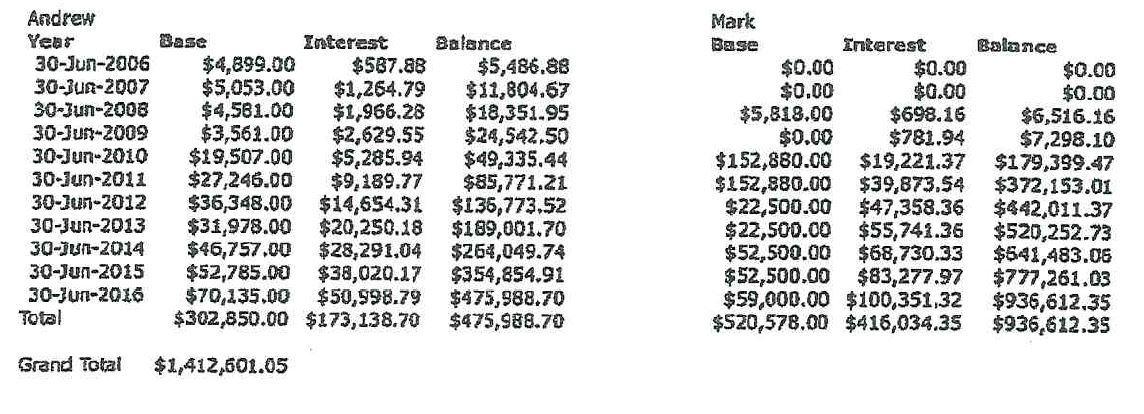
“we are struggling to pay the mortgage”;
“we are very tight on money”;
“we are in a lot of debt”;
“we might have to sell the house”; and “hurry up and start working”.
54. In addition to the above Dad told me from time to time that we may have to move to a public school because he couldn’t afford to pay our school fees and the mortgage. In doing so Dad said to me that we had to choose whether to stay in the Family House or stay at our current school, but that we couldn’t afford both.
55. During the period 2001 to 2003, Dad regularly said that we needed to sell the Family House and move into an apartment because he couldn’t afford the mortgage
56. Throughout 2001 to 2003, Dad also constantly pushed Matthew and I to find a job. Dad would say words to the effect of:
“Hurry up and start working”
“Hurry up and start working so you can help pay for the mortgage I can’t do it by myself”
“If you don’t want to work we might as well sell the house because I can’t afford it by myself”
“This isn’t only my house, it’s yours and your brothers so everyone needs to help”.
57. From 2003 to December 2012, Dad referred to the Family House and all our assets as “everyone’s” and the “family’s”. Dad would make these references in front of me to family and family-friends at gatherings. The kinds of things Dad said were, including but not limited to, words to the effect of:
“I’ve told the boys that this is everyone’s house. I’m not keeping it for me”;
“This is everyone’s house. I’ve told them that as long as we stick together, they’ll also have 2 or 3 units by the time they’re 30”;
“It’s the family’s house”;
“We all own everything, we’re a family”.
58. I also had conversations with Dad in which Dad would reaffirm to me that the Family House was “everyone’s” and “the family’s”. These conversations usually occurred when we were discussing our financial position, household bills, and when I wanted to handle my own funds. There were a large number of these conversations and a recurrent theme of the conversations and the kinds of things Dad said to me were including but not limited to, words to the effect of:
“This is everyone’s house and as long as we stick together, we’ll be ok”
“This isn’t only my house, it’s yours and your brothers so everyone needs to help”
“It’s not just my money or your money … we all own the house so we all pay for it as a family”
“It’s not my house, it [sic] yours and your brothers”
“As long as you all have this house, you’ll always be ok financially”
“Whatever you do, always keep this house and you’ll be ok.”
And the things that I say Dad said in paragraphs 103 and 112.
59. From 2003 and up to approximately November 2012, Dad also commented about “our” tight financial position at least once every few months. In these conversations, Dad would say to me words, including but not limited to, those noted in paragraphs 61, 62, 64, 71, 72, 76, 78, 79, 80, 82, 122, 123, 125.
…
63. Dad would say words to the effect of “Why didn’t you go to work!?”, “Why am I working to keep the house if you’re not going to help?”, “I can’t do it by myself. If you don’t want to help then I’ll sell it and we can move into a unit and you and your brothers can go to a public school” and “This is your house. I’m only keeping the house for you boys so if you don’t want to help then we might as well just sell it.”
16 His Honour recorded that Daniel had commenced university studies in 2007 and obtained employment with Lawler Partners, a firm of accountants. He worked part time for Lawler Partners during the academic year but full time when he was on holiday from university. On graduation he commenced working for Lawler Partners full time. His Honour noted that all of Daniel’s earnings were paid into a bank account opened in his name. However, the funds in the account were used for the expenses of the whole family, including mortgage repayments. The amount that Daniel actually received for his own purposes was quite modest, on Daniel’s calculation, amounting to $29,000 out of $204,000.
17 After Daniel left the property, Tarek had no access to Daniel’s earnings.
18 His Honour referred (at [11]) to evidence Daniel gave of a conversation he had with Tarek in around January 2013 after Daniel had left the property. Daniel asserted that he had asked Tarek to put his name on the title of the property and Tarek had refused. Daniel said that he then had the following conversation:
In response, I said to Dad words to the effect of “then repay me the value of my wages since I started working since you told me that you needed it to keep the house, and you said that the house was all of ours and the Family’s”.
However, Dad refused and said words to the effect of “that’s right, the house is the family’s and since you’re no longer part of the family, you don’t own it anymore”.
An argument followed where I repeatedly told Dad that I wanted him to either repay me the value of my wages or put my name on the title for the house, however Dad refused to do this.”
19 His Honour noted that the money which had been contributed by the sons had been used for a number of expenses including private school education, an extensive range of motor bikes, family use of a motor boat, family holidays and various other activities. He noted that the sons received a benefit in the form of the ability to continue to live in a five bedroom home.
20 His Honour was satisfied that the total income earned by Daniel paid into the account operated by Tarek was $184,913.86 and that Daniel had endorsed over to Tarek tax refunds of $19,843.87.
21 His Honour was satisfied that Daniel’s earnings had either been used directly to pay the mortgage or significantly assisted Tarek in being able to make the mortgage repayments and meet costs relating to the property.
22 His Honour noted that Daniel claimed a constructive trust on the basis of agreement or common intention. His Honour referred to the decision of White J in Shepherd v Doolan & Ors [2005] NSWSC 42 and stated at [33]:
I derive the following principles from Doolan:
(1) the inquiry for the purposes of determining whether there was a common intention is inquiry as to the actual intention of the parties. The law does not impute a presumed intention to the parties based upon what the Court considers fair and reasonable persons would have intended: see [34];
(2) the intention need not be that the parties have a specific share of the property;
(3) intention may be established by:
(a) agreement as to how the property should be held;
(b) express statements of intention;
(c) intentions inferred from conduct,
(4) a common intention that a party have a beneficial interest in a property owned by another will not be inferred merely from their joint occupation of property, nor the carrying out of household duties, nor the bringing up of children on the property, nor the doing of repairs, renovations, maintenance, decoration or improvement, nor the provision of furniture (Pettitt v Pettitt [1970] AC 777 at 805-6, 811, 818, 826; Gissing v Gissing [1971] AC 886 at 900, 910; Burns v Burns [1984] Ch 317 at 326, 328, 342);
(5) the intentions may be inferred from financial contributions, direct or indirect, to the acquisition of property, including the paying of mortgage or the payment of expenses which free up funds for that purpose (see [38]). In the case of ‘the common intention’ constructive trust there is no presumption that the beneficial interest is in proportion with the contribution of the purchase price;
(6) declarations about intentions before or at the time of the transaction or so close in time after the transaction as to constitute a part of it can be relied on (see [39]);
(7) a plaintiff must show that he or she acted to his or her detriment in a way referable to the agreement or intention that she have an interest in the property;
(8) conduct which is insufficient to establish a common intention as to ownership of the property [may] be sufficient to constitute relevant actions to the plaintiff’s detriment to establish a trust if the common intention is established otherwise;
(9) conduct may be both the evidence from which an intention that the plaintiff have a beneficial interest can be inferred and the act of detrimental reliance;
(10) equality is equity but that statement can be departed from when the parties make disproportionate contributions to the acquisition of the property;
(11) the constructive trust may arise after the acquisition of a property where the common intention is formed at a later time: Doolan at [45] and see Aytul Ak-Tankiz v Ferat Ak & Ramazan Ak [2014] NSWSC 1044 at [55].
23 His Honour did not consider there was a common intention that Daniel would have an interest in the property when he was still at school, saying at [34] and [35]:
[34] I am not satisfied that Terry did tell Daniel that he would use Daniel’s earnings to pay the mortgage when Daniel commenced earning money as a teenager. I think it is unlikely that he would say any such thing to an eleven or fourteen year old boy or that if he did say such, it could be expected that Daniel (and Matthew) would understand that to mean that they would have a one fifth (or a one third) interest from the time that they commenced employment. The proposition that merely by commencing employment and the payment of wages into an account controlled by Terry, would confer such an interest is extraordinary, with no detail of how long it was to continue or what would occur if the sons stopped working and how Terry could possibly enforce the continuation of the arrangement after the sons had reached eighteen: see Ashton v Pratt [2015] NSWCA 281; (2014) 88 NSWLR 281 at [84] to [89].
[35] I am unable to accept that merely by telling his children that the house or home was theirs and that any earning they obtained would be used for the family’s benefit Terry is to be taken as having agreed that each of the sons would, when they commenced working and contributing to the household, have a one fifth share in the property. The plaintiff was no more than fourteen years of age when the conversation took place.
24 His Honour held that the position changed from about March 2007 after Daniel had left school and commenced working at Lawler Partners. His Honour said:
[36] The situation is, however, altered when Daniel is an adult and has commenced earning a substantial wage. By the time Daniel commenced working for Lawler Partners I think he was intended to and would have understood that by his contributions Terry would be able to pay the various liabilities in respect of the property that had been and were continuing including the mortgage repayments. There was in a sense a joint pooling of resources for the benefit of all family members much as a de facto might contribute their income to the needs of both themselves and their partner.
25 At [38] and [39], his Honour then said:
[38] The view of Deane J in Muschinski v Dodds (1985) 1 60 CLR 583 with which Mason J (as his Honour than was) concurred was embraced in Baumgartner v Baumgartner [1987] HCA 59; (1987) 164 CLR 137 in the principal judgment (Mason CJ, Wilson and Deane J) and with the concurrence of Toohey and Gaudron JJ in their separate judgments, described as an application of
the general equitable principle which restores to a party contributions which he or she has made to a joint endeavour which fails when the contributions have been made in circumstances in which it was not intended that the other party should enjoy them
a principle to which reference was made by the plurality in Giumelli v Giumelli [1999] HCA 10; (1999) 196 CLR 101 at p 113.
[39] In Baumgartner the plurality said:
In the present case the parties pooled their earnings with a view to meeting all the expenses and outgoings arising from their living together as a family. The individual contributions of each party were not allocated to a particular category or particular categories of expenses and outgoings. The pool of earnings was used to pay outgoings associated with accommodation — mortgage instalments on the unit at Cabramatta and the property at Leumeah — as well as other living expenses. There was no suggestion that the respondent’s contributions were paid and received by way of rent or a charge for use and occupation and for living expenses. Such a suggestion would be inconsistent with the relationship that came into existence between the appellant and the respondent, a family relationship which was for the most part until 1982 a long-term stable relationship in which marriage was under continuous contemplation. The land at Leumeah was acquired and the house on it was built in the context and for the purposes of that relationship. Together they planned the building of the house. Together they inspected it in the course of its construction. Together they moved out into it and made it their home after it was built.
In this situation it is proper to regard the arrangement for the pooling of earnings as one which was designed to ensure that their earnings would be expended for the purposes of their joint relationship and for their mutual security and benefit. To the extent which the pooled funds were the source of payment of mortgage instalments by the appellant, the pooled funds contributed not only to present accommodation expenses but also to the security of the parties’ accommodation in the future. In this context it would be unreal and artificial to say that the respondent intended to make a gift to the appellant of so much of her earnings as were applied in payment or mortgage instalments. There is no evidence which would sustain a finding that the respondent intended to make a gift to the appellant in this way.
The case is accordingly one in which the parties have pooled their earnings for the purposes of their joint relationship, one of the purposes of that relationship being to secure accommodation for themselves and their child. Their contributions, financial and otherwise, to the acquisition of the land, the building of the house, the purchase of furniture and the making of their home, were on the basis of, and for the purposes of, that joint relationship. In this situation the appellant’s assertion, after the relationship had failed, that the Leumeah property, which was financed in part through the pooled funds, is his sole property, is his property beneficially to the exclusion of any interest at all on the part of the respondent, amounts to unconscionable conduct which attracts the intervention of equity and the imposition of a constructive trust at the suit of the respondent.
26 His Honour gave judgment for Daniel in an amount of $120,000, reflecting a one fifth interest in the property and granted Daniel a charge over the property, saying at [45] to [47]:
[45] Whilst I am inclined to regard the plaintiff’s claim to a one fifth interest having regard to the size of the total net payments made by him to the pooled account and the fact that he has received no wages from Nationwide Pest Control as not unrealistic, a declaration of a one fifth interest may create problems in the future including as to whether Daniel must become jointly liable for the repayment of the mortgage debt and I think it preferable that the property be burdened with a charge for the repayment of the equivalent amount of $120,000 with a specification of the period within which what amount is to be repaid to Daniel. I will give counsel an opportunity to address on the precise form of orders to be made.
[46] Terry did provide a sum of $80,000 by way of gift to Daniel and his brothers to enable them to buy an apartment at Wolli Creek. It seems likely that Daniel’s earnings assisted in the provision of that benefit to all of the sons to some degree. Daniel later had his interest in the apartment bought out for $25,000 (see para 41 of Terry’s affidavit) so that should be viewed as the return of a portion of the money he had contributed.
[47] Without a full accounting of how the earnings have been used which is not possible due to the incomplete banking records produced in respect of Terry’s many accounts, Daniel’s solicitor having subpoenaed Terry’s bank, it is difficult to arrive at any precise figure. Taking into account the net retention by Terry of the figure to which I have referred in [25] and even allowing for the return to Daniel of an additional amount through Wolli Creek, and for indirect benefit such as food and board, the claimed one fifth interest which equates to $120,000 of the net value of the property seems to me a reasonable reflection of what Daniel had contributed beyond what could be expected of a son living at home.
27 His Honour would also have upheld the alternative claim for relief based on proprietary estoppel, stating at [55]:
[55] Having regard to the undisputed fact that Terry told him at the time after Daniel had become an adult that “this is everyone’s house”, “I’m not keeping it for me”, “we all own everything” and “it’s yours and your brothers”, I accept that Daniel understood that he would, by continuing to make his extensive contributions, have an interest in the property which reflected those contributions although the extent of that interest was somewhat vague. In a context where significant contributions had commenced to be made it is not surprising that Daniel should have so understood the words used by Terry and Terry’s response when Daniel asked for return of his money was “the house is the family’s and since you’re no longer part of the family you don’t own it anymore” effectively recognising the existence of the interest that Terry denies Daniel ever had.
28 On 30 November 2015, Rein J delivered reasons for concluding that Daniel was entitled to indemnity costs from 1 April 2015 and to interest on the judgment amount of $120,000 from the date of commencement of the proceedings, totalling $12,440.55. The amount ultimately payable for interest was higher, because the amount was not paid until after the conclusion of an appeal, referred to below.
29 Andrew’s affidavit in the Supreme Court of NSW included the following:
5. In 2005 I commenced at McDonald’s Australia on a part time basis. I worked at the Bexley franchise of [McDonald’s] along with my brothers Daniel and Matthew. I worked similar hours to my brothers. My income was [deposited] into a bank account I had with National Australia Bank. My father as Trustee for me opened that account. My income was then used to contribute to the family’s financial resources.
6. I understood that we were each to contribute all that we could to support the lifestyle that we were living as a family. This allowed all expenses that arose to be covered. I did not believe and was never promised that my contribution to the family’s welfare would develop into a legal interest in the property. I never heard of [sic – or] observed any conversation between any member of the family that suggested that either myself or my brothers were to contribute our income so that we could maintain the mortgage and thereby receive an equal share, or any share at all in the property.
7. In 2009 I commenced work at William Buck accountants. I worked part time there will [sic] attending university. My income was paid into my bank account and I would transfer it to my father’s account so that I contributed to all family expenses. This was again done with the understanding that I was contributing to our family’s ability to enjoy a good lifestyle that included holidays, purchase of vehicles and recreational activities and equipment for those activities. The activities we enjoyed together included:
a. Family holidays;
b. Camping;
c. Fishing;
d. Family outings and activities;
e. Music concerts;
f. Private school fees;
g. Mobile phones every 2 years;
h. Computers every 2 years;
i. Acrobatic flights; and
j. Sports.
8. I worked at William Buck from 2009 to June 2014. During that period I did not hear or observe any discussion between my father and either or [sic – of] my brothers that indicated the reason for combining our incomes together was so that we would each obtain an equal share in the property we lived in.
…
17. I have contributed my earnings with no expectation that I would acquire any right or interest or future right or interest in the Property. I did not have an expectation because it was never communicated to me via my father’s inducement, action, inaction, reliance or statements.
18. I have not had any discussions with my father or my brothers regarding the subject of my brothers and or I acquiring any right or interest in the Property.
19. I contributed my earnings of my own volition and strictly for the purpose of increasing the family’s pool of disposable expenditure such as those outlined in paragraph 7.
20. My father has, at no stage, represented to me that my earnings were or would be applied toward his loan repayments, legal fees or his personal expenses.
21. I am not aware of my father making such representations to my brothers or any inducement, action, inaction, reliance or statements that may cause my brothers to come to such an understanding.
30 At this hearing, Andrew confirmed that his evidence in the Supreme Court of NSW was truthful and correct.
31 Mark’s affidavit in the Supreme Court of NSW included the following:
6. Since I commenced part-time work in 2007 at McDonald’s Australia through to full-time work at PSI Sheet Metal and now running my own business of Nationwide Pest Control, I have contributed my entire income to my family’s pool of disposable expenditure for our mutual benefits. This included:
a. Family holidays;
b. Camping;
c. Fishing;
d. Family outings and activities;
e. Music concerts;
f. Private school fees;
g. Mobile phones every 2 years;
h. Computers every 2 years;
i. Acrobatic flights; and
j. Sports.
7. I had known and observed that my elder brother’s [sic] had each contributed their income to the family pool of funds. I expected that when I commenced part time work at [McDonald’s] I would also contribute my income to the family pool as that money covered all our family expenses. There was no specific conversation about this occurring other than the original conversation we discussed as a family when my older two brothers commenced work. I knew it to be the way that our family functioned. There was no promise or inducement held out to me by any member the family including my father that caused me to do this. I do not expect or believe that I am to become entitled to a twenty percent interest in my father’s house at 46 Oliver Street, Blexley North.
…
12. I have never discussed with my father nor has he made any representations that I would obtain an interest in the property as a result of my contribution of my income to the family’s pool of funds.
13. I have not been induced by my father’s actions, inaction or relied on any representations made by my father regarding the property.
14. I have never discussed the property with my father nor has my father discussed, made representations and or induced me into giving him moneys in return for an interest in the property. I have never observed my father have a discussion with any of my siblings that they would obtain an interest in the property in return for investing their moneys into the family pooled funds.
15. I have always understood that our combined incomes allowed us to cover all expenses that we each benefitted from. I have listed the types of expenses I recall being paid from our combined incomes in paragraph 6. I am certain there were other expenses but I am unable to recall them all and I am certain I was not aware of all expenses at the time they were paid.
32 At this hearing, Mark confirmed that his evidence in the Supreme Court of NSW was truthful and correct.
The NSW Court of Appeal Decision
33 Tarek appealed the NSW Supreme Court’s decision in Daniel’s favour.
34 On 3 November 2016, the NSW Court of Appeal dismissed the appeal, with costs: Behman v Behman [2016] NSWCA 295. The principal case advanced on appeal was recorded by Meagher JA (with whom McColl and Gleeson JJA agreed) at [12]:
The essence of the appellant’s challenge to these findings at [36] and [55] is captured in the following submission made by his counsel in the course of argument. Having referred to the various statements which the appellant accepted were made over the period from 2003 to 2012, counsel’s submission continued:
For the reasons that the trial judge gives at paras 34 and 35: that these are statements which are not sort of one offs that were made alone and after Daniel had become an adult but, rather, as para 26 shows, these were just a continuing sort of conversation that went on in an informal fashion between the father and his four sons around the kitchen table, and the like, as they’re trying to deal with the circumstances in which they find themselves. So those words carry a meaning having been used as part of, as it were, the family dictionary or playbook over the years. They continued to have the meaning as originally understood. They don’t get a new meaning just because Daniel gets to his adulthood and is making greater contributions. If those words had only ever been used after Daniel became an adult, then that would be an entirely different state of affairs.
… [I]f words have been used over a long period of time in one circumstance, then, one would expect that they would be understood by the user of the words and the hearer of the words not to have changed their meaning. Really, that’s as far as I can take that point. I submit it doesn’t materially alter that proposition by a finding that at some later time the respondent was informed that some of the money he was paying was going to be used to pay a mortgage. Really, that’s the appellant’s argument: …
35 Meagher JA rejected the argument. His Honour held at [18] that, contrary to the case advanced by Tarek on appeal:
[The] evidence justified the primary judge’s finding that by March 2007 the parties intended and understood that the contributions were made on the basis that the respondent had a joint ownership interest. At that time he commenced university and a new job and made clear that he wanted to be independent, to move out of the home and to manage his own affairs. The appellant persuaded him not to do so because the contribution of his wages was necessary to enable the repayment of the mortgage and retention of the family home in which he had a joint interest. Exchanges to that effect continued over the subsequent period and, as the primary judge found, were a “factor in [the respondent] continuing to provide most of his wages and permitting those wages to pay for the mortgage and related property expenses such as council rates” ([54]).
Events between the Decision of Rein J and the Deed of Settlement
36 Andrew gave evidence in these proceedings to the effect that, between 2 April 2014 and 23 October 2015 (during the course of the Supreme Court and Court of Appeal litigation), Tarek had encouraged him not to make the claim made by Daniel. Andrew said that his father had said:
1. Daniel’s claiming that each of you are entitled to a 1/5th interest in the house.
2. If Daniel is right, then that means you have an interest in the house too.
3. If Daniel wins, then each of you must have an interest too.
4. If Daniel is right, then that mean you and Mark own a share of the house.
5. Don’t make the same claim as Daniel. You’ll lose. Daniel’s going to lose because his claim is bullshit.
6. Don’t worry about Daniel. No matter what happens, I’ll look after you with the house.
37 Andrew said he responded:
I don’t necessarily agree with Daniel, but if it turns out that he’s right and we all have an interest, then Mark and I should get our interest too.
38 Andrew gave evidence of the following conversation with his father after the decision of Rein J was delivered on 23 October 2015 and before the Court of Appeal’s decision:
Andrew: The Court said that Daniel has an interest in the house which means Mark and I do too.
Mark: Yep.
Terry: Andrew, I’m going to appeal. It can’t be right. Just hold off for now.
Mark: What are you going to do if you don’t win the appeal?
Terry: We’ll deal with it then.
Andrew: So Mark and I would have the same interest as Daniel?
Terry: Yes.
39 Mark gave broadly similar evidence, including:
[I]n 2014, 2015 and 2016 my father told me that he would acknowledge Andrew’s and my interest if Daniel won by saying in words to Andrew and me to the following effect:
i. Daniel is claiming that everyone has a 1/5th interest in the house.
ii. If Daniel wins, then that means you and Andrew own part of the house too.
iii. We can sort out you and Andrew later.
iv. The Court said Daniel has an interest in the house, which means you and Andrew have an interest.
v. You don’t have to go to Court. I said you will get it. The money will just go to the lawyers.
40 In cross-examination, Mark stated:
Q: Now, in that period after Rein J’s decision there were discussions between your father, Andrew and you which resulted in that deed of settlement of 4 January 2017?
A: Yes.
Q: You remember that?
A: Yes.
Q: Is it the case that your father said to you, that’s to you and Andrew, that you’re entitled to whatever Daniel got?
A: We were entitled to a share of the property.
Q: Did he say what share?
A: He just said we were entitled to a share. You’re entitled to a share. The judge reckons you’re entitled to a share. Daniel’s entitled to share. Obviously, you guys are entitled to a share.
…
Q: You’ve told us that there were several conversations between Andrew, your father and yourself … after Rein J’s decision, in which your father said to you and Andrew words to the effect that you are entitled to or he will give you an interest in the house?
A: Yes.
Q: Did he tell you at any point what that interest was in specific terms?
A: Well, he said if Daniel’s entitled to one-fifth then you guys are entitled to your one-fifth as well, so I reckon my interest was more than one-fifth considering the amount that I’ve put into the house and all the money that I haven’t been paid that he put into the house, so - - -
Q: But your father had said that if Daniel is entitled to a fifth you two, Andrew and you, are also entitled to a fifth?
A: Yes.
Q: You didn’t think that was sufficient from your point of view. Is that the case?
A: Not for the amount of money I put in.
Q: Right. Did you tell your father that?
A: Yes, but, look. He does what he wants to do and at the end of the day it’s better than nothing, isn’t it? I would rather get a share in the house than get nothing.
Refinance in December 2016 and payment to Daniel
41 Tarek gave evidence that he refinanced the property in December 2016 in order to pay Daniel the judgment amount and interest. He thought he borrowed about $1.1 million.
42 Tarek said that he did not discuss with Andrew and Mark that he had to refinance in order to pay the amount. I conclude that Tarek was mistaken on this point, at least so far as concerns Andrew.
43 In cross-examination, Andrew agreed that he knew around 22 December 2016 that Tarek had refinanced with ING in order to pay Daniel, and that the debt was $1.1 million. He knew that the equity in the property at that time was about $400,000.
44 By December 2016, Andrew had been admitted as a solicitor for two years. He also had experience working as a junior in the insolvency practice of William Buck & Co. It is likely that Tarek would have discussed the refinance with Andrew. Tarek, Andrew and Mark all lived at the property and spoke on numerous occasions about Daniel’s claim and the consequences of the decision of the Supreme Court and the Court of Appeal for them.
45 Both Andrew and Mark gave evidence of a conversation with Tarek in December 2016 in which Tarek stated the he had paid Daniel. They both conveyed that they understood from what Tarek had said to them that Daniel had been fully paid, including as to the costs of the litigation in both the Supreme Court and the Court of Appeal. The Court of Appeal had only dismissed the appeal on 3 November 2016.
46 Andrew agreed that he knew that the legal costs associated with the trial before Rein J and the appeal would be in the hundreds of thousands of dollars. He stated, however, that he did not turn his mind at the time, meaning December 2016, to Daniel’s costs. His evidence regarding conversations with his father about refinancing was:
Q: So sometime between 3 November and the date on which [Tarek] refinanced with ING Bank which was, apparently, 22 December 2016?
A: Yes. And the conversation about refinancing happened at the time of the – of Rein Js decision, as well.
Q: Right. So it had been, so to speak, in your father’s mind, from what he said, both at the time of the Supreme Court decision in October 2015 but not then activated because of the appeal, but revived again when the appeal was dismissed in 2016?
A: Yes.
Q: Did your father talk to you about what the refinancing would entail?
A: No.
Q: Did you know how much, at that point, was owed on the mortgage on the property?
A: I knew it was about 900,000.
Q: Right. That’s before Daniel’s judgment?
A: That’s correct.
Q: So that by the time you took Daniel’s judgment plus interest into account you would be getting close to 1.1 million?
A: That sounds about right, yes.
Q: Has your father said to you anything concerning how much he had incurred in legal costs for Daniel’s case?
A: He may have mentioned something about him having to pay his solicitors as the invoices came in.
Q: And, to your knowledge, did he pay them?
A: I believe he did, yes.
Q: Did he tell you how much it had cost him?
A: Not the total amount, no.
Q: Did you know from your own, if you like, professional knowledge that the legal costs of the trial before Rein J plus the appeal would be in the hundreds of thousands of dollars?
A: Yes.
Q: So without any need, if you like, to see a bill of costs of [sic – or] an assessment result, you knew that your father’s liability to Daniel was going to be considerably more than $140,000 that comprised merely the judgment debt plus the interest?
A: No, I – I didn’t know that.
Q: Well, you anticipated that the costs would be in the hundreds of thousands of dollars, didn’t you?
A: I didn’t anticipate that. I anticipated – I – I know that now. But at the time, I didn’t turn my mind to Daniel’s costs.
47 It was not put to Andrew, at least as directly as it should have been, that he knew that Daniel’s costs had not been paid. In those circumstances, I am not prepared to conclude positively that Andrew did know that those costs had not been paid. However, I do not have an actual persuasion that Andrew did not know Daniel’s costs had not been paid. The reasons for my lack of persuasion are as follows:
(1) First, by December 2016, Andrew had been a solicitor for two years. He must have been broadly familiar with how costs were determined in the kind of litigation in which he had been involved. It is inherently unlikely that Andrew could have thought that Daniel’s costs had been determined and paid within 6 weeks after the Court of Appeal’s decision. Andrew agreed that he read the decisions of Rein J and the Court of Appeal at the time they were published. I infer that he also read the decision of Rein J when his Honour ordered interest and indemnity costs.
(2) Secondly, there was no evidence to suggest that he thought that there had been some agreement with Daniel about Daniel’s costs or that they had been paid on some other occasion.
(3) Thirdly, from September 2009 to July 2014, Andrew had worked as a junior in the insolvency team of an accounting firm for a bankruptcy trustee and liquidator. With this experience, and being a solicitor, it is inherently unlikely that Andrew would not have given consideration to the costs order made against Tarek. He must have wondered how his father would pay for the costs in circumstances where his father had not been contributing to the pool of funds since his incarceration.
(4) Fourthly, the issue was of direct interest to Andrew and Mark, both of whom were then asserting an interest in the property as against Tarek. In a context where Andrew and Mark were regularly discussing their interest in the property and how that interest would be recognised, it is inherently unlikely that Andrew would not have considered and discussed when and how Daniel’s costs would be met.
(5) Fifthly, it is inherently unlikely that Andrew considered that the refinance of the property made available sufficient funds for Tarek to pay the judgment amount and interest of over $140,000 and the order for costs of the trial (including indemnity costs) and of the appeal. Andrew agreed that he might have signed a document in connection with the refinance. It was not suggested that Andrew considered the refinance was sought to obtain funding to pay Daniel’s costs. Andrew did not give evidence that he considered the funding was also sufficient to meet the orders for costs.
48 Nor do I have an actual persuasion that Mark did not know that Daniel’s costs had not been paid when the property was transferred. As set out in more detail at [81] below, it is clear that Tarek knew that Daniel’s costs had not been paid, although he did not know the quantum of those costs. For the reasons set out at (4) and (5) immediately above, I am not persuaded that Andrew did not know that Daniel’s costs had not been paid, and that he had not discussed that fact with Mark. It is inherently unlikely that Andrew and Mark would not have discussed the matter between themselves, and together with Tarek. Whilst I am not prepared to conclude that Mark did know that Daniel’s costs were not in fact paid in circumstances where he was not directly challenged on the point, on the evidence before me I do not have an actual persuasion that he did not know.
The Deed of Settlement
49 On 4 January 2017, Tarek entered into the “Deed of Settlement” with Mark and Andrew.
50 By the Deed of Settlement Tarek acknowledged that Mark and Andrew each had a proprietary interest in the property at 46 Oliver Street of which Tarek was the sole registered proprietor. Clause 3 provided:
3. PROPRIETARY INTEREST
3.1 Tarek hereby acknowledges that Mark and Andrew each have a proprietary interest in the Property to the extent outlined in Schedule A, and any further amounts that may be advanced thereafter.
3.2 Interest shall accrue at the rate of 12.00% p.a., as outlined in Schedule A, until the Amount of Claim is paid.
51 The “Amount of Claim” was defined as the amount provided in Schedule A, namely:
52 Schedule A was not shown to provide a proper calculation of financial contributions to the property by either Andrew or Mark. Indeed, it was shown to be little more than an overstatement of all of Andrew’s and Mark’s earnings since 2006, calculated with interest at 12%.
53 Schedule A was prepared by Andrew. He stated in cross-examination that it was prepared in a hurry and that he accepted it might contain errors. He stated:
In terms of the schedule, I accept that it’s probably not 100 per cent correct because it was put together quite quickly, once we got our father on board.
54 He stated that he derived the figures, at least so far as Annexure A concerned his contributions, from his PAYG statements and perhaps also his Notices of Assessment. He was tested on this in cross-examination. To take one example, Annexure A asserted a contribution by Andrew of $70,135 in the year ended 30 June 2016. However, his Notice of Assessment indicated that his disposable income after PAYG withholding and taking into account the Medicare levy was under $40,000.
55 Andrew’s evidence included:
Q: Well, some of them are manifestly seriously wrong, aren’t they?
A: Well, I’m trying to remember what other figure I took into account. I may have taken it from my tax return. I may – I – I thought it was – from my recollection it was my income plus my refund.
…
Q: Well, do you agree that whatever the explanation the figures shown on page 52 [Annexure A], at least so far as you are concerned, as representing your base figure, are quite unrelated to your assessable income in the respective years?
A: I don’t agree that it’s unrelated, no.
…
Q: Well, as far as you were concerned, the purpose of this schedule on page 52 [Annexure A] was to provide, on the face of it, a rational explanation for what was said to be your proprietary interest referred to in clause 3.1 on page 45, wasn’t it?
A: Yes, it was supposed to be representing of that.
Q: Wasn’t it your intention, therefore, to insert as figures in the schedule on page 52 [Annexure A] the largest amounts that you thought that you might be able to explain in order to exaggerate any possible interest that you could justify in relation to the property for the purposes of clause 3.1?
A: I don’t think I needed to exaggerate my income at all.
Q: Because the purpose of this deed, as far as Mark and you were concerned, was to give each of you a documented proprietary interest in 46 Oliver Street for as large a sum as you could establish, isn’t it?
A: No. It was – it was meant to be for the – for the right amount and, as I said before, I – I accept that the amounts in the schedule are not – are not correct.
…
Q: And you still say there that your estimates shown for your own base contributions, which you originally thought to be your assessable income that year, are a fair representation of what you say are justified as being your contributions even though now you can’t explain where the figures came from?
A: Well, I know they came from my income. I just – I don’t know how I came from that figure in my notice of assessment to – to the deed.
56 In closing submissions, when the Court asked how the income for the 2016 year could be thought to have been correct, Counsel was instructed by Andrew that the amounts in Annexure A were taken from his tax returns, and that the error occurred by Andrew having used gross earnings in his calculations. The Court indicated that this did not appear to be a likely explanation but that, in any event, it could only proceed on the evidence before it.
57 After the conclusion of the hearing, Andrew sought and was granted leave to re-open to explain how he had derived the figures in Annexure A. His evidence revealed errors in respect of nearly every one of his calculations. In relation to the 2016 year, Andrew stated that he had added the PAYG withholding to his gross income rather than deducting it to determine his net income. Mathematically, this provides an explanation. The error leads to a material overstatement and it is difficult to accept that such an error was not obvious in late 2016 / early 2017 (when Annexure A was prepared) given that the financial year was the one which had just ended. Andrew agreed that he would have had a reasonable idea of how much he had in fact received as income in that financial year when he prepared the Deed.
58 Andrew also prepared the figures in Annexure A for Mark for the 2010 and 2011 financial years. The claim for each year was $152,880. Mark turned 18 on 23 September 2010. Andrew stated that these amounts were calculated on the basis that Mark had worked in Tarek’s pest control business in those years but had not been paid. He said they were calculated by reference to the relevant award. Andrew did not know how much Tarek’s business in fact earned in either year or whether it was capable of paying any such amount. The circumstances suggest that it could not reasonably have been considered that the pest control business was sufficiently profitable to pay over $150,000 a year to an 18 year old employee. I am also no prepared to accept as accurate any of the other amounts stated in Annexure A to reflect Mark’s earnings. They were not demonstrated to be accurate by reference to primary records.
59 Although Andrew stated that Annexure A had been prepared in a hurry, Tarek gave evidence that there had been a number of drafts of it.
60 It should also be observed that Andrew lodged a proof of debt which he signed on 30 April 2018, claiming (for him and Mark) the purported debt under the Deed of Settlement dated 4 January 2017 in the amount of $1,832,656.29, being the amount in Annexure A with interest at 12% calculated to the date of the proof of debt. The proof of debt acknowledged the consideration of $1,450,000 paid by way of transfer of the property. By this time, Andrew had ample opportunity to check his calculations, which he should have done if they had been prepared in a hurry some 16 months earlier. Andrew agreed that he was aware that there was an obligation on individuals who lodged proofs of debt in bankruptcy to ensure that the proof of debt was correct.
61 It is likely that Andrew knew that the figures in Annexure A overstated the financial contributions of Andrew and Mark to the property when he prepared and signed the Deed of Settlement. Not only did Annexure A represent an outright overstatement of Andrew’s contributions, it assumed that all of Andrew’s and Mark’s earnings from 1 July 2005 (when they were respectively 15 and 12) should be counted towards an interest in the property. I do not believe Andrew could genuinely have thought that he and Mark were entitled to an interest in the property calculated by reference to every dollar each had ever earned.
62 As to the payment of interest at 12%, Andrew stated that his father agreed to the payment of interest at some time proximate to the date the Deed of Settlement was entered into. He agreed that the interest rate was far in excess of interest payable under the Court rules or the rate that Rein J had ordered. As noted above, his Honour had awarded interest only from the date of commencement of Daniel’s proceedings. I do not believe Andrew could genuinely have thought that he and Mark were entitled as against their father to interest at 12% on every dollar they had ever earned.
63 In reaching those conclusions, I take into account that Andrew was a solicitor of two years’ standing who had also worked part-time for five years as a junior in an insolvency team for a bankruptcy trustee and liquidator. I take into account the circumstances in which the Deed of Settlement and Annexure A were prepared.
64 Clause 4 of the Deed of Settlement contemplated that Tarek would provide an executed mortgage in registrable form for the purposes of Tarek charging all of his interest in the property to Mark and Andrew for their proprietary interest in the property. Clause 4 provided:
4. GRANT OF MORTGAGE
4.1 Tarek hereby charges all of his right, title and interest in the Property to Mark and Andrew for Mark and Andrew’s proprietary interest in the Property.
4.2 Tarek will provide to Mark and Andrew an executed mortgage in registrable form for the purposes of Clause 4.1.
4.3 Until such time as Tarek provides an executed mortgage to Mark and Andrew in accordance with Clause 4.2, Tarek consents to Mark and Andrew lodging a caveat over the Property in respect of their proprietary interest in the property.
4.4 Mark and Andrew shall pay any fees and charges associated with the registration of the caveat and mortgage described in Clauses 4.2 and 4.3.
65 Clause 6 provided that Mark and Andrew granted to Tarek a right to occupy the property “for the term of Tarek’s life”, on certain terms and conditions.
66 Tarek, Andrew and Mark each gave evidence that, although Tarek executed a mortgage as had been contemplated by the terms of the Deed of Settlement, the first mortgagee did not consent to the mortgage being registered.
67 On 2 June 2017, the property was valued at $1,500,000. The parties were agreed that the market value of the property as at 4 January 2017 and 27 June 2017 was $1,500,000.
The Transfer
68 A transfer of the property from Tarek to Mark and Andrew as joint tenants occurred on 27 June 2017. The transfer was registered on 10 July 2017. The transfer recorded that Tarek acknowledged receipt of consideration of $1,450,000. Stamp duty of $67,880 was paid.
69 Andrew and Mark borrowed $1,100,000 from Macquarie Bank Limited and granted that bank a mortgage over the property, dated 27 June 2017. These funds were used to discharge Tarek’s loan in relation to the property.
Daniel’s 37A proceedings
70 On 19 October 2017, Daniel commenced further proceedings in the Supreme Court of New South Wales seeking to have the transfer of the property to Andrew and Mark declared void pursuant to s 37A of the Conveyancing Act. Tarek was the first defendant. As noted earlier, on 28 February 2018, Tarek was declared bankrupt and a trustee was appointed to his bankrupt estate. The trustee filed the application the subject of this judgment in the Federal Court of Australia in August 2018, also seeking to void the transfer of the property to Andrew and Mark.
71 On 3 April 2019, the Supreme Court proceedings which Daniel had commenced were transferred to this Court pursuant to s 5(1) of the Jurisdiction of Courts (Cross-Vesting) Act 1987 (NSW). On 29 May 2019, an order was made staying Daniel’s proceedings pending the determination of these proceedings.
Daniel’s claim for costs
72 On 25 January 2018, the District Court of New South Wales issued an order for the payment of Daniel’s costs in the amount of $224,595.25. This related to the proceedings determined by Rein J and the subsequent appeal.
Tarek’s Evidence
73 Andrew and Mark issued a subpoena to Tarek to give evidence. His evidence, so far as it is not referred to elsewhere in these reasons, may be summarised in the following way.
74 He had contributed nothing towards the property since his incarceration. Together, Mark and Andrew had contributed all the funds towards the property since February 2013.
75 He had “hundreds” of conversations with Mark and Andrew about what would happen with respect to the property once Daniel’s case had been determined. He believed that the decision of the NSW Court of Appeal meant that Andrew and Mark were also entitled to one fifth of the value of the property prior to 2013.
76 Before December 2012 he had told Andrew and Mark and his other sons that “the house will always be [theirs]”. He intended this to mean that they would inherit the house when he died. He did not mean that they had a share in the property at that time, or that they had a proprietary interest in the property.
77 Tarek agreed that he executed the document in front of a Justice of the Peace at Kingsgrove. He had read the document when he signed it, considered he understood it and did not get any advice from any independent person about the substance of the Deed of Settlement. He could not recall when he received the Deed of Settlement before he signed it. He said that he, Andrew and Mark had numerous discussions about the amounts involved. He considered that by effecting the transfer he was reimbursing Andrew and Mark for all the money that they had ever contributed to the property. Schedule A to the Deed of Settlement had changed several times before the Deed of Settlement was executed.
78 So far as Tarek was concerned, he did not particularly care what dollar amount was shown in Annexure A. He gave the following evidence:
Q: Whether it was or it wasn’t, whatever the final figure was that you agreed to, what was the significance of that figure for you in relation to Andrew and Mark?
A: That figure really wasn’t significant to me in relation to Andrew and Mark. It was – the figure that was significant to Andrew and Mark was – this is all I’ve got. Whether you’re asking for 5 million or 1 million, it really doesn’t matter. There’s only 400,000. So once you’ve demonstrated to me that I owe you more than 400,000, then everything above that is really irrelevant. I can’t give you more than what I have.
79 Tarek wanted to stay out of court in circumstances where Andrew and Mark were threatening to sue him. As Tarek put it in his evidence, in terms which I accept, he preferred to settle their claims rather than spend another three years in litigation and lose the other half of his family.
80 Tarek also gave the following evidence:
Q: Any arrangement or agreement that you reached with Andrew and Mark had to, from your point of view, protect your ability to remain living in the house for life. Is that right?
A: It wasn’t a matter of living in the house, but it was a matter of making sure I had a roof over my head. That was the most important thing to me.
81 Tarek had re-financed the property in order to pay Daniel the judgment sum and interest, totalling approximately $143,000. Tarek was aware that Daniel had also been awarded costs in respect of the Supreme Court litigation (ultimately determined to be $224,595), but believed the figure was going to be more like $80,000.
82 As at 4 January 2017, Tarek had roughly $400,000 available to him (in equity in the property) and no other assets. He entered the Deed of Settlement to transfer the property to Mark and Andrew to settle his debt to them. At the time, the only thing he could offer anyone was the equity in the property. He did not know the quantum of Daniel’s costs at the time of the Deed of Settlement.
83 Tarek said he transferred the property into Andrew and Mark’s names to ensure they received what they were owed. He claimed that it did not cross his mind that by transferring the property to Andrew and Mark, he would ensure third parties could not claim repayment from the equity in the property. He claimed he did not intend to avoid making payment to Daniel. He explained that the transfer was made after he formed the opinion that the “most commercial, logical decision was to settle with Andrew and Mark”. He stated that the only people he owed money to were Andrew and Mark because Daniel’s costs had not yet been quantified.
84 I do not accept that Tarek thought he did not owe Daniel money. He must have known that he owed Daniel in respect of the costs orders but that the amount so owed had yet to be formally quantified. I do not accept that he did not turn his mind at the time the Deed of Settlement was signed, or when he transferred the property, to the fact that he had an outstanding but unquantified debt to Daniel which he would ultimately be required to meet.
85 Before turning to the claims made by the trustee it is convenient first to determine whether Andrew and Mark had an interest in the property.
The interest of Andrew and Mark in the property
86 Mark and Andrew adhered to the evidence they had given in the Supreme Court of NSW in August 2015 that they did not, at that time, have the understanding that their financial contributions would give them any proprietary interest in the property. Their evidence was to the effect that they paid money into the common pool of funds voluntarily and without any expectation of thereby receiving a proprietary interest in the property.
87 I conclude that, at least up until August 2015, Andrew and Mark contributed funds to the general expenses of the family, as members of the family, without expectation of having a proprietary interest in the property. In the case of Mark, I accept that he worked in Tarek’s business for a substantial period without being paid amounts which he should have been. He did so without an understanding that he would thereby receive a proprietary interest in the property.
88 That position changed at some point after the decision of Rein J. At some point after his Honour’s decision, Tarek, Andrew and Mark operated on the common assumption and with the common intention that, by Andrew and Mark continuing to contribute to the pool of funds as they had in the past, they would hold a beneficial interest in the property.
89 I conclude that Tarek, Andrew and Mark intended that they each hold an equal share in the property.
90 I accept the evidence of Andrew and Mark that they considered and discussed whether it should be a one fifth share on the basis of the reasoning of Rein J in relation to Daniel. I accept that they discussed one quarter on the basis that Daniel’s one fifth share had been paid. I accept that they discussed one third on the basis that Daniel had been paid the judgment amount and Matthew was not making any claim.
91 Having had those discussions, I conclude that they each had a common intention that they hold a share in the property, and that they each held an equal share, irrespective of the amount of their previous financial and non-financial contributions or the precise amount of their ongoing financial contribution to family expenditure.
92 This understanding was reached in the context where each of them had previously contributed in different ways. For many years, Tarek had contributed to the pool of funds. Indeed, from 1995 when the property was purchased and for many years thereafter, he was the sole contributor. He had, in what must have been very difficult circumstances, worked two jobs and shouldered the burden of bringing up four children as a single parent. Mark had contributed substantial services in Tarek’s business before he was incarcerated.
93 I do not accept that there was any common intention that they hold an interest in the property calculated by reference to financial contributions or historic earnings as might be suggested by the Deed of Settlement.
94 As at the date of the Deed of Settlement and the transfer, it was the common intention of Tarek, Andrew and Mark that each have an equal beneficial interest in the property, having regard to their historical contributions and irrespective of the precise amount of their ongoing contributions. It would have been unconscionable for Tarek to hold his legal title and assert he held it free of any beneficial interest in Andrew and Mark– see generally: Grant v Edwards [1986] Ch 638; Green v Green (1989) 17 NWSLR 343; Maharaj v Chand [1986] AC 898 at 907; Doolan at [31], [34] to [43]. On the basis that the equity in the property was $400,000, each interest equated to a little over $133,000.
95 The position would have been no different if the common intention had arisen before the decision of Rein J. If the evidence given by Andrew and Mark in the Supreme Court of NSW was incorrect or if, notwithstanding the precise terms of that evidence they too, together with Tarek, had the intention that they held an interest in the property, I would have concluded that it was an intention that each hold an equal interest in the property irrespective of their particular financial and other contributions. Mark’s contributions were not always financial, but comprised substantial performance of work in Tarek’s business.
96 Even if a trust in favour of Andrew and Mark existed on the basis of the principles in Baumgartner v Baumgartner [1987] HCA 59 (see also West v Mead [2003] NSWSC 161 at [52] to [64]; Doolan at [32] and [33]) – that the parties had contributed to a failed joint endeavour in circumstances where it was not intended that the other parties should retain the benefit – I would have concluded that the respective beneficial interests of each of Tarek, Andrew and Mark were equal taking into account their various financial and non-financial contributions over the years assessed in light of the scope of the joint endeavour.
97 A common intention constructive trust does not need to be recognised by judicial declaration before equity will recognise its existence; the Court’s declaration of the existence of the trust recognises rather than creates the trust: Muschinski v Dodds (1985) 160 CLR 583 at 614 (Deane J); Giumelli v Giumelli (1999) 196 CLR 101 at [3] to [6] (Gleeson CJ, McHugh, Gummow and Callinan JJ); Parsons v McBain (2001) 109 FCR 120 at [13] (Black CJ, Kiefel and Finkelstein JJ); Clout v Markwell [2001] QSC 91 at [20] (Atkinson J); Jabbour v Sherwood [2003] FCA 529 at [76] (French J).
98 Section 116(2)(a) of the Bankruptcy Act excludes property held on trust by the bankrupt from divisible property. A trustee takes property subject to all liabilities and equities which affect it in the bankrupt’s hands. It would be unconscionable for the trustee to deny those interests: Clout at [21] (Atkinson J).
99 The equitable interests of Andrew and Mark existed before Daniel’s costs order had been quantified. The common intention did not come into existence in any way to defeat Daniel being paid the amount of his costs. Rather, it came about in good faith in the circumstances identified earlier. At some time after Rein J’s decision, Tarek, Andrew and Mark conducted themselves on the common understanding and with the common intention that each of them held an equal beneficial interest in the property because of what had occurred in the past and in light of their ongoing circumstances. It was on that basis that Andrew and Mark continued to meet the mortgage repayments and contribute to family expenditure.
100 It is now necessary to turn to the trustee’s claims.
THE CLAIM UNDER SECTION 120 OF THE BANKRUPTCY ACT
101 Subsection 120(1) of the Bankruptcy Act provides:
120 Undervalued transactions
Transfers that are void against trustee
(1) A transfer of property by a person who later becomes a bankrupt (the transferor) to another person (the transferee) is void against the trustee in the transferor’s bankruptcy if:
(a) the transfer took place in the period beginning 5 years before the commencement of the bankruptcy and ending on the date of the bankruptcy; and
(b) the transferee gave no consideration for the transfer or gave consideration of less value than the market value of the property.
Note: For the application of this section where consideration is given to a third party rather than the transferor, see section 121A.
102 The phrases “transfer of property” and “market value” are defined in s 120(7):
Meaning of transfer of property and market value
(7) For the purposes of this section:
(a) transfer of property includes a payment of money; and
(b) a person who does something that results in another person becoming the owner of property that did not previously exist is taken to have transferred the property to the other person; and
(c) the market value of property transferred is its market value at the time of the transfer.
103 There was no dispute that s 120(1)(a) was satisfied because the transfer of 46 Oliver St took place in the period beginning 5 years before the commencement of the bankruptcy.
104 As to s 120(1)(b), Andrew and Mark applied the advance of approximately $1.1 million from Macquarie Bank to pay out Tarek’s loan with ING. The trustee did not dispute that this was consideration given in relation to the transfer. The trustee denied that any further consideration was given.
105 Andrew and Mark relied upon s 120(6) of the Bankruptcy Act which provides:
Protection of successors in title
(6) This section does not affect the rights of a person who acquired property from the transferee in good faith and by giving consideration that was at least as valuable as the market value of the property.
106 Andrew and Mark relied upon their funding of mortgage repayments from 28 February 2013 to 27 June 2017, totalling $231,439.34. Those payments mostly represented interest. Indeed, there was not shown to be any reduction in principal. The payments were made in circumstances where Tarek had been incarcerated and, even after release, had not contributed. However those payments were not made pursuant to a loan arrangement between Tarek and his sons, so much being denied by both Andrew and Mark. Nor, it should be observed, did they get nothing in return for meeting the mortgage repayments. If they had not made them, Andrew and Mark would presumably have been paying rent to live elsewhere. These amounts were not consideration paid for the transfer of the property. The amounts were paid, at least after the decision of Rein J, pursuant to a common intention on the part of Tarek, Andrew and Mark that each of them would have an equal interest in the property.
107 Andrew and Mark relied on their “pre-2013 contributions”, being a reference to those contribution made before Tarek was incarcerated. However, those amounts were not consideration for the transfer, nor were they made pursuant to any understanding that Andrew or Mark would gain a proprietary interest in the property. They were contributions made to a pool for all family expenses, including mortgage repayments, in the expectation that Tarek would ultimately leave the property to his children in his will, but not in circumstances such that a constructive trust would be recognised.
108 Andrew and Mark relied upon renovation expenses which they had paid in the amount of $50,000. This amount was said to be the reason why the transfer recorded a consideration received by Tarek of $1.45 million rather than the actual market value of $1.5 million.
109 Andrew and Mark also relied upon the following payments said to have been made from 2013 to 2017: insurance premiums, council rates, plumbing repairs, water rates, electricity, gas, a dishwasher, light replacements, intercom repairs, garage door repairs, subfloor ventilation, oven repairs and a sliding gate replacement. None of these payments was consideration for the transfer. Many of them were outgoings commonly incurred in maintaining property.
110 Andrew and Mark did not give consideration that was at least as valuable as the market value of the property transferred: s 120(6). The market value of the property was $1.5 million. Andrew and Mark did not give consideration in that amount.
111 Further, I am not satisfied that Tarek’s one third equitable interest in the property was transferred in “good faith” within the meaning of s 120(6). For the reasons given at [47] and [48] above, I do not have an actual persuasion that Andrew and Mark did not know that an objective of Tarek in making the disposition was to avoid payment of Daniel’s costs. Andrew knew that the amounts he included in Annexure A of the Deed of Settlement represented inflated amounts of “contributions” with interest at 12%. So far as the figures were correct, at best they represented gross earnings since Andrew was 15 and Mark was 14. Given Andrew’s training and experience, and his denial that the amounts of money he had paid constituted loans, he could not possibly have considered that his father owed him or Mark the amounts in Annexure A, or that such an amount represented consideration paid by him or Mark towards the property.
112 It follows that the trustee’s claim under s 120 must succeed.
THE CLAIM UNDER SECTION 121 OF THE BANKRUPTCY ACT
113 Subsection 121(1) to (4) of the Bankruptcy Act provide:
121 Transfers to defeat creditors
Transfers that are void
(1) A transfer of property by a person who later becomes a bankrupt (the transferor) to another person (the transferee) is void against the trustee in the transferor’s bankruptcy if:
(a) the property would probably have become part of the transferor’s estate or would probably have been available to creditors if the property had not been transferred; and
(b) the transferor’s main purpose in making the transfer was:
(i) to prevent the transferred property from becoming divisible among the transferor’s creditors; or
(ii) to hinder or delay the process of making property available for division among the transferor’s creditors.
Note: For the application of this section where consideration is given to a third party rather than the transferor, see section 121A.
Showing the transferor’s main purpose in making a transfer
(2) The transferor’s main purpose in making the transfer is taken to be the purpose described in paragraph (1)(b) if it can reasonably be inferred from all the circumstances that, at the time of the transfer, the transferor was, or was about to become, insolvent.
Other ways of showing the transferor’s main purpose in making a transfer
(3) Subsection (2) does not limit the ways of establishing the transferor’s main purpose in making a transfer.
114 Subsection (4) disengages the operation of subsection (1) if the transferee discharges the onus of establishing certain matters:
Transfer not void if transferee acted in good faith
(4) Despite subsection (1), a transfer of property is not void against the trustee if:
(a) the consideration that the transferee gave for the transfer was at least as valuable as the market value of the property; and
(b) the transferee did not know, and could not reasonably have inferred, that the transferor’s main purpose in making the transfer was the purpose described in paragraph (1)(b); and
(c) the transferee could not reasonably have inferred that, at the time of the transfer, the transferor was, or was about to become, insolvent.
115 Section 121(9) defines “transfer of property” and “market value”:
Meaning of transfer of property and market value
(9) For the purposes of this section:
(a) transfer of property includes a payment of money; and
(b) a person who does something that results in another person becoming the owner of property that did not previously exist is taken to have transferred the property to the other person; and
(c) the market value of property transferred is its market value at the time of the transfer.
116 Section 121(1) of the Bankruptcy Act was considered by the High Court in Cannane v J Cannane Pty Ltd (in liquidation) (1998) 192 CLR 557. It then took a different form:
(1) Subject to this section, a disposition of property, whether made before or after the commencement of this Act, with intent to defraud creditors, not being a disposition for valuable consideration in favour of a person who acted in good faith, is, if the person making the disposition subsequently becomes a bankrupt, void as against the trustee in the bankruptcy.
117 The section now focusses attention on the “main purpose” on the part of the transferor in making the transfer. The “main purpose” of which the section speaks is the actual purpose of the transferor in making the disposition.
118 Purpose is different to motive. The motive for a person’s conduct is the person’s reason for engaging in it. By contrast, the purpose of a person’s conduct is the end that is sought to be accomplished by it: Federal Commissioner of Taxation v Sharpcan [2019] HCA 36 at [49] (Kiefel CJ, Bell, Gageler, Nettle and Gordon JJ); Donnelly v Windoval Pty Ltd [2014] FCA 80 at [144] (Foster J); News Ltd v South Sydney District Rugby League Football Club Ltd (2003) 215 CLR 563 at [18] (Gleeson CJ).
119 The relevant purpose of the transferor must be the “main” purpose. The word “main” is not defined. It means what it says. The section requires identification of the transferor’s main purpose which might also be described as the chief, ruling, principal or predominant purpose; however, the word actually used – “main” – is the critical one.
120 Consistent with the meaning of the word “main”, the existence of purposes additional to, but not predominating, the “main” purpose do not prevent the operation of the provision: Prentice v Cummins (No 5) (2002) 124 FCR 67 at [148] (Sackville J).
121 The “main purpose” may be proved directly or it may be inferred, including from the objective circumstances: Cannane at [12] (Brennan CJ and McHugh J). For example, as was said by the Full Court in Zreika v Royal [2019] FCAFC 82 at [90]:
(1) a subtraction of assets which, but for the impugned disposition, would be available to meet the claims of present and future creditors is material from which a purpose of preventing the transferred property from becoming divisible among the transferor’s creditors (or hindering or delaying that division) might be drawn;
(2) if property is transferred at an undervalue or is given away, that is a fact relevant to the purpose to be attributed to the transferor in transferring the property.
122 The trustee must establish that the circumstances give rise to a reasonable and definite inference, not merely to conflicting inferences of equal degree of probability. The evidence is to be assessed, and inferences drawn, having regard to the seriousness of the allegations and the gravity of the consequences of any adverse findings: Trustees of the Property of Cummins (a Bankrupt) v Cummins (2006) 227 CLR 278 at [34] (Gleeson CJ, Gummow, Hayne, Heydon and Crennan JJ); s 140(2) of the Evidence Act 1995 (Cth); Bringinshaw v Briginshaw (1938) 60 CLR 336.
123 As at 4 January 2017, Tarek was aware that Daniel was still owed a substantial amount with respect to his costs, even though the amount of those costs had not been quantified. Tarek had only a few weeks earlier refinanced the property in order to pay Daniel the judgment amount of $120,000 plus interest. He could not have been in any doubt that Daniel would pursue his costs order. Although Tarek’s recollection on this issue was not particularly good, he thought he had paid between $50,000 and $70,000 in respect of his own costs of the Supreme Court and Court of Appeal litigation. He gave evidence that he thought that Daniel’s cost would “be somewhere around the 80 grand, 50 grand, 80 grand. There were conversations around that figure at one point during the court matter with Daniel”.
124 Tarek must have known that he would not have be able to meet Daniel’s costs from his earnings. He must have known that the only plausible way he could meet Daniel’s costs was either by refinancing the property or by selling it to release equity. He must have known that either of these options would likely result in further dispute with Andrew and Mark, an outcome he understandably wished to avoid.
125 Tarek did not give evidence of his earnings in 2017, either when the Deed of Settlement was signed or when the property was transferred. However, they could not have been significant. Tarek stated that Andrew and Mark had paid for everything since he had been incarcerated. He stated:
There’s only two contributors to that pool of funds that have paid – paid for the clothes on my back.
126 In terms of s 121(2), “it can reasonably be inferred from all the circumstances that, at the time of the transfer, the transferor was, or was about to become, insolvent”. It is reasonable to infer that, at the time of the transfer and because of it, Tarek would not have been able to pay when due the costs owed to Daniel once demanded, and that he would therefore then not have been “solvent”, with the result that he would become “insolvent”: s 5(2) and 5(3).
127 Even absent the presumption of the “main purpose” created by s 121(2), I conclude by inference from all of the circumstances, and notwithstanding his denial of the proposition, that Tarek’s “main purpose” in making the transfer was “to prevent the transferred property from becoming divisible among the transferor’s creditors”: s 121(1)(b).
128 Tarek received no cash payment for the transfer of legal title in the property to Andrew and Mark. I do not accept that Tarek believed that he held no beneficial interest in the property as at 4 January 2017, or that he owed Andrew and Mark amounts which exceeded the remaining equity in the property. Before his incarceration in 2013, Tarek had worked hard, sometimes working multiple jobs at the one time, in order to meet the repayments on the house and to provide for his children. In addition to the payments made for many years towards the property, he had – as the sole contributor – paid for private school educations, holidays and all other general family expenditure up until the time his children also started contributing.
129 I conclude that Tarek did not believe he owed Andrew and Mark a debt in the amount shown in Annexure A of the Deed of Settlement. Annexure A represented Andrew’s entire gross earnings from when he was 15. It represented artificial earnings for two years with respect to Mark and otherwise, Mark’s entire earnings since he was 14. I accept that Tarek believed that Andrew and Mark were entitled to an interest in the property, but not a 100% interest. I do not accept that he considered he owed them money in the sense that he had a legal obligation to repay Andrew and Mark what they had contributed to the pool of funds. Each of Tarek, Andrew and Mark understood that they were entitled to an interest in the property, not to repayment of their financial contributions to the pool of funds.
130 According to the terms of the Deed of Settlement, Tarek could remain in the house for life, assuming it was not sold by Andrew and Mark. I conclude that none of Tarek, Andrew or Mark contemplated that the property would be sold during Tarek’s lifetime.
131 By entering into the Deed of Settlement and transferring the property, Tarek secured the outcome that he could remain living in the property without having to pay Daniel the costs which Daniel would inevitably seek.
132 Tarek’s state of mind did not relevantly alter between 4 January 2017 and 27 June 2017 when he transferred the property.
133 Andrew and Mark submitted that Tarek’s main purpose could not have been to prevent, hinder or delay the property being divisible amongst Tarek’s creditors because there was no equity in the property which would have been available to his creditors. In this regard, Andrew and Mark referred to the decision of the NSW Court of Appeal in Chen v Marcolongo; Chen v Lym International Pty Ltd [2009] NSWCA 326 at [268] to [272]. It follows from my conclusion that the parties operated on the basis that each of Tarek, Andrew and Mark had an equal interest in the property that this submission cannot be accepted.
134 Andrew and Mark’s reliance on the terms of s 124(4) in their defence cannot succeed, for the following reasons:
(1) Paragraph (a) of s 121(4) was not satisfied for the reasons given at [47], [48] and [111] above.
(2) As to paragraph (b) of s 121(4), Andrew and Mark did not discharge the onus of establishing that they did not know or could not have reasonably inferred that the transferor’s main purpose in making the transfer was the purpose described in (1)(b). Whilst I do not conclude positively that Andrew and Mark did know that Tarek had not yet paid Daniel’s costs in circumstances where it was not squarely put to him, I am not left with a positive persuasion that they did not know. The reasons for that conclusion are set out at [47] and [48] above.
(3) Nor have Andrew and Mark established that paragraph (c) of s 121(4) is satisfied. Given I am not satisfied that Andrew and Mark did not know that Daniel’s costs had not been paid (see [47] and [48] above), I am not satisfied that they would not reasonably have inferred that Tarek was about to become insolvent.
135 As at the date of transfer, the property would “probably have been available to creditors if the property had not been transferred”: s 121(1)(a). Tarek’s “main purpose” (s 121(1)(b), (2) and (3)) in making the transfer was “to prevent the transferred property from becoming divisible among the transferor’s creditors”: s 121(1)(b)(i).
136 It follows that the trustee’s claim under s 121 must succeed.
THE CLAIM UNDER SECTION 37A OF THE CONVEYANCING ACT
137 Section 37A of the Conveyancing Act provides:
37A Voluntary alienation to defraud creditors voidable
(1) Save as provided in this section, every alienation of property, made whether before or after the commencement of the Conveyancing (Amendment) Act 1930, with intent to defraud creditors, shall be voidable at the instance of any person thereby prejudiced.
(2) This section does not affect the law of bankruptcy for the time being in force.
(3) This section does not extend to any estate or interest in property alienated to a purchaser in good faith not having, at the time of the alienation, notice of the intent to defraud creditors.
138 Section 37A should receive a liberal construction in effecting the purpose of suppressing fraud: Marcolongo v Chen (2011) 242 CLR 546 at [20] (French CJ, Gummow, Crennan and Bell JJ) and [58] (Heydon J); Zreika at [88] (Besanko, Farrell and O’Callaghan JJ).
139 In Zreika at [88], the Full Court explained by reference to Marcolongo:
(1) Section 37A refers to “an intent to defraud creditors”. The word “defraud” when used in that phrase means “delay, hinder or [otherwise] defraud” as the Elizabethan Statute had provided (Marcolongo at [19]).
(2) Whether there is an intent to defraud creditors involves a question of fact concerning actual knowledge and is to be distinguished from the purely equitable doctrine of constructive notice or constructive knowledge (Marcolongo at [26]–[28]).
(3) However, it is not necessary to prove a desire to cheat or swindle those prejudiced. Furthermore, whilst it is necessary to show the existence of an intention to hinder, delay or defeat creditors, it is not necessary to show that the debtor wanted creditors to suffer a loss or that the debtor had a purpose of causing loss (Marcolongo at [32]).
(4) Finally, it is not necessary that the intent to defraud creditors be the sole or predominant intention (Marcolongo at [57]).
140 Had I not concluded that s 121(1) of the Bankruptcy Act was engaged, I would have concluded that the claim under s 37A of the Conveyancing Act had been made out. The findings of fact and inferences set out from [123] to [133] above in relation to s 121(1) also engage the operation of s 37A(1) and prevent the operation of s 37A(3).
ANSHUN ESTOPPEL AND ABUSE OF PROCESS
141 The trustee argued that Andrew and Mark were estopped from arguing that they held an equitable proprietary interest in the property on the basis that they ought to have brought such a claim when Daniel brought his claim to that effect. The trustee argued that not to have brought such a claim was an abuse of process. The effect of this argument, if correct, was that no proprietary interest could have been recognised as at February 2013 or August 2015 (when the NSW Supreme Court proceedings were heard).
142 In closing submissions, however, the trustee accepted that neither an Anshun estoppel nor an abuse of process could be established if the equitable interest arose out of events which post-dated Daniel’s proceedings. That is the conclusion that has been reached. It is accordingly not necessary to consider these arguments.
CONCLUSION
143 For the reasons set out above, the trustee’s claim must succeed.
I certify that the preceding one hundred and forty-three (143) numbered paragraphs are a true copy of the Reasons for Judgment herein of the Honourable Justice Thawley. |
Associate:


