

FEDERAL COURT OF AUSTRALIA
Rangi v Kmart Australia Ltd [2019] FCA 1778
ORDERS
Applicant | ||
AND: | Respondent | |
VID 1618 of 2018 | ||
| ||
BETWEEN: | YUDHVIR RANGI Applicant | |
AND: | KMART AUSTRALIA LTD Respondent | |
DATE OF ORDER: |
THE COURT ORDERS THAT:
1. The application for leave to appeal be dismissed.
2. The parties are to confer on the issue of costs in respect of proceedings VID949/2018 and VID1618/2018 and within 14 days hereof they are to file agreed orders or, if no agreement is reached, submissions of no more than two pages in length.
Note: Entry of orders is dealt with in Rule 39.32 of the Federal Court Rules 2011.
STEWARD J:
1 In 2017, Mr Rangi filed an application in the Fair Work Division of the Federal Circuit Court alleging that his (now erstwhile) employer, Kmart Australia Ltd (“Kmart”), had contravened s 340 of the Fair Work Act 2009 (Cth) (the “FW Act”). Subsequently, he also alleged that Kmart had breached an employment contract between the parties. He sought orders for a promotion, compensation for loss of earnings, and pecuniary penalties.
2 Kmart sought summary dismissal of the proceeding and a costs order pursuant to s 570 of the FW Act. The learned primary judge gave summary judgment for Kmart against Mr Rangi pursuant to s 17A(2) of the Federal Circuit Court of Australia Act 1999 (Cth) on the basis that Mr Rangi had no reasonable prospect of successfully prosecuting the proceeding. Her Honour also ordered Mr Rangi to pay Kmart’s costs pursuant to s 570 fixed in the sum of $13,192.
3 Mr Rangi now seeks leave to appeal both the primary judge’s summary dismissal of his application and her Honour’s order as to costs. For the reasons that follow, I have concluded that Mr Rangi’s applications for leave to appeal should be dismissed.
Relevant Legislative Provisions
4 Section 340 of the FW Act is central to Mr Rangi’s claims against Kmart. It relevantly provides:
Protection
(1) A person must not take adverse action against another person:
(a) because the other person:
(i) has a workplace right; or
(ii) has, or has not, exercised a workplace right; or
(iii) proposes or proposes not to, or has at any time proposed or proposed not to, exercise a workplace right; or
(b) to prevent the exercise of a workplace right by the other person.
…
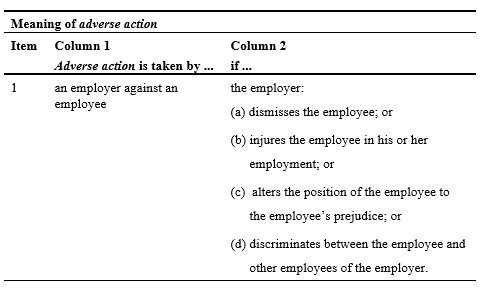
5 Section 342 of the FW Act relevantly defines the term “adverse action” as follows:
Meaning of adverse action
(1) The following table sets out circumstances in which a person takes adverse action against another person.
…
6 Section 341(1) of the FW Act defines the term “workplace right” as follows:
A person has a workplace right if the person:
(a) is entitled to the benefit of, or has a role or responsibility under, a workplace law, workplace instrument or order made by an industrial body; or
(b) is able to initiate, or participate in, a process or proceedings under a workplace law or workplace instrument; or
(c) is able to make a complaint or inquiry:
(i) to a person or body having the capacity under a workplace law to seek compliance with that law or a workplace instrument; or
(ii) if the person is an employee—in relation to his or her employment.
7 Section 361 of the FW Act creates a presumption that practically shifts the burden of proof onto a person accused of contravening s 340:
Reason for action to be presumed unless proved otherwise
(1) If:
(a) in an application in relation to a contravention of this Part, it is alleged that a person took, or is taking, action for a particular reason or with a particular intent; and
(b) taking that action for that reason or with that intent would constitute a contravention of this Part;
it is presumed that the action was, or is being, taken for that reason or with that intent, unless the person proves otherwise.
(2) Subsection (1) does not apply in relation to orders for an interim injunction.
8 Section 570 of the FW Act limits the circumstances in which a Court may order a party to pay costs in relation to a matter arising under the FW Act. It relevantly provides:
Costs only if proceeding instituted vexatiously etc.
(1) A party to proceedings (including an appeal) in a court (including a court of a State or Territory) in relation to a matter arising under this Act may be ordered by the court to pay costs incurred by another party to the proceedings only in accordance with subsection (2) or section 569 or 569A.
Note: The Commonwealth might be ordered to pay costs under section 569. A State or Territory might be ordered to pay costs under section 569A.
(2) The party may be ordered to pay the costs only if:
(a) the court is satisfied that the party instituted the proceedings vexatiously or without reasonable cause; or
(b) the court is satisfied that the party’s unreasonable act or omission caused the other party to incur the costs; or
(c) the court is satisfied of both of the following:
(i) the party unreasonably refused to participate in a matter before the [Fair Work Commission];
(ii) the matter arose from the same facts as the proceedings.
9 Section 17A of the Federal Circuit Court of Australia Act 1999 (Cth) relevantly provides:
Summary judgment
…
(2) The Federal Circuit Court of Australia may give judgment for one party against another in relation to the whole or any part of a proceeding if:
(a) the first party is defending the proceeding or that part of the proceeding; and
(b) the Court is satisfied that the other party has no reasonable prospect of successfully prosecuting the proceeding or that part of the proceeding.
…
Background
10 Mr Rangi is a qualified lawyer and has his own legal practice, Rangi Lawyers, in Thomastown. In the period 2008 to 2018, Mr Rangi was employed by Kmart at their store located in South Morang (the “South Morang Store”). The employment relationship after 2011, on Mr Rangi’s account, was marked by some difficulties. He thus took the significant step of instituting a proceeding against his employer in 2017 by way of an application in the Fair Work Division of the Federal Circuit Court.
11 Mr Rangi subsequently filed a document entitled “Amended Points of Claim” in the Federal Circuit Court claiming, in essence, that: (i) Kmart was in breach of a contract entered into by the parties on or around 1 March 2009 by reason of reducing his salary from that of a Level 3 Supervisor to that of a Level 1 Retail Assistant; and (ii) Kmart had contravened s 340 of the FW Act by failing to promote him on three occasions by reason of him exercising his workplace rights.
12 The three adverse action claims can be briefly summarised as follows (drawing on the Amended Points of Claim):
(1) On or around 24 October 2011, during an oral conversation between a manager of the South Morang Store and Mr Rangi, the manager allegedly said to Mr Rangi words to the following effect, “We are restarting the evening filling shift, do you want to take up the role of team leader for the evening?”. Mr Rangi allegedly replied “Yes, I accept the role for the evening shift”. This conversation was said to constitute the “Promotion Assurance”. On or around 11 November 2011, Mr Rangi made an oral complaint to Kmart regarding a change to the timing of his shifts (the “Roster Complaint”). On or around 28 November 2011, Kmart reneged on the Promotion Assurance by failing to promote Mr Rangi.
It was claimed that by making the Roster Complaint, Mr Rangi had exercised a “workplace right” for the purposes of s 341(1)(a) and (c) of the FW Act; and that Kmart took “adverse action” against Mr Rangi, within the meaning of item 1(c) of s 342(1) of the FW Act, by failing to promote him.
(2) On or around 21 November 2012, Mr Rangi made a complaint to Kmart alleging that colleagues had engaged in bullying conduct towards him (the “First Bullying Complaint”). On or around 2 October 2013, Mr Rangi made a complaint to Kmart that the duty manager had engaged in bullying conduct towards him (the “Second Bullying Complaint”). On 24 January 2014, a manager of the South Morang Store advised Mr Rangi that he could commence training under the Manager in Training (“MIT”) Program (the “Training Assurance”). This did not eventuate.
It was claimed that by making the First and Second Bullying Complaints, Mr Rangi had exercised a “workplace right” for the purposes of s 341(1)(a) and (c) of the FW Act; and that Kmart took “adverse action” against Mr Rangi, within the meaning of item 1(c) of s 342(1) of the FW Act, by denying him training under the MIT Program (which was referred to as the “Second Failure to Promote”).
(3) On 27 February 2014, Mr Rangi made a complaint to Kmart regarding the failure to commence training under the MIT Program (the “MIT Complaint”). On 13 March 2014, Mr Rangi again applied for the MIT Program. The application was not accepted and Kmart did not promote Mr Rangi to the position of duty manager.
It was claimed that by making the MIT Complaint, Mr Rangi had exercised a “workplace right” for the purposes of s 341(1)(a) and (c) of the FW Act; and that Kmart took “adverse action” against Mr Rangi, within the meaning of items 1(c) and 1(d) of s 342(1) of the FW Act, by denying him training under the MIT Program and a promotion (when two other duty managers were appointed shortly thereafter).
13 Mr Rangi sought the following remedies: (i) a promotion to the position of manager; (ii) compensation for loss of earnings; (iii) the imposition of a pecuniary penalty for each and every contravention of the FW Act as pleaded; and (iv) an order that any penalty be paid to him.
14 In response, Kmart filed a defence which, in substance, denied all the allegations made by Mr Rangi (leave to file an amended defence was given on 20 April 2018). On 5 July 2017, an in-house solicitor of Kmart, Ms De Marchi, wrote to Mr Rangi. This correspondence was important to the primary judge’s decision with respect to costs. The letter relevantly provided:
… Kmart is of the opinion that your clam is fatally flawed and therefore liable to be dismissed by reason of the fact that your claim has no reasonable prospect of success … [Kmart has] raised issues about the legal status of some of your claims, particularly having regard to the fact the claims made in contract by you are statute barred. This makes your claim in that regard untenable and amount to an abuse of process if such claims were to be maintained.
…
Kmart refers to paragraph 52 of the Defence, which raises starkly the basic reason why your claims will have no reasonable prospect of success. This is because, as pleaded, [t]he Respondent denies all matters alleged and any contravention of s.340 of the FW Act, and says further that the pleading has no reasonable prospect of success on the basis that there is no pleading of a connection with a workplace right (not routinely specified) and any adverse action (which is denied) taken by the Respondent. Further, the Respondent says that despite having the reverse onus under s.361 of the FW Act the pleading has not set out the objective facts or circumstances giving rise to the application of the reverse onus under s.361 of the FW Act.
…
In your case, you have not pleaded such objective facts and circumstances, and where there are allegations of material fact made against Kmart, they are either denied or not admitted but, importantly, do not make a connection with a workplace right or adverse action alleged having regard to the fact that some of the action alleged is not adverse action within the meaning of s.342 of the FW Act and/or is statute barred. In Kmart's opinion, the linkage between what is alleged and any adverse action is simply not present, leading Kmart to the conclusion that your claim has no reasonable prospects of success and that, for reasons adverted to in the Defence as referred to earlier, some claims are statute barred.
15 Kmart invited Mr Rangi to withdraw his Amended Points of Claim and to discontinue the proceeding. It further stated that it would not pursue a claim for costs if such a course were to be taken. If, however, Mr Rangi pressed ahead with his proceeding, Kmart foreshadowed that it would seek summary judgment and costs pursuant to s 570 of the FW Act.
16 Mr Rangi did not respond to or act upon the contents of Kmart’s letter. Significantly, he did not seek to address the alleged flaws in his pleading pointed out by Kmart. The parties were referred to mediation, but were unable to resolve their differences. Kmart subsequently made an application for summary judgment and for its costs; this was supported by an affidavit sworn by Ms De Marchi on 11 August 2017.
The Federal Circuit Court
17 Kmart’s application for summary dismissal was heard by the primary judge on 20 April 2018. It was predicated on the following contentions:
(1) that the contractual claims were statute barred by reason of s 5 of the Limitation of Actions Act 1958 (Vic); and
(2) that Mr Rangi had no reasonable prospect of successfully prosecuting the adverse action claims.
18 In response to the first contention, Mr Rangi submitted:
… there is no limitation regarding brining evidence before the honourable Court by way of background and for putting the matters in the right perspective … Although, the breach of contract is asserted, no claim has been made for the said breaches … As the evidence is not barred, the statement of claim dealing with the events prior to 19 February is on sound footing …
(Errors in original.)
19 Mr Rangi otherwise submitted that there were obvious factual and legal disputes in need of adjudication by the Court and which were not amenable to summary dismissal.
20 The primary judge rejected Mr Rangi’s submissions and gave summary judgment in favour of Kmart: Rangi v Kmart Australia Ltd [2018] FCCA 2040. The key passages of her Honour’s reasons are reproduced below:
13. The difficulty for the Court with the affidavit evidence of the Applicant is as follows:-
a) it is mostly in the form of submissions. The Respondent objected to the affidavit being relied upon by the Applicant. The Court indicated to the parties that the affidavit evidence could remain before the Court but that little or no weight could be placed on that evidence for the most part, and that certainly matters of submission and conclusion were not evidence;
b) the Applicant cannot plead that a breach of contract occurred in circumstances where he now says no claim is made in relation thereto. That material is not relevant to the orders sought in the litigation;
…
14. There is no doubt that some non-material factual issues remain outstanding as between the parties. Such a situation does not, however, prohibit the seeking of summary dismissal of a proceeding.
…
23. Each alleged contravention of s.340 of the FW Act was described by the Applicant as a “failure to promote” and expressly pleaded as alleged “adverse action” on the basis of s.342(1) Item (1)(c), which provides that adverse action is taken by an employer against an employee if the employer “alters the position of the employee to the employee’s prejudice”.
24. It is the failure to act that is the substance of the allegation against the Respondent. In that regard the Court was referred, by the Respondent, to the decision in Unsworth v Tristar Steering and Suspension Australia Limited [2008] FCA 1224 (‘Unsworth’), where Gyles J said, at paragraphs 24 and 25 the following:-
“24. A “before and after” test is usually applied to see whether there has been any injury to, or prejudicial alteration of, the position of the employee by reason of any act of the employer (eg per Evatt J in Blair v Australian Motor Industries Ltd (1982) 61 FLR 283 at 289, 3 IR 176; per Branson J in Commonwealth Bank of Australia v Finance Sector Union of Australia [2007] FCAFC 18; (2007) 157 FCR 329 at [127]). Applying what had been said by the Full Court in an earlier interlocutory appeal (BHP Iron Ore Pty Ltd v Australian Workers’ Union [2000] FCA 430; (2000) 102 FCR 97 at [35]), it was succinctly put by Kenny J in Australian Workers’ Union v BHP Iron-Ore Pty Ltd [2001] FCA 3; (2001) 106 FCR 482 at [54] as follows:
“Before s 298K(1) can apply, it must be possible to say of an employee that he or she is, individually speaking, in a worse situation after the employer’s acts than before them; that the deterioration has been caused by those acts; and that the acts were intentional in the sense that the employer intended the deterioration to occur.”
25. Tracey J usefully summarised the authorities as to the former s 298K in Australian and International Pilots Association v Qantas Airways Ltd [2006] FCA 1441, (2006) 160 IR 1 at [13]–[22]. “Injury” is concerned with an adverse effect upon an existing legal right, or “compensable” injury. Prejudicial alteration of position goes beyond that concept. There are many examples in the cases. It is sufficient to refer to Patrick Stevedores Operations No 2 Pty Ltd v Maritime Union of Australia (No 3) [1998] HCA 30; (1998) 195 CLR 1 per Brennan CJ, McHugh, Gummow, Kirby and Hayne JJ at [37] and [38]; Community and Public Sector Union v Telstra Corp Ltd [2001] FCA 267; 107 FCR 93 at [17]–[22]; Greater Dandenong City Council v Australian Municipal, Administrative, Clerical and Services Union [2001] FCA 349; (2001) 112 FCR 232; and Commonwealth Bank of Australia v Finance Sector Union of Australia [2007] FCAFC 18; 157 FCR 329.”
…
26. As submitted by the Respondent, and being a submission with which the Court agrees, if there is no change as pleaded to the Applicant’s position, as a matter of law, given the natural ordinary meaning of the words in s.342(1) Item (1)(c) no adverse action by way of prejudicial alteration of position as pleaded has occurred. An alleged failure to do something, is not an alteration of the position in terms of the section. The Court accepts that on this analysis the Applicant is not able to reach the point alleging reasons for adverse action which would trigger the reverse onus provision in s.361 of the FW Act, because the action itself is not “adverse action” within the terms of the definition as pleaded and explicitly relied upon.
…
33. The Court concludes that there is neither material facts nor evidence of sufficient quality adduced by the Applicant that would militate against summary judgment being awarded. Nor is there a linkage between the allegations made and the alleged breaches raising a question of law warranting the matter going to trial. The initiating application will be dismissed and the parties invited to make submissions as to costs and their quantum.
21 I note parenthetically that it is not entirely clear whether her Honour accepted that the breach of contract claim was statute barred. Based on [13(b)] of the reasons, it appears her Honour decided that the issue need not be considered as Mr Rangi had ostensibly abandoned the claim. In any event, that issue does not have a material bearing upon the application before me as it was not agitated with great force by either party.
22 In a separate judgment, her Honour considered Kmart’s application for costs: Rangi v K-Mart Australia Ltd (No.2) [2018] FCCA 3622. Kmart submitted that Mr Rangi’s continuation of the proceeding amounted to an abuse of process in circumstances where, at the time of instituting the proceeding, he had no reasonable prospects of success (s 570(2)(a) of the FW Act). In the alternative, it submitted that Mr Rangi engaged in an unreasonable act and/or omission in failing to discontinue the proceeding despite the invitation from Kmart’s solicitor to do so prior to the filing of the application in a case by Kmart for summary dismissal (s 570(2)(b) of the FW Act).
23 In the result, the primary judge declined to award the indemnity costs Kmart sought but otherwise decided that costs should be awarded in Kmart’s favour on a party and party basis. Her Honour stated at [12] and [14]-[15]:
The Applicant’s failure to withdraw the proceeding in July 2017, in circumstances where no costs would have been sought by the Respondent despite the proceeding having been instituted without reasonable cause, does amount to an unreasonable act or omission on the part of the Applicant which “caused the other party to incur the costs”.
…
The Court determines that, unusually in these type of proceedings, a costs order should be made and by specific reference to s.570(2)(a) and (b) of the Act. In all the circumstances a costs order is the appropriate sanction and on the usual basis of party/party costs. The quantum of costs and disbursements sought on a party/party basis and to be paid by the Applicant to the Respondent is $8,614.50. This quantum is referable to the Schedule 1 Scale of Costs as set out in the Rules (‘the scale’). The scale is however subject to a discretion exercised by the Court as to the award of further costs for work done not quantified in the scale. The Respondent has been required to prepare submissions as to costs for which the Court shall make a further allowance in the sum of $1,000. Additionally, the quantum as claimed omits some work done. The Court’s calculation of costs is as follows:-
a. $4,584.50 in accordance with item 1 of the scale;
b. $3,480 in accordance with item 3 of the scale;
c. $3,079 in accordance with item 5 of the scale;
d. $598 in accordance with item 9 of the scale; and
e. $450 in accordance with item 13 of the scale in relation to the hearing of 16 August 2017.
Thus, the total sum of costs to be awarded is $13,192.
Applications for Leave to Appeal
24 Pursuant to s 24 of the Federal Court of Australia Act 1976 (Cth), Mr Rangi sought leave to appeal both decisions of the primary judge to this Court.
Test for leave
25 There was no dispute about the content of the test for leave to appeal an interlocutory decision. In Samsung Electronics Company Ltd v Apple Inc (2011) 217 FCR 238 at 248-249 [26]-[28], the Full Court of this Court said:
In this Court, it is well established that the relevant test (or “litmus test”) for whether leave to appeal from an interlocutory judgment will be granted, comprises the following two integers:
(1) Whether, in all the circumstances of the case, the decision is attended by sufficient doubt to warrant its being reconsidered by the Full Court; and
(2) Whether substantial injustice would result if leave were refused supposing the decision to be wrong.
(Décor Corporation Pty Ltd v Dart Industries Inc (1991) 33 FCR 397 at 398-400.)
In Bienstein v Bienstein (2003) 195 ALR 225 at [29], McHugh, Kirby and Callinan JJ said that:
The principles that govern the grant of leave to appeal are well established. An applicant for leave must establish that the decision in question is attended with sufficient doubt to warrant the grant of leave. The applicant must also show that substantial injustice will result from a refusal of leave to appeal.
The test for leave to appeal explained by the High Court in Bienstein v Bienstein is the same test as the Full Court had earlier articulated in Décor.
26 The parties thus structured their arguments according to the two integers of the test enunciated in Décor Corporation Pty Ltd v Dart Industries Inc (1991) 33 FCR 397 with respect to both of the primary judge’s decisions.
27 I shall address the second Décor integer first as this issue did not take up a great deal of time before me. The first Décor integer was the true site of contest between the parties.
Would substantial injustice result if leave is refused supposing the decisions to be wrong?
28 On the question of whether substantial injustice would result to Mr Rangi if leave is refused, supposing the primary judge’s decisions to be wrong, Mr Rangi contended the following in his written submissions:
Supposing that the [primary judge’s] Findings are wrong, substantial injustice will be caused if leave to appeal is refused:
(a) The Applicant lost opportunities for promotion suffering huge economic loss and will lose his entitlements for claim resulting from adverse action, bullying and harassment;
(b) impact on the professional reputation and standing of the Applicant, a qualified lawyers practicing in the field of employment law; and
(c) has resulted in Applicant already paying costs in sum of $13,192.
(Errors in original.)
29 Kmart demurred. It submitted that the foregoing is not sufficient to satisfy “the test of substantial injustice”, particularly in circumstances where Mr Rangi is no longer employed by Kmart. Further, it was said that there is an absence of evidence to make good the alleged adverse impact on Mr Rangi’s professional reputation and standing.
30 Before me, I pressed Mr Rangi to explain the substantial injustice that would befall him other than deprivation of the pecuniary amounts sought. In particular, I asked him to clarify the utility of an order for a promotion given that Kmart is no longer his employer. With respect, Mr Rangi was unable to explain clearly why he was pursuing such an order at this point in time given that the employment relationship had been severed. Mr Rangi subsequently refined his position as to why substantial injustice would ensue from a refusal of leave to appeal. He submitted that a prima facie case exists for granting leave as the primary judge’s decisions have the practical operation of finally determining the rights of the parties; Johnson Tiles Pty Ltd v Esso Australia Pty Ltd (2000) 104 FCR 564 at 584 [43] per French J (as his Honour then was) (with whom Beaumont and Finkelstein JJ agreed), endorsed in Samsung at 249-250 [30]-[31]. In other words, while the decisions were interlocutory in legal effect they practically foreclosed Mr Rangi’s rights such that, if there is any doubt about the decisions at first instance, leave should be granted.
31 Mr McKenney of Counsel, who appeared for Kmart, in my view, properly conceded that the two interlocutory decisions in question are different to “mere procedural decisions” and that they “obviously determine the rights of the applicant”. He nevertheless reiterated the contention that “substantial injustice” would not result as Mr Rangi is no longer employed by Kmart. He also argued that no material had been adduced to quantify the alleged financial losses which, it was said, would place me in an “invidious position” of ascertaining the extent of potential injustice.
32 In my view, the decisions here are not ones only affecting the course of proceedings in an action or suit – for example, orders relating to interrogatories, discovery, the giving of particulars, or like procedural matters; see Ex parte Bucknell (1936) 56 CLR 221 at 225. The decisions under consideration in this case bear a different complexion. Her Honour’s decision to dismiss summarily the proceeding is final in effect: it practically places a terminal barrier on the litigation pathway such that Mr Rangi cannot, without the intervention of this Court, move forward to pursue his rights and entitlements (if any). Similarly, the decision as to costs finally determines the rights of the parties though it is in an interlocutory form. Consequently, I am satisfied that substantial injustice would result if leave were refused supposing the primary judge’s decisions to be wrong.
Are either or both of the primary judge’s decisions attended by sufficient doubt?
33 I now turn to consider the first integer of the Décor test: whether, in all the circumstances of the case, either decision is attended by sufficient doubt to warrant being reconsidered by this Court exercising its appellate jurisdiction. In making this assessment, I should consider at a “reasonably impressionistic level” whether the proposed appeal is “arguable”, “sufficiently arguable” or has “reasonable prospects of success”: see MZABP v Minister for Immigration and Border Protection (2015) 242 FCR 585 at 597-598 [62]-[63] per Mortimer J.
34 I shall address each of the primary judge’s decisions separately.
Decision to dismiss summarily the proceeding
35 Mr Rangi submitted that the primary judge’s decision to dismiss summarily his proceeding is attended with sufficient doubt for the following reasons:
(1) first, it was contended that her Honour had misinterpreted item 1(c) of s 342(1) of the FW Act by holding that “[a]n alleged failure to do something is not an alteration of the position in terms of the section”. It was said that her Honour’s reliance on Unsworth v Tristar Steering and Suspension Australia Ltd (2008) 216 FCR 122 to support the general proposition that inaction by an employer cannot constitute “adverse action” was misguided. In that respect, Mr Rangi contended that Kmart’s failure to “promote” him on three occasions altered his position to his prejudice as he “was marginalized, bullied, harassed, discriminated against … [and] he lost his entitlements to get promoted and to earn at a higher level”. It was also contended that the failures to promote involved the “withholding of accrued benefits”. Mr Rangi cited Rowland v Alfred Health [2014] FCA 2 in aid of his contention that a refusal to promote can constitute a prejudicial alteration of position within the meaning of item 1(c). That case concerned, amongst other things, whether the non-selection of a surgeon, a Mr Rowland, under a restructure at a hospital constituted “adverse action”. Relevantly, Marshall ACJ said at [48]:
Counsel for Alfred Health submits that the non-selection of Mr Rowland for a position in the Unit was not adverse action but rather “inaction” in that there was a failure to appoint him. The Court rejects the submission that inaction cannot constitute adverse action. For example, an employee may be denied a promotion notwithstanding that he or she satisfied established criteria while others (who do not) are promoted. The non-selection of Mr Rowland was adverse action …
It was therefore said that the primary judge was wrong to conclude that the “status quo” remained after Kmart’s three alleged failures to promote Mr Rangi;
(2) secondly, her Honour erred, it was said, in concluding that the outstanding factual issues in dispute were not material and significant. Two examples were cited in Mr Rangi’s written submissions for this purpose: the dispute between the parties as to the authority of the manager of the South Morang Store to make the Promotion Assurance and whether Mr Rangi in fact applied for the MIT Program; and
(3) thirdly, it was submitted that her Honour erroneously denied Mr Rangi the opportunity to amend his pleading so that his claim could be assessed against items 1(b) and 1(d) of s 342(1) of the FW Act. Mr Rangi contended that this was at odds with her Honour’s willingness to grant leave to Kmart to amend its defence. He submitted that the defects in his pleading were curable and the non-determination of whether “adverse action” was taken within the meaning of items 1(b) and 1(d) “left open the possibility of the Applicant having an arguable case and reasonable prospects of success”. Further, her Honour failed to consider whether the third failure to promote and denial of training under the MIT Program constituted “adverse action” within the meaning of item 1(d).
36 Kmart submitted the following opposing contentions:
(1) first, Mr Rangi had failed to demonstrate that there had been a deterioration in the advantages enjoyed by him prior to the conduct in question for the purposes of item 1(c) of s 342(1) of the FW Act. It was said that her Honour correctly identified Unsworth as authority for the uncontroversial legal proposition that if there is no change to an employee’s position on a “before and after test scenario” then there is no alteration of position within the terms of the statute. It followed that because Mr Rangi had not secured a promotion or an entitlement to a promotion, he suffered no prejudice by the alleged failures to promote. In any event, it was said, his purported alteration in position was misconceived as the “concept of entitlement and accrual makes no sense in the context of an application about a failure to promote” and the alleged bullying, harassment or discrimination was “pure speculation”. Mr McKenney submitted that Rowland was not of assistance to Mr Rangi as that case is distinguishable; it was said that Marshall ACJ was contemplating a particular hypothetical whereby a duly qualified candidate is denied a promotion in the face of unqualified persons being promoted in his or her stead. Such a situation did not arise in the present case so the principle laid down in Rowland does not apply;
(2) secondly, the function of a Court in determining whether to dismiss summarily a proceeding is not to decide “all the issues in a case or any tangential matters”. The non-resolution of some factual disputes is particularly of no moment where Mr Rangi had failed at a more fundamental level to demonstrate an “alteration of position let alone a prejudicial one”; and
(3) thirdly, Mr Rangi’s submission that the primary judge failed to make findings regarding the non-engagement of items 1(b) and 1(d) of s 342(1) of the FW Act was said to be “non-sensical” as the Court is only able to deal with and rule on the pleaded rather than the non-pleaded case including as to relief. Further, Mr Rangi did not put forward a proposal as to how his pleading would be amended before the primary judge. To frame a claim pursuant to items 1(b) and 1(d), it was submitted, would not have entailed a straightforward insertion of those section references into the Amended Points of Claim. For example, to allege “adverse action” within the meaning of item 1(d) would have required identification of a comparator, the type of discrimination, the attribute in question etc. – matters which were simply absent on the face of the materials before the Court below. Finally, to the extent item 1(d) was pleaded in respect of the third failure to promote, it was not properly particularised; Mr Rangi made a bare assertion of discrimination without any pleaded facts in support.
37 In view of the above, I do not consider that the primary judge’s decision to give summary judgment is attended by sufficient doubt. I respectfully disagree with Mr Rangi’s submissions for the following reasons.
38 First, as to whether there was an alteration of Mr Rangi’s position to his prejudice by reason of the three alleged failures to promote, in my view, he has not shown that he has a reasonably arguable case that satisfies item 1(c) of s 342(1) of the FW Act. In Blair v Australian Motor Industries Ltd (1982) 3 IR 176, Evatt J considered s 5(1)(e) of the Conciliation and Arbitration Act 1904 (Cth) (which was in comparable terms to s 342(1) of the FW Act) and the proper construction of “alter his position to his prejudice” in the opening sentences of that section. Her Honour adopted and applied the views of Smithers J in Childs v Metropolitan Transport Trust (1982) 29 AILR 24, where his Honour observed that the word “position” should be read to:
… refer to a man’s employment position in all its attributes and that to find what those attributes are in any particular case, you look at the terms of the agreement in relation to the particular employment …
39 In Patrick Stevedores Operations No 2 Pty Ltd v Maritime Union of Australia (No 3) (1998) 195 CLR 1 (“Patrick Stevedores Operations”), in considering former s 298K(1)(c) of the Workplace Relations Act 1996 (Cth), the High Court held that “alter the position of an employee to the employee’s prejudice” is a “broad additional category which covers not only legal injury but any adverse affection of, or deterioration in, the advantages enjoyed by the employee before the conduct in question” (at 18 [4]).
40 More recently, as the primary judge recognised, Gyles J in Unsworth at 137 [24] stated that a “before and after” test is usually applied to see whether there has been any prejudicial alteration of position of the employee by reason of any act of the employer.
41 Turning to the factual matrix of the present case, Mr Rangi did not plead that he had entered into a contract of employment to crystallise a promotion. He did not plead that he had a legal entitlement to a promotion. He did not otherwise plead facts which would ground a finding that there was a real or substantial prejudicial alteration to his position.
42 On the pleaded case, Mr Rangi’s attributes of employment, including the advantages he enjoyed, were unaltered before and after the purported failures to promote. His contract of employment with Kmart remained the same, his role was the same, his duties were the same, his remuneration was the same and his status was the same. There was no material to suggest that Kmart had acted inconsistently with Mr Rangi’s contractual rights in his then position of employment: cf Community and Public Sector Union v Commonwealth of Australia [2006] FCAFC 176; (2006) 157 IR 470 at [32]. One could not therefore say that Mr Rangi was worse off in the relevant sense to engage item 1(c).
43 I accept that Mr Rangi may have had a strong expectation of being promoted based on, amongst other things, the alleged Promotion Assurance. Hence, he may well have felt personally aggrieved when his desired promotion did not come to fruition. However, a departure from those expectations of promotion, strongly held as they may have been on his part, was not sufficient to satisfy the terms of item 1(c). That is not to say that an employee’s “position” can only be altered by reference to an alteration of legal rights and entitlements. In Qantas Airways Ltd v Australian Licensed Aircraft Engineers Association (2012) 202 FCR 244 at 250 [32], the Full Court of this Court considered the authorities concerning the reach of the concept of prejudicial alteration. It concluded:
The authorities thus establish that a prejudicial alteration to the position of an employee may occur even though the employee suffers no loss or infringement of a legal right. It will occur if the alteration in the employee’s position is real and substantial rather than merely possible or hypothetical.
44 I thus accept that there may be cases where there is a prejudicial alteration of position within the meaning of item 1(c) by reference to something that falls short of a legal right or entitlement: see, for example, Community and Public Sector Union v Telstra Corporation Ltd (2001) 107 FCR 93 (“Telstra Corporation Ltd”); Patrick Stevedores Operations. But this is not such a case. In that respect, I do not consider that Marshall AJA in Rowland intended to mean that any failure to promote would amount to “adverse action”; indeed his Honour expressed his opinion in the context of a specific example that does not bear resemblance to the present case. In my view, something more is required than just the defeat of a unilaterally held expectation of promotion to qualify as a prejudicial alteration of position. The prejudicial alteration must be “real or substantial, rather than merely possible or hypothetical”: Telstra Corporation Ltd at 100 [18].
45 As to the alleged marginalisation, bullying, harassment and discrimination that followed after the alleged failures to promote, these matters were not pleaded nor raised in argument in the Court below as part of the adverse action claim (rather, a separate assertion was made that “hurt, humiliation and distress” formed part of Mr Rangi’s loss and damage). The primary judge could thus not have been expected to consider those allegations in appraising the satisfaction of item 1(c).
46 Secondly, I agree with Kmart’s contention that a Court is not obliged to resolve every factual dispute before summarily dismissing a proceeding. The two examples of facts in dispute identified by Mr Rangi were not of sufficient significance to bar the giving of summary judgment. The resolution of those factual disputes would not have overcome the more fundamental flaws in the pleading identified by her Honour, including with respect to item 1(c).
47 Thirdly, Mr Rangi conceded that he did not put on a formal application to amend his pleading accompanied by a draft pleading. His “offer” to cure the defects in his pleading was prompted by the flow of oral argument before her Honour. In my view, and with the greatest respect, Mr Rangi was responding to the weaknesses in his pleaded case and sought to bolster his position by spontaneously reaching for other items in the definition of “adverse action”. Before the primary judge, he was conjecturing at the bar table as to further avenues that could get him home. In those circumstances, it was not improper for her Honour to consider the case as pleaded and deny Mr Rangi leave to amend his pleading so as to include items 1(b) and 1(d) of s 342(1) of the FW Act.
48 As to the application of item 1(d) with respect to the third failure to promote, I agree with Kmart’s submission that Mr Rangi failed to particularise how his former employer discriminated against him vis-à-vis other Kmart employees. Additionally, in [54] of his Amended Points of Claim which is located under the heading “Contraventions of s 340 of the FW Act”, there is no mention of discrimination. It reads as follows:
The Third Failure to Promote was done because of the reason, or because of reasons including the reason, that the Applicant:
a. exercised his workplace right to make the MIT Complaint described in paragraph 46 above;
b. had the workplace right to the benefit of clause 27.2 of the 2012 Agreement; and/or
c. exercised his workplace right to the benefit of clause 27.2 of the 2012 Agreement.
49 Before me, Mr Rangi conceded that there was a defect in the pleading. He submitted that the discrimination arose because other people were promoted whilst he was not and “this [was] the common denominator in all promotions”. I prompted Mr Rangi to identify what else he would have pleaded beyond those two other employees being promoted. He was unable to identify any discriminatory reason and merely said that he could have asked “some barrister” to draft it for him. In all the circumstances, it is therefore difficult to see how her Honour erred in implicitly dismissing the invocation of item 1(d).
50 Finally, for completeness, I note that Mr Rangi took issue with the primary judge’s treatment of particular evidence. As best as I understood it, Mr Rangi argued that her Honour erred in admitting into evidence Kmart’s letter dated 5 July 2017. It was said that this was contrary to s 131 of the Evidence Act 1995 (Cth) which prohibits evidence of settlement negotiations to be adduced save in prescribed circumstances. With respect, I found it difficult to discern the relevance of this contention given that her Honour’s decision to dismiss summarily Mr Rangi’s application did not turn on that letter. Mr Rangi also asserted that the primary judge erred in “[rejecting] the entire affidavit of the Applicant including evidence”; he specifically pointed to [13(a)] of her Honour’s judgment (reproduced above) as betraying the error. In that respect, I am not persuaded that her Honour erred in deciding to place little or no weight on matters which Mr Rangi sought to characterise as “evidence” but were in fact submissions.
51 For the foregoing reasons, leave is not granted to appeal the primary judge’s decision to award summary judgment in favour of Kmart.
Decision to order costs pursuant to s 570 of the FW Act
52 Whether the primary judge’s decision as to costs is attended with sufficient doubt was not the subject of great debate before me. Having considered the parties’ written submissions and the judgment below, I make the following observations:
(1) first, for the purposes of s 570(2)(a), her Honour held that Mr Rangi “instituted the proceedings … without reasonable cause” as the claims made concerning contraventions of s 340 of the FW Act did not disclose a prejudicial alteration of position nor “a linkage between the allegations made and the alleged breaches”;
(2) secondly, for the purposes of s 570(2)(b), her Honour held that Mr Rangi’s failure to withdraw the proceeding in July 2017 after receiving Kmart’s letter of 5 July 2017 amounted to an “unreasonable act or omission” which caused Kmart to incur costs. In particular, her Honour highlighted that Mr Rangi did not respond to the letter; indeed he did not seek to amend his defective pleading until the hearing on 20 April 2018. Her Honour also placed weight on Kmart’s representation to Mr Rangi that it would not have sought any costs if he duly withdrew notwithstanding that the proceeding had been instituted without reasonable cause;
(3) thirdly, in my view, the characterisation of s 570 as an “access to justice” provision does not mean that parties can commence proceedings under the FW Act lacking legal and factual foundation with impunity nor does it give parties licence to act unreasonably in the conduct of proceedings with impunity: see Ryan v Primesafe [2015] FCA 8; (2015) 323 ALR 107 at [64]-[66] per Mortimer J; and
(4) fourthly, Mr Rangi has not demonstrated that the primary judge’s exercise of the discretion conferred by s 570(2) is attended by sufficient doubt to warrant reconsideration. No error of law of the kind described in House v The King (1936) 55 CLR 499 was identified by Mr Rangi in the exercise of that discretion. I respectfully reject his contentions that her Honour: (i) failed to address how the institution of the proceeding or its non-withdrawal was unreasonable; (ii) failed to recognise that s 570 is an access to justice provision; and (iii) erred in calculating the quantum of costs. This is because: (i) her Honour did address how the conditions in s 570(2)(a) and (b) were satisfied as I have described above; (ii) her Honour recognised the exceptional nature of the costs order, but determined that “[i]n all the circumstances a costs order [was] the appropriate sanction” given the way the proceeding had been conducted. I infer that her Honour formed the view that Mr Rangi, despite being a legal practitioner, did not act in manner that was consistent with the requirements for proceedings to be conducted reasonably, fairly and efficiently; and (iii) Mr Rangi did not adequately expose the errors said to have been made in relation to the calculation of the costs. His contention rose no higher than mere assertion.
53 For the foregoing reasons, leave is not granted to appeal the primary judge’s decision to award costs in favour of Kmart pursuant to s 570.
Conclusion
54 Leave is denied in respect of both applications for leave to appeal. The parties will have 14 days to file agreed orders as to costs or, if no agreement is reached, submissions of no more than two pages in length.
I certify that the preceding fifty-four (54) numbered paragraphs are a true copy of the Reasons for Judgment herein of the Honourable Justice Steward. |


