

FEDERAL COURT OF AUSTRALIA
Australian Competition and Consumer Commission v Ashley & Martin Pty Ltd (No 2) [2019] FCA 1739
ORDERS
AUSTRALIAN COMPETITION AND CONSUMER COMMISSION Applicant | ||
AND: | ASHLEY & MARTIN PTY LTD (ACN 090 141 021) Respondent | |
DATE OF ORDER: |
THE COURT DECLARES THAT:
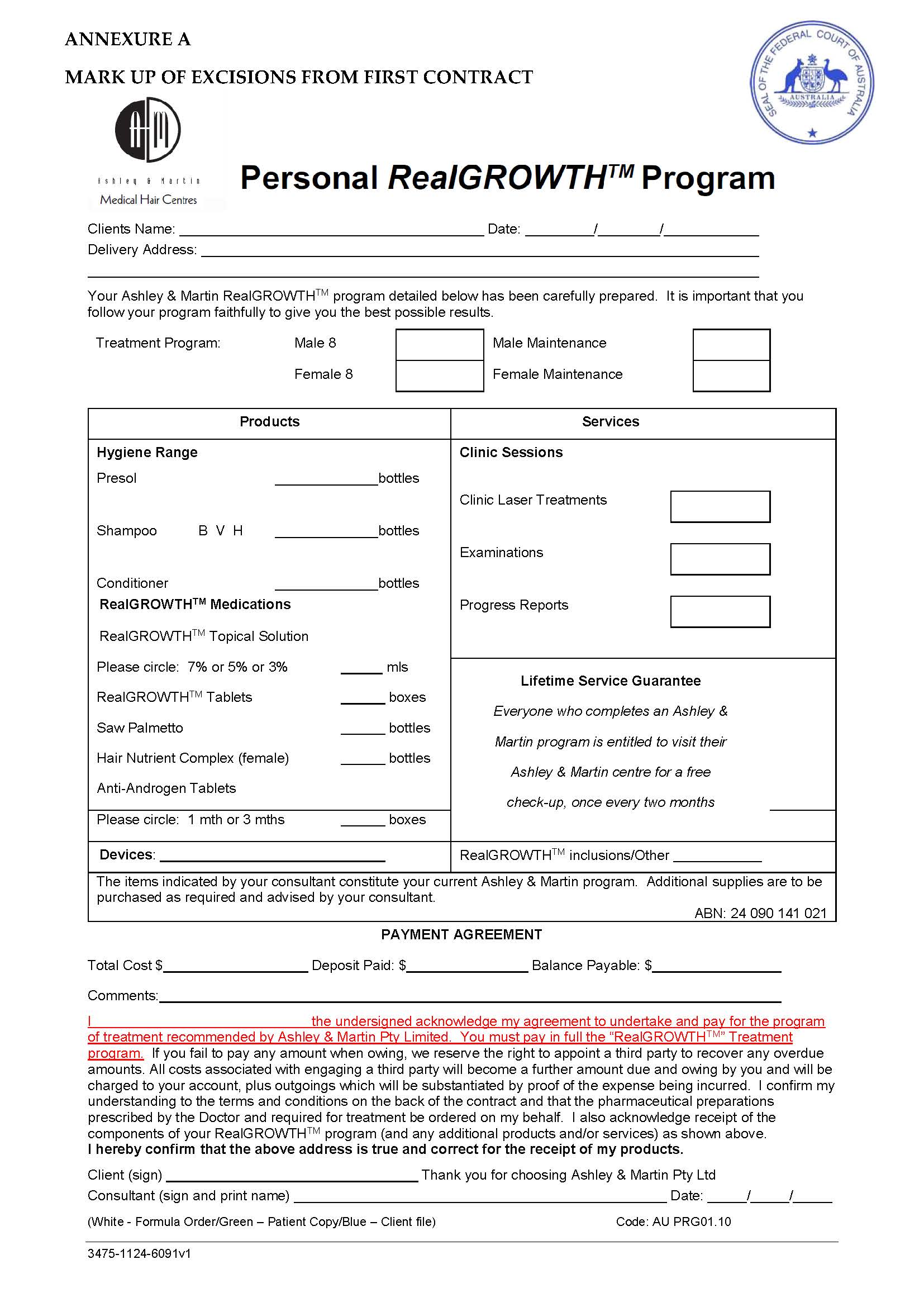
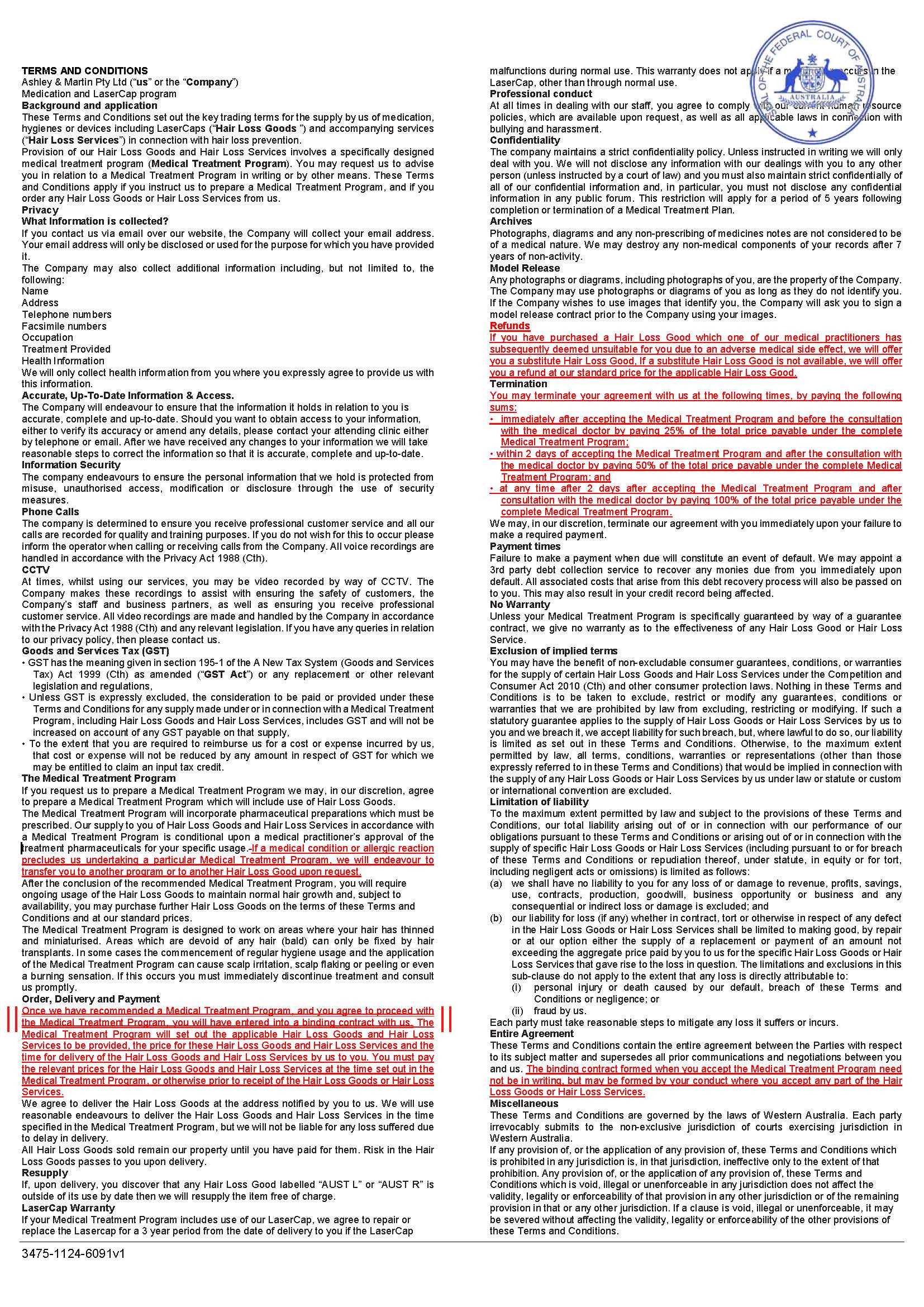
1. The terms in contracts between the respondent and consumers which are marked on the Personal RealGROWTH Program contract identified with code AU PRG01.10 (First Contract) in Annexure A to these orders are unfair terms within the meaning of s 24 of the Australian Consumer Law (ACL), and are void pursuant to s 23 of the ACL, because they commit the consumer to pay for a medical treatment program before the consumer has had the opportunity to receive and consider medical advice and give or refuse informed consent to the medical treatment.
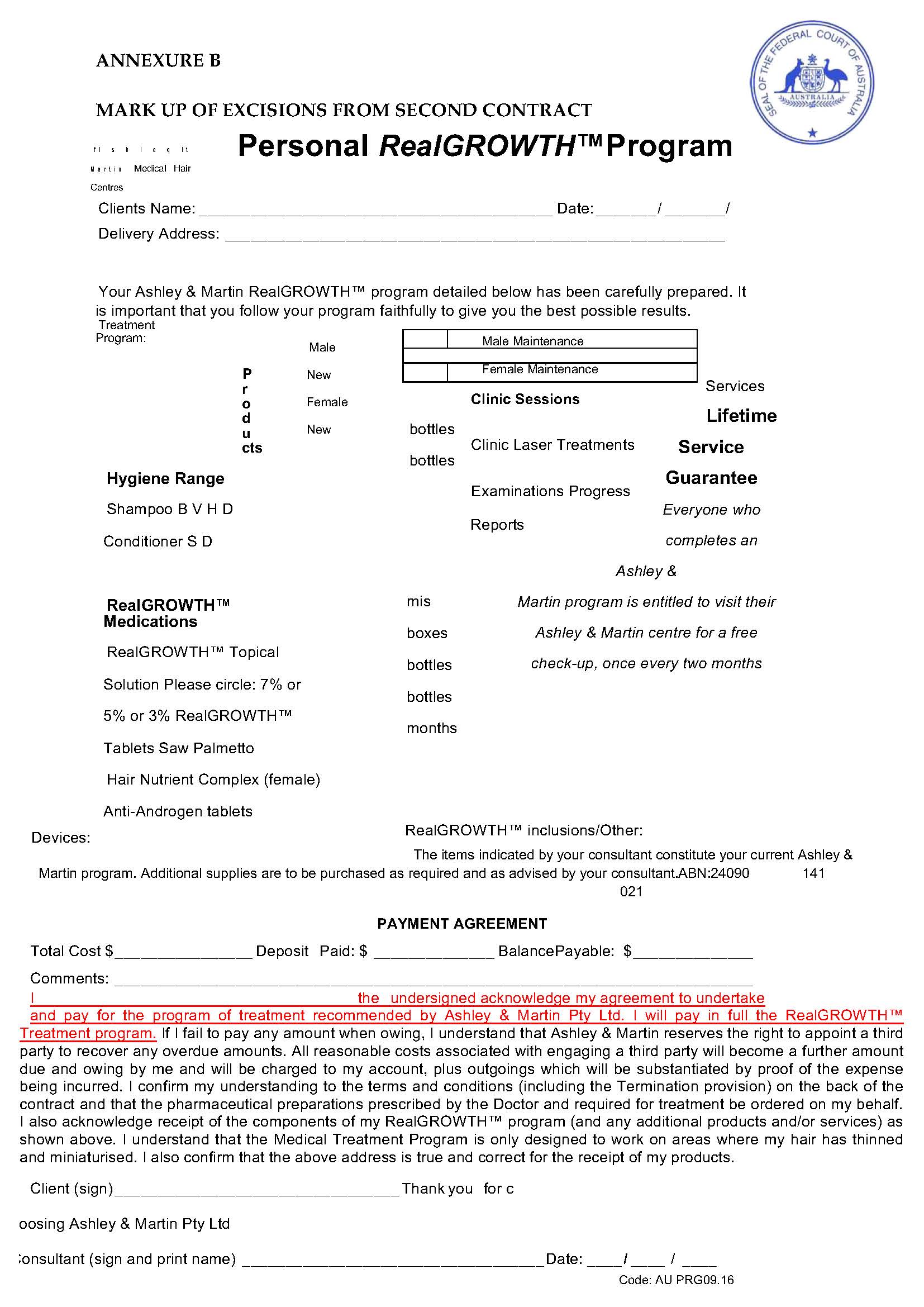
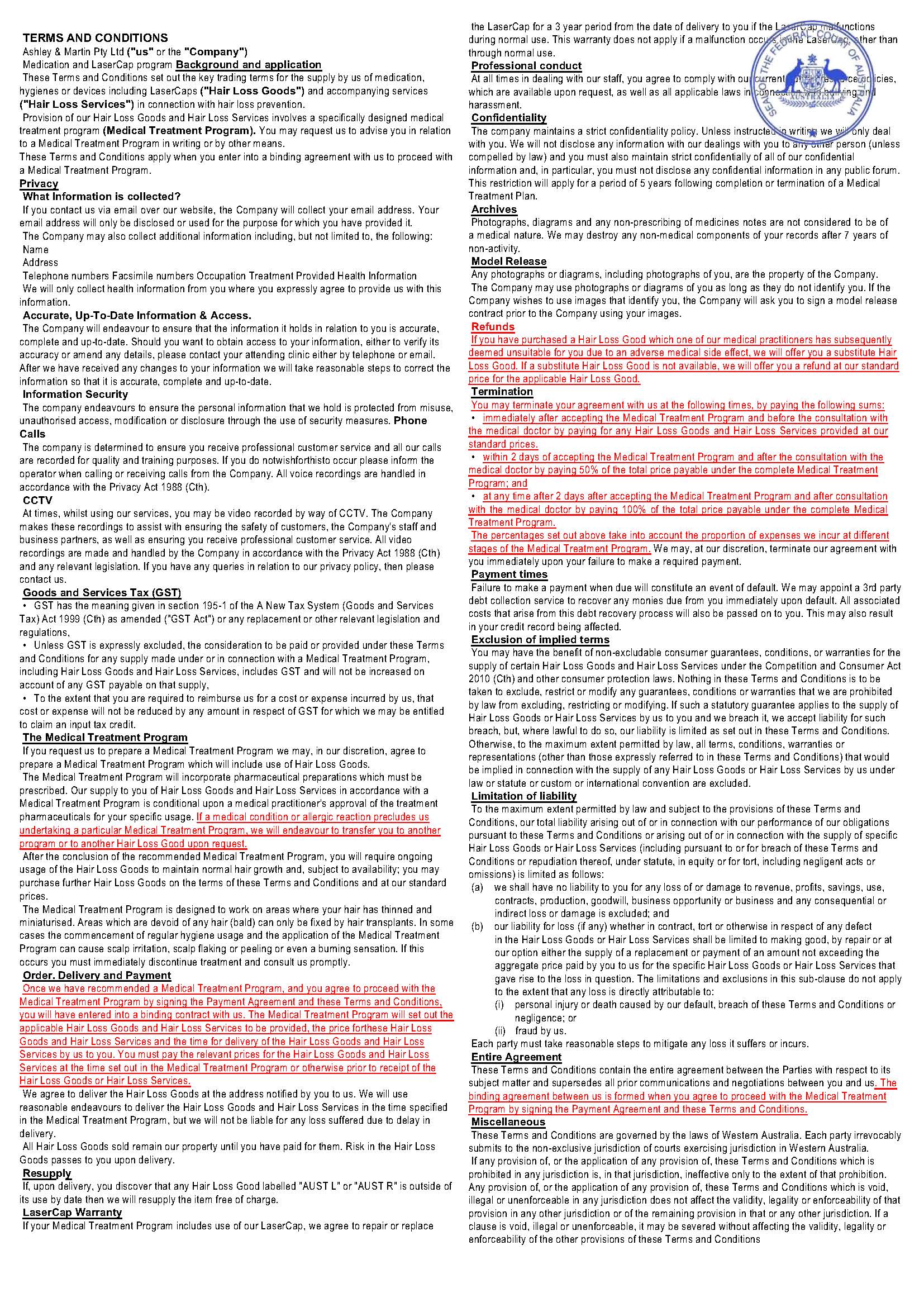
2. The terms in contracts between the respondent and consumers which are marked on the Personal RealGROWTH Program contract identified with code AU PRG09.16 (Second Contract) in Annexure B to these orders are unfair terms within the meaning of s 24 of the ACL, and are void pursuant to s 23 of the ACL, because they commit the consumer to pay for a medical treatment program before the consumer has had the opportunity to receive and consider medical advice and give or refuse informed consent to the medical treatment.
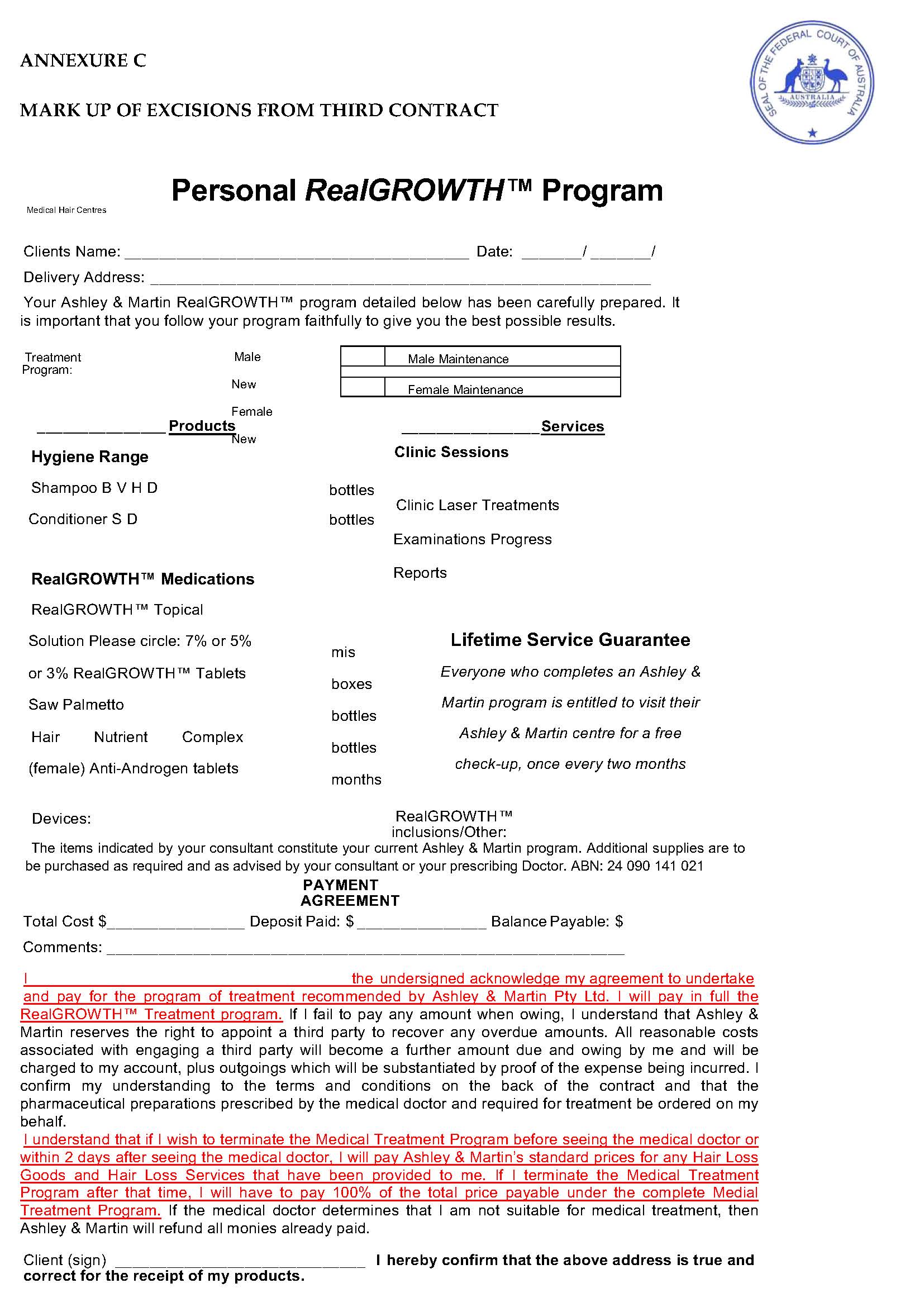
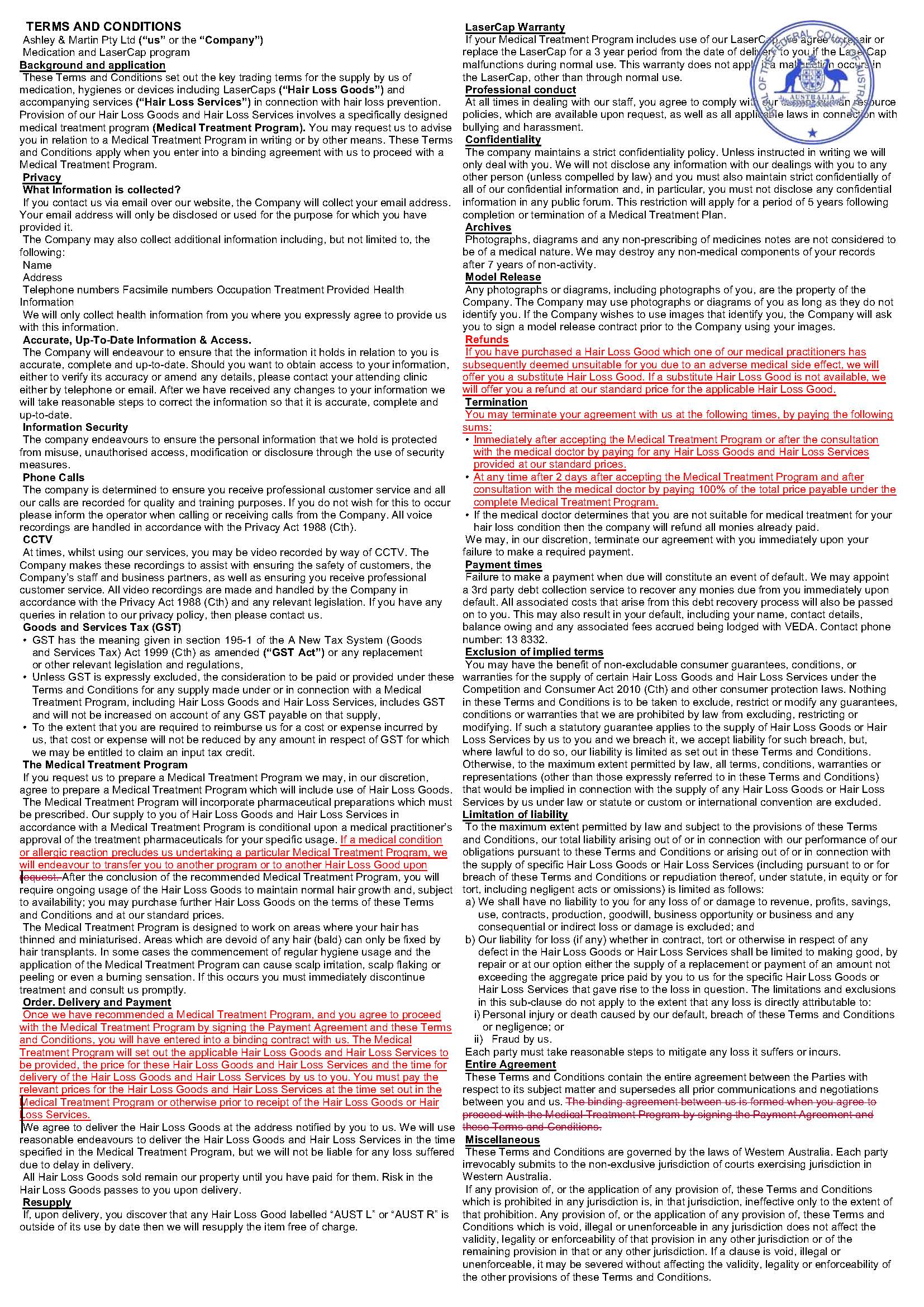
3. The terms in contracts between the respondent and consumers which are marked on the Personal RealGROWTH Program contract identified with code AU PRG12.16 (Third Contract) and otherwise in Annexure C to these orders are unfair terms within the meaning of s 24 of the ACL, and are void pursuant to s 23 of the ACL, because they commit the consumer to pay for a medical treatment program before the consumer has had the opportunity to receive and consider medical advice and give or refuse informed consent to the medical treatment.
THE COURT ORDERS THAT:
4. By way of redress to non-party consumers under s 239 of the ACL:
(a) within 90 days of the date of this order, the respondent will conduct a review of its records (including its Enterprise Resource Management system, emails and point of sale records) to identify who of its patients belong to a class of the Relevant Patients, as defined below;
(b) within 21 days of completing the review referred to in (a) above, the respondent will send a letter to the effect of the letter that is Annexure D to each Relevant Patient at the email and postal addresses last known to the respondent to offer a refund (Refund Offer) of the Refund Amount, as defined below;
(c) if no response is received by the respondent from the Relevant Patient within 60 days of the respondent sending the communication referred to in (b) above, the respondent will again write to each Relevant Patient notifying the Relevant Patient that if no response is received within 30 days, then no refund will be payable; and
(d) to each Relevant Patient who accepts a Refund Offer within 90 days of the Refund Offer being sent, the respondent will pay the relevant Refund Amount within a further 7 days.
5. For the purpose of order 4, and subject to the exclusions in order 6, the Relevant Patients are persons who:
(a) signed either the First Contract, Second Contract or Third Contract (Relevant Contract):
(i) prior to receiving medical advice in relation to a Medical Treatment Program (as defined in the Relevant Contract); or
(ii) within a period of 7 days after receiving medical advice in relation to a Medical Treatment Program (as defined in the Relevant Contract); and
(b) during the term of the Relevant Contract:
(i) were advised by a medical practitioner (contracted by the respondent or otherwise) that the Medical Treatment Program was not suitable (Category A); or
(ii) experienced one or more side-effects from the medically prescribed drugs used in the Medical Treatment Program that caused them to stop using that drug (Category B); or
(iii) within 7 days of signing the Relevant Contract or first receiving medical advice in relation to a Medical Treatment Program (whichever is later), expressed to the respondent a wish to terminate the Relevant Contract or obtain a refund under it (Category C); or
(iv) expressed to the respondent a wish to terminate the Relevant Contract or obtain a refund under it because the patient:
(A) had not had the opportunity to receive and/or consider medical advice; or
(B) had subsequently received and considered medical advice and no longer wished to undertake their Medical Treatment Program (Category D).
6. Relevant Patients excludes those who:
(a) (in respect of Categories A and B only) continued under an amended medical treatment program which contained one of the medically prescribed drugs, unless the patient falls within Category C or D in which case they will receive a full refund; or
(b) prior to signing the Relevant Contract, had been prescribed and used the same medically prescribed drugs that were supplied pursuant to the Relevant Contract pursuant to a previous contract or treatment program; or
(c) after the term of the Relevant Contract, had undertaken a subsequent Medical Treatment Program containing the same medically prescribed drugs that were supplied pursuant to the Relevant Contract.
7. For the purpose of order 4, the Refund Amount is:
(a) a full refund of all money paid under the Relevant Contract;
(b) less any amount already refunded to the Relevant Patient.
8. The respondent pay the applicant's costs, to be taxed if not agreed.
Note: Entry of orders is dealt with in Rule 39.32 of the Federal Court Rules 2011.
Dear [Patient]
Ashley & Martin Pty Ltd - Entitlement to refund
Our records say that you entered into a Personal RealGROWTH Program contract between June 2014 and June 2017.
The Federal Court of Australia has found that during that period Ashley & Martin's Personal RealGROWTH Program contracts contained unfair contract terms. The reasons for that are set out in a Judgment that can be found at:
https://www.judgments.fedcourt.gov.au/judgments/Judgments/fca/single/2019/2019fca1436.
The Court has ordered Ashley & Martin refund the amounts you paid to us [where appropriate: less the refund you have already received by an earlier refund].
If you would like to claim your refund, please contact us no later than [Date of letter +90 days] either by:
telephone at [insert number];
email at [insert address]; or
post addressed to:
The Proper Officer
Ashley & Martin Pty Ltd
673 Murray St
WEST PERTH WA 6005
If you do not contact us by [Date of letter +90 days], you will lose your entitlement to a refund through this process.
If you elect to receive a refund through this process you will not be able to claim those amounts in separate proceedings by you (as an individual) against Ashley & Martin.
If you have any questions about this, please contact [name] at [number].
Yours sincerely
Ashley & Martin Pty Ltd
BANKS-SMITH J:
1 Following a trial, the Court found that certain terms in contracts entered into between Ashley & Martin and consumers were unfair within the meaning of s 23 and s 24 of the Australian Consumer Law (ACL): Australian Competition and Consumer Commission v Ashley & Martin Pty Ltd [2019] FCA 1436.
2 Ashley & Martin carries on the business of supplying to its customers a hair regrowth Medical Treatment Program. The proceedings relate to three iterations of a standard form contract entered into between Ashley & Martin and its customers (referred to as patients) and used during the period June 2014 to June 2017. The particular contracts in question are no longer in use.
3 The fact that the treatment involves prescription medications was important in this case. Whenever medical treatment is involved, issues of informed consent and knowledge of risk must be taken seriously by a provider.
4 In the liability reasons, I found that the impugned terms of the contracts operated together in a manner that commits patients to undertake and pay for a Medical Treatment Program that includes prescription-only medicines before patients have had an opportunity to obtain and consider medical advice as to risk and suitability, and in circumstances where patients remain liable to make payments regardless of the nature of the advice.
5 I found that it was unfair to hold a patient to an agreement that required a contractual commitment without informed consent and that required payment upon termination, and that there was resulting financial and non-financial detriment to patients.
6 Since the liability reasons were delivered, the parties have conferred as to proposed orders and while recognising that the question of relief remains a matter for the Court, are in agreement as to the nature of relief that might be granted. That agreement was reached after considerable conferral, including during an adjournment in the course of the relief hearing, and the parties and their legal representatives are to be commended for persevering with the conferral process.
7 The parties propose that first, the court make declarations under s 21 of the Federal Court of Australia Act 1976 (Cth) and s 250 of the ACL. Second, it is proposed that there be a consumer redress regime in accordance with s 239 of the ACL.
Declarations
8 Ashley & Martin accepted prior to the liability hearing that if the Court were to find that the impugned terms of the contracts were unfair, then declaratory relief was appropriate. It has properly maintained that position. The parties have agreed that there be declarations with respect to each of the contracts to the following effect:
(1) The terms of the contracts identified with code AU PRG01.10 (First Contract) in Annexure A to these orders are unfair terms within the meaning of s 24 of the ACL, and are void pursuant to s 23 of the ACL, because they commit the consumer to pay for a medical treatment program before the consumer has had the opportunity to receive and consider medical advice and give or refuse informed consent to the medical treatment.
(2) The terms in contracts between the respondent and consumers which are marked on the Personal RealGROWTH Program contract identified with code AU PRG09.16 (Second Contract) in Annexure B to these orders are unfair terms within the meaning of s 24 of the ACL, and are void pursuant to s 23 of the ACL, because they commit the consumer to pay for a medical treatment program before the consumer has had the opportunity to receive and consider medical advice and give or refuse informed consent to the medical treatment.
(3) The terms in contracts between the respondent and consumers which are marked on the Personal RealGROWTH Program contract identified with code AU PRG12.16 (Third Contract) and otherwise in Annexure C to these orders are unfair terms within the meaning of s 24 of the ACL, and are void pursuant to s 23 of the ACL, because they commit the consumer to pay for a medical treatment program before the consumer has had the opportunity to receive and consider medical advice and give or refuse informed consent to the medical treatment.
9 The Court has a wide discretionary power to make declarations under s 21 of the Federal Court Act.
10 As established in Forster v Jododex Australia Pty Ltd [1972] HCA 61; (1972) 127 CLR 421 at 437-438, the following three threshold requirements should be satisfied before a declaration will be made:
(a) the question must be a real and not a hypothetical or theoretical one;
(b) the applicant must have a real interest in raising it; and
(c) there must be a proper contradictor.
11 Each of these requirements is satisfied in this case:
(a) the proposed declarations relate to clauses within Ashley & Martin's standard form contracts which are void on the basis that they have been found to be unfair terms within the meaning of s 23 and s 24 of the ACL, and the matters in issue have been identified and particularised by the parties with precision;
(b) it is in the public interest for the Australian Competition and Consumer Commission (ACCC) to seek to have the declarations made, and for the declarations to be made, as:
(i) there is a significant legal controversy in this case, which is to be resolved;
(ii) declaratory orders of the kind proposed are in the public interest because they make it plain that the relevant clauses of the standard form contracts are unfair terms; and
(iii) the ACCC is the public regulator under the Competition and Consumer Act 2010 (Cth) (CCA) and in this role it has a genuine interest in seeking the declaratory relief and having that relief granted by this Court; and
(c) Ashley & Martin is a proper contradictor because, notwithstanding it now consents to the declaratory relief, as is apparent from the liability hearing, it had a genuine interest in resisting the granting of the declarations.
12 In Australian Competition and Consumer Commission v The Construction, Forestry, Mining and Energy Union [2006] FCA 1730, Nicholson J listed various matters that inform whether it is appropriate to make declaratory relief:
[6] So far as concerns the declarations against each of the respondents proposed in the Minute of Consent Orders, I consider they are within s 21 of the Federal Court of Australia Act 1976 (Cth) and appropriate for the following reasons. They:
1. are an appropriate vehicle to record the Court's disapproval of the contravening conduct (Tobacco Institute of Australia Limited v Australian Federation of Consumer Organisations Inc (1993) 41 FCR 89 at 100; Australian Competition and Consumer Commission v Chen (2003) 132 FCR 309 at [36] (Chen 132 FCR));
2. serve to vindicate the Commission's claim that the respondents contravened the Act (Australian Competition and Consumer Commission v Goldy Motors (2000) 23 ATPR 41-801 at [34] (Goldy Motors 23 ATPR));
3. are of some assistance to the Commission in the future in carrying out the duties which are conferred upon it by the Act (Goldy Motors 23 ATPR at [34]);
4. are of assistance in clarifying the law (Goldy Motors 23 ATPR at [34]; Australian Competition and Consumer Commission v. Chaste Corporation Pty Ltd (in liq) [2005] FCA 1212 at [146]);
5. may inform consumers of the dangers arising from a respondent's contravening conduct (Chen 132 FCR at [48]); and
6. may deter corporations from contravening the Act (Australian Competition and Consumer Commission v. Midland Brick Co Pty Ltd (2004) 207 ALR 329 at [22]).
13 Those matters have been cited frequently, for example in Australian Competition and Consumer Commission v Reebok Australia Pty Ltd [2015] FCA 83 at [106].
14 In this case I am of the view that the declarations sought are appropriate because they serve to:
(a) record the Court's disapproval of the use of unfair terms;
(b) vindicate the ACCC's claim that Ashley & Martin's contracts contained unfair terms;
(c) assist the ACCC to carry out the duties conferred upon it by the CCA;
(d) inform consumers of Ashley & Martin's conduct; and
(e) deter other corporations from imposing unfair terms.
15 Accordingly, I am satisfied that it is appropriate that the Court make the declarations in the terms agreed by the parties.
Consumer redress
16 The parties are agreed that orders should be made under s 239 of the ACL for refunds to patients who fit certain criteria.
Legislation and relevant principles
17 Section 239 of the ACL provides:
Orders to redress etc. loss or damage suffered by non‑party consumers
(1) If:
(a) a person:
(i) engaged in conduct (the contravening conduct) in contravention of a provision of Chapter 2, Part 3‑1, Division 2, 3 or 4 of Part 3‑2 or Chapter 4; or
(ii) is a party to a contract who is advantaged by a term (the declared term) of the contract in relation to which a court has made a declaration under section 250; and
(b) the contravening conduct or declared term caused, or is likely to cause, a class of persons to suffer loss or damage; and
(c) the class includes persons who are non‑party consumers in relation to the contravening conduct or declared term;
a court may, on the application of the regulator, make such order or orders (other than an award of damages) as the court thinks appropriate against a person referred to in subsection (2) of this section.
Note 1: For applications for an order or orders under this subsection, see section 242.
Note 2: The orders that the court may make include all or any of the orders set out in section 243.
(2) An order under subsection (1) may be made against:
(a) if subsection (1)(a)(i) applies - the person who engaged in the contravening conduct, or a person involved in that conduct; or
(b) if subsection (1)(a)(ii) applies - a party to the contract who is advantaged by the declared term.
(3) The order must be an order that the court considers will:
(a) redress, in whole or in part, the loss or damage suffered by the non‑party consumers in relation to the contravening conduct or declared term; or
(b) prevent or reduce the loss or damage suffered, or likely to be suffered, by the non‑party consumers in relation to the contravening conduct or declared term.
(4) An application under subsection (1) may be made at any time within 6 years after the day on which:
(a) if subsection (1)(a)(i) applies - the cause of action that relates to the contravening conduct accrued; or
(b) if subsection (1)(a)(ii) applies - the declaration is made.
18 Section 243 indicates the kind of particular orders which the Court may make. It provides:
Kinds of orders that may be made
Without limiting section 237(1), 238(1) or 239(1), the orders that a court may make under any of those sections against a person (the respondent) include all or any of the following:
(a) an order declaring the whole or any part of a contract made between the respondent and a person (the injured person) who suffered, or is likely to suffer, the loss or damage referred to in that section, or of a collateral arrangement relating to such a contract:
(i) to be void; and
(ii) if the court thinks fit - to have been void ab initio or void at all times on and after such date as is specified in the order (which may be a date that is before the date on which the order is made);
(b) an order:
(i) varying such a contract or arrangement in such manner as is specified in the order; and
(ii) if the court thinks fit - declaring the contract or arrangement to have had effect as so varied on and after such date as is specified in the order (which may be a date that is before the date on which the order is made);
(c) an order refusing to enforce any or all of the provisions of such a contract or arrangement;
(d) an order directing the respondent to refund money or return property to the injured person;
(e) except if the order is to be made under section 239(1) - an order directing the respondent to pay the injured person the amount of the loss or damage;
(f) an order directing the respondent, at his or her own expense, to repair, or provide parts for, goods that had been supplied by the respondent to the injured person;
(g) an order directing the respondent, at his or her own expense, to supply specified services to the injured person;
(h) an order, in relation to an instrument creating or transferring an interest in land, directing the respondent to execute an instrument that:
(i) varies, or has the effect of varying, the first mentioned instrument; or
(ii) terminates or otherwise affects, or has the effect of terminating or otherwise affecting, the operation or effect of the first mentioned instrument.
19 However, the Court may not make an award of damages: see s 239(1) and s 243(e).
20 Section 240 identifies matters to which the Court may have regard in determining whether to make an order under s 239(1). It provides:
Determining whether to make a redress order etc. for non‑party consumers
(1) In determining whether to make an order under section 239(1) against a person referred to in section 239(2)(a), the court may have regard to the conduct of the person, and of the non‑party consumers in relation to the contravening conduct, since the contravention occurred.
(2) In determining whether to make an order under section 239(1) against a person referred to in section 239(2)(b), the court may have regard to the conduct of the person, and of the non‑party consumers in relation to the declared term, since the declaration was made.
(3) In determining whether to make an order under section 239(1), the court need not make a finding about either of the following matters:
(a) which persons are non‑party consumers in relation to the contravening conduct or declared term;
(b) the nature of the loss or damage suffered, or likely to be suffered, by such persons.
21 A consumer who has the benefit of a non-party consumer redress order will be precluded from bringing any separate action in respect of the loss or damage to which the order relates. That is the effect of s 241 which provides:
When a non‑party consumer is bound by a redress order etc.
(1) A non‑party consumer is bound by an order made under section 239(1) against a person if:
(a) the loss or damage suffered, or likely to be suffered, by the non‑party consumer in relation to the contravening conduct, or the declared term, to which the order relates has been redressed, prevented or reduced in accordance with the order; and
(b) the non‑party consumer has accepted the redress, prevention or reduction.
(2) Any other order made under section 239(1) that relates to that loss or damage has no effect in relation to the non‑party consumer.
(3) Despite any other provision of:
(a) this Schedule; or
(b) any other law of the Commonwealth, or a State or a Territory;
no claim, action or demand may be made or taken against the person by the non‑party consumer in relation to that loss or damage.
22 Section 239 is, in substance, the counterpart of s 87AAA of the Trade Practices Act 1974 (Cth) (TPA). Section 87AAA was inserted into the TPA by the Trade Practices Amendment (Australian Consumer Law) Act (No 1) 2010 (Cth). A counterpart provision, s 12GNB, was inserted into the Australian Securities and Investments Commission Act 2001 (Cth) at the same time. The Explanatory Memorandum accompanying the Second Reading Speech indicates that the intention was to vest this Court with power to make orders for the redressing of the loss caused to non-party consumers resulting from contraventions of provisions in the TPA.
23 In the Second Reading Speech for the Trade Practices Act Amendment Bill, the Minister said:
The redress for non-parties provisions of the Bill will allow the ACCC and ASIC to act more effectively where, for instance, thousands of consumers suffer small losses on which each of them might not take action individually because of cost and inconvenience. Businesses should not profit from consumer detriment, just because the amount is small or the harm spread widely.
…
This reform will allow a court to order the payment of refunds and similar forms of redress without the need for all consumers affected to be named as parties to the regulator's court proceedings.
This is not a general power to award damages, but a power to order redress where that loss or damage is clearly identifiable and there is no need to adjudicate the merits of each particular case. It could be used to order redress of a standard form, such as the making of an apology, the exchange of goods or the payment of a refund.
24 An argument that the reference in the Second Reading Speech to 'clearly identifiable' loss or damage required a narrow reading was considered and rejected in Director of Consumer Affairs Victoria v Domain Register Pty Ltd (No 2) [2018] FCA 2008. Whilst addressing redress by a refund regime in the context of s 18 of the ACL, the following principles may be distilled from Murphy J's reasons:
(1) It may be the case that refunds are not only given to those persons who have actually suffered loss or damage as a result of the contravention. Some persons may seek a refund when they may not be able to establish before a court that they were in fact misled or deceived or that they suffered loss or damage: at [24], [33], [35];
(2) Section 240(3), which provides that the Court need not make findings about which persons are the relevant non-party consumers, means that it is not the case that orders should only be made where the loss or damage is clearly identifiable or where there is no need to decide the merits of each case: at [28];
(3) It would be 'misplaced' to place reliance on the statement in the second reading speech that s 239 is a power 'to order redress where that loss or damage is clearly identifiable and there is no need to decide the merits of each case', having regard to the rest of the speech: at [36];
(4) Read in full the second reading speech does not indicate that the availability of s 239(1) orders is limited to where a consumer establishes that they actually suffered loss or damage. It discloses a legislative intention to allow non-party consumers to recover loss or damage where they might not take action individually because of cost and inconvenience, and a purpose of preventing businesses from profiting through contraventions just because the amount of loss or damage is small or the harm is widely spread: at [38].
25 I also note Mortimer J's comments as to s 239 in Australian Competition and Consumer Commission v Clinica Internationale Pty Ltd (No 2) [2016] FCA 62 at [293]:
Section 239 is a remedial power. It is designed to allow the Court to undo damage to third parties caused by contravening conduct. The manner in which damage caused might need to be undone will inevitably need to be tailored to the circumstances of the contravening conduct, to the loss or damage suffered, and to the circumstances of the contravener and those involved in the contravention. There are no boundaries drawn in express terms in the way the power is conferred. The terms of s 243 provide examples of the way power might be exercised but should not be construed as confining s 239: Acts Interpretation Act 1901 (Cth), s 15AD. Rather, the use of the standard of appropriateness is a clear indicator that the legislature intends the Court to be able to fashion orders to suit the circumstances of a given case. …
26 Aspects of her Honour's judgment were overturned on appeal but this part of [293] was not criticised: Swishette Pty Ltd v Australian Competition and Consumer Commission [2017] FCAFC 45; (2017) 249 FCR 483.
Determination
27 The conditions necessary for the application of s 239 are established in this case.
28 As to the first condition of s 239(1), Ashley & Martin has contravened a provision in Chapter 2 of the ACL and declarations are appropriate.
29 As to the second condition, I am satisfied that the contravening conduct has caused a class of persons to suffer loss or damage. However, it is not necessary to make findings as to the identity of the particular consumers, nor the precise nature and extent of the loss which they have suffered (s 240(3)).
30 As to the class of consumers, the regime identifies four categories of patients who are entitled to a refund of all monies paid under the relevant contract, less any refunds already received.
31 Before turning to the four categories, it is useful to first repeat some of the findings as to financial and non-financial detriment set out in the liability reasons. For example, as to the First Contract, financial detriment was apparent as follows:
[176] Where a patient sees the doctor and decides not to proceed (even if the doctor has not advised that the Medical Treatment Program is unsuitable), then by the Contract the patient has already committed to pay between 50% and 100% of the contract price.
[177] Where a patient sees the doctor and is advised that the medical treatment program is unsuitable, then again they have already committed to pay between 50% and 100% of the Contract price and cannot undertake the Medical Treatment Program for which they have paid.
[178] Where a patient sees the doctor and commences the Medical Treatment Program but suffers an adverse side effect to a medication or treatment, they have again already committed to pay between 50% and 100% of the Contract price, cannot undertake the Medical Treatment Program for which they have paid, and their rights are otherwise limited to receiving a substitute medication or a refund for only the relevant product at Ashley & Martin's standard price.
[179] Such outcomes quite clearly comprise financial detriment. The fact that they have already received some products does not ameliorate the detriment: they may not use the products at all and they cannot be used as part of a Medical Treatment Program. There is no benefit that outweighs the detriment.
32 Further, I found that there was non-financial detriment:
[180] The regime created by the Contracts did not deny the patients the opportunity to obtain medical advice. That is not the vice. The vice was the requirement that an obligation to undertake and pay for medical treatment be incurred without the opportunity for an informed choice. Once patients have received advice, the fact that they have already incurred costs regardless of whether they proceed with the program may interfere with the manner in which they assess the risks of treatment raised by the doctor and, importantly, the time they take to assess such risks. Such non-financial detriment is difficult to assess but still comprises detriment within the meaning of the Act. Even if I am wrong as to that, financial detriment is in my view clearly established.
33 Detriment was similarly established with respect to the Second Contract and Third Contract: at [201], [208].
34 I accept the submissions of counsel for Ashley & Martin that detriment will not necessarily equate to a measure of damage or loss. I also accept that some aspects of detriment may not be readily quantifiable. However, in this case, where identified payments have been made, it seems to me that it is appropriate that redress proceed by having regard to payments made under the contracts, and that redress proceed in effect as a refund. The unfairness identified in the liability reasons was (in part) that the contract committed the patients to the relevant payments and in effect denied them the opportunity to avoid the payments. There is a correlation between the unfairness at the heart of the contracts and repayment of fees incurred by way of refunds under the proposed refund scheme.
35 And so to return to the proposed four categories of redress consumers.
36 It seems clear that the patients who signed the First, Second or Third Contracts will all be readily identifiable, having regard to the business records of Ashley & Martin. However, not all patients who signed a contract are entitled to redress under the regime proposed by the parties.
37 There is a threshold requirement that limits those patients who are entitled to redress. That threshold is that the relevant patients are only those who entered into one of the First, Second or Third Contracts (defined as a Relevant Contract) prior to receiving medical advice about the Medical Treatment Program or within the short window of seven days after receiving such medical advice. This threshold highlights that those persons who signed within the short period of seven days after receiving medical advice did not receive sufficient time to consider their position. They were denied, in effect, any reasonable cooling off period. These patients are referred to as the Relevant Patients.
38 The first category proposed are those patients who during the term of the Relevant Contract were advised by a medical practitioner (contracted by Ashley & Martin or otherwise) that the medical treatment program was not suitable for them (Category A).
39 The second category are those patients who experienced one or more side-effects from the medically prescribed drugs used in the Medical Treatment Program that caused them to stop using that drug (Category B).
40 The third category are those patients who, within seven days of signing the Relevant Contract or first receiving medical advice in relation to a Medical Treatment Program (whichever is later), expressed to the Respondent a wish to terminate the Relevant Contract or obtain a refund under it (Category C). In other words, these patients notified Ashley & Martin quite quickly that they wanted to terminate the relevant contract.
41 The fourth category are those patients who expressed to Ashley & Martin a wish to terminate the Relevant Contract or obtain a refund under it because the patient:
(a) had not had the opportunity to receive and/or consider medical advice; or
(b) had subsequently received and considered medical advice and no longer wished to undertake their Medical Treatment Program (Category D).
42 As is apparent, the difference between Category C and Category D patients is the timing of the expression of the wish to terminate, and the nature of that expression. Those who indicated a desire to terminate in the (early) seven day period need not have expressed their reason for that wish, in order to be entitled to redress.
43 There are express exclusions. Relevant Patients does not include persons who:
(a) (in respect of Categories A and B only) continued under an amended medical treatment program which contained one of the medically prescribed drugs, unless the patient falls within Category C or D in which case they will receive a full refund;
(b) prior to signing the Relevant Contract, had been prescribed and used the same medically prescribed drugs that were supplied pursuant to the Relevant Contract pursuant to a previous contract or treatment program; or
(c) after the term of the Relevant Contract, had undertaken a subsequent Medical Treatment Program containing the same medically prescribed drugs that were supplied pursuant to the Relevant Contract.
44 The first exclusion is said to be justified on the basis that if a treatment program is varied by the exclusion of one of the medically prescribed drugs and the patient chooses to continue with it as varied, then Ashley & Martin should not be obliged to provide a full refund. Ashley & Martin will have continued to provide goods and services under the varied contract.
45 The second and third exclusions are justified on the basis that those patients would have obtained medical advice and been advised of risk during the initial and continuing programs. By their voluntary and informed continuation of treatment, those patients may be taken to have not suffered any loss, even if informed consent was not given in the first place.
46 In considering the appropriateness of the classification of patients and of the exclusions, I have had careful regard to whether the requirement of full refunds (less any refunds already paid) acts in effect as a punitive order against Ashley & Martin. For example, if the redress scheme were such that it could easily be abused by patients now claiming a refund who would have proceeded with the treatment regardless, or if there is a clear case that patients were being overcompensated, then a scheme such as that proposed may not be appropriate.
47 However, the exclusions seem to me to address that risk in an appropriate manner. It is not possible to entirely alleviate such risk, and there may well be the odd example where on particular facts Ashley & Martin are obliged to pay a refund due to cessation of treatment in unanticipated circumstances (such as, for example, where a patient terminates for medical reasons that arise during the course of treatment but are unrelated to the Medical Treatment Program or associated identified risks). Such 'outlier' claims are unlikely, and are highly unlikely to arise in any significant number, and as counsel for Ashley & Martin accepted, a redress regime cannot sensibly be adapted to accommodate every potential factual scenario or the regime itself becomes unworkable. The risk that there may be claimants for refunds who cannot properly 'prove' a claim is anticipated by the redress regime itself, as noted by Murphy J in Director of Consumer Affairs Victoria v Domain.
48 In the circumstances, I am satisfied that the redress regime as proposed does not operate in a punitive manner against Ashley & Martin, but rather is a fair regime that has due regard to the conduct of the patients in communicating with Ashley & Martin (as evidenced by the different conditions for Category C and Category D); the fact that the relevant treatment takes place over a period of time; and the fact that side effects may take some time to be revealed. It also suitably addresses the circumstances of the contractual relationship entered into between the patients and Ashley & Martin.
49 Under the redress regime, Ashley & Martin will inform its former patients of their entitlement to a refund by notification to their last known email and postal address. These patients will have to 'opt in' to the scheme, by replying to Ashley & Martin. The regime proposed by the parties includes agreed terms of the letter to be sent to patients notifying them of their entitlement, whilst allowing for minor amendments that may be required. It is not unusual that the proposed communication be approved by the court: see, for example, Australian Competition and Consumer Commission v AGL South Australia Pty Ltd [2015] FCA 399. Consumers will be informed that if they receive a refund they will not be able to claim such an amount separately from Ashley & Martin, as provided by s 241.
50 In all the circumstances, it is appropriate that orders be made giving effect to the non-party consumer redress regime as agreed to by the ACCC and Ashley & Martin.
Costs
51 Ashley & Martin accepts that it must bear the ACCC's costs of the proceedings in the usual way, to be assessed if not agreed.
I certify that the preceding fifty-one (51) numbered paragraphs are a true copy of the Reasons for Judgment herein of the Honourable Justice Banks-Smith. |
Associate:


