FEDERAL COURT OF AUSTRALIA
Mehajer v Weston in his Capacity as Trustee of the Bankrupt Estate of Salim Mehajer [2019] FCA 1713
ORDERS
Applicant | ||
AND: | PAUL WESTON IN HIS CAPACITY AS TRUSTEE OF THE BANKRUPT ESTATE OF SALIM MEHAJER First Respondent SC LOWY Second Respondent | |
DATE OF ORDER: |
THE COURT ORDERS THAT:
1. The further amended application filed on 19 July 2019 be dismissed.
2. On or by 17 October 2019, the parties are to file and serve a submission limited to one page identifying the order for costs for which they contend and the matters relied upon in relation to their proposed order as to costs.
3. Pursuant to FCR 36.03(b) the date by which any notice of appeal is to be filed be fixed as the date 28 days after the provision by the Court to the parties of the revised reasons for judgment.
Note: Entry of orders is dealt with in Rule 39.32 of the Federal Court Rules 2011.
ORDERS
NSD 144 of 2019 | ||
BETWEEN: | SALIM MEHAJER Applicant | |
AND: | PAUL WESTON IN HIS CAPACITY AS TRUSTEE OF THE BANKRUPT ESTATE OF SALIM MEHAJER First Respondent SC LOWY Second Respondent | |
JUDGE: | LEE J |
DATE OF ORDER: | 25 October 2019 |
THE COURT ORDERS THAT:
1. The applicant pay the respondents’ costs of the proceeding.
Note: Entry of orders is dealt with in Rule 39.32 of the Federal Court Rules 2011.
Revised from the transcript
LEE J:
a Introduction
1 Mr Mehajer brings an application for an annulment of his bankruptcy. As I will explain, his annulment efforts have had a long and, in some respects, lamentable history. The grounds upon which it is said that a sequestration order ought not to have been made have morphed somewhat and, as a result, a tsunami of material has been put before the Court on the application, much of which, in the end, is irrelevant to the disposition of the application.
2 Indeed, the sheer volume of material gives a patina of complexity to the matter which is dispelled upon close analysis: the case is determined by application of well-established principles to facts ascertained relatively straightforwardly. The considerable assistance the parties have provided the Court by way of submissions and the efforts of Mr Finnane QC, senior counsel for Mr Mehajer, to narrow the issues in dispute, have allowed me to proceed to determine the matter immediately upon conclusion of oral submissions.
B Relevant Background
3 In Mehajer v Weston (Trustee), in the matter of Mehajer [2018] FCA 608 at [1], I referred to the fact that on 17 April 2018, Mr Mehajer filed an originating application joining his trustee in bankruptcy, Mr Paul Weston (Trustee), and a number of other respondents. The primary relief sought was an order for annulment under s 153B(1) of the Bankruptcy Act 1966 (Cth) (Act).
4 At the time this originating application was filed, interim relief was sought, which included an order staying the sequestration order made against Mr Mehajer on 20 March 2018. For reasons I explained in that judgment, I refused the interim relief sought. In doing so, at C.1 of the judgment, I turned to the issue of the serious question to be tried in relation to that application. I noted at that time that in the original application for annulment, Mr Mehajer called in aid three matters said to support his annulment contentions. They were as follows (at [14]):
The first was that there were defects in the creditors’ petition, being erroneous information and an overstatement in the amount of the interest claimed on the judgment debt (Defects Contention); the second was that an adjournment of the hearing of the creditors’ petition ought to have been sought and granted, given Mr Mehajer’s circumstances (Adjournment Contention); the third was that Mr Mehajer had the ability to pay his debts as at the date of the making of the sequestration order (Ability to Pay Contention).
5 When considering the third matter, the “Ability to Pay Contention”, I said the following at [26]-[29]:
The third matter raised on the serious question to be tried is that Mr Mehajer intends to contend that he had the ability to pay his debts at the time the sequestration order was made. In this regard, it is fair to say that the present state of the evidence is unsatisfactory. I was provided with Mr Mehajer’s schedule of claimed assets and debts (Schedule), which is based on the affidavit material. In relation to the assets, a number of properties were identified, including seven for which there was no evidence as to whether or not they are the subject of encumbrances. Two of the properties, said to be owned by Mr Mehajer, are offered as security for an undertaking for the stay, and I will deal with these separately. A number of other assets are identified, for which values are asserted, including a series of personal loans, chattels, and an amount of $27 million said to represent an interest in developments being carried out by two companies: SET Services Pty Ltd (SET) and Sydney Project Group Pty Ltd (SPG). The evidence in respect of this last asset is illustrative of the difficulties which beset the evidence. At [38] of her affidavit affirmed on 24 April 2018, Ms Zali Burrows, Mr Mehajer’s solicitor, deposed as follows:
I am informed by Mr Mehajer that, since October 2017, he has been unsuccessfully attempting to obtain from the external controllers of Sydney Project Group and SET Services Pty Ltd copies of the entities’ financial records. However, I am informed by Mr Mehajer that SET Services Pty Ltd is, together with Sydney Project Group Pty Ltd, the proponent of a development which has made approximately $83,000,000 of pre-sales of real estate. I am also informed by Mr Mehajer that he has an interest in developments carried out by SET Services Pty Ltd and Sydney Project Group Pty Ltd to a value of $27,000,000. On or about 18 April 2018, Mr Mehajer obtained caveats against 18 lots in respect of his interest in SET Services Pty Ltd. Now shown to me at Tab [5] of ZB-1 is a copy of those caveats.
(Uncorrected)
When one goes to the annexure referred to by Ms Burrows, rather than seeing a copy of the caveats, what is annexed at pages 160-162 are copies of registration notices identifying the dealing numbers issued by Land Registry Services. What is notable is that the caveats are not in evidence, which caveats would have identified the nature of the interest sought to be asserted. When I sought clarification of the nature of the interest that was to be asserted, nothing further could be said other than what is extracted above.
Two other examples from what might be described as the other side of the ledger further illustrate the difficulties. One is the debt owed to the DCT, which, according to Mr Raguragavan Nithiaseelan, a Senior Manager in the employ of the Trustee, is an amount of $8,604,202.56, not the amount of $8,355,778 referred to in the Schedule. Similarly, in respect of Prime, the amount identified as the debt in the Schedule is $199,519, when it appears from a copy of the bankruptcy notice served on Mr Mehajer that as at 11 October 2017, the debt was $668,276.76.
While the material was, no doubt, prepared with some haste, it is fair, at least at present, to describe the evidence as to assets and liabilities as somewhat high, wide and (depending upon the view one takes of it) handsome.
6 My last comment reflected my concern that the solvency evidence put before the Court at that stage was, to put it mildly, less than compelling.
7 Eventually, the annulment application came before me for hearing on 21 June 2018, when Mr Robison, of counsel, appeared for Mr Mehajer. At that time, Mr Robison indicated to me that he was instructed to seek an adjournment of the hearing. A number of contentions were made in support of that application, including that a solicitor previously acting for Mr Mehajer had failed to attend to the task of preparing adequate evidence, particularly evidence relating to the question of the solvency of Mr Mehajer as at the date of the making of the sequestration order.
8 Following the hearing of evidence and lengthy submissions, I refused the application for an adjournment (see T45.21.06.2019). The immediate response of counsel appearing on behalf of Mr Mehajer at that point was to seek to discontinue the annulment proceeding, and I ordered that leave be granted for Mr Mehajer to discontinue the proceeding, and I dispensed with the need to file a notice of discontinuance and make consequential costs orders. As was made clear at that time, this did not prevent another annulment application being brought by Mr Mehajer.
9 The matter (to use this expression in its broader, constitutional sense) next came before me, in a substantive way, on 19 December 2018, when SC Lowy Primary Investments Limited (SCL) sought orders which, in effect, declared that certain property (being various causes of action alleged by Mr Mehajer against SCL and other persons) had vested in the Trustee pursuant to s 58(1) of the Act. Mr Mehajer appeared for himself on this occasion, by way of video-link from gaol. During the course of submissions, it was made clear to Mr Mehajer that the making of the order sought by SCL would not inhibit him from making an application for the annulment of his bankruptcy. I explained that he would have a chance to bring any application he wished to make, but if such an application was to be made, it must be made in an appropriate form supported by evidence so it could be determined in accordance with the case management objectives referred to in Pt VB of the FCAA.
10 The matter was then stood over until January 2019, so that Mr Mehajer would be able to seek legal advice in relation to whether he consented to the orders sought in SCL’s application. Mr Mehajer did not indicate that he consented to the orders, and on 23 January 2019 filed a document which appeared to be an informal application for annulment. On 25 January 2019, final argument was heard as to SCL’s application, and I was satisfied that I should accept the submissions made by SCL and considered it was appropriate to make a declaration pursuant to s 90-15(1) of Sch 2 of the Act and s 23 of the Federal Court of Australia Act 1976 (Cth) (FCAA) that certain property referred to in the schedule to the order had vested in the Trustee. The course of the hearing on 25 January is evident from the transcript, and brief oral reasons were given at that time, which are unnecessary to repeat here. I also indicated that I proposed to accept the informal application of Mr Mehajer as an application commencing an annulment proceeding, and made a number of timetabling orders to ensure the annulment application was advanced properly. After Mr Mehajer obtained legal representation, the informal application was superseded by the filing of a further amended application on 19 July 2019. There were no longer any claims for interim relief, and the only substantive order sought was an order for annulment under s 153B(1) of the Act.
11 On 5 July 2019, the annulment proceeding came before me for a first case management hearing, and Mr Finnane appeared on behalf of Mr Mehajer. At that time, Mr Finnane indicated that the “primary argument is that [Mr Mehajer] was solvent at the time he was made bankrupt” (T2.05.07.2019). After discussing the best mode by which the issue of solvency should be determined by the Court consistent with the overarching purpose (including consideration as to whether a referee should be appointed to inquire into and report upon solvency at the relevant date), the matter was stood over to allow the parties to consider what orders should be made to ready the matter for hearing.
12 The matter next came before me on 24 July 2019, with Mr Finnane again appearing on behalf of Mr Mehajer; Mr Leopold SC and Mr Koch appearing on behalf of SCL; and Mr Calabria appearing on behalf of the Trustee. At that time, Mr Leopold indicated that SCL wished to file an application under s 31A of the FCAA for the summary determination of the annulment application. The prospect of a reference was abandoned in circumstances unnecessary to recount for present purposes, and I indicated to Mr Leopold and Mr Finnane that the proceeding should go to a hearing in an orthodox way. Orders were made for the service of evidence so as to provide “a greater opportunity for [Mr Mehajer] to marshal whatever material that he wishes to put before the Court” (T6.24.07.2019).
13 In particular, orders were made for Mr Mehajer to file any further evidence on or before 19 August 2019, with the respondents to file any evidence by 9 September 2019, and any evidence in reply to be filed by 23 September 2019. The matter was listed for hearing with an estimate of three days commencing on 8 October 2019. The reason for the generous estimate of hearing time is because, at that time, it seemed to me likely that there may be contested valuation evidence and other expert evidence relevant to solvency, which may take some time to adduce and test.
14 In any event, it is against this long background that the annulment application finally comes before the Court for determination. Before coming to the refined case of Mr Mehajer (as maintained in final submissions), it is appropriate that I pause to provide a survey of the relevant principles that inform the determination of the application.
C relevant law
15 There are five general principles which assume importance on this application, which are as follows:
(1) An applicant who seeks an annulment of his bankruptcy “carries a heavy burden”; it is incumbent on an applicant “to place before the Court all relevant material with respect to his or her financial affairs so that the Court may be properly informed and may make a judgment that is based on the full facts and the actual circumstances of the applicant”: Re Papps; ex parte Tapp (1997) 78 FCR 524 at 531.
(2) In addressing the question of whether or not a sequestration order “ought not to have been made”, the inquiry is a broad one and is not confined to a consideration of whether the order should have been made on the facts known to the Court at the time at which it was made; the Court is to take account of the facts, known at the time the sequestration order was made and also other facts, which are evident, at the time of the hearing of the annulment application, even if those facts were not before the Court at the time the sequestration order was made: see Boles v Official Trustee in Bankruptcy [2001] FCA 639; (2001) 183 ALR 239 at 243 [16]; as Mansfield J described it Re Almassy [1999] FCA 1004; (1999) 92 FCR 597 at 599-600 [15]:
The expression “ought not to have been made” in s 153B in respect of a sequestration order being cancelled requires there to be shown that there was some matter upon which the order was made which was not in fact correct, although that might be shown not just from the facts as disclosed at the time, but as they would have been disclosed had all the true facts been disclosed at the time of the making of the order…
(3) A sequestration order “ought not to have been made” if the Court would have been bound not to make the sequestration order: see Re Frank; Ex parte Piliszky (1987) 16 FCR 396; this means that if it was open to the judge to make an order in the exercise of discretion, it can only be said that the judge ought not to have made the order if none of the circumstances could justify the making of the order; or, alternatively, if it can be established that an order ought not to have been made because subsequent evidence discloses that all of the true facts were not before the Court when the order was made: Re Cook (1946) 13 ABC 245.
(4) The power conferred on the Court by s 153B(1) is discretionary in nature; even if persuaded that the sequestration order ought not to have been made, the Court can, under appropriate circumstances, decline to annul the bankruptcy: Boles v Official Trustee in Bankruptcy at 243 [16]; as Logan J in Crocker v Infa-Secure Pty Ltd [2018] FCA 84 at [7] explained:
The Court retains a discretion as to whether to annul a bankruptcy, even if persuaded that a sequestration order ought not to have been made… In Francis v Eggleston Mitchell Lawyers Pty Ltd [2013] FCA 564 at [26] Marshall J offered a necessarily non-exhaustive summary of circumstances which, in earlier cases, had been regarded as warranting an adverse exercise of that discretion. Factors such as whether the issue put forward as a basis for being satisfied the sequestration order ought not to have been made were capable of being raised at the time of the hearing of the petition, whether the bankrupt was legally represented then, the bankrupt’s conduct over the course of the bankruptcy and the commercial morality of the bankrupt’s conduct prior to bankruptcy are some which, in the past, have been regarded as relevant to the exercise of the court’s discretion.
(5) Considerations which may have a bearing on the exercise of discretion include delay, whether or not the applicant for annulment at the time of the hearing of the application is solvent, whether or not the applicant has made full disclosure of his financial affairs and also whether there was a failure by the bankrupt to oppose the creditor’s petition and attend the hearing at which the sequestration order was made: re Williams (1968) 13 FLR 10; also see Hassall, D A, “Annulment of Bankruptcy and Review of Sequestration Orders” (1993) 67 ALJ 761 at 766.
16 With the above principles in mind, I come to the case maintained by Mr Mehajer at the hearing.
D The Refined Case of Mr Mehajer
17 I noted at [4] above, a threefold case was advanced by Mr Mehajer in his first application in order to justify his annulment. Nothing was heard further of the Defects Contention and, as I have explained, it was the Ability to Pay Contention which was focussed on during the course of the interlocutory stages of this application (and also during the course of opening submissions). With commendable candour, however, by the time of final submissions, senior counsel for Mr Mehajer conceded that he was not in a position, on the basis of the evidence at the hearing, to gainsay the proposition that Mr Mehajer was insolvent at the time the sequestration order was made. Prior to that time, much of the hearing had been consumed (and vast amounts of paper had been deployed) in an attempt (successfully as it turned out) to prove that Mr Mehajer was insolvent at that time.
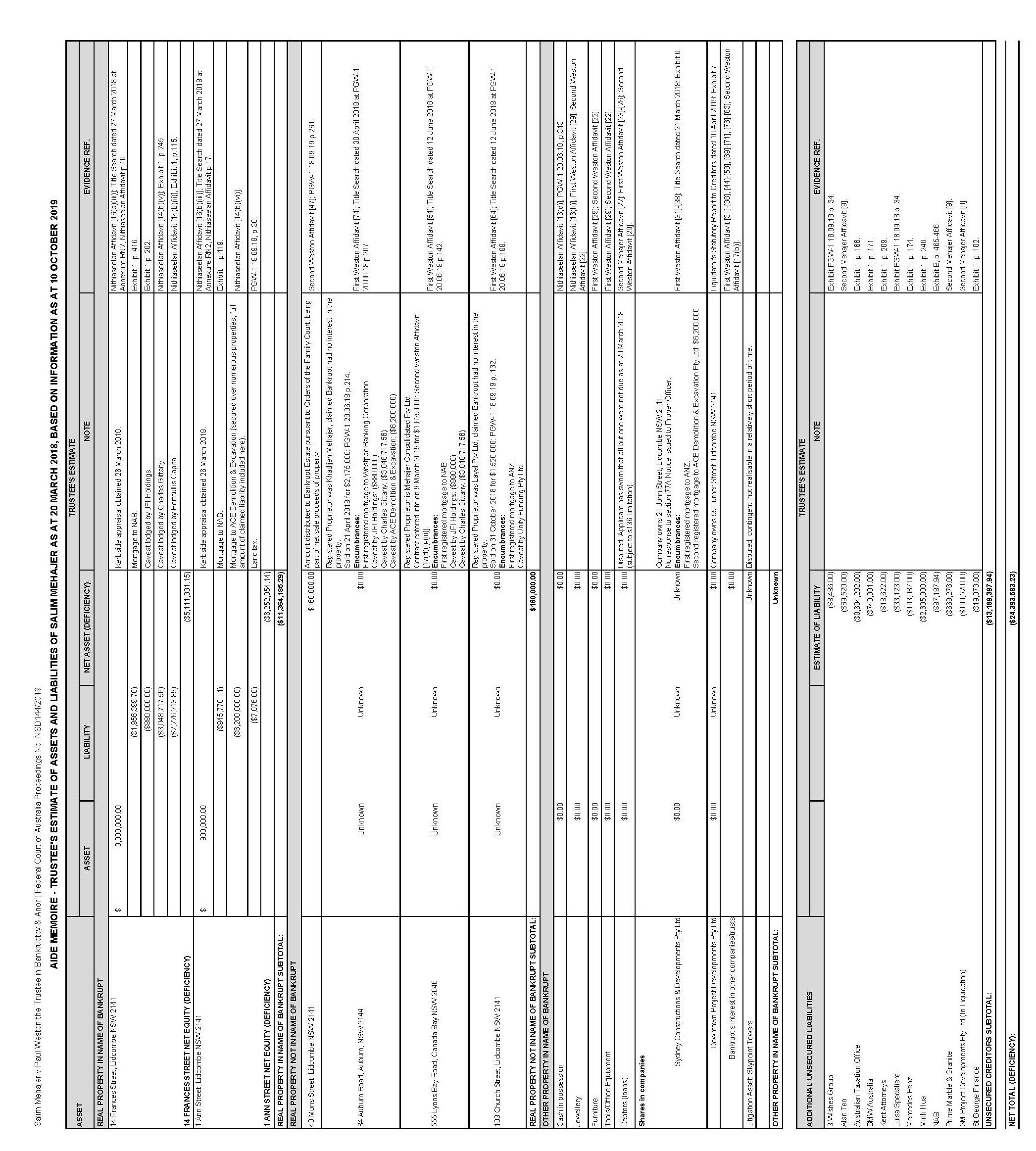
18 Schedule 1 to this judgment is an aide-mémoire identifying the assets and liabilities of Mr Mehajer as at 20 March 2018, prepared by the Trustee. Included in that document are various evidentiary references where the material contained in the aide-mémoire is established. It demonstrates beyond peradventure that according to the Trustee’s estimate of assets and liabilities, the Trustee’s estimate of the net total deficiency of assets over liabilities was negative $24 million.
19 Mr Mehajer submitted, however, that this conclusion as to his financial position as at the date of the sequestration order, was not fatal to his application for an annulment. In doing so, there were two principal matters to which reference was made.
20 The first was psychiatric evidence adduced on behalf of Mr Mehajer which was relevantly unchallenged. It was that Mr Mehajer has been affected by symptoms of bipolar disorder since at least 2012 and was in a hypomanic state during 2015, when he entered into various loan agreements. Dr Olav Nielssen, a highly experienced psychiatrist, provided the psychiatric diagnosis that Mr Mehajer suffers from bipolar mood disorder (manic depressive illness). This diagnosis of bipolar mood disorder was made on the basis of Mr Mehajer’s account of the syndrome of hypomania (submania), generally defined as the presence of the syndrome of mania without delusional beliefs or to the degree that it was not severe enough to require hospital admission. It was said that the corroborative information provided by his sister and aspects of his presentation and thought content during the course of various interviews with Dr Nielssen supported this diagnosis.
21 It was said that Mr Mehajer’s mood disorder is likely to have resulted in significant impairment of his ability to attend to complex legal documents and to consider properly the effect of any legal advice provided to him or the need to obtain independent advice. Perhaps, not surprisingly in these circumstances, Dr Nielssen expressed the view that the course of his bipolar disorder and overall mental health “would be improved by the annulment of [his] bankruptcy”.
22 None of this material, of course, was before the primary judge. There was no suggestion made that the opinion expressed by Dr Nielssen did not accurately describe Mr Mehajer’s psychiatric position at any earlier time and I would infer on the basis of the evidence, that it is more probable than not, given Mr Mehajer had suffered from the bipolar disorder since at least 2012, that he was, at the time of the making of the sequestration order, also afflicted in the same way.
23 The second matter which is called in aid by Mr Mehajer was a variation on what I described in my earlier judgment as the Adjournment Contention. Again, unchallenged evidence was given by Mr Mehajer that on 23 January 2018, he was taken into custody on remand and was held in a holding cell in Surry Hills for eight days. During this period, he was entitled to one phone call, which he made to his family. His solicitor and barrister in the bankruptcy proceeding did not visit him during that period. He then gives the following evidence:
In early February, I was moved to Silverwater MRRC. I was permitted to make a phone call to my family to inform them of my whereabouts. During the first week of February, while I was at Silverwater, my then-solicitor in the bankruptcy proceedings, Mohomed Abbas, visited me approximately three times. Mr Abbas was my legal representative for my bankruptcy matter, and During (sic) one of those occasions, I said words to Mr Abbas to the following effect:
“I cannot afford to go bankrupt. Please ensure you will adjourn the matter until at least 21 days after my bail application in the Supreme Court, which is on 29 March. Tell Jim [which I infer is a reference to Jim Johnson, counsel who was apparently briefed by Mr Abbas to appear in the bankruptcy proceedings] to seek an adjournment at the hearing. I need to be out to fight my bankruptcy, as it’s too hard to communicate with the outside world.”
I am informed by Mr Bogoevski [a person involved with a company called Financial Control Lending Pty Limited] and believe that, whilst in custody at the MRRC Silverwater, he made arrangements to visit me to explain the terms of the proposed loan and sign the proposed loan agreement. However, Mr Bogoevski was refused entry, as I was in segregation, with visits restricted to lawyers and family. In the result, I was not able to sign the loan agreement and unable to obtain the loan.
24 In short, it was submitted by senior counsel on behalf of Mr Mehajer that in circumstances where Mr Mehajer had given instructions to his solicitor to seek an adjournment, while he was in gaol, pending an application for a Supreme Court bail application, the matter should have been adjourned. Although not directly submitted by Mr Finnane, I will assume that such a counterfactual adjournment would have been for a relatively short period, to allow consideration as to whether or not bail would be granted and to allow Mr Mehajer to then explore the possibility of pursuing arrangements to procure funds in order to enter into discussions to compromise his debts with his creditors.
25 In closing written submissions on behalf of the applicant, Mr Finnane noted that Mr Mehajer, because he was in custody, was not able to attend Court; to put forward any evidence on the day; or to negotiate with any of his creditors. I will come back to this refined case after now turning to some additional relevant findings based on the evidence that has been adduced at the hearing.
E Relevant Findings
26 Although I do not understand the figures referred to in Schedule 1 to have remained the subject of disputation by the end of the hearing, it is worth making some specific findings. The first relates to a debt owed at the date of the sequestration order to the Australian Taxation Office (ATO). Three notices of amended assessment and a notice of assessment of shortfall penalties were issued on or around 24 October 2017 in the amount of $8,355,778.03.
27 Given the impact of the General Interest Charge on those amounts, by the time of the sequestration order, it appears the debt owed to the ATO was somewhere in the region of $8.6 million. Prior to the date of the sequestration order, objections had been lodged with the ATO. Despite this, it is well-established in the authorities (see, for example, Deputy Commissioner of Taxation v Niblett (1965) 83 WN (Pt 1) (NSW) 405 (Asprey J); Deputy Federal Commissioner of Taxation v Roma Industries Pty Ltd (1976) 6 ATR 54 (Bowen CJ in Eq)) that the relevant legislative provisions require the court to treat the debt as undisputed even though an objection has been lodged.
28 Additionally, there were a number of miscellaneous debts (owed to SM Project Developments Pty Ltd (in liq), Prime Marble & Granite Pty Ltd, and Mr Alan Teo) totalling about $937,000 which were undisputed and owing at the relevant date. An amount of $2.905 million was also owing to the National Australia Bank.
29 Mr Mehajer was indebted to Mr Charles Gittany at the time of the making of the sequestration order in an amount in excess of $3 million, although it will be necessary to return to the position relating to Mr Gittany below, by reason of events which are said to have occurred after the making of the sequestration order.
30 Mr Minh Hua was listed as a personal creditor in a document prepared by Mr Mehajer in December 2018 entitled “Composition with Creditors” (which was circulated to his then creditors) and appears to have been owed a sum of approximately $2.6 million. Although evidence was given by Mr Mehajer initially denying Mr Hua was a personal creditor, to the extent that there is an inconsistency between the information that Mr Mehajer gave to his creditors in 2018 and the evidence given on this application, I prefer the contemporaneous material.
31 In respect of Portcullis Capital Pty Ltd, as at the date of the sequestration order, Mr Mehajer owed in excess of $2.1 million. Again, this company was listed as a creditor by Mr Mehajer in the “Composition with Creditors” document. In relation to a company called JFI, there was evidence that it was claimed that an amount of $880,000 was owed by Mr Mehajer, and there does not seem any reason to doubt the accuracy of this amount referred to in a business record from a solicitor for this organisation.
32 In what appears to be a somewhat unusual set of circumstances, Mercedes-Benz, after repossessing a vehicle (the finance for which had been guaranteed by Mr Mehajer) and selling it, a very large loss of $100,000 was the result, for which it appears two conclusions may be drawn: first, that Mr Mehajer was also liable for this sum at the relevant date; and secondly, the vehicle was either damaged or the secondary market for Mercedes-Benz motor vehicles is not what one would have expected.
33 In relation to ACE Demolition, at the date of the sequestration order, it appears Mr Mehajer owed the sum of $6.2 million, although, again, it will be necessary to return to the arrangements with this company below. Finally, it appears that Mr Mehajer owed BMW the sum of $743,000 at the time of his bankruptcy, which amount does not appear to have been the subject of any disputation.
34 Accordingly, consistently with Schedule 1, the unsecured amounts by Mr Mehajer as at the date of the sequestration order were about $25 million, leaving aside various minor creditors.
35 As to the position concerning Mr Mehajer’s assets, the difficulty that has been encountered during the course of the hearing is that despite opportunity being given to Mr Mehajer to file opinion evidence, no admissible valuation evidence was provided on behalf of the applicant to prove the value of assets at the relevant time.
36 In these circumstances, no persuasive evidence whatever was adduced to dispute the Trustee’s estimate recorded in Schedule 1, and I did not understand Mr Finnane, in the course of final submissions, to submit to the contrary.
37 The argument that was run, however, was that Mr Mehajer had access to sources of funds which he would have used to pay the claim of the petitioning creditor, and then various other creditors. Two relevant sources of funds were the subject of evidence during the course of the hearing. The first was contended to be the ability to raise what was described by Mr Dimce Bogoevski as “working capital” early in 2018 (working capital source). The second source was what has been described as “causes of action” that Mr Mehajer believes he has against a range of persons, including SCL, in respect of a development known as “SkyPoint Tower”. It is appropriate to turn to specific findings relating to these two matters.
F Mr Bogoevski and “Working Capital”
38 In closing submissions, the evidence of Mr Bogoevski was relied upon as support for the proposition that as an experienced broker, Mr Bogoevski had been in discussions with Mr Mehajer and was in a position to raise $1.6 million for him at the time the sequestration order was made. The only reason this did not occur was said to be because Mr Mehajer was in custody.
39 Mr Bogoevski was called by Mr Mehajer to give evidence on the second day of the hearing. Mr Bogoevski was a persistently non-responsive witness. As the transcript will record, it was difficult to glean from Mr Bogoevski definitive answers as to precisely what had occurred in the time leading up to the sequestration order and thereafter concerning his attempts to raise money for Mr Mehajer. Some things are, however, clear about his evidence. In response to a question from me as to whether or not, in his capacity as a broker, he received approval by a lender that they would advance the sum of $1 million to Mr Mehajer, Mr Bogoevski answered, “Not to Mr Mehajer, no”.
40 Additionally, Mr Bogoevski agreed that his attempts to obtain money for the benefit of Mr Mehajer fell through because of negative media attention that Mr Mehajer was receiving (presumably by reason of the fact that Mr Mehajer had been charged in November 2017 with electoral fraud). Mr Bogoevski also agreed that he was prevented by the prison authorities from meeting with Mr Mehajer and he needed to meet with Mr Mehajer for him to progress his efforts. In particular, he agreed, during the course of cross-examination, that he could not “take the matter any further with Mr Mehajer in any way which would end up becoming legally binding until [Mr Bogoevski] could have access to [Mr Mehajer] in prison”: at T168.
41 At the end of Mr Bogoevski’s evidence, I was left somewhat confused about precisely what Mr Mehajer was to receive if Mr Bogoevski’s efforts had been able to be pursued without the hindrance of Mr Mehajer’s detention. At the end of the day, however, it does not seem to matter very much whether Mr Bogoevski could possibly have raised working capital of about $1 million (or as it sometimes appears in the evidence, $1.6 million), other than as a matter which may have been relevant to any adjournment of the hearing at which the sequestration order was made. Obviously enough, the sums Mr Bogoevski was seeking to raise would not have been sufficient to change the position in relation to Mr Mehajer’s manifest insolvency.
42 I do not consider that on the evidence I can make a finding that it was more likely than not that Mr Bogoevski’s efforts would have resulted in the $1 or $1.6 million being raised. Mr Bogoevski did, after all, “run into the wall” of negative publicity and Mr Mehajer’s incarceration. Having said that, the prospect of raising funds was available which could have been relevant to any adjournment application if it had been advanced. For completeness, I should also note that Mr Bogoevski gave evidence as to the current position and indicated that he considered he would be able to raise funds on the basis of Mr Mehajer’s assets should the application for an annulment be successful. I do not find this evidence compelling but, as I will explain, it does not matter.
G Litigation Asset
43 A recurring theme during the course of this and earlier litigation involving Mr Mehajer is the contention that Mr Mehajer has a valuable cause or causes of action against SCL and other persons arising out of the Syndicated Construction Loan Note Subscription Agreement, dated 29 April 2016, which is Exhibit 3 in the proceeding. In effect, Mr Mehajer has stressed, on more than one occasion, that he wishes to have his bankruptcy annulled in order to allow him to agitate this claim: Worrell v Westpac Banking Corporation (1994) 51 FCR 304. There are a number of difficulties with this contention.
44 The alleged cause of action against SCL is premised on the fact that the relevant loan agreement contains a term that specifies the “Total Commitment to the Loan Facility” is $73.5 million (total commitment sum). Despite this, the loan significantly exceeded the amount of the total commitment sum. In evidence, though limited to the belief of Mr Mehajer, are various documents which seek to value this litigation asset as being worth a minimum of $35 million, based (at least in part) on the notion that the loan by SCL was not allowed to exceed the total commitment sum.
45 The first issue to point to in relation to this claim (such as it is) is that it is a cause of action the benefit of which is not enjoyed by Mr Mehajer in his personal capacity, but rather by companies with which he was formerly associated, being SET Services Pty Ltd (SET) and Sydney Project Group Pty Ltd (SPG), which were guarantors of the amount repayable by the borrower, which was a company called Auckland Lid. In any event, both SET and SPG have been in liquidation since December 2017, well before the sequestration order was made, and any claim arising pursuant to contract would be for the benefit of the creditors of these companies.
46 In any event, to the extent that there is some claim based on the fact that there was a requirement that only the amount of the total commitment sum $73.5 million was to be advanced, then a review of Exhibit 3, being the Syndicated Construction Loan Note Subscription Agreement, and Exhibit 2, being the Security Trust Deed (Project Auckland security trust), shows that an argument that those documents prevented additional funds being advanced, even if it would exceed the total commitment sum, is misconceived.
47 I will not further weary the reader of these reasons by setting out the interminable cross-referencing and turgid drafting of these documents, but the reasons why this conclusion is irresistible are set out at [51]-[62] of the second respondent’s outline of closing submissions, which I accept and which conclude, accurately in my view, that when the terms of the Subscription Agreement and the Security Trust Deed are properly understood, it can be seen that any “litigation asset”, based on the advance of loan funds exceeding the total commitment sum, has no value whatsoever. I need to pause here, however, to make an important qualification as to what is set out in those submissions. The submissions proceed on the basis that the only party against whom relief may be sought would be SCL and that the only claim that could arise is one relating to contract. As the solicitor for the Trustee fairly pointed out, Mr Mehajer makes a number of claims against a range of other parties said to have participated in wrongful conduct which led to loss being suffered. These include a firm of solicitors and another entity providing advice. Hence although I consider any contractual claim against SCL to be one which could properly be described as having no value (a conclusion reinforced by the fact that Mr Mehajer, if the above was not bad enough, has expressly released SCL from such a claim), I could not reach that level of satisfaction as to the worthlessness of other claims that Mr Mehajer may have against third parties arising out of the same substratum of facts. Having said that, this is not the same thing as saying I am persuaded that any third-party claims are valuable.
H additional matters
48 This is not a case where credit findings play a decisive role in determining the outcome. The most important evidence given by Mr Mehajer, in my view, was unchallenged. To the extent that I have reservations as to Mr Mehajer’s evidence (and I do hold such reservations), they mainly relate to issues which, at the end of the day, I consider to be peripheral. In particular, there has been a great deal of heat and light generated in the proceedings as to whether or not Mr Mehajer has paid the amount owing by him to Mr Gittany and to ACE Demolition.
49 In respect of Mr Gittany, a judgment had been obtained against Mr Mehajer in April 2018 for a sum of over $3.05 million. The entry of judgment on 30 April 2018 is somewhat curious. Upon the making of the sequestration order, there would have been a statutory stay of proceedings, and how that judgment came to be entered is unexplained (and probably is inexplicable). Further, a document was tendered on behalf of Mr Mehajer which was said to be a deed of release entered into sometime in early 2019. Mr Mehajer is not a party to this deed (which became Exhibit E in the hearing), but it did purport to vary certain arrangements between Mr Gittany and some of Mr Mehajer’s co-sureties to reduce the amount that had been outstanding to a total sum of $600,000 in full and final settlement of the underlying dispute.
50 The question of how this release affected the liability of Mr Mehajer in circumstances where the judgment appears, prima facie, to have been entered irregularly, is not one which is unattended by complexity, and the parties did not address the issue in submissions to the extent necessary for me to form any final conclusions. Having said that, the question of whether the debt owing to Mr Gittany is the amount claimed in the judgment or is some smaller amount (or, in fact, has been repaid) is not material to the conclusion of insolvency at the time of the sequestration order and is also immaterial to any conclusion being reached as to whether or not Mr Mehajer is presently solvent. The Trustee’s second report to creditors, dated 15 October 2018, demonstrates that Mr Mehajer remains insolvent irrespective of the view one takes in respect of this debt. It follows that irrespective of the efficacy or otherwise of the deed, or whether or not I was to accept the unsupported evidence of Mr Mehajer that Mr Gittany had been repaid, this is not decisive in the outcome of this application.
51 Evidence was given in re-examination by Mr Mehajer that another creditor that has been repaid is ACE Demolition. Again, the point can be made that the fact that a debt has been repaid says nothing about Mr Mehajer’s solvency at the date of the sequestration order, and even assuming I could accept the uncorroborated evidence of Mr Mehajer in re-examination (a matter about which I have serious reservations), it is not decisive as to any conclusion as to whether or not Mr Mehajer is presently solvent (because as noted above, in the absence of any contradiction or qualification since its publication, the Trustee’s second report to creditors, dated 15 October 2018, proves Mr Mehajer is currently insolvent).
52 For this reason, it does not seem to me to be necessary for me to make the finding urged on me by SCL, which, if I may put it colloquially, was that Mr Mehajer’s evidence was, at best, all mouth and trousers and, at worst, deliberately false. It was submitted that the conclusion as to falsity of the evidence given as to these two debts should be more readily reached because Mr Mehajer has been convicted of electoral fraud and was involved in producing a fraudulent document. It is unnecessary for me to make any findings related to this last matter.
53 For the avoidance of any doubt, however, if I was required to make a finding as to the position relating to ACE Demolition, given no evidence was adduced by Mr Mehajer other than in re-examination which would corroborate a discharge of the debt to ACE Demolition, then I consider it is more probable than not that that amount is still owing to ACE Demolition.
54 I have already explained above why I consider that there may be causes of action which might conceivably have some worth, and why it is not possible to reach a definitive conclusion in relation to this on the present state of the evidence (other than in respect of SCL). But even if such a valuable asset exists (which is far from clear), what is plain is that by reason of the nature of the asset, it is not reasonably immediate nor realisable in a relatively short time, and, accordingly, it ought not be taken into account in assessing Mr Mehajer’s present solvency.
I Proceedings before the bankruptcy judge
55 A further matter in respect of which it is necessary to make findings is in relation to what occurred before the judge of the Federal Circuit Court who made the sequestration order. As noted above, at that time, Mr Mehajer was in custody and unable to attend court. Mr James Johnson, who is a well-known and experienced bankruptcy law practitioner, appeared before Judge Smith on behalf of Mr Mehajer. For reasons unexplained on the evidence, no application was made to adjourn the proceedings, notwithstanding the instructions Mr Mehajer said he gave his solicitor.
56 Senior counsel for SCL asked me to infer that not making the adjournment application must have been a course that counsel regarded as appropriate to take on the basis of his instructions at that time. I am not sure that that is necessarily right and, in any event, it seems to me to be somewhat beside the point. There seems to be unchallenged evidence that at least at some time prior to the hearing instructions were given to seek an adjournment and a decision was evidently made subsequently not to make the application. Precisely what occurred between the giving of the instruction referred to in the evidence and the appearance by Mr Johnson at the hearing is something in respect of which I can only speculate.
57 I was not taken by any party to the transcript, although it was placed in evidence. It is evident that Mr Mehajer had filed a notice stating grounds of opposition to the application in December 2017 by which he raised three grounds of opposition to the petition. Two grounds that were raised were that he is able to pay his debts and there is some other sufficient cause as to why the Court ought not make the sequestration order. Both these grounds were abandoned by Mr Johnson at the hearing, and Mr Johnson indicated (T2.20.03.2018) that there was no contest on any matter, other than that raised by paragraph 1 of the notice stating grounds of opposition.
58 This remaining ground was directed to what might be described as a far-reaching submission that the validity of bankruptcy notices in the form which was then being issued by the official receiver was open to question, and that the relevant bankruptcy notice served on Mr Mehajer was a nullity and of no effect. Hence, the only finding that needs to be made in relation to what occurred before the Federal Circuit Court is that a forensic decision was made by experienced counsel not to seek to adjourn the hearing and to run at that hearing only an argument going to the validity of the bankruptcy notice, and not to advance any argument as to solvency or related grounds.
J Conclusion: Stage I
59 As noted above, the first matter to which I need to direct my attention is whether or not the sequestration order “ought not to have been made”: s 153B of the Act. In reaching a conclusion as to whether this requirement has been satisfied, as explained above, I need to focus not only upon the facts that were available to the Federal Circuit Court, but those facts which would have been disclosed had all the true facts, as shown in the application for annulment, been before the judge at the hearing. It seems to me, in this regard, the following undisclosed facts are of particular relevance:
(1) that on 23 January 2018, Mr Mehajer was taken into custody on remand;
(2) that when Mr Mehajer did have access to his solicitor, he instructed him to “ensure” that the hearing would be adjourned until after a bail application, which bail application had been listed at the end of March, and that the solicitor was to instruct counsel in this regard;
(3) that Mr Mehajer needed to be released on conditional liberty in order to provide proper instructions in relation to the hearing and in order to communicate effectively with others including funders and creditors; and
(4) that there were at least some discussions taking place between Mr Bogoevski and Mr Mehajer about raising loan finance, although these discussions may have had some difficulties occasioned by reason of adverse publicity.
60 Pausing there, one would have thought that those facts, in and of themselves, would have provided a rational basis to bring an application for an adjournment of the hearing at least until the application for bail had been determined by the Supreme Court. This is by far Mr Mehajer’s strongest point. One can imagine a potentially persuasive adjournment application being made in these circumstances.
61 Balanced against this, however, was the fact that the true financial position of Mr Mehajer was that he was hopelessly insolvent at the time any such application for an adjournment would have been made and indeed had a deficiency in liabilities over assets in an amount in excess of $24 million.
62 In these circumstances, the notion that a court would have been bound not to adjourn and not proceed to make the sequestration order cannot be sustained. One might infer that this may be the reason why the application was not made by experienced counsel, but that is to speculate. What matters is that it was clearly within the permissible exercise of discretion of the judge hearing the application for a sequestration order (in the light of all the true facts) to have made a determination that it was in the interests of everyone that an adjournment be refused and that a sequestration order be made sooner rather than later, notwithstanding Mr Mehajer’s incarceration.
63 Accordingly, Mr Mehajer has not satisfied me of either his initial argument that the sequestration order ought not to have been made on the basis that he was solvent (a contention which is unsustainable on the evidence) or in relation to his more refined argument that the sequestration order ought not to have been made because the proceeding ought to have been adjourned.
K Conclusion: Stage II
64 Given that I am not satisfied the sequestration order ought not to have been made, it is unnecessary for me to deal with matters of discretion other than to state my conclusions in a relatively summary way.
65 First, by reason of the matters referred to in the report of Dr Nielssen, I do not consider that the dilatory, unorthodox and somewhat irregular way that Mr Mehajer has conducted his application for an annulment should weigh adversely in the balance against him. I reach this conclusion notwithstanding in different circumstances, there may have been very powerful discretionary reasons to decline relief by reason of the fact that Mr Mehajer discontinued an earlier application and has not conducted this proceeding in accordance with the overarching purpose (until recent times, when Mr Finnane appeared).
66 Secondly, although Mr Mehajer, at the heel of the hunt, proffered an undertaking to pay the costs of the Trustee, there has been no provision to the Court of any concrete proposal to provide security for those costs and it is difficult for me to conceive as to why I should accept that the undertaking has real significance in those circumstances. I am conscious that Mr Finnane submitted that if I was persuaded to make an annulment order, then questions of security would need to be addressed, but making an adequate and supportable proposal is a discretionary consideration that arises at the anterior stage in the evaluation as to whether an annulment order should be made. I am not satisfied, on the evidence, that Mr Mehajer has access to sufficient funds to ensure that the Trustee’s fees, which are approaching $1 million, would be paid. Further, no offer was made to pay the costs of the earlier discontinued annulment proceeding incurred by all respondents.
67 Thirdly, and critically, there is the current solvency position of Mr Mehajer in respect of which I have made findings. It is very difficult for me to understand why, given the current state of Mr Mehajer’s affairs, a discretion should be exercised in favour of granting the relief sought.
68 Fourthly, as to the alleged causes of action available to Mr Mehajer, the Trustee appears to have conducted his task conscientiously to date, and there is no reason to think the Trustee would fail to bring any case against any third party which is to the benefit of Mr Mehajer’s creditors in the event that the case is worthwhile bringing.
69 Fifthly, although, as I have explained, there may have been sound reasons to make an adjournment application, I am conscious that Mr Mehajer was represented by experienced counsel and I have no reason to believe that he would have acted otherwise than in accordance with his professional obligations. I have some disquiet as to whether I understand precisely what occurred between Mr Mehajer giving instructions and when Mr Johnson stood up in Court. The fact that a forensic decision was made to proceed, in circumstances where Mr Mehajer was legally represented, is a factor which tends against the exercise of the discretion in favour of Mr Mehajer.
70 Even if I have fallen into error in taking into account one or other of the “non-solvency” discretionary matters to which I have made reference, or failed to take into account any other “non-solvency” matter, the position concerning Mr Mehajer’s current insolvency is so stark that it would overwhelm any other discretionary considerations. In these circumstances, the application for an annulment must be dismissed.
L costs
71 At the conclusion of delivering these reasons, the parties indicated that they wanted to be heard as to costs but wished argument to be deferred. I indicated to the parties that I would grant leave for them to each file one-page submissions as to costs and would propose to record my reasons for costs at the end of my revised reasons for judgment as set out at [1]-[70] above. This is despite the fact that given the state of Mr Mehajer’s finances, the fact that there is argument relating to the appropriate order for costs is somewhat surreal.
72 Mr Mehajer does not oppose an order for costs being made in favour of the Trustee. It is well established that a costs order may be made against an undischarged bankrupt after bankruptcy and not arising from any obligation incurred before the bankruptcy: see Foots v Southern Cross Mine Management Pty Ltd [2007] HCA 56; (2007) 234 CLR 52 at 76 [67]. Such an order should be made in this case.
73 Mr Mehajer does, however, resist an order for costs being made in favour of SCL. The primary contention made on behalf of Mr Mehajer is that it is unfair that a third party, such as SCL, joins itself to proceedings unnecessarily such that its participation increases costs. It was said that the Trustee was capable of representing the creditors and the conduct of the hearing on behalf of SCL was such as to be characterised by “long spirited (sic) submissions and at times cross examination that serve[d] only to attack and embarrass” Mr Mehajer. Relying on these contentions, it is then said that SCL’s costs “were improperly, unreasonably or negligently incurred” and should not be allowed. Indeed, the applicant goes so far as to say that SCL should pay the costs of Mr Mehajer attributable to the involvement of SCL. It is further submitted that SCL ignored Court orders as to the filing of evidence and that some evidence was served unnecessarily (it being directed merely to justifying the involvement of SCL).
74 I do not consider there is any substance in any of the allegations of improper or inappropriate conduct of the case by SCL which company, it might be added, were joined in the first place by Mr Mehajer (although at the commencement of the hearing Mr Mehajer did belatedly seek an order that SCL be removed from the proceeding).
75 As is usual in an application such as the present, the Trustee played a constructive but limited (and essentially neutral) role. Given the nature of the contentions made by Mr Mehajer, it was clearly desirable that there be an active contradictor and that Mr Mehajer’s evidence be the subject of testing through the process of cross-examination. Additionally, it is a tad rich for Mr Mehajer to criticise SCL for its conduct in circumstances when the conduct of this litigation by Mr Mehajer, at least initially, has been characterised by a less than complete facilitation of the overarching purpose.
76 There is no reason to depart from the usual order that costs follow the event and the order should be that the applicant pay the costs of the respondents. For completeness, given the lack of any practical utility in the costs order, I should indicate that I do not propose to waste further time by engaging in a lump sum quantification process.
I certify that the preceding seventy-six (76) numbered paragraphs are a true copy of the Reasons for Judgment herein of the Honourable Justice Lee. |
Associate:
SCHEDULE 1