

FEDERAL COURT OF AUSTRALIA
Martin v Norton Rose Fulbright Australia (No 5) [2019] FCA 1481
ORDERS
Applicant | ||
AND: | NORTON ROSE FULBRIGHT AUSTRALIA Respondent | |
DATE OF ORDER: |
THE COURT ORDERS THAT:
1. The Applicant’s application for Kerr J’s recusal on the basis of apprehended bias be dismissed.
2. There be no order as to costs.
Note: Entry of orders is dealt with in Rule 39.32 of the Federal Court Rules 2011.
ORDERS
NSD 1610 of 2016 | ||
BETWEEN: | NORTON ROSE FULBRIGHT AUSTRALIA Applicant | |
AND: | TOM MARTIN Second Respondent | |
JUDGE: | KERR J |
DATE OF ORDER: | 9 September 2019 |
THE COURT ORDERS THAT:
1. The Second Respondent’s application for Kerr J’s recusal on the basis of apprehended bias be dismissed.
2. There be no order as to costs.
Note: Entry of orders is dealt with in Rule 39.32 of the Federal Court Rules 2011.
KERR J:
1 On Thursday 29 August 2019, Mr Martin (the Applicant in SAD49/2017 and the Second Respondent in NSD1610/2016, which have been ordered to be heard together) made an oral application that I recuse myself from further management and conduct of these proceedings.
2 Having heard submissions in that regard, I dismissed Mr Martin’s application for my recusal on the basis that I was not satisfied that a fair minded lay observer might reasonably apprehend that I might not bring an impartial mind to the resolution of outstanding issues in these proceedings. I undertook to publish reasons in due course. These are my reasons.
3 The application was initially advanced on the basis that I ought to disqualify myself having regard to certain email correspondence as adverted to at [44]-[49] of my reasons in Martin v Norton Rose Fulbright Australia [2019] FCA 967 (Martin No 1). Subsequent to that decision, the Court made arrangements to provide Mr Martin with all of the email correspondence held by the Court as was relevant to those paragraphs.
4 It is convenient first to set out the background to these proceedings to provide the context in which the correspondence was made. For that purpose I respectfully adopt White J’s short summary of what the underlying two proceedings (earlier ordered to be heard together) involve. His Honour’s summary appears as a preface to his Honour’s reasons granting Mr Martin leave to appeal an interlocutory decision of Charlesworth J to the Full Court: Martin v Norton Rose Fulbright Australia [2019] FCA 1101. Her Honour had upheld claims of legal professional privilege that Norton Rose Fulbright Australia (NRF) had advanced over a significant number of documents. It is as follows:
Matters of background
2. In the underlying proceedings, Mr Martin seeks damages from the firm of Norton Rose Fulbright Australia (NRFA), following the termination of his staff partnership in that firm on 15 July 2016. There is an issue as to the correct characterisation of Mr Martin’s relationship with NRFA, and I am using the term “partnership” and its cognates for convenience only and without intending any pre-judgment of that issue.
3. None of Mr Martin’s claims concern the actual termination of his staff partnership. Instead, they arise out of steps taken subsequent to that termination. Those steps, as alleged by Mr Martin, were:
(a) on 5 August 2016, Mr Martin commenced in the Fair Work Commission (the FWC) a General Protections Application under Pt 3-1 of the Fair Work Act 2009 (Cth) (the FW Act) seeking relief in respect of the termination. The respondents to that application were NRFA and four of its partners. A conciliation conference in those proceedings was listed before the FWC on 20 September 2016;
(b) between 26 August 2016 and 19 September 2016, Mr Martin, by his then solicitors, Harmers, and NRFA engaged in discussions about participation in a private mediation;
(c) on 21 September 2016, NRFA commenced proceedings in this Court under s 39B of the Judiciary Act 1903 (Cth) (NSD1610/2016) seeking an order prohibiting the FWC from proceeding with Mr Martin’s General Protections Application, on the basis that it lacked jurisdiction to do so. NRFA had sent the Originating Application, Statement of Claim and a Genuine Steps Statement to the Court on 19 September 2016 at 10.59 am, but they were not accepted for filing until 21 September 2016;
(d) on 19 September 2016, the FWC, at the request of the parties, adjourned the listed conciliation conference to 19 October 2016;
(e) the proceedings in NSD1610/2016 were served on Harmers on 23 September 2016;
(f) on 7 October 2016, the parties participated in a private mediation, but did not reach a concluded settlement;
(g) on 17 October 2016, Mr Martin discontinued his General Protections Application in the FWC; and
(h) on 18 October 2016, at the First Case Management Hearing in NSD1610/2016, NRFA sought an order that Mr Martin pay the costs of those proceedings.
4. Mr Martin’s claims, summarised at a high level of generality, are as follows. He seeks damages in respect of an alleged contravention of s 18 of the Australian Consumer Law (the ACL). Mr Martin alleges that statements and conduct by members of NRFA in relation to the negotiation of the agreement for the private mediation were misleading or deceptive, were made in order to induce him to continue the negotiation of terms for the private mediation, and were made to provide a basis on which NRFA could “force the adjournment” of the conciliation conference in the FWC. He also alleges that representations made by NRFA when serving the proceedings in NSD1610/2016 were false or misleading.
5. Mr Martin also seeks damages for the alleged deceit by NRFA constituted by the same conduct on which he relies for the s 18 claim.
6. Mr Martin alleges that the conduct of NRFA in commencing NSD1610/2016 constituted an intentional abuse of this Court’s process because it was commenced for the purpose of causing him vexation and harassment, to obstruct, hinder and frustrate his FWC application as well as for other inappropriate purposes and not for the predominant purpose of obtaining relief to which NRFA may be entitled. Further, Mr Martin alleges that the action of NRFA in making the costs application in NSD1610/2016 was vexatious and an abuse of this Court’s process.
7. Mr Martin alleges that, by reason of the alleged misleading or deceptive conduct and the alleged deceit, he discontinued the General Protections Application, and incurred costs and a potential liability for the costs of NRFA in Action NSD1610/2016, as well as other detriments. Several of Mr Martin’s allegations concern the conduct of Mr David Cross, a partner in NRFA. Mr Martin alleges, and NRFA admits, that between 8 August 2016 and 8 February 2017, Mr Cross was instructed to represent the respondents in his FWC action and to represent NRFA in Action NSD1610/2016.
5 It will be observed from that summary that there are two proceedings being heard together. The first is NSD1610/2016, in which the President and Members of the Fair Work Commission (FWC) and Mr Martin were originally the First Respondents and the Second Respondent respectively. The second is SAD49/2017, in which Mr Martin is the Applicant and NRF is the Respondent.
6 In respect of NSD1610/2016 I take it to be uncontentious that, Mr Martin having discontinued his General Protections Application in the FWC, the only live issue remaining is as to costs. Mr Martin’s other claims are as advanced by him in SAD49/2017.
7 That is sufficient background to provide context to the short chain of email correspondence that concluded with an email sent by my associate on 11 April 2019.
8 My associate’s email is what Mr Martin submits gives rise to an apprehension of bias on my part. The email chain which concludes with my associate’s email commences with an email sent by Ms Amelia Blefari to the associate of Charlesworth J on Tuesday 26 February 2019. I take it as uncontentious that Ms Blefari was acting for NRF. It may be noted that at that time, these matters were still in the docket of her Honour. The first was as follows:

9 On 4 March 2019, the associate to Charlesworth J replied to all addressees of that correspondence, acknowledging receipt of Ms Blefari’s email. They were advised that an associate allocated the matter would be responding in due course.
10 No reply having been received, on Thursday 11 April 2011 Ms Blefari sent another email, on this occasion to my associate.
11 That was because, in the interim, the matter had been reallocated to my docket. Ms Blefari’s email was as follows:
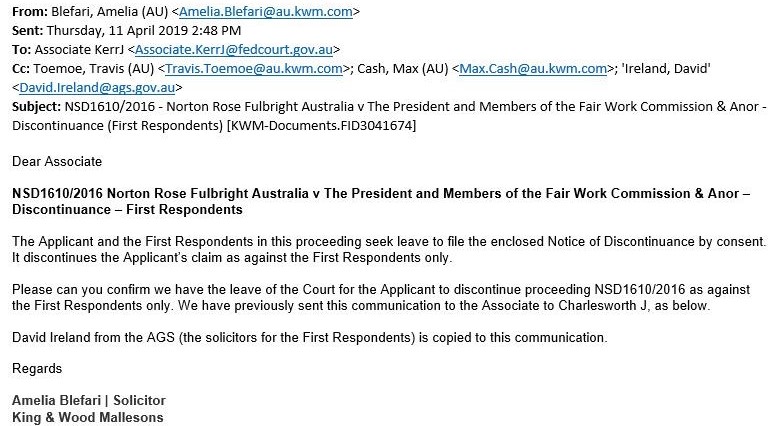
12 Later on the same day my associate replied to all addressees of that email as follows:
Dear Practitioners
My apologies that the 4 March 2019 correspondence [the reply sent by Charlesworth J’s associate] was not brought to his Honour’s attention. Pursuant to r 26.12(2)(b) of the Federal Court Rules 2011 (Cth), leave is not required to discontinue with the opposing party’s consent. Please file the notice of discontinuance and it will be processed by the registry.
13 Two things should be acknowledged immediately.
14 The first is that Mr Martin was not included in the list of three addressees to whom that email was copied. In matter NSD1610/2017 (the subject of that correspondence) there were three parties: the Applicant (NRF), and two respondents: the FWC and Mr Martin. In those proceedings, NRF was represented by King & Wood Mallesons.
15 The second is that, while I have no present recall of the precise circumstances, I would not resist the inference that Mr Martin seeks to draw, that my associate would have drawn my attention to the terms of her proposed response to that communication before it was sent.
16 Mr Martin submits that, having regard to the fact my associate responded in the terms referred to above, I ought to disqualify myself “based on the communication that occurred between the Respondent and your Honour’s associate in Chambers in April of this year without my knowledge or consent, about which I was not informed until June this year, with regard to the Respondent’s discontinuance of proceedings in matter NSD1610/2016”.
17 In support of that application, Mr Martin referred to Re JRL; Ex parte CJL [1986] HCA 39; 161 CLR 342 (Re JRL) and John Holland Rail Pty Ltd v Comcare [2011] FCAFC 34; 276 ALR 221 (John Holland).
18 In Re JRL, Gibbs CJ observed at 346:
It is a fundamental principle that a judge must not hear evidence or receive representations from one side behind the back of the other …
19 Mason J observed at 350:
A central element in the system of justice administered by our courts is that it should be fair and this means that it must be open, impartial and even-handed. It is for this reason that one of the cardinal principles of the law is that a judge tries the case before him on the evidence and arguments presented to him in open court by the parties or their legal representatives and by reference to those matters alone, unless Parliament otherwise provides. It would be inconsistent with basic notions of fairness that a judge should take into account, or even receive, secret or private representations on behalf of a party or from a stranger with reference to a case which he has to decide. This principle immediately distinguishes the judicial branch from other branches of government, except in so far as they may be relevantly affected by the rules of natural justice. In conformity with the principle, every private communication to a judge made for the purpose of influencing his decision in a case is treated as a contempt of court because it may affect the course of justice … Indeed, it is regarded as a serious contempt.
A judge must therefore be alert not to receive any such communication …
(Citations omitted.)
20 Mr Martin noted that both Gibbs CJ and Mason J had referred with approval to the statement of McInerney J in R v Magistrates’ Court at Lilydale: Ex parte Ciccone [1973] VR 122 at 127 that:
The sound instinct of the legal profession - judges and practitioners alike - has always been that, save in the most exceptional cases, there should be no communication or association between the judge and one of the parties (or the legal advisers or witnesses of such a party), otherwise than in the presence of or with the previous knowledge and consent of the other party. Once the case is under way, or about to get under way, the judicial officer keeps aloof from the parties (and from their legal advisers and witnesses) and neither he nor they should so act as to expose the judicial officer to a suspicion of having had communications with one party behind the back of or without the previous knowledge and consent of the other party. For if something is done which affords a reasonable basis for such suspicion, confidence in the impartiality of the judicial officer is undermined.
21 Mr Martin then drew the Court’s attention to the observations of Mason J (at 351) in which his Honour observed (citations omitted):
As McInerney J. pointed out, the receipt by a judge of a private communication seeking to influence the outcome of litigation before him places the integrity of the judicial process at risk. A failure to disclose that communication will seriously compromise the integrity of that process. On the other hand, although the terms of a subsequent disclosure by the judge of the communication and a statement of its effect in some, perhaps many, situations will be sufficient to dispel any reasonable apprehension that he might be influenced improperly in some way or other, subsequent disclosure will not always have this result. The circumstances of each case are all important. They will include the nature of the communication, the situation in which it took place, its relationship to the issues for determination and the nature of the disclosure made by the judge.
The problem is governed by the principle that a judge should disqualify himself from hearing, or continuing to hear, the matter if the parties or the public entertain a reasonable apprehension that he might not bring an impartial and unprejudiced mind to the resolution of the issues. This principle, which has evolved from the fundamental rule of natural justice that a judicial officer should be free from bias, reflects a concern with the need to maintain public confidence in the administration of justice. This concern is expressed in the cognate principle that, not only must justice be done, it must be seen to be done.
22 With respect to John Holland, Mr Martin submitted:
This involved another apprehended bias application where a party had a unilateral communication with a judge’s associate. Now, I won’t go, your Honour, to the detail of that judgment other than to identify that in that case the Full Court found that there was not any basis for reasonable apprehension of bias. Essentially on factual grounds, and the two factual matters that were essentially distinguishing that instance from other instances that would more readily be considered to give rise to a reasonable apprehension of bias were that, firstly, there was no evidence that the judge himself or herself in that case was aware of the communication with the associate.
So it was the first distinguishing factor in circumstances where the judge themselves is not aware of the communication with the associate then that would not necessarily be open to conclude that the judge – that there was some apprehension of bias on the judge’s part. And the other distinguishing factor was that the matters discussed between the party and the associate did not pertain to any substantive issue. It was really about – it was about the scheduling of a directions hearing where there was leave to apply – liberty to apply reserved as well. And so, the court found that there wasn’t anything of substance that had occurred.
Now, your Honour, neither of those circumstances are – or those distinguishing factors are present in what had transpired in this case.
23 Mr Martin submits that for the purpose of the principles discussed in John Holland at [22], the communication sent by my associate is properly to be characterised as being in relation to a matter of substance rather than in relation to “procedural, administrative or practical matters”.
24 Mr Martin submits that the singular in r 26.12(2)(b) of the Federal Court Rules 2011 (Cth) (Rules) includes the plural such that the term “party’s” in that provision should be read as encompassing “parties’”. Such a reading, he submits, is consistent with the interpretive principle provided for in s 23(b) of the Acts Interpretation Act 1901 (Cth) (AIA) that the singular includes the plural.
25 So understood, my associate’s correspondence involved a matter of substance. That was because NRF’s discontinuance as against the FWC required leave. Such a grant of leave required judicial consideration and an exercise of discretion as to whether that course would be permitted or not permitted.
26 Mr Martin submits that NRF’s communication to my associate without being copied to him, in those circumstances, was not only professionally improper, but also constituted contempt of the Court. He submitted that its solicitor writing to the associates of Charlesworth J and myself in the terms set out above was “intended to mitigate the adverse impact on Norton Rose Fulbright and, presumably, King & Wood Mallesons of an ongoing non-compliance with a notice to produce that was issued by Wigney J on 14 December 2016 …”. My having participated within the factual matrix of facilitating NRF’s miscreance, I would not be able to bring an independent mind to the resolution of any application to hold those parties in contempt if later pressed. My associate and I had become witnesses whose evidence was likely to be material.
27 For all of those reasons, Mr Martin submitted that a fair minded lay observer might reasonably apprehend that I might not bring an impartial mind to the resolution of the issues arising in these proceedings. I should recuse myself and vacate the orders I had earlier made in Martin No 1 as to pre-trial timetabling and the setting down of the trial.
28 Ms Ng, counsel for NRF, opposed Mr Martin’s application, contending initially that his application raising those contentions “[was] just part of Mr Martin’s tactics to delay the inevitable hearing” of these proceedings. However, correctly in my view, Ms Ng did not press that objection. In any event, I would not have entertained such an objection. Whatever Mr Martin’s suspected motivation might be on his opponent’s part is of no account. Mr Martin is entitled, whatever his opponent might assert as his motive, to have his case heard and determined by a court free of a reasonable apprehension of bias.
29 Ms Ng subsequently submitted that there was nothing in Mr Martin’s submissions as might give rise to apprehended bias on the part of a reasonable observer:
The communication that was sent to your Honour’s chambers and to which your associate responded is, in my respectful submission, nothing more than, as the Full Court said in John Holland, a matter of procedural practicality. It has nothing to do with the substance of – or the merits of the proceedings. And further, the communication from your Honour’s associate is consistent with the patently clear words of rule 26.12(2)(b), that is, that only the parties to the discontinuance are required to consent and, with respect to any other parties involved in the proceedings, notice is given by way of service through rule 26.13.
So contrary to what Mr Martin has submitted, his consent is not required … given that he is not a party to the [discontinuance], being another party. It’s only the parties who are involved in the discontinuance itself, so that in this case, it’s Norton Rose and the Fair Work Commission that are the necessary parties.
Consideration
30 The relevant principles in relation to the resolution of an application for a judge’s recusal for apprehended bias are well settled. In Ebner v Official Trustee in Bankruptcy [2000] HCA 63; 205 CLR 337 (Ebner), Gleeson CJ, McHugh, Gummow and Hayne JJ conveniently summarised the principles in the followings terms (at [6]-[8]):
6 Where, in the absence of any suggestion of actual bias, a question arises as to the independence or impartiality of a judge (or other judicial officer or juror), as here, the governing principle is that, subject to qualifications relating to waiver (which is not presently relevant) or necessity (which may be relevant to the second appeal), a judge is disqualified if a fair-minded lay observer might reasonably apprehend that the judge might not bring an impartial mind to the resolution of the question the judge is required to decide. That principle gives effect to the requirement that justice should both be done and be seen to be done, a requirement which reflects the fundamental importance of the principle that the tribunal be independent and impartial. It is convenient to refer to it as the apprehension of bias principle.
7 The apprehension of bias principle may be thought to find its justification in the importance of the basic principle, that the tribunal be independent and impartial. So important is the principle that even the appearance of departure from it is prohibited lest the integrity of the judicial system be undermined. There are, however, some other aspects of the apprehension of bias principle which should be recognised. Deciding whether a judicial officer (or juror) might not bring an impartial mind to the resolution of a question that has not been determined requires no prediction about how the judge or juror will in fact approach the matter. The question is one of possibility (real and not remote), not probability. Similarly, if the matter has already been decided, the test is one which requires no conclusion about what factors actually influenced the outcome. No attempt need be made to inquire into the actual thought processes of the judge or juror.
8 The apprehension of bias principle admits of the possibility of human frailty. Its application is as diverse as human frailty. Its application requires two steps. First, it requires the identification of what it is said might lead a judge (or juror) to decide a case other than on its legal and factual merits. The second step is no less important. There must be an articulation of the logical connection between the matter and the feared deviation from the course of deciding the case on its merits. The bare assertion that a judge (or juror) has an “interest” in litigation, or an interest in a party to it, will be of no assistance until the nature of the interest, and the asserted connection with the possibility of departure from impartial decision making, is articulated. Only then can the reasonableness of the asserted apprehension of bias be assessed.
(Citations omitted.)
31 The two step test in Ebner requires the identification of what might affect the judge’s impartiality and its logical connection with the possibility of departure from impartial decision-making in the case at hand. Ebner itself concerned a case where the first step was said to have been satisfied because the judge had a direct or indirect pecuniary interest in the cause. There is no suggestion that I have any direct or indirect interest in the litigation. Nor is there any suggestion that I have any association with any party or witness.
32 Rather, as has already been noted, the asserted appearance of my want of impartiality is said to flow entirely from the terms in which my associate replied to a communication from NRF advising that it was seeking leave to file a Notice of Discontinuance, by consent, as against the FWC only. My associate’s reply was to the effect that the Rules did not require leave of the Court in such circumstances.
33 The fair minded lay observer is postulated in order to emphasise that the test is objective. While the fictional or hypothetical observer is not a lawyer and is not assumed to have a detailed knowledge of the law, he or she is taken to be reasonable and to not be “wholly uninformed and uninstructed about the law in general or the issue to be decided”: Johnson v Johnson [2000] HCA 48; 201 CLR 488 (Johnson) at [53] per Kirby J citing R v George (1987) 9 NSWLR 527 at 536 per Street CJ. It is necessary to attribute to the fair minded lay observer knowledge of all of the circumstances of the case: CUR24 v Director of Public Prosecutions (NSW) [2012] NSWCA 65; 83 NSWLR 385 at [39].
34 The “reasonableness of any suggested apprehension of bias is to be considered in the context of ordinary judicial practice”. That includes “the exigencies of modern litigation” and modern case management practices: Johnson at [13]. That is not to suggest that the exigencies of modern litigation might permit a judge to disregard the seminal principles stated by Gibbs CJ in Re JRL. However, as Ms Ng submits, a communication does not automatically give rise to a reasonable apprehension of bias, having regard to Mason J’s reference to the critical importance of the nature of the impugned communication.
35 In John Holland, a Full Court of this Court (North, Kenny and Dodds-Streeton JJ) reasoned as follows:
22 As already stated, the authorities do not support the proposition that there is any necessary impropriety if a party or practitioner communicates unilaterally with a judge’s chambers. Whether or not such a communication is improper depends on all the circumstances, including, principally, its nature, subject matter, and perhaps, its sequence and extent. There is no impropriety in a party’s unilateral communication with chambers in relation to procedural, administrative or practical matters, although a sustained sequence of communications not circulated to the other parties, even in relation to matters of this kind, could, at a certain point, become unprofessional or improper in the absence of some good reason: see, for example, Carbotech-Australia Pty Ltd v Yates [2008] NSWSC 540.
23 On the other hand, save in the unusual circumstances warranting an ex parte application, it is clearly improper for parties or their practitioners to attempt to communicate unilaterally with a judge’s chambers in relation to the substantive issues in the litigation. Every communication of this kind must be circulated to, or made in the presence of, the other parties (unless the other parties have previously consented to its unilateral communication to the judge: see Fisher at 352). Breach of that principle is not only an impropriety on the part of the party making the communication but may, in certain circumstances, found, or be a factor contributing to, a reasonable apprehension of bias, alternatively, lack of procedural fairness, on the part of the judge. It does not follow from this, however, that the mere making of a unilateral communication raises a presumption of impropriety (as John Holland’s argument assumed), thereby casting on the parties involved (including the practitioner, chambers staff who received or engaged in the communication and, in some cases, the judge) an onus to prove the contrary by means of affidavit or a similar level of proof …
36 The critical consideration having regard to those observations, seems therefore to be whether the communication that was sent on behalf of NFR and responded to by my associate in the terms Mr Martin relies upon was objectively such as to invite any suggestion of impropriety on either part.
37 In the absence of a sustained sequence of communications not circulated to other parties, on the authority of John Holland, such a suggestion will not arise by reason of a communication strictly in relation to a procedural, administrative or practical matter rather than the substantive issues before the Court.
38 Mr Martin submits that those communications give rise to an apprehension of bias because, properly understood, each related to a substantive issue before the Court.
39 I proceed on the basis that if that submission is correct, there is at least a prima facie case that I should disqualify myself. While Mr Martin does not allege any bad faith on my part, or on the part of my associate, he would be correct to observe that there was a failing on my part not to have identified the absence of his address amongst those to whom Ms Blefari’s email had been copied. I accept that if my associate’s reply was in respect of a matter of substance rather than a purely procedural matter, the fact of it not having been copied to Mr Martin would be objectively a sufficient reason to cause me to consider whether a fair minded lay observer would reasonably apprehend that I might be biased in his cause.
40 On the other hand, if Mr Martin’s submission that the communication was in relation to a matter of substance in the proceeding is flawed, such a circumstance would apparently not arise. It is not suggested that there was any preceding sustained sequence of communications, between my chambers and the solicitors for NRF that was not communicated to Mr Martin.
41 I therefore turn to consider whether Mr Martin’s submission is soundly premised.
42 It may seem strange that it falls to the judge whose recusal is sought to determine the legal correctness or otherwise of a submission upon which his or her disqualification has been sought. However, the law is clear that the duty of a judge is to decide such an application. It is inherent in that duty that I undertake that task. I therefore turn to the relevant facts and law.
43 My associate’s reply was in response to correspondence that she had received earlier that day. In that correspondence, the solicitors for NRF advised that the Applicant (NRF) and the First Respondents (the FWC) in NSD2016/2016 were seeking leave to file a Notice of Discontinuance by consent terminating NRF’s claim as against the FWC only.
44 It will be recalled that my associate’s reply was in the following terms:
Dear Practitioners
My apologies that the 4 March 2019 correspondence [the reply sent by Charlesworth J’s associate] was not brought to his Honour’s attention. Pursuant to r 26.12(2)(b) of the Federal Court Rules 2011 (Cth), leave is not required to discontinue with the opposing party’s consent. Please file the notice of discontinuance and it will be processed by the registry.
45 If it is correct that that provision of the Rules confers an unqualified right, not requiring the Court’s leave, in those circumstances for the consenting parties to file a notice of discontinuance then my associate’s response merely identified the procedural mechanism available to facilitate that course. It was limited to a purely procedural or administrative matter.
46 Mr Martin however submits that, properly construed, r 26.12(2)(b) does not obviate the need of those parties to seek leave. He submits that for that reason there was a substantive issue requiring the consideration of the Court. The course my associate had enabled (without notice to him) had denied him the opportunity to make submissions that leave not be granted.
47 Mr Martin’s submission requires attention to the proper construction of the relevant Rules. The relevant rules are those provided for by r 26.12 and r 26.13. They are as follows:
26.12 Discontinuance
(1) A party claiming relief may discontinue a proceeding in whole or in part by filing a notice of discontinuance, in accordance with Form 48.
(2) The party may file the notice of discontinuance:
(a) without the leave of the Court or the other party’s consent:
(i) at any time before the return date fixed in the originating application; or
(ii) if the proceeding is continuing on pleadings—at any time before the pleadings have closed; or
(b) with the opposing party’s consent—before judgment has been entered in the proceeding; or
(c) with the leave of the Court—at any time.
Note 1: For when pleadings close, see rule 16.12.
Note 2: The Court may give leave subject to conditions including costs—see rule 1.33.
(3) The notice of discontinuance must:
(a) state the extent of the discontinuance; and
(b) if the discontinuance is by consent—be signed by each consenting party.
(4) However, a litigation representative or a representative party must not discontinue a party’s claim without first obtaining the leave of the Court.
(5) An application for a winding up order under section 459P or 461(1)(a) of the Corporations Act 2001 may be discontinued only with the leave of the Court.
(6) A notice of discontinuance filed by one party does not affect any other party to the proceeding.
(7) Unless the terms of a consent or an order of the Court provide otherwise, a party who files a notice of discontinuance under subrule (2) is liable to pay the costs of each other party to the proceeding in relation to the claim, or part of the claim, that is discontinued.
26.13 Service of notice
A party who files a notice under rule 26.11 or 26.12 must, as soon as reasonably practicable, serve a copy of the notice on each other party to the proceeding.
48 Mr Martin advances his submission having regard to the interpretive principle set out in s 23 of the AIA. Section 23 provides that in any Act, words expressed in the singular number include the plural. That provision applies to the Rules, having regard to the extended operation given to it by s 46 of the AIA.
49 Mr Martin submits, in reliance on s 23 of the AIA, that the word “party’s” in r 26.12(2)(b) must be understood as including “parties’’’. However, critically, s 2(2) of the AIA provides that the application of that Act “is subject to a contrary intention”.
50 The prima facie application of s 23 of the AIA will be displaced by a plainly manifested, and intractable, contrary intention. The terms of r 26.12 and r 26.13 clearly distinguish between circumstances where a singular and where a plural reference to a party or parties is intended. The text of r 26.12(2)(b), as part of the provision overall, stands clearly against reading into the singular “party’s” as if it were a reference to the plural “parties’”.
51 That a contrary intention applies is made obvious by the terms of r 26.12(3)(b) of the Rules, which states that a Notice of Discontinuance, if it be by consent, must be signed by each consenting party. Self-evidently, that provision acknowledges that the necessity for consent (rendering leave of the Court unnecessary) does not extend to every party to a proceeding.
52 Rule 26.12(6) provides that a Notice of Discontinuance does not affect any other party to the proceeding. So understood in the context of this proceeding, r 26.12(7) permits the consenting parties by their Notice of Discontinuance to address any costs liabilities as between themselves but preserves Mr Martin’s right to seek costs as against them.
53 That Mr Martin’s submission cannot be accepted is further manifested by r 26.13, which requires a party filing a notice under r 26.12 to serve a copy of the notice on each other party to the proceeding as soon as practical thereafter. It is by that means that a party is notified of any discontinuance by consent against other parties in respect of which they have not earlier been advised.
54 Having regard to the text of r 26.12(2)(b) of the Rules, read within the larger context of r 26.12 and r 26.13, Mr Martin’s submission that the word “party’s” is open to be read as “parties’” is not only implausible, it is unarguably mistaken.
55 As Ms Ng submits, my associate’s reply was confined exclusively to her drawing attention to a purely procedural provision open to facilitate the course the consenting parties had themselves agreed upon (as they were entitled to) in circumstances in which the Court’s leave did not need to be sought and was not required.
56 Neither that request nor the reply were in relation to any substantive issue in the litigation.
57 I am satisfied that those circumstances fall within the category of matters in respect of which the Full Court in John Holland concluded “could not, in our view, raise any reasonable apprehension of bias on the part of a fair minded lay observer” (at [30]). That is so, even assuming, as Mr Martin is entitled to assume, that my associate had brought that correspondence to my attention.
58 I reject that a fair minded lay observer, with knowledge of the circumstances of this case and wholly uninformed and uninstructed about the law in general and the issues to be decided, might conclude that an apprehension of bias might arise by reason of Mr Martin being deprived of an opportunity to participate in an inevitably futile hearing given that a right to discontinue is expressly conferred, without the requirement of leave, by the Rules: see Johnson at [53].
59 I would accordingly dismiss Mr Martin’s application for my recusal in so far as it is based on that correspondence.
60 Out of an abundance of caution, I should indicate that I reject that my conduct of the trial might be precluded by the possibility I or my associate might be a witness in an application for contempt against NRF or its solicitors for their conduct in seeking to discontinue, and later discontinuing as against the First Respondents only. It cannot plausibly be contended that a party commits contempt by seeking to take or taking a procedural step they are expressly authorised to take by the Rules.
61 That stated, I note that in Martin No 1 I observed at [45] that in my mind there was a live question as to whether there may have been a breach of professional obligations in the solicitors for NRF not copying Mr Martin into the chain of emails which they had commenced by a communication to the associate of Charlesworth J on 26 February 2019.
62 I was cautious in the manner of my expression because of the observation of the Full Court in John Holland that there is no impropriety in a party’s unilateral communication with chambers in relation to procedural, administrative or practical matters.
63 I expressed that reservation nonetheless because, in my view, the absence of impropriety ought not to be equated with approval of such a practice; the more so by a legally represented party if his or her opponent is unrepresented.
64 I would not want these reasons to have the appearance of condoning the abandonment of the usual practice that when any email correspondence is sent to a court (including to a judge’s associate) by a legally represented party to a proceeding, the lawyer initiating that correspondence should, save in exceptional circumstances (for example in seeking an ex-parte hearing) ensure that that communication is copied to every other party. It is immaterial whether or not the content of that correspondence might or might not touch on what would otherwise be an omitted party’s forensic interests.
65 Given the ease of sending an electronic “carbon copy”, that is not a difficult expectation for the Court to have of parties represented by a lawyer.
66 I do not doubt that, had Mr Martin been copied into the correspondence sent to Charlesworth J’s and my associate, some of the consequential difficulties that have burdened this proceeding would not have eventuated.
67 Equally importantly, unless that practice is universally maintained, there is an obvious risk that when an email communication is sent to a judge’s associate from a legal practitioner, copied to several addressees but omitting one, that the recipient will wrongly assume it has been copied to all. In the absence of any suggestion of bad faith on my associate or my part by Mr Martin, that may be assumed to have occurred in the present case.
68 There is one further matter I should mention. It is the subsequent apparent failure of NRF’s solicitors to comply with their obligations pursuant to r 26.13 of the Rules to serve a copy of the notice of discontinuance that was filed on Mr Martin “as soon as reasonably practicable” thereafter.
69 Mr Martin appears to have been left to discover that a notice had been filed only by chance. That no doubt contributed to his sense that what had been done had been achieved behind his back.
70 I refer to an “apparent failure” on NRF’s solicitor’s part merely out of prudence. There was no denial of that fact when Mr Martin first made such a claim in the course of an earlier interlocutory hearing, nor has there been any denial of it since. If the fact was disputed I would have expected Ms Ng to do so on instructions.
71 Moreover that factor, at least initially, was one of the premises upon which Mr Martin made his recusal application. Mr Martin ultimately accepted that a subsequent failure by NRF’s lawyers to serve the requisite notice as required by the Rules could not bear upon whether a reasonable lay observer reasonably might apprehend an inability on my part to bring an unbiased mind to the resolution of his matters by reason of how such an observer would perceive the communication my associate had received and replied to but it is understandable that that factor would have influenced the course he set upon pursuing.
72 While I have rejected that I ought to recuse myself based on the impugned communications those two features are, as Mr Martin submits, relevant to the Court’s discretion on costs. I return to that question later.
73 Before doing so, I should address the other matters raised by Mr Martin which he submits warrant my recusal. In that regard, I first set out the circumstances in which those submissions were advanced.
74 Mr Martin commenced his oral submissions seeking my recusal because of the impugned correspondence at approximately 11.30am. Upon my understanding that he was about to conclude his submissions, the following exchange occurred at 12.35pm:
HIS HONOUR: Anyway, look, I’m just trying to get a sense of when you will finish because – I don’t want to press you, but, obviously, I have to hear from Ms Ng. I assume – can I rely on you to complete your submissions by quarter to 1, and then I can hear from Ms Ng after an adjournment, and you can be heard in reply.
MR MARTIN: Your Honour, what – do you mean quarter to 1 Eastern Standard Time?
HIS HONOUR: Yes.
MR MARTIN: Yes, your Honour.
HIS HONOUR: That’s another 10 minutes.
75 As events transpired, Mr Martin’s submissions extended well in excess of ten minutes. No criticism is warranted in that regard; in substantial part his submissions were directly responsive to questions from the bench.
76 Shortly before 1.00pm, Mr Martin advised that his submissions of that issue were concluded but advised that “there are other matters … that I won’t address today”. Mr Martin indicated that those were matters in respect of what had transpired at an earlier case management hearing and some of the remarks in my interlocutory decision Martin No 1. Mr Martin put the matter as follows: “[i]t may be necessary to renew the application [for my recusal] if it’s not granted on the grounds that I have raised before your Honour today”.
77 I indicated that if Mr Martin was seeking my recusal against the prospect of a trial set to start in September, he should raise his concerns now. He had already addressed the Court on the issues of principle relevant to a judge’s recusal. It was not appropriate to leave other questions hanging.
78 I declined to grant Mr Martin an adjournment on the basis that “it would not be a suitable thing to permit a party to say ‘I am now raising these grounds but on Monday, I will raise some new ones’ and that we go through this whole process right to the teeth of trial”. I note that in Vakauta v Kelly [1989] HCA 44; 167 CLR 568, Dawson J reasoned (at 579) that “where a party in civil litigation, being aware of the circumstances giving rise to a right to object, allows the case to continue for a sufficient time to show that he does not presently intend to exercise that right, he may be held to have waived it”.
79 Notwithstanding Mr Martin’s earlier indication that he would complete his submissions as to my recusal before the lunch adjournment, I indicated I would permit him an additional 15 minutes after the adjournment to identify anything in the transcript, or my earlier judgment, that manifested a circumstance whereby my recusal was warranted. I observed that Mr Martin was entitled to a fair hearing, not an everlasting hearing. I rejected that he might have further time.
80 After the lunch adjournment Mr Martin took advantage of that opportunity to contend that I had conducted myself in earlier interlocutory proceedings in a manner which inferred I had a concluded mind that Mr Martin had in some manner discredited himself and had demonstrated that I had a bias against self-represented litigants. At the conclusion of those submissions, Mr Martin indicated he was withdrawing and would take no further part in the hearing.
81 In almost every respect the propositions Mr Martin advanced are not particularised, however there were two instances which require a specific response.
82 The first is with respect to Mr Martin’s submission that from the commencement of my presiding over this matter it had been apparent that I had entered it with preconceptions. In that regard, Mr Martin refers to the first occasion I presided as a judge on 29 April 2019 “when you referred to the unpleasant task of reading or reviewing the papers in this matter”.
83 That conveys an inaccurate picture. It is neither textually nor contextually accurate.
84 I take the relevant passage Mr Martin relies on to be that at p 4 of the transcript. What was then being discussed had followed Mr Martin having identified that there were extant matters about the index of the Court Book to be produced for the trial, and him objecting that he had only recently been made aware of the timetabling orders being sought on behalf of NRF.
85 The passage, within its relevant context, appears as follows:
MR MARTIN: Well, I – sorry – I only raise it because my wife is giving birth on 6 June, so these orders would be particularly inconvenient to me, and that’s something that I could have conveyed to the respondents if they had bothered to provide this to me before they sent it through to your chambers.
HIS HONOUR: Yes. Well, look – well, I assume they sent it – at the same time as they sent it through to my chambers, they sent it to you.
MR MARTIN: Yes, your Honour, but, as a carbon copy to the email. I’ve had no opportunity to provide any input into this timetable. I mean, the custom, of course, would be to send a timetable to one’s opponent and ask for some input to see whether the timetable could be agreed. I’ve never seen this timetable until it was provided in the manner that it was this morning.
HIS HONOUR: Well, I’ve had the unfortunate experience of going through the papers in this proceeding and it seems very little is – or it’s rare that parties agree. So I have to deal with realities that, in many regards, there are going to be different positions taken by the parties with respect to interlocutory matters and timetabling, as well as the substantive issues, but I do appreciate what you say: you had no precise notice of the proposals. But the court did ask the parties as to their availability for various possible hearing dates.
And given that the matter will require about five days hearing, as I understand it, it is not readily the case that the court will have the flexibility to accommodate each party’s preferences. Necessarily, it will have to try and find time to permit the hearing of the matter to be heard and determined in an appropriate and convenient way. Now, it wouldn’t appear that there could be any substantial dispute as to the originating process pleadings, witness statements, because each party will provide those. The only difficulty may be that there may be some intersection with the discovery processes ---
MR MARTIN: That’s correct, your Honour.
86 Two things may be noted. First, there is no reference in what I said to the Court viewing reading the papers as an “unpleasant task”. The words I used convey no distaste. My remarks refer neutrally to it being “unfortunate” that the papers before me disclosed that it was rare that the parties had ever agreed on anything. No blame is attributed to either side.
87 Mr Martin’s suggestion that what I stated on that occasion reflected some adverse judgement on my part as to his credit is rejected. No fair minded lay observer, aware of the history of these proceedings, would think that there was any unfairness in my drawing attention to the historical fact that the papers then before me demonstrated that it had been rare for the parties to form agreement.
88 The second proposition I can identify from the generality of Mr Martin’s submissions is that my conduct of the interlocutory hearing of 11 June 2019 was such as to be grossly disrespectful and insulting to the dignity and privacy of himself and his wife in the context of a very sensitive time for them following the birth of their child.
89 Mr Martin submits that the way in which I conducted that hearing was callously indifferent to natural human sensitivity and decency with respect to what his wife was undergoing. My treatment of the facts in the reasons I gave, in which I rejected Mr Martin’s application for an adjournment, are said to be “so absurdly obtuse and fundamentally lacking in logic that it is difficult to understand” how I might have reached the conclusions I did.
90 I have revisited the transcript of that hearing. I reject that characterisation of its conduct.
91 A critical question I had to determine was whether to grant an adjournment to Mr Martin in circumstances in which the Court had already postponed the date scheduled for that hearing having regard to his and his wife’s circumstances, and prior to which Mr Martin had been advised that any further request for an adjournment would need to be supported by an affidavit. Mr Martin had not done so. I gave reasons for my decision after having first heard from Mr Martin.
92 I reject that anything in my reasons might lead a fair minded lay observer to conclude that I might not thereafter bring an unbiased mind to the discharge of my judicial responsibilities in his cause. That I concluded adversely to the submissions Mr Martin then advanced in my interlocutory decision, Martin No 1, is not a proper basis to require my recusal.
93 In Doggett v Commonwealth Bank of Australia [2019] FCAFC 19, a Full Court (Kerr, Davies and Thawley JJ) said as follows in relation to claims of apprehended bias based on rulings in interlocutory proceedings or judgments (at [11]):
Claims of apprehended bias arise not infrequently, as they have in this appeal, in respect of interlocutory proceedings. The usual position in relation to interlocutory proceedings is that an apprehension of bias is not per se manifested by an unfavourable finding. That is because often there will be instances prior to a final decision where a judge will require steps to be taken or not taken which disappoint one side or another in a proceeding. It is inherent in the interlocutory process that such preliminary decisions are made. Unfavourable findings, in such circumstances, are not to be taken by a fair-minded person as an expression that the judge has other than an impartial and unprejudiced mind in relation to the substantive proceeding.
94 Those remarks are entirely consistent with what Mason J had earlier stated in Re JRL (at 352):
It needs to be said loudly and clearly that the ground of disqualification is a reasonable apprehension that the judicial officer will not decide the case impartially or without prejudice, rather than that he will decide the case adversely to one party. There may be many situations in which previous decisions of a judicial officer on issues of fact and law may generate an expectation that he is likely to decide issues in a particular case adversely to one of the parties. But this does not mean either that he will approach the issues in that case otherwise than with an impartial and unprejudiced mind in the sense in which that expression is used in the authorities or that his previous decisions provide an acceptable basis for inferring that there is a reasonable apprehension that he will approach the issues in this way. In cases of this kind, disqualification is only made out by showing that there is a reasonable apprehension of bias by reason of prejudgment and this must be “firmly established”: Reg. v. Commonwealth Conciliation and Arbitration Commission; Ex parte Angliss Group; Watson; Re Lusink; Ex parte Shaw. Although it is important that justice must be seen to be done, it is equally important that judicial officers discharge their duty to sit and do not, by acceding too readily to suggestions of appearance of bias, encourage parties to believe that by seeking the disqualification of a judge, they will have their case tried by someone thought to be more likely to decide the case in their favour.
(Citations omitted.)
95 I am satisfied that none of the further matters that Mr Martin referred the Court to after the lunch adjournment have been established such that a fair minded lay observer might reasonably apprehend that I might not thereafter bring an impartial mind to the resolution of the outstanding issues in these proceedings.
96 It was for the above reasons that I dismissed the recusal application and continued to hear the parties (notwithstanding Mr Martin having withdrawn) as to whether the scheduled trial dates in September should or should not be vacated. The outcome of that application is the subject of an earlier separate judgment: Martin v Norton Rose Fulbright Australia (No 4) [2019] FCA 1441.
97 Having stated my reasons for dismissing his application, I turn to the question of costs. The usual position is that an unsuccessful applicant for a judge’s recusal should be required to meet the other party’s costs, the ordinary position being that costs follow the event.
98 However having regard to the factors which I have referred to at [60]-[70] above, it is open to reason that at least some part of the responsibility for the circumstances that gave rise to Mr Martin’s application can be attributed to the solicitors for NRF not copying Mr Martin into their correspondence to Charlesworth J’s and my associate, and their later failing to serve Mr Martin with their Notice of Discontinuance as against the First Respondents as soon as was practicable after having filed it.
99 In those circumstances I am satisfied, in the exercise of my discretion, that notwithstanding Mr Martin having failed to secure the outcome he was seeking, I should make no order as to costs with respect to his application for my recusal.
I certify that the preceding ninety-nine (99) numbered paragraphs are a true copy of the Reasons for Judgment herein of the Honourable Justice Kerr. |
Associate:


