

FEDERAL COURT OF AUSTRALIA
Shafston Avenue Construction Pty Ltd, in the matter of CRCG-Rimfire Pty Ltd (subject to deed of company arrangement) v McCann [2019] FCA 1426
ORDERS
DATE OF ORDER: |
THE COURT ORDERS THAT:
1. By close of business on 6 September 2019, the parties are to consult and submit to my chambers a draft set of orders to reflect the content of these reasons.
Note: Entry of orders is dealt with in Rule 39.32 of the Federal Court Rules 2011.
REEVES J:
INTRODUCTION
1 Shafston Avenue Construction Pty Ltd, 28 Baxter Street Construction Pty Ltd and Lincoln Street Construction Pty Ltd (the plaintiffs) have applied to set aside a Deed of Company Arrangement (DOCA) entered into on 19 March 2018, shortly after the second creditors’ meeting of CRCG-Rimfire Pty Ltd (the Joint Venture Company), the third defendant. The plaintiffs claim to be creditors of the Joint Venture Company. In that capacity, they claim that the DOCA is “unfairly prejudicial” to them or contrary to the interests of the Joint Venture Company’s creditors as a whole. They also claim that the DOCA is contrary to public policy because one effect of it is to exclude any investigations of any claims of insolvent trading against the directors of the Joint Venture Company.
2 Aside from the Joint Venture Company, the other defendant parties all oppose the plaintiffs’ application. They are Mr Michael McCann and Mr Said Jahani, the first and second defendants respectively, and China Railway Construction Group Co Ltd (China Rail), the fourth defendant. The former are the joint and several administrators of the Joint Venture Company appointed on 16 November 2017 (the Administrators). The latter was one of the joint venture partners. Further details of China Rail’s involvement will be explained below.
3 For the reasons that follow, the plaintiffs’ application will be dismissed.
THE BROAD FACTUAL CONTEXT
4 The Joint Venture Company was incorporated on 29 March 2016 for the purpose of engaging in residential, commercial and infrastructure construction projects in Queensland. It involved a joint venture between its two shareholders: China Rail and Rimfire Constructions Pty Ltd (Rimfire). Under the shareholder agreement entered into on 22 June 2016, China Rail was to acquire a 55% interest (1,222,222 $1 shares) in the Joint Venture Company and the remaining 45% (1,000,000 shares) was to be held by Rimfire.
5 On or about 7 July 2016, the Joint Venture Company obtained a category 7 licence from the Queensland Building and Construction Commission (the Commission) allowing it to undertake construction work in Queensland up to and exceeding the value of $240,000,000. To obtain that licence, both China Rail and Rimfire separately entered into deeds of covenant (DCA) with the Joint Venture Company and the Commission whereby each of them covenanted that, in the event that the Joint Venture Company were to be wound up, it would pay the “Defined Amount” to it upon written demand (cl 2). The terms of the DCA and the meaning of the expression “Defined Amount” are reviewed in detail later in these reasons.
6 The Joint Venture Company traded for a period of 20 months. During the whole of that period it operated at a loss.
7 As is already mentioned above, on 16 November 2017, Mr McCann and Mr Jahani were appointed jointly and severally as the administrators of the Joint Venture Company. There were no secured creditors. The Administrators have estimated that the company’s unsecured creditors are between $15,200,000 and $41,300,000. According to the Executive Summary to the Report to creditors, those creditors fell into the following categories:
(a) employee entitlements – $357,000 (approximately);
(b) developers – $25,900,000 (approximately);
(c) related parties – $9,250,000 (approximately); and
(d) subcontractors and sundry creditors – $5,700,000 (approximately).
8 Rimfire has since been placed in liquidation.
9 Shortly after the Administrators’ appointment, a dispute arose between China Rail and the Joint Venture Company over the enforceability of its DCA. The details of that dispute were outlined in a letter China Rail’s lawyers, Baker McKenzie, wrote to the Administrators’ lawyers, Clayton Utz, on 13 February 2018, asserting that the DCA was not binding or enforceable against it. Among other things, Baker McKenzie claimed that Rimfire had misled China Rail about the necessity for the DCA, that Mr Zhao, who signed the DCA on behalf of China Rail pursuant to a Power of Attorney, was not aware of the legal effect of the DCA as, contrary to the legal certification contained in the DCA, he was not given an explanation as to its effect and that Mr Zhao did not hold the requisite authority to sign the DCA.
10 The second meeting of creditors of the Joint Venture Company was held on 7 March 2018. That meeting was chaired by Mr McCann. During the meeting, an equal number of creditors by number voted for and against a resolution that the Joint Venture Company enter into the DOCA. As there was no majority either in favour of, or against, the resolution, Mr McCann exercised a casting vote in favour of the resolution, thereby ensuring it was passed. A representative of the plaintiffs was in attendance at that meeting and exercised a general proxy to vote against the resolution. It should be noted that this occurred before the plaintiffs’ proofs of debt were disallowed by the Administrators (see at [13] below).
11 As already mentioned above, the DOCA was executed on 19 March 2018.
12 A number of steps has been taken to implement the DOCA. They include the payment to the Administrators of the balance of the DOCA fund in the sum of $7,670,000, the payment of a dividend to the priority (employee) creditors and the submission and adjudication of the majority of the proofs of debt submitted by creditors. In their written submissions, the Administrators claimed that, “[b]ut for these proceedings, a dividend to creditors could be made declared within a matter of weeks” and that “[t]he estimated return to creditors was (and remains) between approximately 40 and 55 cents in the dollar”.
13 On 7 August 2018, the plaintiffs submitted their final proofs of debt to the Administrators. On 17 September 2018, two of those proofs of debt were adjudicated by the Administrators at nil value. On the third, the Administrators sought further information before an adjudication could be made. That information has never been provided.
14 Finally, it should be noted that there is no issue in this proceeding concerning the present solvency of the Joint Venture Company.
SOME RELEVANT PROCEDURAL HISTORY
15 The plaintiffs commenced this proceeding on 18 September 2018. Initially their originating application was limited to a challenge to the Administrators’ adjudication of their proofs of debt as mentioned above. It also sought an order that the parties be given leave to proceed against the Joint Venture Company under s 444E(3) of the Act. Because that originating process had not been served on the Administrators by the time of the first case management hearing, that hearing had to be adjourned.
16 On 31 October 2018, the plaintiffs filed an amended originating application. Among other things, that amended application sought an order for the termination of the DOCA under s 445D of the Corporations Act 2001 (Cth) (the Act) on the ground that the Administrators had provided materially false or misleading information to creditors. It also sought an order that the Joint Venture Company be wound up under s 461(1) and an order that the Administrators be removed under s 447A of the Act.
17 On 14 November 2018, the plaintiffs filed a further amended originating application. That amended version added reliance upon Division 75, ss 75-41 and 75-42 of the Insolvency Practice Schedule (Corporations), which is Schedule 2 to the Act (the Schedule).
18 At the adjourned first case management hearing on 15 November 2018, the claim that the Administrators had provided materially false or misleading information to creditors was withdrawn. At that hearing, the plaintiffs were given leave to add China Rail as the fourth defendant in the proceeding. The plaintiffs filed a second further amended originating application on 21 November 2018 reflecting these changes.
19 At the hearing in April 2019, the plaintiffs sought to further amend their originating application and their statement of claim to return their reliance upon s 445D of the Act, specifically ss 445D(1)(f) and (1)(g). That leave was granted. Those amendments did not, however, seek to return their reliance on the false or misleading provision in s 445D.
20 The end result of all these changes was that the plaintiffs sought the following relief:
1. An Order pursuant to Section 90-15 of Schedule 2 the Insolvency Practice Schedule, that the Proof of Debt lodged by the First Plaintiff on 7 August 2018 and adjudicated by the First and Second Defendants on 17 September 2018 and otherwise disallowed in full, be adjudicated in the amount of $9,273,771.00.
2. An Order pursuant to Section 90-15 of Schedule 2 the Insolvency Practice Schedule, that the Proof of Debt lodged by the Second Plaintiff on 7 August 2018 and adjudicated by the First and Second Defendants on 17 September 2018 and otherwise disallowed in full, be adjudicated in the amount of $411,077.00.
2A. An Order pursuant to Section 90-15 of Schedule 2 the Insolvency Practice Schedule, that the Proof of Debt lodged by the Third Plaintiff on 7 August 2018 and adjudicated by the First and Second Defendants on 13 December 2018 and otherwise disallowed in full, be adjudicated in the amount of $2,627,116.44.
3. An Order pursuant to Section 90-15 of the Insolvency Practice Schedule, that the First and Second Defendants as Deed Administrators of the Third Defendant give effect to Orders 1, 2, and 2A herein.
[There is no paragraph 4.]
5. In the alternative, an Order pursuant to Sections 445D(1)(f) and 445D(1)(g), 447A of the Act and sections 75-41 and 75-42 of the Insolvency Practice Schedule that the [DOCA] dated 19 March 2018 be terminated forthwith.
6. An Order pursuant to Section 461(1) of the Act, that the Company be wound up in insolvency.
7. An Order that Jonathon Paul McLeod and Bill Karageozis be appointed as liquidator to conduct the said winding up.
8. An Order that the Liquidator have the power specified in the Act to conduct the said winding up.
[There is no paragraph 9.]
10. An Order that Jonathon Paul McLeod and Bill Karageozis be appointed a Deed Administrator in respect to the Company.
11. Pursuant to section 444E(3) of the Act, the Plaintiffs be granted leave to proceed as against the Third Defendant.
12. The Defendants pay the Plaintiffs’ costs of the proceeding.
13. Such further orders or directions as the Court thinks fit.
(Errors in original)
21 However, at the hearing, the plaintiffs elected not to pursue the relief sought in paragraphs 1 to 3 inclusive above.
THE CONTENTIONS
The plaintiffs
22 It should be noted at the outset that, because the final set of amendments outlined above occurred after the plaintiffs filed their written submissions, their oral submissions at the hearing departed significantly from their written submissions. In their oral submissions, they placed almost complete reliance on s 445D of the Act, whereas that section was not mentioned in their written submissions. Nonetheless, before summarising their oral submissions, it is appropriate to briefly review their written submissions. In them, the plaintiffs contended that the creditors of the Joint Venture Company would be better off if the company were to be wound up and if China Rail were required to meet its obligations under its DCA. They contended that, if that occurred, the unsecured creditors would be paid in full, resulting in a far better outcome for them than that proposed under the DOCA. They contended that China Rail is a significant company with “more than sufficient assets to pay any demand made of it pursuant to the [DCA]”. They acknowledged that there were impediments to recovery against China Rail including whether the DCA could be enforced against it and, if it could, what the prospects of recovery against it were.
23 As to the first of these impediments, the plaintiffs contended that, having regard to the certificate of independent advice provided by its lawyers, it would be difficult for China Rail to successfully argue that it was misled into signing the DCA, or that it did not understand its legal effect. For similar reasons, they contended that any suggestion that Mr Zhao did not have the requisite authority to sign the DCA would be difficult to maintain. As to the second impediment, they contended that China Rail had not itself stated that it would not pay any judgment entered against it and, in fact, the contrary was more likely in all the circumstances.
24 In their oral submissions, the plaintiffs reiterated their primary written contention that the creditors of the Joint Venture Company would be in a better position if China Rail were required to meet its obligations under its DCA. However, as mentioned above, in making this submission, they relied upon ss 445D(1)(f) and (1)(g) of the Act. They contended that the DOCA was “oppressive or unfairly prejudicial” to one or more of the creditors within the terms of s 445D(1)(f) because, under it, the creditors would receive between 40 and 58 cents in the dollar, whereas, in the event that China Rail were forced to meet its obligations under its DCA, they were likely to recover the full amount. With regard to s 445D(1)(g), they cited authorities to contend that public interest considerations may override the creditors’ interests and favour liquidation. They claimed that the public interest considerations in this matter included commercial morality and the interests of the public at large, in particular, that the DOCA precluded any investigations of insolvent trading by the Joint Venture Company.
25 On the issue whether there was a sufficient likelihood of recovery from China Rail under its DCA, the plaintiffs contended, first, there was no evidence from Mr Zhao himself that he had been misled about the terms of the DCA. As mentioned in their written submissions above, they claimed that the certificate of independent advice provided by China Rail’s lawyers, MinterEllison, stood against this proposition. Secondly, in response to China Rail’s contention that Mr Zhao’s authorisation to sign the DCA was limited to “handling the business of setting up [the Joint Venture Company]”, while noting that the Court did not need to form a final view on this issue, they submitted that the DCA was signed approximately three months following the incorporation of the Joint Venture Company and executing the DCA during that period was well within the terms of Mr Zhao’s authorisation. Thirdly, in response to China Rail’s contention that Mr Zhao did not obtain independent legal advice before signing the DCA because MinterEllison were acting for the Joint Venture Company, and not China Rail, they submitted that this was “splitting hairs”. They pointed to the fact that China Rail owned 55% of the Joint Venture Company and claimed that it, therefore, controlled it. Fourthly, in response to the contention that China Rail had no assets in Australia and would “not voluntarily pay an Australian judgment and [would] require any Australian judgment to be enforced in the appropriate forum”, namely the People’s Republic of China (China), they pointed to the statement that China Rail had made to the Foreign Investment Review Board in March 2018, to the effect that it intended to conduct its business in Australia in accordance with applicable laws.
26 Finally, in their oral submissions, in the alternative to ss 445D(1)(f) and (1)(g) of the Act, the plaintiffs very briefly addressed their reliance on ss 75-41 and 75-42 of the Schedule. Their submissions on this issue were very brief because, as their counsel stated, “this argument [was] overtaken by [ss] 445D(1)(f) and (g)”. Nonetheless, they claimed that the former applied because, in the event that China Rail’s vote was disregarded, the vote to approve the DOCA still would not have passed and would have been decided on a casting vote. In respect of the latter, they contended that the Administrators failed to give sufficient weight to the fact “that China Rail was a large company with significant assets which may have made a voluntary payment if, in fact, it was sued on the [DCA] and it was unsuccessful and there was a judgment entered against it”.
The Administrators
27 Because their written submissions also preceded the plaintiff’s final set of amendments, the Administrators’ written submissions addressed the plaintiffs’ reliance on ss 75-41 and 75-42 of the Schedule rather than their case under s 445D of the Act. On the former provisions, they made four primary submissions. First, they submitted s 75-41 of the Schedule was not engaged in this instance because the outcome of the vote approving the DOCA was not determined by the vote of a related entity. Accordingly, they claimed that the DOCA vote would have fallen to be determined by a casting vote regardless of the vote of China Rail.
28 Secondly, they contended that no proper case had been made out to set aside, or vary, the DOCA under s 75-42 of the Schedule because the casting vote was exercised “conscientiously and by reference to all relevant considerations appropriately identified and weighed” (emphasis removed). In this respect, they highlighted the consideration they gave to the prospects of a better return being achieved under a liquidation and contended that there “is very substantial doubt about [that] prospect”. Accordingly, they contended that, since there was no challenge to the “honesty, propriety or rationality” of Mr McCann’s decision and since there was no evidence from another insolvency practitioner challenging the way in which he had exercised his vote, there was no occasion for the Court to exercise its power under s 75-42 to set aside the DOCA resolution. They also contended that the Court’s assessment must be made at the time the casting vote was exercised rather than in light of subsequent events.
29 Thirdly, if the Court decided to consider exercising its discretion under ss 75-41 and 75-42, they contended two factors weighed against that course. First, the unexplained delay of approximately eight months between the execution of the DOCA and the plaintiff’s challenge and, secondly, the fact that the DOCA administration had now reached its final stages.
30 Fourthly and finally, they contended that, in the event that the Court decided to terminate the DOCA and place the company into liquidation, it would be preferable to retain them as liquidators “given their familiarity with the [Joint Venture Company] and the absence of any suggestion of a lack of good faith, a lack of ability or a conflict of interest”.
31 In their oral submissions, the Administrators pointed to the following seven factors (many of which overlapped their ss 75-41 and 75-42 submissions above) which, so they contended, showed there was no proper basis to terminate the DOCA and to place the Joint Venture Company into liquidation:
(a) the DOCA provided the certainty of a substantial return to creditors within a relatively short period;
(b) the DOCA continued to be supported by Linton Developments (QLD) Pty Ltd, the largest creditor by value, and by the Australian Taxation Office;
(c) the DOCA had been entered into more than 12 months prior to the hearing in this proceeding;
(d) they were experienced administrators “whose integrity, ability and the sufficiency of their inquiries” had not been called into question;
(e) there was no longer any allegation that any false or misleading information had been given to creditors;
(f) with regard to the public interest, this proceeding was not one which, to any significant extent, featured claims against directors for unfair preferences or insolvent trading; and
(g) the only potentially realistic benefit of liquidation was the possibility of recovery against China Rail.
32 Finally in respect of s 445D of the Act, relying on Vero Insurance Ltd v Kassem (as joint administrators of Ungul Properties Pty Ltd) (2011) 86 ACSR 607; [2011] NSWCA 381 (Vero), the Administrators contended that the Court should give due weight to their assessment of the competing benefits of the DOCA and liquidation and should also take into account whether there had been a material change in the information available such that the Court was “better informed in terms of the prospects of recovery … than [they] were at the time they made their recommendation decision”.
China Rail
33 Many of China Rail’s written and oral submissions repeated those of the Administrators above. Thus, like the Administrators, its contentions included: that the DOCA was not contrary to the interests of the unsecured creditors, that it was not unfairly prejudicial to the creditors who voted against the DOCA, that any final dividend under the DOCA was likely to be paid sooner than it would be under a liquidation and that any better return under a liquidation depended entirely on the prospects of recovery in any action to enforce the DCA against it. On the prospects of that recovery, China Rail made the following additional contentions.
34 First, while the plaintiffs alone among the creditors have offered to fund the action against it, they have not shown that they were capable of doing so, nor that the proposed funding amount is adequate.
35 Secondly, since the offer of funding was not made at the time of the DOCA resolution, it was not a relevant factor affecting the exercise of the casting vote under s 75-41 of the Schedule.
36 Thirdly, that it is unlikely that a judgment would be obtained against it because Mr Zhao, who signed the DCA, was only authorised by his Power of Attorney to undertake matters relating to the establishment of the Joint Venture Company and signing the DCA was not one of those matters, the DCA was not correctly certified because the lawyer who signed it was the Joint Venture Company’s lawyer, not its lawyer and Mr Zhao was misled into signing the DCA as he was told it was a standard form document required by the Queensland government so that the Joint Venture Company could obtain a building licence. In support of the latter contention, it sought to draw a comparison between its 55% interest in the Joint Venture Company and the $1.095 billion approximately that it pledged under its DCA with Rimfire’s 45% interest and the fact that it only pledged $2,200,000 approximately under its DCA.
37 Finally, China Rail submitted that, since it was a foreign company, any proceedings against it would have to be served out of the jurisdiction. Furthermore, it stated that it would not voluntarily pay an Australian judgment and any judgment obtained against it would therefore have to be enforced in China.
The plaintiffs’ reply
38 In the plaintiffs’ written submissions in reply filed following the hearing, they contended that Vero did not assist in the determination of this application because, in that matter, there was only a speculative prospect of recovery by the liquidator whereas, in the present matter, China Rail had “signed a [DCA] upon which it is prima facie liable” and the “real issue is whether [China Rail] would meet any judgement that was entered against it”. On the latter issue, they claimed that China Rail would meet any judgment given by an Australian Court. In support of this claim, they again pointed to China Rail’s solicitors’ letter to the Foreign Investment Review Board in March 2018 in which China Rail stated its intention to continue to conduct business in Australia, abide by its laws and conduct itself in an ethical manner. They also emphasised that this letter post-dated the second meeting of creditors, at which the Administrators’ Report to creditors focused on whether China Rail had assets within the jurisdiction which would be available to meet any judgment against it.
39 The plaintiffs also contended that the estimated dividend in a liquidation of 30 cents in the dollar was unrealistic. Among other things, they claimed that this estimate took into account the costs of separate proceedings in China which, it claimed, were unnecessary and that any need China Rail had to call witnesses living in China did not dictate that China was the appropriate forum for the litigation related to the enforcement of the DCA. The plaintiffs also challenged the Administrators’ estimate of $2,000,000 in legal fees, claiming that they had stated that they would fund any litigation and that Mr Thornton, the director of the plaintiffs who made that statement, was not cross-examined about it.
40 Additionally, they contended that, under ss 445D(1)(f) and (g) of the Act, it was a matter for the Court to determine whether there is a realistic prospect of a greater return under a winding up as opposed to the DOCA and this determination could not be fettered by the Administrators’ contrary opinion. Accordingly, so they contended, it did not matter that Mr McCann was not cross-examined on the validity of his opinion. They also contended that, in any event, Mr McCann was not giving evidence on a question of fact, but was merely putting forward his opinion.
41 Finally, on the issue whether the Administrators should be appointed as liquidators if the DOCA were terminated, the plaintiffs contended that the liquidators of a company should not only be independent, but should also be seen to be independent. Thus, as the Administrators have had dealings with representatives of China Rail regarding the DCA, they submitted that it would be preferable for different persons to be appointed as the liquidators. They also challenged the Administrators’ submissions that there would be a significant wastage of costs if this were to occur.
THE RELEVANT STATUTORY PROVISIONS
Section 445D
42 Section 445D of the Act provides:
(1) The Court may make an order terminating a deed of company arrangement if satisfied that:
(a) information about the company’s business, property, affairs or financial circumstances that:
(i) was false or misleading; and
(ii) can reasonably be expected to have been material to creditors of the company in deciding whether to vote in favour of the resolution that the company execute the deed;
was given to the administrator of the company or to such creditors; or
(b) such information was contained in a document that accompanied a notice of the meeting at which the resolution was passed; or
(c) there was an omission from such a document and the omission can reasonably be expected to have been material to such creditors in so deciding; or
(d) there has been a material contravention of the deed by a person bound by the deed; or
(e) effect cannot be given to the deed without injustice or undue delay; or
(f) the deed or a provision of it is, an act or omission done or made under the deed was, or an act or omission proposed to be so done or made would be:
(i) oppressive or unfairly prejudicial to, or unfairly discriminatory against, one or more such creditors; or
(ii) contrary to the interests of the creditors of the company as a whole; or
(g) the deed should be terminated for some other reason.
(2) An order may be made on the application of:
(a) a creditor of the company; or
(b) the company; or
(ba) ASIC; or
(c) any other interested person.
Sections 75-41 and 75-42
43 Sections 75-41 and 75-42 of the Schedule came into force on 1 March 2017. Section 75-41 of the Schedule relevantly provides:
(1) This section applies if, on the application of a creditor of a company under external administration, the external administrator of the company or ASIC, the Court is satisfied of the following matters:
…
(b) if the vote or votes that a particular related creditor, or particular related creditors, of the company cast on the proposal had been disregarded for the purposes of determining whether or not the proposal was passed, the proposal:
(i) if it was in fact passed—would not have been passed; or
(ii) if in fact it was not passed—would have been passed;
or the question would have had to be decided on a casting vote …
44 And s 75-42 of the Schedule relevantly provides:
(1) This section applies if:
(a) a resolution is passed at a meeting of creditors of a company under external administration; and
(b) the resolution is passed because the person presiding at the meeting exercises a casting vote.
…
(3) A person (other than ASIC) may apply to the Court for an order setting aside or varying the resolution, but only if:
(a) the person voted against the resolution in some capacity (even if the person voted for the resolution in another capacity); or
(b) a person voted against the resolution on the first‑mentioned person’s behalf.
…
(4) On application under subsection (2) or (3), the Court may:
(a) by order set aside or vary the resolution; and
(b) if it does so—make such further orders, and give such directions, as it thinks fit.
…
THE RELEVANT PRINCIPLES
45 Since the plaintiffs’ primary purpose in this application is to terminate the DOCA under s 445D of the Act, it is convenient to begin with the objects of Part 5.3A of the Act in which s 445D is located. That Part is entitled “Administration of a company’s affairs with a view to executing a deed of company arrangement”. Its object is defined in s 435A of the Act as follows:
The object of this Part, and Schedule 2 to the extent that it relates to this Part, is to provide for the business, property and affairs of an insolvent company to be administered in a way that:
(a) maximises the chances of the company, or as much as possible of its business, continuing in existence; or
(b) if it is not possible for the company or its business to continue in existence—results in a better return for the company’s creditors and members than would result from an immediate winding up of the company.
Note: Schedule 2 contains additional rules about companies under external administration.
46 As the Joint Venture Company is no longer in business, s 435A(a) above does not arise for consideration in this matter. That leaves the object stated in s 435A(b): that the affairs of the Joint Venture Company be administered in a way that “results in a better return for the company’s creditors and members than would result from an immediate winding up of the company”.
47 In Britax Childcare Pty Ltd (ACN 006 773 600) v Infa Products Pty Ltd (ACN 092 222 994) (admins apptd) (2016) 115 ACSR 322; [2016] FCA 848 (Britax), Burley J outlined the circumstances in which Part 5.3A was introduced to the Act and the efficiency, avoidance of expense and delay, and flexibility that it was intended to achieve, as follows (at [86]–[87]):
86 Part 5.3A of the Act was introduced into the Corporations Law in 1992 as a result of the recommendation of the Harmer Committee in 1988 (Australian Law Reform Commission, General Insolvency Inquiry, Report No 45 (Canberra, 1988) (Harmer Report)). The Harmer Report reviewed the existing processes for dealing with company insolvencies on a voluntary basis and noted, at 26 [46], that:
The procedure for a scheme of arrangement is cumbersome, slow and costly and is particularly unsuited to the average private company which is in financial difficulty. The time taken to implement a scheme varies but in general is at least two to three months. The legal and accountancy costs of even a relatively straightforward scheme are substantial.
87 When the Corporate Law Reform Bill 1992 (Cth) was introduced, the Explanatory Memorandum (Explanatory Memorandum, Corporate Law Reform Bill (Cth) 1992) stated (at [449]) that the new Part was intended to provide for speed and ease of commencement of administration, minimisation of expensive and time-consuming court involvement and formal meeting procedures, flexibility of action and ease of transition to other insolvency solutions where an administration does not by itself offer all of the answers.
48 Accordingly, it has often been held that s 445D must be construed to promote these objects (see, for example, Shaoyong (David) Guo & Anor v Xinwei Song & Ors; In the matter of SG Capricorn Investments Pty Ltd (subject to deed of company arrangement); Dameng Developments Pty Ltd (subject to deed of company arrangement); and New Mangrove Pty Ltd (subject to a deed of company arrangement) [2018] NSWSC 12 (Guo v Song) at [148] per Black J).
49 Burley J went on, in Britax, to describe how the new administration process in Part 5.3A was intended to operate. His Honour said (at [88]):
It is with these objectives in mind that s 435A was introduced. The administration process operates in circumstances where those controlling the relevant company have accepted that it is insolvent. It has been accepted that the investigation conducted in the administration process is intended by Parliament to be a “swift and practical” one; Perpetual Trustee Co Ltd v Mustang Marine Australia Services Pty Ltd [2010] NSWSC 1429 (Mustang Marine) at [109]. Consistent with this, the administrator’s investigation is necessarily a preliminary investigation which involves the administrator carrying out his or her investigations in a manner which is modified in light of the tight timeframe and associated constraints provided for by Pt 5.3A. An administrator, so constrained, cannot carry out a detailed investigation of at company in the same way as can a liquidator, and accordingly the administrator’s actions must be looked at in the light of that more restricted range of activities which are available to him or her; Mediterranean Olives Financial Pty Ltd v Loaders Traders Pty Ltd (ACN 069 549 042) (subject to deed of company arrangement) (No 2) [2011] FCA 178; (2011) 82 ACSR 300 (Mediterranean Olives) at [61]–[62].
(Emphasis added)
See also Mighty River International Ltd v Hughes (2017) 52 WAR 1; [2017] WASCA 152 at [123].
50 Divisions 10 and 11 of Part 5.3A set out various provisions relating to, as appears from their headings, the “Execution and effect of deed of company arrangement” and the “Variation, termination and avoidance of deed”, respectively. Section 445D falls within the latter Division. That section prescribes the circumstances in which a court may make an order terminating a DOCA. This scheme of Part 5.3A of the Act, it is to be noted, is different from its predecessors. It allows the Court to terminate a DOCA after it is made rather than approve it beforehand (see Lehman Brothers Holdings Inc v City of Swan (2010) 240 CLR 509; [2010] HCA 11 (Lehman Brothers) at [32]). As the plurality (French CJ, Gummow, Hayne and Kiefel JJ) observed in Lehman Brothers, Part 5.3A is intended to vest the commercial judgment about whether to enter into a DOCA in the majority of the creditors of a company. In particular, their Honours said (at [39]):
… Prima facie, it is for the majority of creditors to decide what terms are an acceptable price for compromising their claims. That is, whether compromising debts or claims on particular terms and conditions is commercially more desirable than the company going into liquidation is, according to the structure and content of Pt 5.3A, a question for creditors. It is for them to make their own commercial judgment. That being so, the evident scheme of the Act is that the will of the requisite statutory majority is imposed on all creditors. Neither considerations of the speed with which such an arrangement must be proposed, agreed in and concluded, nor the observation that dissenting creditors are bound by the decision of a majority in number and value, require any narrow or confined reading of those provisions that govern the making and content of a [DOCA].
Nonetheless, as their Honours pointed out earlier in Lehman Brothers, individual creditors, or groups of creditors, are protected by the provisions of s 445D of the Act, particularly s 445D(1)(f) (see at [30]).
51 In respect of the expression “unfairly prejudicial” in s 445D(1)(f)(i), Cohen J pointed out in Hagenvale Pty Ltd v Depela Pty Ltd and Another (1995) 17 ACSR 139 (Hagenvale) at 151, that “the test is not merely discrimination but unfair discrimination or unfair prejudice” and that “[i]n order to consider questions of fairness it is necessary to look at the whole of the circumstances and see if there is overall unfairness in the proposal”. See also Sydney Land Corp Pty Ltd v Kalon Pty Ltd (1997) 26 ACSR 427 at 429 per Young J.
52 As to the succeeding words in s 445D(1)(f)(i) “against … one or more such creditors”, in In the matter of Connections Total Fitness for the Family Pty Limited (administrator appointed) [2014] NSWSC 75, Brereton J observed that the relevant considerations included (at [44]):
… a comparison between the return to creditors under the [DOCA] and that likely on a winding up, and comparative prejudice suffered by differing groups of creditors. The differential treatment of creditors does not necessarily equate to unfair discrimination or prejudice … But while a [DOCA] may discriminate between creditors or class of creditors, it nevertheless ought to deal fairly with the interests of creditors of an insolvent company and its validity depends on its being reached fairly in the interests of creditors …
See also Britax at [115].
53 A telling example of the tension that can exist between the perceived unfairness of an individual creditor and the interests of the other creditors of a company was provided by Austin J in Deputy Commissioner of Taxation v Portinex Pty Ltd (2000) 156 FLR 453; [2000] NSWSC 99 as follows (at [137]):
This is a case where by far the most substantial unrelated creditor has been outvoted by related creditors and now finds himself bound to arrangements to which he objects. He objects broadly on the grounds that the arrangements unduly benefit the director of the companies and that the administrator has made inadequate investigations. If there were nothing more to the case than this, the creditor may have at least a sound moral case for assistance. But Pt 5.3A clearly contemplates that the wishes of an individual creditor may be over-ridden, and permits related creditors to take part in the decision to do so, subject to s 600A. Moreover, this is not a simple case of a substantial creditor’s reasonable objections going unheeded. The arrangements which have been put in place confer benefits on the creditors generally, and employees have been catered for collaterally …
54 In Mediterranean Olives Financial Pty Ltd v Loaders Traders Pty Ltd (Subject to Deed of Company Arrangement) (No 2) [2011] FCA 178 (Mediterranean Olives), Dodds-Streeton J made the following observations bearing on the expression in s 445D(1)(f)(ii) “the interests of the creditors of the company as a whole” (at [195]–[197]):
195 The interests of creditors as a whole in the relevant context do not, as the plaintiffs submitted, necessarily require certainty of greater material benefit on winding up. Nevertheless, if there is no prima facie evidence of misfeasance, concealment or a materially inadequate preliminary examination; the DOCA offers both real financial benefits credibly estimated on preliminary investigation to exceed those available on liquidation and indirect or collateral benefits from the survival of the company’s business; and no worthwhile avenues for further recovery on liquidation are identified, a major creditor’s curiosity or preference for further exploration of speculative claims is unlikely to render termination of the DOCA in the interests of the creditors as a whole.
196 In contrast, where, for example, the dividend or other benefits to creditors under, or as a result of, a DOCA are small; there are potential claims which, on a preliminary view, warrant further investigation because they afford reasonable prospects of greater returns on winding up; funding is probably available for an investigation; there are reasonable prospects that litigation or other necessary steps to prosecute the claims can be funded; and the defendants appear capable of satisfying their liability; termination of the DOCA may be in the interests of the creditors as a whole.
197 Each case will depend upon its own facts and combination of circumstances, which must be mutually balanced.
55 In considering the corresponding benefits to the creditors of a company of a DOCA, as opposed to those that may be gained by pursuing investigations and proceedings in a liquidation, Burley J observed in Britax that an applicant did not need to make out its proposed course of action on the balance of probabilities, but rather that it was sufficient if it satisfies the Court that, by adopting that course, there is a “not unrealistic prospect that there may be a return to creditors on a winding up that is better than under the [DOCA]” (emphasis removed), or that there is a “serious case for the recovery of assets in a liquidation” (emphasis removed), or that there is a “real prospect” (emphasis removed) of a greater recovery in a liquidation than under a DOCA (see at [93]–[94]). While Burley J considered that the “interests of creditors” was a primary consideration in such an inquiry, his Honour also included the “public interest … [including] considerations of commercial morality and the interests of the public at large” as considerations (see at [95]).
56 With respect to the latter considerations, his Honour quoted (at [95]) the following observations of Campbell J in Bidald Consulting Pty Ltd v Miles Special Builders Pty Ltd (2005) 226 ALR 510; [2005] NSWSC 1235 (at [290]–[291]):
[290] For a director to avoid public examination about the affairs of the corporation, and the possibility of the type of clawback litigation which is possible in a winding up, by making a payment to creditors, can also be a factor in favour of termination: cf Paton v Campbell Capital Ltd at 32. It is in a relevant sense “detrimental to commercial morality” to dispense with the opportunity which the winding up law provides for the investigation of the affairs of a failed company: Re Data Homes Pty Ltd (in liq) [1972] 2 NSWLR 22 at 26; Emanuele v Australian Securities Commission at FCR 69; ALR 520; ACSR 15.
[291] How much weight is given to the fact that the affairs of the company will not be investigated depends upon whether there are circumstances which suggest that investigation is called for. Sometimes, the fact that only a small dividend will be paid to creditors is itself such a circumstance: Lancaster v NZI Capital Corporation Ltd (Sheppard J, Federal Court of Australia, 3 September 1991 unreported, but quoted and approved in Paton v Campbell Capital Ltd at 32). Sometimes, the fact that it appears that there may be prospects of preference or uncommercial transaction or insolvent trading recoveries can be such a circumstance …
(Emphasis in original)
57 Addressing similar issues under s 447A of the Act, in Australian Securities and Investments Commission v Midland Hwy Pty Ltd (ACN 153 096 069) (admin apptd) (2015) 110 ACSR 203; [2015] FCA 1360 (Midland Hwy), Beach J made the following observations about the interaction between the interests of creditors and the public interest (at [68] and [70]–[74]):
68 The public interest includes considerations of commercial morality and the interests of the public at large (Bidald Consulting Pty Ltd v Miles Special Builders Pty Ltd (2005) 226 ALR 510; [2005] NSWSC 1235 at [287] (Bidald Consulting) per Campbell J). Where there has been misconduct in the affairs of a company requiring appropriate investigation by a liquidator and appropriate recovery proceedings being considered and undertaken, it is detrimental to commercial morality to prevent or hinder such steps through the device of a DOCA propounded by entities and individuals who ought be the subject of investigation and the target of such proceedings. A winding up will be beneficial from a public interest perspective where investigations and recovery proceedings are likely to be funded and the investigations and appropriate recovery proceedings could realistically lead to the relevant persons who have engaged in the suspect transactions being brought to account: Public Trustee (Qld) v Octaviar Ltd (subject to a deed of company arrangement) (2009) 73 ACSR 139; [2009] QSC 202 at [182] per McMurdo J.
…
70 The Court may set aside a DOCA pursuant to s 445D even where creditors may be better off under the DOCA than with a liquidation: Bidald Consulting at [286]–[291] per Campbell J. It may do so in the public interest.
71 Where the relevant company is not trading and there is no likelihood of its resuming its former business, the public interest in placing the company in the hands of a liquidator may prevail over the interests of creditors (see Australian Securities and Investments Commission v Storm Financial Ltd (recs and mgrs apptd) (admin apptd) (2009) 71 ACSR 81; [2009] FCA 269 at [69] and [71] per Logan J).
…
74 Finally, in any event, the preclusion of an effective investigation by a liquidator into relevant transactions and the opportunity for greater returns may render a DOCA contrary to the creditors’ interests overall (see Canadian Solar v ACN 138 535 832 Pty Ltd [2014] FCA 783 at [37] per Perry J).
58 With respect to the expression “some other reason” in s 445D(1)(g), the Explanatory Memorandum for the Bill which introduced Part 5.3A to the Act (Explanatory Memorandum, Corporate Law Reform Bill 1992 (Cth)) expressed the view that, having regard to the width of the other termination categories in s 445D(1), the “some other reason” category in (g) would be “exercised at most very rarely” (see at [602]). Accordingly, in Midland Hwy, Beach J observed that that subsection “is broad and on one view unconstrained, save by its context” (see at [69]).
59 In Britax, Burley J held that an inquiry relating to the termination of a DOCA under s 445D(1) involved two stages. The first is directed to establishing one of the grounds set out in subsection (1) and the second, assuming such a ground is established, involves a matter of discretion (see at [90] and [107]). As the Administrators pointed out in their submissions (correctly, in my view, so I reject the plaintiffs’ contentions in reply that these principles do not assist in determining this matter), the principles relevant to such an inquiry were outlined by Campbell JA (with whom Meagher JA agreed) in Vero. At [83] of Vero, Campbell JA summarised those principles in the following terms:
In considering whether to terminate a [DOCA] under s 445D(1)(f) of the Act, the court does not make a judgment “… founded upon mere possibility or speculation; it makes a determination on the characteristics of the [DOCA] as they are seen to be at the date of hearing.”
The discretion given by s 445D must be “untrammelled by any overriding considerations. [One] must look at the whole of the effect of the [DOCA] and assess its unfairness, if any, to the plaintiff, but in doing so … bear in mind the scheme of Pt 5.3A … and the interests of the other creditors, the company and the public generally.”
A [DOCA] may be set aside under s 445D(1)(f)(ii) where it precludes creditors from receiving the benefit of recovering voidable transactions. It is material “that most of the votes in support of the DOCAs were by parties having an interest in avoiding an enquiry by a liquidator.”
A [DOCA] may be set aside under s 445D(1)(g) where there is a public interest in the affairs of a company being examined by a liquidator. It may be considered to be “detrimental to commercial morality” to dispense with the opportunity for the investigation of the affairs of a failed company.
(Citations omitted)
60 Further, at [113]–[114], his Honour made two additional observations which are pertinent to this matter. The first concerned whether the Court was any better informed than the administrators were at the time of the meeting of creditors about the issues in contention. His Honour said:
113 The evidence that was before the court did not make the court, in any significant way, better informed than the administrators had been at the time of the meeting of creditors about [the issue in contention or] … about whether there had been insolvent trading, whether there were any available defences to an action for insolvent trading, or whether the directors would be able to pay any judgment that might be obtained against them.
61 The second concerned the onus an applicant bore to persuade the Court that there was a “sufficient reason” to set aside a DOCA, as follows:
114 An applicant for an order to set aside a DOCA to enable further investigations to take place must persuade the court that there is sufficient reason to put to one side the decision of the majority of creditors to adopt the DOCA. That decision of the court is inevitably made by reference to the circumstances of the individual case. However, the court is entitled to take into account, in deciding whether sufficient reason has been shown, the opportunity that the applicant for such an order has had to show that there is a real practical point in conducting the further investigations …
62 On the question of an applicant’s onus, Palmer J in University of Sydney v Australian Photonics Pty Ltd (subject to deed of company arrangement) (2005) 53 ACSR 579; [2005] NSWSC 412 highlighted the importance given to the commercial judgment of the creditors of a company mentioned above as follows (see at [34]):
Setting aside a [DOCA] which has been solemnly approved at a meeting of creditors is not a light matter. Generally speaking, the creditors are taken to be the best judges of what is in their commercial interests. If the [DOCA] is to be terminated there must be a sufficient reason shown for that termination: that reason exists if those seeking the termination prove one or other of the grounds under s 445D(1) to the court’s satisfaction …
See also Britax at [91].
63 An administrator appointed under Part 5.3A of the Act is given numerous responsibilities, including to promptly investigate the company’s affairs (s 438A), to report possible offences and other misconduct to the Australian Securities and Investments Commission (ASIC) (s 438D) and to report to the creditors of the company regarding the company’s “business, property, affairs and financial circumstances” (s 439A, since repealed by the Insolvency Law Reform Act 2016 (Cth)).
64 Unsurprisingly, a number of judges have expressed views on these responsibilities. For example, in Hagenvale, Cohen J made the following observations about the time constraints in which an administrator is required to operate (at 145):
The intention [under Pt 5.3A] was … to provide a more expeditious and less expensive way of assisting those creditors and members than under the greater formality of a winding up or of the entry into a scheme of arrangement. One result, however, is that an administrator, constrained as he or she is by the time limits imposed under the Part, cannot carry out a detailed investigation of a company in the same way as can a liquidator, and accordingly the administrator’s actions must be looked at in the light of that more restricted range of activities which are available to him.
65 In Mediterranean Olives, Dodds-Streeton J made the following more general observations about an administrator’s role and responsibilities (at [213]):
He or she must independently evaluate information by reference to an examination of books, records and other evidence, and must identify and follow up contradictions, inconsistencies or unresolved issues. Nevertheless, the administrator may properly accept a director’s information and assessments if, in the light of the administrator’s expertise and experience, and the surrounding circumstances, it is reasonable to do so. In the absence of circumstances which should provoke further inquiry, an administrator is not obliged to conduct forensic investigations, accept only independently verified information, routinely commission independent valuations, engage experts or implement external processes to test the veracity of manifestly credible information.
66 In In the matter of Mustang Marine Australia Services Pty Ltd (admin apptd) - Perpetual Trustee Company Ltd v Mustang Marine Australia Services Pty Ltd [2010] NSWSC 1429, Ward J discussed an administrator’s responsibility to properly investigate insolvent trading by a company in the following terms (at [112]–[115]):
112 I accept that it is not necessary for an administrator to investigate every potential or possible claim for which there is no realistic prospect of recovery (Cresvale Far East Ltd (in Liq) v Cresvale Securities Ltd (2001) 37 ACSR 394, at [130], [141], per Austin J and see Commissioner of Taxation v Comcorp, at 363) …
…
114 … it has also been said that the possibility of recoveries for insolvent trading or otherwise in a winding up should not be lightly overlooked (Young (as representative for the Australian partnership known as Accenture) v Sherman (2002) 170 FLR 86; (2002) 20 ACLC 1559; [2002] NSWCA 281, at [91] per Davies AJA).
115 As a matter of public policy, creditors are entitled to a proper investigation of such matters notwithstanding the practical constraints faced by an administrator (DCT v Portinex (2000) 156 FLR 453; (2000) 34 ACSR 391; [2000] NSWSC 99, at [101] and [126]). Hence, Mr Coles’ submission that the failure to carry out such an investigation undermines the purpose of Part 5.3A because it deprives creditors of the opportunity to make an informed decision as to the company’s future (Linen House Pty Ltd v Rugs Galore Australia Pty Ltd [1999] VSC 126, at [75]-[80]).
67 As for the approach a court should take regarding the opinion expressed by an administrator, in Helenic Pty Ltd as trustee of the Mastrantonis Family Trust v Retail Adventures Pty Ltd (Administrators Appointed) [2013] NSWSC 1973 (in the context of an application under s 600A), Robb J said (at [67]):
67 I accept as a general principle that in many cases it may be necessary for the court to take the report of an administrator at face value, and to make an assessment of the strength of the opinions expressed, having regard to the role of the administrator and the investigations undertaken, and the inherent limitations in the scope for investigations imposed by the regime in Part 5.3A. That I have followed a somewhat different course in this case should not be taken to be a departure from the views expressed in the cases upon which the plaintiffs rely.
68 And further (at [81]):
81 The circumstances in which the court may be asked to act upon an administrator’s report are likely to be extremely varied. I doubt that it is possible to formulate any rules that would be found to be adequate in all possible situations. The forensic problem is such that the issue should probably be left to the individual judgment of the court in each case.
69 On the same issue, in Mentha, In the matter of Griffin Coal Mining Company Pty Ltd (administrators appointed) [2010] FCA 764, Gilmour J stated, in the context of an application under s 447A, that “[i]n deciding whether it should exercise its discretion to make the orders sought the Court will give weight to an administrator’s opinion that what is sought is in the best interests of the company as well as to the consistency of the administrator’s objectives with the operation of Pt 5.3A of the Act …” (at [24]). See also Vouris and Tonks as Deed Administrators Of Good Impressions Offset Printers Pty Limited (ACN 002 306 587) [2012] NSWSC 603 per Brereton J (at [9]) and Richard Albarran, Brent Kijurina and Cameron Shaw as Joint and Several Administrators of Cooper & Oxley Builders Pty Ltd (Administrators Appointed) [2018] WASC 161 per Vaughan J (at [54]).
70 Regarding the operation of s 75-41 of the Schedule, Barrett J in Ausino International Pty Ltd v Apex Sports Pty Ltd (2007) 210 FLR 22; [2007] NSWSC 289 made the following observations concerning the exercise of an administrator’s casting vote (at [16]):
[A] casting vote is intended to be a means by which a tie or deadlock is resolved so that a decision is reached, one way or the other; also that a deed administrator is subject to the duties of an “officer” in making decisions with respect to the casting vote, including the duty to act for a proper purpose. It would be going too far to say that a person to whom a casting vote is entrusted must always exercise it. Clearly, there is a discretion. But the discretion cannot be regarded as unfettered. I am of the opinion that the person should proceed to exercise the casting vote and resolve the deadlock (thereby resorting to the power for the purpose for which it exists) unless there is some good reason to refrain from doing so; also that failure to exercise the casting vote for some irrational or irrelevant reason is inconsistent with the person’s duty. That person plays, in the context, an administrative decision-making role attracting a duty to take into account relevant matters and to leave out of account irrelevant matters — with questions of relevance determined according to the purpose for which the power exists and the context in which it becomes exercisable.
See also Guo v Song per Black J at [112]–[113].
71 As for s 75-42 of the Schedule, the Court will look at the decision-making process employed by the person exercising the casting vote to determine “whether the decision was conscientiously made by reference to all relevant considerations appropriately identified and weighed by him or her” (see Britax at [98] referring to Barrett J in Plumbers Supplies Co-operative Limited v Firedam Civil Engineering Pty Limited [2011] NSWSC 325 at [41]–[42] (in the context of s 600B)), including “whether any particular class of creditors will be unfairly prejudiced by the proposal, whether the meeting has been given all relevant information, and whether the directors stand to gain an unfair advantage” (see Cresvale Far East Ltd (in liq) v Cresvale Securities Ltd (2001) 37 ACSR 394; [2001] NSWSC 89 at [117]). The Court’s assessment is to be made at the time the casting vote was exercised and not in light of subsequent matters (see Britax at [124]).
THE DETAILED FACTUAL CONTEXT
72 With these principles in mind, I turn to consider the plaintiffs’ primary contention in this application: that the DOCA should be terminated under ss 445D(1)(f) and/or (g). I will begin by reviewing the factual context to this application in more detail.
The non-party actors
73 First, it is convenient to identify two companies that are not parties to this proceeding, but which were closely involved in the events surrounding the making of the DOCA. The first is Rimfire, the other shareholder in the Joint Venture Company. As is noted above, Rimfire is presently in liquidation. In the draft Business Plan for the joint venture, Rimfire was described in these terms:
Rimfire Constructions Pty Ltd (Rimfire) is an Australian construction company with offices in Brisbane and Sydney undertaking construction work in the resource, commercial and residential sectors.
74 The second non-party is China Rail’s parent company, China Rail Construction Corporation Limited (CRCC). It is a State-owned entity under the administration of the State-owned Assets Supervision and Administration Commission of the State Council of China. It is listed in Shanghai and Hong Kong. It was described in the draft Business Plan mentioned above in the following terms:
[CRCC] is a Chinese listed company that operates in 79 countries around the world. In its 2014 Financial Report it states that its net assets were RMB 90,935,729,000 and its Revenue was RMB 591,968,452,000.
Whilst [CRCC] operates in 79 countries around the world only 4% of its total revenue is generated outside of China (see page 37 of [its] 2014 Annual Report).
75 The circumstances in which Rimfire came to be introduced to CRCC was described in the draft Business Plan in the following terms:
Rimfire, which was only incorporated in 2013 began to receive approaches, from potential clients, looking for a construction company that had the experience and scale to be able to undertake large construction contracts both in Australia and surrounding countries.
The directors decided that in order to undertake these potential larger construction contracts their current capital was not sufficient and they needed to be able to draw on additional expertise, which they did not currently have.
…
Mr Charlie Li from Focus Key introduced Rimfire to [CRCC], a major international construction company which was looking to expand its operations into the Australian Market.
…
The introduction of Rimfire to [CRCC] has provided solutions that both companies were seeking.
[CRCC] was seeking to partner with an Australian company which could provide
• A track record of completing projects of significant size on time and on budget; and
• An ability to identify potential projects and, with funding assistance, grow a substantial business, both in Australia and other parts of the region.
Rimfire and [CRCC] have, after holding several meetings both in Australia and China and working through the issues, identified that an opportunity exists and both have agreed, that subject to appropriate approvals from [the Foreign Investment Review Board], to work together and create a new company to seek construction contracts in Australia and surrounding countries.
76 In addition to these two non-party actors, it is appropriate to identify the persons who served as directors of Rimfire and the Joint Venture Company during the periods that are material to this matter. First, throughout the period in question, Mr Danny Cain (Managing Director) and Mr Adam Moore were the directors of Rimfire. Secondly, according to the Executive summary to the Administrators’ Report to creditors dated 28 February 2018, the following persons were directors of the Joint Venture Company:
(a) Dapeng Zhao (current);
(b) Zaiqiang Lin (current);
(c) Wentao Gao (current);
(d) Kun Li (resigned on 24/02/2017);
(e) Fangnan Li (resigned on 27/06/2017); and
(f) Adam Moore (resigned on 4/10/2017).
77 It should be noted that, while Mr Dapeng Zhao was, at the time of that report, a current director of the Joint Venture Company (see at [76(a)] above), he was appointed on 24 February 2017 and he, therefore, did not hold that position at the time he signed the DCA on behalf of China Rail. At that time he was an employee of China Rail.
78 Furthermore, Mr Walter, China Rail’s lawyer in this proceeding, said in his affidavit that Mr Dapeng Zhao was no longer employed by China Rail and he presently resided in China. He also gave the same evidence with respect to Mr Wentao Gao (see at [76(c)] above).
The DCA
79 As is already adverted to above, the central issue in contention in this matter concerns the enforceability of the DCA that China Rail executed on 21 July 2016. The statutory context to that [DCA] is outlined in its recital clauses as follows, noting that, in this matter, “the Licensee” is the Joint Venture Company and “the Covenantor” is China Rail:
A. The Licensee is a licensee under the provisions of the Queensland Building and Construction Commission Act 1991 (Qld) (“the Act”) or is the applicant for such a licence (“the Licence”).
B. The licence authorises the Licensee to conduct the business of carrying out or supervising building work of a class or classes specified in the licence.
C. As a condition of the grant, renewal or upon compliance audit commenced by the Commission of a licence, the Licensee must comply with the Queensland Building and Construction Board policy “Minimum Financial Requirements” in relation to, among other things, a prescribed level or amount of net tangible assets. The Minimum Financial Requirements relating to the Licensee’s financial circumstances are referred to in the Act and are to be made or issued under the Act by the Queensland Building and Construction Board (“Minimum Financial Requirements”).
D. The Commission is responsible for the administration of the Act and, among other things, compliance by Licensees under the Act with the Minimum Financial Requirements.
E. The Covenantor has requested the Licensee to apply for the licence or comply with the provisions of the Act to enable it to continue to hold the licence. The Licensee has agreed to do so in consideration of, and conditional upon, the execution of this [DCA] by the Covenantor.
F. This [DCA] is entered into to give effect to the agreement between the Licensee and the Covenantor referred to in recital E and also for the purpose of enabling the Licensee to comply with the Minimum Financial Requirements.
80 The terms of the covenant were set out in cl 2 as follows:
The Covenantor:
(a) covenants that if:
(i) the winding up of the Licensee, being a company, begins under the Corporations Act 2001; or
(ii) the Licensee, being a natural person, becomes a bankrupt under the Bankruptcy Act 1966 (Cth),
the Covenantor shall, upon a written demand by the Licensee, pay the Defined Amount to the licensee;
(b) acknowledges, if the Licensee is a natural person, that the benefit of the covenants in this [DCA] in favour of the Licensee will vest in, and be enforceable by, the Licensee’s trustee in bankruptcy in accordance with the Bankruptcy Act 1966 (Cth);
(c) covenants not to assign or vary the burden of any covenant or obligation (present or contingent) existing upon it under this [DCA];
(d) covenants not to prove in a liquidation or bankruptcy (as the case may be) of the Licensee for the Defined Amount;
(e) covenants that, upon demand under subclause (a) hereof being made upon it, its Subject Property shall be charged with, and secure, payment of the Defined Amount; and
(f) covenants that this [DCA] is in the same terms as the prescribed pro forma for this [DCA].
(Emphasis added; errors in original)
81 Clause 3 contained a provision that the Licensee would “account to the Covenantor for any part of the Defined Amount which has been paid to it which remains as a surplus after the payment in full of all of its unsecured creditors”.
82 Clause 11 provided for the jurisdiction and forum which governed the operation of the [DCA]. It provided:
This [DCA] will be governed by and construed in accordance with the laws of Queensland and each party to this [DCA] covenants to submit to the non-exclusive jurisdiction of the courts of Queensland and courts with jurisdiction to hear appeals therefrom.
83 Clause 12 contained a number of warranties by the Covenantor as to the legal advice it had obtained before entering into the [DCA]. It was in the following form:
The Covenantor represents and warrants to the Commission that the Covenantor:
(a) has obtained legal advice from its solicitors in respect of this [DCA] (as is evidenced by those solicitors having made the statements set out in the schedule hereto);
(b) has read and understood the contents of this [DCA]; and
(c) acknowledges that the execution of this [DCA] was not brought about in any way by collateral representations of any of the parties, their servants or agents or persons connected thereto or by any third party other than specified in this [DCA].
84 The Schedule referred to in cl 12 above appeared as Schedule A under the heading “STATEMENT BY COVENANTOR’S SOLICITOR”. It provided for that solicitor to state as follows:
1. I have explained to the Covenantor (or, if the Covenantor is a company, the Covenantor’s director/s) the contents and effect of this [DCA] and the provisions it contains.
2. I have asked the Covenantor (or, if the Covenantor is a company, the Covenantor’s director/s) whether the Covenantor is executing this [DCA] of the Covenantor’s own free will. He/she/they has/have assured me that the Covenantor is.
3. I have made enquiries of the Covenantor (or, if the Covenantor is a company, the Covenantor’s director/s) from which I have formed the opinion that the Covenantor understands the obligations created by this [DCA].
4. After giving the explanation and making the enquiries to which I have referred above, the Covenantor executed this [DCA] in my presence and appeared to do so freely, voluntarily and mindful of its implications and consequences.
The alleged want of authority in the Power of Attorney
85 Mr Adam Moore and Mr Fangnan Li, the two directors of the Joint Venture Company, signed China Rail’s DCA on behalf of the Joint Venture Company and Mr Dapeng Zhao signed it on behalf of China Rail. The execution clause that Mr Zhao signed stated that he had signed the [DCA] “in accordance with the authority given to him … by that company”. His signature was witnessed by Ms Yi (Annie) Wang (see at [93] below). The following words appeared below Mr Zhao’s signature: “executed by Dapeng Zhao under Power of Attorney dated 14 June 2016”.
86 The Power of Attorney in question was in the Chinese language. There is a dispute between the plaintiffs and China Rail as to its correct translation. The plaintiffs claim the correct translation is as follows:
Power of Attorney
I, the undersigned, as the legal representative of China Railway Construction Group Co., LTD (hereinafter referred to as [China Rail]), hereby appoint Zhao Dapeng (Passport Number: PE0707137) from [China Rail] as attorney-in-fact, to act on behalf of [China Rail] in handling the business of setting up [the Joint Venture Company] in Australia.
Principal hereby ratify and agree to ratify any action, which the attorney-in-fact under this power of attorney shall do or purport to do by virtue of this power of attorney.
The power of attorney is effective from 14th June 2016 to 14th December 2016.
The attorney-in-fact must not transfer the power of attorney to other party.
Principal: [China Rail] (Seal)
Legal Representative: (Signature)
Date: Day Month Year
87 However, China Rail claims that its correct translation is:
Letter of Authorisation
As the legal representative of [China Rail], I hereby authorise Zhao Dapeng (Zhao Dapeng), passport number: PE0707137 of this Group Company as the formal lawful agent, to deal with matters relevant to the establishment in Australia by this Group Company, of [the Joint Venture Company], in the name of this Group Company.
Within the authorised scope, actions undertaken by the authorised person have legal effect, and are ratified by the authorising party.
Term of authorisation: 14 June 2016 to 14 December 2016
The authorised person has no right to sub-delegate this authorisation!
Authorising entity:
[seal of [China Rail]]
Legal representative: [signature]
Date of authorisation: [not completed]
(Italics in original)
88 The issue concerning Mr Zhao’s authority to sign the DCA was elaborated on in a letter dated 13 February 2018 which China Rail’s lawyers, Baker McKenzie, sent to the Administrators’ lawyers, Clayton Utz, as follows:
Mr Zhao had no actual authority to sign the DCA. He also had no apparent authority.
The Letter of Authorisation (styled power of attorney by the person who completed the DCA, which was not Mr Zhao) did not authorise the execution of the DCA. It only covered “the establishment of CRCG-Rimfire Pty Ltd”, as translated from the Chinese word “…”.
The DCA was in its form a promise to pay an amount not expressly limited on its face. Coupled with the undisclosed MFR Report, it became a promise to pay in excess of $1 billion. Given the nature of the promises involved, and because Rimfire was aware it was dealing with a [China] SOE, Rimfire (acting on behalf of the JV Company) was on notice that it could not just rely on a mere signature to bind CRCG. It was required to make due inquiry as to the scope of Mr Zhao’s authorisation to enter into the DCA before it could rely on his authority to do so. It did not make such enquiries. Rimfire and the [Joint Venture Company] could not have reasonably believed that Mr Zhao was authorised to commit CRCG to such a financial exposure, without making further enquiry.
In short, Mr Zhao’s signing of the DCA did not bind CRCG, and could not bind CRCG in the circumstances.
89 Further to the claims that China Rail, or its parent company, is a State-owned entity and the processes it is required to follow as a consequence, Mr Walter, China Rail’s lawyer, said in his affidavit that he had been informed by Mr Jingsheng Li that:
(a) no approval in accordance with [China Rail’s] internal policies, or from [China Rail’s] directors or shareholders, was sought or given for the execution of the DCA;
(b) the DCA was not registered with the State Administration of Foreign Exchange (SAFE) of [China].
(Bold in original)
90 And further, that:
I am further informed by Mr Jingsheng Li and believe that the following internal approval process would need to be followed to authorise the entry into the DCA:
(a) local legal or accounting advice is sought in respect of the document;
(b) the advice is then submitted and goes through an approval process in [China Rail’s] International Division’s, commercial division, financial division and legal division;
(c) approval sign off by the head of each of the commercial, financial and legal divisions is required;
(d) once approval is obtained by the head of the commercial, financial and legal divisions the decision is required to be made by the General Manager of the International Division;
(e) depending on the nature of the decision, once approval is obtained by International Division General Manager, the matter must go through the same process at the [China Rail] company level (i.e. through the commercial, financial and legal divisions with necessary Vice General Manager sign offs);
(f) the matter will be escalated to the General manager of [China Rail] before it submitted to the board of directors.
(g) in the case of an external guarantee given by [China Rail], the document needs to be additionally authorised by the board of directors; and,
(h) depending on the circumstances, parent company board approval is required (CRCC approval).
91 He added that: “I am informed by Mr Jingsheng Li and believe that none of the above steps were followed for the DCA”.
92 As to Mr Jingsheng Li’s position, see [96] below.
The alleged falsehoods in the solicitor’s statement
93 The statement at Schedule A of the DCA (see at [84] above) was made by Ms Yi (Annie) Wang of MinterEllison, Level 22, 1 Eagle St, Brisbane. That statement was dated 21 July 2016. As is noted above (at [85]), Ms Wang also witnessed Mr Zhao’s signature on behalf of China Rail.
94 In this application, China Rail has claimed that the statements in paragraphs 1–3 of the solicitor’s statement (see at [84] above) were false. It has also claimed that, if the Commission had known the true position when it issued the building licence to the Joint Venture Company, it would not have issued that licence. It based these claims, in part, on a letter it received from MinterEllison dated 29 March 2018 where that firm stated that “[h]aving reflected on the matter, we consider that our client was [the Joint Venture Company]”. That letter contained the following reasons for that view:
1. Under the Shareholders Agreement between [China Rail] and [Rimfire] dated 22 June 2016, the [Rimfire] appointed directors of [the Joint Venture Company] had the responsibility for obtaining a building licence for [the Joint Venture Company].
2. We were approached by Mr Danny Kane [sic – Cain], a [Rimfire] appointed director of [the Joint Venture Company], to assist in completing the [DCA] signed by [China Rail], which [the Commission] required before it would grant a building licence to [the Joint Venture Company].
3. At the time Mr Kane [sic – Cain] approached us he was also a director of [Rimfire], but he could not be said to have approached us in that capacity. [Rimfire] also provided a [DCA] to [the Commission], but we did not act for [Rimfire] nor [the Joint Venture Company] in that regard. We have never acted for [Rimfire] in relation to its shareholding in [the Joint Venture Company].
4. We therefore consider that Mr Kane [sic – Cain] approached us in his capacity as a director of [the Joint Venture Company] in the context of him seeking to obtain a building licence for [the Joint Venture Company].
95 On the same issue, in his affidavit, Mr Walter gave the following unchallenged evidence about MinterEllison’s position at the time Ms Wang’s signature was affixed to the solicitor’s statement:
I am informed by Mr Jingsheng Li and believe that:
(a) [China Rail] did not retain Minter Ellison [sic – MinterEllison] to act for it in relation to the DCA or in any other capacity in 2016;
(b) Minter Ellison [sic – MinterEllison] did not invoice [China Rail] for any services provided in relation to the DCA or in any other capacity in 2016;
(c) Minter Ellison’s [sic – MinterEllison’s] client in 2016 was [the Joint Venture Company] rather than [China Rail];
(d) Minter Ellison [sic – MinterEllison] did not provide any advice to the Directors of [China Rail] in relation to the DCA;
(e) Dapeng Zhao and Xing Chang were not Directors of [China Rail] but occupied positions several levels down the chain of authority from the Directors of [China Rail].
96 Earlier in his affidavit, Mr Walter’s provided the following information about Mr Jingsheng Li, the source of the above information:
(a) he is a lawyer employed by [China Rail], who provides legal assistance to [China Rail] and its subsidiaries, in his role of Deputy General Counsel of [China Rail], and who has access to books and records maintained in the ordinary course of [China Rail’s] operations enabling him to inform me of the matters in this affidavit I have where so identified; and
(b) he has worked for [China Rail] in his current role from 2013, including during the period 2016 to the present.
The expressions “Defined Amount” and “Minimum Financial Requirements”
97 The expression “Defined Amount” was itself defined in cl 1.1 of the DCA to mean:
… the amount determined pursuant to the Minimum Financial Requirements, as being the amount assured by the Covenantor to the Licensee by [DCA], as stated in the MFR Report provided to the Commission from time to time. The amount is the difference between the Net Tangible Assets held by the Licensee and the Net Tangible Assets required for the Licensee’s Maximum Revenue.
98 The expression “Minimum Financial Requirements” was defined in Recital C of the DCA (see at [79] above). Under the policy referred to in that recital (as in force at 9 October 2015), licensees were allocated to a category, depending on their nominated maximum revenue. Then, for each category, a net tangible assets figure was designated. For example, a category 7 licence had a maximum revenue of >$240,000,000 and a designated net tangible assets figure of >$14,400,000. By comparison, a licensee with a turnover of $55,000,000 fell into category 4 ($30,000,001–$60,000,000) for which the designated net tangible assets figure was between $1,200,001 and $2,400,000. This distinction is important in this matter because the letter dated 7 July 2016 from the Commission to the Joint Venture Company approving its licence application stated that its nominated maximum revenue for the next financial year was $54,673,095.
99 The way in which these provisions operated when a person was applying to the Commission for a building licence was conveniently outlined by Mr McCann in his Report to creditors dated 27 February 2018 as follows:
In circumstances where a building company applying for a Queensland building licence does not have sufficient Net Tangible Assets (NTA) to meet the level of Maximum Revenue (MR) (as prescribed by the QBCC Act), the [Commission] will require a DCA to be entered into prior to issuing a licence.
The DCA will stipulate the Defined Amount (as defined in the QBCC Act), being an amount that is to be assured by the Covenantor in the event of liquidation for the purposes of paying debts of the building company. This amount is calculated as the difference between the NTA held by the licencee and the NTA required for the licensee as prescribed by the QBCC Act.
In order to calculate both the NTA and MR a Minimum Financial Requirement (MFR) report is to be prepared with an accompanying Statement of Financial Position.
…
It is important to note that the Defined Amounts are not payable unless a Liquidator is appointed to the company. In this instance the DCA is not available should the Company execute a DOCA.
(Emphasis added)
The Defined Amounts in the DCAs
100 Rimfire executed two DCAs in the same form as that executed by China Rail above. The first was executed on 23 May 2016 and the second on 1 July 2016. Both DCAs were given under Rimfire’s original name: Rimfire Constructions (Resources) Pty Ltd. Both DCAs were signed by Mr Fangnan Li and Mr Adam Moore on behalf of the Joint Venture Company and both were executed by Mr Danny Cain on behalf of Rimfire. In his Report to creditors mentioned above, Mr McCann said that the DCA signed on 1 July 2016 (the second DCA mentioned above) was for an amount of $460,000 and that “[t]his was based on a NTA value of $2,186,923 and MR of $12m as at 31 March 2016”.
101 In the same report, Mr McCann said that the DCA that China Rail entered into with the Commission on 21 July 2016 was for an amount of “$1,095,391,969. This was calculated based on a NTA value of $1,095,391,969 and MR of $18b as at 30 June 2016”.
The MFR Reports
102 At least three MFR Reports are in evidence. All were certified by Mr Anthony Curt Rendall of Rendall Kelly Pty Ltd, Chartered Accountant and all identified the Joint Venture Company as “the client”. The first in time is dated 20 May 2016 and identifies Rimfire Constructions (Resources) Pty Ltd as the Covenantor, although the copy in evidence is not signed by any director on behalf of Rimfire. It related to the period ended 31 March 2016.
103 It stated, among other things, that Rimfire’s “Defined Amount” was $2,206,923, that the client’s (namely the Joint Venture Company: see above) current assets were $1,846,822, its current liabilities were $1,846,821 and the maximum revenue that it may earn per financial year was $55,000,000. No figure was stated for revenue.
104 That report was attached to an email Mr Rendall sent to the Commission on 4 July 2016 stating:
Please find attached a copy of the signed [DCA], given by Rimfire Constructions (Resources) Pty Ltd to [the Joint Venture Company], to support its application for a Builders License.
The original of this document will be delivered to your office tomorrow, 5 July 2016.
105 The second MFR Report in evidence was dated 10 August 2016. In it, China Rail is identified as the Covenantor. It was signed by Mr Adam Moore and Mr Fangnan Li as directors of the client. It related to the period ending 30 June 2016. It stated, among other things, that China Rail’s “Defined Amount” was $1,095,391,969, that the client’s (namely the Joint Venture Company: see above) current assets were $1.00, that its revenue was nil and the maximum revenue that it may earn per financial year was $18,000,000,000. No figure was stated for current liabilities.
106 The third MFR Report is dated 6 July 2017. In it, a company called “China Railway Construction Company Co Ltd”, and not China Rail, is named as the Covenantor. It was signed by Mr Wentao Gao and Mr Adam Moore as directors of the client (again, the Joint Venture Company). It related to the period ending 30 April 2017. It stated, among other things, that China Rail’s “Defined Amount” remained $1,095,391,969, that the client’s (namely the Joint Venture Company: see above) current assets were $7,572,236, that its revenue was $17,118,016, that its current liabilities were $5,357,974 and the maximum revenue that it may earn remained $18,000,000,000.
The alleged misleading conduct
107 The significance of these MFR Reports and the Defined Amounts stated in them in the dispute concerning the enforceability of China Rail’s DCA was outlined in a letter dated 28 February 2019 that its lawyers, Baker McKenzie, sent to the plaintiffs’ lawyers. In that letter, the author referred to an email which Mr Cain of Rimfire sent to China Rail on 19 May 2016 stating:
To the extent this representation was in writing, Mr Cain’s email to [China Rail] of 19 May 2016 stated:
Please find attached the [DCA] required by the Queensland government for [the Joint Venture Company] to hold a Queensland builders license. Rimfire has already lodge this with the government to get out license in place but [China Rail] will need to provide the same [DCA] to support the builder’s license. [grammatical errors are taken from the original text]
(Emphasis in original)
108 It also referred to another email Mr Cain sent on 23 May 2016 attaching a copy of the DCA executed by Rimfire. The author then stated:
Critically, neither email:
(a) Attached a copy of Rimfire’s MFR report dated 20 May 2016, which limited Rimfire’s exposure under its DCA to either $460,000 or $2,206,923, depending on which of the two MFR reports of that date is relied upon; or
(b) Informed [China Rail] that the real purpose of a DCA from [China Rail] was not to permit the grant of a building license but was to increase the Maximum Revenue that [the Joint Venture Company] would be entitled to earn under its building licence.
The true position is that:
(a) The DCA was not a requirement for a building licence;
(b) [The Joint Venture Company] was granted a building licence with a Maximum Revenue limit of approximately $55 million, without reliance on the DCA from [China Rail];
(c) Were [China Rail] to provide or pledge assets of $2.6 million, then the aggregate assets from [China Rail] and from Rimfire would exceed $4.8 million and permit [the Joint Venture Company] to earn Maximum Revenue of over $120 million;
(d) A Maximum Revenue cap of $120 million comfortably exceed [the Joint Venture Company’s] projected annual revenue (as at January 2016) of approximately $45 million in 2016 and $105 million in 20171, as well as its actual revenues;
(e) In these circumstances, it was unnecessary and irrational to pledge the assets of a multi-billion dollar company to support a relatively minor part of [China Rail’s] overall operations.
(Footnote omitted)
109 Two things may be noted about these statements. First, earlier in that letter, the author noted that “the total revenue across the entire operational life of [the Joint Venture Company] spanning across three financial years, from 29 March 2016 to 16 November 2018, is $36,946,454”. Secondly, while the author states that there were two MFR Reports dated 20 May 2016, there is only one report of that date in the evidence (see at [102] above).
The Administrators’ recommendations and opinions
110 First, on this issue, it should be noted that, in the introductory paragraphs to his main affidavit in this proceeding, Mr McCann briefly described his qualifications and experience in the following terms:
6. I have been a partner of Grant Thornton Australia in Brisbane since 1998. I am currently the head of Grant Thornton’s Queensland Financial Advisory business, which includes the restructuring practice.
7. I am a registered liquidator and have practiced in corporate insolvency and restructuring for over 30 years and a fellow of the Australian Restructuring Insolvency and Turnaround Association (ARITA) and a Chartered Accountant.
(Emphasis removed)
111 Consistent with their obligations, the Administrators’ Report to creditors circulated shortly before the second meeting of creditors concluded with the following recommendation:
Given the risks highlighted in this report in enforcing the DCA, along with the level of a return and timing under a DOCA, we are of the view that it is in creditors’ interests for the [Joint Venture] Company to execute a DOCA.
112 Immediately before this recommendation, the Administrators outlined the three options available to the creditors and provided their recommendation on each of those options as follows:
In accordance with Section 75-225 of the Insolvency Practice Rules, the Administrators are required to make a recommendation to creditors as to which of the options available to them is in their best interests. The following options are available for creditors to vote on at the meeting pursuant to Section 439C of the Act:
• That the administration should end;
• That the company execute the proposed DOCA; or
• That the company be wound up.
1. The administration should end
It is possible that creditors may consider ending the Administration which would return the [Joint Venture] Company to the control of its Director. Ordinarily, the Director would resume control of the [Joint Venture] Company’s assets and be able to deal with them as they deem appropriate.
Administrator’s recommendation: It would not be in the creditors’ best interests for the Administration to end as the [Joint Venture] Company is insolvent and therefore requires a mechanism to deal with creditors’ claims.
2. The [Joint Venture] Company executes a [DOCA]
The provisions of Part 5.3A of the Act allow the [Joint Venture] Company and its creditors to negotiate a proposal to deal with the [Joint Venture] Company’s affairs and in such circumstances execute a DOCA.
Details of the proposed DOCA are included at Section 8 of this report.
Administrator’s recommendation: It is our recommendation that it would be in creditors’ best interests for the [Joint Venture] Company to execute a DOCA due the following:
– A return under a DOCA is estimated to be higher than liquidation under both a optimistic and pessimistic scenario.
– The return under liquidation is significantly risky with real prospects that there may be no return for employee superannuation and unsecured creditors, should litigation seeking enforcement of the DCA’s fail.
– To commence proceedings to enforce the DCA’s, substantial funding would be required which will need to be provided by creditors or a litigation funder, which is not guaranteed.
– Even if funding is provided by a litigation funder, and successful judgment was obtained and enforced, then unsecured creditors would still not receive 100 cents in the dollar as the success fee of o.30% would be deducted along with legal and liquidation costs.
3. The [Joint Venture] Company be wound up (liquidation)
Creditors may resolve to wind up the [Joint Venture] Company which would result in the Company being placed into liquidation. If there is no alternative nominee, Said Jahani and I will be taken as having been nominated as Joint and Several Liquidators of the [Joint Venture] Company.
A more detailed review of the [Joint Venture] Company’s financial affairs would be conducted and as a consequence a report on its affairs and the conduct of its officers would be prepared and the findings conveyed to ASIC.
Further investigations in relation to voidable transactions and insolvent trading would be made as well as a determination to proceed with such claims, if any.
To pursue recoveries under the [DCAs] executed by [China Rail] and [Rimfire] funding will be required. Whilst funding can be requested from creditors and/or government departments (such as the [Commission] or the ASIC) we believe that the source of any funding would likely be from a litigation funder who would require a premium and would require payment from funds recovered. Please refer to section X of this report in respect to pursuing amounts under the [DCAs].
In the event sufficient funds are recovered, monies would be distributed in accordance with the provisions of Section 556 of the Act.
Administrator’s recommendation: Given the risks highlighted in this report in enforcing the DCA along with the level of a return and timing under a DOCA we are of the view that it is not in the creditors’ best interests for the Company to be placed into liquidation.
(Errors in original)
113 The details of the calculations underpinning the estimated returns which the creditors could expect to receive under the DOCA and liquidation scenarios were set out in a table which appeared earlier in the Administrators’ Report. That table is attached as a Schedule to these reasons.
114 In his first affidavit filed in this proceeding, Mr McCann referred to these recommendations (at [40]) and outlined the reasoning which supported them, as follows:
(a) it was estimated that under the DOCA:
(i) employees would receive 100 cents in the dollar in respect to outstanding employee entitlements when compared to 73 cents in the dollar under a liquidation scenario where employees may not receive outstanding superannuation (this is a result of the operation of s.444DA of the Corporations Act 2001 and clause 3.8 and 7.6 of the DOCA. In a liquidation, the Fair Entitlements Guarantee Scheme will not allow an employee to claim for unpaid Superannuation Guarantee Contributions).
(ii) unsecured creditors would receive:
A. between 40.3 and 58.1 cents in the dollar compared to between 0 and 30.3 cents in the dollar under a liquidation scenario (see paragraph 37); and
B. a dividend between about October and December 2018 (but subject to disputes by creditors as to their debts owing on amounts admitted). This is in contrast to liquidation, where any return would be heavily contingent upon legal recoveries and could take up to at least November 2021 (assuming no appeal after first instance).
(b) under a liquidation scenario:
(i) there was a real risk that the [DCA] would not be able to be effectively enforced. Even if a judgment was obtained in Australia against [China Rail] with respect to its obligations under its DCA, a judgment in [China] is not automatic and would require a separate judgment and proceedings to be heard and determined. Furthermore, in the event of a successful judgment in [China], enforcement is still to be obtained against a state owned enterprise. Each of these steps carry a significant amount of litigation risk should any action fail and may result in adverse legal costs being awarded against the Company.
(ii) unless funding was provided by creditors, or another body (such as the [Commission] or ASIC), funding is likely to only be available from a litigation funder. Of the five litigation funders contacted, as at the date of Second Meeting, none had confirmed that it would provide funding. Potential legal costs to pursue an action in Australia and [China] were estimated to be circa $2,740,000 (as detailed further below) in addition to an estimated success fee payable to the funder of approximately 30% of funds recovered.
115 Mr McCann then stated (at [41]–[42]) that:
41. The opinions expressed in the Report to Creditors accurately reflected my understanding and my professional opinions, and I am informed by Mr Jahani and believe also reflected his understanding and his professional opinions.
42. My professional opinion remains that the more beneficial outcome for creditors of the [Joint Venture] Company was and continues to be the [Joint Venture] Company having entered the [DOCA] proposed by [China Rail].
The second creditors’ meeting
116 As is already mentioned above, the second creditors’ meeting was held on 7 March 2018. It was attended by 50 creditors in person, or by proxy, and 17 observers. The meeting was chaired by Mr McCann. In his affidavit, Mr McCann described the business conducted at that meeting in the following terms:
59. The creditors attending the meeting had gross debt claims totalling approximately $35 million. Of those claims, approximately $12.7 million had been admitted for voting purposes at the meeting. I explained to creditors that the adjudication of proofs of debt conducted to date was for the purposes of the meeting and did not represent a final adjudication of the proof or claim. In that respect, I informed the meeting that I had formed the view that the major proofs of debt would be adjudicated as follows for the purposes of voting at the meeting:
(a) 28 Baxter Street Pty ltd - $1.00 (it had submitted a proof of debt for $4,526,095.97);
(b) Lincoln Street Construction Pty Ltd - $1.00 (it had submitted a proof of debt for $3,380,780.67);
(c) Shafston Avenue Construction Pty Ltd - $1.00 (it had submitted a proof of debt for $10,027,894.74);
(d) Australian Taxation Office - $695,751 (it had submitted a proof of debt for $895,000);
(e) [China Rail] - $2,605,000 (it had submitted a proof of debt for $3,060,000);
(f) Linton Developments Pty Ltd - $7,072,279.69 (it had submitted a proof of debt for $7,365,890.00);
(g) Rimfire - $329,000 (it had submitted a proof of debt for $3,009,333.00); and
(h) Rimfire Constructions (QLD) Pty Ltd (In Liquidation) (Receivers and Managers Appointed) - $1.00 (it had submitted a proof of debt for $920,142.87.
60. A key aspect of discussion during the Second Creditors’ Meeting was the enforceability of the [DCA] entered into by [China Rail]. In that respect, I informed the meeting that:
(a) the voluntary administrators and their advisors had spent considerable time investigating the enforceability of the [DCA];
(b) [China Rail] disputed the validity of the [DCA] and had indicated that it would defend any claim seeking to enforce the [DCA] in Australia and overseas; and
(c) that the voluntary administrators were not aware of [China Rail] having any assets in Australia against which a successful judgment could be enforced;
(d) the voluntary administrators had engaged with 5 litigation funders and that, while no funder had confirmed that it would fund a recovery action, there was a possibility that funding may be available to seek to enforce the [DCA].
61. I then provided a summary of the DOCA proposal received from [China Rail]. I noted that it would result in a payment of $8 million from [China Rail] but that payment was subject to a number of conditions (as outlined above). I expressed my view that, given the size of the DOCA fund, creditors would be best served by resolving that the [Joint Venture] Company enter into the proposed DOCA.
62. Mr Ian Innes of Baker McKenzie, representing [China Rail], addressed the Second Creditors’ Meeting. He indicated that:
(a) the board of [China Rail] had approved the DOCA contribution of $8 million;
(b) the amount of the contribution had been determined following an assessment by [China Rail] of the amounts owing to creditors and [China Rail] believed that the contribution represented a fair offer to take control of the Company;
(c) that it was his view that the [DCA] purportedly executed by [China Rail] did not have legal force or effect as the person who signed it did so without authorisation; and
(d) [China Rail] did not have assets in Hong Kong and that the entity listed on the Hong Kong Stock Exchange was a separate legal entity to [China Rail].
(Errors in original)
117 With respect to that part of the meeting where those present resolved to enter into the DOCA, the minutes of the meeting record the following:
RESOLUTION 1 | The Chairperson read the first resolution, being: | |||
“That the Company execute a [DOCA] as proposed by [China Rail] detailed in the report to creditors dated 27 February 2018 including specifically the draft [DOCA] document.” | ||||
The motion was moved by Peter Gribble of Linton Developments. The motion was seconded by Ian Innes representing [China Rail]. | ||||
A request was made to put the resolution to a poll. The Chairperson noted that there were no objections to the resolution to be decided by a poll. | ||||
The results of the poll were as follows: | ||||
Number | Value | |||
In favour | 23 | $10,732,598 | ||
Against | 22 | $1,942,108 | ||
Abstained | 1 | $1 | ||
The Chairperson declared that the resolution was passed. | ||||
It was noted that a majority in value for the resolution had been obtained, as $10.7 million (representing 84% of the creditor pool) had voted in favour of the resolution. The total value against the resolution was $1.9 million. | ||||
There were 23 votes received for the resolution, with 22 against and 1 abstained. The Chairperson noted that proxies in his favour were all special proxies. | ||||
A question was raised by Ginette Muller in respect to the resolution being passed due to [China Rail’s] related party vote and whether it was capable of being overturned due to this vote. The Chairperson advised that he is of the view that it would not be overturned due to the vote by [China Rail] and even if one vote was removed a casting vote would be used by the Chairperson and it was likely that as Chairperson the casting vote would be used to support the DOCA. The Chairperson also noted that creditors, as they do in any matter, have the right to object to the vote if they wish to on the basis of [China Rail’s] related party vote. | ||||
118 Mr McCann exercised a casting vote in favour of the resolution. In his affidavit, he explained why he decided to take that course, in the following terms:
Given that creditors in value but not in number approved the resolution, the Deed Administrator, as chairperson of the meeting, was required to exercise a casting vote. I exercised that casting vote in favour of the resolution and the resolution was passed. I voted in favour of the resolution because my professional judgment was that entry into the [DOCA’ was in the interests of the creditors as a whole, including the interests of the unsecured creditors. I reached this judgment based on the following factors:
(a) under a DOCA, employees would receive their full entitlements and unsecured creditors would receive a substantial return;
(b) the DOCA is likely to result in a timelier dividend to creditors with payment of the DOCA contribution occurring within two months. Following receipt of that contribution, subject to the adjudication of creditor claims, a dividend could be paid;
(c) any dividend in a liquidation was highly dependent on enforcing the [DCA] against [China Rail];
(d) [China Rail] was very likely to resist enforcement;
(e) on my analysis, even an optimistic assessment of the likely return to creditors in a liquidation would result in creditors receiving a lower return than the pessimistic assessment under a DOCA scenario;
(f) it was uncertain whether litigation funding could be obtained to bring proceedings in Queensland and in other jurisdictions;
(g) even if funding were obtained, there was a substantial risk that either a favourable judgment would not be obtained or that any judgment would not be able to be enforced against [China Rail] in a jurisdiction in which it had substantial assets;
(h) accordingly, there was a substantial risk that there would be no dividend to creditors if the [Joint Venture Company] entered into liquidation, and the payment of any dividend was likely to take several years.
The relevant terms of the DOCA
119 The relevant terms of the DOCA, for present purposes, were admitted on the pleadings in the following terms:
At the creditors’ meeting the creditors were asked to consider a deed of company arrangement (the DOCA proposal) proposed by [China Rail] which contained the following terms:-
(a) [China Rail] would provide a contribution of $8 million in addition to funds previously provided to the [Administrators] in the sum of $330,000;
(b) the $8 million was to be advanced by [China Rail] by way of secured loan to the [Joint Venture Company] in the amount of $7.96 million;
(c) $40,000 was to be paid by [China Rail] in consideration of the purchase of 400 million new ordinary shares in the [Joint Venture Company] by [China Rail];
(d) [China Rail], its employees, agents and advisors are released from the operation of and all claims arising under or in relation to the [DCA].
120 Additionally, the following provisions of the DOCA should be noted. First, its overall effect on any creditors’ claims is set out in cl 3.1 as follows:
Creditors must accept their rights and entitlements specified in this [DOCA] in substitution for all Claims which they have or claim to have against the [Joint Venture] Company.
121 Next, the provisions dealing with its termination are contained in cl 3.2 as follows:
If this [DOCA] terminates in accordance with clause 14.1, all Claims of Creditors against the [Joint Venture] Company are released in full and extinguished upon termination of this [DOCA] (whether or not they have been proved or accepted to participate in a distribution under this [DOCA]), and this [DOCA] may be pleaded against any Creditor in bar of its Claim against the [Joint Venture] Company. Each of the Creditors will, if called upon to do so, execute and deliver to the [Joint Venture] Company such forms of release of any such Claim as the Deed Administrators require.
122 Finally, the provisions relating to the release and extinguishment of claims against China Rail and certain officers and employees (see at [119(d)] above) are contained in clauses 3.3 and 3.4 as follows:
3.3 If the preconditions in clauses 14. l(a) and (b) of this [DOCA] are met, then prior to making the certification required by clause 14.1 the Deed Administrators:
(a) must take all reasonable steps to return to [China Rail] the original of any [Commission] DCA held by the [Commission];
(b) execute on behalf of the [Joint Venture] Company a deed in the terms at Schedule F, and deliver that deed to [China Rail].
3.4 If this [DOCA] terminates in accordance with clause 14.1:
(a) the [Joint Venture] Company releases and discharges [China Rail] from all Claims the [Joint Venture] Company may have, or might at any time arise in the future, against [China Rail] under or in respect of any [Commission] DCA;
(b) the [Joint Venture] Company, including by any agent or liquidator appointed to it, will not make any demand under any [Commission] DCA;
(c) in the event that the [Joint Venture] Company is any time paid any amount under, the [Commission] DCA, the [Joint Venture Company] will repay that amount in full to [China Rail];
(d) the [Joint Venture] Company forever releases and discharges its past and present employees or Officers who also are or have been employees or agents of [China Rail], or of any related entity of [China Rail], in respect of any and all actions, claims, suits, causes of action, debts, costs, or demands, whether certain or contingent, present or future, ascertained or sounding only in damages, the circumstances giving rise to which occurred on or before the Relevant Date.
The Administrators’ views on insolvent trading
123 In their Report to creditors dated 27 February 2018, the Administrators undertook a detailed insolvent trading review (pp 42–48). Their conclusions following that review, based on the Cash Flow Test of Insolvency, were as follows:
• On the basis of our review of the [Joint Venture] Company’s ability to pay its debts as and when they fall due, it appears the [Joint Venture] Company may have been insolvent from or by 30 September 2017. This is based on the following key factors:
– In September 2017, the [Joint Venture] Company had the largest disparity between cash and accounts payables including subcontractor’s debts of $5.1m.
– Tax liabilities are outstanding since the September 2017 BAS reporting period and superannuation is outstanding from August 2017.
– It was likely evident prior to 4 October 2017, when Mr Moore resigned as a director, that the dispute was not likely to be resolved in the near future and therefore funds may not be provided to the [Joint Venture] Company in the short term.
• We have estimated that the quantum of the loss incurred after 30 September 2017 may be in the vicinity of c.$800k.
• Further investigations will be undertaken should the [Joint Venture] Company be placed into liquidation.
On the alternative Balance Sheet Test of Insolvency, the conclusions were as follows:
• On the basis of our review of the [Joint Venture] Company’s books and records, financial position, liquidity ratios and financial performance, it appears the [Joint Venture] Company may have been insolvent from or by 30 September 2017 to 16 November 2017. This is based on the following key factors:
– In September 2017 net assets decreased significantly as a result of a loss of c.$560k and continued to decline thereafter indicating that accessing working capital was becoming more and more difficult.
– The [Joint Venture] Company incurred operating losses in September 2017, when it was likely foreseeable that discussions between shareholders in respect to the contribution of working capital would be unsuccessful.
• Further investigations will be undertaken should the [Joint Venture] Company be placed into liquidation.
Recovering a judgment against China Rail
124 Mr McCann addressed this issue in some detail in his main affidavit filed in this proceeding. First, he recorded his understanding as to the assets China Rail held in Australia as follows:
At the time of preparing the Report to Creditors, I did not understand that [China Rail] held any assets in Australia. It remains my understanding that [China Rail] holds no, or very few, assets in Australia. The only asset I am presently aware of is a shareholding of 10 ordinary shares in CRCG Australia Pty Ltd ACN 021 [sic – 621] 922 781. CRCG Australia Pty Ltd has capital of only $10 and, based on the following searches, has no substantial assets:
(a) National Property Ownership Search - CRCG Australia Pty Ltd dated 23 November 2018 (appearing at page 14 of the Affidavit of Benjamin Rooks sworn on 28 November 2018 and filed in these proceedings);
(b) Personal Property Security Register Search - no registrations exist with respect to CRCG Australia Pty Ltd.
125 Next, Mr McCann addressed the consequences of that state of affairs as follows:
47. Given [China Rail] is a company based in [China], I considered that the jurisdiction in which [China Rail] was most likely to hold substantial assets against which a judgment might be enforced was [China].
…
49. Prior to the Second Meeting I sought legal advice from my Australian lawyers, Clayton Utz, and through them, from the Chinese law firm Zhong Lun Law Firm about obtaining and enforcing a judgment against [China Rail].
50. Having considered that advice, I formed the following views:
(a) a liquidator could (without first obtaining judgement in Australia) apply to the courts of [China] to obtain judgment enforcing the [DCA]. However, given that [China Rail] is a state owned enterprise, there would be a substantial risk that the Courts of [China] would find in favour of [China Rail]. Making such an application would be expensive;
(b) another approach would be to first obtain judgment in the Australian courts and then to seek to enforce that judgment in [China];
(c) there were no treaties between [China] and Australia under which it was likely that the courts of [China] would automatically recognise and enforce a judgment of an Australian court;
(d) a Court in [China] was likely to enforce an Australian judgment only if it could be demonstrated that there was reciprocity – that is, that Australian courts enforced judgments of the courts of [China]. This would be difficult as there were not any clear examples of Australian courts enforcing judgments of a court of [China].
51. I also considered whether [China Rail] held assets in jurisdictions other than China against which an Australian judgment could be enforced. I was unable to identify substantial assets held by [China Rail] (as opposed to some entity that may have been related to [China Rail]) outside of [China].
(Errors in original)
126 In their Report to creditors, the Administrators included the following estimate of the costs of proceedings to obtain and enforce a judgment against China Rail:
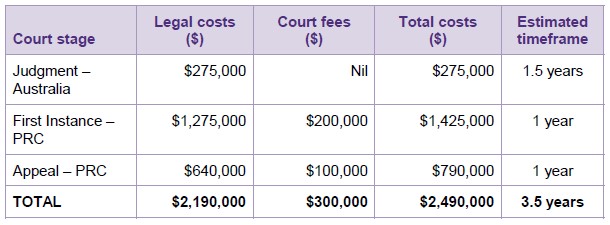
127 As for the first Court stage (Judgment – Australia), in the notes to their Report to creditors, the Administrators included the following table entitled “Estimated DCA realisations”:
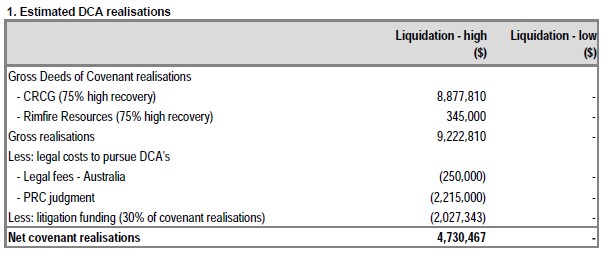
128 Finally on this issue, since the plaintiffs placed particular reliance on the letter Baker McKenzie sent to the Foreign Investment Review Board on 26 March 2018, it is appropriate to set out the pertinent part of that letter in full, as follows:
We are instructed that [China Rail] is committed to conducting business in accordance with applicable laws and regulations, and in an ethical manner. [China Rail] engaged Baker McKenzie to advise on the voluntary administration process and preparation of the DOCA to ensure that it complies with all applicable Australian laws.
Funding litigation against China Rail
129 As the plaintiffs pointed out in their submissions in reply, Mr Thornton, the sole director of the plaintiffs, made an affidavit in this proceeding in which he relevantly said, on this issue:
2. The [plaintiffs] are prepared to fund a liquidator of [the Joint Venture Company] to commence and prosecute proceedings in the Supreme Court of Queensland against [China Rail].
3. The administrator in paragraph 53 of his affidavit sworn 8 February 2019 estimates the cost of prosecuting such proceedings to judgement would be $275,000. I agree with that estimate.
4. The [plaintiffs] would also fund a liquidator to register any judgement that is obtained against [China Rail] in Hong Kong and take steps to execute on such judgment. This would include, if possible, proceedings to wind up [China Rail].
5. The administrator has referred in his affidavit of 8 February 2019 to a 30 per cent premium that might be charged by a litigation funder. The [plaintiffs] would not charge such premium.
6. The [plaintiffs] would prefer to fund a liquidator other than the current administrators.
(Errors in original)
Mr Thornton was not cross-examined on his affidavit.
ANALYSIS
Section 445D(1)(f)(i) – “unfairly prejudicial”
130 As Burley J pointed out in Britax, s 445D(1) of the Act engages a two-stage process. The first stage is to determine whether one of the grounds referred to in subsection (1) has been established and, if it has, the second stage is to decide whether to exercise the discretion to terminate the DOCA based on that ground.
131 The plaintiffs bear the onus to establish that one or more of these grounds provide a sufficient reason to set aside the DOCA (see at [61]–[62] above).
132 With respect to the first stage, the plaintiffs have relied upon ss 445D(1)(f) and (g). Dealing first with the former, by its terms, the introductory words in s 445D(1)(f) allow a DOCA to be terminated if it, or a provision of it, or an act or omission done, or made, or proposed to be done, or made, under it, meets one of the criteria expressed in subsections (i) or (ii). It is therefore necessary to maintain a focus on the DOCA, or the provisions of the DOCA, or the act or omission concerned, when applying the criteria in subsections (f)(i) and (ii).
133 As for the criterion in s 445D(1)(f)(i), the plaintiffs have particularly relied upon the expression “unfairly prejudicial” and claimed that the DOCA has that effect on them as creditors of the Joint Venture Company. It may be accepted that forcing a creditor to accept less than the full amount of its debt will usually be prejudicial to it. However, as the authorities discussed above clearly demonstrate, that prejudice is not sufficient under s 445D(1)(f)(i). By including the adjective “unfairly” in the expression “unfairly prejudicial”, that subsection requires an applicant to establish that, in all the circumstances, the prejudice in question has an element of unfairness associated with it. Beyond complaining about the fact that they, and other creditors opposed to the DOCA, will receive less than the full amount of their debts, the plaintiffs have not, in my view, identified any provision of the DOCA, or any act or omission under it, that could be said to constitute this additional element of unfairness. Furthermore, they have not, in my view, established that the DOCA will have an unfairly prejudicial effect on them as individual creditors, or as a group of creditors, which is also a requirement of s 445D(1)(f)(i). Self-selection as one, or more, of a group of creditors opposed to the terms of a DOCA does not, by itself, avail them. Accordingly, I do not consider that the plaintiffs have discharged their onus to establish the ground contained in s 445D(1)(f)(i). That being so, it is unnecessary, for the purposes of this ground, to consider whether the DOCA should be terminated as a matter of discretion (but see further at [156] below).
Section 445D(1)(f)(ii) – “contrary to the interests of the creditors … as a whole”
134 I turn, next, to the ground stated in s 445D(1)(f)(ii). That subsection requires a focus on the creditors of the Joint Venture Company as a whole, not on individual creditors or groups of creditors, and it does not expressly incorporate any element of oppression, unfairness or discrimination as s 445D(1)(f)(i) does. Under this ground, the plaintiffs have relied on two matters. First, they have claimed it is contrary to the interests of the creditors as a whole not to pursue a proceeding to enforce the DCA against China Rail when, on its face, that covenant is expressed in clear terms, the amount of it far exceeds the total amount of the unsecured creditors of the Joint Venture Company and there appears to be no dispute that China Rail is a company of substance. Secondly, they have claimed that it is contrary to the interests of the creditors as a whole not to pursue investigations against the directors of the Joint Venture Company for insolvent trading. They have also raised this matter as a public interest consideration under s 445D(1)(g). This latter aspect is therefore dealt with separately below.
135 The principles discussed in the authorities above (see at [55]) demonstrate that the plaintiffs bear the onus to establish that there is a “not unrealistic prospect” (or a “serious case for the recovery” or “a real prospect”) of obtaining a better return for the creditors of the Joint Venture Company by pursuing the proceedings and investigations which they have identified above. It should be noted that all of the parties agree that, in determining this issue, the Court is not required to undertake a detailed or exhaustive assessment of the prospects of success in those proceedings or, for that matter, the prospect of recovery under any judgment obtained.
136 The plaintiffs have claimed that the Administrators have overstated the difficulties and costs associated with obtaining and enforcing a judgment against China Rail and they have therefore underestimated the amount the company’s creditors would obtain from pursuing that course in a liquidation. In particular, they have claimed that, with respect to the DCA, there is “nothing to investigate” because China Rail is “prima facie liable” under it. Accordingly, they claim that the real issue is whether a judgment can be successfully enforced against China Rail. On the former, they have contended that China Rail’s postulated challenges to the enforceability of the DCA have little, if any, merit. On the latter, they have contended that, since China Rail intends to continue to conduct business in Australia, the enforcement of any judgment obtained against it should be unproblematic.
137 It is convenient to deal with the issues associated with obtaining a judgment against China Rail first, and then to consider the issues associated with enforcing that judgment next. As will appear below, the latter issue is the most contentious. That is so because it has the greatest effect on the prospects of recovery against China Rail in a liquidation scenario.
138 The first question to arise with respect to obtaining a judgment against China Rail is the forum for those proceedings. Clause 11 of the DCA requires the parties to “submit to the non-exclusive jurisdiction of the courts of Queensland” (see at [82] above). The plaintiffs have claimed this clause requires that the proceeding be pursued in the Supreme Court of Queensland. While the Administrators did canvass the option of commencing proceedings in China without first obtaining a judgment in Australia, they appear to have rejected that option because of the likelihood of failure and the expense involved (see at [125(50)(a)] above). There would therefore appear to be agreement between the parties that a judgment would first need to be obtained against China Rail in the Supreme Court of Queensland.
139 The next question is the costs of obtaining that judgment. On this issue, the parties also appear to be agreed. In his affidavit, Mr Thornton, the sole director of the plaintiffs, accepted the Administrators’ estimate of those costs of $275,000 (see at [129(3)] above). The only dispute relates to the necessity to obtain a litigation funder and pay the 30% premium associated therewith. On this aspect, Mr Thornton also said in his affidavit that the plaintiffs would fund the costs of the litigation and would not charge any premium for doing so. I accept this evidence. The result is a saving of approximately $80,000 (30% of $275,000). This sum, it should be noted, is relatively minor. It represents approximately 1% of the DOCA fund or between 0.2% and 0.5% of the total value of the Joint Venture Company’s creditors. The question whether a 30% premium should be included in the judgment recovery costs is addressed separately below.
140 The third question with respect to obtaining a judgment against China Rail concerns the challenges China Rail has made against the enforceability of the DCA. Those challenges fall into three groups as follows:
(a) the claim that it was misled into signing the DCA by the statements made by Mr Cain of Rimfire (see at [108] above);
(b) the claim that Mr Zhao had no authority to sign the DCA under the Power of Attorney provided to him (see at [88] above); and
(c) the claim that the solicitor’s certificate signed in conjunction with the DCA was false because Ms Yi was not its solicitor at the time (see at [94] above).
141 The factual background to those three grounds of challenge have been outlined in some detail above, as follows:
(a) Mr Cain’s alleged misleading conduct at [107]–[109];
(b) Mr Zhao’s lack of authority at [85]–[88]; and
(c) the alleged falsehoods in the solicitor’s statement at [93]–[96].
142 It is neither necessary, nor appropriate, for the purposes of determining this application, to make an assessment of China Rail’s prospects of success in any of these three grounds of challenge. It suffices to say that each, to varying degrees, appears to have a foundation in fact and to be arguable, at least on a prima facie basis. The stark contrast between the defined amount in Rimfire’s DCA of $460,000 and that stated in China Rail’s DCA of approximately $1.095 billion provides one illustration of this. Whether the responses raised by the plaintiffs above will defeat some, or all, of these challenges is a matter that will ultimately be determined at trial. But the important point is that, given China Rail’s stated intention to pursue these challenges, it is reasonable to conclude that there will be some risk associated with any proceedings to obtain a judgment against China Rail and that those proceedings will take some time to conclude.
143 In their Report to creditors, the Administrators appear to have assessed the former at 75%, that is, that proportion of the amount claimed is likely to be recovered on a “high recovery” basis (see at [127] above). As for the latter, in his affidavit Mr McCann provided an estimated finalisation date of November 2021, not including any appeals that may ensue (see at [114(a)(ii)(B)] above).
144 The plaintiffs have claimed the former does not “take into account that the full $1b is recovered and then a refund is made to [China Rail] after payment of all unsecured creditors”. This is an apparent reference to cl 3(a) of the DCA (see at [81] above). I reject this contention. It assumes a 100% recovery in those proceedings and, therefore, does not take any account of the risk associated with pursuing them. In the absence of any evidence from the plaintiffs bearing on this question, I consider it is reasonable to accept the Administrators’ estimate. The plaintiffs have not made any challenge to the latter estimate. In all the circumstances, I consider it is also reasonable to accept that estimate.
145 Finally on this issue, given the fact that China Rail intends to continue to conduct business in Australia, the suggested difficulty with serving the proceedings on it in Australia would appear to have little merit (see at [37] above).
146 To sum up on this issue, it appears to be agreed that any proceeding to obtain judgment against China Rail will be conducted in the Supreme Court of Queensland and will cost approximately $275,000, not including any litigation funding premium. Furthermore, the risk associated with recovery in that proceeding is approximately 25% and it is not likely to be finalised, to first instance stage, until approximately November 2021.
147 I turn, then, to the second issue mentioned above: the plaintiffs’ claim that the Administrators have overstated the difficulties associated with enforcing a judgment against China Rail. As mentioned above, this matter is at the heart of their claims that there is a “not unrealistic prospect” of obtaining a better return for the creditors of the Joint Venture Company by terminating the DOCA and pursuing the liquidation scenario.
148 The first question that arises under this issue is whether any such enforcement action is likely to be undertaken in Australia, or in China, or somewhere else. On this question, the Administrators’ inquiries have revealed China Rail does not have any significant assets in Australia, or anywhere else outside China, excluding Hong Kong (see at [124]–[125(51)] above). Beyond pointing to China Rail’s intention to continue conducting business in Australia and its statement to the Foreign Investment Review Board in connection therewith (see at [128] above), the plaintiffs have not adduced any evidence which would counter the accuracy of these statements. The fact that China Rail intends to continue to conduct business in Australia and will abide by Australia’s laws does not, in my view, bear on this question. That intention and commitment does not require China Rail to retain any assets in Australia to meet any judgments that may be obtained against it, much less bring assets from China to Australia for that purpose. Accordingly, I accept the Administrators’ opinion that it will be necessary to attempt to enforce any judgment obtained against China Rail, in China.
149 It is then necessary to consider what difficulties may be associated with pursuing that course of action. In summary, the Administrators’ views on this question are that it will be difficult and quite expensive (see at [125(50)] above). It is important to note that those views are based upon advice the Administrators have obtained from their Australian lawyers and from the Chinese law firm, Zhong Lun Law Firm (see at [125(49)] above).
150 In contrast, the plaintiffs have not sought to put forward any differing legal advice, or any countering evidence. Instead, apart from relying on China Rail’s intention to continue conducting business in Australia, which I have rejected as irrelevant to this issue above, it has made a number of contentions about the inaccuracy of the Administrators’ costs estimates. The fallacy with this approach is that, even if all of those contentions were to be accepted, that will not mean that they have discharged their onus to show that there is a realistic prospect of a better recovery for creditors from obtaining and enforcing a judgment against China Rail.
151 In summary on this issue, having regard, on the one hand, to the reasonableness of the Administrators’ opinions concerning the risks and delays that are likely to be associated with obtaining a judgment against China Rail in Australia, and the difficulties and expense that are likely to be encountered in enforcing that judgment in China, and, on the other, the dearth of evidence or other materials from the plaintiffs on these questions, I do not consider that the plaintiffs have discharged their onus to show that there is a realistic prospect of obtaining a better recovery for the creditors of the Joint Venture Company by pursuing that course in a liquidation scenario. It follows that I do not consider that the plaintiffs have established the ground contained in s 445D(1)(f)(ii). That being so, for the purposes of this ground, it is also unnecessary to consider whether the DOCA should be terminated as a matter of discretion (but, again, see further at [156] below).
Section 445D(1)(g) – “some other reason”
152 As Beach J observed in Midland Hwy, the expression “some other reason” is “broad and on one view unconstrained, save by its context” (see at [69]). The contextual constraint to which his Honour referred would seemingly include that mentioned in the Explanatory Memorandum above, namely the width of the other termination categories in s 445D(1) (see at [58] above). Notably, however, none of those subsections includes the public interest factor which, on the authorities reviewed above, has been most commonly considered under this subsection of s 445D(1).
153 The plaintiffs have generally raised the opportunity to investigate insolvent trading in the Joint Venture Company as a public interest factor which supports the termination of the DOCA under this “some other reason” ground in s 445D(1)(g). On that point, it should, however, be noted that, while there was a reference to the Joint Venture Company’s insolvent trading in the plaintiffs’ statement of claim, they did not plead any reliance on this public interest ground as such. Nonetheless, since their complaint under this ground is essentially founded on the insolvent trading which, as mentioned above, they have pleaded, I consider no injustice will be occasioned to the defendants by considering this aspect of the plaintiffs’ case.
154 In their Report to creditors, the Administrators concluded, in summary, that there may have been insolvent trading in the Joint Venture Company from, or by, 30 September 2017 to 16 November 2017. They also concluded that the quantum of that trading may be in the vicinity of $800,000. Finally, they stated that this matter would be further investigated should the company be placed into liquidation (see at [123] above).
155 The plaintiffs do not contest these opinions. However, they have not pointed to any particular feature of this insolvent trading, nor any other conduct of the Joint Venture Company or its officers, that warrants investigation in the public interest. In those circumstances, I do not consider the plaintiffs have discharged their onus to show there is some “sufficient reason” (see at [61] above) for the termination of the DOCA under s 445D(1)(g).
156 Alternatively, if this ground were to be approached as a matter of discretion, for the following reasons, I would not have exercised my discretion to terminate the DOCA. First, I would have taken account of the caution that is urged when a court is considering whether to terminate a DOCA that has been supported by a majority of the creditors of a company (see at [62] above). Secondly, I would have taken account of the fact that the period of insolvent trading concerned is relatively short (seven weeks) and the amount involved is relatively small (approximately $800,000). The latter is demonstrated by the fact that it represents approximately 2%–5% of the total creditors of the company of between $15,200,000 and $41,300,000. Thirdly, I would have had regard to the fact that there is no evidence of any unlawful activity on the part of the company or its officers. Fourthly, it is common ground that the Joint Venture Company is presently solvent. Fifthly, and perhaps most importantly, the evidence shows that the DOCA is supported by the largest creditor by value (Linton Developments (QLD) Pty Ltd) and by the largest public creditor, the Australian Taxation Office. The latter is, in my view, of particular significance when one is considering the public interest.
157 For these reasons, the plaintiffs have not established that there is any other reason under s 445D(1)(g) why the DOCA should be terminated.
OTHER MATTERS
158 Before concluding these reasons, it is appropriate to note the following matters which were developed in submissions, but which, because of the conclusions reached above, are unnecessary to consider. First, the defendants raised the plaintiffs’ delay in bringing this application. In Khoury v Zambena Pty Ltd (1997) 23 ACSR 344 at 353, Young J expressed the view that a delay of one month would be the absolute maximum to be tolerated. In this matter, the delay from the vote at the meeting where the DOCA was adopted (7 March 2018) to the issuing of this proceeding (18 September 2018) was approximately six months. There then followed a further delay of approximately six weeks (until 31 October 2018) until the plaintiffs included an application in this proceeding seeking to set aside the DOCA. None of this delay was explained. Accordingly, if it had been necessary to consider this issue, I would have concluded that this delay would, in itself, have provided a further reason why I would not have exercised my discretion to terminate the DOCA.
159 Secondly, despite the fact that the plaintiffs regarded their case under ss 75-41 and 75-42 of the Schedule to have been overtaken by their reliance on s 445D(1), it is worth adding that I broadly agree with the Administrators’ submissions about the construction of those sections and that, in the circumstances of this matter, they did not provide any basis for relief (see at [27]–[31] above).
160 Finally, on the question whether, if the DOCA were to be terminated, the Administrators should be appointed as the liquidators of the company, it is appropriate to add the following brief observations. I do not consider the fact that the Administrators had dealings with representatives of China Rail supports the plaintiffs’ contentions that they were biased, or not independent. Furthermore, nothing was disclosed in the course of this proceeding which, in my view, gave any support for the attacks the plaintiffs made on the integrity and independence of the Administrators.
CONCLUSION
161 For these reasons, I do not consider that the plaintiffs have established any of the grounds for termination of the DOCA prescribed by ss 445D(1)(f)(i) or (ii) or 445D(1)(g) of the Act. Further, even if the plaintiffs had established one of those grounds, in the circumstances of this matter outlined above, I would not have exercised my discretion to terminate the DOCA. It follows that the apposite parts of the plaintiffs’ application should be dismissed with costs.
162 Since it is unclear from the plaintiffs’ amended originating application (see at [20] above) what those parts are, I will order the parties to consult and, by close of business on 6 September 2019, to submit to my chambers a draft set of orders to reflect the content of these reasons.
I certify that the preceding one hundred and sixty-two (162) numbered paragraph are a true copy of the Reasons for Judgment herein of the Honourable Justice Reeves. |
Associate:
SCHEDULE
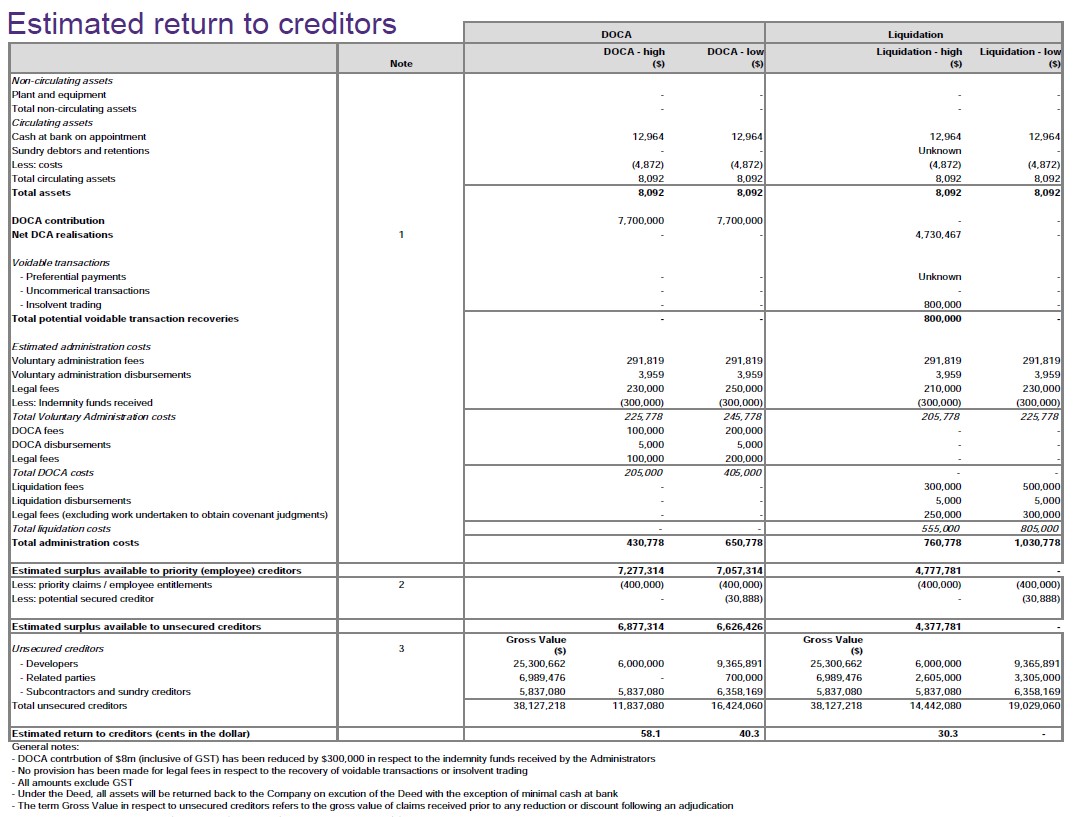
QUD 683 of 2018 | |
CHINA RAILWAY CONSTRUCTION GROUP CO LTD |


