

FEDERAL COURT OF AUSTRALIA
Foster on behalf of the Gunggari People #4 v State of Queensland [2019] FCA 1300
ORDERS
DATE OF ORDER: |
THE COURT ORDERS THAT:
1. The interlocutory application filed on 1 August 2019, as amended, is dismissed.
Note: Entry of orders is dealt with in Rule 39.32 of the Federal Court Rules 2011.
REEVES J:
INTRODUCTION
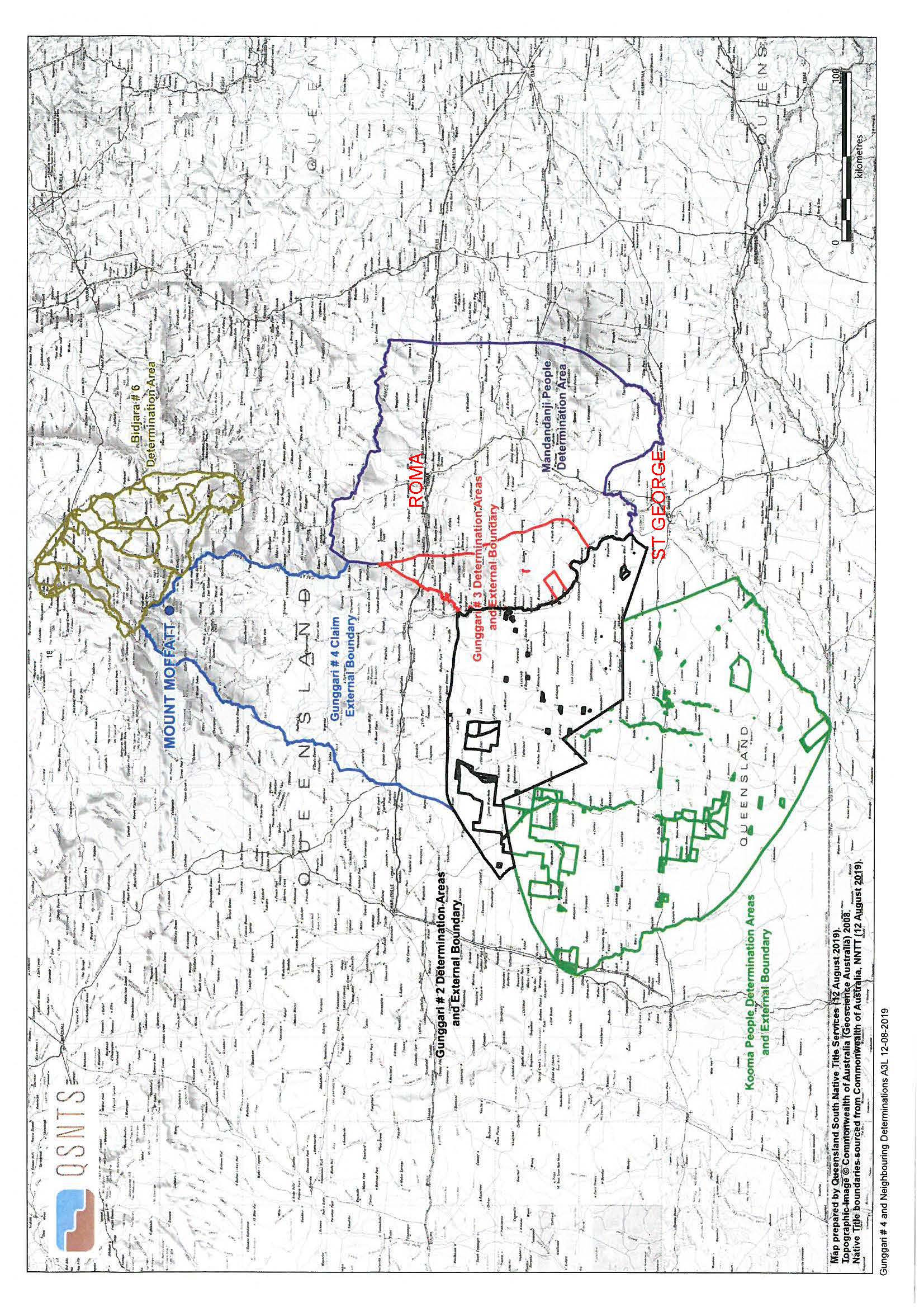
1 Mr Wayne Wharton has applied under s 84(5) of the Native Title Act 1993 (Cth) (NTA) to become a respondent party to this proceeding, the Gunggari People #4 native title determination application. The Gunggari People #4 application covers an area located west and north of Roma in western Queensland.
2 This application has been dealt with as a matter of urgency because the existing parties to the Gunggari People #4 application are about to file an agreement with the Court under s 87 of the NTA in relation to which a consent determination hearing has been fixed for 2 September 2019, approximately two and a half weeks hence.
FACTUAL CONTEXT
3 Mr Wharton is a senior Kooma person. The Kooma People hold native title rights and interests in the area which lies to the south of the lands over which the Gunggari People hold their native title rights and interests. Over the years since the passage of the NTA, a number of disputes has arisen between the Kooma People and the Gunggari People concerning areas located in the vicinity of the common boundary to their lands. The Gunggari applicant’s submissions in this application provided the following convenient summary of the native title determination applications filed under the NTA on behalf of both the Gunggari People and the Kooma People and the disputes which have arisen in relation thereto:
18. The first Gunggari claim was Gunggari #1, QUD6019/1998 lodged with the National Native Title Tribunal (‘NNTT’) on 8 March 1996 by Robert John Munn … initially covering a large area of central Queensland which was later covered by Gunggari #2 and #4 …
19. Gunggari #1 claim area was amended a number of times following resolution of issues raised by overlapping claims to the north, notably claims by Bidjara people. Following entry into an ILUA, Gunggari #1 was dismissed on 30 November 2009.
20. The first Kooma claim (QUD6031/1998) was lodged with the NNTT three months after Gunggari #1, on 4 June 1996, with Mr Wharton as the Applicant, covering 7 individual reserves … Kooma #1 was discontinued on 23 March 2010.
21. Gunggari #2, QUD6027/2001 was filed with the Federal Court on 21 August 2001, (also a date of amendment of Gunggari #1), again with Robert John Munn as applicant …
22. The following year two Kooma claims #2 (QUD 6012/1998) and Kooma #3 (QUD 6013/1998) were both filed on 21 March 2002. Neither included Mr Wharton as an applicant. Kooma #2 covered the same parcels of land as Kooma #1 and Kooma #3 substantially overlapping Gunggari #2 … Following the orders of the Court in Munn v [State of] Queensland [2002] FCA 486, on 9 April 2002 several Kooma people were joined as respondents to Gunggari #2. Mr Wharton was already a respondent to Gunggari #2 but was joined as a respondent to Gunggari #1.
23. There was substantial dispute between Mr Wharton and the other Kooma applicants leading to litigation determined in proceedings listed in Schedule 2 [the following judgments:
• Kooma Aboriginal Corp for Land v Goolburri Regional Council of the Aboriginal & Torres Strait Islander Commission [1999] FCA 82, Spender J, 5 February 1999
• Munn v State of Queensland [2002] FCA 78, Emmett J, 6 February 2002
• Kooma People v State of Queensland [2002] FCA 86, Drummond J, 8 February 2002
• Wharton on behalf of the Kooma People v State of Queensland [2002] FCA 1112, Emmett J, 28 August 2002
• Wharton on behalf of the Kooma People v State of Queensland [2003] FCA 790, Emmett J, 18 June 2003
• Wharton on behalf of the Kooma People v State of Queensland [2003] FCA 1398, Emmett J, 3 December 2003
• Wharton on behalf of the Kooma People v State of Queensland [2004] FCA 1761, Emmett J, 4 February 2004
• Branfield v Wharton [2004] FCAFC 138, Ryan, Finn and North JJ, 21 May 2004].
24. Kooma #3 was discontinued on 23 March 2010.
25. Agreements resolving the overlaps between their claims were reached between Gunggari and Kooma people … After the 2007 mediation, both Gunggari #2 and Kooma #3 were amended to create the ‘zig-zag’ common boundary. The adoption of a ‘common boundary’ resolved the overlap issues between the groups.
26. Contrary to one of the outcomes of the 2007 agreement the Kooma respondents remained parties to Gunggari #2, following amendment of the boundaries. This lead to the 2011 mediation. Its outcomes meant the Kooma respondents (except for Ross Mitchell, who decided to consent to the Gunggari #2 consent determination instead) all withdrew as respondents (including Mr Wharton) upon the Gunggari #2 applicant agreeing to make one further amendment to its southern boundary …
…
28. Kooma #4 was filed on 18 November 2011 consistent with the 2011 agreement, its boundary abutting the amended boundary of Gunggari #2. The resolution reached between Gunggari and Kooma people inter alia allowed for a consent determination in Gunggari #2 on 22 June 2012, Kearns [on behalf of the Gunggari People #2] v [State of] Queensland [2012] FCA 651 and of Part A of Kooma #4 in Weatherall [on behalf of the Kooma People #4 Part A] v [State of] Queensland [2014] FCA 662.
29. Gunggari #4 was filed on 10 October 2012 and is set down for a consent determination on 2 September 2019.
(Footnotes omitted)
4 As this summary demonstrates, Mr Wharton has been closely involved with many of the claims made on behalf of the Kooma People and as a respondent in some of the claims made on behalf of the Gunggari People.
5 The area or feature that is at the centre of Mr Wharton’s present application is known as Mount Moffatt. As appears on the map attached to these reasons, it is located in the northern tip of the Gunggari People #4 claim area. Significantly, it is not specifically mentioned in either of the two agreements referred to in the summary above. Despite this omission, Mr Wharton gave the following evidence in his affidavit filed in support of this application:
18. I was involved in the mediation held in Claim #2 between the Claimants and the Kooma People. The mediation was run by Member Graham Fletcher and Ian Stokes of the [National] Native Title Tribunal.
19. In that mediation an agreement was reached between the parties (Agreement). It was agreed that:
(a) Mount Moffit [sic – Moffatt] would be excluded from all claim areas; and
(b) I would withdraw as a Respondent to Claim #2.
…
21. Mount Moffit [sic – Moffatt] is not included in the Claim #2 determination area.
22. I would also note that I personally drew [an] outline on the map and specifically excluded Mount Moffitt [sic – Moffatt], although the Map has not been provided by [the National Native Title Tribunal].
23. As can be seen from the Agreement Queensland South Native Title Services Limited (QSNTS), were involved in and have full knowledge of that mediation and the Agreement.
24. The current claim area of the Gunggari People Claim #4 QUD19/2019 (Claim #4) includes Mount Moffit [sic – Moffatt].
25. I have commenced this application because I recently became aware that Mount Moffit [sic – Moffatt] and the surrounding area was part of the Claim #4 … the determination area of the Gunggari Claim #3 does not include Mount Moffit [sic – Moffatt].
26. I say that Claim #4 in its current form conflicts with and breaches the Agreement.
27. The reason Mount Moffitt [sic – Moffatt] is so important is that it is an area that was used for meetings between several Mobs, including Kooma and Gunggari Mobs and therefore must be available to all the Mobs not simply one.
28. It is particularly important to the Kooma Mob and considered Kooma Country just as much as Gunggari Country and this Claim #4 will go against thousands of years of protocols and culture.
(Heading omitted; errors in original; bolded terms in original)
CONTENTIONS
6 Mr Wharton claimed that this evidence demonstrated that he had a sufficient interest for the purposes of s 84(5), which interest may be affected if a determination were to be made with respect to the claim area of the Gunggari People #4 application, particularly insofar as it included the area of Mount Moffatt. His counsel emphasised that he regarded his relationship with the Gunggari People as being amicable since the resolution of their disputes in 2011. He also emphasised that the Kooma People intended to abide by the terms of the agreements it had reached with the Gunggari People, one of which prevented them from filing a native title determination application over the area of the Gunggari People #4 application, including Mount Moffatt. Nonetheless, he contended that he was entitled to act to protect his interests in the Mount Moffatt area as a respondent in this proceeding. Accordingly, he stated that, if he were to become a respondent in this proceeding, he would seek to oppose a native title determination being made over the area of Mount Moffatt. He sought to explain the lateness of his application by claiming that he only recently became aware that the Gunggari People #4 application included Mount Moffatt.
7 The Gunggari applicant contended that Mr Wharton had not established that he had a sufficient interest to be made a respondent party in this proceeding. It contended that he had not established a native title interest in that area and, to the extent that he had and was seeking to pursue a positive determination of native title with respect to the Mount Moffatt area, that was not permitted. Alternatively, the Gunggari applicant contended that, even if Mr Wharton had established that he had a sufficient interest for the purposes of s 84(5) of the NTA, that interest would not be affected by a native title determination in the Gunggari People #4 application because the determination only sought non-exclusive rights. Finally, it claimed that it was not in the interests of justice to permit Mr Wharton to become a respondent party in this proceeding, in circumstances where he intended to oppose a determination being made over Mount Moffatt. It contended that this was likely to lead to a vacation of the hearing set for 2 September 2019 and result in costs and further delays for the recognition of the Gunggari People’s native title rights and interests.
RELEVANT PRINCIPLES
8 Section 84(5) of the NTA provides:
The Federal Court may at any time join any person as a party to the proceedings, if the Court is satisfied that the person’s interests may be affected by a determination in the proceedings and it is in the interests of justice to do so.
9 Some of the principles applicable to an application of this kind were recently summarised by Rangiah J in Pegler on behalf of the Widi People of the Nebo Estate #1 v State of Queensland [2019] FCA 711 at [11]–[12], as follows:
11 It is necessary for an applicant for joinder to demonstrate a prima facie case that he or she has interests that may be affected by a determination: Wakka Wakka People # 2 v State of Queensland [2005] FCA 1578 at [6]; Isaacs on behalf of the Turrbal People v State of Queensland (No 2) [2011] FCA 942 at [8].
12 The interests of persons who claim to hold native title rights and interests in relation to the land or orders the subject of the proceeding may be sufficient interests: Munn v State of Queensland [2002] FCA 486 at [8]; Kokatha Native Title Claim v South Australia (2005) 143 FCR 544 at [22], [24]–[25]; Worimi Local Aboriginal Land Council v Minister for Lands for New South Wales [sic – Minister for Lands (NSW)] (2007) 164 FCR 181 … at [10]; Holborow v State of Western Australia [2009] FCA 1200 at [4]; Bonner on behalf of the Jagera People #2 v State of Queensland [2011] FCA 321 at [10]; A.D. (deceased) on behalf of the Mirning People v State of Western Australia (No 2) [2013] FCA 1000 at [53]; Blucher on behalf of the Gaangalu Nation People v State of Queensland [2018] FCA 1369 at [21].
10 The expression “interests” in s 84(5) is a “broad conception” and is not confined to the statutory meaning of the term “interest” in s 253 of the NTA (see Chippendale on behalf of the Wuthathi People #2 v State of Queensland [2012] FCA 310 at [14] per Greenwood J). Nonetheless, as Mansfield J observed in Sumner v State of South Australia [2014] FCA 534 (Sumner) at [13], the interest must be “genuine”, “not indirect, remote or lacking substance” and “capable of clear definition”. It must also be affected by the native title determination concerned “in a demonstrable way” (emphasis in original).
11 Furthermore, as Mansfield J went on to observe in Sumner (at [14]), an entity claiming to represent persons who had a direct interest did not, in that capacity, have a sufficient interest to become a respondent party for the purposes of s 84(5). Conversely, a person cannot seek to become a respondent party in order to pursue a positive determination of native title (see Bonner on behalf of the Jagera People #2 v State of Queensland [2011] FCA 321 (Bonner) at [19] per Reeves J). Nonetheless, a person may be joined as a respondent party to seek to “defensively assert their native title rights and interests” (see Munn v State of Queensland [2002] FCA 486 at [8] per Emmett J, Davis-Hurst (on behalf of the traditional owners of Saltwater) v Minister for Land and Water Conservation (NSW) (2003) 198 ALR 315; [2003] FCA 541 at [27] per Branson J, Kokatha Native Title Claim v South Australia (2005) 143 FCR 544; [2005] FCA 836 at [24] per Mansfield J, Worimi Local Aboriginal Land Council v Minister for Lands (NSW) (2007) 164 FCR 181; [2007] FCA 1357 at [16]–[17] per Bennett J and Bonner at [18] per Reeves J).
12 There is also an additional criterion expressed in s 84(5). That is, that joining the respondent is “in the interests of justice”. Under that criterion, or at least the sentiments expressed in it, judges of this Court have, in the past, taken into account whether the applicant has provided a satisfactory explanation for any delay connected with his or her application and the prejudice that may be caused to existing parties to the proceeding if the applicant is joined as a party (see, for example, Barunga v State of Western Australia (No 2) [2011] FCA 755 at [163] and [219] per Gilmour J, Jacob v State of Western Australia [2014] FCA 1106 at [4] and [51] per McKerracher J, Allen on behalf of the Nyamal People #1 v State of Western Australia [2018] FCA 320 at [56] and [75] per Barker J and Blucher on behalf of the Gaangalu Nation People v State of Queensland [2018] FCA 1369 at [18] and [23]–[27] per Rangiah J).
CONSIDERATION
13 As Mansfield J pointed out in Sumner (at [12]), to succeed in his application for joinder, Mr Wharton must establish three things:
(a) that he has an interest for the purpose of s 84(5) of the NTA;
(b) that that interest may be affected by a determination of native title in this proceeding; and
(c) that it is in the interests of justice for him to be joined as a party to this proceeding.
For the reasons that follow, I consider Mr Wharton has established (a) above, but not (b) and (c).
14 Dealing first with (a) above, it is necessary at the outset to bear in mind that an applicant like Mr Wharton need only establish his interest on a prima facie basis. Next, it is important in this matter to record that Mr Wharton is a senior Kooma man who has been closely involved in most of the proceedings under the NTA over approximately the past two decades concerning the region of western Queensland in which both Kooma and Gunggari lands are located. Against this background, it is necessary, next, to turn to the particular interest Mr Wharton claims to have in this proceeding. This interest is stated at [27]–[28] of his affidavit (see at [5] above). In essence it is that under the “protocols and culture” of both Gunggari and Kooma People, Mount Moffatt and the surrounding area has been “used for meetings” for thousands of years. This interest is, in my view, sufficiently clearly defined and it could not be said to be “indirect, remote or lacking [in] substance”. Furthermore, the Gunggari applicant did not seek to cross-examine Mr Wharton on its genuineness. Having regard to all these factors, I find that Mr Wharton has a sufficient interest in this proceeding for the purposes of s 84(5) of the NTA.
15 Turning then to (b) above, it is convenient to begin by identifying the native title rights and interests the Gunggari People seek to have determined over the claim area in the Gunggari People #4 application. They are set out in the entry relating to that application on the Register of Native Title Claims maintained by the National Native Title Tribunal as follows:
The Gunggari People claim the non-exclusive rights to:
(a) access, be present on, move about on and travel over the [a]pplication [a]rea;
(b) camp on the application area and, for that purpose, erect temporary shelters on the application area;
(c) take (including by hunting and gathering) and use traditional natural resources from the application area for personal, domestic and non-commercial communal purposes;
(d) conduct religious and spiritual activities and ceremonies on the application area;
(e) maintain places of importance and areas of significance to the native title holders under their traditional laws and customs and protect those places and areas, by lawful means, from physical harm;
(f) teach on the application area the physical and spiritual attributes of the application area; and
(g) light fires on the application area for domestic purposes including cooking, but not for the purposes of hunting or clearing vegetation;
(h) hunt and fish in or on, and gather from, the water for personal, domestic and non-commercial communal purposes; and
(i) take and use the water for personal, domestic and non-commercial communal purposes.
16 A determination of native title in these terms in this proceeding will not, in my view, affect Mr Wharton’s interests as set out above. That is so because, first, the rights and interests sought are non-exclusive rights. Furthermore, by their terms, none of these rights and interests will interfere with the ability of Mr Wharton or members of the Kooma People to have meetings at Mount Moffatt or the surrounding area. This applies to the rights in (a), (d) and (e) above which come closest to affecting the holding of such meetings.
17 Finally, as to (c) above, even if I had not reached the conclusion concerning (b) above, I do not consider it is in the interests of justice to join Mr Wharton to this proceeding at this late stage. On this aspect, first, I do not consider Mr Wharton’s statement that he only became aware of this issue recently provides a satisfactory explanation for this application being made approximately two and a half weeks before the final hearing in the Gunggari People #4 application. The Gunggari People #4 application was filed on 10 October 2012. Immediately thereafter, it was subject to the extensive notification provisions of s 66 of the NTA. Given his close involvement with native title proceedings in the region of western Queensland to which the Gunggari People #4 claim relates, as mentioned above, I consider it is highly likely that Mr Wharton became aware of the claim at that time. Assuming he did, the public records of the claim would have allowed him to ascertain that it, in part, covered the area surrounding Mount Moffatt.
18 In addition, I consider the competing prejudices that Mr Wharton and the Gunggari People may suffer if he is joined as a respondent party in this proceeding, stand against that course being taken. Mr Wharton’s counsel frankly stated that, if he is joined as a respondent party, he intends to oppose any determination of native title being made over the area surrounding Mount Moffatt. That position is very likely to result in a vacation of the hearing date for the Gunggari People #4 application. While there is a procedure in ss 87(10) and (11) of the NTA which would allow a party’s opposition to an agreement to be considered and rejected, that procedure would not avail Mr Wharton and the Gunggari applicant in this matter because it includes a notification period of at least 21 days.
19 Finally, on this aspect, I consider the confined nature of Mr Wharton’s interests as discussed above is significant. It is also important to note that the area surrounding Mount Moffatt comprises a small fraction of the Gunggari People #4 claim area. On the other hand, if Mr Wharton becomes a respondent party to this proceeding and succeeds in having the hearing on 2 September 2019 vacated, I consider the Gunggari People stand to suffer much greater prejudice. Apart from the costs that will be wasted in vacating that hearing, the recognition of their native title rights and interests over the Gunggari People #4 claim area will be further delayed.
CONCLUSION
20 For these reasons, while Mr Wharton has established an interest for the purposes of s 84(5) of the NTA, I do not consider he has established that that interest will be affected by a determination of native title in the Gunggari People #4 application, nor that, in the circumstances, it is in the interests of justice to join him as a respondent party in this proceeding. Accordingly, I propose to order that Mr Wharton’s amended interlocutory application originally filed on 1 August 2019 be dismissed.
I certify that the preceding twenty (20) numbered paragraphs are a true copy of the Reasons for Judgment herein of the Honourable Justice Reeves. |
QUD 19 of 2019 | |
MURWEH SHIRE COUNCIL | |
Fifth Respondent: | ERGON ENERGY CORPORATION LIMITED |
Sixth Respondent: | TELSTRA CORPORATION LIMITED (ACN 33 051 775 556) |
Seventh Respondent: | BABBILOORA PTY LTD |
Eighth Respondent: | BUCKNELL ENTERPRISES PTY LTD |
Ninth Respondent: | ADRIAN WENTWORTH BUCKNELL |
Tenth Respondent: | JENNIFER NARELLE BUCKNELL |
Eleventh Respondent: | JOHN BRUCE COMPANGNONI |
Twelfth Respondent: | JUNE OLIVE COMPANGNONI |
Thirteenth Respondent: | LAURE-LEE ANNE COMPANGNONI |
Fourteenth Respondent: | WILLIAM DONALD COMPANGNONI |
Fifteenth Respondent: | WALTER JOHN HARTNELL |
Sixteenth Respondent: | ALAN REGINALD MAUDSLEY |
Seventeenth Respondent: | MARGARET DAWN MAUDSLEY |
Eighteenth Respondent: | ERICA JAN PERRETT |
Nineteenth Respondent: | HARRY SIBUN PERRETT |
Twentieth Respondent: | MARGARET ANN PHILLIPS |
Twenty-First Respondent: | RONALD JOHN PHILLIPS |
Twenty-Second Respondent: | NORA JEAN STATHAM |
Twenty-Third Respondent: | MAREE ANNE STINSON |
Twenty-Fourth Respondent: | ROBERT WILLIAM THORNE |
Twenty-Fifth Respondent: | HENRY RICHARD THOMAS WHITTON |
Twenty-Sixth Respondent: | WARREN GAVIN WILSON |


