

FEDERAL COURT OF AUSTRALIA
Metro Trains Melbourne Pty Ltd v Australian Rail, Tram and Bus Union Industry [2019] FCA 1265
ORDERS
METRO TRAINS MELBOURNE PTY LTD Applicant | ||
AND: | AUSTRALIAN RAIL, TRAM AND BUS INDUSTRY UNION Respondent | |
DATE OF ORDER: |
UPON THE APPLICANT, BY ITS COUNSEL, UNDERTAKING:
(a) to submit to such order (if any) as the Court may consider to be just for the payment of compensation, to be assessed by the Court or as it may direct, to any person, whether or not a party, adversely affected by the operation of the order or undertaking or any continuation (with or without variation) thereof; and
(b) to pay the compensation referred to in (a) above to the person there referred to,
THE COURT ORDERS THAT:
1. Until the hearing and determination of the application or further order, the respondent, whether by itself, its officers, servants, agents or howsoever otherwise, be restrained from organising any action in the form of that described at paragraphs 1 and 13 of the respondent’s Notice of Intention to Take Industrial Action dated 5 August 2019 (Open Barrier Actions).
2. Not later than 11:00pm on Friday, 9 August 2019, the respondent generate a notice on its letterhead in the form of Attachment 1 to these orders, signed by its Victorian Branch Secretary, Ms Luba Grigorovitch, and:
(a) post a copy of the notice on the home page of the respondent’s internet site;
(b) ensure that the notice posted in accordance with order 2(a) above remains so posted until 11:59pm on Monday, 19 August 2019.
(c) post a copy of the notice on the home page (whether described as a ‘timeline’, ‘feed’, or otherwise) of each online social media account (including accounts on the social media platforms Facebook and Twitter) normally used by the respondent to communicate with its members who are employed by the applicant, and which are accessible by those members;
(d) ensure that the notice posted in accordance with order 2(c) above remains posted in a manner that is immediately visible on the home page (whether by ‘pinning’ the posted notice or otherwise) until 11:59pm on Monday, 19 August 2019; and
(e) provide a copy of the notice to the applicant.
3. Not later than 4:00pm on Saturday, 10 August 2019, the respondent post a copy of the notice referred to in order 2 on all noticeboards at the applicant’s train stations normally used by the respondent for communicating with the applicant’s employees;
4. Until the hearing and determination of the application or further order, the respondent, whether by itself, its officers, servants, agents or howsoever otherwise, be restrained from making, publishing or disseminating representations to the effect that:
(a) commuters travelling on the Melbourne metropolitan train network can have a “free travel day,” can otherwise travel for “free”, or are otherwise relieved of any obligation to pay for that travel on days on which members of the respondent engage in industrial action;
(b) it is lawful and permissible for commuters to travel on the Melbourne metropolitan train network on days on which members of the respondent engage in industrial action, without “touching on” or “touching off” with a Myki card; and
(c) commuters travelling on the Melbourne metropolitan train network without touching on or touching off with a Myki card on days on which members of the respondent engage in industrial action, cannot or will not be issued with an infringement notice or otherwise contravene the law.
5. The respondent take all reasonable steps to cause to be published in the print editions of the Herald-Sun newspaper and The Age newspaper on 10 and 11 August 2019, an advertisement in the form of Attachment 1 to these orders, and take all reasonable steps to ensure that the advertisement:
(a) is placed within the first 10 pages of those newspapers;
(b) is at least 14 centimetres by 4 columns in size;
(c) has a headline font of at least 12 point bold; and
(d) has a body text font of no less than 11 point.
6. The respondent take all reasonable steps to cause to be published in the online editions of the Herald-Sun newspaper and The Age newspaper on 10 and 11 August 2019, an advertisement in the form of Attachment 1 to these orders, and take all reasonable steps to ensure that the advertisement:
(a) is placed on the home pages of each of the Herald-Sun newspaper and The Age newspaper;
(b) has a headline font of at least 12 point bold; and
(c) has a body text font of no less than 11 point.
7. The question of costs (if any) arising from that part of the Applicant’s Originating Application that concerns these interlocutory orders be reserved.
TO: AUSTRALIAN RAIL, TRAM AND BUS INDUSTRY UNION
TAKE NOTICE, PURSUANT TO ORDER 41.06 OF THE FEDERAL COURT RULES, THAT:
You are liable to imprisonment or to sequestration of property or punishment for contempt if:
(a) you neglect or refuse to do the things that this order requires you to do within the time or times specified; or
(b) you do the things that this order requires you to abstain from doing, or otherwise disobey this order.
Attachment 1
On 5 August 2019, the Australian Rail, Tram and Bus Industry Union issued a Notice of Intention to Take Industrial Action against Metro Trains Melbourne Pty Ltd (Metro) from Monday, 12 August 2019.
Item 1 of the Notice described action in the form of “keeping open the passenger ticket barriers at train stations” on Monday, 12 August 2019 between 00:01am and 23:59pm.
Item 13 of the Notice described action in the form of “keeping open the passenger ticket barriers at train stations” on Monday, 19 August 2019 between 00:01am and 23:59pm.
The RTBU has withdrawn Items 1 and 13. The RTBU directs its members not to engage in the actions notified at Items 1 and 13 of the Notice.
The RTBU wishes to clarify that:
• commuters travelling on the Melbourne metropolitan train network cannot have a “free travel day” or otherwise travel for “free”, on days on which RTBU members engage in industrial action (or otherwise take action against Metro);
• it is not lawful or permissible for commuters to travel on the Melbourne metropolitan train network on days on which RTBU members engage in protected industrial action (or otherwise take action against Metro), without “touching on” or “touching off” with a Myki card; and
• commuters travelling on the Melbourne metropolitan train network without touching on or touching off with a Myki card on days on which RTBU members engage in protected industrial action (or otherwise take action against Metro), may be issued with an infringement notice or otherwise contravene the law.
Note: Entry of orders is dealt with in Rule 39.32 of the Federal Court Rules 2011.
SNADEN J:
1 On Friday, 9 August 2019, the court granted urgent interlocutory injunctive relief at the request of the applicant (hereafter, “Metro Trains”). Those orders were accompanied by brief, oral reasons, which the court undertook to supplement by more fulsome, written reasons.
2 These are those reasons.
3 Metro Trains operates Melbourne’s metropolitan rail network. That undertaking involves the operation of approximately 230 six-carriage passenger trains across 998 kilometres of track in the Melbourne metropolitan area. It operates 15 separate train lines, which collectively comprise 222 train stations. On a typical Monday, it transports in excess of 800,000 people by means of 2,367 train voyages. The majority of those people (as one might expect) travel during the morning and afternoon peak periods (namely, between 7:00am and 9:00am, and 4:00pm and 6:00pm). Mondays are typically the busiest days of any given week.
4 In the main, commuters who wish to travel across the rail network that Metro Trains operates must pay to do so. That occurs primarily by means of the well-known “Myki” system. In perhaps overly simplistic terms, that system involves the use of pre-paid swipe cards upon or in connection which commuters can virtually “store” credit (not unlike a credit card) or pay for travel within identified periods. When the card is used (in the manner described below), the balance of credit stored in respect of it is reduced by the cost of the trip in aid of which it was used; or, alternatively, the system recognises that the trip falls within the period for which a commuter has already paid.
5 The Transport (Compliance and Miscellaneous) (Ticketing) Regulations 2017 (Vic)—which are made pursuant to ss 56, 221AA and 230AH of the Transport (Compliance and Miscellaneous) Act 1983 (Vic)—identify the requirements that a person must satisfy in order to travel on the rail network that Metro Trains operates. Regulations 6 and 7 relevantly provide as follows:
6 Validity for travel or entry
For the purposes of these Regulations—
(a) a ticket is valid for the whole of a person's travel in a passenger vehicle if the ticket authorises the whole of that travel; and
(b) a ticket is valid for a person's entry to a compulsory ticket area if the ticket authorises that entry to the compulsory ticket area; and
(c) a ticket is not valid for the whole of a person's travel in a passenger vehicle if any part of that travel is not authorised by the ticket.
Examples
For the purposes of Division 2 of Part 2, examples of reasonable steps that may be available to make a ticket valid for travel include—
• in the case of a myki, to have recorded on the myki a myki product or myki money of sufficient value to pay for the whole of the travel or entry to a compulsory ticket area and have the whole of the travel recorded on the myki; and
• in the case of a ticket other than a myki, to purchase a ticket for the whole of the travel or entry to a compulsory ticket area; and
• in the case of a myki, to have the myki scanned by a smartcard reader and made valid for travel or entry to a compulsory ticket area before commencing travel or, if travelling on a tram or a bus, on commencing travel or entering a compulsory ticket area.
7 Obligation to hold valid ticket
(1) A person who is travelling in a passenger vehicle must have in the person's possession a ticket that is valid for the whole of the person's travel in that passenger vehicle.
Penalty: 10 penalty units.
Note
Regulation 13 sets out the defence that may apply in respect of a charge under this subregulation.
(2) A person who is in a compulsory ticket area must have in the person's possession a ticket that is valid for that entry to the compulsory ticket area.
Penalty: 10 penalty units.
Note
Regulation 14 sets out the defence that may apply in respect of a charge under this subregulation.
6 “[T]icket” is defined by reg 5(1) to mean “…a ticket, pass, card (including a debit or credit card), permit, authority, device, software application, symbol or other thing issued, or which may be used, for the purpose of authorising travel in a passenger vehicle or entry to a compulsory ticket area”. “[P]assenger vehicle” and “compulsory ticket area” are defined by the same regulation: the former includes trains; the latter incorporates:
(a) an area of land or an area within premises owned or occupied by a passenger transport company that is designated by the passenger transport company by means of signs in or near the area as an area for entry to which a ticket valid for that entry is required; or
b) if a railway station is specified by the Secretary in a notice published in the Government Gazette as a station to which this paragraph applies—
(i) a platform at that station; and
(ii) a waiting room or area adjoining a platform from which the platform can be accessed without the need to pass a smartcard and digital card reader or a ticket barrier; and
(iii) an area between a platform and any smartcard and digital card reader or ticket barrier that it is necessary to pass to gain access to the platform;
7 The effect of those regulations is that passengers who wish to travel somewhere on the Metro Trains network—and who intend to use the Myki system in order to do so—must have their Myki cards scanned by a smartcard and digital card reader, devices that are present at (amongst other locations) all of the 222 train stations that span the network. The conduct that that requires is more commonly known in Melbourne as “touching on” and “touching off”. In order to ride in that fashion on the Metro Trains network, a passenger must, first, have stored upon his or her Myki card credit that is sufficient to cover the cost of the trip (or that covers the period within which the trip is to be taken); must, second, touch his or her Myki card to one of the readers present at the train station from which the journey commences; and then must, third, touch his or her Myki card to one of the readers at the train station at which the journey completes.
8 A person who rides on a train without having met those requirements does so unlawfully and is exposed to the imposition of pecuniary penalties of up to $247.83: Transport (Infringements) Regulations 2010 (Vic), reg 6 and Sch 2. Such penalties can be imposed by notice issued by police officers and protective services officers (each of whom are employed otherwise than by Metro Trains). They can also be imposed by notice issued by Metro Trains employees who are engaged as “Authorised Officers”.
9 At many Melbourne train stations—30, to be precise—the Myki card readers are incorporated into barrier systems, such that passengers are physically unable to gain (or are physically obstructed from gaining) access to or egress from the station without (respectively) “touching on” or “touching off”. In simple terms, the process of touching on or touching off triggers the opening of a barrier, creating a passage through which such access or egress is then conveniently gained.
10 Stations at which such barriers are present are staffed by employees engaged by Metro Trains in various roles (referred to, hereafter and collectively, as “Station Employees”) at least between 7:00am and 10:00pm. During those hours, the barriers are closed by default, which is to say that they are closed unless or until opened, usually by means of a commuter “touching on” or “touching off”. When that (“touching on” or “touching off”) occurs, the barrier opens to allow the commuter’s passage into or out of the station, following which it closes again.
11 Station Employees (or at least some of them) can and, in defined circumstances—for example, where there is a safety or emergency concern that warrants it—do, open those barrier systems, both intermittently and indefinitely (depending on the circumstances). Save in respect of emergency situations, they are not authorised to leave barrier systems locked open (such as to afford free access to or egress from a station) unless instructed to do so by Metro Trains.
12 The respondent (hereafter, the “RTBU”) is a well-known trade union. It is an employee organisation” (within the meaning attributed to that phrase by s 12 of the FW Act). It represents or is eligible to represent (amongst others) Authorised Officers and Station Employees (or at least some of them).
13 Metro Trains and the RTBU have, since approximately February 2019, been bargaining in respect of terms to be incorporated into an enterprise agreement that is proposed to be made under Pt 2-4 of the Fair Work Act 2009 (Cth) (hereafter, the “FW Act”). If or when made, that agreement (hereafter, the “Proposed EA”) will replace the Metro Trains Melbourne Pty Ltd Rail Operations Enterprise Agreement 2015 – 2019 (hereafter, the “Current EA”), which is itself an instrument made under that part.
14 The Current EA does—and the Proposed EA (if or when it is made and operative) will—apply in respect of the employment by Metro Trains of (at least) Authorised Officers and Station Employees (or at least some of them), many of whom are members of the RTBU.
15 In support of the claims that it has advanced during bargaining for the Proposed EA, the RTBU has given notice of its intention to organise—and of the intention of its members to engage in—protected industrial action (within the meaning attributed to that phrase by s 408 of the FW Act). That notice, dated 5 August 2019, identified what were said to be 14 species of such industrial action in that regard. Four are of immediate relevance: the RTBU, by that notice, proposed to organise industrial action of the following sorts (using the numbering employed in the notice):
1. Employees will perform their work differently by keeping open the passenger ticket barriers at train stations, commencing at 00:01 on Monday 12 August 2019 and finishing at 23:59 on Monday 12 August 2019. The employees intending to engage in the protected action would be all employees who are employed in any station grade who are members of the RTBU and whose employment will be subject to the proposed agreement.
2. Employees will perform their work differently by refusing to sell and upload Myki money and Myki passes and refusing to inspect passenger Mykis, commencing at 00:01 on Monday 12 August 2019 and finishing at 23:59 on Monday 12 August 2019. The employees intending to engage in the protected action would be all employees who are employed in any station grade and any authorised officer grade who are members of the RTBU and whose employment will be subject to the proposed agreement.
…
13. Employees will perform their work differently by keeping open the passenger ticket barriers at train stations, commencing at 00:01 on Monday 19 August 2019 and finishing at 23:59 on Monday 19 August 2019. The employees intending to engage in the protected action would be all employees who are employed in any station grade who are members of the RTBU and whose employment will be subject to the proposed agreement.
14. Employees will perform their work differently by refusing to sell and upload Myki money and Myki passes and refusing to inspect passenger Mykis, commencing at 00:01 on Monday 19 August 2019 and finishing at 23:59 on Monday 19 August 2019. The employees intending to engage in the protected action would be all employees who are employed in any station grade and any authorised officer grade who are members of the RTBU and whose employment will be subject to the proposed agreement.
For the sake of convenience, I shall refer to the proposed action listed above as the “Impugned Action”. I will refer to items 1 and 13 as the “Open Barriers Action”.
16 Immediately, it can be seen that the Open Barriers Action proposed to involve, on each of Monday, 12 and Monday, 19 August 2019, the deliberate locking “open” of barriers at the 30 train stations at which they are present. The remainder of the Impugned Action proposed to involve, on those same days, a ban upon the issuing by Authorised Officers of infringement notices of the kind referred to at [8] above (or, more accurately, upon the “inspect[ion of] passenger Myki[ cards]”, which is a necessary precursor to the issuing of such notices) and a ban on the performance of work that involves the sale to members of the public of credit to be used via the Myki system.
17 Later (or perhaps at the same time) that day (Monday, 5 August 2019), the RTBU published the following press release concerning the action that it proposed to organise against Metro Trains (including the Impugned Action):
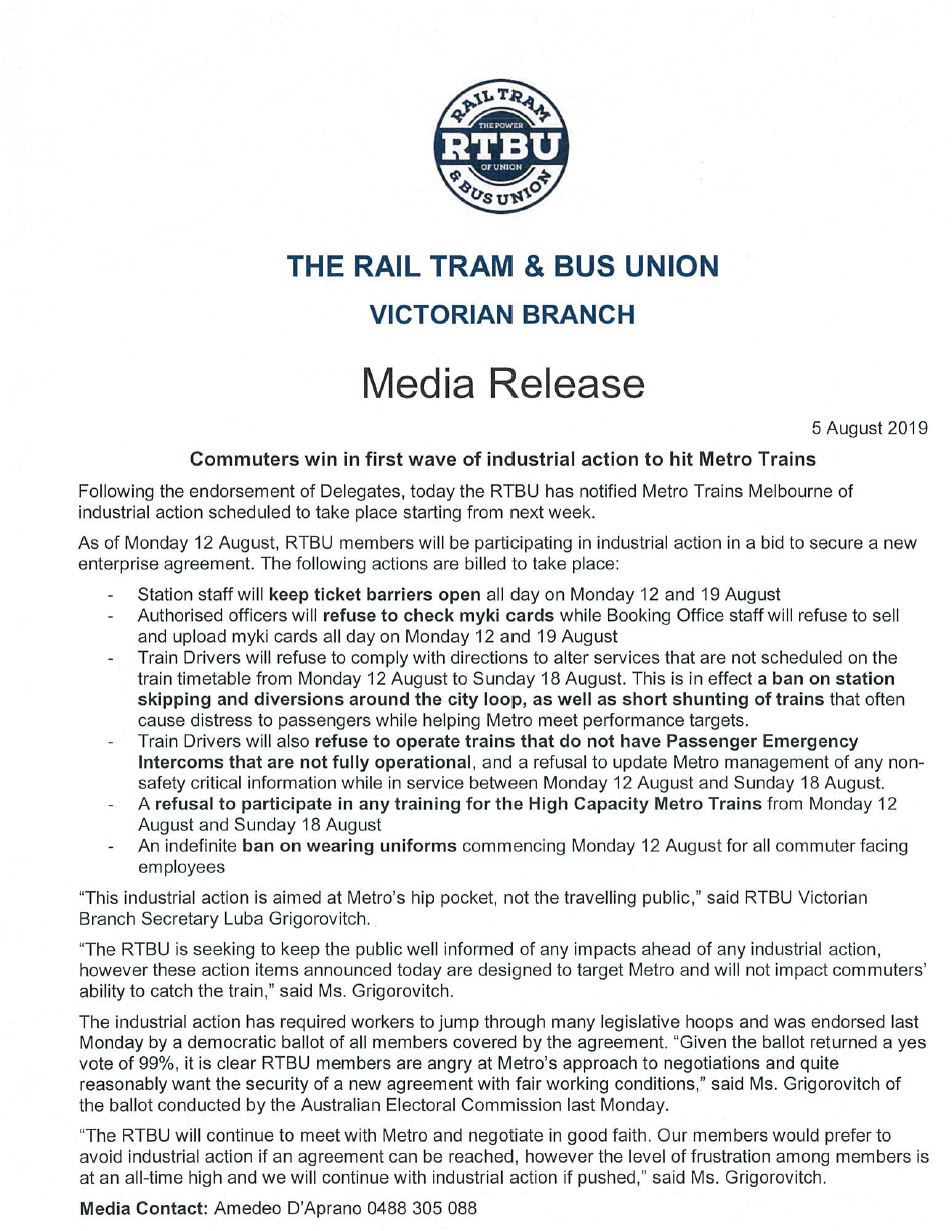
18 Also on Monday, 5 August 2019, the RTBU’s Victorian Branch Secretary, Ms Luba Grigorovitch, held a press conference during which she was recorded as saying (presumably amongst other things), “We’ve decided that we don’t want to harm or inconvenience the general public. Instead, we’d prefer to hurt the hip pocket of Metro Trains Melbourne.”
19 On the same day, Ms Grigorovitch was interviewed on the “Drive” radio program hosted by Mr Tom Elliott on a well-known Melbourne radio station, 3AW. During that interview, the following exchanges occurred:
Mr Elliott: ...So, between August the 12th, which is next Monday, and August the 19th, ticket barrier gates will be left open. Hooray no Myki!
…
Mr Elliott: So if I'm catching the tram or the train next week, what will I notice next week? What's different?
Ms Grigorovitch: So we've got open barriers, which on Monday, obviously we will have open barriers and that's a win for commuters because RTBU members won't be checking tickets on that day...
…
Mr Elliott: ...So on Monday, you'll have open barriers so anyone travelling anywhere on a train on Monday, you don't have to scan on your Myki, you can just walk through. And your members will be wearing casual clothes apart from, I don't know, a safety vest or whatever. Is there anything else that customers might notice?
Ms Grigorovitch: Yes. So, you should have received my media release, I would hope that you have.
Ms Grigorovitch then went on to identify the various other forms of industrial action that were the subject of the notice that the RTBU served upon Metro Trains earlier that day (above, [15]).
20 Those representations, or some combination of them, appear to have excited significant public (or at least media) interest. Several media outlets—including television stations Seven and Nine, and various print (and online) journalism houses, including The Age and the Herald Sun—published stories that referred to commuters being able, on account of the Impugned Action, to travel on the Metro Trains network for free on the two days in question. As might already be apparent from the summary above, that suggestion was false. It was common ground between the parties that the Impugned Action would not have (nor have had) the effect of relieving commuters of any obligation to pay for—that is to say (insofar as concerned the Myki system), to “touch on” and “touch off” in respect of—train travel on those days.
21 On Wednesday, 7 August 2019, Metro Trains sent by email a letter to Ms Grigorovitch, by which (amongst other things) it invited the RTBU to withdraw paragraphs 1, 2, 13 and 14 of its 5 August notice, and to clarify the nature and effect of the Impugned Action. Those invitations were declined by reply correspondence sent the following day. By that correspondence, Ms Grigorovitch recorded that “[n]either [the RTBU’s] media release of 5 August 2019…nor [her] public statements spoke of ‘free travel’ or ‘free travel days’ or ‘commuters riding for free’.”
22 By an originating application dated 8 August 2019, Metro Trains charges the RTBU with contravention of ss 343, 345 and 348 of the FW Act. It seeks relief in the nature of declarations, compensation and penalties in respect of those alleged contraventions. In short compass, the complaint is that the RTBU has made misleading statements about the effect of the Impugned Action, and that the Open Barriers Action amounts to a threat to engage in conduct with intent to coerce Metro Trains into acceding to the claims that have been made against it during bargaining for the Proposed EA.
23 By the same originating application, Metro Trains also sought interlocutory relief in the nature of injunctions, both restrictive and mandatory, directed to the avoidance and correction of the conduct about which it complains. That application was brought on for urgent hearing on the morning of Friday, 9 August 2018. In support of it, Metro Trains relied upon an affidavit affirmed on Thursday, 8 August 2019 by its General Manager Station & Passenger Service Delivery, Mr Nicholas Kevin Sleigh. In opposition to it, the RTBU relied upon two affidavits, each affirmed on Friday, 9 August 2019 by its solicitor, Mr Marcus Rogers Clayton. All three affidavits were treated as read, each without objection.
24 The facts, as I have summarised them above, find voice in those affidavits. It is, of course, prudent not to describe them as facts that the court finds to be true. None of the evidence has been tested as yet and, dealing with the matter, as I am, at an interlocutory stage, I should be careful to indicate that they (or some of them) might not survive at trial. Nonetheless, all are matters that are apparent from the evidential material that was before the court.
25 Additionally, both parties produced helpful written outlines of the submissions upon which they elaborated orally at the hearing.
Legislative framework
26 Section 19(1) of the FW Act defines what is meant, conceptually, by “industrial action”:
(1) Industrial action means action of any of the following kinds:
(a) the performance of work by an employee in a manner different from that in which it is customarily performed, or the adoption of a practice in relation to work by an employee, the result of which is a restriction or limitation on, or a delay in, the performance of the work;
(b) a ban, limitation or restriction on the performance of work by an employee or on the acceptance of or offering for work by an employee;
(c) a failure or refusal by employees to attend for work or a failure or refusal to perform any work at all by employees who attend for work;
(d) the lockout of employees from their employment by the employer of the employees.
27 Section 408 of the FW Act defines “protected industrial action”:
Industrial action is protected industrial action for a proposed enterprise agreement if it is one of the following:
(a) employee claim action for the agreement (see section 409);
(b) employee response action for the agreement (see section 410);
(c) employer response action for the agreement (see section 411).
28 “[E]mployee claim action” is defined in s 409 as follows:
Employee claim action
(1) Employee claim action for a proposed enterprise agreement is industrial action that:
(a) is organised or engaged in for the purpose of supporting or advancing claims in relation to the agreement that are only about, or are reasonably believed to only be about, permitted matters; and
(b) is organised or engaged in, against an employer that will be covered by the agreement, by:
(i) a bargaining representative of an employee who will be covered by the agreement; or
(ii) an employee who is included in a group or groups of employees specified in a protected action ballot order for the industrial action; and
(c) meets the common requirements set out in Subdivision B; and
(d) meets the additional requirements set out in this section.
…
29 In the present case, there is no issue concerning the “common requirements” to which s 409(1)(c) refers, nor the “additional requirements” to which s 409(1)(d) refers.
30 Section 414 of the FW Act provides for the notice requirements that must be met in order that industrial action might qualify as (amongst other things) employee claim action:
Notice requirements—employee claim action
(1) Before a person engages in employee claim action for a proposed enterprise agreement, a bargaining representative of an employee who will be covered by the agreement must give written notice of the action to the employer of the employee.
(2) The period of notice must be at least:
(a) 3 working days; or
(b) if a protected action ballot order for the employee claim action specifies a longer period of notice for the purposes of this paragraph—that period of notice.
Notice of employee claim action not to be given until ballot results declared
(3) A notice under subsection (1) must not be given until after the results of the protected action ballot for the employee claim action have been declared.
…
Notice requirements—content
(6) A notice given under this section must specify the nature of the action and the day on which it will start.
31 Section 415 of the Act provides for a measure of legal immunity that attaches to protected industrial action:
(1) No action lies under any law (whether written or unwritten) in force in a State or Territory in relation to any industrial action that is protected industrial action unless the industrial action has involved or is likely to involve:
(a) personal injury; or
(b) wilful or reckless destruction of, or damage to, property; or
(c) the unlawful taking, keeping or use of property.
(2) However, subsection (1) does not prevent an action for defamation being brought in relation to anything that occurred in the course of industrial action.
32 Section 343 prohibits the taking or threatened taking of action with intent to coerce a person to exercise a “workplace right”. It provides:
(1) A person must not organise or take, or threaten to organise or take, any action against another person with intent to coerce the other person, or a third person, to:
(a) exercise or not exercise, or propose to exercise or not exercise, a workplace right; or
(b) exercise, or propose to exercise, a workplace right in a particular way.
Note: This subsection is a civil remedy provision (see Part 4-1).
(2) Subsection (1) does not apply to protected industrial action.
33 Section 345 prohibits the making of certain misrepresentations about “workplace rights”. It provides:
(1) A person must not knowingly or recklessly make a false or misleading representation about:
(a) the workplace rights of another person; or
(b) the exercise, or the effect of the exercise, of a workplace right by another person.
Note: This subsection is a civil remedy provision (see Part 4 1).
(2) Subsection (1) does not apply if the person to whom the representation is made would not be expected to rely on it.
34 The concept of a “workplace right” is relevantly defined by s 341 of the FW Act as follows:
Meaning of workplace right
(1) A person has a workplace right if the person:
…
(b) is able to initiate, or participate in, a process or proceedings under a workplace law or workplace instrument;
…
Meaning of process or proceedings under a workplace law or workplace instrument
(2) Each of the following is a process or proceedings under a workplace law or workplace instrument:
…
(c) protected industrial action;
…
(e) making, varying or terminating an enterprise agreement;
…
35 Section 348 prohibits the taking or threatened taking of action with intent to coerce a person to engage in industrial activity. It provides:
A person must not organise or take, or threaten to organise or take, any action against another person with intent to coerce the other person, or a third person, to engage in industrial activity.
Note: This section is a civil remedy provision (see Part 4-1).
36 Section 347 of the Act stipulates the circumstances in which a person engages in industrial activity. It (relevantly) provides:
A person engages in industrial activity if the person:
…
(b) does, or does not:
…
(iv) comply with a lawful request made by, or requirement of, an industrial association…
…
Interlocutory relief: General principles
37 The court’s power to grant interlocutory injunctive relief is not doubted: FW Act, s 545 (read together with s 539(1) and item 4 of the table set out at s 539(2)); Federal Court of Australia Act 1976 (Cth), s 23.
38 Likewise, the principles that govern the court’s discretion to grant interlocutory injunctive relief are well-settled and not in dispute. In order to qualify for the relief that it seeks, Metro Trains must demonstrate that it has a prima facie case and that the balance of convenience favours the grant of an injunction: Australian Broadcasting Corporation v O’Neill (2006) 227 CLR 57, 81-84 (Gummow and Hayne JJ, with whom Gleeson CJ and Crennan J agreed).
39 When considering the grant of an interlocutory injunction, the issue of whether an applicant has established a prima facie case and whether the balance of convenience favours injunctive relief are related inquiries. Whether there is a prima facie case is to be considered together with the balance of convenience: Samsung Electronics Co. Ltd v Apple Inc. (2011) 217 FCR 238, 261 [67] (Dowsett, Foster and Yates JJ).
40 In Bullock v FFTSA (1985) 5 FCR 464, Woodward J (with whom Smithers and Sweeney JJ relevantly agreed) stated (at 472):
…an apparently strong claim may lead a court more readily to grant an injunction when the balance of convenience is fairly even. A more doubtful claim (which nevertheless raises “a serious question to be tried”) may still attract interlocutory relief if there is a marked balance of convenience in favour of it.
41 An applicant for interlocutory injunctive relief must, in showing that the balance of convenience favours that outcome, point to inconvenience for which an award of damages at trial would not be a sufficient remedy: Castlemaine Tooheys Ltd v South Australia (1986) 161 CLR 148, 153 (Mason ACJ); Communications, Electrical, Electronic, Energy, Information, Postal, Plumbing and Allied Services Union of Australia v Blue Star Pacific Pty Ltd (2009) 184 IR 333, 339 (Greenwood J).
Prima facie case
42 There are, in effect, two cases that Metro Trains sought to agitate in favour of the grant of interlocutory injunctive relief. The first concerned the nature of the public representations that the RTBU (through Ms Grigorovitch) made in relation to the Impugned Action. The second concerned whether or not the Open Barriers Action would have amounted to protected industrial action (within the meaning attributed to that phrase by s 408 of the FW Act) and, if it would not have, whether it was relevantly coercive.
43 It is convenient to consider each separately.
The s 345 case
44 Metro Trains contends that Ms Grigorovitch’s public statements concerning the Impugned Action (hereafter, the “Impugned Statements”)—that is, the statements contained within the press release, the statements made at the press conference and the statements made during the “Drive” interview (in each case on Monday, 5 August 2019—see above, [17]-[19])—amounted to public indications that the Impugned Action would have the effect of relieving commuters of any obligation otherwise upon them to pay for their travel on the Metro Trains network on Monday, 12 or Monday, 19 August 2019.
45 For the reasons identified above, the Impugned Action would not have had that effect. For that reason, Metro Trains contended that the Impugned Statements were made in contravention s 345(1) of the FW Act. That section is reproduced above (at [33]). It serves to prohibit a person from knowingly or recklessly making a false or misleading representation about (amongst other things) the effect of another person’s exercise of a workplace right. By making the Impugned Statements, Metro Trains contends that Ms Grigorovitch should be understood to have been making a representation or representations about the effect of a workplace right that Authorised Officers and Station Employees (or some of them) collectively proposed to exercise: namely their right to engage in protected industrial action in the form of the Impugned Action (or so much of it that so qualified). Because those statements were, so the contention proceeded, false or at the least misleading, it followed that they were made in contravention of s 345(1). There was no suggestion that s 345(2) had any application to the circumstances with the court is presently confronted.
46 There was also no contest—and there is no obvious reason to doubt (although it is not necessary that I should find)—that the Impugned Statements concerned (that is to say, were about) the effect of the Impugned Action. To the extent that the Impugned Action qualified as protected industrial action, they must be understood to have been about the effect of the exercise of workplace rights. The respondent contended, simply enough, that they were neither false nor misleading. It is convenient, then, to consider whether they were.
47 That question turns upon whether the statements in question falsely stated or otherwise implied (so as to mislead others into thinking) that an effect of the Impugned Action would be that commuters would be relieved of any obligation otherwise upon them to pay for travel on the Metro Trains network on Monday, 12 or Monday, 19 August 2019. I was (and remain) comfortably satisfied that there was a strong prima facie case that they did.
48 True it is, as counsel for the RTBU fairly submitted, that none of the Impugned Statements expressly stated the imputation about which the respondent complains (namely, that the Impugned Action would have the effect of relieving commuters of any obligation to pay for their train travel on the relevant days). Nonetheless, the Impugned Statements contain a number of representations that lead me to the conclusion stated above.
49 The first is the heading to the 5 August press release: “Commuters win in first wave of industrial action to hit Metro Trains”. Clearly enough, that should—or, at a prima facie case level, could—be understood as an indication that the Impugned Action would confer upon commuters some benefit that might not otherwise be available to them. It is difficult to see what that might be—and what a reasonable lay observer might understand that that might be—other than they might not have to pay for their train travel on the relevant days.
50 The press release goes on to indicate, in an orthodox way, what the proposed industrial (including the Impugned Action) actually is: it notes that barriers are (or were) to be kept open, that Authorised Officers would refrain from issuing infringement notices (or, more accurately, from “check[ing] myki cards”, which is a necessary precursor to the issuing of such notices), and that staff would “refuse to sell and upload myki cards all day”. Again, if not that they might be relieved of any obligation otherwise upon them to pay for their train travel on the days in question, it is difficult to see how commuters might “win” from that conduct.
51 Second, the press release (after additional explanation of the industrial action proposed to be organised) contains a quote from Ms Grigorovitch: “[t]his industrial action is aimed at Metro’s hip pocket…” Equivalent words were used at the press conference that she held on that day. Again, it might rhetorically be asked, how might Metro’s proverbial hip pocket be “hit” otherwise than by commuters not paying for their travel?
52 Third, the comments alleged to have been made by Ms Grigorovitch during the “Drive” interview were to an effect similar to those contained within the 5 August press release. She is said to have stated that, “…on Monday, obviously, we will have open barriers and that’s a win for commuters because RTBU members won’t be checking tickets on that day…” Although not stated in terms, it is exceedingly difficult—and perhaps not fairly possible—to construe that statement as anything other than that the Impugned Action would afford “commuters” a “win” in the form of effectively free travel. That, fairly obviously, would appear to have been its point: to result in the application of economic pressure (through reduced revenue) sufficient to convince Metro Trains that it should accept the claims that the RTBU has advanced during bargaining for the Proposed EA.
53 Counsel for the RTBU submitted that none of the Impugned Statements was capable, even on a prima facie case basis, of sustaining the imputation that Metro Trains attributed to them (namely, that an effect of the Impugned Action was that commuters would be relieved of any obligation otherwise upon them to pay for their travel on the Metro Trains network on Monday, 12 or Monday, 19 August 2019). To his credit, he valiantly maintained that contention in the face of the court’s unambiguous expression of doubt as to its correctness.
54 I had (and have) no hesitation in concluding that there was a strong prima facie case that the Impugned Statements falsely, or in a manner apt to mislead, represented that an effect of the Impugned Action would be that commuters would be able to ride on the Metro Trains network without paying to do so on each of Monday, 12 and Monday, 19 August 2019. Given her position as Secretary of the RTBU’s Victorian branch—and also the statement made in her correspondence of 8 August (namely, her careful recitation of the fact that the RTBU had not, in terms, represented that travel on the days in question would be free)—I consider that there is an equally strong prima facie case that Ms Grigorovitch’s statements were made in the knowledge that they were false or misleading, or recklessly as to whether they were.
55 It follows that Metro Trains established a prima facie case—in my view, a strong one—that the RTBU had contravened s 345(1) of the FW Act.
The coercion case
56 The case advanced by Metro Trains under ss 343(1) and 348 of the FW Act was confined to the Open Barriers Action (as opposed to the broader Impugned Action). It was said that the Open Barriers Action was not protected industrial action (within the meaning attributed to that phrase by s 408 of the FW Act) because it was not industrial action (within the meaning attributed to that phrase by s 19 of the FW Act); and that, because it was to be (or was said would be) organised with the intent of forcing Metro Trains into acceding to claims that the RTBU had advanced during bargaining for the Proposed EA, it was relevantly coercive.
57 The RTBU maintained that the Open Barriers Action amounted to industrial action and, therefore, protected industrial action. It conceded that there was a prima facie case that it didn’t (on both fronts) but urged the court to conclude that that case was weak. It also contended that the court should be slow to accept (even on a prima facie case basis) that the Open Barriers Action was to be organised with intent to coerce Metro Trains in any relevant way (requiring, as that would, an intent to negate choice by unlawful, illegitimate or unconscionable means: Esso Australia Pty Ltd v Australian Workers’ Union (2016) 245 FCR 39, 84 [174] (Buchanan J, with whom Siopis J agreed, Bromberg J not deciding); Victoria v Construction, Forestry, Mining and Energy Union (2013) 218 FCR 172, 175 [7] (Kenny J), 191-192 [90]-[92] (Buchanan and Griffiths JJ)).
58 There was no contest that (and no basis for questioning whether) the outcome that was said to have been the intended product of the allegedly coercive conduct—that is, the concession by Metro Trains of claims that the RTBU has advanced during bargaining for the Proposed EA—would amount to or involve the exercise by Metro Trains of a workplace right (for the purposes of s 343(1) of the FW Act) or the engagement by Metro Trains in a form of industrial activity (for the purposes of s 348 of the FW Act).
59 This aspect of the claim, then, turns upon the answer to two questions: first, was it seriously arguable that the Open Barriers Action was not action that fell within the definition of “industrial action” in s 19 of the FW Act; and, second, was it seriously arguable that the RTBU’s threat to organise the Open Barriers Action was made with intent to coerce Metro Trains into acceding to the claims that the RTBU had advanced during bargaining for the Proposed EA? I address each below.
Would the Open Barriers Action have been industrial action?
60 Industrial action, as s 19 of the FW Act defines it, covers four broad categories of conduct (each contained within the four paragraphs, (a) through (d) of s 19(1) of the FW Act—see above, [26]). For present purposes, only the first two of them are relevant. At issue is whether the Open Barriers Action was not of a character that either of ss 19(1)(a) or (b) describe.
61 Metro Trains contended that it was not: that is, that it involved neither the performance of work in such a way as resulted in “…a restriction or limitation on, or a delay in” its performance; nor a “ban, limitation or restriction” on the performance of work.
62 The RTBU led evidence about how it was (and is) that Station Employees (or at least some of them) configure the barrier systems in place at the 30 train stations at which they are installed. In summary form, that evidence tended to suggest that employees are given instructions as to how barriers are to be configured at given times, to which they then give effect by manipulating various control systems. It was submitted that, by proposing not to follow (or, more precisely, by proposing to conduct themselves contrary to) those instructions, the relevant Station Employees should be understood to be proposing industrial action within the definition for which s 19(1) of the FW Act provides.
63 The RTBU’s evidence was not materially different from that which Metro Trains led. Both sets indicate that the relevant Station Employees were subject to direction from Metro Trains as to how barriers should be configured at any given time. Respectfully, there is little that the RTBU can make of that circumstance.
64 What falls for consideration is whether the Open Barriers Action might qualify as a ban, limitation or restriction on the performance of work, or as a mode of working that restricts, limits or delays its performance (or, more accurately, whether it might seriously be argued that it does not so qualify). In truth, the Open Barriers Action appears to amount to little, if anything, more than an attempt by the relevant employees to appropriate a power that they do not have: namely, the power to determine how it is that barriers should be configured at any given time. I do not accept, at least not on a prima facie case basis, that the usurping of that power might qualify as a relevant ban, limitation or restriction on the performance of work, or as a method of working by which work performance is restricted, limited or delayed. In each case, the work in question must be the work that the employee who proposes to engage in the action is employed to perform: Davids Distribution Pty Ltd v National Union of Workers (1999) 91 FCR 463, 486 [52] (Wilcox and Cooper JJ, with whom, on this point, Burchett J agreed); Construction, Forestry, Mining and Energy Union v BHP Coal Pty Ltd (2015) 230 FCR 298, 324-325 [136]-[142] (Logan, Bromberg and Katzmann J). Other functions or responsibilities—including those that are sought to be appropriated for the purposes of advancing an industrial campaign—are not within the contemplation of the definition.
65 If the RTBU’s contention is correct, it would follow that employees at any workplace could, in appropriate circumstances, clothe with the immunity of protected industrial action conduct in the engagement of which their employment does not require or authorise them to act (including conduct that is unlawful or even criminal). In this case, it is the making of decisions about how Myki barrier systems should be configured; in another, it might involve the publication of potentially sensitive data (see Ambulance Victoria v United Voice (2014) 245 IR 375 (Tracey J)), the performance of work in industrial campaign-related clothing (see United Firefighters Union of Australia v Easy [2013] FCA 763 (Ross J)) or obstructive picketing (see Davids Distribution Pty Ltd v National Union of Workers (1999) 91 FCR 463 (Wilcox, Cooper and Burchett JJ)).
66 In any event, the test for present purposes is not whether the Open Barriers Action falls outside the definition of industrial action; but, rather and more simply, whether the cause of action that Metro Trains advances on the premise that it does—namely, that it is coercive, and was threatened in contravention of ss 343 and 348 of the FW Act—is established on a prima facie case basis. Insofar as concerns the first of the two limbs upon which that question turns, I have little (which is to say, no) hesitation in concluding that it is at least seriously arguable that the Open Barriers Action would not have amounted to industrial action (within the meaning attributed to that phrase by s 19(1) of the FW Act) and, therefore, would not have qualified as protected industrial action (within the meaning attributed to that phrase by s 408 of the FW Act).
Would the Open Barriers Action have been coercive?
67 Both sides contended that, in order to qualify as coercive, Metro Trains would need to demonstrate that the Open Barriers Action would have been unlawful, illegitimate or unconscionable conduct engaged in to negate any choice that it had as to whether or not it should make the Proposed EA in the terms for which the RTBU has bargained: Esso Australia Pty Ltd v Australian Workers’ Union (2016) 245 FCR 39, 84 [174], (Buchanan J, with whom Siopis J agreed, Bromberg J not deciding).
68 If, as I have already concluded, it were seriously arguable that the Open Barriers Action would not have qualified as protected industrial action (within the meaning attributed to that phrase by s 408 of the FW Act), then there is not really any doubt that it would have been unlawful, illegitimate or unconscionable. Counsel for the RTBU did not contend otherwise, even in the alternative to his primary contention on this front (which, of course, was that the Open Barriers Action would have been protected industrial action).
69 Instead, the RTBU submitted that the other half of the equation—the negation of choice—was not here present. That was so because the Open Barriers Action represented just two out of 14 species of action that the RTBU intended to organise against Metro Trains. It could not be said, so the submission proceeded, that the RTBU intended to negate any choice open to Metro Trains merely by means of such a small component of what it was organising.
70 That submission is difficult to reconcile with the evident purpose to which any protected industrial action is, by its very nature, directed. In Automotive, Food, Metals, Engineering, Printing and Kindred Industries Union (AMWU) v O-I Operations (Australia) Pty Ltd [2019] FCA 1272, I made the following observation about the scheme of the FW Act and what it should be understood to authorise by the taking of protected industrial action:
[57] …The scheme of the Act is such as to permit, in limited circumstances, the application of what might not unfairly be described as lawful coercion: that is, the application of pressure, usually economic in nature, that is designed to make as difficult as possible any ongoing resistance to the claims advanced from the other side of the proverbial bargaining table.
71 Counsel for Metro Trains submitted that it is “…well-established that interferences with the normal performance of work in a bargaining context which are not ‘protected industrial action’ are relevantly coercive”. Respectfully, I am not convinced that that should always be so. It is not difficult to conceive of conduct that doesn’t amount to protected industrial action and that might be taken (by way of relevant interference) against an employer in the pursuit of a bargaining outcome; but that, nonetheless, might not amount to coercion.
72 The better point, which was also made, is that the case on that score here is at least seriously arguable. Indeed, it is not immediately apparent why else the RTBU would seek to organise the Open Barriers Action if not by way of an attempt to force Metro Trains into accepting the claims that it has advanced during bargaining. At the very least, it can seriously be argued that that was its purpose. The RTBU did not lead any evidence that it wasn’t.
73 Before concluding on this issue of whether the Open Barriers Action was relevantly coercive, mention should be made of s 361 of the FW Act. Section 361(1) provides for a reverse onus of proof, applicable to proceedings commenced under Pt 3-1 of the FW Act, by which a respondent is presumed, unless or until it can prove otherwise, to have acted for whatever prohibited reason or reasons are alleged against it. In the case of ss 343(1) and 348 of the FW Act, the RTBU is accused of having engaged in conduct (namely the threatened organisation of the Open Barriers Action) with intent to coerce Metro Trains into, respectively, exercising a workplace right (or doing so in a particular way) and engaging in industrial activity. At trial, it will fall to the RTBU to establish that it did not do what it is alleged to have done with either of those intents.
74 Section 361(2) provides that the reverse onus for which s 361(1) provides “…does not apply in relation to orders for an interim injunction.” There is authority that suggests, notwithstanding s 361(2), that, in an interlocutory application for injunctive relief, account might be taken of the existence of the reverse onus in assessing whether or not there exists a prima facie case for the relief sought: Police Federation v Nixon (2008) 168 FCR 340, 361 [69] (Ryan J); Automotive, Food, Metals, Engineering, Printing And Kindred Industries Union v Visy Packaging Pty Ltd (No 2) (2011) 213 IR 48, 52-53 (Murphy J); Construction, Forestry, Mining and Energy Union v BHP Coal Pty Ltd [2012] FCA 563, [63] (Greenwood J); Automotive, Food, Metals, Engineering, Printing and Kindred Industries Union known as The Australian Manufacturing Workers’ Union (AMWU) v McCain Foods (Aust) Pty Ltd [2012] FCA 1126, [45] (Bromberg J); Construction, Forestry, Mining and Energy Union v Angelo Coal (Capcoal Management) Pty Ltd (2016) 266 IR 185 (Katzmann J). I have had occasion to express some views about the correctness of that reasoning: Australian Workers’ Union v Chemring Australia Pty Ltd [2019] FCA 750, [46]-[49] (Snaden J); Automotive, Food, Metals, Engineering, Printing and Kindred Industries Union (AMWU) v O-I Operations (Australia) Pty Ltd [2019] FCA 1272, [48]-[52] (Snaden J). At the hearing on 9 August 2019, Senior Counsel for Metro Trains indicated that no reliance was placed upon s 361(2). I have proceeded on the basis that it has no application to the question with which the court is here confronted.
Conclusion on the coercion case
75 Each of the two questions upon which the coercion claims turn (above, [59]) must be answered in the affirmative: it is seriously arguable that the Open Barriers Action would not have amounted to protected industrial action; and it is seriously arguable that its organisation was threatened with intent to coerce Metro Trains into acceding to the claims that the RTBU has advanced during bargaining for the Proposed EA.
76 In light of my other conclusions on this front (above, [58]), it follows that there is a strong prima facie case that the Open Barriers Action was threatened—and, had it been engaged in, would have been taken and organised—in contravention of the injunctions for which ss 343(1) and 348 of the FW Act provide.
Conclusion as to the existence of a prima facie case
77 For the reasons identified above, there is (and was) a strong prima facie case that the Impugned Statements were made in contravention of s 345(1) of the FW Act and that the Open Barriers Action was threatened in contravention of ss 343(1) and 348 of the FW Act.
Balance of convenience
78 In the event that the court were to find, at trial, that it would have qualified as protected industrial action, a grant of interlocutory injunctive relief directed to the Open Barriers Action now will deprive the RTBU and its members of the value that they would otherwise (and legitimately) have hoped to realise from it. That value would have sounded principally in the application of economic (and perhaps other) pressure upon Metro Trains to accede to the claims made by the RTBU during bargaining for the Proposed EA. There is no question that the deprivation of an opportunity to profit from that valuable statutory entitlement (if, at trial, that is what it is found to have been) is a matter that should inform the court’s assessment of whether or not the balance of convenience warrants a grant of interlocutory injunctive relief.
79 That inconvenience, however, pales against the inconvenience that the Impugned Action threatened to visit upon Metro Trains and its customers. The former stood to lose significant sums of revenue in circumstances that would realistically defy precise calculation. Although there is room to debate the point, that loss is not of a kind that would conveniently have lent itself to correction by an order for damages.
80 Just as significantly, those who would have been induced by the Open Barriers Action (or the Impugned Action more broadly) to travel on the Metro Trains Network without paying to do so would have been exposed to the prospect of penalty. It is appropriate that the impact upon those third parties of the conduct that was sought to be restrained should inform the court’s assessment of whether the balance of convenience favours a grant of relief: Patrick Stevedores Operations No 2 Pty Ltd v Maritime Union of Australia (1998) 195 CLR 1, 41-42 (Brennan CJ, McHugh, Gummow, Kirby and Hayne JJ).
81 Given the strength of each prima facie case advanced for the relief sought and the balance of convenience factors to which reference is made above, the court’s discretion to grant interlocutory injunctive relief should be (and was), in this case, exercised.
82 The orders made largely reflect a minute that Metro Trains proposed. In addition to restraining the RTBU from organising the Open Barriers Action and making comments of the sort by which the Impugned Statements were comprised, the orders also required that the RTBU take certain steps to reverse the effect of what it had put into play: in other words, to advise that the Open Barriers Action would not proceed and that commuters would not, by means of any RTBU-organised industrial action, be relieved of any obligation otherwise upon them to pay for their travel on the Metro Trains Network on each of Monday, 12 and Monday, 19 August 2019. This court has made orders of that nature many times and they were appropriate in the present case.
I certify that the preceding eighty-two (82) numbered paragraphs are a true copy of the Reasons for Judgment herein of the Honourable Justice Snaden. |
Associate:


