FEDERAL COURT OF AUSTRALIA
Jahani, in the matter of Northern Energy Corporation Limited (Administrators Appointed) (No 3) [2019] FCA 1198
ORDERS
THE COURT ORDERS THAT:
1. Pursuant to s 90-15(1) of the Insolvency Practice Schedule (Corporations), Scott Langdon and Robert Hutson in their capacity as special purpose administrators of Northern Energy Corporation Ltd (administrators and special purpose administrators appointed) and Colton Coal Pty Ltd (administrators and special purpose administrators appointed) (Companies) are justified, and would otherwise be acting reasonably, in causing the Companies to enter into the Funding Deed in the form of Exhibit A1.
2. Pursuant to s 90-15(1) of the Insolvency Practice Schedule (Corporations), the Court makes a direction that the orders made by Farrell J on 15 March 2019 permit the special purpose administrators to enter into the Funding Deed.
3. Pursuant to s 447A(1) of the Corporations Act 2001 (Cth), Part 5.3A of the Corporations Act 2001 (Cth) is to operate in relation to the Companies, to the extent necessary, to allow the special purpose administrators to enter into the Funding Deed.
4. Pursuant to s 90-15(1), and only to the extent necessary, the Court directs that the appointment of the special purpose administrators will terminate upon the appointment of a liquidator to the Companies.
5. Pursuant to s 447A(1) of the Corporations Act 2001 (Cth), the operation of s 443D of the Corporations Act 2001 (Cth) be altered such that the liability of the special purpose administrators be limited to the extent of their indemnity against the assets of the Companies.
6. The special purpose administrators’ costs and expenses incidental to this application be costs in the administration of the Companies and notes that, under the Funding Deed, such costs will be advanced as “Legal Costs”, as that term is defined in the Funding Deed.
7. Grant liberty to any person to apply, including any creditor of the Companies or the Australian Securities and Investments Commission, who can demonstrate sufficient interest to vary the orders on the giving of 24 hours' notice to the applicants and to the Court.
8. These orders be entered forthwith.
Note: Entry of orders is dealt with in Rule 39.32 of the Federal Court Rules 2011.
FARRELL J:
1 Scott Langdon and Robert Hutson were appointed as special purpose administrators of Colton Coal Pty Ltd (administrators appointed) (Colton Coal) and Northern Energy Corporation Limited (administrators appointed) (NEC) (Companies) by orders made pursuant to s 447A(1) of the Corporations Act 2001 (Cth) and s 90-15(1) of the Insolvency Practice Schedule (Corporations) on 15 March 2019: see Jahani, in the matter of Northern Energy Corporation Limited (Administrators Appointed) (No 2) [2019] FCA 382 (March Reasons).
2 These are reasons for orders made on 26 July 2019 in relation to a proposed funding deed pursuant to which Wiggins Island Coal Export Terminal Pty Ltd (WICET) would agree to pay the special purpose administrators’ costs and remuneration incurred in investigating whether NEC’s transfer by way of in specie dividend of all of its shares in Taroom Coal Pty Limited, Yamala Coal Pty Limited and Elimatta Pastoral Pty Limited (transferred entities) to its immediate holding company, Arkdale Pty Ltd, in early 2016 and/or transactions related to it (antecedent transaction) constituted voidable transactions, breach of directors duties or equivalents at common law or in equity.
3 The Companies, the transferred entities and Arkdale are, and were in early 2016, subsidiaries of New Hope Corporation Limited (NHC).
Background
4 Said Jahani and Shaun McKinnon were appointed as administrators of the Companies pursuant to s 436A of the Corporations Act on 17 October 2018.
5 On 20 November 2018, this Court made orders extending the convening periods in relation to the second meeting of the creditors of the Companies until 21 February 2019: see Jahani, in the matter of Northern Energy Corporation Ltd (Administrators Appointed) [2018] FCA 1983. The convening periods were further extended to 19 July 2019: see March Reasons. WICET opposed those orders being made.
6 WICET is a creditor of the Companies because, in August and September 2011, the Companies became parties to three agreements relating to the development and operation of the Wiggins Island Export Terminal by WICET, including a Take or Pay Agreement. The Terminal commenced operation in September 2016. In September 2014, November 2015 and May 2017 respectively, three of the eight shippers with obligations under a Take or Pay Agreement of the kind to which the Companies were parties went into voluntary administration. As a result, amounts payable by the Companies under the Take or Pay Agreement have more than doubled and costs under a Port Services Agreement with Gladstone Ports Corporation Limited have also increased. This caused financial strain on the Companies.
7 WICET claims to have the benefit of a deed of cross guarantee (DOCG) executed on 31 July 2012 by NHC and some of its subsidiaries. The DOCG was executed in order to obtain relief under Class Order [CO 98/1418] issued by the Australian Securities and Investments Commission (ASIC), allowing accounts for some subsidiaries of NHC to be prepared on a consolidated basis. The Companies and some other subsidiaries of NHC are listed in Part 1(3) of the schedule to the DOCG as being “Group Entities (other than the Holding Entity) which are as at the date of execution of the Deed ineligible for the benefit of the Class Order”. They did not execute the DOCG. NHC is listed in Part 1(1) of the schedule as the “Holding Entity”. NHC and the entities listed in Part 1(2) are all signatories to the DOCG.
8 WICET’s opposition to the grant of the extensions of the convening periods was on the basis that NHC’s obligations under the DOCG would crystallise upon the winding up of the Companies and WICET contended that it was therefore in the interests of the Companies’ creditors that the administration end. NHC disputes that it has any liability to the creditors of the Companies under the DOCG. Accordingly, on 1 February 2019, NHC (and some of the entities listed in Part 1(2) of the DOCG, including Arkdale) commenced proceedings in the Supreme Court of New South Wales against 19 defendants, including the Companies, other entities listed in Part 1(3) of the DOCG and WICET (DOCG Proceedings).
9 One of the bases of WICET’s opposition to the extension of the convening period in February/March 2019 was that it was concerned that investigation of the antecedent transaction would be delayed. It contended that if the Court determined to extend the convening period to 19 July 2019, it should appoint special purpose administrators to investigate the antecedent transaction and it was prepared to fund them to an amount of $500,000 on the basis that it would only be entitled to recover that funding out of the proceeds of any recovery action following that investigation.
10 WICET was not prepared to fund the administrators to conduct the investigation because, among other reasons, the administrators had formed the view that significant expenditure on investigating the antecedent transaction (such as obtaining a valuation) should be deferred until the outcome of the DOCG Proceedings was known. The administrators considered that if NHC was bound by the DOCG (and they had formed the view that it was), further investigation might not be necessary: see March Reasons at [38] and [51].
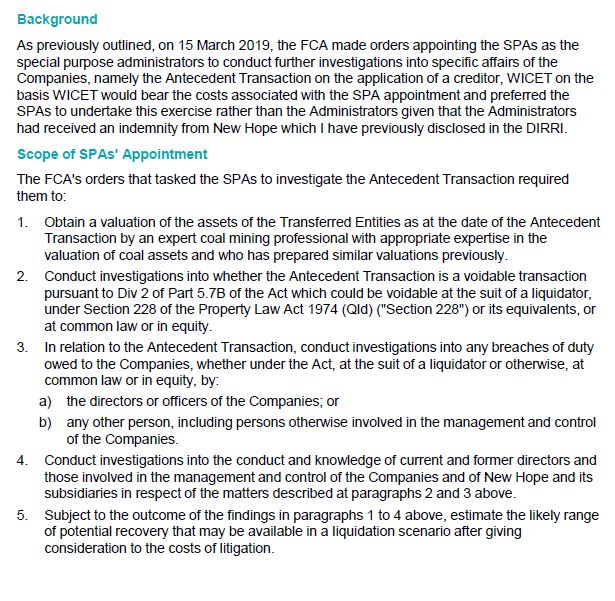
11 The Court appointed the special purpose administrators on 15 March 2019 to undertake investigations into the “antecedent transaction” and provide a report to the administrators by 28 June 2019. The scope of the investigations which the special purpose administrators were required to undertake was described in schedule A to the orders made on 15 March 2019 (approved work) as follows:
1. Obtain a valuation of the assets of the transferred entities as at the date of the antecedent transaction by an expert coal mining professional with appropriate expertise in the valuation of coal assets and who has prepared similar valuations previously.
2. Conduct investigations into whether any Antecedent Transaction is a voidable transaction pursuant to Div 2 of Part 5.7B of the Act which could be voidable at the suit of a liquidator, under section 228 of the Property Law Act 1974 (Qld) or its equivalents, or at common law or in equity.
3. In relation to any Antecedent Transaction, conduct investigations into any breaches of duty owed to the Companies, whether under the Act, at the suit of a liquidator or otherwise, at common law or in equity, by:
(a) the directors or officers of the Companies; or
(b) any other person, including persons otherwise involved in the management and control of the Companies.
4. Conduct investigations into the conduct and knowledge of current and former directors and those involved in the management and control of the Companies and of NHC and its subsidiaries in respect of the matters described at paragraphs 2 and 3 above.
5. Subject to the outcome of the findings in paragraphs 1 to 4 above, estimate the likely range of potential recovery that may be available in a liquidation scenario after giving consideration to the costs of litigation.
12 Since March 2019, the following has occurred:
(1) Following his retirement from Grant Thornton Australia, Mr McKinnon resigned as a voluntary administrator of NEC and Colton Coal on 15 June 2019 and 28 June 2019 respectively, leaving Mr Jahani as the sole administrator of the Companies.
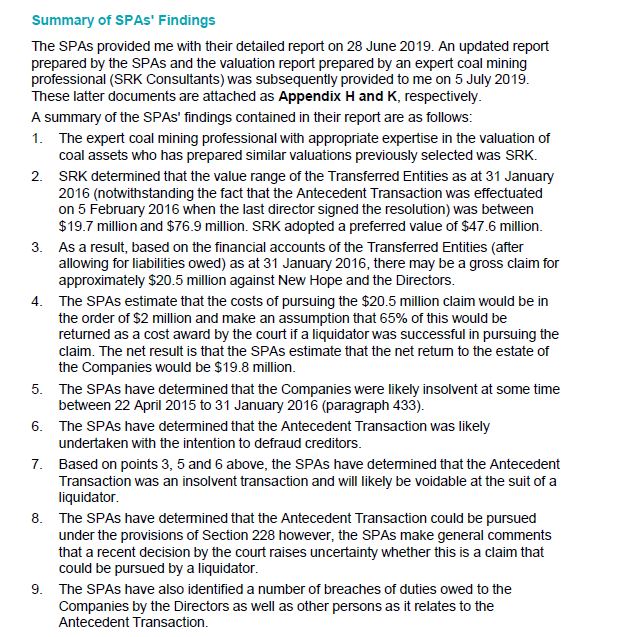
(2) The special purpose administrators provided their report (SPA report) to the administrators on 28 June 2019, and it was updated on 5 July 2019. The SPA report included a valuation of the assets of the transferred entities as at 31 January 2016, as was required by the orders made on 15 March 2019. The valuation was prepared by SRK Consulting (Australasia) Pty Ltd (SRK Consulting). In brief, the special purpose administrators found that as at 31 January 2016 there may have been a gross claim for $20.5 million against NHC and its directors, that the Companies were likely insolvent at some time between 22 April 2015 and 31 January 2016, that the antecedent transaction was likely undertaken with the intention to defraud creditors and was therefore likely voidable at the suit of a liquidator of the Companies and that there were likely breaches of directors duties owed to the Companies by directors as well as others related to the antecedent transaction.
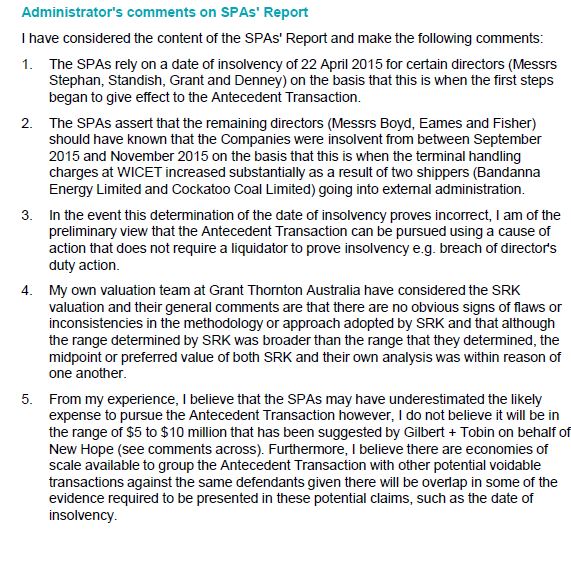
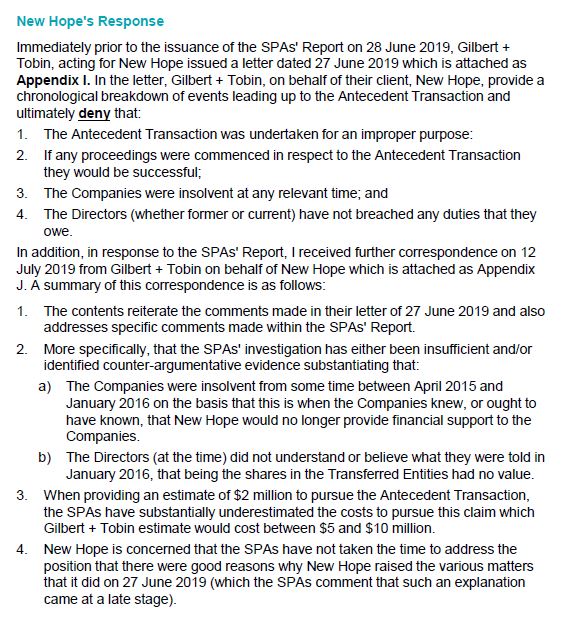
(Set out in the appendix to these reasons is the administrator’s summary of the findings in the SPA report, the administrator’s response to the findings and correspondence received from the solicitors for NHC in response the findings in the SPA report.)
(3) On 12 July 2019, Stevenson J delivered judgment in the DOCG Proceedings and found that, on a proper construction of the DOCG, NHC and entities listed in Part 1(2) of the DOCG (including Arkdale) did not guarantee the creditors of the entities listed in Part 1(3) of the DOCG (including the Companies) under the DOCG: see New Hope Corporations Ltd v Northern Energy Corporation Ltd (administrators appointed) [2019] NSWSC 879.
(4) Mr Jahani issued the administrator’s report dated 19 July 2019 to the Companies’ creditors and convened the second creditors’ meetings to be held at the offices of Grant Thornton Australia at Level 18, 145 Anne Street, Brisbane at 11.30 am on 26 July 2019. The administrator’s report, which annexes the entirety of the SPA report, was tendered and marked as exhibit 5.
13 Mr Jahani recommended that creditors vote in favour of the Companies being wound up. Among other things, the administrator’s report provided as follows:
(1) It was Mr Jahani’s preliminary belief that:
(a) The antecedent transaction may be a voidable transaction as against a liquidator of the Companies or constitute a breach of directors’ duties and, having regard to SRK Consulting’s valuation, the claim may be for $20.5 million after adjusting liabilities.
(b) The repayment of a debt owing from Colton to NHC in the amount of $27.6 million made up by $11.2 million in cash remitted on 11 December 2017 and $16.4 million in journal entries entered on 20 December 2017 (Loan Repayment) may have been in breach of directors’ duties.
(2) Mr Jahani summarised the terms of a deed of company arrangement proposed by NHC and dated 12 July 2019 (DOCA). The DOCA was subject to conditions precedent which, on 18 July 2019, WICET indicated that it would not accept. Those conditions included that WICET confirm in writing that it would not file any appeal in the DOCG Proceedings and that it take all necessary steps to terminate the Take or Pay Agreement dated 2011 between WICET and Colton Coal (as shipper) and NEC (as guarantor). Mr Jahani did not recommend that creditors vote in favour of the DOCA.
(3) In relation to the estimated return to creditors, Mr Jahani said:
Liquidation scenario
I estimate that between approximately 0 and 22 cents in the dollar may be returned to creditors in the event the Companies are wound up.
This significant range is in relation to the Antecedent Transactions and Loan Repayment claims which, if unsuccessful, will not avail any funds for creditors.
If pursuit of the Antecedent Transactions and Loan Repayment claims is successful, it is difficult to determine the time when a distribution will be made save for the comment that it would likely be in excess of 24 months (subject to the defence posed by New Hope and other related parties).
Proposed DOCA
Creditors should be aware that WICET will currently not agree to some of the condition precedents to the operation of the DOCA. As such there is a risk that, even if the DOCA is approved, it cannot be effectuated unless New Hope waive those conditions. At this stage they have not.
I estimate that approximately 9.43 cents in the dollar may be returned to creditors in the event the Companies proceed to DOCA/creditors' trust.
If creditors resolve to accept the terms of the proposed DOCA, recovery from the Antecedent Transaction and the Loan Repayment will not be able to be pursued. In addition, creditors would need to forego any right of appeal they may have otherwise had in the DOCG Proceeding.
I estimate that if creditors resolve to accept the terms of the DOCA, a dividend will likely be distributed to creditors within approximately 6 months.
Interlocutory application
14 With the second creditors’ meeting of the Companies having been convened for 11.30 am on 26 July 2019, at about 5.56 pm on 24 July 2019, the special purpose administrators lodged for filing an application seeking orders under ss 447A of the Corporations Act, ss 65-5(2) and 90-15(1) of the Insolvency Practice Schedule and s 37AF of the Federal Court of Australia Act 1976 (Cth). A supporting affidavit sworn by Mr Langdon on 24 July 2019 was also filed.
15 The special purpose administrators sought determination of their application on an urgent basis. Their solicitors communicated with chambers during the day, and the matter was set down for hearing at 11 am on 25 July 2019.
16 Written submissions were sent to chambers at 5.14 am on 25 July 2019. Those submissions indicated that the special purpose administrators had been required to act under a tight timetable, and it had been necessary to conduct public examinations and seek a significant volume of documents. They said that, as matters unfolded, the formalisation of the terms under which WICET would fund them and seeking necessary approval was only now being undertaken. More conventionally, those steps would have been taken before they completed their work. They had performed their tasks “on the assumption and expectation that the funding arrangements contemplated at the previous hearing would be entered into in due course”.
17 They said that the matter became “somewhat urgent” when, subsequent to the delivery of the SPA report to the administrator, the administrator had indicated that it would recommend that the Companies be wound up, rather than entering into a DOCA with NHC, having previously held the reverse view. They said that, while it was likely that the outcome of the second creditors’ meeting would be that it would be adjourned (to see whether any improved proposal could be procured), there was a risk that the Companies would go into liquidation. They were concerned to ensure that their application was determined before that occurred, so as to avoid uncertainty as to their standing to bring the application. They said that, having regard to the circumstances in which they were appointed, it was appropriate for them, rather than the administrator, to bring that application and they were best placed to negotiate the terms of the funding deed.
18 At the hearing on the morning of 25 July 2019, counsel for the administrator advised that the administrator had only been advised of the proceedings and given a copy of the proposed funding deed at around 5 pm on 24 July 2019 and accordingly, the administrator was not in a position to be an informed contradictor on the application. The application was stood over to 4 pm on the afternoon of 25 July 2019, at which time counsel for the administrator advised that he neither opposed nor supported the application.
19 None of the creditors, other than WICET, had been advised of the application. Senior counsel for the special purpose administrators sought to justify that on the basis that the application was urgent and applications for approval of funding agreements are usually made ex parte. Senior counsel relied on the fact that the special purpose administrators had recommended that action be taken against NHC and its related entities in relation to the antecedent transaction. It was submitted that it was not appropriate that NHC be given notice of the hearing of the interlocutory application; nor was it usually the case that the “target” of any funding agreement is given notice of the application to approve the entering into agreement. The special purpose administrators sought orders protecting the confidentiality of the proposed funding deed under s 37AF of the Federal Court of Australia Act for that reason. Senior counsel submitted that, in any event, the proposed orders allowed for liberty to be given to any person who could demonstrate sufficient interest (including ASIC) to seek to vary any orders made.
20 That argument was unconvincing in circumstances where NHC already knew the outcome of the special purpose administrators’ investigations as the administrator had already published the SPA report as an appendix to his own report. Further, there was no proposal that the special purpose administrators be funded to conduct any litigation arising out of any possible actions against NHC and its related entities. The scope of the role of the special purpose administrators had been deliberately limited in the orders made on 15 March 2019 to procuring a valuation of the assets of the transferred entities and conducting an investigation within the scope of the approved work. Orders are most commonly made under s 37AF of the Federal Court of Australia Act in relation to funding agreements in order to prevent prejudice to the administration of justice by giving a respondent to actions undertaken by a liquidator an unfair advantage by allowing them to know the exact extent of the funding and the terms on which it might be called (colloquially termed “war chest” or “cash box” information). Although senior counsel for the special purpose administrators sought to draw a parallel, the Court was unconvinced. As NHC was both a substantial secured creditor of the Companies and their ultimate holding company, it was appropriate that it be given an opportunity to be heard on the application, the urgency for which arose out of the failure of the special purpose administrators and WICET to act earlier.
21 In any event, that issue (and the application for orders under s 37AF of the Federal Court of Australia Act that the funding deed not be published or disclosed) was rendered moot, since an employee of Gilbert + Tobin, solicitors to NHC in these proceedings, attended the hearing on the morning of 25 July 2019 and heard discussion in open Court that the proposed funding was more than double the $500,000 discussed at the hearing in March 2019. Accordingly, the application for an order under s 37AF was not pressed.
22 Ultimately, the matter was stood over until the afternoon of 25 July 2019 and then to 9 am on 26 July 2019, NHC’s solicitors were provided with a copy of the proposed funding deed and NHC was represented by counsel at those hearings. WICET’s solicitor advised that Gladstone Ports Corporation and Aurizon Network Pty Ltd, two companies which had made claims to be creditors of the Companies in the amounts of $3,305,035 and $5,950,689 respectively (see March Reasons at [10]), had been made aware of the proceedings and had communicated to him that they had no objection to the orders sought being made.
Proposed orders
23 The special purpose administrators sought the following orders.
Directions and orders to allow entry into the funding deed
24 The special purpose administrators sought advice and directions that they are justified, and would otherwise be acting reasonably, if they entered into a funding deed with WICET and orders under s 447A of the Corporations Act and s 90-15(1) of the Insolvency Practice Schedule permitting them to do so. The special purpose administrators submitted that analogous principles should be applied to those applied in applications under s 477(2B) where liquidators seek approval of arrangements for litigation funding: see Robinson, in the matter of Reed Constructions Australia Pty Ltd (in liq) [2017] FCA 594 per Gleeson J at [31]-[39], adopted in Erskine, in the matter of North Shore Property Developments Pty Ltd (in liq) [2019] FCA 476 per Farrell J. That proposition was not contradicted by counsel for the administrators or NHC.
25 There were several issues to be addressed in this context.
26 First, the “Agreed Sum” set out in the funding deed was more than double the $500,000 discussed at the last court hearing as the amount which WICET would provide by way of funding. In addition, the special purpose administrators would be able to call upon WICET to pay:
(1) Adverse Costs Orders made after the date the proposed funding deed is signed; and
(2) “Examination Costs” incurred by the special purpose administrators in commencing and conducting public examinations as part of the work required under the Court’s orders. These costs were to be regarded as separate from remuneration and expenses included in the “Agreed Sum”.
27 There was no indication in the written submissions about why the amount of the “Agreed Sum” has more than doubled (that fact was not addressed at all), nor was there any break-down of the proposed Agreed Sum. In response to a query from the Court on the morning of 25 July 2019, at the hearing, senior counsel for the special purpose administrators tendered a summary of the special purpose administrators actual and expected costs, expenses and remuneration as at 30 June 2019; it was marked as MFI-1.
28 Senior counsel submitted that, far from NHC and its subsidiaries cooperating with the special purpose administrators, they were required to undertake public examinations and seek the production of documents in order to conduct their investigations. Senior counsel took the Court to the pages of the SPA’s report dealing with those issues and described NHC’s approach to the investigation as being “very adversarial” and said that it led to costs, expenses and remuneration which had not been anticipated. This characterisation was disputed by NHC’s solicitor and counsel when they appeared at the hearing. Due to the closeness of the second creditors’ meeting and the limited opportunity that NHC had to respond to the characterisation of NHC’s approach, it would be inappropriate for the Court to characterise the approach which it took to the provision of information to the special purpose administrators. Indeed, it is unnecessary to do so. Having regard to the material in the SPA report to which the Court’s attention was drawn, it is plain that that work was within the scope of the approved work and, as events transpired, it was more extensive than had been anticipated at the time the special purpose administrators were appointed.
29 Second, was the definition of “Recoverable Amount”. Remembering that the loans made by WICET were to be non-interest bearing and to be repaid only from recoveries in actions related to the antecedent transaction, the proposed funding deed provided that the definition of “Recoverable Amount” was to be:
Recoverable Amount is the sum of:
(a) any monies recovered by the Administrator, the Deed Administrator, the Liquidator or the Companies by way of judgment or settlement of any claims in respect of the Antecedent Transactions; and/or
(b) any increase in the total consideration payable under any deed of company arrangement entered into by the Companies from the consideration previously offered in the deed proposal of New Hope made 24 January 2019.
30 WICET submitted that paragraph (b) of this definition reflected the difficulty in establishing that any uplift in the amount which NHC might propose to pay under a new deed of company arrangement resulted from the special purpose administrators’ identification of claims which the Companies might have as a result of the antecedent transaction where the proceedings have not yet been commenced. They relied on a letter dated 5 March 2019 from WICET to KordaMentha in connection with the proposal to appoint special purpose administrators who would be funded by WICET. That letter was annexure WTL-4 to the affidavit of Wen-Ts’ai Lim sworn on 6 March 2019 which was read at the hearing in March 2019. It relevantly provided as follows:
The entitlement of WICET to repayment set out in paragraphs 3 and 4 should be understood to be limited to payment from any recoveries realised as a result of:
(i) the carrying out of the Approved Work by KordaMentha (noting that the scope of the Approved Work will depend on whether Messrs Langdon and Hutson are appointed as Special Purpose Administrators or Liquidators); or
(ii) judgment or settlement of any claims made or asserted in respect of the prior transfer of shares in Elimatta Pastoral Pty Ltd, Yamala Coal Pty Ltd and Taroom Coal Pty Ltd, including by way of a Deed of Company Arrangement or otherwise.
31 Ultimately, WICET accepted that it would bear the onus of demonstrating that any uplift (or the extent of any uplift) in any deed of company arrangement proposed by NHC might be characterised as in the nature of settlement of claims related to the antecedent transaction resulting from the special purpose administrators’ investigation, consistently with the tenor of the 6 March 2019 letter and that the definition of “Recoverable Amount” should be amended as follows:
Recoverable Amount is the sum of all monies recovered by the Companies or an external administrator of the Companies in respect of the claims arising out of the Antecedent Transactions whether such recoveries are payable as a consequence of a judgement, settlement or a deed of company arrangement.
WICET also agreed that the correlative provision, being clause 2.4(a), should be amended to read as follows:
2.4 Limited recourse loan
(a) Any amount paid by WICET pursuant to this Deed is to be treated as an interest free loan to the Companies, which loan is only repayable in the event and to the extent of the Recoverable Amount.
32 Third, NHC sought to include in clause 2.2(b) of the proposed funding deed a mechanism by which it could challenge payment requests by the special purpose administrators before they were paid by WICET. NHC proposed that a payment request should only be payable seven days after creditors had been given a copy of it. That would allow NHC time to seek to injunct a payment if it disputed that it should be paid.
33 NHC was also concerned to ensure that there was no “doubling up” of legal costs. The basis of this concern was that the special purpose administrators originally engaged Ashurst, which was also WICET’s solicitors in this matter, to act in relation to their investigation into the antecedent transaction. However, having regard to objections raised by NHC, the special purpose administrators engaged ERA Legal in substitution for Ashurst. Mr Greenberg of Ashurst advised the Court that the special purpose administrators were not responsible for Ashurst’s fees and none were included in MFI-1.
34 In order to seek to assuage NHC’s concerns, a copy of MFI-1 was provided to NHC. Counsel for NHC indicated that its concern was not about the amount claimed for SRK Consulting’s valuation or the amount of counsel’s actual invoices and anticipated costs for this application and a remuneration approval application, but rather with establishing the appropriateness of the remuneration claimed by the special purpose administrators and the costs of their solicitors, ERA Legal. Counsel for NHC submitted that it still had concerns about amounts that might have been charged in the handover from Ashurst to ERA Legal.
35 The special purpose administrators did not seek the Court’s approval to the payment of its remuneration: they sought an order under s 90-15(1) of the Insolvency Practice Schedule that any administrator(s), deed administrators or liquidator put to the creditors of the Companies a resolution approving their remuneration. Ultimately, this order was not pressed because the special purpose administrators were satisfied that under the “ARITA Code” issued by the Australian Restructuring Insolvency & Turnaround Association, any external administrator of the Companies would be required to seek creditors’ approval to the special purpose administrators’ remuneration. As the special purpose administrators’ remuneration would be subject to approval of the creditors before it was paid by WICET, NHC’s concern on this count was satisfied.
36 That left the issue of the costs and disbursements charged by the solicitors for the special purpose administrators. At the end of the hearing on 25 July 2019, it was agreed by the special purpose administrations and NHC that invoices would be provided to NHC’s solicitors by 8.30 pm that night on the basis that they made an undertaking to the Court not to provide them to NHC and the special purpose administrators did not waive client legal privilege in them. That undertaking was given.
37 However, during that evening, the special purpose administrators formed the view that the content of ERA Legal’s work-in-progress ledger (which was all that was available as invoices had not yet been issued) should not be given to NHC’s solicitors; that ledger contained material which was subject to client legal privilege which had not been redacted and the ledger would not normally be provided to the special purpose administrators as a client.
38 The special purpose administrators determined to take the position that they were not prepared to provide invoices from ERA Legal to NHC’s solicitors nor were they prepared to enter into a funding deed with the amendment sought by NHC.
39 Senior counsel for the special purpose administrators submitted that, dealing only with the issue of ERA Legal’s costs and expenses:
(1) If ERA Legal submit invoices for about $250,000 plus GST (as envisaged), the special purpose administrators are subject to the same duties as a liquidator to ensure that ERA Legal are charging an appropriate rate (which is what the Court takes senior counsel to have meant by the “best rate”) and that work has been properly charged before they pay the bill. If they did not discharge that duty, they will be liable for breach of duty. To the extent that the special purpose administrators use money provided by WICET to pay the bill, the Companies (through the administrator or any liquidator) will still be entitled to have the bills assessed as a third party payer under the Legal Profession Uniform Law and to have any excess refunded to it.
(2) Judicial advice that it is reasonable for the special purpose administrators to enter into the proposed funding deed does not absolve them from the obligation to scrutinise and ensure that invoices rendered by ERA Legal are properly chargeable.
(3) Further, given the estimated amount of ERA Legal’s fees as set out in MFI-1 and the extent of the work done, which can be inferred from the SPA report which discusses the public examinations undertaken and the document production obtained, it is unlikely that ERA Legal’s fees would be found to be excessive either at all or to any great extent. To the extent that there might be credit risk that any excess would not be paid to the Companies should it be found to be payable, that risk is negligible given the stature of KordaMentha and ERA Legal.
(4) The special purpose administrators have incurred expense in carrying out the approved work on the basis that they would be funded by WICET. There is no reason why they should be put out of pocket by the mechanism proposed by NHC, which might involve long delays while any dispute is resolved in circumstances where ERA Legal and others would expect to be paid on their usual terms. It is not fair that the special purpose administrators be put out of pocket and they are not prepared to enter into a funding deed on the basis that they would be put in that jeopardy.
(5) NHC contends that there is no basis on which any recovery action in relation to the antecedent transaction might be successful. If they are right, then it will be WICET and not the Companies which incur expense. WICET is only entitled to repayment of the non-interest bearing loan arising from the payment of the special purpose administrators’ costs and expenses out of recoveries made in relation to the antecedent transaction. Absolutely no issue can arise about the fairness or otherwise of ERA Legal’s invoices until successful recovery action has been undertaken.
(6) If a funding deed is not agreed, then there would be a perverse outcome, quite contrary to what was intended when orders were made appointing the special purpose administrators. What will happen is that when WICET in fact pays the special purpose administrators’ costs expenses and approved remuneration for the approved work, it will become subrogated to their claims on the assets of the Companies, whether or not NHC or its related entities are successfully sued in relation to the antecedent transaction.
40 Counsel for NHC could not say that the amount set out in MFI-1 as the expected costs of ERA Legal are unreasonable or likely to be unreasonable, but NHC still sought the assurance which would have been provided by the course agreed by NHC and the special purpose administrators on 25 July 2019. However counsel submitted that, unless that course or the amendments which they propose to clause 2.2 of the proposed funding deed are made, the Court should not give directions that the special purpose administrators would be justified, and act reasonably, by entering into it. It would have the effect of crystallising a contingent liability of the Companies without creditors having an opportunity to test the reasonableness of those expenses. If the special purpose administrators will not agree to adopt the proposed amendments, the Court should make orders that the information be provided to NHC.
41 The Court was satisfied that it was appropriate to give directions pursuant to s 90-15 of the Insolvency Practice Schedule and to make the related orders under s 90-15 and s 447A of the Corporations Act in the form sought by the special purpose administrators in circumstances where:
(1) The question of whether to approve the special purpose administrators’ remuneration will be put to a resolution of the creditors and does not fall for determination by the Court.
(2) The approved work is complete so that the general quantum of the costs and charges are known. NHC does not contend that the fees payable to SRK Consulting or counsel as set out in MFI-1 are unreasonable. NHC does not contend that the fees and disbursements payable to ERA Legal, as set out MFI-1 are, or are unlikely to be, unreasonable.
(3) There is no reason to believe that the special purpose administrators would not observe their obligations to ensure that any fees or charges payable to ERA Legal, counsel or any expert were properly and reasonably incurred.
(4) The special purpose administrators propose a funding deed in the form of a document tendered and marked Exhibit A1 and will not enter into a funding deed with the amendments proposed by NHC.
(5) At the time the special purpose administrators were appointed, it was envisaged that their costs, remuneration and expenses should be paid by WICET on the basis that that would be a loan to the Companies which did not bear interest and would only be repayable out of recoveries from actions against NHC or its related entities (including directors of those entities) in relation to the antecedent transaction. The proposed funding deed in the form of Exhibit A1 fulfils that objective.
(6) The Court accepts the special purpose administrators’ submission that it would not be in the interest of the Companies’ creditors if the assets of the Companies were exposed to the obligation to pay the remuneration, costs and expenses of the special purpose administrators at a time earlier than when a “Recovery Amount” has been obtained by the Companies or to an extent greater than that amount. The Court is not persuaded that any benefit which creditors (including NHC) might obtain from accessing invoices for such costs and expenses is sufficient to outweigh the deferral of any obligation to repay WICET until recoveries have been made in actions concerning the antecedent transaction, as provided for under a funding deed in the form of Exhibit A1.
(7) The fact that the amount required to enable the special purpose administrators to perform the approved work within the timeframe proposed was more than double the estimated $500,000 anticipated at the time they were appointed does not alter that view.
(8) As advised by counsel for the administrator, the administrator did not either oppose or support the application.
42 The Court was not persuaded that it would be appropriate to order the special purpose administrators to provide access to invoices as proposed by NHC. The Court was not persuaded that such an order would have any material utility and the special purpose administrators were not prepared to waive any client legal privilege in them.
Orders affecting compliance with s 65-5(1)
43 The special purpose administrators sought an order permitting amounts payable to the special purpose administrators under the proposed funding deed to be paid by WICET to them directly, rather than through an external account opened up on behalf of the Companies and then to them, as would be required by s 65-5(1) of the Insolvency Practice Schedule. This was said to be in the interest of “practicality and expediency”.
44 The Court was not persuaded that such orders should be made unless the order was subject to conditions which allowed any external administrator of the Companies to track payments made to the special purpose administrators, and therefore to know with certainty the amount of any liability incurred to WICET under the proposed funding deed.
45 The application for this order was not pressed.
Order under s 37AF of the Federal Court of Australia Act
46 For reasons previously given at [20]-[21] above, the application for this order was not pressed.
Orders altering the operation of s 443D of the Corporations Act
47 This order would limit the liability of the special purpose administrators to the extent of their indemnity against the assets of the Companies. This relief was sought even though clause 2.4 of the proposed funding deed contains acknowledgments that the special purpose administrators:
(1) Caused the Companies to execute the proposed funding deed solely in their capacity as special purpose administrators and agents of the Companies and not (except for express provisions) in their personal capacity;
(2) Have not, by executing the proposed funding deed, adopted any of the Companies’ rights, liabilities or interests;
(3) Debts incurred under the proposed funding deed are incurred by them properly in the performance of their functions and powers and they are the subject of a right of indemnity referred to in s 443D of the Corporations Act for the purposes of ss 443E and 443F of the Corporations Act; and
(4) Notwithstanding the previous paragraph, to the maximum extent permitted by law, they are not liable to pay or satisfy any of the Companies’ obligations under the proposed funding deed and have no liability to WICET except to the extent of their right of indemnity out of the assets of the Companies, and if those assets are insufficient, WICET cannot and must not seek to recover any shortfall from them.
48 This order was not opposed. The special purpose administrators submitted that this was an uncontroversial proposition in light of the decision of Gilmour J in Mentha, in the matter of Griffin Coal Mining Company Pty Ltd (administrators appointed) [2010] FCA 1469; 82 ACSR 142 at [30] and that it was appropriate given that they were appointed by the Court and should not face personal liability by reason of that appointment.
49 In Mentha, in the matter of Griffin Coal Mining Company Pty Ltd (administrators appointed), Gilmour J relevantly summarised the law at [23] –[34] as follows:
23 Section 443A of the Corporations Act relevantly provides:
The administrator of a company under administration is liable for debts he or she incurs, in the performance or exercise, or purported performance or exercise, of any of his or her functions and powers as administrator, for:
(a) services rendered; or
(b) goods bought; or
(c) property hired, leased, used or occupied; or
(d) the repayment of money borrowed; or
(e) interest in respect of money borrowed; or
(f) borrowing costs.
24 Section 443D of the Corporations Act provides the administrators with a statutory indemnity out of the property of the company for, amongst other things, any other debts or liabilities incurred by the administrators in the performance of their functions or powers as administrators.
25 Section 447D(1) of the Corporations Act enables administrators to seek directions about matters arising in connection with the performance or exercise of any of the administrator's functions and powers.
26 Section 447A(1) of the Corporations Act provides that the Court may make such orders as it thinks appropriate about how Part 5.3A is to operate in relation to a particular company.
27 The Court has broad powers under s 447A(1), and has widely used this power in a variety of contexts.
28 It is well established that the Court has power under s 447A of the Corporations Act to order an indemnity where the indemnity available to the administrator under s 443D is insufficient or in doubt, in order to satisfy the debts for which the administrator is personally liable pursuant to s 443A: Mentha, Re Spyglass Management Group Pty Ltd (2004) 51 ACSR 432.
29 It is also well established that the Court has power under s 447A of the Corporations Act to make orders to limit the administrators' personal liability under s 443: Hayes Re Estate Property Group Ltd (Admins Apptd) [2007] FCA 1393; Re Malanos [2007] NSWSC 865; Re View Gold Pty Ltd, View Resources Ltd & View Nickel Pty Ltd; Ex Parte Saker [2008] WASC 241; Re Great Southern Infrastructure Pty Ltd; Ex parte Jones [2009] WASC 161; Carter, Re SFM Australasia Pty Ltd (admin apptd) [2009] FCA 360; and Vision (Brisbane) Pty Ltd (Admins Apptd) [2010] FCA 186.
30 The principles governing the granting of an application for orders under s 447A to vary the liability of administrators under s 443A can be summarised as follows:
(a) the proposed arrangements are in the interests of the company's creditors and consistent with the objectives of Part 5.3A of the Corporations Act: Re Great Southern at [13].
(b) typically the arrangements proposed are to enable the company's business to continue to trade for the benefit of the company's creditors: Re Malanos at [9] and Re View at [17].
(c) the creditors of the company are not prejudiced or disadvantaged by the types of orders sought and stand to benefit from the administrators entering into the arrangement: Re View at [18], and also Re Application of Fincorp Group Holdings Pty Ltd [2007] NSWSC 628 at [17].
(d) notice has been given to those who may be affected by the order: Re Great Southern at [12].
31 Most of the cases where the courts have exercised its power under s 447A to vary the administrator's personal liability under s 443A have involved administrators borrowing funds during the period of the administration. The orders typically sought have the effect of limiting recourse of the counterparty to the administrator personally to the extent to which he or she is able to be indemnified from the assets of the company.
32 However, Re Cook Cove Pty Ltd (Admins Appt) [2009] NSWSC 620 was a case which involved the administrators entering into various post appointment construction related contracts. In that case, orders were made to limit the administrators' potentially significant personal liability under the post appointment contracts to the extent that they were able to be satisfied out of the property of the company.
33 In Re Cook at [40], Austin J considered the practical utility of the administrators' statutory indemnity as being a crucial factor in favour of granting the orders sought.
34 Austin J in Re Cook at [37] also made the following comments:
One can envisage cases in which it would not be appropriate to make an order limiting the normal liability of an administrator under Pt 5.3A for post-appointment debts: for example, where the administrator proposes to enter into many business transactions in the course of carrying on the company’s business, contracting with suppliers and service providers for relatively small amounts in circumstances where those with whom the administrator contracts would not be aware of the court’s order and would be entitled to assume that the normal liability provisions of Pt 5.3A were applicable. But the decided cases are of a different kind.
50 It appears that the application in this case has been made for greater caution, given the width of the terms of clause 2.4(b) of the proposed funding deed. However, the Court is satisfied that entry into the proposed funding deed in the form of Exhibit A1 is for the benefit of the creditors of the Companies, since WICET will fund their costs, expenses and remuneration on an interest free and non-recourse basis and it will not be able to claim repayment unless Recovery Amounts are received and only to that extent. The special purpose administrators are Court appointed and the Court is satisfied, having regard to the above principles enunciated by Gilmour J set out above, it is appropriate to make the order sought. All substantial creditors have received notice of this application.
Order directing that a resolution be put to creditors approving the special purpose administrators’ remuneration
51 As noted previously at paragraph [35] above, this order was not pressed.
Order that the special purpose administrators’ costs and expenses incidental to the application be costs in the administration of the Companies
52 The proposed funding deed provides for these costs to be included in the definition of “Legal Costs” which WICET will be obliged to fund. Nonetheless, the Court accepted that it was appropriate to make the order so that the basis of the right to recover that amount out of the assets of the Companies is established given that a payment out of the Companies’ assets would made when WICET is repaid out of a Recovery Amount. In light of the arrangements under the proposed funding deed, it was appropriate to amend the proposed order to include a notation that recognised that fact.
Order that any person, including any creditor of the Companies or ASIC, who can demonstrate sufficient interest, be granted liberty to vary the orders on 24 hours’ notice to the special purpose administrators and the Court
53 This is a usual order, and it should be made in this case having regard to the fact that not all creditors were notified of the application, even though the substantial creditors were all made aware of it during 25 July 2019.
I certify that the preceding fifty-three (53) numbered paragraphs are a true copy of the Reasons for Judgment herein of the Honourable Justice Farrell. |
Associate: