

FEDERAL COURT OF AUSTRALIA
Brooking on behalf of the Bunuba People (Bunuba #2 Part B)) v State of Western Australia [2019] FCA 1136
ORDERS
GEORGE BROOKING AND OTHERS ON BEHALF OF THE BUNUBA PEOPLE (BUNUBA #2 (Part B)) Applicant | ||
AND: | STATE OF WESTERN AUSTRALIA AND OTHERS Respondent | |
DATE OF ORDER: |
THE COURT NOTES THAT:
A. Pursuant to s 87(1) of the Native Title Act 1993 (Cth) the parties have filed a Minute of Consent Determination which reflects the terms of an agreement reached by the parties in relation to these proceedings.
B. The terms of the agreement involve the making of a determination of native title in relation to the area of land and waters the subject of these proceedings pursuant to ss 87(2) and 94A of the Native Title Act.
C. Each of:
(a) Callum Hugh MacLachlan of Blina Station; and
(b) Jubilee Downs Pastoral Co Pty Ltd of Quanbun Downs Station;
has agreed to the terms of the proposed determination on the basis of having reached agreement with the Applicant in relation to those portions of their respective pastoral leases that are situated within the proposed determination area. Following the making of the proposed determination, it is intended that that agreement will be executed and an application will be made for the agreement to be registered as an Indigenous Land Use Agreement on the Register of Indigenous Land Use Agreements as a prescribed body corporate agreement pursuant to s 24BG of the Native Title Act.
D. The persons who are the Applicant have indicated that they intend to have the native title rights and interests held in trust and have nominated the Bunuba Dawangarri Aboriginal Corporation RNTBC as the prescribed body corporate to be the trustee of the native title rights and interests.
E. The Bunuba Dawangarri Aboriginal Corporation RNTBC has consented in writing to hold the rights and interests comprising the native title in trust for the native title holders.
BEING SATISFIED that a determination in the terms sought by the parties is within the power of the Court, and it appearing to the Court appropriate to do so, pursuant to s 87 of the Native Title Act and by the consent of the parties:
THE COURT ORDERS THAT:
1. There be a determination of native title in the terms of the Determination as provided for in Attachment “A”.
2. The Bunuba Dawangarri Aboriginal Corporation RNTBC shall hold the determined native title in trust for the native title holders pursuant to section 56(2)(b) of the Native Title Act 1993 (Cth).
3. There be no order as to costs.
Note: Entry of orders is dealt with in Rule 39.32 of the Federal Court Rules 2011.
ATTACHMENT “A”
DETERMINATION
THE COURT ORDERS, DECLARES AND DETERMINES THAT:
Existence of native title (s 225)
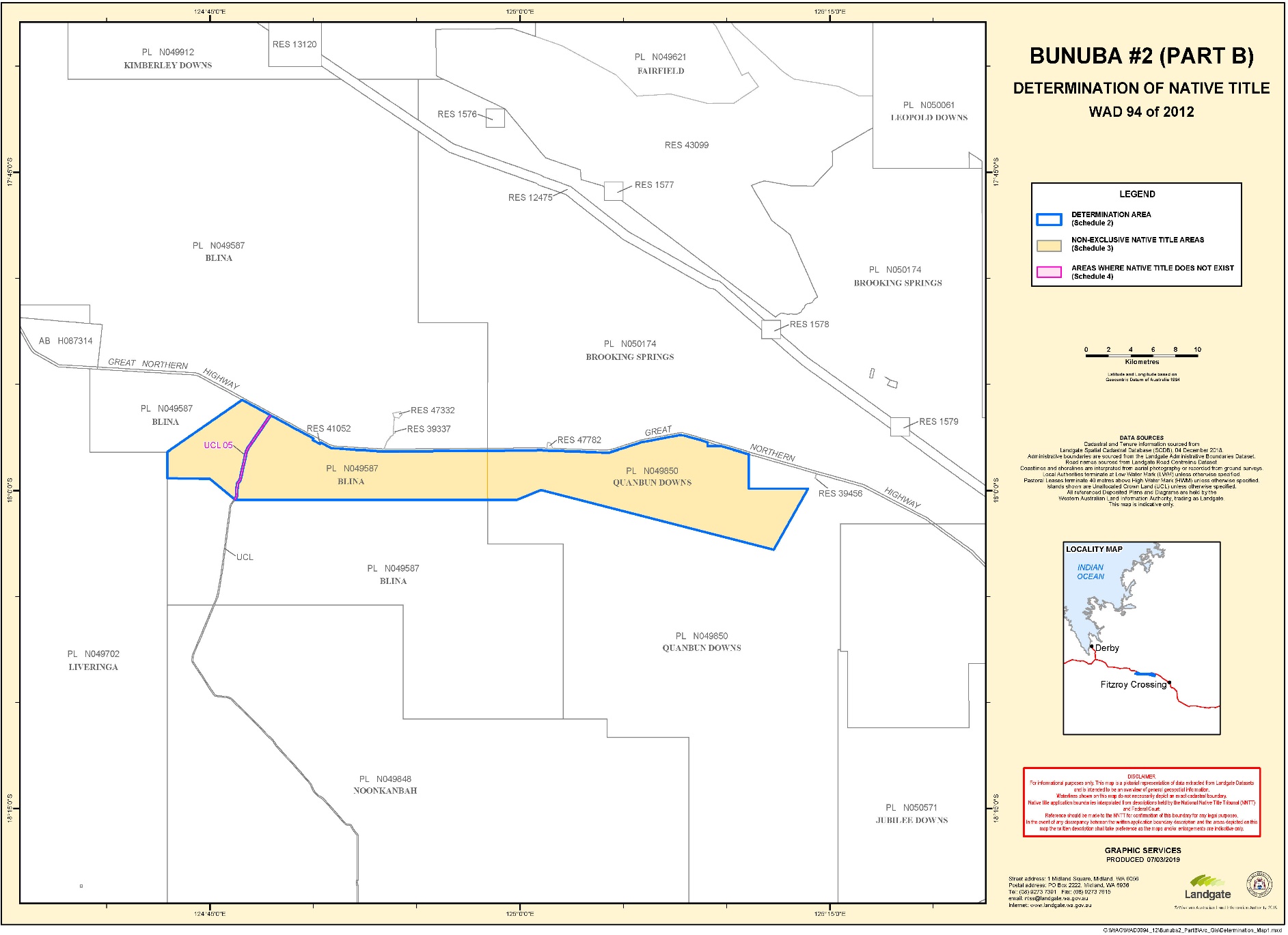
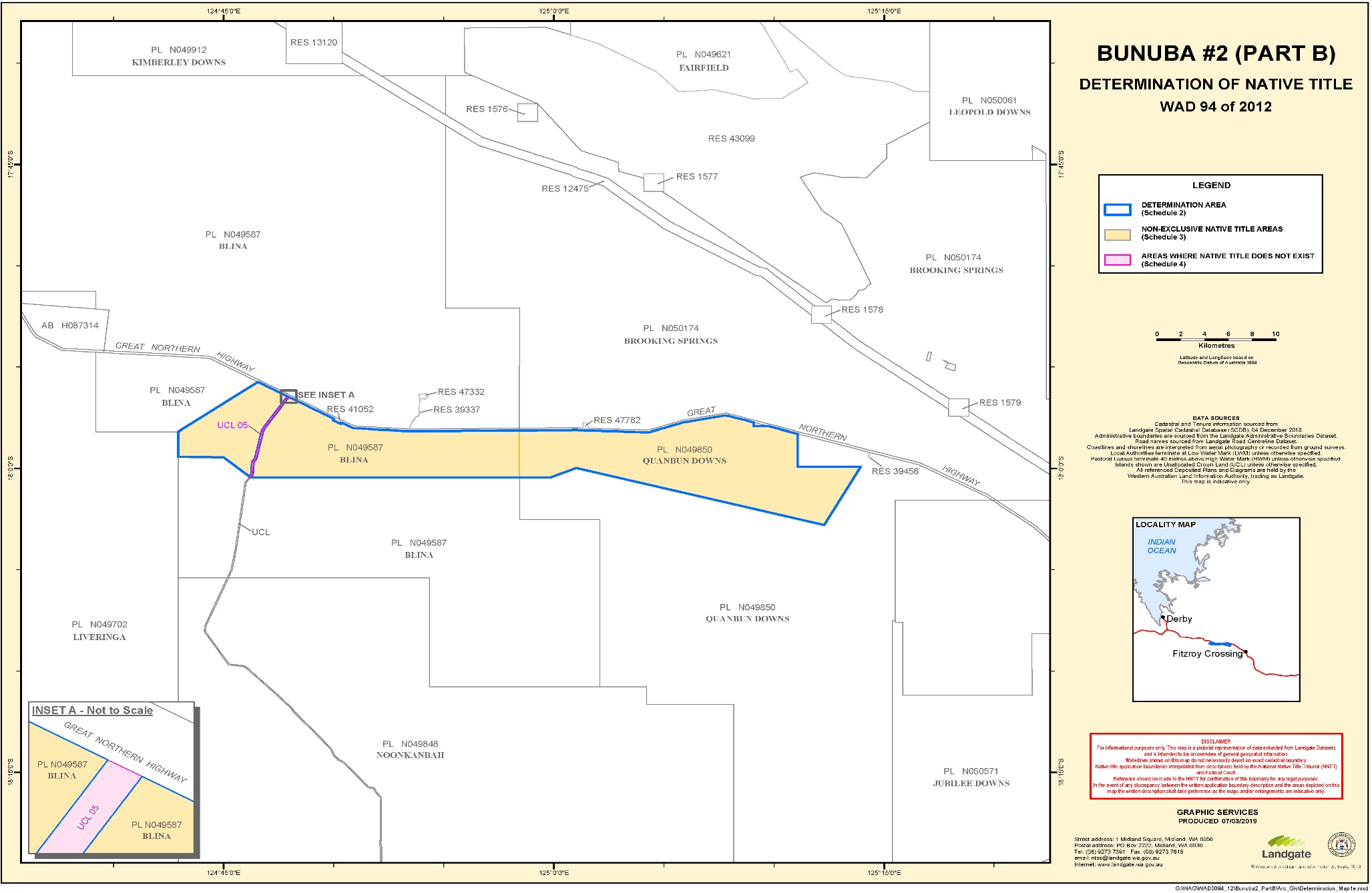
1. The Determination Area is the land and waters described in Schedule 1 and depicted on the maps comprising Schedule 2.
2. Native title exists in those parts of the Determination Area identified in Schedule 3 (Native Title Area).
3. Native title does not exist in those parts of the Determination Area identified in Schedule 4.
Native title holders (s 225(a))
4. The native title in the Determination Area is held by the Bunuba People. The Bunuba People are the people referred to in Schedule 5.
The nature and extent of native title rights and interests (s 225(b)) and exclusiveness of native title (s 225(e))
Non-exclusive rights and interests
5. Subject to paragraphs 6, 7 and 8, the nature and extent of the native title rights and interests in relation to each part of the Determination Area referred to in Schedule 3 (being areas where there has been a partial extinguishment of native title and where any extinguishment is not required to be disregarded) are that they confer the following non-exclusive rights on the Native Title Holders, including the right to conduct activities necessary to give effect to them:
(a) the right to access and move freely through and within each part of the Determination Area referred to in Schedule 3;
(b) the right to live, being to enter and remain on, camp and erect shelters and other structures for those purposes on the Determination Area referred to in Schedule 3;
(c) the right to:
(i) hunt, gather and fish for personal, domestic, cultural and non-commercial communal purposes;
(ii) take and use flora and fauna for personal, domestic, cultural and non-commercial communal purposes;
(iii) take, use, share and exchange the natural resources of each part of the Determination Area referred to in Schedule 3 including soil, sand, clay, gravel, ochre, timber, charcoal, resin and stone for personal, domestic, cultural and non-commercial communal purposes;
(iv) light fires for domestic purposes but not for the clearance of vegetation;
(v) engage in cultural activities in the area, including the transmission of cultural heritage knowledge;
(vi) conduct and participate in ceremonies;
(vii) conduct burials and burial rites and other ceremonies in relation to death;
(viii) hold meetings;
(ix) visit, maintain and protect from physical harm, areas, places and sites of importance in each part of the Determination Area referred to in Schedule 3; and
(x) access, take, use, share and exchange water for personal, domestic, cultural or non-commercial communal purposes.
6. The native title rights and interests referred to in paragraph 5 do not confer:
(a) possession, occupation, use and enjoyment of those parts of the Determination Area on the Native Title Holders to the exclusion of all others, nor
(b) a right to control the access of others to the land or waters of those parts of the Determination Area.
7. Notwithstanding anything in this Determination there are no native title rights and interests in the Determination Area in or in relation to
(a) minerals as defined in the Mining Act 1904 (WA) (repealed) and the Mining Act 1978 (WA);
(b) petroleum as defined in the Petroleum Act 1936 (WA) (repealed) and the Petroleum and Geothermal Energy Resources Act 1967 (WA);
(c) geothermal energy resources and geothermal energy as defined in the Petroleum and Geothermal Energy Resources Act 1967 (WA); or
(d) water lawfully captured by the holders of other rights and interests;
except the right to take and use ochre to the extent that ochre is not a mineral pursuant to the Mining Act 1904.
8. Native title rights and interests are subject to and exercisable in accordance with:
(a) the laws of the State and the Commonwealth, including the common law; and
(b) the traditional laws and customs of the Native Title Holders for personal, domestic, cultural and non-commercial communal purposes (including social, religious, spiritual and ceremonial purposes).
The nature and extent of any other interests
9. The nature and extent of other rights and interests in relation to the Determination Area are those set out in Schedule 6.
Relationship between native title rights and other interests
10. The relationship between the native title rights and interests described in paragraph 5 and the other interests referred to in paragraph 9 (“the other rights and interests”) is that:
(a) to the extent that any of the other rights and interests are inconsistent with the continued existence, enjoyment or exercise of the native title rights and interests, the native title rights and interests continue to exist in their entirety, but the native title rights and interests have no effect in relation to the other rights and interests to the extent of the inconsistency during the currency of the other rights and interests; and otherwise,
(b) the existence and exercise of the native title rights and interests do not prevent the doing of any activity required or permitted to be done by or under the other rights and interests, and the other rights and interests, and the doing of any activity required or permitted to be done by or under the other rights and interests, prevail over the native title rights and interests and any exercise of the native title rights and interests, but, subject to the operation of s 24JB(2) of the Native Title Act, do not extinguish them.
Liberty to Apply
11. The parties have liberty to apply to establish the precise location and boundaries of the public works and adjacent land and waters identified in relation to any part or parts of the Determination Area referred to in Part 2 of Schedule 4 of this Determination;
Definitions and interpretation
12. In this Determination, unless the contrary intention appears:
“Determination Area” means the land and waters described in Schedule 1 and depicted on the maps at Schedule 2;
“flowing water” means the following water within the Determination Area:
(a) water which flows, whether permanently, intermittently or occasionally, within any river, creek, stream or brook; and
(b) any natural collection of water into, through, or out of which a river, creek, stream or brook flows;
“land” includes the airspace over, or subsoil under, land, but does not include “waters” and, for the avoidance of doubt, includes any natural collection of water found on the land which does not fall within the definition of “waters”;
“Native Title Act” means the Native Title Act 1993 (Cth);
“non-commercial communal” includes social, cultural, religious, spiritual and ceremonial purposes;
“underground water” means water from and including an underground water source, including water that percolates from the ground;
“waters” has the same meaning as in the Native Title Act; and includes flowing and underground water.
In the event of any inconsistency between the written description of an area in Schedule 1 or Schedules 3 to 4 and the area as depicted on the maps at Schedule 2, the written description prevails.
SCHEDULE 1
DETERMINATION AREA
The Determination Area, generally shown as bordered in blue on the maps at Schedule 2, comprises all that land and waters bounded by the following description:
All those lands and waters commencing at the northwesternmost corner of the eastern severance of Native Title Determination WAD25/2012 Yi-Martuwarra Ngurrara Part A (WCD2018/001); Then extending generally westerly passing through the following coordinate positions:
LATITUDE (SOUTH) | LONGITUDE (EAST) |
17.999651 | 125.016909 |
18.007270 | 124.997543 |
18.007270 | 124.973973 |
18.007270 | 124.770227 |
17.990761 | 124.749908 |
Then westerly to the intersection of an eastern boundary of PL N049702 (Liveringa) at Latitude 17.990444 South, also being a point on the eastern boundary of Native Title Determination WAD6099/1998 Nyikina Mangala (WCD2014/003); Then northerly, along the eastern boundary of that native title determination to the intersection of a southern severance of Native Title Determination WAD535/2018 Bunuba #2 (Part A) (WCD2015/009); Then northeasterly, generally southeasterly and generally easterly along the southern boundaries of that native title determination to the intersection of a southern severance of Native Title Determination WAD6133/1998 Bunuba (Area A) (WCD2012/006); Then southerly and easterly along boundaries of that native title determination to the intersection of again a southern severance of Native Title Determination WAD535/2018 Bunuba #2 (Part A) (WCD2015/009); Then generally southeasterly along the southern boundary of that native title determination to the intersection of again a southern severance of Native Title Determination WAD6133/1998 Bunuba (Area A) (WCD2012/006); Then southerly and easterly along boundaries of that native title determination to again the intersection of a southern severance of Native Title Determination WAD535/2018 Bunuba #2 (Part A) WCD2015/009; Then southwesterly along the western boundary of that native title determination back to the commencement point.
Note: Geographic Coordinates provided in Decimal Degrees.
All referenced Deposited Plans and Diagrams are held by the Western Australian Land Information Authority, trading as Landgate.
Cadastral boundaries sourced from Landgate’s Spatial Cadastral Database dated 04th December 2018.
Rivers and Creek data sourced from Commonwealth of Australia (Geoscience Australia) 2006
For the avoidance of doubt the application excludes any land and waters already claimed by:
Native Title Determination WAD535/2018 Bunuba #2 Part A (WCD2015/009) as Determined in the Federal Court on the 22nd December 2015.
Native Title Determination WAD6099/1998 Nyikina Mangala (WCD2014/003) as Determined in the Federal Court on the 25th May 2014.
Native Title Determination Application WAD25/2012 Yi-Martuwarra Ngurrara Part A (WC2012/002).
Datum: Geocentric Datum of Australia 1994 (GDA94)
Prepared By: Graphic Services (Landgate) 07th March 2019
Use of Coordinates:
Where coordinates are used within the description to represent cadastral or topographical boundaries or the intersection with such, they are intended as a guide only. As an outcome to the custodians of cadastral and topographic data continuously recalculating the geographic position of their data based on improved survey and data maintenance procedures, it is not possible to accurately define such a position other than by detailed ground survey.
SCHEDULE 2
MAPS OF THE DETERMINATION AREA
SCHEDULE 3
NON - EXCLUSIVE NATIVE TITLE AREAS
Areas where native title comprises the rights set out in paragraph 6
The following land and waters generally shown as orange on the maps at Schedule 2:
1. Pastoral Leases:
Portion of Pastoral Lease N049850 (previously 3114/1269, Crown Lease 381/1992) Quanbun Downs falling within the Determination Area.
Portion of Pastoral Lease N049587 (previously 3114/1271, Crown Lease 402/1992) Blina falling within the Determination Area.
SCHEDULE 4
AREAS WHERE NATIVE TITLE DOES NOT EXIST
Native title does not exist in the following land and waters by reason of extinguishment, being those areas (except those public works which are captured by the definition at paragraph 2 of this Schedule) shown as pink on the maps at Schedule 2.
1. UCL Areas
UCL 05 | Road through Blina Station to Great Northern Highway, Government Gazette 24 July 1980 |
2. Any other public works
Any other public works as that expression is defined in the Native Title Act and the Titles (Validation) and Native Title (Effect of Past Acts) Act 1995 (WA) and to which section 12J of the Titles (Validation) and Native Title (Effect of Past Acts) Act or section 23C(2) of the Native Title Act applies, within the external boundary of the Determination Area including the land and waters defined in section 251D of the Native Title Act.
SCHEDULE 5
DESCRIPTION OF THE NATIVE TITLE HOLDERS
Bunuba People (referred to in paragraph 4) are:
(a) The descendants of the following ancestors:
Mubu1;
Jaranggu2;
Jurrguna3;
Frank Edgar (Pilot)4;
Limirruwa;
Nindiligal5;
Dawanjina6;
Ganggula7;
Mangalanyi8;
Yambanana9;
Minyjinyji10;
Balylburru11;
Gijalamili12;
Jingirriban13;
Guburrmiya14 ;
Bundu15;
Ginyjiwul; and
Limadji.
(b) The individuals, and their descendants, who have been adopted or Marurra (people who are raised, grown up, embraced and acknowledged as a Bunuba person) by members of the Bunuba People, or by their predecessors, in accordance with the traditional laws and customs of the Bunuba People; and
(c) Aboriginal persons who:
(i) self-identify as Bunuba; and
(ii) are recognised by other members of the Bunuba People as Bunuba under traditional law and custom.
SCHEDULE 6
OTHER RIGHTS AND INTERESTS
1. Pastoral Leases
Portion of Pastoral Lease N049850 Quanbun Downs falling within the Determination Area.
Portion of Pastoral Lease N049587 Blina falling within the Determination Area.
2. Existing Interests under the Mining Act 1978 (WA)
Tenement ID | Tenement type | Date of grant |
E04/2364 | Exploration Licence | 10/03/2015 |
3. Other Rights and Interests
(a) Rights and interests, including licences and permits, granted by the Crown in right of the Commonwealth or the State pursuant to statute or otherwise in the exercise of its executive power and under any regulations made pursuant to such legislation;
(b) Rights or interests held by reason of the force and operation of the laws of the State or of the Commonwealth including the force and operation of the Rights in Water and Irrigation Act 1914 (WA) and of the Country Areas Water Supply Act 1947 (WA);
(c) Rights and interests of members of the public arising under the common law including but not limited to:
(i) the public right to fish;
(ii) the public right to navigate;
(iii) the right of any person to use any road in the Determination Area (subject to the laws of the State) over which, as at the date of this Determination, members of the public have a right of access under common law;
(d) The right to access land by:
(i) an employee or agent or instrumentality of the State;
(ii) an employee or agent or instrumentality of the Commonwealth;
(iii) an employee or agent or instrumentality of any local Government authority;
as required in the performance of his or her statutory or common law duties where such access would be permitted to private land.
(e) Rights of any person to access and enjoy (subject to the laws of the State) Stock Routes.
(f) (i) Without limiting the operation of any other paragraph in the Eighth Schedule, but subject to paragraph 9(f)(ii), the rights of holders from time to time of existing petroleum interests under the Petroleum and Geothermal Energy Resources Act 1967 (WA), petroleum pipelines under the Petroleum Pipelines Act 1969 (WA) and existing mining tenements under the Mining Act 1978 (WA) including those mentioned at paragraphs 7 and 8 above to use (including by servants, agents and contractors) roads and tracks as are existing at the time of this Determination in the Determination Area to the extent reasonably necessary to have access to the area subject of the petroleum, pipeline and mineral interests for the purposes of exercising the rights granted by those interests;
(ii) Nothing in paragraph 9(f)(i) above allows any upgrade, extension, widening or other improvement to the road or track other than work done to maintain such road or track in reasonable repair.
(g) Any other:
(i) legal or equitable estate or interest in the land or waters; or
(ii) any other right (including a right under an option and a right of redemption), charge, power or privilege over, or in connection with:
(A) the land or waters; or
(B) an estate or interest in the land or waters; or
(iii) restriction on the use of the land or waters, whether or not annexed to other land or waters.
(h) The rights and interests of Telstra Corporation Limited:
(a) as the owner or operator of telecommunications facilities within the Determination Area;
(b) created pursuant to the Post and Telegraph Act 1901 (Cth), the Telecommunications Act 1975 (Cth), the Australian Telecommunications Corporation Act 1989 (Cth), the Telecommunications Act 1991 (Cth) and the Telecommunications Act 1997 (Cth) including rights:
(i) to inspect land;
(ii) to install and operate telecommunications facilities; and
(iii) to alter, remove, replace, maintain, repair and ensure the proper functioning of its telecommunications facilities;
(c) for its employees, agents or contractors to, access its telecommunications facilities in and in the vicinity of the Determination Area in performance of their duties; and
(d) under any lease, licence or easement relating to its telecommunications facilities in the Determination Area.
BROMBERG J:
1 The parties have sought a consent determination under the Native Title Act 1993 (Cth) (“NTA”) that native title exists over the land and waters covered by the application, which is detailed in Schedule 1 to the proposed consent determination and consists of land in the Kimberley region of Western Australia in the vicinity of Fitzroy Crossing (“Bunuba #2 (Part B) Determination Area”)
2 The Bunuba #2 Application was filed with the Court on 10 April 2012 and was entered on the Register of Native Title claims on 10 May 2012. The claim area encompassed by that application has been dealt with in two parts which have been respectively titled “Bunuba #2 (Part A)” and “Bunuba #2 (Part B)”. That part being Bunuba #2 (Part A) formed part of a consent determination (“Bunuba #2 (Part A) Determination”) made on 22 December 2015: Brooking on behalf of the Bunuba People (Bunuba #2) v State of Western Australia [2015] FCA 1481 (Barker J). A consent determination in relation to the Bunuba #2 (Part B) Determination Area was held up by the overlap of that area with the area that was covered by proceeding WAD 744 of 2015, the Warlangurru proceeding (“Warlangurru #2 proceeding”). The Warlangurru #2 proceeding was dismissed on 5 March 2019. The Applicant and the First Respondent (“State”) submit that there is now no impediment to a consent determination in relation to the Bunuba #2 (Part B) Determination Area.
3 For the reasons I set out below, I am satisfied that it is both within the power of the Court and appropriate for me to make the consent orders sought.
The Parties
4 The parties to this application are:
(a) the Applicant;
(b) the State of Western Australia (“State”);
(c) the Shire of Derby/West Kimberley;
(d) Callum Hugh MacLachlan of Blina Station; and
(e) Jubilee Downs Pastoral Company Pty Ltd of Quanbun Downs.
The Material before the Court
5 The Court has the following material before it on this application:
(a) the Bunuba #2 native title determination application made pursuant to s 61 of the NTA;
(b) an affidavit of Ashley Mumford, Legal Officer of the Kimberley Land Council Aboriginal Corporation (“KLC”), dated 2 April 2019 and made in support of this application, including;
(i) Annexure AM-1: affidavit of Julia Taylor, Senior Legal Officer of KLC, dated 3 November 2015;
(ii) Annexure AM-2: affidavit of Julia Taylor, Senior Legal Officer of KLC, dated 14 December 2015;
(iii) Annexure AM-3: notice of nomination of the Bunuba Dawangarri Aboriginal Corporation RNTBC ICN 7813 (“BDAC”) as the prescribed body corporate;
(iv) Annexure AM-4: notice of consent of the BDAC to its nomination as the prescribed body corporate.
(c) a minute of proposed consent orders and determination of native title (“Minute”); and
(d) a joint submission of the Applicant and the State (“Joint Submission”) made in support of the Minute.
Material provided to the State of Western Australia
6 The Applicant provided the State with the following material in support of the Bunuba People’s connection to the claim area which is the subject of this application:
(a) Bunuba Native Title Determination Application WAD6133/98 Anthropological Report and Appendices, by Dr Sandra Pannell including;
(i) Appendix A: Bunuba People Interviewed;
(ii) Appendix B: Bunuba Site Register;
(iii) Appendix D: Claimant Genealogies, by Dr Sandra Pannell;
(iv) Appendix E: Named Bunuba Individuals Featured in Kaberry’s 1935-36 Genealogies;
(v) Appendix F: Site Names Recorded in Kaberry’s 1935-39 ‘Punuba’ Genealogies; and
(vi) Appendix G: Country Affiliation of ‘Kunian’ Individuals in Kaberry’s 1935-36 Genealogies;
(b) Outstanding Connection Issues: A Response to the Issues and Concerns Identified by the Office of Native Title, by Dr Sandra Pannell;
(c) Affidavits of Mona Oscar and June Oscar;
(d) Meeting notes of teleconference with Dr Sandra Pannell and Ms Laurelea Robb, 16 March 2009;
(e) Memorandum: Response to Office of Native Title and the Issue of Bunuba Laws and Customs Concerning “Looking After Country”, by Dr Sandra Pannell, 12 April 2009; and
(f) Bunuba #2 Part B Native Title Claimant Application (94/2012) Expert Report by Dr Sandra Pannell, November 2018.
Bunuba People’s connection to country
7 The following description of the Bunuba People’s connection to country was stated at [18]-[22] of Brooking and repeated in the Joint Submissions as an accepted description of the basis for the Bunuba People’s connection to their country:
Bunuba People are a language-owning group who speak the language laid down on Bunuba country in the Ngarranggani. The Bunuba language is said to belong to a large region that is bounded by the Fitzroy River to the south-east, the Leopold Range to the north-east, the Oscar Range to the south-west and the Napier Range to the north-west.
An integral aspect of identifying as Bunuba is an affiliation to a muway, or a particular tract of country. The concept of muway has multiple levels. In the broadest term, muway is a generic term for “place” in the Bunuba language. More specifically, muway can refer to named sites, a camp, and a more inclusive area or country, such as the 18 named local countries acknowledged by the Bunuba People as comprising Bunuba country. In the latter sense of the word, muway encapsulates a sense of belonging. All Bunuba People profess to belong to a named muway, and are able to identify each other in terms of muway affiliation. In fact, affiliation to a muway, located within the area recognised as Bunuba country, is a necessary precursor to being acknowledged as a Bunuba person.
Knowledge about the muway affiliation of deceased antecedents is widely known and highly valued. Contemporary Bunuba People are able to reckon the muway affiliation of an individual, with reference to their genealogical relations to Bunuba individuals in the grandparental generation, in particular. Bunuba People’s laws and rules originate from Ngarranggani. It therefore plays a central role for the Bunuba People as they regard Ngarranggani as the Law that encompasses all aspects of their lives.
Ngarranggani Law refers to the creative actions of a range of beings that left traces of their spiritual essence at places in their travels. It can also refer to the period of these creations and to the narratives associated with it. Ngarranggani-derived laws and customs are transmitted from generation to generation in the form of stories, thus facilitating continuity of the normative system. Records from Phyllis Kaberry in the 1930s, for instance, reflect the same stories that exist and are told today, demonstrating their transmission and continuity.
Ngarranggani Law differentiates the Bunuba People from surrounding groups, and continues to influence behaviours and social norms.
8 It is agreed by the Applicant and the State that the connection material provided to the State regarding the Bunuba People’s connection to country supports the contention that the Bunuba People continue to observe their system of law and custom as it pertains to Ngarranggani, and this observance has a normative quality.
The requirements of s 87
9 As the Joint Submissions noted, for a determination of native title to be made pursuant to s 87 of the NTA, without a hearing, the following requirements must be satisfied:
(a) The period specified in the notice given under s 66 of the NTA has ended (s 87(1));
(b) There is agreement reached between the parties on the terms of an order of the Court in relation to the proceeding (s 87(1)(a)(i));
(c) The terms of the agreement are in writing, signed by or on behalf of all of the parties and are filed with the Court (s 87(1)(b));
(d) The Court is satisfied that an order in, or consistent with, those terms would be within the power of the Court (s 87(1)(c)); and
(e) It appears appropriate to the Court to make an order consistent with the terms of the order sought (ss 87(1A) and 87(2)).
10 I am satisfied that all the above requirements are met.
11 First, it is clear that the notification period referred to in ss 66(8) and 66(10)(c) of the NTA has ended, since the original native title application was entered on the Register of Native Title Claims on 10 April 2012 and the period of three months starting on the notification day referred to in s 66(10)(c) ended on 7 November 2012. Second, the Minute is an agreement on a proposed order of the Court in relation to the proceedings (s 87(1)(a)(i)). Third, the Minute is in writing, has been signed by the parties or on their behalf and was filed with this Court (87(1)(b)).
12 I am satisfied that the proposed order and the terms of the proposed determination are within the Court’s power to make, for the following reasons:
(a) There is no challenge to the validity of the application. I am satisfied on the basis of the affidavit of Ms Taylor of 14 December 2015 that the application was authorised in a manner compliant with the NTA and is a valid application. I am also satisfied that the Applicant is authorised to have agreed to the order now proposed;
(b) There is no approved determination of native title in relation to the area subject to the proposed determination (s 13(1)(a) NTA) and the terms of s 68 of the NTA are not applicable;
(c) There are no proceedings before the Court relating to native title determination applications that cover any part of the area the subject of the proposed determination which would otherwise require orders to be made under s 67(1) of the NTA;
(d) The form of the proposed determination outlined in the Minute complies with s 94A by setting out the details of the matters required by s 225 of the NTA;
(e) The proposed determination concerns rights and interests which the Australian common law is able to recognise (s 223(1)(c)); and
(f) The requirements of s 87 of the NTA are otherwise satisfied.
13 I turn now to consider whether the proposed order is appropriate (ss 87(1A) and 87(2)).
Whether it is appropriate to make the orders sought
14 The requirement that the Court be satisfied that the order is “appropriate” is present in both ss 87 and 87A. The applicable principles are the same.
15 I set out my consideration of what the Court requires in order to be satisfied that the order is “appropriate” in Davey and on behalf of the Mayala #2 Native Title Claim Group v State of Western Australia [2019] FCA 1137 as follows:
[14] As I said in Jones on behalf of the Yinhawangka People v State of Western Australia [2017] FCA 801 at [45], the focus of the Court is upon determining whether there is an agreement between the parties and whether that agreement was freely entered into on an informed basis: Hughes (on behalf of the Eastern Guruma People) v State of Western Australia [2007] FCA 365 at [9] (Bennett J). As observed by North J in Ward v State of Western Australia [2006] FCA 1848 at [8]:
The Act makes mediation the primary means of resolution of native title cases. It is designed to encourage parties to take responsibility for resolution of proceedings without the need for litigation. Section 87 must be construed in this context. The section provides a power which is exercisable only when an agreement has been made. The power must be exercised flexibly and with regard to the purpose for which the section is designed. The section should not be construed to require parties in agreement to produce evidence as if in a trial …
[15] I also said in Jones at [44] that in determining where it is appropriate to make the determination sought by the parties, the Court exercises a discretion that must be exercised judicially and within the broad boundaries ascertained by reference to the subject matter, scope and purpose of the NTA: Brown (on behalf of the Ngarla people) v State of Western Australia [2007] FCA 1025 at [22] (Bennett J).
[16] Like Mortimer J in Freddie v Norther Territory [2017] FCA 867 at [20], I accept that it is also important to see the exercise of the judicial power in ss 87 and 87A of the NTA in the context of the Court’s jurisdiction as a whole, and its foundational legislation, the Federal Court of Australia Act 1976 (Cth), and in particular s 37M and s 37N of that Act.
[17] Further, in Brown v Northern Territory of Australia [2015] FCA 1268 at [23], in describing the task to be undertaken by the Court, Mansfield J said this:
The Court is not required to embark upon an inquiry as to the merits of the claim to be itself satisfied that the orders are supported and in accordance with law: Cox on behalf of the Yungngora People v State of Western Australia [2007] FCA 588 at [3] per French J. However, the Court will consider evidence for the limited purpose of determining whether the State has made a rational decision and is acting in good faith: Munn for and on behalf of the Gunggari People v State of Queensland (2001) 115 FCR 109 at [29]-[30] per Emmett J.
[18] The State has a public responsibility to ensure that its agreement to the order proposed is in the interests of the community it represents. That responsibility involves, but it is not limited to, satisfaction by the State that there is a sufficient basis for concluding that the proposed determination is capable of satisfying the requirements of s 225 of the Native Title Act. As Mortimer J said in Freddie:
23. … A s 87 agreement may be reached on behalf of the State (or Territory), and other parties, without the level of proof required in a contested application. Inherent in parties’ agreement to resolve claims by settlement rather than litigation, as in other areas of the law, is a willingness to abide by an outcome without the exhaustive and detailed investigation that accompanies a trial of contested issues of fact and law. The public interest in an outcome of this kind is considerable: see Prior on behalf of the Juru (Cape Upstart) People v State of Queensland (No 2) [2011] FCA 819 at [26], Rares J.
24. The Court is entitled to rely on the processes established by a State (or Territory) for the assessment of claims to native title and, without abdicating its task of determining that the matters set out in s 225 are present in a particular application, is entitled to proceed on the basis the State (or Territory) has made a reasonable and rational assessment of the material to which it has access in deciding to enter into a s 87 agreement: see, in relation to a similar point with respect to s 223 of the Act, King on behalf of the Eringa Native Title Claim Group and the Eringa No 2 Native Title Claim Group v State of South Australia [2011] FCA 1387 at [21] (Keane CJ).
16 In the Joint Submissions, the Applicant and the State submitted that it was appropriate for the Court to make the determination they sought on the following basis:
(a) The State played an active role in the negotiation of the proposed consent determination and, through a rigorous and detailed assessment process, has satisfied itself that the determination is justified in all the circumstances, having regard to the requirements in the NTA;
(b) The connection material provided to the State is, in the State’s view, sufficient to demonstrate that the proposed determination has a “credible basis” and that the Bunuba claimants have maintained a physical presence in the Bunuba #2 (Part B) Determination Area since the acquisition of British sovereignty. In addition, evidence of the Bunuba claimant’s continuing physical or spiritual involvement in the application area was sufficient to enable the State to conclude that this connection had not been severed. Taken together, the State was satisfied that the material presented was sufficient to demonstrate the maintenance of connection, according to traditional laws and customs, in the Bunuba #2 (Part B) Determination Area by the Bunuba claimant; and
(c) The State conducted searches of land tenure, mining and petroleum registries to determine the nature and extent of “other interests” within the Bunuba #2 (Part B) Determination Area and those interests are included in the proposed determination.
17 Having regard to the above matters, I am satisfied that it is appropriate for the Court to make the proposed orders.
Nomination of a prescribed body corporate
18 By s 55 of the NTA the Court must, either at the time of making its orders or “as soon as practicable” after having done so, make such determinations as are required by ss 56 and 57 of the NTA, relating to whether the native title is to be held on trust and if so by whom (s 56) and, whether a prescribed body corporate will hold the native title on trust, alternatively whether such a body will perform the non-trustee functions as set out in s 57(3) of the NTA.
19 A representative of the native title holders has filed with the Court a written notice of nomination of the BDAC to be the prescribed body corporate and trustee of the native title on behalf of the native title holders and the BDAC has provided written consent to be the prescribed body corporate. This fulfils the requirements in s 56(2)(a) of the NTA. I will therefore make a determination under s 56(2)(b) that the BDAC is to hold the rights and interests from time to time comprising the native title in trust for the native title holders.
Conclusions on the application
20 I am satisfied that the requirements of the NTA are met and that it is appropriate that the orders and the determination proposed by the parties should be made.
21 I congratulate the parties on reaching their agreement and will make orders in the terms proposed by them.
I certify that the preceding twenty-one (21) numbered paragraphs are a true copy of the Reasons for Judgment herein of the Honourable Justice Bromberg. |
Associate:
Banjo Wirrunmarra’s MM and David Fairfield’s MM
Johnny Marr’s F
Rita Laylay’s MF
Felix Edgar’s F
Nancy Williams’ MF and George Brooking’s FF
Billy Oscar’s FM, Lionel Jambara’s FFMM
George Leopold’s MM
Adam Andrews’ F
Fred Green’s F
Moses Beharrel’s M
Joe Ross’ MFF and Wibiy Roger’s FF
Betty Smith’s MMF
Rose Benning’s MF
Barbara Cole’s FM
Harry and Lena Skinner’s F and Nita Skinner’s FF


