

FEDERAL COURT OF AUSTRALIA
Finance Sector Union of Australia v Unimoni Pty Ltd [2019] FCA 1128
ORDERS
FINANCE SECTOR UNION OF AUSTRALIA Applicant | ||
AND: | Respondent | |
DATE OF ORDER: |
THE COURT ORDERS THAT:
1. The name of the Respondent be amended to Unimoni Pty Ltd.
2. The proceeding is dismissed.
Note: Entry of orders is dealt with in Rule 39.32 of the Federal Court Rules 2011.
FLICK J:
1 In June 2018, the Finance Sector Union of Australia (the “Finance Sector Union”) filed in this Court an Originating Application and a Statement of Claim. Both the Originating Application and the Statement of Claim have since been amended with a view to clarifying and narrowing the issues sought to be resolved.
2 The Respondent to the proceeding was originally named as UAE Foreign Exchange Pty Ltd (“UAE”). That entity, however, in September 2018 changed its name to Unimoni Pty Ltd (“Unimoni”). Given the late change in name, many of the expert reports sought to be relied upon refer to the entity as UAE. A reference to UAE is to be taken as a reference to Unimoni.
3 The declaratory relief which is now sought by the Finance Sector Union is set forth in the Further Amended Originating Application as follows:
7. A declaration that the applicant has the right to represent the industrial interests of the employees of the respondent engaged in the exchange of foreign currency, the electronic transfer of money and the provision of prepaid travel cards.
8. A declaration that the Banking, Finance and Insurance Award applies within the meaning of s 47 of the Act to the Respondent in respect of its employees engaged in the exchange of foreign currency, the electronic transfer of money and the provision of prepaid travel cards.
4 The proceeding gives rise to questions as to:
the construction of the Rules of the Finance Sector Union of Australia (the “Finance Sector Union Rules”) and whether employees of Unimoni are eligible for membership; and
the construction of Banking, Finance and Insurance Award 2010 (the “Banking Award”).
5 In very summary form, the Finance Sector Union contends that:
employees of Unimoni are eligible to apply for membership of the Finance Sector Union;
and that
the Banking Award covers such employees.
6 Unimoni maintains (in summary form) that:
its employees are not eligible for membership of the Finance Sector Union as it is not a financial institution, finance company or financial intermediary and is not engaged in the banking, finance or insurance industry within the meaning of the Banking Award. Unimoni further maintains, in the event that it is concluded that its employees are covered by the Banking Award, for the purposes of cl 4.6 of that award, it is the General Retail Industry Award 2010 (the “Retail Award”) which is the “most appropriate” award; and
the declaratory relief sought ought not to be granted by reason of the form of declaratory relief being “so vaguely worded that it would not resolve the parties dispute as to the applicability of the Banking Award in respect of any particular employee … and would create its own disputes …”.
7 Again in very summary form, and although the construction to be given to the terms employed in cl 4 of the Banking Award departs in some way from the process of construing r 5 of the Finance Sector Union Rules, it is concluded that the activities of Unimoni do not form part of the “finance industry” as that phrase is employed in both cl 4 and r 5. It is further concluded that the activities of Unimoni are not those of a “financial intermediary” as that phrase is employed in cl 4.2 and r 5.8. If attention is shifted to the terms of the Finance Sector Union Rules, the employees of Unimoni are not considered to be those of employees “in or in connection with the finance industry” for the purposes of r 5.8. Nor are they “employees engaged in the business of finance companies” for the purposes of r 5.7.
8 Albeit necessarily cautious in focussing upon a solitary term as opposed to the entirety of the phrases employed in cl 4 or r 5, a difficulty in the path of the Finance Sector Union at the outset is the simple fact that Unimoni does not provide “finance”. Neither the terms of cl 4 or r 5 (including the phrase in cl 5.8 of “in connection with”) nor the evidence support a conclusion that Unimoni forms part of the “finance industry” as that phrase is understood in common parlance or as used in the industry.
9 It follows that the Finance Sector Union is not entitled to the declaratory relief it seeks – either in the form initially proposed or even as revised – and that the proceeding is to be dismissed.
THE ELIGIBILITY RULES OF THE FINANCE SECTOR UNION
10 Section 6 of the Fair Work (Registered Organisations) Act 2009 (Cth) defines “eligibility rules” in relation to an organisation or association as meaning:
… the rules of the organisation or association that relate to the conditions of eligibility for membership or the description of the industry or enterprise (if any) in connection with which the organisation is, or the association is proposed to be, registered.
Rule 5
11 It is rule 5 of the Finance Sector Union Rules which sets forth “Conditions of Eligibility for Membership” of the Finance Sector Union. Rule 5 (the “eligibility rule”) provides, in part, as follows:
5.7 Without in any way limiting or being limited by Rules 5.1, 5.2, 5.3, 5.4, 5.5, 5.6, 5.8, 5.9 or 5.11 the Union shall also consist of all persons who are employees engaged in the business of finance companies throughout Australia, with the exception of employees of the following finance companies:
5.7.1 BMW Australia (Finance) Limited;
5.7.2 Ford Credit Australia Limited;
5.7.3 General Motors Acceptance Corporation, Australia;
5.7.4 Nissan Finance Corporation Limited;
5.7.5 Suncorp Finance Limited; and
5.7.6 Toyota Finance Australia Limited.
5.8 Without in any way limiting or being limited by Rules 5.1, 5.2, 5.3, 5.4, 5.5, 5.6, 5.7, 5.9 or 5.11 the Union shall also consist of all employees in or in connection with the finance industry in Australia and/or in connection with the businesses and/or industries of financial intermediaries or financial services in Australia with the exception of employees of the companies listed in rules 5.7.3, 5.7.4, 5.7.5 or 5.7.7.
Of primary relevance is the phrase “all employees in or in connection with the finance industry in Australia and/or in connection with the businesses and/or industries of financial intermediaries or financial services in Australia….”.
Principles of construction
12 The principles to be applied when construing the eligibility rules of a registered organisation have been summarised as follows by Gibbs CJ, Mason, Wilson, Brennan, Deane and Dawson JJ in R v Williams; Ex parte Australian Building Construction Employees’ and Builders Labourers’ Federation (1982) 153 CLR 402 at 408 (“Williams”):
The eligibility provisions in the rules of a registered organization of employees serve the function of defining the general area or areas of industry or industrial pursuit from which members can legitimately be drawn and with which the organization can legitimately be concerned ... Since such eligibility provisions constitute a reference point for courts, commissions, employers, employees and other organizations in determining or ascertaining an organization’s proper coverage and field of operation, they must be construed objectively ... In so construing them, however, it is permissible to pay regard to any common understanding among people concerned with relevant industries and particularly with industrial matters of the ordinary application of the words used and to take account of evidence of that common understanding furnished by the previous use of the words in the relevant organization’s rules and in statutory provisions, decisions, determinations, awards, reports and other papers concerned with the relevant industry or industries …
(citations omitted)
These principles have since been applied by Jessup, Tracey and Reeves JJ in ResMed Ltd v Australian Manufacturing Workers’ Union [2015] FCAFC 195 at [15], (2015) 243 FCR 386 at 390.
13 The decision in Williams has also since been relied upon in a number of other cases. One such decision is that in R v Isaac; Ex parte Transport Workers Union (1985) 159 CLR 323 (“R v Isaac”). The eligibility rule in that case included (in part) “every bona fide worker … engaged in manual or mental labour in or in connection with any of the following industries or callings, namely: … metalliferous mining, smelting, reducing and refining of ores …”. In issue was whether employees at a diamond mine were eligible. In concluding that they were, Gibbs CJ referred to the importance of giving effect to the “ordinary meaning of the words” and to the fact that an eligibility rule may extend to industries not in contemplation when the eligibility rule was first drafted. In so concluding, his Honour said (at 331):
The history of the amendments, to which reference has already been made, is not such as to justify a departure from the ordinary meaning of the words of the rule. It may well be that in 1919 the ores which the members of the union were employed to reduce and refine were all metallic ores. However, although the purpose which activated those who sought an amendment of the rule in 1919 might have been satisfied if the rule had been restricted to metallic ores, it does not follow that the rule should be given that narrow construction. It may be accepted that an expression in the eligibility rules of a union is intended to have a wide meaning … and is intended to cover any industries or callings which may in future fairly come within the description which it contains, even if those industries or callings were unknown when the rules were drafted. …
(citation omitted)
The Chief Justice went on to observe in respect to the phrase “in connexion with” (at 333):
The words “in connexion with” in an eligibility rule connote a relationship between the work of the employee and the industry or calling in question. It is not enough that the products of the worker are used in the industry or that the products of the industry are used by the worker. Thus it has been held that workers employed to produce coke from coal, in a business of iron and steel manufacturers, were not employed in, or in connexion with, the coal and shale industry: … Similarly, workers who produced the coal in those circumstances could not have been said to be employed in or in connection with the iron and steel industry … The question is one of fact and depends on all the circumstances of the case. …
(citations omitted)
Deane and Dawson JJ agreed with the Chief Justice. See also: Maranoa Close (Management) Pty Ltd v Gould [2011] FCA 234 at [29], (2011) 205 IR 383 at 389 per Marshall J.
14 In commenting upon the former observations of Gibbs CJ in R v Isaac, Siopis, Buchanan and Flick JJ in Transport Workers’ Union of Australia v Coles Supermarkets Australia Pty Ltd [2014] FCAFC 148, (2014) 245 IR 449 at 461 also noted:
[46] ... However, giving primacy to the text does not deny the importance of understanding the context in which an instrument is made, and which it is intended to address, nor the utility of bearing in mind the facts as they are known at the time the instrument is drafted.
See also: Australian Education Union v Lawler [2005] FCAFC 135 at [135], (2008) 169 FCR 327 at 371 per Jessup J.
15 Similarly, it has been said that the meaning to be given to an eligibility clause may be discerned from their “industrial usage, even though that is not their ordinary meaning”: R v McKenzie; Ex parte Actors and Announcers Equity Association of Australia (1982) 148 CLR 573 at 576 to 577. Gibbs CJ there observed:
…. the jurisdiction of the Commission in many cases depends on the scope and effect of the· provision in the union's rules governing the eligibility of its members. The rules will often have been prepared without the assistance of a skilled draftsman, and will have been amended from time to time by the addition of new classes of employees, with more regard to the practical benefits sought to be gained by the amendment than to the effect which the making of the amendment has on the syntax of the clause. In the result, rules of this kind are often long and complicated, and marked by ambiguity or obscurity. In such cases the meaning of the clause must be determined by the application of the ordinary rules which govern the construction of written documents. However, the words of an eligibility clause which is intended to operate in relation to the conditions of a particular industry may have the meaning which those words bear in industrial usage, even though that is not their ordinary meaning: ….. Further, although the conditions of eligibility may validly extend beyond the industry in respect of which the organization is registered, an ambiguity in the eligibility clause may sometimes be resolved by reference to the industry clause: ….
(citations omitted)
Mason, Aickin and Wilson JJ agreed with the Chief Justice. See also: CSBP Ltd v Construction, Forestry, Mining and Energy Union [2011] FCA 917 at [178], (2011) 212 IR 162 at 200 per McKerracher J.
16 Extra-judicial writings also refer to both the fact that “rules may not have been drawn by lawyers and that it would therefore be wrong to focus upon mere blemishes of drafting or disconformity with legal conventions” and the fact that “… cases demonstrate very substantial reliance by the courts on giving meaning to words within the trade union constitutional rule upon industrial practices a understandings about such terminology”: Shaw, “Interpreting Trade Union Constitution Rules” (1988) 62 ALJ 690 at 691 to 692.
THE BANKING AWARD
17 Also of relevance to the resolution of the competing positions being pursued in the present proceeding by the Finance Sector Union and Unimoni are both:
the terms in which cl 4 of the Banking Award is expressed; and
the general principles to be applied when construing an industrial award.
18 Each of these matters should be briefly addressed.
Clause 4
19 Clause 4 of the Banking Award (the “coverage clause”) provides, in part, as follows:
4. Coverage
4.1 This industry award covers employers throughout Australia who are engaged in the banking, finance and insurance industry in respect of work by their employees in a classification in this award and those employees to the exclusion of any other modern award.
4.2 Definition of banking, finance and insurance industry
Banking, finance and insurance industry means the industries of banking, lending, loaning, providing credit, investment, finance, superannuation, all forms of insurance, credit unions, building societies, financial intermediaries, trustee creditors and agencies, money market dealers, credit or charge card institutions, wool broking, agribusiness and services to the above industries such as broking, trading, debt recovery, financial consulting, valuation, money changing, data processing, transaction accounts, telephone enquiries and transaction processing.
…
4.6 Where an employer is covered by more than one award, an employee of that employer is covered by the award classification which is most appropriate to the work performed by the employee and to the environment in which the employee normally performs the work.
NOTE: Where there is no classification for a particular employee in this award it is possible that the employer and that employee are covered by an award with occupational coverage.
General principles of construction
20 The general approach to be adopted in construing the terms of an industrial award are well-settled. They mirror the approach given to the construction of eligibility rules.
21 With respect to the construction of an industrial award, reference is frequently made to the following observations of Madgwick J in Kucks v CSR Ltd (1996) 66 IR 182 at 184:
Legal principles
It is trite that narrow or pedantic approaches to the interpretation of an award are misplaced. The search is for the meaning intended by the framer(s) of the document, bearing in mind that such framer(s) were likely of a practical bent of mind: they may well have been more concerned with expressing an intention in ways likely to have been understood in the context of the relevant industry and industrial relations environment than with legal niceties or jargon. Thus, for example, it is justifiable to read the award to give effect to its evident purposes, having regard to such context, despite mere inconsistencies or infelicities of expression which might tend to some other reading. And meanings which avoid inconvenience or injustice may reasonably be strained for. For reasons such as these, expressions which have been held in the case of other instruments to have been used to mean particular things may sensibly and properly be held to mean something else in the document at hand.
But the task remains one of interpreting a document produced by another or others. A court is not free to give effect to some anteriorly derived notion of what would be fair or just, regardless of what has been written into the award. Deciding what an existing award means is a process quite different from deciding, as an arbitral body does, what might fairly be put into an award. So, for example, ordinary or well-understood words are in general to be accorded their ordinary or usual meaning.
These observations have long commanded respect: e.g., Amcor Ltd v Construction, Forestry, Mining and Energy Union [2005] HCA 10 at [96] and [129] to [130], (2005) 222 CLR 241 at270 to 271 per Kirby J and 282 to 283 per Callinan J (“Amcor Ltd”); Treasury Wine Estate Vintners Ltd v Pearson [2019] FCAFC 21 at [73] per Rares, Perry and Charlesworth JJ.
22 Expressed differently, albeit to the same effect, are the following observations of Tracey, Bromberg and Rangiah JJ in WorkPac Pty Ltd v Skene [2018] FCAFC 131, (2018) 280 IR 191 at 235 (“Skene”):
[197] The starting point for interpretation of an enterprise agreement is the ordinary meaning of the words, read as a whole and in context: City of Wanneroo v Holmes (1989) 30 IR 362 (Holmes) at 378 (French J). The interpretation “… turns on the language of the particular agreement, understood in the light of its industrial context and purpose …”: Amcor Ltd v Construction, Forestry, Mining and Energy Union (2005) 222 CLR 241; 138 IR 286 (Amcor) at [2] (Gleeson CJ and McHugh J). The words are not to be interpreted in a vacuum divorced from industrial realities (Holmes at 378); rather, industrial agreements are made for various industries in the light of the customs and working conditions of each, and they are frequently couched in terms intelligible to the parties but without the careful attention to form and draftsmanship that one expects to find in an Act of Parliament (Holmes at 378–9, citing George A Bond & Co Ltd (in liq) v McKenzie [1929] AR (NSW) 498 at 503 (Street J)). To similar effect, it has been said that the framers of such documents were likely of a “practical bent of mind” and may well have been more concerned with expressing an intention in a way likely to be understood in the relevant industry rather than with legal niceties and jargon, so that a purposive approach to interpretation is appropriate and a narrow or pedantic approach is misplaced: see Kucks v CSR Ltd (1996) 66 IR 182 at 184 (Madgwick J); Shop Distributive and Allied Employees’ Association v Woolworths SA Pty Ltd [2011] FCAFC 67 at [16] (Marshall, Tracey and Flick JJ); Amcor at [96] (Kirby J).
See also: Hail Creek Coal Pty Ltd v Construction, Forestry, Maritime, Mining and Energy Union [2018] FCAFC 186 at [6] per Bromberg J (Reeves J agreeing).
23 Part of the process of construing the terms of an award by reference to the ordinary meaning of the words employed by the draftsman is an understanding of the context and purpose of the terms under consideration: JJ Richards & Sons Pty Ltd v Transport Workers’ Union of Australia [2010] FWAFB 9963, (2010) 202 IR 180 at 191. Lawler CP and Bissett C there observed, in part:
[29] … the task of statutory interpretation is concerned with ascertaining the intention of the legislature as manifested by the text of the legislation. Context (using that word in its widest sense to include such things as the existing state of the law and the mischief which, by legitimate means, one may discern the statute was intended to remedy) and the purpose or object underlying the legislation must always be considered. These must be considered in the first instance, not merely at some later stage when ambiguity might be thought to arise. The text of a provision, read in context and having regard to the object and purpose of the provision, is always the surest guide. Moreover, the context, the general purpose and policy of a provision and its consistency and fairness are surer guides to its meaning than the logic with which it is constructed. …
EARLIER DECISIONS & STATEMENTS OF THE COMMISSION
24 Also of relevance to the process of construing both r 5 of the Finance Sector Union Rules and cl 4 of the Banking Award, and the terms “finance” or “finance industry”, are:
an earlier decision of the Australian Industrial Relations Commission in 2005 which considered r 4 of the Finance Sector Union Rules and the phrases “industry of financial services” and the “industry of financial intermediaries”; and
statements made by the Australian Industrial Relations Commission as part of the award modernisation process.
Again, each of these matters should be briefly mentioned.
An earlier decision of the Commission
25 In 2005, the Australian Industrial Relations Commission, in Finance Sector Union of Australia v Comsec Trading Limited PR960317 [2005] AIRC 637 (“Comsec Trading”), considered r 4 of the Finance Sector Union Rules. Rule 4 then provided (and still provides) as follows:
4 – INDUSTRY
4.1 The industries in or in connection with which the Union is registered are the Finance Industries which include, but shall not be limited to, Insurance Industry, the Industry of Banking, the Industry of Credit Unions, the Industry of Building Societies, the Industry of Finance Companies, the Industry of Financial Intermediaries, the Industry of Financial Services, the Trustee Executors and Agency Industry, and the Industry of Wool Selling Brokers. Without limiting the generality of the foregoing, the Insurance Industry shall be deemed to include the industries, trades, businesses, undertakings, callings and occupations of loss adjusting, loss assessing, insurance broking, friendly societies, health insurance and the provisions of health benefits.
4.2 Without in any way limiting, or being limited by the provisions of sub-rule 4.1, the description of the industry in connection with which the union is registered is the industry conducted by the Commonwealth Banking Corporation, Commonwealth Bank of Australia, the Commonwealth Trading Bank of Australia, the Commonwealth Savings Bank of Australia, the Commonwealth Development Bank of Australia, the Reserve Bank of Australia and any banking agency or instrumentality of the Commonwealth of Australia, together with CBFC Limited, Travelstrength Limited, Australian European Finance Corporation Limited, Australian Banks’ Export Re-Finance Corporation Limited and the Australian Resources Development Bank Limited.
It was there concluded that a stockbroker fell within the “industry of financial services” and the “industry of financial intermediaries”. In the course of so concluding a Vice President of the Commission concluded, in part:
[28] I am not satisfied, on either the evidence before me or by reference to my own understanding and experience, that there is an established industrial usage in relation to the expressions, “finance industry”, “industry of financial services” or “industry of financial intermediaries”…
[29] The ordinary or popular denotation of the expression “finance industry” has been evolving and expanding rapidly. In my view the ordinary and popular denotation of the expression “finance industry” includes banking and certainly includes entities who are in the business of providing or arranging for the provision of finance. The form of Rule 4.1 of the FSU rules (“...the Finance Industries including...”) suggests that the framer of that rule had a perception that the expression “finance industry” has a broad meaning encompassing a number of industries more specifically described.
[30] In my view the ordinary or popular denotation of the expression “industry of financial services” has similarly been evolving and expanding, perhaps even more rapidly, in the modern era and certainly includes the provision of financial or wealth management advice and, in my view, also includes stock broking.
…
[37] In my view, by reference to the ordinary and popular denotations of its terms, the industry of “financial intermediaries” overlaps substantially, if not entirely, with the “industry of financial services”: financial intermediation is a form of financial service. In my view the ordinary and popular denotation of the expression “industry of financial intermediaries” includes stockbroking.
(citation omitted)
The award modernisation process
26 The industrial context in which the present Banking Award should be construed includes consideration of a number of Statements made by the Full Bench of the Australian Industrial Relations Commission as part of the award modernisation process.
27 One such statement was a statement made in September 2008: Award Modernisation Statement [2008] AIRCFB 708. The Full Bench there stated that it “should make awards primarily on broad industry lines and, as far as practical, make those awards applicable to all award-covered employees in the relevant industry”: [2008] AIRCFB 708 at [4]. In so doing, the Full Bench attached a list of industries to be dealt with in a subsequent stage of the award modernisation process – in Attachment A to the Statement – which it characterised as the “Financial Services Group”, namely:
“Banking services”;
“Finance and investment services”;
the “Health insurance industry”; and
the “Insurance Industry”.
28 In the following year, in January 2009, the Full Bench expanded upon its understanding of what it described as the “financial services group”: Award Modernisation Statement [2009] AIRCFB 50. In doing so the Full Bench described that “group” as follows:
Financial services group
[63] This industry sector is a major part of the Australian economy and an employer of over 400,000 people. It covers a range of financial institutions, including banks, building societies, credit unions, insurance companies, trustee companies and related service businesses such as trading, debt recovery, financial consulting, and broking institutions.
[64] Award coverage of the sector is long standing. The major banks, merchant banks and several building societies are currently covered by federal enterprise awards. Most other parts of the industry are covered by industry awards and NAPSAs. Award covered employees are predominantly engaged in white collar clerical related roles with particular finance industry knowledge and skills. There are widespread formal and informal overaward arrangements.
[65] The Finance Sector Union, the major banks and some other employers supported the making of a single award for the sector. Other employers and the Australian Services Union supported the continuation of awards which had been established for parts of sector.
[66] We have prepared an exposure draft of a single award covering the entirely of the industry entitled the Banking, Finance and Insurance Industry Award 2010 (Banking Modern Award). We consider that there are advantages in a uniform safety net provided that it is simple to understand and apply and does not lead to significant changes to current terms and conditions. The draft covers all parts of the industry including those currently covered by separate instruments such as the health insurance industry and woolbroking.
[67] The terms of the exposure draft reflect, in large part, the current terms of federal awards covering parts of the industry such as the Insurance Industry Award 1998 and the Credit Union Award 1998 (Credit Union Award). The draft is intended to ensure that there will be little change for those remunerated in excess of the award and those who currently receive limited overaward benefits. This should minimise disadvantage to employees and additional costs to employers.
[68] The classification structure reflects the six level structures applying in many awards and includes a partial exemption from hours, overtime and allowances for employees paid in excess of $44,242. Although the rate is higher, this reflects many of the partial exemption provisions in finance industry awards and particularly the terms of the Credit Union Award.
29 As part of the award modernisation process, it should be noted that the Full Bench also gave consideration to what constituted the “retail industry”: Award Modernisation Statement [2008] AIRCFB 550 at [80] to [84]; Award Modernisation Statement [2008] AIRCFB 717 at [84] to [92].
THE STATEMENT OF AGREED FACTS & THE EVIDENCE
30 It is the terms of both r 5 of the Finance Sector Union Rules (being the eligibility rule) and cl 4 of the Banking Award (being the coverage clause), and the general principles set out above, which are to be applied to the facts of the present case.
31 The facts of the present proceeding are largely set forth in a Statement of Agreed Facts. That Statement of Agreed Facts provides as follows:
The Respondent
1. As at 19 October 2018, the Respondent has 39 stores across Australia located in shopping centres and retail precincts.
2. The Respondent has undergone a name change and is now named Unimoni Pty Ltd. The Respondent has changed its trading name to Unimoni.
The Respondent’s Services
3. The Respondent provides the following services to its customers:
(a) Foreign currency exchange, being the buying and selling of foreign currency;
(b) money transfers; and
(c) a pre-paid multi-currency travel card.
4. The exchange of foreign currency is settled immediately for individual customers. For corporate customers, the exchange of foreign currency is settled (including delivery) on the same day.
5. The Respondent does not charge a fee or commission for foreign currency sales. Instead, rates are set at a level which builds in a return for the Respondent.
6. The Respondent sells foreign exchange and makes money transfers to both individuals and businesses.
7. The Respondent only sells the pre-paid multi-currency travel card to individuals.
8. The Respondent sells this card (named ‘Cash Passport’) as an authorised representative of MasterCard Prepaid Management Services Pty Ltd.
9. The Respondent does not hold an Australian Financial Services Licence.
10. The Respondent makes the sales set out in paragraph 3 above to customers for their personal, household or business use.
The Respondent’s Employees
11. The Respondent’s employees working in its stores (Store Employees) perform the following duties:
(a) the receiving, arranging or making payment for:
(i) foreign currency to and from customers;
(ii) money transfers;
(iii) pre-paid multi-currency travel card;
(b) the recording of sales; and
(c) completing required end of day reconciliations.
12. The Respondent’s internal transaction management software automatically sets the exchange rates applicable for foreign currency exchange sales.
13. Employees do not have any discretion to provide alternative rates outside the range set by the system. Employees are also not required to check financial markets on a daily basis (or at any other time interval) in order to guide what exchange rates are provided to customers – they must buy and sell foreign currencies at the rates set by the software.
Award Coverage
14. The Fair Work Ombudsman (FWO) has advised the Respondent that the General Retail Industry Award 2010 (Retail Award) applies to it and its Store Employees. The FWO has also required the Respondent to comply with the terms of the Retail Award, including as part of the terms of an enforceable undertaking entered into by the FWO and the Respondent on 29 June 2018.
15. The Applicant considers that the Respondent and the Applicant’s members employed by the Respondent are covered by the Banking, Finance and Insurance Award 2010 (Banking and Finance Award).
32 Unimoni supplemented these agreed facts by two affidavits of Mr Sivakumar, an Associate Director - Operations of Unimoni. The Financial Sector Union supplemented the agreed facts by the affidavit of Mr Shaw.
33 Mr Sivakumar gave evidence in greater detail than the agreed facts in respect to the services provided by Unimoni, including evidence as to the manner in which foreign currency exchange sales took place and how Unimoni processed retail remittances. According to his evidence, Unimoni’s annual revenue in the past 12 months was sourced from:
the sale and purchase of foreign currency (80%);
money remittance services (19%); and
the sale of the pre-paid multi-currency travel cards (“Cash Passports”) (1%).
Unimoni itself does not hold an Australian Financial Services Licence. In respect to the “Cash Passports”, Mr Sivakumar stated that Unimoni sold such travel cards as the authorised representative of MasterCard PrePaid. It was MasterCard Prepaid which held the Australian Financial Services Licence. The vast majority of Unimoni’s customers are members of the public. In exchanging currency, Unimoni does not speculate on the foreign exchange market but rather sources currency to sell to its customers from Travelex Australia (another foreign currency retailer), UAE Exchange Centre LLC (another company in the UAE Exchange Group) and from its own customers. In effecting money transfers, Unimoni has no direct relationship with any overseas bank that may be receiving the money.
34 There was also evidence from two experts – Professor Percy Allan in the case of the Finance Sector Union and Professor James Bartle in the case of Unimoni.
35 It was the evidence of the two experts which occupied much of the hearing time. Objection had been taken at the outset to the course sought to be pursued by the Finance Sector Union in relying upon the evidence of Professor Allan as an aid to the construction of r 5 of the Finance Sector Union Rules and cl 4 of the Banking Award. But that evidence, even if admissible, it has been concluded is of only limited assistance in the resolution of the questions to be resolved in the present proceeding.
36 But brief reasons for this generally expressed conclusion should be given.
THE REPORTS OF THE EXPERTS
37 During the course of the hearing both the Finance Sector Union and Unimoni sought to bolster their respective positions by relying upon the views of the two experts.
38 In his September 2018 affidavit, Professor Allan set forth his professional qualifications and experience and stated that by “reason of that specified training, study and experience” he had “a field of specialised knowledge in the Banking and Finance industries”. In his Report, Professor Bartle states that based on his “knowledge, qualifications, skills and experience” he has “specialised knowledge of banking and financial institutions, financial markets and their regulation within Australasia, including specialised knowledge of key industry terms”.
39 Professor Allan prepared two Reports which were tendered by the Finance Sector Union – the first dated 26 September 2018; the other dated 2 November 2018, this being an additional report which commented upon the report of Professor Bartle. In addition to these two reports, there was a further Report of Professor Allan. This further Report was one dated 21 August 2018 and was annexed to an affidavit of Allan sworn 3 September 2018. This Report was used (and tendered) by Counsel for Unimoni for the purposes of cross-examination to elicit a change in an opinion expressed by Professor Allan.
40 As a general proposition, it is respectfully concluded that:
the task of the Court presently being undertaken is to discern the “ordinary meaning of the words” (cf. R v Isaac (1985) 159 CLR at 331 per Gibbs CJ) and whether they have any “industrial usage” (cf. McKenzie (1982) 148 CLR at 576 to 577 per Gibbs CJ). In doing so it is considered “permissible to pay regard to any common understanding among people concerned with relevant industries and particularly with industrial matters of the ordinary application of the words used and to take account of evidence of that common understanding furnished by the previous use of the words in the relevant organization’s rules and in statutory provisions, decisions, determinations, awards, reports and other papers concerned with the relevant industry or industries” (cf. Williams (1982) 153 CLR at 408);
the task of determining the ordinary and common understanding of r 5 Financial Sector Union Rules and cl 4 of the Banking Award in the present case is not readily susceptible of resolution by reference to expert evidence;
the reports of the two experts were probably inadmissible, as neither witness had demonstrated any area of specialised knowledge of relevance to the issues to be resolved in the present proceeding; and
the Reports of Professor Allan are, in any event, of only limited assistance.
These conclusions should be briefly explored.
The admissibility of expert evidence on questions of construction
41 Subject to exceptions, s 76(1) of the Evidence Act 1995 (Cth) provides that evidence “of an opinion is not admissible to prove the existence of a fact about the existence of which the opinion was expressed”. One exception to the “opinion rule” is set forth in s 79(1) of that Act which provides as follows:
If a person has specialised knowledge based on the person's training, study or experience, the opinion rule does not apply to evidence of an opinion of that person that is wholly or substantially based on that knowledge.
42 Although it was the Finance Sector Union which sought to rely upon the Expert Reports of Professor Allan, in final written submissions Counsel for the Financial Sector Union maintained that the “evidence of the expert witnesses does not aid the Court” as the “task of the Court is to determine the ordinary and popular meaning of the terms used in the Rules and the Award”. Counsel further submitted that neither Professor Allan nor Professor Bartle “was an expert on either of these points”.
43 The construction of the terms employed in cl 4 and r 5, it is concluded, did not involve the application to the known facts of any “specialised knowledge” on the part of Professor Allan.
44 Little reliance was placed by Counsel for the Finance Sector Union in its final written submissions upon any of the opinions expressed by Professor Allan. Emphasis in the submissions advanced shifted from the opinions of Professor Allan to such inferences as could be drawn from the annexures and definitions found in his Reports. Counsel for the Finance Sector Union accepted that the Court was in as good a position as Professor Allan to draw such conclusions as were available from those annexures and definitions.
45 In retrospect, the Reports of Professor Allan should have been rejected as inadmissible. But his evidence was the subject of cross-examination and should be addressed.
The reports of Professor Allan
46 To the limited extent that reliance was placed upon the opinions expressed by Professor Allan, a few preliminary points should be made.
47 First, if his evidence as to the meaning to be ascribed to different terminology be presently placed to one side, as a general observation it may be noted with respect to the Reports relied upon by the Finance Sector Union that:
the September 2018 Report set forth the “assumptions” upon which Professor Allan proceeded; and
those “assumptions” provided only a limited understanding as to the factual nature of the business activities of Unimoni.
Notwithstanding the limits imposed by the “assumptions” from which Professor Allan was asked to proceed, opinions were nevertheless purported to be expressed by the Professor as to the character of the business activities of Unimoni:
which went well beyond any of the facts forming part of those “assumptions”; and
which were made without a full understanding of the activities of Unimoni or (for example) the qualifications or tasks entrusted to its employees.
These considerations considerably impact upon such reliance as may properly be placed upon the Professor’s opinions.
48 Second, many of the opinions expressed were founded upon definitions of a number of phrases such as “financial services industry” and a “financial intermediary”. These definitions were drawn from a disparate variety of sources including definitions or guidelines provided by (for example) the Australian Bureau of Statistics, the Australian Securities and Investments Commission (“ASIC”), the Australian Transaction Reports and Analysis Centre (“AUSTRAC”) and the Australian Prudential Regulation Authority (“APRA”). Reliance was also placed upon s 763A of the Corporations Act 2001 (Cth) and Professor Allan’s understanding of that provision and upon definitions found “online”.
49 Leaving aside the position ultimately adopted by Counsel for the Finance Sector Union as to the Court being in as good a position as Professor Allan to draw conclusions or inferences from the sources to which the Professor referred, it may be queried:
whether such opinions as were expressed adequately or properly took into account the different functions performed by (for example) AUSTRAC or the Australian Bureau of Statistic as opposed to ASIC. AUSTRAC, it may be noted, is continued in existence by s 209 of the Anti-Money Laundering and Counter-Terrorism Financing Act 2006 (Cth). Its function is to assist the AUSTRAC CEO: s 210 of the Act. The functions of AUSTRAC CEO are, in turn, set forth in very broad terms in s 212 of the Act. Included within those functions are the functions to “provide access to, and to share, AUSTRAC information to support domestic and international efforts to combat money laundering and terrorism financing and other serious crimes” (s 212(1)(aa)) and to “facilitate gaining access on a timely basis to the financial, administrative and law enforcement information that the AUSTRAC CEO requires to properly undertake the AUSTRAC CEO’s financial intelligence functions” (s 212(1)(da)).
In making these comments it must nevertheless be recognised that Professor Allan was starting from the position that there was “no legislative definition of ‘Finance Industry’ in Australia” and no definition in “popular online encyclopaedias or dictionaries”. His Reports were thus an attempt to draw together such disparate sources of information as were available and to thereafter draw his own Conclusions from that material.
50 A third general observation is that Professor Allan frequently strayed from the position of an independent expert and into the arena of becoming an advocate for the case sought to be advanced by the Finance Sector Union. In making such an observation, it must necessarily be recognised that experts – including independent experts called as witnesses in a proceeding – may become so immersed in their area of professed expertise that they may understandably become committed to espousing a particular point of view. Even so, it is respectfully considered that Professor Allan tripped over the line and became more an advocate than an independent witness trying to assist the Court, as exposed by:
his reluctance to accept (or as he may have perceived it to “concede”) that which was otherwise self-evident (an example being a reluctance to accept that his Conclusion that Unimoni was “a ‘Financial Institution’ as defined by the RBA because of its foreign exchange dealings” was a Conclusion based upon the Reserve Bank of Australia (“RBA”) definition);
his not infrequent expression of views, albeit not views which were in response to any question being asked by his cross-examiner; and (albeit to a lesser extent)
his not infrequent reference to his Report as a “submission”.
51 On balance, it is respectfully considered that Professor Allan did not properly understand that his limited role in giving evidence was to that of answering the questions being asked of him.
52 Separate from these general introductory observations as to the evidence of Professor Allan are more specific reservations expressed in respect to the Conclusions expressed in his September 2018 Report.
53 The September 2018 Report sets forth the “assumptions” he was asked to make for the purposes of preparing that Report as follows (without alteration):
2. I have been asked to make the following assumptions:
(i) That UAE is involved in the exchange of foreign currency into Australian dollars and vice versa;
(ii) That UAE provides debit cards to customers, which enables them to purchase items for goods and services overseas; and
(iii) That UAE is involved in transferring money into foreign bank accounts by electronic funds transfers.
(iv) UAE is registered as a Australian Financial Services Representative of MasterCard Prepaid Management Services Australia Pty Ltd (ACN: 145 452 044 ABN: 47 145 452 044) which holds an Australian Financial Services Licence (No: 386837).?
The same Report set forth the Conclusions reached as follows (without alteration):
Conclusions
105. In my opinion UAE Exchange Australia is:
• Not a “Bank” since it is not an ADI or authorised to call itself a bank.
• Not a “Merchant Bank” since that description is banned in Australia. Nor is it an “Investment Bank” because it is not an ADI.
• A “Financial Institution” as defined by the RBA because of its foreign exchange dealings.
• A “Financial Intermediary” since it stands between its customers and (i) forex brokers in Forex dealings, (ii) banks in funds remittances and (iii) Mastercard’s prepaid cash card and management services.
• A “Financial Services” provider because it offers stored value cards (i.e. prepaid cash cards) which ASIC deems a “Financial Product” for purposes of financial services licensing.
• Part of the “Financial Services Industry” as recognised by ABS’s ANZSIC and suggested by ABS’s ANZSCO and as defined by AUSTRAC. ASIC licenses prepaid card as “financial products”, but not spot forex and money transfers as it does not regulate all “financial services”.
• Part of the “Financial Sector” as described by the RBA.
• Part of the “Finance Industry” if the term “Finance” is shorthand for “Financial Services”.
Without qualification, these Conclusions obviously support the case sought to be advanced by the Finance Sector Union.
54 In order to question the reliability of the Conclusions expressed, the course pursued by Professor Allan’s cross-examiner was to focus attention (in particular) upon the Conclusions as to Unimoni being:
a “Financial Institution”; and
a “Financial Intermediary”.
The basis upon which each of these Conclusions was founded were set forth earlier in the Report.
55 It serves no useful point to pursue each of the lines of cross-examination in respect to other Conclusions or opinions expressed in the Report. It is sufficient for present purposes to focus attention upon two. In summary, it is concluded that there are reasons to question the reliability of the Conclusions reached by reason of the basis upon which the Conclusions are reached being inadequately addressed in the Professor’s reasoning process.
56 The first line of cross-examination to be considered was directed to the Professor’s Conclusion (at para [105]) that Unimoni was a “financial institution”, albeit not a phrase found in either r 5 or cl 4. That Conclusion was founded upon the reasons set forth at paras [25] and [27]. Notwithstanding the terms in which para [105] was expressed, there was considerable reluctance on the part of Professor Allan to accept that that conclusion was reached “because of” the definition provided by the RBA. Why there was such reluctance is difficult to comprehend on the part of an expert. But the more substantial reason to question this conclusion is that paras [26] and [27] provide as follows (without alteration):
26. The RBA uses a broad definition of “Financial Institutions” to cover:
• Authorised Deposit-taking Institutions (ADIs)
• Non-ADI Financial Institutions
• Insurers and Funds Managers
27. Under “Non-ADI Financial Institutions” it includes “Money market corporations (broker-dealers)” which in turn include “Other services, including advisory, relate to corporate finance, capital markets, foreign exchange and investment management.” (emphasis mine)
(footnotes omitted)
Those paragraphs of the Report were, in turn, based upon a publication of the RBA addressing “Main Types of Financial Institutions”. That publication identified the “Authorised Deposit-taking Institutions (ADIs)” as being banks, building societies and credit unions. It went on to identify the “Non-ADI Financial Institutions” as being money market corporations, finance companies and securitisers. That part of the publication relied upon by Professor Allan relevant to the Conclusion he reached, and as extracted in para [27] of his Report, was that directed to “Money market corporations”. But when reference is had to the publication it presents the more complete description of the “main characteristics” of that type of institution as follows:
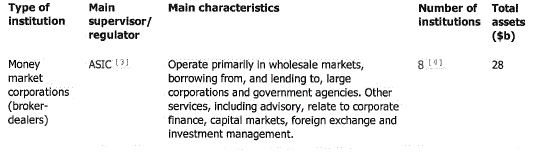
It is, with respect, seriously apt to mislead to draw a conclusion as to Unimoni being a “financial institution” because it falls within the RBA publication and its reference to “foreign exchange” without reference also to the RBA’s identification of a main characteristic of a money market corporation being one that “[o]perate[s] primarily in wholesale markets, borrowing from, and lending to, large corporations and government agencies”.
57 Paragraphs [28] and [29] of the Report, which extract a reference to the Australian Bureau of Statistics dividing Australian industry into 19 Divisions, one of which is labelled “Financial and Insurance Services”, adds nothing to the reasoning. The extract from the Bureau’s publication, which is a statement as to what it perceives to be included within the “Financial and Insurance Services [Division]”, says nothing as to the characterisation of a business which exchanges money from one form of currency into another. Nor was Professor Allan able to say whether the Bureau treated – or would treat – Unimoni as falling within that Division.
58 A second line of cross-examination, again provided only by way of example, was the challenge made to Professor Allan’s Conclusion (at para [105]) that Unimoni is “a ‘Financial Intermediary’ since it stands between its customers and (i) forex brokers in forex dealings, (ii) banks in funds remittance and (iii) Mastercard’s prepaid cash card management services”. That Conclusion was founded upon the following earlier paragraphs within his Report:
Financial Intermediary
31. There is no legislative definition of “Financial Intermediaries” in Australia.
32. In common parlance a “Financial Intermediary” is simply an entity that acts as the middleman between two parties in a financial transaction.
33. The 2006 Australian Financial System Inquiry “broadly defined (financial intermediaries) to include not only banks and insurance companies but also managed funds such as superannuation and collective investments schemes.”
34. In my opinion, a “Financial Intermediary” stands between two parties to a financial transaction including foreign exchange, money transfer and stored value card transactions. As such UAE is a “Financial Intermediary”.
(footnotes omitted)
In respect to these paragraphs, it will be noted that:
there is no authority or reference source identified for the statement in para [32]; and
the “broad” definition referred to in para [33] says nothing as to whether or not a business engaged in simply exchanging money from one currency into that of another is a “financial intermediary”.
Further reason for reservation only arises when reference is made to the earlier Report prepared by Professor Allen in August 2018. That was the Report which was annexed to an affidavit filed but not read by the Finance Sector Union. It was one of the Reports which were used in the cross-examination of Professor Allan and later tendered by Unimoni. The August 2018 Report, in contrast to the September 2018 Report, sought to be relied upon by the Finance Sector Union, stated in part:
36. In common parlance the term is used either narrowly to mean “an institution, such as a bank, building society, or unit-trust company, that holds funds from lenders in order to make loans to borrowers.” or more broadly to mean “an entity that acts as the middleman between two parties in a financial transaction”
(footnotes omitted)
Missing from the September 2018 Report, but referred to in the August 2018 Report, was any reference to “common parlance” having a more narrow meaning as well as a broader meaning. It was only the broader meaning which was ultimately advanced by Professor Allan. A change in emphasis, or a change in opinion, may perhaps be readily understandable. But what was not satisfactorily explained were the reasons for failing to ultimately refer to the fact that in “common parlance” the phrase “financial intermediary” had potentially two different meanings. The omission only underlines a concern that Professor Allan was not in fact an “independent” expert but rather a person advocating only that view which suited the interests of the Finance Sector Union.
59 A final line of cross-examination may be noted as but a further illustration as to why the Reports and reasoning of Professor Allan provide little assistance in the resolution of the present proceeding. This line of cross-examination was directed to the Conclusion of Professor Allan (at para [105]) that Unimoni is part of the “Financial Services Industry”. In support of that conclusion Professor Allan refers to a number of sources, including publications of the Australian Bureau of Statistics, s 763A of the Corporations Act 2001 (Cth), statements by APRA, and the Regulatory Guide issued by ASIC. Albeit forming only part of that reasoning process, para [42] of the Report states as follows:
To quote ASIC’s Regulatory Guide 36 (Section A):
“You provide a financial service if (among other things) you:
• ‘provide financial advice’ (see RG 36.3-RG 36.6); or
• ‘deal in a financial product’ (see RG 36.7-RG 36.8).”(emphasis mine)
(footnote omitted)
But missing from the reasoning of Professor Allan is any reference in the Report to that which constituted in the mind of ASIC a “dealing” in a financial product. If reference is made to the text of the Regulatory Guide itself, it provides in part as follows:
What is the meaning of ‘deal in a financial product’?
RG 36.7 The licensing provisions apply to persons who ‘deal in a financial product’.
To determine whether you deal in a financial product it is necessary to consider the following questions:
(a) What is ‘dealing’ within the meaning of s766C(1)?
(b) What is ‘arranging’ within the meaning of s766C(2)?
(c) What conduct is exempt from the definition of ‘dealing’?
RG 36.8 The meaning of ‘deal in a financial product’ is considered in more detail in Section C.
And when addressing what is meant by the term “arranging”, the Regulatory Guide states as follows:
What is the meaning of ‘arranging’?
RG 36.9 ‘Arranging’ for a person to engage in certain conduct, such as applying for or acquiring a financial product (see RG 36.36), constitutes dealing unless:
(a) the actions concerned amount to providing financial product advice (s766C(2)); or
(b) the conduct is exempt from the definition of dealing – for example, if the clerks and cashiers exemption applies (s766A(3)).
RG 36.10 Arranging occurs when a person brings into effect the issue, variation, disposal or acquisition of, or application for, a financial product. Ultimately, whether a person’s activities constitute arranging is a question of degree.
RG 36.11 The meaning of ‘arranging’ is considered in more detail in Section D.
The cross-references set forth in para [42] make clear that Professor Allan considered that regs 36.7 and 36.8 were of relevance to what constitutes “dealing” in a financial product in the Regulatory Guide. But no reference was made by Professor Allan to reg 36.9. And Professor Allan was in no position to know whether reg 36.9(b) applied to Unimoni given the “Assumptions” from which his September 2018 Report proceeded.
60 When addressing the same question as to whether Unimoni is part of the “Financial Services Industry” Professor Allan also placed reliance upon publications of AUSTRAC. His Report thus states in part as follows:
49. AUSTRAC defines “financial services” to include both “Currency exchange services” and “Remittance services”. This is how it describes such services:
“What is a ‘currency exchange service’?
“Under the AML/ACT Act, a ‘currency exchange service’ involves physically exchanging currency, where currency from one country is converted into currency of another country. Most commonly, currency exchange occurs at bureaux de changes, banks, hotels and airports within a retail environment…
“What are remittance services?
Generally, remittance services facilitate the transfer of money or property from a customer in one location and pay an equivalent amount in cash or value to a beneficiary customer in another location, often outside the formal financial and banking system …” (emphasis mine)
50. For regulatory purposes, AUSTRAC (unlike ASIC) does not distinguish between spot and other forms of foreign currency exchange and money transfer.
(footnote omitted)
The extract in para [49] of the Report can be found in Chapter 2 of the AUSTRAC Compliance Guide. Within Chapter 2, Table 1 to the “Definitions and examples of common designated services” is titled “financial services”. Included in Table 1 is a reference to “currency exchange services”. The difficulty with accepting the reasoning of Professor Allan at para [49] is that he gives no consideration in his Report to the different roles played by the ASIC and that played by the AUSTRAC. AUSTRAC is an entity established by the Australian Government to monitor financial transactions with a view to identifying (inter alia) money laundering, organised crime, terrorism and tax evasion. Given these responsibilities it is readily understandable why AUSTRAC may take a broader or more expansive view as to those transactions which warrant reporting obligations and scrutiny than the regulatory functions entrusted to ASIC when scrutinising banks or building societies. How the different areas of responsibilities entrusted to one agency rather than another impact upon the reasoning of Professor Allan was left unexplained in his Report.
61 Conclusions based upon a selective extraction of publications of (for example) regulatory agencies and without regard to the different functions entrusted to different agencies are open to serious reservation.
62 Although the Reports of Professor Allan serve as a useful collation of published materials, the submission advanced by Counsel on behalf of the Financial Sector Union as ultimately advanced is accepted. This Court is in as good a position as the Professor to form a view as to what those publications disclose as to the common understanding or meaning of such phrases as the “financial industry” or “financial institutions”. What the expertise of essentially an economist can add to such a process of drawing inferences is open to question.
63 The Reports and opinions expressed by Professor Allan, it is thus respectfully concluded, are of little assistance in resolving the questions of construction as to cl 4 and r 5.
The Report of Professor Bartle
64 The Report of Professor Bartle, as a general observation, was more useful than that of Professor Allan – but again subject to the overriding reservation as to the extent to which the common understanding of terms could be the subject of opinion from an expert.
65 The Report of Professor Bartle, however, did provide some assistance.
66 It is to be noted that Professor Bartle from the outset was careful not to over-step the area of expertise in which he felt comfortable to express an opinion. At the very commencement of his cross-examination there was thus the following exchange:
Mr [Bartle] – sorry – in your affidavit, you refer to specialised knowledge of the meaning of key terms used in the finance industry?––Yes.
And you – those terms are the terms set out in paragraph 2 of the letter of instruction; is that correct?––Yes.
And, as you describe them, those terms are “terms of art”, and I think by “terms of art” you mean that they have a specialised meaning, a particular technical meaning, within financial markets; is that correct?––That’s correct.
I see. And you’re certainly not giving evidence as to the ordinary and popular meaning of those terms, are you?––It would be the meanings according to what the industry itself would understand.
Yes, but that’s different, isn’t it?––Not necessarily.
No, not necessarily?––Yes.
But you’re not giving expert evidence as to the ordinary and popular meaning of those terms, are you?––Well, in some instances they would be. You would have to point out which ones are not and which ones that are.
And you’re certainly not giving expert evidence as to their meaning in the context of union rules, are you?––No, I’m not an expert in union rules.
Or in awards of the Fair Work Commission?––I’m not an expert in the – in that as well.
Okay. And if the task of the court was to determine the ordinary and popular meaning of these terms, that would fall outside your identified field of – sorry – could I withdraw that. If the court was to – was required to determine the ordinary and popular meaning of those terms so far as they existed in union rules and awards of the Fair Work Commission, that would fall outside your identified field of expertise, wouldn’t it?––I couldn’t comment on that.
Well, let me ask you again. If the court was being asked to determine the ordinary and popular meaning of terms in union rules and in awards of the commission, that task would fall outside your identified field of expertise, wouldn’t it?--- The reason I say I can’t comment is because some of those – most of those terms are well understood within the industry itself.
Mr [Bartle], can you please answer the question. It would fall outside your field of expertise or it would not; which is it? --- I think it falls within my field of expertise.
67 It should also be noted at the outset that the opinions expressed by Professor Bartle proceeded from his position that finance involves the transfer of funds from “Surplus Units to Deficit Units”.
68 It was for that reason that Professor Bartle was of the opinion that Unimoni was “not in the finance industry because exchanging currency does not transfer funds from Surplus Units to Deficit Units”. The remittance service effected by Unimoni, in Professor Bartle’s opinion, “both at the in-store and online, does not transfer funds from Surplus Units to Deficit Units and the Cash Passport product they sell does not transfer funds from Surplus Units to Deficit Units”.
69 Nor was Unimoni, in the opinion of Professor Bartle, a “financial intermediary”. “Financial intermediation”, in his opinion, “typically involves transforming deposits or contractual savings (which can be defined as Surplus Units) into investments and loans (which can also be defined as Deficit Units) through the creation of a financial contract”.
70 When cross-examined on this issue there was the following exchange:
… And, in your view, does the finance industry include the business of changing money?––No.
Not at all?––I will qualify that.
Yes?––If it’s a bank it’s part of their services; then it’s part of the finance industry. If it’s separate, it’s a fee for service so there’s no intermediation process.
No – sorry. I may have not properly explained my question. Are you saying that money changing is not part of the finance industry?––Per se?
Yes?––In my – in the context that I’ve been asked to assume, no, it’s not.
Sorry – and what is that context, then?––That it’s a standalone money exchanger.
Okay. And you say that that is not part of the finance industry?––Yes, correct.
How could a finance industry occur without money changing?––Be done through a bank.
I see. So the activity itself is part of the finance industry if it’s done by a particular player, not…?––It’s by…
The activity itself doesn’t fall within the finance industry; is that what you’re saying?––I’m saying it depends on the context and the purpose. So the context is, if it’s a bank, it’s just part of their ancillary services. If it’s a standalone money changer, it’s a completely different purpose.
71 Although Professor Bartle accepted in his Report that “[t]hrough the provision of the Cash Passport product, Unimoni may strictly be providing a financial service as defined by the Corporations Act 2001 under section 763A(1)”, he went on to conclude that:
48. In my opinion, Unimoni should not be considered to be in the industry of financial services because the Cash Passport product is such an insignificant part of its business and, given the nature of its business, the finance industry would not regard it as a provider of financial services.
72 Professor Bartle expressed the further opinion that Unimoni was not a foreign exchange dealer.
THE FINANCE INDUSTRY
73 Although the terms of cl 4 of the Banking Award and r 5 of the Finance Sector Union Rules are each drafted in their own terms, common to both is the phrase the “finance industry”. That phrase must obviously be construed in the context in which it is used in cl 4 and r 5. But the phrase itself remains undefined in either the Banking Award or the Finance Sector Union Rules.
74 Given the conclusion that only limited assistance (if any) can be gleaned from the Reports of Professor Allan (in particular) and that of Professor Bartle, the meaning to be given to this phrase (in particular), it is respectfully concluded, is best discerned by reference to:
the phrase itself;
together with such assistance as may be gleaned from:
any common understanding that the terms may have, including a reference to such judicial consideration as has been given to those terms;
the industrial context, including a reference to the background to the current Banking Award and such consideration as has been given to relevant terminology as used in the industry; and
definitions of terminology, being definitions that it may be presumed were within the contemplation of the draftsmen of r 5 of the Financial Sector Union Rules and cl 4 of the Banking Award.
Although separate streams of authority have directed attention to the principles of construction to be applied in respect to industrial awards and eligibility rules, neither the Finance Sector Union nor Unimoni suggested that the application of those principles were relevantly different.
75 Each of these potential sources of informing a common understanding of terminology should be briefly addressed.
76 Informed in this manner, and in summary form, it is concluded that the term “finance” and the phrase “finance industry” each have the same meaning when employed in both cl 4 and r 5 and that meaning is one which focusses upon the borrowing or lending or dealing in finance as the principal or characteristic activity.
The common understanding of the term “finance” – the authorities
77 Such guidance as may be gleaned from decisions of the High Court of Australia and this Court, it is concluded, do not support the case sought to be advanced by the Finance Sector Union. Such decisions, by way of contrast, confine the understanding of the term “finance” to a corporation “which borrows and lends or otherwise deals in finance as its principal or characteristic activity”.
78 Although such authorities arise in a very different context to the present context of construing an industrial award and the rules of a union, and although care must accordingly be exercised in too readily placing too much reliance upon such authorities, they nevertheless provide some assistance.
79 Reference, for example, to a “financial corporation” is made in s 51(xx) of the Constitution. Section 51(xx) confers legislative power upon the Commonwealth Parliament to make laws for the peace, order, and good government of the Commonwealth with respect to “foreign corporations, and trading or financial corporations…”. The phrase “financial corporations” – irrespective of whatever other distinctions may be drawn between the present context and principles of relevance to the interpretation of a Constitutional conferral of legislative power – is not a phrase employed in neither r 5.8 nor cl 4.2. If such distinctions may nevertheless be presently placed to one side, it has been observed that the Constitutional phrase is one directed to identifying a business which deals in finance: Re Ku-Ring-Gai Co-Operative Building Society (No 12) Ltd (1978) 36 FLR 134 (“Re Ku-Ring-Gai”). The applicants in that case were co-operative terminating building societies whose object was the raising of a fund so as to make loans to members and did not conduct their activities for the purposes of making financial profit. In concluding that they were nevertheless “financial corporations” for the purposes of s 51(xx), Bowen CJ observed at 138:
… In order to include within the scope of legislative power those corporations which commercially borrowed, lent or otherwise dealt in money, the words “or financial” were included in s. 51 (xx). But, it was said, the commercial nature of a trading corporation should also attach to a financial corporation.
I do not consider that there is any reason for interpreting s 51(xx) so as to subordinate the meaning of “financial” to that of “trading”. In my opinion a financial corporation is one which borrows and lends or otherwise deals in finance as its principal or characteristic activity or, depending on which approach one takes, it is a corporation formed for the purpose of borrowing and lending or otherwise dealing in finance. If it does so in the way of trade it may also be a trading corporation, but that is not a necessary feature of a financial corporation. The phrase “trading or financial corporations” has a distributive operation, and neither adjective qualifies the other. Furthermore, although the connotation of the words used in s. 51(xx) remains constant, their denotation may change: …
Justice Deane (when sitting as a member of this Court) likewise concluded at 160:
Notwithstanding the restricted scope and limited duration of their activities, each applicant, in my view, carries on a business. At the heart of that business are the commercial dealings in finance constituted by the relevant applicant's borrowing and lending of money and the subsequent payments and receipt of money pursuant to obligations and rights resulting from those dealings. Each applicant was formed to carry on that business. The activities of each applicant are confined to carrying it on. The business which each applicant carries on and which it was formed to carry on is a financial business. Each applicant, being formed to carry on a business of dealing in finance and in fact carrying on such a business, is, in my view, properly to be categorized as a financial corporation within the meaning of the phrase as used in s. 51 (xx) of the Constitution and in the definition of “corporation” contained in s 4 of the Act. It follows that each of the applicants is a corporation for the purposes of s. 47 of the Act.
80 The observations of Bowen CJ and Deane J were accepted by Gibbs CJ and Wilson J in State Superannuation Board v Trade Practices Commission (1982) 150 CLR 282 at 295 (“State Superannuation Board”) as a “sufficient definition and one which we accept”. Mason, Murphy and Deane JJ, when considering the “nature and the extent or volume of a corporation’s financial activities needed to justify its description as a financial corporation” gave the following “obvious example” of a “financial corporation” at 305:
Like the expression “trading corporation”, the words “financial corporation” are not a term of art; nor do they have a special or settled legal meaning. They do no more than describe a corporation which engages in financial activities or perhaps is intended so to do. The nature and the extent or volume of a corporation's financial activities needed to justify its description as a financial corporation do not call for much discussion in the present case. A finance company is an obvious example of a financial corporation because it deals in finance for commercial purposes, whether by way of making loans, entering into hire-purchase agreements or providing credit in other forms, and this activity is not undertaken for the purpose of carrying on some other business. However, just as a corporation may be a trading corporation, notwithstanding that its trading activities are entered into in the course of carrying on some primary or dominant undertaking, so also with a corporation which engages in financial activities in the course of carrying on its primary or dominant undertaking. Thus a corporation which is formed by an employer to provide superannuation benefits for its employees and those of associated employers may nevertheless be a financial corporation if it engages in financial activities in order to provide or augment the superannuation benefits:
But their Honours found it “unnecessary to decide whether the expression ‘trading or financial corporation’ in s. 51(xx) might justify a broader interpretation of the constitutional power than that indicated by the … judgments in Ku-ring-gai”: (1982) 150 CLR at 306.
81 For present purposes, the observations of both Bowen CJ and Deane J in Re Ku-Ring-Gai provide some support for construing the phrase actually used in cl 4 of the Banking Award, “finance … industry”, and the term “finance” in r 5 of the Finance Sector Union Rules as one likewise conveying an identification of the “industry” sought to be embraced within the coverage of the Banking Award as “one which borrows and lends or otherwise deals in finance as its principal or characteristic activity”.
82 “Dealing” in finance would extend beyond the activity of merely borrowing and lending money; it would also include such other activities as (for example) investing moneys. Thus, Ellicott J (Franki J agreeing) in State Superannuation Board v Trade Practices Commission (1982) 60 FLR 165 at 190 observed:
It was argued that because the appellant did not borrow the moneys which it invested it was not a financial corporation. I am unable to accept this argument. The fact that the appellant obtains the moneys as contributions from contributors and not loans makes no difference. It is engaged in investing and in reinvesting the moneys it receives. It is dealing in finance. A corporation which obtained capital from the issue of shares and, in accordance with its objects, used that capital in a similar way would, in my view, clearly be a financial corporation. What gives it this character is its dealing with or lending money and obtaining a return on it. The appellant receives moneys from officers or from borrowers (1982) 41 ALR 279 at 301 (on the repayment of loans) and deals with it in precisely the same way.
It is therefore a financial corporation within the meaning of the Act.
There in question was whether the State Superannuation Board was a corporation within the meaning of the Trade Practices Act 1974 (Cth).
The industrial context
83 Nothing in the industrial context out of which the present Banking Award emerged supports a conclusion that the business activities of Unimoni were ever previously considered to be a part of the “finance industry” or that its activities were commonly referred to as the provision of “finance” or “financial services”.
84 In particular:
the 2005 decision of the Australian Industrial Relations Commission in Comsec Trading PR960317 [2005] AIRC 637, albeit recognising that the “finance industry” was “evolving and rapidly expanding” (at para [29]) and that the expression “industry of financial services” was a similarly evolving phrase which then “include[ed] the provision of financial or wealth management advice and … stock broking” (at para [30]), said nothing to indicate that an activity such as that involved in the exchange of money formed part of the “finance industry”; and
the Statement made by the Full Bench as part of the award modernisation process in September 2008 said nothing to indicate that such activities as are carried on by Unimoni formed part of the “finance industry” and, indeed, such examples as were provided by the Full Bench, in Attachment A to the Statement, as to what it considered to form part of the “Financial services group” on their face do not include any activity comparable to that provided by Unimoni: [2008] AIRCFB 708; and
in referring to the “range of financial institutions” to which it was then directing attention and to the employees “predominantly engaged … clerical related roles with particular finance industry knowledge and skills”, the January 2009 Statement of the Full Bench again says nothing to indicate that it then had in mind activities such as those carried on by Unimoni: [2009] AIRCFB 50 at [63] to [64].
85 The argument for the Finance Sector Union perhaps gained some support for including the activities of Unimoni within the definition of the “finance industry” in cl 4.2 of the Banking Award by the reference in that clause to “money changing”. Even if the fact that the reference to “money changing” is identified in the definition in cl 4.2 as one of the “services” to be provided to the “banking, finance and insurance industry” is left to one side, and even if were to be accepted that “money changing” can form part of the “finance industry” (as it would be if it were an activity carried on by a bank), the evidence was silent in respect to such matters as:
what was intended to be embraced by the draftsman of cl 4.2 in employing the term “money changing”; and
who it was that proposed the inclusion of that phrase (if anyone) and the reasons why such a proposal was made.
In the absence of any such explanation, it is difficult to construe cl 4.2 – and, in particular, the reference to “money changing” – otherwise than by reference to the terms in which it is expressed.
Definitions
86 In determining the common understanding of such phrases as the “finance industry” recourse may legitimately be had to both:
dictionary definitions; and
definitions provided by government regulators who oversee the industry.
It may safely be presumed that the draftsman of provisions such as cl 4.2 and r 5 had in mind both the understanding of terms as set forth in dictionaries and to the manner in which a government regulator may provide guidance as to the manner in which it construes like phrases. Both sources of definition may inform the meaning sought to be conveyed by the draftsman.
87 The New Shorter Oxford English Dictionary (Clarendon Press, 1993) thus defines “finance” as including (inter alia) the following:
… payment, money …
Payment of a debt …
88 The materials annexed to the Reports of Professor Allan, albeit not the opinions of the Professor, also potentially serve as a fertile source of the type of information which was available to the draftsmen of both the Banking Award and the Financial Sector Union Rules.
89 But caution must be exercised when reviewing the materials annexed. For example, the reference to the RBA’s assessment as to the Main Types of Financial Institutions was a reference to a document published “As at December 2017”. In a rapidly evolving industry, that publication of itself may provide little assistance to an understanding of terminology as at 2010 when the Banking Award commenced. Similarly, the annexure of parts of ASIC’s Regulatory Guide was one published in June 2016.
90 Even subject to that reservation, and to the prospect that terms may be used by a draftsman of an award or the rules of a union with a view to including future employment activities (cf. R v Isaacs), none of the publications lend support for a conclusion that the activities of Unimoni were intended or contemplated to be embraced within the meaning ascribed to these phrases by the government regulators.
91 Thus, and only by way of example, the RBA’s identification of the “Main Types of Financial Institutions” focusses attention, not surprisingly, upon banks, building societies and credit unions as instances of “Authorised Deposit-taking Institutions” and on money market corporations, finance companies and securitisers as instances of “Non-ADI Financial Institutions”. And to the extent that “foreign exchange” is identified as a “Main characteristic” of a money market corporations, that activity is but part of “Other services” provided to (inter alia) the wholesale markets.
92 Similarly, the Australian Bureau of Statistics, albeit in a publication released in June 2013, in its “Australian and New Zealand Standard Classification of Occupations” refers to a Group identified as “Financial Dealers”. Included within that Group is a “Financial Market Dealer”, where the occupation is described as one who “buys and sells securities within financial markets, and trades and distributes financial securities on behalf of financial institutions”. An instance of a “specialisation” is a “Foreign Exchange Dealer”.
93 Such definitions, accordingly, would provide no support for any common understanding on the part of such a draftsman that the activities of Unimoni were to be included within the reach of cl 4 or r 5. In exchanging money, for instance, Unimoni is not providing that service to the wholesale market but rather to its customers and is not trading in financial securities.
94 For completeness, it may presently be noted that the New Shorter Oxford English Dictionary (Clarendon Press, 1993) provides the following definition of an “intermediary”, namely:
Situated or occurring between two things.
THE DIFFERENT TERMS EMPLOYED
95 Separate from any consideration as to the meaning of the phrase common to both cl 4 of the Banking Award and r 5 of the Finance Sector Union Rules, namely “finance industry”, is the necessity to recognise that each is drafted in different terms.
96 The meaning and content of the terms employed in either cl 4 or r 5 must necessarily take into account the differences in the language employed by the draftsman and the different object and purpose sought to be achieved (cf. Amcor Ltd [2005] HCA 10 at [2], (2005) 222 CLR 241 at 426 per Gleeson CJ and McHugh J) – cl 4 being directed to the coverage of an award and r 5 being directed to identifying those employees who are eligible to join the Finance Sector Union.
97 If reference is made to the provisions under consideration, it is self-evident that cl 4 of the Banking Award and r 5 being the Finance Sector Union Rules are expressed in different terms. So much is only to be expected as the two provisions are directed to achieving different objects and purpose. Differences in terminology include, for example, the following:
the definition in cl 4.2 of the Banking Award and the absence of any definition in r 5 of the Finance Sector Union Rules;
the reference to “money changing” in cl 4.2 of the Banking Award and the absence of any such reference in r 5 of the Finance Sector Union Rules;
the inclusion within r 5.8 of the Finance Sector Union Rules of “all employees in or in connection with the finance industry”; and
the inclusion within r 5.8 of the Finance Sector Union Rules of the phrase “business and/or industries of financial intermediaries or financial services”.
98 Both the Finance Sector Union and Unimoni were in agreement that there was a degree of overlap in the terms of the Banking Award and the Finance Sector Union Rules, the phrase “finance industry” (for example) being common to both cl 4.2 and r 5.8. However, Unimoni contended that each needed to be construed separately.
99 Albeit in the part of its submissions addressing whether Unimoni is covered by the union rules, the Finance Sector Union maintains that Unimoni:
is a “financial institution” – a phrase not employed in either r 5.8 nor cl 4.2;
is part of the “finance industry” – a phrase common to both r 5.8 and cl 4.2;
is a “financial intermediary” – a phrase common to both r 5.8 and cl 4.2; and
is part of the “financial services industry” – a phrase not employed in either cl 5.8 nor cl 4.2, albeit the phrase “services” appears in both.
Unimoni maintains (in very summary form) that it “does not provide ‘finance’ (through borrowing, lending, the provision of credit or investment of money) in any of its activities”.
100 It is respectfully concluded that the case advanced by the Finance Sector Union fails once consideration is given to:
the express terms of cl 4 and r 5, construed according to the terms employed and the context in which they appear.
That conclusion is only reinforced when consideration is also given to:
the common understanding of the term “finance”, as discussed in the authorities;
the industrial context out of which the Banking Award emerged;
the definitions ascribed to the phrases of present concern by both dictionaries and regulators.
The finance industry & financial intermediaries – cl 4 & r 5.8
101 Common to both cl 4.2 of the Banking Award and r 5.8 of the Finance Sector Union Rules are the phrases:
“finance industry”; and
“financial intermediary”.
102 The phrase “finance industry” was the phrase to which most attention was (not surprisingly) directed during the course of the hearing.
103 In construing that phrase, it may be accepted at the outset that the phrase is not employed in cl 4 or r 5.8 as a “term of art”: State Superannuation Board (1982) 150 CLR at 305 per Mason, Murphy and Deane JJ. It may also be accepted that a common understanding of what constitutes “finance” or a “finance industry” may be an understanding that is rapidly changing (cf. Comsec Trading PR960317 [2005] AIRC 637 at [29] to [31]) with an ever emerging uncertainty as to what activities fall within those terms. And an eligibility rule may thus be construed as covering industries and activities not in contemplation at the time an award or agreement is first drafted: cf. R v Isaac (1985) 159 CLR at 331. Nor is there a need for a particular description of a business activity be expressly referred to as such in an award for it to cover that activity. The fact that the term “stockbroking” (for example) was not referred to in the Finance Sector Union Rules thus did not preclude the Australian Industrial Relations Commission, in Comsec Trading, from concluding that a stockbroker fell within r 4.
104 It should also be noted at the outset that the focus of attention upon the phrase “finance industry” may be apt to mislead, particular when construing cl 4 of the Banking Award. The actual phrase employed in cl 4.1 is “the banking, finance and insurance industry…”. Part of the context is that the draftsman, when penning cl 4, had in mind a number of different industries which had at least some common element. And the definition in cl 4.2 refers to “…services to the above industries such as broking, trading, debt recovery, financial consulting, valuation, money changing, data processing…”. In some circumstances it may lead to error to attempt to construe isolated words taken from a more broadly expressed composite phrase: cf. Collector of Customs v Agfa-Gevaert Limited (1996) 186 CLR 389 at 401 per Brennan CJ, Dawson, Toohey, Gaudron and McHugh JJ.
105 Subject to these preliminary observations, it is concluded that the essence of “finance” is the business of borrowing or lending or dealing in finance as the principal characteristic of that business: cf. Re Ku-Ring-Gai. Such is the natural and ordinary meaning of that word. No different understanding is discernible from the industrial context out of which cl 4 and r 5 emerged.
106 When using that term in cl 4 and r 5, it is concluded that the draftsmen intended to convey the commonly accepted meaning of the word “finance”.
107 The activities engaged in by Unimoni are, with respect, no way comparable to those referred to – albeit not exhaustively – by Bowen CJ and Deane J in Re Ku-Ring-Gai or by Ellicott J in State Superannuation Board v Trade Practices Commission (1982) 60 FLR 165.
108 The business activities of Unimoni, by way of contrast, are described in the Statement of Agreed Facts as being:
foreign currency exchange, being the buying and selling of foreign currency;
money transfers; and
the provision of pre-paid multi-currency travel cards.
Although those services may potentially be described as the provision of financial services, none of its services involve providing “finance” to any of its customers.
109 It is thus concluded that Unimoni does not form part of the “finance industry”. No part of the business activities of Unimoni involve the provision of “finance” to any of its customers. Its customers are overwhelmingly travellers and not borrowers, lenders or investors.
110 It is also concluded that Unimoni is not a “financial intermediary”. Effect should be given to the common understanding of an “intermediary” as provided by the New Shorter Oxford English Dictionary such that in the present context it means a person or entity acting “between” two others in the provision of finance.
111 But that conclusion leaves open the prospect that the business activities of Unimoni may nevertheless fall within one or other of the phrases employed in cl 4 or r 5. Each should be addressed separately
Clause 4 – the Banking Award
112 Terminology other than a reference to the “finance industry” and “financial intermediary” relevant to the present proceeding is the reference in cl 4 to:
“money changing”.
113 Although it may be open to conclude that Unimoni is engaged in “money changing”, cl 4.2 is more narrowly drafted. The definition provided in cl 4.2 for the phrase “banking, finance and insurance industry” does not extend simply to the business of “money changing”; the definition is more confined and restricts the business of “money changing” to one that is “a service to the above industries”. Unimoni does not provide a “service” of “money changing” to (for example) the “banking industry”.
114 An attempt during the cross-examination of Mr Sivakumar to elicit an admission that Unimoni provided a “service” to a bank was unsuccessful. Mr Sivakumar was taken to his affidavit and the cross-examination continued as follows:
Okay. Now, in paragraph 46 you say:
Unimoni does not provide any of its services to banks –
and I won’t read out all of the other terms but there’s a whole series of different bodies referred to there. What did you mean by that?––So basically, in my understanding, I believe that they all provide credit facilities
Right?––to others, when we don’t. So that’s basically what I was trying to imply there.
I see?––That’s my understanding, yes.
I see. So you were saying, “We do not provide credit” ––?––Yes.
–– “in the same way that banks, for example, do so”?––No
Okay?––I believe the banks do so. We don’t do it. That’s what I … there.
I see?––Yes.
But in fact, there is nothing to prevent a bank being provided services by Unimoni, is there?––I’m sorry, I didn’t get the question.
Sorry. There is nothing to prevent a bank using the services of Unimoni, is there?––No, we don’t deal with the banks. We don’t – we don’t service any of the banks.
Well, you provide services to banks, don’t you?––No, we don’t.
Because, for example, you remit money into bank accounts overseas?––Yes.
And that’s a service to that bank, isn’t it?––That’s what I was very clear – so we are acting on instructions on the customer
Certainly?–– ––not on the bank’s instructions.
Yes?––So for us it’s an individual retail customer, so that’s the service that we take instructions from them and provide. So we don’t exactly sell or purchase currencies to a bank or we don’t take instructions from a bank to remit money overseas.
No, no, I understand that. But you take instructions from your clients––?––Yes.
––to provide money into a bank account––?––Yes.
––overseas. And in doing that, you do provide a service to that bank, don’t you, in that money is transferred into their account?
That evidence of Mr Sivakumar is accepted. Unimoni, it is concluded, does not provide “services” to a bank or any of the other institutions referred to by Mr Sivakumar at para [46] of his October 2018 affidavit.
115 The constraint imposed by the natural and ordinary meaning of cl 4.2, it is considered, only provides further support for the conclusion that “money changing” itself was intended by the draftsman to form part of the “finance industry” but only insofar as it was a service provided to (for example) a bank. For the sake of completeness, nor is Unimoni engaged in “financial consulting” for the purposes of cl 4.2.
116 So much follows from the terms employed in cl 4.2 itself.
117 Unimoni, it is thus concluded, is not covered by the Banking Award.
118 No question thus arises to determine whether it is the Retail Award or the Banking Award which is the “most appropriate” award for the purposes of cl 4.6 of the Banking Award.
Rule 5 – the Eligibility Rule
119 Just as it has been concluded that Unimoni is not engaged in the “finance industry” and is not a “financial intermediary” for the purposes of cl 4 of the Banking Award, the same phrases are to be construed in the same manner for the purposes of r 5.8 of the Finance Sector Union Rules.
120 The relevant phrases appearing in r 5 of the Finance Sector Union Rules which are different to those in cl 4 of the Banking Award, and which could potentially lead to a different conclusion, are the phrases:
“finance company”; and
“in connection with…”
121 It is concluded that Unimoni is not a “finance company” for the purposes of r 5.7 of the Finance Sector Union Rules. The natural and ordinary meaning of that phrase is a company that provides finance.
122 It is no part of the business of Unimoni to lend money or provide “finance” to any of its customers.
123 It is further concluded that the employees of Unimoni are not employed “in connection with the finance industry” for the purposes of r 5.8. Although the phrase “in connection with” are words of expansion and not restriction, the natural and ordinary meaning of the phrase itself is that there has to be some connection between two things. Such is also the meaning given to the phrase in the industrial context where the phrase, it has been said, calls for there to be “a relationship between the work of the employee and the industry”: cf. R v Isaac (1985) 159 CLR at 333. On the facts of the present case there is no such relationship.
CONCLUSIONS
124 It is has been concluded that the natural and ordinary meaning of both cl 4 of the Banking Award and r 5 of the Finance Sector Union Rules dictates that the case being advanced by the Finance Sector Union fails. The common understanding of each of the phrases of relevance to the present proceeding, informed as it is by reference to the context and purpose sought to be achieved by the draftsmen of the two provisions, leads to the conclusion that the Banking Award does not cover the employees of Unimoni. Nor are those employees eligible for membership of the Finance Sector Union.
125 This conclusion, it is respectfully considered, construes each of the phrases “in a way likely to be understood in the relevant industry rather than with legal niceties and jargon”: cf. Skene [2018] FCAFC 131 at [197], (2018) 280 IR 191 at 235.
126 Given the conclusion in respect to the reach of cl 4, it is unnecessary to resolve any question as to whether it is the Banking Award or the Retail Award which is the “most appropriate” award for the purposes of cl 4.6 of the Banking Award.
127 It is equally unnecessary to consider whether declaratory relief would have been granted in the terms sought by the Finance Sector Union.
128 The proceeding is to be dismissed.
THE ORDERS OF THE COURT ARE:
1. The name of the Respondent be amended to Unimoni Pty Ltd.
2. The proceeding is dismissed.
I certify that the preceding one hundred and twenty-eight (128) numbered paragraphs are a true copy of the Reasons for Judgment herein of the Honourable Justice Flick. |
Associate:


