

FEDERAL COURT OF AUSTRALIA
Crescent Capital Partners Management Pty Limited v Crescent Funds Management (Aust) Limited [2019] FCA 1082
ORDERS
NSD 448 of 2014 | ||
BETWEEN: | CRESCENT CAPITAL PARTNERS MANAGEMENT PTY LIMITED ACN 108 571 820 First Applicant CRESCENT CAPITAL PARTNERS LIMITED ACN 094 040 874 Second Applicant | |
AND: | CRESCENT FUNDS MANAGEMENT (AUST) LIMITED ACN 144 560 172 First Respondent CRESCENT INVESTMENTS AUSTRALASIA PTY LTD ACN 141 570 952 Second Respondent CRESCENT CONSOLIDATED GROUP HOLDINGS PTY LIMITED ACN 154 527 296 Third Respondent (and others named in the Schedule) | |
JUDGE: | MARKOVIC J |
DATE OF ORDER: | 11 july 2019 |
THE COURT ORDERS THAT:
1. The first, second and tenth respondents pay the applicants’ costs in a lump sum in the amount of $437,000.
2. There be no order as to costs of the applicants’ application for lump-sum costs.
Note: Entry of orders is dealt with in Rule 39.32 of the Federal Court Rules 2011.
ORDERS
DATE OF ORDER: |
THE COURT ORDERS THAT:
1. The appellants pay the respondents’ costs in a lump sum in the amount of $97,000.
2. There be no order as to costs of the respondents’ application for lump-sum costs.
Note: Entry of orders is dealt with in Rule 39.32 of the Federal Court Rules 2011.
ORDERS
NSD 567 of 2016 | ||
BETWEEN: | CRESCENT CAPITAL PARTNERS MANAGEMENT PTY LIMITED ACN 108 571 820 First Appellant CRESCENT CAPITAL PARTNERS LTD ACN 094 040 874 Second Appellant | |
AND: | CRESCENT FUNDS MANAGEMENT (AUST) LIMITED ACN 144 560 172 First Respondent CRESCENT INVESTMENTS AUSTRALASIA PTY LTD ACN 141 570 952 Second Respondent TALAL YASSINE Third Respondent | |
JUDGE: | MARKOVIC J |
DATE OF ORDER: | 11 July 2019 |
THE COURT ORDERS THAT:
1. The appellants pay the respondents’ costs in a lump sum in the amount of $39,600.
2. There be no order as to costs of the respondents’ application for lump-sum costs.
Note: Entry of orders is dealt with in Rule 39.32 of the Federal Court Rules 2011.
MARKOVIC J:
1 These reasons concern three applications for an award of costs on a lump-sum basis.
background
2 On 9 March 2016 Bennett J delivered judgment in proceeding NSD448/2014 (Trial Proceeding). In summary, her Honour made findings that the applicants (collectively, Crescent Capital) had succeeded in claims against some of the respondents (collectively, Crescent Wealth) under ss 12DA and 12DB of the Australian Securities and Investments Commission Act 2001 (Cth) and ss 18 and 29 of Sch 2 of the Competition and Consumer Act 2010 (Cth), namely the first, second and tenth respondents. Accordingly, her Honour found that it was appropriate to make a costs order that took into account that lack of success. The parties were ordered to submit draft orders: Crescent Capital Partners Management Limited v Crescent Funds Management (Aust) Limited [2016] FCA 229.
3 On 23 March 2016 Bennett J made orders including, relevantly, an order that the first, second and tenth respondents pay 80% of Crescent Capital’s costs incurred in the Trial Proceeding on a party party basis.
4 Each of Crescent Wealth and Crescent Capital appealed the orders made by the primary judge (which I will refer to respectively as the Wealth Appeal and the Capital Appeal). Those appeals were heard concurrently and on 12 January 2017 a Full Court of this Court:
dismissed the Wealth Appeal and ordered Crescent Wealth to pay Crescent Capital’s costs of and incidental to the Wealth Appeal, to be taxed if not agreed; and
in the Capital Appeal made an order varying one aspect of the primary judge’s orders in the Trial Proceeding but otherwise dismissed the Capital Appeal and ordered Crescent Capital to pay Crescent Wealth’s costs of and incidental to the Capital Appeal, to be taxed if not agreed,
see Crescent Funds Management (Aust) v Crescent Capital Partners Management Pty Limited [2017] FCAFC 2.
5 On 3 March 2017 Crescent Capital filed a bill of costs in the Trial Proceeding in the amount of $675,975.14 (Trial Bill).
6 On 29 March 2017 a Registrar of this Court issued an estimate of $456,200 for the Trial Bill (Trial Estimate) which represents recovery of 67.5% of the total costs claimed by Crescent Capital.
7 On 19 April 2017 Crescent Wealth filed a notice of objection to the Trial Estimate.
8 On 17 May 2017 Crescent Capital filed a bill of costs in the Wealth Appeal in the amount of $168,552.20 (Capital Appeal Bill).
9 On 19 June 2017 a Registrar of this Court issued an estimate of $116,000 for the Capital Appeal Bill (Appeal Estimate) which represents recovery of 68.8% of the total costs claimed by Crescent Capital.
10 On 10 July 2017 Crescent Wealth filed a notice of objection to the Appeal Estimate.
11 A confidential conference was held on 23 October 2017 before a Registrar of the Court at which the parties agreed they should consider the costs in both the Trial Proceeding and the Wealth Appeal. While settlement was not reached, neither matter proceeded to taxation.
12 On 6 July 2018 Crescent Capital filed an interlocutory application in each of the Trial Proceeding and the Wealth Appeal seeking orders respectively that the costs order made in the Trial Proceeding and the costs order made in the Wealth Appeal be varied so that Crescent Wealth pay Crescent Capital’s costs fixed in an amount to be determined by the Court.
13 In about October 2018 Crescent Wealth prepared a draft bill of lump-sum costs at scale in relation to its costs of the Capital Appeal claiming total costs and disbursements of $55,863.30 (Wealth Appeal Bill).
14 Ultimately, orders were made by consent on 23 August 2018 between Crescent Capital and Crescent Wealth that the costs orders made in the Trial Proceeding, the Wealth Appeal and the Capital Appeal should be varied so that costs in each case would be assessed on a lump-sum basis.
the respective positions of the parties
15 Crescent Capital seeks lump-sum costs orders in the amount of:
(1) $506,981 for the Trial Proceeding; and
(2) $126,414.15 for the Wealth Appeal.
16 Crescent Wealth contends that those amounts should be reduced to:
(1) $348,216.77 for the Trial Proceeding; and
(2) $66,988.47 for the Wealth Appeal.
17 Crescent Wealth seeks a lump-sum costs order in the amount of $44,858.12 for its costs of the Capital Appeal. Crescent Capital contends that a more appropriate amount to award to Crescent Wealth is $37,987.04 or, in the alternative, $37,428.41.
evidence
18 Crescent Capital relied on evidence given by Michael John Williams, partner at Gilbert+Tobin, its solicitors, who had carriage of the proceedings on its behalf and Suzanne Maree Ward, an executive costs lawyer employed by Pattison Hardman Pty Limited, a legal costs consulting firm.
19 Crescent Wealth relied on evidence given by Odette Margaret Gourley, partner at Corrs Chambers Westgarth, its solicitors, who had carriage of the proceedings on its behalf and Alyson Wendy Ashe, a solicitor and legal costs consultant.
Ms Ward’s evidence
20 Ms Ward prepared the Trial Bill and the Capital Appeal Bill. Her evidence in support of the amounts claimed by Crescent Capital as lump-sum costs in the Trial Proceeding and the Wealth Appeal is summarised below.
21 In the Trial Bill Crescent Capital claims $675,975.14 for its total profit costs and disbursements. Ms Ward has applied a 25% discount to the total amount in the Trial Bill to arrive at the amount of $506,981, which is the amount claimed by Crescent Capital as a lump-sum for its costs of the Trial Proceeding.
22 In the Capital Appeal Bill Crescent Capital claims $168,552.20 for its total profit costs and disbursements of the Wealth Appeal. Again, Ms Ward has applied a 25% discount to the total amount of the Capital Appeal Bill to arrive at $126,414.15, the amount claimed by Crescent Capital as a lump-sum for its costs of the Wealth Appeal.
23 Ms Ward has prepared a costs summary for Crescent Capital’s costs of the Trial Proceeding and the Wealth Appeal. She believes the categories of work undertaken in each proceeding have been fairly and reasonably incurred and include predominantly substantive and reasonably recoverable attendances, such as, but not limited to:
(1) drafting and preparation of pleadings;
(2) drafting and preparation of evidence;
(3) drafting and preparation of arguments, including legal research;
(4) drafting and settling of submissions; and
(5) court and related conference attendances.
24 Ms Ward has verified that the work was undertaken primarily by Crescent Capital’s lawyers at rates and levels of expertise which she has set out, and which I do not intend to replicate in these reasons. Ms Ward is of the opinion that the rates and levels of expertise of the team members indicate that the team’s practices were efficient and reasonably distributed between all levels of professional expertise in both the Trial Proceeding and the Wealth Appeal.
25 Ms Ward is also of the opinion that the disbursements were generally fairly and reasonably incurred in the conduct of the Trial Proceeding and Wealth Appeal including counsels’ fees which, having regard to the total, indicated that use of counsel was reasonable and that there was no overreliance on counsel. For:
(1) the Trial Proceeding, senior counsel’s fees comprised 18.8% of the total costs and two junior counsel were engaged. Their fees each comprised approximately 0.5% and 0.6% of the total costs; and
(2) the Wealth Appeal, senior counsel’s fees comprised 16.3% of the total costs and junior counsels’ fees comprised 5.6%.
26 Both the Trial Bill and the Capital Appeal Bill include a component for “skill, care and responsibility”. It is fair to say that this is the item about which there is the greatest divergence of opinion between Ms Ward and Ms Ashe. Ms Ward is of the opinion that the appropriate amount to be added for skill, care and responsibility, given the complexity of the matters in dispute and the nature of the proceedings, was at least 20% for the Trial Proceeding and 25% for the Wealth Appeal. Ms Ward arrived at these amounts based on her experience in the application of “General Care and Conduct Criteria Schedule 3 Items 11.1 and 12.1” and the manner in which taxing officers apply the National Guide to Discretionary Items in Bills of Costs (Discretionary Items Guide). Ms Ward also balanced this with the weight typically given to the decision in APC Marine Pty Ltd v The Ship “APC Aussie 1” [2011] FCA 679 (APC Case) in taxations.
27 In Ms Ward’s opinion no other special or unusual costs arrangements apply that warrant any further reductions to the Trial Bill or the Capital Appeal Bill and she does not consider that there are any items that have been overestimated. By contrast Ms Ward notes there are many items on the file where perusals have been claimed at scan rates and multiple party party correspondence forwarded or received by email where no claim is made.
28 Ms Ward has also responded to:
(1) the criticisms made by Ms Ashe of the amounts claimed in the Trial Bill and the Capital Appeal Bill, which are set out below; and
(2) the Wealth Appeal Bill.
29 I have had regard to those responses and do not propose to set them out in any detail but refer to that evidence insofar as necessary in resolving the issues that have arisen between the parties.
Ms Ashe’s evidence
30 Ms Ashe has provided her opinion of the fair and reasonable and likely recoverable amount on taxation in relation to the amounts claimed in the Trial Bill and the Capital Appeal Bill. Ms Ashe’s opinion is derived from her line-by-line analysis included in the draft notices of objection she prepared in response to the Trial Bill and the Capital Appeal Bill.
31 The outcome of Ms Ashe’s analysis is that, in her opinion, the amount likely to be allowed to Crescent Capital on a taxation of:
the Trial Bill is $348,216.77, which is approximately 50% of the amount it claims in the Trial Bill; and
the Capital Appeal Bill is $66,988.47, which is also in the order of 50% of the amount it claims in the Capital Appeal Bill if the apportionments for joint work as between the Wealth Appeal and the Capital Appeal is 50% throughout the Capital Appeal Bill.
32 Central to Ms Ashe’s approach in reaching her opinion about the recoverable costs in relation to the Trial Bill was her view that the Trial Proceeding was for a “passing off-style claim” which is not complex and did not warrant the resources and extent of preparation applied by Crescent Capital’s solicitors. According to Ms Ashe this resulted in a claim for costs which is not fair and reasonable.
33 Ms Ashe’s approach to Crescent Capital’s claims for its costs was to consider whether, in the circumstances, the following aspects of the claims were fair and reasonable and, if not, why not:
(1) the makeup of the team;
(2) the appropriate deployment of the team and delegation within it;
(3) the role or use of counsel as part of the team interaction;
(4) the rates of team fee earners who fall below the item 1.1 cap of $580 per hour;
(5) the skill care loading claimed;
(6) counsels’ rates; and
(7) the time claimed by fee earners.
34 In Ms Ashe’s opinion each of the factors set out in the preceding paragraph, together with her opinion that there was an incorrect application of the scale in some respects, combined to reduce the Trial Bill and the Capital Appeal Bill substantially and below the Registrar’s estimates. In Ms Ashe’s opinion, contrary to that expressed by Ms Ward, the time before issue of an estimate by a Registrar does not indicate that there has been a close review or comprehensive taxation by the Registrar. On their face, the Trial Bill and Capital Appeal Bill include claims which would lead the Registrar to adopt an estimate below 70% and it is not until a detailed review, such as she has carried out, is undertaken that the further reduction is apparent.
35 The matters Ms Ashe raises in her draft notices of objection in relation to the Trial Bill and the Capital Appeal Bill are:
(1) reducing the hourly rates to a range which, in Ms Ashe’s opinion, is fair and reasonable for the nature, complexity and circumstances of the proceedings. Ms Ashe’s assessment took into account the presence or absence of factors including administrative tasks performed by lawyers, time spent which appeared on its face to be excessive or indicative of inefficiency, duplication between fee earners, self-educative research, internal conferences and correspondence, lack of appropriate delegation, time spent getting acquainted with the file, attendances on counsel by a junior solicitor where a senior solicitor was also present and cross-over between types of work done by counsel and solicitors;
(2) correcting errors in drafting the bills in accordance with Sch 3 to the Federal Court Rules 2011 (Cth), titled “costs allowable for work done and services performed”, effective as at the date the services the subject of these applications were performed (Schedule 3). The error is said to be in the application of scale item 2.1, preparation of a document or letter, by reason of a failure by the draftsperson of the bills to apply item 2.1 to the word count of the final document filed. Instead multiple claims for redrafting and amending affidavits are included, increasing the preparatory work, and additional time-based claims are made for work before “drafting”;
(3) identifying other items which are not recoverable on a party party basis including items in the costs of taxation section where claims are made for work not likely to be done given the current application for assessment of costs on a lump-sum basis;
(4) having regard to the Discretionary Items Guide, reducing the skill care claim, in the case of the Trial Proceeding, from 20% to 5% and, in the case of the Wealth Appeal, from 25% to 10% and, in each case, applying it only to the proceedings and not to the costs of taxation. Ms Ashe says that Ms Ward’s reliance on the APC Case is misplaced, as the main issue for the taxing officer under Schedule 3 is the complexity of the proceedings and neither the Trial Proceeding nor the Wealth Appeal were sufficiently complex to command the loading allocated by Crescent Capital;
(5) having regard to the National Guide to Counsel Fees (National Guide) and the nature, complexity and circumstances of the proceedings, reducing senior counsel’s daily rate exclusive of GST from $10,000 in the Trial Proceeding and $11,000 in the Wealth Appeal to $6,400. Ms Ashe says that as the Trial Proceeding was commenced in 2014, the National Guide is relevant to it and the Wealth Appeal, especially in the context of a straightforward passing off style proceeding. Ms Ashe notes that, although not complex, senior counsel appeared in the Trial Proceeding without a junior and thus could be seen to fairly and reasonably command the higher rate in the National Guide of $6,400 per day; and
(6) in relation to the Capital Appeal Bill only, reducing some of the apportionment claims made. The Capital Appeal Bill apportions items between the Wealth Appeal and the Capital Appeal on different bases including relative hearing time spent on each appeal and proportion of the reasons of the Full Court devoted to each appeal. Ms Ashe says these allocations are arbitrary and the correct apportionment to apply is 50% thus providing equal weight to each separately instituted appeal.
36 Ms Ashe prepared the Wealth Appeal Bill. She is of the opinion that the fair, reasonable and likely recovery by Crescent Wealth in relation to that bill is 75% of the professional costs claimed and 85% of the disbursements claimed, with an overall recovery of $44,858.12 based on a claim for total costs and disbursements of $55,863.30.
37 Ms Ashe has calculated the professional costs claimed by Crescent Wealth from time records, solicitors’ files, court documents and transcripts according to Schedule 3 and has calculated disbursements from a review of counsel and supplier invoices.
38 Ms Ashe provides a summary of the categories of work which in her opinion were fairly and reasonably incurred in the conduct of the Capital Appeal, including an estimate of the proportion that each category of work constitutes of the total costs claimed, and the hourly rates and total hours worked for each fee earner who performed work on the matter. In calculating the professional costs claimed Ms Ashe excluded items in invoices for work not within the scope of the costs order made in the Capital Appeal and, where an item of work related only partly to the claim, she allocated only the time and amount referable to the Capital Appeal. Ms Ashe also included a claim for skill, care and responsibility in an amount of 10% of the professional fees claimed.
39 Senior and junior counsel were retained by Crescent Wealth. Their fees make up approximately 43% of the total costs and disbursements claimed by Crescent Wealth. The amount charged by senior counsel and junior counsel were, in the case of senior counsel, from July 2016 $100 per day more than the top of the range set by the National Guide and the daily and hourly rates for junior counsel were within the range specified in the National Guide.
40 Consistent with her approach to the Capital Appeal Bill, noted above at [35(6)], where the work related to the Capital Appeal and the Wealth Appeal Ms Ashe apportioned the costs as to 50% between each appeal.
Legal framework
41 The Court has power to award a party costs in a specified sum: see s 43(3)(d) of the Federal Court of Australia Act 1976 (Cth).
42 The Court’s Costs Practice Note (GPN-Costs) (Costs Practice Note) provides the process by which an application for a lump-sum costs order should be made. No formal application is required but the costs applicant should file an affidavit in support of its claim (Costs Summary) in accordance with the timetable set by the judge, which should succinctly address the matters set out in Pt B of “Annexure A - Guide for Preparing a Costs Summary”. In particular the Costs Summary should not resemble a bill of costs. For a simple case it should not exceed five pages and for a complex case it should not exceed 10 pages. The express intention of the lump-sum costs procedure is to streamline and expedite the determination of the question of the quantum of costs and not replicate the taxation procedure.
43 The costs respondent may file an affidavit in reply which also must be clear, concise and briefly summarise the categories of any dispute arising in respect of the Costs Summary. It should not resemble formal costs objections prepared for a taxation of costs; should make clear which of the costs issues arising from the Costs Summary are in dispute and which are not; and for a simple case should not exceed four pages while for a complex case it should not exceed eight pages.
44 The issue of whether there should be an award of costs in a lump sum, instead of taxed costs, does not arise on these applications. The parties have resolved that issue by consent. The issue before the Court is solely one of quantum.
45 It is well established that in making a lump-sum costs order the Court is not required to undertake a detailed examination of the kind that would be appropriate to a taxation. To do so “would defeat the purpose of making a lump sum costs order”: see Bitek Pty Ltd v IConnect Pty Ltd (2012) 290 ALR 288; [2012] FCA 506 at [23] (Bitek). As Kenny J observed in Bitek the starting point for fixing costs is the charges rendered by the costs applicant’s solicitors: at [18]. In assessing quantum the Court may take into account the evidence that is before it, its own observations of the case and the judge’s own assessment experience: see Innes v AAL Aviation Limited (No 2) [2018] FCAFC 130 at [18]. The sum of costs fixed should be proportionate to the nature, including the complexity, of the case: Bitek at [18].
46 In Australian Mud Company Pty Ltd v Coretell Pty Ltd (No 7) [2017] FCA 1469 McKerracher J made a lump-sum costs order notwithstanding that the process of taxation of the costs in question had advanced to the point of a Deputy District Registrar having issued an estimate. His Honour noted that there was no doubt that a lump-sum costs order could be made once a taxation process was underway: at [20]. In that case a Registrar had already examined the detailed bill of costs and come to a preliminary view. McKerracher J did not have the benefit of any evidence in opposition to the costs applicant’s expert evidence but used the Registrar’s assessment as a starting point, discounting that estimate by a little under 5% to 68.5%.
Crescent Capital’s applications for lump-sum costs
47 Crescent Capital made its applications for orders that Crescent Wealth pay its costs of the Trial Proceeding and the Wealth Appeal in a lump sum after the commencement of the taxation process in each of those proceedings. For that reason, other than in a limited way, I was not provided with the material envisaged by the Costs Practice Note. Rather, Crescent Capital relied on the Trial Bill and the Capital Appeal Bill to substantiate its claim. However, I also had evidence before me of the Trial Estimate and the Appeal Estimate.
48 Crescent Wealth provided detailed objections to the Trial Bill and the Capital Appeal Bill and, for the purposes of its own claim for lump-sum costs in the Capital Appeal (discussed further below), prepared the Wealth Appeal Bill. As a result, and contrary to the intent of the Costs Practice Note and applicable principles, the applications have taken on the flavour of a taxation. That is not how applications of this nature should proceed. The areas of dispute should be highlighted and it should not fall to the Court to have to undertake a detailed examination of the bills as if on a taxation. For that reason I will approach each of the applications by considering the issues raised by the parties at a level of principle and determine their effect on the amounts claimed.
The parties’ submissions
49 Crescent Capital submitted that the Trial Bill and the Capital Appeal Bill should be the starting point for the Court’s assessment of the amount to be awarded on a lump-sum basis and that those bills already recognise the actual costs incurred on a party party, as opposed to solicitor client, basis.
50 Crescent Capital noted that the Trial Estimate is for approximately 67% of the Trial Bill and the Appeal Estimate is for approximately 68% of the Capital Appeal Bill. It submitted that should the Court not accept Ms Ward’s evidence and the amount she has arrived at for an award for lump-sum costs in each case, then the Trial Estimate and Appeal Estimate would represent an alternative basis for an award of costs to Crescent Capital.
51 Crescent Capital made the following submissions in response to Crescent Wealth’s contention that a significantly lower amount of $348,216.77 for the Trial Proceeding and $66,988.47 for the Wealth Appeal should be awarded by the Court. It submitted:
(1) if Crescent Wealth’s position was accepted it would amount to a recovery of only approximately 51.5% of the amount claimed by Crescent Capital in the Trial Proceeding and 39.7% of the amount claimed by Crescent Capital in the Wealth Appeal, which is substantially out of step with the percentage recovery usually allowed by this Court in lump-sum costs applications;
(2) the amounts contended for by Crescent Wealth are also far below the percentages allowed in the Trial Estimate and the Appeal Estimate, which are not outside the ordinary range of costs recoverable in a trial and an appeal but, according to Ms Ward, are at the lower end of the scale of recent estimates issued;
(3) it is based on an approach by Crescent Wealth’s expert, Ms Ashe, that involved preparation of itemised objections as if this were a taxation, which it is not. To proceed in that way would be contrary to the authorities and not appropriate to an application for lump-sum costs;
(4) Ms Ashe’s complaints regarding a number of matters such as the rates charged by solicitors, the use of scale item 2, the fair and reasonable nature of the work and the choice of counsel have been comprehensively answered by Ms Ward and ought to be rejected;
(5) the proceedings were hard fought. Had Crescent Capital been unsuccessful it would have been compelled by business considerations to change its corporate name. The litigation was complex and substantial evidence was filed and extensive discovery given by Crescent Wealth. Further the Full Court observed that Crescent Wealth effectively reargued its case on appeal and the costs incurred by Crescent Capital in responding to the Wealth Appeal were reasonably incurred;
(6) the conduct of the proceedings would not warrant the reduction contended for by Crescent Wealth. A reduction has already been made in respect of the costs in the Trial Proceeding which were awarded at 80% and the criticisms made by Crescent Wealth about the manner in which the trial was conducted, even if accepted, do not rise to the level that would disturb the usual approach to awarding costs in a lump sum. In any event, Crescent Capital contended that the conduct of the proceedings was appropriate for litigation of its size and that the costs claimed by it are not out of the ordinary or excessive; and
(7) Crescent Wealth seeks to have a rate of recovery applied to Crescent Capital’s costs which is far lower than the 80% rate of recovery claimed by it in respect of its costs of the Capital Appeal. The Court would be slow to accept a contention from a party that its opponent’s costs should be awarded at a substantially lower percentage rate than its own, when the case was conducted by equivalent sized firms.
52 Crescent Wealth submitted that the appropriate amount to be fixed for Crescent Capital’s costs of the Trial Proceeding is $348,216.77 as quantified by Ms Ashe. It contended that was so for the reasons which follow.
53 First, Crescent Wealth submitted that the experience, size and rates of Crescent Capital’s legal team exceeded what is fair and reasonable. It contended that the “luxuries of litigation must be paid for by those who indulge in them” and only the necessities are to be paid for by the losing party: quoting Sony Entertainment (Australia) Ltd v Smith (2005) 215 ALR 788; [2005] FCA 228 at [200]. In that regard Crescent Wealth said:
(1) Crescent Capital’s Trial Bill comprised work performed by five partners and 11 solicitors, with the core team comprising two partners and four solicitors, and 59.14% of the work was performed by the partners at their capped rate. Where work is undertaken by a large team it is “likely to have necessitated a degree of duplication which would not be included in party/party costs”: quoting Yeo v Australian Securities and Investments Commission (No 3) [2018] FCA 1749 at [26]. Crescent Wealth submitted that it was not clear if the Trial Bill had been prepared on a solicitor client or party party basis, although it accepted that the solicitors’ rates included in the Trial Bill had been reduced in accordance with the scale; and
(2) senior counsel’s fees should be reduced in line with the National Guide and more use of junior counsel should have been made for drafting work given their lower charge-out rates compared to those of the solicitors who undertook this work.
54 Secondly, Crescent Wealth submitted that the case was not a complex one and the amounts allocated for skill, care and responsibility to the Trial Bill of 20% and the Capital Appeal Bill of 25% were not justified. Crescent Wealth would allocate 5% to the Trial Bill and 10% to the Capital Appeal Bill for this component.
55 Thirdly, Crescent Wealth submitted that the Court should not give material weight to the opinions of Ms Ward given the lack of persuasive reasoning to support them. Crescent Wealth said that it had identified two material errors in Ms Ward’s estimate, namely the misapplication of scale item 2 by failing to take into account duplicated work in the preparation of Crescent Capital’s affidavits and the inclusion of costs that are referrable to a taxation in the estimate.
56 Crescent Wealth submitted that the appropriate amount to be fixed for Crescent Capital’s costs of the Wealth Appeal is $66,988.47 as quantified by Ms Ashe. It contended that was so for reasons similar to those raised in relation to the reduction of the amount claimed by Crescent Capital for the Trial Proceeding, namely:
(1) the experience, size and rates of the Crescent Capital legal team exceeded what was fair and reasonable with the team comprising two partners and six solicitors and the core team comprising one partner and three solicitors. Crescent Wealth again contended that senior counsel’s rates should be reduced based on the National Guide;
(2) the appeal was not complex and the amount applied for skill, care and responsibility should be reduced (see [54] above); and
(3) Ms Ward misapplies scale item 2 and wrongly includes an estimate for the costs of the taxation.
57 A further issue that arises with the Wealth Appeal and the Capital Appeal is the apportionment of work between the two appeals. Ms Ward’s evidence was that the work undertaken by Crescent Capital should be apportioned such that approximately 75-80% is allocated to the Wealth Appeal and the balance to the Capital Appeal. On the other hand, where items of work related to the other appeal, Crescent Wealth has apportioned the work equally between them.
Consideration
58 I would not adopt the approach which seems to be urged upon me by Crescent Wealth in assessing the amount that should be paid on a lump-sum basis for Crescent Capital’s costs of the Trial Proceeding and the Wealth Appeal. It is not appropriate that, in an application of this nature, the Court should consider the costs claimed at the level of granularity for which Crescent Wealth seems to contend.
59 Subject to one matter, I adopt as a starting point the amounts claimed by Crescent Capital in the Trial Bill and Capital Appeal Bill. That matter is the inclusion in each of the Trial Bill and the Capital Appeal Bill of the amounts estimated for work on the taxations which have not come to pass. In that regard, while Ms Ward says that a Registrar will routinely not include the costs estimate for a taxation in his or her estimate, it is not evident whether that has occurred in relation to the Trial Estimate and the Appeal Estimate and the better course, in my opinion, is to exclude those amounts. They are:
(1) in relation to the Trial Bill the following amounts:

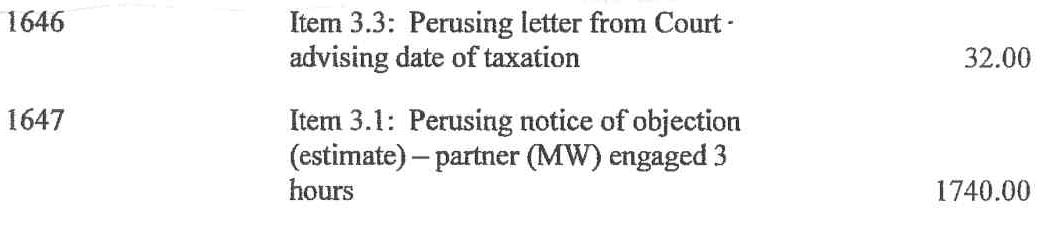

(2) in relation to the Capital Appeal Bill the following amounts:
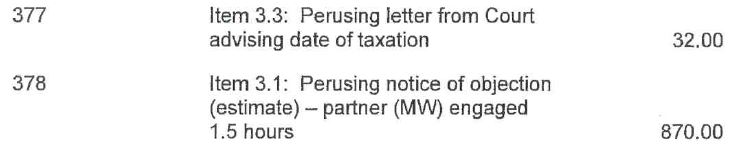
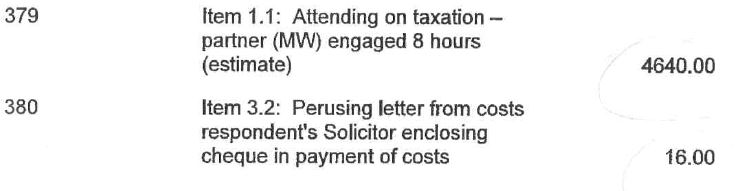
(3) in relation to both the Trial Bill and the Capital Appeal Bill, there is an amount included for skill, care and responsibility calculated on the total of the items making up the work done and to be done for taxation. I accept Ms Ashe’s evidence that these amounts should not be included.
60 Thus the total claim in the Trial Bill should be reduced to $647,237.94 and the total claim in the Capital Appeal Bill should be reduced to $161,484.32.
61 I turn then to consider what adjustments should be made so as to produce a logical, fair and reasonable outcome which avoids both overestimation and underestimation. In that regard, in my opinion, the estimates produced by the Registrar provide a starting point from which to consider any further adjustments. That is, given the reduced total for each of the Trial Bill and the Capital Appeal Bill, the percentage reduction applied by the Registrar in arriving at his estimates for each of those bills (see [6] and [9] above) provides the necessary starting point. The Registrar examined the detailed Trial Bill and Capital Appeal Bill in order to provide the Trial Estimate and the Appeal Estimate and, I would infer, reached his view on the percentage reduction to be applied and provided those estimates after spending time considering those bills. I accept Ms Ward’s evidence that the Registrar would have arrived at the estimates by undertaking a line-by-line assessment of the Trial Bill and the Capital Appeal Bill. That said, the Registrar did not have the benefit of the submissions that have now been made to me. It is with the benefit of those submissions that I will consider whether any further adjustment, either by way of increase or decrease, to the percentage reductions applied by the Registrar ought to be made.
62 Before doing so, I note that Crescent Capital submitted that the Court would take notice of the fact that lump-sum costs orders recently made by the Court have often been in the order of or exceeded 70% of the actual costs incurred by the parties seeking recovery and referred to a number of decisions of this Court in that regard. I am not persuaded that the Court is able to simply apply a percentage recovery in one particular case to another set of circumstances. Each case is to be determined based on its own circumstances. That said, as has been recognised by this Court, the result in other cases may inform, to some degree, the ultimate decision to be made in a particular case: see Hislop v Paltar Petroleum Limited (No 4) [2017] FCA 1632 at [10].
Are the Trial Bill and Capital Appeal Bill prepared on a party party or solicitor client basis?
63 Annexure B to the Costs Practice Note is titled “guide for preparing a bill of costs”. Its purpose is to assist a costs applicant in preparing a bill of costs so as to assist the taxing officer to make an estimate. Parts D and E of annexure B, titled “tables of claims for costs and disbursements”, provides that for a bill of costs, costs and disbursements should be listed in separate tables and that details should be listed in those tables in chronological order, inserting the claim number, date, scale item and description of the work done and the amount claimed either inclusive or exclusive of GST. The Costs Practice Note also provides requirements for the information to be included and how to complete the costs tables.
64 The Trial Bill and Capital Appeal Bill appear to have been prepared in accordance with those requirements. It is not apparent, having regard to the contents of the Trial Bill and the Capital Appeal Bill, nor from Ms Ward’s evidence, whether the Trial Bill and Capital Appeal Bill were prepared on a solicitor client basis or party party basis. Although Ms Ward says that there are no other special or unusual costs arrangements that would warrant a further reduction than the 25% she recommended and that she does not consider there to be any aspect in which costs were overestimated. Ms Ward goes on to say that “[b]y contrast, for example, there are many items on the file where perusals have been claimed at scan rates and multiple party party correspondence forwarded or received by email (including lengthy email chains) where there is no claim at all”. Although not conclusive, this seems to suggest a focus on party party attendances, as does my review of each of the bills.
65 In any event, in my opinion the percentage reductions applied by the Registrar to the Trial Bill and the Capital Appeal Bill would have taken into account any duplication or unnecessary work, including claims that might be for solicitor client as opposed to party party attendances and thus costs. Similarly those reductions would take account of any misapplication of the scale as asserted by Ms Ashe.
Counsels’ fees
66 Crescent Wealth submitted that the amount for counsels’ fees claimed by Crescent Capital in the Trial Bill and the Capital Appeal Bill should be reduced because senior counsel appearing for Crescent Capital charged an amount which was in excess of the maximum allowed for by the National Guide. No complaint is made about the fees charged by junior counsel retained in the Wealth Appeal. Only minimal work was undertaken by junior counsel in the Trial Proceeding and again no complaint is made about the fees charged. The relevant rates in the National Guide for senior counsel are:
(1) appearance at hearing (daily rate including conference) - $2,060-$6,400; and
(2) hourly rate for directions hearing, preparation time, conferences (not occurring on the day of hearing), settling applications, affidavits, statements of claim and other documents, opinions and advice on evidence, written submissions, attending to receive judgment (where appropriate) and items that are not otherwise provided for - $425-740.
67 Senior Counsel appeared in the Trial Proceeding without a junior (Ms Whitby, who was present for some of the time, either did not charge or charged a minimal amount about which no issue arises). Ms Ward gave evidence that it carries significant weight on submissions before a Registrar where only one counsel is engaged in circumstances where the market for legal services would usually engage two counsel. She said that this has contributed to higher allowances for professional fees, senior counsel rates and general care and conduct because of the overall efficiencies and savings resulting from a specialised legal team. Ms Ashe accepted that the retainer of senior counsel in the Trial Proceeding without a junior could be seen to fairly and reasonably command the higher rate per day prescribed by the National Guide (see [35(5)] above).
68 I am satisfied, based on Ms Ward’s evidence, that for the Trial Proceeding it is fair and reasonable to allow senior counsel’s fees at the higher rate charged by him. However, for the Wealth Appeal, where senior counsel appeared with a junior, there should be a reduction to account for the fact that senior counsel’s fees exceeded the maximum amount included in the National Guide. That reduction can be reflected in the overall percentage reduction to be applied to the Capital Appeal Bill.
69 Crescent Wealth submitted that senior counsel’s total fees were too high and that there was a disproportionate use of senior counsel, as opposed to junior counsel, and thus a disproportionate use of solicitors at a higher cost than would have been the case if junior counsel had been retained. To the extent that is so, which I accept may be the case for the Trial Proceeding, any reduction is already reflected in the reduction applied by the Registrar to the Trial Bill.
Skill, care and responsibility loading
70 It is this single item which represents the most significant difference between the parties. Crescent Wealth’s justification for reducing this item to 5% for the Trial Bill and 10% for the Capital Appeal Bill is that the matter lacked sufficient complexity to command a skill, care and responsibility loading of the magnitude claimed by Crescent Capital.
71 Item 11 of Schedule 3 is for skill, care and responsibility and provides that an additional amount may be allowed, having regard to all the circumstances of the case, including:
(a) the complexity of the matter;
(b) the difficulty or novelty of the questions involved in the matter;
(c) the skill, specialised knowledge and responsibility involved and the time and labour expended by the lawyer;
(d) the number and importance of the documents prepared and read, regardless of their length;
(e) the amount or value of money or property involved;
(f) research and consideration of questions of law and fact;
(g) the general care and conduct of the lawyer, having regard to the lawyer’s instructions and all relevant circumstances;
(h) the time within which the work was required to be done;
(i) allowances otherwise made in accordance with this scale (including any allowances for attendances in accordance with item 1.1); and
(j) any other relevant matter.
72 In addition, the Court’s Guide to Discretionary Items in Bills of Costs is a guide for parties as to how the discretion available to taxing officers in relation to claims made in a bill of costs for, among other things, “skill, care and responsibility” is commonly exercised. It provides that for item “11.1 - Skill, care and responsibility”:
A percentage of the amount allowed for items 1-10, in the range of 0-15%, is commonly allowed.
73 While the factors that go to quantification of the skill, care and responsibility loading include the complexity of the matter, they are not limited to that. They include a myriad of other aspects of the conduct of the litigation including specialised knowledge, time and labour expended and the “value” of property involved. In the context of this proceeding, while the applicable law may have been settled, there were factual matters that the parties were required to address, in the absence of agreed facts. It is apparent that the case was hard fought. In effect, at stake for each party was the continued use of current trading names. Crescent Capital submitted that at trial it focused a considerable amount of its effort on establishing its reputation in the financial services market. At the end of the day, much of that evidence was, at the request of the trial judge, removed from the court book. But it was not until the parties were at the trial that the Court’s attitude to the effect of and need for that evidence was known.
74 It may be that the loading included by Crescent Capital for skill, care and responsibility is higher than would be allowed on a taxation. Of course this is not a taxation but an application for lump-sum costs in which I am to assess an amount that is fair and reasonable in the circumstances of the case. In that regard, to the extent that the percentage amount applied for this factor is excessive and should be reduced, I am satisfied that that reduction is already reflected in the percentage reduction applied by the Registrar.
Apportionment of costs between the Wealth Appeal and the Capital Appeal
75 I was a member of the Full Court that heard and determined the Wealth Appeal and the Capital Appeal. In my opinion, having regard to the issues raised in each appeal, the apportionment of costs should be as to 70% for the Wealth Appeal and as to 30% for the Capital Appeal. I do not think that an equal split of costs between the two appeals as contended for by Crescent Wealth is fair and reasonable given the relative issues that were raised in each appeal, the time spent in argument and proportion of the parties’ written submissions devoted to each appeal. The apportionment I have reached is also somewhat less than that which in Ms Ward’s opinion would be allocated between the two appeals and which is, in any event, inconsistent with the apportionment of 88-90% she in fact applied to certain items in the Capital Appeal Bill where the work done related to both the Wealth Appeal and the Capital Appeal.
76 In those circumstances, it is appropriate that the different conclusion I have reached on apportionment be reflected in the percentage reduction to be applied to the Capital Appeal Bill.
Conclusion on Crescent Capital’s applications
77 Having regard to the matters set out above, in my opinion:
(1) in the Trial Proceeding, Crescent Wealth should pay $437,000 to Crescent Capital in a lump sum for its costs of that proceeding. That reflects the percentage applied by the Registrar in calculating the Trial Estimate but beginning with the reduced amount (see [60] above). I am not persuaded that the Registrar’s percentage estimate should be increased or decreased; and
(2) in the Wealth Appeal, Crescent Wealth should pay $97,000 to Crescent Capital in a lump sum for the costs of that proceeding. In that regard I am satisfied that the percentage recovery calculated by the Registrar for the purpose of the Appeal Estimate should be reduced to 60% from approximately 68.8% to allow for the fact that senior counsel’s fees were well above the upper limit in the National Guide and for an apportionment of the work carried out between the two appeals that more fairly reflects the time devoted to each.
Crescent Wealth’s application for lump-sum costs
78 As noted above, Crescent Wealth seeks an order that Crescent Capital pay $44,858.12 in a lump sum for its costs of the Capital Appeal. Again this application is supported by a bill of costs prepared by Ms Ashe for Crescent Wealth. However, this bill has not been the subject of an estimate by a Registrar of this Court.
79 Crescent Capital submitted that the higher amount claimed by Crescent Wealth (80% of the figure in the Wealth Appeal Bill) appears to be based on the contention that the Capital Appeal represented a very high or at least an equal proportion of the work undertaken when the matter went on appeal which, it is said, was an overestimation of its significance. Crescent Capital further submitted that the appropriate approach would be to apply a percentage rate of recovery of the claim that equates to the rate of recovery allowed in respect of Crescent Capital’s costs of the Wealth Appeal.
80 I do not accept Crescent Capital’s submission that the appropriate way to deal with Crescent Wealth’s costs of the Capital Appeal is simply to apply the same reduction as I have applied in reaching my conclusion as to the lump-sum amount payable by Crescent Wealth to Crescent Capital for its costs of the Wealth Appeal. The bills in each of those appeals have different components. For example the amount applied for skill, care and responsibility is significantly less in the Wealth Appeal Bill than in the Capital Appeal Bill.
81 Ms Ward says that the rates charged for graduates working on the matter exceed an amount that would be allowed if the matter proceeded to a taxation. Apparently in that scenario the graduate designation is not recognised and the paralegal rate is applied. Be that as it may, this is not a taxation and to the extent the rate may be high for the level of solicitor that will be accommodated in the overall reduction applied.
82 Two particular matters arise in relation to the Wealth Appeal Bill. First, as noted above, in my opinion the appropriate allocation between the Wealth Appeal and Capital Appeal where items of work undertaken were for the benefit of both of those proceedings, is as to 70% to the Wealth Appeal and 30% to the Capital Appeal. Accordingly, in that respect, Crescent Wealth has allocated in the Wealth Appeal Bill a higher proportion for the costs of those items than that to which it is entitled.
83 Secondly, estimated professional fees for the taxation are included in the Wealth Appeal Bill. Of the amount so included $870.50 should be deducted so that the starting figure for the costs claimed is $54,992.80.
84 As noted, Ms Ashe calculated the amount claimed by Crescent Wealth by applying a 75% recovery of the professional costs claimed and 85% recovery to the disbursements, including counsels’ fees, making for an overall recovery of approximately 80% of the total claimed. In my opinion, having regard to the matters set out above, a fair and reasonable outcome is achieved at a 72% rate of recovery on the total claimed, adjusted to deduct the estimate for taxation. Thus the amount payable by Crescent Capital to Crescent Wealth as a lump sum for its costs of the Capital Appeal is $39,600.
costs of the lump-sum costs applications
85 In relation to Crescent Capital’s applications for lump-sum costs, the parties agreed that if the result of their applications was that the amount to be ordered for payment closely approximated, in the case of the Trial Proceeding and the Wealth Appeal, the Trial Estimate and the Appeal Estimate respectively then there would be no order as to costs. However, if the amount awarded more closely approximated either the amount which Crescent Capital on the one hand, or Crescent Wealth, on the other, said it should receive or pay by way of lump sum in those proceedings then, depending on where the amount lay, either Crescent Capital or Crescent Wealth would get its costs of those applications. The parties adapted the same approach was adopted in relation to the costs of the application for lump-sum costs of the Capital Appeal.
86 Given the result of Crescent Capital’s lump-sum costs applications, set out at [77] above, the result is that there should be no order as to costs in relation to those applications. The amounts to be paid by Crescent Wealth for Crescent Capital’s costs of the Trial Proceeding and the Wealth Appeal closely approximate the Registrar’s estimate in each case.
87 In relation to Crescent Wealth’s application for its costs of the Capital Appeal, the difference between the amount claimed by Crescent Wealth and the amount which Crescent Capital submitted was payable was small, with only $7,400 separating the parties. I am left to wonder why, in those circumstances, the parties could not simply have reached an agreement about the amount payable rather than incur the additional costs of preparing evidence and submissions and spending time arguing the matter. For that reason alone neither party should recover their costs of the application. In any event, the amount to be paid by Crescent Capital to Crescent Wealth for its costs of the Capital Appeal are close enough to the middle of the very narrow range between, at one end, the amount claimed by Crescent Wealth and, at the other, the amount which Crescent Capital submitted it should pay such that the appropriate order is that there should be no order as to costs of Crescent Wealth’s application.
conclusion
88 I will make orders reflecting the conclusions I have reached as set out above.
I certify that the preceding eighty-eight (88) numbered paragraphs are a true copy of the Reasons for Judgment herein of the Honourable Justice Markovic. |
NSD 517 of 2016 | |
CRESCENT FINANCIAL SERVICES PTY LTD ACN 155 740 631 | |
Fifth Appellant: | CRESCENT FOUNDATION FUND PTY LTD ACN 149 971 577 |
Sixth Appellant: | CRESCENT HOLDINGS AUSTRALIA PTY LTD ACN 150 960 731 |
Seventh Appellant: | CRESCENT SUPER PTY LTD ACN 138 223 686 |
Eighth Appellant: | CRESCENT INSTITUTE LTD ACN 155 826 467 |
Ninth Appellant: | YASSINE CORPORATION PTY LTD ACN 077 199 654 |
Tenth Appellant: | TALAL YASSINE |
NSD 448 of 2014 | |
Respondents | |
Fourth Respondent: | CRESCENT FINANCIAL SERVICES PTY LIMITED ACN 155 740 631 |
Fifth Respondent: | CRESCENT FOUNDATION FUND PTY LIMITED ACN 149 971 577 |
Sixth Respondent: | CRESCENT HOLDINGS AUSTRALIA PTY LTD ACN 150 960 731 |
Seventh Respondent: | CRESCENT SUPER PTY LTD ACN 138 223 686 |
Eighth Respondent: | CRESCENT INSTITUTE LIMITED ACN 155 826 467 |
Ninth Respondent: | YASSINE CORPORATION PTY LIMITED ACN 077 199 654 |
Tenth Respondent: | TALAL YASSINE |


