FEDERAL COURT OF AUSTRALIA
DHM17 v Minister for Immigration and Border Protection [2019] FCA 1071
ORDERS
Appellant | ||
AND: | MINISTER FOR IMMIGRATION AND BORDER PROTECTION First Respondent ADMINISTRATIVE APPEALS TRIBUNAL Second Respondent | |
DATE OF ORDER: |
THE COURT ORDERS THAT:
2. The appellant is to pay the first respondent’s costs of the appeal, as agreed or assessed.
Note: Entry of orders is dealt with in Rule 39.32 of the Federal Court Rules 2011.
SNADEN J:
INTRODUCTION
1 The appellant is a 27 year-old citizen of Pakistan. He hails from Bara, in Pakistan’s Khyber Pakhtunkhwa province (formerly within the Khyber Agency of Pakistan’s Federally Administered Tribal Areas). He is a Sunni Muslim of Afridi Pashtun ethnicity. He speaks Pashto, Urdu and English.
2 Prior to his arrival in Australia, the appellant lived in Peshawar, a short distance to the north of Bara. He arrived in Australia on 24 July 2012 with a valid Higher Education Sector (subclass 573) visa, issued to him in accordance with the Migration Act 1958 (Cth) (hereafter, “the Act”). That visa was valid until 30 August 2015.
3 On 6 December 2012, the appellant applied under the Act for a Protection (Class XA) visa (that application is referred to, hereafter, as the “Visa Application”). On 21 February 2013, he attended an interview with a delegate of the first respondent (then known as the Minister for Immigration and Citizenship). On 19 July 2013, the first respondent, by his delegate, refused the application (a decision referred to, hereafter, as the “Minister’s Decision”).
4 By an application dated 2 August 2013 (hereafter, the “Review Application”), the appellant sought to have the Minister’s Decision reviewed by what was then the Refugee Review Tribunal (hereafter, the “RRT”). By a written decision dated 24 April 2014, the RRT affirmed the Minister’s Decision. An application for judicial review of that affirmation failed in the Federal Circuit Court of Australia (hereafter, the “FCCA”): MZAES v Minister for Immigration and Border Protection [2015] FCCA 307 (Judge McGuire). An appeal from that decision to this court succeeded: MZAES v Minister for Immigration and Border Protection [2015] FCA 1133 (Murphy J). By orders dated 23 October 2015 (hereafter, the “FCA Judgment”), the Review Application was remitted to the second respondent (which, by then, had assumed the relevant responsibilities that had previously vested with the RRT) to be determined according to law.
5 On 4 November 2016—and pursuant to an invitation that it extended by way of compliance with s 425(1) of the Act—the second respondent (hereafter, the “Tribunal”) convened another hearing with the appellant to receive evidence and argument relevant to his Review Application (the “Tribunal Hearing”). The appellant attended with a barrister. The Tribunal Hearing proceeded with the assistance of a Pashto/English interpreter, whose services the Tribunal supplied. Those services assume central significance in the matter before this court and they are referred to in more detail below.
6 On 18 November 2016, the appellant’s barrister provided the Tribunal with some written, post-hearing submissions. They were not sufficient to convince the Tribunal: by means of a written decision date 30 June 2017, it again affirmed the Minister’s Decision to refuse the appellant a protection visa (that decision is referred to hereafter as the “Tribunal Decision”).
7 The appellant subsequently lodged an application with the FCCA for judicial review of the Tribunal Decision (the “Judicial Review Application”). In support of the relief that he claimed, he contended that the Tribunal Decision was the product of jurisdictional error because, amongst other reasons, he was deprived of the meaningful hearing to which he was entitled under s 425 of the Act. That deprivation arose because of what, he contended, was the substandard nature of the interpretation service provided at the Tribunal Hearing.
8 The Judicial Review Application failed: DHM17 v Minister for Immigration & Anor [2018] FCCA 3428 (Judge Hartnett) (hereafter, the “FCCA Judgment”). The appellant now appeals from the FCCA Judgment. He asks that the orders of the FCCA be set aside and that, in their place, this court grant relief in the nature of certiorari and mandamus to quash the Tribunal Decision and remit the Review Application back to the Tribunal to be determined according to law. He also seeks an order that the first respondent pay his costs, both of the present appeal and of the Judicial Review Application.
The Statutory Provisions
9 Part 7 of the Act provides for the review by the Tribunal of “Part 7-reviewable decisions”. There is no doubt that the Minister’s Decision qualifies as such under s 411(1)(c) of the Act. By reason of the Review Application and its remittal to the Tribunal pursuant to the FCA Judgment (above, [4]), the Tribunal was obliged to review the Minister’s Decision: the Act, s 414(1).
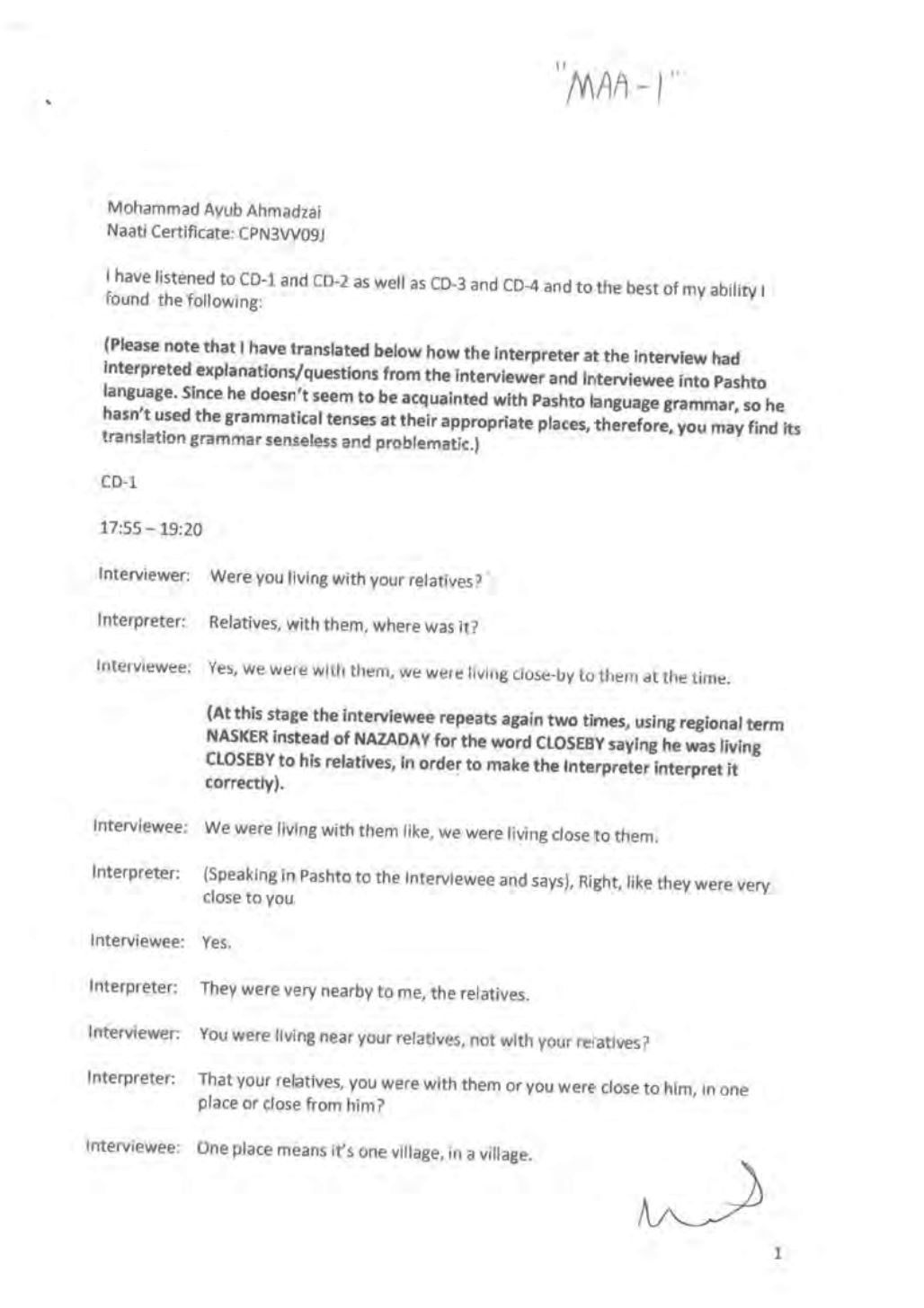
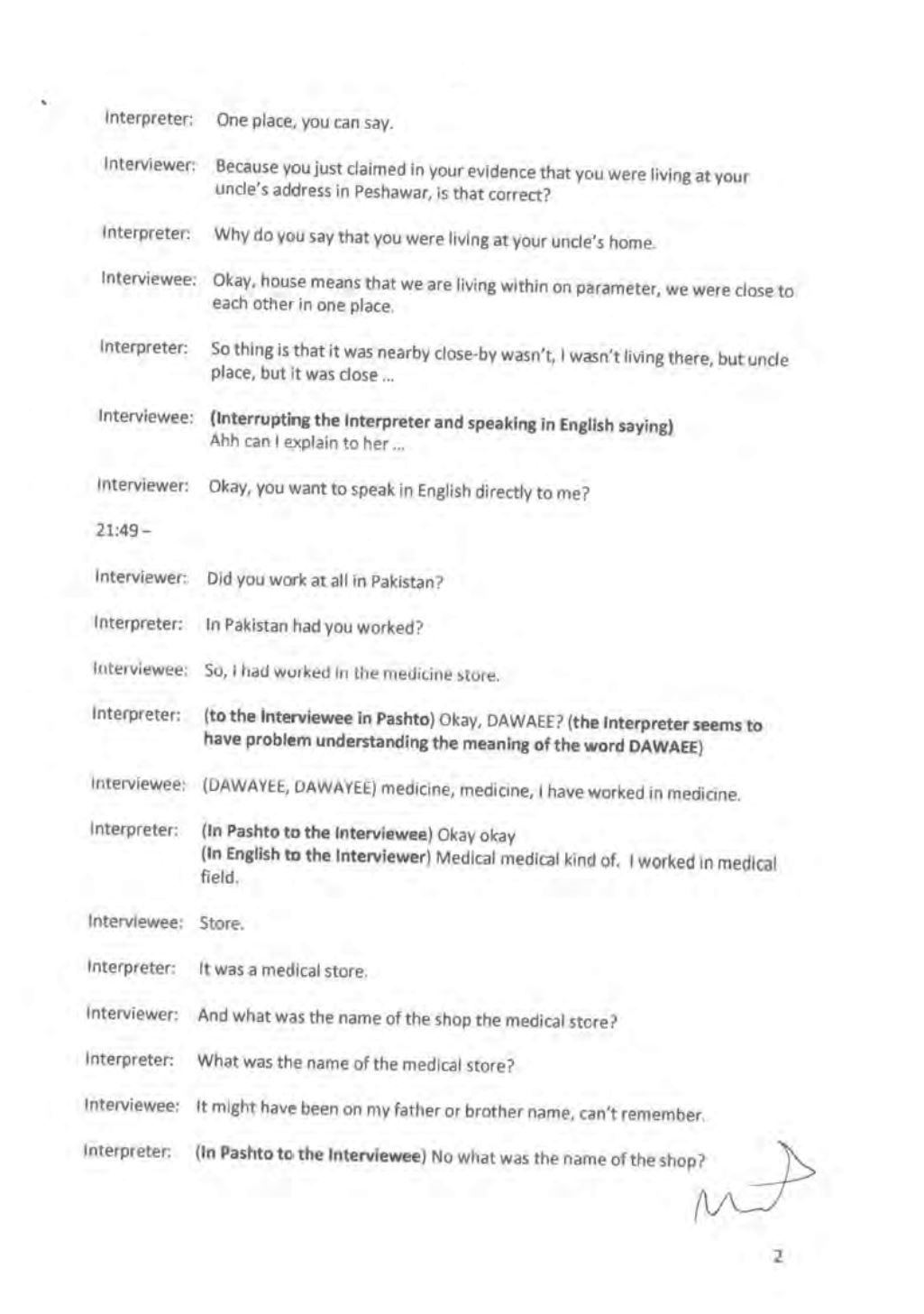
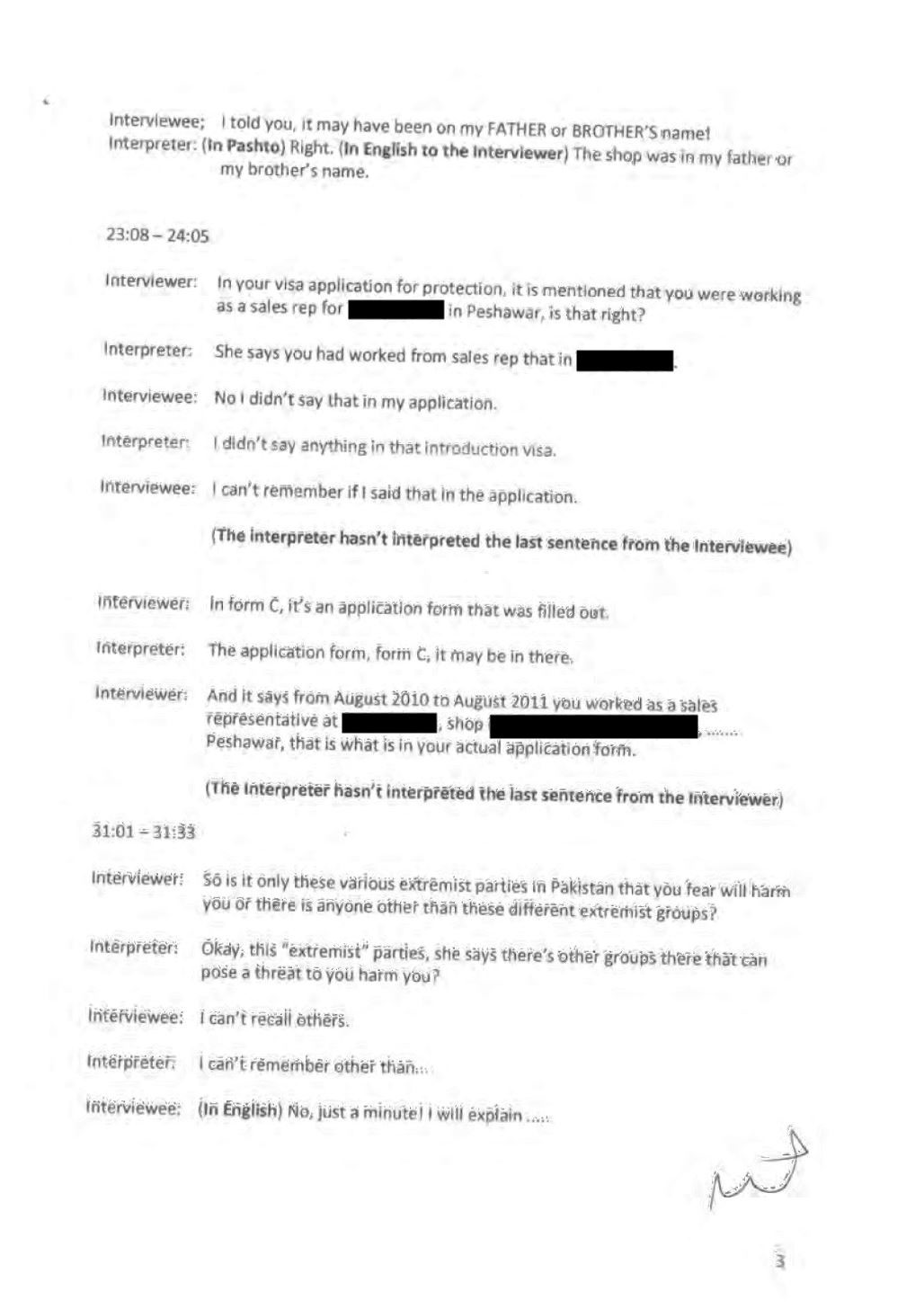
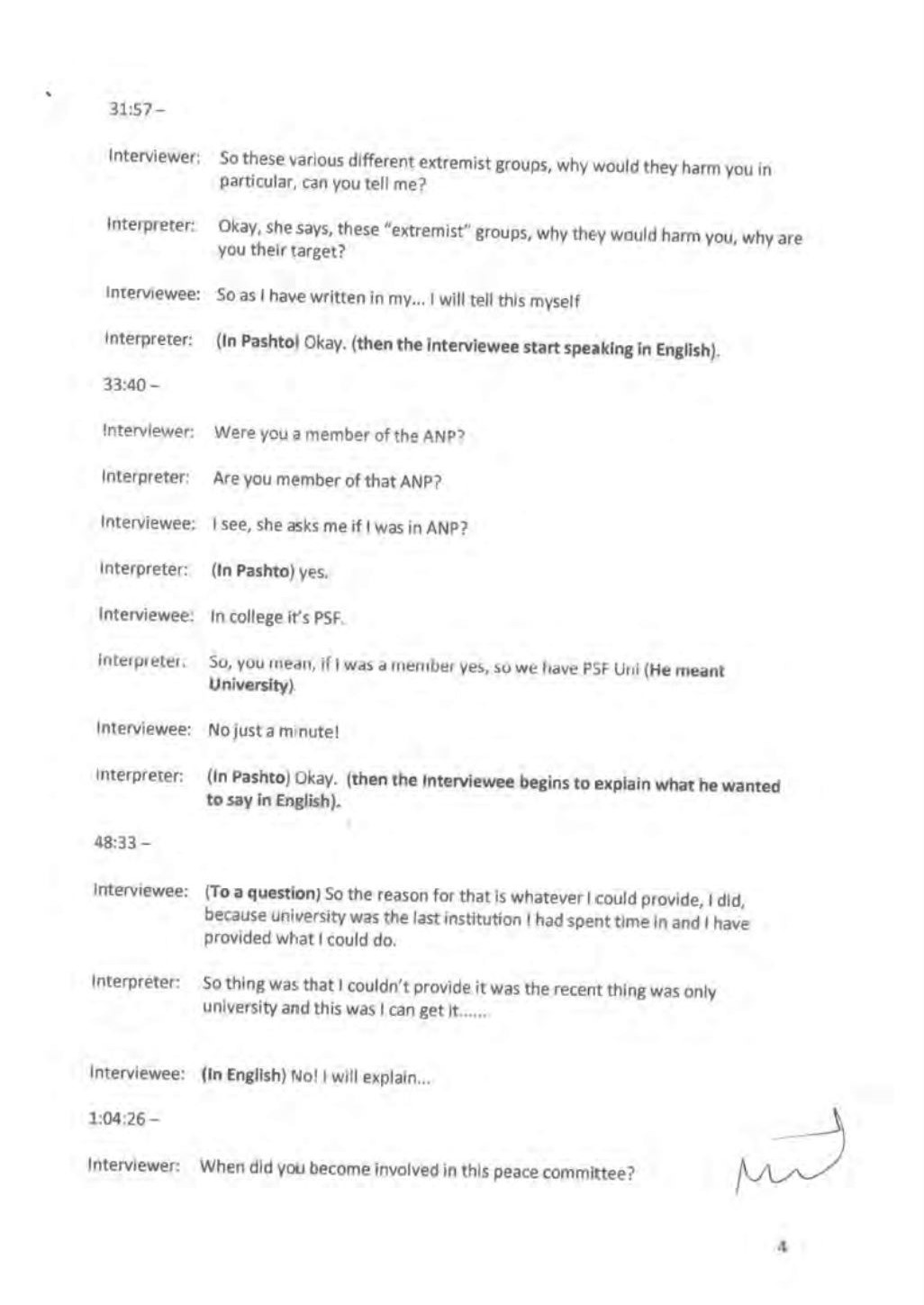
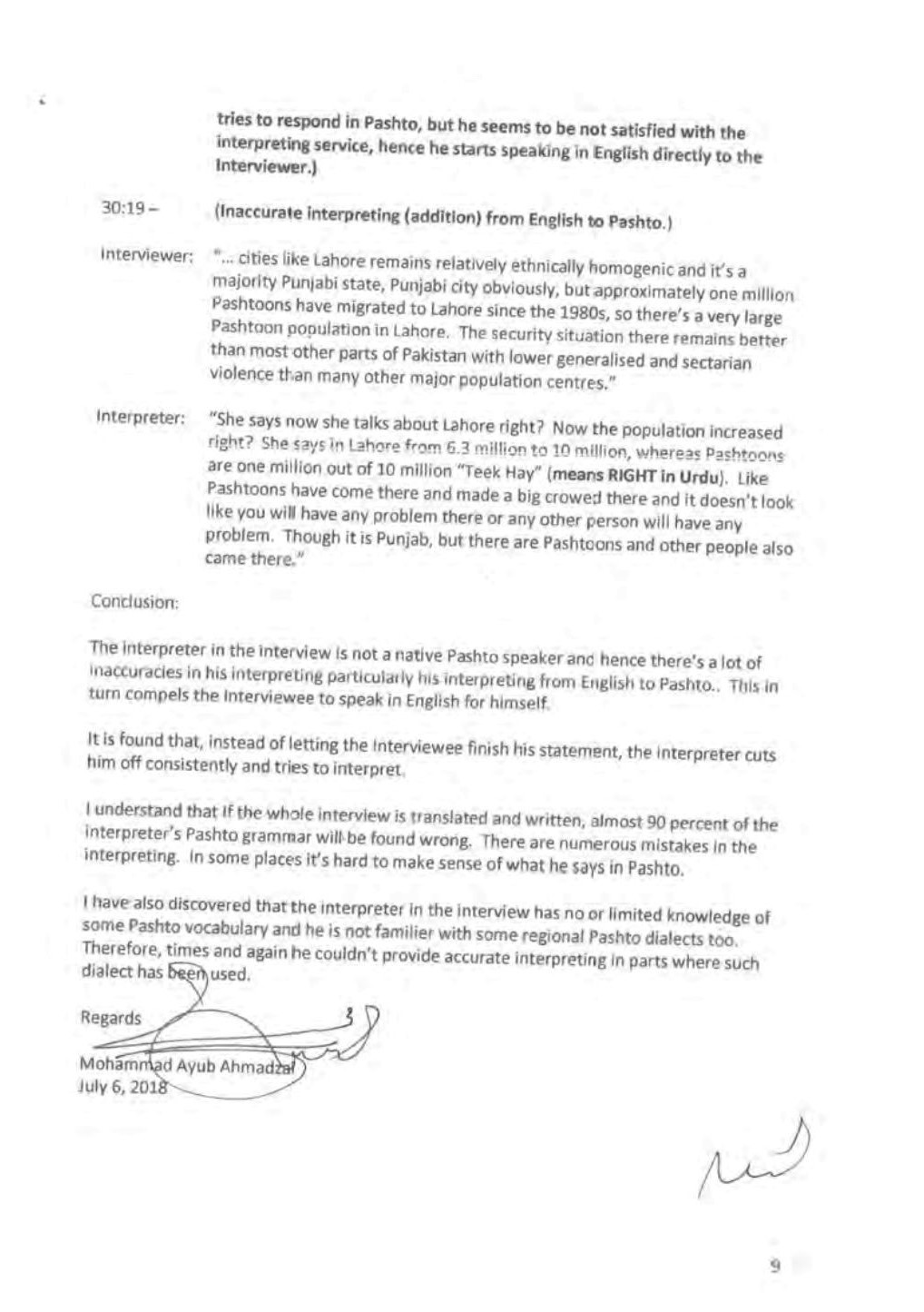
10 In conducting such a review, the Tribunal was obliged to invite the appellant to appear before it for the purposes of advancing evidence and submissions relevant to his Visa Application. Section 425 of the Act relevantly provides:
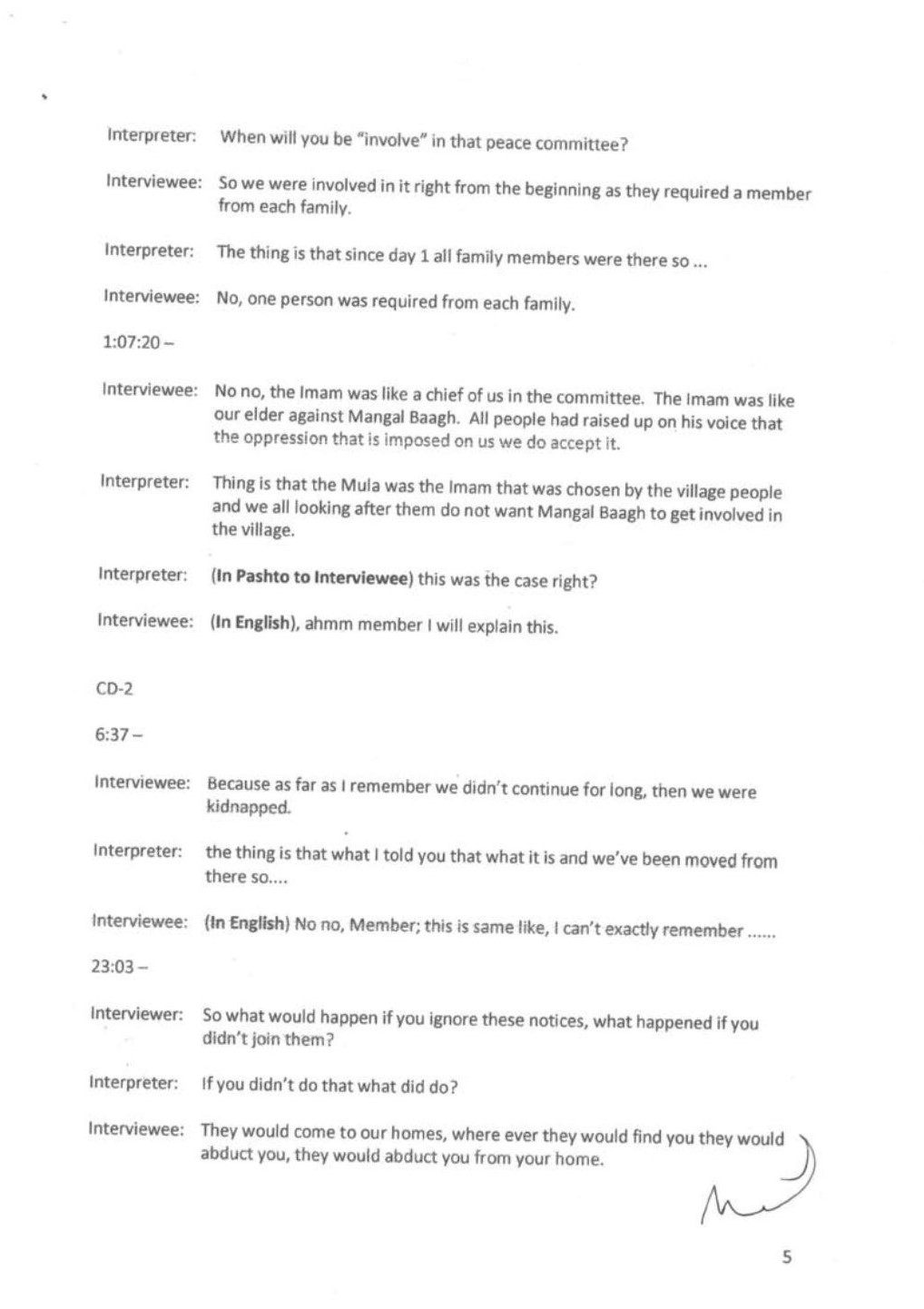
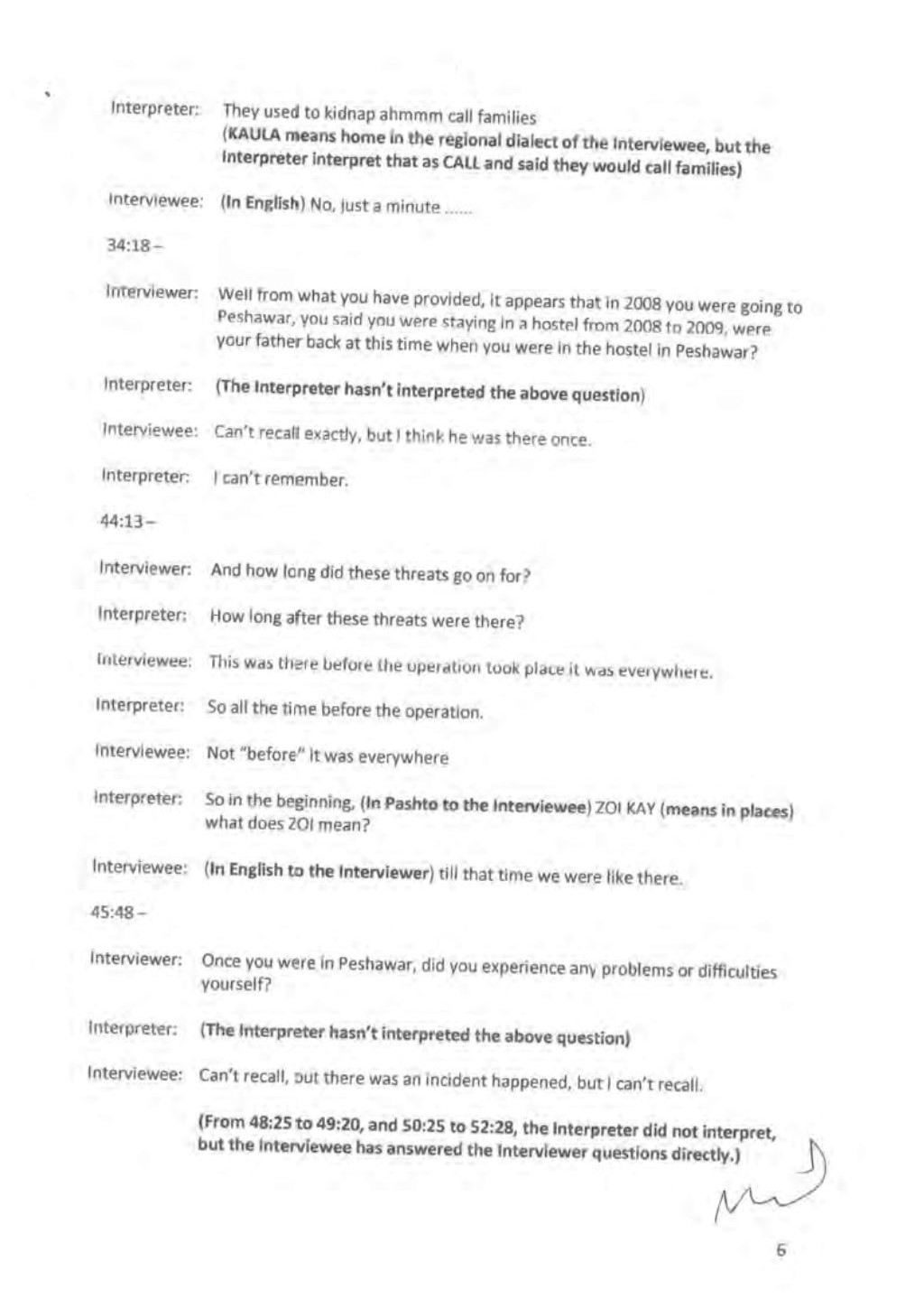
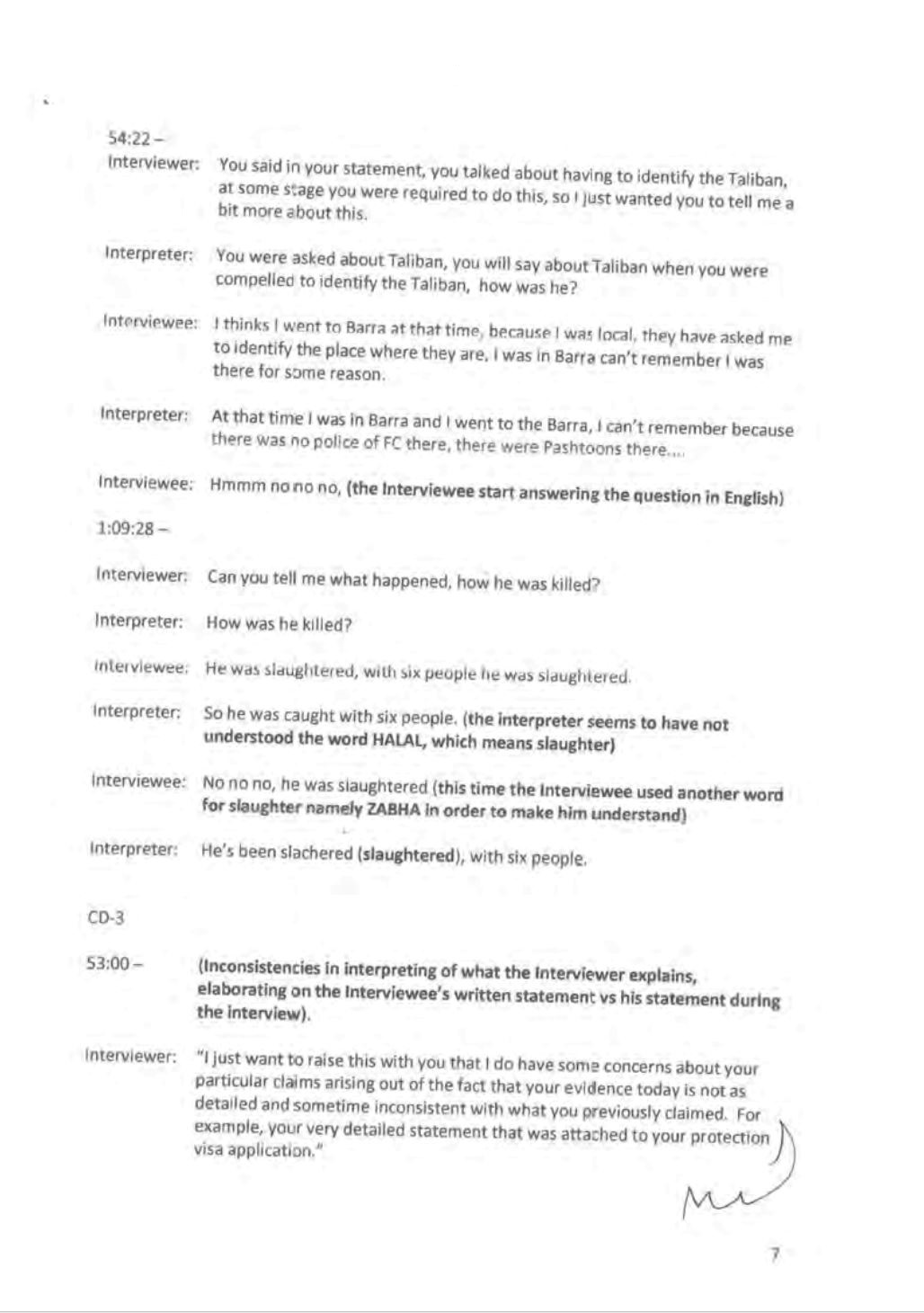
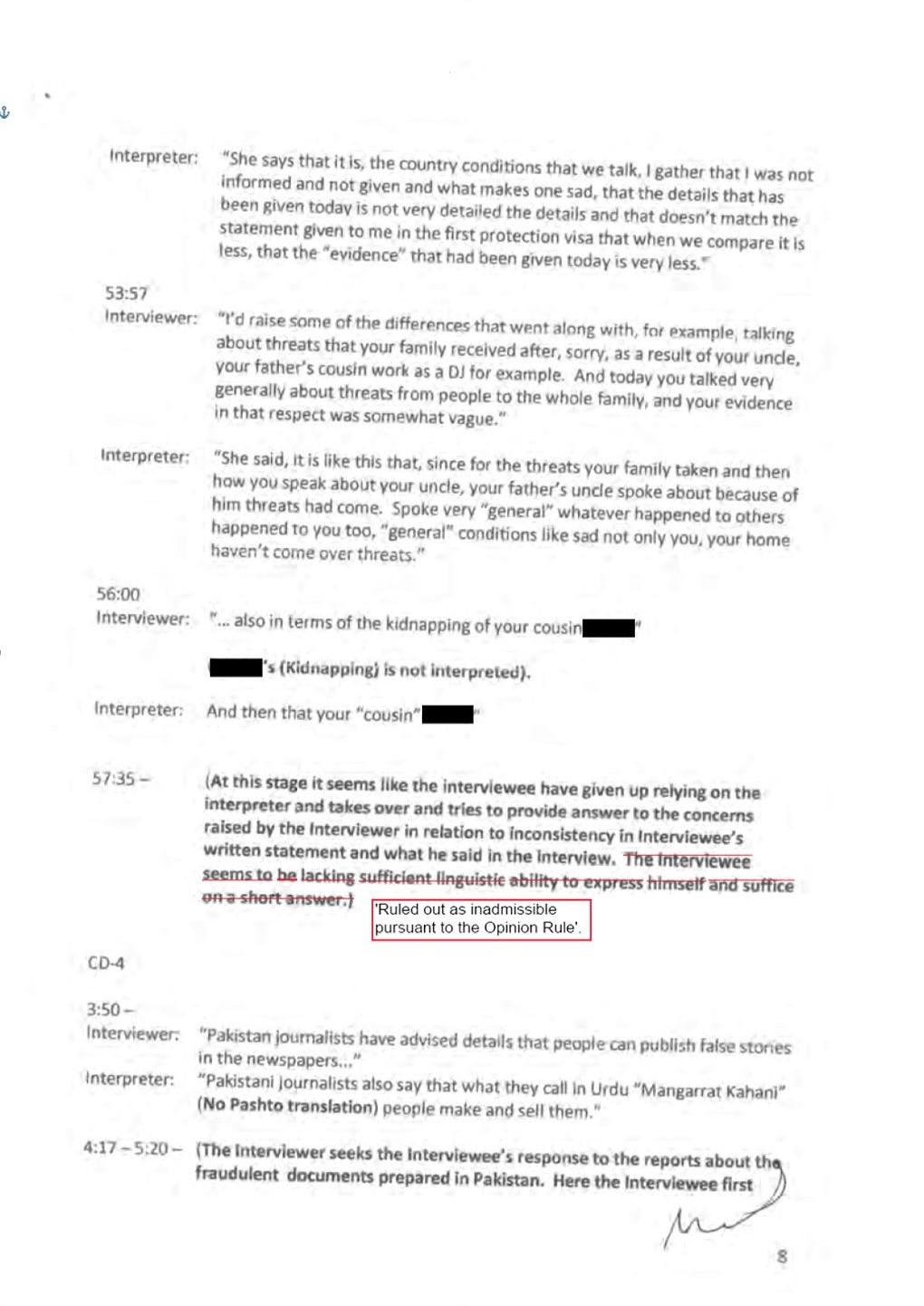
(1) The Tribunal must invite the applicant to appear before the Tribunal to give evidence and present arguments relating to the issues arising in relation to the decision under review.
(2) Subsection (1) does not apply if:
(a) the Tribunal considers that it should decide the review in the applicant’s favour on the basis of the material before it; or
(b) the applicant consents to the Tribunal deciding the review without the applicant appearing before it…
11 Section 427(7) of the Act provides:
If a person appearing before the Tribunal to give evidence is not proficient in English, the Tribunal may direct that communication with that person during his or her appearance proceed through an interpreter.
12 It is not in dispute (nor credibly disputed) that the obligation for which s 425 of the Act provides is an obligation imposed upon the Tribunal to afford an applicant a fair and meaningful opportunity to advance his or her visa application: Minister for Immigration and Citizenship v Li (2013) 249 CLR 332, 361-362 [58]-[62] (Hayne, Kiefel and Bell JJ); Minister for Immigration and Multicultural and Indigenous Affairs v SCAR (2003) 128 FCR 553, 561 [35]-[38] (Gray, Cooper and Selway JJ); BRQ18 v Minister for Home Affairs [2019] FCA 319, [28] (Perry J); SBLF v Minister for Immigration and Citizenship (2008) 103 ALD 566, 574-575 [29] (Gray J).
The Tribunal Decision
13 In support of both his Visa Application and his Review Application, the appellant claimed that he left Pakistan because he felt that he was at risk of being kidnapped, tortured or killed. That fear, he contended, arose from his opposition to the Taliban, which was known sufficiently widely in his home region. Amongst other things, the appellant said that:
(1) when he resided in Bara, he spent some time as a member of a local “peace committee”, a purpose of which was to protect the local community from attacks by extremist organisations;
(2) he opposed the politics and religious ideas of the Taliban;
(3) he and members of his family are or were active within the Awami National Party, or “ANP” (and that, at college, he was active within its student wing, the Pukhtoon Student Federation, or “PSF”);
(4) by reason of that association, he and they were named on what he described as a “main list” (the precise nature of which is less than clear);
(5) he was a member of the Khyber Union, an organisation dedicated to the advancement of Afridi students;
(6) he had, for a time commencing when he was 16 years of age, been conscripted by members of his village to serve as a bodyguard of “the religious person at the Mosque in Bara known as Moulvi Gul Salam”—he was told that, unless he performed in that role, the locals would burn down his house;
(7) after the Moulvi left Bara and his (the appellant’s) service as a bodyguard came to an end, he (the appellant) was kidnapped by agents of the extremist group, Lashkar-e-Islam, who kept him in a private jail and periodically beat him with guns;
(8) his kidnapping came to an end when his uncle paid a ransom (presumably to Lashkar-e-Islam, or forces aligned with it);
(9) after his release, Lashkar-e-Islam continued to threaten him and his family, including by means of demands for money and/or that he (or they) commit to fighting for it;
(10) a relative of his father’s was a radio disk jockey, who regularly played songs and discussed topics that attracted the ire of extremist groups, which, in turn, resulted in pressure being brought to bear upon the appellant and his family by local people apparently concerned to avoid that wrath;
(11) his family home was destroyed, either by Lashkar-e-Islam or Ansar Ul-Islam (a rival extremist group) and, apparently, because of his or his family’s opposition to the Taliban;
(12) in 2008 (or possibly 2009), he moved to Peshawar to attend college—he stayed in a hostel (although, may, for some of the first year that he was in college, have commuted, or regularly moved, between Peshawar and Bara);
(13) he was once fined for having music stored on his mobile telephone;
(14) he was once caught dancing at a wedding, for which he was fined and sent for 10 days of religious education in Punjab;
(15) a relative of his had been killed along with six (or maybe five) others, at least some of whom were doctors (he initially claimed that they all were but later conceded that they might not all have been)—their deaths were apparently at the hands of extremists in the appellant’s home region;
(16) the Taliban had once kidnapped a cousin of his, but he (the cousin) was later released (possibly because other relatives paid a ransom to secure his release, although the evidence about what the appellant’s recollection on that front was is unclear);
(17) another relative—a known supplier of arms to groups opposed to extremist organisations such as Lashkar-e-Islam—was kidnapped in May 2012 and his whereabouts since are unknown;
(18) yet another cousin was also kidnapped and taken to a training facility operated by Lashkar-e-Islam or forces aligned with it—he (the cousin) escaped but was later killed when (or, possibly, at some point after) unknown men (assumed to be aligned with Lashkar-e-Islam or its leader, Mangal Bagh) tried to recapture him;
(19) in 2009, he (the appellant) was required to assist Pakistan’s Frontier Corps or the Pakistani military by identifying Taliban operatives in the local Bara area;
(20) he (the appellant) applied to join the Pakistani military but was rejected because (or for reasons that included that) he is Pashtun and/or hails from what was once the Khyber Agency (now Khyber Pakhtunkhwa);
(21) after he arrived in Australia, his (the appellant’s) family’s business—a “medicine store” in Bara—had to be closed down because of orders (presumably made by extremist groups in the region, although that isn’t clear) that western medicines not be used;
(22) his (the appellant’s) brother had been threatened with death on account of his employment with a non-governmental organisation known as “ACE”, which was dedicated to the creation of employment opportunities and the advancement of children, and which, because it was an NGO, extremist groups were known to abhor—his brother’s work involved conducting surveys within the Bara region (although other evidence suggested that he may have been an accountant of some sort);
(23) prior to his arrival in Australia, the appellant had worked at his family’s shop in Bara and at a fabrics business in Peshawar (although the appellant later indicated that the latter might not have been a regular engagement);
(24) he (the appellant) had “lost many scholarships” because of his or his tribe’s association with (or proximity to) extremists and the difficulties that created with the Pakistani government (which included difficulties in getting certain documents signed or approved); and
(25) the United Nations High Commissioner for Refugees had registered his (the appellant’s) family as internally displaced persons.
14 As will be immediately apparent from the summary set out above, there were aspects of the appellant’s claim that lacked detail and/or were difficult to follow. Nonetheless, central to the appellant’s Visa Application was his contention that, by reason of his activism, his former service as a bodyguard to the local Moulvi, his family connections and his history (as broadly summarised above), he was known or identifiable as an anti-extremist, and as an opponent of outfits such as the Taliban, Lashkar-e-Islam (and its leader, Mangal Bagh) and Tehrik-i-Taliban (the Taliban Movement of Pakistan—or “Tehreek e Taliban”, as the appellant nominated it). His and his family’s experiences, he contended, reflected the fact that, if returned to Pakistan, he would be subjected to persecution or would otherwise be at risk of significant harm. That being so, he said, he qualified for a protection visa under the Act.
15 The Tribunal did not accept that narrative. It is necessary to set out in detail the findings that it made en route to affirming the Minister’s Decision. The key passages from the Tribunal Decision are as follows:
31. The [appellant] claimed in the hearing that he fears he will be harmed by Lashkar-e-Islam, Mangal Bagh, Tehreek-e-Taliban and any extremist parties in Pakistan because of his anti-extremist opinion and opposition to them and also his ANP political opinion. The [appellant] claimed that he and his family were opposing these various extremist groups from the start.
32. The [appellant] claimed in the hearing that he and his family are members of the ANP and therefore they are on a list. In his detailed statement attached to his protection visa application, he claimed that he worked for the Pukhtoon Student Federation (PSF) in government college in Peshawar as general secretary and that he was also a member of the Khyber Union, which works for the rights of the Afridi tribal students. He also claimed to have been the PSF representative of the biotechnology department at the Agricultural University in Peshawar. The Tribunal found the [appellant]’s evidence in respect to his and his family’s association with the ANP and PSF to be vague and lacking in detail. The Tribunal notes when asked when his father joined the ANP, the [appellant] claimed they did not have to join because they have the same ideology. While the Tribunal appreciates that the [appellant]’s father may share the same views and beliefs as the ANP, the Tribunal does not accept the [appellant]’s contention that this automatically results in his father being a member of the party. The Tribunal also found the [appellant]’s evidence regarding the role his father and brother/s played in the party to be unconvincing. He initially claimed that his father and brother used to serve for them in the village. When asked to explain what he meant by this, the [appellant] claimed that he, his father and brothers would talk to people in the village about the ideology of the ANP during gatherings for the party during elections. In response to the Tribunal’s question asking what he would tell people about the ideology of the ANP, the [appellant] spoke very generally about speaking to people about the ANP making schools and roads, being against extremist violence, Pashtun rights, being non-violent and education, particularly for women. The Tribunal found the [appellant]’s evidence in respect of this principal activity which he and his family engaged in in support of the party every month, according to the [appellant]’s evidence in the hearing, to be limited and unpersuasive. The Tribunal has taken into consideration the ANP membership cards of his father and brother and letter from Sartaj Khan, ex-general secretary ANP, City District Peshawar, dated 3 December 2013 confirming the [appellant]’s father is a member of the ANP, Peshawar Khyber Pakthtunkwa, which the [appellant] submitted to the first Tribunal. It also has had regard to the information it put to him from DFAT’s country information report on Pakistan, dated 15 January 2016, which described document fraud as being endemic in Pakistan and DFAT being aware of numerous cases of false school and academic records, birth certificates, death certificates, medical records, bank records and documents issued in a legitimate format without proper verification by Pakistani authorities. Pakistan journalists have advised DFAT that people can publish false stories in newspapers for a fee, although this trend appears to be in decline. In light of this information and the Tribunal’s concerns regarding the [appellant]’s oral evidence, as discussed above, the Tribunal places little weight on these membership cards or letters purportedly from the ANP.
33. Similarly, the Tribunal found the [appellant]’s evidence regarding his alleged association with the PSF to be inadequate. The [appellant] claimed in the hearing he held the position of general secretary but initially he could not recall if held [sic] this position while at university or in college, later claiming it was while at university, which contradicts his claims in his detailed statement that it was while he attended government college. Nor was the [appellant] able to tell the Tribunal how long he held this official position for. The Tribunal also notes the [appellant]’s evidence in the hearing that there was not much difference between a member and a general secretary. The Tribunal does not accept that if the [appellant] had been involved in a political party, whether it be the PSF and/or the ANP, he would not appreciate there being some variation between an ordinary member of the organisation and someone who holds an official position. In respect of his role as alleged general secretary, the [appellant] claimed it was to bring new students “into the membership”, tell new members about the aims of the PSF and their role and help with their problems. However, when asked what the aims of the PSF are, the [appellant] claimed they are the same as the ANP yet did not identify what these are. Further, the Tribunal found the [appellant]’s evidence regarding his alleged role in getting students to join the PSF to be somewhat irrelevant. Despite being asked directly how he got students to join the PSF or brought people into the organisation, the [appellant] spoke about a camp organised by PSF students which people could attend on their own accord. There was nothing in the [appellant]’s evidence to suggest that he played any role in these camps.
34. The Tribunal notes that in the hearing, when asked if he held any other position within the PSF while at university he stated no. Yet, the [appellant] submitted a letter from the PSF stating that he joined the party at the University of Agriculture on 5 March 2012 and that he was student representative of the bio-technology department. Further, there was nothing in this letter about the [appellant] having the role of general secretary, as the [appellant] asserted during the hearing. When the Tribunal put this to the [appellant], he stated he could not remember, it was either representative or general secretary. The Tribunal finds it implausible that the [appellant] would not be able to recall what alleged position or positions he held in the PSF, even if it had been several years ago.
35. Based on the above, the Tribunal does not accept that the [appellant] was a member of the ANP or the PSF. It does not accept that he held any official role, as either general secretary or student representative of the bio-technology Department. In light of the Tribunal’s concerns regarding the credibility of the [appellant]’s claims in relation to his involvement with the ANP and/or PSF, the Tribunal places little weight on the letter from the PSF the [appellant] submitted regarding him joining in March 2012 and being a student representative or the membership card that he submitted to the Department. The Tribunal does accept that the [appellant] may have been a member of the Khyber Union in College, which he described as an Afridi organisation of Bara which discussed the problems of Afridis going from Bara to Peshawar such as transport issues or if they received special funds. The Tribunal finds on the basis of the [appellant]’s evidence that this union was not a political organisation but one concerned with providing support and assistance to Afridis.
36. The Tribunal does not accept that the [appellant] was a member of a peace committee. Firstly, it notes in the hearing the [appellant] claimed it was while he was still living in Bara that he was involved in the peace committee, yet his evidence to the first Tribunal was that he engaged in activities as a member of the peace committee after he left Bara, while living in Peshawar. According to the [appellant]’s evidence to the first Tribunal, he became a member of the peace committee because his uncle was still living in Bara, despite the fact that the [appellant] and his immediate family had moved elsewhere. In contrast, the [appellant]’s evidence during the current hearing was that he was involved in the peace committee in maybe 2005 or 2006, he could not remember exactly, but he confirmed he was residing in Bara when he became actively involved.
37. Secondly, while the [appellant] spoke about the village getting together against the Mangal Bagh group, including his family, and him being chosen from his family to be part of the peace committee, when asked about his involvement, the [appellant] spoke about being a bodyguard for the Mullahs, which was a separate claim made by him. It was only when the Tribunal specifically put to the [appellant] information about peace committees or village defence committees or Lashkars and their function in providing or leading patrols and defending against attacks by extremist groups, that the [appellant] spoke about protecting the village and having weapons. The Tribunal does not accept that if the [appellant] was involved in any peace committee as claimed, that he would be unable to describe his activities without prompting. The Tribunal also does not accept that the [appellant]’s family members had any involvement with the peace committee. Although the [appellant] claimed that all his family members were involved in the peace committee because it was on a “village based kind of thing”, the [appellant] could not remember the time when his family members were allegedly involved and instead assumed if they were there they would have helped too. The Tribunal finds the [appellant]’s evidence regarding his family members [sic] alleged involvement in the peace committee lacking, and as such does not accept that they were part of any peace committee.
38. Given the discrepancy in the [appellant]’s evidence as to where he allegedly served as a member of a peace committee and the deficiency in his evidence regarding the role of the peace committee and his responsibility as a member, the Tribunal finds the [appellant] was not a member of a peace committee. As such, it does not accept that the [appellant] faces a real chance of being kidnapped and tortured because of his opposition to the Taliban as a member of a peace committee.
39. The Tribunal also does not accept that the [appellant] was bodyguard to a Molvi, as he claimed. The Tribunal notes in the [appellant]’s detailed statement attached to his protection visa application, he claimed he was ordered to become a bodyguard otherwise his family was told to leave the village or they will burn their house down. The Tribunal finds it implausible that as a sixteen year old the [appellant] would be tasked with this responsibility, even if he was large for his age, as suggested in submissions from the [appellant]’s advisers. Further, the Tribunal notes the [appellant] had at least one older brother in Pakistan at the time, if not two given the vagueness of his evidence regarding his brothers’ residence, and as such, it does not accept the [appellant]’s family would have put him in the front, as he claimed, instead of one of his older brothers.
40. As the Tribunal does not accept that the [appellant] acted as a bodyguard to a Molvi, it does not accept the [appellant] was kidnapped by Lashkar-e-Islam and kept in a private jail. The Tribunal notes the [appellant] has provided conflicting evidence as to why he was allegedly kidnapped. In the detailed statement attached to his protection visa application, the [appellant] claimed it was because he was a bodyguard to the Molvi and Mangal Bagh had noticed. He also claimed he was taken because “they” were doing that in revenge for the death of their fathers and brothers in battle. According to the delegate’s decision, a copy of which was provided to the Tribunal by the [appellant], he similarly claimed it was because he was part of a group guarding the Imam. However, in the current hearing the [appellant] stated he was kidnapped because he was against them and they knew he was against them. The Tribunal does not accept that while the [appellant] was allegedly being held in this private jail, he was beaten with guns and that he was only released after his uncle paid a ransom. The Tribunal notes the [appellant] had no knowledge of who his uncle approached to allegedly have him released. Nor does the Tribunal accept that after the [appellant] was released Lashkar-e-Islam continued to threaten him, as he initially claimed in his detailed statement. The Tribunal found the [appellant]’s evidence in the hearing regarding what happened after he was allegedly kidnapped and released to be vague and lacking in detail. When asked if anything happened to him after he was released, he stated they were always looking for a reason to torture them and were imposing their own Sharia. In response to the Tribunal’s request to explain what he meant, the [appellant] stated that they were always trying to get them to join them. The [appellant] spoke about notices which his father and uncle received asking them to give them a member of the family, any member, and not specifically the [appellant], or money. The Tribunal notes that there was nothing in the [appellant]’s evidence in the hearing to suggest that he was directly threatened by Lashkar-e-Islam, let alone continuously threatened, as he initially claimed in his detailed statement.
41. The Tribunal also finds the [appellant]’s evidence in the hearing regarding the notices his uncle and father allegedly received, stating that they needed people to fight, and the activities of Lashkar-e-Islam in kidnapping families and forcing people to fight and driving around the village looking for young people to fight, inconsistent with the [appellant]’s claims that he was released by Lashkar-e-Islam. The Tribunal finds it implausible that if Lashkar-e-Islam were intent on forcing the young people in the [appellant]’s village to join them, including by force, that they would release him even if his uncle had made approaches, as the [appellant] described in the hearing. The Tribunal therefore does not accept either the [appellant]’s father or uncle received any notices asking them for a person in their house or money or requesting that they appear in the Shura every month where they paid an amount of money instead of giving a family member to join. Given the Tribunal’s concerns regarding the credibility of this claim, it places little weight on the purported notice the [appellant] submitted to the Department from Lashkar-e-Islam dated 9 August 2009 requesting an appearance of [name redacted] before the Council of Lashkar-e-Islam and payment of 2000 rupees per month.
42. The Tribunal has serious doubts that the [appellant]’s father’s relative, which he described in his statement attached to his protection visa application as his grandfather, but in the hearing as his father’s uncle, was a DJ on FM radio. The Tribunal notes when asked if his father’s relative had any problems or difficulties as a result of his activities on the radio, the [appellant] stated that there was a big issue because he was playing songs and talking about education so he was stressed but he continued his efforts. When asked if his father’s relative was asked to stop his DJ activities, the [appellant] stated indirectly people said to stop it, however he did not know who these people were. The [appellant] was also unable to tell the Tribunal what issues his father’s relative faced as a result of his activities as a DJ.
43. The Tribunal does not accept that Mangal Bagh sent the [appellant]’s family threatening notices because of his father’s relative’s activities as a DJ living in Jamrud. The Tribunal notes when asked if he or his family members experienced any problems or difficulties as a result of his father’s relative’s activities on the radio, the [appellant] stated that they were pressurised because of him. In response to the Tribunal’s questions aimed at eliciting further information from the [appellant] about this alleged pressure he and his family were allegedly subjected to, the [appellant] claimed there was a threat – people saying just tell him to stop all these things and they were afraid they would attack their house. The [appellant]’s evidence was that local tribe people would say this in “social life” or in the market when they would go out to the village or a gathering. When asked if he personally received any threats from anyone in relation to his father’s relative’s activities as a DJ on the radio, the [appellant] responded because he is his uncle so if they are talking about him, they are all one family so it comes to him as well. The Tribunal finds the [appellant]’s evidence in the hearing regarding the alleged problems he and his family experienced in respect of his father’s relative’s alleged position as a DJ on FM radio to be significantly different from the claims he made in his detailed statement attached to his protection visa application, which was that Mangal Bagh was sending threatening notes to his family.
44. Given the above deficiencies in the [appellant]’s evidence in respect of this particular claim, the Tribunal does not accept that the [appellant]’s father’s relative was a DJ on the radio or that the [appellant] or his family received any threats, including threating notices from Mangal Bagh or indirect threats from people in the village socially, that his father’s relative should cease his activities.
45. The Tribunal notes in the [appellant]’s detailed statement he claimed that his family home in Terah was destroyed by either Ananul Islam or Lashkar-e-Islam. Due to the rambling and convoluted nature of the [appellant]’s statement, the Tribunal is unclear as to who was responsible for allegedly burning the [appellant]’s family home because the [appellant] and his family are against the Taliban people. The [appellant] made no mention in the hearing about this particular claim. While the Tribunal accepts as plausible that the [appellant]’s family home may have been destroyed due to fighting that occurred in that area, it does not accept that he and his family were specifically targeted because they were perceived to be against Taliban people.
46. The Tribunal does not accept that the [appellant] and his brother were sent to Peshawar to his uncle’s home because of the alleged notices that his father and uncle received from Lashkar-e-Islam. Rather, the Tribunal accepts the [appellant]’s evidence in his detailed statement that he went to Peshawar from 2008 to attend college. In the hearing the [appellant] claimed that he moved to Peshawar in 2009, when the operation started. When the Tribunal put to the [appellant] that in his statement he claimed he went to Peshawar and stayed in a hostel from 2008 to 2009, the [appellant] responded that he did spend time in a hostel but Bara and Peshawar was close so he spent time coming up and down. However, the Tribunal does not accept that the [appellant] went back and forth between Bara and Peshawar as it finds it inconsistent with [h]is evidence in his statement that he was sent to Peshawar to keep him safe.
47. The Tribunal does not accept that the [appellant] was fined in 2008 because he had songs on his mobile. The Tribunal notes the [appellant]’s evidence in the hearing was that there was an incident in Peshawar but he could not remember. When the Tribunal put to the [appellant] the claim made in his statement of being fined for having songs on his mobile, the [appellant] stated that this may have happened in Bara. The Tribunal found the [appellant]’s evidence about the circumstances surrounding this incident to be very vague. While he claimed Lashkar-e-Islam would check vehicles and mobiles to see if there were any cassettes or songs, he was unable to remember what actually happened to him or how much he was allegedly fined.
48. Similarly, while the [appellant] also claimed in his statement that he had once danced at a relative’s marriage in Peshawar and was punished 15 kore and sent to Tableigh (Islamic teachings) in Punjab for 10 days, when asked in the hearing about any problems or difficulties he experienced in Peshawar, the [appellant] did not raise this particular incident but instead stated that he could not remember. It was only when the Tribunal put to the [appellant] this particular claim made in his detailed statement, that he agreed that this had occurred but was unable to tell the Tribunal what actually happened. The [appellant] was also unclear as to whether he was sent to Tableigh for this reason or if it was for another reason and could not say how long he had to go to Tableigh for. While the Tribunal appreciates that these events occurred some years ago, it is unable to reconcile the [appellant]’s inability to recall at all these claims, which he had previously expanded upon in his detailed statement attached to his protection visa application. Further, the Tribunal finds the [appellant]’s evidence in the hearing that he was punished in Bara, when he went back there from Peshawar, for his alleged actions in Peshawar, implausible. The Tribunal also finds the [appellant]’s claims that he went back to Bara despite being allegedly sent away to Peshawar by his family to keep him safe because Lashkar-e-Islam was getting stronger and wanting people to join and fight for them, difficult to accept. The Tribunal finds the [appellant]’s explanation for the reason why he went back to Bara, that he had to return because if he did not his family may have got into trouble, unconvincing. As such, the Tribunal does not accept that the [appellant] was punished by being fined 15 kore and sent to Tableigh because he danced at a relative’s marriage in Peshawar.
49. The [appellant] made claims in relation to a number of relatives who had allegedly experienced harm in Pakistan. In his statement he claimed in August 2009, six doctors [sic] throats were cut and one of them was his relative [relative A]. The Tribunal has serious doubts about the [appellant]’s claim that his relative [relative A] was killed. The Tribunal notes in the hearing he stated [relative A] was slaughtered with six people, however he had previously claimed he was one of six doctors whose throats were cut. The [appellant] was also unclear in the hearing as to who the other people were who were killed with his relative [relative A]. He initially described them as being all local people and when the Tribunal put to the [appellant] that he had previously referred to them as doctors, the [appellant] claimed that [relative A] and another one person he knew were doctors but he did not know about the others. The Tribunal also has some concern that in addition to claiming that [relative A] was a doctor, the [appellant] also claimed that [relative A] was implicit in supplying arms to government supported groups to fight against the Taliban.
50. The [appellant] claimed in his statement before [relative A] was killed, “they” kidnapped his nephew and the [appellant]’s cousin named [cousin B] but [relative A] and his brother gave money to the Taliban to save [cousin B] so [cousin B] was not killed. The Tribunal does not accept the [appellant]’s claims regarding the alleged kidnapping of [cousin B]. The Tribunal found the [appellant]’s evidence to be vague and lacking in detail. He could not remember when [cousin B] was allegedly kidnapped or the circumstances of his alleged kidnapping apart from him being on the way somewhere and Lashkar-e-Islam followed him in a vehicle. The [appellant] also stated in the hearing that he could not remember what happened to [cousin B] but maybe the military did shelling however he was released. He stated that he did not know how [cousin B] got released. The Tribunal finds this is in stark contrast to his evidence in his detailed statement that [cousin B] was saved by [relative A] and his brother giving the Taliban (as opposed to Lashkar-e-Islam) money.
51. The Tribunal also does not accept that the [appellant]’s alleged relative, [relative C], who was allegedly involved in supplying arms to government supported groups to fight against the Taliban with [relative A], was kidnapped by the government in May 2012 and since then his whereabouts have been unknown. The Tribunal does not accept, in circumstances where [relative C] was allegedly assisting the government, that he would be kidnapped by their agencies. Further, the Tribunal found the [appellant]’s evidence as to how he became aware that government agencies were allegedly responsible for [relative C] going missing to be unconvincing and speculative, with the [appellant] suggesting it may have been a shop keeper but he was not exactly sure; they just got the news.
52. The [appellant] claimed in his detailed statement attached to his protection visa application that his cousin was taken from school to a training centre in a hilly area in Bara division but he escaped from there and went to Lahore. He claimed in the hearing that this same cousin, [cousin D], was subsequently killed on 16 June 2012 when he went to Peshawar to buy medicine for his mother and four men tried to kidnap him but he did not let them so they killed him. The Tribunal notes the [appellant] did not raise anything in the hearing about the kidnapping of this cousin from school and escaping from a training centre which he was taken to. Only when the Tribunal raised this claim directly with the [appellant], did he suggest it was the same relative who was killed in Bajray area, after initially stating he could not remember. The [appellant] also could not remember when this kidnapping took place, how his cousin managed to escape from training with Mangal Bagh or how long his cousin was in Lahore, where he had escaped to, before returning to Peshawar. While the Tribunal appreciates it may have been some years since these events occurred, given the level of detail the [appellant] previously provided in respect of these claims and their significance to his application for protection, the Tribunal would expect the [appellant] would demonstrate some awareness of what allegedly transpired.
53. In respect of the death of the same cousin later in Peshawar when he was going to buy medicine for his mother, the [appellant] claimed in the hearing that “they” tried to kidnap his cousin but he did not let them so they killed him. However, in the articles the [appellant] submitted about this incident, it was reported that some unknown persons actually kidnapped [cousin D], took him to a nearby area in Bajray Bazar and killed him there. The reports submitted also provide that [cousin D]’s brother had stated that the family had no enmity or financial dispute with anyone. As the Tribunal put to the [appellant] in the hearing, it finds the details of what happened during this incident, as reported in the articles, different from the [appellant]’s statement and his evidence in the hearing that they tried to kidnap [cousin D], he tried to get away and they shot him. The Tribunal does not accept that the [appellant] would not be able to consistently recall what happened to [cousin D], even in vague detail, if in fact he was a relative of his and in light of the fact that this incident happened shortly before the [appellant] departed Pakistan, as he wrote in his protection visa application. While the Tribunal accepts that someone named [cousin D] was killed, consistent with the articles provided by the [appellant], the Tribunal does not accept that this person is related to the [appellant].
54. The Tribunal does not accept that the [appellant] was required to assist the Frontier Corps and/or the military by identifying Taliban in the area. According to the [appellant]’s evidence at various stages of the process, he had been living in Peshawar since 2008 and this incident happened sometime in 2009. The Tribunal finds it implausible, as someone who had not been living in the area for some time, that the [appellant] would be asked to engage in this activity. The Tribunal notes the [appellant] was also unable to remember in the hearing the reason why he went to Bara on this occasion, however he had previously claimed he had gone there to help his uncle move from the area. The Tribunal also found the [appellant]’s evidence as to how it came about that he was tasked by the FC and/or military with this job vague. As such, the Tribunal does not accept that the [appellant] gave information against the Taliban.
55. The Tribunal also does not accept the [appellant]’s vague claims in the hearing about an alleged incident in Peshawar involving a kidnap attempt, which he could not remember. The Tribunal found the [appellant]’s evidence to be confusing in respect of who was the alleged victim of this attempted kidnapping.
56. The Tribunal accepts the [appellant] may have made an effort to join the Pakistan Army and Air Force. It accepts that he passed the academic test but was deemed medically unfit due to problems with his hand. The Tribunal does not accept on the evidence before it that there was any other basis on which the [appellant] was excluded from joining the army or air force, particularly because of his Pashtun ethnicity or because he originated from Bara or Khyber Agency or Khyber Pakhtunkhwa. As the Tribunal put to the [appellant] in the hearing, if the authorities had any concerns about the [appellant] being a terrorist or being involved in any extremist groups because of where he came from originally, they would not have permitted him to sit the entrance exams. While the [appellant] claimed that he passed year 12, had a Pakistani passport and ID and did not have a criminal record so they could not stop him from sitting the test, the Tribunal does not accept that if the army, air force or authorities had any concerns about him that they would have permitted him to do so. In light of the [appellant]’s preparedness to join the army or air force, the Tribunal does not accept that the [appellant] has been mistreated by the army or that he had any fear of being harmed by the army or military. The Tribunal does not accept the [appellant]’s explanation which was essentially by joining the army he would get protection and would not be assumed to be a terrorist.
57. In the [appellant]’s statement attached to his protection visa application, he claimed that his family was ordered to close their shop in Bara Bazar because it was ordered that western medicine should not be used. The Tribunal notes when it asked about his father’s business, the [appellant] stated the only thing he knew was that it was a medicine business. When the Tribunal queried if this business was his father’s, he stated that it was a family business because his father was not in Pakistan and that it was his uncle and some other guys who worked there. The [appellant] was unable to remember when his family started having problems with the business. When asked if there was any request for his family to close the business, the [appellant] stated that they shut it down because of the threats from people. However, in response to the Tribunal’s question about the threats his family received, the [appellant] spoke about the general threat everywhere in Peshawar and their assumption that they would be next. When asked if his father was told to close his shop, the [appellant] stated that somebody, not a person of Taliban appearance but a local person known to them and to the [appellant]’s family, verbally indirectly told him to shut his business. The Tribunal does not accept that the [appellant]’s family were ordered to shut their family business selling medicine either in Bara or Peshawar. It accepts as plausible that when the [appellant]’s family relocated from Bara to Peshawar as a result of the volatile situation in that area at the time, that they closed their business. It does not however, accept that after the [appellant] came to Australia, his family were pressured to close their business in Peshawar, based on the limited evidence provided by the [appellant] as to when this happened or why.
58. The Tribunal has considered the [appellant]’s claims regarding his brother’s employment with an NGO in Pakistan. According to the [appellant]’s evidence in the hearing his brother worked for an organisation involved in kids’ education or health but he did not know the name of it. He claimed that to his knowledge, his brother’s position involved conducting surveys house to house and that his brother ceased working for this organisation, although he did not know when, because of threats he received from Mangal Bagh, Lashkar-e-Islam or the Taliban. When asked when his brother started receiving these threats, the [appellant] claimed the threat is always there because they kill NGO people. In response to the Tribunal’s question as to how his brother received these alleged threats, the [appellant] stated that he did not know.
59. The Tribunal does not accept that the [appellant]’s brother worked for an NGO, as he claimed. Firstly, the Tribunal notes the [appellant] submitted a letter from the NGO to the first Tribunal dated 30 August 2012 which certified that his brother was working as an assistant accountant from 1 October 2012 to date and that his main responsibilities were preparing daily vouchers, receipt books, passing general entries and filing records, in accordance with rules and guidelines, liable to maintain all the concerned records, besides assist [sic] senior officers in performing functions of the Finance Department. The Tribunal finds the contents of this letter is not consistent with the [appellant]’s evidence regarding his brother’s responsibilities, which was to go house to house for surveys. While the [appellant] responded that he did not discuss with his brother his responsibilities and job description and thought that maybe his NGO work was going door to door doing surveys, the Tribunal finds it implausible that the [appellant] would not make himself aware of these basic facts given his reliance on his brother’s alleged association with an NGO in seeking protection.
60. Further, according to the decision of the first Tribunal, the [appellant] had provided a letter from this same brother regarding his medical business with his student visa application and according to this letter, this business had been operating at the one location for a period of at least 3 years and was run by his brother, suggesting that was what he was doing for work in Pakistan and that he was not working for this NGO. The Tribunal does not accept the [appellant]’s suggestion that his brother was doing two jobs. The Tribunal also does not accept the [appellant]’s claim that he may have made a mistake and may have missed one part “or something”. As the Tribunal noted in the hearing, he had the assistance of an adviser in making his application and during the processing of his application at both the Department and Tribunal stage. While the [appellant]’s adviser submitted that the previous adviser was not a good one, the Tribunal is not in a position to make such an assessment and does not accept that this adequately explains the deficiencies it has identified in the [appellant]’s case.
61. In respect of the [appellant]’s employment in Pakistan, the Tribunal has some doubts regarding his claim that he worked in a medial [sic] store which was owned by his family. The Tribunal notes, as it did in the hearing, that in the [appellant]’s protection visa application it was recorded that he worked as a sales representative for [a business] in Peshawar. While the [appellant] responded that he did not say anything like that in his protection visa application, the Tribunal referred the [appellant] to the specific question in Form C, which he had recorded that he had worked from August 2010 to August 2011 as a sales representative at [a business] in Peshawar. When the [appellant] was shown this information, he claimed there was a shop in Fedroz but he did not go on a regular basis.
62. The [appellant] claimed in his statement attached to his protection visa application that he had lost many scholarships. When asked to explain this, the [appellant] stated that there has been a rule since British time called FCR (Frontier Crimes Regulation) which operated in a way that if any person in a tribe did something, even if he (the [appellant]) did not do anything, the government will stop singing [sic] the documents of everyone. When asked what documents he was referring to, the [appellant] stated domicile documents or identity cards; any documents requiring a signature from the political agent. The Tribunal notes when asked what scholarships he had applied for and missed out on for this reason, the [appellant] stated that he could not apply because he did not have proof of domicile. Yet, when the Tribunal asked the [appellant] if he tried to get a domicile certificate, he said he got one. Based on the [appellant]’s evidence that he was able to secure a domicile certificate, a copy of which he submitted to the first Tribunal, and the fact that he actually did not apply for any scholarships in Pakistan, the Tribunal does not accept that the [appellant] lost any scholarships for any reason including because of his membership of the Afridi tribe or the operation of the Frontier Crimes Regulation.
63. The [appellant] also raised in his statement issues relevant to the registration of his family as IDPs in order to receive assistance from UNHCR. He claimed in the hearing that the government did not initially register the people of Bara as IDPs, only later. The Tribunal notes the [appellant] submitted a UNHCR document which recognised him and his family as IDPs. According to this document, the [appellant] and his family entered Peshawar in March 2012 and not 2009 as the [appellant] claimed. While it may have been the case that the [appellant] and his family were not recognised by UNHCR until sometime after their arrival in Peshawar, based on the [appellant]’s evidence regarding how he and his family came to be in Peshawar, the Tribunal does not accept they were necessarily displaced. The Tribunal does not accept that any assistance the [appellant] and his family may have received from UNHCR in the past would result in any difficulties, let alone harm, for the [appellant] on return to Pakistan, particularly given the [appellant] has not suggested that his family who have continued to reside in Pakistan have experienced problems for this reason.
16 Those findings led the Tribunal to regard the appellant as an unreliable witness. At [64] of the Tribunal Decision, it noted:
64. Taking into consideration all of the above, the Tribunal has serious concerns about the credibility of most aspects of the [appellant]’s claims. The vagueness and deficiencies in numerous aspects of his evidence leads the Tribunal to find that the [appellant] is not a witness of truth.
17 That culminated in the observations that the Tribunal recorded at [68] and [69] of its decision:
68. While the Tribunal is prepared to accept that the [appellant] and his family may be supporters of ANP and may be opposed to the various extremist groups operating in their area of Pakistan including Mangal Bagh and Lashkar-e-Islam and the Taliban, based on the findings above it does not accept that his claims regarding his and his family’s membership of the ANP and the PSF are credible. Nor does the Tribunal accept the [appellant]’s claims in respect of his (or his family’s) involvement in the peace committee in Bara or the [appellant]’s role in protecting a Molvi are credible. The Tribunal does not accept that the [appellant]’s family engaged in any political activities or that they had any political profile. For the reasons provided above, the Tribunal does not accept that the [appellant] was kidnapped or that he or his family received threatening notices from Lashkar-e-Islam, the Taliban, Mangal Bagh or any other extremist groups either because the [appellant]’s father’s relative was a DJ on FM radio, because they were required to either give one member of his family or pay a specific sum of money, because his family operated a business selling medicine, because his brother allegedly worked for an NGO or for any of the other reasons the [appellant] has raised during the course of the processing of his application for protection. While the [appellant]’s adviser pointed out the [appellant] has not exaggerated his claims and had come across as sincere, for the reasons discussed above, the Tribunal does not find the [appellant] a reliable witness and does not accept that his claims regarding his past experiences in Pakistan, and those of his family, are credible.
69. Based on the above, the Tribunal finds that neither the [appellant] or his immediate family have been targeted by Lashkar-e-Islam, the Taliban or any other extremist groups. The Tribunal does not accept that the Taliban, Lashkar-e-Islam or any other extremist groups are looking for the [appellant] either because they want one young man from each family or because he was always their target because he and/or his family rose up against them, his brother was working for an NGO, they were taking food from UNHCR or they are moderate, as he claimed in his statement attached to his protection visa application. The Tribunal does not accept on the evidence before it, and also taking into account the fact that the [appellant]’s family have continued to reside in Pakistan without experiencing any harm including his brother, that the [appellant] faces a real chance of persecution on his return to Pakistan now from any extremist groups for any reason or from the military or Pakistan authorities because he is from Bara or Khyber Agency or because he belongs to the Afridi tribe or because of the [appellant]’s alleged anti-extremist opinion and opposition to them and also his ANP political opinion.
18 It followed that the Tribunal was not satisfied that the appellant was someone in respect of whom Australia owed protection obligations under the Act. On that basis, the Minister’s Decision was affirmed.
The appellant’s CASE on judicial review
19 By means of the Judicial Review Application, the appellant contended that the Tribunal Decision was affected by jurisdictional error and, therefore, was liable to the relief that he sought. The appellant advanced two grounds in support of that contention. Only one is presently relevant—the appellant contended that he:
…was deprived of a meaningful hearing to which he was entitled under s 425 of the Migration Act by reason of the Tribunal’s failure to provide adequate interpretation services to the [appellant].
Particulars
a) The interpreter repeatedly failed to interpret fully and clearly the evidence given by the [appellant] during the hearing.
b) The [appellant] was forced to interrupt the interpreter repeatedly to give direct evidence in broken English when he believed the interpreter had not adequately interpreted his evidence to the Tribunal.
c) The inadequacy of the interpretation was material to the Tribunal’s finding that the [appellant] was not a credible witness due to “the vagueness and deficiencies in his evidence.”
20 In support of that contention, the appellant led evidence in the FCCA about what was said during the Tribunal Hearing. That evidence, in part, assumed the form of a transcript of that hearing (hereafter, the “Hearing Transcript”), which was apparently produced by a transcription service from audio recordings supplied by the Tribunal. It appears to have been received into evidence without objection; sensibly, if I might say so.
21 The appellant also relied upon expert evidence in the form of an affidavit affirmed by a professional Pashto interpreter, Mr Mohammad Ayub Ahmadzai. He produced (and annexed to his affidavit) a note, dated 6 July 2018, that he prepared whilst listening to four numbered compact discs that were supplied to him and that he described as containing audio recordings of the Tribunal Hearing. That note predominantly assumes the form of transcriptions of (and, to a lesser extent, commentary about) parts of those audio recordings. Each such part is identified by reference to the number of the compact disc upon which it was recorded and, in each case, the point in time after the commencement of that disc that the relevant exchange occurred. Again, sensibly, no issue appears to have been taken as to the veracity of the recordings (which were not received into evidence) or the accuracy of Mr Ahmadzai’s transcriptions. Some parts of his statement were ruled inadmissible under s 76 of the Evidence Act 1995 (Cth); but they are not relevant to the present appeal.
22 A close facsimile of Mr Ahmadzai’s note (in which only identifying references have been redacted) is reproduced as annexure 1 to these reasons (and referred to, hereafter, as the “Ahmadzai Note”). It identifies 23 discrete examples of exchanges that occurred during the Tribunal Hearing in respect of which the appellant alleged that the interpretation service provided was inaccurate or inadequate. In all but two of those discrete exchanges, the Ahmadzai Note records (in English) what was said, both in English and in Pashto, by each of the interviewer, the interpreter and the appellant. In the remaining two instances, it records only some observations of Mr Ahmadzai himself about the interpretation service in respect of the relevant exchange. In all cases (and to varying degrees), the Ahmadzai Note discloses a want of correspondence between what was said to the interpreter in English and what he then said in Pashto, or vice versa.
23 The appellant also led evidence through his solicitor in the form of a guideline apparently published by the Tribunal for the benefit or instruction of interpreters. That document, amongst other things, recorded the Tribunal’s preference for using interpreters accredited “at Interpreter level 3 or above with the National Accreditation Authority for Translators and Interpreters (NAATI)”. It was not in dispute that the Pashto interpreter whose services were employed during the Tribunal Hearing was not accredited with that body (at any level).
24 The appellant contended, by reference to the evidence summarised above, that the Tribunal Hearing was not conducted in a manner that the Act required; and that, therefore, the Tribunal Decision was vitiated by jurisdictional error.
25 The FCCA rejected that contention. It found that the Tribunal Hearing was fairly conducted and that the Tribunal Decision was not the product of jurisdictional error. By his appeal to this court, the appellant contends, simply enough, that the FCCA was wrong so to conclude.
26 The central issue in the present appeal, then, is the same as it was before the FCCA: namely, whether the Tribunal Hearing was conducted in the manner that the Act requires (and, if it wasn’t, whether that failure bespeaks jurisdictional error that enlivens the relief that the appellant claimed and continues to claim).
27 That being so, it is not necessary to examine the reasoning that underpinned the FCCA Judgment. If the Tribunal Hearing was deficient in the way that the appellant alleges, then the FCCA will have erred by finding otherwise. If it wasn’t, then the FCCA will have correctly decided as much.
28 For the reasons that follow, the Tribunal Decision was not attended by jurisdictional error. The decision of the FCCA was correct and this appeal is, for that reason, dismissed with costs.
General principles
29 Interpreting is both an art and a science. Given the difficulties that attend it—not the least of which being the real-time environment in which it typically occurs (and, in this case, did occur)—it is neither necessary nor realistic that evidence given with the aid of an interpreter be perfectly translated: SZSEI v Minister for Immigration and Border Protection [2014] FCA 465, [79] (Griffiths J). The very description of the process as one of interpretation, rather than translation, illustrates that truth.
30 In Perera v Minister for Immigration and Multicultural Affairs (1999) 92 FCR 6, Kenny J observed (at 18 [24]):
“The right to a hearing is a vain thing if the [applicant for refugee status] is not understood.”: Gonzales v Zurbrick (6th Cir 1930) 45 F 2d 934 at 937. In this country, the function of an interpreter in courts and tribunals is to convey in English what has been said in another language (and vice versa). The function of an interpreter in the Tribunal (as in a court) is to place the non-English speaker as nearly as possible in the same position as an English speaker. In other words, an interpreter serves to remove any barriers which prevent or impede understanding or communication: see Gradidge v Grace Bros Pty Ltd at 425 per Samuels JA. An interpreter provides the means for communication between the applicant, the Tribunal and other participants in the Tribunal hearing, in cases where the applicant’s own linguistic capacities are not, on their own, sufficient to that end.
31 Not every departure from the standard of interpretation that is necessary to afford a visa applicant a proper opportunity to give evidence or make submissions will be sufficient to establish jurisdictional error: SZTFQ v Minister for Immigration and Border Protection [2017] FCA 562, [34] (Lee J). In CPN16 v Minister for Home Affairs [2018] FCA 872, Kerr J stated (at [79]):
…for a decision to be set aside because of an error or errors in interpretation, that error or those errors must be shown to have been material. It or they must go to an important point of the reasoning of a decision maker. Jurisdictional error is not established in the absence of such materiality.
32 In SZRMQ v Minister for Immigration and Border Protection (2013) 219 FCR 212 (Allsop CJ, Flick and Robertson JJ), Allsop CJ observed in obiter (at 215-216 [9]-[10]):
The question whether standards of interpretation have affected a hearing as an opportunity to be heard is a question of evaluation as to whether the hearing was fair. That in turn involves the recognition of the purpose of the hearing: to give the person concerned or affected by the exercise of power a real opportunity to place before the repository of the power such information as is relevant. This will require a substantially effective mechanism of communicating oral and written information, both from, and to, the person. To the extent that interpretation or translation is necessary, it must be adequate to convey the substance of what is said, to a degree that the hearing can be described both as real and fair. It will be a matter of evaluation in all the circumstances, by reference to the issues, the nature of the evidence, the character and frequency of any proven errors in interpretation, and any other factor apparently relevant to the quality of the communication, as to whether the hearing was fair. Relevant to the task will be how the decision-maker approached the resolution of the task before her or him.
How the decision-maker approached the matter may be critical. If an error of interpretation or translation can be seen to lead to a material and adverse finding relevant to a decision against the person, the unfairness of the hearing is self-evident. It may not be possible, however, to show how one or more inaccuracies affected the decision, since it will often be impossible to show what the decision-maker would have done with different information. This is especially so if the decision is based in part, or in whole, on credit. It is at this point that the focus upon the process becomes important. The enquiry is not to investigate, and the applicant’s burden is not to establish, a precise causal link between any irregularity and an adverse result, but to assess whether the decision-making process (including the hearing and the making of the decision) was fair. Even if one cannot show an operative causal influence of any irregularity upon the decision, it may still be that the irregularity might reasonably have had such an effect through its materiality or repetition or context. Any such conclusion may affect the legitimacy of the process in that it may not be able to be concluded that it was fair. Such may be expressed as requiring the appearance of a fair hearing...It can, in this context of adequacy of communication through interpretation, be perhaps better expressed as requiring that the hearing be fair. How, it might be asked rhetorically, can a hearing be described as fair, when it can be shown that real and potentially material errors of substance occurred in interpreting or translating a person’s version of events to a decision-maker, being errors that may well have affected the decision in a real way, though such causal effect cannot be demonstrated one way or another?
33 That case concerned the application of common law procedural fairness requirements but, respectfully, I consider his Honour’s observations to be no less applicable in the circumstances with which the court is presently concerned. Whether deficient interpretation might be said to have deprived an applicant of the opportunity afforded by s 425 of the Act involves “…a qualitative assessment of the conduct of the hearing before the Tribunal as a whole”: SZHEW v Minister for Immigration and Citizenship [2009] FCA 783, [52] (Jagot J).
34 The fact that an interpreter in a s 425 hearing is not NAATI-accredited, or is not accredited to a particular level, is not especially significant: SZSUT v Minister for Immigration and Border Protection [2015] FCA 190, [48] (Katzmann J); CPN16 v Minister for Home Affairs [2018] FCA 872, [65]-[67] (Kerr J). It is not made significant by the existence of an expressed preference that interpreters be so accredited. What an applicant for judicial review must show is that the standard of interpretation was such that the hearing was not conducted fairly; that is to say, was affected in a material sense by “errors of substance” in the interpreting process.
35 In BZAID v Minister for Immigration and Border Protection (2016) 242 FCR 310, Edelman J enumerated (at 319-320 [52]) eight principles that inform whether a hearing conducted upon an invitation extended in compliance with s 425(1) of the Act might, for want of adequate interpretation, fall short of what the statute requires:
(1) interpretation involves an expert exercise involving judgment based on close correspondence in meaning. It is not necessary, and indeed might never be possible, to achieve a “perfect” interpretation;
(2) whether or not an inadequate translation or interpretation means that a hearing has not been fair is an evaluative exercise which will depend on the particular circumstances;
(3) in making the evaluative assessment, all of the circumstances are relevant including the course the hearing took as well as the reasoning of the decision-maker;
(4) where interpretation is necessary, it must be adequate to convey “the substance of what is said” or “the essential elements that were being conveyed by the appellant” in order to communicate the substance of the appellant’s case and his or her response to the issues raised to a sufficient degree that the hearing can be described as real and fair;
(5) where there are frequent or continuous errors in translation, it may be easier to conclude that the process has miscarried and that there has been a denial of procedural fairness;
(6) where there are intermittent errors, the individual errors must be assessed in the context of the overall fairness of the hearing. Individually, the errors may not be significant but viewed in aggregate they may demonstrate a pattern that indicates a denial of procedural fairness;
(7) if an error of interpretation or translation leads to a material adverse finding, the unfairness of the hearing will often be self-evident; [and]
(8) however, it is not necessary, and in many cases will not be possible, to establish a causal link between an error of interpretation or translation and an adverse finding. It might be sufficient for a finding that a hearing was procedurally unfair if the irregularity might reasonably have led to an adverse finding either because of its materiality or repetition or context.
36 Where, in a case involving an interpreter, it can be said that a variety of factors has operated in favour of a conclusion that an applicant ought not to be believed, attention should focus upon whether or not any deficiencies in the interpretation process might have contributed to that conclusion. It will be sufficient for an applicant to show that a different conclusion might have been reached had the deficiencies not transpired: W284 v Minister for Immigration and Multicultural Affairs [2001] FCA 1788, [35] (French J); BZAID v Minister for Immigration and Border Protection (2016) 242 FCR 310, 329 [113] (Edelman J).
Consideration
37 The FCCA admitted into evidence two documents that are properly described as transcripts of the Tribunal Hearing: one the Hearing Transcript (a fulsome transcript of the entire hearing), the other the Ahmadzai Note (below, annexure 1). Those documents do not perfectly correspond: that is to say that, in varying respects, they attribute slightly different statements to the participants of the Tribunal Hearing.
38 In her reasons for the FCCA Judgment, the judge at first instance gave primacy to the Hearing Transcript: DHM17 v Minister for Immigration & Anor [2018] FCCA 3428, [47] (Judge Hartnett). In other words, to the extent that the two documents offer conflicting evidence about what was said in English during the Tribunal Hearing, the Hearing Transcript prevails. As is recorded above, the accuracy of Mr Ahmadzai’s English translations of what was said in Pashto (by both the interviewer and the appellant) is not in question; likewise each of the observations that he recorded in his note (other than those that didn’t survive evidential objection).
39 It cannot credibly be doubted—and the Ahmadzai Note makes it clear—that there were exchanges during the Tribunal Hearing that were not as well translated to and from Pashto as might ordinarily be preferred. The question for resolution is whether any of them individually, or any two or more of them in combination, compel the view that the appellant was denied a fair opportunity to advance the case that he wished to advance in support of his Review Application.
40 For the following reasons, I do not accept that they do.
41 First, the irregularities identified in the Ahmadzai Note must be considered in their proper context. The Tribunal Hearing extended for five hours and 10 minutes (inclusive of breaks—four-and-a-half hours exclusive). The Hearing Transcript is 93 pages long. In addition to what was said at the Tribunal Hearing, the appellant advanced post-hearing submissions that totalled 72 pages (including attachments). The “personal statement” that he attached to his Visa Application (and that was before the Tribunal for the purposes of the Review Application) was 18 pages long. The 23 irregularities highlighted by the Ahmadzai Note were, in a volume or numerical sense, not significant.
42 Second (and more importantly), none of the irregularities identified in the Ahmadzai Note is of a species that might be thought to have contributed, or potentially contributed, to any of the central findings upon which the Tribunal Decision rested. It is clear from the lengthy recitation of its findings (Tribunal Decision, [31]-[63]—above, [15]) that the Tribunal’s conclusion that the appellant was not a reliable witness was a function of the fact that his evidence, in multiple respects, was critically lacking in detail. None of the irregularities referred to in the Ahmadzai Note explains, or might potentially explain, that particularity deficit. On the contrary, it is abundantly clear that the want of specifics about each of the matters that the Tribunal painstakingly recited arose, in each case, not because the appellant was unable to properly understand or communicate the information that was sought; but, rather and more simply, because he didn’t possess it. That was a problem for him that no standard of interpretation could have overcome. Whether it was a function of his fading memory or something else is a matter for speculation that is beyond the scope of this appeal. What can be said with clarity is that none of the discrete examples of misinterpretation that are the subject of the Ahmadzai Note served, or might have served, as part of the foundation upon which rested the Tribunal’s conclusion that the appellant was “not a witness of truth”.
43 Third, it is clear from the Hearing Transcript—and, in part, from the Ahmadzai Note—that the appellant was, at least in many (if not all) respects, capable of adequately communicating his case in English. The Ahmadzai Note identifies a number of occasions during the Tribunal Hearing in which the appellant interrupted the interpreter and addressed the interviewer directly in English. Before the FCCA and again before this court, the appellant contended that he did so because he recognised that the interpretation was below the standard at which it should have been. The judge at first instance rejected that contention: DHM17 v Minister for Immigration & Anor [2018] FCCA 3428, [57] (Judge Hartnett). I do too. There was no evidence to support it (including none from the appellant himself) and no basis upon which an inference of that sought could properly have been drawn. In any event, the appellant’s reasons for interjecting don’t much matter. At issue is whether he was able to understand and get across that which he needed to understand and wanted to get across. The Hearing Transcript makes clear (in both respects) that he did. On the occasions that he interjected, the appellant’s evidence was sufficiently clear to convey to the Tribunal in English that which the Ahmadzai Note suggests he wished to convey through the interpreter in Pashto.
44 That is hardly surprising. The appellant indicated during the Tribunal Hearing (as he had done previously in his Visa Application) that he understood and spoke English. On occasion throughout the five-hour Tribunal Hearing, he spoke—it would appear, voluntarily—directly to the interviewer in English. Again, the way that he said what he said was not what concerned the Tribunal. The concern lay in what he was asked to say but couldn’t: he couldn’t supply the detail that the Tribunal requested; not because he lacked adequate means of comprehension or communication, but because he didn’t possess it.
45 Fourth, it must be borne in mind that the appellant was represented both during and after the Tribunal Hearing by a barrister. The first respondent points out, correctly, that at no point during the Tribunal Hearing did either the appellant or his counsel direct attention to the standard of the interpretation service. That, by itself, would not be sufficient to cure the vice by which the appellant says that the Tribunal Hearing was infected. The opportunity afforded to the appellant to advance his case was either fair or it was not fair. That question does not turn upon subjective opinions that were or were not formed or stated at the Tribunal Hearing stage. The central question remains whether the appellant was given a proper opportunity to advance his case; not whether anybody thought or complained at the time that he wasn’t.
46 Nonetheless, the appellant’s representation assumes some significance insofar as concerns the post-hearing submissions that were advanced on his behalf. The Hearing Transcript (towards the end of the Tribunal Hearing), records the following exchange:
TRIBUNAL MEMBER: The hearing is resumed at 1.48 pm. Before we had the break, I’d finished asking the questions I had in relation to your particular claims. So before I put the country information to you that is relevant to your claims for protection, I just want to raise with you that I do have some concern about your particular claims arising out of the fact that your evidence today is not as detailed and sometimes inconsistent with what you have previously claimed, for example, in your very detailed statement that was attached to your protection visa application.
I have raised some of the differences as we went along, but for example there is also – we were talking about threats that your family I think actually received after – sorry, as a result of your uncle’s – your father’s cousin’s work as a DJ for example and today you talked very generally about the threats from people who – the whole family and your evidence in that respect was somewhat vague.
You sort of talked about the village people saying in the market and social life for your uncle to stop that sort of activity, but you have previously claimed in your statement that Mangalbar was sending threatening notes to you and your family. Also just in terms of the kidnapping of your cousin [cousin B]. You told me today about how you couldn’t recall how he was released, but thought it had – the military was shelling and that he was released - maybe something to do with that, but you couldn’t remember how he was released.
However, you had previously specifically claimed that he was released after [relative A] and [cousin B]’s brother had given the Taliban money to save him. So I’m just raising this because I need to carefully consider all your evidence, but my impressions from today listening to you is that your evidence about these particular claims that you’ve previously raised in some detail have not been - you’ve not provided information that’s consistent with everything you’ve previously claimed and some of it has not been as detailed as previous and it just raises some concerns for me and so I just wanted to raise that and give you an opportunity to respond to that.
[appellant]: (Direct) Member, like think about inconsistency. It’s after three years and I can’t copy and paste the statement, so I have gone through all the courts and all these tribunal things, so I can’t remember too many things at the same time. It’s a long time ago, like, the time I remembered that thing, but I can’t remember everything, like. I’m not saying like there is no threat from Mangalbar to my uncle or [Cousin B], but I can’t remember everything like this.
I have been through all these stresses and things, so – and especially I have been to court and don’t know what to do and all these things. So it’s very hard for me to remember everything and especially when I’m alone, like I have no support from anyone or like things. So it affects me. I can’t remember.
47 Later, it records the following exchange:
TRIBUNAL MEMBER: It’s just, as I said, I’ve explained, there are a few – I mean, I have to still weigh all of this up. I’m not making any sort of decision or anything, but I need to make you aware that there are some concerns and it’s not – and they’re just examples and they’re not a major inconsistency, but it’s something that I need to make you aware of so you have the opportunity to respond.
I need to weigh it all up and see whether it is, you know – if there were lots of them, whether cumulative, you know altogether, that raises doubts about these claims or, you know – that’s just – I just want to make you aware that there were a few differences and that’s just an example, but I suppose my main concern is more so that the level of detail that you’ve been able to provide about aspects of very important events in your past which you’ve put forward as your claims, you haven’t been able to provide a lot of detail about that or a lot of information about it and that’s just something that raises some concerns for me and I need to consider that, but I’m just letting you know so you can explain it or, you know, respond to that. Do you understand?
[appellant]: Yes.
TRIBUNAL MEMBER: Yes. So is there anything else you want to say in relation – I mean, I you and you have repeatedly said through the hearing – and I’ve noted it – that you can’t remember and that’s obviously – I will take into consideration, but apart from, you know, the fact that there has been some – a long period of time between these events and you obviously have been through stress, as you said, and this all makes it very difficult to remember. Is there anything else you want to say?
[appellant]: No, there’s nothing I can say, like it’s a long time and, like you said, it’s like I’ve been through all these like - - -
[the appellant’s counsel]: (indistinct) post hearing.
TRIBUNAL MEMBER: Yes, that’s right. Yes, definitely.
[the appellant’s counsel]: You don’t have to worry about that.
TRIBUNAL MEMBER: You don’t have to. I’m just making sure you have a chance to tell me everything, but as Ms (indistinct) said, there will be an opportunity, you know, for some submissions to be made. I’ll invite that. Whether they’re today at the end of the hearing or in writing and these can all be addressed again in those submissions and in more detail and you’ll have a chance to first speak to Ms (indistinct) about that. So, you know, this isn’t your last chance to explain it, but I’m just making sure you have that opportunity to.
[appellant]: That’s what I’m saying like because it’s very hard to go again all through court and all these things and it’s - - -
[the appellant’s counsel]: And having to repeat it all the time.
TRIBUNAL MEMBER: Yes.
[appellant]: I can’t remember and not only this, I can’t remember many things back. It’s too hard now.
48 After an exchange about relevant country information, the Hearing Transcript reveals that the discussion turned to the issue of the appellant’s post-hearing submissions. The following exchange took place:
[the appellant’s counsel]: We’ll put in a post-hearing submission. I think we’ve probably had enough today.
TRIBUNAL MEMBER: Yes, okay.
[the appellant’s counsel]: The only thing I wanted to point out is (indistinct) [presumably the appellant] hasn’t exaggerated his claims.
TRIBUNAL MEMBER: No, I know that. Yes.
[the appellant’s counsel]: He has been as - I think he has come across as sincere as – he’s tried his best to do that.
TRIBUNAL MEMBER: Yes.
49 A short time later, the Hearing Transcript records the appellant’s counsel’s observation that her client “…can’t remember lots of things, not just his own claims…” Shortly thereafter, in the context of a discussion about the preparation of post-hearing submissions, it records the Tribunal member asking the appellant if there was anything else that he (the appellant) wished to say, which prompted the following exchange:
[the appellant]: No. Yes, anything like if you are not satisfied or need more information or anything.
[the appellant’s counsel]: I’ve already covered that.
50 The Hearing Transcript concludes by recording the appellant’s barrister thanking the interpreter for his “valiant effort today”.
51 Two weeks later, the appellant’s barrister filed with the Tribunal a 72-page post-hearing submission. That document commenced as follows (omitting formalities):
Thank you for the opportunity to make submissions further to the hearing held before you on 4 November 2016. I am instructed as follows. As you know, [the appellant] has been diagnosed with PTSD and had great difficulty in remembering the details of many events. No doubt this was compounded by being nervous at the hearing but as I submitted to you, he did not exaggerate his claims and did his best to convey why he fears for his life if he returns to Pakistan.
52 Later, the submission stated:
[The appellant]’s difficulty in recalling events undoubtedly makes the Tribunal’s task of assessing his claims more difficult and account for the haphazard way in which his claims were presented from initial application, including his rambling, almost incomprehensible personal statement. Although [the appellant] was represented by a migration agent, the representation was far from ideal and that particular agent was suspended by the MARA for a period of time.
You put to him that his claims were not as detailed at the hearing as in his previous statements and that [the appellant] has not provided consistent information. [The appellant] responded that he is trying to recall events over the past three years since he initially applied for protection and that it was hard for him to remember things as he was living under constant stress without any family support…
53 The submission then, over the course of the next three pages, summarised the appellant’s factual contentions. Intending no disrespect to its author (who, I am sure, did the best that could be done with the information that was at hand), it did not descend anywhere close to the detail that, by its decision, the Tribunal complained was missing. Instead, it consisted of not much more than a better-written and more concise statement of the conclusory and largely non-particularised information with which the Tribunal had already been furnished.
54 Again, no complaint was made about the standard of the interpretation service that was provided during the Tribunal Hearing (although, again, that is not determinative of anything). Nonetheless, two matters of significance arise from the submission. First, the submission afforded the appellant an opportunity to correct whatever aspects of the Tribunal Hearing he felt required correction; that is to say, to provide the detail that he was unable to provide at the Tribunal Hearing, whether by reason of substandard interpretation or otherwise. Second (and as set out above), it acknowledged that the appellant was unable to do so. As has already been adverted to, that acknowledgment was consistent with what the Hearing Transcript so unambiguously demonstrates.
Conclusion
55 The standard of interpretation during the Tribunal Hearing was below that to which the Tribunal ought ordinarily to aspire. There is no doubt that there were some deficiencies or irregularities inherent in the interpretation service that was provided. They were not, however, material. To some degree, the applicant was able to—and, to the limited extent that his recollection permitted, did—overcome them by means of his own command of English. More broadly, the want of particularity in his evidence that led the Tribunal to find that he was “not a witness of truth” was not a function of what he said or the way that he said it. It was not a function of any inability on his part to comprehend or respond to the questions that the Tribunal posed. It was, instead and more fundamentally, a function of the fact that he did not know the answers to those questions. His predicament would not have been improved had the standard of interpretation during the Tribunal Hearing been higher.
56 It follows that the review process undertaken by the Tribunal did not miscarry. The Tribunal Decision was not the product of jurisdictional error and the FCCA was correct so to conclude.
57 The appeal is dismissed with costs.
I certify that the preceding fifty-seven (57) numbered paragraphs are a true copy of the Reasons for Judgment herein of the Honourable Justice Snaden. |
Associate:
Annexure 1