

FEDERAL COURT OF AUSTRALIA
JKC Australia LNG Pty Ltd v AkzoNobel NV [2019] FCA 1032
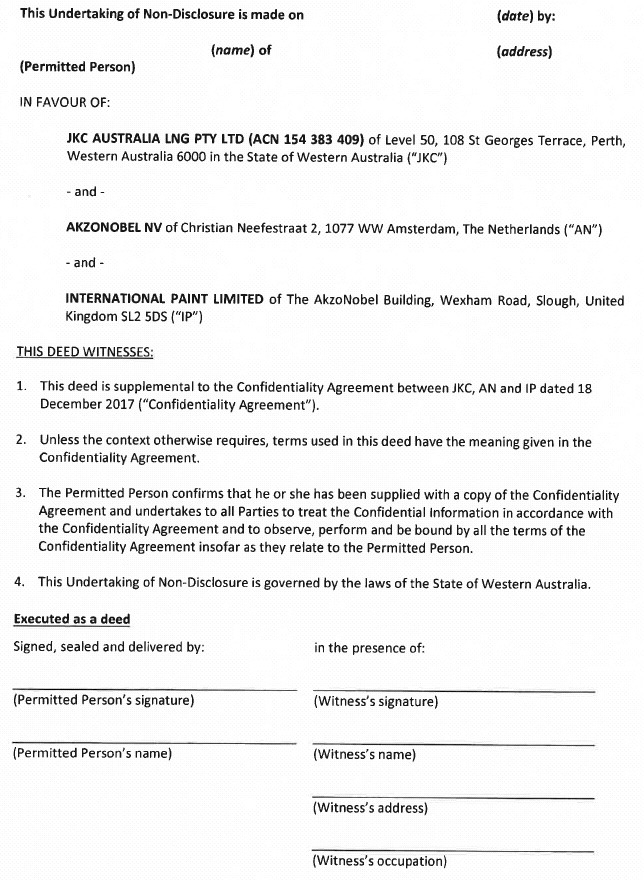
ORDERS
JKC AUSTRALIA LNG PTY LTD (ACN 154 383 409) Applicant | ||
AND: | First Respondent INTERNATIONAL PAINT LIMITED Second Respondent | |
DATE OF ORDER: |
THE COURT ORDERS THAT:
1. Subject to order 2 below, the applicant, and its external legal representatives, be released from their respective obligations to use the documents listed in Annexures A and B (by their unique document identifiers) to these orders (Documents) only for the purpose of this proceeding, to the extent only that they may each use any of the Documents:
(a) for the purposes of responding to any claims made against the applicant by:
(i) INPEX Operations Australia Pty Ltd (INPEX); or
(ii) Ichthys LNG Pty Ltd (Ichthys)
in relation to the use of Intertherm 228 coating on the Ichthys Onshore Project;
(b) in any dispute that arises between the applicant and:
(i) INPEX; or
(ii) Ichthys
in relation to the use of Intertherm 228 coating on the Ichthys Onshore Project, including in and for the purposes of any judicial or arbitral proceedings in relation thereto (Permitted Use).
2. The Documents listed in Annexure B to these orders, which contain information that has been nominated as confidential to the first and/or second respondent, may only be inspected by, or provided or made available to the applicant, and:
(a) any of the applicant's officers or employees;
(b) any other external lawyer or external counsel engaged by the applicant, or any secretarial or administrative assistant engaged by that external lawyer or external counsel;
(c) any other in-house lawyer employed or contracted by the applicant; and
(d) any expert engaged by the applicant;
who:
(e) is engaged by the applicant to act or advise in relation to a Permitted Use, or to instruct or otherwise assist someone else to act or advise in relation to a Permitted Use; and
(f) has signed a confidentiality undertaking in the form set out in Annexure C to these orders.
3. Pursuant to section 37AF of the Federal Court of Australia Act 1976 (Cth), until further order, and in order to prevent prejudice to the proper administration of justice, access to exhibit TDG-2 to the affidavit of Trafford Dean Gazsik made on 17 June 2019 not be available or open for inspection or removal from the Registry by third parties pursuant to Division 2.4 of the Federal Court Rules 2011 (Cth) (Rules) other than by order of the Court.
4. The applicant will be given notice, and an opportunity to make submissions, if a non-party seeks access under rule 2.32(4) of the Rules to:
(a) paragraphs 16 and 17 of the affidavit of Trafford Dean Gazsik made on 17 June 2019;
(b) annexures TDG-3 and TDG-4 to the affidavit of Trafford Dean Gazsik made on 17 June 2019.
Annexure A - Non-Confidential Documents
Production Number |
AKZ.001.001.1839 |
AKZ.003.002.7621 |
AKZ.003.004.3909 |
AKZ.003.004.7611 |
AKZ.003.004.9768 |
AKZ.003.005.1177 |
AKZ.003.006.4760 |
AKZ.003.006.6718 |
AKZ.003.008.4362 |
AKZ.003.008.4570 |
AKZ.003.008.4840 |
AKZ.003.008.5122 |
AKZ.003.008.7458 |
AKZ.003.008.7508 |
AKZ.003.008.7589 |
AKZ.003.009.0105 |
AKZ.003.009.3499 |
AKZ.004.002.0878 |
AKZ.004.002.4222 |
Annexure B - Confidential Documents
Production Number |
AKZ.003.001.0394 |
AKZ.003.005.3631 |
AKZ.003.005.8072 |
AKZ.003.009.3437 |
AKZ.003.010.5577 |
AKZ.003.010.6173 |
AKZ.003.010.7971 |
AKZ.003.010.8982 |
AKZ.004.002.8160 |
Annexure C - Confidentiality Undertaking
Note: Entry of orders is dealt with in Rule 39.32 of the Federal Court Rules 2011.
BANKS-SMITH J:
1 The Ichthys Onshore Project is one of the world's largest liquefied natural gas developments. In short, it involves the extraction of gas and condensate from the Ichthys Field in the Browse Basin off North West Australia and transportation of the gas and condensate by 890 km of undersea pipeline to onshore LNG facilities near Darwin for conversion into LNG for export.
2 A short summary of the pleaded case is as follows.
3 The applicant in these proceedings (JKC) entered into a contract with INPEX Operations Australia Pty Ltd (INPEX) for JKC to undertake certain engineering, procurement, supply, construction and commissioning for the project (the contract is referred to as the EPC contract).
4 Relevantly, one of JKC's tasks under the contract was to develop coating specifications for pipework and equipment as necessary for the scope of its works.
5 After various correspondence with one or both of the respondents (AkzoNobel parties), JKC directed certain suppliers to use a particular coating system known as Intertherm 228 on pipework and equipment modules.
6 Following use of Intertherm 228, degradation and decolourisation issues arose with respect to the coated pipework and equipment.
7 In these proceedings, JKC alleges that the AkzoNobel parties engaged in conduct that was misleading or deceptive or likely to mislead or deceive by endorsing the use of Intertherm 228 for the project.
8 JKC alleges that a regime of repairs was instituted, but it alleges that the AkzoNobel parties also engaged in misleading or deceptive conduct with respect to the repair process.
9 JKC alleges that the AkzoNobel parties then advised INPEX and JKC, in effect, that Intertherm 228 was not suitable for use in the manner it was used on the Ichthys Onshore Project. INPEX withdrew its approval for the repair regime and directed JKC to conduct rectification work.
10 JKC says that it has suffered or is likely to suffer loss or damage by reason of the misleading and deceptive conduct of one or both of the AkzoNobel parties.
11 The AkzoNobel parties deny the allegations.
12 The parties have been proactive, indeed exemplary, in addressing case management and interlocutory steps in these proceedings. In particular, discovery has been undertaken by the Redfern schedule process and the Court has been obliged to resolve only a small number of discovery disputes.
13 By that discovery process, JKC has in its possession documents from the AkzoNobel parties that relate to Intertherm 228, some of which are the subject of confidentiality agreements as between JKC and the AkzoNobel parties.
14 There is potential for separate claims between INPEX and JKC with respect to Intertherm 228. It is not necessary for the purpose of these reasons to detail the current position as between INPEX and JKC. However, JKC has retained different lawyers for its dealings with INPEX to those who represent them in these proceedings, and those lawyers have retained an expert in painting/coatings to provide an opinion relating to coatings, including Intertherm 228. For ease of reference, I will refer to those matters involving the lawyers and expert as the separate advice.
15 JKC contends that 28 documents it has received from the AkzoNobel parties by the discovery process in these proceedings appear relevant to the separate advice. Accordingly, JKC seeks orders permitting it to be relieved of the implied undertaking to the Court (commonly known as the Home Office v Harman undertaking) in respect of those documents so that it can provide them to, relevantly, the separate lawyers (and counsel) and the expert, and for the purpose of the separate advice.
16 In support of its application, JKC relies on the affidavits of Trafford Gazsik and Liam Prescott.
17 Mr Gazsik holds the position of senior legal counsel for JKC and is responsible for the day-to-day management of the present proceeding. I therefore infer that he has a good understanding of the matters in issue in these proceedings and so understands the significance of the documents that have been discovered by the AkzoNobel parties.
18 He deposes to the fact that the relevant documents (Documents) fall within three categories:
(a) coating defects correspondence, being correspondence between relevant identified parties that records or refers to the nature and extent of alleged coating defects, including testing of Intertherm 228 and possible rectification solutions;
(b) specified tests, being testing reports and presentations performed by the AkzoNobel parties or on their behalf relating to the alleged coating defects and the merits of possible rectification; and
(c) formulation documents, being documents prepared by INPEX or related parties, or the subject of communications between them and the AkzoNobel parties, that refer to the formulation and constituent parts of the Intertherm 228 supplied and used on the project.
19 The Documents are not of the type that are publicly available or generally available to the industry.
20 Mr Gazsik also explained that to the extent that the Documents contain information that is confidential to the AkzoNobel parties then it accepts that it is appropriate that there be a confidentiality regime in place to protect such confidentiality.
21 Mr Prescott is a partner of the law firm DLA Piper and is the solicitor for JKC for the purpose of the separate advice. Mr Prescott's evidence is to the effect that he has spoken to the coatings expert engaged by JKC, who has indicated that certain types of documents (which fall within the three categories referred to) would assist in his preparation of a report.
22 I should add that Mr Prescott set out in his affidavit relevant extracts from his communications with the expert which support the matters to which he has deposed.
23 Further, Mr Prescott deposes to the fact that it would be possible to obtain the Documents separately through other means such as pre-action third party discovery or pre-action subpoenas for documents likely to have been created and held by coating designers and manufacturers in the position of the AkzoNobel parties, but that if it were required to take such steps, additional costs would be incurred and there would be delays in dealing with the separate advice.
Relevant principles
24 The relevant principles are uncontroversial.
25 The implied undertaking to the Court is derived from the substantive legal obligation imposed on a party to litigation who obtains documents or information as a result of the compulsory processes of a court not to use them for any other purpose without leave of that court: Hearne v Street [2008] HCA 36; (2008) 235 CLR 125 at [96], [106]; Harman v Secretary of State for the Home Department [1983] 1 AC 280; [1982] 2 WLR 338.
26 In Liberty Funding Pty Ltd v Phoenix Capital Ltd [2005] FCAFC 3, the Full Court explained what is required to be released from the implied undertaking as follows:
[31] In order to be released from the implied undertaking it has been said that a party in the position of the appellants must show 'special circumstances': see, for example, Springfield Nominees Pty Ltd v Bridgelands Securities Ltd (1992) 38 FCR 217. It is unnecessary to examine the authorities in this area in any detail. The parties were not in disagreement as to the legal principles. The notion of 'special circumstances' does not require that some extraordinary factors must bear on the question before the discretion will be exercised. It is sufficient to say that, in all the circumstances, good reason must be shown why, contrary to the usual position, documents produced or information obtained in one piece of litigation should be used for the advantage of a party in another piece of litigation or for other non-litigious purposes. The discretion is a broad one and all the circumstances of the case must be examined. In Springfield Nominees, Wilcox J identified a number of considerations which may, depending upon the circumstances, be relevant to the exercise of the discretion. These were:
• the nature of the document;
• the circumstances under which the document came into existence;
• the attitude of the author of the document and any prejudice the author may sustain;
• whether the document pre-existed litigation or was created for that purpose and therefore expected to enter the public domain;
• the nature of the information in the document (in particular whether it contains personal data or commercially sensitive information);
• the circumstances in which the document came in to the hands of the applicant; and
• most importantly of all, the likely contribution of the document to achieving justice in the other proceeding.
27 Examples of more recent applications of the principles include Corbett v Corbett Court Pty Ltd, in the matter of Corbett Court Pty Ltd [2017] FCA 718 and Blucher on behalf of the Gaangala Nation People v State of Queensland [2018] FCA 1621.
28 In this case, the two factors of particular importance are the confidential nature of some of the Documents, and the likely contribution of the Documents to the separate advice and therefore the position as between INPEX and JKC.
29 JKC accepts that some of the Documents contain information that is confidential to the AkzoNobel parties. With respect to those identified documents, JKC proposes a confidentially regime whereby such documents can only be provided to officers or employees of JKC, external lawyers or counsel and their respective administrative staff, in-house lawyers employed by JKC and any expert retained by JKC and only where they are engaged by JKC to advise in relation to a 'permitted use' and have signed an approved confidentiality undertaking.
30 In my view, access to the Documents as proposed by JKC is likely to contribute to the separate advice and therefore the position as between INPEX and JKC, and is accordingly in the interests of justice as between those parties. The evidence of Mr Gazsik and Mr Prescott persuades me that the provision of the Documents to the lawyers and experts engaged by JKC will enable the separate advice to proceed with the benefit of important information. The subject matter of the Documents, as is apparent from the three defined categories, is likely to be directly relevant to that task. I note that such advice from an expert may also be of assistance in the proceedings between JKC and the AkzoNobel parties.
31 Particularly in circumstances where copies of the Documents could in any event be sought by JKC through the use of other pre-trial tools, it seem to me to be sensible and in the interests of justice to grant the orders ought.
32 I add that the AkzoNobel parties appeared but made no submissions with respect to JKC's application and indicated through counsel that they neither consented to nor opposed the grant of the orders.
I certify that the preceding thirty-two (32) numbered paragraphs are a true copy of the Reasons for Judgment herein of the Honourable Justice Banks-Smith. |
Associate:


