

FEDERAL COURT OF AUSTRALIA
Mitolo Wines Aust Pty Ltd v Vito Mitolo & Son Pty Ltd [2019] FCA 902
Table of Corrections | |
7 January 2020 | In paragraph 22, the word “marks” has been added after the word “applicants’”. |
In paragraph 186, “2019” has been replaced with “2018”. | |
7 January 2020 | In paragraph 365, the word “action” has been replaced with the word “notion”. |
ORDERS
DATE OF ORDER: |
THE COURT ORDERS THAT:
1. The applicants file and serve draft minutes of order reflecting the conclusions in these reasons within 14 days.
2. The respondents within a further seven days indicate by letter whether they agree with the applicants’ draft minutes of order, or, if they do not, file and serve their own draft minutes of order.
Note: Entry of orders is dealt with in Rule 39.32 of the Federal Court Rules 2011.
BESANKO J:
INTRODUCTION
1 This is a claim by the applicants for relief in relation to infringement of trade marks, contraventions of ss 18 and 29(1)(h) of the Australian Consumer Law (Schedule 2 to the Competition and Consumer Act 2010 (Cth) (ACL)) and the tort of passing off. The respondents have brought a Cross-Claim in which they allege an estoppel and a contravention of s 18 of the ACL by the applicants.
2 The applicants to the proceeding are two companies, being Mitolo Wines Aust Pty Ltd (Mitolo Wines Aust) and Mitolo Wines Pty Ltd (Mitolo Wines). Mitolo Wines Aust brings this action in its capacity as the trustee of the Mitolo Wine Trust. The company is the owner of two registered trade marks which are said to be relevant in this action and those trade marks are identified below. The company has applied for the registration of two other trade marks and those applications are pending in the Australian Trade Mark Office. Those applications are also identified below (at [9]–[14]).
3 Between 3 September 1999 and 11 August 2003, Mitolo Wines Aust conducted a wine production and sales business. On 11 August 2003, it entered into a “Business Licence Agreement” with Mitolo Wines whereby it granted Mitolo Wines an exclusive licence to use the two registered trade marks and such further trade marks as the parties might subsequently agree to be subject to the agreement and an exclusive licence to carry on the wine production and sale business which until then had been conducted by Mitolo Wines Aust. Since 2003, Mitolo Wines has operated a family owned wine production and sale business. The sole director of each of the applicants is Mr Francesco (Frank) Mitolo.
4 The respondents to the proceeding are a company and two individuals. The first respondent is Vito Mitolo & Son Pty Ltd (Vito Mitolo & Son) and it was incorporated on 25 October 2013. The second respondent is Mr Vito Mitolo and he is the sole director and secretary of Vito Mitolo & Son and owns half the issued share capital of the company. Mr Vito Mitolo and Mr Frank Mitolo are cousins. The third respondent is Mr Vito Mitolo’s son, Mr Anthony (Tony) Mitolo, and he owns the other half of the issued share capital of Vito Mitolo & Son. The second and third respondents are and have been since 19 March 2016 involved in a restaurant business which trades under the name “Pizzateca” and which operates at 319 Chalk Hill Road, McLaren Vale, South Australia. Vito Mitolo & Son owns and operates a business of retail and wholesale services relating to the sale, distribution and marketing of wine and cellar door sales of wines.
5 On 12 November 2016, Vito Mitolo & Son became the owner of the registered business name “V. Mitolo and Son”.
6 The relief sought by the applicants is as follows: (1) declarations of the infringement of their trade marks and of contraventions of both ss 18 and 29(1)(h) of the ACL; (2) orders for delivery up or destruction of all infringing products and all packaging, purchase orders, invoices, catalogues, promotional material, advertisements, signage and other materials in any form which include or refer to the infringing products; (3) injunctions, damages or an account of profits under the Trade Marks Act 1995 (Cth) (s 126) or the ACL (ss 232 and 236); and (4) injunctions, damages or an account of profits for the tort of passing off. The tort of passing off was not the subject of a detailed pleading, but it was a claim pursued at trial.
7 The relief sought by the respondents in their Cross-Claim is as follows: (1) a declaration that the applicants have, by making certain representations, contravened s 18 of the ACL and damages, including damages pursuant to s 236 of the ACL. The Cross-Claim includes a plea by the respondents of an estoppel against the applicants.
8 An order was made prior to the trial that issues of liability be heard and determined before issues of quantum, including damages or an account of profits.
THE TRADE MARKS AND THE APPLICATIONS FOR REGISTRATION OF MARKS
9 The first registered trade mark is trade mark number 801717 “MITOLO”, which has a filing date of 27 July 1999 and is registered with respect to Class 33, being Wines. I will refer to this as the “Mitolo mark”.
10 The second registered trade mark is trade mark number 881421 “MITOLO”, which has a filing date of 3 July 2001 and which is registered with respect to Class 29. That class is as follows:
Class 29: Preserved, dried, cooked and frozen fruits, vegetables and herbs, including olives and pickles; jellies and jams; edible oils and fats including olive oil; preserves.
These goods did not feature in the evidence and this registered trade mark can, as I think occurred in the applicants’ closing written submissions, be put to one side.
11 The application for registration of the word mark “MITOLO” in relation to Classes 35, 41 and 43 has a lodgement date of 11 August 2016 and an acceptance date of 18 October 2016. Classes 35, 41 and 43 are as follows:
Class 35: Retail and wholesale services relating to the sale, distribution and marketing of alcoholic beverages; cellar door sales of wine; direct marketing in relation to the supply of wines including by mail order and by electronic means; promotion services.
Class 41: Arranging exhibitions and tasting events in respect of wine.
Class 43: Restaurant services; wine bar services; providing food and drink; temporary accommodation; rental of rooms for social functions.
12 The application for registration of the word mark “MITOLO WINES” in relation to Classes 35 and 43 has a lodgement date of 15 August 2016 and an acceptance date of 24 November 2016.
13 The two applications for registration are the subject of opposition proceedings by Vito Mitolo & Son. Vito Mitolo & Son made a request for an extension of time to file evidence in the opposition proceedings which was refused by a delegate of the Registrar of Trade Marks. Vito Mitolo & Son brought proceedings under the Administrative Decisions (Judicial Review) Act 1977 (Cth) in relation to the delegate’s decision. Reasons in that proceeding will be published on the same day as these reasons.
14 The other matter to note is that the applicants are not precluded from bringing proceedings on the two applications for registration, but they are not able to obtain relief until registration has taken place (Hunter Douglas Australia Pty Ltd v Perma Blinds (1969) 122 CLR 49 at 59 per Barwick CJ; Global Brand Marketing Inc v Cube Footwear Pty Ltd [2005] FCA 852; (2005) 66 IPR 19 at [6] per Goldberg J).
A SUMMARY OF THE PLEADED CASE
15 The applicants allege that V. Mitolo & Son from a date unknown to them has advertised, marketed, promoted, exhibited in public, exported and offered for sale and sold wine products using the sign “MITOLO” or a sign substantially identical with, or deceptively similar to it. These wine products are the infringing products.
16 The applicants allege that the infringing products have been advertised, marketed, promoted, exhibited in public, offered for sale and sold by the following means: through various websites; through Pizzateca; through the Chalk Hill cellar door; at an event known as the 2016 McLaren Carne Vale; on Facebook; on Instagram; on Twitter; through internet retailers; through retailers in the United States of America; and at an event known as the McLaren Vale Sea & Vines Festival 2017. The respondents admit many of the acts pleaded by the applicants as the acts of advertising, marketing, promotion, exhibiting in public, offering for sale and selling the infringing products.
17 The applicants plead that Vito Mitolo & Son has infringed the trade marks and applications for registration of trade marks and that it has contravened ss 18 and 29(1)(h) of the ACL. The applicants plead 17 particulars of instances or events they allege support their plea that the conduct of Vito Mitolo & Son has a tendency to lead members of the public into error, such that the conduct is misleading or deceptive, or is likely to mislead or deceive. There is a short plea of passing off.
18 The applicants plead that Mr Vito Mitolo and Mr Tony Mitolo were and are directly liable for the infringement of the trade marks and ss 18 and 29(1)(h) of the ACL, or as to the latter, persons involved in the contraventions (ss 2 and 236(1) of the ACL).
19 Finally, there is a plea of loss and a lengthy plea of intended future infringement and contravention.
20 The respondents raise various defences to the applicants’ claims.
21 First, they contend that there is no entity known at law as V. Mitolo & Son. The first respondent’s name is Vito Mitolo & Son Pty Ltd and the business name is V. Mitolo and Son (emphasis added).
22 Secondly, they contend that the use of Vito Mitolo & Son’s mark is not substantially identical with, or deceptively similar to, the applicants’ marks.
23 Thirdly, the respondents contend that if they have advertised, marketed, promoted, exhibited in public, exported and offered for sale and sold wine products using the sign “MITOLO” or a sign substantially identical with, or deceptively similar to it (which they deny), then such conduct was caused by the misleading and deceptive conduct of Mr Frank Mitolo. The conduct involves a number of messages on Facebook passing between Mr Frank Mitolo and Mr Tony Mitolo in July 2014. That conduct is described below (at [72]–[74]).
24 With respect to the plea that there was an infringement of the Mitolo mark by using as a trade mark a sign that is substantially identical with, or deceptively similar to the registered trade mark in relation to wines, the respondents plead that Vito Mitolo & Son’s unregistered mark is not substantially identical or deceptively similar with the Mitolo mark, and Vito Mitolo & Son’s use of its own name “Mitolo” in good faith does not amount to an infringement of s 120 of the Trade Marks Act. With respect to the plea that there was an infringement of the applications for registration and, in particular, application number 1789135, by using as a trade mark a sign that is substantially identical with, or deceptively similar to the marks the subject of those applications, and in particular, application number 1789135, in relation to cellar door sales of wines, direct marketing in relation to the supply of wines by mail order and by electronic means and promotion services, including arranging exhibitions and tasting events in respect of wines, which are Class 35 services in respect of which the services are registered, the respondents plead that: Vito Mitolo & Son’s unregistered trade mark is not substantially identical with, or deceptively similar to, the marks; Vito Mitolo & Son’s use of its own name “Mitolo” in good faith does not amount to an infringement of s 120 of the Trade Marks Act; the applicants have manufactured the infringing conduct of which they complain; and, in the event that Vito Mitolo & Son has infringed s 120(1) of the Trade Marks Act (which is denied), the conduct was caused by Mr Frank Mitolo’s conduct which was a misrepresentation and misleading and deceptive, and as a result, the applicants are estopped from asserting their rights under the Trade Marks Act.
25 With respect to the plea that by its conduct Vito Mitolo & Son represented that Vito Mitolo & Son and the applicants are the same person and the wines, being the infringing products, were produced by or at the direction of the applicants and thereby contravened s 18 of the ACL, the respondents plead that: Vito Mitolo & Son’s use of the unregistered trade mark is merely descriptive of its business which reflects the name of the producer of the wine; any tendency to mislead depends upon a misconception that the applicants and Vito Mitolo & Son are the same person and consumers who have been misled by their own misconceptions have not been misled by the conduct of Vito Mitolo & Son; any misleading effect is transitory and is immediately dispelled upon inspection of wine labels, website or cellar door; premium wine consumers are the relevant class and they are not likely to be misled by Vito Mitolo & Son’s conduct; and in the alternative, the relevant class of persons are not likely to be misled by Vito Mitolo & Son’s conduct.
26 With respect to the plea that by its conduct Vito Mitolo & Son represented that the infringing products have a sponsorship, approval or affiliation with the applicants or the applicants’ products, the respondents repeat their pleas to the previous allegation.
27 With respect to the plea that by its conduct Vito Mitolo & Son passed off and continues to pass off the infringing products as and for goods of, or endorsed, or approved by the applicants, the respondents plead that the allegations should be struck out as being embarrassing or not disclosing a cause of action or providing particulars of the first respondent’s deceptive conduct.
WITNESSES
28 The applicants called Frank Mitolo, Gemma Mitolo, Kirsty Czuchwicki, Melanie Minear, Joanna Hawkins, Damien Smith, Karen Stevens, Sally Bevan and Professor Lawrence Lockshin.
29 The respondents called Vito Mitolo, Tony Mitolo and Dr Stephen Downes.
30 Frank Mitolo, Vito Mitolo and Tony Mitolo are mentioned so frequently in these reasons that it is convenient (without intending any disrespect) to refer to them as Frank, Vito and Tony respectively.
31 There were a number of objections to the evidence. Many of these objections were resolved in the course of submissions with either the applicants not pressing evidence, or the respondents withdrawing their objection. I ruled on the remaining objections and my reasons for my rulings are set out in Annexure A to these reasons.
32 Frank was the main witness for the applicants and he was cross-examined at some length. He was an honest and reliable witness. It was suggested at one point in his cross-examination that he had let the respondents “go on” through 2014, 2015 and 2016 based on the Facebook Exchange (described below) and then lodged the first application for registration on the day before his solicitors sent a letter of demand. This plan was formulated so that the applicants could complain of further infringement. Frank denied this suggestion. I reject it entirely. There is no basis for it. I find that the applicants acted when it became clear to them that they needed to do so. Part of that was to protect their commercial interests as far as possible by lodging applications for registration of trade marks.
33 Vito and Tony were the main witnesses for the respondents. For reasons I will give when I address their evidence in detail, I did not find Vito’s evidence satisfactory in a number of respects. Tony’s evidence was less unsatisfactory, although even in his case, some of his evidence relating to financial matters was not reliable.
34 The other lay witnesses were honest and reliable witnesses and I accept their evidence. The expert evidence is dealt with in a separate section below.
THE APPLICANTS’ BUSINESS
35 The following section of my reasons is based on Frank’s evidence which I accept. It is also based on the large number of documents which Frank produced. It is necessary to consider the applicants’ business and wine products in some detail because one of the respondents’ arguments is that, in defence of the applicants’ claims, the applicants’ business and wine products were meeting the needs of a different market or section of the market than that of the respondents.
36 In or about 1999, Frank decided to start making wine commercially and he incorporated a company and registered the Mitolo mark for that purpose. He intended from the outset to use his family name and his desire was to produce red wines from single sites in McLaren Vale. He wanted the business to be family focussed and he wanted to leave a legacy for his children. The applicants’ business began and continues to buy their grapes from the Lopresti family. In 2001, Frank became a partner with Mr Ben Glaetzer, a winemaker from the reputable “Glaetzer” winemaking family. Frank and Mr Glaetzer decided that McLaren Vale would be the geographic focus of Mitolo Wines because they considered the grapes from the McLaren Vale region to be better suited to the style of red wine that Frank wanted to produce. The business grew between 2000 and 2008, consolidated from 2008 to about 2013, and thereafter has been in an expansion phase.
37 Mitolo Wines Aust was incorporated on 25 August 1999 as Mitolo Wines Pty Ltd and continued under that name until about late 2003 when a new entity known as Mitolo Wines was established and the company changed its name to Mitolo Wines Aust. The restructure was undertaken to segregate risk in the business and the new entity became the trading entity.
38 Frank is the sole director, secretary and shareholder of Mitolo Wines Aust and the company is the trustee of the Mitolo Wines Trust. The company is:
(1) the owner or finance lessee of plant and equipment used in the conduct of the business of the production and sale of wine;
(2) the registered owner, or applicant for registration, in certain jurisdictions, and beneficial owner in all jurisdictions of the trade marks used in the business of the production and sale of wine;
(3) the owner of the copyright, including the copyright in the trade marks and the packaging and promotional material used in the business of the production and sale of wine; and
(4) the owner of goodwill in the business of the production and sale of wine, including the wines produced and sold under the trade marks.
39 As I have said, under the Business Licence Agreement between Mitolo Wines Aust and Mitolo Wines executed on or about 11 August 2003, the former company granted the latter company an exclusive licence to: (1) carry on the business, which is defined as the production and sale of wine; and (2) use the plant and equipment used in the business and the trade marks. The term “Trade Marks” is defined in the agreement as follows:
Trade Marks mean all the trade marks referred to in Recital B(b), including those listed in the Schedule and such other trade marks as the parties subsequently agree shall be added to the Schedule or otherwise included in this definition.
40 The trade marks identified in the Schedule to the agreement include the two registered trade marks. Frank as managing director of both licensor and licensee has determined that the marks which are the subject of the applications for registration should be within the terms of the Business Licence Agreement.
41 As I have said, the applicants operate a wine production and sale business. This includes the cellar door/tasting room and restaurant at 141 McMurtrie Road, McLaren Vale, South Australia which opened to the public in October 2017. I will refer to this as the applicant’s cellar door/tasting room and restaurant at McMurtrie Road.
42 Mitolo Wines currently produces wines which can be divided into three broad ranges or categories as follows:
(1) Mitolo Jester Wines which are produced using a blend of grapes and are intended to be drinkable soon after release and are modestly priced compared to the applicants’ other ranges;
(2) The Mitolo Small Batch Series which are produced in smaller runs and are more expensive than the Jester range; and
(3) The Mitolo Single Vineyard Series which are premium wines each produced from grapes sourced from a single vineyard.
43 Mitolo Wines has a “Design Standards Manual” which it has used since about August 2006 and which contains criteria directed to how “Mitolo” is to be branded, including on wines, stationery, packaging materials, marketing material, websites, banners, clothing, merchandise and vehicles.
44 In his evidence, Frank produced wine labels falling within categories:
(1) for the Mitolo Jester Wines: red wines, Vermentino and Sangiovese Rose;
(2) for the Mitolo Small Batch Series: red wines, Vermentino and Grenache Rose;
(3) for the Mitolo Single Vineyard Series: G.A.M. Shiraz, Cantiniere Shiraz, Savitar Shiraz, 7th Son Grenache, Shiraz Sangrantino, Serpico Cabernet Sauvignon and Marsican Shiraz;
(4) “one-off” wines produced in partnership with retailers or for export. An example of the latter is an entry level shiraz wine called Junior produced exclusively for export to Canada and Sweden;
(5) photographs and printing profiles of labels used by Mitolo Wines over the years.
45 Most of the Mitolo Jester Wines bear the predominantly black label on the front of the bottle with the word “MITOLO” at the top in white text inside a rectangular border. An example of the front and back labels is shown below:
|
|
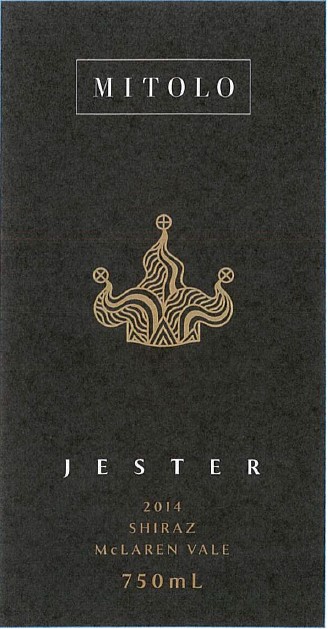
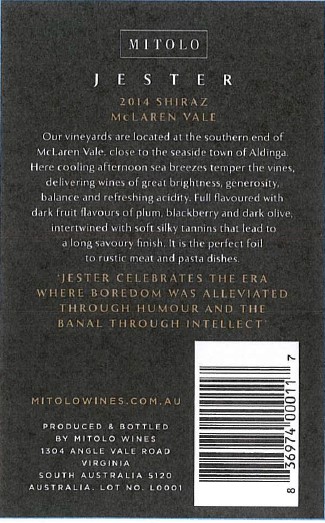
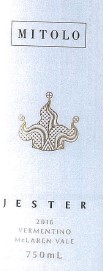
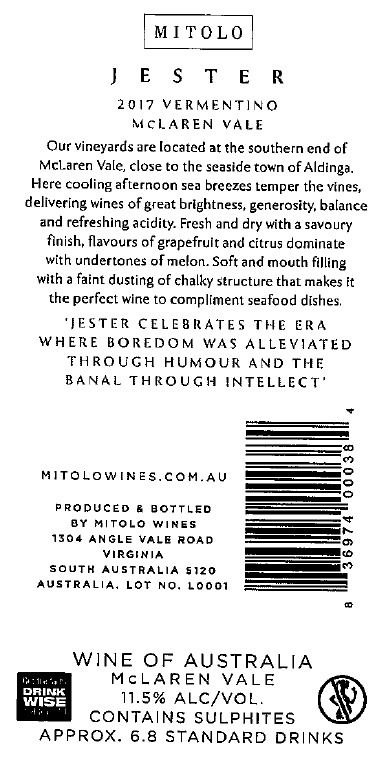
46 The Mitolo Jester Wines also include the Vermentino and Sangiovese Rose. These wines feature a white label on the front of a light-coloured bottle with the word “MITOLO” at the top in black text inside a rectangular border. An example of the front and back labels is shown below:
|
|
47 Red wines in the Mitolo Small Batch Series feature a black and white label on the front of the bottle with the word “MITOLO” at the top in white text. The word “MITOLO” is larger on these labels compared to the Mitolo Jester Wines and is not surrounded by a rectangular border. An example of the front and back labels of a red wine in the Mitolo Small Batch Series is shown below:
|
|
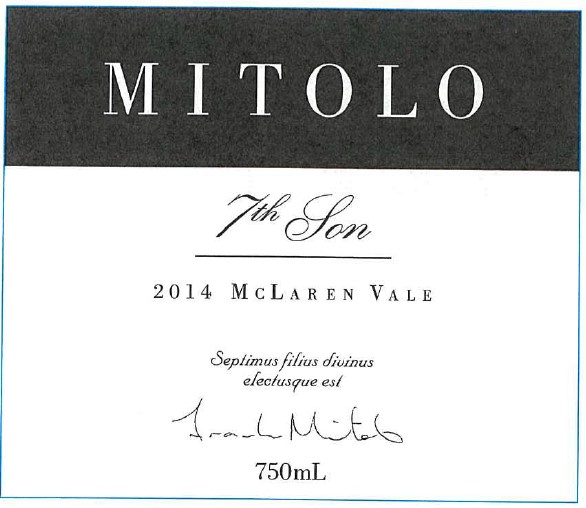
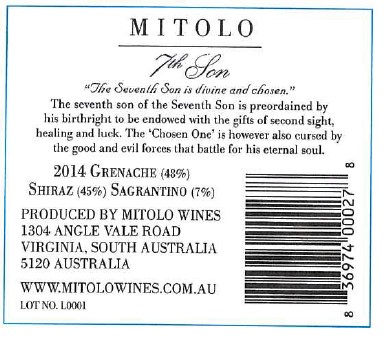
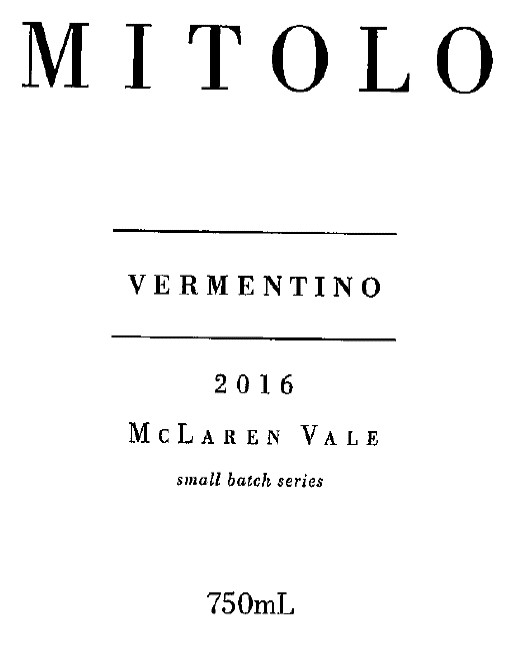
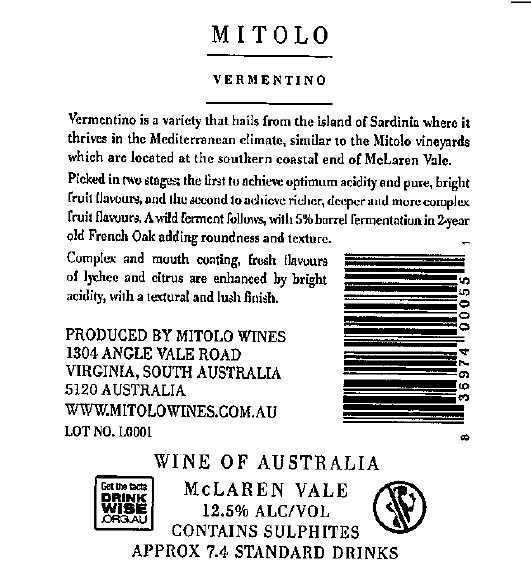
48 The Mitolo Small Batch Series also features the Vermentino and Grenache Rose. These wines feature a white label on the front of a light-coloured bottle with the word “MITOLO” at the top in black text. The word “MITOLO” is larger on these labels compared to the Mitolo Jester Wines and is not surrounded by a rectangular border. An example of the front and back labels of the Vermentino is shown below:
|
|
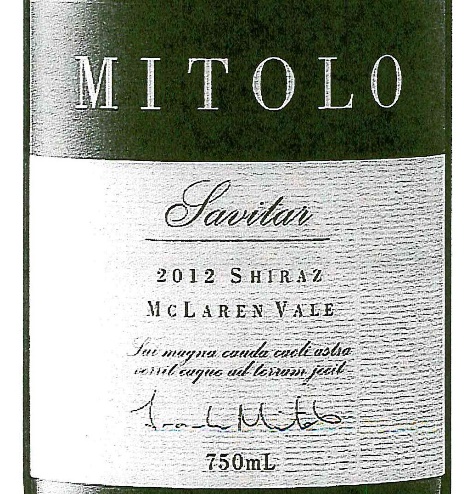
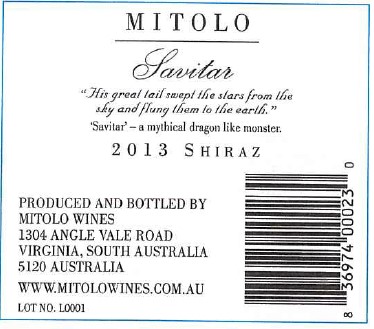
49 The Mitolo Single Vineyard Series features only red wines. Four of the wines in the Mitolo Single Vineyard Series bear similar labelling to the red wines in the Small Batch Series, including the word “MITOLO” in large white text at the top of the label. These wines are the G.A.M. Shiraz, the Cantiniere Shiraz, the Savitar Shiraz, the 7th Son Grenache, Shiraz Sangrantino and the Serpico Cabernet Sauvignon. An example of the front and back labels of the Savitar Shiraz is shown below:
|
|
50 The applicants also use a variety of other material to advertise their business. This includes packaging material, signs, banners, stationery, clothing, merchandise, vehicles and marketing material.
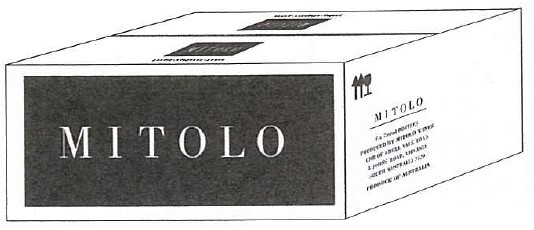
51 The applicants’ packaging material includes the cartons in which they ship their wine. An example of one of these cartons is shown below, featuring the word “MITOLO” and the words “purity”, “elegance” and “power’:
52 The applicants’ signs and banners are featured at the entrance to their cellar door/tasting room and restaurant at McMurtrie Road. The respondents tendered a number of photographs of the applicants’ premises. They show, for example, the word “MITOLO” in large white print on a black background.
53 The applicants also advertise their business through a variety of media. Ms Kirsty-Marie Czuchwicki is the applicants’ Brand Manager and is responsible for all of the applicants’ online marketing activities and for administering the applicants’ social media accounts.
54 The applicants have a website, which can be accessed via “www.mitolowines.com.au”. The website was first established in around 2002 or 2003 and has been redesigned on several occasions. It operates both as an online store for the applicants’ wine sales and as a platform for making reservations at the applicants’ restaurant at McMurtrie Road. Ms Czuchwicki has the ability to update the content on the website to reflect what is happening in the applicants’ business at any given time.
55 The applicants also have an Instagram account with the username “mitolowines”. It can be accessed via the website “https://www.instagram.com/mitolowines”, or via the Instagram app. The Instagram account was established in September 2012. The applicants use the Instagram account to share images of their wines, the cellar door/tasting room and restaurant at McMurtrie Road and other activities of the business, and to interact with members of the public who follow the applicants’ Instagram account. Ms Czuchwicki operates the Instagram account and generally uploads an image once or twice a day.
56 The applicants also have a Facebook page called “Mitolo Wines”. It can be accessed via the website “https://www.facebook.com/mitolowines/”, or via the Facebook app. Ms Czuchwicki operates the applicants’ Facebook account. She uses it to generate public interest in the applicants’ brand. All of the images which Ms Czuchwicki uploads to the Instagram account are also automatically uploaded to the Facebook account. She also shares through the Facebook account various articles and reports that are relevant to the applicants’ brand.
57 The applicants also have a Twitter account which is presently inactive.
58 In addition to social media, Ms Czuchwicki creates and sends media releases to journalists and publications on the applicants’ media list. The media list includes wine magazines, journals, lifestyle magazines and online and print journalists.
59 In his evidence, Frank identified reviews of the wines produced by Mitolo Wines from time to time, including the following reviews:
(1) Wine Guide, Halliday;
(2) James Halliday in the magazine “Wine Companion”;
(3) Newspaper articles;
(4) Media Monitoring reports for Mitolo Wines, Press Review Sheets summarising the references in the press to Mitolo Wines; and
(5) Media articles about the wines, restaurant and cellar door of Mitolo Wines.
60 Mitolo Wines has from time to time supplied wine to airlines for consumption as part of their inflight service and those airlines include Qatar Airways and Qantas.
61 Frank gave evidence of the way in which the applicants have in the past promoted, and continue to promote, their business and their wine products to the public. They include the following: (1) operating a small tasting space in McLaren Vale in about 2012; (2) arrangements with a restaurant to sell the applicants’ wines in about 2014 or 2015; (3) the distribution of bookmarks to customers and trade customers domestically and internationally; (4) the provision to wholesalers for use by their sales representatives of sell sheets, brand introduction sheets and tasting notes; (5) the preparation of PowerPoint presentations for new customer demonstrations; (6) competitions where the prize is one of the applicants’ wines; (7) regular vineyard visits for both domestic and international trade customers; (8) preparation of professional photographs for use in sales and marketing activities of the applicants; (9) co-hosting dinners at restaurants in Sydney and Melbourne; (10) the shipments of its wine in cartons marked “Mitolo”; (11) conducting events with providers of goods or services with well-known brands; (12) billboard advertisements (13) participation in wine shows by way of a stand and the provision of tasting facilities; (14) participation in festivals such as the Sea & Vines Festival in McLaren Vale; and (15) in about 2014, Frank producing his own pasta sauce.
62 The marketing material of the applicants frequently refers to the Mitolo family and the district of McLaren Vale. The applicants’ wines are listed on many online wine retail websites.
63 As I have said, the business of the applicants presently includes the production and sale of wines and the operation of a cellar door/tasting room and restaurant at McMurtrie Road. The applicants’ wine is sold domestically to wholesalers and retailers, at the cellar door, through the website and mail order, and overseas in approximately 20 countries. The financial documents produced by Frank, which are the subject of a confidentiality order, show the operation of a reasonably successful business, both domestically and internationally. Sales and marketing staff travel both interstate and overseas.
64 I am satisfied that the applicants have and have had for a number of years a reputation as an established wine producer of good quality wines. The applicants’ wines have consistently received critical acclaim from a number of reviewers. The following reviews should be noted. Halliday, a prominent wine guide, describes Mitolo Wines as having had a “meteoric rise” and notes that it now “[e]xports to all major markets”. James Halliday, in a review of new wines published in the Wine Companion magazine, gave the 2016 Mitolo Jester a rating of “94 points”, indicating that the wine is “highly recommended” with “great quality, style and character [and is] worthy of a place in any cellar”. The Australian Gourmet Traveller described the 2005 Mitolo Serpico as the “emerging star” in Cabernet from McLaren Vale. Ralph Kyte-Powell, a wine writer and reviewer, gave the 2012 Mitolo 7th Son McLaren Vale Grenache Shiraz a rating of “90” in a review published in The Age newspaper in 2014. Fergus McGhie, in a 2008 article in The Canberra Times, gave the 2006 Mitolo Jester Shiraz a “five star rating” and described the wine as follows:
… this is pretty intense, typical of the Mitolo style. Lovers of big shiraz will not be disappointed…. This is a great example of the new Australia shiraz in a full-bodied style…. It’s capable of maturing well for a decade, but the generous flavours are so appealing now, there’s no need to wait.
65 Mitolo Wines has also received a number of awards for its wines. These are detailed in Frank’s first affidavit. The following awards should be noted. In May 2008, the 2006 Reiver Shiraz was awarded a “Gold Medal” at the 2008 International Wine Competition, a “Silver Medal” at the 2008 New Zealand International Wine Show and a “Silver Medal” at the 2008 International Wine & Spirit Competition. In July 2009, the 2007 Jester Cabernet Sauvignon was awarded a “Gold Medal” at the 2009 Japanese Wine Challenge. In May 2015, the G.A.M. McLaren Vale Shiraz and the 2013 Jester Cabernet Sauvignon were named in the “100 Best Australian Wines 2015/16” by Matthew Jukes. The G.A.M. McLaren Vale Shiraz was also awarded a “Gold Medal” at the 2015 Sommelier Wine Awards.
66 The applicants have also developed a reputation as targeting the “high-end” of the market. The visual impression of its labels — which, in the case of its red wines, feature the word “MITOLO” in white against a black background — convey a sophisticated and elegant image.
67 As I have said, the applicants’ cellar door/tasting room and restaurant at McMurtrie Road was opened in October 2017. The restaurant is one which provides fine dining and the food served combines traditional Italian and modern Australian cuisine. The restaurant is called “Bocca di Lupo”, which is an Italian idiom that has a similar meaning to “break a leg”. The restaurant has a well-regarded chef and the staff dress in a standard modern uniform. The restaurant offers the option of matching each course with the applicants’ wines.
68 As noted above, prior to 2012, the applicants’ business consisted of only the production, marketing and sale of wine. In that year, the applicants commenced the design and development of the cellar door/tasting room and restaurant at McMurtrie Road. In 2016, the applicants received a $557,000 regional development grant from the South Australian government in respect of the development. The development is said to have involved an overall cost of over $3 million.
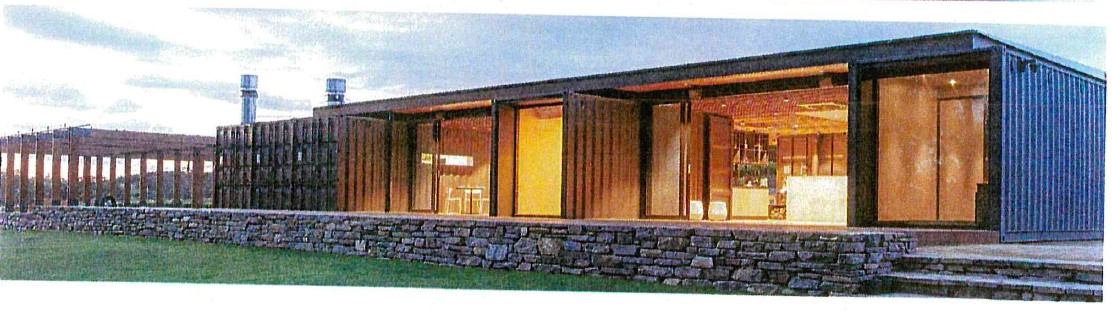
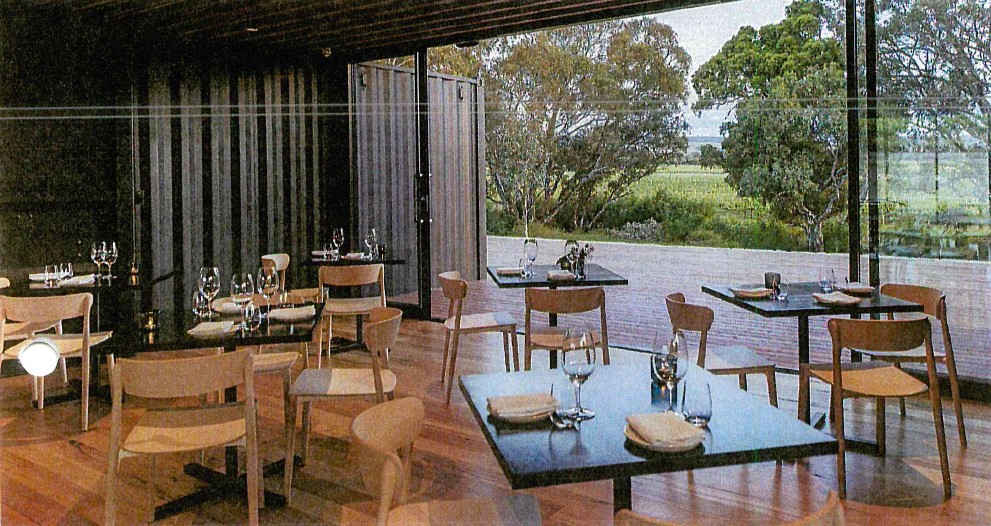
69 The buildings comprising the development feature the use of 10 black shipping containers, polished wood and glass. It was designed with a “clean, sharp look” in mind that is intended to “solidify the brand’s premium mark”. It was featured in an article published in December 2017 in the Grapegrower and Winemaker Magazine titled “Clean and bold – Mitolo unveils its brand new cellar door and restaurant” with the following images of the exterior and interior:
THE APPLICANTS’ KNOWLEDGE OF THE ACTIVITIES OF THE RESPONDENTS IN SELLING WINE AND CONDUCTING A RESTAURANT
70 The starting point in this section is the exchange between Frank and Tony on Facebook in 2014.
71 In 2014, Tony lived in New York in the United States. Frank was his friend on Facebook. In early July 2014, Frank became aware that Tony was planning to sell wine in New York using a label which included the name “MITOLO”. Tony posted the following picture of the wine label on Facebook:
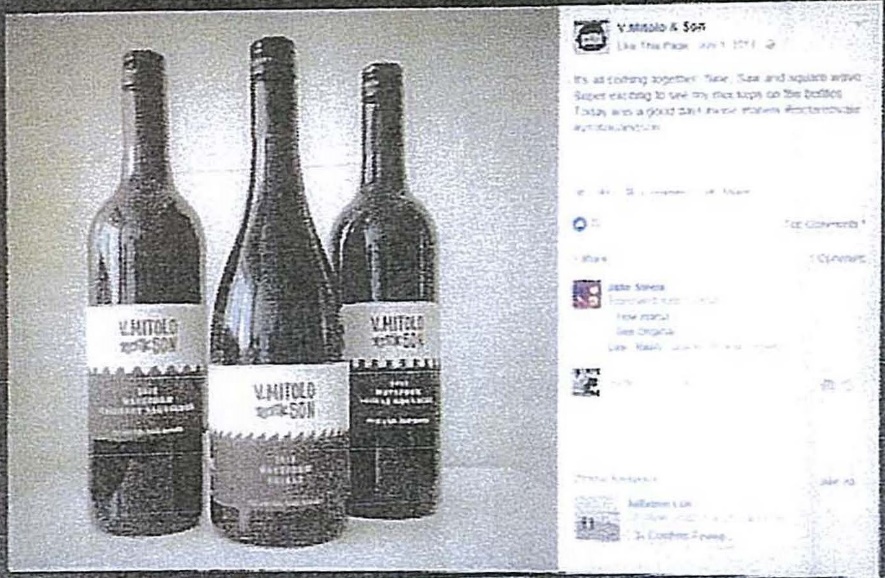
72 Frank saw the post and was concerned that Tony and Vito intended to sell wine commercially using branding which might be confused with the applicants’ products. The following exchange then took place on Facebook:
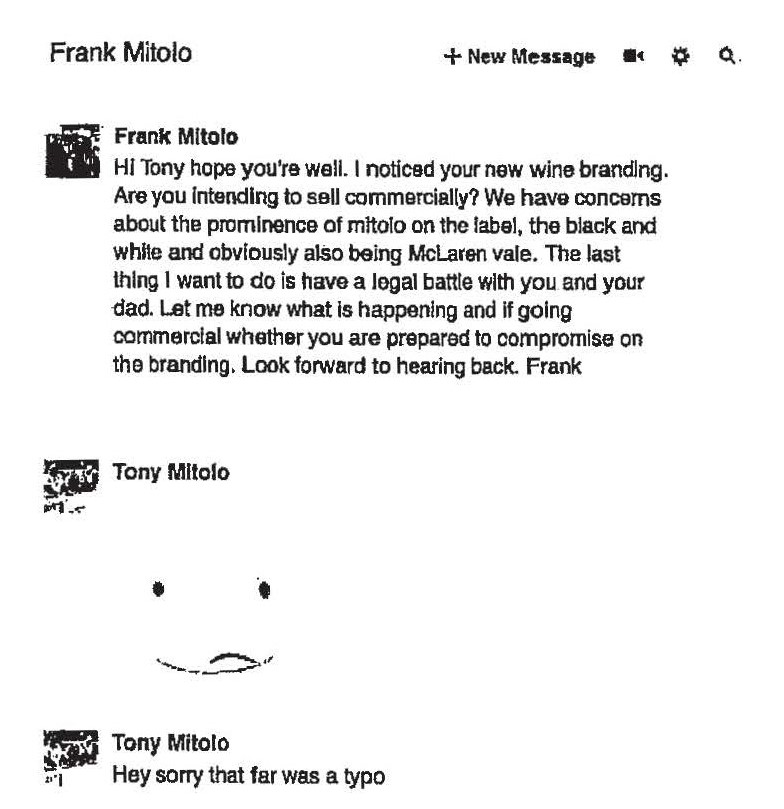
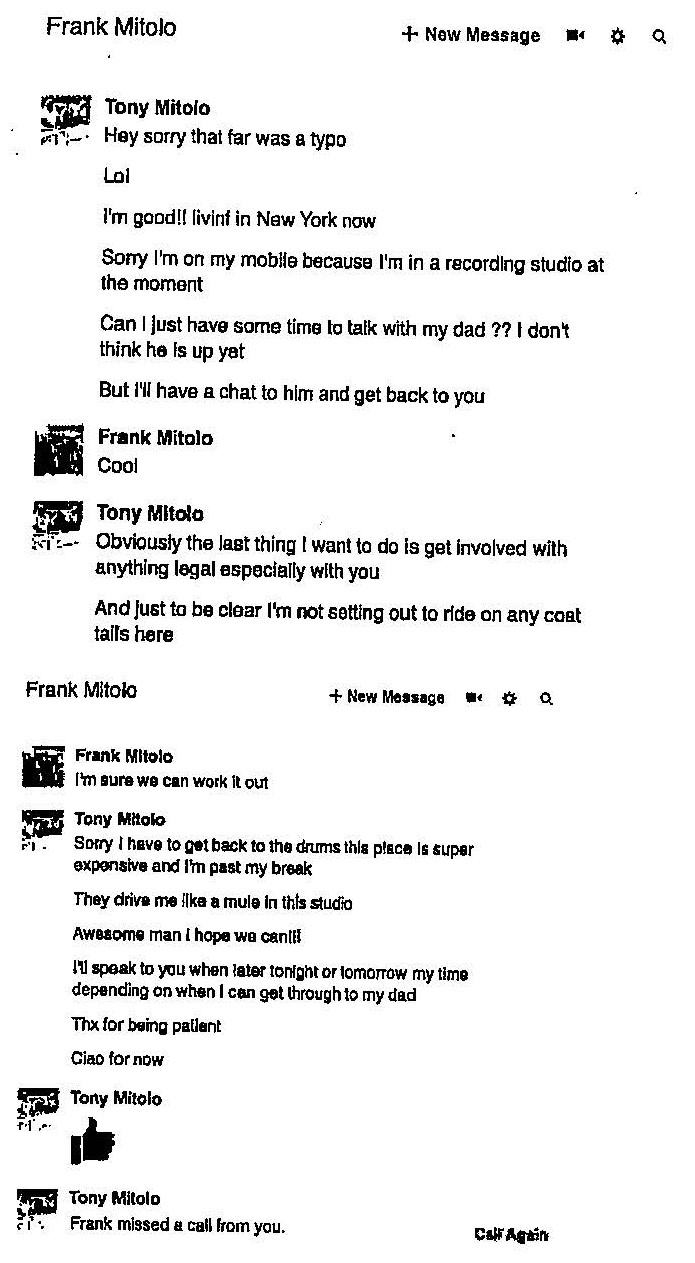
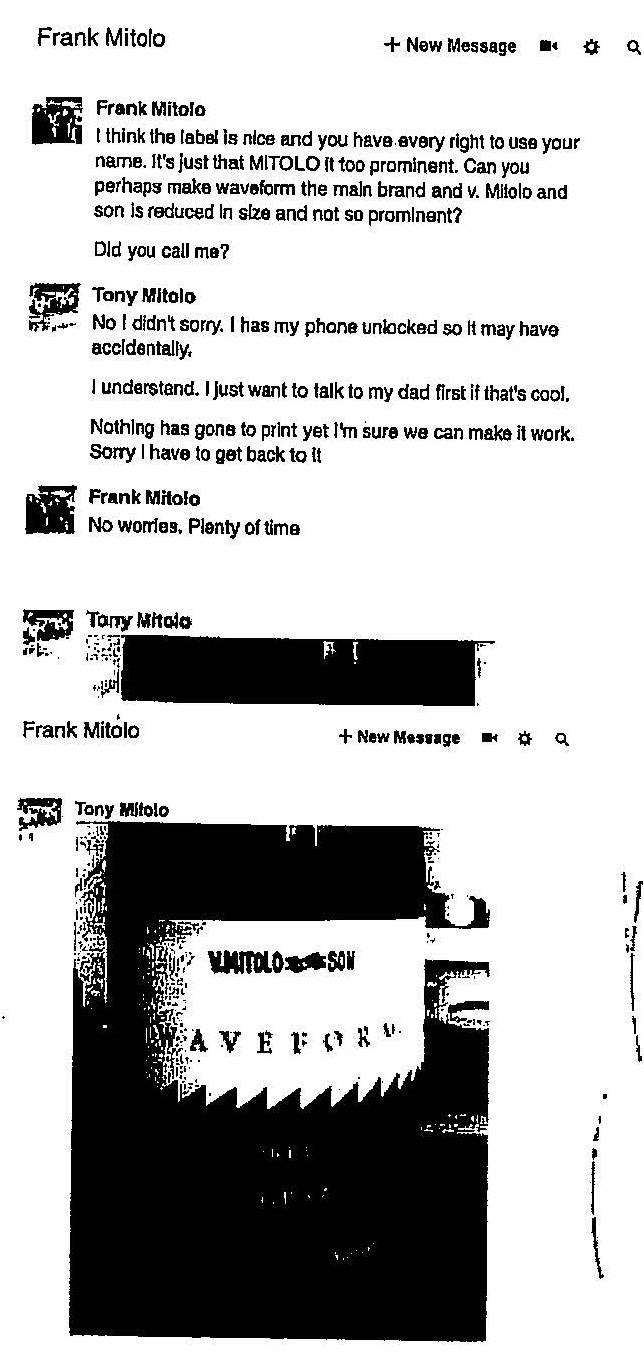
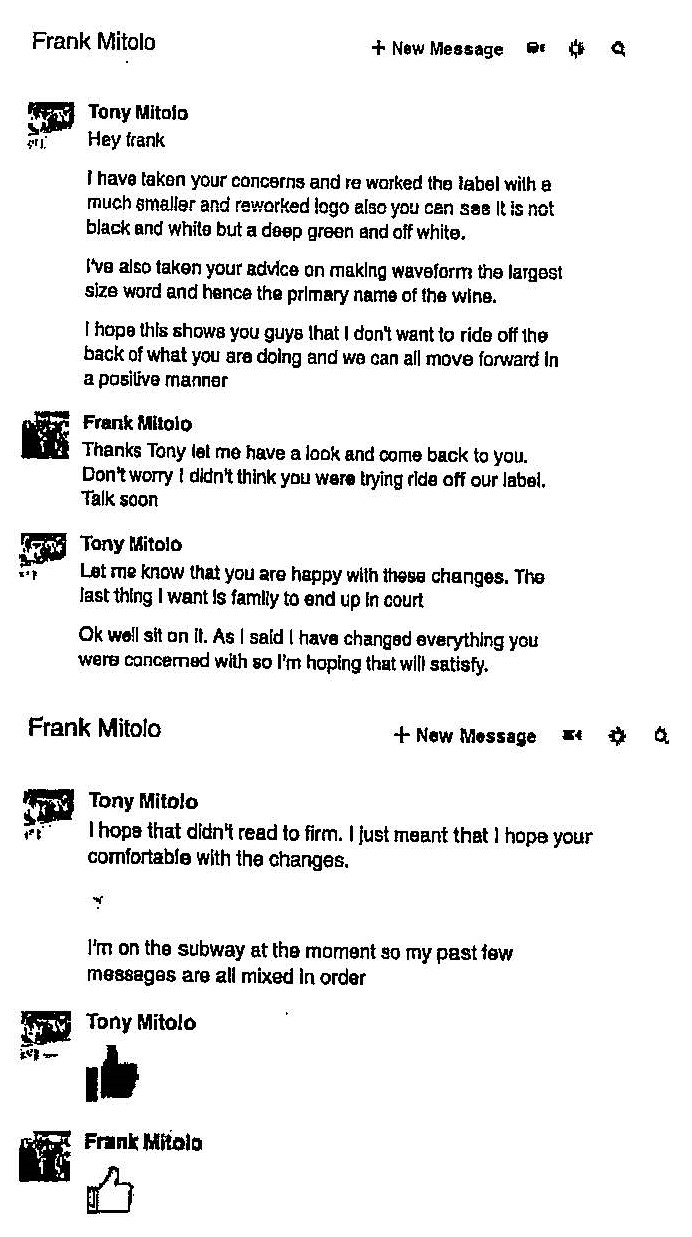
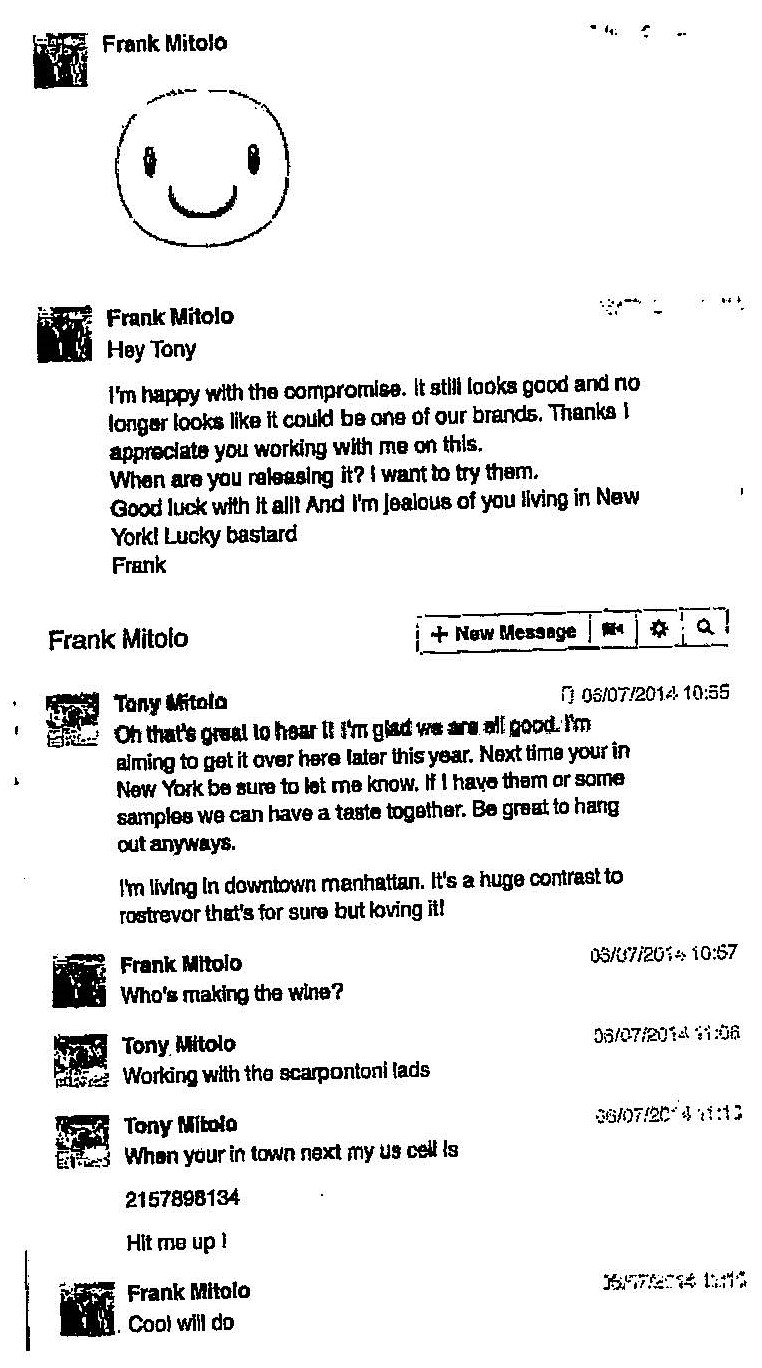
I will refer to the above as the Facebook Exchange.
73 Frank said that at the time of the Facebook Exchange he believed Tony was based in New York and was working as a musician and would only be selling the wine in New York City and, essentially, as a hobby. Frank gave the following evidence:
69. [Had] Tony given me any indication that he, or he and Vito, intended to sell wine commercially in Australia and around the world, and operating a physical premises in McLaren Vale, I would never have agreed to the use of the word “Mitolo” in association with wine, or indicated that I was happy with [the] revised label. Because none of those things were raised with me I did not desire to prevent Tony (or Tony and Vito) from doing a small run of wine to sell in New York as a hobby. I did not believe that in doing so that I was abandoning Mitolo’s interests in protecting its brand against unauthorised use by a competitor. If Tony had said to me that [the] intended to do what he has since done, then I would have refused to consent to the use he proposed and I would have taken steps to protect the Mitolo brand.
74 As at October 2014, Frank was aware that Vito had been selling wine into China under a label called “Governor’s Choice”. He saw Vito at the “Bushing King Festival” at McLaren Vale and they discussed winemaking. They discussed Vito’s purchase of a property at Oakley Road and Frank’s purchase of and plans for the property at McMurtrie Road. The property at Oakley Road is approximately three and-a-half kilometres from the property at McMurtrie Road. The conversation, according to Frank, was along the following lines:
70.1. I said words to the effect that:
“I am building a tasting room and restaurant.”
Vito did not tell me about his plans for a cellar door and restaurant at Chalk Hill Rd or at Oakley Rd:
70.2 He said words to the effect that:
“I needed to buy a vineyard to give my business legitimacy in the eyes of my customers in China.”
70.2. I said words to the effect of “Who is making your wine?”
70.3. He said words to the effect of “Scarpantoni Wines are making it.”
75 I will return to make findings about this conversation at the Bushing King Festival after I have examined Vito’s evidence.
76 In or about mid-2015, Frank began hearing of the promotion of the V. Mitolo & Son website “www.vmitoloandson.com” and an associated Instagram account, Facebook page, and a website “www.americanwineshop.com”.
77 Vito Mitolo & Son promoted an event described as the “V Mitolo & Son 2016 McLaren Carne Vale” through the “websites www.stickytickets.com.au” and “www.insidesouthaustralia.com.au”, the Facebook account and the Instagram account. On one of the websites there is a reference to enjoying “V.Mitolo & Son wines”. The event was held on 6 February 2016.
78 Frank became aware of Pizzateca in approximately 2016 and at that time he understood it to be a “pop up” food vendor which sold pizza out of a booth at a McLaren Vale winery called Alpha Box and Dice. Frank became aware that in approximately mid-2016, Pizzateca moved into permanent premises at 319 Chalk Hill Road, McLaren Vale. That is approximately six kilometres from the McMurtrie Road property. The Chalk Hill Road property is the address for the V. Mitolo & Son cellar door.
79 Frank produced menus and wine lists obtained from the Pizzateca website. He has observed A-frame and fence signs near the Pizzateca restaurant referring to Pizzateca and V. Mitolo & Son. As set out below (at [143]), Tony produced a number of photographs showing the use the respondents have made of “V. Mitolo and Son”.
80 The McLaren Vale Sea & Vines Festival 2017 is a festival in which local food and wine producers in McLaren Vale participate. In 2017, the festival took place between 10 and 12 June. Vito and Tony participated in the festival.
THE RESPONDENTS’ BUSINESS INCLUDING ITS SALE OF WINE AND THE FACEBOOK EXCHANGE
81 Vito was born in Adelaide in 1957. He described himself as working in the wine industry part time in addition to having interests in car detailing, transport and panel beating. I have previously described his interest in Vito Mitolo & Son. Vito is shown as not holding his shares in the company beneficially. He said in cross-examination that he had never been of the belief that he held his shares on behalf of another person. I found his evidence about this topic vague and confusing.
82 Tony is Vito’s son. He was born in Mount Gambier in 1982. In 2014, Tony worked full time as a musician. He has been involved in the production of wine with Vito Mitolo & Son. His main role in the company was described by Vito as being in the marketing, label design and public relations of the brand.
83 Although Vito and Frank are cousins, Vito said that he does not have a close relationship with Frank.
84 Vito said that he began working in the wine industry in 2014. In October 2014, he purchased a vineyard at 135 Oakley Road, McLaren Vale (the Oakley Road property).
85 In 2016, Tony was involved in the establishment of the Pizzateca restaurant at 319 Chalk Hill Road, McLaren Vale (the Chalk Hill Road property) and he now works full time at the Pizzateca restaurant.
86 Vito said that Vito Mitolo & Son was established by Tony for the purpose of producing and selling wine. At the beginning of 2014, Tony, who was then living in New York City, had a conversation with Vito about the idea of selling wine in New York City. Vito agreed and Vito Mitolo & Son was incorporated and import licences were obtained for the company in the United States. Tony started a Facebook page for the company and commenced designing labels for the production of the wine. On 14 September 2015, a Producer’s Licence was issued by the Liquor and Gambling Commissioner for V. Mitolo and Son. Vito Mitolo & Son is the owner of the Producer’s Licence.
87 Vito said that Vito Mitolo & Son has produced wines from the vineyard at the Oakley Road property as the producer V. Mitolo and Son since 2014. The company has produced wine for export to the United States, China (under the label of Royal Governor) and for sale in the domestic market (under the modified WAVEFORM label) since 2014.
88 In June 2016, Vito Mitolo & Son opened a cellar door at the Chalk Hill Road property and Tony commenced operating the Pizzateca restaurant at the property. The intention was to sell and offer tastings of the company’s wines.
89 Vito was aware that Frank started Mitolo Wines in 1999. Vito recalls conversations with family members whereby he learnt that Mitolo Wines Aust had bought a property at McMurtrie Road where it intended to construct a cellar door. Vito was aware that the applicants did not produce all their own grapes and that the business purchased the majority of their grapes from a business known as Lopresti Wines. Frank had previously advised Vito of that fact.
90 Vito was aware of the Facebook Exchange in July 2014 between Tony, and Frank. Tony, who was living in New York City at the time, contacted Vito to inform him of his discussion with Frank and to discuss what was to be done with their label. Vito instructed Tony to redesign the label to make the word “MITOLO” less prominent. He did so because he did not want to “cause any dramas”. Vito was aware of the subsequent exchanges.
91 Vito Mitolo & Son produced three varieties of wine, being Shiraz, Shiraz Grenache and Cabernet Sauvignon. Following the Facebook Exchange, the company bottled 14,000 bottles. The first batch of WAVEFORM was bottled by Scarpantoni Wines in October 2014 and Vito said that the label was in the form approved by Frank. The grapes used in this bottling were purchased from Scarpantoni Wines, as well as other grape growers. Vito said that very little of this wine was sold on the domestic market as Tony was in the United States at the time and the company decided to focus on that market.
92 Vito said that he had no discussions with Tony along the lines of Vito Mitolo & Son’s operations in New York City being a hobby, or limited only to that area.
93 Vito provided details of the costs incurred by Vito Mitolo & Son in designing and redesigning labels, printing labels, advertising, travel costs to and from New York, accommodation in New York over a three month period and internal travel expenses. The figure he provided was $78,000.
94 On 31 October 2014, there was a wine show in the McLaren Vale area which was known as the Bushing King Festival. Vito sat near Frank and he gave an account of a conversation he had with Frank. He said that they discussed the wines each of them were producing, where their grapes were coming from, their plans for the future, their respective properties in the McLaren Vale area and the export of wines overseas, in particular, to China. He said that Frank asked him about the purchase of the Oakley Road property and that he confirmed that he had purchased the property. Frank asked him how big the property was and Vito said approximately 12-and-a-half acres. Frank asked him why he had chosen the Oakley Road property. Vito explained that the investors and customers of Vito Mitolo & Son included Chinese clients and he was keen to “give my business legitimacy in the eyes of my customers in China”. Frank asked Vito how much wine the company was selling into China and Vito said that the company had sold two shipping containers which equated to 1,200 cases, or approximately 144,000 bottles of Royal Governor wine. Vito asked Frank whether he sold wine in China and Frank said that he did not. Vito invited Frank to come with him to China to meet his contacts for that market.
95 Frank told Vito that he was busy with renovations to his house and the building of his cellar door. Frank talked about his purchase of the vineyard at the McMurtrie Road property and his plans to commence operation of a cellar door and restaurant at the property. Frank asked about Vito’s plans for the Oakley Road property and Vito told him that he was planning to operate a cellar door from the property and that he wanted to open a restaurant focused on rustic provincial cooking. Frank asked Vito about Vito Mitolo & Son’s sale of wine in New York City and Vito responded by saying the company’s wine was due to reach New York City and the United States market in January 2015. Vito gave evidence that Frank said words to the effect of “don’t worry, I didn’t think you were gonna tread on our toes”.
96 Vito said that at the same festival, he spoke to Frank’s architects and that during the discussions he was provided with their business cards as they offered to design the cellar door that he had discussed with Frank.
97 In December 2014, Tony returned to Australia. At that time, Vito instructed Tony to continue to market Vito Mitolo & Son’s wine through both Facebook and Instagram, and he was told by Tony that the company and its associated label was included in all marketing material online.
98 On 6 February 2016, Vito Mitolo & Son held an event called the “McLaren Carne Vale” at the Oakley Road property and the event included a five course Italian feast with the company’s wines being showcased alongside Italian beers. Vito said that before the event, Tony marketed the event heavily through both Vito Mitolo & Son’s Facebook page and Tony’s personal Facebook page. An event page was set up by Tony on Facebook through the company to specifically market the event and to allow for the purchase of tickets. On 27 December 2015, Vito recalls that Tony changed his profile picture on Facebook to advertise the event by Vito Mitolo & Son. Vito said that the event was a great success and that 150 people attended, including many family members. He spoke to a number of the Mitolo family members, including a number of members who were Frank’s first cousins.
99 In or around February 2016, and following the success of the McLaren Carne Vale event, Tony decided to open a permanent restaurant called “Pizzateca” at the Chalk Hill Road property. From 18 May 2016 onwards, the opening of Pizzateca was advertised on Vito Mitolo & Son’s Facebook page and on Tony’s personal Facebook page. In June 2016, Tony and his business partner, Mr Tim Anderson, commenced operating Pizzateca at the Chalk Hill Road property. Pizzateca is owned by Tony as to 85% and Mr Anderson as to 15%. The restaurant is open three days per week and serves mainly pizza and wine to approximately 140 guests. I note that later in his evidence, Vito said that the cellar door, including Pizzateca, was open four days a week. This apparent inconsistency was never clarified, but at the same time, was not an issue. The restaurant is open for lunch and dinner. Pizzateca has sold Vito Mitolo & Son’s labelled wine at its premises since 2016. It has also sold wines from Alpha Box and Dice, Oliver Taranga, Chalk Hill Wine and Chapel Hill Wine.
100 Pizzateca and Vito Mitolo & Son’s cellar door is also located on the same premises. Vito said that the wines available for purchase at the cellar door prior to 8 August 2016 were as follows:
(1) the WAVEFORM Series being 2013 Shiraz, 2013 Shiraz Grenache and 2013 Cabernet Sauvignon;
(2) the V. Mitolo & Son Pizza Rosso NV Shiraz; and
(3) the V. Mitolo & Son 2016 Grenache, and V. Mitolo & Son 2016 Barbera.
101 The wines currently available at the cellar door are as follows:
(1) the 2015 V. Mitolo & Son OZTALIA Shiraz and 2015 V. Mitolo & Son OZTALIA Shiraz Grenache;
(2) the V. Mitolo & Son 2016 Grenache; and
(3) the V. Mitolo & Son Pizza Rosso NV Shiraz;
(4) the V. Mitolo & Son OZTALIA Gamay Rosé.
102 Vito said that the cellar door, including Pizzateca, is open four days per week and has patronage of approximately 1,200 people over those four days.
103 Vito said that, based on records of Vito Mitolo & Son since the Facebook Exchange in July 2014, the company’s sales of wine from the cellar door has been $120,000 as at 3 February 2017 and $50,000 as at 8 August 2016.
104 Vito said that as at 8 August 2016, Vito Mitolo and Son has used the following labels:
(1) V. Mitolo & Son WAVEFORM — in the United States and Australia;
(2) Royal Governor — in China only; and
(3) V. Mitolo and Son — in Australia only, being the Pizza Rosso red collar pizza base logo and the Triangle label “known as the V. Mitolo & Son Malocchio”.
105 Those labels are as follows:
|
|
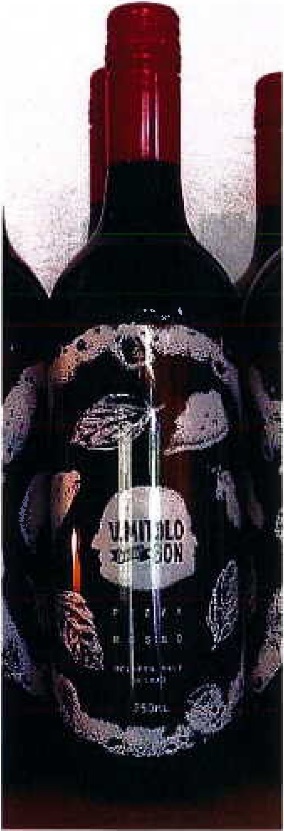
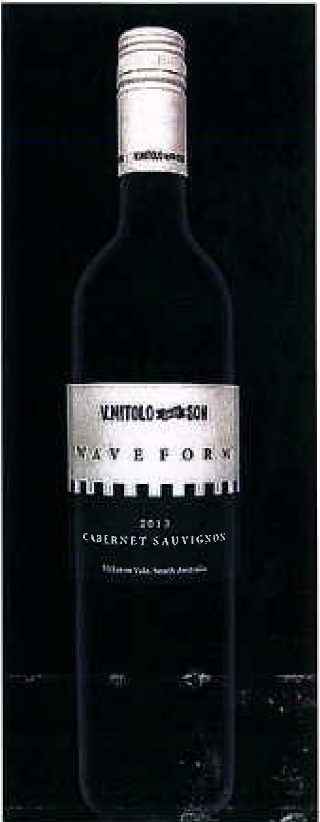
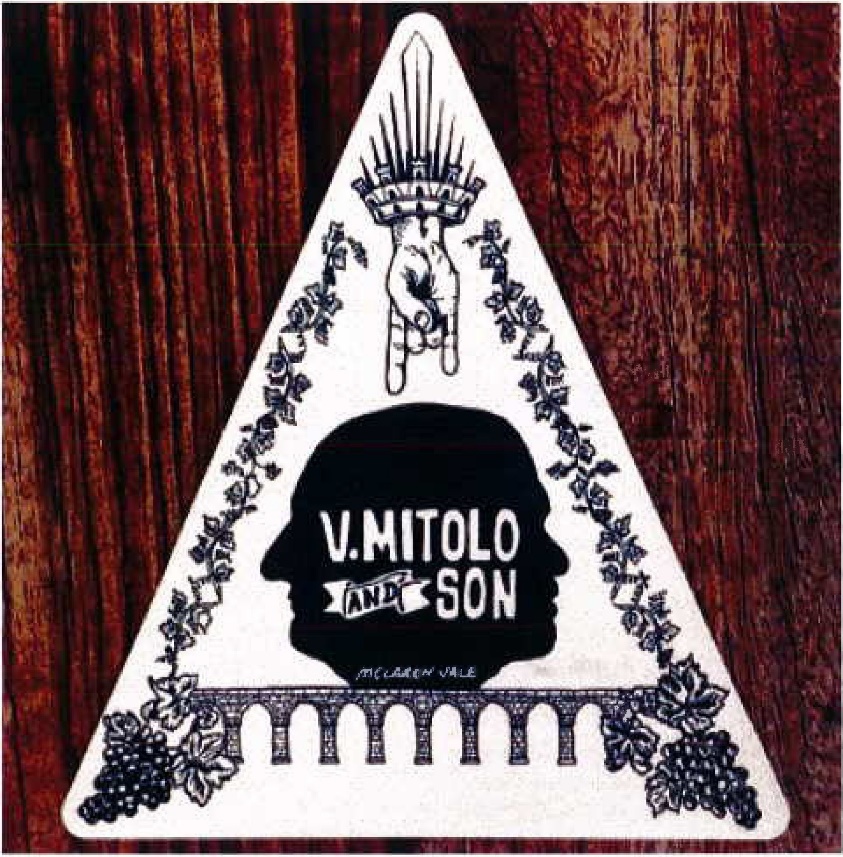
106 Vito said that as at January 2018, V. Mitolo and Son have the following brands of wine for sale, being OZTALIA Shiraz, Rose, Shiraz Grenache and Grenache. He produced copies of the labels. He said that the wine is sold and distributed through the cellar door on the Chalk Hill Road property which is also Pizzateca.
107 As far as sales of wine by Vito Mitolo & Son into the United States are concerned, Vito again said that he had reviewed the records and that WAVEFORM in three varieties has been sold through America’s Wine Shop by McAdam Buy-Rite; the Fine Wine Agency (New York); the Wine Angel (New Jersey); and a number of other channels which it is not necessary for me to mention. He said that upon his review of the company’s records since the Facebook Exchange, the company has sold $115,000 worth of wine as at 3 February 2017 and $115,000 worth of wine as at 8 August 2016.
108 As far as sales of wine by Vito Mitolo & Son into the People’s Republic of China are concerned, the company has sold the brand Royal Governor (Shiraz and Cabernet Sauvignon) and this wine is sold and distributed through the company’s business partner in Guangzhou. Again, from his review of the company’s records, Vito states that since the Facebook Exchange, the company has sold $130,000 worth of wine as at 3 February 2017 and $130,000 worth of wine as at 8 August 2016.
109 Vito was cross-examined at some length. It emerged that his evidence was unsatisfactory and unreliable in a number of respects. I should mention at this point that the affidavits of Vito and Tony were similar in many respects in terms of layout and content. In their closing submissions, the applicants produced a schedule showing the similarities. It is clear from Vito’s cross-examination that, although he professed to have examined the records of Vito Mitolo & Son, he had done no more than rely on what Tony had told him.
110 First, although Vito said in paragraph 172 of his affidavit that he had reviewed the records of Vito Mitolo & Son for the purposes of providing evidence of sales revenue in connection with the sale of wine into the United States, it is apparent that:
(1) the company’s taxation returns, balance sheets and profit and loss statements were not produced and that some, if not all, of the monies received for sales of wines into the United States were paid to one of Vito’s other companies, 610 Regency Road Pty Ltd;
(2) he was not responsible for the preparation and calculation of the figures. That was done by Tony; and
(3) the documents produced by the respondents upon request supported sales revenue of no more than approximately $67,000 and no sales into the United States after April 2016. Vito was unable to explain the difference between approximately $67,000 and $115,000 and he did not know whether there had been sales into the United States after April 2016.
111 Secondly, Vito’s evidence in cross-examination with respect to sales of wine into China was even more unsatisfactory. He said that, in fact, he had not reviewed any of the records of Vito Mitolo & Son and he did not know why he said he had. He said that he had not received any money from China. There were two relevant container loads, one under 610 Regency Road Pty Ltd. One container load was shipped in June 2013 before Vito Mitolo & Son was incorporated. The second container load was shipped in late 2013. The reference to the dates of the shipment of wine to China led Vito to qualify the evidence he had given in his affidavit about when Tony had first raised with him the idea of selling wine. It seems that the respondents did not provide any invoice from China.
112 Thirdly, Vito’s evidence about the sales of wine in Australia was that, despite what he said in his affidavit, he did not review the records of Vito Mitolo & Son, but he relied on what Tony told him. As at January 2018, all of the company’s wine sales in Australia were through Pizzateca. Furthermore, the wine was mainly sold through people who had eaten at the restaurant and groups were not encouraged to come in for wine tasting.
113 Vito agreed that Vito Mitolo & Son sold very little, if any, wine in Australia until after March 2015. The respondents did not produce any documentary evidence of sales of wine in Australia in the 2015 financial year. One invoice produced for that period could not have been correctly dated in view of the vintages referred to in the invoice.
114 Vito agreed that his figure of sales revenue for the period as at 8 August 2016 must relate to sales in the period from 1 July 2015 to 8 August 2016. The documents provided by the respondents suggested sales of $31,410 for the period from 8 August 2016 to 3 February 2017, not $70,000 as suggested by Vito in paragraph 169 of his affidavit. Vito did not know if any of the WAVEFORM series wine was sold in Australia. None was sold at Pizzateca.
115 Vito agreed that there had been no sales of wine into China since the two shipments in 2013 and no sales into the United States since 2016.
116 Fourthly, Vito agreed that sales of wine by Vito Mitolo & Son in Australia did not pick up until the establishment of Pizzateca in June 2016 and that he received a letter of demand from the applicants’ solicitors in August 2016.
117 Fifthly, Vito was cross-examined about his evidence concerning the costs incurred by Vito Mitolo & Son in connection with the WAVEFORM label. It emerged from the cross-examination that the figure for printing labels should be $3,000, not $30,000 and that for the most part, Vito had no independent knowledge of the matter and relied on Tony and what Tony had told the respondents’ solicitors.
118 Sixthly, Vito made a number of statements about his belief following the Facebook Exchange. At one point, he said that he believed that the amendments to the WAVEFORM label were made so that Vito Mitolo & Son could operate commercially “without infringing Frank’s business”. Later when relating the negotiations that took place and the meeting at Café Cena on 1 September 2016, he said he told Frank that the respondents would continue to use the modified WAVEFORM label “as it was agreed to by Frank in the 2014 Facebook Exchange and a substantial investment has been made in promoting the brand”. He gave oral evidence-in-chief that he understood from the Facebook Exchange that Frank had given the respondents the “OK” to put V. Mitolo and Son on the label. In cross-examination, he was probed about his belief in July 2014 when Tony sent the Facebook Exchange to him by screenshot. It is not easy to discern the exact nature of his belief, but it appears to embrace the following matters: (1) the respondents could use V. Mitolo and Son as long as it was not too prominent, or less prominent; (2) he did not think the approval from Frank was subject to the name not being the primary name on the wine; and (3) he knew the respondents did not have Frank’s approval for all future labels, but at the same time, he denied that he knew he needed such approval.
119 Vito is the owner of the Oakley Road property. Up to the time of trial, there was no formal lease or licence agreement with Vito Mitolo & Son with respect to the property. Neither Vito nor Vito Mitolo & Son has an interest in Pizzateca Pty Ltd which, until recently, leased the property at Chalk Hill Road. Tony has recently purchased the property.
120 Vito agreed that he had known about Mitolo Wines operating in the McLaren Vale area making McLaren Vale wine for “a long time”. He agreed that neither Vito nor his parents were born in the McLaren Vale area or grew up there.
121 Vito said in cross-examination that he did not know whether any of the WAVEFORM series wine was sold in Australia. Two pallets of it might have been. He said that it was sold in the United States and the respondents made money out of it. At one point, he seemed to agree that Vito Mitolo & Son suffered no detriment as a result of the Facebook Exchange.
122 Finally, Vito said that his plans with respect to the Oakley Road property were as follows: (1) to have a cellar door there in addition to the cellar door at the Chalk Hill Road property; (2) the main name on the wine sold from the Oakley Road property might be different and could be Agriturismo; (3) there would be a restaurant providing high quality seasonal Italian food with a capacity of 75 persons; and (4) the drawings are only concept drawings and may not represent what will be built.
123 In re-examination, Vito said that he considered that he could use the “two-heads” label (i.e., the larger label set out at [105] above) because of a combination of the Facebook Exchange and the fact that he told Frank at the Bushing King Festival that he was going to establish a restaurant and cellar door at Oakley Road and the fact that there has been a sign with V. Mitolo and Son on it outside the Oakley Road property since October 2014. The significant matters in the Facebook Exchange were that the modified WAVEFORM label has V. Mitolo and Son on it and Frank had said that the respondents had every right to use their own name.
124 I turn now to the evidence of Tony.
125 Tony is the managing director of Pizzateca Pty Ltd and he works full time at the Pizzateca restaurant. He had been aware of Mitolo Wines since his time at school. He was aware from discussions with family members that Frank started Mitolo Wines in 1999. He recalls being told by his father in 2014 that the applicants bought a property at McMurtrie Road, McLaren Vale where they were going to construct a cellar door. He became aware from his discussions with his father and other members of the wine industry that the applicants purchased the majority of their grapes from Lopresti Wines.
126 Tony states that he established Vito Mitolo & Son for the purpose of producing and selling wine. The company has produced wines from the Oakley Road property as the producer V. Mitolo and Son since 2014. The company has produced wine for sale in the domestic market since 2014 under the WAVEFORM label and wine for export to the United States and to China.
127 In June 2016, Vito Mitolo & Son commenced operating a cellar door at the Chalk Hill Road property with the intention of selling and offering tastings of its wines.
128 Tony performs all of the marketing, label design and public relations functions of the brand, being the wine, produced by Vito Mitolo & Son. Tony said that that came about when at the beginning of 2014, and whilst living in New York City, he decided that he wanted to commence some work in the sales and marketing sector. He was working as a musician, but he realised that this would not be “a long term career path”. He decided to gain work experience and begin a new venture whilst in New York City. He spoke to his father and suggested the idea of selling wine in New York City. His father agreed with the idea. He said that shortly after speaking with his father, he incorporated Vito Mitolo & Son in Australia and obtained the relevant import licences for the company in the United States. That chronology cannot be correct because Vito Mitolo & Son was incorporated in October 2013. Tony also started a Facebook page for the company and commenced designing labels for the production of the company’s wine.
129 Tony began promoting the label for Vito Mitolo & Son’s WAVEFORM wine on social media, in particular, through the company’s Facebook page and his own personal Facebook page, in or around July 2014. He said that the WAVEFORM concept was conceived by him to represent the three waveforms of music and, therefore, the three varieties of wines produced under the label of the company. He then related the circumstances of the Facebook Exchange between him and Frank in July 2014. After discussing the matter with Vito, they decided to redesign the label to make the word “Mitolo” in the V. Mitolo & Son less prominent. Vito instructed him to work with Frank and not to cause any “dramas”. Tony said that he did not at any time indicate to Frank that what he was proposing was merely a hobby or that “commerciality” was not going to be pursued.
130 Following the Facebook Exchange, Vito Mitolo & Son proceeded with production by bottling 14,000 bottles across three varieties and printing the redesigned labels. Tony said that prior to that, the WAVEFORM label was only a concept design drawn up by him and that Vito Mitolo & Son had not commercially printed its labels before printing the redesigned labels. Very little of this wine was sold on the domestic market as Tony was in the United States at the time and opted to focus on that market. Tony said that the first batch of the company’s WAVEFORM wine was bottled by Scarpantoni Wines in October 2014 and that this batch, and all ensuing batches, featured the modified WAVEFORM label. The first batch was produced using grapes purchased from Scarpantoni Wines, as well as other vineyards.
131 Tony said that in reliance on the 2014 Facebook Exchange, Vito Mitolo & Son commercially arranged for the printing of approximately 14,000 labels and marketed the WAVEFORM wine, both in the United States and locally. Tony gave similar evidence to Vito of the costs incurred by Vito Mitolo & Son in relation to the redesign of the label in 2014. His evidence was that the cost was $78,000 and his breakdown of those costs was in the same terms as the evidence of Vito.
132 Tony said that he returned to Australia in December 2014 and that he continued to market Vito Mitolo & Son’s wine through Facebook and Instagram. He wanted to ensure that there was a family focus as well as a focus on the region of McLaren Vale. Between 4 April 2015 and 16 December 2015, he highlighted the company’s family theme and the connection to the McLaren Vale.
133 Vito Mitolo & Son held the McLaren Carne Vale at the Oakley Road property on 6 February 2016 and Tony “heavily marketed” the event through Facebook. Tony said that on 27 December 2015, he changed his profile picture on Facebook to advertise the event by Vito Mitolo & Son and on all marketing campaigns he ensured that the company appeared prominently as the organiser of the event and that he made specific reference to the showcasing of the company’s wines. The McLaren Carne Vale was a great success.
134 Tony made the decision to open the permanent restaurant called Pizzateca at the Chalk Hill Road property in February 2016, and from 18 May 2016 onwards, he advertised the opening of Pizzateca on Facebook. The restaurant commenced operating in June 2016. It is open three days per week for lunch and dinner serving mainly pizza and wine to approximately 140 guests. The wines of Vito Mitolo & Son are sold at the premises and that has been the case since June 2016. Other wines sold from the Pizzateca restaurant are the wines of Alpha Box and Dice, Oliver Tarange, Chalk Hill Wine and Chapel Hill Wine.
135 Tony said that from his inspection of the records of Pizzateca, wines of Vito Mitolo & Son to the value of $39,210 (wholesale) have been sold from the premises until June 2017. This figure is comprised of the following labels:
(1) Pizza Rosso ($13,500); and
(2) Other labels ($25,710).
136 The first time Tony heard that Frank was “taking issue” with the wines, labels and commercial activities of Vito Mitolo & Son was following a text conversation and subsequently in discussions with his father in August 2016.
137 Since this proceeding was issued by the applicants, Vito Mitolo & Son has hosted an event called Menu Fuso on 11 June 2017 and was involved in the Sea & Vines Festival on 12 June 2017 at the vineyard on the Chalk Hill property. In his evidence-in-chief, Tony said that he has not experienced any confusion between the Mitolo Wines brand and the wines of Vito Mitolo & Son. However, in cross-examination, he said that he had, in fact, experienced confusion at Pizzateca, although he did not specify the extent of this confusion. He produced a copy of a bundle of Facebook and Instagram posts relating to the geo-tagging and hash-tagging of the applicants’ wines and those of Vito Mitolo & Son.
138 Tony said that his understanding of Instagram is when uploading a photograph on Instagram, the meta-data relating to the location in which the photograph is taken which is attached to the photograph and is called a geo-tag, is read and automatically uploaded with the photograph when posted. It follows that a user of Instagram uploading a photograph taken at the Chalk Hill Road property will automatically have the option to allow the location V. Mitolo & Son or Pizzateca to appear alongside the photograph. An option listing the applicants’ cellar door would not be available due to a difference in geographic location and, therefore, geo-tag data.
139 As to the cellar door at the Chalk Hill Road property, Tony gave the same evidence as Vito with respect to the wines available for purchase at the cellar door prior to 8 August 2016, and the wines currently available for purchase at the cellar door. He gave the same evidence about the opening times and visitors to the cellar door as Vito.
140 Tony’s evidence concerning Vito Mitolo & Son’s sales of wine from the cellar door at the Chalk Hill Road property since the Facebook Exchange, the labels used by the company as at 8 August 2016, and the sales of wines by V. Mitolo and Son in Australia, the United States and China is the same as the evidence given by Vito.
141 Tony states that there is a bar area inside the Pizzateca restaurant premises from which Vito Mitolo & Son’s wines may be purchased. The wines available for purchase are those which are available for consumption with food at Pizzateca. Pizzateca does not have the space to have a dedicated wine tasting operation, and “overwhelmingly” the company’s sale of wine is wine which customers in the restaurant have enjoyed with their meal and wish to take home.
142 Tony said that Pizzateca and Vito Mitolo & Son do not promote or encourage tastings at Pizzateca and that if customers enter the premises for the purposes of wine tasting only, as opposed to eating in the restaurant, the practice is to tell them that they are unable to accommodate them. This is because staff in the premises are usually busy with food service. That is not always the case and if they are not too busy, then either Vito or Tony are happy to spend time with customers while they taste the wine.
143 The takeaway sales of Vito Mitolo & Son’s wine is promoted by way of signage and A-frames at the Chalk Hill Road property as well as on the Pizzateca wine list. Tony produced photographs of the roadside signs, a Vespa three wheel vehicle, an umbrella, an apron, the wine list and a cutting board. Those photographs show a prominent use of the sign, V. Mitolo and Son, sometimes within the two-heads logo and sometimes not.
144 Tony states that Vito Mitolo & Son currently offers the following wines for sale: (1) Grenache Rose, (2) “Pizza Rosso” Shiraz; (3) Grenache; (4) “Sabbath” Barbera; (5) Single Vineyard Shiraz; (6) Montepulciano; (7) 2016 Fatto E Mano Basket Press Shiraz; and (8) 2015 Fatto E Mano Basket Press Shiraz.
145 Tony said that he can confirm that in Australia, Vito Mitolo & Son’s wines continue to be sold exclusively from the Chalk Hill Road property and that he can confirm that the company still has stock in the United States of the WAVEFORM brand. He also states that the company continues to have wine stock of the Royal Governor brand in the Peoples Republic of China. He states that the company’s WAVEFORM series of wine effectively evolved into the OZTALIA series and the wines produced and sold by the company have further evolved to the range of eight types identified in the preceding paragraph. He states that OZTALIA is more than just a series of wines, but is an overarching theme for what they do at Pizzateca and V. Mitolo & Son. It is a term which he coined to capture the essence of who the respondents are, Australians of Italian heritage for whom family, food and wine are essential parts of their lives. He states that he was born in Australia as was his father, Vito. His grandparents came to Australia from Italy and, although they continue their Italian traditions, particularly with respect to food and wine, adjustments and changes had to be made to how things were done to reflect the new environment in which they were being done. He states that over time this form of Italian food and wine developed its own distinctive style which was Italian in origin, but making use of the produce and environment of Australia and that that to him is OZTALIA. For example, at the Pizzateca restaurant, pizzas are made in the Italian way, but with Australian ingredients. The pizzas are made in the way that Tony’s grandparents taught him, however, local ingredients are used. Tony said that the reason the signage at Pizzateca contains the words “Vera Pizza Oztalia” is because they are making traditional home style Italian pizza with Australian ingredients in Australia.
146 Tony describes the environment at Pizzateca as very informal and that it is intended to make customers feel like they are having lunch with his family. He describes the informal “hand-made” label presentation of Vito Mitolo & Son’s wines as fitting in perfectly with this environment as does the invitation to purchase wine if customers have enjoyed it with their meal. He considers that all of this comes within the concept of OZTALIA which is why OZTALIA has gone beyond being simply a wine series. He states that the OZTALIA theme is central to the experience at Pizzateca, is “saturated” throughout Pizzateca marketing, and has steadily evolved over the course of Pizzateca’s operation. The use of the word “OZTALIA” was a “nod” to the experience at Pizzateca and how Vito Mitolo & Son’s wines complement that same experience. He describes the primary focus of Pizzateca as the presentation of the OZTALIA theme and that it is for that reason that he has chosen not to operate a tasting service or a conventional cellar door from the Chalk Hill Road property. He states that tastings cannot be booked and are only ever conducted in an informal setting at the bar at Pizzateca if he has the time to guide a customer through Vito Mitolo & Son’s wines. In fact, this rarely occurs. Rather, the wines and other wines are recommended to customers who visit Pizzateca and are commonly paired with the type of food ordered.
147 Tony gave evidence about an application for development lodged with the Onkaparinga Council on 11 February 2016 in relation to the Oakley Road property. The application is for development approval for a winery with small batch processing, wine barrel storage, cellar door and a restaurant with capacity for 150 people and a car park. The application has progressed through the development application process and is now awaiting building consent. Tony states that he and his father intend to seek a further extension of time to lodge the building plans and, subject to obtaining necessary approvals, plan to develop a cellar door. It has not yet been decided what label the wine will be sold under at the Oakley Road property. Tony said that the word “Mitolo” will not be used prominently on the label and that he and his father have no intention of using a label style which is in any way similar to the corporate style of the applicants. Tony states that they intend to establish a restaurant which sources a substantial proportion of its produce and ingredients from the McLaren Vale/Fleurieu area in further development of the OZTALIA theme. It is intended that the wines of Vito Mitolo & Son will be sold at the restaurant.
148 Until the 2018/2019 financial year, it was Tony who maintained the accounts, including the invoices of Vito Mitolo & Son and Pizzateca. He provided the figures for sales revenue, other than sales revenue for sales into China which came from Vito.
149 With respect to sales into China, Tony agreed that he did not review any of the company’s records as stated in his first affidavit, but simply obtained information from Vito. He has not seen any invoices for sales to China. He agreed that there was no link between the sales into China and the Facebook Exchange.
150 With respect to sales into the United States, the records produced by the respondents show sales in the 2014 calendar year totalling approximately $12,000; 2015 calendar year totalling $40,650; 2016 calendar year (up until 8 August 2016) $332.30, a total of $52,902.83. Tony sought to explain the difference between this figure and the figure in his affidavit by saying that he had made a mistake and that the figure in his affidavit was for inventory, not sales.
151 With respect to the “Incurred Costs of the 2014 Re-Design”, Tony agreed that the design costs had not been the subject of an invoice. The respondents had not printed any labels for the WAVEFORM series of wines before the Facebook Exchange. Other costs such as travel and accommodation seem to be costs that would be incurred in any event.
152 With respect to sales in Australia, there appears to be no “invoiced” sales in the 2015 financial year. After he had been taken through the documents, he agreed that the figures in paragraphs 99.1 and 99.2 of his first affidavit were roundabout figures.
153 The cross-examination of Tony and the documents produced suggests that no WAVEFORM series wine was sold in Australia, although I accept that a little later in his evidence, Tony said that there was stock of the WAVEFORM series wine in Australia which was sold at package events.
THE CONVERSATION BETWEEN FRANK AND TONY AT THE BUSHING KING FESTIVAL
154 This conversation took place in October 2014. I have already set out Frank’s version (at [74]) and that of Vito (at [94]–[95]). Frank was the more reliable of the two witnesses and I accept his version that Vito did not tell him that he planned to operate a cellar door and restaurant at the Oakley Road property.
THE NEGOTIATIONS BETWEEN FRANK AND VITO AFTER THE LETTER OF DEMAND
155 In early August 2016, Frank instructed his solicitors, Minicozzi Lawyers, to send a letter of demand to the respondents. The letter is dated 12 August 2016 and its purpose was to put the respondents on notice about the alleged infringement of the applicants’ registered trade marks (particularly the Mitolo mark), the alleged contraventions of ss 18 and 29(1)(a) and (h) of the ACL, and the alleged passing off by the respondents. The letter set out a series of demands, including that the respondents permanently cease and refrain from promoting, advertising, exporting, displaying, offering for sale, selling or dealing in any other manner with any “V. MITOLO AND SON” wine products (including WAVEFORM) via the respondents’ website, any other website, or from Pizzateca. The letter also demanded that the respondents change the branding of “V. MITOLO AND SON” to remove all references to “Mitolo” and remove all references to “V. MITOLO AND SON” from any signage, labels, advertising, promotional or marketing material, electronic or print media, and any other media. The letter indicated that if the demands were not complied with by a certain date, then the applicants would issue proceedings against the respondents seeking declarations that the respondents had infringed the Mitolo mark within the meaning of s 120 of the Trade Marks Act and contravened ss 18 and s 29(1)(a) and (h) of the ACL; injunctions; damages or an account of profits; and costs.
156 The letter of demand was received by Vito on or around 14 August 2016.
157 Frank and Vito exchanged a number of text messages before meeting at Café Cena in Prospect on 1 September 2016. One of the text messages from Vito to Frank which was sent on or about 18 August 2016 read as follows:
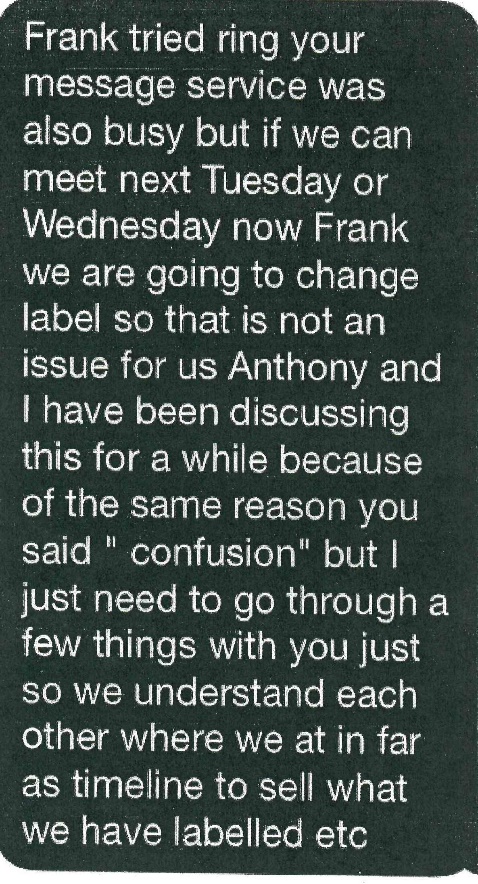
158 At the meeting on 1 September 2016, Frank and Vito discussed the letter of demand and the confusion between the respective labels of the applicants and the respondents. Vito said that he was willing to compromise by changing the respondents’ current labels. He said the respondents would not continue to use the “two-heads” label. He said that he and Tony were already in the process of changing the respondents’ labels to the OZTALIA label, but that “Vito Mitolo and Son” as producers of the wine would be printed on each label in compliance with South Australian liquor licensing laws. Vito said that Vito Mitolo & Son needed at least until the end of the first quarter of 2017 to sell the current labelled stock and introduce stock with different labels. The company would continue to use the modified WAVEFORM label as Frank had agreed to it and a substantial investment had been made in promoting the brand. Vito said he was willing to compromise in order to “keep the peace between the family”.
159 Frank says that this was not the reason for the willingness to compromise. He says that Vito and Tony had independently recognised that there was confusion, and that the decision to change to the OZTALIA label — which occurred prior to Vito receiving the letter of demand — was based on this recognition.
160 Frank and Vito also discussed the use of “Mitolo” on the respondents’ merchandise and other promotional material. Frank said that the respondents could not use the word Mitolo “anywhere” because it could cause confusion.
161 Vito also said in his affidavit that he and Frank discussed the respondents continuing to use the WAVEFORM label in the form approved by Frank in the 2014 Facebook Exchange because they had made a substantial investment in promoting the brand. Frank denies that this was discussed. In cross-examination, Vito conceded that the respondents’ WAVEFORM products were not being sold at Pizzateca at the time of the Café Cena meeting and that he was unsure whether there were any WAVEFORM products in existence at the time.
162 Frank and Vito concluded the meeting on the understanding that the applicants’ solicitors would draft an agreement reflecting what had been discussed. The agreement (the First Deed) was received by Vito on 3 September 2016.
163 With respect to the negotiations, I find, based on my preference for Frank’s evidence over that of Vito, the following: (1) Vito did tell Frank at Café Cena that he and Tony had already decided to change the label of Vito Mitolo & Son’s wines to OZTALIA to avoid confusion caused by the use of V. Mitolo and Son; (2) that there was no discussion at the meeting about any requirement of the law to put the producer’s name on the label; (3) that Vito Mitolo & Son was not, in fact, using the WAVEFORM label at the time of the meeting at Café Cena; and (4) they did agree that the respondents would stop using the word “MITOLO” except in identifying the name of the producer of the wine.
164 Frank and Vito met again on 20 September 2016 at Café Cibo in St Peters. They discussed the terms of the First Deed and agreed to make various changes. Frank said that he would arrange for a new agreement (the Second Deed) to be drafted to reflect those changes. The Second Deed was received by Vito on 20 September 2016.
165 Between late September 2016 and early November 2016, Frank and Vito exchanged a number of text messages regarding the Second Deed.
166 By 2 November 2016, Vito indicated that although he was willing to make changes to the respondents’ labels and cellar door sign, he would not agree to the Second Deed.
167 On 8 November 2016, Vito met with his solicitors, Mr Dimitri Georgiadis and Mr Paul Costi of Georgiadis Lawyers to make amendments to the Second Deed.
168 On 25 November 2016, a mediation conference was held at the offices of Minicozzi Lawyers. The mediation conference was attended by Vito, Mr Frank Mitolo (Vito’s brother) and Vito’s solicitors, as well as Frank and his solicitor. The mediation was ultimately unsuccessful.
INSTANCES OF ACTUAL CONFUSION
169 The applicants called considerable evidence directed to showing confusion by third parties as to the identity of, or association between, the applicants’ business and wine products on the one hand, and Vito Mitolo & Son’s business and wine products on the other. As will become clear, the evidence differs in its cogency.
170 It is possible to categorise the evidence in various ways. For example, some items of evidence support a case of error (or a capacity to induce error), whereas other items support a case of wonderment. I should say that I am using the word “confusion” to include both wonderment and actual error (or a capacity to induce error). Some items of evidence relate to the respective wines, others to the respective cellar doors and restaurants, and yet others to the two businesses more generally. I do not consider it necessary to categorise each item of evidence in accordance with these or other categories. It is sufficient to say that I am aware of the different features of various items of evidence and, in particular, the evidence that supports a conclusion of error (or a capacity to induce error) on the one hand, and the evidence which supports a conclusion of wonderment on the other.
Frank’s Evidence
171 Frank gave evidence of the following incidents.
172 On 2 March 2016, Ms Fleur Runge, an employee of the applicants, received an email from the City of Onkaparinga. The email referred to a request from “Tony” regarding “Tourism Winery signs” and asked for the “best contact for the Cellar door”.
173 On 16 June 2016, a Twitter user with the username “Willunga Wino” made a post on Twitter which mentioned the applicants’ Twitter account (@mitolowines) in connection with Pizzateca. I refer to this evidence in Annexure A.
174 On 21 July 2016, a representative of Clique Magazine emailed Ms Runge in relation to a feature the magazine was planning to run about the applicants’ business. The representative suggested that the feature could be run alongside a feature about Pizzateca.
175 On 1 August 2016, a representative of the website “Fleurieu Living” emailed Ms Runge. The email referred to the “new Mitolo cellar door”. At that time, the applicants’ cellar door had not yet opened, but the respondents’ cellar door had just opened.
176 On 29 November 2016, Ms Mary-anne Kennedy, a representative of “A Taste of SA wine tours”, sent an email to the applicants’ generic enquiries email address. Ms Kennedy opened the email with “Hi to all at Vitolo” and said she was “waiting for your cellar door to open”. At that time, the applicants’ cellar door had not yet opened, but the respondents’ cellar door was open.
177 On 28 October 2015, Ms Tamme Golding-Holbrook sent the following email to the applicants’ general enquiries email address:
Hello Mitolo Wines,
How can I purchase the Grenache Rose to drink today! I know your cellar door is still under construction, is there anywhere in McLaren Vale I can purchase this? Are you still selling it at Pizzateca?
178 On the same day, Ms Runge responded to Ms Golding-Holbrook’s email to clarify that “[Mitolo Wines is] not affiliated with Pizzateca, it is a restaurant run by V Mitolo & Son”. Ms Golding-Holbrook responded to Ms Runge’s email by stating “Sorry I confused Mitolo Wines with Pizzateca I thought it was the same owners”.
179 On 28 November 2016, the Premier of South Australia published a Facebook post in relation to the construction of the applicants’ restaurant and cellar door. In response, a Facebook user with the username “Blacky Whitey” posted a comment that mentioned the respondents’ Facebook page (@pizzateca). I refer to this evidence in Annexure A.
180 On 11 June 2017, an Instagram user with the username “thglvz” published an Instagram post which referred to the McLaren Vale Sea & Vines Festival and Pizzateca in association with the applicants’ Instagram page (@mitolowines). I refer to this evidence in Annexure A.
181 In an undated Instagram post, an Instagram user with the username “laurenminuzzo” posted photographs of two locations at the respondents’ Pizzateca restaurant. The post referred to “#mitolo” and “#mitolowines”. I refer to this evidence in Annexure A.
182 On 6 January 2018, Mr Simon Wilkinson published a review of Pizzateca in the SA Weekend Magazine. The review made reference to the wines produced by the respondents and the applicants’ winery. However, the review made clear that the wines produced under the V. Mitolo & Son label were “not to be confused with another branch of the family at the … Mitolo winery”.
183 On 13 January 2018, a 21st birthday party was held at the applicants’ restaurant. The organiser of the party took a series of photographs which were posted on her Instagram page. Each of the photographs of the event were tagged “V Mitolo & Son”.
184 On 5 June 2018, the applicants received a message via their Facebook page from a member of the public called “Marissa”. In the message, she asked whether a voucher purchased for a meal at the applicants’ restaurant could also be used at Pizzateca.
185 On or around 16 July 2018, Ms Czuchwicki received a message on Facebook from the editor of the McLaren Vale Visitor Guide, Ms Ellen Morgan, in response to photographs that Ms Czuchwicki had provided to her for publication. Ms Morgan asked whether Ms Czuchwicki also had access to Pizzateca images.
186 On 22 July 2018, an Instagram user with the username “Insta_dizzle” tagged “V Mitolo & Son” as their location when, in fact, they were at the applicants’ cellar door.
Ms Gemma Olivia Mitolo
187 Ms Mitolo is Frank’s daughter. She is employed by the applicants as the “Tasting Room & Restaurant Assistant Manager” at the applicants’ cellar door/tasting room and restaurant at McMurtrie Road.
188 Ms Mitolo gave evidence as to the number of people that frequent the applicants’ cellar door/tasting room and restaurant based on her own observations and on the review of her staff members. She estimated that the applicants’ tasting room has, on average, 15–20 visitors per day, and that the applicants’ restaurant has, on average, 40 customers per day.
189 In her first affidavit, Ms Mitolo gave evidence of five instances of confusion by customers of the applicants’ cellar door/tasting room and restaurant that she observed. The five instances occurred between 21 October 2017 and 7 November 2017.
190 On 21 October 2017, a couple attended the applicants’ tasting room. One of them said to Ms Mitolo words to the following effect: “We have tasted your wines before at a different cellar door … have you moved?”. She responded with words to the effect that the cellar door to which he referred “was operated by cousins but that was a separate business”.
191 On 22 October 2017, two men attended the applicants’ tasting room. One of the men said words to the following effect to Ms Mitolo: “I’ve tasted your wines before but they had a different label”. She responded with words to the effect that the wines could have been the “black and white Mitolo” or the “Jester”, and gestured towards those two wines. The man responded with words to the effect that “it was neither of those wines but it was definitely Mitolo”. She responded with words to the effect that “I think you’re talking about a wine produced by a cousin of the family”.
192 On 25 October 2017, a woman attended the applicants’ tasting room. She asked Ms Mitolo in words to the following effect: “Is this V Mitolo & Sons?” Ms Mitolo responded with words to the effect that “Vito Mitolo is a cousin. His business is separate to our business”.
193 On 29 October 2017, a group of people attended the applicants’ tasting room. One of the group said words to the following effect: “Are you guys the same as V Mitolo and Pizzateca?” to which Ms Mitolo responded with words to the effect that “They’re cousins but there is no affiliation between the brand”.
194 On 7 November 2017, a man and his adult children attended the applicants’ tasting room. The man said words to the effect that “I’ve had your Grenache Shiraz before … it was Mitolo Wines”, to which Ms Mitolo responded with words to the effect that “Mitolo Wines don’t make a Grenache Shiraz” and that “the wine you’re talking about was probably produced by V Mitolo & Son”.
195 Ms Mitolo also gave evidence that, in the two weeks prior to 19 December 2017, she recalls different customers of the applicants’ cellar door/tasting room and restaurant said words to the effect that: (a) “Is this a wood oven for the pizzas you make?”; (b) “What’s the relationship between you and V Mitolo?”; and (c) “My friends came here for Sea & Vines last year”.
196 Ms Mitolo said that she was able to recall the dates of the instances described above because she recorded notes on her mobile phone. She did not keep those notes. In cross-examination, she was asked whether those quotes were recorded “word for word”. She responded that the quotes “should be word for word” because they were recorded contemporaneously with the relevant instance. She also gave evidence that Frank asked her to record the notes, but could not recall when he first asked her to do so. She was also asked in cross-examination whether the five instances described above represent most or all of what actually occurred. She initially responded that the five instances were not most of what was captured. When pressed by counsel for the respondents, she responded that she recorded most of the instances that occurred, even if she did not record all of them.
197 Ms Mitolo also gave evidence that, in her estimation, a customer at the applicants’ cellar door/tasting room and restaurant makes a reference to, or asks a question about, the applicants’ association with V. Mitolo and Son or with Pizzateca every day. The respondents objected to this as a “vague general assertion which fails to identify any relevant representation”. The respondents did not press the objection at trial. Nevertheless, it was put to Ms Mitolo in cross-examination that the estimation was an exaggeration or overstatement. She responded that she believed the estimation to be correct.
198 In her second affidavit, Ms Mitolo supplemented and updated those matters deposed to in her first affidavit. She said that since the time of the instances of confusion described in her first affidavit, she had observed further instances of confusion by customers of the applicants’ cellar door/tasting room and restaurant on a regular basis. She also said that Frank asked her to email him with a summary of instances of customer confusion that she observed. She gave evidence of a further fifteen instances of confusion from 20 December 2017 to 30 June 2018. I set these further instances out below. I will infer, unless I indicate otherwise, that Ms Mitolo’s record of each instance was made contemporaneously with the instance.
199 On 20 December 2017, a couple from Sydney attended the applicants’ cellar door/tasting room. One of the couple said words to the following effect to Ms Mitolo: “What’s the difference between you and the other [M]itolo, do you guys sell the same wine or is it a totally different thing?” Ms Mitolo responded by explaining that the brands and wines were different. The man responded with words to the effect that he had driven past the applicants’ property after driving past the respondents’ property and had been very confused by the same name.
200 On 21 December 2017, a man attended the applicants’ cellar door/tasting room or restaurant. The instance is recounted as follows:
[Ms Mitolo] “Have you had our wines before?”
[Man] “Yes, I’ve had your wines at Pizza Tecca”
201 On 22 December 2017, a woman telephoned Ms Mitolo about making a group booking at the applicants’ restaurant. The woman later telephoned back and said words to the effect that she thought the applicants’ restaurant was Pizzateca and had instead booked there.
202 On 23 December 2017, a man said to Ms Mitolo words to the following effect: “So how new is this place? Do you still have Pizzateca?” to which she responded with words to the effect that “No they are cousins but there is no affiliation”.
203 On 23 December 2017, two men spoke to Ms Mitolo. The younger man said words to the following effect: “So is this any relation to Tony and Vito”. She responded that “they are cousins”. The older man then said words to the effect that “it seems to me that V Mitolo are riding on the tail of your already well established business”.
204 On 6 January 2018, Ms Mitolo had the following conversation with a woman at the applicants’ cellar door/tasting room or restaurant:
[Woman] “I had your wines at Pizza Tecca recently”
[Ms Mitolo] “oh no, they make their own wine under ‘Mitolo’ too”
[Woman] “oh you’re joking, so you’ve never had your wines on their list”
[Ms Mitolo] “no never”
[Woman] “wow, I was under the impression I was drinking your wines”
205 On 16 January 2018, Ms Mitolo had the following conversation with a man at the applicants’ cellar door/tasting room or restaurant:
Man “are you and pizza tecca the same”
[Ms Mitolo] “no, we aren’t affiliated at all, they are cousins who also make wine”
Man “wow okay, we have been to pizza Tecca twice and thought we’d check out their new place. Very different to what they’ve got now”
206 On 21 January 2018, Ms Mitolo had the following conversation with a father and a son at the applicants’ cellar door/tasting room or restaurant:
Son “so what’s the connection with v mitolo”
[Ms Mitolo] “no connection, they are my dads [sic] cousins who started making wine a few years ago”
[Father] “hmm seems to me that v mitolo is riding your tail of an already very well established winery.”
207 On 22 January 2018, Ms Mitolo had the following conversation with a woman at the applicants’ cellar door/tasting room or restaurant:
[Woman] “We just came from pizza tecca and had your wines”
[Ms Mitolo] “oh they don’t sell our wines, they make their own”
[Woman] “oh wait no the waitress told us they were your wines”
[Ms Mitolo] “no it’s totally different.”
208 On 31 January 2018, Ms Mitolo overheard a conversation between a woman and a man at the applicants’ cellar door/tasting room or restaurant:
[Woman to man] “I keep getting this confused with pizza tecca, what’s the difference ... ?”
[Man to woman] “I don't know, think there’s a family connection”
[Woman to man] “same wine?”
[Man to woman] “no I don’t think so. I think they are different”
209 On 11 February 2018, Ms Mitolo had the following conversation with a man at the applicants’ cellar door/tasting room or restaurant:
Man “we had your wines at pizza tecca last night, the Grenache”
[Ms Mitolo] “oh no, they make their own wine under a similar label at pizza tecca but it’s not ours.”
Man “oh you’re joking, we thought it was yours. That must be confusing”
210 On 29 June 2018, a woman said the following to Ms Mitolo:
So are you and pizza tecca the same
211 On 29 June 2018, a man said the following to Ms Mitolo:
Is v mitolo a smaller branch of mitolo, is that a different range you do?
212 On 30 June 2018, a woman said the following to Ms Mitolo:
I had your wines the other week, we were at sea and vines and went to pizza tecca and they had your wines there
213 On an unspecified day in June 2018, an unidentified person said the following to Ms Mitolo:
So is this the same as v mitolo, I was given a wine from there with a clear label but I can’t see it
214 In cross-examination, Ms Mitolo was asked whether she would have done her best to record every instance of confusion she observed over the period December 2017 to June 2018. She responded that she could not record instances daily, but that she would record instances when she remembered or was reminded.
215 It was also put to Ms Mitolo in cross-examination that the instances of confusion that occurred over the period December 2017 to June 2018 were likely to represent a very small proportion of the number of people that visited the applicants’ cellar door/tasting room and restaurant. She accepted this, although she noted that there were “plenty more” instances beyond those which she recorded.
216 Perhaps because Ms Mitolo gave a good deal of evidence about instances of actual confusion, the parties’ submissions on this topic generally tended to focus on her evidence. I will summarise those submissions at this point, but will not overlook the fact that they apply to all of the evidence directed to the applicants’ case of instances of actual confusion.
217 The applicants submit that the Court should readily accept the evidence of Ms Mitolo regarding identified instances because her notes are contemporaneous or nearly contemporaneous, and because she was specifically instructed to pay attention to and try to capture statements made by the customers at the cellar door following the applicants’ concerns about confusion. The applicants submit that this evidence can be distinguished from the other evidence of people with no real focus on the issue who now do not have a precise recollection. The applicants also submit that there is no issue about the credit of Ms Mitolo.
218 The applicants also submit that for every person that did have the type of exchange at the applicants’ cellar door described in Ms Mitolo’s evidence, there must be other members of the public who either do not ask the question or do not attend the applicants’ cellar door/tasting room or restaurant and so the absence of an association is never clarified.
219 The applicants submit more generally that the significant volume of evidence regarding actual confusion (including Ms Mitolo’s evidence) strongly supports the conclusion that there is an erroneous belief in the minds of a significant portion of the consumer market that the applicants and the respondents are one and the same or, at least, commercially related to one another. The applicants submit that, absent the use of the word “Mitolo”, there is no credible explanation for the pattern of customer confusion between the two businesses. The applicants contend that the obvious and overwhelming inference is that the documented customer confusion is being generated by the common use of the words “Mitolo” by two very similar businesses located in almost the same place. These submissions support the applicants’ claim that the respondents have contravened s 18 of the ACL.
220 The applicants also seek to rely on the same conduct of the respondents to support the claim that the respondents’ have contravened s 29(1)(h) of the ACL. Although it is not expressly stated, this seems to include reliance on the instances identified by Ms Mitolo.
221 In their written submissions, the respondents contend that the anecdotal evidence of customer confusion is flimsy, equivocal and of little, if any, assistance to the resolution of the relevant issues. The respondents contend that the evidence is of limited probative value for several reasons. First, the evidence is uncontrolled because there is a lack of control evidence against which the instances of actual confusion can be compared. According to the respondents, there is no evidence of a protocol or some structured exchange with people whereby the information can be documented. Rather, the process was random, ad hoc and unstructured. On this basis, the respondents submit that the material is highly suspect material in terms of drawing conclusions. Secondly, the evidence is subjective. Thirdly, the evidence has been reported by or through parties with an obvious interest in the matter, noting that Frank requested that Ms Mitolo record instances of actual confusion at a stage where legal proceedings had been commenced. Fourth, the evidence lacks detail as to the context in which the apparent confusion took place. The respondents also submitted orally that, as explained by Dr Downes, the evidence is merely “hypothesis-generating … information” which is capable of, and which should be subject to, empirical testing.
222 The respondents further contend that Ms Mitolo’s email reports to Frank disclose only a small number of exchanges over a seven month period, and that there is no way of knowing what proportion these incidents bear to the overall level of customers who made no such comment. The respondents contend that Ms Mitolo’s estimation that instances of confusion happened every day should be rejected as an overstatement.
223 I should say that in this context, the respondents pointed out that with respect to the allegation that they contravened s 18 of the ACL, evidence of confusion or uncertainty in the minds of the relevant members of the public, without more, does not ordinarily suffice to establish misleading or deceptive conduct. The respondents refer to Bing! Software v Bing Technologies [2009] FCAFC 131; (2009) 180 FCR 191 at [42] in support of this proposition.
Ms Kirsty Marie Czuchwicki
224 I have already referred to Ms Czuchwicki’s evidence in some detail. She said that as part of her role as brand manager with Mitolo Wines, she spent time in the new cellar door at McMurtrie Road during the first week of trading. During the first week, a couple came into the cellar door and she spoke to them. During the course of the discussion, they said words to the effect that, “We’ve tried wines made by Mitolo Wines before at Pizzateca”. Ms Czuchwicki said in response that, “The operators of Pizzateca also made wine but there was no association with Mitolo Wines”. She said that since that time she had had similar interactions with members of the public visiting the tasting room and asking about the pizzas or talking to her about visiting “our” cellar door on Chalk Hill Road. She said that she had experienced these types of interactions almost every day that she had been at the cellar door. Ms Czuchwicki said that she had encountered this type of confusion socially as well, when Mitolo or Pizzateca came up in conversation. She did not have a specific recollection of dates, times and particular conversations, but her estimate was that she had heard Pizzateca be used in reference to Mitolo Wines on a near-weekly basis, or on around 50 occasions.
Ms Melanie May Minear
225 I set out the substance of Ms Minear’s evidence in Annexure A. In cross-examination, Ms Minear did not accept that that Mr Gagliardi may have said that he had just been to the “V” Mitolo cellar door, rather than “the” Mitolo cellar door.
Ms Joanna Hawkins
226 I set out the substance of Ms Hawkins’ evidence in Annexure A. In cross-examination, Ms Hawkins appeared to accept that the words she quoted in her affidavit were not used and that Mr Frost did not say anything, although he was “within” the conversation. She said that she was not really sure whether Mr Cretteden actually linked up Frank and Pizzateca in the conversation, or when she went to the computer. In re-examination, she said that they did some research on the computer and were researching Mitolo Wines when Mr Cretteden said that he had been to Pizzateca. They looked at Pizzateca and Ms Hawkins said, “That’s not Frank’s restaurant”. Ms Hawkins’ evidence was quite uncertain, and although I do not doubt her genuineness, I place little weight on her evidence.
Mr Damien Smith
227 Mr Smith has worked as sales and marketing manager at Mitolo Wines for four years. Prior to that time, he worked in a similar role at Chapel Hill Winery.
228 In his role as sales and marketing manager, Mr Smith is responsible for wine sales. This involves liaising with all distribution partners, both at domestic and international level. His role also involves overseeing marketing strategy in conjunction with Frank.
229 Mr Smith was informed by Frank that Mitolo Wines has exported wines since 2002. In the early years, the core market was North America, the United Kingdom and the Netherlands. Over the following 15 years, Mitolo Wines has expanded into Asia, including Japan, Taiwan, Singapore, Malaysia and China. Mr Smith travels to all of the export markets where the applicants’ wines are distributed, sold and promoted.
230 Mr Smith travels to North America two to three times a year and North America is a key export market. In conjunction with Frank, Mr Smith decided to employ a full time sales professional based in Toronto, Canada. The role is described as Vice President, Sales, North America and entails responsibility for sales and marketing throughout the United States and Canada. Ms Lara Bean occupied the role until 12 December 2017. Before Ms Bean’s appointment, Mr Smith was primarily responsible for the sales and marketing activities of Mitolo Wines in North America. He states that he built on existing relationships that prevailed at the time he commenced with Mitolo Wines and he also established and fostered new relationships with distributors, importers, retailers, restauranteurs and consumers. These marketing and sales networks were maintained and expanded by Ms Bean.
231 In about September 2015, Mr Smith travelled to North America and as part of his trip he visited the north eastern area of the United States where certain key distributors are based. He met with representatives of retailers in the north eastern area around Boston and New York with a view to having them stock the applicants’ wines. Mr Smith said that in several of these locations, approximately six or seven, he was told by the retailer that they already stocked Mitolo wines. When he asked to see the wine they were referring to, he was shown bottles of the WAVEFORM series of wine produced by V. Mitolo & Son. Mr Smith examined the bottles and noticed that the wine was produced in the McLaren Vale region of South Australia. He photographed the bottle labels and sent them by text to Frank so that Frank was aware of what he was being shown.
232 Mr Smith said that at about the time Pizzateca opened in 2016, he had a number of “interactions” with industry colleagues during which the activities of V. Mitolo & Son were raised with him. These included conversations at industry functions and telephone discussions. He recalls people saying words to the effect that: (1) “I see you have opened a cellar door”; (2) “I see you have opened a new facility in McLaren Vale”; and (3) “I didn’t know you were opening”. Mr Smith said that he responded with words to the effect of “I think you might have Mitolo Wines confused with V Mitolo & Son”.
233 Late in 2016, Mr Smith attended a meeting with Qantas in Sydney to discuss business development and the ongoing supply of wines to Qantas for their inflight service and their wine club. The head buyer for Qantas was present. She said words to the effect that “I hear that you have opened a facility in McLaren Vale”. Mr Smith responded by telling her that the new restaurant at McLaren Vale was operated by Vito and Tony who were relatives, but there was no business association.
234 In September 2016, Mr Smith attended a wine trade show in Sydney. There were a number of trade representatives there who spoke to him about visiting McLaren Vale and in particular, visiting the new Mitolo Wines premises. In each case, Mr Smith explained that Mitolo Wines was still constructing its cellar door at McLaren Vale and that they were referring to the cellar door and pizza restaurant operated by Vito and Tony.
235 Mr Smith said that he continued to experience instances of confusion among industry representatives and that he did not make notes of when those instances of confusion occurred.
236 The objections to Mr Smith’s affidavit were not pressed by the respondents.
237 By the time of the trial, Mr Smith was no longer employed by Mitolo Wines. He attended court pursuant to a subpoena.
Ms Karen Stevens
238 I set out the substance of Ms Stevens’ evidence in Annexure A. In cross-examination, it emerged that Ms Georgina Pazios may have based her knowledge of Pizzateca and it being part of Mitolo Wines on what her daughters told her, rather than first-hand knowledge. In the circumstances, I place little weight on Ms Stevens’ evidence.
Ms Sally Bevan
239 Ms Bevan is the venue manager at the applicants’ cellar door/tasting room and restaurant at McMurtrie Road and has been since it opened. She collects the mail from the McLaren Vale Post Office approximately once a week. She has noticed mail for V. Mitolo & Son or Tony at Pizzateca in the Mitolo Wines Post Office Box and that that continued despite the fact that she spoke to a service attendant at the Post Office and told them that V. Mitolo & Son was a different company from Mitolo Wines.
Conclusions
240 I reject the respondents’ general criticisms of the evidence directed to instances of actual confusion and I am satisfied that the evidence is a powerful body of evidence of actual confusion in the market place caused by the common use of the word “Mitolo”. The confusion is as to the relationship between the applicants on the one hand, and Vito Mitolo & Son on the other, and whether they are the same business or associated or related businesses. Whilst some items of evidence rise no higher than wonderment, other items are of actual error (or capacity to induce error) as to the businesses or the wine products. I accept that there is a grey area between statements which suggest wonderment and those which suggest error. However, it seems to me that examples which suggest error are set out in the following paragraphs of these reasons: [172], [174], [177], [184], [185], [190], [191], [194], [200], [202], [204], [207], [209], [212], [224], [225] (Annexure A), [232], [233], [234], and that the remaining examples suggest wonderment.
241 In reaching these conclusions, I have taken the various arguments advanced by the respondents into account. I do not think the evidence was flimsy or equivocal. I accept that the evidence was not obtained by the use of a well-structured survey and is of its nature subjective. I do not think the fact that most of those reporting the comments or observations had an association with the applicants affected the reliability of their evidence. As I have said, they were honest and reliable witnesses. I have taken into account that in the case of anecdotal evidence of the type advanced, the Court needs to be alive to the possibility that the full context of the statements or observations has not been provided. I accept that, as to some of the posts, there might have been an automatic geo-tagging of the post, although the evidence about this possibility was far from clear. Taking these matters into account, I nevertheless consider the evidence to be a powerful body of evidence of actual confusion in the market place caused by the common use of the word “Mitolo”.
THE EXPERT EVIDENCE
242 Each party adduced expert evidence relevant to the issues in the case. The applicants adduced evidence from Professor Lawrence Lockshin and the respondents adduced evidence from Dr Stephen Downes. Each expert prepared a written report and, in Professor Lockshin’s case, a written report in reply. These reports addressed issues of consumer behaviour, principles of marketing and brand identification and the issues in the case, including whether the respondents’ mark is deceptively similar to that of the applicants. Each expert was cross-examined.
243 The parties proceeded on the basis that the expert evidence was admissible and that is clearly correct (Sydneyside Distributors Pty Ltd v Red Bull Australia Pty Ltd [2002] FCAFC 157; (2002) 234 FCR 549; (2002) 55 IPR 354 at [82] per Weinberg and Dowsett JJ). Nevertheless, the ultimate decision is made by the Court: Interlego AG v Croner Trading Pty Ltd (1992) 39 FCR 348 at 387 per Gummow J (with whom Black CJ and Lockhart J agreed).
244 Important matters in assessing the weight to be placed on the expert evidence include the correctness of the assumptions made by the expert and the cogency of the expert’s reasoning. An important feature of this case is the reliance Professor Lockshin placed on the evidence of cases of actual confusion which he was asked to assume were correct. I have addressed that evidence. Dr Downes expressed the opinion that reliance could not be placed on those matters.
245 I will summarise the evidence given by each expert and then address the important points of difference between them as identified by the parties when addressing the issues in the case.
246 Professor Lockshin has a Bachelor of Arts (Humanities), a Master of Science (Viticulture and Agricultural Economics) and a Doctor of Philosophy – Marketing. He is currently the Head of the School of Marketing of the University of South Australia Business School. He has held that position since 2011 and in that position he manages over 60 staff members. He is a senior member of the Business School Executive, a researcher and PhD supervisor, and a lecturer in “Marketing Principles: Trading and Exchange”. Since 2003, Professor Lockshin has been Professor of Wine Marketing and Senior Researcher at the Ehrenberg-Bass Institute for Marketing Science (the Institute) which is part of the School of Marketing. The Institute carries out what Professor Lockshin described as basic empirical research to understand buyer behaviour, that is, how buyers make purchasing decisions, and he said that the Institute’s purpose is to develop evidence-based marketing principles of general application. Professor Lockshin has more than 30 years’ experience working in the wine industry. He has published widely and has received substantial research grants and funding. He has had previous experience giving evidence as an expert witness.
247 On or about 29 May 2017, Professor Lockshin received a letter of instructions from the applicants’ solicitors in which he was asked to address a number of questions. He was given a copy of the pleadings and he was asked to assume that a number of allegations in the pleadings were correct.
248 Professor Lockshin was first asked to provide an opinion concerning the reputation and goodwill in the Mitolo mark and the association of that mark with the applicants. He said that he had heard of the wine brand, Mitolo, before in South Australia and that he had purchased their wines infrequently. He had no personal or professional knowledge (based on specific research) of the reputation of Mitolo Wines.
249 Professor Lockshin said that he proceeded on the basis that the term “brand” and the term “mark” were interchangeable. He understood that there is a specific legal meaning of the words “mark” and “trade mark”. He said that he would use the common marketing understanding of the word “brand”. He referred to a number of general principles on the assumptions that he was asked to make and said that since no other brand or mark carried the name “Mitolo” from its inception, the exclusivity of the association of the mark with the brand name until the new brand came into the market was self-evident. He said that consumers will associate the two names as one brand and he said that from this reasoning, he will call Mitolo Wines a brand, which is the same as the trade mark.
250 Professor Lockshin said that he had no personal experience of Mitolo Wines or “V Mitolo & Son or Vito Mitolo & (and) Son” that would lead him to know about any changes in associations of the Mitolo mark. Professor Lockshin expressed the opinion that there is no difference in how consumers respond to either the word “and” or the symbol “&” when seeing these as part of a brand name. Professor Lockshin said that drawing on his experience, he believed that consumers of the applicants’ wines would likely see any wine with that name as part of the branding as belonging to the brand they are most familiar with, which, in this case, is likely to be Mitolo Wines.
251 Professor Lockshin expressed some general opinions about how persons reacted to brands. He said that people learn about brands through usage as well as through advertising and other communications. He said that brands are not important to most people and, as a result, the information about a brand is stored in memory, typically in a very general way. The memory storage is linked to previous experiences, comments, marketing materials and other communication devices. He said that in marketing and psychology, these linkages are called “nodes”. Professor Lockshin said that the sight or mention of a trigger or cue, in this case the name “Mitolo”, can be enough to activate the node and bring the name “Mitolo” to active memory. He expressed the following opinion:
Unless V Mitolo or Vito Mitolo and Son have established unique nodes in memory, the existing Mitolo link will most likely be activated and added to with any contact, even if that contact is with the respondent’s product.
252 Based on the actual examples of mistake or confusion with which he was provided, namely, those set out in para 15.3 of the Statement of Claim as appearing on Facebook, Instagram, in telephone calls and emails about the V. Mitolo wines, Professor Lockshin expressed the opinion that they are examples of how consumers know the name “Mitolo” and associate any reference to it with their earliest and strongest memory associated with the brand and that this was typical consumer behaviour.
253 Professor Lockshin said that there was a strong likelihood that the more communications and sales by V. Mitolo and Son using the name “Mitolo” there are, the more there will be an association with the Mitolo Wines brand. He said that consumers assume that products bearing the same name are made by the same producers.
254 Professor Lockshin expresses the opinion that the only way to ensure that customers are able to differentiate between the two marks in question is to remove the Mitolo name from one of the two marks. In Professor Lockshin’s opinion, if this is not done confusion will continue to occur.
255 Professor Lockshin expresses the opinion based on two matters that a survey to test whether consumer confusion existed between the two brands would not be useful. First, he considers that there was enough evidence of confusion for him to feel confident that consumers coming into contact with the V (Vito) Mitolo and Son product believe it to be the same brand as Mitolo Wines. Secondly, Professor Lockshin considers that a survey of wine consumers in Australia, or even a more focused survey of wine consumers in South Australia, would have to recruit a very large sample to obtain enough wine drinkers familiar with the wines of Mitolo Wines and the wines of V (Vito) Mitolo and Son to be able to make a statistically valid judgment of confusion. Such an undertaking would be both expensive and time consuming and would, in Professor Lockshin’s opinion, be very likely to show the exact confusion evident from the evidence presented.
256 Professor Lockshin expresses the opinion that consumers do not process product information very deeply and that most of the mental processing is based on recognition using cues linked to memories. Based on his instructions, he deduced that there were approximately 240,000 instances of consumers coming into contact with Mitolo Wines. Professor Lockshin said that he did not have the production figures of V. Mitolo and Son, but understood them to be substantially smaller. Professor Lockshin considers that consumers who have had previous experience or awareness of Mitolo Wines and who see any instance of the word “Mitolo” and a wine product are likely to see the product as related to Mitolo Wines. Professor Lockshin did not consider that any specific segment of the public was identified except for those purchasing wines above $13.98 in the Australian market. He states that this corresponds to the average price for bottled wine purchased in Australia. It seemed to him to be the similar price point to the range of V. Mitolo and Son wines.
257 Professor Lockshin expresses the view that the fact that two wines use a portion of the same name, Mitolo, is responsible for the confusion. He expresses the opinion that consumers do not read labels carefully and utilise cues learned from previous experience to identify brands. This means, according to Professor Lockshin, that the effects of the confusion are not transitory, but lasting because the memory nodes are added to rather than replaced with different experiences. Professor Lockshin said that from the evidence presented to him, he did not consider that inspecting the premises of the respondents and drinking the wine, presumably with the bottle on the table, would dispel the confusion. He considered that a consumer searching the internet, or using Instagram and Facebook, are more likely to find Mitolo Wines and not V. Mitolo and Son. After finding Mitolo Wines online, consumers contacted them, believing it was V. Mitolo and Son. Professor Lockshin considered this a clear case of confusion.
258 Professor Lockshin was asked to address the respondents’ plea that premium wine consumers, being the relevant class of persons, were not likely to be misled by the first respondent’s conduct. Professor Lockshin said that, based on his knowledge and experience, the use of the word “premium” is applied to a wide range of wine and wine consumers, and has no specific meaning. Professor Lockshin provided details of consumer behaviour. In typical retail shopping, buyers spend very little time in front of the shelf and about 80% of consumers spend four minutes walking into a store, choosing a bottle and lining up at the cash registers. Very few consumers pick up the bottle and look at the label closely. Research carried out tested whether there was a difference between low involvement and high involvement consumers and no difference was found. Low and high involvement consumers are psychological constructs that distinguish between those who drink wine without much interest in the details about the wine and those for whom wine is part of their lifestyle and who think and are more interested to learn about wine. Professor Lockshin refers to material that suggests that the actual purchase experience is similar between low and high involvement consumers, but the two types of consumers tend to focus on different aspects of the wine. Low involvement consumers focus more on price, grape variety and brand. High involvement consumers focus more on grape variety and region as well as price, though not as much as low involvement consumers.
259 Professor Lockshin said that other research had shown that consumers buy among multiple price tiers. What this means is that those who buy wines around $8–$10 also buy wines in the $10–$15 price tier. Consumers who buy at $15 also buy wines around $20. Professor Lockshin concludes from these circumstances that it is hard to identify a premium wine buyer. Mitolo wines and V. Mitolo and Son both sell wines starting at around $14 and the majority of wines they sell are up to the mid-$30 range. Mitolo wines sell two high priced wines above that figure and these high priced wines are made in small quantities. They are not bought very often. Professor Lockshin expresses the opinion that it is impossible to specify a “premium wine consumer” with any degree of accuracy and that consumers tend to buy in several adjacent price tiers. They can move up to higher price tiers for a special occasion and move into a lower priced tier if the wine seems attractive.
260 Professor Lockshin concludes from this that there is no special class of consumers that buy the applicants’ wines compared to a different group that buys the respondents’ wines. The relevant class of person is exactly the same for both the respondents and the applicants, and consists of persons who buy wines around $14–$35. Professor Lockshin said that his expert opinion is as follows:
… the use of the name Mitolo on two different wine brands is likely to be confusing to wine buyers. Wine buyers, and for that matter consumers in general, tend not to focus on details when shopping and purchasing. They use simple cues to identify the product within the category. Cues that are similar will likely result in confusion, in the sense that consumers may intend to buy one brand, but could buy another that is identified using similar cues. The probability of this happening is related to the availability of the products on the shelf, wine list and or online.
261 In summary, Professor Lockshin has drawn on research and his own knowledge to express opinions as to the behaviour of consumers of wine up to and including the point of purchase, and the features of the wine market for determining whether the relevant market for the applicants’ wines is premium wine consumers. Professor Lockshin then applies that research and knowledge to the facts presented to him by the applicants’ solicitors and, in particular, the examples of confusion set out in para 15.3 of the Statement of Claim provided to him, and the additional information provided by the applicants’ solicitors. Professor Lockshin then expresses an opinion as to the significance of the name “Mitolo” in the case of the applicants, and the use of V. Mitolo & Son or Vito Mitolo & (and) Son. In large measure, Professor Lockshin’s opinions come down to the fact that his research and knowledge of the wine market and consumer behaviour is such as to confirm that the examples of mistake and confusion are, in fact, caused by, and consistent with, the common use of the name, Mitolo.
262 Professor Lockshin was cross-examined at some length. A key matter put to him was that a well-constructed logical survey would be the best way of determining consumer behaviour. It was put to him that he was relying on a number of anecdotes which did not provide a reliable basis for his opinion. Professor Lockshin did not change his opinion that a survey would not be useful for the reasons he gave in his report and he considered that the actual instances of confusion revealed a pattern which was a sufficient basis for the opinions he expressed.
263 Dr Downes has a Bachelor of Medicine, Bachelor of Surgery (MB,BS) and Master of Marketing. He is a Lecturer (sessional), School of Economics, Finance and Marketing at RMIT University and a Lecturer (sessional) Department of Management and Marketing Faculty of Business and Economics, University of Melbourne. He is the principal and director of QBrand Consulting Pty Ltd, a firm he established in 2003, which involves expert marketing evidence and survey design in legal and regulatory matters concerning trade practices, trade marks and advertising, and consulting in marketing strategy, brand strategy, consumer and B2B market research, content and creative development and copywriting. He has published and been involved in seminar and conference presentations. He said that he has worked continuously in marketing and communications since 1988.
264 On or about 31 August 2017, Dr Downes received a letter of instructions from the respondents’ solicitors in which he was asked to address Professor Lockshin’s report and provide his opinion as to a number of matters.
265 Dr Downes said that brand is a central concept in contemporary marketing and consumer behaviour, theory and practice. He said that since the 1980s in particular, the brand concept, the strategy and process of “branding” and the management of brands have become key issues for marketing and business management and for academic study in marketing. Brand theory, Dr Downes said, drew on elements of cognitive and social psychology, anthropology and cultural studies, and neurophysiology.
266 Dr Downes provided his opinions as to the concept of brands, brand image, brand personality and brand positioning. He said that the term “brand” had a well-established and much broader meaning and interpretation that differed significantly from the narrower legal use of the term “mark”. He said that a brand is conceptualised as a network of associations in the mind of a consumer, while a mark can be thought of as equivalent to a brand identity element. Dr Downes also referred to the consumer response to packaging and labels.
267 Dr Downes was unaware of the respective businesses and brands of the applicants and the respondents prior to being approached and receiving instructions from the respondents’ solicitors. Dr Downes said that the overall impression created by a package, including the label or labels applied to a wine bottle, was very important when considering consumer response. He made a number of observations of the differences between the Mitolo Wines wine labels on the one hand, and the V. Mitolo and Son wine labels on the other. He expresses the following opinions:
28. As I have noted above, the overall impression created by a package, including the label or labels applied to a wine bottle is very important when considering consumer response. Examining and comparing the ranges of bottled wine products produced and offered for sale by the Applicant and the Respondents, I make the following observations.
28.1 The Applicant’s Mitolo wines labels make use of what I would regard as a formal layout with a sophisticated and elegant overall impression, accentuated by the use of classic and precise Roman and cursive fonts, symmetrical layouts, and the judicious use of dark colours and metallic inks or “foils”. In my opinion, the brand image conveyed is of a serious and corporate wine producer offering sophisticated products.
28.2 The labels of the majority of the Respondents’ products bearing the branding V.MITOLO AND SON generally have a distinctive “low-tech” style, with a simple, black and white colour scheme, the use of hand-drawn elements including lettering and graphic devices, and (often) of the facial silhouettes of the proprietors, creating what I would describe as an informal, non massproduced or “artisanal” overall impression. In my opinion, the brand image conveyed is of a small, family-owned, “hand-made” and “hands-on” brand.
28.3 The deliberately hand-made and low-tech graphic design approaches used by the Respondents and the consequent impression conveyed to consumers through the branding and labels of V.MITOLO AND SON products seems intended to support a “sincere” brand image and personality (with traits including down-to-earth, wholesome, honest, cheerful, family-oriented friendly). In my opinion, this is in keeping with a more relaxed, less serious brand positioning targeting consumers who have a relaxed approach to wine consumption.
28.4 By contrast, in my opinion the formal, elegant and classic impression as conveyed by the labels of the Applicant’s Mitolo Wines products seems intended to, and is likely to, support a “sophisticated” brand image and personality (with traits including upper class, charming, smooth, goodlooking), targeted towards consumers who are seeking a more serious wine experience.
268 He also referred to the significance of the use of the letter “V” in the respondents’ mark. He expressed the following opinion on that matter:
In my opinion, this creates the overall visual impression “V.MITOLO AND SON”, that is, of a brand name that begins with V. From my observations, this naming format – the use of an initial letter before a descriptive word that together serve to identify a particular brand – has become familiar to consumers in recent years through the prominence of brands including the fashion jeans brand G-Star, the clothing brand J.Crew, the gaming console brand Xbox, and consumer electronics brands iPhone and iPad.
269 Dr Downes considered that this use of the letter “V” was likely to contribute to a different visual and verbal impression compared to that created by the use of the word “Mitolo” alone. Dr Downes was also of the opinion that the letter “V” as a significant graphic element of the respondents’ labels, was likely to be important to many consumers in retaining and accessing the impression they have of the brand in their memory.
270 Dr Downes agreed with a number of Professor Lockshin’s opinions. A short summary of the areas of disagreement will suffice. He disagreed with Professor Lockshin’s opinion that:
(1) the terms “brand” and “mark” can be viewed as interchangeable;
(2) that any and all uses of the word “Mitolo”, regardless of adjacent text, visual context, font or graphic design treatment, would be confusing to buyers. Dr Downes considered that the comparison was not made against a single node such as the word “Mitolo”, but rather against the overall concept represented by a linked network of nodes that together identify a brand;
(3) Professor Lockshin’s emphasis on the use of the single word on a label, “rather than the overall visual impression and visual cues conveyed by the label, in terms of effects on consumer brand and recognition and identification”;
(4) that there is no special class of consumers that buy the applicants’ wines compared to a different group that buy the respondents’ wines; and
(5) that the word “Mitolo” is most likely the identifying cue when consumers are buying either wine. Dr Downes considered that this was not supported by the material in his report, according to Dr Downes. Dr Downes considered that it is the visual impression created by the bottle and its label as a whole that is likely to be the first thing consumers process and compare to impressions and brand concepts stored in their memories and is likely to be of much greater importance in brand recognition than the brand name considered alone.
271 Dr Downes does not consider any of Vito Mitolo & Son’s labels to be “substantially or significantly identical with, or deceptively or significantly deceptively similar to the Applicant[s’] mark”. He does not consider that any relevant segment of the public is likely to confuse the applicants on the one hand, and the respondents or any business operated by them on the other. Dr Downes seems to express the opinion that the applicants’ wines are addressed to a different market than the respondents. Furthermore, he is critical of Professor Lockshin’s reliance on anecdotal evidence which he considers “uncontrolled, subjective, have been reported through or by parties with an obvious interest in the matter, and/or lack a range of other detail (such as the context in which the apparent confusion took place)”. Having made those points, Dr Downes expresses the following opinion:
Most importantly, there is no basis on which these anecdotal reports of apparent confusion can be used to quantify the incidence of confusion across the market as a whole; that is, there are no data regarding the number of proportion of consumers who were not confused.
272 Dr Downes provides some information on the Australian wine market. He states that four large companies together account for almost 40% of Australian wine sales by revenue (domestic and international sales). Between them, these four companies own numerous leading and well-known wine brands. Dr Downes refers to Professor Lockshin’s statement that about 240,000 bottles of the applicants’ wines are sold annually in Australia and states that, assuming the volume of each bottle to be the standard 750 ml, that this represents total sales of 180,000 litres. Dr Downes states that he understands that the sales of the V. Mitolo and Son wines are, by comparison, lower than those of the applicants’ wines. He states that according to Wine Australia’s latest report on Australian wine production and sales, 468 million litres of Australian wine was sold in the Australian domestic market in 2015–2016. Thus, Mitolo Wines and V. Mitolo and Son can each be assumed to have less than 0.04% share of the Australian domestic market by sales volume. Dr Downes expresses the opinion, based on his experience, that when market shares are this small, it is impossible to determine the likelihood of any sales volume-related effect on comparative levels of consumer brand awareness.
273 Dr Downes states that he disagrees with Professor Lockshin’s conclusion that there is confusion and with his opinion that the only way to avoid or remedy confusion is to remove the word “Mitolo”. He expresses the following opinion:
In my opinion, the overall visual impression conveyed to consumers by the products of the Respondents, and the intended positioning of the Respondent’s brands are likely to be very different from the impressions conveyed by the Applicant’s products, making the removal of the word “Mitolo” unnecessary. This is particularly the case in relation to a product such as OZTALIA, where use of the word “Mitolo” is in the context of the wording “Produced by Vito Mitolo and Son” presented in a small font and clearly used to describe the producers of the wine and not as an important brand identity element.
274 It emerged in cross-examination of Dr Downes that he would not draw any conclusions about the likelihood of confusion in general in the market place until he saw some mathematical or scientific justification on a statistical basis. He referred to the evidence of actual confusion in the following answer:
I would accept that they are observations of interest, and that they lead to the generation of a hypothesis. In order to test the extent to which that occurs and the conditions under which it might occur, that’s where a scientifically designed survey or experimental study, in my mind, in my opinion, would be warranted.
275 One point to note in Dr Downes’ evidence in the context of trade mark infringement is that he has focused on how the applicants have used the Mitolo mark. The focus for trade mark infringement is, as I will explain, largely the mark itself and the ways in which it may be used within the class of goods or services concerned.
276 It seems to me that the differences between Professor Lockshin and Dr Downes come down to the following.
277 First, the two experts differ as to the significance, in terms of the likelihood of confusion, of the use of “Mitolo” in each mark. The difference includes differences as to the significance of the letter “V” in the case of the respondents’ mark and other brand indicia as between the applicants’ labels and those of the respondents.
278 Secondly, the two experts differ as to the significance of the cases of actual confusion, with Professor Lockshin placing significant weight on the cases, and Dr Downes none.
279 Thirdly, and related to the second matter, the experts differ as to the significance of the fact that a logical and coherent survey has not been carried out in this case. By a logical and coherent survey, I mean one that is properly constructed so as to yield meaningful results.
280 With respect to the first point of difference between the experts, clearly the mark Mitolo is different from the mark V. Mitolo and (in the ribbon device) Son. However, I am unable to see the significance Dr Downes attributes to the letter “V” followed by a full stop. I cannot see that in the mark, V. Mitolo and Son, the letter “V” followed by a full stop performs a similarly significant function to the examples he gave, such as G-Star in the case of fashion jeans, or J.Crew in clothing brands, or Xbox in gaming consoles, or iPhone and iPad in consumer brands. Insofar as Dr Downes is drawing an analogy, I do not consider it to be apt. In the case of V. Mitolo and Son, it is not an initial letter followed by a descriptive word, such as Star, Crew, box, phone or pad. In the case of V. Mitolo and Son, the initial letter is plainly the first letter of a christian name and Mitolo is plainly a surname. It is true, as Dr Downes said, that in wines listed alphabetically, wines for V. Mitolo and Son will appear in a different section of a wine list and that the letter “V” is a graphic element in the respondents’ mark (Dr Downes referred to it as a significant graphic element). However, we are not just talking about comparisons made by reference to wine lists organised alphabetically and, in any event, the difference between Mitolo and V. Mitolo and Son is much more equivocal than differences between features of logos or devices in terms of whether such differences indicate, or may indicate, different sources for the wines. It is quite possible that V. Mitolo and Son could also trade under the name, Mitolo, and/or have an association with Mitolo. The other difficulty with Dr Downes’ approach is that, as I read paragraphs 28 to 36 of his written report, he compares not only the marks — Mitolo and V. Mitolo and Son — but how they are used in terms of the colours and other features of how they are used. At least as far as trade mark infringement is concerned, this is not the correct approach. The way in which the trade mark owner is presently using the mark is not relevant and nor is it relevant that the goods are different in terms of price or category of purchaser if the ambit of registration encompasses all those goods. I refer to my discussion of the relevant principles set out below.
281 With respect to the second point of difference, I have explained that I consider the cases of actual confusion to be significant. Dr Downes criticised reliance on the cases of actual confusion. He said that they were “uncontrolled”. It is not clear to me whether he means by this that there was no control group or that they were not controlled, in the sense of conducted, by an independent group as one would have in the conduct of a survey. If he means the absence of a control group, it is not clear to me what characteristics such a group would have. Whichever meaning is correct, it is true that in either sense, the cases of actual confusion were uncontrolled. Dr Downes said that the cases of actual confusion were “subjective”. Any expression of confusion is subjective, but if he means subjective in the sense of not being subject to such objectivity as a properly constructed survey can involve, then Dr Downes’ point is a valid one. Dr Downes criticised the cases of actual confusion as having been reported by or through parties with an “obvious” interest in this matter. That is true in some of the cases of actual confusion, but not others. I have had the benefit of evidence of the cases of actual confusion where there is an interest and I have considered whether that affects the weight which should be given to the evidence. As I have said, I do not think it affects the cogency of the evidence. Dr Downes criticised the lack of a range of other data, such as context, in the evidence of cases of actual confusion. That is true and is a matter I have taken into account. Finally, Dr Downes criticised the evidence on the basis that there is no material which enables one to compare the number of cases where confusion occurred with cases where it did not. That is true to a point and leads to the third point of difference, that is to say, the significance of the lack of the results of a properly constructed survey. Plainly, Dr Downes considers that, although the cases of actual confusion leads to the generation of a hypothesis, a scientifically designed survey or experimental study is warranted. The applicants pointed out that Dr Downes did not carry out a survey. There is nothing in this point. The onus is on the applicants to prove their case. It may be accepted that a properly constructed survey is likely to provide more cogent evidence of the presence or absence of confusion. However, as I have explained, in my opinion, the cases of actual confusion provide more than a hypothesis in the sense of a belief that something may be happening or of a proposition that requires further investigation.
282 I reject the key aspects of Dr Downes’ opinion. I prefer the substance of the opinions of Professor Lockshin.
TRADE MARK INFRINGEMENT
Deceptive Similarity
General Principles
283 The applicants’ case is that the respondents have infringed s 120(1) of the Trade Marks Act. That subsection provides as follows:
120 When is a registered trade mark infringed?
(1) A person infringes a registered trade mark if the person uses as a trade mark a sign that is substantially identical with, or deceptively similar to, the trade mark in relation to goods or services in respect of which the trade mark is registered.
284 The predominant mark used by Vito Mitolo & Son has been “V. Mitolo and Son”. There has also been some use of “V. Mitolo & Son” which is not materially different. The applicants submit that V. Mitolo and Son is deceptively similar to the Mitolo mark. It does not press a case that the mark is substantially identical to its mark.
285 Section 10 of the Trade Marks Act provides as follows:
10 Definition of deceptively similar
For the purposes of this Act, a trade mark is taken to be deceptively similar to another trade mark if it so nearly resembles that other trade mark that it is likely to deceive or cause confusion.
286 In Australian Woollen Mills Ltd v F S Walton & Co Ltd [1937] HCA 51; (1937) 58 CLR 641, Dixon and McTiernan JJ said (at 658):
In deciding this question, the marks ought not, of course, to be compared side by side. An attempt should be made to estimate the effect or impression produced on the mind of potential customers by the mark or device for which the protection of an injunction is sought. The impression or recollection which is carried away and retained is necessarily the basis of any mistaken belief that the challenged mark or device is the same. The effect of spoken description must be considered. If a mark is in fact or from its nature likely to be the source of some name or verbal description by which buyers will express their desire to have the goods, then similarities both of sound and of meaning may play an important part. The usual manner in which ordinary people behave must be the test of what confusion or deception may be expected. Potential buyers of goods are not to be credited with any high perception or habitual caution. On the other hand, exceptional carelessness or stupidity may be disregarded. The course of business and the way in which the particular class of goods is sold gives, it may be said, the setting and the habits and observation of men considered in the mass affords the standard. Evidence of actual cases of deception, if forthcoming, is of great weight.
287 In Southern Cross Refrigerating Co v Toowoomba Foundry Pty Ltd [1954] HCA 82; (1954) 91 CLR 592, Kitto J said (at 595):
… It is not necessary, in order to find that a trade mark offends against the section, to prove that there is an actual probability of deception leading to a passing-off. While a mere possibility of confusion is not enough — for there must be a real, tangible danger of its occurring … — it is sufficient if the result of the user of the mark will be that a number of persons will be caused to wonder whether it might not be the case that the two products come from the same source. It is enough if the ordinary person entertains a reasonable doubt.
288 In Shell Co of Australia Ltd v Esso Standard Oil (Australia) Ltd (1963) 109 CLR 407 (Shell v Esso Standard Oil), Windeyer J said (at 415):
On the question of deceptive similarity a different comparison must be made from that which is necessary when substantial identity is in question. The marks are not now to be looked at side by side. The issue is not abstract similarity, but deceptive similarity. Therefore the comparison is the familiar one of trade mark law. It is between, on the one hand, the impression based on recollection of the plaintiff’s mark that persons of ordinary intelligence and memory would have; and, on the other hand, the impressions that such persons would get from the defendant’s television exhibitions.
289 From time to time, an issue has arisen as to the matters relating to the trade mark owner’s mark which the Court may take into account. It seems that other than the mark itself, the Court may take into account the background usages in the particular trade, the characteristics of consumers of the particular product and particular categories of consumers and the way in which the product is marketed. In the ordinary case, the reputation associated with the mark is not taken into account. In Shell v Esso Standard Oil, Windeyer J said at 409–411:
The ultimate reference when infringement of a registered mark is in issue is the mark as registered, not the mark as used. Whether or not another mark is identical in form with a registered mark, or so substantially identical as to be an infringement, depends upon a comparison of it with the registered mark, rather than with any variants that the owner has preferred to use in practice: see Tatem &Co. (1915) Ltd v. Gaumont Co Ltd: for an action to restrain the infringement of a trade mark is essentially different from a passing-off action. Nevertheless, the way in which the owner has used his mark, the form in which he has depicted it, the devices or legends by which he has commonly surrounded it, all these may become relevant in considering whether another mark is not only similar but deceptively similar. All questions concerning trade marks must be considered against the background of the usages in the particular trade … I admitted evidence that before the date of registration advertisements had been published by various vendors of motor spirit and lubricating oils in which drops of oil with faces, arms and legs were represented as expressing sentiments or making statements extolling particular products …These occasional and sporadic appearances before 1958 of personified oil-drops simply as dramatis personae in advertisements fall short, I think, of establishing that such oil-drops were in the trade mark sense common to the trade. It is not suggested for the defendant that the plaintiff’s marks are not distinctive. Most of the personified oil-drops that appeared in the other advertisements are quite unlike the plaintiff’s marks. The significance of the evidence of these advertisements is that, in the light of them, the plaintiff’s trade mark cannot be regarded as giving an exclusive right to personified oil-drops of all kinds. So that another mark that is or incorporates a device in the shape of an oil-drop is not, on that account alone, an infringement of the plaintiff’s marks.
(Citation omitted.)
290 In New South Wales Dairy Corporation v Murray Goulbourn Co-operative Company Ltd (1989) 86 ALR 549; (1989) 14 IPR 26 (NSW Dairy Corporation v Murray Goulbourn) at 589, Gummow J, sitting as a judge of this Court, made the point that the other matters aside from the mark itself which may be considered are the circumstances of the goods, the prospective purchasers and the market covered by the monopoly attached to the registered trade mark (see also MID Sydney Pty Ltd v Australian Tourism Co Limited (1998) 90 FCR 236 (MID Sydney v Australian Tourism Co) at 245–247; CA Henschke & Co v Rosemount Estates Pty Ltd [2000] FCA 1539; (2000) 52 IPR 42 (Henschke) at [42]; Berlei Hestia Industries Ltd v Bali Co Inc [1973] HCA 43; (1973) 129 CLR 353 at 362 per Mason J (as his Honour then was)). Another point which emerges from NSW Dairy Corporation v Murray Goulbourn is that it will not be appropriate for a defendant to urge that the products of the plaintiff are in a more expensive range than those of the defendant, or that they are sold to a category of customer which differs from that attracted to the goods of the defendant if the ambit of the registration encompasses all those goods. This point was also made in MID Sydney v Australian Tourism Co where the Full Court of this Court said that there can be no doubt that deceptive similarity is not to be considered having regard only to the registered owner’s actual use of its mark, “but rather to the extent of its statutory monopoly, that is, having regard to the full extent of the services in respect of which the mark is registered” (at 254).
291 The Full Court of this Court has also considered the relevance of reputation in a registered trade mark in a number of cases. It is sufficient to refer to Henschke where the matter is fully discussed at [45]–[52]. The matter was most recently considered by the Full Court of this Court in Australian Meat Group Pty Ltd v JBS Australia Pty Limited [2018] FCAFC 207; (2018) 363 ALR 113 (Australian Meat Group v JBS Australia). In that case, the Full Court said that it was not persuaded on the submissions put that the decision in Henschke was plainly wrong and that the Court proposed to apply Henschke as it had been understood to date. The applicants in this case do not rely on a reputation associated with its marks in the way in which the trade mark owner sought to do in Australian Meat Group v JBS Australia. Nor was it put that the trade mark was notoriously “so ubiquitous and of such long standing that consumers generally must be taken to be familiar with it and with its use in relation to particular goods or services” (Henschke at [52]). The issue of reputation does not arise in this case.
A Comparison of the Marks and Other Matters
292 As I have already said, the respondents have used a mark which includes the word “Mitolo” in relation to the following versions or categories of their wine products:
(1) the modified WAVEFORM range of wine where the mark was V. Mitolo and (the word “and” is within a ribbon device) Son;
(2) the current series where there is another identifying word on the bottle such as Pizza Rosso (R6), Sabbath Barbera (R7), Montepulciano (R8) and Fatto a Mano (made by hand) (R9). In these cases, the mark V. Mitolo and (the word “and” is within the ribbon device) Son appears inside the two-heads logo;
(3) as in paragraph (2), but the bottles do not contain another prominent word (R5, R10 and R11); and
(4) the OZTALIA range where “V. Mitolo and Son” is only used to identify the producer of the wine product and the Oakley Road address is given (R18).
293 As I understand the evidence of Tony, the respondents no longer produce the modified WAVEFORM range of wine. As I have said, the applicants have indicated that they do not pursue a claim in relation to the modified WAVEFORM range of wine insofar as that was promoted and sold in the United States and they contend that there is no evidence of sales of modified WAVEFORM range of wine in Australia. However, the applicants do contend that the respondents could not commence selling the modified WAVEFORM range of wine in Australia today.
294 The applicants do not contend that the OZTALIA range infringes their trade marks because, they say, such use falls within s 122(1)(a)(i) of the Trade Marks Act.
295 I do not think it was seriously contended by the respondents, and nor could it be, that the words V. Mitolo and (within ribbon device) Son, and V. Mitolo and (within ribbon device) Son within the two-heads logo were not signs within the definition of “sign” in s 6 of the Trade Marks Act and were used or intended to be used as trade marks, that is to say, “to distinguish goods or services dealt with or provided in the course of trade by a person from goods or services so dealt with or provided by any other person” (s 17 of the Trade Marks Act). To my mind, that is clear whether used with another identifying word (i.e., category (2) above) or without (i.e., category (3) above). One only need consider the use of V. Mitolo and Son on other goods and items as identified by Tony (see [143] above).
296 It appears that in some of the early advertising and descriptions of the respondents’ wine products, the mark used was V. Mitolo & Son. As Professor Lockshin explained in his main report, the use of an ampersand, rather than the word “and” makes no difference to the analysis. Professor Lockshin said, and I accept, that there is no difference in how consumers respond to either the word “and” or the symbol “&” when seeing these as part of a brand name.
297 The respondents submit by reference to three authorities that the Court would fall into error if it overemphasised the common use of a single word and failed to place weight on the other aspects of the label. Those cases were Henschke (first instance [1999] FCA 1561; (1999) 47 IPR 63); Samuel Smith & Son Pty Ltd v Pernod Record Winemakers Pty Ltd [2016] FCA 1515 (Samuel Smith & Son); and Stone and Wood Group Pty Ltd v Intellectual Property Development Corporation Pty Ltd [2016] FCA 820; (2016) 120 IPR 478 (Stone & Wood); (on appeal [2018] FCAFC 29; (2018) 129 IPR 238).
298 In Henschke, the relevant product was wine and the registered mark was “HILL OF GRACE”. The impugned mark was “HILL OF GOLD”. The claim for trade mark infringement was rejected despite the common use of “HILL OF G…”. I have already referred to the surrounding circumstances the Court in Henschke identified as circumstances to be taken into account.
299 In Samuel Smith & Son, the product was again wine and the registered mark was the words, “THE SIGNATURE”. The impugned mark was “BAROSSA SIGNATURE”. Charlesworth J considered the words themselves and certain surrounding circumstances and decided that trade mark infringement was not made out.
300 In Stone & Wood, the relevant product was beer and the registered mark included the words “PACIFIC ALE”, but also included six other words and a device or logo. The impugned marks were “PACIFIC ALE” and “PACIFIC”. Moshinsky J held at first instance that trade mark infringement was not made out. That conclusion was not the subject of the appeal to the Full Court. It is of assistance to set out a passage from Moshinsky J’s judgment at first instance (at [229]):
For present purposes, I will assume (without deciding) that the words ‘Pacific Ale’ and ‘Pacific’ were used as trade marks by the respondents. In my view, the words ‘Pacific Ale’ and ‘Pacific’ are not deceptively similar to the Registered Trade Mark (set out in paragraph [9] above). The test of deceptive similarity is set out in s 10 of the Trade Marks Act and the cases discussed above. It is not a side-by-side comparison. It is enough if the impugned mark so closely resembles the registered mark “that it is likely to deceive or cause confusion”. The test is further described in Shell and the other cases discussed above. Here, there are significant differences between the Registered Trade Mark, on the one hand, and the words ‘Pacific Ale’ and ‘Pacific’, on the other. The dominant feature of the Registered Trade Mark is the name ‘Stone & Wood’. Those words are not present in the impugned marks. The Registered Mark also includes an ampersand symbol in the middle of the words ‘Stone & Wood’ and the word ‘Handcrafted’ across the top. Those aspects are not present in the impugned marks. Stone & Wood relies on the part of the Registered Trade Mark which comprises the words ‘Pacific Ale’. But I do not think this is an “essential feature” of the Registered Trade Mark in the sense discussed in the cases referred to above. The words appear in small print relative to the words ‘Stone & Wood’. They occupy a subsidiary place in terms of size and positioning. If anything is an essential feature, it is the words ‘Stone & Wood’; the words ‘Pacific Ale’ are not an essential feature of the Registered Trade Mark. Taking these matters into account, and whether the matter is approached visually or aurally, I do not think the impugned mark (whether this be ‘Pacific Ale’ or ‘Pacific’) so closely resembles the Registered Trade Mark that it is likely to deceive or cause confusion.
301 There is no dispute about the proposition that the mere fact of a common word is not decisive and it is necessary to consider circumstances outside the words (assuming a word mark) themselves.
302 If one considers (visually or aurally) only the words “Mitolo” and “V. Mitolo and Son” themselves, I have no doubt that a customer or consumer would be caused to wonder whether it might not be the case that the two products came from the same source. I put it in that way at this point because I am only considering trade mark infringement. I will come later to misleading or deceptive conduct and passing off where a different test is to be applied. In my opinion, the use of a common surname to indicate the source leads inevitably to that conclusion.
303 I move now to such surrounding circumstances as a court is permitted to take into account. I start with the respondents’ labels and bottles. As for cases where the respondents have used another prominent word (e.g., R6–R9 inclusive), I make the observation it is not clear to me that the other words such as “Pizza Rosso” and “Fatto a Mano” are used as marks in that they are used to distinguish the respondents’ wines from the wine of other suppliers. In any event, in my opinion, the reference to V. Mitolo and Son is what will strike the consumer as the overwhelmingly important indication of the source of the wine product. For the same reasons, the two-heads logo and other “drawings” and “images” on the respondents’ bottles do not detract from the conclusion about the customer’s or consumer’s wonderment as previously identified.
304 In many respects, the main argument advanced by the respondents is as follows. The respondents’ wines are predominantly purchased at Pizzateca and those purchasers who see Vito and Tony working in the restaurant, observing the two-heads logo and knowing that V. Mitolo and Son referred to a father and a son would not wonder or be confused about the source. They would know (so the argument runs) that the source was the father and son team working at Pizzateca. There are a number of answers to that argument. First, the argument runs up against the fact that there was actual confusion in the market. Secondly, and in any event, the proper approach is to posit a hypothetical consumer or customer with an impression based on a recollection of the applicants’ Mitolo mark and compare that with the impressions created by the respondents’ mark. There might be some customers who would react in the way identified by the respondents, but they would not be a majority of people.
305 The next argument advanced by the respondents seemed to involve a comparison of markets, including as part of this, labels and wine bottles, price and premises in terms of the applicants’ products on the one hand, and the respondents’ products on the other. It was not always easy to separate out the arguments and it is true that they do to an extent overlap. It will be necessary to consider their cumulative effect.
306 The discussion which follows applies to my consideration of trade mark infringement. The relevance of the following matters to misleading or deceptive conduct and passing off will need to be considered in due course.
Markets and Price
307 As I understand the “market” argument, it was that the applicants were operating in the premium quality market, whereas the respondents were not operating in that market. I am not convinced that there is a sharp division between the two. The labels were certainly different with the applicants’ labels being stylish and chic, whereas the respondents’ labels are more earthy and “artisanal”, as Dr Downes described them. On the other hand, Professor Lockshin gave evidence, which I accept, about comparative prices which suggested that there was not a significant difference in prices and, in any event, customers or consumers move up and down different tiers.
308 However, the problem for the respondents, and a significant problem for a key part of Dr Downes’ report, is that one does not look at the trade mark owner’s actual use of his or her mark, but rather, at the scope of the statutory monopoly. In this case, the scope of the statutory monopoly is Class 33 Wines.
309 In any event, the argument is rebutted by the evidence of actual confusion.
Premises
310 The applicants’ cellar door/tasting room and restaurant at McMurtrie Road is, as I have said earlier in these reasons, very different from Pizzateca, but again, the same problem arises for the respondents. It is not the owner’s actual use that matters; it is the owner’s permitted use. It is not uncommon for a supplier to create a different looking product in order to entice potential customers or consumers with different characteristics.
311 Again, in any event, the argument is rebutted by the evidence of actual confusion.
Use of a Person’s Name in Good Faith
Relevant Principles
312 The respondents plead that Vito Mitolo & Son’s use of its own name “Mitolo” in good faith means that there has been no infringement of s 120 by reason of s 122(1)(a)(i) of the Trade Marks Act. The particulars they provide are somewhat confusing as they refer to the second and third respondents’ surname and the use of the second and third respondents’ name in good faith, honestly and without ulterior motive. As presented at trial, I think it is clear enough that the issue is the use by Vito Mitolo & Son of its name in connection with the supply or sale of wine.
313 Section 122(1)(a)(i) of the Trade Marks Act provides as follows:
(1) In spite of section 120, a person does not infringe a registered trade mark when:
(a) The person uses in good faith:
(i) The person’s name …
314 At common law, a person has a right to trade under their own name, but not to use their name as a trade mark. By contrast, the statutory exception in s 122(1)(a)(i) does cover the use of a person’s name as a trade mark (Baume & Co Ltd v A H Moore Ltd [1958] Ch 907; (1958) 2 WLR 797; [1958] RPC 226 (Baume v Moore)).
315 The test of good faith is one which involves an examination of the subjective intention of the person relying on the statutory provision and is of an honest belief that the use of the name will not give rise to confusion and the lack of an intention to wrongfully divert business to himself by the use of the name (Australian Postal Corporation v Digital Post Australia [2013] FCAFC 153; (2013) 308 ALR 1; Baume v Moore at 235). As the discussion in Davison M and Horak I Shanahan’s Australian Law of Trade Marks and Passing Off (6th ed, Thomson Reuters, 2016) at [85.1810] illustrates, there is no notion of constructive dishonesty. At the same time, it is not necessary to show a fraudulent intention to show a lack of good faith (see Anheuser-Busch, Inc v Budejovicky Budvar, Narodni Podnik [2002] FCA 390; (2002) 56 IPR 182 (Anheuser-Busch v Budejovicky Budvar) at [215] per Allsop J (as his Honour then was)). As the learned authors observe, if confusion is inevitable, it will be difficult to establish good faith, whereas a technical infringement is more likely to result in a finding of good faith than an infringement which is not technical.
316 A passage in Anheuser-Busch v Budejovicky Budvar is illuminating, having regard to the circumstances of this case. The passage is as follows (at [216]):
Leaving this qualification to Baume & Co Ltd, supra, aside, it is clear that the Court of Appeal required for there to be ‘bona fide use’ that ‘the trader honestly thought that no confusion would arise’. No witness for the first respondent so deposed. No witness explained why it was thought inappropriate (if anyone did so think) to use Budějovický Budvar, Národní Podnik as the company name and why it was thought appropriate to use a name with ‘Budweiser’ in it. Rather, the only explanation was that it is the ‘English’ name in the Court Register. However, as I have elsewhere noted, the case was conducted on the basis that there was no paramount Czech law requiring the use of this name in Australia. The using of a name including ‘Budweiser’ was informed by a moral claim and, no doubt, a belief in a legal claim. However, the likely existence of a reputation of its rival in the territory was known. At best, the first respondent was only unaware of its strength. In these circumstances, if it had been positively believed that there would be no confusion, I think someone would have said so. I think that if one were aware of the reputation of ‘Budweiser’ and ‘Bud’ in Australia, it would be tolerably clear that despite the get-up differences and the obviously European source, there could well be some confusion in consumers as to whether this ‘Budweiser’ did, or did not, have some connection with the ‘Budweiser’ with which they were familiar. If Mr Bocek, as he says, was not aware from his company’s research of the ‘level’ or quality of the reputation of ‘Budweiser’ in Australia, that does not assist his or the first respondent’s position. He knew of a reputation. He knew of wide sales around the world of Anheuser-Busch’s ‘Budweiser’ beer. He must have known that, as was the fact, it could well be the case that the ‘Budweiser’ reputation was not insignificant in Australia. It is hard to see how he and his company could be sure, or could hold the view, that no confusion would arise. They have not persuaded me that anyone did hold that view. In these circumstances, I think it can be said that, though the first respondent and Mr Bocek were not consciously dishonest, the first respondent did not use, and does not intend to use, its own name in good faith for the purposes of s 122 of the TM Act.
317 It is not necessarily the case that notice to an alleged infringer of the likelihood of deception will mean that use of the name thereafter is not in good faith (Parker-Knoll Ltd v Knoll International Ltd [1961] RPC 346 at 363 per Upjohn LJ; Parker-Knoll Ltd v Knoll International Ltd (No 2) [1962] RPC 265 (HL)).
318 In a recent decision of the Full Court of this Court (Optical 88 Ltd v Optical 88 Pty Ltd [2011] FCAFC 130; (2011) 197 FCR 67; at [71]–[79]), the Court considered the meaning of good faith in the context of a future use of the name. The Court said that whether a future use of a name will be in good faith raised or involved questions of fact. The Court said that it did not follow from the primary judge’s findings about the potential for confusion (i.e., that there was a potential for confusion) that any future use by the respondent in that case of its name would necessarily be other than in good faith. The issue was one of fact about which evidence might have been given by the respondent. As the appellant had not raised the matter at trial, it could not, in those circumstances, raise the matter on appeal.
319 The applicants referred in some detail to the observations Reeves J made about good faith in Mantra Group Pty Ltd v Tailly Pty Ltd (No 2) [2010] FCA 291; (2010) 183 FCR 450. That case concerned s 122(1)(b) which I think is a different context because it seems that in that context the use of a descriptive word or expression as a trade mark is unlikely to be a use in good faith (Nature’s Blend Pty Ltd v Nestle Australia Ltd [2010] FCA 198; (2010) 86 IPR 1 at [45] per Sundberg J; Nature’s Blend Pty Ltd v Nestle Australia Ltd [2010] FCAFC 117; (2010) 87 IPR 464 at [50]–[57]).
320 The onus to establish good faith is on the person seeking to rely on the statutory exception and the failure to adduce evidence of an honest belief by an appropriate person within the defendant’s organisation may be fatal (Anheuser-Busch v Budejovicky Budvar at [216] per Allsop J).
321 The user of the respondents’ mark “V. Mitolo and Son” was Vito Mitolo & Son Pty Ltd. There was a pleaded case that the other respondents were primary infringers in relation to the modified WAVEFORM wine products (Further Amended Statement of Claim paragraph 16.1), but that case is not pursued by the applicants as to past alleged infringements. The respondents did arrange for the registration of a business name “V. Mitolo and Son” in the name of the first respondent. That was done, as I have said, on 12 November 2016. Even if it was open to the respondents to rely on the registered business name, the difficulty for the respondents is that they cannot prove good faith because the business name was registered after they had received the letter of demand from the applicants’ solicitors in August 2016. The issue is whether the use of V. Mitolo and Son is a use by Vito Mitolo & Son Pty Ltd of the latter’s name.
322 The statutory exception in s 122(1)(a)(i) of the Trade Marks Act does apply to a registered company and to the use of the company’s name with or without reference to its corporate status (Proprietary or Pty; or Limited or Ltd).
323 In the House of Lords in Parker-Knoll v Knoll International, Lord Denning addressed the issue of whether Knoll or Knoll International was a use of Knoll International Limited’s name. With respect, in an illuminating passage on both this issue and the history of the statutory exception, his Lordship said (at 274–275):
Now arises the question: Can the defendants bring themselves within the protection of s. 8 (a) of the 1938 Act which says that “No registration of a trade mark shall interfere with any bona fide use by “by a person of his own name”. There is no new provision. It merely embodies the previous law. Its history is significant. In 1853 it was held that a man had a right to sell his goods in his own name so long as he made no false representation, see Burgess v. Burgess ((1853) 3 De G., M. & G. 896. In 1888 this right was recognised by Parliament when it enacted that no entry by a person of his own name on the Register of Trade Marks “shall affect the right of any owner of the same name to use that name,” see s. 10 of the Trade Marks Act, 1888. In 1905 this provision was re-enacted in the words: “No registration under this Act shall interfere with the bona fide use by a person of his own name,” see s. 44 of the Trade Marks Act, 1905. In 1934 the Departmental Committee recommended that this should continue to be a recognised exception to infringement of trade mark, and that it should be re-enacted in its present form, see Articles 186 (1), 188, 194-6 of the Report. And it has been re-enacted accordingly in s. 8(1) of the 1938 Act.
In the light of this history, it is plain that Parliament has deliberately preserved the right of a man bona fide to use his own name as a trade mark in relation to his goods. His exercise of this right may cause confusion, but no matter. So long as he makes no false representation, he is safe. This right is not confined to his use of his own name as the name of his business (for example, over his shop front) but extends also to his use of it as a mark on his goods (for example, by putting it on a label). And “bona fide” means what it says. It means honestly in good faith. So that the section means that it is no infringement for any person honestly to use his own name, in relation to his goods, so long as he has no intention to deceive anybody and no intention to make use of the goodwill which has been acquired by another trader. I find myself in full agreement with the judgment of Danckwerts, J., in Baume & Co. Ltd. v A.H. Moore Ltd. [1958] Ch. 137, affirmed as he was on this point by the Court of Appeal [1958] Ch. 907.
Applying this interpretation, it seems to me that Knoll International Limited are entitled to the protection of s. 8. They were absolutely honest throughout. Their use of their own name was entirely bona fide. They made no false representation at all. It may have been likely to cause confusion, but this must be endured, lest the plaintiffs be allowed an unfair monopoly of the name KNOLL. The protection extends to the defendants’ use of their own name, “Knoll International Limited,” and also to the natural abbreviation of it to “Knoll International” omitting the word “Limited.” But I would not extend the protection so as to authorise the further abbreviation to “Knoll” alone without the word “International.” The user which is protected is the honest user of a man’s ordinary name–the name by which he is usually known. A further abbreviation, which reduces it to less than his ordinary name, is not protected if the likelihood of confusion is thereby increased.
324 King J took a similar approach in Smith & Nephew Plastics (Australia) Pty Ltd v Sweetheart Holding Corporation (1987) 8 IPR 285 at 290–291 and this Court has taken a similar approach in SAP Australia Pty Ltd v Sapient Australia Pty Ltd [1999] FCA 1027; (1999) 45 IPR 169 at [43] per Wilcox J; Wellness Pty Limited v Pro Bio Living Waters Pty Limited [2004] FCA 438; (2004) 61 IPR 242 at [43] per Bennett J. In Anheusen-Busch v Budejovicky Budvar, Allsop J held that the use of the words “Budweiser Budvar, National Enterprise” as a mark was not a use of the first respondent’s name which in English was Budweiser Budvar, National Corporation and in French was Budweiser Budvar Enterprise Nationale.
325 In Anchorage Capital Partners Pty Limited v ACPA Pty Ltd [2015] FCA 882; (2015) 115 IPR 67, Perram J took a wider view when he said that a company called Anchorage Capital Group LLC was using its own name within s 122(1)(a)(i) if it used the word or words “Anchorage”, “Anchorage Capital” or “Anchorage Capital Group”. His Honour said (at [43]):
In those circumstances, I conclude that the second respondent and its affiliates used the US ANCHORAGE names in relation to the provision by them of funds management services on two occasions in January 2007 before the priority date and that this use was sufficient to mean that the applicant was not the owner of the ANCHORAGE and ANCHORAGE CAPITAL marks. The power to remove the marks from the register is enlivened under s 88(1)(a) of the Act. A corollary of this conclusion is that the second respondent was entitled to seek registration of the ANCHORAGE and ANCHORAGE CAPITAL names as trademarks. It was for that reason that I would have upheld the second respondent’s defence based on ss 122(1)(f) and 122(1)(fa): see above at [18].
(See also Flexopack SA Plastics Industry v Flexopack Australia Pty Ltd [2016] FCA 235; (2016) 118 IPR 239; at [107] per Beach J.)
326 The Full Court of this Court in Anchorage Capital Partners Pty Limited v ACPA Pty Ltd [2018] FCAFC 6; (2018) 259 FCR 514 disagreed with Perram J. The Court said (at [207]–[208]):
The authorities that have considered the defence under s 122(1)(a)(i) of the Act and similar provisions in the 1955 Act and the Trade Marks Act 1938 (UK) provides some guidance as to the circumstances in which a corporation may be regarded as having made use of its own name. The most well-known of these is Parker-Knoll Limited v Knoll International Limited (No 2) [1962] RPC 265, a case in which the defendant, Knoll International Limited, was sued for passing off and infringement of the plaintiff’s registered trade mark PARKER-KNOLL. The House of Lords accepted that the protection afforded by s 8(a) of the 1938 Act extended to the defendant’s use not merely of its full corporate name, but also the natural abbreviation of that name to KNOLL INTERNATIONAL. However, the protection was held not to extend to the defendant’s use of the word KNOLL. There were similar outcomes in Smith & Nephew Plastics (Australia) Pty Ltd v Sweetheart Holding Corporation (1987) 8 IPR 285 where King J held that s 64(1)(a) of the 1955 Act did not permit the respondent to use “Sweetheart” and SAP Australia Pty Ltd v Sapient Australia Pty Ltd (1999) 45 IPR 169 at 181 where Wilcox J observed (obiter) that neither “Sapient” nor “Sapient Corporation” could properly be regarded as the name of the respondent (Sapient Australia) for the purposes of s 122(1)(a) of the Act.
In our view the second respondent’s use of the name ANCHORAGE CAPITAL GROUP was within the scope of the protection afforded by s 122(1)(a)(i) of the Act. This would include the use of those words as part of the mark appearing on the first page of the presentation which Mr Howes sent to Mr Cohen. However, contrary to the view of the primary judge, we do not think that the second respondent’s use of the names ANCHORAGE or ANCHORAGE CAPITAL was within the scope of the protection afforded by s 122(1)(a)(i) of the Act.
The decision of the Full Court is to be followed.
Analysis
327 The first question is whether the use of the mark, V. Mitolo and Son, was a use by Vito Mitolo & Son Pty Ltd of its name. The absence of the words “Pty Ltd” from the mark does not mean that the first respondent was not using its own name. Nor do I consider that the use of the word “and” instead of an ampersand means that the first respondent was not using its name. That type of difference seems to me to fall into the same category as a reference to corporate status.
328 The only point to be determined is whether the substitution of the first letter of Vito, “V.” for the name “Vito” means that the first respondent was not using its name within s 122(1)(a)(i) of the Trade Marks Act. Whilst Vito Mitolo and Son reflects the first respondent’s name in my opinion, V. Mitolo and Son does not. This conclusion follows from the authorities to which I have referred. The issue raised by the statutory exception is a narrow one of whether the person’s name has been used and not whether the two names are effectively the same, or nearly the same. If there is room for an approach involving a contraction of the name, that would only be in a case where the person is well known by the contracted name and there is no evidence of that in this case.
329 I have mentioned the particulars to the plea in the defence (at [312]). The respondents developed the argument in submissions. They seem to rely on the second and third respondent’s respective names, rather than the first respondent’s name. It was that V. Mitolo and Son (Pty Ltd) consists of the names of the second and third respondent respectively. As far as Vito Mitolo is concerned, the argument raises the same difficulties as the argument in relation to the first respondent’s name. As far as Tony is concerned, while he is Vito Mitolo’s son, his name is not “Son”. I reject the respondents’ argument.
330 My conclusion that the first respondent was not using its name disposes of the respondents’ reliance on the statutory exception. However, in case I am wrong, I will consider the issue of good faith on the assumption that the first respondent has used its name.
331 I do not consider that the first respondent has used its name in good faith within s 122(1)(a) as far as the supply or sale of wine in Australia is concerned. The prior supply or sale in the United States under the modified WAVEFORM label is not in issue, as I have already explained. The use of the impugned mark is by Vito Mitolo & Son. Vito is the controlling mind and will of the company. His knowledge and beliefs may come from what he is told by Tony. In order to negate good faith, it is sufficient to establish that the alleged infringer knew or understood that the use of one’s name may well cause confusion, and it is not necessary to prove fraud. At one point, the applicants said that they were not alleging fraud in this respect. It seems to me, as in a number of areas of the law, that knowledge includes wilful blindness. Of course, one must avoid slipping into constructive notice.
332 When Vito Mitolo & Son started supplying or selling wines in Australia, its controlling mind, Vito, knew of the wines supplied or sold by the applicants. Vito gave the following evidence in cross–examination:
At that time, that is, at the time that you were receiving these screenshots in July of 2014, you knew that Mitolo Wines had been operating in the McLaren Vale making McLaren Vale wine?---Yes.
Yes. You knew they had been doing that since the early 2000s?---I knew they had been doing it for a long time. I didn’t know what dates exactly – what years. Well, over a decade anyway?---Yes. Okay.
Correct?---Possibly. Yes.
Well, it was over a decade?---Well, I didn’t know if it was a decade, but a long time.
Yes?---A number of years.
Yes. And you knew that they were specialising in red wine?---I didn’t know they were specialising in red wine. I just thought they were selling the whole range of wines. I didn’t know it was just red.
Predominantly shiraz and shiraz blends?---Again, I thought they were selling a whole range of wines. I didn’t know it was just one blend – one grape variety.
And it’s the case, isn’t it, you were born in Adelaide?---Yes.
Yes. Not in McLaren Vale?---No.
And you had lived in Mount Gambier for some time?---Yes.
That’s where Tony was born?---Yes.
You had been operating as a contractor, you’ve told his Honour before?---I had been operating as a contractor?
At Mitolo Contracting?---No. I don’t operate as – no.
What was Mitolo - - -?---That’s not the only thing - - -
Sorry. You finish?--- - - - I did.
What was Mitolo Contracting, the 610 Regency Road Pty Ltd?---So I do work for car yards and one of the things I do is I maintain their – you know, if they’ve got a light bulb to change, that part of it is called Mitolo Contracting.
Now, is that a business that still operates?---Yes.
Is that your principal occupation?---Up until McLaren Vale it was. Yes.
When you say “up until McLaren Vale”, what year are we talking about?---Probably mid-2015. 2016, I started to move away from that.
Thank you. Your parents didn’t grow up in the McLaren Vale, did they?---No.
333 It seems to me that Vito must have realised that there would be, or may well be, confusion if as happened, Vito Mitolo & Son used as a mark words including the word “Mitolo”. In the alternative, if he did not think about it, he was wilfully blind to that circumstance.
334 The respondents seemed to place some reliance on the Facebook Exchange in July 2014 as supporting their claim of good faith. The argument was put in various ways. One strand was that they believed that they could use their own name, or that of Vito Mitolo & Son. There is, in the Facebook Exchange, a statement by Frank about having the right to use your own name, but the Facebook Exchange must be read as a whole and it is clear the respondents were not being told that they had an unlimited right to use their own name. Another strand is that the respondents were acting in good faith because Frank had told them they could use Mitolo in certain circumstances. There are two answers to that argument. First, it is not the good faith question which is whether the user realised that there may well be confusion among consumers in the market. Secondly, for reasons I will give in connection with the defence of estoppel, the representations made by the applicants during the Facebook Exchange went no further than the modified WAVEFORM label.
335 The exception in s 122(1)(a)(i) is not made out.
Estoppel
336 This plea is raised by the respondents in both the Amended Defence and in the Cross-Claim. The plea is effectively the same in both documents.
337 The thrust of the plea is that by reason of the representations made by Frank in the course of the Facebook Exchange, the respondents acted in a certain way and, as a result, the applicants are estopped from asserting an infringement by the respondents of the Mitolo mark and from asserting a contravention of s 18 of the ACL.
338 The respondents made detailed submissions about the Facebook Exchange and the factual conclusions which should be drawn from it. Little was said on the law and the particular type of estoppel alleged by the respondents was not identified. I consider that if there is an estoppel, it is of a type discussed by the High Court in Waltons Stores (Interstate) Ltd v Maher [1988] HCA 7; (1988) 164 CLR 387. It is sufficient to mention one passage from that decision. Mason CJ and Wilson J said (at 406):
The foregoing review of the doctrine of promissory estoppel indicates that the doctrine extends to the enforcement of voluntary promises on the footing that a departure from the basic assumptions underlying the transaction between the parties must be unconscionable. As failure to fulfil a promise does not of itself amount to unconscionable conduct, mere reliance on an executory promise to do something, resulting in the promisee changing his position or suffering detriment, does not bring promissory estoppel into play. Something more would be required. Humphreys Estate suggests that this may be found, if at all, in the creation or encouragement by the party estopped in the other party of an assumption that a contract will come into existence or a promise will be performed and that the other party relied on that assumption to his detriment to the knowledge of the first party.
339 This case is to be dealt with as it has been pleaded, that is, as a representation case. It is the representations which are said to give rise to the estoppel. The respondents do not actually plead the representations they claim arose from the Facebook Exchange. As I have said, what they do plead in some detail is the Facebook Exchange.
340 In my opinion, there are three reasons for rejecting the respondents’ estoppel argument. Before identifying those reasons, I should mention again that the applicants have abandoned any claim for relief in relation to past sales in the United States of wine bearing the modified WAVEFORM label.
341 The first of the three reasons is that I am not satisfied that there was a clear representation beyond the modified WAVEFORM label. There are certainly phrases that suggest a representation beyond the modified WAVEFORM label and they are as follows: (1) “the prominence of mitolo on the label”; (2) “you have every right to use your name”; (3) “MITOLO it [sic] is too prominent”; (4) “make waveform the main brand and v. Mitolo and son is reduced in size and not so prominent” (5) “waveform the largest size word and hence the primary name of the wine”; and (6) “no longer looks like it could be one of our brands”. The difficulty is in precisely framing a representation beyond the modified WAVEFORM label. The point is neatly illustrated by reference to the respondents’ closing submissions on estoppel. The representation which they said arose was that they could use V. Mitolo and Son on the front of the label provided that that logo was not more prominent than the name given to the wine in wine marketed and sold commercially by the respondents. The difficulty with that is that although “prominence” is referred to in the Facebook Exchange, the idea of equal or less prominence than the name of the wine is not. Furthermore, neither Vito nor Tony gave evidence that they believed that, as a result of the Facebook Exchange, Frank had promised that he would not sue for trade mark infringement or misleading or deceptive conduct in relation to labels where V. Mitolo and Son was no more prominent than the name of the wine. Insofar as their evidence-in-chief was directed to the estoppel plea, it was directed to the modifications to the WAVEFORM label.
342 The second reason is that it is difficult to detect conduct by Frank which had created or encouraged an assumption that he would not sue the respondents if they used V. Mitolo and Son in a way which is no more prominent than the name of the wine when neither Vito nor Tony gave express evidence that that was their state of mind.
343 The third reason is that there is no evidence of detriment beyond the modified WAVEFORM label. Even the evidence in relation to the modifications to the WAVEFORM label was unclear and, in some respects, unconvincing. I refer to the evidence of Vito and Tony discussed above (Vito at [117]; Tony at [151]–[153]).
344 For the sake of completeness, I will address the respondents’ pleading of their reliance on Frank’s representations (Further Amended Defence para 18.4; Amended Statement of Cross-Claim para 5).
345 With respect to the plea that in reliance on the representations, the respondents produced wine and labelled it, which labels included reference to the fact that it was produced by V. Mitolo & Son, I find that the WAVEFORM label was modified because the respondents believed that Frank would take no action against them with respect to such a label.
346 With respect to the plea that in reliance on the representations, the respondents incurred costs to design, redesign and produce labels which used the name, V. Mitolo & Son, but which did not give prominence to the name “MITOLO”, I find that insofar as they did, that was the case with respect to the modified WAVEFORM label.
347 With respect to the plea that in reliance on the representations, the respondents reasonably believed and relied on the fact that neither Frank nor the applicants had any objection to the respondents marketing their wine and any related business venture by using the name V. Mitolo and Son provided that the word “MITOLO” was not more prominent than the other words, it should be noted that this is a plea of a belief, not of conduct involving detriment. I found Vito’s evidence about what he did believe to be confusing. I refer to my previous discussion on this topic of his evidence (at [118]). The reality is that his evidence of his belief as a result of the Facebook Exchange is inconsistent with the representation said to have been made. Tony agreed that in the Facebook Exchange, they were only talking about the WAVEFORM label, but he said that he assumed Frank had given him the right to use his own name and that his “guiding light” was Frank’s statement that “it no longer looks like one of our brands”. This reference is yet another perspective to emerge from the Facebook Exchange.
348 With respect to the plea that in reliance on the representations, the respondents believed on reasonable grounds and relied on the fact that neither Frank nor the applicants had any objection to the respondents using the name “MITOLO” in the advertising, marketing and sale of wine because the respondents had every right to use the name Mitolo because it was the surname of the second and third respondents, this is, like the previous plea, a plea of belief, not conduct involving detriment. In any event, it is not made out. Although Tony’s evidence came close to supporting this plea, Vito’s evidence did not. Furthermore, reasonable grounds for the pleaded belief did not exist. It is true that there is reference in the Facebook Exchange to the right to use one’s own name, but the Facebook Exchange must be read as a whole. It is clear that the applicants were objecting to the use of the name Mitolo at least in certain circumstances.
349 With respect to the plea that in reliance on the representations, the respondents incurred advertising, production and marketing costs in the promotion of wine bearing the name V. Mitolo & Son on the label, there is no evidence outside the modified WAVEFORM label (which is not relevant for reasons previously given) of these costs. The figures which were given by Vito and Tony were for sales.
350 With respect to the plea that in reliance on the representations the respondents took no steps to register any trade marks in relation to V. Mitolo & Son, no evidence was given or submissions made in support of this plea.
351 With respect to the plea that in reliance on the representations, the respondents from June 2016 marketed and sold wine bearing the name V. Mitolo & Son from a cellar door sales location adjacent to and in conjunction with Pizzateca at McLaren Vale, the following may be noted: (1) that could be detriment at least as to the infringement between June and August 2016, the latter month being the month in which the applicants sent a letter of demand to the respondents; and (2) for the reasons I have already given, I do not consider that the representations went beyond the modified WAVEFORM label. I would note in this context that even if I am wrong, the respondents sold wine under labels which even on its own case were not protected by the alleged estoppel (see exhibit R5 (3 bottles), exhibit R10 and exhibit R11).
352 With respect to the plea that in reliance on the representations, the respondents established substantial goodwill in wine produced by Vito Mitolo & Son and bearing the name V. Mitolo & Son on the labels, I reach the same conclusion as I have in relation to the previous plea with one additional observation. There was no attempt to quantify the goodwill in the first respondent’s business or the contribution to that goodwill of the name, V. Mitolo and Son.
353 In my opinion, the estoppel argument must be rejected. There was no representation beyond the modified WAVEFORM label which is no longer pursued by the applicants in terms of a claim for infringement for past sales in the United States. Wine bearing the modified WAVEFORM label has never been sold from Pizzateca and, as I have said, there is no clear evidence of sales of wine bearing the modified WAVEFORM label in Australia, other than possibly sales which could properly be considered de minimis. Even if my conclusions about the representations are incorrect, there is no evidence of detriment suffered by the respondents in reliance on the representations beyond August 2016 when the letter of demand was sent to the respondents.
Misleading or Deceptive Conduct or a False or Misleading Representation
354 The applicants claim that Vito Mitolo & Son has by its conduct represented that it and the applicants are the same person or that the wines produced by the first respondent and being the infringing products were produced by or at the direction of the applicants or both. The applicants claim that that same conduct amounted to a representation that the wines have a sponsorship, approval or affiliation with the applicants or the applicants’ products.
355 The conduct which the applicants claim gives rise to the representation is the use by Vito Mitolo & Son of the sign “MITOLO” or a sign substantially identical with, or deceptively similar to it in advertising, marketing, promoting, exhibiting in public, exporting, offering for sale and selling wine products.
356 The general principles which are to be applied in order to determine whether conduct is misleading or deceptive were identified in the early authorities in the High Court and this Court: Hornsby Building Information Centre Pty Ltd v Sydney Building Information Centre Ltd [1978] HCA 11; (1978) 140 CLR 216; Parkdale Custom Built Furniture Pty Ltd v Puxu Pty Ltd [1982] HCA 44; (1982) 149 CLR 191; Taco Company of Australia Inc v Taco Bell Pty Ltd (1982) 42 ALR 177 (Taco Co v Taco Bell); Global Sportsman Pty Ltd v Mirror Newspapers Ltd (1984) 2 FCR 82).
357 For present purposes, it is sufficient to repeat the convenient summary of the relevant principles which is set out in the decision of the Full Court of this Court in S & I Publishing Pty Ltd v Australian Surf Lifer Saver Pty Ltd (1998) 88 FCR 354 at 361–363:
…We would restate the applicable principles relevant to the present case as follows:
1. There will be no contravention of s 52 unless the error or misconception which occurs results from the conduct of the corporation and not from other circumstances for which the corporation is not responsible: Parkdale Custom Built Furniture Pty Ltd v Puxu Pty Ltd (1982) 149 CLR 191 at 199-200 per Gibbs CJ and at 209-211 per Mason J; Global Sportsman Pty Ltd v Mirror Newspapers Ltd (1984) 2 FCR 82 at 91; Tobacco Institute of Australia Ltd v Australian Federation of Consumer Organisations Ltd (1993) 38 FCR 1; ATPR 40,751 and cf Argy v Blunts & Lane Cove Real Estate Pty Ltd (1990) 26 FCR 112 at 132.
2. Conduct will be misleading and deceptive if it leads into error: Parkdale at 198.
3. Conduct will be likely to mislead or deceive if there is a “real or not remote chance or possibility” of misleading or deceiving regardless of whether it is less or more than 50 per cent: Global Sportsman at 87.
4. Conduct causing confusion or uncertainty in the sense that members of the public might have cause to wonder whether the two products or services might have come from the same source is not necessarily misleading and deceptive conduct: Parkdale at 200; Bridge Stockbrokers Ltd v Bridges (1984) 4 FCR 460 at 472-473; 57 ALR 401 at 413 per Lockhart J; Taco Company of Australia Inc v Taco Bell Pty Ltd (1982) 2 TPR 48; 42 ALR 177.
5. In a case such as the present an applicant must establish that it has acquired the relevant reputation in the name or get-up such that the name or get-up has become distinctive of the applicant’s business or products: Sheraton Corporation of America v Sheraton Motels Ltd [1964] RPC 202; BM Auto Sales Pty Ltd v Budget Rent A Car System Pty Ltd (1976) 51 ALJR 254; 12 ALR 363.
6. Conduct may be misleading or deceptive or likely to mislead or deceive notwithstanding that the corporation said to engage in that conduct acted honestly and reasonably and did not intend to mislead or deceive: Parkdale at 197 per Gibbs CJ; Hornsby Building Information Centre Pty Ltd v Sydney Building Information Centre Ltd (1978) 140 CLR 216 at 223 per Stephen J; Global Sportsman at 88. Logically, a finding that conduct had been intentionally engaged upon will be irrelevant in determining whether that conduct is misleading or deceptive. It may perhaps be imagined that conduct engaged upon with the intent to mislead or deceive may fail in its purpose and not be found misleading or deceptive. Nevertheless, where the intention to mislead or deceive is found, it logically would be likely that a court would more easily find that the conduct was misleading or deceptive: cf Australian Home Loans Ltd v Phillips (1998) ATPR 41,626 and New South Wales Dairy Corporation v Murray Goulburn Co-operative Co Ltd (No 1) (1989) 86 ALR 549 at 558. It is unnecessary in the present case to consider the question whether a finding of intention to mislead or deceive can have relevance in other ways to issues such as remedies.
7. In many cases it will be necessary to consider the class of persons to whom the representation was directed: Parkdale at 199 and Taco Bell at 72; 202. To the extent that it is here necessary so to do that must be the class of persons interested in purchasing magazines concerned with triathlon sport.
8. There is no proposition of law to the effect that intervention from erroneous assumption between conduct and misconception destroys the necessary chain of causation with the consequence that the conduct cannot be regarded as likely to mislead or deceive: Taco Bell at 70; 200; Campomar Sociedad Limitada v Nike International Ltd (1998) 85 FCR 331 at 361-362; 156 ALR 316 at 344-345.
9. The test of whether conduct is misleading or deceptive or likely to mislead or deceive is an objective one for the Court to determine. It is ultimately a question of fact.
358 Two further matters should be noted. First, further to what is set out above about the distinction or difference between confusion on the one hand, and being misled on the other, the observations of Deane and Fitzgerald JJ in Taco Co v Taco Bell should also be noted. Their Honours said (at 201):
Confusion
In McWilliam's v McDonald’s ((1980) 33 ALR 394), the Full Court held that, although the conduct of McWilliam’s was likely to have caused confusion or wonderment, it did not appear that in the particular circumstances of that case the conduct was misleading or deceptive or likely to mislead or deceive. As we read their Honours’ judgments, that was a factual conclusion. Their Honours were not suggesting that there is, for the purposes of s 52 of the Act, a necessary dichotomy between “confusion” on the one hand and “misleading or deception” on the other.
Conduct which produces or contributes to confusion or uncertainty may or may not be misleading or deceptive for the purposes of s 52. In some circumstances, conduct could conceivably be properly categorized as misleading or deceptive for the very reason that it represents that confusion or uncertainty exists where, in truth, there is no proper room for either. Ordinarily, however, a tendency to cause confusion or uncertainty will not suffice to establish that conduct is of the type described in s 52. The question whether particular conduct causes confusion or wonderment cannot be substituted for the question whether the conduct answers the statutory description contained in s 52.
359 As I hope I have made clear earlier in these reasons, the instances of actual confusion include cases of wonderment and cases of actual error.
360 Secondly, the question of whether conduct is misleading or deceptive is a question of fact; it is an objective question and one which is to be considered in the light of all the surrounding facts and circumstances. Conduct is misleading or deceptive if it induces error or is capable of inducing error: Butcher v Lachlan Elder Realty Pty Ltd [2004] HCA 60; (2004) 218 CLR 592 at [109]–[111] per McHugh J; Miller & Associates Insurance Broking Pty Ltd v BMW Australia Finance Ltd [2010] HCA 31; (2010) 241 CLR 357.
361 I am satisfied in light of Frank’s evidence, including the documents he produced, that Mitolo Wines has acquired a reputation in the market in the name “Mitolo” as distinctive of the applicants’ wine products. I refer to my earlier discussion of the instances of actual confusion which involved actual error and to my discussion of the expert evidence. It seems to me that the conduct of using the name V. Mitolo and Son has induced error and is likely to induce error. It cannot be said to be transitory or caused by the consumer’s own misconceptions.
362 The first respondent has contravened s 18 and s 29(1)(h) of the ACL. The applicants alleged that Vito and Tony were knowingly involved in the contraventions (ss 2 and 236 of the ACL). That allegation was not the subject of extensive submissions. Nevertheless, I think it is correct. Vito was the sole director and secretary of the company, and, according to him, owned half the shares. Tony owned half the shares, was responsible for marketing and designing the labels and appeared to be in charge of financial matters.
Passing Off
363 The applicants referred to passing off in their Further Amended Statement of Claim, but it was not as clearly pleaded as it should have been. Nevertheless, the case was conducted on the basis that it was a live issue before me. As developed in closing submissions, the case was that by offering for sale red wines bearing the McLaren Vale geographic indication from a location very near to the applicants’ cellar door and utilising the name V. Mitolo and Son, the first respondent was representing that the wines are, or are associated with, the wines made by the applicants.
364 The relevant principles are well-known. I take the liberty of repeating what I said in Coca-Cola Company v PepsiCo Inc (No 2) [2014] FCA 1287; (2014) 109 IPR 429; (2014) 322 ALR 505 at [251]–[252], [258]–[260]):
251 The three core concepts in the law of passing off are reputation (in the relevant mark or other indicia), misrepresentation (leading to deception), and damage to goodwill (or the likelihood thereof): Conagra Inc v McCain Foods (Aust) Pty Ltd (1992) 33 FCR 302 (“Conagra Inc v McCain Foods”) at 356 per Gummow J.
252 In Reckitt and Colman Products Ltd v Borden Inc and Others (1990) 17 IPR 1, Lord Oliver of Aylmerton described the three elements in the following terms (at 7):
... First, he must establish a goodwill or reputation attached to the goods or services which he supplies in the mind of the purchasing public by association with the identifying get-up (whether it consists simply of a brand name or a trade description, or the individual features of labelling or packaging) under which his particular goods or services are offered to the public, such that the get-up is recognised by the public as distinctive specifically of the plaintiff's goods or services. Secondly, he must demonstrate a misrepresentation by the defendant to the public (whether or not intentional) leading or likely to lead the public to believe that goods or services offered by him are the goods or services of the plaintiff. Whether the public is aware of the plaintiff's identity as the manufacturer or supplier of the goods or services is immaterial, as long as they are identified with a particular source which is in fact the plaintiff. For example, if the public is accustomed to rely upon a particular brand name in purchasing goods of a particular description, it matters not at all that there is little or no public awareness of the identity of the proprietor of the brand name. Thirdly, he must demonstrate that he suffers or, in a quia timet action, that he is likely to suffer damage by reason of the erroneous belief engendered by the defendant's misrepresentation that the source of the defendant's goods or services is the same as the source of those offered by the plaintiff.
(see also TGI Friday’s Australia Pty Ltd and Another v TGI Fridays Inc and Another (1999) 45 IPR 43; [1999] FCA 304).
…
258 Where an applicant alleges that a respondent has engaged in passing off by using a trade mark or similar indicium, he must show that his own trade mark or indicium is known in the relevant market and the reputation associated with the mark is, to some degree, substantial. Passing off includes a representation by the respondent that leads a consumer or customer to believe that the respondent’s business is associated with the applicant’s business (Erven Warnick BV v J Townend & Sons (Hull) Ltd [1979] AC 731, at 741-742 per Lord Diplock).
259 The tort of passing off is complete upon the making of the representation and relief may be granted even if any deception or erroneous belief in the mind of a consumer or customer is dispelled before sale: Caltex Oil Australia P/L v S & M Motor Repairs Pty Ltd (1987) AIPC 90-931. That means that in a case such as the present the tort will be complete even if on reaching the cash register the consumer realises his mistake and does not proceed with the purchase. The same applies to the misleading or deceptive conduct claim. The fact that a purchase does not proceed will be relevant to damages, not liability. At the same time, it is important to note that confusion by itself is not enough to establish passing off or misleading or deceptive conduct.
260 The plaintiff in a passing off action need not prove an actual subjective intention to mislead: Sydneywide Distributors v Red Bull Australia Pty Ltd at 372 per Weinberg and Dowsett JJ (with whom Branson J agreed). However, it is well-established that proof of an actual subjective intention to mislead will be evidence in a borderline case that the defendant’s conduct has misled or deceived its audience: Australian Woollen Mills v Walton at 657 per Dixon and McTiernan JJ. A distinction must be drawn between an intention to copy and an intention to deceive. For the principle identified by Dixon and McTiernan JJ in Australian Woollen Mills v Walton to be engaged, an intention to deceive must be shown, and an intention to copy does not always indicate an intention to deceive: Conagra Inc v McCain Foods at 345 per Lockhart J; Apand Pty Limited v The Kettle Chip Company Pty Limited (1994) 52 FCR 474 at 495.
365 For similar reasons to those which I have given in relation to the claim of misleading or deceptive conduct, passing off has been established. The evidence of Frank and the substantial period over which Mitolo Wines has operated using the Mitolo mark mean that it has, in connection with wines, a substantial reputation in the market. It is true that the wines differ in terms of labelling and the circumstances under which they are ordinarily sold. However, it is sufficient if an association is conveyed and the evidence of instances of actual confusion, in the sense of error, dispels any notion that differences in labelling and premises has prevented error arising.
The Cross-Claim
366 I have dealt with the estoppel plea in the context of the respondents’ defence to the applicants’ claim. The estoppel in materially the same terms is pleaded in the respondents’ Cross-Claim and its factual basis is the basis for the respondents’ claim against the applicants for a contravention of s 18 of the ACL. For the reasons I have already given, it must be dismissed.
367 The respondents’ Cross-Claim must be dismissed.
CONCLUSIONS
368 The applicants have abandoned any claim for past infringement in the United States in relation to the modified WAVEFORM range of wine and they do not contend that the OZTALIA range of wine infringes the Mitolo mark.
369 The other uses of V. Mitolo and Son, for example, those uses identified in subparagraphs (2) and (3) of [292] do involve an infringement of the Mitolo mark. The exception involving the use in good faith of a person’s name is not made out and the estoppel claim or defence is not made out with respect to any relevant act of infringement.
370 The causes of action for contraventions of ss 18 and 29(1)(h) of the ACL and passing off are also made out.
371 I will hear the parties as to the final orders which should be made. To that end, the applicants should file and serve draft minutes of order reflecting the conclusions in these reasons within 14 days. The respondents should, within a further seven days, indicate by letter whether they agree with the applicants’ draft minutes of order, or, if they do not, file and serve their own draft minutes of order.
I certify that the preceding three hundred and seventy-one (371) numbered paragraphs are a true copy of the Reasons for Judgment herein of the Honourable Justice Besanko. |
Associate:
ANNEXURE A
The applicants sought to adduce evidence of confusion in the market place between the applicants’ wine products and those of Vito Mitolo & Son. The applicants contended that this evidence was not hearsay evidence because they were not seeking to prove the truth of the representations or statements. In the alternative, if it was hearsay, it was admissible under the Evidence Act 1995 (Cth). The applicants had served a notice under s 67 of the Evidence Act of their intention to adduce the evidence.
1. Frank’s Evidence
(a) In paragraph 94.2 of his first affidavit, Frank deposed to the fact that on 16 June 2016 a Twitter user, whose identity beyond the name of the user’s Twitter account “Willunga Wino” is not known to Frank, made a post on Twitter which mentioned the applicants’ Twitter account in connection with Pizzateca. He produced the post.
The objection to this evidence was that the identity of the Twitter user was capable of being identified and there was no evidence that all reasonable steps have been taken by the applicants to locate and compel the person to give evidence.
The applicants put three arguments in support of the admissibility of the evidence. First, the evidence is not hearsay evidence within s 59 of the Evidence Act. Secondly, even if it is hearsay evidence, it falls within the exception in s 66A of the Evidence Act. Thirdly, even if it is hearsay evidence, it falls within the exception in s 63(2) or s 64(2) of the Evidence Act.
I ruled that the evidence was admissible.
It was convenient for counsel to deal with the objections to the evidence by putting full argument in relation to the first objection and then accepting the ruling in the case of subsequent objections. That was undoubtedly a convenient course, although it somewhat obscured the fact that slightly different problems arose with respect to some of the subsequent objections. I do not think counsel considered them material, and, in the circumstances, I propose to deal with the matter in a general way. There is a respectable argument that the evidence is not within s 59(1) of the Evidence Act because it is not being adduced to prove the truth of any fact asserted in the statements, but rather a state of wonderment or error (Ratten v R [1972] AC 378 at 387 (PC); HP Bulmer Ltd and Showerings Ltd v J Bollinger SA and Anor [1978] 95 RPC 79 at 106 per Buckley LJ). However, I do not need to pursue that issue because I consider all of the evidence which was the subject of objection is admissible under s 66A as evidence of a contemporaneous representation about a person’s knowledge or state of mind (Austereo Pty Ltd v DMG Radio (Australia) Pty Ltd [2004] FCA 968; (2004) 209 ALR 93 at [17] per Finn J). Furthermore, to the extent s 66A does not apply, one or other of the exceptions in s 63 (maker not available; as to which see the Dictionary to the Act, Part 2, 5.4) s 64 (make available but undue expense or undue delay would be caused) applies.
(b) In paragraph 94.10 of his first affidavit, Frank deposed to the fact that on 28 November 2016, the Premier of South Australia published a Facebook post in relation to the applicants. In response, a number of Facebook users posted comments. One of these comments from a user called “Blacky Whitey” was “@pizzatecca.yum”. He produced the posts.
The objection to this evidence was the same as it was in relation to paragraph (a) and the applicants’ arguments were the same as they were in relation to paragraph (a). I ruled that the evidence was admissible for the same reasons.
(c) In paragraph 94.12 of his first affidavit, Frank deposed to the fact that on 11 June 2017, a member of the public made an Instagram post referring to the McLaren Vale Sea & Vines Festival and the applicants.
In paragraph 94.13 of his first affidavit, Frank deposed to the fact that in an undated Instagram post, a member of the public posted photographs of two locations at the Pizzateca premises at the Chalk Hill Road property, but referred to “#mitolo” and “#mitolowines”.
He produced the posts.
The objection to this evidence was the same as it was in relation to paragraphs (a) and (b) and the applicants’ arguments were the same as they were in relation to paragraphs (a) and (b). I ruled that the evidence was admissible for the same reasons.
2. Ms Melanie Minear’s Evidence
Ms Minear is Ms Czuchwicki’s sister. She works as a florist.
The applicants sought to adduce the following evidence from Ms Minear which was objected to by the respondents:
3. In around June 2016 a woman named Rosa who works with me as a florist mentioned to me that she was attending the Sea & Vines Festival at McLaren Vale and as part of that festival she was going to visit “Frank Mitolo’s cellar door, Pizzateca.”
5. In around May 2017 my friend, Michael Gagliardi, attended at my home at Glen Osmond. He said, “I’ve just been to the Mitolo cellar door. I got a pizza there”.
6. I was confused because I knew from Kirsty-Marie that the Mitolo Wines cellar door was still under construction. I told Michael that Mitolo Wines didn’t have a cellar door yet. He responded by saying that the place that he had been to “had the name Mitolo all over it”.
The respondents’ objections to this evidence were framed as follows:
(i) Paragraph 3: Identity of maker of representation known and calling the maker would not unnecessarily prolong the trial as evidence of Ms Minear would not be required.
(ii) Paragraphs 5 and 6: Identity of maker of representation known and calling the maker would not unnecessarily prolong the trial as evidence of Ms Minear would not be required. Inadmissible to prove extent of signage unless maker of statement able to be tested on observations.
I ruled that this evidence, save and except for the evidence in the last sentence in paragraph 6, was admissible for the same reasons.
3. Ms Joanna Hawkins
Ms Hawkins is Frank’s executive assistant. She has held this position since 8 June 2017. Prior to that time, she worked at Sportsmed SA Orthopaedics Pty Ltd (Sportsmed). In the course of preparing for her new role at Mitolo Wines, she carried out research in relation to Frank and Mitolo Wines. She also learned about the commercial activities of Vito and Tony in McLaren Vale. She had a conversation with two of her colleagues at Sportsmed shortly after she advised Sportsmed that she was leaving to take up a new role with Mitolo Wines. Those colleagues were Mr Alex Frost who was the commercial operations manager and Mr Nathan Cretteden who was the IT manager. Those colleagues said to her “We’ve been to Frank’s restaurant, Pizzateca”. Ms Hawkins said in response words to the effect that, “Pizzateca was operated by a cousin of Frank’s and there was no connection with Mitolo Wines”. That conversation took place in early June 2017.
The respondents’ objection to this evidence was as follows:
Identity of possible maker of statement known. Calling the maker of the statement would not unnecessarily prolong the trial. Representation is attributed to two people by the use of plural “we”.
I ruled that this evidence was admissible for the same reasons, but propose to put little weight on it for the reason given in the body of these reasons.
4. Ms Karen Stevens
Ms Stevens is a psychologist and a friend of Ms Czuchwicki. She swore an affidavit which contained the following:
2. In around September 2016, I was speaking with my friend Georgina Pazios over dinner when she told me about this new pizza place called Pizzateca that her daughters had been to. She said words to the effect that Pizzateca was part of Mitolo Wines.
3. Georgina told me that Pizzateca was near their holiday house at Victor Harbour. She suggested that we go there next time my fiance and I visited.
4. I felt confused because I hadn’t heard Kirsty-Marie mention anything about Mitolo Wines opening a pizza place. I surmised at the time that Pizzateca must be part of their wine business, perhaps their cellar door. I based this belief on my familiarity with Mitolo Wines through Kirsty-Marie.
5. I telephoned Kirsty-Marie a few days later and asked her about Pizzateca. She told me that it was not part of Mitolo Wines but it was a restaurant operated by a cousin of Frank’s.
6. Next time I saw Georgina I told her that Pizzateca was not affiliated with Mitolo Wines. She expressed surprise.
The respondents objected to paragraphs 2 and 3 in the following terms:
Identity of the maker of the statement known and calling the maker of the statement would not unnecessarily prolong the trial as the evidence of Stevens would not be required.
I ruled that this evidence was admissible for the same reasons, but propose to put little weight on it for the reason given in the body of these reasons.
SAD 340 of 2016 | |
VITO MITOLO | |
Third Cross-Claimant: | ANTHONY MITOLO |
MITOLO WINES PTY LTD (ACN 112 011 560) |


