

FEDERAL COURT OF AUSTRALIA
Tronox Limited, in the matter of Tronox Limited (No 2) [2019] FCA 681
ORDERS
Plaintiff | |
DATE OF ORDER: | 22 March 2019 |
OTHER MATTERS:
A. The Court received into evidence the following further affidavits in this proceeding:
(i) Second Affidavit of John Francis Sartori dated 25 February 2019 with annexure.
(ii) Affidavit of Edi Patricio Remache dated 7 March 2019 with annexures.
(iii) Affidavit of Anthony Saverio Vecchio dated 8 March 2019 with annexures.
(iv) Affidavit of Dennis Michael Sneyers dated 11 March 2019 with annexures.
(v) Affidavit of William Valentin dated 15 March 2019 with annexures.
(vi) Fourth Affidavit of Jeffrey Nathan Neuman dated 15 March 2019 with annexures.
(vii) Third Affidavit of John Francis Sartori dated 19 March 2019 with annexures.
(viii) Fourth Affidavit of John Francis Sartori dated 22 March 2019 with annexure.
B. There has been produced to the Court a statement in writing by the Australian Securities and Investments Commission (ASIC) in accordance with section 411(17)(b) of the Corporations Act 2001 (Cth) stating that ASIC has no objection to the Schemes of Arrangement referred to in this Order.
C. The New Tronox Shares to be issued pursuant to the Schemes of Arrangement (and as defined in the Schemes of Arrangement) will not be registered under the Securities Act of 1933 (USA) or the securities laws of any other state jurisdiction in the United States. In connection with the implementation of the Schemes and the issue of New Tronox Shares, Tronox and New Tronox intend to rely:
(i) on the Federal Court’s approval of the Schemes; and
(ii) on section 3(a)(10) of the Securities Act of 1933 (USA).
THE COURT ORDERS THAT:
1. Pursuant to subsection 411(4)(b) of the Corporations Act 2001 (Cth) (Act):
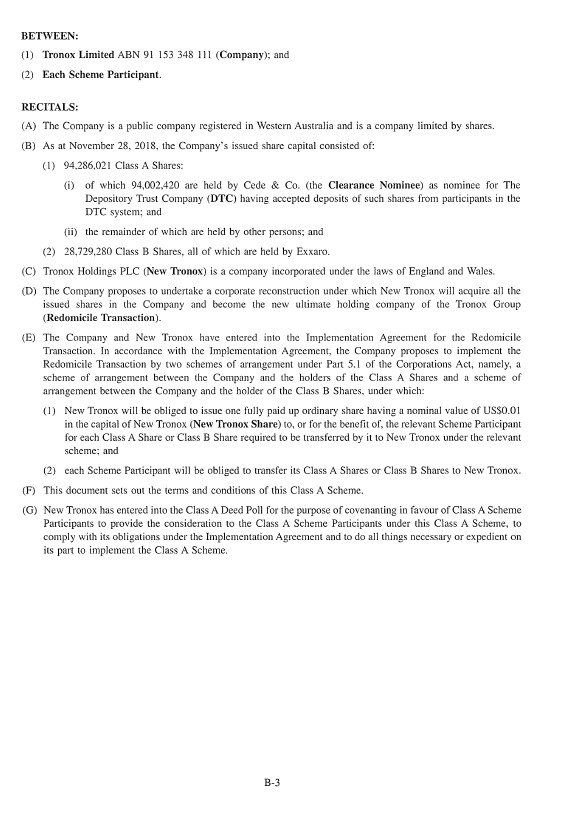
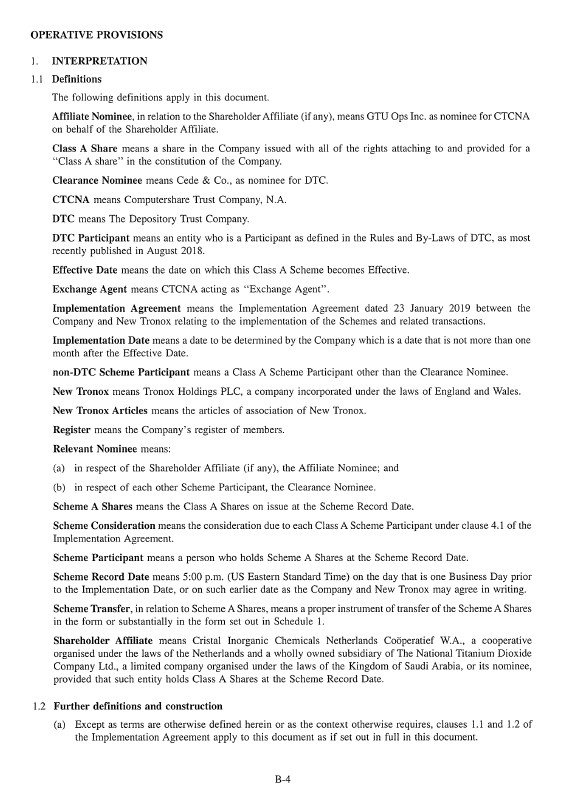
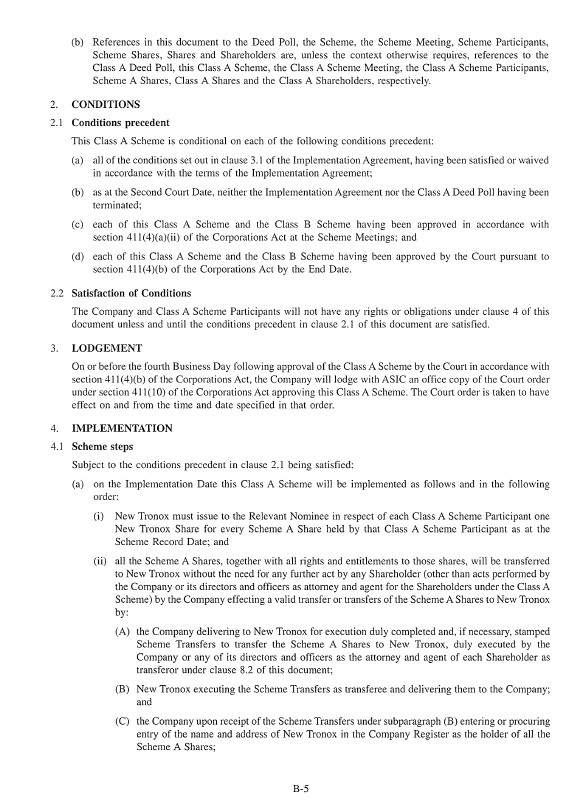
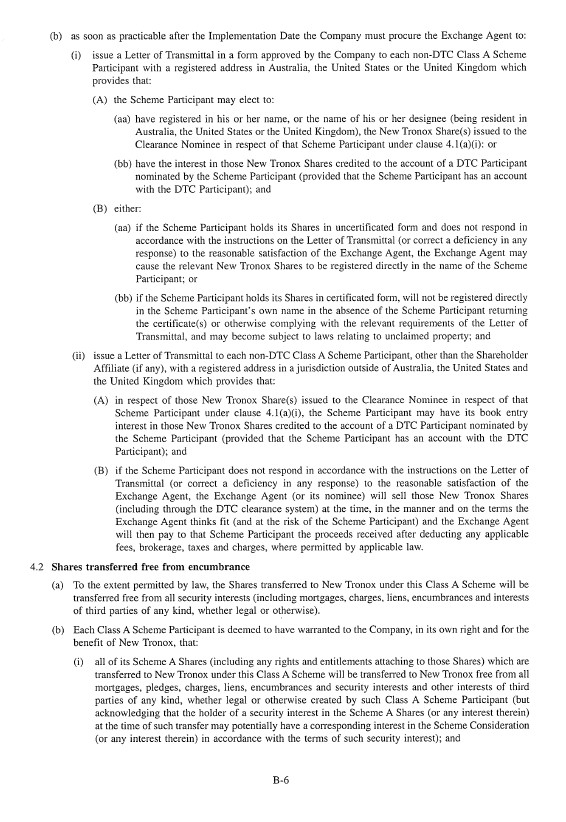
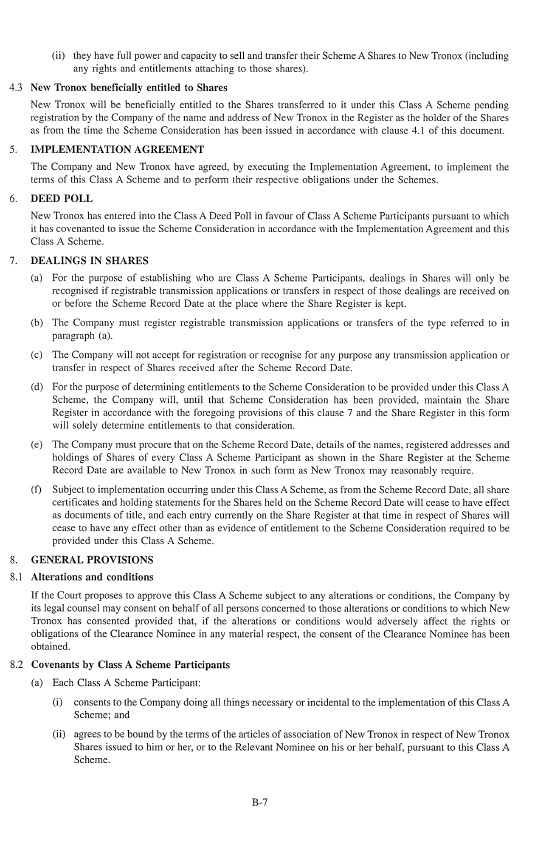
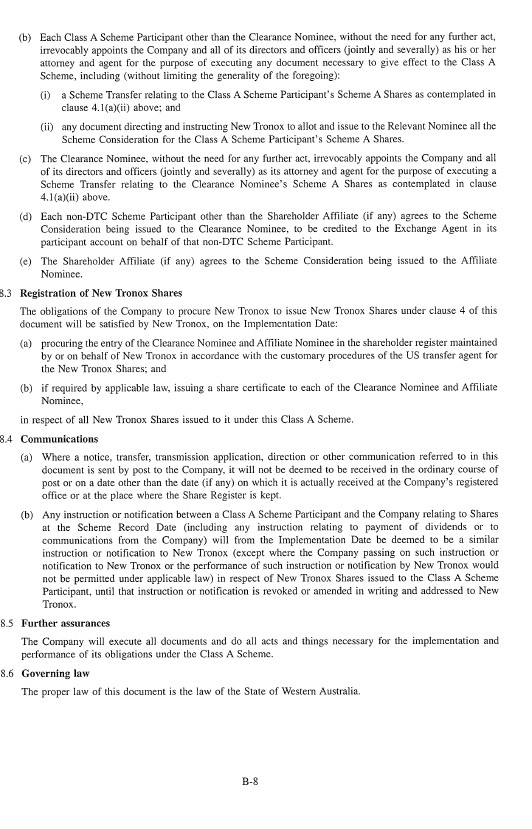
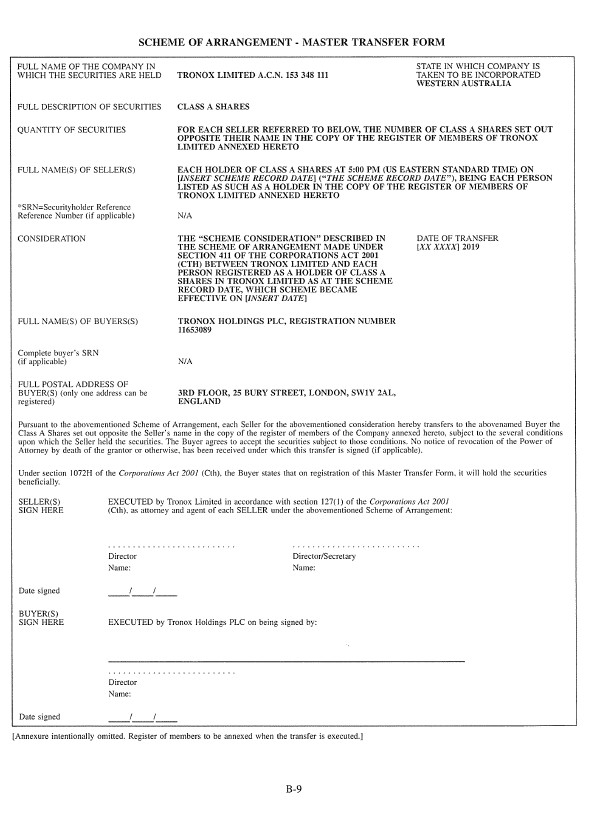
(a) the scheme of arrangement between the Plaintiff (Tronox) and the holders of Class A ordinary shares in Tronox, in the form annexed hereto and marked “A”, be and is hereby approved; and
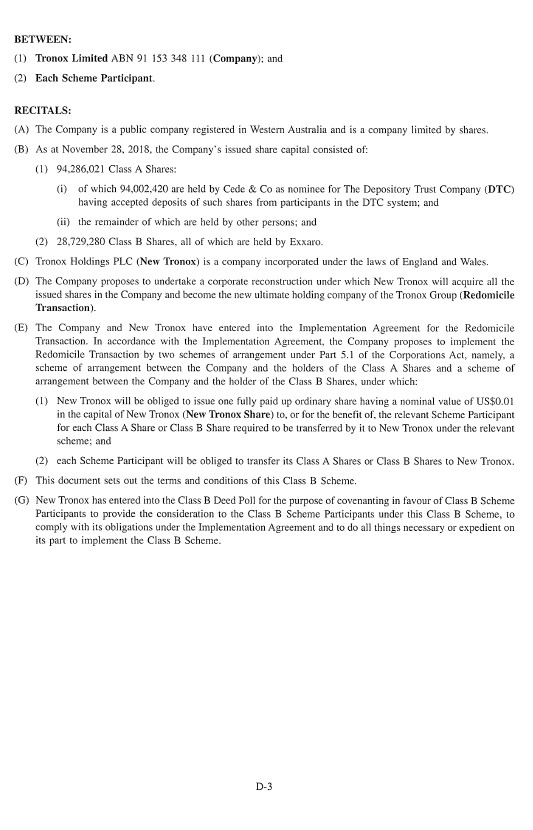
(b) the scheme of arrangement between Tronox and the holder of Class B shares in Tronox, in the form annexed hereto and marked “B”, be and is hereby approved.
2. Pursuant to subsection 411(12) of the Act, Tronox be exempted from compliance with section 411(11) of the Act.
3. These Orders be entered forthwith.
Note: Entry of orders is dealt with in Rule 39.32 of the Federal Court Rules 2011.
ANNEXURE A 
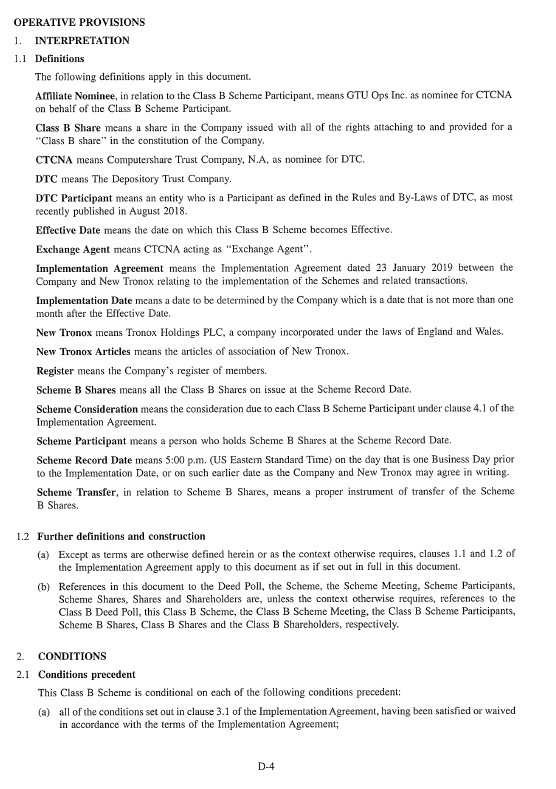
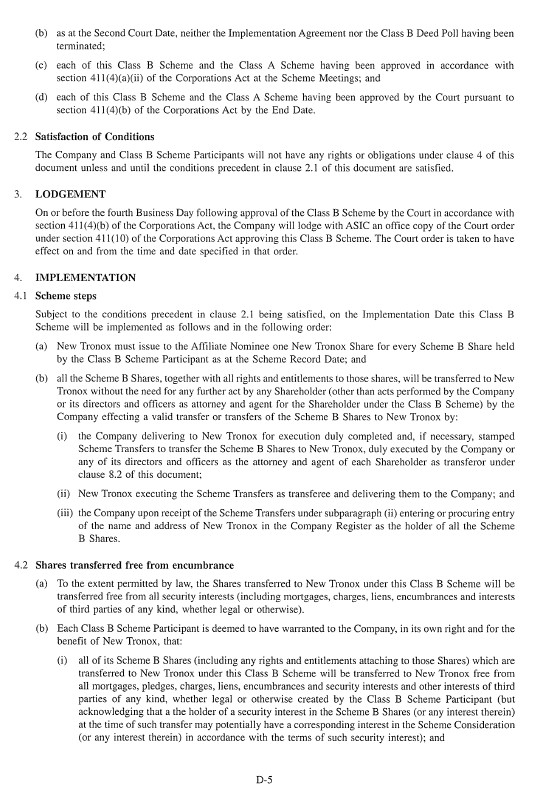
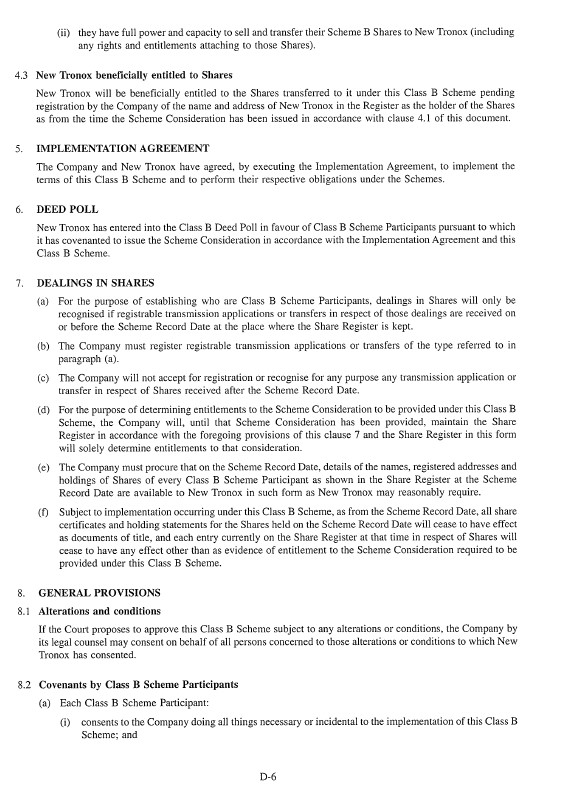
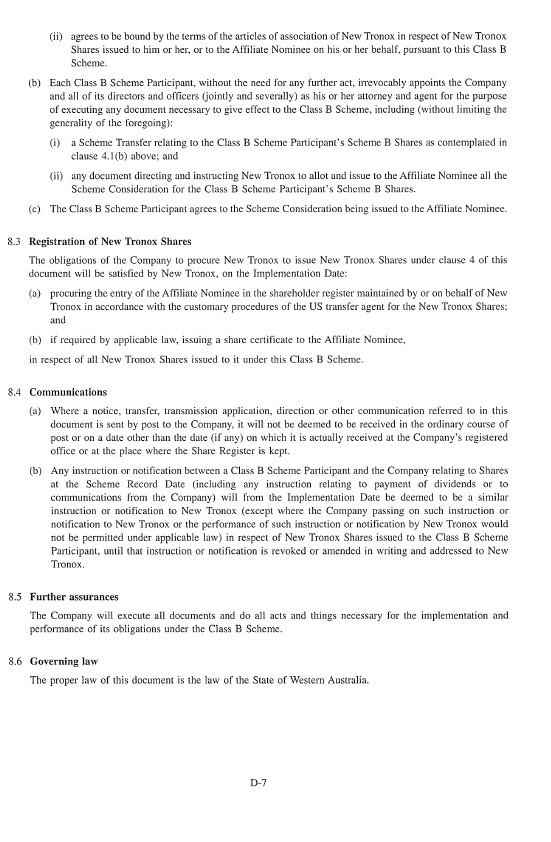
ANNEXURE B 
O’CALLAGHAN J:
INTRODUCTION
1 On 8 February, I made orders (the Convening Orders) on the application of Tronox Limited (Tronox) under s 411(1) of the Corporations Act 2001 (Cth) (the Corporations Act) for convening meetings of Tronox shareholders to consider proposed schemes of arrangement, called the Class A Scheme and the Class B Scheme (the Schemes), to effect a redomiciliation of Tronox from Australia to the United Kingdom. See Tronox Limited, in the matter of Tronox Limited [2019] FCA 312.
2 These reasons should be read together with those reasons (and terms used in those reasons can be taken to have the same meaning in these).
3 The meetings were duly convened on 8 March in Stamford, Connecticut, as provided for by the Convening Orders.
4 The Schemes were approved by an overwhelming majority of shareholders.
5 On 22 March I heard Tronox’s application for approval of the Schemes, pursuant to s 411(4)(b) of the Corporations Act.
6 I made the orders set out above on that day. I said that I would give my reasons for having done so later. These are those reasons.
7 Section 411(4) of the Corporations Act provides:
A compromise or arrangement is binding on the creditors, or on a class of creditors, or on the members, or on a class of members, as the case may be, of the body and on the body or, if the body is in the course of being wound up, on the liquidator and contributories of the body, if, and only if:
(a) at a meeting convened in accordance with an order of the Court under subsection (1) or (1A):
(i) in the case of a compromise or arrangement between a body and its creditors or a class of creditors – the compromise or arrangement is agreed to by a majority in number of the creditors, or of the creditors included in that class of creditors, present and voting, either in person or by proxy, being a majority whose debts or claims against the company amount in the aggregate to at least 75% of the total amount of the debts and claims of the creditors present and voting in person or by proxy, or of the creditors included in that class present and voting in person or by proxy, as the case may be; and
(ii) in the case of a compromise or arrangement between a body and its members or a class of members – a resolution in favour of the compromise or arrangement is:
(A) unless the Court orders otherwise – passed by a majority in number of the members, or members in that class, present and voting (either in person or by proxy); and
(B) if the body has a share capital – passed by 75% of the votes cast on the resolution; and
(b) it is approved by order of the Court.
8 At the hearing on 22 March, counsel for Tronox, Mr M I Borsky QC and Mr B K Holmes, made oral submissions in support of their detailed and very helpful written submissions. They relied on the following affidavits, each of which was read:
(a) Second Affidavit of John Francis Sartori dated 25 February 2019;
(b) Third Affidavit of John Francis Sartori dated 19 March 2019;
(c) Fourth Affidavit of Jeffrey Nathan Neuman dated 15 March 2019;
(d) Affidavit of Anthony Saverio Vecchio dated 8 March 2019;
(e) Affidavit of Edi Patricio Remache dated 7 March 2019;
(f) Affidavit of Dennis Michael Sneyers dated 11 March 2019;
(g) Affidavit of William Valentin dated 15 March 2019;
(h) Fourth Affidavit of John Sartori dated 22 March 2019;
(i) First Affidavit of Jeffrey Nathan Neuman dated 18 January 2019; and
(j) Second Affidavit of Jeffrey Nathan Neuman dated 29 January 2019.
9 The Class A Scheme was agreed to by 99.8% of votes cast and by 97.4% of shareholders present and voting (in person or by proxy). Exxaro voted all of its shares in favour of the Class B Scheme, and so the Class B Scheme was agreed to by 100% of the votes cast and shareholders present and voting.
10 The required statutory majorities set out in s 411(4)(a) of the Corporations Act were therefore satisfied.
ROLE OF THE COURT
11 In Re Alabama, New Orleans, Texas and Pacific Junction Railway Company [1891] 1 Ch 213 at 246, Fry LJ described the role of the court in applications of this type as follows:
... the Court is bound to ascertain that all the conditions required by the statute have been complied with; it is bound to be satisfied that the proposition was made in good faith; and, further, it must be satisfied that the proposal was at least so far fair and reasonable, as that an intelligent and honest man, who is a member of that class, and acting alone in respect of his interest as such a member, might approve of it. What other circumstances the Court may take into consideration I will not attempt to forecast.
(Citations omitted).
12 The court’s task is to ensure that all statutory and procedural requirements in relation to s 411 have been observed and to determine in the exercise of its discretion whether to approve the scheme. See Re Alabama, New Orleans, Texas and Pacific Junction Railway Company (1981) 1 Ch 213; Re NRMA Ltd (No 1) (2000) 33 ACSR 595; [2000] NSWSC 82 at [41]; Re Coles Group Ltd (No 2) (2007) 65 ACSR 494; [2007] VSC 523 at [8].
STATUTORY AND PROCEDURAL REQUIREMENTS
13 The principal statutory and procedural requirements are as follows:
(a) compliance with the orders convening the scheme meetings and with applicable rules of court;
(b) compliance with the disclosure obligations under s 412(1) of the Corporations Act;
(c) passing of the approval resolution by the majorities required by s 411(4)(a)(ii) of the Corporations Act; and
(d) satisfaction of the condition under s 411(17) of the Corporations Act.
14 In addition, before approving a scheme, the court will ordinarily require that all conditions precedent to the scheme (other than the court’s approval and the lodgement of the court’s approval order with the Australian Securities and Investment Commission (ASIC)) have been satisfied or waived.
Compliance with Convening Orders
15 A copy of the Convening Orders was lodged with ASIC on 8 February 2019, as required by r 3.5(b) of the Federal Court (Corporations) Rules 2000 (the Rules).
The DTC System
16 The Convening Orders were framed to accommodate the operation of the DTC System within the scheme approval process under Part 5.1 of the Corporations Act. See Tronox Limited, in the matter of Tronox Limited [2019] FCA 312 at [45]-[51] and [60]. As I explained in those reasons, given the position under the DTC System and in circumstances where one person owned 99.97% of all Class A Shares, it was desirable to make adjustments to the usual orders for a scheme of arrangement, particularly in terms of the exercise of voting rights. It was necessary to adjust the usual process for the dispatch of the notice of meeting and explanatory memorandum to accommodate the DTC System, although this did not require any additional orders to be made.
Dispatch of Information Memorandum to Registered Holders
17 The Convening Orders required that the Scheme Meetings be convened by the dispatch of the following documents to each registered holder of Tronox Shares (each a Scheme Shareholder):
(a) a document substantially in the form of the Information Memorandum at Annexure A to the Convening Orders (Information Memorandum), which included Notices of Meeting at Annexures J and K of the Information Memorandum;
(b) a document substantially in the form of the Proxy Card at Annexure B to the orders, personalised with the name and address of the relevant Scheme Shareholder; and
(c) a reply paid envelope for the return of the Proxy Card
(together, the Shareholder Pack).
18 The Convening Orders required that these documents be sent on or before 12 February 2019 by the following methods:
(a) in the case of Class A Shareholders, by prepaid post addressed to the relevant addresses recorded in the Tronox register; and
(b) in the case of the Class B Shareholder, to a person who is a director, company secretary, proxy, Corporate Representative or attorney under power of the Class B Shareholder, by pre-paid post or by courier, addressed to the address of the Class B Shareholder recorded in the Tronox Register.
19 The evidence establishes that a Shareholder Pack was sent to each Scheme Shareholder on or before 12 February 2019 in accordance with the requirements of the Convening Orders.
20 The evidence establishes compliance with orders 2 and 3 of the 8 February orders as follows:
(a) on 4 February 2019, Computershare Communication Services Inc (Computershare) – which maintains the Tronox share register – prepared an electronic list containing the names and addresses of the Tronox shareholders recorded as holding Class A Shares or Class B Shares as at 4 February 2019 (the Securities Data File);
(b) the Securities Data File showed that there were 389 holders of Class A Shares and one holder of Class B Shares;
(c) on 11 February 2019, 470 copies of the Information Memorandum were printed by Summit Financial Disclosures LLC (Summit) and delivered to Computershare;
(d) the version of the Information Memorandum printed by Summit and delivered to Computershare was:
(i) the same as the version attached to the Convening Orders as Annexure A; and
(ii) the version which had been registered by ASIC on 8 February 2019;
(e) on 11 February 2019, a personalised Proxy Card was printed for each Class A Shareholder whose name appeared in the Tronox Register as at 4 February 2019 as recorded in the Securities Data File;
(f) on 11 February 2019, a personalised Proxy Card was printed for the Class B Shareholder;
(g) the personalised Proxy Cards printed for each Class A Shareholder and the Class B Shareholder were the same version of the Proxy Card attached to the Convening Orders as Annexure B;
(h) on 11 February 2019, 390 envelopes, each containing a Shareholder Pack, were sent by prepaid post to each registered holder of Class A Shares and Class B Shares in Tronox.
Dispatch of Information Memorandum to DTC Participants
21 Tronox also provided sufficient copies of the Information Memorandum to DTC Participants for distribution to beneficial holders of Tronox shares. This is a requirement of US law, but was not a requirement of the Convening Orders. I summarised the relevant requirements under US law in Tronox Limited, in the matter of Tronox Limited [2019] FCA 312. It suffices to say here that the evidence filed by Tronox establishes that those requirements have been met.
Advertisement of second court hearing
22 On 13 March 2019, a notice advertising the hearing listed for 22 March 2019 was published in The Australian newspaper, in accordance with r 3.4 of the Rules.
Compliance with disclosure obligations under s 412(1)
23 As I earlier observed, the Information Memorandum is comprehensive and clearly satisfies the requirements of s 412(1) of the Corporations Act. See Tronox Limited, in the matter of Tronox Limited [2019] FCA 312 at [117].
24 Further, as required by s 412(6) of the Corporations Act, the explanatory statement contained in the Information Memorandum was registered by ASIC on 8 February 2019.
25 Registration by ASIC is evidence of compliance with the disclosure obligations imposed by s 412 of the Corporations Act. This is because s 412(8) of the Corporations Act provides that ASIC must not register the explanatory statement unless the statement appears to comply with the Corporations Act and ASIC is of the opinion that the statement does not contain any matter that is false in a material particular or materially misleading in the form or context in which it appears.
Passing of the approval resolutions
26 In accordance with order 1 of the Convening Orders, the Scheme Meetings were held on 8 March 2019 at the Stamford Marriott Hotel, 243 Tresser Boulevard, Stamford, Connecticut, with the Class A Meeting commencing at 10.00am US Eastern Standard Time, and the Class B Meeting commencing immediately after the conclusion of the Class A Meeting.
Class A Meeting
27 Whilst the Australian position is generally that the registered holder is the person entitled to vote at the scheme meeting, under the DTC system neither Cede nor DTC exercises any voting rights in relation to these shares.
28 The evidence demonstrates that all requirements in the Convening Orders for the Class A Meeting were satisfied, as follows:
(a) In accordance with order 10 of the Convening Orders, the Class A Meeting was chaired by Mr Jeffry Quinn.
(b) In accordance with order 8 of the Convening Orders, voting on the resolution to approve the Class A Scheme was conducted by way of poll.
(c) Mr Dennis Sneyers of Computershare was appointed to act as “Inspector of Elections” in relation to the Class A Meeting. The function of Mr Sneyers as the Inspector of Elections was to act as returning officer in relation to the poll and tally the votes cast on the Class A Scheme Resolution. Mr Sneyers prepared a Certificate of the Inspector of Elections in relation to the Class A Scheme Meeting, setting out the results of the poll. The Certificate records that:
(i) of the total votes attaching to eligible Class A Shares cast on the Class A Scheme Resolution, 79,696,808 votes (or approximately 99.8%) were cast in favour of the Class A Scheme Resolution and 129,563 votes (or approximately 0.16%) were cast against the Class A Scheme Resolution; and
(ii) of all the eligible Class A Shareholders (including Cede), 38 eligible Class A Shareholders or approximately 97.4% were in favour of the Class A Scheme Resolution.
29 In determining whether a Class A Shareholder was in favour of the Class A Scheme Resolution for the purposes of the “headcount test” in s 411(4)(a)(ii)(A) of the Corporations Act, the Inspector of Elections adopted the following approach laid down by Barrett J in Re Spark Infrastructure Holdings No 1 Limited and Others (2010) 79 NSWLR 756 at 760-761, [24]-[27]:
… Positive and negative votes cast by a particular member are relevant to the operation of s 411(4)(a)(ii)(B) [which requires that the resolution be passed by 75% of the votes cast]; and the positive votes the member casts will contribute to the passing of the resolution. Under s 411(4)(a)(ii)(A), however, it is necessary to say of every member voting that the member either is or is not one of those by whom the resolution was “passed”; and that judgment is to be made according to how the member’s votes were cast. The resolution cannot be said to have been partly “passed” and partly not “passed” by a particular member (nor, where the resolution was passed, can a particular member be one who both “passed” it and did not “pass” it).
Where all of a member’s votes were cast against it, the resolution was obviously not “passed by” that member. Likewise, in my view, the resolution was not “passed by” a member some of whose votes were cast against it, even though others were cast in favour.
The concept of “passing”, when used in a context where every person who votes must be classified as one who “passes” or one who does not “pass”, seems to me to imply unequivocal support. A person “passes” the resolution (or joins in its “passing”) only if the person accepts unreservedly the measure it embodies ...
…Several distinct cases…may be noted:
1. If a member exercises all or only some of the member’s votes and, in so doing, casts some in favour and some against … [t]he member will be (a) taken into account when determining the total of the members who voted; (b) not included among those by whom the resolution was “passed”; and (c) therefore included among those by whom the resolution was not “passed”.
…
30 The “headcount test” in s 411(4)(a)(ii)(A) of the Corporations Act was thus satisfied.
31 The Convening Orders included additional orders and directions as to voting at the Class A Meeting. The evidence demonstrates that that each of those requirements was satisfied, as follows:
(a) Order 5 (subject to the Convening Orders, the procedures for the Scheme Meetings must be in accordance with Part 2G.2 of the Act and Tronox’s Constitution):
(i) 21 days’ notice of the meetings was given;
(ii) the meetings were held outside of Australia and in a location where holders of a substantial numbers of Tronox shares have registered addresses;
(iii) if a member had appointed a proxy or attorney, that member was taken to be present at the meeting;
(iv) upon the taking of the poll as required by order 8 of the Convening Orders, every member had one vote for every share held; and
(v) the contents of the Notices of Meeting complied with the requirements of s 249L of the Corporations Act.
(b) Order 6(a) (defining the Class A Meeting Record Time):
(i) as at the Class A Scheme Meeting Record Time, there were 389 persons recorded in the Register of Members as holders of Class A shares.
(c) Order 6(b) (defining who is a Relevant DTC Participant for the purposes of the Class A Meeting):
(i) as at the Class A Scheme Meeting Record Time, there were 129 DTC Participants to whose accounts were credited in the DTC system 96,777,373 Tronox Class A shares in total.
(d) Order 6(c) (Cede may transfer its voting rights to Relevant DTC Participants pursuant to the Omnibus Proxy):
(i) an Omnibus Proxy was issued by Cede.
(e) Orders 6(e) (f), (g) and (h) (DTC Participants or beneficial owners may attend and vote pursuant to Omnibus Proxy, any votes counted as if cast by Cede, calculation of quorum):
(i) 82 Relevant DTC Participants were present pursuant to the Omnibus Proxy, who together had 95,033,832 Class A shares credited in the DTC system to their accounts;
(ii) 38 holders of Class A shares were present in person or by proxy, who together held 56,289 Class A shares (not counting Cede); and
(iii) the above two groups together represented approximately 98.04% of the Class A shares on issue as at the Class A Scheme Meeting Record Time.
Class B Meeting
32 In accordance with order 10 of the Convening Orders, the Class B Meeting was chaired by Mr Jeffry Quinn.
33 In accordance with order 8 of the Convening Orders, voting on the resolution to approve the Class A Scheme was conducted by way of poll.
34 The evidence in relation to the Class B Meeting is as follows:
(a) the Chairman opened the Class B Meeting, and a quorum being present, the Class B Scheme Resolution was put to the vote; and
(b) having been duly appointed by Exxaro as its proxy for the Class B Meeting, the Class B Scheme Resolution was then decided and passed by the Chairman (acting as proxy for Exxaro) signing a record of the Class B Scheme Resolution, as contemplated by order 7 of the Convening Orders. The Class B Scheme Meeting was then closed.
Conclusion on passing of the Scheme Resolutions
35 It follows that, in accordance with s 411(4)(a)(ii) of the Corporations Act, the resolutions were passed by a majority in number of the class of members present and voting (either in person or by proxy) at each Scheme Meeting, and by 75% of the votes cast on each resolution.
Section 411(17)
36 Section 411(17) provides:
The Court must not approve a compromise or arrangement under this section unless:
(a) it is satisfied that the compromise or arrangement has not been proposed for the purpose of enabling any person to avoid the operation of any of the provisions of Chapter 6; or
(b) there is produced to the Court a statement in writing by ASIC stating that ASIC has no objection to the compromise or arrangement;
but the Court need not approve a compromise or arrangement merely because a statement by ASIC stating that ASIC has no objection to the compromise or arrangement has been produced to the Court as mentioned in paragraph (b).
37 Where a no objection statement is received from ASIC, as it has been in this case, there is no need for the court further to consider s 411(17)(a), particularly where no issue has been raised concerning Chapter 6 of the Corporations Act (as is the case here). See, by way of example, Re Tatts Group Limited (No 2) [2017] VSC 770. The prohibition in s 411(17) on the court approving a scheme of arrangement is thus removed.
Conditions Precedent
38 Clause 2.1 of both Schemes of Arrangement lists the following conditions precedent:
(a) all of the conditions set out in clause 3.1 of the Implementation Agreement having been satisfied or waived in accordance with the terms of the Implementation Agreement;
(b) as at the Second Court Date, neither the Implementation Agreement nor the relevant Deed Poll having been terminated;
(c) the Class A Scheme and the Class B Scheme having been approved at the Scheme Meetings; and
(d) the Class A Scheme and the Class B Scheme having been approved by the court by the End Date (which is 23 June 2019).
39 Clause 3.4 of the Implementation Agreement requires both Tronox and New Tronox to provide to the court on the Second Court Date a certificate confirming whether or not all Conditions Precedent have been satisfied or waived.
40 The evidence on this application includes a certificate signed by each of Tronox and New Tronox under clause 3.4 of the Implementation Agreement dated 14 March 2019 confirming that each of the conditions in clause 3.1 of the Implementation Agreement (other than the condition in clause 3.1(b) relating to the court’s approval for the Schemes) have been satisfied or waived.
DISCRETION
41 The following factors are commonly regarded (see Re Wesfarmers Ltd; Ex Parte Wesfarmers Ltd [No 2] [2018] WASC 357 at [14]) as informing the court’s discretion as to whether or not to approve a scheme:
(a) whether the shareholders voted in good faith and not for an improper purpose;
(b) whether the proposal is fair and reasonable so that an intelligent and honest person who was a member of the relevant class, properly informed and acting alone in respect of his or her interest as a member, might approve it;
(c) whether the scheme proponent has brought to the attention of the court all matters that could be considered relevant to the exercise of the court’s discretion;
(d) whether there has been full and fair disclosure of all information material to the decision whether to vote for or against the scheme;
(e) whether minority shareholders would be oppressed by the scheme; and
(f) whether the scheme offends public policy.
42 Tronox submitted, and I agree, that the court should exercise its discretion to approve the scheme of arrangement for the following reasons:
(a) the overwhelming support of the shareholders as reflected in the voting results of the Scheme Meetings, in particular:
(i) for the Class A Meeting, the Class A Scheme was agreed to by 99.8% of votes cast and by 97.4% of shareholders present and voting (in person or by proxy);
(ii) for the Class B Meeting, 100% of members voting and 100% of votes cast were in support of the resolution to agree to the Class B Scheme;
(b) the opinion of the independent expert that the Class A Scheme is in the best interests of Class A Shareholders;
(c) the recommendation from all Directors that shareholders vote in favour of the Schemes;
(d) the absence of any opposition to the Schemes by ASIC or any shareholder, and the anticipated position of ASIC in relation to s 411(17);
(e) the full disclosure in the Information Memorandum of the potential benefits and disadvantages of the Schemes;
(f) there is nothing to suggest that the Schemes were proposed other than in good faith;
(g) there is nothing to suggest that the shareholders voted other than in good faith;
(h) there is nothing to suggest that any shareholder was oppressed; and
(i) the Schemes contains measures to protect shareholders against performance risk.
43 I am accordingly satisfied that it is appropriate that the court exercise its jurisdiction to approve the schemes of arrangement.
44 ASIC issued a “No objection under section 411(17)(b) of the Corporations Act 2001” letter prior to the hearing on 22 March 2019 stating that it had no objection to the Scheme.
45 Further, no person appeared at the hearing listed for 22 March 2019 to oppose the Scheme or for any other reason.
US SECURITES ACT EXEMPTION
46 Tronox informed the court that if approval of the Schemes was granted (as it was), Tronox and New Tronox intended to rely upon the court’s approval for the purposes of qualifying for the exemption under s 3(a)(10) of the Securities Act of 1933 (USA) from US registration/prospectus requirements in connection with the issue of New Tronox Shares to US residents in connection with the implementation of the Schemes.
47 Section 3(a)(10) of the Securities Act of 1933 (USA) provides:
Except with respect to a security exchanged in a case under title 11 [of the United States Code], any security which is issued in exchange for one or more bona fide outstanding securities, claims or property interests, or partly in such exchange and partly for cash, where the terms and conditions of such issuance and exchange are approved, after a hearing upon the fairness of such terms and conditions at which all persons to whom it is proposed to issue securities in such exchange shall have the right to appear, by any court or by any official or agency of the United States, or by any State or Territorial banking or insurance commission or other governmental authority expressly authorized by law to grant such approval.
48 As Damian and Rich explain in Schemes, Takeovers and Himalayan Peaks (3rd ed, 2013) at 650 and 654:
In the US, mergers in which the consideration to be paid is shares or other securities and which must be approved by a vote of the target’s public shareholders are not exempt from the US registration/prospectus requirements. The SEC and the US Courts ... treat the merger vote in the same way as a public offering for the purposes of the US registration/prospectus requirements. However, in the case of an Australian scheme of arrangement in which the bidder is proposing to issue securities as consideration, including to target members in, or who are citizens or residents of, the US the bidder may be able to avoid the need to comply with the US registrations/prospectus requirements if the scheme of arrangement satisfies the requirements of the exemption from registration afforded by section 3(a)(10) of the US Securities Act of 1933.
…
If the conditions of the section 3(a)(10) exemption are satisfied, there is no need to file a registration statement with the US Securities and Exchange Commission (the SEC) in respect of the offer and sale of the securities to be issued to target members in, or who are citizens or residents of, the United States pursuant to the scheme of arrangement.
49 One of the conditions of the exemption is that the court must be advised, before any hearing at which a scheme is approved, that the issuer will rely on the s 3(a)(10) exemption based on the court’s approval in the event that the scheme is in fact approved.
50 Counsel for Tronox and New Tronox told me at the 22 March hearing that they intend to rely on the exemption based on an order of the court. Their intention was also made clear at the first hearing and in the Information Memorandum.
51 In that regard I also note the following:
(a) an independent expert report concluded that the proposal is in the best interests of Class A shareholders;
(b) the court, as it is required to do, held a hearing to consider the fairness and reasonableness of the proposed Schemes;
(c) that hearing was open to the public;
(d) any person to whom New Tronox Shares are to be issued had standing to appear;
(e) notice of the date of the hearing was included in the Information Memorandum sent to all shareholders of Tronox prior to the proposal being considered by the meetings of those shareholders, and was advertised in a daily newspaper circulating throughout the country; and
(f) no shareholder gave notice of any intention to appear at the hearing to oppose the approval of the Schemes.
EXEMPTION FROM SECTION 411(11)
52 Section 411(11) of the Corporations Act requires, subject to s 411(12), that a copy of the court’s order approving a scheme of arrangement be annexed to every copy of the company’s constitution issued after the order is made.
53 Section 411(12) allows the court to exempt a body from compliance with this provision or to determine the period during which it shall comply.
54 In Re Equinox Resources Ltd (2004) 49 ACSR 692; [2004] WASC 143, E M Heenan J (at [22]) explained that the purpose of section 411(11) was ... “to ensure that any modification of the rights of shareholders of the company which is the subject of the scheme or any other provision in the scheme which may affect the interests of persons dealing with the company, such as prospective creditors or purchasers of shares, will be sure to have the opportunity of seeing what the exact rights of shareholders in the company or of its creditors are, as modified, if at all, by the scheme which has been approved”. See also Re Hostworks Group Ltd (No 2) [2008] FCA 248 at [36] and Re AXA Asia Pacific Holdings Ltd (No 2) (2011) 82 ACSR 501; [2011] VSC 102 at [36].
55 Tronox submitted, and I agree, that exemption from compliance with s 411(11) is appropriate given that the Schemes will not alter the constitution of Tronox or the rights of shareholders, creditors or other persons dealing with the company because then current shareholders had been fully informed of the Schemes and were to be informed of the approvals.
56 I agree that no ongoing purpose would have been served by requiring that the orders approving the Schemes be annexed to Tronox’s constitution.
CONCLUSION
57 For the foregoing reasons, which are in substance the reasons advanced by counsel for Tronox, I made the orders set out above.
I certify that the preceding fifty-seven (57) numbered paragraphs are a true copy of the Reasons for Judgment herein of the Honourable Justice O'Callaghan. |
Associate:
Dated: 21 May 2019


