FEDERAL COURT OF AUSTRALIA
Moana v Minister for Immigration and Border Protection [2019] FCA 659
ORDERS
Applicant | ||
AND: | MINISTER FOR IMMIGRATION AND BORDER PROTECTION First Respondent ADMINISTRATIVE APPEALS TRIBUNAL Second Respondent | |
DATE OF ORDER: | 14 May 2019 |
THE COURT ORDERS THAT:
1. The Minister, through departmental officers, undertake proper and full enquiries with the government of New Zealand and its agencies, whether Police or otherwise, so as to seek to locate the current whereabouts of the applicant and to contact him in order to inform him of the continuation of this proceeding.
2. Within 28 days an officer of the Department file and serve an affidavit identifying the steps taken pursuant to Order 1.
Note: Entry of orders is dealt with in Rule 39.32 of the Federal Court Rules 2011.
ALLSOP CJ:
1 This is an application for extension of time in which to file an application for leave to appeal from orders made by a judge of the Federal Circuit Court of Australia on 7 September 2017 dismissing an application for judicial review of a decision of the Administrative Appeals Tribunal (the Tribunal) dated 17 November 2016, which found that it had no jurisdiction to review a decision of a delegate of the Minister to cancel a Class TY subclass 444 Special Category visa.
2 The matter was in the docket of a judge of this Court. It was placed under my control after the Court learned that the applicant had been involuntarily removed from Australia after he had engaged the jurisdiction of the Court and before the matter had come on for hearing.
Procedural history
3 The applicant is a citizen of New Zealand. He has at all times been self-represented. The applicant arrived in Australia in 2001. On 26 May 2005, at the age of 17, the applicant was granted a Class TY subclass 444 Special Category visa which permits citizens of New Zealand to reside in Australia indefinitely.
4 On 30 May 2016, a delegate of the first respondent exercised discretion to cancel the applicant’s visa under s 116(1)(e)(i) of the Migration Act 1958 (Cth) (the Act) on the basis of a number of increasingly serious convictions between 2012 and 2015. It should be noted that in the letter to the applicant informing him of the cancellation, the first respondent stated that the visa was cancelled on 7 June 2016, contrary to the Record of Decision attached to the letter, which has been relied upon.
5 At some point between May and October 2016, the applicant was apparently detained in prison for other offences and upon his release taken directly to immigration detention.
The Tribunal decision
6 On 24 October 2016, the applicant sent a form to the Migration and Refugee Division of the Tribunal entitled “Request for Revocation of a Mandatory Visa Cancellation Under Section 501(3A)”. On 27 October 2016, the first respondent sent a letter to the applicant confirming receipt of the form, noting that it was likely out of the prescribed period for appeal and that it had been forwarded to the General Division. On 17 November 2016, the Tribunal dismissed the application, providing oral reasons. The applicant requested written reasons on 6 July 2018 which were provided in published form on 9 August 2018.
7 In its reasons the Tribunal noted that the revocation had been under s 116 not s 501(3A). It stated the following:
[12] A decision under s 116(1)(e) is one of a group of decisions known as “Part 5-reviewable decisions”. Decisions coming within that description are set out in s 338 of the Migration Act. The decision made by the delegate in this case under s 116(1)(e) comes within the particular description set out in s 338(3) for two reasons. One is that Mr Moana was in Australia, and so in the migration zone, when it was made. The second is that it was not a decision of the sort set out in ss 338(3)(a) to (d). Therefore, it was not a decision that was excluded from the scope of s 338(3).
[13] As it was a Part 5-reviewable decision, Mr Moana was entitled to make an application for review of it if he complied with s 347. Compliance required that he make the application himself as he was the non-citizen, to whom the decision is related. It also required that he make the application in the approved form, pay any fee that was prescribed and give it to the Tribunal within the prescribed period after being notified of the decision. Once an application has been lodged and the Minister has not issued a conclusive certificate, the Tribunal is obliged to review a Part 5-reviewable decision.
(Footnotes omitted.)
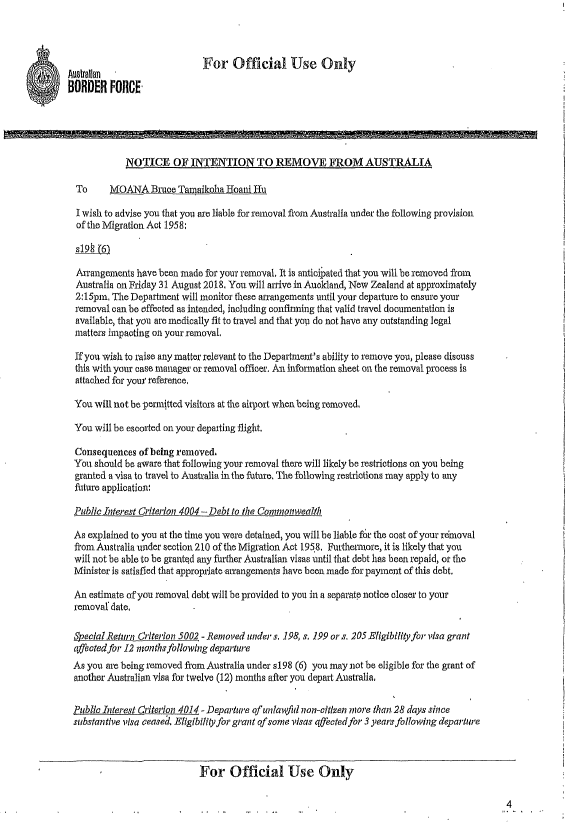
8 The Tribunal found that the applicant filed the incorrect form, being a form for a “Request for Revocation of a Mandatory Visa Cancellation under Section 501(3A)”, which, as the name suggests, was for use in entirely different circumstances. This was not accompanied by the prescribed fee.
9 As to the prescribed period within which an application may be made, the Tribunal found that
[14]…the period starts when the person receives notice of the decision and ends at the end of seven working days after the day on which the person received the notice.
10 On 11 May 2016, prior to the cancellation of the applicant’s visa, a notice of the first respondent’s intention to consider cancellation of the visa and an invitation to respond was posted to an address. This address, it was found by the Tribunal, was “obtained from the Western Australian Police as Mr Moana’s then current address and the address at which he was required to reside according to his bail conditions”: [6]. It is unclear from the reasons as to when the applicant was subject to those bail conditions. A notification of cancellation and reasons were sent to this same address on 7 June 2016. The applicant did not respond to either notice, save by sending the Revocation form to the address specified in the cancellation letter.
11 The applicant argued before the Tribunal that the address on file was his parents’ home address and that he hadn’t received either notice because he was residing elsewhere with his children and such notices were not brought to his attention. In dealing with this argument the Tribunal stated that:
[19] The way in which the Minister’s delegate was required to notify Mr Moana of the decision is the subject of s 127 of the Migration Act. When a decision is made to cancel a visa, the Minister is required to notify the visa holder in the “prescribed way”. The “prescribed way” is to notify the visa holder of the decision in writing.
[20] Among other matters, r 2.55 applies to the way in which a document relating to the cancellation of visa is given to that (former) visa holder. Regulation 2.55(3) provides for various ways in which the document may be given to the former visa holder. One way is set out in r 2.55(3)(c), which provides:
“by dating it, and then dispatching it:
(i) within 3 working days (in the place of dispatch) of the date of the document; and
(ii) by prepaid post or by other prepaid means;
to the person’s last residential address, business address or post box address known to the Minister;…”
[21] The qualification “known to the Minister” applies to each of the residential address, the business address and the post box address…
(Footnotes omitted.)
12 The Tribunal found that the applicant acknowledged he had advised the first respondent that he would be residing at the address to which the notices were sent and therefore the applicant was taken to have received the notice seven days after it was posted to this address. It was found that the application was filed some four months out of the prescribed period and that the Tribunal had no power to extend that period.
13 Given the non-compliance of the application with s 347 of the Act, the Tribunal found that it had not received an application with respect to a decision under s 116(1)(e) and therefore had no jurisdiction or power on which to review the decision of the delegate.
14 The Tribunal recommended at oral hearing that the applicant approach the first respondent in respect of his concern that he had not received notice of cancellation of his visa.
The Federal Circuit Court decision
15 On 19 December 2016, the applicant applied to the Federal Circuit Court for judicial review of the Tribunal’s (17 November 2016) decision. In the application and at oral hearing the applicant relied on the argument that he was not aware that he resided in Australia under a visa, that the notices were sent to the wrong address and that he did not receive notification of his visa cancellation until he was released from a six month period of imprisonment and taken directly to immigration detention in October 2016. The inconsistencies in the timeline as to when the applicant was in prison or subject to bail conditions was not addressed directly or resolved.
16 In the oral hearing on 4 September 2017, it was put by the first respondent that the Federal Circuit Court did not have the power to review a decision of the General Division of the Tribunal, presumably on the basis that only the Federal Court had jurisdiction to review decision of the Tribunal. Additionally, the first respondent informed the Federal Circuit Court that:
Now Mr Moana subsequently lodged an application for review of that decision in the General Division of the Administrative Appeals Tribunal…
at which the deputy president correctly, we would submit, determined that review of a decision made under section 116 was not within the jurisdiction of the General Division of the AAT and the applicant really needed to consider where an application for review should be lodged, and dismissed the application accordingly.
17 This submission is not consistent with the findings of the Tribunal.
18 At hearing of the application for an order to show cause, the Federal Circuit Court made an interlocutory order dismissing the application by consent pursuant to r 44.12(1)(a) of the Federal Circuit Court Rules 2001 (Cth) on 7 September 2017, ordering costs in favour of the first respondent. No reasons were provided by the Federal Circuit Court.
The application to this Court
19 On 27 July 2018, the applicant filed an application for extension of time and leave to appeal against the orders of the Federal Circuit Court. The application contained the following grounds of appeal:
(1) The respondent’s decision was unreasonable.
(2) The respondent’s failed to make relevant considerations into account.
(3) The respondent took into account irrelevant considerations.
(4) The respondent’s decision involved an error of law.
(5) The respondent’s in making its decision did not comply with the rules of natural justice and the applicant was denied procedural fairness.
(6) There was insufficient evidence or no evidence to support various findings made by respondents.
20 In an affidavit sworn on 27 July 2018 the applicant said the following in support of his application for an extension of time:
The Facts
1. The applicant is without liberty and was unrepresented at all relevant times.
2. The applicant is restricted to limited resources.
3. The duty of care has failed the applicant in accordance with s256 of the Migration Act 1958 (Cth) preparation of case.
4. The applicant was in custody with corrections earlier this year for 3 months.
5. The applicant was denied procedural fairness when the matter was heard in Federal Circuit Court by the following;
(i) being unrepresented at all relevant times
(ii) no path of reasoning was set forth in order for the applicant to prepare case
(iii) no court order was made under r4.12 Federal Court Rules 2011 (Cth) referring the applicant for legal assistance on a pro bono basis
(iv) the minister’s representative perverted the course of justice by manipulating the applicant outside the Court room
(v) having no legal experience in court proceedings at the time
(vi) the matter was dismissed without having a reason of judgment
The applicant suffers from living in a state of uncertainty in detention and no one to help with the ongoing case.
The applicant apologises to Honourable Court for any misunderstanding and inconvenience that may cause in relation to this matter.
21 On 22 August 2018, Registrar McCormick of this Court made orders with respect to the filing and serving of submissions and the Court Book.
Removal of the applicant from Australia
22 After I learned what had happened, I called a case management hearing on 19 November 2018. I made a number of orders on the day. First, I called for affidavits from those who made decisions about Mr Moana’s removal as to the basis for it, including any current policy. Secondly, I made an order from the Department to seek to contact Mr Moana in New Zealand. The orders were as follows:
1. On or before 3 December 2018, the Minister, through departmental officers, file and serve affidavits by all persons involved in making and executing the decision to remove Mr Moana to New Zealand which explain the decision and the steps taken to execute it. These affidavits must include, but are not limited to:
(a) identification of and reference to any policy currently in place in relation to the involuntary removal of applicants/appellants when the jurisdiction of the Federal Court of Australia has been invoked; and
(b) any communications whatsoever between departmental officers and Mr Moana including, but not limited to, the relevant case manager and removal officer referred to in the letter to Mr Moana dated 24 August 2018.
2. The Minister, through departmental officers, undertake an inquiry with the government of New Zealand and its agencies as to the current whereabouts of Mr Moana.
3. By 10 December 2018, the Minister, through departmental officers, file and serve an affidavit or affidavits concerning the result of the inquiries referred to in Order 2 above.
23 From the affidavits filed the following can be gleaned. On 24 August 2018 the applicant was held in Maribyrnong Immigration Detention Centre. Sometime during the day on Friday 24 August Mr Edwin San Jose, then “Status Resolution officer” at the Detention Centre, met with the applicant and gave him a notice entitled “Notice of Intention to Remove from Australia”. A copy is attached as Annexure A. The notice was read to him and when asked whether he understood, he did not respond. He refused to provide overseas contact details. He refused to sign an acknowledgement of receipt. He refused to comment.
24 Later that day another “Status Resolution Officer” at the Detention Centre, Ms Rosina Lacorcia met with the applicant and handed him a letter. The letter was read to him. A copy of the letter is attached as Annexure B. It is to be noted immediately that the letter directed the applicant to an injunction by the Federal Circuit Court, not this Court.
25 The affidavit of Mr San Jose stated that the applicant had access to a computer and telephone at the Centre on 24 August. There was no evidence that he had internet access to enable him to e-file in the Court, or that he had access to a fax machine to send a document to the Court.
26 On 28 August 2018, an email was sent by a lawyer of the Australia Government Solicitor to “VIC –Migration” purporting to inform the Court of the applicant’s impending removal. It was copied to an email address apparently for the applicant. The email stated:
…
We write to inform the court that we are instructed that the applicant will be involuntarily removed from Australia to New Zealand on 31 August 2018. We are instructed that the applicant was advised about his removal in writing on 24 August 2018. We are further instructed that the applicant was advised in writing that if he wished the Court to consider any application for an interlocutory injunction to prevent his removal from Australia, he needed to contact the Court and ask for his matter to be listed urgently.
We are instructed to accept service of any urgent applicant filed by the applicant and would be grateful if the Court could advise us in the event that such an application is made.
27 No relevant Court officer, judicial or non-judicial, became aware of the email.
28 No application was made to the Court and the removal was effected on 31 August 2018 under s 198(6) of the Act. It was not until 17 October 2018 after the Court had commenced case management in preparation for hearing that the Court became aware of the removal. Since removal, the Court has not received any correspondence from the applicant with respect to this case.
29 On 6 September 2018, after the removal of the applicant from Australia, the solicitors for the first respondent sent a letter to the applicant with a copy of the orders made on 22 August 2018 and serving the tender bundle. The solicitors stated in this letter that “[i]f we do not hear from you, we may be instructed to ask the Court to list this matter for a mention and seek to have your matter dismissed with costs on that day.”
30 Pursuant to the orders made, on 3 December 2018, an affidavit was filed by Mr Cody Smith who is the Assistant Secretary of the Migration and Citizenship Litigation Branch of the Department of Home Affairs.
31 Mr Cody’s affidavit referred to the obligations of an officer to remove unlawful citizens as referred to in s 198 of the Act. The Department’s policy on giving effect to s 198 is set out in procedural instructions giving guidance (the Policy). The latest version of the Policy is dated 30 August 2018. A related document was a procedural instruction about removal.
32 The relevant section of the Policy covered “Unfinalised judicial review” in section 4.9. I set the section out in full:
4.9 Unfinalised judicial review in relation to substantive visas
General policy
The Act does not preclude involuntary removal of UNCs [unlawful non-citizens] who are entitled to seek judicial review or who are seeking judicial review of a decision in relation to a substantive visa. However, as a matter of policy, persons in this cohort usually should not be removed because:
• the person should be given adequate time after a negative tribunal decision to consider their legal options to seek judicial review
• the court may ultimately overturn the substantive visa decision
• the court may grant an injunction to prevent removal of the person.
Note: This policy can be bypassed if a removee requests voluntary removal under s198(1) of the Act.
Policy exceptions
In some cases, particularly if a person has a history of serial and repetitive litigation, the officers may decide to progress removal despite unfinalised litigation.
Before progressing removal, officers must first refer the case to the AAT and Removals Injunctions Section for their views on the appropriateness of the removal and the Department's ability to successfully defend an injunction application (to stay removal).
When referring cases to the AAT and Removals Injunctions Section, officers are to include a summary of the person's immigration history and note any sensitivities of the case (provide up-to-date ROIB, if available).
33 The procedural instruction dealt with notifying the person of the planned date of removal as follows:
In addition to the VIN and regular conversations between the detainee and departmental/ABF officers, removal officers should also give written notice of the planned date that the Department intends to remove them. Where operationally possible, the detainee should be notified that they will be removed on or after a date seven (7) calendar days from the date of notification. This notification is recorded in a 'Notice of Intention to Remove from Australia form' (TRIM ADD2016/715315).
A detainee with ongoing judicial review proceedings must be given seven (7) days notice prior to any planned removal: SZSPI v Minister for Immigration & Border Protection [2014] FCAFC 140.
Whilst there is no statutory requirement that a 'notice of intention to remove from Australia' be given or a planned removal date nominated, removal officers should endeavour to provide a detainee with as much notification as operationally possible. Seven (7) days is recommended for notification of intention to remove and this time frame will allow the detainee time to raise any concerns about their planned removal. For circumstances in which less than seven days' notice is required see: Notification exceptions and Notification of 48 hours or less.
Removal officers should consider any concerns raised by the detainee and, if necessary, escalate the case to their removal manager. Removal officers should also appropriately document the detainee's concerns and any resulting action on departmental systems.
34 I will return in due course to SZSPI [2014] FCAFC 140; 233 FCR 279 referred to in the procedural instruction.
35 The officers involved in removal are required to complete a “Removal Availability Assessment” for a detainee who is to be removed. A “compliance guide” is available to assist them.
36 One aspect to consider by section 4 of the compliance guide is whether the visa application has been “finally determined”. Under the Act that phrase is defined in s 5(9) as follows:
(9) For the purposes of this Act, subject to subsection (9A), an application under this Act is finally determined when:
(a) a decision that has been made in respect of the application is not, or is no longer, subject to any form of review under Part 5 or 7; or
(b) a decision that has been made in respect of the application was subject to some form of review under Part 5 or 7, but the period within which such a review could be instituted has ended without a review having been instituted as prescribed; or
(c) in relation to an application for a protection visa by an excluded fast track review applicant—a decision has been made in respect of the application.
37 Section 9 of the compliance guide is entitled “Outstanding legal matters” and is in the following terms:
9. Does the removee have any outstanding litigation, court orders, un-finalised judicial review or other legal matters directly relating to the Department?
If yes, ensure that the matter has been cleared as per the current Removals PAM before further removal action is progressed.
Fact to be established: The removee either has no outstanding legal matters or the outstanding legal matters do not pose an impediment to removal.
If the answer to this question is yes, it is possible to proceed with the removal under certain circumstances. Discuss the case with AAT and Removals Injunction Section before proceeding with the removal. If the removee obtains an injunction from the Court the removal cannot proceed.
Main Evidence:
- Email from AAT and Removals Injunctions Section confirming that there are not outstanding legal matters that would pose an impediment for removal
- Where the person has outstanding legal matters, email from the AAT and Removals Injunctions section with confirmation that the removal may proceed regardless
Other evidence
- Email correspondence
38 The first question would have required the “AAT & Removals Injunctions Section” to provide advice. Mr Cody said the following in his affidavit:
…. As a general rule, detainees with competent judicial review applications or appeals on foot are not removed. In giving advice as to whether an exception should be made to this general rule, the AAT & Removals Injunctions Section of the Branch takes into account factors including whether the judicial review application is competent, whether it relates to a substantive visa, the merits of the application, whether the proceeding has been brought out of time and, if so, the length of the delay in the proceedings having been commenced, the prospects of resisting an injunctive relief application, the litigation history of the detainee, and how long the detainee has been in detention.
39 A request was made by the removals office to the AAT & Removals Injunctions Section. The email stated:
Mr MOANA Bruce Tamaikoha Hoani Hu (CID: 55776360805) is currently in s189(1) immigration detention at the Maribyrnong Immigration Detention Centre.
My question is, is Mr MOANA's recent judicial review application/appeal is an impediment to his removal?
On 07/06/2016 his TY444 Special Category visa was cancelled under s116(1)(e)(i) because he was found to be a risk to the community.
On 08/11/2016 Mr MOANA commenced a review of the cancellation at the AAT and on 17/11/2016 the AAT affirmed the delegates decision.
On 19/12/2016 he made a Judicial review appeal to the Federal Court and on 07/09/2017 the court dismissed the application.
On 27/07/2018 Mr MOANA made a further Judicial review appeal to the Full Federal Court. This appeal has been made more than ten months after the last decision by the court.
Grateful if you can advise if this further appeal is an impediment to his removal?
40 The officer of the AAT & Removals Injunctions Section answered as follows:
Thank you for your email and I apologise for the delay in responding to you.
As you note below Mr Moana's Special Category (Subclass 444) visa was cancelled pursuant to s 116 of the Act.
He lodged an application for review of the delegate decision in the General Division of the Administrative Appeals Tribunal which was the incorrect Division of the Tribunal, accordingly the Tribunal found that it did not have jurisdiction to hear the matter.
Mr Moana filed for judicial review of the Tribunal's decision in the Federal Circuit Court. Similarly, the Federal Circuit Court had no jurisdiction to review the matter, accordingly on 7 September 2017, with Mr Moana's consent, the Federal Court dismissed the matter.
We had expected Mr Moana to commence merits review proceedings in the correct Division of the Tribunal however it appears he instead elected to apply for a Protection visa on 28 February 2018.
Mr Moana now seeks to appeal the decision on the Federal Circuit Court, significantly out of time. These proceedings have no prospects of success. I am of the view that the proceedings are not an impediment to removal and that removal planning should commence. |
Please do not hesitate to contact me should you wish to discuss any of the above.
41 There are a number of errors in both the request and the answer which it is unnecessary, presently, to discuss, save to say that there is no reference at all to the applicant’s assertion that he did not receive notice of the visa application in the first place.
The decision in SZSPI
42 In 2014, I sat with Mansfield and Besanko JJ in an application for an extension of time to file a notice of appeal. Three (senior) judges sat because of a significant concern of the Court that its processes had been undermined by the removal of the applicant. In that judgment ([2014] FCAFC 140; 233 FCR 279) the Court said at [17]-[21], [40]-[41], [44]-[50]:
17 There have been a number of cases that have considered the situation where the Minister has sought to remove from Australia a person who has pending litigation of some kind. Senior counsel referred to the following: Attorney-General (NSW) v Ray (No 3) (1989) 90 ALR 263; Ex parte De Braic [1971] HCA 15; 124 CLR 162; Laremont v Minister for Immigration and Ethnic Affairs [1985] FCA 602; Singh-Dhillon v Mahoney [1986] FCA 334 (AustLII Reference); Mahoney v Singh-Dhillon (1987) 71 ALR 395; Lewis v Minister for Immigration, Local Government and Ethnic Affairs [1988] NTSC 16; (1988) 89 FLR 218; Kopiev v Minister for Immigration and Multicultural Affairs [2000] FCA 1831; Lewai v Minister for Immigration and Multicultural Affairs [2001] FCA 1309; Li v Minister for Immigration and Multicultural Affairs [2001] FCA 1414; NAEX v Minister for Immigration and Multicultural and Indigenous Affairs [2002] FCA 1633; P1/2003 v Minister for Immigration and Multicultural and Indigenous Affairs [2003] FCA 1029; SBBG v Minister for Immigration and Multicultural and Indigenous Affairs [2003] FCA 1315; BZACY v Minister for Immigration and Border Protection [2014] FCA 10; SZTUO v Minister for Immigration and Border Protection [2014] FCCA 104; Tchoylak v Minister for Immigration and Multicultural Affairs [2001] FCA 872; (2001) 111 FCR 302; M38/2002 v Minister for Immigration and Multicultural and Indigenous Affairs [2003] FCAFC 131; (2003) 131 FCR 146; Morrison v Minister for Immigration and Citizenship [2007] FCA 723; and Re Minister for Immigration and Multicultural Affairs; Ex parte SE [1998] HCA 72; (1998) 158 ALR 735 on the question of the words “as soon as reasonably practicable” (per Hayne J).
18 It is unnecessary to discuss these cases other than to make one comment about the reasons in Tchoylak [2001] FCA 872; 111 FCR 302. In that case, Hill, Carr and Weinberg JJ said the following at [52] and [53]:
52 The respondent has offered an apology to the Court and, it may be inferred, to the applicant, for what has occurred. There is no suggestion, in the present case, that the applicant’s removal from Australia was the result of anything other than a series of misunderstandings on the part of officers within the Department. That, of course, is little comfort to the applicant.
53 The respondent must take responsibility for ensuring that no one is removed from this country while there are proceedings pending in this Court challenging the validity of that removal. We do not accept that any of the various subsections of s 198 of the Act, which impose a duty in the circumstances there specified to remove a non-citizen “as soon as reasonably practicable” can be invoked by the respondent to justify what occurred in the present case.
19 The reference to the apologies in [52] and the breadth of language used in [53] can be well understood upon even brief perusal of the facts in that case. The applicant had been removed three weeks before the hearing of his appeal, that had been listed for hearing prior to his removal.
20 To the extent that [53] may be read as meaning that no removal can take place whilesoever any application remains pending in the Court, it is too wide, and is contrary to s 153 (assuming that section’s Constitutional validity).
21 It is unnecessary for the disposition of this matter to explore the proper limits of s 198 in the context of ss 153, 256 and 481.
…
40 The intersection of the exercise of judicial power in respect of an application pending before the Court, and the exercise of executive power under the Act may, in many cases, be both of importance and delicate. Any policy or practice of the Department that has the effect of impeding or prejudicing persons seeking orders from the Court in respect of statutory or other rights to remain in this country would raise deep questions of a Constitutional character, even if such a policy or practice appeared to be founded on a reading of a statutory provision. We leave to one side the law of contempt. To avoid such difficult questions and any question of contempt, as a minimum, persons who have an application before the Court should be given a reasonable time and relevant facilities to seek advice and make any relevant application for injunctive relief. So much is recognised by the Act in s 256. If a reasonable opportunity is given to the person in detention for the making of such application, it may, in any given case, not be inappropriate for the removal of that person to occur. The individual circumstances of a case would need to be examined. It is to be recalled that, in many cases, a person in immigration detention may not speak English, at all, or with any great facility, and may well be a stranger to the Australian legal system.
41 The Department’s policy identifies a usual period of seven days’ notice, which would generally be at least five working days. Further, a reasonable opportunity presupposes the knowledge of the person that she or he can seek injunctive relief to prevent deportation until her or his case is disposed of. It is of little use to have a telephone available for five days if the person does not know that she or he is entitled to approach the Court for an order to prevent her or his removal.
…
44 It was submitted by senior counsel for the respondent that, in all the circumstances of this case, it should be concluded that the applicant had ample opportunity to seek injunctive relief, in particular it was submitted, in circumstances where the case officer had made enquiries that the applicant had a lawyer or agent, had encouraged the applicant to speak to his migration agent, and had endeavoured to have the agent make contact with the Department.
45 We are not prepared to conclude positively that this applicant had the full benefit of s 256 of the Act. Whilst he appears to have been informed on a number of occasions of the Department’s unwillingness to regard his application for an extension of time as a matter which would prevent his removal, he was given only three working days to bring an application in relation to the date set for his removal. He did, however, appear to have a lawyer available to him. The assessment of a reasonable time is difficult. Giving seven days (five working days) would have made the assessment easier to make. The case is therefore not without its troubling aspects.
46 As we said above, where it has been demonstrably shown that a person has had a reasonable opportunity to obtain legal advice and injunctive relief if desired, the removal of an applicant from Australia with a subsisting and pending application, such as an application for an extension of time in which to file a notice of appeal, may not raise either questions of contempt, or Constitutional issues concerning the intersection of judicial and executive power to which we have made reference. Such a conclusion would be able to be reached by a Court if it were demonstrated that the person was aware of her or his ability to approach the Court to prevent deportation until disposition of any application and that the person had been given a reasonable opportunity and reasonable facilities to seek advice about and, if desired, make such an application.
47 In all the circumstances of this case, whilst we are not positively persuaded that such a reasonable opportunity was given, we cannot conclude that the applicant did not have a reasonable opportunity, in the light of the apparent availability of a migration agent.
48 In the circumstances, we are prepared to dismiss the matter on the basis of the application being moot in the absence of the applicant in Australia. We are not prepared to deal with the matter on the merits.
49 What is a reasonable time and a reasonable opportunity to bring legal proceedings to prevent removal will always depend on the circumstances. Further, as the case of Morrison [2007] FCA 723 shows, the circumstances of an individual may demand very prompt removal.
50 The earlier procedure of the Minister of taking the initiative and seeking the disposal of cases not thought to be likely to succeed may impose on the Minister a burden and expense that is unreasonable. It is, however, important that policies and practices of the Department do not impede or undermine access to the Court by persons seeking to invoke the exercise of judicial power under Ch III. It is the responsibility of litigants to bring their applications to the Court. It is not the responsibility of the Court to manage their applications for them. Nevertheless, generally (and leaving to one side exceptional cases, such as Morrison) parties should be given a real and meaningful opportunity to approach the Court, if so advised. That involves, not only the provision of sufficient time and necessary implements of communication, but assumes and necessitates knowledge by the person of the entitlement and ability to seek that relief.
43 Section 256 of the Act is in the following terms:
Where a person is in immigration detention under this Act, the person responsible for his or her immigration detention shall, at the request of the person in immigration detention, give to him or her application forms for a visa or afford to him or her all reasonable facilities for making a statutory declaration for the purposes of this Act or for obtaining legal advice or taking legal proceedings in relation to his or her immigration detention.
44 Evidently, here was an attempt to heed the content of SZSPI. What must be remembered by all who work in the Department, however, is the seriousness (for them personally) of the possible contempt of the Court by removal from Australia of an applicant in circumstances where the engagement of the protective judicial power of the Commonwealth that has occurred is undermined and stultified by a lack of full and reasonable opportunity to engage the Court. What is a full and reasonable opportunity is not susceptible to rules and simple (or complex) bureaucratic procedures. It will depend on the person and his or her circumstances. Nothing in SZSPI said that 7 days’ notice would always be reasonable. Often the people subject of these powers are of limited education, having restricted or little English language, or suffering other disadvantage, perhaps physical or mental illness. I have no evidence of the applicant’s background and circumstances other than his New Zealand heritage. The letter or notice given to him by Ms Lacorcia gave him the wrong court to contact. The “reasonable facilities” for the purposes of s 256 should at least include means of communication to the correct court and information that would assist him in approaching the duty judge of the correct court. The applicant had lodged an application with the Federal Court to extend time on 27 July 2018, but he was told he should apply to the Federal Circuit Court for an injunction. I cannot say whether this misleading information impeded him.
45 No one in the Department should consider 7 days’ notice to be necessarily adequate to bring on an urgent application, without an understanding of the personal circumstances of the person concerned. Reasonable facilities for the taking of legal proceedings should include clear and correct information as to how to approach the duty judge of the Federal Court of Australia in the relevant Registry, to restrain removal pending the resolution of the case. That matter and any opposition can then be brought on urgently.
46 From the above, I am not prepared to conclude that the applicant had a full and reasonable opportunity to approach this Court to restrain his removal and that he decided not to do so. Nor, however, am I prepared to conclude, on what I presently know, that any of the departmental officers acted inappropriately so as to raise a question of contempt. If I may, however, without disrespect to those involved, put it in the colloquial: near enough is never good enough in circumstances such as this.
47 It is not this Court's place to give the Department advice as to the appropriate steps to take so as to avoid a contempt of Court. The exercise of the protective judicial power of the Commonwealth for those who are within Australia, whether citizens or not, is a central and important aspect of civil society, the democratic process and the Rule of Law. It is not for lawyers or others in the Department to pre-empt the exercise of judicial power by the Court by their own view that a person's application is without merit. Of course, that view can be drawn by officers of the Department. If that view is to form the foundation of a removal from this country of a person who has properly engaged the jurisdiction of the Federal Court of Australia in the exercise of the judicial power of the Commonwealth it is wrong (and may be a contempt of court) to remove that person without the provision of a full and reasonable opportunity in all the circumstances to approach this Court, if that is what the person wishes to do. A person's background, language, intelligence, state of health, as well as the facilities available including information as to the existence (in the correct Court) of a duty judge are parts of, and are relevant to, that opportunity as circumstances that surround it, and they are relevant to the assessment of whether an opportunity is full and reasonable. The officers of the Department, who themselves face the risk of being in contempt of the court, should be in a position to demonstrate with clarity that this applicant (that is, the particular person to be removed) has been afforded a full and reasonable opportunity to seek an injunction to prevent his removal.
48 Given that I am not satisfied that the applicant had a full and reasonable opportunity to approach the Court I am not prepared to dismiss his application.
49 Mr Moana is now still presumably in New Zealand. A Mr Jonathon Papalia, a legal practitioner employed by the Department, swore an affidavit that the Department had made a request to Interpol Wellington for addresses recorded by New Zealand authorities in respect of the applicant. A hostel lodge in Auckland was the address identified. This was the accommodation arranged for five days for the applicant by the Department upon his arrival in New Zealand.
50 I am not satisfied that the Department has properly complied with Order 2 which I made on 19 November 2018. I expect the Department to make appropriate and proper efforts to find Mr Moana and inform him of his ability to seek to maintain his application notwithstanding his presence in New Zealand. In these circumstances, I propose to make the following orders:
(1) The Minister, through departmental officers, undertake proper and full enquiries with the government of New Zealand and its agencies, whether Police or otherwise, so as to seek to locate the current whereabouts of the applicant and to contact him in order to inform him of the continuation of this proceeding.
(2) Within 28 days an officer of the Department file and serve an affidavit identifying the steps taken pursuant to Order 1.
51 If I am not satisfied with the steps that have been taken, or if they are otherwise unsuccessful, I will consider on a later occasion ordering the Minister, through the Department, to cause to be published in New Zealand newspapers an advertisement of a suitable size and of suitable clarity directed to the applicant informing him that his proceeding is still on foot and that if he wishes to prosecute it from New Zealand he should approach the Court. Further, on a later occasion I will consider whether I should appoint a special counsel or an amicus curiae to assist the Court in the further conduct of this matter.
52 For now I will await the further and proper searches for the whereabouts of the applicant.
I certify that the preceding fifty-two (52) numbered paragraphs are a true copy of the Reasons for Judgment herein of the Honourable Chief Justice Allsop. |
Associate:
Annexure A
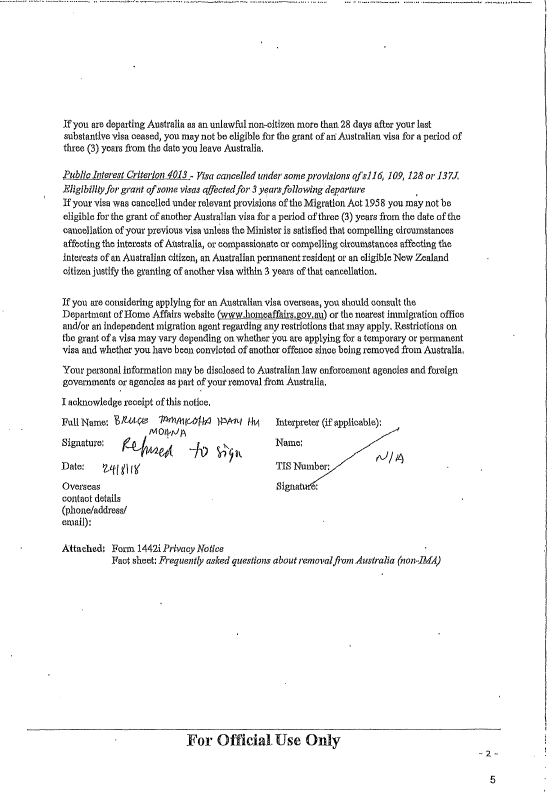
Annexure B