FEDERAL COURT OF AUSTRALIA
Tyne (Trustee of the Argot Trust) v UBS AG [2019] FCA 628
ORDERS
SCOTT FRANCIS TYNE AS TRUSTEE OF THE ARGOT TRUST Applicant | ||
AND: | Respondent | |
DATE OF ORDER: |
THE COURT ORDERS THAT:
1. The proceeding be permanently stayed.
2. Pursuant to section 37AO of the Federal Court of Australia Act 1976 (Cth), Mr Scott Francis Tyne, either in his capacity as trustee of the Argot Trust, or individually, be prohibited from instituting any further proceedings against UBS AG arising from or relating to the same substratum of facts as:
(a) This proceeding;
(b) NSW Supreme Court Proceeding 2010/363808; or
(c) Proceeding QUD10/2014 in the Federal Court.
3. The applicant pay the respondent’s costs, of and incidental to the application and the proceedings to date, including reserved costs, of any, to be taxed if not agreed.
4. The time within which to seek leave to appeal, or, as the case may, institute an appeal, against each or any of the orders made today be extended to 17 May 2019,
Note: Entry of orders is dealt with in Rule 39.32 of the Federal Court Rules 2011.
(REVISED FROM TRANSCRIPT)
LOGAN J:
1 Ms Clare Marks has never enjoyed a trial on the merits of such rights, if any, as she may have in respect of alleged remedies in law against UBS AG (UBS), the respondent in the present proceedings (2017 proceedings). Ms Marks became bankrupt under the Bankruptcy Act 1966 (Cth) (Bankruptcy Act) on 11 June 2014. She remained an undischarged bankrupt when the 2017 proceedings were instituted in this court on 8 August 2017. Two days prior to the institution of the 2017 proceedings, Ms Marks’ trustee in bankruptcy, Mr Nick Combis, purported to assign to Ms Marks’ partner, Mr Scott Tyne, as trustee of the Argot Trust, such rights in law as she had to bring proceedings against UBS. It is necessary to add the qualification purported, because the bankruptcy trustee’s ability to affect such an assignment is controversial.
2 Neither in this Court nor in the Supreme Court of New South Wales nor in the High Court of Singapore are Mr Tyne, nor via its sometime trustees, Telesto Investments Limited (Telesto), ACN 074791109 Pty Ltd (ACN 074), or, as the case may be, Mr Tyne, strangers to litigation with UBS. At all material times, Mr Tyne has been the directing mind and will of Telesto and ACN 074. At least inferentially on the evidence, he also controls the Argot Trust.
3 In 2014, Mr Tyne, in his capacity as trustee of the Argot Trust, and Ms Marks commenced proceedings in this Court against UBS (2014 proceedings). In the 2014 proceedings, and as is related in the joint judgment of Kiefel CJ and Bell and Keane JJ in subsequent proceedings in the High Court, UBS AG v Tyne (2018) 92 ALJR 968 (UBS v Tyne) at [2], they claimed damages and equitable compensation arising out of advice and representations made by UBS to Mr Tyne and “through him” to certain “Tyne-related entities”. The latter include the former trustee of the trust, ACN 074, and an investment company incorporated in Jersey, Telesto. At all material times, Mr Tyne was the controlling mind of ACN 074 in its capacity as trustee of the trust and at Telesto. The trust is a family trust of which Mr Tyne, Ms Marks and their children are sole beneficiaries. The trust’s claimed loss arises in connection with the pledge of its assets to secure Telesto’s liabilities under credit facilities extended by UBS.
4 The 2014 proceedings proceeded for some years in this court before it became known that Ms Marks had been made a bankrupt in 2014. The existence of Ms Marks’ bankruptcy having come to its attention on 8 March 2017, UBS notified Ms Marks’ trustee in bankruptcy of the 2014 proceedings, and requested that he make an election under s 60(3) of the Bankruptcy Act to discontinue or prosecute that proceeding. On 6 April 2017, Ms Marks’ trustee in bankruptcy notified the court that the 28-day period for election had expired, with the consequence that Ms Marks’ claims in the 2014 proceeding were deemed to have been abandoned. Shortly thereafter, on 11 April 2017, Greenwood J dismissed with costs Ms Marks’ claim in the 2014 proceeding: Tyne v UBS AG (No 4) [2017] FCA 374. The order of dismissal was unqualified, that is it was not expressed to have been made without prejudice to Ms Marks’ right, if any, again, to bring her claims against UBS. Ms Marks did not challenge that order of dismissal.
5 Earlier in the 2014 proceedings, and at a time when the existence of Ms Marks’ bankruptcy was not known either to UBS or to the court, Greenwood J had ordered that the 2014 proceeding be permanently stayed: see Tyne & Anor v UBS AG (No 3) (2016) 236 FCR 1 (Tyne v UBS (No 3)). Following a grant of leave to appeal that order was, by majority, reversed by the Full Court: Tyne v UBS AG (2017) 250 FCR 341. It was the order made by the Full Court, which following a grant of special leave to appeal, was, by majority, reversed by the High Court in UBS v Tyne.
6 By the time the High Court came to give judgment, and as earlier noted, Ms Marks’ bankruptcy had become known to UBS. As is noted in the High Court’s judgment at footnote 2, on 15 December 2017, by consent, an order was made in that court that Ms Marks cease to be a party to the proceedings in the High Court. Thus whilst the High Court’s order restored the permanent stay ordered by Greenwood J in 2016, it did so only at a time when Ms Marks was no longer a party to the proceedings in the High Court, and for that matter at a time when her claims had, in any event, become subject to the order of dismissal made in April 2017.
7 In the 2017 proceedings, UBS seeks the following interlocutory orders:
1 The proceeding be permanently stayed or dismissed pursuant to s 23 of the Federal Court of Australia Act 1976 (Cth), or in the exercise of the Court’s inherent or implied power to control its own process and procedure, on the ground of abuse of process.
2 Alternatively, the proceeding be summarily dismissed, in whole or in part, pursuant to s 31A of the Federal Court of Australia Act 1976 (Cth) and/or r 26.01 of the Federal Court Rules 2011 (Cth) on the ground that the proceeding has no reasonable prospect of success or is an abuse of process.
3 In the further alternative, the proceeding be stayed, in whole or in part, pursuant to r 39.03(2) of the Federal Court Rules 2011 (Cth).
4 In the further alternative, the statement of claim filed on 8 August 2017 be struck out, in whole or in part, pursuant to r 16.21 of the Federal Court Rules 2011 (Cth) on the ground that the pleading:
(a) fails to disclose a reasonable cause of action or other case appropriate to the nature of the pleading; or
(b) arises from the same substratum of fact and/or constitutes materially the same claim as was permanently staved by the High Court in UBS AG v Tyne [2018] HCA 45: or
(d)(c) is otherwise an abuse of the process of the Court.
5 Orders pursuant to s 37AO of the Federal Court of Australia Act 1976 (Cth) staving or dismissing the proceeding and prohibiting the Applicant, and Scott Francis Tyne in his personal capacity, from instituting any further proceedings against the Respondent arising from, or relating to, the same substratum of facts traversed in:
(a) the present proceeding;
(b) proceeding no 2010/363808 in the Supreme Court of New South Wales; or
(c) proceeding no QUD10/2014 in this Court;
or such other or further order pursuant to s 37AO of the Federal Court of Australia Act 1976 (Cth) as the Court considers appropriate.
56 The Applicant to pay the Respondent’s costs of, and incidental to, this interlocutory application and of the proceeding.
67 Such further or other orders as the Court considers appropriate.
8 As that application came to be argued on behalf of UBS it is fair to say that of the orders claimed emphasis was given most to a claim for a permanent stay, and an order under s 37AO of the Federal Court of Australia Act 1976 (Cth) (Federal Court Act).
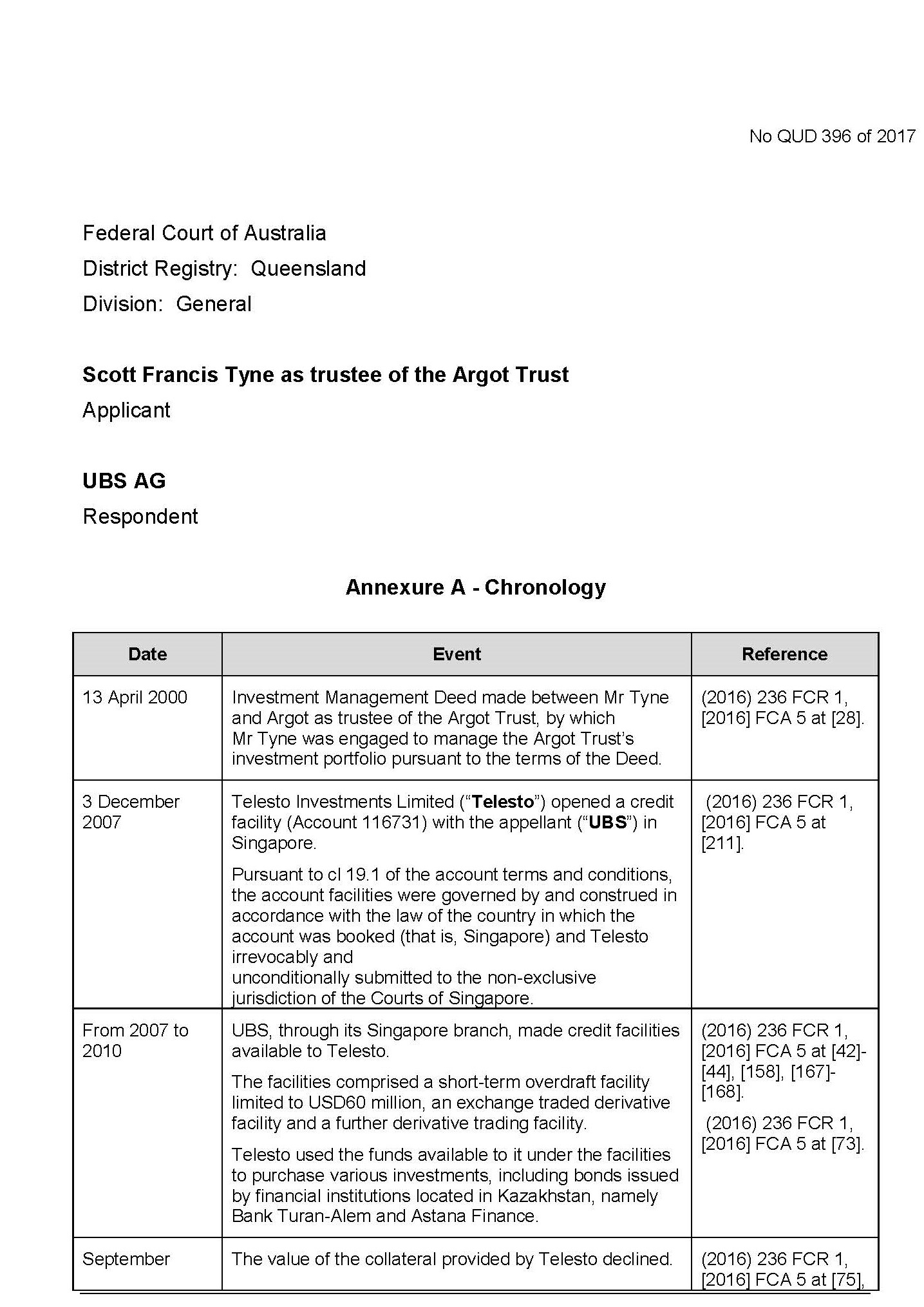
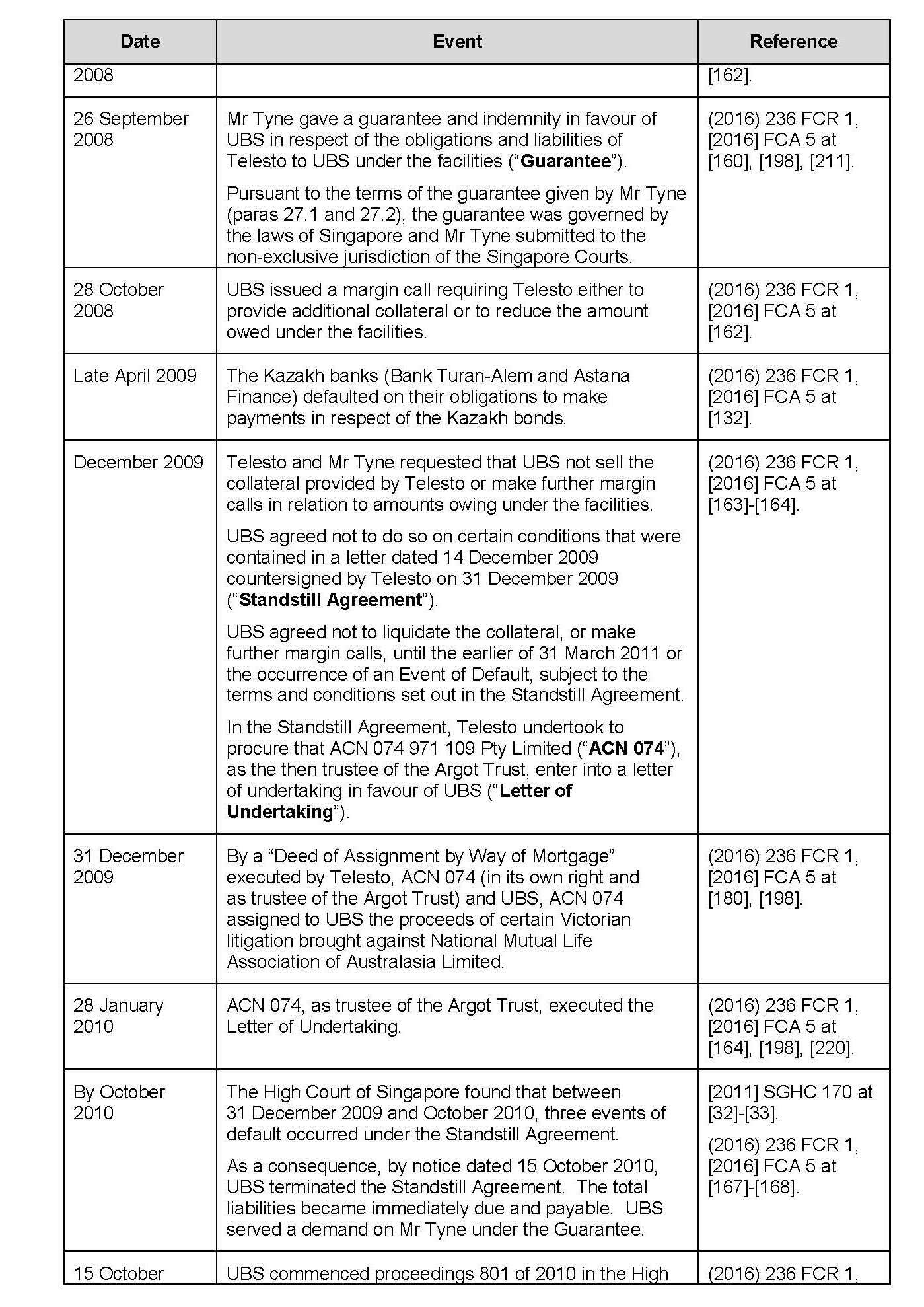
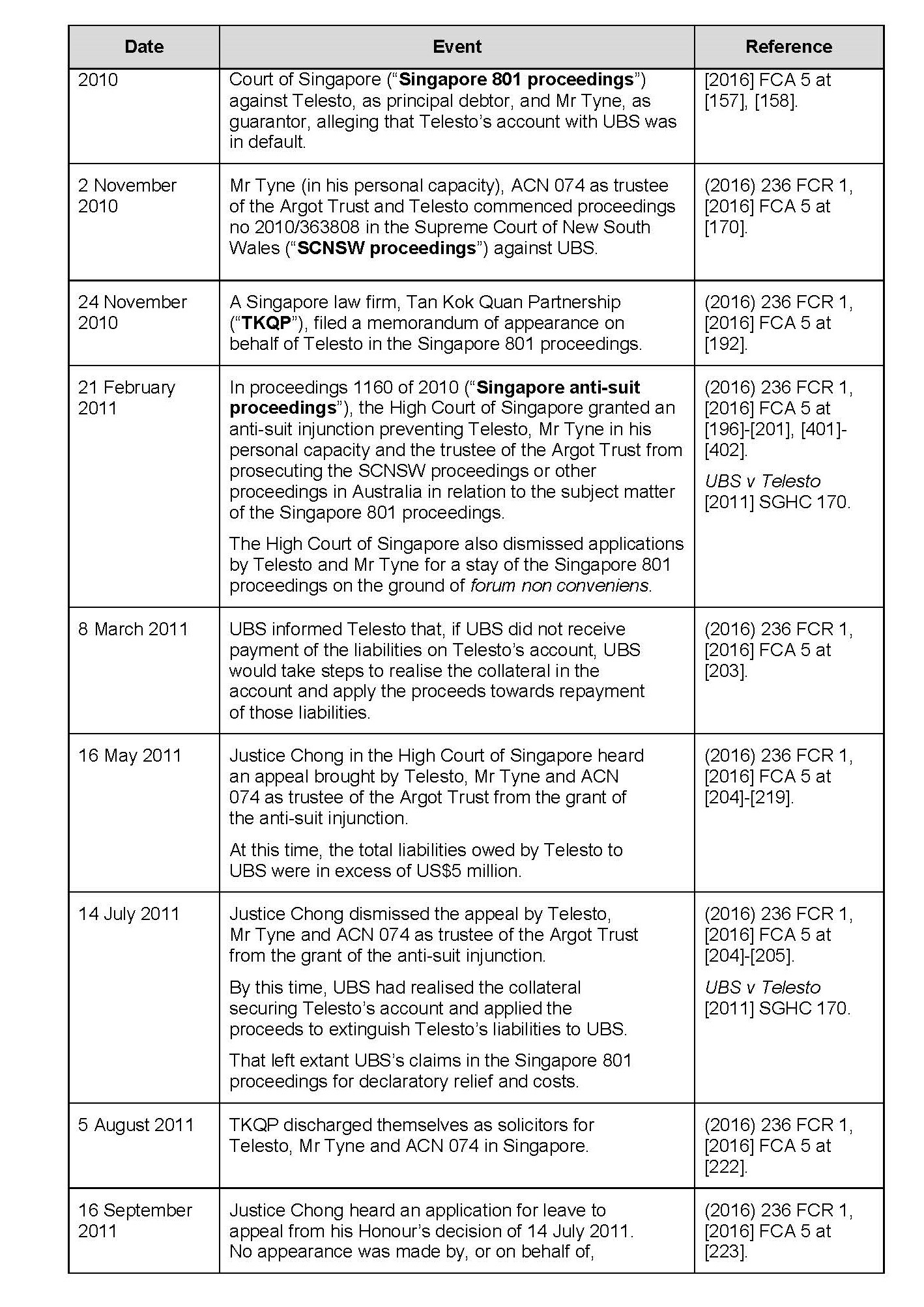
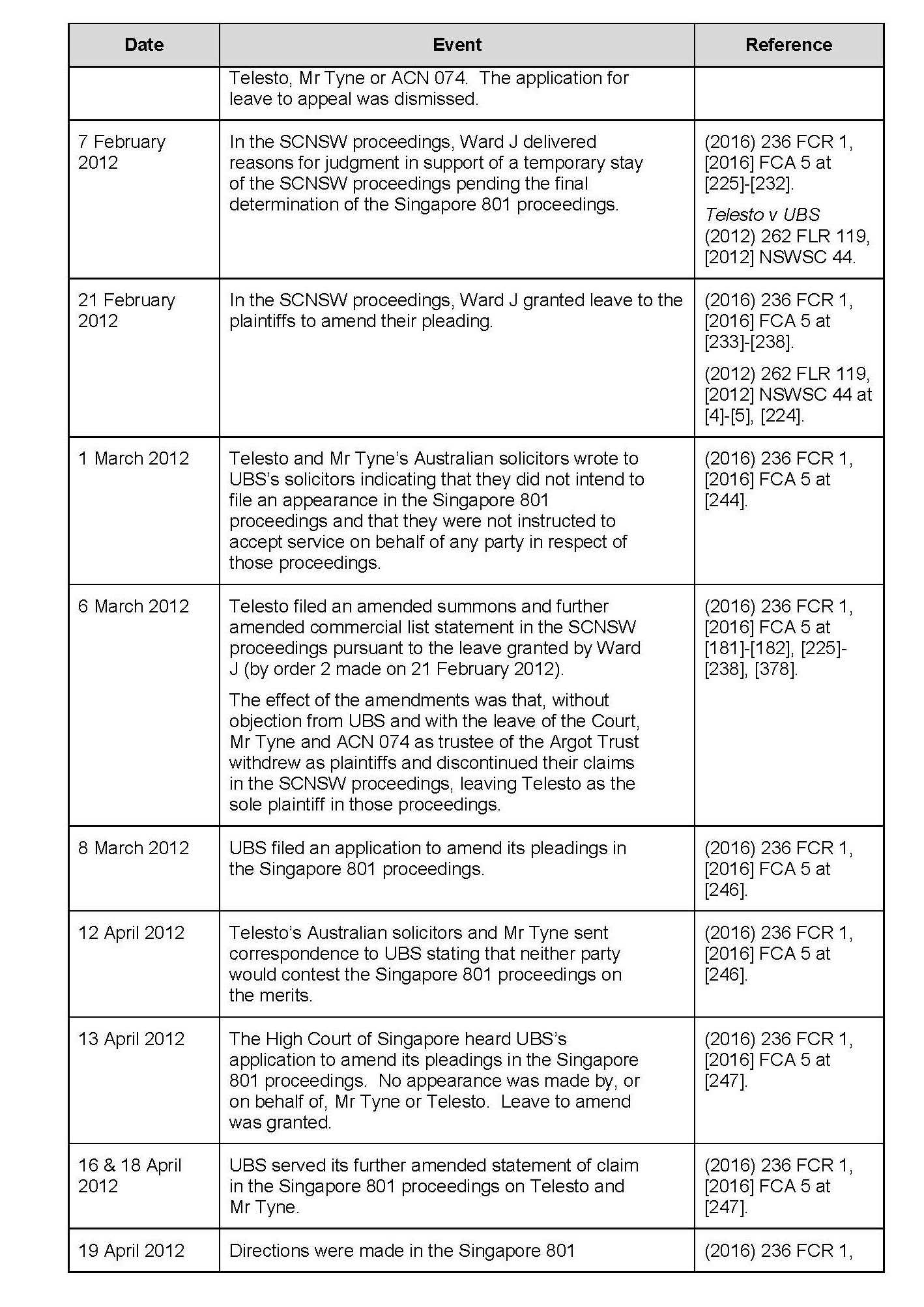
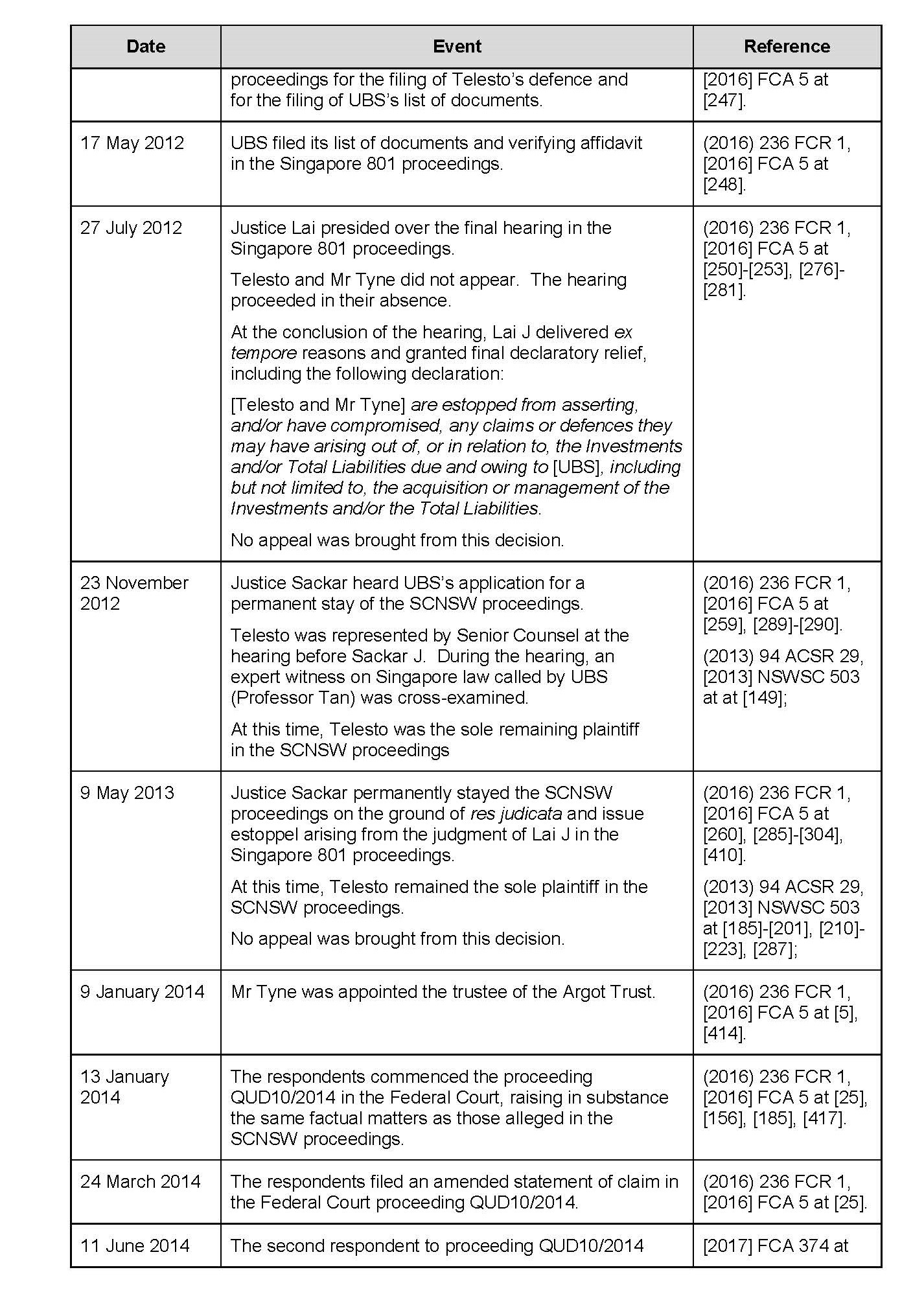
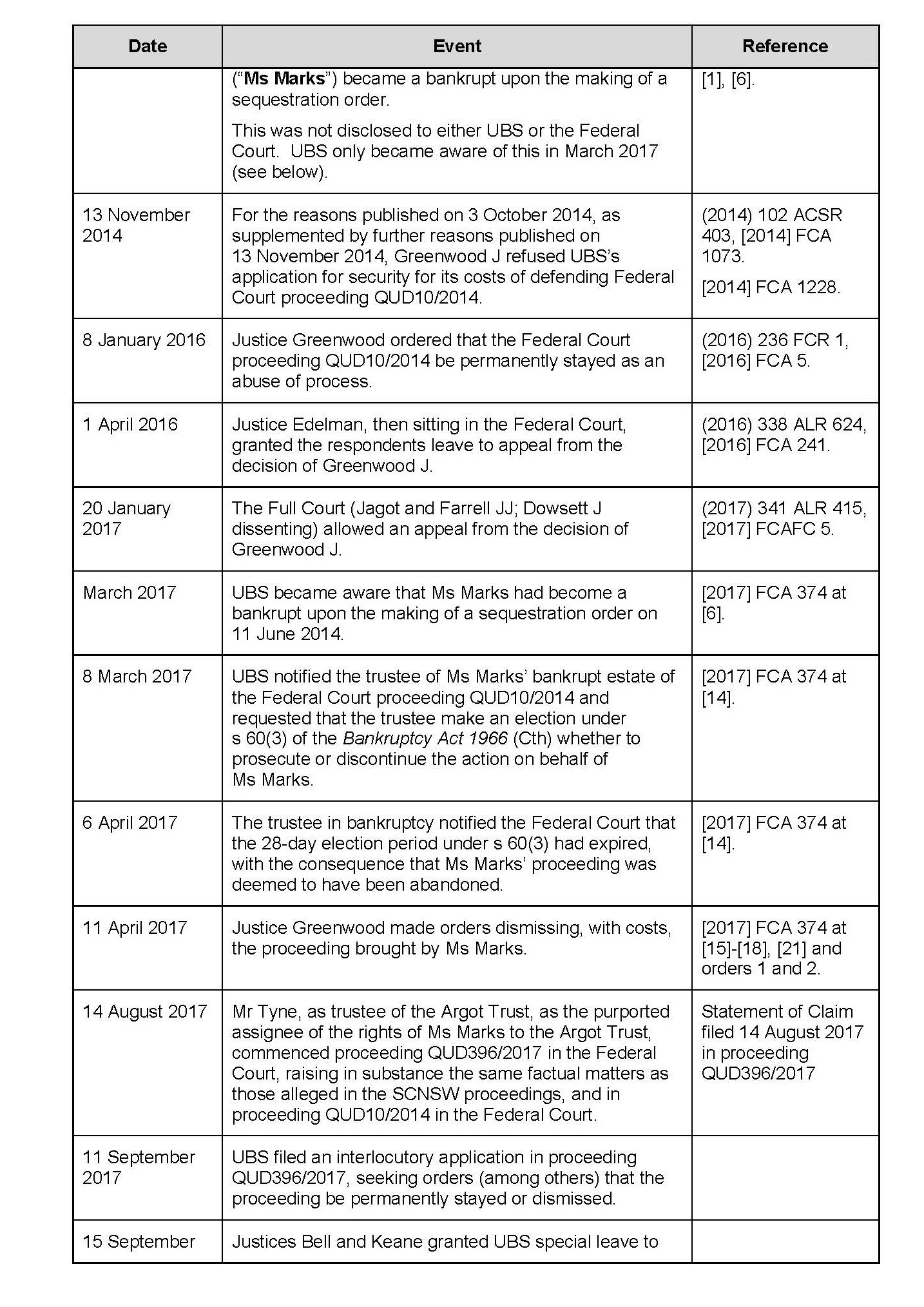
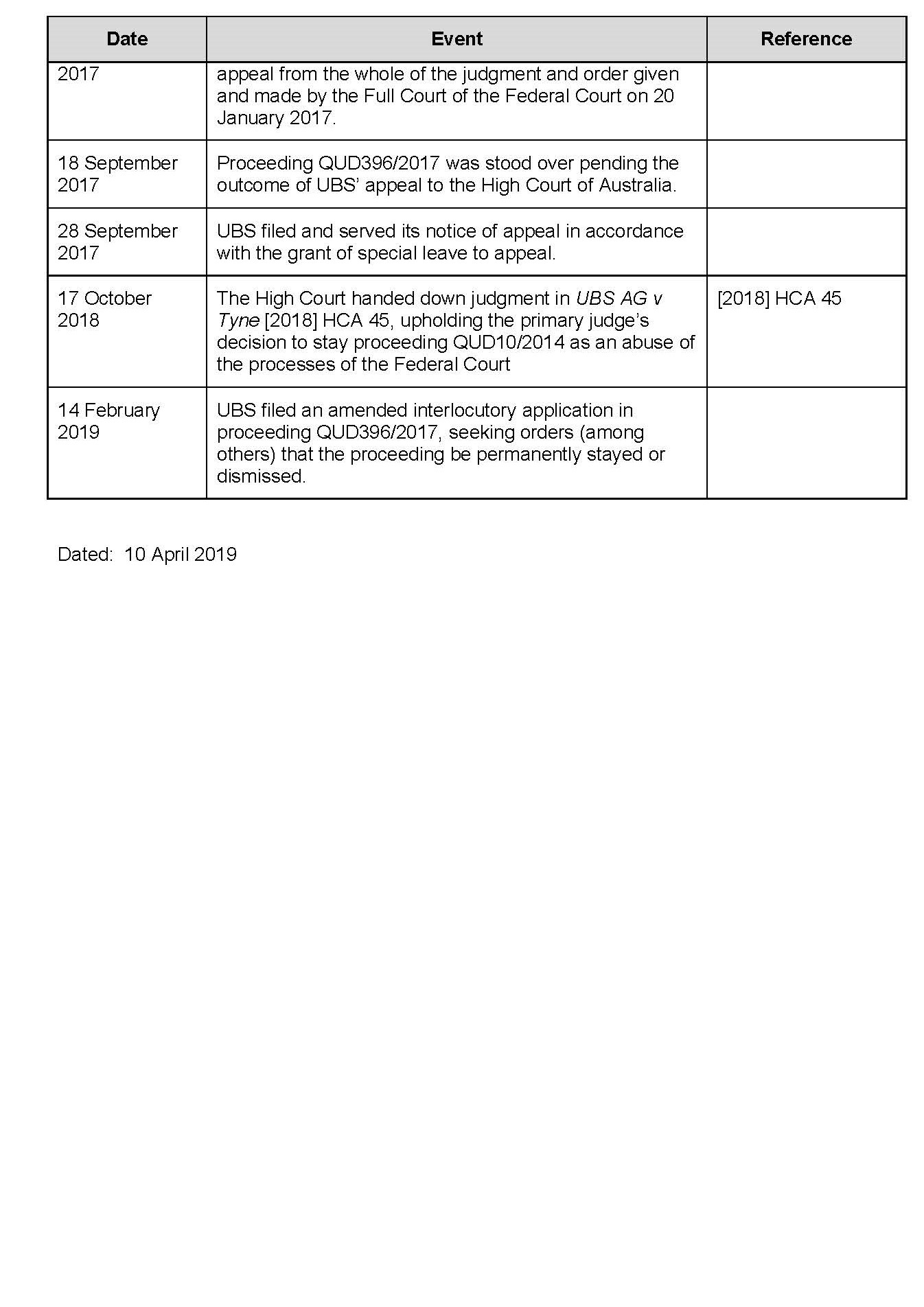
9 The prevailing circumstances against which UBS seeks this relief are complicated, and extend back in time over a decade. They are summarised in the High Court judgment, and more particularly in a chronology provided by the parties, the accuracy of which is not contested in the present proceedings. For convenience, rather than reproduce that chronology in the body of these reasons for judgment, I annex the chronology to the reasons for judgment, and find that the events related in that chronology occurred as summarised.
10 Events relevant to the present application up to the time of delivering of his Honour’s reasons for judgment were also summarised by Greenwood J in Tyne v UBS (No 3). It will be necessary to return, in some detail, to his Honour’s reasons for judgment in due course.
11 In Yat Tung Investment Co Ltd v Dao Heng Bank Ltd [1975] AC 581 at 589, the Judicial Committee of the Privy Council held that a particular claim made in later proceedings was an abuse of process because it was “clearly a matter necessary and proper to be litigated at the same time with all the other issues between the parties”. It having reached that conclusion, Lord Kilbrandon, added the following at 590:
But there is a wider sense in which the doctrine may be appealed to, so that it becomes an abuse of process to raise, in subsequent proceedings matters which could and therefore should have been litigated in earlier proceedings.
12 Those additional observations have come to be known as the “Kilbrandon Principle”: see, notably, Spencer Bower and Handley: Res Judicata (4th ed), [26.05] – [26.06]. The Kilbrandon Principle was rejected by the High Court of Australia in Port of Melbourne Authority v Anshun Pty Ltd (1980) 147 CLR 35, and, finally, in England and Wales, in Johnson v Gore Wood & Co [2002] 2 AC 1 (Johnson). In Johnson, Lord Bingham, who delivered the principal speech, stated, at 31:
The bringing of a claim or the raising of a defence in later proceedings may, without more, amount to abuse if the court is satisfied … that the claim or defence should have been raised in the earlier proceedings if it was to be raised at all. I would not accept that it is necessary … to identify any additional element such as a collateral attack on a previous decision or some dishonesty, but where those elements are present the later proceedings will be much more obviously abusive, and there will rarely be a finding of abuse unless the later proceeding involves … unjust harassment of a party. It is, however, wrong to hold that because a matter could have been raised in earlier proceedings it should have been, so as to render the raising of it in later proceedings necessarily abusive. That is to adopt too dogmatic an approach to what should … be a broad, merits-based judgment which takes account of the public and private interests involved … one cannot formulate any hard and fast rule to determine whether, on given facts, abuse is to be found or not.
13 As is obvious from the reasons for judgment of the majority in the High Court in Tyne v UBS, Johnson was highly persuasive in relation to the outcome in that court.
14 It is for UBS to demonstrate that the present proceedings, the 2017 proceedings, are an abuse of process. The onus lying on UBS in that regard has been described as “a heavy one”, with the power to grant a permanent stay being one to be exercised “only in the most exceptional circumstances”: Williams v Spautz (1992) 174 CLR 509 at 529. The reason for that stricture was expressed in this way by Leeming and Simpson JJA in Attila Boros v Pages Property Investments Pty Ltd [2018] NSWCA 269 at [16], thus:
The consequence is to prevent a plaintiff who has invoked a court’s jurisdiction from having a case heard and determined on the merits. Open access to justice is an important civil right, to which courts have long given high regard: see for example the decisions mentioned in Perera v Genworth Financial Mortgage Insurance Pty Ltd (2017) 94 NSWLR 83 … at [55]-[56].
15 That stricture acknowledged, the 2017 proceedings are proceedings to which s 37M of the Federal Court Act is applicable. That section provides:
37M The overarching purpose of civil practice and procedure provisions
(1) The overarching purpose of the civil practice and procedure provisions is to facilitate the just resolution of disputes:
(a) according to law; and
(b) as quickly, inexpensively and efficiently as possible.
(2) Without limiting the generality of subsection (1), the overarching purpose includes the following objectives:
(a) the just determination of all proceedings before the Court;
(b) the efficient use of the judicial and administrative resources available for the purposes of the Court;
(c) the efficient disposal of the Court's overall caseload;
(d) the disposal of all proceedings in a timely manner;
(e) the resolution of disputes at a cost that is proportionate to the importance and complexity of the matters in dispute.
(3) The civil practice and procedure provisions must be interpreted and applied, and any power conferred or duty imposed by them (including the power to make Rules of Court) must be exercised or carried out, in the way that best promotes the overarching purpose.
(4) The civil practice and procedure provisions are the following, so far as they apply in relation to civil proceedings:
(a) the Rules of Court made under this Act;
(b) any other provision made by or under this Act or any other Act with respect to the practice and procedure of the Court.
16 Recently, in Coshott v Official Trustee in Bankruptcy, in the matter of the Bankrupt Estate of Michael Petrovic Lenin (deceased) [2019] FCA 401, Thawley J offered, by reference to Tomlinson v Ramsay Food Processing Pty Ltd (2015) 256 CLR 507 and to UBS v Tyne (No 3) a helpful summary at [48] - [52] of what has come to be termed, in Australia, by reference to a case already mentioned, as “Anshun estoppel”:
48 Anshun estoppel was described in this way by the plurality (French CJ, Bell, Gageler and Keane JJ) of the High Court in Tomlinson v Ramsey Food Processing Pty Limited (2015) 256 CLR 507 at [22] (footnotes omitted):
… [An Anshun estoppel] operates to preclude the assertion of a claim, or the raising of an issue of fact or law, if that claim or issue was so connected with the subject matter of the first proceeding as to have made it unreasonable in the context of that first proceeding for the claim not to have been made or the issue not to have been raised in that proceeding.
49 Also at [22], their Honours observed:
Considerations similar to those which underpin this form of estoppel may support a preclusive abuse of process argument.
50 Their Honours then stated:
[23] The present significance of the recognition of those three forms of estoppel [cause of action estoppel, issue estoppel and Anshun estoppel] is that each has the potential to preclude assertion of a right or obligation, or the raising of an issue of fact or law, between parties to a proceeding or their privies. Absent a principled basis for distinction – and none has been suggested – one principle must govern the identification of privies for the purpose of all forms of estoppel which result from the rendering of a final judgment in an adversarial proceeding.
[24] To explain contemporary adherence to the comparatively narrow principle in Ramsay v Pigram, it is appropriate also to explain the relationship between the doctrine of estoppel and the doctrine of abuse of process as it has since come to be recognised and applied in Australia. The doctrine of abuse of process is informed in part by similar considerations of finality and fairness. Applied to the assertion of rights or obligations, or to the raising of issues in successive proceedings, it overlaps with the doctrine of estoppel. Thus, the assertion of a right or obligation, or the raising of an issue of fact or law, in a subsequent proceeding can be simultaneously: (1) the subject of an estoppel which has resulted from a final judgment in an earlier proceeding; and (2) conduct which constitutes an abuse of process in the subsequent proceeding.
[25] Abuse of process, which may be invoked in areas in which estoppels also apply, is inherently broader and more flexible than estoppel. Although insusceptible of a formulation which comprises closed categories, abuse of process is capable of application in any circumstances in which the use of a court’s procedures would be unjustifiably oppressive to a party or would bring the administration of justice into disrepute. It can for that reason be available to relieve against injustice to a party or impairment to the system of administration of justice which might otherwise be occasioned in circumstances where a party to a subsequent proceeding is not bound by an estoppel.
[26] Accordingly, it has been recognised that making a claim or raising an issue which was made or raised and determined in an earlier proceeding, or which ought reasonably to have been made or raised for determination in that earlier proceeding, can constitute an abuse of process even where the earlier proceeding might not have given rise to an estoppel. Similarly, it has been recognised that making such a claim or raising such an issue can constitute an abuse of process where the party seeking to make the claim or to raise the issue in the later proceeding was neither a party to that earlier proceeding, nor the privy of a party to that earlier proceeding, and therefore could not be precluded by an estoppel.
51 The concept of abuse of process in this field was recently explored in UBS AG v Tyne (2018) 360 ALR 184. Kiefel CJ, Bell, and Keane JJ stated at [38] (footnotes omitted):
The timely, cost effective and efficient conduct of modern civil litigation takes into account wider public interests than those of the parties to the dispute. These wider interests are reflected in s 37M(2) of the FCA. As the joint reasons in Aon Risk Services Australia Ltd v Australian National University explain, the “just resolution” of a dispute is to be understood in light of the purposes and objectives of provisions such as s 37M of the FCA. Integral to a “just resolution” is the minimisation of delay and expense. These considerations inform the rejection in Aon of the claimed “right” of a party to amend its pleading at a late stage in the litigation in order to raise an arguable claim. The point is made that a party has a right to bring proceedings but that choices are made respecting what claims are made and how they are framed. Their Honours speak of the just resolution of the dispute in terms of the parties having a sufficient opportunity to identify the issues that they seek to agitate. The respondent’s argument in Aon, that the proposed amendment to raise the fresh claim was a necessary amendment to avoid multiple actions, did not avail. As their Honours observe, if reasonable diligence would have led to the bringing of the claim in the existing proceedings, any further proceeding might be met by a stay on Anshun grounds.
52 At [70] to [72], Gageler J stated (footnotes omitted):
Finally, and for present purposes no less importantly, Lord Bingham’s reference to the need for the requisite normative judgment to take account of “the public and private interests involved” underscores that the question of whether the claim sought to be brought in the later proceedings “should” have been brought in the earlier proceedings cannot be determined solely by reference to interests of the parties to the action. There is a public interest in the timely and efficient administration of civil justice. The importance of that public interest has only increased in the years since Lord Bingham spoke.
Dowsett J sought to capture that public interest when he referred in dissent in the decision under appeal to the abusive character of litigious conduct which, if permitted, would lead “the right-thinking person” to perceive the system for the administration of civil justice to be “inefficient, careless about the incurrence of cost by the parties, and profligate in the application of public moneys”. His Honour’s anthropomorphic allusion was evidently drawn from the frequently quoted description of the power to prevent an abuse of process in terms of an “inherent power which any court of justice must possess to prevent misuse of its procedure in a way which, although not inconsistent with the literal application of its procedural rules, would nevertheless be manifestly unfair to a party to litigation before it, or would otherwise bring the administration of justice into disrepute among right-thinking people”.
Although undoubtedly capable of application in circumstances in which use of a court’s procedures would be unjustifiably oppressive to a party or would bring the administration of justice into disrepute, the doctrine of abuse of process has repeatedly been recognised to be insusceptible of a formulation which would confine it to closed categories. In the context of the application of the doctrine to the bringing of successive proceedings, consistently with the analysis of Lord Bingham, I think it better in weighing the private and public interests involved to eschew the extremes of private “oppression” and of public “disrepute”. The relevant public interest is ordinarily appropriately identified in more general and less emotive terms as the timely and efficient administration of civil justice.
17 To that summary, the following additional reference might materially be made to the joint judgment of Kiefel CJ and Bell and Keane JJ in UBS v Tyne at [45] and [46]:
45 UBS, through Mr Betsalel and Mr Farrell (and otherwise), held itself out as having specialist knowledge and expertise in the analysis of debt capital markets including the debt capital markets of emerging countries: para 21.
The Expertise Representations – the para 21 representations
46 At para 21, thirteen particular representations are pleaded as having been made by UBS through Mr Betsalel and Mr Farrell (and otherwise) to Mr Tyne concerning UBS’s specialist knowledge and expertise. They include (among others) that UBS was a leading underwriter and arranger in relation to debt capital markets of emerging countries; Mr Farrell (and others of UBS in Singapore) were expert and experienced in the debt capital markets of emerging countries; Mr Farrell was particularly knowledgeable about the debt capital markets of Russia and the Commonwealth of Independent States including Kazakhstan; UBS had people on the ground in Almaty providing the benefits of local knowledge and connections; UBS was one of the most active traders of relevantly corporate bonds of Kazakh companies; UBS had a close relationship with Kazakhstan; Mr Farrell had traded Russian debt throughout the Russian debt crisis; and, Mr Farrell kept abreast of developments in Russia and the Commonwealth of Independent States, including Kazakhstan, both from a debt capital markets perspective and as regards current and political affairs. These representations are described in the pleading as the Expertise Representations. As to the time when those representations were said to have been made, see [49] below, although the pleading is imprecise in this regard.
[emphasis in original]
18 It is this type of abuse of process which UBS alleges is present in relation to Ms Marks’ claims in the 2017 proceedings, either as formulated in the filed statement of claim or, for that matter, as reformulated in a proposed amended statement of claim which became an exhibit in respect of the present application.
19 UBS contended that the present proceeding was an abuse of process for these reasons (referring in this regard to its outline of submissions): first, since Mr Tyne, in his capacity as trustee of the Argot Trust, is controlling the present proceeding as the purported designing of the claims of Ms Marks, the same “directing mind and will” is now conducting the present proceeding as conducted the 2014 proceeding. UBS contends that in UBS v Tyne, in relation to the 2014 proceeding, Mr Tyne’s conduct as the directing mind and will had been such to make that proceeding an abuse. UBS further contends that the same factual matters are raised in the present proceeding as those raised in the 2014 proceeding, and, for that matter, the proceedings in the Supreme Court of New South Wales.
20 As to this, an analysis offered by Greenwood J in Tyne v UBS (No 3) at a time when Ms Marks was a party (and thought permissibly to be a party in her own right), is not without relevance. His Honour offers, in his reasons for judgment, a very close analysis indeed of the causes of action then pleaded. In particular, at [425] - [429], his Honour makes these observations:
425 The remaining question is that of the claim of Ms Marks.
426 The claim by Ms Marks is in every sense a derivative claim in that it is entirely reliant for its foundation of fact and its related reliance loss formulations upon the events which occurred by reason of the entire portfolio of misrepresentations said to have been made by UBS to Mr Tyne. All of the events upon which Ms Marks relies occurred during the period from 2007 to 2009. All of the central events are directly related to the entire conduct alleged against UBS.
427 Ms Marks is the partner of Mr Tyne. I am satisfied that the claims made by Ms Marks as formulated in the amended statement of claim in these proceedings is a claim which could and should have been brought along with the claim by the trustee in the SCNSW proceedings. That Court had jurisdiction to hear the claims, was seized with the proceeding and was seized with all of the foundation factual matters which were required to be ventilated and ultimately made the subject of findings in that proceeding.
428 I am satisfied that the claims by Ms Marks could have and should have been brought in the SCNSW proceedings.
429 I am satisfied that the joinder of the claims by Ms Marks in the Federal Court proceedings is an abuse of this Court’s processes and that the proceedings commenced by Ms Marks must also be stayed.
[emphasis in original]
21 Looking at the statement of claim and, for that matter, at the proposed amended statement of claim, my conclusion is the same as that reached by Greenwood J. In other words, it remains the case that the purportedly assigned causes of action, be they under statute or, for that matter, as additionally sought to be formulated at common law are, in every sense, derivative in exactly the way described by Greenwood J in the passages which I have just quoted. UBS contended that this court, in the administration of Commonwealth judicial power:
… could not countenance a circumstance in which a single directing mind causes to be initiated multiple proceedings arising out of the one substratum of fact; one of those proceedings then travels all the way to the High Court, where it is dismissed on the basis that the maintenance of several proceedings by the single directing mind is inconsistent with the over-arching purpose [of s 37M of the Federal Court Act] and an abuse; only to have the very same directing mind initiate or continue (by way of a purported assignment of the cause of action) yet another proceeding raising the very same substratum of fact.
22 It is well over a century since, in respect of married women, their property was assimilated with that of their husband and their husbands were considered their “directing minds”. I did not understand UBS to base its submissions on such an outdated conception of the rights of women. In my view, Ms Marks’ claims and the inherent abuse entailed in the present proceeding are best characterised in the way Greenwood J chose to in Tyne v UBS (No 3). They are derivative. They not only could, but should, have been raised in earlier proceedings. That remains the case, even though some of the allegations with respect to loss refer to alleged losses occurring as late as 2013. In the 2014 proceeding, and as summarised by Greenwood J at:
150 The applicants plead that by reason of the default by BTA and Astana (the subscription price of which is set out at [73] of these reasons), the market value of the bonds declined substantially which, in turn, caused Telesto to default upon its obligations to the ANZ Bank under the Facility Extension.
151 The guarantee given by Ms Marks to the ANZ Bank was called upon.
152 The obligations of Ms Marks under the guarantee were supported by a first ranking registered mortgage over the land of which she was the registered proprietor. The mortgagee exercised a power of sale under the mortgage and sold the property.
153 Ms Marks’s right of indemnity against Telesto as guarantor to the ANZ Bank was rendered worthless by Telesto’s default.
154 Ms Marks lost the property by reason of the mortgagee’s exercise of the power of sale and was unable to recoup the value of the loss through her right of indemnity against Telesto.
155 The applicants plead that the loss suffered by Ms Marks was caused by the pleaded contraventions by UBS of s 12DA of the ASIC Act, s 1041H of the Corporations Act and contraventions of the relevant provisions of the State Fair Trading Acts.
[emphasis in original]
23 What emerges from that formulation is that Ms Marks’ losses were well and truly able to have been the subject of earlier court proceedings. Having reached these conclusions, the present, in my view, is a paradigm example of a case of the kind described by Kiefel CJ and Bell and Keane JJ in UBS v Tyne at [45]. Thus, UBS has discharged its onus of proof in relation to whether the 2017 proceedings are an abuse of process.
24 That was not the only basis upon which UBS contended that the 2017 proceedings were an abuse. It also put its submission on the basis that the particular order of dismissal made under r 39.03(1)(a) of the Federal Court Rules 2011 (Cth) was not made without prejudice to Ms Marks’ right to bring later proceedings.
25 In this regard, it commended a conclusion reached in Ferella v Otvosi (2005) 63 NSWLR 523 at [13], as to the meaning of a cognate provision in an earlier iteration of this Court’s Rules. I concur with that particular view as to the effect of the order of dismissal made in relation to Ms Marks’ claim in the 2014 proceedings. Its effect was to extinguish her right to bring proceedings against UBS. It makes no difference at all, even assuming the assignment to be valid, that the proceeding is now brought by an assignee of that right.
26 As to the order of dismissal – and correctly, in my view – UBS also submitted that the order of dismissal operates as a res judicata, preventing either Ms Marks or an assignee from bringing fresh proceedings against the same respondent in respect of the same cause of action. UBS’s citation of Zetta Jet Pte Limited v The Ship “Dragon Pearl” (No 2) [2018] FCAFC 132 at [30] - [35] was apt. That the order of dismissal was made, in circumstances where there was no hearing on the merits, does to detract from its character as a final judgment, and the res judicata that consequentially arises.
27 UBS further contended that the continued prosecution of the 2017 proceeding was just as oppressive to it as had been concluded, albeit only by a majority in the High Court, that the 2014 proceedings were. In this regard, it highlighted that it had spent both considerable time and money in:
(a) its application before the courts of Singapore for an anti-suit injunction;
(b) the obtaining of final declaratory relief in the courts at Singapore;
(c) its obtaining a permanent stay in the New South Wales Supreme Court proceedings; and
(d) its obtaining a permanent stay in the original jurisdiction of this court, restored in the High Court, in the 2014 proceedings.
28 All of this, in my view, necessarily follows. As was stated in the High Court in UBS v Tyne at [57], “[t]he time to have the trial of the factual allegations underlying Telesto’s and the trust’s claims was in the SCNSW proceedings.” The point made by UBS in its submissions in the present case was apt. That is the very trial which Mr Tyne, as purported assignee, now seeks in the 2017 proceedings.
29 All of the foregoing exemplifies also an additional basis upon which UBS relied, namely, that it was antithetical to the overarching purpose stated in s 37M for a litigant to fail to bring her bankruptcy to the court’s attention, prosecute her claim in the original jurisdiction and in a Full Court, and then to have that claim dismissed following belated disclosure of the fact of bankruptcy, only to seek via an assignment to have that very same claim litigated in fresh proceedings.
30 These are reasons sufficient enough to make the order granting a permanent stay sought by UBS. Something, though, additionally needs to be said about two further matters. As noted, UBS contested the ability in law of Ms Marks to effect an assignment of the causes of action, either in law or in equity. The relevant analysis of authority is that offered by von Doussa J in Chapman v Luminis Pty Ltd (No 4) (2001) 123 FCR 62 at [204] - [206]. Having regard to this analysis, my conclusion is that the statutory causes of action which were purported assigned to Mr Tyne as trustee by Ms Marks, bankruptcy trustee, were incapable of assignment.
31 It is those statutory causes of action which provide the basis for the invocation of this Court’s jurisdiction. Being incapable of assignment, it necessarily follows, in my view, that the invocation of this Court’s jurisdiction by the institution of the 2017 proceedings was colourable. That being so, and even assuming in Mr Tyne’s favour that other causes of action at common law also embraced by the generality of the purported assignment were capable of assignment, there is no jurisdiction to entertain them in light of a colourable invocation of this Court’s jurisdiction.
32 UBS also raised, in relation to the assignment, that it was ineffective because notice had not been given to it pursuant to s 199 of the Property Law Act 1974 (Qld). Mr Tyne whose submissions, with respect, were every bit as concise and erudite as those made on behalf of UBS by Mr Stoljar SC, submitted that the service of the application and statement of claim could, in any event, even if earlier notice was not effective, amount to effective notice. There does, with respect, seem to me to be some substance in that particular submission advanced by him, so I expressly do not take that particular alleged deficiency into account in a conclusion that the purported assignment was ineffective.
33 UBS also made a submission that the time limit for the institution of the present proceedings, namely, six years, had expired. It submitted that on Mr Tyne’s own pleading, the cause of action had first accrued not later than the time of the deterioration in value of the Kazakh bonds as pleaded in [168] and [169] of the statement of claim, namely, in 2009.
34 It was said, then, to follow from s 12GF(2) of the Australian Securities and Investment Commission Act 2001 (Cth), and s 1041(2) of the Corporations Act 2001 (Cth), and the then provisions of State fair trading legislation, namely, s 68(2) of the Fair Trading Act 1987 (NSW) and s 99(3) of the Fair Trading Act 1989 (Qld), that the causes of action had expired. As against this and, with respect, aptly, Mr Tyne drew attention to this observation made by Mason CJ and Dawson, Gaudron and McHugh JJ in Wardley Australia Ltd v Western Australia (1992) 175 CLR 514; [1992] HCA 55 at 533, [31]:
We should, however, state in the plainest of terms that we regard it as undesirable that limitation questions of the kind under consideration should be decided in interlocutory proceedings in advance of the hearing of the action, except in the clearest of cases. Generally speaking, in such proceedings, insufficient is known of the damage sustained by the plaintiff and of the circumstances in which it was sustained to justify a confident answer to the question.
35 To this, Toohey J added at 558 - 559, [41]:
The case, however, provides a good illustration of the difficulty and undesirability of trying to determine a limitation point in interlocutory proceedings, unless the position is clear beyond peradventure.
[footnotes omitted]
36 Mr Tyne’s point was that a particular loss had been incurred by Ms Marks in the exercise by the ANZ of its power of sale under a mortgage security. He submitted that the loss crystallised, at the earliest, at the date when the letter of demand was served on her, 22 August 2011. On that basis, he submitted that the limitation period had not expired at the time when the 2017 proceedings were instituted.
37 As I have earlier indicated by reference to Greenwood J’s analysis, there is a much earlier point in time at which it might be said that Ms Marks’ causes of action, if any, accrued. But the reference by Mr Tyne to later dates upon which it might be said particular losses crystallised, highlights, in my view, why it is not apt to make orders on the basis that a statute of limitations has expired. The better basis upon which to rest the making of those orders is that indicated above.
38 The appropriate order to make, in my view, is permanently to stay the 2017 proceedings. Ample power to make such an order is as Greenwood J correctly notes at [2], with respect, in Tyne v UBS (No 3), to be found in s 23 of the Federal Court Act, and, for that matter, in the inherent power of the court to prevent an abuse of its processes.
39 The question then becomes whether or not to make an order under s 37AO of the Federal Court Act. Materially, power to make such an order is engaged if the court is satisfied that a person has frequently instituted or conducted vexatious proceedings in Australian courts or tribunals. In Fuller v Toms (2015) 234 FCR 535 at [31] (Fuller v Toms), the Full Court stated:
Section 37AO of the Federal Court Act empowers a court to balance the right of one individual of access to justice with other rights namely, a correlative right on the part of the present respondents to finality and the separate right of other individuals also to access this Court. It is for this Court, the present manifestation of a recognition by the Australian Parliament, the origins of which may be traced to an earlier recognition by the United Kingdom Parliament via the Vexatious Actions Act 1869 (UK) (59 & 60 Vict.C. 51), of a need for a power to effect just such a balance.
40 The Full Court made reference with approval to observations made by Pagone J in Garrett v Federal Commissioner of Taxation (2015) 147 ALD 342 in relation to the word frequently, and further cited with approval an exposition of it by Perry J of applicable principles in HWY Rent Pty Ltd v HWY Rentals (in liq) (No 2) [2014] FCA 449:
33 In Garrett v Federal Commissioner of Taxation, at [8], Pagone J observed of the word “frequently” in s 37AO that it, “has its ordinary meaning and is not given a specific statutory meaning for the purposes of s 37AO(1) (the former O 21, r 1 of the Federal Court Rules had imposed the higher threshold of the need to establish that vexatious proceedings had been conducted ‘habitually, persistently and without reasonable grounds’)”. We agree. As did Pagone J, we adopt as correct the following exposition offered by Perry J in HWY Rent Pty Ltd v HWY Rentals (in liq) (No 2) [2014] FCA 449 (the HWY Case) of the meaning of that word as found in s 37AO(1)(a):
5.3.5 Were vexatious proceedings instituted or conducted by Mr Jarvie “frequently”?
110 Notwithstanding the seriousness of these matters, the power in s 37AO(1)(a) is enlivened only if it can be said that Mr Jarvie instituted or conducted vexatious proceedings “frequently”. As Davies J explained in Attorney-General (NSW) v Wilson [2010] NSWSC 1008 at [11]:
It would not be sufficient, therefore, to point to the fact that a litigant had instituted even a number of vexatious proceedings. If the adverb “frequently: could not be used in connection with the sum of them, no order can be made under s 8. That is a significant matter because it is a serious thing to deprive litigants of their access to the courts, a right which might be thought to be an inherent right for persons living in a democratic society under the rule of law – see in that regard In Re Boaler [1915] 1 KB 21 at 34 and Re De W Kennedy (Finance) Pty Ltd v Ley (unreported – Supreme Court NSW, Holland J – 29 March 1978).
111 Without detracting from the seriousness of the consequences of such an order, the use of the term “frequently” nonetheless imports a lesser test than that imposed by the predecessor provision in rule 6.02 which required that vexatious proceedings have been conducted “habitually and persistently”. That test had been said to imply “more than great frequency”, the word “[h]abitually suggest[ing] that the institution of such proceedings occurs as a matter of course, or almost automatically, when the appropriate conditions (whatever they may be) exist; ‘persistently’ suggest[ing] determination, and continuing in the face of difficulty or opposition, with a degree of stubbornness”: Attorney-General v Wentworth (1988) 14 NSWLR 481 at 492 Roden J.
112 The term “frequently” is a relative term and “must be looked at in the context of the litigation being considered”: Attorney General (NSW) v Gargen [2010] NSWSC 1192 at [7] (Davies J); see also Attorney General (NSW) v Wilson [2010] NSWSC 1008 at [12]; Jones v Cusack (1992) 109 ALR 313 (Jones) at 315 (Toohey J), and Chan at [37]. Thus, the Court may find that a person has instituted or conducted vexatious proceedings “frequently” even though the number of proceedings may be quite small, such as where the proceedings are an attempt to re-litigate an issue determined against the person: Fuller v Toms [2013] FCA 1422 (Fuller) at [77] (Barker J).
113 Thus in Fuller, for example, the applicant against whom a vexatious proceedings order under s 37AO was made had commenced five separate proceedings over a period of approximately five years. Having regard to the circumstances and the conduct of those various proceedings, Barker J was satisfied that the applicant had “frequently” instituted and conducted proceedings of the type contemplated by s 37AO notwithstanding that “the number of proceedings may be considered small”. Similarly, in Jones, in determining whether the applicant had “frequently” instituted proceeding for the purposes of former O 63, r 6(1) of the High Court Rules, Toohey J held that the five proceedings initiated by the applicant during a six year period “readily answer[ed] that description”.
114 In short, there being no numerical threshold prescribed by Part VAAA itself, the question of whether an applicant has “frequently” instituted or conducted vexatious proceedings for the purposes of s 37AO must be answered in the circumstances of the particular case.
41 In support of its application, UBS drew attention to an observation made in the High Court in UBS v Tyne at [55]:
Mr Tyne perceived a forensic advantage to the Tyne-related parties in holding back the Trust’s claim. This was a decision that, were Telesto’s claim to be stayed, would lead to duplication of resources and increased cost and would delay the resolution of the dispute between the Tyne-related parties and UBS. Hiving off the Trust’s claim, with a view to bringing it in another court after the determination of the SCNSW proceedings, was the antithesis of the discharge of the duty imposed on parties to civil litigation in the Supreme Court of New South Wales and in the Federal Court.
[footnotes omitted]
42 UBS further submitted that the findings in the High Court were made in the context of circumstances as a whole, which included these:
(a) Mr Tyne’s conduct in continuing to prosecute and in causing Telesto to continue to prosecute the Supreme Court of New South Wales proceedings after final judgment was entered in favour of UBS in the Singaporean proceedings on 27 July 2012.
(b) Three plaintiffs were parties to the New South Wales Supreme Court proceedings. On 6 March 2012, two of those plaintiffs, being Mr Tyne in his personal capacity and ACN 074 as trustee of the Argot Trust, withdrew as plaintiffs and discontinued their claims in those proceedings, leaving the third plaintiff, Telesto, as the sole plaintiff in those proceedings. No appeal was brought in relation to the permanent stay of the Supreme Court of New South Wales proceedings granted by Sackar J on 9 May 2013.
(c) Mr Tyne in his capacity as trustee of the Argot Trust, commenced the 2014 proceeding in this Court raising, in substance, the same factual matters as those litigated in the Supreme Court of New South Wales proceedings. The 2014 proceeding was stayed in the original jurisdiction and in the High Court as an abuse of process, a finding which, as UBS correctly submitted, necessarily includes the institution of the appeal to the Full Court in the 2014 proceedings.
(d) Mr Tyne conducted proceedings for and on behalf of, and represented, Ms Marks in the 2014 proceedings without disclosing to the court or UBS that Ms Marks had become a bankrupt upon the making of a sequestration order on 11 June 2014.
(e) On 8 August 2017, Mr Tyne commenced, as purported assignee of Ms Marks, the 2017 proceeding based on the same substratum of fact traversed in the Singaporean proceedings, the Supreme Court of New South Wales proceedings, and the 2014 proceedings.
(f) Mr Tyne continues to prosecute the 2017 proceeding, even after the High Court upheld the permanent stay of the 2014 proceeding on the basis of an abuse of process.
43 All of these points are aptly made on behalf of UBS and tell in favour, in my view, of the making of an order under s 37AO of the Federal Court Act, which prohibits Mr Tyne, both in his capacity as trustee of the Argot Trust and in his personal capacity, from instituting any further proceedings against UBS arising from or relating to the same substratum of facts traversed in the present proceeding, the New South Wales Supreme Court proceeding, or the 2014 proceedings.
44 Mr Tyne made reference in his submission to the First Optional Protocol to the International Covenant on Civil and Political Rights, and to a complaint which he had filed against the Commonwealth of Australia alleging a violation of that particular international instrument. The riposte made by UBS in relation to this complaint was that:
… when considered in the overall conduct of the dispute by Mr Tyne in various guises across three jurisdictions [the complaint] displays the attitude of a litigant who is reluctant to respect the finality of any court’s decision and who has a disregard for the “extent of the damage and inconvenience the litigant’s forays into the courts have caused pecuniary or otherwise”.
45 This, with respect, is true. A purpose, perhaps the essence, of judicial power is to quell disputes and to thereby bring finality, by way of an exercise of sovereign power, to controversies. I am compelled to reach the conclusion that Mr Tyne is just not disposed to accept this inherent feature of judicial power. That is why an order under s 37AO targeted in the way that I have indicated is so very necessary in this case.
I certify that the preceding forty-five (45) numbered paragraphs are a true copy of the Reasons for Judgment herein of the Honourable Justice Logan. |
Associate:
ANNEXURE