

FEDERAL COURT OF AUSTRALIA
Braedon on behalf of the members of the family groups with responsibility for the Imarnte Estate v Northern Territory of Australia [2019] FCA 614
ORDERS
ERIC BRAEDON AND PETER KENNY ON BEHALF OF THE MEMBERS OF THE FAMILY GROUPS WITH RESPONSIBILITY FOR THE IMARNTE ESTATE Applicant | ||
AND: | NORTHERN TERRITORY OF AUSTRALIA Respondent | |
DATE OF ORDER: |
THE COURT NOTES THAT:
A. The Applicant in this proceeding NTD24/2018 has made a native title determination application (“the application”) that relates to an area of land and waters which is the subject of a proposed determination of native title (“the Determination”).
B. The Applicant and the Northern Territory of Australia (“the parties”) have reached agreement as to the terms of the Determination which is to be made in relation to the land and waters covered by the application (“the Determination Area”). The external boundaries of the Determination Area are described in Schedule A and depicted on the map at Schedule B of the Determination.
C. Pursuant to ss 87(1)(a)(i) and 87(1)(b) of the Native Title Act 1993 (Cth) (“the Act”), the parties hereby file with this Court their agreement in writing.
D. Pursuant to ss 87 and 94A of the Act the terms of the parties’ agreement involve the making of consent orders for a determination that native title exists in relation to the Determination Area as provided by the Determination.
E. The parties acknowledge that the effect of the making of the Determination is that the members of the native title claim group, in accordance with the traditional laws acknowledged and the traditional customs observed by them, should be recognised as the native title holders for the Determination Area as provided by the Determination.
F. The parties have requested that the Court hear and determine this proceeding in accordance with their agreement.
BEING SATISFIED that a determination of native title in the terms set out in the Determination in respect of this proceeding would be within power of the Court and, it appearing to the Court appropriate to do so, pursuant to s 87 of the Act and by the consent of the parties:
THE COURT ORDERS THAT:
1. There be a determination of native title in terms of the Determination set out below.
2. The native title is not to be held on trust.
3. Wura Aboriginal Corporation (ICN: 9008) is:
(a) to be the prescribed body corporate for the purposes of s 57(2) of the Act;
(b) to perform the functions outlined in s 57(3) of the Act after becoming a registered native title body corporate.
4. The parties have liberty to apply to establish the precise location and boundaries of any public works and adjacent land and waters identified or otherwise referred to in Schedule C of the Determination.
5. There be no order as to costs.
THE COURT DETERMINES THAT:
The Determination Area
6. The Determination Area comprises NT Portion 1993, being the land and waters more particularly described in Schedule A and depicted on the map comprising Schedule B.
7. Native title exists in the Determination Area.
8. Native title does not exist in those parts of the Determination Area described in Schedule C.
The native title holders
9. The Determination Area comprises one estate area associated with the Imarnte landholding group.
10. The persons who hold the common or group rights comprising the native title are the Aboriginal persons who are:
(a) members of the landholding group referred to in paragraph 9 by virtue of descent (including adoption) through father’s father, mother’s father, father’s mother and mother’s mother; or
(b) accepted as members of the landholding group referred to in paragraph 9 by senior members of that landholding group by virtue of the following non-descent connections to the estate:
(i) conception and/or birthplace affiliation with the estate;
(ii) putative or close kinship ties; and
(iii) possession of cultural knowledge, including of neighbouring shared Dreamings, consolidated long-term residence in and ongoing ritual involvement with an estate.
Native title rights and interests
11. The native title rights and interests of the native title holders are the non-exclusive native title rights and interests possessed under and exercisable in accordance with the traditional laws acknowledged and traditional customs observed, including the right to conduct activities necessary to give effect to them, being:
(a) the right to access and travel over any part of the land and waters;
(b) the right to live on the land, and for that purpose, to camp, erect shelters and other structures;
(c) the right to hunt, gather and fish on the land and waters;
(d) the right to take and use the natural resources of the land and waters;
(e) the right to access, take and use natural water on or in the land;
(f) the right to light fires for domestic purposes, but not for the clearance of vegetation;
(g) the right to share or exchange natural resources obtained on or from the land and waters, including traditional items made from the natural resources;
(h) the right to access and to maintain and protect sites and places on or in the land and waters that are important under traditional laws and customs;
(i) the right to conduct and participate in the following activities on the land and waters:
(i) cultural activities;
(ii) ceremonies;
(iii) meetings;
(iv) cultural practices relating to birth and death including burial rites; and
(v) teaching the physical and spiritual attributes of sites and places on the land and waters that are important under traditional laws and customs;
(j) the right to make decisions about the use and enjoyment of the land and waters by Aboriginal people who recognise themselves to be governed by the traditional laws and customs acknowledged by the native title holders provided that the right does not extend to making any decision that purports to control the access of such persons to the Determination Area;
(k) the right to be accompanied on the land and waters by persons who, though not native title holders, are:
(i) people required by traditional law and custom for the performance of ceremonies or cultural activities on the land and waters;
(ii) people who have rights in relation to the land and waters according to the traditional laws and customs acknowledged by the native title holders;
(iii) people required by the native title holders to assist in, observe, or record traditional activities on the areas.
12. The native title rights and interests referred to in paragraph 11 do not confer possession, occupation, use and enjoyment of the land and waters on the native title holders to the exclusion of all others.
13. The native title rights and interests are subject to and exercisable in accordance with:
(a) the valid laws of the Northern Territory of Australia and the Commonwealth of Australia;
(b) the traditional laws and customs of the native title holders for personal or communal needs which are of a domestic or subsistence nature and not for any commercial or business purpose.
Other rights and interests
14. The nature and extent of the other interests in the Determination Area are:
(a) the interest of the Conservation Land Corporation under Crown Lease Perpetual No. 307;
(b) the interests of the Parks and Wildlife Commission of the Northern Territory in the care, control and management of the land comprised in Crown Lease Perpetual No. 307 pursuant to its functions and powers under the Parks and Wildlife Commission Act 1980 (NT) and the Territory Parks and Wildlife Conservation Act 1976 (NT), including interests in any buildings, works or other structures constructed or established by the Commission;
(c) the interest of members of the public arising from their right to access and use the Rainbow Valley Conservation Reserve pursuant to the Territory Parks and Wildlife Conservation Act 1976 (NT) and by-laws, subject to any statutory limitations on the exercise of the right, including under the Northern Territory Aboriginal Sacred Sites Act 1989 (NT);
(d) the interests of the Northern Territory of Australia and the Central Land Council as parties to the Rainbow Valley Framework for the Future Indigenous Land Use Agreement (DI2004/032) entered on the Register of Indigenous Land Use Agreements on 3 October 2005 and pursuant to the Joint Management Principles and Joint Management Plan referred to in that Indigenous Land Use Agreement;
(e) the interests of the holder of the following petroleum tenement granted pursuant to the Petroleum Act 1984 (NT):
No. | Expiry date | Holder |
EP 82 | 29/01/2020 | Helium Australia Pty Ltd/Santos QNT Pty Ltd |
(f) the right of Aboriginal persons (whether or not native title holders) who have traditionally used the land and waters to continue to do so in accordance with Aboriginal tradition for hunting, food gathering (otherwise than for the purpose of sale) and for ceremonial and religious purposes under s 122 of the Territory Parks and Wildlife Conservation Act 1976 (NT);
(g) the rights of Aboriginal persons (whether or not native title holders) by virtue of the Northern Territory Aboriginal Sacred Sites Act 1989 (NT);
(h) rights of access by an employee, servant, agent or instrumentality of the Northern Territory, Commonwealth of Australia or other statutory authority as required in the performance of his or her statutory duties;
(i) the interests of persons to whom valid or validated rights and interests have been:
(i) granted by the Crown pursuant to statute or otherwise in the exercise of its executive power; or
(ii) conferred by statute.
Relationship between rights and interests
15. The relationship between the native title rights and interests referred to in paragraph 11 and the interest of the Conservation Land Corporation referred to in paragraph 14(a) is that the non-extinguishment principle applies. The rights granted by Crown Lease Perpetual No. 307 are:
(a) partly inconsistent with the continued existence, enjoyment or exercise of the native title rights and interests to the extent that the native title rights and interests confer the right referred to in paragraph 11(b) above. The right:
(i) continues to exist but has no effect in relation to the grant of Crown Lease Perpetual No. 307; and
(ii) will again have full effect if Crown Lease Perpetual No. 307 or its effects are wholly removed or otherwise wholly cease to operate;
(b) not inconsistent with the continued existence, enjoyment or exercise of the non-exclusive native title rights and interests referred to in paragraph 16.
16. The native title rights and interests that are not inconsistent with the interest of the Conservation Land Corporation under Crown Lease Perpetual No. 307 are the rights and interests set out in paragraph 11 above, except the right referred to in paragraph 11(b).
17. To the extent that the continued existence, enjoyment or exercise of the native title rights and interests referred to in paragraph 11 is inconsistent with the existence, enjoyment or exercise of the other rights and interests referred to in paragraph 14, the other rights and interests and the doing of any activity required or permitted to be done by or under the other interests prevail over, but do not extinguish, the native title rights and interests.
Other matters
18. There are no native title rights and interests in:
(a) minerals (as defined in s 2 of the Minerals Acquisition Act 1953 (NT));
(b) petroleum (as defined in s 5 of the Petroleum Act 1984 (NT));
(c) prescribed substances (as defined in s 5 of the Atomic Energy Act 1953 (Cth) and s 3 of the Atomic Energy (Control of Materials) Act 1946 (Cth)).
19. In this Determination the term:
(a) ‘natural resources’ means:
(i) animals ferae naturae, birds, fish and plants, including timber, wax, resin and gum; and
(ii) surface soils, clays, stone, rocks and ochre,
but does not include minerals, petroleum and prescribed substances;
(b) ‘natural waters’ includes springs and rockholes.
20. Unless the contrary intention appears, a word or expression used in the Act has the same meaning in this Determination as it has in the Act.
Schedule A
1. The Determination Area is NT Portion 1993 comprising an area of 24 square kilometres 83 hectares held under Crown Lease Perpetual No. 307 by the Conservation Land Corporation.
Schedule B
Determination Area
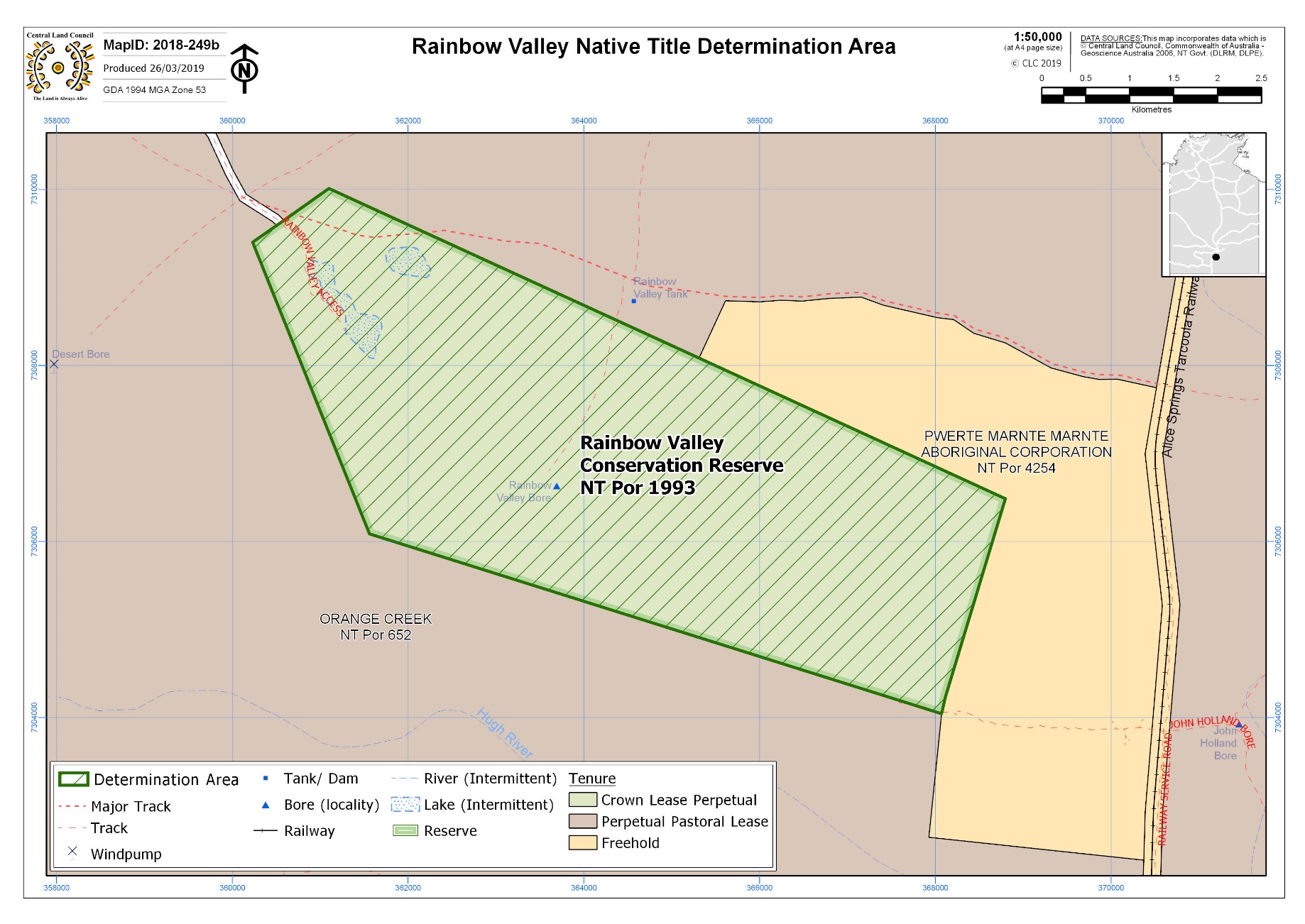
Schedule C
Areas where native title does not exist
Native title rights and interests have been wholly extinguished in the following areas of land and waters:
Public works
1. Those parts of the Determination Area covered by public works as defined in s 253 of the Act that were constructed or established before 23 December 1996 or commenced to be constructed or established on or before that date (including land and waters within the meaning of s 251D of the Act), including:
(a) public roads, namely, rural public roads (50m either side of the centre line), rural arterial roads and national highways and associated road infrastructure;
(b) community, pastoral access and other roads (including access roads and tracks to public works referred to in this paragraph) which are not otherwise public roads;
(c) gravel and fill pits established to maintain the roads referred to in (a) and (b) above;
(d) government bores and associated works;
(e) river and rain gauges;
(f) transmission water pipes (adjacent area 5m either side of the centre line);
(g) distribution water pipes measuring 150mm diameter or less (adjacent area of 1.5m either side of the centre line) and greater than 150mm diameter (adjacent area 5m either side of the centre line);
(h) sewer pipes measuring 150mm diameter or less (adjacent area 1.5m either side of the centre line) and greater than 150mm diameter (adjacent area 5m either side of the centre line);
(i) bores, sewer pump stations and overhead power lines.
2. In addition to the areas referred to in paragraph 1 above, native title has been wholly extinguished in the areas covered by the following public works (including land and waters within the meaning of s 251D of the Act):
(a) stock proof boundary fence (including an adjacent area of 5m either side of the fence line);
(b) Bore RN 13669; and
(c) original ranger camp pit toilet.
Note: Entry of orders is dealt with in Rule 39.32 of the Federal Court Rules 2011.
REEVES J:
INTRODUCTION
1 It is pleasing to see that the practice in the Northern Territory’s Central Region of bringing native title matters to resolution in a timely manner has continued in this proceeding. The expedient resolution of proceedings such as this is important because, all too often, senior members of the claim group pass away without witnessing the recognition of native title with respect to their traditional lands: see, for example, my decision in Doctor on behalf of the Bigambul People v State of Queensland [2016] FCA 1447 at [7] and the decision of Rares J in Prior on behalf of the Juru (Cape Upstart) People v State of Queensland (No 2) [2011] FCA 819 at [30]. For that reason, among others, the expedient resolution of this matter is a great credit to all those involved, including the parties, and their legal and other advisers.
2 On 28 June 2018, Mr Eric Braedon and Mr Peter Kenny, acting as the authorised applicant (the Applicant), filed a native title determination application over an area of land and waters in Central Australia – the claim area described below. That application was filed pursuant to the terms of an Indigenous Land Use Agreement (ILUA) entered into between the Central Land Council and the Northern Territory of Australia and registered on the Register of Indigenous Land Use Agreements on 3 October 2005. The ILUA provided, among other things, that an application for a determination of native title would only be made in circumstances where the parties agreed upon the terms of a consent determination over the area.
3 Consequently, between 2011 and 2018, the parties actively negotiated to endeavour to reach an in principle agreement regarding the terms of a consent determination over the claim area. On 22 July 2011, the Applicant provided the Northern Territory with its anthropological report and a sites, estates and dreaming tracks map prepared by Mr Ray Wood. The Northern Territory reviewed that material and, within a relatively short period, the parties reached agreement on all of the anthropological issues raised by the application.
4 On 27 November 2013, the Northern Territory provided the Applicant with a tenure analysis showing those parts of the claim area where it claimed native title had been extinguished. Again, within a relatively short period of time, the parties were able to reach an agreement with respect to those parts of the claim area in which native title existed and those parts in which it had been supressed, or no longer existed.
5 On 26 March 2019, the parties provided executed consent orders to the Court (the Consent Orders) and the Applicant and the Northern Territory have filed a statement of agreed facts, joint submissions and the anthropological report of Mr Wood. Based on those materials, the parties have now requested the Court to make this consent determination of native title in the terms of the Consent Orders.
THE CLAIM AREA
6 The claim area covers the Rainbow Valley Conservation Reserve. The area was declared a reserve in 1990 and then re-declared as such under s 12 of the Territory Parks and Wildlife Conservation Act 1976 (NT) in 2002. It comprises an area of 24 square kilometres 83 hectares and is located in the drainage of the Hugh River along the northern rim of the James Range, approximately 100 kilometres south of Alice Springs. It is presently held by the Conservation Land Corporation under Crown Lease Perpetual No. 307. It comprises NT Portion 1993. It consists of sand plains covered by desert oak woodland, interspersed with stony outliers of the James Range. It forms a part of Pertame country which includes the area within the Hugh and Finke River drainages.
THE NATIVE TITLE CLAIM GROUP AND THE APPLICANT
7 Rainbow Valley is part of a larger estate known as Imarnte country. As the report of Mr Wood records, the claim group is comprised of the members of three cognatic descent groups, the Braedon, Kenny-Taylor-Briscoe-Forrester and Johnson groups, which are the family groups responsible for the Imarnte estate.
8 The claimants identify as both Imarnte people at the estate level, and as Pertame people at a broader, language-group level. However, the claimants view Pertame as not just a language or dialect grouping, but as a social and cultural one that gives rise to a level of collective rights in Pertame country.
9 Land ownership in the claim area is mainly determined by cognatic descent, but a strong ideal of patrilineal descent and links to upper generation males makes rights transmitted through a person’s father and father’s father a default rule, followed closely by the claims of matrifiliates through their mother’s estate. As well, an individual’s conception site is important. While it mainly functions as a distributor of finer-grain distinctions within the estate descent groups, it has, on occasion, been instrumental in admissions.
10 Apart from the Applicant mentioned above, the only other party to the proceeding is the Northern Territory of Australia.
THE CONDITIONS IN SECTION 87 OF THE Native Title Act 1993 (Cth)
11 Section 87 of the Native Title Act 1993 (Cth) (the NTA) empowers the Court to make an order consistent with the terms of a written agreement between the parties to a native title proceeding without holding a hearing in that proceeding. Before the Court can exercise that power, the procedural conditions specified in s 87(1) must be satisfied. In Nelson v Northern Territory (2010) 190 FCR 344; [2010] FCA 1343 (Nelson), I set out five procedural criteria that the parties must meet in order to have the Court make a consent determination of native title under s 87: see at [3]–[7]. It is convenient to briefly outline each of those criteria and to consider whether they have been met in this matter.
12 The first criterion is that the notice period under s 66 of the NTA must have ended: s 87(1). The present application was notified by the Native Title Registrar on 31 October 2018. The period specified in that notice expired on 30 January 2019. I am therefore satisfied that this first criterion has been met.
13 The second criterion is that the agreement that has been reached must relate to the whole of the proceeding, or to a part of the proceeding, or to a matter arising out of the proceeding: s 87(1)(a). The Consent Orders filed with the Court show that the agreement relates to the whole of this proceeding. This second criterion has therefore been met.
14 The third criterion is that the agreement must be reduced to writing, it must be signed by, or on behalf of, the parties and it must be filed with the Court: s 87(1)(b). As I have already mentioned above, the Consent Orders have been filed with the Court. This criterion has also been satisfied.
15 Fourthly, the Court must be satisfied that an order in, or consistent with, the terms of the Consent Orders would be within the power of the Court: s 87(1)(c). In Nelson, I observed (at [4]):
… An order will be within the power of the Court if it is consistent with s 94A of the [NTA], the rights and interests included in the proposed determination are recognisable by the common law of Australia and there is no other determination in existence over the area the subject of the proposed determination …
16 Section 94A of the NTA requires the Court, in making a determination of native title, to set out the details of the matters mentioned in s 225 of the NTA. Section 225 defines a “determination of native title” as follows:
A determination of native title is a determination whether or not native title exists in relation to a particular area (the determination area) of land and waters and, if it does exist, a determination of:
(a) who the persons, or each group of persons, holding the common or group rights comprising the native title are; and
(b) the nature and extent of the native title rights and interests in relation to the determination area; and
(c) the nature and extent of any other interests in relation to the determination area; and
(d) the relationship between the rights and interests in paragraphs (b) and (c) (taking into account the effect of this Act); and
(e) to the extent that the land or waters in the determination area are not covered by a non-exclusive agricultural lease or a non-exclusive pastoral lease—whether the native title rights and interests confer possession, occupation, use and enjoyment of that land or waters on the native title holders to the exclusion of all others.
17 I have examined the Consent Orders and I am satisfied that each of the matters referred to in s 225(a)–(e) above is appropriately articulated in those orders and the rights and interests so described are recognisable by the common law of Australia.
18 Based on the records of the National Native Title Register kept under Pt 8 of the NTA, I am satisfied that there is no determination of native title in existence over the claim area.
19 I am therefore satisfied that a determination of native title in the terms sought by the parties would be within the power of the Court as required by s 87(1)(c).
20 Finally, before the Court makes a native title determination consistent with the terms of the parties’ agreement, it must be satisfied that it is appropriate to do so: s 87(1A) of the NTA. In Nelson, I noted (at [7]) that these words:
… have been held to confer on the Court a discretion which, subject to the Court being satisfied about the pre-conditions mentioned above, is unfettered. However, like all discretions conferred on the Court, it must be exercised judicially and in exercising it, the Court must have regard to the objects of the [NTA], one of the most important being the resolution of disputes by negotiation and agreement, rather than litigation: Munn v Queensland (2001) 115 FCR 109; [2001] FCA 1229 (“Munn”) [sic – Munn (for and on behalf of the Gunggari People) v Queensland] at [26] and [28].
21 After canvassing the authorities relevant to this question in Nelson, I identified (at [14]) the following principles:
(a) the central issue “is whether there exists a free and informed agreement between the parties”;
(b) in determining whether such an agreement exists, the following factors will be significant:
(i) “the process followed by the State party respondent, particularly how it goes about assessing the underlying evidence as to the existence of native title”;
(ii) “whether the parties have independent and competent legal representation”: Munn (for and on behalf of the Gunggari People) v Queensland (2001) 115 FCR 109; [2001] FCA 1229 (Munn) at [29] and Lovett on behalf of the Gunditjmara People v State of Victoria [2007] FCA 474 (Lovett) at [39]–[40];
(iii) whether the terms of the proposed consent orders are unambiguous and clear: Munn at [32]; and
(iv) “whether the agreement has been preceded by a mediation process”: Nangkiriny v State of Western Australia [2004] FCA 1156 at [6]; Trevor Close on behalf of the Githabul People v Minister for Lands [2007] FCA 1847 at [6] and Lovett at [41]–[42].
22 In their joint submissions, the Applicant and the Northern Territory submitted that it was appropriate that the Court make a determination in the terms of the parties’ agreement because:
(a) the parties were legally represented throughout;
(b) “the Northern Territory … obtained searches of land tenure and mining and other relevant interests to determine the extent of ‘other interests’ within the proposed determination area and provided copies of those searches to all [p]arties”;
(c) “the [p]arties have agreed the nature and extent of interests in relation to the [D]etermination [A]rea and those interests are those described in paragraph” 11(a)–11(k) of the consent orders (s 225(c));
(d) “there are no other proceedings before the Court relating to native title determination applications that cover any part of the [claim] area” “which would otherwise require orders to be made under s 67(1) of the [NTA] (ss 87(1) and (2))”;
(e) “the Northern Territory … has played an active role in the negotiation of the consent determination. In doing so, the Northern Territory, acting on behalf of the community generally, having had regard to the requirements of the [NTA] and having conducted a thorough assessment process, is satisfied that the proposed determination is justified in all the circumstances”.
23 As to the principle set out in [21(b)(iii)] above, I have examined the Consent Orders executed by the parties and I consider that they are unambiguous and clear in their terms.
24 Having regard to these matters and my review of the materials filed with the Court, including, the anthropological report of Mr Wood, I am satisfied that it is appropriate to make orders consistent with the Consent Orders.
THE PRESCRIBED BODY CORPORATE
25 Order 2 of the Consent Orders is to the effect that the native title in question is not to be held on trust. Accordingly, there is no need for me to make a nomination under s 56 of the NTA. However, in these circumstances, s 57(2) of the NTA requires certain steps to be taken to determine which prescribed body corporate is to perform the functions prescribed by s 57(3).
26 On this aspect, the Consent Orders seek a determination that the Wura Aboriginal Corporation is to be the prescribed body corporate for the purposes of s 57(2) and to perform the functions prescribed by s 57(3) of the NTA. That agreement is supported by an affidavit of Ms Susan Polden, a lawyer employed by the Central Land Council and the Applicant’s representative in this matter, in which she deposes that, at a meeting of the native title claim group held on 12 February 2019, the Wura Aboriginal Corporation (ICN: 9008) was nominated by the claim group to be their prescribed body corporate and that the members of the Wura Aboriginal Corporation consented to it being so nominated.
27 Accordingly, as required by s 57(2)(b), I determine that the Wura Aboriginal Corporation is to be the prescribed body corporate to perform the functions prescribed by s 57(3) of the NTA.
CONCLUSION
28 One of the central objects of the NTA is to resolve native title claims by negotiation and agreement. The negotiations and agreement that have led to this consent determination clearly serve to advance that central object. All the more so where, as I mentioned at the outset of these reasons, this consent determination has been achieved in a relatively short period of time. Before concluding, it is also worth adding this observation: this consent determination of native title does not create native title in the claim area; instead it marks the recognition by the Australian legal system of the native title holding group’s long held and pre-existing native title in this land. That is to say, that native title has existed in this land, according to the traditional laws and customs of the claim group, since long before this land became the Rainbow Valley Reserve.
I certify that the preceding twenty-eight (28) numbered paragraphs are a true copy of the Reasons for Judgment herein of the Honourable Justice Reeves. |
Associate:


