FEDERAL COURT OF AUSTRALIA
SZHYH v Minister for Immigration and Border Protection (No 3) [2019] FCA 589
ORDERS
Appellant | ||
AND: | MINISTER FOR IMMIGRATION AND BORDER PROTECTION First Respondent ADMINISTRATIVE APPEALS TRIBUNAL Second Respondent | |
DATE OF ORDER: | 30 April 2019 |
THE COURT ORDERS THAT:
2. The orders of the Federal Circuit Court of Australia made in SYG 551 of 2016 on 15 December 2017 be set aside, and in lieu thereof it be ordered that:
(a) the decision of the Administrative Appeals Tribunal dated 23 February 2016 be set aside;
(b) the matter be remitted to the Administrative Appeals Tribunal for re-determination according to law; and
(c) the first respondent pay the applicant’s costs.
3. The first respondent pay the appellant’s costs of the appeal.
Note: Entry of orders is dealt with in Rule 39.32 of the Federal Court Rules 2011.
ALLSOP CJ:
1 This is an appeal from orders of the Federal Circuit Court of Australia made on 15 December 2017 dismissing an application for judicial review of a decision of the Administrative Appeals Tribunal (AAT) of 23 February 2016 affirming the decision of a delegate of the Minister not to grant the applicant a protection visa.
2 The appellant’s claims for a protection visa reach back to early May 2005, when he arrived in Australia from the People’s Republic of China. Within two weeks of arrival, he made his first application for a protection visa claiming that he would be killed if he returned to China. He was about 36 years old when he made this application. I will come to the claims presently.
3 The first application was refused by a delegate of the Minister in August 2005 and affirmed in November 2005 by the Refugee Review Tribunal (RRT) (the first Tribunal). In July 2007, this first Tribunal decision was set aside by the Federal Magistrates Court of Australia.
4 In October 2007, the RRT once again affirmed the delegate’s decision (the second Tribunal). In October 2008, this second Tribunal decision was also set aside by the Federal Magistrates Court.
5 In February 2009, the RRT once again affirmed the decision of the delegate (the third Tribunal). This time, on 4 June 2009, the Federal Magistrates Court dismissed an application for judicial review. In August 2009 an appeal to this Court was dismissed: SZHYH v Minister for Immigration and Citizenship [2009] FCA 1001. On 10 March 2010 the High Court refused special leave to appeal.
6 After the decision of the Full Court in SZGIZ v Minister for Immigration and Citizenship [2013] FCAFC 71; 212 FCR 235 that was concerned with the proper construction and reach of s 48A of the Migration Act 1958 (Cth), the appellant, on 26 September 2013, lodged another (second) visa application. This application was refused by a delegate on 13 June 2014. The AAT affirmed this decision on 23 February 2016. An application for judicial review of this (fourth) Tribunal decision was dismissed by the primary judge in the Federal Circuit Court on 15 December 2017. The appeal is from those orders.
7 The claims for this visa were (as was necessary by reason of s 48A construed in accordance with SZGIZ) based on the complementary protection criterion in s 36(2)(aa) of the Migration Act; that there are substantial grounds for believing that as a necessary and foreseeable consequence of being removed to China, there is a real risk that the appellant will suffer significant harm.
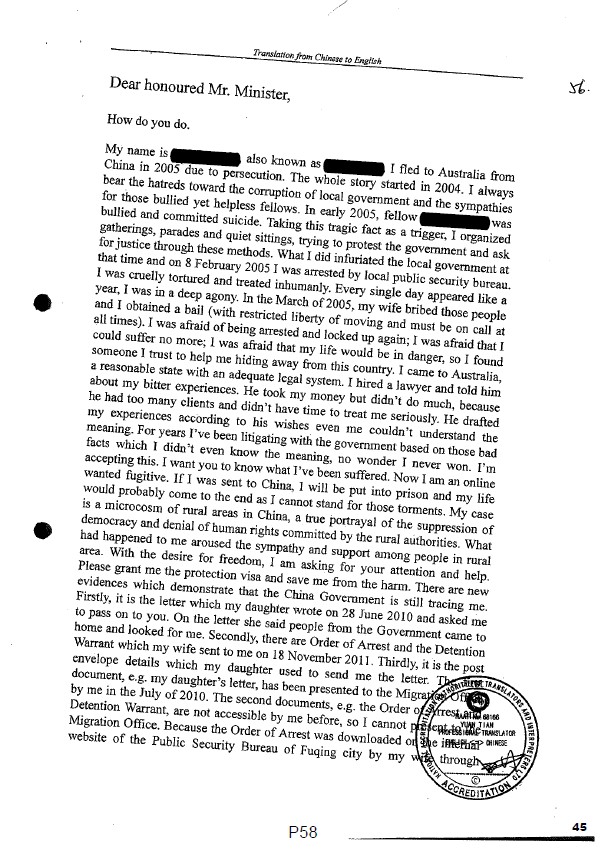
8 The appellant’s claims were set out from [5]-[22] of the decision record. The primary judge summarised them at [17] of his reasons from a letter of the appellant dated 28 December 2011 attached to his earlier protection visa application:
a) The Applicant fled from China to Australia in 2005 due to persecution.
b) In early 2005, following the suicide of his friend as a result of local government bullying, the Applicant organised gatherings, parades and quiet sit-ins in order to protest to the government and to ask for justice. This course of action “infuriated the local government” which led to his arrest by the Public Security Bureau in China on 8 February 2005.
c) While under arrest, the Applicant was “cruelly tortured and treated inhumanly”. In order to get out of prison, in March 2005 his wife bribed the Public Security Bureau and he was able to get bail, conditional upon him being restricted from moving and being “on call at all times”.
d) Due to fearing for his life, fear of “being arrested and locked up again”, and being “afraid that [he] could suffer no more” the Applicant came to Australia.
e) The Applicant fears that he is now “an online wanted fugitive” in China, and that if he was sent back there he “will be put into prison and [his] life would probably come to [an] end”.
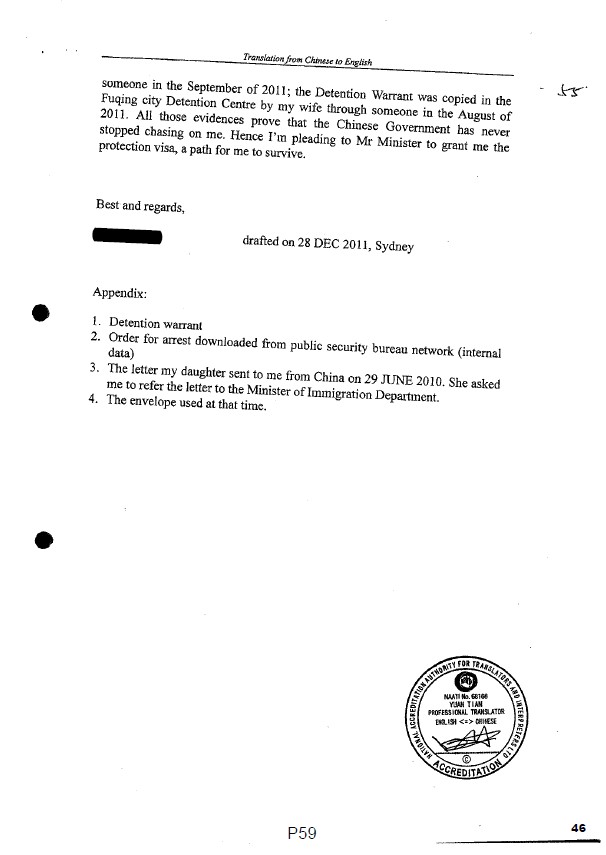
f) The Applicant claimed that the Chinese Government is still “tracing” him and “never stopped chasing” him. This was said to be evidenced by three documents available since the third RRT decision being:
i) a letter sent from the Applicant’s daughter dated 28 June 2010 stating that the Chinese authorities have visited their family home in China enquiring after the Applicant;
ii) the envelope in which the letter from the Applicant’s daughter arrived, which shows that the Applicant received the letter in June, 2010; and
iii) a copy of an order of arrest and a detention warrant in the Applicant’s name which was sent to him on 18 November 2011 by his wife.
9 As is sometimes the case in these matters, the summarising of a person’s claims for protection into separate paragraphs or integers can decontextualize and disembody their coherence. I attach to these reasons an English translation of the letter of 28 December 2011 (excluding attachments).
10 The primary judge at [28]-[33] recorded the approach of the Tribunal to the claims:
28 At [8] of its Decision Record the Tribunal recorded that the Applicant admitted that he had not been employed by the Longxing Color Printing Company Limited when he had come to Australia in May 2005 and that the letter of reference on the letterhead of that company confirming his employment, which he submitted for the purposes of his Visitor visa, was false.
29 At [23]–[46] of its Decision Record the Tribunal recorded its discussion of the Applicant’s claims with the Applicant at the Tribunal hearing. Much of that discussion involved seeming inconsistencies in his evidence as made over the years by him since the lodgement of his first Protection visa application.
30 At [47]–[60] of its Decision Record the Tribunal stated its conclusions.
31 At [59] of its Decision Record the Tribunal recorded that it did not accept that the Applicant was a witness of truth because of significant inconsistencies in his evidence and it did not accept that the Applicant had ever been of any interest to the Chinese authorities.
32 I do not consider it necessary for present purposes to generally recount and recapitulate the Tribunal’s detailed consideration of the claims and evidence given by the Applicant since 17 May 2005 when he lodged his first Protection visa application. The Tribunal proceeded in this respect by considering his claims for protection as articulated from time to time and putting to the Applicant at the hearing various perceived inconsistencies in that body of evidence and seeking his explanation of those inconsistencies. The Tribunal gave extensive and comprehensive reasons for rejecting the Applicant’s claims to protection and those reasons appear to be legally reasonable and do not constitute a blanket, reflex or exaggerated adverse credit finding but rather reflect a proper examination of the Applicant’s claims: see AZU15 v Minister for Immigration and Border Protection [2016] FCAFC 74; (2016) 240 FCR 143 at 145 [11].
33 In the result the Tribunal was not satisfied that there were substantial grounds for believing that as a necessary and foreseeable consequence of his removal from Australia to China that there was a real risk that the Applicant would suffer significant harm and it affirmed the Delegate’s decision not to grant to the Applicant a Protection visa.
(Emphasis added.)
11 In short, the Tribunal disbelieved the appellant. That lack of acceptance that the appellant was a “witness of truth” was based on what were described by the Tribunal as a series of “significant inconsistencies” in the appellant’s evidence. There was no express reliance on demeanour.
12 The six bases for judicial review that were dismissed by the primary judge were as follows:
1 The Tribunal failed to give to me particulars of information, including inconsistencies relating to my employment, addresses where I lived in China and where my wife and children had been living after I had left China and so on, that the Tribunal considered or had used would be the reason or a part of the reason, for affirming the decision;
2 The Tribunal failed to ensure that I understand why the information is relevant to the review;
3 The Tribunal failed to invite me to comment on the information;
4 The Tribunal took into account of irrelevant considerations. The Tribunal did not consider my claims of persecution and of that there is foreseeable consequence that if I am removed from Australia to China there is a real risk that I will suffer significant harm. The Tribunal did not consider the Certificate as the evidence to support my story and claims. The Tribunal dismissed and ignored my story and claims because the Tribunal took into account of irrelevant considerations on inconsistencies in the evidence and the Tribunal came to a credibility conclusion without considering or putting any weight on the evidence I provided and/or assessing my claims;
5 The Tribunal concluded that I was not a credible witness and therefore the Tribunal found and decided that none of my claims is true and my evidence provided is also not true; and
6 The Tribunal did not give any other reason why the Tribunal did not assess my claims or consider the evidence I provided but the Tribunal gave the only reason that my claims had been rejected or ignored due to the problem of my credibility.
13 Counsel for the Minister on appeal in his written submissions helpfully distilled the core of these bases as follows:
(a) [The Tribunal] failed to put the inconsistencies which it observed in the Appellant’s evidence to him for comment, ensure that he understood why they were relevant to the review, and/or invite him to comment on the information, in breach of s 424A of the Act;
(b) [The Tribunal] “considered irrelevant considerations”;
(c) [The Tribunal] found that the Appellant was not a credible witness “without considering or putting any weight” on his evidence; and/or
(d) [The Tribunal] made findings regarding particular items of evidence provided by the Appellant which were not based on probative evidence or were otherwise affected by legal unreasonableness.
14 The primary judge’s reasons as to the central findings were that the Tribunal gave “extensive and comprehensive reasons … [that] appear to be legally reasonable and do not constitute a blanket, reflex or exaggerated adverse credit finding” ([32] of the reasons); which were “detailed and legally reasonable” ([47] of the reasons). One aspect of this was that the Tribunal’s adverse credibility findings provided an appropriate basis for it to afford “lesser weight to the Applicant’s corroborative documents than to significant inconsistencies in the rest of his evidence” ([53] of the reasons).
15 The appeal to this Court initially had three grounds:
1. The Tribunal was not professional, which led to my lack of evidence.
2. AAT denied all the evidences I provided without any consideration.
3. The staff’s attitude was so bad, which caused me not to state well.
These grounds departed from the grounds below.
16 The appeal first came on for hearing in May 2018. The appellant appeared for himself with an interpreter. There was some lack of clarity and possible confusion about filing documents. I made various orders for provision of the transcript of the proceeding before the primary judge and for referral to a pro bono lawyer. I stood the matter over to 19 June 2018 to allow a pro bono lawyer to assist the appellant: SZHYH v Minister for Immigration and Border Protection [2018] FCA 687. At the request of counsel who took up the matter, the appeal was further adjourned part-heard to 18 September 2018. The matter was relisted shortly prior to that date on 13 September at the request of pro bono counsel (Ms Gleeson) who wished to withdraw as she was unable to continue to appear for the appellant. I recorded what happened in [2]-[4] of a brief judgment on that day: SZHYH v Minister for Immigration and Border Protection (No 2) [2018] FCA 1417:
2 I accept it that is not appropriate for any further explanation to be given. But [Ms Gleeson] has instructions today from the appellant to seek an adjournment of next week’s hearing and for any orders for any timetabling. Unfortunately, my reasons of 11 May were not given to Ms Gleeson until recently. I have discussed the matter with Ms Gleeson and Mr Kaplan, who appears for the Minister. Irrespective of any wishes of the appellant, I propose to seek the assistance of counsel to act as an amicus curiae to put all submissions as can properly be put in furtherance of the appellant’s appeal.
3 This will necessitate another approach to the New South Wales Bar Association and a further adjournment. One of the reasons I think this is appropriate is that the matter has been before a Tribunal on a number of occasions and set aside on a number of occasions. I don’t say that out of gratuitous criticism. It is just that this appellant’s confidence in the exercise of administrative and judicial power is important, in particular in the light of the serious assertions he makes as to the Chinese authorities and are which are the basis of his claim.
4 I propose to adjourn the matter to a date to be fixed for hearing, before which day I will give the appellant a further opportunity to put any submission in writing, and the amicus curiae an opportunity to put any submission to me in the interests of the appellant. This will mean that the matter will not be able to be heard probably before November. Nevertheless, I will seek to have the matter listed at a day convenient to the appellant, amicus curiae, the Court and the Minister.
17 The appeal was once again listed for hearing on 12 December 2018. Mr Free SC and Ms Trahanas appeared as amici curiae. Careful written submissions were filed and addressed on the day. The Court is grateful for the skill and diligence of all counsel who have assisted in the matter (by which I include Mr Kaplan for the Minister, and Ms Gleeson, who felt compelled to withdraw). I particularly wish to thank Mr Free SC and Ms Trahanas for their assistance. The willingness of counsel to appear, without fee, to assist the Court in any matter, but in particular in matters in which, on one hypothesis, a party may be placed at great personal risk depending on the result, should be acknowledged as an important aspect of the administration of justice and the Rule of Law.
18 The submissions of the amici focused on the credibility findings which were said to display legal unreasonableness and jurisdictional error. No amended notice of appeal was required because ground 2 of the notice of appeal had been taken by the Minister to be directed to this subject.
The appellant’s claims
19 The appellant said he stood for election to be leader of the village of Beichen and that he was elected in December 2004. In support of his first protection visa application he relied on a certificate of the Villagers Committee Member as evidence of his election. This document was destroyed by the first Tribunal after the first application and was not available to the later constituted tribunals in 2015 and 2016. Its contents can be gleaned from earlier decisions of the first Tribunal and the Federal Magistrates Court, where it was apparently accepted as genuine. It had never been denounced as a forgery.
20 In January 2005, a neighbour of the appellant committed suicide over an inability to pay local government taxes. To protest high taxes and to request fair treatment for villagers the appellant organised peaceful protests in Sanshan Town and Fujian City. He said this infuriated the local government. He said he was arrested on 8 February 2005 by the Fuqing City Public Security Bureau (PSB) and detained for a month. He said he was “cruelly tortured”. He said his wife bribed officials to have him released on bail, with restricted movement conditions. He said that he could be called on by the PSB at any time. In support of this claim about his detention he had a “Certificate of Releasing from Detention” from the Fuqing City Detention Centre, said to have been copied in the detention centre by his wife. He also relied on a copy of an order of arrest which he said was downloaded from the internal website of the PSB in September 2011. That order stated that he was wanted from 17 June 2005. The “case briefing” (in translation) in the document stated:
On 20 Jan, 2005, a riot happened in Sanshan Town, Fuqing City, Fujian Province. [SZHYH] has instigated and organised general public against national enforcement with violence, resulting in the huge lost [sic] with the public property. Now the person is on the run, any informants would be rewarded.
His addresses were set out as “household address” and a “current address”.
21 He said he feared for his life and someone assisted with his departure. He considered that he would be still the subject of interest to the local government. In support of this he provided a letter from his daughter dated 28 June 2010 which stated that the family was “often harassed by the local government”. The letter stated, amongst other things:
What was more frightening is that we were often harassed by the local government. They often mythically [sic] followed us, kept a lookout over us and investigated my father’s recent situation etc. Their intention of arresting my father and avenging us scares me. We dare not ask my father to come back for the sake of his safety. We miss him a lot, but we don’t want him to be persecuted.
The Tribunal’s decision
22 The Tribunal’s decision turned on a lack of belief in the appellant’s evidence because of perceived inconsistencies. It also referred in its reasons to the advice of the Department of Foreign Affairs and Trade that “fraudulent documents are relatively easy to produce in China”. No express finding, however, was made that any document was a forgery or fraudulent, though, perhaps, there may be no escape from that conclusion. Thus, the findings that the appellant was entirely untruthful, and that apparently corroborating documents could be put to one side (including the one that had been destroyed by an earlier Tribunal) rested entirely on the strength of perceived inconsistencies in the appellant’s accounts of his claims and history.
23 The Tribunal did not accept that the appellant had been elected as a director of the committee or head of Beichen Village in 2004; that he had organised protests, or been arrested; that his wife had paid money to have him released, or that he was required to report as a condition of his release, or that not having done so, he was wanted; that he was on bail when he left China or that a friend helped him by paying money to enable him to evade the controls of people departing China; that the appellant’s wife and children moved to another province after he left China; that his family had any problems with the authorities, including any problems as referred to in the daughter’s letter; that the appellant is regarded by the Chinese authorities as an anti-government activist or a person who had strong anti-government ideologies or dissident opinions or that the appellant had ever been of interest to the Chinese authorities.
24 The discussion of the inconsistencies is over nearly four pages of single-spaced typescript from [47]-[58].
25 The first group of inconsistencies concerned matters that dated back to his first application when events were somewhat fresher. They related to the evidence as to where he lived and his employment.
26 The first subject was his employment. In his first application the appellant referred to employment with the Fuzhou Chuangxin Computer Company from August 1998 to December 2004. He had been “confronted with the fact” that in seeking a visa to visit Australia in October 2004 he had said that he was employed by the Fujian Fuqing Longxing Color Printing Company. He explained this by stating that in preparing his first protection visa application he had forgotten to tell the migration agent of his employment with the printing company. In a subsequent statutory declaration in 2007 he said he worked for the printing company from January 2002 to August 2004 for 15 hours per week, and normally worked at the computer company 25 hours per week. However, before the third Tribunal he had said that his trip to Australia in October 2004 had been a business trip for the printing company (for which he had said in the statutory declaration he ceased employment in August 2004). The Tribunal then put these inconsistencies to him and recorded his response at [49] of the decision record:
… After the Tribunal asked him why he would have come here on a business trip for the printing company in October 2004 if he had ceased working for the company in August 2004 he said that because it was some time ago he was confused with the dates. He said that perhaps he could start from the beginning and give the Tribunal the correct information. He said that because he had been beaten in the past this had affected his memory. He said that the truth was that he had kept working in the company until December 2004. He claimed that he had stated that his employment had ceased in August 2004 because he had been confused and he had not been thinking clearly. He said that he had not referred to his employment with the printing company in his first application for a protection visa because he had not felt it was necessary because he had believed that the Department would have all the records in relation to his business trip sponsored by the company.
27 The significance attached to all this was a conclusion that the inconsistencies were untruths, not lapses of memory. At [50] of the decision record the Tribunal said:
… [SZHYH] said that he could not remember the exact time or these details because he had suffered persecution and he had a bad memory. He said that he was telling the truth but because of the lapse of time and his bad memory there might be mistakes. However I have difficulty in accepting that, even taking into account the lapse of time and his claimed memory problems, [SZHYH] would not recollect whether he had stopped working for the printing company in August 2004 or whether he had still been working for the company in October 2004 when he first visited Australia on what he has said was a business trip for that company. As I put to him, I consider that these inconsistencies in [SZHYH]’s evidence go to whether I can accept that he [sic] telling the truth.
28 The Tribunal then turned to inconsistencies about where the appellant had lived. In his first protection application he had stated that he had lived in Sanshan Town in Fuqing City from May 1995 to April 2005. He restated this at the hearing before the third Tribunal in 2009. But in the current application before the Tribunal he had said that he had lived at an address in Fuzhou City (a city about one hour away from Fuqing City) from March 2002 to May 2005. This was confirmed to the primary decision-maker in 2014. He told the Tribunal that he had been living at this address in Fuzhou (for 2 years) which was his household registration (or hukou). Whilst the Tribunal placed no weight on the discrepancy between two and three years living at Fuzhou City, it did place importance on what it saw as the inconsistencies in living in Sanshan Town in Fuqing City from 1995 to April 2005 and in Fuzhou City from March 2002 to May 2005 and in the appellant’s explanation, as explained in [51] and the first part of [52] of the decision record:
… I do attach significance to the fact that, as I put to him, in his first application for a protection visa in 2005 he did not mention living in Fuzhou City at all. [SZHYH] said that he had sometimes lived there and sometimes in Fuzhou City and he gave evidence to me that when he had been working for the innovation company in Fuzhou City he had lived in the company. He also said initially that when he had been working for the printing company in Longtian Town in Fuqing City he had lived in the printing factory but he said subsequently that the factory in Fuqing was very small and that they did not have a dormitory so when he had been working there he had had to stay with his family in his old house in Sanshan Town in Fuqing City. He said that he had spent half of his time in Sanshan Town but he confirmed that for around two years before he had left China he had been living in Fuzhou City and that his wife and children had been living there as well.
I consider that the inconsistency in [SZHYH]’s evidence with regard to where he was living immediately before he left China cannot be explained on the basis of the lapse of time or his claimed memory problems, given that he claimed in his first application, made in 2005 when these matters would presumably have been freshest in his memory, that he had been living in Sanshan Town up until April 2005 whereas he now says that he had been living in Fuzhou City with his wife and children for at least two years by that time and that his household registration or hukou was at this address. Once again I consider that this inconsistency in his evidence is relevant to his credibility. …
29 The Tribunal then (in [52] of the decision record) to deal with inconsistencies concerning where his family had lived after he left China, as follows:
… He initially said that after he had left China his wife and children had continued living at the address he had given in Fuzhou City and that they were still living there now. After I put to him that at the hearing before the third Tribunal in 2009 he had said that they had gone to live with his wife’s brother in Hainan Province on 4 May 2005, the day after he himself had arrived in Australia, and that they were living in Hainan Province at the time of the hearing in 2009, he said that they had gone to Hainan but that he could not remember the exact time. He said that when he had stated that they had continued living in Fuzhou City he had meant that their hukou or household registration had been there. As I put to him, I consider it relevant that the letter which he produced supposedly written by his daughter makes no reference to his family ever having gone to Hainan Province. [SZHYH] said that they had really gone to Hainan Province but that if I asked him where they lived he would definitely tell me that they lived in Fuzhou. Once again I consider that these inconsistencies in [SZHYH]’s evidence are relevant to his overall credibility.
30 The next matter highlighted by the Tribunal concerned the appellant’s claim that he had been elected as the president of the Beichen Village. In support of this was the document produced to the first Tribunal which had been destroyed. The findings of inconsistencies by the Tribunal in respect of this subject were heavily attacked in the submissions of the amici. It is appropriate to set out [53] and [54] of the decision record in full:
[SZHYH] has claimed that on 25 December 2004 he was elected as the president of Beichen Village. In support of this claim he produced to the first Tribunal what is described as a ‘Certificate of the Villagers Committee Member’ issued on 25 December 2004 and stating that he had been elected as the Director of the Villagers Committee. In a letter to the Tribunal dated 24 October 2005 [SZHYH] said that this document was evidence that he had been successfully elected as the Director of the Administrative Committee of Beichen Village at the election on 25 December 2004. He said that according to relevant policies a candidate had first to be elected as the Director of the Administrative Committee and then appointed by the government as the president or deputy president but he had not been genuinely appointed as the president or the deputy president for the reasons he had mentioned in his application. At the hearing before the third Tribunal [SXHYH] said that although he had been elected he had not become head of his village because the appointment letter had never come from the authorities. He said that if he had been appointed his title would have been vice-president of the village. He said that although this was the title people regarded this person as the actual president of the village.
At the hearing before me, after I referred to the fact that [SZHYH] had said that he had been elected as the director of the Administrative Committee of Beichen Village, he said that this was the deputy leader of the village. He then said that the leader of the village was actually the director of administration of the village. I put to him that what he had said previously was that, although he had been elected as the director, the government had had to appoint him as either the president or the deputy president. [SZHYH] said that this was correct. I put to him that he had just told me that the director of administration was the leader of the village. [SZHYH] repeated that in China the director of administration was the village leader. He said that there were only two offices: the director of administration and the secretary of the village who he said was a member of the Communist Party. As I put to [SZHYH], I consider that this is another matter in relation to which he has given inconsistent evidence. He has produced the certificate stating that he was elected as the director and on some occasions he has said that the director is known as the head or the leader of the village but on other occasions he has said that he had to be appointed by the government as the deputy president or president of the village. [SZHYH] repeated that the director of administration was the leader of the village in China. I remain of the view that there are significant inconsistencies in [SZHYH]’s evidence in this regard.
31 The Tribunal then turned at [55] of the decision record to another reason not to accept that the appellant had been elected as leader of the village of Beichen – that he had lived in Fuzhou City for two years. The Tribunal said:
… [SZHYH] said that he had been born and had grown up in Beichen Village but, as I put to him, he said at the hearing before me that his hukou was in Fuzhou City. [SZHYH] said that his hukou was in Fuzhou City but he had spent half of his time in Beichen Village and he said that people in the village had known him because he had grown up there. However, as I put to him, I consider that the people in the village would have known that he had moved away to Fuzhou City. [SZHYH] repeated that he had been born there and that whatever happened it would always be his hometown. He said that although his hukou had been in Fuzhou City this was not related to the election. I remain of the view that it is difficult to accept that [SZHYH] would have been elected as the director of administration or the head of Beichen Village when he had moved to live in Fuzhou City two years previously.
32 The Tribunal next turned to the date of the alleged protest in Sanshan Town and Fuqing City, 20 January 2005 and the date on which the appellant said he was arrested, 8 February 2005. The Tribunal at [56] of the decision record found it “difficult to accept” that there would be a two week gap between the protest and his arrest:
[SZHYH] has consistently said that he was arrested on 8 February 2005, Chinese New Year’s Eve, and at the hearing before me he said that this had maybe been a few days after the protests which he claims to have organised in Sanshan Town and Fuqing City. As I put to him, the wanted notice which he has produced – if it were accepted as genuine – suggests that the protest in Sanshan Town took place on 20 January 2005. [SZHYH] said that he had forgotten the exact time. After I put to him that it was a little difficult to accept that, if the government had wanted to stop him from organising protests, they would have waited for over two weeks before arresting him, he said that according to the government’s standard operating procedure they would not set a certain day for a certain case. He said that they might think which day was the most important date so they would write down that date. After I asked him if he was saying that they had waited for Chinese New Year's Eve because it was an important date he said that it was a matter for them when they would arrest him. He said that he had not known why and when they would arrest him because of his organising the public. I accept that it would of course have been a matter for the Chinese authorities when they arrested [SZHYH] but I remain of the view that it is difficult to accept that, if the protest had taken place on 20 January 2005 as suggested by the wanted notice – which [SZHYH] maintains is genuine – the Chinese authorities would then have waited for over two weeks before arresting him.
33 The Tribunal then turned to the question of his release on bail and the lack of reference in the document produced (the Detention Certificate) to the bail conditions. The Tribunal said at [57]:
… [SZHYH] said that his document showed that he had been detained. He said that actually he had been bailed and released. With regard to his evidence that he had had to report to the police every week but that this condition had been removed after the three weeks because he had become seriously ill, he said that this had been an excuse because he had already paid money for his bail. He said that actually his case had not been resolved. He said that he had had to report to them weekly to ensure that he was not escaping but then he had escaped to Australia. He said that since he had not reported he had been wanted. Quite apart from the fact that the ‘Certificate of Releasing Detention’ makes no mention of [SZHYH] having been released on bail, his evidence that he is wanted because he did not report to the police is inconsistent with his previous claim that the reporting condition on his bail had been removed because he had become seriously ill.
34 The Tribunal then turned to the final subject matter that affected its credit findings – how the appellant left China and the assistance he received in so doing. The difficulty of the Tribunal which began this exchange was how he could leave the country while he claims he was on bail. The Tribunal found it difficult to accept that he would not have had to surrender his passport as a condition of bail. The Tribunal said the following about this and other aspects of his leaving China at [58] of its reasons:
… [SZHYH] said that they had not kept his passport but, as I put to him, I find it difficult to accept that this is true. As I likewise put to [SZHYH], departing passengers are checked against alert lists and China has a computerised national policing network. When this issue was raised at the hearing before the third Tribunal in 2009 [SZHYH] said that, because he had been ill and his wife had paid money to the person looking after his case, this person had not expected that he would leave China. He said that the police officer had been aware that he had been severely tortured in detention. He said that he had not been able to walk when he had been released: he had had to be carried out. He added that nothing in relation to his detention had been recorded in his personal file because this police officer had been paid. He said that lots of people escaped from China every year. At the hearing before me [SZHYH] said that he had paid money to his friend [redacted]. He said that of course there was a national computer network and that he did not know how [redacted] had bought out people to allow him to pass this. I accept that [SZHYH] said in the statutory declaration accompanying his first application that [redacted] had ‘arranged me to leave the country early in May 2005’ but, as I put to him, he had previously suggested that she had arranged his visa for him but not that she had paid money to facilitate his departure from China when he was on bail. As I put to him, I consider that this is another inconsistency in his evidence.
The amici submissions
35 The amici put forward four grounds for a submission that the Court should conclude that the credibility findings were legally unreasonable.
36 First, important findings of the Tribunal regarding important aspects of the appellant’s claims did not have a logical, rational or prohibitive basis. These were as follows:
(a) The purported inconsistencies in the appellant’s evidence relating to the title of the position to which he had been elected were illogical and irrational. The phrases that he had used (director, head, leader, deputy president, president) all connoted a leadership position in very similar senses. The Tribunal, it was submitted, focused on minor differences in terminology to reject the appellant’s evidence as being inconsistent and to lack credibility. It did so without considering whether the supposed inconsistency might more readily be explained by an innocent lack of terminological precision by the appellant or by the interpreters.
(b) The basis for the refusal to accept that the friend had paid money to enable him to leave China was that he had given evidence that the friend had arranged for him to leave China and he had also said at the time that the friend had paid money to facilitate his departure while he was on bail. The fact that he had provided specific information about his friend having assisted him providing him with a visa at a previous point in time did not logically suggest that the friend had not provided other assistance, let alone exclude that as a logical possibility.
37 The second proposition was that a number of findings of fact were based on unwarranted assumptions, not evidence available to and considered by the Tribunal. These were as follows:
(a) Part of the reason that the Tribunal did not believe that the appellant had been elected leader of Beichen village was because he had not been living there. This involved an unwarranted assumption about the need for candidates for election in local villages to be residents. The appellant had explained that he was elected leader of Beichen village because he had grown up there, and not living in Beichen village did not therefore logically suggest that the appellant would not have been elected to a leadership position there.
(b) The Tribunal did not accept that he was arrested and tortured because it was hard to believe that the Chinese authorities would have waited two weeks to arrest him. This view is based on the unwarranted assumption that the police waiting for two weeks before arresting him was inherently unbelievable. There was no basis in evidence or common sense for this assumption on this view. Any number of explanations could be plausible as to why the PSB took two weeks.
(c) The Tribunal did not accept that the appellant’s wife had paid money to have him released on bail in part because the Detention Certificate did not refer to bail. Again this is based on some unwarranted assumption that a genuine Detention Certificate would have referred to bail. The appellant explained that the Detention Certificate was a pro forma document and bail would not be necessarily listed on it.
(d) The Tribunal made a further unwarranted assumption that if the appellant had been on bail the authorities would have required him to surrender his passport. There was no basis for this being a sound assumption.
38 The third proposition was that the Tribunal’s findings regarding inconsistencies in the appellant’s evidence about where he lived, his employment and the whereabouts of his family were minor matters upon which the Tribunal placed unreasonable emphasis in rejecting the appellant’s claims. They were an unreasonable basis for finding that there were no substantial grounds for believing that as a necessary and foreseeable consequence of being removed back to China he faced the real risk of significant harm.
39 The fourth proposition was that the Tribunal failed to engage in an active intellectual manner with the corroborative documents; namely the Election Certificate, the Detention Certificate, the Arrest Order, and the daughter’s letter. In rejecting the appellant’s claims as a matter of logic the Tribunal must have rejected the corroborative documents. However the Tribunal did not attempt to analyse or explain the documents and simply gave greater weight “to the problems with the inconsistent evidence”.
Consideration
40 The development of the law on legal unreasonableness since Minister for Immigration and Citizenship v SZMDS [2010] HCA 16; 240 CLR 611 and Minister for Immigration and Citizenship v Li [2013] HCA 18; 249 CLR 332 has seen the clearer recognition that findings of fact, even ones based on credit, are not immune from judicial review based on jurisdictional error. See, for example and in particular, the important judgment of Robertson J in Minister for Immigration and Citizenship v SZRKT [2013] FCA 317; 212 FCR 99. It can be accepted that credit findings have a particular and important place in decision-making, whether of courts or tribunals: see the remarks of McHugh J in Re Minister; Ex parte Durairajasingham [2000] HCA 1; 168 ALR 407 at [67]. For this reason, no doubt, a court exercising the power of judicial review should be cautious in its approach to deciding whether the decision-maker, in dealing with the factual material, including the oral evidence of the applicant, has failed to exercise its statutory task by an approach which can be criticised as seriously irrational, illogical or lacking material foundation in important aspects. There is no formula involved. Careful attention must be paid to the reasons and approval of the decision-maker: Minister for Immigration and Border Protection v Singh [2014] FCAFC 1; 231 FCR 437 (Allsop CJ, Robertson and Mortimer JJ) not for the purpose of ascertaining the facts, but for the purpose of deciding whether the approach of the tribunal was sufficiently lacking in foundation, rationality, or logical coherence in a way that could have affected the outcome so as to be legally unreasonable. It can be accepted that reasonable differences of views as to material are insufficient to found legal unreasonableness. The flaw in the fact-finding or treatment of the evidence must be sufficiently seriously illogical, irrational or groundless as to compromise the decision, in that the credit finding can be seen as compromised. See the Full Court decisions which deal with the review of credit findings: ARG15 v Minister for Immigration and Border Protection [2016] FCAFC 174; 250 FCR 109; ASB17 v Minister for Home Affairs [2019] FCAFC 38; AVQ15 v Minister for Immigration and Border Protection [2018] FCAFC 133; 361 ALR 227; CQG15 v Minister for Immigration and Border Protection [2016] FCAFC 146; 253 FCR 496; DAO16 v Minister for Immigration and Border Protection [2018] FCAFC 2; 258 FCR 175. I refer to what I said in CWR16 v Minister for Immigration and Border Protection [2018] FCA 859 at [60]-[65].
41 The submissions of the amici correctly emphasised the interconnectedness of all the findings of inconsistencies and the ultimate finding of lack of belief. The finding of lack of belief was sufficiently strong for the Tribunal not to consider the corroborating documents, other than, impliedly, as concocted. Here, if there are important criticisms that can be seen as valid about important aspects of the Tribunal’s approach to inconsistencies and the truthfulness of the appellant, there is nothing in the structure or balance of the reasons which would permit such a strong credit finding to stand. That said, it goes without saying, that some errors of a minor nature may not otherwise taint fatally the ultimate finding of disbelief, if that finding were overwhelmingly available from other unimpeached findings. The exercise is case- and fact-specific.
The question of the leadership of Beichen Village
42 The first focus of attention by the amici was the subject of the appellant’s leadership of the village, dealt with by the Tribunal at [53] and [54] of its reasons.
43 I agree with the submissions of the amici that the textual distinctions of the capacity in which the appellant was elected were minor, they were distinctions almost completely without a difference. There was no basis either in country information or the evidence for any real weight to be placed upon them. This is particularly the case when there had been a document in existence which had been destroyed and which apparently stated that he had been elected as the director of the village’s committee in December 2004. The Tribunal did not reject the proposition that the certificate had existed and that is what the certificate said. But there was some perceived inconsistency in language in the leadership position apparently sufficient for the Tribunal to reach the conclusion of untruthfulness and a lack of need to consider the apparently corroborating document. The transcript of this at the hearing in the Appeal Book at pages 168 to 170 reflects a focus on detail and distinctions that, on their face, appear irrelevant or meaningless. What this transcript shows was, as Mr Free submitted, that the appellant confirmed what he had always said: that he was elected director and because of that he was regarded as the leader of the village.
44 It is impossible to view these textual distinctions (expressed through more than one interpreter on more than one occasion) as other than broadly distinctions without differences. The essential idea or meaning of the appellant’s account was consistent. To elevate the distinctions in languages as was done, and with such apparent significance, is concerning. This was exacerbated by the entirely unwarranted assumption that this village (where he said he grew up) would not elect him to a leadership position because he did then live there. That the appellant indicated his household registration was in Fuzhou does not affect the conclusion that, taken together, these questions of inconsistency and unwarranted assumption made the finding as to this critical part of the appellant’s story of no real reliability.
How he left China
45 The approach of the Tribunal is set out at [34] above. There was again a finding of inconsistency in the appellant’s account of leaving China. Critical to [58] of the Tribunal’s reasons was the second last sentence of the paragraph. There are a number of problems with these findings. First, there is a finding of inconsistency in circumstances where all the Tribunal had identified was that in an earlier account the appellant had said that his friend had arranged for him to leave the country early in 2005, not saying anything either way about bribery. Then, in his most recent Tribunal hearing he had suggested that she had paid money to facilitate his exit because he was on bail. There does not appear to be any inconsistency. Further, there was material in the most recent delegate’s decision which revealed the consistency of the appellant’s claims in this regard over time. The delegate summarised what the appellant had claimed in attending three RRT hearings. The summary of what the appellant had consistently claimed at these hearings was that he left the country without any difficulty because he paid bribes. To conclude as the Tribunal did at the end of [58], that it was inconsistent for the appellant to be claiming in his fourth Tribunal hearing that bribes had been paid by his friend to facilitate his departure, reveals a clear failure to engage with all the material which was before the Tribunal, and to make an important and damaging finding which was groundless and contrary to the available material.
46 Related to these matters concerned with his leaving China was the assumption made that if the appellant had been on bail the authorities would have required him to surrender his passport. There was no basis in the country information or any other material from that assumption. The Tribunal was bringing (without any apparent basis in expressed expertise, country information on material before it) an apparent personal assumption forward as a critical factor in a finding of disbelief.
Two weeks to be arrested?
47 The approach of the Tribunal is set out at [32] above.
48 It was critical to finding that the central event of his story did not take place that it was not credible that SZHYH would be arrested two weeks after a protest. There was no foundation in logic, or experience, or material for that assumption to be made. There was no country information to support it. One cannot say, one way or the other, without some foundation, that the PSB would or would not take one week, two weeks or three weeks to arrest someone. Why, one asks, is it difficult to accept? Again this is a personal assumption made without any apparent connection with country information, material or common experience of Chinese authorities.
Bribing to get bail and the detention certificate?
49 The approach of the Tribunal is set out at [33] above.
50 The criticism of the approach of the Tribunal is not perhaps as forceful as the criticism above. I agree that there is no particular basis to draw anything from the lack of mention of bail on the certificate. Nevertheless, money had been paid to have him released, and such may have affected the form of the document. I am not prepared to conclude that this aspect of the decision, taken alone, warrants a description of being groundless and seriously irrational. Nevertheless, it is not a strong basis to deny the legitimacy of apparently corroborating documentation.
51 The above criticisms and conclusions then place the Tribunal’s other findings of inconsistencies into some context. The confusion (or inconsistencies, if one likes) of the evidence about his employment, and his family’s residence, can be seen as minor, or as less telling. They are findings, however, about the importance of the weight of which, minds might differ. They do not, however, overwhelm or make immaterial, the serious deficiencies in the fact-finding process to which I have referred.
52 Finally in the circumstances of the deficiencies to which I have referred, there is the documentary material that, even when the Tribunal’s reasons are read in their entirety, has been left unexamined with any seriousness. This was done because of the lack of belief in the appellant’s evidence. The serious deficiencies in the fact-finding process that led to that conclusion, make the failure to attend to the corroborative documentary material a serious deficiency as well.
53 It can be accepted that the making of factual errors by a Tribunal can often be put to one side or seen as part of the exercise of the jurisdictional task. Here, however, reading the whole of the decision, and focusing upon important and critical aspects of it, to which I have referred, I am left with the impression that the findings of inconsistencies, especially about the election to the leadership of the village and the circumstances of leaving China are insupportable. The material that was before the Tribunal to which the amici made reference, in particular the delegate’s decision in this matter in 2014, showed a fundamental consistency of evidence, over time. The findings as to inconsistency in the two important respects concentrated on by Mr Free in oral address leave me with the gravest doubt as to the legitimacy of the finding of lack of credibility. Of course, that finding is not for the Court to make. But it is for the Court to assess the lawfulness of the finding made. There was no basis to identify serious inconsistencies in relation to the election as village leader, nor in relation to the exit from China. When one looks at the fragility of all the findings of inconsistency one cannot conclude other than that the Tribunal has not engaged with its task reasonably, in the sense discussed in Minister for Immigration and Border Protection v Stretton [2016] FCAFC 11; 237 FCR 1 at 3-4 [5] and 6 [12]. How possibly could a two week delay in arrest by the PSB in a Chinese city, after demonstrations be seen as inherently unlikely? If bribery took place, how is leaving China without difficulty unbelievable? The so-called inconsistencies about the bribery do not withstand analysis when looked at in the light of previous accounts earlier summarised by a delegate. The criticism of his evidence over the Beichen village can be seen only as coping with the English product of evidence given through more than one interpreter on more than one occasion.
54 There is nothing inherently unlikely about the essence of the appellant’s claims. There was some documentary support for them, which documents were given less (in fact, no) weight because of the conclusions, and consequences as to credit, of inconsistencies, which were seriously flawed.
55 Looking at the totality of the Tribunal’s decision and so many of the stages of its reasoning process on such an important question as the truthfulness of the appellant being flawed, it follows that the decision was legally unreasonable.
56 Whilst I have not directly referred to the submissions of Mr Kaplan for the Minister, the above deals in substance with them. Mr Kaplan’s submissions were helpful, but ultimately they do not persuade me that these central credit findings were not seriously flawed for the reasons that I have given.
Orders
57 For the above reasons I would allow the appeal with costs, set aside the orders of the Federal Circuit Court of Australia, and in lieu thereof set aside the decision of the Administrative Appeals Tribunal made 23 February 2016 and remit the matter to the Tribunal for rehearing according to law and order that the first respondent pay the appellant’s costs.
I certify that the preceding fifty-seven (57) numbered paragraphs are a true copy of the Reasons for Judgment herein of the Honourable Chief Justice Allsop. |
Associate:
Appendix A