

FEDERAL COURT OF AUSTRALIA
All Options Pty Ltd v Flightdeck Geelong Pty Ltd [2019] FCA 588
ORDERS
Applicant | ||
AND: | First Respondent DARREN MATHEWS Second Respondent | |
DATE OF ORDER: |
THE COURT ORDERS THAT:
1. The parties are to file within 14 days hereof consent orders giving effect to the reasons of this judgment, or if the parties cannot so agree, submissions limited to 5 pages setting out what each party contends should be the form of final relief.
Note: Entry of orders is dealt with in Rule 39.32 of the Federal Court Rules 2011.
STEWARD J:
1 By a written agreement dated 19 March 2015, the applicant (“All Options”) purchased from the first respondent (“Flightdeck”) an “Indoor Trampoline Park and Inflatables Business” (the “Airodrome Business” or “Business”) based upon what it contends were false representations made to it by Flightdeck and/or the second respondent (“Mathews”). All Options and Flightdeck are corporate entities. The purchase price was $1,525,000. All Options alleges that the representations were made in contravention of s 18 of the Australian Consumer Law (“ACL”) set out in Sch 2 to the Competition and Consumer Act 2010 (Cth) (the “CCA”). All Options consequently seeks damages pursuant to s 236 of the ACL against both Flightdeck and Mathews.
2 The Business was and is operated from two different premises, one located in South Geelong (the “Geelong Site”) and one located in Altona (the “Altona Site”). Each of these premises comprises a series of fixed trampolines, which members of the public can use in return for the payment of a stipulated fee. In addition, the Altona Site was to include a new business activity relating to inflatables.
3 In simple terms, the case All Options makes against Flightdeck and Mathews is that the Business was sold to it based upon representations which inflated the quantum of past and future sales as well as past and future profitability. Had the real sales data been disclosed, All Options would not have purchased the Business. The representations, it was said, were made by Mathews who was the sole director and shareholder of Flightdeck. All Options submits that Mathews’ conduct was carried on in or on behalf of Flightdeck within the scope of his actual or apparent authority as its director. Therefore, such conduct is taken to have been engaged in by Flightdeck by reason of s 139B(2) of the CCA. It further submits that Mathews is also primarily liable for contraventions of s 18 of the ACL or, alternatively, liable as a person knowingly involved in what it alleges are Flightdeck’s contraventions of that provision.
Applicable Legislation
4 All Options relies upon s 18 of the ACL, which is in the following terms:
Misleading or deceptive conduct
(1) A person must not, in trade or commerce, engage in conduct that is misleading or deceptive or is likely to mislead or deceive.
(2) Nothing in Part 3-1 (which is about unfair practices) limits by implication subsection (1).
5 “Conduct” is defined in s 2(2)(a) of the ACL in these terms:
a reference to engaging in conduct is a reference to doing or refusing to do any act, including:
(i) the making of, or the giving effect to a provision of, a contract or arrangement; or
(ii) the arriving at, or the giving effect to a provision of, an understanding; or
(iii) the requiring of the giving of, or the giving of, a covenant; …
6 Section 4 of the ACL is concerned with representations about future matters. It provides:
Misleading representations with respect to future matters
(1) If:
(a) a person makes a representation with respect to any future matter (including the doing of, or the refusing to do, any act); and
(b) the person does not have reasonable grounds for making the representation;
the representation is taken, for the purposes of this Schedule, to be misleading.
(2) For the purposes of applying subsection (1) in relation to a proceeding concerning a representation made with respect to a future matter by:
(a) a party to the proceeding; or
(b) any other person;
the party or other person is taken not to have had reasonable grounds for making the representation, unless evidence is adduced to the contrary.
(3) To avoid doubt, subsection (2) does not:
(a) have the effect that, merely because such evidence to the contrary is adduced, the person who made the representation is taken to have had reasonable grounds for making the representation; or
(b) have the effect of placing on any person an onus of proving that the person who made the representation had reasonable grounds for making the representation.
(4) Subsection (1) does not limit by implication the meaning of a reference in this Schedule to:
(a) a misleading representation; or
(b) a representation that is misleading in a material particular; or
(c) conduct that is misleading or is likely or liable to mislead;
and, in particular, does not imply that a representation that a person makes with respect to any future matter is not misleading merely because the person has reasonable grounds for making the representation.
7 Section 236 of the ACL provides for the award of damages where there has been a contravention of s 18 and is in these terms:
Actions for damages
(1) If:
(a) a person (the claimant ) suffers loss or damage because of the conduct of another person; and
(b) the conduct contravened a provision of Chapter 2 or 3;
the claimant may recover the amount of the loss or damage by action against that other person, or against any person involved in the contravention.
…
8 Section 2(1) of the ACL defines the term “involved” as follows:
involved: a person is involved, in a contravention of a provision of this Schedule or in conduct that constitutes such a contravention, if the person:
(a) has aided, abetted, counselled or procured the contravention; or
(b) has induced, whether by threats or promises or otherwise, the contravention; or
(c) has been in any way, directly or indirectly, knowingly concerned in, or party to, the contravention; or
(d) has conspired with others to effect the contravention.
9 Section 139B(2) of the CCA provides:
(2) Any conduct engaged in on behalf of a body corporate:
(a) by a director, employee or agent of the body corporate within the scope of the actual or apparent authority of the director, employee or agent; or
(b) by any other person:
(i) at the direction of a director, employee or agent of the body corporate; or
(ii) with the consent or agreement (whether express or implied) of such a director, employee or agent;
if the giving of the direction, consent or agreement is within the scope of the actual or apparent authority of the director, employee or agent;
is taken, for the purposes of this Part or the Australian Consumer Law, to have been engaged in also by the body corporate.
The Representations
10 The representations concerning the sales figures and profitability of each site were alleged to have been made by Mathews and which were said to be false, arose out of documents (including emails) given to Mr Nicholls (“Nicholls”), the sole director of All Options, as well as in certain conversations held between Nicholls and Mathews. The pleaded representations were as follows (Mathews did not admit that he made all of these; others he said were not false):
Past revenue representations made by the respondents
In or around February to March 2015, Flightdeck and/or Mathews represented, inter alia, that:
(1) for the Altona Site, the total sales revenue for the weeks ending 2 November 2014 to 21 December 2014 was $196,016;
(2) for the Altona Site, the total of the weekly sales revenue for the weeks ending 11 January 2015 to 8 March 2015 was $188,874;
(3) for the Geelong Site, the total sales revenue for the weeks ending 2 November 2014 to 21 December 2014 was $287,973;
(4) as at on or about 2 March 2015, the sales revenue at the Geelong Site had not dropped more than 30% from the average sales revenue for the period September 2014 to 21 December 2014;
(5) as at on or about 16 March 2015, the sales revenue at the Geelong Site had not dropped more than 30% from the average sales revenue for the period September 2014 to 31 January 2015;
(6) for the Altona Site:
(a) sales commenced in April 2014;
(b) the sales for the first six months from April 2014 to September 2014 were $726,000 with a net profit under full management of around $230.000;
(7) for the Geelong Site:
(a) sales for the first 2 months to October 2014 were $385,000 with a net profit under full management of $215,000;
(b) net profit:
(i) for November 2014 was $63,625;
(ii) for December 2014 was $62,578; and
(iii) for January 2015 was $105,557.
Future profitability representations made by the respondents
In or around February to March 2015, Flightdeck and/or Mathews represented, inter alia, that:
(8) for the Altona Site, forecast annual profit would be in excess of $400,000;
(9) for the Geelong Site, weekly sales revenue would stabilise at no less than 30% below the average sales revenue for the period September 2014 to 21 December 2014; and
(10) for the Geelong Site, forecast annual profit for the period would be in excess of $750,000.
Set up cost representations made by the respondents
In or around February to March 2015, Flightdeck and/or Mathews represented, inter alia, that:
(11) for both the Altona and Geelong Sites, the fit out, set up and infrastructure costs for each were well in excess of $1 million.
General Background
11 It is convenient to give a short narration of what happened between the parties. In early 2015 Nicholls decided to acquire a new business to supplement his family’s cash flow. At the same time, Mathews and Flightdeck were determined to sell the Business as Mathews was shortly to relocate to America. Previously, in November 2014, Mathews had asked a broker, Mr Wayne Marlow of “Marlow & Co”, to sell a number of his businesses, including the Airodrome Business. Nicholls approached Mr Marlow in early 2015 who delivered to him a Business Profile for each of the Altona and Geelong Sites. Marlow & Co had prepared each document on behalf of Flightdeck. Each Business Profile disclosed recent weekly sales; set out a profit and loss statement for the months of September and October 2014 for the Geelong Site; set out a profit and loss statement for the months April to September 2014 for the Altona Site; made representations about the future profitability of each site; and stated the cost involved in the fit out of each site was “well in excess” of $1 million.
12 Nicholls looked at the sales and profitability figures disclosed in each Business Profile. The Business looked promising. He prepared a financial model using the figures disclosed. The model was updated when Nicholls received new figures in the course of his negotiations with Mathews. In early March 2015, Nicholls visited the Altona and Geelong Sites and met Mathews. They met again on 10 March 2015 at the Knox Shopping Centre and again on 16 March 2015 at the offices of Mathews’ accountants in Camberwell. There was also email correspondence between Mathews and Nicholls. Following completion of the fourth version of the model, Nicholls decided to acquire the Business. This took place by written agreement dated 19 March 2015. Since then the Business has made a loss. The Geelong Site is now to be closed. Nicholls has tried, but has failed, to sell the Business.
13 For reasons which will become clear, I have found it unnecessary to set out in any further detail the narrative of events, save in particular instances. That is because I have found a number of the key representations made by Mathews to be clearly false. I have also found that if Nicholls had been told the truth about the condition of the Business, he certainly would not have purchased it through All Options; indeed, he would not have purchased it at all.
Application for Adjournment and for Leave to Represent Flightdeck
14 Flightdeck was not represented before me. On the first day of the trial on 3 September 2018, Mathews renewed an application to adjourn the trial which he had previously made at a case management hearing held on 20 August 2018 (“August Case Management Hearing”). The basis for his application was his lack of legal representation. He said he did not have the capacity or experience to represent himself or, inferentially, Flightdeck.
15 All Options had commenced these proceedings on 17 August 2016. At a case management hearing heard by me on 16 March 2018, the Court was told that the matter was ready to proceed to trial. I accordingly listed the matter for a trial of five days commencing on 3 September 2018. Up until that time, Flightdeck and Mathews had been legally represented and had filed and served lay and expert evidence.
16 A further case management hearing occurred on 27 April 2018 (“April Case Management Hearing”) to address the failure on the part of Flightdeck and Mathews to prepare with All Options a joint expert report which the Court had ordered to be done. On this occasion, Mathews appeared on behalf of himself and Flightdeck. Mathews told the Court he could not afford to pay for this joint report to be prepared. I told Mathews that he needed to make an application to the Court if he wished to seek leave to represent Flightdeck given that he was not a lawyer. Leave is required because of r 4.01(2) of the Federal Court Rules 2011 (Cth) which provides:
A corporation must not proceed in the Court other than by a lawyer.
17 Pursuant to r 1.34, I can dispense with that requirement. I explained to Mathews at the April Case Management Hearing that his application needed to be accompanied by an affidavit setting out what he considered would be the facts in support of a grant of leave. I told him that there were a variety of considerations to which the Court would have regard, including the financial position of the company which was unrepresented, and the complexity of the case. I also told Mathews that the application needed to be made before the trial and as soon as possible.
18 Mathews said that he “understood” these requirements. He made no application to the Court at that time to adjourn the trial, the timing of which he knew about. Subsequently, no application for leave was made by Mathews.
19 At the August Case Management Hearing, some two weeks before the scheduled trial, Mathews made his application for an adjournment for the first time on behalf of himself and Flightdeck. I pointed out to him that he did not have leave to represent Flightdeck and indicated that any such application would now need to be made at 9:30 am on the first day of the trial. I refused to adjourn the trial date given that it had been listed since March 2018 and the only basis for seeking the adjournment was that Flightdeck and Mathews lacked legal representation – a state of affairs known to them since late March 2018 when their lawyer filed a notice of ceasing to act. Mathews complained that he had not been assessed by this Court for legal aid. He was told the Court does not make such assessments. He was also told that because of his admission that he lacked the ability to represent himself and thus Flightdeck as well, there was a “strong possibility” that Flightdeck would remain unrepresented at trial. I directed Mathews to file any application for leave on or before 31 August 2018. Again, no such application was made to the Court by Mathews.
20 As already mentioned, the application for an adjournment was renewed on the first day of the trial. Again, Mathews said he needed an adjournment because he lacked the knowledge and skill to run a Federal Court proceeding. He needed more time to obtain funds to pay for legal representation which he expected he would get following a three-day trial scheduled to be heard in the Victorian Civil and Administrative Tribunal (“VCAT”) in October 2018. Mathews apparently had sufficient funds to be legally represented for that hearing. I refused the application. Mathews had previously managed to organise his affairs to obtain legal representation and no explanation was forthcoming as to why the issue of representation had been neglected by him since April 2018. There was also no explanation for the choice Mathews had made to fund lawyers for the VCAT hearing but not in these proceedings. There was no evidence concerning the financial position of Mathews or of Flightdeck. In that respect, his evidence about his alleged personal impecuniosity was puzzling. On the first day of the trial, Mathews told the Court that he was not calling his two expert witnesses because he could not afford to do so. However, by the fourth day of the trial, without explanation, he told the Court that he would now be calling each expert to give evidence.
21 I then turned to the question of leave. No formal application had been made to the Court by Mathews seeking leave to represent Flightdeck and there was no evidence before me concerning that issue. I explained to Mathews that this issue might have serious consequences for Flightdeck by reason of the fact that there would be no one before me to lead evidence on its behalf (especially in relation to whether there were reasonable grounds for the representations made about future matters – assuming that the representations had been made). I told Mathews that he could renew his application for leave with evidence.
22 On the morning of 4 September 2018, the second day of the trial, the Court “received” from Mathews his income tax return for the year ended 30 June 2017 (“Mathews Return”) and an income tax return for the DJM Investments Trust (“Trust”) for the same fiscal period (“Trust Return”), together with an affidavit from Mathews. I received this material into evidence. The Trust was not a party to the proceeding. Mathews was then questioned by Mr Boston, counsel for All Options. Mathews confirmed that the Trust was a family discretionary trust and that Flightdeck bore no relationship to it.
23 Mathews renewed yet again his request for leave to represent Flightdeck and for an adjournment. I refused again the application for leave and gave the following reasons for doing so.
24 In Silkearl Pty Ltd v Ainsworth Game Technology Ltd [2006] FCA 949, Allsop J (as his Honour then was) summarised the principles in relation to how and when a court should dispense with the requirements for legal representation. His Honour described the discretion to dispense with the ordinary rule as a broad one to be exercised judicially depending upon the existence of sufficient cause. His Honour referred to Termi-Mesh Australia Pty Ltd v Josu Manufacturing Pty Ltd [1999] FCA 1241 where French J (as his Honour then was) said as follows at [13]-[14]:
… the policy of the rule is clear that ordinarily a corporation will be required to be represented by a solicitor. Relevant factors for dispensing with that requirement include the financial capacity or lack of capacity of the corporation and those standing behind it, the effect of diverting company resources to paying legal expenses, the nature of the company’s undertaking, its financial structure, its ability to retain and pay its staff and the identity and spread of its shareholders. The factual complexities of the case and the capacity of the proposed representative to conduct it effectively are also relevant – VN International Video Pty Ltd v West End HK TVB Video & Others (1996) 14 ACLC 1308.
There is no doubt that those who choose to carry on their businesses through corporate structures enjoy advantages that those carrying on business on their own account do not enjoy. They also acquire disabilities and obligations. One of the disabilities is that which is imposed by the Rules of Court under consideration in this case. A distinction may be drawn between the case in which the company in question is applicant and that in which it is respondent. In the latter case it may be a more liberal approach to the grant of leave is warranted. ...
25 Allsop J applied the foregoing principles and refused to give leave for an individual to represent the applicant in that case for the following reasons at [35]:
1. There is an absence of meaningful financial information as to the applicant, Mr Maiocchi and others who may be interested in the applicant on its success. The various and repeated assertions are general and based on unstated implicit assumptions and value judgments which cannot be illuminated without primary financial material.
2. The case will be complex both as to factual and legal issues. The difficulty of Mr Maiocchi in dealing with this complexity is revealed by the documents before me. They reveal an unwillingness or inability in Mr Maiocchi to deal in a dispassionate way with relevant issues. Much of the correspondence is argumentative and emotive, and in some circumstances abusive. …
26 The following matters I found to be relevant in relation to both the application for leave as well as the application for an adjournment. First, there was the issue of Flightdeck’s financial capacity to pay and be represented by lawyers. Mathews deposed that he was a self-employed landlord who was dependent on income from rents. To supplement his income, he relied upon dividends from DJM Group Pty Ltd (“DJM Group”) in its capacity as trustee of the Trust. He had not received any dividends from the Trust in the 2017/2018 financial year. DJM Group was a party to the VCAT proceeding that was said to be an action for unpaid rent and outgoings of approximately $110,000 and for maintenance and cleaning costs of approximately $50,000. There was some prospect, according to Mathews, that DJM Group would be able to recover these sums in the near future. Until that matter could be finalised, however, Mathews deposed that he had no other source of income. He also had asked the Court for legal assistance in this proceeding. He deposed that Flightdeck did not have any funds to employ legal representation in this matter. Mathews also relied on the tax returns. The Mathews Return recorded a tax loss; the Trust Return disclosed that it had net income of $34,896.
27 There was, however, no financial information before the Court in relation to Flightdeck. No income tax returns or business activity statements for that entity were produced. No accounts for that entity for the most recent year of trading were produced. No bank statements for Flightdeck or of Mathews were produced. In that respect, I note the submission of Mr Boston that the tax return for Mathews revealed a considerable “churn” in earnings as well as a considerable churn in liabilities during the course of the 2017 year of income.
28 I was initially prepared to accept for the purposes of his application that Mathews was impecunious and was not in a position to pay for a lawyer to represent himself. However, I was not satisfied about the situation relating to Flightdeck because there was no evidence before me concerning that entity’s position. However, I now doubt whether Mathews was as impecunious as he claimed. He had money to pay for lawyers in VCAT. He was able to call his experts even though he told the Court on the first day of the trial he had no money to do so.
29 The second consideration is the question of delay that arises both in relation to the application for an adjournment and the application for leave. This matter was set down for trial on 16 March 2018. It is a matter that was commenced in this Court in 2016, (at the time) approximately two years ago. As already mentioned, at the April Case Management Hearing Mathews was informed by the Court that he could not represent the first respondent without leave and that for the purposes of seeking leave he needed to file an affidavit in support of such an application. Mathews said that he understood that, although in evidence before the Court on 4 September 2018, he deposed that he did not.
30 No application for leave to represent the first respondent was made until the first day of the trial, and that is notwithstanding what I said to Mathews at the August Case Management Hearing. Mathews still appeared to think that it was the responsibility of the Court to organise legal aid for him. In my view, Mathews had not given a satisfactory explanation to the Court for his delay.
31 The next matter I took into account is the fact that Flightdeck and Mathews are respondents and that, as such, I should be more inclined to grant leave; I should adopt a “more liberal approach” to use the language of French J in Termi-Mesh Australia. I also considered the possibility that without leave, Flightdeck was exposed because there would be no one before the Court to adduce evidence on its behalf, especially concerning the reasonableness of the alleged future representations.
32 On balance, I was not satisfied that leave should be given for Mathews to represent Flightdeck. The primary consideration was the candid admission Mathews made that the case was too complex for him and that he was not in a position to give meaningful assistance to the Court. That is a consideration which was relied upon by Allsop J in Silkearl and, in my opinion, is decisive in this matter. I was also not satisfied that Flightdeck did not have the resources to defend itself. No evidence was adduced concerning its financial state. No proper explanation was forthcoming about the withdrawal of legal representation in this proceeding, and the maintenance of representation in the VCAT proceeding. I infer that Mathews made a forensic decision to resource the VCAT matter. That was his choice.
33 I also rejected, for the second time, the application for an adjournment. I refer to what I have already said about the history of this matter. For the purpose of deciding whether to grant an adjournment I had to consider the rights of Mathews and Flightdeck. But I also had to consider the right of the applicant to have its day in court and have its application considered and determined by this Court in accordance with s 37M of the Federal Court of Australia Act 1976 (Cth) as efficiently and as quickly as possible.
34 I did, however, vary the timetable for the hearing to enable the parties to file written submissions over the month following the trial and I listed the matter for closing submissions on 24 September 2018 rather than on the scheduled fifth day of the trial. There was thus, practically, adjournment of the making of closing submissions in order to give Mathews more time to prepare his case.
Preliminary Point
35 It was not disputed before me that Mathews’ conduct in negotiating and facilitating the sale of the Business was engaged in within his actual or apparent authority as the sole director of Flightdeck. It follows that to the extent I find that Mathews made representations in respect of the Altona and Geelong Sites for the purposes of the sale of the Business, Flightdeck will also be taken to have made those representations by virtue of s 139B(2) of the CCA.
Representations with respect to Future Matters
36 The fact that Flightdeck was not represented before me had specific consequences as a result of s 4 of the ACL, assuming that I was otherwise satisfied that the representations made about the future matters as alleged by All Options had been made.
Written representations with respect to future matters
37 Two of the representations were in writing and were admitted by Mathews to have been made by him and/or Flightdeck in an amended defence. They were each contained in the two Business Profiles issued on behalf of Flightdeck by Marlow & Co. Each Profile contained a disclaimer in the following terms:
The information and financial details contained in this business profile are based solely on that supplied by the vendor and the vendor’s advisors. MARLOW & CO, its directors, officers and employees hold no beliefs as to the accuracy of the information and financial details.
The information and financial detail within this business profile are provided to a potential purchaser on behalf of the vendor for whom MARLOW & CO acts solely as agent. Accordingly, MARLOW & Co, its directors, officers and employees do not and cannot warrant or guarantee the accuracy of such statements and financial information relating to the business, and they accept no responsibility in any way whatsoever in respect to any errors or omissions in respect of such statements and financial information howsoever caused.
Each and every opinion expressed by MARLOW & CO, its directors, officers and employees that is held, made, stated or contained in this business profile is offered in good faith and on the basis that the information supplied to them by the vendor is accurate at that time.
38 The Altona Business Profile made the following representation about the future:
According to the trading figures supplied by the vendor … the forecast profit annualised [is] in excess of $400,000.
The Geelong Business Profile made the following representation about the future:
According to the trading figures supplied by the vendor … the forecast profit annualised [is] in excess of $750,000.
In my view, each representation was about a future matter, being the future profitability of the Business at each respective site, for the purposes of s 4 of the ACL: Ting v Blanche (1993) 118 ALR 543 at 553 per Hill J; cf Miba Pty Ltd v Nescor Industries Group Pty Ltd (1996) 141 ALR 525 (which concerned a representation of present belief). Each statement concerning the predicted or projected profit of the Altona and Geelong Sites was made for the purpose of inducing the sale of the Business.
39 Mathews submitted that these representations were true. But no evidence was led on behalf of Flightdeck about their accuracy because Flightdeck was not represented. Pursuant to s 4(1) of the ACL a representation made about a future matter without reasonable grounds for making the statement is “taken” to be “misleading” for the purposes of s 18 of the ACL. Pursuant to s 4(2) of the ACL a person is “taken” not to have reasonable grounds for making a representation with respect to a future matter “unless evidence is adduced to the contrary”. No such evidence was adduced on behalf of Flightdeck. It follows, that each of the representations set out above in the Business Profiles are taken to be “misleading”. It also follows that I find that Flightdeck engaged in misleading conduct in making the two representations set out above. For reasons which I give below, that conclusion does not necessarily extend to Mathews.
Oral representations with respect to future matters
40 All Options contended that further oral representations were made that the weekly future revenue of the Geelong Site would not drop by more than 30%. These were said to have been made by Mathews at a meeting at the Geelong Site held with Nicholls in March 2015, and again subsequently at Camberwell. In the amended defence, Flightdeck and Mathews denied making the representations. In order to determine whether the oral representations were made, some consideration of the background leading up to the meetings in Geelong and in Camberwell is required.
41 Nicholls gave evidence before me. He presented as a thoughtful and honest individual. In early 2013, he owned and managed a Telstra shop. With an expanding family he decided to purchase an additional business to supplement his income. His main concern, with a budget of around $1.7 million, was to acquire a business which had stable revenue and ongoing profitability.
42 On 2 March 2015, Nicholls visited the Altona and Geelong Sites and met Mathews. Nicholls first inspected the Altona Site and was told by Mathews that an area, then set aside for indoor beach volleyball, was to be replaced with inflatable jumping equipment. Nicholls said that the inflatables business had to be included in the sale.
43 Nicholls then drove down to the Geelong Site. The following representation was there said by Nicholls to have been made by Mathews to him:
Mathews said that the revenue might drop by 20 or 30%, from the levels I’d seen in the Geelong Business Profile although there hadn’t been a similar drop in the revenue of the Altona Site. Furthermore, whilst the revenue of the Altona Site had dropped slightly, it had recently picked up again. This was even though a number of other trampoline parks had opened in Melbourne. I then responded that based on the information contained in the Business Profiles, a 30% drop in revenue would all come straight off the profit of the Airodrome Business. He said that he couldn’t see the revenue at the Geelong Site falling by as much as 30% from its initial levels, but that I would be safe to assume a maximum drop of 30% for assessing the value of the Geelong Site.
44 Subsequently, on 16 March 2015, Nicholls met with Mathews at the offices of an accountant in Camberwell who acted for the respondents. Nicholls wanted to go through and verify some figures and show Mathews his updated model (“Second Model”). Mathews denies that he was ever shown this. Nicholls was worried about the figures for the Geelong Site as a rival trampoline business had just opened called “Supa Tramp”. Amongst other things, Nicholls said that the following exchange took place:
I said to Mathews that if the revenue of the Geelong Site drops any more than 30% it will hardly make any money, and that I can’t go ahead with the purchase of the Airodrome Business without the recent revenue figures. I told him that [my wife] was already nervous about purchasing the Airodrome Business and, that I wouldn’t go to her for the ‘go ahead’ without the recent figures. I told Mathews that there is ‘no way’ I would pay $1.7 million for a business in a new industry without having more than just a few months of sales figures.
I then said that I would at least need to see how the revenue of the Altona Site had performed since it had been open for almost 12 months. Mathews then said that 30% decline in revenue is fairly conservative and that if I ‘looked at’ the Altona Site, the revenue hasn’t dropped that much even though a lot of competing parks had opened.
45 The evidence concerning these representations was not challenged by Mathews in his cross-examination of Nicholls. I have no reason to doubt the veracity of Nicholls’ recollection of what took place. Asking persistent questions about the future possible decline in sales growth is consistent with the behaviour of a prudent if not anxious purchaser of a business. There is no material before me which contradicts or is inconsistent with the answers that Nicholls says Mathews gave – other than a bare denial by Mathews. In contrast, in the Second Model that Nicholls prepared there appears the following notation: “Geel 30% as per Darren”. I infer that the reference to “Geel” is to Geelong, and that the reference to “Darren” is to Mathews, for that is his first name. In my view, this is contemporaneous evidence which corroborates the making of the representation that the revenue for the Geelong Site would not drop beyond 30%. I therefore accept that the various representations that the revenue of the Business would not drop beyond 30% were made to Nicholls. Given the contemporaneous evidence it is improbable that they were not made.
46 I also find that the oral representations were made by Mathews, and on behalf of Flightdeck as its sole director. They were made to induce a sale of the Business by Flightdeck to All Options. They were made about a future matter and were not merely representations of present belief.
47 It also follows that, as between All Options and Flightdeck, for the reasons given in respect of the written representations about future matters, that by reason of s 4 of the ACL, each oral representation was misleading for the purposes of s 18 of the ACL.
48 That conclusion does not apply to Mathews as a person potentially “involved” in Flightdeck’s contraventions of s 18 of the ACL. Section 4 does not apply to Mathews in that possible capacity: see Quinlivan v Australian Competition and Consumer Commission (2004) 160 FCR 1 at [11] per Heerey, Sundberg and Dowsett JJ citing Australian Competition and Consumer Commission v Universal Sports Challenge Ltd [2002] FCA 1276 at [43]-[45] per Emmett J.
49 It follows that the issue as to whether these representations were misleading must be separately considered for the purposes of the case made against Mathews. This is dealt with below.
The Past Representations
50 For the alleged past representations, All Options does not have the benefit of s 4 of the ACL, and must demonstrate that the identified representations were relevantly misleading.
51 The representations about the past fell into the following categories: (i) representations about past revenue for the Altona and Geelong Sites; (ii) representations about past profitability of those sites; and (iii) representations made about the set up costs of each site. The preponderance of the alleged representations were made in writing. They were contained in the Business Profiles, in certain emails and in a profit and loss statement. In his opening outline, Mr Boston summarised the representations contended for as follows:
PAST REVENUE REPRESENTATIONS – ALTONA
16. The Past Revenue Representations in relation to the Altona Site are contained in the Altona Business Profile and the 17 March 2015 email (the 17 March Email).
17. The Respondents represented in the Altona Business Profile that:
(a) “Sales for the first six months from April to September 2014 were $726,000”.
The Applicant contends that this representation is false. The true position was that:
(i) The first six months of trade for the Altona Site was January - June 2014. During this period sales totalled $503,377; [and]
(ii) Sales for the period April to September 2014 was $645,568.
(b) “Total sales revenue for weeks ending 2 November 2014 to 21 December 2014 was $196,016”.
The Applicant contends that the representation is false. The true position was that total sales revenue for this period was either $91,727; $108,793; or $121,932 (depending upon the source of the financial information).
18. The Respondents represented in the 17 March Email the “weekly revenues for Jan, Feb and start of March”. Those figures tallied to $188,874.
The Applicant contends that the representation is false. The true position was that total sales for this period was $92,231; $117,589; or $131,296 (depending upon the source of financial information).
PROFIT REPRESENTATIONS – ALTONA
19. The Respondents represented in the Altona Business Profile that:
(a) for the “first six months from April to September 2014…a profit under full management of around $230,000” and that “the net profit for the first six months of operation was $228,000”.
The Applicant contends that this representation is false. The true position was that[:]
(i) The first six months of trade was January to June 2014. During this period the profit totalled $73,137; and
(ii) Profit for this period April to September 2014 was $91,911.
…
SET UP COSTS REPRESENTATION – ALTONA
20. The Respondents represented in the Altona Business Profile that the “cost involved in the fit out, set up and infrastructure of a trampoline park is enormous, well in excess of $1 million”. The set up costs representation was repeated by Mr Mathews (Second Respondent) to Mr Nicholls (Applicant’s director) at the 2 March 2015 inspection of the Altona Site. Mr Mathews is alleged to have said to Mr Nicholls “that each venue had cost over one million dollars, and that the Geelong Site cost more to build than the Altona Site”.
21. The Applicant contends that this representation is false. The Respondents’ expert (Mr Wilkinson) concludes that Flightdeck “had no site fitout costs or equipment on the balance sheet as at 30 June 2014 and 30 June 2015”.
PAST REVENUE REPRESENTATIONS – GEELONG
22. The Past Revenue Representations in relation to the Geelong Site are contained in:
(a) the Geelong Business Profile;
(b) the November 2014 to January 2015 profit and loss statement (the Geelong P&L); …
23. The Respondents represented in the Geelong Business Profile that:
(a) “Sales for the first 2 months to October 2014 were $385,000”.
The Applicant contends that this representation is false. The true position was that the total sales revenue for this period was $91,727; $108,793; or $121,932 (depending on the source of the financial information).
(b) Sales for the weeks ending 2 November 2014 to 21 December 2014 totalled $287,973.
The Applicant contends that this representation is false. The true position was that the sales for this period were $197,415.
…
24. … The true position is that the weekly/monthly sales figures and the profit figures presented in the Geelong Business Profile and the Geelong P&L are materially over-inflated and wrong. The sales revenue for November and December 2014 was $91,578 and $116,782 (respectively) rather than the figures presented in the Geelong Business Profile. The sales revenue for February and March 2015 was $57,367 and $47,247 (respectively). This represents a drop of about 50% (based upon averages of the numbers). Further, in February and March 2015, the Geelong Site had made losses of ($113,201) and ($215,124), respectively. It is also noted that between January 2014 and March 2015, the Geelong Site only made a profit for 4 of the 15 months, being September 2014 ($78,002), October 2014 ($16,042), December 2014 ($18,588) and January 2015 ($30,100).
PROFIT REPRESENTATIONS – GEELONG
25. The Respondents represented in the Geelong Business Profile that:
(a) “For the first 2 months to October 2014…a profit under full management of around $215,000”.
The Applicant contends that this representation is false. The true position was that the net profit was $94,044.
…
26. On 13 March 2015, the Respondents forwarded to Mr Nicholls the Geelong P&L as an attachment to an email. The P&L disclosed the net profit for November 2014 was $63,625; for December 2014 it was $62,578; and for January 2015 it was $105,557.
The Applicant contends that these representations were false. The true position was that the net position for November 2014 was a loss of $13,963, for December 2014 there was a profit of $18,588 and for January 2015 there was a profit of $30,100.
SET UP COSTS REPRESENTATION – GEELONG
27. The Respondents represented in the Geelong Business Profile that the “costs involved in the fitout, set up and infrastructure of a trampoline park is enormous, well in excess of $1.0 mil”.
28. This representation was repeated by the Respondents to Mr Nicholls at the 2 March 2015 inspection of the Altona Site and Geelong Site. At this inspection, the Respondents said to Mr Nicholls “that each venue had cost over one million dollars, and that the Geelong Site cost more to build than the Altona Site”. Further the initial sales price was $2 million, “so that [Mathews] could recoup most of his capital costs”.
29. The Applicant will contend that these representations were false. This is because even on the Respondents’ own expert evidence, the set up costs for Geelong “appears to be around $525,000”. The Applicant will contend even this figure is inflated and unsupported by the Respondents’ financial documents.
(Footnotes omitted.)
52 The issue, save in respect of the set up costs representations, was whether the representations made by, or on behalf of Flightdeck/Mathews, were false. Mathews contended that they were accurate. In relation to the set up costs representations, Mathews also denied that he was the author of the representations.
53 I should first record Nicholls’ evidence about the financial benchmarks he required. These are recorded in the various “models” he developed when considering the revenue and profitability figures he obtained from Mathews and from each Business Profile. His evidence was that the models he had developed showed that the Business being sold (comprising the two sites) passed the following key benchmarks:
(1) less than a 30% decline in sales;
(2) achieving EBITDA (Earnings before Interest, Taxes, Depreciation and Amortisation) of $500,000; and
(3) average weekly sales for the Altona Site being not less than $20,000.
54 All Options submitted that in reality, using correct figures, the Business did not meet any of these benchmarks. As a result, if Nicholls had known the true figures he would never have directed All Options to purchase the Business.
55 I have no reason to doubt that Nicholls applied these benchmarks. They represent sound and prudent objectives that a man such as Nicholls might reasonably have been seeking to achieve. I also have no reason to doubt that Nicholls would not have had All Options purchase the Business if he thought that any one of these benchmarks was not going to be met.
56 There was a dispute before me as to where I might find the most accurate statement about the revenue and profitability of the Altona and Geelong Sites.
57 Mathews and Flightdeck relied on the “Actual Banking” line of the Weekly Till Reconciliation Reports which were produced by the Business and retained. The Weekly Till Reconciliation Reports had three different sections. It recorded: (i) the Business’ takings in the “Reports” section; (ii) the amount banked as “Actual Banking”; and (iii) any differences between these two amounts in the section titled “Variances”.
58 The preparation of the Daily Till Reconciliation Reports was explained in detail by Mr Daniel Bampton, duty manager at the Altona Site, and by Ms Emma Sakaguchi, another duty manager at the Altona Site. Their evidence was not seriously challenged by Mathews. In essence, they deposed that customer fees, whether paid in cash or EFTPOS, were recorded on a “PBSA system”. At the end of each day, the PBSA system would produce a report that would be matched with the cash and EFTPOS receipts. The money would then be put into a safe located at the Altona Site. On busy days there might be variances between what was recorded in the PBSA system, and the cash and EFTPOS receipts for that day. In cross-examination, Mathews further explained that due to the PBSA system being “very, very difficult to balance”, a practice developed whereby staff would place excess cash, not captured by the system, into envelopes and defer recording this excess. At the end of the week, the Weekly Till Reconciliation Report was prepared, at which time the excess cash received during the week was totalled. The excess was subsequently factored into the “Actual Banking” line so as to record the “real amounts” received by the Business.
59 In contrast, All Options and Nicholls relied upon the “Accounting System Transactions” records of Flightdeck as prepared by Flightdeck’s external accountants and as interrogated by their expert, Ms Dawna Wright, a qualified chartered accountant and a senior managing director and leader for Australia of the Forensic Accounting and Advisory Services practice at FTI Consulting. These records, created or prepared by using the “Xero” accounting software, when aggregated, formed the statutory accounts of Flightdeck. Expressing opinions about what is recorded in the accounts from an interrogation of the books and records is properly a matter for expert accounting evidence: Re Montecatini’s Patent (1973) 47 ALJR 161.
60 A resolution of this issue may perhaps be deferred. That is because, even assuming the accuracy of the Weekly Till Reconciliation Reports, I have found that the representations made by Mathews about the sales figures and profitability of each of the Geelong and Altona Sites were false. For reasons which I will explain below, that is sufficient to dispose of this part of the case.
The Past Altona Site Representations
61 In its closing written submissions, All Options did not appear to press all of its pleaded alleged misrepresentations about the past for this site.
Altona Site Revenue Representations
Altona Business Profile
62 The Business Profile for the Altona Site reported the following weekly sales for the weeks ending 2 November to 21 December 2014:
W/ending | Altona Business Profile |
02/11/14 | $23,040.00 |
09/11/14 | $24,354.00 |
16/11/14 | $25,843.00 |
23/11/14 | $24,499.00 |
30/11/14 | $23,105.00 |
07/12/14 | $25,920.00 |
14/12/14 | $26,463.00 |
21/12/14 | $22,792.00 |
$196,016.00 |
63 Nicholls relied upon these figures and entered them into his “model”. The model reported average weekly sales of $24,502. That figure was important to Nicholls because, as already mentioned, if the average weekly sales had been less than $20,000, he would not have directed All Options to purchase the Business. The figure of $24,502 was false.
64 Using the “Actual Banking” figures from the Weekly Till Reconciliation Reports, which Mathews said were accurate, the weekly revenue from the Altona Site was as follows:
W/ending | Actual Banking |
02/11/14 | $16,534.00 |
09/11/14 | $19,068.00 |
16/11/14 | $19,665.00 |
23/11/14 | $18,518.00 |
30/11/14 | $16,668.00 |
07/12/14 | $15,920.15* |
14/12/14 | $20,761.25 |
21/12/14 | $16,537.20 |
*For this week, the “Actual Banking” figure recorded was nil. To test the accuracy of the representations made, the figure I have included here is that recorded in the “Reports” line item, said to reflect the takings recorded by the PBSA system. I made this inclusion because I also considered that it was more probable that the Altona Site earned some income rather than nil income for this week. That conclusion favours Mathews and Flightdeck.
65 These figures, report an average weekly sales revenue of about $17,960 which is materially less than Nicholls’ target of $20,000. In other words, using the very figures Mathews said were reliable, the figures presented in the Altona Business Profile were false. Notwithstanding this, Mathews refused to concede that this was so.
66 From where did the sales figures used in the Altona Business Profile come? In cross-examination, it was revealed that the figures appear to be based upon those recorded in the “Reports” line item disclosed in the Weekly Till Reconciliation Reports, but increased by an arbitrary rounded amount of about $10,000. This may be illustrated by the following table:
W/ending | Altona Business Profile | Reports | Variance (approx.) |
02/11/14 | $23,040.00 | $13,040.00 | $10,000 |
09/11/14 | $24,354.00 | $14,354.50 | $10,000 |
16/11/14 | $25,843.00 | $15,843.00 | $10,000 |
23/11/14 | $24,499.00 | $14,499.50 | $10,000 |
30/11/14 | $23,105.00 | $13,105.50 | $10,000 |
07/12/14 | $25,920.00 | $15,920.15 | $10,000 |
14/12/14 | $26,463.00 | $16,463.25 | $10,000 |
21/12/14 | $22,792.00 | $12,792.20 | $10,000 |
Total | $196,016.00 | $116,018.10 |
67 Mathews was cross-examined about these numbers. He denied that the figures disclosed in the Altona Business Profile had been inflated. When asked to identify documentation which might support the sales figures disclosed in that document, Mathews said:
And so for that period, 2 November 2014 to 21 December 2014, the figure that’s contained in this business profile is inflated by $80,000; do you accept that, Mr Mathews?---No, I do not.
And you cannot point the court to any document which supports the figures that you have included for the week ending 2 November 2014 to 21 December 2014; can you?---Have I been asked to?
The question is: can you point the court to any document that supports the figures that are contained in the business profile for Altona for the weeks ending 2 November 2014 to 21 December 2014?---I believe the figures were in the discovered documents which are provided to your side when they were asked for; so you should have them.
Your Honour, I call for those documents.
68 The call made by Mr Boston was ultimately answered with a bundle of documents contained in a box. No particular document was ever identified by Mathews which supported the sales figures in the Altona Business Profile. Indeed, Mathews made no reference to the documents in the box in his closing written submissions and he chose not to appear on the day set aside for oral closing submissions, notwithstanding that I had explained to Mathews that he needed to identify which records supported the figures disclosed in the Altona Business Profile. This is what I said to him:
So you understand what you need to do? You need to examine what records you have that – you say – support these figures, and tomorrow is the time to produce them?---I understand, but if the applicant has already been given these, should they not be doing the same thing and finding the documents?
Well, I think what they want to do is have you go through the process of identifying the ones that – you say – are the ones that support these figures. I can’t imagine that it’s a particularly voluminous set of documents, because there’s one, two, three, four, five, six, seven – there’s eight weeks of numbers; so it would be eight – presumably, eight documents which contain the numbers that appear in the business profile for Altona?---Your Honour, I live in Queensland. I have no idea where these documents will be; so – I can do my best.
The sales figures disclosed in the Altona Business Profile remain unsupported. They are contradicted by the figures said by Mathews to be accurate; they are also inconsistent with the sales figures disclosed in the books of account, or Accounting System Transactions records, of Flightdeck upon which All Options relied, and which had been identified by Ms Wright in her expert report (subject to certain adjustments she needed to make, which were not the subject of any criticism). Her expert opinion, which I describe in more detail below, was never seriously challenged by Mathews (this is also explained in more detail below). The differences can be seen in the following table:
W/ending | Altona Business Profile | Wright – Accounting System Transactions | Variance (approx.) |
02/11/14 | $23,040.00 | $10,905 | $12,135 |
09/11/14 | $24,354.00 | $11,799 | $12,555 |
16/11/14 | $25,843.00 | $11,387 | $14,456 |
23/11/14 | $24,499.00 | $12,419 | $12,080 |
30/11/14 | $23,105.00 | $10,769 | $12,336 |
07/12/14 | $25,920.00 | $9,782 | $16,138 |
14/12/14 | $26,463.00 | $15,714 | $10,749 |
21/12/14 | $22,792.00 | $8,952 | $13,840 |
Total | $196,016.00 | $91,727 | $104,289 |
69 It follows that I find that the figures disclosed in the Altona Business Profile were false. They exceed both the figures said by Mathews to be accurate and the figures said by Ms Wright to be accurate. Either way, they had been inflated. Moreover, I find that Mathews concocted them by adding arbitrary rounded amounts to the figures disclosed in the “Reports” section of the Weekly Till Reconciliation Reports. Inferentially, Mathews did this to induce the sale of the Business. In that respect, I was not impressed with Mathews’ testimony in the witness box. He was at times aggressive, at times evasive, and sometimes surly. He resented being cross-examined. He resented being asked to produce evidence to support the figures disclosed in the Altona Business Profile. He tried to ridicule the cross-examiner. He contended that Nicholls had been overzealous and overconfident and that this was a case of “buyer’s regret”. I reject that characterisation of the case presented on behalf of All Options.
17 March 2015 Email
70 In March 2015, Nicholls texted Mathews and asked for the sales figures for the Altona Site for the period January to March 2015. On 17 March 2015, Mathews sent an email to Nicholls (“17 March Email”) in the following terms:
Hi Michael,
Altona weekly revenues for Jan, Feb and start of March
11/1/15 | $22,402 |
18/1/15 | $27,480 |
25/1/15 | $20,255 |
01/02/15 | $26,420 |
08/02/15 | $19,897 |
15/02/15 | $16,384 |
22/02/15 | $16,812 |
01/03/15 | $18,490 |
08/03/15 | $20,734 |
71 Nicholls gave evidence that these figures disclosed a decrease in sales of about 25% but that the average weekly figures remained above $20,000 (about $21,000). Nicholls deposed:
Based on the 17 March Altona Revenue Model I concluded that the revenue of [the] Altona Site was approximately $21,000 per week almost 1 year after its opening. Further, I was encouraged that the sales figures were consistent during the hot summer months and only in the month of February had sales fallen below $20,000 in any week. This is recorded in the 17 March Altona Revenue Model with the statement “Drop 25% from Apr-Sep in Feb heat”. I considered that this was a good indicator of the strong demand for trampoline parks and the Airodrome Business.
Prior to preparing this model, I had already determined that I would not proceed with the purchase of the Airodrome Business, if the average weekly sales for the Altona Site for the period of January to March 2015 had decreased to a level that was below $20,000.
72 I have no reason to doubt this evidence. As it happens, the figures disclosed in the 17 March Email were also false. They are inconsistent with the figures disclosed in the “Actual Banking” section in the Weekly Till Reconciliation Reports as well as the figures disclosed in the books of account of Flightdeck, as identified by Ms Wright. This may be illustrated by the following table:
W/ending | 17 March Email | Actual Banking | Wright – Accounting System Transactions |
11/1/15 | $22,402 | $18,890.00 | $9,258 |
18/1/15 | $27,480 | $23,300.90 | $15,343 |
25/1/15 | $20,255 | $16,000.40 | $9,652 |
01/02/15 | $26,420 | $22,168.25 | $12,162 |
08/02/15 | $19,897 | $14,989.35 | $11,651 |
15/02/15 | $16,384 | $12,157.45 | $9,259 |
22/02/15 | $16,812 | $11,261.00 | $9,357 |
01/03/15 | $18,490 | $12,881.95 | $7,383 |
08/03/15 | $20,734 | $13,583.50 | $8,166 |
73 This table shows that whether using the figures said by Mathews to be accurate (the “Actual Banking” figures) or those said by Ms Wright to be reliable, the figures given to Nicholls in the 17 March Email were false. Again, they had been inflated. When a comparison is made with the figures disclosed in the “Reports” section of the Weekly Till Reconciliation Reports with the figures disclosed in the 17 March Email, it can be seen that the figures represented to Nicholls had been arbitrarily inflated by amounts of $6,000, $7,000 or $9,000.
74 Once again, Mathews was asked what documents supported the figures disclosed in his email. The transcript records the following exchange:
Well, Mr Mathews, I can take you through all of that again, if you wish. When I took you through it, I identified for you that in respect of each of the periods from the week ending 11 January 2015 to 8 March 2015, whether or not you used the actual banking number or the reports number, the numbers that you provided to Mr Nicholls on 17 March were higher than the numbers either in actual banking or reports; do you accept that, Mr Mathews?---I can see that.
Thank you. And again, Mr Mathews, what documents support the differential of 6000 to 9000 in respect of each of these numbers?---Thanks for asking the same question again, Mr Boston, but as I’ve already explained, this has already been discovered to your clients.
I will stop you there, Mr Mathews. I call for those documents, your Honour.
75 No documents were ever identified by Mathews which support the figures represented in the 17 March Email. Once again, I find that Mathews invented the figures by increasing the numbers disclosed in the “Reports” section by arbitrary amounts. There is no other explanation for the numbers represented by Mathews in the email. I also find that had Nicholls been told what the true figures were he would not have procured the purchase of the Business from Flightdeck. That is because the real figures show that his benchmark of $20,000 of sales per week was not being achieved.
Altona Site Profit Representation
76 The Altona Business Profile also contained representations that the sales figures for the period from April to September 2014 were $726,000 with a profit of around $230,000. The Weekly Till Reconciliation Reports for this period were not before the Court. All Options relied upon two expert reports of Ms Wright. In her first report, Ms Wright was asked to provide a valuation of the Business as at the date of its sale, being 19 March 2015 (“First Wright Report”). In a subsequent report (“Second Wright Report”) she was asked to undertake the following work:
(a) What was the net profit or loss for the Altona Site for the period between 1 April 2014 and 30 September 2014? (net profit question 1)
(b) What was the net profit or loss for the Geelong Site for the period between 1 September 2014 and 31 October 2014? (net profit question 2)
(c) What was the net profit or loss for the Geelong Site for the period between 1 November 2014 and 31 January 2015? (net profit question 3)
(d) What were the total sales for the Altona Site and the Geelong Site, respectively, calculated on a weekly basis from the week ending 2 November 2014 until the week ending 21 December 2014; (sales question 1)
(e) What were the total sales for the Altona Site calculated on a weekly basis from the week ending 11 January 2015 until the week ending 8 March 2015? (sales question 2)
(f) What were the total sales for the Altona Site calculated on a monthly basis for the period from:
(i) 1 December 2013 to 31 March 2014; and
(ii) 1 October 2014 to 31 March 2015; (sales question 3)
(g) What were the total sales for the Geelong Site calculated on a monthly basis for:
(i) August 2014; and
(ii) the period from 1 February to 31 March 2015? (sales question 4)
(h) What was the net profit or loss of the Airodrome Business for the period from 1 December 2013 until 31March 2015? (net profit question 4)
77 For the purposes of preparing the First and Second Wright Reports, Ms Wright was supplied with the following key financial documents:
(a) Profit and loss data supplied in the Business Profiles;
(b) Revenue information contained in monthly PBSA Reports;
(c) Profit and loss statement for the Geelong Site for the months November 2014 to January 2015;
(d) Financial statements for the Flightdeck Geelong Unit Trust for the year ended 30 June 2015; and
(e) Accounting System Transactions for the Airodrome Business for the financial year ended 30 June 2014 and the financial year ended 30 June 2015 which, when aggregated, comprised the statutory accounts for Flightdeck and its previous trading entity.
78 Ms Wright found discrepancies in the financial data provided to her, and in particular, had to decide whether the PBSA Reports were more accurate than the Accounting System Transactions. She decided, notwithstanding her instructions that the PBSA Reports were more accurate, that the Accounting System Transactions records were more reliable for the following reasons:
(a) The Accounting System Transactions information was used to prepare the statutory accounts, and was therefore used for external reporting purposes;
(b) The Accounting System Transactions information included both revenue and expenses transactions;
(c) The Accounting System Transactions information had been prepared by an external party, being Lanyon Partners, the external accountant for the Business;
(d) The Accounting System Transactions information had been signed off by the directors as to its accuracy when it had been lodged;
(e) The PBSA Reports were ‘stand-alone’ and therefore not directly linked to the accounting system or to external reporting; and
(f) The PBSA Reports related only to revenue, and therefore might not have been comparable to the expenses data that would still need to be sourced from the Accounting System Transactions.
79 Mathews cross-examined Ms Wright. However, the opinions expressed by Ms Wright about the reliability of the Accounting System Transactions figures was not challenged in any credible way. He did not challenge any specific conclusion reached, but in a general way expressed his disagreement with everything in it. I shall return to Mathews’ challenge to the Wright reports. For the reasons expressed by Ms Wright, I accept her conclusion about the reliability of the Accounting System Transactions subject to two tables of corrections concerning the accuracy of the Accounting System Transactions figures. No expert evidence was led to contradict its conclusions save perhaps for the report of Mr Wilkinson, which I have rejected for the reasons given below. In her third report, Ms Wright explained in more detail why the Till Reconciliation Reports were also not reliable. She said at [4.5.3(d)(iii)]:
Mr Wilkinson’s reason for relying on the till reconciliation reports is that not all cash sales were recorded in the PBSA reports. Had this been correct, the Accounting System Transactions would have recorded the same amount of sales as the till reconciliation reports. This is not the case, and it is a circular argument. Mr Wilkinson concludes that the till reconciliation reports are correct simply because the value is greater than the PBSA reports. This may be precisely the reason that the till reconciliation reports are incorrect. Per the Wilkinson Report, the accounts of the Airodrome Business recorded $1.438 million of sales to 15 March 2015, compared to $1.862 million per the till reconciliation reports. The correct analysis for determining whether the till reconciliation reports are correct would be a comparison to the cash deposited in the bank. Based on my review of the bank statements, it is not possible to compare cash sales to the bank statements as cash deposited into the Airodrome Business’ bank accounts does not appear to be have been completed regularly. Accordingly, cash deposited into the bank account won’t match the dates or amounts recorded in the till reconciliation reports.
I also agree with Ms Wright’s criticism of the use of these reports.
80 Preferring the Accounting System Transactions figures has consequences for Flightdeck and Mathews. According to Ms Wright, during the period April to September 2014, sales for the Altona Site amounted to $645,568 and not $726,000, as disclosed in the Altona Business Profile, and the profit for the same period was not $230,000 but only $150,245. It follows that the representations made in the Altona Business Profile about this period were misleading for the purposes of s 18 of the ACL. The figures disclosed had been inflated. There was insufficient evidence before me to determine how they had been inflated.
The Past Geelong Site Representations
81 The Geelong Business Profile also made representations about weekly sales figures for the weeks ending 2 November to 21 December 2014, and about sales/profitability for the two months to October 2014. On 13 March 2015, Mathews also gave Nicholls a profit and loss statement for the month ending January 2015 for the Geelong Site.
Geelong Site Revenue Representations
82 In relation to the representations contained in the Geelong Business Profile about weekly sales, in all but two occasions the figures match what was disclosed in the “Actual Banking” section of the Weekly Till Reconciliation Reports. On one occasion the figure in the Weekly Till Reconciliation Report was higher than what was represented in the Geelong Business Profile, and on the other it was lower. All Options relied, however, on the figures disclosed in the Accounting System Transactions, as identified by Ms Wright, or the figures set out in the “Reports” section of the Weekly Till Reconciliation Reports. The differences are summarised in the following table:
W/ending | Geelong Business Profile | Reports | Variance | Wright – Accounting System Transactions | Variance |
2/11/14 | $34,292.00 | $32,511.50 | $1,780.50 | $22,087 | $12,205 |
9/11/14 | $35,248.00 | $31,017.35 | $4,230.65 | $24,041 | $11,207 |
16/11/14 | $36,588.00 | $34,906.70 | $1,681.30 | $21,711 | $14,877 |
23/11/14 | $31,450.00 | $28,203.95 | $3,246.05 | $23,874 | $7,576 |
30/11/14 | $29,225.00 | $30,552.90 | ($1,327.90) | $21,952 | $7,273 |
7/12/14 | $36,736.00 | $45,353.95 | ($8,617.95) | $18,332 | $18,404 |
14/12/14 | $41,427.00 | $38,797.75 | $2,629.25 | $35,907 | $5,520 |
21/12/14 | $43,007.00 | $37,032.30 | $5,974.70 | $29,511 | $13,496 |
83 I am not prepared to accept the accuracy of the figures for the “Reports” section or “Actual Banking” section of the Weekly Till Reconciliation Reports. There was no evidence before me which supported their reliability. Rather, the evidence of Ms Wright was that they should not be used. However, I am prepared to accept, for the reasons already given, the reliability of the weekly sales figures identified by Ms Wright in the Second Wright Report. It follows, to the extent set out in the above table, the weekly sales figures disclosed in the Geelong Business Profile were incorrect. They were overstated. Mathews was asked to identify documents which supported the weekly sales figures disclosed in the Geelong Business Profile. He said that they had been discovered. A call was made to produce these documents. Mathews, however, never identified what documents he had discovered which supported the weekly sales figures disclosed in the Geelong Business Profile. Nonetheless, I accept that the figures were supported by the “Actual Banking” section of the Weekly Till Reconciliation Reports. However, because I favour the expert opinion of Ms Wright, I find that the figures were false.
Geelong Site Profit Representations
Geelong Business Profile
84 The Geelong Business Profile also disclosed that the sales for the first two months to October 2014 was $385,000 with a profit of around $215,000. Ms Wright analysed the figures disclosed for this period in the Accounting System Transactions data. It disclosed that sales and other revenue for the period September to October 2014 at the Geelong Site totalled $307,123, with a net profit of $94,044. The accuracy of these figures was not persuasively challenged by Mathews, who only asserted in general terms that the Second Wright Report was not reliable. The numeric difference between the gross sales represented in the Geelong Business Profile and those identified by Ms Wright is around $78,000. Mathews was cross-examined about this difference. The following exchange took place:
And then when you go back to court book, 148, do you see your statement there, sales for the first two months to October 2014 were 385,000?---I see that.
So according to Ms Wright’s calculation, there’s a differential of 78,000. So the figure that’s in the profile is 78,000 higher than what Ms Wright says is the correct position; do you accept that?---I don’t accept any of Ms Wright’s report.
All right. But you have no documents upon which you can establish that Ms Wright’s wrong; do you?---You have all the documents - - -
Just answer the question. Do you have any documents, Mr Mathews?---I will answer the question. You have all the documents by the 11,000 pages this morning from PBSA; you have all the documents by way of till - - -
Can I might stop you there, Mr Mathews?---I’m not finished yet, Mr Boston.
Mr Mathews, your case is that you base your calculation on till – on the till reconciliations?---I’m not finished. I’m going to answer the question. Am I allowed to answer?
Mr Templar’s - - -?---I was – sorry. I was talking.
Mr Templar’s evidence this morning was in relation to the PBSA, Mr Mathews. So the question is in respect of the till reconciliations; where I find those that support the numbers that you rely upon in the Geelong - - -?---In the discovered evidence that you’ve got. It is all there.
Well, I call for that?---You’ve got it.
85 Subsequently the following exchange took place:
All right. Well, you’ve heard the call, and if you can, produce books of account and records from the Xero system?---Again ..... say that this stuff has already been discovered. You’re sending me on a wild-goose chase tonight, when the applicant already has this stuff. They collected boxes and boxes of things from my solicitor, copied it all, only chose to put in what they wanted to, and now they’re calling for it. It’s an absolute imposition, for me to try to find it tonight, when they already have it.
86 Notwithstanding the call made by All Options, Mathews never identified the particular documents which supported the representation in respect of profit made in the Geelong Business Profile. I reject his complaint that requiring him to produce supporting documentation was a “wild-goose chase”. It was not; those documents – if they existed – would have been critical to his defence. In those circumstances, I find that the profit representations in the Geelong Business Profile were false.
13 March 2015 Email
87 Further representations were made about the profitability of the Geelong Site in an email dated 13 March 2015 sent by Mathews to Nicholls (“13 March Email”). That email contained a profit and loss statement for the month ended January 2015, with the profits made for the months of November and December 2014 also disclosed. The profit figures disclosed are very different from those found in the Accounting System Transactions data analysed by Ms Wright. The following table, reproduced from All Options’ closing written submissions, sets out the differences:
Month | 13 March Email – Gross profit | Wright – Accounting System Transactions – Sales and other revenue | Variance |
Nov 14 | $122,567 | $91,578 | $30,989 |
Dec 14 | $139,473 | $116,872 | $22,601 |
Jan 15 | $152,412 | $111,045 | $41,367 |
88 If it matters, the table above sets out the gross profit figures in the 13 March Email against Ms Wright’s “Sales and other revenue” figures for the Geelong Site in the Second Wright Report (equivalent to gross profit), as opposed to the net profit figures in the 13 March Email that were outlined in All Options’ pleaded case. Using the net profit figures would result in the following table:
Month | 13 March Email – Net profit | Wright – Accounting System Transactions – Net profit | Variance |
Nov 14 | $63,625 | ($13,963) | $77,588 |
Dec 14 | $62,578 | $18,588 | $43,990 |
Jan 15 | $105,557 | $30,100 | $75,457 |
89 I prefer, for reasons already given, the figures identified by Ms Wright. They show that the Geelong Site’s net profit disclosed by Mathews for the months of November 2014 to January 2015 were inflated. They also show that the figures in every month were incorrect.
90 Mathews complained that the figures derived by Ms Wright were incorrect because one needed to compare “apples to apples”. He said that by the time the numbers got to the accountant “and the tax return – the accountants moved things around”. No evidence was led by him concerning that process, nor why the accountants might move things around, and what things were actually moved. Moreover, the differences between the figures identified by Ms Wright and those represented by Mathews, are far too significant to be explained away as the work of an accountant who had moved things around. In some cases there might be minor variations in the income reported by the underlying journals kept by a company and what is then disclosed in the annual accounts, such as the timing of when to book earnings. But a simple matter, such as computing the gross earnings of one month at one site should be capable of being accurately prepared and the resultant figure should be booked and then be reflected in the annual accounts. It should not need to change greatly. I reject this criticism of the Second Wright Report. For these reasons I find that the profitability figures disclosed in the 13 March Email by Mathews were false.
Set Up Costs
91 Both the Altona and Geelong Business Profiles made the following representation:
The cost involved in the fit out, set up and infrastructure of a trampoline Park is enormous, well in excess of $1 million.
92 Nicholls relied upon this information as he wished to claim depreciation for income tax purposes, and thus improve his cash flow, and he wanted, for that purpose, to have the highest possible cost basis for depreciation purposes. His evidence was as follows:
Based on the information in the Business Profiles, the assets of the Airodrome Business were less than a year old from the opening dates in the Business Profiles there would be at least $1,600,000 depreciation charge available to reduce the tax payable on the profits generated from the Airodrome Business. My knowledge about the depreciation charges was based on my training as a Certified Practising Accountant, as well as my professional experience. This was important to me as cash flow generation in the next 3 to 5 years was a key consideration in buying another business.
If at the time I was aware that the cost of setup of the Airodrome Business was substantially lower than what was represented in the Business Profiles I would have revised my purchase price for the Airodrome Business, so that it was similar to the set up costs of the Airodrome Business.
93 However, there was no evidence before me of any agreement to rollover the depreciating assets of the vendor company (Flightdeck) to All Options for the purposes of s 40-340(3) of the Income Tax Assessment Act 1997 (Cth). That provision provides as follows:
(3) There is also roll-over relief if:
(a) there is a balancing adjustment event for a depreciating asset because of subsection 40-295(2) (about a change in the holding of, or in interests in, the asset); and
(b) the entity or entities that had an interest in the asset before the change (also the transferor) and the entity or entities that have an interest in the asset after the change (also the transferee) jointly choose the roll-over relief.
In general terms, where roll-over relief is chosen, the transferee can continue to deduct the decline in value of the depreciating asset using the same method and remaining effective life that the transferor had been using. In the absence of such an agreement to choose roll-over relief, All Options was required to allocate the purchase price it paid for the Business to particular items of depreciating assets by reference to their then market value. That in fact is what it did. That process does not involve in any way using the decline in values and the remaining effective life of the assets before sale and does not turn upon the accuracy of statements made about the set up costs in the Business Profiles. Rather, that process turns upon the amount in fact paid for the Business and the market value of the depreciating assets – in each case matters for objective ascertainment. It follows that the statements made about the set up costs in the Business Profiles, whether misleading or not, could not of themselves be productive of any loss or damage on the part of All Options arising from reduced depreciation deductions. If it matters, that conclusion does not affect the outcome of this case.
94 Because of my conclusion it is unnecessary for me to decide whether I should accept Mathews’ contention that he did not make this representation. Nor do I need to decide whether it was misleading.
Contravention of Section 18
95 There was no dispute before me concerning the tests applicable under s 18 of the ACL. That provision provides:
A person must not, in trade or commerce, engage in conduct that is misleading or deceptive or is likely to mislead or deceive.
There was also no dispute that the impugned representations were made in “trade or commerce” and that the representations, set out above, constituted “conduct”. In Australian Competition and Consumer Commission v Dukemaster Pty Ltd [2009] FCA 682, Gordon J summarised some of the key principles concerning former s 52 of the Trade Practices Act 1974 (Cth), which are equally applicable to s 18 of the ACL as follows at [10]:
1. A contravention of s 52(1) of the TPA is established by “conduct” which is misleading or deceptive or likely to mislead or deceive: Global Sportsman Pty Ltd [[1984] FCA 180;] 2 FCR 82, 87. The “conduct”, in the circumstances, must lead, or be capable of leading, a person into error (Hannaford (trading as Torrens Valley Orchards) v Australian Farmlink Pty Ltd [2008] FCA 1591 at [252] citing Taco Company of Australia Inc v Taco Bell Pty Ltd [[1982] FCA 136;] (1982) 42 ALR 177 at 200; Parkdale Custom Built Furniture Pty Ltd v Puxu Pty Ltd [[1982] HCA 44;] (1982) 149 CLR 191 at 198) and the error or misconception must result from “conduct” of the corporation and not from other circumstances for which the corporation is not responsible: Global Sportsman Pty Ltd [[1984] FCA 180;] 2 FCR 82, 91. “Conduct” is likely to mislead or deceive if there is a “real or not remote chance or possibility regardless of whether it is less or more than fifty per cent”: Global Sportsman Pty Ltd [[1984] FCA 180;] 2 FCR 82, 87.
2. Section 52(1) is concerned with the effect or likely effect of “conduct” upon the minds of that person or those persons in relation to whom the question of whether the “conduct” is or is likely to be misleading or deceptive falls to be tested. The test is objective and the Court must determine the question for itself: Global Sportsman Pty Ltd [[1984] FCA 180;] 2 FCR 82, 87. Section 52 is not designed for the benefit of persons who fail, in the circumstances of the case, to take reasonable care of their own interests: Elders Trustee and Executor Co Ltd v E G Reeves Pty Ltd [[1987] FCA 332;] (1987) 78 ALR 193 at 241. Moreover, it would be wrong to select particular words or acts which although misleading in isolation do not have that character when viewed in context: Elders Trustee [[1987] FCA 332;] 78 ALR 193 at 241 citing Parkdale Custom Built Furniture Pty Ltd v Puxu Pty Ltd [[1982] HCA 44;] (1982) 149 CLR 191 at 199.
3. “Conduct” can, of course, include making a statement which is misleading or deceptive or likely to mislead or deceive: Global Sportsman Pty Ltd [[1984] FCA 180;] 2 FCR 82, 88.
4. By making a statement of past or present fact, a corporation’s state of mind is irrelevant unless the statement involved the state of the corporation’s mind: Global Sportsman Pty Ltd [[1984] FCA 180;] 2 FCR 82, 88. Contravention of s 52(1) does not depend upon the corporation’s intention or its belief concerning the accuracy of the statement of fact but upon whether the statement conveys a meaning which is false. A false meaning will be conveyed if what is stated concerning the past or present fact is inaccurate but also if, although literally true, the statement conveys a meaning which is false.
5. Precisely the same principles control the operation of s 52(1) to statements involving the state of mind of the maker when the statement was made (e.g. promises, predictions and opinions). A statement which involves the state of mind of the maker ordinarily conveys the meaning (expressly or impliedly) that the maker of the statement had a particular state of mind when the statement was made and, commonly, that there was a basis for that state of mind: Global Sportsman Pty Ltd [[1984] FCA 180;] 2 FCR 82, 88.
6. A statement of opinion will not be misleading or deceptive or likely to mislead or deceive merely because it turns out to be incorrect, misinforms or is likely to do so: Elders Trustee [1987] FCA 332; 78 ALR 193, 242 and Bateman v Slatyer (1987) 71 ALR 553, 559. An incorrect opinion does not of itself establish that the opinion was not held by the person who expressed it or that it lacked any or any adequate foundation: Global Sportsman Pty Ltd [[1984] FCA 180;] 2 FCR 82, 88. An expression of an opinion which is identifiable as an expression of opinion conveys no more than that the opinion is held and perhaps that there is a basis for the opinion. If that is so, an expression of opinion however erroneous misrepresents nothing: Global Sportsman Pty Ltd [[1984] FCA 180;] 2 FCR 82, 88.
7. However, an opinion may convey that there is a basis for it, that it is honestly held and when it is expressed as the opinion of an expert, that it is honestly held upon rational grounds involving an application of the relevant expertise. If the evidence shows that the opinion was not held or that it lacked any or any adequate foundation, particularly if the opinion was expressed as an expert, a statement of opinion may contravene s 52 of the TPA: Elders Trustee [[1987] FCA 332;] 78 ALR 193, 242, proposition (4): see also Hannaford [2008] FCA 1591 at [253] and RAIA Insurance Brokers Ltd v FAI General Insurance Co Ltd [[1993] FCA 92;] (1993) 41 FCR 164; Murphy v Overton Investments Pty Ltd [[2004] HCA 3;] (2004) 216 CLR 388; NC Seddon and MP Ellinghaus, Cheshire and Fifoot’s Law of Contract (9th Australian Edition, 2008), [11.116].
I respectfully adopt the foregoing statement of the law.
96 In Henjo Investments Pty Ltd v Collins Marrickville Pty Ltd (1988) 39 FCR 546 at 555, Lockhart J said in relation to the terms “misleading” and “deceptive”:
The two words, “misleading” and “deceptive”, are plainly not synonymous. That is not to say that each word may not catch some of the same conduct and that there may not be some degree of overlap. “Mislead” does not necessarily involve an element of intent and it is a word of wider reach than “deceive”. However, it is difficult, in my opinion, to read the word “deceive” in s 52 other than as involving some degree of moral turpitude as it does in ordinary English usage. Trickery, craft and guile, though not essential elements of liability, are typically at the heart of this second element of the statutory provision directed to the protection of the public from unfair trading practices.
Misleading or deceptive conduct generally consists of representations, whether express or by silence; but it is erroneous to approach s 52 on the assumption that its application is confined exclusively to circumstances which constitute some form of representation. The section is expressed briefly, indeed tersely, in plain and simple words which, if I may be forgiven for repeating them, say simply: “a corporation shall not, in trade or commerce, engage in conduct that is misleading or deceptive or is likely to mislead or deceive.” There is no need or warrant to search for other words to replace those used in the section itself. Dictionaries, one’s own knowledge of the developing English language and ordinary experience are useful touchstones, but ultimately in each case it is necessary to examine the conduct, whether representational in character or not, and ask the question whether the impugned conduct of its nature constitutes misleading or deceptive conduct. This will often, but not always, be the same question, as whether the conduct is likely to mislead or deceive.
97 In Campbell v Backoffice Investments Pty Ltd (2009) 238 CLR 304, French CJ observed at [25] that characterisation of conduct as misleading or deceptive requires “consideration of whether the impugned conduct viewed as a whole has a tendency to lead a person into error” and that the test is “necessarily objective”; cited with approval in Australian Competition and Consumer Commission v TPG Internet Pty Ltd (2013) 250 CLR 640 at [49] per French CJ, Crennan, Bell and Keane JJ.
98 I have found that the representations, set out above, concerning the sales figures and profitability of each of the Geelong and Altona Sites to have been false, in some cases intentionally so. There is no question that the representations, which exaggerated the financial attractiveness of the Business, were capable of inducing error and indeed did lead All Options into erroneously purchasing the Business. My view is that each false statement constituted misleading or deceptive conduct and contravened s 18 of the ACL. It was not suggested by Mathews that if I found that these statements were incorrect it should be found, for some other reason, that s 18 had not been contravened.
Primary and Secondary Liability of Mathews
99 All Options contended that Mathews was primarily liable for contraventions of s 18 of the ACL. Alternatively, Mathews was said to have been “involved” in Flightdeck’s contraventions of s 18. I find that Mathews was the voice of Flightdeck as its sole director. All the representations I have found to have been misleading in this matter were made by Mathews or at his request. He was the alter ego of Flightdeck. To use the language of Windeyer J in Casuarina Pty Ltd v Federal Commissioner of Taxation (1970) 1 ATR 755 at 764, in reality Flightdeck was “merely the trade-name in which a man carries on some part of his affairs”. In Australian Securities and Investments Commission v Narain (2008) 169 FCR 211, Jacobson and Gordon JJ decided that a Mr Narain was primarily liable for contraventions of s 1041H of the Corporations Act 2001 (Cth) together with the company of which he was the chief executive officer. Their Honours expressed the following propositions at [94]-[97]:
First, the High Court has followed the House of Lords in holding that in the world of tort law the status of a person as an employee or director of a company does not divest him or her of personal liability for wrongful acts committed in that capacity; the same applies under s 52 of the Trade Practices Act and other statutory analogues: Houghton v Arms 225 CLR 553 at [40]; Standard Chartered Bank [2003] 1 AC 959 at [20], [39]-[40].
This view had already been recognised by the High Court in Hamilton v Whitehead [[1988] HCA 65;] (1988) 166 CLR 121 at 128. Mason CJ, Wilson and Toohey JJ observed that it is a logical consequence of Salomon’s Case [1897] AC 22 that one person may function in dual capacities. See also Houghton v Arms 225 CLR 553 at [46].
Second, the question in each case is whether all of the elements of the contravention are made out against the individual or whether he or she merely acted as a corporate organ, binding the company but not the person individually: Cleary v Australian Co-operative Foods Ltd (No 2) (1999) 32 ACSR 701 at [54], [56], [57]; Pico Holdings Inc v Voss [2004] VSC 263 at [157]; Genocanna Nominees Pty Ltd v Thirsty Point Pty Ltd [2006] FCA 1268 at [297]-[305].
Third, as the authorities referred to in the previous paragraph make clear, it is a question of fact in each case whether all the elements of the contravention are made out: see also Ingot Capital Investments Pty Ltd v Macquarie Equity Capital Markets Ltd (No 6) (2007) 63 ACSR 1 at [1056]-[1057].
100 In my view, all of the elements of the contraventions of s 18 are made out against both Mathews and against Flightdeck in relation to the past representations. Mathews did not merely act as a “corporate organ” for Flightdeck. He was vitally interested in the outcome of the sale of the Business. He personally stood to gain from the fact of the sale at the highest possible price. He also had a personal stake in the accuracy of the representations that I have found were false. It follows that I find that he was primarily liable for these contraventions.
Application of s 4 of the ACL to Mathews
Geelong Site – Future representation
101 In relation to the representation made in the Business Profile about the future profitability of the Geelong Site (set out above at [38]), I am satisfied, for the reasons already given, that this was a representation made by Mathews (who gave the figures to Mr Marlow in November 2014) about a future matter and was not a representation of present belief.
102 The evidence here was that Mathews derived that figure by an annualisation of the profits disclosed for the two months of trading in September and October 2014 in the Geelong Business Profile. As such, I treated this as “evidence” adduced by Mathews which contradicted, for the purpose of s 4(2) of the ACL, the proposition that this representation had been made without reasonable grounds.
103 All Options submitted that there was not a reasonable ground for the making of that representation for the following reasons (extracted from its written submissions):
(a) The Profit and Loss to 30 June 2014 revealed a net loss of $211,161.71;
(b) At the time the forecast was made, the Geelong Site had only been trading for two months;
(c) The forecast is based upon the “Actual Banking” section of the Till Reconciliation … [and] no reliance can be placed on that section of the Till Reconciliation; and
(d) Mr Mathews’ evidence was that the forecast was based upon the profit from September and October 2014. Mr Mathews accepted that that forecast would depend upon those September and October 2014 figures being correct. The true position is that at November 2014 (i.e. at the time Mr Mathews made the forecast) the profit to November 2014 was $80,081. Assuming this profit level continued (which it did not) that would have annualised at slightly over $300,000. It is open to the Court to infer that Mr Mathews knew the true financial position of the Geelong Site at the time this forecast was made.
(Footnotes omitted.)
104 For reasons already given in this judgment, I accept the accuracy of the sales figures and profitability reported by Ms Wright. Ms Wright found that the profits for the months in question were much less than what was disclosed. The difference between the profit disclosed in the Geelong Business Profile of $215,000 for the two months of trading and the actual profit disclosed from the Accounting System Transactions records of Flightdeck, as interrogated by Ms Wright, which was $94,044, is stark.
105 For the reasons given by All Options, I am of the view that Mathews did not have reasonable grounds for the making of the Geelong future profitability representation. That is because when the representation was made in November 2014, the Geelong Site had made a loss in the preceding financial year. It was not contended that this fact, drawn from a profit and loss statement of the Flightdeck Geelong Unit Trust, was inaccurate. Moreover, and whether or not Mathews knew this, the figures used to predict the profitability of the Geelong Site were grossly wrong. The true figures, as identified by Ms Wright, only supported an annualised profit of just over $300,000. The forecasted profit represented by Mathews via the Geelong Business Profile was $750,000.
106 No written submission was made by All Options about the other future representation concerning whether Mathews had reasonable grounds for his representation that revenue at the Geelong Site would not decline beyond 30%. I have therefore not considered that issue.
Altona Site – Future representation
107 The representation made about future profitability of the Altona Site (annual profitability of $400,000) was made by Mathews in November 2014 when that figure was supplied to Mr Marlow. Again, for similar reasons as those set out above in relation to the Geelong Site, the representation was not a mere statement of present belief but was a specific representation about a future matter, namely the future profitability of the Altona Site. I have also assumed that Mathews calculated this figure in the same way that he calculated the Geelong Site’s profitability figure (i.e. he annualised the profits disclosed in the Altona Business Profile for the months April to September 2014).
108 All Options submitted that the actual annualised profit should only have been $223,672.60 and that there were no reasonable grounds for the making of the representation for the following reasons:
(a) the profit and loss statement to 30 June 2014 disclosed a profit of only $13,204.11;
(b) the forecast was based on figures which had been inflated;
(c) the true position is that as at November 2014, when Mathews made the representation, the Altona Site had a loss of $45,188.
109 As to the contention that the figure had been inflated, All Options again relied upon the interrogation of the accounts by Ms Wright. Because I accept Ms Wright’s evidence, that interrogation revealed that the monthly sales figures set out in the Altona Business Profile had been inflated. This can be seen from the following table
Month | Altona Business Profile | Wright – Accounting System Transactions | Variance (approx.) |
Apr 14 | $131,006.73 | $131,008 | ($1.27) |
May 14 | $89,224.26 | $89,226 | ($1.74) |
Jun 14 | $118,932.77 | $118,935 | ($2.23) |
Jul 14 | $168,390.84 | $137,840 | $30,550.84 |
Aug 14 | $105,445.66 | $78,375 | $27,070.66 |
Sep 14 | $113,514.25 | $90,183 | $23,331.25 |
Total | $726,514.51 | $645,568 | $80,947.51 |
This table reveals that the monthly sales figures had been inflated by some $80,000 for the last three months. Because Mathews relied upon and used grossly incorrect data to make the representation about the forecasted profitability of the Altona Site, his representation about the future matter was made, I find, without reasonable grounds.
Conclusion on Liability of Mathews
110 It follows that I find that Mathews is primarily liable for contraventions of s 18 in relation to the past representations and also in relation to the two representations made about future matters, set out above.
111 By reason of that finding, it is unnecessary for me to decide whether Mathews was liable in the alternative as a person “involved” in Flightdeck’s contraventions of s 18.
Loss or Damage
112 Turning now to the issues of causation and damages. All Options relied upon the following passages from Wardley Australia Ltd v Western Australia (1992) 175 CLR 514 at 525 regarding the predecessor of s 236 of the ACL:
The statutory cause of action arises when the plaintiff suffers loss or damage “by” contravening conduct of another person … But the word clearly expresses the notion of causation without defining or elucidating it. In this situation, s. 82(1) should be understood as taking up the common law practical or common-sense concept of causation … except in so far as that concept is modified or supplemented expressly or impliedly by the provision of the Act.
… Here we are concerned with contraventions of s. 52(1) in the form of misleading conduct constituted by misrepresentations. In this situation, as at common law, acts done by the representee in reliance upon the misrepresentation constitute a sufficient connexion to satisfy the concept of causation. And, if those acts result in economic loss, that is, loss other than physical injury to person or property, that economic loss will ordinarily be recoverable under s. 82(1).
(Footnotes omitted.)
113 There was otherwise no debate before me or dispute about the applicable legal test to be applied for the purposes of s 236 of the ACL. Whilst s 236 departs from its predecessor in the use of the phrase “because of” as opposed to “by”, I do not view this as giving rise to a practical difference in this case. The task before me is to determine whether a causal connection exists between the contravening conduct and the loss or damage that All Options alleges it has suffered; Campbell at 341 per Gummow, Hayne, Heydon and Kiefel JJ. In that respect, I accept that the jurisprudence in relation to s 82 of Trade Practices Act 1974 (Cth) is of assistance here.
114 In Henville v Walker (2001) 206 CLR 459, Gleeson CJ stated at 469-470:
For there to be the necessary causal relationship between a contravention of s 52, and loss or damage, so as to satisfy the requirements of s 82(1), it is not essential that the contravention be the sole cause of the loss or damage. As Brennan J pointed out in Sellars v Adelaide Petroleum NL [(1994) 179 CLR 332], where the making of a false representation induces a person to act in a certain manner, loss or damage may flow directly from the act and only indirectly from the making of the representation; but in such a case the act “is a link — not a break — in the chain of causation”.
…
Section 82 of the Act is the statutory source of the appellants’ entitlement to damages. The only express guidance given as to the measure of those damages is to be found in the concept of causation in the word “by”. The task is to select a measure of damages which conforms to the remedial purpose of the statute and to the justice and equity of the case. The purpose of the statute, so far as presently relevant, is to establish a standard of behaviour in business by proscribing misleading and deceptive conduct, whether or not the misleading or deception is deliberate, and by providing a remedy in damages.
115 Earlier, in Gould v Vaggelas (1985) 157 CLR 215, a case of deceit which induced the purchase of a business, Gibbs CJ observed at 220-222:
… the general principle [is] that “In an action of deceit a plaintiff is entitled to recover as damages a sum representing the prejudice or disadvantage he has suffered in consequence of his altering his position under the inducement of the fraudulent misrepresentations made by the defendant”: Toteff v. Antonas [(1952) 87 CLR 650]. In other words, the general principle is that the plaintiff is to be put, so far as possible, in the position he would have been in if he had not acted on the fraudulent inducement: Holmes v. Jones [(1907) 4 CLR., at 1709]; see also Canavan v. Wright [[1957] NZLR 790 at 802]; Doyle v. Olby (lronmongers) Ltd. [[1969] 2 QB 158 at 167]; and South Australia v. Johnson [(1982) 42 ALR 161 at 169-170].
…
There may be cases in which the purchaser continues to trade, either because he has no real alternative or because he has not become aware of the nature of the fraud, and in those circumstances incurs losses which are not represented by the difference between the price and value of the business. There is no reason in principle why the defrauded purchaser should not recover damages for all the loss that flowed directly from the fraudulent inducement (unless, possibly, the loss was not foreseeable). If the purchaser, besides paying more for the business than it was worth, has suffered additional losses which resulted directly from the fraud he ought to be compensated for them. Of course, the court must be satisfied that the loss did result directly from the fraud and not from some supervening cause such as the folly, error or misfortune of the purchaser himself, and must ensure that no additional compensation is given for losses when those losses, or the probability of their occurrence, has already been taken into account in determining the value of the business.
116 In the same case, Dawson J said at 267:
Moreover, for a loss to be recoverable it must be clear that it is suffered as a direct consequence of the deceit and is not referable to something else such as the purchaser's ineptitude in the conduct of the business.
117 All Option’s primary case is that if Nicholls had been informed of the true financial position of the Business, he would never have agreed to purchase it. In that sense, the contraventions of Flightdeck and Mathews are said to be causative of its loss. All Options submitted that the loss incurred should be measured as the difference between what it paid for the Business and its true value as at the date of sale, together with its subsequently incurred trading losses. As to the former purpose, All Options relied upon two out of three expert reports of Ms Wright (the last filed in response to certain expert reports filed and served by Flightdeck and Mathews), and an expert report of Mr Adam Richards of “Mr Trampoline”. He was asked to give his opinion concerning the costs of relocating the site of each of the Geelong and Altona trampoline businesses.
118 All Options also relied upon an expert report of Mr Mark Tallon of “Hymans Valuers and Auctioneers”. Mr Tallon was asked to give a valuation of the assets of the Business on two different bases. First, on the basis that the assets would remain at the existing sites in Altona and Geelong (called the “Market Value In Situ” valuation); and secondly on the basis that the assets would be relocated following the sale (called the “Market Value Ex Situ” valuation).
119 Mathews cross-examined each expert. He did not challenge their expertise to answer the valuation questions asked of them.
120 Flightdeck and Mathews also relied on two expert reports. The first was from Mr Bruce Wilkinson of “Munday Wilkinson”. He was asked to value the Business. The second was prepared by Mr Stephen Peisley of “Peisley Associates Valuers”. He was asked to appraise the market value of the assets at the Altona and Geelong Sites (as distinct from the Business). All Options objected to the admissibility of this second report pursuant to s 135 of the Evidence Act 1995 (Cth), which provides:
The court may refuse to admit evidence if its probative value is substantially outweighed by the danger that the evidence might:
(a) be unfairly prejudicial to a party; or
(b) be misleading or confusing; or
(c) cause or result in undue waste of time.
At the trial I admitted the Peisley report into evidence. Notwithstanding its shortcomings, which I will address, on balance it had the potential to have some probative value. I did not want to shut out Mathews and Flightdeck from being able to rely on its contents in closing submissions, especially given that neither party was legally represented.
121 Before I consider the expert evidence in more detail, I should recall a submission made by Mathews, that any loss or damage suffered by All Options in the period following the purchase of the Business was the fault of All Options and Nicholls with the effect of severing the causal link. Mathews contended that neither he nor Flightdeck should be responsible for any trading losses incurred by All Options. To use his language, this is a case of “buyer’s regret”. He asserted that in respect of the Altona Site, Nicholls was aware “from his due diligence and [an] email sent [on] 17 March 2015 that weekly takings for Altona had decreased by 32%”. In relation to the Geelong Site, Mathews asserted that Nicholls “was aware (or should have been aware) from his Major Due Diligence that weekly takings for Geelong had fallen from opening and had decreased by 41%”. In each case, Mathews relied upon tables comparing sales in late 2014 or early 2015 with more recent sales. I reject that submission. It assumed the accuracy of the sales figures disclosed in the Business Profile for the Geelong Site and in the 17 March Email for the Altona Site. For reasons I have already given, those figures were false. Other than bare assertions made by Mathews, there was otherwise no evidence before me that All Options and/or Nicholls had mismanaged the Business, thereby incurring trading losses.
122 Mathews also asserted that All Options’ average takings in the 16 weeks after the sale of the Business “were completely in line with the pre-sale figures provided to [Nicholls] by [Mathews]”. That allegation is of no assistance because those presale figures were also false.
123 In his closing written submissions, Mathews made more allegations about the mismanagement of the Business by Nicholls, for example in relation to the termination of the general manager. These allegations were never proven and I have had no regard to them.
124 I am otherwise well satisfied, and find, that Nicholls and thus All Options relied on the sales and profitability figures represented to Nicholls by Mathews, thereby establishing the requisite causal connection. The “model” developed by Nicholls was in evidence before me. It was updated several times when new figures were delivered to Nicholls by Mathews. The model is contemporaneous evidence of clear reliance by Nicholls and thus by All Options on the figures disclosed by Mathews, which is what I would have expected.
125 I also find that if the correct figures had been disclosed to Nicholls he would not have procured the purchase of the Business. For example, after Nicholls received the January sales figures for the Geelong Site he updated his model. His evidence, which I accept, was as follows:
The average weekly revenue of $20,000, represented an almost 30% drop from the opening period of the Altona Site. The 30% drop in revenue was the maximum level of decline in the revenue of the Altona Site that I was comfortable with. If the average weekly revenue for the Altona Site was less than $20,000, it would indicate to me that the revenue of the Altona Site was not stabilising, and that the revenue would continue to decline. This would have made me doubt the sustainability of the revenue of the Airodrome Business and I would have terminated my interest in purchasing it. I prepared a second model to revise my calculations of the EBITDA of the Airodrome Business (Second EBITDA Model). The Second EBITDA Model is at tab “budget adjusted for S&W & Rev” of exhibit “MN-7”. The Second EBITDA Model incorporated additional information provided by Mathews relating to the salaries, and the payroll information. In the course of preparing the Second EBITDA Model, I reviewed the profit and loss information contained in the Business Profiles and the figures recently provided by Mathews for the Geelong Site. An excerpt of Second EBITDA Model is below:
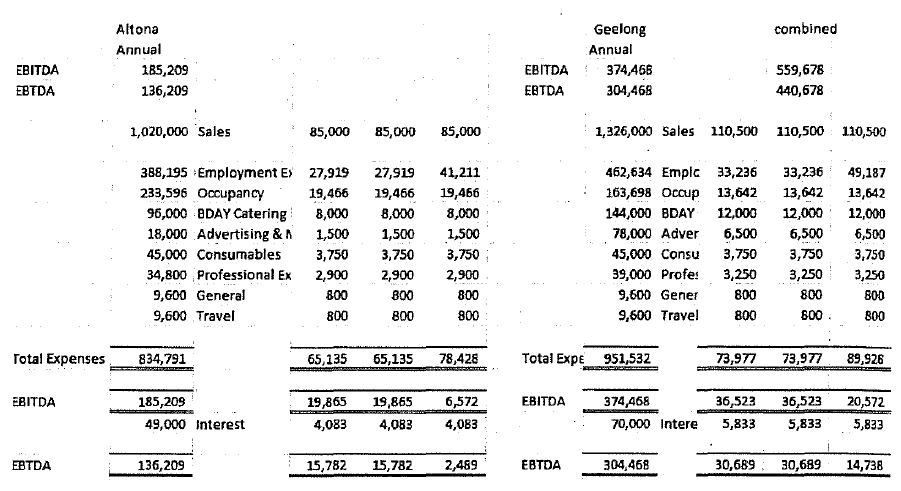
126 I have no reason to doubt Nicholls’ decision that he needed to be satisfied that All Options would earn at least $20,000 of sales per week from the Altona Site. His own model records a weekly “breakeven” quantum of weekly sales for the Altona Site and Geelong Site as being $16,000 and $19,000 respectively.
127 Having found the causative influence of Flightdeck and Mathews’ conduct, I accept that All Options is entitled to damages equal to the difference between the purchase price paid for the Business and the real value of the Business as at the date of sale, which I address in greater detail below: Kizbeau Pty Ltd v W G & B Pty Ltd (1995) 184 CLR 281; Potts v Miller (1940) 64 CLR 282.
128 I also accept that, to the extent that All Options incurred losses in the years following the sale as a result of trading at the Altona and Geelong Sites, each loss was incurred “because of” the contraventions of s 18 by Flightdeck and Mathews and not from a supervening cause such as the “folly, error or misfortune” of All Options, to use the language of Gibbs CJ in Gould at 221: see also Henville at 472-473 per Gleeson CJ. As stated by the High Court in HTW Valuers (Central Qld) Pty Ltd v Astonland Pty Ltd (2004) 217 CLR 640 at 667:
The deduction of true value at the acquisition date from the price paid is no more than a guide to the assessment of damages under s 82. Section 82 does not in terms refer to that method, and the width of s 82 permits other approaches to the assessment of damages so long as they work no injustice.
(Footnote omitted.)
The High Court then referred to a decision of the House of Lords, Smith New Court Securities Ltd v Scrimgeour Vickers (Asset Management) Ltd [1997] AC 254. In considering the correct measure of damages where a plaintiff has acquired property in reliance on a fraudulent misrepresentation, Lord Browne-Wilkinson said at 264-266:
Doyle v. Olby (Ironmongers) Ltd [[1969] 2 QB 158] establishes four points. First, that the measure of damages where a contract has been induced by fraudulent misrepresentation is reparation for all the actual damage directly flowing from (i.e. caused by) entering into the transaction. Second, that in assessing such damages it is not an inflexible rule that the plaintiff must bring into account the value as at the transaction date of the asset acquired: although the point is not adverted to in the judgments, the basis on which the damages were computed shows that there can be circumstances in which it is proper to require a defendant only to bring into account the actual proceeds of the asset provided that he has acted reasonably in retaining it. Third, damages for deceit are not limited to those which were reasonably foreseeable. Fourth, the damages recoverable can include consequential loss suffered by reason of having acquired the asset.
…
In many cases, even in deceit, it will be appropriate to value the asset acquired as at the transaction date if that truly reflects the value of what the plaintiff has obtained. Thus, if the asset acquired is a readily marketable asset and there is no special feature (such as a continuing misrepresentation or the purchaser being locked into a business that he has acquired) the transaction date rule may well produce a fair result. … But in cases where property has been acquired in reliance on a fraudulent misrepresentation there are likely to be many cases where the general rule has to be departed from in order to give adequate compensation for the wrong done to the plaintiff, in particular where the fraud continues to influence the conduct of the plaintiff after the transaction is complete or where the result of the transaction induced by fraud is to lock the plaintiff into continuing to hold the asset acquired.
(Emphasis added.)
In my view, these observations are apposite in the present case. At the time of the sale, the Business was already “pregnant with disaster”, to use the words of Lord Browne-Wilkinson. Flightdeck and Mathews’ wrongful conduct locked All Options into a flawed Business and caused it to incur trading losses.
129 Indeed, shortly after the completion of the sale, Nicholls became concerned about the level of revenue being generated. He asked for an explanation for the decline in sales from the manager of the Geelong Site. The manager said that she did not think that there had been any decline in sales. She formerly was required to write a weekly report for Mathews, but each report was overwritten by the next and no copies were kept. Nicholls met staff at the Altona Site and told them that weekly sales of $10,000–$15,000 were not good enough, and that sales needed to be $22,000 per week. The Altona Site manager told him that weekly sales of $15,000 was a good achievement. This was much less than the break-even figure of $20,000.
130 Nicholls then tried to sell the Business through a broker. No one was interested. He eventually offered to sell the Altona Site for less than $200,000 without success. In preparing the financial accounts for 2015, the assets of the Business were written down to $400,000. By 2016, Nicholls thought he was facing financial ruin. He offered to sell the Geelong Site for $50,000, but that offer was refused.
131 Mathews cross-examined Nicholls about these events. Other than having Nicholls confirm that he had no experience in the leisure industry, the cross-examination did not assist me and did not lead me to doubt Nicholls’ evidence in any way. In particular, I accept his explanation of the profit and loss statement prepared for the possible sale of the Altona Site as disclosing a profit of around $249,000. That statement excluded significant costs such as the salary of a manager and marketing costs.
132 The only evidence of the trading losses incurred by All Options is the profit and loss statement in the accounts for that entity for the 2016 and 2017 years. For the 2016 year, the statement disclosed the loss of $28,756; and for the 2017 year, the profit and loss statement disclosed the loss of $49,474. Mathews did not deny the existence of these trading losses, nor did he submit that the profit and loss statements were inaccurate. In my view, All Options is entitled to damages equal to these sums in order to restore that entity to the position it would have been had the contraventions of s 18 of the ACL not taken place: Gates v City Mutual Life Assurance Society Ltd (1986) 160 CLR 1; Yorke v Ross Lucas Pty Ltd (1982) 45 ALR 299.
133 In my view, these losses could not reasonably have been avoided. Because All Options had been unable to sell the Business, it was reasonable for it to continue to carry on its undertaking: Gould at 221; Vieira v O’Shea [2012] NSWCA 21. It has not otherwise been suggested that All Options and Nicholls have not taken steps to pursue their rights against Flightdeck and Mathews promptly, or have delayed matters, thus causing the incurrence of more losses.
134 For completeness, I note that it was not put to me that the trading losses ought not to be awarded on the basis that the unprofitability of the Business was already taken into account in Ms Wright’s calculation of its real value at the time of sale: see Gould at 221-222 per Gibbs CJ, 266-267 per Dawson J. Neither the respondents’ amended defence (prepared by their legal representatives at the time) nor Mathews in his submissions raised this as an issue. On that basis, and in view of the approach taken to ascertaining the Business’ true value set out below, I do not consider that additionally awarding the trading losses will work an injustice in this case.
135 I now turn to the value of the Business and commence with a consideration of the two expert reports relied upon by Flightdeck and Mathews. Mr Wilkinson was of the opinion that the Business had a value of approximately $1.3 million. He reviewed the financial information which was available to him. He considered the Weekly Till Reconciliation Reports and the figures recorded in the PBSA system. The latter were considered by Mr Wilkinson to be unreliable because not all cash sales were recorded in it. Actual sales were determined from the Till Reconciliation Reports. The figures recorded in the Xero accounting system were not referred to by Mr Wilkinson. Initially, he considered applying a “capitalisation of earnings” basis for ascertaining market value, but then rejected that methodology because the profitability of the Business was “insufficient to provide an appropriate economic return on the costs of the assets employed by the business”. A “net assets approach” was instead adopted by Mr Wilkinson, although his report does not explain why it should have been considered; there is a sense, and I say this with respect, of a search for any methodology which might support a valuation of the Business.
136 For the purpose of applying the net assets approach to valuation, Mr Wilkinson decided to use the values attributed to the assets of the Business, as ascertained by Mr Peisley. I will address that report shortly. Using those values, Mr Wilkinson re-stated the balance sheet as at 30 June 2015 which disclosed net assets of $1,009,740. That value was then increased by the sum of $383,580 because of a loan said to be due to Mathews (the loan was not in evidence before me).
137 I reject that valuation. Not only does it value the Business at the wrong date and turn in part on a loan which was not proven, it was dependent upon the report of Mr Peisley, whose valuation of the assets of the Business I reject for the reasons given below.
138 I turn to the report of Mr Peisley. For the purposes of ascertaining the value of each of the assets of the Business, he used a depreciated replacement cost or “DRC” methodology for major assets and considered comparable sales data for more general assets. Attached to his report was a table comprising an inventory of the assets of the Business in which each asset was identified and given a value. What is missing, however, is the reasoning to support each identified value. Paragraph 2.4 of this Court’s “Expert Evidence Practice Note” states:
An expert witness’ opinion evidence may have little or no value unless the assumptions adopted by the expert (ie. the facts or grounds relied upon) and his or her reasoning are expressly stated in any written report or oral evidence given.
139 Mr Peisley did not expressly state in his report his reasons for attributing specific values to each asset of the Business. For example, a “Music system” at the Altona Site was given a value of $2,500. But we are not told why. We are told that the “storeroom fit out” at the Altona Site has a value of $400. We are told that the “trampoline fit out” has a value of $373,000. But again, in neither case is the conclusion about value supported by any reasoning. Value is simply recorded. The worst example of this is the asset described as “additional to schedule per email confirmation, Aughtersons 26/9/17” which added $51,000 of value to the Altona Site and $140,000 of value to the Geelong Site. The email was attached to the report but is barely legible and simply instructs Mr Peisley to value “the fit out of the subject business and this includes leasehold improvements”. In the table this asset is nonetheless described as comprising leasehold improvements, which “include” items, such as office painting and bathroom upgrades. It follows that I am unable to give any weight to this report. Without supporting reasons it simply comprises a collection of conclusions.
140 Mr Boston also criticised the body of the report (only 10 pages long) in the following ways:
(a) the report refers to the undertaking of “suitable and appropriate research” without saying what that was;
(b) the report is expressed to be limited by “professional assumptions” which are not fully disclosed;
(c) the report refers to a telephone enquiry and internet research without describing the contents of either enquiry;
(d) the DRC methodology was not sufficiently or properly explained; and
(e) the report relied upon “verbal and email advice”, which advice was never disclosed.
141 These criticisms fortify my conclusion that the report has no weight. This is not intended to be a criticism of Mr Peisley. No doubt in the valuation industry, for the sake of efficiency, tables which lists assets and then values are commonplace, and in the commercial context, are a sufficient expression of the valuer’s process of reasoning. But for the purposes of giving expert evidence in a court, in my view, far more is needed. There should at least be a short explanation for why a given asset bears a nominated value. Here, no such explanation had been given.
142 I turn now to consider the expert evidence relied upon by All Options. Ms Wright’s first valuation of the Business applied a Capitalised Future Maintainable Earnings methodology using the figures disclosed in the Accounting System Transactions records. The Future Maintainable Earnings were found to be in the sum of $1,598,739, with future maintainable expenses being valued at $2,015,496. For this purpose, Ms Wright used an earnings multiple of 1-2 times earnings. That conclusion was reached by an examination of comparable companies identified by Ms Wright using a “Capital IQ and Merger Market” database. Mathews criticised this conclusion in his cross-examination of Ms Wright. He said only a milk bar would merit an earnings multiple of 1 and that a “very poorly run hotel” might merit an earnings multiple of 1-2 times earnings. Ms Wright responded by saying that her conclusion was supported by the data she had examined. No contradictory data or expert opinion was adduced by Flightdeck or Mathews which would justify a rejection of Ms Wright’s opinion, which I accordingly accept as correct. Applying her methodology led her to conclude that the value of the Business sold was nil. Ms Wright cross-checked that valuation by applying a net asset methodology (estimates the value of a business by reference to the realisable value of its assets), which led to the Business being valued at $325,000. This valuation took the balance sheet historical cost value of the assets as a starting point. Ms Wright then made adjustments to those values to ascertain the appropriate market value. She assessed that the amount recorded as “repairs and maintenance” was indicative of the initial cost of the equipment. None of this was challenged. Her final conclusion was that the value of the Business was somewhere between nil and $325,000.
143 Ms Wright’s third report was a reply to the valuation of the Business prepared by Mr Wilkinson (“Third Wright Report”). Certain corrections were made to that report by Ms Wright when she was called to give evidence. She agreed with parts of Mr Wilkinson’s valuation, but disagreed with a number of key aspects. For example, at [2.3.2] of the Third Wright Report, she said:
I disagree that the following information should be relied upon in preparing the valuation of the Airodrome Business:
(a) …
(i) The volleyball business revenue should not be included in the valuation of the Airodrome Business; and
(ii) The implied assumption made by Mr Wilkinson that the inflatables business will earn the same revenue and incur similar expenses to the volleyball business is not supported.
(b) The 30 June 2015 financial information does not reflect 8.5 months trading of the Geelong Site …;
(c) The Airodrome Business did not generate maintainable earnings for the 8.5 months to 15 March 2015 …; and
(d) The revenue of the Airodrome Business is recorded in the Accounting System Transactions, and not the till reconciliations, ....
In this report, Ms Wright also revised down her valuation of the net assets of the Business from $325,000 to $15,383 following her consideration of Mr Tallon’s expert report (as to which see below) and said that the value of the Business was somewhere between nil and $220,000 (a figure derived from the PBSA Reports and on the assumption that those figures were accurate).
144 It is unnecessary for me to dwell upon the Third Wright Report. That is generally because I have not been persuaded to accept the reliability of Mr Tallon’s report.
145 All Options relied on two further expert reports. The first was from Mr Richards, who trades under the name “Mr Trampoline”. Mr Richards has expertise and knowledge concerning the design, construction and installation of trampolines. In his opinion, the cost of relocating the equipment from the Geelong Site would be in the sum of $75,000. The cost of relocating the equipment from the Altona Site would, in his opinion, be around $85,000–$90,000. The total cost of reinstalling the Geelong trampoline equipment to a new venue was said by him to be around $220,000, and the total cost of reinstalling the Altona trampoline equipment in a new venue was said to be around $310,000–$330,000. Mathews did not cross-examine or challenge the correctness of these conclusions. It follows that I accept their accuracy.
146 The other expert report relied upon by All Options is that of Mr Tallon. He had over 30 years of valuation and auctioneering experience. His evidence was that the market value of the assets of the Business ex situ was $61,390 and that the market value of the assets in situ was $975,845. Ms Wright relied upon this value of the assets of the Business in reaching her second conclusion that the net asset methodology supported a valuation of only $15,383. But given her new valuation range of between nil and $220,000, that alternative conclusion is perhaps less important. In that respect, and if it matters, I accept that a valuation of the assets ex situ is, in the circumstances of this case, more appropriate than a valuation of those assets in situ. That assumption is justified because I accept that in order for the Business to become profitable its assets would need to be relocated. Ms Wright’s calculation of future maintainable earnings, which disclosed the incurrence of future losses, supports the soundness of that assumption, as does the actual losses suffered by the Business in 2016 and 2017.
147 Mr Tallon was not cross-examined by Mathews in any meaningful way. Whilst his report is considerably more detailed than that of Mr Peisley, it does, on one view, suffer in some respects from a similar lack of supporting reasoning. Mr Tallon also attached a list of assets with nominated values based upon in situ and ex situ assumptions, without explaining how he reached his conclusions. For example, in respect of the Geelong Site, two 41-inch Hisense plasma televisions were given an in situ value of $1,000 and an ex situ value of $400. How these values were arrived at, and why there was a difference in value, was not explained. For these reasons I have not found Mr Tallon’s report to be of any great assistance.
148 In my view, the expert report which was of greatest assistance to the Court was the First Wright Report which valued the Business at a value between nil and $325,000. I prefer this report over the Third Wright Report because the latter was dependent in part on the report of Mr Tallon. The First Wright Report also relied upon a value being ascertained for the assets of the Business. As already mentioned, the value identified was not challenged. As the respondents were not represented, and thus were not aptly placed to challenge either the First or Third Wright Reports, I have decided to accept the First Wright Report as preferable to the Third Wright Report, as it favours the respondents. I was urged by All Options to find that the Business had a nil value. But in my view that conclusion is not supported by the evidence. There was no opinion before me which supported a conclusion that the market value of the Business should be fixed at a figure that was close to nil or nil. In those circumstances, obliged as I am to decide upon a value of the Business for the purposes of calculating the damages to be awarded, I think it appropriate to choose a midpoint of $162,500. It follows that in addition to the losses incurred in 2016 and 2017, All Options is entitled to damages in the sum of $1,362,500, being the difference between the amount paid by All Options to Flightdeck and the market value of the Business at the date of sale.
149 All Options is accordingly entitled to most of the damages it seeks and interest and to an order for costs in its favour. I will ask the parties to consider the precise form of final relief and, if no agreement is reached, to file short submissions on that issue.
I certify that the preceding one hundred and forty-nine (149) numbered paragraphs are a true copy of the Reasons for Judgment herein of the Honourable Justice Steward. |
Associate:


