

FEDERAL COURT OF AUSTRALIA
Croft v State of South Australia (Port Augusta Overlap Proceeding) (No 2) [2019] FCA 581
ORDERS
DATE OF ORDER: |
THE COURT ORDERS THAT:
1. On the Interlocutory Application of the Barngarla and Nukunu Claim Groups filed on 26 November 2018 the Kokatha #3 Native Title Claim SAD83/2016 is dismissed.
Note: Entry of orders is dealt with in Rule 39.32 of the Federal Court Rules 2011.
WHITE J:
1 The question before the Court is whether one of three overlapping claims for the determination of native title should be summarily dismissed pursuant to s 31A(2) of the Federal Court of Australia Act 1976 (Cth) (the FCA Act) and/or r 26.01 of the Federal Court Rules 2011 (Cth) (the FCR).
2 Each of the Barngarla, Nukunu and Kokatha Peoples has filed an application for the determination of native title under the Native Title Act 1993 (Cth) (the NT Act) over an area which includes the City of Port Augusta and areas proximate to it. These are the Barngarla Native Title Claim (SAD6011/1998), the Nukunu Native Title Claim (SAD6012/1998), and the Kokatha #3 Native Title Claim (SAD83/2016). On 21 August 2017, the Court ordered that, to the extent that the claims overlapped, they proceed in Action No SAD6011/1998 and that the proceedings be known as the Port Augusta Overlap Proceeding.
3 On 26 November 2018, the Barngarla and the Nukunu Peoples filed a joint interlocutory application seeking an order pursuant to s 31A(2) of the FCA Act and/or r 26.01 of the FCR for the summary dismissal of the Kokatha #3 Claim on the basis that:
(a) the Kokatha have no reasonable prospect of successfully prosecuting their application; and/or
(b) it is otherwise an abuse of the process of the Court.
4 The Barngarla and the Nukunu made the application following the refusal by the High Court on 19 October 2018 of special leave to appeal from the judgment of the Full Court of this Court in Starkey on behalf of the Kokatha People v State of South Australia [2018] FCAFC 36. By that judgment, the Full Court had, by majority, dismissed an appeal from the judgment of Mansfield J in Lake Torrens Overlap Proceedings (No 3) [2016] FCA 899 (LTOP (No 3)) dismissing each of the separate claims for the determination of native title over Lake Torrens made by the Kokatha, Barngarla and Adnyamathanha Peoples.
5 The Kokatha People opposed the interlocutory application of the Barngarla and the Nukunu and are supported in that opposition by the Commonwealth.
6 The State of South Australia supported the submission of the Barngarla and the Nukunu that the Kokatha #3 Claim has no reasonable prospects of success. It took a neutral position with respect to the submission that the proceedings constitute an abuse of process. No other respondent to the Port Augusta Overlap Proceeding sought to be heard on the application.
7 Both the Barngarla and the Kokatha have had determinations recognising their native title over areas of land adjacent, or close, to the area of Kokatha #3.
8 The Barngarla Determination recognises the native title of the Barngarla over a large area of land on Eyre Peninsula extending east to Spencer Gulf and north to the southern end of Lake Torrens. It was made on 23 June 2016: Croft on behalf of the Barngarla Native Title Claim Group v State of South Australia (No 2) [2016] FCA 724 and Croft on behalf of the Barngarla Native Title Claim Group v State of South Australia (No 3) [2018] FCA 552. The eastern boundary of the Barngarla Determination area near Port Augusta forms the western boundary of the Kokatha #3 claim area.
9 A determination (Kokatha Part A) recognising the native title of the Kokatha Uwankara People over a large area of land to the immediate west of, and contiguous with, the western boundary of Lake Torrens was made on 1 September 2014: Starkey v State of Australia [2014] FCA 924 (Starkey 2014).
10 A determination (Adnyamathanha (Stage 1)) recognising the native title of the Adnyamathanha People over a large area of land to the immediate east of, and contiguous with, the eastern boundary of Lake Torrens was made on 30 March 2009: Adnyamathanha No 1 Native Title Claim Group v State of South Australia (No 2) [2009] FCA 359.
11 The Nukunu Native Title Claim encompasses a large area to the north-east, south and south-east of Port Augusta and includes Port Augusta itself. The north-western portion of the Nukunu claim area abuts the eastern boundary of the Barngarla Determination. Its northern boundary abuts the southern boundary of the Adnyamathanha (Stage 1) Determination.
12 The principal parties to the Nukunu Native Title Claim have reached agreement on the question of whether native title exists in much of the area which is the subject of that claim, other than the area of the Kokatha #3 claim and the area in the City of Port Augusta which overlaps with the Barngarla claim. They have also agreed on the identity of the native title holders and on the nature of the native title rights and interests. They are now following a process which may lead to the making of a consent determination over a reduced area of the Nukunu claim. However, a consent determination has not yet been made.
Section 31A
13 Section 31A of the FCA Act provides (relevantly):
…
(2) The Court may give judgment for one party against another in relation to the whole or any part of a proceeding if:
(a) the first party is defending the proceeding or that part of the proceeding; and
(b) the Court is satisfied that the other party has no reasonable prospect of successfully prosecuting the proceeding or that part of the proceeding.
(3) For the purposes of this section, a defence or a proceeding or part of a proceeding need not be:
(a) hopeless; or
(b) bound to fail;
for it to have no reasonable prospect of success.
(4) This section does not limit any powers that the Court has apart from this section.
…
Rule 26.01
14 Rule 26.01 of the FCR provides (relevantly):
(1) A party may apply to the Court for an order that judgment be given against another party because:
(a) the applicant has no reasonable prospect of successfully prosecuting the proceeding or part of the proceeding; or
(b) the proceeding is frivolous or vexatious; or
(c) no reasonable cause of action is disclosed; or
(d) the proceeding is an abuse of the process of the Court; or
(e) the respondent has no reasonable prospect of successfully defending the proceeding or part of the proceeding.
…
The Barngarla and the Nukunu rely upon subparas (a), (c) and (d).
Summary judgment principles
15 The principles relating to the exercise the Court’s power pursuant to s 31A(2) and r 26.01 have been considered in a number of the authorities. The Court must be satisfied that an applicant has “no reasonable prospect” of successfully prosecuting the proceeding. The Court may reach that state of satisfaction even if it cannot be said that the application is “hopeless” or “bound to fail” – see s 31A(3). In Spencer v The Commonwealth of Australia [2010] HCA 28; (2010) 241 CLR 118, French CJ and Gummow J said at [25]:
[25] Section 31A(2) requires a practical judgment by the Federal Court as to whether the applicant has more than a "fanciful" prospect of success. That may be a judgment of law or of fact, or of mixed law and fact. Where there are factual issues capable of being disputed and in dispute, summary dismissal should not be awarded to the respondent simply because the Court has formed the view that the applicant is unlikely to succeed on the factual issue. Where the success of a proceeding depends upon propositions of law apparently precluded by existing authority, that may not always be the end of the matter. Existing authority may be overruled, qualified or further explained. Summary processes must not be used to stultify the development of the law. But where the success of proceedings is critically dependent upon a proposition of law which would contradict a binding decision of this Court, the court hearing the application under s 31A could justifiably conclude that the proceedings had no reasonable prospect of success.
16 It is the party seeking summary judgment who must persuade the Court that it is appropriate: Australian Securities and Investments Commission v Cassimatis [2013] FCA 641; (2013) 220 FCR 256 at [45].
17 In Dandaven Pty Ltd v Harbeth Holdings Pty Ltd [2008] FCA 955, Gilmour J summarised many of the principles evident in the authorities concerning the application of s 31A(2):
[6] Success under s 31A does not require a demonstration that the case is hopeless or bound to fail. The following principles are of general application to an application under s 31A:
(a) the Court must be very cautious not to do a party an injustice by summarily dismissing proceedings;
(b) the Court ought not dismiss a claim based on a predictive assessment of prospects, where it is possible that if the claim went to trial, it may succeed;
(c) in a case where evidence can give colour and content to allegations, and where questions of fact and degree are important, the Court should be more reluctant to dismiss a proceeding on the face of a pleading;
(d) it is not Parliament's intention to require the Court to engage in lengthy and elaborate trials on an interlocutory basis for the purposes of determining whether or not a proceeding has no reasonable prospects of success. It may be necessary for the opposing party to provide no more than an outline of evidence, sufficient to show that there is a genuine dispute, to prevent the summary application becoming a trial;
(e) if there is a real issue of fact or law to be decided, and the rights of the parties depend upon it, it is obviously appropriate that the matter goes to trial. It cannot be said that where there is a real factual dispute and that factual dispute must be resolved to determine whether the claim succeeds that there is ‘no reasonable prospect of success’;
(g) it ought not be used to shut out proceedings where, on a proposition of law, there may be room for doubt. On questions of law, an inquiry as to their merit should not be for the purpose of resolving them and also not simply to determine whether the argument is hopeless, but in order to decide if it is sufficiently strong to warrant a trial;
(h) evidence of an ambivalent character will usually be sufficient to amount to reasonable prospects;
(i) in determining if there are real issues of fact in issue so as to preclude summary judgment the courts must draw all reasonable inferences in favour of the non-moving party.
(Emphasis in the original)
18 No party in the present case suggested that r 26.01(a) or (c) requires any different approach.
19 The very nature of the claim made by the Kokatha, being a claim for the determination of native title, suggests the appropriateness of the Court acting with particular caution on the present application. As the Full Court observed in Western Australia v Fazeldean (No 2) [2013] FCAFC 58; (2013) 211 FCR 150 at [34]:
[L]itigation under the Native Title Act is not ordinary private inter partes litigation. Sought to be vindicated are rights of a communal nature based on occupation and a physical and spiritual connection between land and people that has endured for possibly millennia. The vindication is not only for the living in the claim group, but for their ancestors and for generations to come. …
20 Hence, in Murray on behalf of the Yilka Native Title Claimants v State of Western Australia (No 5) [2016] FCA 752, McKerracher J said that an application for summary dismissal for abuse of process will only succeed in a very clear case and the power to make such an order is to be exercised only with exceptional caution.
The Kokatha #3 Claim
21 The Kokatha #3 Claim has been amended, most recently on 17 October 2018. It is brought by eight persons (Andrew Starkey, Maxwell Reid, Andrew Dingaman, Lynette Strangways, Dianne Welgraven, Glen Wingfield, Tracey Reid, and Barbara Amos) who jointly comprise the applicant. The Native Title Claim Group is identified as those Aboriginal people who descend from one or more of 19 named apical ancestors. Paragraph [3] of Attachment F asserts that the Kokatha People described in the application “were recognised as native title holders and [as] a society of persons united by and in their acknowledgement of Kokatha traditional laws and customs … in respect of areas to the north and northwest of this application area”, that is, in the Kokatha Part A Determination. In Starkey 2014, Allsop CJ described the Kokatha as the “south-easternmost sub-group of the Western Desert Society”, at [41].
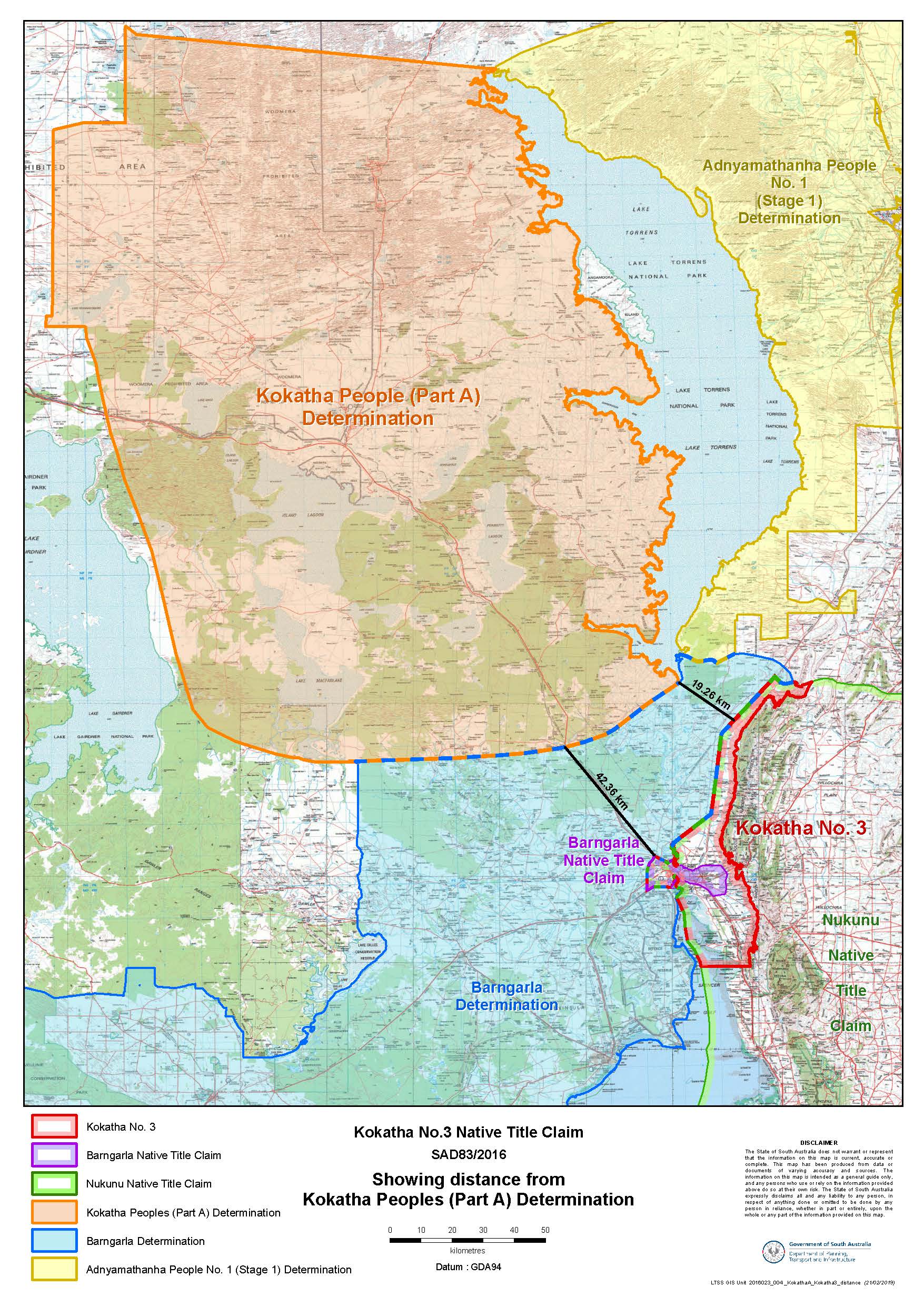
22 The area the subject of the Kokatha #3 Claim is irregular in shape, and not easy to describe. It is best seen in the map attached as Appendix A to these reasons.
23 In very general terms, the Kokatha #3 claim area comprises a relatively narrow arc of land and water oriented on essentially a north-south axis. The northern-most point is about 75 km north-northeast of Port Augusta, near the Willochra Creek and the southern-most point, about 30 km south, between Mambray Creek and Nectar Brook. The western boundary runs up the middle of Spencer Gulf to Port Augusta where it diverts for a short distance to the west to encompass an area including Port Augusta West and the Port Augusta Aerodrome. Further to the north, the western boundary of the Kokatha #3 claim follows the eastern boundary of the Barngarla Determination. The eastern boundary of the arc follows, broadly, the western boundary of the Flinders Ranges.
24 The undetermined part of the Barngarla Claim includes the area of the City of Port Augusta. The Kokatha #3 Claim overlaps with that part of the Barngarla Claim.
25 The whole of the Kokatha #3 claim area overlaps with part of the area which is the subject of the as yet undetermined Nukunu Native Title Claim.
26 As is apparent, the Kokatha #3 area is not contiguous with any portion of the Kokatha Part A area. At its closest distance, Kokatha Part A is 19.26 km from the part of Kokatha #3 which overlaps the Nukunu claim area and some 42.36 km from the overlapped area claimed by both the Barngarla and the Kokatha.
27 The Barngarla Determination recognised the Barngarla as having native title over the whole of the area between Kokatha Part A and Kokatha #3.
28 There was no suggestion that, in the determination of the summary judgment application, any distinction should be drawn between particular parts of the Kokatha #3 claim.
29 In summary the Kokatha #3 Claim:
(a) is centred on Port Augusta;
(b) includes strips or fingers of land extending north-east and south-east from Port Augusta which are relatively narrow: that north of Port Augusta being for the most part less than 10 km wide and that south of Port Augusta being in the range of 20-25 km wide;
(c) falls entirely within the area of the Nukunu Claim;
(d) is wholly separated from Kokatha Part A by the north-eastern portion of the Barngarla Determination and, to an extent, by the southern end of Lakes Torrens and the south-western portion of the Adnyamathanha (Stage 1) Determination;
(e) lies, at its closest point, some 19.26 km from the Kokatha Part A area; and
(f) will, if the consent determination of the Nukunu proceeds, be surrounded entirely (apart from a small portion in Spencer Gulf), by areas in respect of which others have been recognised as holding native title.
30 In Attachment F to the Kokatha #3 claim, the claimants assert that they are the direct descendants of these Aboriginal persons who were “in occupation of the application area, and areas surrounding the application area, at sovereignty”. They assert shared spiritual beliefs and continued observance of traditional laws and customs.
31 On 2 August 2016, the National Native Title Tribunal (the NNTT) rejected the Kokatha #3 claim for registration pursuant to s 190A of the NT Act. It did so because the application did not satisfy the s 190C(3) condition, namely, that there be no group members who are also members of another native title claim group with respect to the same area. The NNTT considered that some of the apical ancestors in the Kokatha #3 claim group were also named in the existing Nukunu claim. The NNTT found that the Kokatha #3 claim satisfied all of the other conditions in ss 190B and 190C.
The submissions of the Barngarla and the Nukunu
32 In relation to their application under s 31A(2) and r 26.01(a) and (c), the Barngarla and the Nukunu submit that the Kokatha have no reasonable prospects of establishing that:
(a) they held rights and interests in the Kokatha #3 claim area at sovereignty; and
(b) those rights and interests were possessed under the traditional laws and customs acknowledged and observed by the Kokatha at sovereignty.
33 The Barngarla and the Nukunu relied on three matters for these submissions:
(a) the findings of Mansfield J in LTOP (No 3);
(b) the fact that the Kokatha #3 area is not only not contiguous with Kokatha Part A but is separated from it by land in respect of which another group altogether has been recognised as having native title; and
(c) the improbability in the Kokatha having native title over the claimed “island” of land given that they are of the Western Desert Cultural Bloc, whereas each of the surrounding groups, the Barngarla, the Adnyamathanha and Nukunu, are Lakes People.
34 In relation to LTOP (No 3), the Barngarla and the Nukunu submitted that:
(a) the decision establishes that at sovereignty the native title rights and interests of the Kokatha did not extend further east than the western shore of Lake Torrens, that is, an area which is north-west of the Kokatha #3 area;
(b) in making that finding in LTOP (No 3), Mansfield J had found that the Kokatha had migrated south-east from the Western Desert, and that the extent of that migration at sovereignty was the western shore of Lake Torrens; and
(c) that conclusion precludes a finding that, at sovereignty, the Kokatha could have been located on land further to the south and east and, in particular, that they held rights and interests in the land the subject of the Kokatha #3 claim.
The Lake Torrens Overlap Proceedings
35 The LTOP (No 3) was a determination of three overlapping applications for a determination of native title rights and interests over the land and waters of Lake Torrens. The three claimants were the Adnyamathanha, the Kokatha and the Barngarla. The area the subject of each claim was entirely coincident.
36 Lake Torrens is a large salt water lake running on a general north-south axis. It southern-most point is approximately 60 km north of Port Augusta. Determinations of native title have been made with respect to all of the land on the Lake’s perimeter. In addition to the Kokatha Part A Determination and the Adnyamathanha (Stage 1) Determinations, the Arabana People have been recognised as the native title holders of land of which a small portion abuts the northern tip of Lake Torrens and the Barngarla Determination recognised the Barngarla as the native title holders of an area of land which abuts approximately 6 km of the south-eastern boundary of the Lake.
37 In LTOP (No 3), Mansfield J dismissed the claim of the Kokatha because he considered that, while the evidence established that the Western Desert Cultural Bloc of which the Kokatha form part had moved progressively from the north and west towards Lake Torrens, it did not establish that they had, at the time of sovereignty, extended their country under their traditional laws and customs into the area east of the western boundary of Lake Torrens. His Honour’s findings were as follows:
[713] In my view, it is not possible, on the evidence, to be satisfied that the Kokatha People had extended their country under their traditional laws and customs into the area east of that western boundary of that determination at the time of sovereignty.
[714] There is no evidence of Kokatha occupation of any areas to the east of that western boundary of Lake Torrens at the time of first European contact, or indeed in my view in any of the ethnographic or historical material until well into the 20th century, probably about the 1980s. I do not regard any of the earlier ethnographic or historical material, including any roughly drawn maps, as progressing that physical occupation either actually or conceptually into Lake Torrens itself. …
…
[724] In my view, the absence of any material at all which tends to associate Kokatha interests with Lake Torrens until the relatively recent past, particularly in circumstances where it may have been expected that such Kokatha Dreaming stories as relate to Lake Torrens (according to the contemporary evidence) would have emerged in the course of those investigations particularly in the 1980s, and having regard to the fact that the maps drawn by others, including Tindale, in the earlier decades of the 20th century draw the Kokatha boundary on the western shore of Lake Torrens lead to the conclusion that, at sovereignty, the Kokatha People by their traditional laws and customs did not possess or occupy any part of Lake Torrens east of the western shore of Lake Torrens (as determined in the Kokatha Part A determination).
(Emphasis added)
38 The separate claims of each of the Barngarla and Adnyamathanha Peoples failed because Mansfield J was not satisfied that either had maintained in a continuous way since sovereignty any connection which they may then have had to the Lake or part of it, substantially in accordance with their traditional laws and customs.
39 The Barngarla and the Nukunu submitted that the finding in [724] of LTOP (No 3) “makes it simply impossible” or at least “implausible” for the Kokatha to establish that they held native title in the area of Kokatha #3, because it is to the south-east of the western shore of Lake Torrens. Not only would the Kokatha have to establish matters which are inconsistent with the findings in LTOP (No 3), they would have to satisfy the Court that they had “passed through” areas in which the Barngarla and/or the Adnyamathanha have been determined to have native title and that they had then “settled” in the area of Kokatha #3, while their fellows had remained in the Kokatha Part A area. The Barngarla and the Nukunu described such a hypothesis as illogical. The untenability of the position is made all the more manifest, the Barngarla and the Nukunu submitted, when it is remembered that the Kokatha are members of the Western Desert Cultural Bloc, whereas the Barngarla and the Adnyamathanha are Lakes people, observing Lakes Culture laws and customs.
40 The State submitted that the separation of the area of Kokatha #3 from Kokatha Part A, together with the circumstance that the Kokatha and the Barngarla come from different cultural blocs makes it “unlikely or fanciful” that the Kokatha will be able to establish native title over the Kokatha #3 area.
The reliance on the decision in LTOP (No 3)
41 In my view, the findings in LTOP (No 3) cannot be regarded, by themselves, as indicating that the Kokatha #3 claim has no reasonable prospects of success. Two matters in particular indicate the appropriateness of that conclusion.
42 The first is that in LTOP (No 3), Mansfield J was concerned only with claims for the recognition of native title over the area of Lake Torrens itself. His Honour’s reasons and findings should be understood having regard to the fact that those were the issues for his determination. Furthermore, Mansfield J said on more than one occasion that his findings were based on the evidence then before him. Naturally, that evidence was directed to the issues then before the Court and not to broader claims of the Kokatha.
43 Accordingly, I consider that when Mansfield J said that it was not possible for the Court to be satisfied that the Kokatha had extended their country east of the western boundary of Lake Torrens, his Honour was referring only to eastern movement into Lake Torrens itself and to be basing that finding on the evidence then before him. It was not necessary for Mansfield J to express a conclusion about movement to the south or south-east of the Kokatha Part A area.
44 Counsel for the Kokatha noted that the claim group in Kokatha #3 is not entirely coincident with the claim groups in Kokatha Part A or LTOP (No 3). Counsel did not develop a submission as to the significance of this difference but I accept that it may add to the prospect that the evidence in the Port Augusta Overlap Proceeding may not replicate exactly the substance of the evidence in either of those claims.
45 Secondly, the findings of Mansfield J do not exclude as a possible hypothesis that the Kokatha had continued to move south and south-east from the Kokatha Part A area. I do not understand his Honour to have had in mind a notional north-south line derived from the western boundary of Lake Torrens extending south from the southern end of Lake Torrens, and marking the extent for all purposes of the movement of the Kokatha People. Given the inhospitable nature of Lake Torrens, movement to the south or south-east may, as counsel for the Kokatha submitted, be a more natural movement for the Kokatha to have taken. Whether there was a permanent supply of water at Port Augusta which could have accounted for such movement does not have to be considered presently.
46 My conclusion that the findings in LTOP (No 3) are not sufficient in themselves to indicate that the Kokatha #3 claim has no reasonable prospect of success does not mean that these findings have no relevance at all on the present application. On the contrary, they constitute material which, with other material, may support the present application of the Barngarla and Nukunu. In particular, the finding that the movement of the Kokatha has been from the Western Desert in a general southerly or easterly direction (which I took not to be in contest) is pertinent, as is the finding that that movement had recurred in comparatively recent times. They are matters bearing on the ability of the Kokatha to establish connection with Kokatha #3 claim area at sovereignty.
The significance of the Gawler Ranges Determination
47 Contrary to the submission of the Barngarla and the Nukunu, I am not satisfied that the consent determination in McNamara on behalf of the Gawler Ranges People v State of South Australia [2011] FCA 1471 supports their present application. By that determination, the Court recognised that a group comprised of certain persons who are Kokatha, Wirangu and the Barngarla hold native title over the Gawler Ranges area (which is south-west of the Kokatha Part A area). Counsel’s submission was that, just as the movement of the Kokatha in a south-westerly direction had “petered out” so that they did not have exclusive native title in the Gawler Ranges area, it is likely that the movement had also “petered out” in a south-easterly direction and, in particular, had not progressed beyond the intermediate land over which the Barngarla have been recognised as holding native title.
48 I do not regard this as a persuasive consideration. First, the “petering out” of movement in one direction may say very little about the extent of the movement in another direction. Secondly, as O’Loughlin J noted in De Rose v State of South Australia [2002] FCA 1342 at [908], “Aboriginal society does not mark out boundaries to land in Western style”. In LTOP (No 3), Mansfield J, at [125], referred to this passage in De Rose and continued:
I remarked in Barngarla at [778] that Aboriginal cultural groupings are not and were never, political entities and so there was never any need for them to be geographically demarcated with the precision one expects of nation states.
The significance of the Barngarla Determination
49 The fact that the Barngarla have been found to have native title over the intermediate land is, however, a significant matter. The Barngarla and the Nukunu submitted that it would be exceptional for a determination of native title to be made in favour of the Kokatha over the Kokatha #3 area in that circumstance. I accept that a finding that the Kokatha had native title over an “island” of land and water separated from Kokatha Part A would, at the least, be unusual. That is especially so when the “island” at its northern end comprises only a narrow finger of land. This makes it necessary to consider whether the possibility of such an exceptional determination can be excluded.
50 Counsel for the Kokatha submitted that there may be at least two explanations for the Kokatha having an “island” of native title separated from Kokatha Part A which should not be dismissed as far-fetched or fanciful:
(a) the Kokatha and the Barngarla may at sovereignty have had shared native title in the intermediate land but the Kokatha’s connection with that land has been lost in the intervening years (referring in this respect to LTOP (No 3) at [115]-[116] and at [185]-[188]); and
(b) the native title of the Kokatha may be centred on the clusters in which water or other resources could be found, these being in the Kokatha #3 claim area and not in the intermediate areas. Counsel for the Kokatha referred in this respect to the acceptance by O’Loughlin J at first instance in De Rose of a submission that “the Aboriginal concept of territory is a “constellation” of locations, often along a Dreaming track for which those who are Nguraritja have responsibility”, at [100].
51 As the decision in Spencer indicates, the plausibility or otherwise of these explanations has to be assessed as a practical matter.
52 As to the first rationale proffered by counsel, it appears implausible that the Kokatha have lost connection which once existed with land varying in width between about 20 and 40 km but have maintained it over more distant land. That rationale is even more implausible in respect of the finger of land which, at its northern end, is less than 10 km in width. As to the second, the lack of water resources (if that be the case) in the intermediate land postulated as having led to the Kokatha’s loss of connection did not lead to the Barngarla ceasing to have continuous connection. These matters suggest that there is an element of the abstract or theoretic, rather than the practical, in the explanations advanced by the Kokatha. Before considering these matters further, it is appropriate to refer in more detail to the third matter on which the Barngarla and the Nukunu relied.
The different cultural blocs
53 Counsel for the Barngarla and the Nukunu and counsel for the State submitted that it is improbable that the Kokatha, being part of the Western Desert Cultural Bloc, could be found to have native title over an area which is surrounded entirely by areas over which persons from an entirely different cultural bloc have been found to have native title (or in the case of the Nukunu, may be found to have native title).
54 The premise for this submission is sound. In relation to the Kokatha, I have already referred to the finding of Allsop CJ in Starkey 2014. In LTOP (No 3), Mansfield J noted that it was accepted that the Kokatha People are part of the wider Western Desert Society and the Adnyamathanha People and the Barngarla People are part of the wider Lakes Group society, at [13], [198], [709]. Mansfield J accepted that the laws and customs of the two cultural groups were, and are, different, at [208], [709].
55 I agree that this is a significant matter. It would be unusual for a finding of native title in favour of the Kokatha to be made in these circumstances. At the same time, I keep firmly in mind that the existence or absence of reasonable prospects of success is not to be determined by a prediction as to whether the Kokatha will, or will not, succeed, or by an evaluation of the probabilities of them succeeding.
The Kokatha material
56 The Kokatha #3 application includes statements and affidavits from members of the claim group which, on their face, indicate contemporary connection by the Kokatha with the claim area, as well as statements describing the claim area as “Kokatha country”. However, there is relatively little material in the application indicating the necessary connection of the Kokatha as a society present in, or occupying, the claim area at sovereignty.
57 The materials before the Court did not identify the relevant date of sovereignty for the claim area, but I take it to be 1788. At the same time, it appears that there may not have been contact with Europeans before the early years of the 19th Century and it seems appropriate to proceed on the same basis as did Mansfield J in Croft on behalf of Barngarla Native Title Claim Group v State of South Australia [2015] FCA 9; (2015) 325 ALR 213 (Croft obo Barngarla) at [91]-[92], namely, that the society existing at the time of first European contact was the same society as existed in 1788.
58 The Kokatha #3 application states that Tindale’s “Aboriginal Tribes of Australia: Their Terrain, Environmental Controls, Distribution, Limits and Proper Names”, University of California Press (1974), did not include Port Augusta within Kokatha country. The Masters’ thesis of JM Jacobs entitled “Aboriginal Land Rights – Port Augusta” submitted in 1983 is referred to in Attachment F of the claim application. It describes Jacobs as referring to evidence suggesting that the Kokatha had “moved through” the area in pre-contact times, that they had had “encounters” with Port Augusta during its early development, that by 1930, the Kokatha were “closely associated” with the town, and that in the following 20 years they had become permanent residents, a situation which continues. That material suggests that the contact of the Kokatha with Port Augusta at settlement had, at best, been of a transient kind.
59 In response to a request from the NNTT on 6 June 2016 for further material in support of the registration of the Kokatha #3 claim, South Australian Native Title Services (SANTS), which represents the Kokatha, instructed Mr Robert Graham, its Senior Research Officer and an anthropologist “to review existing material and conduct further research”.
60 In response, on 27 June 2016, Mr Graham provided materials which he describes as “notes”. He said that these notes supplemented the material in Schedule F to the Kokatha #3 application and responded to the specific questions of the NNTT. It is evident that, in preparing the notes, Mr Graham relied substantially on the existing statements of members of the Kokatha Claim Group. On the basis of that material, Mr Graham expressed the opinion:
(a) the Kokatha have had a presence in the claim area for generations at least;
(b) the Kokatha have a spiritual attachment to the area that emerges from traditional Aboriginal law and customs;
(c) this attachment is seen as Kokatha group attachment;
(d) this attachment, both spiritual and physical, continues.
As can be seen, Mr Graham did not in this part of the notes suggest that the Kokatha had occupied Kokatha #3 at sovereignty.
61 Mr Graham also said that there were a number of “sacred sites” in the claim area associated with the Kokatha Tjukurpas, in particular at Umewarra Lagoon, Yorkey’s Crossing and Dempsey Lake. Mr Graham described the Kokatha as a group having responsibility for the Tjukurpas when they “pass through the Kokatha No 3 claim area”. He listed a number of native title rights and interests possessed by the Kokatha derived from the statements and affidavits of the members of the claim group.
62 In its request for further material, the NNTT had noted that the information in the application and the accompanying affidavits was limited to the association with the claim area of members of the native title claim group and of the generation preceding them. It noted that there is “little information demonstrating the association of the native title claim group’s predecessors with the Kokatha #3 claim area in the intervening years between European settlement and the present”.
63 In response, Mr Graham referred to the thesis of Jacobs and to Tindale’s 1974 work, saying:
We know that the town itself was established in the 1850s. Based upon an 1891 newspaper report Jacobs, (page 221) notes that the “Early Aboriginal associations with Port Augusta were spasmodic and usually confined to the western portion of the town.” Knowing that almost universally Aboriginal camping patterns correspond to traditional land relations, (i.e. ‘western’ people camp to the west etc.,) we could expect to form a reliable working hypothesis that these people would include Kokatha and, or, other westerners. Indeed Jacob’s research confirms this when she notes that this “Movement into Port Augusta was essentially from Kokatha country”. By 1920 she reports there were permanent Aboriginal camps (page 223), that is to say, her “spasmodic” settlement period had by then ended. This Kokatha movement into the town increased following the completion of the trans-continental railway which, as she puts it, became an ‘artery’ for travel between Kokatha country and Port Augusta. Across the 20th century there was an increasing Aboriginal presence in and around the town, a view consistent with Kokatha oral history. Who were they? While we could expect that they would have come from a number of areas we have Jacobs noting that until the late 1950s to 1960s,
.. the majority of the Port Augusta Aboriginal population were locals or immigrants from the area to the north-west of Port Augusta, that is essentially Kokatha people or Aboriginals from closely allied groups” (page 225).
There would have been cultural implications associate[d] with this ‘build up’ of Kokatha people. This would have included a proliferation of Kokatha associations;
.. as more Aboriginals moved into Port Augusta events of conception and death would have secured the locality a significant land mark by internal values .. (page 222).
Again, this is consistent with Kokatha oral history. In his 1938/9 genealogical work Tindale recorded Kokata “of Port Augusta” among those who he identified with territorial associations, further showing that at this time there were Kokatha identified with the town. While it could be seen as a movement out of one territory into another and the development of new or extended rights, Jacob’s reconstruction does not leave one with this view. She suggests the association goes back to the early years of settlement, and even beyond.
There is evidence to suggest the Kokatha moved through the Port Augusta area in pre-contact times and had brief encounters with the town during its early development (page 162).
It is not unlikely that this … pre-contact movement was part of the Kokatha water quest (particularly during harsh times) alluded to by Tindale 1981. Whatever the situation, Jacobs was clearly of the opinion that Kokatha associations with the area included those now considered as being traditionally Aboriginal, when she wrote;
Further, the traditional links the Kokatha had with the Port Augusta area including Umeewarra Lake and Yorkies (sic) Crossing area ensured the movement into Port Augusta was not conflicting with traditional land organisation (page 223).
On this point, for our purposes, Jacobs is particularly significant. These two sites (both within the application area) are mentioned again and again by Kokatha when discussing their associations with the application area. …
(Footnote omitted, italicised emphasis in the original and underlined emphasis added)
64 In a footnote, Mr Graham also referred to statements of Tindale in his 1974 work. He said that this material showed a “Kokatha presence to the southeast including Port Augusta that is longstanding and that pre-dates and extends across European settlement”. With due respect to Mr Graham, that conclusion appears, at best, to comprise a very generous interpretation of the passages in Tindale’s work to which he referred.
65 Mr Graham’s report was the extent of the anthropological material provided by the Kokatha #3 in resistance to the strike out application.
66 I keep steadily in mind that the Kokatha #3 Claim Group do not carry any onus on the summary judgment/strike out application. Nevertheless, it is the fact that the Kokatha provided Mr Graham’s report in answer to the summary judgment/strike out application and that is the extent of the anthropological material provided. In the oral submissions, counsel for the Kokatha submitted that, if the matter proceeds to trial, the Kokatha will lead anthropological and ethnographic evidence to establish that the Kokatha People have occupied and used the area in and around what is now Port Augusta from a time well before European settlement. However, counsel did not identify the material, and the Barngarla/Nukunu application is to be determined on the material presently before the Court.
67 In this context, some matters do seem remarkable by reason of their absence. The Kokatha do not advance any evidentiary material at all addressing the significance of the native title of Barngarla over the area between Kokatha Part A and the Kokatha #3 claim area, let alone of the fact that the Kokatha #3 area is not contiguous with the Kokatha Part A area. Nor do they advance any evidential material addressing the significance of those circumstances having regard to the relatively narrowness of the land both north and south of Port Augusta over which they do claim native title. Nor do they adduce evidential material addressing the significance of a claim by them, as part of the Western Desert Cultural Bloc, over land which is not only not contiguous with the Kokatha Part A area but is separated from it by land over which people of a different Cultural Group have been recognised as having native title.
68 It is probable that Mr Graham did not address these matters because they were not part of his instructions. However, they have been “live” issues for the Kokatha both before and since the original lodgement of their application. That is because of the decision of Mansfield J in Croft obo Barngarla, delivered on 22 January 2015. In that decision, Mansfield J found that the Barngarla held native title, subject to issues of tenure and extinguishment, over the areas which became the subject of the determination in their favour in 2016, including the land between Kokatha Part A and the Nukunu claim area.
69 Further, on examination, the ethnographic material on which the Kokatha #3 Claim Group do rely does not provide a basis on which, in the context of the existing determinations and the implications arising from them, it could be held that the Kokatha’s prospects of establishing the existence of the necessary society in the claim area at settlement are other than remote. In the very passages in her thesis upon which the Kokatha rely, Jacobs referred to early Aboriginal associations with Port Augusta as being “spasmodic”; on more than one occasion to “movement” by the Kokatha into Port Augusta; to the “spasmodic” settlement of the Kokatha as having ended by 1920; and that as more Aboriginals “moved into Port Augusta”, events of conception and death would have secured the locality a significant landmark by internal values. All this indicates that the association of the Kokatha with Port Augusta, which Mr Graham suggests “goes back to the early years of settlement, and even beyond” is relatively recent and was originally of a transient kind. This is evident in the very passage in the Jacobs thesis upon which he relies upon for this conclusion:
There is evidence to suggest the Kokatha moved through the Port Augusta area in pre-contact times and had brief encounters with the town during its early development.
(Emphasis added)
70 In summary, there are matters of an objective kind which point against the Kokatha having reasonable prospects of success. These are the nature and extent of the area claimed in Kokatha #3, the determination in favour of the Barngarla over the intermediate land, and difference in the Cultural Groups. In addition, there are matters of a circumstantial kind, including the findings in LTOP (No 3).
71 Added to those matters is the absence of historical or ethnographic material indicating the occupancy of the claim area by the Kokatha at sovereignty.
72 Counsel for the Kokatha made a third submission, by reference to the decision of the Full Court in De Rose v State of South Australia [2003] FCAFC 286; (2003) 133 FCR 325 at [46], [57], [254] and [255] that, depending on the laws and customs of the relevant “society”, the post-sovereignty acquisition of rights and interests over an area is not necessarily inconsistent with native title. However, on my understanding, the Full Court was then referring to movements of people which had occurred in accordance with the traditional laws and customs of the society in question, and not to some more generalised migration, or a migration prompted by European contact itself. There is no indication presently that the Kokatha may have acquired native title rights and interests of this kind in the claim area.
73 All these matters warrant the conclusion, despite the cautions which are appropriate on applications of the present kind and in the present circumstances, that the Kokatha do not have a reasonable prospect of establishing that they held rights and interests in the Kokatha #3 claim area at sovereignty, which were possessed under the traditional laws and customs of the Kokatha People at that time. Accordingly, it is appropriate that it be summarily dismissed.
Abuse of process
74 My conclusion on the first part of the Barngarla/Nukunu application makes it unnecessary, strictly speaking, to address the second part of the application concerning abuse of process. However, in case the matter goes further, I will address this issue.
75 For their application under r 26.01(d), the Barngarla and the Nukunu relied on the principle that it is an abuse of process for a party to seek to re-litigate controversies which have already been determined by judicial decision.
76 The Barngarla and the Nukunu submitted that the findings in LTOP (No 3) were to the effect that the native title rights and interests of the Kokatha did not extend further east than the western shore of Lake Torrens.
77 In addition to the matters already mentioned, other considerations indicate that the submission that the Kokatha claim constitutes an abuse of process cannot be accepted. First, contrary to the submissions of the Barngarla and the Nukunu, the findings of fact made by Mansfield J in LTOP (No 3) do not “bind” the Court if the present proceedings. Findings of fact based on evidence do not have precedential effect. Spender J stated the principle in North Australian Cement Ltd v Federal Commissioner of Taxation [1989] FCA 447; (1989) 20 ATR 1058 at 1060-1:
There is no question of precedent in relation to findings of fact, and to approach the matter in that way runs the serious risk of entrenching factual conclusions based on evidence before an earlier court as having some binding quality on a later court having different evidence at a different time.
As Viscount Haldane LC said in G & C Kreglinger v New Patagonia Meat and Cold Storage Co Limited [1914] AC 25 at 40:
“To follow previous authorities, so far as they lay down principles, is essential if the law is to be preserved from becoming unsettled and vague … But when a previous case has not laid down any new principle but has merely decided that a particular set of facts illustrates an existing rule, there are few more fertile sources of fallacy than to search in it for what is simply resemblance in circumstances, and to erect a previous decision into a governing precedent merely on this account. To look for anything except the principle established or recongnized by previous decisions is really to weaken and not to strengthen the importance of precedent. The consideration of cases which turn on particular facts may often be useful for edification, but it can rarely yield authoritative guidance.”
This is not to suggest that consistency in decision-making on factual questions is not to be desired, but simply to underline that, if a matter is one of fact, it falls to be resolved on the evidence as it appears at the time the factual resolution is to occur. …
78 Furthermore, as the Full Court observed in Sampi on behalf of the Bardi and Jawi People v State of Western Australia [2010] FCAFC 26; (2010) 266 ALR 537:
[71] The circumstances of each native title application are different. They depend heavily on the facts concerning the beliefs, histories, and practices of the particular native title claim group. It is therefore not normally useful to compare the facts in one case to the facts in others. …
79 Not only is the area which is the subject of the Kokatha #3 claim different from the area which was the subject of LTOP (No 3), the application is made, as noted earlier, by a slightly differently constituted claim group.
80 Having regard to these matters, I do not consider that it can be held that the Kokatha #3 constitutes an abuse of process. In particular, it is not an attempt to re-litigate an issue decided adversely to the Kokatha in LTOP (No 3). Accordingly, the application made pursuant to r 26.01(1)(d) fails.
Conclusion
81 For the reasons given above, I am not satisfied that the Kokatha #3 claim constitutes an abuse of the Court’s process but am satisfied that it is appropriate for the Court to determine, at this stage, that the claim has no reasonable prospects of success and that it should be dismissed. Accordingly, I order on the interlocutory application of the Barngarla and Nukunu claim groups filed on 26 November 2018 is that the Kokatha #3 claim is dismissed.
82 I will hear from the parties with respect to any further matters.
I certify that the preceding eighty-two (82) numbered paragraph are a true copy of the Reasons for Judgment herein of the Honourable Justice White. |
Associate:
APPENDIX A
SCHEDULE OF PARTIES
SAD 6011 of 1998
First Applicant
Barngarla Native Title Claim (SAD6011/1998)
Applicant: | BARRY CROFT |
Applicant: | HOWARD RICHARDS |
Applicant: | ELLIOTT MCNAMARA |
Applicant: | LORRAINE DARE (DECEASED) |
Respondent: | DISTRICT COUNCIL OF STREAKY BAY |
Respondent: | DISTRICT COUNCIL OF LOWER EYRE PENINSULA |
Respondent: | DISTRICT COUNCIL OF KIMBA |
Respondent: | DISTRICT COUNCIL OF FRANKLIN HARBOUR |
Respondent: | THE FLINDERS RANGES COUNCIL |
Respondent: | DISTRICT COUNCIL OF CLEVE |
Respondent: | CORPORATION OF THE CITY OF PORT AUGUSTA |
Respondent: | CITY OF PORT LINCOLN |
Respondent: | DISTRICT COUNCIL OF TUMBY BAY |
Respondent: | DISTRICT COUNCIL OF ELLISTON |
Respondent: | ARABUNNA PEOPLES NATIVE TITLE CLAIM GROUP |
Respondent: | ADNYAMATHANHA PEOPLE |
Respondent: | RICHARD CHARLES REID |
Respondent: | NUKUNU PEOPLES |
Respondent: | CORPORATION OF THE CITY OF WHYALLA |
Respondent: | BROKEN HILL PROPRIETARY COMPANY LIMITED |
Respondent: | EPIC ENERGY SOUTH AUSTRALIA PTY LTD |
Respondent: | ONESTEEL MANUFACTURING PTY LTD |
Respondent: | SANTOS PETROLEUM PTY LTD |
Respondent: | DELHI PETROLEUM PTY LTD |
Respondent: | SANTOS LTD |
Respondent: | REEF OIL PTY LTD |
Respondent: | BRIDGE OIL DEVELOPMENTS PTY LTD |
Respondent: | ALLIANCE PETROLEUM AUSTRALIA PTY LTD |
Respondent: | VAMGAS PTY LTD |
Respondent: | BASIN OIL PTY LTD |
Respondent: | ORIGIN ENERGY RESOURCES LIMITED |
Respondent: | SANTOS (BOL) PTY LTD |
Respondent: | EUGENE MONTGOMERY |
Respondent: | SOUTH AUSTRALIAN APIARISTS ASSOCIATION INC |
Respondent: | ST JOHN AMBULANCE AUSTRALIA SA INC |
Respondent: | DOUGLAS P SPRIGG |
Respondent: | MARGARET SPRIGG |
Respondent: | GRISELDA SPRIGG (DECEASED) |
Respondent: | SA AMBULANCE SERVICE |
Respondent: | TELSTRA CORPORATION LIMITED |
Respondent: | BHP BILLITON OLYMPIC DAM CORPORATION PTY LTD |
Respondent: | SOUTH AUSTRALIAN NATIVE TITLE SERVICES LTD |
Respondent: | WUDINNA DISTRICT COUNCIL |
Respondent: | AUSTRALIAN MARITIME SAFETY AUTHORITY |
Respondent: | TASMAN RESOURCES LTD |
Respondent: | COMMONWEALTH OF AUSTRALIA |
Respondent: | SANTOS (NARNL COOPER) PTY LTD |
Respondent: | SA POWER NETWORKS (FORMERLY KNOW AS ETSA UTILITIES) |
Respondent: | CHEETHAM SALT LTD |
Respondent: | PICHI RICHI RAILWAY PRESERVATION SOCIETY INCORPORATED |
Second Applicant
Nukunu Native Title Claim (SAD6012/1998)
Applicant: | ROSALIE ELIZABETH TURNER |
Applicant: | LINDSAY JOHN THOMAS |
Applicant: | MARGARET ELIZABETH SMITH |
Applicant: | DOUGLAS EDWARD ARTHUR TURNER |
Applicant: | IAN CLARENCE WEBB |
Applicant: | HELEN RENAE WEBB |
Applicant: | FREDERICK GRAHAM |
Respondent: | DISTRICT COUNCIL OF ORROROO/CARRIETON |
Respondent: | ADNYAMATHANHA PEOPLE |
Respondent: | BARNGARLA NATIVE TITLE CLAIM |
Respondent: | DARYL KEITH AITCHISON |
Respondent: | DAVID ALLPORT |
Respondent: | STEPHANOS ATHANASOS |
Respondent: | DAVID BACKER |
Respondent: | IAN HARRY BACKLER |
Respondent: | BOSTON BAY ROCK LOBSTER PTY LTD |
Respondent: | LAKKANA BOONMAJAROEN |
Respondent: | ROY JAMES BANKS |
Respondent: | JAMES DOUGLAS BANKS |
Respondent: | BARRY J BOWYER |
Respondent: | DAVID BECK |
Respondent: | DONALD ROY BARRAND |
Respondent: | ROBERT WILLIAM BARTSCH |
Respondent: | RONALD A BATES |
Respondent: | JARRAD BARNES |
Respondent: | BEN L BARNES |
Respondent: | ADAM BARNES |
Respondent: | BARKER FISHERIES PTY LTD |
Respondent: | R W BAILEY |
Respondent: | JOHN BOZANIC |
Respondent: | LINDSAY DENE BOTT |
Respondent: | RUSSELL EDWIN BOORD |
Respondent: | BRONTE BAMPTON |
Respondent: | MICHAEL BALESTRIN |
Respondent: | ROBERT BAKER |
Respondent: | STEWART JOHN BUTSON |
Respondent: | ROBERT JOHN BUTSON |
Respondent: | BARTHOLOMEW BRETT BUTSON |
Respondent: | ROBERT ASHLY CHAMBERS |
Respondent: | CARINA ASSOCIATES PTY LTD |
Respondent: | CG SIMMS NOMINEES PTY LTD |
Respondent: | TONY D CUSTANCE |
Respondent: | ROGER M CUTTING |
Respondent: | JOHN COLLINSON |
Respondent: | WALTER PHILIP COOPER |
Respondent: | JEFFREY JOHN DALE |
Respondent: | IAN DEGILIO |
Respondent: | VALERY DREWER |
Respondent: | BARRY DREWER |
Respondent: | CRAIG NEIL EDWARDS |
Respondent: | JOHN DUDURA |
Respondent: | DAVID EDWARDS |
Respondent: | DR EDWARDS |
Respondent: | TREVOR NORMAN EDWARDS |
Respondent: | EF HENDRY PTY LTD |
Respondent: | MALCOLM ETTRIDGE |
Respondent: | BARRY J EVANS |
Respondent: | CRAIG FLETCHER |
Respondent: | FROMAGER PTY LTD |
Respondent: | JOSIP GOBIN |
Respondent: | CHRISTOPHER FEWSTER |
Respondent: | CHRISTOPHER BADEN FEWSTER |
Respondent: | TREVOR GILMORE |
Respondent: | MICHAEL JAMES GUBBIN |
Respondent: | WILLIAM PHILIP HADLOW |
Respondent: | DAVID ENGE |
Respondent: | MARIO FABRIS |
Respondent: | DONALD GEORGE FEAST |
Respondent: | DEBRA LEA FERGUSON |
Respondent: | DAVID JOHN FOSTER |
Respondent: | WAYNE JEFFREY GALPIN |
Respondent: | DAVID FARADAY GILL |
Respondent: | SHANNON MAUREEN GILL |
Respondent | :LOVRE A GOBIN |
Respondent: | GRAHAM GORDON FILMER |
Respondent: | SHAYNE MICHAEL FITZGERALD |
Respondent: | DENNIS HOLDER |
Respondent: | HERBERT NOEL HENDRY |
Respondent: | ANN LUKIN |
Respondent: | GF HARROWFIELD |
Respondent: | TONY KINGDON |
Respondent: | STEPHEN B HINGE |
Respondent: | WILLIAM JOHN HENDRY |
Respondent: | ANTE LUKIN |
Respondent: | PETER LAGOUDAKIS |
Respondent: | PETER WAYNE HUTCHINSON |
Respondent: | GJ HOOD |
Respondent: | DE HARROWFIELD |
Respondent: | DAVID WILLIAM HALL |
Respondent: | ROBERT JOHN HARDING |
Respondent: | GRAHAM FRANK HARROWFIELD |
Respondent: | RICHARD W HOWARD |
Respondent: | BARRY J HURRELL |
Respondent: | HUBERT BRIAN HURRELL |
Respondent: | VALDIS IEVINS |
Respondent: | WARREN E LUDWIG |
Respondent: | DAVID JOHN KENNEDY |
Respondent: | BRIAN D JONES |
Respondent: | RENO MARTINOVIC |
Respondent: | DEAN LUKIN |
Respondent: | VICTOR J MARSHALL |
Respondent: | ARTHUR MARKELLOS |
Respondent: | MARINE SCALE NET FISHERS ASSOCIATION |
Respondent: | TERRY K MANNERS |
Respondent: | PAUL D MANNERS |
Respondent: | ANTHONY PAUL MANNERS |
Respondent: | K R MULLAN |
Respondent: | EUGENE MONTGOMERY |
Respondent: | CRAIG DAVID MCCATHIE |
Respondent: | JOHN THORNTON MCCARTHY |
Respondent: | KYM BRYAN MALLYON |
Respondent: | SIMON MANNERS |
Respondent: | PETER JOSEPH MARTIN |
Respondent: | JOHN EDWARD MCGOVERN |
Respondent: | STEPHEN MORIARTY |
Respondent: | MERVYN H MARWOOD |
Respondent: | ROBERT TYRER PENNINGTON |
Respondent: | HAYDN JOHN O'BRIEN |
Respondent: | BRIAN POLLARD |
Respondent: | NEAL PALMER |
Respondent: | JOHN PALEOLOGOUDIAS |
Respondent: | RAYMOND OTTEY |
Respondent: | DAVID B MUNDY |
Respondent: | ALAN PAYNE |
Respondent: | BRIAN K MUNDY |
Respondent: | JENNIFER M PURTELL |
Respondent: | BARRY POWER |
Respondent: | MATEO RICOV |
Respondent: | MILORAD RICOU |
Respondent: | RIBARI PTY LTD |
Respondent: | RHYONA PTY LTD |
Respondent: | ANDREW CHARLES PUGLISI |
Respondent: | MERVYN ALLAN PITTAWAY |
Respondent: | MAX POLACCO |
Respondent: | PETER PARISSOS |
Respondent: | ALLEN FRANCIS JAMES PITTAWAY |
Respondent: | PETER RITTER |
Respondent: | PHILIP ROBINSON |
Respondent: | ROGER SAUNDERS |
Respondent: | KENNETH JOHN SINCOCK |
Respondent: | MICHAEL SLATTERY |
Respondent: | HELEN IVY SMITH |
Respondent: | WILLIAM HERBERT SMITH |
Respondent: | JOHN SPADAVECHIA |
Respondent: | SPENCER GULF AQUACULTURE PTY LTD |
Respondent: | MARK JAMES ROTHALL |
Respondent: | RONALD PETER ROWE |
Respondent: | JOSIP SANTIC |
Respondent: | EDWARD T SMITH |
Respondent: | RODNEY SMITH |
Respondent: | DAVID SHERRY |
Respondent: | TREVOR SMITH |
Respondent: | S & Z LUKIN PTY LTD |
Respondent: | ANNE ELIZABETH TAPLEY |
Respondent: | GRAHAM MARK TAPLEY |
Respondent: | BRENTON E TYRRELL |
Respondent: | RENE JOHN SPRUYT |
Respondent: | JEFFERY PAUL WAIT |
Respondent: | GRAHAM LESLIE WALDEN |
Respondent: | GREGORY WARD |
Respondent: | SCOTT WEAVER |
Respondent: | BRENTON SYMONS |
Respondent: | DOMONIC TATTOLI |
Respondent: | WAYNE JOHN TAYLOR |
Respondent: | ROBERT THEAKSTONE |
Respondent: | MICHAEL B TILLEY |
Respondent: | ELLINAS TOUMAZOS |
Respondent: | BILL TSOUPAS |
Respondent: | LAWRENCE JOHN VAHLBERG |
Respondent: | RITA VALCIC |
Respondent: | PETER DEAN VICKERS |
Respondent: | LILIANA VITLOV |
Respondent: | B WALLER |
Respondent: | WHITE POINTER FISHERIES |
Respondent: | DISTRICT COUNCIL OF MOUNT REMARKABLE |
Respondent: | NORTHERN AREAS COUNCIL |
Respondent | :DISTRICT COUNCIL OF BARUNGA WEST |
Respondent: | ANTONIO PETER YANCIC |
Respondent: | A H WOOD |
Respondent: | PETER ANTHONY WILLIAMSON |
Respondent: | LEON CHARLES WRIGHT |
Respondent: | MICHAEL H WILDE |
Respondent: | CORPORATION OF THE CITY OF PORT AUGUSTA |
Respondent: | THE FLINDERS RANGES COUNCIL |
Respondent: | PORT PIRIE REGIONAL COUNCIL |
Respondent: | SOUTH AUSTRALIAN APIARISTS ASSOCIATION INC |
Respondent: | TELSTRA CORPORATION LIMITED |
Respondent: | DEAN JAMES BARNES |
Respondent: | WILDCATCH FISHERIES SA INC |
Respondent: | NYRSTAR PORT PIRIE PTY LTD ACN 008 046 428 |
Respondent: | COMMONWEALTH OF AUSTRALIA |
Respondent: | SA POWER NETWORKS (FORMERLY KNOW AS ETSA UTILITIES) |
Respondent: | BHP BILITON OLYMPIC DAM CORPORATION PTY LTD |
Respondent: | CHEETHAM SALT LTD |
Respondent: | PICHI RICHI RAILWAY PRESERVATION SOCIETY INCORPORATED |
Third Applicant
Kokatha #3 Native Title Claim (SAD83/2016)
Second Applicant: | MAXWELL REID |
Third Applicant: | ANDREW DINGAMAN |
Fourth Applicant: | LYNETTE STRANGWAYS |
Fifth Applicant: | DIANNE WELGRAVEN |
Sixth Applicant: | GLEN WINGFIELD |
Seventh Applicant: | TRACEY REID |
Eighth Applicant: | BARBARA AMOS |
Respondent: | COMMONWEALTH OF AUSTRALIA |
Respondent: | BARNGARLA NATIVE TITLE CLAIM |
Respondent: | BARRY CROFT |
Respondent: | THE FLINDERS RANGES COUNCIL |
Respondent: | CORPORATION OF THE CITY OF PORT AUGUSTA |
Respondent: | BHP BILLITON OLYMPIC DAM CORPORATION PTY LTD |
Respondent: | CHEETHAM SALT LIMITED ACN 006 926 487 |
Respondent: | TELSTRA CORPORATION LIMITED |
Respondent: | PICHI RICHI RAILWAY PRESERVATION SOCIETY INCORPORATED |
Respondent: | DISTRICT COUNCIL OF MOUNT REMARKABLE |


