

FEDERAL COURT OF AUSTRALIA
Eagles on behalf of the Combined Thiin-Mah, Warriyangka, Tharrkari and Jiwarli People v State of Western Australia [2019] FCA 508
ORDERS
HERBERT EAGLES AND OTHERS ON BEHALF OF THE COMBINED THIIN-MAH, WARRIYANGKA, THARRKARI AND JIWARLI PEOPLE Applicant | ||
AND: | STATE OF WESTERN AUSTRALIA AND OTHERS Respondents | |
DATE OF ORDER: |
THE COURT NOTES THAT:
A. The Applicant in proceeding WAD 464 of 2016 has made a native title determination application (the TMWTJ Application).
B. The Applicant in the TMWTJ Application, the State of Western Australia and the other Respondents to the proceedings (the parties) have reached an agreement as to the terms of a determination which is to be made in relation to the land and waters covered by the TMWTJ Application (the Determination Area).
C. Each of the Second Respondents has agreed to the terms of the determination, having reached agreements with the Applicant in relation to those portions of their respective pastoral leases that are situated within the Determination Area. Following the making of the determination, those agreements will be executed and an application will be made for the agreements to be registered as Indigenous Land Use Agreements on the Register of Indigenous Land Use Agreements as body corporate agreements pursuant to section 24BG of the Native Title Act 1993 (Cth) (Native Title Act).
D. Pursuant to subsections 87(1), (1A) and (2) of the Native Title Act the parties have filed with the Court a Minute of Proposed Consent Determination of Native Title setting out the terms of the agreement reached by the parties in relation to the TMWTJ Application.
E. The terms of the agreement involve the making of consent orders for a determination pursuant to sections 87 and 94A of the Native Title Act that native title exists in relation to the land and waters of the Determination Area.
F. The parties acknowledge that the effect of the making of the determination is that the members of the native title claim group, in accordance with the traditional laws acknowledged and the traditional customs observed by them, should be recognised as the native title holders for the Determination Area as set out in the determination.
G. Pursuant to section 87(2) of the Native Title Act, the parties have requested the Court determine the proceedings that relate to the Determination Area without holding a hearing.
H. The Applicant in the TMWTJ Application has nominated the Woodgoomungooh Aboriginal Corporation pursuant to section 56(2) of the Native Title Act to hold the determined native title in trust for the native title holders.
BEING SATISFIED that a determination of native title in the terms set out in Attachment A would be within the power of the Court and, it appearing to the Court appropriate to do so, pursuant to sections 87 and 94A of the Native Title Act and by the consent of the parties:
THE COURT ORDERS THAT:
1. In relation to the Determination Area, there be a determination of native title in WAD 464 of 2016 in the terms provided for in Attachment A.
2. The Woodgoomungooh Aboriginal Corporation shall hold the determined native title in trust for the native title holders pursuant to section 56(2) of the Native Title Act.
3. There be no order as to costs.
Note: Entry of orders is dealt with in Rule 39.32 of the Federal Court Rules 2011.
ATTACHMENT A
DETERMINATION
THE COURT ORDERS, DECLARES AND DETERMINES:
Existence of native title (s 225 Native Title Act)
1. Subject to paragraph 2, native title exists in the Determination Area in the manner set out in paragraph 4 of this determination.
2. Native title does not exist in relation to those parts of the Determination Area identified in Schedule Three and which are shown as generally shaded pink on the maps at Schedule Two.
Native title holders (s 225(a) Native Title Act)
3. The common rights comprising the native title in the Determination Area are held by the Thiin-Mah, Warriyangka, Tharrkari and Jiwarli people, being the people referred to in Schedule Five.
The nature and extent of native title rights and interests (s 225(b)) and exclusiveness of native title (ss 225(b) and 225(e) Native Title Act)
4. Subject to paragraphs 5, 6 and 7, the nature and extent of the native title rights and interests in relation to the Determination Area are that they confer the following non-exclusive rights on the Native Title Holders:
(a) access the land and waters;
(b) enter and remain on the land, camp, erect shelters and light fires for cooking, heating and lighting purposes;
(c) take flora, fauna, fish and other traditional resources (excluding minerals) from the land and waters;
(d) take and use water, and for the sake of clarity and the avoidance of doubt this right does not include the right to take or use water captured or controlled by the holders of the Pastoral Leases pursuant to those leases or other valid permit or authority;
(e) engage in ritual and ceremony;
(f) care for, maintain and protect from physical harm, particular sites and areas of significance to the Native Title Holders; and
(g) be accompanied on to the Determination Area by those people who, though not Native Title Holders, are spouses, parents or descendants of Native Title Holders.
5. The native title rights and interests set out in paragraph 4 are subject to and exercisable in accordance with:
(a) the laws of the State and the Commonwealth, including the common law; and
(b) the traditional laws and customs of the Native Title Holders for personal, domestic or non-commercial communal purposes (including social, medicinal, cultural, religious, spiritual and ceremonial purposes).
6. The native title rights and interests set out in paragraph 4 do not confer:
(a) possession, occupation, use and enjoyment on the Native Title Holders to the exclusion of all others; nor
(b) a right to control access to, or use of, the land and waters of the Determination Area or their resources.
7. Notwithstanding anything in this determination the native title rights and interests set out in paragraph 4 include the right to take and use ochre to the extent that ochre is not a mineral pursuant to the Mining Act 1904 (WA) (repealed), but do not confer any rights in relation to:
(a) minerals as defined in the Mining Act 1904 (WA) (repealed) and the Mining Act 1978 (WA);
(b) petroleum as defined in the Petroleum Act 1936 (WA) (repealed) and the Petroleum and Geothermal Energy Resources Act 1967 (WA); or
(c) geothermal energy resources and geothermal energy as defined in the Petroleum and Geothermal Energy Resources Act 1967 (WA).
Areas to which ss 47, 47A or 47B of the Native Title Act apply
8. Sections 47, 47A and 47B of the Native Title Act do not apply to disregard any prior extinguishment in relation to the Determination Area.
The nature and extent of any other interests (s 225(c) Native Title Act)
9. The nature and extent of the Other Interests in the Determination Area are described in Schedule Four.
Relationship between native title rights and Other Interests (s 225(d) Native Title Act)
10. Except as provided by law, the relationship between the native title rights and interests described in paragraph 4 and the Other Interests described in Part A of Schedule Four is that:
(a) to the extent that any of the Other Interests are inconsistent with the continued existence, enjoyment or exercise of the native title rights and interests, the native title rights and interests continue to exist in their entirety, but the native title rights and interests have no effect in relation to the Other Interests and cannot be enjoyed or exercised to the extent of the inconsistency during the currency of the Other Interests; and otherwise,
(b) the existence and exercise of the native title rights and interests do not prevent the doing of any activity required or permitted to be done by or under the Other Interests, and the Other Interests, and the doing of any activity required or permitted to be done by or under the Other Interests, prevail over the native title rights and interests and any exercise of the native title rights and interests, but subject to the operation of section 24JB(2) of the Native Title Act, do not extinguish them.
11. Except as otherwise provided for by law, the relationship between the native title rights and interests described in paragraph 4 and the Other Interests described in Part B of Schedule Four is that to the extent that any of the Other Interests are inconsistent with the continued existence, enjoyment or exercise of the native title rights and interests, the Other Interests continue to exist in their entirety, but are invalid to the extent of the inconsistency with the native title rights and interests during the currency of the Other Interests, pursuant to section 24OA of the Native Title Act.
Definitions and Interpretation
12. In this determination, unless the contrary intention appears:
“Determination Area” means the land and waters described in Schedule One and depicted on the maps at Schedule Two;
“land” has the same meaning as in the Native Title Act and, for the avoidance of doubt, includes any natural collection of water found on the land which does not fall within the definition of “waters”;
“Native Title Act” means the Native Title Act 1993 (Cth);
“Native Title Holders” means the persons described in Schedule Five and referred to in paragraph 3;
“Pastoral Leases” means Pastoral Leases N049418, N049430, N049605, N049994, N050129, N050211, N050329, N050359, N050360, N050477, N050594, N050650; and
“waters” has the same meaning as in the Native Title Act.
13. In the event of any inconsistency between the written description of an area in Schedules One, Three or Four and the area as depicted on the maps at Schedule Two, the written description prevails.
SCHEDULE ONE – DETERMINATION AREA
[Schedule referred to in paragraphs 12 and 13]
The Determination Area, generally shown as bordered in blue on the maps at Schedule Two, comprises all that land and waters bounded by the following description:
All those lands and waters commencing at the southernmost corner of Native Title Determination WAD6212/1998 Thudgari People (WCD2009/002) and extending generally northeasterly and northwesterly along the boundaries of that native title determination to an intersection with the centreline of an unnamed creek at Latitude 22.943786 South; Then generally southeasterly and generally northeasterly along the centreline of that unnamed creek passing through the following coordinate positions:
LATITUDE (SOUTH) | LONGITUDE (EAST) |
22.943770 | 116.064790 |
22.944110 | 116.066130 |
22.943900 | 116.068690 |
22.947070 | 116.071480 |
22.948900 | 116.078300 |
22.949580 | 116.079520 |
22.952980 | 116.082800 |
22.955030 | 116.086450 |
22.959440 | 116.090940 |
22.960570 | 116.091180 |
22.961250 | 116.091790 |
22.961490 | 116.093370 |
22.963860 | 116.095680 |
22.964320 | 116.096900 |
22.967380 | 116.100060 |
22.968860 | 116.104680 |
22.969660 | 116.106020 |
22.969780 | 116.108700 |
22.970580 | 116.110040 |
22.966650 | 116.116520 |
Then northeasterly to the intersection of the western boundary of Native Title Determination WAD62/2016 Jurruru People #3 (WCD2018/018) at Latitude 22.963596 South; Then generally southeasterly along the boundaries of that native title determination to the intersection with the western boundary of Native Title Determination WAD537/2018 Jurruru People Part A (WCD2015/002); Then generally southeasterly along the boundaries of that native title determination to Longitude 116.671944 East; Then generally southeasterly passing through the following coordinate positions:
LONGITUDE (EAST) | |
23.684433 | 116.674138 |
23.701898 | 116.680061 |
23.717318 | 116.692649 |
23.736515 | 116.706811 |
23.747844 | 116.715622 |
23.762635 | 116.726007 |
23.780573 | 116.738595 |
23.796937 | 116.746148 |
23.814875 | 116.747092 |
23.830610 | 116.750239 |
23.850436 | 116.757163 |
23.868687 | 116.774490 |
Then southeasterly to the northwesternmost corner of the northernmost severance of Native Title Determination WAD28/2019 Wajarri Yamatji Part B (WCD2018/002); Then generally southeasterly along the western boundaries of that native title determination to the intersection of the northernmost severance of Native Title Determination WAD28/2019 Wajarri Yamatji Part A (WCD2017/007); Then generally southeasterly along the western boundaries of that native title determination to the intersection of a western boundary of the northernmost severance of WAD28/2019 Wajarri Yamatji Part B (WCD2018/002); Then generally southeasterly and generally southwesterly along the boundaries of that native title determination to the intersection of a northern boundary of a northern severance of Native Title Determination WAD28/2019 Wajarri Yamatji Part A (WCD2017/007); Then generally southwesterly along the boundaries of that native title determination to the intersection of the northernmost corner of the northernmost severance of Native Title Determination WAD44/2018 Wajarri Yamatji People (Part C) (WCD2018/014); Then southwesterly along the western boundary of that native title determination to its westernmost southwest corner;
Then southwesterly and generally westerly through the following coordinate positions:
LATITUDE (SOUTH) | LONGITUDE (EAST) |
24.190484 | 116.446723 |
24.195923 | 115.919312 |
24.162598 | 115.726501 |
24.095093 | 115.533325 |
Then westerly back to the commencement point.
Note: Geographic Coordinates provided in Decimal Degrees.
All referenced Deposited Plans and Diagrams are held by the Western Australian Land Information Authority, trading as Landgate.
Cadastral boundaries sourced from Landgate’s Spatial Cadastral Database dated 04th December 2018.
Rivers and Creek data sourced from Commonwealth of Australia (Geoscience Australia) 2006
For the avoidance of doubt the application excludes any land and waters already claimed by:
Native Title Determination WAD62/2016 Jurruru People #3 (WCD2018/018) as determined in the Federal Court on the 20th December 2018.
Native Title Determination WAD537/2018 Jurruru People Part A (WCD2015/002) as determined in the Federal Court on the 1st September 2015.
Native Title Determination WAD6212/1998 Thudgari People (WCD2009/002) as determined in the Federal Court on the 18th November 2009.
Native Title Determination WAD28/2019 Wajarri Yamatji Part A (WCD2017/007) as determined in the Federal Court on the 19th October 2017.
Native Title Determination WAD28/2019 Wajarri Yamatji Part B (WCD2018/002) as determined in the Federal Court on the 23rd April 2018.
Native Title Determination Application WAD22/2019 Gnulli (WC1997/028).
Datum: Geocentric Datum of Australia 1994 (GDA94)
Prepared By: Graphic Services (Landgate) 13th February 2019
Use of Coordinates:
Where coordinates are used within the description to represent cadastral or topographical boundaries or the intersection with such, they are intended as a guide only. As an outcome to the custodians of cadastral and topographic data continuously recalculating the geographic position of their data based on improved survey and data maintenance procedures, it is not possible to accurately define such a position other than by detailed ground survey.
SCHEDULE TWO – MAPS OF THE DETERMINATION AREA
[Schedule referred to in paragraphs 2, 12 and 13]
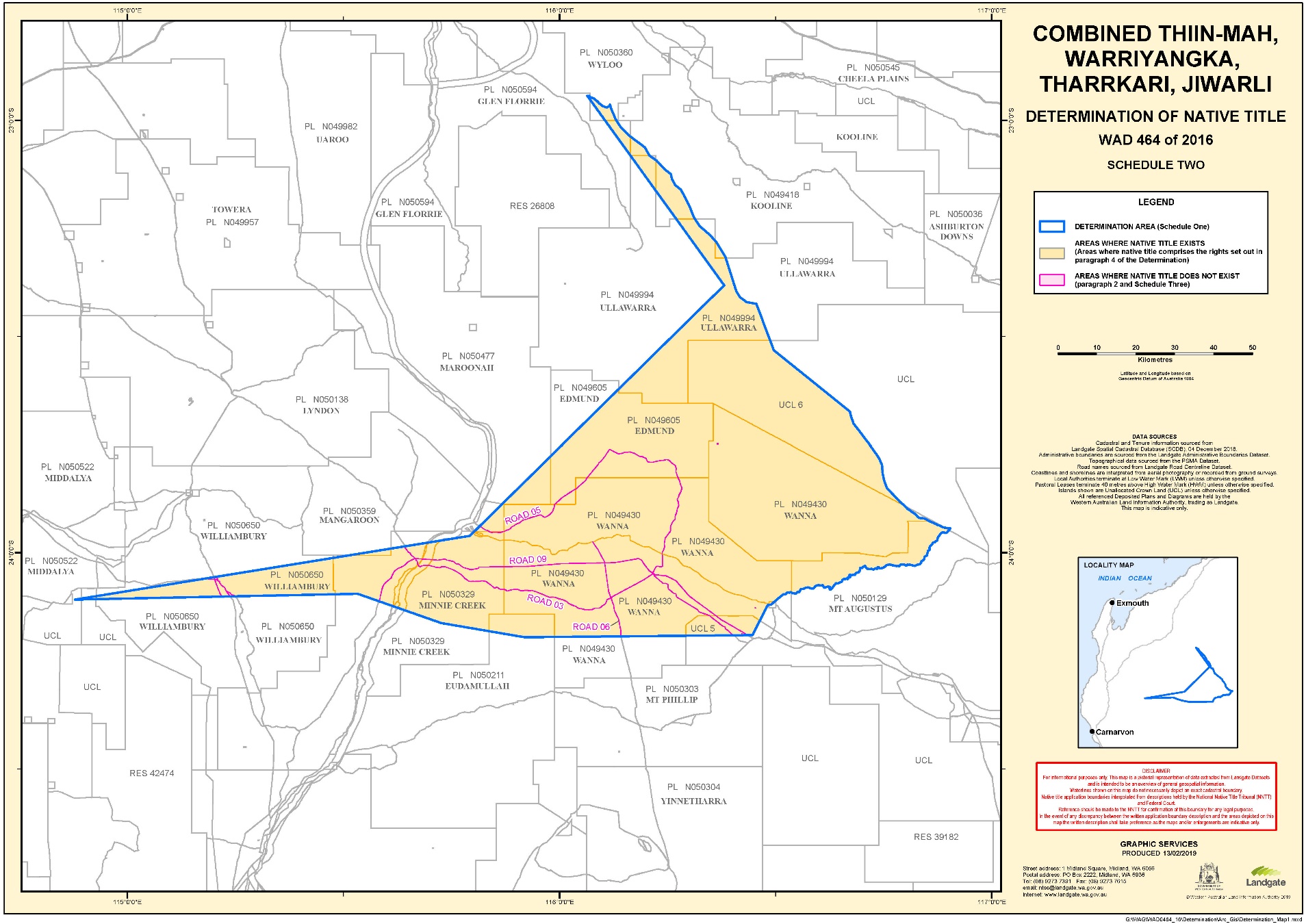
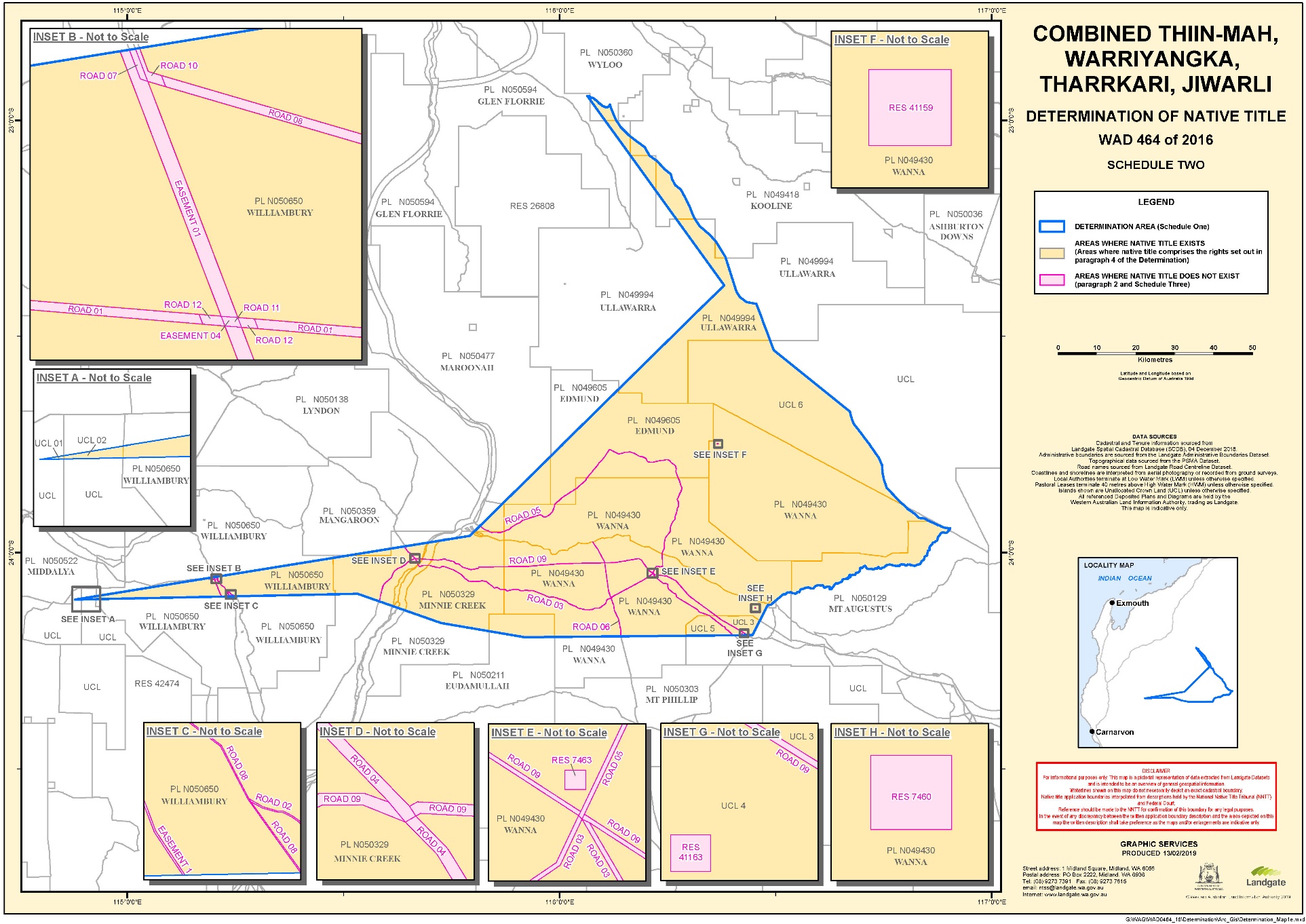
SCHEDULE THREE – AREAS WHERE NATIVE TITLE DOES NOT EXIST
[Schedule referred to in paragraphs 2 and 13]
Native title does not exist in relation to land and waters the subject of the following interests within the Determination Area which, with the exception of public works (paragraph 4 of this Schedule), are generally shown as shaded in pink on the maps at Schedule Two:
1. Reserves
Reserve No. | Current / Last Purpose |
RES 07460 | Water (under Act 57, Vict., No. 20) |
RES 07463 | Water (under Act 57, Vict., No. 20) |
RES 41159 | Repeater Station Site |
RES 41163 | Repeater Station Site |
2. Roads
Dedicated roads, roads set aside, taken or resumed or roads which are to be considered public works (as that expression is defined in the Native Title Act and the Titles (Validation) and Native Title (Effect of Past Acts) Act 1995 (WA)), including the following:
MapInfo ID | Description | Shown in |
Road 01 | Road No. 5432 | Public Plan No. 503085 |
Road 02 | Road No. 3614 | Public Plan No. 503088 |
Road 03 | Road No. 3608 | Public Plan No. 503091 |
Road 04 | Road No. 3609 | Public Plan No. 503091 |
Road 05 | Road No. 3610 | Public Plan No. 503091 |
Road 06 | Road No. 3615 | Public Plan No. 503091 |
Road 07 | Road No. 3626 (Mount Sandiman Williambury Road) | Lot 300 on Deposited Plan 220834 and in Government Gazettes dated 6 September 1935 (at p.1764) and 13 September 1935 (at p. 1798) and on Public Plan No. 503087 |
Road 08 | Road No. 3626 (Mount Sandiman Williambury Road) | Government Gazettes dated 6 September 1935 (at p.1764) and 13 September 1935 (at p. 1798) and on Public Plan No. 503087 |
Road 09 | Road No. 5997 | Government Gazette dated 28 June 1918 (at p.901) |
Road 10 | Road No. 3626 (Mount Sandiman Williambury Road) | Lot 530 on Deposited Plan 220834 and in Government Gazettes dated 6 September 1935 (at p.1764) and 13 September 1935 (at p. 1798) and on Public Plan No. 503087 |
Road 11 | Road No. 5432 | Lot 486 on Deposited Plan 215517 and on Public Plan No. 503085 |
Road 12 | Road No. 5432 | Lot 529 on Deposited Plan 220834 and on Public Plan No. 503085 |
3. Easements containing public works
The land and waters the subject of the Dampier to Bunbury Natural Gas Pipeline, being the land of Pipeline Licence PL 40 and the following easement (which is currently held by the Dampier to Bunbury Natural Gas Pipeline Land Access Minister) for the purpose of access to, and the construction, use and maintenance of, a natural gas pipeline and associated apparatus and appurtenances (Dampier to Bunbury Natural Gas Pipeline) for the transmission and conveyance of natural gas:
MapInfo No. | Easement No. / Document No. |
Easement 01 | E3134B/785 |
Easement 04 | H347256E |
4. Public Works
Any other public works as that expression is defined in the Native Title Act and the Titles (Validation) and Native Title (Effect of Past Acts) Act 1995 (WA) (including the land and waters on which a public work is constructed, established or situated as described in section 251D of the Native Title Act) and to which section 12J of the Titles (Validation) and Native Title (Effect of Past Acts) Act 1995 (WA) or section 23C(2) of the Native Title Act applies.
SCHEDULE FOUR – OTHER INTERESTS
[Schedule referred to in paragraph 9 and 13]
The nature and extent of Other Interests in relation to the Determination Area are as follows:
Land tenure interests registered with the Western Australian Land Information Authority are current as at 4 December 2018. Mining tenements and petroleum interests registered with the Department of Mines, Industry Regulation and Safety are current as at 15 February 2019. All Other Interests are current as at the date of the Determination.
Part A – Other Interests which validly affect the native title rights and interests (paragraph 10)
1. Reserves
(a) The following reserves:
Reserve No. | Current Purpose |
RES 09701 | De Grey Mullewa Stock Route |
(b) The rights and interests of persons who have the care, control and management of the reserves identified in subparagraph (a) above;
(c) The rights and interests of persons entitled to access and use the reserves identified in subparagraph (a) above for the respective purposes for which they are reserved, subject to any statutory limitations upon those rights; and
(d) The rights and interests of persons holding leases over areas of the reserves identified in subparagraph (a) above.
2. Pastoral Leases
The following pastoral leases and the rights and interests of the holders from time to time of those pastoral leases:
Pastoral Lease | Station Name |
PL N049418 | Kooline |
PL N049430 | Wanna |
PL N049605 | Edmund |
PL N049994 | Ullawarra |
PL N050129 | Mt Augustus |
PL N050211 | Eudamullah |
PL N050329 | Minnie Creek |
PL N050359 | Mangaroon |
PL N050360 | Wyloo |
PL N050477 | Maroonah |
PL N050594 | Glen Florrie |
PL N050650 | Williambury |
3. Dampier to Bunbury Natural Gas Pipeline
(a) The interests of the Dampier to Bunbury Natural Gas Pipeline Land Access Minister in the land of the Dampier to Bunbury Natural Gas Pipeline Corridor, including State corridor rights, under the Dampier to Bunbury Pipeline Act 1997 (WA), and the interests of any other person in land in the Dampier to Bunbury Natural Gas Pipeline Corridor under sections 34, 36 and 41(2)(b) of the Dampier to Bunbury Pipeline Act 1997 (WA), including the land and waters the subject of the following taking orders:
Taking Order |
I951020 |
H950807 |
4. Mining Tenements
(a) The following mining tenements under the Mining Act 1904 (WA) (repealed) and the Mining Act 1978 (WA) and the rights and interests of the holders from time to time of those mining tenements:
(i) Mining Leases
Tenement ID | Tenement ID | Tenement ID | Tenement ID | |||
M0900063 | M0900159 | M0900162 | M0900165 | |||
M0900157 | M0900160 | M0900163 | ||||
M0900158 | M0900161 | M0900164 |
(ii) Exploration Licences
Tenement ID | Tenement ID | Tenement ID | ||
E0802897 | E0901943 | E0902129 | ||
E0802904 | E0901944 | E0902137 | ||
E0901043 | E0901989 | E0902143 | ||
E0901700 | E0902007 | E0902149 | ||
E0901703 | E0902018 | E0902166 | ||
E0901704 | E0902084 | E0902195 | ||
E0901705 | E0902086 | E0902239 | ||
E0901706 | E0902095 |
(iii) General Purpose Leases
Tenement ID | Tenement ID | Tenement ID | ||
G0900010 | G0900014 | G0900018 | ||
G0900011 | G0900016 | |||
G0900013 | G0900017 |
(iv) Miscellaneous Licences
Tenement ID | Tenement ID | Tenement ID | Tenement ID | |||
L0900027 | L0900069 | L0900074 | L0900082 | |||
L0900066 | L0900070 | L0900075 | L0900083 | |||
L0900067 | L0900071 | L0900080 | ||||
L0900068 | L0900072 | L0900081 |
(v) Prospecting Licences
Tenement ID |
P0900482 |
P0900489 |
5. Petroleum Interests
The following petroleum interests granted under the Petroleum and Geothermal Energy Resources Act 1967 (WA) or the Petroleum Pipelines Act 1969 (WA) and the rights and interests of the holders from time to time of those interests:
Interest ID | Interest Type |
EP 481 | Exploration Permit |
PL 40 | Pipeline Licence |
6. Access to Mining and Petroleum Areas
(a) Without limiting the operation of any other paragraph in Schedule Four, but subject to paragraph 6(b) below, the rights of the holders from time to time of a mining tenement or petroleum interest referred to in paragraphs 4 and 5 of Schedule Four to use (including by servants, agents and contractors) such portions of existing roads and tracks in the Determination Area as necessary to have access to the area the subject of the mining tenement or petroleum interest for the purposes of exercising the rights granted by that tenement or interest.
(b) Nothing in paragraph 6(a) above allows any upgrade, extension, widening or other improvement to the road or track other than work done to maintain it in reasonable repair and in order to leave it in substantially the same condition as it was prior to its use pursuant to paragraph 6(a).
7. Telstra Interests
The rights and interests held by Telstra Corporation Limited:
(a) as the owner or operator of telecommunications facilities within the Determination Area, including customer radio terminals and cabling;
(b) as the holder of a carrier licence under the Telecommunications Act 1997 (Cth);
(c) created pursuant to the Post and Telegraph Act 1901 (Cth), the Telecommunications Act 1975 (Cth), the Australian Telecommunications Corporation Act 1989 (Cth), the Telecommunications Act 1991 (Cth) and the Telecommunications Act 1997 (Cth); and
(d) for its employees, agents or contractors to enter the Determination Area to access its facilities in, and in the vicinity of, the Determination Area.
8. Other
The following rights and interests:
(a) rights and interests, including licences and permits, granted by the Crown in right of the Commonwealth or the State pursuant to statute or otherwise in the exercise of its executive power;
(b) rights or interests held by reason of the force and operation of the laws of the State or of the Commonwealth including the force and operation of the Rights in Water and Irrigation Act 1914 (WA);
(c) rights and interests of members of the public arising under the common law;
(d) the right to access the Determination Area by an employee, agent or instrumentality of:
(i) the State;
(ii) the Commonwealth;
(iii) any local government authority,
as required in the performance of his or her statutory or common law duty where such access would be permitted to private land;
(e) so far as confirmed pursuant to section 14 of the Titles (Validation) and Native Title (Effect on Past Acts) Act 1995 (WA) as at the date of this determination, any existing public access to and enjoyment of:
(i) waterways; or
(ii) beds and banks or foreshores of waterways; or
(iii) stock routes;
(f) the right of any person to use and enjoy (subject to the laws of the State) any road in the Determination Area over which, as at the date of this determination, members of the public have access according to the common law; and
(g) any other:
(i) legal or equitable estate or interest in the land or waters; or
(ii) any other right (including a right under an option and a right of redemption), charge, power or privilege over, or in connection with:
(A) the land or waters; or
(B) an estate or interest in the land or waters; or
(iii) restriction on the use of the land or waters, whether or not annexed to other land or waters.
Part B – Other Interests which are invalid to the extent they affect the native title rights and interests (paragraph 11)
The following current mining lease under the Mining Act 1978 (WA) is invalid to the extent of the inconsistency with the native title rights and interests during the currency of the Other Interests, pursuant to section 24OA of the Native Title Act:
Tenement ID |
M 0900081 |
SCHEDULE FIVE – NATIVE TITLE HOLDERS
[Schedule referred to in paragraphs 3 and 12]
The Native Title Holders:
(1) are the descendants of people who belonged to the Thiin Mah, Warriyangka, Tharrkari and Jiwarli (TMWTJ) language groups, in particular the descendants of the following ancestors:
(a) Maldurdari and Jiraguru;
(b) Balgonyunga and Wurajulba;
(c) Yagaraja and Kurmainma;
(d) Thaldungu and Jigura;
(e) Larry Brewer and Nancy Cameron;
(f) Togo Griffin and Agnes Barron;
(g) Marigold; and
(h) Warngarri and Didibirri;
or who are adopted by such biological descendants in accordance with the traditional laws acknowledged and the traditional customs observed by the TMWTJ groups; and
(2) identify themselves as members of the TMWTJ groups under traditional law and custom and are so identified by other Native Title Holders as members of the TMWTJ groups; and
(3) have a connection with the land and waters in the Determination Area, in accordance with traditional laws acknowledged and the traditional customs observed by the TMWTJ groups.
MURPHY J:
1 This proceeding is an application made pursuant to s 61 of the Native Title Act 1993 (Cth) (the Act) for a determination of native title, which is known as the Combined Thiin-Mah, Warriyangka, Tharrkari and Jiwarli application (the TMWTJ Application). The applicant in the TMWTJ Application, the State of Western Australia and the other respondents to the proceeding (the parties) have reached an agreement as to the terms of a determination (the Determination) which is to be made in relation to the land and waters covered by the TMWTJ Application (the Determination Area), the external boundaries of which are described in Schedule One to the Determination (which is itself Attachment A to the orders made).
2 Each of the parties has signed a Minute of Proposed Consent Determination of Native Title (the Minute) to show their agreement to the proposed consent determination, and the application is supported by joint submissions filed by the applicant and the first respondent, the State of Western Australia (the State). I have directly drawn upon the parties’ joint submissions in providing these reasons.
THE CLAIM GROUP, PARTIES AND PROCEDURAL HISTORY
3 The TMWTJ Application was filed with the Federal Court pursuant to s 61 of the Act on 7 October 2016, and notified by the Native Title Registrar (Registrar) on 14 December 2016. The period after the notification day referred to in s 66 of the Act ended on 14 March 2017.
4 The TMWTJ Application was subsequently considered by the Registrar pursuant to s 190A of the Act and the Registrar was satisfied that the application addressed the criteria of the registration test. The application was entered on the Register of Native Title Claims on 21 October 2016.
5 The parties to the TMWTJ Application are:
(a) the TMWTJ Applicant;
(b) the State; and
(c) the following pastoralists:
(i) Richard Bernard Arends;
(ii) Bagden Pty Ltd;
(iii) Central Stockcare Pastoral Pty Ltd;
(iv) Mt Augustus Station (1980) Pty Ltd;
(v) Peter Robert Grey and Susan Jean Grey;
(vi) Stamco Beef Pty Ltd; and
(vii) Williambury Station (WA) Pty Ltd and Moogooree Pty Ltd.
6 The TMWTJ Application is made against the background of an existing native title determination in favour of the same native title claim group (see Thudgari People v State of Western Australia [2009] FCA 1334 (Thudgari Determination)), which claim group now wishes to be referred to as Thiin-Mah, Warriyangka, Tharrkari and Jiwarli people, instead of Thudgari. It seeks to extend the area covered by a native title determination to lands that were not covered by the Thudgari Determination.
7 The joint submissions state that the connection material filed in the Thudgari application (prepared by anthropologists Michael Robinson and Mark Chambers in 2004 and titled Thudgari Connection Report) noted at various points that the Thudgari application did not encompass all of the land traditionally associated with the native title holding group as much of the area was, at that time, covered by neighbouring native title claims. The neighbouring claims were subsequently withdrawn from that area, but not before the Thudgari Determination was made.
8 The TMWTJ Application therefore claims additional traditional lands that were not covered by the Thudgari Determination, essentially an area of land to the south/south-east of the Thudgari Determination. The claim is bounded by the Gnulli claim area in the south and south/west, the Wajarri Yamatji determination areas in the south/west, and the Jurruru determination areas in the east. The claim area is predominantly comprised of pastoral stations, in particular Edmond, Wanna, Minnie Creek and Williambury stations and it also intersects small sections of Kooline, Ullawarra, Mangaroon, Mt Augustus and Eudamullah stations.
THE MATERIAL BEFORE THE COURT
9 The Court has the following material before it:
(a) the application pursuant to s 61 of the Act;
(b) the Minute signed by each of the parties;
(c) a notice of nomination of the Woodgoomungooh Aboriginal Corporation to be the prescribed body corporate (PBC) for the Determination pursuant to s 56(2)(a)(i) of the Act;
(d) the written consent of Woodgoomungooh Aboriginal Corporation to be the PBC for the Determination pursuant to s 56(2)(a)(ii) of the Act; and
(e) an affidavit from Mr Jeremy Michael Brown, a solicitor with the Yamatji Marlpa Aboriginal Corporation (YMAC) made 3 April 2019, addressing the authorisation of the Determination and the nomination of Woodgoomungooh Aboriginal Corporation as the PBC (Brown Affidavit).
PRECONDITIONS UNDER S 87 OF THE ACT
10 Pursuant to s 87 of the Act the Court may make a determination of native title by consent without holding a hearing where:
(a) the period specified in the notice given under s 66 of the Act has ended (section 87(1));
(b) there is an agreement for a proposed determination of native title in relation to the proceeding (s 87(1)(a));
(c) the terms of the proposed determination, in writing signed by or on behalf of all of the parties, is filed with the Court (s 87(1)(b));
(d) the Court is satisfied that an order in, or consistent with, those terms would be within the power of the Court (s 87(1)(c)); and
(e) it appears appropriate to the Court to make the orders sought (ss 87(1A) and 87(2)).
11 I am satisfied that these requirements are met in the present application.
12 First, the notice period specified in ss 66(8) and 66(10)(c) of the Act has ended.
13 Second, there is an agreement in writing (the Minute) that has been filed with the Court and signed by all persons required to be parties.
14 Third, I am satisfied that an order consistent with the terms of the Minute is within the power of the Court. The TMWTJ Application was validly made, and the Brown Affidavit shows that the applicant was properly authorised at a meeting of the TMWTJ native title claim group in Carnarvon on 14 March 2019 to make the application for a consent determination in terms of the Minute.
15 There is no approved determination of native title for the area covered by the Minute (s 13(1)) and there remains no approved determination of native title for the area the subject of the proposed determination (s 68). There are no other proceedings before the Court relating to native title determination applications that cover any part of the area the subject of the proposed determination which would otherwise require orders to be made under s 67(1) of the Act. Finally, the form of the proposed determination complies with ss 94A and 225 of the Act.
16 I therefore turn to consider whether it is appropriate to make the orders proposed by the parties pursuant to s 87(1A) of the Act.
WHETHER IT IS APPROPRIATE TO MAKE THE PROPOSED DETERMINATION
The narrowing of the assessment of connection
17 It should be understood that in circumstances where the TMWTJ Application operates as an extension of the Thudgari native title holders’ claim to areas adjoining the Thudgari Determination area (which were not pursued in that application because of competing claims which have since been withdrawn) the applicant and the State have agreed that it is appropriate to narrow the focus of the connection inquiry to the following issues:
(a) whether the TMWTJ Application area was part of the country of Thudgari/TMWTJ society at sovereignty;
(b) if so whether the TMWTJ people have maintained a connection to the TMWTJ Application area from sovereignty to the present, by acknowledgement of their traditional laws and observance of their traditional customs; and
(c) the type of native title rights and interests that are to be recognised in the TMWTJ Application area.
18 The joint submissions state that a substantial body of connection material supporting the application was provided to the State in relation to these matters. In addition to the Thudgari Connection Report prepared for the purposes of the Thudgari Determination, the TMWTJ Applicant provided the State with:
(a) an anthropological report by anthropologist Alistair Vaughan, titled TMWTJ Supplementary Report dated March 2018;
(b) an affidavit of Peter Salmon dated 15 August 2016;
(c) an affidavit of Herbert Eagles dated 26 August 2016; and
(d) an affidavit of Carmen Cummings dated 13 October 2016.
The Court’s function under s 87
19 In deciding whether it is appropriate to make the proposed orders it must be kept in mind that the Court’s function under s 87 focuses on the making of an agreement by the parties, and the power must be understood in the context of the Act’s emphasis on negotiation and alternative dispute resolution, rather than judicial determination in a contested proceeding. The power in s 87 is only exercisable when an agreement has been reached and the power should be exercised flexibly and with regard to the purpose for which the provisions are designed.
20 The Court is not necessarily required to make findings or embark on its own inquiry as to the merits of the claim made in an application for a consent determination under s 87: see Ward v State of Western Australia [2006] FCA 1848 (Ward) at [8] (North J); Cox on behalf of the Yungngora People v State of Western Australia [2007] FCA 588 (Cox) at [3] (French J); Lander v State of South Australia [2012] FCA 427 at [11]-[12] (Mansfield J); Freddie v Northern Territory [2017] FCA 867 (Freddie) at [16]-[17] (Mortimer J). Rather, the Court must be satisfied, inter alia, that it is appropriate to make the orders sought. The indicia that will be sufficient to satisfy the Court of the appropriateness of a consent determination will be determined on a case by case basis. In some cases it may be appropriate to make orders under s 87 where the Court has received no evidence of the primary facts substantiating native title if the Court is satisfied that the parties have freely and on an informed basis come to an agreement: see Hughes (on behalf of the Eastern Guruma People) v Western Australia [2007] FCA 365 at [9] and Ward at [8].
21 Even so, as French J observed in Cox the concept of appropriateness also recognises that the determination made by the Court is one made as against the whole world, and not just between the parties to the proceeding. The Court must be conscious that the rights conferred are enduring legal rights, proprietary in nature. This informs considerations including the requirement for the free and informed consent of all parties and the State’s agreement that there is a credible and rational basis for the determination proposed: Freddie at [18].
22 The requirements of s 87 may, and will likely, be met where the Court is satisfied that a relevant government respondent (such as the State in the present case), through competent legal representation, is satisfied as to the cogency of the evidence upon which the Applicant relies. The Court is entitled to rely on the processes established by a State or Territory for assessing native title claims and to proceed on the basis that the State or Territory has made a reasonable and rational assessment of the material to which it has had access in deciding to enter into an agreement: Freddie at [23]-[24] and the authorities there cited.
THE CLAIMANTS AND THEIR COUNTRY
23 While the Court’s task in dealing with an application under s 87 is not to assess and make findings about the matters set out in s 223 of the Act, this determination and the reasons which accompany it will stand as a permanent record for the Thiin-Mah, Warriyangka, Tharrkari and Jiwarli people of the judicial recognition of their native title rights and it is appropriate to say something about the claimants and their country. In doing so I rely directly on the joint submissions, which draw on material provided to the State to show the Thiin-Mah, Warriyangka, Tharrkari and Jiwarli people’s connection to and occupation of the proposed Determination Area (the connection material).
Description of the native title holders
24 The proposed native title holders are described in Schedule Five of the Minute. The TMWTJ Applicants are the descendants of people who belong to the Thiin-Mah (also known as Thiin), Warriyangka, Tharrkari and Jiwarli language groups, in particular the descendants of the following ancestors:
(a) Maldurdari and Jiraguru;
(b) Balgonyunga and Wurajulba;
(c) Yagaraja and Kurmainma;
(d) Thaldungu and Jigura;
(e) Larry Brewer and Nancy Cameron;
(f) Togo Griffin and Agnes Barron;
(g) Marigold; and
(h) Warngarri and Didibirri;
or who are adopted by such biological descendants in accordance with the traditional laws acknowledged and the traditional customs observed by the TMWTJ groups. The description also includes a requirement that such persons identify themselves as members of the TMWTJ groups, be accepted by other native title holders as members of the TMWTJ groups, and to have a connection with the land and waters in the Determination Area in accordance with traditional law and custom.
25 An identical description was used in the Thudgari Determination with the exception that in the present application “Thudgari” has been replaced by “TMWTJ groups”. This is because Thudgari is a blanket term which, by definition, expressly means the persons from the four language groups above, namely the Tharrkari, Thiin, Warriyangka and Jiwarli.
26 According to the anthropological evidence referred to in the joint submissions, at the time of settlement the four language groups were distinct but so close culturally and socially as to be virtually indistinguishable. As the population of these groups declined in the post-sovereignty era, their surviving members coalesced into one group. The joint submissions refer to the evidence of Peter Salmon, a senior claimant in the group, to the effect that:
(a) the four groups have “always been together” and “follow the same rules”;
(b) the four groups have a “different kind of culture from the other surrounding groups”; and
(c) the four groups have “always shared the country”.
27 The Thudgari claim used one of the groups’ labels, Tharrkari, as its marker but individual claimants continue to self-identify by reference to their specific language group, and the native title claimants’ choice of label in this application reflects that fact.
The native title holders rights to country
28 In the Thudgari Determination, the majority of lands comprising the determination area were traditionally associated with the Tharrkari and Jiwarli language groups, with smaller areas of Thiin-Mah and Warriyangka. The majority of the TMWTJ Determination Area is recognised by the native title holding groups traditionally associated with the Thiin-Mah and Warriyangka language groups, with smaller areas of country associated with Jiwarli and Tharrkari.
29 The connection materials provided to the State in support of both the Thudgari and TMWTJ native title claims indicate a multi-layered and nuanced tenure system. At the broadest level every claimant regardless of language group has rights in the whole of the TMWTJ claim area, but certain individuals who have special status over particular areas (ngurrara) are seen as having stronger rights and interests in, and the right to speak for, those parts of country.
30 The rights of TMWTJ people to speak for country are derived from the connections of native title holders to country, of two main kinds. First, native title holders have maintained a physical connection with places within the claim area, derived from birth on the land, growing up on the land, working on the land, continued visitation of the land and residence on the land. Second, native title holders have what may be described as cultural connections to land, in the case where physical connection of individuals to the land has lessened but where cultural ties remain. Cultural connection includes the retention and transmission of knowledge about places of significance and of the country and its resources, historical events on the land and a sense of belonging to country through the enduring laws and customs of the TMWTJ people.
The spiritual beliefs of the Thiin-Mah, Warriyangka, Tharrkari and Jiwarli people
31 The TMWTJ people’s beliefs about country go back to the time of the Dreaming. This period is known throughout the Pilbara and parts of the Ashburton-Gascoyne regions of Western Australia in terms that translate generally to “the time that the land was soft”. For TMWTJ people, the Dreaming was a creative time in the past when the land was without a physical shape, when the earth and sky were merged and the landscape was not yet divided into hills, plains, rivers and other landforms. It is believed that ancestral beings roamed the land during the Dreaming, their actions shaping the natural world into the form which is now recognisable.
32 The knowledge of spirits and their continuing presence on country has been maintained into the present. According to TMWTJ people, the natural environment continues to contain spiritual forces, which have the potential to interfere or involve themselves with human affairs. The nature of the involvement of a spiritual force in human affairs depends largely on the attitude taken by humans towards the forces and their own observance of traditional laws and customs. Some of those spirits have existed since, and were involved in, the creation of the natural environment and of humans, while others are the spirits of ancestors who have passed.
Ongoing connection to country
33 The TMWTJ people have maintained their connection to country since the assertion of sovereignty. The joint submissions provide that the archaeological and historical record make it clear that Aboriginal people have occupied and used the resources of the land in the Determination Area since well before first contact with Europeans.
34 Successive generations of TMWTJ people have had a physical presence on the land and have an enduring spiritual connection to those areas. During the 1850s and 1860s, the TMWTJ people were often absorbed into the pastoral workforce, which allowed them to remain in the area and maintain a physical connection to the land. Contemporary ownership of TMWTJ land is often expressed in terms of connection to pastoral stations in the area. The connection material shows how working on pastoral stations within the Determination Area has been a way for TMWTJ people to maintain a physical connection to country and also enabled them to learn about the cultural dimensions of their traditional land from elders.
35 After the pastoral downturn in the 21st century some Aboriginal people were displaced from pastoral stations in the area and region, however a permanent core of people continued to live in the claim area and TMWTJ people continue to visit the Determination Area and pastoral stations in the area to this day.
36 According to the submissions, senior members of the claim group have retained and transmitted an impressive amount of knowledge to younger generations, reflected in the TMWTJ people’s knowledge of landscape. The joint submissions refer to the evidence of Peter Salmon, whose affidavit states:
I’m trying to keep my traditions alive and am teaching people about country and want to pass on my country and these rules to my younger family. I still think about country when I’m not at home.
The position taken by the State
37 It is significant to my decision to make the proposed determination that the connection materials provided to the State for this application, together with other anthropological reports that were prepared for the purposes of the application for the Thudgari Determination, have been assessed by the State and the State’s response is informed by legal advice from the State Solicitor’s Office.
38 The State has played an active role in the negotiation of the proposed consent determination. Acting for itself and on behalf of the community generally, the State has satisfied itself having regard to the requirements of the Act that the proposed determination is justified in all the circumstances. In particular the State is satisfied that the agreement reached in Thudgari People v State of Western Australia in relation to issues concerning the native title holders’ identity, traditional laws and customs and the nature and extent of the native title rights and interests possessed by members of the claim group is equally applicable to the TMWTJ Application. In reliance on the material the State has reached the view that the additional land in the TMWTJ Application was part of the traditional country of the native title holders’ society at sovereignty and that, by acknowledgement of their traditional laws and observance of their traditional customs, the Thiin-Mah, Warriyangka, Tharrkari and Jiwarli people have maintained a connection to the TMWTJ Application area from sovereignty to the present.
39 The State is satisfied that the native title rights and interests set out in the Minute in respect of this application are the same as those recognised in the Thudgari Determination. It has also conducted searches of relevant land tenure, mining and petroleum registries to determine the nature and extent of “other interests” within the Determination Area, and the joint submissions state that those interests are included in the proposed determination: see Minute, Schedule Four.
40 The TMWTJ applicant and the State submit, and the Court accepts, that the Minute sets out a description of the nature and extent of the native title rights and interests and the “other interests” in relation to the Determination Area which complies with s 225 of the Act.
41 The proposed orders are within power and, for the reasons set out above I am also satisfied that they are appropriate pursuant to s 87 of the Act.
Nomination of a prescribed body corporate
42 Pursuant to s 55 of the Act the Court must, at the same time as or soon as practicable after making a determination of native title make such determinations as are required by s 56 (which deals with holding the native title on trust) and s 57 (which deals with non-trust functions of prescribed bodies corporate).
43 The joint submissions state that prior to the Thudgari Determination, the Thudgari common law native title holders incorporated the Wyamba Aboriginal Corporation (ICN 7266) (Wyamba) and nominated it to be the PBC for the Thudgari people. Wyamba was registered on 9 September 2009 and subsequently changed its name to Kulyamba Aboriginal Corporation RNTBC on 26 February 2014.
44 The Brown Affidavit shows that at a meeting of the TMWTJ native title claim group at Carnarvon on 14 March 2019:
(a) the claim group approved the incorporation and rules of the Woodgoomungooh Aboriginal Corporation;
(b) the claim group resolved to nominate the Woodgoomungooh Aboriginal Corporation to be the Prescribed Body Corporate (PBC) to hold the TMWTJ claim group’s native title in the proposed Determination Area on trust for the native title holders; and
(c) the Woodgoomungooh Aboriginal Corporation ICN 9040 was incorporated on 3 April 2019.
On 3 April 2019 the directors of Woodgoomungooh Aboriginal Corporation consented to its nomination as the PBC.
45 I am satisfied that it is appropriate to order that the Woodgoomungooh Aboriginal Corporation hold the determined native title in trust for the native title holders pursuant to s 56(2)(b) of the Act.
Conclusion
46 The parties are to be congratulated on reaching agreement regarding the proposed determination and I have made orders in the terms they propose.
I certify that the preceding forty-six (46) numbered paragraphs are a true copy of the Reasons for Judgment herein of the Honourable Justice Murphy. |
Associate:


