

FEDERAL COURT OF AUSTRALIA
MYOB Group Limited, in the matter of MYOB Group Limited [2019] FCA 484
ORDERS
DATE OF ORDER: |
THE COURT ORDERS THAT:
1. Pursuant to r 2.13(1) of the Federal Court (Corporations) Rules 2000 (Cth) (Corporations Rules), Manikay Partners LLC has leave to be heard in the proceeding without becoming a party to it.
2. Pursuant to 2.32(4) of the Federal Court Rules 2011 (Cth) (Rules) and subject to 2.32(3) of the Rules, Manikay Partners LLC has leave to inspect each document filed and read or tendered in evidence in the proceeding, such access to be granted on and from midday on 14 March 2019.
3. The interlocutory process filed by Manikay Partners LLC and others on 12 March 2019 (Interlocutory Process) be otherwise dismissed.
4. Costs of the Interlocutory Process be reserved.
5. Pursuant to s 411(1) of the Corporations Act 2001 (Cth) (Act), the plaintiff convene a meeting (Scheme Meeting) of its members (other than holders of Excluded Shares as defined in the Scheme Booklet) (MYOB Shareholders), for the purpose of considering, and if thought fit, agreeing (with or without modification) to a scheme of arrangement proposed between the plaintiff and Scheme Shareholders (as defined in the Scheme Booklet) (MYOB Scheme), being the scheme of arrangement set forth in Annexure C to the explanatory statement prepared in relation to the MYOB Scheme (Scheme Booklet), which is annexure IFB7 to the affidavit of Ian Francis Boylan sworn on 12 March 2019 in this proceeding.
6. Pursuant to s 411(1) of the Act, the Scheme Booklet be approved for distribution to the MYOB Shareholders.
7. The Scheme Booklet to be dispatched to the MYOB Shareholders be substantially in the form of annexure IFB7 to the affidavit of Ian Francis Boylan sworn on 12 March 2019 in this proceeding.
8. The Scheme Meeting be held at 3.00 pm (AEST) on 17 April 2019 at Level 8, 45 Clarence Street, Sydney in the State of New South Wales.
9. The time for determining eligibility to vote at the Scheme Meeting be fixed for 7.00 pm (AEST) on 15 April 2019.
10. The Chairperson of the Scheme Meeting be Justin Trevor Milne and, in his absence, Andrew Cameron Stevens.
11. The Chairperson of the Scheme Meeting have the power to adjourn the Scheme Meeting in his absolute discretion, including to another day.
12. Except for procedural motions, all voting at the Scheme Meeting be by poll as declared by the Chairperson.
13. Rule 2.15 of the Corporations Rules shall not apply to the Scheme Meeting, except for r 75-15(2) of the Insolvency Practice Rules (Corporations) 2016.
14. Pursuant to s 1319 of the Act, on or before Tuesday, 19 March 2019, there be dispatched to:
(a) each MYOB Shareholder who has nominated an electronic address for the purposes of receiving communications from the plaintiff, at such address, an email containing a link to a website at which the Scheme Booklet and proxy form substantially in the form of the document at annexure IFB8 to the affidavit of Ian Francis Boylan sworn on 12 March 2019 and an online portal for submitting the proxy form can be accessed;
(b) each other MYOB Shareholder, by hand at, or prepaid post or courier to, and in the case of a member whose registered address is outside Australia, by prepaid airmail post or air courier for overseas pre-paid post to, the address of that MYOB Shareholder as set out in the register of members of the plaintiff, a copy of the Scheme Booklet and a proxy form substantially in the form of the document at annexure IFB8 to the affidavit of Ian Francis Boylan sworn on 12 March 2019; and
(c) if the plaintiff receives notification that the email is unable to be delivered to the nominated electronic address of any MYOB Shareholder to whom the email was sent in accordance with Order 14(a), the Scheme Booklet and the personalised proxy form be dispatched by the plaintiff to that MYOB Shareholder by the method appropriate to that member referred to in Order 14(b).
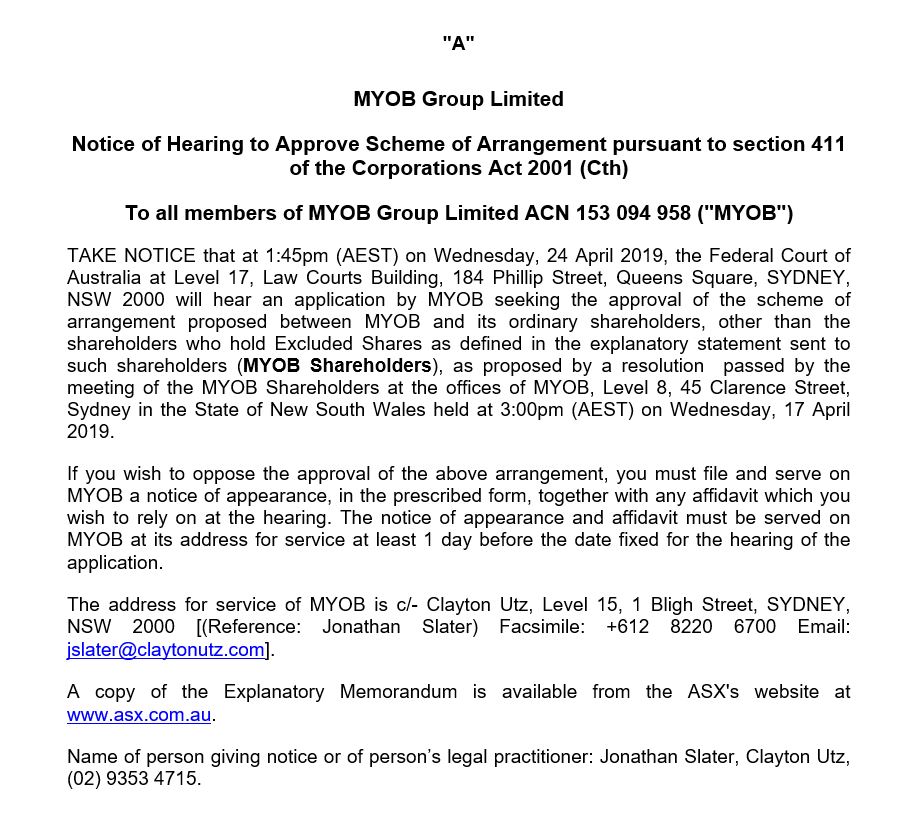
15. Notice of the hearing of an application pursuant to s 411(4)(b) of the Act for orders approving the MYOB Scheme be published by an advertisement in The Australian newspaper substantially in the form of annexure “A” to these orders, such advertisement to be published on or before 20 April 2019 and the plaintiff be otherwise exempted from compliance with r 3.4 of the Corporations Rules.
16. The proceeding be stood over to 1.45 pm on 24 April 2019 before Markovic J for the hearing of any application to approve the MYOB Scheme.
17. Liberty to apply on 2 days’ notice.
18. These orders be entered forthwith.
Note: Entry of orders is dealt with in Rule 39.32 of the Federal Court Rules 2011.
MARKOVIC J:
1 Pursuant to an originating process filed on 27 February 2019 the plaintiff (MYOB) has made an application under s 411 of the Corporations Act 2001 (Cth) (Act) and seeks orders in connection with a proposed scheme of arrangement between it and its shareholders (MYOB Shareholders) other than the shareholders who hold “excluded shares” as defined in the scheme implementation agreement (Scheme Shareholders).
2 On 13 March 2019 Manikay Partners, LLC (Manikay Partners), Manikay Master Fund, LP, Manikay Merger Fund, LP and Jangus Pty Ltd (collectively, Manikay Parties) filed an interlocutory process seeking orders pursuant to r 2.13(1) of the Federal Court (Corporations) Rules 2000 (Cth) (Corporations Rules) for leave to be heard in the proceeding without becoming a party to it, leave pursuant to r 2.32 of the Federal Court Rules 2011 (Cth) to inspect each document filed in the proceeding, and for the first court hearing to be adjourned to a date to be fixed.
3 The proceeding was listed before me for a first court hearing on 13 March 2019. At that time, on the application of MYOB, I made orders including an order pursuant to s 411(1) of the Act convening a meeting of the Scheme Shareholders for the purposes of considering and, if thought fit, agreeing (with or without modification) to the scheme proposed to be made between Scheme Shareholders as defined in cl 1.1 of the scheme implementation agreement dated 23 December 2018 (SIA) and MYOB (Scheme) and for the distribution of the explanatory statement required by s 412(1)(a) of the Act (Scheme Booklet) to Scheme Shareholders.
4 I also made orders granting leave to Manikay Partners to be heard in the proceeding without becoming a party to it and for it to have leave to inspect the evidence filed and read or tendered in the proceeding on and from midday on 14 March 2019. I declined to make the order sought by the Manikay Parties adjourning the first court hearing to a date to be fixed and otherwise dismissed the interlocutory process.
5 These are my reasons for making those orders.
MANIKAY PARTIES’ ADJOURNMENT APPLICATION
6 The Manikay Parties together hold approximately 11% of the fully paid ordinary shares in MYOB. In support of their interlocutory process they relied on an affidavit sworn by Milorad Gajic, a partner of MinterEllison, their solicitors. Mr Gajic deposed to the following facts which were not in contention:
(1) on 8 October 2018 MYOB announced to the ASX that Kohlberg Kravis Roberts & Co. L.P. together with its affiliates (KKR) had purchased 17.6% of MYOB’s issued share capital and that it had received an unsolicited conditional proposal from KKR to acquire all of the remaining shares in MYOB that KKR did not already own by way of a scheme of arrangement at $3.70 per share. The announcement noted that the offer price represented a 24% premium on the closing price of $2.98 per share on 5 October 2018;
(2) on 2 November 2018 MYOB announced to the ASX that it had determined to grant information access to KKR to enable it to progress its indicative proposal and that KKR had increased its offer price to $3.77 per share. The proposal remained conditional;
(3) on 24 December 2018 MYOB announced to the ASX (December Release) that, following conclusion of discussions with KKR, it had entered into the SIA under which an entity associated with KKR, ETA Australia Holdings III Pty Ltd (ETA Australia), would acquire for an offer price of $3.40 per share all of the shares in MYOB not already owned by KKR by way of a scheme of arrangement under Pt 5.1 of the Act. The announcement to the ASX included:
In agreeing to the transaction, the Directors of MYOB have taken into account:
- the attractive terms of the SIA, including the ability to ensure a full and fair testing of the KKR Revised Proposal;
- current market volatility including share price declines of approximately 10% and 17% across the ASX and domestic technology companies respectively;
- the significant short-term investment requirements to execute the strategic growth plan; and
- the potential disruptive impact of a failed transaction on the Company and its trading price, given the significant existing shareholding of KKR.
(emphasis added.)
(4) on 27 February 2019 and 6 March 2019 respectively the Manikay Parties served on MYOB a notice of initial substantial holder in Form 603 and a notice of change of interests of substantial holder in Form 604, both in accordance with s 671B of the Act;
(5) despite their request, MYOB did not provide the Manikay Parties with copies of the draft versions of the Scheme Booklet or the draft independent expert’s report required by s 412(1)(a)(ii) of the Act and Sch 8 cl 8303 of the Corporations Regulations 2001 (Cth) (Corporations Regulations);
(6) on 5 March 2019 the Manikay Parties wrote to MYOB (Manikay Letter). The Manikay Letter included the following:
Unfortunately, in December of last year, the Company agreed to a scheme of arrangement (the “Scheme”) with Kohlberg Kravis Roberts & Co. L.P. and its affiliates (“KKR”) at a price per share of $3.40. We believe this deal significantly undervalues the Company. The Scheme followed a previous unsolicited and conditional offer by KKR at a price per share of $3.77. We were disappointed when KKR made its original offer and expected the Board would be able to negotiate a higher price that would reflect the true value of the Company. Instead, KKR took advantage of the temporary adverse market conditions in late 2018 to pressure the Board to accept a deal at $3.40 per share, a material reduction from the original $3.77 per share offer. Since then, equity markets have rallied significantly, and the financing markets have normalized, such that a sale of the Company at $3.40 per share does not represent a fair and reasonable deal for Company shareholders. Our valuation of the Company, which we are happy to discuss with the Board and with our fellow shareholders, is well in excess $4.00 per share.
(7) MYOB made an announcement to the ASX which attached the Manikay Letter; and
(8) MYOB and the Manikay Parties engaged in subsequent correspondence. While it is not necessary for me to exhaustively set out the content of that correspondence, relevantly in its letter dated 6 March 2019 Manikay Partners said:
Thank you for your letter to us dated 5 March 2019 (“MYOB letter”) and for your prompt response to the matters raised in our letter to MYOB Group Limited (“MYOB” or the “Company”) of March 4th, 2019 (“Manikay Letter”).
As stated in the Manikay letter, we strongly believe the change in market conditions since the KKR proposal was agreed, among other things, support the conclusion that the KKR proposal does not reflect the true value of the Company. As such, we strongly believe that the MYOB Board’s recommendation to vote in favor of the KKR proposal can no longer be supported and should not be maintained.
While we are pleased to receive your acknowledgment that the Independent Expert’s Report will reflect any relevant and material movements in market conditions and other developments since the announcement of the KKR proposal on December 24th, 2018, no amount of disclosure will, of itself, provide a basis for the directors of MYOB to maintain their unanimous recommendation for the KKR proposal.
(emphasis added.)
7 The Manikay Parties sought access to the documents filed in the proceeding and an adjournment of approximately one week to review the Scheme Booklet and the independent expert report included in the Scheme Booklet (IER) and, if so advised, to lead evidence from an expert about the value of the shares in MYOB and the adequacy of the IER. They submitted that granting the adjournment and the leading of further evidence would assist the Court in forming a view as to whether the material, by which I assume they refer to the Scheme Booklet including the IER, presented a fair picture of value to shareholders.
8 The Manikay Parties said that their application arose in the context of the movements in the market, particularly in information technology stocks, that had taken place over the period from when the initial indicative offer was made to 24 December 2018, when MYOB announced its entry into the SIA, and since that time. There was some evidence of the movement in the market in two charts exhibited in Mr Gajic’s affidavit which were obtained from the ASX website on 12 March 2019 and which Mr Gajic described as “showing the increase in each of the ASX200 and ASX300 Information Technology Index from 11 September 2018 to 11 March 2019”.
9 The Manikay Parties noted that in the December Release the MYOB directors said that in agreeing to the transaction they had taken into account “current market volatility including share price declines of approximately 10% and 17% across the ASX and domestic technology companies respectively” (see [6(3)] above). Reference was made to the footnote to that statement which referred to share price movement of the ASX200 and ASX300 Information Technology Index between 8 October 2018 and 21 December 2018.
10 The point that the Manikay Parties sought to make was that the market in information technology stocks had declined leading up to the entry into the SIA but that it had subsequently recovered. The Manikay Parties contended that the offer price of $3.40 represented a 14% premium to the 5 October 2018 share price which they described as “a bit skinny”. They submitted that if they were given the opportunity to put on expert valuation evidence, the Court, with the benefit of that evidence, could determine whether there had been fair disclosure by MYOB.
11 The Manikay Parties submitted that the change in share price over the period of the offer is the reason for their legitimate concern that the offer price of $3.40 is too low. They said that in their view MYOB’s valuation is higher but that their concern might be allayed by seeing the IER, which they had not seen at that time of making their application despite having requested a copy. Notwithstanding that submission, the Manikay Parties contended that if the IER supported the offer price then something had gone wrong and, in light of MYOB’s reliance on a market based analysis, the Court would be best placed to assess whether the IER and Scheme Booklet are fair in their disclosure with the assistance of informed submissions and the opinion of another expert procured by the Manikay Parties.
12 The Manikay Parties accepted that their position could be put at the second court hearing, rather than causing an adjournment of the first court hearing. However, their preferred course was to have any issue they wished to raise considered at an earlier time so as to avoid cost and delay and, if their premise be correct, the publication of information which they considered to be flawed.
13 I refused the Manikay Parties’ application for an adjournment. My reasons for doing so are summarised below.
14 First, the Scheme involves a cash offer of $3.40 per share. In that regard it is not complex. It has been recommended by the directors of MYOB in the absence of a “superior proposal” (as defined in cl 1.1 of the SIA) and subject to an independent expert concluding that the transaction is in the best interests of MYOB Shareholders. It will be a matter for the Scheme Shareholders to determine whether they wish to accept that offer for their shares.
15 Secondly, as MYOB submitted, it is not appropriate that one shareholder be given an advance copy of an explanatory statement prior to its general release to the market pursuant to orders made at the first court hearing.
16 Thirdly, an independent expert preparing a report in relation to a scheme is genuinely independent. That is, he or she is expected to prepare the report without communication which might undermine his or her independence and to come to a view about the value of the company. The expert is not engaged in an adversarial process where he or she is put in the position of considering and responding to the views of another expert. Yet that would be the result if the process urged on the Court by the Manikay Parties was adopted. They would seek to rely on their own expert evidence and leave it to the Court to adjudicate on any differences between the two opinions, it seems, in order to form a view about the adequacy of disclosure.
17 The standard expected of an expert in performing their role, as described above, is reinforced by the Australian Securities and Investments Commission’s (ASIC) Regulatory Guide 112 “Independence of Experts” dated March 2011 (RG112), which focuses on reports prepared for transactions under, among others, Ch 5 of the Act, whether they are required by the Act or provided voluntarily. RG112 includes under the heading “Communication”:
RG 112.52 To help maintain independence and negate any inference of bias, we consider that an expert should direct and lead all meetings and discussions with the commissioning party, its advisers and any other interested party. The expert should keep appropriate file notes of discussions and retain copies of documents worked on in discussions with the commissioning party, its advisers and any other interested party.
RG 112.53 Brooking J in Pivot at 339 summarised this issue in the following terms:
The guiding principle must be that care should be taken to avoid any communication which may undermine, or appear to undermine, the independence of the expert.
18 Fourthly, the issue raised by the Manikay Parties, as they conceded, is one that can be raised at the second court hearing. Indeed, it is more appropriate for that forum. The application for leave to summon a meeting is in the nature of an interlocutory proceeding and is preliminary to the final determination, which is made when the matter comes back before the court for approval after the holding of the meeting as directed. That is, at the first court hearing the court does not make a final determination of the question whether the arrangement falls within the scope of s 411. That is a question for the second court hearing: see Australian Securities Commission v Marlborough Gold Mines Limited (1993) 177 CLR 485 (Marlborough Gold Mines) at 504-505.
19 This is not a case where it has been claimed that there would be no utility in making the order sought by MYOB convening the scheme meeting pursuant to s 411(1) of the Act. As Keane CJ and Jacobson J observed in Re CSR Limited (2010) 183 FCR 358:
61 It may be accepted that these observations cannot be taken to mean that a court would exercise its discretion under s 411(1) of the Act in favour of setting in train a process which is clearly bound to fail: it has long been recognised that a clear want of utility in putting in train the processes of s 411 is a good reason to decline to order the convening of the first meeting. …
…
64 In our respectful opinion, the discretion to make an order under s 411(1) of the Act may properly be exercised in the negative where the making of the order would be futile because the scheme as proposed is unlikely to be finally approved. The Court should not promote the waste of resources and the raising of false hopes or the creation of unnecessary concern and anxiety by promoting a process which will clearly not proceed to consummation under s 411(4)(b). But that having been said it must be recognised that there are other procedural opportunities which are more appropriate for the resolution of the issues which the learned primary judge held to be fatal to CSR’s attempt to put the s 411 process in train in this case.
20 Fifthly, it is open to the Manikay Parties to obtain an alternate valuation after an order approving distribution of the Scheme Booklet is made.
21 Finally, in its letter dated 6 March 2019 (see [6(8)] above) Manikay Partners candidly said that “no amount of disclosure will, of itself, provide a basis for the directors of MYOB to maintain their unanimous recommendation for the KKR Proposal”. In other words, it is apparent that the Manikay Parties’ primary concern is not with adequacy of disclosure but with adequacy of the price offered. This is further evident in that the only basis proffered by the Manikay Parties to ground the assertion of possible inadequate disclosure is movement in the share market, about which information is publicly available and which could be considered by shareholders in determining how to vote at a properly convened meeting.
FIRST COURT HEARING
22 Given my refusal to grant an adjournment, I proceeded to hear MYOB’s application.
Background
23 MYOB is an Australian listed public company limited by shares. It is a cloud based business management solutions provider that serves 1.2 million businesses across Australia and New Zealand by providing accounting, payroll, tax, practice management, customer relationship management, job costing, inventory and other services.
24 On 23 December 2018 ETA Australia and ETA Asia Holdings II Pte Ltd (ETA Asia) entered into the SIA pursuant to which MYOB agreed to propose the Scheme and implement it subject to the terms and conditions of the SIA.
25 The Scheme involves the acquisition by ETA Australia of all the Scheme Shares held by Scheme Shareholders who are those persons registered in MYOB’s share register as the holder of Scheme Shares as at the “record date” (as defined in cl 1.1). Scheme Share is defined in the SIA to mean a fully paid ordinary share in MYOB other than an “excluded share” on issue as at the record date (Scheme Share). “Excluded share” is defined to mean any share held in MYOB by the bidder, ETA Australia, or any of its associates as defined in s 12 of the Act.
26 ETA Australia is indirectly owned by KKR Asian Fund III L.P. and certain co-investment funds and investment vehicles managed and or advised by KKR.
27 ETA Asia, a holdings company of ETA Australia, currently holds 103,935,106 MYOB shares, being approximately 17.6% of the MYOB shares currently on issue, and it is contemplated that the MYOB shares held by ETA Asia will be transferred to ETA Australia on or around the “implementation date” (as defined in cl 1.1 of the SIA). They will not be transferred as part of the Scheme.
28 The consideration in connection with the Scheme is that all Scheme Shareholders will receive $3.40 cash per Scheme Share (Scheme Consideration).
29 After the Scheme is implemented, and subject to the satisfaction or waiver of a number of conditions precedent, the Scheme Shareholders will cease to hold shares in MYOB; all of the Scheme Shares held by the Scheme Shareholders will be transferred to ETA Australia; and MYOB will enter ETA Australia in the share register as the holder of all the Scheme Shares.
30 MYOB’s board of directors has unanimously recommended that the Scheme Shareholders vote in favour of the Scheme in the absence of a superior proposal and subject to the independent expert, Grant Samuel & Associates Pty Limited (Independent Expert), continuing to conclude that the Scheme is in the best interests of the holders of MYOB shares.
Independent expert’s report
31 The Independent Expert, engaged by the MYOB board of directors to assess the Scheme, has prepared the IER which is included at annexure A to the Scheme Booklet. The Independent Expert has valued MYOB in the range of $3.19 to $3.69 per share, which it says “represents the estimated full underlying value of MYOB assuming 100% of the company was available to be acquired and includes a premium for control”. The Independent Expert observes that the Scheme Consideration of $3.40 cash per share falls within its valuation range for MYOB and accordingly the Scheme is fair. The Independent Expert notes that, because the Scheme is fair, it is by definition reasonable.
32 The Independent Expert also observes that, given the process undertaken by MYOB to seek alternative proposals (see [43] and [65] below), the prospects of a higher offer from a third party appear remote. It notes that in the absence of a change of control proposal for MYOB it expects that MYOB shares would trade at prices well below the Scheme Consideration, given the continuation of current market conditions.
33 Reginald Stephen Cooper, an authorised representative of the Independent Expert who supervised a team which assisted him in the preparation of the IER, has confirmed that the opinions expressed in the IER are opinions he held as at its date, 13 March 2019, and that as at 12 March 2019 he had not become aware of any facts or circumstances that would cause him to change the opinions expressed in the IER.
Scheme meeting
34 It is proposed that the Scheme meeting will be held on 17 April 2019 at 3.00 pm (AEST) at the offices of MYOB in Sydney (Scheme Meeting) and that Justin Milne, the Chair of MYOB, will be the chairperson of the Scheme Meeting and, failing him, Andrew Cameron Stevens, who is also a director of MYOB, will be the chairperson of the meeting. Messrs Milne and Stevens are holders of MYOB fully paid ordinary shares as disclosed in their respective affidavits. They have both recommended that Scheme Shareholders vote in favour of the resolution to approve the Scheme and have indicated that, in the event that the Court orders the Scheme Meeting to be convened, they will vote all of their MYOB shares in favour of the Scheme at the Scheme Meeting.
Legal framework
35 There are three stages to an application under s 411 of the Act. The first stage involves the court approving the convening of a scheme meeting and distribution of the explanatory statement; the second stage involves members voting on the proposed scheme at the scheme meeting; and the third stage is the court approval of the scheme.
36 At the first stage, namely the first court hearing, the court must be satisfied of the following:
(1) the plaintiff is a “Pt 5.1 body”;
(2) the proposed scheme is an “arrangement” within the meaning of s 411 of the Act;
(3) the scheme booklet will provide proper disclosure to members;
(4) the scheme is bona fide and properly proposed;
(5) ASIC has had a reasonable opportunity to examine the terms of the scheme and the scheme booklet and to make submissions and has had 14 days’ notice of the proposed first court hearing date;
(6) the procedural requirements of the Corporations Rules have been met; and
(7) there is no apparent reason why the Scheme should not, in due course, receive the court’s approval if the necessary majority of votes is achieved:
see Staging Connections Group Limited, in the matter of Staging Connections Group Limited [2015] FCA 1012 at [19]-[20] (Staging Connections); Amcom Telecommunications Limited, in the matter of Amcom Telecommunications Limited [2015] FCA 341 at [10]-[12].
37 The court’s approach at the first court hearing is that it “will not ordinarily summon a meeting unless the Scheme is of such a nature and cast in such terms that, if it achieves the statutory majority at the … meeting the court would be likely to approve it on the hearing of a petition which is unopposed”: see FT Easement & Sons Pty Ltd v Metal Roof Decking Supplies Pty Ltd (1977) 3 ACLR 69 at 72 per Street CJ approved in Marlborough Gold Mines at 504. The question to be determined by the court is not whether final approval should be given to the scheme, but whether the scheme is one which is adequately explained to those who have a financial interest in it, and whether there is any obvious flaw in the scheme such that it would be inappropriate for it to be even submitted for consideration: see Abacus Funds Management (2006) 24 ACLC 211; [2005] NSWSC 1309 at [23].
38 As the application is ex parte there is a duty of disclosure which falls upon the plaintiff which is required to bring to the court’s attention all matters that could be considered relevant to the exercise of the discretion to convene the scheme meeting: see Re Permanent Trustee Co Ltd (2002) 43 ACSR 601; [2002] NSWSC 1177 at [7].
Consideration
Part 5.1 body
39 The term “Part 5.1 body” is defined in s 9 of the Act to mean, relevantly, a company. MYOB is thus a Pt 5.1 body.
Arrangement
40 The text of the scheme, which is set out in the Scheme of Arrangement at annexure C to the Scheme Booklet (Scheme of Arrangement), is prima facie evidence that the proposed scheme is an “arrangement”: see Staging Connections at [55]. As the Scheme is an “acquisition scheme” it falls within the concept of an “arrangement” which has often been approved by Australian courts: Simavita Holdings Limited, in the matter of Simavita Holdings Limited [2013] FCA 1274 at [2].
Scheme Booklet will provide proper disclosure to members
41 Sections 411(3) and 412 of the Act require that the draft explanatory statement in relation to a proposed scheme:
(1) explains the effect of the proposed scheme and, in particular, sets out any material interests of the directors of the company, whether as directors, members or creditors, and the effect of those interests on the proposed scheme insofar as that effect is different from the effect on the like interests of other persons; and
(2) sets out any prescribed information and other information that is material to the making of a decision by a member whether or not to agree to the proposed scheme.
42 The information must be presented in a form that is intelligible to reasonable members of the class to whom it is directed and should contain information that is realistically useful having regard to the complexity of the proposal: see Re HIH Casualty and General Insurance Ltd (2006) 200 FLR 243; [2006] NSWSC 485 at [81]-[83] citing Fraser v NRMA Holdings Ltd (1995) 55 FCR 452 at 468.
43 Having regard to those requirements, I was satisfied that the Scheme Booklet provides proper disclosure. In particular:
(1) the letter from the chairman of MYOB, Mr Milne, provides a summary of the Scheme, explains the “Go Shop Period”, which was provided for in the SIA and which entitled MYOB to solicit competing proposals for a period of up to 60 days after signing the SIA (Go Shop Period), and refers to and summarises the findings of the Independent Expert;
(2) a summary of the Scheme and next steps are set out in section 1 of the Scheme Booklet;
(3) the advantages and disadvantages of the Scheme are summarised in sections 2.1-2.3 of the Scheme Booklet. Section 2.2 includes:
(a) a high level summary of the IER;
(b) reasons why members may wish to vote in favour of or against the Scheme. In particular, at “(f) MYOB’s share price may fall if the Scheme is not implemented and no Superior Proposal emerges”:
If the Scheme is not implemented, and in the absence of a Superior Proposal, the price of MYOB Shares on ASX may fall.
The closing price for MYOB Shares on 5 October 2018 was $2.98, being the last trading day prior to receipt of the initial indicative KKR proposal to acquire MYOB Shares.
On the last trading day before the announcement of the Scheme Implementation Agreement (21 December 2018), the MYOB Share price closed at $2.87. On the day of announcement of the Scheme Implementation Agreement (24 December 2018), the MYOB Share price closed at $3.29. From the day after the announcement of the Scheme Implementation Agreement to 8 March 2019, being the Last Practicable Trading Date, the closing price of MYOB Shares has ranged between $3.29 and $3.45.
The MYOB Directors are unable to predict the price at which MYOB Shares will trade in the future but consider that in the absence of the implementation of the Scheme and in the absence of a Superior Proposal, the price of MYOB Shares may fall.
Section 2.3 (c) “You may consider that the Scheme does not capture MYOB’s long term potential” provides:
If the Scheme is approved and implemented, you will cease to be a MYOB Shareholder in May 2019. However, you may consider that MYOB has stronger long-term growth potential, particularly in light of MYOB’s strategic growth plan, first outlined to shareholders in November 2017, and reiterated in ASX releases through 2018 and most recently on 21 February 2019, and that the Scheme Consideration of $3.40 per MYOB Share does not fully reflect your views on long-term value. You may therefore prefer to retain your MYOB Shares and realise the value of them over the longer term. However, there is no guarantee as to MYOB’s future performance or value, as with all investments in listed securities.
(4) section 3 of the Scheme Booklet covers “Frequently Asked Questions”. In providing responses, it directs attention to those sections of the Scheme Booklet that provide more detailed responses;
(5) section 4 of the Scheme Booklet provides an overview of the Scheme;
(6) section 5 provides a profile of MYOB including at 5.8 an analysis of recent MYOB share price performance;
(7) section 6 provides information about KKR; and
(8) section 9 provides additional information including in relation to the break fee payable under the SIA and the circumstances in which that fee becomes payable.
44 The Scheme Booklet also discloses the information specifically required to be disclosed by s 412(1)(a) of the Act and reg 5.1.01 and Sch 8 cl 8301 of the Corporations Regulations.
45 Ian Francis Boylan, MYOB’s general counsel, gives evidence of the process undertaken by MYOB for the verification of the statements in the Scheme Booklet in relation to information disclosed therein with respect to MYOB. That process involved the establishment of a due diligence committee, which included key members of the MYOB executive and MYOB’s lawyers, to oversee the preparation of the Scheme Booklet and the verification process.
46 David Peter Lang, a director of ETA Australia, has provided evidence of the verification process undertaken by it to verify the information in relation to KKR and its affiliates, details about the proposed funding arrangements for the Scheme Consideration, details of ETA Australia’s intentions, details of ETA Australia’s interest in MYOB shares and other information required to be disclosed to MYOB shareholders in respect of KKR and its affiliates which is included in the Scheme Booklet. That process involved verification of each material statement of fact or opinion contained in section 6 of the Scheme Booklet. It was undertaken by representatives within KKR with the requisite knowledge and with the assistance of ETA Australia’s legal advisors in Australia and in the United States of America.
Scheme is bona vide and properly proposed
47 MYOB has committed itself to propounding the Scheme by entering into the SIA which provides prima facie evidence that the Scheme is bona fide and has been properly proposed, see Staging Connections at [61].
Notification of ASIC
48 There was evidence before me, by way of a letter dated 13 March 2019, that ASIC had had a reasonable opportunity to examine the terms of the Scheme and the Scheme Booklet and to make submissions. ASIC noted that the requirement that it be given at least 14 days’ notice of the first court hearing had been met.
49 For completeness, I also note that ASIC had been made aware that the Manikay Parties had filed an interlocutory application seeking the orders referred to at [7]. ASIC did not seek leave to appear on that application but noted in its letter, which was provided to the Court after the conclusion of the hearing of Manikay Parties’ interlocutory application, that a representative would be in attendance to observe the proceeding and “assist the Court should the Court so desire it”.
Other procedural requirements have been met
50 I was satisfied that the other procedural requirements had been met. As noted at [34] above, consents to act as chairperson and alternate chairperson were obtained and the requirements of the Corporations Rules have been satisfied.
Other matters
51 MYOB brought a number of other aspects of the Scheme to the Court’s attention which I address below.
Deemed warranty and no encumbrance clause
52 Clause 7.4 of the Scheme of Arrangement provides that each Scheme Shareholder is deemed to have warranted that the Scheme Shares are fully paid and free of encumbrances and third party rights or interests of any kind and that they have full power and capacity to sell and transfer their Scheme Shares.
53 The inclusion of a clause of this kind will not prevent the making of orders under s 411(1) of the Act provided the clause is properly disclosed in the Scheme Booklet: see Re APN News & Media Limited (2007) 62 ACSR 400; [2007] FCA 770 at [59]-[63]. The required disclosure of the deemed warranty clause is included in the Scheme Booklet in section 4 titled “Overview of the Scheme” at 4.18.
Performance rights
54 MYOB has two incentives plans. These are identified by Mr Boylan as:
(1) the “target executive share plan” (as defined in cl 1.1 of the SIA) which is also known as the “MYOB executive share plan”; and
(2) the “target unified incentive plan” (as defined in cl 1.1 of the SIA) also known as the “MYOB unified incentive plan”.
55 Mr Boylan has explained that the MYOB executive share plan has been superseded by the MYOB unified incentive plan such that following the lapse of the MYOB executive share plan it will no longer have any operational effect. He said that the MYOB unified incentive plan has replaced the MYOB executive share plan as the incentive scheme in operation for future incentive awards made on and from the financial year ended 31 December 2018.
56 Section 9.2 of the Scheme Booklet describes the intended treatment of “ESP incentives” under the MYOB executive share plan and “UIP incentives” under the MYOB unified incentive plan. In particular, it includes:
The relevant performance hurdles under the MYOB Executive Share Plan have not been met and therefore the MYOB Shares under the MYOB Executive Share Plan will not vest. All MYOB Shares representing ESP Incentives shall be sold on-market and the proceeds from such sale (ESP Sale Proceeds) shall be retained by MYOB and held by MYOB as at the Implementation Date. To the extent that the loans in respect of the ESP Incentives are not deemed to be repaid out of the ESP Sale Proceeds, such loans shall be forgiven, and the ESP Participants shall cease to have any rights or entitlements in respect of ESP Incentives or otherwise under the MYOB Executive Share Plan.
The market share performance hurdles in respect of the UIP Incentives for the financial year ending 31 December 2018 have been met such that 1,219,718 MYOB Shares will be acquired on-market by the trustee of the UIP Trust for the benefit of the relevant UIP Participants. MYOB is proposing to put in place the required arrangements to permit the relevant UIP Participants to provide voting directions in respect of the MYOB Shares held on trust for them (as a result of the UIP Incentives vesting for the financial year ending 31 December 2018) to the trustee of the UIP Trust on the Scheme at the Scheme Meeting.
57 Mr Boylan said that MYOB also has the right to determine and grant incentives under the UIP incentives in respect of the financial year ending 31 December 2019, subject to various provisos set out in cl 8 of the SIA and to determine to substitute cash in lieu of MYOB shares in relation to that financial year’s incentives. He says that the MYOB board may not exercise any discretion with respect to vesting of any such incentives without the prior written consent of ETA Australia, which is not to be unreasonably withheld.
58 In SAI Global Limited, in the matter of SAI Global Limited [2016] FCA 1312, Foster J explained that the rights of the holders of performance rights, such as those set out above, against the company are the same as any other shareholder insofar as the shares that they hold are concerned. His Honour held that insofar as additional rights or benefits are concerned by reason of the proposed treatment of their performance rights, those additional rights did not create enough of a differential position to put the shareholders into separate classes and to make it impossible for the holders of performance rights to consult together with other shareholders with a view to their common interest: at [73]-[75]. Thus the vesting of performance rights, as described by Mr Boylan, so as to enable Scheme Shares, representing UIP incentives which have vested, to participate in the Scheme, does not give rise to any class issue.
Performance risk
59 The Scheme is subject to the conditions precedent set out in cl 3.1 of the SIA which will need to be satisfied, or waived in accordance with cl 3.5 of the SIA, so that the Scheme will be self-executing upon the coming into effect, pursuant to s 411(10) of the Act, of the orders made by the Court at the second court hearing.
60 If the Scheme becomes “effective” (as defined in cl 1.1 of the SIA) because the Court makes an order under s 411(4)(b) of the Act, which is then lodged with ASIC in accordance with s 411(10), ETA Australia will be required to pay an amount in cleared funds equal to the aggregate amount of the Scheme Consideration into a trust account operated by MYOB as trustee for the Scheme Shareholders on the business day before the implementation date: see cl 4.4(m) and cl 5.1 of the SIA, cl 5.2 of the Scheme Document and cl 3 of the Deed Poll executed by ETA Australia in favour of each Scheme Shareholder. MYOB is not obliged to register all transfers of the Scheme Shares to ETA Australia on the implementation date unless ETA Australia pays the Scheme Consideration in accordance with its obligations under the Scheme: see cl 4.3(w)(iv) of the SIA.
61 I was satisfied that these provisions ensure that the Scheme Consideration will be provided before the transfer of Scheme Shares occurs, thus mitigating any concerns about performance risk.
Deal protection clauses
62 Clause 9 of the SIA is titled “exclusivity arrangements” and includes “no shop”, “no talk”, “no due diligence”, “notification” and “matching right” provisions.
63 In Re Arthur Yates & Co Ltd (2001) 36 ACSR 758; [2001] NSWSC 40 at [9], Santow J said that an exclusivity clause must satisfy the following concerns:
(a) it should be for no more than a reasonable period capable of precise ascertainment, hence the need to ensure that any exclusivity period is properly defined;
(b) while an exclusivity clause may differentiate between actively soliciting an alternative merger proposal or simply dealing with an unsolicited one, in either case it is important that such an exclusivity clause be framed so that it is subject to the overriding obligation not to breach the directors’ fiduciary duties or be otherwise unlawful; and
(c) there should be adequate prominence given to that constraint in the explanatory memorandum sent to shareholders.
64 I was satisfied that these concerns had been addressed in relation to the deal protection clauses included in cl 9 of the SIA. In particular:
(1) the exclusivity clause is capable of precise ascertainment in that it is restricted to the “exclusivity period”. That period commenced on 22 February 2019 and will end on the earliest of the “end date” (as defined in cl 1.1 of the SIA), date of termination of the SIA or the implementation date;
(2) the “no talk” and “no due diligence” restrictions are subject to the overriding obligation that the MYOB directors not breach their fiduciary or statutory duties. The “no shop” restriction is not subject to the fiduciary carve out, but this is consistent with authority: see BigAir Group Limited, in the matter of BigAir Group Limited [2016] FCA 1296 at [21]; and
(3) the exclusivity arrangements are disclosed in section 9.1(c) of the Scheme Booklet.
65 In addition, as noted at [43] above, MYOB was permitted to actively solicit competing proposals up to and including 21 February 2019 during the Go Shop Period. Mr Boylan gave evidence that this mechanism allowed a full and fair testing of ETA Australia’s offer in order to seek the best possible outcome for MYOB Shareholders. On 22 February 2019 MYOB announced to the market the conclusion of the Go Shop Period.
66 Under cl 11 of the SIA if a “qualifying superior proposal”, as defined in cl 1.1 of the SIA, was made during the Go Shop Period, ETA Asia undertook to:
(1) vote all of its MYOB shares in favour of such qualifying superior proposal; or
(2) accept all its MYOB shares into such qualifying superior proposal prior to the end of the offer period,
as applicable.
67 If a qualifying superior proposal is made after the end of the Go Shop Period and during the exclusivity period, ETA Australia continues to have the same obligation as referred to in the preceding paragraph but subject to a matching right.
Target payment
68 Under cl 10.2 of the SIA, MYOB has to pay a ”target payment”, also referred to as a “break fee” in the Scheme Booklet, of $20 million to ETA Australia if the Scheme does not proceed in the circumstances contemplated in that clause (Target Payment). This includes in the event of termination of the SIA for material breach by MYOB of any clause under the SIA.
69 The Target Payment represents approximately 1% of the total implied equity value of MYOB based on the Scheme Consideration. Mr Boylan’s evidence is that the Target Payment provisions were agreed following negotiations in which both sides were represented by external legal advisors and external financial advisors. Similarly, Mr Lang gives evidence that he was involved in negotiations with MYOB in relation to the circumstances in which the Target Payment would be payable to ETA Australia and that its quantum was negotiated having regard to costs incurred, or anticipated to be incurred, by ETA Australia in preparing for and implementing the Scheme.
70 The Target Payment is not payable in circumstances where the Scheme Shareholders do not approve the Scheme by the requisite majorities at the Scheme Meeting and therefore is not a disincentive to Scheme Shareholders in their consideration of the Scheme: see Adelaide Bank Limited, in the matter of Adelaide Bank Limited [2007] FCA 1582 at [31].
Correspondence with the Manikay Parties
71 MYOB brought to the attention of the Court the correspondence between it and the Manikay Parties.
CONCLUSION
72 For those reasons I made the orders that I did on 13 March 2019.
I certify that the preceding seventy-two (72) numbered paragraphs are a true copy of the Reasons for Judgment herein of the Honourable Justice Markovic. |
Associate:


