Australian Securities and Investments Commission v Marco [2019] FCA 466
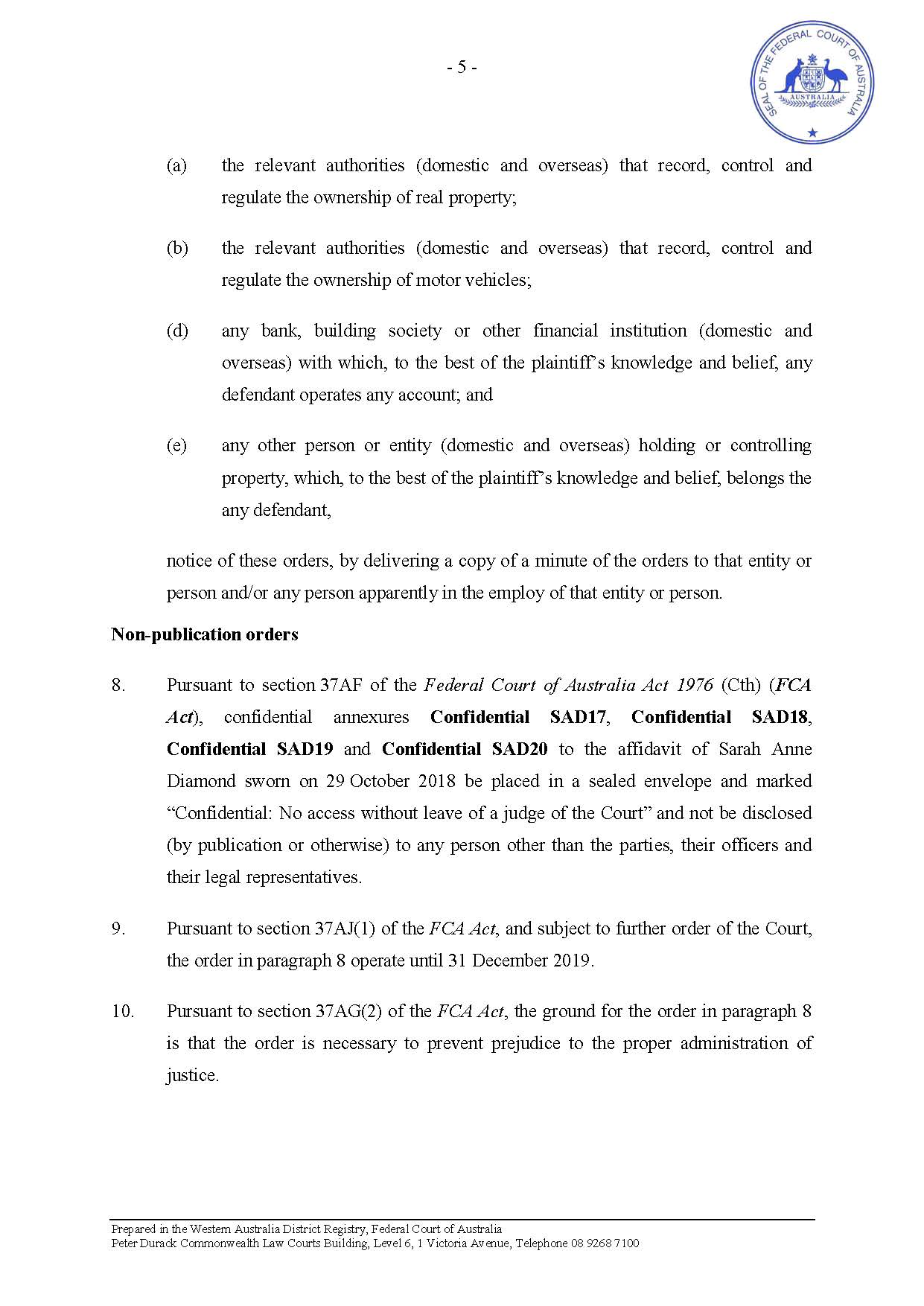
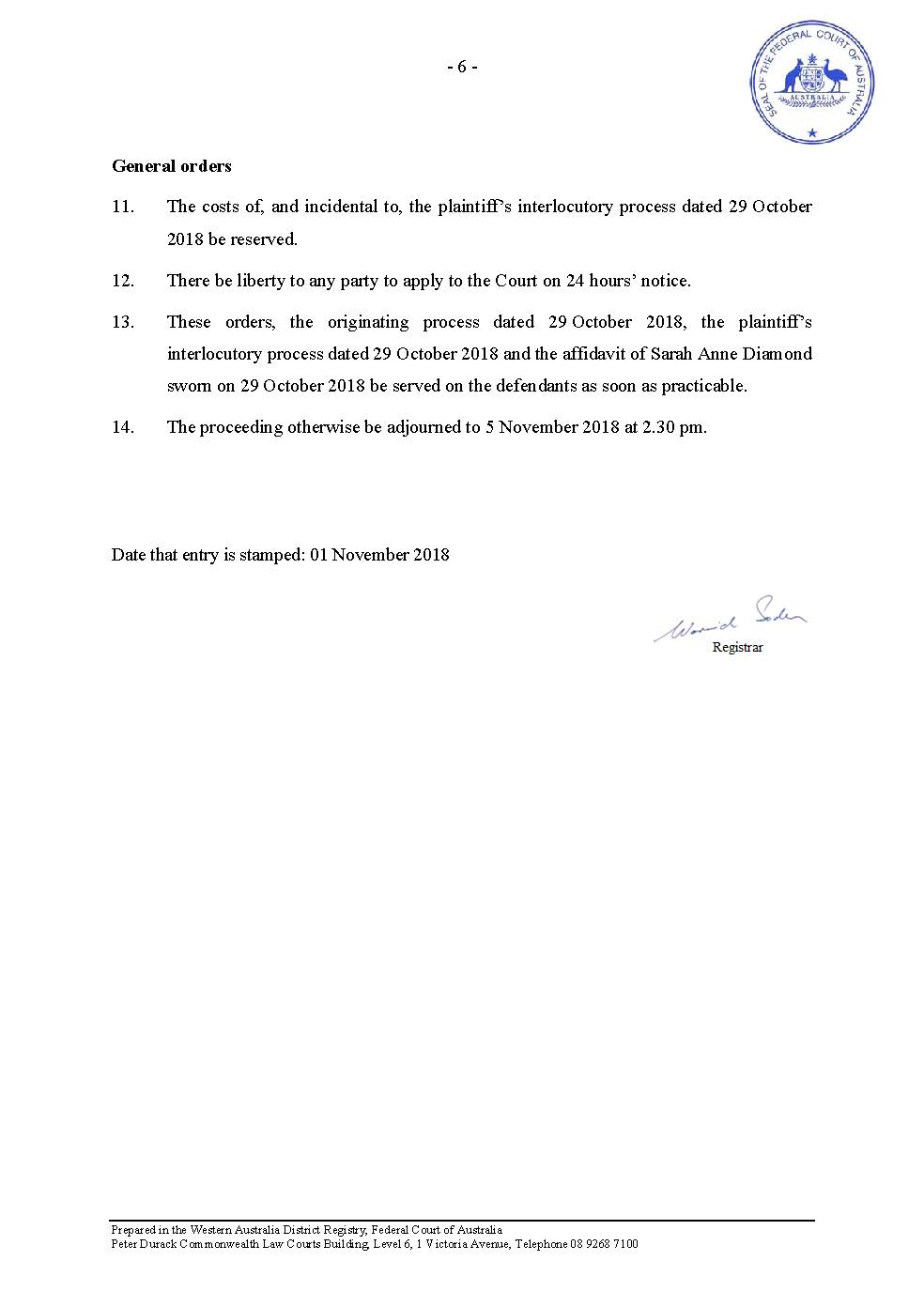
ORDERS
DATE OF ORDER: |
BY CONSENT, THE COURT ORDERS THAT:
Notwithstanding order 3 of the orders made on 1 November 2018, the First Defendant be permitted to pay the following expenses:
(a) the tax invoice rendered by Building Workshop Pty Ltd dated 5 November 2018 number 00000508 for the refurbishment of the property at 151 Scarborough Beach Road, Mount Hawthorn, in the sum of $275,000.00 (inclusive of GST);
(b) the tax invoice rendered by Building Workshop Pty Ltd dated 15 November 2018 number 00000513 for the refurbishment of the property at 151 Scarborough Beach Road, Mount Hawthorn, in the sum of $198,228.37 (inclusive of GST).
Note: Entry of orders is dealt with in Rule 39.32 of the Federal Court Rules 2011.
MCKERRACHER J:
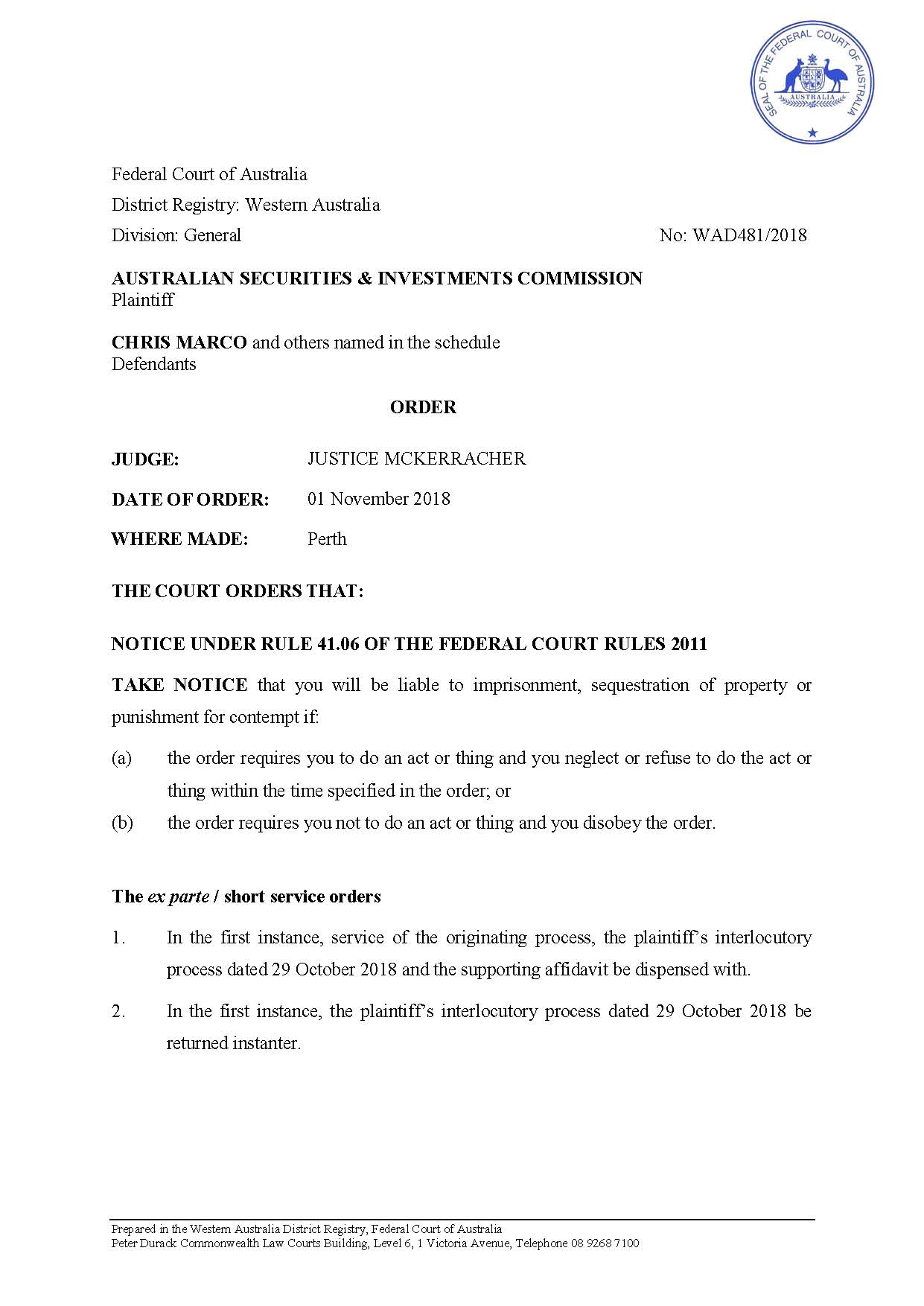
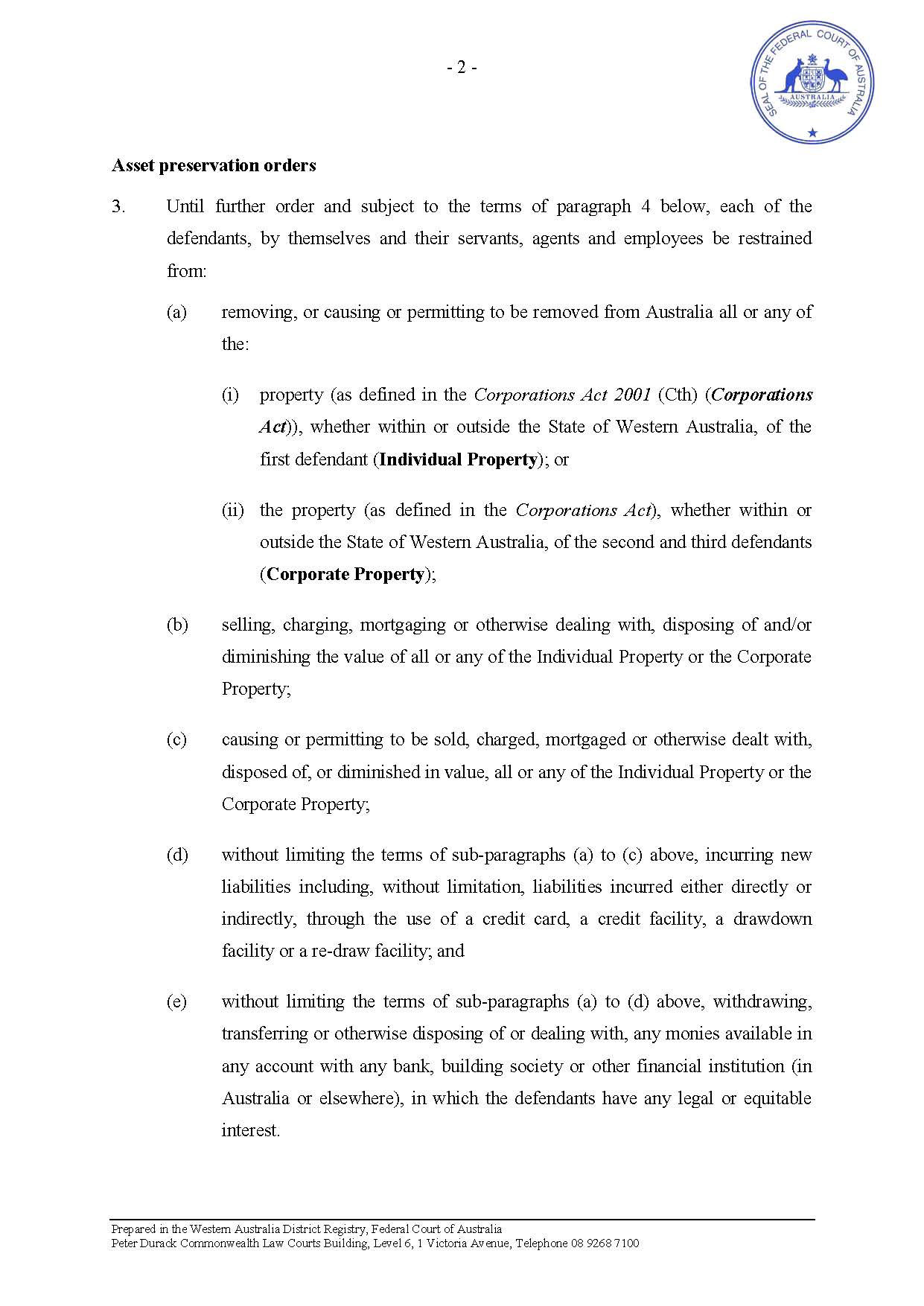
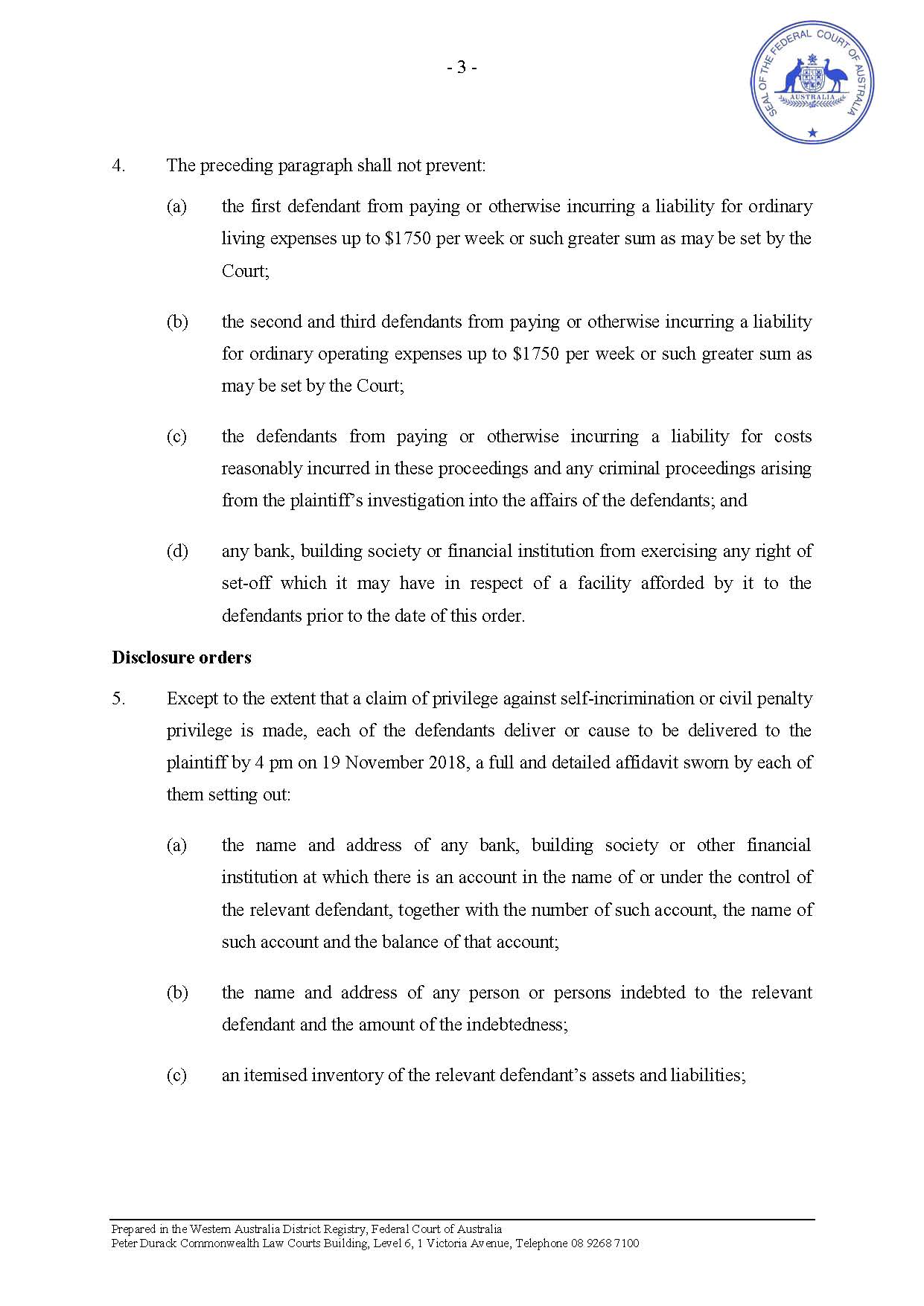
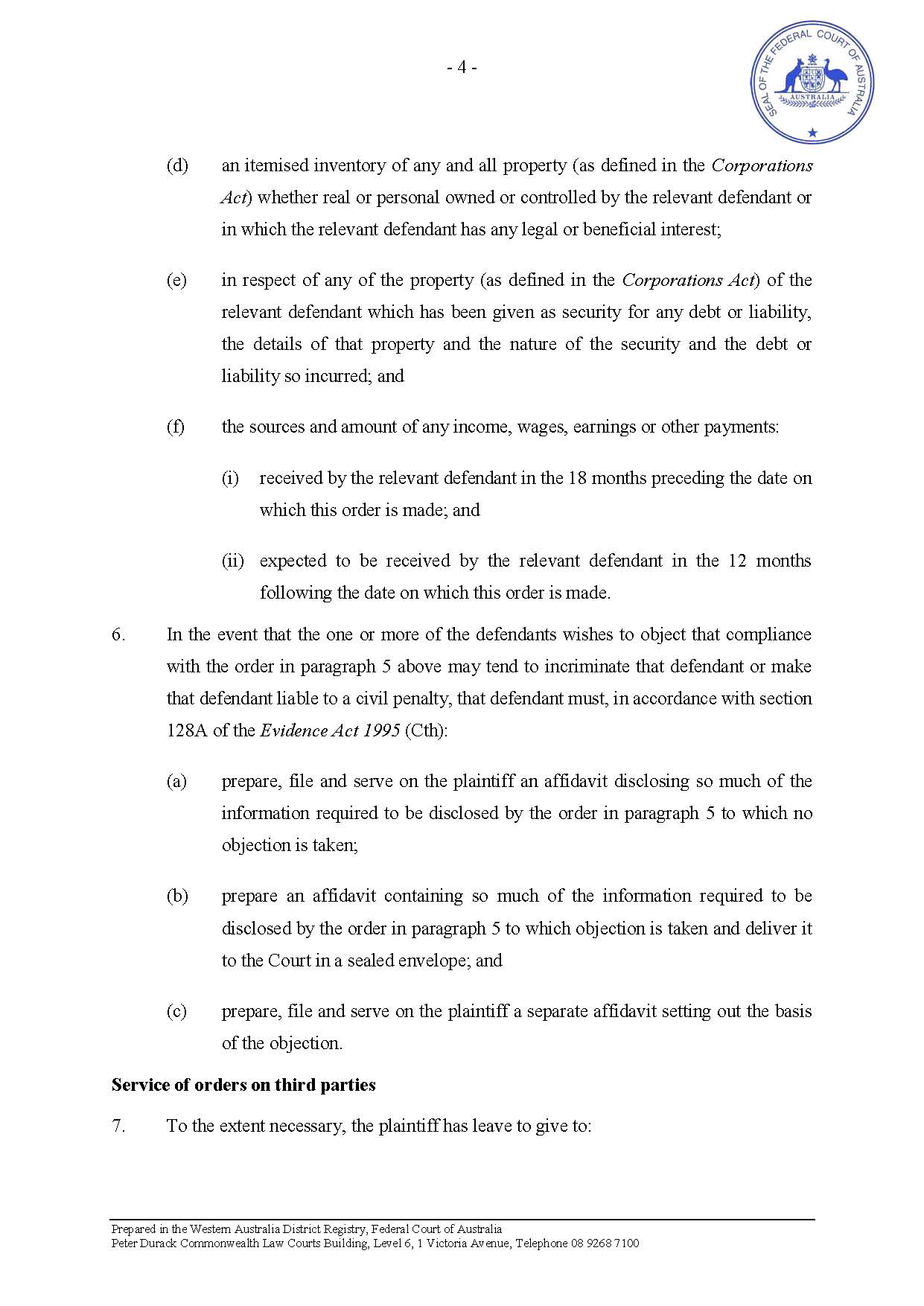
1 These reasons relate to certain freezing orders and their variations. On 1 November 2018, I made extensive asset preservation orders and certain non-disclosure orders in the form annexed to these reasons (Annexure A). Those orders have since been varied, most recently and significantly, by consent. These are reasons for approving the consent orders as well as earlier orders.
2 The original orders were made ex parte and pursuant to an interlocutory process in support of an originating process filed on 29 October 2018 by the plaintiff, the Australian Securities and Investments Commission (ASIC), seeking orders appointing a trustee, receiver or receiver and manager to the property of the defendants pursuant to s 1323(1) of the Corporations Act 2001 (Cth) or, alternatively, asset preservation and reporting orders against each of the defendants under s 1323(1) of the Corporations Act and s 23 of the Federal Court of Australia Act 1976 (Cth) (FCA Act). Interim orders were sought to preserve the assets of the defendants and to maintain the status quo in order to protect the interests of alleged ‘aggrieved persons’ while allowing ASIC to continue to investigate claims that the defendants may be in breach of various provisions of the Corporations Act and the Criminal Code (WA).
3 The application was supported by an extensive affidavit of an ASIC lawyer.
BACKGROUND
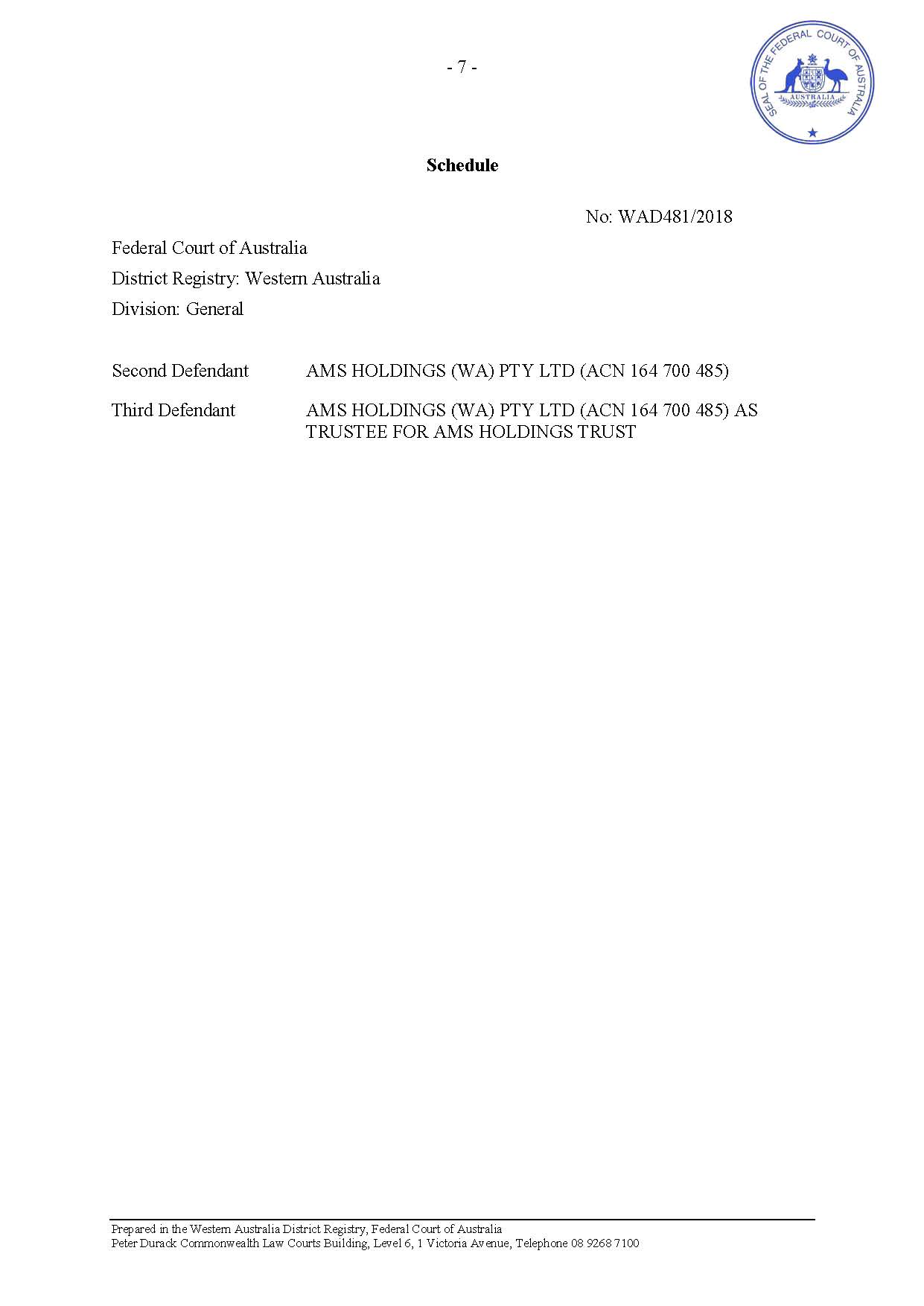
4 The evidence revealed that ASIC had commenced a formal investigation pursuant to s 13 of the Australian Securities and Investments Commission Act 2001 (Cth) (the ASIC Act) into suspected contraventions from 1 January 2010 of s 911A and s 601ED of the Corporations Act and s 409 of the Code by the first defendant, Mr Chris Marco and the second defendant, AMS Holdings (WA) Pty Ltd (ACN 164 700 485). AMS Holdings is the trustee of the third defendant, AMS Holdings (WA) Pty Ltd (ACN 164 700 485) as trustee for AMS Holdings Trust.
5 At that stage, the investigation was in its infancy. The investigation is still ongoing. However, from the information obtained by ASIC in the course of its preliminary investigations, ASIC formed the foundation of a belief that Mr Marco had raised investment funds from what may be in the order of 300 investors on the promise of high returns in circumstances where companies controlled by him did not hold an Australian Financial Services Licence (AFSL) or authorisation from an AFSL holder. This evidence was put before the Court.
6 Specifically, ASIC contended at the time of its ex parte application for freezing orders that the information showed that Mr Marco:
(a) may have raised over many years something in the order of $123 million from investors on the promise of very high returns using a document styled ‘Declaration of Trust’;
(b) has paid out something in the order of $92 million to investors, although at that stage it was unknown as to what extent that represented repayments of capital or payments of interest;
(c) did not appear to have an investment or asset which was capable of generating a return to fund the amounts paid to investors;
(d) appeared to have utilised funds raised from investors to pay amounts owed by way of principal and/or interest to other investors, which was indicative of a ‘Ponzi’ scheme;
(e) had reportable taxable earnings in the order of $250,000 per annum in each of the 2012 and 2013 financial years;
(f) has, or has had, access to offshore bank accounts;
(g) appears to have transferred a net sum in the order of $4 million to accounts held in the name of AMS Holdings; and
(h) appears to have acquired in excess of $500,000 worth of motor vehicles in the past few years.
7 The evidence so far obtained by ASIC suggested that Mr Marco possibly may have breached, and may then be continuing to breach, at least s 911A of the Corporations Act. Further, Mr Marco had some assets which may be available to meet the claims of aggrieved persons, which may have been dissipated if the proposed asset preservation orders were not made.
8 The evidence also indicated that AMS Holdings:
(a) had received a net cash flow intake in the order of $4 million from funds raised by Mr Marco from investors;
(b) had acquired a substantial real property portfolio, which appeared to have been funded using money raised by Mr Marco from investors; and
(c) had some assets which may be available to meet the claims of the allegedly aggrieved persons.
9 It is to be emphasised that the investigations in respect of all these matters were entirely in a preliminary stage and, while the evidence was relied upon in order for the Court to form a view about the appropriateness of granting the relief sought by ASIC, nothing remotely approaching final findings have been made in respect of any of these matters.
10 Some of the extensive material put before the Court was treated on a confidential basis. It contained information that if released would disclose the identity of potential witnesses or informants were it to be prematurely released to a non-party. Such disclosure, I was satisfied, may have had the potential to compromise the effectiveness of ASIC’s ongoing investigations and any subsequent criminal or civil penalty proceedings which may result from such an investigation. I was also satisfied on the other hand that none of this confidential material was precluded from access by the defendants. Confidentiality orders were made for reasons discussed from [13] below.
PRINCIPLES APPLICABLE TO FREEZING ORDERS
11 The Court has power under s 1323(1) and s 1323(3) of the Corporations Act and s 23 and s 37AF of the FCA Act to make orders of the kind sought by ASIC. The application of s 1323 of the Corporations Act and its intended function had been considered in several cases, including Re RG Munro Futures Pty Ltd [2010] QSC 435, where Martin J said (at [8]):
[8] The application of the section and its intended function have been considered in a number of cases. For the purposes of this application, those authorities provide the following guidance.
(a) “[14] At the heart of s 1323 is a concern to protect the interests of aggrieved persons. The section aims to provide a means by which property that may in due course represent a source for the vindication of the rights of those persons is preserved for their benefit, shielded from inroads that might otherwise be made upon it.” ASIC v Burnard (2007) 64 ACSR 360.
(b) “[6] It is tolerably plain that s 1323(1) is directed to the protection of the interests of aggrieved persons (so defined). If the purpose for which the order is made is not for that purpose then the provision does not authorise the making of an order. The purpose of keeping [the respondent] within the jurisdiction to ensure that he is present if and when the Director of Public Prosecutions decides to prosecute him is not the purpose of protecting the interests of the aggrieved person. It follows that orders under s 1323(1) cannot be made for that purpose.” ASIC v Hawley (2008) 250 ALR 57.
(c) “[26] The circumstances in which the court may make orders under s 1323(1) are wide as indicated by the words ‘necessary or desirable … for the purpose of protecting the interests of a person …’. There is an element of risk assessment and risk management in the judgment the court is called on to make. It follows, and has been accepted, that there is no requirement on the part of ASIC to demonstrate a prima facie case of liability on the part of the relevant person or that the person’s assets have been or are about to be dissipated.” Re Richstar Enterprises Pty Ltd (2006) 57 ACSR 307.
(d) “[27] The nature and duration of orders made under s 1323(1) can be fashioned by the court to reflect its assessment of any risk of dissipation of the assets of a person under investigation.” Re Richstar Enterprises Pty Ltd (2006) 57 ACSR 307.
12 See also what was said by French J (as the Chief Justice then was) in Richstar Enterprises Pty Ltd (ACN 099 071 968); Australian Securities and Investments Commission v Carey (No 3) (2006) 232 ALR 577 (at [26]) and Finkelstein J in Australian Securities and Investments Commission v Lee [2007] FCA 508.
INTERIM CONFIDENTIALITY AND NON-PUBLICATION ORDERS
13 The Court’s power to make suppression and non-publication orders are found in Div 2 of Pt VAA of the FCA Act. Section 37AE provides:
37AE Safeguarding public interest in open justice
In deciding whether to make a suppression order or non-publication order, the Court must take into account that a primary objective of the administration of justice is to safeguard the public interest in open justice.
14 Again, numerous cases have dealt with these provisions, notably in Solahart Industries Pty Ltd v Solar Shop Pty Ltd (2011) 281 ALR 544, where Perram J said (dealing with the predecessor of the current provision – s 50 of the FCA Act) (at [116]):
But, and this should be emphasised, the risk must be real and the evidence compelling because the order reversing the ordinary principle of open justice is not to be made lightly. The requirement of s 50 is not inconvenience or suspicion or concern; it is necessity and only proof positive of necessity will enliven the power.
15 Similarly, in Hogan v Australian Crime Commission (2010) 240 CLR 651, the High Court (French CJ, Gummow, Hayne, Heydon and Kiefel JJ) observed (at [30]-[31]):
30 As it appears in s 50, “necessary” is a strong word. Hence the point made by Bowen CJ in Australian Broadcasting Commission v Parish, that the collocation of necessity to prevent prejudice to the administration of justice and necessity to prevent prejudice to the security of the Commonwealth “suggests Parliament was not dealing with trivialities”. Further, as indicated earlier in these reasons: (a) s 50 is an example of a provision authorising the Federal Court to make orders for the exercise of its jurisdiction other than in open court as mandated by s 17(1); and (b) “the administration of justice” spoken of in s 50 is that involved in the exercise by the Federal Court of the judicial power of the Commonwealth; this is a more specific discipline than broader notions of the public interest.
31 It is insufficient that the making or continuation of an order under s 50 appears to the Federal Court to be convenient, reasonable or sensible, or to serve some notion of the public interest, still less that, as the result of some “balancing exercise”, the order appears to have one or more of those characteristics.
(Citations omitted.)
16 In Australian Securities & Investments Commission v Rich (2001) 51 NSWLR 643, Austin J said (at [26]):
It appears to me that the principle of prematurity, though a valid and weighty consideration, especially where evidence has been filed but not used for any purpose, is displaced in circumstances such as those existing last Friday. The principle of open justice entails, in my view, that when the Court makes quite significant orders on an ex parte application, the basis for the making of those orders must be available so that the court is accountable for what it has done after it has considered the information provided to it. In my view, that is so important a consideration that, unless there is some specific or obvious prejudice of another kind, the mere consideration of prematurity, in the sense that the plaintiff’s evidence has not been tested or answered, is insufficient to prevent the Court from making available to outsiders, including in particular the media, the affidavits relied upon in ex parte circumstances leading to significant relief.
17 Generally speaking, the courts have shown a reluctance to compromise a criminal investigation by requiring the premature disclosure of information concerning that investigation. This is apparent from cases such as Barnes v Boulton (2004) 139 FCR 356 per Finn J (at [25]), citing National Companies and Securities Commission v News Corp Ltd (1984) 156 CLR 296 (at 323-324).
18 There was a proper basis for granting such suppression orders. Further, given the early stage at which ASIC’s investigation had reached, the potential for that investigation to be impeded or compromised in the event that the identity of the 300 or so potential investors then identified by ASIC became known to non-parties before ASIC had the opportunity to interview them, the non-publication and suppression orders sought by ASIC in respect of certain bank statements of the defendants to which the defendants obviously had access, were necessary to prevent prejudice to the proper administration of justice.
A VARIATION APPLICATION
19 Pursuant to liberty to apply, the defendants sought variation of the orders made in a number of respects. Some variations were agreed by consent; one payment was made by a third party, but specifically, the following variation was initially opposed by ASIC:
1. Notwithstanding order 3 of the orders made on 1 November 2018, the First, Second and Third Defendants be permitted to pay the following expenses:
(a) the tax invoice rendered by Building Workshop Pty Ltd dated 5 November 2018 number 00000508 for the refurbishment of the property at 151 Scarborough Beach Road, Mount Hawthorn, in the sum of $275,000.00 including GST;
(b) the tax invoice rendered by Building Workshop Pty Ltd dated 15 November 2018 number 00000513 for the refurbishment of the property at 151 Scarborough Beach Road, Mount Hawthorn, in the sum of $198,228.37 including GST;
…
20 Extensive affidavit material was filed by both parties in relation to these orders.
21 In short, Mr Marco argued that, in a sense, the payment of the builder’s invoices was inevitable because if the Court refused to grant a variation to permit the payment, the builder would be able to exercise his rights under the building contract. Pursuant to the building contract, the builder’s rights were protected by the lodging of a caveat over the relevant land at which the building works were being carried out, 151 Scarborough Beach Road, Mount Hawthorn, Western Australia (the property). Additionally, the builder was entitled to charge interest on any unpaid part of any progress payment at the builder’s bank overdraft rate. So on any view of ASIC’s claim, and in whatever capacity the funds in Mr Marco’s bank account were held whether it be personal funds or funds held on trust or in some other respect for the investors, either Mr Marco or the investors would benefit because there was evidence that the value of the property would be sufficiently increased.
22 There is some $6 million in Mr Marco’s bank account which, at least in part, represented sums advanced by investors pursuant to the Declaration of Trust documents. Mr Marco denied that the funds were held on trust and had become aware that mixing of the trust funds would not be consistent with his duty as a trustee. But Mr Marco argued that if the funds were on trust, then the property acquired from investors’ funds would also be on trust, such that any improvement in the property achieved by payment of the builder’s invoices would be for the benefit of the investors.
23 Mr Marco had been informed by the builder that the builder would complete the refurbishment of the property if the builder’s two outstanding invoices were paid in full. Further, in any event, Mr Marco deposed that the builder would be contractually obliged to complete the refurbishment of the property if the invoices were paid in full, providing that they were paid before the builder took the requisite steps to terminate the building contract.
24 Mr Marco contended that in its current partially completed state, the property was valued at between $1,160,000 and $1,195,000. If the refurbishments were completed, the property would have a value of approximately $2.2 million to $2.3 million. Accordingly, it was submitted that completion of the refurbishment would increase the value of the property by an approximate minimum of $1,005,000 and a maximum of approximately $1,140,000. The total contract price for the refurbishments is $1,202,674.80 of which Mr Marco had already paid $391,792.21. The total of the two unpaid invoices was $473,228.37. Accordingly, the remaining refurbishment work would cost approximately $337,654, but that would increase the value of the property by the sum indicated above.
25 Regardless of the value of the property, there was also evidence of prospective income from the lease of the property on completion of the refurbishment. On 10 January 2018, Mr Marco had entered into a lease of the property for a term of 5 years with a lessee. The commencement date was the latter of 3 April 2018 or the day following receipt by the lessee of a Certificate of Practical Completion of the refurbishment issued by the builder. The lease provides for a rent free period of the first eight months of the term of the lease, although the lessee was required to pay the operating expenses from the commencement date of the lease. Following the rent free period, rent at $6,250 plus GST per month was payable under the lease, subject to rent review provisions. Accordingly, the first term of the lease would produce a rental income of approximately $357,500 inclusive of GST, with an option to renew for a further 5 years. Failure to complete the refurbishments of the property would result in a loss of the rental income and potential legal proceedings to recover the costs the lessee had incurred in relation to the lease and foreshadowed claims in respect of such matters.
ASIC’s position
26 ASIC firmly opposed the variations sought, essentially on the basis of inconsistency in the evidence put forward by Mr Marco. ASIC’s position was that it remains an open legal question on the material before the Court as to whether the funds in Mr Marco’s bank accounts are held by him in the same capacity as the capacity in which Mr Marco holds the property, specifically whether and if so which of these assets are held on trust.
27 ASIC’s investigations as to the numerous transactions into which Mr Marco has entered continue, and ASIC accepted that this variation application is not the appropriate vehicle in which to determine such issues relating to the assets. However, the context in which this application is made is that on his own evidence as at 26 November 2018, Mr Marco owed 132 investors the principal sum of $238,478,888. That comes from Mr Marco’s personal disclosure affidavit of 26 November 2018.
28 On ASIC’s evidence, of that sum, at least $125,401,245 in principal and at least $12,965,402.25 in interest was due and payable to investors as at 1 February 2019. On his own evidence at 26 November 2018, Mr Marco had cash at bank of $6,868,897.82 which ASIC understood to be the cash to which Mr Marco would have recourse to the extent the variations are made. He has said in his personal disclosure affidavit to have been owed amounts by third parties of $12,659,326.60 and to have other assets of $10,509,000 and liabilities of $1,407,222. Assuming for the purposes of argument that those figures are correct, as at 26 November 2018, Mr Marco’s net asset position would have been approximately $28.63 million.
29 As to AMS Holdings, on AMS Holdings’ disclosure affidavit sworn by Mr Marco on 26 November 2018, assuming the figures in that affidavit to be accurate, AMS Holdings had a net asset position of approximately $13.8 million.
30 The combined net assets of Mr Marco and AMS Holdings represented only 17.8% of the principal owed to investors, a shortfall of some $196 million, without taking into account interest, which continues to accrue. Claims of potentially aggrieved persons are therefore substantial. Whilst ASIC agreed it is likely that investors will, in due course, have recourse to the property to meet their claims against Mr Marco, it does not follow in ASIC’s submission, that the builder would have recourse to the cash presently sitting in Mr Marco’s bank account to meet its claims against Mr Marco. That, however, will be the practical effect of the orders. Even if the status quo ought not be maintained for that reason, the evidence in respect of the building contract leaves very real doubts as to whether the amounts invoiced by the builder are properly payable to the builder.
31 ASIC pointed to several pieces of evidence which instilled those concerns. First, the builder with whom Mr Marco has dealt is Mr Frank Giannasi. Mr Giannasi is an investor in Mr Marco’s investment schemes. On Mr Marco’s own evidence, he owes him $2,884,775. It is not therefore an ordinary arm’s length building contract between Mr Marco and an independent third-party builder. This requires the numerous inconsistencies which remain in Mr Marco’s evidence with respect to the building contract to be assessed with a much more critical eye.
32 Secondly, the evidence as to whether or not Mr Marco personally or AMS Holdings is liable to the builder remains far from clear. The documents in evidence before the Court ASIC contended, on their face suggest that the entity undertaking the redevelopment of the property was AMS Holdings. The invoices were addressed to AMS Holdings in the period June 2017 to July 2018 in respect of design fees for the property. An invoice dated 17 October 2018 was addressed to AMS Holdings for painting in respect of the property. A quote dated 6 November 2018, five days after the freezing orders were made, for the provision of benchtops at the property was addressed to AMS Holdings. Each of the invoices from the builder, the latter two of which are the subject of this variation application, are addressed to AMS Holdings for building work at the property. Mr Marco’s asset disclosure affidavit on behalf of AMS Holdings contains evidence that AMS Holdings was liable to both the builder and the painter in respect of the invoices which were addressed to AMS Holdings. The building contract itself is less straightforward, but even that was drawn up originally in the name of AMS Holdings before that name was apparently struck out and replaced by the name of Mr Marco. Mr Marco owns the property which may suggest that the building contract is with Mr Marco, but there is no reason why Mr Marco may not have caused AMS Holdings to enter into the contract if the contractor was happy with that. However, there is evidence that points the other way.
33 The Court is entitled, ASIC contended, to entertain strong doubts that the explanation proffered by Mr Marco, which is essentially that of an accounting error on the part of the contractors, is credible. The far more credible explanation is, notwithstanding Mr Marco owns the property, that a decision was made by him that the redevelopment would be undertaken using AMS Holdings as the relevant development vehicle and that is why all of the aforementioned documents from third party contractors have been addressed to that entity.
34 Thirdly, the evidence as to the amount said to be properly payable to the builder also remain inconsistent in a number of ways. The application for the building licence prepared by the builder and forwarded on 22 May 2018 to Mr Damon Marco, Mr Marco’s son, only seven days before the building contract is said to have been made, estimated the value of the building work at $650,000 inclusive of GST. The building licence issued to the builder reflected that amount also.
35 The building contract indicates a fixed price of $1,202,674.80 inclusive of GST. That is the basis on which this application is brought. The application is brought on the basis that the building contract figure is the correct figure. A contract cost breakdown prepared by the builder sets out a full progress claim schedule for the project at five claims totalling $1,000,804.73 exclusive of GST, or $1,100,885.20, approximately $100,000 less than the amount that appears in the contract. The first three project claims listed in that schedule match the two invoices issued and paid before the freezing orders were made by this Court and the third which was issued on 5 November 2018, a few days after the freezing orders. The fourth invoice, being the second invoice the subject of this application, does not accord with that schedule either as to timing or as to amount.
36 Mr Marco has endeavoured to explain this inconsistency by deposing that the contract sum of $1,100,885.20 inclusive of GST, evidenced by the contract cost breakdown of 21 August 2018, does not include the builder’s margin of 10%. He deposes that once that is taken into account, you end up with a figure of $8,298.80 more than the fixed price provided for in the building contract. He says he cannot explain that difference, but that is the basis on which to explain the approximate $100,000 discrepancy.
37 ASIC submitted that two things tell strongly against that explanation. First, it is not consistent with the straightforward five progress claims to be paid from commencement to handover, without reference to any such amounts being exclusive of builder’s margin. Secondly, the building contract is a fixed price contract as to the agreed scope of works. The 10% builder’s margin at item 1 of appendix 1 of the building contract applies only with respect to surveying costs incurred under cl 5(b) of the building contract and with respect to the pricing of extra work performed as a variation under cl 16(h) of the building contract. It is not payable under the terms of the building contract in addition to the fixed price payable for the agreed scope of works. It is therefore not capable of explaining inconsistency as to the contract sum which exists between the building contract, which is in evidence and the contract costs breakdown sent before the freezing orders were made, which is also in evidence.
38 In light of all those matters, ASIC submitted there remained real inconsistencies on the evidence presently before the Court as to the true lump sum contract amount and therefore the amount properly payable to the builder and, in particular, whether the outstanding invoices are properly payable. Those inconsistencies were particularly concerning to ASIC in circumstances where the builder is an investor in Mr Marco’s scheme and therefore he has interests extending beyond those of an ordinary arm’s length third-party builder. There is contemporaneous documentary evidence pre-dating the making of the asset preservation orders which is only consistent with a lower price having been agreed for the work than is now contended to be the case by Mr Marco. Further, the terms of the building contract in evidence before the Court now do not appear to accord with that contemporaneous documentation, which pre-dated the freezing orders.
39 ASIC therefore maintained its submission that in order to make a proper assessment of whether it is in the best interests of aggrieved persons for the builder to be paid and the building work completed, a formal valuation ought to be obtained with respect to the value of the works completed by the builder to date and the value of the property on an as-is and on completion basis.
40 ASIC remained prepared to consent to a suitable variation to the orders to permit the costs of such valuation evidence to be obtained.
41 ASIC accepted that if it be assumed that (a) the assessment claimed is correct, (b) the building work will increase the property value as claimed and (c) the building contract was at arm’s length, then payment to the builder would have no negative impact to the investors as the property is frozen.
42 Ultimately, ASIC accepted if it could be demonstrated by appropriate evidence that it was in the overall financial interests of ‘aggrieved persons’ for the builder’s expenses to be paid and the building work at the property to be completed, a variation to the freezing orders to permit that to occur may be appropriate.
CONSIDERATION
43 The variation application was adjourned twice to enable Mr Marco to file additional evidence to explain inconsistencies and omissions referred to above. I accept that the preparation of the extensive asset disclosure material which the original orders required was a considerable and taxing task. To the extent there were omissions in that material or inaccurate descriptions of the correct contracting parties, I would take a far less strict view than if it were a final hearing. The requirements of the orders were considerable and their performance was to be within a finite time period.
44 The cases and the statute make it quite clear that it is necessary to have regard to the interests of the investors as the potentially aggrieved persons. Their interests in any application to vary is of significance. The statute and authorities do not suggest that the interests of aggrieved persons are the only interests to take into account in fashioning relief or varying relief. In this instance, one such person whose interests may be taken into account is the builder who, on the face of matters, was apparently properly and innocently entitled pursuant to performance under a building contract, which pre-existed the freezing orders, to payment for building services actually performed. Further, I was taken to no information to suggest that the lessee was not operating on an arms-length commercial basis and the lessee of the property would also suffer loss if the building was not completed.
45 Most importantly, the defendants in the meantime cannot dispose of the property. The interests of the investors, whether under a trust or otherwise depending on which of ASIC’s contentions (if any) is ultimately accepted, are better protected by the property value being enhanced but preserved for their benefit should ASIC ultimately succeed in its claims.
46 I suggested to Mr Marco’s counsel that he obtain independent corroborative evidence of the amounts due to the builder and sworn evidence as to the property value before and after completion of the building works. I adjourned the hearing to allow Mr Marco’s counsel to obtain, if possible, the requisite evidence, indicating that (should it be necessary) the Court would re-list the variation application as soon as the corroborative evidence was obtained.
47 On 13 March 2019, an affidavit of Mr Marco’s solicitor, sworn on the same date, was filed. The affidavit relevantly annexed a report of a Quantity Surveyor in relation to the property which had been compiled consistently with the Court’s ‘Expert Evidence Practice Note (GPN-EXPT)’. The report included the following conclusionary observations:
the Quantity Surveyor has found that the Contract price of $1,202,674.80 (including GST) reflected in the contract between the builder and the principal is a competitive price and it is reflective of the market prices/conditions as of May 2018;
the sum of $865,020.58 (including GST) claimed for work complete from 29 May – 15 November 2018 is within the market range for the works carried out and in keeping with the contract conditions; and
invoices totalling $865,020.58 (including GST) for work complete from 29 May – 15 November 2018 is a fair, reasonable and accurate reflection of the work completed during that time.
48 The evidence now filed indicates that the sums sought to be paid to the builder are reasonable and that the building works should increase the market value of the property. As no party has taken the Court to evidence to suggest the building contract was anything other than a transaction conducted at arm’s length (and indeed the competitive price of the building contract is consistent with a third-party dealing), the conditions, in effect, identified by ASIC (and recorded at [41]) appear to be established on the evidence that is presently before the Court.
49 On 14 March 2019, my associate was forwarded by email a minute of proposed consent orders, signed by ASIC and Mr Marco’s solicitors, agreeing to the variations sought to allow payment of the builder’s invoices.
CONCLUSION
50 In all those circumstances, I was satisfied that variation orders consented to should be permitted as sought. I endorsed the minute of proposed consent orders on the terms agreed by ASIC and Mr Marco.
I certify that the preceding fifty (50) numbered paragraphs are a true copy of the Reasons for Judgment herein of the Honourable Justice McKerracher. |
Associate:
ANNEXURE A