

FEDERAL COURT OF AUSTRALIA
Kinjun on behalf of the Gulngay People and State of Queensland [2019] FCA 446
ORDERS
DORIS KINJUN, CLARENCE KINJUN AND JOANNE KINJUN ON BEHALF OF THE GULNGAY PEOPLE Applicant | ||
AND: | STATE OF QUEENSLAND and others named in the Schedule Respondents | |
DATE OF ORDER: |
BEING SATISFIED that an order in the terms set out below is within the power of the Court, and it appearing appropriate to the Court to do so, pursuant to s 87 of the Native Title Act 1993 (Cth):
BY CONSENT THE COURT ORDERS THAT:
1. There be a determination of native title in the terms set out below (the determination).
2. Each party to the proceedings is to bear its own costs.
BY CONSENT THE COURT DETERMINES THAT:
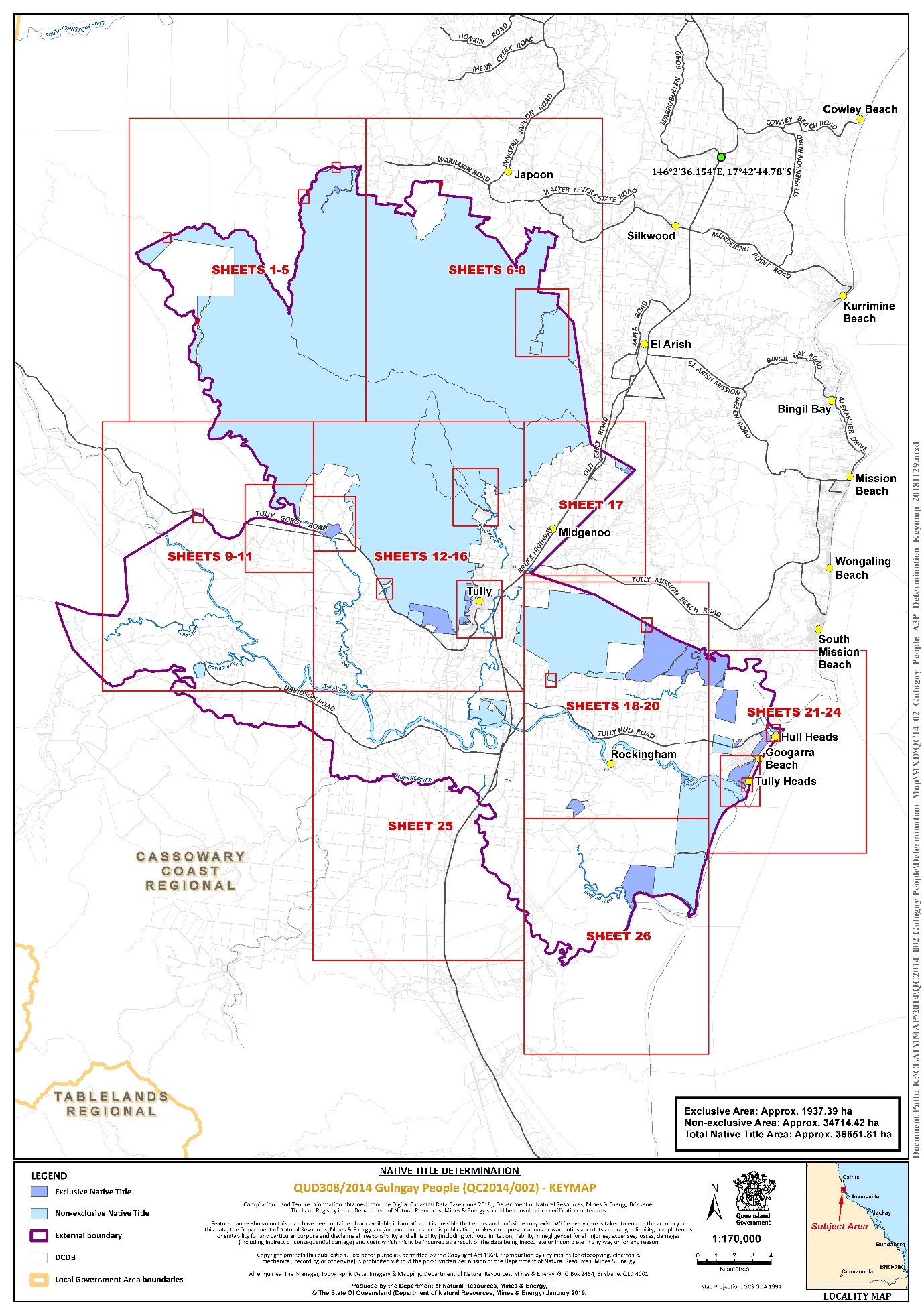
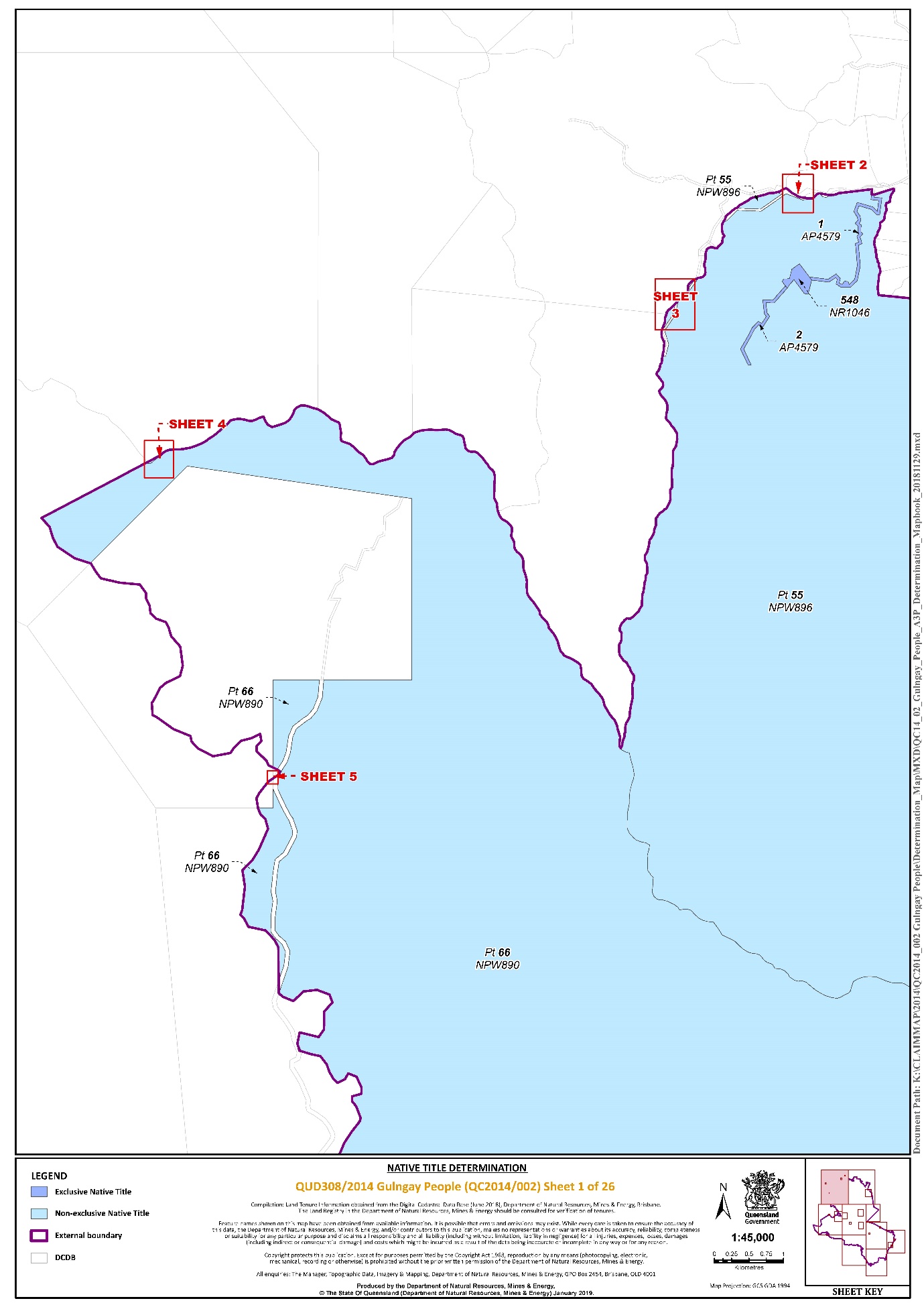
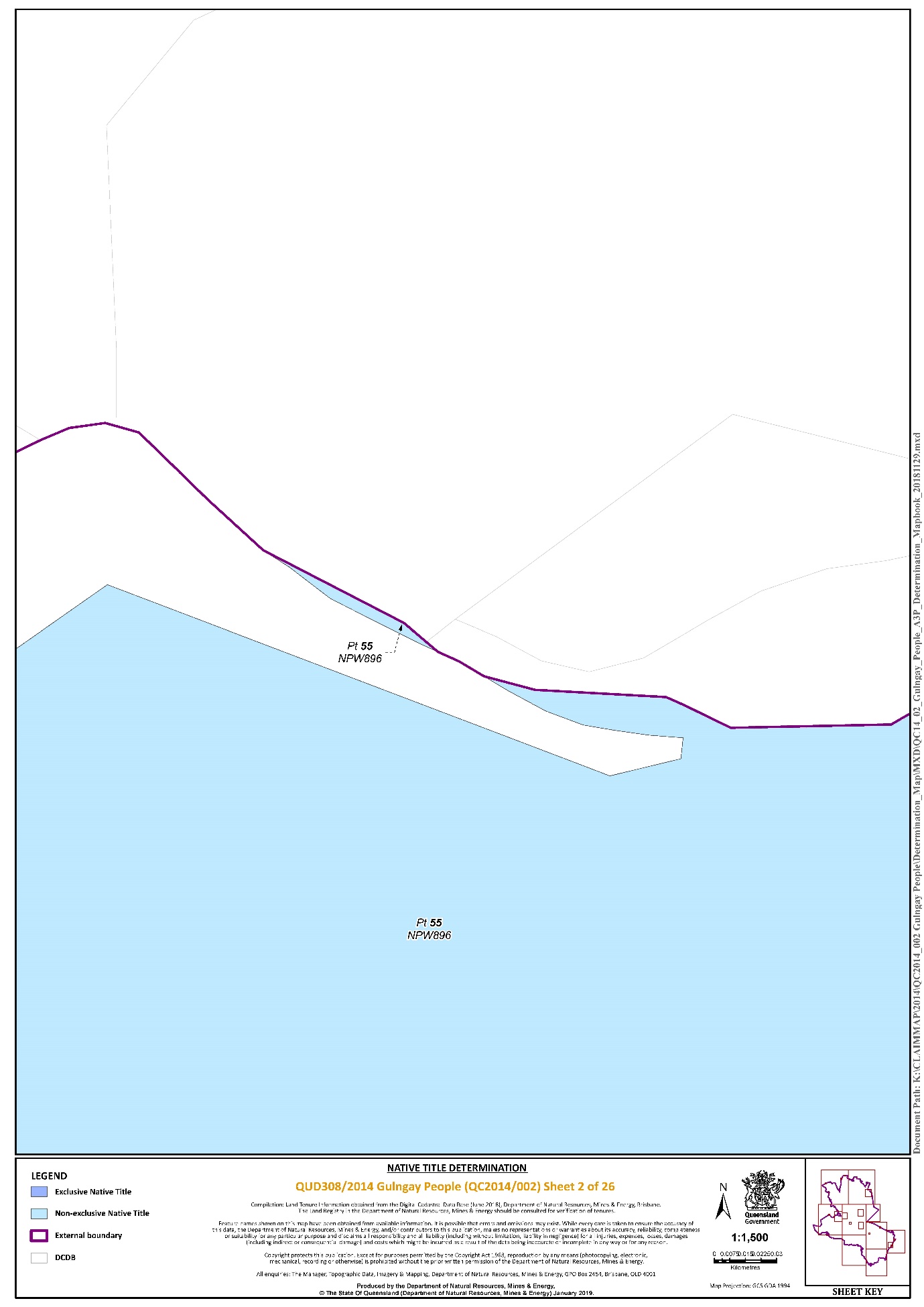
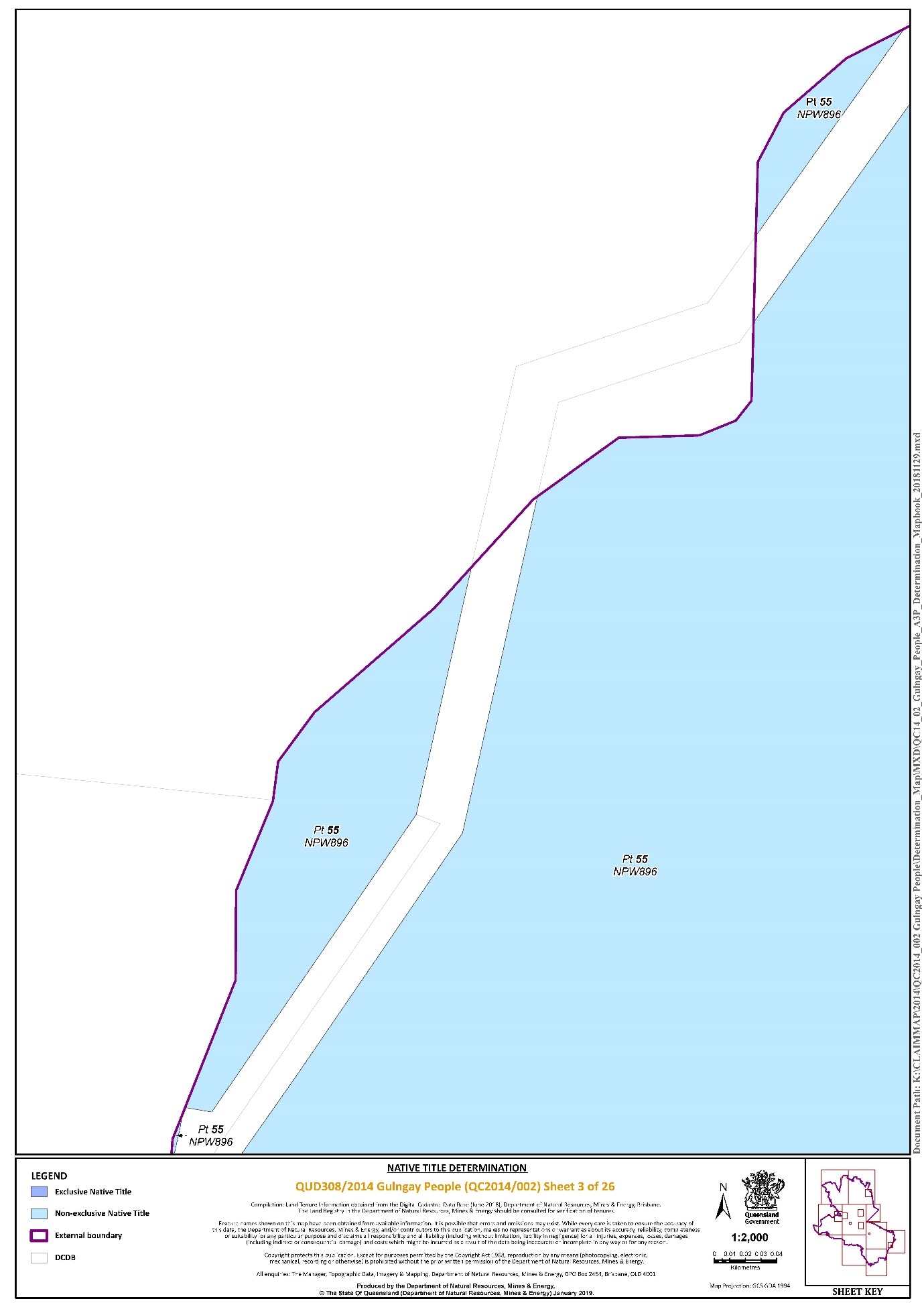
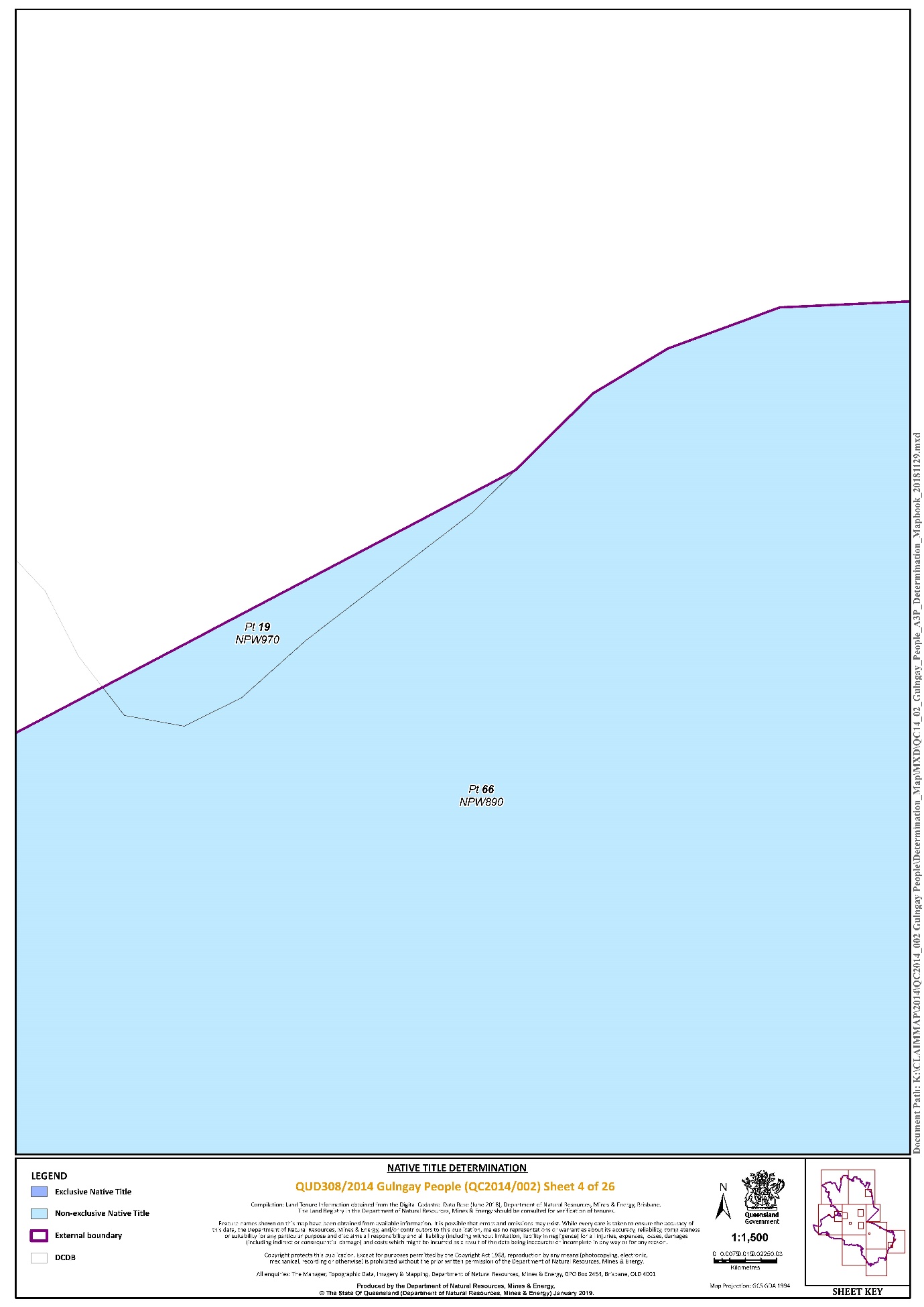
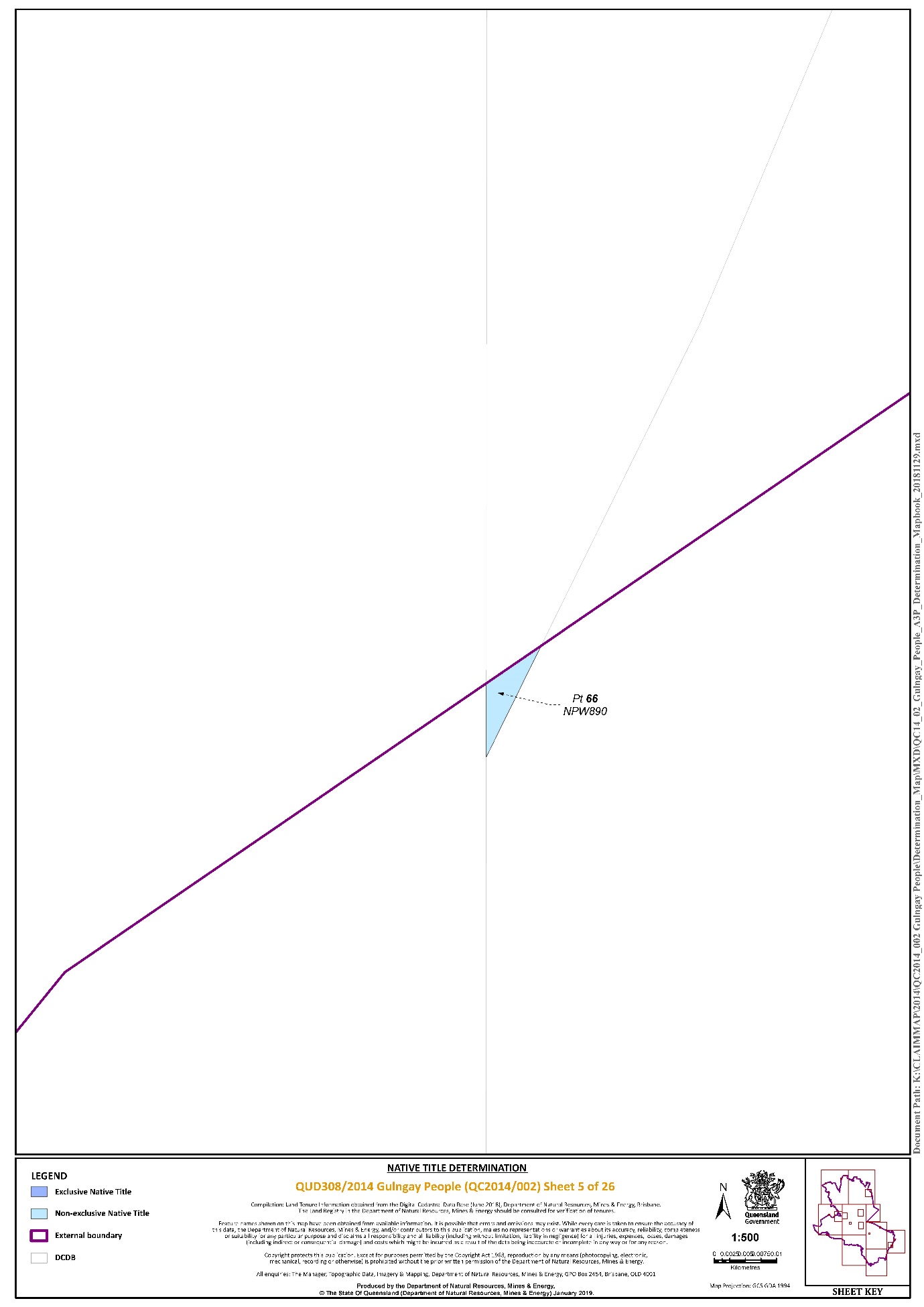
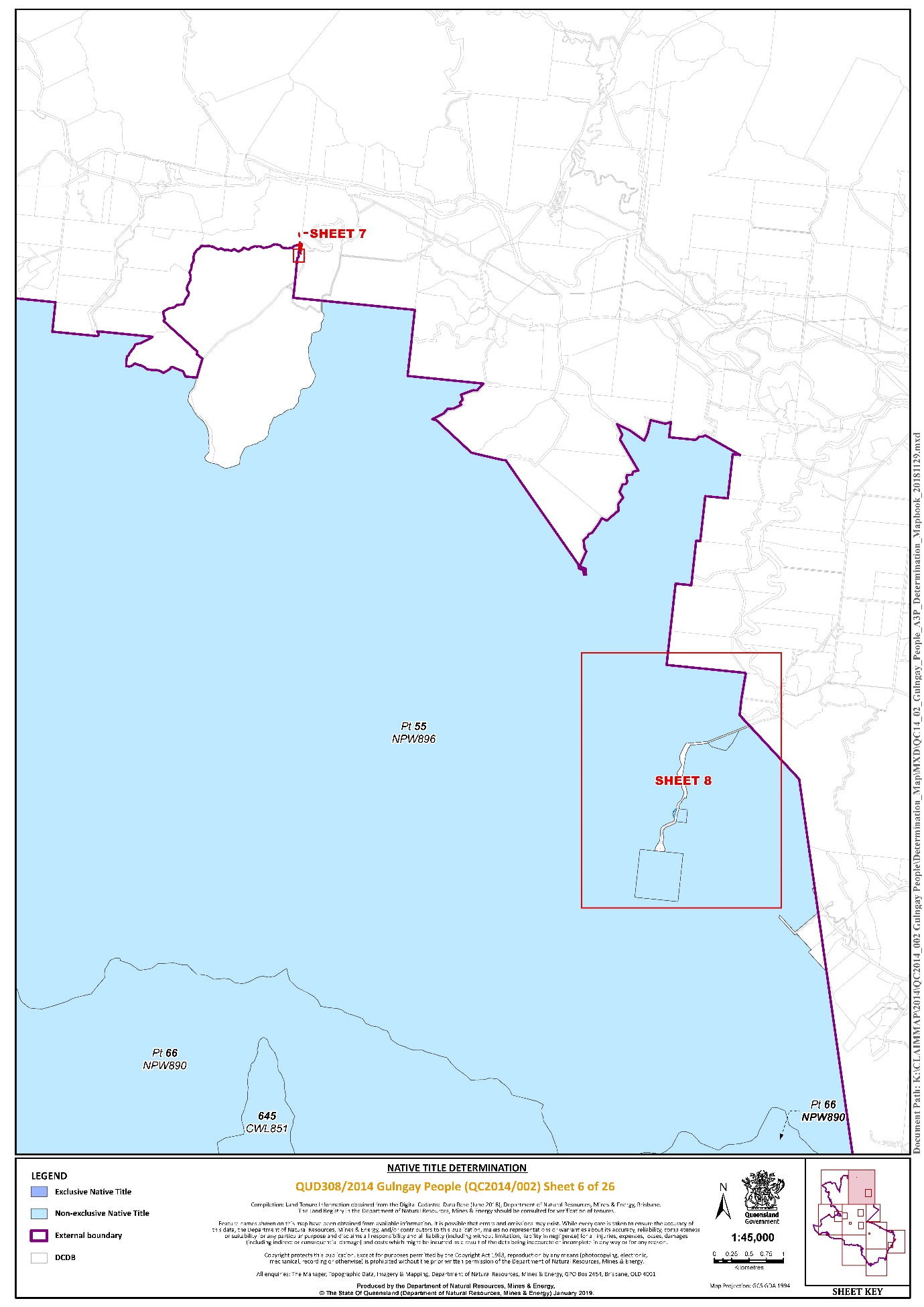
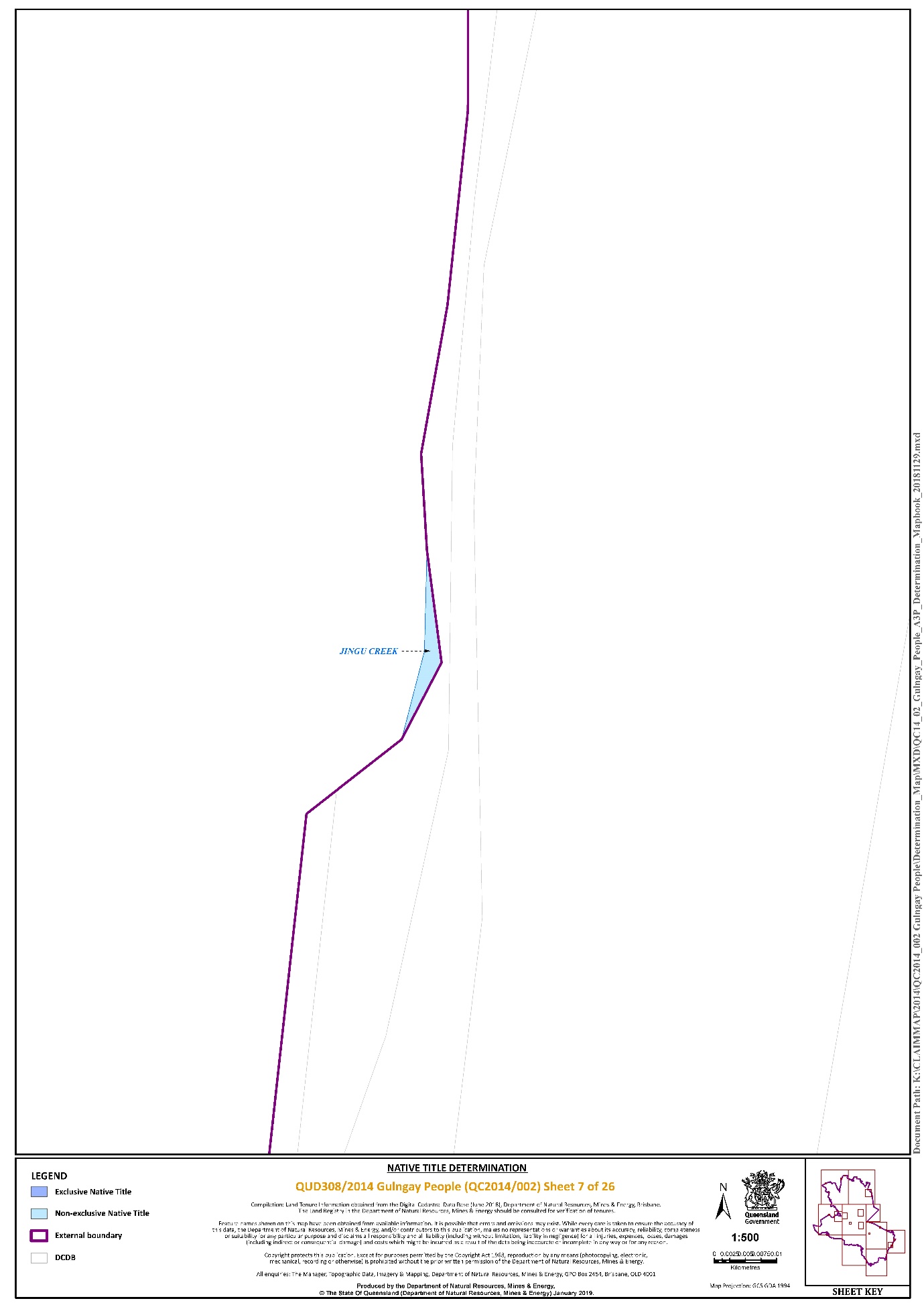
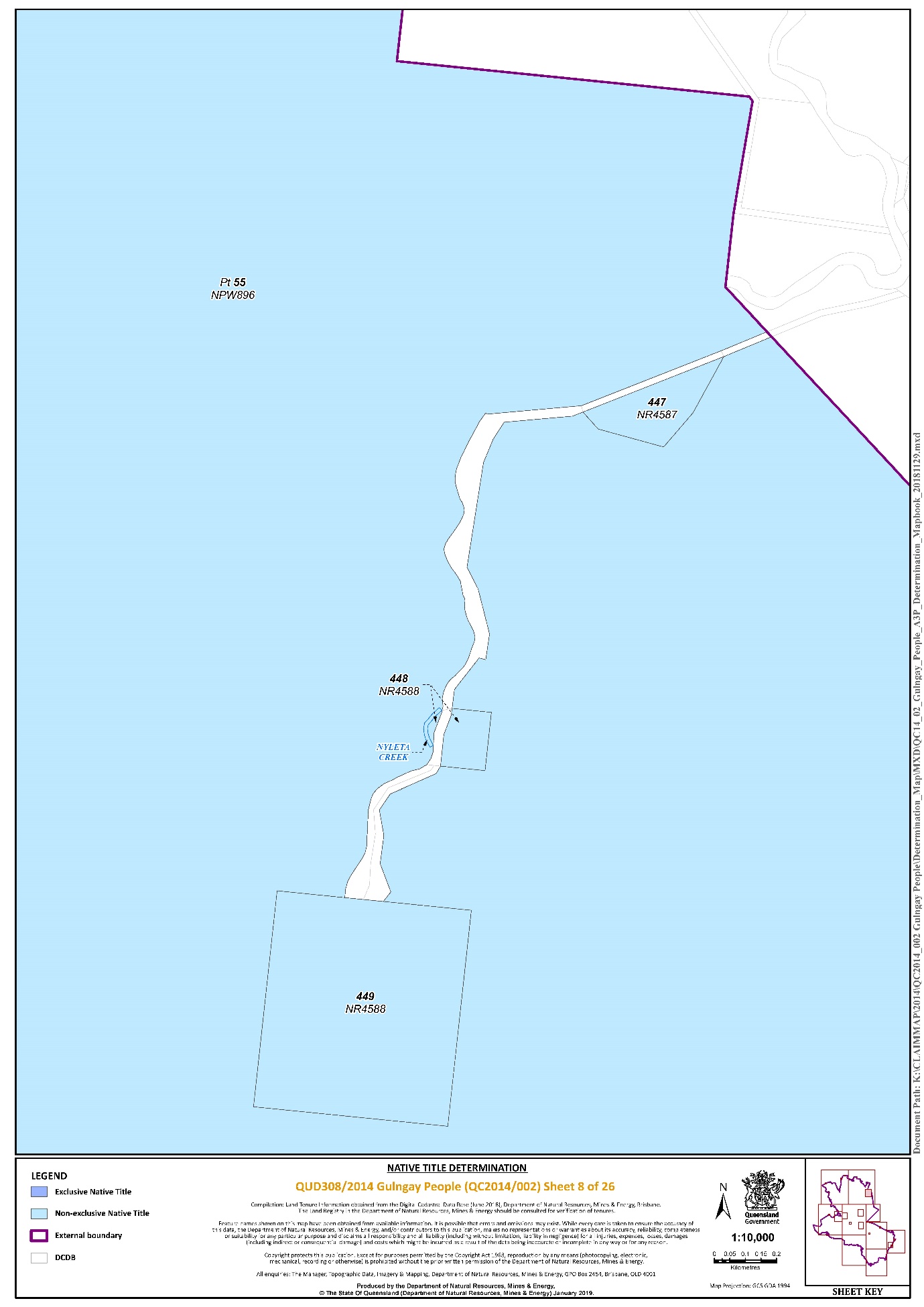
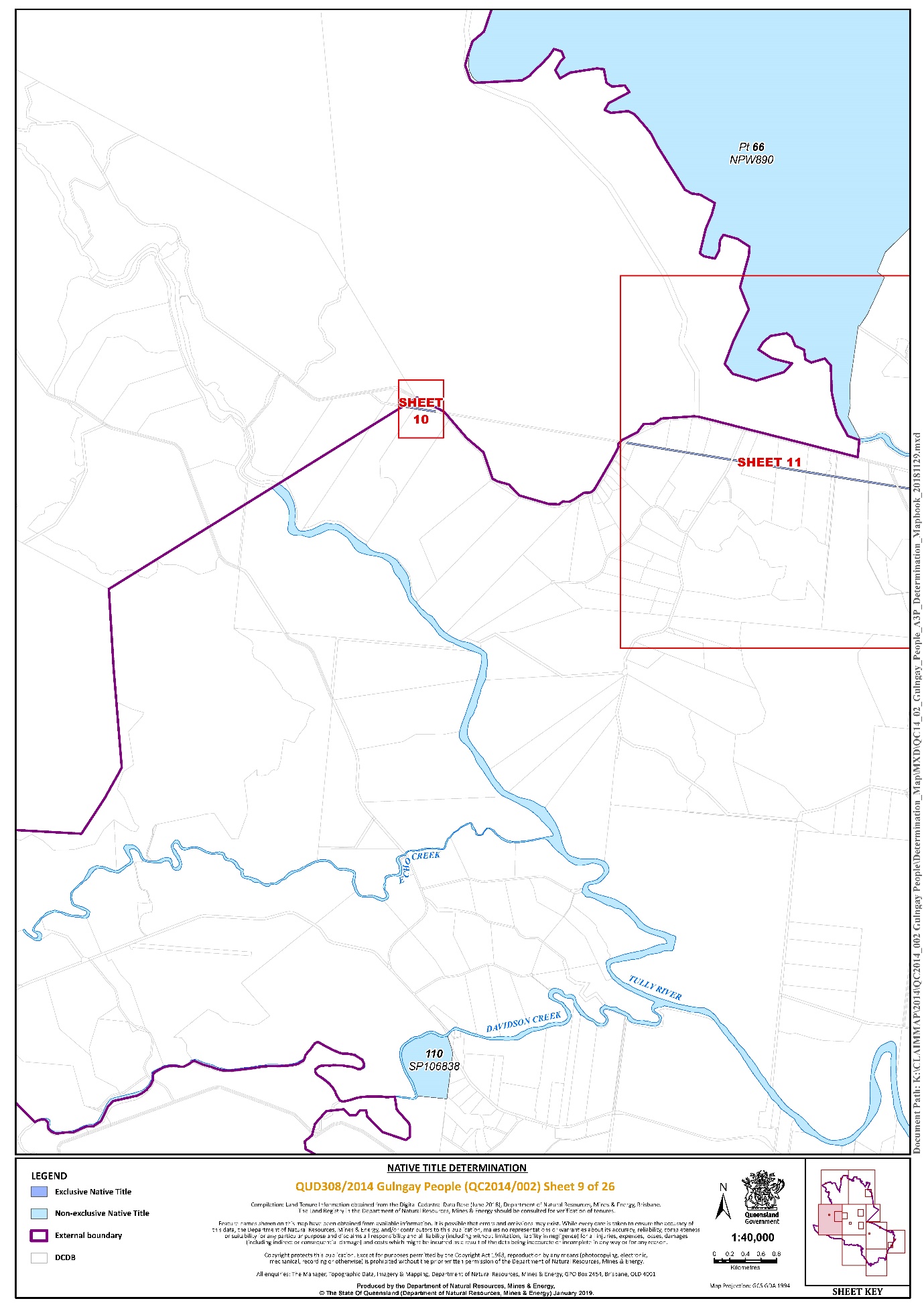
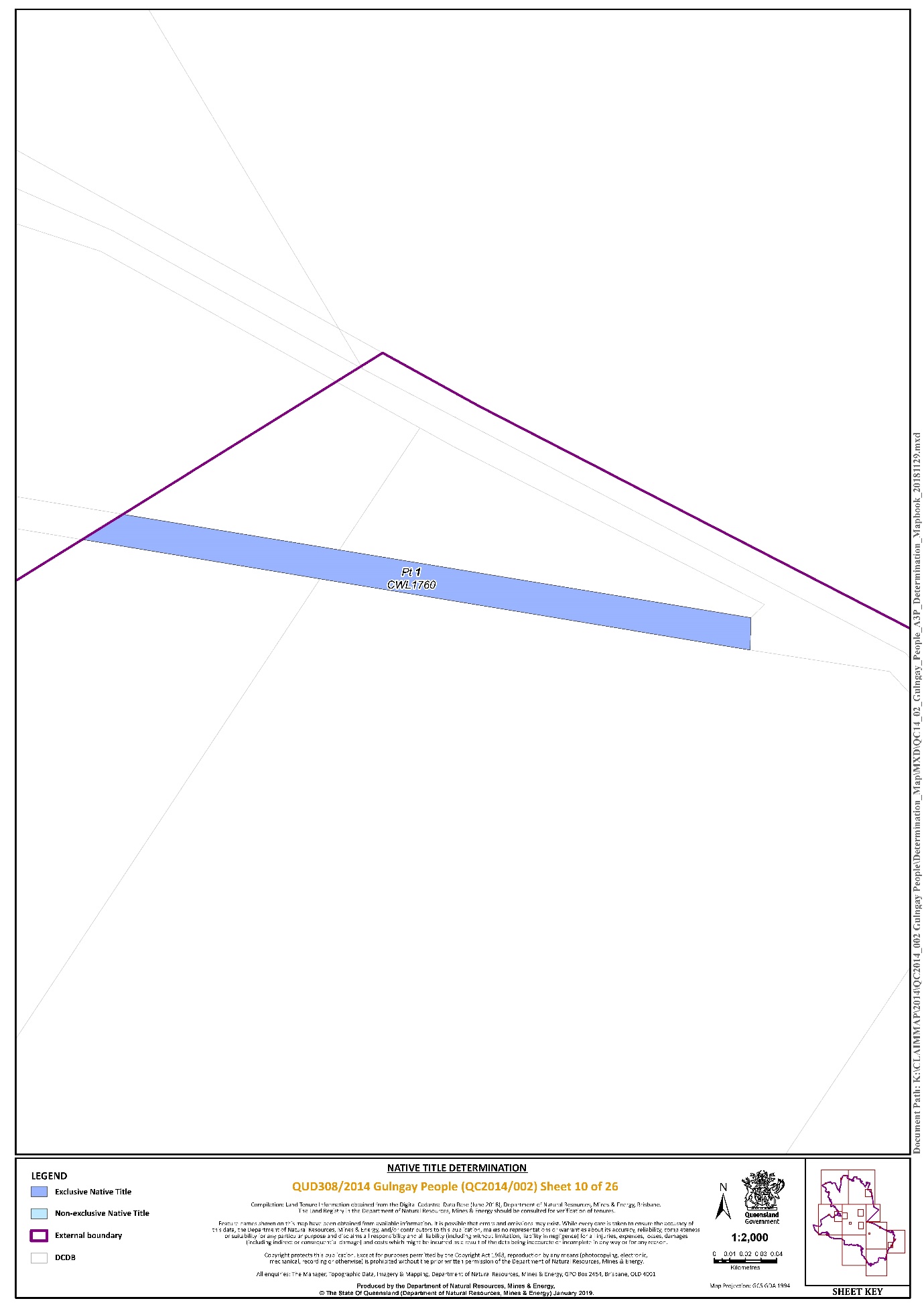
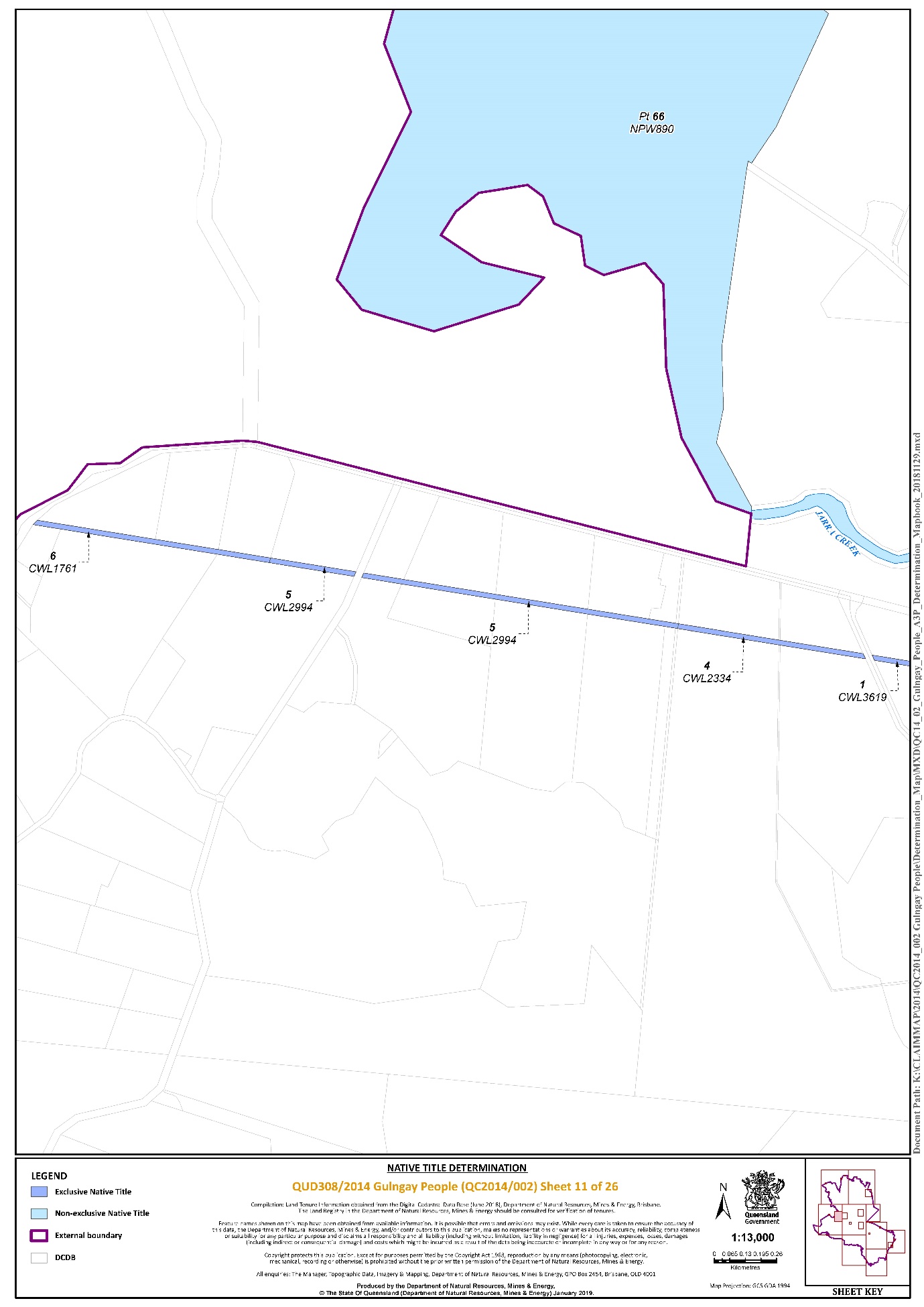
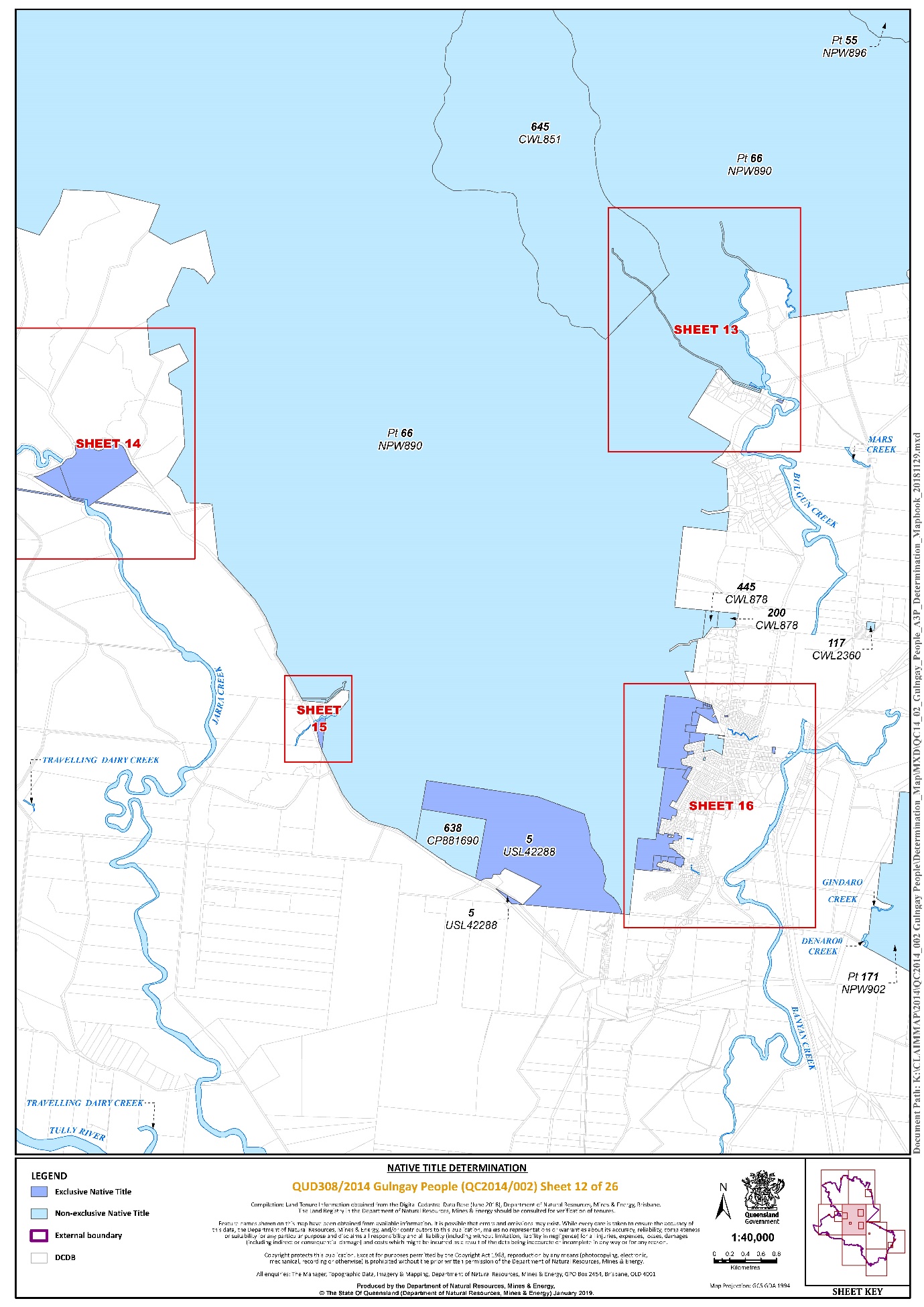
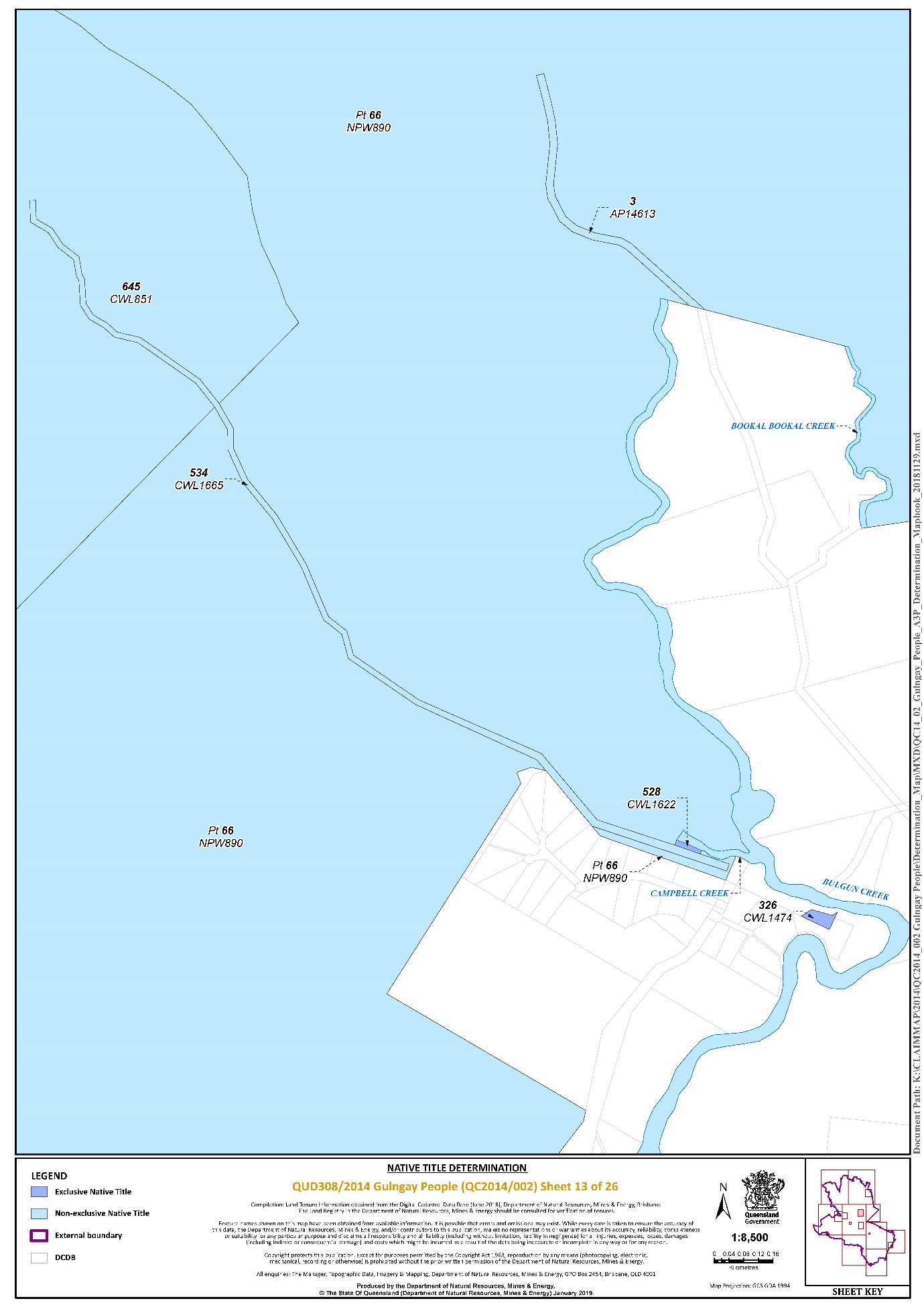
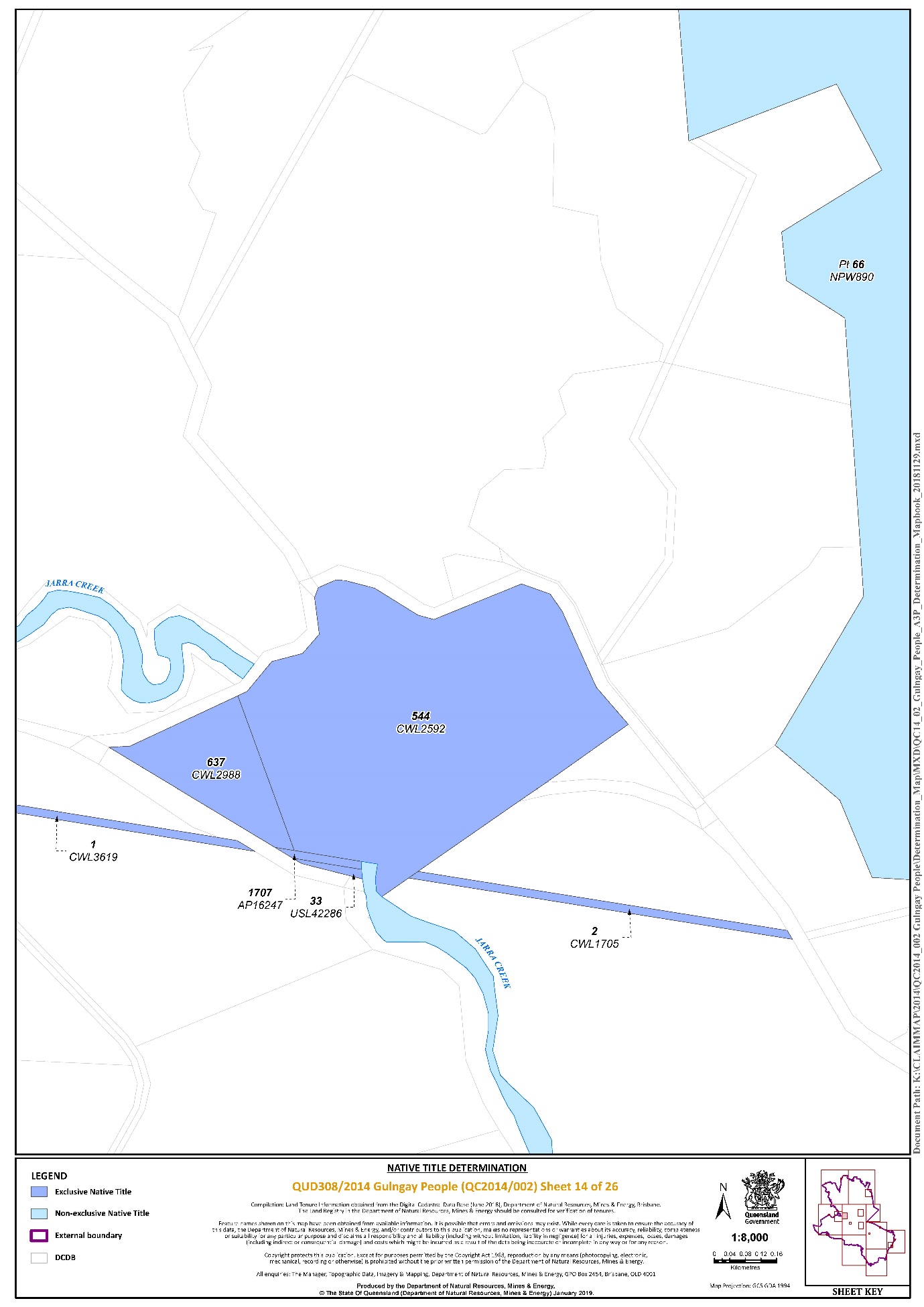
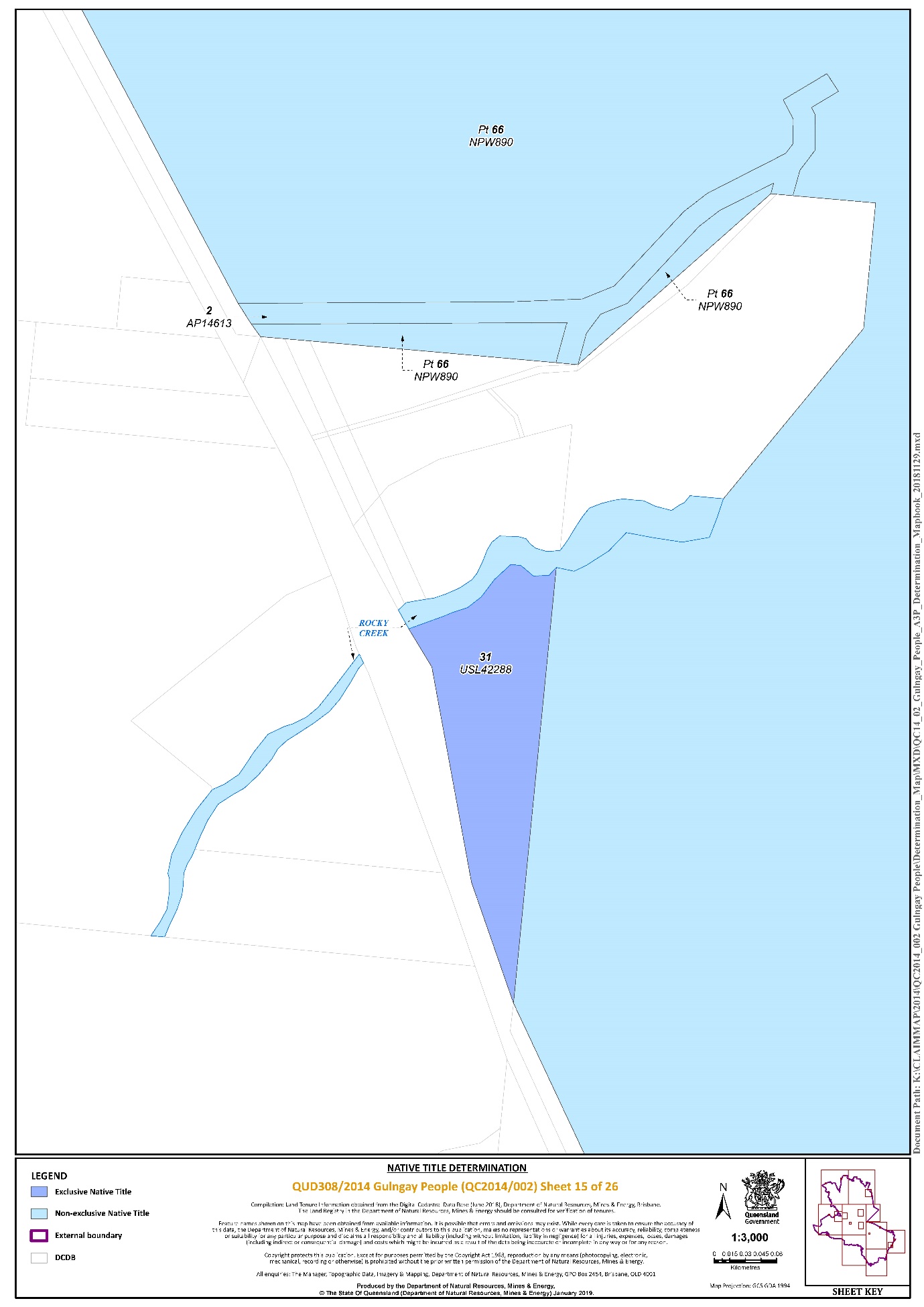
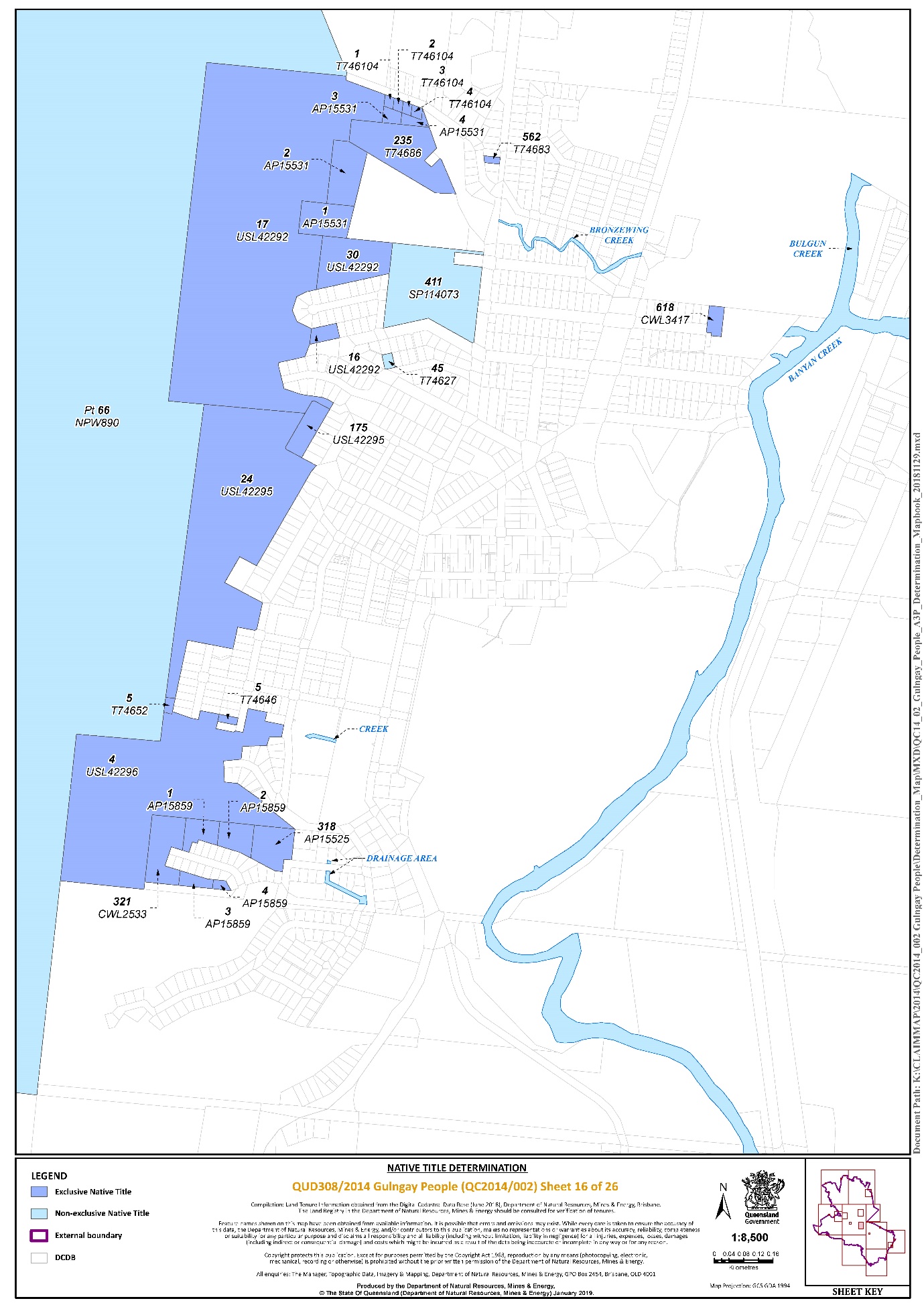
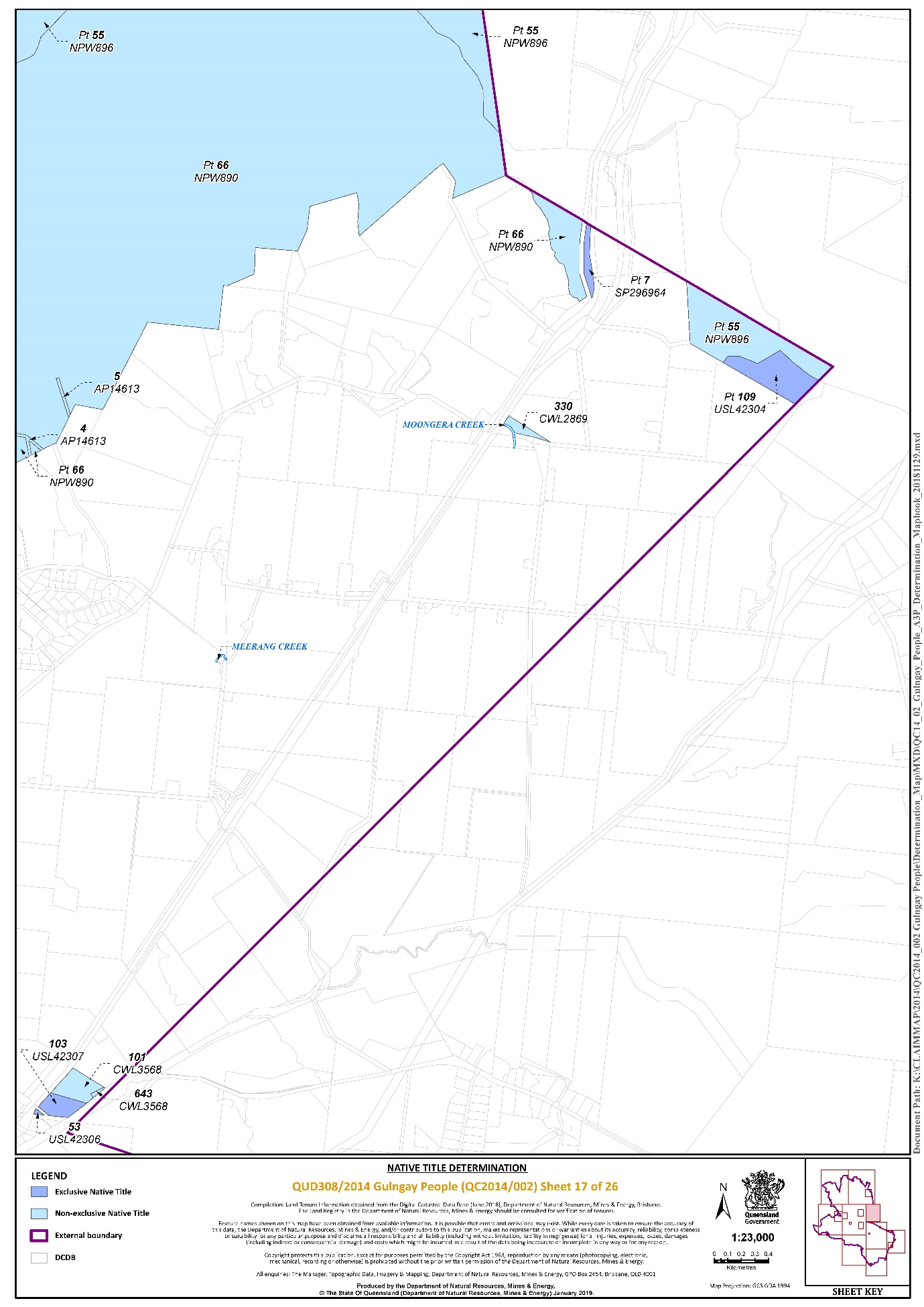
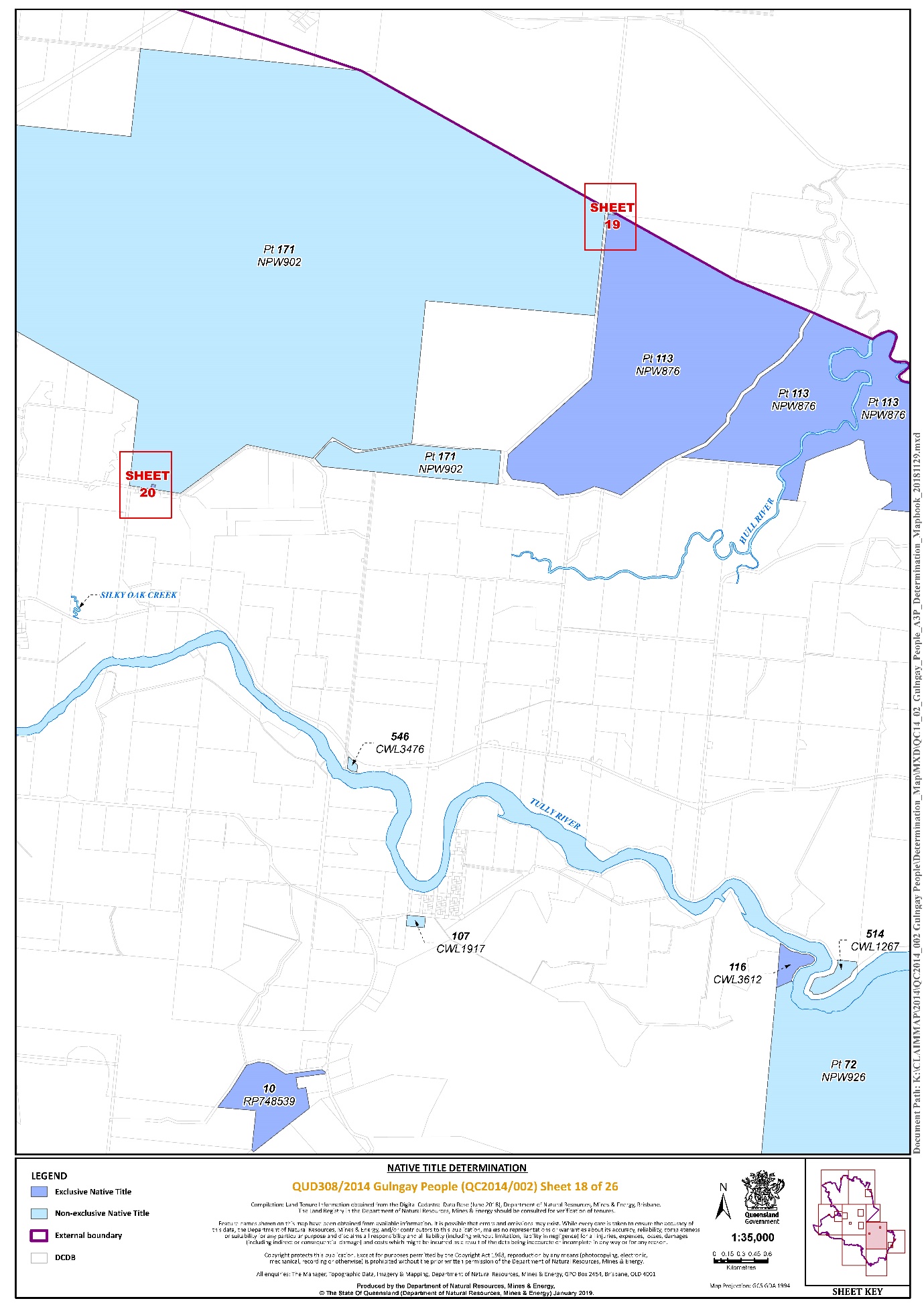
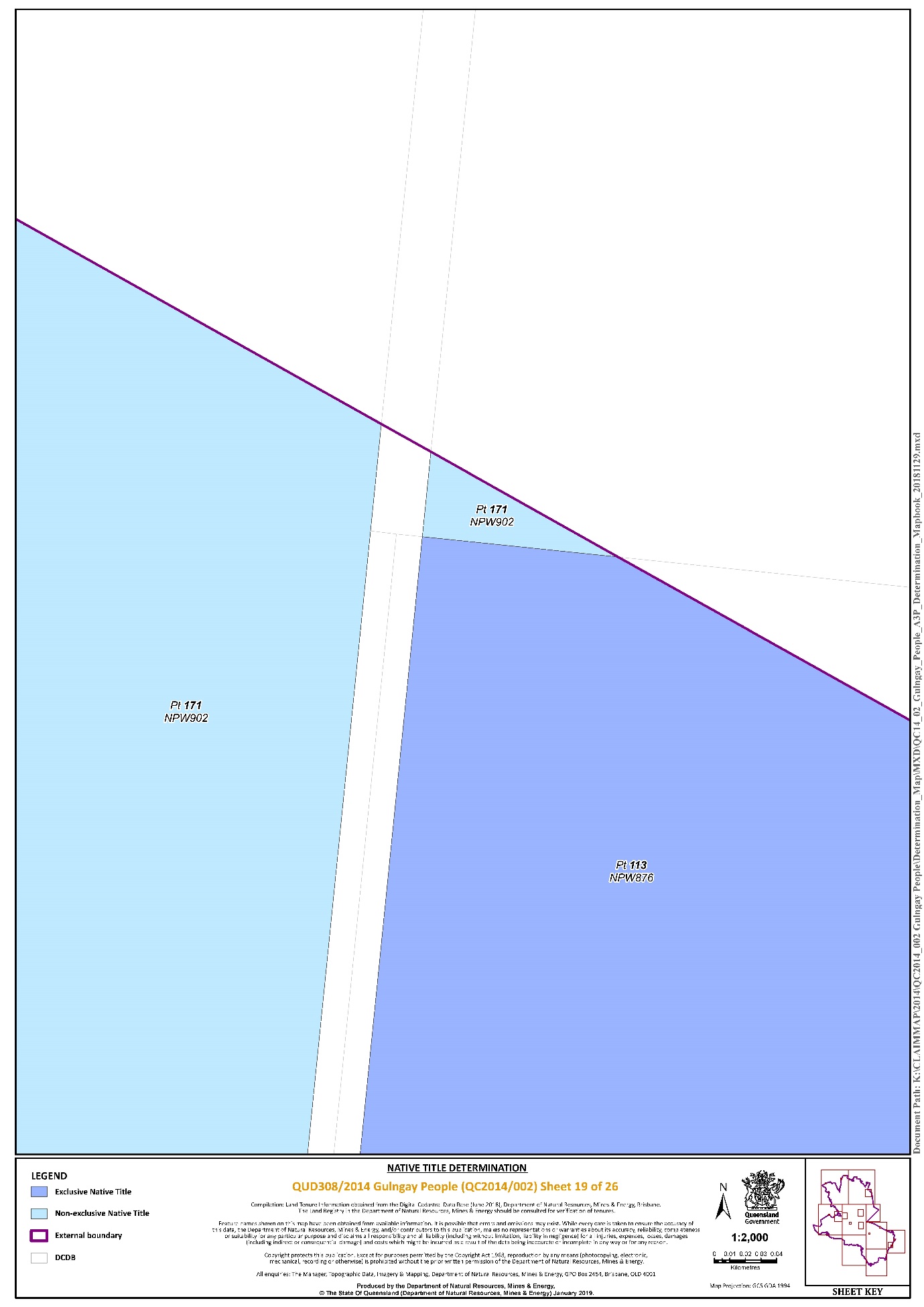
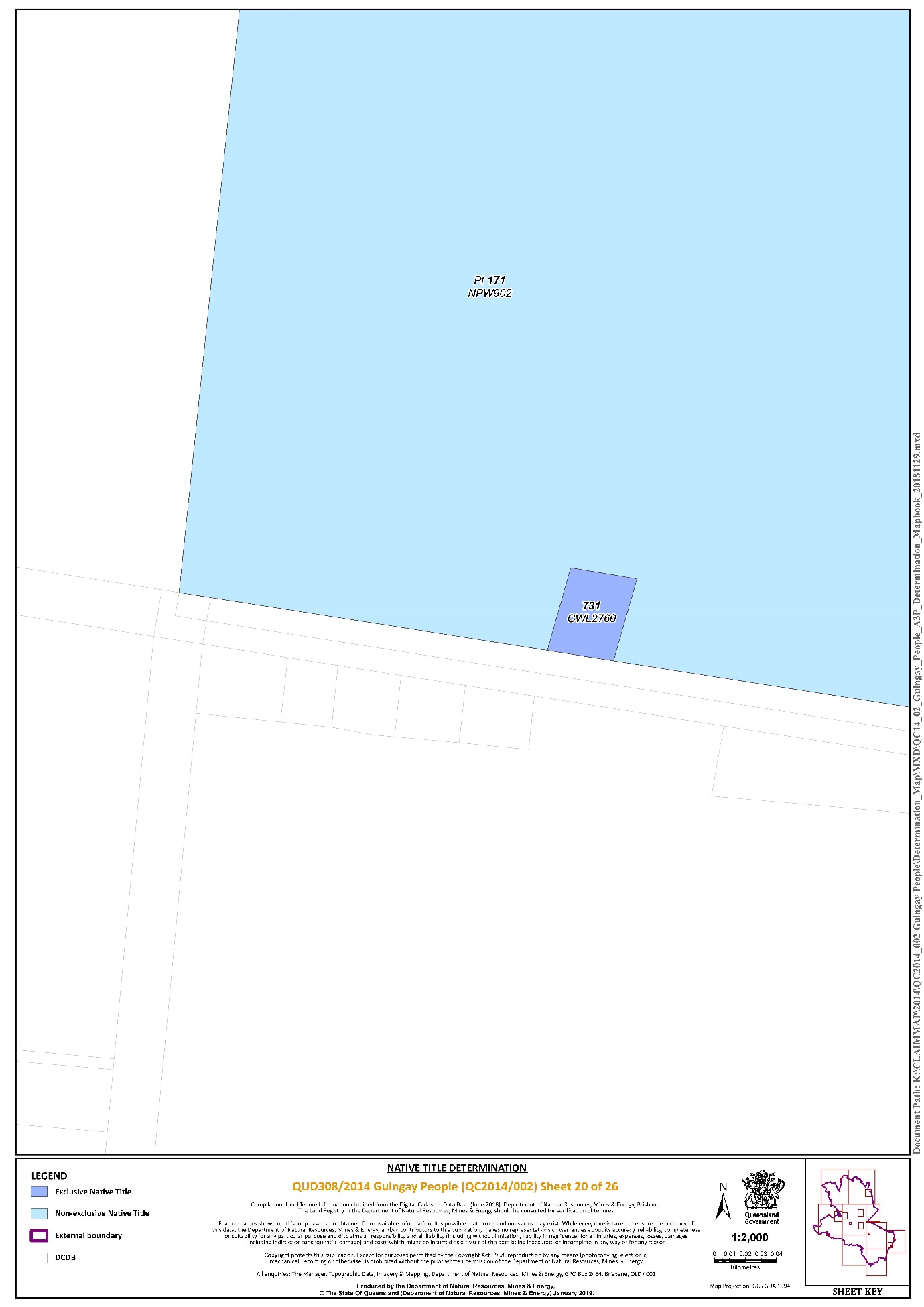
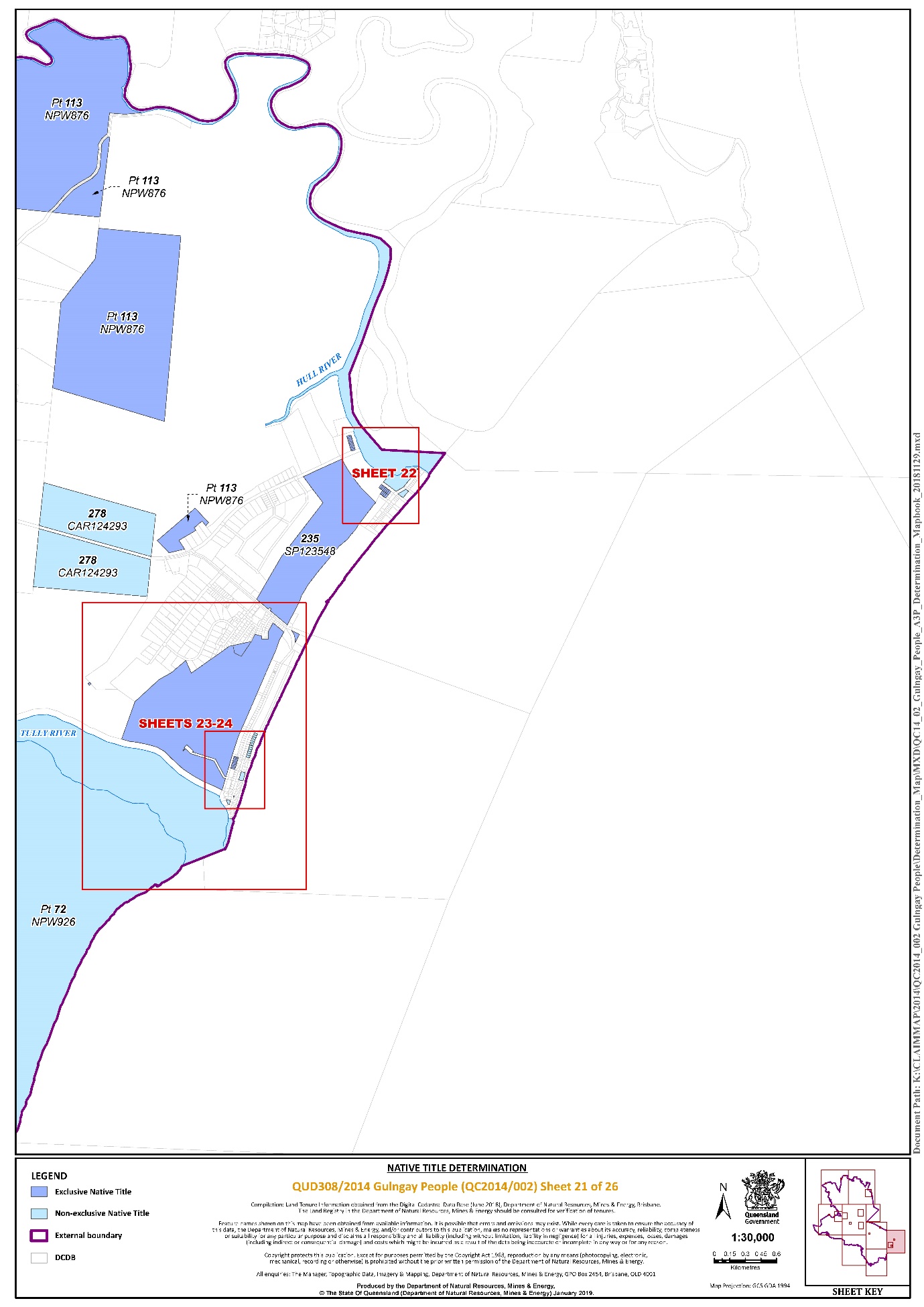
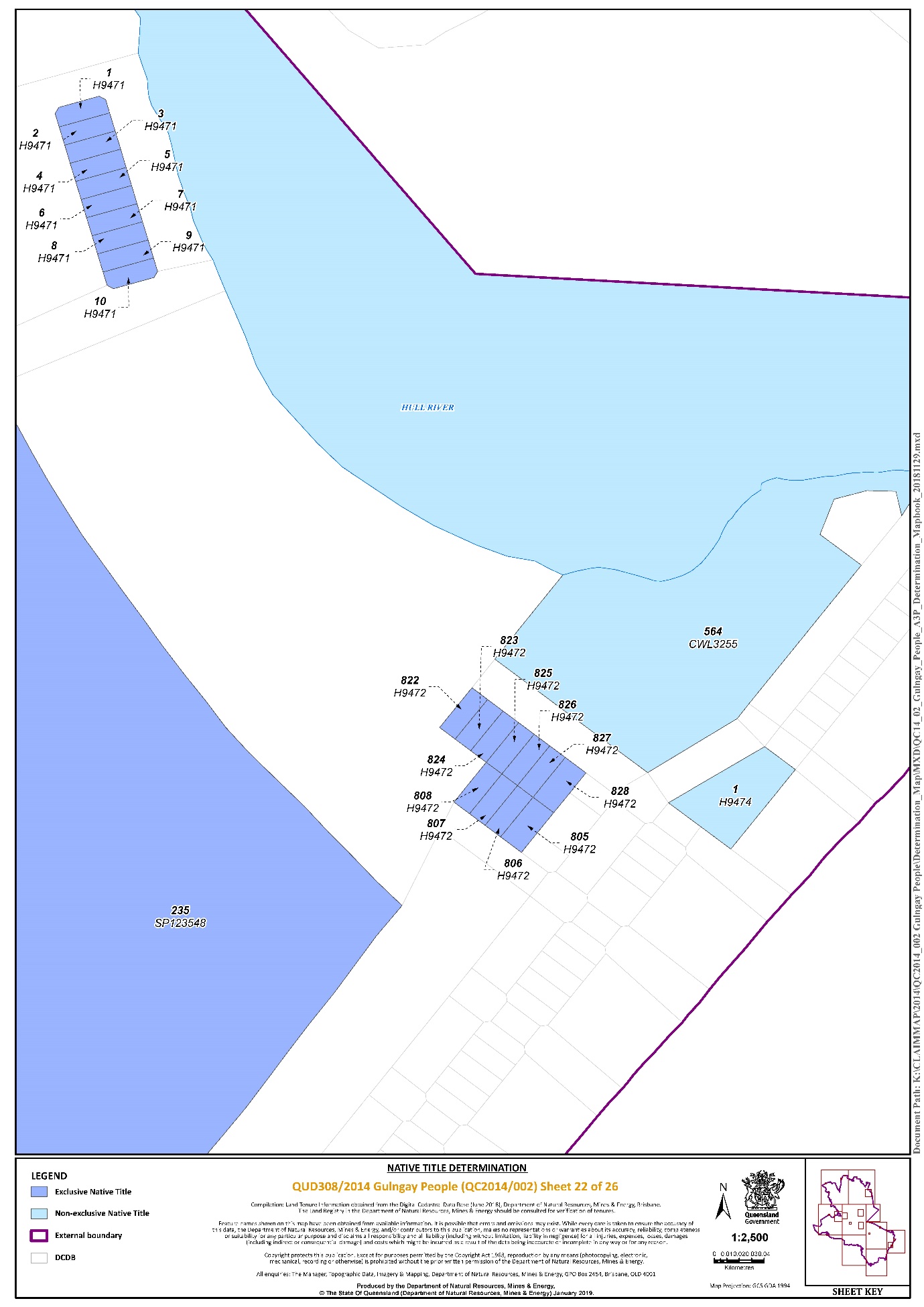
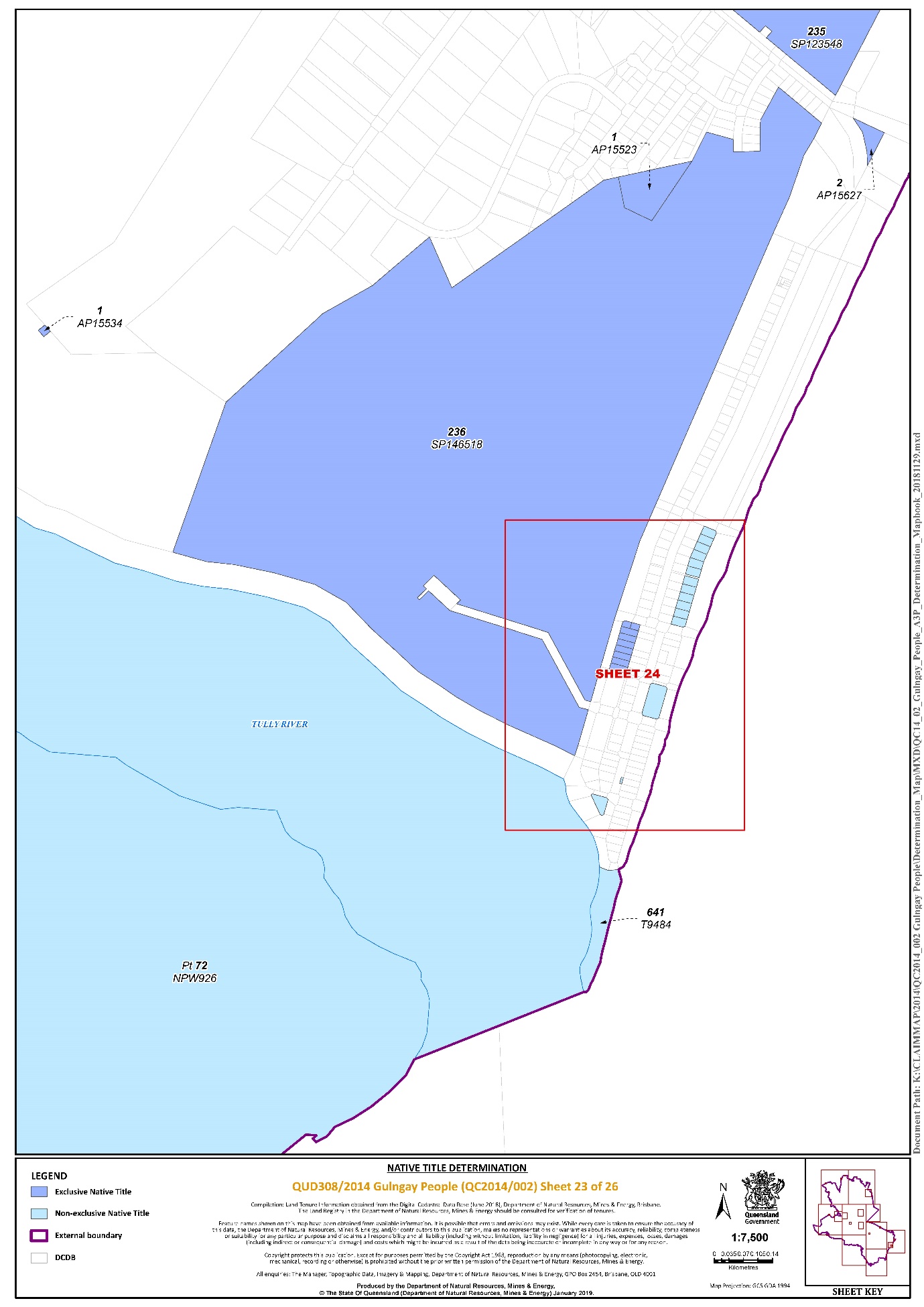
3. The determination area is the land and waters described in Schedule 4 and depicted in the map attached to Schedule 6 to the extent those areas are within the External Boundary and not otherwise excluded by the terms of Schedule 5 (the Determination Area). To the extent of any inconsistency between the written description and the map, the written description prevails.
4. Native title exists in the Determination Area.
5. The native title is held by the Gulngay People described in Schedule 1 (the Native Title Holders).
6. Subject to orders 8, 9 and 10 below the nature and extent of the native title rights and interests in relation to the land and waters described in Part 1 of Schedule 4 are:
(a) other than in relation to Water, the right to possession, occupation, use and enjoyment of the area to the exclusion of all others; and
(b) in relation to Water, the non-exclusive rights to:
(i) hunt, fish and gather from the Water of the area;
(ii) take and use the Natural Resources of the Water in the area; and
(iii) take and use the Water of the area,
for personal, domestic and non-commercial communal purposes.
7. Subject to orders 8, 9 and 10 below the nature and extent of the native title rights and interests in relation to the land and waters described in Part 2 of Schedule 4 are the non-exclusive rights to:
(a) access, be present on, move about on and travel over the area;
(b) camp, and live temporarily on the area as part of camping, and for that purpose build temporary shelters;
(c) hunt, fish and gather on the land and waters of the area for personal, domestic and non-commercial communal purposes;
(d) take and use Natural Resources from the land and waters of the area for personal, domestic and non-commercial communal purposes;
(e) take and use the Water of the area for personal, domestic and non- commercial communal purposes;
(f) conduct ceremonies on the area;
(g) be buried and bury Native Title Holders within the area;
(h) maintain places of importance and areas of significance to the Native Title Holders under their traditional laws and customs and protect those places and areas from physical harm;
(i) teach on the area the physical and spiritual attributes of the area;
(j) hold meetings on the area; and
(k) light fires on the area for domestic purposes including cooking, but not for the purpose of hunting or clearing vegetation.
8. The native title rights and interests are subject to and exercisable in accordance with:
(a) the Laws of the State and the Commonwealth;
(b) the traditional laws acknowledged and traditional customs observed by the Native Title Holders.
9. The native title rights and interests referred to in orders 6(b) and 7 do not confer possession, occupation, use or enjoyment to the exclusion of all others.
10. There are no native title rights in or in relation to minerals as defined by the Mineral Resources Act 1989 (Qld) and petroleum as defined by the Petroleum Act 1923 (Qld) and the Petroleum and Gas (Production and Safety) Act 2004 (Qld).
11. The nature and extent of any other interests in relation to the Determination Area (or respective parts thereof) are set out in Schedule 2 (the Other Interests).
12. The relationship between the native title rights and interests described in orders 6 and 7 and the Other Interests is that:
(a) the Other Interests continue to have effect, and the rights conferred by or held under the Other Interests may be exercised notwithstanding the existence of the native title rights and interests;
(b) to the extent the Other Interests are inconsistent with the continued existence, enjoyment or exercise of the native title rights and interests in relation to the land and waters of the Determination Area, the native title continues to exist in its entirety but the native title rights and interests have no effect in relation to the Other Interests to the extent of the inconsistency for so long as the Other Interests exist; and
(c) the Other Interests and any activity that is required or permitted by or under, and done in accordance with, the Other Interests, or any activity that is associated with or incidental to such an activity, prevail over the native title rights and interests and any exercise of the native title rights and interests.
DEFINITIONS AND INTERPRETATION:
13. In this determination, unless the contrary intention appears:
“External Boundary” means the area described in Schedule 3;
“High Water Mark” means the ordinary high-water mark at spring tides;
“land” and “waters”, respectively, have the same meanings as in the Native Title Act 1993 (Cth);
“Laws of the State and the Commonwealth” means the common law and the laws of the State of Queensland and the Commonwealth of Australia, and includes legislation, regulations, statutory instruments, local planning instruments and local laws;
“Local Government Act” has the meaning given in the Local Government Act 2009 (Qld);
“Natural Resources” means:
(a) any animal, plant, fish and bird life found on or in the lands and waters of the Determination Area; and
(b) any clays, soil, sand, gravel or rock found on or below the surface of the Determination Area,
that have traditionally been taken and used by the Native Title Holders, but does not include:
(a) animals that are the private personal property of another;
(b) crops that are the private personal property of another; and
(c) minerals as defined in the Mineral Resources Act 1989 (Qld); or
(d) petroleum as defined in the Petroleum Act 1923 (Qld) and the Petroleum and Gas (Production and Safety) Act 2004 (Qld);
“Water” means:
(a) water which flows, whether permanently or intermittently, within a river, creek or stream;
(b) any natural collection of water, whether permanent or intermittent;
(c) water from an underground water source; and
(d) tidal water.
Other words and expressions used in this determination have the same meanings as they have in Part 15 of the Native Title Act 1993 (Cth).
THE COURT DETERMINES THAT:
14. The native title is not held in trust.
15. The Gulngay Kinjufile Aboriginal Corporation ICN 8802, incorporated under the Corporations (Aboriginal and Torres Strait Islander) Act 2006 (Cth), is to:
(a) be the prescribed body corporate for the purpose of s 57(2) of the Native Title Act 1993 (Cth); and
(b) perform the functions mentioned in s 57(3) of the Native Title Act 1993 (Cth) after becoming a registered native title body corporate.
Note: Entry of orders is dealt with in Rule 39.32 of the Federal Court Rules 2011.
LIST OF SCHEDULES
Schedule 1 – | Native Title Holders | |
Schedule 2 – | Other Interests in the Determination Area | |
Schedule 3 – | External Boundary | |
Schedule 4 – | Description of Determination Area | |
Schedule 5 – | Areas Not Forming Part of the Determination Area | |
Schedule 6 – | Map of Determination Area |
Schedule 1 – Native Title Holders
1. The Native Title Holders are the Gulngay People. The Gulngay People are the descendants of Joe Kinjun (Ginydjubayil), also known as Kinjufile, and sometimes referred to as King of the Gulngay People.
Schedule 2 – Other Interests in the Determination Area
The nature and extent of the Other Interests in relation to the Determination Area are the following as they exist as at the date of the determination:
1. The rights and interests of Ergon Energy Corporation ACN 087 646 062:
(a) as the owner and operator of any “Works” as that term is defined in the
Electricity Act 1994 (Qld) within the Determination Area;
(b) as a distribution entity and the holder of a distribution authority under the Electricity Act 1994 (Qld);
(c) created under the Electricity Act 1994 (Qld) and the Government Owned Corporations Act 1993 (Qld) including;
(i) rights in relation to any agreement relating to the Determination Area existing or entered into before the date on which these orders are made;
(ii) rights to enter the Determination Area by its employees, agents or contractors to exercise any of the rights and interests referred to in this paragraph; and
(iii) to inspect, maintain and manage any Works in the Determination Area.
2. The rights and interests of the Cassowary Coast Regional Council (the Council) as the local government for the Determination Area, including:
(a) the Council’s powers, functions, responsibilities and jurisdiction under a Local Government Act;
(b) the Council’s rights and interests in land or waters within the Determination Area including under any lease, license, access agreement, easement or reserve in the Determination Area;
(c) the Council’s rights to use, operate, maintain, replace, restore, remediate, repair and otherwise exercise all other rights as the owner and operator of infrastructure, structures, earthworks, access works, facilities and other improvements within the Determination Area;
(d) the rights under any agreements between the Council and third parties which relate to land or waters in the Determination Area; and
(e) the rights of the Council’s employees, agents and contractors to enter upon the Determination Area for the purpose of performing its powers and responsibilities under paragraphs (a) to (d).
3. The rights and interests granted by the Commonwealth of Australia pursuant to statute or otherwise in the exercise of its executive power and under any regulations made pursuant to such legislation and including, for the avoidance of any doubt, but not limited to, the “Defence Practice Area” otherwise declared and described as “Item and map number 8”, referring to the “Tully Training Area” in the Schedule to the Declaration of Defence Practice Areas made by the Minister for Defence pursuant to regulation 49 of the Defence Force Regulations on 30 July 1987, and published in Commonwealth of Australia Gazette No. GN 14 on 5 August 1987.
4. The rights and interests of the State of Queensland or any other person existing by reason of the force and operation of the laws of the State of Queensland, including those existing by reason of the following legislation or any regulation, statutory instrument, declaration, plan, authority, permit, lease or licence made, granted, issued or entered into under that legislation:
(a) the Fisheries Act 1994 (Qld); and
(b) the Land Act 1994 (Qld).
5. Any other rights and interests:
(a) held by the State of Queensland or Commonwealth of Australia; or
(b) existing by reason of the force and operation of the Laws of the State and the Commonwealth.
Schedule 3 – External Boundary
The area of land and waters commencing in the centre of the mouth of the Murray River at the High Water Mark then generally north westerly and generally south westerly along the centreline of the northern channel of that river; then generally south westerly and generally north westerly along the centreline of that river to an unnamed creek at Longitude 145.851919° East, Latitude 18.016160° South; then generally north westerly along that creek to its end point at approximately Longitude 145.784370°East, Latitude 17.978220° South; then north westerly to an unnamed creek at Longitude 145.781310° East, Latitude 17.976400° South; then generally north westerly and generally north easterly along that creek to Davidson Creek; then generally westerly along the centreline of that creek to Longitude 145.741667° East; then north westerly to a corner on the eastern boundary of Lot 66 on Plan NPW890 (Tully Gorge National Park) at Latitude 17.953749° South, also a point on the boundary of native title determination QUD42/2004 Jirrbal People #3 (QCD2010/006); then generally north easterly along the eastern boundary of that lot to a corner at Latitude 17.909171° South; then north easterly to a point on the southern boundary of again Lot 66 on Plan NPW890 (Tully Gorge National Park) at Longitude 145.785829° East; Latitude 17.887051° South, then generally easterly and northerly along the southern and eastern boundaries of that lot to the centreline of Jarra Creek; then generally north westerly along the centreline of that creek to its end point at Latitude 17.759440° South; then north easterly to a northern boundary of again Lot 66 on Plan NPW890 Tully Gorge National Park at Longitude 145.771231° East, being the mountain peak shown as elevation 705 on 1:100,000 Topographic Map 8062 “Tully”; then generally easterly and generally south easterly along the northern boundary of that lot to the centreline of Liverpool Creek at Longitude 145.831060° East; then generally northerly and generally easterly along the centreline of that creek to the eastern boundary of Lot 55 on Plan NPW896 (Japoon National Park) at Longitude 145.859517° East; then generally westerly, generally easterly and generally southerly along the northern boundaries of that lot to the southernmost corner of Lot 36 on Plan NR1578 (being a corner of former Lot 196 on Plan NR1114); then generally southerly, generally easterly, generally northerly, and generally north westerly along the western, southern, eastern and northern boundaries of that former lot to again the northern boundary of Lot 55 on Plan NPW896 (Japoon National Park); then generally north easterly and generally south easterly, along the northern and eastern boundaries of that lot to the southern bank of South Liverpool Creek; then south easterly to the source of North Maria Creek at Longitude 145.970040° East, Latitude 17.793720° South; then south easterly through the following coordinate points:
Longitude East | Latitude South |
145.971899 | 17.802069 |
145.972709 | 17.807763 |
145.972853 | 17.808772 |
145.973128 | 17.810710 |
145.974226 | 17.818432 |
145.978763 | 17.850324 |
then southerly to the southern boundary of Lot 66 on Plan NPW890 at Longitude 145.979154° East; then generally south easterly through the following coordinate points:
Longitude East | Latitude South |
145.980643 | 17.853941 |
145.984230 | 17.856039 |
145.984492 | 17.856229 |
145.984767 | 17.856391 |
145.991140 | 17.860081 |
145.993635 | 17.861540 |
145.997261 | 17.863661 |
146.000881 | 17.865778 |
then south westerly to Jacobs Knob at Longitude 145.950000° East, Latitude 17.916661° South, then generally south easterly through the following coordinate points:
Longitude East | Latitude South |
145.981572 | 17.927237 |
146.006218 | 17.941052 |
146.006504 | 17.941212 |
146.007584 | 17.941818 |
then south easterly to the south west corner of Lot 646 on Plan SP252229 (former Lot 646 on Plan CAR124226); then continuing south easterly to the centreline of the Hull River where it meets the prolongation south easterly of the centreline of Carmoo Creek; then generally easterly and generally southerly along the centreline of that river, taking the centreline of the southern channel to the intersection of the mouth of that river and the High Water Mark of the mainland coastline; then generally south westerly along that High Water Mark, crossing the mouths of any waterways between the seaward extremities of each of the opposite banks of each such waterway back to the commencement point.
Note
Data reference and source
Application boundary data compiled by National Native Title Tribunal based on data sourced from Department of Natural Resources and Mines, Qld; Determination of native title QUD42/2004 Jirrbal People #3 (QCD2010/006) as determined in the Federal Court on 8 October 2010; Cadastre data sourced from Department of Natural Resources, Mines and Energy, Qld (8 February 2018).
Rivers/Creeks where available are based on casement data sourced from Department of Natural Resources and Mines, Qld (8 February 2018) – else Topographic vector data is © Commonwealth of Australia (Geoscience Australia) 2006.
Topographic data (1:100,000) sourced from Department of Natural Resources, Mines and Energy, Qld (July 2002).
Reference datum
Geographical coordinates have been provided by the National Native Title Tribunal Geospatial Services and are referenced to the Geocentric Datum of Australia 1994 (GDA94), in decimal degrees and are based on the spatial reference data acquired from the various custodians at the time.
Use of Coordinates
Where coordinates are used within the description to represent cadastral or topographical boundaries or the intersection with such, they are intended as a guide only. As an outcome to the custodians of cadastral and topographic data continuously recalculating the geographic position on their data based on improved survey and data maintenance procedures, it is not possible to accurately define such a positon other than by detailed ground survey.
Prepared by Geospatial Service, National Native Title Tribunal (18 July 2018).
Schedule 4 – Description of Determination Area
The Determination Area comprises all of the land and waters described by lots on plan, or relevant parts thereof, and any rivers, streams, creeks or lakes, described in the first column of the tables in the Parts immediately below, and depicted in the maps in Schedule 6, to the extent those areas are within the External Boundary and not otherwise excluded by the terms of Schedule 5.
Part 1 – Exclusive Areas
All of the land and waters described in the following table and depicted in dark blue on the determination map contained in Schedule 6:
Area description (at the time of the determination) | Determination Map Sheet Reference |
Lot 1 on Plan AP4579 | 1 |
Lot 1 on Plan AP5889 | 24 |
Lot 1 on Plan AP15523* | 23 |
Lot 1 on Plan AP15531* | 16 |
Lot 1 on Plan AP15534* | 23 |
Lot 1 on Plan AP15859* | 16 |
Lot 1 on Plan CWL1760 (part) | 10 |
Lot 1 on Plan CWL3619 | 11 and 14 |
Lot 1 on Plan H9471 | 22 |
Lot 1 on Plan T746104* | 16 |
Lot 2 on Plan AP4579 | 1 |
Lot 2 on Plan AP5889 | 24 |
Lot 2 on Plan AP15531* | 16 |
Lot 2 on Plan AP15627 | 23 |
Lot 2 on Plan AP15859* | 16 |
Lot 2 on Plan CWL1705 | 14 |
Lot 2 on Plan H9471 | 22 |
Lot 2 on Plan T746104* | 16 |
Lot 3 on Plan AP15531* | 16 |
Lot 3 on Plan AP15859* | 16 |
Lot 3 on Plan H9471 | 22 |
Lot 3 on Plan T746104* | 16 |
Lot 4 on Plan AP15531* | 16 |
Lot 4 on Plan AP15859* | 16 |
Lot 4 on Plan CWL2334 | 11 |
Lot 4 on Plan H9471 | 22 |
Lot 4 on Plan T746104* | 16 |
Lot 4 on Plan USL42296* | 16 |
Lot 5 on Plan CWL2994 | 11 |
Lot 5 on Plan H9471 | 22 |
Lot 5 on Plan T74646* | 16 |
Lot 5 on Plan T74652* | 16 |
Lot 5 on Plan USL42288* | 12 |
Lot 6 on Plan CWL1761 | 11 |
Lot 6 on Plan H9471 | 22 |
Lot 7 on Plan SP296964 (part)* | 17 |
Lot 7 on Plan H9471 | 22 |
Lot 8 on Plan H9471 | 22 |
Lot 9 on Plan H9471 | 22 |
Lot 10 on Plan H9471 | 22 |
Lot 10 on Plan RP748539* | 18 |
Lot 14 on Plan T9486 | 24 |
Lot 15 on Plan T9486 | 24 |
Lot 16 on Plan T9486 | 24 |
Lot 16 on Plan USL42292* | 16 |
Lot 17 on Plan T9486 | 24 |
Lot 17 on Plan USL42292 | 16 |
Lot 18 on Plan T9486 | 24 |
Lot 19 on Plan T9486 | 24 |
Lot 20 on Plan T9486 | 24 |
Lot 24 on Plan USL42295* | 16 |
Lot 30 on Plan USL42292* | 16 |
Lot 31 on Plan USL42288 | 15 |
Lot 33 on Plan USL42286 | 14 |
Lot 53 on Plan USL42306 | 17 |
That part of Lot 72 on Plan NPW926 formerly described as Lot 3 on Plan USL38662 that is within the External Boundary | 26 |
Lot 103 on Plan USL42307 | 17 |
Lot 109 on Plan USL42304 (part) | 17 |
That part of Lot 113 on NPW876 that is within the External Boundary and excluding the areas formerly described as Lot 234 on Plan CWL1830, Lot 11 on Plan CWL113 and Lot 593 on Plan CWL2537 | 18, 19 and 21 |
Lot 116 on Plan CWL3612* | 18 |
Lot 175 on Plan USL42295* | 16 |
Lot 235 on Plan SP123548* | 21 and 22 |
Lot 235 on Plan T74686* | 16 |
Lot 236 on Plan SP146518* | 23 and 24 |
Lot 318 on Plan AP15525* | 16 |
Lot 321 on Plan CWL2533* | 16 |
Lot 326 on Plan CWL1474* | 13 |
Lot 528 on Plan CWL1622* | 13 |
Lot 544 on Plan CWL2592 | 14 |
Lot 548 on Plan NR1046 | 1 |
Lot 562 on Plan T74683^ | 16 |
Lot 618 on Plan CWL3417* | 16 |
Lot 637 on Plan CWL2988^ | 14 |
Lot 731 on Plan CWL2760^ | 20 |
Lot 805 on Plan H9472 | 22 |
Lot 806 on Plan H9472 | 22 |
Lot 807 on Plan H9472 | 22 |
Lot 808 on Plan H9472 | 22 |
Lot 822 on Plan H9472 | 22 |
Lot 823 on Plan H9472 | 22 |
Lot 824 on Plan H9472 | 22 |
Lot 825 on Plan H9472 | 22 |
Lot 826 on Plan H9472 | 22 |
Lot 827 on Plan H9472 | 22 |
Lot 828 on Plan H9472 | 22 |
Lot 1707 on Plan AP16247 | 14 |
*denotes areas to which s 47B of the Native Title Act 1993 (Cth) applies
^denotes areas to which s 24ID(1)(c) of the Native Title Act 1993 (Cth) applies
Part 2 – Non-Exclusive Areas
All of the land and waters described in the following table and depicted in light blue on the determination map contained in Schedule 6:
Area description (at the time of the determination) | Determination Map Sheet Reference |
Lot 1 on Plan H9474 | 22 |
Lot 1 on Plan T9485 | 24 |
Lot 2 on Plan AP14613 | 15 |
Lot 2 on Plan T9485 | 24 |
Lot 3 on Plan AP14613 | 13 |
Lot 3 on Plan T9485 | 24 |
Lot 4 on Plan AP14613 | 17 |
Lot 4 on Plan T9485 | 24 |
Lot 5 on Plan AP14613 | 17 |
Lot 5 on Plan T9485 | 24 |
Lot 6 on Plan T9485 | 24 |
Lot 7 on Plan T9485 | 24 |
Lot 8 on Plan T9485 | 24 |
Lot 9 on Plan T9483 | 24 |
Lot 9 on Plan T9485 | 24 |
Lot 10 on Plan T9485 | 24 |
Lot 11 on Plan T9485 | 24 |
Lot 12 on Plan T9485 | 24 |
Lot 13 on Plan T9484 | 24 |
Lot 19 on Plan NPW970 (part) | 4 |
Lot 45 on Plan T74627 | 16 |
That part of Lot 55 on Plan NPW896 that is within the External Boundary and excluding the areas formerly described as Lots 190-198 on Plan NR1114 | 1, 2, 3, 6, 8, 12 and 17 |
Lot 66 on NPW890 (part) | 1, 4, 5, 6, 9, 11, 12, 13, 14, 15, 16 and 17 |
That part of Lot 72 on Plan NPW926 that is within the External Boundary and excluding the areas formerly described as Lot 3 on Plan USL38662, Lot 122 on Plan CWL2309, Lot 99 on Plan CWL2186, Lot 100 on Plan CWL1914 and Lot 61V on Plan K103937 | 18, 21, 23, and 26 |
Lot 89 on Plan CWL3469 | 25 |
Lot 101 on Plan CWL3568 | 17 |
Lot 107 on Plan CWL1917 | 18 |
Lot 110 on Plan SP106838 | 9 |
Lot 117 on Plan CWL2360 | 12 |
Lot 119 on Plan CWL2323 | 26 |
Lot 171 on Plan NPW902 (part) | 12, 18, 19 and 20 |
Lot 200 on Plan CWL878 | 12 |
Lot 278 on Plan CAR124293 | 21 |
Lot 330 on Plan CWL2869 | 17 |
Lot 411 on Plan SP114073 | 16 |
Lot 445 on Plan CWL878 | 12 |
Lot 447 on Plan NR4587 | 8 |
Lot 448 on Plan NR4588 | 8 |
Lot 449 on Plan NR4588 | 8 |
Lot 514 on Plan CWL1267 | 18 |
Lot 534 on Plan CWL1665 | 13 |
Lot 546 on Plan CWL3476 | 18 |
Lot 564 on Plan CWL3255 | 22 |
Lot 638 on Plan CP881690 | 12 |
Lot 641 on Plan T9484 | 23 |
Lot 642 on Plan T9484 | 24 |
Lot 643 on Plan CWL3568 | 17 |
Lot 645 on Plan CWL851 | 6 |
Save for any waters forming part of a lot on plan, all rivers, creeks, streams and lakes within the External Boundary, including but not limited to: (i) Hull River; (ii) Tully River; (iii) Murray River; (iv) Banyan Creek; (v) Jarra Creek; (vi) Bulgun Creek; (vii) Boongari Creek; (viii) Echo Creek; and (ix) Davidson Creek. | 7, 8, 9, 11, 12, 13, 14, 15, 16, 17, 18, 21, 22, 23, 24, 25 and 26 |
Schedule 5 – Areas Not Forming Part of the Determination Area
The following areas of land and waters are excluded from the Determination Area as described in Part 1 of Schedule 4 and Part 2 of Schedule 4:
1. Those land and waters within the External Boundary which at the time the native title determination application was made were the subject of one or more Previous Exclusive Possession Acts, within the meaning of s 23B of the Native Title Act 1993 (Cth), as they could not be claimed in accordance with s 61A of the Native Title Act 1993 (Cth).
2. Specifically, and to avoid any doubt, the land and waters described in (1) above include:
(a) the Previous Exclusive Possession Acts described in ss 23B(2) and 23B(3) of the Native Title Act 1993 (Cth) to which s 20 of the Native Title (Queensland) Act 1993 (Qld) applies, and to which none of ss 47, 47A or 47B of the Native Title Act 1993 (Cth) applied; and
(b) the land and waters on which any public work, as defined in s 253 of the Native Title Act 1993 (Cth), is or was constructed, established or situated, and to which ss 23B(7) and 23C(2) of the Native Title Act 1993 (Cth) and to which s 21 of the Native Title (Queensland) Act 1993 (Qld) applies, together with any adjacent land or waters in accordance with s 251D of the Native Title Act 1993 (Cth).
3. Those land and waters within the External Boundary on which, at the time the native title determination application was made, public works were validly constructed, established or situated after 23 December 1996, where s 24JA of the Native Title Act 1993 (Cth) applies, and which wholly extinguished native title.
4. Those land and waters within the External Boundary which, at the time the native title determination application was made, were the subject of one or more Pre-existing Rights Based Acts, within the meaning of s 24IB of the Native Title Act 1993 (Cth), which wholly extinguished native title.
5. Land and waters specifically excluded from QUD308/2014 Gulngay People native title determination application (QC2014/002) filed on 27 June 2014, being land and waters subject to the following determinations of native title:
QUD42/2004 Jirrbal People #3 (QCD2010/006), made on 8 October 2010;
QUD6003/2003 Djiru People #2 (QCD2011/005) made on 1 September 2011;
QUD6014/2001 Mamu People (QCD2013/005) made on 1 November 2013; and
QUD741/2015 Girramay People #2 (QCD2018/003) made on 1 August 2018.
Schedule 6 – Map of Determination Area
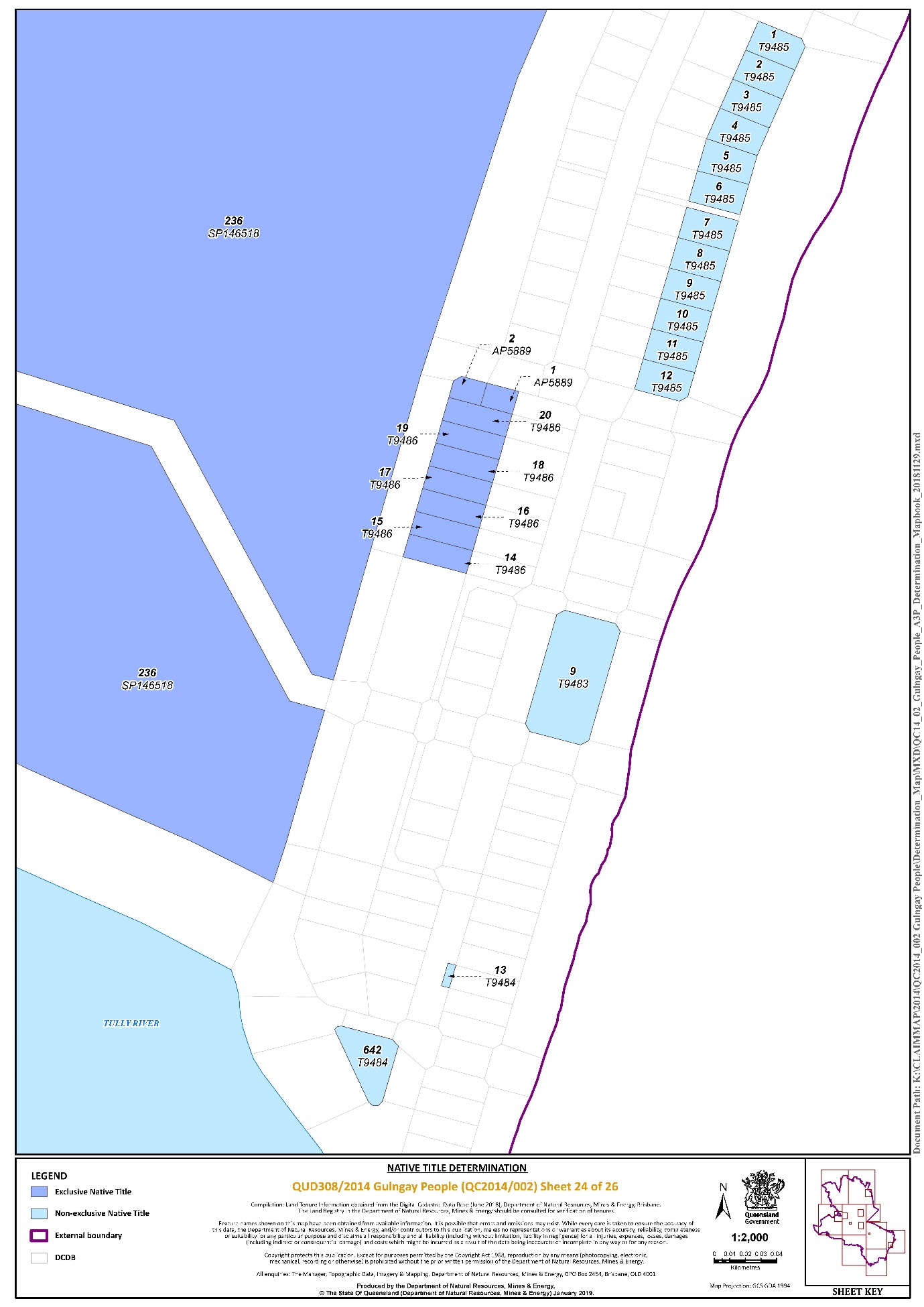
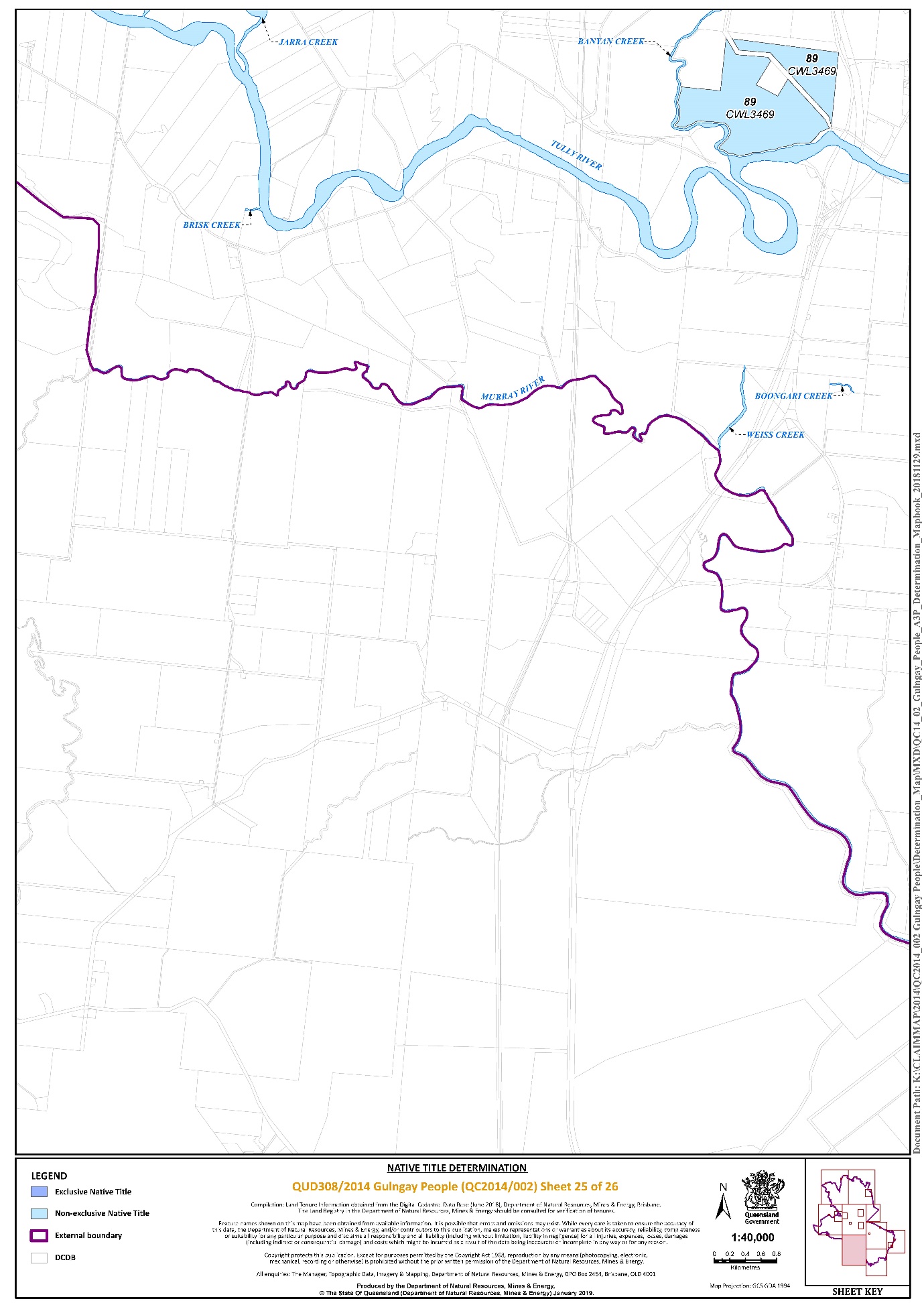
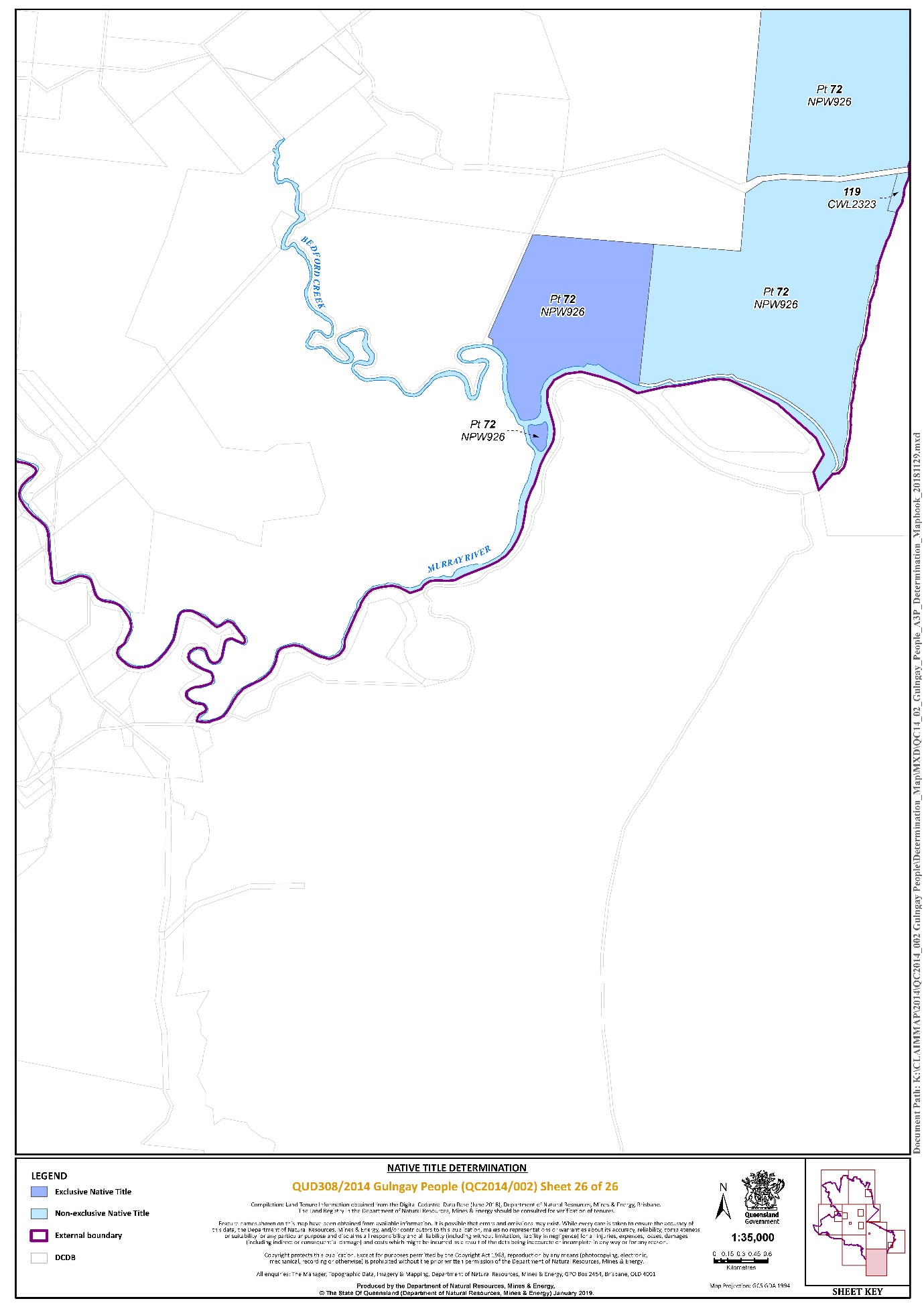
ROBERTSON J:
Introduction
1 These are the reasons of the Court for making a consent determination in the proceeding for the Gulngay People (QUD308/2014).
2 The named members of the applicant in the Gulngay People proceeding are Doris Kinjun, Clarence Kinjun and Joanne Kinjun.
3 The applicant seeks a determination of native title pursuant to s 61 of the Native Title Act 1993 (Cth), on their own behalf and on behalf of the Gulngay People, over lands and waters located on the coastal plain between the Hull River in the north and the Murray River in the south, and framed in the west by the foothills of the Great Dividing Range, and in the east by Rockingham Bay and the Coral Sea. Schedule B of the Application identifies the boundaries of this area, and areas which are not covered by the Application.
4 The “Determination Area” is defined in paragraph [3] of the Determination by reference to Schedule 4 and to a map at Schedule 6. Schedule 5 identifies areas which do not form part of the Determination Area.
5 The Determination is set out in the agreement pursuant to s 87(2) of the Native Title Act, filed on 27 February 2019. That agreement shows that each party consents to the Court making an order in terms of the draft order annexed to that agreement.
6 The parties are the applicant, the State of Queensland, the Commonwealth of Australia, Cassowary Coast Regional Council, Ergon Energy Corporation Limited, Stephen Essery, Desmond Gary Finlay, Ted Loveday, Thomas James Neil, Daniel Alexander Pope and Michael Wayne Wood.
7 The applicant submits that it is appropriate for the Court to exercise its discretion under s 87(1A) of the Native Title Act to make an order in the terms of the Determination, set out in the agreement referred to in [5] above, without holding a hearing.
8 The applicant submits the principles are established by Munn for and on behalf of the Gunggari People v State of Queensland [2001] FCA 1229; 115 FCR 109, as follows, and are met:
(a) All parties have had the benefit of independent and competent legal advice and have freely entered into an agreement under s 87 of the Native Title Act relating to the Determination.
(b) It is consistent with the object of the Native Title Act that issues and disputes concerning native title are resolved by mediation.
(c) The State has taken a “real interest” in the proceeding on behalf of the community and given appropriate consideration to the applicant’s connection material.
(d) The material relied upon by the applicant is capable of satisfying s 47 and s 47B of the Native Title Act.
(e) The connection material filed by the applicant satisfies s 223 of the Native Title Act and supports the making of the Determination.
(f) The requirements of ss 56, 94A and 225 of the Native Title Act are satisfied.
(g) The Determination is unambiguous and is certain as to the rights declared.
For the reasons which follow, the Court agrees with this submission.
Chronology of the proceedings
9 The Application was filed on 27 June 2014.
10 The notification closing date pursuant to s 66 of the Native Title Act was 4 February 2015.
11 As the result of a successful case management process, all parties to the Application have reached agreement that native title exists, and also in regard to the nature and extent of those native title rights and interests, over the areas covered by the Application.
12 The applicant has provided the State and other respondents with a report produced by an expert anthropologist and other material, which has been provided to the Court for the purpose of informing the Court as to why the parties have reached agreement in the matter and demonstrating that the requirements of s 223 of the Native Title Act are met.
The evidence
13 The evidence that has been provided to the State and the other respondents and filed in the Court by the applicant is as follows (the Connection Material):
(a) Associate Professor S Pannell PhD, ‘Gulngay People Connection Report’ dated 20 May 2014 (Pannell 2014) and filed on 19 February 2019.
(b) Associate Professor S Pannell PhD, ‘Gulngay People Supplementary Report’ dated April 2016 (Pannell 2016) and filed on 19 February 2019.
(c) Affidavit of Doris Kinjun sworn 24 June 2014 and filed with the Form 1 on 27 June 2014.
(d) Affidavit of Clarence Kinjun sworn 24 June 2014 and filed with the Form 1 on 27 June 2014.
(e) Affidavit of Joanne Kinjun sworn 24 June 2014 and filed with the Form 1 on 27 June 2014.
(f) Nomination and consent of Prescribed Body Corporate, Gulngay Kinjufile Aboriginal Corporation (ICN: 8802), filed on 24 January 2019.
14 The applicant relies on the s 87 agreement and the Connection Material to satisfy the Court that it is appropriate to make the orders contained in the Determination.
The Court’s consideration of the issues
15 Where the parties reach agreement on the terms of an order, the Court may, if it appears appropriate to do so, make an order in those terms without holding a hearing.
16 In terms of s 87(1), the Court finds that the period specified in the notice under s 66 for notification of the Application has ended.
17 The Court also finds that an agreement has been reached between all the parties on the terms of an order in relation to the proceedings (s 87(1)(a)(i)) and the terms of that agreement, in writing signed by or on behalf of the parties, has been filed with the Court (s 87(1)(b)).
18 The Court is satisfied that an order in, or consistent with, those terms is within the power of the Court (s 87(1)(c)). The Court has jurisdiction, and the requirements of s 94A of the Native Title Act are satisfied because, as detailed further below, each of the requirements of s 225 of the Native Title Act are met by the Determination.
19 The Court is satisfied that the native title rights and interests to be determined are recognised by the common law of Australia. Having regard to the terms of s 223 of the Native Title Act, the Court finds that the agreement and the proposed orders are “rooted in reality”: Kerindun (Wik and Wik Way Native Title Claim Group) v Queensland [2009] FCA 789; 258 ALR 306 at [16] per Greenwood J.
20 The submissions on behalf of the applicant set out the following issues which, it was submitted, the material before the Court needed to answer.
(a) Do the Gulngay people, as a society or community, presently observe and acknowledge traditional laws and customs that are normative rules that originate from a pre-sovereignty (in this case, prior to 26 January 1788) Gulngay society or community?
(b) Do the Gulngay People presently possess the native title in accordance with those traditional laws and customs?
(c) Taking account that some change to, or adaptation of, traditional law or custom or some interruption of enjoyment or exercise of native title rights or interests in the period between the Crown asserting sovereignty and the present will not necessarily be fatal to a native title claim, has the normative system of the Gulngay People had a continuous existence and vitality since sovereignty?
(d) Are the rights and interests in the Determination recognised by the common law of Australia?
21 The applicant presented the material necessary to answer these issues under the following categories:
(i) Identification of the native title Claim Group:
(a) Archaeological material
(b) Anthropological and Linguistic material and the Gulngay pre-sovereign society
(c) Evidence from the Gulngay group
(ii) Continuity of connection:
(a) Physical, cultural and spiritual connection
(b) Traditional concepts of ownership and responsibility
(c) Transmission of responsibilities
(d) Continuity of connection
(e) Continuity and transformation into the contemporary land tenure system
(f) Traditional law and customs substantially maintained
(iii) Normative system of traditional laws and customs
(iv) Rights and interests recognised by the common law of Australia
22 The Court finds that Aboriginal people who spoke the Gulngay language used and occupied Gulngay country prior to 1788. The Court finds there has been ongoing use of the Gulngay language and acquisition and transfer of Gulngay People’s cultural knowledge throughout the twentieth century. The Court infers that the Gulngay People today are descended from a community of people who spoke the Gulngay language and who used and occupied Gulngay country prior to 1788. Gulngay identity and the Gulngay People today are linked to land and language through the application of normative rules associated with “dreaming stories”. The evidence identifies Gulngay ancestors and locates them as a community of Gulngay People in the early days of sustained European contact in Gulngay People’s country (ie from the 1880s). The Court infers that the Gulngay People are descended from a pre-sovereignty community of Gulngay People ancestors. The Court finds the Gulngay People today are, and were in 1938, an organised society that possesses native title rights and interests in accordance with observed and acknowledged traditional laws and customs. The Court finds there has been intergenerational transfer of those laws and customs and infers that they, as well as the rights possessed in accordance with them, have their origins in a pre-sovereignty Gulngay society.
23 The Court finds the material establishes the continuity of the Gulngay People as a society possessing native title in accordance with observed and acknowledged traditional law and custom. While there have been some adaptations of laws and customs as a result of the impacts of sustained European settlement, those changes have not affected the laws and customs of the Gulngay People such that it can no longer be said that the rights or interests asserted are possessed under their traditional laws acknowledged and the traditional customs observed. The Court infers the established laws and customs, as well as the rights possessed in accordance with them, have their origins in a pre-sovereignty Gulngay People society.
24 The Court finds the material establishes that the rights and interests in the Determination are not antithetical to fundamental tenets of the common law and, subject to permissible adaptation, existed at sovereignty, survived that fundamental change in legal regime, and now can be enforced and protected. As such, they are recognised by the common law of Australia.
25 In terms of the identification of the native title claim group, the applicant’s submissions, which the Court accepts, refer to Dr Pannell’s 2014 report, where it is noted that the identity and constitution of the native title claim group is confined to 7 individuals. In 1938, Norman Tindale specifically identified 23 individuals on his genealogies as belonging to the “Gulngai Tribe”. Contemporary Gulngay People comprises one particular family group, whose current members cover 4 generations, and who are all descendants of Gulngay man Joe Kinjun (Ginydjubayil). Dr Pannell in reaching her conclusions relied on information from a number of sources, including statements from surviving Gulngay People, genealogical data and recorded information from a range of archaeological, anthropological, linguistic and historical data. Dr Pannell records that in the claimants’ use, “Gulngay” denotes 3 elements of people’s social and cultural identity: a way of speaking; a group of Aboriginal people who claim connection to Gulngay-speaking forebears; and a defined area of land and waters.
26 The Court accepts the archaeological material, limited though it is for the Tully River Valley, the anthropological and linguistic material and the evidence from the Gulngay group going to the group’s identification. The Court notes the opinion of Dr Pannell as follows:
On the basis of the written record and Aboriginal oral testimony, and in accordance with the previously-discussed traditional laws and customs of Gulngay people regarding group membership, in my expert opinion the living descendants of Gulngay man, Joe Kinjun, clearly possess Gulngay ancestral connections, they are unequivocally recognised and accepted by neighbouring Girramay, Dyribal, Djiru and Mamu, who comprise the regional, Aboriginal jural community, and … they clearly continue to acknowledge and observe the traditional laws and customs of the group and those of the wider society of southern rainforest Aboriginal people.
… Gulngay identity, and membership in the Gulngay group, is based upon filiation with a known antecedent in the first ascending generation from ego, and not upon descent from a distant and unknown ancestor. Moreover … in the wider Aboriginal community, Joe Kinjun's name is exclusively regarded as being synonymous with Gulngay-speaking people, while in the broader European community, Joe Kinjun’s name is synonymous with the original Aboriginal people of the Tully district.
27 In relation to the linguistic and anthropological material, the Court accepts the applicant’s submission that the archival records, from Roth’s 1900 report, research conducted by Tindale in 1938, Dixon’s research in 1963, Henry’s 1967 publication, Pedley’s post-1995 book and Dr Pannell’s contemporary research provide a record of the Gulngay People who have continued to acknowledge and observe the traditional custom of speaking Gulngay, the language of their ancestors.
28 The Court accepts the evidence establishing continuity of connection. The Court accepts the submission on behalf of the applicant that the Gulngay People have maintained a strong physical connection to Gulngay country which is clearly evidenced in the research conducted by Dr Pannell, and contained in the connection report. The physical connection of Gulngay People is embedded in the spiritual and cultural activities of Gulngay People which have been handed down through the generations to the present day native title holders.
29 The Court accepts the applicant’s submission that in addition to the physical connection, the Gulngay People have maintained an ongoing cultural and spiritual connection to their lands. There are many sites in the Gulngay landscape that are culturally and spiritually important and to which the Gulngay People have a cultural and spiritual connection.
30 The laws and customs of the Gulngay People are “traditional” as:
they are said by Gulngay People to derive from the antecedents of the Gulngay group, whether deceased ancestors or living antecedents;
they are said by Gulngay People to have been passed from generation to generation of Gulngay People, in a continuous manner, in the form of oral accounts, common and observed practices, and/or as socially acknowledged prescriptions and taboos;
they are of sufficient antiquity and durability, that they were recorded by early European observers soon after sustained European contact and settlement in the region, and thus, they appear to have their origins in the pre-sovereignty laws and customs of the Gulngay People; and
they were recorded by European observers, including anthropologists and linguists, at various points in time in the twentieth and early twenty-first centuries, establishing the continuous existence and vitality of these laws and customs.
31 The Court accepts the applicant’s submissions in relation to the traditional concepts of ownership and responsibility. Gulngay People’s traditional laws and customs establish that, according to Dr Pannell’s evidence which the Court accepts:
… [T]he traditional laws and customs acknowledged and observed by Gulngay people circumscribe a system wherein an individual has possessory rights by virtue of their languagegroup or ‘tribal’ membership, established on the basis of their filial connections to Gulngay antecedents. In other words, the laws and customs observed by Gulngay people dictate that possession is a traditional birth-right articulated within the context of kin-referenced group membership. The principles of language-group or ‘tribal’ membership serve to establish a kin-based connection between Gulngay people, Gulngay country and Gulngay antecedents.
32 Dr Pannell recorded the Gulngay People as having a Gulngay system of local organisation which revolves around the ascription of the guwal or “language names”, and the inalienable connection between these names and a story-place on Gulngay country.
33 Gulngay country is regionally identified as gambal, or “rain” country and Gulngay People, such as Joe Kinjun, are locally acknowledged as “rain-makers”. Gulngay country is also regarded by Gulngay informants as ancestral landscape, replete with the former camp grounds and burial sites of Gulngay antecedents, as well as Girramay and Dyribal ancestors. In conjunction with the mythological landscape created by Girrugal, mayinggi, and other beings, the location of these sites also indicates to Gulngay People the identity of the lands and waters as part of Gulngay country.
34 The Court accepts the submissions on behalf of the applicant as to the transmission of responsibilities by an acknowledgement of an individual’s Gulngay identity, the bestowal of a guwal name attached to country associated with an individual’s antecedents and the right of families to speak for country generally. Gulngay People’s acknowledgement and observation of their laws and customs regarding subsistence and material culture enables them to hunt, fish and gather, and to use a range of natural resources occurring on Girramay country to create shelters, fires, implements and art. The physical ingestion by Gulngay People of the faunal and floral species found on Gulngay country, and their physical use and transformation of these and other natural resources into a range of Aboriginal artifacts, establish a connection of “consubstantiality” between Gulngay People and Gulngay country. The ability of Gulngay People to continue to carry on these spiritual and cultural pursuits with relatively minor adjustments reflects very clearly that there has been and continues to be a successful transmission of responsibilities and knowledge. In Gulngay law and custom, the authority to speak for country is transmitted from previous generations.
35 The Court accepts the submissions on behalf of the applicant as to the continuity of connection. The continuity of this connection is evidenced by the laws and customs the Gulngay People have in connection with their traditional lands and waters. Connection to country for Gulngay People is not singular in nature, and Gulngay People acknowledge and express a spiritual and cultural connection to Gulngay country.
36 The Court accepts the submissions on behalf of the applicant as to continuity and transformation into the contemporary land tenure system: the Connection Material shows that the Gulngay People’s contemporary traditional land tenure system has its roots firmly in the traditional land tenure system that existed pre-sovereignty.
37 The Court accepts the submissions on behalf of the applicant that the traditional laws and customs have been substantially maintained, as summarised by the applicant under the topics “identity”, “physical connection”, “cultural connection”, “spiritual connection” and “culturally significant places”.
38 The Court accepts the submissions on behalf of the applicant as to the normative system of traditional laws and customs: the laws and customs which continue to be practised by the Gulngay People on their country today.
39 The Court accepts the submissions on behalf of the applicant that the rights and interests in the Determination are not antithetical to fundamental tenets of the common law and, subject to permissible adaptation, existed at sovereignty, survived that fundamental change in legal regime, and now can be enforced and protected. As such, they can be recognised by the common law of Australia.
40 In terms of the issues identified at [20] above, the Gulngay People, as a society or community, do presently observe and acknowledge traditional laws and customs that are normative rules that originate from a pre-sovereignty (in this case, prior to 26 January 1788) Gulngay society or community. The Gulngay People do presently possess the native title in accordance with those traditional laws and customs. The normative system of the Gulngay People has had a continuous existence and vitality since sovereignty. The rights and interests in the Determination are recognised by the common law of Australia.
41 As to s 225(a), paragraph [5] of the Determination provides that the persons holding the native title are the Gulngay People described in Schedule 1. The Court accepts the applicant’s submission that the description provides a clear identification of the Gulngay People as a group and the means by which Gulngay People can be identified as native title holders through descent from an identified ancestor.
42 As to s 225(b), the native title rights and interests are described in paragraphs [6] and [7] of the Determination. Paragraph [8] of the Determination provides that the native title rights and interests are subject to, and exercisable in accordance with, the traditional laws acknowledged, and traditional customs observed, by the native title holders. The Court accepts the applicant’s submission that s 225(b) is satisfied.
43 As to ss 225(c)-(d), the Court finds that paragraphs [11] and [12] together with Schedule 2 of the Determination satisfy these paragraphs. They clearly identify all other interests in relation to the Determination Area and establish that, to the extent that there is an inconsistency between those other interests and the determined native title, the other interests will prevail.
44 As to s 225(e), the native title rights and interests are clearly described as “exclusive” or “non-exclusive” in paragraphs [6] and [7] of the Determination and the Court accepts the applicant’s submission that they therefore satisfy s 225(e).
45 The Court notes that the Gulngay People rely on s 47B of the Native Title Act in relation to certain of the parcels listed as Exclusive Areas under Part 1 of Schedule 4 of the Determination. In this respect the parties agree that the provisions of s 47B(l) of the Native Title Act have been satisfied in relation to the s 47B areas, so that any prior extinguishment should be disregarded pursuant to s 47B(2).
46 In addition to areas to which s 47B of the Native Title Act applies, there are a number of other parcels described in the Determination as being Exclusive Area. The Court accepts the applicant’s submission that it is appropriate for the Court to make an order, in the terms of the Determination, recognising exclusive native title in relation to those parcels on the basis of the State’s tenure research, provided to the parties as part of the consent determination negotiations, which did not reveal any prior extinguishing tenures over those parcels.
47 The Court finds that the requirements of s 94A of the Native Title Act are satisfied because each of the requirements of s 225 of the Native Title Act are satisfied.
48 Turning to s 56 of the Native Title Act, paragraph [14] of the Determination provides that the native title is not to be held on trust and the Gulngay Kinjufile Aboriginal Corporation (ICN: 8802) is to be the prescribed body corporate for the purposes of s 56.
49 There is in evidence a true copy of the Certificate of Incorporation of the corporation, issued on 19 March 2018. The Certificate states that the Gulngay Kinjufile Aboriginal Corporation was registered on 19 March 2018, and is incorporated under the Corporations (Aboriginal and Torres Strait Islander) Act 2006 (Cth). The Gulngay Kinjufile Aboriginal Corporation’s Rule Book (the Rules) provides that membership is only open to persons over the age of 18 years and who fall within the definition of “Gulngay People”. The definition of Gulngay People set out in paragraph [3.9] of the Rules is the same as that contained in Schedule 1 of the Determination. The Court accepts this evidence.
50 On 24 January 2019, the Applicant filed a Notice of Nomination and Consent of the Prescribed Body Corporate which nominates the Gulngay Kinjufile Aboriginal Corporation for this role. At Part A of the Nomination and Consent, the Gulngay Kinjufile Aboriginal Corporation is nominated as the Prescribed Body Corporate to perform the functions set out in s 57(3), in accordance with s 57(2)(a)(i) of the Native Title Act. At Part B of the Nomination and Consent, the Gulngay Kinjufile Aboriginal Corporation consents to that nomination in accordance with s 57(2)(a)(ii).
51 The Court finds that the Gulngay Kinjufile Aboriginal Corporation satisfies the requirements of the Native Title (Prescribed Bodies Corporate) Regulations 1999 (Cth). It is an Aboriginal and Torres Strait Islander Corporation (reg 4(1)). It is registered for the purpose of being the subject of a s 56 or s 57 determination and the Rules include reference to the purpose of becoming a registered native title body corporate (reg 4(2)(a)). Membership is only open to persons over the age of 18 years and who fall within the definition of “Gulngay People”. That definition is consistent with the definition of Gulngay People contained in Schedule 1 of the Determination. The Rules do not allow membership of people other than Gulngay People. Therefore, all current members of the Gulngay Kinjufile Aboriginal Corporation are persons who are included in the Determination as native title holders (reg 4(2)(b)(i)). The Rules of the Corporation provide that membership is confined to Aboriginal persons who fall within the description of Gulngay People set out in the rules. The Rules do not provide for any other class of persons to be members. The Indigeneity requirement of s 29-5 of the Corporations (Aboriginal and Torres Strait Islander) Act will therefore be met (reg 4(2)(d)).
52 The Court therefore finds that s 56 of the Native Title Act is satisfied.
Conclusion and orders
53 Today, the Court makes orders by consent which recognise that the native title claimants have, and always have had, native title rights and interests in land and waters within the area the subject of the Application.
54 The Court congratulates the parties in this proceeding for having made their agreement under s 87 and for having finalised proposed orders by consent.
I certify that the preceding fifty-four (54) numbered paragraphs are a true copy of the Reasons for Judgment herein of the Honourable Justice Robertson. |
Associate:
QUD 308 of 2014 | |
COMMONWEALTH OF AUSTRALIA | |
Third Respondent: | CASSOWARY COAST REGIONAL COUNCIL |
Fourth Respondent: | ERGON ENERGY CORPORATION LIMITED ACN 087 646 062 |
Fifth Respondent: | STEPHEN ESSERY |
Sixth Respondent: | DESMOND GARY FINLAY |
Seventh Respondent: | TED LOVEDAY |
Eighth Respondent: | THOMAS JAMES NEIL |
Ninth Respondent: | DANIEL ALEXANDER POPE |
Tenth Respondent: | MICHAEL WAYNE WOOD |


