FEDERAL COURT OF AUSTRALIA
Australian Competition and Consumer Commission v amaysim Energy Pty Ltd (trading as Click Energy) [2019] FCA 430
ORDERS
AUSTRALIAN COMPETITION AND CONSUMER COMMISSION Applicant | ||
AND: | AMAYSIM ENERGY PTY LTD (TRADING AS CLICK ENERGY) Respondent | |
DATE OF ORDER: |
THE COURT NOTES THAT:
1. In these orders, the expression “relevant plans” means:
(a) Click Topaz Electricity (Victoria);
(b) Click Shine Electricity (Victoria);
(c) Click Shine Bonus (Victoria);
(d) Click Business Prime (Victoria);
(e) Click Magenta Gas (Victoria);
(f) Click Topaz Electricity (Queensland);
(g) Click Shine Electricity (Queensland);
(h) Click Shine Budget Electricity (Queensland);
(i) Click Shine Extra (Queensland); and
(j) Click Business Electricity (Queensland).
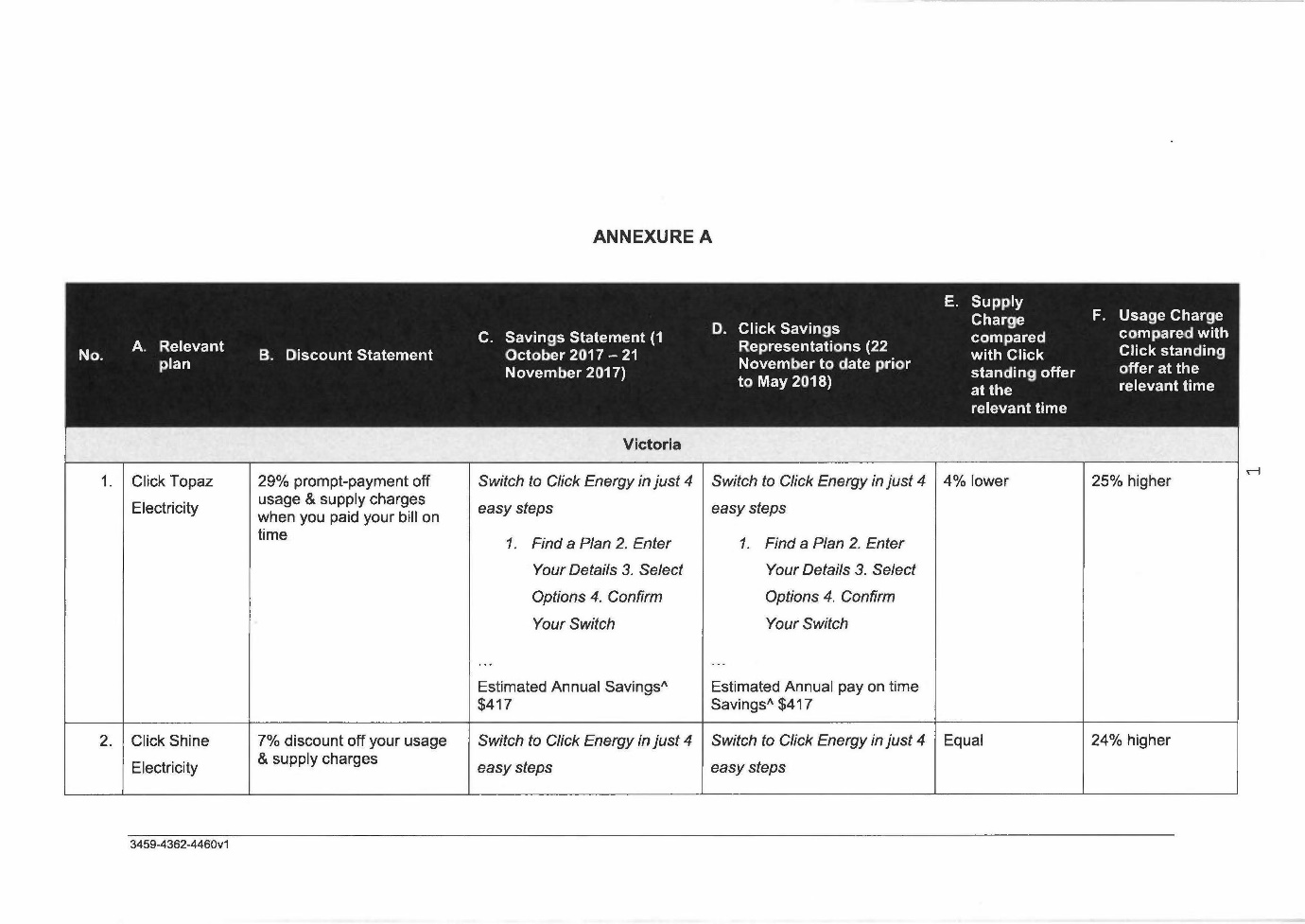
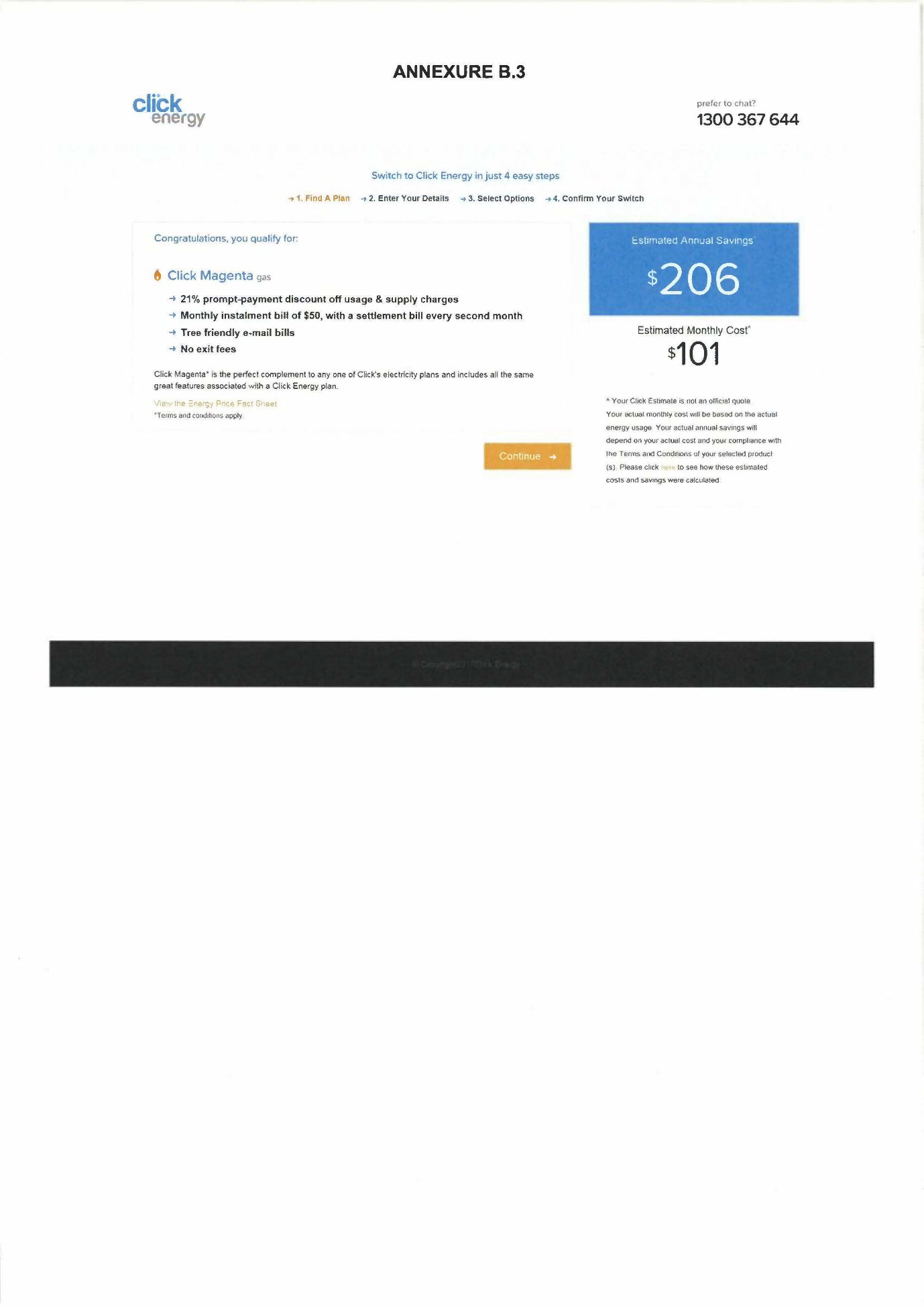
THE COURT DECLARES THAT:
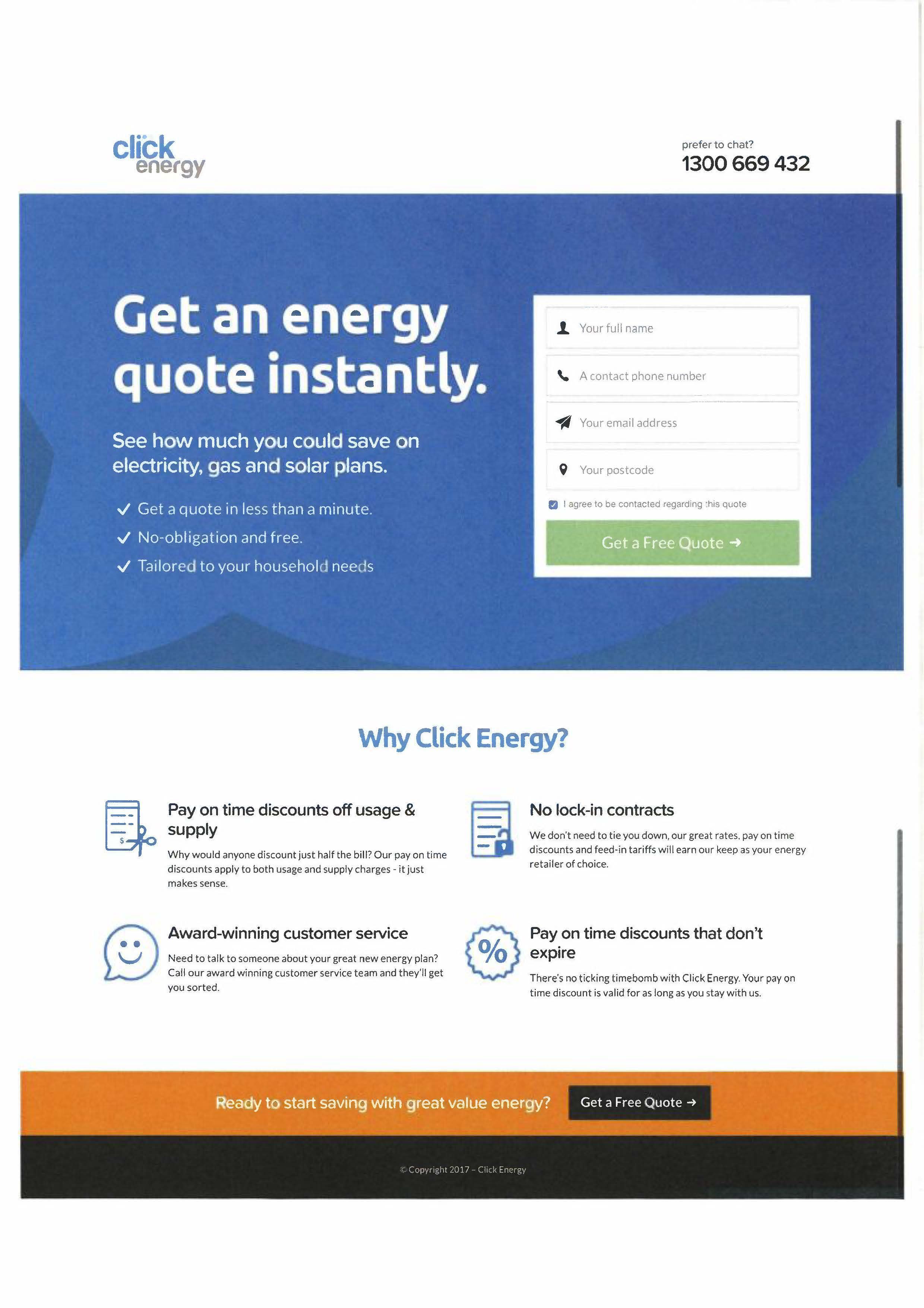
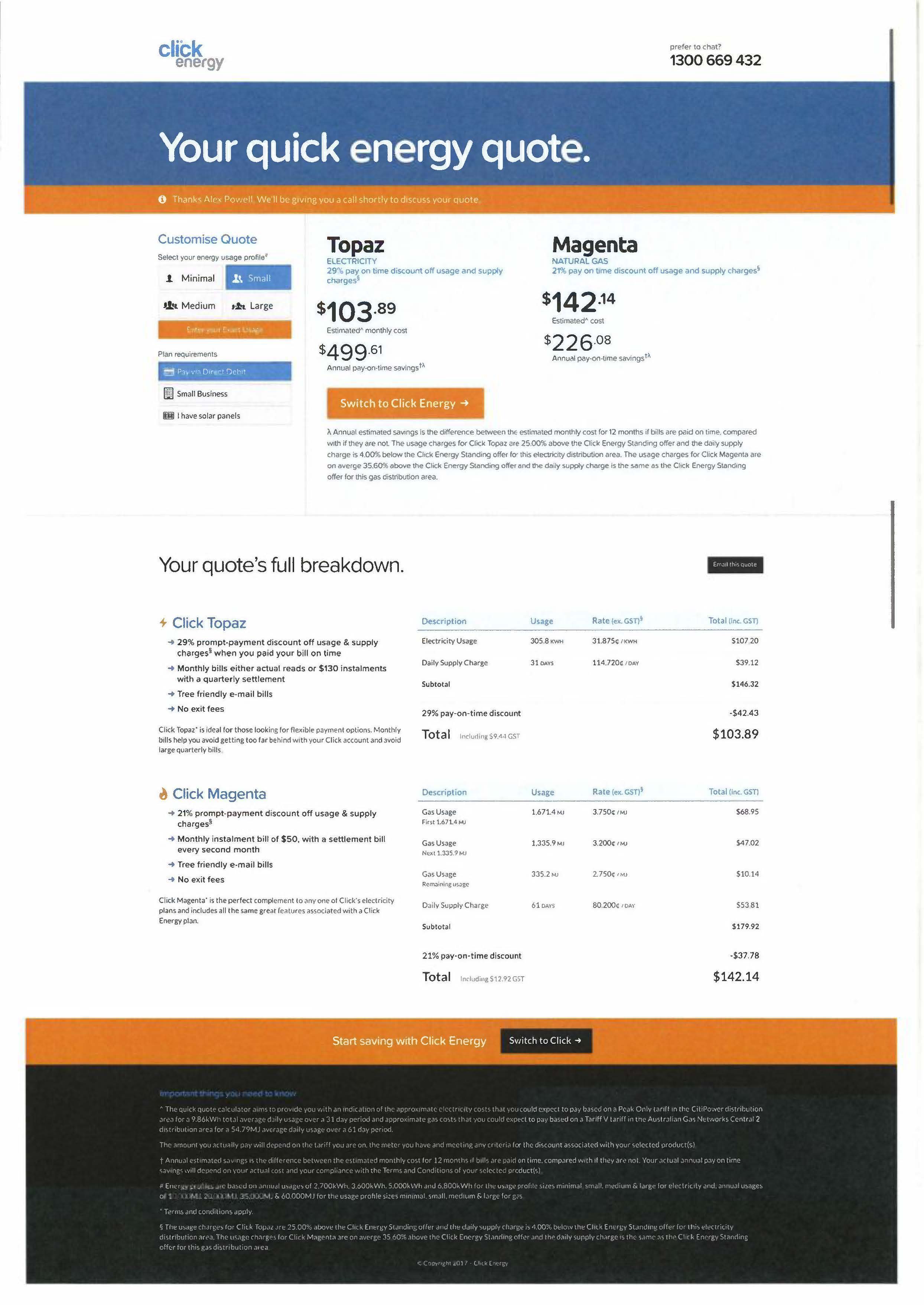
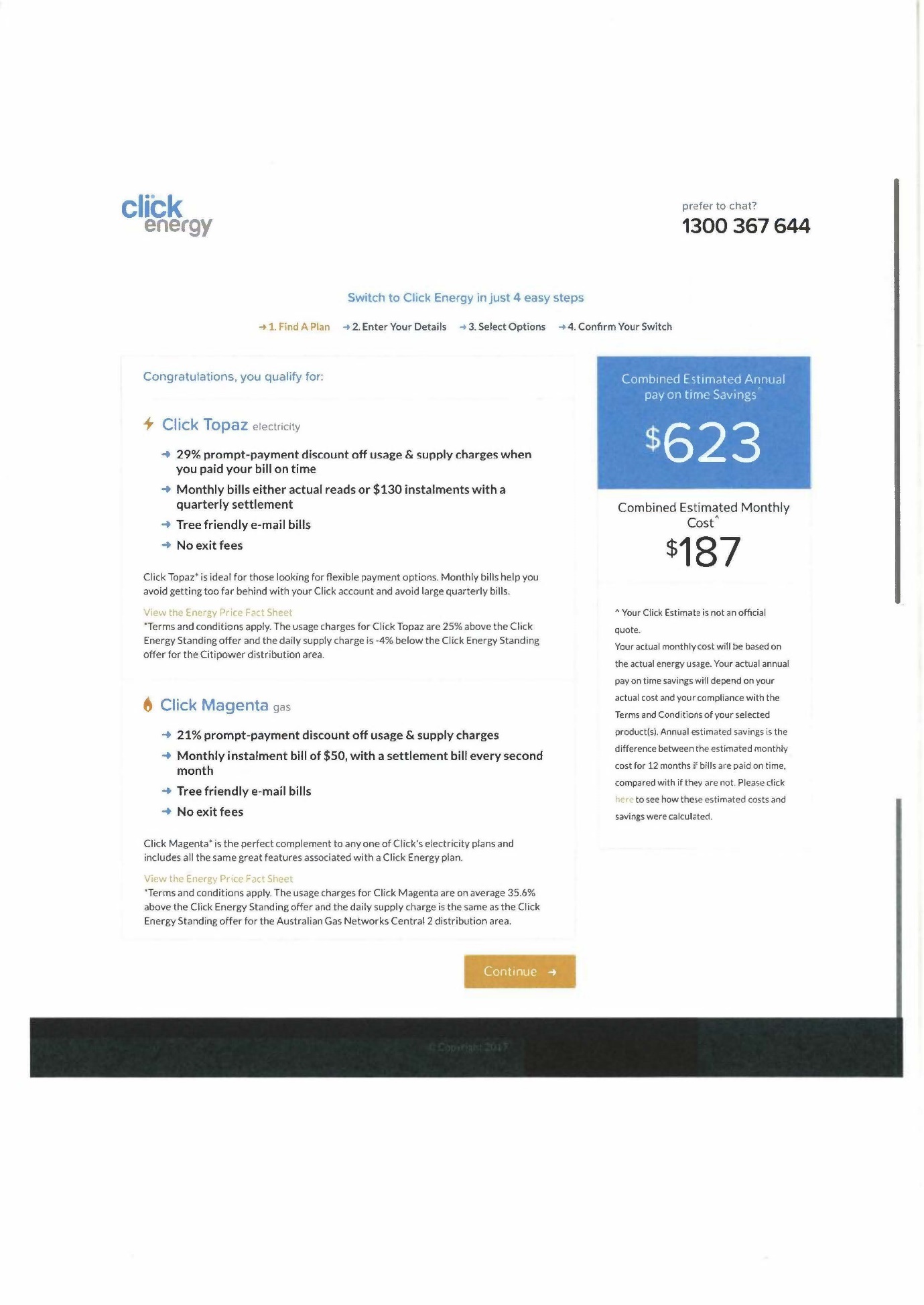
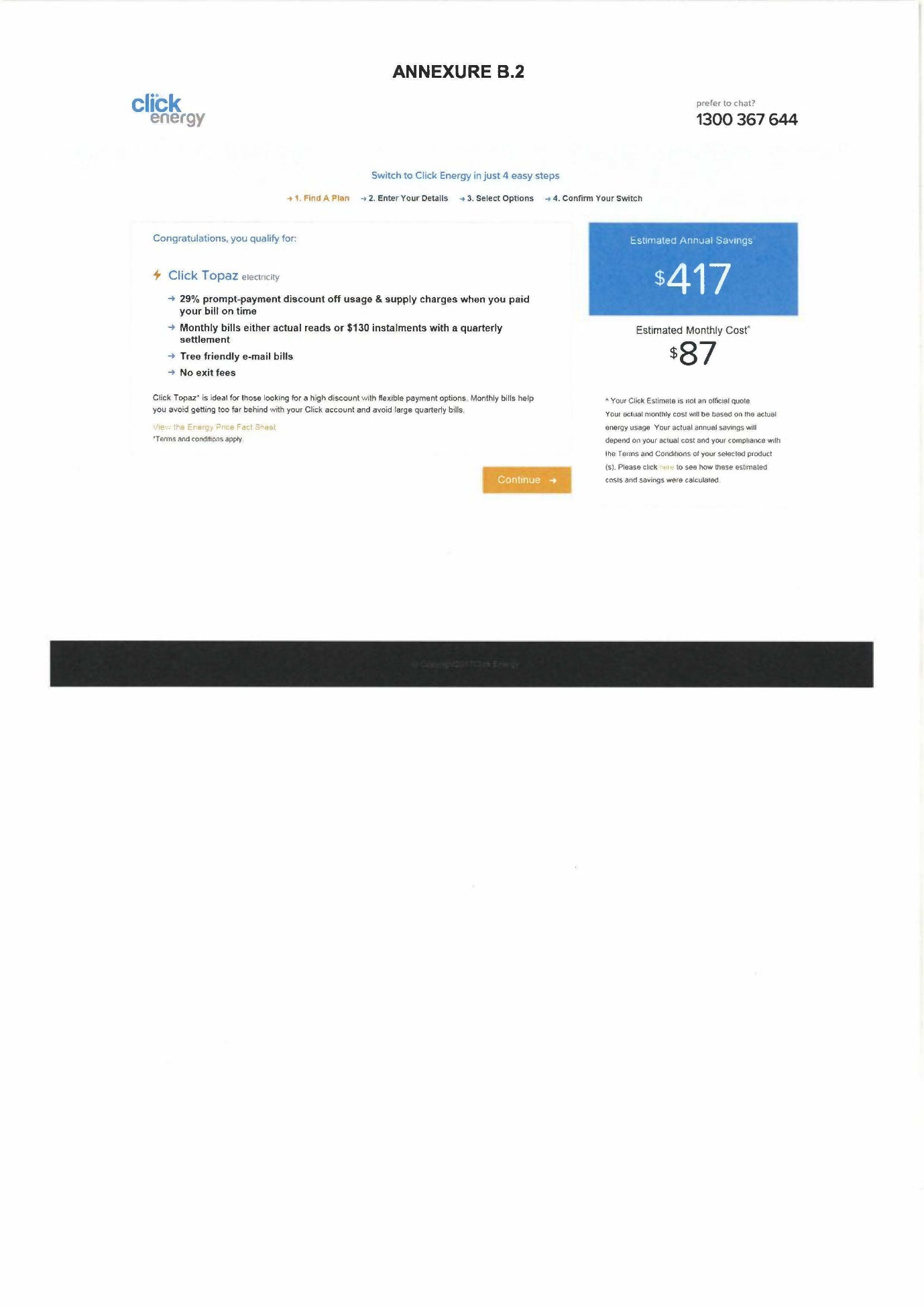
Discount representations
2. Between 1 October 2017 and around March 2018, the Respondent (Click Energy), in trade or commerce, in connection with the supply or possible supply of energy or in connection with the promotion of the supply of energy to consumers:
(a) made false or misleading representations that the supply of energy under the relevant plans had benefits in contravention of section 29(1)(g) of the Australian Consumer Law (ACL);
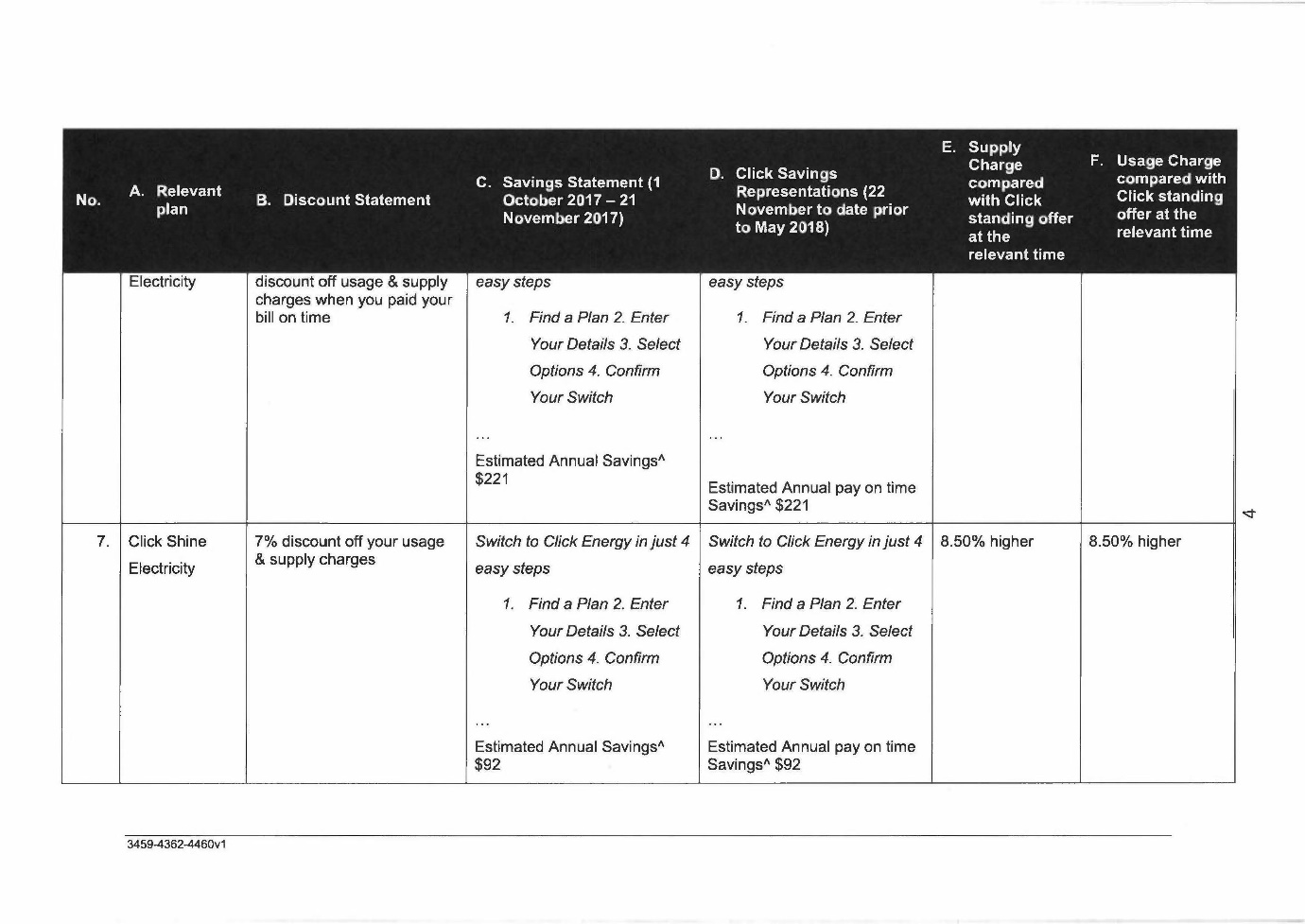
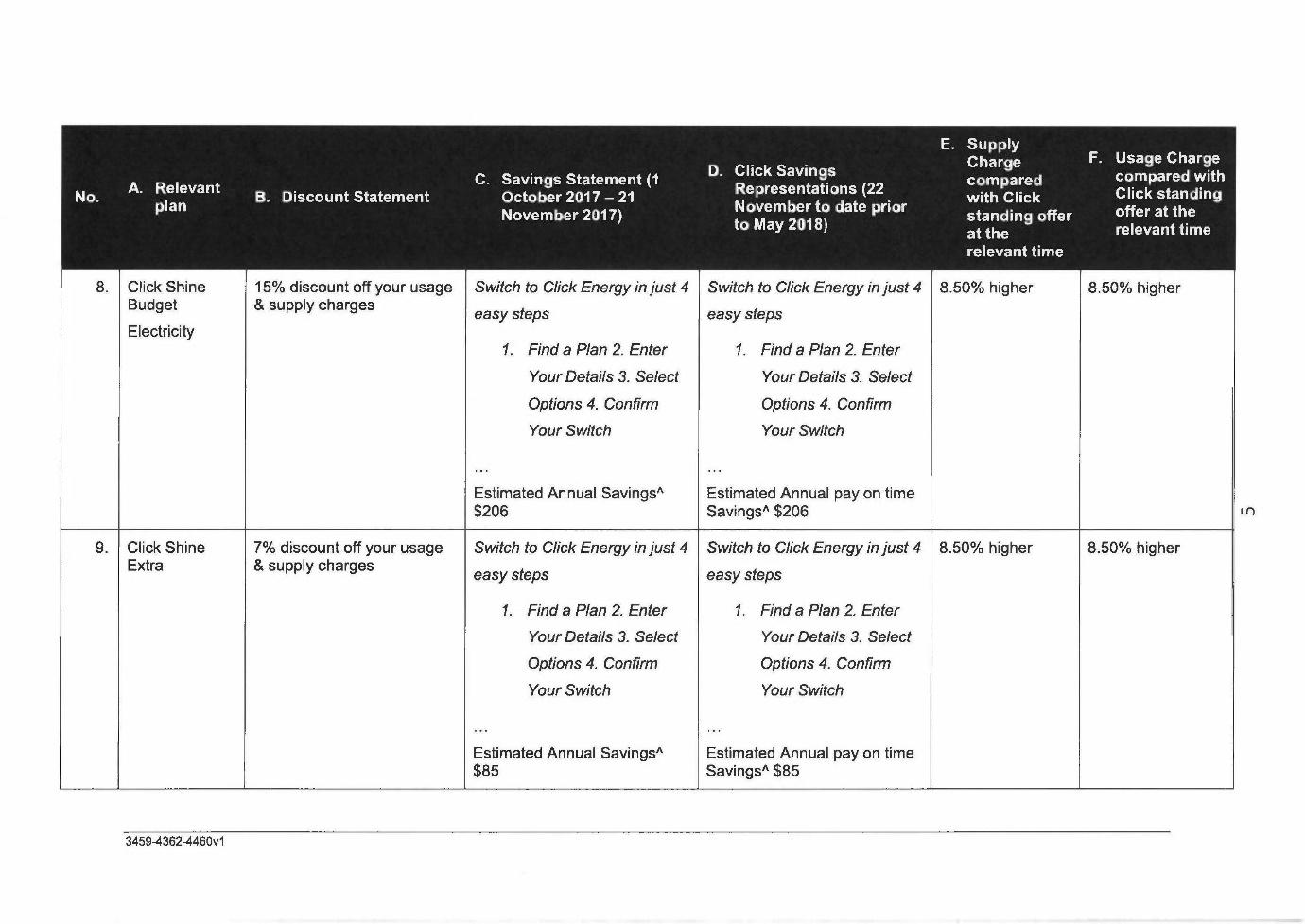
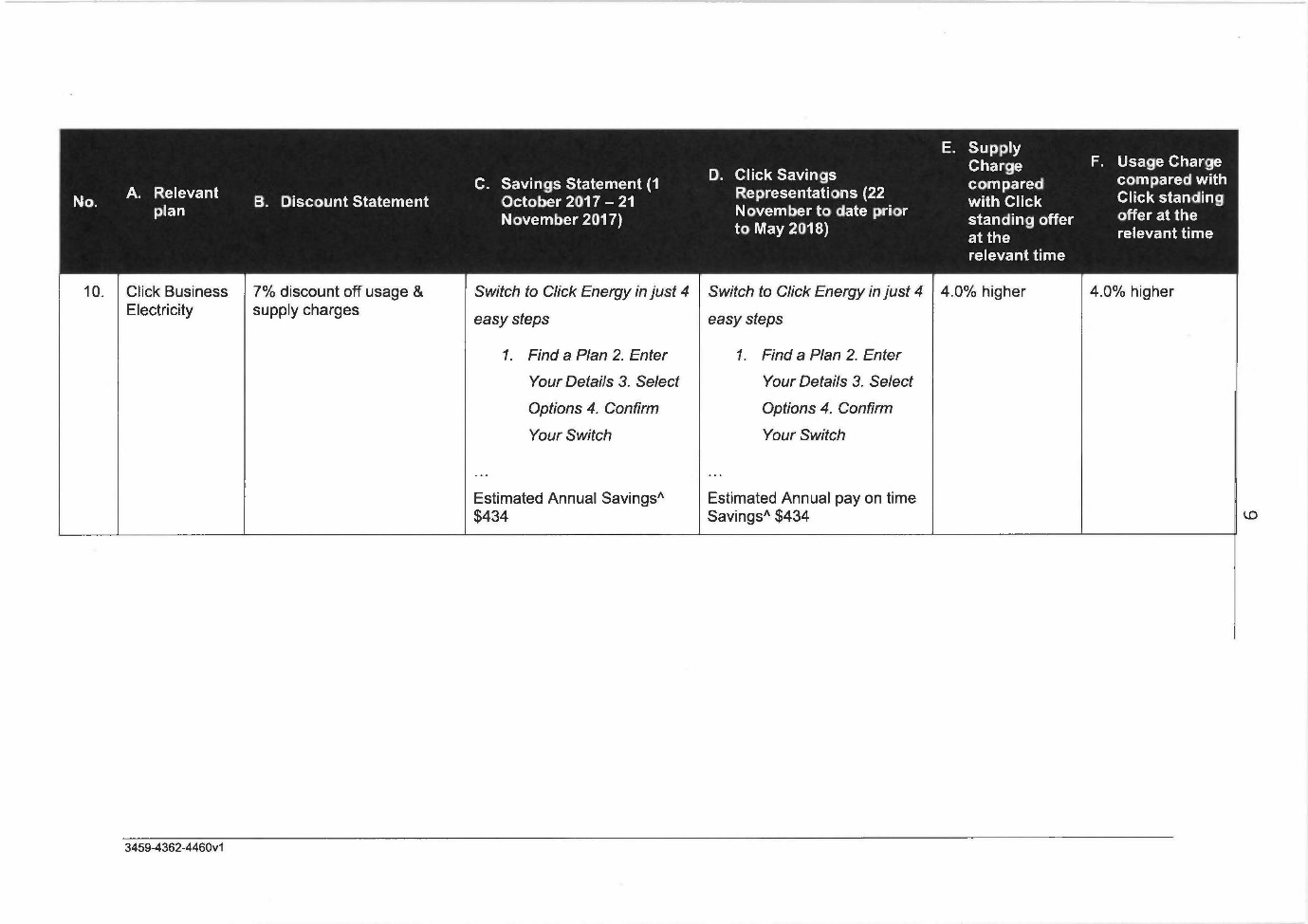
(b) made false or misleading representations with respect to the price of energy under the relevant plans in contravention of section 29(1)(i) of the ACL; and
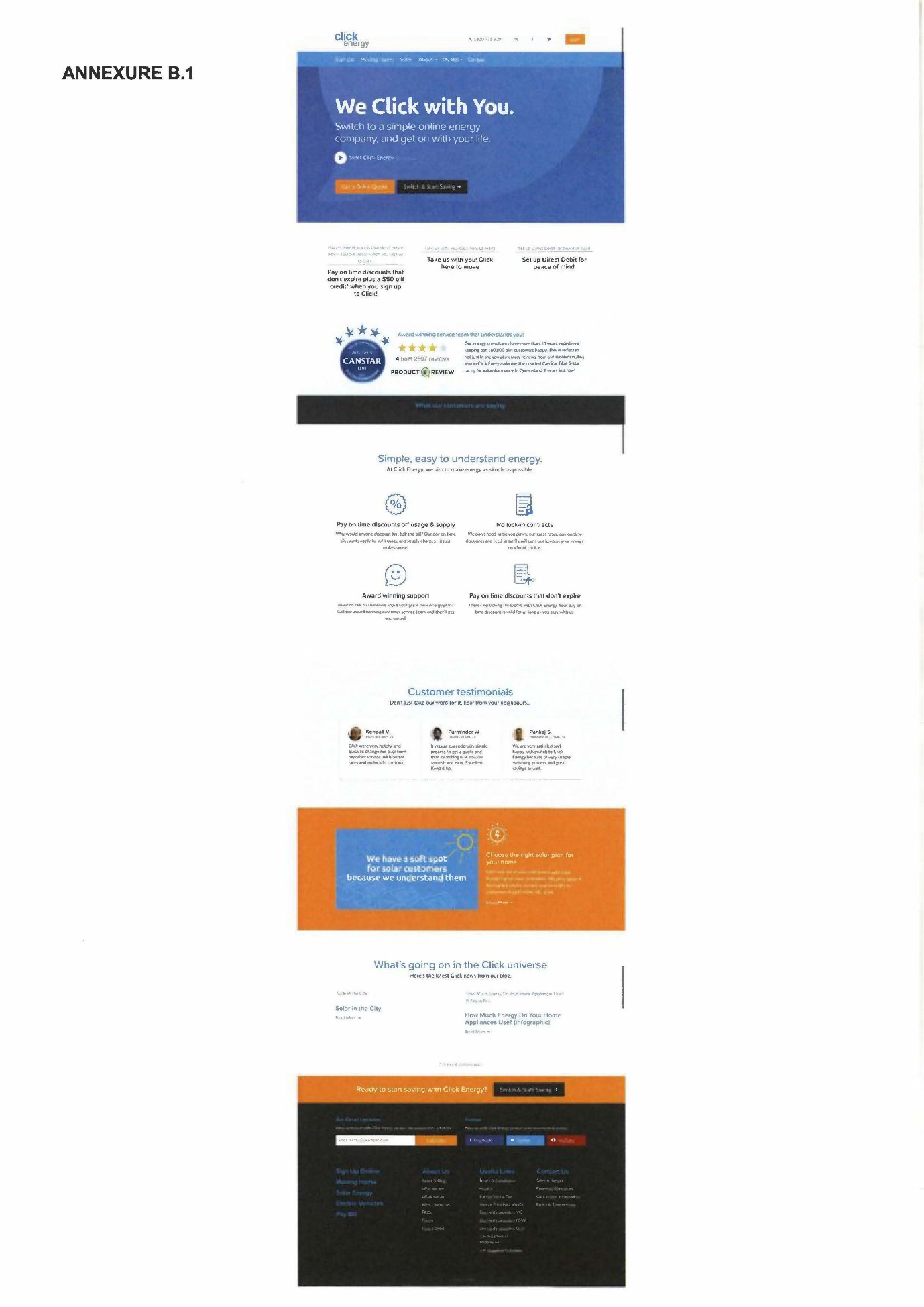
(c) engaged in conduct that was misleading or deceptive or likely to mislead or deceive in contravention of s 18 of the ACL,
by making statements on the Click Energy website that consumers who signed up to the relevant plans in Victoria and Queensland would obtain a significant discount off their usage and supply charges for paying their bills by the due date when in fact:
(d) the relevant percentage discount was calculated based on Click Energy’s market offer rates which, for the relevant plans, were higher than Click Energy’s standing offer rates; and
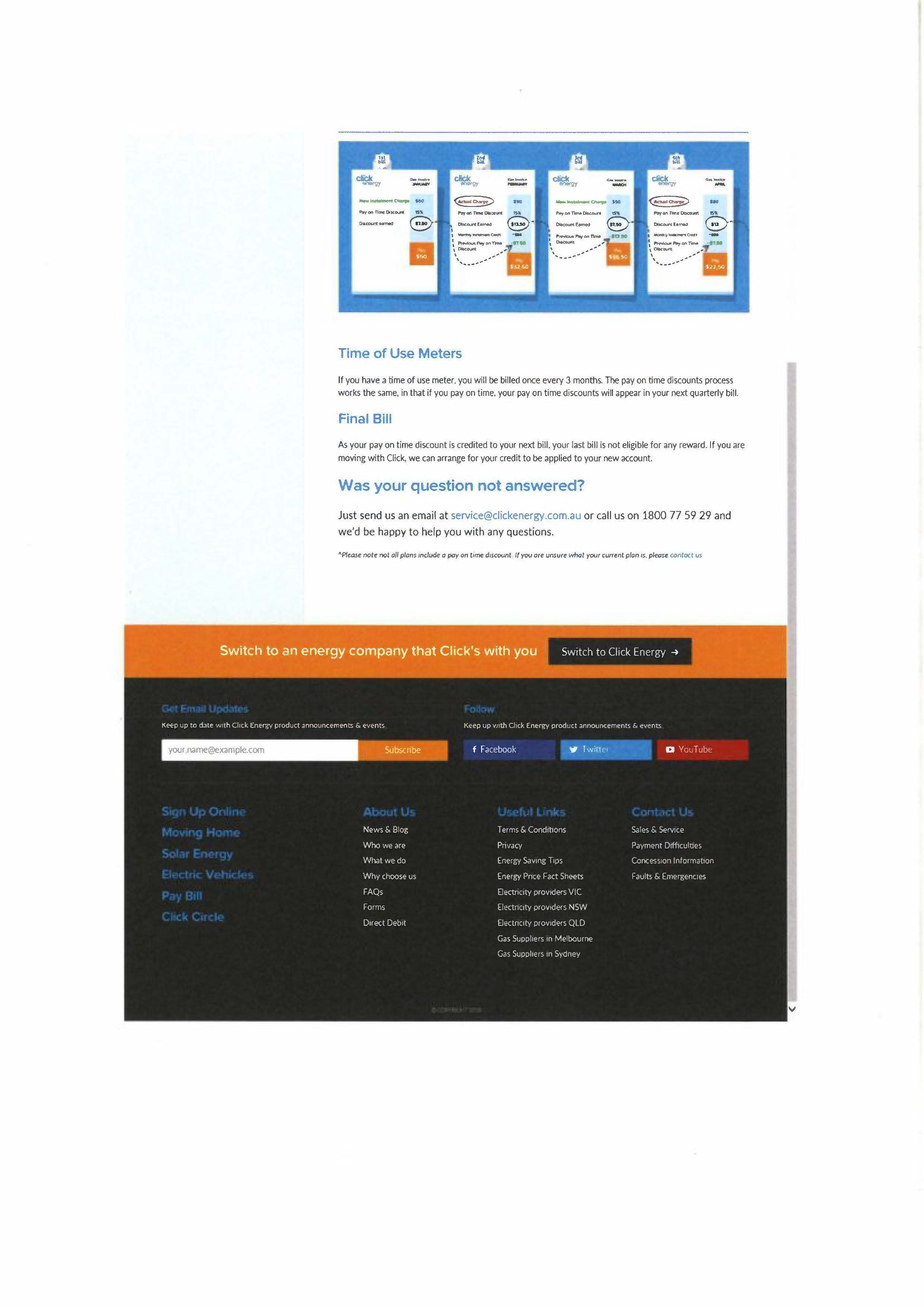
(e) when compared with Click Energy’s rates for standing offers also available to consumers, the effective discounts on the relevant plans were much smaller than promoted and some consumers effectively received no discount.
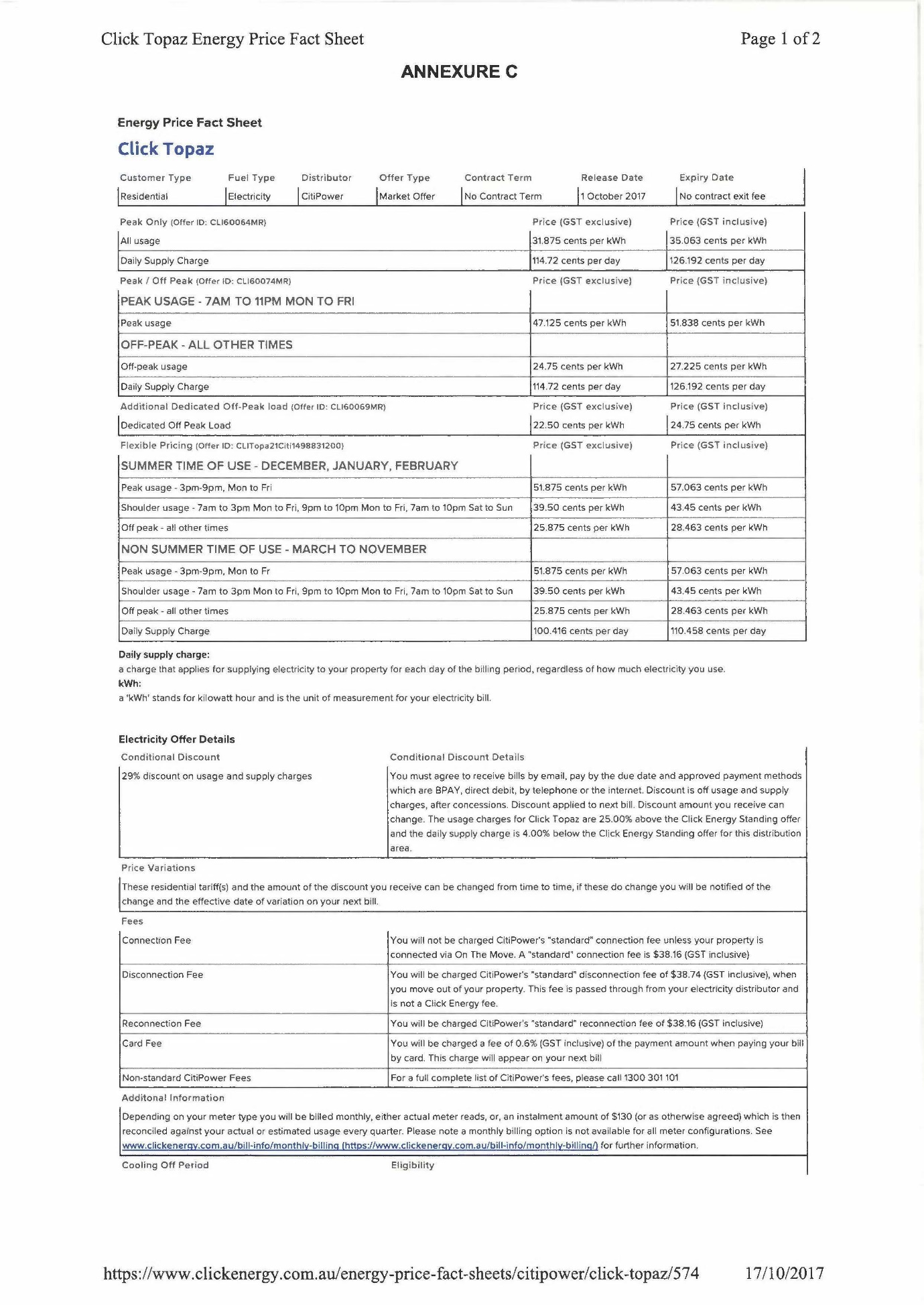
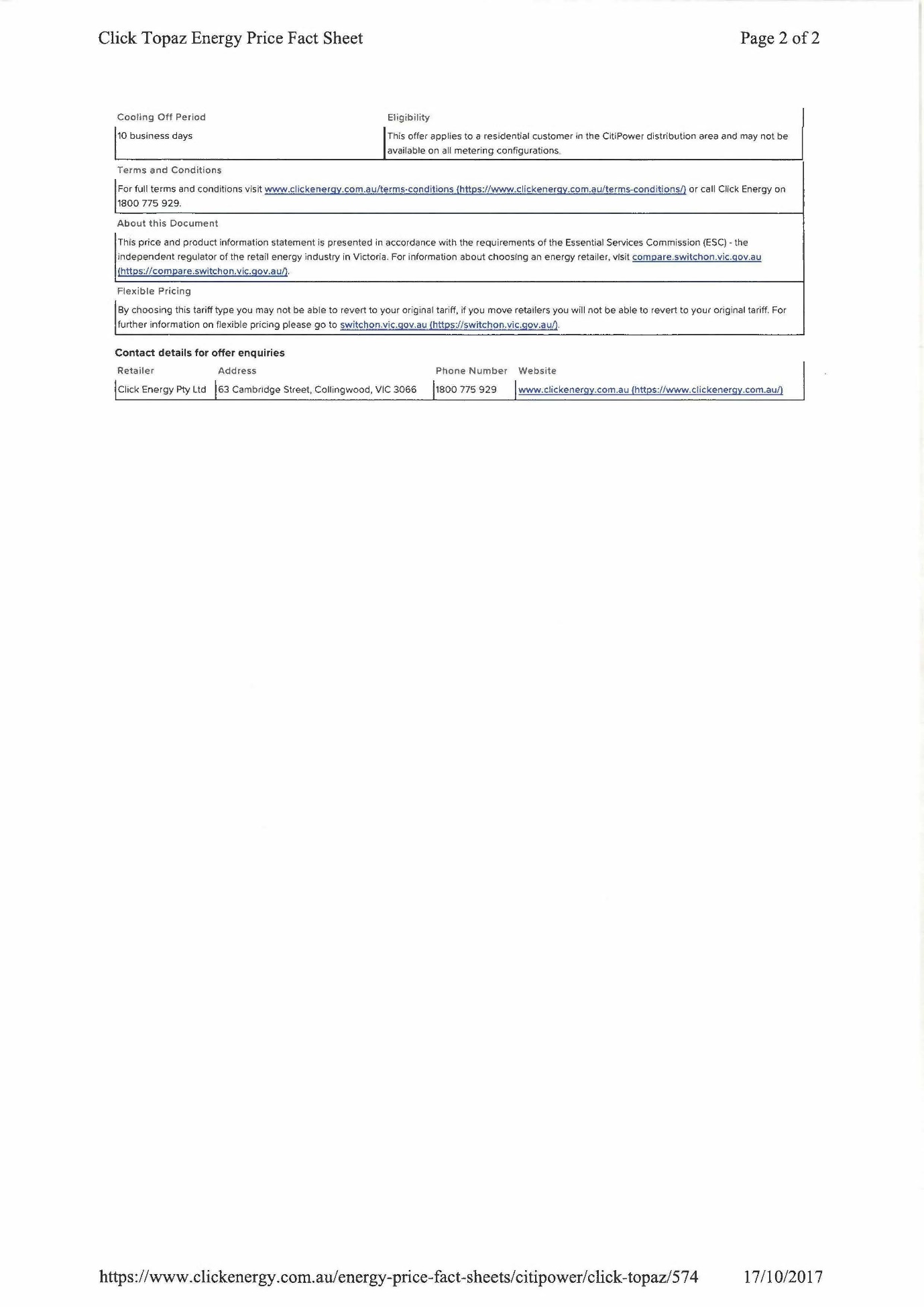
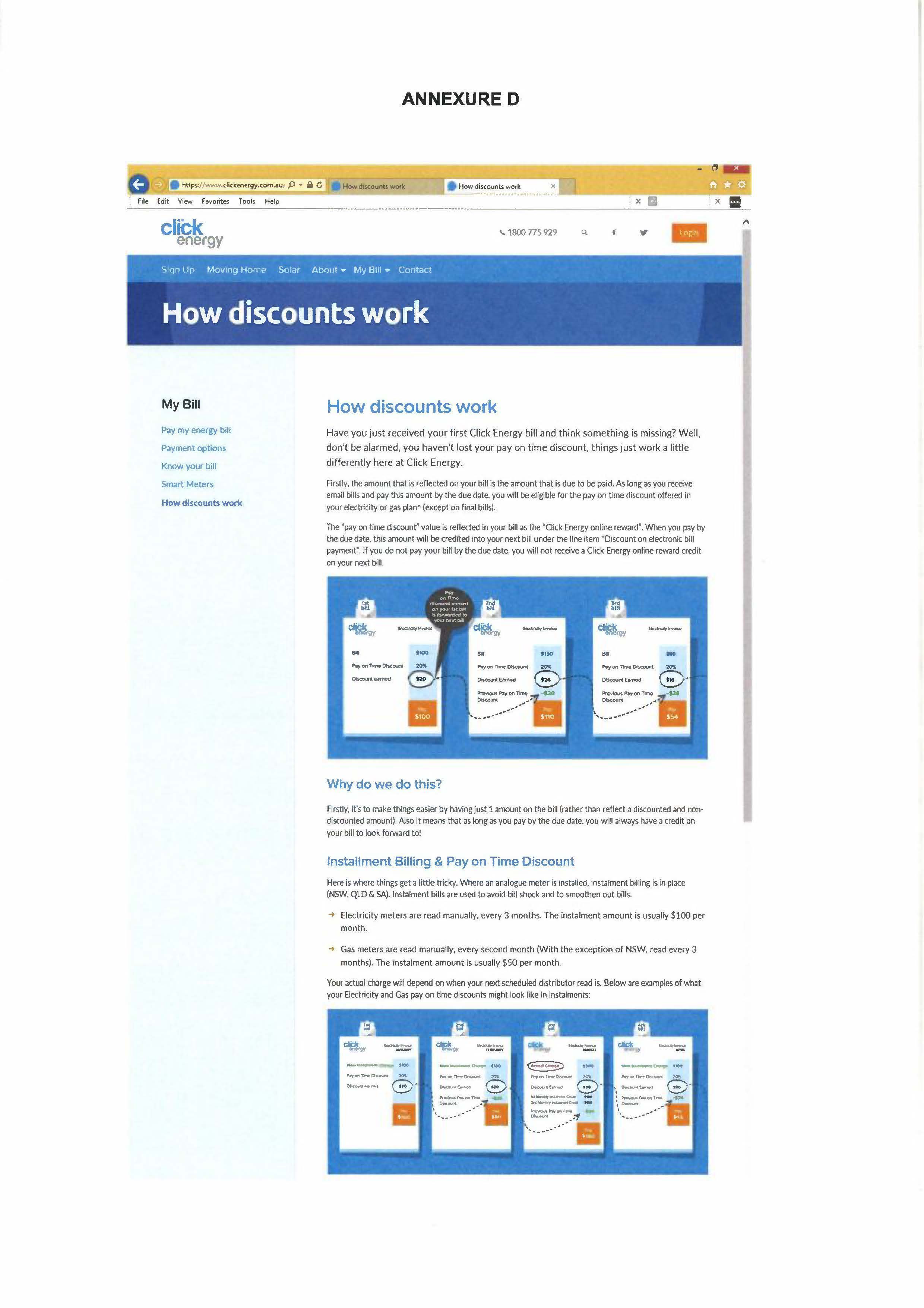
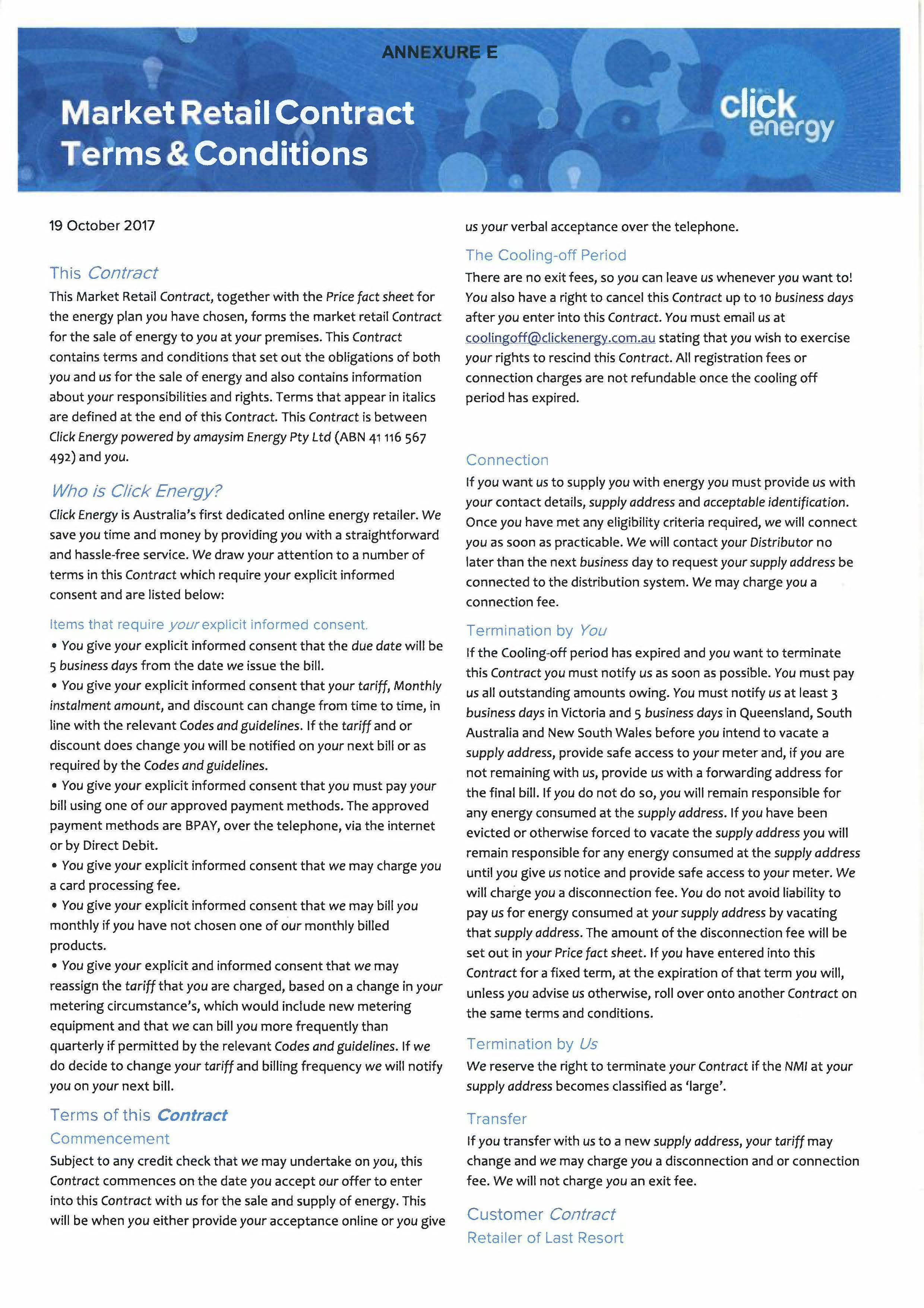
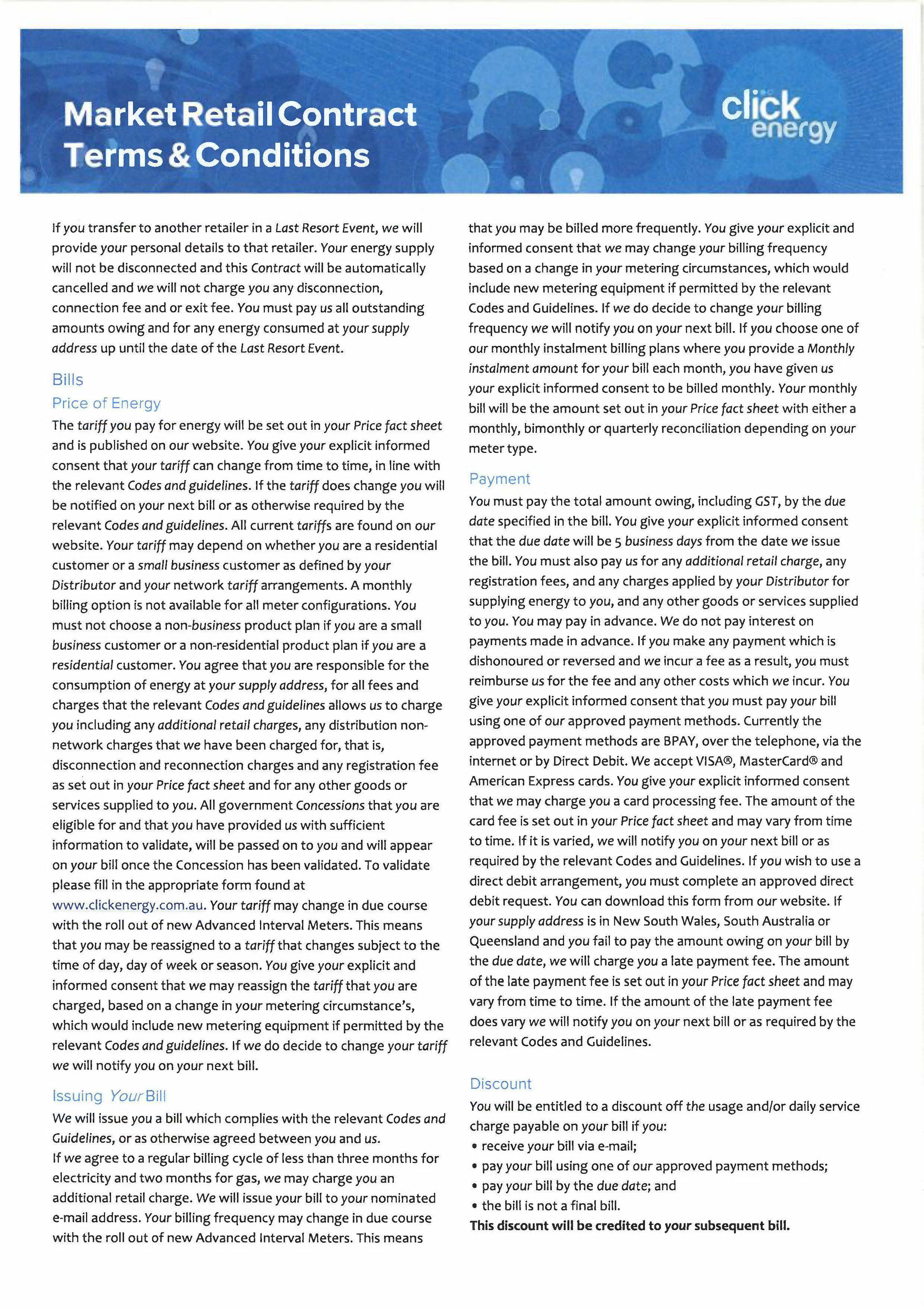
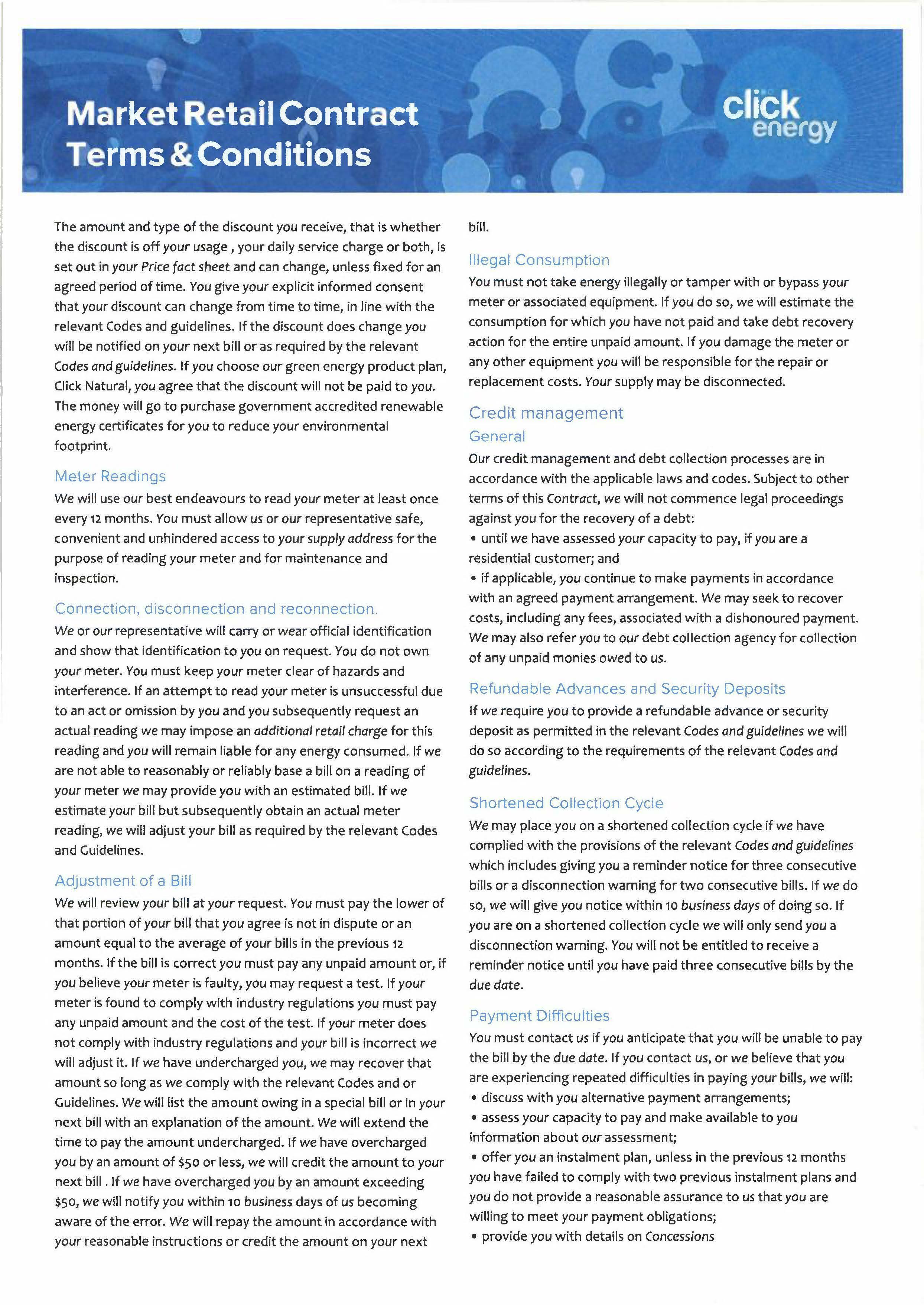
Savings representations
3. Between 1 October 2017 and a date prior to May 2018, Click Energy, in trade or commerce, in connection with the supply or possible supply of energy or in connection with the promotion of the supply of energy to consumers:
(a) made false or misleading representations that the supply of energy under the relevant plans had benefits in contravention of section 29(1)(g) of the ACL;
(b) made false or misleading representations with respect to the price of energy under the relevant plans in contravention of section 29(1)(i) of the ACL; and
(c) engaged in conduct that was misleading or deceptive or likely to mislead or deceive in contravention of s 18 of the ACL,
by making statements on the Click Energy website that consumers in Victoria and Queensland could save up to a specified dollar amount on their annual energy charges if they switched to a plan with Click Energy; and, from 22 November 2017, if they also paid their bills on time, when in fact the specified dollar amounts were estimated annual savings that a Click Energy market offer consumer would obtain by paying on time compared with paying after the due date, rather than the estimated savings that a consumer would obtain by switching to Click Energy from another retailer.
Pay-on-time credit condition
4. Between 1 October 2017 and early August 2018, Click Energy, in trade or commerce, in connection with the supply or possible supply of energy or in connection with the promotion of the supply of energy to consumers:
(a) made false or misleading representations with respect to the conditions relating to the supply of energy under the relevant plans in contravention of section 29(1)(m) of the ACL; and
(b) engaged in conduct that was misleading or deceptive or likely to mislead or deceive in contravention of s 18 of the ACL,
by making statements on the Click Energy website that consumers who signed up to the relevant plans in Victoria and Queensland would obtain a significant discount off their usage and supply charges for paying their bills by the due date without adequately disclosing to consumers on its website that:
(c) Click Energy’s ‘pay on time’ discounts are not applied to the current bill but rather are credited against the charges on the next bill; and
(d) a consumer who paid their final bill on time did not receive any discount for paying that bill on time as there was no subsequent bill against which the pay on time discount could be applied.
THE COURT ORDERS BY CONSENT THAT:
Pecuniary penalty
5. Click Energy pay to the Commonwealth of Australia a pecuniary penalty in the total amount of $900,000 in respect of the contraventions of sections 29(1)(g), 29(1)(i) and 29(1)(m) of the ACL declared by the Court, within 120 days of the Court’s order.
Corrective publication orders
6. Within 21 days of the date of this order, Click Energy, at its own expense, cause an email in the terms of Annexure A to be sent to all Click Energy customers as at 26 March 2019 who signed up to the relevant plans during the period 1 October 2017 to 31 August 2018.
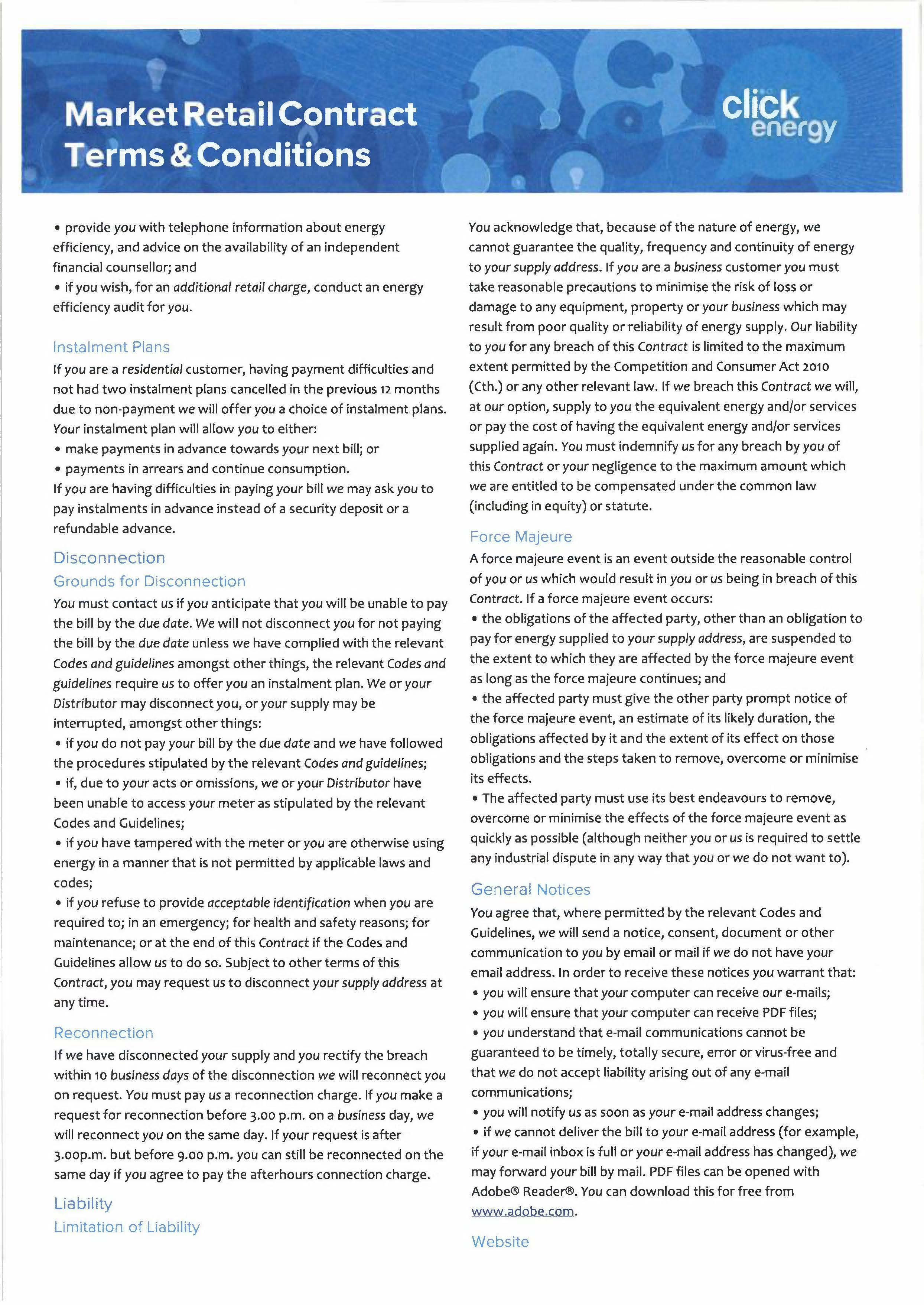
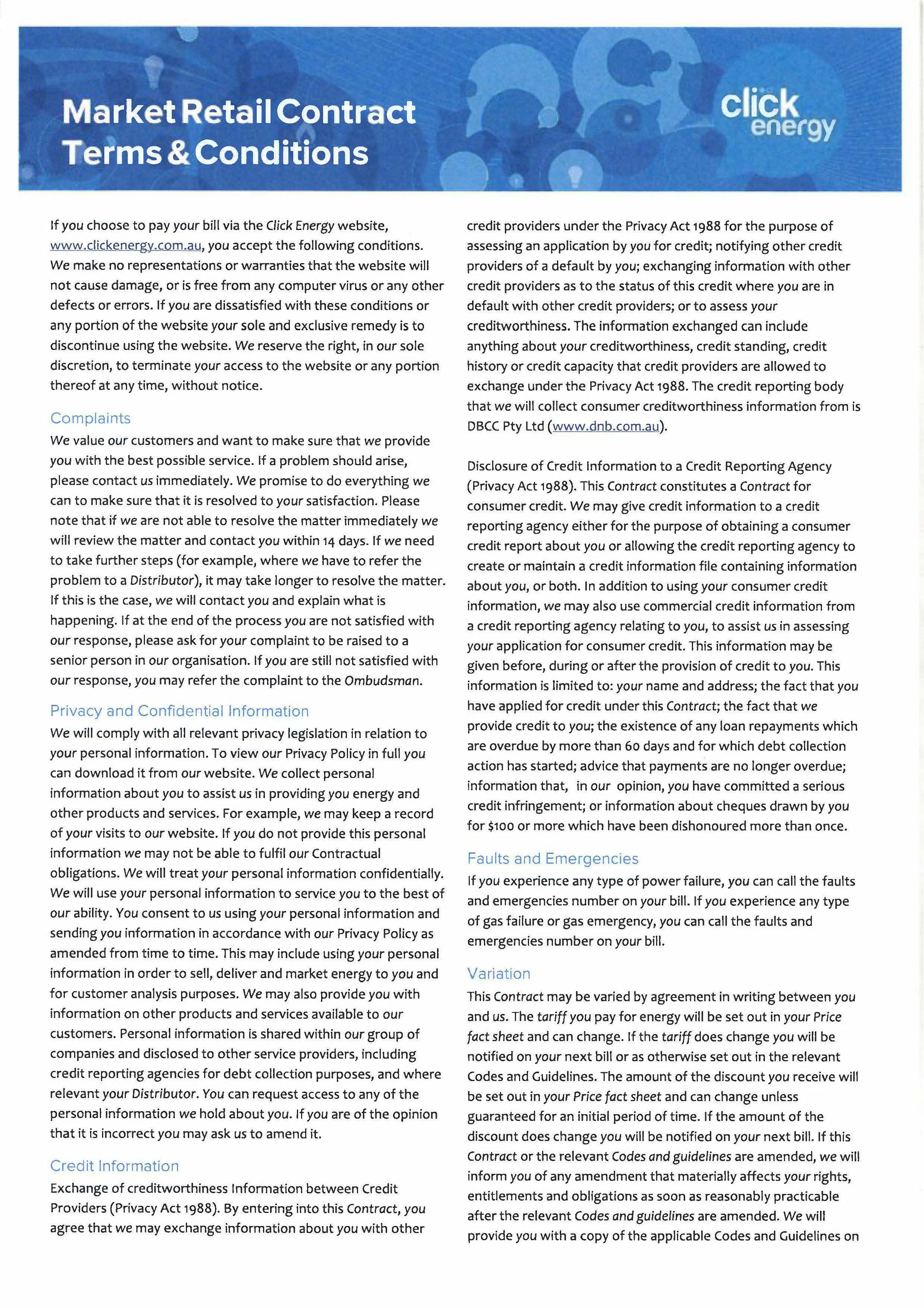
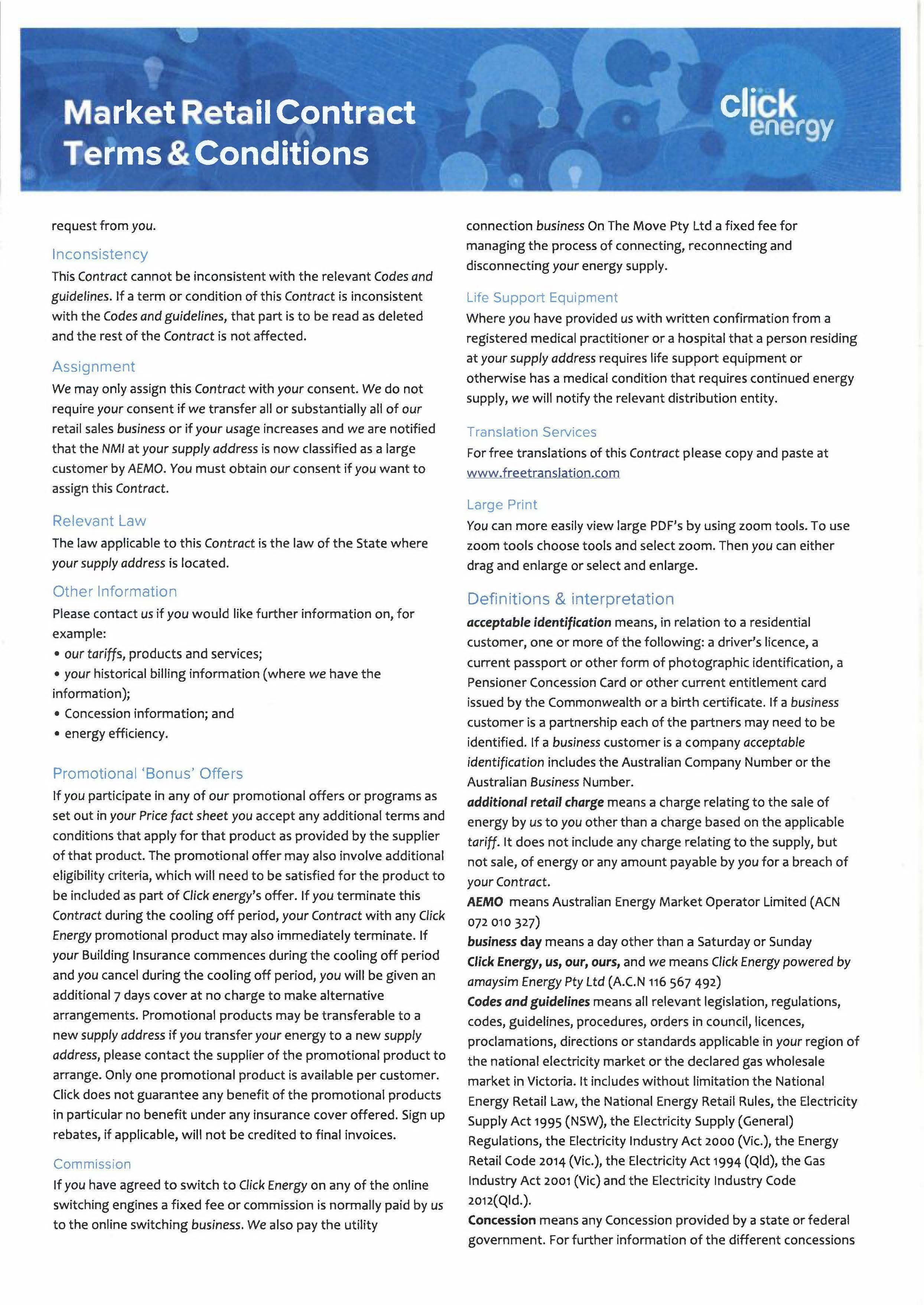
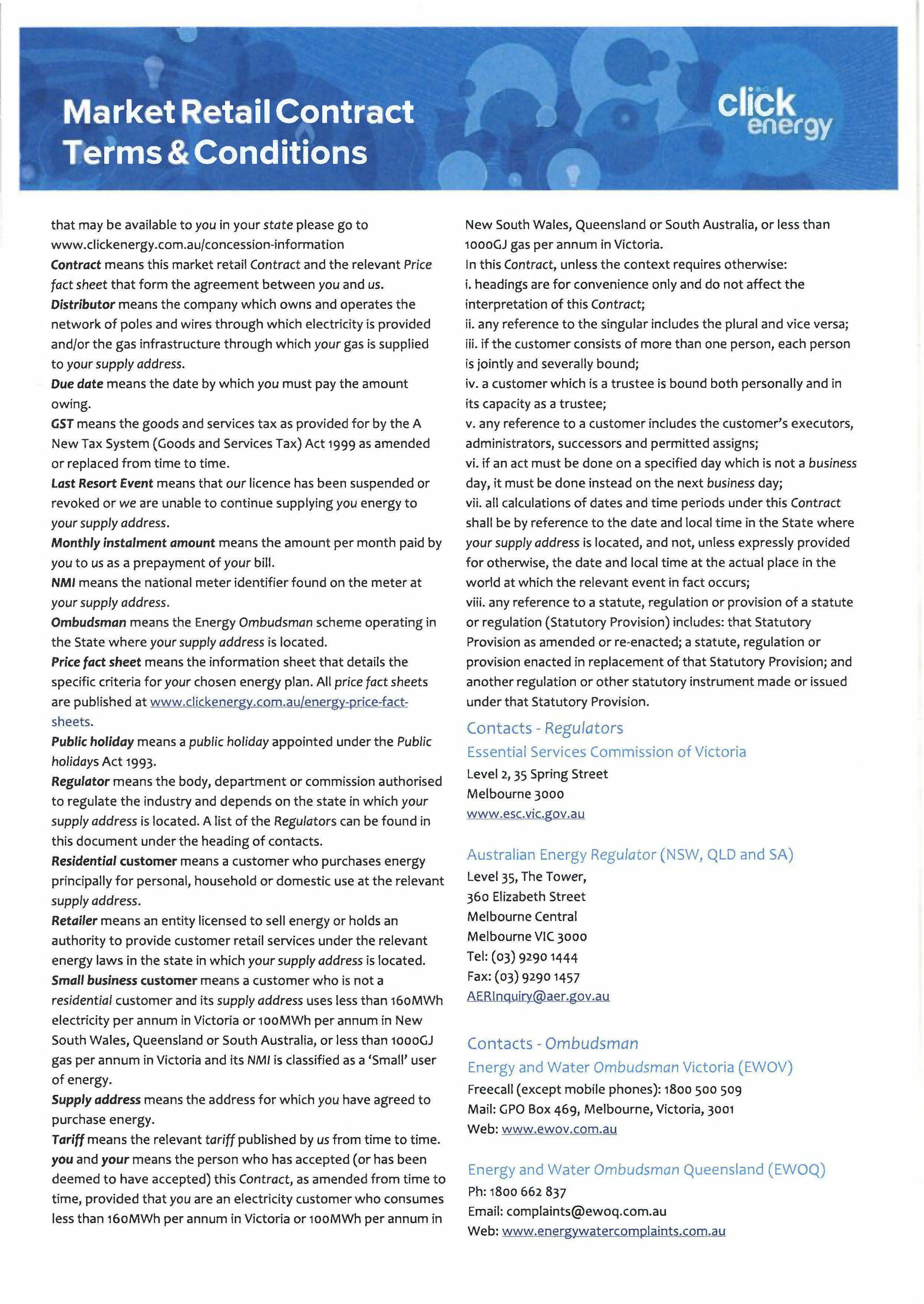
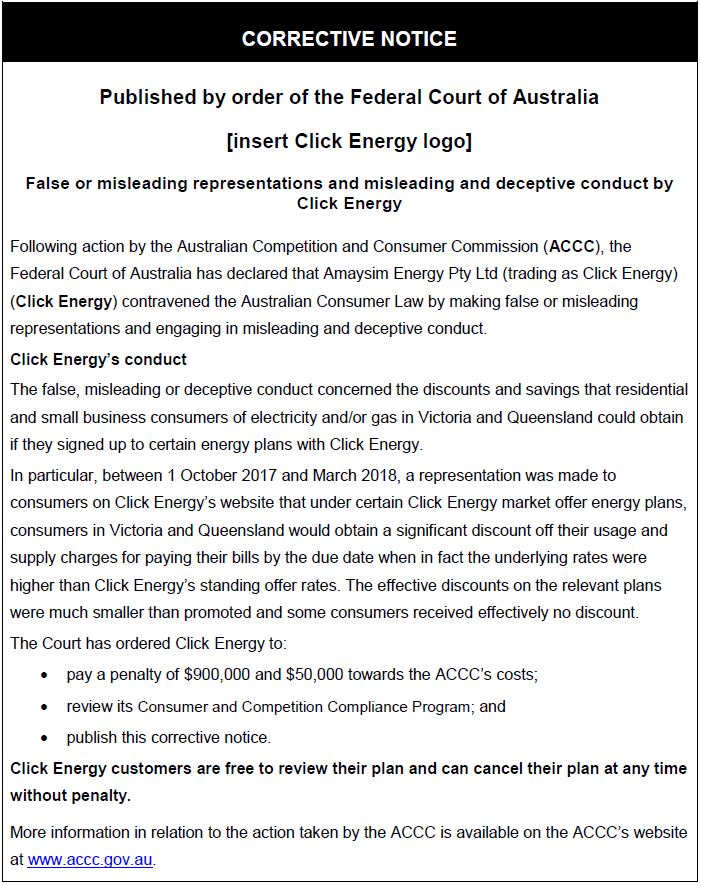
7. Within 21 days of the date of this order and for a period of 60 days, Click Energy at its own expense publish, or cause to be published in a prominent place on the homepage of the website located at the URL http://www.clickenergy.com.au, in the typeface of at least 14 point Times New Roman, reading “False and Misleading Conduct by Click Energy – Corrective Notice Ordered by Federal Court of Australia” which directs consumers to a corrective notice in the form and terms set out in Annexure B.
Compliance program
8. Click Energy, at its own expense, within 90 days of the date of the Court’s order, review its existing Consumer and Competition Compliance Program and make any amendments necessary to ensure that it meets the requirements set out in Annexure C and maintain the compliance program for three years from the date on which the amendments are made.
Costs
9. Click Energy pay the ACCC’s legal costs of the proceeding fixed in the sum of $50,000.
Note: Entry of orders is dealt with in Rule 39.32 of the Federal Court Rules 2011.
ANNEXURE A
[Click Energy letterhead]
[Email]
Following action by the Australian Competition and Consumer Commission (ACCC), the Federal Court of Australia has found that Click Energy contravened the Australian Consumer Law by making false or misleading representations and engaging in misleading and deceptive conduct.
The false, misleading or deceptive conduct concerned the discounts and savings that residential and small business consumers of electricity and/or gas in Victoria and Queensland could obtain if they signed up to certain energy plans with Click Energy.
In particular, between 1 October 2017 and March 2018, a representation was made to consumers on Click Energy’s website that under certain Click Energy plans, consumers in Victoria and Queensland would obtain a significant discount off their usage and supply charges for paying their bills by the due date when in fact the underlying rates were higher than Click Energy’s standing offer rates. The effective discounts on the relevant plans were much smaller than promoted and some consumers effectively received no discount.
You are free to review your plan and cancel your plan at any time without penalty.
If you have any questions, please contact Click Energy at [contact details to be inserted].
The Federal Court ordered that this email sent. More information in relation to the action taken by the ACCC is available on the ACCC’s website at www.accc.gov.au.
ANNEXURE B
ANNEXURE C
COMPETITION AND CONSUMER COMPLIANCE PROGRAM
Amaysim Energy Pty Ltd ACN 116 567 492 (trading as Click Energy) (Click Energy) will establish a Competition and Consumer Compliance Program (Compliance Program) that complies with each of the following requirements:
Appointments
1. Within 30 days of the date of the Order of the Court (Court Order) coming into effect, Click Energy will appoint a Director or a Senior Manager of the business to be responsible for the development, implementation and maintenance of the Compliance Program (Compliance Officer).
2. Within two months of the date of the Court Order coming into effect, Click Energy will appoint a suitably qualified internal or external compliance professional with expertise in competition and consumer law (the Compliance Advisor).
3. Click Energy will instruct the Compliance Advisor to conduct a Competition and Consumer Act 2010 (Cth) (CCA) risk assessment (Risk Assessment) within two months of being appointed as the Compliance Advisor.
4. Click Energy will use its best endeavours to ensure that the Risk Assessment covers the following matters, to be recorded in a written report (Risk Assessment Report):
(a) identify the areas where Click Energy is at risk of breaching section 18, and Division 2 of Part 3-2 of the Australian Consumer Law (ACL), being Schedule 2 to the CCA;
(b) assess the likelihood of these risks occurring;
(c) identify where there may be gaps in Click Energy’s existing procedures for managing these risks; and
(d) provide recommendations for action having regard to the assessment.
Compliance Policy
5. Click Energy will, within 30 days of the date of the Court Order, issue a policy statement outlining its commitment to compliance with the CCA (the Compliance Policy).
6. Click Energy will ensure that the Compliance Policy:
(a) is written in plain language;
(b) contains a statement of commitment to compliance with the CCA;
(c) contains a requirement for all staff to report any Compliance Program related issues and CCA compliance concerns to the Compliance Officer;
(d) contains a clear statement that Click Energy will take action internally against any persons who are knowingly or recklessly concerned in a contravention of the CCA and will not indemnify them.
Complaints Handling System
7. Click Energy will ensure that the Compliance Program includes a competition and consumer law complaints handling system capable of identifying, classifying, storing and responding to competition and consumer law complaints (Complaints Handling System).
Staff Training
8. Click Energy will ensure that the Compliance Program includes a requirement for regular (at least once a year) training for all employees, representative and agents of the Company, whose duties could result in them being concerned with conduct that may contravene section 18, and Division 2 of Part 3-2 of the ACL.
9. Click Energy will ensure that the staff training is conducted by a suitably qualified compliance professional or legal practitioner with expertise in competition and consumer law.
10. Click Energy will ensure that the Compliance Program includes a requirement that awareness of competition and consumer compliance issues forms part of the induction of all new directors, officers, employees, representatives and agents, whose duties could result in them being concerned with conduct that may contravene sections 18, and Division 2 of Part 3-2 of the ACL.
Reports to Board/Senior Management
11. Click Energy will ensure that the Compliance Officer reports to the Board and/or senior management every six months on the continuing effectiveness of the Compliance Program.
Compliance Review
12. Click Energy shall, at its own expense, within three months of the date of the Court Order, cause an annual review of the Compliance Program (the Review) to be carried out in accordance with each of the following requirements:
(a) Scope of Review: the Review should be broad and rigorous enough to provide Click Energy and the ACCC with:
(i) a verification that Click Energy has in place a Compliance Program that complies with each of the requirements detailed in paragraphs 1-11 above; and
(ii) the Compliance Reports detailed at paragraph 13 below.
(b) Independent Reviewer – Click Energy will ensure that each Review is carried out by a suitably qualified, independent compliance professional with expertise in competition and consumer law (the Reviewer). The Reviewer will qualify as independent on the basis that he or she:
(i) did not design or implement the Compliance Program;
(ii) is not a present or past staff member or director of Click Energy;
(iii) has not acted and does not act for, and does not consult and has not consulted to, Click Energy in any competition and consumer law matters, other than performing Reviews under this Court Order; and
(iv) has no significant shareholding or other interest in Click Energy.
(c) Evidence – Click Energy will use its best endeavours to ensure that each Review is conducted on the basis that the Reviewer has access to all relevant sources of information in Click Energy’s possession or control, including without limitation:
(i) the ability to make enquiries of any officers, employees, representatives, and agents of Click Energy;
(ii) documents relating to the Risk Assessment, including the Risk Assessment Report;
(iii) documents relating to Click Energy’s Compliance Program, including documents relevant to Click Energy’s Compliance Policy, Complaints Handling System, Staff Training and induction program; and
(iv) any reports made by the Compliance Officer to the Board or senior management regarding Click Energy’s Compliance Program.
(d) Click Energy will ensure that a Review is completed within one year from the date of this Court Order, and that a subsequent Review is completed within each year for three years.
Compliance Reports
13. Click Energy will use its best endeavours to ensure that in within 30 days of a Review, the Reviewer includes the following findings of the Review in a report to Click Energy (the Compliance Report):
(a) whether the Compliance Program of Click Energy includes all the elements detailed in paragraphs 1-11 above, and if not, what elements need to be included or further developed;
(b) whether the Compliance Program adequately covers the parties and areas identified in the Risk Assessment, and if not, what needs to be further addressed;
(c) whether the Staff Training and induction is effective, and if not, what aspects need to be further developed;
(d) whether Click Energy’s Complaints Handling System is effective, and if not, what aspects need to be further developed;
(e) whether there are any material deficiencies in Click Energy’s Compliance Program, or whether there are or have been instances of material non-compliance with the Compliance Program (Material Failure), and if so, recommendations for rectifying the Material Failure/s,
where Material Failure means a failure, that is non-trivial and which is ongoing or continued for a significant period of time, to:
(f) incorporate a requirement of the Undertaking in the design of the Compliance Program, for example, if a Complaints Handling System did not provide an mechanism for responding to complaints; or
(g) comply with a fundamental obligation in the implementation of the Compliance Program, for example if no Staff Training has been conducted within the Annual Review period.
Click Energy’s response to Compliance Reports
14. Click Energy will ensure that the Compliance Officer, within 14 days of receiving the Compliance Report:
(a) provides the Compliance Report to the Board or relevant governing body;
(b) where a Material Failure has been identified by the Reviewer in the Compliance Report, provides a report to the Board or relevant governing body identifying how Click Energy can implement any recommendations made by the Reviewed in the Compliance Report to rectify the Material Failure;
15. Click Energy will implement promptly and with due diligence any recommendations made by the Reviewer in the Compliance Report to address a Material Failure.
Reporting Material Failure to the ACCC
16. Where a Material Failure has been identified by the Reviewer in the Compliance Report, Click Energy will:
(a) provide a copy of the Compliance Report to the ACCC within 14 days of the Board or relevant governing body receiving the Compliance Report;
(b) inform the ACCC of any steps that have been taken to implement the recommendations made by the Reviewer in the Compliance Report; or
(c) otherwise outline the steps Click Energy proposes to take to implement the recommendations and will then inform the ACCC once those steps have been implemented.
Provision of Compliance Program documents to the ACCC
17. Click Energy will maintain a record of and store all documents relating to and constituting the Compliance Program for a period not less than five years.
18. If requested by the ACCC during the period of five years following the date of this Court Order Click Energy will, at its own expense, cause to be produced and provided to the ACCC copies of all documents constituting the Compliance Program, including:
(a) the Compliance Policy;
(b) the Risk Assessment report;
(c) an outline of the Complaints Handling System;
(d) Staff Training materials and induction materials;
(e) all Compliance Reports that have been completed at the time of the request;
(f) copies of the reports to the Board and/or senior management referred to in paragraphs 11 and 16.
ACCC Recommendations
19. Click Energy will implement promptly and with due diligence any recommendations that the ACCC may make that the ACCC deems reasonably necessary to ensure that Click Energy maintains and continues to implement the Compliance Program in accordance with the requirements of this Court Order.
MIDDLETON J:
INTRODUCTION
1 On 26 March 2019, the Court made orders in this proceeding (the ‘Orders’). These are the reasons for the Orders.
2 In the proceeding before me, the applicant, the Australian Competition and Consumer Commission (the ‘ACCC’), claims that the respondent, amaysim Energy Pty Ltd (trading as Click Energy) (‘Click Energy’), engaged in misleading and deceptive conduct and made false or misleading representations in respect of the discounts and savings that a consumer could expect to receive on the price paid for electricity or gas if that consumer commenced an energy plan with Click Energy in contravention of ss 18, 29(1)(g), 29(1)(i) and 29(1)(m) of the Australian Consumer Law (‘ACL’) being Sch 2 to the Competition and Consumer Act 2010 (Cth) (the ‘CCA’).
3 The parties have now reached agreement as to the terms on which they seek to resolve this proceeding and on 20 March 2019, jointly filed the following documents:
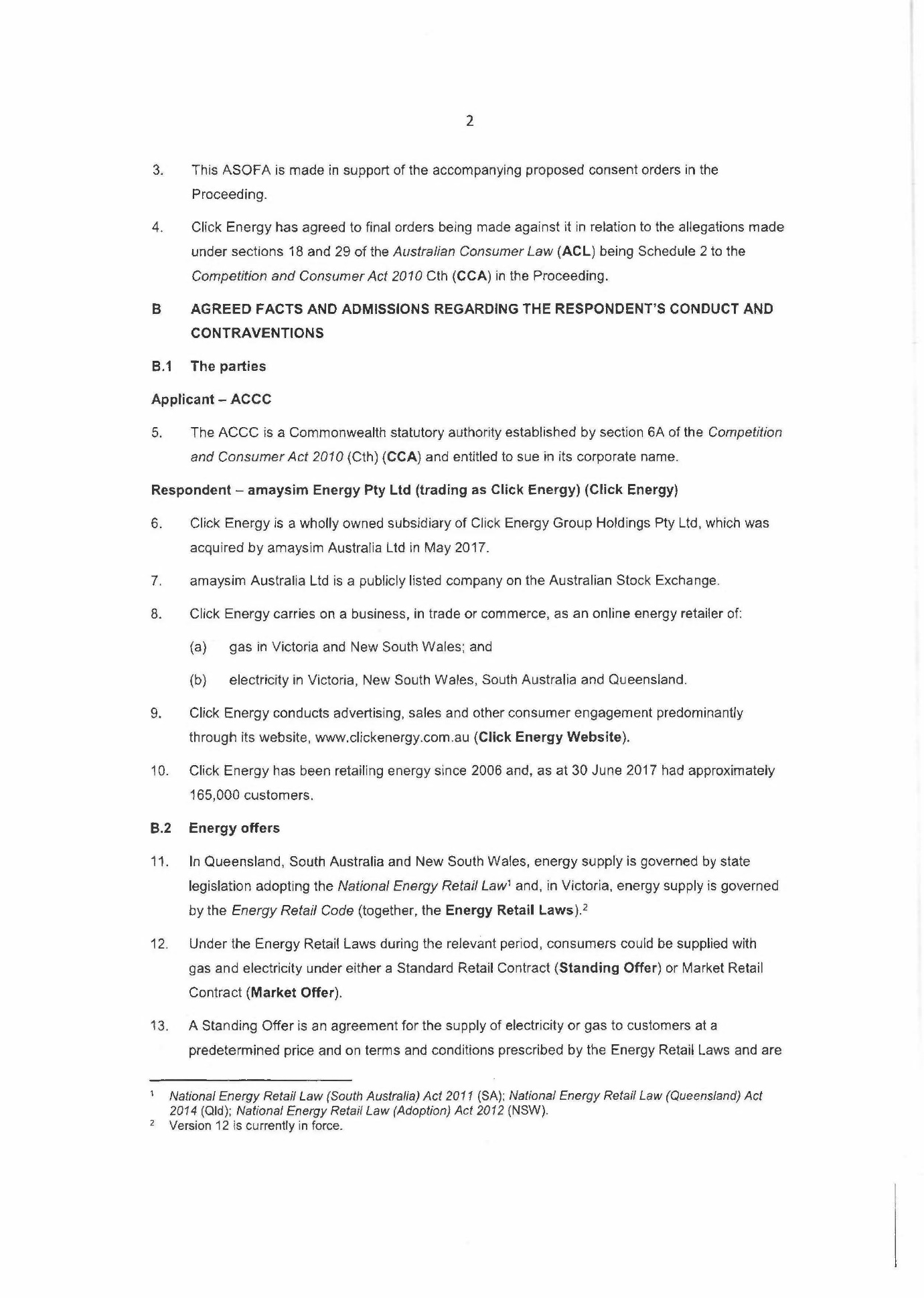
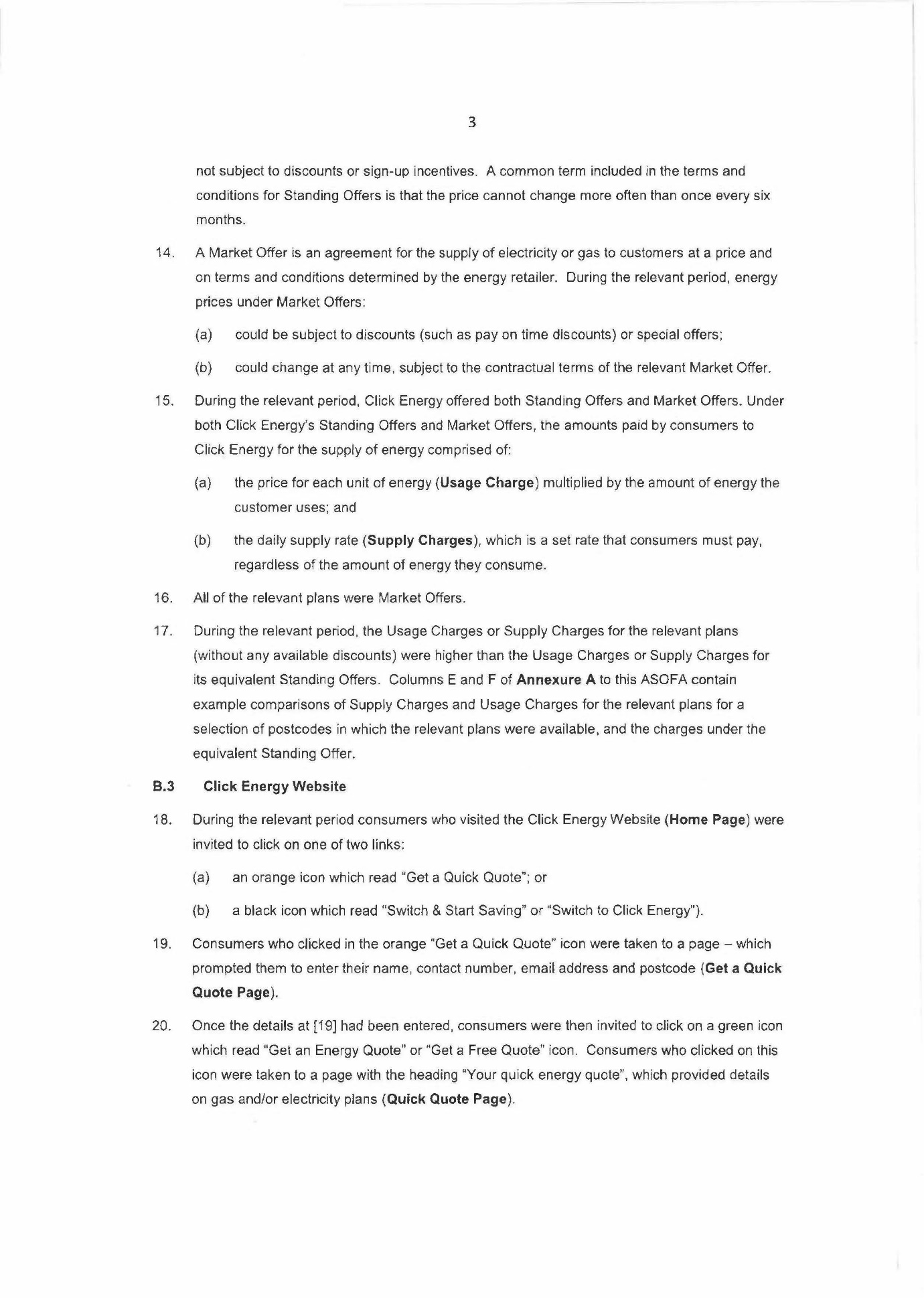
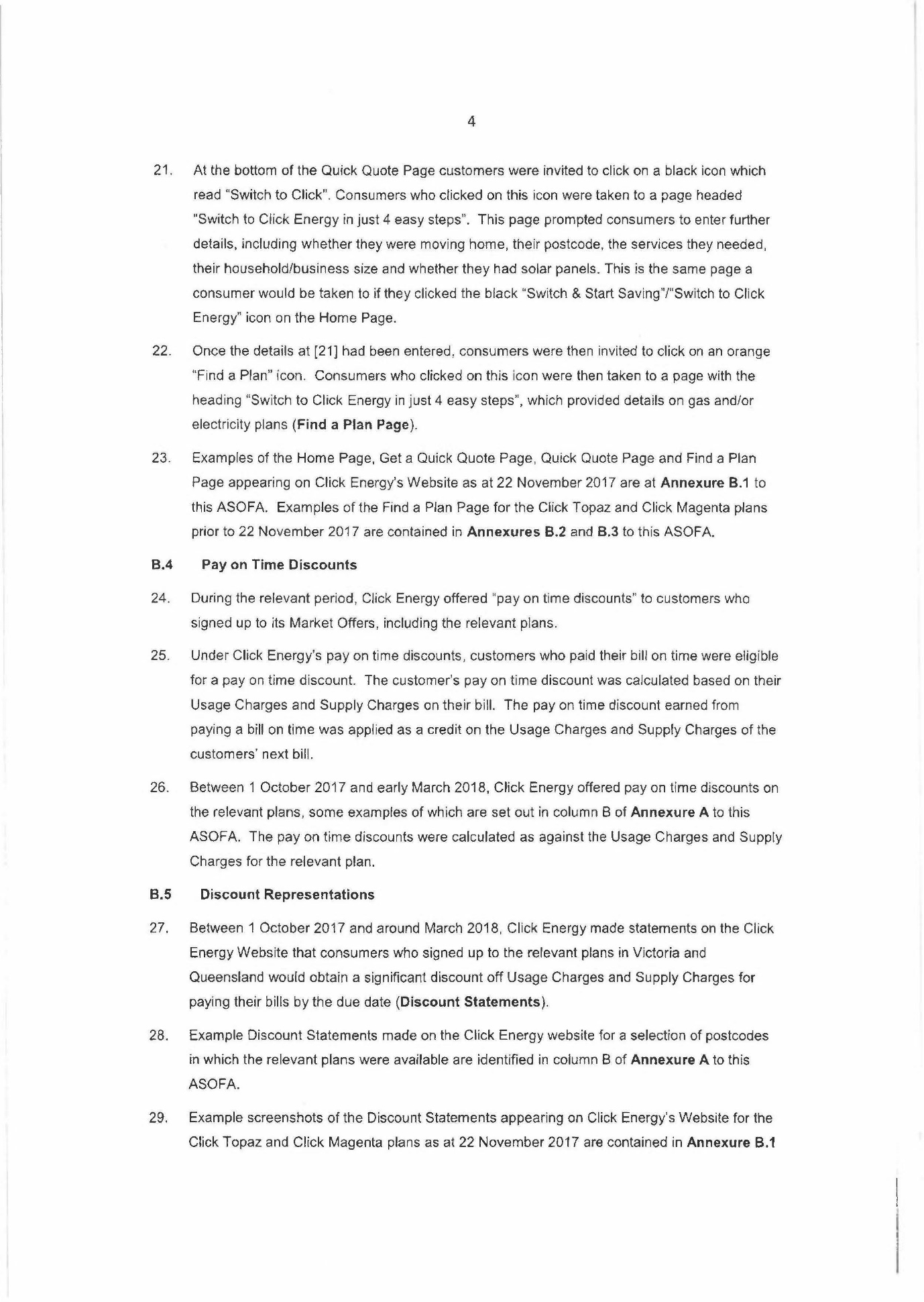
(1) an agreed statement of facts and admissions setting out the facts agreed between the parties and the admissions made by Click Energy, a copy of which is annexed to these reasons (the ‘Agreed Statement of Facts and Admissions’);
(2) agreed minute of proposed declarations and orders setting out the relief (including as to penalty) which the parties submit is appropriate (the ‘Proposed Declarations and Orders’); and
(3) submissions jointly prepared by solicitors for the parties in support of the Proposed Declarations and Orders.
4 First, in the Agreed Statement of Facts and Admissions, Click Energy has admitted for the purposes of this proceeding that it has, in trade or commerce, in connection with the supply or possible supply of energy or in connection with the promotion of the supply of energy to consumers:
(1) engaged in misleading or deceptive conduct, or conduct that was likely to mislead or deceive, in contravention of s 18 of the ACL;
(2) made false or misleading representations that the supply of energy under the relevant plans had benefits in contravention of s 29(1)(g) of the ACL;
(3) made false or misleading representations with respect to the price of energy under the relevant plans in contravention of s 29(1)(i) of the ACL; and
(4) made false or misleading representations with respect to the conditions relating to the supply of energy under the relevant plans in contravention of s 29(1)(m) of the ACL.
5 Second, the Proposed Declarations and Orders provide for:
(1) declarations to be made pursuant to s 21 of the Federal Court of Australia Act 1976 (Cth) (the ‘Federal Court Act’) in relation to the admitted contraventions of the ACL;
(2) an order for payment by Click Energy of a pecuniary penalty of $900,000 pursuant to s 224 of the ACL;
(3) corrective publication orders pursuant to ss 246(2) and 247(1) of the ACL;
(4) an order for the review and amendment of Click Energy’s compliance program pursuant to s 246(2) of the ACL; and
(5) payment by Click Energy of the ACCC’s costs in an amount as agreed ($50,000) pursuant to s 43 of the Federal Court Act.
6 And third, the parties’ joint submissions have formed the basis for the following reasons which explain why I was prepared to make the Orders, which are in substantially the same form as the Proposed Declarations and Orders filed by the parties.
APPLICABLE LEGISLATION AND LEGAL PRINCIPLES
7 Section 18(1) of the ACL states that a person must not, in trade or commerce, engage in conduct that is misleading or deceptive or is likely to mislead or deceive.
8 Section 29(1)(g) relevantly prohibits the making of false or misleading representations “in connection with the supply or possibly supply of goods or services ... that goods or services have ... particular performance characteristics ... uses or benefits”.
9 Section 29(1)(i) relevantly prohibits the making of false or misleading representations “in connection with the supply or possibly supply of goods or services ... with respect to the price of goods or services”.
10 Section 29(1)(m) relevantly prohibits the making of false or misleading representations “concerning the existence, exclusion or effect of any condition, warranty, guarantee, right or remedy”.
11 The principles applicable to determining whether conduct contravenes s 18 of the ACL are well-known and need not be rehearsed here.
12 I recently outlined generally the principles applicable to the interpretation of ss 18 and 29 of the ACL in Australian Competition and Consumer Commission v Australian Private Networks Pty Ltd [2019] FCA 384 (‘Australian Private Networks’) at [13]-[16]. There is nothing further that needs to be added in the context of this proceeding.
ADMITTED CONTRAVENTIONS
Click Energy’s conduct
13 Click Energy is a wholly owned subsidiary of Click Energy Group Holdings Pty Ltd, which was acquired by amaysim Australia Ltd (a publicly listed company) in May 2017. Click Energy carries on a business, in trade or commerce, as an online energy retailer of:
(1) gas in Victoria and New South Wales; and
(2) electricity in Victoria, New South Wales, South Australia and Queensland.
14 Click Energy conducts advertising, sales and other consumer engagement predominantly through its website, www.clickenergy.com.au (the ‘Click Energy website’).
15 The impugned conduct concerns the marketing of the ‘relevant plans’ as defined in the Agreed Statement of Facts and Admissions and in order 1 of the Orders.
16 The relevant plans were market offers. A market offer is an agreement for the supply of electricity or gas to customers at a price and on terms and conditions determined by the energy retailer. Such offers can be subject to discounts (such as pay-on-time discounts) and may change over time, subject to the contractual terms of the relevant market offer. A market offer is to be contrasted to a ‘standing offer’ which is an agreement for the supply of electricity or gas to customers at a predetermined price and on terms and conditions prescribed by the applicable state-based energy retail laws.
Admissions
17 Click Energy has made for the purposes of this proceeding the following admissions of contraventions of the ACL pursuant to s 191 of the Evidence Act 1995 (Cth).
Discount representations
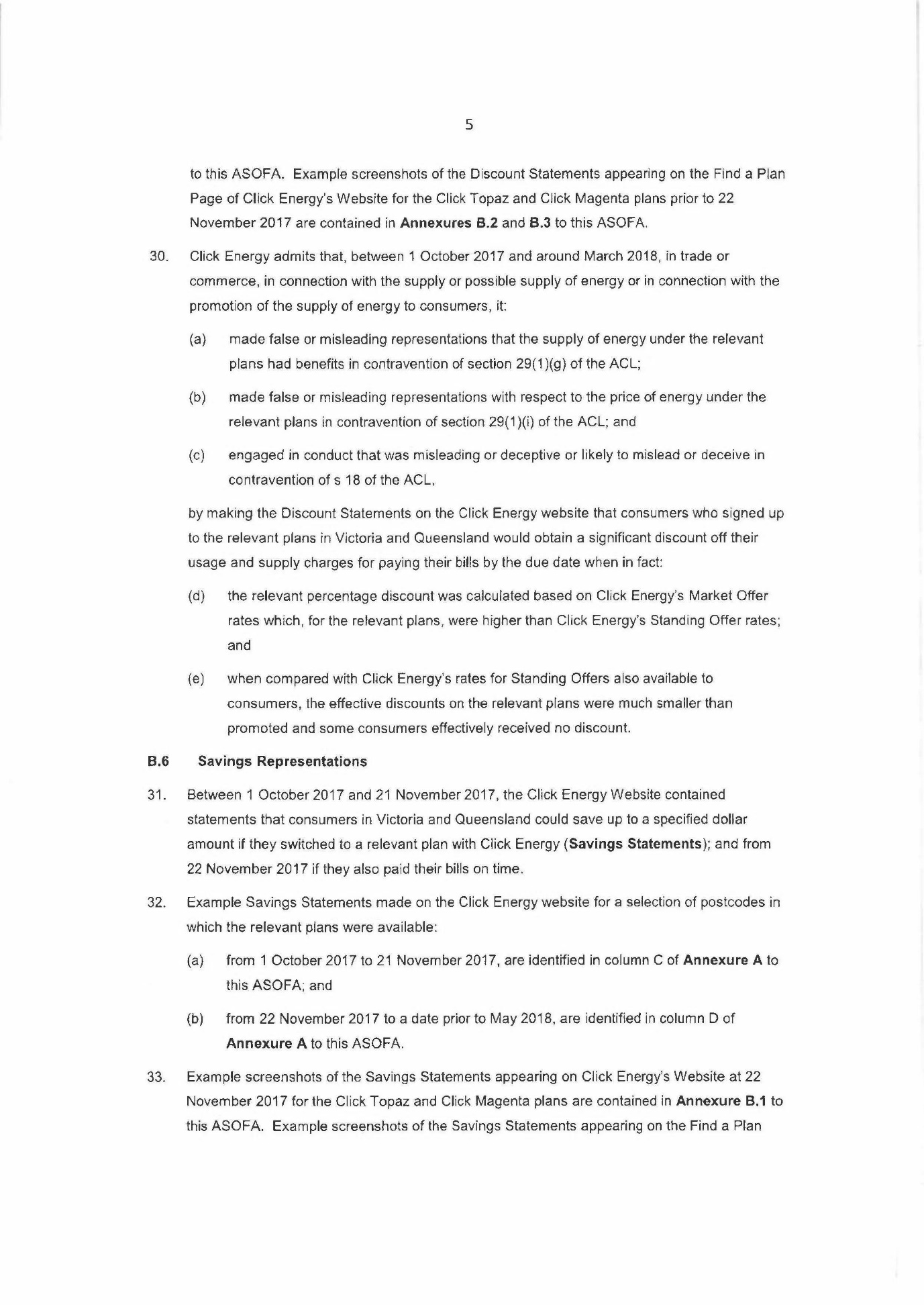
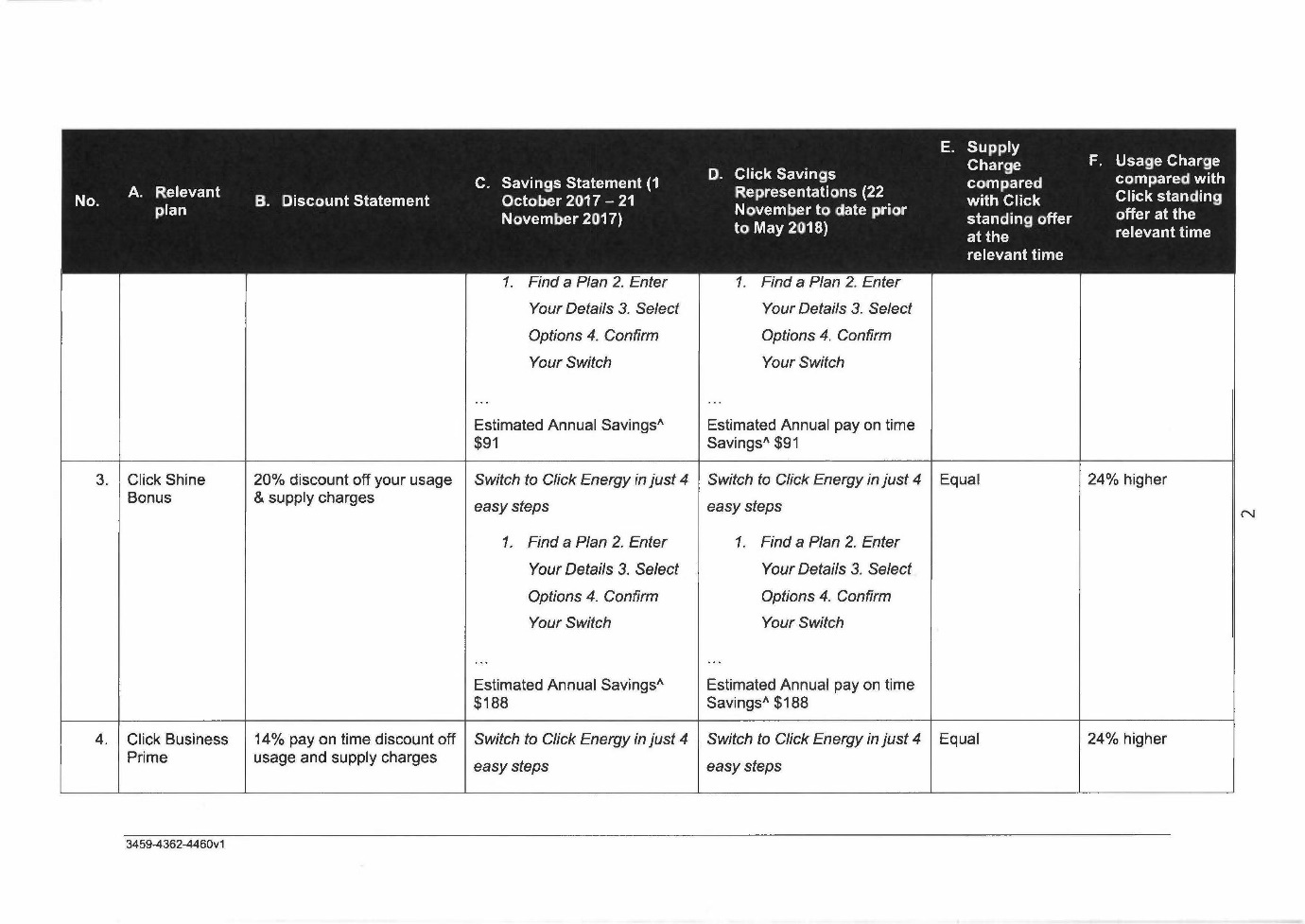
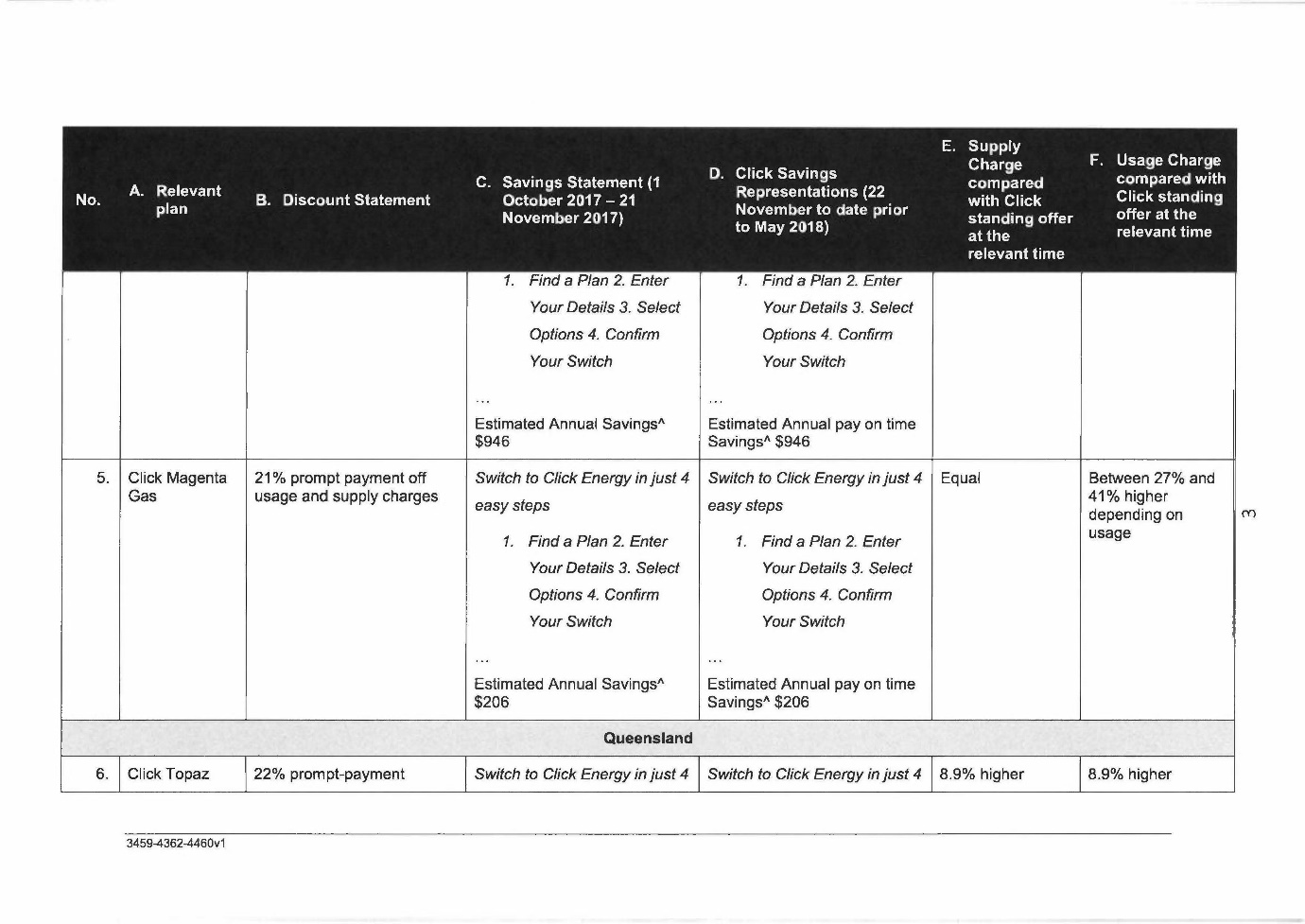
18 Between 1 October 2017 and around March 2018, Click Energy made statements on the Click Energy website that consumers who signed up to the relevant plans in Victoria and Queensland would obtain a significant discount off usage and supply charges for paying their bills by the due date (the ‘Discount Statements’). Example Discount Statements made on the Click Energy website for a selection of postcodes in which the relevant plans were available are identified in column B of Annexure A to the Agreed Statement of Facts and Admissions (ranging from 7% to 29%).
19 Screenshots of the Discount Statements appearing on the Click Energy website for the ‘Click Topaz’ and ‘Click Magenta’ plans as at 22 November 2017 are contained in Annexure B.1 to the Agreed Statement of Facts and Admissions. Example screenshots of the Discount Statements appearing on the ‘Find a Plan’ page of the Click Energy website for the ‘Click Topaz’ and ‘Click Magenta’ plans prior to 22 November 2017 are contained in Annexures B.2 and B.3 to the Agreed Statement of Facts and Admissions.
20 The Discount Statements were false or misleading, and misleading or deceptive or likely to mislead or deceive, because:
(1) the relevant percentage discount was calculated based on Click Energy’s market offer rates which, for the relevant plans, were higher than Click Energy’s standing offer rates; and
(2) when compared with Click Energy’s rates for standing offers also available to consumers, the effective discounts on the relevant plans were much smaller than promoted and some consumers effectively received no discount.
21 Click Energy has admitted that by making the Discount Statements it:
(1) made false or misleading representations that the supply of energy under the relevant plans had benefits in contravention of s 29(1)(g) of the ACL;
(2) made false or misleading representations with respect to the price of energy under the relevant plans in contravention of s 29(1)(i) of the ACL; and
(3) engaged in conduct that was misleading or deceptive or likely to mislead or deceive in contravention of s 18 of the ACL.
Savings representations
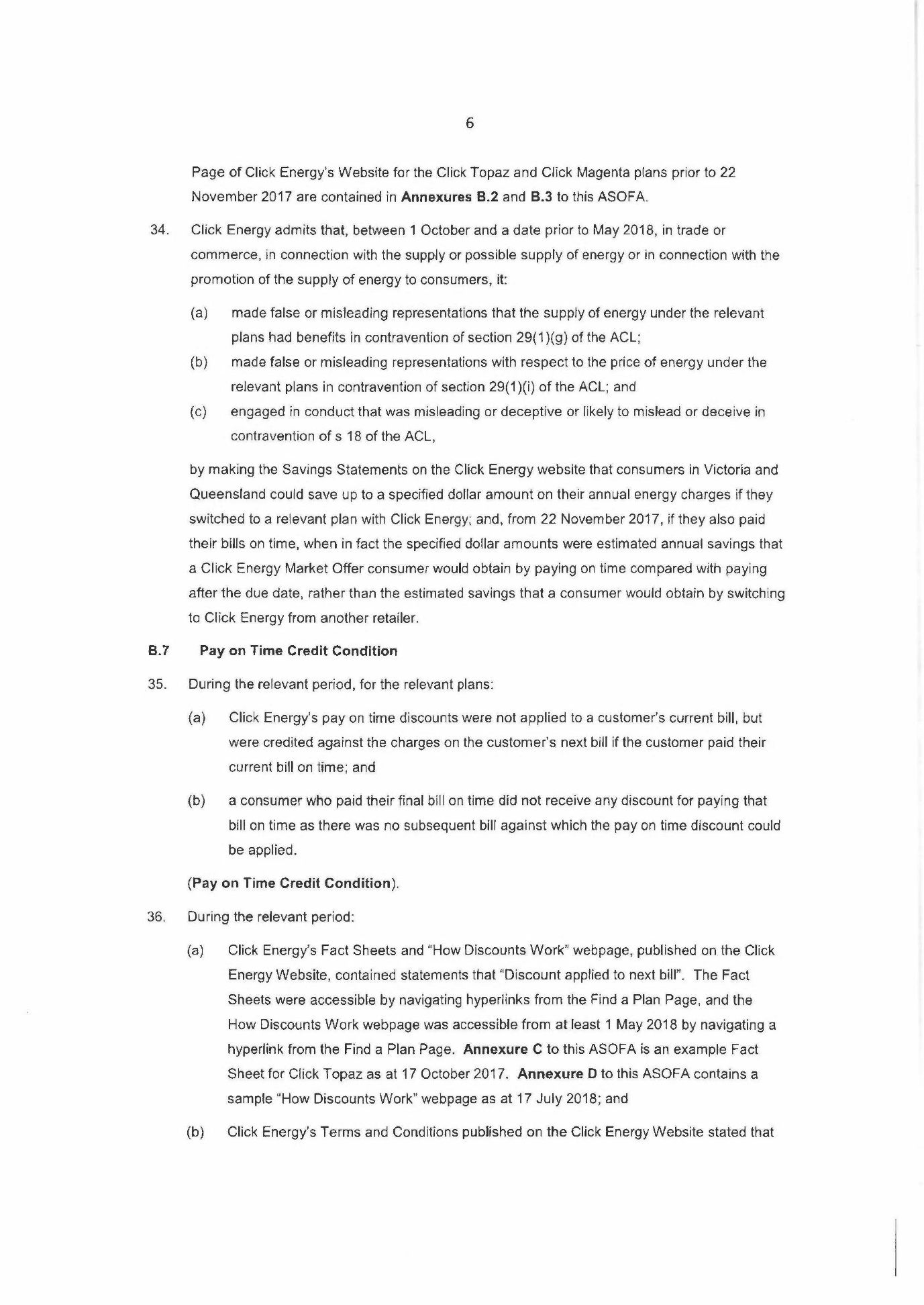
22 Between 1 October 2017 and 21 November 2017, the Click Energy website contained statements that consumers in Victoria and Queensland could save up to a specified dollar amount if they switched to a relevant plan with Click Energy (the ‘Savings Statements’), and from 22 November 2017 if they also paid their bills on time. Example Savings Statements made on the Click Energy website for a selection of postcodes in which the relevant plans were available:
(1) from 1 October 2017 to 21 November 2017, are identified in column C of Annexure A to the Agreed Statement of Facts and Admissions; and
(2) from 21 November 2017 to a date prior to May 2018, are identified in column D of Annexure A to the Agreed Statement of Facts and Admissions.
23 Example screenshots of the Savings Statements appearing on the Click Energy website at 22 November 2017 for the ‘Click Topaz’ and ‘Click Magenta’ plans are at Annexure 8.1 to the Agreed Statement of Facts and Admissions. Example screenshots of the Savings Statements appearing on the ‘Find a Plan’ page of the Click Energy website for the ‘Click Topaz’ and ‘Click Magenta’ plans prior to 22 November 2017 are contained in Annexures B.2 and B.3 to the Agreed Statement of Facts and Admissions.
24 The Savings Statements were false or misleading, and misleading or deceptive or likely to mislead or deceive, because the specified dollar amounts were estimated annual savings that a Click Energy market offer consumer would obtain by paying on time compared with paying after the due date, rather than the estimated savings that a consumer would obtain by switching to Click Energy from another retailer.
25 Click Energy has admitted that by making the Savings Statements it:
(1) made false or misleading representations that the supply of energy under the relevant plans had benefits in contravention of s 29(1)(g) of the ACL;
(2) made false or misleading representations with respect to the price of energy under the relevant plans in contravention of s 29(1)(i) of the ACL; and
(3) engaged in conduct that was misleading or deceptive or likely to mislead or deceive in contravention of s 18 of the ACL.
Pay-on-time credit condition
26 During the period from 1 October 2017 to early August 2018, for the relevant plans:
(1) Click Energy’s pay-on-time discounts were not applied to a customer’s current bill, but were credited against the charges on the customer’s next bill if the customer paid their current bill on time; and
(2) a consumer who paid their final bill on time did not receive any discount for paying that bill on time as there was no subsequent bill against which the pay-on-time discount could be applied,
(the ‘Pay-on-time Credit Condition’).
27 During the period from 1 October 2017 to early August 2018:
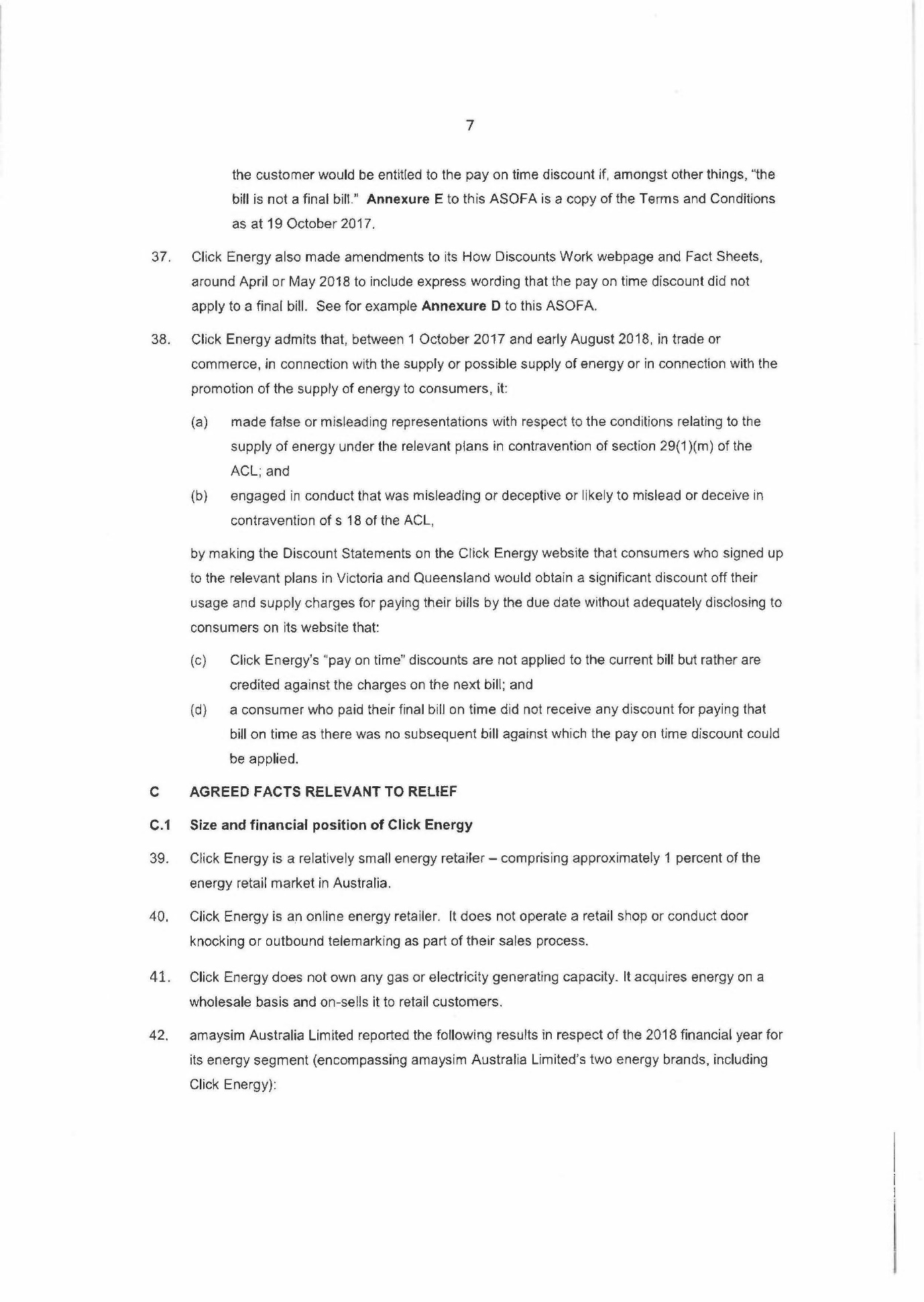
(1) Click Energy’s Fact Sheets and ‘How Discounts Work’ page, published on the Click Energy website, contained statements that “Discount applied to next bill”. The Fact Sheets were accessible by navigating hyperlinks from the ‘Find a Plan’ page (see Annexure B.1 to the Agreed Statement of Facts and Admissions for sample ‘Find a Plan’ page). The ‘How Discounts Work’ page was accessible from at least 1 May 2018 by navigating a hyperlink from the ‘Find a Plan’ page. Annexure C to the Agreed Statement of Facts and Admissions is an example Fact Sheet for ‘Click Topaz’ as at 17 October 2017. Annexure D to the Agreed Statement of Facts and Admissions contains an example screenshot of a ‘How Discounts Work’ page as at 17 July 2018; and
(2) Click Energy’s Terms and Conditions published on the Click Energy website stated that the customer would be entitled to the pay-on-time discount if, amongst other things, “the bill is not a final bill”. Annexure E to the Agreed Statement of Facts and Admissions is a copy of the Terms and Conditions as at 19 October 2017.
28 Click Energy also made amendments to its ‘How Discounts Work’ page and Fact Sheets, around April/May 2018 to include express wording that the pay-on-time discount did not apply to a final bill. See for example Annexure D to the Agreed Statement of Facts and Admissions.
29 Click Energy has admitted that by making the Discount Statements without adequately disclosing to consumers the Pay-on-time Credit Condition it:
(1) made false or misleading representations with respect to the conditions relating to the supply of energy under the relevant plans in contravention of s 29(1)(m) of the ACL; and
(2) engaged in conduct that was misleading or deceptive or likely to mislead or deceive in contravention of s 18 of the ACL.
DECLARATORY RELIEF
30 The declarations proposed by the parties in paragraphs 1 to 3 of the Proposed Declarations and Orders are in the same form as those now made as orders 2 to 4 of the Orders.
31 The Court has a wide discretionary power to make such declarations under s 21 of the Federal Court Act.
32 I accept the parties’ joint submissions in respect of the declarations proposed and consider them to be appropriate in all the circumstances insofar as:
(1) the declarations identify with precision the conduct that contravened the ACL and is directed to the determination of an extant legal controversy rather than any abstract or hypothetical question;
(2) it is in the public interest for the ACCC to seek the declarations and for the declarations to be made. The ACCC is the regulator under the CCA and ACL and therefore has a real interest in the declarations being made; and
(3) Click Energy is a proper contradictor because it is the subject of the declarations and had an interest in opposing the declarations.
PECUNIARY PENALTY
Statutory scheme and applicable principles
33 Under s 224(1) of the ACL, the Court may, in respect of contraventions of the provisions of Part 3-1 of the ACL (which relevantly includes s 29), order the contravener to pay such pecuniary penalties in respect of “each act or omission” as the Court determines to be appropriate.
34 Section 224(2) of the ACL requires the Court in determining the appropriate pecuniary penalty to have regard to all relevant matters including:
(1) the nature and extent of the act or omission and of any loss or damage suffered as a result of the act or omission;
(2) the circumstances in which the act or omission took place; and
(3) whether the person has previously been found by a court in proceedings under Chapter 4 or Part 5.2 to have engaged in similar conduct.
35 Under s 224(3) of the ACL, the maximum civil pecuniary penalty for a corporation for each act or omission that constitutes a contravention of Part 3-1 of the ACL is $1.1 million.
36 As I said in Australian Private Networks at [37]:
The principles to be applied to the statutory provisions referred to above are well understood. These include the course of conduct, totality and parity principles, the objective of specific and general deterrence, and the process of “instinctive synthesis” by which courts are to arrive at the appropriate penalty (as explained by the High Court in Markarian v The Queen (2005) 228 CLR 357). I need not rehearse those principles here.
Consideration of mandatory and other relevant factors
Nature and extent of the act or omission and loss or damage suffered
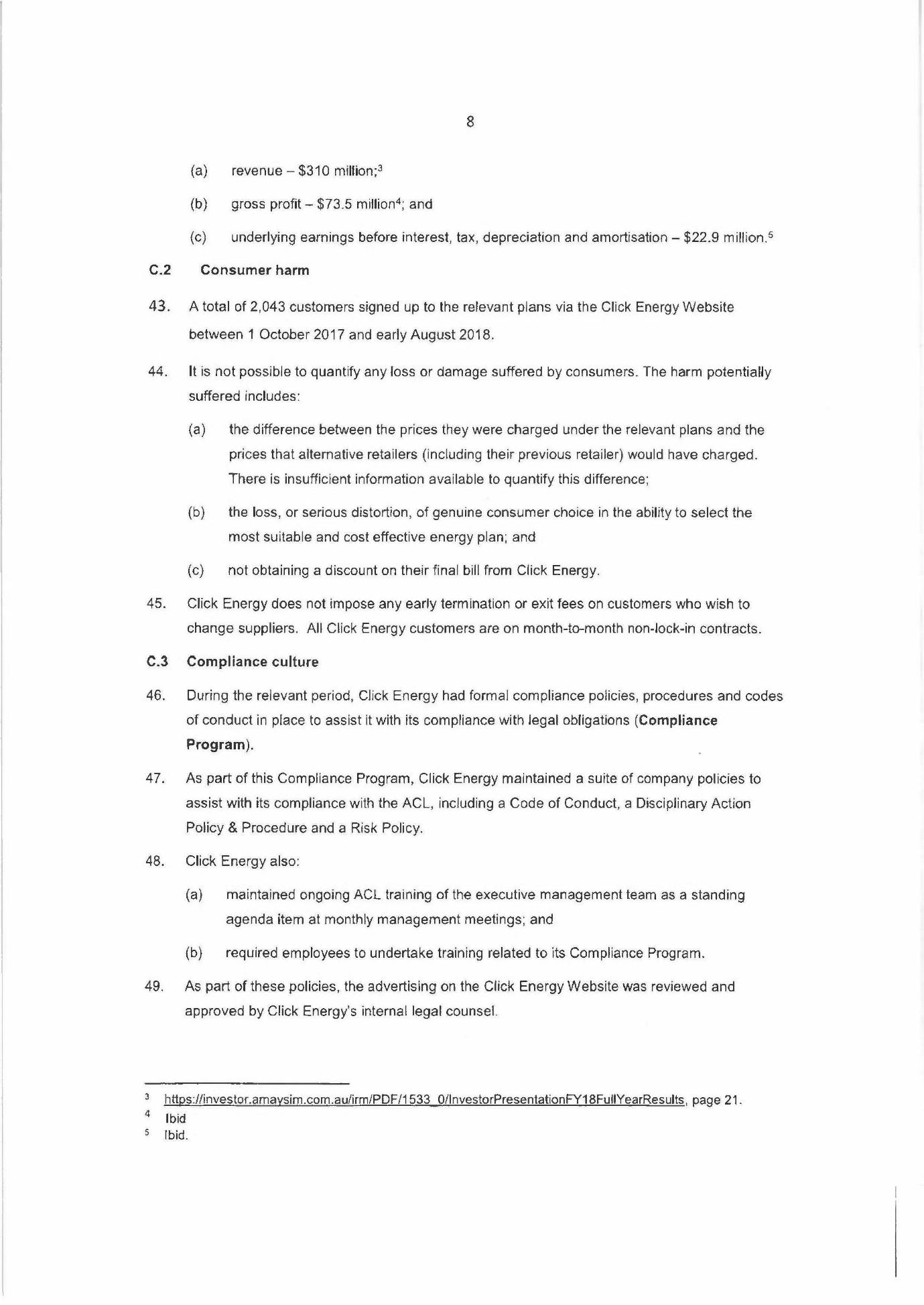
37 The admitted contraventions of ss 18, 29(1)(g), 29(1)(i) and 29(1)(m) of the ACL are serious in nature. They affected a total of 2,043 customers who signed up to the relevant plans via the Click Energy website between 1 October 2017 and early August 2018.
38 While it is not possible to quantify precisely the loss or damage suffered by consumers, s 224(2)(a) of the ACL does not require it. For present purposes, it suffices to say that the harm potentially suffered includes:
(1) the difference between the prices they were charged under the relevant plans and the prices that alternative retailers (including their previous retailer) would have charged;
(2) the loss, or serious distortion, of genuine consumer choice in the ability to select the most suitable and cost effective energy plan; and
(3) not obtaining a discount on their final bill from Click Energy.
Prior findings by a court in proceedings under Chapter 4 or Part 5.2
39 Relevantly, Click Energy has not previously been found to have engaged in contraventions of the ACL, the CCA or its predecessor legislation.
Other relevant factors
40 The following factors are also relevant to my consideration, in all of the circumstances, of the appropriate penalty. The parties submit, and I accept, that:
(1) Click Energy is a relatively small energy retailer comprising approximately 1% of the Australian retail energy market.
(2) While the conduct of Click Energy was ‘deliberate’ insofar as Click Energy intended to make the statements on its website, Click Energy did not deliberately set out to contravene the ACL. At the time it made the relevant statements, there was no evidence that Click Energy considered the statements to be false or misleading.
(3) During the period relevant to the admitted contraventions, Click Energy maintained formal compliance policies, procedures and codes of conduct to assist it with its compliance with legal obligations. As part of these policies, the advertising on the Click Energy website was reviewed and approved by Click Energy’s internal legal counsel. Pursuant to order 8 of the Orders, these policies, procedures and codes of conduct will be reviewed against what is now Annexure C to the Orders.
(4) Click Energy has agreed to resolve this proceeding at an early stage and it is entitled to credit for this co-operation. Such co-operation saves the ACCC, this Court and the community at large the cost and burden of fully litigating this dispute.
Determination of appropriate penalty
41 I accept the parties’ joint submissions that, in respect of the admitted conduct engaged in by Click Energy, the proposed penalty of $900,000 is appropriate.
42 The proposed penalty is appropriate to deter Click Energy and other potential wrongdoers from engaging in like conduct in the future. It takes account of the size and financial position of Click Energy, together with the nature and extent of the contravening conduct and the cooperation of Click Energy in resolving the proceeding at this early stage. Having regard to all of the circumstances of this case, the penalty would not be seen as a mere disgorgement of profits or the “cost of doing business”, but would serve to secure compliance by Click Energy and by other potential wrongdoers.
43 It is of public importance that Click Energy and its competitors operate in a manner that complies with the ACL. A penalty of $900,000 sufficiently conveys that requirement and achieves the necessary deterrence.
44 It is also important that the penalty sends a strong message to the retail energy market. The energy retail market is large, and energy is something required by all Australians. As such, the potential impact of misrepresentations in that industry, and the potential benefit from them, are substantial. Any perception that penalties attaching to such gains could be absorbed as a mere “cost of doing business” would give rise to the potential for widespread harms to consumers. This requires a penalty substantial enough to deter other businesses from engaging in similar conduct.
45 Each time a consumer viewed the Discount Statements or the Savings Statements on the Click Energy website, there was a separate contravening act for the purposes of s 224 of the ACL. It follows that the notional maximum penalty may be in the billions of dollars to the extent that it can be calculated, but such a mathematical approach is not a meaningful or helpful exercise in this case.
46 Equally, the course of conduct principle is not likely to be of much assistance in this case. As it has been applied in other cases, the principle would not, in any event, operate to constrain the total maximum penalty, and should not be given primacy or undue weight in relation to the determination of an appropriate penalty of sufficient deterrent value.
47 Applying the totality principle, the parties submit, and I accept, that the penalty of $900,000 is appropriate because it reflects both the extent and nature of the contravening conduct. It strikes the right balance and reflects the need for deterrence and the particular circumstances of Click Energy, and it also takes account of the impact that the contraventions would have had on the relevant consumers.
CORRECTIVE PUBLICATION ORDER
48 The Court has the power to make orders for the publication of corrective notices under s 246(2)(d) and s 247(1) of the ACL. That power should be used protectively to inform the relevant markets of the outcome of the litigation so that those in the market have at least a broad understanding of how the contravener has had to change their conduct. The purpose of a corrective notice is to protect the public interest in dispelling incorrect or false impressions created by contravening conduct, alert the consumer to the fact of contravening conduct, aid the enforcement of primary orders and prevent repetition of contravening conduct.
49 The parties submit, and I accept, that the corrective publication orders (as proposed at paragraphs 5 and 6 of the Proposed Declarations and Orders, and as now made as orders 6 and 7 of the Orders) are appropriate in the present case. Those orders require Click Energy to:
(1) send an email to all current customers who signed up to the relevant plans during the period 1 October 2017 to 31 August 2018, in the form set out in what is now Annexure A to the Orders; and
(2) publish a corrective notice on the Click Energy website, in the form set out in what is now Annexure B to the Orders.
COMPLIANCE PROGRAM
50 The Court has power under s 246(2) of the ACL to order that a respondent establish and implement a training program to assist in ensuring that it avoids future contraventions of the ACL.
51 Click Energy has agreed to review its existing compliance program and make any amendments necessary to ensure it meets the requirements of the ACL compliance program set out in what is now Annexure C to the Orders, and to maintain the compliance program for three years from the date on which the amendments are made.
52 Such orders are appropriate in the circumstances.
COSTS
53 Click Energy has agreed to pay the ACCC’s costs of the proceeding, fixed in the sum of $50,000. I see no reason not to make such an order.
I certify that the preceding fifty-three (53) numbered paragraphs are a true copy of the Reasons for Judgment herein of the Honourable Justice Middleton. |
Associate: