

FEDERAL COURT OF AUSTRALIA
Le v Minister for Immigration and Border Protection [2019] FCA 427
ORDERS
Appellant | ||
AND: | MINISTER FOR IMMIGRATION AND BORDER PROTECTION First Respondent ADMINISTRATIVE APPEALS TRIBUNAL Second Respondent | |
DATE OF ORDER: |
THE COURT ORDERS THAT:
2. The orders of the Federal Circuit Court of Australia in Proceeding No. BRG 27 of 2017 made on 9 October 2017 be set aside and, in lieu thereof, orders that the constitutional writs issue quashing the decision of the second respondent and remitting the application of Thi Xuan Nga Le to the second respondent to be determined according to law.
3. The first respondent pay the appellant’s costs of the proceeding in the Federal Circuit Court of Australia in Proceeding No. BRG 27 of 2017 fixed in the sum of $8,556.00.
4. The first respondent pay the appellant’s costs of and incidental to the appeal as agreed or assessed.
5. Pursuant to s 23 and s 37P of the Federal Court of Australia Act 1976 (Cth), rule 1.32 and rule 1.36 of the Federal Court Rules 2011, these orders and the reasons for judgment in support of these orders are made and published from Chambers.
Note: Entry of orders is dealt with in Rule 39.32 of the Federal Court Rules 2011.
GREENWOOD J:
Background and Introduction
1 This appeal from Orders of the Federal Circuit Court of Australia dismissing the appellant’s application for judicial review on grounds of jurisdictional error of a decision of the Administrative Appeals Tribunal (the “Tribunal”) gives rise to a relatively short but important point, especially of course, from the perspective of the appellant, but also more generally.
2 Part 5 of the Migration Act 1958 (Cth) (the “Act”) provides for the review by the Tribunal, in its Migration and Refugee Division, of “Part 5 – reviewable decisions”. Section 338 of the Act provides that a decision is a Part 5 – reviewable decision if the section so provides. It is common ground between the appellant and the first respondent Minister that the application or purported application made to the Tribunal for review is a “Part 5 – reviewable decision” by reason of s 338(2) of the Act.
3 Section 347(1) provides that an application for review of a Part 5 – reviewable decision “must be made in the approved form” (s 347(1)(a)) and “must be given to the Tribunal within the prescribed period” as set out in s 347(1)(b). Section 347(2) provides, relevantly, that an application for review before the Tribunal of a Part 5 – reviewable decision “covered by subsection 338(2)”, “may only be made by … the non-citizen who is the subject of that decision”: s 347(2)(a).
4 Section 347(3) provides that in respect of a decision covered by s 338(2), an application for review can only be made by a non-citizen who is physically present in the migration zone when the application for review is made. The “Migration zone” is, for the purposes of s 5(1) of the Act, put simply, an area consisting of the States, the Territories and relevantly defined Australian resource installations and Australian sea installations. There is no issue about whether the non-citizen was physically present in the migration zone when the application for review was made.
5 The appellant is a non-citizen who is the subject of a decision covered by s 338(2) of the Act.
6 The appellant is a citizen of Vietnam. The appellant asserted in her application for the relevant visas that she has been married to “Mr The Thai Tran” since 21 May 2015. By a letter dated 26 May 2015 (and received by the recipient on 27 May 2015), the appellant’s lawyers, H & N Lawyers Pty Ltd, wrote to the Department of Immigration and Border Protection (the “Department”) enclosing the appellant’s application for a Partner (Temporary) (Class UK) (subclass 820) visa (a “subclass 820 visa”) and a Partner (Residence) (Class BS) (subclass 801) visa (a “subclass 801 visa”). An applicant for a subclass 820 visa is required by the Migration Regulations 1994 (Cth) (the “Regulations”) to make a simultaneous application for a subclass 801 visa. As to the criteria applicable to a subclass 820 visa and a subclass 801 visa: see 820.1 to 820.6 of Schedule 2 to the Regulations and 801.1 to 801.6 of Schedule 2 to the Regulations, respectively, as they stood at the date of application, 27 May 2015. There is no issue raised in these proceedings about non-compliance with any of those elements by the appellant.
7 One of the elements of each class of visa is that the applicant for the visa is sponsored by, relevantly in the circumstances of the appellant, her spouse. The appellant, in her application for each visa, asserted that she was sponsored by the man she asserts to be her spouse, Mr Tran. In describing Mr Tran as the man the appellant asserts to be her spouse, I simply note the underlying contention as it is no part of the proceedings on appeal to address any aspect of those matters.
8 On 11 October 2016, the Minister’s delegate refused to grant each visa.
9 The appellant asserts that she sought to have the delegate’s decision reviewed by the Tribunal by the lodging of an application for review with the Tribunal on 1 November 2016, by her lawyers, H & N Lawyers.
10 As to that application, a document was electronically lodged (that is, lodged online) with the Tribunal on 1 November 2016 using a form described as “eM1”. There is no suggestion that the application made by that form was an incorrect form, or put another way, that the application was not “made in the approved form” for the purposes of s 347(1)(a) of the Act. However, the form seeks to elicit classes of information designed to inform the Tribunal of the decision sought to be reviewed; details of the person applying for review; information in relation to the person described as the “Primary visa applicant”; and details of any person said to be representing the applicant (such as a registered migration agent). The form also enables a person uploading the form to also upload any documents relevant to the application such as the notification from the Department of the delegate’s decision and the Delegate’s Decision Record.
11 In this case, the form lodged online recites, in a sequence of boxes under the heading “Details of person applying for review”, details concerning Mr Tran. The information in those boxes recites that he is an Australian citizen or permanent resident whose nationality is Australian. The boxes recite his address, contact details, passport number and other information particular to him.
12 The short point is this.
13 The Minister says that the Statute could not be more clear about who has standing to apply for review under s 347 of the Act of a Part 5 – reviewable decision “covered by” s 338(2) of the Act. The Minister says that the mandatory language of s 347(2)(a) makes it plain that an application for review of such a decision may only be made by the non-citizen who is the subject of that decision. The Minister says that the application form recites that the details of the person applying for review is the sponsor of the applicant for the visa and not the applicant for the visa, who necessarily is the non-citizen who is the subject of the decision sought to be reviewed. The Minister says that the application is not in conformity with the mandatory language of s 347(2) and is thus invalid with the result that the Tribunal’s jurisdiction has not been enlivened.
14 As to the mandatory nature of the statutory language that an application for review of a decision covered by s 338(2) may only be made by the non-citizen who is the subject of the decision, the Minister observes that s 347(2)(a), (b), (c) and (d) selects those persons who have standing to apply for review of various classes of Part 5 – reviewable decisions covered by particular subsections of s 338. For example, in relation to a Part 5 – reviewable decision “covered by subsection 338(5) or (8)”, the application for review may only be made by the “sponsor or nominator” referred to in the relevant subsection: s 347(2)(b). Thus, the structure and language of s 347(2)(a) to (d) is said to reinforce the statutory language of s 347(2)(a) that the only person who may make an application for review of a decision covered by s 338(2) is the non-citizen who is the subject of the decision and not the sponsor.
15 The Minister also says that in the section of the form setting out the details of Mr Tran as the “[d]etails of person applying for review”, there is a box addressing the topic “[c]apacity to apply for review” and the information given on the form is “[s]ponsor or nominator”.
16 The appellant accepts that in that part of the form lodged online, the form recites under the heading “Details of person applying for review 1”, information in relation to the sponsor Mr Tran.
17 However, the appellant says that a reading of the form in its entirety makes it perfectly plain that the visa applicant is, in substance, the person seeking to invoke the Tribunal’s jurisdiction and that follows because, under the heading “Primary visa applicant”, all of the details in the various boxes concern the appellant. Moreover, the form recites the name of the registered agent acting for the appellant as visa applicant, H & N Lawyers (Mr Huynh), under the heading “[r]epresentative details”, and the form uploads the notification of the Delegate’s Decision and the Decision Record, both of which concern the appellant.
18 The appellant says that when the form is examined in its entirety, it can be seen that the application for review has been “made by” the non-citizen who is the subject of the s 338(2) decision for the purposes of s 347(2)(a) notwithstanding that the information recited in the particular boxes under the description, details of person applying for review, recites information concerning the sponsor rather than the appellant.
19 The appellant says that since the form recites comprehensively all of the relevant details in relation to what is described as the “[p]rimary visa applicant”, the Tribunal could not be in any doubt that the appellant, as the primary visa applicant, is the person seeking to invoke the Tribunal’s statutory review function by the uploading of the form.
The application for review
20 The form as uploaded on 1 November 2016 is set out below in its entirety.
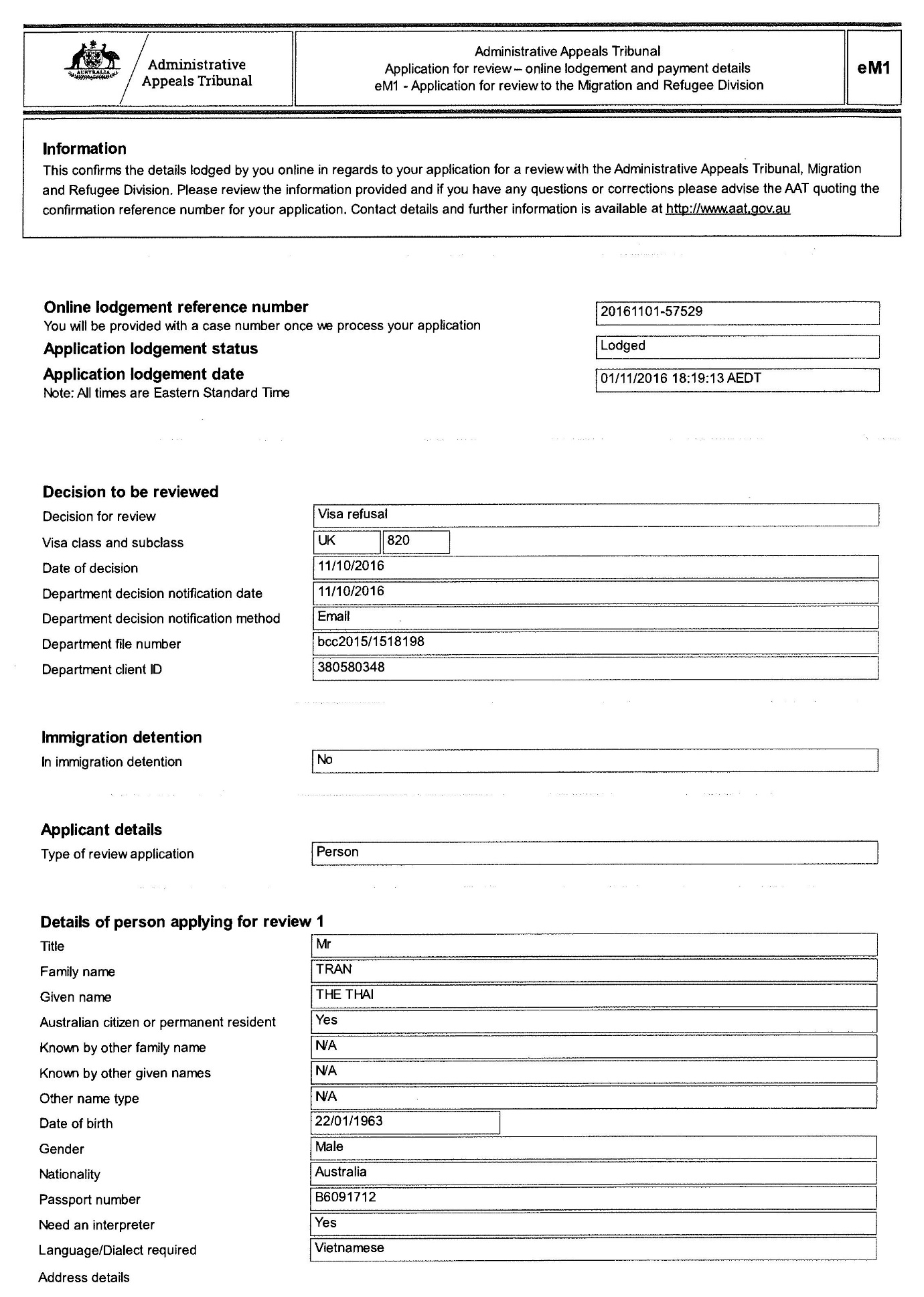
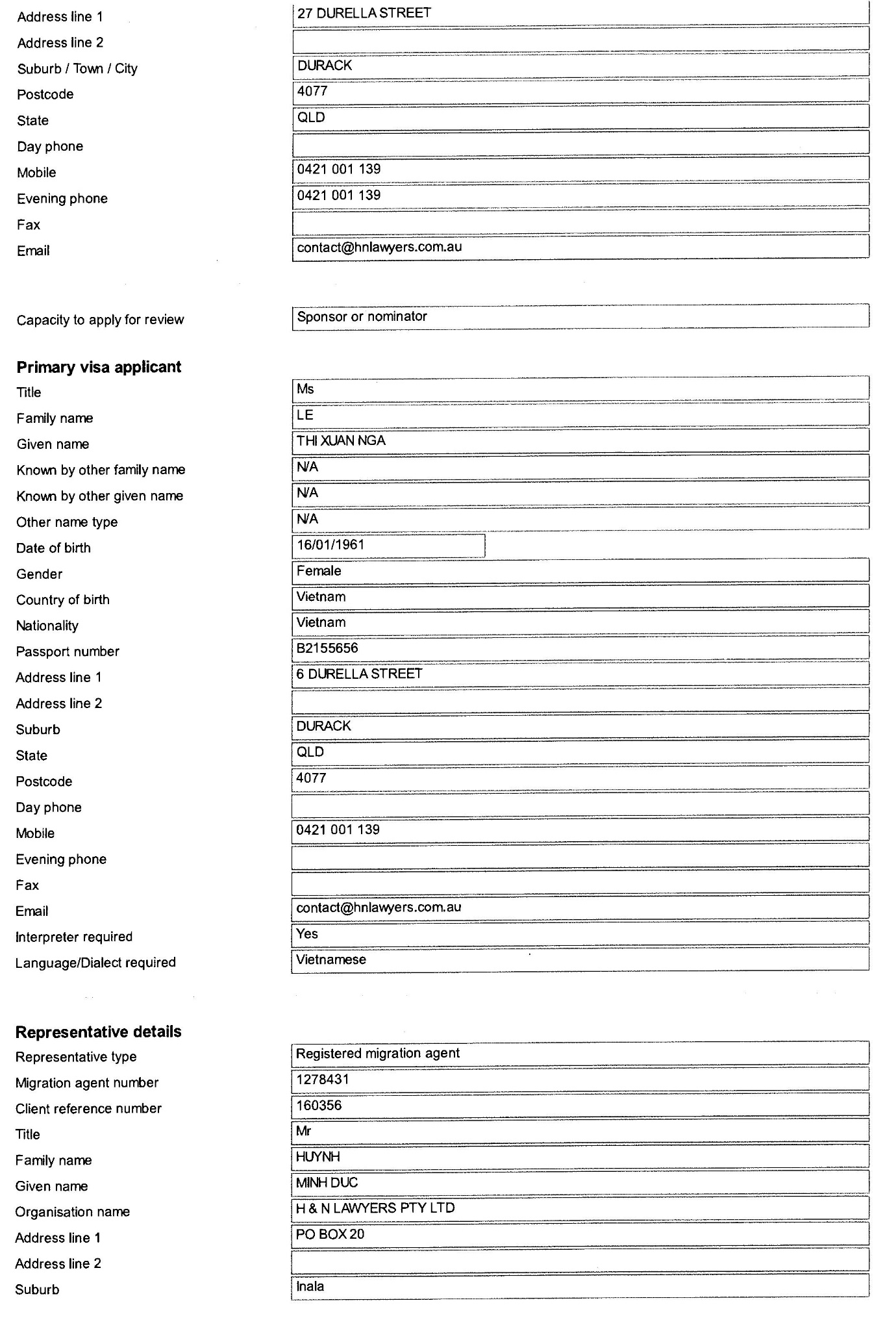
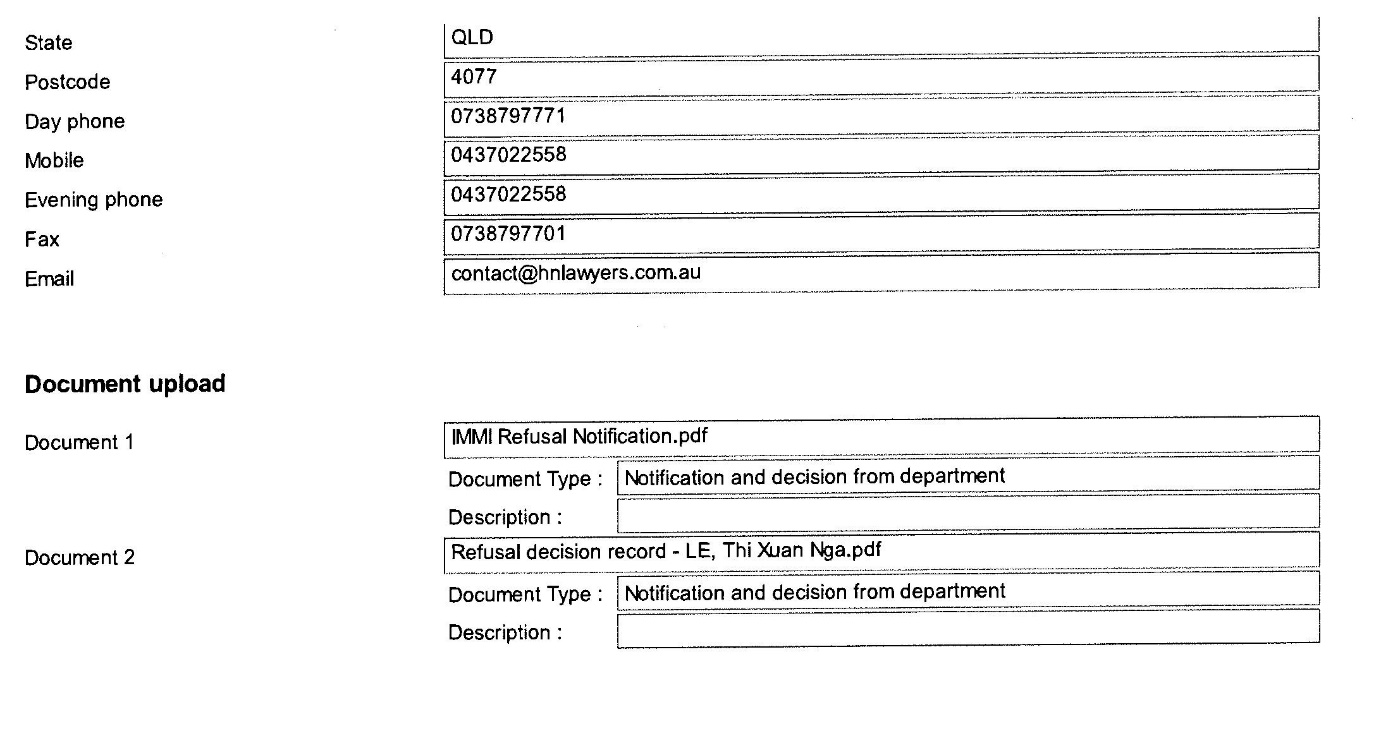
The Tribunal’s Decision
21 On 7 November 2016, the Tribunal sent a letter to Mr Huynh of H & N Lawyers, as the person nominated on the application form. The letter recites the subject matter as “Acknowledgment of Application – Mr The Thai Tran” and recites that the Tribunal has “received an application for review made by Mr The Thai Tran in respect of a decision to refuse to grant a Partner (Temporary) (Class UK) visa, on 1 November 2016”. The letter of 7 November to Mr Huynh enclosed a letter from the Tribunal dated 7 November 2016 addressed to Mr Tran which asked Mr Tran to note that “the validity of your application has not yet been assessed” and the Tribunal “can only review a decision if a valid application for review has been made”. It also said this: “We have requested the Department of Immigration and Border Protection (the department) provide us with all documents and files which they consider to be relevant to your application”.
22 On 11 November 2016, the Tribunal sent a letter to Mr Huynh by email attaching a letter dated 11 November 2016 addressed to Mr Tran under the subject matter “Invitation to comment on the validity of application for review – Mr The Thai Tran”. In that letter the Tribunal said this:
The person who is entitled to apply to us in relation to this decision is the visa applicant. You are not such a person, and I am therefore of the view that your application is not a valid application. As you lodged your application for review on the last day of the allowable time frame to apply for a review, it now appears to be too late for that person to make an application to us. However this is a matter which must be determined by a Member.
23 The Tribunal invited Mr Tran to make any comments about the validity of the application in writing by 25 November 2016.
24 On 14 November 2016, Mr Huynh sent an email to the Tribunal attaching a letter from him dated 12 November 2016 addressed to the Tribunal in which reference is made to the Tribunal’s letter of 11 November 2016 and in which this observation is made:
It is noted that your letter stated that Mr Tran, being the sponsor, is not entitled to lodge this application to [the] AAT. We had informed Mr Tran of the situation. However, in accordance [with] the eligibility provided by the AAT (attached), the sponsor is also entitled to lodge such application. Can you please urgently confirm your position so we can get our client’s instructions.
25 The letter of 12 November 2016 attached an extract drawn from the AAT’s website under the heading “Eligibility” which says this (leaving aside website references in the text):
The Migration Act 1958 and the Migration Regulations 1994 specify which decisions we can review, who may seek review of a decision, how an application for review must be made, the time limits within which applications for review must be lodged, and whether an application fee is payable. The rules vary depending on the type of matter.
We cannot accept an application for review lodged outside the relevant time limit or which has been lodged by a person who is not entitled to apply for review. Depending on the decision under review, the person applying for review must be the visa applicant, the former visa holder, the sponsor or a close relative.
26 In the extract attached to the letter, the words “the sponsor” in the last line of the passage quoted above have two lines drawn under them apparently in freehand which I assume is emphasis attributed to those words by Mr Huynh.
The Tribunal’s decision
27 On 6 December 2016, the Tribunal decided that it had no jurisdiction to review the decision of the delegate as the application for review was not made in accordance with the Act. The Tribunal gave these reasons:
7. Section 347(2) of the Act specifies who has the right to apply for review of a decision that is reviewable under Part 5 of the Act. In the case of a decision described in s 338(2) of the Act, an application for review may only be made by the non-citizen who is the subject of the decision and is physically present in the migration zone when the application for review is made: s 347(2)(a) and (3) of the Act. “Migration zone” is defined in s 5(1) of the Act and generally speaking means the Australian States and Territories.
8. The Tribunal had regard to Mr Tran’s agent’s submissions and the specific reference to the Eligibility page on the Tribunal’s website. Notably, the sentence to which Mr Tran’s agent refers, commences with the words “Depending on the decision under review” before continuing on to list the sponsor as one of the person[s] who can apply for a review. The information provided is correct. It depends upon the decision under review as to who must lodge an application for review, and must be the visa applicant, the former visa holder, the sponsor or a closer relative, depending on the decision under review.
9. As the decision that is the subject of the review application is a decision covered by s 338(2) of the Act, the application for review could only be made by the non-citizen who is the subject of the decision, that is the visa applicant, Ms Le. In the present case, the review application was made by Ms Le’s sponsor, Mr Tran. As such, the application for review is not an application properly made under s 347 and it follows that the Tribunal does not have jurisdiction in this matter.
DECISION
10. The Tribunal does not have jurisdiction in this matter.
28 Section 348(1) provides, subject to subsection (2) (which has no application in these proceedings) that if an application is “properly made under section 347 for review of a Part 5 – reviewable decision, the Tribunal must review the decision”. As noted, the Tribunal decided that the application was not “properly made under s 347” and thus the review jurisdiction was not engaged or enlivened.
29 Section 15AA of the Acts Interpretation Act 1901 (Cth) is in these terms:
15AA Interpretation best achieving Act’s purpose or object
In interpreting a provision of an Act, the interpretation that would best achieve the purpose or object of the Act (whether or not that purpose or object is expressly stated in the Act) is to be preferred to each other interpretation.
30 Section 25C of the Acts Interpretation Act is in these terms:
Where an Act prescribes a form, then strict compliance with the form is not required and substantial compliance is sufficient.
31 Section 2 of the Acts Interpretation Act provides that that Act applies to all Acts of the Commonwealth Parliament: s 2(1). However s 2(2) of that Act provides that “the application of this Act or a provision of this Act to an Act or a provision of an Act is subject to a contrary intention”.
The Decision of the Federal Circuit Court
32 The appellant sought judicial review of the Tribunal’s decision before the Federal Circuit Court. The Federal Circuit Court dismissed the application on 9 October 2017 and delivered ex tempore reasons for judgment.
33 In the reasons, the primary judge at [6] notes that the decision to be reviewed is a visa refusal decision of 11 October 2016. At [6] the primary judge notes that the online application recites the departmental file number and departmental client ID number both referable to the appellant. At [6], the primary judge notes much of the information on the application form under the heading “details of the person applying for review”. At [7] the primary judge notes a concession that those details are the details of “Mr Le” although, clearly enough, that was intended to be a reference to Mr Tran. At [8] the primary judge notes the reference to “sponsor or nominator” in the box in response to “Capacity to apply for review”. At [8] the primary judge also notes much of the information set out on the form under the heading “Primary visa applicant”. At [8] the primary judge notes the “Representative details”. At [9] the primary judge, although mistakenly making reference to “Mr Le” rather than Mr Tran, observes (substituting Mr Tran for references to Mr Le) that looking at the form, “one would be in very little doubt that the person making the application is Mr Tran and not Ms Le” because, first, Mr Tran’s details are recited in the boxes as the details of the person applying for review, and second, the box asking for a statement of that person’s capacity to apply for review recites the words sponsor or nominator.
34 At [10] to [11] the primary judge notes the Tribunal’s letter of 11 November 2016, the reply to that letter of 12 November 2016, and the screenshot from the Tribunal’s website under the heading “Eligibility”.
35 At [14] the primary judge recites the nine grounds relied upon by the appellant in support of the application before that Court. However, the primary judge notes at [15] that the real contention was that the application lodged with the Tribunal ought to have been understood and construed as an application by the visa applicant herself having regard to her details recited on the form and the references to the departmental material which concerned the appellant as the visa applicant. Further, the application was electronically signed by the migration agent who had been representing the visa applicant throughout the visa application process as from 26 May 2015. At [16] the primary judge observes that the migration agent was, however, also acting for the sponsor and that letters from the agent made it clear that the application was made by the sponsor.
36 The appellant contended that construing the application as one made by the sponsor alone would be “allowing form to triumph over substance” and would bring “the administration of justice into disrepute”.
37 As to that matter, the primary judge said that it was “quite obvious” that it was the sponsor who was making the application and to hold otherwise would render s 347(2)(a) meaningless.
38 At [21] the primary judge held that s 25C of the Acts Interpretation Act has “no real application”. As to s 15AA of that Act, the primary judge held that s 347 provides, in a “very distinct way” as to who may apply for review of classes of s 338 decisions and, as to a decision covered by s 338(2), it can only be the visa applicant.
39 Thus, the appellant’s application for judicial review was dismissed by the primary judge.
The grounds of appeal
40 The appellant contends that the primary judge erred on the following grounds:
1. … by failing to properly interpret and/or apply s 25C and/or s 15AA of the Acts Interpretation Act 1901 (Cth).
2. … by not properly applying the principles in MZAIC v Minister for Immigration and Border Protection [2016] FCAFC 25.
3. … by not finding that the tribunal failed to properly apply and/or interpret Part 5 – Review of Part – 5 Reviewable Decisions of the Migration Act 1958.
4. … in not finding that the tribunal’s decision was unreasonable.
41 The appellant seeks orders setting aside the orders of the primary judge and, in their place, orders for the issue of the constitutional writs quashing the Tribunal’s decision and directing the Tribunal to decide the appellant’s application according to law, together with consequential costs orders.
The appellant’s essential contention
42 The appellant says that all the grounds of appeal coalesce into one proposition and it is this. Because the form correctly identifies the decision to be reviewed as the delegate’s decision concerning a visa refusal of a Class UK subclass 820 application; correctly identifies the particular decision of 11 October 2016 concerning the appellant; correctly identifies the Department’s corresponding file by the number bcc 2015/1518198; correctly identifies the application made by the appellant under the “client ID” as 380580348; correctly identifies the appellant as the “[p]rimary visa applicant”; correctly identifies the appellant’s representative as Mr Minh Duc Huynh; and correctly attaches two documents concerning the appellant, namely, the Department’s notification letter of refusal of the appellant’s application and the Decision Record explaining the reasons for the delegate’s refusal, it follows that the electronic application is in substance, an application for review of the delegate’s decision by the visa applicant.
43 The appellant also says that once all of the details described at [42] of these reasons were correctly identified in the form, s 25C operates such that there has been “substantial compliance” with the form which “is sufficient” and thus the insertion in the form of information reciting Mr Tran’s details as the “details of person applying for review”, is an “irregularity” and, by operation of s 25C, “strict compliance with the form is not required”.
44 As to s 15AA of the Acts Interpretation Act, the appellant says that s 347 of the Act is to be interpreted in a way which would best achieve the purpose or object of the Migration Act and a purposive construction of Part 5 of the Act is one which provides for a system of merits review within the boundaries of that which is stipulated by all of the statutory provisions guiding the scope of such a review and prescribing the duties and obligations of the parties and the Tribunal. What is said to follow from that notion is the proposition that the “system of merit review” ought not to be “thwarted” by an “overly technical approach to the application of the review application forms”.
45 In this context, the appellant relies upon the observations of Black CJ, Merkel and Stone JJ in Australian Postal Corporation v Forgie (2003) 130 FCR 279 at [66] (“Forgie”) in these terms:
Moreover, the beneficial nature of merits review is such that when provisions are made for it within a legislative scheme, it is unlikely that the legislature would have intended that they should be construed in a narrow or technical way since to do so would be inconsistent with the generally beneficial nature of merits review.
46 The question in Forgie was whether the Australian Postal Corporation (“APC”) had made a “determination” for the purposes of s 37 of the Safety Rehabilitation and Compensation Act 1988 (Cth) (the “SRC Act”). If so, the determination was said to have had the effect of bringing about the consequences contemplated by s 37(7) of that Act of suspending an employee’s rights to compensation under the SRC Act and to institute or continue any proceedings under that Act for compensation until the employee had commenced undertaking a rehabilitation program (as directed). The suspension operated in circumstances where the employee had refused or failed, without reasonable excuse, to undertake the program. If such a determination had been made for the purposes of s 37, it was first subject to a reconsideration in a particular way and was then reviewable on the merits before the Administrative Appeals Tribunal. The employee sought review. The APC contended that no determination had been made and thus the Tribunal had no jurisdiction.
47 The Full Court determined at [37] that the definition of the term “determination” was of such “substantial breadth” that, at [64], it was consistent with an intention to give a wide measure of merits review within the field marked out by the definition. It was in that context that the Full Court made the observation relied upon by the appellant at [66] as quoted at [45] of these reasons. Immediately following that sentence, the Full Court said this at [66]:
This is particularly the case where the legislation in question is intended to apply in relation to matters concerning a person’s employment in the public sector. As was observed by the then Attorney-General in the second reading speech for the Administrative Appeals Tribunal Bill 1975 (Cth) …: “The intention of the present Bill is to establish a single independent tribunal with the purpose of dealing with appeals against administrative decisions on as wide a basis as possible” (emphasis added).
48 The appellant also relies upon MZAIC v Minister for Immigration and Border Protection and Another (2016) 237 FCR 156 (“MZAIC”). In MZAIC, Kenny, Tracey, Robertson and Mortimer JJ observed that the inconvenience of the construction adopted by the primary judge in that case was, in part, to be found in adopting a construction that “prefers form over substance”.
49 The appellant says that the circumstances of the present case suggests that the Tribunal fell into jurisdictional error by preferring form over substance in deciding that its jurisdiction was not enlivened.
MZAIC
50 Because the appellant relies on MZAIC significantly, it is necessary to address it in some detail.
51 The observation at [32] in MZAIC arose in this context. In MZAIC, the appellant had made an application to the Refugee Review Tribunal (the “RRT”) for review of the decision of the Minister’s delegate. The appellant had used a superseded version of the approved Form R1 rather than one of two approved forms then current. The RRT decided that the application had not been “made in the approved form” as required by s 412(1)(a) (which reflects the operative language of s 347(1)(a)) and therefore the RRT’s jurisdiction had not been engaged. The Federal Circuit Court primary judge dismissed the judicial review application on the ground that use of a non-approved form meant that the Tribunal had no jurisdiction.
52 The Full Court in MZAIC noted at [50] that although appellant MZAIC had used a superseded form, the similarity between the superseded form and the two approved forms for use at the date of MZAIC’s application to the RRT was such that “those not versed in the identification system in very small print at the foot of each page would be hard pressed to tell whether or not the form currently approved was being used”. In answer to the Minister’s proposition in MZAIC that s 25C of the Acts Interpretation Act has no application where the wrong form is used (that is, one not then approved), the Full Court concluded at [30], taking into account the Explanatory Memorandum or Notes on Clauses to the Acts Interpretation Amendment Bill 1984 (Cth) concerning proposed s 25C, that s 25C applies both to the Form used and to the content of the material on the form. It was that construction as to the dual role of s 25C which the Full Court regarded as one of preferring substance over form by rejecting the Minister’s contrary contention as one which had the effect of preferring form over substance.
53 The Full Court also concluded at [50] that it would be counter to the “scheme of the [Migration Act]” to hold that mere use of a superseded form, subject to the question of substantial compliance with the current form, rendered ineffective an application to the RRT which had been made; and that s 412(1)(a), in context, did not show a contrary intention for the purposes of s 2(2) of the Acts Interpretation Act: [30] of these reasons. At [52], the Full Court held that s 412(1)(a), taken together with s 25C, was to be read as raising a question of whether appellant MZAIC’s application for review to the RRT had been made in, or substantially in, the approved form.
54 The departure from substantial compliance with the form was said to be that appellant MZAIC had not provided his passport number as required by the approved forms. The Full Court ultimately concluded that the failure to provide the passport number was not a failure to substantially comply with the approved form.
55 At [51], the Full Court rejected the Minister’s contention that making an application on a non-approved (revoked) form would give rise to “significant uncertainty” and rejected the contention that the RRT member would be drawn into a comparative analysis of the differences between an approved form and use of a non-approved form to determine whether compliance with s 412(1)(a) had occurred. The point of principle said to be relevant for present purposes leading to the rejection of those contentions in MZAIC, was put this way at [51]:
The answer to both these issues, in our opinion, is that the Tribunal would ask itself the question whether the form of the application made contained the information the Tribunal needed to set in train the process of review. That, in our view, is the purpose of s 412. Otherwise, as we have said, despite s 25C, the focus of attention would be on the form of the form rather than on the substance of its contents.
[emphasis added]
56 At [52], the Full Court observed that it would read s 412(1)(a) with s 25C as raising the question of whether an application for review to the Tribunal had been made in, or substantially in, the approved form.
57 The present appellant relies upon the following statement of principle at [58] as a matter of general application although inherent in these observations are also aspects of the matters of principle as applied to the particular facts of MZAIC:
Our reasons for concluding that there was substantial compliance are as follows. First, the purpose of the form is to indicate that the visa applicant invokes the jurisdiction of the Tribunal and for that purpose states who he is and identifies the decision that is being challenged. Secondly, the appellant’s application to the Tribunal attached a copy of the notification letter from the Department which contained the appellant’s name, date of birth, client ID, application ID and file number. … Fourthly, the request for a passport number appears to be directed, at best, to the administrative convenience of the Tribunal rather that to whether, as a matter of substance, its jurisdiction has been duly invoked. … It is also significant that, unlike an application for a visa which occurs at an early stage of the process, an application to the Tribunal of necessity follows a substantial administrative process. … Lastly, assuming the Secretary fulfils his or her obligation under s 418(3) of the Migration Act, as soon as practicable after being notified of the application to the Tribunal the Secretary will give to the Registrar of the Tribunal each other document in the Secretary’s possession or control considered by the Secretary to be relevant to the review of the decision.
[emphasis added]
58 Finally, as to MZAIC, the present appellant relies upon the matter set out below contained in the observations of Buchanan J at [137] who agreed that the appeal ought to be upheld:
If I might permit myself two further observations, they are as follows: first, the result for which the first respondent [Minister] contends in the present case would rightly be thought to bring the administration of justice in this country, and the court system upon which it depends, into disrepute. I do not feel compelled to contribute to that outcome. [The second matter is not relevant to the present proceedings].
The propositions the appellant draws from MZAIC
59 The appellant says that the proper application of these statements of principle drawn from MZAIC at [50] to [58] of these reasons is to treat the substance of Form eM1 as having conveyed to the Tribunal that the appellant is both the primary applicant and, in truth, the review applicant such that the insertion on the form of the name and details of Mr Tran as the “person applying for the review” is “superfluous and of no legal effect”.
60 The appellant also says that the Tribunal ought reasonably to have understood and appreciated that it was the appellant who was seeking or attempting to invoke merits review by the Tribunal of the delegate’s decision within the scheme of s 338(2) and s 347(1) and (2)(a) of the Act because the Tribunal must be taken to have understood, when looking at the form overall as lodged together with the uploaded documents, that Mr Tran, as an Australian citizen and sponsor simply could not be a review applicant for a review of a decision concerning rejection of the class (and subclass) of visa application lodged onshore by the appellant.
Further aspects of the Minister’s contentions
61 The Minister says that the circumstances in this appeal are different from those in MZAIC and no question of substantial compliance with the approved form arises. The Minister says that the Tribunal decided that it had no jurisdiction because the wrong person, Mr Tran, made the application and since Mr Tran is not a person falling within the clear statutory language of s 347(2)(a) of the Act, there simply was no valid application for merits review.
62 The Minister, relies upon the observations of Graham J in SZLHP v Minister for Immigration and Citizenship (2008) 172 FCR 170 at [79] and [80] (“SZLHP”) in support of that proposition.
63 In that sense, the determination of validity is said to be, in effect, binary. Did Mr Tran have statutory standing to apply – yes or no? If not, the Minister says the application is invalid.
64 In SZLHP, the appellant claimed to be a citizen of the People’s Republic of China. He arrived in Australia using a false Indonesian passport issued in the name Denny Dendeng Kalalo. He applied for a protection visa in that name asserting fear of persecution on particular grounds. The Minister’s delegate refused the application and the appellant sought review before the Refugee Review Tribunal (“RRT”). Graham J observed at [80] that the appellant had signed the application for review by “imitating” the signature of Denny Dendeng Kalalo on the false passport and concluded, at [80], not surprisingly, that no valid application for review had ever been made because the non-citizen, the subject of the primary decision, was fraudulently represented to be someone other than the appellant.
65 The Minister also contends that where the application is not made by the appellant, but rather by Mr Tran, no question of “substantial compliance” arises at all.
66 The Minister also says that the appellant’s reliance upon s 15AA seems to suggest that s 347(2)(a) is to be purposively construed so as to include Mr Tran, the sponsor, within the language “the non-citizen who is the subject of the decision” in s 347(2)(a). The Minister says that the language of s 347(2)(a) is clear; it is not capable of an alternate construction; it is given force by the words introducing that phrase, that is: “[a]n application may only be made by”, the relevant non-citizen the subject of the decision; and, s 347(2)(b) contemplates applications for review by a “sponsor or nominator” where the decision is one covered by s 338(5) or (8) but where the decision is covered by s 338(2) only the relevant non-citizen may apply.
67 Finally, the Minister also says that to the extent that the appellant relies upon observations in Forgie at [66] as quoted at [45] of these reasons, that authority concerns an entirely different statutory scheme.
Consideration
68 Sections 347 and 348 were, at the date of the Tribunal’s decision, in these terms:
347 Application for review of Part 5 – reviewable decisions
(1) An application for review of a Part 5 – reviewable decision must:
(a) be made in the approved form; and
(b) be given to the Tribunal within the prescribed period, being a period ending not later than:
(i) if the Part 5 – reviewable decision is covered by subsection 338(2), (3), (3A), (4) or (7A) – 28 days after the notification of the decision; or
(ii) if the Part 5 – reviewable decision is covered by subsection 338(5), (6), (7) or (8) – 70 days after the notification of the decision; or
(iii) if the Part 5 – reviewable decision is covered by subsection 338(9) – the number of days prescribed, in respect of the kind of decision in question prescribed for the purposes of that subsection, after the notification of the decision; and
(c) be accompanied by the prescribed fee (if any).
(2) An application for review may only be made by:
(a) if the Part 5 – reviewable decision is covered by subsection 338(2), (3), (3A), (4) or (7A) – the non-citizen who is the subject of that decision; or
(b) if the Part 5 – reviewable decision is covered by subsection 338(5) or (8) – the sponsor or nominator referred to in the subsection concerned; or
(c) if the Part 5 – reviewable decision is covered by subsection 338(6) or (7) – the relative referred to in the subsection concerned; or
(d) if the Part 5 – reviewable decision is covered by subsection 338(9) – the person prescribed in respect of the kind of decision in question prescribed for the purposes of that subsection.
Note: Section 5G may be relevant for determining family relationships for the purposes of paragraph (2)(c).
(3) If the Part 5 – reviewable decision was covered by subsection 338(2), (3), (3A) or (4), an application for review may only be made by a non-citizen who is physically present in the migration zone when the application for review is made.
(3A) If the Part 5 – reviewable decision was covered by subsection 338(7A), an application for review may only be made by a non-citizen who:
(a) was physically present in the migration zone at the time when the decision was made; and
(b) is physically present in the migration zone when the application for review is made.
(4) If the Part 5 – reviewable decision was covered by subsection 338(4), the approved form for an application for review must include a statement advising the applicant that the applicant may:
(a) request the opportunity to appear before the Tribunal; and
(b) request the Tribunal to obtain oral evidence from a specified person or persons.
A request must be made in the approved form and must accompany the application for review.
(5) Regulations made for the purposes of paragraph (1)(b) may specify different periods in relation to different classes of Part 5 – reviewable decisions (which may be decisions that relate to non-citizens in a specified place).
348 Tribunal to review Part 5 – reviewable decisions
(1) Subject to subsection (2), if an application is properly made under section 347 for review of a Part 5 – reviewable decision, the Tribunal must review the decision.
69 The application form lodged online on 1 November 2016 was Form eM1. That form, at that time, was (and perhaps still is) to be used for migration review applications for “persons not in immigration detention”. The form to be used for persons in immigration detention was Form eM2. The refugee review application form was Form eR1.
70 There is no suggestion in this case that the wrong form was used.
71 However, Form eM1 is designed to serve a multiplicity of purposes because it serves as the review application form concerning decisions about a range of persons not in immigration detention and s 338 (apart from s 338(4)) covers a range of Part 5 reviewable decisions concerning persons not in immigration detention.
72 As to each of those Part 5 reviewable decisions under s 338, s 347(2) prescribes the only person who may make an application and thus Form eM1 is designed to be used not only in respect of a multiplicity of decisions engaging s 338 but the same form is designed to be used by the multiplicity of persons who have standing conferred upon them by s 347(2).
73 So, for example, if the Part 5 reviewable decision is covered by s 338(2), (3), (3A), (4) or (7A), only the non-citizen who is the subject of the decision may make an application for review. On the other hand, if the Part 5 reviewable decision is covered by s 338(5) or (8), only the sponsor or nominator referred to in the relevant subsection may make an application for review. Similarly, if the decision is covered by s 338(9), only a person who is the “person prescribed” for the purposes of that subsection may apply.
74 Accordingly, the form contemplates that a non-citizen the subject of the relevant decision or a sponsor or nominator under s 338(5) or (8) or a s 338(9) prescribed person might use the form to make an application for review.
75 When one of those s 347(2) classes of applicants seeks to enliven the Tribunal’s s 348 merits review jurisdiction, the person must be astute to the particular subsection of s 338 which “covers” the relevant decision and be astute to the corresponding subparagraph of s 347(2) which prescribes only those persons who may make application for review in respect of a decision covered by any one of the subsections of s 338.
76 The Tribunal, however, must also recognise that by reason of s 347(2) taken together with s 338, three classes of persons will be seeking to use the same form (as the Tribunal says on its website “depending on the decision under review”) to seek merits review of Part 5 reviewable decisions covered by s 338.
77 It is conceivable therefore that a person might examine the form and in the section calling for “[d]etails of person applying for review” enter his or her details as a sponsor on a mistaken assumption that such a person has standing to apply for review of a decision concerning the sponsored “[p]rimary visa applicant” as may otherwise be described on the form in respect of a decision recited and identified in detail on the form concerning the subject matter of an uploaded departmental notification letter and a delegate’s Decision Record explaining the decision.
78 The appellant, by her agent, H & N Lawyers, sought to enliven the Tribunal’s review of the delegate’s decision covered by s 338(2) of the Act by electronically lodging the approved form for that purpose in accordance with s 347(1) but did so on the mistaken footing that the sponsor of the appellant could “properly” be a person applying for a review of the delegate’s decision concerning the primary visa applicant as described otherwise on the form.
79 In that sense, the sponsor was the nominee of the appellant’s agent H & N Lawyers when filling out and electronically lodging the form. It seems tolerably clear from Mr Huynh’s letter to the Tribunal dated 12 November 2016 ([24] and [25] of these reasons) that Mr Huynh thought that Mr Tran could, in effect, stand in the shoes of Ms Le to initiate the application for review or “apply” for the review of a decision concerning the affected applicant, Ms Le. In that sense, Mr Tran was standing in the shoes of Ms Le although that was never expressly put by Mr Huynh.
80 Section 347(2) begins with the words: “An application for review may only be made by” [emphasis added]. The subsection then addresses each person prescribed as the only relevant person who may apply. The statutory question the Tribunal must ask itself, in deciding whether it has a statutory obligation under s 348(1) to review the decision the subject of the application is whether the application is “properly made under section 347 for review of a Part 5 – reviewable decision”: s 348. In order to be properly made under s 347, the elements of s 347(1)(a) to (c) must be satisfied and the application must only be made by the person prescribed by s 347(2).
81 In deciding whether the application before it is “properly made” for the purposes of s 347(2), the Tribunal must ask itself and decide the statutory question of whether an application for review has been made to it by the non-citizen who is the subject of the decision covered by s 338(2). The breadth of that statutory question cannot be answered by simply or only looking at the section of the approved form that calls for “[d]etails of person applying for review”. The layout and headings on the form cannot constrain the scope of the statutory question to be answered. Obviously enough, that section of the form (that is, information in the sequence of boxes on the form under that heading) is a rational and very important starting point in addressing the statutory question but the breadth of the statutory question cannot be diminished or read down by the form itself or by the Tribunal looking only at one section of the form.
82 The information in the boxes under that heading is not, by itself, determinative.
83 The Tribunal must look to the entirety of the form and take into account in an evaluative way all of the information recited in the form and have regard to the documents uploaded with it in order to decide whether the application is made by the non-citizen who is the subject of the decision covered by s 338(2), in all the circumstances reflected in the form by which the application for review is made.
84 The information recited in the boxes under the heading “[d]etails of person applying for review” are just that: the details of the person described on the form as “applying for review” concerning an application for review made by a person later described in the form as the “[p]rimary visa applicant”. The only person who could engage the fundamentally important merits review process conferred upon the Tribunal in respect of the delegate’s decision to reject Ms Le’s visa application was Ms Le.
85 When all of the information recited on the form is taken into account including all of the features recited at [42] of these reasons, a proper reading of the entire form leads to an inevitable conclusion that it was Ms Le who was seeking to engage the Tribunal’s review jurisdiction in the sense that the application was being made by Ms Le even though it was Mr Tran who is recited on the form as the person initiating or “applying for review”.
86 The relevance of the matters of principle drawn upon by the appellant from MZAIC is that the Tribunal had an obligation to look at the form in its entirety and “ask itself” the statutory question (not simply look to one section of the form) and decide whether the form overall containing, as it does, all of the information emphasised by the appellant and recited at [42] of these reasons, “set in train a process of review”. That is the statutory purpose of s 347.
87 The focus of attention of the Tribunal must be upon the entire contents of the form in order to identify the substance and effect of the information conveyed by the form not merely one section of it. It must be read, construed and analysed as an integrated whole when answering the statutory question of who is “making” this application in an attempt to set in train the Tribunal’s merits review jurisdiction.
88 When each of the items of information recited on the form as described at [42] of these reasons is considered, the form was conveying to the Tribunal that this was an application made by (to use the statutory term) Ms Le for review of the delegate’s decision even though the form described Mr Tran as a “person applying for review” [emphasis added]. The door to the Tribunal’s statutory review function is not to be closed simply because the appellant’s agent filled out one section of the form by inserting Mr Tran’s details in a sequence of boxes rather than inserting in those same boxes Ms Le’s details when all the other information and attachments make it clear that Ms Le is the primary visa applicant and only Ms Le could enliven the Tribunal’s jurisdiction by making an application for review. The appellant is not seeking to include Mr Tran within the words “[a]n application for review may only be made by the non-citizen who is the subject of that decision”. Rather, the appellant’s contention is that when the form is considered in its entirety it can be seen that having regard to the decision sought to be reviewed, it is necessarily an application “made by” the non-citizen.
89 Three other things should be kept in mind.
90 First, in accordance with the provisions of the Act, the material in the hands of the Department in relation to Ms Le’s application was also referred to the Tribunal and was before it. Second, the form in question in these proceedings is one which is designed to have the effect of engaging and enlivening the Tribunal’s review jurisdiction and it is not a form of the kind filled out by an applicant when applying for the primary visa which, of necessity, is of an entirely different character and calls for a wide range of very particular information. Third, the underlying visa refused to Ms Le by the delegate is an application for a partner visa on the footing that Ms Le has been married to Mr Tran since 21 May 2015. Accordingly, the Tribunal’s review jurisdiction is one which goes to reviewing, on the merits, a question of whether Ms Le is to be refused a visa in circumstances where she asserts she is properly, genuinely and lawfully married to Mr Tran and the effect of the delegate’s decision is to refuse a visa which in turn has the effect of depriving Ms Le of the capacity to sustain her marital relationship with Mr Tran. The underlying subject matter which is sought to be brought before the Tribunal for merits review is not an insignificant matter either culturally or socially. No question of the underlying merits of that matter arises for consideration in this appeal but the context within which the Tribunal’s jurisdiction was said not to be engaged is the context within which the delegate’s decision was sought to be reviewed.
91 I accept that Part 5 of the Act which addresses the topic of the review of Part 5 reviewable decisions and, particularly, s 338 and its relationship with s 347 and s 348 suggests that the statutory mechanism for review of Part 5 reviewable decisions (within the textual limitations contained within those provisions) is to be understood as conferring upon the relevant applicant the benefit of a review on the merits of decisions falling within the class of decisions described in s 338 providing that the application for review is properly made. In that sense, I accept that, particularly Division 3 of Part 5, is to be construed beneficially. There is nothing inconsistent with this construction in s 4 of the Act by which the Parliament recites the object of the Act in these terms:
Object of Act
4 (1) The object of this Act is to regulate, in the national interest, the coming into, and presence in, Australia of non-citizens.
(2) To advance its object, this Act provides for visas permitting non-citizens to enter or remain in Australia and the Parliament intends that this Act be the only source of the right of non-citizens to so enter or remain.
(3) To advance its object, this Act provides for non-citizens and citizens to be required to provide personal identifiers for the purposes of this Act or the regulations.
(4) To advance its object, this Act provides for the removal or deportation from Australia of non-citizens whose presence in Australia is not permitted by this Act.
(5) To advance its object, this Act provides for the taking of unauthorised maritime arrivals from Australia to a regional processing country.
92 Even so, the provisions within Part 5 are to be construed according to the orthodoxy of CIC Insurance Ltd v Bankstown Football Club Ltd (1997) 187 CLR 384 at 408, Brennan CJ, Dawson, Toohey and Gummow JJ; Alcan (NT) Alumina Pty Ltd v Commissioner of Territory Revenue (Northern Territory) (2009) 239 CLR 27 at 47, Hayne, Heydon, Crennan and Kiefel JJ; Commissioner of Taxation v Consolidated Media Holdings Ltd (2012) 250 CLR 503 at [39], French CJ, Hayne, Crennan, Bell and Gaegler JJ; Project Blue Sky Inc v Australian Broadcasting Authority (1998) 194 CLR 355 at [69] to [71, McHugh, Gummow, Kirby and Hayne JJ; Monis v The Queen (2013) 249 CLR 92 at [309], Crennan, Kiefel and Bell JJ.
93 In this case, the text of s 347(1) and (2) is not unclear.
94 Nor is the text of s 348 unclear.
95 The text of s 347(2) requires an application for review of a Part 5 reviewable decision may only be made the prescribed person. The question in issue in this appeal is whether the appellant as the non-citizen who is the subject of the s 338(2) decision has made an application for review in all the circumstances. The answer to that question is not to be found by looking to only one set of boxes of information in response to one heading on the form. The answer to the statutory question can only be found in evaluating the form in its entirety to determine whether the non-citizen who is the subject of the delegate’s decision is, by the form, making an application for review.
96 Having regard to all of these considerations, I am satisfied that by Form eM1 the primary visa applicant made an application for review notwithstanding that a sequence of boxes on a particular form recited information inconsistent with the statutory notion that it was in truth and in substance, an application for review “made by” Ms Le.
97 Accordingly, the orders of the primary judge are to be set aside and the matter remitted to the Tribunal for determination on the footing that Ms Le has properly engaged the Tribunal’s review jurisdiction under s 348 because the application is properly made under s 347 for review of a Part 5 reviewable decision covered by s 338(2) of the Act. The appellant should have an order for costs of the appeal and an order for the costs of the proceeding before the Federal Circuit Court.
98 Because the appellant says that all of the grounds of appeal coalesce in one ground (as addressed in these reasons), I do not propose to address the contended ground of unreasonableness as a separate matter. I accept that the highest at which the appellant puts the unreasonableness ground is as a conclusionary matter that the ground is made good by reason of the merits of the other grounds. It is neither appropriate nor necessary to enter into that debate.
I certify that the preceding ninety-eight (98) numbered paragraphs are a true copy of the Reasons for Judgment herein of the Honourable Justice Greenwood. |
Associate:


