

FEDERAL COURT OF AUSTRALIA
Tronox Limited, in the matter of Tronox Limited [2019] FCA 312
ORDERS
Plaintiff | ||
DATE OF ORDER: | 8 February 2019 |
A. The Court received into evidence the following affidavits:
(i) First Affidavit of Jeffrey Nathan Neuman dated 18 January 2019, with annexures.
(ii) Second Affidavit of Jeffrey Nathan Neuman dated 29 January 2019, with annexures.
(iii) Third Affidavit of Jeffrey Nathan Neuman dated 5 February 2019, with annexures.
(iv) Affidavit of Gary Michael Green dated 31 January 2019, with annexures.
(v) Affidavit of John Francis Sartori dated 7 February 2019, with annexure.
B. The Court notes that the Australian Securities and Investments Commission (ASIC) was provided with at least 14 days’ notice of the hearing of this application.
C. The Court is satisfied that ASIC has had a reasonable opportunity to:
(i) examine the terms of the proposed schemes of arrangement to which the application relates and a draft explanatory statement relating to those arrangements; and
(ii) to make submissions to the Court in relation to the proposed schemes of arrangement and the draft explanatory statement.
THE COURT ORDERS AND DIRECTS THAT:
1. Pursuant to subsection 411(1) of the Corporations Act 2001 (Cth) (Act), the Plaintiff (Tronox) convene and hold the following meetings to be held at Stamford Marriott Hotel, 243 Tressser Boulevard, Stamford, Connecticut, United States of America (USA) to consider, and, if thought fit, to approve (with or without modification) the respective schemes of arrangement (Schemes) proposed to be made between Tronox and its shareholders, the terms of which are as set out in Annexure A to these orders (Information Memorandum):
(a) a meeting of holders of fully paid Class A ordinary shares in Tronox (Class A Shareholders), such meeting to be held on 8 March 2019 commencing from 10.00am (US Eastern Standard Time) (Class A Meeting); and
(b) a meeting of the holders of fully paid Class B shares in Tronox (Class B Shareholder), such meeting immediately following the conclusion or adjournment of the Class A Meeting (Class B Meeting),
(together, Scheme Meetings).
2. The Scheme Meetings be convened by sending on or before 12 February 2019 (US Eastern Standard Time) to each registered holder of Tronox shares (Scheme Shareholder):
(a) a document substantially in the form of the Information Memorandum (which contains among other things the Notices of Scheme Meetings at Annexures J and K of the Information Memorandum);
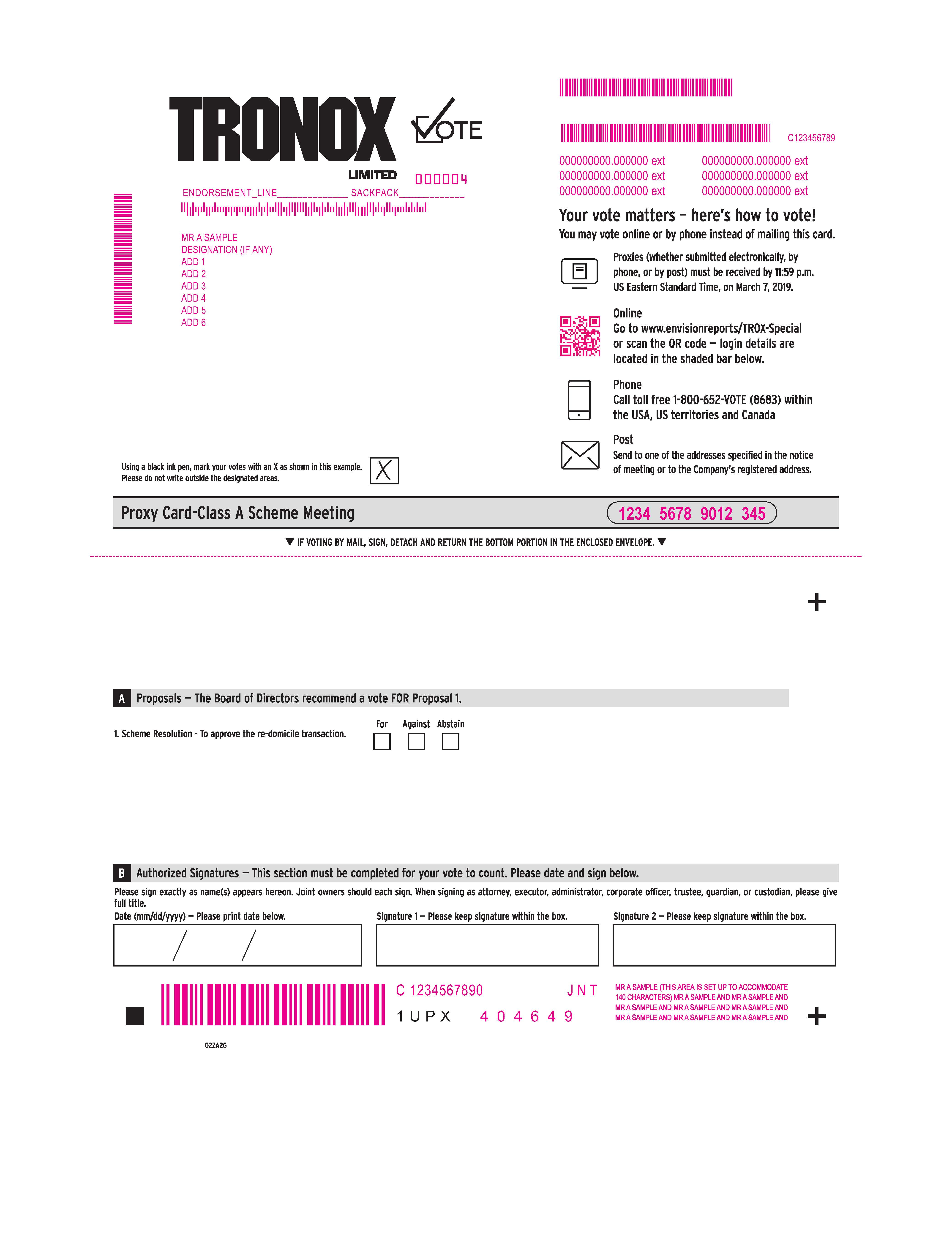
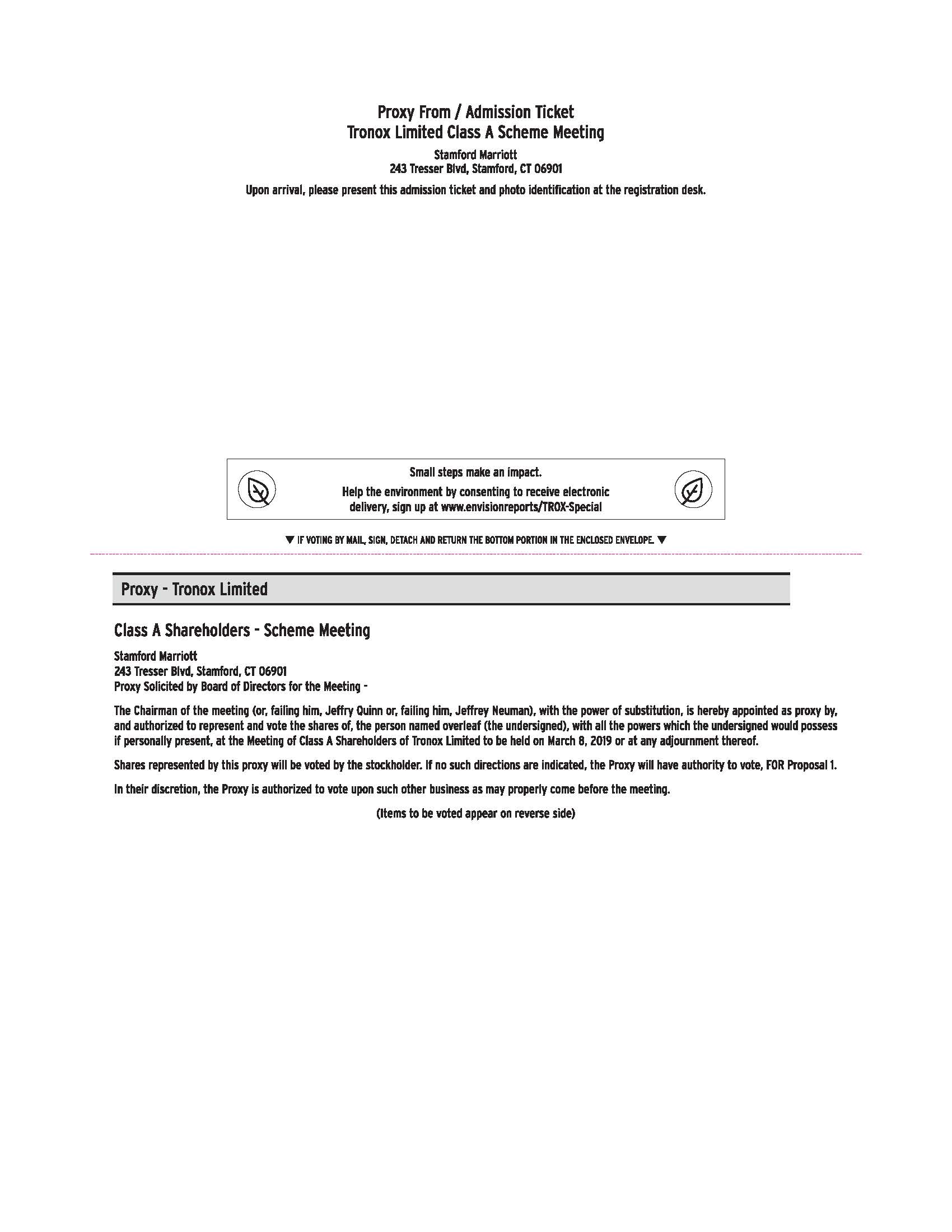
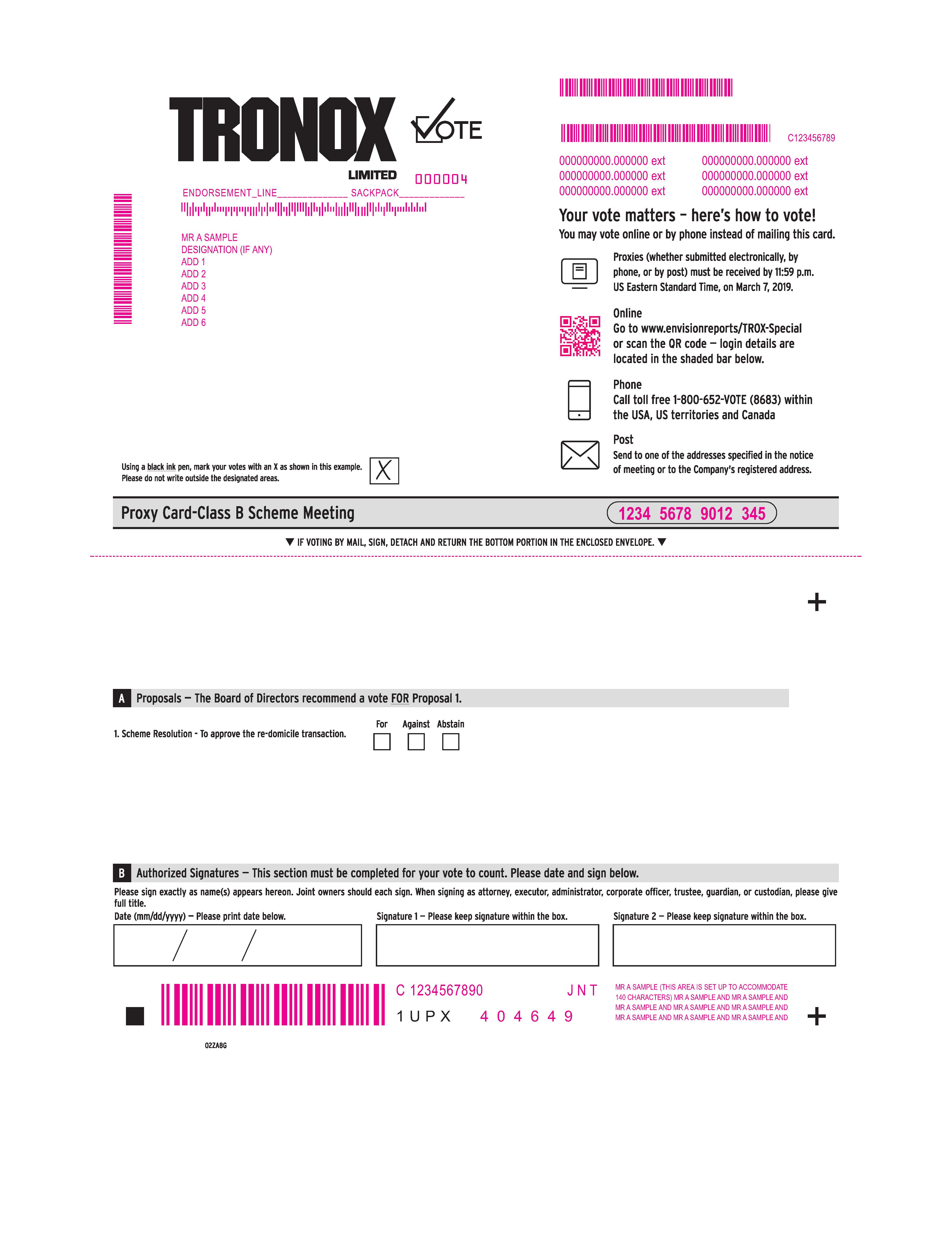
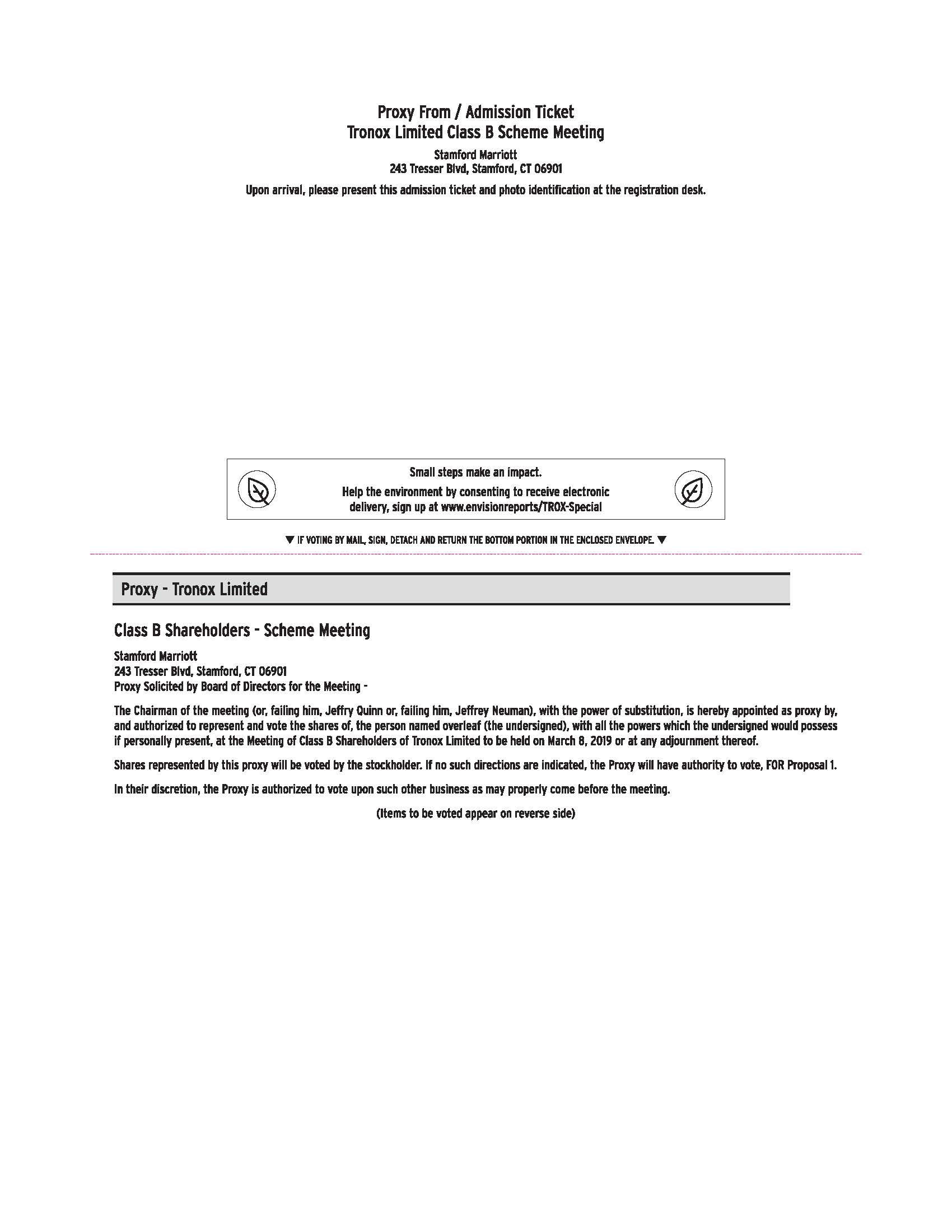
(b) a document substantially in the form of the Proxy Card that is Annexure B to these orders, personalised with the name and address of the relevant Scheme Shareholder; and
(c) a reply paid envelope for the return of the Proxy Card.
3. The documents referred to in Order 2 be sent:
(a) in the case of Class A Shareholders, by pre-paid post addressed to the relevant addresses recorded in the Tronox register; and
(b) in the case of the Class B Shareholder, to a person who is a director, company secretary, proxy, Corporate Representative or attorney under power of the Class B Shareholder, by pre-paid post or by courier, addressed to the address of the Class B Shareholder recorded in the Tronox register.
4. The Information Memorandum, which Information Memorandum comprises the explanatory statement as required by s 412(1)(a) of the Act, be and is hereby approved (subject to any minor amendments required or approved by ASIC for purposes of registration thereof under s 412(6) of the Act).
5. Subject to these Orders, both Scheme Meetings be convened, held and conducted in accordance with the provisions of:
(a) Part 2G.2 of the Act (save for any applicable replaceable rule) that apply to a meeting of Tronox’s members; and
(b) Tronox’s constitution that apply in relation to meetings of members and that are not inconsistent with Part 2G.2 of the Act.
6. For the purposes of voting at the Class A Scheme Meeting, pursuant to s 1319 of the Act:
(a) the holders of Class A Shares be taken, for the purposes of regulation 7.11.37(3)(b) of the Corporations Regulations 2001 (Cth), to be such persons whose name appears on the Tronox share register as at 5.00 p.m (US Eastern Standard Time) on 6 March 2019 (Class A Meeting Record Time);
(b) a ‘DTC Participant’ (as that term is understood for the purposes of the DTC share depository system in the USA) shall be taken to have the number of Class A Shares credited to their DTC account as appears on a securities position listing as at the Class A Meeting Record Time (Relevant DTC Participants);
(c) in accordance with the DTC share depository system in the USA, Cede & Co. as nominee for the Depository Trust Company may by instrument (Omnibus Proxy) transfer its right to attend the Class A Scheme Meeting and its voting authority in relation the Class A Shares it holds to the respective Relevant DTC Participants whose DTC accounts are credited with those shares according to the securities position listing as at the Class A Meeting Record Time (with the power of substitution in each);
(d) if either a holder of Class A Shares or a Relevant DTC Participant is a body corporate, then the body corporate may appoint a corporate representative under section 250D of the Act (Corporate Representative) to attend and vote for the person at the Class A Scheme Meeting;
(e) each Relevant DTC Participant may attend the Class A Scheme Meeting and exercise any voting authority transferred to it by Cede & Co. as referred to in order 6(c) above either:
(i) by itself; or
(ii) by one or more proxies (including by appointing one or more beneficial owners to attend and to vote via one or more “legal proxies”, as that term is understood within the DTC system),
in accordance with the DTC share depository system in the USA;
(f) the quorum for the Class A Scheme Meeting shall be holders of Class A shares present in person or by proxy holding more than 50% of the Class A shares on issue at the Class A Meeting Record Time;
(g) for the purposes of calculating the quorum requirement referred to in order 6(f) above, Cede & Co. shall be taken to be present and to hold the number of Class A shares credited in the DTC system to the account of each Relevant DTC Participant present in person or by proxy (including by its attorneys under powers or by “legal proxies”) at the Class A Scheme Meeting;
(h) any votes cast at the Class A Scheme Meeting by or on behalf of a Relevant DTC Participant pursuant to the Omnibus Proxy (including by its attorneys under powers or by “legal proxies”) shall be deemed to be cast and shall be counted on a poll as if in fact cast by Cede & Co. in person.
7. For the purposes of voting at the Class B Scheme Meeting, pursuant to s 1319 of the Act:
(i) the Class B Shareholder may appoint any person as its proxy, Corporate Representative or attorney under a power, for the purposes of attending and voting at the Class B Scheme Meeting;
(j) a resolution put to the vote at the Class B Scheme Meeting to approve the Class B Scheme may be decided by the proxy, Corporate Representative or attorney of the holder of the Class B shares signing a record of the resolution; and
(k) the Class B Shareholder, present by proxy, Corporate Representative or attorney under a power, shall constitute a quorum for the purposes of the Class B Scheme Meeting.
8. Voting on the resolutions to approve the Schemes is to be conducted by way of a poll.
9. A proxy appointment by a member in respect of either Scheme Meeting will be valid and effective if it is completed and delivered in accordance with its terms by 11.59 pm (US Eastern Standard Time) on 7 March 2019.
10. Mr Ilan Kaufthal, or failing him, Mr Jeffry Quinn, be Chair of each of the Scheme Meetings.
11. The Chair of the Scheme Meetings shall have the power to adjourn the meetings to such time, date and place as he considers appropriate.
12. Compliance with rule 2.15 of the Rules, except insofar as it operates to apply rule 75-15(2) of the Insolvency Practice Rules (Corporations) 2016 (Cth) to the Scheme Meetings, is dispensed with.
13. The further hearing of the Originating Process is adjourned to the Honourable Justice O’Callaghan on 22 March 2019 at 9.30 am (Australian Eastern Daylight Time) or as soon thereafter as the business of the Court allows.
Note: Entry of orders is dealt with in Rule 39.32 of the Federal Court Rules 2011.
A copy of the scheme booklet is available from Tronox’s website at http://investor.tronox.com/static-files/43138d53-fd04-4667-9d44-ea8b67552843. / (as accessed on 7 March 2019).
Annexure B
REASONS FOR JUDGMENT
O’CALLAGHAN J:
INTRODUCTION
The application
1 This is an application by Tronox Limited (Tronox) for orders under s 411(1) of the Corporations Act 2001 (Cth) (Corporations Act) for convening meetings of Tronox shareholders to consider proposed schemes of arrangement (Schemes) to effect a redomiciliation of Tronox from Australia to the United Kingdom.
2 Sub-section 411(1) provides:
Where a compromise or arrangement is proposed between a Part 5.1 body and its creditors or any class of them or between a Part 5.1 body and its members or any class of them, the Court may, on the application in a summary way of the body or of any creditor or member of the body, or, in the case of a body being wound up, of the liquidator, order a meeting or meetings of the creditors or class of creditors or of the members of the body or class of members to be convened in such manner, and to be held in such place or places (in this jurisdiction or elsewhere), as the Court directs and, where the Court makes such an order, the Court may approve the explanatory statement required by paragraph 412(1)(a) to accompany notices of the meeting or meetings.
3 I heard the application on 8 February, and made the orders set out above on that day (8 February orders). I said that I would give my reasons for having done so later. These are those reasons.
4 At the hearing on 8 February, counsel for Tronox, Mr M Borsky QC and Mr B Holmes, made oral submissions in support of their detailed written submission, dated 7 February 2019, to the effect that, if considered and adopted by the members, the Schemes are of such a nature that they would likely be approved by the court at the second hearing required by s 411.
5 These reasons follow the structure of counsel’s very helpful submissions.
6 Redomicile schemes may be used for different reasons. It is not unusual for them to be used to allow a corporate group to seek a regime in another jurisdiction that may be more favourable to the nature of its business, or more conducive to raising equity capital. See Re Opus Group Limited [2018] FCA 959 at [7]-[8] and the cases there referred to.
The Schemes
7 Tronox is a public company limited by shares. It mines titanium-bearing mineral sands and produces titanium dioxide pigment.
8 Tronox’s issued share capital consists of approximately 94 million Class A shares (Class A Shares) held by 393 shareholders (Class A Shareholders), and approximately 29 million Class B shares (Class B Shares). The Class B Shares are held by one shareholder, Exxaro Resources Limited (Exxaro or the Class B Shareholder).
9 Tronox’s Class A Shares are listed on the New York Stock Exchange (NYSE).
10 For reasons that are explained below, it is proposed that the Class A Shareholders and the Class B Shareholder will vote in separate classes, and that there be a separate Scheme for each class of holder. If neither of the Schemes is approved, the redomiciliation will not proceed.
11 The commercial purpose of the Schemes is to effect a redomiciliation by a “top-hatting” of the corporate group comprising Tronox and its subsidiaries (Tronox Group) with a company that has recently been incorporated under the laws of England and Wales (Tronox Holdings plc or New Tronox). (“Top-hatting” is a colloquial expression that means that the shares following the restructure held by the new company will reflect precisely the shares held by the company making the s 411(1) application).
12 The proposed redomiciliation is said to provide advantages to shareholders including by the following:
(1) enabling Tronox to create an organizational and legal structure which is more aligned with its global mining and production activities and employees that operate across multiple time zones;
(2) bringing the jurisdiction of incorporation of the parent company of the Tronox Group more into line with some of Tronox’s peers and the majority of other non-US companies listed on the NYSE, thereby more easily attracting investors;
(3) increasing the attractiveness of Tronox shares to certain investors by providing the New Tronox Board with greater authority and flexibility to undertake share repurchases than the current Tronox constitution or Australian law permits;
(4) facilitating the ability of the New Tronox Board to periodically refresh itself;
(5) providing greater certainty with respect to certain tax matters in light of the implementation of the OECD Multilateral Convention to Implement Tax Treaty Related Measures to Prevent Base Erosion and Profit Shifting by the Governments of Australia and the UK; and
(6) reducing certain ongoing compliance costs.
13 The Schemes provide that New Tronox will acquire all of the issued shares in Tronox (Tronox Shares) from the holders of those shares (Tronox Shareholders), with the result that Tronox will become a wholly owned subsidiary of New Tronox.
14 In consideration for the transfer of each Tronox Share to New Tronox, Tronox shareholders will receive one fully paid up ordinary share to be issued in New Tronox (New Tronox Shares) (or an interest in such a share). The New Tronox Shares will be allotted and issued prior to Tronox Shareholders transferring their Tronox Shares to New Tronox.
15 Following implementation, the dual-class share structure will be eliminated, and all shareholders will hold the same class of shares. Shareholders will still hold the same proportional economic interest in the assets of the Tronox Group that they currently hold, and New Tronox Shares will be able to be traded on the NYSE. There will be no change to the business plan or the financial and operating strategies of the Tronox Group, and the executive officers and assets of the Group are expected to be the same.
Summary of reasons why the Schemes would be likely to be approved by the court at the second hearing
16 Tronox relies on an independent expert’s report from KPMG Corporate Finance (Independent Expert). That report is of the view that the Class A Scheme is on balance in the best interests of Class A Shareholders. The Independent Expert notes that the underlying economic interests of the Tronox Shareholders will be unchanged as a result of the Schemes, as shareholders will effectively retain their existing ownership interest in the assets of Tronox. After considering the advantages and disadvantages of the Schemes and the wider redomiciliation transaction, the Independent Expert concludes that the Class A Shareholders would be better off, or at least not worse off, if the Class A Scheme proceeds than if it does not.
17 The Information Memorandum (which includes the explanatory statement required by s 412 of the Corporations Act) (Information Memorandum), and which is Annexure A to the 8 February orders, provides a detailed description of the Schemes and their advantages and disadvantages. It has been reviewed in final draft by the Australian Securities and Investments Commission (ASIC) and has been filed with the US Securities and Exchange Commission (SEC) for review.
18 At the hearing on 8 February 2019, Mr Borsky tendered a letter from ASIC which (omitting formal parts) reads as follows:
We refer to the respective draft explanatory statements in respect of the following proposed schemes of arrangement under Part 5.1 of the Corporations Act 2001 (Act):
(a) the proposed redomicile of Tronox Limted ACN 153 348 111 (Tronox) and transfer of shares to Tronox Holdings PLC (New Tronox) between Tronox and its class A shareholders; and
(b) the proposed redomicile of Tronox and transfer of shares to New Tronox between Tronox and its class B shareholder;
(together, the Schemes).
The draft explanatory statements were first provided to the Australian Securities and Investments Commission (ASIC) on 22 November 2018, and revised versions were provided to ASIC on 21 December 2018, 22 January 2019 and 30 January 2019, with the finalised version provided to ASIC on 7 February 2019.
ASIC’s policy regarding statements under paragraph 411(17)(b) of the Act
ASIC’s policy is that it will not provide a statement under paragraph 411(17)(b) of the Act until the second, or confirmation, court hearing in relation to a scheme of arrangement. This is because ASIC will not be in a position to advise the court properly until it has had an opportunity to observe the entire scheme process. It is also consistent with the wording of the section which relates the statement to the court’s approval of the scheme.
However, ASIC recognises that proponents of a scheme may reasonably wish for an indication of ASIC’s views before committing to the expense of calling a meeting and printing the scheme documentation.
ASIC’s review of the Schemes and the draft explanatory statements
Paragraph 411(2) (a) of the Act requires ASIC to be given at least 14’s (sic) notice of the hearing of an application, under subsection 411(1) of the Act, unless ASIC, or the court, permits a shorter period. This requirement has been satisfied in relation to the Schemes.
Paragraph 411(2) (b) of the Act requires the court to be satisfied that ASIC has also had a reasonable opportunity to examine the terms of the Schemes and the draft explanatory statements, and to make submissions to the court in relation to the Schemes and the draft explanatory statements. ASIC is of the view that it has had a reasonable opportunity.
ASIC has examined the terms of the Schemes, and the draft explanatory statements, in accordance with our policy in Regulatory Guide 60 schemes of arrangement (RG 60).
ASIC’s current intention in relation to the Schemes.
ASIC does not currently propose to appear to make submissions, or intervene to oppose the Schemes, at the first hearing under subsection 411(1) of the Act.
This current intention is based on ASIC’s examination of the terms of the Schemes, and the draft explanatory statements, in accordance with our policy in RG 60. It is also based on information available to ASIC, as at the date of this letter, on the matters to which ASIC will have regard before stating that it has no objection to a scheme under paragraph 411(17)(b) of the Act. These matters are set out in RG 60. ASIC’s position may chance (sic) if further information becomes available.
ASIC is not responsible for the contents of the draft explanatory statements. Although ASIC has reviewed the draft explanatory statements in accordance with our policy in RG 60, ASIC has not verified the information in the draft explanatory statements either as to accuracy or as to whether there may be additional information that is relevant to the Schemes that may need to be disclosed in the draft explanatory statements. ASIC has not formed any view as to the merits of the Schemes or as to how members should vote.
19 The directors of Tronox unanimously recommend that Tronox Shareholders vote to approve the Schemes. All directors intend to vote their shares in favour of the Class A Scheme.
20 I turn now to the detail of key aspects of the Schemes.
KEY ASPECTS OF THE SCHEMES
Scheme Meetings to be held in Stamford, Connecticut
21 The Scheme Meetings are to be held in Stamford, Connecticut.
22 The power of this court to make an order for a scheme meeting to be held outside Australia is clear, as is the fact that the court must have regard to where the members reside. See ss 411(1) and 411(3A) of the Corporations Act.
23 Clause 13.9 of Tronox’s constitution also provides that the members are taken to accept that it is reasonable to hold meetings in any locality outside of Australia in which the voting shares are quoted, or holders of a substantial number of shares have registered addresses, or the executive headquarters of the company are located.
24 The vast majority of Tronox’s shareholders reside in the United States: 380 holders of Tronox Class A Shares (out of a total of 393) reside there, while only four holders of Class A Shares have their registered address in Australia.
25 For these reasons, the proposed location for the Scheme Meetings is self-evidently appropriate.
Exxaro will be treated as a separate class from the holders of Class A Shares for the purposes of the Scheme Meetings.
Principles to be applied
26 The question of classes (and separate class meetings) arises because of the reference in s 411(1) to an arrangement proposed between a company and its members “or any class of them”.
27 Recently, the New South Wales Court of Appeal (Bathurst CJ, Beazley P and Leeming JA agreeing) reviewed the relevant authorities on classes in First Pacific Advisors LLC v Boart Longyear Ltd (2017) 121 ACSR 136 at [77]-[81] in these terms:
In the well-known passage from the judgment of Bowen LJ in Sovereign Life supra, his Lordship described the identification of a class in the following terms (at 583):
It seems plain that we must give such a meaning to the term ‘class’ as will prevent the section being so worked as to result in confiscation and injustice, and that it must be confined to those persons whose rights are not so dissimilar as to make it impossible for them to consult together with a view to their common interest.
The test relates to the difference in the rights of relevant creditors as distinct from their commercial financial interest. In Re Opes Prime Stockbroking Ltd (No 2) (2009) 179 FCR 20; [2009] FCA 813, Finkelstein J explained the application of the test in the following terms (at [66]):
The application of the relevant test involves a comparison of the rights creditors have in the absence of the scheme and any new rights that are established under the scheme: Re T & N Ltd (No 3) [2007] 1 All ER at 882. Once those differences are identified the question whether they form separate classes must be assessed with the following factors in mind. First, when creditors are broken up into classes, each class is given power to veto the scheme and that is a process that undermines the basic approach of decision by majority: Nordic Bank plc v International Harvester Australia Ltd [1983] Vic Rp 89; [1983] 2 VR 298 at 301. Second, there is a built-in safeguard against majority oppression in that the court is not bound by the decision of the meeting. Thus, it is necessary to ensure that there is no oppression by the minority. Third, practical considerations are relevant. If a judge is too assiduous in identifying classes, it is possible to end up with any number of classes. In the end, schemes of arrangement are propounded in a business context. The judge should adopt a practical business-like approach to the issue, as would the creditors if they were to decide the matter.
In UDL Argos Engineering & Heavy Industries Co Ltd v Li Oi Lin [2001] 3 HKLRD 634, Lord Millett NPJ with whom the other members of the Hong Kong Court of Final Appeal agreed, after reviewing both English and Australian authority summarised the relevant principles as follows (at [27]):
...
(2) Persons whose rights are so dissimilar that they cannot sensibly consult together with a view to their common interest must be given separate meetings. Persons whose rights are sufficiently similar that they can consult together with a view to their common interest should be summoned to a single meeting.
(3) The test is based on similarity or dissimilarity of legal rights against the company, not on similarity or dissimilarity of interests not derived from such legal rights. The fact that individuals may hold divergent views based on their private interests not derived from their legal rights against the company is not a ground for calling separate meetings.
(4) The question is whether the rights which are to be released or varied under the Scheme or the new rights which the Scheme gives in their place are so different that the Scheme must be treated as a compromise or arrangement with more than one class.
(5) The Court has no jurisdiction to sanction a Scheme which does not have the approval of the requisite majority of creditors voting at meetings properly constituted in accordance with these principles. Even if it has jurisdiction to sanction a Scheme, however, the Court is not bound to do so.
(6) The Court will decline to sanction a Scheme unless it is satisfied, not only that the meetings were properly constituted and that the proposals were approved by the requisite majorities, but that the result of each meeting fairly reflected the views of the creditors concerned. To this end it may discount or disregard altogether the votes of those who, though entitled to vote at a meeting as a member of the class concerned, have such personal or special interests in supporting the proposals that their views cannot be regarded as fairly representative of the class in question.
The test seems to me to involve three questions. First, what are the rights which existing creditors (or members) have against the company and to what extent are they different. Second, to what extent are those rights differently affected by the scheme. Third, does the difference in rights or different treatment of rights make it impossible for the creditors (or members) in question to consider the scheme as one class.
That approach is consistent with authority. In Re Hills Motorway Ltd (2002) 43 ACSR 101; [2002] NSWSC 897 there was a question as to whether foreign shareholders constituted a separate class by reason of the fact they would receive cash for their shares rather than an issue of shares in the new company. In determining that this did not make it necessary for the foreign shareholders to vote as a separate class, Barrett J made the following remarks (at [12]):
The test is thus not one of identical treatment. It is one of community of interest. The Court must ask itself whether the rights and entitlements of the different groups, viewed in the totality of the scheme’s context, are so dissimilar as to make it impossible for them to consult together with a view to their common interest. The focus is not on the fact of differentiation but on its effects. The extent and nature of the differentiation must be measured in terms of the effect on the ability to consult together in a common interest, or, in other words, the ability to come together in a single meeting and to debate the question of what is good or bad for the constituency as a whole and where the common good lies. Only if the differentiation destroys that ability – the word used by Bowen LJ is ‘impossible’ – does class distinction come to prevail.
28 The fact that a shareholder undertakes to the company to vote its shares in favour of the scheme does not, in itself, require that it vote in a separate class because there is no difference in treatment of the rights of the relevant member as compared to the treatment of the rights of other members.
29 However, if a shareholder enters into a pre-scheme voting agreement with the company, and the shareholder receives a benefit in consideration for entering into that agreement (which benefit is not immaterial and which is not available to other members), then they must vote in a separate class.
30 It is with those principles in mind that I now turn to the position of Exxaro and the circumstances pertaining to a transaction that has not yet closed, concerning a company called Cristal Inorganic Chemicals Netherlands Coöperatief W.A (Cristal) (Cristal Transaction).
Exxaro
31 Tronox submitted, in light of the principles discussed above, that the appropriate course to take here is that Exxaro should be treated as a separate class from the holders of Class A Shares for the purposes of the Scheme Meetings.
32 As noted above, Exxaro is the only holder of Class B Shares.
33 The rights attaching to Class B Shares and Class A Shares differ with respect to matters concerning entitlement to elect and remove directors, among other things.
34 If the Schemes are implemented, all New Tronox Shareholders will hold the same class of shares.
35 Tronox considers, in my view correctly, that a reasonable view could be taken that the rights of the Class B Shareholder will be altered by the Schemes in a material sense and in a manner which will not apply to Class A Shareholders.
36 Further, in November 2018, Tronox and Exxaro entered into an agreement called the “Exxaro Mineral Sands Transaction Completion Agreement”. That agreement addresses several “legacy” issues related to the 2012 acquisition of Exxaro’s mineral sands business and its ongoing relationship with Exxaro.
37 Pursuant to the agreement:
(1) Exxaro has agreed to sell down its remaining ownership interest in Tronox in a manner that does not cause the Tronox Group to lose the benefit of approximately US$4.1 billion of net operating losses which could be used in certain circumstances to offset future taxable income and therefore reduce the Group’s US federal income tax liabilities;
(2) Tronox has been granted the right to repurchase from Exxaro any Class B Shares (or from the date upon which the redomicile transaction completes, any of its New Tronox Shares) that Exxaro desires to sell;
(3) Tronox LLC, a wholly-owned member of the Tronox Group, has covenanted to pay Exxaro an amount equal to any South African capital gains tax assessed on Exxaro in respect of any profit arising to it on a disposal of any of its New Tronox Shares where such tax would not have been assessed but for the redomicile transaction; and
(4) Exxaro has agreed to vote in favour of the Class B Scheme.
38 I agree with the submission made by counsel for Tronox that the extent and nature of the differentiation of the rights to be granted to Exxaro if the Schemes proceed, including as part of a pre-scheme voting agreement, and which are not available to other shareholders, are such as to preclude the ability of all shareholders to “to come together in a single meeting and to debate the question of what is good or bad for the constituency as a whole”.
Cristal
39 If the Cristal Transaction closes before the Class A Meeting Record Time (referred to below), Cristal Inorganic Chemicals Netherlands Coöperatief W.A. will be a holder of Class A Shares for the purpose of the Class A Scheme Meeting and will be a party to the “Cristal Shareholder Agreement”. It is proposed that, as part of the redomicile transaction, New Tronox and Cristal would enter into a “New Cristal Shareholder Agreement” (substantially in the form of Annexure H of the Information Memorandum), conditional on the Schemes being implemented. Cristal has approved the form of the New Cristal Shareholder Agreement. Upon implementation of the Schemes, the Cristal Shareholder Agreement would terminate in accordance with its terms. Cristal has undertaken to vote in favour of approving the Class A Scheme.
40 The evidence is that the Tronox Board considered whether, if Cristal were a holder of Class A Shares at the time of the Class A Scheme Meeting, its rights, on the one hand, and the rights of other holders of Class A Shares, on the other hand, would be so dissimilar as to make it impossible for them to consult together with a view to a common interest in relation to the Schemes. In particular, the Board considered the proposed terms of the New Cristal Shareholder Agreement and formed the view that it reflects, as far as practicable (taking into account the differences in the laws and practices of Australia and the laws and practices of England and Wales), the positions of the parties in relation to New Tronox as the positions of the parties in relation to Tronox under the Cristal Shareholder Agreement.
41 Accordingly, the Board formed the view that:
(1) the position of Cristal vis-à-vis Tronox and the other holders of Class A Shares immediately before the Schemes are implemented, and the position of Cristal vis-à-vis New Tronox and the other holders of New Tronox Shares immediately after the Schemes, are not materially different;
(2) therefore, the rights and entitlements of Cristal and other holders of Class A Shares, viewed in the totality of the context of the redomicile transaction, are not so dissimilar as to make it impossible for them to consult together with a view to their common interest, and Cristal and the other holders of Class A Shares should comprise a single class.
42 Counsel submitted, and I agree, that this is the correct approach to adopt in the circumstances.
43 In any event, Tronox will “tag” any votes cast by or on behalf of Cristal at the Class A Scheme Meeting, so that the position can be considered further at the second hearing if necessary.
Voting and the implications of the Depository Trust Company system in the United States
Voting rights and Scheme Meetings
44 The usual rule in Australia is that voting rights, including the right to vote at a scheme meeting, are conferred on the registered holder of the shares. In this case, clause 16.1 of the Tronox constitution is to much the same effect as s 250E of the Corporations Act. It provides that “on a poll, a member has one vote for every share held.” “Member” is defined in clause 1.2 of the Tronox constitution as “a person whose name is entered in the Register of members as the holder of a share”.
45 Under the Depository Trust Company (DTC) System that operates in the United States, which applies to the vast majority of publicly traded shares there (including, in this case, over 99% of Tronox Class A Shares), Cede & Co (Cede) as the registered holder is not entitled to vote at a members’ meeting, and must transfer its voting rights down to intermediary holders (the DTC Participants). It is for this reason that Tronox sought, and obtained, specific orders in relation to voting at the Class A Scheme Meeting.
46 I made those orders for the following reasons.
Voting under the DTC System
47 DTC is the central securities depository in the United States.
48 The vast majority of publicly traded shares in the US are subject to the DTC System.
49 The evidence before me, in the form of a memorandum from the US law firm Kirkland & Ellis (K&E Memo), established the following facts.
50 Securities are deposited at DTC by DTC Participants. They are re-registered in the name of Cede, which is DTC’s nominee. Because the records of the issuer (ie, the company) or its transfer agent reflect the securities as registered to Cede (as the nominee of DTC), DTC (through its nominee) has legal title to the securities. However, by New York law, DTC has an obligation under Article 8 of the Uniform Commercial Code (UCC) to pass the beneficial rights of ownership (including voting rights) to its Participants for the benefit of the ultimate investors. In the case of voting rights, DTC does not exercise voting rights itself. Instead, DTC has a longstanding and well established “Omnibus Proxy Procedure” to transmit voting rights to the ultimate beneficial owners holding through DTC Participants. In particular, DTC issues an Omnibus Proxy and forwards it to the issuer (company) as soon as possible after the record date (the date at which Participant holdings are definitively determined). The Omnibus Proxy attaches a listing of the DTC “security position”, broken down by Participant positions on the record date. At the same time that the Omnibus Proxy is created, Participants are notified by DTC of their voting position in the issue (which represents an amalgamation of the voting rights of the Participant’s customers holding the issue). This procedure is effective as a contract between DTC and its Participants.
51 DTC also has the legal obligation under Part 5 of Article 8 of the UCC to afford its Participants the rights associated with the securities credited to their accounts. Participants, as securities intermediaries, have the same obligations under Article 8 to their customers. Accordingly, DTC has statutory and contractual obligations to pass along the voting rights, which it does by means of the omnibus proxy.
52 The following passage from the judgment of the Court of Chancery in Delaware in Kurz v Holbrook, 989 A.2d 140 at 149 (Del. Ch. 2010) is a helpful summary of the DTC:
Although this concept is doubtless familiar to many readers, I offer a brief summary from a leading treatise:
The vast majority of publicly traded shares in the United States are registered on the companies’ books not in the name of beneficial owners—i.e., those investors who paid for, and have the right to vote and dispose of, the shares—but rather in the name of “Cede & Co.,” the name used by The Depository Trust Company (“DTC”).
Shares registered in this manner are commonly referred to as being held in “street name” ... DTC holds the shares on behalf of banks and brokers, which in turn hold on behalf of their clients (who are the underlying beneficial owners or other intermediaries).
John C. Wilcox, John J. Purcell III, & Hye–Won Choi, “Street Name” Registration & The Proxy Solicitation Process, at 10–3 in Amy Goodman, et al., A Practical Guide to SEC Proxy and Compensation Rules (4th Ed. 2007 & 2008 Supp.) (hereinafter “Street Name”).
DTC figures prominently in this case. So does the Investor Communications Solutions Division of Broadridge Financial Services, Inc. (“Broadridge”). Although Broadridge’s role is also likely familiar to many readers, I again offer a quick summary:
For many years, banks and brokers maintained their own proxy departments to handle the back-office administrative processes of distributing proxy materials and tabulating voting instructions from their clients. Today, however, the overwhelming majority have eliminated their proxy departments and subcontracted these processes out to [Broadridge]. For many years, these proxy processing services were provided by Automatic Data Processing, Inc. (“ADP”), but on March 31, 2007, ADP spun off its Brokerage Services Group into a new independent company, Broadridge, which now provides these services to most banks and brokers.
To make these arrangements work, Broadridge’s bank and broker clients formally transfer to Broadridge the proxy authority they receive from DTC (via the [DTC] Omnibus Proxy) via written powers of attorney. On behalf of the brokers and banks, Broadridge delivers directly to each beneficial owner a proxy statement and, importantly, a voting instruction form (referred to as a “VIF”) rather than a proxy card. Beneficial owners do not receive proxy cards because they are not vested with the right to vote shares or to grant proxy authority—those rights belong only to the legal owners (or their designees). Beneficial owners merely have the right to instruct how their shares are to be voted by Broadridge (attorney-in-fact of the DTC participants), which they accomplish by returning a VIF.
As this summary notes, DTC is generally understood to be the entity with the power under Delaware law to vote the shares that it holds on deposit for the banks and brokers who are members of DTC. Through the DTC omnibus proxy, DTC transfers its voting authority to the banks and brokers. The banks and brokers then transfer the voting authority to Broadridge, which votes the shares held at DTC by each bank and broker in proportion to the aggregate instructions received from the ultimate beneficial owners.
53 The process set out in the final paragraph is the same process that Tronox intends to be followed in relation the Class A Tronox Shares held by DTC.
54 In the present case, as at the relevant date (25 January 2019), Cede was the registered owner of 99.7% of all Class A Shares in Tronox (representing 76% of all Tronox Shares) and there were 132 DTC Participants whose accounts were credited with these shares.
55 DTC Participants holding shares on behalf of others will be required to obtain voting instructions in relation to the resolutions to be put to each Scheme Meeting. In this respect, the purpose of the Omnibus Proxy is to create the appropriate chain of authority for the casting of votes in accordance with the intentions of beneficial owners whose shares are recorded in DTC. In order to achieve this, it is proposed that:
(1) Cede provides the Omnibus Proxy to its Participants based on their share position in the relevant securities as at the record date;
(2) approximately 3 days after the record date, DTC provides the issuer’s tabulator with a listing of the intermediaries’ positions at the record date; and
(3) beneficial owners must pass their voting instruction on to the intermediary who is able to vote with the issuer under the authority of that Omnibus Proxy.
56 In relation to the dispatch of materials to shareholders for the purposes of the meetings, Australian law and US law have different requirements.
57 Pursuant to s 249H of the Corporations Act, Tronox must give each member at least 21 days’ notice of the meetings. Tronox will comply with this requirement by sending the Information Memorandum containing the notices of meeting and related documents to each of the 393 registered holders of Class A Shares (one of whom is Cede) and to Exxaro (as the Class B Shareholder).
58 In addition, Tronox will be required by US securities laws to send to DTC Participants sufficient copies of the notice of meeting and Information Memorandum for distribution to beneficial holders. In this respect, the K&E Memo notes the following:
(1) the US Securities Exchange Act, (15 U.S.C. §§ 78a – 78jj (1934)) requires a copy of the definitive proxy statement (being the Information Memorandum) to be sent to each person whose vote is solicited in connection with the transaction (rule 14a-3);
(2) DTC is required to send a search card to each Participant holding securities of the Company, as well as other securities intermediaries that are registered owners, to determine whether they are holding shares for beneficial owners and, if so, the number of sets of proxy packages needed to be forwarded to those beneficial owners (rule 14a-13);
(3) this process may involve multiple tiers of securities intermediaries holding securities on behalf of other securities intermediaries, with search cards distributed to each securities intermediary in the chain of ownership;
(4) once the search card process is complete, the company should know the number of beneficial owners owning shares through each securities intermediary;
(5) the company must then provide the securities intermediary, or its third-party proxy service provider, with copies of the definitive proxy statement (being the same document as the Information Memorandum) and related proxy card for forwarding to those beneficial owners (rule 14a-13); and
(6) the securities intermediary must in turn forward these proxy materials to beneficial owners no later than five business days after receiving such materials (rules 14b-1 and 14b-2).
59 On that basis, Tronox sought, and I made as part of the 8 February orders, orders in relation to voting at the Scheme Meetings which reflect the requirements of the DTC System.
The 8 February orders
60 The 8 February orders are intended to facilitate voting by DTC Participants or the underlying beneficial owners of the Class A Shares held for them by Cede.
61 The 8 February orders provide that, in relation to the Class A Scheme Meeting, Class A Tronox Shares may be voted either by:
(1) the relevant DTC Participant listed in the Security Position Report at the Record Date in relation to the relevant Class A Shares, pursuant to an Omnibus Proxy issued by DTC; or
(2) the beneficial holders of Class A Tronox Shares, by obtaining a legal proxy from the DTC Participant.
62 The 8 February orders further:
(1) provide for Tronox to send the notices of meeting and Information Memorandum to registered holders of Tronox shares at least 21 days before the meeting date. (No further order is required in relation to dispatch, as clear obligations are imposed on Tronox by the Securities Exchange Act to send sufficient copies of the Information Memorandum to the relevant DTC Participant or its third-party proxy service provider, who must then provide those documents to the ultimate beneficial owners);
(2) identify the time and date on which an assessment is to be made as to who the holders of Tronox shares are for the purposes of the Class A Scheme Meeting (ie, who is recorded on the Tronox share register at that time) (Class A Meeting Record Time);
(3) stipulate the time and date on which DTC Participants who hold shares in Tronox are to be identified (which is also to be the Class A Meeting Record Time);
(4) reflect s 250D of the Corporations Act in providing for a natural person to attend to exercise any voting rights held by a body corporate, the body corporate being the registered holder of the Class A Shares (ie, Cede or one of the other 392 Class A registered holders) or a DTC Participant who has received a transfer of the right to vote the Class A Shares via an Omnibus Proxy;
(5) provide for the registered holder (Cede) validly to appoint DTC Participants to vote the Class A Shares;
(6) provide for the DTC Participants to cast the votes transferred to them by Cede either personally (in accordance with the instructions given by the ultimate beneficiary, for which purpose the DTC Participant may appoint an investor communications firm such as Broadridge to administer the process), or by appointing the beneficial owner to cast the votes (via a legal proxy);
(7) have the effect that a quorum will be established if holders of 50% or more of the Class A Shares are present at the meeting, and for the purposes of calculating quorum, relevant DTC Participants who are present with instructions to vote will be counted as the holder in relation to all of the Class A Shares which are recorded in that participant’s DTC account as of the record date; and
(8) have the effect that all votes cast at the Class A meeting by DTC Participants in accordance with the above procedure are counted as if it were voted by the registered holder, Cede – without which order “the members” in Cede would cast no votes, effectively disenfranchising 99.7% of Class A Shareholders.
63 The court undoubtedly has power to make such orders. See Re Australian Consolidated Press Ltd (1994) 14 ACSR 639 at 640: “[t]he court can, pursuant to s 1319 of the Corporations Law, give procedural directions in relation to such a meeting which may not correspond with the procedural requirements of a general meeting of the company convened under its articles of association”.
“Head count” test
64 Counsel for Tronox also raised the issue that the DTC System may have consequences in relation to the “head count” test.
65 Section 411(4)(a)(ii) of the Corporations Act requires that the resolution be passed by a majority in number of the members. It provides:
(4) A compromise or arrangement is binding on the creditors, or on a class of creditors, or on the members, or on a class of members, as the case may be, of the body and on the body or, if the body is in the course of being wound up, on the liquidator and contributories of the body, if, and only if:
(a) at a meeting convened in accordance with an order of the Court under subsection (1) or (1A):
(i) …
(ii) in the case of a compromise or arrangement between a body and its members or a class of members - a resolution in favour of the compromise or arrangement is:
(A) unless the Court orders otherwise--passed by a majority in number of the members, or members in that class, present and voting (either in person or by proxy); and
(B) if the body has a share capital - passed by 75% of the votes cast on the resolution; and
(b) it is approved by order of the Court.
66 Tronox foreshadows that, should the resolution to approve the Class A Scheme be approved by the majority required by section 411(4)(a)(ii)(B) (the “votes cast” test) but not by the majority required under s 411(4)(a)(ii)(A) (the “head count” test) Tronox will likely seek an order “otherwise” pursuant to s 411(4)(a)(ii)(A).
SCHEME MECHANISM AND KEY DOCUMENTS
Scheme Mechanism
67 The essential mechanism of the Schemes is as follows:
(1) if the Schemes are to proceed, all conditions precedent (other than approval by the court) will be either satisfied or waived by 8.00am on the date on which the application for approval comes before the court; and
(2) if the Schemes are approved by shareholders and the court, they become effective on the lodging of an official copy of the court’s order with ASIC.
68 In particular, if each Scheme becomes effective and is implemented as contemplated in the Implementation Agreement (in particular, clause 4):
(1) all Class A Shares (under the Class A Scheme) and all Class B Shares (under the Class B Scheme) held by the persons who are recorded in the register of members of Tronox on the Scheme Record Date as holders of Class A Shares or Class B shares (each a Scheme Participant) will be transferred to New Tronox; and
(2) for each such share transferred, each Scheme Participant will be entitled to one fully paid New Tronox Share (the Scheme Consideration).
69 Under the Implementation Agreement, the Scheme Record Date is 5.00 pm (US Eastern Standard Time) on the date one business day prior to the Implementation Date, which will be a date to be determined by Tronox, being a date that is not more than one month after the date on which the Schemes become effective under s 411(10) of the Corporations Act.
70 Except in the case of Scheme Consideration due to Exxaro and Cristal (Shareholder Affiliates), it is proposed that New Tronox will issue all the Scheme Consideration to Cede, that is, both the Scheme Consideration due to Cede as a holder of Class A Shares in its own right (i.e., as a Class A Scheme Participant) and the Scheme Consideration required to be issued to Cede on account of each other such Scheme Participant. This structure is expected to ensure that transfers by any such Scheme Participants of interests in their New Tronox Shares on the NYSE after the Schemes are implemented can be effected without a charge of UK stamp duty or UK stamp duty reserve tax arising.
71 It is proposed that New Tronox will issue the New Tronox Shares:
(1) in respect of Tronox Shares transferred under the Schemes and held by someone other than Cede, Exxaro and Cristal - to Cede, as nominee for DTC, credited to the Exchange Agent (being a Computershare Trust entity CTCNA), in its participant account, for the benefit of the respective transferors of Tronox Shares;
(2) in the case of the transfer under the Class A Scheme of Class A Shares held by Cede - to Cede; and
(3) in the case of transfers under the Schemes of Tronox Shares held by Shareholder Affiliates - to GTU Ops Inc. as nominee for CTCNA for the benefit of Exxaro and Cristal Shareholder, respectively, as the transferors of the relevant Tronox Shares (or to such other person as the Shareholder Affiliates and Tronox agree before the Schemes are implemented). Tronox has been informed by DTC’s lawyers that DTC will not accept for deposit “restricted securities” held by “affiliates” of New Tronox. The terms of the depositary agreement are being negotiated between the parties, and that it is proposed that the agreement will be executed before the second hearing, should the Schemes be approved by Tronox’s shareholders.
72 Accordingly, all Class A Scheme Participants under the Class A Scheme, other than Cede and Cristal (the non-DTC Scheme Participants), will hold the New Tronox Shares to be issued in exchange for their respective Tronox Shares through the facilities of DTC.
73 It is proposed that New Tronox, CTCNA (as Exchange Agent) and Computershare Inc. will, prior to the second hearing, enter into an agreement (Exchange Agent Agreement) under which the Exchange Agent will be required, as soon as practicable after the Schemes are implemented, to:
(1) issue a “Letter of Transmittal”, in a form approved by Tronox, to each non-DTC Scheme Participant with a registered address in Australia, the US or the UK which provides that the Scheme Participant may elect to have registered in his or her name, or the name of his or her designee (being resident in Australia, the US or the UK), the New Tronox Shares issued to Cede in respect of that Scheme Participant or to have the interest in those New Tronox Shares credited to the account of a DTC Participant nominated by the Scheme Participant (provided that the Scheme Participant has an account with the DTC Participant). If the Scheme Participant does not respond in accordance with the instructions on the Letter of Transmittal (or correct a deficiency in any response) to the reasonable satisfaction of the Exchange Agent, the Exchange Agent may cause the relevant New Tronox Shares to be registered directly in the name of the Scheme Participant;
(2) issue a Letter of Transmittal in a form approved by Tronox to each non-DTC Scheme Participant with a registered address in a jurisdiction outside of Australia, the US or the UK (ineligible foreign jurisdictions) which provides that the Scheme Participant may have those New Tronox Shares transferred into the account of a DTC Participant nominated by the Scheme Participant (provided that the Scheme Participant has an account with the DTC Participant). If the Scheme Participant does not respond in accordance with the instructions on the Letter of Transmittal (or correct a deficiency in any response) to the reasonable satisfaction of the Exchange Agent, the Exchange Agent (or its nominee) will sell those New Tronox Shares at the time, in the manner and on the terms the Exchange Agent thinks fit (and at the risk of the Scheme Participant) and the Exchange Agent will then pay to that Scheme Participant the proceeds received after deducting any applicable fees, brokerage, taxes and charges, where permitted by law.
74 The reason for the difference in the forms of the Letters of Transmittal proposed under the Class A Scheme between Scheme Participants with registered addresses in Australia, the US or the UK and Scheme Participants with registered addresses in ineligible foreign jurisdictions is to mitigate the risk of Tronox and the Exchange Agent inadvertently contravening securities laws of the ineligible foreign jurisdictions by issuing or transferring shares to persons in those jurisdictions.
75 As at the relevant date, there were only 9 holders of Class A Shares with registered addresses in ineligible foreign jurisdictions. Together these holders hold 11,625 Class A Shares, in total, representing only 0.01% of the Class A Shares on issue.
76 Tronox submitted, and I agree, that the treatment of foreign ineligible shareholders it proposes does not require they be in a separate class.
Scheme documentation
77 The Schemes are annexed to the Information Memorandum.
78 New Tronox’s obligations in respect of the Schemes are secured by entry into deeds poll. The deeds poll are in the usual form. They bind New Tronox in favour of Tronox shareholders to provide the Scheme Consideration in accordance with the terms of the Schemes.
79 As New Tronox is a foreign corporation, Tronox adduced expert evidence from Gary Michael Green, of CMS Cameron McKenna Nabarro Olswang, based in London, as to the proper execution of the deeds poll by New Tronox (and their enforceability against New Tronox) in the United Kingdom. See Re Simavita Holdings Limited [2013] FCA 1274 at [43] concerning the need for such evidence in cases such as the present to ensure that the deeds poll are enforceable. See also Re Biosceptre International Limited [2013] FCA 1429 at [21], Re Sirtex Medical Limited [2018] FCA 584 at [54], and Re Staging Connections Group Limited [2015] FCA 1012 at [44] - [48].
POWER TO MAKE ORDERS UNDER SECTION 411 OF THE CORPORATIONS ACT
80 Part 5.1 of the Corporations Act relevantly provides a procedure whereby an arrangement between a company and its members (a scheme) can be made binding on all members.
81 There are three main steps:
(1) an application to the court for an order that the company convene a meeting of its members;
(2) if such an order is made, the convening of such a meeting at which a resolution agreeing to the scheme is considered, and perhaps passed; and
(3) if the resolution is passed by the necessary majority (see section 411(4)), an application to the court for approval of the scheme.
82 This procedure is regulated by s 412 of the Corporations Act and reg. 5.1.01 and Schedule 8 of the Corporations Regulations 2001 (Cth) (the Regulations), which all relate to the information which is required to be sent to the members about the scheme.
83 Section 411of the Corporations Act confers a discretion on the court to make an order if:
(1) a compromise or arrangement is proposed between a Part 5.1 body and its members (or any class of them) (s 411(1));
(2) application for the order is made in a summary way by the body (s 411(1));
(3) 14 days’ notice of the hearing of the application has been given to ASIC (or such lesser period as the court or ASIC permits) (s 411(2)(a)); and
(4) the court is satisfied that ASIC has had a reasonable opportunity to:
(i) examine the terms of the proposed compromise or arrangement to which the application relates and a draft explanatory statement relating to the proposed compromise or arrangement; and
(ii) make submissions to the court in relation to the proposed compromise or arrangement and the draft explanatory statement.
(s 411(2)(b))
84 Tronox submitted, and I agree, that the evidence satisfies each of these requirements, and that accordingly the court’s power is enlivened. Taking each requirement (briefly) in turn:
An “arrangement” is proposed between a Part 5.1 body and its members
85 It is well established that a scheme designed to effect an acquisition by one company of the shares in another may be an “arrangement” within the section, including for the purposes of redomiciliation. See, by way of example only, Re Brambles Industries Ltd (2006) 59 ACSR 501, Re Brambles Industries Ltd (No 2) [2006] FCA 1719, Re Heartware Limited [2008] FCA 1997, and Re Marengo Mining Ltd (No 2) [2012] FCA 1498.
86 A “Part 5.1” body is defined in s 9 of the Corporations Act in terms that include a company registered under the Corporations Act. The ASIC Company Extract in evidence confirms that Tronox is a company registered under the Corporations Act and so a “Part 5.1 body”. Pursuant to clause 2(a) of the Implementation Agreement, Tronox undertook to propose the Schemes, and it has done so.
87 Accordingly, I am satisfied that the requirement that a compromise or arrangement is proposed between a Part 5.1 body and its members has been met.
Application by Tronox
88 The requirement that the application for the order is made “in a summary way by the body” is (obviously) met by the making of this application by Tronox.
14 days’ notice to ASIC of first fourt hearing
89 ASIC was given notice of the first court hearing on 23 January 2019.
ASIC has had reasonable opportunity to consider the explanatory memorandum and to make submissions to the court
90 ASIC was first provided with a draft of the Information Memorandum and a draft Independent Expert’s report on 22 November 2018.
91 ASIC were also provided with amendments to the draft Information Memorandum and the Independent Expert’s report. The amendments between the versions provided to ASIC and the versions annexed to the Orders have been brought to ASIC’s attention.
92 ASIC has, as I have noted above, confirmed that it had sufficient notice of the 8 February hearing and that it had a reasonable opportunity to examine the terms of the proposed Scheme and the draft Information Memorandum.
EXERCISE OF THE COURT’S DISCRETION
93 Having regard to the matters set out above, counsel submitted, and I agree, that the court’s discretion to make an order convening a meeting under s 411(1) of the Corporations Act is enlivened.
Function of the court
94 Section 411 of the Corporations Act does not stipulate the criteria which must be satisfied before a court exercises its discretion whether to make an order convening a meeting.
95 The cases make clear, however, that the function of the court on the hearing of an application to convene a meeting under s 411 is limited.
96 As Finkelstein J explained in Re CSR Ltd (2010) 183 FCR 358 at [75] – [76], at the first court hearing the court should generally confine itself to ensuring that certain procedural and substantive requirements are met (for example, that there will be adequate disclosure), with limited consideration of issues of fairness; and the court should only consider the merits or fairness of a proposed scheme at the convening hearing if the issue is such as would “unquestionably” lead to a refusal to approve the scheme at the approval hearing. That is, the scheme must appear on its face so blatantly unfair or otherwise inappropriate that it should be stopped in its tracks before going any further.
97 In this case, no issue arises from the proposed Schemes which would unquestionably lead to a refusal to approve the Schemes at the approval hearing. Furthermore, it cannot be said that the Schemes are on their face “so blatantly unfair or otherwise inappropriate that it should be stopped in its tracks before going any further”.
98 The remaining issue that counsel addressed at the 8 February hearing was whether the procedural and substantive requirements for the calling and conduct of the meetings will be met. In that regard, the court needs to be satisfied of two matters:
(1) that the schemes are fit for consideration by the proposed meeting, in the sense that they are of such a nature and cast in such terms that, if they achieve the statutory majority at the members’ meeting, the court would be likely to approve them on the hearing of a petition which is unopposed; and
(2) the members are to be properly informed as to the nature of the schemes before the scheme meetings.
99 See, by way of example only, the judgment of Hayne J in Re Sonodyne International Ltd (1994) 15 ACSR 494 at 497 and the cases there referred to.
THE SCHEMES ARE FIT FOR CONSIDERATION
100 In my view, the Schemes are fit for consideration by the proposed meetings.
101 As counsel for Tronox submitted, the question whether or not to accept particular consideration for shares is a commercial matter for the members of Tronox to assess. They ought not to be prevented from having the opportunity to do so, provided that the court can be satisfied that they are acting with sufficient information and with time to consider what they are voting about.
102 Counsel pointed in particular to the following matters recorded in the Information Memorandum:
(1) a recommendation from all directors that shareholders vote in favour of the Schemes;
(2) a statement that all directors intend to vote their Tronox shares in favour of the Schemes; and
(3) an independent expert report that the Schemes are in the best interests of Tronox Shareholders.
103 In general, courts must be satisfied that the terms of the relevant schemes do not contain any element of unfairness that would be likely to preclude the approval of the schemes if they came before the court for approval. But in cases such as this, as counsel submitted, which effect an internal corporate reorganisation (not a merger for example), there is little apparent scope for such unfairness.
104 In this case, Tronox emphasised the following features of the proposed Schemes in this case:
(1) performance risk;
(2) deemed warranties by Tronox shareholders in relation to their Tronox shares;
(3) Tronox management incentive arrangements; and
(4) purpose of the Schemes (ie, not to avoid Chapter 6 of the Corporations Act).
105 Tronox submitted, and I agree, that, for the reasons set out below, none of these matters is out of the ordinary for schemes of this type, nor do they provide any reason for the court to refrain from making an order convening the meetings.
Performance risk
106 In considering whether to approve a scheme involving the participation of a person other than the plaintiff company and its members (here, New Tronox), the court should ensure that that other party is bound to perform the role assigned to it, and that its obligations are able to be enforced.
107 In this case, New Tronox is bound to perform the roles assigned to it, and that its obligations can be enforced for the following reasons.
108 Under the Schemes and the Implementation Agreement, the New Tronox Shares must be allotted and issued prior to Tronox Shareholders transferring their Tronox Shares to New Tronox. New Tronox has entered into deeds poll in favour of Tronox shareholders. New Tronox must provide or procure the provision of the Scheme Consideration to each Tronox shareholder in accordance with the terms of the Schemes (clause 3.2) and perform all actions attributed to it under, and otherwise comply with, the Schemes as if it were a party to the Schemes (clause 3.1).
109 For those reasons I accept that there is no relevant “performance risk”, that is, any relevant risk of the scheme shareholders not being able to enforce their entitlements.
Deemed warranties
110 Clause 4.2(b) of each Scheme of Arrangement provides that each Tronox shareholder is deemed to have warranted to New Tronox that all of their shares will, at the date of transfer to New Tronox, be fully paid and free from all security interests and interests of third parties of any kind and from any restrictions on transfer of any kind, and that it has full power and capacity to sell and to transfer those shares together with any rights and entitlements attaching to such shares to New Tronox under the respective Schemes.
111 In my view, the deemed warranty clause is acceptable.
Tronox management incentive arrangements
112 The evidence before me detailed the management incentive arrangements operated by Tronox and the proposed treatment of those arrangements if the Schemes are implemented. In short, any holders of entitlements under the Tronox incentive arrangements will be granted equivalent rights in respect of New Tronox if the Schemes are implemented.
113 Counsel for Tronox submitted, and I agree, that the arrangements do not require those shareholders who hold the incentives to meet separately (as a separate class) from those shareholders who do not hold incentives in order to consider and vote on the proposed Schemes.
Tronox Shareholders will be properly informed
114 The second principal aspect relevant to the exercise of the court’s discretion on the making of an application such as this is the adequacy of the information to be provided to shareholders.
115 Counsel for Tronox submitted, and I agree, that the prescription of the contents of the explanatory statement in s 412 of the Corporations Act and Schedule 8 to the Regulations provide guidance to the court in assessing this matter.
Information for shareholders
116 By virtue of s 412(1) of the Corporations Act the explanatory statement must:
(1) explain the effect of the compromise or arrangement, and in particular state any material interest of the directors, and the effect on those interests of the compromise or arrangement so far as it is different from the effect on the like interests of other persons;
(2) set out the prescribed information, here relevantly in reg 5.1.01 and Schedule 8 (part 3) of the Regulations; and
(3) set out any other information (that is within the knowledge of the directors and has not previously been disclosed) that is material to the making of a decision whether or not to agree with the compromise or arrangement.
117 Here, the Information Memorandum is comprehensive and clearly satisfies the requirements of s 412(1). Shareholders are provided with a detailed comparison of their rights as Tronox shareholders as against what their rights will be as New Tronox Shareholders. The Independent Expert’s report also contains a detailed evaluation of the proposal, presented in a way that enables a shareholder to form his or her own view of the merits of the proposal.
Independent Expert’s report
118 Schemes of arrangement are not required to be the subject of a report by an independent expert unless the parties have a common director, or the acquiring company controls 30% of the scheme company, neither of which is the case here.
119 Nevertheless, out of an abundance of caution, Tronox has put in evidence a report from the Independent Expert as to whether, in the expert’s opinion, the Class A Scheme is in the best interest of the holders of Class A Shares.
120 The Independent Expert notes that the underlying economic interests of the Tronox Shareholders will be unchanged as a result of the Schemes, as shareholders will effectively retain their existing ownership interest in the assets of Tronox. On this basis, and having considered the advantages and disadvantages of the Schemes and the wider redomicile transaction, the Independent Expert concludes that the Class A Shareholders will be better off, or at least not worse off, if the Class A Scheme proceeds than if it does not.
121 There is also extensive discussion of the advantages, disadvantages and risks of the Scheme in the Information Memorandum.
Approval of the explanatory statement by the court
122 Sub-section 411(1) of the Corporations Act provides that if the court has made an order convening a meeting or meetings of members or creditors, the court “may approve the explanatory statement”.
123 In my view, in light of all the circumstances set out above, it was appropriate in this case that I do so.
CONCLUSION
124 In summary, I made the 8 February orders convening meetings of the Tronox Shareholders to enable the Schemes to be considered by those shareholders because:
(1) the terms of the proposed Schemes are in a conventional form for a redomiciliation scheme;
(2) there is no reason why the Schemes, if considered and adopted by the members, are not “of such a nature” as would be likely to be approved by the court at the second hearing;
(3) Tronox Shareholders are to be presented with a detailed analysis by the Independent Expert of the transaction and its advantages and disadvantages and have the recommendation of the directors;
(4) the draft Information Memorandum meets all of the statutory requirements, has been carefully prepared and verified by Tronox, and has been examined by ASIC and filed with the SEC; and
(5) it cannot be said that the Schemes appear on their face so blatantly unfair or otherwise inappropriate that they should be stopped in their tracks.
I certify that the preceding one hundred and twenty-four (124) numbered paragraphs are a true copy of the Reasons for Judgment herein of the Honourable Justice O’Callaghan. |
Associate:
Dated: 7 March 2019


